| The Digital Library of Liberty & Power incorporating the Guillaumin Collection of the Great Books of Liberty |
Home | New | Authors | Works | Papers | Blog | About | Email | Search |
 |
|
"Broken Windows" by David M. Hart.
A Screenplay about the Life and Work of FrEdEric Bastiat (1801-1850)
[Updated: August 28, 2016]
 |
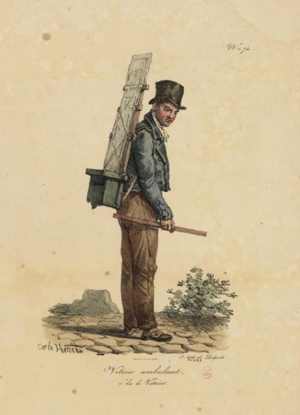 |
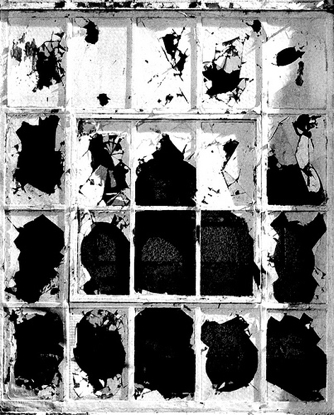
[Some broken windows and a travelling glazier]
Contents
- Introduction
- Striking Visuals
- Music
- Big Set Pieces
- My Fabrications in the Script
- The Main Players
- Acts and Scenes
Introduction
This screenplay is designed to be the classical liberal or libertarian equivalent of Warren Beatty's brilliant but very leftwing movie Reds (1981) about the life of the American communist journalist John Reed (1887-1920) before and during the Russian Revolution of 1917. [See his famous account Ten Days That Shook the World (1919).]
A number of movies about ideas and revolutions have influenced my thinking about this screenplay. Films explictly about revolutions include the following:
- the Bolshevik or Russian Revolution: Warren Beatty, Reds (1981) - see the entry in the Internet Movie Data Base for Reds.
- the French Revolution: Andrzej Wajda, Danton (1982) - about the rivalry between Danton and Robespierre during the Terror.[ See my old teaching Study Guide on Danton.]
Other films about how ideas can change the world include:
- Richard Attenborough, Gandhi (1982)
- Margarethe von Trotta, Rosa Luxemburg (1986)
- Michael Apted, Amazing Grace (2006)
The screenplay as written (Aug. 2016) is part historical guide to the period (1843-1850), part biography of Bastiat, part history of the 1848 Revolution and the fighting on the street barricades aganst the Army, and part history of ideas of the growing liberal movement against protectionism, socialism, and bureaucratic Bonapartism. I have used the actual words of the participants in many of the speeches used in the screenplay such as meetings of the French Free Trade Association, speeches in the Chamber of Deputies in the Second Republic, the Peace Congress of Aug. 1849, and elsewhere. In any filmable version of the screenplay these of course would have to be drastically cut, but I include them here for historical purposes. [Some of them are also very good as political speeches.]
For more on this topic see my manuscript on "The Struggle against Protectionism, Socialism, and the Bureaucratic State: The Economic Thought of Gustave de Molinari, 1845-1855".
I have also tried to reconstruct the physical appearance of Paris when Bastiat went there in 1845. The three visually striking architectural structures which surrounded Paris at the time have since largely disappeared as the Paris suburbs have grown. But when Bastiat went to Paris for his May 1845 welcome by the Political Economy Society one of the newly constructed railroads would have taken him through the ring of 16 newly constructed "star shaped" forts which surounded the city for its "protection" from the British (Adolph Thiers' greatest fear); the massive military wall built by Adoplhe Thiers 1841-44 (at huge public expense and massive compulsory acquisition of private property), and the old customs wall built in the 1780s to make it easier for the private tax collectors, the Farmers General, to collect state taxes. Any attempt to film these architectoral structures would require considerable CGI resources. [See the map below of the three concentric circles of state power which surrounded Paris and restrained the free movement of its inhabitants.]
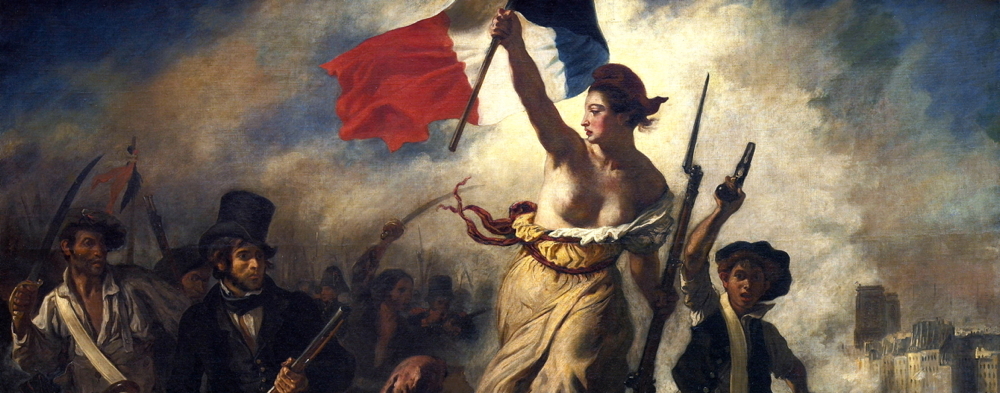
A third visual element in the film is the art of Delacroix and the political cartoons of Honoré Daumier. As visual themes or leit motifs for the film I had in my mind Delacroix's "Liberty Leading the People on the Barricdes" (1830) and Daumier's cartoon of "Gargantua" (1832) (which landed him in jail for offending the King). There can be seen below. For more details see the collection of illustrations in "Broken Windows: An Illustrated History of the Life and Works of Frédéric Bastiat."
I didn't want the film to end on a depressing note - even though it is probably the most suitable emotion to feel at the end of 1850 if you were a classical liberal in Paris - so I tried to think of a more uplifting way to end the movie. I think I found a suitable way to do so (thanks to R.C. Hoiles). Let me know what you think: Email me.
Note: the actual text of this draft of the screenplay retains the original formatting of the application used by many writers (Final Draft 9) to create screenplays for submission. Hollywood has very strict rules concerning the exact format screenplays have to be in. I'm sorry for that inconvenience. It is ugly but it seems to have evolved into the Hollywood equivalent of the QWERTY keyboard.
For additional information about Bastiat see:
- for more images, maps, and photographs see, "Broken Windows: An Illustrated History of the Life and Works of Frédéric Bastiat."
- A "Reader's Guide to the Work of Frédéric Bastiat (1801-1850)" on the OLL website.
- on the world of the political economists in Paris in the late 1840s, see “The World of French Political Economy in which Frédéric Bastiat lived”
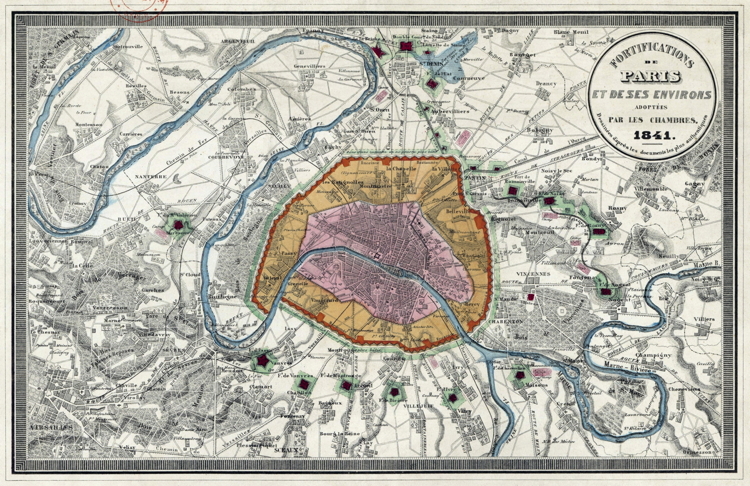
[A birdseye view of Paris and its 3 concentric circles of walls and forts in 1841-44]
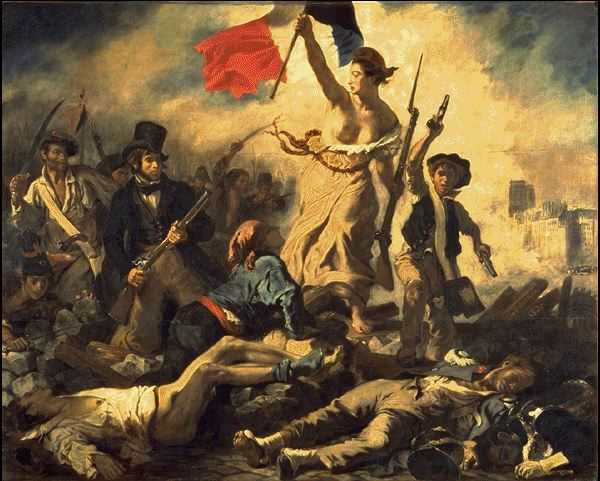
[Theme image of the film: Delacroix’s “Liberty Leading the People on the Barricade” (1830)]
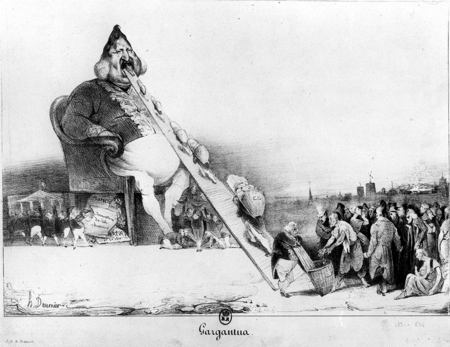
[King Louis Philippe the “tax-eater” sitting on his throne and shitting privileges]
What follows are some thoughts about various aspects of the film as I imagined it and wrote it. As an historian I wanted to be as historically accurate (and interesting) as possoble, and to kept dramatic fabrications to a minimum.
Striking Visuals
I have spent a lot of time thinking about the visuals and images (as the supplementary document of images shows) and I think I have come across some very striking ones which would make this film about Frederic Bastiat (FB) unique. This is also available online here "Broken Windows: An Illustrated History of the Life and Works of Frédéric Bastiat.". These include:
- the symbolism of the three rings of walls and forts which the French state built around Paris to oppress their own people. The main one, the military wall and the 16 outlying forts were built the year before FB arrived in Paris (I don’t think any filmmaker has ever shown these properly before so the Bastiat film would be a first). As these have been either destroyed (the custom gates were pulled down in 1859-60 during the rebuilding of Paris; the military walls were largely pulled down in the 1920s and eventually became the ringroad freeway which now circles Paris; and the forts are now largely part of the outer Paris suburbs) or abandoned they would have to be recreated by CGI.
- the contemporary art and political cartoons of Delacroix and Daumier
- drawings of the large halls where some of the key meetings were held in Paris for the free trade movement (Montesquieu Hall), the new revolutionary government (the Palais Bourbon, the Palais Luxembourg), and the Peace Congress (Saint Cecilia Hall)
- drawings of the large outdoor political banquets which eventually forced the King to abdicate and thus started the revolution (from the weekly illustrated newspaper L’Illustration)
- contemporary illustrations of the scores of massive barricades which were built in Paris during the height of the fighting against the regime (I don’t think any filmmaker has ever shown these properly before so the Bastiat film would again be another first)
- the home of the wealthy Cheuvreux family in Paris where Madame Cheuvreux held her private salons
- the Hunting Lodge at Butard in a forest outside Paris; this is now an important historic building and is listed as such; this is where FB wrote his major economic treatise
Music
I also have thought a lot about music from the period to accompany the film, which includes:
- the folk music of his homeland - they played a kind of strange celtic bagpipe; the Basque people had quite mournful folk songs
- FB played the cello whenever he could so I have found pieces by Boccherini and Liszt he might have played
- FB loved the political songs of Béranger who was imprisoned several times by the regime for criticising the King; they were illegally sung in bars known as goguettes and FB knew many off by heart
- when FB was in Paris the operas of Verdi and the music of Hector Berlioz were popular; I have a scene where the opera diva of the day Jenny Lind meets FB at a soiree; Berlioz’ requiem mass would be good for FB’s death scenes
Big Set Pieces
Because FB was involved in politics and then in a major revolution there are several big set pieces, such as:
- King Louis Philippe inspecting his troops along the long military fortification wall
- a big public meeting of at least 2,000 people at the Montesquieu Hall in Paris for the French Free Trade Association
- a big outdoor political banquet held in a park in Paris on the eve of the Revolution, attended by 800-1,000 people and with “political toasts” challenging the government
- the protest marches through the streets of Paris in Feb. 1848 which led to the collapse of the government and the formation of the Second Republic; and the massive public funeral march through the streets of Paris for those killed by the troops
- the building by the people and then their destruction by the army of the scores of street barricades in Paris in Feb. and June 1848
- debates in the Chamber of the National Assembly which seated 900 elected deputies of the people; also the invasion of the Chamber by socialists who wanted to stage a coup d’état in May 1848
- the big International Congress of the Friends of Peace in August 1849 at which FB gave a keynote speech
My Fabrications in the Script
A number of things were complete fabrications on my part part which I did for dramatic purposes:
- FB had no assistant named Thomas and he was not killed on the barricades
- FB was not injured on the barricades although he was an eyewitness to these events, but he did intervene to call for a ceasefire to remove the dead and injured, and he was on the streets of Paris in both February and June
- FB was never diagnosed by a doctor as having throat cancer. He did have a severe throat condition which killed him but no one at the time really knew what it was. In his letters he complained a a “polyp” in his throat that was extremely painful and made swallowing increasingly difficult.
- He did not have an affair with Hortense Cheuvreux although she did lend him their hunting lodge, she was one of the only people from Paris to visit him on his deathbed in Rome, and she did publish his letters to her 28 years after his death (these were heavily edited and have nothing in them about an affair). I have no idea if he inscribed her copies of his books but it could have happened and is plausible given their relationship.
- King Louis Philippe inspecting his troops and riding the length of the new military wall on the 16th anniversary of his coming to power. I did find accounts from English tourists at the time who were surprised at how often there were military parades in Paris
- I made FB the driving force behind changing the strategy of the Parisian
economists away from more academic activities and towards creating a popular
movement for free trade along the lines of Cobden’s Anti-Corn Law League in
England. This change made FB more pro-active in coming to Paris and fits in
with what he had written about strategy in his 1845 book on Cobden and the
League
Strange but True
Some other things sound as if they were made up, but did in fact happen, such as:
- King Louis Philippe’s throne was found burning in the street after his abdication (see Louis Blanc’s memoirs)
- Delacroix’s painting of Marianne/Liberty was under wraps in the bowels of the Luxembourg Palace where the socialist Louis Blanc held his meetings
- FB did have a farewell lunch at the Lodge and left it suddenly to go riding off into the sunset (Molinari’s obit. of FB)
- Delacroix was painting the ceiling murals of the Library in the Palais Bourbon at the time FB was there
- Louis Blanc’s supporters did invade the National Assembly while FB was there and did carry Blanc around the Chamber on their shoulders; he was stripped of his parliamentary privileges so he could be tried for it; and FB did defend his arch-enemy in the Chamber.
- the shepherds in his homeland did walk about on stilts
- FB did make a secret trip to London in Oct. 1849. Historians have wondered why and I have made an educated guess.
- the Nazis were melting down his bronze statue at the same time as the American publisher R.C. Hoiles in California was republishing FB’s works
The Main Players
His Friends and Colleagues (in order of appearance)
- Félix Coudroy (1801-74) - trained as a lawyer; Bastiat's boyhood friend and neighbour in Mugron
- Joseph Garnier (1813-1881) - editor of the Journal des Économistes; professor of political economy at the École des Ponts et chaussées
- Urbain Guillaumin (1801-1864) - founded the Guillaumin publishing firm; his office was the HQ for the Parisian liberal movement kn own as the "Guillaumin network"
- Horace Say (1794-1860) - son of Jean-Baptiste Say; a successful businessman and president of the Chamber of Commerce of Paris; married Anne Cheuvreux, sister of Casimir Cheuvreux
- Mme Hortense Cheuvreux (née Girard) (1808-1893) - wife of the successful manufacturer Casimir Cheuvreux; ran a salon in Paris
- Gustave de Molinari (1819-1912) - economic journalist; professor of political economy in Brussels after 1852; radical and prolific author
- Michel Chevalier (1806-79) - had the chair of political economy at the Collège de France; mininster under Napoleon III; signed the treaty on free trade between France and England in 1860
- Pierre-Jean Béranger (1780-1857) - a liberal poet and songwriter; elected to the Constituent Assembly in April 1848 with Bastiat
- Thomas, his assistant and office boy (1830-1848) - an invented character
- Hippolyte Castille (1820-1886) - radical republican journalist and author; ran his own salon from his house in the rue Saint-Lazare
- Étienne Arago (1802-1892) - went to school with Bastiat; radical republican playright; Mininster of Post in the Second Republic
- Jenny Lind (1820-1887) - Swedish opera star or the period; famous for singing Verdi
- François Arago (1786-1853) - older brother of Étienne; mathematician and astronomer; Mininster for War in Second Republic
- Alexis de Tocqueville (1805-1859) - famous liberal politician and historian; Minister of Foreign Affairs
- Duc d’Harcourt (1786-1865) - politician, head of the French Free Trade Association
- Alphone de Lamartine (1790-1869) - poet and historian; headed provisional giovernment after the fall of King Louis Philippe in Feb. 1848; Minister of Foreign Affairs
- Peupin (not known)
- Richard Cobden (1804-1865) - English manufacturer; leader of the free trade movement in England; Member of Parliament; anti-war activist
- Léon Faucher (1803-1854) - journalist; author; politician
- Charles Coquelin (1802-1852) - secretary of the French Free Trade Association; editor of the Dictionnaire de l'économie politique; one of the founders of the political Club for the Liberty of Working in March 1848
- Victor Hugo (1802-1885) - famous poet, playwright, novelist
His Opponents:
- Louis Blanc (1811-1882) - socialist author; head of National Workshops program in early 1848; advocated the "right to a job"
- Joseph Gratry (1805-1872) - Catholic priest and author
- King Louis Philippe (1773-1850) - the French monarch between 1830 and Feb. 1848, the so-called "July Monarchy"
- Adolphe Thiers (1797–1877) - one of the leading conservative politicans during the July Monarchy
- Alexandre-Albert Martin (aka “Albert”) (1815-1895) - one of the leaders of the National Workshops program
- Karl Marx (1818-1883) - the founder of communism (and "Marxism" of course)
- Louis Napoléon Bonaparte (1808-1873) - nephew of Napoléon Bonaparte; elected President of the Second Republic in Dec. 1848; staged a coup d'état in Dec. 1851; declared himself Emperor Napoleon III on Dec. 1852
For more biographical information see “The World of French Political Economy in which Frédéric Bastiat lived”.
Acts and Scenes:
Opening: Death on the Barricades in June 1848
- 1 EXT. A STREET IN PARIS NEAR THE HOTEL DES CAPUCINES - DAY
- 2 EXT. THE PYRENEES MOUNTAINS AND THE COUNTRYSIDE OF LES LANDES - DAY
ACT I. From Provincial Mugron to Paris (1843–44)
- 3 EXT. BASTIAT'S HOUSE IN MUGRON AND ITS SURROUNDINGS - DAY
- 4 EXT. THE OCTROIS TOLL GATES OUTSIDE BAYONNE - DAY
- 5 EXT. A SMALL FARM IN THE VICINITY - DAY
- 6 EXT. A QUIET SPOT ON THE ADOUR RIVER - EVENING
- 7 EXT. FREDERIC'S GARDEN - DAY
- 8 EXT. A STREET IN MUGRON - DAY
- 9 INT. THE MAGISTRATES COURT IN THE TOWN OF MUGRON - DAY
- 10 EXT. THE MARKET IN BAYONNE - DAY
- 11 INT. THE OFFICE OF THE MAGISTRATE'S COURT - DAY
- 12 I/E. A GOGUETTE/BAR IN MUGRON - EVENING
- 13 EXT. THE OCTROIS TOLL GATES OUTSIDE BAYONNE - DAY
- 14 INT. THE GENERAL COUNCIL CHAMBER IN BAYONNE - DAY
- 15 INT. BASTIAT'S HOUSE IN MUGRON - DAY
- 16 INT. BASTIAT'S HOUSE IN MUGRON - EVENING
- 17 INT. A MEETING HALL IN MANCHESTER, ENGLAND - DAY
- 18 INT. BASTIAT'S HOUSE IN MUGRON - NIGHT
- 19 EXT. BASTIAT'S HOUSE IN MUGRON - NIGHT
- 20 INT. BASTIAT'S HOUSE IN MUGRON - EVENING
ACT II. Success in Paris (1845–47)
- 21 EXT. THE JOURNEY TO PARIS - DAY
- 22 EXT. THE SAINT-LAZARE TRAIN STATION
- 23 EXT. LES HALLES FOOD MARKET IN PARIS - DAY
- 24 INT. A RESTAURANT IN PARIS - EVENING
- 25 EXT. GUILLAUMIN'S OFFICE - DAY
- 26 INT. THE FREE TRADE ASSOCIATION OFFICE - DAY
- 27 INT. THE FREE TRADE ASSOCIATION OFFICE - DAY
- 28 EXT/INT. CASTILLE'S LARGE HOUSE ON RUE SAIN-LAZARE - EVENING
- 29 INT. THE FREE TRADE ASSOCIATION OFFICE - DAY
- 30 EXT. A STREET IN PARIS - DAY
- 31 INT. THE FREE TRADE ASSOCIATION OFFICE - DAY
- 32 INT. A COURT ROOM IN PARIS - DAY
- 33 EXT. THE STREET OUTSIDE THE FREE TRADE ASSOCIATION OFFICE - DAY
- 34 INT. HORTENSE CHEUVREUX'S SALON - EVENING
- 35 EXT. THE KING'S PALACE - DAY
- 36 INT. THE FREE TRADE ASSOCIATION OFFICE - DAY
- 37 EXT. A STREET IN PARIS - DAY
- 38 INT. THE MONTESQUIEU HALL IN PARIS - EVENING
- 39 INT. GUILLAUMIN'S OFFICE - EVENING
- 40 INT. A RESTAURANT IN PARIS - NIGHT
- 41 EXT. A STREET IN PARIS - DAY
- 42 INT. THE FREE TRADE ASSOCIATION OFFICE - DAY
- 43 INT. A COMMITTEE ROOM IN THE NATIONAL ASSEMBLY - DAY
- 44 INT. THE LIBRARY IN THE PALAIS BOURBON
- 45 INT. A GOGUETTE IN PARIS - DAY
- 46 EXT. A PARK IN PARIS - EVENING
- 47 EXT. A STREET IN PARIS - DAY
ACT III. Revolution and Crisis between February and June 1848
- 48 EXT. THE EXTERIOR OF THE PALAIS LUXEMBOURG - DAY
- 49 EXT. A STREET IN PARIS - DAY
- 50 EXT. OUTSIDE THE KING'S PALACE - DAY
- 51 EXT. A BALCONY OF THE HOTEL DE VILLE - DAY
- 52 EXT. A STREET IN PARIS - DAY
- 53 INT. THE FREE TRADE ASSOCIATION OFFICE - DAY
- 54 EXT. A STREET IN PARIS - DAY
- 55 INT. A PRINTER'S SHOP - DAY
- 56 EXT. A STREET IN PARIS - DAY
- 57 EXT. A BARRICADED STREET IN PARIS - DAY
- 58 EXT. A STREET IN PARIS - DAY
- 59 INT. LUXEMBOURG PALACE - DAY
- 60 EXT. THE COURTYARD OF THE LUXEMBOURG PALACE - DAY
- 61 INT. LUXEMBOURG PALACE - DAY
- 62 INT. GUILLAUMIN'S OFFICE - DAY
- 63 EXT/INT. A STREET IN PARIS - NIGHT
- 64 INT. CLUB LIB MEETING ROOM - EVENING
- 65 EXT. PUBLIC SQUARE IN MUGRON - DAY
- 66 INT. BASTIAT'S HOUSE IN MUGRON - EVENING
- 67 INT. CONSTITUENT ASSEMBLY HALL - DAY
- 68 INT. CHAMBER COMMITTEE MEETING ROOM - DAY
- 69 INT. CONSTITUENT ASSEMBLY HALL - DAY
- 70 INT. FREDERIC'S OFFICE AT GUILLAUMIN HQ
- 71 INT. LUXEMBOURG PALACE - DAY
- 72 EXT. A STREET IN PARIS - DAY
- 73 EXT. A STREET IN PARIS - DAY
- 74 INT. DOCTOR'S SURGERY - DAY
ACT IV. Resolution - from June 1848 to December 1850
- 75 INT. THE LECTURE HALL AT THE COLLEGE DE FRANCE - DAY
- 76 INT. BASTIAT'S APARTMENT IN PARIS - DAY
- 77 INT. CONSTITUENT ASSEMBLY HALL - DAY
- 78 EXT. A STREET IN PARIS - DAY
- 79 INT. GUILLAUMIN'S OFFICE - DAY
- 80 INT. CONSTITUENT ASSEMBLY HALL - DAY
- 81 INT. HORTENSE CHEUVREUX'S HOME - DAY
- 82 INT. BUTARD LODGE - DAY
- 83 INT. BUTARD LODGE - DAY
- 84 INT. BUTARD LODGE - DAY
- 85 INT. BUTARD LODGE - DAY
- 86 EXT. SAINT CLOUD FOREST - DAY
- 87 INT. SAINT-CECELIA HALL - DAY
- 88 INT. HORTENSE CHEUVREUX'S SALON - NIGHT
- 89 EXT. THE ENGLISH CHANNEL - DAY
- 90 INT. THE REFORM CLUB - DAY
- 91 INT. CONSTITUENT ASSEMBLY HALL - DAY
- 92 INT. BUTARD LODGE - DAY
- 93 INT. THE LECTURE HALL AT THE COLLEGE DE FRANCE - DAY
- 94 INT. GUILLAUMIN'S OFFICE - EVENING
- 95 I/E. BUTARD LODGE - DAY
- 96 EXT. IN THE STREET OUTSIDE FREDERIC'S APARTMENT IN PARIS - DAY
- 97 INT/EXT. THE CARRIAGE OF A TRAIN AS IT LEAVES PARIS - DAY
- 98 INT. HOTEL ROOM IN ROME - DAY
- 99 INT. ROOM IN THE FOREIGN OFFICE IN PARIS
- 100 EXT. PUBLIC SQUARE IN MUGRON - DAY
- 101 EXT. PUBLIC SQUARE IN MUGRON - DAY
- 102 INT. A FOUNDRY IN FRANCE - DAY
- 103 EXT. THE PRINTING WORKS OF THE SANTA ANA DAILY REGISTER - DAY
Opening: Death on the Barricades in June 1848↩
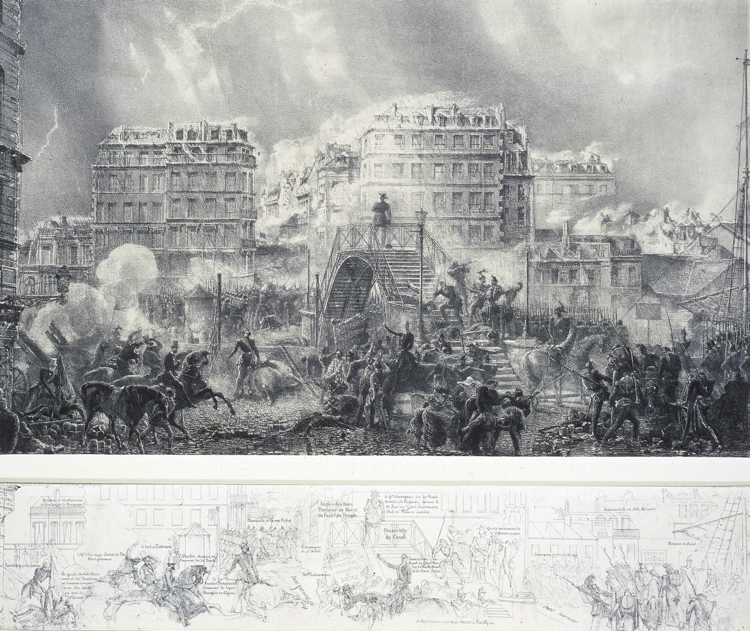
[Troops taking the barricade on the rue de la Fontaine-au-Roi, 23 June 1848]
               OPENING

                                                               FADE IN.

         1     EXT. A STREET IN PARIS NEAR THE HOTEL DES CAPUCINES - DAY1

               June 22, 1848. GUNFIRE can be heard nearby as men and women
               run down the street towards one of the several barricades
               which have been thrown up across the street. Some are
               carrying banners with their protest slogans "We have a Right
               to a Job" and "Save the National Workshops" which they throw
               to the ground as they run. The barricades consist of paving
               stones, overturned carriages, broken doors, furniture and
               other debris all chained together.

               The soldiers move down the street firing at the people on the
               barricade and in the apartments above the street. Behind them
               other soldiers are setting up an ARTILLERY PIECE which they
               aim at the barricade. Some of the protesters run into the
               side streets as soldiers fire volleys of rifle fire and the
               occasional artillery shell which hits the barricade. The
               soldiers fire methodically at the people, injuring some and
               killing others. Men begin firing back at the soldiers from
               the side streets and the windows of the upper stories of the
               houses along the street. Some people throw furniture and
               stones out of the windows onto the advancing soldiers.

               We see FREDERIC and his assistant THOMAS (whose face we
               cannot see) clutching the stack of newspapers they were
               handing out on the street, running towards the barricade to
               seek shelter. Frederic is hit in the upper arm by a bullet
               and stumbles, dropping the newspapers, and collapses behind
               the barricade. As he looks at the extent of his wound he is
               hit in the face by flesh and blood (perhaps some brain
               tissue) from the person next to him who has been killed by a
               bullet to the head.

               As Frederic loses consciousness the camera pulls up
               vertically above him to show the street, then the suburb
               where the shooting has been taking place, and the
               neighbouring streets with all their barricades. The camera
               flies at increasing speed showing the city, the customs wall,
               the new military wall around Paris, the imposing forts
               outside the city, then into the countryside.

                                                                CUT TO:

         2     EXT. THE PYRENEES MOUNTAINS AND THE COUNTRYSIDE OF LES LANDES2
               - DAY

               A flying camera takes us from Paris back to Mugron in the
               summer of 1843 showing the beauty of the French countryside.
               The camera flies over the Pyrénées mountains, down the Adour
               River towards the major port city of Bayonne with its toll
               gates and Customs House, and Frederic's home in the small
               town of Mugron and its empty town square. Then we see the
               sand dunes along the coast, the pine forests of the interior,
               the heathland with its sheep and shepherds, and the rolling
               hills of the vineyards.

               The camera zooms in to show Frederic's beautiful home in
               Mugron, where the story begins.

                                   FREDERIC (V.O.)
                         So the worst has happened; you left
                         our village. You abandoned the
                         fields you loved, the family home
                         in which you enjoyed such total
                         independence, your old books which
                         slumbered peacefully on their dusty
                         shelves, the garden in which on our
                         long walks we chatted endlessly
                         about every thing under the sun,
                         this corner of the earth that was
                         our last refuge. None of this could
                         keep you here. You left the village
                         and went to Paris, to this Babylon,
                         to this living whirlwind.

                                                           DISSOLVE TO:
ACT I: Bastiat's Life in Mugron (1843-44)↩
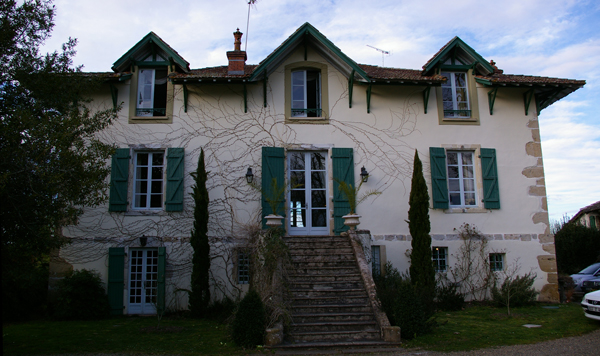
[Bastiat’s house in Mugron]
FADE IN.
3 EXT. BASTIAT'S HOUSE IN MUGRON AND ITS SURROUNDINGS - DAY3
At normal camera speed we see soundless shots of Frederic's
house in Mugron and the peaceful economic activities which
are going on around it, such as workers in his vineyards, his
sharecroppers at work in the fields, SHEEP FARMERS ON STILTS
tending their flocks, and boats full of goods plying the
river. It does not look especially wealthy but there is some
prosperity.
CUT TO:
4 EXT. THE OCTROIS TOLL GATES OUTSIDE BAYONNE - DAY 4
People are lined up on foot and in their carriages outside
the Customs Gate at the entrance to the town of Bayonne.
Customs Officers are roughly inspecting the possessions of
the people, poking them with long iron rods to find goods
they will have to pay tax on. There are complaints by some of
the people about the delays and the rough handling by the
officers. They grumble about how much they have to pay to
enter the town. Some people who can't pay the tax have their
possessions confiscated.
CUT TO:
5 EXT. A SMALL FARM IN THE VICINITY - DAY 5
Soldiers are going from farm house to farm house looking for
men who are twenty and liable for conscription into the
French army. They have a list of names of the young men they
are looking for. They call at one farm to demand the
appearance of a young man. He is dragged out by a soldier to
the complaints of the father and tears of the mother. He is
forced to join a column of other young men who are being
taken to the local garrison to be inducted into the army.
CUT TO:
6 EXT. A QUIET SPOT ON THE ADOUR RIVER - EVENING 6
Customs officers have spotted a smugglers' boat hiding in a
bend in the Adour river. It is full of bags of contraband
Spanish salt and American tobacco which they plan to sell on
the black market. The officers call out for the Basque men to
stop.
The smugglers try to escape, the officers FIRE THEIR RIFLES
killing one man, while the others escape into the fields
leaving their goods behind. The officers seize the goods and
we see some of them taking the salt and tobacco for their own
personal use.
CUT TO:
7 EXT. FREDERIC'S GARDEN - DAY 7
Frederic and his close boyhood friend and neighbour of 40
years FELIX COUDROY are walking through Frederic's beautiful
garden talking about philosophy, literature, and economics
which they do on a regular basis. They come to a more open
part of the garden and see a small bird busily building a
nest. A hawk which has been circling above the garden
suddenly swoops down and seizes the bird killing it
immediately. The hawk then perches on a tree branch and
begins tearing the bird apart and eating it. After a pause,
Felix renews the conversation.
FELIX
Do you think it is in our nature to
kill and plunder our fellows?
FREDERIC
It would seem so from what I have
been able to observe.
FELIX
Yet Adam Smith says that it is
inherent in our nature to truck,
barter, and exchange with each
other. That is part of what makes
us human.
FREDERIC
True. But maybe our nature is more
complex. Sometimes it is easier to
plunder than to produce.
The two continue walking through the garden as they discuss
the problem. It is a beautiful day.
8 EXT. A STREET IN MUGRON - DAY 8
An illegal march is being held in the town by socialists to
celebrate the 50th anniversary of the inauguration of the
Terror and the Maximum system of price controls in 1793. They
hold banners with Jacobin slogans such as "Robespierre saved
the Revolution!" and "Price Controls on Bread".
They also have banners with slogans supporting the
contemporary socialist Louis Blanc, such as "We demand the
right to a job", and "The Workers must Organise to defeat the
Bosses".
Some locals clap the marchers, others jeer at them calling
them names, such as "Bloody socialists!" "Murderers". An ANTI
SOCIALIST YOUTH is especially vocal in his opposition. One of
the YOUNG SOCIALISTS breaks away from the march and
approaches the other youth.
SOCIALIST YOUTH
You damn bourgeois!
ANTI-SOCIALIST YOUTH
You murdering Jacobin! How many
people do you plan to kill this
time?
The two youths scuffle and the anti-socialist youth is shoved
against a SHOP WINDOW BREAKING it in a very dramatic fashion.
(Note: Since there are several episodes in the film which
will show windows being broken we need to come up with
visually interesting and creative ways in which glass can
break.]
The police arrive to break up the march and arrest as many of
the marchers as they can, as well as the anti-socialist youth
who broke the window. The socialist youth escapes on foot.
CUT TO:
9 INT. THE MAGISTRATES COURT IN THE TOWN OF MUGRON - DAY 9
Frederic begins a typical day in the local Magistrates court,
which looks out over the town square, hearing minor cases.
PROSECUTOR
The first case concerns petty
property damage to a store owned by
M. Jacques Bonhomme. His shop
window was broken during a scuffle
between two youths. One of the
youths was arrested. They other ran
away.
FREDERIC
(addressing the youth)
Is this true young man? Did you
break M. Bonhomme's window?
ANTI-SOCIALIST YOUTH
Yes Monsieur.
FREDERIC
Why did you do it?
ANTI-SOCIALIST YOUTH
It was an accident. I was arguing
with a protester and he pushed me
and I fell against the window and
broke it.
FREDERIC
What were you arguing about? It
must have been a pretty violent
argument.
ANTI-SOCIALIST YOUTH
He was a socialist who supported
the Terror. I do not and we started
arguing. One thing led to another
...
FREDERIC
I see. It is a good thing to be
arguing about. Regardless of the
justice of your position, a window
of an innocent third party was
broken and his loss has to made
good. The law states I should
impose either a fine or a few days
in prison or working in a labour
gang repairing the roads. What do
you think a fitting punishment
should be?
ANTI-SOCIALIST YOUTH
I suppose a fine because it was
just a window, and there was one
good thing that came out of it. The
glazier made a profit installing a
new window.
FREDERIC
Not at all! No good came out of you
breaking M. Bonhomme's window. If
he hadn't had to pay for a new
window he might have bought a new
pair of shoes. So he lost a window
and wasn't able to buy a new pair
of shoes, and the shoe maker lost a
sale.
ANTI-SOCIALIST YOUTH
I suppose so ... What will you do
to me?
FREDERIC
You owe M. Bonhomme 6 francs to
cover the cost of a new window. If
he is willing, I instruct you to
work that off by working in his
store under his supervision. Is
that agreeable to you M. Bonhomme?
JACQUES BONHOMME
Yes it is sir.
FREDERIC
Good. I don't want to send a young
man to prison over a minor matter
like this. Let's not bother the
government any more with this. Next
case M. Prosecutor.
CUT TO:
10 EXT. THE MARKET IN BAYONNE - DAY 10
An annual festival and market is being held in the regional
centre of Bayonne. We see people playing the local instrument
a celtic bagpipe; Basques are singing their mournful folk
songs; shepherd youths on stilts are jousting with each; a
bull fight is underway in the local arena; there is a
bustling market filled with all the local produce. As a
respected Justice of the Peace Frederic has been asked to
judge the local smoked ham competition. He walks around the
many stalls in the market which have their hams on display.
He tastes the hams, talks to the vendors in their local
languages (he speaks Spanish, the Gascogne dialect of French,
and Basque), cracking jokes and listening to their stories.
They like and respect him because he is a fair and no
nonsense magistrate who has looked after their interests for
over ten years. The crowd gathers to hear his final
judgement. He announces the winner who is a matronly woman
who comes forward to receive the prize of a small cash
amount. There is a cheer as she accepts the award as she is a
popular choice among the locals. At the end of the day
Frederic mounts his horse and rides slowly back to his farm
in Mugron savouring the warm air of the region he loves so
much.
11 INT. THE OFFICE OF THE MAGISTRATE'S COURT - DAY 11
PROSECUTOR
M. Bastiat, here is a revised case
list for the coming week.
Frederic reads it and gets angrier as he reads.
FREDERIC
What is this? The arrest and trial
of smugglers and draft dodgers is
not our business. Why are there so
many?
PROSECUTOR
The government has issued a decree
ordering us to assist with their
crackdown on law breakers like
smugglers, draft dodgers, and
people holding political meetings.
FREDERIC
This is outrageous! My job is to
settle local property matters and
keep the peace, not enforce the
government's absurd policies.
PROSECUTOR
There is nothing I can do.
Everybody is in the same boat. The
King has ordered that dissent and
disobedience be eliminated before
it gets out of control.
FREDERIC
If he keeps doing this, it will
definitely get out of control.
CUT TO:
12 I/E. A GOGUETTE/BAR IN MUGRON - EVENING 12
Frederic is walking home from the Court through the main
street of Mugron and passes a goguette (bar) where he hears
singing. He stops and enters the bar and hears a group of men
singing Béranger's popular song "The Smugglers". He joins in
as he knows the words.
MEN IN A BAR
Curse them! Curse them, the Revenue
Men!
Because we bring happiness and
wealth,
The people always toast our health.
They are indeed our friends.
Yes, everywhere the people are our
friends.
Yes, everywhere, everywhere, the
people are our friends.
Men busy themselves with trade
But taxes bar the way.
Let us through! Exchanges will be
made,
There will be balance, come what
may.
Providence protects us everywhere
And asks that in return,
Abundance we will share
So wealth there is to earn.
Curse them! Curse them, the Revenue
Men!
For we bring happiness and wealth!
The people always toast our health.
They are indeed our friends.
Yes, everywhere the people are our
friends.
Yes, everywhere, everywhere, the
people are our friends.
The singing finishes and Frederic moves closer to a group of
men who are arguing about politics. One is a SOCIALIST and
defends the ideas of the socialist Louis Blanc.
MAN IN GOGUETTE 1
So what you are saying is that the
workers have to organise their own
labour and not let the bosses
control what they do?
SOCIALIST 1
Yes. They have to oranise work
rationally, not the chaos of the
market we have now. And their wages
should reflect the full value of
the things they create. If they
organise things properly there will
no longer be any profits for the
capitalists or interest paid to the
bankers. The workers will get to
keep everything for themselves. "To
each according to their needs; from
each according to their abilities"
That's our motto. What could be
fairer than that?
Frederic interrupts their conversation.
FREDERIC
What happens to the person who puts
up the money to start the business,
who pays the workers before any
profits are made, and who assumes
the risk of the business failing?
How do they get paid?
SOCIALIST 1
They are parasites who should not
get paid anything. Their labour
contributed nothing to the final
product.
FREDERIC
They may not do manual labour but
they labour with their minds.
SOCIALIST 1
What a load of nonsense! Read this!
He gives Frederic and the men at his table some socialist
literature, which Frederic quickly reads.
FREDERIC
So, who does all this organising of
labour?
SOCIALIST 1
Society does. Or at least the
working part of society does.
According to Louis Blanc.
FREDERIC
What if I don't want to be
organised in the way M. Blanc
recommends?
SOCIALIST 1
We all have to do what society says
is best, don't we sir? Otherwise
there will be hell to pay.
FREDERIC
Yes, we all have to pay one way or
another.
POLICEMEN enter the bar shouting.
LOCAL POLICEMAN
Everybody out! You know it is
against the law to hold political
meetings.
ONE OF THE MEN IN THE BAR
We were just singing a song and
having a drink!
LOCAL POLICEMAN
That's what they all say! Get your
workbooks ready for inspection!
The policemen manhandle the men in the bar, seize the
socialist's literature, and take him and some of the other
men away under arrest. They then inspect everybody's
workbooks and then force the goguette to shut for the
evening.
CUT TO:
13 EXT. THE OCTROIS TOLL GATES OUTSIDE BAYONNE - DAY 13
Frederic is in a carriage on his way to the Council Chamber
in Bayonne. He is waiting to be inspected by Customs
officials who will force him to pay duty on any consumer
goods he is bringing into the town. There is a long line of
people ahead of him. He has a box of printed copies of the
report on local tax reform he is about to present. The
CUSTOMS OFFICER rifles through Frederic's possessions
knocking the bundle of papers to the ground. Frederic argues
with him.
CUSTOMS OFFICER
Anything to declare?
FREDERIC
No. Only my impatience.
The Customs Officer notices Frederic's package of papers.
CUSTOMS OFFICER
Let me have a look.
He leans into the carriage and begins rifling through it.
CUSTOMS OFFICER (CONT'D)
What this? Something to sell?
FREDERIC
No. They are copies of the Report
I'm about to give to the General
Council this afternoon. I'll be
giving them away. In fact, I'll
probably make a financial loss on
the afternoon if that is any help
to you.
Unhappy with this answer, the officer carelessly knocks the
papers to the ground.
FREDERIC (CONT'D)
Hey! Be careful! Pick them up!
CUSTOMS OFFICER
Pick them up yourself.
He moves down the line to the next waiting carriage, while
Frederic picks up his papers and goes on his way.
CUT TO:
14 INT. THE GENERAL COUNCIL CHAMBER IN BAYONNE - DAY 14
Frederic is in the Council Chambers where he presents his
Report on the need to lower the tax burden in the region if
they are to avoid another VIOLENT UPRISING in protest. There
is considerable opposition to his remarks.
FREDERIC
The president of the Council asked
to me draw up a Report to answer
the Government's request for
information about reallocating the
tax burden for our Department, an
inquiry which is soon to begin. You
have my full report in your hands.
I apologise for the dirt marks. I
had an altercation with a Customs
Officer coming into the city. He
thought this was high value
contraband which I was smuggling
into the town to sell.
The Councillors all laugh.
FREDERIC (CONT'D)
As you can see, it is of low
monetary value but I hope to
persuade you that it might be of
high political value. Let me draw
your attention to the summary on
page 2 of my Report. In brief I
argue that the government has
locked us into a tax regime which
is rigid, inflexible, and 30 years
out of date. It must be changed if
we wish to avoid continuing
economic decline and perhaps even
political crisis.
Our tax burden was determined
decades ago when economic
conditions were very different from
those today. What was very
profitable then is less so today,
such as the wine industry, but the
tax burden remains the same. The
same goes for the new industries
which have emerged since then, such
as the pine forests. The tax burden
is thus all out of kilter. Some
farmers are being decimated by
malnutrition, there are artisans
with no work, and there are some
landowners whose most bitter
scrimping scarcely manages to
postpone ruin.
THE COUNCILLORS
(From some of the
Councillors)
Hear! hear!
FREDERIC
I suggest that there are two
solutions to our economic problems:
the first is the freedom to trade
so that we can be rewarded for
producing the things for which our
region is best at providing, like
wine; the second is to cut taxes
and make the burden more so that
all producers contribute the same
proportion of their income as their
changing economic fortunes allow.
If we do not do this we are
condemned to seeing more of our
farmers languish for lack of
overseas sales, and our workers
suffering from high prices for food
and lack of employment. This cannot
go on!
A Council member interjects.
COUNCILLOR 1
How will the government pay for all
these new public works like canals,
railways, and military
fortifications, if we cut taxes?
FREDERIC
The Councillor asks an important
question.
Perhaps we do not need all this new
expenditure on railway building and
the fortifications of Paris.
Private industry should pay for all
railway investment and we don't
need expensive military walls
around our capital city.
There are murmurs of disapproval from the Councillors.
FREDERIC (CONT'D)
If we do not lower taxes and make
them fairer there will be trouble,
I can assure you. Just the other
day I was in a gogette...
The Councillors laugh at the idea of Frederic being in a
workingman's bar.
FREDERIC (CONT'D)
... I was in a goguette and heard a
socialist agitator calling for the
workers to "organise labour"
themselves.
There are more murmurs of disapproval from the Councillors.
FREDERIC (CONT'D)
You may mutter, but the man has a
point. If we do not open up our
economy to more opportunities for
work and employment, if we do not
reduce taxes and make those few
taxes which remain more fairly
distributed among the people, then
agitators like the one I met will
be able to mount the case that it
is time to change the system
itself.
THE COUNCILLORS
No! No!
FREDERIC
You call yourselves Conservatives.
You oppose the lowest social strata
having the right to vote. In that
case, be the responsible guardians
of these people who are banned from
participating. You do not wish to
rule fairly on their behalf, nor to
allow them to legally rule for
themselves. What then do you want?
There is just one possible end to
their sufferings and this is to
rise up in rebellion against the
things that harm them.
THE COUNCILLORS
No! Never!
FREDERIC
If we do not reform our tax system
I promise you this will happen.
There will be a political explosion
not seen since the last one in
1789.
THE COUNCILLORS
No!
CUT TO:
15 INT. BASTIAT'S HOUSE IN MUGRON - DAY 15
We see Frederic's book-lined study and his desk covered with
books and papers as if he were in the middle of writing
something. The camera pans across the shelves showing
economics book in Italian, Spanish, English, and French. We
also see a print of Frederic's favourite painting by
Delacroix, "LIBERTY LEADING THE PEOPLE ON THE BARRICADE"
hanging prominently on his study wall.
Frederic is writing at his antique desk which looks out into
a beautiful garden. On his desk are some of his favourite
books: a collection of Boccherini cello sonatas, a Basque
grammar, Molire's plays, La Fontaine's Fables, Adam Smith's
Wealth of Nations in English, Jean-Baptitste Say's Treatise
on Political Economy, and Béranger's Songs. We will see these
same books later again in his office in Paris.
Now and again he gets up to check a reference in a book on
his shelf. Sunshine streams into the room through French
doors which open out onto a patio. In the distance we can see
his vineyards and the curves of the Adour river. It is an
idyllic scene. At one moment we see him look up to see a
single bird pecking for food just outside the french doors.
He gets up, goes to a small bowl of grain, and throws some to
the little bird, which jumps about in excited expectation.
Frederic smiles.
16 INT. BASTIAT'S HOUSE IN MUGRON - EVENING 16
Frederic's close friend Felix and some of his NEIGHBOURS have
gathered for their regular meeting of "THE ACADEMY"
DISCUSSION GROUP. Frederic is in the sitting room playing his
cello (a Boccherini suite). The local red wine from
Frederic's vineyard is being served by a Basque-speaking
maid.
NEIGHBOUR 1
Not a bad drop Frédéric. What year
is it?
Frederic puts down his cello and joins the others
FREDERIC
'39.
NEIGHBOUR 1
Yours is better than mine. My
grapes took forever to ripen.
FREDERIC
This year's should be as good if
not a bit better. We'll see how
well the sun shines.
NEIGHBOUR 1
Would you like some tobacco? I just
got a new delivery of American
leaf.
FREDERIC
From whom?
NEIGHBOUR 1
From my usual Basque supplier. He
is very reliable.
FREDERIC
Was it made in Kentucky?
NEIGHBOUR 1
I don't know. Does it matter?
FREDERIC
Yes. I refuse to smoke slave-made
tobacco. So if I can, I buy
Kentucky grown tobacco which is
made by free labour. But smoking is
starting to hurt my throat, so I'm
trying to give it up for good
anyway.
NEIGHBOUR 1
Too bad. It is very good.
FELIX
Have you noticed the police crack
down around the district? I saw a
goguette closed down the other day
in a pretty brutal manner. Quite
uncalled for.
NEIGHBOUR 2
They probably deserved it, singing
that way about the King's
government.
FELIX
Well, they were promised some
political freedoms when the King
seized power in 1830 and we helped
him do that if you remember. This
is what his promises have come to.
FREDERIC
They have trebled my work load at
the Court. I now have to deal with
all these police raids and arrests.
It is not really my job and I am
appalled by it. It will only
provoke further opposition.
NEIGHBOUR 2
It is better to nip it in the bud
now than wait till later.
FREDERIC
Or it could lead to the opposite.
That is what worries me.
FELIX
So what should the government do?
FREDERIC
It is not what the government
should do but what the people make
the government do.
NEIGHBOUR 1
And what is that?
FREDERIC
Do what the English are doing right
now with the Anti-Corn Law League.
That is what I have been reading
about for a couple of months.
He waves his arm towards his desk piled high with books and
newspapers.
NEIGHBOUR 1
And that is ... ?
FREDERIC
Richard Cobden says the English
ruling elite, the "oligarchy" he
calls it, won't reform the system
unless they are absolutely forced
to.
NEIGHBOUR 1
By whom for goodness sake?
FREDERIC
By the ordinary people who have
been mobilised by his movement.
Just the other week, they had
collected hundreds of thousands of
signatures calling for an end to
tariffs and dumped them on the
steps of Parliament House to
embarrass the government into
action. It was truly amazing.
NEIGHBOUR 1
You don't say! The cheek!
FELIX
But why are they going after
tariffs? How will that help them?
FREDERIC
Well to begin with, cheaper food
for everybody, especially the poor.
And besides, tariffs are the key to
the economic power of the landed
elites. Abolish them and you cut
their heart out. We should do the
same here if we want real reform of
the system.
NEIGHBOUR 1
The French people wouldn't stand
for that. They think eliminating
tariffs would expose them to
foreign competition and destroy
their livelihoods.
FREDERIC
That is what they have been taught
to believe by our ruling elites,
But it isn't true. They have been
duped and I plan to enlighten them
one day.
NEIGHBOUR 2
How would free trade effect our
business? Wouldn't we suffer loss
of markets?
FREDERIC
On the contrary. The growing wealth
of the English middle class would
be a huge new market for our wines.
Our trade hasn't expanded for
decades. We should be allowed to
sell to them. How else can we earn
enough to pay our taxes?
NEIGHBOUR 1
But if government revenue falls if
we cut tariffs how do we pay for
the railways, or the military?
FREDERIC
That is the beauty of Cobden's
strategy! With free trade in place
the British people will have much
better relations with their
neighbours, like us, and the
government can drastically cut
military spending, and thus
eventually cut even more taxes. We
then are in a virtuous circle of
peace, prosperity, and lower taxes!
NEIGHBOUR 1
That is crazy Frederic! Madness! We
can't disarm while the British Navy
rules the waves!
FREDERIC
And that is exactly what the
British say about the French Army!
Somebody has to make the first
move. And it might well be Britain,
if Cobden has his way.
NEIGHBOUR 2
And by the look of it
(gesturing to Frederic's
study)
you plan to help him do just that.
FREDERIC
Exactly. I have been researching
all summer and have written a book
on Cobden's strategy and how it
might be applied to French
conditions.
He passes around copies of his manuscript.
FREDERIC (CONT'D)
Just listen to what he said the
other day in Manchester. If this
doesn't inspire you I don't know
what will.
Frederic grabs a copy of an English newspaper on his desk and
begins to read. As Frederic reads we cut to the hall in
Manchester where we see Cobden at the podium in front of
several thousands people.
FREDERIC (CONT'D)
"Before a large crowd in Manchester
the leader of the Anti-Corn Law
League Richard Cobden presented
this rousing conclusion to his
speech which enraptured his
enthusiastic audience:"
FADE TO:
17 INT. A MEETING HALL IN MANCHESTER, ENGLAND - DAY 17
RICHARD COBDEN
I have never taken a limited view
of the object or scope of this
great principle. I see in the Free
trade principle that which shall
act on the moral world as the
principle of gravitation in the
universe, drawing men together,
thrusting aside the antagonism of
race, and creed, and language, and
uniting us in the bonds of eternal
peace. I have looked even farther.
I have speculated, and probably
dreamt, in the dim future Ñ ay, a
thousand years hence Ñ I have
speculated on what the effect of
the triumph of this principle may
be. I believe that the effect will
be to change the face of the world,
so as to introduce a system of
government entirely distinct from
that which now prevails. I believe
that the desire and the motive for
large and mighty empires; for
gigantic armies and great navies Ñ
for those materials which are used
for the destruction of life and the
desolation of the rewards of labour
Ñ will die away; I believe that
such things will cease to be
necessary, or to be used, when man
becomes one family, and freely
exchanges the fruits of his labour
with his brother man. I believe
that, if we could be allowed to
reappear on this sublunary scene,
we should see, at a far distant
period, the governing system of
this world revert to something like
the municipal system; and I believe
that the speculative philosopher of
a thousand years hence will date
the greatest revolution that ever
happened in the world's history
from the triumph of the principle
which we have met here to advocate.
FADE TO:
18 INT. BASTIAT'S HOUSE IN MUGRON - NIGHT 18
Frederic stops reading from the newspaper in order to gather
his breath.
NEIGHBOUR 1
He is claiming a lot for the reform
of a single economic policy.
FREDERIC
It is not just an economic reform.
It is a complete change in the way
people interact with each other.
NEIGHBOUR 1
Perhaps ... But it wouldn't work
here. The French don't have the
reformist zeal of Protestant
Englishmen.
FREDERIC
Don't forget the English women!
They are deeply involved in this as
well!
NEIGHBOUR 1
Goodness gracious! How appalling!
FREDERIC
But I don't agree. I have also been
researching how free trade would
change the situation here in France
and I think the same things could
happen here. I have written
another paper which I plan to send
to Paris to get published.
NEIGHBOUR 2
Good luck with that. I'm not sure
there are many there who would
support you.
FREDERIC
There are a few economists in Paris
who are free traders. They will be
interested. I'm also going to send
a copy to Cobden to see what he
thinks of it.
FELIX
Gentlemen! Enough economics for one
night. It is giving me a headache.
Have some more wine. Frederic, what
were you playing as we came in?
Play us some more.
FREDERIC
No. Something more light-hearted.
Frederic begins singing a song by Béranger, "The Good Yvetot"
as his neighbours drink more wine, and sing along with him.
FREDERIC (CONT'D)
There once was a king who won no
prize
in our history books for ruling
wise
he went early to bed and was late
to rise
his night-cap crown was his sole
disguise
Rat-a-tat! Rat-a-tat! Rat-a-tat!
Oh what a good little king was
that!
CUT TO:
19 EXT. BASTIAT'S HOUSE IN MUGRON - NIGHT 19
After his guests have gone for the evening there is a knock
at the door. The Basque maid announces that one of FREDERIC'S
SHARECROPPERS wants to talk to him. He is the same man we say
earlier whose son was dragged away by the army recruiters.
FREDERIC
Good evening Pierre. What can I do
for you.
PIERRE THE SHARECROPPER
Good evening M. Bastiat. I have
come to ask for your advice and a
favour.
FREDERIC
What can I do?
PIERRE THE SHARECROPPER
They took my boy yesterday.
FREDERIC
Who took your boy?
PIERRE THE SHARECROPPER
The Army. They came to the house
and took him away. What can I do to
get him back? We need him.
FREDERIC
They are cracking down on everybody
right now. They have to fill their
quota of recruits. Orders from
Paris. Do you have enough money to
pay for a substitute? What is the
going rate right now?
PIERRE THE SHARECROPPER
Two thousand francs. I don't have
that much. I have about 700 francs
put aside for my daughter's dowry.
I could use that.
FREDERIC
This is terrible Pierre. They
shouldn't do this to hard working
people. The Army is already too big
and costly. They don't need any
more farm boys. Here is what I can
do. I can lend you the money and
you can pay it back when you can.
You have been a good tenant for me
for many years. I know I can trust
you.
PIERRE THE SHARECROPPER
Thank you M. Bastiat, thank you!
CUT TO:
20 INT. BASTIAT'S HOUSE IN MUGRON - EVENING 20
A few days later Frederic has sent a message to his friend
and neighbour Felix to visit him to tell him some good news.
Felix enter's his study.
FELIX
Yes, Frederic. You wanted to see
me?
FREDERIC
Yes, yes! They want me to come to
Paris to talk to them.
FELIX
Who?
FREDERIC
The Economists. They liked the
draft of my book and the research
paper and want to publish them.
FELIX
That is excellent news Frederic.
Congratulations!
FREDERIC
Yes. Let's have a glass to
celebrate.
They sit down and open a bottle of wine.
FREDERIC (CONT'D)
They also want me to talk to them
about my plan to start a French
Free Trade movement like Cobden's
in England.
FELIX
Fantastic! Will it mean you will
have to move to Paris?
FREDERIC
Most probably.
FELIX
What about your farms and your job
as Justice of the Peace?
FREDERIC
I will have to employ a manager for
the vineyard and the farms, that is
not too hard to arrange. Regarding
the Justice of the Peace, I have
become so angry at what the
government is asking me to do right
now that I was close to resigning
anyway. I can't in all conscience
help them repress free trade and
freedom of assembly, and I won't
help them beef up the size of the
Army. That goes against my most
fundamental beliefs. I'll take a
leave of absence and see what
happens.
FELIX
As a friend, I have to tell you
that this is a big move for a man
your age. You are 44 after all and
your health is not so good. Your
cough is getting worse, I can tell.
Is this really the time to be
making a major change in your life?
FREDERIC
Perhaps not, but I think there is
more I want to do outside of our
little village of Mugron. As much
as I like life here I think there
are powerful forces at work in the
world which I want to be a part of.
FELIX
Like the free trade movement?
FREDERIC
Yes! But that is not all there is
to it. My researches over the past
year have shown me I have some
skill as a writer and I want to
explore that, to see how far it
might take me. Maybe I have a book
about economic theory in me, like
we used to talk about when we were
kids. How will I find out if I
don't try?
FELIX
It sounds like you have made up
your mind already. I'll miss you
Frederic, especially our little
salon, the Academy on the Adour
river!
The scene ends with Frederic's Basque maid in the kitchen
quietly singing a Basque folk song "Adios Ene Maitia"
(Goodbye, My Love).
MAID
Adios ene maitia
Adios sekŸlako
Nik ez dit beste phenarik
Maitia zuretako
Zeren Ÿzten zŸntŸdan
Hain libro bestentako
Goodbye, my love
Goodbye forever
I have no regrets
About you, my love
For I left you
So free for another
FADE OUT.
ACT II. Success in Paris (1845 to Feb. 1848)↩
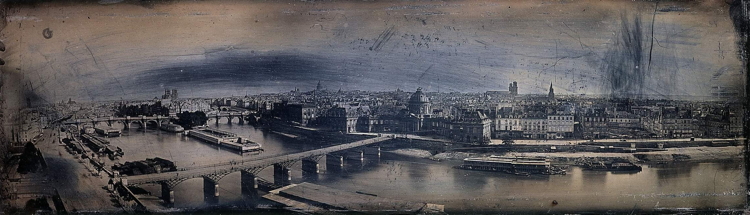
[A Panoramic View of Paris in the 1840s]
FADE IN:
21 EXT. THE JOURNEY TO PARIS - DAY 21
May 1845. We see Frederic making the long journey from Mugron
to Paris, the first leg by the traditional way by coach to
Orléans, and then from Orléans to Paris by the newly built
train. On the way to Orléans we see the next leg of the
railway system to Bordeaux being built by navvies who are
leveling the ground for the tracks and cutting through the
sides of hills.
As the train gets closer to Paris we see one of the ENORMOUS
FORTS which have recently been completed around the city. The
train then passes under the new MILITARY WALL before it
reaches the inner ring of the older CUSTOMS WALLS built in
the 1780s. The passengers have to disembark at one of the
very recently built HUGE RAILWAY STATIONS in Paris. Their
luggage is inspected by customs officers who demand payment
for consumer goods which are being brought into the city. The
passengers are then free to leave the station platform.
CUT TO:
22 EXT. THE SAINT-LAZARE TRAIN STATION 22
Frederic is met by JOSEPH GARNIER the editor of the Journal
des ƒconomistes.
GARNIER
Monsieur Bastiat, welcome to Paris!
My name is Joseph Garnier, the new
editor of the Journal des
ƒconomistes.
FREDERIC
Good afternoon Monsieur Garnier!
I'm glad to be here.
GARNIER
Please call me Joseph. Let me help
you with your bags. Guillaumin
asked me to meet you and take you
to your apartment. Don't forget
that there is a welcome dinner for
you tomorrow night hosted by the
Political Economy Society.
FREDERIC
Excellent, I'm looking forward to
meeting everybody very much.
GARNIER
There is so much to talk about!
Guillaumin and the other economists
were very impressed with your work.
They have a lot of questions to ask
you.
FREDERIC
And I them.
GARNIER
By the way, if you don't mind me
asking, where did you study
economics? Whom did you study
under?
FREDERIC
Nobody. I taught myself.
GARNIER
My goodness, how unusual. Here is
our carriage. After you!
Joseph opens the door to the carriage and helps Frederic
aboard.
23 EXT. LES HALLES FOOD MARKET IN PARIS - DAY 23
Their coach takes them past the large Paris food market, LES
HALLES, where they see all the economic activity which it
takes to feed a city the size of Paris with its one million
people.
FREDERIC (V.O.)
Here in Paris are a million human
beings who would all die in a few
days if supplies of all sorts did
not flood into this huge
metropolis. The mind boggles when
it tries to assess the huge variety
of objects that have to enter
through its gates tomorrow if the
lives of its inhabitants are not to
be snuffed out in convulsions of
famine, uprisings, and pillage.
And in the meantime everyone is
asleep, without their peaceful
slumber being troubled for an
instant by the thought of such a
frightful prospect. On the other
hand, eighty departments have
worked today without being in
concert and without agreement to
supply Paris. How does it happen
that every day what is needed and
no more or less is brought to this
gigantic market? What is thus the
ingenious and secret power that
presides over the astonishing
regularity of such complicated
movements, a regularity in which
everyone has such blind faith,
although well-being and life depend
on it? This power is an absolute
principle, the principle of free
commerce.
CUT TO:
24 INT. A RESTAURANT IN PARIS - EVENING 24
10 May 1845. The Political Economy Society is hosting a
welcome dinner for Frederic. The publisher and co-founder of
the Society GUILLAUMIN introduces Frederic to the other
economists. All the key players are there including HORTENSE
CHEUVREUX and ANNA SAY who are the wives of two of the
wealthy funders of the economists's activities. When Frederic
arrives his hat and coat are taken by the doorman who hangs
Frederic's large and unfashionable green hat and woolen coat
on a hook alongside the many, plain, black, but very
fashionable hats and coats of the economists.
GUILLAUMIN
Ladies and Gentlemen, on your
behalf I would like to welcome our
newest member to the Society, M.
Frédéric Bastiat, who is joining us
this evening all the way from Les
Landes in Gascogny.
There is polite applause and shouts of "welcome" from those
present.
GUILLAUMIN (CONT'D)
I'm sorry I wasn't at the station
to greet you myself.
FREDERIC
Don't worry. The Customs Officer
was there to greet me!
GUILLAUMIN
Of course he was! He welcomes
everybody to Paris!
There is much hilarity among the guests.
GUILLAUMIN (CONT'D)
As you know, we published his
article on French and English
tariff policy in our journal last
October. Who knew there was such a
talent hidden away in the
provinces! Such mastery of
statistics and economic theory!
There are cries of "Indeed" and "Congratulations" from those
present.
GUILLAUMIN (CONT'D)
Not only that, but he has written a
book which our press will shortly
publish on the strategy of the
English Anti-Corn Law League. It is
a very, shall I say "challenging"
book, which should stir up quite a
bit of controversy among us. So,
with no further ado, I propose a
toast to M. Bastiat. Welcome to
Paris!
Everyone stands and toasts "Welcome to Paris!"
FREDERIC
Thank you so much for your kind
introduction. I would like to
propose another toast, to "Peace,
Prosperity, and Freedom in Our
Time!"
The attendees toast to "Peace, Freedom, and Freedom in Our
Time".
The meal begins and there is much conversation and drinking.
Guillaumin introduces Frederic to members of the Society, the
President CHARLES DUNOYER, ANNA AND HORACE SAY the wealthy
business and financial supporter of the Economists, and the
professor of economics MICHEL CHEVALIER.
GUILLAUMIN
Let me introduce you to some of our
members.
He takes Frederic by the arm and steers him towards CHARLES
DUNOYER.
GUILLAUMIN (CONT'D)
Here is our distinguished President
of the Society, Charles Dunoyer.
DUNOYER
Welcome to Paris Monsieur.
FREDERIC
Thank you. It is a real pleasure to
meet the author of so many books
which have profoundly influenced my
thinking.
DUNOYER
You are too kind!
FREDERIC
I'm currently writing a review of
your latest, "On the Liberty of
Working".
DUNOYER
Indeed!
(he does not look pleased
at Frederic's effrontery)
GUILLAUMIN
Now you must meet Horace and Anna
Say. M. Say is one of our most
important supporters and his wife
Anna helps run our salon.
FREDERIC
It's a pleasure to meet you
Monsieur, Madame.
GUILLAUMIN
And next to them is Michel
Chevalier, one of our rising stars.
He was recently appointed to the
chair in political economy at the
Collge de France and has just been
elected to the Chamber of Deputies.
We are expecting a great deal of
him in the future.
FREDERIC
It is a pleasure to meet you
professor!
MICHEL CHEVALIER
I am pleased to meet the person who
wrote that remarkable essay. We
will have to talk about that when
you have a moment.
FREDERIC
Yes, I'd love to.
GUILLAUMIN
Now you must meet Madame Hortense
Cheuvreux. She and her husband
Casimir, who can't be here tonight,
are another of our important
supporters.
FREDERIC
It's a pleasure to meet you Madame.
MME CHEUVREUX
The pleasure's all mine.
(a certain look passes
between them which
suggests a more than
intellectual interest in
each other)
I was most taken by your analysis
of the British oligarchy in the
introduction to your book. You seem
to suggest that France too has its
oligarchy which must be defanged of
its powers before it does too much
damage. That is an intriguing idea.
We must talk about that some time
when you have a moment.
FREDERIC
I look forward to doing that soon
madame.
MME CHEUVREUX
You must come to one of my soirées
once you have settled in.
FREDERIC
How delightful!
MME CHEUVREUX
M. Bastiat, a little bird has been
whispering in my ear about the
salon you used to run in Mugron,
the "Academy" I think it was
called?
FREDERIC
Yes, madame. My neighbours and I
are not Plato of course, but we
like to amuse ourselves from time
to time with good Bordeaux wines
and some stimulating conversation,
MME CHEUVREUX
I hear one moment you discussed
economics, and the next you would
play music and sing songs. How
delightful! We don't have any
musical economists in Paris. You
must play something for us.
FREDERIC
It would be my pleasure. I pride
myself on being quite harmonious.
GUILLAUMIN
Excuse me Hortense but I want to
introduce M. Bastiat to our
youngest members. I'm sure they
will have a lot to talk about.
MME CHEUVREUX
Of course! We'll meet again soon, I
hope M. Bastiat!
FREDERIC
I hope so too madame.
GUILLAUMIN
Here is Joseph Garnier, whom you
have already met.
FREDERIC
Hello again Joseph!
GUILLAUMIN
He is the Secretary of the
Political Economy Society and our
new editor of the Journal des
ƒconomistes. It was he, by the way,
who discovered your article on
French and British Tariffs and
brought it to our attention. It had
been languishing in the in tray for
weeks before he found it.
Garnier nods and Frederic nods in thanks.
GUILLAUMIN (CONT'D)
Next I want to introduce you to one
of our youngest members of the
Society, Gustave de Molinari. He is
engaged in our largest research and
publishing program on the history
of economic thought. He is also
working on a history of tariffs
which should be very interesting.
FREDERIC
Good evening Gustave.
GUSTAVE DE MOLINARI
Good evening M. Bastiat.
FREDERIC
Please call me Frederic.
GUSTAVE DE MOLINARI
Of course! Frederic. To get an
appreciation of the other side of
life here in Paris I would suggest
another kind of salon to Madame
Cheuvreux's.
FREDERIC
Like what?
GUSTAVE DE MOLINARI
I and a few friends have our own
salon on the rue Saint-Lazare. You
should visit us one night and join
the conversation.
FREDERIC
What do you talk about?
GUSTAVE DE MOLINARI
The rights of ordinary workers. The
benefits of being a republic. That
sort of thing.
FREDERIC
It sounds intriguing. I'd like to
participate. Send me an invitation.
GUSTAVE DE MOLINARI
I will.
GUILLAUMIN
Excuse me gentlemen, but there is
one more person I know Frederic
wants to meet - our poet of
liberty, BéRANGER.
FREDERIC
Oh, Béranger is here! How
wonderful!
GUILLAUMIN
Yes. He made a special effort to
come tonight. This way. But before
I leave you, we would like to meet
with you tomorrow at our office to
discuss your book on Cobden and the
Anti-Corn Law League. Would that be
convenient?
FREDERIC
Yes, of course. Tomorrow then.
Guillaumin takes Frederic to the other end of the table where
BéRANGER is holding court among some of his admirers in the
society. Frederic is introduced by Guillaumin and sits down
next to Béranger. As the meal proceeds some SINGING begins at
the far end of the table where Béranger is sitting. The
loudest voice belongs to Frederic who gives a rowdy rendition
of "The Smugglers Song". The more conservative members of the
Society are not amused by his behaviour as they think
Béranger is too common and crude. They sing the refrain.
FREDERIC AND FRIENDS
(singing very boisterously)
Curse them! Curse them, the Revenue
Men!
For we bring happiness and wealth!
The people always toast our health.
They are indeed our friends.
Yes, everywhere the people are our
friends.
Yes, everywhere, everywhere, the
people are our friends.
CUT TO:
25 EXT. GUILLAUMIN'S OFFICE - DAY 25
The next day Frederic meets with the inner core of the
Economist group to discuss their future plans. They are in
the library which is lined with all the economics books the
firm publishes.
The publisher Guillaumin is there, along with the economist
Michel Chevalier and the editor of the Journal des
ƒconomistes Joseph Garnier, and Hortense Cheuvreux the wife
of the wealthy industrialist and financial supporter of the
economists CASIMIR CHEUVREUX. Guillaumin's daughter FELICITY
who managers the running of the firm is also present. Before
the meeting begins the economists are chatting with Frederic
about his choice of clothes. He is wearing a green woolen
jacket, a broad brimmed hat, and riding boots.
MICHEL CHEVALIER
I suppose now that you are in Paris
you will be wanting a good tailor
to fix you up with a fashionable
suit.
FREDERIC
Why do you say that? I like my
clothes. They are very comfortable.
MICHEL CHEVALIER
But they look a bit too Gascogne, a
bit too countrified.
FREDERIC
That's because I am from Gascony
and proud of it. I am also a
farmer, and a productive one at
that.
MME CHEUVREUX
Leave him alone Michel. He is quite
charming. He adds a dash of colour
to all you black-coated economists.
MICHEL CHEVALIER
Sorry!
(laughing)
I didn't mean to offend. It is just
that we don't see many Gascogne
farmers around here.
GUILLAUMIN
Gentlemen. We can talk about the
fashion of economists, or perhaps
even the economics of fashion, some
other time. Let me get down to the
business at hand. First off,
Frederic, we want to publish your
book on Cobden and the League as
soon as possible. Felicity, our
office manager can tell us - what
is the publishing schedule for
that?
FELICITY
Page proofs are due next month and
printing will take place in July.
GUILLAUMIN
Excellent! It should cause quite a
stir. Our good friend and colleague
over the channel, Richard Cobden,
wrote to me saying Frederic has
some very interesting ideas about
strategy in that book which we
should listen to closely if we want
to replicate his success. So I have
asked you here today to listen to
what M. Bastiat has to tell us.
Frederic?
FREDERIC
Thank you Guillaumin. I have been
studying the success of Cobden's
Anti-Corn Law League for a couple
of years now and thinking hard
about how we might apply his
techniques to France. My conclusion
is that you are doing it all wrong.
MICHEL CHEVALIER
I beg your pardon!
FREDERIC
You have no popular movement to put
pressure on the politicians and
vested interests to change things,
so things will never change.
The economists are rather shocked at his forthrightness.
GARNIER
But we have our professors, our
journal, and our books.
FREDERIC
Who reads them? How many people
belong to the Political Economy
Society?
GARNIER
About 150.
FREDERIC
Out of total population of 36
million. And how many subscribers
to the Journal des ƒconomistes?
GARNIER
About 1,000.
FREDERIC
Exactly! I rest my case. Do you
know how many people read the
magazine and the pamphlets of the
Anti-Corn Law League? Tens of
thousands.
The economists are shocked at the figure.
FREDERIC (CONT'D)
Just the other day they collected
hundreds of thousands of signatures
for a petition to repeal the corn
laws which they presented to the
House of Commons. They are on
course to getting legislation
passed in the Commons sometime in
1846 or 1847. Where are we?
Nowhere.
GUILLAUMIN
(very defensively)
We have our strengths in academic
work, such as Chevalier's chair at
the College de France and Garnier's
professorship at the Engineering
school. Then there is the
formidable publishing achievements
of this firm in theoretical and
applied economics.
Chevalier, Garnier, and Guillaumin all nod in agreement.
FREDERIC
That is not enough. And
furthermore, time is running out.
The distortions caused by
protectionism are getting worse
year by year and unless we fix the
problem there could well be an
explosion of some sort.
MICHEL CHEVALIER
Explosion? What kind of explosion?
FREDERIC
We are seeing one take place in
Ireland right now with their food
shortages and massive price rises.
Without free trade in food many
thousands of people will die.
Something similar could happen here
if there is a crop failure.
MICHEL CHEVALIER
Possibly.
FREDERIC
What I propose is that we start a
popular free trade movement
alongside our existing academic
activities and focus on that for
three years. By that time we should
have softened up the opposition in
the Chamber and we can then force
them to reform the system of
tariffs.
MME CHEUVREUX
What would you do specifically, M.
Bastiat, to begin this process?
FREDERIC
I would start a popular weekly
magazine written for a broad
audience. That means keeping
technical economic language to a
minimum and using well-known
stories and language ordinary
people can understand. I would also
organise large meetings in key
cities and employ speakers to
present free trade ideas and debate
protectionists before the public.
When the politicians see how many
people we are reaching they will be
forced to pay more attention to us.
That is when we should start
lobbying them in earnest.
MME CHEUVREUX
That is a very ambitious plan and
thus would be an expensive
undertaking.
FREDERIC
Yes. What Cobden and the League do
to offset some of those costs is to
charge a small fee for their
literature and they seek donations
to cover costs at every meeting.
You'd be surprised how much the
British public is willing to give
for good causes like anti-slavery
and free trade.
GARNIER
I'm not sure the French public
would be as generous.
FREDERIC
How do we know unless we try?
GUILLAUMIN
Let me get this clear. Are you
putting yourself forward to
organise the activities you have
just outlined to us?
Frederic hesitates only slightly before answering.
FREDERIC
Yes I am. I've studied this for
years and think I am the man to do
it.
GUILLAUMIN
Some of us have been thinking along
similar lines for a while now. M.
Bastiat would please excuse us for
a moment?
FREDERIC
Of course.
Frederic leaves the room to let the economists talk
privately. He wanders around the Guillaumin offices looking
at the books and magazines which are in production.
Guillaumin fetches him after a few minutes.
GUILLAUMIN
M. Bastiat, would you please join
us again.
FREDERIC
Yes.
They return to the library.
GUILLAUMIN
Our group was very much challenged
by your radical proposals for a new
strategy. We were initially sharply
divided but eventually reached a
consensus. We think your analysis
of our weaknesses and the strengths
of the English Anti-Corn Law League
are correct. We do need to change
to meet the new challenges we now
face.
Therefore we have agreed to fund
what you propose for a period of
three years, after which we will
reassess the situation. We want you
to edit a weekly free trade
magazine, write articles for it in
the style you think most
appropriate, and organise public
meetings.
FREDERIC
That is excellent. Thank you all
very much for your confidence in
me.
He looks around the room nodding at the economists who smile
and nod back at him.
FREDERIC (CONT'D)
I won't let you down. Together we
will defeat this economic parasite
of protectionism!
GUILLAUMIN
We also have agreed to some
logistical matters. Felicity, would
you be so kind?
FELICITY
We will provide you with an office,
pay for a personal assistant, pay
you a salary plus expences, to be
negotiated, and publish what you
write for us.
GUILLAUMIN
Is that agreeable to you M.
Bastiat?
FREDERIC
Most agreeable, thank you!
GUILLAUMIN
Excellent! Let's have a glass of
wine to celebrate.
As they are enjoying a glass of wine Hortense Cheuvreux comes
up to Frederic with a twinkle in her eye.
MME CHEUVREUX
Congratulations Monsieur Bastiat.
That was an impressive proposal you
put forward.
FREDERIC
Thank you Madame. Guillaumin tells
me you were the driving force
getting them to agree to my
proposal.
MME CHEUVREUX
I had something to do with it, but
they didn't need much convincing
when they understood what you were
proposing. It just took a few prods
of encouragement.
(she smiles suggestively at
Frederic)
FREDERIC
I just hope I can repay you for
your support and confidence in me.
MME CHEUVREUX
Don't you worry. I'll find
something.
CUT TO:
26 INT. THE FREE TRADE ASSOCIATION OFFICE - DAY 26
May 1846. Frederic is working with his new assistant Thomas
in an office on the second floor of a building in the rue
Choiseul in central Paris. It is the HQ of the newly formed
FRENCH FREE TRADE ASSOCIATION. There is a large desk in the
middle of the room. Two of the walls are covered with book
shelves which are only partly filled with books, there is a
large window overlooking the street, and on the 4th wall
hangs a map of the city showing the ring of walls and forts
around the city. There are also prints of DAUMIER CARTOONS, a
print of Delacroix's painting "Liberty Leading the People"
from his home in Mugron, and an illustration from a book of
Béranger's songs (The Smugglers).
FREDERIC
Well, Thomas. What do you know
about economics?
THOMAS
Not much.
FREDERIC
That is fine! You'll be just like
nearly every other person in
France! I can use you as a sounding
board for my little essays.
THOMAS
Yes, Monsieur.
Thomas is distracted by one the pictures on the wall of
Frederic's office.
FREDERIC
What are you looking at?
THOMAS
The fat man in he cartoon.
FREDERIC
Do you know who that is?
He points to a CARTOON OF KING LOUIS PHILIPPE by Daumier
which he has hanging on the wall.
FREDERIC (CONT'D)
That is King Louis Philippe, our
beloved monarch.
Thomas goes up to the cartoon to look at it more closely. He
is very amused.
THOMAS
He looks like a big fat pear!
FREDERIC
Yes he does. It was drawn by Honoré
Daumier. The King was so angry with
him he put in prison. Do you know
what happened then?
THOMAS
No.
FREDERIC
More cartoonists began drawing the
King like a pear and Daumier sold
even more copies of his. Eventually
the King gave up trying to stop it.
Goes to show how pointless
censorship is.
THOMAS
What is that?
Thomas points to the print of Delacroix's painting "Liberty
Leading the People".
FREDERIC
That is one of my favourite
paintings.
It is Delacroix's "Liberty Leading
the People on the Barricade".
THOMAS
Why do you like it?
FREDERIC
I played a very small part in the
Revolution of 1830 and this reminds
me of what we were trying to
achieve. You see that man there,
wearing the top hat?
THOMAS
Yes.
FREDERIC
His name is Etienne Arago and I
went to school with him when I was
a boy.
THOMAS
No! And what about her?
(pointing to the figure of
Liberty)
Did you go to school with her too?
FREDERIC
No of course not! What a foolish
question! She is Marianne, the
symbol of France and French
liberty.
THOMAS
Is she really leading the people or
are the people leading her?
FREDERIC
That is a very good question
Thomas. But now to work! Here is an
article I want you to take to the
printer.
CUT TO:
27 INT. THE FREE TRADE ASSOCIATION OFFICE - DAY 27
Thomas runs up the stairs and enters Frederic's office with a
large stack of the morning's newspapers.
THOMAS
Good morning monsieur! Here are
today's papers.
FREDERIC
Excellent! Let's see what the
Minister for Trade has to say this
morning. He is always good for a
laugh early in the morning!
Frederic begins to read the major government daily The
Moniteur.
FREDERIC (CONT'D)
Ah! He never disappoints. Here M.
Gridaine, the Minister for Trade,
tells us "it is imperative that we
increase the amount of work for
French workers by imposing tariffs
on cheaper foreign goods".
Excellent. Here is the topic for
this week's article. Tell me
Thomas, should we increase the
amount of work done by French
workers?
THOMAS
Yes, of course monsieur.
FREDERIC
Why?
THOMAS
So there will be more jobs for
French workers to do.
FREDERIC
Rubbish! What if I had tied your
right hand behind your back this
morning before you came to the
office. How long would it have
taken you to bring up all those
newspapers?
THOMAS
Twice as long monsieur because I
would have had to make two trips.
No! Probably a third because I
would have dropped some and had to
have gone back for them.
FREDERIC
But according to the logic of the
Minister for Trade M. Gridaine the
more work you and I have to do to
accomplish anything, the better off
we would be. So, I should tie your
hand behind you back every day!
In fact, the good Minister says, if
we tie every French worker's hands
and every French consumer's hands
behind their backs the whole Nation
would have more work to do and we
would all be made better off!
THOMAS
But that would be stupid monsieur.
FREDERIC
Why?
THOMAS
Because if I had taken only one
trip to bring up your papers then I
could have had time to do something
else for you monsieur.
FREDERIC
Exactly. And you said you didn't
know anything about economics! I'm
going to write that up and when I'm
done you can take it to the
printers.
Molinari pokes his head into Frederic's office.
GUSTAVE DE MOLINARI
Frederic, I just wanted to let you
know that Hippolyte Castille is
holding one of his salons on the
rue Saint-Lazare tomorrow night.
Would you like to come?
FREDERIC
I would indeed!
GUSTAVE DE MOLINARI
Excellent! Here's the address.
(he passes Frederic a piece
of paper)
The dress is "rustic radical" so
you should fit in quite well!
The two laugh.
CUT TO:
28 EXT/INT. CASTILLE'S LARGE HOUSE ON RUE SAIN-LAZARE - EVENING28
Frederic walks along the majestic rue Saint-Lazare and sees
the construction of the new and very LARGE SAINT-LAZARE
RAILWAY STATION at the end of the street. There is great
activity with coaches dropping passengers off at the station
and people milling about.
He comes to a stately residence which used to be the
residence of the Archbishop of Paris but which is now owned
by the radical journalist HIPPOLYTE CASTILLE. He enters the
main door which is unlocked and unattended and climbs the
stairs towards a room filled with noisy conversation. He is
greeted at the door by Molinari.
GUSTAVE DE MOLINARI
Ah, Frederic! Good to see you. Give
me your hat.
He takes Frederic's large country hat and puts it on a chair
by the door next to other more working class hats.
GUSTAVE DE MOLINARI (CONT'D)
Let me introduce you to some of the
key players in our little drama!
The two enter the room which reveals that it was once a
luxuriously appointed room but which is now filled with cheap
furniture. Marks on the wall show where paintings once hung
but which is now bare. There are about a dozen people in the
room drinking and conversing. There are no servants but a
table with bottles of various kinds to which the guests help
themselves. In one corner is Hippolyte Castille surrounded by
a group of men who are dressed rather shabbily.
GUSTAVE DE MOLINARI (CONT'D)
Let me introduce you to our host
Hippolyte. He edits the journal I
write for. Perhaps he will publish
some of your stuff as well.
Hippolyte, let me introduce you to
Frederic Bastiat, our newest find!
HIPPOLYTE CASTILLE
Nice to meet you Frederic! You
don't look like an economist, which
is a relief.
(they all laugh)
FREDERIC
I'm not sure what an economist is
supposed to look like! Tell me!
HIPPOLYTE CASTILLE
I suppose a bit formal and
"bookish." And not rough looking
around the edges.
FREDERIC
Ah!
(he gestures to his outfit
of clothes)
This may seem like rough edges but
they hide a much sharper edge
inside.
HIPPOLYTE CASTILLE
The sharp edge of economic reality
perhaps!
FREDERIC
Perhaps! Is there anything sharper
than that?
(they laugh)
HIPPOLYTE CASTILLE
We were just discussing the trial
of the carpenters which is
underway. I've asked Gustave to
cover it for the journal and he has
been sitting in on the trial every
day. What is your view of the
matter? Should carpenters be
allowed to form their own union?
FREDERIC
Do you want me to answer wearing my
economist's hat?
HIPPOLYTE CASTILLE
Of course! What other hats do you
have?
(they laugh)
FREDERIC
Many! The first point is rather
obvious I think. Every person has
the right to form a voluntary
association to pursue their own
interests, whatever they might be,
so long as they are peaceful.
HIPPOLYTE CASTILLE
Bravo! Well said sir! But that is
against the law!
FREDERIC
As it currently stands.
HIPPOLYTE CASTILLE
It was enshrined in French law
during the Revolution, and it might
take another revolution to change
it.
FREDERIC
Unfortunately, it often does.
HIPPOLYTE CASTILLE
You should go with Gustave one day
to see the trial. Hear the sort of
dreadful arguments the state is
putting forward to deny workers the
right of free association. It is
quite enlightening.
FREDERIC
I'd like to. Maybe I could also
write something about it.
HIPPOLYTE CASTILLE
Excellent We might even publish it
if it is any good!
(they laugh)
As they are talking ETIENNE ARAGO the radical playwright and
old school mate of Frederic's walks up to the group.
ETIENNE ARAGO
Frederic, my old friend! How are
you!
FREDERIC
Etienne! What are you doing here!
ETIENNE ARAGO
What am I doing here? I live here!
I should be the one asking you?
What dragged you out of your
beloved Mugron to come to this cess
pit of a Babylon?
FREDERIC
I've come to defeat the oligarchs
who run France!
ETIENNE ARAGO
That's my old Frederic. Tilting at
windmills again! Which set of
oligarch's did you have in mind?
The aristocrats, the big
landowners, the manufacturers, or
the army generals?
FREDERIC
Well, all of them actually. But to
begin with just the big landowners
and the manufacturers!
ETIENNE ARAGO
Good idea! Start small and then
work your way up!
FREDERIC
That's the plan. First we abolish
their subsidies and monopolies and
tariff protection, and then we go
for the jugular!
ETIENNE ARAGO
Bravo!
FREDERIC
But what are you doing Etienne? It
has been so long since our school
days at Sorze.
ETIENNE ARAGO
I have a new play coming out but we
are having trouble getting
permission to put it on the stage.
FREDERIC
Were you rude to the ruling elite?
ETIENNE ARAGO
Always!
FREDERIC
Who this time?
ETIENNE ARAGO
The lazy, good for nothing
aristocrats who produce nothing and
live off the people's hard work.
The censors say I was rude to them!
FREDERIC
I hope it was more than just rude!
ETIENNE ARAGO
Of course! Possibly even
revolutionary!
FREDERIC
Not you! Never!
(they laugh)
ETIENNE ARAGO
So what are you doing nowadays to
further the cause of the
revolution? I hope you haven't
given up on all our childhood
dreams of changing the world!
FREDERIC
Now that you mention it, there are
a couple of things I've been doing.
ETIENNE ARAGO
Do tell!
FREDERIC
The first is free trade.
ETIENNE ARAGO
Ah! You have picked up Cobden's
ideas about helping the poor by
lowering the cost of the bread they
eat.
FREDERIC
Yes. But it also goes to heart of
the wealth and the power of the
oligarchs who own the big landed
estates.
ETIENNE ARAGO
Yes. And the second?
FREDERIC
Have you heard of the penny post in
England?
ETIENNE ARAGO
Yes, vaguely.
FREDERIC
Well Cobden and his friends were
behind that as well. They abolished
the high cost of sending a letter
or newspaper through the post so
that ordinary working people could
afford to keep in touch with their
families.
ETIENNE ARAGO
What a great idea! So sending
letters is no longer the privilege
of the elite.
FREDERIC
No. We should do something like
that here in France.
ETIENNE ARAGO
Mmm. Maybe we could ... While you
are here there is someone else you
should meet. He is a crazy
socialist who has been making waves
recently. Let me introduce you to
Louis Blanc.
Etienne takes Frederic over to another group of people who
have gathered around Louis Blanc who is lecturing them about
his ideas about workers organising their own labour.
LOUIS BLANC
Just imagine the wealth we could
have if we could get rid of the
middle men, the capitalist who
siphons off the profits and the
bankers who suck up the surpluses
by charging exorbitant interest.
There are murmurs of part approval and part disapproval by
the people around Blanc.
ETIENNE ARAGO
Pardon me Louis, but I would like
to introduced to an old school mate
of mine, Frederic Bastiat. He has
recently arrived in Paris and is an
economist. You two should hit it
off like a house on fire!
LOUIS BLANC
How do you do M. Bastiat! An
economist you say? Where do you
stand on the labour question?
FREDERIC
How do you do Monsieur. I think I
stand with you on the ultimate aim,
which is allow workers to acquire
the greatest amount of benefit from
their own labour, but we differ on
the best way to achieve that.
LOUIS BLANC
What do you mean?
FREDERIC
Well, I want to remove all the
legal obstacles which lie in the
way of workers starting their own
business, or joining with others to
make and sell things on the market.
Whereas you want the state to use
its powers to regulate how
businesses are run and who gets to
enjoy the profits created by those
businesses.
LOUIS BLANC
That is true. We have to level the
playing field first before we can
permit the laissez-faire policies
you and the economists are
enamoured with. The state has its
role and then we can allow things
to play out once we have things
"organised."
FREDERIC
Monsieur, I think that is a very
naive view. Once the state has
"organised" labour as you suggest
why would it withdraw? Why would it
ever give up any power it might
hold? Far from protecting your
workers from exploitation by
capitalists and bankers, your state
would become the universal
exploiter.
LOUIS BLANC
I don't think so Monsieur. That is
the naive view not mine. I saw how
workers are treated in the iron
foundries in Arras. That was
brutal, absolutely brutal. We can't
allow that sort of thing to
continue. Once we have changed the
way people think about the proper
organisation of labour there will
be no going back to the old days of
ruthless competition, profit
taking, and the exploitation of
workers. We will have a completely
new kind of society which will be
nothing like the old one we have
today.
FREDERIC
How will work be organised in this
new society you have in mind?
LOUIS BLANC
The guiding principle should be
"from each according to his
ability, to each according to his
needs." And since most workers have
very similar needs, they should all
be paid an equal wage.
FREDERIC
That sounds very naive to me.
LOUIS BLANC
Then Monsieur, we will have to
differ on that. Good evening.
Louis Blanc walks away.
CUT TO:
29 INT. THE FREE TRADE ASSOCIATION OFFICE - DAY 29
We see a wagon from the printers dropping off three bundles
of printed material at the Free Trade Association office. It
is the new weekly newspaper of the French Free Trade
Association, "The Free Trader", edited by Frederic. Thomas
brings them inside and runs up the stairs to show Frederic.
THOMAS
Monsieur! They have arrived!
FREDERIC
Excellent!
He takes a copy of the issue from the first pile and opens it
wide.
FREDERIC (CONT'D)
This one is for our subscribers. I
will give you their addresses and
you can begin delivering them.
He takes one from the second pile which is a single sheet.
FREDERIC (CONT'D)
This one is the flyer we will hand
out in the street. We will ask for
a small coin as a contribution but
give it away if you have to.
We want as many people as possible
to read it.
THOMAS
What this one for?
He points to the third pile of large posters.
FREDERIC
That is the poster we will paste up
on the walls around town.
Frederic takes one of the posters and pins it to the wall
behind his desk. It is the statement of principles of the
Free Trade Association.
FREDERIC (CONT'D)
This is to reminds of what we are
here for. Now get going. I'll
deliver the magazine to some of our
bigger supporters. You take that
pile of leaflets and start handing
them out on the street.
We see Thomas handing out flyers on the street corner to
passersby. The camera zooms to show the poster on Frederic's
office wall.
The Association for Free Trade
Declaration of Principles
(10 May 1846)
The Association seeks the total destruction of the
protectionist régime and its replacement with a régime of
FREE TRADE.
The reasons for this are the following:
- the right to TRADE is a natural right held by every
individual, just like their natural right to own PROPERTY
- to deprive an individual of the right to trade the things
they have created or acquired with someone anywhere in the
world is to violate this right and is thus an act of LEGAL
PLUNDER and is UNJUST
- interference with this right to trade jeopardizes the PEACE
between nations by disrupting the relationships that unite
them
- governments have the right to impose low rates of tax for
FISCAL reasons only, anything above this holds the community
to ransom for the benefit of a SINGLE CLASS
The Association will pursue its goals in a constitutional and
legal manner outside of all existing political parties.
It embraces the cause of eternal justice, peace, union,
unfettered communication and fraternity among all peoples as
CONSUMERS.
We also see Frederic pinning up the first of the flyers on
his office wall, "The Right Hand and the Left Hand", which
over the coming months will gradually be covered by them.
CUT TO:
30 EXT. A STREET IN PARIS - DAY 30
We see Thomas and some young friends with a long handled
broom pasting the poster of The Declaration of Principles on
walls around the city.
CUT TO:
31 INT. THE FREE TRADE ASSOCIATION OFFICE - DAY 31
Frederic is at his desk reading the latest issue of the
newspaper of the protectionist Association for the Defence of
National Labour put out by the Mimerel Committee.
FREDERIC
Thomas! Here is another person who
never disappoints me. He provides
me with a never ending source of
sophisms to refute!
THOMAS
Who monsieur?
FREDERIC
August Mimerel. He heads the
Association for the Defence of
National Labour. In the latest
issue of their journal he has a
long list of reasons why the
government should increase the
tariffs on imported textiles. Can
you guess what things his factory
produces Thomas?
THOMAS
Textiles, monsieur?
FREDERIC
Yes! What a surprise! I have an
idea for our next article.
Can you think of something that
everyone uses every day but doesn't
pay for which some powerful
manufacturer would like us to pay
for if they could get away with it?
THOMAS
The air we breathe?
FREDERIC
Not bad. But it would be hard to
make us pay for that unless the
government forced us to wear a bag
over our heads.
THOMAS
What about sunshine?
FREDERIC
That might work! There are
manufacturers of artificial light
like lamp and candle makers who
might like to get the government to
grant them a monopoly. Give me a
moment!
Frederic begins scribbling a draft essay.
CUT TO:
32 INT. A COURT ROOM IN PARIS - DAY 32
Frederic is with Molinari in a court where the trial of two
Parisian carpenters is underway. They have been charged with
violating the law banning the formation of an association
founded with the express intention of increasing the wages or
improving the working conditions of workers. The court room
is half filled with workers who have come to support their
colleagues. The judge is about to bring down his verdict.
JUDGE
We have heard testimony from both
sides in this matter. There has
been no dispute concerning the main
points of the case. The carpenters
before the bench do not dispute the
fact that they intended to and in
fact did successfully form an
association, a "trade union" if you
will, with the intention of
violating the law banning such
organisations. ...
There is booing and jeering from some workers in the court
room.
JUDGE (CONT'D)
Order! There will be quiet in my
courtroom!
There is more booing and jeering but it is more subdued.
Frederic and Molinari look around the court and see the anger
on the faces of the workers who realise that the case will
not go their way. Molinari whispers to Frederic.
GUSTAVE DE MOLINARI
This is rigged! They will not be
allowed to get away with this.
FREDERIC
Not until the law is changed.
The Judge resumes his ruling.
JUDGE
The only defence, if you could call
it that, was the argument that the
law was not applied equally, that
associations of business owners and
manufacturers exist and that they
also violate the statutes. This may
be true but it is beyond the
jurisdiction of this court, which
is to investigate the matter before
it, and only this matter. I
therefore rule that the two
defendants will be fined 1,000
francs each ...
There is loud muttering of disapproval among the workers in
the court room
JUDGE (CONT'D)
Quiet! And 3 months imprisonment.
There are angry shouts and people stand up in protest at the
ruling.
JUDGE (CONT'D)
Quiet! The court is adjourned!
Workers in the room rush up to console their two comrades who
have been convicted. Molinari and Bastiat go up with them and
one of the carpenters recognises Molinari and talks to him.
FIRST CARPENTER
Thank you for coming M. Molinari.
It is good to see a friendly face
here.
GUSTAVE DE MOLINARI
I'm sorry things went this way. Our
magazine will write a full report
on it. People will know about this
outrage!
FIRST CARPENTER
Thank you!
GUSTAVE DE MOLINARI
We have also raised some money in
an appeal which will help pay your
fine.
FIRST CARPENTER
Thank you Monsieur!
GUSTAVE DE MOLINARI
There is nothing we can do about
the prison term.
SECOND CARPENTER
What about our families?
GUSTAVE DE MOLINARI
I'm sorry for you, but the state
doesn't care about your families.
The two carpenters are dragged out of the court room in
chains by court officers.
CUT TO:
33 EXT. THE STREET OUTSIDE THE FREE TRADE ASSOCIATION OFFICE -33
DAY
The wagon from the printers drops off another pile of printed
material for Frederic.
THOMAS
Here is the latest one Monsieur
Bastiat!
FREDERIC
Excellent!
He takes a copy of the latest flyer and pins it to the
growing collection on the wall behind his desk.
The title is "PETITION OF THE MAKERS OF CANDLES" He begins to
read it out loud in an exaggerated and mocking manner, and as
he does so he keeps pointing his finger to the sky.
FREDERIC (CONT'D)
"Petition of the manufacturers of
tallow candles, wax candles, lamps,
candlesticks, street lamps,
snuffers, extinguishers and
producers of tallow, oil, resin,
alcohol, and in general everything
that relates to lighting. To
Honorable Members of the Chamber of
Deputies. We are suffering from the
intolerable competition of a
foreign rival whose situation with
regard to the production of light,
it appears, is so far superior to
ours that it is flooding our
national market at a price that is
astonishingly low for, as soon as
he comes on the scene, our sales
cease, all consumers go to him, and
a sector of French industry whose
ramifications are countless is
suddenly afflicted with total
stagnation."
He pauses at the end and asks:
FREDERIC (CONT'D)
Do you know this will end Thomas?
THOMAS
I can guess monsieur.
FREDERIC
What?
THOMAS
They want the government to ban
sunlight so they can have increased
sales of their candles.
FREDERIC
Exactly. Get your friends and start
handing this one out. It should
cause a bit of amusement.
We see Thomas and friends handing it out on the street. They
call out "Read about how the Protectionists want to tax our
sunlight"! People stop, read it quickly, laugh, and then go
about their business.
CUT TO:
34 INT. HORTENSE CHEUVREUX'S SALON - EVENING 34
Frederic attends Madame HORTENSE CHEUVREUX'S SALON for the
first time. It is in a luxurious home in the centre of Paris
and it is attended by the cream of the liberal minded
cultural and political elites. He is welcomed in the foyer by
Madame Cheuvreux.
MME CHEUVREUX
M. Bastiat! Welcome! I'm so glad
you could come.
FREDERIC
My pleasure Madame!
MME CHEUVREUX
There are so many people I want you
to meet. Where to begin? I know,
Mlle. Jenny Lind is about to sing
one of the songs from Verdi's new
opera, "The Robbers." You'll love
it. She has been the talk of London
recently.
She rushes him to one of the many rooms in the house where
people have gathered. In this room the Swedish opera
sensation JENNY LIND has just started SINGING AN ARIA from
"The Robbers" "Tu del mio Carlo al seno" (Blessed spirit, you
have flown to the bosom of my Carlo) in which Amalia sings of
her love for Carlo who has joined a robber band which is
terrorising the countryside. She is in her mid 20s and is
very attractive and flirtatious. After she has finished
singing Hortense introduces her to Frederic.
MME CHEUVREUX (CONT'D)
Mlle. Lind, I want you to meet a
friend of mine the economist
Frederic Bastiat.
JENNY LIND
How nice to meet you. I've never
met an economist before. How did
you like the song?
FREDERIC
I enjoyed it very much. It deals
with an interesting subject, how to
deal with members of one's own
family who have turned to
criminality.
JENNY LIND
Indeed! I've heard some people say
that you economists sometimes
defend criminality.
FREDERIC
How so?
JENNY LIND
By defending smugglers who break
the law by selling contraband
tobacco for example.
FREDERIC
Well, not exactly! We criticise the
law which prevents people freely
trading across the border. It is
this bad law which turns peaceful
traders into criminals. They commit
no real crime. There is no victim
who is injured.
JENNY LIND
Isn't the state the victim because
it misses out on getting its taxes?
FREDERIC
No. I would say the real victim is
the consumer who is forced to pay
too much for his tobacco.
JENNY LIND
A curious way to see things!
FREDERIC
Perhaps M. Verdi will write an
opera one day about smugglers
instead of robbers. I'm sure you
would sing that just as
delightfully!
Frederic begins humming the refrain from Beranger's song "The
Smugglers".
FREDERIC (CONT'D)
"Curse them, curse them, the
revenue men ..."
JENNY LIND
What is that you are singing?
FREDERIC
A song I know about smugglers.
JENNY LIND
Curiouser and curiouser. A friend
told me that you have also written
about my voice in one of your
theoretical articles. Is that
correct?
FREDERIC
Yes. Mlle. Lind.
JENNY LIND
Tell me why an economist would be
interested in my voice?
FREDERIC
Probably not just your voice Mlle.!
(she smiles at him
appreciatively)
But your voice particularly because
of its rarity and the service it
provides to others.
JENNY LIND
What on earth do you mean by
"service"?
FREDERIC
You provide the person who pays for
a ticket to one of your concerts
the service of being delightfully
entertained for an evening. People
are wiling to pay for that service
...
JENNY LIND
And other services too I can
imagine!
FREDERIC
Yes, quite.
(he laughs)
But the rarer and the more
beautiful the voice the more they
are willing to pay for that
service. It is quite simple really.
JENNY LIND
For you perhaps, M. Bastiat!
FREDERIC
No really! The service I might
provide others by singing my song
about smugglers is much less
valuable than you singing your song
about robbers. No one wants to hear
my feeble voice. If they paid to
hear me sing I would be guilty of
robbing them of the opportunity of
hearing yours. But lots of people
are wiling to pay to hear you,
regardless of the content of the
song. So you can rightly charge
what the market will bear to do
that.
JENNY LIND
And what if I used my voice to sing
your song about smugglers?
FREDERIC
That would double the value of your
service I'm sure Madame. I for one
would pay a lot of money to hear
it!
JENNY LIND
And it wouldn't be contraband,
would it?
FREDERIC
No Mlle. Lind!
JENNY LIND
M. Bastiat, we will have to talk
again sometime about such
intriguing topics. In the meantime,
send me a copy of your smugglers
song. I'm intrigued!
FREDERIC
It would be my pleasure.
Mme Cheuvreux has become a little anxious about all the
attention Lind has been paying Frederic and decides to break
up their conversation. She comes up to Frederic to introduce
him to the mathematician and astronomer FRANOIS ARAGO who is
in the adjoining room.
MME CHEUVREUX
Isn't she delightful?
FREDERIC
Very!
(a bit too
enthusiastically)
MME CHEUVREUX
Let me take you to Franois Arago.
He has been asking about you. How
do you know him?
FREDERIC
I went to school with his younger
brother Etienne a long time ago and
we still keep in touch.
They come to a small drawing room where FRANOIS ARAGO is
talking to a group of people.
FRANOIS ARAGO
To answer your question madame, we
are building a number of new
telescopes for the Paris
Observatory in order to track the
movement of these comets which we
believe have a regular, periodic
obits around the sun. Ah. I see
Frederic has arrived! Excuse me a
moment. Good evening Frederic. It
has been a long time.
FREDERIC
Yes, indeed it has. I saw Etienne a
few days ago. I see he is in
trouble again.
FRANOIS ARAGO
In trouble as usual. He has written
a play denouncing the Aristocrats
for not working productively like
everybody else. He says all their
chateaux should be turned into
factories and they should take
their turn working on the machines.
For some reason, this has annoyed
the censors. They won't let him put
it on stage.
FREDERIC
That's typical. So what will he do?
FRANOIS ARAGO
He has been giving private readings
of it. What are you up to Frederic?
FREDERIC
I've been working on trying to
calculate the economic impact
government policies have on various
kinds of economic activity. Things
like the impact that tariffs have
on the way people spend or don't
spend their money. How it diverts
spending from one good to another
and what this flow on effect does
to production in general.
FRANOIS ARAGO
Interesting.
FREDERIC
But I am stuck on the mathematics
of it all.
FRANOIS ARAGO
Neither you nor Etienne were very
good at maths as I recall. Too busy
writing poetry and playing the
cello.
FREDERIC
Maybe so! But I would like your
help on figuring out how to
calculate the sum of effects as
they diminish in size over an
infinite number of iterations.
FRANOIS ARAGO
That sounds pretty straight
forward. When you have some free
time come and visit me at the
Observatory and I'll show you
around.
FREDERIC
Thanks. I'll do that!
He moves around the mansion taking in all the luxury of the
paintings and furnishings and the sophisticated conversations
of the guests. He comes across a group of people talking to
the catholic priest and philosopher JOSEPH GRATRY. Frederic
listens in.
JOSEPH GRATRY
The problem is that reason has been
seized by liberal sophists and used
against the Church in a way which
is both damaging and false.
It is our task to refute these
sophists and rescue the Church from
this anarchy of words which are
being hurled at it. I see one of
those sophists has just entered the
room. Good evening M. Bastiat.
FREDERIC
M. Gratry. You misinterpret my
work. I am a debunker of sophisms,
not a disseminator of sophisms
myself.
JOSEPH GRATRY
What sophisms do you debunk then,
monsieur?
FREDERIC
The lies and half-truths which the
rich and powerful tell the people
in order to confuse them and so
more easily take their money.
JOSEPH GRATRY
That would be a noble mission
monsieur, if you limited your
debunking to the sophisms of the
powerful manufacturers and
landowners, or to the sophisms of
the wicked socialists who are
corrupting our workers. But you go
too far when you attack the so
called "theocratic sophisms" of the
Church as you did in a recent
essay.
FREDERIC
I apply the same economic reasoning
to exposing the wealthy landowner
who claims he is helping the poor
when he forces them to pay more for
food, as I do to the priest who
makes fraudulent claims about the
afterlife and forces the poor to
hand over a tithe to the Church in
order to secure a spot in Heaven.
Both are forms of plunder in my
view.
JOSEPH GRATRY
Then that is what I call false
reasoning because these two things
are entirely different in their
essence.
FREDERIC
I disagree. In their essence they
are the same. They both use the
power of the state to force people
to hand over their money against
their will. They are both acts of
plunder and they are justified by
sophistical arguments.
JOSEPH GRATRY
Nonsense!
FREDERIC
The main difference is that the
landowners and manufacturers have
only been plundering the people for
a couple of hundred years. The
Church has been doing it for over a
thousand years and is thus much
more experienced in duping the
people with false arguments.
JOSEPH GRATRY
I see there is no possibility of me
changing your mind on this topic?
FREDERIC
I seriously doubt it.
JOSEPH GRATRY
Then good evening monsieur.
FREDERIC
Good evening.
Frederic walks about the mansion admiring the paintings and
fine furniture. Each room he passes has a different
conversation underway and walks past several looking for an
interesting one to join. He comes across a room where the
historian and political theorist ALEXIS DE TOCQUEVILLE is
holding forth about his views of democracy in America.
Frederic enters the room.
TOCQUEVILLE
So you see madame, it is not a
matter of whether or not I
personally like democracy, it is a
question of what do we do given its
inevitable triumph, at least in the
short to medium term. Ah, I see
Monsieur Bastiat has joined us. He
has been causing some excitement
among our economist friends
recently. What say you sir?
FREDERIC
I'm afraid I haven't been to
America sir, so I'm not sure my
opinion would be worth much.
TOCQUEVILLE
Possibly, but you have taken quite
an interest in the spread of
democracy in England and the impact
it is having on their economic
policies, isn't that true?
FREDERIC
Yes. But the two cases are quite
different. The is no ruling elite
or oligarchy in America, outside of
the slave owning south, so the
people there do not have that
battle to fight. There is only half
a democracy in England at the
moment so they have not yet been
able to get rid of their ruling
oligarchy. It is only a matter of
time before they do, in my opinion.
TOCQUEVILLE
Yes, but my point is that whether
in America or England the people
can't be trusted with political
power because they are not educated
sufficiently to use it wisely. They
are too fickle and emotional.
FREDERIC
Whereas the ruling and presumably
educated elites in France and
elsewhere in Europe do rule wisely
and justly? I'm sure we can all
find examples to the contrary, of
unjust and unwise rule by elites.
Like serfdom, protectionism,
conscription. I could go on.
TOCQUEVILLE
Of course, but when change comes it
must come slowly and in an orderly
fashion otherwise things can get
out of control, as we only know too
well in France.
FREDERIC
I agree. But if change is too slow
it can also lead to things getting
out of control.
TOCQUEVILLE
Interesting. So you are like
Goldilocks then. Change can't be
too hot or too cold, but has to be
just right. How amusing!
FREDERIC
Not quite, sir. I think I prefer my
change to be on the hot side.
TOCQUEVILLE
Ah! Spoken like a true southerner!
Frederic and Tocqueville continue arguing and bantering in
this vein for some time until Frederic excuses himself and
decides to leave the Cheuvreux's home after an eventful
evening.
CUT TO:
35 EXT. THE KING'S PALACE - DAY 35
August 1846. Frederic and Thomas are standing on a street
corner not far from the TUILERIES PALACE which is the
residence of KING LOUIS PHILIPPE. They have been handing out
a leaflet with the title "The Kings must Disarm". People are
gathering to watch a BIG MILITARY PARADE in the palace
grounds to mark the 16th anniversary of his coronation in
August 1830 and the completion of the new military wall which
has been built around Paris.
We see THE KING standing on a balcony over the parade ground
acknowledging his elite troops as they march past in
formation. The people are not very enthusiastic when someone
calls for a cheer for the King.
We next see the King getting into an elaborate carriage which
drives off in the direction of THE MILITARY WALL WHICH
SURROUNDS PARIS. As it approaches the wall it pulls off onto
the access road which runs along the inside of the wall for
its entire length of 33 km (20 miles). Along the top of the
wall soldiers in full dress uniform are lined up 1 metre
apart from each other as far as the eye can see. As the
King's carriage approaches they present arms and shout "VIVE
LE ROI" (Long live the King).
The camera follows the King's carriage for several miles
showing the enormous size of the wall and its massive
fortifications.
As the crowd disperses we see Frederic and Thomas resume
their work handing out leaflets. Thomas says something to
Frederic in a whisper.
THOMAS
He really does look like a big fat
pear!
(they both laugh)
CUT TO:
36 INT. THE FREE TRADE ASSOCIATION OFFICE - DAY 36
A few weeks later. Gustave is in the office to talk to
Frederic about advertising posters for the upcoming public
meeting of the Free Trade Association. Frederic has bought
another DAUMIER PRINT and is hanging it on the wall behind
his desk alongside the other Daumier print.
THOMAS
What is this one about monsieur?
FREDERIC
Have a closer look and tell me what
you see.
THOMAS
The pear King is sitting on a sort
of throne in front of the National
Assembly building.
FREDERIC
Look more closely. Is it really a
throne?
THOMAS
Mmm... It looks a bit like a
toilet.
FREDERIC
Yes. And what is he eating?
THOMAS
People are throwing money into
baskets and some other people are
lifting them up and pouring the
money into his month.
FREDERIC
Yes. The people are paying their
taxes and he is a tax-eater or a
budget-eater. What is coming out of
the bottom of the "throne"?
THOMAS
Pieces of paper.
FREDERIC
Look more closely!
THOMAS
(he peers more closely at
the print)
It says "Government Subsidy" and
the other says "Monopoly
Privilege". That's funny. Did
Daumier go to jail for that one
too?
FREDERIC
Yes. But not for very long.
Molinari has come over to Frederic's desk.
GUSTAVE DE MOLINARI
I hate to interrupt these
scatological reflections on
monarchical economic practices but
we need to discuss the advertising
for the meeting at Montesquieu
Hall.
FREDERIC
Yes, of course.
They pour over a draft of the BIG POSTER for the Meeting.
CUT TO:
37 EXT. A STREET IN PARIS - DAY 37
Thomas is with some friends PASTING UP POSTERS advertising
the first big public meeting of the Free Trade Association in
Paris. They walk past a wall where they had put up posters
earlier in they day. They have been TORN DOWN and are hanging
in strips off the wall. They replace them with new ones and
continue on their way.
CUT TO:
38 INT. THE MONTESQUIEU HALL IN PARIS - EVENING 38
September 1846. The Hall is a large 2,000 PERSON CAPACITY
concert hall which is also used for public gatherings. It is
rapidly filling up. The entrance and foyer have many tables
filled with Free Trade Association literature, such as books
and pamphlets written by Frederic and others. Thomas is at
the entrance handing out leaflets to the people coming into
the hall.
A large poster at the entrance lists the program of speakers
for the evening's event: the President of the Association the
DUKE OF HARCOURT, the economist Michel Chevalier, the poet
and liberal politician ALPHONSE LAMARTINE, Frederic, and a
working class printer M. PEUPIN.
The front of the Hall is decorated with a large banner with
the slogan of the FREE TRADE ASSOCIATION written on it "Let
us live our lives at the lowest possible prices," "We should
pay taxes only to the state," "Goods are bought with other
goods."
The front few rows have been cordoned off for members of the
aristocracy and senior politicians. The cheap seats on the
mezzanine level are also filling up with ordinary people many
of who are working class.
The Duke of Harcourt rises and walks to the lectern.
DUC D'HARCOURT
Distinguished visitors, Ladies and
Gentlemen, fellow citizens! Welcome
to this historic moment when the
French Free Trade movement is
formally launched.
A cheer goes up from about half the people in the Hall.
DUC D'HARCOURT (CONT'D)
We believe this is a movement that
can and will change France for
ever. It will usher in new
opportunities for prosperity for
all classes and will lessen the
antagonisms which have been
building up between nations as a
result of the pernicious policy of
protectionism. We have an
outstanding group of speakers for
you this evening. Let us begin with
some words from one of the leading
economists in France, Professor
Michel Chevalier from the Collge
de France.
There is moderate applause from the crowd who are not sure
what to expect.
MICHEL CHEVALIER
Thank you! There is so much an
economist could say about the many
positive effects free trade has on
our prosperity.
For example, there is the benefit
of the spread of an international
division of labour when nations get
to specialise in producing what
they do best, the spreading of risk
in times of a poor harvest, such as
the Irish are now experiencing, as
regions where there is plenty can
export their surpluses to places
which have shortages. I could go on
with some more examples, but I
won't.
There is some laughter from the audience who are relieved he
promises not to lecture them on economics for much longer.
MICHEL CHEVALIER (CONT'D)
But tonight I want to focus on one
aspect which many of you may not
have thought about before. That is
the undeniable fact that all of us
are both consumers AND producers.
We all work at something, therefore
we are producers. We have or
produce something which we sell to
others, even if is just our labour.
On the other hand, we are all
consumers. We buy things others
have produced such as our food, our
clothing, or our housing. Not one
of us is just a consumer or just a
producer. We are all consumers and
as consumers, free trade is our
best friend because it ensures that
everything we consume will be
available at the lowest possible
price. We can live, as our
colleague Lamartine has put it so
well,
(he points to the banner
above his head)
"la vie ˆ bon marché", let us live
our lives at the lowest possible
prices. Our protectionist opponents
argue that as producers living in
France we should all be in favour
of tariffs which raise the prices
of the goods we produce, but they
forget that we are all consumers
and not all of us work in
industries which can get the
government to raise the prices of
the things we produce.
So, outside of a few tens of
thousands of privileged workers and
business owners, we, the other 36
million citizens of France, have to
pay higher prices for everything we
consume. This is economic madness
and it is unjust!
There is a loud cheer from the audience at his closing
remarks.
DUC D'HARCOURT
Thank you professor Chevalier. Our
next speaker is perhaps our
favourite living poet, Alphonse
Lamartine.
A very loud cheer and great applause fills the Hall as
Lamartine approaches the lectern.
LAMARTINE
Thank you my friends! I am very
happy to be here tonight to add my
name to the growing list of those
who are urging a radical change in
our economic policy from the
backwardness which is protectionism
to the new and progressive policy
of international free trade. I have
no head for numbers, this "algebra
of political economy,"
The audience laughs.
LAMARTINE (CONT'D)
... about which those scholars like
Monsieur Chevalier are far more
knowledgeable. Instead I want to
talk to you tonight about the moral
dimension which lies behind free
trade, that aspect of free trade
which first made it attractive to
me. I remember sitting one day on
the benches in the National
Assembly, listening to some boring
speech on tariff policy.
There is an ironic cheer from some members of the audience
who share his dim view of economics.
LAMARTINE (CONT'D)
When I for the first time took a
close look at the legislation which
governs our policy of tariffs. It
can be found in this book.
He holds up the heavy 400 page volume which contains the
legislation governing French tariff policy.
LAMARTINE (CONT'D)
This enormous, immense, infinite,
confused, irrational volume, this
apocalypse of the protectionist
system, regulates every single
aspect of our economic life, from
the oil from the smallest oil seed
up to the oil we get from the
largest whale, from the steel in
the tiniest needle used for sowing
lace up to the largest ship's mast
in our merchant fleet. It tries to
regulate every single aspect of our
national economic life, and to do
this it requires a virtual army of
tens of thousands of bureaucrats
and tax collectors who push and
prod their way through our bags at
every border we cross, and force us
to fill out endless forms when we
pay our taxes or government fees.
The people of France are being
crushed by this bureaucratic
burden. It must end! Let the next
revolution, the revolution of free
trade, begin and sweep all away
this before it crushes our very
soul!
Another loud cheer goes up and the applause lasts for several
minutes.
DUC D'HARCOURT
Our next speaker is Monsieur
Frederic Bastiat, the Secretary of
the Free Trade Association and a
Member of the Institute.
There is only polite applause as the audience does not know
him.
FREDERIC
Ladies and Gentlemen, when I first
came to Paris from my native
Gascony I visited your lovely
Botanic Gardens. I had heard about
the monkey cage and wanted to see
it because I had never seen monkeys
before. In my part of the world we
have bulls of course, which some
people fight in rings, which is as
good as any place I suppose, if you
must fight bulls.
There is some laughter from people in the Hall.
FREDERIC (CONT'D)
We also have Basque smugglers who
come over the Spanish border to
sell contraband tobacco, and they
get shot at by Customs officers,
which makes it a dangerous sport
like bull fighting, at least for
the smugglers
There is more laughter as people begin to warm to him.
FREDERIC (CONT'D)
But here, in Paris, I wanted to see
the monkeys. I visited them, at
feeding time. Each monkey was in a
separate cage, and I watched as
their keepers pushed a bowl of food
into their cage through a little
door. You might think as I did at
first that each of the monkeys
would eat what had been given to
him. But this does not happen. You
see them all putting their arms
through the bars of the cage next
to theirs, trying to steal each
other's share. There are cries,
grimaces, and contortions, in the
middle of which some of the bowls
are overturned and a lot of food
gets spoilt and wasted.
Occasionally, one of the larger and
wiser monkeys learns to push his
bowl into the centre of his cage
where the other monkeys can't reach
it, and then goes about stealing
the food of the monkeys on either
side of his cage.
This happens every day at feeding
time and the net result is an
enormous loss of food for the group
of monkeys as a whole.
The audience has grown quiet and there are looks of
puzzlement on many people's faces.
FREDERIC (CONT'D)
So, you might ask, why I am telling
you this story? Perhaps a simple
man from the provinces has lost his
mind at the Botanical Gardens. But
watching this, it occurred to me
that this is a perfect example of
what the protectionist regime does
to us, as French producers and
consumers.
Some people in the audience see the joke and begin to laugh.
FREDERIC (CONT'D)
It turns us into mutual plunderers,
because we seek special privileges
like tariffs so we can plunder the
food bowls of our neighbours. But
what we don't realise is that our
neighbours are doing the same to
us, trying to get special
privileges from the state so they
can plunder us in turn. The net
result is that we are like the
monkeys in the cages where all the
bowls get overturned and spoilt. We
have to put an end to this madness!
There is much laughter and applause from the audience as they
get the joke.
FREDERIC (CONT'D)
Only under a regime of free trade
can we have the largest bowl of
food possible and the peace and
freedom to enjoy it without having
our greedy neighbours try to steal
it out of our mouths.
A heckler calls out from the crowd:
HECKLER 1
That is all very well for a bunch
of monkeys, but what about real
workers like me?
FREDERIC
The gentleman obviously doesn't
like being compared to a monkey! or
a mutual plunderer!
(the crowd laughs with
Frederic)
But you raise a good point
Monsieur.
Frederic turns to the Duke of Harcourt.
FREDERIC (CONT'D)
With your permission sir, perhaps
we should invite our final speaker
to the platform to give the
PERSPECTIVE OF A WORKER. M. Peupin
is a printer by trade. Monsieur!
PEUPIIN
Thank you Monsieur Bastiat. As he
said I am a printer by trade. I
have steady work about 10 months a
year and on the days I work I can
earn between 3 and 4 francs a day,
which isn't bad. I can't complain.
But what I do complain about is
that when you add it all up, all
the extra costs caused by tariffs
and other subsidies to some
favoured producers, on things like
cereals for bread, or coal for
heating my home, textiles for my
children's clothes, or iron for the
tools of my trade, I figure it
comes to about 75 centimes per day.
That is about 25% of my day's
income. In my opinion, this is
tyrannical, unjust, and immoral.
There is a loud cheer from the audience and Peupin becomes
more confident when he realises the crowd is on his side.
PEUPIIN (CONT'D)
It is tyrannical because it forces
me to buy things from one person
rather than another person of my
choice; it is unjust because it
levies a tax on me for the benefit
of another class, and it immoral
because it makes me pay more for
everyday essentials. That is why I
am a supporter of a policy of free
trade!
There is loud applause and cheering, and the evening
gradually comes to a close. We see people filling out of the
hall taking literature with them as they leave. We see the
HECKLER arguing loudly and angrily with Thomas and some of
the other free traders at the back of the Hall as people
leave.
CUT TO:
39 INT. GUILLAUMIN'S OFFICE - EVENING 39
A RECEPTION is underway at the Guillaumin firm's offices to
celebrate the completion of several important publishing
ventures. There is a large crowd of people, the new titles
are spread out on tables, wine and food are being served, and
there is a lot of noisy conversation taking place.
Guillaumin bangs his wine glass with a fork to get people's
attention.
GUILLAUMIN
Ladies and gentlemen, if I could
have your attention please. Thank
you. Tonight we want to celebrate a
very successful few months in the
publishing activities of the
Guillaumin firm. You can see spread
out before on the tables our most
recent books. There is Gustave de
Molinari's marvellous two volume
work on the History of Tariffs.
The crowd claps and this is acknowledged by Gustave de
Molinari.
GUILLAUMIN (CONT'D)
Our multi-volume collection of
classics of economic thought is
drawing to close with the
appearance of works by Malthus,
Ricardo, and the Physiocrats.
(more applause but less
enthusiastic)
And our best selling title at the
moment, Frederic Bastiat's Economic
Sophisms.
(the crowd applauds very
enthusiastically with a
couple of cheers as well)
This is a collection of the short
essays he has written over the past
year or so debunking the myths and
false thinking of the
protectionists and the socialists.
They are some of the cleverest and
most amusing pieces of economic
writing I have ever read. They
certainly appeal to an audience we
have not tried to appeal to before,
that is people who are new to
economic ways of thinking about
problems. He tells me he has
enough for another volume which we
look forward to publishing in the
near future. Frederic would you
like to say a few words?
FREDERIC
Thank you Guillaumin for those kind
words. Ladies and gentlemen we
stand at a cusp of history which
could turn us in one of two
different directions. We could go
down the path the English have
taken with Cobden's mass free trade
movement which looks very close to
achieving victory. This is the path
towards prosperity and freedom. Or
we could be half-hearted in our
support for free trade and stay
where we are now. This is the path
to more economic stagnation and
social discontent. We have had some
promising signs that more French
people are becoming interested in
our ideas. We have had some large
public meetings in Bordeaux and
Paris which give us some hope. The
very good sales of the volume of
Economic Sophisms is another good
sign. We will know fairly soon
which path France will ultimately
take. Thank you all for your
support and encouragement.
There is very strong applause and the guests begin to mill
about. People come up to Frederic to shake his hand. Hortense
comes up to Frederic with a big smile on her face.
MME CHEUVREUX
I'm so pleased for you Frederic!
Your book is selling so well.
She kisses him on the cheek for the first time.
FREDERIC
Thank you madame.
(he is taken a little
aback)
MME CHEUVREUX
Please call me Hortense.
FREDERIC
Hortense!
MME CHEUVREUX
I do hope you will come to our
salon again soon. I got many, shall
we say, interesting comments after
your last visit!
FREDERIC
I'd be delighted to.
MME CHEUVREUX
Excellent! In the meantime, would
you sign my copy.
Frederic signs her copy and we see what he has written, "To
dear Hortense, FROM A GRATEFUL ADMIRER, Frederic".
CUT TO:
40 INT. A RESTAURANT IN PARIS - NIGHT 40
Richard Cobden's Anti-Corn Law League was successful in
finally getting the protectionist Corn Laws repealed in June
1846 after 8 years of intense and sometimes acrimonious
political agitation. He has embarked on a celebratory tour of
Europe over the summer of 1846 which brings him to Paris in
August where he is feted by a banquet hosted by the Political
Economy Society. Present are the Duke of Harcourt, the
president of the French Free Trade Association, Guillaumin,
Horace Say the vice-president of the Society, Casimir and
Hortense Cheuvreux, Michel Chevalier, Frederic Bastiat,
Molinari, and others.
SAY
It is my very great honour to
welcome Mr. Richard Cobden, the
indefatigable opponent of trade
restrictions, to Paris. Sir, you
and your League have shown us the
way we Frenchmen and women must now
follow.
Your tenacity and skill have shaken
the remnants of feudalism in
England to its very core. No longer
will the landed elites be able to
steal the very bread from the
mouths of the working poor! No
longer will nations be at each
others throats to get access to
markets! You sir, have let the free
trade genii out of the bottle and
the old regime will never be able
to put it back in again! I ask all
of you to join with me in toasting
our esteemed visitor. To Richard
Cobden and to the sacred principle
of free trade!
All the guests rise to the feet and toast Cobden lustily.
RICHARD COBDEN
M. Say, you are too kind! In
response, let me say it is not I
who have shown you Frenchmen the
way. Both our great countries have
produced economists and politicians
who have argued and agitated for
free trade. Last century your M.
Turgot and our Adam Smith were
pioneers in this endeavour. Earlier
this century, your own father, Jean
Baptiste Say is one of the giants
of the free trade movement. Thus
one can never say that free trade
is only an English phenomenon. It
is a world phenomenon!
An obviously emotional Guillaumin rises to his feet to give
another impromptu toast.
GUILLAUMIN
To free trade throughout the world!
The guests all say "Hear! Hear!"
RICHARD COBDEN
But friends, let me give you a word
of advice from an old war horse in
the battle. The battle you now face
as you ramp up your movement will
not be easy.
Adam Smith wrote his great treatise
the Wealth of Nations attacking the
mercantilist system of trade
restrictions and subsidies exactly
70 year ago this very year. It has
taken us that long to achieve our
success. If you recall, in that
book Smith himself was very
pessimistic about achieving
victory. The powers of the
oligarchy which controlled the
British state seemed too strong to
budge, but we were able to overcome
that powerful entrenched resistance
by mobilizing the English people.
You will have to do the same. The
oligarchy will lie about the
benefits they personally receive
and will tell the people that trade
restrictions are in their
interests. These dreadful and
pernicious sophisms will have to
combatted. In times of crisis - and
there will be times of acute crisis
- the people will lose heart and
resist any changes to the system
they know. You will have to
persuade them otherwise. But I
think that you are in good hands.
When I look around the room I see
many reasons to be confident about
the future of free trade it France.
As he looks around the room he focuses on Guillaumin, the
Cheuvreux's and Horace Say, Chevalier, Molinari, and Bastiat.
RICHARD COBDEN (CONT'D)
I see the great organiser and
intellectual entrepreneur
Guillaumin; I see those who raise
the money to fund this great cause,
(he indicates Cheuvreux and
Say)
You have scholars in the university
like Chevalier, young scholars
writing the sordid history of
tariffs,
(he indicates Molinari)
And you have a more recent find in
M. Bastiat whose skill as a writer
should not be underestimated.
I remember getting from him out of
the blue a couple of years ago an
extraordinary manuscript which
analysed the strategy and theory
behind the Anti-Corn Law League
which I myself was not able to
articulate. If such genius can
arise out of the furthest removed
province of France, there is great
hope for our movement in the
future. So, it my turn to toast
you, ladies and gentlemen, "To the
great future of freedom in France!"
The guests rise to their feet and respond to the toast.
Frederic's colleagues are clapping him on the back and
congratulating for what Cobden has just said. Hortense sits
at a table in the corner and smiles.
41 EXT. A STREET IN PARIS - DAY 41
May 1847. We see a BAKER doubling the price of bread in his
shop window. A bad harvest has led to a shortage of flour and
much higher bread prices. A crowd of people begin to gather
in the street outside the bakery. One of these is the heckler
we saw at the Montesquieu Hall meeting.
PERSON OUTSIDE BAKERY 1
This is outrageous! How can I
afford to feed my family at these
prices?
PERSON OUTSIDE BAKERY 2
I tell you! It is the hoarders of
grain who are profiting off our
backs. This happens every time
there is a poor harvest.
PERSON OUTSIDE BAKERY 3
No. It's these free traders.
She points to wall posters outside the bakery announcing the
next pubic meeting of the Free Trade Association.
PERSON OUTSIDE BAKERY 2
They want our farmers to sell wheat
abroad if they can get higher
prices.
PERSON OUTSIDE BAKERY 1
The bastards!
He begins to tear down the poster and is joined by others.
BAKER
What are you doing? Leave that
alone.
PERSON OUTSIDE BAKERY 2
We are not paying those high prices
for our bread. That is immoral!
BAKER
It is not my fault. I have to buy
my flour at the market like
everybody else.
PERSON OUTSIDE BAKERY 1
Sell us bread at the old prices!
BAKER
No I can't and I won't!
PERSON OUTSIDE BAKERY 3
Then we will!
The crowd pushes forward into the shop taking the bread they
want. A scuffle break out, some items in the shop window are
knocked and THE WINDOW BREAKS.
BAKER
Get out of my shop!
PERSON OUTSIDE BAKERY 2
We are only taking what is ours by
right.
She throws down some coins on the shop counter, takes her
bread, and storms out of the shop. The others do the same.
CUT TO:
42 INT. THE FREE TRADE ASSOCIATION OFFICE - DAY 42
A few days later. Gustave de Molinari is in the office
talking to Frederic when Thomas enters.
THOMAS
Here are the morning papers
Monsieur!
FREDERIC
Thank you Thomas.
(turning to Gustave)
Here is a report on that food riot.
GUSTAVE DE MOLINARI
It looks like they are getting more
frequent.
FREDERIC
I can't say I blame them. Prices
are nearly double what they were
last year and wages certainly
haven't gone up.
GUSTAVE DE MOLINARI
But it is so stupid to blame the
bakers. It is not their fault that
the government won't let in wheat
from Odessa. That market is booming
and we could be buying cheaply from
them at the moment. They won't even
allow in surplus wheat from the
south because of the stupid zonal
system. Getting a permit takes
forever anyway.
FREDERIC
Well, we have been telling them
that for months now.
GUSTAVE DE MOLINARI
Perhaps we should use stronger
language. Take a leaf out of the
socialists' book. They denounce
making a profit as an act of
exploitation on the part of the
business owner; they say charging
interest on a loan is nothing but
plunder. And damn it, Proudhon says
that property itself is theft!
FREDERIC
I've been moving towards that
myself but I'm not sure if it is
right rhetorically speaking.
GUSTAVE DE MOLINARI
What do you mean?
FREDERIC
I mean my strategy has been to use
gentle mockery and satire not
outright name calling.
GUSTAVE DE MOLINARI
Perhaps its time to change before
things get out of hand. Why not
call a spade a spade?
FREDERIC
I wrote this a while ago but
haven't used it.
He pulls an article out of his desk drawer.
FREDERIC (CONT'D)
Take a look.
He hands Gustave an essay entitled "Theft by Subsidy".
Gustave reads it and chuckles.
FREDERIC (CONT'D)
I thought you would find that
amusing.
THOMAS
What is he laughing at Monsieur?
GUSTAVE DE MOLINARI
Frederic knows how much I like
Molire's plays and he makes fun of
one here. Can you read Latin?
He gives the essay to Thomas to read, showing him the
passage.
GUSTAVE DE MOLINARI (CONT'D)
It is from "The Hypochondriac".
I'll give you a clue. He hates
doctors. He thinks they are quacks.
THOMAS
(reading the Latin with
some difficulty)
"Ego, cum isto boneto Venerabili et
doctor, Don tibi et concedo
Virtutem et puissanciam, Medicandi,
Purgandi, Seignandi, Perandi,
Taillandi, Coupandi, Et occidendi
Impune per total terram."
Thomas pauses after the effort of reading it.
THOMAS (CONT'D)
What the hell does that mean?
GUSTAVE DE MOLINARI
The medical students have to
promise to do this if they want to
become real doctors: "I give and
grant you Power and authority to
Practice medicine, Purge, Bleed,
Stab, Hack, Slash, and Kill with
impunity throughout the whole
world."
THOMAS
No, he doesn't like doctors much
does he?
GUSTAVE DE MOLINARI
He hates doctors about as much as
Frederic hates customs officials.
Read what comes next. In Frederic's
story this is what trainee customs
officers have to promise to do if
they want to became professional
customs collectors.
He points to the next passage which Thomas reads.
THOMAS
"Dono tibi et concedo, Virtutem et
puissantiam, Volandi, Pillandi,
Derobandi, Filoutandi, Et
escroquandi, Impune per totam istam
Viam"
GUSTAVE DE MOLINARI
And what does that mean?
Thomas puts his hand over his heart and puffs out his chest
as if he were making a pledge of honour.
THOMAS
"I give to you and I grant virtue
and power to steal, to plunder, to
filch, to swindle, to defraud, at
will, along this whole road."
He pauses for breath.
THOMAS (CONT'D)
(laughing)
I like it better in Latin!
Thomas grabs a FIRE POKER which was lying next to the fire
and begins to act like the customs officers he had seen at
the octroi gates searching for contraband in travellers
luggage. He thrusts the poker in time to the words
THOMAS (CONT'D)
"Volandi, Pillandi, Derobandi,
Filoutandi, escroquandi".
Gustave and Frederic both burst out laughing.
GUSTAVE DE MOLINARI
Frederic, you should write some
more like this. I like the harsh
and direct language!
FREDERIC
Yes, but will the politicians
accept it? That is the question.
CUT TO:
43 INT. A COMMITTEE ROOM IN THE NATIONAL ASSSEMBLY - DAY 43
Summer 1847. Frederic is part of a delegation of economists
who will meet with the PRIME MINISTER THIERS and the MINISTER
FOR TRADE GRIDAINE and their senior officials to discuss
trade reform. With Frederic is Michel Chevalier and Horace
Say both of whom are Deputies in the Chamber. They have a
bundle of documents to show the Ministers. They enter the
PALAIS BOURBON which houses the Chamber of Deputies and enter
a luxurious committee room where the Ministers and their
staff are waiting. In a corner of the room is a large marble
bust of Cardinal Richelieu, the Chief Minister of Louis XIII
and the architect of the centralised French state.
PRIME MINISTER THIERS
Gentlemen, please come in. This is
the Minister for Trade M. Gridaine
and these are some of his senior
staff.
MICHEL CHEVALIER
Prime Minister! Let me introduce M.
Frederic Bastiat, the secretary of
the Free Trade Association, and
Deputy Horace Say.
PRIME MINISTER THIERS
Gentlemen. A pleasure. Please be
seated. I have granted you this
opportunity to present your case
for trade reform because several
Deputies have suggested it to me,
including your two colleagues, but
they are not alone.
We have been following with great
interest what has been happening
across the channel regarding their
experiment in liberalisation and we
would like to know what options we
face in this country. Please begin.
MICHEL CHEVALIER
Prime Minister, we have broken down
the argument into the following
parts. I will provide an estimate
of the reductions in government
income over five years if we cut
the tariff to 10% or even 5% on all
the major products which are
currently taxed, such as beef,
coal, textiles, sugar, and so on.
We also have figures on the impact
of an across the board abolition of
all tariffs.
The politicians are visible disturbed by this idea.
MICHEL CHEVALIER (CONT'D)
Here is a table of figures of our
estimates.
He hands Thiers, Gridaine, and the officials the first
document.
MICHEL CHEVALIER (CONT'D)
Deputy Say will discuss the impact
of a reduction in tariffs and taxes
on the standard of living of
ordinary working people. A summary
of his estimates are in this
document.
He hands out another document to the politicians.
MICHEL CHEVALIER (CONT'D)
And to conclude, M. Bastiat will
discuss the impact of these cuts on
French industry as a whole, both
those protected by tariffs and
subsidies and those which are not.
His analysis might surprise you
because he looks behind what is
immediately apparent to the most
affected industries, that is a loss
of income in the short term, and
looks at the longer term and less
easily seen consequences of an
economy wide lowering of costs and
the expansion of international
markets which we believe will be
the consequences of a cut in
tariffs. In the even longer term,
there might even be an increase in
tax revenue caused by an overall
expansion of the national economy.
But this of course is not our
intention but merely an unintended
consequence of liberalistaion.
He hands out Frederic's paper to the ministers. They discuss
the free traders proposals for some time before PM Thiers
calls the meeting to a close.
PRIME MINISTER THIERS
Before we close the meeting, are
there any final comments you would
like to make? M. Bastiat?
FREDERIC
Yes. One more thing Prime Minister.
Even if you find our economic
analysis inadequate, could I draw
to your intention the dire
political circumstances the nation
now finds itself in. In my view,
unless taxes and tariffs on basic
foodstuffs are cut there will be
more food riots like the ones we
have seen recently over the rising
price of bread. They could get out
of control one day and cause havoc.
Surely, the security of the regime
itself might then come under
threat.
PRIME MINISTER THIERS
M. Bastiat, I'm sure our security
forces can keep a few bread rioters
under control. Thank you all very
much for coming and presenting your
case. It was most interesting.
As the free traders leave the Committee Room they see waiting
outside the two leaders of the Protectionist Association for
the Promotion of National Labour AUGUSTE MIMEREL and ANTOINE
ODIER. They are welcomed into the Committee Room even more
warmly than the free traders were. As they wait for the
meeting to end they stroll about looking at the art work
which lines the corridor.
The meeting with Mimerel and Odier ends and one of the SENIOR
BUREAUCRATS comes up to the free traders with some bad news.
SENIOR BUREAUCRAT
Gentlemen, I'm afraid I have some
bad news for you. The Prime
Minister and the Minister of Trade
are going to recommend to the
Chamber that there should be no
change in tariff policy in the
immediate future. They both would
like to express their thanks for
your valuable contributions.
MICHEL CHEVALIER
Thanks you for letting us know so
quickly. Good day.
CUT TO:
44 INT. THE LIBRARY IN THE PALAIS BOURBON 44
The three men walk off visibly shocked. It was not what they
had expected. They leave the building through the MAGNIFICENT
LIBRARY where the painter DELACROIX is finishing work on a
series of ceiling murals. Frederic takes his time looking at
the works.
FREDERIC
(calling to his departing
friends)
Don't wait for me. I'll see you
back at Guillaumin's.
Frederic is more upset than the other two as this is a severe
blow to the entire free trade movement which he has built up
from nothing. He looks at the paintings on the ceiling as
Delacroix cleans up his brushes at the end of a day's work.
After walking up and down the entire length of the room
looking at the images, Frederic comes up to Delacroix.
FREDERIC (CONT'D)
M. Delacroix. I see at one end
Orpheus bringing the law, the
knowledge of agriculture, peace,
and prosperity to mankind.
(he points to the southern
end of the building)
But who is that at the other end?
(he points to the northern
end)
DELACROIX
That is Attila with his hordes of
barbarians taking it all away
again. If men don't learn from
their mistakes they will have to
pay the penalty one day.
FREDERIC
Indeed they will. But the thing to
figure out is whether the next
Attila will come from within this
building or from without.
DELACROIX
That's a good question. I don't
know. Either is possible I suppose.
FREDERIC
May I ask you another question M.
Delacroix?
DELACROIX
Yes of course.
FREDERIC
I have a print of your painting
"Liberty leading the People" on my
office wall. Where is it now?
DELACROIX
They took it down because it
embarrassed the King. It is in a
storeroom somewhere in the Palais
Luxembourg where no one can see it.
FREDERIC
That is a great pity. Thank you
Monsieur.
Frederic turns and leaves the building in a very sad state of
mind.
CUT TO:
45 INT. A GOGUETTE IN PARIS - DAY 45
The socialist LOUIS BLANC and some colleagues are in a bar
filled with working men after the day's work. They are
handing out leaflets with the title "The Organisation of
Work".
LOUIS BLANC
Friends! There is a better way to
organise society. If we leave it to
the bosses we will always have high
prices for our food and low wages
for ourselves and our families.
A worker takes the leaflet, looks at it, and asks
WORKER 1
So who does the organising then?
LOUIS BLANC
Well, we do friend. Workers like
you and me. We will organise
ourselves into social workshops and
run them ourselves. If we do the
work then we should be paid
accordingly. That means each person
is paid according to their needs
not their monetary worth. If the
bosses do no work then they should
not be paid.
WORKER 1
Sounds fair to me!
WORKER 2
And what would you do about the
high price of food?
LOUIS BLANC
Exactly like Robespierre did back
in the Revolution. Bring in price
controls to stop people like bakers
gouging the people.
WORKER 2
But don't bakers have to make a
profit too?
LOUIS BLANC
Yes friend, but not at the expense
of the ordinary people. Only a fair
and equitable profit.
The conversation is interrupted by the police who enter the
goguette demanding to see their working papers.
POLICEMAN 1
Get your workbooks out for
inspection! You there!
(he points to Louis Blanc
and his colleagues)
Stop handing out those leaflets.
Arrest him! Get them and their
pamphlets!
The policemen go from table to table INSPECTING THE WORKBOOKS
of all the workers in the goguette and collecting all the
socialist pamphlets which had been handed out. Those without
workbooks or up-to-date stamps from their employers are
rounded up and taken outside.
POLICEMAN 1 (CONT'D)
(talking to Louis Blanc)
Haven't I told you before
distributing political pamphlets is
illegal? Take him outside!
Two policemen roughly take him outside while the others
gather up all the leaflets and remove them from the goguette.
POLICEMAN 1 (CONT'D)
This goguette is closed until
further notice!
There are groans and shouts of disapproval from the workers
in the goguette.
WORKER 2
Why don't you just leave us alone!
CUT TO:
46 EXT. A PARK IN PARIS - EVENING 46
Throughout late 1847 an organised movement emerged throughout
France to challenge the government's ban on political
meetings and freedom of speech. LARGE OUTDOOR BANQUETS often
attended by 800 or 1,000 people were organised. Instead of
political speeches the banquets had dozens of political
"toasts" made by political figures and intellectuals one
after the other. The police had a hard time distinguishing
between a short political "speech" and a long political
"toast". The government eventually banned a political banquet
planned for Paris on 22 February, 1848 to celebrate GEORGE
WASHINGTON'S BIRTHDAY.
A protest march opposing the ban was the trigger for the
collapse of Louis Philippe's government and the beginning of
the Revolution. Here we see one of the last large banquets
before the ban was declared.
Tables are arranged outdoors under the trees in a large
public park in Paris. Lanterns hang from the trees. Waiters
are serving dinner to the guests who have bought tickets to
attend. To one side of the tables is a raised platform where
speaker after speaker comes up to make a "toast". In the
background we can see small groups of policemen moving about
to observe the proceedings.
A MASTER OF CEREMONIES announces each speaker in turn.
MC
Monsieur Louis Blanc has the
lectern!
LOUIS BLANC
On behalf of the workers of Paris I
would like to toast the rational
organisation of labour so that
working people are given the wages
they truly deserve and the
destructive chaos of unbridled
competition and wage labour is
brought to an end. To the workers
of Paris!
He is largely ignored by the guests who continue eating and
drinking. Only a couple of people stand with their glasses
raised and toast "To the Workers of Paris".
MC
Monsieur Léon Faucher, Deputy of
France and economist now has the
lectern!
LéON FAUCHER
In contrast to the previous
speaker, I would like to make a
toast to the true freedom of
working, where the government
leaves businesses free to arrange
their own affairs as they see fit,
and where workers are free to move
about to choose their place of
employment. To the freedom of
working!
Faucher gets a slightly better response from the guests, a
dozen of whom stand to raise their glasses and make the
toast.
MC
The poet Monsieur Alphonse
Lamartine now has the lectern!
He is welcomed with very enthusiastic applause from the
guests.
LAMARTINE
There can be no true liberty in
France unless all people have the
right to say and write whatever
they please and to criticise the
government when it makes mistakes.
I propose a toast to complete
freedom of speech!
There is a load cheer from the guests when they hear
Lamartine's toast. They all stand and raise their glasses and
repeat the toast loudly, thus attracting the attention of the
police who come over to see what has been happening. One of
the policemen warns the crowd:
POLICEMAN 1
May I remind you political speeches
are banned under the law!
He is jeered by several in the crown.
GUEST 3
That wasn't a speech that was a
toast!
The police move off looking a bit confused.
MC
The playwright and republican M.
Etienne Arago!
ETIENNE ARAGO
As long as the aristocrats control
the political system there can be
no freedom in France. The people
must be given a say in how they are
governed. It is our birthright! I
toast the next republic of France!
There is murmuring among the guests, some of whom are not
prepared to support the idea of a Republic yet. Others stand
to toast Arago. On hearing these words, the police move in to
REMOVE ARAGO FROM THE BANQUET. They seize him and some of
guests protest their actions. A scuffle breaks out between
the police and the republican guests. This part of the
banquet dissolves into chaos. At other tables a bit further
away the toasting continues.
The camera rises above the tables for an aerial shot of the
entire park showing parts that are relatively undisturbed and
several where there are scuffles and arrests of speakers
taking place.
CUT TO:
47 EXT. A STREET IN PARIS - DAY 47
January 1848. It is a cold winter's day and government
workers are pasting up a large wall poster which announces
that henceforth ALL POLITICAL BANQUETS HAVE BEEN BANNED by
order of the Prime Minister, Adolphe Thiers, in the name of
His Majesty, King Louis Philippe, King of the French People.
Some passers-by gather to read the announcement and there is
unhappy muttering.
FADE OUT.
ACT III. Revolution and Crisis (Feb-June 1848)↩
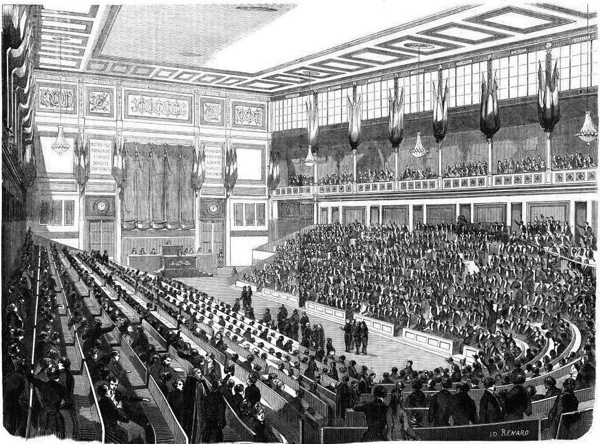
[Interior of Assemblée Nationale in 1848. It seated 900 Deputies.]
FADE IN.
48 EXT. THE EXTERIOR OF THE PALAIS LUXEMBOURG - DAY 48
Opening shot of the imposing exterior of the PALAIS DE
LUXEMBOURG where the Chamber of Peers met during the July
Monarchy and where the socialist National Workshops will soon
have its HQ.
FREDERIC (V.O.)
Legal plunder can be carried out in
an infinite number of ways. This
gives rise to an infinite number of
plans for organizing it, through
tariffs, protectionism, privileges,
subsidies, incentives, progressive
taxation, free education, the right
to a job, the right to a guaranteed
profit, the right to a wage, the
right to public assistance, the
right to be given tools for work,
free credit, and so on. And it is
the combination of all of these
plans, insofar as they have legal
plunder in common, which is given
the name of socialism.
DISSOLVE TO:
49 EXT. A STREET IN PARIS - DAY 49
We can only hint visually at the complex events which led to
the overthrow of King Louis Philippe's government 22-26
February 1848 and the declaration of the Second Republic.
Feb. 22, 1848. A large crowd of protesters with banners are
PROTESTING the ban on political banquets, especially the one
planned for Feb. 22 for Washington's Birthday. As the crowd
marches down the streets agitated soldiers wonder how to
control the crowd. A scuffle breaks out between some of the
protesters and soldiers. SHOTS RING OUT, and some protesters
fall to the ground. The crowd scatters.
CUT TO:
50 EXT. OUTSIDE THE KING'S PALACE - DAY 50
A few hours later an even larger crowd gathers outside the
King's palace demanding action be taken against the troops
for killing the protesters. They are shouting angry things
about the King and call for a new government.
A carriage pulls up at the side of the Palace and an
obviously frightened King with his family get into it and
ride off.
CUT TO:
51 EXT. A BALCONY OF THE HOTEL DE VILLE - DAY 51
Lamartine is standing on the balcony addressing a very large
and happy crowd of people who have gathered in the square in
front of the HOTEL DE VILLE. Standing next to him are 11
other Deputies, including Louis Blanc and Etienne Arago, whom
he has asked to form a Provisional Government now that the
King has abdicated and fled. The balcony is draped with the
tricolour flag of the French Republic.
CUT TO:
52 EXT. A STREET IN PARIS - DAY 52
On a windswept street which is covered in debris following
the protest marches we see a pile of rubbish which is
burning. No one is there, just the burning pile of rubbish.
At the top of the pile someone has tossed King Louis
Philippe's throne. It is identical to the one in the Daumier
cartoon which so intrigued Thomas in Frederic's office. It is
very elaborate, with fine upholstery and gold trim. It slowly
burns and then breaks up and collapses into the pile of red
hot coals.
53 INT. THE FREE TRADE ASSOCIATION OFFICE - DAY 53
Thomas comes running into the office waving a flyer he has
picked up in the street. Gustave and Frederic are there
reading the papers which are spread out all over the desks.
THOMAS
Messieurs! The King has abdicated!
The government has collapsed! We
are a Republic again!
GUSTAVE DE MOLINARI
Vive la république!
FREDERIC
That's fantastic!
They all run out into the street where they see people
milling about, shouting for joy. Some people are putting up
large wall posters announcing the news. "Louis Philippe
abdicates!", "Lamartine announces the formation of a
Provisional Government".
FREDERIC (CONT'D)
This is our chance!
GUSTAVE DE MOLINARI
What do you mean?
FREDERIC
Now that the government has fallen
and before the new government is
formed we have real freedom of
speech! We have to start our own
magazine and get our ideas out to
the people! Are you with me
Gustave?
GUSTAVE DE MOLINARI
Yes, of course.
FREDERIC
Well, let's get started!
They run back into the office and begin writing the first
issue.
GUSTAVE DE MOLINARI
What will we call it?
FREDERIC
"The Republic" of course!
GUSTAVE DE MOLINARI
Of course, how silly of me!
Frederic and Gustave quickly draw up the magazine's statement
of principles. Frederic shouts out the key points and Gustave
writes them down as fast as he can. Adding a few of his own
as he goes.
FREDERIC
"we demand universal suffrage"
GUSTAVE DE MOLINARI
"universal suffrage"
FREDERIC
"We wish that henceforth labour
should be completely free, no more
laws against unions"
GUSTAVE DE MOLINARI
"no more laws against unions"
FREDERIC
"complete liberty of working as
demanded by Turgot nearly 100 years
ago"
GUSTAVE DE MOLINARI
"complete liberty of working"
FREDERIC
"an end to conscription"
GUSTAVE DE MOLINARI
"an end to conscription"
FREDERIC
"complete freedom to trade"
GUSTAVE DE MOLINARI
"free trade"
When they have completed drawing up their statement of
principles to their satisfaction Frederic surveys it.
FREDERIC
Excellent! Now we need to go get
permission to publish it and find a
printer.
GUSTAVE DE MOLINARI
What do you mean, get permission? I
thought censorship has collapsed.
FREDERIC
Maybe, but we don't want to break
the law unnecessarily. It won't
take long to go to City Hall (Hotel
de Ville) and do the paperwork.
Come on!
CUT TO:
54 EXT. A STREET IN PARIS - DAY 54
Gustave, Frederic, and Thomas walk along the street towards
the Hotel de Ville.
The streets are filled with people milling about savouring
the moment. There is shouting. People gather around the wall
posters with the latest news, reading out the headlines and
fervently discussing events as they unfold. When they turn
the corner into the square where the Hotel de Ville is
located they see SCENES OF LOOTING. Armed rioters have seized
control of the building, offices are being ransacked, papers
and furniture are being thrown into the street. There is
complete chaos.
FREDERIC
My mistake! There is no point in
being here now. Paris has complete
freedom of speech for the time
being. What a great day! Let's find
a printer. There are several down
this street.
The three turn down a street where several print shops are
located. People with the same idea they have had are rushing
in and out of print shops with the copy they have written for
their little magazines and newspapers. As they walk down the
street a person thrusts a freshly printed paper into their
hands, shouting "Vive la Rébulique!"
GUSTAVE DE MOLINARI
Damn! Frederic, do see what they
have called their magazine? They've
beaten us to it!
He shows him the title of the paper which reads "The
Republic."
GUSTAVE DE MOLINARI (CONT'D)
What will call ours then?
FREDERIC
"The French Republic" of course!
GUSTAVE DE MOLINARI
Of course, how silly of me!
They come to a print shop and enter it.
CUT TO:
55 INT. A PRINTER'S SHOP - DAY 55
A PRINTER is standing to one side surrounded by a group of
workers who have come to get their little magazine printed.
Frederic calls out to get his attention.
FREDERIC
Monsieur, we would like to have our
small magazine printed!
THE PRINTER
Can't you see I'm very busy right
now.
We can see posters and magazines which are being printed and
collated. They are entitled "The National Workshops will
Guarantee every Frenchman the Right to a Job". Some have the
title "The Organisation of Work" with Louis Blanc's name
underneath.
FREDERIC
But monsieur, it is very urgent!
The printer eventually comes over to Frederic.
THE PRINTER
Let me have a look.
He tears the papers out of Frederic's hands and begins
reading.
THE PRINTER (CONT'D)
Sorry. I'm not printing this
rubbish about free trade.
FREDERIC
What do you mean?
THE PRINTER
I'm a socialist and I'm helping
these workers print their magazine
called "The Organisation of
Labour". I don't want anything to
do with you lot! It's my right, so
go somewhere else!
Frederic, Gustave, and Thomas leave the print shop very
surprised and walk down the street to find another printer's
shop.
CUT TO:
56 EXT. A STREET IN PARIS - DAY 56
Frederic, Gustave, and Thomas have taken up a position on a
street corner where they begin handing our their little
newspaper. They are not alone as other groups are doing the
same thing.
There is a paper called "Friends of the Republic," another
called "The Democrat", and another called "The People's
Constitution."
Thomas and his friends are pasting a large poster with their
declaration of principles on the wall behind where Frederic
and Gustave are standing. The poster reads:
THE FRENCH REPUBLIC.
It is not enough just to change the men who rule us, it is
also necessary to change our ideas.
We demand:
an end to all political and economic privilege.
henceforth labour should be completely free,
no more laws against unions,
complete liberty of working
Universal suffrage.
No more state funded religions
Freedom of commerce
The elimination of taxes on food
Let us live our lives at the lowest possible prices!
No more conscription
labour exchanges for the workers to find jobs
respect for private property
let us fraternize with all the people of the world,
let liberty, equality, and fraternity be the law of the
world!
PASSERSBY come up to Frederic and Gustave to talk to them
about their ideas. They get into arguments.
PASSERBY 1
But the government ought to be on
the side of the workers not the
bosses! It should give jobs to
anyone who wants to work.
FREDERIC
No. The government should not take
one side or the other. It should
leave people alone to go about
their business.
PASSERBY 1
The workers are too weak. They need
help from the government.
PASSERBY 2
They've been on the side of the
bosses for too long. It is our turn
now!
CUT TO:
57 EXT. A BARRICADED STREET IN PARIS - DAY 57
A shout further up the street can be heard above all the
discussion.
UNSEEN PERSON
The soldiers are coming! To the
barricades!
Suddenly people disappear from the street which a moment ago
had been full of activity. Windows on the upper levels of
building are opened and pieces of furniture and other
household ITEMS ARE THROWN INTO THE STREET. People emerge
from side streets with stones and iron railings from fences
which they add to the growing pile in the middle of the
street. An empty coach appears out of nowhere, is overturned
and added to the pile of debris. A group of men come out of a
building with a long iron chain which they wrap around the
barricade, pull it tight and then tie the entire mass into a
more solid structure.
This is happening up and down the street and Frederic,
Gustave, and Thomas find themselves trapped between two
barricades. They can hear GUNSHOTS coming from a street a few
blocks away
A MAN who seems to be in charge of building the barricade
comes up to them and says:
MAN AT BARRICADE 1
The troops have been sent out to
crush the revolution. You have a
choice either to help us or get out
of the way. Do you support the
Republic or not?
FREDERIC
I support the Republic!
MAN AT BARRICADE 1
Then, pick up some paving stones to
add to the barricade!
The three of them start pulling up street paving stones as
they see others around them doing.
The sound of GUNSHOTS becomes louder and they can see over
the barricade that soldiers are moving down the street. They
have SNIPERS who are shooting protesters in the windows of
the apartments above them. The protesters also have snipers
who fire back killing several soldiers. There is a massive
volley of gunfire. Several people on the barricade are
killed, others are wounded and lie bleeding in the street.
The shooting stops for a moment and Frederic sees an OFFICER
further up the street and calls out to him.
FREDERIC
Can we call for a cease fire!
OFFICER 1
Who is that?
FREDERIC
A citizen! Can we have a cease fire
so we can attend to the wounded?
OFFICER 1
Yes. Ten minutes.
Frederic, Gustave, and Thomas help others drag THE DEAD AND
INJURED into a side street. There are over a dozen dead, and
a similar number of wounded who are propped up against a
wall. The cease fire goes on for longer than 10 minutes.
Frederic asks the barricade leader:
FREDERIC
What is happening?
MAN AT BARRICADE 1
The soldiers seem to have
retreated. I think we have won. The
Republic has won!
Frederic surveys the devastation in the street, the glass
from the BROKEN WINDOWS, and the leaflets which litter the
street.
CUT TO:
58 EXT. A STREET IN PARIS - DAY 58
A MASSIVE PUBLIC FUNERAL is taking place for the people who
were killed by troops in the first couple of days of the
Revolution. There are tricolour flags everywhere, banners
declaring support for the Republic, and bands are playing la
Marseillaise and other revolutionary songs.
CUT TO:
59 INT. LUXEMBOURG PALACE - DAY 59
27 February 1848. A large group of men some of them armed,
chanting slogans and carrying banners which state "Long Live
the National Workshops" and "The Right to a Job for every
Frenchman", enter and SEIZE CONTROL of the enormous
Luxembourg Palace, the seat of the old Chamber of Peers. They
clear the building of the few people who were there and begin
setting up shop to run the National Workshops program.
Louis Blanc and ALBERT take charge directing a group of
workers who are busy writing decrees which will be plastered
on walls all over the city.
We see Blanc leave the group and walk alone through the empty
corridors and rooms of the magnificent palace which once
housed the aristocratic Chamber of Peers, but which is now
home to radical socialist agitators. As Blanc walks through
the rooms he sees and hears some of the ghosts of the
recently departed Peers who seem to still haunt the building.
He enters one room and sees A LARGE OBJECT DRAPED IN CLOTHS.
He is curious about it and lifts up a corner of the cloth to
see Delacroix's painting "Liberty Leading the People" which
has been hidden away as if it now shamed the King to have it
on display.
CUT TO:
60 EXT. THE COURTYARD OF THE LUXEMBOURG PALACE - DAY 60
Several groups of men set out in different directions to put
up the posters which say, "The Commission for Labour decrees
a Work Day limit of 12 hours"; "All unemployed men are to
report to the mayors of their districts for allocation to
work brigades. Guaranteed Pay of 2 francs per day", etc.
The next day a DEMONSTRATION OF A FEW THOUSAND PEOPLE gather
in the courtyard of the Luxembourg Place. They are provided
with large banners which say "We have a Right to a Job". They
begin marching through the streets chanting and waving their
banners.
CUT TO:
61 INT. LUXEMBOURG PALACE - DAY 61
Louis Blanc is in the old speaker's chair in the main chamber
of the Palace where the Peers used to debate. The director
Albert is with him. Behind him there is a semi-circle of
statues of famous French politicians and statesmen.
The camera surveys the STATUES focusing on the one at the far
left, the supporter of free markets TURGOT, and the one in
the middle, COLBERT who advocated centralised power and
government regulation of the economy. Louis Blanc is
addressing the inner circle of his supporters.
LOUIS BLANC
We have to keep the pressure on the
Provisional Government. Lamartine
is weak and is afraid of a public
backlash. We are one of the few
groups which can get thousands of
angry people out into the streets
at a moment's notice. The
Provisional Government created the
Committee for Labour but they have
no idea what our real aims are.
ALBERT
It shouldn't come as a surprise to
them as we have been quite open
about our goals. Another edition of
Blanc's book Organisation of Labour
is being printed and we will begin
circulating copies as soon as they
are delivered.
LOUIS BLANC
Albert and I have drawn up a
statement of principles which we
will distribute now for private
internal discussion among us.
He indicates to an assistant to hand out the paper
LOUIS BLANC (CONT'D)
It is too soon to present this to
the Provisional Government for
discussion. After the elections in
April when we have consolidated our
political position we will put this
forward for formal discussion.
There is a buzz of excitement around the room as people begin
to read the leaflet. Blanc begins to read out the list of
proposals.
LOUIS BLANC (CONT'D)
We will create a new Ministry for
Labour whose mission will be to
prepare us for the next stage of
the social revolution which will
lead us gradually to the abolition
of the proletariat as a class.
We will also create a Ministry for
Economic Progress whose task will
be to nationalise in the hands of
the State all landed property, the
railways, the mines, and the
insurance industry. It will also
create huge warehouses in which
every manufacturer and producer
will deposit the things they make
to be sold at prices determined by
the state and managed by state
functionaries. The producers will
be paid with paper money issued by
the central state bank. All profits
made by state enterprises like the
railways will be paid to the
Ministry of Labour to be
distributed to the workers. To be
eligible for these payments workers
associations must be placed under
the control of the state and
organised in a collective and
fraternal manner. All wages and
prices will be set at a uniform
level by a commission established
by the state for this purpose. This
will ensure that there is no
harmful competition between
workshops in the same industry. The
capital acquired by society will be
allocated by an administrative
council which will thus control the
reins of industry. The State will
bring about the realisation of this
legal plan to build socialism
through successive stages without
assaulting any person. It will
provide the model for private
associations which will continue to
exist in parallel with it. However,
we are convinced that, such will be
its attractiveness, that the State
will attract into the orbit of its
power, all rival systems of
economic organisation. Then we will
have realised our ultimate goal of
ridding the world of private
property, wage labour, profit,
interest, and rent.
CUT TO:
62 INT. GUILLAUMIN'S OFFICE - DAY 62
Early March 1848. There is an emergency meeting of the
Economists at the Guillaumin HQ to rethink their political
strategy.
FREDERIC
This is madness! After four years
hard work you want to shut it down!
We haven't finished our work yet!
GUILLAUMIN
But Frederic! Everything has
changed with the Revolution! We
have to drop the free trade
movement and focus on the new
threat of socialism.
GUSTAVE DE MOLINARI
We completely underestimated the
power of the socialists to get
people into the streets. Don't you
see we have to focus on them now,
Frederic.
FREDERIC
But the protectionist oligarchy
hasn't gone away. They are still
out there.
GUILLAUMIN
Yes, but they are in disarray. They
were caught unawares just as we
were. We have to counter the most
pressing threat which is Louis
Blanc and his supporters in the
Luxembourg Palace. He is putting
considerable pressure on the
Provisional Government. To make
things even worse, Chevalier has
been sacked as a professor at the
College de France.
FREDERIC
How could they do that?
GUILLAUMIN
They decided to "reorganise" the
teaching of economics so socialist
economics could be taught alongside
free market economics. They said
they wanted "to teach the debate".
FREDERIC
That's a disaster.
GUILLAUMIN
Yes. Say is heading up a delegation
to see Lamartine and urge that he
be re-appointed, but it will take a
while. In the meantime we have lost
one of our most important positions
of influence. So, we have to
completely rethink our strategy to
oppose the socialists.
FREDERIC
Not all the people have gone over
to the socialists. We met lots of
good people on the streets who just
wanted freedom of speech and lower
food prices. They weren't
socialists by any means!
GUSTAVE DE MOLINARI
But they are listening to what the
socialists are saying about the
right to a job and the need for
government funded relief in times
of hardship. We have to counter
that.
GUILLAUMIN
I'm not saying we forget the free
trade movement. We just rearrange
our priorities for the time being.
We will come back to free trade
later.
FREDERIC
When?
GUILLAUMIN
When things have settled down.
Maybe after the elections in April.
FREDERIC
I still can't believe you want to
do this, after all that I have
done.
GUILLAUMIN
There are other things you can do
Frederic. You've attacked the
socialists before in your sophisms.
You should do more of that.
GUSTAVE DE MOLINARI
We also need to take advantage of
the collapse of the censorship
laws. We can debate the socialists
on the streets on their own terms.
Political Clubs are springing up
all over the city. We can start our
own. Coquelin even has a name for
it.
FREDERIC
What is it?
GUSTAVE DE MOLINARI
The Club for the Liberty of
Working, or "Club Lib" for short.
CUT TO:
63 EXT/INT. A STREET IN PARIS - NIGHT 63
The camera pans down a street in Paris where several of the
new POLITICAL CLUBS are located. In the building which
contains the Salle de Montesquieu, where the Free Trade
Association once held its meetings, there is now a SOCIALIST
CLUB called the "Icarian Socialists Club". A large banner
announces "Join the Icarian Socialists Model Community in
Texas". ETIENNE CABET is speaking before a small audience:
ETIENNE CABET
Brothers! The best hope for
socialism is not here in Paris but
in the vast expanses of Texas. We
have land there and an advance
party of socialists has already
begun the task of building a model
socialist community in the new
world. Join them! Leave this
Babylon of Paris behind and start
anew! Texas will soon become a
socialist paradise!
CUT TO:
64 INT. CLUB LIB MEETING ROOM - EVENING 64
The camera moves further down the street and we see another
Club called "The Club for the Emancipation of Women". A
banner says "Women must have the Right to Vote". A woman is
speaking before a much larger crowd of men and women, but the
camera does not linger so we can hear what she is saying.
The next Club on the street is "The German Workers Club"
which is filled with German workers who live and work in
Paris. A banner announces "The Manifesto of the Communist
Party: Workers of the World Unite!" A heavily bearded man,
KARL MARX, can be heard addressing the group:
KARL MARX
We ally ourselves with the more
advanced French socialists such as
Louis Blanc and the Social
Democrats in the Chamber. Many of
our demands are similar to theirs.
We call for the abolition of
property in land and land rent, a
high and progressive income tax,
the centralisation of credit in the
hands of the state, the ownership
and centralisation of the means of
communication and transport in the
hands of the State, the expansion
of state owned and run factories,
the creation of industrial armies,
especially for agriculture, and
free education for all children in
public schools
We openly declare that our ends can
be attained only by the forcible
overthrow of all existing social
conditions. Let the ruling classes
tremble at a Communistic
revolution. The proletarians have
nothing to lose but their chains!
The next Club revealed by the camera is Louis Blanc's
"Socialist Workers Club" where we see Blanc addressing a
group but we do not listen in. We can see his banners and
slogans draped across the front of the hall. The camera then
passes to show the meeting place of the Economists' "CLUB FOR
THE FREEDOM OF WORKING". The banner on the front wall of the
hall states "The Freedom to Work is the Right of every
Worker". Joseph Garnier, Frederic, and Gustave are the
speakers.
GARNIER
The socialists have correctly
identified some serious problems in
French society, such as the high
price of food and the difficulty of
getting good jobs.
There is jeering by some socialists in the audience.
GARNIER (CONT'D)
But they are completely wrong about
what causes these problems!
More jeering.
GARNIER (CONT'D)
The high price of food is caused by
tariffs on imported wheat which
keeps the price of bread high, or
by government taxes on salt and
wine, which we know are essential
for the well-being of the French
worker!
There are spirited cheers from the audience.
GARNIER (CONT'D)
So, to lower the price of food we
desperately need free trade so we
can buy the cheapest food wherever
it might be in the world. From
America, from the Crimea, even from
England!
There is boo-ing at the last mentioned country.
GARNIER (CONT'D)
My friend and colleague Frederic
Bastiat will tell you why good jobs
are so hard to get.
There are some cheers for Frederic as he is known by some in
the audience.
FREDERIC
Ladies and Gentlemen!
(there are a few women
present in the audience)
The most precious thing you or
anyone else has is their own body
and the labour which they create
with their body. But why does the
government stop you from using your
own body and your own labour as you
see fit?
PERSON IN AUDIENCE 1
Tell us then! Why does it?
(there is some laughter and
jeering)
FREDERIC
I'll tell you friend! Because for
decades the government has not let
workers work without having a
workbook which their employer has
to sign and the police have to
check every time they see you on
the street. You are slaves to the
workbook!
There are loud cheers of agreement from the audience.
FREDERIC (CONT'D)
The government will not let you
work at any trade you like. You
cannot be a butcher or a baker
unless the government gives you a
licence!
There are boos from the audience.
PERSON IN AUDIENCE 2
What about a candlestick maker?
There is much hilarity at the comment.
FREDERIC
Friend, I'm glad you ask! I have
written a paper on that very
question. The candlemakers don't
have to work too hard. They just
get an exclusive licence from the
government! Something you can't do!
The debate and repartee continues in this vein for a while
until the meeting comes to a close and people begin to file
out. It is very noisy in the hall as the debate has stirred
up a lot of interest. As the last of audience leaves the hall
Joseph, Frederic, and Gustave pack up their pamphlets and
banner. They are met by A GROUP OF THUGS. One of them pushes
Gustave who drops his bundle of papers.
GUSTAVE DE MOLINARI
What the hell are you doing!
COMMUNIST THUG 1
You have no right to be here. You
are not a real worker.
GUSTAVE DE MOLINARI
I have every right! Who are you?
TWO OF THE THUGS step between Gustave and Frederic and
Joseph. The first thug grabs Gustave by the hands, twists
them hard, and looks at his nails. Gustave cries out in pain.
COMMUNIST THUG 1
Just as I thought. You don't have
the hands of a worker! Get out of
here!
The three communist thugs push the economists to the ground,
kick their pamphlets into the street, rough up Thomas, and
then leave. The economists did not fight back. They are dirty
and dishevelled and Gustave and Thomas have bloody noses.
Louis Blanc sees this violence from the adjoining hall and
comes over to speak to the economists.
GUSTAVE DE MOLINARI
See what your communists thugs have
done! So much for socialists
supporting the freedom of speech!
LOUIS BLANC
I don't believe in violence and
have never advocated it. I don't
know who these people are. I've
never seen them before. Can I help
you?
GUSTAVE DE MOLINARI
Leave me alone!
FREDERIC
Thank you Louis. He is just a bit
shocked.
LOUIS BLANC
It shocked me too.
FREDERIC
The danger is that you and your
socialist friends have raised the
expectations of so many of the
unemployed that they now expect the
new government to solve all their
problems for them.
LOUIS BLANC
And why shouldn't it?
FREDERIC
Because it can't without taking
other people's property.
LOUIS BLANC
Then so be it!
Louis Blanc walks off as the economists pick themselves up
and get their things in order.
CUT TO:
65 EXT. PUBLIC SQUARE IN MUGRON - DAY 65
Early April 1848. As part of the new strategy adopted by the
Economists Frederic is STANDING FOR ELECTION to the
Constituent Assembly of the new Second Republic to be held on
22 April. He has returned to Mugron to campaign under the new
electoral law which has granted universal manhood suffrage.
We hear him giving a speech in the square of Mugron on
political and economic freedom and the dangers posed by high
taxes and socialist schemes.
FREDERIC
Citizens of Mugron! Last time we
had an election here only the
wealthiest tax payers were allowed
to vote. This "electoral class",
this dreadful oligarchy, were able
to control the Assembly for their
own purposes. Now thank goodness,
the rule of this class has been
broken and all the people can vote.
It is now up to you to see that
people like me can represent your
interests for the first time in
many decades.
There are cheers from the crowd of electors in the square.
FREDERIC (CONT'D)
My activities in Paris over the
past few years show exactly what I
stand for and how I will represent
your interests. I have argued for
free trade, which will assist our
region in finding new markets for
our wine; I have opposed high taxes
on food and other essential
products which oppress the poorest
members of our community, I have
lobbied hard in the local Council
for a complete reassessment of the
tax burden which is based on
decades old and out of date tax
assessments;
and most particularly in the recent
revolution I have taken the
strongest possible stand against
socialism and for the protection of
the property rights of all
individuals. I will continue to do
this if you elect me as one of
representatives in the coming
election.
CUT TO:
66 INT. BASTIAT'S HOUSE IN MUGRON - EVENING 66
Sometime later, Frederic is with his neighbours having a
drink and reminiscing abut old times before he went to Paris
while they wait to hear the election results.
FELIX
How are your nerves holding up
Fredreric?
FREDERIC
Quite well. This wine helps!
FELIX
I think you should be confident.
People are impressed with what you
have done in Paris over the past
few years. They understand you
appreciate the needs of our region.
FREDERIC
I just hope they appreciate the
danger if the socialists do well in
the election.
A messenger comes up to the front door of his house with news
about the vote count.
MESSENGER
May I come in? We have news about
the vote count.
FREDERIC
Please, come in!
MESSENGER
M. Bastiat you came 2nd with 56,445
votes. You will be one of 7
representatives for our district.
FREDERIC
That's wonderful! How did the
socialist candidates do?
MESSENGER
They did very badly. Not one was
elected in our district. I don't
know about Bordeaux. It is too soon
to tell.
FELIX
Well done Frederic!
Congratulations.
CUT TO:
67 INT. CONSTITUENT ASSEMBLY HALL - DAY 67
Early May 1848. The 900 Deputies in the newly elected
Constituent Assembly gather in the Chamber of the Palais
Bourbon. There is a lot of noise as they take their seats. We
see the song writer BéRANGER taking his seat as well as some
of the other Economists who were successful in the election,
such as Alexis de Tocqueville, Wolowski, Faucher. Frederic
takes his seat between the two main blocks of delegates. To
the right is the majority faction of conservatives and
monarchists all of whom are very well and fashionably
dressed. To the left is the smaller group of socialists and
radical republicans like Louis Blanc, Victor Considerant, and
Proudhon who are wearing different types of city worker or
country farmer styles of clothes. They have not done as well
as they had hoped in the election. Frederic sits with a group
of moderate republicans and liberals in the middle, like
Lamartine, who are suitably dressed in middle of the road
attire. The SPEAKER OF THE ASSEMBLY bangs his gavel and calls
the assembly to order.
SPEAKER OF THE ASSEMBLY
I call upon the member for Les
Landes and Vice-President of the
Chamber's Finance Committee,
Citizen Bastiat to address us on
the question of tax reform. Citizen
Bastiat has the floor!
FREDERIC
Today it is my task to report to
you the conclusions of the Finance
Committee. As you know, the
Revolution of February, barely two
months ago, caused an economic
recession in our country which
continues to this day.
The uncertainty caused by the
collapse of the Monarchy, the
brutal repression of the people,
and the collapse of the stock
market has resulted in a serious
decline in tax revenue and a
significant increase in
unemployment. The initial reaction
of the Provisional Government was
to launch the National Workshops in
order to put the unemployed to work
and to increase direct taxes on
ordinary working people by 45%.
Both these measures have been an
utter disaster.
There are boos and catcalls from the socialists on the left;
shouts of abuse from the right at the socialist deputies.
FREDERIC (CONT'D)
Instead of cutting government
expenditure across the board,
including measures such as an end
to all government subsidies to
industry and bailouts for the
railway companies,
There are now boos and catcalls from the conservative right;
and abuse from the socialist left at the conservatives.
FREDERIC (CONT'D)
And cutting taxes on the poorest
members of our society, especially
on food,
There are cheers from the left.
FREDERIC (CONT'D)
The government has done the
opposite. Unless we can agree on
the right mix of tax cuts and
expenditure cuts, the economic
crisis will continue and I fear
another explosion of discontent
such as we witnessed in February.
The Chamber breaks down into name-calling from both sides as
the Speaker tries to restore order.
CUT TO:
68 INT. CHAMBER COMMITTEE MEETING ROOM - DAY 68
A meeting of the Chamber's Finance Committee is underway in
the same meeting room where Frederic and the economists
discussed tariff reform unsuccessfully with Thiers the
previous year. Frederic is presenting the case for taking
radical and immediate action to solve their budget problems.
FREDERIC
Gentlemen, we have reached a
breaking point. We have to do two
nearly impossible things to save
our financial situation. We have to
cut taxes on ordinary working
people and we have to cut spending
massively just to balance the
budget. The biggest single item of
expenditure is the military which
costs us fr. 400 million every year
and this cries out for cuts.
There are murmurs of strong disagreement from Members of the
Committee.
FREDERIC (CONT'D)
My suggestion is an immediate cut
of fr. 100 million followed by an
attempt to negotiate a treaty with
England for mutual disarmament,
which would allow us to make
further cuts in the future.
FINANCE COMMITTEE MEMBER 1
Citizen Bastiat I think that is
unacceptable at the moment given
the widespread suspicion of
England's motives at this time.
FINANCE COMMITTEE MEMBER 2
I agree.
FREDERIC
Well, the newest expenditure which
is rapidly getting out of control,
is spending on Louis Blanc's
National Workshops. The initial
prediction for the number of
unemployed we would have to support
in Paris was 10,000. This has
ballooned to over 100,000 and there
is no end in sight. I urge that
this boondoggle be closed down
immediately.
FINANCE COMMITTEE MEMBER 2
Now that is more acceptable!
There are murmurs of agreement among the committee members.
FREDERIC
If we cut this relief program we
have to offer the poor people of
France something it return,
otherwise the burden does not fall
equally. I suggest an across the
board cut in tariffs on food and
clothing to 10% by value so these
essential items are cheaper to buy.
FINANCE COMMITTEE MEMBER 1
The conservative block will never
agree to that. You know tariff
reform failed last year, so why do
you think it would pass today?
FREDERIC
Because we are in a crisis and
something drastic has to change or
we face catastrophe.
FINANCE COMMITTEE MEMBER 1
I suggest we call for a vote on the
measures we will recommend to the
Chamber.
FREDERIC
All those in favour of cutting the
military budget by 25%?
Only 3 out of 10 Committee members vote for it.
FREDERIC (CONT'D)
All those in favour of cutting
tariffs to a maximum of 10% by
value?
Only 2 out of 10 Committee members vote for it.
FREDERIC (CONT'D)
And all those in favour of
scrapping the National Workshops
program immediately?
This time 8 out of 10 Committee members vote for it.
FREDERIC (CONT'D)
I have to say I am disappointed in
you gentlemen.
We have to move faster and harder
on this than you seem to realise.
CUT TO:
69 INT. CONSTITUENT ASSEMBLY HALL - DAY 69
May 15 1848 and Frederic is giving his Report to the Chamber
on the Finance Committee's recommendations to solve the
budget crisis.
FREDERIC
So, in conclusion Fellow Deputies,
the near unanimous recommendation
of the Finance Committee is that
the unsupportable financial demands
of the National Workshop program be
brought to an immediate end, that
the program be wound up, and that
the Chamber use the savings to
balance the budget and to look for
ways to cut taxes in order to
relieve the burden on the poorest
people in our community.
There are boos and calls of "shame" from the left benches and
applause from the right benches.
The Speaker of the Chamber is about to call for vote on the
Committee's recommendation when there is a noise at the main
entrance to the Chamber and A GROUP OF ARMED MEN force their
way in.
INTRUDER 1
In the name of the people and the
Luxembourg Commission for Labour we
demand that the Assembly
immediately resign and hand power
over to a new Provisional
Government!
DEPUTIES IN THE CHAMBER
(from nearly all the
Deputies)
Get out of here! Guards! Have these
men removed immediately.
Frederic is stunned and remains on the podium not knowing
what to do next. The intruder goes to the podium and pushes
Frederic roughly aside. He raises his rifle and threatens the
Deputies. The other intruders move to block the exit and to
take up strategic positions around the Chamber.
INTRUDER 1
Quiet! I have two further demands.
The first is that the new
Provisional Government pass a
decree pledging financial and
military support for our comrades
in Poland who are fighting their
oppressors and wish to follow the
glorious example of our nation in
building a new society for all its
citizens.
DEPUTIES IN THE CHAMBER
(from the right benches)
Never!
(from the left benches)
Bravo!
INTRUDER 1
Our third demand is that the new
Provisional Government promise to
protect the integrity of the
National Workshops at all costs.
DEPUTIES IN THE CHAMBER
(from the right benches)
This is madness!
(from the left benches)
Hear! Hear
There is more commotion as a group of armed protesters enter
the Chamber CARRYING LOUIS BLANC ON THEIR SHOULDERS. A cheer
breaks out among the socialist deputies when they see who it
is. Blanc is uncomfortable being carried around the Chamber
as he did not want to enter the Chamber in this way but is
powerless to stop them.
After making a circuit of the Chamber the intruders put Louis
Blanc down. By this time armed guards appear and begin
arresting the intruders. They are surrounded, disarmed, and
the spokesman at the podium is pulled down and arrested.
There is much shouting but no shooting. The intrudes are all
removed from the Chamber at gun point.
When the noise dies down and order begins to be restored, the
Speaker steps up to the podium.
SPEAKER OF THE ASSEMBLY
Gentlemen! I apologise for the
intrusions. Now perhaps some of you
can see what we are up against.
There are boos and catcalls from the left benches.
SPEAKER OF THE ASSEMBLY (CONT'D)
Before we disperse, I want to call
for a vote on the recommendations
of the Finance Committee as
presented by Citizen Bastiat. All
those in favouring of immediately
closing the National Workshops
program?
DEPUTIES IN THE CHAMBER
(there is a deafening and
overwhelming cry)
Aye!
SPEAKER OF THE ASSEMBLY
I think the "ayes" have it.
Assembly adjourned!
CUT TO:
70 INT. FREDERIC'S OFFICE AT GUILLAUMIN HQ 70
Mid-June 1848. Frederic, Joseph, Gustave, and Thomas are in
Frederic's office planning their next step.
GUSTAVE DE MOLINARI
The word on the street is that
Louis Blanc and his socialist
friends are planning a big
demonstration at the end of the
week to protest the closing of the
National Workshops. This could get
really nasty.
FREDERIC
I don't think Louis Blanc was
behind the invasion of the Chamber.
That was done by some of his
hothead supporters.
GARNIER
Yes, but he put the idea in their
heads that the state owed them a
job and a living at taxpayer
expence.
FREDERIC
True enough I suppose. Even though
his solutions are wrong he has
tapped into a lot of popular
resentment about the lack of jobs
and the high price of food. We have
to counter that somehow.
GARNIER
What do you have in mind? Another
magazine?
FREDERIC
Precisely!
GUSTAVE DE MOLINARI
Will you never learn?
FREDERIC
We have to appeal to the people
directly. Otherwise the socialists
will have won the war of ideas.
GUSTAVE DE MOLINARI
We tried that already, and where
did that get us?
FREDERIC
No we didn't. We appealed to the
average newspaper reader not the
average person in the street. This
time we will write from his or her
perspective. This time we will call
it "Jacques Bonhomme" or "Jack
Everyman" and write about events as
if Jacques Bonhomme himself were
describing them. Short and simple
and in the vernacular of the
street.
GARNIER
It might work.
FREDERIC
It will this time. I'm sure! I've
already written a couple of
articles which can also double as
wall posters. Thomas, you can put
them up as you are now an expert at
that sort of thing! Aren't you?
THOMAS
Yes, monsieur.
(he says a bit reluctantly)
FREDERIC
Good! Take a look at this one. I am
offering a prize of 50,000 francs
for the best definition of the
state anyone can come up with.
GARNIER
You are kidding! You don't have
50,000 francs.
FREDERIC
I know. It is a bit of poetic
license! But I want to get people's
attention. I want them to think
about the fact that the state can't
give anybody anything without
taking it from someone else first.
It can't be a universal big father
or big brother who can take care of
everybody's every need. That is a
great fiction which must be
dispelled!
GUSTAVE DE MOLINARI
Good luck with that!
FREDERIC
I also have another which will make
a great wall poster. A list of the
reasons why the National Workshops
are a bad idea for the country and
for ordinary people.
THOMAS
Monsieur, if I paste that up on the
walls they will only get torn down
again.
FREDERIC
Most likely. We'll just have to get
more printed then.
CUT TO:
71 INT. LUXEMBOURG PALACE - DAY 71
There is a meeting taking place in the Luxembourg Palace
between Louis Blanc and the leadership of the protests.
LOUIS BLANC
We must defend the National
Workshops at all cost. You know
that. If we can get enough people
out in the streets to protest we
can put pressure back on those
spineless bastards in the Assembly
who are trying to close us down.
There are 100,000 on the Workshop
payroll and many more sympathisers
among the working class. The people
know how to build barricades, just
help them get motivated. Tell them
that the National Workshops are a
kind of insurance which anyone of
them might need one day in the
future when the economy goes bad.
If the government takes this away
then who knows what else they will
take from the working people of
this city. To add insult to injury
they are threatening to conscript
all those working in the National
Workshops into the army and send
them by force out into the
countryside. Spread out, don't
confront the troops head on. With
any luck they will make the same
mistakes as they did in February
and get cut off down the side
streets. Oh! One last thing. If you
see any wall posters or flyers from
Bastiat's free trade group. Tear
them down.
The team leaders move out into the parade ground where people
are gathering to form a large coordinated protest through the
streets. They have banners which state "Save our National
Workshops!" and "We have the Right to Work" and "To each
according to his Needs!".
As the groups form up ready to march out into the streets the
camera shows us a final fleeting glimpse of Delacroix's
iconic painting "Liberty leading the People" draped in cloth
and hidden from public view.
CUT TO:
72 EXT. A STREET IN PARIS - DAY 72
June 22, 1848. There are four different sets of activity
which come together on this day: the street marchers
organised by Blanc's Luxembourg Commission of Labour
protesting the closure of the National Workshops; other
groups who are erecting hundreds of barricades across the
streets of Paris in a reprise of February, some of whom
support the protest against the closure of the Workshops and
others who are unhappy about the bad economic condition
France is in; Frederic's group of economists who are on the
streets with their new magazine "Jacques Bonhomme" protesting
about the protesters;
and the soldiers who are getting into position with their
rifles and artillery to crush the rebellion once and for all.
First we see a large group of SEVERAL HUNDRED PROTESTERS from
the Luxembourg Commission marching down a street with their
banners and shouting "Save the National Workshops" and "We
have a Right to a Job".
Next we see shots of BARRICADES being erected in street after
street (as described earlier). A bird's eye view of these
streets shows how extensive the barricade building is (there
are over 1,000 barricades across the city), with men, women
and children assisting in their construction.
Then we see TROOPS MASSING at the ends of the major
boulevards but not doing anything for the time being.
Ominously, we see DOZENS OF ARTILLERY PIECES being drawn up
along with wagon loads of shells.
Finally we see Gustave, Frederic, and Joseph at an
intersection begin handing out their newly printed magazine
"Jacques Bonhomme". As they hand out their sheets we see some
of the passersby shaking their heads and throwing the sheets
away as they go about their business.
For comedic relief, we see Thomas starting to paste up the
new wall posters. One of them is "The State" which says:
"What is the State?
Does the STATE have bread for every mouth, milk for every
child, work for every arm, capital for every businesses, balm
for every suffering, and answers to every question?
NO of course not. The state is the great fiction by which
everyone endeavors to live at the expense of everyone else.
It gives with one hand but takes with two!
Don't be duped by the socialists!"
The second one is Frederic's critique of the National
Workshops:
"Close the National Workshops Now!
The National Workshops do not Provide real jobs for real
workers! They pay you a pittance to dig ditches for the
government and fill them in again.
Real jobs come from a thriving economy which is open, free,
and growing.
The National Workshops are bankrupting France and destroying
the economy.
End them Now!"
As Thomas rounds the building he disappears from sight and
pro-Blanc supporters appear and begin RIPPING DOWN HIS
POSTERS.
When Thomas comes back to his starting point he sees what
they have done, shrugs, and begins posting them up again.
A short time later we see Thomas and Frederic alone working a
street where a hastily built barricade has suddenly appeared
in the middle of the street. Frederic is asking the people on
the barricade why they are doing this.
FREDERIC
Citizen! Do you support the
National Workshops? Is this why you
are building the barricade?
MAN AT BARRICADE 1
Not really. I feel sorry for those
out of work but we can't really
afford to support them like this.
It is not as though we are teaching
them a productive trade for the
future.
FREDERIC
So why the barricade?
MAN AT BARRICADE 1
I'm sick of the taxes, I'm sick of
the corruption, I'm sick of the
squabbling in the Chamber. Nothing
is getting done to help people like
me. I've had enough. Things have to
change.
FREDERIC
Yes they do.
GUNFIRE can be heard nearby.
MAN AT BARRICADE 1
Quick! Take cover. They are coming
now.
We can see men and women running down the street towards the
barricade. Some are carrying banners with their protest
slogans "We have a Right to a Job" and "Save the National
Workshops" which they throw to the ground as they run. The
barricades consist of paving stones, overturned carriages,
broken doors, furniture and other debris all chained
together.
A group of protesters on the barricades begin to chant "GIVE
US BREAD, OR GIVE US LEAD!" taunting the soldiers as they
approach
The soldiers move down the street firing at the people on the
barricade. Behind them other soldiers are setting up an
ARTILLERY PIECE which is aimed at the barricade. Some of the
protesters run into the side streets as soldiers fire volleys
of rifle fire and the occasional artillery shell which hits
the barricade. The soldiers fire methodically at the people,
injuring some and killing others. Men begin firing back at
the soldiers from the side streets and the windows of the
upper stories of the houses along the street. Some people
throw furniture and stones out of the windows onto the
advancing soldiers.
We see Frederic and Thomas clutching the stack of newspapers
they were handing out on the street, running towards the
barricade to seek shelter. Thomas drops his bundle of papers
and stops to retrieve them:
FREDERIC
No! Leave them!
As Thomas fumbles about trying to pick up the papers FREDERIC
IS HIT in the upper arm by a bullet and collapses behind the
barricade. As he looks to see what happened to Thomas he is
hit in the face by flesh and blood (perhaps some brain
tissue) from THOMAS WHO HAS BEEN KILLED BY A BULLET TO THE
HEAD.
FREDERIC (CONT'D)
Thomas, oh no! What have they done
to you? What have I done?
He grabs Thomas body clutching it to him and then falls back
onto the barricade losing consciousness from shock and loss
of blood.
CUT TO:
73 EXT. A STREET IN PARIS - DAY 73
As Frederic lies on the barricade holding the dead body of
Thomas the camera shows a bird's eye view of the devastated
streets of Paris with hundreds of abandoned and partly
destroyed barricades.
This time the soldiers have been successful and the
protesters with their barricades have been defeated by
coordinated artillery fire and more disciplined deployment of
the troops.
We see a group of soldiers rounding up a group of dishevelled
protesters and lining them up against a wall in a side
street. An officer gives the command and they are all
SUMMARILY EXECUTED.
Later, we see a group of soldiers who have arrested a man who
they are roughing up and threatening TO SHOOT WITH A REVOLVER
HELD TO THE HEAD. We see it is Louis Blanc who is very
frightened. They do not shoot him but arrest him and drag him
off.
Later we can see people cleaning up the DEBRIS AND BROKEN
GLASS; squads of solders and police leading away groups of
arrested men; wagons carrying off the bodies of the dead
protesters.
CUT TO:
74 INT. DOCTOR'S SURGERY - DAY 74
After the riots Gustave is helping the injured Frederic to a
doctor's surgery. He has lost a lot of blood and has injuries
to his face and upper arms.
FREDERIC
(very distraught)
What is happening to Thomas?
GUSTAVE DE MOLINARI
I got you away as fast as I could
before the soldiers came. They took
his body away with the others.
FREDERIC
He's dead?
GUSTAVE DE MOLINARI
Yes. A lot of that blood on you is
his, poor boy.
FREDERIC
I must see his body! I'm
responsible for him.
GUSTAVE DE MOLINARI
After you are through with the
doctor I'll go and ask the soldiers
if we can have the body for burial.
Here we are.
They enter the doctor's surgery where other victims of the
shooting are being attended to.
GUSTAVE DE MOLINARI (CONT'D)
It is your turn.
Frederic is helped into the surgery and the examination
begins.
DOCTOR
You have lost quite a lot of blood
but a few stitches and some rest
will see you right. Nothing too
serious. No bones are broken. Do
you have any other pain? I see you
cough quite a lot.
FREDERIC
Yes. In my throat.
DOCTOR
Let me take a look.
He begins feeling Frederic's throat and becomes very
interested when he feels a lump.
DOCTOR (CONT'D)
How long have you had this lump?
FREDERIC
A couple of years. I sometimes have
trouble swallowing and speaking for
long periods can get difficult.
DOCTOR
I'm afraid I have bad news for you.
I think it is what they call a
cancer.
FREDERIC
What's that?
DOCTOR
A lump which continues to grow and
puts pressure on other tissue
around it. In your case the throat.
FREDERIC
Can it be removed?
DOCTOR
No. Not without killing you from
loss of blood or post-operative
difficulties.
FREDERIC
What are you telling me?
DOCTOR
I'm afraid it will eventually kill
you.
FREDERIC
How long do I have?
DOCTOR
A year or two at the most. I can't
be sure. So if you have things you
need to do I would do them as soon
as possible.
Frederic is very quiet as he digests the meaning of what the
doctor has told him. He holds his head in his hands.
FREDERIC
Will there be much pain?
DOCTOR
I'm afraid there will be and it
will get worse.
He puts a small brown bottle on the table next to Frederic.
DOCTOR (CONT'D)
I suggest you carry a bottle of
laudanum with you at all times and
take a sip when the pain gets bad.
You can buy it anywhere.
FREDERIC
Thank you doctor. This is very
hard.
DOCTOR
Yes, I know. Good luck. Do you have
a good friend to help you? There
will be some difficult times ahead.
FREDERIC
Yes I do. Thank you doctor.
Gustave takes the shaken Frederic home to his apartment.
FADE OUT.
ACT IV. Resolution (June 1848-50)↩
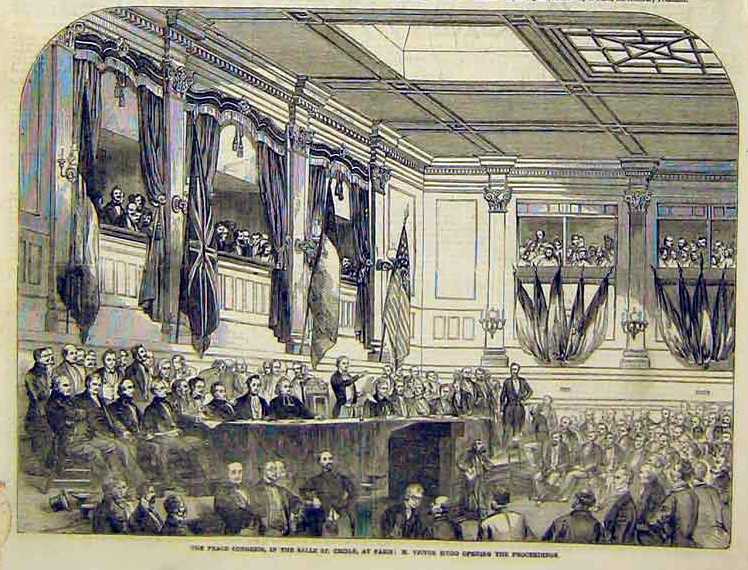
[Victor Hugo opening the Peace Congress in Saint-Cecile Hall]
FADE IN:
75 INT. THE LECTURE HALL AT THE COLLEGE DE FRANCE - DAY 75
We see the a shot of the interior of the ORNATE LECTURE
THEATRE in the Collge de France where Frederic will later
give a guest lecture.
FREDERIC (V.O.)
Eagerness to learn, the need to
believe in something, minds still
immune to age-old prejudices,
hearts untouched by hatred, zeal
for worthy causes, ardent
affections, unselfishness, loyalty,
good faith, enthusiasm for all that
is good, beautiful, sincere, great,
wholesome, and spiritual Ñ such are
the priceless gifts of youth. That
is why I dedicate this book to the
youth of France. The seed that I
now propose to sow must be sterile
indeed if it fails to quicken into
life upon soil as propitious as
this.
DISSOLVE TO:
76 INT. BASTIAT'S APARTMENT IN PARIS - DAY 76
Gustave has brought Frederic home to his apartment. They are
sitting looking out the window while having a glass of wine.
FREDERIC
This is rather funny when you think
of it.
GUSTAVE DE MOLINARI
How so?
FREDERIC
A politician who is losing his
voice.
GUSTAVE DE MOLINARI
I suppose it is.
FREDERIC
Now that I have a captive audience
of 900 people in the Chamber all I
will be able to do is croak at
them. What an indignity!
GUSTAVE DE MOLINARI
Your opponents will love it. They
couldn't silence you with their
guns or their arguments. They had
to wait for nature to intervene for
them.
FREDERIC
(he chokes on his wine as
he laughs)
Don't make me laugh. It hurts!
GUSTAVE DE MOLINARI
Sorry! But Frederic, your real
skill lies in writing. You'll have
to concentrate on that while your
strength lasts. Think of it as a
kind of division of labour.
FREDERIC
How so?
GUSTAVE DE MOLINARI
Leave the speaking to the orators
like Lamartine and Faucher. You
should continue to write your
pamphlets and we'll circulate them
among the Deputies.
FREDERIC
That might work. But I love
speaking to a good audience and see
their eyes light up when they get
the point of the argument.
GUSTAVE DE MOLINARI
People love reading your sophisms.
They will last longer than a speech
which disappears into thin air.
FREDERIC
Maybe you are right.
GUSTAVE DE MOLINARI
And don't forget. A positive side
to all this is that it might free
up more of your time to finish your
treatise. If you have the will
power.
FREDERIC
I hope I do.
GUSTAVE DE MOLINARI
How much have you done on it?
FREDERIC
With a couple of months work I
could have the first volume
finished. I have lots of drafts and
sketches for the second volume but
I keep getting distracted.
Revolutions can be very distracting
Gustave.
GUSTAVE DE MOLINARI
(he laughs)
Yes, I know! You should talk to
Hortense. Maybe she can help you
get away so you can work on your
treatise. She is very fond of you
and would do anything to help.
FREDERIC
Yes.
Frederic is thinking that he is very fond of her too, and
looks wistfully out the window.
CUT TO:
77 INT. CONSTITUENT ASSEMBLY HALL - DAY 77
Early July 1848. The Assembly is meeting to discuss measures
to be taken after the June Days uprising.
SPEAKER OF THE ASSEMBLY
I now call for a vote on the
measure before the Assembly to
continue martial law for another
three months and to close all the
Political Clubs for the foreseeable
future. Those in favour?
There is a loud cry of "Aye!"
SPEAKER OF THE ASSEMBLY (CONT'D)
Those against?
A very much smaller group of Deputies say "Nay!"
SPEAKER OF THE ASSEMBLY (CONT'D)
The "Ayes" have it by a large
majority. The next order of
business is the motion to strip
Representative Louis Blanc of his
parliamentary privilege so he can
be arrested and charged with
complicity in the organisation of
the June Days uprising. It is
fitting that one of the speakers
against the motion is
Representative Bastiat. Citizen
Bastiat has the floor!
FREDERIC
Thank you Monsieur Speaker! No one
could ever call me a friend of
Louis Blanc. I have strenuously
opposed his socialist views from
the moment I first heard them. I
have opposed them in my writings
and on the floor of this very
Chamber. I have done everything in
my power to close down his
operation at the Luxembourg Palace
as Vice-President of the Finance
Committee. All of that should be
blindingly obvious to you my fellow
Representatives. However, I want to
speak against the motion for two
reasons of principle and one reason
of practicality. The reasons of
principle are as follows. It is a
clear principle under the rule of
law that a person cannot be charged
with a crime which was not illegal
at the time it was committed. Louis
Blanc in June of this year was a
recognised member of this Chamber
and as such had then and still has
now all the privileges of that
office. To change this
retroactively would in itself be a
crime according to the rule of law.
The second reason of principle is
that he did not commit any act
which violated the law. Others
acted in this way but not him
personally.
He expressed ideas about the
organisation of labour and the
right to have a government funded
job which I find abhorrent but
again this expression of ideas was
not then and is not now illegal in
themselves. In fact I would go
further, this Chamber paid him as
the head of the Luxembourg
Commission to make these ideas
public and to attempt to put them
into practice. You gentlemen! You
paid him to do this. How can you
now arrest him for doing what you
paid him to do? My third and final
reason is one of practicality.
Stripping him of his parliamentary
immunity and putting him in jail
will do nothing to destroy the idea
of socialism. That will live on no
matter what you and this Chamber
may do to him. In fact, this might
make things worse by making him a
martyr to the socialist cause.
Socialism must be destroyed as an
idea if we are to eliminate it for
good, as I'm many in this Chamber
wish to do.
There are cries of "hear! Hear! From the right; and "never"
from the left.
SPEAKER OF THE ASSEMBLY
Thank you Citizen Bastiat. Now I
call for the vote. Those in favour
of stripping Representative Blanc
of his immunity?
(a very loud chorus of
"ayes")
Against,
(very few say "nay",
including Frederic)
The "ayes" have it 504 votes to
252.
CUT TO:
78 EXT. A STREET IN PARIS - DAY 78
MARTIAL LAW has been declared in Paris. We see a huge new
poster announcing this fact being plastered over the torn and
fading political posters of the revolution.
The police and soldiers are methodically closing down all the
Political Clubs, goguettes, and print shops in the working
class sections of Paris. Men are dragged out of the
buildings, lined up against the walls, their papers checked,
and some are arrested and carted off in wagons. They complain
about the harsh treatment but the police and soldiers just
shove them against the wall or HIT THEM WITH THEIR RIFLE
BUTTS.
Wall posters with political slogans are torn down from the
city walls. Print shops and book shops are ransacked with
books and papers thrown into the streets to be carted off and
burnt.
The streets are still filled with the debris left over from
the hundreds of barricades which had been erected during the
June Days riots. Posters with "The Right to Work" are in
tatters and lying on the pavement. Men are sweeping up the
rubbish and filling wagons with paving stones, broken pieces
of furniture and glass, and carriages.
CUT TO:
79 INT. GUILLAUMIN'S OFFICE - DAY 79
Early July 1848. Guillaumin is meeting with the inner core of
the Economists group to discuss their next step: Frederic,
Michel Chevalier, Charles Coquelin, Gustave, Hortense
Cheuvreux, Felicity Guillaumin, Joseph Garnier, Horace Say.
GUILLAUMIN
Ladies and Gentlemen, it is a sad
day for liberty in this city. We
have witnessed some extraordinary
scenes, ones I never thought I
would see in my lifetime. But
France has gone mad once again, and
once again the military has reacted
in the only way it knows how, to
shoot and kill their fellow
Frenchmen and women.
COQUELIN
At least the socialist threat has
subsided for the moment.
GUSTAVE DE MOLINARI
That's the problem. It has subsided
but not gone for good. We still
haven't won the battle of ideas.
GUILLAUMIN
That is why I have called you all
here today. To think about what we
do next. But first, we should
remember our young friend and
comrade Thomas who fell from a
soldier's bullet on a barricade not
2 kilometres from where we now
stand.
Frederic has a tear in his eye and appears to choke. Mme
Cheuvreux who is siting next to him squeezes him on the arm
to show her support.
GUILLAUMIN (CONT'D)
The declaration of martial law and
the suspension of civil liberties
affects us as well as the
socialists. We need to marshal our
forces for the next phase of the
struggle. I call for suggestions.
Frederic, any thoughts?
FREDERIC
Those of us in the Chamber,
Wolowski, Faucher, and myself still
have our jobs to do. The
government's finances are still in
a mess so I have to keep pushing
for tax and expenditure cuts from
within the Finance Committee.
Wolowski and Faucher need to keep
fighting within the Chamber to keep
the socialists from inserting their
government funded "right to a job"
clause in the new constitutions
which is still being debated.
GUSTAVE DE MOLINARI
That's all very well, but we still
have to keep trying to change
people's views about the justice
and viability of socialism in
practice. I want to try writing
something aimed at a more popular
audience, like Frederic's economic
sophisms but longer and more
comprehensive. I think he should
keep writing his anti-socialist
pamphlets as well. The always hit
their targets.
GUILLAUMIN
Coquelin and I were struck by
something Joseph said about the
difference between "socialism from
below" and "socialism from above."
We are seeing the destruction of
"socialism from below", from the
protesters in the street. The
police and military will soon put
an end to that, along with
everybody else's freedoms as well.
But what worries me is that the
next push for socialism will come
from within the Chamber and the
government bureaucracy. We are
seeing that now in the Chamber with
the discussion about the new
constitution, but what I really
fear the most is if Louis Napoleon
becomes President in the December
election. He is a born
interventionist and if he gets his
hands on the levers of power he
will create a new kind of
bureaucratic state socialism
imposed from above.
FREDERIC
Heaven helps us!
MICHEL CHEVALIER
Let me add something to the mix. I
have been cultivating quite a few
friends in high bureaucratic
positions whom I think will have
senior positions in Louis
Napoleon's government, should he
get elected in December. I think I
can get them around to a free trade
position in time.
FREDERIC
Good luck with that!
MICHEL CHEVALIER
You'd be surprised what can be
achieved with behind the scenes
work.
FREDERIC
Better you than me! That is all I
can say!
The meeting dissolves into general conversation.
CUT TO:
80 INT. CONSTITUENT ASSEMBLY HALL - DAY 80
September 1848. All through the late summer and fall of 1848
the Chamber debates the wording of the new Constitution for
the Second Republic. The key debate concerns a clause in
which the government guarantees the right to a job for all
Frenchmen to be paid for by the taxpayers. There is a bitter
struggle between the Socialist deputies, like Considerant and
Proudhon and Louis Blanc, who wanted the government to
guarantee under the constitution the right of every
individual to a government (i.e. taxpayer) funded job, and
the Economists and liberals in the Chamber, such as
Tocqueville, Faucher, Bastiat, and Wolowski, who strenuously
opposed this. Lamartine took a middle of the road position
believing the government should guarantee each person's
"right to existence" but not necessarily the right to a
government funded job. The President of the Constitutional
Committee of the Chamber is trying to wind up its
deliberations.
PRESIDENT OF THE CONSTITUTIONAL
COMMITTEE
Citizens. It has been a long, hot
summer and we must conclude our
business so we can make our final
recommendations to the full Chamber
on the wording of these key
passages in the Constitution. I
wish to enter into the record a
statement from Citizen Louis Blanc
who had been a member of this
Committee before he was disciplined
by the Chamber and forced into
exile for his role in the June Days
uprising. The Reporter will read
his statement.
REPORTER
Citizen Blanc states the following:
"Socialism predated the February
Revolution but blossomed as a
result of it.
I was appointed by the Provisional
Government to head a Commission for
the Workers with the intention of
exploring and even to begin
implementing a society-wide work
program to provide jobs for those
hardest hit by the brutal
competition which the system of
laissez-faire has unleashed upon
us. It is clear that the intent of
the Provisional Government was to
guarantee the "right to a job" of
all French citizens. It is the duty
of this Committee to implement this
wish by enshrining it in the
Constitution of the new Republic.
My economist opponents claim that
the Constitution should only
protect the "freedom of working"
but they ignore that a "right" has
no meaning unless one has the power
to act. In this case the right to
seek work means nothing if there is
no work to be done, or no tools to
do it with, or no credit to invest
in creating new jobs. Only the
State can guarantee this power or
capacity to work for all its
citizens, not just the propertied
and the wealthy. Thus it is our
duty to guarantee this right to our
people in our new constitution."
PRESIDENT OF THE CONSTITUTIONAL
COMMITTEE
Thnak you. I now call upon Citizen
Alexis de Tocqueville.
TOCQUEVILLE
Citizen Blanc's theory of the
"right to a job" guaranteed by the
state, or I should say, by the
ordinary taxpayers of France, is
socialism, pure and simple. It may
be the aim of a small minority of
people within the Provisional
Government, but as the April
elections showed very clearly, it
is not the view held by the
majority of Frenchmen.
I put it to you that if we enshrine
the "right to a job" in the
Constitution we will have laid the
foundations for fully fledged
socialism in this country, if not
today then sometime tomorrow. The
socialists attack, either directly
or indirectly, the principle of
private property. Some like Citizen
Proudhon have called property
"theft" and others see in it the
origin of all the ills of the
world. Their plan for government
funded workshops and job creation
is an attack on property because in
order to fund these schemes they
have to confiscate the private
property of others to pay for the
wages and the tools of these
workers. Not only is socialism an
attack on property it is also an
attack on personal liberty and
shows complete contempt for the
individual. Socialists hold that
the State must not only act as the
director of society, but must
further be master of each man, and
not only master, but keeper and
trainer. In doing this, the
socialist government will be
creating a new system of serfdom.
Therefore, in my opinion, if we
wish to prevent the creation of
this new socialist state we must
act now and prevent the insertion
into the new Constitution of any
government guaranteed right to a
job and all the consequences for
liberty that this entails.
PRESIDENT OF THE CONSTITUTIONAL
COMMITTEE
Thank you. I next call Citizen
Bastiat.
FREDERIC
Thank you Citizen President. If one
understands by the phrase right to
work as the right of working (which
implies the right to enjoy the
fruit of one's labor), then one can
have no doubt on the matter.
As far as I'm concerned, I have
never written two lines which did
not have as their purpose the
defence of this notion. But if one
means by the right to work that an
individual has the right to demand
of the state that it take care of
him, provide him with a job and a
wage by force, then under no
circumstances does this bizarre
thesis bear up to close inspection.
Do I have the right to demand of
one of my fellow citizens that he
provide me with a job and a wage by
force? This right would obviously
violate his right to property. And,
if I do not have this right, and if
none of the other citizens who make
up the community have it either,
then how can we create it when one
group of people exercises it over
another group through the
intermediary of the State? My
goodness! Pierre does not have the
right to demand by force that Paul
supply him with a job and a wage;
but if the two of them establish a
common force paid for at common
expence, does Pierre then have the
right to call upon this force, to
use it against Paul, so that the
latter is forced to supply him with
a job? By creating this common
force, the right to work is born
for Pierre and the right to
property is dead for Paul! What
confusion! What word play! It is
for this reason that I strongly
object to the inclusion of the
"right to a job" clause in the new
Constitution.
PRESIDENT OF THE CONSTITUTIONAL
COMMITTEE
Thank you Citizen Bastiat. Finally,
I wish to call upon Citizen
Lamartine to conclude this session.
LAMARTINE
Thank you citizen President. We
have heard two extreme views
presented here today.
One calls for the state to assume
almost complete control over
property and labour in the name of
ending the free market's brutal and
destructive competition in order to
guarantee a minimum of comfort
provided by having some minimum of
paid employment. On the other hand,
we have heard others who believe
that any interference by the state
in the economic activities of
individuals is a profound violation
of their natural right to property
and liberty which should be avoided
at all costs. I think I speak for
the majority of this Committee when
I say I believe there is a middle
ground which we should consider
seriously. Property is not an
absolute!
Applause breaks out among a majority of those on the
Committee. Lamartine smiles as he sees he is winning over his
colleagues.
LAMARTINE (CONT'D)
It is capable of and in fact needs
to be improved when there are
glaring inequalities or temporary
hardships. I believe the new
Constitution and the new government
which will spring from it must have
the power and should have the duty
to guarantee the right to
existence, the right to live, to
all its citizens, regardless of
class. This means it must have the
power to care for the old and
infirm, the destitute, and the
temporarily unemployed. It must
live up to the grand principles
which have driven our Revolution:
Liberty, Equality, Fraternity. It
should never be tempted to abandon
them and replace them with two
other vile words "Buying and
Selling". That is not what our
Republic should stand for!
There is very loud applause after he has finished speaking.
Tocqueville and Bastiat shake their heads in disbelief that
their ally from the free trade movement would make such
concession to the socialist minority on the Committee.
PRESIDENT OF THE CONSTITUTIONAL
COMMITTEE
Citizen Lamartine I believe is
correct when he said that he speaks
for the majority of the Committee
when he recommends that the phrase
"right to a job" should be replaced
by the phrase "right to existence"
for those who are too old or sick
to care for themselves, and for
those who are in temporary
hardship. I move that we make this
recommendation to the Chamber in
our final report. All those in
favour?
THE MAJORITY OF THE COMMITTEE MEMBERS
Aye!
PRESIDENT OF THE CONSTITUTIONAL
COMMITTEE
The "Ayes" have it.
Bastiat turns to Tocqueville as the Committee members leave
the room.
FREDERIC
Well said. We stopped the hard core
socialists from having their way,
but it looks like socialism is
coming in through the back door
this time.
TOCQUEVILLE
I fear it will. I fear it will.
81 INT. HORTENSE CHEUVREUX'S HOME - DAY 81
September 1848. Frederic arrives at the Cheuvreux's house, he
knocks and is admitted by a servant.
SERVANT
Monsieur Bastiat is here, madame.
MME CHEUVREUX
How nice to see you Frederic, do
come in! To what do I owe this
pleasure? Have you come to amuse me
with some of your bons mots?
FREDERIC
I'm afraid not Hortense. I would
like a private word with you if I
may?
They enter the drawing room and sit facing each other.
FREDERIC (CONT'D)
Hortense, I have some bad news. I
have a serious throat condition.
MME CHEUVREUX
Oh my goodness! How serious?
FREDERIC
Very serious. I may not have long
to live the doctor tells me.
Hortense jumps out of her chair to embrace Frederic.
MME CHEUVREUX
How long?
FREDERIC
Perhaps two years.
MME CHEUVREUX
No! No! That can't be!
FREDERIC
That is why I have come to ask you
for your help.
MME CHEUVREUX
Anything Frederic! What can I do?
She pulls herself together after the initial shock and
becomes much more serious.
FREDERIC
As you know, there are a couple of
projects I want to finish before
the end comes.
MME CHEUVREUX
I know. Especially that damn
treatise which you never seem to be
able to finish.
FREDERIC
Exactly. I can't seem to get the
free time to work on it without
distraction.
MME CHEUVREUX
We have the perfect place for you.
Casimir and I have a hunting lodge
in the Saint-Cloud woods outside
the city. We hardly ever use it. I
can set you up there for as long as
you like.
FREDERIC
That sounds perfect!
MME CHEUVREUX
But you have to promise me one
thing Frederic.
FREDERIC
What is that?
MME CHEUVREUX
You must finish that damn treatise!
I'm sick of hearing about it.
FREDERIC
I promise. It WILL be the last
thing I ever do. I'll make sure you
get the first copy off the press.
MME CHEUVREUX
Signed by you of course.
FREDERIC
Of course!
She goes over to him and reaches for his hand. He squeezes
her hand in gratitude.
CUT TO:
82 INT. BUTARD LODGE - DAY 82
Early summer 1849. Hortense comes to see how Frederic is
progressing with his treatise. He is PLAYING HIS CELLO in the
sitting room when there is a knock at the door of the Hunting
Lodge.
FREDERIC
Come in Hortense!
MME CHEUVREUX
I didn't mean to disturb you. I've
come to see how you are settling
in. Do you have everything you
need?
FREDERIC
Yes, almost everything. I miss my
daily newspapers. Thomas used to
bring them to me every morning.
MME CHEUVREUX
I'll have them sent to you.
FREDERIC
I can't thank you enough for
helping me like this. It is a
beautiful place to read and write.
MME CHEUVREUX
I thought you would like it.
Hortense moves over to his desk to look at the papers he had
been working on. We can see the BOTTLE OF LAUDANUM he uses to
ease the pain of his coughing on the desk.
FREDERIC
I know what you are going to ask.
How is my treatise coming along?
She sits in a chair next to the long desk which faces out the
French doors into the woods.
FREDERIC (CONT'D)
My plan is to have volume one
finished by the end of the summer.
That is the first pile. The second
pile are notes and sketches for the
second volume. Who knows when that
will be finished.
MME CHEUVREUX
Guillaumin will be so pleased to
get this! And the third pile?
FREDERIC
You weren't supposed to see that.
It is my most recent popular work.
Hortense picks up the third pile and begins to leaf through
it.
MME CHEUVREUX
So, you have found some more
sophisms which need to be refuted.
You really are incorrigable!
She begins to read out a passage.
MME CHEUVREUX (CONT'D)
"In the sphere of economics an
action, a habit, an institution or
a law engenders not just one effect
but a series of effects. Of these
effects only the first is
immediate; it is revealed
simultaneously with its cause, it
is seen. The others merely occur
successively, they are not seen; we
are lucky if we foresee them." So
you are writing about "invisible
economics" now?
FREDERIC
Yes, in a way. Not invisible, but
rather, not seen.
MME CHEUVREUX
I see, if you will pardon the pun.
I have to hand it to you Frederic,
you have a way with words!
He laughs.
FREDERIC
Thanks! I'll have to see if I can
use that joke at your next soirée.
They both laugh and look at each other with tenderness tinged
with sadness.
CUT TO:
83 INT. BUTARD LODGE - DAY 83
It is late afternoon and the sun is streaming in through the
large bay windows of the sitting room which looks out into
the woods. Hortense and Frederic are sitting in comfortable
armchairs sipping wine and talking. Their friendship has been
developing steadily over the summer.
MME CHEUVREUX
Why did you come to Paris Frederic?
FREDERIC
You know why! To create a free
trade movement, abolish trade
restrictions, and improve the lives
of ordinary French people.
MME CHEUVREUX
Yes, but that is a task more
suitable for a young man, Frederic,
not someone your age.
They sit without speaking for a while Frederic considers his
answer.
FREDERIC
I'm not that old.
MME CHEUVREUX
But old enough to have some land
and property, some wealth and the
comforts that brings, good friends
and colleagues who know and respect
you.
FREDERIC
Yes.
Again, they sit without speaking for a while.
MME CHEUVREUX
So why did you leave all that
behind?
FREDERIC
I thought there should be something
more to my life than that, as
comfortable as it was.
He looks at the growing pile of papers on his desk which will
one day become his economic treatise. Hortense sees this.
MME CHEUVREUX
So you thought you had a book in
you. That you had something to say.
FREDERIC
Yes.
(he pauses)
Maybe two.
There is another long pause as they look out the window at a
pair of birds pecking at some crumbs lying on the ground.
MME CHEUVREUX
I think you might be right. That
will be something to regret I
think.
FREDERIC
Yes. And there is another regret I
have Hortense. ...
They continue looking at the pair of birds. A small tear
appears in Hortense's eye. They say nothing more.
CUT TO:
84 INT. BUTARD LODGE - DAY 84
Frederic works all summer 1849 at a furious pace and
completes the 1st volume of Economic Harmonies. We see his
work routine, playing the cello, reading, writing, and RIDING
HIS HORSE THROUGH THE WOODS when he has a writer's block.
Hortense makes one of her regular visits to see how he is
progressing.
There is a knock at the door of the Hunting Lodge.
FREDERIC
Come in Hortense!
MME CHEUVREUX
I have fresh bread and some of your
favourite smoked Gascogne ham.
Her maid takes a basket into the kitchen and then leaves.
FREDERIC
Thank you!
He takes her by the hand in welcome and then she walks
towards his desk to see what he is working on.
MME CHEUVREUX
How is the wine supply holding up?
FREDERIC
It is getting a bit of a beating.
The words flow when the wine does.
MME CHEUVREUX
Speaking of words, dare I ask?
FREDERIC
You have every right to ask after
what you have done for me. Take a
look, there on the desk.
He waves to a large pile of papers on his desk, and coughs as
he does so.
MME CHEUVREUX
So this is volume 1. It looks
finished. Well done. Do you mind?
She reaches for the pile, sits down and begins reading a
chapter. Frederic sits down in a comfortable chair by the
window with a glass of wine and stares out at the woods while
she reads. The pair of birds are back looking for food
together. Every so often she stops to ask him a question on
some technical economic matter (she is very knowledgeable)
which he answers tersely.
MME CHEUVREUX (CONT'D)
When you say that all exchanges are
the mutual exchange of "a service
for a service" how do you measure
that?
FREDERIC
There is an equivalence in the
value of the things exchanged.
MME CHEUVREUX
Not an equality?
FREDERIC
No.
Some time passes in quiet reading.
MME CHEUVREUX
And how do you measure that
equivalence then?
FREDERIC
The equivalence as judged by the
two parties engaged in the exchange
at that moment in time.
Some more time passes in quiet reading.
MME CHEUVREUX
Hmm É And land rent you think is
just another kind of service?
FREDERIC
Yes. There is nothing special about
the contribution of the soil and
the sun to the creation of value.
No more than the contribution of
steam power or electricity.
MME CHEUVREUX
Hmm É Dunoyer and the old school
won't like this.
FREDERIC
Too bad É
Some more time passes in quiet reading.
MME CHEUVREUX
You must finish this Frederic. It
is very good É
FREDERIC
Yes, I think so. But there is so
much more that needs to be done.
Frederic coughs again. Hortense puts her arm around him as he
has a VIOLENT COUGHING FIT. She looks at Frederic knowing
that he will die before he can finish his treatise. She looks
very sad at the prospect. He looks at her showing that he
knows this too.
CUT TO:
85 INT. BUTARD LODGE - DAY 85
Garnier visits Frederic to encourage him to give one of the
keynote speeches at the Peace Congress he is organising in
August 1849.
GARNIER
I know you are tired and not well
Frederic, but you did promise me
you would speak at the Peace
Congress.
FREDERIC
I know I did.
GARNIER
Victor Hugo has agreed to act as
President of the Congress. Richard
Cobden will be there with a large
British contingent. You must speak.
Everyone is counting on it.
FREDERIC
I have already said what I want to
say in my articles. I don't have to
say it again.
GARNIER
Yes you do. You have to keep saying
it until things change. And you
have to say it before this
audience.
FREDERIC
Why?
GARNIER
Because you are an economist and
too many of them are well-meaning
religious moralists who don't
understand the economic imperative
of disarmament, or the dire
political consequences which will
follow if we don't disarm and cut
taxes.
FREDERIC
I just hope my voice can stand up
to the strain. Let me think about
it Joseph. I want to go for a ride
to clear my head.
CUT TO:
86 EXT. SAINT CLOUD FOREST - DAY 86
Frederic needs to think about whether he can follow through
with his promise to give one of the keynote speeches at the
forthcoming Peace Congress. He goes riding through the Saint
Cloud woods where he sees the MILITARY FORTIFICATION WALL
which encloses Paris on its western side. As he rides beside
the wall for several miles he passes the MASSIVE NEW FORT at
Mont-Valérien and becomes angrier and angrier at the waste of
time, money, and labour that went into building and paying
for the wall, the ring of forts, the conscription of young
men into the army and their labour used to build the wall,
and all other forms of military spending. By the end of the
ride he is determined to give his speech calling for
disarmament and tax cuts.
CUT TO:
87 INT. SAINT-CECELIA HALL - DAY 87
23 August 1849. The International Peace Congress organised by
Joseph Garnier is taking place in a large concert hall, Saint
Cecelia Hall, in the centre of Paris. It holds 2,000 people
and is full of delegates from England, America, and all over
Europe.
It is August and it is hot and humid in Paris at that time of
year and the hall is packed and stuffy.
The President of the Congress is the poet and novelist VICTOR
HUGO. Discussion is underway of the five main resolutions
before the Congress. RICHARD COBDEN is speaking and is close
to concluding.
RICHARD COBDEN
I have the honour to submit to your
consideration a motion condemnatory
of loans for warlike purposes. My
object is to promote peace by
withholding the sinews of war. I
propose that this Congress shall
make an appeal to the consciences
of all those who have money to
lend.
A murmur of concern at this radical proposition goes around
the hall.
RICHARD COBDEN (CONT'D)
I address myself to those who, by
their loans, really hire and pay
men who commit atrocities, and we
say, "It is you who give strength
to the arm which murders innocent
women and helpless old age; it is
you who supply the torch which
reduces to ashes peaceful and
inoffensive villages and on your
souls will rest the burden of these
crimes against humanity." I urge
the Congress to vote in favour of
the Resolution "The Congress
condemns all loans and taxes
intended for the prosecution of
wars of ambition and conquest."
There is loud and enthusiastic cheering from the audience.
VICTOR HUGO
I thank the Honourable speaker and
call for the Vote. Those in favour
...
THE DELEGATES
Aye!
VICTOR HUGO
Those against ...
(there is silence)
The vote for the resolution is
carried unanimously. I now call
upon our final speaker to address
the Congress on the resolution "to
call the immediate attention of
governments to the necessity of a
general and simultaneous
disarmament." As I read these
words, a sad and bitter thought
presents itself to my mind. It
results, from a comparison of
statistical accounts, that the
nations of Europe expend each year
for the maintenance of armies a sum
amounting to two billion francs,
and which, by adding the expense of
maintaining establishments of war,
amounts to three billion. Add to
this the lost produce of the days
of work of more than 2,000,000 men
Ñ the healthiest, the most
vigorous, the youngest, the elite
of our population Ñ a produce which
you will not estimate at less than
one billion francs, and you will be
convinced that the standing armies
of Europe cost annually more than
four billion. Ladies and Gentlemen,
peace has now lasted thirty-two
years, and yet in thirty-two years
the enormous sum of one hundred and
twenty-eight billion francs has
been expended during a time of
peace on account of war! Suppose
that the people of Europe, in place
of mistrusting each other, had
spent this enormous sum on peace
instead of war. What if this sum
had been given to labour, to
intelligence, to industry, to
commerce, to navigation, to
agriculture, to science, to art? I
will let you draw your conclusions.
I now call upon a man who is an
economist and thus more fit than I
am to address these matters, M.
Frederic Bastiat who is a
Representative of the People in the
National Assembly and a
Corresponding Member of the French
Institute. M. Bastiat!
Frederic comes to the podium accompanied by considerable
applause.
FREDERIC
At this stage of the discussion, I
shall only take up your time to
make a few observations on the
subject of disarmament. It is my
opinion that the cause of external
peace is also that of internal
order. A powerful military state is
forced to exact heavy taxes, which
engender misery, which in its turn
engenders the spirit of social
disorder and of revolution. These
heavy taxes, notwithstanding the
best intentions on the part of the
legislator, are necessarily most
unfairly distributed; whence it
follows that great armaments
present two causes of revolution Ñ
economic misery in the first place,
and secondly, the deep feeling that
this misery is the result of
injustice.
He coughs and takes a sip of his laudamum.
FREDERIC (CONT'D)
The first kind of military taxation
that I observe is called
conscription. The young man who
belongs to a wealthy family,
escapes by the payment of two or
three thousand francs; the son of
an artisan or a labourer, is forced
to throw away the seven best years
of his life. Can we imagine a more
dreadful inequality? Do we not know
that it caused the people to revolt
even under the Empire, and do we
imagine that it can long survive
the revolution of February? The
second kind of military taxation is
indirect taxation. Does the
government come directly to us and
ask us for a quarter, a third, or a
half of our incomes? No: that would
be impracticable; and consequently,
to arrive at the desired end, it
has recourse to a trick, and gets
our money from us without our
perceiving it, by subjecting us to
an indirect tax laid on food. This
is a crying injustice inflicted
upon the poor to the advantage of
the rich.
These two kinds of military
taxation, conscription and indirect
taxation, will lead to the
perpetuation and systematization if
injustice in this country. And, is
it not certain that this injustice
will, sooner or later, engender
disaffection? disaffection which is
all the more dangerous because it
is legitimate, because its
complaints are well-founded,
because it has reason on its side,
because it is supported by all men
of upright minds and generous
hearts, and, at the same time, is
cleverly managed by persons whose
intentions are less pure, and who
seek to make it an instrument for
the execution of their ambitious
designs. In France because, in
consequence of our ancient
electoral laws, the wealthy class
had the management of public
business, the people think that the
inequality of the taxes is the
fruit of a systematic greed. This
is only partly true. It is also the
necessary consequence of the
increase in the level of taxation.
The very nature of things has
placed a radical incompatibility
between the increased level of
taxation and their unequal
imposition. There is, then, only
one means of diverting from this
country the calamities which menace
it, and that is, to equalize
taxation ; to equalize it, we must
reduce it; to reduce it, we must
diminish our military force. For
this reason, amongst others, I
support with all my heart the
resolution in favour of a
simultaneous disarmament. And if
our governments are not willing to
take this crucial step, then it is
up to the people of the world to do
it for them. Let me conclude in the
words of our national poet
Béranger: "People of the World!
While your cities burn, your
dictators have the impudence to
count and recount with the tip of
their mocking sceptres the bodies
which have fallen in battle, which
history now calls a bloody triumph.
People of the World! You go
helplessly like poor beasts of
burden from one heavy and inhuman
yoke to another. People of the
World! Form a Holy Alliance, take
each other by the hand, and Unite
in Opposition!"
There is loud and vociferous applause from all the Delegates.
Hugo steps forward to call for the vote on the Resolution:
VICTOR HUGO
Having heard the speaker, I now
call for a vote by the Congress on
the Resolution "to call the
immediate attention of governments
to the necessity of a general and
simultaneous disarmament". Those in
favour?
ALL THE CONGRESS DELEGATES
Aye!
(there is universal
agreement)
VICTOR HUGO
Those against?
(silence)
The Ayes have it by a unanimous
vote.
RICHARD COBDEN
Mr. President! May I have the
floor?
VICTOR HUGO
The Honourable Mr. Cobden has the
floor.
RICHARD COBDEN
Mr President, now that our
proceedings are drawing to a close
I would like to call for some
English cheers.
The large English delegation stand and look towards Cobden.
RICHARD COBDEN (CONT'D)
Hip! Hip!
THE ENGLISH DELEGATION
Hooray!
Cobden with his hand urges the rest of the Congress to stand
and join in. They look very puzzled at this strange English
behaviour.
RICHARD COBDEN
Hip! Hip!
THE DELEGATES
Hooray!
RICHARD COBDEN
Hip! Hip!
THE DELEGATES
Hooray!
CUT TO:
88 INT. HORTENSE CHEUVREUX'S SALON - NIGHT 88
A few days after the Peace Congress Frederic attends another
of Hortense's soirees where he meets ALEXIS DE TOCQUEVILLE,
THE MINISTER OF FOREIGN AFFAIRS. Frederic is sitting in one
of the rooms surrounded by a small group of well dressed
guests.
GUEST 1
M. Bastiat, what was that passage
you read out at the end of your
speech the other day?
FREDERIC
It was from a song by Béranger.
GUEST 1
Oh, that rabble rouser! Is he still
alive?
FREDERIC
Yes. In fact he was elected to the
Constituent Assembly when I was.
GUEST 1
Perhaps you should have sung it?
That would have been amusing.
FREDERIC
I'll sing it now if you like.
The guests are a little alarmed at this prospect. Frederic
begins SINGING the refrain very quietly.
FREDERIC (CONT'D)
"People of the World! Form a Holy
Alliance, take each other by the
hand, and Unite in Opposition!"
But has to stop abruptly in pain.
FREDERIC (CONT'D)
I'm sorry. My singing voice is not
good right now.
GUEST 2
I'm not convinced that songs and
fables are the best way to examine
serious matters like foreign policy
and expenditure on the army.
FREDERIC
Oh, I don't know. It seems to get
people's attention. You know La
Fontaine has a lot to say about
government expenditure.
GUEST 2
I can't imagine he did. He wrote
fables and children's stories.
FREDERIC
Do you know the one about the
weasel and the granary?
GUEST 2
Of course. Every child does.
FREDERIC
What do you think the weasel
represents, the weasel who breaks
into the farmer's granary through a
crack in the wall, gets fat eating
his grain, and then can't get back
out through the crack when the
farmer comes looking to kill him
with his spade?
GUEST 2
I have no idea.
FREDERIC
The military which eats up so much
of the taxpayers money each year.
GUEST 1
And the farmer is the angry
taxpayer?
FREDERIC
Exactly! Every weasel needs to
remember that one day the farmer
will come after him with a spade.
GUEST 2
That's absurd! It is just a
children's story.
FREDERIC
If you say so. Please excuse me
ladies and gentlemen, I need to get
a drink.
As Frederic leaves the room Alexis de Tocqueville, the
Foreign Minister, comes up to him.
TOCQUEVILLE
Excuse me M. Bastiat. Could I take
a moment of your time?
FREDERIC
Of course.
Tocqueville leads him into an adjacent room and closes the
door. They sit down.
TOCQUEVILLE
There are some in the government
who were very impressed with your
speech at the Peace Congress.
FREDERIC
Thank you. I put a lot of thought
into it and seemed to be well
received.
TOCQUEVILLE
I have been asked to see if you
would be prepared to go to England
to speak to Mr. Cobden about the
possibility of a disarmament
agreement between France and
Britain. You seem to have a very
good relationship with Cobden ...
FREDERIC
For some years now.
TOCQUEVILLE
Good. This meeting would have to be
an unofficial one at the moment, as
there are still people in the
government who are opposed to this.
FREDERIC
Including our "Prince-President?"
TOCQUEVILLE
Perhaps. At this moment. That is
all I can say. We want to find out
from Mr. Cobden who in the British
government might also be interested
in pursuing this and what their
strength is in the House. We would
also like to know how much effort
Mr. Cobden would be prepared to
make to take this matter further.
FREDERIC
I see. I am willing to do this but
I need to know what support you
have in the cabinet.
TOCQUEVILLE
Naturally. We can talk about that
later.
CUT TO:
89 EXT. THE ENGLISH CHANNEL - DAY 89
Early October 1849. Frederic is sitting on the deck of the
boat as it makes its way across the choppy waters of the
channel. We see well dressed English men and women strolling
about.
CUT TO:
90 INT. THE REFORM CLUB - DAY 90
Frederic has crossed the Channel to carry out Foreign
Minister Tocqueville's request to speak to Cobden about
disarmament. Frederic and Cobden are meeting in one of the
BEAUTIFUL WOOD PANELLED ROOMS in the Reform Club in London.
FREDERIC
This is an impressive building. I
imagine a lot of political reforms
have been hatched from within these
walls.
RICHARD COBDEN
There certainly have been, and I
expect a lot more will be! Like us
here today. Tell me, what does M.
Tocqueville have in mind?
FREDERIC
Well, he has not been completely
forthcoming about what he really
wants. It is still a bit
mysterious. My hunch is that he and
a group of liberal-minded
politicians, myself included, are
worried what will happen as our
"Prince-President" consolidates his
power.
RICHARD COBDEN
Isn't he limited to only one term
in office?
FREDERIC
Yes, but he is a Bonaparte don't
forget and the Bonapartes believe
that they are born to rule.
RICHARD COBDEN
In the name of the people!
FREDERIC
Of course.
(they laugh)
Always in the name of the people!
RICHARD COBDEN
And the glory of France!
FREDERIC
And the glory of France!
(they laugh again)
But there are rumours that he will
try to legally get around the
constitutional limits on a second
term, and if that fails, since he
has already crowned himself "Prince
President", he could see himself as
France's next emperor.
RICHARD COBDEN
God help us!
FREDERIC
Indeed! And we know what the
Bonapartes do when they get hold of
an empire.
RICHARD COBDEN
Start wars and seize territory!
(they laugh again)
We shouldn't laugh but they are so
damn predictable, these tyrants. So
Tocqueville thinks that he might be
able to head this off with our
help?
FREDERIC
Yes. He was appointed Minister of
Foreign Affairs in June but he
despises the Prince-President and
he knows that. So Tocqueville could
get rolled at any time. Hence this
quick trip. He thinks that if you
and I can arrange something he
could then present that as a fait
accompli to the President who likes
the popular acclaim it would bring
and then he would move on to
something else. He is easily
distracted.
RICHARD COBDEN
As I see it, the problem with the
Liberals and the Reform group in
Parliament is that they are split
into a free trade and peace
faction, which would be very much
in favour of a disarmament
agreement between France and
England, and a liberal but still
pro-colony and pro-empire group
which are not in favour. The
problem with any disarmament
proposal is that the Tories would
use it as a wedge to split the two
reformist groups. It would be very
tricky.
FREDERIC
I see.
RICHARD COBDEN
Furthermore, if your President were
to declare himself an Emperor the
British public would be outraged
and all bets would be off, on this
side of the Channel anyway. The
hatred for old "Boney" still runs
deep in this country I'm afraid.
FREDERIC
I'm not surprised. And if
Tocqueville were to be dumped by
the Prince-President, all bets
would be off on our side as well.
RICHARD COBDEN
Look, I'll sound out some of my
colleagues to see what they think.
It is probably worth a chance even
if it is a small one.
FREDERIC
Thanks. It is worth a try. On
another matter the free trade
movement is dead in France at the
moment.
RICHARD COBDEN
Yes, I know. You were so close in
1847.
FREDERIC
Not as close as we thought. But you
should keep an eye out for Michel
Chevalier. He is a very solid free
trader and he is close to the
Prince-President. Hard to believe
I know, but he is! Some time in the
future you might be able to play
the same trick Tocqueville is
trying to do with disarmament.
RICHARD COBDEN
Go over the French people's heads
and go straight to the President?
FREDERIC
Yes. Chevalier would be your man to
go to in Paris.
RICHARD COBDEN
Thanks! I'll keep that in mind.
CUT TO:
91 INT. CONSTITUENT ASSEMBLY HALL - DAY 91
November 1849. Frederic's health is rapidly failing and he is
finding it harder to speak in the Chamber of Deputies. In one
of his last speeches in the Chamber he joins in the debate
concerning the Article 415 of the Civil Code which bans
workers from forming unions to demand higher wages and better
working conditions. REPRESENTATIVE MORIN has proposed an
amendment to the Code.
REPRESENTATIVE MORIN
Citizen Representatives, the
amendments before you are designed
to rectify a glaring injustice in
the Civil Code which punishes
individuals who voluntarily wish to
form an association or a "union",
to discuss matters relating to
their work with their peers, and to
negotiate freely and peacefully
with others over working conditions
and pay.
There are catcalls and booing from the Right of the Chamber
and cheers from the Left.
REPRESENTATIVE MORIN (CONT'D)
The way Article 415 of the Code is
presently phrased it punishes any
worker who attempts to raise their
wages and improve their conditions
regardless of how they go about
doing so. It punishes the peaceful
and voluntary acts of most workers
exactly the same way it punishes
the minority of workers who engage
in violence and intimidation to
achieve these same ends. Under the
current law what is forbidden and
punished is the very act of seeking
an improvement in conditions and
pay and not how that might be
achieved. My amendment is as
follows: "to punish only those
individuals who attempt to raise
wages" ...
There is cheering from the Right of the Chamber.
REPRESENTATIVE MORIN (CONT'D)
"or lower wages" ...
There is cheering from the Left.
REPRESENTATIVE MORIN (CONT'D)
Let me finish! ... "by violence or
threats of violence or other
individual or collective means of
intimidation, by either party." The
law should punish only those who
engage in violence, not those who
exercise their rights to freedom of
association and freedom of speech,
for example by forming a trade
union.
There is opposition coming from both sides of the Chamber.
SPEAKER OF THE ASSEMBLY
Thank you Citizen Representative
Morin. I now call upon Citizen
Bastiat to address the Chamber.
FREDERIC
Thank you Monsieur Speaker. I beg
the Chamber's patience as I
struggle with my failing voice. I
hope I can be heard.
A shout of "speak up!" is heard from the back of the Chamber.
FREDERIC (CONT'D)
The last time I addressed the
Chamber on labour matters was when
I opposed the inclusion of the
"right to a job" clause in the new
Constitution.
There are boos from the Left of the Chamber.
FREDERIC (CONT'D)
I am pleased to say we were partly
successful in doing that.
There are boos from the Left and cheers from the Right.
FREDERIC (CONT'D)
But what I want to do here today is
to speak in support of Citizen
Morin's amendments because, and
this might surprise the Chamber,
for EXACTLY the same reasons as I
opposed the right to a job clause
last year.
Interjections are coming from sides of the Chamber.
FREDERIC (CONT'D)
Let me explain!
He takes a sip from his bottle of Laudanum as his voice
begins to fail from the pain of speaking so loudly.
FREDERIC (CONT'D)
The law wishes to punish a man for
refusing to work for another under
a certain set of conditions. Does a
man not have the right to refuse to
sell his work at a rate that does
not suit him?
There are cheers from the Left.
FREDERIC (CONT'D)
Some will say that this is true
when it concerns an individual, but
not true when it concerns a group
of men in association. But, sirs,
an action that is innocent in
itself does not become criminal
because it is multiplied by a
certain number of men. I cannot
therefore see how it can be said
that the stoppage of work is a
guilty act. If one man has the
right to say to another "I will not
work under such and such a
condition", two or three thousand
men have the same right; they have
the right to withdraw. That is a
natural right which ought to be a
legal right as well.
There are more cheers from the Left.
FREDERIC (CONT'D)
When I am standing before an
employer, we discuss the price, the
one he is offering me does not suit
me, I commit no act of violence and
withdraw, and you tell me that it
is I who am undermining the freedom
of the employer because I am
damaging his business! Take care
lest what you are proclaiming is
none other than slavery. For what
is a slave if not a man obliged by
law to work under conditions that
he rejects?
Calls of "Hear! Hear!" from the Left. Frederic begins to have
a coughing fit but recovers enough to conclude his speech.
FREDERIC (CONT'D)
Excuse me Citizen Representatives.
Let me conclude by saying that, in
practice, your law is full of
inequalities; it does not apply
exactly and proportionally to both
parties whose antagonism you wish
to remove. There is one way to
remove antagonism between two
parties: by treating them in an
equal manner, and prohibiting force
and coercion in all its forms. This
is why I support Citizen Morin's
amendments and urge you to do as
well.
SPEAKER OF THE ASSEMBLY
Thank you Citizen Bastiat. And I
now call for the vote on Citizen
Morin's proposed amendments to the
labour law. Those in favor?
About one third of the Chamber mainly from the Left say
"Aye."
SPEAKER OF THE ASSEMBLY (CONT'D)
Those against?
About two thirds of the Chamber, mainly from the Right and
Centre, say "Nay."
SPEAKER OF THE ASSEMBLY (CONT'D)
I think the "Nays" have it. The
amendments are rejected by the
Chamber.
92 INT. BUTARD LODGE - DAY 92
It is summer 1850 and Frederic is again living in the
Cheuvreux's Hunting Lodge over the summer trying to finish
his last writing projects, the long pamphlet "What is Seen
and What is Not Seen" and "The Law". Frederic is working
quietly at his desk when he hears a knock at the door.
Hortense and Gustave enter. Frederic is noticeably WEAKER AND
SICKER.
MME CHEUVREUX
Good morning Frederic. I have
brought you some lunch and some
good news.
GUSTAVE DE MOLINARI
Hello Frederic!
FREDERIC
Thank you Hortense. Hello Gustave.
MME CHEUVREUX
Guillaumin loves the manuscript and
it is being typeset. The book will
be released very soon.
FREDERIC
That is very good news. It is
relief to know it will be printed.
At least part 1.
MME CHEUVREUX
How is part 2 coming along?
FREDERIC
Not so good. I haven't touched it
in a while. It is too hard to focus
on something that complex. So I am
working on something else which is
simpler.
MME CHEUVREUX
Is there anything I can get to help
you?
FREDERIC
Not right now.
Hortense turns to Frederic's desk and picks up his manuscript
for "What is Seen and What is Not Seen" and begins reading
while Gustave and Frederic talk.
GUSTAVE DE MOLINARI
Guillaumin showed me the manuscript
of your treatise. There is some
radically new stuff there Frederic
I'd like to talk to you about.
FREDERIC
Of course. Take a seat.
GUSTAVE DE MOLINARI
You know your new theory about
population will antagonise the
Malthusians like me and Joseph
Garnier.
FREDERIC
I know, but I think you are wrong
about population growth inevitably
leading to increasing misery among
the poor. The facts just don't
support it.
GUSTAVE DE MOLINARI
It has been an historical fact for
centuries.
FREDERIC
May be, but not any more. You
underestimate the productive power
of free people engaging in trade
with each other. This will lead to
an explosion in agricultural
productivity which will make all of
Malthus' predictions false. Just
look at what has been happening in
America right now.
GUSTAVE DE MOLINARI
Yes, but that might be the
exception. Here the poor and the
working class have to be very
careful about not having too many
children or the Malthusian trap
will catch them in its jaws.
FREDERIC
But you and Garnier also
underestimate the ability of people
to take action to plan their lives
rationally. For goodness' sake,
they are not like plants or stupid
rabbits just reproducing
mindlessly. They are thinking,
acting individuals who can plan
their lives, if they are left free
to do so.
GUSTAVE DE MOLINARI
Frederic, you are now the one
exaggerating. Most poor people are
not like that.
Hortense interrupts their conversation.
MME CHEUVREUX
Frederic, I see you have finished
your pamphlet on "the seen and the
unseen".
FREDERIC
Yes.
MME CHEUVREUX
Gustave, you should take a look at
this and leave poor old Malthus for
later.
She hands the manuscript of "What is Seen and What is Not
Seen" to Gustave who has not seen it before. He begins
reading it with growing interest.
MME CHEUVREUX (CONT'D)
(addressing Frederic)
I see you have applied your idea of
the unseen to several case studies,
even the benefits of cutting the
size of the army! I like that. It
works well.
FREDERIC
Thank you. I was worried that it
was too long for a popular work and
not long enough to be a serious
work of theory.
MME CHEUVREUX
The opening chapter is very clever.
What do you think Gustave?
GUSTAVE DE MOLINARI
I think it is the best thing he has
ever written! The essence of his
entire theory is in that one short
chapter, "The Broken Window." But I
don't like the title.
FREDERIC
What do you mean you don't like the
title?
GUSTAVE DE MOLINARI
"The seen and the unseen" is too
poetic, too literary. It hides a
deeper theoretical principle which
is at work, so it needs a more
scientific sounding title.
FREDERIC
So you think that without a fancy
name, the theorists won't take my
idea seriously?
GUSTAVE DE MOLINARI
Quite likely.
FREDERIC
What should I call it then?
GUSTAVE DE MOLINARI
I don't know. But what you are
saying is that everything we do has
a cost, as well as everything we
don't do, or choose not to do, for
whatever reason.
FREDERIC
Yes.
GUSTAVE DE MOLINARI
So it needs a name or a title.
Perhaps "Bastiat's Law"?
FREDERIC
That sounds vain and stupid. I'll
leave the title as it is.
GUSTAVE DE MOLINARI
Whatever you call it, it is very
good Frederic.
Frederic begins coughing violently and Hortense goes to him
to comfort him and help him with his medicine.
MME CHEUVREUX
Gustave, perhaps we should go and
let Frederic rest for a while.
GUSTAVE DE MOLINARI
Of course. Frederic, I really like
the essay. The treatise I'm not so
sure about. I'll have to think some
more about it.
Frederic waves them away as he coughs. They both leave.
A few days later Frederic has another visitor. It is the
economist Michel Chevalier.
MICHEL CHEVALIER
May I come in?
FREDERIC
Of course! Do come in my friend.
MICHEL CHEVALIER
Gustave told me about your essay on
"the seen and the unseen". I wanted
to take a look for myself.
FREDERIC
By all means. Here it is. I'll get
us a glass of wine while you read
through it.
MICHEL CHEVALIER
Thank you.
He sits down to read.
Some time passes as they drink and Chevalier reads the essay.
Eventually he looks and says to Frederic
MICHEL CHEVALIER (CONT'D)
I want to say that I envy you
Frederic.
FREDERIC
(astonished)
You envy me? It is I who have
envied you. You are the one with
the prestigious chair in political
economy at the university. I have
only ever given a few lectures to a
handful of students at the law
school. What I would have given for
a proper chair!
MICHEL CHEVALIER
That may be. But I envy your
ability to write and you have some
very original ideas. You are never
dull and dry like I am, like most
economists. You could make even a
treatise on public works witty and
amusing to read.
FREDERIC
I suppose I could, but I've never
tried!
(they both laugh)
MICHEL CHEVALIER
Would you be willing to give a
guest lecture to my students on
this?
He lifts up the pamphlet "What is Seen and What is Not Seen".
MICHEL CHEVALIER (CONT'D)
I want them to hear this.
FREDERIC
So you have got your chair back
safely after all that nonsense last
year?
MICHEL CHEVALIER
Yes, the socialists lost that
battle thank goodness.
FREDERIC
I would like to talk to your
students. I like talking to young
people. But I'm afraid I cannot
talk for very long in one stretch.
MICHEL CHEVALIER
I understand. We can circulate the
paper beforehand and you can just
speak to it.
FREDERIC
That sounds good. Michel, I have
something to ask you.
MICHEL CHEVALIER
Yes, of course.
FREDERIC
Do you think we ever had a
realistic chance of getting a free
trade bill adopted by the Chamber
three years ago?
Chevalier pauses before answering.
MICHEL CHEVALIER
No I don't think we did. The vested
interests who controlled the
Chamber would never have allowed
it. And they didn't. No ruling
elite has ever given up its
privileges unless they absolutely
had to.
FREDERIC
The English elite were forced to
give up their privileges because of
pressure from below from the new
voting middle class.
MICHEL CHEVALIER
Which we didn't have in France
then. Now that we do, they are in
love with another Napoleon, not
with free trade.
FREDERIC
So where do we go from here?
MICHEL CHEVALIER
Well, in my view the best chance
France has for free trade is for it
to come from the top down.
FREDERIC
You mean from our so-called "Prince
President"?
MICHEL CHEVALIER
Yes. If we can stop him from
starting too many wars!
(they both laugh)
But that is where I have some
skill. I have lots of contacts
inside his bureaucracies and I
think I can eventually appeal to
his vanity and show him what a
prestigious thing it would for
France to have a free trade treaty
with Britain.
FREDERIC
That is something else I envy about
you Michel. Your patience to take
the long view and spend time
working with these boring
bureaucrats.
MICHEL CHEVALIER
Yes, it can be boring at times. But
I think we will get there one day.
FREDERIC
When I am gone, you need to talk to
Richard Cobden. He is on our side
and understands French politics
very well. Maybe the two of you can
work something out, behind the
scenes.
The two men sit looking out the window at the woods and
continue their conversation for some time.
CUT TO:
93 INT. THE LECTURE HALL AT THE COLLEGE DE FRANCE - DAY 93
September 1850. Frederic is in the beautiful and ornate
lecture theatre at France's most prestigious university, the
Collge de France. He is speaking to about 50 students who
are sitting on steeply inclined benches above him. His voice
is faint and he stops now and again to cough and sip from his
bottle of laudanum which is resting on the lectern. He has
been accompanied by Hortense who assists him with his papers.
FREDERIC
Gentlemen, you have my paper before
you. What does an economist see
when someone, anyone, buys
something, like a new window to
replace a broken one?
A couple of the students raise their hands. Frederic picks
one at random.
STUDENT 1
He sees money and a window pane
changing hands between the seller
and the buyer.
FREDERIC
Yes. What doesn't the economist
see?
The students look a bit puzzled. Frederic picks another at
random.
FREDERIC (CONT'D)
You in the back row.
STUDENT 2
I'm not sure. What do you mean?
FREDERIC
Think about it. We see the buyer or
the seller doing one thing. But
what aren't they doing? You on the
left!
He points to a third student who visibly squirms.
STUDENT 3
Um ... They aren't buying or
selling something else?
FREDERIC
Precisely! They are not buying or
selling a book to read, or a
chicken to eat for dinner.
But there is a third alternative
you haven't mentioned. What is it?
There is an embarrassed silence.
FREDERIC (CONT'D)
Come on, what is it? What else
could they be doing with their
money? What else could the buyer be
doing?
There is continued silence.
FREDERIC (CONT'D)
He could be doing what you are all
doing, which is nothing!
There is an audible groan as the students realise how obvious
the answer was.
FREDERIC (CONT'D)
He could refrain from engaging in
any exchange and just keep looking
out of his broken window and keep
the money in his purse, or he could
deposit it in a savings bank. There
are so many opportunities for
economic actors to do or not do
things and each alternative has its
own costs and benefits. A good
economist must take note of these
things. They must go looking for
them if they are not obvious at a
first glance. They may well be
"unseen" to the casual viewer.
The lecture goes on like this for a while before Chevalier
sees that Frederic is getting tired and calls the lecture to
an end.
MICHEL CHEVALIER
M. Bastiat is getting tired. So we
will bring this session to an end.
Please join me in thanking him for
his unique perspective.
They applaud him and begin leaving the lecture theatre.
Hortense helps Frederic gather his papers and gives him her
arm to help him walk. She says to him as they are walking
out:
MME CHEUVREUX
You were born to do this Frederic.
Frederic nods sadly as they leave. She squeezes his arm.
CUT TO:
94 INT. GUILLAUMIN'S OFFICE - EVENING 94
Late summer 1850. The economists have gathered to celebrate
the publication of Frederic's latest works which are hot off
the press, volume 1 of his theoretical treatise Economic
Harmonies and his booklet on popular economics What is Seen
and What is Not Seen. Copies are displayed on tables around
the room. The mood is both happy and sad as they realise his
health has been rapidly deteriorating over the summer. There
is quite a hum of noise in the Guillaumin offices as people
drink and eat hors d'oeuvres.
GUILLAUMIN
If I may have your attention!
The noise subdues.
GUILLAUMIN (CONT'D)
Thank you. We are here this evening
to celebrate the publication of
Frederic's long awaited book,
Economic Harmonies.
There is a cheer around the room.
GUILLAUMIN (CONT'D)
We think it will have a big impact
on the profession. Let us raise our
glasses to salute Frederic's
achievement.
EVERYONE IN THE ROOM
Here's to Frederic! Bravo Frederic!
Etc.
GUILLAUMIN
But that is not all. If working on
that was not enough, Frederic also
completed over the summer what many
of us think is his best work of
popular economics - the booklet
What is Seen and What is Not Seen.
EVERYONE IN THE ROOM
Well done Frederic! Bravo! Etc.
GUILLAUMIN
We are hoping it will sell like hot
cakes so get your copy now while we
still have some! I believe Frederic
would like to say a few words.
Everybody turns towards Frederic who is standing off to the
side of the room with his hand holding the edge of a table
covered with his books for balance.
FREDERIC
Thanks to all of you for your help
and encouragement over the past few
months. I couldn't have done it
without you. Thanks to Guillaumin
for sticking with me in spite of
the delays. He knows only too well
how easily I get distracted.
There is laughter in the room.
FREDERIC (CONT'D)
But I made it! Here's to Guillaumin
and Felicity!
He raises his glass and is joined by the others in the room.
FREDERIC (CONT'D)
Now I have some less happy news. My
doctor has instructed me to leave
Paris and spend the winter in a
sunnier clime.
There are some sounds of dismay from the group.
FREDERIC (CONT'D)
I have decided on Rome. The climate
and the architecture should help me
convalesce. So I want to say
farewell to you all and thank you
for putting up with a brash, naive
man from the provinces like me who
came here just over 5 years ago.
You made me feel welcome and
tolerated my strange Gascogne ways.
There is laughter around the room.
FREDERIC (CONT'D)
I hope to see you in the spring!
Many thanks! Oh, one more thing.
I'd be happy to sign copies of my
book.
As an economist, I can assure you
that it should increase the resale
price should ever you want to part
with it! Or not, as the case may
be!
There is more laughter and people resume eating and drinking
and talking.
Frederic sees Hortense and goes over to her with a copy of
Economic Harmonies in his hand.
FREDERIC (CONT'D)
Here is your copy Hortense.
MME CHEUVREUX
Thank you Frederic! I knew you
would do it.
FREDERIC
I wasn't so sure. Without your
help, probably not. Thank you.
Hortense opens the book and sees that it has been inscribed,
then shuts it.
MME CHEUVREUX
When you get back from Rome we will
have to get to work finishing
volume 2.
Frederic says nothing but looks sadly at her. He then sits
down in a chair next to a table with copies of his books and
begins signing copies as people come up to him to
congratulate him. Hortense reads the inscription he wrote for
her and a tear comes to her eyes. It says "TO MY MARIANNE,
who made it all possible, love Frederic." She looks up to see
him but he has gone.
CUT TO:
95 I/E. BUTARD LODGE - DAY 95
Early Autumn 1850. We see Frederic writing beautifully
written invitations to a lunch at the Hunting Lodge to his
young comrades who worked with him on the barricades in June
1848 - Gustave, Joseph. We see the letters being hand
delivered by a messenger.
On the day we see Gustave and Joseph walking up the path to
the Lodge with their invitations in hand.
GARNIER
I wonder want this is all about.
Most unusual.
GUSTAVE DE MOLINARI
We will see in a moment.
They knock on the door. It is opened by Hortense's maid.
MAID
Come in gentlemen. M. Bastiat is
expecting you in the courtyard.
As they walk through the Lodge they see that all of
Frederic's books and papers have been packed up ready to be
moved. The library is almost empty and we can see another
maid in the bedroom packing clothes into a travel trunk. They
walk out into the courtyard where they see a table set for
lunch and Frederic and Hortense waiting for them.
FREDERIC
How good to see you Joseph,
Gustave.
He shakes their hands vigorously.
FREDERIC (CONT'D)
I hope you have brought your
appetites with you. Hortense has
arranged quite a banquet for us.
They nod to Hortense who tries to hide the fact that she has
wiped away a tear from her face.
GUSTAVE DE MOLINARI
Madame!
GARNIER
How nice to see you!
Hortense nods and then leaves to supervise serving the lunch.
FREDERIC
Now for some wine. I have some of
my special 1839 vintage from my
vineyard in Mugron. I have been
keeping it for a moment like this.
GARNIER
Thank you. That would be excellent.
Frederic pours them both a glass.
FREDERIC
Every time I drink this I can taste
the Gascogne sunshine.
GUSTAVE DE MOLINARI
I can see what you mean!
There is some more small talk for a while. Some hors
d'oeuvres are served by the maid and then Hortense announces
that lunch is about to be served. Frederic seats them.
FREDERIC
Gustave would you please sit here.
You there Joseph. Hortense, would
you sit here.
Frederic walks around an empty chair and sits at the head of
the table. Gustave and Joseph look at each other puzzled. He
suddenly rises to make a toast.
FREDERIC (CONT'D)
You must be wondering why I invited
you here today. Two years ago we
were on the barricades together
fighting both the socialists and
the French army. We defeated one
but not the other. One of us fell.
He waves his glass towards the empty chair.
FREDERIC (CONT'D)
Young Thomas. Here's to young
Thomas!
Joseph and Gustave also raise their glasses in memory of
Thomas.
FREDERIC (CONT'D)
And to what might have been!
He looks towards Hortense and their eyes meet.
He sits down, and they begin eating. As they drink the tone
becomes more jovial as they reminisce about events two years
ago.
GUSTAVE DE MOLINARI
Frederic, do remember the time when
you wanted to get permission from
the government to start a
revolutionary magazine? How absurd
was that?
(they all laugh)
FREDERIC
That wasn't absurd. The rule of law
should also apply in the middle of
a revolution.
MME CHEUVREUX
What do you mean Gustave?
FREDERIC
(a bit embarrassed)
Oh, don't tell her.
MME CHEUVREUX
Please do!
GUSTAVE DE MOLINARI
Well, it was the day after Louis
Philippe's government fell in
February. The three of us had
decided to start a street magazine
to hand out to the rioters in the
street. Frederic announced that we
had to go to the Mayor's office to
get permission from the censors so
our newspaper could be legal. When
we got to the Mayor's office it was
in complete chaos. The
revolutionaries were looting it
from top to bottom. Official papers
were everywhere. Only when he saw
that did Frederic agree we could go
ahead without getting government
permission. There was no longer any
government to give permission! But
Frederic still wanted to be "a law
abiding revolutionary"!
They all laugh, even Frederic. The happy reminiscing
continues for some time. As they get tipsy Frederic leans
over to his two comrades and begins to talk in a softer
voice.
FREDERIC
You know, when I first came to
Paris I though we could win.
GARNIER
What do you mean win?
FREDERIC
I mean beat the protectionists and
win.
GUSTAVE DE MOLINARI
Like Cobden did in England?
FREDERIC
Yes. Just like Cobden. But we blew
it.
GARNIER
We didn't blow it! They out
manoeuvred us in the Chamber of
Deputies.
FREDERIC
No. We had the best chance in
decades and we blew it.
GARNIER
Maybe the time just wasn't right
for that particular strategy to
work.
FREDERIC
What do you mean?
GARNIER
Well, perhaps if economic
conditions had been better, or if
we had been able to win the support
of a key political figure ...
FREDERIC
Perhaps ... Perhaps not. We'll see.
The conversation continues in a similar vein for a while. The
maid brings out more wine and pours it out for the guests.
FREDERIC (CONT'D)
You know Joseph said something very
insightful to me once.
GARNIER
What did I say?
FREDERIC
I'll always remember this. You once
said to me that they may have
defeated "socialism from below" but
the real threat will be a new form
of socialism, "socialism from
above".
GARNIER
Did I say that?
FREDERIC
Yes you did! It took me a while to
understand what you meant but I did
eventually.
GARNIER
What did I mean?
FREDERIC
Well, we saw it happening right
before our eyes. The socialists in
the streets, like our communist
friends who shut down our political
Club, were defeated by soldiers and
artillery in June '48. They got
dispersed and might come back
eventually. But what if Louis
Napoleon and his bureaucrats decide
to become socialists ...
GUSTAVE DE MOLINARI
You mean more socialist than they
are already?
FREDERIC
Yes. Then that is a new and more
powerful form of socialism,
"socialism from above". And they
have the government bureaucracies,
and the courts, and the police.
That's what worries me the most. We
will never get rid of that kind of
socialism. Not in my lifetime.
Maybe you will have a better chance
than I.
They all become quiet as they think about what Frederic has
just said. Joseph, Gustave and Hortense begin talking amongst
themselves. Frederic quietly gets up and moves away to cough
in private. He has another very SERIOUS COUGHING FIT. A few
minutes later the three look around to see what has happened.
Frederic has gone over to the stables, SADDLED HIS HORSE, and
is mounting it to go for a ride through the woods. It is very
late in the day and the shadows are getting long.
GUSTAVE DE MOLINARI
What is Frederic doing?
MME CHEUVREUX
He likes to go for a ride when he
wants to clear his head.
GUSTAVE DE MOLINARI
I'll say thanks for the lovely
lunch when he gets back.
MME CHEUVREUX
He won't be coming back. This is
his way of saying good bye.
CUT TO:
96 EXT. IN THE STREET OUTSIDE FREDERIC'S APARTMENT IN PARIS -96
DAY
October 1850. A carriage has come to take Frederic to the
railway station so he can begin his long journey to Rome
where he knows he will die of his throat cancer. His single
bag is loaded into the carriage. As the carriage pulls away
from his building he sees some ANTI-NAPOLEON GRAFFITI and a
poster on the wall. It is a caricature of Louis Napoleon as a
vulture sitting on a tree branch eating the flesh off the
body of Marianne, the symbol of France whom he holds in his
talons. The message states "Beware the New Napoleon, the
Budget-Eating Vulture of France". Frederic pulls the folded
print of Delacroix's painting from his coat pocket. Looks at
it and then at the caricature of Napoleon on the wall. He
notices THE FACE OF THE DEAD MARIANNE is the same as the one
in Delacroix's painting. He folds up the Delacroix print and
puts it carefully back in his coat pocket.
CUT TO:
97 INT/EXT. THE CARRIAGE OF A TRAIN AS IT LEAVES PARIS - DAY97
Frederic is in the carriage of a train. As he looks out the
window he sees THE OCTROI CUSTOMS GATE AND WALL roll by out
the window. Then the train passes under THE MILITARY
FORTIFICATION WALL and then the train is out into the
countryside. One of the last things he sees is one of the
HUGE FORTS on the outskirts of Paris with soldiers standing
on the outer wall looking out observing everything. He thinks
to himself that he is leaving the concentric circles built by
the French state to contain the citizens of Paris for the
last time, and that it is a kind of liberation, at least for
himself.
He looks out the window, smiles ruefully, and begins softly
singing the Basque folk song "Adios Ene Maitia" (Goodbye, My
Love).
FREDERIC
Goodbye, my love
Goodbye forever
I have no regrets
About you, my love
For I left you
So free for another
CUT TO:
98 INT. HOTEL ROOM IN ROME - DAY 98
It is three months later - Christmas Eve 1850. Frederic has
taken a hotel room in Rome overlooking the Tiber river. He is
unable to swallow or keep food down. He is CLOSE TO DEATH. A
doctor has just been in to see him, as he leaves he meets
Hortense waiting outside.
MME CHEUVREUX
May I see him doctor?
DOCTOR IN ROME
He does not have much longer to
live. Only a few hours. Go in.
MME CHEUVREUX
Frederic. It is Hortense.
FREDERIC
Hortense you've come!
MME CHEUVREUX
Yes.
She moves a chair closer to the bed and sits with him.
FREDERIC
Hortense. What about my papers?
MME CHEUVREUX
They are safe. I have given them
all to Prosper Paillottet as you
asked. I will help him edit them.
FREDERIC
Has Guillaumin agreed to publish
volume 2?
MME CHEUVREUX
Yes. He was reluctant to at first
because it wasn't finished. But I
said Casimir and I would underwrite
the costs. He agreed then.
FREDERIC
Thank you Hortense. You have been
so kind.
He reaches for her hand and she lets him hold it. A few
moments of silence go by.
FREDERIC (CONT'D)
We had some happy times. At your
salon and at the Lodge. I wish
there had been more.
MME CHEUVREUX
So do I.
There are some more moments of silence as Frederic breathes
hard and swallows.
FREDERIC
Promise me one thing Hortense.
MME CHEUVREUX
Yes?
FREDERIC
Destroy our letters.
MME CHEUVREUX
There are some which show another
side to you Frederic. People should
know about that.
Frederic slowly passes away while Hortense sits with him
holding his hand. She eventually gets up and looks out the
window at the Tiber river. She watches the hustle and bustle
of the commercial river traffic below her. On the window
ledge she sees a solitary bird pecking for food. A tear runs
down her cheek.
FADE OUT.
CODA↩
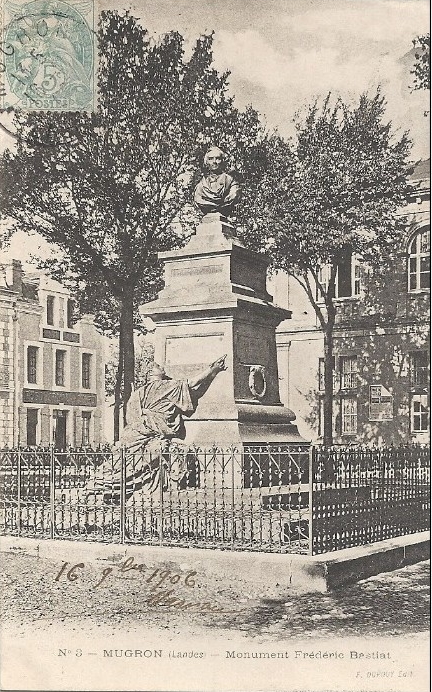
[The Statue for Bastiat in Mugron 1878]
                                                               FADE IN.

        99     INT. ROOM IN THE FOREIGN OFFICE IN PARIS                99

               23 January 1860. Emperor Napoleon III has agreed to sign a
               free trade treaty with Britain. Signing on behalf of the
               French government is Frederic's friend and colleague Michel
               Chevalier, on behalf of Britain is Richard Cobden. They are
               in a sumptuous room in the Foreign Office signing the treaty.
               After they have signed the treaty they have a glass of
               champagne to celebrate and they make a toast to the efforts
               of Frederic for making the treaty possible.

                                   RICHARD COBDEN
                         Let us remember the work of our
                         dear departed friend Frédéric who
                         laid the groundwork for this
                         important treaty between our two
                         great nations.

                                   MICHEL CHEVALIER
                         Indeed! To Frédéric!

               They raise their glasses to toast their old friend.

                                                                CUT TO:

       100     EXT. PUBLIC SQUARE IN MUGRON - DAY                     100

               It is 23 April 1878 and a small crowd has gathered around a
               statute in the main square of the town of Mugron for the
               official unveiling. We can see on one side of the square the
               Magistrate's Court where Frederic once worked. The town mayor
               unveils the statue. We hear clapping and Gustave de Molinari
               steps forward to make a brief speech. We can't hear the
               words. Hortense is standing next to him. The camera shows the
               bust of Frederic at the top of a marble plinth. A FULL-SIZED
               BRONZE FIGURE OF "MARIANNE" can be seen writing on a marble
               tablet with her finger the titles of Frederic's books,
               "Economic Sophisms," "Economic Harmonies", and "What is Seen
               and What is Not Seen." Beneath the tablet is a large bronze
               plaque with some writing on it. We can read a quotation from
               one of Frederic's letters to Richard Cobden dated August
               1850:

                                   FREDERIC (V.O.)
                         "War is a monster, a vulture that
                         is almost as voracious when
                         digesting as it is when eating, for
                         I truly believe that expenditure on
                         arms causes almost as much harm to
                         nations as war itself. As long as
                         disarmament prevents governments
                         from restructuring their finances,
                         lowering their taxes, and
                         satisfying the just hopes of the
                         workers, nations will continue to
                         be in convulsion . . . and God
                         alone knows what the consequences
                         will be."

                                                                CUT TO:

       101     EXT. PUBLIC SQUARE IN MUGRON - DAY                     101

               Time lapse photography shows the weathering of Frederic's
               monument over the next 6 decades. During this period
               Frederic's work is completely forgotten in France and
               elsewhere.

               In is now 1942 and GERMAN SOLDIERS are stripping all the
               bronze work from buildings, churches, and public statues all
               across France. They are breaking off the bust of Frederic at
               the top of the statue and some are trying with great
               difficulty to pull the figure of Marianne and the plaque off
               the plinth. They eventually succeed and throw Frederic's
               bust, the figure, and the plaque into the back of an army
               truck which drives off.

                                                                CUT TO:

       102     INT. A FOUNDRY IN FRANCE - DAY                         102

               Sometime later we see pieces of bronze being lowered into a
               crucible by a winch to be melted down and made into
               munitions. The plaque with the quotation is lowered first,
               and we see it slowly dissolve into the molten metal. Then the
               figure of Marianne and the bust of Frederic's head are
               lowered into the vat together and we watch as they slowly
               melt and merge into THE POOL OF RED HOT MOLTEN METAL.

                                                                FADE TO
                                                            RED/ORANGE.

       103     EXT. THE PRINTING WORKS OF THE SANTA ANA DAILY REGISTER - DAY103

               We cut to 1944 when the printing presses of the American
               newspaper publisher R.C. Hoiles in Santa Ana, California (the
               Santa Ana Register) are printing large numbers of a NEW
               ENGLISH LANGUAGE EDITION of Frederic's Economic Sophisms and
               Economic Harmonies. They are being loaded onto trucks to be
               distributed to bookshops all over the country. Wall posters
               announce the event with a picture of Bastiat and the cover of
               the books which are BRIGHT RED in colour - the same colour
               red as the molten metal in the German foundry. They are being
               sold for $2.50 per volume.

                                                         FADE TO BLACK.