| The Digital Library of Liberty & Power incorporating the Guillaumin Collection of the Great Books of Liberty |
Home | New | Authors | Works | Papers | Blog | About | Email | Search |
 |
|
CHARLES COMTE,
"On the Reorganisation of European Society, by Saint-Simon and Thierry"
Le Censeur (1 March, 1815)
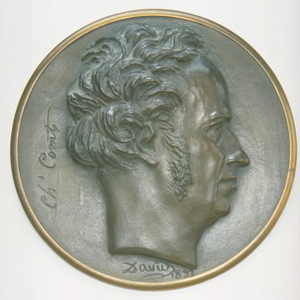 Charles Comte (1782-1837) |
 |
|
[Created: 8 May, 2026]
[Updated: 26 May, 2026] |
Source
, "On the Reorganisation of European Society, by Saint-Simon and Thierry," Le Censeur T.4 (1 March, 1815), pp. 63-87.http://davidmhart.com/liberty/FrenchClassicalLiberals/Comte/CenseurAnthology/C1-11-en.html
Charles Comte, "On the Reorganisation of European Society, by Saint-Simon and Thierry," Le Censeur T.4 (1 March, 1815), pp. 63-87.
This is a translation of [G.F. = CC], [CR] “De la Réorganisation de la société européenne, etc., par M. le comte de Saint-Simon et de Thierry,” Le Censeur T.4 (1 mars, 1815), pp. 63-87.
It is also available in French in a facsimile PDF of the original and in HTML.
This essay is part of a collection: Charles Comte and Charles Dunoyer, Censoring the State: An Anthology of Articles by Charles Comte and Charles Dunoyer from Le Censeur (1814-1815) and Le Censeur européen (1817-1819). Edited and translated by David M. Hart (Pittwater Free Press, 2026).
The anthology is available in the following formats:
- all 35 essays in one file in French [HTML] and in English [HTML]
- the 17 essays from Part 1 Le Censeur (1814-1815) in French [HTML] and in English [HTML]
- the 18 essays from Part 1 Le Censeur européen (1817-1819) in French [HTML] and in English [HTML]
- all the essays listed in a sortable table with links to the individual French and English language versions.
Comte, "On the Reorganisation of European Society, by Saint-Simon and Thierry" (March, 1815)
On the Reorganisation of European Society
[63]
ON THE REORGANIZATION OF EUROPEAN SOCIETY, or On the necessity and the means of uniting the people of Europe into a single political body, while preserving for each its national independence, by the Count de St.-Simon, and by Thierry, his pupil.
Politics is divided into two very distinct parts, which one must not confuse under penalty of being regarded as outrageous , even [64] though one is a philosopher, or for seditious, although one is orthodox in one's views; in a word, under penalty of incurring ridicule and of appearing to be unreasonable although one has reasoned well. These two parts are general politicsand particular politics; the former, is purely theoretical, and delves into the great questions of public law, the nature of the social pact/contract, [1] and the reciprocal rights of governments and people. The latter is occupied with the interests of such or such a nation, with certain institutions which it wishes to support or improve; it is occupied, if one will, with the interests of the whole of Europe, but of Europe at a particular time, in a particular situation and in a particular set of circumstances. It differs essentially from the former, although it must constantly strive to draw as near as possible to the principles and to the improvements offered by a good theory. The former builds rapidly on paper with a compass and ruler; the latter builds laboriously, by dint of time and patience, on uneven ground, with poor materials which most of the time have been prepared for other uses.
[65]
Can the plans of the former and the latter be the same, and what can one say of the architect who is rash enough to attempt to subject the latter to the rigorous designs of the former?
Nevertheless that architect may have, like Count de Saint-Simon, great talent and excellent ideas. But if he proposes to the European potentates to remedy the bad constitution of the congress which is now assembled in Vienna, by replacing it with a European parliament which strips them of all their arbitrary powers, and which presupposes the reorganization of most of the existing governments, then he confuses general politics with particular politics. By wanting to apply the former to the latter, he will in vain pre-empt the slow march of the centuries; he will turn a good system in theory into a bad work in practice; finally, he will inspire in his readers a mistrust which will too often result in injustice. This injustice inflicted on the public will be pushed still further when the officials in the ministries, in their instructions to journalists, [66] authorize the commission of all the evil, and expressly forbid all the good that they might have to say about the matter under discussion.
We shall therefore consider the ideas of M. de Saint-Simon as purely speculative; they are without doubt capable of being realized one day, otherwise they would not merit examination; but one must leave their execution to that natural progress of things which one does not hasten without great danger, and which is not the work of a single man and a single year, but of men and centuries.
Here are the questions which M. de Saint-Simon proposed to resolve. We believe that he has succeeded in great part; the reader will be the judge.
1.) Is a federal constitution between several independent governments possible?
2.) What conditions would be necessary for Europe to adopt this constitution?
3.) What must be the form of this constitution for it to be strong and long-lasting?
[67]
The simplest and most definitive answer that one can give to the first question, is that from the Amphictyonic League down to the diets of Switzerland and of Germany, history gives us a sufficiently large number of examples of federal constitutions, so that the possibility of these constitutions cannot be called into doubt.
But reason, in showing us that this possibility has already been proven to exist by historical experience, can gradually lead us to the solution of the second question.
Common interests unite men, and it is contrary interests which divide them. Why should people not be capable of forming a social pact/contract among themselves, out of the same motives of common utility which form the political bond of each state in particular? When the first men assembled together to combat hunger, wild beasts, or any other scourge which threatened them all, they doubtless obeyed the same principle of association which once united the people of Greece against Xerxes, the Low Countries [68] and Holland against Spain, the the English colonies of North America against the tyranny of their metropolis; and, more recently still, all the nations of Europe against the most ambitious of men.
Human action can be shaped by two kinds of interests or needs: firstly, the needs of the moment which produce actions of the moment, unforeseen changes, and sudden revolutions; and secondly, constant, habitual, and uniform needs which produce habits, laws, and institutions. Societies would dissolve quickly if they had no other aim than to rid themselves of a wild boar, a ferocious tiger, or a particular conqueror; but they became enduring and permanent when prudence extended these fears over time, and when men learned in advance to fear the tigers, the robbers, and the conquerors who were yet to come. From this came the institution of political societies and of permanent confederations such as those of America, of Holland and of Switzerland, which are themselves [69] only political societies, having for members nations, which are to the whole body what citizens are to a particular state.
Why have these federal constitutions not been extended and multiplied further? Yet it is very certain that all people have a common need for peace and tranquillity; that the more civilization, commerce, industry and the arts are improved, the more war becomes harmful for them, without being in any respect beneficial or useful to them, as one may claim with some reason, that it was for the ancient tribes of Greece and Italy. These tribes, by their location, by their customs, and as a consequence of the extreme backwardness of their commerce and of their industry, had to love war dearly: it was upon war above all else that they established the foundation of their public revenue, and almost their entire way of life. But as far as we are concerned, what a difference there now is! what urgent need have we to go and get ourselves slaughtered? The Greeks and the Romans were born soldiers: we are born [70] artisans, manufacturers, merchants, and farmers. We do not see, as they did, the fatherland exposed to continual dangers. Yes, we can say it loudly, the general interest, and, which is the same thing, the general will of the people of Europe, demands peace constantly. Of all the wars which have ruined modern nations, there are very few which the national will has not condemned; and if the intervention of a supreme tribunal had been possible, there is no one who would not have preferred to submit to its ruling rather than undertake even the most just war. Ask the good inhabitants of Prussia and Austria if, in good faith, they earnestly desire that Saxony and Italy be added to the vast domains held by their monarchs; ask them if they are impatient to return to work in the fields in order to support these absurd claims; if they want to die for this noble cause and get their their descendants ready for all the new wars which this one might cause in the future. You will see what answer they will give you, provided that it is not William, [71] Francis, or their ministers.
It is therefore not to the will of the people that one must attribute this horrible series of disasters and massacres without any utility, without any legitimate cause, and almost without any apparent motives; it is rather to the silence of this sacred will, to the unjust superiority of private interest over public interest, that is to say to the vice of absolute governments, that we must attribute so many misfortunes.
Since it is true that wars would be infinitely rarer, if they depended upon the national will, it follows that they will be rarer as the usurped authority of absolute kings gives way in the various states of Europe to legitimate governments, such as ours and that of England, where the national will dominates. [2]
Now, it is certain that the progress of [72] knowledge, the good example provided by certain nations, the universally felt need for order, the daily developments of the various parts of the social economy, [3] leads the people still subjected to illegitimate governments to call continually for the great reforms which France has just undergone. It is a necessary revolution, but one which must be slow, moderate, and imperceptible. It would be foolish to want to decide in advance on the way or the time this will happen, which, alas, is still so far off in the future for us. But until it has been accomplished, how many wars shall we see, we and our descendants, waged for motives of ambition as arbitrary, and for trifles as frivolous, as those which today divide the congress which is assembled in Vienna!
Third question: What must be the form of the European constitution for it to be strong and long-lasting?
The European constitution of the Abbé de [73] Saint-Pierre [4] was founded on this hypothesis: that kings would consent voluntarily to renounce, in favor of a congress, their arbitrary power. Rousseau has shown that this hypothesis would always be unacceptable to them, and it takes but a little common sense to be persuaded by this argument.
The project of Henry IV was in no way hypothetical; he based its execution on the force of arms and on the private interests of most of the Christian powers. The prudent Sully had calculated the impact of all its measures, and had to overcome some strong prejudices before approving it. But this project, assuming it could be carried out, would, like that of the Abbé de Saint-Pierre, have given Europe a solid organization; but would the bond have been strong enough to contain so many powers which were otherwise free from any other kind of bond? No, without doubt. This tribunal of kings, proposed by the two projects of which we speak, would not have provided the slightest guarantee (of peace) for the future. The same virtue, the same disinterestedness which the Abbé de Saint-Pierre assumed existed, and which Henry IV alone had in his [74] heart for the establishment of this permanent congress, had to exist in perpetuity among all the members of this congress, in order that it might be maintained. Who cannot see, in fact, that this assembly of kings who recognize no common superior, who are impatient to distinguish themselves and to make their real or presumed advantages prevail over the others, who are all-powerful at home, and who are dependent abroad only upon a council composed of their peers, their rivals, and their inferiors, would succumb to too many intrigues and be blinded by too many passions not constantly to tend towards dissolving itself? This democracy of the kings of Europe would without doubt have served only to inflame their quarrels even more, by putting all the interested parties into close proximity with each other; it would have been in some sense a way of organizing diplomatic warfare and perhaps the result of this dangerous kind of warfare might have lead to more battles than one wished to prevent.
The project of Count de Saint-Simon rests on an assumption which is much more natural than that of the Abbé de Saint-Pierre. I have already criticised him for [75] ignoring the centuries it will take to realize it, when he states that he brought forward the publication of his work in order to influence the outcome of the congress of Vienna; whatever stretch of time he wants us to jump over, we can still let our imagination make that leap in order to resolve one of the most significant questions which politics poses. Let us return to the facts which we mentioned above.
Although this free constitution, which is appropriate to be called parliamentary and whose gradual establishment we consider to the surest path to achieving general peace, [5] grants the king, in positive terms, the faculty of making war and peace; nevertheless this clause is extremely restricted, as indeed it ought to be, by all the other articles of this same constitution. We do not yet know in France what the spirit of the government which we have just adopted will be, because we have not yet seen any of its actions. It is therefore to England that we must turn our eyes, if we wish to learn anything more than the words in our charter. This [76] terrible right of making war and peace, which (in France) is granted to a single man, whom pride, ambition, flattery, prejudices, and the desire to increase his power abroad and at home, leads to war; is in England, as in every well-constituted state, only an almost nominal prerogative. Let us pass over some abuses which the French often like to exaggerate; it is certain that in England, when a minister declares a war, it is because he is supported by the majority of the nation, otherwise he could neither obtain the means of conducting it, nor even keep his political position. Now, let us suppose that all the great powers of Europe were governed by a representative system which was as well established, and as well developed as it is in England, (then) the great task of general pacification would be almost accomplished. One must admit, in fact I repeat it, that there are very few people in Europe whose national interests are mutually exclusive, and are incompatible with, or even different from each other. Even England, which is the only power interested in despotism because its natural weakness makes it fear [77] being enslaved if it does not dominate others; even England would then lose its ambition along with its fears; it would certainly gain as a result. If it didn't it would run the risk of one day being cut off from the great political society, like a contaminated limb, or like a devouring ulcer. [6] But this same nation has quite recently given us a fine proof of the happy influence which national representation could exercise over the external relations of a government. Who has not read with admiration the eloquent motions of Mr. Whitbread, in the House of Commons, on the appalling usurpations which are being coldly prepared in the congress of Vienna? Couldn't one conclude that, if in France the Flaugergues, the Bedoch, the Raynouard; and if in Russia, in Prussia, in Spain, in Austria, men of this same stamp, who were vested with the same representative powers (as in England), had responded (positively) to the noble motion put forward by the English opposition, then this intervention of the people whose interest is in justice, would not have ended in the most desirable manner the quarrels between kings who have an [78] interest in pursuing their pride and their ambition?
In pursuing our hypothesis, it is easy to see that the public law of Europe would thus become the subject of free, frank, and open discussion, and essentially devoted to the common good of the parliaments of the various nations. A European confederation would exist from then on.
By what means could such a state of things be improved still further?
It is a unique thing and one which I criticise M. de Saint-Simon for not having pointed out to us in his work! History gives us a model, which is quite small in size but complete in all its parts, of the system of organization which he proposes in order to bring European society to its highest level of perfection.
Before the United States of America had formed themselves into a single permanent federal government, each of its states was, as it still is today, governed according to a parliamentary form. The governor of each province is the king of it, elective to be sure; but one understands how, [79] in such limited states, only elective and ministerial royalty is needed, and how they would be embarrassed by having an hereditary honorific royalty. [7] The legislative power in which the government takes part is entrusted principally to two chambers, a senate and a legislative body, whose constitution differs from ours only by local circumstances and not at all in substance. Some states which are more attached than others to the republican form, at first wished to content themselves with a single representative body; but they soon retreated from this error.
Well then, these seventeen small American provinces, before the time of the great union and after the war against the English, found themselves in the same situation and at the same level of political development which we believe Europe to now be in, when they went about establishing a federal government.
What could have been, in all appearance, the relations of these divided states, [80] but all equally directed by the national will? Conquering ambition is not the vice of commercial people, nor of any modern people; conquests are for them only a resource, a last resort, as we ourselves experienced during the sufferings of anarchy and despotism. The American states would therefore have sought before all a peaceful existence. If one of them had wished to dominate at the expense of some other, the interest of all the states would immediately have been compromised, a league would have been formed and would soon have re-established that equilibrium, which would not be regarded as a chimera, if it had other guarantees than the moderation and probity of kings.
Thus, each particular parliament could have been considered as a portion of a great American parliament, composed of all those of the different states. Only this great senate, thus dispersed, could not have dealt with general affairs with enough promptitude and ease. It was natural that these nations should seek to simplify their diplomacy by bringing their representatives closer together; [81] thence this noble idea of the American union. We are going to give here an account of this masterpiece of political institutions, and also an analysis of the views of M. de Saint-Simon.
What men shall be charged with representing each nation? Will it be someone who is a confidant of the head of each government, known for his talents at court, who is provided with the full powers of his master, and will support behind closed doors the so-called interests of his country, sowing everywhere division, lies, and corruption? Or will it be instead, an elite of good citizens, recognised as such by their nation; and chosen by it, a choice of enlightened, virtuous men; and if one does not regard disinterested virtue and proven talents as a sufficiently good guarantee, why should not farmers and merchants who support the greatest good of their country as a result of their position, and consequently to peace, be called, as in our particular chambers, to the solemn discussion of general interests of which theirs form part?
Such are the members of the highest government of the American states.
[82]
Now it must be considered that, when great interests are joined to the irrevocable decision of a single assembly, intrigue, discord and ambition may find their way in much more easily than when the decision of that assembly is subjected to the serious examination of another assembly, which is independent and well shielded from the intrigues, pretensions, and prejudices which agitate the first, simply by the fact that it is separate.
The wise legislators of the United States divided the supreme government into two chambers.
As these two chambers would likely develop and pursue their own interests which were different from those of the governed, if their members were appointed for life, these legislators wanted them to be renewed at fixed and very short intervals.
Nevertheless it was important not to renew them entirely at the same time, in order to avoid shocks, sudden revolutions, and the errors of inexperience. Thus the senators are elected, in the [83] United States, at longer intervals than the representatives.
It was necessary to restrict as tightly as possible the execution of the will of the united nations, and consequently to entrust it to a single person. But it was equally necessary that the highest officer who is called president, and who might have been called king if he were not temporary, should be better informed than anyone about the means and needs of public matters and current affairs in all their details, should be able to take some part in the resolutions which he is charged with executing. Thus the president of the United States has almost the right to reject the bills which are presented for his sanction, since he is able to return them for a new examination by the chambers, with the observations which he judges to be appropriate.
A city and its territory must belong in its own right to the parliament, like Washington in America, so that no particular province can be its residence, and exert an influence on its deliberations.
Such is the plan of the great European constitution proposed by Count de [84] Saint-Simon. Let us not say that the great states of Europe are not capable of the same forms and the same needs as the small united provinces of America. We suppose the same particular government in each of these great states as in each of those provinces, and experience shows us that this similarity can exist; now, similar relations must exist between similar governments. As for the needs of the European peoples, it is just as certain that France needs to be at peace with Spain and Austria, as it is certain that Pennsylvania needs to be at peace with New York and Massachusetts.
We shall not tire of repeating that these considerations are not, for the period in which we live, of practical application. Count de Saint-Simon does not seem to have sufficiently thought about this. Too eager to realize the views which humanity inspires in him, he proposes, while awaiting the formation of the great European parliament, an association of the same kind between the parliaments of France [85] and England, accompanied by the combining of their public debt into one, for which the two states would be jointly responsible. We shall avoid offering a judgment on a proposition which lies outside the circle of the principal ideas which we have just set forth, and which, upon a slight examination, seemed to us rather hazardous.
Nor shall we say anything either about certain parts of detail which are too developed, in relation to the others, in the book of Count de Saint-Simon; for example, in fixing in advance the incomes of the members of the European parliament, he made superficial readers who had grasped only the outline of his project cry out against the system as a whole.
Here is an observation about the possibility of a European organization which, though good in itself, seems to us exaggerated in its consequences. Two things are necessary for this organization to exist; namely, the uniformity of governments and the existence of a common bond which unites them. It is certain that these conditions were fulfilled in the twelfth, thirteenth, fourteenth and [86] fifteenth centuries, when the whole of Europe had well established feudal governments, and when the will of the popes directed those of the princes and the people. This organization was bad, says the author, but after all it was an organization. We shall readily agree, provided that Count de Saint-Simon does not attribute exclusively to this state of things the absence of the great national wars (except the crusades) which that epoch demonstrated. For it is certain that, even if this ecclesiastical bond had not existed, the great national wars could not have existed, since those nations had not been formed, had no unity, and found themselves divided into a multitude of fiefs which were almost independent of the crown;and finally, since the kings, who had no revenue and no regular troops, were constantly occupied with their own private wars against thjeir vassals who were rivals of their power, could scarcely even imagine the existence of the great foreign nations.
On the matter of the project of a union between France and England, the author shows [87] the dangers to which France would be exposed if the government engaged in conduct which was not faithful to the charter. Although one may criticise him for his excessive warnings of these dangers, which are more like potential threats, nevertheless this part of the work is generally very well treated, and is read with the greatest interest.
This book is written in a firm, simple and precise manner. The grand views of humanity which are presented alone suffice to merit a tone of respect in our criticism. M. Thierry, the pupil and collaborator of Count de Saint-Simon, also desreves our praise for the part he has taken in this work.
G. F.
Endnotes
[1] EN: He says "le pacte social" not "le contrat social". How to best translate this?? "Pact" or "treaty".]
[2] Why is it that the most just expressions are those of which most abuse has been made; and that this word national will presents to many good minds another sense than those of national interest, public interest, common utility? One of the most dire consequences of our revolution is to have discredited for a long time the soundest ideas and their most fitting expressions by the abuse which it made of them.
[3] [EN: he says "l'économie sociale" not "l'économie politique".]
[4] [EN: see molinari's writings on saint-pierre.]
[5] [EN: he says "la pacification" - peace-making, peace-keeping.]
[6] [EN: say and molinari on ulcers]
[7] See in the same work of Count de Saint-Simon this simple and luminous distinction.