| The Digital Library of Liberty & Power incorporating the Guillaumin Collection of the Great Books of Liberty |
Home | New | Authors | Works | Papers | Blog | About | Email | Search |
 |
|
A CHRONOLOGY OF THE LIFE AND WORKS OF
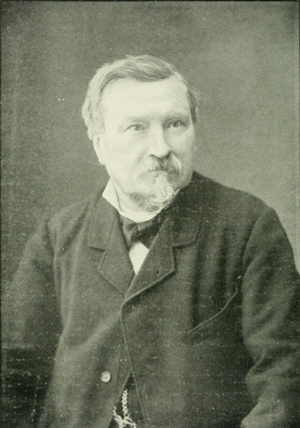
GUSTAVE DE MOLINARI (1819-1912)
 |
 |
|
[Created: 8 July, 2025]
[Updated: 8 July, 2025] |
Introduction
For a list of the books and articles Molinari wrote see David M. Hart, "The Works of Gustave de Molinari (1819-1912)" here.
For my papers on Molinari (13), anthologies (4), and translations (7) of his work, see here (sort table by clicking on "Subject Area" and scroll down to see "Molinari").
A brief overview of his life and work:
- 1819-1840: his childhood and youth was spent in Liège
- 1840-1851: he moved to Paris to work as an economic journalist, free trade activist, and began his long association with the Guillaumin publishign firm and the JDE
- 1852-1867: after the coming to power of Napoleon III he moved to Brussels were he worked as an academic economist, a journalist, and a free market lobbyist
- 1867-1881: he returned to journalism in Paris, where he wrote for the JDD serving as chief editor 1871-1876; he also wrote several books on his international travels with interesting economic analyses of the countries he visited
- 1881-1909: he was appointed editor of JDE, and wrote on economics, moral philosophy, and historical sociology;
- he retired in 1909 at the age of 90 and died in 1912
A Chronology of the Life and Works of Molinari (1819-1912)
1819-1840: childhood and youth spent in Liège
- Born 3 March 1819 in Liège, then in the United Kingdom of the Netherlands (and after 1830 Belgium)
- it is possible that he began studying medicine in Brussels before he moved to Paris. [1]
- it is also possible that he worked in a cotton factory for six years before coming to Paris which sparked his interest in labour matters. [2]
1840-1851: journalist, free trade activist, and economist in Paris
1840-47
- circa 1840 comes to Paris from Belgium where he finds work as a journalist
- 1842-43 writes biographies for the magazine, Le biographe universel, including one on the Minister of Finance Comte Roy, and on the author and politician Lamartine, which he publishes as his first book, a Biographe politique de M. A. de Lamartine (1843). His first piece appears in January 1842 as a monthly "Chronique politique"
- 1843-46 works as a journalist writing for La Nation and Le Courrier français on economic topics such as railroads, workers' rights, labour exchanges, and slavery. Meets Hippolyte Castille who also works for the Courrier français and attends Castille's soirées at his house in the rue Saint-Lazare 1844-48, other attendees include Bastiat, Garnier, Fonteyraud, and Coquelin.
- 1846 publishes his first book on economics, Études économiques. L'Organisation de la liberté industrielle et l'abolition de l'esclavage (Economic Studies on the Organization of Industrial Liberty and the Abolition of Slavery) (1846) with a quote on the front page "Laissez faire, laissez passer." The book is reviewed very favorably by Joseph Garnier in the JDE thus beginning Molinari's long association with the journal.
- 1846 meets Bastiat in early 1846 in the offices of Le Courrier français who comes to thank them for reviewing his first book of Economic Sophisms. Bastiat agrees to publish some future sophisms in the journal, possibly edited by Molinari. Molinari joins Bastiat's Free Trade Society in July (founded 1 July 1846, Bastiat is Secretary General), becoming one of the associate secretaries, along with Adolphe Blaise, Charles Coquelin, Alcide Fonteyraud, Joseph Garnier; Coquelin is one of the key speakers at la Salle Montesquieu where meetings were held; he is invited to attend banquet in 18 Aug. 1846 in Paris in honour of Richard Cobden. In Sept. publishes two critical letters in the Courrier français addressed to Bastiat criticizing him and the FTA for not being radical enough in their demands to abolish protectionism.
- 1847 Molinari formally enters into the Guillaumin network; publishes his first article in the Jan. edition of the JDE on agriculture in England; between 1847-52 writes on economic conditions in England and Ireland, history of economic thought, tariffs, articles in JDE, DEP
- is invited to join the Political Economy Society (founded 15 Nov. 1842), becomes full member in 1847. Founding members were five: Eugène Daire, Joseph Garnier, Adolphe Blaise, Guillaumin, et Pierre Bos-Darnis (dropped out when he became a protectionist)
- Attends as delegate of the SEP the first congress of economists held in Brussels 16-18 September 1847 - French delegation includes Charles Dunoyer, Horace Say, Joseph Garnier, Alcide Fonteyraud, Adolphe Blanqui, Guillaumin, Molinari. It was also attended by Karl Marx who was to present a paper so it possible that they met.
- publishes the first of many books by Guillaumin on Histoire du tarif (The History of Tariffs) (1847); begins editorial work on the last two volumes of the Collections des Principaux économistes on 18th century economic thought.
- late 1847 begins teaching a course on economics at the Athénée royal de Paris which is interrupted by the Revolution; resumed teaching course when he went to Brussels in 1852. Published as Cours d'économie politique (1st ed. 1855, 2nd ed. 1863)
- 1847-48 helps Castille and Bastiat edit journal about intellectual property: Le travail intellectuel (Intellectual Labour) 1847-48)
1848
- February - the day after the Revolution breaks out he, Bastiat, and Castille start their first small magazine which appears daily and which they hand out on the streets of Paris, La République française. 30 issues appeared between 26 Feb. - 28 March 1848
- March - active in a political club, "Le Club de la liberté du travail" (The Club for the Liberty of Working), founded by Coquelin with Fonteyraud as one of the key speakers, to publicly debate socialists on "the right to work," forced to close when communist thugs use violence against them
- writes four signed articles and book reviews for the JDE and many unsigned articles and reports about the events of 1848, including "L'utopie de la liberté (lettre aux socialistes, par un RÉVEUR)" (The Utopia of Liberty: A Letter to the Socialists by a Dreamer) in June appealing for a coalition between the economists and the socialists
- June 1848 joins Bastiat, Garnier, Coquelin, Fonteyraud in editing and publishing a second revolutionary magazine to appeal to ordinary workers which they hand out on the streets of Paris, Jacques Bonhomme (11 June- 13 July 1848), 4 issues appeared, forced to close because of the violent crack down by the police after the June Days rioting
- June-December 1848 - works closely with the editorial staff at the JDE reporting on political and intellectual developments during the year, especially the debate in the Chamber on the "right to work" clause in the new constitution
- Dec. Molinari in an unsigned article sums up the events of the year on behalf of the editors of the JDE concluding that the "fever" of socialism has temporarily subsided but he expects another outbreak at any time
1849
- January writes an important article on Thiers' book De la propriété (On Property) in JDE criticizing the conservatives for defending property poorly against the socialists
- February writes "De la production de la sécurité" (The Production of Security) for the JDE in which he gives the first defense of the anarcho-capitalist argument for the private provision of police and defense. This is taken up again in S11 of Les Soirées
- July/Aug. assists Garnier in organizing an international Peace Congress in Paris the president of which was Victor Hugo and at which Bastiat gives an important speech. Molinari wrote a report on the meeting published in JDE in Sept.
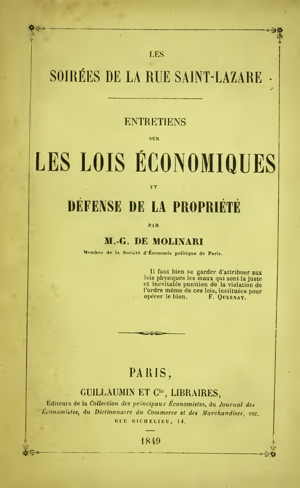
- Sept. most likely date of publication of Les Soirées de la rue Saint-Lazare. Announced in Oct. 1849 Guillaumin catalog.
- Oct. Molinari's book Les Soirées is critically discussed at the regular monthly meeting of the Political Economy Society. Dunoyer says he has been "swept away by illusions of logic." Bastiat and others argue that the state must have supreme power in order to defend property rights; the participants also criticize him for objecting to eminent domain laws.
- Nov. Charles Coquelin critically reviews Les Soirées in the JDE, he agrees with most of the book but objects to Molinari using the figure of "The Economist" to put forward his own views about the private production of security.
1850-51
- writes nine articles and book reviews for the JDE during this period, including the obituary of Bastiat in February 1851.
- assists in the editing and publishing of the DEP edited by Coquelin and Guillaumin, writes 25 principle articles and four biographical articles, including the ones on Liberté du commerce, Liberté des échanges, Paix, Guerre, Paix (Société et Congrès de la Paix), propriété littéraire, Servage, Tarifs de douane, Théatres, Travail, Union douanière, Usure
- the coup d'état of Louis Napoleon on 2 Dec. 1851 forces Molinari into a self-imposed exile in Brussels
- The first period in GdM's professional life came to an end with death of 3 close colleagues and his decision to leave Paris at end of 1851: Fonteyraud 1849 (death in cholera epidemic); F. Bastiat 24 Dec. 1850 (throat cancer); Ch. Coquelin 1852 (heart attack August 1852).
1852-1868: academic economist and free market lobbyist and journalist in Brussels.
- moves to Brussels to teach economics at the Musée royal de l'industrie belge, later at Institut supérieur du commerce d'Anvers (Antwerp); he is active in the Belgian free trade movement and attempts to set up Labour Exchanges
- Oct. 1852 writes an analysis of the 1848 Revolution and the coup d'état of Louis Napoléon based upon his theory of class interests, Les Révolutions et le despotisme envisagés au point de vue des intérêts matériel (1852). This is followed in 1861 by a book examining the political and economic thought of Emperor Napoleon III, Napoleon III publiciste (1861).
- 1855-68 edits and publishes his own journal the Économiste belge to promote free trade and labour exchanges
- 1855 publishes his treatise of economics based upon his lectures, Cours d'économie politique (2nd ed. 1863).
- 1855 publishes a second book of "conversations" about free trade between a rioter, a prohibitionist or protectionist, and an economist, Conservations familières sur le commerce des grains (1885)
- 1857 writes a book on the 18th century peace advocate L'abbé de Saint-Pierre (1857)
- 1859 debates Frédéric Passy on compulsory education, De l'enseignement obligatoire in which Molinari argues that the state should compel parents to educate their children but not provide that education.
- 1861 publishes an account of his visit to Russia and the abolition of serfdom, Lettres sur la Russie (1861); also a collection of his economic articles from the previous 15 years, Questions d'économie politique et de droit public.
- 1868 - his wife Edmée died at the age of 50 on October 30, 1868; he closes his magazine Économiste belge in December and moves back to Paris
1869-1881: returns to journalism in Paris
- Molinari works for the prestigious Journal des Débats, serves as chief editor 1871-1876
- 1870-71 in Paris during the Paris Commune and the formation of the Third Republic; writes accounts of the socialist political clubs and the socialist movement during the Commune, Les Clubs rouges pendant le siège de Paris (The Red Clubs during the Siege of Paris) (1871) and Le Mouvement socialiste et les réunions publiques avant la révolution du 4 septembre 1870 (The Socialist Movement and their Public Meetings before the Revolution of 4 Sept. 1870) (1872)
- 1873 writes his first and only book on political and constitutional theory, La République tempérée (The Strengthened Republic) (1873) as the constitution of the Third Republic is being developed
- 1874 - is elected a corresponding member of the Institute (Académie des sciences morales et politiques)
- 1876 travels to Canada and the US to cover the centennial celebrations and writes accounts of his travels
- 1877-79 - writes a series of articles in the JDE which becomes his first book on historical sociology which is published in 1880, L'évolution économique du XIXe siècle (Economic Evolution in the 19th Century) (1880)
1881-1909: editor of JDE, very prolific period in his life; writes on economics and historical sociology and his travels
- 1881 Appointed editor of JDE in October when Joseph Garnier dies;
- 1881-83 - begins another multi-part series of articles in the JDE which becomes his second book on historical sociology, L'évolution politique et la Révolution (Political Evolution and the Revolution) (1884)
- 1881-86 continues to travel abroad and writes several books about his travels - visits Canada, US, Jersey, Russia, Corsica, Panama, Martinique, Haiti
- 1881-87 writes a series of books on economic topics - protectionism, slavery, and agriculture, e.g. Conversations sur le commerce des grains et la protection de l'agriculture (1886)
- 1887-93 writes a series of books on the natural laws and the moral philosophy of political economy, e.g. Les Lois naturelles de l'économie politique (Natural Laws and Political Economy) (1887)
- 1887-98 - writes several articles and a book on the growing threat of war, eg. a series of letters printed in The Times (of London) on organizing a "League of Neutrals" (28 July, 1887), " A Syndicat of Peace" (1 Nov. 1893), and "The Assurance of Peace" (21 Oct. 1895); and a book on Grandeur et decadence de la guerre (The Grandeur and Decadence of War) (1898)
- 1892-1901 - writes books on Malthus, labour exchanges, the social question, science and religion, and the future of liberty, e.g. Les Bourses du Travail (Labour Exchanges) (1893), Comment se résoudra la question sociale (1896), Esquisse de l'organisation politique et économique de la Société future (1899)
- 1901-1902 - writes two important articles and a book surveying the achievements of liberty during the 19th century and its bleak future in the 20th, "Le XIXe siècle", JDE (Jan. 1901); "Le XXe siècle", JDE (Jan. 1902); Les Problèmes du XXe siècle (1901).
1909- 1912: retirement
- 1909 - Molinari is forced to resign as editor of the JDE because of ill health
- 1911 writes his last book at age 92 appropriately called Ultima Verba: Mon dernier ouvrage (Last Words: My Last Book) (1911)
- Died 28 January 1912 in Adinkerque, Belgium (buried in Père-Lachaise cemetery in Paris).
Endnotes
[1] Red., "Molinari, Gustave de", Handwörterbuch der Staatswissenschaften (1900). Volume 5, p. 850. The editors state that he"studierte in Brüssel Medizin und in Paris Nationalökonomie" (studied medicine in Brussels and political economy in Paris).
[2] "La mobilisation du travail," La Réforme (9 juin 1845). In a footnote it states that "A period lasting six years spent in a factory (possibly cotton) has allowed the author to collect these various observations." He also referred to this part of his life in a long footnote in his book L'Évolution économique (1880), p. 300, where he quotes a letter he wrote to the editor of a newspaper in New Orleans in August 1877 on trade unions and strikes and uses his work experience in a factory to justify his observations.