| The Digital Library of Liberty & Power incorporating the Guillaumin Collection of the Great Books of Liberty |
Home | New | Authors | Works | Topics | Papers | Blog | About | Email | Search |
 |
|
GUSTAVE DE MOLINARI,
"On the Production of Security" (JDE, Feb. 1849)
 |
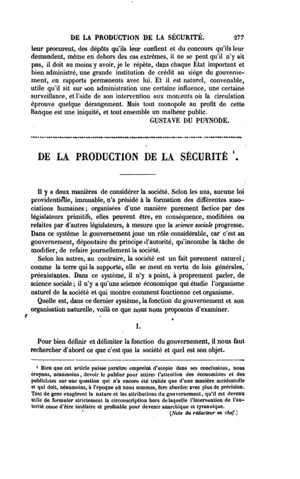 |
| Gustave de Molinari (1819-19112) |
|
[Created: 11 November, 2020]
[Updated: 5 August, 2025] |
Source
, "On the Production of Security". A translation of "De la production de la sécurité," Journal des Economistes, Vol. XXII, no. 95, 15 February, 1849, pp. 277-90.http://davidmhart.com/liberty/FrenchClassicalLiberals/Molinari/Articles/PoS/Molinari_ProductionSecurity1849.html
This is a translation of Gustave de Molinari, "De la production de la sécurité," Journal des Economistes, Vol. XXII, no. 95, 15 February, 1849, pp. 277-90.
Published as a separate pamphlet: De la Production de la sécurité, par M. G. de Molinari. Extrait du n° 95 du "Journal des économistes", 15 février 1849. (Paris : Guillaumin, 1849). In-8°, 16 p.
This title is also available in HTML and a facsimile PDF of the original French version.
This book is part of a collection of works by Gustave de Molinari (1819-19112).
On the Production of Security [1]
[277]
There are two ways of considering society. According to some, the development of different human associations is not subject to providential, unchangeable laws. Rather, these associations, having originally been organized in a purely artificial manner by early legislators, can later be modified or remade by other legislators, in step with the progress of social science. In this system the government plays a considerable role, because it is upon it, the custodian of the principle of authority, that the daily task of modifying and remaking society devolves.
According to others, on the contrary, society is a purely natural fact. Like the earth on which it stands, society moves in accordance with general, preexisting laws. In this system, there is no such thing, strictly speaking, as social science; there is only economic science, which studies the natural organism of society and shows how this organism functions. [2]
We propose to examine, within the latter system, what is the function of government and its natural organization.
I.
In order to define and delimit the function of government, [3] it is first necessary to investigate what society is and what its purpose is.
[278]
What natural impulse do men obey when they come together to form a society? They are obeying the impulse, or, to speak more exactly, the instinct of sociability. The human race is essentially sociable. Like beavers and the higher animal species in general, men have an instinctive inclination to live in society.
What is the raison d'être of this instinct?
Man experiences a multitude of needs, on whose satisfaction his happiness depends, and whose non-satisfaction entails suffering. Alone and isolated, he could only provide in an incomplete, insufficient manner for these constant needs. The instinct of sociability brings him together with his fellow humans, and pushes him to communicate with them. Once this has been established, under the impulse of the self-interest of the individuals thus brought together, a certain division of labor is established, necessarily followed by exchanges. In brief, we see an organization emerge, by means of which man can much more completely satisfy his needs than he could by living in isolation.
This natural organization is called society. [4]
The purpose of society is therefore the most complete satisfaction of man's needs. The division of labor and exchange are the means by which this is accomplished.
Among the needs of man, there is one particular type which plays an immense role in the history of humanity, namely the need for security.
What is this need?
Whether they live in isolation or in a society, men are, above all, interested in preserving their existence and the fruits of their labor. If the sense of justice were universally prevalent on earth; if, consequently, each man confined himself to laboring and exchanging the fruits of his labor, without wishing to take the life or to to seize by violence or fraud, the fruits of other men's labor; if everyone had, in a word, an instinctive horror of any act harmful to another person, it is certain that security would exist naturally on earth, and that no artificial institution would be necessary to establish it. Unfortunately this is not the way things are. The sense of justice seems to be the preserve of only a few higher and exceptional temperaments. Among the inferior races, it exists only in a rudimentary state. Hence the innumerable violations, ever since the beginning of the world, since the days of Cain and Abel, of the lives and property of individuals.
Hence also the creation of institutions whose purpose is to guarantee to everyone the peaceful possession of his person and his goods.
These institutions were called governments.
Everywhere, even among the least enlightened tribes, one encounters a government, so universal and urgent is the need for security provided by a government.
Everywhere, men resign themselves to the most extreme sacrifices rather than [279] do without government and hence security, without realizing that in so doing, they are thinking incorrectly.
Suppose that a man found his person and his standard of living constantly menaced; wouldn't his first and most pressing preoccupation be to protect himself from the dangers that surrounded him? This preoccupation, these efforts, this labor, would necessarily absorb the greater portion of his time, as well as the most energetic and active faculties of his mind. In consequence, he could only devote insufficient and uncertain efforts, and his divided attention, to the satisfaction of his other needs.
Even though this man might be asked to surrender a very considerable portion of his time and his labor to someone else who takes it upon himself to guarantee the peaceful possession of his person and his goods, wouldn't it be to his advantage to agree to this transaction?
Still, it would obviously be no less in his self-interest to procure his security at the lowest price possible.
II.
If there is one well-established truth in political economy, it is this:
That in all cases, for all commodities that serve to provide for the material or non-material needs of the consumer, it is in the consumer's best interest that labor and trade remain free, because the freedom of working and of trade have as their necessary and permanent result the maximum lowering of prices.
And this as well:
That the interests of the consumer of any commodity whatsoever should always prevail over the interests of the producer.
Now in pursuing these principles, one arrives at this rigorous conclusion:
That the production of security should, in the interests of the consumers of this non-material good, remain subject to the law of free competition.
Whence it follows:
That no government should have the right to prevent another government from going into competition with it, or to require consumers of security [5] to come exclusively to it for this commodity.
Nevertheless, I must admit that, up until the present, one recoiled before this rigorous implication of the principle of free competition.
One economist who has done as much as anyone to extend the application of the principle of liberty, M. Charles Dunoyer, thinks "that the functions of government will never be able to fall into the domain of private activity." [6]
Now here is a a clear and obvious exception to the principle of free competition.
This exception is all the more remarkable for being unique.
Undoubtedly, one can find economists who establish more numerous exceptions to this principle; but we may emphatically affirm [280] that these are not pure economists. True economists are generally agreed, on the one had, that the government should restrict itself to guaranteeing the security of its citizens, and on the other hand, that the freedom of working and of trade should otherwise be complete and absolute.
But why should an exception be made for security? What special reason is there that the production of security cannot be left to free competition? Why should it be subjected to a different principle and organized according to a different system?
On this point, the masters of economic science are silent, and M. Dunoyer, who has clearly noted this exception, does not investigate the grounds on which it is based.
III.
We are consequently led to ask ourselves whether his exception is well founded, in the eyes of an economist.
It offends reason to believe that a well established natural law can admit of any exceptions. A natural law must hold everywhere and always, or be invalid. I cannot believe, for example, that the law of universal gravitation, which governs the physical world, is ever suspended at any moment or at any place in the universe. Now I consider economic laws to be like natural laws, and I have just as much faith in the principles of the division of labor, the freedom of working, and free trade, as I have in the law of universal gravitation. I believe that while these principles can be subject to disturbances, they admit of no exceptions.
But, if this is the case, the production of security should not be removed from the law of free competition; and if it is removed, society as a whole will suffer a loss.
Either this is logical and true, or else the principles on which economic science is based are invalid.
IV.
It thus has been demonstrated a priori, to those of us who have faith in the principles of economic science, that the exception indicated above has no raison d’être, and that the production of security, like anything else, should be subject to the law of free competition.
Once we have acquired this conviction, what remains for us to do? It remains for us to investigate how it has come about that the production of security has not been subjected to the law of free competition, but rather has been subjected to different principles.
What are those principles?
Those of monopoly and communism.
In the entire world, there is not a single institution of the security industry [7] that is not based on monopoly or on communism.
[281]
In this connection, we add, in passing, a simple remark.
Political economy has disapproved equally of monopoly and communism in the various branches of human activity, wherever it has found them. Is it not then strange and unreasonable that it accepts them in the security industry?
V.
Let us now examine how it is that all known governments have either been subjected to the law of monopoly, or else organized according to the communistic principle.
First let us investigate what is understood by the words monopoly and communism.
It is an observable truth that the more urgent and necessary are man's needs, the greater will be the sacrifices he will be willing to endure in order to satisfy them. Now, there are some things that are found abundantly in nature, and whose production does not require a great expenditure of labor, but which, since they satisfy these urgent and necessary wants, can consequently acquire an exchange value all out of proportion with their natural value. [8] Take salt for example. Suppose that a man or a group of men succeed in having the exclusive production and sale of salt assigned to themselves. [9] It is apparent that this man or group could raise the price of this commodity well above its value, well above the price it would have under a regime of free competition.
One will then say that this man or this group possesses a monopoly, and that the price of salt is a monopoly price.
But it is obvious that the consumers will not consent freely to paying the excessive monopoly surtax. It will be necessary to compel them to pay it, and in order to compel them, the employment of force will be necessary.
Every monopoly necessarily rests on force.
When the monopolists are no longer as strong as the consumers they exploit, what happens?
In every instance, the monopoly finally disappears either violently or as the outcome of an amicable transaction. What is it replaced with?
If the aroused and rebellious consumers secure the means of production of the salt industry, in all probability they will confiscate this industry for their own profit, and their first thought will be, not to leave it to free competition, but rather to exploit it, in common, for their own account. They will then name a director or a directive committee to operate the saltworks, to whom they will allocate the funds necessary to defray the costs of salt production. Then, since past experience has made them suspicious and distrustful, since they will be afraid that the director named by them will seize production for his own benefit, and simply reconstitute by open or hidden means the old monopoly for his own profit, they will elect delegates or representatives entrusted with appropriating the funds necessary for production, [282] with watching over their use, and with making sure that the salt produced is equally distributed to those entitled to it. The production of salt will be organized in this manner.
This form of the organization of production has been named communism.
When this organization is applied to a single commodity, the communism is said to be partial.
When it is applied to all commodities, the communism is said to be complete.
But whether communism is partial or complete, political economy is no more tolerant of it than it is of monopoly, of which it is merely an extension.
VI.
Isn't what has just been said about salt applicable to security? [10] Isn't this the history of all monarchies and all republics?
Everywhere, the production of security began by being organized as a monopoly, and everywhere, nowadays, it tends to be organized communistically. Here is why.
Among the material and non-material commodities necessary to man, none, with the possible exception of wheat, [11] is more indispensable, and therefore none can support quite so large a monopoly tax.
Nor is any quite so prone to monopolization.
What, indeed, is the situation of men who need security? It is weakness. What is the situation of those who undertake to provide them with this necessary security? It is force. If it were otherwise, if the consumers of security were stronger than the producers, they obviously would not need their assistance.
Now, if the producers of security [12] are originally stronger than the consumers, won't it be easy for the former to impose a monopoly on the latter?
Everywhere, when societies originate, we see the strongest, most warlike races seizing the government of these societies exclusively for themselves. Everywhere we see these races seizing the monopoly of security [13] within certain more or less extensive boundaries, depending on their number and strength.
And, this monopoly being, by its very nature, extraordinarily profitable, everywhere we see the races invested with the monopoly of security devoting themselves to bitter struggles, in order to add to the extent of their market, the number of their coerced consumers, and hence the size of their profits.
War has been the necessary and inevitable consequence of the establishment of the monopoly of security.
Another inevitable consequence has been that this monopoly of security has engendered all the other kinds of monopolies.
[283]
When they saw the situation of the monopolizers of security, [14] the producers of other commodities could not help but notice that nothing in the world is more advantageous than monopoly. They, in turn, were consequently tempted to add to the profits from their own industry by the same process. But what did they require in order to create a monopoly of the commodity they produced, to the detriment of the consumers? They required the use of force. However, they did not possess the force necessary to contain the resistance of the consumers whose interests were being harmed. What did they do? They borrowed it, for a financial consideration, from those who had it. They petitioned and obtained, at the price of an agreed upon fee, the exclusive privilege of carrying on their industry within certain determined boundaries. Since the taxes [15] for these privileges brought the producers of security a considerable sum of money, the world was soon covered with monopolies. Labor and trade were everywhere shackled, chained up, and the condition of the masses remained as miserable as possible.
Nevertheless, after long centuries of suffering, as enlightenment spread through the world little by little, the masses who had been smothered under this web of privileges began to rebel against the privileged, and to demand liberty, that is to say, the suppression of monopolies.
This process took many forms. What happened in England, for example? Originally, the race which governed the country [16] and which was organized into orders (feudalism), having at its head a hereditary director (the king), and an equally hereditary administrative council (the House of Lords), originally set the price of security, which it had monopolized, at whatever rate it pleased. There was no negotiation between the producers of security and the consumers. This was the regime of "serving at the King’s pleasure." [17] But as time passed, the consumers, having become aware of their numbers and strength, rose up against this regime of pure arbitrary rule, and they obtained the right to negotiate with the producers over the price of this commodity. For this purpose, they sent delegates to the House of Commons to discuss the level of taxes, that is, the price of security. [18] They were thus able to obtain some relief from the financial pressure they were under. Nevertheless, the producers of security had a direct say in the naming of the members of the House of Commons, so that debate was not entirely free, and the amount of the tax, the price of this commodity, remained above its natural value. One day the exploited consumers rose up against the producers and dispossessed them of their industry. [19] They then undertook to carry on this industry by themselves and chose for this purpose a director of operations [20] assisted by a Council. Thus communism replaced monopoly. But the scheme did not work, and twenty years later, primitive monopoly was re-established. Only this time the monopolists were wise enough not to restore the absolutist rule of "the king’s pleasure"; they accepted free debate over taxes, being careful, all the while, constantly to corrupt the delegates of the opposition party. They gave these delegates control over various posts in the administration of security, [21] and they even went so far as to allow the most influential (of them) into the heart of [284] their Upper Council. Nothing could have been more clever than thus behavior. Nevertheless, the consumers of security finally became aware of these abuses, and demanded the reform of Parliament. This long contested reform was finally achieved, [22] and since that time, the consumers have won a significant lightening of their burdens.
In France, the monopoly of security, after having similarly undergone frequent vicissitudes and various modifications, has just been overthrown for the second time. [23] As once happened in England, monopoly for the benefit of one caste, and then in the name of a certain class of society, was finally replaced by communal production. [24] The consumers as a whole, behaving like shareholders, [25] named a director responsible for supervising the actions of the director and of his administration.
We will content ourselves with making one simple observation on the subject of this new regime.
Just as the monopoly of security logically had to give rise to all the other monopolies, so communistic security [26] must logically give rise to all the other forms of communism.
In reality, we have a choice of two things:
Either communistic production is superior to free production, or it is not.
If it is, then it must be for all things, not just for security.
If not, progress requires that it be replaced by free production.
Complete communism or complete liberty: that is the alternative! [27]
VII.
But is it conceivable that the production of security could be organized other than as a monopoly or communistically? Could it conceivably be left to free competition?
The response to this question on the part of political writers is unanimous: No.
Why? We will tell you why.
Because these writers, who are concerned especially with governments, know nothing about society. They regard it as an artificial construction, and believe that the mission of government is to modify and remake it constantly.
Now in order to modify or remake society, it is necessary to be empowered with an authority which is superior to that of the various individuals of which it is composed.
Monopolistic governments [28] claim to have obtained from God himself [285] this authority which gives them the right to modify or remake society according to their fancy, and to dispose of persons and property however they please. Communistic governments appeal to human reason, as manifested in the majority of the sovereign people.
But do monopolistic governments and communistic governments truly possess this superior, irresistible authority? Do they in reality have a higher authority than that which free governments [29] could have? This is what we must investigate.
VIII.
If it were true that society were not naturally organized, if it were true that the laws which govern its motion were to be constantly modified or remade, the legislators would necessarily have to have an unchangeable and sacred authority. Being the heirs of Providence on earth, they would have to be regarded as almost equal to God. If it were otherwise, would it not be impossible for them to fulfill their mission? Indeed, one cannot intervene in human affairs, one cannot attempt to direct and regulate them, without daily offending a multitude of interests. Unless the custodians of power are believed to belong to a higher species or have been charged with a mandate from heaven, those whose interests have been harmed will resist.
From this idea comes the fiction of divine right.
This fiction was certainly the best imaginable. If you succeed in persuading the multitude that God himself has chosen certain men or certain races to give laws to society and to govern it, no one will dream of revolting against these appointees of Providence, and everything the government does will be accepted as well done. A government based on divine right is indestructible.
On one condition only, namely that one believes in divine right.
Indeed, if one dares to think that the leaders of nations do not receive their inspirations directly from Providence itself, that they obey purely human impulses, the prestige that surrounds them will disappear and one will irreverently resist their sovereign decisions, as one resists anything manmade whose utility has not been clearly demonstrated.
It is accordingly fascinating to see the pains theorists of divine right take to establish the superhuman nature of the races who have taken possession of human government.
Let us listen, for example, to M. Joseph de Maistre: [30]
Man cannot create a sovereign. At most he can serve as an instrument for dispossessing a sovereign and delivering his estates into the hands of another sovereign, himself a prince by birth. Moreover, there has never been a sovereign family whose origin could be identified as plebeian. If such a phenomenon were to appear, it would be a new era for the world.
… It is written: It is I who make the kings. This is not a statement made by the Church, nor a preacher’s metaphor; it is the literal, [286] simple, and palpable truth. It is a law of the political world. God makes kings, quite literally so. He prepares royal families. He nurtures them within a cloud which hides their origin. Finally they appear, crowned with glory and honor. Then they assume their place. [31]
According to this system, which embodies the will of Providence in certain men and which invests these chosen ones, these anointed ones with a quasi-divine authority, the subjects evidently have no rights at all. They must submit, without question, to the decrees of the sovereign authority, as if they were the decrees of Providence itself.
According to Plutarch, the body is the instrument of the soul, and the soul is the instrument of God. [32] According to the divine right school, God selects certain souls and uses them as instruments for governing the world.
If men had faith in this theory, surely nothing could unsettle a government based on divine right.
Unfortunately, they have completely lost faith.
Why?
Because one fine day they took it into their heads to question and to reason, and in questioning, in reasoning, they discovered that their governors governed them no better than they, simply mortals without any communication with Providence, could have done themselves.
It was free inquiry that discredited the fiction of divine right, to the point where the subjects of monarchs or of aristocracies based on divine right obey them only insofar as they think it in their own self-interest to obey them.
Has the communist fiction fared any better?
According to the communist theory, of which Rousseau is the high-priest, authority does not descend from on high, but rather comes up from below. The government no longer looks to Providence for its authority, it looks to united mankind, to the one, indivisible, and sovereign nation.
Here is what the communists, the partisans of the sovereignty of the people, assume. They assume that human reason has the power to discover the best laws and the organization which most perfectly suits society; and that, in practice, these laws reveal themselves at the conclusion of a free debate between conflicting opinions. If there is no unanimity, if there is still dissension after the debate, the majority is in the right, since it comprises the larger number of reasonable individuals. (These individuals are, of course, assumed to be equal, otherwise the whole structure collapses.) Consequently, they insist that the decisions of the majority must become law, and that the minority is obliged to submit to it, even if it is contrary to its most deeply rooted convictions and injures its most deeply held interests.
That is the theory; but, in practice, does the authority of the decision of the majority really have this irresistible, absolute character as [287] assumed? Is it always, in every instance, respected by the minority? Could it be?
Let us take an example.
Let us suppose that socialism succeeds in propagating itself among the working classes in the countryside as it has already among the working classes in the cities; that it consequently becomes the majority in the country and that, profiting from this situation, it sends a socialist majority to the Legislative Assembly and names a socialist president. [33] Suppose that this majority and this president, invested with sovereign authority, decrees the imposition of a tax on the rich of three billions, in order to organize the labor of the poor, as M. Proudhon demanded. [34] Is it probable that the minority would submit peacefully to his iniquitous and absurd, yet legal and constitutional plunder? [35]
No, without a doubt it would not hesitate to disown the authority of the majority and to defend its property.
Under this regime, as under the preceding, one obeys the custodians of authority only insofar as one thinks it in one's self-interest to obey them.
This leads us to affirm that the moral foundation of authority is neither as solid nor as wide, under a regime of monopoly or of communism, as it could be under a regime of liberty.
IX.
Suppose nevertheless that the partisans of an artificial organization, either the monopolists or the communists, are right; that society is not naturally organized, and that the task of making and unmaking the laws that regulate society continuously devolves upon men, look in what a sad and sorry situation the world would find itself. The moral authority of governors rests, in reality, on the self-interest of the governed. The latter having a natural tendency to resist anything harmful to their self-interest, authority which was not recognized would continually require the help of physical force.
The monopolists and the communists, furthermore, completely understand this necessity.
If anyone, says M. de Maistre, attempts to detract from the authority of God's chosen ones, let him be turned over to the secular power, let the hangman perform his duties. [36]
If anyone does not recognize the authority of those chosen by the people, say the theorists of the school of Rousseau, if he resists any decision whatsoever of the majority, let him be punished as an enemy of the sovereign people, let the guillotine perform its justice.
These two schools, which both take artificial organization as their point of departure, necessarily lead to the same conclusion: TERROR.
X.
Allow us now to formulate a simple hypothesis.
[288]
Let us imagine a newly created society: The men who are part of it it are busy working and exchanging the fruits of their labor. A natural instinct reveals to these men that their persons, the land they occupy and cultivate, the fruits of their labor, are their property, and that no one, except themselves, has the right to dispose of or touch this property. This instinct is not hypothetical; it exists. But man being an imperfect creature, this awareness of the right of everyone to his person and his goods will not be found to the same degree in every soul, and certain individuals will attempt to attack, by violence or by fraud, the persons or the property of others.
Hence, the need for an industry that prevents or suppresses these violent or fraudulent aggressions.
Let us suppose that a man or a combination of men comes and says:
In return for a payment, I will undertake to prevent or suppress attacks against against persons and property.
Let those who wish their persons and property to be protected from all aggression just talk to me.
Before making a deal with this producer of security, [37] what will the consumers do?
In the first place, they will find out if he is really strong enough to protect them.
In the second place, whether he offers a moral guarantee so that one would not have to fear him undertaking the very aggressions he has promised to suppress.
In the third place, whether any other producer of security, offering equal guarantees, is willing to offer them this commodity on better terms.
These terms would be of various kinds.
In order to be able to guarantee the consumers full security of their persons and their property, and, in case of harm, to pay them compensation which is proportioned to the loss suffered, [38] it would be necessary, therefore:
1. that the producer of security would establish certain penalties for those who committed offences against individuals and those who violated property, and that the consumers of security would accept being subjected to these penalties in the case where they themselves committed any offences against person or property;
2. that the producer of security would impose on the consumers of security certain obligations for the purpose of assisting it (the producer) in discovering the perpetrators of the offences
3. that the producer of security would regularly impose a certain premium [39] to cover its costs of production as well as the normal profit for its industry, which would vary according to the situation of the consumers, the particular occupations in which they were engaged, and the extent, value, and nature of their property. [40]
If these terms, necessary for carrying on this industry, are agreeable to the consumers, a deal will be made. Otherwise the consumers will either do without security, or seek out another producer.
Now if we consider the particular nature of the security industry, it is apparent that the producers will necessarily restrict [289] their clientele to certain territorial boundaries. They would be unable to cover their costs if they tried to provide police services [41] in localities comprising only a few clients. Their clientele will naturally be clustered around their business headquarters. [42] They would nevertheless be unable to abuse this situation by dictating conditions to their consumers. In the event of an exorbitant rise in the price of security, the consumers would always have the option of giving their patronage to a new entrepreneur, or to a neighboring entrepreneur. [43]
This option the consumer retains of being able to buy security wherever he pleases brings about continual competition [44] among all the producers, each producer striving to maintain or increase his clientele by attracting them with cheaper prices [45] or of faster, more complete, and better justice. [46]
If, on the contrary, the consumer is not free to buy security wherever he sees fit, [47] you will immediately see open up considerable opportunities for businesses to engage in arbitrary practices and bad management. Justice becomes slow and costly, the police become troublesome, individual liberty is no longer respected, the price of security [48] is raised exorbitantly and is unequally levied, according to the power and influence of this or that class of consumers. The insurers (who provide security) [49] will engage in bitter struggles to wrest customers from one another. In a word, all the abuses inherent in monopoly or in communism suddenly begin to appear.
Under the regime of free competition, war between the producers of security entirely loses its justification. Why would they make war? To conquer consumers? But the consumers would not allow themselves to be conquered. They certainly would be careful not to have their persons and property insured [50] by men who would unscrupulously attack the persons and property of their competitors. If some audacious conqueror tried to impose the law on them, they [290] would immediately call to their aid all the free consumers [51] menaced by this aggression, and they would bring him to justice. Just as war is the natural consequence of monopoly, peace us the natural consequence of liberty.
Under a regime of liberty, the natural organization of the security industry would be no different from that of other industries. In small districts a single entrepreneur [52] could suffice. This entrepreneur might leave his business to his son, or sell it to another entrepreneur. In larger districts, one company by itself would bring together enough resources to carry on this important and difficult business adequately. If it were well managed, this company could easily last, and security would last with it. In the security industry, just as in most of the other branches of production, the latter mode of organization (one large company) will probably replace the former (a single entrepreneur), in the end.
In one case this might result in a monarchy, in the other case it might result in a republic; but it would be a monarchy without a monopoly and a republic without communism.
In both cases, this authority would be accepted and respected in the name of utility, and would not be an authority imposed by terror.
It will undoubtedly be disputed whether such a hypothetical situation is realizable. But, at the risk of being considered a utopian, we affirm that this is not disputable, that a careful examination of the facts will decide the problem of government more and more in favor of liberty, just as it does all other economic problems. We are convinced, so far as we are concerned, that one day associations will be established to agitate for free government, [53] as they have already been established on behalf of free trade.
And we will not hesitate to add that after this reform has been achieved, and all artificial obstacles to the free action of the natural laws that govern the economic world have disappeared, the situation of the various members of society will become the best possible.
G. DE MOLINARI
Endnotes
[1] (Note by Joseph Garnier, editor-in-chief of the Journal des Economistes, 1849.) Although this article may appear utopian in its conclusions, we nevertheless believe that we should publish it in order to attract the attention of economists and journalists to a question which has hitherto been treated in only a desultory manner and which should, nevertheless, in our day and age, be approached with greater precision. So many people exaggerate the nature and prerogatives of government that it has become useful to formulate strictly the boundaries outside of which the intervention of authority becomes anarchical and tyrannical rather than protective and profitable.
[2] (Editor's Note.) Over time, Molinari developed a rather complex and detailedtheory of the "Natural Laws of Political Economy." He discussed these laws in some detail in the following works: in the early which followed soon after this articles, Les Soirées de la rue Saint-Lazare; entretiens sur les lois économiques et défense de la propriété (Paris: Guillaumin, 1849) Onine; Les Lois naturelles de l'économie politique (1887), Première partie: Les lois naturelles, pp. 1-31 Online; La Morale économique (1888), Livre I chap. IV "Les lois naturelles qui régissent les phénomènes économiques de la production, de la distribution et de la consommation," pp. 10-19 Online in PDF; Notions fondamentales économie politique et programme économique. (1891), Introduction Section I, pp. 2-11; Section I, chap. 1 "Les lois naturelles," pp. 55-70 Online; and Esquisse de l'organisation politique et économique de la Société future (1899), Introduction-Les lois naturelles, pp. i-xxvii Online. He came to believe that there were six basic “natural laws of economics” which governed the operation of the economy and which could not be ignored with impunity by individuals or by governments. They were: 1. “la loi naturelle de l’économie des forces ou du moindre effort” (the natural law of the economizing of forces, or the law of the least effort); 2. “la loi naturelle de la concurrence” (the natural law of competition) which he also expressed as “la loi de libre concurrence” (the law of free competition) and “la loi du laissez-faire” (the law of laissez-faire); 3. “la loi naturelle de la valeur” (the natural law of value) or sometimes also as “la loi de progression des valeurs” (the law of the progress or increase of values); 4. “la loi de l’offre et de la demande” (the law of supply and demand) ; 5. “la loi de l’équilibre” (the law of economic equilibrium); and 6. “Malthus’ law of population growth”.
[3] (Editor's Note.) This article and S11 in Molinari's book provoked a debate within the Political Economy Society in October 1849, January 1850,and February 1850 on this very topic. See, "Séance de 10 oct. 1849," in "Chronique," JDE, T. 24, no. 103, October 1849, pp. 315-16; also ASEP (1889), pp. 82-86; "Séance de 10 jan. 1850," in "Chronique," JDE, 15 January 1850, T. XXV, pp. 202-205; also ASEP (1889), pp. 94-100.; and "Séance de 10 fev. 1850," in "Chronique," JDE, T. XXV, no. 107, 15 fev., 1850, pp. 202-5; also ASEP (1889), pp. 100-5. In Annales de la Société d’Économie politique, publiées sous la direction de Alphonse Courtois fils, secrétaire perpétuel (Paris: Guillaumin, 1889), vol. 1846-1853.
[4] (Editor's Note.) The Economist made a distinction between the "natural organisation" of society by voluntary, market means and the "artificial organisation" of society by coercive socialist means.
[5] (Editor's Note.) He says "les consommateurs de sécurité."
[6] (Molinari's note.) In his remarkable book De la liberté du travail (On the Freedom of Labor), Vol. III, p. 253. (Published by Guillaumin.) (Editor's Note: See, Charles Dunoyer, De la liberté du travail, ou simple exposé des conditions dans lesquelles les force humaines s'exercent avec le plus de puissance (Paris: Guillaumin, 1845), Vol. III, Livre IX. Application of the Same Means by which Liberty in the Arts and Sciences act on Mankind, Chapitre VII. Continuation of the Arts which work towards the Formation of Moral Habits - On Government. "In addition, there is an infallible way of determining what they (governments) should do, and what lies outside of their proper functions; this is because the functions which are proper for them to do have the special characteristic that they would never fall into the domain of private economic activity, while private economic activity will always take over to a greater or lesser degree those activities which have been taken away from them."
[7] (Editor's Note.) He says "l'industrie de la sécurité."
[8] (Editor's Note.) Molinari is using the term "natural price" as Smith did in Wealth of Nations. He quotes Smith on this in S12 in a discussion of the difference between the market price, the cost of production, and the natural price.
[9] (Editor's Note.) The salt industry was highly regulated in France. In some places there was a government monopoly, in other places privileged corporations had a license to produce salt. Because of the high price of salt and the great consumer need for salt for the preservation and flavouring of food, there was considerable smuggling of salt across France.
[10] (Editor's Note.) Elsewhere Molinari liked to use the example of the local town monopoly grocer. See my essay "Gustave de Molinari and the Story of the Monopolist Grocer" Online.
[11] (Editor's Note.) The grain trade was also very heavily regulated by the French government because of the constant fear of riots when shortages occurred and the price of bread rose. France was divided into zones each of which had its own government run grain storage facilities and the trade of grain between zones was heavily regulated concerning price and quantities which could be trade across the zones. The economists and the French Free Trade Association (of which Molinari was a founding member) wanted to free both the internal and external trade in grain.
[12] (Editor's Note.) He says "les producteurs de sécurité."
[13] (Editor's Note.) He says "le monopole de la sécurité."
[14] (Editor's Note.) He says "des monopoleurs de la sécurité."
[15] (Editor's Note.) Molinari uses the term "l'octroi" here to mean a tax or duty in general. The Octroi was the entry tax cities charged on certain consumer goods which were brought into the city which they used to pay for streets, lighting, and other municipal services.
[16] (Editor's Note.) Molinari is referring to the theory of the "Norman Conquest" which historians like Augustin Thierry discussed in their theory of class.
[17] (Editor's Note.) He says "le régime du bon plaisir."
[18] (Editor's Note.) He says "le prix de la sécurité."
[19] (Editor's Note.) The English Civil Wars and Revolution circa 1640 and then the Restoration of the monarchy in 1660.
[20] (Editor's Note.) He says "un directeur d'exploitation."
[21] (Editor's Note.) He says "l'administration de la sécurité."
[22] (Editor's Note.) The 1832 Reform Act expanded the franchise in England and gave the vote to the middle class for the first time.
[23] (Editor's Note.) The Revolution of February 1848 which saw the collapse of King Louis Philippe's regime and the coming to power of the Second Republic.
[24] (Editor's Note.) He says "la production commune."
[25] (Editor's Note.) He says "comme actionnaires."
[26] (Editor's Note.) He says "le communisme de la sécurité."
[27] (Editor's Note.) At the conclusion of S12 the Economist present a similar set of options to the reader.
[28] (Editor's Note.) In this paragraph he uses the expressions "les gouvernements de monopole" and "les gouvernements communistes."
[29] (Editor's Note.) He uses the expression "des gouvernements libres" (free governments) here and in S11 he uses the slightly different expression "la liberté de gouvernement" (the liberty of governments) both of which have the meaning of governments competing to get business from consumers of security.
[30] (Editor's Note.) Joseph de Maistre (1753-1821) was a magistrate who became one of the leading conservative defenders of the old regime and the idea of "throne and altar."
[31] (Molinari's note.) Du principe générateur des constitutions politiques. Preface. (Editor's Note): In Considérations sur la France suivi de l'Essai sur le principe générateur des constitutions politiques et des Lettres à un gentilhomme russe sur l'Inquisition espagnole, Volume 7 of Oeuvres de Joseph de Maistre (Bruxelles: La Société nationale, 1838), Préface to l'Essai sur le principe générateur des constitutions politiques, pp. x, x1. This quote was also used in S11.
[32] (Editor's Note.) Plutarch: "for, as the body is the organ of the soul, so the soul is an instrument in the hand of God. Now as the body has many motions of its own proceeding from itself, but the best and most from the soul, so the soul acts some things by its own power, but in most things it is subordinate to the will and power of God, whose glorious instrument it is." In Plutarch, "The Banquet of the Seven Wise Men, Diocles to Nicarchus," Plutarch's Morals (1878). vol. 2, p. 39.
[33] (Editor's Note.) In the first and only presidential election held on 10-11 December 1848 under the new constitution, 7.4 million people voted making Napoleon Bonaparte's nephew, Louis Napoleon the President of the Second Republic. General Cavaignac, received 1.4 million votes (19%) to Louis Napoleon's 5.5 million votes (74%). In the election held soon after this article was published, that of 13-14 May 1849 for the Legislative Assembly, 6.7 million men voted (out of 9.9 million registered voters). The largest block in the Legislative Assembly was "the party of Order" (monarchists and Bonapartists) (500), the extreme left ("Montagnards" or democratic socialists) (200), and the moderate republicans (80).
[34] (Editor's Note.) Pierre Joseph Proudhon (1809-65) was an anarchist socialist who was elected to the Constituent Assembly in 1848 representing La Seine. Molinari is referring to a speech Proudhon gave in the Assembly in July 1848 in which he advocated a tax on income of one third which would have raised 3 billion francs for the government. See "Discours prononcé à l'Assemblée Nationale le 31 juillet 1848," Œuvres complètes de P.-J. Proudhon (1868), vol. 7, pp.276-77.
[35] (Editor's Note.) The economist who developed the idea of "la spoliation légale" (legal plunder) in the most detail was Frédéric Bastiat. See my anthology of his writings on this topic, La Spoliation, la Classe, et l’État (Plunder, Class, and State): An Anthology of Texts (1845-1851). Edited and with an Introduction by David M. Hart (Sydney: The Pittwater Free Press, 2023). Online; and the long introduction to this “Frédéric Bastiat on Plunder, Class, and the State” Online. See also the article by Ambroise Clément "De la spoliation légale" which was published in the JDE as Molinari was writing Les Soirées: Ambroise Clément, "De la spoliation légale," Journal des économistes, 1e juillet 1848, Tome 20, no. 83, pp. 363-74, in French [online] (FrenchClassicalLiberals/Clement/Articles/1848-SpoliationLegale/Clement_SpoliationLegale1848.html) and my English translation, "On Legal Plunder" in English Online.
[36] (Editor's Note.) Molinari may have in mind Maistre's book Considérations sur la France (1796) where there are some very bloodthirsty remarks about the need to execute and torture those who committed crimes of "lèse-majesté" (harming his majesty) against the King during the Revolution: "great crimes unfortunately demand great torture; and in this matter it is easy to exceed the limits when it is a question of crimes of "lèse-majesté", and when the hangman is held in adulation." In Maistre, Chap. II "Conjectures sur les voies de la Providence dans la Révolution française," Considérations sur la France suivi de l'Essai sur le principe générateur des constitutions politiques, in Oeuvres de Joseph de Maistre (1838), vol. 7, pp. 27-28.
[37] (Editor's Note.) He says "ce producteur de sécurité."
[38] (Editor's Note.) Molinari uses the term "la prime" here in a different sense. Elsewhere it refers to the "premium" the insured consumer pays to the insurance company for the protection of his person or property. However here, "la prime" refers to the payout by the insurance company for losses suffered by the insured consumer.
[39] (Editor's Note.) He says "une certaine prime."
[40] (Editor's Note.) Molinari revised these three conditions slightly in the later version in S11 where he replaced the terms "le producteur" (the producer of security) with "les compagnies d'assurances" (insurance companies) and "les consommateurs" (consumers) with "les assurés" (the insured). The word "prime" (premium) remained the same in both cases.
[41] (Editor's Note.) He says "d'entretenir une police" (to provide or maintain police services).
[42] (Editor's Note.) He says "le siège de leur industrie" (the seat, headquarters, location or their industrie or business).
[43] (Editor's Note.) This is the first time Molinari refers to entrepreneurs in the security industry: "à un nouvel entrepreneur, ou à l'entrepreneur voisin."
[44] (Editor's Note.) He says "une constante émulation entre tous les producteurs."
[45] (Editor's Note.) He says "l'attrait du bon marché."
[46] (Editor's Note.) (Molinari's note) Adam Smith, whose remarkable spirit of observation extends to all subjects, remarks that the administration of justice gained much, in England, from the competition between the different courts of law: "The fees of court seem originally to have been the principal support of the different courts of justice in England. Each court endeavoured to draw to itself as much business as it could, and was, upon that account, willing to take cognizance of many suits which were not originally intended to fall under its jurisdiction. The court of king's bench instituted for the trial of criminal causes only, took cognizance of civil suits; the plaintiff pretending that the defendant, in not doing him justice, had been guilty of some trespass or misdemeanor. The court of exchequer, instituted for the levying of the king's revenue, and for enforcing the payment of such debts only as were due to the king, took cognizance of all other contract debts; the plaintiff alleging that he could not pay the king, because the defendant would not pay him. In consequence of such fictions it came, in many case, to depend altogether upon the parties before what court they would chuse to have their cause tried; and each court endeavoured, by superior dispatch and impartiality, to draw to itself as many causes as it could. The present admirable constitution of the courts of justice in England was, perhaps, originally in a great measure, formed by this emulation, which anciently took place between their respective judges; each judge endeavouring to give, in his own court, the speediest and most effectual remedy, which the law would admit, for every sort of injustice. (Editor's Note): Adam Smith, An Inquiry into the Nature and Causes of the Wealth of Nations (Cannan ed.), vol. 2, p. 212. A slightly longer version of this quote also appeared in S11.
[47] (Editor's Note.) He says "d'acheter de la sécurité où bon lui semble" (to buy security services wherever he thinks it is good to do so).
[48] (Editor's Note.) He says "le prix de la sécurité."
[49] (Editor's Note.) He does not call them "producers of security" here but uses a more specific term "les assureurs" (those who provide insurance, or the insurers).
[50] (Editor's Note.) Again he uses a very specific term to describe what consumers are doing, they are buying policies "assurer leurs personnes et leurs propriétés" (to insure their persons and property).
[51] (Editor's Note.) He says "les consommateurs libres."
[52] (Editor's Note.) He says "un simple entrepreneur."
[53] (Editor's Note.) The linked pair of phrases Molinari uses are "la liberté de gouvernement" (free government, or freely competing governments) and "la liberté du commerce" (the liberty of commerce, or free trade as it was better known as). The groups agitating for the latter were the English Anti-Corn Law League and the French Free Trade Association. perhaps Molinari hoped one day to see a "French Free Government Association" to lobby for the former.