| The Digital Library of Liberty & Power incorporating the Guillaumin Collection of the Great Books of Liberty |
Home | New | Authors | Works | Papers | Blog | About | Email | Search |
 |
|
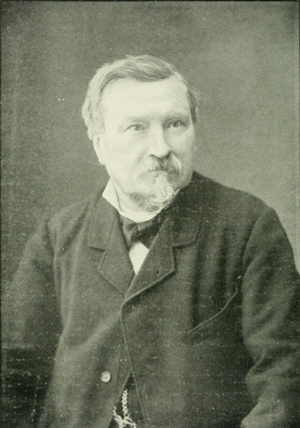
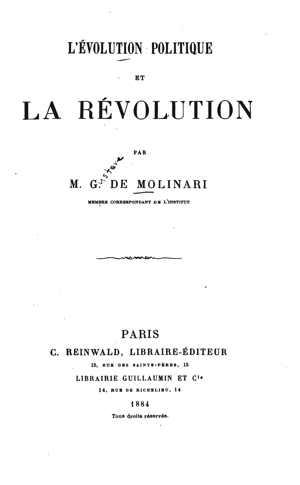
GUSTAVE DE MOLINARI,
Political Evolution and the Revolution (1884)
August 2025 draft
|
 |
The Guillaumin Collection
 |
This title is part of “The Guillaumin Collection” within “The Digital Library of Liberty and Power”. It has been more richly coded and has some features which other titles in the library do not have, such as the original page numbers, formatting which makes it look as much like the original text as possible, and a citation tool which makes it possible for scholars to link to an individual paragraph which is of interest to them. These titles are also available in a variety of eBook formats for reading on portable devices. |
Source
, Political Evolution and the Revolution. Translated and edited by David M. Hart (Pittwater Free Press, 2025).http://davidmhart.com/liberty/FrenchClassicalLiberals/Molinari/Books/1884-EvolutionPolitique/Molinari_PoliticalEvolution1884.html
Gustave de Molinari, Political Evolution and the Revolution. Translated and edited by David M. Hart (Pittwater Free Press, 2025).
A translation of Gustave de Molinari, L’évolution politique et la Révolution (Paris: C. Reinwald, 1884).
This title is also available in an enhanced HTML and a facsimile PDF of the original French edition and various eBook formats - HTML, PDF, and ePub.
This book is part of a collection of works by Gustave de Molinari (1819-1912).
Table of Contents
- CHAPTER ONE. Constitution of societies — Primitive governments, p. 1
- CHAPTER II. Governments in the Era of Small-Scale Industry. The Feudal System, p. 23
- CHAPTER III. Governments in the Era of small-scale industry (continued), p. 48
- CHAPTER IV. Modern Governments. Constitutional Monarchy, p. 87
- CHAPTER V. Modern Governments. The Republic and Universal Suffrage, p. 119
- CHAPTER VI. Foreign Policy of Modern States. War, p. 139
- CHAPTER VII. The Internal Politics of Modern States, p. 191
- CHAPTER VIII. Evolution and Revolution, p. 238
- CHAPTER IX. The French Revolution, p. 270
- CHAPTER X. The Governments of the Future, p. 351
- CHAPTER XI. Guardianship and Freedom, p. 424
- CHAPTER XII. Summary and Conclusion, p. 486
- Endnotes
Table of Contents (detailed)
CHAPTER ONE. Constitution of societies — Primitive governments
- I. Reason for the formation of societies and the constitution of governments.
- II. Elements and conditions of existence and progress of primitive societies.
- III. Original diversity of governments and codes. — Why community was the political form suited to primitive societies.
CHAPTER II. Governments in the Era of Small-Scale Industry. The Feudal System
- I. Progress that brought about the rise of small-scale industry. Influence of this progress on the constitution of governments.
- II. Specialization of the functions of government. Replacement of the regime of community with that of corporations.
- III. Causes of the diversity of political institutions. The feudal regime.
CHAPTER III. Governments in the Era of small-scale industry (continued)
- I. Determining motive of political enterprises in the era of small-scale industry. Profit. Conquest of England by the Normans.
- II. The Creation and Organization of the State.
- III. The Expansion of the State.
- IV. Exploitation of the State.
- V. Politics.
- VI. Summary of the necessities that determined the [82] constitution and politics of States. Political competition.
CHAPTER IV. Modern Governments. Constitutional Monarchy
- I. In what respect modern governments differ from those of the old regime.
- II. The constitutional monarchy and its mechanism.
- III. Results of the constitutional monarchy experiment.
- IV. The politicians and the political parties.
CHAPTER V. Modern Governments. The Republic and Universal Suffrage
- I. Forms and types of modern governments.
- II. The republic. How it differs from constitutional monarchy.
- III. The Stadtholdership and the Empire.
- IV. Conclusion.
CHAPTER VI. Foreign Policy of Modern States. War.
- I. — Inevitability of war in primitive times and in the age of small-scale industry.
- II. — How the evolution toward a state of peace began and progressed up to the French Revolution.
- III. Abnormal persistence of the state of war in the present era. Causes that have replaced the natural risk of war with an artificial risk.
- IV. — The motives and results of contemporary wars. Their tendency toward periodicity. Conclusion
CHAPTER VII. The Internal Politics of Modern States
- I. Retrospective overview of the constitution of the States of the old regime.
- II. Political communism. Causes of its inferiority. Consequences of its establishment.
CHAPTER VIII. Evolution and Revolution
- I. First period: Primitive and rudimentary industry.
- II. Second period: Rise of small-scale industry.
- III. Third period. Rise of large-scale industry and the military supremacy of civilized people.
- IV. Revolution in the Present Age and Its Retrogressive Effects.
CHAPTER IX. The French Revolution.
- I. The reforms accomplished and the institutions created by the French Revolution.
- II. The causes of the revolution.
- III. Regression caused by the revolution.
- IV. Regressive influence of the revolution on moral and political sciences.
- V. Material losses and demoralization caused by the revolution.
- VI. Retrograde influence of the French Revolution abroad.
- VII. How civilized nations will emerge from the [342] revolution to return to evolution.
CHAPTER X. The Governments of the Future
- I. Causes of the superiority of governments run as a business enterprise over governments organised by the community. [174]
- II. Governments suited to the present and future state of civilized societies.
- III. On the economic regime of political States in the age of large-scale industry.
- IV. The commune and its future.
V. Individual Sovereignty and Political Sovereignty. VI. Nationality and Patriotism. CHAPTER XI. Guardianship and Freedom
- I. Necessity of guardianship.
- II. Guardianship in the past.
- III. Guardianship and the revolution.
- IV. Results of the abolition of the old regime of guardianship by revolutionary or philanthropic means.
- V. On the Reconstruction of Free Guardianship by Way of Evolution.
- VI. Future of liberty and guardianship.
CHAPTER XII. Summary and Conclusion
Endnotes
[1]
CHAPTER ONE. Constitution of societies — Primitive governments↩
I. Reason for the formation of societies and the constitution of governments. — II. Elements and conditions of existence and progress in primitive societies. — III. Original diversity of governments and codes. Why the community was the political form suited to primitive societies.
I. Reason for the formation of societies and the constitution of governments.
At all times in its existence, humanity appears to have been divided into more or less numerous societies — bands, [1] clans, tribes, or nations — and these societies in turn are equipped with a government. This government appears in diverse forms, but which can be reduced to a small number of types; its functions are more or less varied and extensive; finally, societies and governments grow, are transformed, and perish to make way for others.
What is the reason for these phenomena? Why did men, from the beginning, form societies? Why [2] do these societies appear to us universally equipped with a government?
This method of constitution and existence of the human race was determined by necessities deriving from the nature of man and the environment in which he lives. Man can only survive and reproduce on the condition of continually assimilating the elements necessary for the maintenance of his strength and life; if this work of assimilation comes to a halt or proves insufficient, he suffers and perishes. The materials of existence, the earth he inhabits contains them in abundance, but he is not alone in feeling the urgent need to procure them; he is forced to contend for them not only with his fellow men, but also with some of the other animal species. Among these lower species, some seem naturally destined to serve him as prey; they are too weak to resist and, along with plants, constitute the food resources at his disposal — provided he discovers, seizes, and reproduces them for his use. Others, on the contrary, compete with him for this stock of food and sometimes even consider him as prey; some, such as the large carnivores, are superior to him in strength and equipped with natural weapons far more powerful than his. If the first men had not, like most of the weaker and less well-armed species, formed bands, they would inevitably have become victims of these more robust, more agile, and better-fanged competitors. If they had not resorted to association to compensate for this inequality in strength and natural weaponry, their species would quickly have disappeared from the earth.
How were the first bands formed, which became the embryos of human societies? We do not know, but the observation of lower animal species [3] allows us to conjecture that individuals with resemblances or racial affinities gathered and associated under the compulsion of shared needs. These primitive bands could not, at least in the beginning, include more than a limited number of individuals. Living off the gathering of natural fruits, hunting, or fishing — activities practiced using rudimentary weapons and tools — men had to explore vast spaces to find food, while the necessity of mutual protection forced them to stay close together, so to speak within earshot. Under these conditions, a band could hardly consist of more than a few hundred heads. This is still the case with the Australian tribes whose industry has not advanced beyond that of the earliest ages.
But as soon as the band was assembled, even if it contained only a very small number of individuals, a government became necessary to it, and had to be established in one way or another. Every association implies an organization adapted to the needs that determined its formation. These needs, in the primitive association, were of two kinds: external and internal. First, it was necessary to ensure the existence of the members of the association by providing for their defense, whether against other animal species or against other human bands, and even, if possible, to obtain an increase of food at the expense of competing individuals or bands. Secondly, it was necessary to prevent the members of the association from committing acts or acquiring habits harmful to the association, and on the contrary to train them to act, in all circumstances, in the way most beneficial to it. This double necessity implied the creation of a government tasked, on the one hand, with organizing and directing the forces of the band for defense or [4] external attack, and on the other hand, with preventing anything that could be harmful to the association, and promoting anything that could be useful to it.
How was this indispensable government instituted? Did the members of the band gather deep in the woods, as Rousseau imagined, to elect a chief and discuss the articles of a social contract? [2] They [5] possessed, in all likelihood, only the most rudimentary language, and would have been as incapable of regular deliberation as monkeys, beavers, or other animals that live in bands. The natural method of the formation of governments was without a doubt quite different. The strongest, the most intelligent, the most agile, those with the sharpest eyesight who first spotted the enemy or the prey, who surpassed their companions in courage and skill in combat or hunting, acquired a natural ascendancy, and the man whom opinion recognized as the most capable of leading the band became its chief. Thus, in the absence of an established hierarchy — or when that hierarchy no longer met the needs of the moment — one sees, for instance, a group of shipwrecked men choose as their leader the one who, in the face of danger, has shown the most energy and presence of mind. Now, what were the first men if not castaways on an unknown land, where they had to struggle for food and life against a multitude of rival and hostile species?
The same necessities that determined the creation of a government in each band also determined its organization and its military and civil functions. The first of these necessities was war — war with other men and other animal species — and this necessity was imposed on every band without possibility of escape. But war has its natural conditions of organization, strategy, and tactics. It cannot be undertaken or sustained successfully unless all available forces are gathered, coordinated, and put into motion in a way that yields a maximum of useful effect for a minimum of cost; in other words, unless one transforms a band into an army. Lacking science — which, in [6] this field as in any other, is the product of experience, observation, and reflection — this transformation could only occur by trial and error. Above all, it required unity of command, the rapid and reliable transmission of essential orders, and the absolute, passive obedience of those responsible for conveying and executing them. Apparently, much time passed before these natural conditions of organization and operation of an army were perceived and understood. Painful and repeated trials were needed to prove that rivalry among leaders, failure of obedience, and delays in transmitting or executing commands inevitably led to defeat and the destruction of the band. Only when these lessons bore fruit — that is, when the intellectual elite of each band became convinced that anarchy, lack of subordination, and lack of discipline were ruinous to all — could hierarchy and discipline be established and maintained.
However, it was not enough that the band be organized to wage a successful struggle against competing species and bands, that it be hierarchized and disciplined for external warfare; it also had to protect itself against the internal causes of weakening and dissolution of the “firm.” [3] These causes, which have not ceased to operate since the birth of human associations, lay in man’s innate imperfection, in his ignorance of the conditions on which the association could survive and prosper — and finally, once these conditions were known, in the absence or insufficiency of the moral force needed to enforce them by restraining contrary impulses from blind passions and [7] selfish interests among the members of the association. These impulses, which as yet had met no restraint or moderation, naturally led each individual to satisfy his needs — that is, to obtain pleasures and avoid pains — without regard for others and even at their expense. Man’s needs in this primitive state were, it is true, few and undeveloped; they were limited to almost exclusively material appetites and required only coarse satisfaction. But still, they had to be satisfied, and given the imperfection of the means of production or acquisition of life’s necessities, this could be achieved only with great difficulty. Hence, natural conflicts of interest arose. The sharing of prey or booty, for example, must have been a constant source of quarrels until a useful rule was discovered and could be imposed to make such sharing possible. The passions had not yet been subject to any restraint, and if some were suited to uniting the members of the association, others on the contrary tended to divide them. If one observes the emergence of sympathy among individuals brought together under the pressure of common necessity, one also sees the rise of antipathy and all sorts of hostile and harmful sentiments toward others: jealousy, envy, hatred, the spirit of domination. These antisocial passions generally prevail over the feelings that contribute to unity and peace. It has been claimed — and we are aware of it — that there exists among men a particular sympathy which might be called species-sympathy. But this is only a seed, which develops only when common interests and shared ways of seeing and feeling act to make it sprout and grow. One may even question whether man has a natural inclination to love his fellow men more than other creatures. How many men have more affection for [8] horses or dogs than for members of their own species! Finally, apart from sexual relations — which do not necessarily imply any moral sympathy — men are more inclined to distrust and malevolence than to goodwill toward one another, especially when they belong to rival races, professions, or localities. However close they may be in race, nationality, or even kinship, do we not see every day that the slightest conflict of interest is enough to make them enemies and prompt them to harm or destroy each other? If there does exist a natural sympathy among them, it is very weak indeed, and offers only a feeble barrier against so many powerful impulses that tend to divide them.
On the other hand, at the beginning of an association, how could the uncultivated and savage individuals who composed it have known which of their acts might be useful to it and which harmful? Let us not forget that they lived — and for a long time to come would continue to live — by means of destruction and pillage carried out at the expense of the rest of creation. How could they have had the slightest notion of the need to renounce these practices with respect to their associates, while continuing to employ them toward other men, and even with the aim of doing so more effectively? Only experience could warn them that acts they had hitherto considered useful — and would continue to consider useful outside the band or tribe — were harmful within their own “firm” and that they must abstain from them. These were, in particular, theft, murder, and abduction. These acts, and many others, could only be recognized and forbidden as “harms” [4] once experience had clearly attested to their harmfulness — at least among [9] their associates — and shown that they endangered the existence of an association necessary for the prosperity and safety of all its members. Thus, even the most unscrupulous thieves and the most ferocious bandits abstain, among themselves, from the acts of plunder and violence they habitually and professionally commit against other men. They establish a code containing the set of rules without which experience has shown their “firm” cannot survive — and such was the origin of all codes.
But even when experience has exposed the acts and ways of acting that are harmful to society, and revealed those that are useful, the members of the association must still possess the moral strength to abstain from the former and practice the latter, despite the contrary impulses of their self-interest and their selfish passions. How could they possess this moral strength? How could it have arisen and developed among the members of primitive societies, since they had not previously had occasion to exercise it? Until such strength could arise and develop to the necessary degree, its absence or insufficiency had to be compensated for. This was done by means of a dual apparatus of penalties and rewards — one of the most marvelous products of human genius.
Indeed, when one considers the nature of man, when one analyzes the original impulses of his instincts and passions and observes the state of antagonism in which they place him toward other creatures — including individuals of his own species — one is struck by the immense difficulty of forming associations of beings who are unaware of the conditions and demands of social life and seem so little capable of conforming to them. It required nothing less than an inexorable necessity to induce them to draw closer to each other, [10] to form societies, and to submit to the rules and constraints indispensable to their maintenance. But this necessity existed, and experience — brutal and cruel experience — ceaselessly attested to it in the eyes of even the least observant and reflective men. That isolated individuals, or those gathered in too small a number, were incapable of sustaining the struggle for existence; that the dissolution and dispersion of a band quickly led to the destruction of its members — this was obvious. The necessity of association thus imposed itself with such clarity and violence that it had to be perceived by even the dullest minds and accepted by the most rebellious temperaments. However, it was not the same for all the ancillary conditions. One can understand how, during a hunting or war expedition, the band would accept the leadership of the most capable and skillful — just as migratory birds let themselves be led by those with the keenest eyesight — that it would submit to his orders, and that a crude hierarchy would thereby form: for the absence or insufficiency of such discipline produced an immediate and easily perceptible harm. In such cases, experience would immediately generate an opinion condemning all acts contrary to discipline which was necessary for their joint safety, and approving all acts conforming to it. It was otherwise for all acts or ways of acting whose effects were not immediately perceptible or could only be appreciated by minds capable of reflection. Among these acts or manners, some were useful: they helped increase the band’s strength and resources; others, on the contrary, contributed to its weakening and impoverishment. But only the experience of the beneficial effects of the former, and the harmful effects of the latter, could [11] determine into which category they should be placed — and this experience could bear fruit only if it were the object of attentive observation. Only the intellectual elite of the band had the necessary capacity — and even then, among lower races, this capacity is very weak — to observe the results of this or that method of behavior and to recognize whether they were advantageous or harmful to the “firm.” Furthermore, once this observation was made, this opinion formed, it had to be accepted or imposed, so that useful ways of acting would be encouraged or even made obligatory, and harmful ones forbidden in the common interest. That is not all. It was still necessary that such encouragement and such prohibition be effective and lasting; that the various members of the band, whether they wished it or not, be compelled to abstain from harmful acts and to perform useful ones. This problem may seem quite simple to us today, and yet — if one considers man’s animal nature, his original ignorance, his wild and brutal instincts — there is none whose solution presented greater difficulty. How was it solved? Through the combined action of opinion and religion. [5]
In primitive times, as in our own, it was the real or supposed interest of the “firm” to which they belonged that provoked, among men capable of observing and judging, the formation of an “opinion” on each expression or manifestation of individual or collective activity — and the totality of these opinions made up the code of the band, the tribe, and eventually the nation. Yet we can observe every day how changeable and diverse opinion is. Must it not have been even more so in those early times of ignorance, when the observations that form the raw material of opinion lacked, even more than today, [12] in accuracy and precision, and when the ability to gather, combine, and draw conclusions from them was even weaker? All who have closely studied savage tribes agree that nothing is more changeable and inconsistent than the impressions and opinions of this backward portion of our species. How, then, could these changeable impressions and opinions have solidified into nearly immutable customs? For if nothing is less stable than the opinions of men of underdeveloped intelligence, nothing is more fixed than the customs they obey. This consolidation of judgments made by naturally shifting public opinion is due to the intervention of religion.
Religion is the product of various faculties, among which the spirit of causality is the chief. The elite among men, in whom this faculty is powerful and active, are driven by it to seek the causes of natural phenomena — and these phenomena, whether beneficial or harmful, they attribute to the action of powers or deities, [6] some beneficent and friendly, others maleficent and hostile, to whom they assign power in proportion to the scale of their perceived activity. Thus the most powerful god in Greek mythology is the one who hurls the thunderbolt. These deities, man cannot help but endow with his own feelings and passions, magnified to their scale. But alongside the spirit of causality, which gives rise to the idea of the existence of superior powers, operates the faculty of translating an idea into an image. One envisions the deity in a graceful or terrifying form, pleasant or repulsive, with attributes conforming to the function or role assigned to it, to the feelings and passions ascribed to it; and one tries to fix the image of this deity by reproducing it in clay, wood, stone, and later, [13] in metal. This image is more or less expressive depending on how much of an artist its creator is. If it is expressive enough and if it corresponds to the confused concept that other members of the tribe — inferior in imagination and artistic faculties — have formed of the deity, it will be regarded as its authentic representation or even its incarnation, and it will pass into the state of an idol. The artist who conceived and shaped it himself will naively prostrate himself to adore it. For how, indeed, could this image have formed in his mind? How could he have discovered and assembled its features, if the deity had not truly appeared to him, if it had not revealed itself to him? This conviction must grow stronger in his mind as he realizes it is shared — that the idol, beautiful or hideous, beneficent or maleficent, is the object of love or fear for the other men.
But these idols, to which superhuman power is attributed, become the most powerful tools of government. Those who shaped them or who are entrusted with their care do not fail to consult them on all questions concerning the existence and welfare of the tribe, and neither do they fail to attribute to them their own opinions. How could they not be persuaded that the opinion that formed and became predominant in their mind while contemplating the divine idol was suggested or dictated by it? And this opinion, inspired or revealed by the deity itself — how could it not acquire, for both those who received it and the crowd to whom they communicate it, an unquestionable and sovereign authority? It is accepted as a revelation of divine intelligence and will; and if the failure to observe the custom or law that arises from it is followed by consequences [14] harmful to the tribe, that custom or law becomes immutable; it is imposed on successive generations, even when the needs it originally addressed have changed or ceased to exist.
The customs or laws thus engendered and imposed are not, to be sure, always perfectly suited to the needs that gave rise to them; but however imperfect they may appear to us, they were the product of the opinion of the intellectual elite of the tribe — that is, of the men most capable of discovering and formulating the rules indispensable for the preservation and development of the nascent society. They carry a double sanction, embodied in a dual apparatus of penalties for those who violate them and rewards for those who obey them — and experience attests that nothing less is required to make the common interest prevail over the disorderly impulses of selfish passions and interests. When this machinery of government, [7] at once divine and human, becomes obsolete — when the law ceases to correspond to the state of society — the latter weakens and soon succumbs in the struggle for existence.
II. Elements and conditions of existence and progress of primitive societies.
In summary, the elements of vitality, longevity, and development of the embryonic societies of the first age of humanity can be summarized as follows:
The future of these first human groups depended above all on the physical and moral qualities of their members, on the quality of the race, [8] and on the nature and circumstances of the environment in which they were cast. bands placed in an environment where they had to sustain a particularly harsh struggle against nature and against competing species or bands had either to succumb in that struggle or to acquire a superiority of physical and moral development.
[15]
Strength, agility, physical courage, and the ability to endure privations were then the most necessary and most esteemed qualities; this is why the notion of courage, for example, was merged with that of worth, courage being the most “in demand” quality. To these qualities required for the struggle against the surrounding environment were added those demanded by association and government — without which, unless one supposes perfect individuals, no association can survive. It was necessary, above all, to have a certain spirit of observation to recognize what, in the manifestations of each person’s activity, constituted a harm to society, and what, on the contrary, was beneficial to it, so that a useful opinion could be formed on the one and the other. This opinion, as it took shape, suggested practices and customs that were or were believed to be best suited to the situation and the conditions of existence of the band or tribe. As has happened throughout time, the men endowed with the greatest amount of natural intelligence shaped or guided the opinion of the crowd. [9]
[16]
However, unless the superiority of physical strength was joined to that of intelligence — which could only be accidental and probably exceptional — these elite individuals did not themselves possess the power required to command regular and continuous obedience to the rules they judged necessary for the existence and prosperity of the association. In order to obtain that indispensable obedience, they therefore had to call upon beings whose power surpassed that of the strongest individuals; and these imaginary beings — whom they conceived as good or evil, beautiful or ugly, but whose features and qualities they necessarily borrowed either from themselves or from their surrounding environment, for the mind can only work with the data it possesses — these imaginary beings, we say, they fashioned once they had conceived them. It is even likely that they believed the deities their imagination had engendered had truly appeared to them, and they were the first to worship those crude and shapeless images. But from that moment, the most powerful of all the tools of government had been found. Whatever their numerical and physical inferiority, the intelligent individuals — the seers, the prophets to whom the deities revealed themselves — were henceforth assured of making their opinion prevail. By consulting their deities, or the signs through which they manifested — the flight of birds, the entrails of sacrificial victims — they obtained in all circumstances the revelation of the best rule to follow or the most useful course to take. The deities indicated the behaviors that ought to be adopted and those from which one must abstain; they also designated the most [17] capable leader. No competitor could dispute the position of the man they had chosen, for he had on his side, with divine right, all the irresistible power the deity placed at the service of its chosen ones. To fight or disobey him was to fight or disobey the deity itself, and thus to expose oneself to the terrible and inevitable punishments it had the power to inflict. Likewise, by violating the rules it had dictated for all circumstances of life, by refusing to employ the processes and tools it had invented (for inventors, like legislators and poets, truly believed themselves inspired by the gods — and after all, did not the spirit that manifested in them have a superior or divine origin?), one exposed oneself again to its wrath. The more widespread and deeply rooted the faith in the existence of the gods, the easier government became, the more faithfully customs or laws were obeyed, and the less there was need to resort to physical punishments. Only those who lacked faith were typically exposed to such punishments; and that is why incredulity, contempt for the deities and their commands, was rightly considered the foremost social harm, the greatest of crimes. Certainly, the blind faith of the multitude had the effect of delivering it into the hands of the small number of privileged men who were in communication with the gods — but these men made up the elite of primitive societies and were the most suited to rule them. They could and did abuse the absolute authority conferred on them by faith, but this abuse was small compared to the evils stemming from the absence or insufficiency of this mechanism of government. [10] History shows us that among people poorly endowed with religious feeling, authority lacks respect and strength, and the State is constantly exposed [18] to anarchy; while on the other hand, in China for example, an excessive barbarity of punishments is required — which only imperfectly replaces divine punishment in the repression of social harms. Without religion, it is doubtful whether human societies could have succeeded in developing or even in surviving during their embryonic formation. One might even ask whether there does not exist, in the societies of lower animals, some analogous principle of obedience and order.
III. Original diversity of governments and codes. — Why community was the political form suited to primitive societies.
If one considers the necessities that led to the formation of primitive bands — the embryos of human societies — as well as the constitution of their governments and the creation of their codes, that is to say, the set of customs and moral rules they obeyed; if one does not forget that these governments and these codes were everywhere the product of the cooperation of opinion and religion, one will see that they could not be uniform; that they had to differ from band to band or from tribe to tribe, as they later differed from nation to nation. The necessities that determined the creation of governments and codes were, no doubt, the same everywhere; they amounted to the establishment of internal order and external security. But there were differences both in the physical and geographic conditions of the bands' existence and in the intellectual and moral temperament of their members. Those who lived in regions difficult to access, under harsh climates, had less to fear for their safety than others; they were not forced, consequently, to submit permanently to a [19] chief, and history teaches us that they only submitted temporarily, during their hunting or war expeditions. [11] The bands that inhabited open plains, under a warm climate, in regions abundant in game but teeming with carnivorous competitors, had, on the contrary, under penalty of [20] destruction, to submit to a hierarchy and resolve to obey a chief continually. On the other hand, not all bands belonged to the same race or were endowed with the same degree of intelligence and moral strength. In this respect, there were marked inequalities between bands; and no less within each of them. Hence, further differences in governments and codes. Where the distribution of what might be called governing faculties was particularly unequal, the directing power naturally concentrated in the hands of the few — sometimes even in a single individual; where that distribution was sufficiently equal, the ruling power [12] was shared more widely. These embryonic societies thus tended, by virtue of the nature of the “environment” [13] in which they lived and their particular temperament, some toward monarchical absolutism, others toward oligarchy or democracy. Nevertheless, above these various forms, there arose a political regime derived from the economic conditions of their existence; it was the regime appropriate to societies with the lowest level of productive means, the scarcest and most precarious means of subsistence. It was the regime of community, [14] which emerged at the birth of primitive societies and remained predominant until the rise of small-scale industry.
This primordial political form was, as we said, dictated by the economic situation of the primitive bands, by the imperfection of their weaponry and tools. A little reflection is enough to convince us that it was the only possible one at a time when the functions of the ruler [15] — which later became a rich source of income — were naturally unproductive. When one possesses no tools except crude weapons of wood or unshaped stone, all [21] one can do is get one's daily food. The difficulty of solving the problem of existence is so great that individuals incapable of self-sufficiency are pitilessly sacrificed or left to perish. For example, only a small number of females are raised, with the rest obtained economically by abduction once they reach a useful age. [16] In such a situation, how could one afford to purchase the services of a government? [17] Either one must do without — an impossibility — or one must resolve to produce these indispensable services oneself. Each member of the band or tribe must perform the political, military, legislative, administrative, and judicial functions that constitute the office of a government, however rudimentary it may be. Let us add that not only are these functions unpaid, but they must also be obligatory. Indeed, they are a burden, since the resources needed to compensate them do not exist, and all members of the band must bear their share of the common burdens.
In later ages, as the means of production developed and improved, as societies grew wealthier thanks to the progress of their tools, the functions of government could be compensated, and it became advantageous to exercise them. Then too, we see in each society the strongest and most intelligent men taking exclusive control of them in view of the profits to be gained. But in primitive times, such a monopoly would only have had the effect of increasing the burdens of those who had the imprudence to seize it. They would have lost, by [22] exercising the functions of government to the exclusion of other community members, precious time taken from the search for their own subsistence. The political community was therefore the only regime suitable for societies still too small and too poor for government to be specialized or to provide sufficient means of existence for those who exercised its functions. It ceased to exist only when the means of production had become sufficiently developed for government to cease being free of cost.
[23]
CHAPTER II. Governments in the Era of Small-Scale Industry. The Feudal System↩
I. Progress that brought about the rise of small-scale industry. — Influence of this progress on the constitution of governments. — II. Specialization of the functions of governments. — Replacement of the regime of community with that of corporations. — III. Causes of the diversity of political institutions. — The feudal system. — IV. Economic method of state formation in the era of small-scale industry. — Political enterprises.
I. Progress that brought about the rise of small-scale industry. Influence of this progress on the constitution of governments.
Despite recent advances in prehistoric sciences, we have no definitive knowledge about the duration of the primitive period, which stretches from the birth of humanity to the invention of agricultural tools and the regular cultivation of food plants. Was this duration a matter of a few hundred or a few thousand centuries? We do not know. What we do know, by contrast, is that humanity worked unceasingly to improve its conditions of existence during this period as in those that followed. It had to learn to distinguish useful plants from harmful vegetation, to invent weapons and tools, to subdue and train animals that could be domesticated and serve as auxiliaries or enhance food resources, to make clothes from hides or textiles from plants, to dig out or build shelters, and finally — perhaps the most difficult [24] task — to bend its wild and animal nature to the necessities of life in society. Inventions that seem to us today the simplest — fire-making, for example — posed challenges that can be appreciated by studying the customs of primitive people. Before the invention of the “flint striker,” an invention that presupposes knowledge of metalworking, there was no reliable way of procuring fire. What was done? The fire obtained by chance was kept going permanently, placed under the protection of the tribe’s deities or even worshipped as a deity, with its care entrusted to young girls, who were less suited than boys for strenuous labor. Do not the dreadful penalties imposed on negligent guardians who let the “sacred fire” go out attest to the immense difficulty of relighting it? How much observation and effort the discovery of metals and the art of working them must have required! But then, how greatly the replacement of primitive wooden or stone weapons with metal ones increased the productivity of the warrior or hunter’s labor! The domestication of animals, by creating the pastoral industry, increased the resources of progressive people to an even greater extent and made their subsistence less precarious.
The scattered and hostile state in which human bands lived could only hinder the spread of progress. Each band invented its own weaponry, tools, as well as the customs that made up the crude machinery of its government, and took care not to share them with neighboring bands. Later — and indeed until recent times — every invention that increased the power and wealth of a nation became a “secret” that it was forbidden, under the harshest [25] penalties, to reveal to foreigners — that is, to enemies. War was then virtually the only means by which inventions and discoveries spread. Despite all obstacles, however, these were accumulated and disseminated. On the eve of the decisive rise of agricultural tools and the cultivation of food plants, the people who possessed a stock of domesticated animals and improved weaponry of polished stone or metal were certainly in far superior conditions of existence and security compared to primitive bands. Corresponding progress had taken place in society and government. The increase in resources due to improvements in tools and the accumulation of capital — in the form of livestock or otherwise — had notably made it possible to raise a greater number of women. Each man was able to have one or even several for his exclusive use, and this individual appropriation of women became a new source of well-being and wealth. The woman served as a helper, and children could be employed early in tending and caring for the bands. Those who possessed a surplus could exchange them for heads of cattle — which appears to have been one of the earliest forms of trade. [18] The band became a clan or a tribe; the range of its migrations expanded in proportion to the increase in its capital; it could settle in areas more favorable to the development of its resources. As wealth increased, so too did the inequality of its distribution. Previously, inequality had appeared more between band and band. Some, belonging to a race which was superior in intelligence and vigor, [26] had seized the most game-rich or most naturally fruitful hunting grounds and were wealthy, while inferior bands, left to make do with the scraps, remained in a miserable condition. But within a single band, inequalities stemming from individual differences in intelligence, strength, and courage could not be consolidated and increased so long as each person was forced to live day to day. It was only when capital accumulation became possible — that is, when progressive tribes began to breed livestock — that inequalities individualized: the men most skilled in this new industry rapidly increased the size of their bands, while others, less industrious, possessed only a few animals, and others still had none at all and were forced to enter the service of the great livestock breeders. These were the “rich,” and the others, the “poor.”
During this final epoch of the primitive age, government in turn came under the influence of the progress of productive tools and the resulting changes in the creation and distribution of wealth. The wealthiest members of the tribe naturally saw their power grow; it was from among them that the chief was preferably chosen, and when a particular family became entirely preeminent, people grew accustomed to selecting the chief from that family. One begins to see, in the most advanced tribes, patriarchal government combined with the regime of community. The Germanic tribe, for example, elected its chief, usually from the same family; but this chief could undertake nothing without consulting the elders of the tribe; [19] at times, he [27] was elected only for the duration of a war expedition. When the tribe was at peace, there was no government — or rather, each person exercised, alongside the pastoral industry from which he drew his livelihood, the functions of government: he governed his family, judged his own case when he was or believed himself to be wronged, and exercised the right of vengeance in accordance with custom; [20] [28] finally, he was forced to contribute, in proportion to his strength and resources, to the common defense. When the state of war returned, people once again submitted [29] to the now necessary authority of the chief and to the natural laws of hierarchy and discipline. Let us note well that the functions of government had not ceased to be burdens, and that no remuneration was attached to the office of chief or king. He lived, like the other property owners of the tribe, on the produce of his bands. At most, he was allowed to take a larger share of the booty captured from the enemy. The government of the tribe was unpaid, which did not prevent it from constituting, for those who took part in it, a heavy burden. Similarly, when each person grew his own wheat, ground it with a hand mill, and baked his own bread, he paid nothing for his food — but that food did not therefore [30] cost him less than in the time when these various operations became divided and people began buying their bread from the baker. [21]
II. Specialization of the functions of government. Replacement of the regime of community with that of corporations.
Like any division of labor, the specialization of the functions of government was a form of progress, in the sense that these specialized functions were bound to be better fulfilled and cost less than at a time when everyone was forced to perform them alongside the industry that provided their subsistence. Only, this progress could not come about until the productivity of the food-producing industry had increased enough to provide, in addition to the regular subsistence of those engaged in that industry, a surplus considerable enough to sustain a personnel specifically devoted to the creation of products and services that each person had previously been forced to produce for himself, crudely, inadequately, and intermittently — as in the case of government — or that could not be produced at all, as in the case of comforts or luxuries.
It was the creation of agricultural tools and the regular cultivation of food plants that brought about, along with the enormous increase in population and wealth, this improvement in the machinery of government and replaced the regime of community with that of corporations (or guilds), [22] in both the political and economic organization of societies.
How did this evolution come about? One can attempt to reconstruct it by analyzing the necessities that arose from this new state of affairs. Historical testimony agrees in attributing the creation of the tools of small-scale agriculture and small-scale industry to the tribes inhabiting the temperate zone of the Asian continent. In [31] descending southward and following the courses of the great rivers, one encountered, along with a milder climate, alluvial soils of extraordinary fertility. This direction does indeed appear to have been the one generally taken by the tribes in possession of the new tools, or at least by the adventurous portion of those tribes. [23] Let us not forget that these migrations had already been a habitual occurrence, with only this difference: that the radius in which they occurred had been limited, due to more meager resources. [24] [32] When the tribes derived their food from hunting, they sought out the most game-rich lands; when they depended on livestock raising, they migrated toward regions with pasture. It was natural that they should similarly set out in search of the regions best suited to agriculture. But up until then, their migrations had necessarily resulted in the extermination or expulsion of the human bands [25] already settled on the lands they sought to occupy. This necessity was altered by the invention of the new agricultural tools. Since putting these tools to use required not only draft animals but also a considerable quantity of human labor adapted to the climate, it became more advantageous to enslave the conquered people than to destroy them. In this respect, the situation of the migrating tribes equipped with the new tools can be likened to that of the Europeans, conquerors of the New World. After having plundered, in barbaric fashion, the indigenous population of all the riches they could carry away, they set about exploiting the abundant natural resources from which those riches had been drawn. Only, this exploitation could [33] be undertaken profitably only with the help of numerous hands adapted to the climate. What was done? At first, the conquered population were subjected to this labor, and since they were unable to withstand the excessive labor and inhumane treatment imposed upon them, they were replaced by slaves imported from Africa. Things must have happened in much the same way when the progressive Aryan tribes made the discovery and conquest of the southern regions of Asia and Europe. Thus it was that agricultural progress gave rise to slavery by making it productive.
It also gave rise to the regime of castes or ruling corporations. [26] The cultivation of virgin lands by means of agricultural tools operated by slaves generated an enormous net product; the population and wealth had to grow at an extraordinarily rapid pace. Vast and powerful empires then emerged, containing a population a hundred times greater than what could previously have been sustained on the same territory by the rudimentary industries of hunting and gathering the natural fruits of the soil. These political establishments [27] belonged to the emigrants, equipped with the new tools, who had founded them with the aim of exploiting them by enslaving and training the indigenous population in agricultural and industrial labor — and who naturally reserved for themselves, as owners, both the direction and the profits.
Thus the political state came to be owned by a class, almost always descended from a foreign and superior race, thereby replacing the primitive community. But the transformation wrought in the political constitution of societies by the invention of agricultural tools and the coming of small-scale industry was not to end there.
III. Causes of the diversity of political institutions. The [34] feudal regime.
Relatively few in number, forced to disperse across a vast territory, further forced to keep their slaves or subjects in obedience and to protect their domain against the greed of other tribes hungry for plunder, the conquerors and founders of States could no longer be satisfied with the rudimentary organization of the tribe. That organization, which suited small societies of a few hundred or a few thousand individuals living by the same industry, could hardly suffice for large societies numbering in the millions, engaged in various types of labor, and among whom the conquerors made up only a small minority. Was it not necessary that the political institutions of the tribe be modified to meet these new necessities? This progress inevitably took place, under the irresistible force of circumstances, but it did not occur uniformly or all at once. The manner in which the States — established through the rise of small-scale industry and succeeding the tribes that had lived by hunting and livestock raising — were created and organized depended first on the political condition of the tribes from which they originated; secondly, on the particular circumstances of soil, climate, physical configuration, and geographic position of the regions in which these States took form. We have observed that sometimes effective power ended up being concentrated in the most numerous, wealthiest, and thus most powerful family in the tribe; sometimes in a certain number of families; and finally, in tribes where the distribution of wealth remained more equal, that this power remained in a sense undivided among all members of the community. It is clear that the political transformation brought about by the new state of affairs would bear the imprint of the earlier political condition [35] of the conquering tribe — that it would develop here in a monarchical sense, there in an aristocratic sense, elsewhere in a democratic sense. Nevertheless, a higher necessity — that arising chiefly from the ethnographic situation of the region in which the State was founded, from the size of the State, and from the risks to which it was exposed — always ended up, after a more or less lengthy period of trial and error, determining its final method of constitution, whether or not that method aligned with the political precedents of the tribe.
But before arriving at the political constitution suited to their conditions of existence, the States resulting from conquest, in the early periods of the age of small-scale industry, invariably passed through a stage of aristocratic and feudal formation. In some, this form of constitution became definitive, though modified according to the primitive tendencies of the conquering tribes, and gave rise to more or less aristocratic republics; in others, it led to monarchies more or less absolute.
This period of formation, which everywhere presents identical features, arose from the universally identical necessities of conquest.
A conquest is an enterprise like any other, and the men who associate to carry it out have in view the benefits it can yield. It is also an enterprise with its specific conditions and technical procedures, whether one considers the conquest itself or the preservation and exploitation of the conquered population and territory. Conquest requires the prior constitution of an army, with the necessary hierarchy and discipline, equipment, supplies, and some knowledge of strategy and tactics on the part of its leaders. In the beginning, this army is [36] invariably created as a partnership. [28] Each participant engages in the enterprise with a view to the booty, and once the booty is seized, each receives a share proportional to his contribution and the importance of his services. It is only later, as wealth grows and becomes unequally distributed, that the leaders of the enterprise begin paying their workers, either by providing sustenance and upkeep in kind or by granting a payment in money — to which, until quite recently, there was still added a smaller and more incidental share in the booty. Once the objective is achieved, the conquest made, the division is carried out according to rules demonstrated by experience to be useful — rules not unlike those adopted by similar enterprises. Then arises the need to preserve and exploit the fruits of conquest, which consist chiefly in land, dwellings, and slaves. This second operation also has its technique — a set of methods suited to the goal and revealed by experience. The feudal organization is the product of this science, or rather of this technical empiricism of conquest. It is, as we shall see, the natural method of constitution of a State born of conquest, under the regime of a partnership for [29] profit sharing — that is, before the institution of paid armies.
After a process of division — often laborious and rife with quarrels, especially when the deities and their ministers lack the prestige needed to settle shares and prevent disputes — each person takes possession of his portion, large or small, of the movable and immovable booty. The question now is how to protect it against any risk of dispossession, general or individual, resulting from internal revolts or external invasions. How will this protection be organized, [37] which is all the more indispensable as the risks become more numerous and pressing? It is organized simply by applying the mechanism of the tool of conquest to this complementary task. Instead of dissolving, the conquering army remains permanently organized. This permanence is achieved by a set of obligations imposed on the beneficiaries who are co-sharers in the conquest, which together make up the feudal code. Military obligations become hereditary and remain in perpetuity attached to possession of the allotted domains. Necessary precautions are taken to prevent these domains — which guarantee the fulfillment of the obligations essential to common security — from being subdivided or alienated. Had the co-participants in the conquest remained free to dispose of the real estate portion of their booty as they pleased, they would probably have divided their domains among their children, thus introducing disorder and disintegration into the hierarchy; it might even have happened that these domains passed, by alienation or otherwise, into enemy hands. To forestall such causes of weakness and dissolution of this defensive tool, the domains encumbered with military obligations were made inalienable, indivisible, and exempt from seizure, and their holders were required to pass them down from male to male in order of primogeniture. Moreover, upon each occupant’s death, the heir had to receive investiture from his hierarchical superior; and if there existed any reason for his exclusion — such as incapacity or unworthiness — the domain was allocated to another deemed more capable of fulfilling its obligations. The military organization necessary to the preservation of conquest could thus perpetuate itself through successive generations, constituting a genuine [38] mutual insurance society. [30] [31] Alongside and below this army — transformed, by the necessities of common defense, into a permanent corporation — one sees forming on the same model, and for a similar purpose, an entire series of other (privileged) corporations. The priests, who fulfill religious and civil functions or exercise the liberal professions of the new society, and to whom a share of the movable and immovable booty has been allocated in recognition of the protection afforded by the deities they represent, form another corporation, equal and sometimes even superior to that of the warriors. Beneath these two political corporations — which divide among themselves the ownership of landed property and the government of the State — appear the trade guilds, composed of those men unfit for war or the functions of the ruler, who received no share in the distribution of the land and who live by practicing the lower industries. They organize themselves into private firms to protect their trades or commerce and the property thereby acquired. These firms, these castes or these corporations, multiply and grow in importance as the increasing productivity of human industry, especially of the food industry, brings about a broader and more extensive production. Below the conquering firm, thus divided into corporations or castes, appears the subjugated multitude, forming the livestock of the conquered territory. [32]
This organization obviously was not established all at once according to a preconceived plan; it came about gradually, as the necessities it was meant to address emerged. It is only when internal revolts [39] or external invasions revealed to the conquerors the danger of dispersing themselves across the conquered territory, while allowing the ties of their association to slacken, that they sought the most effective means to avert this danger, and made permanent — for the purpose of occupation — the hierarchical organization they had been compelled to adopt for conquest. What proves that the feudal constitution naturally derived from the necessities of this kind of enterprise, in the period following the rise of small-scale industry, is that it is found — with only superficial differences of form and appearance — in all regions where conquering tribes founded States by reducing the indigenous population to servitude. Everywhere, they form more or less tightly hierarchized corporations; everywhere, government lies in the hands of a “firm” of warriors allied to a “firm” of priests [33] — unless these two associations are one and the same; beneath them, arranged by importance, come the trade guilds; then come slaves and serfs assigned to the lower functions of agricultural and industrial production. These various corporations are uniformly constituted with the aim of mutual protection of life, property, and the industry of their members. Trade guilds differ neither in purpose nor in organizational form from the other corporations. One could say that the difference between these two categories of associations is merely a matter of degree. Trade corporations are not, like the political corporations, constantly at risk of dispossession and destruction; they are simply concerned with guarding against encroachments by their peers and with managing their internal affairs. Consequently, they are not forced to submit to as strict obligations or as rigid a discipline — although one finds in [40] their organization most of the same traits that characterize the political corporations.
In the same way, the varying magnitude and urgency of internal and external risks to which States born of conquest were exposed determined the differences in their political constitutions.
In a broad and open region, where the exploitation of rich alluvial lands allowed population and wealth to multiply rapidly, where at the same time the conquerors were more exposed than elsewhere to the greed of poor, plunder-hungry tribes or nations inhabiting less favored regions, monarchy — in other words, the hereditary dictatorship of a military chief with a strongly organized and strictly obedient hierarchy — appeared as the necessary form of the political constitution of the State. It was different in mountainous regions, where the land was less fertile and the climate harsher. A tribe that settled in one of these difficult-to-access regions had less to fear from invasions. The revolts of the subjugated population [34] were also less to be feared, as this population, occupied with the lower forms of production, could not multiply there as it could in low and warm lands. That is why, whereas the monarchical form definitively prevailed in the great States of China, the two peninsulas of India, Mesopotamia, and Egypt, in Italy and Greece the conquering tribes, once the conquest was accomplished, ceased to feel the need for a permanent dictatorship; they rid themselves of their kings and established their States in the form of an oligarchy more or less close to democracy, according to whether wealth and the power it has always conferred were more or less equally shared. They resorted to a dictator — that is, to a [41] temporary king — only when the need arose again, in moments of extreme peril, when it was necessary for the "firm" in possession of the State to submit to a leader, just as an army obeys its general and the crew of a ship its captain, for the sake of their joint safety.
Hence there are also considerable differences in the condition of the ruling and owning class of States, [35] especially from the intellectual and moral point of view.
In an aristocratic or democratic republic, the class in possession of sovereignty enjoys a degree of independence and liberty greater than that which is left to it in a monarchical State, where sovereignty is concentrated in the hands of a king or emperor. On the other hand, the political and administrative personnel is recruited by election in an aristocratic or democratic State, and monitored by the electors, whereas in a monarchical State it is appointed and supervised by the monarch or his agents. Admittedly, one cannot say that election by several — especially by a great number — is intrinsically a superior method of selection to nomination by one alone; but when a class is invested with the power to elect and oversee those who govern and administer the State, the directing faculties and political aptitudes of that class acquire a development they cannot attain in a State where the exercise of sovereignty belongs to a single man. The moral and political sciences were born and grew within the Greek republics, and it is doubtful that they would have achieved similar progress under a monarchical regime. This seems to be confirmed by the fact that the development of the political sciences and arts came to a halt as soon as the republican oligarchies that governed the small States of Greece lost sovereign power.
On the other hand, the diffusion of sovereignty was less [42] favorable than its concentration to the subjugated population and even to the classes merely excluded from political functions. Certainly, an absolute monarchy can become very burdensome, but the monarch has no interest in sacrificing the weak and poor to the rich and powerful. On the contrary! He is more inclined to prevent the aristocratic class from gaining an ascendancy that it might be tempted to use to dispossess him. That is why he prefers to rely upon the multitude — and thus is explained the unpopularity of republican oligarchies and the popularity of monarchy or Caesarism.
It will be noted that in all the great States of antiquity where the necessities of securing and protecting the political establishment founded by conquest had imposed the regime of monarchy — that is, of permanent and hereditary dictatorship — this regime was perpetuated. Conquerors succeeded conquerors, but the necessities arising from occupation remaining the same, one had to resort to the regime best suited to them. The States created in the form of republican oligarchies in the Mediterranean basin had another destiny. So long as these States possessed only a small territory and easily defended borders, their oligarchic and feudal constitution could persist, with intermittent dictatorships in moments of extreme danger; but when the most powerful of these political establishments had absorbed all the others, when the Roman State had encompassed most of the civilized world, and when, on the other hand, this immense State, made up of heterogeneous elements, found itself continually harassed by barbarian aggressions, dictatorship had to become permanent, having previously been intermittent, and the empire succeeded the republic.
But all these States, whatever the form of their [43] constitution, have two common features that essentially differentiate their political organization from that of the tribes they succeeded — namely: the exclusive appropriation of government by a particular class of society and the specialization of the functions of government. The State is no longer — as it was in the tribe — the property of the entire community, and its members cease to combine the gratuitous exercise of the functions of government with the industry that provides their food. The State belongs to the association that founded it and that constitutes itself as a permanent corporation, with a more or less strict hierarchy and discipline, according to the temperament and condition of its various members, and also according to the importance and imminence of the risks threatening the State. The members of the State divide among themselves the functions of government, which they exercise most often to the exclusion of any other industry, and which provide them with their means of existence. In other words, the State has passed from the regime of community and unpaid functions to that of corporations and specialized, remunerated functions.
§ IV. Economic method of State formation in the era of small-scale industry. Political enterprises.
Let us insist again on the first and determining cause of this major transformation and the way in which it operated.
This cause lies, as we have seen, in the coming of small-scale industry, and in particular in the creation of agricultural tools and the regular cultivation of food crops. Until then, political functions had been unpaid, for the insufficient productivity of the industries supplying life’s basic needs did not allow for the remuneration of others. Instead of being a source of profits, they were a burden, of which each member of the community had to bear [44] his share. But with the coming of small-scale industry, the situation changed entirely. Instead of merely providing subsistence for the person engaged in it, food production yielded a surplus — sometimes a considerable one. The existence of this surplus immediately made it possible to pay for industries that previously could not be remunerated. These industries did not fail to arise and multiply as the equipment and methods of production improved and the productivity of human labor increased as a result.
How then did political functions separate from the food-producing industry to which they had been joined, in order to form a branch of work that could survive on its own? Every new industry is created in the form of enterprises, whether it branches off from another or arises entirely from a leap forward in the machinery of production. From the moment it can yield a profit greater than those generated by existing lines of work, there are always men ready to undertake it, applying to it their forces and resources. This was the origin of political enterprises, [36] just like all others. As long as men had only rudimentary tools and methods for obtaining subsistence, their enterprises had as their sole object the search for or capture of food. These enterprises consisted of hunting or war expeditions — the latter undertaken with a view to pillaging the stores accumulated by others, or for cannibalism. But from the moment they had access to more productive machinery, the field open to enterprise widened. The most industrious men undertook animal husbandry, and later the cultivation of food plants, along with some ancillary industries such as clothing manufacture, weapons-making, and the production of tools. [45] Yet these new branches of work, fostered by progress, remained associated with the old. Tribes undergoing development continued to practice pillage whenever they believed it would be profitable. Even today, do we not see more or less industrious and civilized people in Africa and elsewhere conducting razzias (raids) on the lands of their neighbors? The founding of political States was nothing but a development of the razzia system at a time when the invention of agricultural tools had extraordinarily increased the productivity of food production. From the moment this chief branch of production became sufficiently fruitful to generate a surplus — once the costs of maintaining and renewing the personnel and equipment of agriculture were covered — it became more advantageous to replace the simple razzia with a permanent exploitation of the lands and labor that had previously yielded the booty. In other words, by undertaking this exploitation, one could obtain with less effort a higher profit than that afforded by the ordinary practice of pillage. Thus, men began to associate not only to launch incursions and conduct razzias into other tribes’ territories, but to conquer agricultural lands along with their stock of men and domesticated animals, and to derive a permanent and regular profit from their exploitation. [37] How could this profit be gathered? The quickest and simplest method consisted in enslaving the population attached to the land, training it in agricultural work if it was not already trained, and seizing the surplus or net product of the exploitation. This surplus or net product was the remuneration of the industry of the founders of the State, or the profit of their enterprise. In fertile regions where the population was numerous and easily bent to labor [46] and obedience, such enterprises yielded the entrepreneurs who were associated in a partnership [38] profits high enough to free them from the need to practice any other industry. In less favored areas, where the enslaved population was smaller and more difficult to subjugate, the founders of the State were frequently forced to oversee the exploitation of their allotted share themselves, and at times even to guide the plough or practice some other trade. This was the case in Athens and in Rome before the latter had multiplied its acquisitions. Whatever the case, the founders of States found the remuneration for their industry in the product of the exploitation of the land they had conquered and its band of inhabitants reduced to servitude. Thanks to the invention of agricultural tools, this product — which would have been zero with primitive tools — became significant enough to make the industry of the conquest and founding of States the most productive of all branches of human labor. It was also, to be sure, the one with the most risk, for it was not only necessary to rule and administer the conquered domains, but also to defend them against competitors all the more eager for the spoils as the prey was richer and they themselves were poorer.
The rate of remuneration for the industry of the founders of State — or of conquerors who succeeded in expelling them and taking their place — depended, first, on the fertility of the soil, the industrious qualities of the population cultivating it, the good organization and intelligent management of the agricultural and industrial operations belonging to the founders or owners of the State, [39] and the effectiveness of the protection of persons and property against all aggression, whether internal or external; and second, on the share they appropriated from the yield of these operations. This share, which they were free to set [47] as they pleased, they naturally aimed to raise to the maximum, leaving to the subjugated population only a bare minimum for subsistence. This, in fact, has always been their tendency. Yet this tendency did not take long to meet resistance, and was in part countered by the experience of its harmful effects. The overburdened and overworked population grew discouraged and weakened — if it did not rise in revolt — and the level of dues demanded from it ended up decreasing precisely because of their excess. Under the influence of this experience, and as we shall see further on, under the pressure of political competition, [40] there arose a series of customs and guarantees limiting the discretionary power of the owners of the State. Thanks to these customs and guarantees — at least in countries where they proved sufficiently effective — the owning and ruling class had to content itself with a more moderate share of the product of the labor of the subjugated classes, who were thereby able to increase both in number and in wealth. Little by little, they bought back their freedom from servitude and even acquired an increasingly large share of the land that had originally been the exclusive property of the conquerors. Then they began to claim a share of political power alongside the ruling class — and the more their industries developed thanks to advances in the machinery of production, the richer and more powerful they became, and the more formidable their competition became for the descendants of the old society of the founders or conquerors of the State. It was in the second period of the age of small-scale industry that they began to achieve their aims and to play a political role.
[48]
CHAPTER III. Governments in the Era of small-scale industry (continued)↩
I. Determining motive of political enterprises in the era of small-scale industry. Profit. Conquest of England by the Normans. — II. The creation and organization of the State. — III. The expansion of the State. — IV. The exploitation of the State. — V. Politics § 1. Foreign policy § 2. Domestic policy. — VI. Summary of the necessities that have determined the constitution and politics of States. Political competition.
I. Determining motive of political enterprises in the era of small-scale industry. Profit. Conquest of England by the Normans.
From the coming of small-scale industry onward, the founding of a political State became a profitable enterprise — and indeed more profitable than any other. That is why such enterprises, despite the risks attached to them — which risks, being considerable, explained and justified the magnitude of the premium needed to cover them — why, we say, these enterprises became, over a long succession of centuries, the preferred market for the most energetic, strongest, and most intelligent portion of our species. Search, in the period that opens with the coming of small-scale industry, for the origin of all States, founded under whatever form — monarchical or republican — and you will find an enterprise. You will also observe that this political enterprise has, like all its agricultural, industrial, or commercial counterparts, no other motive and no other objective than profit. At the call of a man or a [49] group of men who have conceived the project of founding a new State, one sees gather a number of auxiliaries, more or less numerous, recruited from one or more tribes, clans, or nations: some bring provisions, weapons, and military supplies; others bring only their strong arms — some arriving alone, others in bands forming small business partnerships [41] — all drawn by the lure of gain. Having gathered the equipment and supplies required, the entrepreneur or associated entrepreneurs organize an army with the personnel they have assembled, subjecting them to the hierarchy and discipline required by this kind of enterprise: they invade the territory they have judged advantageous for founding their establishment, they massacre or enslave the inhabitants, seize their lands and other movable and immovable goods, and divide this booty among themselves and their auxiliaries in proportion to each person’s contribution and the importance of the services provided in the work of conquest. If the invaded territory is already the seat of a State whose owners put up energetic resistance, and if the invaders do not feel strong enough to overcome this resistance completely, or if they judge that it would require sacrifices disproportionate to the expected result, they negotiate with the former occupants and settle for seizing a portion of their domains; sometimes they even merge with them, admitting them as co-participants in their State. This transaction is one to which the vanquished generally end up resigning themselves, and they often find it advantageous. Though it deprives them of part of their goods and profits, it makes their possession more secure by joining them with partners more capable than they were themselves of defending and augmenting them. When, on the other hand, [50] the resistance is weak — and especially when the invaders are numerous — they seize all the movable and immovable goods and purely and simply enslave the defeated population. [42]
[51]
But conquest, with the distribution of its fruits among those who undertook or participated in it, is only [52] the first part of the work of founding a political State. The second consists in defending it, whether against the [53] claims of the dispossessed or the usurpations of the co-sharers, or against external aggressions, [54] and, as far as possible, expanding it. Finally, the third consists in exploiting it in such a way as to extract, along with the [55] resources needed to cover the costs of defense and administration, the highest possible profit.
[56]
These are the “necessities” inherent in the founding and operation of a political establishment; they impose themselves on the founders and operators of this kind [57] of enterprise, and they endeavor, under the impetus of their own interest, to find the best means of addressing them; these necessities determine, in the final analysis, the method of the creation and organization of States, their political regime, as well as their economic and fiscal institutions.
II. The Creation and Organization of the State.
The initial method of constitution of a State depends first, as we have noted, on the manner in which the enterprise that led to its foundation was formed and carried out. If this enterprise had for its promoter and leader a man of great personal merit and from a powerful family, if this leader had many relatives under his authority and a host of retainers in his pay, he would take the lion’s share in the division of the conquered territory and exercise a preponderant influence on the constitution of the State. Furthermore, if the new establishment covered a vast area and was particularly exposed to the risk of invasions, authority would naturally concentrate in the hands of the leader, under the pressure of the necessities of defense. If, on the contrary, the enterprise had been undertaken jointly by men more or less equal in merit and status, the constitution of the State would be more oligarchic or even democratic — especially if the conquered territory were small in extent and, due to its geographical location, relatively protected from invasions. But in the end, it is always the extent and intensity of the risks to which a State is exposed that determine its constitution and the changes it undergoes.
When the conquest had been carried out and the State founded by a business partnership [43] — and this was the most frequent case before the leaders of the enterprise had accumulated enough capital to hire their auxiliaries — the members of the association divided up the [58] conquered lands, governed them and exploited them at will, while fulfilling the obligations required by the common defense and submitting to the orders of the elected or hereditary head of their hierarchy. This chief — duke, king, or emperor — exercised no power over them outside the necessities of defense. He lived, like them, off the product of the domain that had fallen to him in the division, and he could not raise contributions from the other domains except with the consent of their owners, to cover the costs of repressing a revolt, repelling an invasion, or expanding the State for the common benefit. This chief, we say, was elected or hereditary. The first conquering associations, following the customs of the tribes from which they originated, commonly elected their chief, and upon his death, they similarly chose a successor. However, the experience of the disorders and dangers caused, for the association, by competition among the most powerful families eventually led to the custom of selecting the chief from the same family — the most illustrious one, reputed to descend from the Gods or designated by them. Finally, similar evils provoked by competition arising within the elected family led to the adoption of the principle of heredity. Nevertheless, when heredity produced harmful results by placing a series of incapable individuals at the head of the political and military hierarchy, the association returned to election — only to return again to heredity after experiencing once more the disadvantages of election. The same evolution occurred in the regulation of inheritance rights. In the States born of the Germanic conquest, the tribal customs were at first applied to the transmission of political domains: these were divided equally among the children, just as the goods of the head of the family were divided [59] within the tribe; but in time, it became clear that such divisions were a constant source of disputes and struggles that weakened the State by replacing a single command with fragmented and rival commands. The right of primogeniture was instituted to remedy the drawbacks of splitting the succession, and substitutions were introduced to prevent the owners of political domains from alienating them. [44]
Most of the phenomena just described can be observed in the formation of modern States, and particularly in that of France. When the Roman Empire succumbed under the onslaught of the Barbarians, Gaul was first invaded and pillaged by bands coming from Germania and even from Asia. Some of these — such as the Alans, Suebi, and Vandals — then passed into Spain and Africa; others, like the Burgundians and Franks, settled there to exploit the immovable capital [60] that they could not carry away. The Burgundians seized two-thirds of the land and one-third of the slaves. We have no firm data on the portion taken by the Franks. We only know that movable and immovable booty was divided into lots drawn by lot. But not all members of the conquering firms werer co-sharers on the same terms. The wealthiest had with them companions or leudes to whom they provided sustenance and arms, and who remained under their authority after the conquest, just as they had been before; the others had taken part in the enterprise on their own account and at their own expense, subject only to the authority of the leaders during the military operations of conquest. Hence there were two types of lots: benefices and allods. [45] As long as [61] the struggles for conquest and the competition between the conquering firms continued, the chief or king retained his dictatorial power, to which all those engaged in the enterprise submitted equally, though watching jealously that he did not appropriate more than his share of the spoils. [46] But once the conquest was complete, each man went to occupy his domain, and then the differences in the conditions under which they had acquired it became apparent. While the leudes with temporary benefices remained at all times subject to the chief’s authority, the ahrimans were only forced to provide him their services in case the common security required it. The chief’s power naturally weakened once the conquest was complete; it weakened further under the influence of the Germanic tribal inheritance law, which divided the domains and political sovereignty equally among the heirs. Thus fragmented, the State founded by the Salian Franks under the leadership of their chief Clovis became too weak to resist attacks from other Germanic tribes and from Arabs drawn by the wealth of Gaul. New Germanic bands — the Ripuarian Franks — supplanted the first invaders, repelled the Arabs, and founded an empire whose chief exercised dictatorial power until the law of succession [62] once again divided and weakened it. Then, the natural tendency of the co-sharers of the conquest to free themselves from the authority of the chief of the hierarchy prevailed once more, and the Carolingian empire crumbled just as the Merovingian monarchy had. The king's or emperor’s leudes succeeded in obtaining hereditary rights to their benefices; all the seigniories, whatever their origin and the conditions under which they had been created, became in reality independent. Private wars inevitably reappeared and multiplied; on the other hand, in the absence of the great invasions — now over — which might have rallied the conquering firm under a chief endowed with dictatorial power, the Norman pirates ravaged the country without meeting any force large and coherent enough to resist them. But in this state of disorganization and anarchy, the need for security prompted the creation of a new apparatus of protection. What was done? The small landowners, unable to defend their property themselves against their neighbors or foreign pirates, placed themselves under the protection of more powerful lords. The “allods” or free lands were transformed into “fiefs.” [47] This enfeoffment of allodial lands was nothing other than an insurance contract: [48] the owner of the protected fief became the vassal of the insurer or suzerain, paying him a fee and providing specified services in exchange for his protection. The insurer, in turn, enfeoffed himself and his vassals to a more powerful lord than [63] himself, so that it was no longer possible to touch the small seigniories without having to deal with the great suzerains to whom they were enfeoffed directly or indirectly. Security was gradually re-established, and under the protection of this vast insurance system, industry revived, wealth accumulated, and the great period of the Middle Ages began.
During this period, the kings of France differed from the other feudal lords only in that they were the hereditary heads of the military hierarchy. In that capacity, they held the right to summon, in certain cases, and to command the army of the landowners, but in times of peace, their authority did not extend beyond the bounds of their own domain. How did this power gradually extend? How did they manage to annex all the other seigniories, some of which surpassed their own in power and wealth? The explanation of this historical phenomenon lies in the advantage the kings derived from their role as head of the hierarchy, in the establishment of primogeniture and the right of substitution that prevented the division of their political domain, [49] in the impoverishment of the small seigniories following the Crusades, in the transformation of military equipment which gave marked superiority to the possessors of the richest domains; finally, in the constant and effective efforts of a series of kings to increase the extent of their domains per fas et nefas (by right or wrong).
What motives drove them in this long and patient work of expansion that was to result, after four or five centuries, in the absorption of all the small [64] feudal sovereignties and the formation of a unified and absolute monarchy? That is what remains for us to examine.
III. The Expansion of the State.
According to a habit of our time, which consists in backdating our feelings and ideas, we are inclined to attribute to the politicians and warriors who founded and successively enlarged the modern States, patriotic intentions and notions they never had in mind. They had no concern whatsoever with founding a nation, and the proof is that they indiscriminately subjected to their domination population of different races, languages, and religions. If some among them, after the conquest was completed, endeavored to establish religious unity, or simply to prohibit certain cults, it was for purely political reasons, in order to protect the established religion, which, in return for this protection, lent them its influence and spiritual penalties to secure the obedience of their subjects. The goal they pursued in striving to enlarge their State was much more down to earth. They simply sought to increase the power and wealth of the “house” or association that owned and exploited the State. In this regard, they were in no way different from industrialists, merchants, and bankers who strive to expand their clientele and widen the scope of their operations in order to increase, likewise, the power, profits, and prestige of their “house.” The heads of political houses had exactly the same objective as those of commercial or other houses, and they commonly subordinated their affections, their religious sentiments — not to mention their principles of morality — to the well or poorly understood interest of their enterprises.
They were all the more driven to extend their domination because they did not, as in our day, have a fixed civil list [65], and they lived, like other landowners and industrial entrepreneurs, off the variable profit of their enterprises: every time they succeeded in enlarging their “State,” their income increased, they could expand their expenditures, live more lavishly, occupy a more prominent place in the world, acquire greater renown, better secure the future of their family — and such have always been the objects of ambition for men and the motives of their actions, regardless of social position. All those who served as auxiliaries to the heads of sovereign houses, and in particular the families from which they recruited their political and military general-staff, had a similar interest: the more the State grew in size and wealth, the more their opportunities expanded, the more important their functions became, and the greater the profits they could derive. Hence the general tendency of heads of State and of the class from which they recruited the general-staff of their enterprises to continually expand the extent of their domains, and consequently to engage in new wars. No doubt, in the long run, when certain States had acquired enormous proportions, the heads of sovereign “houses” ceased to adjust their expenses to their revenues. They had become accustomed to living in opulence, and they rarely considered reducing their spending after an unsuccessful venture. They preferred to go into debt rather than reform their budgets, or else they increased the burdens on their subjects, thereby risking driving them to revolt and marching themselves toward bankruptcy or violent dispossession. This, as we know, was the fate of most political “houses,” which were the owners and exploiters of the States of the old regime.
The methods to which the owners who exploit [66] political States [50] could resort in order to enlarge them were the following: 1.) conquest, 2.) acquisition by gift, legacy, or inheritance, 3.) acquisition by exchange or by purchase.
It is through the use of these different methods that all political States were successively founded and expanded.
Without examining in detail how and to what extent these methods were combined in the formation of modern States — which would require a separate work — we can, by glancing at the formation of the French State starting with the Capetian dynasty, understand the motives that guided the monarchs who “made France” and the manner in which it was made.
We have previously compared the owners who exploit political States to the heads of commercial or industrial houses, noting that the goal of the former and the latter was exactly the same: namely, the increase of their power and wealth. It was with this goal in view that both groups worked to develop their enterprises and increase their holdings. It must be added that they were all the more driven to pursue this goal since the profits of the industry of government [51] were so high. At what rate did these profits amount, at the time when the successors of Hugh Capet began to make France by gradually annexing the political domains of the feudal order? We find interesting indications on this point in the scholarly work of M. Ad. Vuitry on the financial regime of France.
The importance of a seigniorial or royal domain in France was measured by the number of provostships into which it was divided for administrative and financial purposes. The provost, in fact, was nothing other than a steward in charge of administering the part of the domain that [67] made up the provostship. [52] The territorial possessions of Hugh Capet, which became the royal domain upon his accession to the throne, comprised only 16 provostships. At the accession of Philip Augustus (1180), there were 38; at the death of that conquering and annexationist monarch, there were 94, and at the end of the 13th century, 263.
If we now want to know what the income of these provostships was, and therefore what incentive the exploiting owner of the royal domain had to increase their number, the budget figures from Saint Louis's reign, noted by M. de Wailly, [53] can provide an idea.
In 1238, the revenues collected by the bailiffs and provosts amounted to 235,286 livres, and the administrative expenses of the bailiwicks and provostships amounted to only 80,909 livres. The net product paid into the royal treasury was therefore [68] 154,377 livres, such that the owner’s profits were about two-thirds of the gross product. From these profits, he had to cover the general expenses of his State and his personal expenses; but it should be noted that these costs and expenses did not increase in proportion to the expansion of the domain. According to M. de Wailly’s estimates, they absorbed another third of the gross product. Thus, there remained one third, or 33 percent of the gross product, which was, at the end of the year, the profit of the enterprise. It was a considerable profit, and one may infer that the exploitation of a political domain, when well managed, had to be the most productive of industries. This annual net product naturally varied; it depended, on one hand, on revenues that fluctuated with the state of the harvests, industry, and commerce, etc.; and on the other hand, on the amount of the expenditures. Administrative costs were not subject to major fluctuations; in contrast, general expenses rose more or less depending on how important and successful the ventures were that aimed at defending or extending the domain. In the absence of a double-entry bookkeeping system, it was not possible to track this precisely. The year's surplus was added to the royal treasury, where it accumulated until it could be put to productive use. The use considered most advantageous was the expansion of the domain by conquest or by amicable acquisition — and let us note well that this was not a peculiarity of political enterprises alone. In all industries, until recently, entrepreneurs were in the habit of applying almost all of their surplus profits to the development of their businesses, and this is still the preferred use of savings for most of our peasant landowners. The owners [69] of a political domain followed the usual practice. Depending on how well filled their treasury was, they slowed or increased their business enterprises for annexation by force or acquisition by amicable agreement [54] of the territories they coveted in order to expand. Need we add that not all their business enterprises were equally successful and that a fair number failed, leaving them with a loss instead of a profit. Nevertheless, as their political domain grew, they became increasingly capable of expanding it further, because the multitude of small-domain owners became less and less able to resist them. Thus, over the course of centuries, the House of France came to absorb, by means of conquest, inheritance, or purchase, not only all the seigniories established after the conquest, but also to encroach upon the political domains of “foreign houses.” [55] A similar work of annexation and concentration [70] was carried out throughout the rest of Europe, and, except in Germany where small sovereignties [71] managed to persist, Europe formed, on the eve of the French Revolution, only a small number of large political domains belonging to royal or imperial houses.
IV. Exploitation of the State.
We have just glanced at the necessities that determine the method of constitution of a State and the motives that impel those who possess it to expand it. We must now examine what method of exploitation the owners of the State had recourse to, and under the influence of what causes this method of exploitation — at first crude and barbarous — came gradually to be modified and improved.
What is, in this respect, the situation of the co-sharers [72] in a conquered country under the primitive regime of a business partnership? [56] They are generally free to organize as they please the exploitation of the land attributed to them in the division of the spoils of the enterprise. The conquered country, in its entirety and with all that it contains — minerals, plants, animals, natural resources, and capital — is the property of the conquering association; but in the division, this property is at once split and partitioned; the association, represented by its chief or the assembly of its chiefs, retains only sovereignty — or, in the language of jurists, eminent domain — implying the right to impose on the co-sharers the charges and obligations required by the common good. These charges and obligations consist primarily in the provision of a contingent of men and resources proportional to the size of the allotted domains, in the event that the common property is threatened, or in the event that some warlike undertaking is deemed necessary by the assembly of owners or by the chief to whom they have delegated the exercise of sovereignty. [57] Outside these superior rights of the association to which they belong, each of the co-sharers remains the absolute master of the lot that has fallen to him, of the men, animals, and things that make up his stock. He may use and even abuse his property, according to the definition of Roman law. [58] How will he proceed to extract the highest possible profit from it? What system of exploitation will he adopt? This [73] system will obviously not be the same everywhere. It will differ depending on the nature and degree of development of the conquering population and the subjugated population, the advancement of industry and the development of productive tools, and the scope of the market for agricultural and industrial products. The system that at first appears the simplest and, seemingly, the most productive is that of direct exploitation of the domain. The owner puts the conquered and subjugated population to work in the production of all consumable goods and all services he requires; he creates agricultural and industrial workshops for his use, taking charge of the maintenance and government of the personnel, and the creation and renewal of equipment. This is the regime of pure and simple slavery. But over time, experience teaches him that it is more profitable to leave to his slaves the responsibility for their own subsistence and maintenance, granting them, along with the use of a piece of land on which to build a hut and grow the food necessary for their nourishment, the availability of part of their labor. Serfdom gradually takes the place of slavery, to the advantage of both parties: the owner obtains for himself, after deducting the products and services formerly absorbed by the maintenance and government of his slaves, a share equal to or even greater than what he previously obtained, all while freeing himself from the burden of managing his workforce. The slave, now a serf, gains control of his labor and productive faculties during all the time not absorbed by the performance of the corvée (forced labour). When industrious and frugal, he can not only live better than under slavery but also accumulate some savings. Production, stimulated by the self-interest of the cultivator who is now master of a portion of the fruits of his [74] labor, does not fail to increase, and wealth to grow. Other arrangements become possible. The owner completely relinquishes the care of cultivating part of his domain by granting it to his serfs in exchange for a payment in kind, which will ultimately be replaced, once a market has developed nearby, by a payment or rent in money. [59] Finally, when the cultivator has saved enough, he buys back all or part of this payment and becomes an owner in turn. The same gradual evolution occurs in the relations between the owner and the workers in industry or crafts. He ceases to provide for their upkeep by allowing them to work for themselves part of the week, then he grants them full disposal of their labor, in exchange for a percentage of their production or its equivalent in money; finally, he agrees — especially when necessity presses — to exempt them from all dues, in return for the capitalized value of those dues. The subjugated population thus ends up, under the influence of this natural progress, being freed from economic servitude, while the owner is relieved of the management of his domain; he now only has to collect dues or invest the capital derived from their redemption. However, the lord-owner [60] generally finds it advantageous to reserve a monopoly [75] over certain products and services. He has his mill and oven, where the inhabitants of the domain are forced to grind their grain and bake their bread, at prices he sets. He also has his own coinage, which he forces them to use exclusively, and on which he levies a seigniorage. But the economic management of the domain is nonetheless considerably simplified, and it now requires from him only minimal oversight.
This progress entails another in the government of the population of the domain. Under the regime of slavery, the owner must entirely provide for this government, personally ensuring the maintenance of order and peace among his slaves, taking care of the raising of children, the upkeep of the elderly, etc. When serfdom replaces slavery, the government of his workforce is simplified accordingly. The owner no longer needs to intervene in every aspect of his serfs’ lives. It is enough for him, on the one hand, that the corvées be regularly performed, and on the other, that the population of the domain remains in proportion to the amount of labor required to make it productive. He may therefore now be content to demand the punctual performance of corvée and to ensure the useful reproduction of the population by reserving the right to authorize or forbid marriages. For everything else, he may, without his interests suffering, leave his serfs to themselves. And he does not fail to do so; the serfs are then seen to associate and form “communes” to carry out the administrative, judicial, and police functions that the owner leaves to their care. The “elders” are tasked with maintaining public order and morality, maintaining the village streets and local roads; in short, the commune undertakes all the essential but non-remunerative services [61] that the owner has found it advantageous [76] to relinquish. He now only concerns himself with the most serious offenses against property and the lives of his subjects, especially those that directly affect him and his family: acts of disobedience or revolt against his authority, and these are, indeed, the ones he ensures remain under his jurisdiction. Ultimately, he retains all powers and functions likely to yield a profit or that concern his security and the maintenance of his domination; he leaves the rest to the communes or parishes of his domain. Finally, when the communes become important centers of industry and commerce, they may seek to free themselves from his subjection — some by revolting, others by buying their freedom — and undertake, with varying degrees of success, to govern themselves. [62]
[77]
But in all these changes in the method of exploitation of the domain that provided his livelihood, the lord-owner always had in view only the increase of his profits. In this, the owners who exploit a political domain did not differ in the least from other industrial entrepreneurs. Let us add that they employed methods that were more or less effective and laudable to increase the profits of their exploitation and consequently the power and wealth of their house. The most intelligent applied themselves to improving their administration, encouraging the industry and commerce of their subjects by providing them with the security they needed. Others, more brutal and greedy, strove instead to extract from them the highest possible amount of corvées and dues. However, the excess of their demands encountered a serious, if not always insurmountable, obstacle in “custom.” The dues and corvées that had replaced the direct exploitation of slave labor had originally been set at a certain rate, which the population came to consider as the price of their semi-liberation, and which they refused to allow the lord to increase at will, even when the profits they derived from working their tenures or industries came to grow. “Custom” was protected by tradition, and seigneurial power found in this latent force a resistance it did not always succeed in overcoming. If the lord increased dues and corvées, murder and arson ravaged his domain; if he expelled a recalcitrant tenant, the one who replaced him by agreeing to [78] pay a higher rent contrary to custom was boycotted, and life became impossible on a tenure struck with “bad will.” The result was that the revenues of political domains increased only slowly, even in periods when industry was advancing and the demand for luxury goods it made possible were growing. It then became necessary to resort to another method to increase resources that no longer sufficed to meet expanding needs. This method was conquest — either by the firm of conquerors banding together to undertake a new expedition to enlarge the common domain, dividing among themselves the results of the enterprise; or by the individual efforts of the owners of political domain to round out their holdings at the expense of their neighbors.
V. Politics.
Every owner of a political State was necessarily forced, with a view to protecting, expanding, and drawing the greatest possible profit from it, to adopt certain rules of conduct. These rules had to be discovered. Hence, over the course of centuries, an accumulation of observations and experiences eventually created a special science — the science of politics — which is the specialised knowledge required for this higher branch of human industry. Politics can, in effect, be defined as the science of the means of protecting, exploiting, strengthening, and expanding a State. However, if the objective of politics — the goal that the “statesmen” who practice the art derived from this science aim to attain — is everywhere the same, the methods suitable for reaching that goal differ according to situation and circumstance. These methods, fruits of observation and experience, are passed down from generation to generation, and they constitute the “traditional politics” of each State — a politics tailored as closely as possible to its particular situation.
[79]
Politics can be divided into two main branches: internal politics and external politics.
1) Internal politics. In the period whose main characteristics we have just sketched, the principal aim of internal politics was to maintain the subjects in submission and obedience, and, consequently, to remove or suppress anything likely to divert them from it. The necessities of maintaining his domination led the sovereign to restrict, to a greater or lesser extent, the freedom of his subjects; he prohibited them, for example, from assembling to examine and criticize his actions, and later, from engaging in this examination through printed speech. He also forbade them from forming armed groups, for whatever reason, that could become centers of resistance to his authority. It was a fundamental maxim of politics that one could not permit the creation of a State within the State. The only exception was the religious State, whose cooperation served to secure the obedience of subjects and which was rightly considered an indispensable instrumentum regni (tool of the king); but even then, all sorts of precautions were taken to prevent this “State within the State” from increasing its power and resources beyond what was deemed useful. Generally, only a single religion was tolerated, and for centuries, one of the main preoccupations of statesmen was to place or keep the religious corporation under the direct authority of the sovereign. Lastly, the police and justice systems had above all the mission of identifying and punishing attacks against the sovereign’s power and the security of the State, or again, against the State religion, regarded as the necessary auxiliary of political power — and the penalties attached to such crimes bore an exceptionally severe character. Instead [80] of becoming milder under the influence of civilization’s progress, these penalties even became increasingly barbaric, as the means of attacking Church and State multiplied and improved themselves in turn. Internal politics thus had as its essential object the security of the State, or what amounted to the same thing, the domination of the sovereign, the owner of the State. It also concerned itself with improving the exploitation of the State and developing its resources. As we noted earlier, the exploiting owner of a political State strove to derive from this property the greatest possible income, and his objective in this respect differed in no way from that of any other industrial entrepreneur. Only, there were in this regard two systems: one consisted in encouraging the development of the resources of the subjects, while being content to exact from them moderate dues, the yield of which would naturally increase as they grew richer; the other applied itself, on the contrary, to making them bear, in the most varied forms, a maximum of burdens, thereby keeping them weak and poor. Both systems had their partisans, and arguments could be made for each. If the subjects grew wealthy, the sovereign undoubtedly shared in the increase of their fortune; his resources expanded and his power along with them; on the other hand, subjects who became wealthier, and hence more educated and more independent, were more difficult to rule and to keep obedient. Poor subjects were not as profitable, but perhaps their submission was more assured and their revolts easier to suppress. [63] Whatever the case, the financiers in the service of the owner of the State [81] devoted themselves to discovering the best means of transferring the largest possible share of the subjects’ income into the sovereign’s treasury with the least trouble and difficulty. The fiscal machinery that the Ancien Régime has bequeathed to us may be considered, in this respect, a masterpiece. Experience had successively revealed which were the most fruitful sources of revenue, which were the easiest and most productive items to tax, how far one could tax them effectively, and finally, what was the most economical system of collection. After experimenting with direct collection, the method of tax farming was adopted, and despite the abuses that discredited it, it was incomparably a step forward from government-run collection.
2) External politics. The external politics of an Ancien Régime State aimed to protect it from hostile designs from without, as well as to allow it to expand and increase its power and resources at the expense of other States. This was a very important and very complex science. Its essential principle — which was itself a result of experience — was to divide in order to rule, that is, to keep other political dominions in a state of weakness, division, and antagonism as much as possible; to prevent the formation of large States that would upset the balance of power; to ensure that rival States did not extend the sphere of their influence; to seize the right moment to annex new territory, whether by force or otherwise; to contract marriage alliances or form political leagues likely to strengthen the State.
VI. Summary of the necessities that determined the [82] constitution and politics of States. Political competition.
These were, in the first two ages of industry, the constitution and politics of States. This constitution and these politics, though wholly stamped with the mark of barbarism, were responses to necessities stemming from the nature of man and the environment into which he found himself cast.
We must not forget, in fact, that the human species found itself exposed, from its first appearance on earth, to a permanent risk of destruction, and that its efforts had to be divided between the need to secure its food and the need to guard against that risk — in other words, to procure security. This second necessity, even more than the first, determined the formation of the first human associations. Man was initially forced to defend his life against the numerous and powerful carnivorous species that inhabited the globe before him. Like all weak species poorly equipped with natural weapons, he could survive only by resorting to association with others. Societies were formed [64] — though limited by their inadequate tools and methods of production — as mutual insurance against predatory animals and men. These societies had to bind their members to rules and obligations dictated by the needs of their joint safety. In this initial period of their existence, their organization is purely embryonic. The division of labor and the specialization of functions — one of the main factors of progress — appears only in embryo. Each member of the band or tribe, whatever his individual aptitudes, is forced both to contribute to the defense and government of the society to which he belongs and to provide for his own subsistence. This condition continues as long as the imperfection of production tools and methods forces [83] man to live by hunting, fishing, and the gathering of natural fruits of the earth. However imperfect and crude the organization of these primitive societies may be, it nonetheless provides them the security needed to survive, to gradually increase their discoveries, and to improve their tools. Agricultural tools are invented, the era of small-scale industry begins. Agriculture and industry provide means of subsistence for millions on a territory where only a few thousand could previously survive. But in this new economic phase, as in the preceding one, the original risk of destruction continues to threaten the human species. Though it may have diminished in one respect, it has increased in another. Societies that have grown larger and are equipped with better arms no longer have anything to fear from lower animal species; they destroy or drive off those they do not enslave. On the other hand, the wealth they accumulate becomes the object of the envy and plundering of societies less advanced in the arts of production and of the idle individuals within them. There is a need to secure protection against foreign incursions and pillaging by tribes or people, and against internal disorder, by subjecting those averse to labor to work and preventing them from seizing the fruits of others’ toil. How is this double necessity met? By the specialization of the functions of defense and government — a specialization made possible by the improved tools of production. Thanks to this improvement, the productivity of human labor has increased. With the product of three men’s labor, in regions suited to cultivation, four or more can be fed and maintained. What do the progressive societies [84] in possession of this new equipment do? They search for the territories most suitable for cultivation, subjugate the populations, and subject them to productive labor. These lands they have discovered, the tools they have invented, the population they have compelled to work in exchange for regular subsistence — all of these belong to them, and they live off the net product they extract from them. They are therefore profoundly interested in defending and ruling them so as to obtain the highest possible yield.
The government and defense of societies possessing these new tools of production thus come to be entrusted to the men most capable of fulfilling the functions needed to establish internal and external security, and the most motivated to fulfill them well. Let us add that their aptitude naturally increases from generation to generation through the hereditary exercise of the same functions. With a view to ensuring the external security of their “State,” they seek the strongest kind of constitution and organization suited to their specific circumstances; they also strive to continuously improve their defensive tools and methods. Likewise, to ensure the internal security of this establishment — which provides them with the means of existence — and to extract from it the greatest possible yield, they search for the best means to maintain peace within it, to ensure the obedience of their subjects, to encourage the development of industry, and to collect their share of the general product in the most convenient and reliable way.
These motives for preservation and progress, already extremely powerful in themselves, are further stimulated [85] and kept active by political competition, which arises from the division of territories and population among a growing number of States, whose exploiting owners are interested in expanding their extent and importance. Now, as accessible territories and exploitable population are limited in area and number, a State can grow only by suppressing or reducing in size another. All State owners are thus “competitors,” and their competition manifests itself in war. War is a necessity imposed on political States, in the age of small-scale industry just as in the earlier period; only, instead of being aimed at pillage and cannibalism, it now has as its goal the conquest and exploitation of a territory and its inhabitants. But whatever its purpose, it ultimately acts as a powerful vehicle of progress. It is under the pressure of this primitive and barbaric but effective form of competition — in times when it was the only possible one and when it was most active — that we have seen progress in the sciences and in political and military institutions, as well as in war equipment, accelerate and multiply; that governments have devoted themselves with the most zeal and fervor to developing their economic and financial resources. Finally, it is thanks to war that the ultimate destiny of political States has always and everywhere been to fall into the hands of those most expert in defending and ruling them, that is, in securing their internal and external safety in the most effective way. The original risk of destruction weighing on the human species has thus gradually diminished — first through the improvement of the apparatus intended to combat it, and second, through the progress of industries that increase human productive power, a progress [86] whose essential condition was the increase of security. But as productive power increases and exchanges multiply in consequence, there arises among men — regardless of species or nation — a community of interests, which makes the well-being of each depend on the prosperity of all, and which thereby diminishes the intensity of the original risk of destruction and war.
[87]
CHAPTER IV. Modern Governments. Constitutional Monarchy↩
I. In what respect modern governments differ from those of the old regime. — II. Constitutional monarchy and its mechanism. §1. Royal power. §2. The electoral body. §3. Parliament. §4. Constitutional liberties and guarantees. — III. Results of the experiment with constitutional monarchy. — IV. Politicians and political parties.
I. In what respect modern governments differ from those of the old regime.
Between feudal governments — monarchies more or less dictatorial or republics more or less aristocratic — there is no fundamental difference. Both are individual or corporate enterprises. In the states born of conquest following the fall of Roman domination, the state is the property of the association of conquerors, which exploits it and seeks to enlarge it for its own benefit. Only the constitution of this association and the manner of exploiting the state it has conquered vary according to the circumstances. Sometimes the government of the association and the management of the state it possesses — which provides its means of existence — are concentrated in the hands of a hereditary chief, invested, especially by the necessities of common defense, with dictatorial power; this chief distributes ranks in the conquering army at will, along with the domains that serve to remunerate them, while he himself lives off the product of the domain that has [88] fallen to him as his share; he takes all measures and decides on all enterprises he judges useful to the association’s interests, sometimes subject to the approval of the general assembly of the members of the association. Sometimes the power of the chief is limited to convening and commanding the conquering army in case of common danger; ranks are hereditary along with the domains that remunerate them, and each lord or owner of a domain finds himself in an independent situation, save for supplying his contingent of service when summoned by the chief, king, or emperor; even then, he does not always deem it appropriate to fulfill this obligation. In the absence of a sufficiently powerful higher authority, each one resolves his own quarrels and strives to expand at the expense of his neighbors, which results in a state of anarchy remedied by the constitution of the political insurance system known as the feudal regime. The weak place themselves under the protection of the strong in exchange for a fee, which is a true insurance premium; the latter in turn insure themselves and their dependents with the most powerful lords, and security is reestablished among the clientele of these great suzerains, who are the immediate or successive insurers of the mass of the political owners. However, this regime, which reestablished peace for several centuries and ushered in the most prosperous and perhaps happiest period of the era of small-scale industry, eventually fell into decline.
Political seigneuries, like all other properties, are bought for cash or passed down through inheritance. Wealthy lords purchase the domains and seigneuries of those who have become impoverished; they expand through marriages with heiresses, by confiscating the domains of their vassals when they fail to pay their dues or premiums on time, etc. The large seigneuries thus gradually absorb [89] the small ones, and the fragmented states of the feudal regime become the property of a small number of “political houses,” just as today some colossal commercial houses have supplanted the multitude of small novelty shops and the like. In France in particular, the “house” founded by Hugh Capet absorbed, over the course of four or five centuries, all the seigniorial domains, replacing the multitude of small quasi-independent governments of the lords or municipal oligarchies with a single power.
This evolution, which took place during the same period in most of Europe, though nowhere so completely as in France — did it constitute progress? In some respects, yes; in others, no.
Let us first note that its result was more to modify the scope of political exploitation than their constitution itself. Instead of a multitude of seigneurial or municipal states, independent except for their feudal obligations, there remained only a single state, but the change stopped there. The political constitution of Louis XIV’s monarchy does not fundamentally differ from that of a medieval lord’s seigneury. The lord was the owner of his seigneury and governed it as he pleased, save for what he owed his suzerain; the king was the owner of his state — that is, of the French monarchy — and governed it likewise at his pleasure, even more absolutely, for he had no suzerain. Which of these two regimes was preferable from the point of view of the “subjects,” who made up the majority of consumers of political, military, and administrative services? It would be difficult to say. Without doubt, the absolute and centralized monarchies of the sixteenth and seventeenth centuries were more powerful and more perfect [90] machines than the feudal governments they succeeded. This was especially true in terms of political and military competition. Feudal states were visibly less well organized and equipped for war. Vassals owed only conditional service to their suzerains, and feudal armies, composed largely of simple militias obligated to limited service, were inferior tools. The standing and permanent armies of unitary monarchies, recruited especially from the warlike population who made warfare their trade —the Swiss, Germans, Belgians, Irish — were more manageable and strong. The internal administration of the great monarchies was likewise composed of superior elements, because their officials [65] and agents were drawn from a wider pool and could be better compensated than those of the small seigneuries or municipal oligarchies. On the other hand, “subjects” possessed fewer guarantees and could be subjected to heavier obligations and taxes under the large unitary monarchies than under the fragmented seigniorial regime. The larger the state grew, the more the imbalance of forces increased between master and subject, ruler and ruled. Lords had to take their subjects into account, whether these belonged to the conquering race and had been allotted land in exchange for military service, or whether they engaged in more humble occupations, forming industrial or commercial guilds; they had to grant them franchises or privileges; they could not tax them without their consent; they had conceded or sold to the richest and most powerful communes the right to govern themselves. [91] Almost everywhere, local parliaments had arisen, including notables from the nobility of the sword or the robe, the clergy, and the third estate — that is, from the professions or trades — who voted taxes and exercised some control over the lord’s actions. All these checks and balances on the power of the owners who exploit the seigneurial states disappeared when these small states gave way to large monarchies. The masters of these powerful states no longer wished to tolerate any control over their actions or any limitation of their authority, and thanks to the enormous strength they drew from an army and administration in their pay and entirely dependent on them, they succeeded in breaking all resistance, even reducing the descendants of the feudal aristocracy to the status of court lackeys. Thus Madame de Staël could truthfully say: “Liberty is ancient on the soil of France; it is despotism that is new.” But under the regime of small seigneuries as under that of great monarchies, the political state still remained the property of a “house,” which exploited it for its own account, continually seeking to enlarge it and to extract from it the highest possible profit, just as if it were a commercial or industrial enterprise.
More substantial changes have taken place in the method of existence and the management of political states when the monarchies or oligarchies of the old regime were replaced by modern governments, whether representative monarchies or republics.
These changes, now completed or still in progress, concern, first, the ownership of political states, and second, the constitution of the governments.
Under the old regime, the political state, with all the [92] properties and rights attached to it, belonged, as we have just said, to the reigning “house” or to the ruling oligarchy, except for the guarantees or privileges it had granted its subjects. In France, the political state was the property of the royal house, which had acquired and successively expanded it — by the means we have seen — over the centuries; in Venice and in Bern, the political state belonged to an oligarchy forming a veritable business partnership [66] for the exploitation of this enterprise. The change accomplished under the new regime consisted in transferring the ownership of the political state, with all the rights deriving from it, to the nation, which is composed of the former owners and rulers and the majority of their former subjects. In modern public law, nations are regarded as the owners of their political state, and therefore as having the right to constitute and exploit it at their discretion and for their own profit. However, this transfer of ownership of the state has not been as general or as complete as one might suppose. In countries where the revolution did not sweep away the past entirely, the transformation of the so-called patrimonial monarchy of the old regime into a constitutional monarchy was carried out without dispossessing the reigning “house,” and the question of ownership of the state remained unresolved. The House of Hohenzollern still considers itself the owner of the Prussian state, and the House of Habsburg of the Austrian state. No doubt, the heads of these two sovereign houses have granted their subjects certain rights and guarantees, specified in the modern constitutions of Prussia and Austria, but they have not formally relinquished the hereditary rights of ownership and government over the political states founded or acquired by their ancestors. This right has continued to belong to them, [93] despite the changes made to the method of managing the state. [67]
Things unfolded differently in countries where the government was overthrown by revolution. In France, for example, the day of August 10, 1792 had as its consequence the confiscation of the political state, which had been the property of the House of Bourbon, to the benefit of the nation — that is to say, the collective body of political consumers. [68] The state and all its immovable and movable assets, as well as all its rights, became “national property.” Since August 10, 1792, the state has belonged, by virtue of the right of popular conquest, not to the House of France, but to the French nation.
But the French nation — or, more precisely, the collection of individuals who claimed to represent it and acted in its name — however much they might confiscate the political establishment of the House of France, along with all the materiel and rights attached to it, could not exploit this enterprise themselves, as did the primitive tribe. Whatever the partisans of “direct government” may say, the nature of things opposed it. One can conceive of the few hundred members of a tribe each taking part, according to their abilities, in managing its affairs; one cannot conceive of all the members of a nation of several million people taking part in its government. In this respect, political enterprises differ in no way from industrial and commercial enterprises. Suppose the French nation were to decide to [94] confiscate, with or without compensation, the cotton industry: it is clear that all Frenchmen could not take part in manufacturing cotton goods. This production demands aptitudes and specialized knowledge that not all possess; further, under the economic regime of the division of labor, it can only be conducted by a limited personnel concentrated in a small number of factories. If communist legislators nonetheless decreed that all French citizens in possession of their civil rights should be called upon to participate in it, the great majority would perform their task very poorly, or neglect to perform it at all unless coerced, for it would divert them — without offering adequate compensation to all — from the industry by which they make their living. What then would the French nation have to do, assuming it had confiscated the cotton industry for its own benefit? One of two things: either it would have to entrust the running of the industry, under conditions to be determined, to a firm or company possessing the necessary means, knowledge, and experience; or else it would have to organize the industry’s management on its own account. But one may doubt whether it could succeed in establishing such management in an economic and effective manner. Moreover, the more numerous it is, the less chance it would have of succeeding.
This, in fact, has been the course taken in countries where the nation has seized control of the political establishment: either it has granted the management of the state to a “house,” under conditions accepted by the head of that house, who swore to observe, under penalty of forfeiture, the “constitution” in which these conditions were specified — this is the regime of constitutional monarchy; or else the nation has taken charge, at least nominally, of managing [95] its political establishment itself: this is the republican regime.
II. The constitutional monarchy and its mechanism.
Let us first briefly analyze the mechanism of constitutional monarchies in their essential parts, namely: 1) the royal power; 2) the electoral body; 3) the parliament; 4) liberties and constitutional guarantees. We shall then see how these various parts of the system function, and why the system has failed to fulfill the hopes it once inspired.
§ 1. Royal power. — While in the monarchies of the old regime the king derived his power or authority from his right of ownership, in constitutional monarchies this power stems from a contract concluded between the nation and the head of the house to which it entrusts the management of its political establishment. Sometimes this contract results from an agreement made with the house formerly in possession of the state, to which the nation, now emancipated and regarding itself as the rightful disposer of its political clientele, confirms that possession, under conditions and guarantees specified in a constitution; sometimes the contract is concluded, after the forfeiture of the possessing house, with a new house. In either case, the two contracting parties strive, each on its side, to obtain or impose the conditions that they regard, rightly or wrongly, as most favorable to their interests; the house endeavors to preserve or acquire the greatest possible share of power, while the nation tries to concede as little as possible. If, as in Prussia, the house can still count on the support of a powerful aristocracy, a loyal administration, and a faithful army, it will retain the essence of power and yield only the appearance of it; if, on the contrary, a revolution has placed the political state into the hands of the nation, those who negotiate on its behalf will certainly [96] reserve for it the reality of power, leaving only appearances to the contracting house. Such was the case in France and Belgium after the revolutions of July and September 1830. According to the most widely accepted theories, it is only in this case that the constitutional regime exists in its purest form.
There is, however, one feature common to all constitutional monarchies: the establishment of a civil list. In a patrimonial monarchy, the king, like any other owner operating an enterprise, lives off the income of his exploitation; if he spends less than that income, his savings swell the royal treasury; if he spends more, he alone is responsible for his debts, although he usually shifts the burden onto his subjects. In a constitutional monarchy, the king’s income is entirely separate from that of the political establishment of which he is the nominal head. This establishment is henceforth operated on behalf of the nation. If revenues exceed expenses, it is the nation that benefits from the surplus; if expenses exceed revenues, if loans are needed to cover deficits, it is the nation that bears responsibility for the “public debt.” The king receives, under the name of the civil list, a fixed and guaranteed share of the eventual or uncertain product of the enterprise — in other words, a salary instead of a profit. The civil lists of constitutional monarchies have generally been set high enough that the reigning houses have had no reason to complain of this change; if extravagant kings find the civil list too restrictive, frugal ones can accumulate substantial savings, and in any case the nation commonly provides dowries for their children, not to mention the palaces it places at their disposal and the other small advantages it grants them.
[97]
In return, royal power is significantly diminished, at least in countries where the constitutional regime has been established in its full purity. The king remains nominally the head of state; he appoints all positions, sanctions laws, commands the land and sea forces, holds the right of pardon, and is inviolable and irresponsible; but all his acts are null and void unless sanctioned by a responsible minister. He appoints his ministers, but must choose them from the parliamentary majority. It is thus the majority that holds real power, of which he retains only the appearance; and the majority, in turn, depends on the electoral body, which is or is supposed to be the true sovereign.
§ II. The electoral body. — The nation, now owner of the political state, has entrusted its management to a house, but on the condition of retaining control over the conduct of public affairs, or, to use the established phrasing, of governing itself. Only, the nature of things results in its being able to fulfill practically only one function: that of appointing representatives or delegates charged with governing in its place. This is the “representative regime,” common to both constitutional monarchies and modern republics.
But how is the electoral body to be composed? Can it include the entire nation? No, that is obvious. It is natural and logical to exclude first the minors, children, women, and the insane, who, being deemed incapable of managing their private affairs, must a fortiori be excluded from managing public affairs, which are at once more important and more complex. But this initial exclusion was not deemed sufficient, and there were good reasons to justify a second selection. It was only too evident that, [98] even among the most civilized nations, the mass of the population remained steeped in ignorance and possessed only coarse and erroneous notions about the nature and role of government; that even limiting their involvement to electing members of the national representation risked having this uncultivated mass — easily misled by pandering to their prejudices and stirring up their envy — prove incapable of making sound choices and indeed would make deplorable ones. Consequently, this mass, rightly reputed to be incapable, was declared to be politically a minor. The remaining difficulty was to determine by what sign political majority could be recognized. This difficulty was resolved by establishing a property-based electoral requirement, more or less stringent, sometimes with a few additional conditions. It was assumed that the class paying this requirement — composed of landowners, farmers, industrial entrepreneurs, merchants, annuitants, and the elite of the liberal professions — possessed the necessary qualifications for usefully attending to public affairs, namely independence of means and political capacity, and this class was granted a monopoly of the electoral right, subject to successive expansions of the franchise as the excluded classes were judged fit to participate. [69]
But that is not all. For the representative regime to be perfectly sincere, what is required? The representation must always be the faithful expression of the sentiments, ideas, and will — in other words, the opinion — of those who elected it. Therefore, it must be renewed as frequently as possible, so that changes in the opinion of the constituents are immediately reflected in their representatives. Otherwise, it might happen that the representatives find themselves at odds with the electors, and the nation ends up forced to endure [99]— just as under the old regime — an internal and external policy contrary to its spirit and will, and yet be forced to bear the responsibility and pay the cost. It was therefore stipulated that the electoral body should be called upon to renew the national representation periodically, and care was taken to fix a term neither too long nor too short. Too long, and the representative’s thinking might lag behind that of the elector; too short, and it might harm the nation’s economic interests by multiplying the crises that usually accompany electoral agitation.
§ 3. Parliament. — The nation is the owner of the State. But since the majority of its members are declared to be politically a minor, it is the electoral body, composed of citizens who possess or are presumed to possess the requisite capacity, that is charged with exercising, in the name and in the interest of the community, this right of political property. [70] In turn, however, it can only exercise this right through delegation, and it is the assembly or parliament of delegates that manages the affairs of the nation in its stead. How is parliament created, and what is its role in a constitutional monarchy? Everywhere, except in Greece, parliament is divided into two chambers. The first, the House of Lords, House of Peers, or Senate, does not originate in the electoral body, or only partially so; it represents an aristocracy of landowners, as in England, or of taxpayers, as in Belgium; or else it is appointed by the sovereign and represents only the royal house or the dynasty; its authority is naturally proportional to the importance of the particular interests it expresses and to the place they occupy within the bundle of interests of the community — that is to say, this authority is secondary, and sometimes even almost [100] null. The preponderance belongs to the second chamber, which represents the electoral body or the “nation over the age of legal majority.” [71] Nominally, the government of the State belongs to the head of the house to which it has been entrusted; it is, in the conventional phrase, “the king’s government,” but it must in fact be the expression of the House of Representatives of the nation. How is this problem resolved? By the mandatory agreement between the king and the majority in the House. Although the constitution leaves the king free to choose the ministers who direct public services and are responsible for his acts, he cannot avoid selecting them from this majority. Indeed, it is the House that votes the budget; it lies within the power of the majority to instantly halt the gears of the government machine by refusing to vote on revenues and expenditures, on officials’ salaries, and even the civil list. A ministry that loses the majority’s confidence and its votes finds itself unable to function — unless it dissolves the House, a right generally granted to the king by the constitution; but if the electoral body sends back a chamber composed of the same elements, the king must, whether he likes it or not, dismiss his ministry and appoint another from the majority. Thus, in reality, it is as if the nation itself selected the men charged with ruling it. The king is merely an intermediary, a sort of elector of the top political personnel, with an imperative mandate to appoint the men the nation would choose itself, if that were practically feasible. This mechanism is, without doubt, most ingenious, and it is understandable that it aroused general enthusiasm at a time when the nation, weary of being governed by a king who entrusted the choice of his ministers to favorites or mistresses, aspired to govern itself. The constitutional and parliamentary regime appeared to solve this problem by reducing the king to a [101] function in which his will was to be subordinated to that of the nation and merely express it — while preserving the majestic trappings and pompous decor of the old monarchy, which were thought indispensable to the prestige of power.
§ 4. Liberties and constitutional guarantees. — In the ingenious mechanism we have just outlined, sovereign power belongs to the majority of the electoral body and is exercised by its delegates, forming the parliamentary majority, from which the king is required to select his ministers. But could one not fear that majorities might abuse their power to oppress minorities, to perpetuate their domination, or to satisfy their animosities and grievances? Was it not necessary, in the interest either of the classes excluded from the franchise or of the minorities, to grant citizens certain constitutional rights that majorities would have no power to infringe, or that could only be modified by a solemn revision of the constitution? These included: the eligibility of all citizens for public office; the right of petition; the rights of assembly and association; and freedom of the press — joined, in some countries, by freedom of education and of religious worship. [72] Admittedly, it was not foreseen [102] that these rights and liberties might be significantly curtailed by the very laws intended to “regulate their exercise.” But did it not seem that everything within the reach of human foresight had been done to prevent a return of the abuses and oppression of the old regime, and to ensure the useful and genuine operation of the government of the nation by itself?
III. Results of the constitutional monarchy experiment.
At the time when constitutional monarchies began to replace absolute monarchies in Europe, it was generally believed that they definitively solved the problem of government. In any case, did they not constitute a obvious improvement over the old regime? What could be more barbaric, indeed, than a political system that placed a nation at the mercy of a single man? The king, as owner of the State and head of government, had the power to dispose of the lives and fortunes of his subjects without their having either the right or even the power to resist his “good pleasure.” Did he not have at his disposal a vast and devoted administration [103] and army, which he recruited at will not only within the country but even from abroad? And did he not jealously prevent, under the pretext that “a state within the state” could not be tolerated, any grouping of forces that might have formed a nuclei of resistance to his despotism? He could, for example, undertake a war for the sole interest of the grandeur and prestige of his “house,” a war for which the nation had to pay, without gaining the least advantage. He could multiply sinecures to please his favorites and mistresses. There was no recourse against abuse of his absolute power: even the mildest criticism of his actions, of the doings of his entourage, of the vices and corruption of his administration, exposed the critic to the most arbitrary and harsh penalties. Not only did the nation have no means of asserting its opinion in matters of the greatest interest to it, but it was even forbidden to express one. — Under the new regime, thanks to the effective virtue of a improved political mechanism, this age-old oppression and these abuses disappeared as if by magic. From the institution of royalty, only what was useful was preserved: the stability resulting from the hereditary continuity of royal power. But if the king reigns, it is the nation that governs. Whereas public opinion counted for nothing under the old monarchy, now it is everything, and the press, its organ, has become one of the great powers of the State. No longer is it the interest of a “house” that determines the internal and external policies of government — it is the general interest of the nation. And what is this interest? Externally, it is to live in peace with all other people; to avoid wars that are always unproductive and costly; internally, it is to practice strict economy in the administration of public services, while [104] making them as efficient as possible; it is to eliminate sinecures and reduce the number of positions to those strictly necessary; it is, in a word, to move unceasingly, through judicious and timely reforms, toward the ideal of good government. That is the nation’s interest, and that is the task it imposes on those who govern it — without allowing them to evade it; for it is the nation that appoints and dismisses them. This is, indeed, the ingenious perfection of the constitutional and parliamentary mechanism, that the government is always, inevitably and, so to speak, mechanically the expression of the will of the nation — or at least of the majority of citizens possessing political capacity and forming the electoral body. Moreover, must it not, by the virtue of this same mechanism, always fall into the hands of the intellectual and moral elite of the country? Are not the various groups of opinion within the electorate interested in choosing the most capable and respectable delegates? And is not the group that holds the parliamentary majority in turn interested in being represented in government by its most eminent figures? Is it not a double selection that necessarily brings to power the men most worthy to exercise it? Even supposing things turn out otherwise — that power falls into unworthy hands, that blind and unfaithful rulers try to impose on the nation a policy contrary to its interests and will — are not the parliamentary tribune and a free press there to call them back to their duty and to a sense of their responsibility? Finally, do not the electors take it upon themselves to bring them to justice? Meanwhile, are not minorities and citizens, whether voters or not, protected by the rights and liberties guaranteed by the constitution, against any abuse of power? In short, this ingenious, albeit somewhat complex, mechanism, which allows [105] nations to govern themselves and thereby to secure the best possible government — is it not one of the finest inventions of the human mind?
Look back half a century, and you will be convinced that this is no exaggeration of the hopes expressed by the theorists and statesmen of the new regime. Have these hopes been fulfilled? What have been, so far, the results of the experiment in constitutional monarchy? How have the various parts of this improved mechanism functioned?
First, the royal power. The “houses” to which nations, having become owners of their political states, granted or continued the hereditary management of those states under conditions specified in a constitution — these houses were, for the most part, former owners of States. Preference was given to them over new houses, and not without reason. They had the habit and traditions of an industry they had practiced for centuries and in which they had earned, for the most part, a well-deserved reputation; they had long-established relations with other owners or heads of States; finally, most of them had solid fortunes, and had no need to find posts or riches for poor relations. These were real advantages not found among the parvenus of politics. On the other hand, there was a fear that a king of ancient lineage, especially in a country where his house had once held sovereignty, would not accept without regret — and without a longing to return to the old regime — the constitutional novelties, and in particular, would not sincerely resign himself to relinquishing the reality of power for the sake of keeping only its appearance. This fear was unfortunately not unfounded. While constitutional kings have willingly adapted to the material situation assigned to them — accepting [106] a fixed civil list in place of an arbitrary share in the state’s revenues, and obtaining supplemental grants for their children, etc. — they have had more difficulty accepting the near-nullification of their sovereign power. The senior Bourbon branch could not resign itself to this situation, and King Charles X attempted to break the narrow bonds imposed on royal power by the Charter through a coup d’état. The failure of this attempt was not a sufficient lesson for his successor. The constraints Charles X sought to break, Louis-Philippe attempted to loosen, asserting his personal will in the direction of affairs. Hence the frictions that weakened the regime and contributed to the fall of the July monarchy. King Leopold I of Belgium showed greater skill — though no more resignation to a diminished role — and perhaps his experience in great affairs helped make up for the unpreparedness of a political personnel improvised by the revolution. But one of two things must occur: either the constitutional king tries to overstep the narrow bounds the constitution assigns to his power, in which case his undue intervention is nearly always harmful; or he contents himself with the limited role assigned to him, in which case, may one not criticise him for being too expensive?
However, royalty is only a secondary cog in the mechanism of constitutional monarchy, and not, all things considered, the one that functions the worst. The soul or motor of the machine is the electoral body, acting in the name of the nation, now owner of the State. True, the role of the electoral body is limited to periodically appointing delegates to manage this property and to supervising their management; but still, the electors must have the requisite will and capacity [107] to fulfill this role, and they must be imbued with the sense of their political duties — for they act not only for themselves, but also for the “the nation of legal minors,” [73] and must have only the general interest in view. One understands that the aptitude to exercise the electoral right, and fulfill the duty it implies, varies across countries and eras, and also depends on the composition of the electoral body. In this respect, the differences are notable, and the English electoral body is certainly, of all collective sovereigns, the one that falls least short of its task. It is incomparably superior to its continental counterparts, even though it has not improved by becoming more numerous — and this is largely why England owes the durability and sound functioning of its constitutional regime.
The common and characteristic failing of all these collective sovereigns is their laziness in carrying out their electoral functions, however simple, when only the general interest of the nation is at stake. This laziness is understandable, if not justifiable, by the particular situation of the vast majority of members of the electoral body — even when recruited only from the upper strata of society. [74] Everyone is absorbed in attending to their private affairs, and in this age of competition, such attention becomes ever more pressing. Public affairs certainly concern all members of a nation: according to whether they are well or poorly managed, the well-being of each is increased or diminished. But the influence of this management — good or bad — is not immediate; it is often felt only after a long interval and without any easy connection to the causes that have faded from view. Moreover, the mass of electors has no knowledge of the craft it is called upon to exercise; [108] it is ignorant even of the first elements of political science and art. It is incapable of judging the value of the platforms presented by candidates for national representation, or of determining, with full awareness, which best aligns with the general interest; indeed, it is likely to be seduced by those that align with it the least. Finally, it is only moderately inclined to concern itself with a matter that costs travel and time, and which it does not understand properly. Hence its laziness in going to vote. Yet this laziness disappears as soon as private interest comes into play — for this the elector knows and understands (rightly or wrongly), and he will hasten to vote if, in exchange, he is promised the construction at the State’s expense of a road or canal that adds value to his land, or special protection for his industry, or a job or an honour for himself or a relative, or even simply a treat or a cash gift that compensates what he considers mere lost time. He may also vote if appealed to on the basis of his passions, prejudices, or hatreds — but in such a state of mind, can he make a good choice, or is his vote worse than his abstention? In short, he is a lazy and ignorant king — yet greedy and passionate. Should we then be surprised that, like the monarchs of the old regime he succeeded, he lets himself be duped by courtiers eager to exploit his laziness, ignorance, and passions? These courtiers of the sovereign people are the “politicians.”
IV. The politicians and the political parties.
This category of men who live by politics or aspire to live by it certainly has its reason for being; and it has existed [109] at all times, or rather, since the period when, under the influence of progress in the machinery of production, functions of all kinds became divided and specialized. A class then formed, devoted to the government and defense of the State, and found in the exercise of these necessary functions its means of existence. When the States arising from the barbarian invasions had been unified and centralized, when the king had become the master and dispenser of political, administrative, and military functions, the families who lived from them had to apply themselves to obtaining the monarch’s favor, and, in the lower offices, that of the monarch’s favorites. When the sovereign was an active, intelligent, and firm man, this method of recruiting public offices produced good results; on the other hand, it inevitably produced bad ones under an ignorant, weak, or vicious sovereign. Then the governing personnel of the State, and gradually down to the lower officials, declined and became corrupted.
Under the old regime, the recruitment of political, administrative, and military personnel thus depended, as in any other enterprise, on the king, the exploiting owner of the State. [75] Under the new regime, the State no longer belongs to the king, it belongs to the nation, and it is therefore the politically "mature"" part of the nation, [76] that is, the electoral body, which is charged with exercising the rights connected to ownership of the State. It is no longer to the king, reduced to a mere figurehead, and to the people of his court that one must address oneself in order to obtain offices and honors, but to the electoral body and its representatives. That is the whole difference, and it is not as considerable as one might imagine. Experience has shown that flattery, intrigue, and the other vices of court have not been thrown out, and that, under the new regime as under the old, the surest means of advancement is to flatter [110] the tastes, passions, and prejudices of the collective monarch, without concerning oneself otherwise with the interests of the State.
The transformation of sovereignty, its attribution to a collective sovereign, has brought about a corresponding transformation in the composition and method of operation of the groups or cliques that formerly competed for the monarch’s favor and strove to dominate him in order to seize for their exclusive profit the control of the State. These associations, formed with the aim of monopolizing the offices and the advantages of all kinds that possession of power confers, have not disappeared; they have become “political parties,” and under this new form, adapted to the constitutional regime, they have expanded their ranks and acquired a power they never previously possessed.
Of what elements are political parties composed? In constitutional monarchies, where the electorate includes only the aristocratic and middle classes, two parties were initially formed, representing the interests and imbued with the spirit of these two classes. The aristocratic class, from which revolutions had taken away the monopoly of offices and favors, is generally in decline, and it manages to retain its diminished influence only by allying itself with another fallen power, the clergy; the middle class, on the other hand, enriched by a growing industry, has rapidly seen its power increase and now aspires in its turn to get a monopoly of the management of the State. The two parties that arose from them form veritable armies; they have their general staffs, recruited, one mainly from families who formerly held high office and political influence under the old regime, the other from the new bourgeois strata and especially among the members of the [111] liberal professions. The habit of speaking being particularly necessary under this new regime of collective sovereignty, lawyers have not failed to provide a considerable contingent to the political general-staffs. The general-staff, composed of the most active or skillful “politicians” in the profession, organizes the party and directs all its movements with a view to the conquest or retention of power. Each party has its corporate identity and its program, suited to the interests and spirit of the segment of the electorate from which it draws. Commonly, the party formed within the old ruling class takes the name conservative, while the party originating from the new bourgeois strata calls itself liberal or progressive; but one should not trust the labels; it is not uncommon to see conservatives ally with revolutionaries when the party’s interest requires it, and liberals who have come to power resort to the least liberal measures to secure their domination. In drafting their programs, parties are forced to conform, at least in appearance, to the spirit and will of their voters. If they wish to maintain their influence, must they not indeed ensure that their program matches the “demand” of the class on which they rely; that it fully satisfies its interests, its prejudices, its fears, by exaggerating the advantages it will gain from the party’s triumph, and even more so the damages and dangers to which it will be exposed if the rival party wins? Exaggeration, not to say falsehood, is the natural and necessary weapon of parties. The conservatives accuse the liberals of jeopardizing sacred property interests through reckless innovations, of threatening the existence of the family, and of driving society toward the abyss of revolution. The liberals accuse the conservatives, especially in countries [112] where the clergy has retained a large share of its influence, of wanting to restore the oppressive and outdated institutions of the old regime, mortmain, the Inquisition, and the like. Nevertheless, the program is always worded in vague and elastic terms so as not to become an embarrassment or constraint; firm promises and commitments are replaced by patriotic profusions and declarations of devotion to the public interest. Since the nation, as embodied in the electoral body, can exercise its sovereignty only through the choice of its representatives, the goal of the parties is to secure a majority in the elections, and their entire organization, all their efforts converge on this goal. Each party is governed by a committee where its political notables sit, and to which is entrusted the general direction of the electoral campaign.
In every electoral district, subcommittees in communication with the directing committee take charge of selecting the candidates who offer the party the most guarantees and have the best chance of winning, regardless of their intellectual and moral worth. The result of this organization is to take away the voter’s freedom of choice; for he is forced, under penalty of losing his vote, to give it to the candidate selected by one or the other of the two competing committees. “Sovereignty” thus passes almost entirely into the hands of the “politicians.” The electoral body possesses it only in appearance. Thus, in a country like Belgium, which has around 100,000 voters, elections are determined by 5 or 6,000 politicians who make up the cadres of the two parties competing for possession of power. It is true that independent voters could, if they had the will, free themselves from the domination of the parties, but only on condition of creating an organization strong enough to compete with them. All the attempts made [113] for this purpose have failed, [77] and that is understandable; the general interest to be upheld is, because of its very breadth, a weaker motive than the particular interest of a party, and people are not easily moved to serve it. Finally, election day arrives. The two political armies, expertly organized and disciplined, commanded by leaders who have long since proven themselves on electoral battlefields, and who have under their orders officers and sub-officers experienced in the profession, all directly or indirectly interested in victory, stand face to face. No means, honest or dishonest, is neglected to secure the vote. Here, voters are intimidated by threats of eternal damnation or of non-renewal of a lease, there by fear of the return of feudal dues and tithes; insults and slander are freely dispensed, promises are multiplied, only to be forgotten after the election, and if promises go unfulfilled, the vote of skeptical and pragmatic electors is simply bought outright, under the very nose of respectable and severe laws that punish corruption. The election is held. If the party in power wins, it is nearly assured of retaining control of affairs until the next election. If the opposition gains the upper hand at the polls, it takes power in turn.
The exploitation of the State, the enjoyment of the revenues and benefits of all kinds that this exploitation confers — this is the prize of victory, the spoils of the victor. This booty is all the more considerable the more numerous and important the powers of government are, and the more offices and favors it controls. It is worth noting, however, that the victorious party cannot always distribute the entire spoils among its members. Replacing, in every public office, conservative personnel with liberal personnel and [114] vice versa would risk not only disrupting public services — something a party generally considers of little importance — but also creating among the dismissed personnel irreconcilable enemies. One must be content with a portion of the spoils, and this portion is all the smaller the weaker the victorious party is; it is just as in the time of the barbarian invasions, when the conquerors most often contented themselves with confiscating and dividing among themselves half or two-thirds of the conquered lands so as not to provoke desperate retaliation from the still-formidable vanquished. In such cases, the prize of the struggle is reduced accordingly, and the ferocity of the contest is less intense. On the other hand, that ferocity increases and political struggles take on a particularly violent character in countries where the population is tightly packed in and especially where the liberal professions are overcrowded, where a crowd of lawyers without clients, doctors without patients, and all sorts of social misfits, in search of a livelihood, throw themselves on the "cake" to be divided up, namely jobs in the public sector.
The particular attraction of public offices might seem unjustified if one considered only the direct income they provide. These incomes are not, in fact, higher than those of private industry; they are even generally lower. But one must note that they require far less intelligence and especially far less effort. Officials and employees in State administration, except perhaps in the very lowest ranks, produce on average less than half the effective labor that private industry demands from its workers. Moreover, in countries with restricted suffrage, where there is no need to reward the votes of those assigned to the most modest functions, “small jobs” have retained an [115] almost complete stability, and the minor employee has a secure retirement in old age, whereas the worker may be dismissed at a day’s notice and faces the prospect of dying in a hospital.
Although political positions properly speaking are precarious and fairly poorly paid, their extraordinary allure is also explained by the influence, connections, indirect profits, the satisfactions of vanity they offer and the particular prestige they confer. Here is a lawyer whose name was unknown a few miles from his small town. He becomes a deputy, then a minister. Immediately, the Moniteur publishes his every word, reporters follow his movements, photographers display his portrait, the entire country knows his name. He appears at the head of official ceremonies, he is bedecked with decorations and ribbons of various colors. He is a public figure. If he happens to fall temporarily in the struggle of the parties, nothing is easier for him than to cash in his title of former minister and his influence as a future minister by joining the general-staff of some great financial or other company. Politics is the Open Sesame! that gives access to everything that can seduce human ambition, vanity, and greed. How can one be surprised that it exerts an irresistible attraction?
Thanks to their clever organization, their hierarchy and discipline borrowed from that of armies, and by flattering the base and least respectable passions of the collective sovereign, the parties have dictated the choice of his representatives. The national representation assembles. How will it operate? What objective will it pursue? Obviously, it must have in view only the general interest of the nation. All the words and actions of the representatives of the country must be directed [116] exclusively toward this goal, which is also that of the government formed by the majority, but which is above all bound to observe the constitution and always to subordinate the particular interest of its party to the general interest. That is the ideal of the parliamentary regime. Only, is this ideal realizable? If the collective sovereign were enlightened, if he knew his true interests and watched with constant attention over the management of his affairs, perhaps the parties and the government would be compelled to conform to his opinion and will. But the sovereign is not up to his role; he is incapable, and he seems to be aware of his incapacity, for he leaves it to the “politicians” to manage his affairs, without involving himself. A government that sought only the general interest would be quickly overthrown. Should it wish to implement a reform with some public utility, for example, it would collapse under the effort. Indeed, every reform collides with particular interests, which are far more active in attacking those who offend them than the general interest is zealous in defending those who serve it. A reformist government never fails to be promptly overthrown by a coalition of the opposing party, which systematically rejects all measures not of its own making, along with the malcontents of its own party whose interests or those of their constituents are affected by the reform. No doubt, the press, private associations, and groups could support a reformist government, but only on the condition that they be supported in turn by the “sovereign.”
If the sovereign is incapable and indifferent, the private associations and the press are powerless to help him, and they have no choice but to disappear or enlist in the service of the parties. And so what happens? The general interest vanishes behind party interests: budgets, which [117] should be the chief concern of the nation's representatives — who provide the substance — are passed with barely any scrutiny; no one seriously concerns themselves with how public services are managed, routine prevails, and abuses proliferate. Complaints regarding these abuses are scarcely heard; the attention of parliament and of politicians outside it awakens only when a “party question” arises — that is, a question whose resolution is likely to shift the relative power and influence of the competing parties, and thereby secure for one of them, at the other’s expense, possession and distribution of the “spoils.”
However, as the natural defect of this regime — namely, the political incapacity and indifference of the collective sovereign — produces its inevitable effects, the nation, which at first regarded it as a panacea, grows disenchanted. Remedies are then sought for an ailment whose cause remains unseen; and how could it be seen? Is not the sovereignty of the nation a dogma, and would it not be blasphemy to question the capacity and virtue of that sovereign of which one is a part? Have not accredited theorists even claimed that the people are infallible like the pope? Then, men who did not find within the general-staff of the two rival parties a position worthy of their ambition join sincere spirits who imagine that the evil stems from the preservation of remnants of the monarchy and from the handing over of the electoral monopoly to the upper classes, thus excluding the masses of the people. A third party is formed, whose immediate or eventual goal is summed up in two words: republic and universal suffrage. This party rarely fails to protest its respect for legality, but still more rarely does it refrain from resorting to revolutionary means when the occasion [118] appears favorable. This, moreover, is not a criticism to be addressed exclusively to the radical party. Experience shows that no party shrinks from using the most energetic and least scrupulous means to attain or hold power: proscriptions, riots, insurrections, coups d’état, appeals to foreign intervention, etc. Machiavelli’s The Prince has remained the code of modern politicians, just as it was for their predecessors. Be that as it may, the usual destiny of constitutional monarchies has been to give way to republics. In all likelihood, those that still stand today will sooner or later reach this new stage, whether by going down a gradual slope or by a sudden fall. Is this progress? Is the republic, supported by universal suffrage, a political form superior to the constitutional monarchy supported by limited suffrage?
[119]
CHAPTER V. Modern Governments. The Republic and Universal Suffrage↩
I. Forms and types of modern governments. — II. The Republic. How it differs from the constitutional monarchy. § 1. Election of the head of state. § 2. Universal suffrage. — III. The stadtholdership and the Empire. — IV. Conclusion.
I. Forms and types of modern governments.
Leaving aside the states of Asia and Africa which do not belong to our civilization, we find in modern states the three political forms of absolute monarchy, constitutional monarchy, and republic; but these forms, despite the differences that characterize them, are not sharply separated. Constitutional monarchy, as it exists in Prussia for example, is a transition between the absolutist empire of Russia and the constitutional monarchy of England or Belgium. Like the tsar, the Prussian monarch considers himself to be the owner of his State; the only difference is that he has agreed to grant his subjects a certain participation in public affairs and some other rights specified in a constitution, whereas the tsar continues, at least nominally, to govern his State in an autocratic manner. In Prussia, as in England and Belgium, the political powers of the nation are concentrated in an electoral body and delegated by that body to a parliament. Only, royal power, [120] supported in Prussia by a strongly disciplined army and a bureaucracy traditionally loyal to the sovereign house, has retained an influence and an authority that it has lost in most other constitutional states. In England and Belgium, the nation considers itself the owner of the political state, and if it has granted its management in perpetuity to a royal house, it is on the condition of reserving effective sovereignty to itself. The constitutional monarchy of these two countries does not differ much more from the republic as it exists in France, Switzerland, and the United States than from the mixed monarchy of Prussia. In these three republics, the sovereign nation, instead of granting the management of the State in perpetuity to a "house," elects the head of state directly or indirectly at fixed intervals, but the government mechanism is only a variant of the type known as constitutional monarchy. However, the electoral body is broader in the republics than in the monarchies; they have adopted universal suffrage, while the monarchies still maintain limited suffrage; but neither is necessarily tied to one method of suffrage rather than another; in most currently existing monarchies, the electoral body is expanding, and some are not far from universal suffrage; on the other hand, nothing would prevent the republics from returning to limited suffrage if they felt the need.
Considered from the economic point of view as business "enterprises," the current governments of civilized people can be grouped under four types: 1) the patrimonial enterprise, without limitation of the entrepreneur's powers in favor of the subject nation; 2) with limitation of these powers; 3) the concession or lease to a hereditary entrepreneur, with participation [121] of the owning and sovereign nation; 4) direct management by the owning and sovereign nation.
The Russian government belongs to the first type: it is a patrimonial enterprise, which the exploiting owning directs at his discretion, as if it were an industrial or commercial operation; he has no civil list; he draws his income or is supposed to draw it from the profits of his enterprise; nor does he have to account to his subjects, who have no right to intervene in the management of the State. The Prussian government belongs to the second type; it remains a patrimonial enterprise in the sense that the king continues to regard himself as the owner of the State, but by renouncing some of his rights in favor of his subjects, and agreeing to share others with them; instead of attributing to himself the profits from the exploitation of his political domain, he contents himself with a fixed civil list, surrendering the surplus, if any, to the nation, which, in return, becomes responsible for any deficits; he exercises his power with the cooperation of the representatives of the nation, to whom he renders accounts, submitting for their approval the budget of revenues and expenditures of his State, as well as the civil and other laws under which his subjects are to live. England and Belgium must be placed under the third type; the political state has ceased there to be the property of a house; it belongs to the nation, which grants its management to a hereditary entrepreneur under conditions specified in a contract. As in the case of the limited patrimonial monarchy, this contract stipulates, in favor of the king, a civil list, that is, a fixed and assured salary, whatever the results of the enterprise; in return, the effective management of State affairs is reserved to the parliament, which represents the owning and sovereign nation, and to the ministry which arises from [122] the parliamentary majority and is declared responsible to the nation. Lastly, we find the fourth type in France, Switzerland, and the United States. Here, the nation is not only the owner of the State, it manages it directly itself, by constituting itself politically as a mutual aid society or "cooperative firm." [78] It temporarily delegates the right to govern to assemblies and a president.
II. The republic. How it differs from constitutional monarchy.
The republic differs mainly from constitutional monarchy in that it replaces the hereditary king with an elected president, and replaces limited suffrage with universal suffrage; though, as we have already noted, the method of suffrage is independent of the form of government. What have been the results of these two changes? Have they created advances in the structure and functioning of government or not?
§ 1. Election of the head of state. — At first glance, the replacement of a hereditary king provided with a large civil list by an elected president, allocated a relatively modest salary, would appear to offer savings for the nation. But this is not necessarily the case. In the United States, for example, where the president is elected every four years by universal suffrage, the costs of the election are estimated on average at 4 or 5 million dollars, and the “electoral crisis” costs the business world a sum two or three times larger. Spread over the four-year presidential term, this adds an annual amount of 3 to 4 million dollars to the president’s salary, bringing it almost to the level of the civil list of a constitutional monarch. [79] Experience also shows that elections no more reliably than heredity [123] produce the most capable and worthy man to exercise the functions of head of state. In the United States, the political conventions of the two parties nominate — or more accurately, impose on the voters — the candidates of their choosing, and that choice most often falls on mediocre men who arouse less jealousy and are more easily accepted by the general-staff of the party. Moreover, a constitutional king belongs to none of the parties contending for power, and if he possesses a modicum of good sense, he uses the moral influence of his position to moderate political conflicts and prevent the victors from abusing their triumph. The elected president, by contrast, is essentially a party man, and it is in this capacity that he is chosen. Most often, he belongs to the party holding the parliamentary majority, and in that case, are not the guarantees that the minority possesses against abuse of power by the majority singularly weakened? If it happens, by chance, that he belongs to the minority, does this not inevitably provoke a conflict between the legislative and executive powers? The system of election presents even more serious drawbacks and dangers in countries such as those in South America, where respect for legality barely exists and where the population has only vague notions about the nature of the constitutional mechanism. The elected president readily takes advantage of the ascendancy afforded by his dual role as head of the army and the civil administration to [124] rid himself of a troublesome parliament and transform himself into a dictator. But if there is, in the army, an influential general who also aspires to dictatorship, he gathers his supporters, launches a pronunciamiento, takes to the field, and power becomes the prize of victory, following a more or less lengthy period of civil war and anarchy. Despite its archaic nature, is not hereditary monarchy preferable?
§ 2. Universal suffrage. — Can one also affirm that universal suffrage, which forms the basis of most republics — though not inherently tied to this form of government — is better than limited suffrage? Certainly, limited suffrage has its imperfections and flaws. Its principal fault is that it confers a monopoly of political power on a small class, composed mainly of landowners, industrial entrepreneurs, and public officials, whose interests frequently run counter to those of the mass of salaried workers who are excluded from the electorate. Moreover, the smaller the electorate, the more valuable each vote becomes and the higher the price demanded for it, as soon as its value is known. Usually, this price is not paid in money; it comes in the form of industrial and commercial privileges, subsidies, public honours, and above all, public appointments. After each election, the elected representatives have a mass of such debts to repay, and they are forced to devote the best part of their attention and time to this task, under penalty of being cast out of the political market [80] as bad-faith debtors. Those who fulfill their electoral obligations conscientiously and energetically, on the other hand, are assured of indefinite reelection. Under a regime of limited suffrage, the “representatives of the nation” are therefore, above all, the agents of their electors vis-à-vis the government, and the State, with all [125] its benefits and advantages, is exploited for the exclusive profit of the electorate. In return, however, under this regime, the political and administrative personnel is of correspondingly higher quality, as the electorate is smaller — and the reason is clear. A limited electorate includes most of the families that make up a nation’s elite, and scarcely any others. It is from these families that the general-staff of politics and the administraion are ordinarily recruited, generation after generation. If, therefore, the government is the possession of a class, if it is forced to subordinate the interests of the nation’s majority to those of that class, at least the personnel it comprises is distinguished by social position, traditions, and education. These qualities, which mitigate the flaws of the system, are lost as the electorate expands by annexing lower social strata. In France, the old regime was chiefly criticised for giving the aristocracy and the high clergy a monopoly on government; but what was done by conferring sovereignty on an electorate limited by a property qualification? In effect, the old monopoly was simply widened to include the bourgeoisie, and experience soon showed that this new political stratum was no less greedy for positions, privileges, and honors than its predecessors had been; that it was even more eager to exploit the advantages of its position; and that, by merely broadening the political monopoly, its burdens had been made heavier. Hence it was concluded that the remedy consisted in abolishing this monopoly, established for the benefit of a class, by granting the right to vote to the entire nation. Once all classes participated in sovereignty, it was said, that sovereignty would necessarily cease to be exploited for the profit of a minority; all [126] interests would receive fair representation. Finally, corruption — which could easily operate under a limited suffrage regime — would become impossible under universal suffrage.
Experience, it must be said, has not confirmed these optimistic expectations. While only slightly reducing the flaws of electoral monopoly, universal suffrage has caused a fresh decline in the quality of the political personnel and has set society on the path toward communism.
The first effect of the unqualified expansion of suffrage was to enlarge the recruitment pool for the profession of “politician.” Under the regime of limited suffrage, politicians generally came from the most prominent families of the propertied class. Thanks to their influence and connections, these families could easily secure political and administrative positions for some of their members. They had a dual interest in doing so: first, to secure access to government patronage in case they needed favors or protections, or simply to enhance their social standing; second, to provide their less gifted members with easy and secure livelihoods, since public posts did not require the same exertion of energy or intelligence as did competitive industries. In each locality, a small number of influential families controlled the vote, and their representatives — who in turn decided the fate of ministries and could overthrow them at any time by a vote — took it upon themselves to obtain the jobs and favors their electors demanded, as masters of the electoral market. Under universal suffrage, these old propertied families [127] no longer held sole possession of this market. Lower social elements entered into competition with them and eventually supplanted them. It was no longer just a matter of securing a few hundred votes from property-holders; one had to operate on millions of voters, the vast majority drawn from the lowest strata of the population. New, more forceful and expansive methods of influence had to be employed to persuade this mass — still more ignorant and indifferent to politics than its predecessors — to vote for one candidate over another, or simply to vote at all. Elections could no longer be conducted “within the family,” within a small local association, by using daily networks of patronage and negotiating votes individually. One had to address an unknown multitude and enlist the help of men who exercised — or were able to exercise — influence over this multitude, who knew the language it liked to hear, and the most effective techniques for seducing it. These men, however little else they might have to recommend them, became indispensable electoral agents, but they did not offer their services for free. Depending on their capacity to influence the electorate and the popularity they had gained, they made greater or lesser demands; some imposed themselves as party candidates, others were content with promises of employment or direct payment. One saw a swarm of men with facile, bombastic speech and sharp appetites — men who had generally failed in regular professions and aspired to prominent and comfortable lives — invading the ranks of political parties. Unscrupulous, unconcerned with the choice of rhetorical or other methods, hungry for notoriety, careless of personal dignity, enduring [128] insults and calumny from their adversaries without flinching — and returning them with interest — always ready to pour forth their vulgar eloquence, they excelled in flattering the passions and greed of the crowd. The old forms of influence faded before theirs, and men whose education and refinement rendered them less suited to act upon an ignorant and coarse multitude had to give way to these newcomers. Thus the “quality” of the political class [81] was lowered. Another cause further contributed to its deterioration: the increasing instability of political and administrative positions, resulting from the shortening of electoral terms and the growing need to distribute an ever larger share of the spoils of victory among the winners. [82] In the United States, the president and members [129] of Congress are elected for only four years, and in most individual states the renewal period [130] is even shorter. Thus, men who devote themselves to politics and administration are never assured of keeping for more than four years at most the position or job that provides their livelihood. No doubt they sometimes remain longer when their party again wins the elections or when they manage to gain favor with their victorious opponents. But they are nonetheless periodically at risk of being "dispossessed", [83] and this risk has grown as party structures have expanded and the personnel who work in the industry of politics [84] has increased, being recruited from lower and needier categories. To avoid, after victory, creating disappointments and resentments that would divide and weaken the party, it became necessary to spare the losers less and to distribute an ever larger share of the spoils to the victors. This instability of political and administrative positions, combined with the humiliating necessity of seeking the patronage of inferior politicians and [131] courting the sovereign people by extolling, in bombastic language, its greatness and every possible virtue — and enduring its brutal rebuffs (for the sovereign people does not always care to be polite and its temper is highly variable) — could not fail to drive away from politics and administration those men who possessed the energy and ability to make their way in an independent career. Politics and administration thus became the prey of lower-quality politicians who do not shrink from the demands of the trade and who have no scruples about hedging against its risks by means of illicit gains. Instead of being governed by the most capable and worthy men, states subject to universal suffrage are rapidly advancing toward domination by parties recruited from what is least worthy in each of society’s classes. [85]
[132]
Let us add that this domination is even more complete under a regime of universal suffrage than under one of limited suffrage, and that it is harder to escape from.
As the electoral body becomes larger, a larger, more tightly organized and disciplined army of politicians — better supplied with resources — is needed to lead and dominate it. The costs of electoral campaigns keep rising. Premises must be rented for committees and meetings, travel and maintenance expenses for speakers and campaign workers must be covered, and millions of circulars, [133] posters, and ballots must be distributed. These expenses are paid for by contributions levied on candidates, active party members, or government officials of all ranks, if the party is in power. The higher the costs, the more those who bear them are determined to recover their outlays, and the more fervently they fight. On the other hand, the larger and more heterogeneous an army is, the greater the need for strict hierarchy and discipline — especially if it is facing an opposing army of equal strength. How could isolated voters, with their meager resources, compete against these two highly organized, skillfully led, and well-provisioned armies? Much more than under limited suffrage, where they confront only small local groups, they are forced to accept the candidates imposed by one or the other party, under pain of losing their vote. Remarkably, the elector is all the less free as the electorate is more numerous — and thereby seems, paradoxically, harder to control.
Finally, the unlimited expansion of suffrage is not without danger for social order. The criticism, to some extent justified, that is addressed to limited suffrage is that it sacrifices the masses excluded from the electorate to the classes who possess the vote; that it imposes the principal burden of the budget on the multitude, by multiplying and increasing indirect taxes and by the unequal apportionment of the blood tax, [86] while the budget is spent mostly for the benefit of a political and administrative personnel recruited from the propertied class; that it perpetuates and worsens monopolies whose weight is borne by the entire nation. To sacrifice the great number of poor and ignorant people to the small number of the more or less wealthy and educated — [134] that is the natural tendency of limited suffrage. To sacrifice the small number to the great, by reversing the burden of taxes, by privileging labor at the expense of capital, by encouraging the application of communist theories which are destructive of capital and industry — this, on the contrary, is the tendency of universal suffrage. In truth, this tendency is not immediately evident, and its effects can only occur gradually. Universal suffrage is of recent origin, and in the countries where it has been established — the United States and France — the upper and middle classes possess such influence, dispose of such considerable means of action, and have under their sway such an extensive clientele, that they have so far, thanks to the superiority of their position, their resources, and their education, more than balanced the power of numbers. But their ascendancy is entirely artificial and is constantly under assault. For half a century, socialist and demagogic doctrines have been gaining more and more proselytes among the working classes; the antagonism between entrepreneurs and workers has continually grown; the workers have organized themselves for the struggle, [87] and this organization will sooner or later be applied to politics, if it is not already. We are aware that government spur each other on in the competition to provide universal education, penetrating down to the lowest strata of society; but this instruction, of which the state and the municipalities strive to monopolize control, is incomplete and insufficient: it may even be, for the uncultivated minds who receive it, more dangerous than ignorance. The lower classes learn to read, but what do they most readily read? Crude and immoral novels or communist ravings. Is it not permissible to fear that these poorly educated classes may eventually rid themselves of the influences that have so far [135] restrained them and tip the political balance in favor of sheer numbers? Already, as suffrage expands, governments reckon more and more with these tendencies. It is to legislation borrowed from communist theories that the English government has resorted to address the Irish crisis. In Germany, the government visibly inclines toward a state socialism that would favor the interests of the majority, at the expense of the capitalist bourgeoisie. In the American Union, the communist tendencies of legislation are even more marked in certain states such as California, where organized working-class groups are beginning to acquire the upper hand. It is understandable that the threatened interests take alarm and deploy what remains of their power and influence to escape the risk of revolutionary or legal dispossession. That risk may still be distant, but is it entirely imaginary? Suppose that socialist and communist doctrines continue to spread and ultimately seize control of mass opinion — would not universal suffrage then end by imposing them legally on the minority of property owners and capitalists? No doubt the state of affairs they would establish could not endure; but in the meantime, would not this experiment with a false economic and social doctrine cost as dearly as a barbarian invasion?
But even setting aside that eventuality, it is all too evident that the republic based on universal suffrage has not been a step forward compared to constitutional monarchy with limited suffrage. The flaws and vices that were criticised in the latter did not disappear when the regime of conditional concession to a hereditary entrepreneur was replaced by government management or direct exploitation of the State by the nation and its temporarily elected delegates. One can even argue that [136] this latter method of exploitation has proved inferior to the other; that the management of public affairs has become less economical and less effective — in short, that the nation has lost out in the exchange. Thus, the illusions that this new political experiment had aroused have not failed to dissipate. People grew weary of the unproductive struggle of parties and the instability of power, and this reaction gave rise to the stadtholdership in Holland, the protectorate in England, the consulate and the empire in France.
III. The Stadtholdership and the Empire.
We noted earlier that the economic form to which modern republics are related is that of the “cooperative firm.” The stadtholdership, the protectorate, or the consulate belong to the economic form known as the joint-stock company. [88] The political state under this system is directed by a manager, assisted or not by a council, who concentrates in his hands all powers, without the members of the society having the right to intervene in his management. The manager is appointed or accepted by the general assembly of the members of the society, usually for an indefinite term. In the case of the empire, his functions are hereditary, subject to ratification by the general assembly forming a “plebiscite.” In theory, it is still a republic — the parliamentary republic replaced with a dictatorial republic; but in practice, there is no substantial difference between this regime — especially when the manager becomes hereditary — and that of absolute monarchy. The only purely theoretical difference is that the king, in the system of the old monarchy, was the owner of the State, while the stadtholder, protector, consul, or emperor is only its manager on behalf of the owning nation. We say that it is a purely theoretical difference. In effect, should the nation be dissatisfied with its manager and wish to replace him, it would be extremely [137] difficult, not to say impossible, to achieve this goal by legal means.
In this respect, there is a gap in constitutional law, and as a result, the replacement of one form of government by another can hardly be accomplished except through revolution or coup d’état. It has occasionally been seen that kings, owners of the State according to the public law of the old regime, granted their subjects a constitution — after prolonged resistance and under the influence of fear of violent dispossession — that conferred upon them the right to appoint delegates and granted those delegates some participation in the management of public affairs. But we have not yet seen a republic succeed legally and peacefully a the monarchy, or in turn give way, in a no less legal and peaceful manner, to the stadtholdership, the protectorate, the consulate, or the empire. It is by way of revolution or coup d’état that this succession occurs each time the existing government, fallen into disrepute, can no longer find sufficient support to resist the efforts of those aspiring to take its place, or when an ambitious political leader takes advantage of his position, his means of action, and his popularity to seize power for himself. It is through popular revolutions that the republic in France replaced the constitutional monarchies of Louis XVI and Louis-Philippe, and the constitutionalized empire of Napoleon III; it is through coups d’état that the consulate, then the empire, supplanted the First Republic, and the empire, once again, the Second. Modern nations do not possess the freedom to change the method of management of their political state, although most of them are solemnly recognized as its owners. But no property is more nominal than that, and no owner is less free to make use [138] of his possession. Unable to manage it (la = nation??) himself, he (lui-même = the political state??) is forced to entrust its management to houses, associations, or political individuals who act in his name and make him bear the responsibility for their acts, but who always begin by imposing on him the obligation to preserve in perpetuity the regime they establish for his use and at his expense. [89] It is true that this perpetuity is purely fictitious, and that the perpetual monarchies, republics, and empires that our age has seen multiply have scarcely withstood the passage of time — that in France, for example, their average lifespan has not exceeded fifteen years — but nonetheless they have all been founded “in perpetuity.”
IV. Conclusion.
It is not within the already sufficiently extensive scope of the plan we have set for ourselves to compare the merits and flaws of these modern forms of government: constitutional monarchy and the parliamentary, stadtholderian, consular, or imperial republic. But they have one common trait that must be noted: their fragility. What conclusion must be drawn, except that they offer no more than the old forms they replaced a solution to the problem of a government adapted to the present and future conditions of existence of societies? This conclusion will be confirmed by the examination of the foreign and domestic policy of modern governments — a policy equally backward and at odds with the interests of the people, whether these governments are monarchic or republican.
[139]
CHAPTER VI. Foreign Policy of Modern States. War.↩
I. Inevitablity of war in primitive times and in the age of small-scale industry. — II. How the evolution toward a state of peace arose and progressed until the French Revolution. — III. Abnormal persistence of the state of war in the present age. Causes that have replaced the natural risk of war with an artificial one. — IV. The motives and results of contemporary wars. Their tendency toward periodicity. Conclusion.
All political States have been founded, expanded, and ultimately perished by war. All are continually subject to the necessity of waging it, and until now, it is this necessity — along with the risks of destruction, dismemberment, and weakening to which it exposes them, and the chances of expansion that it offers them — that has determined their foreign policy, that is, their manner of being and acting in relation to other States.
It is therefore necessary to examine closely this great and formidable phenomenon of war, to investigate its natural or artificial causes, to determine whether it is temporary or inherent in the very nature of man and society, and consequently whether it is destined to perpetuate itself. [90]
I. — Inevitability of war in primitive times and in the age of small-scale industry.
§ 1. Primitive times. — Philanthropists and friends of peace have written many little books to cast anathema upon war, by painting a pathetic picture of the various evils it naturally [140] causes, by drawing up the inventory of its ravages, and in short by demonstrating that war is a scourge — perhaps the most destructive one to which the human race has been exposed since its appearance on Earth. But was it within humanity’s power to avoid this scourge?
If, on the one hand, the animal species that preceded or accompanied the emergence of man had been harmless — if there had been no carnivorous species competing with man, fighting for his means of subsistence and treating him as prey — and if, on the other hand, man had been a mere herbivore, arriving in the world with an innate notion of respect for life and the property of others, then the phenomenon of war would very likely not have had occasion to occur, and our globe would have been, from the start, a vast earthly paradise or an Arcadia.
But the conditions of existence and development assigned to man had nothing in common with that vision. The primitive world was populated with carnivorous species, armed by nature in ways man himself lacked, and from which he could escape only by resorting, like other animals inferior in strength, to associating with others. War with these species, for whom he was a prey — lions, tigers, bears, wolves, snakes, etc. — was imposed on him; he had to destroy or drive them away, on pain of being destroyed himself. His instincts of destruction and combat thus had to develop; to fight successfully against wild beasts, he had to possess something of the nature of wild beasts. But if it was not within their power — even had they wished — to avoid war with competing species, could primitive humans at least live in peace with each other? Were they also inevitably condemned to wage war among themselves? Considering the instinct for combat [141] that necessity had to develop and make predominant in them, and considering also the increasingly tight competition that arose between human bands for access to food as they multiplied and came into contact, one sees that war between these hungry bands of humans was inevitable. Within each band, experience had no doubt shown the necessity of observing basic moral laws, of refraining from murder, theft, and abduction — but that necessity was not felt toward members of other bands. On the contrary, it was generally more advantageous to destroy them than to allow them to survive and multiply.
Let us not forget, after all, that man’s first need is nourishment, and that he is an omnivorous animal: he feeds on both plant and animal matter. But before discovering how to increase their availability through regular cultivation and systematic breeding, he had to be content with the food obtained by gathering the wild fruits of the soil and hunting or fishing for edible animals. Now, these two kinds of food are very unevenly distributed; there are regions rich in edible plants and animals, and others where they are scarce, where the means of subsistence for a band of primitive humans — not yet equipped with the tools and techniques of small-scale industry — are quickly exhausted or become insufficient if the band grows. That being the case, is not war inevitable between bands competing for food? Those occupying areas rich in plant or animal resources naturally want to preserve their exclusive possession, while those living [142] nearby in less favored regions strive, under the goad of hunger, to wrest those rich food deposits from them. Hence, war. Moreover, this is necessarily a merciless war, like a hunt — especially in regions where, due to the scarcity of edible animal species, man is man’s principal game.
§ 2. Age of small-scale industry. — Nevertheless, man is a superior animal; he possesses, to a higher degree than other species, the spirit of observation and invention. He gradually discovers the multitude of natural materials and forces that can be used to meet his needs. He first invents the weapons necessary to compensate for the inadequacy of his natural means of defense and attack; later, the tools and techniques of cultivating food. These tools and techniques are so effective that they allow him to gather, from a given area of land, a hundred times more food than he could previously obtain through hunting and gathering. Immediately, under the impulse of the law whereby men, like all other living species, multiply in proportion to their means of subsistence, their numbers increase. [91] The bands and tribes of a few hundred or a few thousand individuals were followed by nations whose population number in the millions, and whom the practice of agriculture, industry, and the arts enables to accumulate an ever-growing mass of wealth. This is a new phase in humanity’s existence; it emerges from animality and begins its ascent up the ladder of civilization.
But in this period, as in the previous one, war continues, and it retains an inevitable character. Civilization, indeed, does not arise [143] in a uniform and general manner. It is a local phenomenon that appears in a few points of the globe, amidst universal barbarism. People who are ahead of others in the productive arts, and who thus offer the covetous multitudes of backward tribes and people the lure of rich plunder, are exposed to being invaded, pillaged, and destroyed. Even if they wish to devote themselves exclusively to productive labor and live in peace, they cannot: they are subject, whatever they do, to the risk of war. The civilized world, still confined within narrow limits, is under siege — and this situation will inevitably continue until civilization, gradually increasing its strength and expanding its borders, acquires decisive predominance.
The first necessity imposed on societies in the process of civilization was to insure themselves against the risk of invasion and destruction, which at that time reached its maximum intensity, due to the small size and power of the civilized world compared to the barbaric one. If such insurance had not been established in a way that preserved the continually threatened existence of the societies emerging from barbarism, it would have been in vain that the men belonging to the most intelligent varieties of the species had applied themselves to inventing and perfecting the tools and methods of production, to developing science and the arts, to creating wealth: the work of civilization would have been constantly interrupted — perhaps even it could not have been pursued or completed. The world would have fallen back into barbarism, as apparently occurred on the North American continent, where the ruins of vast and populous cities attest that one or more successive civilizations had arisen and were destroyed by the savage tribes of [144] Indian hunters and warriors, who remained sole masters of that vast continent until the arrival of the Europeans.
Above all and before all, it was necessary to shield the societies being born into civilization from the destructive blows of the barbaric world. Civilized men had to succeed in repelling or subjugating the predatory races who derived their subsistence from war, just as they had repelled or domesticated the inferior animal species. The latter task they had accomplished by associating and disciplining their forces and creating artificial weaponry that gave them victory over species better equipped with natural arms. But when it came to fighting predatory humans, [92] especially those devoted to hunting and war, the task was more difficult. It even seemed that societies whose members were dedicated to agriculture, industry, and the arts were bound to be overcome in that struggle. Certainly, these societies, equipped with the tools of small-scale industry, had the advantage over barbarian tribes of hunters and warriors in numbers and resources — but this advantage would have been insufficient if they could not permanently confront their enemies with an armed force superior to theirs. Now, this force, intended to ensure the external security of society, had its natural conditions of production. It had to: 1) consist of personnel exclusively devoted to war, like that of the enemy; 2) have as much interest in defending society as the barbarians outside had in attacking it; and finally, 3) possess the ability, when necessary, to command all the forces and resources of society for its defense — while also having an interest in not abusing that power.
[145]
This useful creation of a defensive force for societies in the process of civilization was not invented all at once; it was the result of many painful and cruel experiments; many societies perished under barbarian attacks before they had created it, or for lack of having maintained its necessary elements.
It is by studying the societies that successfully resisted the barbarians, and expanded the domain of civilization through their superior arms, that one sees how this apparatus of insurance was created; that one comes to understand the usefulness of its various parts and the rationale behind a set of institutions and customs which today seem to us barbaric or absurd — because the needs for which they were created have ceased to exist. [93]
We are inclined, for example, to label barbaric the subordination and enslavement of the productive classes to a warrior caste, without observing that this supposedly unproductive caste produced the most necessary good for a society entering civilization in a barbaric environment: security; without observing also that this production, being by its nature especially dangerous and uncertain, required higher compensation than any other; and finally, without observing that it could only be produced by a caste specially dedicated to war and holding all other classes in subjugation.
Suppose, for example, that the members of industrious tribes who had invented the new tools of production and were employing them had undertaken to combine agricultural and industrial labor with the tasks of governing and defending their settlements — they would certainly have been defeated in the struggle with barbarians exclusively devoted to hunting and [146] war. Their situation would have resembled that of a national guard made up of merchants, artisans, etc., struggling against an army composed of men trained solely for the profession of arms. Such a contest was not feasible. A society on the path to civilization could resist the barbarians who coveted its wealth only on the condition that the “production of security” [94] was concentrated in the hands of those most capable of exercising it. This application of the principle of division of labor was necessary to the survival of the nascent society. How could it be achieved? How could the division of occupations be effected? Who would defend the State? Who would till the land, practice agriculture, industry, and commerce? Only force could decide. The strongest — and therefore the most capable of defending the State — enslave the weakest, whether these belong to the same race or to a different and inferior one; they form a firm for the exploitation of the State, which implies the necessity of ruling and defending it. Their political and military aptitudes naturally strengthen and develop through the exercise of these same functions, and are transmitted by heredity. The industry of government and the profession of arms, thus created in accordance with the principle of division of labor, can produce a maximum of useful effect and provide the nascent society with the greatest possible force of resistance. At the same time, the governing and warrior firm or caste, owner of the land and of the livestock of men and animals it contains, has the highest interest, precisely because of the extent and absolute nature of its right of property, in protecting its political establishment from all harm, in exploiting it as economically as possible, and, if possible, in expanding it. Its interest in this regard is similar to that of the owner of any other [147] agricultural, industrial, or commercial establishment. Moreover, the governing and warrior caste, as owner of the land, of men and things, of the living or dead stock [95] of its political domain, can always apply to the defense or enlargement of that domain all the resources it contains. Admittedly, this appropriation of men and things is modified over time, by the action of the very interest of the class that owns and governs the State: slavery gives way to serfdom, then the enslaved classes become free and acquire property. This economic transformation has the consequence of increasing society’s wealth incomparably — but without making it any less available for the defense of the State. For all members of society remain subject, within the limits of the State, to the sovereignty of the head of the political and military corporation: they are “his subjects.” Now, the sovereign has the right to demand from his subjects the sacrifice of whatever portion of their resources he deems necessary for the preservation and expansion of the State, and likewise to impose on them any constraints and servitudes that the safety of the State appears to him to require.
This was the only political organization that could allow societies in the process of civilization to escape the danger of being destroyed by the barbarians. And even then, they did not always succeed, and one often saw tribes of hunters or herdsmen ravage and conquer even the best constituted States. This was due to various causes, but especially to the fact that the owners of the earliest establishments of civilization generally remained on the defensive and thus, by losing the habit of war, lost the ability to wage it. When the corporation or caste that owned and exploited a State founded on small-scale industry had surrounded its cities with solid walls and [148] provided for the defense of its frontiers, it would readily become inactive. What profit could it have drawn from expeditions against poor and warlike tribes? Such expeditions did not cover their costs, for the booty to be brought back was not proportional to the expenses they entailed and the risks they incurred. The corporations or castes that owned populous and prosperous States therefore waited for the barbarians to come to attack them, and in the meantime, they let their military qualities and equipment rust. The barbarians, on the other hand, remained constantly on alert; they knew no periods of idleness. Sometimes they fought among themselves for the possession of hunting grounds or pastures; other times they made raids on the territories of civilized States. This continual practice of the art of war naturally gave them the advantage over adversaries who engaged in it only intermittently, and this is how we can explain the destruction of most ancient empires by tribes of hunters or herders, far inferior in number and resources. When the victors were a band of hunters who had not yet passed the first stage of civilization, the destruction was usually complete. The victors seized the food stores, weapons, clothing, jewelry, and in general all portable goods, and destroyed or abandoned what they could not carry away. Civilization was then uprooted, and sometimes a long time would pass before it sprouted again on land which was sown with ruins. When the victors were beginning to emerge from the savage state and practiced herding and the small trades it entails, their victory had less disastrous consequences; they could adapt to nascent civilization and replace the owning and [149] exploiting caste they had defeated. In that case, civilization was not annihilated; it merely suffered a temporary setback, until the new owners of the State acquired the level of culture of those they had dispossessed. One might even claim that this replacement of a weakened race by a vigorous and warlike one was beneficial to civilization, despite the temporary setback it caused, for it ensured more effectively its defense and future development.
This period, during which States founded on small-scale industry were like islands in an ocean of barbarism, was certainly the most critical phase of civilization — the time when its existence remained most precarious, and the risks of destruction to which it was exposed reached their maximum. But little by little, States in the process of civilization multiplied, and those risks began to diminish. They diminished first due to the change in the ratio between the extent and power of the barbaric world and those of the civilized world; they diminished further due to the competition for political domination and exploitation waged by the firms which own States — a competition all the more active and fierce as the States became more numerous and richer. At the outset, these firms which owned and exploited the establishments of the civilization had generally remained on the defensive, since wars waged against nomadic and warlike tribes did not bring in, at least directly, what they cost. But the situation changed once States founded on small-scale industry had grown in number and wealth. War then became directly a source of profit for the owners of civilized States, just as it had been for savage tribes. By seizing their neighbors’ territories, they increased their revenues and their power — provided, [150] of course, that the costs of acquiring and maintaining their conquest did not exceed the benefits and the increase in strength they derived from it. Consequently, one saw the owners of civilized States making war either for the profits associated with conquest or to eliminate a rival in political exploitation. This was the war that Rome waged against Carthage and pursued until it had destroyed that formidable competitor. After the fall of Carthage, the Romans became masters of the Mediterranean basin; they no longer faced any serious competition in the conquest of regions that were part of, or adjacent to, the domain of civilization. Once that conquest was complete, they stopped; the vast lands beyond, occupied by poor and warlike tribes, did not seem to them worth the cost. War ceased to be their permanent occupation; they waged it only on the borders of their vast empire, to repel barbarian aggressions. They grew less skilled at it, while the barbarians, who fought tribe against tribe when they were not uniting against the common enemy, ended up excelling at it. The Roman Empire succumbed to their repeated assaults, and this vast political establishment was fragmented into a multitude of competing States. War became permanent again in the vast region where Rome, after conquering and subduing it, had made peace reign. Thanks to these internal struggles, which maintained and developed in them through continual practice the qualities necessary for war, the new owners of the civilized world were able to halt the destructive tide of invasions, and later they achieved a decisive advance by introducing firearms into the tools of war. We have already explained (see The Economic Evolution) the consequences of this advance. [96] We showed that it [151] placed civilization henceforth out of reach of barbarism’s harm, by giving predominance in the practice of war to capital, science, and moral strength. The effects of this predominance were quickly felt, and they became more pronounced as the new equipment was improved. Not only were barbarian invasions stopped and civilization ceased to be under siege, but it took the offensive in turn; civilized people invaded and appropriated the greater part of the domain previously occupied by barbarians. From the 15th to the 18th century, they drove back Muslim rule, which had once been threatening, and conquered, along with the New World, parts of Asia and Africa.
The extraordinary ease with which the superiority of their armaments allowed them to carry out these conquests showed clearly that the external peril to which civilization had been exposed since its birth had ceased to exist; that it had become incomparably the stronger — so much so that, the day it suited the civilized people to complete the conquest of the domain, now explored and known, still occupied by barbaric or semi-civilized people, this work would require only an insignificant portion of their forces and resources; and finally, that the risk posed by the existence of a barbaric world — so long all the more feared and terrifying because its extent and real power were unknown — that this risk, we say, having disappeared, war between civilized people ceased to be a necessary sport [97] for ensuring the defense of civilization, and the state of peace could follow the state of war.
However, this state of war, which had existed since the birth of humanity, could not disappear overnight. [152] Political institutions, customs, beliefs, and habits of mind had been shaped by war; numerous and powerful interests were bound up in the organization suited to it. How could all this material and moral machinery, which had provided an indispensable service to humanity, which had been the salvation of nascent civilization — how could it be reformed from one day to the next, and how could universal peace follow universal war, without a period of transition or the possibility of its recurrence? The evolution toward peace could not unfold like a change of stage scenery. Still, it is worth noting that this evolution had been long in preparation, that it had begun to emerge at the moment when the risk of destruction caused by the original predominance of the barbaric world began to weaken. With that risk disappearing, one could hope that it would come to completion within a time in proportion to the resistance offered by the institutions, customs, and interests born of the state of war.
II. — How the evolution toward a state of peace began and progressed up to the French Revolution.
The ownership of political States by associations organized for the profits they could derive from them — associations whose special occupations were government and war, and whose activity was constantly stimulated by competition from other owners of States — had, as we have just seen, the effect of protecting civilization from destruction during the period when the barbarian world still predominated, and later, of allowing it to push back into the domain of barbarism and in turn acquire predominance. These “firms” of founders and owners of States were forced, by the very necessities of their operation, to delegate the exercise of their sovereignty — which, it is [153] essential to note, derived purely and simply from their right of property — to a chief, king, duke, or emperor, or else a consul, dictator, syndic, doge, assisted or not by a board of administration, subordinate or not to the general assembly of the members of the firm. The other classes of the population, devoted to agricultural and industrial labor and other subordinate functions, were owned or were subjects. At first, political property was indistinguishable from economic property; the owners of the State also possessed the land, along with the living or dead stock that filled it. Later, these two kinds of property became separated; the population which had been apprpriated [98] bought its freedom and even acquired a portion of the land; political property became distinct from property in land, of persons, and the fruits of their labor, and it ended up, in most States, as a result of the evolution we have outlined, being concentrated in the hands of a single family. The head of this family or this “house” was the owner of the State, which he exploited for his own benefit and passed on to his heirs. Though no longer owned, the population of the State remained its subjects, and in this capacity was forced to submit to the laws and burdens the sovereign deemed necessary for the preservation and proper exploitation of his State, and to pay him taxes — that is, to supply him, in one form or another, with the portion of their labor or the fruits of their industry he chose to demand. In this respect, the interest of the sovereign was distinct from that of the subjects. He was interested in extracting from them the largest possible quantity of products or services, while leaving them only the minimum necessary to survive and multiply to the extent required by the needs of the political establishment. The subjects, on the other hand, were interested in furnishing the sovereign only [154] the strictly necessary amount of products and services for the maintenance of the State and the growth of its power which was useful.
In the early period of civilized States, when political property was still joined to the other forms of property, no debate on this point was possible between the “firm” of owners and governors and the owned and subjugated population. The latter had no recourse other than revolt when the burden on it became excessive; even then, it was incapable of judging whether the premium it paid to those who provided its security was in proportion to the risk it faced. That risk was then at its highest, and it weighed equally on the firm which owns the State [99] and the mass of people who were owned, for the barbarians made no distinction between them; they looted and massacred slaves as well as masters, and the destruction of the State entailed the destruction of the entire population for whom it served as shelter and shield. However great the sacrifices demanded by the owners of States from the subjugated classes, they could scarcely exceed the risk to which those classes were exposed by the predominance of the barbarian world over the civilized world.
But little by little, civilized States became more numerous, the risk of destruction diminished, and at the same time became unequal. In this new phase, the conquest of the State affected the possessed population far less than the possessing class: the latter was stripped, in whole or in part, of the domains that provided its livelihood, sometimes even massacred or reduced to slavery, while the condition of the appropriated masses was not significantly altered. When it was a war between two States that had reached roughly the same degree of civilization, the victory or defeat of [155] their owners was, so to speak, indifferent to them: they simply changed masters, and what did it matter to them? Could they not say with the writer of fables: [100]
Our enemy is our master?
Admittedly, when the victor was still semi-barbarous, as happened when the people of the north invaded the Roman Empire, the condition of the appropriated population was worsened, at least temporarily; but it faced the risk of destruction only if the invader remained at the lowest level of barbarism — and that case became increasingly rare. Thus, their interest gradually separated from that of the firm of owners of the State. [101]
At the same time, economic property was becoming distinct from political property; the appropriated or enslaved classes were becoming free, and even property owners, while remaining politically subject. Their strength and resources accordingly grew, and they acquired enough influence to compel the sovereign to take them into account and to limit his fiscal demands. In the most advanced civilized countries, they obtained the right to consent to taxes, and they used it to refuse to contribute to wars whose necessity had not been clearly demonstrated to them, or to bargain over their cooperation, as happened in Normandy when Duke William undertook the conquest of England. But although they had grown and become enriched under the protection of the apparatus of defense erected and steadily improved by the firm of owners of the State, they were not yet the strongest party, and in the conflicts that arose between them and the sovereign, they were initially defeated. The expansion and unification of States after the fall of feudalism dealt [156] them a grievous blow, for the power of the sovereign increased enough to crush all resistance. Except in England, the “subjects” were stripped of the right to debate and consent to taxes and, consequently, to refuse the sovereign the resources needed for war.
Nevertheless, the continuation of the state of war had the useful result of multiplying the advances in weaponry and thereby placing the civilized world beyond the reach of renewed barbarian offensives. On the other hand, the enlargement of markets, resulting from the expansion of civilization’s domain, and the progress that was preparing the age of large-scale industry, increased enormously the wealth — and with it, the influence — of the classes dedicated to production. Although they had generally lost the right to consent to taxes, and though the sovereign could tax them at will to meet the costs of the state of war, he had to take their opinion into account. Thus, it was no longer only to the interests of the class from which his political and military general-staff was drawn that he appealed to make war, but also to the passions and interests of the multitude. Hence the wars of religion and commercial wars which, along with wars of succession, filled the last three centuries of the old regime. No doubt, in making war, for some motive or under some pretext, the sovereign continued to have in view only the defense or enlargement of his State — that is, his own power and profits — but now the war had to be accepted by a class that was growing ever larger and more influential, for whom it was nothing more than a “harm.” It also became necessary to lighten the burdens of the war system as much as possible, and thus the heaviest of all, military servitude, [102] was replaced in the most advanced civilized countries by voluntary recruitment. From the condition [157] of serfs, soldiers rose to that of voluntary enlistees and wage-earners, like their officers already were. Despite this mitigation, war became increasingly unpopular, and the antagonism it created between the rulers and the ruled more pronounced.
The sovereign house remained, as before, interested in making war to enlarge or better secure its political domain. The same held for the ruling class, which supplied nearly the entirety of its military and civil general-staff, and whose importance and profits were increased by war through the expansion of their employment. But it was otherwise for the governed masses, who derived their livelihoods from agricultural, industrial, and commercial production. War — whether victorious or not, whether it led to the expansion or contraction of the State’s territory — offered them only burdens; in either case, they had to pay the costs without gaining any benefit. Did they even have a significant interest in avoiding the danger of an invasion or a change in rule? The threat of barbarian invasions that left devastation and ruin in their wake no longer existed. The customs of war between civilized people had softened under the influence of the belligerents’ own interests; [103] respect for persons and private property had become a generally observed rule. [104] As a result, [158] an invasion — especially when followed by permanent occupation — sometimes brought more benefit than cost to the invaded population: by bringing an extraordinary increase in clientele to the classes whose livelihoods came from the trade in life’s necessities and even some luxury goods, it compensated them for the inconveniences, anxieties, and other misfortunes attendant upon war. Was a change of rule any more to be feared [159] by the population, the ruling class excepted? Whether they were subjects of one sovereign house or another, of the House of France or Austria, of the Spanish monarchy or the republic of the United Provinces, their burdens remained nearly the same, and the manner in which they were governed and administered did not change significantly. They therefore had only the faintest interest in avoiding an invasion or even a change of rule. There were was fairly indifferent [160] whether a war was won or lost, but they had a clear and certain interest in seeing the state of war come to an end, for it was no longer necessary for their security; they gained no benefit from it and bore all its costs.
Without being fully conscious of this new state of affairs, public opinion in civilized countries — fed by a contingent from the classes dedicated to agricultural, industrial, and commercial production that grew daily in comparison with that of the class which got its livelihood from politics, administration, and war — public opinion, we say, became more and more pacific. From the beginning of the seventeenth century, advanced minds were already concerned with finding ways to end the state of war by establishing a permanent peace among Christian princes. These pacific tendencies grew and strengthened over the course of the eighteenth century; the Abbé de Saint-Pierre formulated his project for perpetual peace; [105] another priest-philosopher, the Abbé Coyer, encouraged the nobility to seek new opportunities for their children and to turn to professions whose exercise had until then been deemed “derogatory.” [106] When the French Revolution broke out, these tendencies had become entirely dominant, and there was a universal belief that it would inaugurate an era of peace and fraternity among people. [107]
[161]
It turned out otherwise, as we know. The Revolution, on the contrary, brought about a resurgence of the state of war. [162] While the natural risk of war was disappearing due to the expansion of civilization's domain and the decisive preponderance that advances in military science and weaponry protected civilized people, it was replaced by an artificial risk arising from the reconstitution, on broader and stronger foundations, of a class interested in the continuation of the state of war.
III. Abnormal persistence of the state of war in the present era. Causes that have replaced the natural risk of war with an artificial risk.
Suppose that the political transformation of the old regime had taken place through evolution rather than by subversion or [163] revolution; suppose that instead of violently dispossessing the sovereign house and the ruling class, who were interested in maintaining the state of war, and replacing them with the governed classes, who were interested in peace, they had confined themselves to establishing an effective oversight of government administration and expenditures: in that case, it is likely that the state of peace would already have followed the state of war in the civilized world. It might be objected that the sovereign houses and governing corporations of the rest of Europe would not have failed to form a league to stifle in its cradle this progress that threatened their preeminence and their revenues — but they too had to reckon [164] with their “political consumers,” whose eyes were turned eagerly toward France, where the general emancipation of people seemed to be taking shape. Therefore, if the promoters and artisans of the reform of the old regime, instead of seizing power to exploit it in their turn, had been content to limit its powers to a useful degreee and to offer this progress as an example to other nations without attempting to impose it on others, it is fair to say that the era of liberty and peace might have begun two or three centuries earlier.
But that is not how things happened — and need we even say that, given the backward state of the moral and political sciences, not to mention the ignorance and greed of the masses, it was not possible for things to happen that way?
From the moment the Constituent Assembly convened, political factions appeared whose aim was the possession of government. Some, drawn from the class that had until then enjoyed an almost exclusive monopoly on political, civil, and military functions, fought to preserve that monopoly; others, recruited chiefly from the governed masses but now burning with all the pent-up desires of long-frustrated ambition to become governors themselves, fought to seize it. In this conflict — which quickly grew extraordinarily violent — the parties did not confine themselves to constitutional and parliamentary means: some unleashed the revolution to overthrow the monarchy, while others appealed to foreign intervention to maintain it and later to restore it. Yet it was not the extremist parties who began the long and bloody period of the revolutionary wars; it was the moderate party, which fancied that it could thereby divert passions which had been thrown into a panic while at the same time increasing its own importance. But [165] the government soon fell into the hands of the most violent and unscrupulous party, although it was the least numerous; for that party, war became an instrumentum regni (tool of the king), a supremely effective means of imposing its dictatorship in the name of “public safety.”
It is important to note that the revolutionary government was able to use extreme means and considerable resources to wage war and ensure victory — means that the weakened monarchy of the old regime would have been powerless to employ. It had the advantage of relying on the new interests created by the Revolution, which would have been ruined by its defeat, as well as on a political mechanism whose power had been raised to its highest pitch by the Revolution itself. The State had ceased to belong to the “house of France” and had become the property of the nation; this political dispossession had been accompanied by the confiscation of a considerable portion of the property of the ruling classes — the nobility and clergy. This property was handed over for a paltry price to a numerous class that thereby became bound by the strongest of ties — self-interest — to the fate, whether good or bad, of the Revolution. The revolutionary government also relied on all those who had suffered in their interests, their vanity, or — in a more respectable sense — in their liberal aspirations, from the abuses and privileges of the old regime, and who feared its restoration. Finally, it had at its disposal sovereign power, thanks to the dictatorship which the state of war, both foreign and domestic, which it claimed over the vast apparatus of government and the powerful centralization that the unifying kings of the old regime and their most celebrated ministers had labored to establish. This centralization had been further strengthened by the Revolution, which had finished dissolving or subjugating all corporate bodies that still retained [166] a shred of independence: that is the clergy, the judiciary, the provincial assemblies, the guilds, the commercial and financial companies. In the face of an all-powerful State, there were now only isolated individuals; no resistance was possible against even the most tyrannical measures or barbarous excesses of those who held power. In this way, we can understand how the government born of the Revolution could command, more completely than even the most absolute monarchs of the old regime, the forces and resources of the nation to suppress revolts at home and wage war abroad. We can also understand how it was able to extend, for the benefit of the State, military servitude in its heaviest and cruelest form — filling the ranks of its armies by means of the requisitioning of men, then by conscription, through mass conscription, while providing for their upkeep by requisitioning food and issuing paper money.
In order to wage war successfully, it needed an abundance of men and capital. It quickly became apparent that voluntary enlistment, now limited to nationals only, could not supply a sufficient number of men. The revolutionary government did not hesitate to resort to forced conscription, invoking the necessities of public safety, backed by a healthy fear of the guillotine. Circumstances, moreover, favored the expansion and intensification of this odious tax in blood, from which the monarchy had demanded only a supplemental contingent. The revolutionary crisis, by paralyzing commerce and industry, had deprived multitudes of people of their usual means of making a living — who, at least under the banners of the army, found their daily bread. Later, the harsh penalties imposed to ensure payment of the “blood tax” overcame individual resistance and succeeded, [167] according to the official euphemism, in making conscription a part of national custom. Requisition of food and issuing paper money provided the resources needed to supply and arm the masses of men whom forced recruitment placed at the disposal of the State. Still, these extraordinary resources would eventually have been exhausted had conquest not replaced them. Composed of elements not yet weakened by the abuse of the blood tax, commanded by young men unburdened by traditional practices, the armies of the Revolution — first under the dictatorship of the Committee of Public Safety, then under the consular or imperial dictatorship — conquered the greater part of Europe. Thanks to the tributes levied in cash or in kind on the conquered States, and the regular influx of resources from conquered and annexed territories, war once again became, for the French, what it had been for the Romans: the most productive of industries. But improvements in military equipment had changed the conditions for success in that industry by altering the ratio of the agents involved — labor and capital — to the advantage of the latter, thereby ensuring final victory to the belligerent which was best supplied with capital. Now, the agricultural, industrial, and commercial advances led by England, and in particular the application of steam power to manufacturing and mining, had increased its resources to an unprecedented degree; meanwhile, the English government, being to a certain extent under the control of “political consumers,” inspired particular confidence among the capitalists. The credit it enjoyed provided the capital needed to prolong the struggle and, ultimately, to set in motion forces superior to those available to the conqueror of Europe — already weakened by [168] disastrous campaigns in Spain and Russia. The coalitions organized and financed by England finally prevailed; France was invaded in turn and forced to return the spoils of her victories. After twenty-five years of wars requiring unprecedented sacrifices of men and capital, all civilized nations found themselves weakened and impoverished — without it being possible to identify what benefit civilization had gained from it. [108]
After this dreadful bleeding of men and capital, the desire for rest was universal, and it was to satisfy this desire that the Holy Alliance was organized. Its mystical founder [109] envisioned it as establishing the reign of peace through the agreement of sovereigns — just as the revolutionaries had initially hoped to do through the agreement of people. But the Holy Alliance could only offer an insufficient and precarious barrier to the interests that profited from the state of war. So long as these interests succeeded, in one way or another, in maintaining their preponderance, the civilized nations were condemned to suffer the evils and burdens of war.
It even came to pass, owing both to the changes the Revolution had already wrought and would continue to bring in the size and structure of States, and to the rise of large-scale industry, particularly the growth of credit and the means of communication — it came to pass, we say, that the ascendancy of the interests invested in the state of war became more pronounced, and its operation more rapid and almost lightning-like; that the “risk of war” thus increased in an artificial manner, prompting a corresponding expansion of the apparatus meant to prevent it; and that the regime known as the “armed peace,” increasingly exacerbated, ended by making peace nearly as burdensome to bear as war.
[169]
By eliminating the greater number of small states whose weakness gave them an interest in maintaining peace, in order to constitute large, closely situated and rival states, the Revolution and the wars it engendered have visibly contributed to increasing the “risk of war.” The same can be said of the changes it provoked in the constitutions of the states of Europe.
Some of these states, such as Russia, Prussia, and Austria, have continued, despite the Revolution, to belong to sovereign houses. These houses rely mainly, despite the liberal concessions they may have granted to their subjects, on an aristocratic or bureaucratic class whose market lies in politics, administration, and the military, and which today, as in the past, is interested in the continuation of the state of war. It is true that this class has ceased to be privileged in matters of taxation; it bears — or is supposed to bear — its share of public burdens; but it draws from the budget, in the form of salaries, bonuses, and pensions, a share at least ten times greater than what it contributes in the form of taxes. The more political, administrative, and military expenditures rise, the more its markets expand and become profitable, the more its income increases. Let a war break out: the military career immediately provides an additional source of profit and advantage; campaigns count double, promotions come quickly; if the war is successful, the generals and even the lesser officers acquire extraordinary importance and prestige — not to mention the minor gains from occupying conquered territories. Even if he were not driven by tradition or natural inclination, the head of the sovereign house is therefore forced, as often as circumstances permit, to make war, in order to [170] satisfy the interests that support him and whose backing he needs all the more as he feels increasingly threatened by the Revolution.
Conversely, are not the states which were shaped or reconstituted by the Revolution, and belonging no longer to a “house” but to the nation itself, interested in preserving the peace? Do not these nations, now owners of themselves, have the great majority of their interests invested in industries for which war is a harm? Would it not seem that they ought to be essentially peaceful? And yet, strangely enough, the great wars which have needlessly ravaged the civilized world since the Revolution of 1789 have been provoked by political nations rather than by political houses. What accounts for this apparent anomaly? It lies in the fact that, however much nations may own their political state, they cannot, by the nature of things, manage this property themselves, and they have not yet succeeded in organizing its management effectively. We have analyzed the different forms of this management — constitutional monarchy, parliamentary or dictatorial republic, with limited or universal suffrage — and we shall now see that they have uniformly placed the conduct of affairs in the hands or under the predominant influence of a class of men interested in the continuation of the state of war.
When the state is created as a constitutional monarchy with limited suffrage or as a parliamentary republic with unlimited suffrage, government falls into the hands of the party that holds the electoral majority, and the interest of that party dictates its domestic and foreign policy. This interest commands it above all to retain control of public affairs for as long as possible, and the most [171] effective way to achieve this is to increase the number of its co-interested parties by expanding the markets it offers them, that is, by multiplying jobs of every kind. In countries with limited suffrage, these jobs are concentrated in the hands of influential families within the electorate or distributed under their patronage, and since they draw more money from the state coffers than they pay into them, they have an obvious interest in expanding the budget. This is why, even in neutral countries, the war budget constantly increases; it is because military positions serve as markets for the sons of the class that possesses political sovereignty and provide them with an honorable and secure livelihood. If the country possesses enough power and resources to take part in a war without running too much risk, and with the prospect of territorial gain, the ruling class will not fail to seize any favorable opportunity to engage in it. They will be all the more inclined to do so when the political, administrative, and military market they exploit has greater weight than the agricultural, industrial, and commercial one. This explains the belligerent temperament of Italian politicians, while the mass of the nation, excluded from the electorate, is, as in other countries, essentially peaceful.
Are governments founded on universal suffrage more interested in replacing the state of war with a state of peace? When they are still in their parliamentary phase, the parties that compete for power must take into account the mass of the nation, which is interested in peace, and one might think they are forced to obey its will; but one must not forget that the parties, being organized like armies, reduce the electoral right of each citizen [172] in practice to the mere ability to choose between candidates imposed upon them. These rival candidates naturally strive to win voters’ support by appealing to their interests or flattering their passions, and the maintenance of peace is everywhere among the promises in their programs. But we know the value of electoral promises! When a party comes to power, it tends to forget them, and pacific promises are no more exempt than any others from this rule. Foreign war entails domestic dictatorship, that is to say, a period of easy government in which opposition is silenced on pain of being accused of collusion with the enemy. And what could be more desirable, especially when the opposition is troublesome and its strength nearly equals that of the government? It is true that if the war goes badly, it brings down the party that started it. But if it goes well — and wars are only undertaken when victory seems likely — the party that initiated and led it to a successful conclusion acquires an overwhelming dominance, at least for a time. What motives, not to mention the minor profits of war, could be more compelling to seize a favorable chance for making it?
It can even happen that war is spawned by the struggle between parties. Then it becomes civil war, more terrible and more relentless than foreign war, for the latter can often end — and usually does — in a compromise, in which the vanquished provides compensation and yields part of its territory, while civil war ends only with the total crushing of the defeated. The American Civil War provides a characteristic example of this transformation of political conflict into armed conflict. The Democratic Party, mainly supported by the slaveholding [173] interests of the South, had long predominated, but the faster development of the Northern states threatened to dislodge it permanently from control of the Union. Conversely, if the Southern states were to form a separate confederation, it could believe itself assured of retaining power indefinitely. Well then, a reduction in the size of its political market was better than a total loss. Invoking the slaveholding interests threatened by Northern abolitionists and the free-trade interests threatened by protectionists, the Southern politicians initiated the Civil War. Those of the North, interested on the contrary in maintaining the Union — whose government had just fallen into their hands and seemed set to remain there — appealed to interests and sentiments hostile to the South, and once the war was underway, to the pride and passions that war naturally arouses. Thanks to its superior resources, the North ultimately prevailed, but at the cost of a million lives, the waste of twenty billion, the ruin of one of the finest parts of the Union, and the growth of bureaucracy, corruption, and protectionism. The vigorous constitution of American society allowed it to bear these evils, but it will take a long time to recover, and they have by no means produced all their harmful fruits.
When governments founded on universal suffrage reach their dictatorial phase, they offer even fewer guarantees of peace. Like the leaders of the old political houses, the dictator — stadtholder, consul, or emperor — whose secret or avowed ambition is to found a house of his own, relies mainly on the administration and the military, and he is forced, either to reach his desired ends or simply [174] to remain in power, to provide them with ample satisfaction. Now, he can only do this by expanding their markets. He can of course increase the number of civil jobs and enlarge the ranks of the army, but this expansion of administrative and military markets in peacetime is little compared to what war makes possible and even necessary. Finally, dictatorship is generally established by a coup de force (a takeover)and maintained by a system of repression and prohibitions that prevents the vanquished and ousted parties from reorganizing to overthrow the dictatorship and regain power. Maintaining this system — at once burdensome and humiliating — requires considerable power. War provides this power. Besides diverting political passions and absorbing public attention, it justifies, throughout its duration, a national state of siege. The most violent and arbitrary measures against “enemies of the state” are excused by the necessities of public safety. Is not opposition in wartime synonymous with treason? And finally, after a successful war, is not the dictator’s prestige — his effigy crowned with a laurel on the coins — increased, at least for a time? To be sure, the dictator must reckon with the nation, now composed, nine-tenths of it, of families whose livelihood comes from agriculture, industry, commerce, and the arts, and who are therefore interested in maintaining peace, and who possess the right to vote. Might he not fear that they would use this right to elect representatives opposed to war and determined to refuse the extraordinary levies in men and money it requires? This eventuality may indeed occur, but is it [175] not easy to prevent? When the dictator possesses, like Napoleon I, irresistible force and prestige, he simply abolishes the exercise of electoral rights; he removes from members of the “sovereign nation” all legal means of expressing their opinion and opposing his will. When he does not feel strong enough to openly usurp sovereignty, he arranges to manipulate universal suffrage as he pleases. It is only a matter of knowing how to go about it, and the Second Empire knew how with incomparable skill. [110] Suppose, however, that the legislature, enslaved though it was to the government, but still technically arising from the nation, had shared the nation’s repugnance for war: could it have opposed it in a timely and effective way? Did not the imperial dictator possess, like the kings of the old or new regime, the right to declare war, and was it not within his power to make it inevitable before calling on the supposed national representation for support and funds? [111]
[176]
The changes brought about in the constitution of governments have therefore served to increase the risk of war instead of diminishing it. At the same time, a whole series of administrative and economic advances has further increased this risk.
Under the old regime, even the smallest war required long preparations. Soldiers had to be recruited with the lure of decent pay, and since enough could not always be found in the country itself, additional ones had to be imported from abroad. One also needed to possess a well-stocked “treasury,” for only limited recourse could be made to taxes or credit. Finally, when one had painstakingly assembled, equipped, and supplied a small army, it could not, due to the difficulty of communications and inadequate means of transport, be launched into enemy territory overnight: its movements were slow, and the need to conserve soldiers — who were hard to replace and represented a high enlistment premium — further slowed military operations. Great bloodshed was avoided, and wars dragged on without seriously endangering the existence of the belligerent states.
[177]
This state of affairs has completely disappeared due to the advances in unification and centralization that have vastly increased the power of the state compared to that of the individual, making the re-establishment of military servitude possible; and due also to the development of public credit, and the invention and multiplication of telegraphs and railroads. All civilized countries, with the exception of England and the United States, have retained or reinstated, since the Revolution, the system of compulsory conscription. The blood tax, raised almost instantaneously thanks to centralization, aided by the telegraph and backed by severe penalties against draft evasion, allows for the assembly in a few days of immense armies, while paper money and credit supply governments with the extraordinary resources war demands. It is no longer necessary to accumulate a treasury or resort to the meager expedient of debasing metal currency; one can issue, at the cost of paper and printing alone, a sum of paper money equal to the entire metallic circulation, before this improved monetary instrument suffers noticeable depreciation. Furthermore, if the nation, owner of the state and thus responsible for the obligations undertaken in its name, enjoys a reasonably good credit standing on the financial market, it can raise capital proportional to its resources through loans — especially if one does not haggle over the interest rate. And who would bargain when “national honor” and “public safety” are at stake? Thus, in a matter of days, armies ten times larger than those that used to take months to gather a century ago can be assembled and sent across the frontier. These colossal armies move with lightning speed, and no obstacle stands in the way of the commanders who direct them: [178] they are concerned only with the objective, not with conserving human life; they can draw directly from the great reservoir of national manpower. They are replenished as needed, even to the point of exhaustion, and then the defeated state — utterly disorganized, drained of strength and resources — lies at the mercy of the victor, who naturally demands a compensation all the more considerable, in money and territory, the more intense and costly the struggle has been. [112]
Thus peace — and with it the security, freedom, and well-being of several hundred million human beings — is placed at the mercy of a handful of individuals: emperors, kings, and ministers who govern the enlarged, unified, and centralized states that today divide among themselves the most important portion of civilization. These individuals are themselves under the immediate influence of a class interested in the continuation of the state of war, a class whose power has continually grown with the expansion of its political, administrative, and military markets; to which must be added the absolute exclusion of foreigners from this market, now monopolized by nationals — and in particular by those who possess political sovereignty. Moreover, these heads of state can unleash war instantaneously, putting at its disposal all the forces and resources of a great nation. The “risk of war” has thus increased, and as it has grown, it has justified the development of the enormous apparatus of “armed peace.” Do we need to add that this apparatus of protection does not prevent war from breaking out and periodically devouring the fruits of economic progress? [113]
IV. — The motives and results of contemporary wars. Their tendency toward periodicity. Conclusion
However, [179] whatever the power of the men who decide on peace or war and the influence of the class from which the political, administrative, and military general-staff is recruited, they are forced, as we have just observed, to reckon to some degree with the much larger mass whose interests are engaged in the various branches of production, for which war is a harm. The well- or poorly-understood interests of this multitude, its feelings, its passions, are one of the components, if not the determinants, of political opinion. Now, a government that undertook a war in defiance of public opinion would risk being overthrown in the event of a setback. Experience shows, however, that the resistance of this pacific element is in no way proportional to its size. The vast majority of the people who comprise it are completely ignorant, and nothing is easier than to excite their passions and mislead them about their interests. The enlightened minority is small, and in any case, what means would it have to make its opinion prevail in the face of the powerful organization of the centralized state? Moreover, the advances that have made war easier and quicker to engage in have also helped to make its immediate burden more bearable. It is to paper money and credit that one turns to obtain the resources it requires. As a result, it is neither preceded nor accompanied by any increase in ordinary taxes, and even the extraordinary expenses it generates provide an artificial and temporary boost to a multitude of industries. It is only later, once the war is over, that taxes must be raised to withdraw the paper money and provide for the interest payments and amortization of loans. Only then does the burden begin to be felt — though it is concealed, not reduced, [180] by the ingenious artifice of indirect taxation, which modern finance has diversified and improved. To be sure, it is the tax, in its most brutal form, that is used to fill the ranks of the armies; but until now, it is the lower classes — those whose influence counts the least — who have generally supplied the common soldiers. The wealthier classes got off by paying a sum of money, and this sacrifice, usually quite modest, was more than compensated by the opportunities that the state of war offered to their members — opportunities whose access, thanks to the exclusion of foreigners and the requirement of military schools effectively closed to the poor, gave them a monopoly on paid positions in the profession of arms. Finally, if war is cruel for the conscripts who provide, in the vivid popular expression, “cannon fodder,” the departure of these laborers, taken from farm or workshop, reduces the labor supply and thus raises wages, which helps to dull, for those who escape military service, the horror of war. It is only when war is prolonged or breaks out at too short intervals that its full weight is felt, and public opinion finally rises against it.
Nevertheless, opinion, in the majority of its components, is now showing itself more and more attached to peace, and it is no small merit for a statesman to know how to lead it into war. One must highlight the motives most likely to sway it, invoke its interests, awaken its fears, sympathies, and hatreds, persuade it that national honor is at stake — in short, strike the chords of patriotism. One must also, and above all, seize the opportune moment.
The choice of motives naturally varies according to the temperament and natural inclinations of the people [181] being addressed, and it is interesting to compare them to those invoked under the old regime.
The primary motive of wars under the old regime did not differ from that of any other undertaking: it was self-interest. Whatever the reason or pretext, war always aimed at preserving or increasing the wealth and power of the house that owned and exploited the state, along with the subordinate houses that supplied the managerial personnel for this exploitation. If the state, for example, had an open frontier, war would be waged to push it back to a river or mountain, thereby securing a natural frontier. Or again, war would be waged when a power grew to such an extent that its predominance threatened the security of others. These would then form a coalition against it until it was diminished and weakened. But more often, war was motivated by heredity or kinship, sometimes also by family sympathies or obligations. A political state being a property like any other, it could be inherited by succession or legacy, subject to any restrictions on the exercise of that right. Hence the exceptional importance of marriage alliances. When the owning house of a state died out in the direct line, collateral branches or allied houses would inevitably contest the inheritance, and these disputes were typically settled by force of arms. Allied houses naturally supported one another, whether against uprisings by their subjects or against aggressions by foreign houses. Such were political wars. Religious wars aimed to satisfy the interests of the clergy when threatened by internal or external schisms that endangered its monopoly. [114] Finally, commercial wars [182] likewise sought to preserve or expand the monopoly over a market, particularly in cities like Venice and Genoa where government was held by a mercantile class.
Since the ownership of political states has begun to pass, at least nominally, to the nations, the motives or pretexts invoked for going to war have changed accordingly. Some, however, are common to both regimes — such as the need to secure natural borders or to unite against a power whose predominance threatens the general balance. Others, by contrast, are specific to the new regime — or rather, they are new applications of an old principle. Thus, in place of wars driven by dynastic rights, we now see wars stemming from racial kinship. A political nation of a certain race has inalienable rights over offshoots of that same race, especially if they are situated near its borders; under this new public law, Italy has rights over Ticino, Tyrol, Trieste, and the County of Nice; France has rights over Belgium — or at least the Walloon part of it — and over the French and Roman cantons of Switzerland; Germany was justified in claiming Alsace and might also annex the Baltic provinces, and so on. These rights remain dormant until an opportune occasion arises to assert them, but need it be said that when such an opportunity presents itself, no sacrifice must be spared to bring these separated children — whether or not they care for their kinship — back into the bosom of national unity? War is also waged to assist kindred nationalities, helping them free themselves from the “foreign yoke” and turning them into loyal allies: [183] thus France helped Piedmont “make Italy,” and Russia freed the Serbs and Bulgarians from Turkish rule as fellow Slavs. In short, motives and pretexts for war are no scarcer under the new regime than under the old; but under both, the true driving force behind every war remains the interest of the class or party which owns the government — an interest not to be confused with that of the nation or the mass of political consumers, for just as much as the ruling class or party is interested in perpetuating the state of war, the governed nation is interested in maintaining and consolidating peace.
But it is not enough to have a plausible motive or pretext for going to war — one must also choose the right moment. A generation that has already supplied the cannon fodder for a major war, endured the hardship and damage from the depreciation of paper money issued to sustain it, and later the new taxes imposed to pay it off, a generation that has seen war up close and its horrors, develops an invincible repugnance to being drawn into it again. These painful and sinister memories must fade. The dead must be forgotten, the paper money withdrawn, the war taxes abolished, the progress of industry allowed to repair the breaches made in public and private fortunes, and a new generation must come onto the stage before public opinion can once again be stirred to war. If war is attempted too soon, the public will remain deaf to even the most eloquent warlike appeals from patriotic politicians.
Nor must one wait too long and miss what might be called the psychological [184] moment for a war. The July Monarchy learned this lesson at its own expense. It is clear that its stubborn attachment to peace at all costs was one of the main causes of its fall. One must not forget, in fact, that the existence of modern governments still depends much more on the class interested in the continuation of war than on the one whose interests lie in peace. Though they are now forced to accommodate the latter far more than old regime governments ever did — thanks to the growing importance granted to it by the rise of large-scale industry — they remain under the immediate dependence of the former. Thus, if, once the evils of past wars are repaired and forgotten, the finances restored, and a new generation ripe for war — after a period of fifteen to twenty years at most [115] — the government hesitates either to continue the glorious traditions of the previous generation or to avenge its defeats and repair the breaches to national borders and honor, it risks becoming unpopular with this class, now more numerous and powerful than ever, which fills the political, administrative, and military positions. A [185] unhealthy brew is fermenting in this class, which is recruited both from families that already supply the personnel who run the state and from those aspiring to replace them — or at least to share in the spoils. Fanatics, who sincerely believe that by seizing control of the state and applying their political and economic system they will end all the ills of the nation and humanity, begin to organize conspiracies. The nobility, or in current parlance, the sovereignty of their goal, legitimizes all means employed to reach it. A revolution breaks out, installing a new government that, lest it be overthrown in turn, is irresistibly driven to make war to feed the appetites that the revolution has unleashed.
Thus revolutions and wars have taken on a periodic character in an age when war has ceased to have any reason for being, when it is nothing but a harm without compensation. It absorbs the greatest share of the new forces and resources that the progress underway in every branch of human activity has placed at the disposal of civilized man; it is the great and hideous ulcer through which the life-giving substance of progress flows out — wasted and corrupted. [116] The statistics of loss and damage caused by war since the French Revolution show terrifying figures [117] — and yet statistics [186] can account for only a small part: war has weakened the [187] race by placing it under systematic exploitation [118], destroyed capital, [188] imposed on civilized states a debt exceeding 100 billion, whose interest payments, together with the costs of armed peace, absorb on average two-thirds of their budgets [119]; it has forced all nations to bear the burden and constraints of an antiquated tax system that stifles production and hinders the normal development of wealth. What has it brought in return? Not a single modern war can be cited that was not a bankruptcy; not one has returned, in well-being, security, and freedom to the mass of political consumers, even one-hundredth of what it cost them. More often than not, it has established a regime worse than the one it overthrew, and in the [189] most favorable case, what was useful and beneficial in the new regime could have been realized more cheaply and more reliably by peaceful means. The only truly useful result one could credit to it — and the only one no one thinks to acknowledge — is the increase in the power and efficiency of war matériel. Precision and long-range weapons have completed the military superiority of the most advanced and capital-rich nations — but was this outcome not dearly bought? Had the state of war ended sooner, the progress of weaponry might have been slower, but the gains already achieved were enough to ward off the threat of new barbarian conquests and allow civilized people to complete their domination of the rest of the world.
We may therefore affirm that war between civilized people is no longer necessary for the security or progress of civilization; it is but the artificial and harmful prolongation of the original barbaric state of the human species. Accordingly, we must note that as it has lost its reason for being, war has also lost its poetry and its prestige; the patriotic — even humanitarian — motives offered to restore its old popularity ring false; military life no longer attracts the best of our youth, and it is the fear of the police alone that brings and keeps the mass of compulsory conscripts under arms. The glory of warriors no longer outshines that of inventors, scholars, and artists, whose services were once less valued because they were, indeed, less useful. That glory is fading, casting only a dubious glow; for utility is the primary basis of the value of services, and even without understanding the causes that have made war increasingly useless, people have a sense of it. That is why the state of war is [190] morally condemned, despite the efforts of those with vested interests to maintain and perpetuate it.
How can it come to an end? Will it be enough, as the naïve apostles of peace imagine, to advocate the practice of arbitration or further refine international law to abolish war? Certainly not. What artificially sustains the state of war among civilized people is the interest of the ruling classes, and the predominance they maintain — precisely because of the continuation of war. This situation will persist, and the scourge of war will continue to strike periodically, until the evolution of large-scale industry reaches the point where it gives decisive predominance to the mass of people interested in establishing a state of peace.
In the meantime, the foreign policy of modern states has remained and will remain the same as that of states under the old regime. To expand the political establishment they exploit, to forge alliances, to organize leagues — whether to achieve such expansion or to weaken and diminish rival states — without being overly scrupulous about the means used to reach their goals: this, for today’s politicians just as for those of the past, is the objective of foreign policy and the guiding principle of international relations.
[191]
CHAPTER VII. The Internal Politics of Modern States↩
I. Retrospective overview of the constitution of the States of the old regime and their conditions of existence. — II. Political communism. — Causes of its inferiority. — Consequences of its establishment. Abroad: artificial resurgence of the state of war and worsening of its ills. At home: deterioration of the various parts of state management. 1) Exclusion of foreigners from the personnel of public services; 2) Steady expansion of the government's functions; 3) Expansion and deterioration of government imposed guardianship; 4) Restrictions placed on the exercise of the liberties necessary for self government; 5) Powerlessness and corruption of public opinion; 6) Results.
I. Retrospective overview of the constitution of the States of the old regime.
In studying the foundation and constitution of political States, we have observed that they were nothing other than enterprises created, like all enterprises, for the purpose of making a profit. As soon as the creation of the equipment necessary for agriculture and small-scale industry made the regular exploitation of a territory inhabited by its people profitable, associations began to form to undertake this branch of industry, which was then — and for a long time would remain — the most lucrative of all: the promoters of these enterprises assembled sufficient personnel, along with the necessary tools and supplies, stipulating each participant’s share in the potential results of the enterprise, and they organized this personnel according to the objective to be achieved, as one organizes any kind of [192] workshop. They formed an army with which they carried out the conquest of the territory they coveted; once this operation was completed and the domain divided among the co-participants, they created a government responsible for defending the conquered domain against the competition of other political societies, expanding it if necessary at their expense, and exploiting it so as to extract the greatest possible profit. We have further observed that after the division of the domain among the members of the conquering firm, the head of the military hierarchy — duke, king, or emperor — having become the hereditary head of government, endeavored to absorb into the interests of his own house the shares of sovereignty, in other words political property, which had fallen to his co-associates; and that by the end of the eighteenth century, as a result of this process of absorption, the States of Europe belonged, with the exception of Germany, to a small number of “political houses” who exploited them for their own benefit and strove to expand them at the expense of competing houses.
Throughout this period in the life of political States, the principal necessity to which their owners and exploiters had to attend was to defend themselves against foreign competition, and secondarily, to strengthen themselves and expand at the expense of their competitors. This was the objective of their foreign policy. This policy had two tools: diplomacy and war. The mission of diplomacy was to conclude political alliances in order to increase the State’s strength in anticipation of a defensive or offensive war — the result once achieved, these alliances would then be dissolved, sometimes to take new allies from among the enemies of the day before; to skillfully sow division among one’s rivals, to foment quarrels and wars to weaken them, to contract advantageous matrimonial unions, primarily from the point of [193] view of succession: this was diplomacy’s function — but this function was, in the final analysis, only preparation for war. It was war — the deployment of organized force — that determined the destinies of States. It was primarily through war that States grew or diminished and ultimately perished, absorbed by a more skillful and powerful rival. The constant and paramount concern of the owners who exploit political States — whether associations created in the form of republics or feudalities, or royal or imperial houses — was therefore always to have at their disposal sufficient forces and resources to sustain a war when they were exposed to one, or to initiate one when the moment seemed opportune. In short, in a State of the old regime, everything was subordinated to the necessities of foreign policy, for the grandeur and very existence of the State immediately depended upon it.
The external situation of the State had twofold effects on its domestic policy. First, the constant threat of foreign competition forced the association or house owning it to manage the State in such a way as to extract the greatest possible quantity of force and resources that could be applied to war. If it was mismanaged — if disorder and division were allowed to develop, if the subjected population were exhausted — it reduced the State’s potential power and thereby increased the risk of succumbing in external conflict and being stripped of the domain which supplied its means of existence. Secondly, the state of war — especially at a time when it posed the greatest risk to civilization, when the forces of the barbarian world had not yet ceased to rival those of the civilized world — necessitated a set of measures for order [194] and precaution analogous to those that define the regime of a city under siege.
In a city under siege, everything is subordinated to the necessities of defense. [120] The commander of the place is invested with extraordinary powers; he subjects the inhabitants to a particular discipline and imposes upon them all sorts of burdens: he regulates most forms of private activity, forbids meetings and associations he deems dangerous, oversees provisioning, prohibits the export of food and articles necessary for defense, etc., etc. If one judges these measures without taking into account the necessities of a state of siege, they will undoubtedly appear oppressive and contrary to the best-established principles of political economy; on the other hand, they are at least partly justified — for the state of siege can be overburdened with unnecessary harshness and harmful regulations — if one considers the presence of the enemy, the interruption or difficulty of communication with the outside, and the abnormal situation resulting from it. This is so true that the population of a besieged city, or even one merely threatened with siege, conscious of the danger and the necessary precautions it entails, willingly consents to submit to the burdens, servitudes, and charges of a state of siege, and even demands their maintenance for as long as the threat is believed to persist, sometimes even after the danger has passed. This is what must not be forgotten when studying the internal management of the ancien régime states in its various branches: police, administration, and finance.
The most important of these branches was the police, and chiefly the political police. The house or association which owns the State had to fear not only a partial or total dispossession caused by external war, but also had to guard itself against [195] dynastic rivalries, revolts, conspiracies, and internal divisions — perils naturally worsened by the presence and machinations of foreign competitors who sought to exploit them. That is why police and justice had as their primary objective the prevention and repression of attacks against the authority of the sovereign and the security of the state — crimes called lèse-majesté or high treason. Far less concern was shown for offenses against the life and property of individuals, and these were punished with less severity. No doubt, the sovereign’s well-understood interest, as the exploiting owner of the state, forced him to repress them, and to avoid setting an example himself; for insufficient security for persons and property hindered or slowed the development of production, and consequently the revenue he derived from it. But this consequence of insecurity was less immediately apparent, and was rarely linked to its true cause. Offenses against the state religion ranked about as high as those against the sovereign’s authority. Just as soldiers protected the state from external aggression, clergymen maintained among the people the sentiment of obedience to the sovereign, chosen by the Lord, monarch by the “grace of God,” and thereby assured his rule at home. Naturally, in exchange for this service, they demanded protection from rival creeds that threatened to supplant their own and rob them of their flocks and their livelihoods. If two or more competing religions had been able to coexist peacefully in the same state, while still teaching their flocks respect for the sovereign’s authority, he might have permitted religious freedom without difficulty; but this was not the case. The spirit of tolerance existed neither among [196] the orthodox believers nor the heretics. Both sides sought to eliminate a competitor they found harmful, and when the government refused to protect their monopoly, they incited the population or even sought support from abroad. The prohibition of rival cults therefore seemed necessary for the maintenance of internal order and the security of the state. That is why, except in Holland — where the practice of commercial competition had accustomed minds to religious competition — this prohibition was universal. The necessities of internal order, combined with external dangers, also required preventing the unauthorized gathering of forces for any purpose, without the sovereign’s consent and outside his control. Nor could it be permitted that doctrines tending to weaken, directly or indirectly, the sovereign’s authority or to challenge his rights should spread among his subjects. Hence, once the marvelous tools of propaganda — printing and the press — had been invented, one saw the establishment or reinforcement of penalties against political or religious libels, and the generalization of censorship.
These same necessities implied, to varying degrees, the regulation of industry and commerce. As we observed in the first part of this work (L’Évolution économique, chap. vii), [121] the imperfection or absence of the means of communication, combined with inadequate security, limited markets in such a way that the regulating effect of competition was prevented; in other words, most branches of production were “natural monopolies.” In the absence of the natural regulator of competition, it might have been necessary to artificially limit the power of those holding these [197] monopolies by setting maximum prices and regulating manufacture where custom was insufficient. [122] Among its most important duties, the administration was also charged with ensuring the supply of items necessary for the defense of the state and for the feeding of the population, in the frequent event that war disrupted communications with the outside. From this standpoint, it could be expedient to encourage domestic production of iron, food, and clothing, and the protective system, which today is nothing but a costly and harmful anachronism, then had its full justification. The administration also had to concern itself with the poor, beggars, vagrants, and in general all those without means of subsistence, whose proliferation weakened the state. Finally, the state's finances had to be managed so as to yield the highest possible revenue while arousing the least discontent, and it was for this reason that taxes were diversified and especially that indirect taxes were created — taxes embedded in the price of consumer goods so as to be indistinguishable from them.
These were the necessities that determined the rules and procedures of internal administration and policy in ancien régime states. These were the rules and procedures appropriate to a state of siege. As long as the population of states in the process of civilization remained exposed to barbarian invasions, they bore the burdens and servitudes of that regime without complaint. But as the threats to personal and property security gradually diminished, as communications [198] with the outside world became safer and more efficient, they became less patient under a regime that, having once been necessary, had become useless and harmful. They then demanded guarantees against the arbitrary power of the sovereign, especially against his assumed right to tax them at will. They also demanded liberty for their activities, long restricted by necessities that had vanished or were vanishing.
If the houses or associations owning political States had had a clear notion of progress and its requirements, they would undoubtedly have modified their administration and their internal policy as the external situation of their States changed, as security increased and wars became more rare, and they would gradually have abolished the now outdated regime of the state of siege. However, the external dangers which had necessitated this regime had not disappeared as completely as was imagined by those who attacked it, even contesting that it had ever been necessary; moreover, powerful interests — the interests of the political and military aristocracy, of the privileged clergy, of industrialists, artisans and merchants invested with the monopoly of the domestic market — opposed any reform of the existing regime. Hence a struggle that led in France to the violent dispossession of the house owning the political State, and elsewhere to the amicable transfer of the effective management of the State to the nation’s representatives.
At first glance, it would seem that this solution should have been the most advantageous for the nation. When the State was the private property of a house or an association, it was exploited by the latter for its exclusive profit like any other enterprise, and its interest was to extract from it the highest possible profit. Without concern for the burdens and evils of [199] every kind that war imposed upon the population, it waged war with the aim of enlarging its domain, and such was the constant objective of its foreign policy. Internally, its principal concern was to maintain intact the ownership of this domain and the right to exploit it without sharing it: finally, it made the population pay dearly for services of which it reserved the monopoly, without striving to improve their quality. In short, its internal policy was entirely conducted with a view to the increase of its profits. Was it not natural to believe that the most effective way to put an end to this exploitation was to expropriate the house owning the State, or at least to compel it to hand over the administration to the nation’s representatives? Was this not the shortest path toward the regime of peace and freedom, which the supremacy now acquired by the civilized world over the barbarian world and the steady spread of industrial competition had made possible? On the one hand, war having ceased to be a necessity and surviving only in the interest of the small aristocratic caste that lived by it, the nations or their representatives could not fail to agree to put an end to it, thereby economizing on the enormous expenditures of blood and money it entailed, and the evils of which it was the source. Their foreign policy would necessarily be directed toward peace. On the other hand, and thanks to the establishment of peace, to the development of the means of communication, and to the progress of competition, they could abolish the restraints of the state of siege and establish a regime of complete liberty in all branches of human activity; finally, they would concentrate their efforts on improving and reducing the costs of public services: they would replace the bellicose, oppressive and costly governments of the old regime with peaceful, liberal, and inexpensive governments. [123] This [200] would be the objective of their external and internal policy.
This objective has not been achieved. The expropriation of the house owning the State for the benefit of the nation, or the amicable transfer of the administration of this property to the nation’s representatives, has not resulted in replacing a policy of war in international relations with a policy of peace, still less in reducing the costs of government or in improving its services.
This is because economic phenomena, like astronomical phenomena, most often present appearances contrary to reality. Who would not have believed that the sun revolves around the earth? Who would not believe that nations have an interest in owning and managing their own government? What! the State was the property of a house that exploited it for its exclusive profit, taking for itself all the benefits of exploitation as if it were a factory or a farm. Should one not believe that by transferring this lucrative exploitation, which provided the owning “house” and its auxiliaries with ample revenues, into the hands of the nation — that is, of the whole body of political consumers — one would also transfer to the new owner all the benefits once claimed by the old, not to mention those that would inevitably result from improved management in accordance with advances in political science? Such was the appearance, and one understands how it seduced men who were no more advanced in political economy than people were in astronomy before Copernicus and Galileo. But how is it that reality has proven contrary to appearance? How is it that the nations did not benefit from becoming owners of the political State and managing it themselves?
II. Political communism. Causes of its inferiority. Consequences of its establishment.
This is due to the economic inferiority [201] of national communism compared to patrimonial or corporate property. The State, confiscated from its former owner, had become the common property of all the members of the nation; but belonging to everyone, it was as though it belonged to no one. Each individual, possessing only an infinitesimal share, had only — or believed he had only — an infinitesimal interest in concerning himself with its administration, in which, moreover, the vast majority of the new owners understood absolutely nothing, and on which the minority who believed they understood had, with few exceptions, the most erroneous ideas. Hence the formation of political parties aimed at exploiting this property held by an “incompetent,” and the inevitable struggle between these parties to conquer or retain possession of this rich domain, each striving to impose the form of government best suited to secure control of the State. For the aristocratic and clerical party, it was the monarchy of the old regime; for the liberal party, recruited from the wealthy or comfortable bourgeoisie, the constitutional monarchy with limited suffrage; for the radical party, the republic with universal suffrage.
These last two types alone remain more or less today, and we have analyzed their mechanisms. In the constitutional monarchy, government administration is granted in perpetuity, in the name of the nation which retains the stripped-down ownership of the State, to a political house whose chief receives a fixed salary. A minority deemed politically competent, composed — just as in industrial companies — of the large shareholders of the community, alone takes part, to the exclusion of the small shareholders, in the administration of the State. Parties are recruited from this minority invested with political rights and continually strive to gain or retain the [202] majority, which secures them possession of power. But experience everywhere has shown that the minority invested with political rights abuses its monopoly to serve its own interests at the expense of those of the rest of the community, and this has produced a reaction which overthrew constitutional monarchy and electoral monopoly in France, and will probably do so elsewhere. The republic, based on universal suffrage, which usually follows it, is characterized by the direct and total allocation of government administration to the political association holding the electoral and parliamentary majority, for as long as it succeeds in maintaining it.
The economic inferiority of these two types of government based on communism, compared to patrimonial monarchies or the oligarchic republics of the past, lies in the fact that the latter were owners in perpetuity of the State and, as such, had the strongest possible interest in its sound administration, from which they reaped the profits and bore the losses; whereas in modern governments, handed over to the short-term and precarious exploitation of parties, the latter, like tenants at will of an agricultural lease, have no interest in preserving the resources of the domain they exploit. Their interest, on the contrary, is to extract from it the greatest possible profit during the time they possess it, all the more so as they need not fear bearing the consequences of imprudent or incompetent management: it is the nation, the owner, which is liable for all sorts of commitments, and especially for the debts contracted by those who govern in its name. Under the old regime, this responsibility fell entirely on the house or association owning the State; the nation bore no legal part of it, and the State’s creditors had no recourse against it; its responsibility was neither [203] materially nor morally engaged; the State could default on its obligations without in the least tarnishing the honor of the “political consumers” or reducing their credit.
Will it be said that a constitutional and hereditary monarchy is perpetual like the patrimonial monarchies of the old regime? But the Constitution grants the king none of the essential rights pertaining to property; these rights are exercised by the general-staff of the party that has managed to seize power; moreover, the king, provided with a fixed salary, has only a weak interest in the economic management of the State. Whether public spending exceeds revenues, whether the State’s debt increases, what does it matter to him? His income is unaffected. As for political parties, we have just seen that they are even less concerned with the economic management of public affairs. Living off the budget or aspiring to live off it, do they not have an interest in enlarging it? In contrast, is the nation, for want of the king and the parties, not extremely interested in the sound management of its political establishment? Without a doubt; but does it possess the necessary capacity to intervene usefully in this management? Under the old regime, it could also happen that a king was unequal to his task; but his reign was temporary, whereas that of the nation is permanent. One may claim, to be sure, that nations will eventually acquire the necessary capacity to govern themselves in accordance with their interests, but that remains a hope which facts have not yet justified. Meanwhile, there are two options: either the right to intervene in the administration of the State is granted only to a minority deemed politically competent, and experience shows that this minority inevitably tends to serve its own particular interest at the expense of the rest of the nation, by protecting its industrial profits, by increasing the number of [204] civil and military positions, etc.; or the right to intervene in the administration of the State belongs to everyone, and then the interest of each in participating is too weak, while the average political capacity of this mass of people is too low for its participation to be sufficiently active and enlightened. In both cases, the control that the nation exercises or is supposed to exercise over the administration of the party which owns the government is inadequate or flawed. It is as if an ignorant and passionate minor were called upon to control the actions of a guardian interested in inflating the costs of its guardianship. That is why modern nations have not benefited from expropriating the houses or associations owning political States in order to take their place.
This is not to say, of course, that they had no serious grievances against the old regime, especially in the final period of its existence. As long as war remained a historical inevitability, as long as the existence of the civilized world was threatened by the dominance of the barbarian world, the necessities of defense prevailed over all others, and whatever material and moral sacrifices they imposed upon the masses, these sacrifices were less damaging than the harm that would have resulted from the destruction of the political State, which would have entailed their own destruction. Moreover, the political and military competition to which the various States were exposed in an almost continuous manner compelled the exploiting owners of this type of enterprise to improve their administration in order to develop the forces and resources necessary to confront it. The situation changed when barbarian invasions ceased to be feared, when civilization gained the upper hand, thanks to the improvement in military equipment. Then, the pressure of external competition weakened, and with it the [205] necessity for the economic administration of the State. In the final days of the old regime, this pressure had become wholly insufficient. A tacit convention, in the absence of formal treaties, assured the various sovereign houses of Europe against the risk of total dispossession, such that they were no longer, as they had once been, as greatly interested in the good administration of their political domains; on the other hand, their powers were no longer limited; they could, at their discretion, maintain and even increase the burdens, servitudes, and restrictions that weighed upon the population, which seemed all the more unbearable to them as they were no longer justified by any serious danger. In short, the domestic monopoly possessed by the owners who exploit political States was no longer corrected either by active and permanent external competition, nor by the guarantees that consumers had enjoyed in the Middle Ages and that the enlargement and unification of States had taken away from them, and it became increasingly oppressive. One can therefore understand that it eventually came to seem unbearable, and that people came to believe that the most effective way to remedy its abuses was to destroy it by transferring the ownership and management of the State to the nation. But they did not foresee that the evils of monopoly would be followed by those of political communism, and that the latter would soon surpass the former. [124]
It is in this regime of political communism [125] that one must seek the cause of the resurgence of the state of war, at a time when war between civilized people has ceased to be a necessity and has become the worst of “harms.” It is also to political communism that we must attribute the barbarous waste of lives and resources that characterizes modern wars and the enormity of the debts that result from them. When [206] political States were private property, the owner had an interest in not entirely exhausting his resources and burdening the future by persisting in a failed enterprise. He made peace as soon as war ceased to offer reasonable chances of success. His interest protected him against the impulses of pride and vanity. This is not the case in States delivered over to political communism. The parties that hold power on a precarious basis have no interest in conserving the forces and resources of the State. Quite the contrary! They even make it a point of pride to squander them. They embark on a war listening only to their party interests, which they never fail to identify with the national interest, and they continue it even when all reasonable chances of success have been exhausted, if only to retain power a little longer, without concern for the dreadful waste of forces and resources that will result for the nation. What does it matter to them! They concern themselves only with the present, of which they are the masters; they have no interest in sparing a future that may belong to others.
It is again political communism that must be blamed for the steady increase in public expenditures, the abnormal expansion of State functions, the backward and routine management of all the services under its authority, not to mention its tendency to restrict political and economic liberties at a time when the acquired and unquestionable supremacy of civilized people and the expansion of industrial competition ought, on the contrary, to have compelled the end of the regime of international siege, the abolition of customs duties and all other hindrances to the production and circulation of goods and ideas, the reduction of expenditures and of government imposed tutelage. As we shall see in reviewing the different parts of the management of modern States, [207] it is political communism that has prevented this management from improving — when it has not caused it to regress — and that has obstructed the peaceful evolution of their foreign policy.
§ 1. Recruitment of the personnel of public services. Exclusion of foreigners. Like any other industrial entrepreneur, the sovereign, as the exploiting owner of a political State under the old regime, was vitally interested in the economic administration of this domain, which belonged to him personally and in perpetuity, which he exploited for his own account, at his own cost and risk, and from whose profits he derived his means of subsistence. Now, the first condition of economic management is the good recruitment of personnel. Although sovereigns, especially in the period of decline of the old regime, too often yielded to the influences of favoritism and nepotism, they did not tolerate any limitation on their right to recruit their political, military, and administrative personnel as they saw fit. They selected their officers, their functionaries and employees of every kind wherever they could find them in the best quality and at the best price, without regard to nationality or even religion, just as other industrial entrepreneurs have always done. Thanks to their preeminent position, they were even better placed than private individuals to resist the spirit of monopoly, cloaked in patriotic or religious garb, which has driven people everywhere and at all times to demand that profitable jobs be reserved to those who were native born or to the orthodox believers, to the exclusion of foreigners or schismatics. Thus the kings of France went to Germany, Switzerland, Scotland and Ireland to find men of war — generals, officers, and soldiers; to Italy for ministers, administrators, and financiers; and by means of this intelligent and liberal system of recruitment they had succeeded in constituting a model army and administration. [208] [126] The appearance of political communism had, on the contrary, the immediate effect of absolutely excluding foreigners from public office, which was now reserved exclusively for nationals. Yet it was quite clear that the general interest of the nation — that is, of all the consumers of public services — demanded even more than under the old regime that these services be produced at good quality and low cost. [127] It was no less clear that one of the indispensable conditions for achieving this result was the ability to freely recruit political, military, and administrative personnel from an unlimited market, without distinction of nationality, race, color or religion. This was the interest of the nation as a consumer of public services, but such was not the interest of the political associations vying for control of the government — or, which amounts to the same thing, for the revenues and other advantages that possession and exploitation of the government bring. Their interest was, to borrow the American expression, to place at the disposal of their associates or co-interested parties [209] the largest possible share of the governmental “spoils.” Although politicians habitually cloak their ambitions under the guise of burning patriotism, although they declare themselves ready on every occasion to sacrifice to the altar of the fatherland their lives, their fortunes, and all the rest, experience shows that in fact the industry of politics differs little from others, and that it attracts only in proportion to the profits it provides or promises. To protect their associates or their co-interested parties from foreign competition, in such a way as to reserve for them the monopoly of these profits, without concern for whether such a monopoly would be advantageous or harmful to the nation — this had to be, and indeed was, the primary concern of political parties, at the moment when the transfer of ownership of the State to the nation placed government at their discretion. Thus, the regime of international free competition for the recruitment of public service personnel was followed by a protectionist regime, as one of the first fruits of political communism. Yet it must be noted that this change did not occur only in countries where ownership of the State was transferred to the nation; it may be observed as well in those where the old regime continued to exist — Russia, for example. In such cases, it is the result of the decline and corruption of a system that is no longer in harmony with the present conditions of social existence. No longer subject to the permanent risk of dispossession, assured moreover of receiving sufficient revenues and more than enough to satisfy his needs and whims — thanks to the absence of any restraint on his expenditures — the sovereign has ceased to be stimulated to manage his State economically, and he yields without resistance to the desires of the influential class that lives off the exploitation of public offices. They have even succeeded in persuading him, drawing on the example of [210] nations deemed more advanced, that the interest of government officials is one with the general interest, and that it is an essentially patriotic act to apply the protectionist system to public services by reserving them for nationals.
But the protectionist system in this field has not only been directed against foreigners — it has also been directed against the least politically influential classes of the population. “Parties,” especially in countries with limited suffrage, are recruited mainly from the upper and middle classes. Accordingly, they have striven, under the conscious or unconscious impulse of their own interests, to reserve for these classes the best share of the governmental spoils, by excluding or reducing the competition of the multitude. To this end, what has been done? Access to careers funded by the budget has been increasingly subordinated to the requirement of a prescribed period of study in special institutions, whose programs are overloaded with useless or even harmful studies. By lengthening the duration and increasing the cost of education, the positions for which it is required are made less accessible to the masses. One might at first believe that the supposedly democratic institution of scholarships corrects this system, which multiplies diplomas and tends to establish a mandarinate in the Chinese manner. But the awarding of scholarships has not failed to become a partisan affair: they are generally given to families possessing political influence, thereby enabling them to educate at low cost the candidates for positions paid from the public purse or for careers leading to them. Thanks to these ingenious applications of the protectionist system, political families monopolize public offices to the detriment of those who [211] might compete with them, and of the mass of consumers of public services, who have an interest in seeing the market for supplying these services be as wide as possible.
§ 2. Steady expansion of the functions of government. — It was not enough to exclude foreigners from public office and to make access to it difficult for the politically uninfluential classes; it was also necessary to increase the governmental spoils, so as to reward the members and supporters of the party, and to divert them from lending their services and influence to competing parties. Hence the inevitable and irresistible increase in the functions of government and, consequently, in public expenditures.
Here again, the new regime is economically inferior to the one it replaced. As we have observed, the sovereign of the old regime, in his capacity as exploiting owner of the political State, was, like any other owner, directly interested in minimizing the costs of managing his domain. That is why he strove to simplify this management and to prune away the parasitic branches — at least when he properly understood his own interests and was sufficiently subject to the pressure of external competition. He reserved for himself only two kinds of services: 1) those from which he could, without great effort, derive large profits, such as the sale of salt and the minting of money — though even in these he eventually came to recognize that it was more advantageous to farm them out than to operate them directly; 2) those concerning the security of his person and his property, and the preservation and enlargement of his domain — yet even here the economic system of farming out had been introduced into the formation of armies. He paid little attention to other services and willingly left to [212] private individuals, corporations, municipalities, or parishes the care of providing for the safety of persons and private property, education, charitable institutions, the means of communication (except for military roads), and in general, all the physical and moral needs of the population. He concerned himself only with his own business, which consisted in protecting his political domain from outside competition and in enlarging it at the expense of his rivals, and finally in exploiting it so as to draw the greatest amount of profit without reducing its capital. However, we also observed that in the period of the decline of the old regime, when the owners of political States had ceased to be exposed to a permanent and imminent risk of dispossession, their internal administration gradually grew lax and burdened itself with parasitic branches, as always happens with any enterprise not sufficiently subjected to competitive pressure. Thus the monarchies of the old regime were criticised because they were too costly, and it was chiefly proposed, in overthrowing them, to replace them with “cheap governments.” [128]
But there was only one way to realize that economic ideal: to simplify the government machine by reducing the number and scope of public services funded by taxation. Instead, since nations were freed from the yoke of their former masters, these services have multiplied and developed with each passing day.
It is not, however, by any deliberate design that political parties fighting for the management of the State increase its functions and expenditures. No! They even generally and in good faith inscribe in their programs the reduction of public spending — but as soon as they come to power, they are forced by the imperative necessity [213] of satisfying their partisans as well as not alienating their opponents. Pretexts are never lacking, moreover, to justify the expansion of the State’s functions: they invoke the growing needs born of the very progress of civilization and the alleged inability of private industry to meet some of the most important among them; the necessity, in the field of education, of safeguarding the young generations against the influence of the enemies of “modern civilization”; or again, in the case of railroads, the necessity of protecting the public from the greed of companies that hold a “natural monopoly.” Let us briefly examine the merit of these more or less specious pretexts. [129]
It is evident that as wealth increases — thanks to improvements in tools and methods of production, and never have these improvements been so considerable as in our own time — needs develop without requiring outside assistance. People wish to be better fed, better clothed, better housed, to live in cities that are better lit, cleaner and healthier, to enjoy more varied and refined intellectual pleasures. This development of needs under the influence of increasing wealth is particularly visible — in its sometimes excessive and perverse forms — among uneducated workers who rise to the status of entrepreneurs and grow rich. Their material appetites, and still more their vanity, increase almost visibly before one's eyes; once they had not even the bare necessities, now they deny themselves none of the luxuries. They have sumptuous residences in town and country, a lavishly provisioned table; their wives wear only the most expensive fabrics, their children learn Latin and Greek; in short, the needs of these newly rich expand as fast as their wealth and sometimes at an even [214] faster rate; the scope of their consumption expands enormously in a short time. What is true for isolated individuals is no less true for collections of individuals: the richer a society becomes, the more its needs grow; but does it follow that government intervention is needed to satisfy them? On the contrary, it is easy to see that such intervention can only be disruptive and harmful. For if we examine even the least developed societies, we find that the majority of the needs of their members are met by private and voluntary initiative, while those met by the government — through its coercive power and the crude mechanism of taxation — are by comparison quite limited. Private initiative is not powerless even in the countries where it is least active. Suppose, then, that the government and its provincial or municipal branches did not intervene to build roads, transport letters or telegrams, open schools, subsidize theaters, or establish museums and libraries — what would happen? As the demand for these various products or services grew, the profits to be made in supplying them would likewise grow. A point would be reached where the unmet need, growing more intense than those already supplied by existing industries, would yield a profit above the prevailing average. Then, by an irresistible impulse, talent and capital would be drawn in that direction, and the new need would be met at the moment and to the degree that it could be usefully satisfied. [130] Usefully, we say — for what would result from trying to meet it earlier [215] or more extensively? One would divert talent and capital from the industries that supply the most essential needs in order to direct them toward less pressing, less urgent ones. The cost of food, clothing, and other freely produced goods would be driven up in order to create, or artificially lower the price of, products or services for which consumers feel less need — at the expense of those very consumers. It is claimed, to be sure, that consumers (who are nonetheless deemed capable of governing their political state) are incapable of wisely governing their private lives, and that if they were left entirely free in this regard, they would impose sacrifices only to satisfy their coarsest appetites and even their vilest vices. We certainly do not affirm that all members of civilized societies are capable of governing their lives wisely, and we are even of the opinion that a regime of guardianship [131] is now, and will long continue to be, necessary for far too many of them, as it always has been; but experience shows — as we shall see presently — that government is the most incapable and the most expensive of guardians. Yet is it not superfluous to point out that the general interest of consumers is invoked here merely as a formality, and that the politicians are in fact driven by motives diametrically opposed to that interest when they transform government into an entrepreneur or financier of all kinds of industries? What they aim at above all is to increase the number of posts, positions, and favors at their disposal; it is also to gain or retain the support of the influential classes, by helping them to satisfy gratis or at reduced prices needs that the masses feel less keenly. The difference between the cost of producing the services adapted to these needs and the [216] price at which they are placed on the market is covered by taxation and constitutes, in the final analysis, a subsidy or a tribute paid to the politically influential classes by the majority of taxpayers.
It is also argued that individual or voluntary initiative is powerless when it comes to enterprises that exceed, according to the standard formula, “the strength of private industry.” This reasoning might have been valid at a time when governments, acting on motives related to their own security (which was linked to that of the nation), refused to authorize the formation of large concentrations of power. But since war has ceased to be an inevitable destiny and no serious reason remains to oppose the creation and unlimited expansion of voluntary associations, since the invention of shares and bonds now makes it extraordinarily easy to gather large sums of capital, there are no longer any enterprises beyond the capacity of private industry; therefore, there are no longer any needs that cannot be met without the intervention of the State, in the moment and to the extent that it is useful to satisfy them. What is true is that governments continue, under one pretext or another, systematically to obstruct the formation of large enterprises by free association — whether by limiting the lifespan of companies and thereby forcing them to deduct amortization costs from their annual dividends, or by imposing regulations and price ceilings that amount to artificial burdens or constraints on realizing the full profits the enterprise might otherwise yield. These profits, thus reduced below the average level, deter talent and capital from entering such enterprises, since they no longer provide adequate remuneration. At that point, one does not hesitate to [217] declare that private initiative is incapable of meeting a public need, and the government takes over — or else it fills the artificially created shortfall in profits through a subsidy or a monopoly. One can cite as an example the railway companies, upon which most governments impose unprofitable routes instead of others, or complex and costly operating conditions, in order to meet electoral demands and provide employment for official engineers and the bureaucrats of the “Ministry of Public Works.”
In sum, if one traces back to the original cause that determines the expansion of government functions, one always finds a political motive: namely, the necessity of increasing the “spoils” used to reward the members or auxiliaries of the associations organized for the exploitation of the State.
§ 3. Expansion and deterioration of government imposed guardianship. — Under the old regime, the sovereign, as the permanent owner of the State and therefore deeply invested in the preservation and development of the nation’s strength and resources — from which he drew his own — was led by this interest, especially when joined by the pressure of political competition, to protect them from all internal and external harm, and to promote everything that could contribute to their growth. He was the natural guardian or protector of the general interest. It was a self-interested guardianship, but for that very reason, as careful and effective as it could be. The state of war made this task not only indispensable but also particularly complex; markets, being constrained by the near-constant risk of war, turned most branches of human activity, as we have observed, into natural monopolies [218]. It was therefore necessary for the sovereign, as the interested guardian of the general interest, to oppose — where competition was lacking — a limit to the power of the holders of these monopolies, or for local administrations under his authority to take on this responsibility in his stead. The need to protect the interests of consumers was all the more urgent and justified the more powerful were the associations or corporations of the owners who exploited natural monopolies, or the more essential were the articles they produced. Hence the regulatory system, the setting of maximum interest rates, the price of bread and other necessities, manufacturing codes, and protective measures for workers in workshops, when “custom” did not already provide sufficiently effective safeguards. This regulation was not always intelligent, though it often drew inspiration from custom, which it merely formalized; in any case, it was a very imperfect moderator compared to competition, but it nonetheless had its reason for being and its utility in the absence of competition, for as long as markets remained constrained by the state of war. Hence also the need to protect, during the brief intervals of peace, the industries furnishing goods essential to the State’s defense and the most urgent needs of the population against sporadic and haphazard foreign competition.
However, as markets expanded thanks to greater security and the progressive development of the means of communication, and as the state of peace increasingly came to replace the state of war, this guardianship of consumers and industries lost its justification. Having once been necessary when competition could not function, it became harmful by obstructing it. True, natural monopolies [219] have not entirely disappeared, and we are witnessing an artificial resurgence of the state of war; but competition and peace have nonetheless become the rule among civilized people, with monopoly and war as the exception. It would thus seem that regulation and protection should have gradually disappeared. Yet we have seen them, on the contrary, regain fresh vigor since the coming of political communism. On the pretext that certain particularly important industries — specifically those involving the circulation of capital, goods, and people, such as issuing banks and railroads — escape competition by their very nature, competition has been limited or even completely suppressed, and an artificial monopoly has been grafted onto a more or less authentic natural monopoly. As for the protection of industry against foreign competition, we know to what extent it has worsened and become widespread, though it is even less justifiable than the regulation of “natural monopolies.” It has become the most powerful instrument of exploitation and plunder ever employed to enrich special interests at the expense of the general interest. To what cause must this expansion and corruption of government imposed guardianship be attributed? In the period of the decline of the old regime, it was explained by the alliance of monopolistic interests with influence at court, while the weakening of external political competition and the destruction of the safeguards limiting the sovereign’s discretionary power in taxation made him increasingly indifferent to injuries inflicted upon the general interest. Later, the same monopolistic and protectionist interests allied themselves with political parties — far less concerned with defending the nation’s general and permanent interest, and always [220] ready, on the contrary, to sacrifice it to the immediate and temporary interest of securing their dominance.
If the protection of consumers in the economic age of monopolies, and that of industries during periods of international siege, lost their justification once competition became generally possible and war ceased to be a necessity, the same cannot be said of the guardianship aimed at remedying the incapacity for individual self government. On the contrary, this kind of guardianship appears more necessary than ever since all members of civilized societies have become free, and thus responsible for their own fate; and since the crisis brought about by the transformation of the machinery of production has increased the risks weighing on every one. Under the old regime, slavery, serfdom, and industrial or religious corporations enclosed the vast majority of the population within their rough but guardian-like embrace, [132] reducing both their freedom and their responsibility. After the disappearance or too hastily imposed suppression of these primitive forms of guardianship, all members of civilized societies, whatever their degree of intelligence or morality, and regardless of their material situation, were equally called upon to govern themselves. What resulted? What use did the emancipated classes make of their liberty? How did they meet the obligations that now summed up their responsibility? Possessing only an obscure and uncertain notion of the new conditions of their existence and of the duties thereby imposed upon them, they gave in to all the impulses of their appetites; they were seen to multiply without foresight, to abandon themselves to laziness, drunkenness, and debauchery, to exploit excessively the labor of their children and wives, to leave unaided their infirm, their [221] sick, and their elderly. For it is not enough, as has too lightly been assumed, to be free in order to be — or even to become — capable of using freedom wisely. Self government [133] requires qualities and aptitudes that exist only in embryonic form in the vast majority of human beings and that develop only over time, through selection, education, and experience. Even in the upper strata of society, where culture is refined and life is easy, very few individuals show themselves capable of governing their lives without harming themselves or others. How could there not be an even greater number of individuals incapable of self government in the masses, who barely possess the rudiments of intellectual and moral culture and who are exposed to all the difficulties and perils of the struggle for existence? A form of guardianship to compensate for the inadequacy of their self government is therefore today, as it was in the past, necessary for the immense majority of men. Certainly, the old economic and religious guardianship was crude and defective, and it is understandable that it came to be intolerable for those who endured it by force, without being able to escape it; but experience has shown that it was not enough to abolish slavery, serfdom, corporations, and convents — something else had to be put in their place.
Unfortunately, instead of proceeding, in this vital matter, by way of transformation or evolution, what was done? People became obsessed with destroying the old forced guardianship, not only without putting anything in its place, but even while systematically obstructing the reconstruction of free guardianship. [134] The masses, incapable of governing themselves, were condemned to compulsory self government. The result was an overflowing of evils stemming from poverty and vice. In the absence of any alternative, it became necessary [222] to resort to government imposed guardianship. This guardianship was exercised in two ways: by repression and by assistance. Harsh penalties were established against vagrants and beggars, whose numbers had steadily increased since the abolition of servitude; then, faced with the inadequacy of repression, hospitals, hospices, and other charitable institutions had to be multiplied; finally, regular relief was distributed to the poor. Public charity was thus introduced in all countries where self government had replaced servitude. Later still, it became apparent that children and women needed protection from the recklessness and greed of their natural guardians, and laws were passed to regulate their employment in factories and to limit their working hours. In short, government imposed guardianship kept expanding, and first the philanthropists, then the state socialists, did not fail to continually promote its expansion. Yet experience has already amply demonstrated its shortcomings and defects: public charity alleviates poverty only by increasing the number of poor; laws on child and female labor correct abuse in one area only to worsen it in others, etc., etc. The reason is that guardianship — whether applied to children or to adults — is an art, and indeed one of the most difficult and complex arts; and governments, especially since the coming of political communism, do not have sufficient interest in applying themselves to it. No doubt the evils that result from poor self government by the masses are a cause of impoverishment for the nation, and of weakening, perhaps even subversion, for the State; but what concern is that to the parties vying for temporary possession and exploitation of the government? For them, the measures [223] and institutions intended to relieve poverty or assist the “working classes” are little more than a way of gaining popularity when they are in opposition, or of increasing the number of posts and positions at their disposal for rewarding political services when they are in power. As a result, there exists no domain more costly to manage and more rife with abuse than that of the “patrimony of the poor.” [135] Moreover, even supposing that the government were to sincerely attempt to fulfill its role as guardian of those incapable of self government, could it succeed? Would the task not exceed its capacities and resources? Meanwhile, if one studies the full array of institutions, laws, and regulations of every sort that make up the government imposed guardianship of the poor and the incapable — that is, the system of “public assistance” — one will be convinced that the economists are not wrong to accuse it of worsening the very evils it aims to cure, or at least to alleviate.
4.) Restrictions and prohibitions imposed on the freedoms necessary for the exercise of “self government.” — We have just said that the regime of compulsory self government was [224] applied equally to all classes of society. This regime consists, needless to say, of two constituent elements: the freedom to act and the responsibility for one's actions. Now, while responsibility has been imposed in full upon everyone, the same has not been true of freedom. Under the influence of the particular interests with which political parties were forced to reckon, the freedom of some has been enlarged at the expense of the freedom of others, while responsibility remains the same for all. By granting, for example, a monopoly to a bank, the freedom of the beneficiaries of that monopoly is artificially increased, while that of their competitors and the public is diminished; by protecting an industry through the exclusion of foreign competition, the freedom of protected industrialists is increased at the expense of that of consumers, not to mention foreign producers. In this way, self government is made easier for some and more difficult for others.
But it is above all in matters concerning the administration of the State that the freedom of the rulers has been enlarged at the expense of that of the ruled. It is understandable that a sovereign of the old regime would not readily consent to grant his subjects the freedom to examine and criticize the acts of his administration. Was he not the owner of the State and, as such, the master of ruling it according to his good pleasure? The management of the State was a private enterprise and, even today, is not the public forbidden to examine and criticize the management of private enterprises? It is apparently judged that industrial and commercial competition provides consumers with sufficient guarantees against the natural tendency of entrepreneurs to lower the quality of their products or services and to raise their prices. Perhaps the same was true at a time when political competition, in full activity, compelled [225] sovereigns to manage their domains in a manner most conforming to the general interest. But when political competition began to weaken, sovereigns would surely have benefitted from compensating for the diminished stimulus of competition by allowing the free examination of their administration. Still, considering their traditions and the mental habits these traditions had fostered, it is understandable that such scrutiny appeared to them intolerable, and that they strictly limited, in matters concerning State affairs, the freedom of speech and of the press. But this prohibition, which could still be understood — if no longer justified — under the monarchies of the old regime, could any reason or pretext be invoked for maintaining it once the nation had become the owner of the State? Is not the nation clearly interested in having every act of government management subjected to the fullest examination and the most rigorous control? Is it not in its interest even to have the freedom to criticize the very system of this management, whether it be monarchical or republican, and to advocate for its reform or replacement with another? How is it, then, that there are still so few countries among those that call themselves “free” where the freedom to assemble, to associate, to establish publications devoted to examining and criticizing government acts, and to advocate for the reform or change of political institutions, is full and unquestioned? How is it that in France, in particular, these freedoms, which an illustrious politician once described as necessary — though not without having himself, in his time, somewhat mutilated them [136] — have existed [226] only intermittently and incompletely since the nation became the owner of the State, and that their future is far from assured? How is it, in short, that the nation’s own representatives dare to deny it the full exercise of its freedom to examine and control, by speech or by press, a management for which it is responsible? The reason is that political parties consider political freedoms not from the standpoint of the nation's interest, but from the standpoint of their own partisan interest. They are quite content with them when in opposition, for then these freedoms serve to overturn [227] the party which owns the government; but once they themselves come to power, they endeavor to break or distort those very weapons whose effectiveness they had previously experienced. They prohibit political associations, impose fiscal and other barriers to the publication of newspapers hostile to them, and favor or subsidize (naturally, with taxpayers’ money) the journals that serve their interests. Nor do they behave any differently with regard to non-political freedoms: depending on whether they prove more or less advantageous to them, they declare them “true” or “false,” useful or harmful, defending or attacking them accordingly. Thus, the freedom of education is commonly attacked by liberals and defended by clericals, while the freedom of religion has liberals for its champions and clericals for its adversaries. In sum, the criterion for assessing the freedoms that are the necessary tools of self government is not the general and enduring interest of the nation, but the current and contingent interest of the ruling party or one aspiring to rule — and that is why political communism has brought no more freedom to the nations “liberated from the yoke of tyrants” than it has brought them peace.
§ 5. Impotence and corruption of public opinion. — Although a nation cannot, by the nature of things, manage its State directly, it is nonetheless, in its capacity as owner, invested with political sovereignty, and its opinion ought ultimately to prevail in the management of public affairs. Political parties would be forced to rule it in the manner most consistent with its interest, if it had a clear notion of that interest and the firm will to impose it. But one need only glance at the constituent elements of modern nations, even of those most advanced in civilization, to be convinced of the incapacity and [228] impotence of public opinion in matters of government. The most civilized nations are composed, first, of a multitude which possesses scarcely the rudiments of human knowledge and has only a vague idea of the nature and functions of government. Absorbed by the laborious care of life's necessities, incapable — by reason of the still purely physical nature of its work — of engaging in intellectual speculation, this multitude neither knows nor can know in what the general interest consists, and still less what policy must be followed to conform to it. What predominates within it is an instinctive hatred of the foreigner, the natural consequence of the state of war, and a feeling of jealous distrust and antipathy toward the upper classes that have always kept it under their yoke — along with, more commonly, a childish vanity. In its eyes, the nation to which it belongs is the greatest in the world, and this naïve prejudice, which governments — masters, in most cases, of public instruction — have not failed to indulge and cultivate for their own profit, has been consistently exploited. The idols of this ignorant and vain multitude are men who have conquered and humiliated foreigners, despots who reduce all classes of society to the same servitude, or demagogues who flatter its appetites and passions by promising both to improve its lot and to drag the upper classes down to its level. This is why its intervention in politics invariably results in delivering the government into the hands of increasingly base categories of politicians, and ultimately in enthroning the dictatorship of the sword.
The middle and upper classes are assuredly more capable of intervening in the management of public affairs; but if their opinion is more enlightened than that of the multitude, it is, in contrast, distorted by [229] interests contrary to the general interest. Of what are these so-called leading and, in any case, influential classes composed? First, of families traditionally charged with supplying the political general-staff — the administrative officials and military officers — who, living in large part off the budget, are naturally interested in the increase of public expenditures. (Political, administrative, and military families can only gain from war, and this is why they are particularly sensitive on questions of national honor and brimming with patriotism.) Secondly, the ruling classes are composed of industrialists, landowners, and others, along with men belonging to the liberal professions — people reasonably intelligent and educated, but for the most part absorbed by their private affairs and scarcely concerned with the public interest. If they involve themselves in politics, it is almost always with a view to promoting their particular interest at the expense of the general interest. If one were to ask, among even the most civilized nations, how many men possess an opinion on government administration that is sound, reasoned, and above all disinterested, one would find oneself faced with an infinitesimal minority. How, then, could the general interest prevail? Will it be said that public opinion is enlightened and corrected by the debates of parliament, public meetings, and the press? But, except perhaps in England and the United States, such debates — when they are not party matters — attract only a very small number of listeners or readers. The opinion of each is almost always formed in advance; it is determined by the interests of their position or family traditions, which are themselves based on interests, and it is very rare that it changes, unless the interest to which one [230] consciously or unconsciously obeys happens to change. Are the newspapers and orators who profess to influence public opinion more free from the constraints and corruption of private interest? With very rare exceptions, they are enrolled in political parties and above all required to defend the party's interest. If they looked at things purely from the point of view of the general interest, where would they find an audience or readership?
Under these conditions, public opinion cannot be a serious obstacle to the natural and irresistible tendency of parties to increase the booty on which they live. No doubt, this impotence has degrees. Public opinion is stronger in England, for instance, than in Italy, Spain, or Greece; but nowhere — not even in England — has that infinitesimal minority, which possesses the capacity and knowledge required to soundly assess the general interest and whose judgment is not distorted or adulterated by any private interest, succeeded in making its opinion prevail in the management of public affairs. The establishment of free trade in England is perhaps the only example one can cite in this century of a reform entirely conforming to the nation's interest, which was imposed on political parties by public opinion. Yet it took, in order to bring down the citadel of the corn laws, on the one hand, the alignment of the interest of a powerful group of manufacturers with the general interest; and on the other hand, that the middle class — newly granted access to high political and administrative positions by the Reform Bill — saw in the abolition of the protectionist regime a means of weakening the power of the aristocracy in favor of its own. Such, in short, was the result of free trade combined with the Reform Bill. But it is a noteworthy fact that the enlargement of the class endowed with the right [231] to vote, far from improving public opinion as was expected, contributed to its deterioration. So long as political power had been almost entirely monopolized by the aristocracy, the opinion of the middle class had been only slightly tainted by party interests. The government positions that might have tempted the British bourgeoisie were out of its reach, and it had no interest in increasing the governmental spoils. On the contrary, since it supplied much of that spoils while it was consumed almost entirely by the aristocracy, it was interested in reducing it — and if its opinion was not powerful enough to enforce a policy of economy and peace, it at least acted in that direction. Matters changed once it acquired political rights enabling it to demand a share in the distribution of the spoils. It became less peaceable, and one saw a rapid growth, in England as on the continent, of the tendency to multiply the functions of the State and thereby to increase public expenditures. The doctrines of the Manchester school have fallen into disfavor with this politicized bourgeoisie. In the United States, where political parties draw their strength from the multitude endowed with universal suffrage, the tendency to increase public spending is even more pronounced. In short, everywhere, under the regime of political communism and as that regime approaches the ideal dreamed of by theorists of universal suffrage, the general interest is less and less protected by public opinion.
§ 6. Results. If one considers the effects of the progress of the machinery of war and production, if one observes that these advances have had the effect of eliminating all reason for war between civilized people — by securing their preponderance over the [232] barbarous world — and of expanding the markets of all industries by making them permanently accessible to competition, one reaches the conclusion that the foreign and domestic policy now commanded by the general interest of all civilized nations is a policy of peace abroad, liberty at home; that it is appropriate, in consequence, to reduce armaments to the minimum required to ensure the security of the frontiers of civilization against the barbarous world, and to diminish government intervention in all branches of human activity; in a word, that the role of governments adapted to the new era of large-scale industry ought to be to guarantee the security of persons and property — which they can now do at little cost — and for the rest, to let things be. [137] Peaceful, liberal governments, and therefore inexpensive ones: [138] that is what the general interest of civilized nations demands.
How it has come about that governments have, since the gradual transformation of the materiel of war and industry, followed a path precisely opposite to this, is a phenomenon explained, for the governments of the old regime, by the steady weakening of political competition. When war, which had been the method of action of this competition, ceased to be continuous and became instead a temporary accident — when it also ceased to result, as it ordinarily had, in the dispossession of state owners and the ruin of their domains — then the interest of sovereigns in ruling their states in such a way as to elevate their strength and resources to the highest point, in other words in ruling them in conformity with the general interest of their subjects (to which their own interest was tied, as permanent owners of the state), this interest [233] began to wane and fade. The suppression of the right to consent to taxation, a consequence of the much-vaunted unification of states, enabled the sovereign to shift onto his subjects the consequences of poor management without feeling them directly himself, and this further contributed to his indifference toward the good government of his political domain. One saw then the interests and appetites of the classes or coteries that had influence within the sovereign’s circle increasingly prevail over the general interest: expenditures rose, privileges and sinecures multiplied, and at the same time administrative practices slackened and grew corrupt. Over time, the situation worsened to the point of provoking the overthrow of the old regime and the transfer of the ownership of the state to the nation itself, replacing patrimonial or corporate ownership with “national communism” as the foundation of constitutional and political management.
It was assumed that the nation, having become the owner and thereby sovereign master of the state, would not fail to manage it in the way most consistent with its interest — that is to say, with the “general interest.” Only, for this hypothesis to become reality, it would have been necessary not only that the nation possess a political capacity it did not have, but also that the nature of things not stand in the way of a community composed of several million individuals actively managing the state as they would any other enterprise. And so what happened? Business partnerships formed under the name of political parties [139] have exploited this property of an incapable minor. What is the interest of these exploiting associations? Their interest lies in drawing the highest possible profit from the management of the state, and to obtain this result, they have but one course to follow: to increase the budget, and [234] consequently to adopt the foreign and domestic policy most suited to inflating it — to perpetuate a policy of war, to multiply the functions of government, so as to maximize the salaries and other benefits to be shared among members of the party and distributed among the class from which it was formed and whose support is necessary to seize and retain control of the state. If a party were assured of retaining this control in perpetuity, it might have an interest in conserving the nation’s strength and resources and avoiding the burdening of the future with crushing, exhausting debts; but that security of tenure does not exist — a party is constantly at risk of being displaced by one of its competitors. It therefore has only a weak interest in conserving a future in which it can count only on a contingent and uncertain share. Moreover, the more precarious and contested its possession, the more it is interested in increasing the expenditures from which it draws its profits, and the greater the efforts and sacrifices it demands from the nation in order to maintain itself in power. Identifying its particular interest with the national interest, it naturally believes that the nation must not shrink from any sacrifice of men, money, or liberty to keep it in charge of affairs and exclude its rivals. Not only does it feel no scruple in forcing the nation to deliver up its blood and its money at will, but it glories in doing so! In the face of these associations, solidly organized and interested in increasing their profits at its expense, what can the nation do? It can only rid itself of one party to fall into the hands of another, no less determined to exploit it. True, if it had a clear notion of its interest and a firm will to make it prevail, it would eventually impose on the parties a foreign and domestic policy [235] in accordance with the “general interest”; but we have seen that neither this clear notion nor this firm will exists, even among the most advanced nations, and nothing suggests that they will exist anytime soon. Given this, can we be surprised if party interests increasingly prevail over the general interest; if, instead of a policy of peace and liberty, nations are condemned to endure a policy of war, monopoly, intervention, and regulation; if governments grow more corrupt and more costly with each passing day, rather than improving and becoming more economical?
But upon whom does this ever-heavier burden ultimately fall? Upon the nation. And how does it manifest itself in practice? Through a steady increase in the amount of labor each person is forced to supply daily to meet both his own needs and those of the state. It is a remark of Mr. Stuart Mill [140] that despite the enormous labor savings brought about by the introduction of machines, the amount of labor furnished by civilized people has not decreased. One could even argue that it has increased, if one takes into account the abolition of holidays and the subjection of children, in greater numbers and at younger ages, to work. On the other hand, it is clear that the multitude has not seen the fruits of its activity increase in proportion to the gains in industrial productivity. What accounts for this, if not the fact that the nation’s labor has been subjected to a growing tithe of compulsory, unproductive, or harmful expenditures? Suppose that a billion is spent to rule a nation when one hundred million would suffice — do not the nine hundred million that make up the difference reduce the income of each person or increase the amount of labor he must perform to earn that income? Where eight hours would [236] have been enough to obtain the same means of satisfying his needs, he is forced to work ten, twelve, or fourteen. Moreover, even setting aside the usefulness or harm of these services compared to those of other industries, it is easy to see that the part of the nation that lives off the budget [141] works, all else equal, less than the part that funds the budget. And what the former supplies less, the latter must supply more. There is not a bureaucrat or government functionary whose share of labor falls below the average who does not contribute to raising above that average the workload of a co-worker in private industry. Consider now the more or less inevitable inequalities in the distribution of public burdens, and it becomes clear why the unproductive or harmful expenditures necessitated by a policy contrary to the general interest increase by several hours per day the quantity of labor that the mass of taxpayers is forced to produce in order to live. That is not all. To the unproductive expenditures of a budget reduced to the status of “spoils” must be added the burdens resulting from monopolies, favors, and protections granted to interests affiliated with political parties or whose support the parties must court. It is no exaggeration, for instance, to estimate at two hours per day the extra burden imposed on the majority of consumers by the protectionist system. Add to this the obstacles that outdated regulations place in the way of enterprises and innovations whose natural effect is to increase labor productivity and thereby make it possible to secure the same satisfactions for less effort; add the waste of human resources caused by the inadequacy and flaws of government imposed guardianship; add [237] the scarcity of capital — which, from primitive times, has been the indispensable auxiliary of labor, but which the rise of large-scale industry has made even more crucial — and consider that the borrowing of states and cities skims the annual yield of capital, while taxes levied on income, the raw material of saving, slow its accumulation. Do not forget that scarcity leads to higher prices — that is, an increase in capital’s share at the expense of labor’s, a rise in interest, rent, profits, and dividends to the detriment of wages and the returns of intellectual and manual labor — and that this factor depressing the worker’s share of production acts with extraordinary force under the natural law of quantities and prices. [142] Finally, add the influence of the crisis of progress — a crisis significantly worsened by the persistence of a policy at odds with the new economic state of society — and one can understand why the introduction of machines has not lightened the daily labor burden of civilized people. It is because the unproductive expenditures that this labor must cover have increased more rapidly than its productivity has improved. Thus one understands the discontent that has spread among those parts of the population on whom this burden weighs most heavily, and that renders them all too receptive to socialist utopias and revolutionary agitation.
[238]
CHAPTER VIII. Evolution and Revolution↩
Summary: How civilized societies will emerge from the old regime. — Revolutionary means and the evolutionary means. — The genesis of political progress. — The three periods of invention and discovery in political and economic production. — I. First period: Primitive and rudimentary industry. — II. Second period: Rise of small-scale industry. — General characteristics of the political institutions of these two periods. — III. Third period: Rise of large-scale industry and the military supremacy of civilized people. — State of political and economic sciences on the eve of the French Revolution. — Causes that led revolutionary means to prevail over the evolutionary means. — The day of July 14, 1789. — IV. Revolution in the present age and its effects of regression.
How will civilized societies exit the old regime and enter into possession of political and economic institutions suited to the new conditions of existence created by the rise of large-scale industry and the establishment of their supremacy over the barbarous world? Two methods may be used to effect this passage and accomplish this progress: (1) the revolutionary means, consisting in the violent and sudden overthrow of established governments and their replacement by others reputed to be progressive; (2) the evolutionary means, consisting in the reform of the old regime — reform accomplished gradually, at the moment and to the extent that necessity makes it felt — and the exclusive use of the moral pressure of public opinion to overcome the resistance of interests and prejudices opposed to this necessary reform.
[239]
At first glance, the revolutionary means seems the swifter and more effective, and it has continued to be seen and employed as such by most men who pursue political progress. Yet, on close study of the revolutions that have broken out over the past century among civilized people, one sees that rather than achieving a necessary progress, they have produced a growing regression of institutions as well as ideas, and increasingly deepened the discord between the political regime of states and the new conditions of existence of societies.
If we wish to find the reason for this phenomenon, we must call to mind the genesis of political progress.
The institutions that govern societies are the product of a series of inventions and discoveries — that is to say, of a particular kind of industry, which appears and develops like any other industry when the need and, consequently, the demand for its products or services arises and increases. One then finds it profitable — whether one seeks material or merely moral reward — to discover or invent the institutions and laws that meet that need. This work continues until the society — the band, tribe, or nation — is equipped with the ensemble of institutions and laws that are or appear to it best suited to its nature and conditions of existence. When this result is reached, when the machinery of government appropriate to the society is complete, the production of political and economic inventions and discoveries, after slowing down, eventually stops. However, this slowdown and cessation are only temporary, for whenever the elements and conditions of existence of society change, it becomes necessary also to change its institutions and [240] laws, so as to bring them into harmony with the new state of men and things.
One can distinguish in the industry of political and economic discoveries and inventions three major periods of activity, corresponding to the three phases of industrial progress: the creation of primitive and rudimentary industry, of small-scale industry, and finally of large-scale industry.
I. First period: Primitive and rudimentary industry.
It is at the beginning of this period that institutions and laws adapted to bands, clans, or tribes living by hunting, fishing, and gathering the natural fruits of the earth were created. As we have seen, these institutions and laws were simple; they consisted in the voluntary or forced selection of a chief and the establishment of discipline necessary to the success of hunting or war expeditions; in the establishment of rules, no less necessary, for dividing the spoils of expeditions among the participants; and in the institution of other rules aimed at preventing or punishing internal harms, such as murder, theft, abduction, etc. How did the authors of these political discoveries and inventions proceed — those whose collective work created the constitution and code of each band, clan, or tribe? They observed men and things; they learned, for example, through experience, the conditions for the success of a war expedition, and they deduced from this the necessity of unified command, division and hierarchy of functions; they also observed and recognized the harmful consequences of individual reprisals or vendettas provoked by a murder, theft, or other attack on the person or property of a member of the tribe, and they “invented” the institution of a tribunal composed of elders — that is, of the men [241] most capable of judging facts and circumstances maturely and without passion; they also invented the penalties they believed most effective in preventing such harms from recurring. To have their “political inventions and discoveries” accepted, they attributed them to the tribe’s deities, and if experience showed them to be useful, they never failed to pass into the status of institutions or customs. Too often, to be sure, in tribes where religious faith was not sufficiently accompanied by intelligence and critical sense, the patronage of the deities served to secure acceptance of institutions and rules invented to increase the power and wealth of their inventors at the community’s expense.
These institutions and rules necessary for governing a simple tribe, living by rudimentary industry, were naturally limited in number. Once they were invented and established, there was no further need to create new ones. The industry of political inventors was then condemned to idleness until a change in the tribe’s conditions of existence made it necessary to modify the old institutions or the old code. Hence a struggle between the spirit of preservation and the spirit of progress, and a crisis that lasted until the necessary transformation of the old regime was accomplished. The old institutions, even and especially in their most abusive and obsolete aspects, always found defenders among the interests bound up with them. These defenders relied on tradition and custom, and their resistance to innovation was often justified by the impracticability or inadequacy of the institutions and rules that incapable, self-deluded innovators sought to introduce in order to replace those that the deities had established and that time and experience had [242] consecrated. Only when, on the one hand, changes in the conditions of existence made transformation of the old regime irresistibly necessary under pain of ruin and destruction, and on the other hand, institutions and rules truly adapted to the new state of affairs were discovered, did evolution take place. The tribe then abandoned the cult of its old deities for that of new ones who brought a law better suited to its needs, and the crisis came to an end.
II. Second period: Rise of small-scale industry.
Things proceeded in the same way when the rise of small-scale industry radically changed the conditions of existence of primitive societies. Institutions suited to poor and sparsely populated tribes scattered across vast territories could no longer serve in states encompassing several million people, whose labor — made incomparably more productive by advances in the machinery of production — created wealth in abundance. These states, founded by “firms” of conquerors who lived off the exploitation of the labor of the subjected population, tied to the land and to various branches of industry, were subject to necessities that the constitution and code of tribes could no longer meet. While care was taken not to wipe out these embryonic institutions that contained the seeds of future institutions, it was necessary to modify and develop them so as to adapt them to the state that had emerged from the tribe and had replaced it. It was no longer sufficient, for example, to elect a temporary leader for hunting or war expeditions. The “firm” of conquerors — founders and exploiters of the state — had to have a permanent chief and hierarchy to provide for the security of their [243] possession, to defend themselves against the designs of external rivals or to expand at their expense, to repress slave or subject revolts, and profitably to exploit their domain. It was also necessary to clearly define and delimit the rights and obligations of the chief and each member of the hierarchy. Furthermore, with agriculture replacing hunting and gathering as the means of food production, the territory of the state had to cease being common property, as it had been in the tribe; it had to be divided into individually owned domains, which agricultural necessity later fragmented into holdings of varying size depending on whether the work was performed by slaves, serfs, or free men. It was necessary to define and fix the rights and duties of property holders vis-à-vis the conquering association to which they belonged, as well as those of the dependent population; to regulate the conditions of sale, lease, and loan contracts, inheritance, etc. In summary, it was necessary to discover or invent institutions and rules suited to this new state of society and individuals, and to the multitude of transactions unknown to the primitive tribe — in other words, to create a political and religious constitution, with a civil, industrial, and commercial code vastly more extensive and complex than those that had sufficed for the embryonic societies of the first age.
This was a considerable undertaking.
Just as the discovery of food and textile plants, metals, useful animals, and the invention of tools of war, agriculture, industry, and the arts had required an enormous amount of intellectual labor — the application of observation and [244] reasoning to the elements and forces of nature — so too it was necessary to expend an equally great sum of intelligence, and to employ faculties superior to those used to create the material tools of production, by applying them to the study of man and society in order to build the learned and intricate machinery of political, religious, civil, and economic government in states founded on small-scale industry. This work began with the coming of the new regime of food and industrial production and must have been especially intense during the period of the founding of States in the second era. Given the natural imperfection of the human mind, it was not carried out without numerous schools of thought and a multitude of trials and failed experiments. These trials and failures were nonetheless useful: by taking account of failed experiments — if only to avoid repeating them — and sometimes by extracting what value they contained, people eventually discovered and formulated the institutions and laws suited to the new state of society. Finally, by collecting and building upon the results of this great work of observation and invention, people gradually constructed the bundle of moral and political sciences: political, civil, and penal law; the law of nations; commercial law; political economy. These various sciences, however incomplete they may have been, taught what experience had condemned and what it had sanctioned. Those who possessed them were scholars. They used the capital of accumulated truths to acquire new ones. To this capital of theoretical knowledge had to be added practical knowledge of the mechanism to be improved, and finally, one had to possess a special aptitude for discovery and invention. To men [245] combining these various qualities — scholar, practitioner, and inventor — we owe the greatest number of advances that have steadily improved the apparatus of the government of man and society. Alongside them appear empiricists and utopians who either ignore the data of science or refuse to take them into account. These individuals have little chance of adding to the stock of useful inventions; more often, they imagine supposedly new institutions that experience has long since condemned or that were suited to an earlier stage of social existence. Nevertheless, these utopian ideas contribute in part to the work of progress, in that they stimulate the spirit of inquiry and invention; they become dangerous only when their authors attempt to impose them rather than merely propose them.
A moment would come when the work of creating the Constitution and laws suited to the present conditions of society’s existence was complete. Then the need for innovations became less keenly felt, and the demand for political discoveries and inventions slowed — though it never disappeared entirely. But as the need for progress weakened, it became more difficult to achieve. No progress can be accomplished without damaging or at least disturbing the interests bound up with the existing order it seeks to change. When the need is intense, when necessity is pressing, these natural and inevitable resistances that progress encounters are easily overcome. It is otherwise when it is only a matter of successively adapting an already complete apparatus of government to the slow and imperceptible changes occurring within a society whose conditions and means of existence remain more or less the same over the course of centuries — and such [246] was the situation of the states founded on small-scale industry up until the rise of large-scale industry. To be sure, the organization that the industry of political discoverers and inventors had produced during the state’s founding period was not perfect — and had it been, it would still have required modifications over time — but its advantages had been sanctioned by experience, and it was defended by numerous and powerful interests that innovations would threaten. Moreover, such innovations were rarely, at the first attempt, well-suited to the need that gave rise to them; their imperfection or lack of useful applicability only worsened the harm they sought to remedy and discredited the innovators. Thus it is understandable that governments, under the influence of interests and the conservative spirit, eventually proscribed as subversives and public enemies the political, religious, and other inventors who attempted to introduce more or less deep and radical changes in established institutions — and that they placed under the same ban inventors who, by improving the material and methods of production, disturbed the existing organization of industry. These prohibitions were harmful in that they delayed necessary progress, but they were not always devoid of serious justification. In fact, political and religious innovators, like others, were prone to error; they invented institutions and imagined rules of conduct that were inferior or less well adapted to the current state of society than the institutions and rules already in place — and they undertook to impose these harmful innovations by appealing for support to the ignorant masses, having failed to find it elsewhere. In a word, they called upon revolution. One can therefore understand why governments treated these misguided minds and [247] disturbers of public order as enemies. But what followed? The ban imposed on disappointing innovations that their authors sought to impose also hindered necessary progress. Industrial discoveries and inventions encountered less resistance from the ruling classes, whose interests they did not threaten — and sometimes even served — which helps to explain, in part, the growing discrepancy that emerged between the material conditions of existence in civilized societies and their political institutions.
If one now considers the nature of the political institutions of societies in these first two phases of humanity’s existence, one is struck first by their general and characteristic resemblance within each period, despite local differences arising from race or environment; and second, by the equally general and characteristic difference between the institutions of one period and those of another. In the first, the political regime is that of the community: all members of the small, embryonic society are called upon to contribute to its government and defense; political and military functions are not specialized — each person exercises them alongside the industry by which he provides for his subsistence; hierarchy exists only temporarily, during the course of a hunting or war expedition. In the second period, by contrast, the industry of government has become universally specialized. With the exception of a few small communities isolated in mountainous regions and of savage tribes that have continued to live by the industry of primitive times, all political states are specialized enterprises, owned and operated industrially like other businesses. They were founded by business partnerships, [143] in anticipation of getting the profit that was in their nature to provide. These firms were managed, depending on [248] the size and specific circumstances of the enterprise, sometimes by an assembly of co-participants, sometimes by a temporary or hereditary manager. The latter form of the government of political States had generally prevailed as the most effective, especially in the large continental states, where the hereditary manager eventually came to monopolize the ownership and management of the enterprise to the detriment of his co-partners. This, in particular, is what happened in France. In England, by contrast, where the country’s situation — protected by the sea — made permanent concentration of powers in a single head less necessary, the government remained oligarchic. The firm of conquerors, represented by their leading members sitting in the House of Lords, continued to share in the direction of affairs with the king, while below them, the upper stratum of the governed population retained the right — taken from it in the unified monarchies of the continent — to consent to the taxes and laws under which it was to live. But these differences of regime were not fundamental. The general and typical character of the government of societies living by small-scale industry was the constitution of the state as a specialized enterprise, ownedby a firm or a House like any other industrial enterprise, and managed by a council or a chief — sometimes elected and temporary, but more often hereditary.
These were the political institutions of the old regime, and these institutions responded, as we have seen, to necessities stemming both from the still insufficient development of industry and from the persistent inevitability of the state of war.
III. Third period. Rise of large-scale industry and the military supremacy of civilized people.
However, [249] the invention of firearms, the compass, and printing, along with or followed by a growing multitude of other inventions and discoveries, began to profoundly alter the situation and conditions of existence of civilized people. The invention of firearms, by giving predominance to science and capital in warfare, henceforth ensured their military superiority and protected them against invasion by the barbarians. The risk of destruction from this cause became less intense, giving way to a mere risk of political dispossession — one that itself diminished through the successive establishment of a kind of tacit insurance among sovereigns, which protected them from complete dispossession when the fortunes of war turned against them. The political and military competition to which they had previously been permanently exposed with maximum intensity, during the age of barbarian predominance, became intermittent and less dangerous in its consequences. With less pressure and stimulation from competition, the owners who exploit political states had less interest in developing their strength and resources; their management slackened, the general interest was sacrificed to private interests, abuses multiplied to the detriment of the state's power and the well-being of the governed multitude. The burdens upon the latter increased, while they had less reason to bear them, now that the partial or total conquest of the state no longer entailed their own destruction. The need for a change in institutions to make up for the insufficiency of political and military competition in protecting the general interest became increasingly felt and spurred the activity of political inventors. Religion, one of the main branches of state administration, had suffered the effects of the weakening of [250] political and military competition, while its decline had been hastened by the prohibition of religious competition. What was the result? In the absence of the stimulus of competition, the services of the endowed clergy inevitably declined in quality and rose in cost — the natural tendency of producers of this kind of service, like all others, being to increase their profits and reduce their efforts. Moreover, let us not forget that the clergy not only held a monopoly over worship but had also monopolized education and was charged with managing charitable institutions. Here again, an increasingly urgent need for reform was apparent. Finally, the expansion of the sphere of exchanges, resulting from improved security and the means of communication and the beginnings of transformation in the tools of production, rendered obsolete the old organization of guilds and appropriated markets [144] that had until then suited the regime of small-scale industry; once a protection, this organization had become only a hindrance and obstacle to the development of industry and commerce. On the other hand, the appearance of new machines and new production methods, by displacing labor and changing its nature, generated a deadly crisis for workers who, following the disappearance of serfdom, were now responsible for themselves and their families, but who generally lacked the capacity to meet the obligations implied by this responsibility — especially in the state of instability created by industrial progress. Hence the need for a change in the industrial regime, and beginning in the fifteenth century, an extraordinary impulse was given to the spirit of invention and discovery in the realm of moral and political sciences as well as in that of natural [251] sciences and mechanical arts. This work of renovation took as its first objective, as in previous times of renewal of the machinery of the government of societies, namely religion; it had slowed, if not stopped entirely for more than a century by the religious wars, and it was taken up again and pursued with renewed energy and vigor, due to that very delay, in the eighteenth century.
Despite the resistance that vested interests in the old regime, excessive conservatism, prejudice, and routine opposed to new ideas, the latter made their way; they reached the summits of society and even the sovereigns themselves. Nevertheless, this resistance was powerful and obstinate; and while we may condemn what was excessive in it, we cannot deny what was useful. Inventors in the moral and political sciences and in the arts derived from them were not infallible, and if we examine the general state of political, religious, moral, and economic doctrines on the eve of the French Revolution — if we study the systems of government of man and society that emerged from them and that innovators sought to apply overnight — we will be struck by how inadequate, incoherent, contradictory, and, too often, radically false they were. In this harvest, the proportion of tares far outweighed that of the good grain. Political theorists did not agree on the institutions suitable for a society undergoing transformation, and the unworkable and grotesque drafts fashioned by their disciples during the revolutionary period bear witness to how far they were from any useful solution to the problem. Even the economists, although having a more accurate understanding of the new needs of human industry and of the regime henceforth suited to it, erred on [252] essential points. They imagined, for instance, that agriculture alone was truly productive, and therefore wanted to place the entire tax burden on land. Philanthropists like M. Necker conflated monopoly and property in the same anathema; communists like Rousseau, Mably, and Morelly saw progress in a return to the political and economic institutions of primitive societies. These gaps, confusions, and errors were certainly inevitable, and they would have been of no consequence if the application of new conceptions of the government of man and society had occurred gradually, as the need for them became more acute and as the opinion of the most enlightened part of the civilized world increasingly agreed to accept them. Admittedly, opinion was no more infallible than the innovators themselves, and the innovations it welcomed and that were subjected to the test of experience would have caused more than one disappointment. But introduced gradually and partially, they would not have caused irreparable damage nor provoked those violent reactions generated by the sudden and total application of a false theory or a pseudo-reform. It is likely that, despite all the resistance — and even because of it — political evolution would have been accomplished, more or less, in the time and to the extent that the course of industrial evolution made it necessary. On the other hand, if we consider the state of minds, doctrines, and systems at the end of the eighteenth century, if we take stock of the fashionable novelties, we can see clearly the dreadful disorder into which society was bound to fall with the violent collapse of the old regime and the attempt to replace it with a new regime constructed from scratch according to the principles and plans of the most prominent innovators.
[253]
It was unfortunately likely that the revolutionary means — which used material force as the vehicle of political progress — would prevail over the evolutionary means, which excluded material force and relied solely on the action of opinion, that is, on moral force. Had not the revolutionary means, after all, the tradition of all times and the practice of all people on its side? Had not material force been universally regarded until then — and not without reason, as we will soon see — as an indispensable vehicle of political progress? Had not most, indeed almost all, of the changes — whether progressive or not — made to the machinery of the government of man and society occurred with its help? The history of Greece and Rome in particular — where, thanks to classical education, examples were customarily sought — did it not show that changes in political institutions had almost always been produced by internal convulsions, conspiracies, insurrections, coups d'état, civil wars, in which material force played a decisive role? Could one imagine it would henceforth be otherwise? Was it not a delusion to believe that powerful corporations, sovereign masters of the state and wielding its forces and resources at will, would yield to mere moral pressure? No doubt, the growing power of opinion — thanks to the material tools of propaganda that printing and the press, aided by the development of the means of communication and commercial relations, had put at its service — was not overlooked. But could one suppose, at a time when these new auxiliaries of opinion were still in an embryonic state, and when governments were striving [254] either to suppress or to subjugate them — could one suppose they would suffice to bring about reform of the old regime? To rely exclusively on the action of moral force in this struggle against interests armed with material force — was this not to indefinitely postpone necessary progress? Certainly, moral propaganda should not be neglected — but first and foremost, should one not strive to master material force by seizing control of the state in order to make it the instrument of progress? This was the opinion that had always prevailed among political innovators, and, with rare exceptions, among others as well — and it is not surprising that it remained dominant at the end of the eighteenth century.
It was on the day of July 14, 1789, that political evolution — having become necessary — passed from its incubation phase into that of revolutionary action. Since that time, the revolution has not ceased to shake the civilized world, and it is still impossible to foresee when it will run its course. But what is increasingly evident is that instead of being, as was supposed, an indispensable vehicle of progress, it has brought about a general retreat of institutions and even of political and economic ideas; it has delayed, instead of accelerating, the establishment of the machinery of the government of man and society suited to the new conditions of existence created by their acquisition of improved tools of production and war; it has opened a period of retrogression that has led, and continues each day to lead, the nations that undergo its influence — whether directly or indirectly — further backward, neutralizing and corrupting the beneficial results of industrial evolution.
Why has the use of revolutionary means — after having been useful in earlier periods of political renovation [255]— become harmful? Why is revolution now, for civilized people, a cause of retrogression rather than a vehicle of progress? That is what we must now examine.
IV. Revolution in the Present Age and Its Retrogressive Effects.
If the revolutionary means has ceased to be useful and has become harmful, it is because the goal to be attained today in matters of political progress differs fundamentally from that which prevailed during the first two periods in the history of civilization.
In times when war was a fatal condition for civilized people — when, on pain of dispossession and extermination along with the population under their control, the firms which owned and exploited political States had to be stronger than the barbarian tribes living by pillage and plunder — progress consisted in discovering the institutions best suited to this state of things and entrusting their management to men capable of extracting from them the maximum useful effect. When experience revealed the inadequacy of existing institutions, or the decline of the class responsible for managing them, it became necessary for progressive minds either to reform those outmoded institutions or to create more robust ones, to strengthen or replace the weakened class with more vigorous elements. If such progress could not be achieved by peaceful means, then either the establishment to which the existence of society was attached had to be allowed to decline and perish, or one had to resort to revolutionary means. The use of material force was especially appropriate when the question was which among the competing groups or parties aspiring to govern was the strongest and most skillful in the struggle, and thus most capable of ensuring the existence and development of the State. Revolutionary means were [256] therefore, in these circumstances, perfectly in harmony with the essential objective of political progress — that is, to establish the most powerful organization possible in order to oppose a destructive threat to which all States were exposed, and from which they could protect themselves only by force.
If we consult the history of this period, we will find it filled with struggles for domination — that is, for the possession and management of the State, with all the profits and advantages it confers. We will also note that these struggles generally remained confined within the firm of owners of the State; the appropriated or subject masses took no part in them. This was, for instance, the case in the struggle between patricians and plebeians in Rome, which was a contest to determine whether the government of the city and its dependencies would remain a monopoly of a few powerful families or whether the lower class of the political firm [145] — what we would today call the small shareholders of that firm — would be admitted to participate in it. The outcome of this struggle, at least directly, did not concern either the slaves or the population subjected to Roman domination. The plebeians, no more than the patricians, had any intention of granting them liberty or improving their condition. History even teaches us that the burden on their shoulders increased as the class admitted to participate in managing the State grew more numerous. No doubt, slaves and subject population occasionally attempted to throw off their yoke — but only to take the place of their masters by reducing them in turn to the condition of slaves or subjects. All such civil struggles, whether or not they resorted to force, had only one aim: domination. Let us add that when war broke out, rival parties generally united against the common enemy. To be sure, [257] this rule was not without exception: it happened more than once that the weaker party sought help from abroad. But as experience showed that such help was unreliable and that the foreigner readily claimed all the spoils of victory by enslaving his associate and the defeated party alike, the appeal to foreign powers in civil struggles quickly fell into disrepute and came to be condemned as a breach of the accepted practices of that kind of war — however unscrupulous the belligerents otherwise were in their means. Let us add finally that these struggles for control of the government had advantages which compensated, and more than compensated, for the loss of men and capital they entailed. They maintained, in peacetime, the faculties necessary for war; and furthermore, by assigning the direction of public affairs to the best organized, strongest, and most capable party, they increased the power of the State, and therefore the security of all those who lived under its heavy but indispensable shield. This is why despotic States, where competition for power was rare or confined to the narrow circle of a family or court, were less resilient and less capable of facing the risks of invasion than free States (so called because the firm of owners of the State retained control rather than relinquishing it to a hereditary chief). The natural effect of this competition was not only to maintain and develop the combative faculties of all members of the firm which owns the State, [146] but also to stimulate the search for and application of institutions best suited to securing the possession of the political establishment for the class most capable of ruling, defending, and expanding it to everyone’s advantage.
Ultimately, what goal did the factions [258] or political parties pursue when they resorted to force to seize or gain a share in the management of the State? It was to appropriate the profits of that political firm or at least to share in them. But the pursuit of this goal, despite the costs and damage it naturally entailed, still conformed to the general interest of the firm that owned the State: it exercised and developed the faculties required for struggle, helped perfect political and military institutions or kept them from decaying, and thus increased the firm’s chances of success in external conflicts.
When we say that the revolutionaries of this period sought the profits attached to political exploitation, as to other forms of enterprise, we do not mean to deny that some of them were driven by nobler motives — whether to establish a fairer distribution of those profits among the various classes of the political firm, or because, seeing the institution that provided all members of that firm with their means of existence weakening and declining in incapable hands under an outdated regime, they wished to take control to restore and improve it. In any case, whatever their motives, the means they employed were suited to the ends they pursued.
Is this still true today? What goal must progressive men now pursue? Is it to increase the political and military power of the firm to which they belong — that is, the force needed, on one hand, to maintain its domination over its slaves, serfs, or subjects, and preserve or increase the profits it extracts from them in kind or in money; and, on the other hand, to defend this domination against foreign competitors and expand it at their expense by seizing territories inhabited by [259] slaves, serfs, or subjects? No! The goal to which progressive men must now aspire has nothing in common with that. It is to transform political institutions once suited to the situation and conditions of societies living under the regime of small-scale industry and perpetual war, and to adapt them to societies now sustained by large-scale industry and no longer fatally bound to war; to reform the political and military servitudes and the regulation of natural and artificial monopolies resulting from the limitation of markets under that same regime; in a word, to establish liberty and peace — or at least to eliminate the obstacles that prevent or delay their establishment — this is what the work of progress now consists in.
Now, as we shall see by analyzing the “revolutionary means,” not only can their use not hasten the coming of a regime of liberty and peace, but it must, by the very nature of these outdated means, necessarily and, in a sense, mechanically, produce a regression into the old regime — a resurgence of the state of war and the servitudes it imposes.
Every revolution implies an organization whose goal is the overthrow of the government in possession of the political State. This government — whatever its form or name — is always in the hands of a firm more or less solidly organized, well equipped with forces and resources, and highly invested in protecting an enterprise that provides its members with a dominant position and ample, secure livelihoods. Such a firm can only be dispossessed by a rival association that commands greater resources or, what amounts to the same, employs them more skillfully and effectively. [260] Such an association typically forms when the government is in decline or when a segment of the ruling class or the class which aspires to rule seeks to increase its share of the State’s exploitation or obtain one. Only then can a rival association gather the necessary strength and resources for its undertaking. Sometimes, in such circumstances, several political associations form rather than just one; but they generally merge or form a coalition — only to split later and quarrel over the spoils once the prey has been brought down.
It is easy to understand why associations of this sort are strictly prohibited by the governments they threaten with dispossession. That is why they are generally forced to form as secret societies. Between such secret societies and the governments they aim to overthrow, there develops a deadly struggle in which both sides shrink from no means, whether moral or immoral. The conspirators, proclaiming “the sovereignty of the goal,” use whatever methods they deem most effective for reaching it, without scruple — and these methods are all the more violent and terrible the more powerful and fearsome the government they confront, and the more convinced they are that they can expect no mercy. They incite riots at moments they judge opportune, regardless of the innocent lives they sacrifice; they do not hesitate even to assassinate the head of government and his officials; they inflict cruel punishments on deserters and traitors. The governments, for their part, imbued with the maxim that “the end justifies the means,” oppose these secret societies with a political police that rewards espionage and betrayal; they punish the crime of conspiracy and “attacks on [261] State security” — that is, on their own security — with harsher penalties than they impose on crimes against the life and property of their subjects. In cases of riot or insurrection, they refuse to negotiate with these illicit competitors [147] or to grant them the benefits of the ordinary laws of war. They claim the right to exterminate them, except when their interest or some impulse of humanity prompts them to soften this harsh right.
Yet if governments attribute an exceptional criminal character to acts of civil war aimed at their dispossession, the universal conscience does not endorse this view. This is why “political crimes” are generally excluded from extradition treaties. Let us note, however, that this exception would cease to be justified if governments extended to their internal enemies the benefits of the ordinary laws of war. Then acts forbidden by these laws — political assassination, for example — would have to be classified as common crimes; they could no longer, in any case, be considered reprisals and entitled to benefit from the exception that international legislation still grants them.
In this struggle for possession of the State, revolutionary associations enjoy a marked advantage over the government they seek to depose, in that they pursue a single goal toward which all their efforts are constantly directed, whereas a modern government is encumbered with numerous functions and concerns. This advantage is often sufficient to offset the enormous disparity between the forces and resources of a society or group of secret societies counting only a few hundred or thousand [262] members, funded by precarious voluntary contributions or subsidies, and those of a government served by hundreds of thousands of officials and soldiers and wielding a budget in the billions. However, if the government under revolutionary attack possesses an effective police force and a loyal army, and if it avoids — above all — recruiting support for its competitors by alienating the politically indifferent masses through the brutality or clumsiness of its repressive measures, then the superiority of its forces and resources gives it many chances of victory. In truth, this victory is rarely final. If, as in Poland, for example, the revolutionary party forms and gets recruits from a class that has been politically dispossessed but still regards the State as its property, that party may suffer defeats, but it will not renounce its claims until it has exhausted all its chances of success. Conversely, if, as in England after the accession of William III, the new government succeeds in reconciling the interests and opinion of the nation’s most influential classes, and if it skillfully co-opts the partisans of the fallen regime as they lose hope of internal or external support, it will eventually overcome its rival. The dispossessed firm will gradually dissolve, and its members will rally to the victor, as happened with the Jacobite party.
But whatever the outcome, this struggle for possession and exploitation of the State can now produce only harmful results; it can only delay the necessary evolution of civilized societies toward liberty and peace, and thereby increase the disorder, distress, and suffering caused by that delay. Two cases may [263] arise: either the government, after a longer or shorter struggle, defeats its competitors; or it is vanquished and replaced by the political firm that fomented the revolution. In the first case, the “harm” is obvious and wholly uncompensated. It consists, first, in the material loss inflicted on the nation by the costs and damage of the struggle, including the harm to industry and commerce caused by the crises that precede and accompany riots and insurrections; it consists, next, in the evil passions the struggle arouses, the hatreds it engenders and spreads, and the demoralization produced alike by revolutionary and repressive means — assassination, arson, denunciation, and mass executions. Finally, once the struggle ends, this balance of material loss and moral damage is increased by another cause of retrogression: the rise in power of the victorious government and the classes supporting it, and their need to take revenge on the vanquished and to secure themselves against renewed attacks, as well as to derive the greatest possible profit from their victory. Hence a “reaction,” always involving a reduction of the political and economic liberties that the governed masses enjoyed in law or in fact.
In the second case, that is, when the established government comes to succumb, when a revolutionary government takes its place, the damage is, whatever may happen, incomparably greater and the regression more pronounced.
A revolution, in fact, can only succeed and give birth to a new government on one condition: that the political associations preparing and directing it recruit their forces and resources from a class more numerous and more powerful than the one on [264] which the dispossessed government relied. This class, which finances the revolution, naturally wants to reap the profits of the operation. From the day after the victory, the leaders of the revolutionary government are besieged by a swarm of supplicants, eager for the spoils, who, having contributed their blood, their money, or their influence to the fall of the old regime, demand a share of the spoils. However, the personnel of the public offices cannot be completely expelled; part of it must be kept, if only to train the newcomers politically and administratively; it is also prudent to spare people who ask for nothing better than to rally to the revolution in order to keep their posts, and who, if ousted, would not fail to become its implacable enemies. One is therefore forced not only to retain existing posts, even if they are useless or harmful, but also to increase their number, and instead of reducing public expenditures, to increase them. If, in the early days of the revolution, some taxes were abolished to satisfy the masses, it is not long before they must be reinstated or replaced by others. And that is not all. The deposed government has retained supporters, who weave conspiracies or even undertake armed struggle to restore it, while the possession of the revolutionary government and the sharing of the spoils breed divisions and quarrels among the victors. The former appeal to foreign intervention, the latter stir up the ignorant masses by exciting their brutal appetites and ferocious passions. Civil war, and too often foreign war, appear as inevitable consequences of the revolution. However, after a [265] more or less long period of struggle, which the nation bears the cost of and suffers damage from, the stronger party, thanks to the number or quality of its adherents or the genius of its leader, ends up prevailing. Order is restored either by the establishment of a dictatorship, stadtholdership or empire, or by the establishment of a parliamentary government, monarchy or republic. But has the progress that was to be achieved by overthrowing the old government — and which alone could legitimize its dispossession — actually been realized? Has the nation, that is to say, all political consumers, regardless of class, gained in exchange for the extraordinary sacrifices of blood and money that the revolution cost it, a government less burdensome and better suited to the new conditions of its existence, more peaceful and more liberal? Has the old regime disappeared? In appearance, yes, undoubtedly. The old political firm that owned and exploited the State has been dispossessed, and with it the monopolies and privileges it enjoyed have been abolished; but has the nation gained anything from it? No, for a new political firm, recruited from a more numerous and more powerful class, has taken the place of the former and, following its example, applies itself to extracting the greatest possible benefit from the political domain it has conquered and now exploits. Moreover, it is subject to the necessities inherited from its revolutionary origins. The revolution, through the struggles it unleashed, has raised the risk of war; the government born of the revolution must accordingly expand its armaments in proportion to the increased risk. The revolution was forced to reward the victors without completely dispossessing the vanquished. The government that has inherited it thus finds itself compelled to meet more numerous obligations, and as a result, to impose heavier burdens on the nation. It has had to increase its [266] powers, and has done so only at the expense of private activity and the taxpayers’ purses. It has also had to replace the monopolies and privileges formerly enjoyed by the old ruling class with new ones, specially adapted to the no less greedy and more numerous interests of the new one. In this way, it has moved further from the goal that was to be attained: namely, to bring the political institutions of the past into harmony with the present conditions of existence of society, to establish a regime of liberty and peace.
However, the need for this political progress remains after the revolutionary failure, just as it existed beforehand; it has even become more intense, for the industrial evolution that prompted it has continued its movement, while the political evolution has regressed, increasing the gap between the economic state of societies and their political state. This unsatisfied and more pressing need sustains, while worsening, the unrest and discontent of the masses, on whom the burden of political exploitation weighs heavily, and encourages new revolutionary ventures. Political associations once again form to overthrow a government unfaithful to the promises of the revolution. These associations usually recruit their general-staff from the malcontents and the disinherited of the ruling class, and they rely on the classes that bear the weight of the political establishment without obtaining a proportional share of the profits and advantages it confers; they wage public war on the established government, when permitted, or secret and perhaps more dangerous war when it is prohibited, until they succeed in deposing it. But the government born of this second revolution is subject to the same necessities that were imposed on its predecessor, necessities made worse by a further increase [267] in the risk of war and a further rise in the number of appetites to be satisfied, and the revolution once again results in regression.
Resurgence of the risk of war and the armaments intended to cover it, growth of the government's powers and expenses, decline in the quality of its personnel, multiplication and worsening of monopolies and privileges tailored to the particular interests of the ruling class — all of these are summed up in the steadily increasing burden of political exploitation, to the benefit of one class and at the expense of the nation as a whole: such are the inevitable results of revolutions; inevitable, we say, because they flow from the necessities generated by the use of revolutionary means. [148]
These necessities, let us note well, impose themselves regardless of the goal assigned to the revolution by its promoters. These divide into two categories: a minority of narrow-minded fanatics with sincere and disinterested convictions, and a majority of adventurers and social outcasts of all kinds — people with nothing to lose who throw themselves into a revolutionary venture as into any other speculative affair, hoping to find overnight a position and a fortune they could never attain, or could attain only after many years of work by following regular channels. Once the revolution is accomplished, the fanatics, rather than sacrifice their program to necessities they had not foreseen, mostly withdraw and swell the ranks of the disillusioned and the discontented. The others, without any scruple, disavow and postpone programs they had never regarded as anything more than the tools of combat, bait put out to win popularity; they hasten to exploit the unexpected situation that the success of the enterprise has earned them and to draw from it all the [268] profits and advantages it can provide, the more eager to enjoy them the longer they had been kept on short rations, and fearing a reversal of fortune, while easily convincing themselves that the preservation of their power is necessary to the salvation of society, threatened by the utopias of their former allies, and thereby justifying the most ruthless repressive measures against those who dare to resort to revolutionary means to take away this guardian-like power. These means, which they considered legitimate when they used them themselves, now become criminal. Hence, a perversion in moral ideas that appears as the inevitable consequence of every revolution: the morality of the nation is shaken not only by a struggle in which the laws of civilized warfare are disregarded and humanity is outraged, by the confiscation of the spoils of the vanquished and the spectacle of the internal quarrels that their sharing stirs among the victors, by the unrestrained scramble for positions, benefits, and honors, but also by the brazen or hypocritical betrayal of the most solemn promises and commitments, by the renunciation of principles raised to the status of a principle by the men who govern the State and represent the law.
In the realm of political and economic ideas, the perversion and the retreat are no less. Political science is henceforth entirely subordinated to one dogma: that of the sovereignty of the people, which brings modern societies back to the embryonic institutions of primitive bands, and its task must henceforth consist only in seeking the ways in which this dogma can be implemented. Economic science is drawn into the same backward movement. Indeed, if it belongs to the nation to organize and operate the political services [269] of the State for its own profit, why should its authority and competence not extend to all others? The nation is sovereign and is supremely interested in the prosperity and happiness of its members. Who then, better than it, could organize in the most useful way and regulate in the most equitable manner the production, distribution, and consumption of wealth? Like politics, economic science henceforth has the task of seeking, in its own sphere, the ways the principle of the sovereignty of the people can be implemented, and thus regresses all the way to communism.
[270]
CHAPTER IX. The French Revolution.↩
I. The reforms accomplished and the institutions created by the French Revolution. — II. The causes of the revolution. § 1. What the State consisted of. § 2. To whom the State belonged. § 3. The position of the king, owner of the State, in relation to the nation. § 4. Causes that prevented the reform of the old regime. § 5. Why the convening of the National Assembly was bound to lead to revolution. — III. Retrogression produced by the revolution. § 1. Recapitulation of the causes of this phenomenon. § 2. The retrogressive course of the revolution down to the present day. § 3. The future course of the revolution. — IV. Retrograde influence of the revolution on moral and political sciences. § 1. On political science. § 2. On political economy. — V. Material losses and demoralization caused by the revolution. § 1. Destruction of wealth. § 2. Demoralization. — VI. Retrograde influence of the French Revolution abroad. — VII. How the civilized nations will emerge from the revolution to return to evolution.
I. The reforms accomplished and the institutions created by the French Revolution.
The main political outcome of the French Revolution was to strip the patrimonial monarchy of the management of the State, which it exercised jointly with the nobility and the clergy, in order to place this management in the hands of the Bourgeoisie, to which were later added — though without fully merging into it — the remnants of the former ruling class, dispossessed and proscribed. In this violent upheaval, the privileges of the nobility and clergy, tax exemptions, feudal rights, the exclusive possession of certain offices and honors, the tithe, the prohibition of schisms or foreign religions, were swept away along with judicial offices, industrial guilds, [271] chartered companies and internal customs barriers. These reforms, to which are often added the establishment of a uniform code and a new system of weights and measures, constitute the clearest part of the Revolution’s assets [149]; but the most important of these [272] were either already accomplished or in the process of being accomplished since the accession of King Louis XVI. Had the revolution not broken out, the [273] reforms attributed to it would have continued peacefully in what was useful about them, and these reforms [274] would have been final. The growing influence conferred upon the Third [275] Estate by the extraordinary progress of industry would have gradually worked to bring the nobility and clergy under the common law, by establishing a [276] more equitable distribution of taxation, by opening all offices to all, by abolishing the monopolies of [277] religion and education; while the influence of the old ruling class would have, to the benefit of the [278] governed multitude, checked the exploitative appetites of the newcomers. By annulling, at least temporarily, that influence, the Revolution left the field open to the middle class, and it did not fail to take advantage of its position to replace the privileges suited to the interests of the nobility and clergy with others suited to its own. From the old regime, it retained or reinstated what suited its [279] particular interests, and successively added whatever seemed likely to consolidate its power and increase its wealth.
If we study the new regime, we notice that it is an infinitely more complex machine, whose parts are not only more numerous than those of the old regime, but also heavier. Its architects strove — most often, it is true, unconsciously and under the pressure of interests sincerely confused with the general interest — to make it as productive as possible for the class into whose hands the revolution had placed it.
Let us consider, for example, the system of taxation. This system, as it had been created and developed over the centuries, began by being abolished in revolutionary fashion, only to be soon reinstated in all its essential parts and worsened in several respects, under different names. [150] If the [280] partial immunities once enjoyed by the old ruling class have disappeared, the multiplication of indirect taxes, levied on quantity rather than price, has constantly worsened the initial inequality in the tax burden; more than ever, taxes have been paid by the classes excluded from the management of the State and consumed by the civil and military general-staff recruited from the ruling class; moreover, tax collection has regressed from the improved system of tax farming to the primitive and crude system of state management: thus requiring a larger personnel and placing more positions at the disposal of the owners of the State, while becoming more inconvenient and burdensome. Military servitude, which was on the way out under the old regime, was re-established and generalized, with the exceptions of substitution and, later, voluntary enlistment, which, by lightening the burden for the ruling class — from which salaried military officers are almost exclusively recruited — have only increased it for the multitude. This retrogression in [281] the regime of servitude alone would suffice to offset all the progressive reforms, or so-called reforms, that are commonly credited to the Revolution. [151]
[282]
This expansion of the tax system was made necessary by the expansion of the functions of government, henceforth [283] required to provide salaried positions for a political personnel more numerous and no less needy than [284] that of the old regime. Education, roads, canals, telegraphs, and in part, railways, [285] have been brought under state exploitation; the functions of municipal and [286] departmental administrations (the latter multiplied by the artificial fragmentation of the provinces) have been increased, along with those of the [287] central government; finally, the sphere of free activity available to the general population has been restricted even [288] more than it was before, by a series of financial and industrial monopolies and privileges: monopoly over fiduciary currency issuance granted to a privileged institution which monopolized the profits resulting from the use of this improved instrument of exchange; monopoly over the railways, removed from competition for the benefit of a few large companies in partnership with the State; industrial monopolies, multiplied and made heavier at the expense of consumers, through the expansion and reinforcement of the protectionist system aimed at [289] increasing the profits of industrial entrepreneurs; restrictive or prohibitive laws on associations, strikes, and unions; the requirement of a work permit booklet imposed on workers to increase these same profits at the expense of the wage-earning class, which was not admitted to political rights; reestablishment of ministerial offices; subsidies granted to theatres as under the old regime, [152] etc., etc. Thus was constructed and gradually expanded the new regime, by preserving from the previous one whatever seemed advantageous to the class which the Revolution had invested with political power, and by adding [290] the functions, monopolies, and privileges specially suited to its interests. Comparing what the State and its provincial and municipal sub-states monopolized in 1788, the services assigned to corporations or privileged companies, and the set of restrictions imposed on the free activity of all for the benefit of a few, with what they are today, one will be convinced that the Revolution diminished the total amount of freedom enjoyed by the French, and at least doubled the weight of France’s government. In other words, if no changes had been made since 1789 in the political and administrative mechanism, the tax regime, and the economic institutions, the mass of “political consumers” would now be freer and bear fewer burdens.
This old regime, revised, expanded, and adapted to the interests of the new class which the Revolution placed in possession of the apparatus for drafting laws and regulations, has nonetheless been the object of various reforms and has received a certain number of improvements; but these reforms and improvements, when they were not purely illusory, when they truly served the general interest, were caused by factors unrelated to the Revolution and would have been more promptly and effectively realized had it not occurred. Sometimes they were driven by industrial progress, at other times by the example and competition of other nations. It is thanks to the transformation and the marvelous development of the means of communication that the worker was able to escape the state of subjection to which the legislation of the old regime, reinforced by the governments which emerged from the Revolution, condemned him; it is to the example of England that we owe the recent reform of this legislation, as well as that of the protectionist regime; [291] it is the mechanical progress of typography that provoked the development of the periodical press, despite the efforts of governments to suppress it. In the nearly century-long interval since the first revolutionary explosion, one could not cite a single political or economic advance in which France — richly endowed as she is with inventive genius — took the lead. The material advances that transformed production likewise only took root after they had been adopted elsewhere, struggling against administrative obstacles and paying tribute to privileged interests. If one supposes that the French Revolution had circled the globe, the result would have been a universal retrogression and, despite industrial progress, perhaps a Chinese-style immobilization, if not a return to barbarism.
How then did a revolution, undertaken in good faith to establish a regime of liberty and peace for the benefit of all humanity, result in the reconstitution and worsening of the old regime for the benefit of a new ruling class, in an increase in the number of servitudes and burdens weighing on the “political consumers,” and in a resurgence of the state of war?
II. The causes of the revolution.
§ 1. What was the State? — To find an explanation for this phenomenon, we are forced to return to the causes of the revolution and first recall what the political constitution of France was before 1789.
What was the State? The State was an enterprise that provided the nation which formed its political clientele with a certain number of services, most of them essential; it undertook to guarantee the security of persons and property against all internal and external threats; it minted money, built [292] roads, transported letters, etc., etc. It possessed real estate and equipment and matériel used in its various industries, such as fortresses, weapons and war munitions, administrative and police buildings and furnishings, prisons, coin-minting workshops, palaces for the use of the owner of the State, for members of his family, and for his general-staff who administer civil and military functionaries. At its service was a large personnel of officers, soldiers, administrators, judges, police agents, clerks, and workers. To cover the costs of maintaining and renewing its equipment and paying its personnel, and at the same time to make the necessary profits from its industry, the exploiting owner of the State collected, on one hand, the revenues from properties that remained attached to it — forests and other domain lands — and, on the other hand, a variety of taxes levied on the political consumers who were owned by it. We have noted that this appropriation of the market for political, judicial, and administrative services was not unique to the State; it had been the universal regime of industry and the other professions; each guild of arts and trades possessed its own market, throughout which it tolerated neither the establishment of a competing enterprise nor the importation of similar products from elsewhere. In this respect, the economic regime of the State differed in no way from that of other enterprises.
§ 2. To whom did the State belong? — Originally, it was the property of the barbarian army that had conquered it from earlier conquerors, the Romans, and which had divided it among its members, while remaining as a political and military corporation in the interest of common security. We have seen under what necessities this corporation submitted to a [293] hereditary chief, and how this chief, over the centuries, steadily enlarged his personal domain at the expense of the other members of the corporation and of the owners of foreign states. Thus the royal house of France had become the sole owner of the State to which one of the most populous and wealthy countries in Europe was subjected. This State it exploited, defended, and sought to expand with the help of a general-staff composed mainly of the heirs of the houses it had dispossessed, and to whom, in exchange for the uncertain profits they had drawn from their small sovereignties, it allotted fixed and regular payments, shares in the profits of its new acquisitions, privileges, and tax exemptions; it supplemented its civil and military personnel with others from the lower strata of the population or from abroad. Even as it thus enlarged its market, the royal house neglected no opportunity to increase its power over its clientele, always with a view to increasing its profits. The king had come to rule his State according to his own pleasure; in the final centuries of the monarchy, he absolutely refused his subjects the right to inspect the quality of his services or to negotiate their price, as had once been done in the small feudal sovereignties and as had never ceased to be done in England.
In short, the State of the old regime was nothing other than a vast political enterprise belonging to a “house,” whose chief exploited it on his own account from father to son, assuming the risks and appropriating the profits of the operation. He directed it sovereignly, took all measures he deemed necessary for the welfare of the enterprise, appointed and dismissed the subordinates to whom he entrusted the management of the various services, and in these respects, his position did not differ from that [294] of the owner of any ordinary enterprise. Finally, like the majority of entrepreneurs under the old regime, he was the owner of his market. No one could compete with him within the full extent of this market. He imposed his services there, set the price at will, and collected it in whatever form seemed most convenient and advantageous to him. He did not tolerate consumers presuming to discuss or criticize the quality of the services, and in that too, he behaved just as any other entrepreneur would have in his place.
§ 3. The position of the king, the exploiting owner of the State, in relation to the nation. — The king stood in relation to the nation as a producer stands to a consumer. He produced essential services — above all, he ensured the security of persons and property for all members of the nation. In this role as a “producer of security,” not to mention the rest, he was simultaneously interested in raising the price of his services and in lowering their quality. This is the immediate interest of all producers, and this interest can only be balanced, to the advantage of the opposing interest of the consumer, by two counterweights: the competition of producers or the appropriation of the consumers.
If competition exists and is sufficiently active — if the consumer has a choice among producers — he will naturally turn to the one who offers the best product at the lowest price, and he will ultimately obtain the products he needs at a price corresponding to the necessary costs of producing and delivering them at the time and place he requires. If, on the contrary, competition does not exist or is insufficient, the price will rise to the extreme limit of the sacrifices the consumer can make to satisfy his pressing need; and if that need is essential [295]— like security, for instance — the price may reach an excessive level. The producer will enrich himself while the consumer is ruined.
In the absence of competition, the consumer’s only safeguard is to be appropriated by the producer. If the producer owns his clientele, he is thereby interested in not exhausting the resources from which his own are drawn, and in moderating his profits in order to ensure their permanence. This was the position of the hereditary head of the royal house, permanent owner of the political clientele of the French nation. His long-term proprietary interest counterbalanced his immediate interest as a producer.
However, this long-term interest the exploiting owner of the State was always liable to lose sight of and tempted to sacrifice to his immediate interest, just as happens with all entrepreneurs. Then, when the lowering of quality and the increase in the price of State services became intolerable, what did the political consumers do? They resorted to the expedient of forming a coalition. They combined to refuse or haggle over taxes, until such time as they obtained for themselves or their representatives the right to negotiate the price of the State’s services and to inspect their quality. But this expedient, which gave birth to the representative system, could only imperfectly achieve the desired result. Everything depended, as in the case of a workers’ union, on the strength of the two parties involved. When the government was stronger and more skillful, it strove to render illusory both the control of its services and the negotiation over their cost; the guarantees which the consumers thought they had secured in these respects soon lost their force, services deteriorated and burdens increased as before. When the representatives of the governed, [296] who had formed wealthy and powerful corporations, were instead dealing with a weak government, they would haggle over the resources it needed, obstruct even its most necessary operations, and endanger common security. In times and countries where the population was exposed to barbarian invasions, such bargaining became a harm whose disastrous effects were soon felt, and we thus understand why the representative system, which had begun to take root in Europe after the great invasions, fell into discredit when the Muslim conquests once again endangered the Christian world. Except in England, where the population was defended by the sea, they let themselves be stripped, almost without resistance, of a guarantee that was too often illusory or dangerous, and they fell back under the sway of the producers of political services.
This was the regime that had prevailed in France as well as in the other great continental states at the time when industrial evolution began to require the transformation and especially the simplification of the old machinery of government.
§ 4. Causes that prevented the reform of the old regime. — This transformation was in the particular interest of the hereditary head of the royal house, the permanent owner of the State, more than anyone else. If the nation came to weaken and impoverish itself through the routine preservation of a regime that had ceased to be viable, the State could not fail to feel the backlash of its weakening and ruin. The particular interest of the royal house was therefore permanently linked to the general interest of the nation. That being so, it was up to the king to take the initiative in the political transformation which industrial evolution was beginning to require. His [297] rightly understood interest commanded it of him, and he also had the power to do so. Thanks to the successive concentration of political ownership in the royal house and to the increase in strength that centralization had brought to the mechanism of government, he had at his disposal a power that allowed him to impose his will upon the most recalcitrant interests and to overcome all resistance.
Unfortunately, the moral and political sciences, owing to the delay they had suffered and the causes of which we have analyzed, shed only uncertain and confused light on the nature of the reforms that needed to be carried out and the manner in which to carry them out. On the other hand, no immediate and pressing necessity impelled the king to enter upon a new path from which his traditions, his education, and the influences of his entourage must have pushed him away, and which was not even clearly mapped out.
It must not be forgotten that as the State had grown and had become less exposed to the pressure and risks of political and military competition, the king, his house, and his entourage no longer experienced directly, and only after some time, the consequences of an inept and routine management of that colossal establishment. An unproductive or even disastrous war, any calamity that impoverished the people, increased the debts, or decreased the revenues of the State, did not noticeably affect the well-being of the king, his family, or his courtiers. If brown bread was eaten at the court of Versailles during times of famine, it was purely out of decency and not from any real necessity. That is why they gave themselves over, with heedless ease, to costly wars for purely moral satisfaction — enhancing the prestige and glory of the “house,” humiliating the [298] pride of rival houses — and they did not bring them to an end until after a long accumulation of defeats. War, moreover, had remained almost the only market for the nobility surrounding the king. This nobility, stripped of its political domains and reduced to idleness, found only on the battlefield an opportunity to exercise its energy, to acquire a reputation, and to merit rewards. [153] It made up a natural war party. It constantly pushed the sovereign toward war, to which he was himself inclined by his education and his traditions. Finally, the development of credit, a consequence of industrial progress, provided him in this regard with new and increasing means. Wars multiplied unnecessarily throughout the seventeenth and eighteenth centuries, first from motives of dynastic rivalry, and then, at last, during the American Revolution, under the sentimental impulse of the political philanthropy of the day; they had the effect of [299] creating a series of deficits which continued to accumulate and ended by seriously hampering the finances. Another source of embarrassment added to that. The dispossession of the seigneurial feudal nobility had brought around the sovereign the heirs of the dispossessed houses. In compensation for the political clientele he had taken from them, he had distributed to them high offices, honorary titles, and other sinecures. The “court” had become increasingly numerous and lavish, and it was an ever-heavier burden on the State’s finances. The king distributed gifts and favors, and it was very difficult for him to refuse them to his favorites and mistresses. What did they cost him? A signature. Yet, in the long run, the financial difficulties arising from these two causes became so pressing that remedies had to be found. These remedies were of two kinds: 1) expenses could be reduced — but as soon as one attempted that course, one came up against the coalition of all those who lived, rightly or wrongly, at the expense of the State; 2) revenues could be increased by imposing an additional burden on the nation. Certainly, the nation was wealthy enough — as later experience proved — to bear this additional load. But the progress of industry, of wealth, and of education — education still quite incomplete and too much mingled with chaff — had created centers of discontent and resistance that made a tax increase dangerous and caused hesitation in adopting it without the consent of the taxed. While the nobility, in hereditary possession of most high offices, sinecures, and some remaining privileges in matters of taxation, had lost its prestige by descending into the condition of a court domestic, and had lost its local influence by deserting its châteaux [300] for residence at Versailles, [154] and while it had become impoverished, despite the favors and privileges it enjoyed, [155] owing to the decline in the profits of war, the progress of industry had increased in number, wealth, influence, and appetite the middle class. That class bore impatiently the [301] artificial supremacy of the nobility — a supremacy no longer justified either by superior services or by greater wealth. Among the discontented, some merely aspired to take part in the exploitation of the State, while others demanded, along with a more equitable distribution of public burdens, the abolition of political and economic servitudes and the establishment of a regime of liberty and peace. The passion for reform had seized men’s minds, and it would have required from the king an energy and a wisdom that he equally lacked, to restrain and guide this movement, which he no longer had the power to stop. In desperation, he resorted to convening an assembly of the nation’s delegates, an expedient [302] to which the most enlightened minds willingly attributed the virtue of a panacea, but which would merely hasten the revolutionary explosion.
§ 5. Why the convocation of the National Assembly had to lead to revolution. — We have compared the situation of the king, as owner of the State, when faced with the delegates of the nation, to that of an industrial employer threatened by a workers’ union. Let us take up and develop this comparison. So long as an employer remains free to set wages, regulate hours and conditions of work in his workshops at will, without his workers daring to resist or evade his decisions, his situation is rightly considered highly enviable. If he does not abuse his power, if he pays his workers in proportion to their effort, if his shop regulations are judicious and fair, this situation may last for a long time. But the time comes when, rightly or wrongly, the workers find that their wages are too low, the working hours too long, the workshop rules unjust and oppressive. They then unite to give more weight to their demands, knowing from experience that they would not be heard if expressed individually, and they appoint delegates to present their grievances and demands and to see them carried through. If both sides are sincerely motivated by a desire for conciliation, if the employer is not driven by pride and greed, if he does not view the workers as pack animals to be used and abused at will; if the workers in turn are moderate and reasonable, if they take into account the conditions necessary for running an enterprise and the demands of competition, then an understanding may be reached. The employer will make concessions on wages and working hours and [303] will reform any abusive aspects of the regulations; the workers, for their part, will renounce such demands as are deemed incompatible with the sound operation of the enterprise and ruinous for the employer. Unfortunately, moderation and fairness are not the dominant traits of the human spirit. It is only too likely that no agreement will be reached, especially if both sides are equally stubborn and ignorant. The conflict will worsen rather than ease, and both parties will struggle until the weaker is forced to yield. If the employer prevails, he will compel the workers to return under the previous conditions, or even harsher ones; if the workers win, they will impose their own, even if these are incompatible with the proper management of the enterprise — for instance, they may demand the dismissal of certain foremen and their replacement with men of their own choosing. The conflict will then remain in a latent state; a silent and implacable war will be waged: the employer dreaming of subjugating the workers, the workers of dispossessing the employer and operating the factory themselves after confiscating it.
Such was the struggle, full of dramatic turns, that inevitably broke out between the king and the delegates of the nation, despite their mutual desire for agreement. But the claims on both sides were irreconcilable, and events showed that those of the Assembly were particularly unreasonable and incompatible with sound management of the State. As agreement became impossible, both parties appealed to force. Force decided against the king. The political factory was confiscated, declared national property, and put into operation on behalf and for the profit of the nation. That was a revolution; but was it a step forward?
[304]
III. Regression caused by the revolution.
§ 1. Recapitulation of the causes of this phenomenon. If we rely on appearances alone, the nationalization of the State must have seemed as conformable as possible to the interest of political consumers, and a clear step forward in the government of societies. Henceforth, the State would no longer be exploited for the benefit of a “house”; the nation, now owner of the State, would no doubt manage it in accordance with its own interests, keeping for itself the profits of that management instead of abandoning them to the exploiting house. These profits, it could distribute among its members at will, or reduce the price of public services, charging only enough to cover the necessary costs of providing them. These were the appearances — but events would soon show how much they differed from reality.
To an individual sovereign constantly directing the management of the State, and deeply invested in managing it well — who might indeed be inept and vicious, but who belonged to a family elevated above all others by its position, education, and traditions, and whose faculties and professional aptitudes were transmitted and accumulated by heredity and alliances with other political families; who was aided by senior staff formed under similar conditions — to this individual sovereign who, in fact, over the centuries and despite the failings of hereditary transmission, had been above the average of his contemporaries, there now succeeded a collective sovereign of 25 million individuals, the immense majority of whom lacked the necessary aptitudes and knowledge to direct a State; who were, moreover, materially incapable of managing it themselves and who were nonetheless called upon [305] to bear the full weight of responsibility for that management, whether good or bad. This was a first cause of regression, and it was bound to generate another: namely, the formation and struggle of political parties for the possession and exploitation of the State.
Given that a nation is unable to manage its political State directly, the formation of political associations to manage it on its behalf is a necessity — and we have seen that in the era of small-scale industry, this was a useful application of the principle of the division of labor and functional specialization. These parties bring together and organize individuals whose particular talents and knowledge draw them toward the various branches of the industry of government, just as others are drawn to agriculture, manufacturing or mining, commerce, and the arts. The parties concentrate the elements required for State management and prepare them for that function. Unfortunately, though their long-term interest aligns with that of the nation, the same cannot be said of their immediate interest, and they are subject to constraints that force them to sacrifice the former to the latter.
No doubt, political parties are interested in the greatness and prosperity of the nation of which they are part, and to whose fate their own is tied. But that interest is distant, and weaker than the interest that motivated the sovereign of the old regime, for the latter enjoyed the continuous and permanent benefit of State exploitation, whereas the parties have only a temporary and uncertain prospect of such benefit. The more uncertain and brief that prospect is, the fewer chances they have of gaining or retaining control of the State; the less consideration they give to the general and permanent interest of the nation, the more they are [306] inclined to sacrifice it to their own immediate and particular interest.
And that interest is, by its nature, opposed to the general and permanent interest of the nation. This opposition arises, first, from the fact that political associations or parties formed to manage the State are producers, active or aspiring, of public services, whereas the nation is composed of the consumers of those services. It arises, second, from the constraints to which they are subject. Every party is recruited chiefly from a particular class of the nation, bearing its own passions, prejudices, and interests distinct from those of other classes. These interests, prejudices, and passions the party is forced to serve, on pain of being disowned and abandoned by the group from which it springs and with which it must reckon periodically, when the sovereign emerges from his passive immobility to elect his representatives. If these are in conflict with the general interest — so much the worse for the general interest! On the other hand, the power of a party and its chances of retaining or capturing control of the State depend on the number, influence, and zeal of its members. It is an army whose interest it is to get bigger and, above all, to remain loyal, faithful, and eager for the fight. Now, experience shows that a party’s devotion, loyalty, and enthusiasm are always proportional to the benefits that victory can provide. Hence the need to multiply posts, to increase salaries, bonuses, and pensions attached to them, while reducing or allowing the reduction of the work required to justify their creation. Is it not natural, after all, for the government official or employee to put his duties to the public second to his obligations toward the party to which he owes his position, and whose defeat would cost him that position? Add to this that, in the [307] struggle for possession of the State, the greater the value of the spoils, and the wider the gulf between the social positions of the competitors — their existing or prospective means of livelihood outside the exploitation of the State and the wealth, rank, and honors it can offer — the more inflamed their zeal and the more furious the conflict. If we further consider the violent passions that any struggle stirs up and inflames, we can understand why no consideration of the long-term general interest of the nation can exert any appreciable influence on the competitors.
If we keep these observations in mind regarding the nature of the collective owner that the revolution introduced to replace the royal house, and the nature of the parties that would henceforth compete to manage the State, we will understand why, instead of a continuous advance in political institutions, this revolution brought about a continuous regression.
§ 2. Retrogressive course of the revolution up to the present day. The ownership of the State had been transferred to the nation, but the management of this property still had to be organized; it was necessary to establish the government of the nation by itself. While awaiting the accomplishment of this chimerical task, the political association that had overthrown the monarchy and conquered the State — with the aid of the people of Paris, and under whose influence the Convention of constituent delegates had been elected — this victorious association remained in control of the State. At first united against the common enemy, it did not fail to divide after victory, each of its factions or cliques claiming exclusive possession of the government of France. Hence the struggle that broke out among them, alongside the one they jointly pursued against the supporters of the dispossessed monarchy. [308] One may be surprised at first glance by the furious violence of this double struggle and the abominable excesses that stained it, but this astonishment vanishes when one considers the immense value of the prey being fought over by the rival factions of the revolutionary party — or which they were defending against the claims of its former owners and their co-interested allies. It was a property worth several billions, whose annual revenue, despite the breaches made by the revolution, still exceeded 500 million, which provided its holders with the highest and most lucrative positions, hitherto reserved for a class deemed superior and surrounded by a kind of mystical prestige. To sentimental politicians and utopians, possession of the State conferred the power to apply their systems of political and social regeneration, and thereby bring eternal happiness to the nation and to humanity; for the ambitious, the greedy, and the vain, it held an inexhaustible source of power, profits, and honors; in short, the possession of the State offered satisfaction for every human desire, from the noblest passions to the basest appetites. How could competition over such a prize not have been pushed to the extreme, when we consider with what bitterness, fury, and lack of scruple men fight over the smallest piece of property or the slightest social advantage? We can thus understand why, in this all-out struggle, every means was employed: proscriptions, riots, massacres with or without judicial form, civil war, appeals to foreign intervention, coups d'état, etc.; we can also understand why the party in possession of the State did not hesitate to draw at will from the reservoir of the nation’s strength and resources — strength and resources whose vastness, incidentally, [309] did honor to the old regime — and to employ the most tyrannical and odious methods to compel the nation to yield them up. But was it not inevitable that, after a few years of such struggles and barbarities, the nation — exhausted and battered — should come to detest a revolution undertaken to establish liberty and peace, but which only resulted in renewed tyranny and war, oppression and poverty?
It was at this psychological moment that the coup d’état of 18 Brumaire occurred, followed by the establishment of a military and administrative dictatorship. This dictatorship met a general need, insofar as it put an end to the violent and ruinous struggle of the parties, while guaranteeing the positions and properties acquired per fas et nefas (by fair means or foul)during the course of the revolution. But, established through the army and supported by the administration, it could only maintain itself by giving decisive supremacy to these two corporations and by binding them to the dictator with the solid ties of shared interest. Hence the necessity to increase their “markets” through wars and conquests, which enhanced their prestige and profits. But war and conquest are risky enterprises. Defeats followed victories, the army was vanquished, and the dictator found himself unable to resume his predatory industry at Europe’s expense. The State then fell into the hands of the coalition of victors. Unable to agree on how to divide up this magnificent political domain, [156] they returned its bare ownership [310] to the House of France, but on the condition that representatives of the nation be admitted to participate in its management — believing thereby to ensure internal peace by reconciling the interests of the old regime with those of the revolution. Events would soon expose the illusion of this idea. The political parties that the imperial dictatorship had dissolved or reduced to impotence reorganized themselves with the aim of securing the share in State management that the “Charter” had granted to the nation, as represented by the electorate and its delegates. These parties, which dominated the political scene of the Restoration, recruited their members from the two elements that made up almost [311] the entire electorate: the landed aristocracy and the bourgeois general-staff of industry and the military, administrative, or liberal professions; one of them, the conservative and royalist party, mainly represented the interests of the ruling class of the old regime; the other, the liberal party, expressed those of the ruling class that had emerged from the revolution.
In the first period of the revolution, the struggle of the parties to conquer and exploit the State had been waged savagely, in disregard of the conventions that experience had led to be adopted elsewhere, as beneficial to belligerents — just as it had led to the establishment of practices that had significantly reduced the evils of war. Under the Restoration, these new practices, borrowed from England, began to be regularly observed: focusing the struggle on the electoral and parliamentary field; renouncing, more or less sincerely, conspiracies, riots, and other violent actions. As in the case of ordinary warfare, the adoption of these constitutional and parliamentary practices provided obvious relief to the population; their interests were no longer constantly on high alert; they were now only slightly affected by newspaper articles and speeches that led to votes rather than gunfire. Political consumers nonetheless continued to bear the costs of this civilized struggle, the result of which — whatever it was — could only increase their burdens. Since the electorate was strictly limited, budgetary expenditures only rose slowly; however, the two rival parties, in disagreement on everything else, agreed to artificially increase, by means of tariffs, the rents of landowners and the profits of [312] industrial leaders, who made up the dominant elements of the electorate.
Nevertheless, the two parties, increasingly inflamed by the struggle, were far from scrupulous in observing what might be called the laws of political warfare. The liberal party wanted more than just a share in State management — it wanted complete control — and it conspired to overthrow what remained of royal power from the old regime, even while outwardly accepting it. The royalist or conservative party sought to regain that management, and to restore it permanently to the class from which the revolution had dispossessed it. But since the progress of industry — which had already, before 1789, raised the wealth and influence of the middle class almost to the level of the nobility and established Church — was now more rapidly increasing it than ever; since the liberal element was becoming more numerous and stronger by the day, the desperate royalist party tried to recapture the direction of affairs through a coup d’état. The coup failed, and the liberal party responded with the revolution of July 1830. The co-owner of the royal house in the management of the State was removed, despite the new king’s covert efforts to preserve it, and the electorate was expanded to ensure the political supremacy of the upper and middle bourgeoisie, henceforth securing the exploitationof the State in their hands. Since the exploiting class had grown by the addition of some lower elements, the volume and profits of the exploitation had to grow; the functions of the State expanded, positions multiplied, public expenditures increased; while the personnel, recruited from a social stratum of lower average quality, became inferior and provided poorer services. [313] Meanwhile, the victorious party had split after its victory, and its rival factions contested the common prize, even as they joined together to defend it against the increasingly less formidable offensives of the vanquished. Furthermore, the growing profits of an ever-expanding and increasingly diversifying exploitation aroused the envy of the classes excluded from the feast; they demanded a share in it, and formed the base of an extra-constitutional party, descended from the Jacobin republic. The government, persisting in its refusal to admit even a small portion of these excluded classes to the legal contest for possession of the State, drove them to revolutionary means, the traditions of which were preserved by their quasi-hereditary political general-staff. [157] The constitutional monarchy with limited suffrage was thus followed, in 1848, by the republic and universal suffrage.
From that moment, the ownership of the State and the right to manage it belonged entirely to the nation, and no artificial barrier any longer prevented the lower social elements from participating in the exploitation of the “public matters.” Hence a new fragmentation of the parties, with an enlargement of their ranks. The upper stratum of the bourgeoisie, joined with the aristocracy and high clergy for their common defense, provided the contingent of the conservative party; the moderate republican party recruited itself mainly from the middle bourgeoisie; finally, the democratic and socialist party found its elements in the lower stratum of the bourgeoisie and the upper stratum of the working classes. Among these [314] reconstituted and expanded parties, the struggle for possession of the State soon resumed, more intense than ever, with no concern this time for the rules of political warfare. [158] Popular agitation and the June uprising struck terror into the conservative interests, terror redoubled by the loud proclamations of revenge in 1852. Then appeared the heir of the man who had once ended the anarchy of the first revolutionary period. A coup d’état restored the imperial dictatorship through military intervention, the parties were scattered, and rendered impotent if not dissolved. This dictatorship was accepted by the immense majority of the nation as a means to end a political struggle whose outcome they perhaps feared more than necessary — for the actual strength of democratic socialism did not match its loud claims — but without foreseeing the price they would have to pay. Supported, like its predecessor, by the army and the administration — its only sources of strength to dominate the parties, prevent their reconstitution, and forestall their revenge — the second dictatorship had above all to reckon with administrative and military interests. To satisfy the administration, it had to expand its functions and raise salaries. To satisfy the army — or at least its professional general-staff — it had to wage war. Whatever its natural inclination toward peace, war was imposed on the dictator. So long as his military ventures were successful, his position remained secure. Nevertheless, he understood the danger and precariousness of relying solely on the army and the administration, and sought to conciliate the parties by reopening the parliamentary arena, thus once again offering them the prize of State exploitation, on the sole condition of accepting his dynastic restoration. [315] The parties remaining irreconcilable, the dictator resorted to a war that would, had it succeeded, have restored him to irresistible dominance — but its disastrous outcome left him without support, at the mercy of the parties united in his overthrow.
Since the fall of the imperial dictatorship and the reestablishment of constitutional and parliamentary government in republican form, the parties have undergone further fragmentation, always reflecting the interest groups from which they originate and in which they are recruited. One can distinguish the Legitimist party now merged with the Orleanist party, the Bonapartist party, the Opportunist Republican party, the Radical Republican party, the Communard and Socialist party, divided into various groups: collectivists, possibilists, anarchists or nihilists. Each of these parties and even of these groups aspires to exclusive possession of the State, but they also have natural affinities that incline them to form coalitions in pursuit of common interests. Thus, in times of crisis, one sees the conservative parties and groups — recruited from the upper and middle strata of the nation, with support from defecting republicans and socialists — joining forces against the radical, communard, and anarchist parties and groups, recruited from the petty bourgeoisie and working class, along with disgruntled and disinherited elements from higher social spheres. By observing the composition and affinities of the parties currently on the scene, one can form an approximate idea of the future course of the revolution.
§ 3. Later course of the revolution. — When the barriers that excluded the mass of the nation from the legal competition for the management of the State were lowered and then disappeared, the classes then in possession of this management were at first seized with fear. It seemed, indeed, that the [316] lower classes must inevitably, by virtue of the superiority of their numbers, prevail in political struggles. However, experience soon demonstrated that numbers are only one element, and not the most significant, of power. In the balance of forces that provide political supremacy, one must count not only personal values, but also movable and immovable property, and take into account, furthermore, the natural inequality of moral faculties and of knowledge, which, along with purely physical forces, enter into the composition of personal values. In summing up these various values, it is easy to see that the amount of power possessed by the upper and middle classes is incomparably greater than that invested in the lower class, and that it is enough for them, consequently, to remain united in order to defy the superiority of numbers. Experience, we say again, has proven this from the very beginning of the revolution until today: whether the electoral system was more or less narrowly restricted by a tax qualification or without any limit other than civil majority, the upper and middle classes have always remained masters of the field; the parties recruited from the lower regions have never been able to gather more than a quarter of the votes of the sovereign nation. Thus, despite the egalitarian character of universal suffrage, although it takes no account of the inequality of electoral values — without being able to destroy the inequality of influence resulting from the inequality of values — radical and socialist parties have clearly understood that it would be, for a long time still, impossible for them to seize the State by constitutional and parliamentary means. It may therefore be foreseen that, at the first favorable opportunity, they will again resort, as in June 1848 and in March 1871, [317] to revolutionary means. Then the upper and middle classes will once again feel the necessity of setting aside their divisions by submitting to a dictatorship, at least until they believe they have nothing more to fear. But, in the meantime, under the ever-growing influence of industrial transformation, the distribution of values among the various social strata will gradually shift in favor of the lower strata, and a moment will come when the balance of forces will tip toward the popular masses. At that point, and regardless of the efforts of the conservative parties or the dictatorship they will have reinstated, the State will fall into the hands of socialist democracy. The workers’ State will follow the bourgeois State, just as the bourgeois State followed the aristocratic and clerical State. The fourth estate, as designated by collectivist theorists, will be exploited for the benefit of the immediate and particular interests of the working masses. In all likelihood as well, it will at first be managed by a dictatorship supported by an armed democracy, in order to ward off counterattacks from the dispossessed classes. For these, rendered incapable of regaining possession of the State by legal means, will not scruple to resort in turn to revolutionary means, until they are definitively crushed and annihilated. That will be the end of the revolution — assuming the nation has managed to endure until then the ever-growing burden of State exploitation, and has not perished, weakened and exhausted, under the pressure of international competition.
We have seen, in fact, that the struggle engaged among political parties for the exploitation of the State must inevitably result in the steady increase of the volume and weight of this exploitation. So long as the electoral body was limited by a tax qualification, [318] the personnel of the parties remained small in number, and, to borrow a characteristic expression from the author of the Essay on the Principle of Population, [159] it only pressed moderately on its means of subsistence. The need to increase the spoils that furnished these means was not keenly felt, and, on the other hand, the quality of this personnel, recruited from the upper regions, declined only slowly, in proportion to the relatively slight growth of the electoral body. But as soon as the barriers were broken down — and could they not be, in the face of the new social strata claiming their share of the spoils? — the political armies suddenly swelled, and it became necessary to increase their means of sustenance. Thus, since the July Revolution and especially since the coming of universal suffrage, the volume and weight of the State have steadily grown, while the quality of the political and administrative personnel has declined. This movement of regression will inevitably accelerate as the competition for an ever-richer prize becomes more intense, and as ever more numerous and needy competitors enter the fray. There is every appearance that it will reach its peak of acceleration under the domination of the fourth estate. Then, with the State absorbing all branches of production, and its costs exceeding those of the free industries of competing countries, it will become absolutely necessary to subject a part of the nation — probably the rural population, stripped of political capacity — to forced labor with a minimum of subsistence; in short, it will be necessary to reestablish slavery. That will be the final stage of revolutionary progress.
IV. Regressive influence of the revolution on moral and political sciences.
§ 1. On the science of politics. — We have established that the decisive act of the revolution [319] was the confiscation of the State for the supposed benefit of the nation. The State, with all its appurtenances and dependencies, ceased to be the property of the royal house and became national property. This confiscation could only be justified by the theory of the sovereignty of the people. The revolution was legitimate only on the condition that the people were sovereign. If they were not, they had absolutely no right to lay hands on the State; the revolution was merely a criminal assault, an act of pure brigandage, whose authors the legitimate owner of the State had both the right and the duty to punish, on the day he reentered possession of his inheritance. The principle of the sovereignty of the people was therefore the necessary foundation of the public law of the revolution. That is why it was adopted as an unquestionable dogma by all the theorists of the new regime. Once this principle was admitted, it was merely a matter of seeking the best form of government by which a nation might govern itself. This henceforth was the goal to be pursued, and the boundaries within which the inquiries and inventions of those cultivating politics, whether as a science or as an art, were to remain. The legislators of the Convention first set out to solve this insoluble problem. Insoluble, we say, because it consisted in adapting to a modern nation, at the beginning of the evolution of large-scale industry, the institutions of the small communities of the first age of humanity. They naturally failed, and the first constitution that came from their hands was declared by themselves to be, if not inapplicable, at least incompatible with the “necessities” of the revolutionary condition. The task assigned to political theorists and legislators remained nonetheless that of discovering or inventing the constitution and laws most conformable to the interests of the sovereign nation.
However, the sovereign nation was a mere fiction; [320] the reality was the parties organized with the aim of seizing the State and exploiting it for their own benefit, leaving to the nation — identified with an electoral body shaped, delimited, and regulated by themselves — no other right than to choose among them, under conditions and at intervals likewise set by them. Now, what was the foremost interest of each of these competing parties? It was to find and establish the political system best suited to ensure for itself, as long as possible if not permanently, the exclusive possession of the State, by annihilating or at least weakening the chances of its competitors. That is the problem upon which the attention and efforts of theorists and practitioners enlisted in the service of the parties have concentrated. No doubt, a few well-meaning men have continued to cultivate political science for its own sake, from the standpoint of the general interest, but their ideas were bound to remain in the realm of mere utopias, with no reasonable chance of being applied, since the general interest has no organized force to serve it. If one inventories the works of political science and art since the French Revolution, what does one find? Theories and systems, constitutions and laws of parties.
After vainly attempting to resurrect the old public law, the theorists of the monarchy, the nobility, and the dispossessed clergy have yielded to, if not accepted, revolutionary law, striving to adapt it to aristocratic and clerical interests. — The nation is sovereign, so be it! they say; but does not its well-understood interest, taking account of its temperament, its history, and its geographical situation, command it to entrust its destinies to the traditional monarchy? It is sovereign, but do all its elements present the safeguards of conservation, the knowledge and morality necessary to [321] ensure the wise selection of its representatives? Is it not essential, in the interest of public order, the stability of the State, and social preservation, to concentrate electoral rights in the upper regions? Does it not also suit these same interests to limit the power of the representatives of the electorate by forcing them to share it with an hereditary aristocratic body or appointees of the king? — On some of these points, the theorists of the middle class agree with the preceding ideas; on others, by contrast, they are in complete dissent. If they accommodate themselves to the monarchy, it is on the condition of nullifying royal power, by making the maxim prevail that “the king reigns but does not govern,” since the monarchy by its origins and affinities is naturally inclined to lean on the nobility and the clergy. If they too consider the limitation of electoral rights indispensable, it is only insofar as and under the conditions most likely to ensure the supremacy of the parties which emerged from the middle class. — The theorists of democracy reject the monarchy, as naturally subservient to the upper classes, and they were until recently agreed in advocating universal suffrage. However, since universal suffrage disappointed their expectations by giving the majority to those with influence rather than to those with the numbers, the most advanced now agree on concentrating the exercise of political rights in the hands of the people of the large cities, invested with a kind of revolutionary dictatorship. — On this point, they do not differ significantly from the theorists of imperialism, who delegate sovereign power to a hereditary dictator, imposed and supported by the army and the administration, with the illusory ratification of a plebiscite. All these theories, however diverse and even opposed they may be, nonetheless take as their point of departure the principle of [322] the sovereignty of the people — only to accommodate it to the interests of the parties competing for possession of the State.
One can understand that these theories, and the institutions that derive from them and that have as their essential and invariable aim to ensure the dominance of one party to the detriment of its competitors, provoke extraordinarily fierce struggles, and that it even happens, when one party seeks to protect itself by means of a tax-based electoral system adapted to its particular situation, or by any other institution, that its competitors resort to revolutionary means to overthrow this customs barrier that threatens to exclude them from the political market. It is permissible to wonder, however, whether the parties are not deluded about the effectiveness of the apparatus by which they seek to secure possession of the State. That effectiveness is naturally limited. In fact, a party’s strength depends on the power of the social element from which it springs. When the competing parties come from classes with roughly equal weight in the political balance, a well-devised system of protection may certainly tilt the scale one way or the other. But no combination of political protectionism, however cleverly conceived, has the power to prevent a growing social element, as the bourgeoisie was in 1789, from supplanting a declining social element, as the nobility was. And such has been, since the revolution, the superiority of the power of the middle class, in comparison with other social elements — aristocracy and high clergy or popular masses — that it has remained master of the State, or has promptly regained possession of it, despite the institutions most contrary to it: a military dictatorship, a monarchy which has been granted a charter and aristocratic suffrage, and arepublic and universal suffrage. Conversely, the day when the popular masses come to [323] prevail in the balance of social forces, the most solid and ingeniously devised apparatus for maintaining the upper classes in control of the State will be swept away like straw by the storm.
One must now understand why the science of politics has remained immobile. Assuming that the dogma of the sovereignty of the people, as formulated by the theorists of the revolution, came to be applied, it would return civilized societies to the political regime of the early communities of mankind. Only, just as it is no longer possible to return to that embryonic regime than to the primitive tools of flaked stone weapons and tools, science has remained frozen in this priestly formula. The production of constitutions and organic or other laws has certainly never been as active as it is today, but the manufacture of these legislative products for party use proceeds no more from the science of politics than the fabrication of protectionist tariffs does from the mechansim of the science of economics. [160]
§ 2. — Regressive influence of the revolution on political economy. — In the half-century preceding the French Revolution, political economy had made considerable progress. It had analyzed the causes that determine the creation of and increase in the wealth of nations, and had demonstrated that it suffices to leave men free to work and to exchange the products of their labor, while simply securing for them the right of property, to “laisser faire et de laisser passer" (leave people free to go about their business), for wealth to be created in all the abundance permitted by the current level of productive tools, and to be distributed in the manner most conformable to general utility. The role of the State was thus confined to guaranteeing the liberty and property of each person, and the work of the reformers was to consist simply in destroying the obstacles that ignorance, greed, and [324] barbarism had placed, in the form of privileges, regulations, taxes, customs duties, monopolies, in the path of the legitimate manifestations of human activity. To be sure, the economists had not traced back to the causes that had necessitated the creation of these various elements of government over man and society under the regime of war and market restriction, nor did they have a much clearer understanding of the causes now operating to render them superfluous and harmful. But, however incomplete, their doctrine was nonetheless founded on an unshakable basis — namely, that the economic world has its natural laws just as the physical world does.
Alongside this scientific school, there was another which, stopping at the surface of things without proceeding any further by way of observation and analysis of economic phenomena, saw in society as it was established nothing but an anarchic conflict of forces, necessarily resulting in the subjugation of the weak. In the eyes of the adherents of this school, the people had always been oppressed and exploited, and they would remain so until the day when, seizing all the property and powers that had been stolen from them by force or fraud and placing them in common, they would organize the production and distribution of wealth according to rules of justice and equality that they themselves would establish. This was the doctrine of communism, the economic corollary of the principle of the sovereignty of the people — or of political communism.
This principle the revolution made triumphant, and it was henceforth imposed as a necessary and unquestionable dogma; but with political communism, its corollary, economic communism, was also imposed. The political economy of the revolution had logically to resolve itself into communism.
[325]
By virtue of the principle of the sovereignty of the people, the revolutionaries had confiscated the political State in order to restore it to its rightful owner, the Nation. Henceforth, the national community was to manage for its own benefit the full range of services that had gradually come within the sphere of State activity and had previously been exploited for the profit of the royal house and its auxiliaries. It was understood — and this point could not be questioned without undermining the utility, and thus the legitimacy, of the revolution — that the national community was more capable of managing the services of the State in a way conforming to its interest than had been the “house of France”; in other words, that it ought to find greater advantage in governing itself than in being governed. This was a truth universally held to be self-evident, a truism that one could dispense with demonstrating. But if this was the case — if the nation or “national community” was more capable than a “house” or an association pursuing only its own private interest of managing public services, of providing for internal and external security, for the protection of persons and property, for education, for religion, for the building and maintenance of roads, for the encouragement of the arts and letters, etc. — was this not equally true of everything else? And was not economic progress to consist in bringing back into the domain of the national community all the industries and all the services that had, like the State itself, until then belonged to private enterprise? One of two things is true: either the system of private enterprise, driven by private interest, whether individual or collective, and governed by competition, is economically superior to that of the national community — it can create products and services more abundantly and distribute them in a way more conformable to general utility; and in this case, it must be [326] entrusted with all the industries that supply the multitude of human needs, not excepting those belonging to the State: security, education, and the rest; or the system of the national community is, from the dual standpoint of the creation and distribution of products and services, more economical and more in line with general utility — the national community can produce everything more cheaply than private enterprise and distribute the results of production more usefully — and in this case, should not all other industries be annexed to those already belonging to the domain of the State, now restored to the nation? Should not agricultural, mining, manufacturing, literary, artistic, and commercial production be placed in the hands of the national community, along with the production of security, education, mail transport, and so on?
There is no escaping this dilemma.
This is why, as soon as the State had been restored by revolutionary means to the national community, one saw economic communism gain the upper hand and advance hand in hand with political communism. The revolutionary government undertook to replace private enterprise with the State, insofar as circumstances permitted, beginning with collective enterprises, which posed the greatest threat to it. The most logical and radical Jacobins, Babeuf and his associates, even tried to push immediately to its endpoint the economic application of the communist principle that had become the foundation of revolutionary public law. But just as the political application of this principle, as formulated in the Constitution of ’93, had to be postponed in the interest of saving the revolution, it was deemed necessary to defer its economic application. Babeuf was guillotined [327], but the absorption of all industries by the State, the communal organization of production and distribution — consumption not excepted — continued to impose itself as the logical and necessary ideal of the revolution.
Nonetheless, one struggles in vain against the nature of things. [161] If the State could be taken from the royal house and transferred to the nation, the nation could not be given the capacity to manage it itself. What, then, had been the practical result of the confiscation of the State from its legitimate owner? Simply the appearance of a series of “firms,” formed with the aim of exploiting the property of an incompetent person. Henceforth, an unceasing struggle was to ensue between these political firms organised as partnerships, [162] or parties, either to conquer the State or to retain it after conquest — a struggle pursued sometimes peacefully by constitutional and parliamentary means, sometimes violently by revolutionary means. In short, it was civil war, more or less regularized and adapted to the present condition of civilized societies. But to sustain this struggle, each party was forced to give special satisfaction to the interests of the social element from which it drew its strength and resources. These interests, rightly or wrongly understood, demanded to be specially protected and favored; only on this condition did they lend their support to political parties. Quid pro quo: this was their motto. Each party thus found itself forced to adopt and enforce the economic regime that its principals or backers regarded as most advantageous to their particular interests. This regime the political practitioners undertook to establish, but they still had to justify it. Hence, a growing “demand” for [328] economic sophisms and utopias, for the use of political parties.
Now, the sciences are like all other products of human industry: they are governed by demand. On one hand, the middle class, into whose hands the revolution had placed political power, called for theories suitable to justify the monopolies and privileges aimed at raising the return on its capital, the profits of its enterprises, the rent from its lands — which, together with the emoluments of public office, make up nearly all its income. The monopoly of banks, the systemof protection, the laws on unions and strikes, and many others aimed at the special protection of the middle class’s interests, found more or less sincere advocates to defend them by arguments drawn at times from politics, at times from political economy — or rather from a so-called “national economy” adapted to their case. It should be noted, however, that the “politicians” who form the general-staff of the parties, and whose business is the actual or potential exploitation of the State, naturally have little taste for economic theories. The protection, monopolies, or subsidies demanded by their constituents are obligations or necessities they undergo — unless they are themselves engaged in some industry, as manufacturers, merchants, shipowners, or landowners as well as politicians. In general, they are careful not to hold any preconceived opinions in these matters, or to take sides, for example, with free trade or protection; they place themselves on the side of the interests most powerful and most capable of serving their political ambitions. On the other hand, as the development of large-scale [329] industry has increased the importance of the working classes, as they have weighed more heavily in the balance of power and provided a more appreciable reinforcement to political parties, it has become necessary to reckon also with their interests — rightly or wrongly understood — to flatter their hopes, to adopt their hatreds, to respond to their “demand” for improvement of their harsh and precarious condition. This demand has provoked the production and supply of a multitude of systems, having in common with the protectionist theories for the upper classes the call for State intervention to protect or favor the interests of the lower classes in particular, differing from those theories only in their application. Among all these socialist, communist, collectivist, anarchist systems, those have gained the greatest vogue that best responded to the demand of the many — that were most accessible to the mass of minds lacking culture or being half-educated, in whom feeling and imagination outweigh reflection. Lastly, it must be noted that the “politicians” — Jacobins or otherwise — who seek reinforcements among the working classes, are no fonder of economic theories than their colleagues in the upper classes. They consider the need to apply such theories as a burden, risking violent resistance and perhaps compromising their victory. In any case, they take care not to judge between the systems, reserving the right to enforce whichever may bring them the most support and the least trouble — or even to postpone them altogether under the convenient and ingenious theory of opportunism.
How, in the face of this competition between protectionist and socialist systems — responding, the one to the demand of the upper classes, the other to that of the [330] working classes — could political economy not have seen the number of its supporters diminish? It has only managed to retain part of it by sacrificing, to some degree, the general interest — now without any voice or power — to the particular interests served by political parties; that is, by making opportunistic concessions to false and regressive systems.
Another factor has helped accelerate the regression of economic science. In all the countries where the revolution triumphed or where it exerted influence, education has been increasingly monopolized by the State. Now can professors and scholars in the service of the State truly be convinced of the superiority of private industry and the necessity of competition? Do not men always, whatever they do, come under the influence of their position, their interests, and the environment in which they live? How could principles that are not only in obvious contradiction with general demand but also with the specific situation of those who teach them, fail eventually to be abandoned? Can one be surprised if the economic school of Adam Smith, of Turgot, and their disciples has fallen into disrepute, and if in its place we have seen the rise and rapid growth of a more prudent school that endeavors to accommodate science to the demands of the day? This new science is, needless to say, a political economy of the State. [163] It is to the State that it confers the management or [331] sovereign direction of the economic interests of the nation. There are no longer natural laws governing the production and distribution of wealth. There are only regulations that the State is to formulate and enforce to direct production and effect distribution in the manner most conformable to the interest of the national community. But does not the emergence and progress of this school — which reduces political economy to a mere branch of public administration — prove that economic science has regressed no less than political science under the influence of the revolution?
V. Material losses and demoralization caused by the revolution.
§ 1. Destruction of wealth. — One can, approximately, calculate what the riots, wars, crises, and alternating rule of political parties stirred up by the revolution have cost France — and, by repercussion, the rest of the civilized world — while deducting from this enormous total of losses and damages those that would have been caused by the preservation of the declining monarchy of the ancien régime, about which only conjectures can be made. By considering the material and moral state of France and the disposition of minds in the rest of Europe during the best years of the reign of Louis XVI, and by supposing that instead of resorting to revolutionary means, the reformers of the time had asked only of the evolutionary means the steady transformation of the ancien régime, one is nonetheless justified in believing that the institutions suitable to peace and to large-scale industry would already have, for the most part, replaced those of the ancien régime, and that the costs of this necessary replacement would have been incomparably lower. Still, one must take these inevitable costs [332] of transforming the old political and economic machinery into account when making the inventory of the losses and damages caused by the revolution.
We can, of course, provide here only a summary of this voluminous inventory. The first chapter, covering the violent and anarchic period of the revolution from 10 August 1792 to 18 Brumaire 1799, is filled with proscriptions and confiscations; the intellectual and moral elite of France perished on the scaffold or in prisons, and although the loss caused thereby cannot be rigorously calculated, it struck France at the very sources of her greatness and wealth. What breach did the murder of a Lavoisier, an André Chénier, a Bailly, and so many other illustrious representatives of French civilization make in the inventory of personal assets that everywhere and always constitute the best part of a country’s wealth? The confiscations, thanks to which a portion of the territorial domain fell into the unscrupulous hands of buyers of national property who fragmented it to the detriment of agricultural progress, [164] [165] made another serious breach in public fortune and morality. Add to this the requisitions, the assignats, the maximum, the destruction of internal and external commerce, [166] the costs and ravages of civil [333] and foreign war, [167] the levées en masse and conscription, the incompetence and embezzlements of the new governing and [334] administrative personnel, and you reach a total such that — apart from the great destructions caused by barbarian invasions (and was the revolution anything other than an irruption of internal barbarism?) — one cannot cite any people who have suffered in so short a span of seven years such a frightful waste of strength, wealth, and civilization.
In the period of military and administrative dictatorship that followed the anarchic period of the revolution, from 1799 to 1814, internal peace was reestablished, the parties were dissolved or reduced to powerlessness, but the dictator, relying on the army and the administration, became, unconsciously, the tool of their domination, believing he was establishing his own. For the army, war — now permanent rather than intermittent as it had been under the ancien régime — provided a more profitable market than ever: ranks, endowments, majorats, [168] and hereditary titles richly rewarded the leaders, while requisitions in enemy territory and the loosening of the rules of war compensated the soldier for the boundless expansion of military servitude. For the administration, the dictator likewise supplied increased markets and profits by enlarging the State’s powers, as the conquests of the army pushed back geographical boundaries: the administrative career expanded, France exported civil servants of every rank to Belgium, Holland, the Rhenish provinces, Italy, and Spain; the monopoly of the University and the Concordat also provided secure livelihoods for a large number of civil and religious officials. Nonetheless, the coalition of Europe, tired of serving as an market for the imperial army and administration, and France’s exhaustion brought the revolutionary dictatorship to an end; France paid the cost of two invasions and, with the Restoration, began the third period —[335] the constitutional and parliamentary period of the revolution. The parties reformed themselves and resumed their struggle for the possession and exploitation of the State, this time by peaceful means. Despite the demands of this struggle, since political rights remained concentrated in the upper classes — naturally few in number — the State’s functions expanded only slightly; the country was governed by an elite of politicians and administered economically. Industry progressed despite the hindrances of the protectionist regime reestablished for the benefit of the politically empowered classes; literature and the arts, whose markets the Revolution had narrowed and degraded, revived and flourished under the influence of peace, security, and growing wealth. Unfortunately, civil war between the parties again descended from the parliamentary arena into the street. The coup d’état of the ordinances and the July Days of 1830 opened a new revolutionary crisis, which disrupted and slowed the course of affairs for several years. Nevertheless, internal peace was eventually reestablished, external peace was maintained. Only, the risk of war had risen under the influence of the crisis, military expenditures had increased accordingly, while the expansion of political rights, along with the lowering of the quality of governing personnel, caused a gradual increase in the functions of the State and a corresponding rise in civil expenditures. The budgets grew larger year after year, though still without exceeding reasonable proportions.
This period of constitutional and parliamentary monarchy, running from 1814 to 1848 and interrupted only by the return from Elba and the short revolutionary convulsion of 1830, was followed by a period of a parliamentary republic and imperial dictatorship, beginning with the [336] revolution of February 1848 and marked by the establishment of universal suffrage, the June Days, the coup d’état of 2 December, the wars of the Second Empire, the German invasion, the revolution of 4 September, and the Commune. In this last period, the rapid rise in the risk of war — resulting from the advance of the revolution on the continent and the establishment in France of a new dictatorship supported by the army — greatly increased military expenditures and doubled public debts, while the crises caused by insurrections, revolutions, and wars slowed the development of industry and commerce, and the removal of barriers limiting the electorate simultaneously acted to increase the State’s functions and lower the quality of the governing personnel. Not only did the State’s expenditures grow, but so did those of the departments and communes, in an unprecedented progression, and as an inevitable consequence of the increase in public burdens, the cost of living steadily rose. [169]
[337]
If one could tally up the costs, in these different periods — particularly in the first two and the last — of the foreign wars [338] provoked by the revolution, of the civil war between parties, sometimes in Parliament and sometimes in the street, sometimes fought with speeches and votes, sometimes with rifles and soon perhaps with dynamite; if one could add, along with the increase in budgets and debts, the material losses the crises of the revolution caused to industry, and the even greater damages occasioned by the expansion of the State’s functions, the protectionist regime, and the monopolies established for the benefit of the dominant classes in matters of credit, transportation, etc., one would reach a figure that would seem implausible. We do not exaggerate in estimating that the amount needed annually to pay the expenses and service the debts of the enormous and formless political establishment created by the revolution — which it constantly expands and whose burden it continually increases — equals one-third and perhaps even one-half of the annual labor of France’s entire able-bodied population. All things considered, is it not a resurrection of the old corvée regime, improved to the point that the multitude of corvéables — that is, the political consumers — do not even know what portion of their daily labor is spent satisfying their own needs and what portion goes to maintaining that idol, ever more greedy for blood and money, that we call the State?
§ 2. Demoralization caused by the revolution. — To the material losses caused by the revolution must be added another series of damages which elude all calculation: we refer to the demoralization produced, on the one hand, by the spectacle of the brutal success of riots and coups d’état, of political proscriptions, of the scramble for positions, of the abasement of those who wish to keep them and of those who seek to obtain them before the victorious men of the day do; on the other hand, and above all, by the necessary hypocrisy [339] of the acts and language of political parties. The goal which the “politicians” of the parties strive to attain, without being otherwise scrupulous about the means employed, is the possession of power, representing for them and their clients a sum more or less considerable of profits and honors. But if they sincerely and openly admitted that they pursued this material objective, they would stir up against themselves public conscience — and a few, particularly delicate souls, even their own conscience — and they would find it impossible to achieve their ends. They must therefore hide it under the appearance of disinterestedness, love of the people, and patriotism. Listen to them. If they consent to endure the hardships and brave the storms of political life, it is solely in the interest of the people and for the love of the fatherland. It is purely out of devotion that they resign themselves to being deputies, senators, ministers, and ambassadors. But that is not all. When they are in opposition, how could they reach power unless they win over the sovereign’s votes? They must therefore flatter his passions, his prejudices, and his interests; promise him, if he is ignorant and destitute, reforms that will improve his condition immediately. But let them succeed in attaining power: their language changes at once, they forget their promises and their programs, only to revive them when they have been evicted. They had promised, for example, to reduce public spending — they increase it; they had pledged to maintain peace — they make war. What causes these reversals and these lies? Should we believe that politicians are born liars and hypocrites? No! but they are subject to the necessities inherent in the regime of popular sovereignty, and to the situation which this regime has created for the parties. When religion was the channel that led to fortune and [340] honors, one feigned love of God; since the people have become sovereign and almost God, one feigns love of the people and devotes oneself to the interests of the fatherland as formerly to those of heaven. Hence the nauseating phraseology of electoral speeches, and the political hypocrisy that will remain the characteristic trait of the century of revolution.
VI. Retrograde influence of the French Revolution abroad.
While inflicting on other civilized nations enormous material losses, of men and capital, through the resurgence of a state of war, the revolution also brought about a general movement of regression in institutions, ideas, and political sentiments.
On the eve of the Revolution, the reform of the ancien régime was the order of the day among all the people of the continent. An active propaganda, with France as its center, was being carried out in favor of the free examination of institutions and government actions, of religious tolerance, and of the freedom of labor and trade. The French philosophers and economists exercised an extraordinary influence abroad, and one knows with what enthusiasm the convocation of the National Assembly was received there. But as soon as the peaceful and liberal evolution that had seemed to be taking shape gave way to revolution imposed by Terror and war, a universal reaction set in not only against the doctrines and practices of the revolution, but also — overshooting the mark like all reactions — against the soundest ideas of political and economic progress. Representative institutions in what they contained that was useful, liberty in all forms of human activity, came to be regarded as subversive; and the sovereign houses, threatened in their existence by the revolution, formed [341] a Holy Alliance against these pernicious novelties. [170]
VII. How civilized nations will emerge from the [342] revolution to return to evolution.
Two causes are working to bring an end to the political perversion brought about [343] by the revolution and the regime of national communism it inaugurated: the first lies in the continual increase [344] of the burdens that this regime imposes on civilized nations; the second, in the development of large-scale industry and the generalization of industrial competition.
We have seen that the resurgence of the state of war and the multiplication of [345] governmental functions have necessarily resulted in a continual rise in public expenditures. Not only have the budgets of all civilized states, including those of communes, departments, or provinces, followed since the revolution a rate of growth faster than that of the population and resources of those who [346] bear their cost, despite the considerable increase in labor productivity in most branches of human activity, but these budgets have also been paid for with deficits, whose accumulation has produced a debt of more than one hundred billion. Assuming the current political regime continues to exist and to generate the same share of wars and revolutions, and that the competition of parties continues to provoke the same expansion of state functions — and we have noted that as the exploiting class of the state grows larger, it demands a larger amount of booty from paid offices — then the scale of public spending and public debt will rise in a corresponding progression. One may safely predict that within a century the budgets of civilized states will have tripled, and their debts will have exceeded 200 billion. This rate of increase in budgets and debts outpacing the growth of private incomes will lead to a point where the burden of the state will exceed the strength of those who have to bear it. Then one of two things must happen: either this burden must be reduced, or the population saddled with it will perish from exhaustion.
However, another cause will act in the meantime, with growing power, to necessitate the abandonment of this retrograde regime and the establishment of a system of government in harmony with the development of large-scale industry and competition. Despite all obstacles, this evolution continues; the machinery of production is being transformed, enterprises are becoming specialized and larger, thus requiring ever broader markets. The progress of transportation and communication meets this need of expanding industry. The fragmented markets formerly limited by the obstacles of distance, the difficulty and high cost of transport, [347] and insufficient security, are gradually being replaced by a universal market into which, despite tariff barriers, all nations pour their products and compete. But this struggle, which no nation can avoid unless it absolutely isolates itself — and assuming such isolation were even possible, condemns itself to preserving the inferior tools of small-scale industry — can only be sustained under one condition: that it produce and bring its goods to market at prices as low as those of its competitors. Now it must not be forgotten that the point toward which market prices constantly gravitate with irresistible force is the total cost of production, and that the charges arising from taxes, monopolies, and privileges always, in one way or another, become incorporated into those costs. Nor should it be forgotten that, under the influence of increasingly easy movement, all other elements of the cost of productionor prices tend to equalize: inventions and industrial methods pass from one country to another along with capital, technical skill, and labor. Only the inequalities arising from public charges, monopolies, and privileges do not level out. That being the case, what must follow from this? As international competition becomes widespread, the industries of the most burdened countries will be increasingly unable to compete with those of the least burdened. The moment will come when they must either abandon the unequal fight and liquidate or collapse, dragging down the wealth and population of the country, unless the expenses and charges raising the cost of production are diminished. In this regard, widespread industrial competition is destined to play the role once filled, under the regime of small-scale industry, by political and military competition. Already, despite the natural or [348] artificial obstacles impeding its regular expansion, one cannot fail to recognize its influence. That influence would be far more visible still if all civilized nations were not, though in varying degrees, being swept into the movement of political regression which is causing the rise in government expenses. However, some — England and the United States foremost — have gained an increasingly evident advantage: England by shaking off the protectionist regime, the United States by respecting freedom of industry and credit, and above all, by exempting, following England’s example, labor from military corvée. [171] American competition [349] has made its appearance in the general market for agricultural products, and when it acquires the aid of commercial freedom, it will soon do so in the market for industrial products. Agriculture and industry on the old continent will then have to prepare to meet this competition. It has already begun to be asked, in order to protect them against this invasive competition, that compensatory duties be introduced, meant, as their name suggests, to offset the inequality in the cost of production. But compensatory duties granted to agriculture increase the the cost of production of industry; granted to industry, they raise those of agriculture; granted to both, they raise all costs of production in such a way as to make it more difficult — and eventually impossible — for all agricultural and industrial products to access the general market. After resorting to this expedient and others like it, people will finally realize that the only way to sustain a struggle from which there is now no escape is to reduce the burden of charges weighing on production. Then, outside the political parties, an opinion increasingly hostile to war, to the seizure of industries and services by the State, to subsidies, monopolies, and privileges, will take shape. This opinion, based on the general interest, will no doubt have a fierce battle to wage against the particular interests bound up with the current regime. It will likely succumb in countries where those interests have acquired [350] an almost impregnable position and where decline will become irreparable; elsewhere, it will prevail, and by applying the evolutionary means, will bring about the political regime appropriate to the conditions of existence of societies living by large-scale industry.
What this new regime will be is what remains for us to investigate.
[351]
CHAPTER X. The Governments of the Future↩
I. Causes of the superiority of governments run as a business enterprise over governments organised by the community. — II. Governments suited to the present and future state of civilized societies. § 1. Statement of the problem to be solved. Necessary return to the natural laws that govern the creation and management of enterprises. § 2. Form of government suited to the regime of large-scale industry. — III. The economic regime of political States in the era of large-scale industry. § 1. Servitudes and their rationale. § 2. Political servitude. § 3. Rationale of political servitude. § 4. System of government suited to political servitude. The constitutional or contractual regime. § 5. Liberty of government. — IV. The commune and its future. — V. Individual sovereignty and political sovereignty. — VI. Nationality and patriotism.
I. Causes of the superiority of governments run as a business enterprise over governments organised by the community. [172]
If we wish to understand how civilized nations will emerge from the regressive path into which the revolution has led them, we must return once more, for a moment, to the era when the regime of private, individual or corporate enterprises replaced political communism, and revisit the causes that brought about this steady evolution of the industry of government.
In primitive times, before the creation of the tools of small-scale industry, when men, still few in number, were gathered in bands or tribes, the functions of government and the defense of these embryonic societies were exercised by the various [352] members of the community, concurrently with the rudimentary industry that provided them with their means of subsistence. This industry — hunting, fishing, gathering the natural fruits of the soil — providing only the bare necessities, the functions of government could not be remunerated; they were so many charges imposed in the common interest, from which no one could exempt himself without increasing the burden on others, as would occur in an association where certain members refused to pay their share while still claiming the profits or social benefits.
But in the course of time, a tremendous advance was made: the tools of small-scale industry were created. As a result, due to the enormous increase in productivity in the food and other industries, the functions of government became profitable rather than burdensome. These functions then became specialized and, like other branches of industry, came to be exploited as a business enterprise. The men possessing the aptitudes necessary for this type of enterprise formed “firms” whose aim was to exploit the industry of government and extract from it the highest possible profit. These firms appropriated a market from which they strove to exclude competing enterprises, and which they sought to expand in order to increase their revenues. In this respect, their practices did not differ from those of the industrial or commercial corporations that were born, in the same period, from the progress of the tools of production.
Yet one might ask whether the nations living by small-scale industry would not have been better off preserving the regime of political community, such as existed in the band or the tribe, and continuing, consequently, to divide [353] the functions of government — now profitable — among all their members. Each would have shared in the profits of the industry of government, whereas these profits were monopolized by the political firm that imposed its services upon a nation reduced to the condition of subjection. Humanity would not have suffered the oppression that political and religious monarchies and oligarchies imposed upon it for many centuries; it would have continued to enjoy the benefits of democracy or of the government of the people by themselves. Why did it not happen this way?
If events unfolded differently, if nowhere did the old regime of political community manage to survive in competition with the new regime of the concentration of the government within a particular corporation, it is because the latter was more effective and more economical, and thus better able to confer victory, in the struggle for existence, upon the nations that were subjected to it.
What are the causes of this superiority — demonstrated by experience — of governments run as a business enterprise over governments organised by the community? These causes lie, on the one hand, in the economic principle of the division of labor and the specialization of functions; on the other, in the natural laws that govern the creation and operation of enterprises.
First, the functions of the government are like all the others. They require, just like industrial, artistic, and commercial functions, special aptitudes and knowledge along with continuous and exclusive application. It is when they are divided and specialized that they are most productive, that they yield the most abundant, cheapest, and highest-quality products and services. Suppose the nations living by small-scale industry had [354] continued to govern themselves as primitive bands or tribes, with each of their members participating in the government and defense of the State while also tending to the labor necessary for his subsistence and upkeep. In that case, these nations would have been less well governed and defended; defence and government would have cost them more. This is exactly what would have happened if everyone had continued to provide for all his other needs — cultivating his wheat, baking his bread, making his clothes, building and furnishing his home — instead of devoting himself to a single industry and exchanging its products or services for those of other industries.
Second, a government is an enterprise like any other, and as such it is subject to the natural laws that govern enterprises in general. Whether its functions are broad or limited, whether it controls a larger or smaller market, a government requires equipment and personnel; it demands the concentration of a more or less considerable quantity of capital, labor, and technical knowledge, combined and directed toward the goal of producing a maximum of useful effect for a minimum of expense. Now, this creation and economic organization of enterprises has its own laws, which experience has revealed — just as it has revealed those of building construction or architecture — and whose neglect invariably leads, sooner or later depending on the seriousness of the errors, to the downfall of the enterprise and the collapse of the structure. Observation and experience further demonstrate that these laws are the same for all enterprises, whether in agriculture, industry, commerce, or government.
[355]
Let us see how things unfold. A product or a service comes to be sufficiently in demand that undertaking its production becomes profitable. What then occurs? If demand is limited, if the market is small, a man equipped with the necessary abilities, knowledge, and resources undertakes this production at his own expense and risk. He establishes an individual enterprise. If the market is large and the product or service requires, by its very nature, the mobilization of a large aggregation of forces and resources, an individual enterprise is generally insufficient; a collective enterprise is needed. But whether individual or collective, every enterprise is subject to certain invariable rules. These rules, which we can only briefly summarize here, are as follows. It is necessary: 1) that an enterprise have ownership or free disposal of its forces and resources, as well as the results of its production; that it may increase or decrease them, retain its products or place them on the market under whatever conditions it chooses to stipulate; 2) the resources and forces at its disposal must be proportioned to the demands of production, and at the same time, it must not expand beyond certain limits, determined by the power of its equipment, the capacity and technical knowledge of its personnel, and the advancement of its procedures and methods; 3) its management must be unified, and at the same time, interested in the success of the enterprise, free to act, and effectively responsible for its actions; 4) all co-interested parties in the enterprise must have a right, proportional to their interest, to monitor its management, along with the material possibility and the capacity to exercise that right usefully; 5) it must, as far as possible, have only one purpose, to be devoted to a single branch of industry, [356] and conform, in a word, to the principle of the division of labor and the specialization of productive functions; 6) finally and above all, it must be subjected, to the extent necessary, to the pressure of competition — otherwise, however solid and excellent its creation and organization may have been originally, they eventually become corrupt and obsolete.
These are, in all branches of human activity, the principal and essential conditions for the existence and success of enterprises. Those that depart the most from them are quick to fail, and in general, they endure and prosper only insofar as they fulfill these conditions. Now, if one studies the creation and organization of governments established in the form of individual or collective enterprises, from the moment the functions of government became productive, one will see that these natural conditions of existence and success were met far more fully than they could be in communities now composed of millions of individuals, of whom the vast majority had neither the material possibility nor the capacity to intervene usefully in governmental management — not to mention other causes of inferiority in a communal enterprise. What should we conclude from this? That nations found it advantageous for government to become the responsibility of a private enterprise instead of remaining that of the community itself. That they could be governed and defended more effectively and at less cost.
It would be impossible to assess the full extent of the advantage that nations encountered, from the point of view of effectiveness of the service, in replacing the governments organised by the community which existed in primitive times with governments established as privately owned enterprises. One can [357] nevertheless argue that this advantage was unlimited, in the sense that nations which had preserved the regime of political community would have been destroyed by those subject to a government run as business enterprise. However heavy and costly this government might be, it was still preferable to a communal government, in that it provided a degree of internal and external security which the latter was incapable of producing. This point will seem decisive if one considers that such is the nature of government services, that their insufficiency and inferiority can lead to the destruction and ruin of the nation that consumes them.
Although the quality of services must here take precedence over the price paid for them, the latter consideration still has its importance. It is obvious that consumers of political services are interested in obtaining them as cheaply as possible, like any other service. Now it may happen that an enterprise producing an essential good, such as security or bread, [173] raises its price not only far beyond the cost of production, but even beyond what it cost consumers when they produced it themselves. In this case, what are the consumers to do? Before deciding to produce it again themselves — which at first glance appears to be the natural solution to the problem — they must consider: 1) whether they can produce it in a quality as good and as consistent as a specialist entrepreneur can; 2) at as low a cost of production. If not — and such is the case with government services as with all others — then their efforts must be devoted exclusively to analyzing the causes that allow the producer to exploit the consumer, and to examining the remedies appropriate to this harm.
[358]
What are the causes that act to determine the price of products or services? The most elementary observation teaches us that the price of any product or service depends, on the one hand, on the costs of production, and on the other, on the law of supply and demand, which in turn is influenced by the situation of the producer in relation to the consumer. Three cases may arise: a production enterprise may possess 1) an unlimited monopoly, 2) a limited monopoly, or 3) be subject to free competition. In the first case, consumers are entirely at the producer’s mercy. If it concerns a product necessary to life, he may raise the price beyond all proportion to the cost of production, up to the extreme limit of the resources available to the consumers. In the second case, if the monopoly is limited, whether by custom (supported by sufficient force), by a charter, or by any other protective apparatus, consumers may be shielded — at least partially — from the abuse of the power that monopoly confers on the producer, provided however — and this condition is rarely fulfilled — that the protective apparatus possesses and retains real effectiveness. In the third case, if the enterprise is subject to competition, there will no longer be any need to resort to any apparatus to moderate the price of products or services and maintain their quality; competition will suffice, provided it is entirely free; the market price will simply cover the costs of production along with the necessary profit.
The governments in the era of small-scale industry belonged to the first two categories. Some possessed an unlimited monopoly over political consumers, others a limited monopoly. The former could, as a result, increase [359] the price of their services and lower their quality at will. Nevertheless, two factors acted to prevent them from abusing this excessive power. First, there was the permanent — or at least indefinite — ownership of their market, which encouraged them not to ruin their clientele; second, there was the continuing pressure of political and military competition, which similarly forced them to avoid exhausting the source from which they drew the means to maintain that competition. The latter, those whose monopoly was more or less effectively limited, were forced to reckon with the consumers. But we have seen that as political states grew larger and more unified, their owners rid themselves of limitations and controls that they found irksome and humiliating, and that they mostly recovered the full integrity of their monopoly. Meanwhile, the pressure of political and military competition had slackened and weakened; government management had become more lax; the quality of services had declined while their price had increased. Hence the increasingly widespread and intense dissatisfaction of political consumers, and the necessity of a change in regime.
II. Governments suited to the present and future state of civilized societies.
§ 1. Statement of the problem to be solved. Necessary return to the natural laws governing the creation and management of enterprises.
That there exist natural laws governing enterprises, that these laws are the same for all enterprises, whether political, agricultural, industrial or commercial; that they continue today to govern their creation and their operations just as they did thousands of years ago, just as they will in the most distant future; that the neglect of these natural and immutable laws of the architecture and management of enterprises has [360] as its inevitable result the lowering of the quality and the raising of the price of their products or services, and ultimately hastens their downfall — this is what the economic study of past history teaches us, and even more so the study of contemporary history.
If we consider the governments of the old regime, we shall find, indeed, that the most stable ones, those that lasted the longest and provided the best services to their populations, were invariably those whose constitution and management conformed most closely to the laws we have enumerated. We shall also be struck by the similarity that exists between their constitution and management and those of other industrial or commercial enterprises. The interest of a family or of a numerically limited society is the motive which presides over the foundation of the political establishment. This establishment is the permanent and hereditary property of a "firm" or a "house" which exploits it from father to son, at its own expense and risk, and which lives on the profits of this exploitation, after providing for the upkeep and renewal of its equipment and the remuneration of its personnel. The king governs his State sovereignly as the industrialist governs his factory and the merchant his office; he bears the full responsibility for its operations and financial obligations. The political establishment has only restricted functions; it produces only essential but limited services — internal and external security (and even the services of justice properly speaking ended up being entrusted to an almost independent company), and currency. The production of everything else is left to the multitude of agricultural, industrial, and commercial enterprises, created and managed in the same manner as the political establishment that protects them.
If we now examine the structure and [361] method of management of governments which emerged from the revolution, we shall recognize that they deviate in essential ways from the laws governing the creation and operation of industrial or commercial enterprises. The State has ceased to be the affair of a family or of a limited association; it belongs to a nation — that is to say, to a community whose members number in the millions, whose stake in this enterprise is infinitesimal, and who, for the most part, have neither the possibility nor the capacity to intervene in an active and useful way in its management. As a result of this fragmentation of interests, of this material impediment, and of this incapacity on the part of the immense majority of its owners, the exploitation of the State is handed over to political associations which sometimes seize it by force, sometimes have it granted to them for a limited time by an assembly of owners — or rather, by an electoral body composed of owners deemed politically capable. Without even mentioning the inevitable frauds to which this grant of an enterprise whose operations are valued in the billions gives rise, what is the result? It is to deliver the exploitation of the State to an association which, having only temporary enjoyment of it, is interested in extracting the greatest possible sum of profits and advantages within this limited interval, even if that means sacrificing the future, which does not belong to it, for the present, which does. Hence its irresistible tendency to increase the functions of the State, and thereby the benefits and advantages that its exploitation can confer — a tendency further intensified by the competitive struggle among associations organized with a view to conquering or being granted the exploitation of the State. Finally, these temporary exploiters, whatever the errors, faults, or even crimes of their management, have no consequences to bear: the only risk they run is that, at the expiration [362] of their tenure, the State will be granted to others; but it is the owning nation that bears the responsibility for the debts with which they have burdened it, along with the devaluation of its domain. Should we be surprised if, in light of these deviations from the essential laws of the creation and management enterprises, governments today have only an ephemeral existence, even as they impose on nations sacrifices increasingly disproportionate to their means? It has been rightly observed that, if industrial and commercial enterprises were created and governed like political states, they would quickly be headed for bankruptcy. If States continue to exist, it is thanks to the vastness of the resources of the nations that own them and the progressive development of their industry; but if this political regime were to persist, it would ultimately ruin even the richest and most industrious nations. That being the case, what then is the problem to be solved, the problem which will impose itself ever more pressingly upon civilized nations as they continue to suffer the harms of the current state of affairs? This problem consists in bringing modern governments back into conformity with the essential principles that govern the creation and management of enterprises, taking as models the industrial and commercial enterprises that have continued to be created and governed in accordance with these principles. Thus, it will be necessary: 1) for the political State to once again become the affair of a house or of an association limited in number, and whose members therefore all have a sufficient interest in seeing it well created and managed; 2) for this house or association to own it in perpetuity, to manage it freely and sovereignly under its effective responsibility, without being able to shift this responsibility onto the political consumers; in a word, for the nation to be no more forced to cover [363] the deficits and pay the debts of the entrepreneur exploiting the State than a consumer of bread or meat is forced to cover the deficits and pay the debts of his baker or butcher — and such was, in law if not always in fact, the situation under the old regime; finally, for the house or association that owns and exploits the State to limit its industry — again following the example of the governments of the old regime, and even more rigorously — to the production of security, leaving all other products and services, including currency, to other enterprises. Then, and only then, will governments again be able to measure their existence in centuries; they will cease to be, in the picturesque phrase of J.-B. Say, the ulcers of nations.
§ 2. Form of government suited to the regime of large-scale industry. — Does this mean that political progress consists in a pure and simple return to the governments of the old regime? No, no more than progress in architecture would consist in returning, for the construction of our houses and buildings, to the architecture of ancient Egypt, on the pretext that the laws of architecture have not changed since the Pharaohs. The form of buildings has changed and will continue to change, even if the laws governing their construction remain immutable. It is the same with the form of political and other enterprises.
Under the old regime, the form of governments was monarchical or oligarchic, except in a few small cantons of Switzerland where it had remained communal or democratic. In other words, the State was the property of a house or an association, and this property was transmitted from father to son, according to the natural laws of heredity, more or less modified by particular provisions or conventions. This was also the regime of [364] other enterprises. This regime has continued to prevail in the latter: industrial or commercial enterprises belong either to houses or to associations. Only, the latter, which formerly had a form identical to that of political oligarchies, have been transformed by the invention of transferable shares, and we have shown the advantages of this new form of enterprise, despite its remaining imperfections and defects. [174] It is, we have said, the form suited to the regime of large-scale industry, just as the patrimonial enterprise was the one best suited to small-scale industry. One may therefore foresee that “political houses” will gradually disappear, just as “houses” disappear in industries that require large accumulations of capital and resources, such as railways, mines, etc., giving way to “firms.” Already, there are precedents for this progressive form of enterprise being applied to political establishments. The English East India Company was the most famous example of this, and if the spread of communist doctrines in England had not brought about its suppression, it would still be cited as a model of sound political government and economic administration.[175]
[365]
III. On the economic regime of political States in the age of large-scale industry.
§ 1. Servitudes and their reason [366] for being. — We have just seen what will likely be the form of political States in the era of large-scale industry; we must now determine [367] what their economic regime will be. Will it be an unlimited or limited monopoly vis-à-vis [368] consumers, as in the era of small-scale industry, or will it be competition? In all other [369] branches of industry, the latter regime is the one that has generally begun to prevail. Enterprises may [370] be freely formed in unlimited number, while consumers, for their part, are free to turn to those that offer them the products or services they judge to be best and cheapest. Under this regime, the producer is free to create his enterprise, to produce his products or services, and to set their prices as he sees fit; but the consumer, in turn, is free to accept or refuse these products and services. Freedom is therefore the regime that governs the relations between producers and consumers and is destined to govern them more and more each day, in the various branches of human activity.
But is this regime currently applicable to political enterprises? Will it ever be?
To resolve this question, we must again refer to the regime that prevailed until recently in the production of the majority of products or services. This regime was that of the appropriation of markets, or of the monopoly of its supply — sometimes unlimited, sometimes limited by custom or by a regulatory apparatus — and implying for the consumer a servitude restricting his natural liberty. Industrial and commercial houses or corporations, as well as political and religious houses or corporations, possessed their market. Within the limits of that market, they did not permit any other establishment to be founded to compete with them, nor did they allow establishments from outside to import their products or services. They [371] defended this property in their market with all their power: in political and religious matters, any attempt to encroach on this market or to divide it was closely watched and strictly punished. The Inquisition, for example, was created to defend the markets appropriated by the Catholic faith, and thus to safeguard the profits of their exploitation, against all internal or external competition. [176] Likewise, industrial and commercial corporations sought the help of the political house or corporation to prevent the importation of foreign products and to forbid other corporations within the State’s borders from encroaching on their particular domain. Under the regime of a state of war, this regime — at least in its application to articles necessary for life — guaranteed not only the security of producers but also that of consumers. In a country continually exposed to war — and let us not forget that, in the periods to which we are referring, peace was the exception and war the rule — if agricultural and industrial enterprises had not possessed their market, they would have been unable to adjust their production to the needs of consumption. During intervals of peace, products imported from outside would have disrupted all the producers’ forecasts by causing ruinous losses and brought about a reduction in domestic production which, when war broke out again — and with it the interruption of external communications — would have exposed consumers to a shortage of necessary goods. Agricultural and industrial servitudes thus created a kind of insurance for them as well as for the producers. However, as wars became less frequent and international communications easier, the usefulness of this insurance decreased, and governments [372] applied themselves less to guaranteeing it. They ceased to maintain in its integrity the prohibition of foreign products — first by authorizing, for a fee, the establishment of temporary free fairs or markets; then by allowing, at all times, the importation of most food and goods, subject to the payment of a fee or “customs duty”; they allowed the corporations’ markets to be invaded, either by new guilds which they authorized in exchange for payments, or by free enterprises which they subjected only to a business license; finally, they established, as a general rule, the freedom of industry and commerce internally, thus replacing monopoly with competition within the borders of the State.
The need for this insurance in the event of war was, as is well known, the strongest argument used by English protectionists against the repeal of the Corn Laws. The repeal of these guardian-like laws, they said, would place England in a state of dependence on foreign countries for its food, and they emphasized, with genuine or feigned concern, the dangers of such a situation. Events have proven them right on the first point, for England today buys from abroad more than half the quantity of food that is consumed; on the other hand, thanks to the extraordinary development of the means of communication, the risk that war might pose in this regard has been significantly reduced. This is why the English nation preferred to expose itself to that risk rather than continue to pay, for its coverage, the premium in the form of higher prices imposed by the Corn Laws. [177]
As for religion, as long as it remained an instrument of government, its market was protected on an [373] equal footing with that of the State; but as the bonds uniting Church and State loosened, religious servitude was less well protected and is now disappearing.
At the present time, the regime of the freedom of industry, which implies internal competition, has generally prevailed in civilized states, both for the products of agriculture, industry, and the arts, and for religious services; and the progress of commercial freedom [374] is increasingly adding external competition to this. The old regime of appropriated markets now exists only for a small number of industries, some reputed to possess a natural monopoly and subjected to regulation intended to limit it, others included, for various reasons, under the management of the State.
§ 2. Political servitude. — On the other hand, all states have striven to retain this old regime of appropriated markets for their own services. The states born of the revolution have even shown themselves more zealous than others in maintaining it, and in perpetuating, apparently in the interest of liberty, political servitude. [178] In France, the revolutionary government began by proclaiming the indivisibility of the Republic, and the government of the American Union sacrificed to this necessity, real or supposed, a million human lives and fifteen to twenty billion francs, swallowed up in the Civil War. Any attempt at separation is considered a crime of high treason, which democratic republics, as much as absolute or constitutional monarchies, denounce with horror and punish with severity. [179] One goes even further: to forestall [375] any attempt to split up the political market, population suspected of secessionist tendencies are forced to renounce their institutions and their language, and are compelled to adopt the so-called “national” institutions and language.
The question is whether these repressive and preventive measures — not to mention the moral condemnation — are justified or not; whether, while progress has consisted in eliminating the industrial, commercial, and religious servitudes that protected the property of the corporations of the old regime in their market to the exclusion of all internal or external competition, this servitude should be maintained for the political market; whether it is, and always will be, necessary for political consumers to remain subject to the house, the corporation, or the nation that owns and operates the State, and to be compelled to consume its services, good or bad; whether they will never possess the freedom to establish political enterprises in competition with it, to grant their patronage to rival enterprises, or even to grant it to none at all in the case where they would find more benefit in becoming the insurers of their own life and property; whether it is, in a word, in the nature of things that political servitude should continue, and that men should never possess liberty of government.
It is clear that this servitude — the most burdensome of all, since it applies to services of the first [376] necessity — can be maintained, under a regime where freedom is the general rule, only on one condition: that it is justified by the general interest. If this interest demands that the owners who exploit political establishments retain full property rights over their market — at least so long as they are not forced to cede part of that market following a lost war, or do not consider it advantageous to part with it through sale or trade — then “liberty of government” could not usefully be established, as have been freedom of religion, of industry, and of commerce. In this case, the right of secession would have to be forever banned — or rather, there would be no right of secession. It is worth noting, however, that significant breaches have already been made in this part of the old public law, under the influence of the changes that the progress of security, of industry, and of communication have introduced into the relations between civilized people. Although governments do not admit any competition within the limits of their market, they have generally given up trying to prevent their subjects from carrying out individual acts of secession through emigration and naturalization abroad. On the other hand, they admit no act of collective secession that infringes on their territorial domain. Yet again, if the secessionists are strong enough to achieve this separation — as were the English and Spanish colonists of North and South America — the former exploiting owners of these separated markets resign themselves to accept the “fait accompli” and even end up recognizing the legitimacy of the secessionist governments. But in such cases they yield only to force, and it is almost without precedent that a secession has been carried out amicably.
Let us therefore examine what arguments can be invoked in [377] favor of maintaining political servitude — understood in its economic sense — while the other servitudes are no longer generally considered necessary.
§ 3. Reason for political servitude. — Under the old regime, this servitude was, like all others, justified by the necessities of the state of war. Suppose a part of the nation had possessed the right to separate from the State — whether to join a rival State, to found an independent State, or to live without any government — the exercise of this right would have produced a harm to all, and the greater the exposure of the nation to being invaded, destroyed, or subjugated by less advanced people (such as the barbarians who threatened the frontiers of ancient and medieval states), the greater that harm would have been. The secession of part of the population, by diminishing or simply dividing the strength of the State, would have increased the risk of destruction, subjugation, and in any case of the regression of civilization that weighed upon the nation for which the State served as a rampart. One can compare the situation of civilized nations, in that period of history, to that of population in lands incessantly threatened — like Holland — by the ocean’s floods. It is necessary that all inhabitants, without exception, contribute to the upkeep of the dikes; those who refuse would wrongly benefit from an apparatus of defense whose cost they do not bear; they would proportionally increase the burden on the others, and if the latter’s resources proved insufficient to build dikes strong and high enough, they too would become victims of this dishonest selfishness; those who stubbornly built private dikes without linking them to the common system would equally endanger the necessary defense against this destructive element. In the times when [378] civilization was threatened by barbarism, political servitude was thus an absolute necessity. Conversely, it has largely lost its justification since the balance of power shifted to the side of the civilized people. However, it can still be justified, albeit to a lesser degree, by the remaining disparities in civilization from one country to another.
In the current state of the world, although the superiority of physical and moral forces, of resources, and of technical knowledge — which are the matériel of military power — clearly belongs to the most civilized nations, one cannot assert that they are entirely safe from invasion by less advanced people. No doubt, the population of the Russian Empire, for example, have no interest in invading Central and Western Europe in the manner of the barbarian and pillaging hordes that once destroyed the Roman Empire; but in the backward state in which Europe’s political constitution still remains, it is not the general interest of the population that determines peace and war. Sometimes it is the real or imagined interest of a sovereign house and the army of civil and military officials on which it relies; sometimes it is the interest of a political party, whose general-staff is recruited from a class that lives off the public budget [180] and its offshoots, and for whom war provides increased opportunities and thus profits, or simply serves, according to circumstances, to consolidate its domination. In this situation, and as long as it endures, the most civilized people remain exposed to the risk of invasion and conquest, and political servitude will retain to some extent its justification. But if this state of affairs comes to an end — if the general interest of “political consumers” gains enough power to master the appetites for exploitation and plunder of the [379] producers; if the risk of invasion and conquest diminishes in proportion to the fading of the inequalities between civilisations under the influence of multiplying exchanges and the spread of enlightenment — then political servitude will lose all justification, and liberty of government will become possible.
§ 4. System of government suited to political servitude. The constitutional or contractual regime. — Meanwhile, “political consumers” must resign themselves to enduring the natural defects of the old regime of appropriated markets, unless they can resort to the always imperfect and insufficient means of limiting the power of the monopoly to which they are subject. The system currently adapted to this state of affairs is that of constitutional government, or rather contractual government, whether monarchical or republican, consisting in a contract freely negotiated and concluded between the “house” or “firm” producing political services and the nation that consumes them.
Only, this system must be established in a way that respects the natural laws governing all enterprises — political, industrial, or commercial — whether they possess a monopoly or are subject to competition. The political house or firm must possess capital in proportion to the scale and demands of its enterprise, both fixed and movable capital, invested in the form of fortresses, war materials and provisions, administration and police offices, prisons, currency intended to pay its civil and military employees and workers, etc., etc.; it must be free to organize its operations and recruit its personnel without any condition or limitation being imposed. In return, it must bear the financial responsibility for its actions and operations; it must [380] bear the losses without being able to pass them onto the consumers, except in cases of force majeure — a barbarian invasion, for example — specified in the contract; it must enjoy the profits, save for sharing these with the consumers above a certain rate likewise fixed in the contract; finally, its powers and functions must be strictly limited to what is necessary for the proper execution of its services, which consist in safeguarding the lives and property of political consumers from any internal or external harm, without being permitted to encroach on the domain of other industries. This must be, in substance, the terms of the contract, if one wishes houses or firms which produce political services to operate once again in a useful and lasting manner. It is for having ignored them — under the influence of revolutionary doctrines and events — it is for having ceased to take account, in the creation and operation of political enterprises, of the natural laws that govern all enterprises, that people have tried in vain to establish stable and economical governments, and have failed just as much to adapt to the present state of society the governments bequeathed to us by the old regime.
Yet can nations themselves negotiate these contractual terms and supervise their execution? Is it not indispensable that they choose representatives, first to draft the contract after debating its clauses with the delegates of the political house or association, then to modify and improve it as needed, and finally to oversee and control the provision of political services, both in terms of quality and cost, and to determine the nation’s share of the enterprise’s losses and profits? This necessity has until [381] now been considered indisputable. Nonetheless, in view of the almost inevitable corruption of the representative regime, one might ask whether the guarantees it supposedly offers are not, more often than not, illusory; whether it might not be preferable to leave it to the consumers themselves to negotiate the terms of the contract, to modify it, and to oversee its execution, without imposing any form of representation upon them. Undoubtedly, political consumers are individually incapable of undertaking this task, but could not associations freely formed among them discharge it, with the help of the press? In countries where the majority of the population lacks the necessary capacity or leisure to concern themselves with political affairs, would not such free representation of consumers, recruited from those possessing that capacity and leisure, be a more effective and less corruptible instrument for supervising and improving the administration of the State than the official representation of an ignorant multitude or a privileged class?
§ 5. Liberty of government. — A day will come, however — and that day may not be as far off as one might suppose when considering the backward movement that the revolution has inflicted on civilized societies — a day will come, we say, when political servitude will lose all justification, and liberty of government, in other words political liberty, will be added to the bundle of other liberties. Then, governments will be nothing more than free insurance companies for life and property, [181] created and organized like all insurance companies. Just as the commune was the form of government adapted to the bands and tribes of primitive times, and as the patrimonial or corporate enterprise — with a monopoly either absolute or limited by [382] customs, charters, constitutions, or contracts — was that of the nations of the era of small-scale industry, so the joint-stock company in a free market [182] will, by all appearances, be the form suited to the societies of the era of large-scale industry and competition. [183]
IV. The commune and its future.
In primitive times, embryonic societies living by hunting, fishing, and gathering the natural fruits of the earth formed political communities, to whose government and defense all their members were forced to contribute. In the subsequent period, when the regular cultivation of food plants and the creation of small-scale industry had allowed human population to multiply in proportion to the enormous increase in their means of subsistence, political functions, having become productive, became dividedand specialized in the hands of a corporation or a house that founded and exploited the State. Whether the political domain was divided among the members of the corporation, forming a group of seigneuries linked by feudal bonds, or concentrated in the hands of a single master and hereditary owner, it necessarily had to be subdivided for purposes of administration. This subdivision occurred in two ways: at times it was the work of the owners who exploit the State; at others, that of the population subjected to them.
In all countries where the conquered population was reduced to slavery, the commune, for example, was only constituted — or rather reconstituted — at the time when slaves passed into the condition of serfs; in those where the [383] conquerors confined themselves to subjecting the inhabitants to serfdom, the commune was created by the original tribe or band fixed to the soil, first by the necessities of agricultural and industrial exploitation, then by the interest of the political owner of the domain, who lived from the exploitation of the human livestock on that domain, by forcing them to cultivate part of it for his benefit and allowing them the use of the rest. But whether the population had passed from slavery to serfdom, or had been directly reduced to that progressive form of servitude, the political owner, king or lord, only undertook the trouble and expense of ruling them insofar as it served his interest. He let groups or communities form at their convenience according to the configuration of the land, ease of local communication, language, and affinities of race or character — only stepping in to prevent any commune from encroaching on the borders of others or from exceeding the bounds of his domain. [184] He also let them follow their customs, speak their language or dialect, use their own weights and measures, and provide for their various individual or collective needs as they saw fit — except in the case of services likely to earn him payment or profit. He forced them, for example, to buy salt from him, to use his currency, his oven, and his winepress; finally, he subjected them to his justice, [384] at least in the case of crimes or offenses disturbing the peace of the domain and especially of attacks against his rights or revolts against his rule. The communes formed other groupings — cantons, bailiwicks — for building and maintaining the means of communication, collecting dues, and later, when the seigneuries were absorbed into the royal domain, they formed provinces administered by an intendant. Some communes, favorably situated for industry and commerce, developed considerably; they became towns; [185] industries and trades were organized into guilds, whose leaders or notables administered the city under the lord’s authority. Then it often happened, especially when the lord demanded excessive dues, when his yoke was tyrannical, or when the city magistrates and agitators were hungry for power, that the communes sought to free themselves from lordly authority and govern themselves. Sometimes the lord agreed to sell them their franchise by capitalizing the total of their dues; other times, they tried to conquer it by force. In France, the king encouraged this insurrection of the communes in order to bring down the power of the lords. But rarely did the emancipated communes succeed in governing themselves well. At times the population was exploited by a guild oligarchy; at others, the commune became the theater of party strife, with factions drawn from the bourgeoisie or the common people fighting over control of the small communal state. It was a struggle similar to what we see today in countries where the State has become the property of the nation. However, once the great seigneuries had absorbed the small ones, and later, when the monarchy absorbed the great ones, the independence that the communes and [385] provinces had acquired or retained vanished. So vast was the disparity between the forces available to the ruler of a large state and those of a commune or even a province that any struggle between them became impossible. The consequence was that communes and provinces retained only such portions of self government [186] as the ruler found no advantage in removing, or which would have imposed a burden without sufficient compensation. Such was the situation when the Revolution broke out.
While transferring to their intendants and other civil and military officials the powers and functions previously exercised by the lords and their officers — and even expanding those powers at the expense of the agents of communal or provincial self government — the kings nonetheless respected, to a certain extent, local customs, and they did not think to interfere with the groupings that had naturally formed over centuries under the influence of the needs and affinities of the populations. But this state of affairs found no favor with the ignorant and furious innovators who claimed to remold and regenerate French society overnight. They redrew provincial boundaries at their whim, replacing the thirty-two provinces of the kingdom with eighty-three departments, thereby nearly tripling the senior salaried positions in the administration. At the same time, they brought centralization to its maximum development — centralization which had been, under the old regime, the natural consequence of the successive absorption of small seigneurial sovereignties into the political domain of the king, and which had also been driven by a purely economic cause. Indeed, as industrial productivity increased under [386] the influence of mechanical and other inventions, the capacity of raising revenue from all the functions of government grew; it thus became advantageous to transfer to the central administration, as soon as they became remunerative, the functions of local self government. Each of these was a new position expanding the administrative field and increasing the importance and influence of the senior officials who controlled appointments. In this way, the central administration grew at the expense of local self government, which retained only subordinate functions — poorly paid or entirely unpaid.
This centralization of services had its advantages and disadvantages: advantages, in that the specialized and sufficiently paid officials or employees of a country’s general administration may possess, to a higher degree, the knowledge necessary for performing their functions and may carry them out better than the officials or employees with multiple tasks, insufficient salaries or no salaries at all in a local administration; to which one must add that they are less susceptible to local influences and parochial passions; disadvantages, in that even the smallest matters, passing through a long administrative chain, can only be resolved after numerous delays, regardless of how urgent a solution may be. These advantages and disadvantages have become, as is well known, an inexhaustible source of debate between the partisans of centralization and those of decentralization: the former seeking to increase the powers of the central government at the expense of departmental and communal sub-governments; the latter insisting, on the contrary, that to the departments and communes should be reserved the examination and final resolution of all local matters. But neither side has thought [387] to ask whether it might be better to reduce and simplify these powers by relinquishing to private industry a portion of the services monopolized by the State, the department, or the commune. Whatever the outcome of these debates, it could not therefore result in a reduction in the burdens borne by the consumers of public services.
The decline of the old regime and the regression toward political communism that has characterized the new regime, by causing the emergence of political parties and their competition to exploit the State, were bound, on the contrary, to result in an increase in the number and weight of all sorts of functions that made up the necessary spoils of these political armies. No doubt, the portion of these spoils available through local administrations was of lesser value than that contributed by the central administration. Many positions, even those of municipal and departmental councillors, mayors, and deputies, remained unpaid or provided only small allowances, and those who vied for them did not fail to proclaim loudly their selflessness and patriotic devotion, but these posts carried an influence that could be monetized in one way or another into material advantages; moreover, they were a pathway to others. That is why we have seen, under the same forces that led to an increase in the powers and budgets of the State, a rise in local powers and budgets, particularly in the cities. The tendency of urban administrations has been to transform the commune into a small State, as independent as possible from the larger one, holding in its hands not only public works and road services but also the police, public education, theaters, fine arts, taxing the population at will and surrounding itself, like the central State, with a fiscal [388] customs wall — even protective of municipal industry. As a result, municipal, departmental, or provincial expenses have increased in a progression which, in certain communes, even surpasses that of State expenditures, with the outcome that life has become increasingly expensive. At first glance, it would seem that the central government ought to oppose this overflow of local spending in order to safeguard its own revenues. It has, indeed, forbidden communes from encroaching on its powers and has ensured that they do not establish taxes that might compete harmfully with its own, but it has done nothing to prevent them from expanding their powers at the expense of private industry — and this is easy to understand: are the political parties which own the government, or aspiring to own it, not interested in the increase of the spoils of positions and influential posts, both in the commune, the department, or the province, and in the State, since these spoils constitute the fund for the remuneration of their personnel?
Yet a time will come when this burden, which is now growing so rapidly, can no longer increase, when an evolution analogous to that which we have shown to be inevitable for the State will also have to take place in the commune, the department, or the province. This evolution will be determined: 1) by the inability of local administrations to continue covering their expenses by means of taxation or borrowing; 2) by intercommunal and regional competition, accelerated by the development of the means of communication and the growing ease with which industry and population can relocate. Localities where the costs of industrial production and the cost of living are excessively inflated by local taxes will run the risk of being abandoned for those [389] where this cause of the increase in prices is less intense; they will then be forced, on pain of ruin, to reduce their powers and expenses. Outside of public works and road services — including sewage, transport equipment, paving, lighting, and sanitation — there is not a single municipal service that could not be left to private industry. Finally, if we consider these very services, we will find that the trend already evident in progress consists in attaching them to real estate industries that manage the development of properties and land, and therefore to incorporate their costs directly into the the cost of production of these industries.
Let us try, using a simple hypothesis, [187] to illustrate the modus operandi of this steady transformation. Let us suppose that a real estate firm is formed to build and operate a new town (and do we not already see firms of this kind building streets and even entire neighborhoods?), on the condition of remaining entirely free to build, maintain, and operate it at will, without any central or local administration meddling in its affairs; how would it proceed? It would begin by purchasing the necessary land in the locality it judged to be best situated, most accessible, and healthiest; it would then bring in architects and engineers to draw up plans and cost estimates for the future city, and among those plans and estimates, it would choose those appearing to be the most advantageous. Building and roadwork contractors and laborers would immediately get to work. Streets would be laid out, residential buildings adapted to various categories of tenants would be constructed, and schools, churches, theaters, and meeting halls would not be forgotten. However, it is not enough, [390] to attract tenants, to provide housing, schools, theaters, and even churches; the homes must open onto well-paved and well-lit streets, the residents must be able to obtain water, gas, and electricity at home; they must have access to variety of transportation and at a cheap price, and finally, their persons and property must be protected from any harm within the city. The better these services are provided, the cheaper they are, and the faster the new city will fill with people. What, then, will company which own this do? It will have the streets paved, sidewalks laid, sewers dug, squares built and adorned; it will contract with other businesses, houses or companies, for the supply of water, gas, electricity, security, trams, overhead or underground railways — that is, for the services which, by their nature, cannot be individualized or subject to unlimited competition within the confined space of the city. For omnibuses and taxis, on the other hand, it will limit itself to calling upon competition, except where the level of demand is too low to support it; in such cases, it will set a maximum fare, while requiring transportation providers as well as owners of private vehicles to subscribe to paving and lighting costs. It will establish road and sanitation regulations; it will prohibit or isolate dangerous, unsanitary, inconvenient, or immoral businesses. Moreover, as it is possible that the city plan may later need to be modified — that some streets may need to be widened, others eliminated — the company will reserve the right to retake possession of its properties, with compensation proportional to the duration of the remaining leases; but it is clear that it will only exercise this right in order to increase the returns [391] on its operations. This operation it will manage either directly or through a municipal agency responsible on the one hand for the good maintenance of the city and supervision of its various services, and on the other for collecting rents, which will include services which cannot be separated from the enjoyment of housing, such as local policing, sewers, paving, and street lighting.
A company thus established to operate the housing industry on a large scale will be motivated to reduce as far as possible the costs of construction, maintenance, and management of its properties, and its natural tendency will be to raise rents as far as possible. If it enjoyed a monopoly, this tendency could only be opposed and neutralized by a custom or regulation similar to those that once limited the power of all monopolistic industries; but thanks to the multitude of the means of communication and the ease of relocation, such a monopoly no longer exists in the housing industry. No artificial apparatus is needed to protect consumers; competition is enough to force the producersof housing — however large their operations may be — to improve their services and reduce their prices to the level required to remunerate their industry.
Let us now pursue our hypothesis. Suppose the favorable location of the new city, the good management of its urban services, and the low level of rent serve to attract the population and that it becomes advantageous to build additional housing. Let us not forget that all enterprises have their natural limits, determined by the nature and the level of the development of their industry, and that below or beyond these limits, their cost of production increase [392] and their profits diminish. If the company that built and operates the city estimates that these limits have been reached, it will leave further expansion to others. One will then see the formation of other real estate companies that will build and operate new neighborhoods, which will compete with the old ones but will nonetheless increase the overall value by enhancing the attractive power of the expanded city. Between these operating companies — the one of the city’s core, the others of new streets or neighborhoods — there will be necessary mutual interests in the linking of roads, sewers, gas lines, the establishment of tramways, etc.; they will therefore be forced to form a long-term union or syndicate to settle these various questions and other matters arising from the juxtaposition of their properties, and this same union must, by the same necessity, extend to neighboring rural communes. Finally, if disputes arise between them, they will have to resort to arbitration or the courts to resolve them.
Thus will communes, in all likelihood, be transformed into free enterprises for the operation of the housing industry and its natural adjuncts. Assuming that individual property and real estate management companies continue to exist alongside joint-stock property and real estate management companies — despite the economic superiority of the latter — the owners who exploit the city, whether individuals or companies, will form a union to settle all matters of common interest, in which they will have a share proportional to the value of their properties. This union, composed of the owners, whether individuals or firms, or their representatives, would manage all matters concerning roads, paving, lighting, sanitation, and security by subscription [188] [393] or otherwise, and it would liaise with neighboring unions to jointly resolve those same matters, insofar as the need for such cooperation arises. These unions would always be free to dissolve or merge with others, and they would naturally be motivated to form the most economical groupings to meet the necessities inherent in their industry.
While revolutionary and socialist doctrines tend constantly to increase the powers of the commune or the State — transformed into a vast commune — by drawing into its sphere of activity all industries and all services, thus assembled and merged into a monstrous monopoly, the evolution prompted by the progress of industry and competition acts instead to specialize all branches of production, including those currently exercised by the commune and the State, and to assign them to enterprises freely established and subject to the action — both propulsive and regulative — of competition. These free enterprises nonetheless have relationships which are determined by the necessities of their industry. Hence a natural but free organization arises, one that evolves and modifies itself in accordance with those very necessities.
Thus, instead of absorbing the organism of society, according to the revolutionary and communist vision, the commune and the State dissolve into that organism. Their functions become divided, and society is composed of a multitude of enterprises forming, under the influence of common necessities derived from their particular natures, unions or free States, each exercising a specific function. The future therefore belongs neither to the absorption of society by the State, as the communists and collectivists claim, nor to the abolition of the State, as the [394] anarchists and nihilists dream, but to the diffusion of the State within society. It is, to recall a famous formula, the free State within the free Society.
V. Individual Sovereignty and Political Sovereignty.
Man appropriates the totality of the physical and moral elements and forces that constitute his being. This appropriation is the result of a work of discovery or recognition of these elements and forces, and of their application to the satisfaction of his needs — in other words, their use. This is personal property. Man appropriates and possesses himself. [189] He also appropriates — by another work of discovery, occupation, transformation, and adaptation — the soil, materials, and forces of the environment in which he lives, insofar as they are appropriable. This is real estate and movable property. These elements and agents that he has appropriated in his own person and in his surrounding environment, and which constitute values, he continually acts upon, under the impulse of his interest, to preserve and increase them. He shapes them, transforms them, modifies them or exchanges them at will, as he deems useful. This is liberty. Property and liberty are the two factors or components of sovereignty.
What is the individual’s interest? It is to be the absolute owner of his person and of the things he has appropriated outside himself, and to be able to dispose of them at will; it is to be able to work either in isolation or by freely associating his forces and other properties, in whole or in part, with those of others; it is to be able to exchange the products derived from the exploitation of his personal, real, or movable property, or again to consume or preserve them: it is, in a word, to possess in full “individual sovereignty.”
However, the individual is not isolated. He is perpetually in contact and in relation with other individuals. [395] His property and liberty are limited by the property and liberty of others. Each individual sovereignty has its natural boundaries within which it is exercised and which it cannot cross without encroaching on other sovereignties. These natural limits must be recognized and guaranteed; otherwise, the weak are at the mercy of the strong, and no society is possible. This is the object of the industry that we have named “the production of security,” or, to use the usual term, such is the object of the “government.”
Like all other industries, this one began in a crude and imperfect manner; it has been steadily improved, though not without phases of regression and decline. In the first age of civilization, it is carried out by the community of the band or members of the tribe. Possessing only rudimentary tools and arms, which scarcely suffice to meet the most basic necessities of life, and being unable to grow beyond a few hundred or a few thousand individuals, the primitive band would not offer a market broad enough to support a specialised government enterprise. Its members are forced to produce themselves the security they require. They are at once the producers and consumers of security. They divide their time and effort between food production and the production of security. Only, with this difference that arises from the particular nature of these two industries, that the one can in most cases be carried out individually, while the other can only be carried out collectively. The band or tribe members therefore make up a community or a mutual insurance group, in which, lacking other capital, each contributes a part of his time and strength. From these individual sovereignties thus associated for the purpose of [396] providing for a common necessity arises political sovereignty. This sovereignty belongs collectively, but not equally, to all the members of the association. Each possesses a share of it proportional to his contribution.
This is the origin and the elements of political sovereignty. Like individual sovereignty, it has its limits. These are determined by the purpose for which it is created, namely to protect, against all aggression internal or external, the life and property of the members of the mutual aid association, considered as consumers of security. It cannot achieve this end without imposing on them charges, obligations, and rules which to that extent diminish their property and liberty. So long as these charges, obligations, and rules do not exceed what is necessary, the sovereign does not overstep the limits of his right. But where is the guarantee that he will not exceed them? How is the individual consumer of security safeguarded from the abuse of power by the collective producer? This essential guarantee lies first in his right to renounce membership in the mutual aid association, either to produce his own security himself, alone, or to join another mutual aid association; in practice, however, this right is almost inapplicable. It lies next in the individual’s participation in the exercise of political sovereignty, and within a small mutual aid association, this guarantee could have sufficient effectiveness.
In the second age of civilization, the method of the production of security undergoes a radical change. Thanks to advances in tool making, the productivity of labor increases to such a degree that the individual cannot only meet his basic needs but many others as well. Then appears the phenomenon of the specialisation of industries and the division of labor. The specialised industries are carried out [397] by specialised enterprises, whose size varies with the extent and wealth of their market. The production of security follows the common law. The primitive mutual aid associations are succeeded — under circumstances and under the impulse of necessities we have previously described — by enterprises organized as business partnerships [190] or otherwise, which found a State and establish a government. What happens to sovereignty under this new regime?
There are now two societies: the "society" (or firm) that owns and exploits the State, and the society, or rather the multitude, subject to its domination. The members of the first possess, at the outset, like those of the primitive communities or mutual aid associations, individual and political sovereignty. However, the necessities of maintaining and enlarging the domination from which they derive their means of subsistence have the ordinary and almost general effect of concentrating the exercise of political sovereignty in the hands of a small number of families, and ultimately even in the hands of one alone. Those excluded from it then find themselves at the mercy of the sovereign, apart from whatever guarantees they may have stipulated to prevent him from infringing upon their individual sovereignty beyond what is necessary. If such guarantees do not exist, they suffer under the regime of despotism and arbitrary rule: the sovereign may dispose at will of the elements of each individual's sovereignty — his property and his liberty. Nevertheless, they may have an interest in running this risk inherent to the concentration of political sovereignty, if this concentration results in better guaranteeing the domination of which they are co-participants and beneficiaries.
The multitude subject to the domination of the firm that owns the State [191] possesses, at the beginning of this regime, neither [398] individual nor political sovereignty. It is enslaved. The individuals who compose it are appropriated either by a member or by the collective members of the ruling firm. [192] It is only over time, through a series of advances, primarily driven by political competition, that they manage to become free — that is, to come into possession of individual sovereignty. However, it is not granted to them in full; it remains burdened by political subjection or servitude. The freedman is no longer a slave or serf, but he is still a “subject.” He owns his person and his goods; he is free to act as he pleases; he possesses, in other words, to a more or less complete degree, sovereignty — except for the obligation, strictly and universally reserved, to have it protected by the political firm of his former masters, at the prices and under the conditions that it pleases them to establish, whether they exercise political sovereignty themselves, or whether it is concentrated in an oligarchy or a “house.” The consumer of security thus finds himself entirely at the mercy of the producer, for he is forbidden not only to seek it elsewhere, but even to produce it himself. And his situation actually worsens on this front as his individual sovereignty becomes more complete: when he was dependent on a master belonging to the ruling firm, the master was interested in protecting him, in his own interest, from the abuse of power by the sovereign, and he was all the more so the closer that dependence was. That interest disappears the moment the slave or serf becomes completely the owner and master of himself. He then finds himself entirely at the mercy of the political corporation or house, in possession of the monopoly on the production of security. This monopoly without counterweight has not failed to become increasingly [399] burdensome and oppressive. An attempt was first made to limit it by establishing a system analogous to that which once restricted the power of other corporations similarly endowed with monopolies. Consumers of security obtained the right to negotiate the price and conditions of this service. But, as we have noted, the two parties rarely succeeded in reaching agreement and, in the final analysis, they resorted to force to settle their disputes.
This recourse had not been favorable to the consumers of security. By the end of the eighteenth century, the corporations or houses possessing political sovereignty had succeeded everywhere, except in England, in recovering the full integrity of their monopoly, and this resulted in a general decline in the quality and a rise in the cost of security — or the guarantee of individual sovereignty. The French Revolution occurred and its first result was to give victory to the consumers. The political establishment that produced security fell into their hands and they had to find a way to provide this service. The problem admitted three different solutions: 1) the old political establishment could be preserved, reverting to the system of guarantees and counterweights used in the Middle Ages and retained and improved in England; 2) a regression could be made to the system of the primitive mutual aid association, or production of security by the consumers themselves; 3) political servitude could be simply abolished and competition left to provide for the guarantee of individual sovereignty.
It is the second system that prevailed, and still prevails today, with varying applications and qualifications, and one can easily understand the causes of its predominance. The consumers had [400] suffered from the abuses of monopoly; it was natural for them to imagine that the simplest and most effective means to prevent the recurrence of these abuses was to produce themselves — collectively, since it was not possible to do so otherwise — the security they needed. This is why we see consumers of bread, [193] in localities where price controls have been abolished and where competition remains insufficient, founding cooperative bakeries, in other words, mutual aid associations for the production of bread. But it is rare that these mutual aid associations, though freely created without anyone being compelled to join, succeed in achieving the goal for which they were established — namely, to produce bread of better quality and at a lower price than the bakeries of the old system — and they usually end up being liquidated or returning to the economic regime of ordinary enterprises, whether individual or collective. Still less has one succeeded in founding economic and lasting mutual aid associations for the production of security, and one need only glance at their creation and functioning to understand the reasons for this failure.
Of what elements are the so-called national political mutual aid associations [194] composed? They are composed of population of diverse origin, occupying a territory conquered by the ruling firms of the old regime, and brought together without their consent or even against their will. These population were declared owners (apparently by virtue of the right of conquest) of the political establishment to which they had formerly been subject, after this establishment was confiscated from its legitimate owners, and were assigned the task of managing it at their own expense, risk, and profit, by arbitrarily assigning the right to participate in its management either to a portion of their members or to all. But first of all, does this collectively [401] fashioned and compulsory sovereignty not constitute, just like the one it replaces, an infringement or a “servitude” imposed on individual sovereignty? If I am sovereign (and was not the revolution made to free me from political servitude, that is, to restore to me my sovereignty in full?), if I am sovereign, and, as such, the owner and free disposer of my person and goods, by what right would you impose on me the obligation to associate with these individuals rather than with those others to protect my person and goods? Is it because at the time when we were jointly subjected to political servitude, when we were compelled, both of us, to seek our security from the corporation or house that had the monopoly, we were under the same yoke? What good would it do us to have shaken off that yoke, if it was only to replace it with another one — be it even that of the serfs as a group in which we had been included without our consent and almost always against our will? In dispossessing the corporation or house of which we were the subjects, do you claim to have restored to us the share of sovereignty of which it had deprived us? So be it! But then you ought to have allowed us to make free use of it, either to produce our own security individually — or to associate with others at our own choosing, supposing that individual production was impossible. Or else, you should have allowed us to apply to a society or house of our choice to obtain this indispensable service, and to contract with it freely. But to compel us to be part of a mutual aid association composed of all the former subjects of the confiscated State — was that not as if, after having abolished the corporation holding the monopoly on the production of bread, and thus having freed us from the burdensome obligation of relying exclusively [402] on the neighborhood bakery, we were forced to operate this establishment ourselves, now transformed into a compulsory cooperative bakery, to bear its costs, to cover its deficits, and to get our bread exclusively from it? Was that not to replace one servitude with another?
Let us add that this servitude, transferred to a large political body that includes those who themselves endure it, can become incomparably heavier and more oppressive than when it was established for the benefit of a corporation or a house. Indeed, it is by relying on the interest of the majority of the nation, and no longer solely on the particular interest of the sovereign corporation or house, that attacks are made on each person's property and liberty. And what limit can individual interests oppose to a power that acts in the name of the general interest? One can set a check on the tyranny of a single individual, if only by steel or poison; one is powerless against the tyranny of a multitude. Will it be said that in this system, revived from primitive times, the individual participates in political sovereignty, and that this participation is enough to protect him from the oppression of a power he helps to form? It may have been enough in primitive times, when the political mutual aid associations comprised only a few hundred or a few thousand members, having the same means of existence, and thus the same interests, and especially having no interest in forming associations or private firms to exploit the still unproductive industry of government; it no longer suffices, it has become purely illusory in the political mutual aid associations whose members number in the millions, exercising the most diverse industries, and at a time when the industry of government possesses increasing productivity, limited [403] only by the contributive capacities that the progress of industry continually enlarges. In this new state of affairs, when each member of the political mutual aid association possesses only an infinitesimal fraction of sovereignty, how could such a diluted share be effective? How could this speck of dust of sovereignty, rendered almost impalpable, resist the pressure of compact agglomerations of interests formed to exploit the industry of government, which has become ever more productive? We have seen where this system leads, a system whose experiment continues and whose consequences worsen before our eyes every day: it leads to the increasing cost and declining quality of government services, created and managed — at least nominally — by national mutual aid associations.
At the point this experiment has now reached, it already shows with sufficient clarity that the revolutionary and communist system of national mutual aid associations does not solve the problem of providing a useful guarantee for individual sovereignty. Two solutions therefore remain: that of limitation, through a freely negotiated contract, of the natural or artificial monopoly of political establishments, and that of competition. It appears likely that we will return to the first, while introducing into the operation of political establishments the advances already achieved in other collective enterprises, and that this will persist until the development of large-scale industry renders the second possible and eventually imposes it as necessary. But what, under present conditions, are the rights of the producers of security and the rights of the consumers? What do they consist of, and what are their limits? We shall see that these rights are the same as those of [404] producers and consumers in other industries. All are equally derived from the principle of individual sovereignty.
Let us take up again the example we have just used. I need bread. If the locality I live in is not populous or wealthy enough to support a baker, I will be forced to make it myself — I will be both producer and consumer of bread. If the population grows wealthier and more numerous, a market opens, a bakery can be established, and I will find it advantageous to buy my bread rather than continue making it myself. But what then becomes of my rights as a producer and a consumer? I cease to exercise my right to produce bread, but I continue to possess it, and in fact it has expanded rather than diminished: to my original right, which I may still exercise, to make bread for my own consumption, has been added the right to produce it for others, by founding a bakery or contributing to one with my capital and labor. My right as a consumer has also expanded; for I may now obtain the bread I need from two producers instead of one: the baker and myself. If I turn to the baker, it is because his bread is better and cheaper than what I could produce myself. I benefit from the difference, and, assuming the industry is free and competition is possible, this price difference will reflect the gap between isolated production and specialized production.
Suppose, however, that the industry is not free. [195] A bakery is established, and the one who runs it forbids me both to make my own bread and to turn to anyone else for this essential item. As long as he provides good quality bread at a moderate price, I [405] may not complain; but if the quality declines and the price rises — and under such conditions it could rise well above the cost of production — I will try either to limit this servitude or to escape from it. If the monopoly I face is "natural", if it cannot be abolished without endangering the food supply and survival of the society I belong to, I will not demand, as a producer, my original right to make my own bread or to establish a competing bakery, but I will demand instead the right to participate in the bakery’s operation, if I have the necessary skills and knowledge. Nor will I demand, as a consumer, the right to supply myself or turn elsewhere; but in exchange for that right, I will insist on the ability to control the quality of the bread and limit its price to the average level it would reach under competition, supposing competition were possible. If both sides understand their interests well, and if they are animated by a spirit of fairness, agreement can be reached on these terms. The baker may continue to operate his business and manage it as he sees fit, but without excluding members of his clientele from his staff, and he will accept the creation and enforcement of a more or less accurate system of quality control and price limitation, without trying to intimidate or corrupt the representatives whom the consumers have tasked with this control and limitation.
If no agreement is reached, or if it breaks down — either due to the producer’s bad faith or impatience at being regulated, or due to the excessive and unreasonable demands of the consumers or their popularity-seeking agents — and if force is used [406] to resolve the dispute, what will happen? If the exploiting owner of the monopoly [196] prevails, he will not hesitate to suppress consumer oversight and even exclude them from his workforce. If the consumers prevail, they will confiscate the monopolized establishment to operate it themselves or have it operated for their benefit, while also reserving the exclusive right to be part of the managing staff. But in either case, both parties will have exceeded the limits of their rights: the exploiting owner of a monopoly oversteps his and infringes on that of the consumers when he removes the apparatus which serves as the natural regulator of competition in maintaining quality and moderating price; the consumers similarly overstep their rights in confiscating the producer’s property and business, seizing his establishment to run it for their own profit. The harms caused by these violations of rights do not take long to appear. The lack of effective control leads to the inevitable abuse of monopoly, and exposes the monopolist to new and more violent demands from consumers; the confiscation of a political establishment endangers all other forms of property. [197]
[407]
Replace the baking of bread with the production of security, and you will have the explanation for all conflicts [408] and struggles between the rulers and the ruled, [198] since the time when political and [409] military competition began to decline among the former, and the latter began to acquire [410] individual sovereignty. You will also understand the origin and limits of political sovereignty.
Let us now summarize this theory:
Sovereignty resides in the individual's ownership of his person and goods and in the liberty to dispose of them, implying the right to protect his property and liberty himself or have them protected by others. When he protects them himself, political sovereignty remains merged with individual sovereignty. When this protection becomes the task of a specialised industry, political sovereignty likewise becomes specialized; but in this new state of things, as in the earlier one, it has limits determined by the nature and requirements of the production of security, and which do not [411] differ from those under which other industries operate.
If an individual or a group of individuals uses its sovereignty to found an establishment aimed at meeting any particular need, it has the right to operate and manage it according to its own interest, and to set the price of its products or services at will. This is the sovereign right of the producer. But this right is naturally limited by the rights of other equally sovereign individuals, considered both as producers and consumers. This setting of limits happens naturally under a competitive system, where other individuals remain free to create similar establishments and [412] to seek services elsewhere, which compels the producer to reduce his price and adjust his conditions to the necessary minimum. It is otherwise under a regime of monopoly. The producer’s right is, in this case, harder to measure and can only be delimited by compromise. In exchange for their right to establish and operate other establishments, the monopolist must concede to his captive clients, [199] as producers, a potential right to participate in the enterprise; in exchange for their right to seek services elsewhere, he must grant them, as consumers, a right to oversee the quality and to limit the prices of his products or services. The right of a producer holding a monopoly can thus be brought back to its natural limits and reconciled with the rights of other members of society, considered as producers and consumers. Experience unfortunately shows that such reconciliation is not easy to achieve in practice. And so it will remain, most likely, as long as the production of security continues under a regime of monopoly and "political servitude" persists. Only competition can establish an exact way of setting limits to political sovereignty.
From this analysis it follows that political sovereignty is an integral part of individual sovereignty. It also follows that it is not necessary to be part of the body holding political sovereignty in order to obtain protection for one's individual sovereignty, any more than it is necessary to be a baker to obtain bread of good quality and at a low price. It is enough, in the case of monopoly, to possess the potential right of cooperation that belongs to the producer, and to exercise effectively the rights of oversight and limitation that belong to the consumer; and finally, where the monopoly [413] is not necessary, to resort to competition. [200]
VI. Nationality and Patriotism.
Will the suppression of political servitude, by virtue of which the house or the association exploiting a State imposes its services on the population of the territory under its domination, not lead to the destruction of nationality and patriotism? [201] This is what we must now examine. To resolve this question, it is necessary to glance at the origins and development of these two phenomena of political and moral order.
In primitive times, the band or tribe, united by racial affinities and a common necessity, made up the nation. The defeat and dispersion of this band entailed the near-certain destruction of all who belonged to it — men, women, and children. Hence arose the formation of an “opinion” which demanded from each person the sacrifice or subordination of [414] his individual interests to the general interest of the association. Hence too, and as a counter-effect, the development of an instinct or feeling akin to that of the family, which embraced in a common reverence the band, its institutions, and its living or dead members. This instinct or feeling was attachment to the nation; and when the band had permanently settled in locations where it found its subsistence, this same feeling extended to the environment or the habitat, and it became love of the homeland or patriotism.
In the next period, when the political State becomes specialized and belongs exclusively to a conquering and governing corporation, nationality likewise becomes specialized. The dominant nationality is that of the owners of the State; beneath it, the subjected population form various nationalities according to their racial, customary, and linguistic affinities. Patriotism undergoes a similar evolution. The existence of each member of the dominant corporation being tied to that of the corporation itself, to the maintenance of its hierarchy and the other institutions that make up its power, opinion places the corporate interest above all others, and patriotism consists in fidelity to the leader and fellowship with the members of the political body united by a community of interests. Among the subjected populations, patriotism hardly extends beyond the limits of the commune or canton; it only unites masters and subjects when a common danger of dispossession or destruction threatens them both. But this community of patriotism disappears as the risk of dispossession and destruction from war and conquest weakens and becomes uneven in its decline. Once barbarian invasions were no longer feared, the owner and ruler of the corporation or the auxiliaries of the sovereign house [415] remained exposed to the loss of their preeminent position as a result of a foreign conquest, while the subjected populations, protected by the progress in the customs of war, no longer had to fear more than a mere change in domination — and sometimes even gained from such a change. One can thus understand why their patriotism was less intense than that of the ruling class and why they were less inclined to expend their blood and money in defense of the State: provided they were not harassed in their livelihood, their property, their industry or commerce, that they retained their local institutions, the use of their language and traditional customs, and that they did not have to bear increased burdens, they cared little for the rest. This was the situation in the final years of the ancien régime. However, the regression brought about by the French Revolution in the customs of war and conquest came to alter this state of affairs and of minds. The wars and conquests of the Revolution and the First Empire did not concern only, like earlier ones, political domination; they affected the property and institutions of the population and even their language. Lacking sufficient financial resources, the enormous armies which the revolutionary government recruited with extraordinary ease, thanks to the re-establishment of state servitude, lived off the lands they invaded; they did not stop at requisitioning provisions, they plundered churches and museums, they confiscated without scruple the domains of corporations; finally, under the pretext of progress, they forced the population to renounce their old institutions in favor of those of the conquerors — chief among them conscription. Hence a resurgence, and one might say a unification, of [416] patriotism in all countries invaded or threatened by the Revolution. Today, this unification tends once again to fade, even though the practices of war and conquest have not yet returned to the advanced state they had reached before the Revolution, and although modern conquerors, following in the footsteps of their revolutionary predecessors, continue to try to impose their institutions and language on the population they subjugate. But the multitude of political consumers is beginning to understand — though still vaguely and confusedly — that its interest in enlarging the borders of the State, or in recovering them when they have been encroached upon, or even in preserving the State, differs significantly from that of the houses and political associations that live off the exploitation of the State or aspire to do so. This difference becomes clear when one analyzes the effects of war and conquest from the point of view of the interests of the producers of political services on one side, and the consumers of those services on the other. War and conquest, in the case where it is successful, increase at once the power, prestige, and profits of the political and military personnel who govern the State; officers gain rank from victorious campaigns, and civil servants see their administrative markets grow with the annexation of new territory; political consumers, on the other hand, bear the costs of war without reaping any appreciable benefit from the conquest. They feed the war through the blood tax, which cannot be reimbursed, and through loans whose interest and amortization demand an increase in taxes that even the largest war indemnities fail to balance — not to mention the disruption that any war brings to industry and business. If they derive any advantage [417] from the shifting of customs borders, this profit is often offset by the degradation of political and administrative services resulting from the expansion of the State beyond its useful limits. Finally, the heightened risk of war, caused by the fear of revenge from the defeated and diminished State, inevitably leads to a permanent increase in their military burdens. Conversely, in the case of defeat, the effects of war and conquest strike more heavily the interests of the houses or associations exploiting the State and of the personnel serving them. Defeat robs them of a significant share of their power and prestige; it shrinks their market if they are forced to cede a portion of national territory, and obliterates it if they are entirely dispossessed, whereas the political consumers suffer only the harm resulting from the replacement of one form of domination by another. Hence arise notable differences between the opinion of the class that lives by exploiting the State and that of the mass of political consumers on the question of war and conquest. The former is always eager to engage the nation in such ventures if it trusts in success; the latter recoils from them. And when, instead of success, come reversals — when the ruling house or association finds itself facing partial or total dispossession — it strives to prolong the fight, has no scruples about imposing unlimited sacrifices on the nation, whereas the governed multitude demands peace all the more insistently as it feels the sacrifices exceed the harm that even a partial or complete conquest would inflict. Its voice, to be sure, is soon drowned out by the clamor of politicians who accuse it [418] of lacking patriotism, and only when the nation is utterly exhausted does the struggle end.
To consider it more closely, patriotism, as modern politicians understand it and as they have succeeded in imposing it on the ignorance of the masses by flattering their base passions, is nothing but a branch — one might say the master branch — of protectionism. On what foundation does protectionist doctrine rest? On the appropriation of the national market by domestic producers, implying an obligation for consumers to purchase their supplies exclusively from national producers, even when they could obtain better quality items at lower cost from abroad. It is an economic servitude which had its justification at the time when civilized nations lived under the regime of a state of siege, but which has since lost it — as we have seen — under the influence of certain evolutionary phenomena.
In the opinion of the protectionists, this servitude remains necessary, and it is the consumer’s duty to submit to it regardless. In the opinion of the consumer, on the contrary, this duty does not exist, and it is in vain that leagues or associations have been formed to revive it in the public mind; [202] nowhere has it been possible to convince consumers that they must give preference to national products or deter them from buying foreign equivalents when they believe it to be in their interest — even if these foreign products have the most detested origin. So what has been done? The apparatus of prohibitions and penalties has been reinforced and expanded to compel consumers to submit to this servitude; and when economists attempted to dismantle this obsolete apparatus, they were accused of seeking to ruin national industry in favor of foreign industry — in a word, of lacking patriotism.
[419]
Similarly, the nation — that is to say, the body of political consumers within the borders where the domination of the State and its rulers prevails — belongs or is subjected to the State. Whatever the inferiority or costliness of the services it receives, not only must it put up with them, but it would becommitting a crime to seek them from a foreign State by means of a total or partial annexation. Furthermore, its duty to the fatherland commands it to place its blood and resources without hesitation at the disposal of the State’s rulers, to prevent foreign competition from encroaching upon their market. Only, since consumers understand their duties toward the State no better than their duties toward national industry, they are forced, by way of tax, requisition, or conscription, to provide the capital and manpower necessary to defend the State’s borders — or, if need be, to extend them. Those who refuse to submit to the sacrifices imposed on them in the name of the fatherland, or even those who merely protest their excessiveness, are once again accused of lacking patriotism.
However, a distinction must be made between the protection of industry and that of the State. Even if one ceases to protect industry, consumers, free to turn to competing industries at home and abroad, will still always be assured of obtaining the products they need on the most advantageous terms. It is otherwise with political services. These services, still everywhere burdened with servitude for the benefit of the State, expose consumers, in the case of conquest, to being subjected to a State inferior in civilization, which imposes upon them — according to the revolutionary fashion — its retrograde institutions and its personnel of functionaries with despotic speed, and moreover [420] charges them a higher price for services of inferior quality. Still, the sacrifices imposed on them for the protection of the State ought to be in proportion to that risk. When they exceed the amount of the premium necessary to cover it, they cease to conform to the interest of the consumers — that is, to the general interest — and the nation would suffer less harm in being exposed to foreign conquest than in bearing burdens out of proportion to the damage that conquest would inflict.
Unfortunately, it is not the mass of political consumers who decide questions of peace or war. This decision still belongs, even in countries reputed to be the freest, to the governing personnel who, deriving their livelihood from the industry of politics, have an unlimited interest in imposing their services on consumers, while the latter have only a limited interest in receiving them rather than others. One has often been able to observe the differences of opinion resulting from this divergence of interest in countries that come to be subjected to foreign domination — which, moreover, is sometimes a benefit and a step forward when the indigenous government was oppressive and corrupt. If the new government is no more burdensome than the old one, if it respects the customs, traditions, and language of the population, the mass of political consumers easily resigns itself to this change of domination. The political class, on the other hand, only accepts it if the conqueror maintains the preeminent position it previously held — which he is very rarely able to do, since he is forced to reckon with the appetites of his own personnel. This political class, stripped of its market, remains in a state of conspiracy and seizes every favorable opportunity to reconquer the state it has lost. Then [421] it happens that the political consumers are forced to pay two taxes: one to the foreign state under whose domination the conquest has placed them, the other to the national state, represented by the conspirators. They naturally try to escape this critical situation and usually end up joining forces with the conspirators among whom they live, and who believe themselves authorized, moreover, as representatives of the "nation," to subject those who refuse them obedience and aid to penalties far more terrible and summary than those a regular government might apply. This does not prevent them from regretting later — when the conspiracy, having become the government, has increased their burdens — the foreign domination.
When the foreign government has been expelled, there is no lack of celebration over the deliverance of the homeland — but that is not all. If some piece of territory deemed "national" remains subject to that government or to another, there is a cry of anguish that the homeland is not yet whole, and it is claimed that no sacrifice should be spared to recover the missing piece — even if the population of that missing piece would prefer the status quo. [203] At least, when the homeland is made whole, does one renounce expanding it? Not at all. At one time it is in need of “natural frontiers”; at another, it must annex races roughly of the same stock to counterbalance naturally hostile races — with the intention, of course, of nationalizing by persuasion or force those who are not national enough. It goes without saying that those who oppose this expansion of the homeland — in other words, the expansion of the market for the political producers who exploit the state [204] — are deemed to lack patriotism.
Thus does political protectionism exploit and [422] distort the notion of nationality and the sentiment of patriotism.
Now, let us suppose that the necessity — already debatable — of political servitude were to disappear, just as the necessity of economic servitude has disappeared: what would become of nationality and patriotism? Because political consumers could, individually or collectively, request the security of their lives, their properties, and their transactions from the national or foreign establishment that offers them this service in the best quality and at the best price, would it follow that “nationality” would cease to exist? Is it not already placed in far greater peril by the foreign importation of agricultural products which incorporate themselves into the consumer and introduce foreign elements into his flesh and bones? Nationality derives at once from geographical, physiological, economic, and moral phenomena; it depends on location, racial affinities, the length of historical relations, the community of language. So long as these factors of nationality remain, it is maintained with all its characteristic signs: thus there exists an English, French, Russian, German, and Spanish nationality. The servitude which obliges a nation to request the political services it needs from a domestic establishment, to the exclusion of all others, does not safeguard its nationality any more than would a compulsion to purchase agricultural and industrial products exclusively from national farms and factories. On the contrary! If political servitude binds together antipathetic or simply dissimilar races — the English and the Irish, the Russians and the Poles, the Germans and the French — and if the stronger parties, following revolutionary tradition, seek to impose their institutions and their [423] language upon the weaker ones, the original and valuable traits of the latter will eventually be erased, while the forced amalgamation of a heterogeneous element will distort the national type of the former. Things will be otherwise if people are free in their political and other relations: such relations, then determined solely by interest and sympathy, will be the most favorable to the preservation and refinement of national types. Is it even necessary to add that love of one’s country is independent of the source of the political services, just as it is of the origin of agricultural or industrial products? This respectable sentiment consists, as we have noted, of two kinds of elements: love of the soil and the physical environment in which the person has grown up, and a special attachment to the tribe or nation to which one belongs, involving the desire to see it surpass others in wealth, power, and civilization. Now, if political servitude — after having once been a necessary condition for the existence and prosperity of nations — loses its raison d’être and becomes instead a cause of their weakness and backwardness, would it not be an act of patriotism to free them from it?
[424]
CHAPTER XI. Guardianship and Freedom↩
I. Necessity of guardianship. — II. Guardianship in the past. — III. Guardianship and revolution. — IV. Results of the abolition of the old regime of guardianship by revolutionary and philanthropic means. § 1. The abolition of Negro slavery. § 2. The abolition of serfdom in Russia. § 3. The reform of the agrarian regime in Ireland. § 4. The relations of civilized people with inferior or backward races. The replacement of so-called barbaric institutions by self government combined with government imposed guardianship. — V. The reconstruction of free guardianship by way of evolution. — VI. Future of freedom and guardianship.
I. Necessity of guardianship.
The essential task of every government is to ensure the security of persons and property against any internal or external attack. Yet would the most complete and effective security, guaranteed to each, suffice to make justice reign in economic relations — and with it harmony and peace — while also directing all the forces and resources of society toward the most useful ends? Are all the members of civilized societies equally capable of governing themselves without harming others or themselves? Do not the majority of them need to be guided, in the government of their affairs and their lives, by a superior intelligence and will? And even supposing they all possessed sufficient intelligence, morality, and energy to manage their affairs and their lives usefully, would they not still need to be protected [425] in many circumstances where the operation of the laws governing the economic world is hindered or paralyzed — for example, in the case of a natural monopoly? If one considers man’s imperfection, his weakness, and above all the obvious insufficiency of his moral strength when it comes to fulfilling a duty contrary to his interest or his passion of the moment; if one also takes into account the defects of the economic environment in which he moves — will one not remain convinced of the necessity of a guardianship that compels those least capable of self government to fulfill the obligations that life in society entails, and protects them from the oppression that surrounding circumstances may place upon them?
That even the most civilized societies contain numerous individuals incapable of usefully governing themselves is a fact that cannot be denied; but how much space should be allotted to freedom and how much to guardianship? How and by whom should these shares be determined? How and by whom should guardianship be exercised? That is the problem facing modern societies, just as it faced those that came before them.
II. Guardianship in the past.
If we study this problem and its solutions in the past, we will find not only that guardianship is the rule and freedom the exception, but also that the general character of guardianship is to be imposed. One can, however, distinguish two types of guardianship: that of the enslaved classes and that of the free or reputedly free classes. The first is inherent in servitude and is entirely imposed. It has its degrees, like servitude itself. It is complete in slavery proper. The slave has neither freedom nor responsibility. All aspects of his activity are governed by the will of his master, who is responsible [426] for them as he is for his own. The serf, by contrast, is only partially under guardianship. He governs his life and that of his family, subject to the restrictions and obligations imposed on him by both his individual or collective master and the commune of which he is a part. The master’s guardianship is imposed solely for the benefit of the guardian. The second kind of guardianship is imposed — or is supposed to be imposed — in the interest of those subject to it and with their consent, although it is too often diverted from its intended purpose and corrupted for the benefit of those who establish and manage it. Like the first, it has its degrees. It is in the interest of the society or community to which the individual belongs — an interest that includes his own — and by reason of the goal it pursues and the necessities it endures, that the individual is subjected to guardianship, sometimes so narrow and strict that the portion of self government left to him is less than that of the serf or even the slave.
Examine the condition of all past societies and you will find that the individual was subjected to a multitude of rules, laws, customs, or obligations established, some in the interest of the individual or collective master to whom he was bound, others in the interest of the political, clerical, or industrial corporation, or of the local community of which he was a member. To these guardianships of the master, the corporation, or the community was added religious guardianship, no less rich in rules and prescriptions concerning every act of existence, and no less obligatory; and finally, the guardianship of opinion — of the class or group to which the individual belonged — an opinion that imposed certain ways of acting or even thinking, to the exclusion of all others, and to which he was forced to submit, especially when he was unable to change his place or condition.
[427]
Thus, no one could govern his life freely unless he went to live apart from all society.
As we have noted, this vast apparatus of guardianship was created, improved, and completed by successive discoveries and inventions, as the need for creating, perfecting, and completing it made itself felt. In primitive societies — bands, clans, or tribes — the most intelligent individuals observed the behaviors that were useful or harmful to the association; they prescribed the former, forbade the latter, and in short established a "law" by attributing it to divine revelation. This law was transmitted from generation to generation, first orally, then in writing, and was modified and completed in accordance with the changes occurring in the association’s conditions of existence. However, the association would only submit to it if it recognized its utility. When it no longer suited them, people abandoned the worship of the deities in whose name the law was imposed, and adopted another cult and another law.
When the progress of industry made the creation of political states possible, one finds therein the existence of two laws: the law governing the firm of the founders and owners of the state, which derives from the law of the tribe from which they come, and the law of the subjected population — the first established in the interest of the associated owners and agreed upon by them, the second imposed in the same interest on slaves and subjects. At first glance, the latter seems to be contrary to the interest of the population that endures it, but the opposing interests of masters and subjects gradually converge and end up becoming identical under the dual influence of the phenomena of property and competition. When a political and warlike firm seizes a territory and shares it [428] among its members along with the inhabitants who populate it, the owners are naturally interested in developing its production and resources as much as possible — and the more so the greater the threat from external competition. Now the only way to achieve this goal — namely, to raise the wealth and power of the state to its highest point — is to establish the law most useful to the subjected population.
The law of the firm owning and exploiting the state has as its main objective to ensure its domination, to extend it, and to make it as fruitful as possible: for this purpose, it imposes a uniform guardianship on all members of that society; it prevents the partitioning of estates and ensures their orderly transmission; it also sees to the preservation and development of moral forces — honor, military valor — indispensable for success in the struggles for domination. The law imposed on the subjected population initially varies from one domain to another: each master or lord establishes the law he deems most aligned with his interests; his subjects likewise regulate, through customs that differ from one seigneury to another, the portion of self government left to them. Eventually, when the state becomes unified, as in France, the law of the kingdom replaces that of the seigneuries; but it consists essentially in a set of rules intended primarily to ensure the domination of the sovereign and the collection of his revenues, and secondarily the security of persons and property; the rest is governed by communal or provincial customs, the statutes and regulations of the corporations and the guilds.
To these laws, which subject the various classes of a nation to a more or less narrow and complicated political and economic guardianship, are added those imposed by religion and opinion. Like the others, these [429] aim at certain interests: the interest of religion — or more precisely, of the corporation which produces religious services; the interest of the particular or general firm in which opinion is formed. Nevertheless, the rules of conduct or ways of acting that religion or opinion seeks to impose must, to some extent, be accepted by those who endure them. The essential articles of the law of any church, as of any state, are intended to ensure its domination; next come those concerning the government of the lives of the faithful, or religious morality properly speaking — but this law and these rules are obeyed only insofar as religious "consumers" judge them to be in their interest, in this world and in the next. Otherwise, the established religion, despite its union or alliance with the state and the protection the latter affords it, ends up being abandoned for a competing religion. This was the fate of paganism when it was supplanted by Christianity, and that of Catholicism in the countries where Protestantism took its place. The same can be said of opinion: its principal, if not sole, objective is the interest of those who produce it and strive to impose it, but it is accepted only insofar as the group judges it to conform to its own interest. If it comes to be suspected of being false — in other words, of not corresponding to the collective interest (that of the corporation or party, the commune or the nation) — it is attacked, the boldest confront it head-on, and it is always ultimately supplanted by another deemed truer, or, what is the same, more aligned with the collective interest.
In its various components — political, civil, and economic laws and customs, religious and moral prescriptions, industrial and commercial regulations, fashions, opinions, etc. — this vast apparatus of guardianship that [430] has been constructed everywhere and in all societies, that has developed or changed, that has at times been improved and at other times degraded, more or less limiting — and in early ages, nearly eliminating — the sphere of individual self government; this vast apparatus of guardianship, we say, has been the product of observation and experience in the government of man and society, an accumulated and capitalized product handed down from generation to generation. This guardianship has replaced the disordered and often harmful impulses of the appetites and passions of the ignorant and short-sighted multitude, with useful rules of conduct, based on observations gathered and experiments repeated over hundreds or thousands of centuries, whose application was sometimes backed by physical force and sometimes only by moral force. Despite its imperfections, its insufficiencies, and the vices of its functioning, it has trained men to respect the life and property of others, and made peace among them possible. It has transformed savages, governed by brutish appetites and passions, into civilized men, capable — albeit to varying degrees — of governing themselves without harming others or themselves; in short, it has provided the social education of the human species. No doubt, this education is far from complete and perfect: even the most civilized men do not govern their affairs and their lives in an irreproachable manner, fulfilling their obligations to others and themselves as they should; moreover, within any society, the inequalities of civilization from one individual to another are immense, and scarcely less so from one society to another; from this it must be concluded that guardianship will remain necessary for a long time, if not always — though in an increasingly limited form — and that it will continue to [431] comprise a multitude of degrees in order to adapt to the natural inequalities of the needs it addresses; but if its work of social education and protection is unfinished and imperfect, it has nonetheless been — and still is — one of the indispensable factors of civilization.
Now, if we consider this apparatus of guardianship during the final centuries of the old regime, at a time when the coming of large-scale industry was beginning to overturn the conditions of existence in civilized societies, we find that it no longer adequately corresponded either to the intellectual and moral state of the population or to the situation of the political and economic environment. Social education had progressed in the upper and middle strata to such a degree that part of the existing guardianship had become unnecessary — and therefore harmful — making it possible to enlarge each individual’s sphere of self government; whereas in the lower strata, by contrast, the abolition of slavery and serfdom had extended self government beyond the capacity necessary to exercise it properly. It was therefore necessary to reduce the guardianship of some and increase that of others. Let us add that the radical change taking place in the political and economic environment, owing to the extraordinary progress of the machinery of war and production, was gradually removing the justification for the apparatus of protection adapted to a regime of warfare and isolated markets. Finally, the progress underway made it possible to replace, to a large extent, imposed guardianship with free guardianship. This was an immense and necessary task to be undertaken — but one that required science and prudence all the more, as it involved a more complex and delicate machinery, which could not be altered without exerting, for better or worse, a considerable [432] influence on the condition of man and society.
III. Guardianship and the revolution.
That the revolution failed in carrying out this task, that it destroyed the old regime of guardianship — at least in those parts that the use of force could destroy — only to replace it with a more retrograde regime, less in harmony with the present condition and future development of man and society, is becoming increasingly evident; and this is moreover easy to explain when one considers the state of minds and of knowledge at the moment of the revolutionary explosion in 1789. A reaction, provoked by the decline and abuses of the old regime and inflamed by a superficial philosophy and science, had arisen in the course of the eighteenth century against political, religious, and economic institutions. Of these age-old institutions, only the defective and outdated aspects were seen; what they had been, and what they still were in terms of usefulness or even necessity, was deliberately ignored. The minds that fancied themselves progressive wanted to wipe out this whole machinery, which, in their view — and they were sincere in their ignorance as well as in their sense of infallibility — had only served to oppress and stupefy humanity. The more moderate spirits were, fundamentally, of the same opinion: only, the idea of upheaval frightened their timid nature; they asked for a gradual transition between the old regime and the new. But what was this new regime to be? Neither group had more than a vague and confused conception of it. There was, however, one point on which they imagined a clear light had been shed: it was necessary to destroy, throughout the world, all that remained of ancient servitude — slavery, serfdom, political, religious, and economic subjection — and to replace it with an order of things founded on liberty, equality, and [433] fraternity. But in this ideal order of things, what role was guardianship to play? Should it be abolished altogether or simply transformed — and if so, to what extent and in what manner? On this question — essential though it was, and most necessary to resolve before overthrowing the old regime — minds were completely divided. Some readily believed it would be enough to make individuals free to govern their affairs and their lives, by abolishing all barriers to the deployment of their activity, by following a policy of "laisser faire" and "laisser passer" (leave people free to go about their business), for order and justice to establish themselves spontaneously. Others, by contrast — and these were the more numerous — were convinced that in the absence of all guardianship, the strong and the rich would inevitably exploit the weak and the poor. In their view, a “social guardianship” was indispensable; only, it should have nothing in common with the old one. The old guardianship had been diverse, unequal, and most often created without the consent or even against the will of those subject to it. The new one was to be unified, egalitarian, and voluntary — that is, the same across the entire territory, equally applicable to all citizens, and emanating from the will of the nation. There should no longer be particular laws and particular forms of guardianship, but a single law, a single guardianship — that of the nation regulating and directing, in a uniform manner and through the mediation of its government, all the aspects of its members’ activity.
This was the revolutionary conception of guardianship. Examined closely, this so-called progressive conception rests not on observation of men and things, but on pure fictions and mere hypotheses. It assumes, in the first place, that all the individuals who make up a nation — naturally equal in intelligence, morality, and enlightenment (why not also in strength and [434] beauty?) — have the same deficiency of capacity to govern their affairs and their lives, and thus the same need for guardianship; an assumption that the most elementary observation is enough to refute. It assumes, secondly — another fiction — that the assembly of legislators instituting this uniform and egalitarian guardianship possesses the capacity and disinterestedness required to establish it in the most useful way, that is, in the manner most in accord with the general interest. It assumes, thirdly, that the government charged with implementing it possesses no less than the legislators the capacity and the will to fulfill its task usefully. Let us replace these fictions with realities. The capacity for self government among the multitude of a nation’s members is essentially diverse and unequal, from which it follows that by subjecting them to a uniform and egalitarian law, one removes too much self government from some and too little from others, thereby diminishing the useful activity of all. Another reality: a legislative assembly never represents, in proportion to their value, all the particular interests whose sum constitutes the general interest; and even assuming that this ideal of representation were realized, the law would always be dictated by the majority interests. But there is no reason to believe that these interests are more aligned than those of the minority with the general interest. A third reality: government nominally belongs to the nation, but in fact it is always in the hands of a political association or a party, which lives by exploiting public guardianship, and which has all the more interest in inflating its costs the more precarious its hold on power. Finally, a guardianship monopolized by a government and composed of all sorts of disparate branches cannot, by the nature of things, be as economical and effective as a specialized guardianship subject to competition.
[435]
This new system of guardianship has nonetheless prevailed in all the countries that have undergone, directly or indirectly, the influence of the revolution. Everywhere, people believed they were serving progress by abolishing the particular, diverse, and unequal institutions of the old regime and replacing them with a uniform, egalitarian law emanating from the so-called national will. In every country, a legislative manufactory, [205] installed at great cost, has been producing for nearly a century an enormous jumble of laws whose essential purpose is to regulate uniformly and equally the all aspects of individual or collective activity. Yet this new regime, in turn, provokes widespread complaints — albeit contradictory ones: some complain that the nation is over-governed, others that it is not governed enough. Is it necessary to repeat that these opposing complaints are equally justified? There is too much guardianship for superior and middle individuals, not enough for the multitude of inferior individuals. Moreover, this guardianship, created under the influence of particular interests by assemblies poorly endowed with enlightenment and morality, and exercised by governments controlled by parties interested in increasing its costs — finally, this guardianship, established in violation of the principles of the division of enterprises and of competition, cannot help but be inefficient and costly; and it is doomed to a sgteady and inevitable degradation and rising expenditure.
IV. Results of the abolition of the old regime of guardianship by revolutionary or philanthropic means.
To abolish the old forms of guardianship, to make the individual free by guaranteeing him all the rights contained in liberty, and by even forbidding him, as an added precaution, to alienate or compromise them — except by subjecting him to a law or a guardianship established by the “nation,” whose essential character is to be one and equal for all; [436] to prevent any other guardianship from re-emerging or arising in competition with that one — such is the conception of the government of man and of society that the revolution established, after having borrowed it itself from the oldest practices of despotism. It is by virtue of this conception, adopted by the majority of minds reputed to be progressive, that the principal civilized States have agreed to suppress the traffic in and slavery of the Negroes; that serfdom has been abolished in Russia; that protective legislation for tenant farmers has been introduced in Ireland; and that the civilized people hasten, in all the territories they subject to their domination, to replace age-old institutions and laws — declared by them, without examination, to be barbarous and retrograde — with their progressive and civilizing codes. It is again by virtue of the same conception that socialists claim to remedy all the ills of society by extending guardianship by the State. Let us briefly examine the results of some of these surgical operations performed on the complex and sensitive organism of societies by philanthropic surgeons who, however, seemed unaware that the purest philanthropy cannot replace knowledge of men and things. [206]
[437]
§ 1. The abolition of the slave trade and of Negro slavery. — Servitude, voluntary or forced, was until a [438] recent era the condition of the great majority of the human race, and it is still the condition of the mass of the population in Africa. The circumstances under which the trade in African Negroes to the Americas was established at the beginning of the sixteenth century are well known. The causes that, a century and a half later, stirred opposition to this trade are also well known. These causes were summed up in the universal reaction taking place against the old forms of guardianship: slavery, serfdom, subjection. The friends of progress and humanity wished to abolish servitude throughout the world, even freeing, if necessary by force and even against their own will, the men of all countries and of all colors. To the objection that these freedmen might not be capable of properly using their freedom, the response was that, it is true, servitude may have degraded them, but this harmful influence of a regime of oppression and debasement would soon fade; that all men are virtually capable of being free, just as they have the right to be; and that, moreover, the benevolent, enlightened, and disinterested guardianship of the State would make up for whatever they might lack in that respect. Public opinion, stirred by the philanthropists in England and the philosophers in France, [439] accordingly urged governments to intervene in order to prohibit a trade and an institution that brought shame upon humanity. The governments first agreed to forbid the slave trade, to dissolve the companies engaged in it, and to establish naval patrols on the African coast to ensure the enforcement of this prohibition. However, the trade continued illegally, and the prohibition yielded only negative results. [207] While requiring considerable [440] sacrifices of money, sailors, and soldiers exposed to an unhealthy climate — and while sparking among the prohibitionist [441] states, acting out of philanthropy, the quarrel over the right of visitation [208] — it worsened the suffering of the unfortunate victims of this [442] forbidden trade, increased their mortality during the crossings, diminished the value of human life in its places of origin, and encouraged the barbaric practice of massacring prisoners. It was then understood that it was not enough to forbid the slave trade; the demand provoking it had to be eliminated, and steps were taken to abolish slavery itself. This humanitarian undertaking, which has been underway for nearly a century, can be divided into three phases: (1) the threat of abolition; (2) abolition through insurrection, war, or redemption; (3) the results of abolition. Before opinion had turned against slavery, and before prohibitive measures had been taken against the trade, slavers and planters took great care of their slaves, and refrained from inflicting deprivations and punishments that might damage or devalue them. The planters, obeying their enlightened self-interest and following the practices that had gradually brought slavery to an end in the Old World, [443] allowed their slaves a “peculium” (a small income) that enabled them to purchase their freedom, once they felt the need to be free and had become capable of governing themselves. But as soon as the slave trade was banned, and the planters found themselves threatened in the ownership of their property, the precautions required by this new state of things and minds made the condition of the slaves increasingly harsh. [209] Finally, the operation of abolition — whether it occurred through insurrection, as in Saint-Domingue; civil war, as in the United States; or redemption, as in the English and French colonies — directly and indirectly caused incalculable expenses and losses.
Yet have all these evils inflicted upon Blacks and whites by a philanthropic prohibition not been compensated by the results? Has the condition of the Negro race not been noticeably improved? Have the countries that were rid of the scourge of slavery not seen their wealth and civilization grow more rapidly? Experience has ratified none of these hopes of the abolitionists. The countries where slavery was abolished have seen their prosperity decline, and the Negro race, left to itself, has generally proved incapable of practicing self government. In some places, it has decreased in number and is in the process of disappearing under the competition of other races; elsewhere, the condition of the weakest individuals — and especially of women and children — has become worse. [210] [444] Moreover, slavery has rather been displaced, and even worsened in certain regions, than truly abolished. Slaves have been replaced by [445] the planters in the West Indies, in Cuba, on the island of Mauritius, etc., with indentured laborers, whom they exploit with rapacious and pitiless harshness because they have no interest in preserving their strength: it is enough that the laborer’s capacity for work lasts as long as his contract. [211]
[446]
What conclusion is to be drawn from this? That guardianship has not ceased to be necessary — at least for the great majority of individuals [447] belonging to the colored races and, who knows, perhaps even for the white race — and that, in prohibiting slavery, the primitive and barbaric form of guardianship, without replacing it with a higher form of guardianship, in subjecting the freedman to compulsory self government without inquiring whether he was capable of practicing it or not, one has accomplished a work of regression rather than of progress.
It was not prohibition that should have been used to abolish slavery, but competition. To allow this backward but necessary form of guardianship to survive until new and progressive forms had come to eliminate it by replacing it — that was and still is what should have been done, in the particular interest of the inferior races and in the general interest of civilization. [212]
[448]
§ 2. The abolition of serfdom in Russia. — Serfdom in Russia dates only from the end of the 16th century, when it was established by a simple ukase of Tsar Boris Godunov, but it would be a mistake to believe that it then replaced a regime of self government. The Russian peasant did not [449] govern himself; he was governed by the agrarian community to which he belonged and by the owner of the estate on which that community was established. This estate, of which he held usufruct in the feudal manner, under the condition of providing the State with the military or civil services that the tsar, as absolute and hereditary head of the [450] political community, deemed it necessary to require, was partly granted by the lord to agrarian communities in exchange for the labor he needed to work the remainder. Furthermore, in feudal fashion, he protected these small communities while leaving them to govern themselves, though he did establish, in their regard, the laws he deemed most suitable for ensuring the good order and prosperity of his “State.” The community or mir, represented by its elders forming a kind of administrative council, divided the lands granted to it among the families according to the number of able-bodied individuals, and periodically renewed this division in order to proportion as much as possible the shares — and with them the dues in labor or corvées — to the available strength of each of these constituent units of the community. The elders also ensured the observance of the customs regulating each individual’s obligations and way of life, and their authority was subordinate only to that of the lord. Boris Godunov’s ukase, forbidding peasants to move without the lord’s permission, did not outwardly change this state of affairs; thus it provoked no resistance among the peasants, who did not foresee its consequences. But by establishing a monopoly where previously there had been only free relations, it inevitably ended up diminishing the quality of the protection and guardianship services the lord provided to his peasants, while increasing their cost. In vain did the tsar intervene to regulate this monopoly by limiting the number of days of corvée; the condition of the enserfed peasants grew worse and worse, and a justly motivated reaction began to arise against serfdom. The remedy to the evil was easy to identify and simple to apply. It [451] consisted in abolishing the monopoly established by Boris Godunov, by restoring the peasants’ freedom of movement and thereby reestablishing the freedom of relations and agreements between them and the landowners. This solution — so natural and simple to a formidable problem — was all the more clearly indicated in that the tsar had ceased requiring members of the political community to provide military and civil services to the State in exchange for enjoyment of their domains; these services had gone from being compulsory to being voluntary. The emancipation of the peasant from seigneurial serfdom thus appeared as the just and necessary consequence of the emancipation of the lord from State servitude. Unfortunately, the prevailing influence of the interests tied up in the monopoly caused the government to shrink from this consequence — until the solution of the peasant emancipation question finally appeared to it as an inevitable necessity.
Instead of seeking that solution in liberty, it was sought, in keeping with the fashion of the day, in a system of regulation that was part socialist, and part protectionist. Seigneurial guardianship was abolished — but only to be divided between the commune and the administrative bureaucracy. The peasant was freed from the lord’s guardianship only to be further subjected to the guardianship of the mir and of the administration. Did he gain from the exchange? The mir is ignorant and brutal, the administration is arbitrary and venal, and it is not directly interested, as the landowner was, in the good government of the estate. The spread of drunkenness — which the government, for whom the alcohol monopoly provides the greater part of its revenue, has no interest in discouraging — is itself sufficient proof that the peasant gained nothing from exchanging the lord’s guardianship, however corrupted by monopoly, for an increase in communal and bureaucratic guardianship. However, if the [452] guardianship to which he remains subject has declined in quality instead of improving, has it at least become less burdensome? Did emancipation, by abolishing the seigneurial monopoly, reduce the peasant’s burdens? On the contrary, it increased them. First, and even though the lord had been freed from the obligations that had justified the grant of this monopoly, it was deemed appropriate to compensate him — by forcing the peasant to buy an arbitrarily determined portion of the estate, and by calculating the purchase price so as to include a compensatory indemnity for the monopoly. This resulted in an additional charge that the emancipated serfs would have to bear for nearly half a century — that is, until the completion of the redemption operation. To this burden were added rising taxes, levied in triplicate by the communal, provincial, and central governments that inherited the seigneurial guardianship and, if they did not otherwise improve it, now compete with one another to increase its price.
The consequences of this operation, as imprudent as it was philanthropic, were not slow to appear. By cutting into the living flesh of a weakened organism — without asking whether they were destroying an essential part of it — the operators worsened the patient's condition instead of curing it. [213] The gangrene of nihilism, not to mention antisemitism, [214] [453] has infected the wound, and it is already all too clear that the peasants, the landowners, and the Russian government have no more reason to be satisfied with the results of the emancipation of the serfs, carried out according to the philanthropic method, than the Negroes, the landowners, and the abolitionist governments had to rejoice in the results of the prohibition of the slave trade and slavery. [215]
[454]
§ 3. The reform of the agrarian system in Ireland. — The entire explanation for Ireland’s economic and social decline, [455] for the afflictions that have burdened it since the English conquest, and for the implacable hatred the Irish have borne [456] toward their rulers, [216] is found in the violent replacement of a regime of patriarchal guardianship by one of compulsory self government. [457] Before the conquest, Ireland was divided into domains belonging to a tribe or [458] clan, governed by a hereditary chief. The customs that this chief or king was charged with upholding regulated [459] the allotment of land, marriages, and the way of life of these great families, in accordance with the particular [460] temperament of each. [217] Under this regime of patriarchal guardianship, Ireland reached an extraordinary degree of prosperity, and security was such that the young woman mentioned in Thomas Moore’s ballad could cross the country alone, adorned with her jewelry. [218]
Then came the conquest. The conquerors confiscated the land and brought with them self government. The old customs were replaced by a law that stripped the vanquished of their collective right to clan property, giving them in exchange individual liberty with the responsibility that naturally goes with it. But this liberty — so precious to the Anglo-Saxons — was an illusory and disastrous gift to the Irish, who were less capable of self government and placed in a less favorable economic environment, owing to the prohibitions their conquerors imposed on their industry. In the absence of cheap, rapid means of communication, land was at the time what it has only recently begun to cease being: a natural monopoly. As a result of the conquest, the English landowner replaced the clan or the native chief and was no longer bound by local custom and thus distributed the land and fixed the rent as he pleased. The dispossessed peasant, unable to find other means of subsistence there or to emigrate, was compelled to accept the landowner’s terms, however extortionate. His income thus gradually diminished to a bare minimum of subsistence — and that minimum declined even further when the introduction of the potato allowed the replacement of traditional food with a less nutritious but more abundant one. On the other hand, with his income reduced to a minimum, could the Irishman — by nature cheerful, witty, hospitable, but [461] improvident and averse to the demands of self government — manage it wisely? Living day to day, multiplying in number without forethought now that custom no longer held him in check, fond of pleasure and glitter, easily led, and, like the Negro, the worst possible master of himself, he was bound to fall into dire poverty — and when the potato failed due to the exhaustion of a land excessively divided, he faced the horrendous extremes of famine.
Exasperated by the bitterness of dispossession and by the afflictions brought by the regime imposed by conquest, the Irish — as is usually the case — resorted to violent remedies that could only worsen the very ills whose full causes they failed to perceive. Too weak to expel the conquerors, they formed secret societies aimed at preventing landowners from using at will the excessive power that the natural monopoly of land conferred upon them. These associations prohibited landowners from raising rents and evicting tenants; and their prohibitions, backed by terrorist measures — arson, mutilation of livestock, death — had the immediate result of preventing rent from rising to the level it would have naturally reached under monopoly and competition from other tenants. But this was only a temporary palliative: the tenant, protected both against possible rent hikes and against eviction, sold what he called his leasehold right, and his successor, in buying that right, paid, in another form, a rent supplement. This second-hand tenant thus found himself in a worse situation than his predecessor — because landowners rarely exercised their full powers, whereas tenants sold their lease rights for the highest possible price. [462] Moreover, this protectionist terrorism, by driving out the landowners, reduced local demand for agricultural and other goods, to the detriment of producers.
As the situation worsened alarmingly, the English government in turn sought to remedy it. Having exhausted the rigors of conquest — by barring the Irish from public office and the liberal professions, forcing them to pay for a foreign religion, and ruining their industries through prohibitive measures — [219] it adopted a restorative, and unfortunately philanthropic, policy toward Ireland. Not only did it [463] cease oppressing Ireland, it strove to extend to it the benefits of government guardianship and protection. It did not stop at introducing the public charity system that thrives in England; it enacted a series of agrarian laws and measures in Ireland to limit the power of landlords and to facilitate tenant access to ownership. But neither public charity nor agrarian measures achieved — or could achieve — the goals of their promoters. The natural and inevitable effects of public charity — in Ireland as elsewhere — are to encourage the poor to multiply in numbers and to be improvident: the easier and more abundant it is, the more it contributes to increasing the poverty and degradation it seeks to alleviate. As for restrictions on landlords’ rights, do they not invariably and solely hinder the progress of agricultural industry? Is it necessary to add that the redemption of property to distribute it to peasants — a philanthropic method borrowed from Russia and enthusiastically embraced by some English economists — would have a similar result? It would prevent the application of science and capital to agriculture by consolidating, if not perpetuating, the excessive subdivision of the land. That is, assuming the tenant-turned-owner even possessed the qualities necessary to keep his smallholding. But these qualities are generally lacking. In all likelihood, his little plot would soon be burdened with mortgages and sold off through foreclosure to Scottish or Jewish lenders, into whose hands landownership would once again become concentrated. The final result of this philanthropic operation would be to replace the current landowners with a new class of more ruthless and rapacious owners, as happened in [464] France after the confiscation of noble and clerical estates. Would Ireland’s agricultural population gain anything from such a change?
Far from remedying Ireland’s ills, agrarian terrorism and governmental philanthropy can only make them worse. [220] The causes of these ills lie in the natural monopoly of landed property and in the incapacity of the mass of the population for self government; the only remedies suited to these causes are [465] competition and guardianship. Already, competition — expanded through the development of rapid and cheap communication — has begun to act in eroding the natural monopoly of landownership. The growing ability to emigrate to the agricultural and industrial centers of England and the New World has enabled Irish workers to negotiate their wages more freely, and poor tenants are no longer forced to rent land at any cost on pain of starvation. Hence, there is a marked improvement in their living conditions. On the other hand, it is doubtful that they are more capable of self government than their ancestors were. In all likelihood, this intelligent and spirited race, but one unable to restrain its appetites and passions, will not see an end to the woes that have plagued it since the violent destruction of its old regimeof guardianship until that guardianship has been freely reestablished under a form suited to the conditions of societies based on large-scale industry, and to the particular temperament of the Irish people.
§ 4. The relations of civilized people with inferior or backward races. The replacement of so-called barbaric institutions by self government combined with government imposed guardianship. — It is an observable fact, with only one exception to date — the Jesuit settlements in Paraguay — that the domination or even the simple contact of civilized people is harmful to inferior and backward races. Everywhere — in Asia, in Africa, in America, in Oceania — whether civilized people act as enemies or as friends, they destroy or degrade the less advanced races instead of elevating them to their own level. Let us try to understand the causes of this phenomenon.
In the first place, it may be attributed to the conviction, which has become [466] an unquestioned dogma or axiom among civilized people, that religions, institutions, and customs differing from their own are nothing more than crude superstitions and monuments of barbarism; and that by compelling inferior races to adopt their religion and laws, they do them an inestimable service. [221] This was, for instance, the conviction of the Spaniards when they converted — by well-known methods — the Indians of Peru and Mexico, and imposed upon them institutions imported from the mother country. The result of these civilizing procedures was to annihilate the nascent civilizations of Peru and Mexico as thoroughly as would have been done by an invasion of the wild Indians of the plains, and to drive the indigenous people back to a lower state. No doubt, the cruelty and greed of the conquerors contributed to this outcome; but even assuming they had been neither cruel nor greedy, that in imposing their religion and institutions upon the Indians they had been moved solely by philanthropic and [467] humanitarian motives, the regression would still have been the same. Why? Because the religion and institutions they destroyed were the fruit of centuries of labor and experience; they were a regime of guardianship suited to the physical and moral temperament of the natives and to their degree of advancement in the art of governing themselves. These institutions might have been improved by gradually pruning what was barbarous and harmful in them; but by abolishing them in order to replace them with others unsuited to the Indians precisely because they belonged to a people more advanced in civilization, they doomed that backward race to destruction — or at the very least, to inevitable regression — just as if one had tried to apply to children the regime appropriate for full-grown men. Only the Jesuits — excellent observers, deeply versed in human nature and the art of governing — understood the character of the Indians and subjected them to the kind and degree of guardianship appropriate to them; hence the success of their missions in Paraguay.
In the second place, even when Europeans refrain from abolishing the religion, institutions, and customs that make up the guardianship of less advanced people, they bring with them tools of destruction and corruption against which that guardianship remains, more often than not, powerless — strong liquors, for example. And the more advanced the colonizing or conquering nation is in civilization, the more developed self government is within it, the more pernicious its domination and the contact of its members are for these half-civilized or savage people. For such nations are prone to imagine they are doing these people a service by granting them the supposed benefit of self government, of which they are incapable, and they do nothing to shield them from the abuses their members make of liberty, exploiting the ignorance and impulsive passions of these childlike people. [468] Domination by relatively less advanced nations is less harmful to them; it exposes them less to the abuse of a more limited liberty, and subjects them to a regime of guardianship more closely aligned with what suits them. Thus, even Spanish domination, harsh and inhuman as it was, was less destructive of the indigenous races of the New World than that of England and the United States.
We are aware that a modern school, basing itself — mistakenly — on the doctrine of evolution, [222] has undertaken to justify this destruction of backward and weak races by the people who are superior in civilization and power. This sanguinary sophism begins with a mistaken conception of liberty, one currently in vogue, which reduces liberty to compulsory self government. Too bad for those who lack the physical and moral strength or the intelligence to govern their own affairs and lives themselves, and who succumb in the struggle for existence! This elimination of the weak and the incapable, it is claimed, works to the general benefit of the species, for their place is taken by more capable and stronger individuals. But are the followers of this so-called liberal and progressive school so sure that the races they so lightly condemn to destruction do not possess faculties and aptitudes whose preservation and further development are important for the future of the species? Do they not know that guardianship and discipline can, and often do, compensate for inequalities in strength and intelligence, by developing the faculties of even the most poorly endowed individuals and directing them toward useful ends? With soldiers of only modest courage and weak physical and moral constitution, is it not possible to form an army capable of defeating an equal number of men individually superior in strength, intelligence, and courage, but subject to less [469] rigorous discipline and less skillful leadership? Progress does not demand that liberty and self government be imposed indiscriminately on all human beings, forcing them to bear the good or bad, useful or harmful consequences. If it is beneficial to grant liberty in its entirety and complete self government to every man who feels himself capable of governing his own affairs and life, rather than forcing him to bear the restrictions, directions, constraints, and costs of a guardianship he does not need, it is no less in the general interest of the species to allow those who are conscious of lacking the necessary capacity for the struggle for existence to submit to the guardianship and discipline that their imperfect and insufficient governing faculties require.
V. On the Reconstruction of Free Guardianship by Way of Evolution.
The progress of industry and the expansion of competition have the effect of increasing both the need for liberty and the need for guardianship.
Over the past half-century especially, the development of large-scale industry has necessitated the creation of increasingly vast enterprises, requiring the concentration of ever greater masses of capital and labor: steam navigation companies, railways, telegraphy, mines, blast furnaces, factories, credit institutions, etc. Far from demanding liberty, these enterprises began by calling for the intervention of the State to limit it to their advantage, and thanks to the political influence they possessed, they generally achieved their ends: in France and in most continental countries, one bank obtained the monopoly on the issuance of fiduciary money; railway companies were shielded from competition within the territories where they operate; industrial and agricultural enterprises were protected from foreign competition [470] by prohibitive tariffs. As long as the domestic market absorbed the greater part of the nation’s labor products, this regime could be maintained without difficulty. No doubt, as the economists demonstrated, one cannot protect some except at the expense of others: the monopoly of banks reduces and raises the cost of credit to the detriment of all sectors of production; the railway monopoly likewise raises the cost of transporting all products and services; customs protection artificially raises the prices of the products of protected industries. But these burdens, added to the tax load, ultimately fall on the consumers. The multitude is less well supplied with all the things it needs, and is forced to pay more for them — in other words, to furnish in exchange a greater quantity of labor. But the multitude is ignorant, and it is not hard to make it believe that it is being protected while being stripped.
However, as the means of production improve and become more powerful, as all kinds of transportation multiply, as commercial relations expand, a “general market” [223] is created alongside the domestic market — one which eventually surpasses it in importance, and into which the industries of all nations bring their products in competition. In this general market, the pressure of competition forces export industries to lower their sale prices to a minimum, and they can only do this by reducing their cost of production accordingly. The protectionist system, which artificially raises these costs, thus becomes a source of inferiority — a “harm” — and as the general market becomes more valuable in comparison to the national market, and as [471] export industries grow in number and importance, this system loses ground. Attempts are made to sustain it by granting export subsidies to counterbalance its harmful effects, but the day comes when this expedient becomes too costly to maintain. If a nation wishes to avoid being excluded from the general market, it must produce things better and more cheaply than its competitors. At that point — and such is the situation beginning to emerge — the need for liberty asserts itself with growing force in nations with large-scale industries. In vain they may wish to isolate themselves: the domestic market would no longer suffice, and they would be condemning themselves to inevitable decline and ruin. On pain of perishing, they must free their industries from the constraints, privileges, and burdens that artificially raise their costs of production, and the day may not be far off when the ever more general and intense pressure of public opinion will force governments to abandon the outdated machinery of regulation and protection and grant to industry the freedom that has become a necessary condition of its existence.
But while industrial progress and expanding competition increase the need for liberty on one hand, they increase the need for guardianship on the other. As enterprises grow, they require a greater concentration of capital. The inequality of power between employer and worker, between buyer and seller of labor — a fact noted by Adam Smith over a century ago [224] — becomes more pronounced each day. The employer increasingly becomes the one who dictates the terms and the rate of wages. In other words, the power of capital grows as it becomes more concentrated in the face of individualized labor. The working masses may thus end up entirely at the mercy [472] of the holders or directors of capital, without even possessing the protections against abuse once afforded to slaves or, to a certain extent, serfs, by the interest their masters or lords had in preserving them. And this multitude — within which the capacity for self government generally exists only in a very weak degree, and which, since the premature abolition of the old forms of guardianship, bears the full responsibility for its own existence — must negotiate the terms and price of its labor with entrepreneurs whose power continues to grow. Moreover, due to the progress of production and wealth, it finds itself confronted by temptations more numerous and pernicious than before. The situation of the worker in our civilized societies is not without analogy to that of the American Indian or the freed negro in contact with the white man: his ignorance, his lack of foresight, and his appetites — which he is still unable to restrain and to which new, seductive, and harmful stimuli are offered — leave him at the mercy of those who wish to exploit him, without finding among those who supply him with materials or a livelihood in exchange for his labor, and who are no longer impelled by any interest of property or domination to look after his well-being, any protection against others or against himself.
This protection, the working class in turn has sought from the government. But at the start of the new regime, it lacked the influence necessary to obtain it; and moreover, part of the apparatus of protection was directed against it. These, for example, were the laws prohibiting unions and, in general, any association or combination aimed at remedying the ordinary inequality between entrepreneurs and workers in the labor market. It took [473] nearly a century of effort to reform the legislation that employed the power of the State to maintain, and even worsen, this unequal situation. In return, public charity was organized and funded by taxes; guardian-like laws were passed to limit the working hours of children, women, and even adult workers in certain industries; other laws, both philanthropic and fiscal in nature, sought to protect workers from themselves by imposing exorbitant taxes on strong liquors. Unfortunately, this government imposed guardianship did not fulfill the hopes of its advocates; it has everywhere and in all its forms proven powerless to relieve the ills it was meant to cure, and has even sometimes made them worse. These negative results have not discouraged governments steeped in the doctrines of State socialism, and they are today working harder than ever to spread the blessings of their guardian-like intervention over the working classes. Revolutionary socialists, for their part, remain convinced that if State guardianship has thus far failed, it is because the State remains in the hands of the capitalist classes; but the day the revolution transfers it into the hands of the workers, its guardian-like power will be revealed to the world: it will cure all ills and end all miseries.
While awaiting the time when experience will put an end to these childish illusions, the need for guardianship persists, and becomes more intense as the growth of enterprises increases the inequality of power between concentrated capital and individualized labor, while the multiplication of wealth — and of the temptations it spreads in the most varied forms — makes self government more difficult in the less privileged classes. Like all other needs, this one has not failed to give rise to the [474] economic organism destined to meet it. Despite the obstacles raised by the ill-understood interest and ill-will of industrial entrepreneurs, by the prohibitions of governments solicited by them, and by the ignorance and brutishness of workers themselves, this organism has nonetheless emerged — as all machinery does in its beginnings — in imperfect and crude forms: labor brokerage, job agencies, trades unions, resistance societies, trade syndicates, mutual aid societies, [225] etc. But by closely studying these still rudimentary institutions, one can already form an idea of what the apparatus suited to the need for guardianship of the multitude will become. [226]
Just as Leverrier was led, through observation of our solar system, to infer the existence of an unseen planet, [227] so too, by studying the troubles and ills brought about by the hasty destruction of the old apparatus of imposed guardianship, and the individualization of labor in the face of the steady concentration of capital, one may conclude that our new economic regime lacks a necessary mechanism: that of free guardianship. Moreover, based on the natural law governing the production of all things, one may assert that this mechanism will ultimately be created in forms and proportions best adapted to fulfill its function. It could not be created all at once and brought immediately to the point of desirable applicability; in this it is no different from other mechanisms. As it is most often created today — in the form of trades unions and trade syndicates — it is a crude mechanism, of uncertain and even dangerous application. The chief flaw of these workers’ mutual aid associations is that they borrow the form of a backward enterprise and subordinate two indispensable factors in the creation of any product or service: [475] the intelligence that organizes and directs the enterprises, and the capital that feeds them. By refusing to assign these factors a position and remuneration in proportion to what they command elsewhere, they are excluded, and what is the result? Even with recourse to intimidation and violence, one fails to establish, between buyers and sellers of labor, the balance of forces that alone can lead to a fair and useful regulation of wages; still less can one succeed in instituting the complex and delicate organism of a free government for those incapable of self government. We have elsewhere outlined the terms of the problem to be solved and the solution it appears to require; we shall content ourselves here with briefly summarizing what we have said. [228]
Let us suppose that the trades unions and other workers’ mutual aid associations were to transform themselves into ordinary commercial companies, with the purpose of supplying labor — that is, of regularly providing this indispensable factor of all production — to agricultural, industrial, and other enterprises. Let us further suppose that these companies, engaged in the labor trade, are solidly created, well managed, and provided with capital: they would find themselves on an equal footing with industrial entrepreneurs, and the prices and conditions under which they supplied their merchandise would then be determined solely by the state of the market — by the quantities of labor demanded on one side and available on the other. We have highlighted the advantages that industrial entrepreneurs would find in this improved system of labor supply: guarantees [476] of regular provision, effective responsibility for defective work and unfulfilled commitments, commercial payment of wages through negotiable term payments, [229] etc. On the other hand, labor-trading companies could offer workers — either individually or grouped in mutual guarantee associations — advantages far superior to those they find in dealing directly with employers: (1) because intermediaries well provided with capital would not be forced to sell their merchandise at a price depressed by the need to sell; (2) because they would be in a position to know, day by day, the state of the market, and to advance the necessary expenses to transport labor to the parts of the market where it was most in demand and therefore best paid. These essential services would be supplemented by ancillary ones that intermediaries would be interested in providing to their worker clientele in order to secure a regular supply of good labor. They would ensure the health and comfort of workshops, adopt methods best suited to prevent accidents or improve working conditions in dangerous or unhealthy industries; they would, if needed and for a commission, collect and place their clients’ savings, insure them against illness and old age, provide them with decent and healthy housing — in a word, provide all the services that, in their current state of abandonment and isolation, they can only obtain through great effort and loss of time. Finally, intermediaries, always guided by their self-interest and obeying the particular needs of their industry, would be led to establish a regime of guardianship aimed at preserving and improving the productive capacities of their worker clientele. On pain of contract termination or [477] non-renewal, or by appealing to rewards and bonuses, they would prohibit the abuse of strong liquors, require proper upkeep of clothing and housing, the fulfillment of family duties, etc. This interested guardianship would vary in extent depending on the worker’s greater or lesser ability to maintain and improve his own productive powers. It would subject uncultivated and short-sighted natures to a discipline encompassing most acts of life, while leaving others a broader measure of freedom — in short, compensating for the more or less significant deficit in their capacity for self government. The payment for these intermediary and guardianship services would be drawn from a deduction on wages, and competition would ensure that this compensation was reduced to the necessary minimum.
Are these forecasts of the progressive development of institutions still in their infancy — and currently viewed as tools of conflict, oppression, and disorder — tainted with utopia? [230] Can one suppose, for instance, that emancipated workers, free to govern their own affairs and lives, would voluntarily submit to guardianship of a disciplinary kind? Let us note that they already passively submit, in hopes of an uncertain wage increase, to the despotic leadership of union leaders and trades unions. Do we not also see, in countries where military service is voluntary, such as England and the United States, armies of land and sea being recruited without difficulty, despite the low pay compared to industrial wages and the draconian severity of military codes and discipline? Finally, do not monastic orders [478] still recruit members of both sexes despite the rigor of their rules and the prohibitions they impose on one of the strongest appetites of our nature? The day when a guardianship suited to the needs of those who are powerless to defend their interests and to bear the responsibility for their lives — a responsibility whose sanction is poverty, degradation, suffering, and death — is offered to them, the demand for this supplement to self government will, in all likelihood, not fall short of the supply. Only those who feel they possess the capacity to govern their affairs and their lives without assistance will refuse to make use of it.
VI. Future of liberty and guardianship.
The revolutionary and communist conception of government consisted in subjecting all the individuals composing the nation, however unequal their capacities to govern themselves, to a uniform and egalitarian “law,” implying the same degree of regulation and guardianship. All particular laws governing territorial, religious, industrial, commercial associations or corporations were to give way to this general and unitary law. Individuals and a government with its administrative subdivisions — departments and communes — this was the “one and indivisible” nation. Individuals were free and property-owning, save for the restrictions and charges that the sovereign people deemed necessary to impose on their liberty and property; but their sphere of activity was naturally limited. Everything that exceeded it, all enterprises beyond the strength and resources of individuals, and which belonged to associations or corporations with their own particular laws, was to be brought within the sphere of government activity. In truth, this latter part of the revolutionary theory could not be fully applied. Faced with [479] the present inability of the government to cope with a task that the progress of industry was significantly expanding, a number of private firms were allowed to persist or reconstitute themselves; but under the condition of being given a constitution and uniform rules dictated by the wisdom of legislators, acting as representatives of the sovereign people. They were required, in particular, to have a special and single object, limited functions, and temporary duration — only the State possessing the double privilege of being able to apply its activity to the most diverse ends and of existing in perpetuity. Furthermore, the State reserved for itself the right to absorb, whenever it deemed appropriate, these remnants of the old regime’s organization. There would then be no other law than its own, and this law, issued by the sovereign people, owner of the State, could not fail to be equally in accordance with the interest of all.
What this conception became in practice is well known. The nation, theoretically the owner of the State, but practically incapable of managing this property, which had become increasingly lucrative, had to surrender its management to firms for the exploitation of the State or political parties created for this purpose and recruited from various strata of the population. What became of the law under this regime? Having as their common goal the seizure of the State and the permanent retention of this rich prey, the parties strove to establish the institutions and laws they deemed most suited to securing their domination. The “conservative” party, formed from the remnants of the ruling class of the old regime, applied itself to reviving that regime as much as possible, and meanwhile to putting the law at the service of aristocratic and clerical interests. The “liberal” party, recruited from the middle class, became the promoter and supporter of constitutional monarchy, based on an [480] electorate limited in such a way as to give predominance to the bourgeoisie, and it put the law at the service of bourgeois interests. The republican or democratic party, in turn, championed the republican form and universal suffrage, and promised the popular masses that it would use the law to protect them in a special way. Only, since universal suffrage has so far left intact the predominance of the middle class, this promise has not yet been fulfilled: the law has indeed been directed against aristocratic and clerical interests, which the other parties opposed as well, but it has continued to protect the interests of the middle class in particular: the republic has remained and will remain bourgeois so long as the popular masses do not tip the balance of political power and influence. Thus, “the law,” instead of being the expression of the general interest, has become the tool of party domination and the exploitation of the general interest for the benefit of these parties and the classes from which they are recruited. Furthermore, the necessities of political competition, forcing parties to continually increase their ranks, and therefore to expand the spoils used to pay them, gave the “law,” whether it emanated from one party or another, a uniform tendency to enlarge the sphere of activity of the State, to extend its guardianship, and to increase its burden.
Nevertheless, despite the obstacles this regime placed in its way and the increasing burdens it imposed, production continued to develop under the impetus of industrial progress, spurred by competition. Private enterprise multiplied and grew, and as they increased in number and importance, they increasingly felt the harm inflicted by “the law,” sometimes by imposing outdated methods concerning incorporation and management, sometimes by increasing their cost prices [481] and restricting their markets; they began to demand to be freed from this “law,” which hindered and burdened them under the pretense of protecting them; they claimed the liberty to govern themselves. At the same time, the ever more obvious insufficiency of State guardianship began to provoke a growing demand for protection and free guardianship from the lower strata of society, and this demand in turn gave rise to the creation of institutions designed to meet this need by following their own “law.”
Between the political associations living off the exploitation of the State and the particular interests on which they rely, and the general interests that bear the increasingly heavy burden of this exploitation, the struggle will obviously be long and bitter. [231] This struggle will remain fruitless — and will only result in making the burden heavier — so long as the defenders of the general interest and all those concerned with the improvement of the lot of the suffering classes imagine that the only effective means of achieving their goal is to replace one government with another, whether violently or even peacefully. For, besides the time lost in the struggle, the result of this replacement is and can only be an expansion and worsening of political exploitation. The task of men of progress must consist solely in enlightening public opinion about the harms that the old system of government — born of the decline of the old regime and consolidated and developed by the Revolution — inflicts on the general body of “political consumers.” Once it is fully informed of the extent and severity of these harms, it will bring to the cause of reform a moral force to which nothing will be able to resist.
Then the organism of government suited to societies [482] living by large-scale industry will enter into full growth. What this organism will be, when it has reached its full development, we can already imagine by studying the constructions that are rising before our eyes despite the impediments of an outdated regime. What characterizes it is not an omnibus government and a uniform and egalitarian law, as revolutionaries and communists dream of, nor is it the absence of all government and law, as imagined by anarchists; it is the diffusion of government throughout society, the specialization and diversification of law.
What form does this natural organism of free government in societies at the dawn of large-scale industry and universalized competition take? What are its characteristic features? All the members of these societies are connected to the multitude of enterprises which they supply with capital and labor, and from which they draw their means of existence. These enterprises are free; they have their own government and law which they establish themselves for the purpose of achieving their end; they have relations among themselves which come from their nature and the needs or requirements they share: relations among exploiting owners of real estate, built or unbuilt, concerning roads, sanitation, and other services pertaining to their operations; relations among transport enterprises to regulate and facilitate the movement of people and goods; relations among various groups or categories of producers — farmers, industrialists, merchants, artists — sometimes to address common harms like plant and animal diseases, sometimes to guarantee the quality and origin of goods, to establish weights, measures, and practices suited to producers' [483] needs and consumers' convenience; relations among firms engaged in the buying and selling of labour and firms engaged in providing for the guardianship of workers, [232] to facilitate the effective placement and good government of their clientele; relations among banks for the exchange of their circulating instruments, paper or metal, etc. — all these relations, along with the customs or laws they require, are established freely, by voluntarily accepted conventions binding only those who accept them. However, in this organism which "goes" by creating and developing by itself [233] bit by bit according to the needs that call for its (the organism??) creation and development, political institutions continue to perform a necessary function: that of guaranteeing property and liberty, or individual sovereignty, within its natural limits. Like all other institutions, they are autonomous and free; they are created according to the natural laws that govern enterprises and the necessities derived from the particular purpose of their industry. They establish the laws and conditions they deem indispensable for the fulfillment of their function as insurers of property and liberty. These laws and conditions, henceforth limited to the sole requirements of the production of security, they propose to the nation or its representatives, so long as “political servitude” retains its raison d’être, and they form the object of the contract binding the two parties. Assuming that political servitude ceases to be necessary and disappears, they propose them to isolated individuals or to those who are freely associated and who feel the need to have their property and liberty insured. They have among themselves relationships which are necessitated by the particular nature of their industry, namely collective protection against attacks from barbarian people, mutual guarantees of client security, and the pursuit of wrongdoers. Though limited in its object to the production [484] of security, their law, which is the product of the science of law, is infinitely diverse and extensive in its applications. It sanctions, except where they are contrary to right or morality, the particular laws of all other enterprises and the rules of conduct of each person insofar as they affect property and liberty. It is, in a word, the keystone of the natural organism of government in societies under a regime of self government and free guardianship.
Properly considered, this organism of government in societies under large-scale industry and universalized competition is merely the development and perfection of that of the earlier era of small-scale industry and limited markets. Under the impulse of progress in the machinery of production, in this second age of humanity, enterprises had become divided and specialized, corporations had formed and established the laws required by the nature and aim of their industry; only, the monopoly resulting from the limited extent of markets had prompted the creation of an apparatus meant to counterbalance the power that this monopoly gave to producers over consumers; at the same time, the shared external peril to civilization, still surrounded and besieged by barbarism, compelled all members of civilized societies to bear jointly the charges and burdens of a state of siege. Today, under the impulse of a new and decisive progress in the machinery of production, enterprises are expanding, markets are extending and unifying, competition is becoming universalized, and it renders obsolete the old apparatus that limited monopoly, while the retreat of the barbarians allows civilized societies to shed the charges and burdens of the state of siege. The organism of government in societies can, as a result, [485] be simplified and become lighter. An eruption of internal barbarism interrupted this progress and even triggered a general regression in the science and art of politics. But when the revolutionary tide has receded, carrying away with it the primitive and unsuitable forms of government it brought with it into the current economic condition of societies, political evolution will resume its course, and the new regime will appear as the natural development of the old, but with the addition of more liberty.
[486]
CHAPTER XII. Summary and Conclusion↩
Since its appearance on earth, humanity, taken as a whole, has progressed in a continuous manner. Through uninterrupted labor involving discoveries and inventions, it has created and increased its capital of civilization. It has successively discovered the greatest number — if not yet the entirety — of the physical materials, forces, and living creatures that populate the mineral, vegetable, and animal worlds, and it has invented tools and processes that are ever more powerful and efficient at using these materials, forces, and inferior creatures by adapting them to the satisfaction of its needs. It has created and improved the organism of government for man and for society, adapting it to their conditions of existence, which have been permanently modified by the increase in the materials used in production and the progress in tool making. This political machinery has been the product of a continuous labor of discoveries and inventions, just like the industrial machinery, to whose development its progress was organically subordinate.
It is the progressive evolution of this organism of the government of man and society that we have attempted to outline after having described, in a first series of studies, [234] the industrial and economic evolution from which [487] it proceeds. Like the latter, we divided it into three periods: 1) primitive times; 2) the era of small-scale industry; 3) the era of large-scale industry. We have shown what the government of the human species was and had to be during the first two periods, on account of the state of production of materials and tools; and, by studying the changes that the coming of large-scale industry began to bring to the conditions of existence for man and society, we have been able to form an idea of what it will be in the third.
I. Necessity or need — that is the first driving forcer of human activity and of all his progress. Needs demand satisfaction, on pain of a loss of strength that implies suffering, and they can only be satisfied by an expenditure of strength, which also implies suffering. If the latter is less than the former, man is motivated — and all the more so as the difference increases — to create the product or service designed to satisfy the need; and the same motive pushes him to discover or invent the most effective means of obtaining this satisfaction by economizing his strength and effort. However, this motive, despite all its power, would not have been sufficient to drive the evolution of progress and create the phenomenon of civilization, which has continuously widened the distance between man — at least in his higher varieties — and other animal species. For these latter are also governed, like the human species, by necessity or need. It was necessary that man be endowed at the outset with a superior physical and mental body, or that he grew from a seed containing this body in potential and in becoming; that he possess a more complete brain along with limbs suited to executing the conceptions and commands of this master organ. It is thanks to this organic superiority, however [488] acquired, that the human species has so prodigiously outpaced all others and produced civilization.
In the first period of this labor, man’s condition and way of life do not differ substantially from those of most animals. He lives, like them, by foraging for edible plants, hunting, or fishing; he dwells in caves and huts made of earth or branches. The necessity of defending himself against stronger animals, better armed by nature, compels him — like many other species — to form societies, bands, clans, or tribes; but as soon as any individuals, human or animal, are gathered together, the need for government arises. If they are joined together to fight other species or other societies of their own race, they require an organization, a hierarchy, and a discipline suited to that struggle, along with an apparatus to prevent or suppress the internal harms that their unruly appetites and selfish passions might drive them to commit — harms that endanger society by weakening its strength and resources. They need, in short, a government. This government prescribes the rules of conduct or the modes of action necessary for the association and, by extension, for its members; it forbids harmful acts; it sanctions these prescriptions and prohibitions with penalties, designed to inflict a suffering greater than the enjoyment that violating them might bring.
The machinery of government is more or less complex depending on the number and nature of the needs it must address; it is also more or less suited to its purpose and effective, depending on how well those who design and operate it understand the end it must achieve and the means suited to it, on account of the [489] particular temperament of the members of the association, their level of civilization, and the surrounding environment — in short, depending on how well endowed they are with political genius. This special genius does not exist in every head, any more than the genius of mechanical arts, of painting, of music, or of poetry. Those who possess it, to any degree, invent the apparatus of government, and they make use of the religious sentiment or instinct in creating this necessary apparatus.
In this first period of the existence and development of societies, the economic character of government is that it is free of charge, or rather that it cannot be paid for, and therefore is communal. The members of these embryonic firms are too few — and, owing to the insufficiency and imperfection of their tools, too poor — to pay for the services of a government. These services are an obligation and a burden that fall upon everyone. From this it follows that the natural and necessary regime of government in primitive societies is that of community.
II. Thanks to their mental superiority, to the self-interest that drives them to increase their enjoyments by reducing their effort and toil, and finally to the life-giving competition [235] that appears and stimulates them more and more as they multiply, men discover a growing number of materials and productive agents; they create and perfect the machinery of production. They learn to identify edible plants, they invent agricultural tools, and this results in a tremendous increase in the productivity of their labor. Equipped with a spade or a plough, man obtains on cultivable soil, in exchange for the same expenditure of force — in other words, the same amount of labor — an infinitely greater quantity of subsistence than he used to obtain with a bow and [490] arrows on a hunting ground many times more extensive. Instead of devoting nearly all his time and strength to the production of food, he can now devote only half or even less, and dedicate the remainder to satisfying his other needs. Then, specialization or the division of labor and exchange become possible. This ingenious process — by which, instead of producing directly all the things one needs, one acquires them indirectly through the exchange of a product or service one applies oneself to creating — this process, facilitated by the invention of money, further increases labor productivity by allowing each person to devote himself to the industry for which he is best suited, to become more skilled in it and more capable of improving its methods and tools. Production divides and branches into ever more numerous fields, population and wealth increase in extraordinary proportions. On a territory formerly occupied by a band or a tribe whose members, absorbed by the search for food and the care of their security, most often led a miserable and precarious existence, one now sees a society emerge whose members number in the millions and within which wealth accumulates in the most varied forms. But this growth of population and wealth requires a corresponding progress in the apparatus of government. This apparatus must become at once broader and stronger in order to protect society from external and internal harms to which it is all the more exposed precisely because its population and wealth have grown. Externally, it is subjected to continual aggression from less advanced tribes of hunters and warriors, for whom it is a prey all the more tempting because they are poorer and it is richer. [491] Internally, order and harmony are harder to maintain within a more numerous population, whose interests have grown more complex and diverse. Property has become divided and specialized, like production; it has become individual or collective; the enjoyment, exchange, and transmission of property must be regulated and secured; wealth has accumulated and become unequal in being accumulated; the rich must be protected against the covetousness of the poor, and the poor against the abuse of the power of the rich. The "law" must therefore be considerably extended in its applications; it must also be established and enforced by a power interested in the general good and strong enough to make it prevail over private interests.
This necessary progress of the machinery of government was not compatible with the communal regime. Men devoted to agricultural labor or to the various branches of industry and the arts could not resist tribes devoted solely to hunting and warfare. The same men could not possess the special knowledge and experience, nor the independence from particular interests, necessary to establish justice and order within society. It was necessary that government, like other industries, specialize in order to fulfill this double task, and that it concentrate sufficient strength, intelligence, professional knowledge, and resources to produce an increase in security proportional to the increase in external and internal risks threatening the society's existence. This specialization was made possible thanks to the capacity of raising revenue that the increase in the productivity of labour had created in government services. Having been negative in the previous period, the profits [492] of the industry of government could now rise high enough to absorb the net product of all other branches of production, leaving them only the share strictly necessary to maintain and renew their personnel and equipment. What was the result of this progress? Intelligent and strong men who had already been leading the tribes by the natural ascendancy of their governing and warlike aptitudes now applied themselves instaed to an industry which, having previously been unproductive, had just become the most productive of all. They joined forces to undertake it, seized the regions where it could be carried out most profitably, divided the land among themselves, and subjected the population to labor for them and deliver to them all or nearly all of the net product of its labor in exchange for the security they provided. [236] Without [493] doubt, the coerced consumers of this service paid a very high price, but could they have obtained it otherwise? Experience must have shown them the impossibility of governing and defending themselves while simultaneously performing the functions of agriculture, industry, and the arts; they had no choice but between servitude and destruction, and thus one can understand how slavery was able to establish itself universally and be accepted by the greatest minds of antiquity. It was the necessary price of security. However high that price, consumers had an interest in paying it — just as, in a time of famine, one has an interest in obtaining bread at any price rather than dying of hunger.
However, security has, in the course of time, become more abundant, more complete, and less costly. How was this progress achieved? It was achieved, like all other progress, through the action of competition. It is the sui generis competition of the producers of security, the political and military competition of the corporations [494] or houses which own the government of civilized societies, which determined the progress of the machinery of government and of war, and the lowering of the price of its services.
Like all other entrepreneurs of industry, the owners who exploit political establishments sought to increase their profits. Now they could increase them only through two methods: 1) by the conquest and annexation of new territories, furnished with a population subjected to agricultural and industrial labor; 2) by a naturally slower increase in the yield of their internal exploitation. The first of these two methods being the most lucrative, it was resorted to preferentially. As States multiplied, political and military competition consequently developed. When the exploiting owners of civilized States were not occupied with defending themselves against the aggressions of the barbarians, they made war on each other, with a view to increasing their political domains and thus their profits. The first result of this competition was to perfect the matériel and art of war, thereby preserving civilized people from barbarian invasions, enabling them to overflow into barbarian territory and ultimately to become the masters of the world, by steadily enlarging the domain of security. The second result was to stimulate progress in the methods of exploiting the subjected populations. Since war, as the matériel it employed became more powerful, demanded more substantial advances of capital, the owners of States had to seek the means of making their exploitation more productive. Hence the transformation of slavery into serfdom and of serfdom into mere subjection; hence also progress in the assessment, the mechanism, and the collection of taxation, involving the successive reduction of the [495] price of security. This was the work of political and military competition.
But after accomplishing this work, political and military competition weakened, the States it had invigorated fell into decline, and the machinery of government of those States — organized for war and the exploitation of subjected populations — became a danger and an obstacle to progress. A second evolution then became necessary: it consisted in adapting the government of civilized societies to the new conditions of existence created by their establishment of supremacy over the globe and the unlimited expansion of industrial and commercial competition. This evolution began at the end of the era of small-scale industry; it now continues its course, unfortunately interrupted, troubled, and delayed by revolutions.
III. What characterized the political establishments under whose protection nations lived in the second age of civilization was their natural hostility and the regime of isolation and the state of siege that this situation made necessary. Each State was a fortress, and it had to be governed as a fortress in wartime. The command had to be permanently concentrated, without interruption or being challenged, in the hands of a chief invested with the power to apply, if necessary, all the forces and resources of the population to the task of common preservation; this sovereign chief also had to be able to impose on all expressions of private activity the political and economic servitude required by this state of affairs — and such, in fact, was the regime that prevailed in the civilized world as well as in the barbarian world. A day came when, thanks to the progress of security, this heavy and rigorous regime, with its arbitrariness, its burdens, and its constraints, [496] began to lose its reason for being. It would have been necessary, in the interest of all, to lighten its burden step by step, by diminishing and eliminating, as they visibly became unnecessary, the servitude weighing on each person's property and freedom. But the masters of the fortress and their general-staff had a natural tendency to preserve the extraordinary powers and advantages conferred upon them by the regime of the state of siege, and this tendency was justified, first, by the fact that the external peril had not yet entirely disappeared; second, because they could fear that the very liberties they had granted would be used to dispossess them and take their place. Then there began a struggle between the rulers and the ruled that continued, with various vicissitudes, until the French Revolution — the ruled first succeeding in obtaining the right to control the services of the rulers, to negotiate and consent to their price; then deprived — too often by their own fault — of this protective right, forced to bear the costs of wars now rendered unnecessary and to endure, upon the return of peace, the burdens and servitude of the state of siege — burdens all the more unbearable as industry and commerce, whose expansion they hindered, had made greater progress and needed more extensive markets; servitude which was all the more unjustifiable as it served to feed the idleness and corruption of a class whose services, after once being indispensable, had become less and less useful. In such circumstances, the reform of the “old regime” imposed itself with irresistible force, and it would have sufficed for the continuous and moderate pressure of the opinion of the ruled to compel the rulers to accomplish it in the necessary time and measure.
Unfortunately, as had already occurred at the beginning of the evolutionary movement, this struggle for [497] emancipation was transformed into a struggle for domination. Evolution gave way to revolution. Instead of continuing to work on reforming the State, aided by the pressure of opinion, the most impatient progressives — and we are willing to believe that at first they were disinterested and sincere — resorted to force to seize it, without realizing that they were simply going to replace the weakened and entrenched masters with new masters who were more numerous, more vigorous, and all the more harsh and greedy as they came from humbler origins and had their fortunes to make. In confiscating the State, these ignorant and naive revolutionaries (their successors have kept their ignorance and lost their naivety) had no intention of keeping it for themselves to exploit; they aimed to restore it to the nation, which, in their eyes, was its rightful owner, and to which they delighted in attributing all the capacity necessary to rule it and even to make it the instrument of universal regeneration. Experience would soon dispel these sentimental illusions. The monarchy overthrown, there appeared an entity nominally belonging to a nation incapable of ruling it — in other words, an unoccupied State, at the mercy of whoever was strong and unscrupulous enough to seize it. If one considers that this prize had a nearly unlimited value — the owners of the State possessing the indefinite power to tax and burden a nation whose industrial progress was increasing its wealth visibly — it is easy to understand how it at once became the object of the fierce struggle of the parties born of the revolution. For nearly a century, we have witnessed this struggle, waged now by violence, now by lies and corruption, now by revolutionary means — assassinations, riots, insurrections, conspiracies, and coups d’État — now by constitutional [498] and parliamentary means — illusory promises, vote-catching, shameless coalitions to increase the incomes of a few at the expense of all. Recruited, the former from the upper and middle strata, the latter from the lower strata, organized and formed into hierarchies like armies, the parties have for their real and sole objective, despite the obligatory hypocrisy of their language, the conquest and exploitation of the State; their policy consists, simultaneously, in the art of capturing this prey and preventing their rivals from wresting it from them, and in the art of extracting from it the greatest possible amount of profit for themselves and their clients. Now these profits are proportional to the scale of the exploitation of the State, to the size of the budget, to the number of civil and military jobs it pays, to the subsidies and favors it allows to be distributed. The policy of the parties — whether conservative, clerical, liberal, radical, or socialist, and whatever their programs and platforms — is thus naturally hostile to the establishment of peace and to the reduction of the functions of the State; for peace would imply the reduction of military personnel, and the simplification of the State would cast out into the street the greater part of the governing, legislating, administrating, and regulating personnel. Let us add that every victory of one party over another, every replacement of one party by another in possession of power, whether accomplished by revolutionary means or by constitutional and parliamentary means, has and can have no other result than to increase the burden of the exploitation of the State. For the political army besieging this fortress cannot seize it except by deploying forces superior to those of the besieged army, and the spoils used to pay it must necessarily be proportional to its strength. That is why, as this [499] regime of competition for the conquest and exploitation of the State becomes more prolonged and sets in motion more numerous armies, it becomes increasingly crushing for the population who furnish the spoils. [237]
Yet this regime is doomed to perish by its very excess. Its end may, to be sure, be long delayed by the progress that continually increases the productivity of labor, thereby creating a growing margin for political exploitation. How will it end?
If political consumers knew the enormous quantity of labor, hardship, and unnecessary suffering that political exploitation inflicts upon them; if the politicians [500] themselves and their clientele were not unaware that, while artificially increasing their share of the nation’s total income, it prevents that income from growing, in such a way that they actually derive less from it than they might in exchange for the same expenditure of intelligence and labor under a regime of liberty and peace — then public opinion, of which the parties form the active and militant element, would rise up in its entirety against a system illusory for some, crushing for others; it would burn the idol of the State it now worships, and it would resume the work, interrupted by the revolution, of reforming and simplifying the machinery of government. Unfortunately, public opinion is profoundly ignorant and more than ever led astray by revolutionary or conservative socialism. The politicians of the parties and their clientele are absolutely convinced that their existence and fortunes depend on the maintenance and development of the political exploitation from which they live or benefit, and that what they call “Society” and “the Fatherland” would be in danger of perishing were that exploitation to cease. One must therefore not expect the teachings of science to have the power to bring civilized societies back onto the path of evolutionary progress. What will put an end to the system of political exploitation — increased if not engendered by the revolution — are the consequences of this system itself, consequences that unfold slowly, to be sure, but that no human power can prevent from occurring. The necessities of party competition generate an increasingly rapid rise in public burdens — we could here apply Malthus’s famous theory, [238] namely that public burdens tend to grow in geometric progression, while the productivity of labor that supports them can grow only in arithmetic progression. A moment must [501] come when those burdens exceed the nation’s capacity to fund and bear them. From that point on, they will become less and less productive and more and more oppressive. Then those who benefit from political exploitation will be less interested in preserving it, and those who bear its cost will be more interested in ridding themselves of it. Then, too, both sides will be more willing to listen to the Cassandras of political economy, and reform will become possible.
We have seen how industrial and commercial competition, from nation to nation, will assist in this task by forcing all industries that pour their products into the expanding and unifying markets to reduce their cost prices. As this competition intensifies — and it has developed in a continuous and prodigious fashion over the past half-century, despite the efforts of political and economic protectionism to hinder and annihilate it — it compels rival industries to adopt the most powerful and economical machines and production methods. When they have reached the same level of progress in this respect; when the price of labor and the return on capital have likewise been leveled, thanks to rapid and cheap transportation; when inequality in cost price stems only from inequality in public burdens, then one of two things must happen: either the most heavily burdened nations will reduce their costs of government, or they will disappear from the market. Industrial and commercial competition thus appears as the irresistible engine of the transformation of the machinery of government in societies in the current age of civilization, just as political and military competition was in the previous age, by making this progress necessary on pain of ruin and death.
[502]
But this transformation cannot be accomplished in a day, and there is reason to fear that it may be long delayed. We are still only at the beginning of the period of revolutionary regression. The government, which the middle classes wrested from the hands of the upper class, is only now beginning to be claimed by workers democracy, which will in turn end up seizing it. This second struggle — of which we have only seen the preliminary skirmishes, in June 1848 and in March 1871 — promises to be incomparably more bitter and prolonged than the first, owing to the continuous growth in the size of political armies, the increase in the spoils they fight over, and the contagious violence of the passions that animate them. Civil and foreign wars, convulsions and catastrophes made more formidable by the progress of destructive agents will, in all likelihood, mark this new phase of the revolution and surpass in scale and horror those that marked the previous one. Certainly, one must grieve over the evils that these savage struggles bring with them and which weigh most heavily upon the weak and the small. But is it possible to avoid them? They are the product of the ignorance and blind passions of those who made the revolution inevitable: on one side, the conservatives, in wanting to prevent a necessary progress; on the other, the philanthropists and sectarians, in wanting to hasten it and imagining that violence can take the place of science.
Yet perhaps we will view these convulsions of progress with more philosophy if we consider how small a place they occupy, after all, in the life of humanity. Although we still possess only uncertain data on the epoch of the birth of the human species, we may conjecture, [503] based on the likely duration of the formation of the strata of earth in which the remains of primitive humans are found — their tools, their industry, and even their cooking debris — that while the age of humanity greatly exceeds the 6,000 years of the biblical period, it does not reach a million years. Now, according to other estimates, the age of our globe is currently around ten million years, and it has reached only a third or, at most, half of its total span. Supposing that it remains habitable for our species until the end, and that humanity preserves, thanks to the mixing of its varieties, the vitality necessary to reproduce and survive without degenerating, [239] it would still have about ten million years of potential existence. It would not yet, at our current moment, have emerged from its period of childhood and early education — something confirmed, moreover, by data drawn from moral and political sciences. Indeed, even in the most advanced societies, there exists only a superficial crust of civilization; not only has the multitude remained in a state of ignorance and semi-barbarism, but the instincts of the brute have not ceased to predominate even in the most cultivated classes: without the apparatus — so crudely imperfect and so exorbitantly costly — that protects each person’s life and property, the strong would rush upon the weak to plunder, massacre, or enslave them. Well then, if we consider that this period of one million years since the birth of humanity forms at most one-tenth of its possible existence; if we do not forget that this million years has been divided between two eras of civilization — the era of primitive times and the era of small-scale industry — and that we are only at the dawn of the third, will not the few centuries of crisis marking the passage from one to the other seem [504] of very little consequence by comparison with the length of each? They are mere incidents in humanity’s growing pains, and, despite the frightful and hideous nature of their symptoms, we must not exaggerate either their importance or their danger.
IV. What must reassure us above all is the indestructibility and providential necessity of civilization. What does civilization consist of? It consists of capital invested, in part, in man, and in part outside him: the former consisting in the mass of moral notions, rules of conduct, sciences and technical processes that have been discovered, invented, and tested by the continuous labor of humanity’s elite, that have been stored up and capitalized in the human brain and are transmitted by heredity and education from one generation to the next; the latter consisting in appropriated land — fertilized and drained — in the exploited subsoil, in buildings, dwellings, factories, workshops, shops, roads, the products of agriculture, industry, letters, the arts, etc., etc., together forming the personal, real, and movable assets that exist on our globe and whose sum increases as human labor becomes more productive. Can this capital be destroyed? In the epochs when civilized societies were only beginning to emerge from the animal and barbarous world, it repeatedly ran serious risks, but civilization never disappeared from one region without reappearing in another.
Now that the military supremacy of the civilized world has become obvious and unquestionable, the capital of civilization is sheltered from incursions and counterattacks by external barbarism; but is it not still exposed to irruptions of internal barbarism? Could it not be damaged or even annihilated by an [505] uprising of the lower social strata, remaining in a state of semi-savagery and armed with the powerful tools of destruction that civilization creates and multiplies every day? Or again, might it not be gradually diminished and exhausted by political exploitation, which the competition of parties similarly works to extend and make more productive at the expense of general wealth and activity? It is certainly possible that a civilized nation may decline and ultimately perish under the influence of one or the other of these two causes; but civilization has spread to so many different points across both hemispheres, and its power of expansion has grown so rapidly since the coming of large-scale industry and the military supremacy of civilized people, that the disappearance of one nation would no longer endanger the existence of others, and indeed, the void it left would soon be filled. One may therefore affirm that civilization is indestructible, and that it is destined to reach the deepest strata of society and to extend, step by step, over the entire surface of the globe.
One may also affirm that civilization was necessary, that it could not fail to arise, given the intellectual and moral powers inherent in man, the needs that provoked their activity, and the materials and external factors available to meet those needs. To this continual provocation of needs was joined, as men multiplied, the competition for life — initially a purely animal competition, focused on the search for food, then political and military, aimed at acquiring and exploiting the most productive regions, and finally industrial and commercial, extending to all the products and services needed [506] to satisfy the many needs of civilized man; and in these successive forms, awarding victory to the strongest, the most courageous, the most enterprising, the most intelligent, and the most industrious. In this struggle, lazy or vicious races and individuals, who make inadequate or harmful use of their productive powers, eventually are defeated and disappear. Thanks to this process of elimination and selection, which rids it of debilitated and flawed members in order to replace them with vigorous and healthy offspring, humanity maintains and increases the forces it needs to carry out the work of civilization. But this great labor, pursued since its birth and likely to be pursued until its death — does it have no purpose, no providential end? Because that end escapes us, are we entitled to deny it? That would be like denying the existence of worlds that our limited sight cannot reach in the infinite depths of the heavens.
Endnotes↩
[1] (Editor's Note.) Molinari uses the term "le troupeau" (band, or flock) which in the context of human groups is better translated as "band".
[2] (Note 1 by Molinari.) In the Discourse on the Origin and Foundations of Inequality among Men, Rousseau attributes the initiative for this deliberation to a “rich man,” seeking the means best suited to protect his property from the aggressions of the poor.
“…The rich man, pressed by necessity, finally conceived the most well-considered project ever to enter the human mind; it was to use in his favor the very forces of those who attacked him, to make his adversaries his defenders, to inspire them with new maxims, and to give them new institutions that would be as favorable to him as natural right had been contrary.
“With this aim, after having exposed his neighbors to the horror of a situation that armed them all against each other, that made their possessions as burdensome as their needs, and in which no one found security either in poverty or in wealth, he easily invented plausible reasons to bring them around to his goal:
‘Let us unite,’ he said to them, ‘to protect the weak from oppression, to restrain the ambitious, and to ensure that each may possess what belongs to him; let us institute rules of justice and peace to which all shall be forced to conform, which will make no exceptions and which will, in some measure, correct the caprices of fortune by subjecting both the powerful and the weak to mutual duties. In short, instead of turning our forces against one another, let us combine them into a supreme power that shall govern us by wise laws, protect and defend all members of the association, repel common enemies, and maintain us in eternal harmony.’
“It took far less than the equivalent of this speech to win over coarse men, easily seduced, who moreover had too many matters to settle among themselves to do without arbitrators, and too much greed and ambition to long do without masters. All rushed toward their chains, believing they were securing their freedom; for with enough reason to sense the advantages of a political establishment, they lacked the experience to foresee its dangers. Those most able to foresee abuses were precisely the ones who counted on benefiting from them, and even the wise saw that it was necessary to resolve to sacrifice a portion of their liberty to preserve the rest, as an injured man has his arm cut off to save the rest of his body.
“Such was—or must have been—the origin of society and laws, which imposed new restraints on the weak and new powers on the rich, irreversibly destroyed natural liberty, forever fixed the law of property and inequality, transformed a clever usurpation into an irrevocable right, and for the benefit of a few ambitious men, henceforth subjected the whole human race to labor, servitude, and poverty.”
[3] (Editor's Note.) Molinari puts the word "la société" in quote marks here because he will later use the term in its other meaning of a business "firm" or "enterprise" which is a major part of this theory of the state as a profit making enterprise run for the benefit of its "owners".
[4] (Editor's Note.) I have translated the word "les nuisances" as "harms". It can also have a legal meaning in the sense of a "tort" or legal harm to somebody.
[5] (Editor's Note.) On this see his book on Religion (Paris: Guillaumin et Cie, 1892).
[6] (Editor's Note.) We have retained Molinari's distinction between "la divinité" (the deity), "les divinités" (the deities), "les dieux" (the gods), and "Dieu" (God). Those who claim to interpret "les divinités" become part of the ruling class along with the warriors and help establish the laws and their respective punishments. Molinari developed his ideas about the deities in his later book Religion (Paris: Guillaumin et Cie, 1892).
[7] (Editor's Note.) Molinari uses the English word "machinery" in the expression "la machinery de gouvernement." Where he uses the English term we also use this term. Other words he used to describe the government were "l'appareil" (apparatus), "le mécanisme" (mechanism), and "le ressort" (the spring which drives a watch, thus "mechanism") which we have retained in the translation.
[8] (Editor's Note.) He literally says "la bonté de la race" (the goodness of the race). He expressed his ideas on how the human race might be improved or "cultivated" in his book La Viriculture. Ralentissemnt du movement de la population. Dégénérescence - Causes et remèdes (Paris: Guillaumin, 1897).
[9] (Note 2 by Molinari.) (Note by the editor: Molinari quotes from the French edition of Principles of Penal Law, entitled "Théorie des peines et des recompenses" edited by Étienne Dumont: Jeremy Bentham, Théorie Des Peines et des Récompenses: Ouvrage Extrait des Manuscrits de M. Jérémie Bentham. 2ème éd. (Paris: Bossange et Masson, 1818). Volume 1, p. 378, note 1. We have used the original English version of the text which is in the Bowring edition: Jeremy Bentham, The Works of Jeremy Bentham, now first collected; under the superintendence of his executor, John Bowring (Edinburgh: William Tait, 1838). Vol. 1, Principles of Penal Law, Part II "Rationale of Punishment", Book III "Of Privative Punishments and Forfeitures", Chap. III "Forfeiture of Reputation", p. 467, note 1.)
“It appears that in those distant times, men were more governed by opinion than they are in our own day. Their reason was more submissive to that of an individual: in that dim dawn of human knowledge, a learned man or one reputed to be learned was a marvel.
…Let me be permitted here to illustrate what has been said of the power possessed by ancient legislators, by a modern example, borrowed from what to some persons will appear a frivolous subject, and certainly from a frivolous person. The legislator in question was a master of ceremonies. For a long series of years, by the authority of opinion, Nash, commonly called Beau Nash, regulated at Bath the conduct of the company assembled at that place during the season: sovereign arbiter and director of all points pertaining to the custom and etiquette of the place, of the order in which balls, concerts, &c. were to succeed each other. How did he go to work? “Let such a thing be done,” said the legislator of the Bath Assemblies. “Let not such a thing be done.” “Let such an Assembly take place on such a day: that it begin at such an hour, that it finish at such an hour,” &c. &c. Setting aside the extreme disparity of the object the resemblance is striking between these ordinances of fashion, and such laws of antiquity as have been handed down to us. There were no punishments, properly so called. The company assembling met there, confiding in his prudence and experience in the concerns he had to regulate, put into his hands a certain quantity of the power of the moral sanction, and the public voice was ready to be raised against the infractors of his rules; and laws the weakest in appearance, were most strictly obeyed.
[10] (Editor's Note.) Molinari says "le ressort de gouvernement" (the spring which drives a watch, thus "mechanism" of government). Clock references were a favourite of Frédéric Bastiat.
[11] (Note 3 by Molinari.) In the primitive state, men survive only on the spontaneous products of nature. Their lives are spent seeking them. After having consumed all that is offered by the spot of ground they occupy, they move away to find new resources elsewhere… At that time, associations are in an embryonic state; the insufficiency of their means of getting nutrition halts their development, and they are rarely composed of more than a hundred families. However miserable, however few in number, savage communities may be, they are not lacking in matters that demand collective effort. Each of them has all the others as enemies. Men who are constantly threatened by the deadly blows of hunger will not tolerate foreigners killing the game or gathering the plants they themselves need. Every encounter between two tribes leads to a bloody clash, a battle after which the victors mercilessly slay those of the vanquished who fail to escape. Thus, communities surrounded by fearful dangers submit to a leadership which alone can preserve them from ruin. Even in ordinary times, they entrust the most capable, the most experienced, with the task of leading them, and what these propose or advise becomes the rule to which each one submits. “One cannot but marvel,” says, in speaking of the North American tribes, the man who knew them best—the Reverend Heckewelder—“to see how an association without a code of laws, without a system of jurisprudence, without any established form of government, and even without a single elective or hereditary magistrate, can live in peace and practice the moral virtues; how a people can be well governed without any recognized authority, but solely by the influence exerted by men of superior spirit over those of a more ordinary stamp, and by a tacit, though general, submission to the natural aristocracy of experience, talent, and virtue. Yet such is the spectacle presented by the Indian races. That is how I saw them during the long time I lived among them.” Such, indeed, is how things are among the people who live mainly from hunting, fishing, and the spontaneous fruits of the earth. They feel no need for stable and regularly constituted powers; the counsel and decisions of those who have shown wisdom and courage in difficult situations are enough to maintain order within; and only in the case—still fairly frequent—where they must undertake a warlike expedition do they temporarily place themselves under the direct command of the one they judge most capable of leading them successfully. This is republican government in all its fullness and at its highest degree of simplicity.” (Hippolyte Passy, Des formes de gouvernement et des lois qui les régissent (On Forms of Government and the Laws That Govern Them) (Paris: Guillaumin, 1870), p. 92.)
[12] (Editor's Note.) Molinari says "le pouvoir dirigeant" (the governing or ruling power). Elsewhere we have translated "la classe dirigante" as "ruling class).
[13] (Editor's Note.) Molinari puts "milieu" (environment, situation) in quotes. The term is an important one for him in the expression "un milieu libre" the creation of which is the ultimate goal of political and economic evolution in his view.
[14] (Editor's Note.) Molinari says here "le régime de la communauté" (the regime of the community or communal government). Sometimes he also calls this an early form of "communism". Altogether, Molinari distinguished between around 30 different kinds of "régimes" which governed societies. They could be general and political in nature, as with "le régime de la communauté" (the regime of the community or communal government), "le régime de l'esclavage" (the regime of slavery), and "le régime de la monarchie constitutionnelle" (the regime of constitutional monarchy); or they could be general and of an economic nature, such as "le régime de la petite industrie" (the regime of small-scale industry), "le régime des corporations" (the regime of privileged corporations of guilds), "le régime du monopole" (the regime of monopolies), "le régime de la protection" (the regime of protectionism), or "le régime de la liberté de l'industrie" (the regime of the freedom of industry); as well as several others of a more particular kind.
[15] (Editor's Note.) Molinari talks about "les fonctions dirigeantes" (the functions of the ruler) and "les fonctions gouvernantes" (the functions of government).
[16] (Note 4 by Molinari.) See The Economic Evolution of the 19th Century, p. 411; Giraud-Teulon, The Origins of the Family.
[17] (Editor's Note.) Here Molinari introduces his key idea, first developed in his article “De la production de la sécurité” (JDE, 1849), that security is a service which is "produced" and "consumed" and "sold" and "bought" for a "price".
[18] (Note 5 by Molinari.) See The Economic Evolution, p. 411.
[19] (Note 6 by Molinari.) Divided into classes or tribes, the patriarchal regime was the only one they (the Germans) knew. Each tribe lived under the supremacy of a family reputed to be of heroic or divine origin. It was from among the members of this family that its chief was chosen; but the chief exercised only limited authority. When a question of general interest arose, he was required to convene the warriors who recognized his command, and it was in general assembly that final decisions were made. Such was the method of government the northern races brought with them to the lands they came to occupy. Not only did legislative power remain under the control of the principal members of the association, but so too, in part, did the constituent power, the right of electing the prince being limited, according to accepted custom, only by the obligation to choose him from the ranks of a family privileged above all others. (H. Passy, On Forms of Government and the Laws That Govern Them, ch. viii, p. 199.)
[20] (Note 7 by Molinari.) The community, at the outset, did not take on the task of suppressing private harms; it concerned itself only with those that affected it directly. On the other hand, it recognized the right of any individual who had been offended or harmed to take vengeance for the offense or to demand reparation for the damage. In the case of a murder, the right of vengeance was exercised by the victim's closest relatives, and this right, among the Germanic tribes for example, continued to be practiced for several centuries after their settlement in Gaul.
“The annals of the Franks,” says M. Thonissen, “are filled with murders committed to avenge a homicide, without a single protest being voiced, without justice being called upon to intervene, without historians or hagiographers thinking to question the legitimacy of these bloody reprisals. In the eyes of the most pious and austere men of the sixth century, these murders were the result of a just judgment of God. Gregory of Tours finds it perfectly natural that the heir of the dead man should kill the assassin and scatter his still-quivering limbs along the roadside. The gentle and pious Clotilde, whom the Church has numbered among the saints, criticised her sons for their delay in avenging the death of her relatives. Public scorn and contempt would fall upon a son who failed to avenge his father's blood, whether by demanding a composition or by taking the life of the killer.” (J.-J. Thonissen, Le Droit de vengeance dans la législation mérovingienne (The Right of Vengeance in Merovingian Legislation), Proceedings and Reports of the Academy of Moral and Political Sciences, January 1879.)
However, this natural practice—which is common to both humans and other animals—of avenging offenses and seeking to repay harm with added harm, could not fail to give rise to private wars that weakened the community. The experience of this indirect harm eventually led the community to intervene in disputes between individuals and in the suppression of private crimes. It first intervened by way of "composition"—that is, by reparation for the offense or compensation for the harm caused. It is worth noting, however, that this transactional practice goes much further back, having been discovered and put into use by the authors of the offenses themselves or by those who had been offended or harmed. “Custom” simply served to facilitate and guarantee it, by establishing a graduated compensation scale for each type of offense or private harm, and by calling down public retribution on those who exercised their right of vengeance—or continued to exercise it—after having accepted composition.
“Among the Bavarians,” says M. Thonissen again, “the perpetrator of a lawful homicide announced the murder to his neighbors using a sacramental formula determined by custom. The relatives of the deceased were thus formally summoned to declare their view on the legality of the homicide. If they claimed and proved that the killer had exceeded his right, they could have him condemned according to the penalties laid down by law; but if the accused, for his part, proved that the customs of the nation permitted him to do what he had done—in other words, that he had lawfully killed his enemy—he escaped penal justice. He retained ‘the peace,’ and the relatives of the dead man, if they sought vengeance in turn, sank to the level of common murderers.
“…The guilty party who paid the composition escaped the faida (fehde, faedh—enmity leading to vengeance). His person and property were once again placed under the protection of common law. He recovered ‘the peace’—that internal peace of the city to which the Germans of all races, despite their coarse passions and adventurous spirit, attached the greatest value. He had extinguished the resentment of the victim of the crime. Laws and customs now guaranteed him full security. Among the North Germans, where national traditions remained long preserved in their native purity, sheltered from the overwhelming influence of the Roman tradition, a kind of curse—both legal and divine—fell upon the head of any man who dared break the peace after having received payment of the composition.”
“Among lower races,” says Sir John Lubbock, “chiefs scarcely concern themselves with crimes, unless they directly affect the interests of the tribe as a whole. As for private quarrels, each person must protect himself or take vengeance as he sees fit.
‘The chief or magistrates,’ says Du Tertre, ‘do not administer justice among the Caribs; but just as among the Topinambous, the person who feels offended obtains the satisfaction that suits him from his adversary, guided by passion and to the extent permitted by his strength. The public does not concern itself with punishing criminals; and among these people, anyone who submits to an offense without seeking vengeance is cast out of the tribe as a coward and a man without honor.’”
However, experience cannot fail to reveal the disadvantages of an individual and unlimited right to avenge offenses, from the perspective of maintaining order and preserving the tribe. Hence efforts are made to limit and regulate this right.
“The amoount of legal vengeance, if one may so speak, is often the subject of strict laws, even in countries where we would not expect to find them. Thus, in Australia, “the criminal may redeem his crime by presenting himself and allowing any offended person to throw spears at certain parts of his body—at the thigh, the calf, or under the arm. The specific part to be pierced is specified for each crime, and a native who has incurred this punishment will often present his leg, for example, to the person he offended, to receive the spear thrust.” (Sir G. Grey, Australia) The severity of the punishment is so strictly limited that if, in administering the wound, a man—by inattention or for any other reason—exceeds the prescribed limits, if for example he strikes an artery, he becomes liable in turn to the same punishment.
“…The severity of ancient codes,” adds Sir John Lubbock judiciously, “and the uniformity of the punishments that characterize them, probably stem from the same cause. An individual who was offended did not philosophically weigh the punishment he had the right to inflict; and undoubtedly, when a tribal chief—enlightened for his time—attempted to replace private vengeance with law, his aim had to be to induce those with a grievance to seek the help of the law rather than to avenge themselves. But how could this be achieved if the punishment imposed by law were less than what custom permitted the victim to inflict himself?” (The Origins of Civilization. Laws)
It was only much later that the community forbade the exercise of the right of vengeance by taking on the suppression of private harms. Is it necessary to add that the duel is a remnant of this primitive right, and that it persists, despite its barbarity and uncertainty, as an extreme means of avenging offenses that the law and public opinion have remained powerless to repress?
[21] (Editor's Note.) The story of the monopoly town "baker" was sometimes used by Molinari in his argument in favour of competing security firms. He argued that if it were cheaper, more efficient, and necessary for the well-being of the town to have more than one baker, then why not also for more than one security provider? It is interesting that here he mentions the costly and time-consuming task of making flour and baking bread on an individual household basis, and suggests the benefits to be had by having a specialist town baker. The next step, which he will take in chap. X "The Governments of the Future" is that they should be more than one town baker.
[22] E. In Molinari's terminology "les corporations" (or "guilds) were groups of producers who received special monopoly privileges from the government in the form of having the sole right to practice their trade and to exclude outsiders or competitors. He would reserve the terms "la société" (firm), "l'enterprise" (business enterprise), and "la Maison" "House, or family own business) for free market organisations and producers.
[23] (Note 8 by Molinari.) If we go back to the time when the human race was scattered over the earth, we find that the earliest settlements took place on high ground: it was from these elevations that men spread out into various regions. The rivers that spring from these heights were the first guides, like the first roads, of these migrations, which never advanced toward the mountains but always followed the courses of rivers; and for the same reason, watercourses and not mountains served as boundaries for primitive people, whose dwellings tended to cluster along the riverbanks. The Zend Avesta contains ancient traditions that confirm this assertion. It states that the first settlement of the Iranian race was Cériéné Vièedjio—now Kashmir or ancient Paropamisus—and that these Iranians, having been driven out by Ahriman, first occupied the regions along the Oxus, then those bordering the Indus and the Arius, and later other lands that received the name of this migrant race. India has preserved similar traditions: they also refer to the Kashmir or Paropamisus plateau, which is presented there, as Thessaly was for the Greeks, as the dwelling place of gods, spirits, and the first men. There rises Mount Meru, the Indian Olympus, where divine power rests in majesty and where four animals stand watch: a horse, a cow, a camel, and a deer; from their mouths flow four rivers—the Brahmaputra (child of Brahma), the Ganges, the Indus, and the Oxus. The first three are the cradle of Indian settlements, and their banks saw the formation of the earliest societies. The shores of the Nile shared the same fate as those of the Oxus, the Indus, and the Ganges. Ancient authors testify that the Ethiopian race descended from the highlands of Abyssinia, that the province of Meroë was the first to be settled, and that the migrations which issued from it later spread into Upper Egypt, Middle Egypt, and Lower Egypt. Thus the Ethiopian race, spreading from south to north, followed an impulse directly opposed to that of the Indian race, which moved from the north to the south. (Essais sur l'organisation de la tribu dans l'antiquité, (Essays on the Organization of the Tribe in Antiquity), by M. Koutorga, translated from Russian by M. Chopin, p. 6.)
[24] (Note 9 by Molinari.) At the origins of civilization, before men took up agriculture, migrations appear to have been numerous. However, historians—starting from the preconceived idea of the unity of origin of the human race—have perhaps exaggerated their importance. For instance, it is not generally noted that the Indian tribes of North America, who still provide for their subsistence through hunting, seldom move about. Each tribe has its hunting grounds, the boundaries of which it rarely exceeds. This sedentary nature of the savage's life is explained by his economic situation. He possesses only a meager capital—some weapons, nets, a few provisions. This capital, which barely suffices to support his existence within the localities forming the domain of his tribe, is surely inadequate for undertaking distant expeditions. No doubt, one can hunt or fish anywhere, but before knowing the places where game and fish are abundant, is it not necessary to undertake explorations that are often difficult and uncertain? Is not the accumulation of a relatively substantial capital required to make such explorations possible? Now, since the savage—naturally improvident—accumulates little, he remains essentially sedentary, unless overpopulation or war drives him from his original territory. Such, at least, is how the savages of the New World appear to us—and such must have been those of the Old World. (Dictionnaire de l'Économie politique, article Émigration.) (Editor's note: This article was written by Molinari in 1852.)
[25] (Editor's Note.) Molinari says "les troupeaux humains". He also refers to the subject population as "le cheptel" (livestock).
[26] (Editor's Note.) Molinari had a detailed and sometimes complex theory of class which was influenced by the work of Charles Comte, Charles Dunoyer, Augustin Thierry, and Frédéric Bastiat. See my chapter on "Class" in The Routledge Companion to Libertarianism. Edited by Matt Zwolinski and Benjamin Ferguson (Routledge, 2022), pp. 291-307. The core idea was that society was divided into two classes depending on how they acquired wealth, either by producing it peacefully and productively themselves, or by seizing it by force from others who had produced it originally. Thus in general terms there were "les classes productives" (the productive classes) on the one hand and "la classe exploitante" (the exploiting class). The composition of these classes changed over time as the means of production changed. Thus the productive class might be hunters and gathers, or farmers, slaves and later serfs, artisans, merchants, and later industrialists. Similarly, the exploiting class might be warriors, priests, kings, emperors, the officer class, bureaucrats, or politicians depending on the particular historical period. In turn, the nature of the state which the exploiting class used to seize the property of the productive classes also changed over time. All states in his view were run by "la classe gouvernante" (the ruling class) which ruled over "les classes gouvernées" (the governed classes), "les classes asservies" (the enslaved classes), or "les classes assujetties" (the subject classes). In many cases the ruling class was made up of an alliance of groups who formed a privileged "la caste" (caste) or "l'oligarchie" (oligarchy) which sometimes jostled for power, "la lutte" (struggle), within the state. There was also "la lutte" between the ruling class and the governed class, either to maintain its control or to escape from its control respectively.
[27] (Editor's Note.) This is the first occurence of a term which Molinari will use repeatedly throughout the book - "l'établissement politique" (political establishment) - for a total of 33 times in its singular and plural forms. Similar terms he will also use are "la société" (firm) and "la Maison" (a House or a family owned business). Since he believes the state is a profit making enterprise these terms should be interpreted in their commercial meaning or a "commercial establishment" or a business "firm" where appropriate. Sometimes "la société" means simply "society" in the general meaning of the term. Other times not, so the context is important. He also believes that these commercial establishments and firms are "owned" by groups of individuals or "les propriétaires" (proprietors or owners) - he sometimes calls them "les actionnaires" (shareholders) - who seek to increase their profits, extend their "market", and compete with other political "firms". He uses the term "la propriétaire de l'État" (the owner of the state) 28 times in the book. Another important term he uses is "la société des propriétaires de l'Etat" (firm or owners of the state). In this passage he is talking about the first formation of the state by people who conquered and subdued an original population.
[28] (Editor's Note.) He uses the term "en participation" (a profit sharing partnership) to describe the state eleven times in the book. For example in "une société en participation" (a business partnership), "le régime de l'association en participation" (the regime of business partnership), "les entrepreneurs, associés en participation) (entrepreneurs associated in a partnership), and "les sociétés politiques en participation ou ces partis" (political firms organised as partnerships, or political parties).
[29] (Editor's Note.) He says "le régime de l'association en participation" (a regime of a partnership for profit sharing).
[30] (Note 10 by Molinari.) See the Dictionnaire de l'Économie politique, article Noblesse. (Editor's note: This article was written by Molinari in 1852.)
[31] (Editor's Note.) The term "une société d'assurance mutuelle" (a mutual insurance company or firm) was a key one for Molinari's theory of the private and competitive provision of security which he developed in 1849 in the article "De la production de la sécurité" (JDE Feb. 1849) and in Soirée 11. Here is the only time in the book he uses this term. See chap. X. "Les gouvernements de l'avenir", pp. 351-423 for details of his thinking on this topic in 1884.
[32] (Editor's Note.) Molinari is quite blunt by using the term "le cheptel" (livestock or herd of animals) to describe those individuals who have been conquered and subjected to the new state. See the references on pp. 45, 46, 147.
[33] (Editor's Note.) Molinari again puts the word "société" in quote marks, suggesting that he thinks that these groups are part "society" and part profit seeking "firm". "Corporations" here refer to the organised groups which had been granted legal privileges from the state to control membership and to exclude competitors.
[34] (Editor's Note.) Molinari uses a couple of terms to described the people who have been enslaved or are owned by others: "la population possédée" (the population which is possessed or owned by another person) and "la population appropriée" (the population which has been appropriated and is thus owned by another person). He also uses another pair of terms to describe the people who have been enslaved or subjugated by others: "la population assujettie" (the population which has been subjugated) and "la population asservie" (the population which has been enslaved). His favoured term was "la population assujettie" (8 uses).
[35] (Editor's Note.) His first use of the term "la classe gouvernante et possédante des Etats" (the ruling class which owns the State).
[36] (Editor's Note.) "Les entreprises politiques" (political enterprises) was one of the several terms Molinari used to describe the state as a profit making organisation like other firms, business partnerships, and business Houses.
[37] (Editor's Note.) Molinari's idea is similar to that of Mancur Olson's theory of the transition from "roving bandits" to "stationery bandits." See Mancur Olson, Power and Prosperity: Outgrowing Communist and Capitalist Dictatorships (New York: Basic Books, 2000). Chapter 1 "The Logic of Power". Discussion of "The Stationary Bandit" pp. 6ff.
[38] (Editor's Note.) He says "entrepreneurs, associés en participation".
[39] (Editor's Note.) He uses another term here to describe the "owners" of the state, "maîtres de l'État" (the masters or owners of the state).
[40] (Editor's Note.) Competition of several kinds played an important role in Molinari's economic and social theory. At the most basic level there was "la concurrence vitale" (competition to live or survive) between all living creatures to secure food and shelter merely to survive. Following this, there was either "la concurrence destructive" (destructive competition) which arose as organised groups of humans fought with each other for food and other resources, and then, as economies grew in size there was "la concurrence industrielle" (industrial or economic competition). In the future Molinari believed competition would become "unlimited" (pp. 390, 495) and "universalised" (pp. 482, 484) and would apply to everything in the economic and political realms. He mentions especially "la concurrence industrielle" (industrial competition), "la concurrence commerciale" (commercial competition), and "la concurrence religieuse" (religious competition). In this book he refers in particular to "la concurrence politique" (political competition) and "la concurrence politique et guerrière" (political and military competition). In the early stages of human development political and military competition played a positive role in three ways. Firstly by defending the nation from other warlike tribes, who sought to pillage and enslave the people, and thus allowing economic and peaceful economic development to take place. Secondly, the military elites who provided this protection also were pioneers in the division of labour and the orgsanisation of larger industrial and economic activities necessary for defence. And thirdly, the ruling class which "owned" the state realised that by limiting its extraction of resources from its own citizens they could maximise its "take" in the longer run. Hence there developed competition between states to adopt economic "best practice" in order to outcompete their rivals in wealth creation. However, a tipping point was reached when this political and military competition stopped being beneficial for economic development and became an increasingly heavy burden on the productive sectors of thin Europe when he was writing these lines in the mid-1880s. Molinari's solution to this problem was to drastically reduce the size and power of the state, to eliminate all state functions which should not be done at all, and to open up the essential functions of government (like some public goods and security) to private provision and competition. There are lengthy discussion of competition in his books: Cours d’économie politique, professé au Musée royal de l’industrie belge, 2 vols. 2nd revised and enlarged edition (Bruxelles et Leipzig: A Lacroix, Ver Broeckoven; Paris: Guillaumin, 1863); L’évolution économique du XIXe siècle: théorie du progrès (Paris: C. Reinwald 1880); Les Lois naturelles de l'économie politique (Paris: Guillaumin, 1887); La Morale économique (Paris: Guillaumin, 1888); Notions fondamentales d'économie politique et programme économique (Paris: Guillaumin, 1891); Comment se résoudra la question sociale (Paris: Guillaumin, 1896); and Grandeur et décadence de la guerre (Paris: Guillaumin, 1898).
[41] (Editor's Note.) He says "les petites associations en participation" (small business partnerships).
[42] (Note 11 by Molinari.) The conquest of England by the Normans offers us a characteristic example of the organization of a conquest enterprise and the manner in which the spoils were distributed among the co-participants in the undertaking. Like all other conquests, this one was a “business.” This is how it has been presented to us in the admirable account by M. Augustin Thierry. One sees first in this account with what skill William succeeded in raising the capital necessary for his enterprise, despite the resistance of the notables from whom he requested subsidies; how he then managed to associate with it, using methods not substantially different from those employed by modern financial companies, men of all ranks and conditions; and finally how the profits were divided among the co-participants. An inventory of the conquest was drawn up, and a portion was allocated to each as exactly in proportion as possible to his contribution and the services rendered. Let us listen instead to the eloquent historian of the conquest:
“Duke William gathered in private council his most intimate friends to ask them for help and support. All were of the opinion that he should cross into England, and promised William their service in body and goods, even to selling or mortgaging their estates. ‘But that is not all,’ they told him; ‘you must seek help and counsel from the majority of the inhabitants of this land, for it is right that those who pay the expense should be called to consent to it.’ Then William summoned, say the chronicles, a great assembly of men of all estates of Normandy—men of war, of the Church, and of trade, the most respected and the richest. The duke presented his project and solicited their support; then the assembly withdrew to deliberate more freely, away from all influence. In the ensuing debate, opinions were sharply divided: some wanted to aid the duke with ships, munitions, and funds; others refused any aid, saying they already had more debts than they could pay. The discussion was tumultuous, and the members of the assembly, out of their seats and divided into groups, spoke and gesticulated noisily. Amidst this disorder, the seneschal of Normandy, William son of Osborn, raised his voice and said: ‘Why do you quarrel thus? He is your lord; he needs you; your duty is to make him offers, not wait for his request. If you fail him and he succeeds, by God, he will remember; show that you love him and act graciously.’ ‘No doubt,’ cried the opponents, ‘he is our lord; but is it not enough for us to pay him his dues? We do not owe him aid for overseas ventures; he has already burdened us too much with his wars; if he fails in his new enterprise, our land is ruined. Let him tend to affairs at home and we shall serve him as we ought; but we are not bound to help him conquer another’s land. Besides, if we once give double service and follow him overseas, it will become a precedent and a custom for the future; it will burden our children; this must not be, it must not be!’”
However, the duke, having summoned the most recalcitrant privately, “none,” says M. Augustin Thierry, “had the courage to refuse him face to face in a one-on-one meeting; what they granted was immediately recorded, and the example of the first persuaded those who followed. One subscribed for ships, another for armed men; others promised to go in person; the clergy gave money, merchants their fabrics, and peasants their produce.
“Soon came from Rome the consecrated banner and the bull authorizing the aggression against England. At this news, eagerness increased; each brought what he could; mothers sent their sons to enlist for the salvation of their souls. William issued his war summons in the neighboring regions; he offered high wages and the plunder of England to every able-bodied man willing to serve with spear, sword, or crossbow. A multitude came, by every road, from near and far, from north and south. They came from Maine and Anjou, Poitou and Brittany, France and Flanders, Aquitaine and Burgundy, the Alps and the banks of the Rhine. All the professional adventurers, all the outcasts of Western Europe came rushing; some were knights and leaders, others mere foot soldiers and men-at-arms, as the expression went; some offered to serve for a wage, others asked only passage and all the booty they might seize, several wanted land among the English—a domain, a castle, a town; others yet sought to marry a rich Saxon woman. All desires, all pretensions of human greed were present. William turned no one away, says the Norman chronicle, and pleased each according to his means.”
These promises William renewed at the moment of engaging in the Battle of Hastings. “Think only of fighting well,” he told his companions, “and put all to the sword; for if we defeat them, we shall all be rich. What I win, you will win; if I conquer, you will conquer; if I take the land, you shall have it.”
These promises were faithfully kept, and William could not have broken them without risking revolt from his companions. While taking for himself, as leader, the largest share of the conquest’s fruits (he claimed no fewer than 1,500 manors), he proceeded to divide the spoils, after first making an inventory of the movable and immovable spoils.
“Commissioners traversed the land where the army had left garrisons; they made an exact inventory of properties of every kind, public and private; they listed and recorded them with great care and detail; for the Norman nation, even in those early times, already showed the penchant for writings, acts, and records that has been observed since.
“They inquired into the names of all the English who died in battle, who had survived defeat, or who had failed to join the banners through no fault of their own. All the possessions of these three categories—lands, incomes, goods—were seized: the children of the first were disinherited forever; the second were also dispossessed without recourse; and they themselves, say the Norman authors, knew that having their lives spared was already a sufficient favor from the enemy; finally, even those who had not taken up arms were stripped of everything for having intended to do so; but, as a special grace, they were left with the hope that after long years of obedience and devotion to the foreign power, not they, but their sons, might perhaps obtain from the new masters some share of their paternal inheritance. Such was the law of the conquest, according to the not-suspect testimony of a nearly contemporary man descended from the conquerors.
“The immense proceeds of this universal spoliation were the pay of the adventurers from all lands who had enlisted under the banner of the Duke of Normandy. Their leader, the new King of the English, first retained for himself all the treasure of the old kings, the church plate, and all that was most precious and rare in the merchants’ warehouses. William sent a portion of these riches to Pope Alexander, along with Harold’s banner, in exchange for the banner that had triumphed at Hastings; and all the churches across the sea where psalms had been sung and candles burned for the success of the invasion received in reward crosses, vessels, and golden fabrics. After the king’s and clergy’s shares came that of the warriors, according to their rank and the terms of their contracts. Those who, at the camp on the Dive, had sworn homage for lands yet to be conquered received those of dispossessed Englishmen; barons and knights got vast domains, castles, boroughs, entire towns; the lesser vassals received smaller portions; some took their wages in money; others had stipulated in advance that they would receive a Saxon wife, and William, says the Norman chronicle, gave them in marriage noble ladies, heiresses of great wealth, whose husbands had died in battle. Only one among the knights who had followed the conqueror asked for neither land, nor gold, nor wife, and refused to accept anything from the vanquished. His name was Gilbert, son of Richard: he said he had accompanied his lord to England because it was his duty, but stolen goods tempted him not; he would return to Normandy to enjoy his modest but legitimate inheritance, and, content with his lot, would not take from others. Vile camp lackeys, filthy vagabonds, say the old annalists, laid claim as they pleased to the noblest girls, leaving them only to weep and wish for death. These unbridled wretches were amazed at themselves; they grew mad with pride and astonishment at finding themselves so powerful, having servants richer than their fathers had ever been. Everything they wanted, they believed permitted; they shed blood recklessly, snatched the bread from the mouths of the poor, and took everything—money, goods, land...
“The Norman soldiers divided among themselves the houses of the vanquished. Elsewhere, they divided the inhabitants themselves, body and soul; and in the town of Lewes, according to an authentic record, King William took sixty townsmen yielding thirty-nine sous in rent each; a certain Ascelin had several townsmen paying only four sous; and William of Caen had two townsmen at two sous (these are the very words of the register).
“The city of Dover, half consumed by fire, became the share of Odo, bishop of Bayeux, who could not, say the old documents, properly assess its value because it was too devastated. He distributed the houses to his warriors and men; Raoul of Combespine received three with the field of a poor woman; William, son of Geoffrey, got three houses and the old town hall or common market hall of the townspeople. Near Colchester, in the province of Essex, Geoffrey of Mandeville alone occupied forty manors or farmsteads; fourteen Saxon landowners were dispossessed by Engelry and thirty by a certain William. A rich Englishman placed himself under the protection of the Norman Gaultier, who made him his tributary; another became a serf on the very land that had been his own. The domain of Stratton in Bedfordshire, that of Burton, and the town of Strafford became the share of Guy of Riencourt. He held all these lands for life. But Richard, his son and heir, lost the best of them gambling with King Henry, the conqueror’s second successor.”
"In the province of Suffolk, a Norman chief appropriated the lands of a Saxon woman named Edive the Fair. The city of Norwich was reserved entirely for the private domain of the conqueror; it had paid to the Saxon king thirty pounds and twenty sous in taxes, but William demanded for it seventy pounds, a valuable horse, one hundred sous for his wife, and an additional twenty pounds to pay the officer who commanded there in his name. A strong citadel was built in the middle of this city, inhabited by men of Danish origin, because the victors feared it might call for and receive aid from Danes, who often cruised near the coast. In the city of Dorchester, instead of the one hundred and seventy-two houses that had existed in the time of King Edward, only eighty-eight remained; the rest were heaps of ruins. In Washam, of one hundred and thirteen houses, sixty-two had been destroyed; in Bridport, twenty houses likewise disappeared, and the poverty of the inhabitants was such that, more than twenty years later, not a single one had been rebuilt. The Isle of Wight, near the southern coast, was invaded by William, son of Osbern, steward to the Norman king, and became part of his vast estates in England; he passed it on to his son, then to his grand-nephew Baldwin, called in Normandy Baudouin de Riviers, and in England nicknamed Baldwin of the Isle.
"The cowbands of Normandy and the weavers of Flanders, with a bit of courage and luck, quickly became, in England, great men, illustrious barons, and their names—vile or obscure on one shore of the Channel—were noble and glorious on the other.
"'Do you wish to know,' says an old roll in the French tongue, 'what are the names of the great men who came from overseas with the Conqueror William the Mighty? Here are their surnames as they are written, though often without their given names, which are missing or changed: Mandeville and Dandeville, Omfreville and Domfreville, Bouteville and Estouteville, Mohun and Bohun, Biset and Basset, Malin and Malvoisin.'
"... Another catalog of the conquerors of England, long kept in the treasury of the Abbey of Battle, contained names of strikingly coarse and bizarre appearance, like Bonvilain and Boutevilain, Trousselot, Troussebout, l’Engayne and Longsword, Ox-Eye (Œil-de-Bœuf)... Finally, several authentic documents identify as knights in England a William the Carter, a Hugh the Tailor, a William the Drummer; and among the surnames of this chivalry gathered from all corners of Gaul, we find many simple names of towns and regions: Saint-Quentin, Saint-Laur, Cahors, etc.
"The servants of the Norman man-at-arms, his squire, his lance-bearer, became gentlemen in England; they suddenly became noble alongside the Saxon, once himself rich and noble, now bowed beneath the sword of the foreigner, expelled from the house of his ancestors, with no place to lay his head.
"... As a final detail offered by the great register of the Norman conquest, it proves that King William established a general law that any title of property prior to his invasion, and any act of property transfer made by an Englishman after the invasion, was null and void unless he himself had formally ratified it."
The extraordinary profits that the conquest brought to William and his fortunate companions could not fail to attract an ever-growing crowd of adventurers eager to claim their share of this rich booty.
"Since the conquest was prospering," says again M. Augustin Thierry, "it was no longer only young soldiers or old war chiefs, but entire families—men, women, and children—who emigrated from nearly all regions of Gaul to seek their fortune in England; this country had become, for the people from across the sea, like those newly discovered lands that are colonized and belong to whoever comes. 'Hoël the Breton,' says an old deed, 'and his wife Célestine both came to the army of William the Bastard, and received as a gift from that same Bastard the manor of Elinghall with all its dependencies.' According to an old rhyming proverb, the first lord of Cognisby, named William, had arrived from Lower Brittany with his wife Tifaine, his servant Maufa, and his dog Hardi-Gras. There were brotherhoods in arms, societies of gain and loss, life and death, formed between the men who ventured together into the hazards of invasion. Robert of Orcilly and Roger of Ivry came to the conquest as brothers bound and federated by faith and oath; they wore the same clothes and the same arms; they divided in half the English lands they conquered. Eudes and Picot, Robert Marmion and Walter of Somerville did the same. John of Courcy and Amaury of Saint-Florent swore their brotherhood in arms in the church of Notre-Dame in Rouen; they vowed to serve together, to live and die together, to share their wages and all they would earn by their good fortune and their sword."
Finally, once the conquest and occupation of the country were complete, William ordered a new inventory for fiscal purposes. He wanted to know the value of each man’s share in order to assess the amount of money or services needed to defend the common property.
"... To base his demands for contributions or monetary services on fixed grounds, to use the language of the time, William ordered a great territorial survey and the creation of a universal register of all property changes brought about in England by the conquest; he wanted to know into whose hands, across the entire country, the Saxons’ lands had passed, how many still retained their inheritances by special treaties with him or his barons; how many acres of land there were in each rural estate; how many could support a man-at-arms; and how many such soldiers there were in each province or county of England; what the total yield was of cities, towns, boroughs, hamlets; what precisely was the property of each count, baron, knight, sergeant-at-arms; how much land each had, how many men held fiefs under them, how many Saxons, how much livestock, how many ploughs.
"This undertaking, in which modern historians have seen the mark of administrative genius, was simply the result of the Norman king’s position as the head of a conquering army, and of the necessity to bring order to the chaos of conquest. So true is this that, in other conquests whose details have been transmitted to us—for example, in that of Greece by the Latin crusaders in the 13th century—we find the same type of survey carried out along much the same lines by the leaders of the invasion.
"By order of King William, Henry of Ferrières, Walter Giffard, Adam, brother of Eudes the steward, and Remi, bishop of Lincoln, along with other men drawn from the judiciary and the royal treasury, traveled throughout the counties of England, setting up a commission of inquiry in every significant locality. They summoned before them the Norman viscount of each province or Saxon shire—a figure whom the Saxons still called by their ancient title shire-reve or sheriff. They called together, or had the viscount summon, all the Norman barons of the province, who then declared the precise boundaries of their possessions and territorial jurisdictions; then, some members of the inquest or commissioners delegated by them went to each large estate and each district or hundred, as the Saxons said. There, under oath, the French men-at-arms of each lord and the English inhabitants of the hundred declared how many freeholders and tenants lived on the estate, what portion each held as property, the names of the current holders, the names of those who held it before the conquest, and the various changes in ownership since: so that, say the records of the time, three declarations were required for each piece of land—what it had been in King Edward’s time, what it had been when King William granted it, and what it was at the present moment. Beneath each particular census entry was written the formula: ‘This is what all the French and all the English of the hundred have sworn.’
"In every town, inquiries were made into what the inhabitants had paid in taxes to former kings, and what the town now yielded to the conqueror’s officials; they investigated how many houses had been destroyed by the wars of conquest or the construction of fortresses; how many houses the victors had taken; how many Saxon families, reduced to extreme poverty, were in no condition to pay anything. In the cities, they took the oath of the great Norman authorities, who summoned the Saxon burgesses to their former council chamber, now the property of the king or some foreign baron; finally, in smaller places, they accepted the oath of the royal provost, the priest, and six Saxons or six villeins from each village, as the Normans said. This survey lasted six years, during which William’s commissioners traversed all of England except the mountainous regions north and west of the province of York—that is, the five modern counties of Durham, Northumberland, Cumberland, Westmorland, and Lancashire. The drafting of the land-roll or the terrier of the Norman conquest for each province followed a uniform plan. The king’s name appeared at the top, along with the list of his lands and revenues in the province; then followed the names of chiefs and lesser landowners, in order of military rank and territorial wealth. The Saxons spared by special grace in the great confiscations were listed only at the very end; for the few among them who remained as true and free owners, or tenants-in-chief of the king, as the conquerors put it, held only modest domains. They were listed at the end of each chapter under the title thegns of the king or with various labels denoting household offices in the royal household. The rest of the Anglo-Saxon-sounding names scattered throughout the roll belonged to tenants of various sizes on the domains of Norman counts, barons, knights, sergeants-at-arms, or crossbowmen.
"Such is the form of the authentic book, preserved to this day, from which most of the instances of expropriation mentioned in this account have been drawn. This precious book, in which the conquest was entirely recorded so that its memory could not be erased, was called by the Normans the Great Roll, the Royal Roll, or the Roll of Winchester, because it was kept in the treasury of Winchester Cathedral. The Saxons gave it a more solemn name: the Book of the Last Judgment, Doomesday Book, because it contained their irrevocable sentence of expropriation." (Histoire de la conquête de l’Angleterre par les Normands, vol. II, p. 237.)
[43] (Editor's Note.) He uses the term "une société en participation" (a business partnership).
[44] (Note 12 by Molinari.) The right of primogeniture has its origin in feudalism, which, in the tenth century, definitively replaced barbarism in most of the West. Under the feudal constitution, in fact, men were divided into two castes: some held land on condition of military service—these were the vassals, the nobles; others held it in exchange for dues or labor—these were the commoners. Now, two principles dominate this organization: land and the sword. “The social order is nothing other than a hierarchy of lands held by warriors, dependent on one another at various levels and forming a chain that starts from the turret of the humble gentleman and rises to the royal keep.” (H. Martin.) The vassal lost his fief—that is, the land granted to him—if he failed to fulfill the duties arising from the grant to his suzerain.
But to fulfill those duties, the fief—having become hereditary—must not be divided; it would then no longer suffice. Thus, there could be no division between the eldest and the younger sons—there was but one fief in the household; the father’s representative, the wisest, the strongest, the eldest in a word, would retain the land and perform the services attached to the useful domain. “Fiefs,” says Montesquieu, “being burdened with a service, required the holder to be in a condition to fulfill it. A right of primogeniture was established, and the logic of feudal law overruled that of political or civil law.” (Montesquieu, The Spirit of the Laws, ch. XXXIII, book XXXI.)
At its origin, the right of primogeniture is thus politically justified. It is then a necessary consequence of the regime to which it is linked. (Dictionnaire général de la politique by M. Maurice Block. Article Droit d’aînesse by Ch. Mazeau.)
[45] (Note 13 by Molinari.) Among the conquerors, two classes of men were distinguished: (1) the ahrimans, or Germanic warriors who had taken part in the invasion, but who, after the struggle, detached themselves from the king or chief they had momentarily followed and lived in complete independence on the conquered land; (2) the leudes (called antrustions because they formed the trust or company of war chiefs), or loyal warriors attached to the fortune of a chief even in peacetime, and who, in return for certain advantages granted by him, remained under his dependence, bound to him by certain duties or services.
… The lands taken by the Barbarians from the vanquished were turned into two kinds of property: allods and benefices. Allods were lands distributed by lot to all the ahrimans after the conquest; they were free of dues, entirely independent, and held in full ownership. The only obligation of the ahriman was to participate in the defense of the land and in national wars; this is why, among the Franks, women—incapable of combat—were excluded from any territorial inheritance. Benefices were lands that the king or war chief took from the larger share allotted to him in the division of the conquered territory, to grant to his leudes, in place of the weapons and horses he had previously given them in Germany. These lands, which the recipients could in turn subdivide to benefit other warriors, were only granted on condition of military service at any requisition, dues under certain circumstances, and even certain duties in the donor’s household; they were a temporary and revocable gift.
As for properties left in the hands of the vanquished, they were called censive lands because they were subject to a cens or tribute. (Histoire de France by Th. Bachelet, vol. I, pp. 126, 128.)
[46] (Note 14 by Molinari.) The well-known anecdote of the Vase of Soissons teaches us that shares of booty were drawn by lot and that the king, like the other co-participants in the enterprise, had a right only to the share assigned to him by the lot.
“The Archbishop of Reims, Saint Remi, had requested a golden vase that had been taken from one of his churches after the victory at Soissons. Clovis was willing to return it; but a warrior, striking the vase with his battle-axe, cried: ‘You shall have from the booty only the share assigned to you by lot.’ Clovis, respecting the customs of his tribe, concealed his anger. Some time later, while inspecting the troops, he criticised the Frankish soldier for the poor condition of his weapons, seized them, and threw them to the ground. As the soldier bent down to pick them up, Clovis split his head with a blow from his francisca, saying: ‘Thus did you to the Vase of Soissons.’” (Histoire de France by Th. Bachelet, vol. I, p. 64.)
[47] (Note 15 by Molinari.) The owners of allods, depending on no one, could expect no assistance if threatened. In a state of society where force often took the place of law, they were naturally led, in order to escape spoliation and violence, to place themselves under the protection of more powerful men. The act by which they acknowledged dependence and bound themselves to certain obligations or dues in exchange for protection was called recommendation. (Histoire de France by Th. Bachelet, vol. I, p. 230.)
[48] (Editor's Note.) Insurance or "mutual assurance" against aggression was an important reason for families, clans, and tribes to come together in the earliest stages of human civilisation. This was to protect themselves against wild animals and marauding groups of warriors. Something similar happened during the feudal period when smaller feudal lords pledged fealty to a larger lord in return for protection from other powerful lords or foreign invaders. This is what he is describing here as "un contrat d'assurance" (an insurance contract) and the system which emerged out of it as "ce vaste système d'assurances" (a vast system of insurance). He would argue in 1849 that this system would eventually evolve, as markets and competition developed further, to enable a fully private, competitive system of "property insurance companies" to emerge which would provide public goods such as policing and the protection of property for the price of an annual "premium". In chap. X of this book he will elaborate further on how "property development companies" might emerge to build privately owned communities where all public goods such as streets, lighting, gas, as well as police, would be paid for by annual fees.
[49] (Note 16 by Molinari.) It was Hugh Capet who, departing from the ancient custom of the Germanic tribes, established a law of royal succession whereby the crown would be passed to the eldest of his sons in the male line. Later, Philip the Bold issued an ordinance declaring the royal domain inalienable.
[50] (Editor's Note.) Here he introduces a new term "les propriétaires exploitants des États politiques" (the owners who manage or exploit the political States) and several variants of this. Since "exploiter" can mean simply "to run, operate, or manage" something like a firm, or it can have a more negative connotation as in "exploit" or "take advantage of someone", the translator's choice is a bit tricky. I have chosen to translate it as "exploit" given what Molinari has said elsewhere about the state. When it is just "propriétaires exploitants" we translate it as "exploiting owners".
[51] (Editor's Note.) Molinari thought that all economic activity was a form of "l'industrie" (industry) with producers and consumers, and profit seeking entrepreneurs who organised this activity by starting firms and businesses. All these industries improved their efficiency and output by deepening the division of labour, extending their markets, and lowering their prices as a result of competition with each other. He pushed this idea to the limit when he argued in earlier works that even in areas which were not normally thought to be an "industry", like education, prostitution, the funeral business, and security, there were in fact (or should be) entrepreneurs who competed with each other for the business of the consumers. In this book he discusses in some detail a particular form of industry, namely "l'industrie du government" (the industry of government) which operates much like all other industries with the important exception that it is based upon and is run by acts of coercion not voluntary exchange. Like other industries it has "les propriétaires" (owners), it is organised as "une société" (a firm), it seeks profits and an expanded market, and it competes with other "firms". See pp. 66, 146, 351-53, 402, 403, and 492. Also like some industries it enjoys a monopoly, which as he explains in chap. X, he would like to see removed and replaced by competition in the "production of security" (11 references). Also like other industries, within the "industry of government" there are subbranches of activity which call for some form of specialisation. He refers in particular to the following as examples: "l'industrie du métier des armes" (the weapons industry) (p. 146), "l'industrie de la conquête" (the conquest industry) (p. 46), "l'industrie déprédatrice" (the plundering industry) (p. 309), and "l'industrie des inventeurs politiques" (the industry of inventing new political institutions) (p. 241).
[52] (Note 17 by Molinari.) The prévôté appears to have been the oldest and most basic territorial division of the domain. The prévôt was a lower-ranking officer with judicial, administrative, and financial duties. As early as 1051, there was a prévôt in Orléans: documents show that by the middle of the following century, Bourges and Sens also had prévôts. The monarchy was not alone in having prévôts for its domain: at that time they are found in nearly all seigneuries. The chapter of Paris had twelve prévôts for the administration of its capitular mense, and the bishop likewise had them for his episcopal mense... Just as in modern countries where large estates have persisted, the owners of substantial landholdings today have stewards to manage their property, so too in the eleventh and twelfth centuries, the feudal lord and the king—who was himself a great feudal lord—had prévôts to exercise their authority and administer their domains. The number of these officers was usually proportional to the importance and size of the seigneury in which they served.
“The baillis whom Philip Augustus instituted in 1190 were placed above the prévôts, and like them were judicial, administrative, and financial officers; they collected part of the revenues and submitted accounts for them. But their institution dates only from the end of the twelfth century, and their jurisdictions, called baillies, were larger, fewer in number, and more variable than the prévôtés. It is therefore by the number of prévôtés rather than of baillies that one can gauge, in the 11th, 12th, and 13th centuries, the extent and growth of the royal domain.” (Ad. Vuitry, Études sur le régime financier de la France avant la révolution de 1789, p. 166.)
[53] (Note 18 by Molinari.) Dissertation on the revenues and expenditures of Saint Louis, preface to vol. XXI of the Recueil des historiens de France, p. 73.
[54] (Editor's Note.) He says "leurs entreprises d'annexion par la force ou d'acquisition à l'amiable" (their business enterprises for annexation by force or acquisition by amicable agreement).
[55] (Note 19 by Molinari.) At the accession of Hugh Capet, the king’s political domain consisted only of the Duchy of France. Outside this domain, the king’s authority was null, except for his right to supreme command in his capacity as head of the feudal hierarchy in the case of a war of common interest. We do not even know exactly what the boundaries of the Duchy of France were. According to M. Vuitry, the lands of which the duke, become king, had direct ownership were likely concentrated in five of our present-day departments: Seine, Seine-et-Oise, Seine-et-Marne, Oise, and Loiret. Gâtinais, Perche, Touraine, Anjou, and Maine also formed part of the Duchy of France; but these were fiefs over which the duke held suzerainty. The first successors of Hugh Capet expanded the royal domain only slightly. — “From 987 to 1101,” says M. Mignet, “the kings of the Capetian dynasty were reduced to an almost complete powerlessness. Despite their title, which placed them at the head of the feudal hierarchy, they obtained during this period neither the obedience of the great vassals of the kingdom nor that of the petty barons of the Duchy of France.” It was Philip Augustus who truly began the work of expanding the royal domain, a work which his successors pursued without interruption, but with no other aim than to increase the power and wealth of their “house.” At times, indeed, they enlarged it at the expense of their vassals in France; at other times, by carrying their arms or asserting rights of succession in Spain, Italy, or Germany. It mattered little to them whether their subjects belonged to one race or another, just as it matters little to an industrialist whether his clientele is French, German, or Chinese. What he considers, above all, is the profit he can derive from it. — The heads of political houses saw matters no differently. If they strove, for example, over several centuries to expand into Italy rather than within France itself, it was because Italy, being wealthier, yielded more.
M. Mignet explains perfectly the causes that favored the expansion of the royal domain under the Capetian dynasty:
“Philip Augustus, grandson of Louis the Fat, made the crown a conquering one, which his grandfather had made a sovereign one. The new dynasty was favorably positioned to unite the territory of France under its rule and to form a compact state. Its domains, located in the center of the country, gave it great geographic ease of expansion, and its title within feudal society afforded it the means — through marriages, treaties, confiscations, or conquests. Powerless until then, or preoccupied with establishing their supremacy, the Capetian princes had made few acquisitions. They had only added to their domain the French Vexin, the counties of Mantes, Dreux, Corbeil, the Gâtinais within the Duchy of France, and the viscounty of Bourges outside it.”
Nevertheless, for several centuries the expansion of the royal domain continued to be hindered by the custom of granting part of that domain in fief, as apanages, to younger sons — the eldest being entitled, according to feudal custom, only to two-thirds of the domain and to the manor. Louis XI recovered most of these apanages and contributed, even more than Philip Augustus had, to the growth of the State of which he was the owner.
“Gifted in politics with a deep mind and wide-ranging designs, although his character lacked greatness — familiar, cunning, bold, cruel — he completed by every means of intrigue, violence, war, and law, the unification of the territory. While still dauphin, in 1448, he had acquired by arms the Viennois, the Valentinois, and the Diois in the Rhône valley. In 1460, he recovered, for 400,000 gold écus, the towns of Picardy that had been ceded by the Treaty of Arras to the Duke of Burgundy. (These towns had been ceded by Charles VII to the Duke of Burgundy, with the option of repurchase at the price of 400,000 gold écus.) — Having remained in possession of Guyenne in 1472 through the violent death of his brother, he confiscated in 1473 from the house of Armagnac — which had taken part in all the confiscations and wars of the apanagists — the territories of Armagnac, Pardiac, Astarac, Fézensac, Fézensaguet, and Rouergue. In 1475 he seized Perpignan, etc. — Thus this political prince, half through the force of his character, half through favorable circumstances (which at the same time left the powerful houses of Burgundy, Anjou, Provence, and Brittany without male heirs), contributed more than any other king, with the exception of Philip Augustus, to the material formation of the monarchy. Philip Augustus had expanded the kingdom at the expense of independent feudal dynasties. Louis XI extended it by reclaiming the provinces held by apanaged dynasties.” (Estai, etc., p. 668.)
Let us add that the dominant trait of Louis XI’s character was a ruthless greed that recoiled before no trickery and no crime to round out his domain and increase his income. His policy, says a historian, could be summed up in this motto: “Where profit lies, there lies glory.” In this regard, he embodied the most complete type of a good entrepreneur in the industry of politics.
After Philip Augustus and Louis XI, it was Louis XIV who contributed most to the expansion of the political domain of the House of France.
Conquest played the primary role in the expansion of this domain; next came inheritance, and finally acquisitions by purchase. Among these we may cite:
— In 1100 or 1101, Eudes Arpin, viscount of Bourges, preparing to depart for the Holy Land with the Duke of Aquitaine, sold his viscounty to the king for 60,000 gold sous, who annexed it to the crown.
—Pierrefonds, in the Valois, was acquired in 1193 from Gaucher de Châtillon, in exchange for 80 livres of annual income to be drawn from Clichy, and secondarily from Montreuil near Paris. This seigneury was under the authority of the bishop of Soissons, and the king relinquished the droit de gîte in order to be exempted from rendering homage as lord of Pierrefonds.
— Louis IX annexed to the crown the county of Mâcon, which he acquired from the count and countess of Mâcon for the price of 10,000 livres and a life pension of 10,000 livres to the countess.
— Humbert II, dauphin of Viennois, sold the Dauphiné to Philip VI, and henceforth the heir presumptive to the French crown bore the title of Dauphin (1349).
— The previous year (1348), the seigneury of Montpellier had been purchased from Don Jayrac of Aragon for 200,000 gold écus.
[56] (Editor's Note.) He says "le régime de l'association en participation" (a regime of a business partnership for profit sharing).
[57] (Note 20 by Molinari.) Two kinds of war were distinguished, and, as a result, two kinds of service: general war or national defense, in which all warriors—ahrimans and leudes—were summoned by means of the heriban, and private-interest war, in which each chief could only bring along his leudes. (Histoire de France, by Th. Bachelet, vol. I, p. 133.)
[58] (Note 21 by Molinari.) The lord was not accountable to anyone for how he treated his subjects; they were gens de poésies (genies potestatis, people under power), “liable to taxation and forced labor at will.” (Histoire de France, by Th. Bachelet, vol. I, p. 244.)
[59] (Note 22 by Molinari.) In France, the kings, like the other lords, sold freedom to their serfs.
“Philip the Fair,” says M. Mignet, “sold freedom to the serfs of the crown. In 1298, he emancipated the serfs of Languedoc for twelve deniers tournois per sesterée of land; and his two sons, Louis the Hutin and Philip the Tall, imitating his example in 1316 and 1318, extended this revolution to the serfs of the langue d’oïl, which, in less than a quarter of a century, granted personal liberty to the peasants of the immense royal domains who could and wished to purchase it.” (MIGNET. Essay on the Territorial and Political Formation of France. Mémoires de l’Académie des sciences morales et politiques, 2nd series, vol. II, p. 596.)
[60] (Editor's Note.) He says "le seigneur-propriétaire" (the lord-owner). This is one of Molinari's neologisms. Another one is "la proprétaire-exploitant de l'État" (the exploiting owner of the state).
[61] (Editor's Note.) He says "non rétribuables" which means services for which its users are not charged and thus earn no income.
[62] (Note 23 by Molinari.) In France, most towns of any importance had ended up redeeming themselves from the domination of their lord, and had created independent republics, save for the payment of the tribute that had been the price of their emancipation. But when kings replaced the lords, they gradually confiscated the independence that the cities had bought with their own money, and imposed an administration appointed by themselves. Perhaps the cities could have defended their liberties against the usurpations of their lords, but they were too weak to resist the king, who had successively supplanted the lords by seizing their political domains.
“In France, nearly all the towns that formed republics while enclosed within feudal sovereignties had lost their independence by the time the expansion of the crown had enveloped them within royal territory. They had kept elective mayors in the north and consuls in the south, but sovereignty had been taken from them in matters of justice and arms. They had received royal provosts, whose sovereign administration was established alongside the local administration of their municipal officers. The bailiff was charged with appointing a general captain for the bailiwick and a special captain for each town in his jurisdiction. The weapons of the townspeople had to be deposited with the latter, to be issued to them in case of need. Judged by the bailiffs, supervised by the provosts, commanded by royal captains, they had since the beginning of the 14th century been subjected to new taxes which, it is true, they themselves had granted through their deputies in the Estates General. Thus they were reintegrated into the State through the administration of justice, military service, tax contributions, and their dependence on royal officers in all these areas. There were, strictly speaking, no more republics in France as there had been in the 12th and 13th centuries.” (MIGNET. Essay on the Territorial and Political Formation of France, p. 632.)
[63] (Note 25 by Molinari.) Such, notably, was the opinion of Cardinal Richelieu: “If the people were too comfortable,” he said in his Political Testament (chap. iv, section 5), “it would not be possible to keep them within the bounds of their duty.”
[64] (Editor's Note.) Although Molinari uses the term "les sociétés" which previously we have translated as "firms", since he says they are in an "embryonic" stage of development, the word "societies" seems more appropriate here.
[65] (Editor's Note.) He says "les fonctionnaires" (functionaries, government employees, officials). The political economists held state employees in low regard for the most part. Frédéric Bastiat thought of them as being part of "la classe spoliateur" (the plundering class) who engaged in "la spoliation légale" (legal plunder), and when their power increased to a certain point the kind of government they presided over he called “le fonctionnarisme” (rule by functionaries, or government bureaucrats) in Harmonies économiques (Paris: Guillaumin, 1851), chap. XVII "Services privé, services publiques", p. 477. An entry was devoted to them in the DEP: Ambroise Clément, "Fonctionnaires", DEP T1, pp. 787-789. Molinari thought of them as being part of a larger class of "tax eaters", along with the military, politicians, and recipients in the private sector of government subsidies and handouts. In 1852 he called them “des mangeurs de taxes” (tax-eaters) (in Les Révolutions et le despotisme envisagés au point de vue des intérêts matériel. (1852), pp. 134-35) and later members of “la classe budgétivore” (the budget eating class) (in his essay in "Le XXe siècle," JDE (1902), p. 8.).
[66] (Editor's Note.) He says "une véritable société en participation" (a veritable business partnership).
[67] (Note 25 by Molinari.) Such remains, at least theoretically, the public law of most monarchical states in Europe. “The Treaties of Westphalia,” says M. Ott, “recognized no other sovereignty in monarchical states than that of royal and princely houses; the prince and the state were identified and conferred majesty upon each other; no one thought of the social contract. The Congress of Vienna in 1816 followed no other principles.”
— A. Ott. Notes on the Law of Nations of Modern Europe, by Klüber, p. 29. Guillaumin edition.
[68] (Editor's Note.) He says "les consommateurs politiques" (political consumers). This is a key idea in Molinari's theory of government, that all government services have "producers" and "consumers". This applies especially to "des producteurs de sécurité" (producers of security services) "and to "des consommateurs de sécurité" (consumers of security services).
[69] (Editor's Note.) Molinari elaborates on his ideal form of political representation along these lines in his book La République tempérée (Paris: Garnier, 1873).
[70] (Editor's Note.) He makes a distinction between "la propriété politique" (political property, which is held by the ruling class who are literally the "owners" of the state, the land, and its inhabitants) and "la propriété économique" (economic property, which is owned by those who work the land, and produce goods and services which they sell voluntarily to others on the market) which he will explore in more depth on pp. 153-55.
[71] (Editor's Note.) He says "la « nation majeure »".
[72] (Note 26 by Molinari.) The Belgian Constitution, notably, guarantees freedom of religion, education, the press, and associations, but makes no mention of industrial and commercial freedom.
Art. 14 — Freedom of religion, its public exercise, and the freedom to express opinions in all matters are guaranteed, subject to the repression of offenses committed in the exercise of these freedoms.
Art. 17 — Education is free, all preventive measures are forbidden; the repression of offenses is regulated solely by law.
Public education at the expense of the State is likewise regulated by law.
Art. 18 — The press is free, censorship shall never be reestablished; no security may be required from writers, editors, or printers.
When the author is known and resides in Belgium, the editor, printer, or distributor may not be prosecuted.
Art. 19 — Belgians have the right to assemble peacefully and without arms, in accordance with laws that may regulate the exercise of this right, without requiring prior authorization.
Art. 20 — Belgians have the right to associate; this right may not be subject to any preventive measures.
Is it necessary to point out that despite Article 14, which guarantees religious freedom, there have been subsidized religions in Belgium—that is, religions whose maintenance Belgians are not free to refuse to support? — that despite Article 17, there is a state-run education system that competes, at the taxpayers’ expense, with free education? — and that despite Article 20, there is special legislation that regulates, through preventive measures, the freedom of civil and commercial associations? But what is easier to “interpret” than a constitution?
The same constitution, though rightly cited as one of the most liberal known, sought to secure the possession of government forever in the hands of the middle class by establishing a maximum and minimum property qualification for voting.
Art. 47 — The Chamber of Representatives is composed of deputies directly elected by citizens who pay the property qualification determined by the electoral law, which may not exceed 100 florins in direct taxes, nor be less than 20 florins.
[73] (Editor's Note.) He says la « nation mineure », that is below the age of legal majority.
[74] (Editor's Note.) Here Molinari introduces a new term which he has not used before. Instead of talking about "la classe" (class), his preferred term, he now uses the term "la couche" (stratum or layer), as in "les couches supérieures de la société" (the upper strata of society), "les couches inférieures" (the lower strata), and "les nouvelles couches bourgeoises" (the new bourgeois strata).
[75] (Editor's Note.) He says "la proprétaire-exploitant de l'État" (the exploiting owner of the state). This is one of Molinari's neologisms. Another one is "le seigneur-propriétaire" (the lord-owner).
[76] (Editor's Note.) He says "la partie politiquement majeure de la nation", meaning that part of the nation which is above the legal age of maturity and politically aware and responsible enough to vote.
[77] (Editor's Note.) A reference to his own failed attempt at standing for election in the 1850s?? ref
[78] (Editor's Note.) Here Molinari mentions for the first time his key idea of "la mutualité" or "la mutualité d'assurance" (mutual insurance society). Molinari thought that a major reason for humans to band together into "associations" or "communities" was to provide each other with "mutual security" or insurance against outside threats such as natural disasters or violence from animals or other humans. He termed this "une mutualité" which can be translated as a "self-help group" or a "mutual aid and assistance group", or "une mutualité d'assurance" (a mutual insurance group). When early states formed they combined an "exploitative function", where a warrior class exploited a subject class they had conquered, and a "protective function", where they "insured" or "assured" the subject population from aggression from external aggression (though not from their own ruling class) by offering them "security" for life and property in one form or another. For Molinari, the evolution of security was from the communal mutual aid provided by members of the tribe in the hunter-gatherer stage, to the institutionalised and politicised "security" provided by the earliest organised states up until the emergence of large-scale industry and free markets, to the ultimate stage when "security" would be provided voluntarily either by private security and protection "societies" (or firms) "producing security" and selling insurance (by means of "premiums") to "consumers of security" (in his 1849 writings), or outsourced to private companies under the supervision of elected representatives (his later writings).
[79] (Note 27 by Molinari.) It is worth noting, however, that the “presidential crisis” could be avoided by another method of appointment. Let us add further that the civil lists of kings or constitutional emperors, and the shares appropriated by absolute sovereigns, such as the Tsar and the Sultan, in the proceeds of state exploitation, are manifestly out of proportion to the services rendered.
According to a statistic published by The Financial Reform Almanack for 1884, the total sum paid annually to the sovereign or ruling families of the various monarchical states of Europe amounted to no less than 341,602,000 francs.
[80] (Editor's Note.) Here we have a reference to Molinari's idea of "le marché politique" (the political market or marketplace) where, in the narrow sense, rivals for political power compete with each other to seize control of the state, government jobs are sought and given, and electoral promises are discharged or fulfilled. In the broader sense, the political market also includes the entire territory of the nation along with its population of taxpayers, workers, and voters which the ruling class tries to preserve and expand in size, and to fend off challenges by rivals. See pp. 124, 322, 375. Related to this is his idea of there being "les consommateurs politiques" (political consumers), a term he uses many times, perhaps ironically, since they have no real say in how they are ruled or taxed.
[81] (Editor's Note.) Molinari talks about "la classe gouvernante" (the ruling class) which is reserved for those at the very highest levels of the state, and more generally about "la classe politique" (the political class) and "le personnel politique" (political personnel) who are either elected politicians or who work for the state in some capacity within the military or the administrative bureaucracy, but not necessarily at the highest level.
[82] (Note 28 by Molinari.) In the European states, most of which are recent arrivals to the constitutional regime, whether in monarchical or republican form, the system of distributing the spoils or “booty” of government posts and favors to the victorious party has not yet reached its full development, which it is inevitably destined to reach. Entry into this system has been gradual and accompanied by protests. Things have been different in the United States, where, more than half a century ago, General Jackson proclaimed it as a principle and boldly and openly made it a part of political practice.
“The accession of General Jackson to the presidency (1829),” says M. Claudio Jannet, “marked the definitive dominance of popular government over the rule of the leading classes that had been practiced by the men of the War of Independence and the generations that followed. Federal employees, few in number, were generally retained in their positions as long as they performed their duties satisfactorily. Jackson, coming to power after a considerable party effort, proclaimed the maxim ‘to the victors belong the spoils’, and he replaced all current employees with men from his own party. At the time, this abuse of power caused considerable outrage; but the parties have each since retained the maxim for their own purposes, and every presidential change has since become the signal for a complete overhaul of all employees, starting with the Secretary of State and ending with the village postmaster and the customs collector.
Before the presidential election, the politicians who run the party conventions carefully negotiate with their candidate over the distribution of posts. The president, when seeking re-election, also has a powerful lever through this mechanism; all federal employees fight zealously and by all means for his victory, for their continued employment depends on his success. One can also understand how much party spirit is inflamed by the prospect of such substantial spoils in the event of victory.” (Claudio Jannet, Les États-Unis contemporains, chap. VII, § 2.)
“When a president is inaugurated,” adds an English writer, “he claims all government posts as the spoils of the defeated and distributes them to his creatures.
“He begins by dismissing and replacing not only the ministry, but even all the subordinates, the envoys to foreign courts, the consuls, the customs officials, down to the postmasters in the villages. All are regarded no longer as servants of the public interest, but as the favorites of a fallen power. The same principle that brought him to office directs his actions: it is no longer the country that must be served, but the party. All its members counted on these positions, their efforts were spurred on by this prospect, and they must not be disappointed. This habit naturally engenders two classes of office-seekers: those who hold the positions, and those who have just lost them. Many of those who have been dismissed and are thus deprived of their means of livelihood become professional politicians, and, inflamed by the zeal their situation demands, they bring to political matters that excess of passion which has often been remarked upon by visitors to the United States. Real qualifications count for nothing when it comes to the highest office of the republic, and even less for lower positions; thus one often sees men occupying posts they are absolutely incapable of filling.” (Note 1: James Spence, L’Union américaine. Institutions politiques de l’Union.)
“The evil,” adds M. Esra Seaman, “lies in the appointment of incapable, unfit, or bad people simply because they have been members of the party, and as a reward for party service.
“… To have two armies of politicians, nearly all aspiring to office, or to public patronage, contracts, or speculation, acting on public opinion in various ways, for weeks and months before a contested election, with the hope and expectation of being rewarded for their services if their party succeeds, must inevitably have a corrupting influence and lead to many lies and deceptions, intrigues and frauds in order to win elections. Hence the corrupting influence of appointing people to office as a reward for party service. Men should be appointed for their political principles, their party affinities, and their competence, not as a reward for their services to a party. They should be appointed for what they are and what they are capable of doing for the public, not for what they have done for a political party. But under the current electoral system and party organization, this evil cannot be avoided. It is inherent to the system.” (Note 2: Esra C. Seaman, Le Système du gouvernement américain. — Chap. II, The Exercise of the Power of Appointment and the Rewarding of Party Services.)
The logical consequence of this system is that posts, belonging by right of conquest to the victorious party, render those to whom they are distributed above all its servants, with only secondary and subordinate obligations toward the public. Hence also the party’s claimed right to impose on them a contribution destined to maintain its hold on the state—a contribution in which they are naturally interested, since it constitutes a veritable insurance premium on their office and the livelihood it provides.
“The theory of the party exploiters,” aptly said an American newspaper, The Evening Post, “is that public service positions belong entirely to the ruling party, to be used primarily for the benefit of that party, provided they are also secondarily employed to render certain public services as usefully as is compatible with the interests of the party. This theory underlies the right to require public officials to return part of the salary they receive, in the form of a contribution to support the party from which they hold their position. It is just that they should pay, so to speak, rent for their office. In doing so, they acknowledge the party’s ownership and their obligation to serve it. The tribute proposed for collection this year (1882), at the rate of 2 percent, assuming all salaries are reached, would bring in about 400,000 dollars to the party’s treasury.”
Nevertheless, as we have just said, this contribution or tribute has less the character of rent than that of an insurance premium.
[83] (Editor's Note.) He does not say "getting voted out of office" but says "dépossession" (dispossessed) as if his office was his personal property.
[84] (Editor's Note.) Here is a reference to politics as an "industry" (l'industrie politique - the industry of politics) which provided "profits" and "income" to those who sought in it their "moyens d'existence " (means of existence, or livelihood). See also pp. 209, 420, and the footnote on p. 69.
[85] (Note 29 by Molinari.) In law, as we noted elsewhere (Letters on the United States and Canada), the American government, at all its levels and in all its branches, belongs to the ten million American voters, and never has a more absolute sovereign ruled on the banks of the Euphrates or the Ganges. In fact, the government of the United States, at all its levels and in all its branches, belongs to a class of two to three hundred thousand politicians, divided into two irreconcilable camps, who find in the politics and administration of the Union, the states, and the cities their means of existence. They make politics just as manufacturers make wool or cotton fabrics, or cobblers make shoes. This is not an evil, and I would even say that this division of labor has been, in the United States as elsewhere, a necessary advance. In our time, citizens can no more personally carry out the increasingly difficult and complex tasks of government and administration than they can manufacture their own clothes and shoes. But what would one say of a cloth or shoe factory whose consumers, assembled in their comitia, undertook every year, every two years, or every four years, to renew the personnel? It is likely that the manufacture of these essential goods would leave something to be desired, and that the consumers would run the risk of paying more and more for increasingly poor-quality clothes and shoes. Such, however, is the political regime of the United States, and I cannot regard it as the final word of political science and human wisdom.
“The two parties that compete here for the exploitation of the ‘factory’ are organized as the feudal militia once was. In every district, in every town, in every county, in every state, and ultimately in the Union itself, there is a series of committees responsible for convening this political militia whenever party interest requires. When it is a question of a presidential election, the ban and arrière-ban are called up; delegates are named throughout the Union, who meet in a national convention and designate, by majority vote, the party’s candidate. Once designated, meetings are held, processions organized, newspapers and pamphlets circulated; in short, no step and no expense is spared to ensure victory. And indeed, it is worth the trouble! The prize of this political contest is nothing less than the budget. The victor invariably seizes, by right of conquest, all the paid offices under the administration. Thirty years ago, there were scarcely more than three thousand of them; since the Civil War and the enormous expansion of services it required, whether for revenue or expenditure, the number has reportedly risen to eighty thousand or even one hundred thousand.
“Doubtless, the mass electorate retains the inalienable right to cast its vote as it pleases; but in practice, each person, under penalty of wasting their vote, is forced to vote for one of the two candidates designated by the national convention of the Republican or Democratic politicians. It is also true that anyone has the right to enlist among the politicians; they do not form a closed oligarchy, but it is a trade that only lawyers and businessmen can combine, without harm, with their regular occupations. Moreover, it is a trade that requires a certain flexibility of conscience, and whose profits are too uncertain to attract people who are honorably and securely established. These latter are quick to profess their disdain for politicians, and they are increasingly withdrawing from active politics. The result is that the power of the politicians increases every day, and that oversight of public affairs by the educated classes becomes, each day, less attentive and less effective.”
[86] (Editor's Note.) He says "l'impôt du sang" (the blood tax) by which he meant the conscription of young men into the army. This in France was for a period of seven years. Wealthier young men men could pay for a "substitute" to take their place in the ranks, thus meaning they could escape the financial and personal burden of serving in the army.
[87] (Editor's Note.) Molinari is referring to trade unions (which he strongly supported if they were voluntary) and the "organisation of labour" which was a policy of the socialists (Louis Blanc and Victor Considerant) during the 1848 revolution. By this they meant the use of government coercion and taxpayer funded subsidies to replace free wage labour with government regulated and "organised" labour in factories and workshops.
[88] (Editor's Note.) He says "la société en commandite" (joint-stock company). Elsewhere he also talks about states being "la société en participation" and "l'association en participation" which are business partnerships.
[89] (Note 30 by Molinari.) In France, supporters of constitutional monarchy and of the Empire, interpreting article 8 of the Constitution of February 25, 1875, concerning the revision of constitutional laws in the broadest possible sense, claim that the National Assembly charged with this revision would have the right to replace the Republic with a monarchy or an empire. But the majority of the republican party does not accept this interpretation of article 8, and it is clear that a change in the form of government could not be accomplished, in France as elsewhere, except by the use of force.
[90] (Editor's Note.) Molinari explores this in more detail in his book Grandeur et decadence de la guerre (Paris: Guillaumin, 1898).
[91] (Editor's Note.) Molinari wrote a good deal about Malthus and his laws of population and, along with Joseph Garnier, was one of the leading Malthusian of his day. See for example the chapters on population in his treatise, chapters. 15 and 16 of Cours d’économie politique, professé au Musée royal de l’industrie belge, 2 vols. (Bruxelles: Librairie polytechnique d’Aug. Decq, 1855). 2nd revised and enlarged edition (Bruxelles et Leipzig: A Lacroix, Ver Broeckoven; Paris: Guillaumin, 1863); and his introduction to Malthus, Du principe de population. 2. éd. précédée d’une introduction et d’une notice par M. G. de Molinari, augmenté de nouvelles notes contenant les faits statistiques récents et les débats relatifs à la question de la population. Avec un portrait de l’Auteur (Paris: Guillaumin, 1885).
[92] (Editor's Note.) He says "les hommes de proie".
[93] (Editor's Note.) Molinari first developed these ideas in a series of entries he wrote for the Dictionnaire de l'économie politique (1852-53), particularly on "Civilisation" (Civilisation), DEP, T. 1, pp. 370-77; "Nations" (Nations), DEP, T. 2, pp. 259-62; “Noblesse” (Nobility), DEP, T. 2, pp. 275-81; "Servage" (Serfdom), DEP, T. 2, pp. 610-13; "Paix, Guerre" (Peace and War), DEP, T. 2, pp. 307-14; “Villes” (Towns and cities), DEP, T. 2, pp. 833-38. In Dictionnaire de l’Économie Politique, contenant l’exposition des principes de la science, l’opinion des écrivains qui ont le plus contribué à sa fondation et à ses progrès, la Bibliographie générale de l’économie politique par noms d’auteurs et par ordre de matières, avec des notices biographiques et une appréciation raisonnée des principaux ouvrages, publié sur la direction de MM. Charles Coquelin et Guillaumin (Paris: Guillaumin, 1852-53).
[94] (Editor's Note.) This is first time Molinari uses the phrase "la production of security" (the production of security). See especially his footnote on p. 413 in chap. X "The Governments of the Future". He is referring to the ideas about the private and competitive production of security (i.e. police and defence) he first put forward in 1849 in the article “De la production de la sécurité,” Journal des Économistes, S. 1, T. 22, N° 95, 15 février 1849; and in Soirée no. 11 in his book Les Soirées de la rue Saint-Lazare; entretiens sur les lois économiques et défense de la propriété (Paris: Guillaumin, 1849).
[95] (Editor's Note.) Earlier he talks about "le cheptel d'hommes et d'animaux" (livestock which is both human and animal) in which human beings were considered to be be no more than another kind of animal to be milked, shorn, or killed as the owner saw fit. Here he talks about "le cheptel vivant ou mort" (literally a "herd or flock which is living or dead") the meaning of which is not clear. I have translated it as "the living or dead stock".
[96] E: See L’évolution économique du XIXe siècle: théorie du progrès (Paris: C. Reinwald 1880). It was serialised in the JDE first, beginning with Molinari, “L’Évolution économique du XIXe siècle”, JDE, T. 45, N° 133. Janvier 1877, pp. 11–32.
[97] Molinari uses the English word "sport" here.
[98] (Editor's Note.) Molinari uses a couple of terms to described the people who have been enslaved or are owned by others: "la population possédée" (the population which is possessed or owned by another person) and "la population appropriée" (the population which has been appropriated and is thus owned by another person). He also uses another pair of terms to describe the people who have been enslaved or subjugated by others: "la population assujettie" (the population which has been subjugated) and "la population asservie" (the population which has been enslaved). His favoured term was "la population assujettie" (8 uses).
[99] (Editor's Note.) He says "la société propriétaire de l'État" (the firm which owns the State).
[100] (Editor's Note.) "Notre ennemi, c'est notre maître". Jean de La Fontaine, "Le Vieillard et l'âne" (The Old man and the donkey) (6:8), Fables (Paris: Hachette, 1843), p. 130.
[101] (Editor's Note.) He says "la société des propriétaires de l'Etat" (the firm of the owners of the State).
[102] (Editor's Note.) That is conscription into the army, often for long periods.
[103] (Editor's Note.) On the laws of war see the following by Molinari: two entries in the DEP on "Paix, Guerre", T. 2, pp. 307-14; "Paix (Société et Congrès de la Paix)", T. 2, pp. 314-15; the articles “Des progrès réalisés dans les coutumes de la guerre,” Journal des économistes, S. 2, T. 3, N° 8, 15 août 1854 ; suite et fin : S. 2, T. 3, N° 9, 15 septembre 1854, and “Le droit de la paix et le droit de la guerre,” Journal des économistes, S. 4, T. 37, N° du 3 mars 1887, which was also published as a separate pamphlet, Le Droit de la paix et le droit de la guerre (Paris : Guillaumin, 1887).
[104] (Note 31 by Molinari.) Although war is a remnant of primitive barbarism, it has nonetheless, to a large extent, come under the influence of civilization. Its customs have gradually softened—one might even say become humanized. In the earliest ages of the world, the "right of war" was unlimited. When two people clashed, the usual outcome of the struggle was the destruction or enslavement of the weaker. The vanquished were massacred without distinction of age or sex, unless the victors found it more profitable to carry them off as slaves to be used like beasts of burden. Vae victis, woe to the vanquished!—such was the maxim of antiquity, and this maxim was long followed in all its pitiless rigor.
Credit has been given to Christianity for having softened the customs of war. We certainly do not wish to diminish that credit. We are convinced that, by spreading the notions of a morality superior to that of antiquity, by casting anathema upon the brutal appetites that paganism had deified and which found in war a fitting nourishment, Christianity contributed, in its way, to preparing the reign of peace in the world. However, humanity owes the successive softening of the customs of war far less to the influence of religious progress than to that of economic progress.
Economic progress has resulted in an increasing separation, within each nation, between the personnel and matériel of war and those of peace. At the outset, no such division of labor existed. The same men who cultivated the land or engaged in any other peaceful trade also went to war. They combined these varied occupations, attempting as best they could to reconcile them. Thus most warlike nations of antiquity would begin their military expeditions only after plowing and sowing their fields, and would end them in time for the harvest. But experience taught them that by separating these activities—by leaving farmers to their plows, artisans to their trades, merchants to their counters, and maintaining men specially devoted to the profession of arms—they became stronger in both the arts of peace and those of war. Production came to have its own specialized personnel just as destruction did.
Likewise, the matériel of war gradually separated from that of peace. At first, all cities and even individual dwellings were fortified. Each property, like each man, served alternately for peace and for war. But gradually, the division of labor intervened, and one began to see open cities where the arts of peace predominated, and fortified towns which served as great workshops of war. Nowadays, very few cities are at once centers of industry and commerce and military positions. Why? Because experience has shown that industry and commerce are hindered and stifled by an apparatus of fortifications, and that, conversely, they hinder and stifle military operations. Experience has shown that a commercial or industrial city cannot be a good military stronghold, and vice versa.
Thus the domain of war has become increasingly distinct from that of peace, and economic progress has exerted the most beneficial influence on the customs of war.
Once each nation had a class increasingly devoted exclusively to peaceful pursuits, it was discovered that, from the standpoint of military success alone, there was profit in respecting the persons and property of that class and in hindering their usual transactions as little as possible. To be sure, the population devoted to peaceful work always plays an indirect role in war, since it is from among them that the men and capital necessary to sustain it are drawn. It might therefore seem that the enemy would have an interest in destroying or at least ruining them. But experience shows that more harm than good comes of this, for the population one seeks to destroy or ruin will inevitably resist. They oppose the enemy not only with the share of strength and resources their government demands of them to sustain the war, but with all the strength and resources at their disposal; instead of contributing indirectly to the struggle, they take a direct part in it.
It is thus in the interest of the success of their military operations themselves—and not, as one might believe, from any philanthropic or humanitarian sentiment—that belligerents have gradually grown accustomed to respecting the persons and property of the classes devoted to the peaceful labors of production. The laws of war, which are nothing more than the preservation of practices shown by experience to be useful, have been modified in this direction.
(Questions d’économie politique et de droit public (Paris: Guillaumin; Brussels: Lacroix, 1861). The Progress Made in the Customs of War, Vol. II, p. 277.)
To this should be added that as nations became wealthier, they were better able to supply their armies and thus enable them to regularly secure their food supplies. This progress in provisioning systems was particularly advantageous from the military point of view, as it ensured armies greater freedom of movement. We will see later that the regression brought about by the French Revolution in the customs of war was due in large part to the insufficient resources the revolutionary governments had at their disposal to maintain their armies, which therefore had to live off the enemy’s country by means of requisitions and pillaging.
[105] (Editor's Note.) On "permanent peace" see his entry in the DEP on "Saint-Pierre (abbé de)", T. 2, pp. 565-66, and his book L’abbé de Saint-Pierre, membre exclu de l’Académie française, sa vie et ses oeuvres, précédées d’une appréciation et d’un précis historique de l’idée de la paix perpétuelle, suivies du jugement de Rousseau sur le projet de paix perpétuelle et la polysynodie ainsi que du projet attribué à Henri IV, et du plan d’Emmanuel Kant pour rendre la paix universelle, etc., etc. (Paris: Guillaumin, 1857).
[106] (Editor's Note.) The Jesuit priest Gabriel-François Coyer (1707-1782) wrote La Noblesse commerçante (The Business-minded Nobility) (London: G. Fletcher Gyles, 1765).
[107] (Note 32 by Molinari.) In Sully’s Économies royales there is an account of a plan attributed to Henry IV for establishing a federation aimed at maintaining peace within the Christian world. The idea was to divide Europe into four states of roughly equal size and strength, to institute a European tribunal for adjudicating their disputes, and to place a common force at the disposal of this tribunal. This same force was also to be employed in waging war against infidel nations. Such was the plan that Sully attributed to Henry IV. Does the honor of conceiving it truly belong to that monarch? Some historians deny it. We may cite in particular M. Bazin, author of a History of Louis XII, who attributes this fantasy, as he calls it, to the old minister. But is it really the fantasy of an old man? And does it not align better with the adventurous and chivalric temperament of Henry IV than with the cooler and more settled mind of his minister? Let us add that Sully’s Memoirs are very explicit on this point, and that the minister and confidant of Henry IV affirms that negotiations were initiated with several sovereigns, notably with Queen Elizabeth, to establish the European federation.
Be that as it may, the idea of establishing a federation, a concert among the principal states to make peace permanent—this idea had been born, and while awaiting its fruition, it was to inspire many projects. In 1623, there appeared a book entitled The New Cyneas, attributed to Émeric de Lacroix, containing a plan for ensuring perpetual peace among Christian nations. In all likelihood, this plan was none other than that of Henry IV, whose panegyric Émeric de Lacroix had written elsewhere. A little later, Leibniz also dreamed of a European federation, to be led jointly by the pope and the emperor. Around the same time, moral theorists began to denounce the horrors of war, and one finds in La Bruyère a magnificent passage on the malevolent madness of men who slaughter one another in fine order and with good discipline.
(beginquote)“Little men of six feet tall, at most seven—who shut yourselves up in fairs as giants and as rare specimens for which one must pay to see, once you reach eight feet; who give yourselves airs of loftiness and eminence, which should properly be granted only to those mountains neighboring the sky that watch the clouds form beneath them; you species of proud and pompous animals who despise all others, who don't even compare yourselves to elephants or whales—approach, men, and answer Democritus for a moment. Do you not commonly say: ‘ravenous wolves, furious lions, cunning as a monkey’? And you—who are you? I hear it proclaimed endlessly in my ears: ‘Man is a rational animal’; who granted you this definition? Was it the wolves, the monkeys, and the lions—or did you bestow it upon yourselves? It's already quite comical that you assign to your fellow animals the worst traits, reserving the best for yourselves. Let them define themselves for once, and you’ll see how they forget themselves—and how you’ll be treated. I’m not speaking, O men, of your frivolities, your madness, and your whims, which put you below the mole and the tortoise, who go sensibly about their modest business and follow without deviation the instinct of their nature. But listen to me a moment. You say of a tiercel falcon, swift and striking beautifully upon a partridge: ‘That’s a good bird’; and of a greyhound that seizes a hare with one bit: ‘That’s a good greyhound.’ I will allow that you might say the same of a man who hunts a boar, corners it, catches it, and slays it: ‘There is a brave man.’ But if you see two dogs barking, confronting, biting, and tearing one another—‘Those are stupid beasts,’ you say, and you pick up a stick to separate them. Now suppose you were told that all the cats of a great country had gathered by the thousands in a field, and that after meowing to their heart’s content they hurled themselves upon one another with fury, fighting tooth and claw; that nine or ten thousand cats on each side lay dead on the field, befouling the air for ten leagues around with their stench—would you not say: ‘This is the most abominable sabbath ever heard of’? And if wolves did the same—what howling! what slaughter! And if either species were to say that they do this for the love of glory—would you conclude that they mean to find it in this glorious assembly, in destroying and annihilating their own kind? Or, having concluded that, would you not laugh with all your heart at the naiveté of such poor beasts? You, in your ‘rational’ capacity and to distinguish yourselves from animals who use only tooth and claw, have imagined lances, pikes, darts, sabers, and scimitars—and quite judiciously, I think, for with your bare hands what could you have done to one another but pull hair, scratch faces, or at most gouge out eyes? But now, you are armed with convenient tools with which to inflict wide wounds upon one another, wounds from which your blood can pour out to the last drop—without risk of escape. And as you grow more rational year by year, you have improved upon this method of extermination: you have small globes that kill outright, if they strike the head or chest; others, heavier and more massive, that cut you in two or disembowel you; not to mention those that, falling upon your roofs, crush floors, fall from attic to cellar, collapse vaults, and send flying into the air—along with your houses—your wives in childbirth, the infant, and the nurse. And this, you say, is where glory lies.”
At the beginning of the 18th century, the abbé de Saint-Pierre wrote his Project of Perpetual Peace, in which he resumed the plan of Henry IV and adapted it to the circumstances of the time. The abbé de Saint-Pierre’s advocacy for peace was not in vain. One finds traces of it in many 18th-century writers. Necker, for example, devotes the penultimate chapter of his work on De l'administration des finances de France (The Administration of France’s Finances) (1785) to reflections on war that appear to have been inspired by the Project of Perpetual Peace. (The Abbé de Saint-Pierre, His Life and Works, chaps. I and II.)
Let us finally cite, as testimony to the pacific tendencies of the time—just before the Revolution rekindled the scourge of war for a long period—these views of Condorcet on the future of humanity:
“Enlightened people, reclaiming the right to dispose themselves of their own blood and wealth, will gradually learn to regard war as the most ruinous scourge, the greatest of crimes. First to disappear will be those wars in which the usurpers of national sovereignty led their people to fight for so-called hereditary rights.
People will know that they cannot become conquerors without losing their liberty; that permanent confederations are the only means to preserve their independence; that they should seek security, not power. Gradually, commercial prejudices will dissipate; a false mercantile interest will lose its dreadful power to soak the earth in blood and to ruin nations under the pretense of enriching them. As people at last draw closer together in political and moral principles, as each of them, for its own benefit, invites foreigners to share more equitably in the goods it owes to nature or to its industry, all the causes that produce, inflame, and perpetuate national hatreds will gradually vanish—they will no longer furnish belligerent fury with fuel or pretext.
Institutions better conceived than those old projects of perpetual peace that occupied the leisure and consoled the souls of a few philosophers will hasten the progress of this fraternity among nations, and wars between people, like assassinations, will be counted among those extraordinary atrocities that shame and revolt human nature and leave a long stain on the country and the era whose annals they have defiled.”
Condorcet, Esquisse d'un tableau historique des progrès de l'esprit humain.
E: See Molinari's entry on "Sully (duc de)*, DEP T. 2, pp. 684-85; Jean de La Bruyère (1645-1696), Oeuvres de La Bruyère. Nouvelle édition par M.G. Servois (Paris: Hachette, 1865), T. 2. "Les caractères ou les moeurs de ce siècle", "Des jugements", p. 128, para 119; Necker, De l'administration des finances de France (1785), 3 vols. Chap. XXXIV "De la guerre" and chap. XXXV "Autres réflexions sur le même sujet." Molinari also edited edited vol. 15 (1848) of the Collection des principaux économistes (Paris: Guillaumin, 1840-48) which included his introduction "Notice sur Necker" and a work by Necker, "Sur la législation et le Commerce des grains" (1775). See also Condorcet, Esquisse d’un tableau historique des progrès de l’esprit humain. Ouvrage posthume de Condorcet (Paris: Agassi, L’an III de la République, une et indivisible). (1795), pp. 368-70. See also, on establishing a federation of states to ensure the peace Molinari wrote an an article for the Times of London on his idea for a "League of Neutral States" (28 July, 1887). This was republished along with other pieces on a similar topic in "Appendix P. 196" in his book Grandeur et décadence de la guerre (Paris: Guillaumin, 1898).
[108] (Editor's Note.) Molinari thought it was the job of the economist to be "les teneurs de livres de la politique" (the book-keepers of politics), i.e. to draw up a balance sheet for government policies in order to assess their costs and benefits for the nation. He first did this in his lecture "Les Révolutions et le despotisme envisagés au point de vue des intérêts matériel" given in Brussels in 1852 in which he examined the costs of benefits of war and revolution up to that date. See Les Révolutions et le despotisme envisagés au point de vue des intérêts matériel; précédé d’une lettre à M. le Comte J. Arrivabene, sur les dangers de la situation présente, par M. G. de Molinari, professeur d’économie politique (Brussels: Meline, Cans et Cie, 1852), pp. 115-16.
[109] (Editor's Note.) A reference to Tsar Alexander I of Russia who was the inspiration behind the Alliance which was signed in paris on 26 September 1815.
[110] (Editor's Note.) A reference to the Second Empire of Napoléon III (1852-1870) on whose ideas and government Molinari wrote at length in his book Napoleon III publiciste; sa pensée cherchée dans ses écrits; analyse et appréciation de ses oeuvres (Bruxelles: A. Lacroix, Van Meenen, 1861).
[111] (Note 33 by Molinari.) “The imperfection of forms of government has been, and still is, very often a cause of war. Despotism, which allows a single man—the sovereign—to decide on war, must make war much more frequent. Indeed, an absolute sovereign has little to suffer from a war, even an unsuccessful one. His revenues are not diminished, nor is his comfort affected. Should he lose a province, only his pride is wounded. By contrast, even the most successful war always inflicts cruel suffering, even upon the victors. Trade is suspended, industry halted, taxes increased, countless dead, wounded, and sick, families decimated, all manner of pain for both soul and body—these are evils that even the most decisive victories cannot prevent. As for the vanquished and invaded country, who can express all that afflicts and devastates it? If people were enlightened enough to discern their true interest, there would be no more wars, for none of them, having nothing to gain by attacking or conquering, would have any reason to defend itself; but a sovereign may find both pleasure and profit in war... In a republic, the election of a president can also provoke war. Thus, in the United States, during the 1872 electoral campaign, the parties took turns rousing the crowd’s animosity against England over the Alabama Claims, and made of this inflamed passion a deplorable means of gaining popularity. The constitutional regime, with a powerless king as in England or a president like in Switzerland, is a better guarantee of peace; but for such a regime to be an obstacle to war, it is not enough to have an elective chamber that deliberates and decides. That chamber must be composed of men sufficiently independent and reasonable to resist the excitations of the executive power. Now, that is something not yet to be found anywhere—at least not on our continent. In all our states, the government, by provoking patriotic sensitivities or by creating a situation which, it claims, compromises the honor of the country, will always obtain a vote for war. This was clearly seen in 1870. It is even in vain that one might write into the Constitution that the right to decide on war belongs exclusively to Parliament. If public reason is not mature and public opinion neither active nor sovereign, Parliament will vote for war whenever the ministry desires it... I know of no example of a chamber that has voted for peace when the government wanted war.”
Émile de Laveleye, On the Current Causes of War in Europe, pp. 59–61.
[112] (Editor's Note.) Molinari no doubt has in mind the disastrous war launched by Napoléon III against Prussia in 1870 which lead to a humiliating defeat for France, the fall of Napoléon III from power, the siege of Paris, the rise of the Paris Commune, and the imposition on France of 5 billion gold francs in reparations. Molinari was in paris during the siege and the Commune and =wrote about his experiences in two books: Les Clubs rouges pendant le siège de Paris (Paris: Garnier Frères, 1871) and Le Mouvement socialiste et les réunions publiques avant la révolution du 4 septembre 1870, suivi de : la Pacification des rapports du capital et du travail (Paris : Garnier frères, 1872). He would also write his only book on political thought during the debate about the constitution of the Third Republic which followed the military defeat and collapse of the Second Empire: La République tempérée (Paris: Garnier, 1873).
[113] (Editor's Note.) See his discussion of the increased risks of war in his 1898 book: Grandeur et décadence de la guerre (Paris: Guillaumin, 1898). Chapter 6 of the second part deals with the burdens of the "armed peace" - "Le Bilan des Guerres des États Modernes. La Paix Armée".
[114] (Editor's Note.) A discussion of the powers, privileges, and monopoly enjoined by the clergy, and its role as a "corporation" alongside that of the nobility can be found in his books: La Morale économique (Paris: Guillaumin, 1888) and Religion (Paris: Guillaumin et Cie, 1892).
[115] (Note 34 by Molinari.) This period of at most twenty years is that recommended by professors of military science.
“If war is a law of humanity,” we read in the course in military history taught in 1882 at the Superior War School, “a law of moral and material progress, it is important that every generation feel its fortifying influence and that the tradition be passed from fathers to sons. Thus one is led to desire at least one war per generation... The interest of the army, in agreement with that of the nation, therefore demands that peace never last more than twenty consecutive years. Not only should this twenty-year limit not be exceeded, but it is advantageous not even to reach it.”
But what motives should be invoked to avoid exceeding this useful period? That is the affair of the sovereign and his ministers.
“Sovereigns who wish to provoke a rupture care little for justice or right. They declare war and leave it to an eloquent minister to justify it. War is justified only by the interest of people. It is neither just nor unjust; it is political or impolitical.”
(First lecture, pp. 31–32.)
[116] (Editor's Note.) Here Molinari compares war to an "ulcer" which eats away at the life giving force of economic progress. Elsewhere he said much the same thing, likening the state to "une plaie" (a plague or sore) in Les Soirées (1849), "leprosy" in Les Soirées (1849), an "ulcère" (ulcer) in "Nations" in DEP (1853), and "une peste" (a plague) in "Ville" in DEP (1853). He believed that the economist should serve the role of the surgeon who cuts out the ulcer in order to save the health of the patient ("Nations", DEP, vol. 2, p. 261; and Cours d'économie politique, vol. 2, Douzième leçon. "Les consommations publiques," pp. 530-31). Later he referred to “la lèpre de l’Étatisme” (the leprosy of Statism) in his article warning about the threats liberty would face in the 20th century: "XXe Siècle," JDE (January 1902), p. 6.
[117] (Note 35 by Molinari.) “An attempt has been made to evaluate, as we noted (Dictionnaire de l’Économie politique, art. Paix), the losses caused to Europe by the wars of the Revolution and the Empire. According to the most credible estimates, the total for England alone, in direct expenditures, would not amount to less than 26 billion francs, and the total loss in men for Europe would be 2,100,000 individuals. The human losses have often been estimated much higher. Sir Francis d'Ivernois, for example, places them at no fewer than 1,500,000 individuals for France alone, up to 1799. In his Tableau des pertes que la Révolution et les guerres ont causées au peuple français, (See Francis d' Ivernois, Tableau historique et politique des pertes que la Révolution et la guerre ont causées au peuple français dans sa population, son agriculture, ses colonies, ses manufactures et son commerce, par sir Francis d'Ivernois (Londres : impr. de Baylis , 1799).) one finds the bases on which he makes his calculation. At the same time, this writer rightly observes that the requisitions and the conscription brought to the slaughterhouses of the battlefield men who had a very different value from those with whom the recruiters of the old regime filled the armies. ‘It must not be forgotten,’ he says, ‘that up to now, in modern wars, the men who dedicated themselves to the soldier’s trade were, for the most part, drawn from the most vagrant, lazy, and dissipated class of society, already so impoverished that celibacy was virtually imposed on them by their very poverty. But the warlike population that the French have sacrificed over the past seven years on the battlefields was drawn indiscriminately from all classes, without regard for the wealthier class which had the greatest inclination toward marriage, and the greatest means to provide for the cost and education of a large family. The blind requisitions dragged by force into the armies this precious class, which perished there by the thousands, and most often in the ranks of ordinary soldiers. It was above all this class that was suited to repair the gaps in the population made by war, and it was cut down in its prime, in the age of strength and vigor, between 18 and 35 years old, the period of life most suitable for reproduction.’ Without even speaking of the void that this appalling consumption of useful men left in private industry, the race was so weakened that, according to M. Putigny, the proportion of medical discharges for lack of stature and infirmities rose in half a century from 29.5 to 54 percent. Other causes may certainly have contributed to this result, but is it not obvious that requisitions and conscription, by reaping the elite of youth for 25 years, must have largely contributed to it?
‘... One can form an idea of the prodigious number of people plunged into poverty by the wars of Bonaparte,’ says J.-B. Say (Traité d’économie politique) based on the record of aid distributed by the Paris charitable offices: from 1804 to 1810, the number of women receiving assistance in Paris alone gradually rose from 21,000 to 38,000. In 1810, the number of children receiving aid from public charity in Paris was no less than 53,000.’
Let us now borrow from Paul Leroy-Beaulieu’s Recherches économiques, historiques et statistiques sur les guerres contemporaines this summary of the material losses directly caused by war over a brief period of 14 years (1853–1866):
1° Losses in men. Men killed on the battlefield or who died from their wounds or from disease:
| Crimea | 784,991 |
| Italy | 45,000 |
| Schleswig-Holstein | 3,500 |
| North America | 281,000 |
| South America | 519,000 |
| Guerre of 1866 | 45,000 |
| Foreign Expeditions and Various Wars: Mexico, Indochina, Marocco, Saint-Domingue, wars in Paraguay, etc. | 65,000 |
| Total | 1,743,491 killed in wars |
‘That is a total of approximately 1,750,000 men taken from civilized people by war between 1853 and 1866—that is, within a span of 14 years; a figure equal to the male population of the Netherlands; also equal to the number of individuals employed in France as workers in industrial and commercial occupations.’
2° Financial losses:
| Crimean War | 8 billion 500 million |
| War in America - North | 23 — 500 — |
| War in America - South | 11 — 500 — |
| War in Italy | 1 — 500 — |
| War in Holstein | 180 — |
| War of 1866 | 1 — 650 — |
| Foreign Wars | 1 — |
| Total | 47 billions 830 millions. |
‘These are only the immediate and measurable expenses of the wars; even so, they are not complete; and yet we have reached the horrifying sum of 48 billion. Forty-eight billion! That is the total of French savings over more than half a century… And yet this immense sum of 48 billion, which, employed in the works of peace, would have transformed the material conditions of life for civilized people, was devoured in fourteen years by the evil genius of war, in order to wipe nearly 1,800,000 men from the face of the earth.’
PaulLeroy-Beaulieu, Les Guerres contemporaines, p. 180.
Finally, we find in a report by M. de La Porte on the final settlement of the 1871 budget the following details on what the war of 1870 directly cost France:
‘From August 1, 1870 to April 1, 1871, the losses incurred were: 3,864 deserters, 310,449 prisoners, 4,756 men discharged for infirmities, 21,430 men killed in action, 14,398 dead from wounds, 223,410 from various other causes.
‘France paid to Germany, for war indemnity, maintenance of its troops, discount charges, etc., 5,627,963,853 francs.
‘In addition, the victor demanded from Paris and other French cities 251 million francs in war contributions; finally, as best as such things can be evaluated, the struggle against Germany and the disastrous peace that followed cost France 12,667,000,000 francs in direct expenses and damages.’
The indirect damages caused by the wartime crisis, we noted in this connection (Journal des économistes, December 1883),—the interruption of communications, the shutdown of workshops which lost the most vigorous portion of their workforce in both France and Germany, etc.—certainly reached a figure equal to that of the direct damages. Thus, the war sparked by the Hohenzollern candidacy for the Spanish throne, and the quarrel that served as its occasion or pretext, cost the two nations drawn into this disastrous conflict at least 25 billion francs, without even mentioning the damage it inflicted in passing on the neutral powers.
[118] (Note 36 by Molinari.) “Fifty million hectoliters of wheat destroyed by water or fire, fifty thousand men swept away by an epidemic,” declared Frédéric Passy in 1865, “would not be a loss for Europe comparable to that inflicted upon it annually by the regime of military spending and increased armaments to which it is subjected.”
“The lack of labor for agricultural work is perhaps the most striking result of this regime. But there are even more disastrous consequences: rickets, if not even the numerical decline of populations. Nature has taught us that the best way to improve a race is to reserve for reproduction the most beautiful and strongest individuals. Why then, by employing the opposite procedure, should we be surprised to arrive at the opposite result? No species, not even ours, can accommodate a reversed selection that condemns the most capable elements to a celibacy of several years—those most able to produce healthy and robust generations.”
Goblet d’Alviella, Désarmer ou déchoir, essai sur les relations internationales. Avec un avant-propos par M. Frédéric Passy (Paris: Guillaumin, 1872),p. 130.
[119] (Note 37 by Molinari.) According to the Financial Reform Almanac for 1884, here is the record of the burdens currently borne by Europe, chiefly on account of past wars and preparations for future ones.
| Population of Europe after the last Census | 346,625,747 inhabitants. |
| National Debt | 100 billion 380 million. |
| National Expernditure | 15 billion 464 million |
| Interest on the national Debt | 5 billion 71 million |
| Military and Naval Expenditure | 4 billion 2 million |
| Standing army | 3,860,045 men |
| Total military forces including Standing army and reserves | 12,454,867 |
| Armoured Naval Vessels | 280 |
| Non-Armoured Naval Vessels | 1,396 |
| Officers and Sailors | 280,534 |
[120] (Editor's Note.) Molinari had personal experience of a siege, namely the siege of Paris by the Prussians between 19 September 1870 and 28 January 1871. He wrote about this, and the rise of socialist groups during the Commune in Les Clubs rouges pendant le siège de Paris (Paris: Garnier Frères, 1871) and Le Mouvement socialiste et les réunions publiques avant la révolution du 4 septembre 1870, suivi de : la Pacification des rapports du capital et du travail (Paris : Garnier frères, 1872).
[121] (Editor's Note.) L’évolution économique du XIXe siècle: Théorie du progrès (Paris: C. Reinwald 1880), chap. VII. Le passé (suite), pp. 206-52.
[122] (Note 38 by Molinari.) See L'Évolution économique, ch. vii, p. 225.
[123] (Editor's Note.) Molinari says "les gouvernements pacifiques, libéraux et à bon marché". The phrase "un gouvernement à bon marché" (a cheap or bargain priced government) was later adopted by Molinari to describe the kind of government he wanted to see. The phrase is used in S11, p. 308 and dozens of times in Cours d'économie politique in relation to government services. The phrase "La vie à bon marché" (life with cheap prices) was used as one of the mottos for a magazine, Jacques Bonhomme, which Molinari and Bastiat wrote and handed out on the streets of Paris during the June Days protests in the 1848 Revolution. The historian Gérard Minart uses the term in the subtitle of his biography of Molinari: Gustave de Molinari (1819-1912), Pour un gouvernement à bon marché dans un milieu libre (Paris: Éditions de l'Institut Coquelin, Charles. 2012).
[124] (Editor's Note.) Molinari contrasts competitive free market economic activity with two other types, that of "le monopole" (monopoly) and that of "le communisme." By monopoly he means any economic or political activity which is given a legal privilege by the state and which is controlled by and operated for the benefit of a favoured merchant or industrialist or by a small group such as the monarch or the ruling elites of a country. By "le communiste" he means any economic or political activity which is owned, controlled, and operated for the benefit of the people or the nation as a whole. We have usually translated "communiste" as communist, though sometimes "communal," "socialist," or "statist" would be preferred. Another translation might also be "collectivist".
[125] (Editor's Note.) By "le communisme politique" (political communism) Molinari has in mind the political version of what his readers would have understood as economic "communism", i.e. the state ownership and control of the means of production. Since conservatives despised economic communism Molinari knew that they would react strongly to being called "communists" in the political realm, where the state has a monopoly in the supply of an entire industry like police, law courts, and national defence. Bastiat used a similar strategy in his debate with conservatives in the Chamber in 1849 on the issue of tariffs, see his pamphlet T.231 Protectionisme et communisme (Protectionism and Communism)(Paris: Guillaumin, 1849). OC4, pp. 504-45 Online; CW2.12, pp. 235-65.]
[126] (Note 39 by Molinari.) Among the foreigners who served in the French army under the Ancien Régime and who appear on the list of marshals, we may cite: Jacques Trivulzio, 1500–1518; Teodoro Trivulzio, nephew of Jacques, 1526–1531; Robert Steuart, 1515–1543; Robert III de la Marck, 1526–1537; Robert IV, 1547–1556; Pierre Strozzi, 1554–1558; Honorat de Savoie, 1572–1586; d'Ornano known as Corso, 1596–1610; Concino, marquis d'Ancre, 1614–1617; Turenne (Count of Sedan—the County of Sedan was not annexed to France until 1641); Josias, Count of Rantzau, 1645–1650; Schulemberg, 1658–1671; Marquis d’Asfeldt, 1734–1743; Cereste Brancas, 1743; d’Isenghien, 1741; Maurice de Saxe, 1747–1755; Thomas Ch. O'Brien, Viscount of Clare, 1757–1761; de Croy Solre, 1783–1788; Luckner, 1791–1793.
In civil offices, we will limit ourselves, to avoid lengthening this note, to citing the famous names of Mazarin, Law, and Necker.
According to the 1772 census, the French army possessed, out of a peacetime force of 210,000 men, 27,348 foreign infantrymen, not counting cavalry.
| Swiss Infantry | 11 régiments | 12,232 men |
| Swiss Guards | 2,348 men | |
| German Infantry | 8 régiments | 8,512 men |
| Irish, Italian, etc. Infantry | 8 régiments | 4,256 men |
[127] (Editor's Note.) He says "à bon marché."
[128] (Editor's Note.) He says « gouvernements à bon marché » (cheap or inexpensive governments).
[129] (Editor's Note.) Molinari had already attempted to do this in his 1849 book Les Soirées de la rue Saint-Lazare; entretiens sur les lois économiques et défense de la propriété in which in nearly every chapter he shows how private and competitive industry could supply all so-called "public goods".
[130] (Note 40 by Molinari.) See our Cours d'économie politique, vol. I, third lesson: Value and Price.
[131] (Editor's Note.) He says "un régime de tutelle" (a régime of guardianship, or guardianship). Molinari made a clear distinction between the two ends of the spectrum concerning liberty. At one end was the "self government" (an English word he used frequently) of the free and responsible individual; at the other end was what he called "la tutelle forcée" (coerced tutelage or guardianship), "la tutelle imposée" (imposed guardianship, or "la tutelle gouvernementale" (government imposed guardianship). When the vast majority of people enjoyed full freedom and exercised "self government" over themselves (his ideal state) there would be "un régime de complète liberté" (a regime of complete liberty) or "une liberté entière, un self government complet" (a whole or uncompromising liberty, complete "self government*). However for most of human history the opposite had prevailed, "un régime de tutelle" (a regime of tutelage) of various degrees of severity. This had ranged from the very harsh "coerced tutelage" of slavery and serfdom in the earliest periods of human history; to the more moderate but still pervasive "la tutelle économique et religieuse" of the middle ages under the control of the state, the church, and other privileged corporations; and again with a harsher form which arose during the French Revolution under the Jacobins and Napoleon, "la tutelle par voie révolutionnaire" (tutelage by way of revolution). Much of this present book is an attempt by Molinari to show how "imposed and coercive tutelage" was gradually shaken off and more economic, political, and individual liberty emerged. However, Molinari did believe that even as the world was evolving towards the regime of complete liberty there needed to be a transition period where some people would still benefit from some kind of mild tutelage, "une tutelle libre" (a free, uncoerced form of tutelage), until they had become fully capable of "self government". To whom this would apply, for how long, and who would decide who fell into this category is not clear. He does say that the following groups would require some form of "une tutelle libre" (a free, non-coerced tutelage): children, some women, people who have recently emerged from slavery, and workers who were often drunk or neglected their families). He thought voluntary associations like trade unions and churches, an apprentice system for young workers, and public opinion in general would provide this alternative form of tutelage during this transition period. See his chap. XI "Tutelle et liberté" below for details.
[132] (Editor's Note.) He says "tutélaire" meaning guardian-like or protective).
[133] (Editor's Note.) He says "le gouvernement de soi-même" this one time and "se gouverner soi-même" (to govern oneself) also only once. All other times (56) he uses the English word "self government".
[134] (Editor's Note.) He says "une tutelle libre" (a free or voluntary form of guardianship).
[135] (Note 41 by Molinari.) Dr. Armand Després, surgeon at the Charité Hospital in Paris, affirms that, including their buildings, landholdings, and invested capital, the hospitals of France still today possess more than 2.5 billion francs.
This colossal fortune, which represents 123 million francs in income, is used to treat an average of 410,000 patients per year. From this number, one must subtract the budget for children and the elderly receiving assistance, which currently amounts to about 40 million francs. That leaves 83 million francs for 410,000 patients, meaning that each case treated costs more than 200 francs. At that rate, the 220,000 patients of the mutual aid societies would spend 44 million francs, whereas they actually cost 16 million (year 1879). And even this amount includes indemnities paid to the sick totaling 5,246,000 francs, and aid to widows and orphans amounting to 525,000 francs—allocations that hospitals do not provide. So, the 220,000 patients of the mutual aid societies in fact cost only 10 million francs in medical and pharmaceutical care; which means that at that rate, the 85 million francs administered by the hospitals could, without a cent in subsidies, serve to assist 1,870,000 patients instead of the 410,000 it currently helps.
[136] (Note 42 by Molinari.) Like most politicians, even the most liberal ones, M. Thiers had only a lukewarm appreciation for the freedom of the press. As for freedom of association, he considered it a dangerous encroachment on sovereignty.
“Do you realize,” he said with his vivid manner of speech, “what it means to grant a gathering of men the power to associate politically—and certainly those who aim to overthrow all the foundations of society are politically associating—it means delegating to them the entire power of society; it means granting them a portion of sovereignty. And I shall demonstrate this to you in a few words. Examine what government is, what it consists of. Look at how many comprise it and where its strength lies. Perhaps one hundred thousand officials, some one hundred thousand soldiers. What are these five hundred thousand individuals in the face of a people of more than thirty million?
“It is nothing in terms of numerical strength, of material force.
“What gives the government its strength, then? It is its organization, the coordination with which it acts, its ability to give orders and be obeyed, its capacity to gather ten thousand soldiers in Lyon at a moment’s notice, along with a prefect, generals—to do the same, if necessary, in Marseille, Bordeaux, or elsewhere, while at the same time acting in Paris with the same unity, with the same vigor. Its power lies in its organization, in its coordination, in this collective force, the result of association. And this faculty, which contains all social power, you would delegate to a few individuals without mandate, without office, who want to overthrow the state?… That would be handing over social power to the first comer who wishes to seize it.
“Observe, gentlemen, what has always been the effort of conspirators, of all those who, through public or secret plots, have wished to overthrow the state. Their goal has been to replicate that organization, that coordination of government itself, to associate in order to correspond from one end of France to the other, so that, at the same signal, at the same moment, disorder would break out in Lyon, in Bordeaux, in Marseille, in Paris. It is therefore social force, which they have striven to usurp, that you would hand over to them of your own free will. Eh! Gentlemen, this is the most anti-social, the most subversive doctrine…”
The misfortune is that in this matter, as in many others, the power of governments is limited. They may forbid public associations, but secret societies defy their prohibitions, and they are far more seductive and dangerous, precisely because they are forbidden.
E: Adolphe Thiers, Discours parlementaires de M. Thiers (Paris: Calman Lévy, 1879), vol. 2 Première paries (1830-1836), XXXII "Discours sur les associations, prononcé le 17 mars 1834, à la Chambre des députés", pp. 267-68.
[137] (Editor's Note.) He says "de laisser faire".
[138] (Editor's Note.) He says "des gouvernements pacifiques, libéraux, partant à bon marché".
[139] (Editor's Note.) He says "des sociétés en participation constituées sous le nom de partis politiques" (Business partnerships formed under the name of political parties).
[140] (Editor's Note.) "Hitherto it is questionable if all the mechanical inventions yet made have lightened the day's toil of any human being." PPE (1871) Book IV, Chap. VI "Of the Stationary State", II-332. John Stuart Mill, Principles of Political Economy with some of their Applications to Social Philosophy. By John Stuart Mill. In Two Volumes. Seventh Edition. (London: Longmans, Green, Reader And Dyer, 1871).
[141] (Editor's Note.) He says "celle qui alimente le budget" (those who eat or live off the budge). In addition to believing that the state was an "ulcer" or "leprosy" which was earting away at society, Molinari also thought that there was a class which lived off taxes and government favours which he called the "tax-eating class" or the "budget eating class". In Les Révolutions et le despotisme envisagés au point de vue des intérêts matériel (1852) he argued that the state was turning into a carnivorous animal where the classes which benefited from government subsidies or government jobs in the bureaucracy had become “des mangeurs de taxes” (tax-eaters) who lived parasitically off the “des payeurs de taxes” (tax-payers) (pp. 134-35). A few years later this had turned into the expression “la classe budgétivore” (the budget eating class) which he continued to use for the rest of the century as part of his class analysis of the modern French state in various articles in the JDE, culminating in his important pair of articles summing up the achievements of the 19th century and his pessimistic prognosis for the fate of liberty in the statist 20th century. The idea of "la classe budgétivore" (the budget eating class) first appeared in De l'enseignement obligatoire (1857), p. 332; then in the Économiste belge No. 45, 10 Novembre 1860, p. 2; in "Chronique" JDE T. XXX, 15 June 1885, p. 465; "Chronique" JDE T. XXXVII, 1887, p. 478; and then used to great effect in "Le XXe siècle," JDE (1902), p. 8.
[142] (Editor's Note.) Molinari thought that there were six basic “natural laws of economics” which governed the operation of the economy and which could not be ignored with impunity by individuals or by governments. They were: 1. “la loi naturelle de l’économie des forces ou du moindre effort” (the natural law of the economizing of forces, or the law of the least effort); 2. “la loi naturelle de la concurrence” (the natural law of competition) which he also expressed as “la loi de libre concurrence” (the law of free competition) and “la loi du laissez-faire” (the law of laissez-faire); 3. “la loi naturelle de la valeur” (the natural law of value) or sometimes also as “la loi de progression des valeurs” (the law of the progress or increase of values); 4. “la loi de l’offre et de la demande” (the law of supply and demand) ; 5. “la loi de l’équilibre” (the law of economic equilibrium); and 6. “Malthus’ law of population growth”.
He discussed these laws in some detail in the following works: Les Soirées de la rue Saint-Lazare; entretiens sur les lois économiques et défense de la propriété (Paris: Guillaumin, 1849) Onine; Les Lois naturelles de l'économie politique (1887), Première partie: Les lois naturelles, pp. 1-31 Online; La Morale économique (1888), Livre I chap. IV "Les lois naturelles qui régissent les phénomènes économiques de la production, de la distribution et de la consommation," pp. 10-19 Online in PDF; Notions fondamentales économie politique et programme économique. (1891), Introduction Section I, pp. 2-11; Section I, chap. 1 "Les lois naturelles," pp. 55-70 Online; and Esquisse de l'organisation politique et économique de la Société future (1899), Introduction-Les lois naturelles, pp. i-xxvii Online.
[143] (Editor's Note.) He says "des sociétés en participation" (business partnerships).
[144] (Editor's Note.) Molinari distinguishes between "un marché libre" (a free market) and numerous forms of limited, restricted, or controlled markets. One of these was what he called "les marchés appropriés (markets which had been "appropriated" and were thus "owned" by some vested interest). These markets were restricted for the exclusive use of one particular vested interest group, such as a privileged corporation or the established Church. They were legally allowed to exclude competitors from entering this market and were the sole beneficiaries of any profits which were to be made, although these were usually regulated by the state in some way. He also talked about "l'appropriation du marché" (the appropriation or seizing control of the market) by special interests.
[145] (Editor's Note.) He says "la société politique" (the political society, organisation, or firm).
[146] (Editor's Note.) He says "la société propriétaire de l'État" (the firm which owns the State).
[147] (Editor's Note.) He says "ces concurrents interlopes" (these illicit competitors). "Interlope" might be translated as "illicit," "black market," "bootleg," or "underground" trade. In order to retain the nautical analogy we have also used the word "interloper" or "pirate." In Les Soirées he used the term to describe "les prêteurs interlopes" (interloper or pirate money lenders); "le transport interlope des correspondances" (black market or "pirate" mail delivery); "entrepreneurs de prostitution" (entrepreneurs in the prostitution business) and "la prostitution interlope" (interloper or freelance prostitution, in other words, prostitutes who did not work in government approved and regulated brothels but worked on their own). It is defined in the 1835 edition of the official dictionary of the Académie française as a merchant ship which broke the monopoly trading rights of a state privileged trading company, usually in the colonies. In other words it was a trading vessel which broke the law in order to engage in private trade. By analogy, Molinari is using it to describe economic activity which breaks the restrictive laws banning or regulating certain trading activities. He sees this in a positive light and thus it has no negative connotations.
[148] (Editor's Note.) He repeats here his assessment of the "costs and benefits" of revolution which he first put forward in a lecture in 1852, Les Révolutions et le despotisme envisagés au point de vue des intérêts matériel; précédé d’une lettre à M. le Comte J. Arrivabene, sur les dangers de la situation présente, par M. G. de Molinari, professeur d’économie politique (Brussels: Meline, Cans et Cie, 1852).
[149] (Note 43 by Molinari.) A good number of items on this balance sheet would still need to be revised. At the same time as it abolished the maîtrises and jurandes, the Revolution violently suppressed industrial and commercial associations by forbidding manufacturers, artisans, and workers from meeting to deliberate on “their so-called common interests.” The abolition of internal customs duties had already been largely accomplished by Colbert.
Outside the customs union to which Colbert’s protectionist tariff was applied, there remained only a small number of provinces and ports, some enjoying a liberal tariff, others complete commercial freedom. The Revolution unified the customs regime of France—but made it prohibitive.
“The Revolution was harmful to the freedom of trade as it was to many other liberties, for it either gave rise to or at least reinforced and universalized the protectionist regime.
“Before the Revolution, the school of Quesnay and Turgot in France, and that of Adam Smith in England, had successfully pleaded the cause of free trade; and a treaty, based on the new economic doctrine, had been concluded in 1786 between France and England. But then the Revolution occurred, and immediately the liberal treaty of 1786 was followed by prohibitive measures of a severity previously unheard of. In one of its feverish decrees, the Convention ordered its armies to take no more English prisoners—this was simply a return to the customs of primitive barbarism. Well, the Convention did not limit this pitiless policy of destruction to English soldiers, it also applied it to English goods. English merchandise was banned, and when it was seized, it was burned in public squares. Napoleon continued this barbaric system, even giving it colossal proportions, and imposed it on all nations allied to France. Under the Continental Blockade, most of the continent was closed to English goods, and the public burnings of these proscribed wares multiplied. Finally, after the fall of the Empire, English industry—which had been spared confiscations, requisitions, paper money, pillaging, and arson—was so far superior to that of the regions of Western Europe where the Revolution had wreaked havoc, that governments everywhere were forced, under the clamor of landowners and manufacturers, to maintain the protectionist system inaugurated by the Revolution. The French Revolution delayed the coming of free trade by at least a century—and this is not one of the least of the grievances that may be raised against it in the name of civilization.” (Note: Les Révolutions et le Despotisme envisagés au point de vue des intérêts matériels, p. 105. Brussels, 1852.)
The replacement of provincial customary laws with a uniform code has never ceased to be celebrated as one of the most renowned benefits of the Revolution. But when one closely examines the essential parts of that compilation to which Napoleon gave his name—despite his absolute ignorance of legislation and the obvious absence, in the murderer of the Duke of Enghien, of any notion of justice—one sees that in many respects the old customary laws, adapted over centuries to the population they governed and successively improved through experience, left far greater room for individual liberty and established more equitable responsibility attached to liberty. They notably respected more fully the right to make a will, which was first abolished by the Revolution and then narrowly regulated by the Napoleonic Code.
“By a law of 7 March 1793, the Convention had completely abolished the right to make a will. This law was worded as follows: ‘Sole provision: The ability to dispose of one’s property either mortis causa or inter vivos, or by inter vivos donation in the direct line, is abolished; consequently, all descendants shall have an equal right to share in the property of their ascendants.’
“The authors of the Civil Code unanimously acknowledged that this law had gravely undermined paternal authority. Unfortunately, they only dared to half-reform it.” (Note: Les Soirées de la rue Saint-Lazare. Entretien sur les lois économiques. Le Droit de tester. Paris, Guillaumin, Nov. 1849.)
The recognition of paternity, which fairly shares the responsibility of raising and supporting a child between those who gave it life, was permitted by the legislation of the Ancien Régime. The Napoleonic Code forbade it, thereby laying the burden of raising and supporting the child entirely on the parent least capable of bearing it. The same regression could be observed in most other articles of the Code. Is it not strange that, in an age where so many useless or harmful books are published, no legal scholar has thought to do justice to this so-called monument of legislation by comparing the old and the new law article by article? On the subject of the system of weights and measures—devised by professors of mathematics in defiance of experience and the needs of those engaged in trade, and imposed by the Revolution along with its fanciful calendar—see our Cours d’économie politique, vol. II, first lesson, Weights and Measures.
Finally, the division of property and the multiplication of landowners is always ranked foremost among the benefits of the Revolution. One might think that small property holdings originated with the Revolution. This is a pure myth, to be shelved alongside the legend of the volunteers of 1792.
“One is led to believe,” says M. A. de Calonne, “that the division of property was born of the Revolution. Nothing could be less true. M. de Tocqueville shows that twenty years earlier, all the agricultural societies were lamenting the excessive fragmentation of land. Young mentions it among the novelties that struck him when he visited our country, and he found it nowhere to the same degree as in France.
“Forbonnais already noted, around 1750, many nobles and ennobled men ‘reduced to extreme poverty despite holding vast titles to property, selling their lands to small farmers at low prices… often for no more than the value of the taille,’ so that nearly a quarter of the land passed into the hands of agricultural laborers.
“The number of small rural properties kept increasing. Necker declared that there was an immense number of them. Most originated in the old censive tenures, which gradually transformed in the hands of their possessors and which, once burdened with a fixed rent in money or kind, eventually diminished to a trivial amount.
“Look at the old land maps. They are as divided as today’s, if not more so—except around the great monastic estates. The 1790 law that established the land tax required every parish to record the properties then existing. Many of these records have disappeared; nevertheless, a good number remain. When these are compared with today’s rolls, one finds that in villages, the number of landowners amounted to half, often two-thirds, of the current number of proprietors—which may seem extraordinary, given that the total population of France has since increased by more than a quarter.
“Already, the love of peasants for land ownership was extreme. ‘Land always sells for more than its value,’ says Arthur Young, ‘which is due to the peasants’ passion to become landowners. All the savings of the lower classes in France are destined for the purchase of land.’
“If property becomes fragmented, rents feel the impact: every smallholder owning a few acres hastens to increase his holdings at the expense of large or medium-scale farms. There is no hardworking laborer who does not dream of renting ‘at any price, land which he often lacks the means or strength to properly cultivate.’” (Archives de l’Aisne) (Note: A. de Calonne, La Vie agricole sous l’ancien régime en Picardie et en Artois: Propriétaires et fermiers.)
“What sustains the peasants,” says M. Albert Babeau, “is that most of them are landowners; it is that they are attached to the land that belongs to them, and that they cultivate it with more care than land held on lease. But their small holdings are often an obstacle to the comfort they pursue; if they suffice for their yearly subsistence, they leave them without resources when the harvest fails. From the end of the Middle Ages, the fragmentation of property was extreme. In Brittany in the 15th century, property was fragmented into ‘parcels that were almost infinitesimal.’ (Dupuy, Histoire de la réunion de la Bretagne à la France.) Guy Coquille said: ‘The divisions are the ruin of village households.’ In Brie, under Henry IV, a seigneur who wished to create a park of thirty hectares had to buy two hundred plots of land. One must read, in the 18th century, what Quesnay the Younger wrote (Encyclopédie) on the excess of land division; one must hear Arthur Young lament the overabundance of small plots cultivated by their owners, which made up a third of the kingdom. Small property, in his view, was the source of dreadful ills, and the English traveler did not hesitate to attribute the countryside’s distress more to this than to the institutions. He saw in the excessive subdivision of land a great waste of effort and toil. ‘A landowner who has nothing to do will move a stone from one place to another,’ he said; ‘he will walk ten miles to sell an egg.’ The passion for equality in inheritance had multiplied the subdivision of estates. Every child wanted a share in each piece of land left by the parents, and a farmer’s estate might consist of ten, fifty, or a hundred parcels of land, the largest of which was not an arpent and the smallest of which were insignificant. A ploughman from Isle-au-Mont whose estate was valued at 3,020 livres in 1701 owned 60 plots of land; the house and its orchard were worth 1,500 livres; the value of the plots varied from 75 livres to 4 livres 10 sous. Only exceptionally did one find families in Nivernais and Berry who maintained their patrimonial domain undivided; it was only in certain regions of the Midi that custom or usage assigned the largest portion or the entirety of a peasant’s land to the eldest son.
All forms of inheritance were accepted in France under different customary laws. Primogeniture applied to rural families in certain provinces. In the deep valleys of the Alps and the Pyrenees, where ancient traditions were preserved intact, there were many families of all classes whose lineage stretched back four or five centuries. In Béarn—a region notable for its comfort and where land was very divided—the eldest son inherited all the property, and when the Revolution abolished primogeniture, the younger sons most often refused to take advantage of the benefits that the new laws conferred on them. (General Servier, Description des Basses-Pyrénées.) The assignment of the paternal estate to the eldest or the most deserving of the sons had the undeniable advantage of guaranteeing the continuity of property and, consequently, of well-being in the family; the liberty to remain reinforced paternal authority; but in regions where custom and mores favored equal division, families—though more unstable—might, spurred on by necessity, branch out into lines more prosperous than the stock from which they descended. The general trend, which would be more strongly affirmed in the time of the Revolution, was in favor of individual and subdivided property. It even went so far as to provoke the division of communal lands, a sort of permanent reservoir from which small proprietors could draw strength without harming the larger ones.
“These economic transformations affected the lot of the peasants. One result of excessive subdivision was to reduce the holdings of some small landowners to such a point that they were forced to return to the occupations of hired servants or tenant farmers once held by their forebears. So it was in Berry, where a number of peasants had to sell even their homes. Yet the wages paid to them rose in proportion to the decrease in the value of money, especially in the 16th century and at the end of the 17th. The scarcity of workers in certain areas increased both their wages and their demands: ‘They want to earn in a day,’ people said in Berry, ‘enough to live idle for several days. Farmers,’ it was added, ‘are slaves to their hired men and receive as a favor the little work they get from them.’ Yet the wages of these men, who became more unruly each year, kept rising. It was also noted that as wages rose, the amount of daily work decreased. Francis I remained popular, under the nickname ‘king with the big nose,’ among the vineyard workers of the same province, because he had reduced their working hours. There was no need for royal ordinances to further reduce them elsewhere, and people rather demanded regulations to ensure regularity of work than to suppress its excess.
“If the scarcity and demands of agricultural workers attested to an improvement in their condition, they made land exploitation more difficult for owners and their tenants. Land was not only a secure investment for the bourgeoisie; it could also confer a title of honor. However, by the end of the 17th century, landed property had depreciated, and certain métairies were nicknamed ‘lands for a son-in-law’—given as dowries for a value higher than their real worth. Since the time of Law’s bank, annuities—fixed or life-based—tontines and private contracts also diverted capital away from the countryside, which would otherwise have been invigorated by it. But while nobles and bourgeois showed less interest in acquiring land, the peasant strove to buy a few plots, and since he often sold his wheat at a remunerative price, one could see him little by little expanding his holding along with his prosperity.
The many crises that agriculture had to endure, particularly at the end of the reign of Louis XIV, did not prevent real progress from taking place in the countryside. Thus the Médoc, desolate and wild in the 16th century, was drained, cleared, and cultivated in the following two centuries; it became covered with vineyards and populated by winemakers. Thus Voltaire would say of France as a whole: “More vines have been planted, and they are better cultivated; new wines have been made that were previously unknown, such as those of Champagne; this increase in wine production has brought with it an increase in spirits; the cultivation of gardens, vegetables, and fruits has grown tremendously. The complaints long made about rural poverty have ceased to be justified.” And Voltaire adds: “There is scarcely a kingdom in the world where the farmer, the tenant, is more comfortable than in some provinces of France, and only England can rival it in this respect.” Elsewhere he writes: “How can one say that the fairest provinces of France are uncultivated? One only needs eyes to be convinced of the contrary.” These provinces, the marquis de Mirabeau enumerates: they are “those of the North, the valley of the Loire near Tours, the valley of the Garonne near Agen, the surroundings of Orléans, Lyon, and Marseille, which present the image of prosperity and fertility.” In these regions, private houses are separated only by their vineyards and orchards, and the laborer, returning from his day’s work, hoes his field by moonlight. Small property has often produced excellent results. The market gardening around Paris is admirable. The less fertile regions are not entirely deprived. In Brittany, while most of the province is poorly cultivated, there are cantons that are farmed with great intelligence and success. In any case, the France that Shakespeare called “the best garden in the world,” France in the 18th century is far from the uncultivated picture painted by certain contemporary publicists.
There are periods in which people like to complain, just as there are others in which boasting seems natural. On the eve of the Revolution, it seems that people took pleasure in exaggerating their misfortunes so as to better cure them. The real progress already achieved made it seem that even greater improvements could be realized... But these complaints, which had the disadvantage of portraying in overly dark colors a situation that was certainly far from ideal, had the advantage of stimulating zeal and improvement. From 1760 onward, progress accelerated under the impetus of the administrations, agricultural societies, and public spirit. Entire provinces were transformed, like Languedoc. The intendant d’Étigny, it is said, revived agriculture there. In ten years, the peasants are said to have multiplied tenfold—along with their population—the quantity and value of their produce. From 1762 to 1789, the value of property there doubled... Dr. Rigby, who crossed France from Calais to Antibes in July 1789, could not say enough about the cultivation and fertility of the regions he passed through. He repeatedly expressed his astonishment. It was not only Flanders that amazed him with the beauty of its wheat, far superior to that produced in England; it was Picardy, it was the Île-de-France. “The cultivation of this region,” he said of Picardy, “is truly incredible, and we have not seen a single inch of land that was not cultivated and fertile.” And when he reached Burgundy, he would say: “We have now travelled 5 or 600 miles through France and have barely seen an uncultivated arpent, except in the forests of Chantilly and Fontainebleau. Everywhere else, nearly every inch of land has been ploughed or hoed and now seems crushed under the weight of its harvests.” Traveling from Dijon to Lyon, Dr. Rigby’s enthusiasm only increased. The hills were covered with vines to the summit, while houses, villages, and countless towns appeared at their feet. “What a country!” exclaimed the Englishman. “What fertile soil! What industrious people! What a delightful climate!” As he descended the Rhône valley, he was struck by the fact that cultivation extended even to the cracks in the rocks where time had deposited a bit of topsoil; he made the same observation around Toulon...
The English doctor also commented on France’s astonishing population. This population had indeed made remarkable progress since the unprecedented decline it had suffered at the beginning of the century, a decline that had affected the cities even more than the countryside. But beginning with Fleury’s ministry, growth resumed; it increased especially after 1768. In the absence of general censuses, the records kept by the Estates of Burgundy and Languedoc attest to the continuous rise in births and marriages. The increase in births was often offset by infant mortality, but beneficial effects were nonetheless reported from all quarters. The liberalization of the grain trade contributed to this. A parish priest in Burgundy published surprising figures on the subject: from 1764 to 1770, the number of births in his parish had quintupled; the price of livestock had doubled, and fallow land had been reduced by nine-tenths. Around the same time, people in various regions were saying: “The population in the countryside is immense. — It is true that there is a multitude of children. — The population has increased so astonishingly that our fields barely have time to rest.” If military service took some countrymen from their fields, if many went to work as domestic servants in the château or the town, peasants still remained overwhelmingly in the village where they were born, striving to improve their situation through work and industry.
“The old institutions did not oppose these legitimate efforts and never forbade the peasant from seeking to rise above his father’s station. The last mainmortables to be seen in France could educate themselves, leave their ancestors’ trade, and become doctors or priests... In certain regions, old farming families maintained their traditions and wished to keep their status... Industrious and frugal, they sometimes ended up acquiring the farms they had long rented. In Normandy, one such family’s rising prosperity has been traced from the 16th century. With each generation, the children’s trousseaus and dowries increased. In 1688, the head of the family rented 78 ares of land for 630 livres; one of his descendants, on the eve of the Revolution, owned 259 acres and refused to increase that number, even a few years later when national domains could be bought at a pittance.” (Note: Albert Babeau, La Vie rurale dans l'ancienne France, chap. vi.)
“...In rags, barefoot, eating only black bread,” adds M. Taine, (Note: Les Origines de la France contemporaine, vol. I, L’Ancien Régime.) “but secretly hoarding the little treasure upon which he placed so many hopes, he waited for his chance—and it did not fail to come. ‘Despite all their privileges,’ wrote a nobleman in 1755, ‘the nobility is ruining and annihilating itself every day; the Third Estate is seizing wealth.’ Many estates thus passed, through forced or voluntary sale, into the hands of financiers, scribes, merchants, and the bourgeois elite. But it is certain that before total dispossession, the indebted seigneur had already resigned himself to partial alienations... Already by 1750, Forbonnais noted that many nobles and ennobled men, ‘reduced to extreme poverty with immense titles of property’, had sold to small farmers at low prices—often for the amount of the taille... In 1772, concerning the vingtième tax levied on net real estate income, the intendant of Caen, having reviewed the assessments, estimated that out of 150,000, perhaps 50,000 did not exceed five sous, and perhaps as many more did not exceed twenty sous.” ...In 1789, Arthur Young was astonished by the prodigious multitude of small rural properties and “tended to believe that they made up a third of the kingdom.” That would already be our current figure, and one still finds today, more or less, the same ratio of landowners to inhabitants... The sale of national property (COCHUT, Revue des Deux Mondes, September 1848, cited by M. Taine) does not appear to have significantly increased the number of small properties nor significantly decreased the number of large ones; what the Revolution expanded was the middle property class. In 1848, there were 183,000 large properties (23,000 families paying 500 francs or more in taxes and owning an average of 260 hectares; 160,000 families paying 250–500 francs and owning an average of 75 hectares). These 183,000 families owned 18 million hectares. — In addition, 700,000 medium properties (paying 50–250 francs in taxes), comprising 15 million hectares. — Finally, 3,900,000 small properties, comprising 15 million hectares (900,000 paying 25–50 francs in taxes, averaging 5.5 hectares; 3 million paying under 25 francs, averaging 3.1 hectares).”
As M. Cochut rightly observes, what the Revolution developed was the middle property class, and this is easily explained. Despite the collapse in the value of noble and ecclesiastical properties that the Revolution brought en masse to market, capital was still needed to purchase them. But capital was chiefly in the hands of the middle class. Amid the revolutionary turmoil, peasants and the working poor held on to the little money they had and did not think of parting with it to purchase property—which might later be reclaimed. Most of the national lands passed into the hands of village usurers, estate managers, and more or less shady or speculative businessmen, who formed the bulk of the “black bands,” and these properties were added to the holdings of the middle class, whose ranks of the enriched thereby increased “revolutionarily” in number, if not in quality. No doubt, later on, when peasants could once again save money, they bought back at high prices the lands parcelled out by the black bands—but the profits from the operation remained in the hands of those who had paid for the confiscated land in assignats and now resold it for gold.
One may ultimately affirm, with M. Taine, that the share of small property—that is, of land owned by those who cultivate it—has remained more or less what it was before the Revolution; the only significant change lies in the distribution of the ownership of lands cultivated by tenant farmers. A considerable portion of these lands passed from the hands of the nobility and religious corporations into those of the purchasers of national property, but they continued to be leased out. Did tenant farmers and other leaseholders gain anything by exchanging their former owners for the newly enriched, who were thoroughly familiar with the value of land and money? One is permitted to doubt it.
Need it be added that if the value of land has increased and if cultivation has improved over the past eighty years, the Revolution had nothing to do with it? These improvements date from before the Revolution; it interrupted and delayed them rather than hastening them. Have not the advances in agriculture during this period been far more rapid and significant in England than in France?
[150] (Note 44 by Molinari.) “The reform of taxation under the Ancien Régime was a mere masquerade. First, the old taxes were indeed abolished; but since the revolutionary government had not thought to reduce public expenditures, it became necessary to fill the gap left by the abolition of the old taxes. This gap was initially filled by means of paper money, confiscations, and requisitions; but these revolutionary resources eventually dried up, and one fine day the public treasury was completely empty. So what was done? The very taxes abolished by the Revolution were purely and simply reinstated. Only, care was taken to give them new names so as not to overly alarm the taxpayers. Thus the taille and the vingtièmes were renamed the land tax (contribution foncière); the tax on maîtrises and jurandes, the marc d’or one paid to be admitted to trade or to practice a craft, was replaced by the patentes; the contrôle duty was henceforth known as the stamp duty (droit du timbre); the aides became contributions indirectes, or droits réunis; the hated gabelle received the innocuous name of the salt tax; the octrois were initially abolished, but were soon reinstated under the philanthropic name octrois de bienfaisance; the corvées remained abolished, but peasants were subjected to obligations in kind. In short, the entire old tax system reappeared; the only difference was that it had been rechristened.”
Les Révolutions et le Despotisme envisagés au point de vue des intérêts matériels. Brussels, 1852.
One of the chief grievances against the Ancien Régime lay in the unequal burden of public charges, in particular the exemption from the taille enjoyed by noble lands. On the eve of the Revolution, the taille produced 91 million livres, and the exemption granted to the nobility was estimated at one-sixth of that amount, or 15 million. This privilege was abolished; but the contribution foncière that replaced the taille was roughly tripled. “The total land tax on rural properties and buildings amounts to 341 million,” says M. Paul Leroy-Beaulieu (Traité de la science des finances); “but since of the 168.5 million francs produced by additional centimes, about 48.5 million represents the share of built property, it follows that the true land tax—i.e., that levied on agricultural property—comes to only 242.5 million francs, of which 122.5 million is principal and 120 million is in additional centimes.”
There were still complaints about the flaws in the collection of direct taxes, but Turgot had already remedied this in his intendancy of Limoges, and the improvements he had introduced in tax collection would not have taken long to become widespread. On the other hand, the régie system for collecting indirect taxes brought with it a considerable increase in vexations and burdens for taxpayers, and it is well known how odious the droits réunis had become under the First Empire.
[151] (Note 45 by Molinari.) Under the first two dynasties, the armies were composed of peasants bound to perform corvée labor, the lands being granted with the obligation of military service. The lords, and later the communes, furnished their contingents of militia at the king’s request and according to his needs. Under Clovis, the armies were composed exclusively of Franks; under Clotaire, the Gauls were admitted:
“Clotaire,” we read in Histoire de la milice française by Père Daniel, “ordered that each province, without distinction of Franks, Gauls, or Burgundians, should provide, in times of war, a certain number of troops, and these troops took the name of the province from which they were furnished: hence historians, when speaking of war, refer to the troops of Berry (Biturici), the troops of Maine (Cœnomanici), etc. Moreover, we see from Gregory of Tours that Gaulish lords were already commanding Frankish armies.
“As for how the troops were raised, it appears that both Frankish and Gaulish lords were forced to supply their quota of troops for military campaigns: for when the Franks divided the lands among themselves after conquering Gaul, although they received the lands free of all other charges, they were nonetheless forced to serve the king in time of war; and when these lands passed into the hands of clergy, they did so under the same condition. Thus, when a bishop whose church had been given such land could not personally perform military service, he appointed a proxy to go to war in his place and represent the seigneur. This is one of the origins of the title vidame, from the Latin vice-dominus.
“...The proclamation ordering the raising of troops was called a banus. From this came the terms ban and arrière-ban, referring to the noble contingents summoned in times of pressing need for the State.
“...Each province was responsible for supplying the militia with provisions, locally, for three months, and with arms and clothing for six; but after the first three months, it was the king’s responsibility to provide them with food for the remaining three months of service.
“...We see from the ordinance of Philippe the Bold (1271) that barons, knights, and even baronets, squires, etc., received—at least in most cases—a salary from the king. This was a change in military organization; for it is certain that when Clovis took over the greater part of Gaul, he did not pay his troops: all their pay consisted of the booty they obtained on raids and in conquests, especially the prisoners they captured, who became their serfs and yielded great profits. No mention is made of pay in the history of the first dynasty; and the capitularies concerning war under the second suggest the same custom. This was the practice of all the Germanic people who came to settle in Gaul, and it was also the practice of the Roman people for 350 years (see Livy, Hist., Book IV, ch. 59); it was only after the peace of Anxur, later called Terracina, that the Republic established regular pay, first for infantry, and three years later for cavalry.”
Following their emancipation, the communes were required, like the seigneuries, to furnish their quota of militia. But these militia were only forced to march at their own expense up to a certain distance; if they were taken farther, the king was required to provide for their maintenance.
“Besides the troops of vassal gentlemen and those of the communes,” says Père Daniel, “there were other paid troops who served only for wages; they were called soldiers or mercenaries (soudoyés). It is believed that Philip Augustus was the first to form a corps of this kind in order to be less dependent on his vassals and to have, in times of need, extraordinary troops. In this he followed the example of Henry II, king of England, who, seeing his children and most of his subjects revolted against him, raised an army formed of adventurers or bandits who roamed the provinces in bands and ravaged them. These troops were of various nations. Historians called them sometimes cottereaux or coterelli, because they carried large knives, sometimes routiers or ruptarii companies, because they ruined everything—hence the saying vieux routier; and sometimes Brabançons, because the most feared among them came from Brabant.
“...The corps of Brabançons was considerable, and the king gave their chief a very high salary.
“...Besides these companies, our kings also hired other troops, but more disciplined than the former. These were companies of gendarmes, of one hundred men each, commanded by gentlemen holding the title of captains of men-at-arms. As early as the time of Philip the Tall, the greatest lords could be seen leading companies of one hundred, sixty, or fifty men-at-arms, for which they received a special salary from the king. They were called compagnies d’ordonnance because they had been created by royal ordinance, and also to distinguish them from those brought into service by vassal gentlemen.”
Voluntary enlistments thus gradually replaced compulsory service. At first, no enlistments were made outside the kingdom.
“Our early kings of the third dynasty did not use foreign troops: 1° because it would have required paying them, and they could not meet such an expense; 2° because they had no intention at that time of making conquests beyond France, but only of strengthening their own throne. Philip the Fair was the first of our kings to negotiate with foreigners to have their troops in his service, as with Albert of Austria and Humbert, Dauphin of Viennois, under the terms of a substantial pension he paid them. But it was mainly under Philip of Valois that foreigners began to serve in large numbers in the armies of France, both on land and at sea.
“...At the Battle of Crécy in 1346, Philip of Valois had in his service fifteen thousand Genoese crossbowmen. The Spanish likewise provided him with ships and troops. Louis XI made agreements with the Swiss and enlisted six thousand of them into his service. During the civil wars under Charles IX and Henry III, many Germans served in the armies of both sides, under the name reitres (cavalry) and lansquenets (infantry). Finally, under the last reigns, all sorts of nations could be found in our armies.”
Up until the reign of Louis XI, however, the armies remained primarily composed of corvéables. While increasing the number of compagnies d’ordonnance composed of voluntary recruits, Charles VII in 1448 required each parish to provide him with a foot soldier to go on campaign with bow and arrows; those chosen were exempted from all taxes, hence their name francs archers. They were given a wage of 4 francs per month. This militia survived until Louis XI, who abolished compulsory military service—a liberal measure that made him popular. This king, a good manager—we could say an economist—did not content himself with recruiting nationals to replace corvéables; he also sought out soldiers from countries where they were the best and the cheapest. He notably enlisted Swiss and Scots. Charles VIII added German infantry. Louis XII brought stradiots into his service; this corps, recruited in Greece, was known as Albanian cavalry.
From Louis XI to Louis XIV, the French army consisted almost exclusively of voluntary recruits, about two-thirds from France and one-third from abroad, mainly from Switzerland, Germany, Scotland, and Ireland. Recruitment was carried out by intermediaries who were paid a commission.
“The recruits,” we read in Père Daniel’s History, “must be enlisted without seduction, violence, or deceit, be 5 feet 2 inches tall, from 17 to 40 years of age in peacetime, and 5 feet 1 inch from 18 to 48 years in wartime. The term of enlistment is 8 years, at the end of which the soldier must be discharged even if he has reached the highest pay grades. Engagements must be made on printed forms which the recruit must sign; and if he cannot write, he must mark it in the presence of two witnesses who sign the engagement. Below must be listed the man’s physical description, profession, and the money he received. If the verified names and information turn out to be false, the recruit is sentenced to the galleys. As the enlistment can be annulled only by the intendant, who reports to the minister, any agreement made by a recruiter on his own is considered null and he is punished. A father who regrets having enlisted may, at his own expense, provide a replacement.
“The enlistment bounty is 30 livres, of which one-third is paid immediately, one-third at the depot of the recruiting regiment, and the rest upon arrival at the destination regiment. These payments may not be delayed or anticipated under any pretext. The tip is 5 livres for men of 5 feet 1 inch, 10 livres for 5 feet 2 inches, 15 livres for 5 feet 3 inches, 20 for 5 feet 4 inches, and 25 for any height beyond. The recruiter’s commission is 3 livres for each of the fifth and sixth men, 4 livres for each of the seventh and eighth, 5 livres for each of the ninth and tenth, 6 livres for each of the tenth and eleventh, and so on proportionally. But recruiters are responsible for travel and incidental costs and for any advances made to men who do not report to the depot or who are rejected for disability.
“New recruits are given two linen shirts, a black collar, a pair of shoes, a pair of black gaiters, breeches, a vest, a hat, a coat, a knapsack, a musket, a bayonet, a cartridge box, and a belt.
“The ordinance of Louis XIV, dated 9 February 1692, and that of Louis XV, dated 2 July 1716, expressly forbid all captains and other officers to enlist cavalrymen, dragoons, or soldiers who are not volunteers; and if a captain or officer has anyone taken from his home or seized on the roads or in the countryside to be forcibly enrolled in his company, he is to be imprisoned by order of the governors or commanders of the provinces until His Majesty, informed of the circumstances, may impose the punishment deserved.”
Unfortunately, under Louis XIV, the shortage of funds and the need to drastically increase troop numbers led the king to return to the less costly and faster corvée system. Royal authority had grown so much since Richelieu that this heavy and cruel levy could be reinstated without serious resistance. It is true that Louis XIV initially limited the levy to 25,000 men and granted the militia, in addition to pay set at 5 sols 6 deniers, certain special benefits. Each province’s quota was divided among the parishes. Selection was done by drawing lots among single men—and if necessary, married men—aged 16 to 40. Service lasted 5 years, with half discharged after 3 years; married men were included in that half. Here, moreover, are some details on the militia’s pay and benefits, according to royal ordinances:
“When said militia battalions are assembled, payment will be 2 livres 10 sols per day to each company’s captain, 13 sols 4 deniers to each lieutenant, 10 sols to each of the eleven sergeants, 1 sol 6 deniers to each of the three corporals, 5 sols 6 deniers to each of the three anspessades, 5 sols 6 deniers to each of the forty-eight fusiliers, and 7 sols 6 deniers to the drummer.
“The parishes must provide, when His Majesty orders the militia to march to the frontiers, for each militiaman a good hat, a vest and jacket made of local cloth, a pair of shoes, a pair of gaiters, two linen shirts, and a knapsack. Additionally, 8 livres in cash are to be provided, of which 3 livres go to the militiaman and 5 to the commissioners in charge of the levy. These supplies will be renewed annually as needed.
“As for weapons and the remainder of the uniform, His Majesty provides a coat of good wool lined with serge, breeches, a cartridge box, a belt with bayonet and sword hangers, a sword, and a musket.
“...Any militiaman who has served four years for his parish shall not be subject to the taille (personal or industrial) for two years after completing his service, on account of his own property or that acquired through marriage. If, during those two years, the militiaman leases additional farms or land, he will be taxed for them moderately by the provincial intendant. His Majesty further wishes that any militiaman who is married when serving be allowed a reduction of 10 livres from his personal taille for each year of service. Moreover, the fathers of these militiamen are to be exempt from tax collection duties while their sons serve in the militia, and during this time their own taille assessments may not be increased by tax collectors.”
Restored only as a temporary necessity, military corvée would perpetuate itself, growing gradually more burdensome. However, militiamen made up no more than about one-fifth of the French army until the Revolution. In 1762, with a wartime strength of 430,731 men, there were 105 militia battalions with a force of 77,040 men; in 1772, with a peacetime strength of 219,165 men, the militias accounted for only 43,888.
The Revolution was about to generalize military servitude, abolished three or four centuries earlier and to which the old regime had returned only cautiously and partially since Louis XIV. Yet the cahiers of the Third Estate were unanimous in calling for the suppression of this worst variety of the corvée.
“At the end of the old regime, the militia was under attack from all sides; some military writers saw in it a useless expense; the soldiers of the regular army, an inept rival; the economist, a scourge on public wealth; the philosopher, an infringement on human liberty; the people, a crushing and unjust tax.
“Among the opponents of compulsory service, one must first count almost all the economists. Writing to the Marquis de Monteynard, Minister of War, Turgot, then intendant of Limoges, regarded the doctrine of military service owed by all as a mere rhetorical formula... Condorcet declared ‘inapplicable to modern nations the maxim of ancient people that called all citizens to the defense of the fatherland’; for him, forced enlistment was a barbarous and routine system, destined to disappear. The soldier who serves under compulsion is never anything but a bad soldier: this maxim of the time rallied numerous adherents. One sentence by Condorcet summed up the arguments in favor of voluntary enlistment: ‘This method of obtaining soldiers is at once the most just, the most noble, the most economical, the safest, the most likely to form good troops...’”
At the time the Estates-General convened, the militia was almost universally condemned. It fell along with the old regime; abolished in practice since the night of August 4, it was officially eliminated on August 4, 1791.
“During the course of the debate (sessions of 12, 15, and 16 December 1789), Dubois de Crancé, on behalf of the minority of the military committee, and Baron Menou spoke in favor of compulsory service and the establishment of conscription. The Duke of Liancourt, Viscount Mirabeau, and Bureaux de Pusy supported voluntary enlistment; the military committee, through its rapporteur the Marquis de Bouthillier, had already declared itself in favor of the latter system... Reflecting public opinion, the overwhelming majority of the Constituent Assembly was hostile to forced service. The speeches given in this assembly provide curious signs of the repugnance liberal minds then felt for the idea of such service. ‘It would be a hundred times better,’ exclaimed the Duke of Liancourt, ‘to live in Constantinople or Morocco than in a country where such laws were in force.’ The debate concluded with the following vote, dated 16 December 1789: ‘French troops, of whatever arm they may be, other than militias and the national guard, shall be recruited by voluntary enlistment.’”
“The imminence of war with Austria led, on 28 January 1791, to the decision to raise an auxiliary army of 100,000 men, recruited through voluntary enlistment. The military forces were to be composed as follows: active army, 150,000 men; auxiliary army, 100,000 men; national guard, formed of all active citizens aged 18 to 50.” (Note: Jacques Gibelin, Histoire des milices provinciales.)
However, the system of military corvée, so enthusiastically abolished, was not long in reappearing, and the National Assembly—whose decisions, incidentally, were not known for their logic—made it nearly inevitable by prohibiting the recruitment of foreign soldiers. In 1791, they had merely called upon volunteers from the National Guard; in 1792, they were required, and shortly thereafter, in 1793, the government simply resorted to a system of requisitions, which remained in effect until 1798. Then, a law of 19 Fructidor, Year VI, gave compulsory enlistment a regular organization by establishing conscription.
One may be surprised that military corvée, so unpopular in 1789, could be reinstated and generalized in 1793; but one must not forget that centralization gave the Convention a power all the more irresistible in that it wielded the guillotine. Not only were réfractaires punished by death, but that terrible and summary penalty was also inflicted on the “accomplices of the foreigner” accused “of dissuading young men from military service.” Later, the death penalty was replaced by collective punishments inflicted on conscripts and their parents. In the Notices sur l’intérieur de la France, written in 1806 by M. Faber, one finds a curious and moving sketch of the measures taken to ensure the enforcement of the military corvée.
“France,” says M. Faber, “resembles a great house of detention where one watches another and one avoids another. One cannot go a musket’s shot from his place without being scrutinized and questioned. Everywhere, guards, watchers, spies; one must always carry a number of certificates and papers. One often sees a young man being chased by gendarmes; often, upon closer look, the young man has his thumbs tied; sometimes he is in handcuffs. Surveillance increases as one nears the borders; there is there a sixfold, perhaps tenfold line of guards. The customs line inspects faces and expressions as it inspects pockets.
“You are traveling. Suddenly you cannot proceed. A large crowd blocks the main road. Clanking of chains. Plaintive voices. An escort on horseback. Sabers drawn. Men with pale, worn faces, shaved heads, hideous uniforms, dragging chains and cannonballs, form a dreadful procession on the highway. Of what monstrous crime, great God! are these poor wretches guilty, to appear so abject and miserable? ... They are réfractaires and deserters who, gathered in depots in one department, are being transported to a fortress in the interior.
“There exist several laws, decrees, and orders prescribing punishments for deserters and réfractaires when caught. Meanwhile, their parents or guarantors are fined; everything they possess is seized and sold to cover the prescribed sum and court costs; the young men themselves, when caught, must personally satisfy the law’s vengeance. As soon as they are arrested, they are taken under good and secure escort to the prison of the nearest commune. There they suffer hunger and poverty, because the commune tasked with supporting them cannot meet their needs. The commune must provide a hideous uniform, in form and color like that of galley slaves—coarse serge or dark gray cloth: jacket, trousers, and cap. On parade day, the arrested conscript is brought before whatever troops are stationed in the area, drawn up under arms. The law and his judgment are read to him; he is declared unworthy of serving. He is stripped of his clothing; his head is shaved; he is dressed in a half-penitent, half-galley-slave uniform; he receives wooden clogs for shoes, and a chain ending in a heavy weight—riveted to his leg—is dragged behind him. It is in this costume, and grouped in convoys, that condemned conscripts are led across France to the fortresses where they are to be employed on public works.”
The horror and dread of conscription had become so great that they acted as a preventive on population growth. In a report of unusual candor, the prefect of the Gers recorded the fact, attributing it to the shocks of the Revolution.
“In the midst of so many tears, of so many revolutionary shocks,” wrote this worthy administrator, “everyone dreads his own fertility, everyone fears marriage if he is single, or reproduction if he is married. Women, in this regard, have shown themselves of one mind with the men. Thus, either the pleasures of life have been suspended, or people have striven to render them fruitless, and morals have blushed for it.”
The Restoration abolished this odious tax in 1814, but, yielding to military influence, reinstated it in 1818. The middle and upper classes scarcely felt its weight, thanks to the possibility of replacement, and on the other hand, their children, by passing through military schools, found in the army a favorable career path—one all the more open the larger the number of corvéables. Thus was established universal and obligatory service, made tolerable for the same classes by the institution of the privilege of one-year voluntary enlistment.
Although the penalties ensuring the fulfillment of the military corvée have been softened, they still surpass in severity those that secure the collection of other taxes.
Code of Military Justice, art. 230. Is considered insubordinate and punished with imprisonment from six days to one year, any young soldier called up by law, any voluntary enlistee or replacement who, except in cases of force majeure, does not arrive at his assigned post within one month after the date specified by his travel order.
In wartime, the penalty is from one month to two years’ imprisonment.
Art. 231. Is considered a deserter within the country:
1° Six days after the day of verified absence, any non-commissioned officer, corporal, brigadier or soldier who leaves his unit or detachment without authorization; however, if the soldier has not yet completed six months of service, he cannot be considered a deserter until after one month of absence;
2° Any non-commissioned officer, corporal, brigadier or soldier traveling individually from one unit to another, or whose leave or furlough has expired, and who, within fifteen days after the date set for his return or arrival at his unit, has not reported there.
Art. 232. Any non-commissioned officer, corporal, brigadier or soldier guilty of desertion within the country in peacetime is punished with two to five years’ imprisonment; and with two to five years of public labor if the desertion occurred in wartime or from territory in a state of war or under siege.
This is how, to use the official euphemism, the government succeeded in making conscription a part of our customs. Nevertheless, efforts are still made today, as in the past, to escape it by feigning infirmities or even through self-mutilation. The most curious case is that of a soldier from the 7th artillery regiment, one Chevrier, sentenced to death in December 1883 by the war council of Châlons-sur-Marne for having attempted to murder his father. The trial established that Chevrier had only one goal: to become the eldest son of a widow in order to be exempt from military service.
The reestablishment and generalization of military servitude enabled revolutionary France to put enormous armies in the field. The result was a transformation in the tactics and customs of war that had nothing gradual about it. Previously, when soldiers could be procured only by voluntary enlistment, their lives were spared and the cost in men of any battle was carefully calculated. Once conscription made it possible to draw directly from the great reservoir of national life and strength, calculation ceased, and the life of the soldier—no longer costly—was squandered. Bonaparte owed a large part of his success to the fact that he never hesitated at any “expense in men” to take a position or gain an advantage. General Moreau was in the habit of calling him a conqueror at the rate of ten thousand men per hour.
“This new system,” says the author of A Survey of the Losses Caused to France by the Revolution, Sir Francis d’Ivernois, “this new system involved a great sacrifice of men; but the French generals felt that life was the commodity of which the Republic was most prodigal, and that while France, within its own borders, offered death such an abundant feast, there was no need to be miserly with it on the battlefield.
“These same motives introduced into tactics an innovation that greatly increased losses. The enemy armies, disconcerted by the great numerical superiority of the French and deprived of intelligence by the tireless activity of the latter’s light troops, often resolved to take the defensive: occupying advantageous and fortified positions, they waited for this impetuous French youth to hurl itself by the thousands under their batteries. It was then that the French generals attacked in successive columns, sending brigades forward one after another, with no regard for the number of men killed. The besieged, finding themselves forced at some point—unable to repel such a sustained and desperate attack on all fronts—regarded the battle as lost and eventually yielded terrain whose possession the attackers bought at immense cost.
“It was in this way that French generals employed entire columns of conscripts, called cannon fodder, before infirmity had reduced their vigor or experience had taught them the dangers of the profession they pursued with the imprudent fervor of childhood.”
It is worth noting, however, that the corvéable armies of the Republic and the Empire remained victorious only so long as they faced other armies of corvéables. While a French army recruited by voluntary enlistment, at home and abroad, had defeated the English at Fontenoy, the best armies of the First Empire were consistently bested in their encounters with the English army, which was formed by free recruitment.
[152] (Editor's Note.) Molinari must have been a great fan of the theater as he mentions it quite frequently in his writings. In addition to whatever aesthetic reasons he had for this he was also very keen to apply an economic analysis to the theater’s regulation and subsidy by the state. Music, art, theater, and other forms of fine art were heavily regulated by the French state. They could be subsidized, granted a monopoly of performance, the number of venues and prices of tickets were regulated, and they were censored and often shut down for overstepping the bounds of political acceptability. Each time revolution broke out in France censorship collapsed in its wake, the number of theaters proliferated, and the subject matter naturally turned to political topics which had previously been outlawed. Molinari would have witnessed this first hand in Paris in the first half of 1848. See his articles in the JDE: Molinari, "L'industrie des théâtres, à props de la crises actuelle," JDE (May 1849),"La liberté des théâtres, à props de deux nouveaux projects de lois soumis au Conseil d'État," (November 1849), and "L'enquête sue les théâtres," (May, 1850); the section in Les Soirées on the theatre in S8; and his entry on "Theatre" in the DEP (1852-53), vol. 2, pp. 731-33, in which he denounced the censorship and regulation of the theater industry as "tyrannical" and the regulators as "the most fanatical partisans of the principle of authority."
[153] (Note 46 by Molinari.) This comparison of the pay and allowances of the French infantry in peacetime and in wartime—leaving aside the differences in opportunities for promotion—would suffice, if needed, to explain the preference that the officer corps, recruited mainly from the nobility, showed for war over peace.
| In Peace. | In War. | |
| Captaine de grenadiers | 2,000 l. | 3,000 l. |
| Captaine de fusiliers | 1,500 l. | 2,400 l. |
| Lieutenant de grenadiers | 900 l. | 1,200 l. |
| Lieutenant de fusiliers | 600 l. | 1,000 l. |
| Sous-lieutenant de grenadiers | 600 l. | 900 l. |
| Sous-lieutenant de fusiliers | 540 l. | 800 l. |
| Per day | ||
| s.d. | s.d. | |
| Sergent | 11 4 | 11 8 |
| Fourrier | 9 0 | 9 4 |
| Caporal | 7 8 | 8 0 |
| Appointé | 6 8 | 7 0 |
| Fusilier de tambour | 5 8 | 6 0 |
[154] (Note 47 by Molinari.) “The military nobility,” says a writer who was the first to study the Revolution as an economist, without being influenced by political theories or passions—M. Raudot—“the military nobility was, during peacetime, exposed to a life of idleness and dissipation. Taking no part, as a political body, in the government of the State, nor even in its administration—except in the pays d’état—it retained no influence over people’s minds through its actions or its usefulness; it did not mix with the population to dispel their prejudices and jealousies through its daily services. The nobility had pretensions but no power. In almost all of France, it had neither assemblies nor deliberations, no political life; each individual lived in the weakness of isolation. The lure of vain splendor and pleasure replaced ideas of independence and political ambition. The nobility abandoned its lands for the court and the pleasures of the cities, and in so doing lost both its influence over the population and, often, its fortune. Not being required to concern itself with the people in order to attain high office, it found no stimulus in the need for election by its fellow citizens—no occasion to increase its knowledge, its standing, its influence; it lacked the vigor of thought, the energy, the intelligence of men and affairs that are indispensable for the classes called upon to direct a nation. The nobility was not governmental. At the head of the nation by law, it did not actually retain its superiority. The nobles were more and more officers without soldiers. The bourgeoisie was already asking what purpose was served by a nobility sunk in frivolity and debauchery, and could well believe that it would be just as capable—or far more so—of directing the destiny of the nation.
“Another flaw in the organization of the nobility and in its dominant ideas was that it had no means, and wished to have none, of fully assimilating the great talents that might arise in other classes of society, of absorbing them to its own greatest advantage. These great talents themselves had no legitimate opportunity to fully develop; they remained outside the highest classes, which they could have strengthened and which, instead, they often worked to destroy—out of spite and pride.”
(Note: Raudot, La France avant la Révolution, p. 117.)
See also, on the causes of the decline of the nobility and the growing impatience with which other classes endured its supremacy and privileges: Tocqueville, L’Ancien Régime et la Révolution, vol. II, chap. I: Why feudal rights had become more odious in France than anywhere else.
[155] (Note 48 by Molinari.) Noble prejudice forbade poor nobles from engaging in industry or commerce. It was only in the eighteenth century that a reaction began against this prejudice—which, like most prejudices, had originally been an opinion based on the necessities of an earlier state of affairs, but which persisted after that state had changed. A writer who then enjoyed some notoriety, the Abbé Coyer, wrote a work entitled The Commercial Nobility, in which he urged nobles to turn to the useful and profitable pursuits of industry and commerce in order to rebuild their patrimonies, which the abuse of luxury had seriously diminished. M. Coyer’s work was well received by the younger nobility, who were beginning to imbibe the ideas of the age; but it aroused to the highest degree the indignation of the partisans of the old ideas. An aristocratic writer, the Chevalier d’Arcq, took it upon himself to refute the unseemly and incongruous opinions put forward in the book. The arguments of this defender of noble prejudice were not without a certain originality. The Chevalier d’Arcq observed with painful alarm that the nobility was all too disposed to follow the degrading advice of the Abbé Coyer, and he implored them, in the name of their honor and the salvation of all, to halt their descent down so fatal a path.
“On the contrary,” he cried, “new barriers must be erected between the nobility and the road now being proposed. Otherwise, instead of seeing just one gentleman per family take this path, we may see the entire family, or nearly so, rush headlong into it, and behold a crowd of nobles aboard our merchant vessels with nothing but pen and apron in hand—instead of seeing them aboard our warships, sword and thunderbolt in hand, defending the timid merchant.”
The Abbé Coyer replied with two volumes entitled Development and Defense of the System of the Commercial Nobility, and Grimm, reporting on the quarrel in his Correspondance (year 1757), wrote in turn a plea in favor of the military nobility.
But did the Revolution not help revive, along with noble prejudice, the mania for titles which the progressive nobility of 1789 had renounced in a moment of generous enthusiasm?
[156] (Note 49 by Molinari.) One finds in The History of the Two Restorations by M. Achille de Vaulabelle some interesting details on the plan to dismember France in 1815; this plan failed thanks to the opposition of England and Russia, who had no interest in participating.
"England," says M. de Vaulabelle, "had only its voice in the common council—a dubious voice, for it let its allies discuss, without opposition, plans of dismemberment that aimed at nothing less than depriving us of a fifth of our territory. The small states along our borders showed themselves the most avaricious: the Netherlands, a kingdom of yesterday, an exclusively English creation, claimed as annexes of Belgium the departments formerly comprising Hainaut, Flanders, and Artois; the various states of the Confederation demanded that all states previously belonging to the old German Empire—those of Alsace and Franche-Comté among others—be reunited with the German body; Prussia wanted nothing less than to push its frontiers into Champagne; Sardinia claimed Savoy, as well as several neighboring French districts; Austria, finally, demanded Lorraine, and it was her representative, M. de Metternich, who most often took charge in the conferences of specifying and justifying the sacrifices the victorious coalition ought to impose on us... In preliminary discussions, M. de Metternich summarized the bases of the new treaty in the following terms: 1) confirmation of the peace treaty of May 30, 1814, in those of its provisions not modified by the new treaty; 2) cession to the King of the Netherlands of districts that once formed part of Belgium; to the King of Sardinia, of Savoy; to Prussia, to Austria, and to the German body, of a certain number of strongholds and several departments in the East; demolition of the fortifications of Huningue, with the commitment never to rebuild them, etc., etc.
"Wellington cried out against the harshness of these conditions, but the conference at first refused to take into account the opinion of the British representative. Before long, a map was produced on which Alsace, Lorraine, Hainaut, Flanders, and notable parts of Champagne, Franche-Comté, and Berry appeared as cut off from France. A copy of it was obtained and presented to Louis XVIII, along with a series of German newspapers in which all facts relating to Lorraine and Alsace were already grouped under the heading: Germany. Louis XVIII then requested an interview with Wellington and Alexander, and he succeeded in touching the generous heart of that monarch. At the close of the conference, Alexander, moved, exclaimed: ‘No, Your Majesty shall not lose your provinces! I will not allow it!’"
[157] (Note 50 by Molinari.) This hereditary character in the composition of political parties is worth noting. Politicians pass their positions on to their descendants, just as industrialists and merchants pass on their businesses from father to son, and today one finds in the various parties most of the same names that figured in them at the time of their formation.
[158] (Editor's Note.) Molinari will makes a similar analysis of the realignment of the various classes within the main political parties in his overview of the achievements of the 19th century and the prospects for liberty in the 20th century in a pair of articles published in the JDE at the turn of the century: “Le XIXe siècle,” Journal des économistes, S. 5, T. 45, N° 1, janvier 1901, pp. 5–19; and “Le XXe siècle,” Journal des économistes, S. 5, T. 49, N° 1, janvier 1902, pp. 5–14.
[159] (Editor's Note.) Molinari was one of the leading Malthusians of the 19th ccentury, along with Joseph Garnier. He edited works by Malthus for the Guillaumin firm for which he wrote introductions. See his contemporaneous article on “Malthus,” Journal des économistes, S. 4, T. 28, N° 10, octobre 1884; and his “Introduction” to a new edition of Du principe de population. 2. éd. précédée d’une introduction et d’une notice par M. G. de Molinari, augmenté de nouvelles notes contenant les faits statistiques récents et les débats relatifs à la question de la population. Avec un portrait de l’Auteur (Paris: Guillaumin, 1885); and again in “Introduction” to Malthus, Essai sur le principe de population de Malthus (Paris: Guillaumin, 1889; Paris: Alcan, 1907).
[160] (Editor's Note.) He uses the unusual phrase "le ressort de la science économique" (the spring or mechanism of the science of economics).
[161] (Editor's Note.) The phrase "la nature des choses" (the nature of things) was a favourite of the French economists going back to the physiocrat Quesnay ("Le droit naturel" (1765)) and taken up by J.B. Say, most notably in his "Discours préliminaire" tohis Traité d’économie politique (1803). Molinari quoted Quesnay on the title page of Les Soirées (1849) "Il faut bien se garder d’attribuer aux lois physiques les maux qui sont la juste et inévitable punition de la violation de l’order même de ces lois, instituées pour opérer le bien." (It is necessary to refrain from attributing to the physical laws which have been instituted in order to produce good, the evils which are the just and inevitable punishment for the violation of this very order of laws.) See François Quesnay, "Observations sur le Droit naturel des hommes réunis en société", Journal de l'agriculture, du commerce & des finances (septembre 1765), tome II, 1ère partie, pp. 4-35.Quote p. 17. Online; and Jean-Baptiste Say, Traité d’Économie Politique, ou simple exposition de la manière dont se forment, se distribuent, et se consomment les richesses. Par Jean-Baptiste Say, Membre du Tribunat (De L’imprimerie De Crapelet. À Paris, An XI —1803). Online. See also the many references throughout Cours complet (1840), vol. 1 "Considérations générales," pp. 1-64, especially p. 17.
[162] (Editor's Note.) He says "les sociétés politiques en participation" (political firms organised as business partnerships).
[163] (Note 51 by Molinari.) We do not doubt the sincerity of the convictions held by state economists, designated in Germany under the name Katheder socialists (socialists of the chair). We merely believe that they unconsciously undergo the influence of their position and of “demand.” We are not speaking of those who use science rather than serve it, who unhesitatingly tailor its principles to the tastes and whims of some all-powerful minister,
And who are scholars less than they are servants;
These, fortunately, are the exception, and while they may serve their own interests, they do not found a school.
[164] (Note 52 by Molinari.) See, concerning the comparative situation and progress of agriculture in France and England, the work by Mounier and Rubichon: On Agriculture and the Condition of Farmers in Ireland and in Great Britain, and the review we published of it in the Journal des Économistes, January 1847.
[165] (Editor's Note.) Molinari thought large-scale farming run like a business enterprise (like that in England) was more eficient and productive than small-scale farming (as in France). In order to make French agriculture more viable Molinari argued that it had to move away from being a family run, small-scale "atelier" or workshop farm, to being a large-scale, for-profit business run by agricultural entrepreneurs, or what he called "entrepreneurs d’industrie agricole" (entrepreneurs in the agriculture industry). They would follow the example of their manufacturing colleagues and sell shares in their farming businesses and run them like an anonymous limited company ("la société anonyme perpétuelle"). See S4 in Les Soirées.
[166] (Note 53 by Molinari.) Here was the progression of France’s foreign trade during the eighteenth century: (Note: Voyages en France, by Arthur Young, with notes and observations by M. Decazaux, vol. III, p. 298.)
| Imports. | Exports. | |
| Between 1716 and 1720, in peace, average annual rate | 65,079,000 liv. | 106,216,000 liv. |
| 1721 - 1732, peace | 80,198,000 liv. | 116,765,000 liv. |
| 1733 - 1735, war | 76,600,000 liv. | 124,465,000 liv. |
| 1736 - 1739, peace | 102,035,000 liv. | 143,441,000 liv. |
| 1749 - 1748, war | 112,805,000 liv. | 192,334,000 liv. |
| 1740 - 1755, peace | 155,555,000 liv. | 257,205,000 liv. |
| 1756 - 1763, war | 133,778,000 liv. | 210,899,000 liv. |
| 1764 - 1776, peace | 165,154,000 liv. | 309,245,000 liv. |
| 1777 - 1783, war | 207,536,000 liv. | 259,782,000 liv. |
| 17841788, peace | 301,727,000 liv. | 354,423,000 liv. |
In the years 1787, 1788, and 1789, foreign trade rose—under the influence of the commercial treaty with England, imports and exports combined—to 991, 983, and 1,018 million.
In the years following the revolutionary outbreak, this trade was almost entirely destroyed and recovered only with extreme slowness.
"During the first fifteen years of this century," says M. Maurice Block (Statistique de la France), "commercial relations remained virtually stationary; they fluctuated between a minimum figure of 621 million in 1809 (288.5 million in imports and 332.5 million in exports) and a maximum of 933.5 million in 1806 (477 million in imports and 456 million in exports). From 1815 to 1826, the results were roughly the same. In 1815, commercial movement dropped to 611 million (199 million in imports and 412 in exports). In 1825, the most prosperous year of the period, it rose again to 954 million (410 million in imports and 544 in exports)."
It was thus only after 36 years that France’s foreign trade returned to roughly the level it had reached before the Revolution.
[167] (Note 54 by Molinari.) After two years of civil war, the Vendée was nothing more than a frightful heap of ruins. Some 900,000 individuals—men, women, children, and old people—had perished, and the small number who had survived the massacre could scarcely find food or shelter. The fields were devastated, the enclosures destroyed, the houses burned down. A former administrator of the republican armies, who left behind some curious memoirs on this war of extermination, described thus the scene that met his eyes during one of his tours:
"I did not see," he said, "a single man in the parishes of Saint-Harmand, Chantonnay, and Les Herbiers. A few women only had escaped the blade. Country houses, cottages, all dwellings—everything was burned. The herds wandered about as if terror-struck around their smoldering homes. I was overtaken by nightfall; but the flames of the burning provided light across the countryside. To the bellowing and bleating of the herds were added the hoarse cries of birds of prey and carnivorous animals that, from the depths of the woods, came rushing down upon the corpses. Finally, a column of fire, which I saw growing larger as I approached, served as my beacon. It was the fire consuming the town of Mortagne. When I arrived, I found no other living beings than some wretched women who were trying to save a few belongings from the general blaze..."
Les Révolutions et le Despotisme, p. 101.
[168] (Editor's Note.) Wikipedia defines Majorat as follows: Majorat is a French term for an arrangement giving the right of succession to a specific parcel of property associated with a title of nobility to a single heir, based on male primogeniture. A majorat (fideicommis) would be inherited by the oldest son, or if there was no son, the nearest male relative. This law existed in some European countries and was designed to prevent the distribution of wealthy estates between many members of the family, thus weakening their position. Majorats were one of the factors facilitating the evolution of aristocracy. The term is not used to refer to inheritances in England, where the practice was the norm, in the form of entails (also known as fee tails. Majorats were explicitly regulated by French law. In France, it was a title to property, landed or funded, attached to a title instituted by Napoleon I and abolished in 1848. Online elsewhere.
[169] (Note 55 by Molinari.) According to the account by M. Necker, government expenditures during the final years of the ancien régime amounted to about 600 million (585 million in 1783) for a population commonly estimated at 25 million inhabitants (24,800,000 in 1784), though M. Raudot—rightly in our view—puts it at 29 million. The interest on the public debt amounted to 207 million. The bankruptcy, disguised under the euphemisms of consolidation and unification of the debt, reduced it to 42 million. Nevertheless, after ten years of revolution, the regularly reestablished budget rose to 835 million for a population of 27,349,000 inhabitants. It would be impossible to make even an approximate account of public spending and the burden it placed on taxpayers during those ten years of despotism and anarchy, during which requisitions and price controls (le maximum) were the principal resources of the revolutionary governments. All that can be affirmed is that this barbarous taxation cost taxpayers at least twice what it brought in to the State. The net proceeds of the emission of the 45 billion assignats may be estimated at 4 or 5 billion (Note: See our Cours d'économie politique, vol. II, 7th lesson. Paper money.), and without straying far from the truth, the annual expenditures of the revolutionary governments may be estimated at one billion, and the burden on taxpayers at two billion.
Here now, according to M. Ch. Nicolas (Les Budgets de la France), is how public expenditures in France have progressed since that time:
| 1801. | 835.223.437 | 1841. | 1.325.239.623 |
| 1802. | 701.241.518 | 1842. | 1.440.974.148 |
| 1803. | 788.405 271 | 1843. | 1.445.265.740 |
| 1804. | 949 648.398 | 1844. | 1.428.133.942 |
| 1805. | 876.365.600 | 1815. | 1.489.432.101 |
| 1806. (1 yr.,3 mths) | 1.161.783.478 | 1846. | 1.566.525.591 |
| 1807. | 926.227.505 | 1847. | 1.629.678.089 |
| 1808. | 965.806.234 | 1848. | 1.770.960.740 |
| 1809. | 1.007.178.170 | 1849. | 1.646.304.442 |
| 1810. | 1.006.721.763 | 1850. | 1.472.637.238 |
| 1811. | 1.309.000.246 | 1851. | 1.461.329.644 |
| 1812. | 1.384.303.758 | 1852. | 1.513.103.997 |
| 1813. | 1.476.156.068 | 1853. | 1.547.597.009 |
| 1814. | 905.605.731 | 1854. | 1.988.078.160 |
| 1815. | 999.269.033 | 1855. | 2.399.217.840 |
| 1816. | 1.055.854.028 | 1856. | 2.195.781.787 |
| 1817. | 1.189.253.628 | 1857. | 1.892.526.217 |
| 1818. | 1.433.746.666 | 1858. | 1.858.493.891 |
| 1819. | 896.000.028 | 1859. | 2.207.660.403 |
| 1820. | 906.729.663 | 1860. | 2.008.091.354 |
| 1821. | 908.344.345 | 1861. | 2.170.988.607 |
| 1822. | 949.174.982 | 1862. | 2.212.839.327 |
| 1823. | 1.118.025.162 | 1863. | 2.287.069.057 |
| 1824. | 986.073.842 | 1864. | 2.256.706.386 |
| 1825. | 981.972.609 | 1865. | 2.147.191.012 |
| 1826. | 976.948.919 | 1866. | 2.203.074.625 |
| 1827. | 986.534.765 | 1867. | 2.237.309.959 |
| 1828. | 1.024.100.637 | 1868. | 2.199.976.241 |
| 1829. | 1.014.914.432 | 1869. | 2.209.810.857 |
| 1830. | 1.095.142.115 | 1870. | 3.462.957.596 |
| 1831. | 1.219.310.975 | 1871. | 3.374.792.960 |
| 1832. | 1.174.350.197 | 1872. | 2.948.029.052 |
| 1833. | 1.134.072.914 | 1873. | 3.114.116.879 |
| 1834. | 1.063.359.443 | 1874. | 2.966.286.483 |
| 1835. | 1.047.207.680 | 1875. | 3.025.010.368 |
| 1836. | 1.065.899.158 | 1876. | 2.946.163.355 |
| 1837. | 1.078.902.494 | 1877. | 3.120.718.046 |
| 1838. | 1.136.188.851 | 1878. | 3.175.281.010 |
| 1839. | 1.179.046.335 | 1879. | 3.568.136.938 |
| 1840. | 1.393.711.102 | 1880. | 3.770.991.698 |
While the population rose during that interval only from 27 million to 37 million inhabitants, state expenditures rose from 835,223,000 francs to 3,770,000,000 francs—that is to say, they more than quadrupled.
[170] (Note 56 by Molinari.) This reaction, which politically isolated France in Europe, was not only the work of governments; it spread to the people. At the moment the Revolution broke out, all those who had suffered from the abuses of the old regime greeted it with enthusiasm. In Belgium, Germany, and Italy, the French soldiers were at first welcomed as liberators. Unfortunately, in Belgium for instance, they were followed by the riffraff of the Parisian clubs, whom the government wished to be rid of—just as M. Ledru-Rollin would later do during the famous expedition of Risquons-tout. “The French ministry,” says the author of L’Histoire des Belges à la fin du XVIIIe siècle, M. Borgnet, “took from the rabble of the clubs the most vicious or atrocious individuals to endow with its powers and unleash upon Belgium. Swollen with their sudden fortune,” (Note: Their annual salary amounted to 10,000 livres, not counting their travel expenses and thefts, says Dumouriez. (Mémoires, vol. II, p. 32.)) “these wretches gave free rein to their passions and believed themselves permitted to do anything. It required a decree from the Convention’s commissioners to forbid them from receiving honors which until then had been reserved to kings; later, after the evacuation of Belgium, when their mission had become pointless, another decree was needed to prohibit them from continuing some of their functions… Their rapacity knew no bounds: ‘They demanded, against French law, by virtue of ancient Belgian custom, and at the same time they demanded, against ancient Belgian custom, by virtue of French law’.” (Note: Procès-verbal des séances du Corps administratif de Tournay, p. 674.)
This cloud of birds of prey descended on Belgium at the end of January 1793; our unfortunate country was then delivered to such brigandage that even Marat was scandalized. Thirty ignoble tyrants did not suffice: the French ministry added still more, under various titles, a horde of satellites eager to take part in their leaders’ plunder. The latter further increased their numbers through delegations: one saw them choosing agents from the lowest classes of the people, even among the inmates of Bicêtre.
“When the French army suffered setbacks, the Convention’s commissioners ordered the agents of the executive council to have the silverware found in religious communities under sequestration transported to Lille ‘to protect it from events’. Immediately, convents and churches were invaded by greedy bands who desecrated even the ashes of the dead, under the pretext of carrying out the commissioners’ orders. A legal document drawn up by the notary Jean Cans, containing the depositions of three locksmiths and two masons forced to assist in breaking open the doors of the Church of Sainte-Gudule, presents a striking account of the profanations committed in that magnificent cathedral.
“Joseph Van den Branden declared that on March 6, at a quarter to two in the afternoon, he was dragged by force from his workshop by a group of Frenchmen; that, led to the door of the Church of Saints Michael and Gudule, he was forced to open it by breaking the lock… that the troops stole ornaments in the sacristy, stripped off their galloons, and burned the fabrics; that the officers took the communion wafers and threw them at each other; that several fell near the fire kindled before the baptistery and were kicked or eaten… that the officers and soldiers paraded mockingly, dressed in the canons’ choir robes and carrying the sacred vessels, some of which they put in their pockets; that they even relieved themselves in the church… that in a room next to the sacristy, the officers had broken open a cabinet containing a small chest filled with liards, which they distributed to the soldiers, and a box with crowns, among which were three gold crosses; that they carried off the box, saying the money had to be delivered to the Mint… The corpses, despite their stench, did not escape—in their funerary wrappings—the investigations and plundering hands of the impious satellites of Jacobinism… These multiplied sacrileges inspired an unspeakable horror. Le Courrier de l’Égalité informs us ‘that they so offended the public mind that a general uprising might have broken out’.” (Note: Les Patriotes et les Jacobins, by Ad. Levak, vol. I, p. 339.)
The evil stemmed above all from the fact that the revolutionary governments lacked the capital needed to maintain their armies in the countries they went to “liberate from their tyrants”. The soldiers had to take care of their own subsistence. “When Bonaparte arrived at the headquarters of the Army of Italy,” says M. Thiers (Histoire de la Révolution française, book XXXIII), “the troops were reduced to utter poverty. Without uniforms, without shoes, without pay, sometimes without food, they bore their hardships with rare courage. Thanks to the resourceful spirit that characterizes the French soldier, they had organized looting and took turns descending in bands into the Piedmontese countryside to procure food.” Bonaparte, upon arrival, issued a proclamation that his historians like to cite as a model of heroic style—but which better suits the leader of a band of brigands than a liberator of people. “Soldiers,” he said, “you are poorly fed and nearly naked. The government owes you much, but can do nothing for you. Your patience and courage do you honor, but bring you neither advantage nor glory. I will lead you into the most fertile plains in the world; you will find there great cities, rich provinces; you will find there honor, glory, and riches.”
Italy was indeed heavily exploited: the city of Milan alone was subjected to a war contribution of twenty million, and while liberating the people from the yoke of tyrants, the army of the Revolution also liberated the Italian museums of their masterpieces.
Later, Napoleon continued on an even larger and more disastrous scale the same system of having his armies live off the invaded countries. One finds in L’Histoire de l’ambassade dans le grand-duché de Varsovie, by the Abbé de Pradt, an instructive picture of the consequences of this system, which was as harmful to the armies as to the population themselves.
“The Russian campaign,” he says, “was launched without any provisioning: that was Napoleon’s method. Some of his foolish admirers claim he owed his successes to it. Today, it is far more certain that he owed to it his defeats.
“It was especially horse fodder that was lacking. Over 400,000 men and more than 100,000 horses were rushed into Lithuania. Immediately, fires broke out, and a line of flame and devastation marked the army’s path from the Niemen to Vilna. The Kingdom of Prussia, though an ally, was also very badly treated.
“To compensate for the lack of forage, they cut the wheat and let the horses graze. The horses advanced no further: a dreadful storm came, and 10,000 of those poor animals died; their corpses poisoned the road from Kovno to Vilna for six months, driving travelers away… The only thing I dare say is that during the seven months I sat on the Warsaw council, there were very few days without the most distressing reports casting consternation among us. I remember that the minister of finance once announced two close relatives of his had escaped the devastation of their estates in Lithuania—something even worse than the massacre of their families; having been stripped and left naked on a tree trunk before the smoking ruins of their homes, they were beaten by drunken soldiers drunk on violence and strong drink; in the end, the trauma so shook their reason that they could no longer appear in public. Another day, it was reports of children being burned… All these horrors stemmed from the system—just as absurd as it was inhuman—of waging war without supplies. This new method has become the scourge of both armies and people, has destroyed the art of war, and has degraded almost everyone in that once noble profession into the category of wild beasts. He who thus corrupted the once-generous heart of the warrior, who thereby multiplied a hundredfold the calamities inseparable from war, deserved the curses of mankind… Allow me to pause and ask: who inspired in French soldiers this spirit of rapacity unknown to their forebears; this thirst for spoils, this contempt for all the laws of society, so that the moment a man dons a military uniform, he too often renounces every sentiment of humanity and justice he once showed? So much so that it becomes difficult to choose between one who claims to be the defender and one who declares himself the enemy? The need, the example, and the impunity of these horrible customs created by the Revolution and improved by Napoleon’s method of warfare.”
"From the moment thousands of men are in the grip of need, are pushed into a country shown to them as their storehouse, and possess the means of force, they appeal to force in all things—they become ferocious brigands because they have been soldiers neglected by their administration. Now, consider the mass of ills and corruption that must result from the application of this practice to a nation of soldiers. It is clearly to those who created the need for this disorder that one must look for responsibility for the excesses it brings in its wake. This method is as senseless as it is barbaric. Because it succeeded in Lombardy and in fat Austria, it is carried into Russia, into Poland, to Dresden; it is applied to 400,000 men just as to 50,000; it is maintained even on one’s own soil; it ruins those whom one ought to protect: and what is the result? Two superb armies perish; the third dies of want in the midst of the most fertile regions of France. With these armies collapse glory and power; even existence itself hangs by a thread; and while homage from the universe was being sought, there comes—on piles of corpses and ruins—the most dreadful punishment for the most detestable depravity of mind and heart that ever existed…
"This failure of administration cost the French army in Russia and Dresden three times more men than combat. From the start of the campaign, the entire army was struck by dysentery: it lacked bread; the soldier, thinking to compensate by an abundance of meat, perished by the thousands. There was no provisioning of anything; only at the end of the campaign did any arrive via Trieste. The Bavarian army corps, 25,000 strong and composed of tall and handsome men at the opening of the campaign, was reduced, by the end of October, to 2,000 present under arms; the rest had perished or were crammed into the most miserable hospitals ever seen…"
To these barbarous practices of the Republic’s and Empire’s armies “without supply trains,” M. Jules Maurel, author of an impartial biography of the Duke of Wellington, contrasts the conduct of the “Iron Duke” upon entering France. “When he had crossed the Bidassoa and the Nivelle, the Spaniards committed deplorable excesses in the frontier villages. Here is the tone in which he immediately expressed his displeasure to the Spanish generals: ‘I have not lost twenty thousand men since the start of the campaign and I have not led my army into France so that soldiers may have the right to plunder and harass French peasants. Get it into your heads that I would rather command a small army that behaves well than a large one that behaves badly…’” He did not change his tone when complaining to the English ministers: “If I had twenty thousand good Spanish soldiers under my orders, I would take Bayonne; if I had forty thousand, I do not know how far we would go. I do have those twenty thousand and those forty thousand good Spanish soldiers, but they are neither fed nor paid nor clothed by the government; if I make them march, they will plunder, and if they plunder, all is lost.” Seeing that neither threats, nor the gallows, nor firing squads were enough to restore order, Wellington decided to place at the rear of the army and send back to Spain all the Spanish armies under his command, which counted no fewer than forty thousand men—excellent soldiers, moreover. He was in enemy territory, he played the part of a conqueror, and he preferred to split his army in two rather than tolerate disorder and pillage. Thus, during the months of December 1813 and January 1814, he camped on French territory with only the Anglo-Portuguese army. The bloody battles he fought beneath the walls of Bayonne had no result, because he no longer had enough men to wage an invasion war. But he had gained an irresistible ascendancy over the Basques and all the population of the frontier. And shortly thereafter, Marshal Soult declared to Napoleon’s ministers that it was pointless to consider a general levy, since the peasants were carrying off their money and driving their livestock to seek protection within the lines of the English army.”
Wellington, moreover, merely followed the customs that had come to prevail in the wars of civilized people since the seventeenth century. “The pillaging and burning of the Palatinate, which would have been considered, a century earlier, as an ordinary act of war, then aroused the opinion of Europe against Louis XIV. Army commanders now limit themselves to levying contributions in enemy territory, and they even come to an understanding not to make them too burdensome to the population.” (Vattel, The Law of Nations, vol. I, book III, chap. ix.) In the eighteenth century, a further advance is made. One refrains from touching public property when it is not part of the military apparatus. Thus Frederick the Great, having seized Dresden, respected the city’s magnificent museum. Finally, in 1785, the United States and Prussia concluded a treaty of alliance in which they stipulated that the most complete guarantees would be granted to private property in the event of war.” (Note: Questions d’économie politique et de droit public. “The progress made in the customs of war,” vol. II, p. 277.)
But the Revolution was to reverse the customs of war, just as it reversed everything else. To the depredations of armies forced to live off the enemy country, add the odious decrees of the Convention,(Note: Decree of 7 Prairial Year II, issued on Barrère’s report and passed with an address to the armies. Art. 1: No English or Hanoverian prisoners shall be taken. Art. 2: The address and decree shall be printed in the Bulletin and sent to all the armies.) the tyranny and exactions of Jacobin delegates, later the despotism of imperial officials and the cruelty of repressions,(Note: Attempted assassination of Napoleon at Schönbrunn. “This man, whose name I have forgotten, was taken to the prisons of Vienna, where he was held in solitary confinement for several days, deprived of sleep, given only fruit to eat so as to weaken him and force him to reveal the names of his accomplices. He persisted in confessing nothing and in boasting of his plan. He was judged by a military commission and was shot. That is the fact, such as it occurred.” De Bausset, Memoirs on the Interior of the Palace, etc.) and one will have the explanation of the feelings of ill will and hostility that have, since the Revolution, succeeded the sympathy that people once felt for France.
[171] (Note 57 by Molinari.) “If civilization were still the exclusive monopoly of the old European states, or if all the nations that today represent Christian society across the globe abandoned themselves with equal fervor to the ruinous competition of exaggerated armaments, we believe that old Europe, from a purely selfish point of view, might not despair of its future. Then, in fact, this ancient citadel of civilization, which has withstood the invasions of the barbarians, the anarchy of feudalism, and the oppression of the great absolutist monarchies, might still manage to survive the transitional age of armed peace, and amidst the general malaise, maintain its rank at the head of nations. But while it collapses under the weight of military spending, other nations, happier or more skillful, are leaping forward in pursuit of progress, unburdened by the cumbersome baggage of our prejudices, abuses, and miseries.
“Let us think of the United States, growing with a vertiginous speed… Let us then think of Australia, another testament to the colonizing genius that seems to make the Anglo-Saxons the nursery of future societies. Will we be able to compete—with our debts, our bureaucracy—against these younger and more populous nations, who, then our equals in knowledge and civilization, will not have to struggle, as we do, against the burdensome inheritance of the past?
“No doubt, these states whose superiority will be owed to peace will not come to subjugate us by force. But will violence even be necessary? One often sees in forests destructive insects attacking shrubs that appear healthy and vigorous. The plant weakens and withers, its leaves fall, its growth halts. Yet it does not die, and when finally the parasite succumbs or disappears, it seems that the plant will resume its interrupted development with its former vigor. But during its languishing, other plants have grown nearby, and even if they surpass the delayed shrub by only a few inches, they will cause it to perish without even brushing it with their branches, solely by depriving it of a share of air and sunlight, which they take in at its expense. Such is the fate that threatens Europe if it persists in piling upon itself burdens that already hamper our ascent. It will be too late when it sees nations, already superior in resources—if not yet in numbers and solidity—gradually restricting the place it still occupies under the sun of civilization.”
Goulet D’Alviella, Désarmer ou déchoir, p. 135.
Already in 1835, Cobden had foreseen the competition from America and its effects. See his admirable pamphlet: England, Ireland and America by a Manchester Manufacturer.
[172] (Editor's Note.) The term he uses is "les gouvernements d'entreprise" (governments run as a business enterprise) which he contrasts with "les gouvernements communautaires" (governments organised communally or by the community). He also contrasts "entreprises privées, individuelles" (private or individually owned and run enterprises) with "entreprises corporatives, collectives, communautaire" (corporative, collective, or communal enterprises). There are also "des entreprises politiques" (political enterprises) which are active in seeking, wielding, and retaining political power, which are contrasted with "des entreprises libres, concurrentes" (free and competitive enterprises) which operate in the free market. One of Molinari's most radical notions, which he returns to here (in 1884) after having first discussed it in 1849, is that "un gouvernement est une entreprise comme une autre" (a government is an enterprise like any other) and that its activity should be judged like any other enterprise as a profit or loss making enterprise which is engaged in productive or unproductive activities. As an "enterprise" governments were engaged in an important "industry", namely "la production de la sécurité" (the production of security - there are 11 references to this term in the chapter), which, like any other industry, has "des producteurs de sécurité" (producers of security) and "des consommateurs de sécurité" (consumes of security). The question Molinari addresses in this chapter is whether the government should have a monopoly of this industry, or whether or not there should be an open and competitive market in the production of security services, or what he calls "la liberté de gouvernement" just as there was "la liberté des échanges" (free trade).
[173] (Editor's Note.) As a rhetorical device to help him make his argument in favour of the private and competitive production of all public goods, including police and defence services, Molinari often resorted to telling a story about the "monopolist grocer" (sometimes the baker). He would ask the reader to "suppose" or "hypothesise" about a village which traditionally had always beeen supplied with its bread by a grocer who had a monopoly in the village. If the price of groceries was too high, the consumer had the natural right to make them him or herself, or to contract voluntarily with a third party to provide them at a lower cost. This competition would help lower the cost of groceries, not just for that individual but also for all the others villagers. Since the reader would probably agree with this "hypothesis" Molinari thought the same reasoning should apply to the supply of all goods and services, including that of "the production of security". Given the hostility Molinari faced for holding this belief throughout his long life it is not surpising that he would resort to rhetorical devices like this to make his point. For a history of his belief in the competitive provision of security see my my essay "Gustave de Molinari and the Story of the Monopolist Grocer" (2020) Online and my paper "Was Molinari a true Anarcho-Capitalist?: An Intellectual History of the Private and Competitive Production of Security," a paper given at the Libertarian Scholars Conference, NYC (Sept. 2019) Online.
[174] (Note 58 by Molinari.) See L'Évolution économique.
[175] (Note 59 by Molinari.) The conquest and occupation of India offer the remarkable peculiarity of having been carried out commercially with a view to the profits they might yield to a company of shareholders. Founded in the year 1600 with a rather modest capital of £80,000, the “Company of Merchants of London Trading into the East Indies” obtained from Queen Elizabeth the monopoly of trade in all seas lying beyond the Cape of Good Hope and the Strait of Magellan. It concerned itself at first solely with commercial operations, and it realized considerable profits: from 1603 to 1613, eight successive expeditions yielded shareholders average dividends of 171 percent. These profits naturally stimulated the Company to expand its sphere of operations and multiply its trading posts. But these were not always respected by native princes. The Company was forced to raise troops to defend them. In 1686, James II authorized it to attack the Mughals, with whom it had grievances, and shortly afterward it was vested with the powers necessary to make war and peace “with princes and people, provided they were not Christians.” The Company of Merchants of London thus ceased to be purely commercial, or rather, it included in the scope of its commerce the government of the territories where it had founded businesses. “The increase of revenue through taxation,” wrote the directors to their agents toward the end of the 17th century, “must henceforth be the aim of our efforts as much as the development of our commerce.” The Company’s agents faithfully followed these new instructions, and they eventually, through boldness and persistence, replaced the power the Great Mogul in India with that of a mere company of merchants. The territorial acquisitions, which at first were only a secondary matter, gradually became the principal one. It still retained the monopoly of trade with India and China; but in response to complaints from metropolitan merchants, Parliament removed in 1814 its exclusive privilege over Indian trade, and in 1834 over Chinese trade. From that date until 1858, when the government abolished the Company and took its place, the East India Company ceased entirely to be a commercial company and became solely a “government company.”
As of 30 April 1856, the East India Company exercised its domination over an area of approximately 3 million square kilometers and a population of 131,990,000 inhabitants. In addition, its influence or patronage extended over a series of native states together comprising a population of 48,376,000. Thus, 180 million people were subject to its domination or influence.
Unfortunately, if India was subject to the Company, the Company was in turn subject to the Crown, and since 1784—the date of the foundation of the Board of Control—this subjection had grown ever more restrictive. Until then, the Company had enjoyed a certain independence, although it was required to have its charter renewed every twenty years. It governed itself, and the Crown exercised only weak oversight. But at the end of the 18th century, the conquests of Clive having made the Company master of the greater part of India, its growing power inevitably provoked the jealousy of the government. The depredations of Warren Hastings and the scandalous trial they gave rise to soon provided Parliament with a plausible motive for intervening in the Company’s administration. The Board of Control was instituted with powers granting it effective predominance in the management of Indian affairs. From that moment, the Company was forced to submit to whatever policy the government chose to impose. This policy, it must be said, was neither intelligent nor elevated. The British government cared neither for the interests of the Company nor for those of the population it governed: it thought only of extending British dominion and, along with it, the lucrative patronage of the governing aristocracy.
Accordingly, it imposed on the Company the obligation to maintain a formidable army, and it pushed it incessantly toward new conquests. If the Company objected that its resources were insufficient, it was authorized to take out loans; if it again objected that it had to pay dividends to its shareholders, it was allowed at all times to allocate them a dividend or interest of 10½ percent.
The organization of the East India Company did not differ essentially from that of an ordinary company. Its capital, which stood at 6 million pounds sterling at the time it was abolished, was divided among about 4,000 shareholders; but these were only allowed to participate in the management of the Company on condition of holding shares to the amount of at least £1,000 sterling. A share of £1,000 in the capital gave the right to one vote; a share of £3,000, to two votes; a share of £6,000, to three votes; and finally, a share of £10,000 or more, to four votes. The number of shareholders admitted to vote was, at the end, 1,780. Shareholders were admitted to exercise their right without distinction of nationality or sex, and among the 1,780 voters, there were no fewer than 400 women. These 1,780 active shareholders, who each held a capital share of £1,000 or more, met four times a year in a general assembly (court of proprietors). They appointed the board of directors (court of directors), which was composed sometimes of 24 and sometimes of 18 members; they oversaw expenditures, voted on budgets, etc., etc. The board of directors, or court of directors, was responsible for managing the enterprise. To carry out its business, it was divided into three committees: finance and internal affairs, policy and war, revenue and justice. Each year, the six longest-serving directors were replaced. A director could not be re-elected until one year after leaving office. The court of directors chose a president from among its members, who was also responsible for presiding over the general assemblies of shareholders.
The court of directors thus established the executive power of the Company. Only, since 1784—the date when the government established the Board of Control—the court of directors was forced to submit all its important decisions and measures to the approval of this board of control or oversight, whose members were appointed by the sovereign in his Privy Council. The Board of Control even ended up encroaching on the powers of the Company’s board of directors, effectively assuming real control over the government of India and dragging the Company into the costly path of annexationist policy. The Company was created for an indefinite period; but its charter was limited to twenty years. At the end of this period, it was submitted to Parliament, which would renew it with more or less modified conditions. It expired in 1854, but at that time, as opinion began to favor direct government of India, the charter was only provisionally renewed until the dissolution of the Company in 1858.
By the admission of all travelers, the regions subject to the Company were incomparably better governed than those that remained under the rule of native princes. The police functioned better, the poor could obtain justice against the rich, and the press enjoyed full freedom in India. To the benefits of security and liberty—unknown in the rest of Asia and even in a good part of Europe—must be added the energetic impetus given to public works.
The Company had carried out vast irrigation works, constructed the canals of the Jumma and the Ganges, the Godavery dam, etc. Finally, it was during its rule that railway and telegraph works were begun. In 1858, a telegraphic network of 5,000 kilometers linked the main population centers of India, and nearly 4,000 kilometers of railway were under construction. (Note: La Domination anglaise dans l'Inde. Économiste belge. (April–June 1858.)
In a remarkable pamphlet entitled Suggestions for a Future Government of India, Miss Harriet Martineau emphasized the superiority of the Company’s government over the colonial government of the metropolis and pointed out the causes of this superiority, which she called “manifest and indisputable”:
“Through centuries of continual changes and frequent disruptions—disruptions which the English could manage at home but which could not fail to be terribly harmful to colonial interests—the government of India remained stable, consistent, and as immutable in the eyes of its Indian subjects as that of a God seated on an unshakable throne. In this particular case, such stability of government was an inestimable benefit. Its corporate character, the succession of leaders of diverse origins, preserved it from the evils of despotism, while its independence from day-to-day politics protected it against the many drawbacks of party changes—drawbacks which we acknowledge to be evils in our own country, although we prefer them to those of any other system. In Hindustan, the non-political character of the Company was an absolutely vital issue. Our rule could not have been maintained if the authorities of India House had changed with every ministry… On the other hand, it is well known that wherever comparisons have been made between government officials and those of the Company, the superiority of the latter has been obvious and indisputable. The Company’s military leaders—or Queen’s officers in the Company’s service and accustomed to Indian warfare—have achieved successes as brilliant as the others’ failures have been lamentable. The public has had fewer opportunities to see how far the same contrast exists in the civil service, but it is no less evident to all those familiar with the affairs of the two governments.”
Miss Harriet Martineau concluded with the following prediction:
“If we hasten to decide that India shall be a crown colony, governed directly and entirely by England, according to the existing notions and habits of our colonial system, we shall lose India promptly, shamefully, and in such a disastrous manner that it will rank among the most memorable calamities in the history of nations.”
Miss Martineau’s prediction has not yet come true, but the rapid growth of India’s budget and debt under the regime of direct government amply confirms what she said about the economic superiority of the Company’s rule.
In the fiscal year ending 30 April 1856, the Company’s expenditures were £29,154,490; they rose to £71,113,079 in the fiscal year 1881–1882. The debt rose from £34,684,997 in 1840 to £157,388,879 in 1881.
It is reasonable to believe, with Miss Martineau, that England may one day regret having taken on the heavy burden of direct rule in India. At the time of this retrograde and anti-economic annexation of the Company’s domain to Crown administration, here is how we proposed to resolve the Indian question. If we reproduce this solution, it is because the government of the East India Company appears to us as the model for the governments of the future.
In short, we said (La Domination anglaise dans l’Inde), England, while claiming the political possession of India—or, if one prefers, the right to rule it—delegates this right to a company organized on a commercial basis, but intervenes more or less actively in the management of this concessionary company entrusted with the governmental service of India, and reserves the right to terminate the contract at the end of twenty years or to modify its conditions. This is, in all respects, the farm system was transplanted into the realm of government and replaced the system of direct administration or régie.
The farm system is clearly an economic advance over the system of régie, and it would be a retrograde step to abandon it for a return to the latter. But it does not follow that the current method of concession or farming of the Indian government must be preserved unchanged. Nor does it follow that we must always adhere to the terms stipulated with the original concessionaires.
Thus experience has shown that India is now too vast to be well governed by a single company. Why not divide the original concession? Why not split India among three or four companies, each responsible for governing 40 to 50 million souls instead of 130 million? Is it not evident that the subdivision of an overly vast service would make it possible to perform that service better, and that India would be ruled much more effectively by three or four companies than it can be by just one?
In the present state of affairs, with the continual and meddlesome intervention of the government in Indian affairs, with its military and annexationist system that has proven so ruinous to the finances of the current Company, it would doubtless be rather difficult to find capitalists willing to risk their funds in such enterprises. But one could grant the concessionary companies more freedom in their operations, as well as longer-term concessions. On the other hand, the government would stipulate various guarantees in favor of the population whose administration it was thus leasing or conceding; it would stipulate, for example, that taxes could not exceed a certain level, that the most essential freedoms—individual liberty, freedom of the press, freedom of association, etc.—must be respected; finally, that failure to carry out these clauses would render the contract null and void as of right.
These companies, thus masters of their own administration, on the sole condition of executing the clauses of their contract, would recruit their civil and military staff wherever they could find the best and most economical candidates, without any regard to nationality. The principle of free trade would be applied to India for services as well as for goods, and we would consequently see the European element—currently altogether insufficient in proportion—rapidly increase there.
No doubt, England would supply the largest number of shareholders and staff for the new companies, just as it still supplies three-quarters of the European products consumed in India; but it would no longer, in any degree, possess a “monopoly on India.” It would admit all nations to participate in the government of this vast empire through their capital or their services; it would reserve for itself only a simple patronage, which would confer upon its nationals neither profit nor any exclusive advantage. From the moment India would no longer offer any particular benefit to the English, from the moment all Europeans were admitted to perform public functions there on an equal footing with the English, we see no one who could still think of dispossessing England of that patronage which it would exercise for the common benefit of the civilized people. Would not all nations, on the contrary, be interested in allowing it to retain that role, so as to avoid the return of an exclusive domination which would again replace, in government matters, the principle of of free trade with that of monopoly?
Let it be well noted: this system would be nothing more than a refinement of the current system. The principle would remain the same. It would still be the concession or leasehold system which replaces direct administration. Only the method and conditions of application would be changed. Instead of a single concessionary company, which has become insufficient to rule an empire expanded by successive annexations, there would be as many companies as necessary to ensure India is governed economically. On the other hand, instead of limiting the duration of the concessions and subjecting the concessionaires to the bothersome and meddlesome intervention of the Board of Control, they would be granted unlimited tenure, on the sole condition of faithfully executing a specification document whose articles would concern above all the guarantees to be granted to the governed people. The companies would thereby combine the two essential conditions for any successful operation: security and freedom. They would, moreover, have a vested interest in ruling the population under their rule well, in order to make more productive the sources from which they drew their revenues; and England, for its part, would have no less interest in preventing them from harassing and overburdening their subjects. For the more prosperous the condition of the people of India became, the more trade with them by the European nations—and especially by England—could expand, and the more abundant and fruitful would become Europe's relations with India. The highest interests of civilization would be no less well served by the adoption of this system, which would destroy the last barriers that the spirit of monopoly has erected between India and the rest of the world; which would allow capital and talent, regardless of origin, to help bring into this almost extinguished hearth of ancient civilization the ideas, inventions, and progressive, life-giving methods of modern civilization.
[176] (Editor's Note.) The DEP (1852-53) for which Molinari helped edit and wrote was put on the Index of Banned Books on 12 June 1856 by Pope Pius IX for for "religious reasons."The DEP was not alone as J. S. Mill’s Principles of political economy was also "indexed" that year. There are many things the Church found to dislike in the DEP.For example, Joseph Garnier in the artciles on "Malthus" and "Population" discussed the idea of "moral restraint" in order to limit the size of one's family. Molinari's views on many matters would also have angered them, such as his economic analysis and tolerance of prostitution; the economics of planning and raising a family (seeing it as a "firm"); thinking that the Church should be seen as a a profit maximising firm, and "protected industry" (religious ideas were the "goods" whose production, sale and distrubution were protected by the state) which tried to stifle its competion by "prohibitions" and monopoly privileges; that the family itself was like a firm which made a capital invested in raising children; and that education should be privatised thus ending the Church's near monopoly of the education of children. See the "Beacon for Freedom of Expression" database of banned books and the entry for the DEP Online elsewhere.
[177] (Note 60 by Molinari.) Here is, according to the Financial Reform Almanack for 1884, the list of all types of food imported into England in 1840 under the regime of protection and in 1882 under the regime of free trade:
| LIVE ANIMALS. | |||||
| 1840. | 1882. | ||||
| Quantity. | Value. | Quantity. | Value. | ||
| livres. | livres. | livres. | livres. | ||
| Large livestock. | heads | prohibited | » | 343.699 | 6.655.590 |
| Mutton and lamb. | » | » | 1.124.391 | 2.558.827 | |
| Chilled pork. | qx | 6.181 | 14.657 | 2.904.400 | 7.772.063 |
| Beef. | » | prohibited | » | 692.383 | 1.785.162 |
| Butter. | » | 252.661 | 934.846 | 2.169.717 | 11.350.909 |
| Cheese. | » | 226.462 | 424.616 | 1.694.623 | 4.749.870 |
| Cocoa and chocolate | livres | 3.499.746 | 73.168 | 19.101.616 | 597.419 |
| Coffee. | qx | 627.328 | 2.129.114 | 1.364.084 | 5.201.536 |
| Flour. | » | 8.637.993 | 5.880.480 | 64.240.749 | 34.259.126 |
| Other cereal. | » | 3.820.434 | 2.171.691 | 52.054.931 | 18.458.448 |
| Wheat flour | » | 1.537.838 | 1.391.653 | 13.057.403 | 10.662.439 |
| Other. | » | » | » | 315.913 | 159.302 |
| Fruit | » | 211.119 | 589.651 | 1.012.102 | 1.351.939 |
| Eggs. | number | 96.149.160 | 220.342 | 813.922.400 | 2.385.263 |
| Fish. | qx | prohibited | » | 1.239.217 | 2.079.181 |
| Lard. | » | 92 | » | 667.153 | 1.866.360 |
| Salt beef. | » | » | » | 201.319 | 674.976 |
| Preserves. | » | » | » | 560.581 | 1.693.520 |
| Oranges and lemons. | bushels | not specified | 150.137 | 4.220.427 | 1.659.367 |
| Salt Pork | qx | 29.532 | 58.818 | 290.587 | 583.797 |
| Potatoes | » | 2.293 | 516 | 2.990.709 | 997.120 |
| Raisins. | » | 224.781 | 98.772 | 548.911 | 1.027.820 |
| Rice. | » | 443.918 | 277.449 | 8.260.175 | 3.297.591 |
| Raw Sugar. | » | 4.035.845 | 9.053.770 | 19.839.225 | 20.936.039 |
| Refined and candied sugar. | » | 17.388 | 25.809 | 2.766.123 | 3.965.278 |
| Molasses. | » | 457.657 | 600.949 | 207.974 | 91.134 |
| Tea. | livres | 28.021.882 | 3.502.735 | » | 11.043.884 |
| Real Value. | 27.599.173 | 157.863.960 |
All these goods now enter duty-free, with the exception of cocoa, coffee, currants, grapes, and tea.
Is it not enough to cast a single glance at this list to be convinced that peace today imposes itself as a necessity upon civilized people?
[178] (Editor's Note.) Molinari distinguishes between la servitude politique (political servitude) at one end of the spectrum and "la liberté de gouvernement" (the liberty of government) at the other, with various forms of "la tutelle" (tutelage or guardianship) somewhere in between. By "la liberté de gouvernement" he had in mind the freedom to choose the kind of government (if any) one wanted by either providing public goods like security oneself, engaging a private firm to provide it, living in a private community where public goods would be provided for an annual "membership" fee, or by seceding or emigrating from a political organisation one did not like.
[179] (Note 61 by Molinari.) The penalties against separatist maneuvers were renewed in France by the 1871 law against the International Workingmen’s Association and separatism.
"The very idea of the homeland," we read in the explanatory memorandum of the proposed law, "would disappear if it were permitted to propose the rupture of the national bond without the law being able to repress such provocations.
"The laws that punish crimes and offenses against public order are, however, silent on this point and contain no penalty against this type of offense, which is new in our country. Article 77 of the Penal Code punishes with the death penalty any intelligence maintained and any maneuvers carried out with the enemies of the State to deliver to them a part of the territory. Provocation by the press to crimes of this nature is punished by the laws on the press, notably by Articles 1 and 2 of the law of May 17, 1819, which punish public incitement to crimes and offenses. But these provisions would not be easily applied to the maneuvers or public demonstrations of separatists, nor to the appeal made to universal suffrage to induce it to vote against national unity.
"This is the gap that the proposed law submitted to the Assembly aims to fill. We propose only moderate penalties, suited to the very nature of the offense: the convicted person will be deprived of the status of French citizen after having denied both its dignity and its most essential duties. Treated in France as a foreigner, stripped of the nationality he has, in a sense, renounced in advance, he could regain French citizenship only by fulfilling the conditions required of a foreigner who seeks to become a citizen.
"The law would thus safeguard the principle of national sovereignty from attacks whose danger is doubtless not great in the midst of truly French-hearted populations, but which ought not to go unpunished."
[180] (Editor's Note.) Another key concept for Molinari was his idea that society was divided into two antagonistic classes, those who lived off benefits and privileges provided by the state, and those who paid the taxes or suffered under various legal controls over their activity. He used a number of colourul phrases to describe this. One was the idea that the state was turning into a carnivorous animal where the classes which benefited from government subsidies or government jobs in the bureaucracy had become "des mangeurs de taxes" (tax-eaters) who lived parasitically off the "des payeurs de taxes" (tax-payers). This was a perspective which he first developed in 1852 in his book about the 1848 Revolution and the rise of Louis Napoléon, Les Révolutions et le despotisme envisagés au point de vue des intérêts matériel (Revolutions and Despotism seen from the Perspective of Material Interests), , pp. 134-35. A few years later this had turned into the expression "la classe budgétivore" (the budget eating class) which he continued to use for the rest of the century as part of his class analysis of the modern French state in various articles in the JDE, culminating in his important pair of articles summing up the achievements of the 19th century and his pessimistic prognosis for the fate of liberty in the statist 20th century. See De l'enseignement obligatoire (1857), p. 332; then in the Économiste belge No. 45, 10 Novembre 1860, p. 2; in "Chronique" JDE T. XXX, 15 June 1885, p. 465; "Chronique" JDE T. XXXVII, 1887, p. 478; and then used to great effect in "Le XXe siècle," JDE (1902), p. 8.
[181] (Editor's Note.) The idea of insurance companies providing government services was first put forward in his essay on "La production de la sécurité" JDE 1849 and in Soirée 11. On the evolution of Molinari's thinking about insurance companies and and their role in the private and competitive"production of security" see my essay “Was Molinari a True Anarcho-Capitalist?:An Intellectual History of the Private and Competitive Production of Security” (Sept. 2019) Online.
[182] (Editor's Note.) He says "l'entreprise par actions avec marché libre" (a joint stock company in a free market).
[183] (Note 62 by Molinari.) See Les Soirées de la rue Saint-Lazare, 11th soirée, p. 303. — Questions d’économie politique et de droit public, “la liberté de gouvernement,” vol. II, p. 248. — Cours d’économie politique, “les consommations publiques,” 12th lecture, p. 480.
[184] (Note 63 by Molinari.) The necessity of such groupings was also felt in the administration of religious services. Thus, at the time of the establishment and spread of Christianity, religious communes or parishes formed within a radius more or less extended according to the terrain, the population density, and the ease or difficulty of communication. When the hierarchy was created, these parishes grouped themselves or were grouped according to their topographical situation and their affinities of race and language, and they formed a bishopric; bishoprics in turn were grouped into archbishoprics, always taking into account natural circumstances, among which political allegiance must not be forgotten; finally, archbishoprics answered directly to the pope, under reserve of their obligations to the political owner of the state.
[185] (Editor's Note.) “Villes,” DEP (1852-53), T. 2, pp. 833-38. Gustave de Molinari, The Collected Articles from the Dictionnaire de l'Économie politique (1852-53). Edited by David M. Hart (The Pittwater Free Press, 2023). In French Online and English Online.
[186] (Editor's Note.) He says here "le gouvernement d'elles-mêmes" (government of themselves) rather than "self government".
[187] (Editor's Note.) Molinari used the term "cette hypothèse" or "une simple hypothèse" as a thinly disguised code word when he wanted to discuss his anarcho-capitalist views. See my paper for details: "Was Molinari a true Anarcho-Capitalist?: An Intellectual History of the Private and Competitive Production of Security". A paper presented at the Libertarian Scholars Conference, NYC (Sept. 2019). Online. He sometimes used it in conjunction with his story of the local village grocer or baker who had a monopoly where he puts forward the radical idea of a competitor entering the market for the first time.
[188] (Editor's Note.) Molinari's term for this was "la sécurité par abonnement" (security paid for by subscription).
[189] (Editor's Note.) Here is a clear statement of his belief in the principle of self-ownership. There are three kinds of property Molinari discusses in this passage: property in oneself, i.e. self-ownership; ownership of things outside of one's own body, such as "moveable property" (la propriété mobilière) which he also calls "personal property" ; and property in un-moveable things, "la propriété immobilière",such as land and buildings.
An important influence on Molinari was likely to have been an early editor of the JDE, Louis Leclerc,who wrote an important essay in the middle of the Revolution on "Simple observation sur le droit de propriété," JDE (October 1848). Here Leclerc took up some ideas expressed by Victor Cousin in his book Justice et Charité (Justice and Charity) (1848). Leclerc was struck by one idea in particular by Cousin, "Le moi, voilà la propriété primordiale et originelle" (Me (the self), there is the primordial and original property). Molinari too was very taken with the idea with its implication that lead to him thinking about "self-ownership" as literally and theoretically being the first kind of property, followed by other forms of "internal property," and then finally what he called "external property" which is an extension of the body and the mind and is made up of the physical things outside the body which the individual creates through his or her labor (the subject of S3). He would later develop these ideas further in several works such as Molinari, Cours d'économie politique (1855, 2nd ed. 1863), Part I, Quatrième leçon. "La valeur et la propriété," pp. 107-31. Molinari, La Morale économique (1888). Livre II. La matière de la morale. Le droit. Chap. I. "Définition du droit. Liberté et la propriété," p. 33 (and following chaps). Molinari, Notions fondamentales économie politique et programme économique. (1891), I. Lois et phénomène économiques. Chap XI. La propriété et la liberté. There is an important long footnote on property rights in Religion (1892), p. 135 where he defends the natural right to self-ownership:
Est-il nécessaire de démontrer qu’elle est fausse ; que chacun possède « naturellement » sa personne et les biens qu’il a acquis par l’emploi utile de ses facultés et qu’il est libre d’en user ; que sa propriété et sa liberté ont pour limites naturelles la propriété et la liberté d’autrui ; que chacun a des devoirs naturels à remplir, devoirs des parents envers leurs enfants, devoirs des enfants envers leurs parents, etc., etc., auxquels s’ajoutent des obligations conventionnelles, que la « morale naturelle » commande à chacun d’employer sa propriété et sa liberté à remplir ces devoirs et à s’acquitter de ces obligations.
[190] (Editor's Note.) He says "les sociétés en participation" (business partnerships).
[191] (Editor's Note.) He uses here a slightly different term "la société maîtresse de l'État" (the firm which owns the state).
[192] (Editor's Note.) He uses here a slightly different term "la société dominante" (the ruling firm).
[193] (Editor's Note.) Molinari often used the story of the "monopolist baker" or the "monopolist grocer" to make his point about the need for competition, whether it was in the baking industry or the security industry. He expands on this below on pp. 407-9. See my essay on "Gustave de Molinari and the Story of the Monopolist Grocer" (June, 2020) Online.
[194] (Editor's Note.) Here he talks about another kind of "la mutualité" (a mutual aid group or association", namely "la mutualité politique" (a political mutual aid group).
[195] (Editor's Note.) Here is an example of his "supposition" or "hypothesis" concerning free markets and competition in everything. He tells the story of a monopolist baker with the thought in the back of his back that this also applies to the production of security.
[196] (Editor's Note.) Here is another version of an expression Molinari has used before, this time "le propriétaire exploitant du monopole" (the exploiting owner of the monopoly).
[197] (Note 64 by Molinari.) By confiscating the political state and following this confiscation with that of the property of the clergy and a portion of the nobility, the Revolution created a “risk” that threatens all property owners and which a new collectivist or anarchist revolution will inevitably realize. What is the language used today by collectivists and anarchists? They say: The bourgeois Revolution of 1789 gave political power to the Third Estate, and transferred into its hands, by way of confiscation, the property of the nobility and the clergy! Well, what was done then for the benefit of the Third Estate—that is, the bourgeoisie—must now be done for the benefit of the Fourth Estate, that is, the people. Our task, they say, is to complete the work of the Revolution by transforming into “national property” the agricultural, mining, industrial, and other enterprises belonging to the capitalist bourgeoisie, just as our forebears transformed into “national property” the estates of the sovereign house, the nobility, and the clergy.
“The revolution that must be carried out today against the bourgeoisie,” says a notable writer of collectivism, M. Jules Guesde (Collectivisme et Révolution), “the bourgeoisie, when it was still only the Third Estate, carried out itself against the nobility and the clergy! No one can forget how it appropriated in ’89 the ‘property’ of these two orders after having declared them ‘national.’ And it is not because, instead of seizing—as it did—for its exclusive profit more than two-thirds of France, the proletariat intends to collectively appropriate the entire country for the benefit of all—including the bourgeoisie (?), that its revolution could be any less justified than the previous one. Quite the contrary.
“For—and this point cannot be emphasized enough—what characterizes the revolution pursued by working-class France or the Fourth Estate is that it does not aim to replace one class with another in the ownership of land and other capital, but rather to merge all classes into one, the class of workers, in whose service all capital for production must be placed.”
To such language, we do not see what reply could be made by writers who take pleasure in justifying the legitimacy of revolutionary confiscations in France, or of the “recovery” of church and monastic property in other countries. If the Third Estate had the right to confiscate the property of the nobility and clergy, along with the State itself, the Fourth Estate has no less evident a right to confiscate the property of the capitalist bourgeoisie in order to place it at the service of the “class of workers.”
There is, despite what the supposedly liberal and conservative sophists may say, no substantial difference between these two types of property. Both were equally the fruit of labor and services rendered. If the nobility did not clear their land with hoe and plow, they defended it for centuries, and there is not a single furrow that was not watered with their blood; they produced the security without which no land could have been cultivated, and this service, as we have shown elsewhere (Cours d’économie politique, 13th lecture, La Part de la terre), became incorporated into the soil—it was one of the first elements of the land’s value. The property of the clergy had no less legitimate an origin; it was the reward for services no less necessary: those of the political and moral government of multitudes still in a semi-barbaric state, and it is to the monasteries that we owe the clearing of the greater part of the land and the rebirth of industry and letters after the great barbarian invasions. Will it be said that these properties were increased and corrupted by privileges and monopolies? But can the same not be said of bourgeois property? What was the purpose of the monopolies granted to banks, to railway companies, and finally to all industrial entrepreneurs protected by customs tariffs, if not to increase their revenues—and therefore their property—at the expense of the mass of consumers of their products or services? Will it also be said that the nobility had grown soft, that the monks were corrupt, that the monasteries had become dens of vice and idleness, and that nobility and clergy had ended by arousing the hatred of all the other classes of the nation? But if one compares the morals of the ruling bourgeoisie of the 17th and 18th centuries to those of the political bourgeoisie of the 19th century, is it truly progress that we observe? If corruption and idleness were sufficient grounds to legitimize confiscation, would the State not be authorized to reclaim the property of all those well-heeled sons of industrialists, merchants, and financiers who squander in idleness and debauchery the fortunes bequeathed to them by enterprising, hardworking, and thrifty fathers? Finally, if the unpopularity of a class were to justify its dispossession, would not industrial entrepreneurs, mine owners, and others today be exposed to expropriation on the same grounds as the nobles, priests, and monks? Could one not even claim, reading the socialist newspapers, listening to the speeches at popular meetings and workshop conversations, that the domination of the middle class has aroused more hatred and resentment in fifty years than that of the nobility and clergy did in ten centuries?
There is a persistent effort to draw at least one distinction between patrimonial property, which is passed from father to son, and the property of religious associations which perpetuate themselves as legal persons and constitute a “mortmain.” It is said that the State creates legal persons; therefore it has the right to suppress them when their existence becomes harmful to society. If it did not possess this right, if it were forbidden to touch the property of institutions which, for one reason or another, no longer serve a social need, just see what absurd and monstrous consequences the fetishism of property would lead to! When Christianity took the place of paganism, should we have respected the property of the priests of Jupiter and Venus and allowed their temples to endure indefinitely? These were justly confiscated in the general interest of society. Is it not just and reasonable to confiscate in the same way the property of monks, who have become no less useless, if not harmful, than the priests of Jupiter and Venus? — To this specious argument, the answer is easy. The State does not create legal persons—any more than it creates persons of flesh and blood. They come into being through the agreement of wills and the pooling of capital by those who found any kind of association, civil or commercial; the State merely protects their life and property, just as it does for natural persons. It has no more right to kill and dispossess the former than the latter. However, if institutions persist after they have lost their reason for existing, when they have become a “harm,” can the State be denied the right to eliminate them as it would any other harm? No! But it must be that this harm is obvious and revealed by criminal acts. Is it necessary to add that legal persons, like others, are subject to dying a natural death, and they die as soon as they cease to be useful—if one does not artificially prolong their existence by protections, subsidies, and privileges. Take the case of a religion in decline. Like all other enterprises, declining religious establishments are steadily abandoned by their clientele, and as a result, their profits decrease and ultimately give way to losses and deficits. At first, these deficits are covered by borrowing. But if the clientele continues to dwindle, if the deficits persist and grow, borrowing ends up absorbing the value of the property and the owners are forced to liquidate the establishment. Such would have been the final and inevitable fate of the religious establishments of paganism, and such is the fate, in the United States, of religions or sects that fail to attract a sufficient clientele to cover their expenses. It is enough for the State to abstain from subsidizing them for them not to drag on an idle existence; competition will see to their demise.
Conversely, as long as a religious or other institution responds to a need, it withstands even the strictest regulations and even the harshest prohibitions. This is currently the case with monastic orders and convents. One may dissolve them, disperse their members, and confiscate their property in the name of “liberty,” but one has not succeeded, and will not succeed, in extirpating them. Why? Because they still meet a religious need and, more than ever, a need for guardianship in our societies of compulsory self government. It is, if one wishes, an outdated and obsolete form of guardianship, but one still preferred by many individuals of both sexes over the responsibility and isolation of individual life. In vain may it be prohibited—it will persist nonetheless. There is only one effective way to abolish it: competition. The day that institutions of guardianship better adapted to the current state of people and things are offered to individuals who feel incapable of bearing the burden of self government, the monastic orders will have outlived their purpose and the convents will enter liquidation. But until then, they will successfully resist the prohibitions and confiscations of liberal and conservative-revolutionary prohibitionism.
One sees from this how the currently pending question of the separation of Church and State should be resolved. In exchange for the property that the Revolution took from it, the Church accepted an annual subsidy that constitutes the endowment of the Catholic religion. The capital value of this subsidy should be returned to it, along with the buildings assigned to worship. The blow dealt by the Revolution to religious property would thus be repaired as far as possible, and the risk to which it exposed all other property diminished. This would not prevent Catholicism from disappearing and its institutions from being liquidated on the day when, like paganism in the past, it ceased to meet the religious needs of society and when some other belief better suited to those needs came to compete with it.
One last question raised by the heirs of the revolutionary dogma of the sovereignty of the people remains to be resolved. It is the question of whether the confiscation of the State and the dispossession of the nobility and clergy were advantageous to the bourgeoisie; and, consequently, whether the dispossession of the bourgeoisie and the socialization of the State would be advantageous to the “class of workers.” For the collectivists of the fourth estate, the answer is not in doubt. They are absolutely convinced that the bourgeoisie owes its fortune to the dispossession of the nobility and the clergy, to the acquisition of the monopoly of State exploitation, to the jobs, privileges, and favors that this monopoly brought it; and a good number of bourgeois, even enlightened ones, are, deep down, of the same opinion. However, nothing is more debatable; better still, nothing is more contrary to the truth.
We will first point out that the middle class of Great Britain became even wealthier than ours, although political power remained in the hands of the aristocracy until the Reform Bill. We will then point out that the French bourgeoisie is, of all the classes of the nation, nobility and clergy included, the one whose wealth and influence increased the most in the final centuries of the old regime. Supposing that the Revolution had not taken place, and even that the bourgeoisie had not yet acquired political power, the prodigious development of industry would nevertheless have significantly increased its wealth and influence to a degree even greater than in the previous century. It might not have had such complete control over the opportunities of political and administrative office, it would have had less access to the budget, its industry would have been less protected, the protectionist regime would not have replaced the liberal regime inaugurated by the Treaty of 1786, the monopoly of the Bank of France would not have been established, workers would not have been placed at the mercy of employers by the abolition of the right of association and by the laws on unions; but is it truly established that access to the budget, monopolies, and protection have contributed to increasing the wealth, vitality, and real power of the bourgeoisie? Do public positions, which require less diligent work and fewer efforts of intelligence and will than positions in private industry, not tend in the long run to physically and intellectually weaken those who hold them—and does that weakening not become hereditary? If monopolies and protection enrich a small number of shareholders in privileged enterprises, of property owners and industrial entrepreneurs, is it not at the expense of the larger number of capitalists and industrious individuals whose burdens they increase and whose markets they restrict? Even setting aside the demoralization brought about by the exploitation of the State and the rivalries it provokes among the middle class, it can be affirmed that this class would today be richer, more influential, healthier, and also less threatened if the Revolution had not placed political power in its hands. Now let us suppose that a complementary revolution transfers this power to the fourth estate, let us suppose even that this fourth estate confiscates the property of the capitalist bourgeoisie for the benefit of the “class of workers” and establishes for the latter a regime of monopoly and protection analogous to the one that the first revolution granted to the middle class—can it really be certain that the workers would become richer as a result? One need not be deeply versed in political economy to foresee that the production of wealth would decline by half or three-quarters under this new regime; that the property and capital confiscated from the bourgeois would quickly be squandered and destroyed, and that the fourth estate would rule only over ruins and corpses. Much to the dismay of collectivists and anarchists, it is not the possession of the State that made the fortune of the bourgeoisie; it would do still less to make that of the people.
No doubt, the exclusive domination of one class is harmful to all the others. But does it follow that the monopoly of political power is beneficial, despite its apparent advantages, to the class that possesses it? The nobility and the clergy fell into decline for having monopolized it under the old regime. It will not be long before the political bourgeoisies who currently govern most modern states meet the same fate. All that sincere friends of the people can hope for—in the interest of their material and moral well-being and progress—is that a new collectivist or anarchist revolution does not bestow on them this deceptive and ruinous gift.
[198] (Editor's Note.) Molinari's uses the following pairing of terms to describe his theory of class conflict: "les luttes entre les gouvernants et les gouvernés" (conflict between those governing and those who are governed).]
[199] (Editor's Note.) He says "ses clients assujettis" (his captive or subjugated clients) which is similar to his term "les classes assujetties" (the subjugated or enslaved classes).
[200] (Note 65 by Molinari.) The sovereignty of the individual contains political sovereignty, and the latter has limits determined by the very nature of the need to which the production of security—or government—responds. Is it necessary to point out that this theory is in absolute opposition to both the monarchical and the revolutionary theories of sovereignty? These theories, when closely examined, are identical—or at least alike in the crucial point that they admit of no limits. In the monarchical theory, the king or emperor derives his sovereignty from God himself; he is accountable only to God for how he uses it; it is absolute and has no limits other than those the sovereign chooses to impose upon it. In the revolutionary theory, the people repossess the sovereignty that the king or emperor had usurped, and they are accountable only to themselves; it is absolute and has no limits other than those the people or their delegates choose to set; and even then, it remains an open question whether the delegates can, without committing an act of usurpation, limit the sovereign’s right. Must we again point out that these two theories—or rather this one theory—places individual sovereignty, that is, the property and liberty of the individual, entirely at the mercy of the man or the party who exercises political sovereignty? It is by virtue of this theory that Asiatic despots confiscate the property and behead the subjects of their realm; it is by virtue of the same theory that the “sovereign people” in France confiscated the property of the nobility and the clergy—not without chopping off the heads of recalcitrant nobles and priests—and that, someday, it will confiscate the property of the owning and capitalist bourgeoisie; it is, in short, the theory of despotism.
[201] (Editor's Note.) In S11, pp. 335 ff. the Socialist asks the Economist whether his ideas about the state will lead to the destruction of nationality and his answer is similar to the one given here. The Socialist remarks that "Voilà, en vérité, une solution bien singulière du problème du gouvernement!" (There, in truth, we have a very strange solution to the problem of government!), to which the Economist concludes that "C’est la seule solution conforme à la nature des choses" (It is the sole solution consistent with the nature of things).
[202] (Editor's Note.) He would have in mind the the Anti-Corn Law League led by Richard Cobden in Britain which organised a mass movement in the early 1840s to abolish the protectionist Corn Laws in 1846; and also the French Free Trade Association led by Frédéric Bastiat at the same time but which had less success in France.
[203] (Editor's Note.) Molinari no doubt had in mind the territory of Alsace-Lorraine which had been conquered by France in the 17th century, then occupied by Germany following the Franco-Prussian War of 1871, and then again by France after 1919. See, “La question de l’alsace-lorraine et l’union douanière de l’Europe centrale,” Journal des économistes, S. 4, T. 44, N° 12, décembre 1888.
[204] (Editor's Note.) He says "le débouché des industriels politiques" but has in mind an older meaning of the word "industriel", not "industrialist", but anyone who produces a good or service for sale. Molinari confusingly uses the words "industriel" and "industrielle"in different ways*. When he uses "industriel" as a noun, as in "les industriels", he is referring to those individuals who are engaged in any productive economic activity designed to produce goods or services for the market. This usage harks back to the theory of "l'industrielisme" developed by Charles Comte (1782-1837) and Charles Dunoyer (1786-1862) during the 1820s. When he uses it as an adjective, as in "les enterprises industrielles" (industrial enterprises) or "les crises industrielles" (industrial crises) he is using it in the more modern sense of industrial or manufacturing activities. According to the "industriualist" school of thought there were only two means of acquiring wealth, by productive activity and voluntary exchanges in the free market ("l'industrie"—which included agriculture, trade, factory production, services, etc.) or by coercive means (conquest, theft, taxation, subsidies, protection, transfer payments, slavery). Anybody who acquired wealth through voluntary exchange and productive activities belonged to a class of people collectively called "les industrieux"; in contrast to those individuals or groups who acquired their wealth by force, coercion, conquest, slavery, government privileges, all of which were considered to be forms of "spoliation" (plunder). The latter group were seen as a ruling class or as "parasites" who lived at the expense of "les industrieux." See, Robert Leroux, Aux fondements de l'industrialisme: Comte, Dunoyer et la pensée libérale en France (Paris: Hermann, 2014); translated as The foundations of industrialism: Charles Comte, Charles Dunoyer and liberal thought in France (New York: Peter Lang, 2016). And also my unpublished PhD thesis, Class Analysis, Slavery and the Industrialist Theory of History in French Liberal Thought, 1814-1830: The Radical Liberalism of Charles Comte and Charles Dunoyer (King's College Cambridge, 1994). Online.
[205] (Editor's Note.) He says "une manufacture législative" which is very similar to Bastiat's notion of "the law factory". Bastiat described the Chamber of Deputies as "une grande fabrique de lois" (a great law factory" which produced privileges and benefits to favoured interests. Frédéric Bastiat, Ce qu’on voit et ce qu’on ne voit pas, ou l’Économie politique en une leçon. Par M. F. Bastiat. Représentant du Peuple à l’Assemblée Nationale, Membre correspondant de l’Institut (Paris: Guillaumin, 1850), VII. "Restriction" (Trade Restrictions), p. 41 Online, also WSWNS, CW3, p. 428.
[206] (Note 66 by Molinari.) Philanthropy is the product of the sentiments of justice and charity, or of love and compassion for the oppressed, the suffering, and the weak—which makes it especially admirable—but it is also associated with ignorance of the nature of men and things and with the philanthropist’s own conviction of infallibility—which makes it especially dangerous. A religious philanthropist who has absolute faith in the dogmas of his Church (and can one have absolute faith without believing oneself infallible?), who is convinced that outside his Church there is no salvation, that heretics and schismatics are doomed to eternal fire, is seized by this dreadful peril; he seeks to avert it, first by persuasion, then, if persuasion fails, by more reliable means—torture and the stake. It is not, however, with the aim of saving their souls, as a famous poet once supposed, that he tortures and burns heretics. No! By refusing to heed his words, they have visibly shown that the Devil has already taken possession of them, and the religious philanthropist does not delude himself with the vain hope of snatching them from eternal fire. But at the very least, he will preserve the multitude of ignorant and simple souls from an infection a thousand times worse than the plague, and he will be all the less susceptible to pity as his faith is deeper and his love for his fellow man more intense. Such were Saint Dominic and Torquemada.
A political philanthropist who has faith in the supreme virtue of a certain form of government to ensure the people’s happiness will likewise shrink from no violence to establish it. He may well be a sensitive man and fondle doves like Couthon, or have written a plea against the death penalty like Robespierre, yet he will bow to the necessity of erecting scaffolds and sending women, children, and old men to the guillotine. All the more so if it is a matter of “driving out the foreigner” and making the nation “one.” Then the political philanthropist will feel no scruple in resorting to the dagger and organizing assassination; he will be Mazzini. Still more, if the aim is to rescue all humanity from oppression and poverty by ending the domination of those who have, from time immemorial, oppressed and exploited it. How could the socialist, communist, collectivist, or nihilist philanthropist—who possesses a social panacea—hesitate before the imperative duty of eliminating, by the most expeditious and reliable means, the tyrants and exploiters who stubbornly refuse to apply this saving remedy?
Finally, does not the liberal philanthropist who believes in the universal virtue of self government have the right to impose it on all varieties of the human species? If he combines his faith in liberty with a special love for the race of Ham, he will not hesitate to call for the use of force to suppress the slave trade, and it will seem just and reasonable to him to compel white taxpayers to cover the costs of abolishing black slavery. If necessary, he will encourage the burning of homes and the massacre of property owners, as in Saint-Domingue; or else he will help, as in the United States, to foment a civil war in which hundreds of thousands of lives will be offered as a holocaust to Negro liberty. He may perhaps lament it, but he will not any less persist in sincerely seeing himself as a benefactor of humanity.
If one could tally the ills caused by religious, political, socialist, liberal, and negrophile philanthropy, one would certainly find them to exceed those inflicted upon our unhappy species by the wickedness of the malicious since its birth. The harmful power of the wicked is limited, for they are met with just suspicion and are generally unsympathetic, whereas the philanthropist, the friend of mankind, is surrounded by trust and esteem that grant him extraordinary power and influence.
This philanthropist, who, fortified by his love for the white or black people, by the infallibility of his science and the virtue of his panacea, allows himself to be stopped by no consideration of ordinary morality, nevertheless runs the risk—if his science is false, or, what amounts to the same, incomplete, if his panacea is flawed—of committing a double “harm.” He risks not only sacrificing men and capital in vain, but also bringing discredit upon the very cause he claims to serve. The religious philanthropists who erected pyres made religion hateful; the political philanthropists, liberators and unifiers of nations, have made us recoil from oppressed people; the socialist, communist, and nihilist philanthropists have hardened the hearts of those most inclined to pity the sufferings of the working classes; and the negrophile philanthropists have made us weary of the Negroes.
Does this mean that one must remain indifferent to human miseries and passively wait for their cure through the steady but slow workings of the machinery of progress? No, certainly not. It is the duty of every man to aid his fellows and to help alleviate their ills; but this duty confers no rights over the persons and property of others. One has the right to put one’s own life and one’s own property at the service of a cause one believes just—nothing more! And even then, the philanthropist who devotes himself to an idea must not have other more concrete and formal obligations to fulfill. Otherwise, however pure his intentions, he is a mere malefactor. May God preserve us from philanthropy and from philanthropists!
[207] (Note 67 by Molinari.) Since 1807, the year of the abolition of the slave trade in England, until 1819, when the naval patrols were established, 2,290,000 negroes were taken from the coast of Africa. Of this number, 680,000 were sent to Brazil, 615,000 to the Spanish colonies, and 562,000 to other countries. The wastage during the crossing amounted to 433,000. From 1819 to 1847, the number of negroes exported was 2,758,506, broken down as follows: Brazil, 1,121,800; Spanish colonies, 831,027; wastage, 688,299; captured, 117,380. Totals over the forty years: slaves imported to Brazil, 1,801,800; to the Spanish colonies, 1,446,027; to other regions, 562,000; wastage during the crossing, 1,121,299; captured since 1819, 117,380. This gives, since the prohibition, a total of 5,048,806 victims of the trade. These figures show how little the measures taken to prevent the transport of slaves from the coast of Africa have achieved their goal.
And that is not all. Not only did the prohibition of the trade and the measures to enforce it fail to stop this odious traffic, but they resulted in worsening the sufferings of its victims. Before the prohibition, the negroes transported were generally treated well during the voyage, for the slave traders had an interest in ensuring that their cargo arrived in good condition. But as soon as the repressive laws on the trade were enforced, all precautions for the well-being of the transported disappeared. The slave traders had only one concern: to escape the naval patrols. To this end, they reduced to a minimum the space reserved for their cargo, and embarked only the strict minimum of water and provisions. The result was that cargo wastage rose from 14 to 25 per 1,000. This increase in wastage is explained by the horrific sufferings which the prohibition of the trade inflicted on the victims of the slavers’ greed. The reports of the Society for the Abolition of Slavery are full of accounts of their torments; there is no shortage of documentation. We will confine ourselves to a few passages from the testimony of Dr. Cliffe, an American who took part in slave trade operations and was in a position to observe all their horrors.
“The slaves,” says Dr. Cliffe, “are heaped together pell-mell and laid on their sides, in a confused tangle of arms, heads, and legs, writhing together so that it is difficult for one to move without the whole mass shifting. On the same ship, there are sometimes two or three decks packed with slaves where the height is no more than a foot and a half, or even just a foot. They have just enough room to lie down, flattened like a sticky insect; even a child could not sit up in these long compartmentalized coffins. They can be said to be stowed like casks or like books on a library shelf. They are fed by a man who lowers to them a gourd of water and a morsel of food. A few of them, those who seem most exhausted, are hoisted on deck into the open air. Before our laws grew stricter, they were fed on deck, by rotating squads; but now even this meagre relief is no longer allowed. Formerly, slave traders brought along a surgeon; today, no practitioner of any merit will consent to follow them. The ships sometimes lose more than half their cargo, and there are recorded cases of a shipment of 160 negroes of whom only 16 survived the voyage. Nothing can convey the degree of suffering to which these unfortunates are subjected, especially due to the lack of water: since the presence of large quantities of water and barrels aboard exposes the traders to seizure, they have calculated, with odious precision, that distributing to each individual the water held in a teacup once every three days is sufficient to keep them alive. They therefore limit their supplies of fresh water to the bare minimum needed to prevent death by thirst. Nothing can adequately describe the appalling filth of a slave-laden ship. Piled and effectively crated together as the negroes are,” says Dr. Cliffe, “it becomes almost impossible to clean the vessel, which is often left to decay for want of a Hercules bold enough to cleanse these new stables of Augeas. Ships that have been disinfected retain a particularly acrid and fetid stench that betrays their original purpose. I recognized that a ship sailing along the African coast had served the slave trade by the characteristic stench it emitted. It is quite certain that if a white man were plunged into the atmosphere in which these poor wretches live, he would be immediately asphyxiated.”
Dr. Cliffe then describes the appearance of a shipment of negroes at the moment of disembarkation.
“The kneecaps of these unfortunates,” he says, “look like bare skulls. Their arms are stripped of all muscle tissue; they are bones covered with skin. Their stomachs are protuberant and bloated in a diseased way. It takes a man to carry these wretches from the ship, for they are unable to walk. As they have not stood upright for one or two months, their muscles are so weakened that they can no longer support them. They look dazed, wild-eyed, and it can be said that they have sunk to the lowest level of degradation, beyond which lies only the brute. Many are bruised all over, covered with large ulcers, with deeply repulsive skin diseases, and the chigoe bores its horrible burrows through the skin and into the flesh.” According to Dr. Cliffe, to get 65,000 negroes to Brazil, it is necessary to seize 100,000 on the coast of Africa, and of the 65,000, 3,000 to 5,000 commonly die within the two months following their arrival.
Other testimony collected in the reports of the Society for the Abolition of Slavery confirm that Dr. Cliffe’s account is by no means exaggerated.
How, then, is it that the measures taken to repress the slave trade have not succeeded in ending it? This fact is explained by the considerable profits of the negro trade—profits which the prohibition of the trade has actually increased enormously.
Before the trade was banned, the slave traders’ operations yielded profits of 20 to 30 per 1,000, at most. Since the trade has become a smuggling business, the profits it yields often rise to 200 or 300 per 1,000. This increase is due, first, to the reduction in the competition of capital and labor that had once been available for the trade: honest entrepreneurs and capitalists gradually withdrew from this commerce when it was branded by public conscience and targeted by the law. Only the least scrupulous entrepreneurs and capitalists continued to engage in it, and the withdrawal of their honest competitors naturally increased their profits. Second, the ever-growing demand for tropical products in Europe over the past sixty years—sugar, coffee, tobacco, cotton—has brought about a corresponding increase in the demand for labor in the colonies. The slave traders have thus profited simultaneously from the discoveries of Watt and Arkwright in England and from the emancipation of labor in France. They have even profited from the laws passed against their trade, under the generous inspiration of the apostles of abolition—just as usurers have profited from laws passed against usury.
The slave trade has thus withstood all efforts made to abolish it, and in one of its reports, the Society for the Abolition of Slavery was forced to admit that “the extent and activity of the slave trade, though affected to a certain degree by the prohibition of the traffic, nevertheless continued to be governed by the demand for the products of slave labor on European markets.” (Note: Dictionnaire de l’Économie politique, article Esclavage.)
“In the long history of chivalrous deeds and acts dictated by the purest feelings of benevolence,” The Economist wrote regarding this lamentable failure of prohibition in the service of philanthropy, “nothing exceeds in nobility the crusade we undertook against the slave trade. Nothing was spared: men, things, money, threats, punishments—everything was lavished in the effort to succeed. And yet, the clearest result of this philanthropic campaign, which even Cervantes’ hidalgo would not have disowned, is that not only are our patrols flouted along the entire African coast, but the sufferings of the victims have increased out of all proportion. And what is supremely painful in this sad episode is that we are not even consoled by general approval for our failure. Not only is there no sympathy for us, but people have even thought and said openly that if we continue to uphold this repressive system—now that all these horrors have been revealed and are being laid bare—it is evidently not out of humanity, but from a desire to promote the prosperity of our West Indian colonies, which have been in full decline since this system was introduced.
“Those who conceived and proposed this repressive plan may blame its total failure on the perversity of human nature. But as for us, we shall always believe that one must be wary of fighting against the general laws that govern the actions of the majority of men. It is not only the pleasures and luxuries of society that are jeopardized by suppressing them: it is its well-being—its very life—even in its most humble conditions.
“The future of the human races, the road they must travel, the goal they will reach, is veiled in profound mystery which we shall not attempt to penetrate. But the harrowing and deplorable failure of our policy on the coast of Africa proves, once again, that it is not by force of prohibitions and restrictions—even when inspired by the noblest principles—that the material or moral condition of man is raised, and that all efforts arbitrarily applied, even for the triumph of a virtue or a lofty idea, inevitably serve only to delay the general development of humanity.”
[208] (Editor's Note.) In the 1830s and 1840s the British Navy increasingly asserted the "right" to search (or "visit") a suspected slave ship in the campaign to end the slave trade across the Atlantic. This antagonised the French and American governments since slavery was still legal in these countries (Britain had abolished slavery in its colonies in 1833). France did not abolish slavery in its colonies until 1848.
[209] (Note 68 by Molinari.) Just as the measures taken against the slave trade worsened beyond all expression the condition of the negroes transported to America, the emancipation of slaves in a number of colonies and the abolitionist efforts made in the United States made life harder for the laborers still subjected to slavery. To the former rigors of plantation discipline were added new ones, intended to prevent escapes made easier and propaganda made more dangerous.
[210] (Note 69 by Molinari.) The losses and damages, both direct and indirect, caused by the abolition of slavery accomplished by insurrection or by prohibition in Saint-Domingue, in other colonies, and in the United States, are to be counted in the billions. In the Southern states of the Union, the emancipation decreed as a wartime measure caused property values to drop enormously, while the expenditures of the governments of those unfortunate states—left to the unscrupulous rapacity of Northern politicians—increased fantastically.
“In 1860,” wrote a South Carolina landowner, Mr. Rhett, in the New York Herald, “the taxable property in South Carolina was assessed at $607,818,288. The annual state tax was $500,000. The legislature sat for three weeks, and each of its members was paid at a rate of $3 per day, plus travel expenses. Official printing cost about $16,000. Public officials received salaries comparable to those now paid in the small states of New England, and they carried out their official duties themselves.
“Today, the taxable property of the state is assessed at only $140 million—and even that is grossly inflated—and the annual state tax has risen to $1,500,000. The legislature now sits for months, and each member receives $600 plus travel expenses, so that it costs $103,000 instead of $15,000. Official printing is budgeted at $50,000, and for several years cost up to $150,000. State officials now consider themselves ‘department heads’ and hire clerks to do their work. The number of positions has multiplied, and salaries have been greatly increased to benefit the swarm of political charlatans. The government now costs, in addition to legislative expenses, about $800,000 per year.”
Has the condition of the negroes in the Southern states at least improved as a result of emancipation and the constitutional amendment granting them “political rights”? On the contrary, the decline of the negro race in the former slave states as well as in most colonies is all too evident, and we have observed it ourselves. (See our Letters on the United States and Canada.) All testimonies unfortunately agree on this point. “Consult,” we were told, “the civil status records in the South, and you will see that the mortality rate of negro children is, proportionately, double or triple that of white children. Those who survive, abandoned to their instincts, without supervision or discipline, form a nursery of vagrants and thieves. The new generation is worse than the old one raised under slavery; the next will be worse still. Negroes care neither for their children, nor for their parents, nor for themselves; they are incapable of observing the most basic laws of domestic economy and hygiene, lacking the moral strength needed to resist the brutal and disordered appetites with which nature has richly endowed them. That is why, with the help of whisky, they will have disappeared from the American continent within a century, leaving no more trace than the Peau-Rouge Indian.” This disappearance would occur even more rapidly were they not protected from white competition by the climate, and from yellow competition by American intolerance. Meanwhile, despite the enormous sums the states have spent on the education of the coloured people, uplift through schooling has completely failed, and the number of negroes who can read and write is actually decreasing year by year.
“Two decades after the proclamation of emancipation,” says the journal The American of Philadelphia, “what does an examination of the progress achieved reveal? That there has been no progress—that the efforts of private philanthropy, of the state governments, and of the nation have failed to accomplish the task of educating people of color. Census figures tell us that from 1870 to 1880, in all Southern states with a large colored population—Virginia excepted—the number of those who could neither read nor write increased in absolute terms and, in many cases, in relative terms. The table below shows the respective numbers of individuals over ten years old in 1870 and 1880 who could neither read nor write, and the proportion of illiterates in each state in 1880.
| Not knowing how to read. | Not knowing how to write. | ||||
| 1870 | 1880 | 1870 | 1880 | ||
| P. 100. | P. 100 | ||||
| 349,771 | 370,279 | 43.5 | 383,012 | 433,447 | 50.9 |
| 111,799 | 153,229 | 28.8 | 133,339 | 202,015 | 38.0 |
| 66,238 | 70,219 | 38.0 | 71,803 | 80,183 | 43.4 |
| 418,553 | 446,683 | 42.8 | 468,593 | 520,416 | 49.9 |
| 249,567 | 258,186 | 22.2 | 332,176 | 348,392 | 29.9 |
| 257,184 | 297,312 | 45.8 | 276,158 | 318,380 | 49.1 |
| 291,718 | 315,612 | 41.9 | 313,310 | 373,201 | 49.5 |
| 339,79 | 367,890 | 38.3 | 397,690 | 463,975 | 48.3 |
| 265,892 | 321,780 | 48.2 | 290,379 | 369,848 | 55.4 |
| 290,549 | 294,385 | 27.7 | 364,697 | 410,722 | 38.7 |
| 189,423 | 256,223 | 24.1 | 221,703 | 316,432 | 29.7 |
| 390,913 | 360,495 | 34.0 | 445,893 | 430,352 | 40.6 |
[211] (Note 70 by Molinari.) Here, for example, according to a letter from Nouméa published in the newspaper Le National (19 January 1879), is how the recruitment of natives from the New Hebrides for New Caledonia is carried out.
The slave trade—an expression that sounds harsh to European ears—having been pursued into its last strongholds in Africa, can still exist in a French colony only in a softened and disguised form. Here is what happens: The indigenous population of New Caledonia has always been fairly small; the colonial occupation has further diminished it while driving it into the interior of the country; already one can foresee the time when the Kanak race will have disappeared. To address the shortage of auxiliary labor, some merchants from Nouméa have come up with the idea—hardly humanitarian, but lucrative—of chartering ships that sail monthly to the New Hebrides with the aim of recruiting natives.
With the help of a few of their chiefs, who are in on the scheme, the natives are lured in by gifts—worthless trinkets, gaudy cotton fabrics, and other small items; generous distributions of rum and tafia are made; and to the natives, Nouméa appears, through the haze of alcohol, like a sort of promised land.
At this psychological moment, a figure appears on the scene: an agent invested with the functions of a commissioner, appointed by the shipowner and simply approved by the colonial interior administration. His role consists in asking these poor savages—whose language he does not speak and who do not understand French—whether they are willing to go to New Caledonia of their own free will and with full understanding of the situation. The answer is always affirmative—for obvious reasons—and the ship sets sail. A few days later, New Hebrideans are disembarked in Nouméa.
Men and women, nearly naked, are exhibited pell-mell near the importer’s warehouse. It is a strikingly painful sight: in this total promiscuity, this human merchandise—there is no other word for it—swarms in the open air, heedless of the stares cast upon it. Buyers are numerous. They examine the blacks, turn them this way and that, for the price varies by age and strength. A New Hebridean, of either sex, well-built and free from visible defect, costs 250 francs for five years, plus food, lodging, and a monthly payment of a few francs.
As one can see, this is not lifelong slavery; but it is slavery for a term. There are two kinds of slavery, just as there are two kinds of forced labor.
New Hebrideans struggle to cope with the climate of New Caledonia and the lifestyle they are subjected to there. They die at a terrifying rate. By consulting, at random, the Moniteur de la Nouvelle-Calédonie under the deaths section, one finds, for example, that from 1 January to 31 March 1875—in just three months—76 New Hebrideans died in Nouméa alone, most between the ages of 14 and 18, some as young as 8, all supposedly having understood, before agreeing to it, the contract that binds them.
Moved by articles in some English newspapers, by the obvious abuses occurring in the recruitment process, and no doubt also by a sense of humanity, the current governor issued, on 8 May 1878, a decree stating that government commissioners aboard ships authorized to transport New Hebridean immigrants would henceforth be chosen by the interior administration. This decree was, in effect, an acknowledgment of the deplorable facts that had preceded it. It began thus: “Considering that the government commissioners aboard vessels authorized to conduct New Hebridean recruitment do not enjoy the full independence required by the delicate duties with which they are entrusted, etc., etc.”
Already in January 1877, Admiral de Pritzbuer, who had served for three years as governor, had to recommend to the commissioners that they ensure engagements were freely contracted, and to this end, he ordered the shipowner to provide them with a New Hebridean interpreter. Even earlier, a decree regulating the conditions for the introduction of Asian, African, and Oceanian workers, and the system of their protection in the colony, had been issued by M. de La Richerie on 26 March 1874; but this decree primarily concerned the introduction to Nouméa of men relatively informed about their rights and duties. It has remained a dead letter by force of circumstance, as far as the indigenous people of the Hebrides are concerned, and cannot be applied to them.
[212] (Note 71 by Molinari.) The abolitionist philanthropists made a first and fundamental error in imagining that Africa was generally populated by free men practicing self government in the English fashion, and that they were being criminally reduced to slavery for the sake of the trade. The truth is that in Africa, slavery is, on the contrary, the general fact, as it once was in Europe, and that it has, at least in the Congo, the character of a patriarchal guardianship.
“The Negroes in the Congo,” says M. Charles Jeannest (Quatre années au Congo), “are divided into two groups: free men and slaves. A slave may himself have muleks (inferiors)... Among the owners, the condition of a slave differs in many respects from what the term would suggest. Masters are very gentle with their muleks. These form a large family, and the chief lives with them like the patriarchs of old. A mulek, subject to a certain tribute, conducts trade on his own account, marries, and purchases slaves if he has the means. He is then no longer a slave, but rather a client, in the Roman sense of the word. If, on the other hand, the mulek cannot support himself, he always finds, with his master, the help he needs; he respects him, loves him as much as he is capable of loving, and calls him only his father. The master, in return, shelters him with his protection and defends him on all occasions.
“There is a custom that, if needed, protects the slave against his master's brutality. He may take refuge with any chief (if he has valid reasons) and implore his protection by breaking a small wooden stick at his feet and handing over the two pieces. The chief must then throw them away. Once this rite is performed, the slave belongs to the new master he has chosen. This custom would be a continual source of war if the law did not require the chief to accept the Black who presents himself in this way.”
It also happens that Negroes sell themselves to whites in order to gain the benefits of the guardianship and protection associated with slavery.
“Four or five years ago,” says M. Charles Jeannest, “my friend C... was at Landana. One day, a young Cabinda boy, about twelve years old, came before him. ‘Do you want to buy me?’ he said. G... thought it was a joke and dismissed him, laughing. But the little fellow persisted and insisted so much that, upon making inquiries, the deal was concluded for 12 pans, or about 30 francs.”
Not long ago, before the abolitionists had succeeded in getting this trade banned, whites established along the coast bought slaves from their masters, and, according to the impartial testimony of M. Jeannest, the slaves benefited from this change of ownership.
“The whites needed workers, and often the natives refused their help or sought to exploit our need for them. To get around these difficulties, here is what the whites did—or rather what they used to do, for the habit has been abandoned. They bought from the rich the slaves they wanted to dispose of for one reason or another. The whites had them work without pay. In exchange, they fed them, maintained them, and protected them. Most became attached to the household and to the whites who employed them, calling them fathers; they were proud to be the sons of whites, as they said, and they looked down on their countrymen. If some fled, it was usually the lazy ones, for whom any labor was torture... I am convinced this system provided great service to these poor Blacks. Those given to us were miserable in their own lands, mistreated by all, and almost dying of hunger. Among the whites, they had everything in abundance and were well treated if they behaved. Lastly, these captivas learned to work and to speak the language of the whites. In contact with our civilization, their intelligence developed and they no longer wished to return to their homeland. I said that the great principle had so spread that no one buys captivas anymore. I do not regret this, but I saw advantages in the system.”
Despite the “great principle,” M. Jeannest nevertheless arrives at the conclusion imposed upon his observant and judicious mind by four years of experience among the Negroes of the coast: “For me, I admit, there is scarcely any way to civilize them except to remove them from their country. This is how the great houses of the coast proceed with the Kroo boys, especially the English, and it benefits both whites and Blacks.”
The slave trade thus did not reduce free men to the status of slaves; it simply transferred slaves from a savage environment to a civilized one. Had the prohibitionist philanthropists not interfered, this transportation would have continued under the hygienic and humane conditions demanded by the traffickers’ interests, and which were improving year by year before the prohibition of the trade and the establishment of patrols along the African coast. It is equally permissible to affirm that the Negroes thus imported from Africa to America would not have taken long, under the combined influence of improvements in the machinery of production and the action of competition, to pass from the regime of slavery to that of freedom or free guardianship—the only condition suited to the majority of them. One can easily imagine how this progress would have unfolded.
The slaves purchased by traffickers on the African coast were resold to planters who were forced to provide for their upkeep, oversee them, and rule them. This primitive method of exploitation would, in all likelihood, have given way—through advances in the division of labor and in enterprise—to a system of contract-based cultivation by companies owning and operating workshops of laborers imported from Africa. Assuming that the custom allowing an African slave to change masters had remained in effect in America, that custom would have protected him to some extent against the abuse of his labor; but he would have been even better safeguarded by the self-interest of the operators. Experience had already shown planters that it was in their interest to allow slaves to accumulate savings and to let them buy their freedom, in order to stimulate their work. This incentive would have become increasingly necessary as plantation equipment improved and required greater care, and competition would have eliminated the backward operators who refused to adopt it. Negroes who felt capable of managing their own lives would have gradually gained their freedom; the others—and they would have been the majority—would have chosen the operating company offering the most favorable conditions of work and guardianship. Thus they would have passed gradually from slavery to the superior regime of free guardianship, rather than from slavery to an inferior regime: that of obligatory self government, imposed on childlike men incapable of self government.
[213] (Editor's Note.) Recall Molinari's own reference to the economist acting as a surgeon who had to cut out the gangrenous or ulcerous state in order to save the "body" of the economy.
[214] (Note 72 by Molinari.) It is by studying the effects of the revolutionary, philanthropic, or socialist destruction of the old forms of guardianship in Eastern Europe and in America that one can understand the causes of the anti-Semitic movement, which threatens the Jewish race with persecutions similar to those it endured in the Middle Ages, under analogous circumstances. So long as the Slavic peasant remained under the guardianship of the lord, and the Negro under that of the planter, both were, to a certain extent, protected from their innate improvidence. They could not mortgage anything and therefore could not borrow. Nor could they, except in rare cases and in secret, squander their earnings and stupefy themselves in taverns, since the lords and planters punished drunkards and did not generally tolerate taverns being opened on their estates. Emancipation arrived, and immediately the emancipated, now free to spend their income as they pleased and equipped with the means to contract debts, were beset by a swarm of tempters offering these child-men present enjoyments in exchange for future payment. The sons of Israel were the cleverest and most cunning of these tempters; peasants and Negroes naturally fell into their nets and became their debtors. Hence the explosion of hatred against these creditors, skilled in exploiting the vices, carelessness, and improvidence of their clients—massacres and expulsions similar to those that followed the abolition of serfdom in the West, and caused by the same factors. Is it necessary to add that these massacres and expulsions cannot remedy the evil? Christian usurers will take the place of the Jews to exploit those incapable of self government: that is all! The remedy lies in establishing a new regime of guardianship adapted to the present conditions of human and social existence. But rather than abolishing the old regime only to deliver those subjected to it into a self government they were incapable of supporting—along with the burdensome and powerless, if not harmful, corrective of government imposed guardianship—would it not have been wise to let this regime persist, simply removing the obstacles that prevented its gradual transformation, that is, the replacement of imposed guardianship by free guardianship?
[215] (Note 73 by Molinari.) It may be, as we said in a study on Russia and Nihilism (Journal des Économistes, April 1881), that the manorial serf, in passing to the status of communal serf, experienced a deep moral satisfaction; but in return, all testimony agrees in affirming that his material condition has generally worsened. It first deteriorated because the emancipated serf had to pay, in cash and regardless of local circumstances, an annuity which replaced his labor dues. It worsened further because, in certain provinces, despite the insight and fairness imbued in the emancipation commission and its agents, the redemption annuity was calculated at an excessive rate. “In one region,” says M. Anatole Leroy-Beaulieu (La Russie et les Russes), “in the Smolensk district, for example, the redemption price was estimated at 50 percent above market value, and the yield from the land scarcely covers the annual charges. Sometimes, in the Novgorod province among others, plots of land are offered for nothing to whoever will assume the tax burden, and even then takers cannot always be found. In other regions—and sometimes in the same ones—peasants received only meager allocations, two, three, or four times less land than they had enjoyed during serfdom.” Finally, the peasant’s condition worsened because, on top of an annuity calculated too high, and in addition to the head tax, there came a growing variety of added burdens resulting from “reforms” undertaken mainly with the laudable aim of improving his lot. He literally buckles under the load. Let us hear on this subject a former member of the emancipation committee, M. Alexandre Kochelew:
“Has the peasant’s condition improved since 1861? This question is often asked, but it is not easy to answer. The abuses and harshness of the serfdom regime have indeed vanished. But on the other hand, he now has less land, less wood, and even less credit than before, while his burdens have increased. His situation is worsened further by the discretionary power of the police and the multitude of authorities the peasant must endure, whether he likes it or not. The village elder, the mayor, the tax collector, the ispravnik, the stanovoi, the ouriadnik, the centurion, the peasant tribunal with its permanent member, the marshal of the nobility, the zemstvo delegation, etc., etc.—each issues commands in the village. The peasant also suffers from the multiplicity of courts: the communal tribunal and its court of cassation, the tribunal for peasant affairs, the justice of the peace. All in all, despite his self government, the peasant today enjoys far fewer guarantees than in the past.
“The costs of maintaining the rural administration have risen; the salaries of mayors and communal scribes have doubled or even tripled, depending on the locality. The position of ‘elder’ now requires a man’s full attention; the best peasants therefore refuse to take it on. Those who do accept it become a kind of bureaucratic functionary, afflicted with all the vices of the old tchinovniks. Delays, negligence, extortion, and bribery flourish more and more in our peasant communes. Formerly, communal assemblies were distinguished by great dignity, and the voices of family fathers were listened to. Now they avoid attending, and it is the communal officials who dominate the meetings. Among the people, all these institutions have fallen into complete discredit... This disorganization of communal institutions exerts a harmful influence on the peasant’s condition. They lose all energy, all hope. They sell their livestock and seek oblivion in the tavern. Immorality advances along with this impoverishment, as the criminal statistics of recent years clearly show.”
... The evils resulting from the false system adopted for the abolition of serfdom were further worsened by that host of incoherent and indigestible reforms, most of which were borrowed indiscriminately and with a blind spirit of imitation from Europe... It is said that an admirer of chinoiserie once had the fancy of having a porcelain tea set made by a skilled craftsman in Canton or Nanking. He sent him a cup as a model, with instructions to imitate it carefully. The cup had a crack. Some months later, our enthusiast received a tea service that was a true marvel. Except that every cup was cracked. In imitating the liberal institutions—or reputed such—of the West, the Russian reformers did not forget the cracks; one could even say they somewhat enlarged them. They obtained in France, in Belgium, in England, in Prussia, an assortment of porcelains that they copied with Chinese fidelity, while combining here an English sugar bowl with a French teapot, there a Belgian cup with a German saucer, proudly boasting of having improved the tea sets... This gaudy trinket assortment pleased Russian consumers only moderately; it seemed ill-suited to their needs and terribly burdensome.
What was Russia especially suffering from? Above all, from an excess of administration and the absence of administrative oversight. What did the reformers do? Instead of simplifying the administration, they made it more complicated and thus more expensive. To the old provincial administrative mechanism, they added two more regulatory and taxing mechanisms: the district zemstvo and the provincial zemstvo, along with “permanent commissions” (zemskaia ouprava), whose members received salaries of 1,500 to 2,000 rubles to perform part of the tasks of the former tchinovniks. As was to be expected, the zemstvo and the zemskaia ouprava immediately set about expanding their functions and their importance, and since this could not be done without simultaneously increasing expenditures, taxes had to rise accordingly. “Around 1865, at the inception of the institution, the combined revenues of the twenty-nine or thirty provinces then equipped with territorial assemblies barely reached 5 million rubles; in 1868, they already rose to 14.5 million, having tripled in three years. In 1872, the total of these provincial budgets reached, for thirty-two provinces, 19 million rubles; in 1873 it exceeded 21 million, in 1874 it neared 23 million rubles, and this steady increase, we believe, continued in the following years.” (A. Leroy-Beaulieu, La Russie et les Russes.)
The greatest part, if not almost all, of these additional burdens fell on the peasants and came on top of those already resulting from the redemption and “organization” of the emancipated communes. According to estimates by the commission tasked with inquiring into the results of emancipation, communal taxes in 1876 amounted to the truly enormous total of 30 million rubles, varying by commune from 31 kopecks to 2 rubles 93 kopecks per head—not including, of course, what the exactions and embezzlements of the slarostas, starchinas, and minor or major tchinovniks (officials) may have added. Provincial taxes followed a similar trajectory. The state’s own taxes had not diminished, and both continued to weigh almost exclusively upon the peasantry. The inquiry commission, in fact, estimated the total of taxes, dues, and charges of all kinds borne by agriculture—including redemption payments—at 208 million rubles, remarking that of this amount only about 13 million fell on the land of proprietors, while 195 million was borne by the peasants... Do taxpayers at least get value for their money? Is the management of the zemstvos, for instance, superior to that of the former tchinovniks? The members of the zemskaia ouprava in charge are recruited, for the most part, from among petty landowners who have mismanaged their own affairs and who have managed, by manipulating the electoral dough to their advantage, to draw 1,500 or 2,000 rubles a year from the provincial budget without much effort and without fear of strict oversight. Their unpaid colleagues in the zemstvos do not pride themselves, in truth, on exemplary diligence, and most of these Belgian-style provincial assemblies rarely succeed in assembling more than a third of their members. (Note 1 below).
In fact, through a strange reversal of their natural role, they are placed under the control of the governor, whom they ought properly—if not solely—to be monitoring; he has the right to oppose all resolutions and measures that seem to him “contrary to the true interests of the Empire,” and, for good measure, the minutes of the zemstvo deliberations are subject to his censorship. Such is the conception of decentralization and administrative reform in the provinces. The same can be said of municipal reform, which was carried out on the same pattern and has, to date, produced no result other than a wild increase in their expenditures and debts. (Note 2 below). … Judicial reform was no less burdensome. It was, unquestionably, a necessary reform—indeed the most necessary of all; but how was it implemented? As is well known, opinion is deeply divided on how to recruit the judiciary. Should judges be appointed or elected? Russian reformers resolved this difficult question by adopting both systems: the English or American system for justices of the peace, the French system for ordinary courts, rendering the two series of tribunals entirely independent of each other and organizing each from the ground up. This dual structure is, of course, extremely expensive—and unfortunately, it does not appear to have had the virtue of shortening the length of trials... Finally, the Russian reformers borrowed their military institutions from Prussia. This system has had the same result in Russia as elsewhere: a significant increase in the burden of military obligations. Formerly, military service lasted twenty-five years, and the fate of the poor conscripts torn from civilian life was certainly unenviable; but the lords and the communes thus rid themselves of their bad elements—thieves, swindlers, forgers, vagabonds—whom military discipline undertook to tame; conscripts were also preferably chosen from overly large families; so that the productive forces of the empire were only lightly touched by the blood tax. Things are different today. Everyone is subject to military servitude. This state servitude lasts six years in the active army, and so it removes from productive labor the flower of youth, leaving only the physical and moral dregs of each generation behind. The youth of the upper classes partly escapes the rigors of this system, thanks to a clergy privilege—an abuse of the old regime turned into a “progress” of the new! On the other hand, it has not escaped the growing burden of study programs... On the one hand, entrance to universities and other educational institutions has been made easier, and efforts have been made to multiply them—always, naturally, at the taxpayers' expense. On the other hand, examinations have been made ever more difficult. The programs are overloaded, and the students cannot keep up. The proportion of gymnasium students who manage to complete their studies and pass the dreaded exam gauntlet does not exceed 4 percent. What follows? That a multitude of young men, drawn in by the deceptively easy access to gymnasiums and universities, and unable upon exit to obtain the diplomas needed to pursue a liberal profession—disillusioned, moreover, by this partial taste of higher education and unprepared by it, being based on dead languages, for more modest careers—have formed an ever-growing class of social misfits and malcontents that has become the seedbed of nihilism.
All these pseudo-reforms have, unsurprisingly, been extremely costly. Before they began to take effect, in 1857, the Russian Empire’s budgetary expenditures amounted to 347 million rubles; by 1881, they had reached 674 million rubles—double—without counting the extraordinary expenses of the most recent war, estimated by a Russian financier, Mr. H. Raffalovich, at around 1 billion rubles. The public debt, which had not exceeded 450 or 500 million rubles—including fiduciary circulation (assignats)—at the time of Emperor Nicholas’s death, stood at 2 billion 504 million rubles on January 1, 1878 (of which 1,106 million was in paper money). It had thus increased by 2 billion rubles and quintupled in twenty-five years. The war budget, which required only 91 million rubles in 1855, now absorbs 193 million. To these ever-growing burdens of the state budget must be added the equally rising burdens of the provincial, municipal, and communal budgets—not to mention the compulsory land redemption payments made by the emancipated peasants. One must also add the tribute, steadily increased since the last war, which the protectionist system exacts from the mass of consumers. It is again to emancipation, carried out by socialist and revolutionary procedures, that we must attribute the continued worsening of this system, which adds to the taxes collected for the benefit of the State another tax, no less heavy, levied for the benefit of influential cliques of monopolists who are not overly scrupulous in their methods of enrichment. The landowners whose fortunes were compromised by emancipation and by the abrupt liquidation of the crown’s credit institutions sought from protectionism the means to rebuild them. The method was simple. By raising the customs tariff, a vacuum was instantly created in the market; prices rose immediately, and in addition to ordinary profits, producers reaped a bonus of 25, 30, even 50 percent. How could capital and enterprise not have been drawn into these protected industries? Only, the protectionist system was powerless to create these agents and elements of production—it could only divert them from other productive uses. And it diverted them from Russia’s great natural industry—agriculture—already so cruelly tried by emancipation and overwhelmed under the growing burden of taxes and levies of all kinds. The result was that, despite the development of communications and the enormous increase in foreign demand for food, Russia’s agricultural production ceased to grow. In 1870, the amount of tchetverts of wheat (one tchetvert equals approximately 2.91 hectolitres) sown and harvested in European Russia was 69,988,000 and 301,744,000 respectively; in 1878, it rose only slightly to 71,182,000 and 300,350,000. Livestock production is in a similar state. The quantity of cattle has remained stationary in proportion to the land cleared and has actually declined relative to the population. In 1851, European Russia possessed 20,962,000 head of cattle, 27,527,000 sheep, and 16,154,000 horses; in 1876, it had only 21,857,000 head of cattle, 44,920,000 sheep, and 16,151,000 horses, while its population rose from 60,255,000 in 1846 to 71,872,000 in 1879. An increase in burdens and a decrease in resources—such is the summary of the balance sheet for the vast majority of the Russian population since the inauguration of the so-called reform policy. Should we be surprised if this policy, although inspired by the most philanthropic intentions, has resulted only in widespread discontent and in the monstrous succubus of nihilism?
To this critical situation, Western-style progressives see only one remedy: a constitution that would establish a representative and parliamentary regime—that is, the alternating rule of political parties, implying the creation of a double or even triple political personnel to be paid by the taxpayers. The terrifying invasion of nihilism has at least had the beneficial effect of postponing this panacea and thereby delaying the advance of the revolution. But it is only a postponement, and Russia is now being fatally drawn into the backward path, full of pitfalls, which France entered in 1789—without, as France then could claim, the excuse of ignorance about where it was headed. In truth, the Russians of the upper classes imagine that the peasant’s love for the Tsar will suffice to avert the danger of revolution. But they forget that emancipation and the other “reforms” have entirely altered the Tsar’s position vis-à-vis the peasants. Formerly, he was their natural protector against the abuses of seigneurial monopoly. He limited the duration of corvée labor and, even if his will was not always obeyed, the peasant still had faith in his paternal goodwill and his justice. Today, the seigneurial monopoly no longer exists, and the peasant is no longer bound to corvée; instead, he pays taxes to the Tsar’s government that are close to breaking his back. He no longer deals with the seigneur’s steward, but with the Tsar’s bureaucrat, and in case of delay in paying his taxes and dues, it is in the name of the Tsar that his last cow is seized and sold. This is why his grief and indignation at the news of the odious assassination of the liberating Tsar were far less demonstrative than one might have expected. A few more years of this new regime, and the peasant’s love for the Tsar will exist only as a legend. Then it will be discovered that legends are no defense against the march of revolutions.
Note 1. “It often happens,” said the journal Le Golos (The Voice) shortly before being suppressed, “that for lack of a sufficient number of zemstvo members present at the opening of the general assembly, the session cannot take place. Yet only a third of the full number of members is required for decisions to be valid.” The Voice cites a similar case that occurred at the provincial zemstvo of Kischinev. The members had been summoned to an extraordinary session in order to aid the inhabitants of the Akkerman district, stricken by famine, and it was a matter of immediately voting a credit of 300,000 rubles for the purchase of wheat, the shortage of which was already being felt.
Similar cases are frequent in zemstvo practice, and The Voice attributes the problem to the abnormal situation of this institution. Thus the zemstvo has ceased to attract the elite of provincial society, which increasingly abstains from holding elective office. Those who still vie for the honor of being elected generally have only one aim: to obtain a paid position in the offices of the delegation. This contingent of zemstvo members, united by a common personal interest, often forms a compact bloc against which the independent members find themselves powerless to struggle—especially since the general assembly all too often finds itself faced with faits accomplis by the delegation and is left only to give its stamp of approval.
Note 2. The average five-year budget of the city of Saint Petersburg, which was only 1,976,000 rubles from 1851 to 1855, rose rapidly after the introduction of the new municipal regime, borrowed from the West. From 1871 to 1876 it was 3,974,000 rubles, and in the latter year it exceeded 5 million rubles. A report by Mr. Stassulévitch, summarized in the Journal de Saint-Pétersbourg, on the results of the new regime from 1872 to 1882, contains enlightening information on the modus operandi of this regime.
In 1873 there were 12,590 eligible voters in Saint Petersburg, of whom only 1,411 exercised their rights; in 1877, of 20,522 voters, 2,220 participated in the elections. In 1881 the number of eligible voters fell to 17,741, but the number who voted rose to 2,730. It is worth noting that during this same period, the population of the capital grew from 660,000 to 860,000 inhabitants, as confirmed by the 1881 census.
As for the work of the municipal council, Mr. Stassulévitch notes the extreme slowness of business conducted by the general assembly’s representative body. In 1880, there were 90 files unopened; in 1883—111. One of the main causes of this delay is said to be the negligence of delegates in attending council sessions. From 1873 to 1876, there were 288 sessions (twelve of which had to be cancelled), and from 1877 to 1880—263 (nine cancelled). Only twenty delegates attended 200 sessions over those four years; 133 attended between 100 and 200; and finally, 109 others did not even attend 100 times. In 1880, thirty delegates did not attend at all, and there were even four who had not set foot in the assembly in four years! This absenteeism has a harmful effect on the resolution of important matters, which require the presence of half the members and a two-thirds majority vote. One important matter came up 22 times, and another—the project to convert in-kind contributions into monetary taxes for street paving—has been coming up for twelve years without being resolved.
What further hampers the regular conduct of affairs is the disorder that reigns during deliberations. The same delegates constantly speak—one of them, for example, spoke 222 times in 1874, 266 times in 1875, and 286 times in 1876. There have been cases where a single delegate spoke up to ten times in a single session.
…“What is noteworthy,” says another Russian writer, Mr. Stchepkine, “is that in several cities, maintaining the municipal administration consumes the largest part of annual resources: thus in Mojaïsk, of a revenue of 4,000 rubles, only 1,696 are devoted to the needs of the inhabitants, the rest being eaten up by the gentlemen of the municipality. The ratio is different in larger cities; but the sums devoted to administration are nonetheless excessive: in Kolomna, 9,640 rubles out of 38,400 in revenue; in Serpoukhov, 12,600 out of 68,500!”
[216] (Editor's Note.) The social and economic problems of Ireland was described vividly by Gustave de Beaumont, the travelling companion of Alexis de Tocqueville, who published an analysis of the poverty in Ireland and blamed the rapacious Irish aristocracy, calling for its abolition. It is surprising that Molinari does not reference this work. Gustave de Beaumont, L'Irlande sociale, politique et religieuse (Paris: C. Gosselin, 1839). 2 vols.
[217] (Note 74 by Molinari.) See the collection of ancient Irish laws and especially the Brehon Code.
[218] (Editor's Note.) Possibly a reference to the Irish writer Thomas Moore (1779-1852) who wrote 10 volumes of Irish Melodies (1808-1834) which consisted of verse set to traditional Irish tunes. It is not clear which one Molinari is referring to. His History of Ireland (1835-1846) was very critical of English rule and may also have come to Molinari's attention.
[219] (Note 75 by Molinari.) Most branches of manufacturing industry were burdened with export prohibitions; for example, the export of glass from Ireland was forbidden, and England claimed for itself, moreover, the monopoly on importing this article. The same prohibition was imposed on woollen cloth, whose production had expanded significantly; King William declared openly in Parliament “that he would do all in his power to discourage the woollen manufactures of Ireland.” The export of raw wool and live cattle was likewise prohibited. These latter prohibitions already existed in the seventeenth century, and so great was the fear that Irish competition inspired in English landlords that, at the time of the London fire, when the landowners of Ireland had come together to send 30,000 head of cattle as aid to the destitute of the metropolis, this charitable act, far from arousing in England the slightest sense of gratitude, was seen instead as a covert attempt to violate the prohibition; indeed, the gesture was almost rejected outright.
Commerce was no less obstructed than industry. Not only was Ireland’s intercourse with various European ports cut off by restrictions on all products that might compete with similar British goods; not only were all relations with Asia forbidden to the Irish under the charters granted to the London Companies; but Ireland’s ports were also closed to trade with the American colonies. Although Ireland offered the ports most spacious and secure in all Europe to the ships of North America, its inhabitants were deprived of every advantage arising from that privileged location; laws forbade the direct importation into Ireland of colonial American products—these goods had to touch first at some port in England or Wales. Moreover, Irish exports to the colonies were prohibited, except through certain English ports. What are we to think, after all this, of those who blame free trade for Ireland’s misfortunes? (Journal des Économistes. Ireland. May 1847.)
[220] (Note 76 by Molinari.) The same may be said of Home Rule. Even supposing that Ireland were to regain its independence through some political cataclysm, would its condition thereby be improved? Today it contributes only the modest sum of £6,781,000 to common expenditures, while England and Scotland contribute £62,893,000; in other words, it is a burden on its two partners. If it were to become independent, it would have to provide for all its internal and external governmental expenses itself; its spending would at least double, and its burdens would therefore have to double as well.
Would it be better governed and administered? The management of local services is clearly wanting: I was struck by the poor state of the Galway workhouse, and the newspapers are filled with unedifying revelations about the administration of the Belfast workhouse; the towns are badly paved and dirty, even though municipal budgets are visibly swelling, while the prisons and the constabulary—which are under the central government—are models of good organisation and good order. The consumers of public services, who make up the bulk of the population, would therefore gain nothing from the acquisition of a national government.
The same goes for the intellectual elite, who enjoy a share in the vast opportunities that the British Empire offers to talents of all kinds. If these politicians, journalists, etc.—clever but extremely restless people—were to return en masse to the narrow market of a nationalised Ireland, could they so easily find positions befitting their merits? Would their rivalries help to consolidate public peace? “An independent Ireland,” an Irishman who was not a Home Ruler told me, “would soon be torn apart by factions. Within ten years we would have civil war. The North, where capital and industry are concentrated, would undoubtedly end up defeating the South, just as happened in the United States. The Catholics would fall once again under Protestant rule, and who knows whether they wouldn’t appeal to England for aid and the restoration of the Union to escape that detested yoke?”
Is it necessary to add that this agitation, organised to realise the most chimerical of political utopias, distracts minds from achievable progress, frightens capital, and forces England to reinforce its garrisons? These are the blessings of Home Rule!
Letters on Ireland, addressed to the Journal des Débats. Ireland, Canada, Jersey, p. 136.
[221] (Note 77 by Molinari.) “Where European civilization encounters people of the same race, the same temperament, endowed with a less advanced civilization but nevertheless moving in the same direction and founded on the same bases, the action of this civilization can be fruitful and produce good results. But when it comes face to face with a completely different civilization, driven by a current of ideas wholly different, based on principles that have nothing in common with its own, then instead of fertilizing, it ruins. In its revolutionary action, it begins by destroying without knowing whether it will be able to rebuild, and to carry out its work of destruction more swiftly it attacks the base first and delivers its first blows there; between it and its rival there can be no compromise, for it is absolute and intolerant in its essence; it has adopted for its own benefit the old ecclesiastical formula: ‘Outside me there is no salvation!’ And, since it wants to save or dominate at all costs, it engages in struggle, a fierce struggle, a devastating struggle where every blow lands, a struggle without quarter or mercy, from which only weakening and ruin can result, until the day when its adversary, exhausted and battered, finally succumbs and leaves it the sole mistress of the battlefield. How many examples have we already had of this? What has become of the Incas, the Red Indians, the Hindus, and the Turks?”
(Léon Rousset, A travers la Chine)
[222] (Editor's Note.) The most likely candidate is Herbert Spencer and his followers. At the same time as Molinari was publishing his pair of works on the evolution of the state and markets Hebert Spencer was publishing his multi-volume work on evolution, The Principles of Sociology, in three volumes (1874-1896). There are significan similarities between the two men, especially Spencer's idea of the two types of societies, the "militant" and the "industrial" in vol. 2 Part V "Political Institutions", but they do not seem to awarer of each other.
[223] (Editor's Note.) By "un marché général" Molinari seems to be suggesting a "world market" of some kind. Elsewhere he talks about competition being "illimitée" (unlimited) (pp. 390, 495) and "universalisée" (universalised) (pp. 482, 484, 495).
[224] (Editor's Note.) See Adam Smith, Wealth of Nations,Book I, chap. 8 "Of the Wages of Labour".
[225] (Editor's Note.) He says "les sociétés de secours mutuels" (mutual aid societies). See the note above about his frequent use of the term "les mutualités" (mutual aid societies).
[226] (Editor's Note.) Molinari had a life-long interest in labour exchanges and the condition of the workers. Soon after coming to Paris in the early 1840s to pursue a career as a journalist Molinari took an interest in the plight of workers who were prosecuted for trying to start a union, which was banned under French law. He believed that they would benefit from a "labour exchange" (bourse) similar to that of a stock exchange which would list job openings and the level of wages all across Europe. Some of these writings were collected in Des Moyens d’améliorer le sort des classes laborieuses : colonisation, éducation professionnelle, bourses du travail (Paris: février 1844, éditions Amyot). Other articles were collected in Questions d’économie politique et de droit public (Paris: Guillaumin; Brussels: Lacroix, 1861), vol. 1, such as his address to the workers, "Aux Ouvriers", Le Courrier français (20 juillet, 1846). He published a pair of articles on this in the late 1880s: “La Bourse du travail,” Journal des économistes, S. 4, T. 39, N° 8, août 1887; and “La bourse du travail,” Journal des économistes, S. 4, T. 43, N° 9, septembre 1888. He would return to this topic later in his lifef with the book Les Bourses du Travail (Paris: Guillaumin, 1893).
[227] (Editor's Note.) A reference to the astronomer and mathematician Urbain Le Verrier (1811-1877) who discovered the planet Neptune as a result of his calulations in September 1846. He explained the perturbations in the orbit of Uranus as a result of the gravitation of another planet.
[228] (Note 78 by Molinari.) See our Cours d’économie politique: La part du travail — Le mouvement socialiste, followed by La Pacification des rapports du capital et du travail — Projet d’une société de placement des ouvriers (published in the Revue du mouvement social by M. Ch. Limouzin).
[229] (Editor's Note.) He says "des effets à terme et escomptables".
[230] (Editor's Note.) He asked himself self this question several times in his long career. Molinari was also not reluctant to call himself a utopian or a "dreamer" for holding radical free market views. He was called a "utopian" by the editor of the JDE which nevertheless published his PoS article calling for the private and competitive production of security; he called himself a utopian on several occasions for his views about the possiblility of bringing about "perpetual" (i.e. a permanent) peace between bellicose nations;for thinking that a labour exchange modelled on the stock exchange would help workers find jobs at a good wage anywhere in Europe; for thinking the private issuing of money by competing banks would solve the problem of the devaluation of money and growing government debt;for thinking that the government could drastically lower the cost of providing internal and external security with his plan for contracting out the service to private competing companies; that he was a "dreamer" like the 18th century Physiocrats whom he admired, for wanting to bring about "le gouvernement à bon marché" (government at a low price). But as he concluded in Grandeur et décadence (1898) all his radical liberal ideas, like "toutes les idées nouvelles, elle fut considérée d’abord comme une pure utopie" (all new ideas were at first thought to be a pure utopia). (Grandeur, p. 78.)
He returned to the question of "utopia" in one of his last articles in the JDE published in 1904, where he asks "Where is utopia?" (“Où est l’utopie ?,” Journal des économistes, S. 6, T. 3, N° 2, août 1904. republished in Questions économiques à l’ordre du jour (Paris: Guillaumin, 1906), pp. 369-87. Quote on pp. 379-80.) Did it lie with the protectionists, statists, militarists, and socialists who were trying to impose their utopian vision for society by force as he was writing these words? Or did it lie with the liberals and economists like Molinari, who had seen some victories during the 19th century, but who now seemed to be very much in retreat intellectually and politically? He ended his book Les Soirées in 1849 with a call for people to "Choisissez!" (choose!) which utopian vision of the future they wanted before it was too late, either the vision of "the communists" or the vision of those who defended private property. (Soirées, p. 343.) He asked the same question again in 1904, but this time the choice was between the vision offered by the "étatistes" (the statists) in the form of militarism, protection, or socialism on one side, and that offered by the small number of liberals who had reained completely faithful to their principles. Unfortunately, he concluded that the number of these had become so small that "ils tiendraient sur un canapé" (they could all fit on one sofa). (“Où est l’utopie ?,” p. 387.)
[231] (Editor's Note.) See his discussion of the future of liberty in the pair of articles he wrote for the JDE at the turn of the century on the achievements of the 19th and the prospects of the coming 20thC: "Le XIXe siècle", JDE (Jan. 1901) and "Le XXe siècle", JDE (Jan. 1902). He also wrote a book a bit later on Les Problèmes du XXe siècle (Paris: Guillaumin, 1901). Online. The two JDE articles can be found in my anthology Thoughts on the Future of Liberty (1901-1911) (2025) in French Online and English Online.
[232] (Editor's Note.) He says here "les sociétés de commerce du travail" (firms engaged in the buying and selling of labour) and "les sociétés du tutelle des travailleurs" (firms engaged in providing for the guardianship of workers).
[233] (Editor's Note.) He sounds here a lot like Hayek and his theory of "spontaneous order" when he says "cet organisme qui va se créant et se développant de lui-même" (this organism which "goes" by creating itself and developing by itself).
[234] (Note 79 by Molinari.) L’Évolution économique du XIXe siècle. Théorie du progrès. 1 vol. Paris, Reinwald, 1880.
[235] (Editor's Note.) Molinari believed that competition played an important role in the formation and developmetn of societies. He thought there were three types of competition, "la concurrence vitale" (competition to live or survive) which was the competition between all species of animals to get food and to ward off predators in order to survive, "la concurrence destructive" (destructive competition) which arose as organised groups of humans fought with each other for food and other resources; and "la concurrence industrielle" (industrial or economic competition) which was the "productive" form of competition which was on the verge of becoming the dominant one. This is the first time in the book he mentions "la concurrence vitale". He would discuss it at much greater length in "Grandeur and Decline of War" in chap. IX "Les Progrès des Industries Productives. — La Genèse de la Concurrence Industrielle", pp. 66 ff. Online.
[236] (Note 80 by Molinari.) Is it necessary to recall that by virtue of the natural antagonism of living creatures, and in particular the competition of carnivorous animals, security was originally entirely absent for the human race? It therefore had to be “produced.” It was first produced individually, then by means of association, combined with the exercise of the food-producing industry. The enterprises so organized were crude and imperfect; they could not compete with those which, founded on the principle of the division of labor, devoted themselves exclusively to the production of security. We have seen under what circumstances and at what point in economic evolution these could arise. As soon as food plants were discovered and agricultural tools were invented, as soon as labor applied to agriculture became productive enough to regularly yield more than the subsistence required by the laborer, other industries could be born and develop as divided and specialized enterprises, and, first among them by necessity, the production of security. The bands of predators who subsisted by hunting animals and men then found it profitable to transform their industry and to found political establishments having as their purpose the subjugation and exploitation of population engaged in agriculture and industry. Now what were these establishments if not workshops for the production of security? No doubt, the aim of those who founded and exploited them was not to serve the subjugated population by providing them the security necessary to survive, multiply, and become civilized. Their goal was solely to exploit them, as we do with our livestock, by extracting from that exploitation the highest possible profit, and it was because the production of security was more profitable than any other that they devoted themselves to it preferentially. But it must be noted that things are no different in other industries. The cloth manufacturer and the tailor do not intend to shield their customers from the cold, nor the baker to spare his from the tortures of hunger. No! they aim only to realize a profit, and if they have chosen one industry over another, it is not because they believe it to be more useful to others, but because they judge it more advantageous to themselves. They have no intention of providing a service to their fellow men by making cloth or bread, and in fact, their dominant concern is to supply the smallest quantity and lowest quality at the highest price. One mixes cotton into his wool, knowing that his cloth will be inferior; another uses spoiled flour bleached with copper sulfate, without caring whether it gives the consumer colic. If they produce good merchandise and sell at low prices, it is to retain or increase their clientele, and because competition compels them to, not out of any philanthropic or humanitarian sentiment. That is also why, as soon as the pressure of competition ceases to be felt, the prices of all products and services rise, and their quality falls.
[237] (Note 81 by Molinari.) One may object that since competition is, in all things, the vehicle of progress, the competition of political parties must also generate progress. No doubt, it does generate progress — in the political exploitation of nations. Suppose that piracy had continued to be honored: it is certain that competition among pirates would have made them more skillful in their art; but would that progress have been beneficial for navigation and trade? If one compares the methods of plunder and exploitation in the times and places where the absence of the State left populations at the mercy of “firms” organized to rob or exploit them, one is struck by the progress accomplished in that industry. The barbarian bands that ravaged Gaul after the fall of Roman rule, and later the “Great Companies,” used coarse and brutal methods of plunder and exploitation, and were by the same token only moderately productive. These primitive methods not only reduced the wealth of populations, they also impeded its regeneration. The political exploitation practiced by parties is far more skillful and therefore more productive — though in the long run it must also prove ruinous. Thanks to refinements in the machinery of taxation, protectionism, monopolies, and subsidies, it siphons off an ever-growing share of national income without the nation even noticing. One could apply to it what Cobden said about monopoly: “Monopoly! Oh, it is a mysterious character who sits with your family around the tea table, and when you put a lump of sugar in your cup, he quickly takes another from the sugar bowl; and when your wife and children demand that piece of sugar they’ve rightfully earned and believe to be theirs, the mysterious thief, monopoly, says to them: I take it for your protection.”
But what is the final result of this mysterious operation? It is to compel its victims to pay more for their sugar, or — which amounts to the same thing — to work both to fill their own sugar bowl and that of the “thief.” In the final analysis, is this anything other than a steady transformation of the corvée system?
[238] (Editor's Note.) Molinari is borrowing an idea first put forward by Bastiat in 1848 in his second series of Economic Sophisms about there being a "Malthusian limit" to the growth of the state. Although Bastiat rejected Malthus's theoiry of limits to population growth he adapted it for use in his theory and history of plunder. Bastiat thought that a “Malthusian Law” operated to fatally restrict the expansion of the plundering class. The Malthusian pressures on the plundering class were twofold: their plunder provoked opposition on the part of those who were being plundered who would eventually resist (such as tax revolts, smuggling, or outright revolution); and the “Plunderers” (of wealth) would gradually realize that their plunder and regulation created economic inefficiencies and absolute limits on the amount of wealth they could extract from any given society. Bastiat developed his ideas on a Malthusian limit of the scale of plunder first in a discussion of “theocratic plunder” and then in a section on the State in general. SeeES2 1 "Physiologie de la Spoliation" pp. 17-18 Online; and p. 20 Online.
[239] (Editor's Note.) See his book on "the cultivation of humanity" in order to improve it - voluntarily of course. La Viriculture. Ralentissemnt du movement de la population. Dégénérescence - Causes et remèdes (Paris: Guillaumin, 1897).