The Digital Library of Liberty & Power
incorporating the Guillaumin Collection of the Great Books of Liberty
Home | New | Authors | Works | Papers | Blog | About | Correspondence | Search
   

THE LEVELLER TRACTS PROJECT

An Anthology of Works by
John Lilburne (1638-1656)

[Created: 23 July, 2024]
[Updated: 22 October, 2025]

Introduction

Bibliographic Details

John Lilburne, An Anthology of Works by John Lilburne (1638-1656). Edited by David M. Hart (Pittwater Free Press, 2025).http://davidmhart.com/liberty/Levellers/Liburne/Anthology/index.html

An Anthology of Works by John Lilburne (1638-1656). Edited by David M. Hart (Pittwater Free Press, 2025).

Lilburne also wrote or co-wrote several other petitions and tracts (some anonymously and thus disputed by historians) which are not included in this collection. See in particular the collection of "Agreements and Remonstrances" listed below.

The Leveller Tract Project

This anthology of pamphlets and tracts is part of a large collection of Leveller Tracts which are listed in detail here (in the form of a stortable table).

It is one of several anthologies which include:

  1. An Anthology of Works by Richard Overton (1641-1649) (2024) with 22 items and 466 pp.
  2. An Anthology of Works by John Lilburne (1638-1656) (2025) with 51 items and 1,488 pp.
  3. An Anthology of Works by William Walwyn (1641-1652) with 29 items and 547 pp.
  4. Demanding Liberty: An Anthology of Leveller Agreements of the People, Petitions, Remonstrances, and Declarations (1646-1659) (2020) with 30 items and 242 pages
  5. An Anthology of Protests of "The Little People" (1641-1652) with 17 items and 182 pages.
  6. The Art of the Levellers (2020) which is a collection and discussion of some of the title pages of the Leveller Tracts (over 40 examples)

Editor's Note

The page numbers in square brackets in bold refer to the page numbers in the original pamphlet. Sometimes page numbers were missing or there were duplicates. We have attempted to correct this where possible.

On many occasions the text in the margin notes is unreadable as a result of poor scanning of the original. In some tracts with large numbers of marginal notes, or very long ones, they have been changed into endnotes.

If there is no author's name given in the tract but we have other sources of information about the name of the author we have put the name in square brackets, as in [Lilburne].

Clicking on the text in the paragraph will bring up the citation tool to the left. Clicking on the "anchor" will reveal the URL for that paragraph; clicking on the "star in the circle" will reveal the full bibliographical details along with the URL for that paragraph.

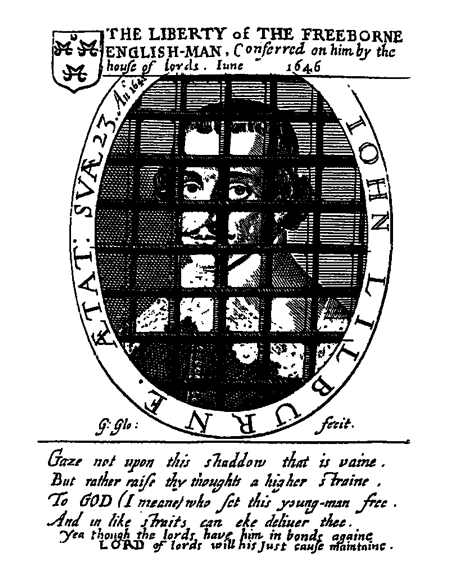
The Illustration above

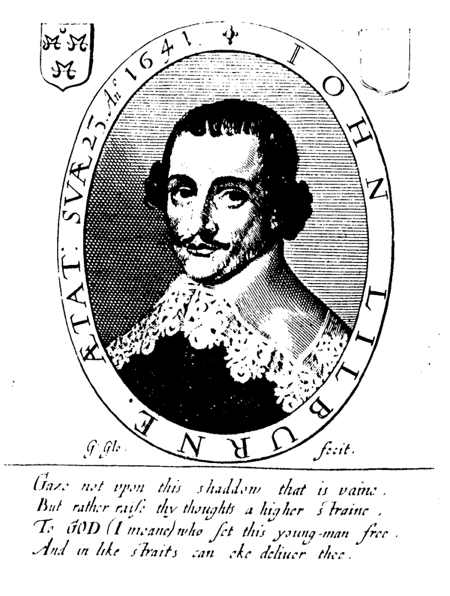
The illustration above comes from an early tract called The Christian Mans Triall (12 March 1638) and comes with the following poem:

IOHN LILBURNE. AETAT: SVAE 23. Ano 1641.
G: Glo: fecit.

Gaze not vpon this shaddow that is vaine.
But rather raise thy thoughts a higher straine.
To GOD (I meane) who set this young-man free.
And in like straits can eke (also) deliver thee.


Table of Contents

  1. Biographical Essay
    1. Charles Harding Firth, "Lilburne, John," Dictionary of National Biography (1885-1900)
  2. Tracts and Pamphlets
    1. John Lilburne, A Light for the Ignorant (1638).
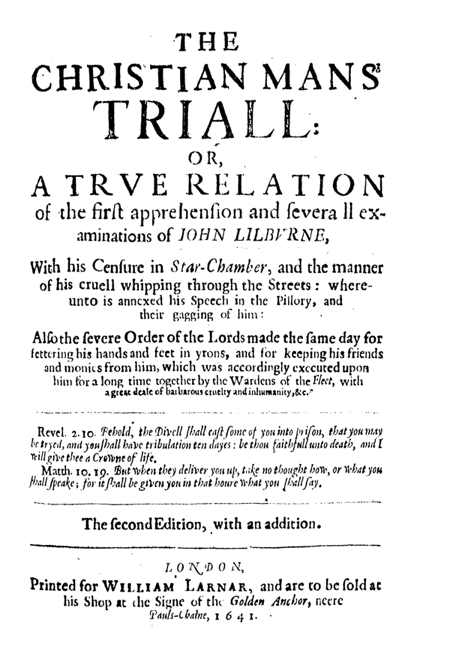
    2. John Lilburne, The Christian Mans Triall (12 March 1638, 2nd ed. December 1641).
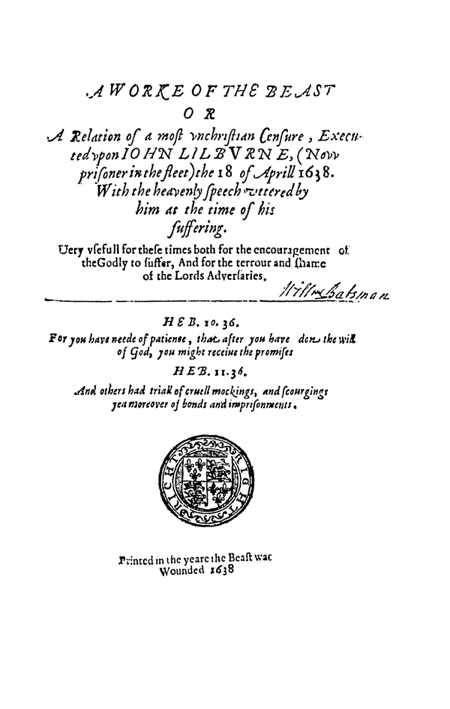
    3. John Lilburne, A Worke of the Beast (1638).
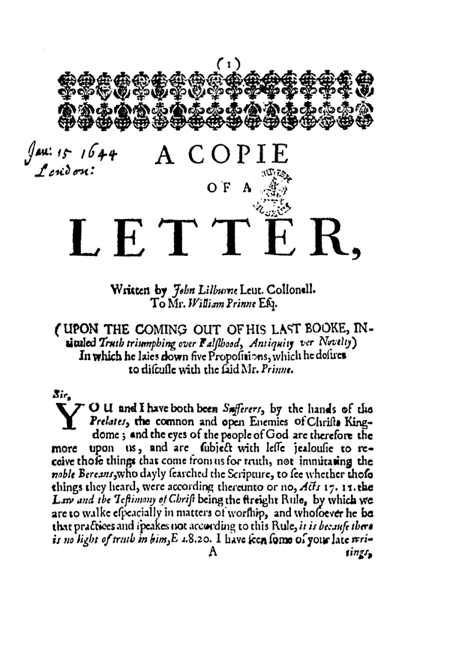
    4. John Lilburne, A Copy of a Letter (15 January 1645).
    5. John Lilburne, Respecting the Power of Disposing of the Militia (30 August, 1645).
    6. John Lilburne, Englands Miserie and Remedie (14 September, 1645).
    7. [John Lilburne], Englands Birth-Right Justified Against all Arbitrary Usurpation, whether Regall or Parliamentary, or under what Vizor soever (8 October 1645).
    8. John Lilburne and Richard Overton, The out-cryes of Opressed Commons (February 1646).
    9. John Lilburne, The Just mans justification (6 June, 1646).
    10. John Lilburne, The Free-mans Freedom Vindicated (16 June 1646).
    11. [John Lilburne], Liberty Vindicated against Slavery (21 August 1646).
    12. John Lilburne, London’s Liberty in Chains discovered (October 1646).
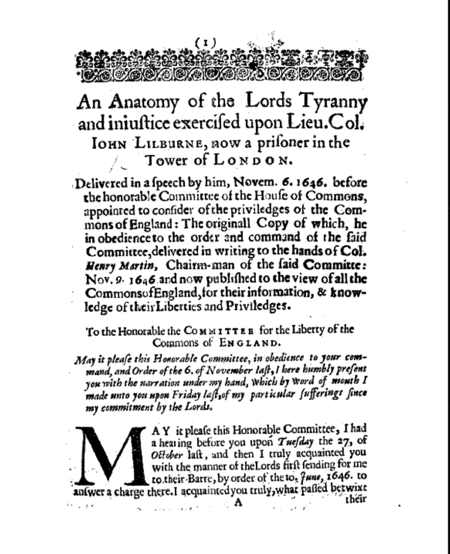
    13. John Lilburne, An Anatomy of the Lords Tyranny (6 November, 1646).
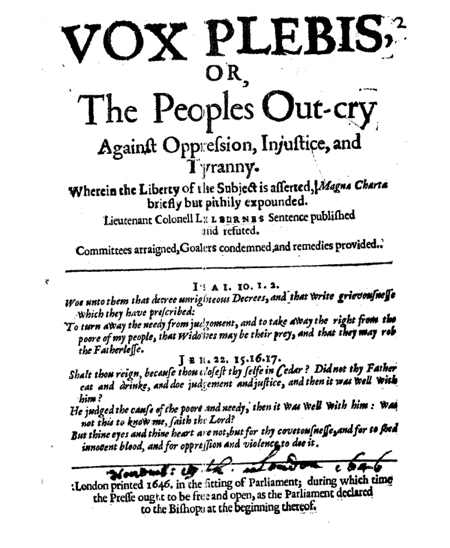
    14. John Lilburne, Vox Plebis, or The Peoples Out-cry Against Oppression, Injustice, and Tyranny (19 November, 1646).
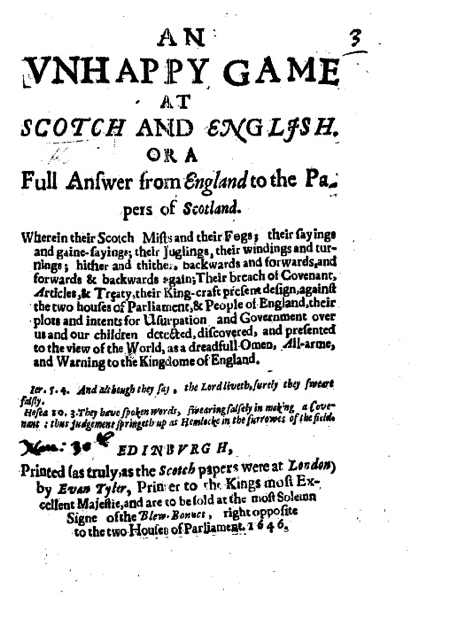
    15. John Lilburne [with Overton], An Unhappy Game at Scotch and English (30 November, 1646).
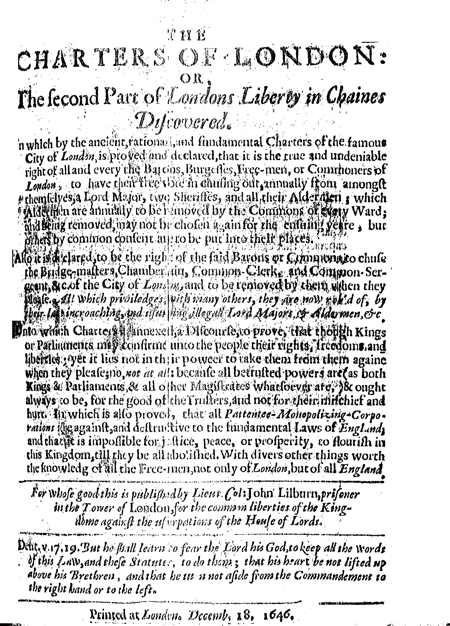
    16. John Lilburne, The Charters of London: or, The second Part of Londons Liberty in Chaines Discovered (18 December, 1646).
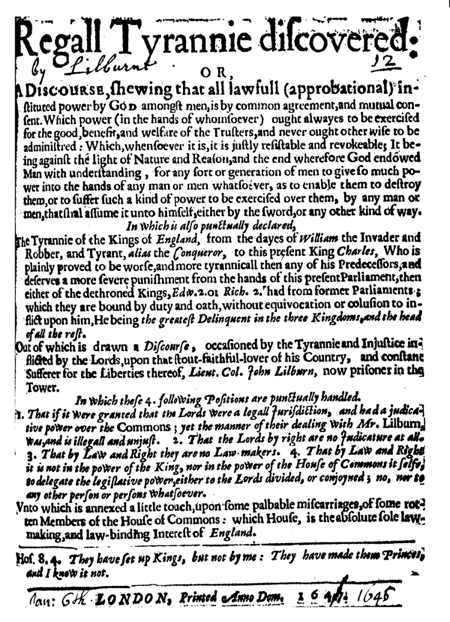
    17. John Lilburne, Regall Tyrannie discovered: Or, A Discourse, shewing that all lawfull (approbational) instituted power by God amongst men, is by common agreement, and mutual consent (6 January 1647).
    18. John Lilburne, The Oppressed Mans Oppressions declared (30 January, 1647).
    19. John Lilburne, The resolved mans Resolution, to maintain with the last drop of his heart blood, his civill Liberties and freedomes (30 April 1647).
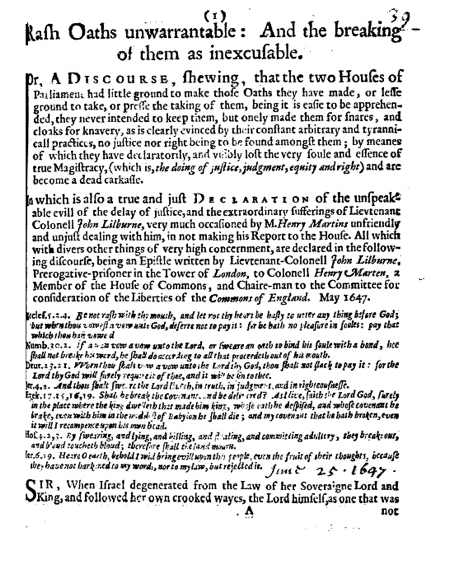
    20. John Lilburne, Rash Oaths unwarrantable (31 May, 1647).
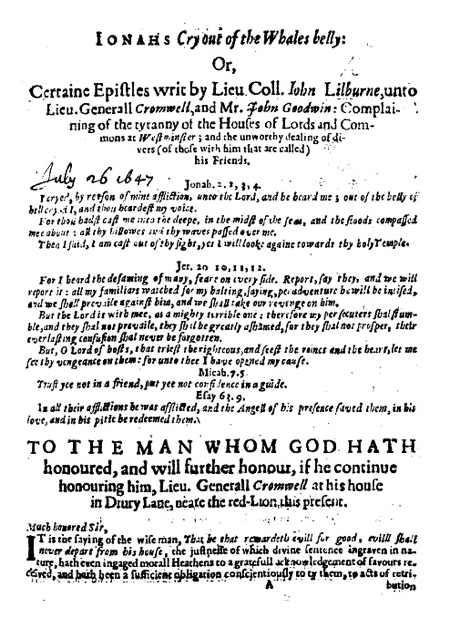
    21. John Lilburne, Jonahs Cry out of the Whales belly (26 July, 1647).
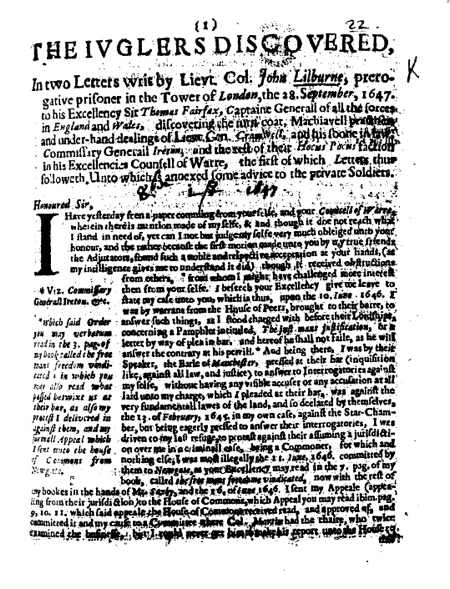
    22. John Lilburne, The Juglers discovered (28 September, 1647).
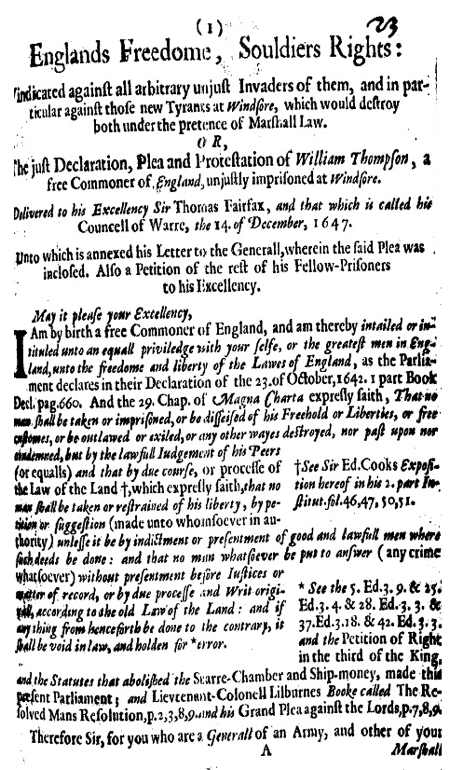
    23. [Signed by Several, attributed to John Lilburne], Englands Freedome, Souldiers Rights (14 December 1647).
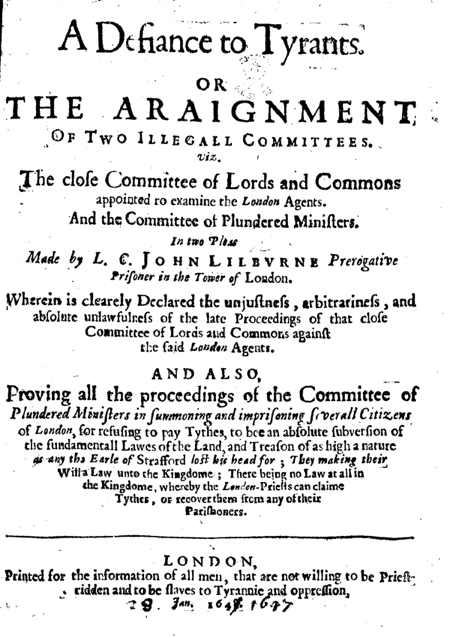
    24. John Lilburne, A Defiance to Tyrants (28 January, 1648).
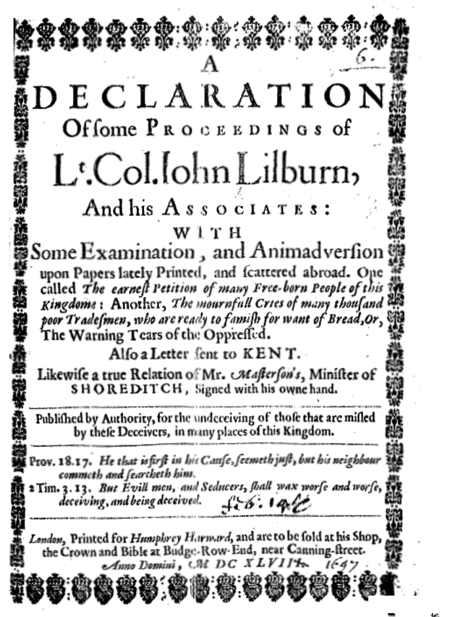
    25. [John Lilburne], A Declaration of some Proceedings of Lt. Col. John Lilburn (14 February, 1648).
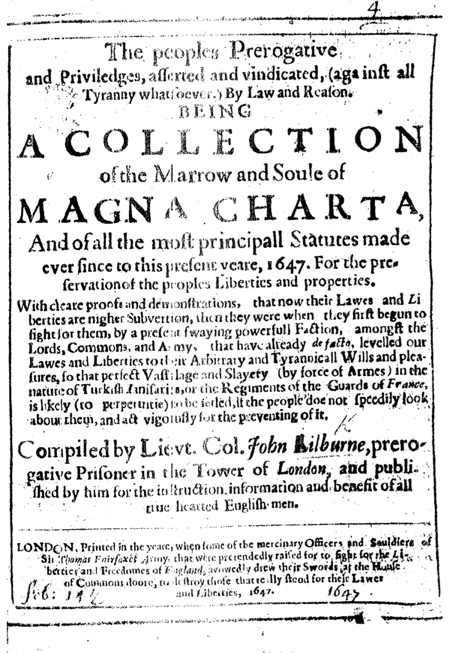
    26. John Lilburne, The Peoples Prerogative and Priviledges (17 February, 1648).
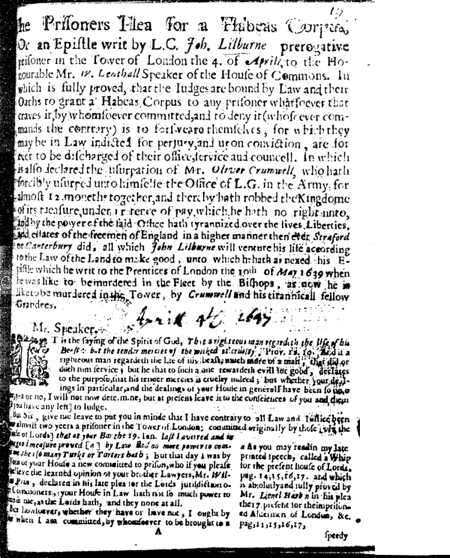
    27. John Lilburne, The Prisoners Plea for a Habeas Corpus (4 April, 1648).
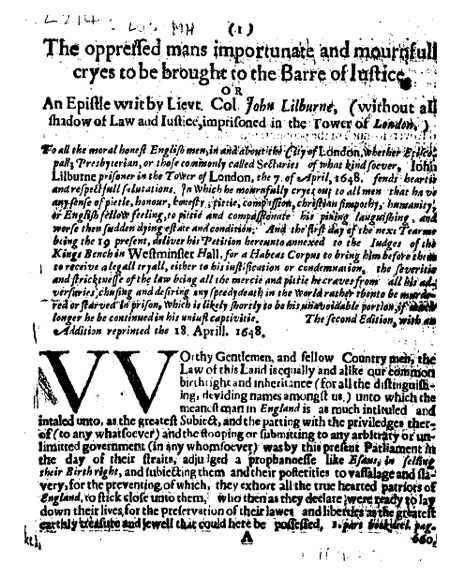
    28. John Lilburne, The Oppressed Mans importunate and mournfull Cryes to be brought to the Barre of Justice (7 April 1648).
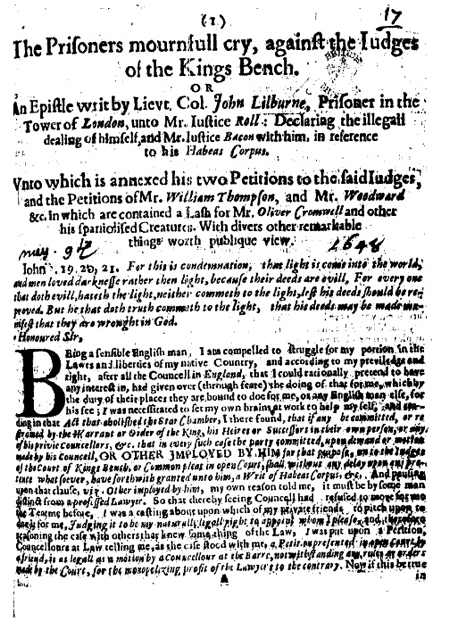
    29. John Lilburne, The Prisoners mournfull Cry, against the Judges of the Kings Bench (9 May, 1648).
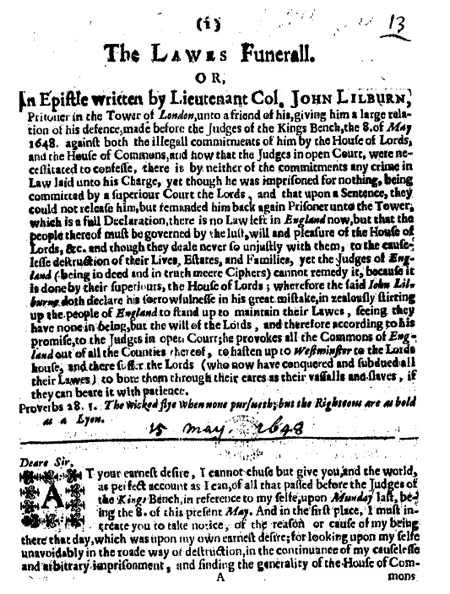
    30. John Lilburne, The Laws Funerall (15 May, 1648).
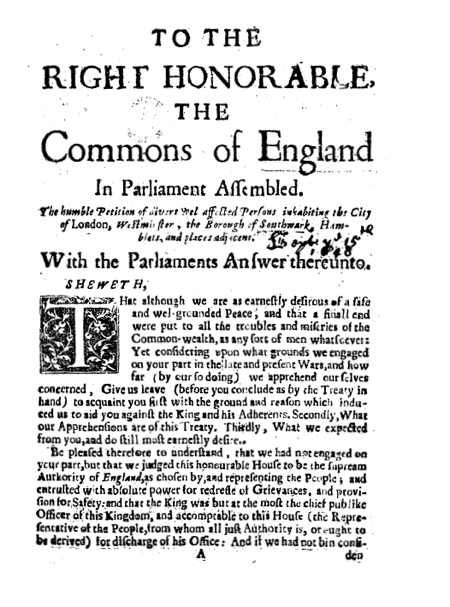
    31. [John Lilburne], To the right Honourable and supreme Authority of this Nation the Commons in Parliament assembled (11 September, 1648).
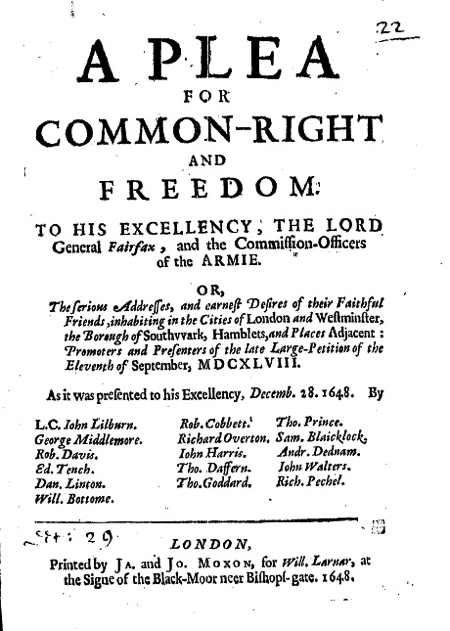
    32. John Lilburne, A Plea for Common-right and Freedom (28 December, 1648).
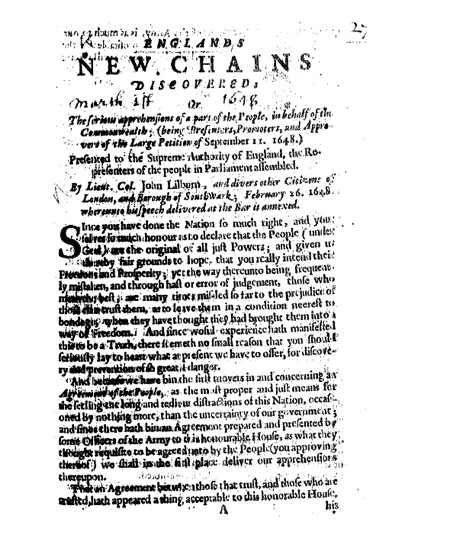
    33. John Lilburne, Englands New Chains Discovered (26 February 1649).
    34. [Signed by Several, attributed to John Lilburne], The Hunting of the Foxes (21 March 1649).
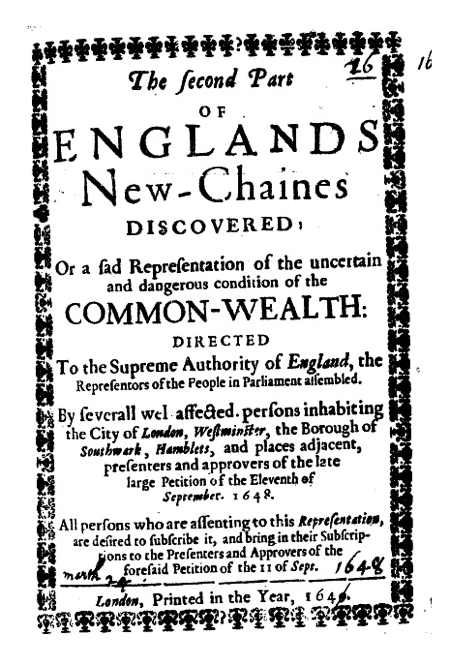
    35. [John Lilburne], The Second Part of Englands New-Chaines Discovered (24 March 1649).
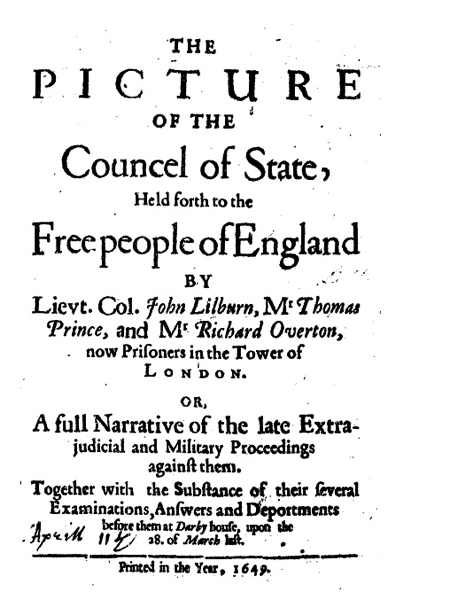
    36. John Lilburne, Thomas Prince, Richard Overton, The Picture of the Councel of State (4 April, 1649).
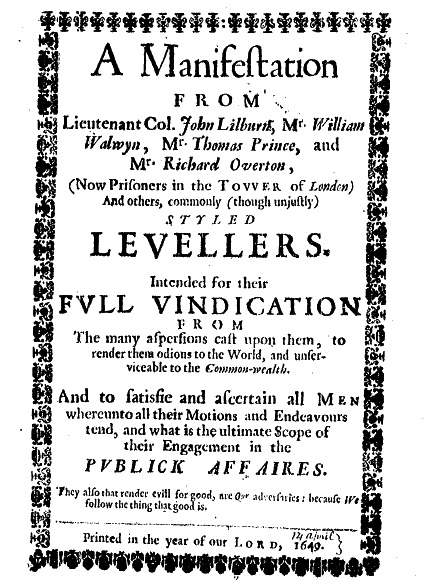
    37. [Several Hnads], A Manifestation from Lieutenant Col. John Lilburn et al. (14 April 1649).
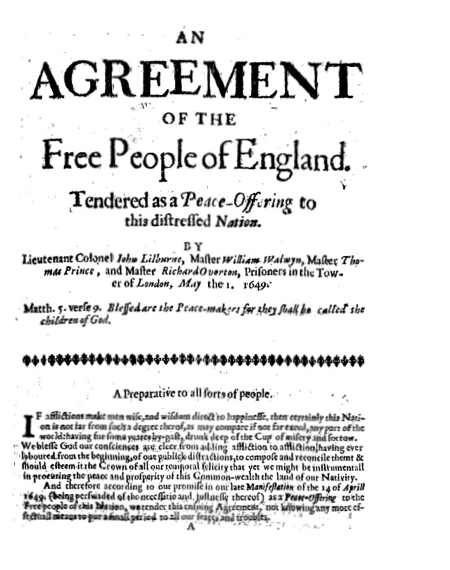
    38. John Lilburne, William Walwyn, Thomas Prince, Richard Overton, An Agreement of the Free People of England (1 May 1649).
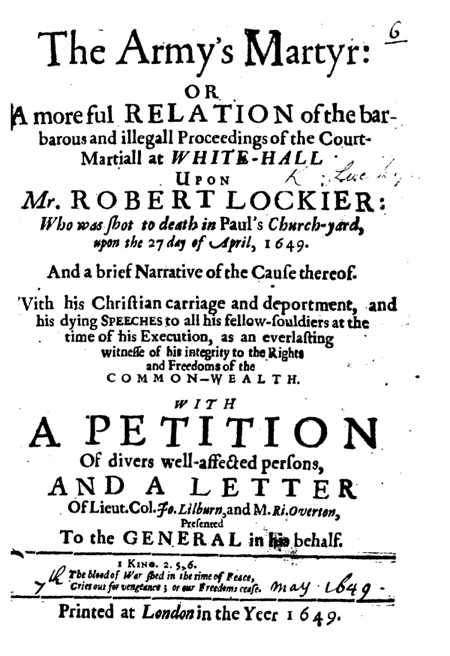
    39. Robert Lockier, John Lilburne, and Richard Overton, The Army’s Martyr (4 May 1649).
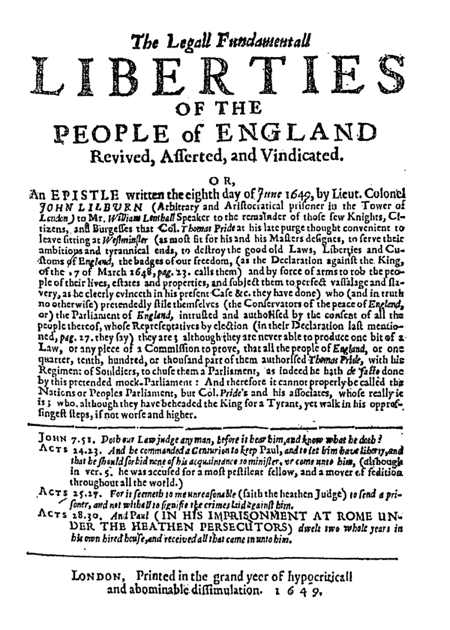
    40. John Lilburne, The Legall Fundamentall Liberties of the People of England Revived, Asserted, and Vindicated (8 June 1649).
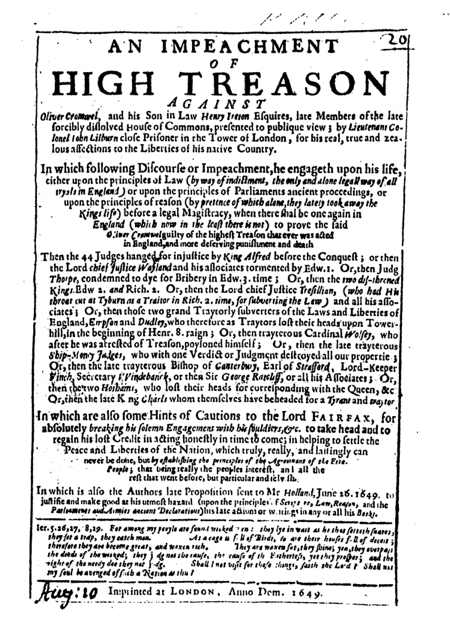
    41. John Lilburne, An Impeachment of High Treason against Oliver Cromwel, and his Son in Law Henry Ireton Esquires (10 August 1649).
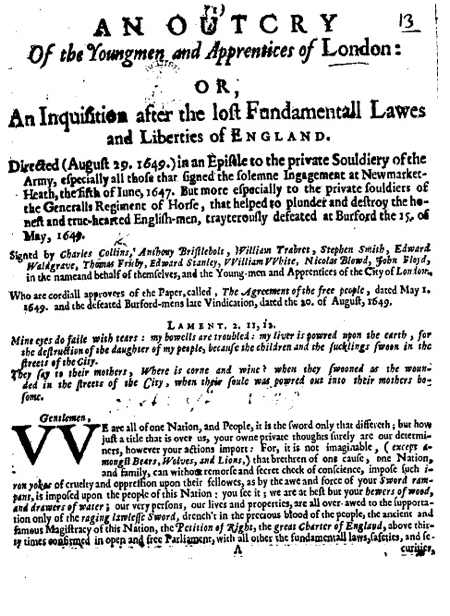
    42. [Signed by several but attributed to John Lilburne], An Outcry of the Youngmen and Apprentices of London (29 August 1649).
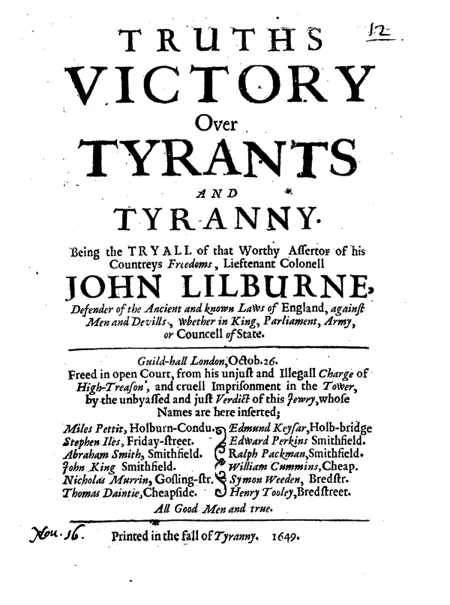
    43. John Lilburne, Truths Victory over Tyrants and Tyranny (16 November 1649).
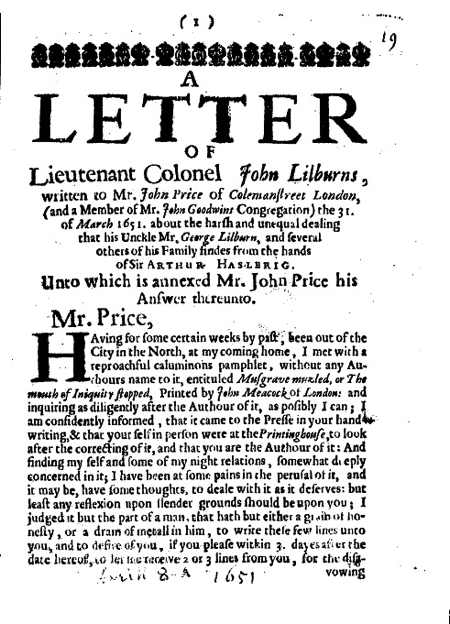
    44. John Lilburne, A Letter written to Mr. John Price (31 March, 1651).
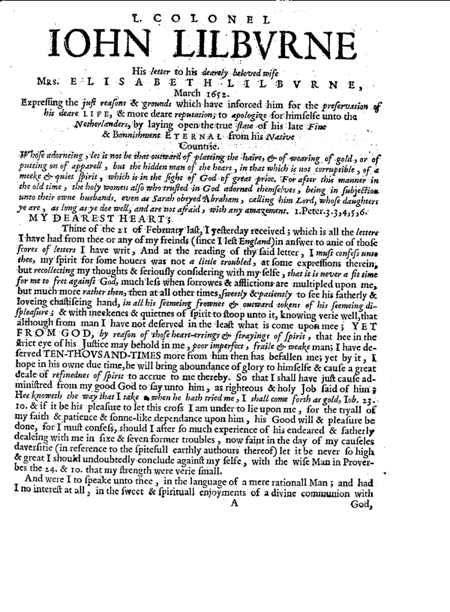
    45. John Lilburne, His letter to his dearly beloved wife (March 1652).
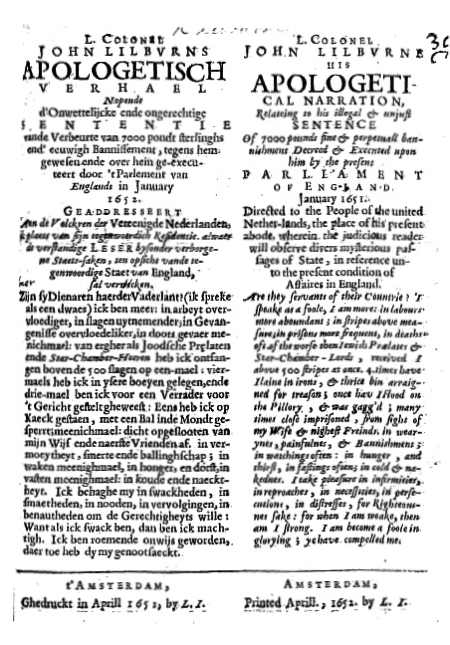
    46. John Lilburne, His Apologeticall Narration (April, 1652).
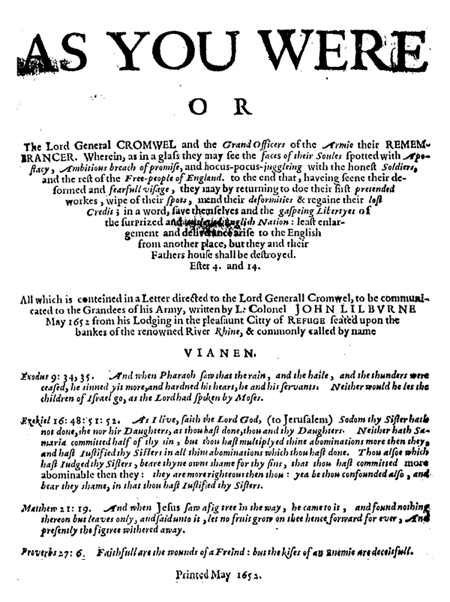
    47. John Lilburne, As you Were (May 1652).
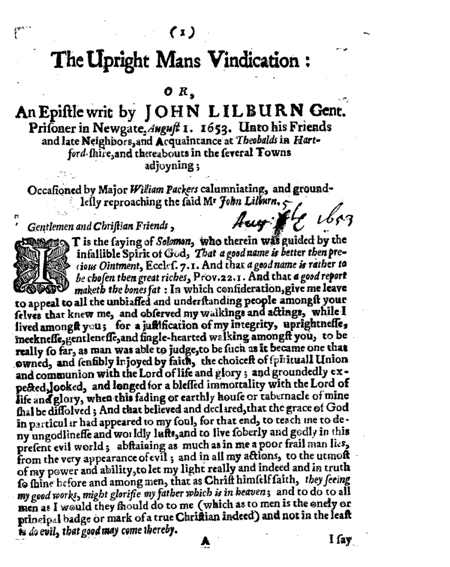
    48. John Lilburne, The Upright Mans Vindication (1 August 1653).
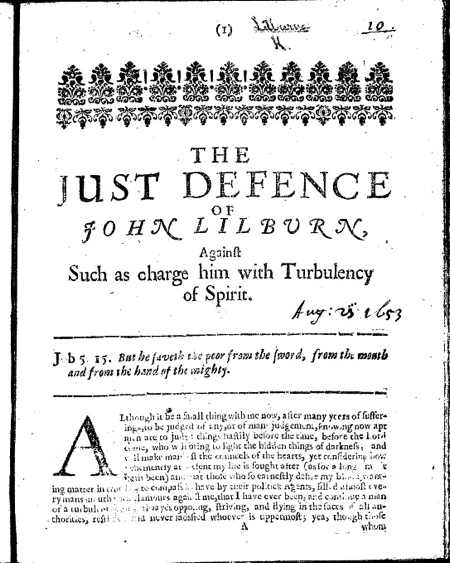
    49. John Lilburne, The Just Defence of John Lilburn (25 August 1653).
    50. John Lilburne, An Hue-and Cry after the Fundamental Lawes and Liberties of England (26 September, 1653).
    51. John Lilburne, The Resurrection of John Lilburne (16 May 1656).
  3. We have not included the following tracts because the scans of the text are very poor resulting in too many illegibles to correct:
    1. T053 John Lilburne, Innocency and Truth justified (6 January, 1646).
    2. T109 John Lilburne, Two Letters Writ (13 September, 1647).
    3. T139 John Lilburne, A Whip for the present House of Lords (27 February, 1648).
    4. T208 John Lilburne, A Preparative to an Hue and Cry (18 August, 1649).
    5. T214 John Lilburne, Strength Out of Weaknesse (19 October, 1649).


BIOGRAPHICAL ESSAY

Charles Harding Firth, "Lilburne, John," Dictionary of National Biography (1885-1900)

Source: Charles Harding Firth, "Lilburne, John," Dictionary of National Biography (1885-1900), vol. 33, pp. 243-50. https://en.wikisource.org/wiki/Dictionary_of_National_Biography,_1885-1900/Lilburne,_John

LILBURNE, JOHN (1614?–1657), political agitator, was the son of Richard Lilburne (d. 1667) of Thickley Puncherdon, Durham, by Margaret, daughter of Thomas Hixon, yeoman of the wardrobe to Queen Elizabeth (Visitation of Durham, 1615, p. 31; Foster, Durham Pedigrees, p. 215). His father signalised himself as one of the last persons to demand trial by battle in a civil suit (Rushworth, vii. 469). Robert Lilburne [q. v.] was his elder brother. A younger brother, Henry, served in Manchester's army, was in 1647 lieutenant-colonel in Robert Lilburne's regiment, declared for the king in August 1648, and was killed at the recapture of Tynemouth Castle of which be was governor (Rushworth, vii. 1226; Clarke Papers,i. 142,368,419; Carlyle Cromwell, Letter xxxix.) A cousin, Thomas, son of George Lilburne of Sunderland, was a staunch Cromwellian while the Protector lived, but in 1660 assisted Lord Fairfax against Lambert, and thus forwarded the Restoration (Thurloe, vii, 411,436; Cal. State Papers, Dom. 1659-60 p. 294, 1663-4 p. 445; Le Neve, Monumenta Anglieana, ii, 108).

Lilburne was born at Greenwich (Innocency and Truth Justified, 1645, p. 8). At the close of a letter appended to that pamphlet and dated 11 Nov. 1638, he describes himself as then in his twenty-second year; in the portrait prefixed to another he is described as twenty-three in 1641 (An Answer to Nine Arguments written by T. B., 1645). The 'Visitation' appears to prove that in each case his age was understated. He was educated at Newcastle and Auckland schools, and then apprenticed by his father to Thomas Hewson, a wholesale cloth merchant in London, with whom he remained from about 1630 to 1636 (The Legal Fundamental Liberties of the People of England, 1649, 2nd edit., p. 25; Innocency and Truth Justified, p.8). In his spare time he read Foxe's 'Book of Martyrs' and the Puritan divines, and about 1636 became acquainted with John Bastwick, then a prisoner in the Gatehouse. Lilburne'a connection with Bastwick, whose 'Litany' he had a hand in printing, obliged him to fly to Holland. The story that he was Prynne's servant seems to be untrue (Bastwick, Just Defence; Prynne, Liar Confounded, 1646, p. 2; Lilburne, Innocency and Truth, p. 7). On his return from Holland, Lilburne was arrested (11 Dec. 1637) and brought before the Star Chamber on the charge of printing and circulating unlicensed books, more especially Prynne's 'News from Ipswich.' In his examinations he refused to take the oath known as the 'ex-officio' oath—on the ground that he was not bound to criminate himself, and thus called in question the court's usual procedure (see Gardiner, History of England, viii. 248; Stephens, History of the Criminal Law , i. 343). As he persisted in his contumacy, he was sentenced (13 Feb. 1638) to be fined 500 l ., whipped, pilloried, and imprisoned till he obeyed (Rushworth, ii. 463-6; State Trials , iii. 1315-67). On 18 April 1638 Lilburne was whipped from the Fleet to Palace Yard. When he was pilloried he made a speech denouncing the bishops, threw some of Bastwick's tracts among the crowd, and, as he refused to be silent, was finally gagged. During his imprisonment he was treated with great barbarity (Lilburne, The Christian Man's Trial , 1641; A Copy of a Letter written by John Lilburne to the Wardens of the Fleet , 4 Oct. 1640; A True Relation of the Material Passage of Lieutenant-Colonel John Lilburne's as they were proved before the House of Peers , 13 Feb. 1645; State Trials, iii. 1315). He contrived, however, to write and to get printed an apology for separation from the church of England, entitled 'Come out of her, my people' (1639), and an account of his own punishment styled 'The Work of the Beast' (1638).

As soon as the Long parliament met, a petition from Lilburne was presented by Cromwell, and referred to a committee (Commons' Journals, ii. 24; Memoirs of Sir Philip Warwick, p. 247). On 4 May 1641 the Commons voted that Lilburne's sentence was 'illegal and against the liberties of the subject,' and also 'bloody, wicked, cruel, barbarous, and tyrannical (ib. ii. 134). The same day Lilburne, who had been released at the beginning of the parliament, brought before the House of Lords for speaking words against the king, but as the witnesses disagreed the charge was dismissed (Lords' Journals, iv. 233).

When the civil war broke out, Lilburne, who had in the meantime taken to brewing, obtained a captain's commission in Lord Brooke's foot regiment, fought at the battle of Edgehill, and was taken prisoner in the fight at Brentford (12 Nov. 1642; Innocency and Truth Justified, pp. 41, 65). He was then put on his trial at Oxford for high treason in bearing arms against the king, before Chief-justice Heath. Had not parliament, by a declaration of 17 Dec. 1642, threatened immediate reprisals, Lilburne would have been condemned to death (Rushworth, v. 93; A Letter sent from Captain Lilburne, 1643; The Trial of Lieutenant-Colonel John Lilburne, 24-36 Oct. 1619, by Theodorus Varax, pp. 33-9). In the course of 1643 Lilburne obtained his liberty by exchange. Essex gave him 300 l. by way of recognition of his undaunted conduct at his trial, and he says that he was offered a place of profit and honour, but preferred to fight, though it were for eight pence a day, till he saw the peace and liberty of England settled (Legal Fundamental Liberties, p. 27). Joining Manchester's army at the siege of Lincoln, he took part as a volunteer in its capture, and on 7 Oct. 1643 was given a major's commission in Colonel King's regiment of foot. On 16 May 1644 he was transferred to Manchester's own dragoons with the rank of lieutenant-colonel. He left the army on 30 April 1645), finding that he could not enter the new model without taking the covenant.

Lilburne had gained a great reputation for courage and seems to have been a good officer, but his military career was unlucky. He spent about six months in prison at Oxford, was plundered of all he had at Rupert's relief of Newark (22 March 1644), was shot through the arm at the taking of Walton Hall, near Wakefield (3 June 1644), and received very little pay. His arrears when he left the service amounted to 880 l. (Innocency and Truth Justified, pp. 25, 43, 46, 69; The Resolved Man's Resolution, p. 32). He also succeeded in quarrelling, first with Colonel King and then with the Earl of Manchester, both of whom he regarded as lukewarm, incapable, and treacherous. He did his beet to get King cashiered, and was one of the authors of the charge of high treason against him, which was presented to the House of Commons by some of the committee of Lincoln in August 1644 (Innocency and Truth, p.43; England's Birthright 1645, p. 17, The Just Man's Justification ). The dispute with Manchester was due to Lilburne's summoning and capturing Tickhill Castle against Manchester's orders, and Lilburne was one of Cromwell's witnesses in his charge against Manchester (Cal. State Papers, Dom. 1644- 1645, p. 146; England's Birthright, p. 17; Legal Fundamental Liberties, p. 30).

Besides these feuds Lilburne soon engaged in a quarrel with two of his quondam fellow sufferers. On 7 Jan. 1645 be addressed a letter to Prynne, attacking the intolerance of the presbyterians, and claiming freedom of conscience and freedom of speech for the independents (A Copy of a Letter to William Prynne upon his last book entitled 'Truth Triumphing over Error,' etc., 1645), Prynne, bitterly incensed, procured a vote of the Commons summoning Lilburne before the committee for examinations (17 Jan. 1645), When he appeared (17 May 1645) the committee discharged him with a caution (Innocency and Truth Justified, p. 9; The Reasons of Lieutenant-Colonel Lilburne sending his Letter to Mr. Prynne, 1645). A second time (18 June 1645) Prynne caused Lilburne to be brought before the same committee, on a charge of publishing unlicensed pamphlets, but he was again dismissed unpunished. Prynne vented his malice in two pamphlets: 'A Fresh Discovery of prodigious Wandering: Stars and Firebrands, and 'The Liar Confounded,' to which Lilburne replied in 'Innocency and Truth Justified' (1645), Dr. Bastwick took a minor part in the same controversy.

Meanwhile Lilburne was ineffectually endeavouring to obtain from the House of Commons the promised compensation for his sufferings. He procured from Cromwell a letter recommending his case to the house. His attendance, wrote Cromwell, had kept him from other employment, and 'his former losses and late services (which have been very chargeable) considered, he doth find it a hard thing in these times for himself and his family to subsist' (Innocency and Truth Justified, p. 63). Lilburne hoped also to attract the notice of parliament by giving them a narrative of the victory of Langport, which he had witnessed during his visit to Cromwell (A more full Relation of the Battle fought between Sir T. Fairfax and Goring made in the House of Commons, 14 July 1645).

But all chance of obtaining what he asked was entirely destroyed by a new indiscretion. On 19 July he was overheard relating in conversation certain scandalous charges against Speaker Lenthall [see Lenthall, William]. King and Bastwick reported the matter to the Commons, who immediately ordered Lilburne's arrest (Commons' Journals, iv. 213). Brought before the committee for examinations, Lilburne refused to answer the questions put to him unless the cause of his arrest were specified, saying that their procedure was contrary to Magna Charta and the privileges of a freeborn denizen of England (Innocency and Truth, p. 13; The Liar Confounded, p. 7). In spite of his imprisonment Lilburne contrived to print an account of his examination and arrest, in which he attacked not only several members by name, but the authority of the Commons house itself (The Copy of a Letter from Lieutenant-Colonel Lilburne to a friend, 1645). The committee in consequence sent him to Newgate (9 Aug.), and the house ordered that the Recorder of London should proceed against him in quarter sessions. The charge against the speaker was investigated, and voted groundless, but no further proceedings were taken against Lilburne, and he was released on 14 Oct. 1645 (Commons' Journals, iv. 235, 237, 274, 307; Godwin, History of the Commonwealth, ii. 21).

Lilburne was for a short time comparatively quiet. He presented a petition to the Commons for his arrears, but, as he refused to swear to his accounts, could not obtain his pay. His case against the Star-chamber was pleaded before the Lords by Bradshaw, and that house transmitted to the Commons an ordinance granting him 2,000 l. in compensation for his sufferings (A True Relation of the Material Passages of Lieutenant-Colonel John Lilburne's Sufferings, as they were represented before the House of Peers, 13 Feb. 1645–6; Lords' Journals, viii. 201). But the ordinance hung fire in the Commons, and in the meantime Prynne and the committee of accounts alleged that Lilburne owed the state 2,000 l., and Colonel King claimed 2,000 l. damages for slander. In this dilemma Lilburne wrote and printed (6 June 1647) a letter to Judge Reeve, before whom King's claim was to be tried, explaining his embarrassments and asserting the justice of his cause (The Just Man's Justification, 4to, 1646). Incidentally he reflected on the Earl of Manchester, observing that if Cromwell had prosecuted his charge properly Manchester would have lost his head. Lilburne was at once summoned before the House of Lords, Manchester himself, as speaker, occupying the chair, but he refused to answer questions or acknowledge the jurisdiction of the peers (16 June). They committed him to Newgate, but he continued to defy them. To avoid obedience to their summons he barricaded himself in his cell, refused to kneel or to take off his hat, and stopped his ears when the charge against him was read. The lords sentenced him to be fined 4,000 l., to be imprisoned for seven years in the Tower, and to be declared for ever incapable of holding any office, civil or military (Lords' Journals, viii. 370, 388, 428–32; The Freeman's Freedom vindicated; A Letter sent by Lieutenant-Colonel John Lilburne to Mr. Wollaston, keeper of Newgate; The Just Man in Bonds; A Pearl in a Dunghill, 4to, 1646).

On 16 June Lilburne had appealed to the Commons as the only lawful judges of 'a commoner of England,' or 'freeborn Englishman.' On 3 July accordingly the house appointed a committee to consider his case, before which Lilburne appeared on 31 Oct. and 6 Nov., but the business presented so many legal and political difficulties, that their report was delayed (Anatomy of the Lords' Tyranny … exercised upon John Lilburne ). Lilburne looked beyond the House of Commons, and appealed to the people in a series of pamphlets written by himself, his friend Richard Overton [q. v.], and others (A Remonstrance of Many Thousand Citizens; Vox Plebis; An Alarum to the House of Lords ). He found time also to attack abuses in the election of the city magistrates, to publish a bitter attack on monarchy, and to quarrel with his gaolers about the exorbitant fees demanded of prisoners in the Tower (London's Liberty in Chains Discovered, 1646; Regal Tyranny Discovered, 1647; The Oppressed Man's Oppressions Declared, 1647). In the last-named he abused the Commons for delaying his release, and was therefore called before the committee for scandalous pamphlets (8 Feb. 1647). His attitude is shown in the title of a tract published on 30 April 1647: 'The Resolved Man's Resolution to maintain with the last drop of his heart's blood his civil liberties and freedom.' Despairing of help from the House of Commons, Lilburne now appealed to Cromwell and the army (Rash Oaths Unwarrantable; Jonah's Cry out of the Whale's Belly ). The agitators took up his case and demanded Lilburne's release as one of the conditions of the settlement between the army and parliament (Clarke Papers, i. 171). When the army marched through London and Fairfax was made lieutenant of the Tower, Lilburne's expectations of immediate release were again disappointed. Though the committee at last reported (14 Sept.), the Commons referred the report back to it again, and appointed a new committee specially to consider the legal questions involved (15 Oct.). Lilburne was allowed to argue his case before the committee (20 Oct.), and on 9 Nov. the Commons ordered that he should have liberty from day to day to come abroad, to attend the committee and to instruct his counsel, without a keeper (The Grand Plea of Lieutenant-colonel John Lilburne; The Additional Plea; Commons' Journals, v. 301, 334). Before his release Lilburne offered, if he could obtain a reasonable proportion of justice from the parliament, to leave the kingdom and not to return as long as the present troubles lasted (Additional Plea; Commons' Journals, v. 326; Tanner MSS. lviii. 549). But ever since June his suspicions of Cromwell had been increasing, and he now regarded him as a treacherous and self-seeking intriguer. The negotiations of the army leaders with the king, and the suggestions of royalist fellow-prisoners in the Tower, led him to credit the story that Cromwell had sold himself to the king (Jonah's Cry; Two Letters by Lilburne to Colonel Henry Marten; The Jugglers Discovered, 1647). Cromwell's breach with the king, in November 1647, which Lilburne attributed solely to the fear of assassination, did not remove these suspicions, and the simultaneous suppression of the levelling party in the army seemed conclusive proof of Cromwell's tyrannical designs. Regardless of his late protestations, Lilburne, in conjunction with Wildman, with the 'agents' representing the mutinous part of the army, and with the commissioners of the levellers of London and the adjacent counties, drew up a petition to the commons, as 'the supreme authority of England,' demanding the abolition of the House of Lords and the immediate concession of a number of constitutional and legal changes. Emissaries were sent out to procure signatures, and mass meetings of petitioners arranged. Information of these proceedings was given to the House of Lords on 17 Jan. 1648, and on their complaint the House of Commons summoned Lilburne to the bar (19 Jan.), and after hearing his lengthy vindication committed him again to the Tower (Lords' Journals, ix. 663–666; Commons' Journals, v. 436–8; Truth's Triumph, by John Wildman; The Triumph Stained, by George Masterson; A Whip for the present House of Lords, by Lilburne, A Declaration of some proceedings of Lieutenant-colonel John Lilburne and his associates; An Impeachment of High Treason against Oliver Cromwell and Henry Ireton, by Lilburne, 1649). Six months later the presbyterian leaders in the Commons, calling to mind the charge which Lilburne had brought against Cromwell at his last appearance before the house, resolved to set him free. On 27 July Sir John Maynard, one of the eleven members impeached by the army in 1647, set forth his case in a powerful speech. On 1 Aug. the Commons passed a vote for Lilburne's release, and next day the Lords not only followed their example but remitted the fine and sentence of imprisonment which they had imposed two years earlier (A Speech by Sir John Maynard, 1648; Commons' Journals, v. 657; Lords' Journals, x. 407).

On the day of Lilburne's release Major Huntington laid before the lords his charge against Cromwell. Lilburne states that he was 'earnestly solicited again and again' to join Huntington in impeaching Cromwell, 'and might have had money enough to boot to have done it,' but he was afraid of the consequences of a Scottish victory, and preferred to encourage Cromwell by a promise of support (Legal Fundamental Liberties, 1649 ed., ii. 32). Nevertheless all Lilburne's actions during the political agitation of the autumn of 1648 were marked by a deep distrust of the army leaders. He refused to take part in the king's trial, and, though holding that he deserved death, thought that he ought to be tried by a jury instead of by a high court of justice. He also feared the consequences of executing the king and abolishing the monarchy before the constitution of the new government had been agreed upon and its powers strictly defined. The constitutional changes demanded by Lilburne and his friends had been set forth in the London petition of 11 Sept. 1648 (Rushworth, vii. 1257), and he next procured the appointment of a committee of sixteen persons—representing the army and the different sections of the republican party—to draw up the scheme of a new constitution. But when the committee had drawn up their scheme, the council of officers insisted on revising and materially altering it. Lilburne, who regarded these changes as a gross breach of faith, published the scheme of the committee (15 Dec.) under the title of 'The Foundations of Freedom, or an Agreement of the People,' and addressed a strong protest to Fairfax ('A Plea for Common Right and Freedom,' 28 Dec. 1648). The council of officers also, on 20 Jan. 1649, presented their revised version of the scheme to parliament, also calling it 'An Agreement of the People' (Gardiner, Great Civil War, iii. 501, 528, 545, 567; Old Parliamentary History, xviii. 516; Legal Fundamental Liberties, pp. 32–42). The difference between the two programmes was considerable, especially with regard to the authority given to the government in religious matters. Moreover, while the officers simply presented the 'Agreement' to parliament for its consideration, Lilburne had intended to circulate it for signature among the people, and to compel parliament to accept it. He now appealed to the discontented part of the army and the London mob, in the hope of forcing the hands of parliament and the council of officers. On 26 Feb. he presented to the parliament a bitter criticism of the 'Agreement' of the officers, following it up (24 March) by a violent attack on the chief officers themselves (England's New Chains Discovered, pts. i. ii.; answered in 'The Discoverer,' attributed to Frost, the secretary of the council of state). Parliament voted the second part of 'England's New Chains' seditious, and ordered that its authors should be proceeded against (27 March). Lilburne and three friends were brought before the council of state, and after refusing to own its jurisdiction, or answer questions incriminating themselves, were committed to the Tower, 28 March (The Picture of the Council of State; Commons' Journals, vi. 183; Cal. State Papers, Dom. 1649–50, p. 57). Immediately a number of petitions in Lilburne's favour were presented—one from London, another from ten thousand well-affected persons in the county of Essex, and a third from a number of women (Commons' Journals, vi. 178, 189, 200). The leaders of the rising which took place in May 1649 threatened that if a hair of the heads of Lilburne and his friends were touched they would avenge it 'seventy times sevenfold upon their tyrants' (Walker, History of Independency, pt. ii. p. 171). Lilburne, whom it seems to have been utterly impossible to deprive of ink, fanned the excitement by publishing an amended version of his constitutional scheme, a vindication of himself and his fellow-prisoners, a controversial tract about the lawlessness of the present government, and a lengthy attack on the parliament (An Agreement of the Free People of England, 1 May 1649; A Manifestation from Lieutenant-colonel John Lilburne and others, commonly, though unjustly, styled 'Levellers,' 14 April; A Discourse between Lieutenant-colonel John Lilburne and Mr. Hugh Peter, upon May 25, 1649; The Legal Fundamental Liberties of the People of England Vindicated, 8 June 1649). None the less on 18 July the house, at Marten's instigation, ordered Lilburne's release on bail on account of the illness of his wife and children (Commons' Journals, vi. 164). A compromise of some kind seems to have been attempted and failed, and then on 10 Aug. Lilburne published 'An Impeachment of High Treason against Oliver Cromwell and his Son-in-law, Henry Ireton,' combining the accusations he had made against Cromwell in January 1648 with the charges brought by Huntington in August following. Of more practical importance was a tract appealing to the army to avenge the blood of the late mutineers, which Lilburne personally distributed to some of the soldiers quartered in London (An Outcry of the Young Men and Apprentices of London, addressed to the Private Soldiers of the Army ). Its immediate result was the mutiny of Ingoldsby's regiment at Oxford in September 1649. On 11 Sept. the parliament voted the 'Outcry' seditious, and ordered immediate preparations for Lilburne's long-delayed trial (The Moderate, 11–18 Sept. 1649; Commons' Journals, vi. 293). Three days later he was examined by Prideaux, the attorney-general, who reported that there was sufficient evidence to convict him (Strength out of Weakness, or the Final and Absolute Plea of Lieutenant-colonel John Lilburne; Cal. State Papers, Dom. 1649–50, p. 314). Lilburne himself offered to refer the matter to a couple of arbitrators, or to emigrate to America provided that the money due to him from the state were first paid (The Innocent Man's First Proffer, 20 Oct.; The Innocent Man's Second Proffer, 22 Oct.).

His trial at the Guildhall by a special commission of oyer and terminer lasted three days (24–26 Oct.) Lilburne began by refusing to plead, and contesting the authority of the court. He was indicted under two recent acts (14 May 1649, 17 July 1649), declaring what offences should be adjudged treason, and his defence was a denial of the facts alleged against him, and an argument that he was not legally guilty of treason. He carried on a continuous battle with his judges, and appealed throughout to the jury, asserting that they were judges of the law as well as the fact, and that the judges were 'no more but cyphers to pronounce their verdict.' Though Judge Jermyn pronounced this 'a damnable blasphemous heresy,' the jury acquitted Lilburne (Trial of Lieutenant-colonel John Lilburne, by Theodorus Varax, 1649; State Trials, iv. 1270–1470; the legal aspects of the trial are discussed in Stephen, History of the Criminal Law, 1883, i. 356, Willis Bund Selections from the Slate Trials, 1879. i. 602, and Inderwick, The Interregnum, 1891, p. 275). Warned by the popular rejoicings, the council of state accepted the verdict, and released Lilburne and his associates (8 Nov. 1649).

So far as politics was concerned, Lilburne for the next two years remained quiet. He was elected on 21 Dec. 1649 a common councilman for the city of London, but on the 26th his election was declared void by parliament, although he had taken the required oath to be faithful to the commonwealth (Commons' Journal, vi. 338; The Engagement Vindicated and Explained ). No disposition, however, was shown to persecute him. On 22 Dec, 1648 he had obtained an ordinance granting him 3,000 l, in compensation for his sufferings, from the Star-chamber, the money being made payable from the forfeited estates of various royalists in the county of Durham. As this source had proved insufficient, Lilburne, by the aid of Marten and Cromwell, obtained another ordinance (30 July 1650), charging the remainder of the sum on confiscated chapter-lands, and thus became owner of some of the lands of the Durham chapter (Commons' Journals, i. 441, 447).

Now that his own grievance was redressed, he undertook to redress those of other people. Ever since 1644, when he found himself prevented by the monopoly of the merchant adventurers from embarking in the cloth trade, Lilburne had advocated the release of trade from the restrictions of chartered companies and monopolists (Innocency and Truth Justified, p. 43; England's Birthright Justified, p. 9). He now took up the case of the soap-makers, and wrote petitions for them demanding the abolition of the excise on soap, and apparently became a soap manufacturer himself (The Soapmaker' Complaint for the Loss of their Trade, 1650). The tenants of the manor of Epworth hold themselves wronged by enclosures which had taken place under the schemes fur draining Hatfield Chase and the Isle of Axholme. Lilburne took up their cause, assisted by his friend, John Wildman, and headed a riot (19 Oct. 1650), by means of which the commoners sought to obtain possession of the disputed lands. His zeal was not entirely disinterested, as he was to have two thousand acres for himself and Wildman if the claimants succeeded (The Case of the Tenants of the Manor of Epworth, by John Lilburne, 18 Nov. 1650; Two Petitions from Lincolnshire against the Old Court Levellers; Lilburne Tried and Cast, pp. 83–90; Tomlinson, The Level of Hatfield Chace, pp. 91, 258–76; Cal. State Papers, Dom. 1652–3. p. 373). John Morris, alias Poyntz, complained of being swindled out of some properties by potent enemies, with the assistance of John Browne, late clerk to the House of Lords. Lilburne, who had exerted himself on behalf of Morris as far back as 1648. now actively took up his cause again (A Whip for the Present House of Lords, 27 Feb. 1647–8; The Case of John Morris, alias Poyntz, 29 June 1651).

Much more serious in its consequences was Lilburne's adoption of the quarrel of his uncle, George Lilburne, with Sir Arthur Hesilrige. In 1649, Lilburne had published a violent attack on Hesilrige, whom he accused of obstructing the payment of the money granted him by the parliamentary ordinance of 28 Dec. 1648 (A Preparative to an Hue and Cry after Sir Arthur Haslerig, 18 Aug, 1649). George Lilburne's quarrel with Hesilrige was caused by a dispute about the possession of certain collieries in Durham—also originally the property of royalist delinquents— from which he had been ejected by Hesilrige in 1649. In 1651 the committee for compounding delinquents' estates had confirmed Hesilrige's decision. John Lilburne intervened with a violent attack on Hesilrige and the committee, terming them 'unjust and unworthy men, fit to be spewed out of all human society, and deserving worse than to be hanged' (A just Reproof to Haberdashers' Hall, 30 July 165l). He next joined with Josiah Primat—the person from whom George Lilburne asserted that he had bought the collieries—and presented to parliament, on 23 Dec. 1651, a petition repeating and specifying the charges against Hesilrige. Parliament thereupon appointed a committee of fifty members to examine witnesses and documents; who reported on 16 Jan. 1653, that the petition was 'false, malicious, and scandalous.' Lilburne was sentenced to pay a fine of 3,000 l, to the state, and damages of 2,000 l, to Hesilrige, and 500 l. apiece to four members of the committee for compounding. In addition he was sentenced to be banished for life, and an act of parliament for that purpose was passed on 30 Jan. (Commons' Journals, vii. 55, 71, 78; Calendar of the Proceedings of the Committee for compounding, pp. 1917, 2127, An Anatomy of Lieutenant-colonel J. Lilburne's Spirit, by T. M. 1649; Lieutenant-colonel J. Lilburne Tried and Cast, 1653; A True Narrative concerning Sir A. Hesilrige's possessing of Lieutenant-colonel J. Lilburne's estate, 1653).

Lilburne spent his exile in the Netherlands at Bruges and elsewhere, where he published a vindication of himself, and an attack on the government (Lieutenant-colonel John Lilburne's Apologetical Narrative, relating to his illegal and unjust sentence, Amsterdam, April 1652 printed in Dutch and English; As you were, May 1652). In his hostility to the army leaders Lilburne had often contrasted the present governors unfavourably with Charles I. Now he frequented the society of cavaliers of note, such Lords Hopton, Colepeper, and Percy. If he were furnished with ten thousand pounds, he undertook to overthrow Cromwell, the parliament, and the council of state, within six months. 'I know not.' he was heard to say, 'why I should not vye with Cromwell, since I had once as great a power as he had, and greater too, and am as good a gentleman.' But with the exception of the Duke of Buckingham, non of the royalists placed any confidence in him. (Several informations taken concerning Lieutenant-colonel John Lilburne, concerning his apostacy to the party of Charles Stuart, 1653; Malice detected in printing certain Information, etc.; Lieutenant-colonel John Lilburne received ; Cal. Clarendon Papers , ii. 141, 146, 213). The news of the expulsion of the Rump in April 1653 excited Lilburne's hopes of returning to England. Counting on Cromwell's placable disposition, he boldly applied to him for a pass to return to England, and, when it was not granted, came over without one (14 June). The government at once arrested him, and lodged him in Newgate, whence he continued to importune Cromwell for his protection, and to promise to live quietly if he might stay in England (A Defensive Deceleration of Lieutenant-colonel John Lilburne, 22 June 1653; Mercurius Politicus, pp. 2515, 2525, 2529; Cal. State Papers, Dom. 1652-3, pp. 410, 415, 436). His trial began at the Old Bailey on 13 July, and concluded with his aquittal on 20 Aug. As usual Lilburne contested every step with the greatest pertinacity. 'He performed the great feat which no one else ever achieved, of extorting from the court a copy of his indictment, in order that he might put it before counsel, and be instructed as to the objections he might take against it' (Stephen, History of the Criminal Law , i. 367; State Trials , v. 407-460, reprints Lilburne's own account of the trial, and his legal pleas; see also Godwin, iii. 554). Throughout the trial popular Sympathy was on his side. Petitions on his behalf were presented to parliament, so strongly worded that the petitioners were committed to prison. Crowds flocked to see him tried; threats of a rescue were freely uttered; and tickets were circulated with the legend:

And what, shall then honest John Lilburne die?
Three-score thousand will know the reason why.

The government filled London with troops, but in spite of their officers, the soldiers shouted and sounded their trumpets when they heard that Lilburne was acquitted (Commons' Journals, vii. 285, 294 ; Thurloe Papers, i. 367,429, 435, 441; Clarendon, Rebellion, xiv. 52; Cal. Clarendon Papers, ii. 237, 246). The government, however, declined to leave Lilburne at large. T0.0he jurymen were summoned before the council of state, and the council of state was ordered to secure Lilburne. On 28 Aug. he was transferred from Newgate to the Tower, and the lieutenant of the Tower was instructed by parliament to refuse obedience to any writ of Habeas Corpus (Commons' Journals, vii. 306, 309, 358; Cal. State Papers, Dom. 1653-4, pp. 98-102; A Hue and Cry after the Fundamental Laws and Liberties of England ). Consequently Lilburne's attempt to obtain such a writ failed (Clavis Aperiendum Carceris, by P. V., 1654). On l6 March 1654, the council ordered that he should be removed to Mount Orgueil Castle, Jersey; and he was subsequently transferred to Elizabeth Castle, Guernsey. Colonel Robert Gibbon, the governor, complained that he gave more trouble than ten cavaliers. The Protector offered Lilburne his liberty if he would engage not to act against the government, but he answered that he would own no way for his liberty but the way of the law (Cal. Sate Papers, Dom. 1654, pp. 33,46; Thurloe Papers, iii. 512, 629). Lilburne's health suffered from his confinement, and in 1654 his death was reported and described (The Last Will and Testament of Lieutenant-colonel John Lilburne ). His wife and father petitioned for his release, and in Oct. 1655 he was brought back to England and lodged in Dover Castle (Cal. State Papers, Dom. 1655, pp. 263, 556), Immediately after his return, he declared himself a convert to the tenets of the Quakers, and announced his conversion in a letter to his wife. General Fleetwood showed a copy of this letter to the Protector, who was at first inclined to regard it merely as a politic device to escape imprisonment. When Cromwell was convinced that Lilburne really intended to live peaceably, he released him from prison, and seems to have continued till his death the pension of 40's'. a week allowed him for his maintenance during his imprisonment (The Resurrection of John Lilburne, now a prisoner in Dover Castle , 1656 Cal. Stat Papers , Dom. 1656-7, p.21). He died at Eltham 29 Aug. 1657, and was buried at Moorfields, 'in the new churchyard adjoining to Bedlam' (Mercurius Politictus, 27 Aug.-3 Sept, 1657).

Lilburne married Elizabeth, daughter of Henry Dewell. During his imprisonment in 1649 he lost two sons, but a daughter and other children survived him (Biographia Britannica, p. 2957; Thurloe, iii. 512). On 21 Jan. 1659 Elizabeth Lilburne petitioned Richard Cromwell for the discharge of the fine imposed on her husband by the act of 30 Jan. 1652, and her request was granted. Parliament on a similar petition recommended the repealing of the act, and the recommendation was carried by the restored Long parliament, 15 Aug. 1659 (Cal. State Papers, Dom. 1658-9, p. 260; Commons' Journals, vii. 600, 608, 760).

Lilburne's political importance is easy to explain. In a revolution where others argued about the respective rights of thing and parliament, he spoke always of the rights of the people. His dauntless courage and his powers of speech made him the idol of the mob. With Coke's 'Institutes' in his hand he was willing to tackle any tribunal. He was ready to assail any abuse at any cost to himself, but his passionate egotism made him a dangerous champion, and he continually sacrificed public causes to personal resentments. It would be unjust to deny that he had a real sympathy with sufferers from oppression or misfortune; even when he was himself an exile he could interest himself in the distresses of English prisoners of war, and exert the remains of his influence to get them relieved (Letter to Henry Marten, 8 Sept. 1652, MSS of Captain Loder-Symonds, but cf. The Upright Man's Vindication, 1 Aug. 1653; Lieut.-col. John Lilburne Tried and Cast ). In his controversies he was credulous, careless about the truth of his charges, and insatiably vindictive. He attacked in turn all constituted authorities—lords, commons, council of state, and council of officers—and quarrelled in succession with every ally. A life of Lilburne published in 1657 supplies this epitaph:

Is John departed, and is Lilburne gone!
Farewell to Lilburne, and farewell to John...
But lay John here, lay Lilburne here about,
For if they ever meet they will fall out.

A similar saying is attributed by Anthony Wood to 'magnanimous Judge Jenkins.'

There are the following contemporary portraits of Lilburne; (1) an oval, by G. Glover, prefixed to 'The Christian Man's Trial.' 1641. (2) the same portrait republished in 1646, with prison bars across the face to represent Lilburne's imprisonment. (3) a full length representing Lilburne' pleading at the bar with Coke's 'Institutes' in his hand; prefixed to 'The Trial of Lieut.-col. John Lilburne, by Theodorus Varax,' 1649.

[A bibliographical list of Lilburne's pamphlets compiled by Mr. Edward Peacock, is printed in Notes and Queries for 1898. Most of them contain autobiographical matter. The earliest life of Lilburne is The Self-Afflicter lively Described, 8vo, 1657; the beat is that contained in Biographia Britannica, 1760, v. 2337-61. Other lives are contained in Wood's Athenæ Oxon. and Guizot's Portraits Politiques des Hommes des differents Partis, 1651. Godwin, in his History of the Commonwealth, 1824, traces Lilburne's career with great care. Other authorities are cited in the text.]


THE TRACTS AND PAMPHLETS

1. John Lilburne, A Light for the Ignorant (1638)

Title ID: T.2 [1638.00] John Liburne, A Light for the Ignorant (1638).

Estimated Date of Publication: 1638 (no month given).

Thomason Tracts Catalog Information: Not listed in TT.

Full Title

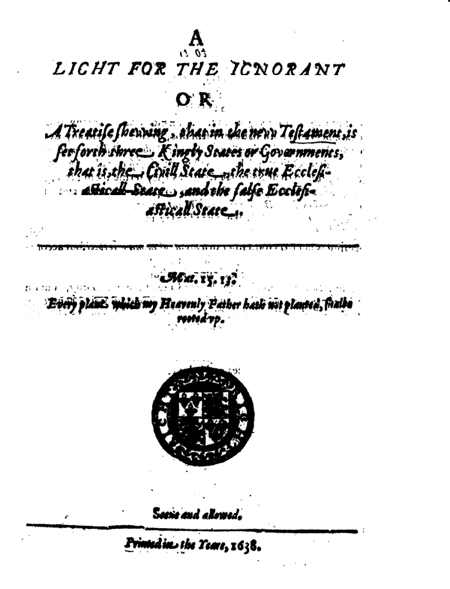
John Lilburne, A Light for the Ignorant or A Treatise shewing, that in the new Testament, is set forth three Kingly States or Governments, that is, the Civill State, the true Ecclesiasticall State, and the false Ecclesiasticall State.

Mat. 15.13. Every plant which my Heavenly Father hath planted shall be rooted up.

Seene and allowed, Printed in the yeare, 1638.


[2]

The Epistle to the Reader,

VVell affectionated Reader. It is (as thou knowest) a divine precept, that we should giue Honour to whom honour is due: Jmplying therein, that no honour is due either to Persons or things, but in a lawfull and right way. And hence it is that many of Gods deare Servants both haue and still doe, refuse to yeeld any Reuerence, Honoor, Service, &c. vnto Archbishops Bishops: and their dependent Offices; I say, as they are Ecclesiasticall persons & doe administer in their Spirituall Courts as they terme them: in regard they have assumed such a State as is to speake properly and truely of it, neither Iure Divino nor jure Humano, warrented by the word of God. But of this I shall not need to say any more, in regard thou shalt find what here I say cleared & proved sufficiently: viz. that their calling is not from God, either in a divine or humane respect, but according to the scripturs after mentioned: altogether & every way from the Devill. And therfore look unto it whosoever thou art, that thou (like Mordecay) bow not the knee to any of these Amaleks, but on the contrarie Feare God and honour the King, and give reverence Only to such ordinances as God binds thy Conscience too, either in respect of nature or grace, and soe doeing thou shalt Give vnto Cæsar the things that are Cæsars, And give vnto God, those things that are Gods. And that thou mayst so doe, the Lord sanctifie both this and all other good meanes and helps to thee.

[3]

A LIGHT FOR THE IGNORANT

OR A Treatise shevving, that in the nevv Testament, is set forth three Kingly States or Governments, that is, the Civill State, the true Ecclesiasticall-State, and the false Ecclesiasticall State.

THere are in the new Testement of Christ Iesus three Kinglie States or Governments. The Civill State. The true Ecclesiasticall State. And the false Ecclesiasticall State. Two of them are of God, and the third is of the Divill. They all consist of these Seven particulars following.

In the First, place these three pollitique Regiments hath each of them a King or Head over them.

Secondly, They haue each of them authoritie power or state pollitique.

Thirdly, They haue books and Charters, wherein their statutes, Lawes, and Cannons are writen.

Fourthly, Each of these make themselves Citties Corporations or bodies politique.

Fiftly, They haue Officers and deputies who are their seuerall Ministers to and in there bodies or Corporations.

Sixtly, They have Lawes, ordinances, and administrations for these officers to administer to their subjects, according to there severall functions in the name and by the power of their proper King, and head; from whom they haue received their authority & in whose name they administer.

Sevenlie, and lastlie, they haue subjects or members governed [4] by and in their seuerall pollitique States and powers vnder their severall beads.

The First particular Handled.

These haue each of them a King or Head over them.

The Civill State.

The First is the State of Magistracie or civill State, that wherein Cesar is to haue his due as King and head, these Kings & heads are to be prayed for of all Gods people, as their Heads and gouernours Rom. 13. 1. 2 1. Tom. 2. 2.

The true Ecclesiasticall State:

This state is Christs the annointed Psa. 2. 6. Acts. 2. 26. whome God the Father hath set upon the Throne of David, Jsay, 9. 6. 7. and he is King of Saints Rev. 15, 3. Yea the King of Kings & Lord of Lords. Rev. 17. 14. & 19, 16.

The False Ecclesiasticall State.

The third is the helish state of the Beast, his Kingdome or state of Rome, which in the 13. Rev. v. 2. is said to haue his power from the Devill; also he is said to haue a Throne: therefore hee is a King 11. c. He is called the King of the Locusts which is there said to bee the Angell of the bottomleste pit. v. 11.

Secondly, these haue each of them a Kingly state or power pollitique

The Civill State.

This power or Civill state is of God, and is the Charracter of Gods soveraigntie over man; is displaid by his Communicating the same unto Kings & such as are in authority under them, for which cause hee hath said yee are Gods; and God must and is obeyed by stooping and submitting to this power and state, and he that resisteth this power resisteth the ordinance of God Rom. 13. c.

The true Ecclesiasticall State.

Likewise this state is of God; for it is the Kingdome of his deare Sonne, & is not the Civill state but the Ecclesiastical state of Christ his Church, or power which he received of his Father Mat 28. 18, after that he rose again from the dead, by which power he authorised his Apostles & sent them on his errand or message to al the world, Mat. 28. which power the Apostles vsed in planting Churchs [5] and Church Officers, which power Christ gives to all the Churches of the Saints to the end of the world, it is the power given to them to bind and loose too, and from the Devill, and to right each others wrongs Mat. 18. it is the same power and state the Churches had comitted to them by the Apostles who reproved the Churches for not using it to suppresse sinne and sinners 1 Cor. 5. with the seuen Churches in Asia. Rev. 2. 3. c. these and many more are the severall vses the Lord hath made of this true Ecclesiasticall or Church state, and Goverment.

The False Ecclesiasticall State.

This Angell of the Bottemlesse pit Rev. 9. 11. the King of the Locusts hath a state, throne, power, and great authority. Rev. 13. 2. & in the same Chapter it is said, he hath power to continue 42 moneths, v. 5. that is 126. dayes as c. 12. 6. counting each day for a yeare (as the Lord doth in numbers, 14. 34. and Ezec. 4. 6,) it is 1260. yeares that is the length or time of his Raigne, that one and the same time which Christs Kingdome vnder the name of the holie City shal be trod under foot Rev. 11. 2. Likewise that is that power or state that the woman or great whore sits or aids uppon: whereby shee is able to Raigne Rev. 13. 16. & c. 17. as a Queene over the Kings of the earth. And Lastly, this state is soe great that it Captiuates all Kings Princes & Emperours, yea all the world of vngodly men Rev. 13. 7. 8. wonders, followes; and worships this state, or beast, and if they will not he hath such power and authority that hee will compell high and low, rich and poore, bond and free, to submit unto him, & to kill all those that are found refractory to his state and power. Rev. 13. 15. 16. 17. This is the False Ecclesiasticall state and power.

Thirdly, these haue each of them bookes and Charters to declare their minds to their Subjects.

The Civill State.

Thirdly, all Kings & governours haue Bookes, statutes, and Records, wherein are recorded their Lawes Articles, Acts of Parliament, likewise to Citties and townes Corporated they give Chartors whereby they haue power and preuilidge from their King, & head, in his name and power to instate themselves into divers [6] previledges for their mutuall good.

The true Ecclesiasticall State.

Even soe in the next place Christ Jesus hath given his lawes vnto Iacob & his statutes to Israell, his statute Books are the Holie Scripture of the Old and New Testament, he is faithfull in all his house as was Moses Heb. 3. 2. 6. the acts of his last Parliament which hee called for the establishing of his Kingdome, when hee was 40. daies with his Disciples giving them lawes through the Holy Ghost, even till hee was taken vp into Heaven in their sight, as wee may see in Acts. 1. chapt. Those bookes called the Acts of the Apostles, with-all the Epistles and the Revelation, in these the Cities and Charters of the new Jerusalem is to be found with the previledges thereunto belonging.

The False Ecclesiasticall State.

This smoaky pollitique State of the Crowned Locusts or Roman Clergie Rev. 9. 3. 7. hath distinct bookes from the other two states that are of God, for this State or power hath Bookes of Cannons, Counsels; bookes of Articles, bookes of Ordination of Priests and Deacons; with the booke of Homilies, and the Booke of Common-prayer, and the power and state of this Beast, doth more narrowly looke that all be agreeable to these bookes then the other two states doth (as is manifest by that strict eye that is had ouer all in every parish) not onelie in forraigne Lands, but even in this our Kingdome of England, for they of this Kingdome of Darkenesse are wiser & more diligent in their generation them the children of light.

Fourthly, by vertue of these Charters, these three states make Citties and Corporations, according to their proper & distinct state & power pollitique.

The Civill State.

In the next place the loyall Subjects of this Regiment vnder their King & Head, by vertue of these Charters, become famous Citties, & other inferior corporations agreeable to the tenour of their severall Charters that they received from their Head, & when they received their Charters then & by that means they received the State & power to become a Citty or Corperation vnder that Head, & when they haue vnited or incorporated themselvs into a Bodie they are a Citty constituted, [7] and this state & power they are entered into, is their for me and being, and nothing else doth distinguish them from their former state and condition but that power and state, that is, their state wherein they live moue and haue their being pollitiquely.

The true Ecclesiasticall State.

In like manner the Subjects of this heavenlie regiment or King dome of Christ, by power from him their Head, doe become visible Churches and bodies incorporated together in his name & power Mat. 18. therefore the Church hee left behind him of 120. were of one accord Acts 1. and to them were vnited or joyned 3000. in the next chapt. so the saints at Antioch, became a body or Church whose constitution or incorporation wee may see to bee a joyning themselves to the Lord Acts. 1. 2. 23. soe all the Churches of the Saints became bodies pollitique, and therefore Gods visible Churches are called Citties or the City of God Psal. 46. 4. Psal. 48. 1. 2. 8. & Psal. 87. 2. 3. Therefore the Saints are called Cittizens Ephes. 2. 19. Inhabitants of the Living God Heb. 12. 22. This holy Cittie is troden under foote 42. Moneths Re. 11. 2. the time of the Raigne of the Beast (Re. 13. 5.) whose Raigne is just so long & this Holy Citty is the new Jerusalem that comes downe from heaven in great glory Rev. 21. the forme or beeing of his divine Citty or spirituall Bodie is the state and power pollitique instituted by Christ and given to his Saints Jude, 3. v. Psal. 133. and thus under Christ as their King they live, moue and haue their being pollitiquelie.

The False Ecclesiasticall State.

So the power of Satan the Devil by hath the wisdome of the second Beast, or false Propher, not only made to himselfe a great Citty whose power killed Christ Rev. 11. 8. Thereby pointing vs to the Roman power that still kills his Saints, for this Citty is soe powerfull that she Raigns over the Kings of the earth, & maks them to drinke of the cup of her fornications, till they be so drunke thereby that they become her servants Rev. 17. 2. 18. & 18. 2. And by this false Ecclesiasticall power & state, there are made lesse Citties called the Citties of the nations of (nation Churches) & are of the same nature Re. 16. 9. as Daughters to the whore & Mother of fornication of the earth, this false great Catholique Church is distributed into [8] nations, provinces, and into every diocesse and parrish, as liuely and apparent as the Civill state, is in every parrish and in every House therein, soe that they live moue and haue their beeing as Royallie from this Beastlike power as the Saints doe by Christ, or subjects under their King, this is plaine by the daily troubles the poore saints suffer in every parrish if they worship not as this power commands.

Fiftly These haue each of them proper and distinct officers belonging to each pollitique State.

The Civill State.

In the first place these Cities by vertue of their Chartors, injoy their owne officers, Majors, Shirrifes, Alderman, and other inferiour Officers as their Lord and King hath allotted them, and also inferiour corporations according as is granted to them in their Chartor, and they that obey these doe well and please God in keeping the first Commandement.

The true Ecclesiasticall State.

Likewise the Citty of God by vertue of their chartor haue right to enjoy their owne Bishops, ouerseeres or Elders Acts, 14. 23. and chap, 20. Titus, 1. 5. 7. Which are not many, yet Wisdome that hath built her house hath found them to be sufficient: which are these, Pastors, Teachers, Elders, Deacons, Widdowes, Rom. 12. 7. 8. Ephe. 4.-11. 12. Phi. 1. 1. 1 Tim. and they that obey these and these onely serve Christ and obey God in keeping the 2. and 3. Commandements, these only being the officers which God by his Holy Apostles hath set up, instituted and placed in his Church to the end of the world: therefore, in Hearing, and obeying these we heare & obey Christ that sent them Luke. 10. 16. Math. 10. 40.

The False Ecclesiasticall State.

In like manner hath this whorith City, or Citties, the False Prophet, or Body of false prophets attending upon their forged divises, & humane administrations, which are almost innumirable to reckon from the Pope to the parish clark or Parstor whosoever obyes these or any of these breaks the three first Commandements, for in hearing & obeying these they hear & obey the Dragon, Beast, & whore, that sent them and gaue them their authority and Office, that as Realie as [9] wee Heare and obey the King by stooping and submitting to a Constable who sees not this.

These haue each of them proper and severall lawes, statutes, ordinances, and administrations for their severall officers to attend vpon.

The Civill State.

Sixtly, In this state or in these Citties are the lawes and ordinances of men, that the saints must obey in the Lord, for though in the time of Christ and his Apostels there were no Christian Kings, yet the Churches of the Saints were commanded to obey their Lawes, Religious Lawes they could not bee, Because the Magistrates were all infidells, therefore the Apostle Peter distingusheth them from the Divine, by calling them the Ordinances of men, due vnto Caesar as divine obedience is unto God,

The true Ecclesiastcall State.

Even so this Cittie of God with their officers are to obserue what soever Christ hath commanded them Math. 28. 20. the Church of Corinth kept them 1 Cor. 11. 2. and Paulls Charge to Timothy is to teach the Church to obserue all without prefering one before another, as he would answer it before Christ Iesus and his Elect Angells. These divine things are due to Christ Iesus, and to him & to him onely, belongs this visible worship Ioh. 4 21. 22. 23.

The false Ecclesiasticall State.

The Lawes & administrations of this whorish Church, are partly their owne Inventions, contained in the Bookes formerly named, with some divine truthes which vsurped they injoy, which truthes they vse as, a help to set a glose vpon their inventions: that they may passe with a better acceptation but both Divine and devised are consecrated & dedicated by the Beast, and are administred by his Officers and power.

Seauentlhy, All these three haue their subjects or people which their pollitique Bodies consist of.

The Civill State.

Lastly, this State hath Subjects, which are the Kings alleiged people, and are bound to him their Head, by the Oath of alleigence, & as any of them do purchase a Charter from him to become [10] a Cittie or Corporation, they are bound by vertue of their Charters to walke submissiuely to him their pollitique head, and in that relation are by duty bound to keepe the Lawes of their Charters in his name & power, which is their pollitique obedience.

This Ciuill State is Gods Ordinance, and is here borrowed to Jllustrate, manifest, and set forth the other two in the former perticuler, and soe we leaue it.

The true Ecclesiasticall State,

Soe in the last place, the Subjects of this State are only Saints & noe other, that is such as by the Rule of the word are to be Judged one of another to be in Christ, otherwise they haue no right to this Kingdome 1 Cor. 4. 20. Chapt. 5. 13. But are intruders lud. 4. verse and soe not of the Kingdome, though in the Kingdome, 1 Iohn 2. 19 and the Saints are out of their places till they come within this Holy Citty.

To this State all Gods people are Called, both out of this world and all false Churches, especially from this Regiment of darkenesse there discribed 2. Cor. 6. 17. & Rev. 18. 4.

The False Ecclesiasticall State,

Lastly, the Subjects of this Kingdome of darkenes are all the Inbabitans of the Earth, Kings & subjects Rev. 13. 16. & Chap. 18. 3. Yea it, hath a commanding power, bond and free, to receive a mark of subjection and servitude, there is none soe bad but will serve his turne, if any proue too good hee casts them out, kills and destroys Rev. 11. 7.

This is the State and Kingdome of darkenes: with which the Devill hath deluded all nations from which all Gods people & Servants are bound in duty to seperate, that soe they may bee free from that wrath of God which shall fall upon the Kingdome of the beast to the Ruine & ouerthrow thereof Rev. 18. 4. 5. & 19. 20. & 14. 9. 10, 11.

Leaving the premises let every one note these ensuing differences or disproportions, that are betwene the Ecclesiasticall States, for thir different natures.

The true Ecclesiasticall State

The First disproportion betweene the true and False State is, [11] in the Originall from whence they arise. The true State came from Heaven and is the house of wisdomes building Pro. 9. 1. wherin the sonne of God, the wisedome of his Father, Heb. 1. 3. hath beene as faithfull as was Moses in the former Heb. 3. 2. 6. & is that Heaven discribed Rev. 12. 1. and that Citty said to come downe from Heaven Rev. 21, and is an habitation for God to dwell in, and for all his people to come into: to dwell with God their Saviour, for the name of the Citty is, the Lord is there Ezec. last Chap. and last ver.

The False Ecclesiasticall State.

Likewise it is no hard Mistery to know the Originall of this False Ecclesiastical State, for the Clargie, (as Goodwins Catologue of Bishops Fox his Booke of martyrs, & Rev. 9. & 13 ch.) & by their Preaching & writing hath taught vs plainly that Antichrist the man of sinne, the sonne of perdition is seated in Rome, & the same Clergy doth also teach us: that their Ministery & Goverments of Bishops & Arch Bb. successiuely proceedes from thence, & for our confirmation here in we read that Gregory the first of that name, Pope of Rome about 1000 yeares since, sent Austin the Monke into Englund & consecrated him first Arch B. of Canterbury, and he consecrated the rest of the Bb. and established the Ecclesiastical state, which state & platforme remaines vnaltered to this day; notwithstanding the Head thereof be changed. This state then being the man of sinne, it is said to arise out of the Bottomles pitt Rev. 9. 1. & is called the King of the Locusts Rev. 9. 11. & is said to come by the effectuall working of Sathan 2 Thess. 2. 9. and as he is the sonne of perdition v. 3. and the Mistery of Iniquity v. 7. so shall he come to confusion by the mouth of the Lord v. 8. & go to perdition Rev. 17. 8. as the sonne & heire thereof, & he shall haue the company of his Fatther the great Dragon the Devill and Satan, with the yonger Brother the False Prophet, that deceiued them that worshipped him, these three shall dwell in the tormenting lake of Gods wrath forever and evermore Rev. 19. 20. & 20. 10. And thus wee see Originally from whence hee came and whither he must goe.

The true Ecclesiasticall State,

A Second disproportion is betweene the true power and the false. The true power which Christ our King hath received of his [12] Father Math. 28. 18. and hath comunicated to his Saints 1 Cor. 5. 4, 12. and Psal. 119. and to them onely; This is that Dominion that the Antient of dayes hath giuen to his Saints Dan. 7. 14. compared with ver. 22. 27: and with Revel. 5. 10. & being lost hee will recover it againe vnto them as Daniell speakes, & in the New Testament is giuen to every Particuler visible Church or Assembly of Saints Math. 18. 17. 19. 20. and 1 Cor. 5. 12. In which point of Power, we are to note two things. Fust the Subject or place where it doth recide, that is in the Body or Assembly of the Saints, as the former scriptures largely declare. Secondly, that they were not forced nor compelled to submitt to their power, but as the loue of God shed abroade in their hearts, & the Doctrine of the Apostles by the power of the spirit caused them freely and willingly to submit themselves unto it Acts 2. 41. for Christ and his Apostles never used any means to bring his saints into his Kingdome.

The False Ecclesiasticall State.

Soe in Like manner the Dragon that Old Serpent Rev. 12. [Editor: illegible word] gave to his son of perdition the Beast, his power & throne & great authority Rev. 13. 2. And this man of sinne hath conveyed to all his Clergie his power; by vertue wherof, they are all rulers & men of authority in all nations where he hath established them, as is declared Rev. 9 Chapter & 10 First Verse: wher it is said, they haue Crownes upon their heads like gold, that is counterfit power and authoritie, & by vertue of this power pollitique; are made one intire body pollitique, under one head & King soe called vers. 11. and are distinct from the Layety, living in & by the practise of this power, with reference to that Head, though they bee never soe farre disperced or remote from him; this beeing observed, the disproportion will appeare in these two particulers.

First, the subject place where this power doth recide, it beeing in the body of the Clergy, the Layety being excluded though never so high or great in place, as Iudges, Iustices, Lords & Knights &c, they refusing it as a matter not belonging to them, but to the Clergy.

Secondly, this power compells all in all nations, will they nill they to come under this Government, and to obey his power and authority Rev. 13, 8. 16. where it is said, he made all great and small, rich [13] and poore, free and bond, to submit to him, else they should not buy, nor sell nor live ver. 17. and ch. 11. 7.

The true Ecclesiasticall State:

A Third disproportion shall appeare in this, Every Kingdome or pollitique state whether Civill or Ecclesiasticall, hath their severall bookes and Charters: wherein is contayned the Platforme of there severall governments, soe every Church is knowne by its owne articles, Cannons, and Constitutions, so that they that will know what Church, Ministery and worship Christ and his Apostles hath planted in the new Testement after the Ceremoniall was abolished; they must read the Acts of the Apostles with the Epistles Acts, 6. 4. 1. Cor. 14. 37. Revel. 22. 18. 19. Yea the whole new Testement, and there they shall finde Jesus Christ our Lord and King, his Bookes of Cannons, Articles and Ordination, to guide and direct the Churches of the saints in his Kingdome vnto the end of the world.

The False Ecclesiasticall State

Also in the False State, they that would know what goverment, Church, Ministery, and worship, the man of sinne hath established, he must viewe his Platforme contayned in his Booke of Cannons, Articles, and Ordintion of the Priests & Deacons, his Bookes of homilies and Common Prayers, for in them is contayned those institutions, Lawes and ordinances that he hath established, but how contrary to the Scriptures of the Old and New Testement; they that are Spirituall in part doe know, and how obedience to them is inforced and divine Lawes omitted and laid aside, the poore saints doe finde, and [Editor: illegible word] to there smart.

The true Ecclesiasticall State

A Fourth Disproportion. This State makes not Nationall nor Provinciall pollitique Bodies, but only particuler Congregations or assemblies of Saints, as in Judea one Nation; yet divers Churches Gal. 1. 22. Soe Galatia one nation yet many Churches ver. 3. likewise Asia hath seaven seuerall Churches ver. 1. 11. and where there was but one the Holighost speakes in the singuler number, as the Church at Rome, another at Corinth, another at Collossia, another at Thessalonica, and the like.

Secondly, the Congregations of our Lord Christ come freely and [14] willingly as so many living stones 1 Pet. 2. 4. 5. volluntarily vniting themselues together, whereby they become A Spirituall house and a Royall Priesthood ver. 9. and are hereby capable of performing the publique worship of the New Testament, wherein they are to offer as Living sacrifices their Soules and Bodies Rom. 12. 1. and by faith to haue Communion with their Mediator Heb. 12. 24. as he hath promised to all such assemblies gathered in his name and power Rev. 21. 3. Math. 18. 19. 20. which is the forme and beeing of this their visible and pollitique vnion & communion Eph. 2. 20. 21. 22. Coll. 2. 19. Thirdly, the visible Churches of Christ are independent Bodies; there is Equallity or apparity amongst them: that is, they are all a like in Iurisdiction & authority, they are all Golden Candlestickes Rev. 1. 20. they are every one of them a Ierusalem compact together within it selfe Psal. 122. 3. compared with Heb. 12. 22. hauing each of them whole Christ for their mediatour, that is, Priest, Prophet; and King; and thereby enjoy all his power and all his promises, and all his Lawes and ordinances, with all his liberties and previledges.

Fourthly and Lastly; in the vse of their liberty which they enjoy from and vnder Christ their Head, and dwels in the whole body, in the vse whereof they are inabled to exclude sinne and sinners and ought that offends God or them, 1. Cor. 5. 13. 2 Thes. 3. 14 Acts 3. and to establish among them such Officers, Ordinances, and Admistrations as their Lord & King hath given them for their comfort and profit, by this power they can examine and try False teachers Rev. 2. 2. they can reproue and admonish proud ones and exhort the negligent Cor. 4. 17, thus their power and liberty from Christ their head, becomes a great benefit and a great good to the whole body, in these and divers others perticulers of great weight.

The False Ecclesiasticall State.

But this False State brings ten Kingdomes into one pollitique body Rev. 17. 12. 13. 15. & hath set heads over nations to bring them into pollitique bodies Ecclesiasticall, as for example, England is one pollitique body Ecclesiasticall, (as well as Civil) vnder one Arch-Bishop of Canterbury, and Pope of Lambeth, and by the sinewes and bonds of his Ecclesiasticall power the whole hand as one body is [15] knitt and bound to that Ecclesiasticall Head, by vertue of that Romish authority that hee successively doth exercise, and hath received from Austin the Monke, who consecrated, authorized & sent into this Land to establish this power according to Pope Gregorius his will wisdome and power.

Farther, this False State hath left noe liberty nor power to any person good or bad Rev. 13. 7. 8. but compels and forces all in the name and power of Antichrists successours; will they nill they, haue they faith or no, conscience or no conscience, this beast will be served and obeyed of all states degrees and conditions, of all people in the world ver. 15. 16. 17. soe that there is noe Ecclesiasticall body of his making whether it be the great Catholique Babylon, Revel. 16. 19. or Nationall, or Provinciall; or Perrochiall bodies, but this Beast first made or framed them, and still by the force of the same authority doth compell them to assemble and worship in his name and power, which power is the tome and being of their visible & pollitique vnion and Communion.

Againe the visible Churches which are in the Kingdome of the Beast, are neither independent nor free bodies, therefore the great Citty is called by the Holy ghost; Sodome & Egypt: for her filthynes & bondage Rev. 11. 8. so that there hath not in Europe one parrish beene found free from spirituall Egyptian bondage inflicted upon them by some taske Master of the Clergy, as the Person and Church-Wardens, who force and drive (by spirituall tyranny ouer the consciences of men) to their falsely so called spirituall Courts, to whom they are in bondage, and vpon whom they do essencially depend, & so are not independent, neither haue they any power, or liberty to procure truth or abandon Errour in their publicke worship.

And Lastly, these poore Captiuated slavish assemblies haue noe liberty or power of Christ among them; but a great power ouer them that keepes them in a spirituall bondage, and there assemblies consists of sinners of all sorts, for they haue noe power of reproving or excluding sinne or sinners, they must take such officers as the Bishops sends them be they never soe bad; and they have noe power to exclude or refuse them, and if they proue good they haue no power to keepe them neyther, canne they keepe themselves there, except they submit to, and practise such ordinances, Lawes & administration, [16] as are the inventions of men and will worship, and so breake the second commandement, so that they haue no power to do themselves any spirituall good, or to exclude from themselves any spirituall evill or hurt, but being injoyned by there spirituall taske-masters to assemble to Church, they goe, and when they present them to their Courts, they runne, & being commanded to do this or that in there publick worship, they doe it, though it bee contrary to God and there own consciences. In these and divers other particulers this power, that is ouer them is to their exceding great hurt & damage.

The true Ecclesiasticall State.

The Fift Disproportionly sin their Officers or ministers, which we are to observe thus.

First in there number, Christ Iesus our Lord and King hath instituted and ordayned onely sins; which are specified Rom. 12. 7. 8. Phil. 1. 1. 1 Tim. 5. for though our Lord hath ordained in his Church for the Foundation thereof; himselfe being the Chiefe corner stone, Apostles, Prophets, and Evangelists, yet not successivelie continued; but these Five onelie are to continue to the End of the world.

Secondly, these Officers and Ministers of Iesus Christ, haue not onely there authority from the particuler congregation, but do originally and naturally arise out of the same Acts, 1. 23, 26, and 6. 3; & 14. 23. Note that in the new Translation the word Election is left out of the 23. verse. For before there be any Officers in the Church there is instituted by the Holy Ghost divine offices; functions or odministrations; as voyd and empty roomes. Psa. 122. 5. Rev. 4. 4, & cha. 20. 4. for the saints which dwell in that Citty of God to supply with fit & able persons, to performe those severall administrations, which God hath ordayned and commanded them, and for the authorising of their Officers, they haue Christ walking amongst them as in one of his golden Candlesticks, holding them in the right hand of his Kingly authority, Rev. 1. 16. by these divine deputies he rules them as a King, teacheth them as a Prophet, and feedes them as a Priest with his most sacred body and bloud.

The false Ecclesiasticall State.

But the officers of this false state are the whole body of the Clergy [17] almost innumerable if we should reckon their severall orders & distinction of degres, as Pope, Cardinals, Patriarchs, Primates, Metrapolitans, Arch-bishops, Lord-bishops, Deanes, Chancellars, Vicar-Generals, Praebendes, Arch-deacons, Subdeacons, Doctors, of the Civill Law, Doctors of Divinity, Proctors Registers, Cannons, Petty-Cannons, Chanters, Preists, Iesuits, Parish-Preists, Parsons, Vicars, Curats, Deacons, Vestremen, Church Wardens, Swornemen, Sidemen, Parish Clarks, Sextons, Pursonants, Summinours, Apparitors, with a-multitude more which would tire a man to reckon them al up their being well nie sixscore in all of this rabble, and as Iesus Christ & his Apostles never knew them nor approvedly spoke of them, but rather gave warning to the Saints that they should take heede of such, for such were to come 2 Pet. 2. 1. Mat. 24. 24. and the Saints haue wofull experience that they are come: for they haue been plagued with them this thousand yeares & more, Yet the time approcheth and is neere when they shall bee consumed with the Breath of his mouth and brightnesse of his comming 2 Thess. 2. 8, that rides vpon the white Horse Rev. 19. 11, 12, 15, for their Kingdome is momentary, and his is Everlasting.

Likewise these offices rise not out of the particuler assemblies, neither haue the assemblies any offices or functions, properly in them nor any power or authority to produce or raise officers out of them selves, for the Clergy are a perticuler body distinct from the Layety hauing their consecrations; Offices and authority from and amongst themselves, and soe sent by their Ecclesiasticall Heads, and bring their Office and authority with them, as matters not belonging to the assemblyes, and so by vertue of that Ecclesiasticall power rule ouer them as Lords and teacheth them as that power allowes, and commands them, vsurpedly administreth spirituall foode vnto them, and soe by Imitation beguileth the simple and affronts the Administration of the mediatourship of Christ Iesus.

The true Ecclesiasticall State.

A Sixt Disproportion is the difference betweene there Lawes and Administrations, as euery Citty and Corporation haue there Lawes amongst themselues by vertue of their Charters from their King, Even soe hath every [Editor: illegible word] Church from Christ there King, [18] by vertue of their Charter, which is the New Testament, in possession amongst themselves all Lawes & ordinances as Christ by his Apostles Mat. 28. 20. hath committed to them, Charging them vnder acurse to keep from adding or diminishing to or from these divine Lawes Act. 1. 2. 2. 1 Cor. 1 1. 3. 2 Thes. 2. 15 Rev. 22. 18. 19.

Secondly, as the difference is great in the number of there Officers, the true being few & the False being innumerable, so of necesity must the difference be in the lawes and administrations agreeable to the number of Officers; which particulers I must omitt as a matter to large for this place, yet note this by the way: that one of the first laws in Christs Church is the ordinance of Prophecie 1 Cor. 14. 1. to the end of the chap. that is, that it is not only the liberty, but the duty of every man in the Church that is able to teach & preach to the edifying of the body, so to do (provided he keep the proposition of faith; that is the boundes of his owne knowledge Rom. 12. 6.

The False Ecclesiasticall State.

But as hath beene formerly said; the false Church hath no power nor Charter nor office, for all these things are locked up within the body of the Clergie, soe is it as true that they are distitute of all lawes or administrations, amongst themselves, so that all they haue at any time is brought to them by these Crowned Stinging messengers of that authority, as Commonsence and reason proveth: that the Clergie being apollitique and distinct body of themselves from the Layety; hauing all power and authority Ecclesiasticall in themselues, must of necessity haue all lawes ordinances and administrations in themselves, whether they bee divine, (which they haue by vsurpatõ) or humane, by their own Inventiõ, they only posesse them and haue power to vse them not fearing adding, or detracting, the Lay congregations being altogether passive herein til their Jnjuntion make them active.

Soe the lawes and ordinances of this state being innumerable (as their officers are) J must omit for to name them, as their severall false holy things: Kneeling in the & of receiving, Signeing with, the Crosse in Baptisme, Churching of women, Reading Prayers, with the Consecrating of Dayes, Times, Places, Persons, Garments, with their Anoynting of the Sicke and unholy Orders of [19] consecration, with other innumerable inventions, not worthy a-place in Christians thoughts, onely note the opposition of their law against the law of Christ, in vehement prohibiting and strongly barring all (Lay men as they call them) from preaching, that let Christ giue never soe great abillities or guifts to lay men: they are never suffered to make any publique vse of them, but it is horrible prophanesse and sacrelegious presumption soe to doe, and this prohibition of the Clergie is and hath been so vniuersall: that it reacheth to the foure Corners of the earth, and with holdeth this spirituall winde of Christ Jesus in the mouth of his Saints that it shall not blow upon them that are in the earth Revel. 7.

The true Ecclesiasticall State

A Sevevth Disproportion is betwixt their subjects or members, the subjects or members of Christs Kingdome or Church must, be beleeving Disciples, they must bee Saints by Calling & sanctified in Christ Iesus 1 Cor. 1. 2. they must be liuing stones to build his house withall 1 Pet. 2. 5. such as these and these onely are enjoyned to observes whatsoever he commands them, to these only is his Kingdome and dominion given, these be they that are crowned as Kings, anoynted as Priests, the mediatour himselfe being theirs, & he hath committed the administration of his mediatorship in his Church to them. But to the Wicked saith God, what hast thou to do with these things. Psa 50. 16. Thou hast not a wedding garment therefore binde him hand & foote & cast him out as leaven dangerous to hurt the body 1 Cor. 5. 7. For without shall be & dogges inchanters and those that loue & make lyes Rev. 22. 15. But within there shall be noe vncleane thing. Revel. 21. 27.

The False Ecclesiasticall State.

But the Subjects of this foule body are all vncleane and hatefull birds, Revel. 18. 2. the Cage that holds them being the Ecclesiasticall state of Rome, is become the habitations of Devils & the hold of every foul spirit, so that the vnfittests members which they can least indure or suffer amongst them, are the conscious saints, they are the soonest turned out, cut of and killed by them Revel. 13. 15, but yet if the saints; or Christ himselfe can by temptations or compulsion bee drawn to worship the Devill, he will haue it of them Mat. 4. 9. for he will haue all the world to worship him, if high and low, rich and [20] poore, bond and free, be all the world, he will compell them to bee subjects or members in his black Regiment Revel. 13. 16. 17.

For these dwell and rule make & change lawes and times in this their habition which is the bottemlesse pit, as the Father Sonne & holy Ghost do in their habitation, which is the New Jerusalem.

The true definition of a true visible Church of Iesus Christ.

1. THat every true visible Church of Christ, are a company of people called and seperated out of the world, (a) By the word of God, Ioyned (b) together in the fellowship of the Gospell by volentary (c) profession of fayth and obedience of Christ (a) Levit. 20. 26. Nehe. 10, 18. Ezeche. 44; 7. 9. 1 Pet. 2. 9. 10. Act, 2. 40. Act, 19. 9. 1 Cor. 1. 12 2 Cor. 6. 17. Revel. 18. 4. (b) Act. 11. 21. 23. Ier. 50. 4, 5 (c) Act. 2. 41.

2 That every true visible Church of Christ, is an independent body of it selfe Revel. 1. 3. chapt. & hath power from Christ her head Coll. 1. 18. 24. to bind & loose; to receive in & cast out by the Keys of the Kingdome Mat. 18. 17. 18. Psa. 149. 8. 9. 1 Cor. 5. 4. 5. 12. 2 Cor. 2. 7. 8.

3 That Jesus Christ hath by his Last wil and Testament given vnto and sett in his Church, sufficient ordinary Officers: with their quallifications Callings and worke, for the Administration of his holy things, and for the sufficient ordinary Instruction, Guidance and service of his Church to the end of the world. Rom. 12. 6. 7. 8. Ephe. 4. 11. 12. 13. Heb. 3. 2. 6. 1 Tim. 3. 2. 8. & Chapt. 5. 9. 10. Act. 6. 3. And that all the Officers in the Church are but onely five

and noe more namely Pastor, Teacher, Elder, Deacons,

Widdows. Rom. 12. 7. 8. Ephe. 4. 11. Phil. 1. 1.

1 Tim. 3. 1. & Ch. 5. Tit. 1. 5. 7.

FINIS


2. John Lilburne, The Christian Mans Triall (1638)

Title ID: T.001 [1638.03.12] John Liburne, The Christian Mans Triall (12 March 1638, 2nd ed. December 1641).

Estimated Date of Publication: 12 March 1638, 2nd ed. December 1641.

Thomason Tracts Catalog Information: The Thomason Tracts collection begins in 1640. There is information about the 2nd edition of this work in 1641. TT1, p. 52, E. 181/7.

Full Title

John Lilburne, The Christian Mans Triall: or, a True Revelation of the first apprehension and severall examinations of John Lilburne, With his Censure in Star-Chamber, and the manner of his cruell whipping through the Streets: whereunto is annexed his Speech in the Pillory, and their gagging of him: Also the severe Order of the Lords made the same day for fettering his hands and feet in yrons, and for keeping his friends and monies from him, which was accordingly executed upon him for a long time together by the Wardens of the Fleet, with a great deale of barbarous cruelty and inhumanity, etc.

Rev. 2.10. Behold, the Divell shall cast some of you into prison, that you may be tryed, and you shall have tribulation ten dayes: be thou faithfull unto death, and I will give thee a Crowne of life.

Matth. 10.19. But when they deliver you up, take no thought how, or what you shall speake, for it shall be given you in that houre what you shall saye.

The second Edition, with an addition.

London, Printed for William Larnar, and are to be sold at his Shop at the Signe of the Golden Anchor, neere Pauls-Chaine, 1641.


IOHN LILBURNE. AETAT: SVAE 23. Ano 1641.
G: Glo: fecit.

Gaze not vpon this shaddow that is vaine.
But rather raise thy thoughts a higher straine.
To GOD (I meane) who set this young-man free.
And in like straits can eke deliuer thee.


TO THE READER.

CHristian Reader, here is presented to thy view, a part of these cruell and grievous sufferings imposed upon this Author, by the malignant malice of the Prelacy and that faction, wherein thou mayest likewise see the wonderfull gracious dealings of a good God, carrying this Author through them all, with boldnesse and courage, being not daunted, neither at their frownes nor whippings, nor pillories, nor close prisons, no nor yrons; so that we may see the faithfull promises of our God before our eyes made good in this young man, who hath promised to be with his people in six troubles, and seven; and to hew himselfe strong in the behalfe of all those whose hearts are perfect before him, that so hee might out of the mouthes of Babes and Sucklings perfect his owne praise, to the astonishment of all those who shall lift up heart or hand against him, or the least of his holy ones; and to the comfort and encouragement of all the Saints, who, from the consideration of the sweet, supporting power of God, appearing to others in their bonds, are the more encouraged publiquely to hold forth their profession of the truths of the Lord Iesus with much more boldnesse and confidence, as knowing that that God which hath appeared to others of the Saints in times of offerings, even before their eyes, will also appeare to them in the like condition; and therefore wee may a little see and take notice of the follyes of wicked mens wisdomes, who thinke by their hellish wits, to raze downe Syon and the truth of God to the ground, and therefore they labour by the imprisonments and tortures of some to dash the rest out of heart, that they should feare to shew any countenance to such a persecuted way, whereas indeed the Saints have by this meanes a fairer object to pitch their faith and confidence upon, namely, the power and wisedome and grace and mercy of their God appearing in a more fuller vision before their eyes; for the afflictions and persecution that are imposed by wicked men upon the Saints, causeth them to see a Spirit of glory resting upon [page] them, even in this condition: here 1 Pet. 4. 13. 14. and a massive weight of glory provided for them hereafter, 1 Cor. 4. 18. So that we may daily see the God of heaven fulfilling of his owne Word, even in this thing, which is that hee will confound the wisedome of the wise, and bring to nought the understanding of the prudent, and catch the wicked in their owne snares, making the rage of man turne to his owne praise his peoples comforts and their ruins, wherefore let the servants of God comfort one another with these words: That we may not feare the feares of men, which, that we may be the more strengthened against them, let us consider the cloud of witnesses which hath gone before in a way of suffering, even in these our times, amongst whom the Author of this booke hath had his share with the deepest of them, and therefore to this end hath he published to the world this Truth, that he might keepe alive to all posterities the goodnesse, and mercy and love of God manifested to him under those cruell barbarous and tyrannical dealings of the prelaticall hierarchie, that so all the Saints of God may hate that wicked calling and power of theirs, and never give over crying to God and men, till it be razed downe to the ground, that so the Lord Iesus may be set up as Lord and King, which ought to be the desire and endeavour of all the chosen ones of God, and is the desire of him who desires the good of the servants of God, in all things, love for Christ.

WILLIAM KIFFEN

This is the first Part.


[1]

A CHRISTIAN MANS TRIALL.

VPon Tuesday last the 11 or 12 of December, 1637 I was treacherously and Judasly betraied (by one that I supposed to be my friend) into the hands of the Pursevant with foure of his assistants, as I was walking in a narrow lane, called Super-lane, being walking with one Iohn Chilliburne, servant to old Mr.And was since advanced by the Bishop of London to be his Balle? Licencer for his paines. Iohn Wharton, in Bow-lane a Hotpresser. Which Iohn had laid the plot before for my apprehension, as I am able for to prove and make good, that he shall not be able with truth to deny it. And at my taking the Pursevants were very violent cries and having by force got me into a shop, they threw me over a Sugar-chest, to take my Sword from me, and cried out for helpe, and said he had taken one of the notoriousest dispersers of scandalous bookes that was in the Kingdome, for (saith he) he hath dispersed them from one end of the Land to the other.

And from thence I was had to the Bole-head Taverne neere to the Dr. Commons, where the Pursevants called freely for wine to make themselves merry, thinking they had got a great prise; Being not long there with my Pursevant Flamsted, who apprehended me, in came Bonntrange, the great Prelates Pursevant, and he looking upon me, said Mr. Lilburne, I am glad with all my heart that wee are met, for you are the man that I have much desired for a long time to see. To which I replied are you so? And for my owne part, I am not much unglad, But you thinke, you have got a great purchase in taking me, but it may be you may be deceived. Come (saith he) give us some wine, and with that he swore an Oath, he would give me a quart of Sacke, for joyfulnesse of our meeting, and so he called for it and dranke to me: And I told him, I would drinke no wine. To which hee replied, and said in these words: Come (said he) be not sad, you are but fallen into the Knaves hands. To which I said, I am not sad in the least, and for my falling into Knaves hands, I verily beleeve without any questioning, [2] that which you have said. And then he swore another Oath, and said, it was true enough.

(So good Christian Reader, take notice of thus much by the way, that the Prelates and their Creatures are a company of Knaves by Bonntrange his own Confession.)

That night I was kept at Hamstedds house where I blesse God, I was merry and cherefull, and nothing at all danted at that which had befalne me. And about twelve of the clocke the next day, I was committed to the Gatehouse, by Sir John the Prelate of Canterburies Chancellour with others without any examination at all, for sending of factious and scandalous Bookes out of Holland into England. And having not beene at the foresaid prison above three dayes, I was removed, by a Warrant from the Lords of the Counsell to the Fleet, where I now remaine. And after my being there some time, I drew a Petition to the Lords of the Counsell for my liberty: and their answer to it was, that I should be examined before Sir John Bankes, the Kings Atturney: The Coppy of which examination thus followes.

Upon Tuesday, the 14 of Ianuary, 1637 I was had to Sir John Bankes the Attorney General’s Chamber (now Lord chiefe Justice of the Court of Pleas) and was referred to be examined by Mr. Coilibey his chief Clerke; And at our first comming together, he did kindly intreat me; and made me sit downe by him, and put on my hat, and began with me after this manner: Mr. Lilburne, what is your Christian name? I said, Iohn, Did you live in London before you went into Holland? Yes, that I did. Where? Neare Londonstone. With whom there? With Mr. Thomas Hewson. What Trade is he? A dealer in Cloath, I told him. How long did you serve him? About five yeares. How come you to part? After this manner: I But the greatest ground was Canterburies malice, who sent his Pursevants to my Masters to apprehend me, for my visiting of (and welwishing to) Noble Dr. Bastwicke, which forced me to fly to save my selfe from thse cruell blood∣suckers. perceiving my Master had an intention to desist his Trade, I often moved him that I might have my liberty, to provide for my selfe, and at the last hee condescended unto it; and so I went into the Country, to have the consent of my friends; and after that departed into Holland. Where were you there? At Rotterdam. And from thence you went to Amsterdam? Yes, I was at Amsterdam. What Bookes did you see in Holland? Great store of Bookes, for in every Bookesellers shop as I came in, there were greate store of Bookes. I know that, but I aske you, if you did see Dr. Bastwicks Answer to my Masters Information and a Book called his Letany? yes, I saw them there, and if you please to goe thither. you may buy an hundred of them at the Bookesellers, if you have a minde to them Have you seene the Unbishopping of Timothy and Titus, the Looking glasse, and Which Book proves them guilty of high treason.a Breviate of the Bishops late proceedings. Yes, I have, and those also you may have there, if you please to send for them. Who Printed all those Bookes? I doe not know. Who was at the charges of Printing of them? Of that I am [3] ignorant. But did you not send over some of these Books? I sent not any of them over. Doe you know one Hargust there? Yes, I did see such a man. Where did you see him? I met with him one day accidentally at Amsterdam. How oft did you see him there? Twise upon one day. But did not he send over Bookes? If he did, it is nothing to me, for his doings is unknowne to me. But he wrote a Letter over by your directions, did he not? What he writ, I know no more than you. But did you see him nowhere else there? Yes, I saw him at Rotterdam. What conference had you with him? Very little; But why doe you aske me all these questions; These are besides the matter of my imprisonment, I pray come to the thing for which I am accused, and imprisoned. No, these are not besides the businesse, but doe belong to the thing for which you are imprisoned. But doe you know of any that sent over any Bookes? What other men did, doth not belong to me to know or search into, sufficient it is for me to looke well to my owne occasions. Well, here is the examination of one Edmond Chilington, doe you know such a one? Yes. How long have you beene acquainted with him? A little before I went away, but how long I doe not certainely know: Doe you know one Iohn Wharton? No. Doe you not, he is a Hot-presser: I know him, but I doe not well remember his other name: How long have you beene acquainted with him: And how came you acquainted? I cannot well tell you: How long doe you thinke? I doe not know: What speeches had you with Chillington since you came to Towne? I am not bound to tell you: But Sir (as I said before) why doe you aske me all these questions, these are nothing pertinent to my imprisonment for I am not imprisoned for knowing and talking with such and such men: But for sending over Bookes: And therefore I am not willing to answer you to any more of these questions because I see you goe about by this examination to insnare mee, for seeing the things for which I am imprisoned cannot be proved against me, you would get other matter out of my examination, and therefore if you will not aske me about the thing laid to my charge, I shall answer no more: but if you will aske me of that I shall then answer you, and doe answer, that for the thing for which I am imprisoned, which is for sending over Bookes, I am cleare for I sent none. And of any other matter that you have to accuse me of, I know it is warrantable, by the Law of God, and I thinke by the Law of the Land, that I may stand upon my just defence, and not answer to your intergatorie; and that my accusers ought to be brought face to face to justifie what they accuse me of; And this is all the answer that for the present I am willing to make: And if you aske me of any more things I shall answer you with silence. At this he was exceeding angry, and said: There would be course taken with me to make me answer. I told him, I did not way what course they would take [4] with me; onely this I desire you to take notice of: that I doe not refuse to answer out of any contempt but onely because I am ignorant what belongs to an examination, (for this is the first time that ever I was examined) and therefore I am unwilling to answer to any impertinent questions for feare that with my answer I may doe my selfe hurt. This is not the way to get liberty. I had thought you would have answered punctually that so you might have beene dispatched as shortly as might be. So I have answered punctually to the thing for which I am imprisoned and more I am not bound to answer, and for my liberty I must waite Gods time. You had better answer, for I have two examinations wherein you are accused. Of what am I accused? Chillington hath accused you for printing ten or twelve thousands of Books in Holland, and that they stand you in about eighty pound, and that you had a Chamber at Mr. Iohnfoots at Delft, where he thinks the Bookes were kept, and that you would have printed the Vnmasking of the Mystery of Iniquity, if you could have got a true Copy of it. I doe not beleeve that Chillington said any such things and if he did, I know, and am sure, that they are all of them lies. You received money of Mr. Wharton since you came to Towne, did you not? What if I did? It was for Bookes? I doe not say so. For what sorts of bookes was it? I doe not say it was for any, and I have already answered you all, that for the present I have to answer and if that will give you content, well and good, if not, doe what you please. If you will not answer no more (here I told him if I had thought you would have insisted upon such impertinent questions, I would not have given him so many answers) wee have power to send you to the place from whence you came. You may doe your pleasure, said I. So hee called in anger for my Keeper, and gave him a strict charge to looke well to me. I said they should not feare my running away. And so I was sent down to Sir Iohn Bankes himself. And after that he had read over what his man had writ he called me in, and said, I conceive you are unwilling to confesse the Truth. No Sir, I have spoken the Truth. This is your Examination, is it not? What your man hath writ I doe not know. Come neare and see that I read it right. Sir, I doe not owne it for my Examination for your man hath writ what it pleased him, and hath got writ my answer, for my answer was to him, and so is to you, that for the thing for which I am imprisoned (which is for sending over bookes) I am cleare, for I did not send any, and for any other matter that is laid to my charge, I know it is warrantable by the Law of God, and I thinke by the Law of the Land, for me to stand upon my just defence, and that my accusers ought to be brought face to face, to justifie what they accuse me of. And this is all that I have to say for the present. You must set your hand to this your Examination. I beseech you Sir pardon me, I will set my hand to nothing but what I have now said. So he tooke the Pen and writ, the examined is unwilling [5] to answer to any thing but that for which hee is imprisoned. Now you will set your hand to it? I am not willing in regard I doe not owne that which your man hath writ, but if it please you to lend me the Pen, I will write my Answer, and set my hand to it. So he gave mee the Pen, and I begun to write thus: The Answer of me Iohn Lilburne is, And here hee tooke the Pen from me, and said he could not stay, that was sufficient. Then one of my Keepers asked him if they might have me backe againe? And he said yea: for he had no Order for my inlargement, and so I tooke my leave of him, and desired the Lord to blesse and keepe him, and came away.

And then about ten or twelve dayes after, I was had forth to Grayes Inne againe, but when I went, I did not know what they would doe with me there: And when I came there, I was had to the Starre-Chamber Office; and being there, as the Order is, I must enter my appearance, they told me, I said, to what, for I was never served with any Subpoena; neither was there any Bill preferred against me No legall proceeding in Star-Chamber.that I did heare of. One of the Clarkes told me, I must first be examined, and then Sir Iohn would make the Bill: it seemes they had no grounded matter against me for to write a Bill, and therefore they went about to make me betray my owne innocency, that so they might ground the Bill upon my owne words: but my God shewed his goodnesse to me, in keeping me, (a poore weake worme) that they could not in the least intangle mee, though I was altogether ignorant of the manner of their proceedings: And at the entrance of my appearance, the Clarke and I had a deale of pritty discourse; the particulars whereof for brevity sake I now pretermit but in the conclusion he demanded mony of me for entring of my appearance: and I told him I was but a young man, and a prisoner, and money was not very plentifull with me and therefore I would not part with any money upon such termes. At which answer the man began to wonder that I should speake so to him and with that the whole company of the Clarkes in the Office began to looke and gaze at me. Well (said he) if you will not pay your fee I will dash out your name againe. Doe what you please (said I) I care not if you doe. So he made a complaint to Mr. Goad, the Master of the Office, that I refused to enter my appearance. And then I was brought before him, and he demanded of me what my businesse was? I told him, I had no businesse with him, but I was a prisoner in the Fleete, and was sent for but to whom and to what end I doe not know, and therefore if he had nothing to say to me, I had no businesse with him. And then one of the Clarks said, I was to be examined. Then Mr. Goad said, tender him the booke. So I looked another way, as though I did not give eare to what he said; and then he bid me pull off my glove, and lay my hand upon the booke, What to doe Sir? said I. You must sweare said he. To what? That you Iust inquisition like.shall make true answer to all things that is asked you. Must I so Sir? But [6] before I sweare, I will know to what I must sweare. As soon as you have sworne, you shall, but not before: To that I answered. Sir, I am but a young man, and doe not well know what belongs to the nature of an Oath, and therefore before I sweare, I will be better advised. Saith he, how old are you? About twenty yeares old, I told him. You have received the Sacrament, have you not? Yes that I have. And you have heard the Ministers deliver Gods Word, have you not? Yes, I have heard Sermons. Well then, you know the holy Evangelist? Yes that I doe. But Sir, though I have received the Sacrament, and have heard Sermons, yet it doth not therefore follow that I am bound to take an Oath, which I doubt of the lawfulnesse of. Looke you here, said he; and with that he opened the booke, we desire you to sweare by no forraigne thing, but to sweare by the holy Evangelist. Sir, I doe not doubt or question that onely I question how lawfull it is for me to sweare to I do not know what. So some of the Clarks began to reason with me, and told me everyone tooke that Oath; and would I be wiser than all other men? I told them, it made no matter to me what other men doe; but before I sweare, I will know better grounds and reasons than other mens practises to convince mee of the lawfulnesse of such an Oath, to sweare I doe not know to what. So Mr. Goad bid them hold their peace, he was not to convince any mans conscience of the lawfulnesse of it, but onely to offer and tender it; Will you take it or no, saith he? Sir, I will be better advised first; with this there was such looking upon mee, and censuring me for a singular man, for the refusing of that which was never refused before: whereupon there was a Messenger sent to Sir Iohn Bankes, to certifie him, that I would not take the Star-Chamber Oath. And also to know of him what should be done with me. So I looked I should be committed close prisoner or worse. And about an houre after came Mr. Cockshey, Sir Iohns chiefe Clarke, what (said he) Mr. Lilburne, it seems you will not take your Oath, to make true answer? I told him, I would be better advised before I took such an Oath, Well then (saith he) you must This is the Divinitie of the Prelates and their Creatures.goe from whence you came and then I spoke merrily to my Keepers, and bid them, let us be gone, we have beene long enough here. Thus have I made a true Relation of that dayes worke.

But before I proceede, I desire to declare unto you, the Lords goodnesse manifested unto me in being my counsellour and director in my great straights. The Prelates intendment towards me was carried so close that I could not learne what they would doe with me, onely I supposed they would have mee into the Star-chamber, in regard I was removed by the Lords of the Counsell; and also tidings was brought unto me by some friends, what cruelty their Creatures did breath out against me, but I incouraged my selfe in my God, and did not feare what man could doe unto me, Esay 51, 12, 13, for I had the peace of a [7] good conscience within me, and the assurance of Gods love reconciled unto me in the precious blood of his Sonne JESVS CHRIST: which was as good as Shield and Buckler unto me, to keepe off all the assaults of my enemies, and I was, as it were, in a strong walled Towne, nothing dreading but lightly esteeming the cruelty of my Adversaries, for I knew God was my God, and would be with me, and inable me to undergoe whatsoever, by his permission they could inflict upon me, and to his praise I desire to speak it: I found his gracious goodnesse and loving kindnes so exceedingly made known unto me, that he enabled me to undergoe my captivity with contentednesse, joyfulnesse, and cherefulnesse: And also was pleased, according to his promise, to be a mouth unto me, whensoever I was brought before them, and gave me courage and boldnesse to speake unto them, his holy and blessed name be praised and magnified for it.

Vpon the Fryday next, after this, in the morning, one of the Officers of the Fleete came to my Chamber, and bid mee get up and make mee ready to goe to the Star-Chamber barre forthwith, I having no time to fit my selfe, made me ready in all haste to goe; (yet when I came there, the Lord according to his promise was pleased to be present with me by his speciall assistance, that I was inabled without any dantednesse of spirit, to speake unto that great and noble Assembly, as though they had beene but my equalls;) And being at the barre, Sir Iohn Bankes laid a verball accusation But there was never any Bill as there ought to have been. against me, which was, that I refused to answer, and also to enter my appearance, and that I refused to take the Star-Chamber Oath: and then was read the Affidavit of one Edmond Chillington, Buttonseller, made against Mr. Iohn Warton and my selfe; Who they forced by cruelty so to doe, having almost starved him in prison, and also removed him into severall prisons to torment him to make him bend to their bow.The summe of which was, that he and I had Printed at Rotterdam in Holland Dr. Bastwickes answer, and his Letany, and divers other scandalous Bookes. And then after I had obtained leave to speake, I said: My noble Lords, as for that Affidavit, it is a most false lie, and untruth. Well, said the Lord-keeper, why will you not answer? My Honorable Lord (said I) I have answered fully, before Sir Iohn Bankes to all things that belongs to me to answer unto, and for other things, which concerne other men, I have nothing to doe with them. But why doe you refuse to take the Star-Chamber Oath? Most Noble Lord, I refused upon this ground, because that when I was examined, though I had fully answered all things that belonged to me to answer unto, and had cleared my selfe of the thing for which I am imprisoned, which was for sending bookes out of Holland, yet that would not satisfie and give content, but other things was put unto me, concerning other men, to insnare me, and get further matter against me, which I perceiving refused, being not bound to answer to such things as doe not belong unto me; and withall I perceived the Oath to be an Oath of inquiry; and for the lawfulnesse of which Oath I have no warrant, and upon these grounds I did, and doe still refuse the [8] Oath: with this some of the Kings Counsell, and some of the Lords spoke, would I condemne and contradict the Lawes of the Land, There is no Law in this Land for warranting of this Oath. and be wiser than all other men to refuse that, which is the Oath of the Court, administred unto all that come there? Well, said my Lord-Keeper, render him the booke. I standing against the Prelate of Canterburies backe, he looked over his shoulder at me & bid me pull off my glove, and lay my hand upon the book. Unto whom I replied, Sir, I will not sweare; and then directing my speech unto the Lords, I said: Most Honorable and Noble Lords, with all reverence and submission unto your Honours, submitting my body unto your Lordships pleasure, and whatsoever you please to inflict upon it yet must I refuse the Oath. My Lords, said the Arch Prelate (in a deriding manner) doe you heare him, hee saith, with all reverence and submission he refuseth the This Prelate cannot lie. Oath. Well, come come (said my Lord Keeper) submit your selfe unto the Court. Most Noble Lords, with all willingnesse I submit my body unto your Honours pleasure, but for any other submission, most Honourable Lords, I am conscious unto my selfe, that I have done nothing, that doth deserve a convention before this illustrious Assembly and therefore for me to submit is to submit I doe not know wherefore. With that up stood the Earle of Dorset, and said: My Lords, this is one of their private spirits; Doe you heare him, how he stands in his owne justification? Well my Lords, said the great Prelate; this fellow (meaning me) hath been one of the notoriousest disperser of Libellous bookes that is in the Kingdome, and that is the Father of them all (pointing to old Mr. Wharton.) Then I replied, and said, Sir, I know you are not able to prove and to make that good which you have said. I have testimony of it, said he. Then said I produce them in the face of the open Court, that wee may see what they have to accuse me of; And I am ready here to answer for my selfe, and to make my just defence. With this he was silent But sat downe in a fury having no more to say. and said not one word more to me: and then they asked my fellow Souldiour old Mr. Wharton, whether he would take the Oath, which hee refused, and began to tell them of the Bishops cruelty towards him, and that they had had him in O cruell persecutors! five severall prisons within this two yeares, for refusing the Oath. And then there was silence, after which was read a long peece of businesse how the Court had proceeded against some that had harboured Jesuits and Seminary Priests (those Traitors) who refused to be examined upon Oath, and in regard that we refused likewise to be examined upon Oath, it was fit they said, that we should be proceeded against, as they were, so they were the president by which we were censured, though their cause and ours be much unlike, in regard theirs were little better than Treason; but our crime was so farre from Treason, that it was neither against the glory of God, the honour of the King, the Lawes of the Land, nor the good of the Commonwealth: but rather for the maintaining of the honour of them all, as [9] all those that read the bookes without partiall affections, and prejudicate hearts, can witnesse and declare, and if the bookes had had any Treason, or any thing against the Law of the Land in them, yet we were but subposedly guilty, for the things were never fully proved against us; indeed there was two Oathes read in court, which they said was sworne against us by one man but he was never brought face to face, and in both his Oathes he hath forsworne himselfe, as in many particulars thereof wee both are able to make good. In the conclusion, my Lord Keeper stood up and said, My Lords, I hold it fit, that they should be both for their contempt committed close prisoners till Tuesday next; and if they doe not conforme themselves betwixt this and then to take the Oath, and yeeld to be examined by Mr. Goad, then that they shall be brought hither againe, and censured, and made an Example; O brave Iustice. Unto which they all agreed; and so we were committed close prisoners, and no friends admitted to come unto us.

And upon Munday after we were had to Grayes Inne, and I being the first there, Mr. Goad said to me, according to the Lords Order upon Friday last, I have sent for you to tender the Oath unto you. Sir, I beseech you, let me heare the Lords Order. So he caused it to be read unto mee, and then tendered mee the Booke. Well Sir, said I, I am of the same minde I was, and withall I understand, that this Oath is one and the same with the High Commission Oath, which Oath I know to be both against the Law of God, and the Law of the Land; and therefore in briefe I dare not take the Oath, though I suffer death for the refusall of it. Well, said he, I did not send for you to dispute with you about the lawfulnesse of it, but onely according to my place to tender it unto you. Sir, I dare not take it, though I loose my life for the refusall of it. So he said, he had no more to say to me; and I tooke my leave of him and came away. And after that came the old Man, and it was tendered unto him, which he refused to take: (and as he hath told me) he declared unto him how the Bishops had him eight times in prison for the refusall of it, and he had suffered the Bishops mercilesse cruelty for many yeares together, and he would now never take it as long as he lived; and withall told him, that if there were a Cart ready at the doore to carry him to Tiburne, he would be hanged, before ever hee would take it. And this was that dayes businesse.

Upon the next morning about seven a clocke, we were had to the Star-Chamber-bar againe to receive our Censure; and stood at the Bar about two houres before Sir Iohn Bancks came; but at the last hee began his accusation against us, that we did still continue in our former stubbornenesse: and also there was another Affidavit of the foresaid Edmond Chillingtons read against us, the summe of which was that I had confessed to him that I had printed Dr. Bastwickes Answer to Sir Iohn Bancks his Information, and his Letany; and an other booke, called, An Answer unto certaine Objections; and another booke of his, called the Vanitie and Impiety [10] of the old Letany; and that I had divers other bookes of Dr. Bastwickes a Printing; and that Mr. Iohn Wharton had beene at the charges of Printing a booke called A breviate of the Bishops late proceedings; and an other booke, called Sixteene new Queries, and divers other factious bookes; and that one James Ouldam, a Turner in Westminster-Hall, had dispersed divers of these bookes. So it came to me to speake; and I said after this manner: Most Noble Lords, I beseech your Honours, that you would be pleased to give me leave to speake for my selfe, and to make my just defence; and I shall labour so to Order my speeches, as that I shall not give your Honours any just distaste; and withall shall doe it with as much brevitie as I can. So having obtained my desire, I began, and said, My Lords, it seemes there was divers bookes sent out of Holland, which came to the hands of one Edmond Chillinton, which made this affidavit against us: and as I understand, he delivered divers of these bookes unto one Iohn Chilliburne, servant to this old Man Mr. Wharton (I, said he, my Lords, and I had given him a strict charge, that he should not meddle with any,) and his Master being in Prison, he dispersed divers of them for the foresaid Chillingtons use, whereupon the bookes were taken in his Custody, and he being found dispersing of them, gos to one Smith, a Taylor in Bridewell (as I am informed) & desires him to get his peace made with the Bishops, whereupon he covenants with some of the Bishops Creatures, to betray me into their hands, being newly come out of Holland, which (as he said) did send over these bookes. So my Lords, he having purchased his owne libertie, layes the plot for betraying me, and I was taken by a Pursevant and foure others of his assistance, walking in the streets with the foresaid Iohn Chilliburne, who had laid and contrived the plot before (as I am able to make good) and the next morning I was committed by Sir Iohn Lamb to the Gate-house, (now my Lords, I doe protest before your Honours in the word of a Christian, that I did not send over these bookes, neither did J know the Ship that brought them, nor any that belongs to the ship, nor to my knowledge did never see with my eyes, either the ship or any that belongs unto it.

(But before I proceede with my Speech, I desire to digresse a little, in regard that Iohn Chilliburne doth yet stifly maintaine, that he did not betray me, nor laid the plot, and therefore I doe him wrong for accusing him, he saith. To which I answer, and say, in this, he is worse than Iudas himselfe; for after he had betrayed Christ, he came and confessed his sinne, and said, I have sinned in betraying the innocent blood; and this man hath betraied Christ in betraying me his member, for what is done to his servant he takes it as done to himselfe: but he is not so good as Iudas, who confessed his fault, but he hides and justifies his sinne, and therefore I will declare my Grounds and Demonstrations, whereupon I am sure he was the Judas: The first is thus, He and I appointed to meete one day upon the Exchange at two a clocke, unto which place I [11] came, and staid long for his comming, but hee came not: and I verily thinke, he sent two or three in his place, two of them being Arminians, living in Cornehill, which J my selfe knew, who passed againe and again by me, vewing very narrowly my apparell, visage and countenance, as J thinke for that end that they might know mee againe: and when J sat downe, they would passe by, and goe a little from me and sit downe and fix their eyes upon me, insomuch that J was afraid that J should there have been taken, which forced me to depart. And at our next meeting J told him of it, and how that (unlesse J had knowne him well) J should have beleeved he had betrayed me. Unto which hee gave me no satisfactory answer, but put it off, and said his libertie was as precious as mine; and if he should betray me, he must betray himselfe, and therefore J needed not to doubt any such thing: the Lord having blinded my eyes. J could not see into his treacherous heart, but tooke this for a currant answer, J knowing that he had had a deepe hand in the dispersing of bookes, and therefore J gave credite to that which he had said, as being a reall Truth, the Lord having a secret hand of providence in it. (J hope at the last for his glorie and my good) did so Order it, that I should not take notice, or perceive his perfidiousnesse, though I had an incling given me of it before by some friends, yet J could not beleeve it till the event manifested it, for that day J was taken, he hearing (by what meanes I doe not know) that I was to meete one at the Temple, and understanding that I had a desire to see his Master at his owne houre (being newly let out of prison) we came towards the Temple, and had some discourse there, in which he put me forward to goe see and speake with his Master, unto whom I declared, how fearefull I was to goe thither (in regard I heard they laid waite for me) least I should be taken; but he made all things cleare, and contrived a way, by meanes of which he said, I might without any feare goe speake with him. So we parted, and appointed to meete at the staires that goes from Bridewell to Black-Fryers. I came to the Staires, and stood a great while, but he came not, till I was a comming away; and I expecting him to come out of Bridewell, I having sent him in thither, to speake with one, unto whom I thinke he did not goe, but yet he told me, he was with him; but rather he went to Flamsted the Pursevant to get him in a readinesse, for he came to me from Flamsteds-houseward, downe from Black-Fryers, being a cleane contrary way to that I sent him. So we went towards his Masters house, and parted againe, and appointed to meet at Tantlins-Church; and when I came there, I saw one walking with him, which I verily beleeve was one of the five that tooke me; and when I came to him, I declared unto him that comming downe Soper-lane, I saw a fellow stand in a corner, very suspiciously, who looked very wishfully at me, and I at him; and therefore I desired [12] him to goe, and see who it was, and whether I might goe safely to his Masters or no. So he went, and came backe, and told me his Master was come to the doore, and I might goe without any danger, and as we went, I declared unto him my fearefulnesse, to goe to his Masters; and I told him, I would halfe draw my sword, that I might be in a readinesse; and he went before towards his Masters; and I doe verily thinke acquainted them how it was with me; and I going after him in the narrow Lane, I passed by two great fellowes suspecting nothing; and by and by they seazed upon my backe and shoulders, and cried out in the Kings Name for helpe, they had taken the Rogues Whartons men, and Iohn was the third man that seized upon me, laying fast hold of my left shoulder, and they three pulled my cloake crosse over my armes, that so, though I had my sword halfe drawne, yet by no meanes could I get it out; which if I had, and got my backe against the wall, I doe not doubt but I should have made them be willing to let me alone; for though they had fast hold of me, they quaked and trembled for feare, and though they were five or sixe, yet they cryed out for more helpe to assist them, I being but one, and when they all seased on me, then they called me by my name, and though we were in the darke, yet they knew my habit, that I was in as well as my selfe, and shewed me their warrant with my name in it I have beene forced of necessity to recite these things in regard of his dayly speeches against me, and his writing to me in justification of his innocency, though as you for all I have sent for him, hee would never come face to face: Tart Letters likewise I have received from Smith and Chillington, for speaking that which I have said in publique of them: and as for Smith, take notice what I said of him, and I here give my reasons for that I said, it is knowne that at the last time the bookes were taken at Mr. Whartons, part of them was not taken; which Iohn can not deny, but he carried them unto Smith, and what passed betwixt them, they themselves best knows but this is sure, Iohn was never troubled for the bookes, though hee was taken dispersing of them; and I am sure, his libertie was obtained by Smiths and Sam Bakers the Prelate of Londons Chaplaines meanes. Also Smith is not ignorant, but doth very well know that promise that Iohn made to Mr. Baker about twelve moneths agoe, to doe him speciall service about such things, which promise I doe verily beleeve he hath faithfully kept; for he hath confessed to his Master since the beginning of my trouble, that he hath used to carry to Baker all new bookes he could get, as soone as they came out, and how for the which he gave him money, but how much he best knowes.

Also, what free and familiar accesse Iohn hath had to him, and he and Iohn to Baker, and for those secrets which Iohn from time to time hath revealed to him and Baker, what they are I name not, but appeale to their owne consciences: for it is too manifest that hee is a darling both to [13] Smith and Baker, in regard they stand so stoutly for him as they doe; for Mr. Wharton, being not long since with Baker, he told him hee heard he was about to put away his Man Iohn, Yea (said he) what should I do with him else? Well (said he) if you doe it, and put him away, the Chamberlaine will make you take him againe. Will he so (said he) he can not doe it, for he is a Iudas, and a Theefe, for he hath stolne money from me, and I can prove it said the Old Man; and therefore he can not make me take him againe. Baker could not well tell what to say to it; but yet did perswade him to keepe him.

This the Old man told me himselfe, it seemes they have kept him at his Masters, as a private and secret servant for their owne turnes above this fourteene Moneths, and they would still, if they could keepe him there. But what secret mischiefe hee hath done by his so frequent resorting to Baker and Smith, is not yet fully knowne, but I hope it will come out by degrees: Therefore, let all that heares of it take notice of it, and let some of those that were in the information with the three Worthies, cast back their eyes and see if they can finde and spie out who was their Originall Accuser and Betrayer. These things may be worth the making knowne, though I may incurre hatred and spite from them for it, yet I weigh not that, for I have not declared these things out of any revenge, for I commit that unto God.

And for that wrong they have done unto mee, I freely forgive them; and if any of them belong to God, I pray him to call them home unto him. But these things I have set downe, being forced thereunto for vindicating my good name from their bitter reproaches and calumniations, and all you that read this, judge and censure what I have said. But now after my Digression I will returne againe to our former matter.

And being at the Gatehouse I was removed by (sixe of your Honours) to the Fleete, at which time the said Chillington was removed from Bridewell to Newgate, and being kept And almost starved. close there: then he by their threats and perswasions and the procuring of his owne liberty, goes and accuses me for printing ten or twelve thousand Bookes in Holland. And at my Examination before Sir Iohn Bankes I cleared my selfe of that, and upon Fryday last he made an Affidavit against me, in which hee hath most falsly forsworne himselfe, and today he hath made another, which is also a most false untruth: And withall my Lords, he is knowne to be a notorious lying fellow, and hath accused mee for the purchasing of his owne liberty, which he hath got. And therefore, I beseech your Honours, to take into your serious consideration, and see whether I am to be censured upon such a fellowes Affidavits or no. Then said the Lord Keeper, thou art a mad fellow, seeing things are thus, that thou wilt not take thine Oath, and answer truely. My Honourable Lord, I have declared unto you the reall Truth, but for the Oath, it is an Oath of Inquiry, and [14] of the same nature of the High-Commission-Oath; Which Oath I know to be unlawfull; and withall, I finde no warrant in the Word of God, for an Oath of Inquiry, and it ought to be the director of mee in all things that I doe, and therefore my Lords at no hand, I dare not take the Oath (when I named the Word of God, the Court began to laugh, as though they had had nothing to doe with it) my Lords (said Mr. Goad) he told me yesterday, he durst not take the Oath, though he suffered death for the refusall of it. And with that my Lord Privy Seal spoke: Will you (said he) take your Oath, that that which you have said is true? My Lord (said I) I am but a young Man, and doe not well know what belongs to the nature of an Oath (but that which I have said is a reall truth) but thus much by Gods appointment, I know an Oath ought to be the end of all controversie and strife, Heb. 6. 16. And if it might be so in this my present cause, I would safely take my Oath, that what I have said is true. So, they spoke to the Old man my fellow partner, and asked him whether he would take the Oath. So he desired them to give him leave to speake; and he begun to thunder it out against the Bishops, and told them they required three Oathes of the Kings Subjects; namely, the Oath of Churchwardenship, and the Oath of Canonicall Obedience, and the Oath Ex Officio; Which (said he) are all against the Law of the Land, and by which they deceive and perjure thousands of the Kings Subjects in a yeare, And withall, my Lords, (said he) there is a Maxime in Divinity, that we should prefer the glory of God, the good of our King and Country, before our owne lives: but the Lords wondering to heare the Old Man begin to talke after this manner, commanded him to hold his peace, and to answer them, whether he would take the Oath or no? To which he replied, and desired them to let him talke a little, and he would tell them by and by. At which all the Court burst out of a laughing; but they would not let him goe on, but commanded silence, which if they would have let him proceed, he would so have peppered the Bishops, as they were never in their lives in an open Court of Iudicature. So they asked us againe, whether we would take the Oath? which we both againe refused; and withall I told them, that for the reasons before I durst not take it. Then they said, they would proceed to Censure. I bid them doe as they pleased, for I knew my selfe innocent of the thing for which I was imprisoned and accused; but yet notwithstanding did submit my body to their Honours pleasure. So they censured us 500 pound a peece; and then stood up Judge Joans, and said: It was fit that I being a young man for example sake, should have some corporall So my youth was the cause of my whipping by Iudge Jones his Law. punishment inflicted upon me. So my Censure was to be whipt, but neither time nor place allotted. And for the Old Man, in regard of his age, being 85. yeares old, they would spare his corporall punishment, though (said they) hee deserves it as well as the other (meaning me) [15] yet he should stand upon the Pillory; but I could not understand or perceive by Censure, that I was to stand upon the Pillory. So we tooke our leaves of them. And when I came from the Bar, I spoke in an audible voice, and said: My Lords, I beseech God to blesse your Honours, and to discover and make knowne unto you the wickednesse and cruelty of the Prelates.

So here is an end of my publike proceedings, as yet, which I have had since I came into my troubles, the Lord sanctifie them unto me, and make me the better by them, and put an end to them in his due time, and make way for my deliverance, as I hope he will.

After our Censure we had the libertie of the prison for a few dayes; but the Old Man, my fellow partner, went to the Warden of the Fleete; and told him the summe of that which he intended in the Star-Chamber, to have spoken against the Bishops, if the Lords would have let him; So he told the Warden, how the Bishops were the greatest Tyrants that ever were since Adams Creation; and that they were more crueller than the Cannibals, those Men-eaters, for (said he) they presently devoured men, and put an end to their paine, but the Bishops doe it by degrees, and are many yeares in exercising their cruelty and tyranny upon those that stand out against them; and therefore are worse than the very Canibals; (and in this he saith very true) for the Holy Ghost saith: They that be slaine with the Sword, are better than they that be slaine with Hunger; and he gives the reason of it: For those pine away, striken through, for want of the fruit of the field, Lamen 4. 9. Whereas those that are slaine out-right, are soone out of their paine.) and said he, they have persecuted mee about forty yeares, and cast mee into eight severall Prisons, and all to undoe me, and waste my estate, that so I might not be worth a penny to buy me meate, but starve in prison, for want of food, and yet were never able to lay any thing to my charge, that I had done either against Gods Law, or the Law of the land, and (said he) they are the wickedest men that are in the Kingdome; and I can prove them (saith he) to be enemies of God, and of the Lord Iesus Christ, and of the King and Common-wealth; Or else I will be willing to loose my life; and also told him that they did thrust the Lord Jesus Christ out of his Priestly, Propheticall and Kingly Offices, and hath set up a willworship of their own invention, contrary to the Holy Scriptures; and that they led by their wicked practises the greater halfe of the Kingdome to Hell with them; and that they rob the King of a million of money in a yeare, and the subjects of as much by their powling, sinfull wicked Courts; and that their living by which they lived was got by Very sa∣table to their constant practise. lying and cozning of poore ignorant Children; for (said he) the Pope and the Priest did promise the Children of deceased Parents, if they would give so much to the Church, they would pray their Parents out of Purgatory, and so cozened them of their estates; & (said he) by such dissemblings and [16] cozening wayes and meanes as this, were their livings at the first raised. Yea, but Sir, (saith the Warden) what is that to them, that was in time of Popery? Yea, but Sir, (said he) their livings hath continued ever since, and they live still to this day upon the sweetnesse and fatnesse of them.

This and much more he then told the Warden, as Mr. Wharton himselfe since then hath told me. And there being a Papist with foure or five more in the roome, the Warden said; Papist come hither, and heare what the Old Man saith. So it came to the Lords of the Counsels eares, whereupon we were the next Munday after brought both together and locked upclose prisoners in one Chamber, without any Order or Warrant at all, but only Warden INGRAMS bare Command and Pleasure; But the Old Man, about three weekes after, made a Petition to the Lords of the Counsell, that he might have some liberty, and being very weake, more likely to dye than to live, hee had his libertie granted till the Tearme; but I doe still remain close Prisoner; but for my own part, I am as cheerefull and merry, and as well contented with my present condition (in regard I see the over-ruling hand of my good God in it) as ever I was with any condition in my life. I blesse his holy name for it, for in all my troubles I have had such sweete and comfortable refreshings from my God, that though my imprisonment, and those straights that I have beene in, might seeme to the World, to be a great and heavy burthen, yet to me it hath beene a happy condition, and a cause of exceeding joy and rejoycing.

From the Fleete, the place of my joy and rejoycing the 12 of March 1637

By me JOHN LILBURNE.

Being close Imprisoned by James Ingram the Warden of the Fleete, who locked me up within few dayes after my Sentence, untill the day of my suffering, and would never suffer me to walke in the Prison yard with a Keeper, though I often sent to him, and desired it of him, but told me all was little enough, because I was so refractory.


3. John Lilburne, A Worke of the Beast (1638)

Title ID: T.3 [1638.00] John Liburne, A Worke of the Beast (April, 1638).

Estimated Date of Publication: April 1638.

Thomason Tracts Catalog Information: Not listed in TT.

Full Title

John Lilburne, A Worke of the Beast, or A Relation of a most unchristian Censure, Executed upon John Lilburne, (Now prisoner in the fleet) the 18 April 1638. With the heavenly speech uttered by him at the time of his suffering. Very usefull for these times both for the encouragement of the Godly to suffer, And for the terrour and shame of the Lords Adversaries.

Heb. 10.36. For you have neede of patience, that after you have done the will of God, you might receive the promises.

Heb. 11.36. And others had triall of cruell mockings, and scourgings yea moreover of bonds and imprisonments.

Printed in the yeare the Beast was Wounded 1638.


[2]

The Publisher to the Reader.

Tender hearted Reader.

OF The wicked it is truely said in Iob. their Light shalbee Put out: Now wee see, in a Candle, beeing almost extinguished, that after it hath glimmered a while, it rayseth some few blazing flashes, and soe suddenly vanisheth.

To speake what I thinke, my minde gives me, that the Lord is now vpon extinguishing the bloody Prelates out of our Land: For whereas they have not, in some late yeares shewed the cruelty which they did before, but now increase in persecution: me thinkes this is a cleere foregoing signe, that (like a snuffe in the socket) their end and ruine is at hand.

I write this, to have thee the more patient, contented, and comforted, when thou either hearest, seest, or readest of their barbarous crueltie; besure their condemnation sleepeth not, but when their wickednes is full, I say when they haue once filled up the measure of their iniquity (the which I trust they haue allmost don) then will the Lord send back’ these locusts to the Bottomlesse pitt, from whence they came.

In the meane time feare not their faces, but stand in the trueth, and let Gods house and his ordinances bee deare to thy soule; And know, that as the Lord gaue strength to this his Servant to suffer joyfully for Christs cause; soe he will to thee and me and all others of his saints,

if he count us worthy to be called thereto.

Thine if thou be Christs, and a hater of the
English Popish Prelates.

F. R.

[3]

A WORKE OF THE BEAST, OR A Relation of a most unchristian Censure, executed vpon IOHN LILBVRNE,

(Novv prisoner in the fleet) the 18. of Aprill 1638 vvith the heavenly speech vtter by him at the time of his suffering

VPon Wednesday the said 18 of Aprill, Hauing noe certaine notice of the execution of my Censure, till this present morning, I prepared my selfe by prayer unto God, that he would make good his promise, to be vvith me & enable me to undergoe my Affliction vvith joyfullnes & courage: and that he vvould bee a mouth and vtterance vnto mee to enable me to speake that vvhich might make for his greatest honour. And in any meditations my soule did principally pitch vpon these Three places of Scripture.

First, That in Jsay. 41. 10. 11. 12. 13. Feare thou not for I am with thee, be not dismaid for I am thy God, I will strengthen thee, yea I will helpe thee, yea I will uphold thee with the right hand of my righteousnes. Behold all they that were incenced against thee shall be ashamed and confounded, they shall be as nothing, and they that striue with thee shall perrish. Thou shalt seeke them & shall not finde them, even them that contended with thee, they that warr against thee shall be as nothing & as a thing of nought. For I the Lord thy God will hold thee by thy right hand, saying vnto thee, feare not, J will helpe thee, Feare not thou worme Jacob, and yee men of Israell, I will helpe, thus sayth the Lord and thy Redeemer the Holy one of Israell. &c.

Secondly, that place in Isay. 43. 1. 2. Where God speaks thus to his Elect. Feare not for J have Redeemed thee, I have called thee by thy name thou art mine. When thou passest through the waters J wilbe with thee, and though the rivers they shall not over flow thee, when thou walkest through the fire thou shalt not bee burnt, neither shall the flame kindell vpon thee.

[4]

Thirdly, that in Heb. 13. 5. 6. In these words For he hath sayd I will never leave thee nor for sake thee, Soe that we may boldly say the Lord is my helper, J will not feare what man can doe to me.

With the consideration of these and other gratious promises, made to his people, I being one of his chosen ones, did claime my share & interest in them, and the Lord of his infinite goodnes enabled me to cast my selfe upon and rest in them, knowing and stedfastly beleeving that he is a God of faithfullnes and power, whoe is able and willing to make good these his promises to the vtmost, and (to his praise be it spoken I desire to speake it) my soule was that morning exceedingly listed up with spiritual consolation: and J felt within me such a divine supportation, that the basenesse of my punishment J was to undergoe did seem as a matter of nothing to me. And I went to my suffering with as willing and joy full a heart as if J had been going to solemnize the day of my maraige with one of the choysest Creatures this world could afford. The Warden of the Fleete hauing sent his men for my old fellow souldler Mr. Iohn Wharton, and my selfe being both in one Chamber, wee made our selues readie to goe to the place of execution. I tooke the old man by the hand and led him downe three payre of stayers, and soe along the yard till we came to the Gate. And when we came there George Harrington the Porter told me J must stay alitle, and after our parting (commending one another to the protection of our alsufficient God) I was bid goe to the Porters Lodge, noe sooner was I gone in, but came Iohn Hawes, the other Porter to me vsing these words.

Mr. Lilburne, I am very sorie for your punishment, you are now to undergoe, you must stripp you, and be whipt from hence to Westminster.

I replied, the will of my God be done, for I knowe he will carry me through it with an vndaunted Spirit; But I must confesse it seemed at the first a little strange to me, in regard I had no more notice given me for my preperation for soe sore a punishment. For I thought I should not haue been whipt through the streete but onely at the Pillory: And soe passing a long the Lane being attended [5] with many Staves and Halberts, as Christ was when he was apprehended by his Enimies and led to the High Priests Hall. Mat.-26, we came to Fleete-bridge where was a Cart standing ready for me. And I being commanded to stripp me, I did it with all willingnes and cheerefullnes, where upon the executioner tooke out a Corde and tyed my hands to the Carts Arsse, which caused me to vtter these words, Wellcome be the Crosse of Christ,

With that there drew neere a Yong man of my acquentance, and bid me put on a Couragious resolution to suffer cheerfully & not to dishonor my cause for you suffer (said he) for a good cause, I gaue him thanks, for his christian incouragement, J replying I know the cause is good, for it is Gods cause, & for my own part I am cheerful & merry in the Lord, & am as well contented with this my present portion as if I were to receiue my present liberty. For I knowe my God that hath gone along with me hither to, will carry me though to the end. And for the affliction itself, though it be the punishment inflicted upon Rogues. yet I esteeme it not the least disgrace, but the greatest honour that can be done unto me, that the Lord counts me worthy to suffer any thing for his great name;

And you my Brethren that doe now here behold my present condition this day, be not discouraged, be not discouraged at the waies of Godlinesse by reason of the Crosse which accompanies it, for it is the lot and portion of all which will lius Godly in Christ, Iesus to suffer persecution,

The Cart being readie to goe forward. I spake to the executioner (when I saw him pull out his Corded whipp out of his pocket) after this manner, Well my friend doe thy office. To which he replyed I haue whipt many a Rogue but now I shall whip an honest man. but be not discouraged (said he) it will be soon over.

To which I replyed, J knowe my God hath not onely enabled me to beleeve in his name, but alsoe to suffer for his sake, Soe the Carman drove forward his Cart, and I laboured with my God for strength to submit my back with cheerfullnes unto the smiter. And he heard my desire & granted my request, for when the first stripe was giuen I felt not the leaft paine but said; Blessed be thy name O Lord my God that hast counted mee worthy to suffer for [6] thy glorious names sake; And at the giving of the second, I cried out with a loud voice Hallelujah, Hallelujah, Glory, Honour, and Praise, bee given to thee O Lord forever, and to the Lambe that sitts vpon the Throne. Soe wee vvent vp Fleetstreete, the Lord enabling me to endure the stripes vvith luch patience and cherefullnes, that J did not in the least manner shevv the least discontent at them; for my God hardened my backe, and steeled my reynes, and tooke a vvay the smart and payne of the stripes from mee.

But J must confesse, if I had had no more but my owne naturall strength, I had suncke vnder the burden of my punishement; for to the flesh the paine was uery grevious & heavy: But my God in whom I did trust was higher and stronger then my selfe, whoe strengthened and enabled mee not onely to undergoe the punishment with cherefullnes: but made me Triumph & with a holy disdaine to insult over my torments.

And as we went along the Strand, many friends spoke to me & asked how I did, & bid me be cherfull, to whom I replied, I was merry and cheerfull: and was upheld with a diuine and heauenly supportation, comforted with the sweet consolations of Gods spirit. And about the middle of the Strand, there came a Friend and bid me speake with boldnesse. To whom I replied, when the time comes soe I will. for then if I should haue spoken and spent my strength, it would haue been but as water spilt on the ground, in regard of the noyse and presse of people. And alsoe at that time I was not in a fitt temper to speake: because the dust much troubled mee, and the Sunne shined very hot vpon mee. And the Tipstaffe man at the first vvould not let mee haue my hatt to keepe the vehement heate of the Sunne from my head: Alsoe hee many times spake to the Cart man to driue softly, Soe that the heate of the Sunne exceedingly peirced my head: and made me somwhat faint. But yet my God vpheld me vvith courage, and made me vndergoe it vvith a joyfull heart. And vvhen J came to Chearing Crosse some Christian friends spake to me and bid me be of good cheere.

Soe I am (said I) for I rest not in my ovvne strength. but J fight vnder the Banner of my great and mightie Captaine the Lord [7] Jesus Christ who hath conquered all his Enemies, and I doubt not but through his strength I shall conquer and over come all my sufferings, for his power upholdes mee, his strength enables mee, his presence cheeres mee, and his Spirit comforts mee, and I looke for an immortall Crowne which never shall fade nor decay, the assured hope and expectation where of makes, mee to contemne my sufferings, and count them as nothing, ffor my momentany affliction will worke for me a farre more exceeding Crowne and weight of glory. And as I went by the Kings pallace a great Multitude of people came to looke vpon me. And passing through the gate vnto Westminster, Many demanded what was the matter.

To whom I replied, my Brethren, against the Law of God, against the law of the Land, against the King or State haue J not committed the least offence that deserves this punishment, but only J suffer as an object of the Prelates cruelty and malice; and hereupon, one of the Warden of the Fleets-officers, beganne to interrupt me, and tells mee my suffering was just and therefore I should hold my tongue; Whom J bidd meddle with his owne businesse, for I would speake come what would, for my cause was good for which I suffered, and here I was ready to sheb my dearest blood for it.

And as we went through Kings Street many encouraged me, and bidd me be cheerefull; O thers whose faces (to my knowledge) I never sawe before; and who J verilie thinke knew not the cause of my suffering, but seeing my cheerefullnes vnder it, beseeched the Lord to blesse me and strenthen mee.

At the last wee came to the Pillary, where I was unloosed from the Cart, and having put one some of my cloathes wee went to the Taverne, vvhere J staid a prittie vvhile vvaiting for my Surgeon.

vvhoe vvas not yet come to dresse mee. Where vvere many of my Friends, whoe exceedingly rejoyced to see my courage. that the Lord had enabled me to vndergoe my punishment soe willingly.

Whoe asked me how I did. I tould them, as well as ever I was in my life I blesse my God for it. for I felt such inward joy and comfort, chearing vp my soule, that I lightly esteemed my sufferings.

[8]

And this I counted my weding day in which I was married to the Lord Iesus Christ: for now I knowe he loues me in that he hath bestowed soe rich apparrell this day upon me, and counted me worthie to suffer for his sake. I hauing a desire to retire into a private roome from the multitude of people that were about me, which made me like to faint: I had not been ther long but Mr. Lightburne the Tipstaffe of the Star-Chamber, came to me saying the Lords sent him to me, to knowe if I would acknowledge my selfe to be in a fault and then be knew what to say unto me. To whom I replied, Haue their Honours caused me to be whipt from the Fleet to Westminster; and doe they now send to knowe if I wil acknowledge a fault. They should have done this before I had beene whipt; for now seeing I have vndergone the greatest part of my punishment, I hope the Lord will assist me to goe through it all, and besides, if I would haue done this at the first I needed not to haue come to this, But as I tould the Lords when J was before them at the Barre. Soe I desire you to tell them againe, that I am not conscious to my selfe of doing any thing that deserues a submission, but yet I doe willingly submit to their Lordships pleasures in my Censure. He told me if I would confesse, a fault it would saue me astanding on the Pillary otherwise I must undergoe the burden of it.

Wel, (Said I) J regard not alittle out ward disgrace for the cause of my God, I haue found alreadie that sweetnesse in him in whom I haue beleeued, that through his strength I am able to undergoe any thing that shalbee inflicted on me; But me thinks that J had verie hard measure that I should be condemned and thus punished vpon two Oaths, in which the party hath most falslie soresworne himselfe: and because I would not take an Oath to betray mine owne innocency; Why Paul found more favour and mercy from the Heathen Roman-Governors, for they would not put him to an Oath to accuse himselfe, but suffered him to make the best defence he could for himselfe, neither would they condemne him before his accusers and he were brought face to face, to justifie and fully to proue their accusation: But the Lords haue not dealt so with me, for my accusers and I were neuer brought face to face to justifie their accusation against me: it is true two false Oathes were [9] Sworne against mee: and I was therevpon condemned. and because I would not accuse my selfe. It is true (said hee) it was soe with Paul but the Lawes of this Land, are otherwise then their Lawes were in those dayes. Then said I, they are vvorse and more cruell, then the Lawes of the Pagans and Heathen Romans were. whoe would condemne no man without wittnesses and they should be brought face to face; to justifie their accusation. And so hee went away, & I prepared my selfe for the Pillary, to which J went with a joyfull courage. and when I was vpon it, I made obeysance to the Lords, some of them as (J suppose) looking out at the Starr-Chamber-window, towards mee. And so I putt my neck into the hole, which beeing a great deale to low for me, it was very painfull to me in regard of the continuance of time that I stood on the Pillary: which was a bout two houres, my back also being very sore, and the Sunne shining exceeding hot. And the Tipstaffe man, not suffering mee to keepe on my hat, to defend my head from the heat of the Sunne. So that I stood there in great paine. Yet through the strength of my God I vndorwent it with courage: to the very last minute. And lifting vp my heart and spirit vnto my God,

While I was thus standing on the Pillary. J craued his Powerfull assistance: with the spirit of wisdome and courage, that I might open my mouth with boldnesse: and speake those things that might make for his greatest glory, and the good of his people, and soe casting my eyes on the multitude, I beganne to speake after this manner.

My Christean Brethren, to all you that loue the Lord Iesus Christ. and desire that hee should raigne and rule in your hearts and liues, to you especially: and to as many as heare me this day: I direct my speech.

J stand here in the place of ignominy and shame. Yet to mee it is not so, but I owne and imbrace it, as the Wellcome Crosse of Christ. And as a badge of my Christian Profession. I haue been already whipt from the Fleet to this place, by vertue of a Censure: from the Honourable Lords of the Starr Chamber hereunto, The Cause of my Censure I shall declare unto you as briefly as I canne.

The Lord by his speciall hand of providence so ordered it, that [10] Not long agoe I was in Holland. Where I was like to haue settled my selfe in a Course of trading, that might haue brought me in a pretty large portion of earthlie things; (after which my heart did too much runne) but the Lord hauing a better portion in store for mee, and more durable riches to bestow vpon my soule. By the same hand of providence: brought me back a gaine. And cast me into easie affliction, that there by I might be weaned from the world, and see the vanitie and emptines of all things therein. And he hath now pitched my soule vpon such an object of beautie, amiablenessc: & excelencie, as is as permanent and endurable as eternitie it selfe, Namely the personall excelencie of the Lord Iesus Christ, the sweetnesse of whose presence, no affliction can ever be able to wrest out of my soule.

Now while J was in Holland, it seemes ther were divers Bookes, of that Noble and Renowned Dr. Iohn Bastwicks sent into England, which came to the hands of one Edmond Chillington, for the sending over which I was taken, and apprehended, the plot being before laid, by one Iohn Chilliburne (whom I supposed) & tooke to be my friend) servant to my old fellow souldier Mr. John Wharton living in Bow-lane (after this manner.)

I walking in the Street, with the said Iohn Chilliburne, was taken by the Pursevant and his men, the said Iohn as I verily beleeve, hauing given direction to them: where to stand, and he himselfe was the third man that laid hands on me to hold mee.

Now at my Censure before the Lords: I there declared vpon the word of a Christian that I sent not over those Bookes, neither did I know the Shipp that brought them, nor any of the men that belonged to the Shipp, nor to my knowledge did I ever see, either Shipp: or any appertaining to it, in all my dayes.

Besides this, I was accused at my examination before, the Kings Atturny at his Chamber, by the said Edmond Chillington Button Seller Iiving in Canon street neere Abchurch Lane, and late Prisoner in Bridewell & Newgate, for printing 10. or 12. thousand Bookes in Holland, and that J would haue printed the Vnmasking the mistery of iniquitie if I could haue gott a true Copie of it, and that I had a Chamber in Mr. John Foots house at Delfe where hee thinkes [11] the bookes were kept. Now here I declare before you all, vpon the word of a suffering Christian: that hee might haue as well accused mee of printing a hundred thousand bookes, and the on been as true as the other; And for the printing the Vnmasking the Mistery of Iniquity, vpon the word of an honest man I never saw, nor to my knowledge heard of the Booke, till I came back againe into England: And for my having a Chamber in Mr. John Foots house at Delfe, where he thinkes the Bookes were kept. J was soe farre from having a Chamber there, as I never lay in his house, but twice or thrice at the most, and upon the last Friday of the last Tearme I was brought to the Star-Chamber Barre, where before mee was read the said Edmond Chillingtons Affidavit, vpon Oath, against Mr. John Wharton and my selfe. The Summe of which Oath was, That hee and I had Printed (at Rotterdam in Holland,) Dr. Bastwicks Answer, and his Letany, with divers other scandalous Bookes.

Now here againe I speake it in the presence of God, & all you that heare mee, that Mr. Wharton, and I never joyned together in printing, either these or any other Bookes whatsoever. Neither did I receive any mony from him, toward the printing any.

Withall, in his first Oath, hee peremtorilie swore that wee had printed them at Rotterdam. Vnto which I likewise say, That hee hath in this particular forsworne himselfe, for my owne part, I never in all my daies either printed, or caused to be printed, either for my selfe or Mr. Wharton any Bookes at Rotterdam. Neither did I come into any Printing house there all the time I was in the Citty.

And then vpon the Twesday after he swore, against both of us againe. The summe of which Oaths was, that I had confessed to him (which is most false) that I had Printed Dr. Bastwicks Answer to Sr. John Banks his Information, and his Letany; & another Booke called Certaine answers to certaine Objections; And another Booke called The vanity & impiety of the old Letany; & that J had divers other Bookes of the said Dr. Bastwicks in Printing, & that Mr. Wharton, had beene at the charges of Printing a Booke called A Breviae of the Bishops late proceeding; and another Booke called 16. new Queries, and in this his Oath hath sworne they were Printed at [12] Rotterdam, or some where else in Holland; & that on James Oldam, a Turner keping Shop at Westminster hall-gate disperced divers of these bookes. Now in this Oath he hath againe forsworne himselfe in a high degree, for wheras he took his Oath that I had printed the Booke called The Vanitie and impiety of the old Letany, I here speake it before you all, that I never in all my daies did see one of them in print, but I must confess, I haue seen & read it, in written hand, before the Dr. was censured, & as for other books, of which he saith I haue diverse in printing. To that I answer, that for mine owne perticuler I never read nor saw any of the Drs. Bookes: but the forenamed foure in English, and one little thing more of about; two sheetes of paper, which is annexed to the Vanity of the Old Letany, And as for his Lattine Bookes J never saw any but two: Namely his Flagellam, for which he was first censured in the High-Commission Court: and his Apologeticus, which were both in print long before J knew the Dr. But it is true, there is a second edition of his Flagellam, but that was at the presse aboue two yeares agoe: namly Anno 1634. And some of this impression was in England before J came out of Holland,

And these are the maine things for which I was Censured and Condemned. Being two Oaths in which the said Chillington, hath palpably forsworne himselfe. And if hee had not forsworne himselfe. Yet by the law (as I am given to vnderstand) I might have excepted against him, being a guilty person himselfe and a Prisoner, and did that which hee did against thee for pvrchasing his owne liberty which hee hath by such Iudasly meanes gott and obtained. Who is also knowne to bee a lying fellow, as J told the Lords I was able to proue and make good.

But besides all this, there was an inquisition Oath tendered vnto mee (which J refused to take) on foure severall daies; the summe of which Oath is thus much. You shall sweare that you shall make true answer to all things that shall be asked of you: So helpe you God. Now this Oath I refused as a sinfull and vnlawfull Oath: it being the High-Commission Oath, with which the Prelates euer haue and still do so butcherly torment, afflict and vndoe, the deare Saints and Servants of God, It is also an Oath against the Law of the Land, [13] As Mr. Nicholas Fuller in his Argument doth proue, And also it is expressly against the Petition of Right an Act of Parlament Enacted in the second yeare of our King. Againe, it is absolutely against the Law of God, for that law requires noe man to accuse himselfe, but if any thing be laid to his charge: there must come two or three witnesses at the least to proue it. It is also against the practise of Christ himselfe, who in all his examinations before the High Priest would not accuse himselfe: but vpon their demands, returned this answer: Why aske jea mee, go to them that heard mee.

With all this Oath is against the uery law of nature, for nature is alwaies a preserver of it selfe and not a distroyer. But if a man takes this wicked Oath he distroyes and vndoes himselfe, as daily experience doth witnesse. Nay it is worse then the Law of the Heathen Romans, as we may reade Act. 25. 16. For when Paull stood before the Pagan Governours, and the Iews required Judgement against him, the Governour replyed, it is not the manner of the Romans to condemne any man before his accusers & hee were brought face to face to justify their accusation. But for my owne part, if I had beene proceeded against by a Bill, J would haue answered & justified all that they coulde have proved against me, & by the strength of my God would have sealed whatsoever I have don with my bloud, for I am privy to mine own actions, & my conscience beares me witnes that I have laboured ever since the Lord in mercy made the riches of his grace known to my Soule, to keep a good conscience and to walke inoffensably both towards God, & man. But as for that Oath that was put unto me I did refuse to take it, as a sinfull and unlawfull Oath, & by the strength of my God enabling me I wil never take it though I be puld in peices with wilde horses as the ancient Chritians were by the bloudy Tirants, in the Primitive Church; neither shall I thinke that man a faithfull Subject, of Christs Kingdome, that shall at any time hereafter take it, seeing the wickednes of it hath been so apparently laid open by so many, for the refusall wherof many doe suffer cruell persecution to this day. Thus have J as briefly as I could; declared unto you, the whole cause of my standing here this day, I being upon these grounds censured by the Lords at the Starr-chamber on the last Court day of the last tearme to pay 500. põ. to the King and to receive the punishment which with rejoicing I hane undergon, vnto whose censure I do with willingnes & cheeresulnes submit, my selfe.

[14]

But seeing I now stand here at this present, I intend the Lord assisting me with his power, and guiding me by his spirit, to declare my minde unto you.

I haue nothing to say to any mans person, and therefore will not meddle with that. Onlie the things that I have to say in the first place, are concerning the Bishops & their calling. They challeng their callings to be Iure Divino, & for the oppugning of which, those three renovvned living marters of the Lord, Dr. Bastwick M. Burton & M. Prinne: did suffer in this place, and they have sufficientlie proved, that their, Calling is not from God, which men I love and honour, and doe perswade my selfe their soules are deere and precious in the sight of God, though they were so cruellie and butcherlie dealt with by the Prelates, and as for Mr. Burton and Mr. Prynne they are worthie and learned men, but yet did not in manie things write so fullie as the Dr. did, who hath sufficientlie & plentifullie set forth the wickednes, both of the Prelates themselves & of their callings. (as you may reade in his Bookes) that they are not Jure Divino, which noble and reverend Dr. I love with my Soule, and as he is a man that stands for the truth and Glorie of God, my verie life and hart blood I will lay downe for his honour, and the maintaining of his cause, for which he Suffered, it being Gods cause. As for the Bishops, they vsed in former times to challeng their jurisdiction, Callings, and power from the King. But they haue now openly in the High Commission Court renounced that, as was heard by many, at the Censure of that Noble Dr. And as you may fullie read in his Apollogeticus. And in his Answer to Sr. Iohn Bankes his Jnformation. Novv J will here mantaine it before them all. That their Calling is so farre from being Iure Diuino (as they say they are) that they are rather Iure Diabollico. Which if I be not able to proue, let me be hanged vp at the Hall Gate. But my Brethren, for your better satisfaction, read the 9. & 13. Chapters of the Reuelation, and there you shall see, that there came Locust out of the Bottomlesse Pitt, part of vvhom they are, and they are ther liuely discirbed. Also yon shall there finde, that the Beast (which is the Pope, or Roman State and Goverment,) hath given to him by the Dragon (the Devill) his Power and Seate, and great authoritie, [15] Soe that the Popes authoritie comes from the Devill, and the Prelates, and their Creatures in their printed Bookes, do challenge their authoritie jurisdiction and Power, (that they exercise over all sorts of people) is from Rome.

And for proving of the Church of England to be a true Church, their best & strongest argument is: that the Bb. are lineally discended from his Holines (or impiousnes) of Rome: as you may read in Pocklingtons Booke, called Sunday no Sabboth. So that by their own confession they stand by that same power and authoritie that they haue receaved from the Pope. Soe that their calling is not from God but from the Divill. For the Pope cannot give a better authoritie or calling to them, then he himselfe hath. But his Authoritie and Calling is from the Devill: Therefore the Prelates Calling and authoritie is from the Devill alsoe. Revel. 9. 3. And there came out of the smoake, Locusts upon the earth: and unto them was given power as the Scorpions of the earth haue power to hurt: and vndoe men, as the Prelates dailie doe. And also Revel. 13. 2. And the Beast which I sawe (saith S. Iohn) was like unto a Leopard, and his seete were as the seete of a Beare, and his mouth as the mouth of a Lion, and the Dragon (that is to say the Devill) gaue him his power, his seat, and great authority. and ver. 15. 16. 17. And whether the Prelates as well as the Pope, do not daily the same things: let every man that hath but common reason judge.

For do not their daily practises and cruell burdens, imposed on all sorts of people, high and low, rich and poore: witnesse that their discent is from the Beast, part of his state and kingdome. Soe also Revel. 16. 13. 14. All which places do declare, that their Power and authority being from the Pope, (as they themselues confesse) Therefore it must needes originally come from the Devill For their power & callings, must of necessitie proceede either from God, or else from the Divill, But it proceeds not from God, as the Scriptures sufficiently declares: Therefore there calling and power proceeds from the Devill, as both Scripture and there owne daily practises doe demonstrate and prove. And as for that last place cited Rev. 16. 13. 14. Jf you please to reade the Second, and third parts of Dr. Bastwicks Letany, you shall finde, he their proves that [16] the Prelates practises doe every way suite with, and make good that portion of Scripture to the vtmost. For in their Sermons that they preach before his Majestie: how doe they incense the King & nobles against the people of God, labouring to make them odious in his sight & stirring him up to execute vengance vpon them, though they be the most harmelesse generation of all others.

And as for all these officers that are vnder them & made by them, for mine own particular I cannot se but that their callings are as unlawfull as the Bishops themselves, and in particular for the callings of the ministers, J do not, nor will not speake against their persons, for I know some of them to be very able men, and men of excellent guiftes and quallifications, and I perswade my selfe their souls are very deare and pretious in the fight of God.

Yet not withstanding, this proves not their Callings to be ever the better. As it is in civill government. If the King (whom God hath made a lawfull Majestrate) make a wicked man an officer, hee is as true an officer and as well to be obeyed, comming in the Kings name, as the best man in the world comming with the same atthoritie, for in such a case, he that is a wicked man hath his calling from as good authority as the godliest man hath: And therefore his calling is as good as the others.

But on the other side, if he that hath noe authoritie make officers, though the men themselues be never so good and holie. Yet their holines makes their calling never a whitt the truer, but still is a false a calling: in regard his authority was not good nor lawful that made [Editor: illegible word] & [Editor: illegible word] so the ministers, be they never so holy men: yet they haue one and the same calling with the wickedest that is amongest them, their holines proues not their callings to be ever the truer: seeing their authority that made them ministers is false, and therefore they haue more to answer for then any of the rest: by how much the more God hath bestowed greater guifts vpon them then vpon others, and yet they detaine the truth in vnrighteousnesse from Gods people: and do not make knowne to them as they ought, the whole will and counsell of God.

And againe, the greater is their sinne if their callings be vnlawfull, (as J verily beleeve they are) in that they still hold them [17] and doe not willingly lay them downe & renounce them, for they do but deceiue the people and highly dishonour God, and sinne against their owne soules, while they preach vnto the people by vertue of an Antichristian and vnlawfull Calling, and the more godlie audable the Minister is that still preaches by vertue of this calling, the more hurt he doth, for the people that haue such a Minister will not be perswaded of the truth of things, though one speake & informe them in the name of the Lord; but will be ready to reply, Our Minister that preaches still by vertue of this Calling, is so holy a man, that were not his calling right & good: I do assure my selfe be would no longer preach by vertue thereof, And thus the holines of the minister is a Cloake to couer the unlawfulnes of his calling, and make the people continue rebells against Christs his Scepter and Kingdome, which is an agreuation of his sinne. for by this meanes the people are kept off from receiving the whole truth into their soules, & rest in being but almost Christians, or but Christians in part. But Oh my Brethren, it behoues all you that feare God, and tender the Salvation of your owne Soules, to looke about you & to shake of that long security & formality in Religion, that you have layne in. For God of all things cannot indure Lukewarmenes Revel 3. 16. And search out diligently the truth of things, and try them in the Ballance of the Sanctuary. I beseech you take things no more vpon trust, as hitherto you haue done, but take paines to search and finde out those Spirituall and hidden truthes that God hath enwraped in his sacred Booke, and finde out a bottom for your owne soules. For if you will haue the comforts of them, you must bestow some labour for the getting of them, and you must search dilligently before you finde them Pro. 2. Labour also to withdraw your neckes from vnder that Spirituall and Antichristian bondage, (unto which you haue for a long time subjected your soules) least the Lord cause his plagues and the fearcenesse of his wrath to seize both vpon your bodies and soules: seeing you are now warned of the danger of these things.

For hee himselfe hath said Revel. 14. 9. 10. 11. That if any man worship the Beast and his Image, and receiue his marke in his forehead or in his hand. The same shall drinke of the wine of his wrath: which is [18] powered out without mixture into the cup of his indignation, and he shal be tormented with fire and brimstone in the presence of the holy Angels, & in the presence of the Lambe, and the smoake of their Torment ascended, vp for ever and ever, and they have noe rest day nor night, who worship the Beast & his Image, and whosoever receiveith the marke of his name. Therefore as you loue your owne soules and looke for that immortall Crowne of happines in the world to come, looke that you with draw your selves from that Antichristian power & slavery that you are now vnder, even as God himselfe hath commanded and injoyned you in Rev. 18. 4. saying Come one of her my people that you bee not pertaker of her sinns and that yee receive not of her Plagues, for her sinnes have reached vnto heaven; and God hath remembred her mignities. Here is the voyce of God himselfe commanding all his chosen ones, though they have lived vnder this Antichristian slavish power and estate along time; yet at last to withdraw their obedience, and subjection from it. My Brethren, wee are all at this present in a very dangerous and fearefull condition; vnder the Idolatrous and spirituall bondage of the Prelates, in regard wee have turned Traytours vnto our God, in seing his Almighty great name and his Heavenly truth troden under foote, and soe highlie dishonoured by them, and yet wee not onely let them alone in holding our peace, but most slavishlie & wickedly, subject our selves unto them; fearing the face of a peece of durt more then the Almightie great God of Heaven and earth, who is able to cast both body & Soule in to everlasting damnation.

Oh repent; I beseech you therefore repent, for that great dishonour you have suffered to bee done unto God by your fearfullnes, and cowardlines, & for the time to come, put on couragious resolutions like valiant souldiers of Iesus Christ; and fight manfullie in this his spirituall battell, in which battell some of his souldiers haue allready lost part of their blood, and withall; Study this Booke of the Revelation; and there you shall finde the mistery of iniquitie fullie vnfolded and explaned; and also you shall se what great spirituall battels haue beene fought betwixt the Lambe & his Servants, and the Dragon (the Devill) and his vassals, and some are yet to fight.

[19]

Therefore gird on your Spirituall armour Spoken of Ephes. 6. that you may quit your selves like good & faithfull Souldiers, and feare no coulors the victory and conquest is ours allready; for wee are sure to have it, (I do not speake of any bodily and temporall battell but onelie of a spirituall one) and be not discouraged and knoct of from the study of it, because of the obscurity and darkenes of it, for the Lord hath promised his enlightening Spirit unto all his people that are laborous and studious to know him aright, and also he hath promised a blessing and pronounced a blessednes vnto all that read and labour to keape the things contayned in this booke Rev. 1. 3. My Christian Brethren, in the bowels of Iesus Christ I beseech you doe not contemne the things that are delivered to you, in regard of the meanesse and weaknesse of mee the instrument, being but one of the meanest and unworthiest of the Servants of Jesus Christ, for the Lord many times doth great things by weake meanes, that his power may be more seene, for wee are to ready to cast our eye vpon the meanes and instrument: not looking up unto that Almighty power that is in God, who is able to doe the greatest things by the weakest meanes, and therefore out of the mouthes of Babes & Sucklings he hath ordayned strength Psal. 8. 2. And hee hath chosen the foolish things of the world to confound the wise, and God hath chosen the weake things of the world to confound the things which are mighty, & base things of the world, & things which are dispised hath God chosen; Yea things which are not, to bring to nought things that are 1. Cor. 1. 27. 28. And he giues the reason wherefore he is pleased so to do. That no flesh should glory in his presence.

So you se God is not tyed to any instrument & means to effect his own glory, but hee by the least instrument is able to bring to passe the greatest things.

It is true, J am a yong man and noe Scoller; according to that which the world counts Scollership, yet I have obtayned mercie of the Lord to be faithfull, & hee by a divine prouidence hath brought me hither this day, & I speak to you in the name of the Lord, being assisted with the spirit & power of the God of Heaven and earth, & I speake not the words of rashnes or inconsideratenesse; but the words of sobernes, and mature deliberation, for I did consult with my God before I came hither, and desired him that he would direct [20] and enable me to speake that which might be for his glory and the good of his people, And as I am a Souldier fighting under the banner of the great and mightie Captaine the Lord Iesus Christ, and as J looke for that Crowne of immortality which one day I know shall bee set upon my temples, being in the condition that I am in, I dare not hold my peace, but speake unto you with boldnes in the might and strength of my God, the things which the Lord in mercy hath made knowne unto my Soule, come life come death.

When I was here about, there came a fat Lawier, I do not know his name, & commanded me to hold my peace & leave my preaching. To whom I replied and said, Sr. I will not hold my peace but speake my minde freely though I be hanged at Tiburne for my paines. It seemes he himselfe was gauled and toucht as the Lawiers were in Christ time, when hee spake against the Scribes & Pharisees, which made them say, Master in saying thus thou reutlest us alsoe. Soe he went away and (I thinke) complained to the Lords, but J went on with my speech and said,

My Brethren, be not discouraged at the waies of God for the affliction and Crosse that doth accompany them, for it is sweete & comfortable drawing in the Yoake of Christ for all that, and I haue found it soe by experience, for my soule is fild so full of spirituall and heavenlie joy, that with my tongue J am not able to expresse it, neither are any capeable (J thinke) to partake of soe great a degre of consolation but onelie those upon whom the Lords gracious afflicting hand is.

And for mine owne part I stand this day in the place of an evill doer, but my conscience witnesseth that I am not soe. And here about I put my hand in my pocket, and puld out Three of worthie Dr. Bastwicks Bookes and threw them among the people and said. There is part of the bookes for which I suffer; take them among you, and read them, and see if you finde any thing in them, against the Law of God, the Law of the Land, the glory of God, the honour of the King or state.

I am the Sonne of a Gentleman, and my Friends are of rancke and quality in the Countrie where they live, which is 200. miles from this place, and I am in my present condition deserted of them [21] all, for I know not one of them dare meddle with me in my present estate, being J am stung by the Scorpions (the Prelates) and for anything I know, it may bee J shall never haue a fauourable countenance from any of them againe, and withall, I am a yong man and likelie to haue lived well and in plentie, according to the fashion of the world. Yet notwithstanding, for the cause of Christ, and to doe him service, I haue and doe bid adue to Father, Friends, Riches, pleasures, case, contented life and bloud, and lay all downe at the Footstoole of Iesus Christ, being willing to part with all rather then I will dishonour him, or in the least measure part with the peace of a good conscience, & that sweetnesse and joy which I haue found in him, for in naked Christ is the quintisence of swetnes & I am so farr from thinking my affliction and punishment which this day I haue endured and still doe indure and groane under (a disgrace) that I receive it as the welcome Crosse of Christ, and doe thinke my selfe this day more honoured by my sufferings then if a Crowne of gold had beene set upon my head, for I haue in some part beene made conformable to my Lord and Master, and have in some measure drunke of the same Cupp which he himselfe drank of, while he was in this sinfull world, for he shed his most precious bloud for the salvation of my poore soul, that so I might be reconsiled to his father, therfor am I willing to undergo any thing for his sake; & that in ward joy & consolation within me that carries mee high aboue all my pains & torments, & you (My Brethren) if you be willing to haue Christ, you must owne him and take him upon his own tearmes, & know that Christ and the Crosse is inseperable, for he that will live godlie in Christ Iesus must suffer persecution and affliction, it is the lott and portion of all his chosen ones, through many afflictions & trials we must enter into glorie and the Apostell saith, that if we be without afflictions whereof all are partakers, then are yee Bastards and, not Sonnes. And therfore if you will haue Christ sit down & reckon before ever you make profession of him what he will cost you; least when you come to the triall you dishonour him, and if you bee not willing and contented to part withall; and let all goe for his sake, you are not worthy of him.

[22]

If Parents, husband, wife or children, lands or livings, riches, or honours, pleasure, or ease, life or blood, stand in the way, you must be willing to parte with all these and to entertaine Christ naked & alone, though you haue nothing but the Crosse, or else you are not worthy of him Math. 10. 37. 38.

Oh my Brethren there is such sweetnes and contentednes in enjoying the Lord Iesus alone, that it is able where it is felt, to make a man goe through all difficulties & endure all hardshipps that may possiblie come vpon him. Therefore if hee call you to it, doe not deny him nor his truth in the least manner, for he hath said, Hee that denies him before men, him will hee denie before his Father which is in Heaven. And now is the time that wee must shew our selves good Souldiers of Jesus Christ, for his truth, his cause and glorie lies at stake in a high degree, therefore put one couragious resolutions, and withdraw your necks and soules from all false power and worship, and fight with courage and boldnes in this spirituall Battell, in which Battell the Lord befor your eyes hath raised vp some valiant Champions that fought up to the eares in bloud, therefore be couragious Souldiers and fight it out bravely, that your God may be glorified by you, and let him onelie have the service, both of your inward and outward man, and stand to his cause, and loue your owne Soules, and feare not the face of any mortall man, for God hath promised to bee with you and uphold you that they shall not preuaile against you, Isay 10. 111. But alas, how fewe are there that dare shew any courage for God and his cause, though his glorie lies at the Stake, but thinke themselves happy and well, and count themselves wise men if they can sleepe in a whole skinn, when Christ hath said, "Hee that will saue his life shall loose it, and hee that will loose his life for his sake shall finde it, What shall it profit a man if he gaine the whole world & loose his owne Soule?"

Therefore is it better for a man to bee willing and contented to let all goe for the enjoying of Christ and doing him service, then to sit downe and sleepe in a whole skinne, though in soe doeing hee gaine all the world and see him dishonoured, his glorie and truth troden under foot and the bloud of his Servants shed and Split?

[23]

Yes without doubt it is. But many are in these times so far from suffering valientlie for Christ, that they rather disswade men from it, and count it a point of singularitie and pride, and selfe ends for a man to put himselfe forward to doe God service; asking, what calling and warrant any private man hath thereunto, seeing it belongs to the Ministers to speake of these things. Yes soe it doth, But alas they are so cowardly and fearfull that they dare not speake;

And therfore it belongs also to thee, or mee, or any other man, if thou beest a Souldier of Iesus Christ, whatsoever by place or Calling thy rancke or degree bee, bee it higher or lower, yet if hee call for thy service, thou art bound though others stand still, to mainetaine his power and glory to the utmost of thy power and strength, yea to the shedding the last drop of thy blood; for he hath not loued his life vnto the death for thy sake, but shed his precious blood for the redemption of thy soule, hath hee done this for thee, and darest thou see him dishonoured and his glory lie at the stake, and not speake on his behalfe, or doe him the best service thou canst?

If out of a base and cowardlie Spirit thus thou dost, Let me tell thee here and that truly to thy face, thou hast a Dalila in thy heart which thou louest more then God, and that thou shalt on day certainly finde by wofull experience. Alas if men should hold their peace in such times as these, the Lord would cause the verie Stones to speake to convince man of his cowardlie basenesse.

Having proceeded in amanner thus farre by the strength of my God, with boldnes and courage in my speech, The Warden of the Fleete came with the fatt Lawier, and commanded mee to hold my peace. To whom I replied, I would speake and declare my cause and minde, though J were to bee Hanged at the gate for my speaking. And he caused proclamation to be maid upon the Pillary: for bringing to him the Bookes. So then he commanded me to be gagged, and if I spake any more that then J should bee whipt againe upon the Pillary.

So I remained about an houre & a halfe gagged, being intercepted of much matter which by Gods assistance I intended to haue spoken, But yet with their cruelty I was nothing at all daunted, for I was full of comfort and courage, beeing mightily strengthned with the [24] power of the Almightie which made me with cheerefullnesse triumph umph over all my sufferings, not shewing one sad countenance or a disconted heart.

And when I was to come downe having taken out my head out of the Pillarie, I looked about mee upon the people and said. I am more then a conquerer though him that loved me. Vivat Rex. Let the King live for ever, and soe I came downe, and was had backe againe to the Tavern, where I to gether with Mr. Wharton, staid a while till one went to the Warden to know what should be done with me, who gaue order wee should be carried back againe to the Fleete, and as I went by land through the streetes, greate store of people stood all along to behold me, and many of them blessed God for enabling me to undergoe my sufferings with such cheerefullnes and courage as I did, for I was mightily filled with the sweete presence of Gods Spirit, which caused me notwitstanding the paines of my sufferings to go along the streets with a joyfull countenance not shewing the least discontentednes, as if I had beene going to take possession of some great treasures.

After J came back to the prison, none were suffered to come at me but the Surgiõ to dresse me, & I feeling my self somwhat Fevorish I went to bed, & my Surgion doubting the same also, gaue me a Glister, and appointed to come the next morning & let me blood, but when he came, he could not be permitted to come at me: nor any else, for the Porter kept the key, and lockt me vp very close: saying the Warden gaue him straight command so to doe. Wherevp on I desired the Surgion to go to Westminster to the Warden & certifie him how it was with me, (being very ill) & that he might haue liberty to come at me to let me blood and dresse mee, which could not be obtained till the Warden himself came home. About one of the clock John Hawes the Porter came to me, to knowe what I had to say to the warden, to whom I said, Mr. Hawes, this is very cruell & harsh dealing, that after so sore whipping my Surgion shal not be admitted to come & dresse me; nor any other be suffered to administer to my necessities, having not eaten all this day nor the last evening but a little Candle, I hope the Lords will be more mercifull then after the undergoeing the extremity of my Censure to take my life from me, by letting mee perish for want of looking to, therefore J [25] pray speake to Mr. Warden, that he would be pleased to give leave to my Chirurgion to come dresse me and let mee bloud; otherwise I was in danger of a Feaver, which might take away my life; So he wished me to have written to the Warden; J told him, if he would helpe me to Penne Inke and Paper, so I would. No (said hee) I dare not doe that; Then I desired him to deliver my mind to the Warden by word of mouth; who then went away, and after I was in my bedd, he came to me againe, and said thus unto me: Mr. Lilburne I have one suite to you. What is that, said J? It is this, said he, that you would helpe me to one of those Books that you threw abroad at the Pillary, that I might reade it, for J never read any of them; I speake not for it to doe you any hurt, only I have a great desire to reade on: of them. Sir, I thinke you doe not (said J) but I cannot satisfie your desire, for if I had had more of them; they should yesterday have all gone. J verily beleeve you, said he, and so we parted.

And in a very little while after, came the Warden himselfe with the Porter, and J being in my bedd, hee asked me how J did? Said J, I am well, I blesse my God for it, and am very merry and cheerfull. Well (said hee) you have undone your selfe with speaking what you did yesterday, Sir (said I) I am not sorry for what I said, but am hartely gladd that the Lord gave mee strength and courage to speake what I did, and were I to speake againe, I would speak twice as much as I did, if J could have liberty, though I were immediatly to loose my life after it, wouldst thou so, said he? Ey indeed Sir would I, with the Lords assistãce, said I, for I fear not the face of Man; And concerning what I yesterday spake, J did not in the least manner speake against any of the Lords, but did openly declare, that I did willingly with all contentednes submitt my selfe to their Censure; and as for the Bishops, I said nothing against any of their persons, but only against their callings. Ey, said the Warden, and thou saidst their calling was from the Devill. Yes Sir so I did, said I, and J will prove it, and make it good, or else I wil be willing to loose my dearest blood; For if you please to reade the 9. & 13. chap. of Rev. you shall there finde, that the Beast which ascended out of the bottomlesse Pitt (which is the Pope and [26] Roman State, hath his power and authority given him by the Dragon; (the Devill) So that all the power which the Pope hath and doth exercise, originally comes from the Devill: If you reade also some Bookes lately set forth by the Prelates themselves and their Creatures, you shall there finde, that they claime their jurisdiction, standing, and power from the Pope: Now, if their power and calling be from the Pope, (as they themselves say it is) then it must needs be from the Devill also; For the Popes power and calling is from the Devill; And he cannot give a better power and calling to them then he himselfe hath; and I pray Sir, if the Bishop of Canterbury be offended at that which J spake yesterday, tell him I will seale it with my bloud; And if he please to send for me, I will justifie it to his face, and if I be not able to make it good before any noble man in the Kingdome, let mee loose my life. By, but it had been a great deale better, said he, for thine owne particular good to have beene more sparing of thy speech at that time. No Sir, said I, nothing at all, for my life and bloud is not deare and precious to me, so I may glorifie God, and doe him any service therewith, I assure thee, said he, I was exceedingly chidd about thee; and also there were old businesses rubd up against mee concerning Dr. Laiton and Mr. Burton, for that Liberty that they had. Wherefore were you chidd for me, said I? About the Bookes, said he, that you threw abroade, in regard you were close Prisoner, and yet had those Bookes about you; I would aske you one question: Did you bring those Bookes to the Fleete with you or were they since brought to you by any other? I beseech you Sir pardon me for revealing that said I. Then he would have knowne who they were that most resorted to me. I desired I might be excused in that also. By, but you must give me an answer, said hee, for I must certifie the Lords thereof. Then, said I, I pray you tell their Honours, I am unwilling to tell you. What were those Bookes, said he, that you threw abroade, were they all of one sort? Those that have them, said I, can certifie you of that. I my selfe have one of them, said he, and have read it, and I can finde no wit in it, there is nothing but railing in it. Sir, said I, J conceive you are mistaken, for the Booke is all full of wit; it is true, this Booke [27] which you lighted on, is not so full of soliditie as other of his Bookes are; but you must understand, that at that time when the Dr. made that Booke, hee was full of heavines and in danger of a great punishment, for the Prelates had breathed out more crueltie against him for writing his Apology; And at that time also he was compassed about on every side with the Pestilence; Therefore he made that Books to make himselfe merrie. But, said he, hee doth not write any thing in it to the purpose against the Bishops callings. Sir, said I, I must confesse, you lighted on the worst of the 3. And it is true, there is not much soliditie and force of argument in it but only mirth; But the other two are as full of soliditie as this is of mirth. What, were they of 3. lotts said he? Yes Sir, that they were, said I. What were the other two called, said he? The one (said I) was his Answer to Sr. John Banks his Information; The other is an Answer to some Objections that are made against that Booke which you have; But if ever you reade his Latine Bookes, you shall there finde soliditie enough, and the wickednes and unlawfulnes of the Bishops Callings and practises set forth to the full. What Latine Bookes be they, said he? His Flagellum, for which hee was first Censured, said I. What, hath hee been twice Censured, said he? Yes, said I, he was Censured in the High-Commission Court, for writing his Flagellum; And after that he wrote his Apology; and that little Booke which you have, which were the cause of his Censure in the Starr-Chamber. But hast thou any more of those Bookes, said he? Sir, said I, if I had had 20. of them more, they should all have gone yesterday. But, hast thou any more of them now, said he? Sir, said I, I verily thinke, that if I should tell you, I had not, you would not beleeve me, and therefore if you please, you may search my Chamber. So I must (said he) for the Lords have commaunded me so to doe, therefore open your Trunke. Sir, said I, it is open alreadie. Search it John Hawes, said he. So he search it, and found nothing there. Open the Cubbard, said he. So I gave the Porter the key of my Cubbard, to search it, and he found nothing there but my victuals. Search his pocket said the Warden. Indeed Sir, said I, there is none in them; Yet he searched them, and found as I said. Then he [28] searched all my Chamber over, but found nothing at all. Well Sir, said I, now you can certifie the Lords how you finde things with me; But I pray Sir, must I still be kept close Prisoner? I hope, now the Lords have inflicted their Censure on me, they will not still keepe me close. No, said hee, within a little time you wilbe eased of it; So we tooke our leaves each of other, and hee went away.

And the next day, being Fryday, and a Starr-Chamber-day, J hoped I should have had the Libertie of the Prison; But in stead thereof, newes was brought me at evening, that I must be removed to the Common Gayte, or a worse place, and that J must bee put in Irons. Well, for all this my God enabled me to keep my hold still, and not to let my confidence goe; For (blessed be his name for it) this newes did not in the least manner trouble me.

And upon Saterday morning Iohn Hawes the Porter came with the Woman that looked to mee to my Chamber, to stand by her that none might speake with me till she had made my bedd, and done other things for me; And he told me, hee was sorrie to heare such newes as he did concerning me. VVhat is it, said J? I heare, said he, that the Lords have ordered, that you must be put into the Wards, and kept close Prisoner there, and lie in irons, and none must be suffered to come at you to bring you any thing; but you must live upon the Poore Mans Box. Sir, that’s verie hard, said J, but the will of my God be done; For mine owne part, it nothing at all troubles me; For I know in whom I have beleeved, and I know, not one Haire of my Head shall fall to the ground without his providence; And I have cast up my account alreadie what it will cost me; Therfore J waigh not any thing that can be inflicted on me; For I knovv, that God, that made Paul and Silas to singe in the Stocks at midnight, will also make me rejoyce in my Chaines; But it is verie much that they wil let none com to me, to bring me any thing; it seemes, they wilbe more cruell to me then the verie Heathens and Pagan Romans were to Paul; who when he was in Prison, did never refuse to let any come to him, to administer to his necessities; But I vvaigh it not, for I knovv my God is and vvill be with me, to make me goe through all my afflictions with [29] cheerefulnes, for I feele his power within me so mightily supporting and upholding me, that no condition in this World can make me miserable; And for mine owne part, I doe no more sett by my life and blood in this cause, then J doe a peece of bread when I have newly dyned.

Afterwards the VVoman telling mee shee hoped I should not have so sore a punishment laid on me, but that I might have things brought me from my Freinds, J told her I did not much care how it went with me, for Ieremies Dungeon, or Daniels Denn, or the 3. Childrens Fornace, is as pleasant and welcome to me as a Pallace; For wheresoever I am I shall finde God there, and if I have him, that is enough to me; And for victuals, J told her J did not doubt but that God that fed the Prophet Eliah by a Raven, would preserve me, and fill me to the full by the way of his providence; And if no meate should be brought me, I knew, if they take away my meate, God would take away my stomack; Therefore I wayed not their crueltie; And thereupon uttered to her these 4. Verses:

I doe not feare nor dread the face of any mortall man,
Let him against me bend his povver, and doe the vvorst he can,
For my vvhole trust, strength, confidence, My hope, and all my aide
Is in the Lord IEHOUAHS, sence, vvhich Heaven and Earth hath made.

[30]

The rest that I intended by the strength of my God to have spoken (if J had not beene prevented by the Gag) I now forbeare to set downe, in regard I heare J am to come into the Feild againe to fight a second battell, unto which time I reserve it, if the Lord so order it that I may have Libertie to speake; I doubt not but by the might and power of my God, in whom I rest and trust, valiantly to display the weapons of a good Souldier of Iesus Christ; Come life, come death; And in the meane time to what I have here said and written, I set to my name, by me JOHN LILBVRN, being written with part of my owne bloud; The rest of which by the Lords assistance I will willingly shed, if hee call for it, in the maintaining of his Truth and Glory; and that which I have here said and written by me

IOHN LILBURNE.

My verses are to follovv here.

[31]

I Doe not[2] feare the face nor power of any mortall man,
Though he against me rise, to doe the worst he can,
Because my[3] trust, my hope my strength, my confidence and aide’
Is in the Lord Iehovahs power, both now and ever staide.
Therefore my soule shall never cease, Triumphantly to sing,
Thou art my Fort,[4] my sure defence, my Saviour and my King,
For in my[5] strayts and trials all, thou well with me hast delt,
Thy mercies and[6] upbearing hand, most sweetly I have felt.
Thou hast in my[7] distresses great, my stripes and bitter smart
So held my soule as from thy truth, I never once did start.
But to thy truth with cheerfulnesse, and courage have I stood,
Though tortur’d for it were my flesh, and lost my dearest blood,
When from Fleet-bridg to Westminster, at Carts Arsse I was whipt,
Then thou with joy my soule[8] upheldst, so that I never wept.
Likewise when I on Pillary, in Pallace-yeard did stand,
Then by thy helpe against my foes, J had the upper-hand,
For openly I to their face, did there truely declare,
That from the Pope our Prelates all, descended still they are,
And that I might for what I said, make confirmation;
J nam’d Chapters the 9. and 13. of Revelation.
Likewise I then did fearelesly, unto the people shew
That what Pocklington hath writ, is sound now very true
Namely, that they com lineally, from[9] Antichrist his Chaire,
Even to him that now doth raigne, the great Arch-Bishop here.
All which I did on Pillary, there offer to make good,
Or else I would loose willingly, my best and dearest blood;
Moreover there to Gods people, I did most plainly shew
That we have been, and so are still, rul’d by a Popish crew;
Therefore against them valiantly, we must[10] fight in the feild
And to their Lawes at any hand, not ever once to yeild,
But from their[11] Yoake without delay, we must our neckes outdraw;
If that we will true Subjects bee, unto our Saviours Law;[12]
Therefore my Freinds, it that you will, Christ Iesus here[13] enjoy,
Withdraw your selves from these vile men, and every Popish toy,
And[14] naked Christ be willing still, and ready to embrace;
Though for the same you suffer shame, and wicked mens[15] disgrace
Because in him is more content, more full and[16] sweeter blesse
Then can be sound in any[17] thing; that in the world now is
And this I have by[18] triall found, what here I doe declare
That to the comforts of our God, the Earthly nothing are, [32]

And he that will not [19] quite denie, all things for Iesus sake,
The joyes of Christ he neither heare, nor [20] after shall partake;
Therefore my freinds if you, your Soules, will Reallie preserve,
[21] Reject their Antichristian Lawes, and from Christ never swerve,
Because the Lord hath said on those, his [22] wrath shall surely come,
His sorest ire, his greatest stroakes, his deepest plagues and doome,
That doe on hand or head receive, the Hell-marke of the Houre,
Or doe the Beast and his image, not cease for to adore
Thus and much more on Pillarie, there openlie I saide,
Till at the last my mouth was gagd, and by them baselie staide;
And threatened there once againe, that my backe should be wipt,
If that my tongue but one word more, against Romes Preists let slipt
Thus with a straight Gagg in my mouth, about an houre stood I,
Having my God to comfort mee, in all my miserie;
And having stood a long time there, J was at length downe brought,
Most sweetly cheered with [23] his blood, that had my poore soul bought;
And when I was come downe, J cheerefully did lay,
I am more then a Conquerer, [24] through Christ that is my stay.
Hallelujah, [25] all blessing, glorie, honour, laud and praise,
Be rendered to thee my God, of mee [26] and thine alwaies,
For though that I was in my selfe, a Creature poore and [27] weake,
Yet was J made through thy great strength, with boldnes for to speake
It was [28] thou Lord, that didst uphold, with mercie and thy grace,
My feeble [29] flesh so that I did, rejoyce in my disgrace,
Thou fildst my soule so full of joy, and inward feeling peace
As that my tongue thy praise to tell, no time shall ever cease,
And now, O Lord, keepe thou my [30] soule, most humblie I thee pray,
That from thy just [31] Commandements, I never runne a stray,
But unto thee, and to thy Truth, my heart may still be fast,
And not offend in any [32] thing, so long as life doth last,
And as thou hast in mee [33] begunne, the saving worke of grace,
So grant, that I thy poore servant, may still therein increase,
And when I shall lay downe this House, of fraile mortalitie,
Then let thy Angels bring my soule, sweet Iesus unto thee.

These Verses were my Meditation the next day, after the Executio of my Censure; after the Warden of the Fleet had been with me; from the Lords of the Counsell; and had searched my Chamber, it being after noone, and I being not well, writ them in my bedd.

By me JOHN LILBVRNE.

FINIS.


[2] Psa. 27 1, 2, 3, & 3, 6, & 118. 6. Jsa. 51. 12

[3] Jsa. 18. 2, & 31. 3, & 28, 7. 8.

[4] Psa. 33 & 119, 5. 7. Ioh. 20. Revel. 1. 5

[5] Psal. 37. 7.

[6] Jsa. 41. 10. 13. 14 & 40. 31

[7] Revil. 2. 13, & 3. 8. Psal. 119. 167. 168.

[8] Psal. 116. 8.

[9] Goodwins Catol. of Bb. Dr. Bast. Bastwicks answer to the information: the 2, & third parts of his Letany

[10] Revel. 12. 7, & 14. 4, & 15. 3, & 20. 4.

[11] Revil. 18. 4.

[12] Psal. 2

[13] 1. Cor. 7. 9. 30. 31, & Ich. 2. 15. 16.

[14] Matth. 10. 37. 38. 39.

[15] Mark. 13. 13. Joh. 15. 9, & 16. 2. 3

[16] loh, 14. 16, 17, 18, 27, & 16. 33.

[17] Psul. 37. 16.

[18] Psal. 119. 67. 71, 75.

[19] Mat. 19. 21, 22, 23, & 16. 24, 25. Luke, 14, 26, 27.

[20] Mat. 10, 23. Luke. 12, 8, 9.

[21] Jsa. 5, 2. 1 1. 1 Cor. 6. 17. Revel. 14

[22] Revel. 14, 9, 10, 11 & 17, 8, & 19, 20.

[23] Heb. 6 1. 10. 1, 7. Rev. 1, 5.

[24] Rom. 3. 37.

[25] Rev. 19. 1. 4.

[26] Psa. 34 1, 2, 3, 4, & 10 3, 1, 2

[27] Psal. 119, 141.

[28] Jsa. 4, 1, 3, & 26, 4, 5.

[29] Psal. 27, 13.

[30] Psal. 31, 5, & 119, 94.

[31] Psal. 119, 10, & 66, 34.

[32] 119, 112, 118, 157.

[33] Philip. 1, 6.


4. John Lilburne, A Copy of a Letter to Mr. William Prinne (15 January 1645)

Title ID: T.42 [1645.01.15] John Lilburne, A Copy of a Letter (15 January 1645).

Estimated Date of Publication: 15 January 1645.

Thomason Tracts Catalog Information: TT1, p. 357, E. 24/22.

Full Title

John Lilburne, A Copy of a Letter, Written by John Lilburne Lieut. Collonell. To Mr. William Prinne Esq. (Upon the coming out of his last booke, intitled Truth triumphing over Falshood, Antiquity over Novelty) In which he laies down five Propositions, which he desires to discusse with the said Mr. Prinne.


A Copy of a Letter, Written by John Lilburne Lieut. Collonell. To Mr. William Prinne Esq.

[1]

Sir,

YOU and I have both been Sufferers, by the hands of the Prelates, the common and open Enemies of Christs Kingdome; and the eyes of the people of God are therefore the more upon us, and are subject with lesse jealousie to receive those things that come from us for truth, not immitating the noble Bereans, who dayly searched the Scripture, to see whether those things they heard, were according thereunto or no, Acts 17.11. the Law and the Testimony of Christ being the streight Rule, by which we are to walke especially in matters of worship, and whosoever he be that practices and speakes not according to this Rule, it is because there is no light of truth in him, Esa. 8. 20. I have seen some of your late writings, [2] which a little diving into, I have found them full of bitter and unsavoury Language against the poore Saints of God, and the unspotted wais of Jesus Christ, and find nary a Confidence very great but you. Arguments very weake and unsound having received a Talent from the Lord, I conceived my selfe bound in Conscience to imploy it, and lay it out for my Masters best advantage) and I was determined some weekes since, to have writ you a few lines in a publique way, and to have told you, you are not knowing the Scriptures. Math. 22. 29. (but being that you, and the Blacke-Coates in the Synod, have not dealt fairly with your Antagonists in stopping the Presse against us, while things are in debate, yea robbing us of our Liberty (as we are Subjects) in time of freedome, when the Parliament is sitting, who are sufficiently able to punish that man (whatsoever he be) that shall abuse his penne. So that whill we are with the hazard of our dearest lives, fighting for the Subjects Liberty, we are brought into Egiptian bonds in this and other particulars by the Blacke-Coates, who I am affraid, will prove more cruell Taskmasters then their dear fathers the Bishops: who Cowardly sit at home, in my apprehension, for no other and but to breed faction and division amongst the well affected to the Parliament, promoting thereby their owne interest, which is Lazines, Pride, Covetousnes and Domination, endevouring to lay lower then the dust a generation of men whom they falsely call Sectaryes, that have in the uprightnesse of their hearts without Synodianlike ends, ventred all they have in the world for the good of the Parliament, and the Common-wealth of England, and who may bid defiance to all their Adversaries that brand them with unfaithfulnes. so that by means of which, I have not been able that way yet, to accomplish my earnest desire: and truly it argues no manhood nor valour in you nor the Blacke-Coates, by force to throw us downe and ty our hands, & then to fall upon us to beat and buffet us, for if you had not beene men that had been affraid of your cause, you would have been willing to have fought and contended with us upon even ground and equall termes, namely that the Presse might be as open for us as for you, and as it was at the beginning of this Parliament, which I conceive the Parliament did of purpose, that so the freeborne English [3] Subjects might enjoy their Liberty and Priviledge, which the Bishops had learned of the Spanish Inquisition to rob them of, by looking it up under the Key of an Imrpimatur, in whose tyrannicall stops the Synod treades, so that you and they thinke you may raile at us cum privilegio, and ranke us amongst the worst and basest of men, as rooters up of Parliaments and disturbers of States and Common welthes, and so thinke to carry it away without controule, but it may be you will be mistaken, for though wee cannot print so fast as you, we can speake and lay downe as strong Arguments for our selves, as you can for your selves, and therefore being desirous to try a fall with you, though one of your friends not long since told me, there was as great disproportion betwixt you and me, to write upon controverting the things of God, as there is betwixt a tall Ceder and a litle shrub: unto which I replyed, goe you, and tell the tall Ceder, the litle Shrub will have about with him: And therefore, that I may be as good as my word, I send you these ensuing Propositions, upon which I will dispute with you, hand to hand before any Auditory in and about the City of London when and where you will chuse, giving me foure or five dayes warning before hand.

First, That the Ordinances, Lawes, Rights and Ceremonies of the Church of the Jewes were types and figures, which were only to last and endure till the coming of Christ, which he by his death did abolish, Gen. 49. 10. John 19. 30. Acts 15. 24. 29. & 21. 21: 28. Heb. 7. 11: 12. & 10. 1. and he himselfe with his Institutions in the New Testament are the Antitypes of them, Acts 3. 22. Heb. 1. 8. & 6. 20. & 7. 17. 18. 19. & 8. 1. 2. 6. & 9. 11. 12.

Secondly, That Jesus Christ being appoynted by God his Father to be Mediatore hath a Kingdome given into him, Dan. 2. 13. 14. Mat. 2. 2. & 28. 18. Luke 1. 32. 33. Heb. 1. 8. which he hath erected, and set up in the world, amongst his Saints where visibly and spiritually he governeth, ruleth and dwelleth, Psal. 2. 6. 22. 27. 28: and 46. 4: and 48. 1. & & 132. Esa. 6.9 - & 33. 23. and according to that trust [4] the Father hath reposed in him Acts 3. 22. 23. he hath been faithfull to every thing requred of him, Heb. 3. 25. compared with Exod. 39.43. and unto this his visible Kingdome by his last Will and Testment he hath bequeathed perfect and compleate Lawes, which are unalterable and unchangable, in all times, ages and places by any of the sonnes of men, Acts 1. 3. 2 Thes. 2. 15. 1 Tim. 6: 13. 14. 20. 2 Tim 3. 15. 16. 17. Heb. 10. 28. 29. & 12: 25.

Thirdly, that the matter, forme, Loves, Warship, Ordinances and Administrations of this Kingdome are not carnall, nor of thir world, but all and every one of them spirituall, John. 4. 22. 23. & 18. 36. Act. 1. 15. & 2. 41. 47. & 11. 23. 24. Rom. 1. 7. 1 Cor. 1. 2. & ch. 5: 2 Cor. 2. 6. 7. 8.

Fourthly, that no Parliament, Councell, Synod, Emperour, King, nor Majestrate hath any spirituall Authrity, or jurisdiction over this Kingdome, or the Subjects thereof, Mat. 20. 25. 27. 1 Cor. 4. 5. Ephes. 1. 21. 22. 23. and 5. 24. 25. Col. 4. 17. 1 Pet. 6. 5. 3. Rev. 17. 1 7.

Fiftly, that to persecute for conscience is not of nor from God, but of and from the Divell, and Anrichrist, Es 1. 2. 3. 4. & 11. 6: 7:9. Micah. 4. 2. 3. Luke 9. 54. 55, 2 Cor. 10. 4. 1 Tim. 1. 20. Rev. 13. 2. 4. 15. 16. 17.

Sir, In your last Booke that you put out, you spend a great deale of paines in citing old dusty Authours, to prove that Kings, Councels, Synods and States have for so many hundred yeares medled with matters of Religion, I grant you they have; but I demand of you, by what Right, or by what Authority out of the Word of God they have so done? Hath God the Father, or Jesus Christ his Son given them any allowance in this? Or have they not hereby rather fulfilled the Prophesies of the Scripture, which saith, (Rev. 17. 17.) that the Kings of the Earth shall give their power unto the Beast, till the Word of God be fulfilled, which they have done in assisting the Pope, to joyne the Ecclesiasticall and Civill State together, making the golden Lawes of Christ, to depend upon the lead in Lawes of man; yea, upon such Lawes, as was just sutable to their tyrannicall lusts, and which might the most advance their wicked ends and designes, and in the doing of this, they have set up a perfect Antichrist against Gods Christ: yea, England is not free from this; for though King Henry the eight did shake of the Popes Supremacy, yet by the advice of the [5] Clergie, the sworne enemies of Jesus Christ, he assumed the same, calling himselfe Head in all causes Ecclesiasticall and Civill, and so though he justed out the Pope, he set himselfe in the Throne of Christ, and his Successours have done the same, for opposing of which, the Saints that were burnt in Queen Maries dayes have not only smarted, but also those that were hanged and murdered in Prisons in Queen Elizabeths dayes, and those that were banished and destroyed in King James his dayes, and my selfe and many others, that have suffvred worse then death in King Charles his dayes, and this is the great Contrversie, that God contends with the whole Earth for, and for which God will make the greatest of Princes and States to tast a Cup of trembling, yea, and to drinke the dregs of his fury and wrath; for he will give people and Nations for his Saints, Esa. 4. 3. 3. 4. 14. And if England drinke yet deeper of this Cup, amongst other causes, they may thanke Mr. Prinne for it who hath incited them to wage war with the King of Saints, (and his redeemed ones) who will dash all the Nations of the Earth in peeces in being revenged of them, for that which they have done unto them already in this particular, Rev. 18. ch. & 19. 1. 2. For Sir, let me tell you, it is the incommunicable Prerogative of Jesus Christ alone to be King of his Saints, and Law-giver to his Church and people, and to raigne in the soules and consciences of his chosen ones, it being too high a throne for all the creatures in the world to raigne in; and therefore, were your eyes but open, it would make you quake and trouble to consider what you have done, in endeavouring to set the Potentates of the Earth together by the eares with Christ (who is to rule all Nations, Rev. 12. 5.) to plucke his Crowne from his head, his Scepter out of his hand, and his Person out of his Throne of State, that his Father hath given him to raigne gloriously in.

Oh Sir! consider the time is not long, before Jesus Christ will come againe in glory tryumphantly, and say it out of his own mouth before the eyes of the Sonnes of men, bring those mine enemies before me, that will not have me to rule over them, that I may stay them, Luke 19. 17.

Sir, If your Positions be true, that there is no rule left in the world, how we may worship God, but that Kings and States may set up what [6] Religion they please; or may mould it to the maners of their people; [Editor: illegible word] Queen Mary did justifiably in burning the Saints in her dayes that would not stoope and submit to that Religion she and her Parliament had set up: Truly, had I not seen your name to your Bookes, I should rather have judged them a Papists or a Jesuites then Mr. Prinnes and without doubt the Pope when he sees them will Cannonize you for a Saint, for throwing downe his enemie Christ, who you say hath been lesse faithfull then Moses, and so had need of the Pope, or some others to supply what he hath been deficient in; Surely you have given away your ears, & suffered as a busie body in opposing the King and the Prelates; without all doubt, all is not gold that glisters; for were you not a man, that had more then truth to looke after, namely your owne ends and particular interest, which I am afraid you strive more to set up then a publike good, you should rather importuned the Parliament, to have continued their favours and respects to that people, that cannot prostrate their consciences to mans devises though never so great and famous; (and who yet with their bodies and estates to the ulmost of their power, yea and divers of them beyond their abilities) have done the Parliament as sinceare, upright, faithfull and good service as either your selfe or any generation of men in England whatsoever they be) then to enforce them to destroy them: But truly the Son of God, and his saints (those beloved Jewels of his) are but a litle beholden to you, that will not suffer his ransomed ones to enjoy the Liberty of their Conscience to serve their Lord and King, that hath bought them with his owne blood, [are you not in this as cruell a Taskmaster as Pharoh] nor to have footing in the Land of their Nativity, though Christ himselfe hath given them a true right to all things present in this world, and all things in that is to come, 1 Cor. 2. 21. 22. 23. and they themselves (many thousand of them) have endeavoured more then your selfe to redeem their native Countrey from bondage and slavery with their dearest blood: And therefore I say, the Lord judge betwixt you and us in this particular.

Sir, It may be instead of satisfying my desire, you’ll run and complaine to the Parliament; and presse them upon their Covenant to take vengance upon me, if you doe I weigh it not; for I blesse God [7] I am fitted to doe, or suffer whatsoever the Parliament shall impose upon me, but if you do, take those two along with you.

First, That I am not against the Parliament setting up a State-Government for such a Church as they shall thinke fit, to make the generality of the Land members of, for I for my part leave them to themselves, to doe what they shall thinke good, so that they leave my conscience free to to the Law and Will of my Lord and King.

Secondly, If you put them in mind of their Covenant, tell them, I thinke they have sworne to root out all Popery, and herefore have lately abolished the Common Prayer (that great Idoll) but yet have established Tythes, &c. the very root and support of popery, which I humbly conceive, is contradiction to their Covenant, and which wil be a greater snaire then the Common Prayer to many of the pretious consciences of Gods people, whose duty is in my judgement, to dye in a prison before they act or stoop unto so dishonourable a thing as this is to their Lord and Master, as to maintaine the Blacke-coates with Tythes, whom they looke upon as the professed enemies of their Annoynted Christ, he that pays Tythes, is bound to the whole Law of Tythes, in which there was a Lambe to be brought for a Sin-offering, which is abolished; also he that was to take Tythes, was one that was to offer sacrifice dayly for sin, which if any do so now it is to deny Christ come in the flesh, and to be the alone sacrifice for sin by his death, and so overthrow all our comfort, joy and hope. So desiring to receive your Answer to the things I propound to you, I rest

LONDON, this 7. Jan.
1645.

Yours more then you are
the Truthes

JOHN LILBURNE.

FINIS.


5. John Lilburne, Respecting the Power of Disposing of the Militia (30 August, 1645)

Title ID: T.47 [1645.08.30] John Lilburne, Respecting the Power of Disposing of the Militia (30 August, 1645).

Estimated Date of Publication: 30 August, 1645.

Thomason Tracts Catalog Information: TT1, p. 393, 669. f. 10/33.

Full Title

John Lilburne, In the 150 page of the book called, An exact collection of the Parliaments Remonstrances, Declarations, &c. published by speciall Order of the House of Commons, March 24. 1642 we find there a Question answered fit for all men to take notice of in these times.


In the 150 page of the Book called, An exact collection of the Parliaments Remonstrances, Declarations, &c.

published by speciall Order of the House of Commons, March 24. 1642. we find there a Question answered fit for all men to take notice of in these times.

Question.NOw in our extreame distractions, when forraigne forces threaten, and probably are invited, and a malignant and Popish party at home offended? The Devill hath cast a bone, and rais’d a contestation between the King and Parliament touching the Militia. His Majestie claims the disposing of it to be in Him by the right of Law; The Parliament saith, Rebus sic stantibus, and no. lenti Rege, the ordering of it is in them?

Answer.VVHich Question, may receive its solution by this distinction. That there is in Laws an equitable, and a litterall sence. His Majesty (let it be granted) is intrusted by Law with the Militia, but it’s for the good and preservation of the Republick, against Forraign Invasions or domestick rebellions. For it cannot be supposed that the Parliament would ever by Law intrust the King with the Militia against themselves, or the Common wealth, that intrusts them to provide for their weal, not for their wo. So that when there is certain appearance or grounded suspition, that the Letter of the Law shall be improved against the equitie of it (that is, the publick good, whether of the body reall or representative) then the Commander going against its equity, gives liberty to the Commanded to refuse obedience to the Letter: for the Law taken abstract from its originall reason and end, is made a shell without a kernell, a shadow without a substance, and a body without a soul. It is the execution of Laws according to their equity and reason, which (as I may say) is the spirit that gives life to Authority the Letter kils.

Nor need this equity be expressed in the Law, being so naturally implyed and supposed in all Laws that are not meerly Imperiall, from that analogie which all bodies Politick hold with the Naturall; whence all government and Governours borrow a proportionable respect; And therefore when the Militia of an Army is committed to the Generall, it is not with any expresse condition, that he shall not turn the mouths of his Cannons against his own Souldiers, for that is so naturally and necessarily implyed, that its needlesse to be expressed, insomuch as if he did attempt or command such a thing against the nature of his trust and place, it did ipso facto estate the Army in a right of disobedience, except we think that obedience binds Men to cut their own throats, or at least their companions.

And indeed if this distinction be not allowed, then the legall and mixt Monarchy is the greatest Tyranny, for if Laws invest the King in an absolute power, and the Letter be not controled by the equity, then whereas other Kings that are absolute Monarchs and rule by will, and not by Law, are Tyrants perforce Those that rule by Law and not by will, have hereby a Tyranny confer’d upon them legally, and so the very end of Laws, which is to give bounds and limits to the exorbitant wils of Princes, is by the Laws themselves disappointed, for they hereby give corroboration (and much more Justification) to an arbitrary Tyranny, by making it legall, not assumed; which Laws are ordained to crosse not countenance: and therefore is the letter (where it seems absolute) alwayes to receive qualification from the equity, else the foresaid absurdity must follow.

It is confessed by all rationall men, that the Parliament hath a power to annull a Law, and to make a new Law, and to declare a Law, but known Laws in force and unrepealed by them, are a rule as long as they so remain for all the Commons of England whereby to walk; and upon rationall grounds is conceived to be binding to the very Parliament themselves as well as others. And though by their legislative power they have Authority to make new Laws, yet no free man of England is to take notice (or can he) of what they intend till they declare it: neither can they, as is conceived, justly punish any man for walking closely to the known and declared Law, though it crosse some pretended Priviledge of theirs, remaining onely in their own breasts.

For where there is no Law declared, there can be no transgression; therefore it is verie requisite that the Parliament would declare their Priviledges to the whole Commons of England, that so no man may through Ignorance (by the Parliaments default run causelesly into the hazard of the losse of their lives, liberties, or estates: for here it is acknowledged by themselves, that their power is limited by those that betrust them; and that they are not to do what they list, but what they ought, namely, to provide for the peoples weal, and not for their wo: so that unknown Priviledges are as dangerous, as unlimited Prerogatives, being both of them secret snares, especially for the best affected people.

It is the greatest hazard and danger that can be run unto, to disart the onely known and declared rule; the laying aside wherof, bring: in nothing but will and power, lust and strength, and so the strongest to carrie all away; for it is the known, established, declared, and unrepealed Law, that tels all the free men of England, that the Knights and Burgesses chosen according to Law, and sent to make up the Parliament, are those that all the Commons of England (who send and choose them) are to obey.

But take away this declared Law, and where will you find the rule of Obedience? and if there be no rule of obedience, then it must necessarily follow, that if a greater and stronger number come to a Parliament sitting, and tell them that they are more and stronger then themselves, and therefore they shall not make Laws for them, but they will rather make Laws for them, must they not needs give place? undoubtedly they must.

Yea take away the declared, unrepealed Law, and then where is meum & tuum and libertie, and propertie? But you will say, the Law declared, binds the people, but is no rule for a Parliament sitting, who are not to walk by a known Law. It is answered: It cannot be imagined that ever the people would be so fortish, as to give such a power to those whom they choose for their Servants; for this were to give them a power to provide for their wo, but not for their weal, which is contrary to their own foregoing maxime; therefore doubtlesse that man is upon the most solid and firm ground, that hath both the letter and equity of a known declared, and unrepealed Law on his side, though his practise do crosse some pretended Priviledge of Parliament.

And whereas by an Act made this present Parliament, Anno. 17 Caroli Regis, intituled,

An Act for Regulating of the Privie Councell, and for taking away the Court, commonly called, The Star-Chamber.

It is there declared, that the proceedings, Censures, and Decrees of the Star-Chamber, have by experience been found to be an intolerable burthen to the Subjest, and the means to introduce an Arbitrary power and Government, and that the Councell-Table have adventured to determine of the estates, and liberties of the Subject, contrarie to the Law of the Land, and the rights and priviledges of the Subject. Which Laws are there recited, as first Magna Carta, and the 5 Ed. 3. 9. and 25 Ed 3. 4. and 28 Ed. 3. 3. the last of which saith that it is accorded, assented, and established, that none shall be taken by Petition, or suggestion made to the King or His Councell, unlesse it be by Indictment, or presentment of good and lawfull people of the same neighbourhood, where such deeds be done, in due manner, or by Processe made by Writ originall at the Common Law, and that none be put out of his franchise or Free-hold, unlesse he be duly brought in, to answer, and fore-judged of the same, by the course of the Law; and by another Statute made in the 42 Ed. 3. 3. it is there inacted, that no man be put to answer without presentment before Justices, or matter of Record, or by due Processe and Writ originall according to the old Law of the Land.

Therefore for the Subjects good and welfare in future time, it is inacted, that from henceforth no Court, Councell, or place of Judicature shall be erected, ordained, constituted, or appointed within this Realm of England, or dominion of Wales, which shall have, use, or exercise the same, or the like jurisdiction, as is, or hath been used, practised, or exercised in the said Court of Star-Chamber.

From the equity and letter of which Law, it is desired that our learned Lawyers would answer these insuing Quæries.

First, whether the letter and equity of this Law, do not bind the very Parliament themselves during the time of their sitting, in the like cases here expressed to the same rules here laid down? Which if it should be denied. Then secondly, whether the Parliament it self, when it is sitting, be not bound to the observation of the letter and equity of this Law, when they have to do with free-men, that in all their actions and expressions have declared faithfulnesse to the Common-wealth? And if this be denied, Then

Thirdly, whether ever God made any man lawlesse? or whether ever the Common-wealth when they choose the Parliament, give them a lawles unlimited power, and at their pleasure to walk contrary to their own Laws & Ordinances before they have repealed them.

Fourthly, whether it be according to Law, Justice, or equity, for the Parliament to imprison or punish a man for doing what they command him, and by oath injoyn him?

Fiftly, whether it be legall, just, or equall, that when free-men do endeavour according to their duty, oath and Protestation, to give in Information to the Parliament of Treason acted and done by Sir John Lenthall, against the State and Kingdom, and long since communicated to severall Members of the House of Commons, but by them concealed and smothered; And now by God providence brought upon the stage again, and during the time that Inquisition is made of it before the Committee of Examination, before any legall charge be fixed upon Sir John Lenthall, or he required to make any answer or defence, that he shall be present to out-face, discourage, and abuse the Informers and witnesses in the face of the Committee, without any check or controll from them?

And sometimes while they are sitting about the Examination of his Treason, that he shall sit down beside them with his hat on, as if he were one of them, and that he shall injoy from the Committee ten times more favour and respect then the just, honest, and legall Informers against him; who by some of the Committee themselves while they are sitting, are threatned, jeered, nicknamed, and otherwayes most shamefully abused.

Yea and the friends of the Informers for the State are kept without doors, and the friends of the accused admitted to come in alwaies without controll; and during the Examination of the Information, that the Committee shall refuse to remove the Informers out of Sir John Lenthals custody of Kings-Bench to another prison, although they have been truly informed, that he hath set instruments on work to murther them, and also importuned to remove them.

Sixtly, whether it be not most agreeable to Law, Justice, and equitie, that seeing Sir John Lenthall having so many friends in the House concerned in the busines, that he should not rather be tried by the same Councell of Warre in London, where Sir John Hotham and his Son were, then at the Parliament, his principall crime being against the Law Marshall as theirs was.


6. John Lilburne, Englands Miserie and Remedie (14 September, 1645)

Title ID: T.48 [1645.09.14] John Lilburne, Englands Miserie and Remedie (14 September, 1645).

Estimated Date of Publication: 14 September, 1645.

Thomason Tracts Catalog Information: TT1, p. 396, E. 302/5.

Full Title

[John Lilburne], England’s Miserie, and Remedie in a Judicious Letter from an Utter-Barrister to his speciall Friend, concerning Leiutenant Col. Lilburn’s imprisonment in Newgate, Sept: 1645.

The pamphlet contains the following parts:

  1. Englands Miserie and Remedie
  2. A poem by Major George Withers from Vox Pacifica "Let not your King and Parliament, in One, Much lesse apart, mistake themselves, for that, which is most worthy to be thought upon: Or, think, they are essentially, the STATE"


[1]

ENGLAND’S MISERIE, AND REMEDIE, IN A JVDICIOVS LETTER from an Utter-Barrister to his speciall Friend,

concerning Leiutenant Col. LILBURN’S Imprisonment in Newgate, Sept. 14 1645.

Kind Sir:

OUt of the firme confidence and certain knowledge which you see me to have of the integrity and honesty of Lieutenant Colonel Lilburne, and that his Letter of the 25.th of July, containes nothing but truth, I send you here my Sense and Opinion concerning his Imprisonment.

And for the clearer explanation of what you demand, and out better understanding of one another, J conceive it necessary that we be at a point upon these two things. First, what the House of Commons is; Next, for what end and purpose they are conveened and called together.

J beleeve you agree with me, that the House of Commons is nothing lesse, then the representative body of the People, elected and sent up, by the severall Shires and Burrought respectively (and joyned with the two other States) of capacitie to make alter, abrogate Lawes, as occasion shall-require; to heare and relieve the Grievances of the people, and to reforme what is amisse in the Common wealth.

Here is the Character and description of the House of Commons (which themselves (I thinke) will allow of) and heart is the end and purpose for which they serve.

In this description you may plainly see, two Bodies of the people, the representative and the represented, which together make up the body of the Common-wealth; and of this later, Lieutenant Colonel Lilburne is an eminent member.

Now, for any man to imagine that the shadow or representative is more worthy then the Substance, or that the House of [2] Commons is more valuable and considerable, then the Body for whom they serve, is all one as if they should affirme, that an Agent or Ambassadour from a Prince, hath the same or more authority, then the Prince himselfe, which in matters of Proxie for Mariage, I believe no Prince will allow of.

J will not undertake to define the limits of power or extent of Parliaments, having found the practice in my reading more or lesse, lengthned or shortned (like a paire of Stirrops) according to circumstances, and Current of times, or the weaknesse or power of the Prince under whom they serve, who hath for the most part subjected them to his will, and made them act his Designes.

Neither will I goe about to cast the apple of Division betwixt the People and their agents, who should be linckt together by common interest and mutuall respects of common preservation; yet this much I cannot forbeare to intimate, that the one is but the servant of the other, the House of Commons, I means of the People, elected by them to provide for their welfare and freedomes, against all in-bred tyrannie or Foraigne invasion, which by reason of their numbers, they cannot conveniently doe in their owne persons without hazard both of confusion and desolation.

But to come to our businesse, Mr. Lilburne complains, that Three times since the first of May last, he hath been imprisoned by Authority from the House of Commons, before he knew his Accuser or Accusation, or was suffered to speak one word in his own defence: Certainly, Theeves and Murtherers, taken in Flagranti delicto, in the very act of a haynous crime, are not thus hardly dealt withall.

This cals to my mind the very words of a Member of the House, Mr. Edward Stephens by name, uttered with passion openly in Westminster hall, in a case of the like injustice, viz. That we have not withdrawne our selves from our obedience to the King, to yeild our selves slaves and vassalls to the Tyrannie of our fellow subjects.

But you will say. How shall we mend our selves, we have given our selves, lives, liberties, and all into the Parliaments power?

To this I answer, That this free and abandoned confidence of ours, whereby they are intrusted with all that is deare and precious unto us, ought the rather to obliege them to a tender and conscientious care of the dispensation of this power.

Besides this soveraign or legislative power (which they make use [3] of) is not lent them for the ruine and destruction of our Lawes and Liberties (no more then the Kings Prerogative) but for the edification and strengthning of the same in particular, as well as generall.

The abuse and overflowing of this power, is odious to God and man; for Princes, or what State soever, when they arrogate to themselves an unlimited jurisdiction, do degenerate into Tyrants, and become Hostes humani generis, enemies of mankind.

And the Angels (which would be like to the most high) were by his just judgement changed into the most wretched of all creatures: It belongs to God, and to God alone, to rule by the law of his blessed will.

As for Princes and States, when they break out into exorbitancy, and will be immitators of the power of God, in governing by an uncircumscribed authority, they run themselves into inevitable mischiefs, and the people (whom they serve) into unavoidable inconveniencies, and this comes to passe of necessitie; for every State governed by fantasticall and Arbitrary power, must needs be floting, inconstant, and subiect to change; besides, man is naturally ambitious and apt to encroach and usurpe upon the liberty of his inferiours.

Hence is derived that excellent maxim, Melius sub iniquissima lege, quam sub aquissimo arbitro vivere; It is better live under a rigorous and unjust Law, then an Arbitrary government though just, the reason is, because by the first, he is at certainty and knows what he must trust too, the last leaves him uncertaine and so in danger.

But to returne to Lievtenant Collonel Lilburne, who stands imprisoned by a Vote of the House of Commons for refusing to answere to the Committees Interrogatories, before cause shewed of his former imprisonment.

J am informed by some members that this Vote was obtained by Bastwicke surreptitiously, when the House was thinne and emptie; and therefore I conceive he may appeale from the House thin and emptie, to the House full and compleat, if this will not be accepted of, why should he not appeale to the people.

For Buchaman an Author without reproach in his Booke (De jure regni apud Scotos concerning the Scottish Lawes) doth boldly and positively affirme, Supremam potestatem esse in Popule, the Supreame power to be in the people.

[4]

And before Buchanan, the Common-wealth of Rome (which remaineth a patterne and example to all âges both for civill and Military government) I say this Common-wealth in its best perfection did allow of this last refuge or appeale to the People.

To this purpose, Titus Livius an unreproveable Author, speakes in these tearmes. Decad. 5. of his History, C. Flaminites was the first (or one of the first that understanding the Majestie of Rome to be indeed wholly in the people, & no otherwise in the Senate then by way of delegacy or grand Commission, did not stand highly upon his birth and degree, but made his addresse to the multitude, and taught them to know and use their Power over himselfe, and his fellow Senators in reforming their disorders: For this the Commons highly esteemed him, and the Senators as deeply hared him, &c.

But I hope the wisdome and Providence of the Parliament will prevent these extremities; yet I cannot but put them in remembrance, that small sparkles do oftentimes occasion great fires.

And that the English Nation is sensible of nothing more then the breach of their liberties, and of violence offered to the freedome of their persons.

Witnesse the Magna Carta thirty times confirmed by the Princes of this Hand; and witnesse the cheerefull readinesse of the people to serve the publique in this present great quarrell.

And let no man dreams that the Parliament may trench boldly thereon without check. A sillie conceit and aggravating the offence; For a dog that devoureth his owne kind, we account more unnaturall, then a Lyon or a Beare of another kind; besides the heart burning which is easily kindled when our owne fellowes domineere over us.

There are but two things of ruing a people either by feare or love, the first may be more agreeable to Master Corbitt as sutable to his gallant and imperious nature, or to Sir Robert Pyes Canine humour, but is brittle, and will last no longer then the some which supports it, The second of love, is safe and durable.

Camillus the Roman speakes of it in two words, Firmissimum imperium quo obediences gardent, the most stable lasting government under which the people rejoyce and live cheerfully.

But Lilburnes case is singular, that a member of the body represented. a borne subject, in life and conversation without exception. [5] Considerable both in his actions and sufferings in this great Cause, that such a subject contrary to the tennor of Magna Carta, contrary to the late Covenant and Petition of Right, yea and the direct rule alleaged in Scripture, should be three times imprisoned without shewing cause by a Parliament professing reformation, and defence of our Lawes and Liberties, and without any urgent or apparent necessity of State enforcing it.

This I professe is to me a riddle beyond all that this monstrous age hath brought forth; I need not say how much the publique libertie, is wounded in the injurie doubled and trebled upon their fellow member, nor the consequences thereof, which if drawne into president, who can count himselfe free? Nor the consequences of a wicked sentence, (which as Chancellor Bacon sayes) is infinitely worse then a wicked fact, as being held a president or patterne, whereby oppression beginning upon one, is extended as warrantable upon all.

And this conclusion he draweth out of this place of Scripture, Fons turbatus pede et vena corrupta, est justu cadens caram impio. A just man falling into the hands of the wicked, is like a fountaine troubled with the foot, or the urines corrupted in the bodie.

The horror of this sentence hath stricken the generality of the people with amazement, to behold the Kid seething in the milke of the Damme, that is to say, the Chambers of justice ordained for our comfort, preservation, and safety, unkindly wrested to enslave, ruine, and destroy us.

Surely after-ages when they shall ponder these proceedings in cold and sober blood will be ashamed to own the actors for these parents or predecessors: And it is to be feared that the stones from the pavement, will rise in judgement one day against the abusers of the trust committed unto them.

And let no man deceive himselfe, to thinke with sencelesse and frivolous distinctions to award the dishonour and danger, which may arise to the Parliament hence; as to say that the Great Charter is but suspended as to Lilburne, but not abrogated; and that the duty of the Parliament is to provide for generalities, but is not at leysure to attend particular grievances; these answeres satisfie none but Ideots, or those that suck profit under their command.

I mentioned before the danger and dishonour arising to the [6] Parliament hereby, which of necessity must ensue, for seeing that Omne Imperium in consensu et assensu parentium fondatur Plinum, Paneg. All lawfull Empire or Soveraigne command hath its basis or firme foundation in the consent, approbation and good liking of the people; a rule without exception.

What consent or good liking can bee expected from those who dayly see themselves abused, in their liberties; and ruined in their Estates? Nay, what hope of redresse, when as our Petitions will not be accepted without great friends in the House? To be short, it is not credible that either people or person, in any outward condition under which they mourne, sigh, or groane, will continue any longer therein, then they have occasion of good termes to be delivered, according to the saying of Liv. lib. 8. Non credibile est illum Populum, vel hominem denique, in eâ conditione, cujus eum poeniteat, diutius quam necesse sit mansursum. Hence it must necessarily follow, that the multitude toucht to the quick in their liberties and means of living, will be easily perswaded to shake off all Bonds of obedience, so necessary to the Magistrate; and to cast the blame of their sufferings upon the Authors, either as false to their Trust, or uncapable of the great weight of Authority committed unto them: For who but a mad-man will yeild obedience unto those, who are regardlesse of their Lawes and Liberties, or negligent of the means of their Subsistance, Livelihood, and Safety? the maine and only ends for which they are Conveened and called together; and not to provide Offices for themselves, or to sollicite the Causes of their particular friends, sometimes the greatest Enemies of the State.

I beseech you passe not lightly by these Considerations as idle and vaine feares; for who shall hinder the multitude, if stung with a lively sence of their lost Freedoms, and means of subsisting; they shall endeavour the re-gaining thereof by some sudden attempt; seeing that (if the worst happen) they cannot be in much worse condition then they now are: As to the Committee for Examinations (mentioned in Mr. Lilburns Letter) which ought to be the Touchstone, whereby to discern Gold from counterfeit: And in equity and reason, ought to be free, equall, and open as well to the Plantiffe, as Defendant; especially in Criminall Causes: But in cases of Treason, or which concern the Publique safety, ought rather to lend an attentive [7] eare to the Delators or Accusers, then any way to discourage them: For if these necessary evills shall be disheartned, who will watch over the safety of the State? Besides, it is more safe and tollerable in the condition wherein we now are, that a mischief should happen to one man, then a ruine to the whole Kingdome.

As to this Committee, I wish from my soule, that Leiurenant Colonell Lilbvrne were the only complainant against them: Let Westminster-Hall, the Exchange, and other places of Publique meeting, inform you; What making of sides, browbeating of witnesses, baffeling of evidences, facing, and out-facing of the truth? What impertinent distinguishing and abusing the Formalities of the Law, is there complained of? And all this noise and turmoile to help a knave out of the briers.

It were more for the honour of their justice, and the satisfaction of the people, if the usuall forms of proceeding in cases of charge of Treason were observed: That is, that the person accused, were secured; and the accusers heard with all equanimity, patience, and attention: Whereas on the contrary, the accused is permitted to sit down covered, as Peer and companion with the Commissioners, and to arraign his accusers.

O wretched times! O miserable England! which doest labour with all the symptoms, marks, and tokens, of a declining and dying state! Injustice avowed; Treason, countenanced; Oppression, become familiar, almost legall; Oaths, Protestations, and Covenants solemnly made in the presence of God and man, slighted, and set at nought: Then to fill up the measure of our sorrowes, a Civill War within our own bowels, nay almost in every family: And last of all, a generall corruption of manners, which assures us the malady will be lasting if not incureable: What will be the end and issue of all this? Seeke to that Oracle which cannot lye.

Propter injustitiam, et injurias, et contumelias et diversos dolos: Reginum a gente in gentem transfertur, Ecclesiasticus, Chap. 10. verse 8. Because of unrighteous dealings, injuries and riches got by deceit, the Kingdome is Translated from one people to another.


[8]

To the Reader.

CHristian Reader, having a vacant place for some few lines I have made bold to use some of Major George Withers his verses out of Vox Pacifica, pag. 199.

Let not your King and Parliament, in One,
Much lesse apart, mistake themselves, for that,
which is most worthy to be thought upon:
Or, think, they are essentially, the STATE;
Let them not fancie, that, th’ Authority
And Priviledges upon them bestown,
Conferred, to set up a Majesty,
A Power, or a Glory, of their own.
But, let them know, t’was for another thing,
Which they but represent; and, which, ere long,
Them, to a strict account, will, doubtlesse, bring,
If anyway, they doe it wilfull wrong:
   For, that, indeed, is, really, the Face,
   Whereof, they are the shadow, in the glasse.
Moreover, thus informe them, that, if either,
They, still, divided, grow from bad, to worse;
Or, (without penitence unite together)
And, by their sin, provoke him to that course;
GOD, out of their confusions, can, and will
Create a cure; and vaise a lawfull-power,
His promise to his people to fulfill;
And, his, and their Opposers, to devour.
Yea, bid both King, and Parliament, make hast,
In penitence, united, to appears:
Lost, into those Confusions, they be cast,
Which will affright them both; and, make them feare,
   And, know, there is, an earth, a greater-thing,
   Then, an unrighteous Parliament, or King.

FINIS.


7. John Lilburne, Englands Birth-Right Justified (10 October 1645)

Title ID: T.49 [John Lilburne], Englands Birth-Right Justified Against all Arbitrary Usurpation, whether Regall or Parliamentary, or under what Vizor soever (8 October 1645).

Estimated Date of Publication: 10 October 1645.

Thomason Tracts Catalog Information: TT1, p. 400, E. 304, 17.

Full Title

[John Lilburne], Englands Birth-Right Justified Against all Arbitrary Usurpation, whether Regall or Parliamentary, or under what Vizor soever. With divers Queries, Observations and grievances of the People declaring this Parliaments present Proceedings to be directly contrary to those fundamentall Principles, whereby their Actions at first were justifyable against the King, in their present Illegall dealings with those that have sent their best Friends, Advancers and Preservers: And in other things of high concernment to the Freedom of all the Free-born People of England; By a Well-wisher to the just cause for which Lieutenant Col. John Lilburne is unjustly imprisoned in New-gate.

The pamphlet contains the following parts:

  1. Englands Birth-Right Justified Against all Arbitrary Usurpation
  2. The Copies of Colonell THO. MIDFORDS Certificate, with others, given under their hands
  3. To the Right Honourable, The LORD MAJOR, and the Right Worshipfull, the Aldermen, and Common-Councell of the City of LONDON; In Common Councell Assembled. The humble Petition of divers Citizens of this Honourable City
  4. This Petition was delivered the 15. of April, 1645. to the Common-Councell of London, sitting at Guild-hall
  5. The chiefe faults escaped in the printing, either through the Authours absence, or the Correctours negligence.


The PREAMBLE, to all the Free-borne Peoiple of ENGLAND.

BRethren and Fellow-Commons; God and the world knowes, that the well-affected party of this Kingdome (discerned by their voluntary aide to the Parliament) having tryed all possible and fair means, as much as any People for number and power of any Kingdom or Nation ever did, by Prayers, Assistance, Concurrence, Attendance, Petitions, Oblations, Informa∣tions, and Discoveries, as well of Treasons, as of utter desolations, and per∣ceiving themselves now at last to be in a far worse condition, both in num∣ber and power (their Lives and Estates, yea and precious time also being so far spent) then they were at the first; and besides, like to loose all, and scarce∣ly to have (or leave) so much as their Lives, Lawes, or Liberties for a prey.

And seeing, by manifold examples of grievous experience, that neither Pe∣titions can be easily accepted, justice truely administred, the Presses equally opened, the cryes of the poor heard, the teares of the oppressed considered, the sighes of the Prisoners regarded, the miseries of the widow and Father∣lesse pittyed, nor scarcely any that are in distresse relieved but Lawes any way wrested, most of our freedoms restrained, Ordinances, Protestations, Oathes, and Covenants slighted, the hearts of all Estates, King, Parliament, Priest and People obdured, the wicked for the most part absolved, the just often∣times condemned, and most of all in Authority perjured, not only by brea∣king that solemne Oath, which themselves did make, and compelling others to take, but neverthelesse, by persecuting those who make Conscience to keep it, even because they will not break it. In deep, sad, serious, and lamentable consideration of all these grievous proceedings, and as much by feeling the smart, as hearing, seeing or knowing the verity thereof, chiefly the Opressi∣ons, taxations, Insurrections, Rebellions, Presecutions, Violences, Robbeies, Sequestrations, and Combustions, I with my poor one Talent, in stead of him that hath Ten, out of a dutifull and consciencious love, tender and pittifull respect to my Nation, now in this her great defection, and apparent desola∣tion, chiefly for the remnant thereof (who mourn in secret, both for her great abominations, sins, desolations, and their own particular transgressions, and who doubtlesse are marked to escape the fury of Gods fearfull indignation;)

Have used my best endeavours here, both to shew the maladies and reme∣dies of this sick, swouning, bleeding, and dying Nation, that if God hath not ordained it, like Babell, to sudden, inevitable and utter destruction, it may yet be cured, and a remnant reserved, according to the Lords usuall dealing in all his visitations, remembring his tender compassions and mercy, even in the midst of his most fearfull judgements and severitie, that in despight of Sathan and all his instruments, they may doe justice and judgement, and praise him in sincerity.

Farewell.

[1]

In the 150. page of the Booke called, An exact Collection of the Parliaments Remonstrances, Declarations, &c. published by speciall Order of the House of Commons, March 24. 1642. we find there a Question answered, fit for all men to take notice of in these sad times; which followeth.

Quest. NOw in our extreame distractions, when forraigne forces threaten, and probably are invited, and a malignant and Popish party at home offended, The Devill hath cast a bone and rais’d a Contestation between the KING and PARLIAMENT touching the MILITIA. His Majestie claims the disposing of it to be in Him by the right of Law; The Parliament saith, Rebus sic stantibus, and nolenti Rege, the Ordering of it is in them?

Ans. WHich Question, may receive its solution by this distinction. That there is in Laws an equitable, and a literall sense. His Majestie (let it be granted) is intrusted by Law with the Militia, but it is for the good and preservation of the Republick, against Forraign Invasions or domestick Rebellions. For it cannot be supposed that the Parliament would ever by Law intrust the King with the Militia against themselves, or the Common-wealth, that intrusts them to provide for their weal, not for their woe. So that when there is certaine [2] appearance or grounded suspition, that the Letter of the Law shall be improved against the equitie of it (that is, the publick good, whether of the body reall or representative) then the Commander going against its equity, gives liberty to the Commanded to refuse obedience to the Letter: for the Law taken abstract from is originall reason and end, is made a shell without a kernell, a shadow without a substance and a body without a soul. It is the execution of Laws according to their equity and reason, which (as I may say) is the spirit that gives life to Authority the Letter kills.

Nor need this equity be expressed in the Law, being so naturally implyed and supposed in all Laws that are not meerly Imperiall, from that Analogie which all bodies Politick hold with the Naturall; whence all Government and Governours borrow a proportionable respect; And therefore when the Militia of an Army is committed to the Generall, it is not with any expresse condition, that he shall not turn the mouthes of his Cannons against his own Souldiers, for that is so naturally and necessarily implyed, that its needlesse to be expressed, insomuch as if he did attempt or command such a thing against the nature of his trust and place, it did ipso facto estate the Army in a right of Disobedience, except we think that obedience binds Men to cut their owne throats, or at least their companions.

And indeed if this distinction be not allowed, then the legall and mixt Monarchy is the greatest Tyranny; for if Laws invest the King in an absolute power, and the Letter be not controlled by the equity, then whereas other Kings that are absolute Monarchs, and rule by Will and not by Law are Tyrants perforce. Those that rule by Law, and not by Will, have hereby a Tyranny confer’d upon them legal’y, and so the very end of Laws, which is to give bounds and limits to the exorbitant wills of Princes, is by the laws themselves disappointed, for they hereby give corroboration (and much more justification) to an arbitrary Tyranny by making it legall, not assumed; which Laws are ordained to crosse, not countenance: and therefore is the Letter (where it seems absolute) alwayes to receive qualification from the equity, else the foresaid absurdity must follow. So farre the Parliaments own words.

It is confessed by all rationall men, that the Parliament hath a power to annull a Law, and to make a new Law, and to declare a Law, [3] but known Laws in force & unrepealed by them, are a Rule (so long as they so remain) for all the Commons of England whereby to walk; and upon rationall grounds is conceived to be binding to the very Parliament themselves as well as others. And though by their legislative power they have Authority to make new Laws, yet no free-man of England is to take notice (or can he) of what they intend till they declare it: neither can they, as is conceived, justly punish any man for walking closely to the knowne and declared Law, though it crosse some pretended Priviledge of theirs, remaining onely in their own breasts.

For where there is no Law declared, there can be no transgression; therefore it is very requisite, that the Parliament would declare their Priviledges to the whole Commons of England, that so no man may through ignorance (by the Parliaments default) run causelesly into the hazard of the losse of their lives, liberties, or estates: for here it is acknowledged by themselves, that their Power is limited by those that betrust them; and that they are not to doe what they list, but what they ought, namely to provide for the peoples weal, and not for their woe: so that unknown Priviledges are as dangerous, as unlimited Prerogatives, being both of them secret snares, especially for the best affected people.

It is the greatest hazard and danger that can be run unto, to disart the onely known and declared Rule; the laying aside whereof brings in nothing but Will and Power, lust and strength, and so the strongest to carry all away; for it is the known, established, declared, and unrepealed Law, that tells all the Free-men of England, that the Knights & Burgesses chosen according to Law, and sent to make up the Parliament, are those that all the Commons of England (who send and choose them) are to obey.

But take away this declared Law: and where will you find the rule of Obedience? and if there be no rule of Obedience, then it must necessarily follow, that if a greater and stronger number come to a Parliament sitting, and tell them that they are more and stronger then themselves, and therefore they shall not make Laws for them, but they will rather make Laws for them, must they not needs give place? undoubtedly they must.

Yea, take away the declared, unrepealed Law, and then where is Meum & Tuum, and Libertie, and Propertie? But you will say, the [4] Law declared, binds the People, but is no rule for a Parliament sitting, who are not to walke by a knowne Law. It is answered: It cannot be imagined that ever the People would be so sottish, as to give such a Power to those whom they choose for their Servants; for this were to give them a Power to provide for their woe, but not for their weal, which is contrary to their own foregoing Maxime; therefore doubtlesse that man is upon the most solid and firm ground, that hath both the Letter and equity of a known, declared, and unrepealed Law on his side, though his practise doe crosse some pretended Priviledge of Parliament.

And whereas by an Act made this present Parliament, Anno 17. Caroli Regis, intituled,

An Act for Regulating of the Privie Counsell, and for taking away the Court, commonly called, The Star-Chamber.

It is there declared, That the Proceedings, Censures and Decrees of the Star-Chamber, have by experience been found to be an intollerable burthen to the Subject, and the means to introduce an Arbitrary Power and Government, and that the Councell-Table have adventured to determin of the Estates, and Liberties of the Subject, contrary to the Law of the Land, and the Rights and Priviledges of the Subject. Which Laws are there recited, as first Magna Carta, and the 5. Ed. 3. 9. and 25. Ed. 3. 4. and 28. Ed. 3. 3. the last of which saith, That it is accorded, assented, and established, that none shall be taken by Petition, or suggestion made to the King or His Councell, unlesse it be by Indictment, or presentment of good and lawfull people of the same neighbourhood, where such deeds be done; in due manner, or by Processe made by Writ originall at the Common Law, and that none be put out of his franchise or Free-hold, unlesse he be duly brought in, to answer, and fore-judged of the same by the course of the Law; and by another Statute made in the 42. Ed. 3. 3. it is there inacted, That no man be put to answer without presentment before Justices, or matter of Record, or by due Processe and Writ originall, according to the old Law of the Land.

Therefore for the Subiects good and welfare in future time, it is Inacted, That from henceforth no Court, Councell, or place of Judicature shall be erected, ordained, constituted, or appointed within this Realme of England, or dominion of Wales, which shall have, use, [5] or exercise the same, or the like jurisdiction, as is, or hath been used, practised, or exercised in the said Court of Star-Chamber; that then whosoever shall offend, or doe any thing contrary to the purport, true intent and meaning of this Law, then he or they shall for such offence, forfeit the Sum of five hundred pounds of Lawfull money of England, unto any party grieved, his Executors or Administrators, who shall really prosecute the same, and first obtaine judgement thereupon, to be recorded in any Court of Record at Westminster by Action of debt, Bill, Plaint or Information, wherein no Essoine, Protection, wager of Law, aid, Prayer, Priveledge, Injunction, or Order of Restraint shall be in any wayes prayed, granted, or allowed, nor any more then one imparlance, &c. And the Petition of Right, which may be said to be more then a bare Law (for it is a Declaration of the equity, true intent and meaning of Magna Carta,) and other the good Laws of the Land, which provides for the peoples freedome (and binds all, as well the trusted, as those that trust) as appeares in the Parliaments, Prayer to the King, which is, That no Free-man hereafter be used contrary to what is before expressed &c. which they say is the Rights and liberties of the Free-men of England, unto which the King answeres, Let Right be done according to the Lawes and Customes of the Realme; But this Answer admitting still a Dispute what was the true intent and meaning of the Lawes and Customes of the Realm.

They Petition the King again to give a more full & satisfactory answer, which he doth, and saith, Let Right be done, as in the Petition is desired; and amongst other things there expressed, it is declared to be contrary to law, to imprison a man without cause shewed or expressed, and also that it is contrary to Law, to force a man to answer to Questions concerning himself, or for refusall, to commit him to prison. So far their own words: And therefore it were well that both Parliament-Committees, and all County-Committees, and other Magistrates in this Kingdom would compound with all those honest and Free-men that they have at their own Wills unjustly committed to Prison contrary to the true meaning of this Law, before by the sentence of the Law they be forced to pay 500l. to every man they have so unjustly Imprisoned.

From the equity and letter of which Lawes, it is desired that our learned Lawyers would Answer these insuing QUERIES.

[5]

1. Whether the Letter and equity of this Law doe not binde the very Parliament themselves, during the time of their sitting, in the like cases here expressed, to the same Rules here laid downe? Which if it should be denied, Then

2. Whether the Parliament it self, when it is sitting, be not bound to the observation of the Letter and equity of this Law, when they have to doe with Free-men, that in all their actions and expressions have declared faithfulnesse to the Common-wealth? And if this be denied; Then

3. Whether ever God made any man law-lesse? Or whether ever the Common-wealth, when they choose the Parliament, gave them a lawlesse unlimmitted Power, and at their pleasure to walke contrary to their own Laws and Ordinances before they have repealed them?

4. Whether it be according to Law, Justice, or Equity, for the Parliament to Imprison or punish a man for doing what they command him, and by Oath injoyne him?

5. Whether it be legall, just or equall, that when Free-men doe endeavour according to their duty, Oath, and Protestation, to give in Information to the Parliament of Treason acted and done by Sir John Lenthall, against the State and Kingdome, and long since communicated to several Members of the House of Commons, but by them concealed and smothered; and now by Gods Providence brought upon the stage againe, and during the time that Inquisition is made of it before the Committee of Examination, before any legall charge be fixed upon Sir John Lenthall, or be required to make any Answer or Defence, that he shall be present to out-fare; discourage, and abuse the Informers and Witnesses in the face of the Committee, without any check or controll from them?

And sometimes, while they are sitting about the Examination of his Treason, that he, shall sit down beside them with his hat on, as if he were one of them, and that he shall injoy from the Committee ten times more favour and respect, then the just, honest, and legall Informers against him; who by some of the Committees themselves, while they are sitting, are threatned, jeared, nick-named, and otherwayes most shamefully abused.

Yea, and the friends of the Informers for the State are kept without doores, and the friends of the accused admitted to come in alwayes without controll, and during the Examination of the Information, that the Committee shall refuse to remove the Informers out of Sir John Lenthalls custody of Kings-bench, to another Prison, although they have been [7] truly informed, that he hath set Instruments on work to murther them, and also importuned to remove them.

6. Whether it be not most agrceable to Law; Justice and Equity, that seeing Sir John Lenthall, having so many friends in the House concerned in the businesse, that he should not rather be tried by the same Councell of Warre in London where Sir John Hotham and his Sonne were, then at the Parliament, his principall crime being against the Law Marshall as theirs was?

7. Whether to answer to an Indictment, when a man is demanded Guilty or not Guilty, be not to a criminall Interrogatory concerning a mans selfe, and so a man not by law bound to Answer to it, especially seeing to a consciencious man, who dare not lie, it is a great snare, who if he be indicted of a thing he hath done or spoken, dare not plead, Not Guilty, for feare of lying, and if he plead guilty, he shall become a self-destroyer (contrary to the law of Nature, which teacheth a man to preserve, but not destroy himself) in declaring that which peradventure all his Adversaries would never be able to prove against him. And

Whether it be not more suitable and agreeable to the true intent of Magna Carta (expressed in the 28 Chap. thereof) where it is said, No Bailiffe from henceforth shall put any man to his open Law, nor to an Oath upon his owne bare saying, without faithfull Witnesses brought in for the same, and to the true intent and meaning of the Petition of Right, and the Act made this present Parliament for the abolishing the Star-Chamber, &c.

For a free-man to have a charge laid against him, and his Adversaries brought face to face to prove it, and then the Accused to have liberty to make the best defence for himself he can, which was the practise amongst the very Heathen Romans, who had no light but the light of Nature to guide them, Act. 25. 16.

Yea, Christ himself when his enemies endeavoured to catch him by Interrogatories, he puts them off, without an Answer. Luke 22. 67, 68. 70. Chap. 23. 3.

Yea, when the High Priest asked him about his Disciples, and his Doctrine. He answers, Hee ever taught of only, and therefore saith he, Why aske ye me? aske them that heard me for they know what I said, John 1820, 21.

Hence justly it is conceived, that the Parliament may not condemne that man for contemning their Authoritie, who refuseth to [8] answer to Interrogatories before them (the supreame Court,) who answereth to Interrogatories in the like case before an inferiour Court, but you will say, it is the usuall practise of the COMMON-LAW, the Question is, whether that practise be just or no? or whether any Law in practise in the KINGDOME of England doth binde the Free-men thereof, but what is made and declared by Common Consent in Parliament? and whether or no is there, or ought there not to be a plaine platforme agreed on, and laid down by the Parliament concerning things of so high consequence to all the Commons of England? and seeing the Parliament hath taken care that the Bible shall be in English, that so Laymen (as they call them) may read it as well as the Clergy, ought they not also to be as carefull, that all the binding Lawes in England be in English likewise, that so every Free-man may reade it as well as Lawyers (seeing they have Lives, Liberties and Estates as well as the other) and peaceably enjoy them no longer then they continue in the observation of the Laws of this Kingdom; whereof they are Members: and seeing the Lawyers are so full of broyles and contentions, and grow so rich and great thereby; have not the people cause to beleeve they drive on an Interest of their owne, distructrive to the Peoples well-fare; yea juggle, and put false glosses upon the Law (meerly) for their own ends. Seeing so great a part of it is in an unknown tongue, (which the Commons call Pedlers-french, or Heathen-Greeke,) even as our State Clergy did in the daies of old, before the Scripture was tollerated to be in English, in which dayes they could easily make the poor people beleeve the Poopes unwritten verities were as binding as Scripture Rules, which the Lawyers have given the Commons just cause to fear, is their present practise with law Cases; many of which are besides the Rule of the Statute-law, and also against Justice, Equity and Conscience, tending to no other end, but to inslave the People?

8. Whether it be not just and equall, that seeing Monopolisers were thrown out of the House about Foure yeeres agoe, as infringers upon the Common right of all the free-men of England, in setting up Pattents of Soape, Salt, Lether, &c. why should not those be partakers of the same justice now, that have been chief sticklers in setting up greater Patentees then ever the former were?

As first the Patent of ingrossing the Preaching of the Word only [9] to such men as weare Black and rough garments to deceive, Zech. 13 4. and have had a Cannonicall Ordination from the Bishops, and so from the Pope, and consequently from the Divell, although the Spirit of God doth command every man that hath received a gift, to minister the same one to another, as good Stewards of the manifold grace of God, 1 Pet. 4. 10, 11.

And although ignorance and blindnesse be so universall all over the Kingdome, experience teaching, that where that most abounds they draw their swords soonest against the Parliament and Common-wealth (and so consequently against themselves, and continue the longest in their Rebellion, as now wee have woefall experience, yet these grand Monopolizers will neither goe amongst them themselves, nor suffer others without severe punishment to instruct and teach them the Principles of Christianity, or Morallity, by means of which they become destroyers and murderers of soules and bodies, and enemies to the very Civill societies of Mankind.

The second Monopoly is the Patent of Merchant Adventurers, who have ingrossed into their hands the sole trade of all woollen Commodities that are to be sent into the Netherlands, the mischievousnesse you may at large read in a late discourse consisting of motives for the inlargement and freedome of trade, especially that of Cloath, & other woollen manufactures ingrossed at present contrary to the law of Nature, the law of Nations, and the lawes of this Kingdome, by a company of private men, who stile themselves Merchant Adventurers, the first part of which Discourse (the second being not yet come out) are to be sold by Stephen Bowtell in Popes-head-Alley. Wool being the stapell Commoditie of the Kingdome, and freee by the lawes and Constitutions of the land, for all the Free-men of England to trade in. 12. H. 6. 6. and 21. 13. the injoyment of which is so essentiall a Priviledge to all the Commons of England, that whosoever gives it from them, and by any pretended Patent or Authority whatsoever, assumes it to themselves, are as culpable of the greatest of punishments whatsoever, as those that are guilty of Robbing the Free-men of England, of their birth-right and Inheritance, and yet the present Farmors of the Custome House, and their Associates are guilty of this capital crime, for if Naboath would not part with his Vineyard (which was his Inheritance), to the King, although he would have given him as much money as it [10] was worth, or a better for it, 1 King. 21. 2. there is no reason why the free men of England should have so great a part of their Birth-right, as this is, taken from them by force and violence, whether they will or no, as their multitude of Petitions to the Parliament yet unanswered, doe declare.

The third Monopoly, is that insufferable, unjust and tyrannical Monopoly of Printing, whereby a great company of the very same Malignant follows that Canterbury and his Malignant party engaged in their Arbitrary Designes, against both the Peoples and Parliaments just Priviledges (who turning with every winde, doe endeavour by all possible means, as well now as then, to sell and betray the Kingdome for their own gaine,) are invested with an Arbitrary unlimmitted Power, even by a generall Ordinance of Parliament, to print, divulge and disperse whatsoever Books, Pamphlets and Libells they please, though they be full of Lyes, and tend to the poysoning of the Kingdom with unjust and Tyrannicall Principles.

And not only so, but most violently (even now in Parliament time, which should be like a cryed Faire, and each one free to make the best use of their Ware, both for the publick, and their own private good) to suppresse every thing which hath any true Declaration of the just Rights and Liberties of the free-borne people of this Nation, and to brand and traduce all such Writers and Writings with the odious termes of Sedition, Conspiracie and Treason, but to countenance and authorize such as shall calumniate them, and so both accept & reward such men far better then their most faithfull servants and best advancers, just as the Bishops formerly did against both the Scots, and the Parliament themselves.

They doe not rest here neither, but are yet further authorized with a generall Ordinance of this very Parliament, contrary to all law, justice, equity and reason, under pretence of searching for scandalous Books, to call numbers of deboyst men with Smiths and Constables, yea and the trained Bands also (when they please) to assist them, and in most bold and tumultuous manner to break open and rifle even the Parliaments owne (in all their greatest dangers, troubles & distresses) most faithfull friends Houses, Chests, Truncks and Drawers; and from thence to rob, steale, and felloniously to carry away such of the Possessors proper goods, choice Linnens, and best things, as they please, as well as Books new and old, after they [11] have put the owners themselves out of doores, and commanded Constables to carry them before a Committee, and from thence to Prison.

Where they may without any consideration rott, if they will not either betray both a good Cause, and some other of the Parliaments best friends, when they had few others, or else submit to their unjust lawes; besides, it is a common thing for such lawlesse men to breake in, and search honest mens shops, when neither the owners nor any of theirs are present to see what businesse they have there.

And yet as unjustly as all the rest, they doe not onely allow the weekly printing, divulging and dispersing of Oxford Aulicus, and other Malignant Books and Pamphlets, tending to the ruine both of the Kingdome and Parliaments Priviledges, but likewise the sending of Printing matterialls to the King, whereby to Print down both Power of Parliament, and freedome of People.

All which unjust dealings doe come to passe also with the privity of the Masters and Wardens of the Stationers Company, as was openly proved to their faces at their publick Hall; who therefore like wise men perceiving the Plague afarre off, would not goe on still and be punished, but most cunningly, both to hide themselves, and their treachery against the well-affected party, and divide their spoile, so unjustly obtained by lying in waite for blood, they have now procured by this their good service to the Parliament (as they did to the Bishops) the forme or power of a Stationer-Committee in London among themselves, that they may henceforth without either Censure or Resistance of Higher Powers, both absolve the wicked, and condemne the just, and so doe whatsoever they list.

The next Monopoly, it is to be feared will be upon Bread and Beere, for as justly may there be a Monopoly upon them; as upon the former.

Oh Englishmen! Where is your freedoms? and what is become of your Liberties and Priviledges that you have been fighting for all this while, to the large expence of your Bloods, and Estates, which was hoped would have procured your liberties and freedomes? but rather, as some great ones Order it, ties you faster in bondage and slavery, then before; therefore look about you betimes, before it be too late, and give not occasion to your Children yet unborne to [12] curse you, for making them slaves by your covetousnesse, cowardly basenesse, and faint-heartednesse; therefore up as one man, and in a just and legall way call those to account, that endeavour to destroy you, and betray your Liberties and Freedomes.

9. Whether it be not more agreeable to Equitie, Law, Justice, and Conscience, that the badge of a Malignant, or a man uncapable of bearing Office in the Common-wealth, or being chosen to sit in Parliament, as one to make Laws, should not rather be, for being disaffected to common Freedome, and having either in purse or person declared his disaffection thereunto, in any ways assisting the Common enemy, who hath drawne his sword, to destroy the freedome of the Common-wealth, which by the Law of this Land is granted unto the Free People thereof, (by means of which all such have disfranchised themselves) then for refusing out of Conscience to take the Nationall Covenant?

Which was first ordained to beget Unity between the Nations, but as sad experience teacheth, in its effects produceth nothing lesse amongst us, setting us at as bitter a Warre and contestation amongst our selves, (almost as wee have with our professed enemies) who before this unhappy make-baite came amongst us, were knit together in love and affection as one man against the common enemies of our Liberties, Peace and safety, and had no upbraiding one another with being a Covenanter, or an Anti-Covenanter, which breeds constant heart-burnings amongst us, and which if it be not by some wise, moderate and discreet means prevented, is likely to burst out into a dangerous flame in the midst of us, so that our being knit faster to God, and each to other by a band of Unity, is hereby frustrated.

Secondly, the Preamble of the Covenant it selfe saith, that the taking of it is not the chiefe part of it, but the keeping of it, the benefits of it being sure and stedfast to us, when wee are sure and stedfast in the Observation of the things Covenanted: so that if there be not the Observation of them, the ends and intention of it is voide and frustrate; but it is observed that many of those that authorised it, and first took it, within a little after, runne both out of the House of Peeres and Commons to the King to Oxford, and drew their swords against it, to destroy it, and so became wilfully perjured, and the most part of the rest that still remaine, have been very [13] active in setting up things quite contrary to the true and declared intent and meaning of the Covenant.

As first, it tyes all those that take it without respect of persons, to indeavour the extirpation of Popery, but contrary hereunto, there is an Ordinance lately made for the strict payment of Tythes, to the Clergy, for their maintenance, although it be one of the greatest branches of Popery that ever was established in Rome, the taking away of which in any place where Popery is professed, is a more direct way to root up Popery, then the taking away all things else professed by the Papists, for the Clergy are such greedy dogges, as the Prophet calls them, that they can never have enough, being sheep-heards that cannot understand, seeing they all look to their owne way, every one for his gaine, Esai. 56. 10, 11. that they will be of any Religion where riches or profit is to be had, and will be sure to avoide and hate that Religion that brings in no profit to fill and cram their fat guts, who bite with their teeth, and prepare warre for those that putteth not into their mouthes. Micah. 3. 5. Besides, Tythes is a Jewish Ceremony abolished, as all the rest by the death of Christ upon the Crosse, Heb. 7. 5. 12. 28. & 8. 5. & 9. 9. 15. 26. 28. the establishing of which againe, is the denying of CHRIST’S death, and a setting up of Moses and the Ceremoniall law: for as the Apostle saith, Gal. 5. 3. For I testifie againe to every man that is Circumcised, that hee is a debter to doe the whole law, yea saith he, Christ is become of none effect to such a man, so say I, Hee that compells you to pay Tythes, compels you to keep the whole law, which whosoever goes about to doe, is fallen from Grace. Gal. 5. 4. Again, the payment of Tythes is an unjust and unequall thing in a Civill sense, for that the Priests who are not one for a thousand of the rest of the Inhabitants in the Kingdome should have the tenth part, yea, or rather the seventh part of all things a man hath (saving his Children) considering that they never labour for it with their hands, nor earne it with the sweat of their browes, nor bestow any kind of Charges, is the most unjust thing in the world, and so intollerable oppressing a burthen, that the Free-people of England are not able to beare it, as the Petitions presented by divers persons already to the Honse, and those many Petititions that are in agitation both in the City of London, and many Shires in the Country doe and will fully declare.

A second thing sworne to in the Covenant, as other branches of [14] Popery is, to root out and exterpate Prelacy (as there it is expressed, Church-Government by Archbishops, Bishops, their Chancellors and Commissaries, Deanes, sub-Deanes and Chapiters, Archdeacons, and all other Ecclesiasticall Officers depending on that Hierarchy,) and yet the same men have established the Bishop’s Priests, and servants, who have no other calling in the world whereby to stand, but what they had from them, as both the Ordinance and the Priests themselves confesse, and yet by vertue of this Papall, Prelaticall Call, they Institute and ordaine a Generation of Antichristian Officers, to fill the Kingdome (contrary to the Covenant) as full of Popery and Popish Officers, as ever it was in the Bishops dayes: the drivers on of which designe (if they have taken the Covenant,) are every man of them perjured.

But you will say though the Parliament and Priests acknowledge the Bishops to be Antichristian, yet the present Priests say, they were not ordained by them as Bishops, but as Presbiters, who had their Calling from the Pope, not as a Pope, but as a Presbyter.

To which I Answer, the Devill was an Angel of Light, but is now a Devill; the question is, Whether now hee doth those actions that he doth as an Angel of Light, or as a Devill? Even so, (admit for Disputations sake only it should be granted,) the Pope was once a Presbyter, but is now a Pope, Antichrist, the man of sinne, and sonne of Perdition, as is confessed by the Priests themselves, The Question therefore to them is, whether the Pope doth the actions that he doth as a Presbyter, or as the grand Antichrist the Pope; againe, the Bishops, as they themselves confesse, are Antichristian, and as Antichristian hath petitioned against them to this very Parliament, that so they might be extirpated root and branch.

The Question now to the Priests is, Whether the Bishops did those actions that they did after they were made Bishops, as Antichristian Bishop, or as JESUS CHRIST’S Presbyters? and if they were Antichristian, then surely those that are made by them are the same, and not in the least degree any better, for the Apostle saith, Heb. 7. 7. without all contradiction, the lesse is blessed of the greater, therefore for these men to say, they are better then-those that made them, is a meer rediculous foppery; Christ himselfe telling all such men, they are very fooles, Matth. 23. 16, 17, 18, &c. where in the like [15] case hee saith unto the Scribes and Pharisees; Woe unto you blinde guides, which say, Whosoever shall sweare by the Temple, it is nothing, but whosoever shall sweare by the gold of the Temple, he is a debter. Yee fooles and blind: For whether is greater, the gold, or the Temple that sanctifieth the gold? and whosoever shall sweare by the Altar, it is nothing, but whosoever sweareth by the gift that is upon it, hee is guilty. Ye fooles and blind: for whether is greater, the gift, or the Altar that sanctifieth the Gift. Whosoever therefore shall sweare by the Altar, sweareth by it, and by all things thereon: and who shall sweare by the Temple, sweareth by it, and by him that dwelleth therein: read likewise the 1 Cor. 10. 17. Hosea. 9. 4.

From all which places, to my understanding, it cleerly appeares, that no man whatsoever can be instated into any Office whatsoever by an Antichristian Power, but his Function is as Antichristian as his that made him, for as James saith, chap. 3. 11. Doth a fountaine send forth at the same place sweet water, and bitter? therefore in the words of the Prophet Esai. chap. 5. 20. I say, woe unto them that call evill good, that put darknesse for light, and light for darknesse, that put bitter for sweet, and sweet for bitter.

But if this be not enough to prove them Antichristian, but that yet they think the stream of Presbyterian imposition of hands is run so cleer from the Apostles to the Pope, and from the Pope to the Bishops, and from the Bishops to them, I would faine know of them how they will be able to prove, that it purely came through the hands of Pope JOANE, or where they will ever finde in the New Testament, that ever a woman in their sense was a Presbyter, or ever laid her hands upon other Presbyters, to ordaine them.

Thirdly, How they will be able to prove their succession to come truly to them, seeing there hath been sometimes two Popes at once, and sometimes three, and each excommunicating the other as false, how they will be able infalibly to make it appeare, that their Ordination came from the true Pope, and not from the false? Or how out of the New-Testament they will ever be able to prove, that a Bishop, Pastor or Teacher, did ever lay his hands to ordaine another Bishop, Pastor, or Teacher? and till they be able satisfactorily to answer to all these Queries, I shall account them as Antichristian as the Bishops, and as papisticall as the Pope himself, and every man a perjured man that hath taken the Covenant, that doth not earnestly [16] endeavour to extirpate and root them out, their power and Interest being so destructive to the Peace, Safety and Freedome of a Nation, as all ages, times and places doe fully declare where they have had footing; and this the Parliaments owne Declaration, made the Fifteenth day of December, 1642, doth cleerly hold out, which is worth every true-hearted English-mans serious perusall and Observation.

In the third place, they sweare to preserve the Liberties of the Kingdome, and yet commit men to prison for standing for them, witnesse Lieutenant Colonell Lilburnes lying in New-gate, committed, originally no man knowes wherefore; and those that were the Authors of his imprisonment, are ashamed to this day, to tell him for what cause they have committed him: And because they would faine pick a hole in his coat, they not onely keep his estate from him, but as if they intended to destroy him without remedy, doe commit, him to prison, which action indeed tendeth to his utter ruine, and then lay all the Provocations and aspersions upon him, which they can devise against him in his Imprisonment, because they had none before.

And then at their last pinch, examine him upon Interrogatories at the Committee of Examinations, concerning himself; (just High-Commission and Star-Chamber-like.) and because he stands upon his right, and the law of the Land, and will not answer, they turne him over to New-gate amongst Roagues and Cut-purses, there to brand him with infamie as much as in them lyeth, that so it shall never be taken off from him as long as he lives, and then to make Orders to arraigne him at New gate Sessions, if they can devise a crime, and get Lawyers to plead against him, before they have done him one bit of justice in helping him to the moneys they owe him.

O English men, what doe you think of the makers, and first takers of this Covenant, are they perjured yea or no? are you able to discerne the benefit of forced Covenants, are they not like forced Religion?

In the fourth place, they sweare faithfully, To discover all such as have been, or shall be Incendiaries, Malignants, or evill Instruments against the publick good, and what mischief they are not able in their own persons to suppresse or overcome, that they shall reveale or make knowne; that it may be timely prevented or remedied; all which they sweare to doe, as in the sight of GOD.

[17]

And yet notwithstanding, although Lieutenant Generall Cromwell, according to his duty long since, revealed the Earl of Manchesters treachery and basenesse at Dennington Castle, and other places, and proved it punctually by unquestionable witnesses before a Committee of the House of Commons, and before hee could perfect his charge, he was sent upon an unhopefull designe with Sir William Waller to relieve Taunton with Horse, although it be an exceeding close inclosed Country, where a hundred foot may deale with a thousand horse.

And when he came back to Windsor, he was posted away Uriah-like, by speciall command, with his owne Regiment of Horse, to lie betwixt Oxford and Worcester, (in the very roade way of destruction, had not the Noble Generall (by GODS Providence) exceedingly streightned his party) and after that hee is posted from place to place, and never suffered to come to the Parliament since, whereby Manchesters treason lies, as it were hid, although it be more fully proved (as some of that House have since confessed) then even Straffords was; and yet he is suffered to act in all the great designes of the Kingdome, unto this present.

2. Master Mussenden and Mr. Wolley, and divers others (Gentlemen of quallity) of the Committee of Lincolne, in August, 1644. exibited Articles of High-Treason; and other hainous misdemeanors against Colonell Edward King, to the House of Commons: which Articles they have since Printed and published to the view of the World; yet can they not to this day get any hearing of them, that so they may prove against him what they accuse him of, howbeit, although in their Fourth and Twelfth Article, they accuse him of plaine High-Treason, their owne words are as followeth: As

Article 4. When hee (the said Colonell King) was before Newarke, he sent for a Captaine, who kept Crowland, who obeyed his command, yet sent word to him of the danger that Towne was in, and therefore desined his second pleasure, which was, That he should march; who accordingly did; the Gentlemen of the Country fearing the enemy, procured Major Ireton to send a 100. Musketiers to keep Crowland, which hee hearing of, took ill, that without Order from him, any should come into his liberties, and commanded them to be gone, who accordingly departed; the enemy presently surprised the Towne, and those few that he had left in it, by which meanes he betrayed the Towne unto the enemy, which was not [18] regained without much charge, hazard, and losse of many mens lives.

Article the 12. That when the Enemy took Grantham, they being beaten from one part of the Town, wheeled about, to fall upon the other side, at a place called Spittle-gate, which Major Savill (being then Major of the Towne) perceiving, commanded Colonell King (being then Captaine of a Company there) to march with his Company to defend that place, Colonell King answered, That he scorned to be commanded by him, and rather then he would be commanded by him, he would take his company, and let the enemy into the Towne, and he delayed so long before hee would goe, that the enemy was entred at the said Port before hee came thither, by which means he betrayed that Towne. Also,

3. John Musgrave Gentleman, hath complained to the Commons in this present Parliament against Richard Barwis Esq. Burgesse for Carlile, and a Member now sitting in the House of Commons, and lately one of the Commissioners of Parliament for both Kingdomes, that at his being at Edenborough, he held correspondency with the Commissioners of Array, both for Westmerland and Cumberland, and in his Twentieth Article against him, he saith. That when the said Richard Barwis was at Sunderland, hee had Intercourse by Letters with the chief Delinquents in Cumberland, which were, especially Baronet Graham, Baronet Musgrave, Baronet Curwen, and Sir Willfrede Lawson; and that the said Mr. Barwis Estate was protected by means of some of the foresaid Knights, during the time the King had the Command of the North, and that Mr. Barwis was as Instrument in getting men nominated to be Committee-men for the Parliament, while they were in actuall Rebellion against the Parliament and Kingdome, and hath been an instrument in getting the Command of both the foresaid Counties into the hands of those that actually have been in Armes, and committed treason against the Common-wealth, who abuse the honest well-affected to the Parliament there, as much as ever they were while the King had the Command of them: and though complaint hath been made of all this to many of the House of Commons, and much more by Mr. Musgrave, and his partner, who are sent up to the Parliament from the Country (as Commissioners for that purpose) yet they cannot be heard or finde any Justice against Mr. Barwis, and the other Delinquents, by means whereof, both the Counties are in danger shortly to be lost and destroyed.

[19]

4. Some Gentlemen of the Bishopricke of Durham, long since complained to divers Parliament men of old Sir Henry Vanes wilfull loosing and betraying their Country, being there Lord Lientenant, but by reason of his greatnesse could never be heard, but in regard the substance of his charge is come into my hands, from the hands of a Gentlemen of that Country now in London: I have inserted here, that you may read it as followeth, only with this caution, that seeing in the Copy I took it out of, there were some interlynings at the latter end thereof, that if a word should be displaced, you would not therefore throw aside all the rest of it, for I dare pawne my life, the substance of it will be proved.

The Militia of the County of Darham was intrusted with Sir Henry Vane the elder, to whom some Gentlemen of the Country repaired and desired his care therein, which he omitting the Earl of Newcastle in August, 1642 taking advantage thereof, came into the County of Durham, and to the Towne of Newcastle upon Tyne, wich divers Captaines, Commanders, not exceeding the number of 100. men to raise forces against the Parliament, and by Michaelmas after, he increased to 500. or 600. men at the most, and Sir Henry Vanes having Armes of his owne in his House at Raby Castle, sufficient to arme 100. men, those Armes were carried by his two principall servants, William Conyers, a Popish Recusant, and Henry Dingly his soliciter in his Law affaires, to the Towne of Newcastle, where they were delivered to one appointed by the Earle of Newcastle, to receive them, and Conyers and Dingley received a note for the receit of those armes.

All which being publikely known in the Country, the people were much disheartned, and for that the party intrusted with the Militia, had furnished the enemie as aforesaid, many were forced to take up Armes under the command of the Earle of Newcastle, divers for feare fled out of the Country, and others of them, who staid longer, were taken and imprisoned: and shortly after, the Earles Army increased to the number of 5000. and upwards, as it was commonly reputed, there being 39. Colours of foot, and 25 Troops of Horse, or neere thereabouts; and the affected plundered in their Estates to their utter impoverishment.

Our humble desire is, That no man that hath taken up Armes and [20] served, or been active in this unnaturall Warre, against the Parliament, or are Delinquents, or willingly contributed thereunto, be put into Commission, or imployment, or Administration of Justice, untill the well-affected of the Country be heard concerning their offences, and misdemeanours, and the same be determined of in the Parliament, &c.

This Information was presented to the Right Honourable the Earle of Essex, in February, 1643. by Richard Lilburne, and his brother George Lilburne, in the presence of Edward Wright, Nicholas Heath, John Ewbanke, and Michael Dawson, all of the County of Durham.

The Copies of Colonell THO. MIDFORDS Certificate, with others, given under their hands.

THat about July, 1642. Thomas Midford and George Lilburne went on purpose to the House of Sir Henry Vane the elder, neere Charing-Crosse, and there acquainted him of the freequent meetings of the Papists and their adherents, in the County of Durham, and that they did not onely gather together most of the prime Horses of the said County, but did exercise them in Armes, and trained the said Horse, to the discouragement of all the true-hearted Protestants of the said County: And that the Sea-ports of the said County were fit to be taken care of, which the said Sir Henry Vane promised to take timely care of, making shew that hee intended shortly to goe downe into the said County: In the meane time, desired the said George Lilburne, and the said Thomas Midford to goe to the Deputy Lieutenants, and acquaint them with the aforesaid Information, and to tell them from him, that he could not then write to them concerning the same, but bid them take care thereof, till he gave further Order.

The said Thomas Midford, about the end of the said moneth, comming into the said County, went to Durham, and did acquaint Sir William Darcie, being then high Sheriffe of the said County, Sir John Conyers and others at John Halls House in Durham, of the same, who returned the said Midford no other answer, but well, well, and seemed to make no great matter thereof.

18 June, 1645.

Tho. Midford.

[21]

In the yeere 1643, Nicolas Heath of Little-Eden in the County of Durham Esq. came to Sir Hen. Vane senior in Westminster-Hall, and told him that the County was in a very sad Condition, and the Inhabitants utterly undone, unlesse there were some present course taken for preventing of raising the forces which were then a gathering; but Sir Henry Vanes Answer was, That he here thought otherwise.

18 June, 1645.

NIC. HEATH.

Mr. Henry Dingly died in Jan. 1644. at Charing. Crosse, and lodged neer Sir Henry Vanes Home, Testis John Marr, Esq. Clarke of the Kitching to the Prince.

Mr. William Conyers, Steward of his Land, hath continued his service likewise, and lived in Raby Castle, ever since the carrying of the Armes from the said Castle to Newcastle upon Tyne, till within these Foure moneths last past, Testis, Mr. George Lilburne, and Col. Rob. Lilburne, his Nephew. June 2. 1645.

5. When Alderman Gurney was Lord Major of London, the Citizens complained to the Parliament of him and others of his Brethren, and also of the Recorder Gardner, those that prosecuted the Cities busines, was principally Alderman Folkes, and Alderman Gibbs, that Monopoliser, and Mr. Gline now Recorder, sate in the Chaire of that Committee, but as soon as they had justled out those, they complained of, and set themselves downe in their places or Saddles, rode and spurr’d the poor Commons of London as hard as ever the former did, and troad in Strafford’s pathes of Arbitrary Government, as much as the former, and the People sigh, groane, and cry out of their unjust bondage by the Lord Major present, Recorder and Coure of Aldermen, and the Parliament look upon them with a fighting eye, and afford them no helpe, though the Commons of London have been chief Instruments under GOD of saving their Lives, Liberties, and Essates, howbeit now they goe about to make them slaves for their paines; it were well therefore the Commons of London would aske their Foure Burgesses, if they did not send them to sit in Parliament, so preserve and defend their Liberties, and if they finde they have not performed their trust, then to desire to choose Foure more Faithfull, Carefull and stouter in their places, and that the Commons of London are sensible of their boing rob’d of their Freedomes by the asoresaid parties, [22] the Petition of divers of them presented to the whole Common Councell, sitting in Guild-hall in Aprill last, and since printed, doth fully declare; whereof a true Copy here followeth.

To the Right Honourable, The LORD MAJOR, and the Right Worshipfull, the Aldermen, and Common-Councell of the City of LONDON;

In Common Councell Assembled.

The humble Petition of divers Citizens of this Honourable City.

SHEWING,

THat the afflictions and sorrows of our hearts are unexpressible, in regard of the manifold miseries that are upon us, and thousands of our deer Brethren, and fellow Citizens complaints being generall, and very grievous. As amongst many other;

I. That the Poore is in great necessity; wanting wherewith to set themselves on worke, their Children uneducated, and thereby prepared to wickednesse and beggery.

II. That Trading is exceedingly decayed, whereby thousands that have lived in a free and plentifull way, are many fallen, and are more falling into great extremity.

III. That Assesments are made very unequall, whereby the Taxes laid upon the City, are made burthensome and paid with much repining.

IV. That the Forces of the Citie are very much abated, and that the Citie is not in a Posture of Warre answerable to its greatnesse, or its danger.

And though there hath not been wanting continuall endeavours of juditious charitable persons to prescribe remedies for those grievances, yet our miseries are such, that we are in effect debarr from opening our griefes, or proposing our remedies to any that hath power to help us.

For if wee motion our going to the Parliament immediately (as [23] was usuall and succesfull in former times) our mouthes are presently stopt with this prejuditiall rumour. That the Parliament will not receive any Petition from the Citizens, but by the Common-Councell; whereupon few or none will move in that way, though there be never so urgent necessities.

If wee propose to goe through the Common-Councell, sad experience hath proved it so difficult to obtaine a Common-Councell, that men are weary in pursuance thereof. The Lord Major and Aldermen challenging to themselves Prerogative of calling Common Councells onely when they see cause, also that nothing shall be debated, but what hath been first presented to the Court of Aldermen, and that after debate, the Lord Major hath a negative voice or power to Null or frustrate all that hath been debated by refusing to put to Vote, or by dissolving the Court at his pleasure. By which Prerogative Rules, if the Lord Major will not, or cannot preserve the Citizens from miseries and destruction, Will not heare our Complaints, nor be sensible of our necessities, The whole power of the chosen Common-Councell men, may not interpose, or use any meanes for our preservation and relief. Wee willingly give all due honour to the Lord Major and Aldermen in referrence to their particular Offices. But that the safety and well-being of so great a People should depend upon the understanding and affections of so few, and that the whole City must be without a just means to preserve themselves, or to remedy things that are anywayes amisse, except the Lord Major and Aldermen will assent, And that those whom the People yeerly choose, and principally intrust, should be made uselesse at their pleasure. And themselves estated with such a power, that no Authority in the City can call them to an account in cases of mis-government, is so pernitiously obstructive and intollerable, as is not to be pleaded, but to the enslaving of the People.

Whereas of Right, the People of the City are a free People, and are not to be bound or concluded but by their own consents, or by the major part of those they yeerly choose to give their consents in common and free Councell, who are Commonners chosen from amongst themselves, with reference to their Consciences, and good affections. In whom the concluding law-making power of the City justly is. It being destructive and improper that it should [24] be estated in two distinct jurisdictions. And therefore, since wee have none to open our griefes unto, but unto you, And that it is thought convenient, that wee should apply our selves to this Court in whatsoever we desire to present unto the Parliament.

Wee most earnestly intreat you to shake off all pretences of Prerogatives, by which (and the like) the Citie and Common-wealth have been most grossely inslaved, and that you will reduce your selves into so proper and just a method of proceeding, as may stand with the condition of a free people, and conduce to the remedying of all grievances, and removall of all our afflictions.

Unto which end we humbly propose to your grave consideration, as followeth.

I. That you will be pleased to Order a Court of Common Councell once every week to meet without warning upon a certaine day, and expresse houre, and to publish the same, that all the Inhabitants of the City may be informed thereof.

II. That you will also publish your readinesse to receive all Informations and Petitions from any of the Inhabitants, there having been many most necessary and usefull things stiffled for want of incouragement in this kind.

III. That you will resolve within your selves, to maintaine the Essence and freedome of your Court, As namely,

To take into your Considerations, and freely to debate whatsoever the present or greater part shall thinke meet and necessary. To Vote and conclude whatsoever to the major part shall seem good: To continue the present Session or Court, at the present occasions shall require, To adjourne to what day and time shall by the greater part be thought convenient, over and besides the set weekly Court, without which, and the due Observations of all reasonable Orders, as by your wisedome shall be provided, you will appeare to every juditious understanding, but as a meer shadow of Power, and no wayes helpfull. And therefore,

IV. That you will he pleased to make a perpetuall standing Order, or Law, that whatsoever Person or Persons shall from henceforth by secret or open meanes endeanour to deprive the Court of Common-Councell of the foresaid Rights, Freedoms or Priviledges (is the vindicating whereof some members of this Court then Commoners exprest much zeale against that obstinate Lord Major Gurney, and his perverse Associates) [5] shall be instantly disfranchised and otherwise punished, as shall seem good is the Justice of this Court.

These wee most earnestly intreate may be speedily established, as being the only meanes to incourage your Petitioners, and all other well-affected People, to study and present you with such materialls as may happily tend to give a speedy end to all our miseries.

And wee shall ever pray, &c.

This Petition was delivered the 15. of April, 1645. to the Common-Councell of London, sitting at Guild-hall.

6. Sir John Lenthall having acted and done many things of extraordinary prejudice against the State, one Captaine Cob, a sea-Captaine, and then Prisoner in the hands of Sir John Lenthall, out of duty and affection to the well-fare of the Publique, informed by a Letter the Speaker of the House of Commons of it, and sent his Letter by the hands of one Mrs Jencks, who faithfully delivered it to him, and by her importunity to some that belonged to the said Speaker for an Answer to it, the said Captaine Cob was brought out of Prison to the House of Commons door, as he thought to justifie, the said Letter, who had brought along with him three or foure Witnesses, to prove all the particulars mentioned in the said Letter.

But the Speaker, contrary to his duty, never caused him to be called in, but only sent him out word, that he should goe home againe, and he would shortly come over to his brother Sir Johns House, and speak with him there, who accordingly did, but would admit none to be present to heare what passed amongst them there; yet Cob, as soone as he came into the Prison amongst his fellows, gave unto them a true Relation, upon his Reputation, of what passed amongst them, which as they averre, was to this effect; as soon as he came up, saith the Speaker, Sir doe you know me, yes sir, saith Cob, I know you to be Speaker of the House of Commons, which was the reason I writ to you, judging you the fittest man to bring to light so great a businesse of importance, as I have to make known to you, for the good of the State and Kingdome, then the Speaker shewed him his [26] Letter, and asked him if he would justifie it, and he told him, yes, and a great deale more, if he would doe his duty, in making it truly knowne to the Honourable House of Commons.

The Speaker turning himself to his Brother, said, Sir John, if this be true, heare is enough to hang you, well Sir, saith Sir John; whereas he chargeth me of letting Violet goe twise to Oxford, during the time that hee and Sir Bassell Brooke were contriving their Plot against the City; you know I never let him goe but once, and then I had your warrant for it; well, well, said the Speaker, Captaine Cob, I see you are an honest man, and much wronged by your adversaries, but shake hands and be friends with Sir John, and I will get you your Liberty, so they parted.

But Captaine Cob perceiving the Speaker did nothing in it, but indeavoured to smother it, sent a true Copy of his Letters, that he had sent to the Speaker, to Mr. William Pendry of London, with Ellen Thomas, her information about the threescore thousand pounds of Sir Bassel Brookes, that then was in Sir Johns hands, which Letter and Information the said Pendry communicated to two Knights that are members of the Committee of both Kingdomes, who took no more care then the Speaker to have it brought to light, nor the 60000l. attached, and now it is upon the stage, before the Committee of Examination, the Chaireman of which, Justice Whittiker, with Mr. Knightly and Sir Robert Pye, who is desired to remember a Letter that was going to Don Cattington &c. have not dealt fairely in the businesse, as both the Informers, and some of the 6. Citizens that were permitted into the Committe, to see to the managing of the businesse doe declare.

And therefore assuredly, if so foule and hainous a businesse as this is, be smothered up againe, I am very confidently perswaded, some one or other will publish all the particulars of it (ere long) in print, to the view of all the Commons of England, that so they may see and judge how they are jugled with, by some of those they have reposed their greatest trust in, although Sir Jo. Lenthall, and the Speaker have (as it may justly be supposed) set Dr. Bastwick at worke to publish to the view of the world the innocency of the parties accused, saying in the 8. page of his late book against Mr. Lilburne, that there is nothing made good against them, so much as with a seeming probabilitie, much lesse proved, and so busy and earnest is [27] the said Bastwick to defend their rotten Reputations, and their wicked and unjust dealings towards the State and Kingdome, that he thinks with his lies and base and sordid language, to salve up their credits, and to Baffle and justle the just and honest prosecuters out of their just wayes and pathes they tread in, to doe the Kingdome faithfull service in bringing treason to light.

Yea, so bold and impudent is hee, being back’d by their Authoritie and Interest, that rather then truth shall come to light, and their wickednesse be discovered, he will lay such a blot upon the Parliament, that will render them ridiculous to all that seriously read his Book, and consider that the Parliaments owne Authority hath licenced him to call them Ninneys and Grols.

For saith he in the last page of his Book, For as there is no family, though never so honest, that both not a Whore or a Knave of their kindred, so it is impossible in such a great Counsell as the Parliament is, but they should have some Ninnyes and Groles, and men that have no more wit, then with reach from their nose to their mouth: It were well Dr. Bastwick would doe the Common wealth that service, as to name those men, that so some men may begge them for fooles, to take upon them so high a calling, as to be Law-makers to so great and knowing a People, as England is, and to have so little wit in them.

Surely this Parliament will be contempteous, not onely to their foes, but also to their freinds, and will never shake off this blot while they sit, unlesse they call him to an account, and make him name whom he meanes, and punish that Licencer that durst be so bould, to let such a book be published cum privilegio, to the dishonour of the very Parliament it selfe, surely Sir John and his Brother the Speaker have feed Bastwick well, and are not very sound, that they put him (their pack-horse) upon such desperate courses to salve up their credit, and he hath as little wit or honesty in him to be so earnest for Sir John Lenthall in particular, who is notoriously knowne and reputed so grand a Knave and Tyrant, by thousands that know him, as England hath not his fellow, being at this present Outlawed, and hath so continued 3-yeers, and of whom for murder, Cruelty, Bribery and Arbitrary Government, and what not, there hath so many complaints been made to this present Parliament, (though little effect they have taken, by reason of the Speakers [28] Power and Interest) whose common practise it is, to walke in a constant contempt and violation of the knowne Laws of the Kingdom, and to the making of them null, and of none effect, as much as in him lies, to the ruine and destruction of thousands of the free Denizons of England.

For though the Law provide, that if a man in Execution escape or walke abroad out of Prison, the Jaylor is lyable to pay his debt, yet for his own gaine he doth constantly doe both, and the undone and wronged Creditor can have no satisfaction of him, neither Law nor Justice against him, by reason of the Speaker his great faction in the House, supporting of him.

Sir John Lenthal, besides his Outlawries, hath dozens of executions upon him, and yet walkes abroad, and continues keeper of Kings-Bench Prison, and Justice of Peace, and as it is reported, is Chairman of a Committee, by means of which, he is invested into a Power to crush and destroy every honest man that but opens his mouth to speake of his basenesse and injustice, the height of his injustice and of his Arbitrary and Tyrannicall Government, scarcely in Strafford to be parralell’d, which is so insupportable to the poor oppressed Prison in Kings Bench, that they have got a proverbe amongst them in these words;

The Lawyers rule Committees, the Speaker rules the Lawyers, Sir John Lenthall rules the Speaker; Thomas Dutson rules Sir John Lenthall, and the Devill rules Dutson.

But for all Bastwicks brags of Sir John Lenthalls innocency, if he please to doe the State so much service, as to prevaile with his good friend the Speaker, to procure the same Court Marshall in London that sate upon the Hothams, as soon as the Ordinance is past, hee shall have the names of some of reputation in the Kingdome, that will before that Counsell accuse Sir John Lenthall of High Treason, and hazard the losse of their lives upon the proof of it.

In the last place, the Parliament men swear to be at enmitie with indifferencie or newtrallity, which newtrallitie in the Covenant, is branded as detestable by them, and yet notwithstanding, divers of them cannot indure them that would have an end of these warres speedily; but hate and abhorre all those who with all their might indeavour the end of them: and though such men walke by better principles then taking the Covenant, even by Principles ingraven [29] upon their soules by God himself: yet unlesse they will take this (impossible to be kept) Covenant, (the framers and makers of which have runne into wilfull perjury themselves) they must be turned out of Committees and their Regiments disbanded (as in Hartfordshire, &c. and Newters put in their places, that are neither hot nor cold, nor have any other principle whereby to walke, but base pecuniary principles and self-Interrests and by this meanes the Kingdome is in danger to be utterly destroyed, even by such covetous newtrall indifferent Committie-men, and men of excellent publique principles, disfranchised, and undenized, contrary to the fundamentall Constitutions of the Kingdome, which doe allow none to be so dealt with, but only for an act done or committed against the welfare of the Publique.

And though many conscientious men have laid out their witts, their time, their paines, their purses, their blood; yea, and all that in this world is most precious to them for the preservation of the Publique, yet they must not sit in Parliament, though never so fit and able, unlesse they will take this make-baite (persecuting, soul-destroying, Englands dividing, and undoing) Covenant; I shall therefore desire all the Commons of England, and the Parliament themselves, seriously to read over some part of their owne words, in their Exhortation to the taking of the Covenant, the words thus follow:

And as for those Clergy men who pretend that they (above all others) cannot Covenant to extirpate that Government, because they have (as they say) taken a solemne Oath to obey the Bishops; in licitis & honestis, they can tell if they please, that they that have sworne obedience to the Laws of the Land, are not thereby prohibited from endeavouring by all lawfull means the abolition of those lawes, when they prove inconvenient or mischievous.

And if there should any Oath be found, unto which any Ministers or others have entered, not warranted by the Laws of God and the Land, in this case they must teach themselves and others, that such Oathes call for Repentance, and not obstinacie in them.

O that the Parliament would mind these their owne words, and give free leave to some of their honest fellow Commoners to remonstrate the inconveniency and mischievousnesse of this Covenant, and I am confident, it would easily and cleerly be made appeare to [30] themselves so wild, that they would never inforce it any more, but rather recall it again. Judg. 11. 30. Est. 3. 10. Dan. 3. 3. &c. Mark. 6. 23.

12. Whether it be not most agreeable to Law, Justice, equitie and conscience, and the nature of a Parliament mans place, that during the time of his being a member, hee should lay aside all places of profit in the Common-wealth, and tend only upon that function, for which he was chosen; or if he be poor, or have lost his Estate, whether he ought not at present, to be content with his masters wages, that is to say, with so much a day, as the Common-Wealth by the Law of the Land is to pay him for his dayes labour, which is expressed in 33. H. 8. 11. to be 4s. per diem to every Knight, and to every Citizen and Burgesse 23. a day, or more, as heretofore hath been accustomed, &c. or with some reasonable Competency, being the Commonwealth is grown so poor, that it is not able to pay her common Souldiers their 8d. a day, though they constantly adventer their lives to preserve her, which the Parliament men seldome doe, and not to thirst after great and rich Places, farre lesse to possesse or enjoy them.

Seeing by woefull experience it is found, that the possessing of them breeds nothing but factions and base cowadlinesse, yea and sowing up of mens lips, that they dare not speak freely for the Common-wealth, nor displease such and such a faction, for feare of being Voted, and thrust out of their unfit to be enjoyed Offices, the Common wealth hath just cause to fear they will set up an interest of their owne, destructive to that common Interest and Freedome, whereof the poorest free man in England ought to be possessor, and so make this present Parliament an everlasting Parliement, and the Warre a never ending Warre, seeing it tends so much to the inriching of Parliament men and their Officers, who have already wisely, as they thinke, senced themselves with an Ordinance made the 26. of June, 1645. That they shall not be called to account for their Masters the Common-wealths money, nor Plate that once commeth into their fingers.

Object. But would you have those Parliament men, that had their Places before the Parliament sate, turned out of theirs?

Yes, I would have Sir Henry Mildmer, Sir Henry Vane the younger, Soliciter Saint-John, Mr. Holland, &c. turned out of their Places at present, though I conceive it just they should be secured of the [31] injoyment of them againe so soon as the Parliament is ended, for their present injoying thereof, sowes but up their lippes, and makes them they dare neither speake nor doe that they should, and without them is hoped they would (and for avoiding the jealousie of partiallity) I thinke there is as much Justice, to turne them out during the Parliaments continuing, as to turne out Mr. Greene, Sir Robert Harlow, Sir Walter Earle, Mr. Reynolds, the Speaker, Mr. Prideaux, &c. and all the Chancery Judges, for to me it is one of the most unjust things in the world, that the Law-makers should be the Law executors, seeing by that meanes, if they doe never so much injustice and oppression, a man may spend both long time, and all he hath besides, before ever he can get any Justice against them, yea, and it may be, hazard the losse of his life too.

And therefore it were a great deal better for the Common-wealth, that all the executors of the Law should be such persons as doe not in the least belong to the Parliament, that so they may not be able to make any factions to save their Lives and Estates, when they doe injustice: and I am confident, there is never an honest-hearted Parliament man that meanes well to the Common-Wealth, but he will upon the debating of this needfull point, be of my minde, though it be never so contrary to his owne particular Interest and profit.

But you will say, This will fetch that gallant man Cromwell from the Army, which will be a mighty losse to the Kingdome, seeing he is so able and active a Souldier, and so extraordinarily beloved of the Officers and Souldiers in the Army, yea, and such a stay to that unparralleld Generall, Sir THOMAS FAIREFAX.

I answer, it is very true, that the Kingdome will have a mighty losse of him indeed, if he should be taken out of the Army, and be made unserviceable to them any where else; but if he come into the House of Commons (that proper seat whereunto hee was chosen,) and doe them ten times more service there, then he doth, or can doe in the Army, what losse hath the Common-Wealth then? Consider seriously the grand service he did the last Winter, when hee was in the House, and see whether any action that ever he did in his life can be parralleld to it, and I beleeve it will be found good to have him at home: for he is sound at the heart, and not rotten cored, [32] hates particular and selfe-Interests, and dares freely speake his minde.

Therefore home with him, as well as the rest of Parliament-men, according to their owne Ordinance, and let him perfect what he began, and either lay Manchester flat upon his back, or himself, for the best service can be done the Kingdome, is to pull out home-bred Traytors, and to helpe to keep and preserve the Great Counsell aright: for if there be Twenty Armies abroad, and your Counsells be not absolutely safe, sound, and Unanimous at home, you are not safe, but still in danger; besides, I have heard it reported, that hee was about a designe of getting a Committee set apart, and an Order made and published to the whole Kingdome, that if any man were unjustly oppressed by any Member of Parliament, Committeman, or any other Officers or Ministers, let him bring his complaint, and hee shall have a just and a faire hearing, and Justice done not in words, but in actions upon the Transgressour.

O for selfe-denying Cromwell home againe, to set this on foot, which would be a salve for all our sores, and would gaine the Parliament more ground in one moneth, then their forcing the Covenant will doe in a hundred; And if you will seriously meditate upon these things, you will finde there was a hidden mystery in sending him from the Parliament, when he had impeached Manchester, the fresh pricking of which veine againe, would cause good blood to grow in the body of our Common-wealth; and besides Cromwell may reasonable well be spared now from the Army, seeing there are so many gallant, brave, and true-hearted Englishmen there besides himself, who are well knowne for their Honesty, Parts, Valour and Souldiery to the Noble Generall: and besides, Cromwell, if he were at the House, might (if it were thought fit) now and then visite the Army, to solder them together, if there should be any disjoynted, (as I hope there will not) in which Art hee hath good skill, and unfainedly hates all factious pertaking, and base selfe-gaining.

Againe, Whether is it not agreeable to Law, Justice, Equity and Conscience, seeing that by the 4. of Ed. 3. 14. that there should be a Parliament once every yeere, and more often, if need require, and in the 36. of E. 3. 10. it is inacted, That for maintenance of the Laws, and the redresse of divers mischiefs and grievances, which daily [33] happen, a Parliament shall be holden every yeere, as at another time was ordained by a Statute, that seeing this present Parliament, (by reason of the extraordinary necessities of the Kingdom) have sate foure yeeres, and many of the members betray’d their trust, and those that remaine, ingross Law-making, and also Law-executing into their own hands contrary both to reason, and to the true intent and meaning of the Law, which saith, delayes in judgement in other Courts shall be redressed in Parliament, as also false judgements and difficult Cases that shall happen, shall be there decided: Read the 14. E. 3. 5.

By which manifest abusing, negligent and not true using the Lawes, oppressions, mischiefes and grievances are no lesse (if not far more) increased; then they were before the Parliament began; and many times by the powerfull Interest of a Faction in the Parliament, to save some one, two or three of their Members, undeserving credits; they so violate the known, unrepealed, and declared law of the land, yea and their owne Votes, Ordinances, Declarations and Protestations, as if they had never made them; I say, all these things considered, ought not the Free-men of England, who have laboured in these destroying times, both to preserve the Parliament, and their owne native Freedoms and Birth-rights, not only to chuse new Members, where they are wanting once every yeere, but also to revue and inquire once a yeere, after the behaviour and carriage of those they have chosen.

And if they finde that since they came into the House, they never made any motions for the publick good, nor so much as for theirs that sent them, but doe sit like so many Ninneys and Groles, that have no more wit in them, then will reach from their noses to their mouthes, as Doctour Bastwick saies, or have any way been unfaithfull and unserviceable to the publique, or groundedly suspected so to be, that then those that chuse and sent them, may have liberty to chuse more faithfull, able and better men in their places, for standing water will speedily corrupt, if it have not fresh running springs to feed it, though it were never so pure at the first.

Therefore I earnestly desire all true-hearted Free-men of England, to have a care in their present new choices, and seriously consider, that Gallant man, Major George Withers advice to them in his late Book, especially his 20. page, who there saith, Some men [34] give their voices to their friends, some to their Landlords, some to the richest (and hee forsooth must needs be the wisest) mens merits are measured by the aker, weighed by the pound, so let a Beast be Lord of beasts, and possesse many acres of durt, hee shall be preferred to be a Parliament-man, in admiration of his wealth, and not wit: although (as Varro saith of a swine) he hath no more soule then will serve in stead of salt to keep his body from putrifying.

But who thinkes upon the poor wise man, who as Solomon saith, saved the City? who thinks of the just man, whose integrity keeps Gods blessing amongst us, and us together amongst our selves? No not one; who wonders then to see a crooked representation of a crooked Commonwealth it is no true glasse that calls not a shadow as crooked and deformed as the substance: but above all others, have care of chusing Lawyers, as the same Author in his late Poems called Vox Pacifica, page 183. saith of them; for if the Common-wealth had Peace with their professed enemies; yet they will reincrease.

———Your Quarrells, else, assigne as you agree:
By their formalities, and slow proceeding,
Your remedy for injuries is made
A mischief, the disease oft times exceeding;
And if some eye unto them be not had,
So many places in your Parliament,
They will supply, and fill so many Chaires
In your Committees; that, much detriment
Unto the Subject; and some close impaires
Of Publique Freedomes (e’re you be aware)
Which slip upon you, if you have not care.

So strong a party they have alwayes had,
That your great-Charter, which doth interdict
Delay of Justice, was in that point made
(Ere since the Grant) a Law without effect.
But when their Courts, and practises have reach’d
Oppressions height; they, as the Clergie were;
Shall downe into another Orb be setch’d,
And taught to keep a constant motion there:[35]
This worke, upon some Courts hath been begun,
Another time, it shall be fully done.

And as the worthy Authour of that late sheet of paper, called Some Advertisements, for the new Election of Burgesses for the House of Commons, saith in his 6. page.

Take heed how you fill up Elections with these kind of men (meaning Lawyers) the Recorder of every Borough will of course looke to be chosen; as being the mouth of his Corporation: but it is a Custome not fit for the necessitie of these times, our affaires require rather States-men then Lawyers; my Reasons against such Elections follow:

1. The Knowledge of the Common Law, doth no way conduce to the making of a States man: it is a confined and topicall kind of learning, Calculated only for the Meridian of Westminster-Hall; and reacheth no further then Dover. Transplant a Common Lawyer to Calice, and his head is no more usefull there, then a Sun-dyall in a grave: who ever heard of the Polyticks written in Law-French?

2. If the making and penning of good Lawes were the worke of these times (as they are not) it were not wisedome to chuse Mercinary Lawyers to make Lawes: because they are the first men to invent subtilties to evade them, and make them uselesse; and will pen them obscurely on purpose to procure themselves work in the interpretation.

3. Lawyers, being a bold and talketive kinde of men; will intrude themselves into the Chaires of all Committees, where (being accustomed to take fees) they will under-hand protect delinquents, and their concealed Estates with tricks and devices.

4. The Reformation of Courts of Justice, is a worke of absolute necessity, without which (though the sword of the Lord returneth again into its scabbard, so that you have no warre yet) you shall have no Peace: but if you have many Lawyers, they will never suffer any effectuall Law to passe for this purpose: Because they yet move by the corruption and delayes of the Law, then by the Law it self:

5. It is necessary to make a Law for limitation of exorbetant fees, extortion, and prevarication (or collusion) amongst Lawyers, as it is used in other Countries.

6. It is necessary to limit the certaine number of practisers in each Court, that they swarme not (like Locusts) over the land, devouring and impoverishing it.

[36]

These blessings you will never attaine unto, unlesse God give you the wisedom to avoide such Elections: lay to your hearts sinne as well as the shame and smart, of oppressions and transgressions of lawyers; and you will finde that the cries of the oppressed have been a principall motive to draw downe Gods vengeance upon this mournfull Land.

Was ever so desperate a wound given to the Lawes, Liberties and properties, as the predetermined judgement of Ship-mony. Who gave that blow? Judges. What were they? Theeves cum privilegio Rege majestatis who bought Justice by whole-sale, and sold it by Retaile? Who assissed them? Lawyers, who undertaking to pleade for their Clyants against it, (pretending one thing, and doing another thing) for the most part; and betrayed the Cause, all to get favour and proferrment; and yet such proceedings were both against the Judges, and the Caronation Oath; upon an extrajuditiall opinion collusively given: (for saith the Record) Sacramentum Domini Regis ergo populum suum habent ad custodiendum. But our Judges, (though more wicked) have the happinesse to live in a more wicked age, and out live their crimes, paying onely a small part by way of fine: and enjoying the rest of their stollen treasures : and after they had made Peace as devouring as warre, and the Law as cruell as the Sword; who’s that is not a better Christian then these Brothers of the Coyse, brothers in evill: will not cry out with Epicures, that God takes no more care what men doe on this earthly bulke, then man doth what doth what Ants doe on an Emmett-hill; when Verres: being Consull of Cicily,) had pilled that Province, and (other Pro-Consulls, and Pro-Pretors were punished for lesser Extortions) he laughing at their foolish moderation, vaunted to his Brother Tymarkedes: that he had got enough to buy the freindship of the Senate and commendation, of a rich and Honourable man: So our Judges enjoy their crimes, and the prize and reward of them: Nay, they grow fatt and prosper upon the anger of God and man, whilest this Land groanes under the sad weight of the Sword, Pestilence, and famine, the effects of their injustice: but through whose favour is it they have not expiated their Crimes with their blood: and washed away the Guilt of the Land; but the Lawyers? who wisely consider it may be their own Case another day.

[37]

I have shewed you how unsafe it is to trust Mercenary-men with making or keeping of your Lawes; I will epitomize what I have said in Pliniea’s words (in Panegyr ad Trajanum) Hereto one we were laden with our Crimes, now we are oppressed with our Lawes: and it is to be feared, least the Common-wealth (though founded by the Lawes) be confounded by the Lawes (or rather by the Lawyers.)

Likewise to this purpose read what the Author (reputed to be a member of the Assembly, as well as he that writes the Brotherly and friendly Censure of Mr. Prinnes 4. late Queries;) in his Antidote against the same 4. dangerous Queries, pag. 3. saith, That if the thing be granted, that he disputes, for Judges will be taught, That they judge not for man, but for the Lord, who is with them in judgement, people will grow more peaceable and free from continuall contentions: Lawyers shall not get the wealth of the Land into their hands by fishing in troubled waters: incouraging men in unlawfull and quarrelous suites, pleading wicked Causes for large Fees, prelonging suites; and making men spend in long suite unto twise the value of their just Right, and debt for which they sue, and by taking treeble fees, and keeping them, though they faile their Clyant, and have beene imployed at other Barres, when his Cause was to be pleaded.

Godlinesse and true Religion being increased by faithfull Preaching and godly Discipline, in the hearts of men, will make the Common-wealth free from the necessity of many Lawyers, which the learned Philosopher held to be a Plague in a State and Kingdome: and therefore it is no marvell that the corrupt ones of that Profession, are deadly enemies to the Maintenance, Honour, and other incouragements of the true Ministery of the Gospel.

Also: Read what that honest Author (and true principl’d Common-wealths man:) of the little booke intituled, A Helpe to the Right understanding of Mr. Wil. Prynne, saith of Lawyers; and lay all the aforecited Authors together, and you will easily finde, they make it evidently appeare, that there is as little use of Lawyers to be in the House of Commons, as there is of a Plague or Pestilence or of the Bishops and Popist Lords in the Honourable House of Peeres; their Interest being both as Delatory, and as destructive to the true Peace, Prosperity and well-fare of the Common-wealth of distressed [38] England: for the procuring of which, as principall helpes and meanes under the powerfull and wise disposing Providence of the Lord JEHOVAH, who in his owne due time, (as Mordecai said to Esther, Est. 4. 14. and Isa. 63. 3. when all means faileth, is alone able without and beyond all meanes, to bring Salvation by his owne out-stretched Arme, Yet let not us be idle or secure, but observe and indeavour these insuing means for our part.

I. By Petitioning, and by all other lawfull wayes and addresses, strive to procure from the Parliament, and all other just Authority, than they (according to their duty, Oath, and Profession; yea, and our trust reposed in them) will Administer JUSTICE impartially, (according to that loud and earnest desire of distressed and Imprisoned Lieutenant Colonell LILBURNE, in that late Letter, (which frequently is called his,) and according to those sad and lamenting Expressions in that just complaining Epistle (of an Utter Barrester to his speciall freind,) called Englands Misery and Remedy,) and that without turning either to the right hand, or to the left, or knowing of any Relation either to Father, Mother, Sister, Brother, Kinsman or other; or without regarding of any Faction, either Popish, Episcopall, Presbyterian, Independant, Separate or Anabaptist, but Cordially to doe every one Justice, because it is just: and severely to punish all perverters of Justice; whosoever they be: one Moneths doing of which, would procure the Parliament more Cordiall freinds then the fighting of all their Armies, or the forcing of all their Covenants, or the Pressing of all their Souldiers, or persecuting all their Sectaries will doe in ten moneths space.

II. To endeavour to set the City of London right in the enjoyment of her Priviledges: (being the Metropolis of England, that shee may indeed be a true President to all the Cities and Corporations in the Kingdome, and a ballance to all the Tyrants, or Arbitrary-principled men in the same:) the means to set her right, is first, for the Commons to get a Copy of their Charters, and translate them into English, and print them, that so every free-man may see and know his own rights, and endeavour the more earnestly the exemplary punishment of the infringers and incroachers thereupon.

III. To rise as one man under faithfull, honest, experienced, constant, well-affected Commanders, such as those that rise, shall chuse to adventure their lives with, and beleager all the Kings Garrisons before the storme grow so great in the North, that no man dare travell under paine [39] of his life, according those honest and good Directions lately printed, which are intituled, Englands Cordiall Physick.

IV. To call to a just and strict account all Fingerers, and Receivers of money, whatsoever, even Parliament men as well as others; for they are all but the Common-wealths servants) and severely (according to the greatest pennalty of any declared and unrepealed Law) to punish all those that have any wayes cheated and cozened the Common-wealth, and unjustly made themselves rich by her treasure now in the time of their great riches, and her extreme poverty; and for future time, to make a Law to punish with death all such grosse transgressors, who deserve to have their skinnes flaid off, and stopt full of straw, and being up publikely in the places where they so unjustly executed their undeserted Offices, and deceived their owne Nation to inrich themselves, to the terrifying of all such as shall succeed them in their places, from the acting of such unchristian yea and worse then Heathen-like Roaguery.

For I am confident, that the portion of all such covetous State-robbers, Nationall Fellons, mighty thieves, and secret Traytors will be such as are described (or painted lively in their colours) throughout the Twentieth Chapter of Job, from the fourth Verse, which I expresse here at large, and more Scriptures after them, for the use of those that have no Bibles, to read (they are become so dear, and Monopolized like other things, as shall yet hereafter appeare,) the words are these.

Knowest not thou this of old, since man was placed upon the earth, that the triumphing of the wicked is short and the joy of the hypocrite bilt for a moment. Though his Excellency mount up to the heavens, and his head reach unto the Clouds, yet he shall perish for ever, like his owne dung: they which have seen him, shall say, Where is hee?

He shall flie away as a dreame, and shall not be found, yea, he shal be chased away as Vision of the night, the eye also which saw him, shall see him no more, neither shall his Place any more behold him. His Children shall seek to please the Poore, and his hands shall restore their goods: His bones are full of the sinne of his youth, which shall lie downe with him in the dust. Though wickednesse be sweet in his mouth, though hee hide it under his tongue: though be spare it, and forsake it not, but keep it still within his mouth.

Yet his meat in his bowels is turned, it is the gall of ashes within him. He hath swallowed down riches, and hee shall vomite them up againe, [40] God shall cast them out of his belly: He shall suck the poyfon of Aspes, the Vipers tongue shall slay him: He shall not see the Rivers, the floods, the brookes of honey and butter; That which he laboured for, hee shall restore, and shall not swallow it downe; according to his substance shall the restitution be, and he shall not rejoyce therein.

Because he hath oppressed, and hath forsaken the poor, because he hath violently taken away an house which be builded not: surely hee shall not finde quietnesse in his belly, hee shall not save of that which hee desired.

There shall none of his meat be left, he shall be in straites; every hand of the wicked shall come upon him: When he is about to fill his belly, God shall cast the fury of his wrath upon him, and shall raine it upon him, while he is eating.

He shall flie from the iron weapon, and the bow of steel shall strike him through: it is drawne, and commeth of the body: yea, the glistering sword commeth out of his gall; terrours are up in him: all darknesse shall be bid in his secret places; & fire not blowne shall consume him: it shall goe ill with him that is left in his Tabernacle. The heaven shall reveale his iniquity; and the earth shall rise up against him: the increase of his House shall depart, and his goods shall flow away in the day of his wrath? This is the portion of a wicked man from God, and the heritage appointed unto him by God.

Consider and apply these Judgements to your selves yee wicked Lawyers, (if you apprehend your selves to be guilty of the blood, and of grinding the faces of the poor, by your professions, and especially you grand Lawyers, (who are out of your element) in the House of Commons, by your practises.)

And as the Psalmist saith well of wicked men, Psal. 73. 5. &c. They are not in trouble as other men, neither are they plagued like other men: their eyes stand out with fatnes, they have more then their heart can wish, they are corrupt and speak wickedly concerning oppression, they speake foolishly, they set their mouth against the heavens, and their tongue walketh through the earth: therefore the people returne hither, and waters of a full cup are wrung out to them. And they say, how doth God know? and is there knowledge in the Most High: Behold these are the ungodly who prosper in the world, they increase in riches.

But in the 18. verse it is said, Surely thou (O Lord) didst set them in slippery places, thou castest them down into destruction.

[41]

And in the 49. Psal. 16. hee saith, Bee not thou afraid, when one is made rich, when the glory of his house is increased, for when hee dieth, hee shall carry nothing away, his glory shall descend after him, &c. And in the 50. Psalm. 16, &c. But unto the wicked, God saith, What hast thou to doe with my statutes, or that thou shouldest take my Covenant in thy mouth: seeing thou hatest instruction, and castest my words behind thee. When thou sawest a thief, then then consentedst with him, and hast been partaker with Adulterers. Thou givest thy mouth to evill, and thy tongue frameth deceit. Thou sittest and speakest against thy brother, thou slanderest thine owne mothers sonne. These things hast thou done, and I have kept silence: thou thoughtest that I was altogether such a one as thy self; but I will reprove thee, and set them in Order before thine eyes. Now consider this, yee that forget GOD, lest I teare you in pieces, and there be none to deliver. Whoso offereth praise, glorifieth me, and to him that ordereth his conversation aright, will I shew the salvation of God.

But as the Prophet Jeremiah saith, chap. 23. &c. But this people hath a revolting and rebellious heart; they are revolted and gone: neither say they in their heart, let us now feare the Lord, our GOD, that giveth rain, both the former and the latter in his season, hee reserveth unto us the very appointed weeks of the harvest: your iniquities hath turned away these things, and your sinnes have withdrawen good things from you. For among my people are found wicked men; they lay wait, as hee that layeth snares, they set a trap to catch men. As a cage is full of birds, so are their houses full of deceit, therefore they are become great, and waxed rich. They are grown fat, they shine, yea, they overpasse the deeds of the wicked they judge not the cause, the cause of the fatherlesse; yet they prosper, and the right of the needy doe they not judge.

Shall I not visite for these things, saith the Lord, shall not my soul be revenged on such a Nation as this? A wonderfull and horrible thing is committed in the Land, the Prophets Prophesie, falsly, and the Priests beare rule by that means, and my people love to have it so, and what will yee doe in the end thereof.

But to returne to our former matter, especially the grievances of the Nation; (through the mistake of the Printer, in omitting of some Manuscripts) and the absence of the Author, when the Monopolies in the former part of this Book were expressed; as chiefly that soul-starving, or murthering Monopoly, in hindering the free passage of [42] the Gospel, by extorting the prices of Bibles, which the false self-loving Stationers, as deadly enemies to all goodnesse, have been enterprizing a long time to obtaine, and against all common freedom, to engrosse into their owne hands the sole and only selling of them, by which meanes, they intend to tell at what rates soever they please, though already they sell at double the rate that honest wel-affected Common-wealths men may print and sell them, and also be conscionable gainers by them:

So of all Monopolies or Patents, next the monopolizing, of ingrossing the Preaching of Gods Word into the Tything and gripeing clawes of the Clergy: this is the most wicked and intollerable, because it deprives many, both poore servants, and others of meane condition to buy any Bibles at all, by reason of the extraordinary dearth or dearnesse of them, that thereby they might be instructed in the way to heaven and happinesse; and taught their duty also towards their Masters, and the Magistrates; whereby it is evident, that those Stationers, thus enterprising, are self-seekers, and as great enemies to the Common-wealth, as they are to all goodnesse.

And besides, they employ the Bishops old Theeves and Roagues about their robbing affaires, as Hunscott their Beadle for one, and a tall pale-faced fellow for another, who lately with their base crue of robbing Partners, under pretence of Parliamentary Authority, to search for dangerous Bookes, have robbed divers honest mens houses in London, who have been the Parliaments best friends and servants, and particularly. Lieutenant Colonell Lilburnes house, who being Prisoner in New-gate, and his wife with him, and she great with Childe, and neer her time, those robbers took advantage of their absence.

And none being in the House, but an old Gentle-woman at that time, whom they much frighted; as they did a young Gentle-woman in another place, to the great danger of her life (insomuch that she cryeth out in her terrible Fever, (Hunscott, Hunscott) ) they ranne up into the Chambers & stole out of his wives Drawers, divers pieces of her Child-bed linen and such other things as they pleased, and refused to shew the Old-woman what they had stollen, though shee earnestly intreated them.

And in other the Parliaments freinds houses, under the colour of Parliamentary Authority, they at least doe rob all choice old books, [43] as well as new, upon all occasions of such grievous oppressions, and unexpected persecutions.

And not only hath this base fellow Hunscott this so needfull and profitable Office of Robbing, but it is reported, that hee hath also another as needfull and profitable, for he gathereth the Excise for Cattell, and Hats, &c. which with the former, is esteemed to be worth 500 l. per aunum to him.

Oh! what a cleer demonstration of future and intended slavery may be well and cleerly perceived by any (who have but halfe an eye) to begin againe among us (though after more hidden and obscured wayes then formerly) when such sturdy Roagues, bold Robbers, shamelesse covetous, and impudent Tyrants as this, or his fellows, are authorized and sent from bigh Judicatories, upon such ungodly & barbarous designes, & inhumane enterprizes, & yet found good enough also to be imployed in the great Affaires of the Kingdom!

Is there never a conscientious nor honest man left unkilled, exiled or imprisoned, that hath the feare of God, & done good & faithfull service to the State, there would be some colour of excuse, that such abjects and off-scourings of mankind should be accepted, and well-deserving worthy men quite rejected? Well, these are brave times for the wicked, who are advanced by the ruine of the godly, the allowed thiefe permitted to rob and destroy the honest man, the rich to rob, plunder, and sequestrate the poore, untill they can get no more, but when they have gotten all, and done with all what they please, it rests only that the poore also, in their turne, render them the like measure, and finde out their Riches for the States service, which all this heavy time they have saved, whiles poore mens estates have been exceedingly destroyed.

But as the Water-men at Queen-hive doe usually cry, Westward hough, hough, so according to the present current of the times, most honest men have more then cause to cry in the Water-mens language, Ægypt hough, hough, the house of Bondage, slavery, oppression, taxation, heavy and cruell, heavy and cruell, wee can no longer beare it, we can no longer beare it, wee can no longer beare it, wee are as much provoked & forced to cast off all our yoakes and crosses from our shoulders (except only that of Persecution) as ever any people or Nation, though no People or Nation under heaven have been more free, beneficiall and helpfull to those whom wee intrusted to help and deliver us from oppression, [44] which saith the Wise-man, is enough to make wise men mad.

According to the Parliaments Declaration, in their own words, expressed on the second page of this book, is it not justly said, that if the Generall of an Army should turn the mouthes of his Cannons against his owne Souldiers, would not that his attempt contrary to the nature of his trust and place committed unto him, ipso facto, estate the Army in a right of disobedience, (even by standing on their own defence, as the Parliament themselves doe (and we also in helping them, or else where had they been, against the fury of the King, which Salomon calleth, like the roaring of a Lion; except wee thinke that obedience binds men to cut their owne throates, or at least their companions, so (as they truly teach us) it is the equitie and not the Letter of the Law, unto which wee must have recourse in our greatest necessity, as the Parliament themselves were forced to doe, and still doth in this their owne extremity.

But some will say, that our bondage is not yet so bad as that of Ægypt was, for all the Jewes were in great bondage under the Egyptians, and yet many of ours are exempted; unto that I yeeld, and doe confesse, that few of our great and mighty men doe either work the clay, or make the bricks; but they lay either all, or most part of the burthen on the poor by heavy labour, and sweat of their browes in the heat of the day, not only in working the clay, and making of the bricks, but if they doe complaine to Higher Powers, upon their cruell and Tyrannous Task-masters, they are so farre from getting any kind of Justice, that because they moaned and complained, and groaned under such heavy and grievous burdens that they were not able any longer to beare or indure, they are further ordained (even for their complaining) to gather stubble too, because they are so idle.

Innumerable instances there are throughout these three mourning and bleeding Kingdomes, to prove all these businesses, but I will onely chuse a Citie instance, and let every man who is in his profession after that manner grieved and wronged, turne the simile home to himself, according to his smart; Though the poore Hatmakers, who earne their living with heavy and hot labour, both early and late, doe pay Excise both for all the materialls, and fire which they use, for the bread they eate, for the liquor they drinke, and clothes they weare, yet when they have made their Hatts, and [45] done all they can with great trouble and toyle, day and night, they are forced to pay Excise over againe out of their very labour, notwithstanding it was both so deare and heavy in buying all the necessaries before.

O cruell, pitifull, lamentable and intollerable Bondage, no longer to be indured, suffered, nor undergone, the burdens being far heavier then the poore labourers can beare; and yet the Spirituall Task-masters doe gape, and roar like Lions for their prey of Tythes, also over, above, and besides all, without any kinde of pitie, compasion or commiseration, in these grievous daies of affliction.

When this Kingdom was in any way or possibility of subsistance, the anntient custome was, that Taxations should be raised by way of Subsidie, which is the most just, equitable, and reasonable way of all, for it sets every tub on its owne bottome, it layes the burthen upon the strong shoulders of the rich, who onely are able to beare it, but spareth and freeth the weake shoulders of the poore, because they are scarcely able to subsist, pay rent, and maintain their families.

But our new invented pay, layes the burden heavily upon the poore, and men of middle quality or condition, without all discretion, and scarcely maketh the rich touch it with one of their fingers: yea, many of them are more and more advanced in their prosperous estate, through the great ruines, distractions, and miseries of the Kingdome, by their great salleries they have for executing their places, as 500l. 1000l. 1200l. and more, per annum, besides all the bribes they get, and the false Accounts they make; So that in this life, the rich have their pleasures, but poore Lazrus paines.

Seeing the Parliament ordained, that none should be accepted to be a Parliament-man, that had been a Monopolizer to the Kings Counsell, and false Judges against the Liberties of the free-men of England, is it not as unjust to imploy any man in a place of Trust, Credit, or profit now in Parliament time, that have been known to be a Monopolizer in any place or Office to or for the Parliament, to the prejudice of the Free-men of England?

Further it was omitted in the former part of this book, where complaint is made both of injustice to well-doers, and no justice to evill doers, that (according to the Parliaments booke of Declarations, pag. 259. and 260.) Whosoever shall save or assist the King in these [46] Warres, are Traytars by the fundamentall Lawes of this Kingdome, and have been so adjudged by two Acts of Parliament. 11. Richard 2. 1. Hen. 4.

And pag. 576. of the said book, It is declared by the Lords and Commons assembled in Parliament, that whereas the King, seduced by wicked Counsell, doth make warre against his Parliament and People, and for the promoting of that war, divers forces both of horse and foot have been, and are leavied and raised by severall persons, and his Majesties good Subjects are most crueliy robbed, spoiled and slaine.

To the end that no man may be misled through ignorance, the Lords and Commons in Parliament declare, that all such persons as shall upon any pretence whatsoever, assist his Majestie in this warre with Horse, Armes, Plate or money, are Traytors to his Majestie, the Parliament, and the Kingdome, and shall be brought to condigne punishment for so high an offence.

Yea, and according to the book of Articles for Warre, pag. [Editor: missing text] It is enacted to be death unto any whosoever, who holdeth Intelligence and correspondency with the enemy.

All which Sir John Lenthall, and the Speaker his Brother have done, and yet is must neither be proved against them, nor they tryed nor arraigned, but altogether excused, cleered, and freed, even by Vote of Parliament, and the accusers both prisoned and arraigned for them; yea, & a Committe chosen to devise and inflict punishments against the Accusers, so that still the just are condemned, and the wicked absolved.

Psal. 9. 18, 19. For the needy shall not alway be forgotten: the expectation of the poore shall not perish for ever: Arise, O Lord, let not man prevail, let the Heathen be judged in thy sight. And 12. 5. For the oppressions of the poor, for the sighing of the needy, now will I arise, saith the LORD, I will set him in sefety, from him that puffeth at him. And 35. 10. All my bones shall say, LORD, who is like unto thee! which delivereth the poore from him that is too strong for him; yea, the poore and the needy from him that spoileth him? And. 37. 14. The wicked have drawne out the sword, and have bent their bow, to cast downe the poor and needy, and to slay such as be of upright conversation.

And 62. 9, 10. Surely men of low degree are vanity, and men of high degree are a lie, to be laid in the ballance, they are altogether lighter then vanity. Trust not in oppression, become not vaine in robbery; if riches increase, [47] set not your hearts upon them. And 74. 19. O deliver not the soul of thy Turtle Dove, unto the multitude of the wicked, forget not the Congregation of thy poore for ever. And 82. 3, 4, 5. Defend the poore and fatherlesse, doe justice to the afflicted and needy. Deliver the poore and needy, rid them out of the hand of the wicked, they know not, neither will they understand: they walk on in darknesse, all the foundations of the earth are out of course.

And 92. 6, 7. A bruitish man knoweth not, neither doth a fool understand this; When the wicked spring as the grasse, and when all the workers of iniquity doe flourish, it is, that they shall be distroyed for ever. And 118. 8, 9. It is better to trust in the Lord, then to put confidence in man. It is better to trust in the Lord, then to put confidence in Princes. And 146. 3. Put not your trust in Princes, nor in the sonne of man, in whom there is no helpe.

Isaiah. 10. 1, 2, 3, 4, 5, 6. Woe unto them that decree unrighteous decrees, and write grievous things, which they have prescribed. To turn aside the needy from judgement, and to take away the right from the poor of my people, that Widdows may be their prey, and that they may robbe the fatherlesse. And what will ye doe in the day of Visitation; and in the desolation which shall come from farre? to whom will ye seek for help? and where will ye leave your glory? Without me they shall bow down under the Prisoners, and they shall fall under the slaine, for al this his anger is not turned away, but his hand is stretched out still. O Assyrian, the rod of mine anger, and the staff in their hand is mine indignation. I will send him against an hypocriticall Nation; and against the people of my wrath, I will give him a charge to take the spoile, and to take the prey, and to tread them downe like the myre in the streets.

FINIS.

The chiefe faults escaped in the printing, either through the Authours absence, or the Correctours negligence.

In page 4. l. 22. read the last but one of. p. 5. l. 2. read and that. & l. 7. read for the same. p. 7. l. 37. r. and justly for hence justly. and read may condemne for may not condemne. p. 9. l. 20. r. of which you may. and l. 32. r. are rulpable. p. 10. l. 19. r. publick for bublick p. 15. l. 18. r. that call evill good, and good evill. and adde to the next [48] line, Joh 14. 4. Who can bring a clean thing out of an uncleane? not one. read 25. 4. and Psalm. 51. 5. p. 16. l. 16. r. to prison without cause shewed. and l. 18. r. to force him to commit a crime. & l. 26. r. and then make for and then to make p. 17. l. 14. r. strengthned for streightned, l. p. 37. l. 18. r. suites for suite, p. 39. l. 1. r. according to those, for, according those. p. 40. l. 23. r. consuler, for cnsider. p. 43. l. 16. r. If there were, for, Is there.

THE POSTSCRIPT,

Containing divers sentences belonging to severall passages of this Book, which were in their due places omitted, and here at last remembred.

ADde to page 16. l. 29. So that first, he was committed by Order and Vote of Parliament, without cause shewed, and then secondly, for refusing to answer upon Interrogatories to their Committee of Examinations; which is contrary, 1. To the Great Charter of England. 2. To the very words of the Petition of Right. 3. To the act made this present Parliament, for abolishing the Star-chamber, 4. To the silemne Oath and Protestation of this Kingdome. 5. To the great Covenant and Solemne Vow, made upon paine of eternall damnation; for uniting the two Kingdomes together. 6. And must principally of all, contrary to the infallible Rules of Gods own must sacred Word, which forbids that any man should answer upon questions to accuse, condemne, and consequently to kill and destroy himself, or that any man should be condemned before he be heard. And 7. Contrary to all justice, equity, conscience, sense, reason, the very practise of the Romish Heathens, love, duty, brotherly affection, Christianity, Reformation, Comiseration, or Compassion. 2. 8. Contrary to the Kingdoms great trust, committed by their grand Commission to the Parliament, for defending and improving, and no wise for destroying nor disannulling their Liberties, and so alwayes for the Weale, but never for the woe of the Free-men of England, otherwise they are not only to be bidden take heed to their injustice, but to be called to an account, and censured accordingly.

That in regard the Kingdome is in so pittifull and great distresse, and that the most and best things that ever, this Parliament did, were first motioned by private men, and then authorised and established by them: it would be excellent and needfull, if they would ordaine, that every freeman of England, who is able, would bestow his service one yeere at least, freely for the good of the Civill State, in any Place or Office of Trust, whereof his skill and breeding doe fit him ; to be most capable, according as they shall be chosen, and those who are not able to serve freely for a, [49] yeere, and to have competent maintenance allowed unto them, to the value of 50. or 60l. a yeere, according to their charge; if such be chosen for their skill and diligence, though they want outward means: for which allowance, those that are conscienscious, will doe as good service, at least, as some others, who have 1000. or 2000. a yeere.

The like rule is no lesse, but rather farre more excellent and needfull, to be observed and established in matters concerning the Church-state wherein her servants are to performe their duties freely, they being able to maintain themselves, and those with them, whether by means obtained formerly, or industry used daily; otherwise, to have the like allowance of 50. or 60l. a yeere, according to their charge.

And that the remainder of all Church-living, obtained by the subtilty of Antichrist, be now wholly imployed to the supply of the Kingdomes manifold present necessities, and after the Warres are ended, to the payment of the Kingdoms great debts, contracted upon the publick faith.

But if in case, that the Clergy or any of them shall not be content with the aforesaid allowance, which is sufficient for as honest men, that then it might be free for those whom God shall be pleased to fit with sufficient abilities to supply their places freely: to the intent, it may not be said of them, as of the Scribes and Pharisees, that they shut up the Kingdome of heaven, and will neither enter in themselves, nor yet suffer those that would. Matth. 23. 13. Luk. 14. 52.

In the Appendix of one of Mr. Prinnes bokes, authorized by the Parliament, called The Soveraign power of Parliaments and Kingdoms, beginning at pag. 1. It is manifested by sundry Histories & Authours, that in the ancient Roman Kingdome and Empire, in the Greek and German Empires, derived out of it, in the old Grecian, Indian, Egyptian Realmes, in the Kingdome of France, Spaine, Italy, Hungaria, Bohemia, Denmark, Poland, Swethland, Scotland, yea of Judah, Israel, and others mentioned in the Scripture, the supreame Soveraignity and Power, resided not in the Emperours and Kings themselves, but in their Kingdomes, Senates, Parliaments, People, who had not onely power to restrain, but censure and remove their Emperours & Princes, for their tyranny and mis-government; Where also there is an answer to the principall Arguments to prove Kings above whole Kingdomes and Parliaments, and not questionable nor accountable to them, nor censurable by them for any exorbitant actions.

The 4. page, 6. 7. 10. 11. 13. 17. 101. 112. 123. 125. 150. 151. 153. 154. 159. are most excellent for deciding those differences, which I referre to the juditious and courteous Reader to peruse at his leisure.

FINIS. Printed Octob. 1645.


8. John Lilburne and Richard Overton, The out-cryes of Opressed Commons (28 February 1646)

Title ID: T.58 John Lilburne and Richard Overton, The out-cryes of Opressed Commons (28 February 1646)

Estimated Date of Publication: 28 February 1646. In TT the date of 1647 is given.

Thomason Tracts Catalog Information: TT1, p. 497; E. 378. (13.)

Full Title

John Lilburne and Richard Overton, The out-cryes of Opressed Commons. Directed to all the rationall and understanding men in the Kingdome of England, and Dominion of Wales, (that have not resolved with themselves to be Vassells and Slaves, unto the lusts and wills of Tyrants.) From Lieut. Col. John Liburne, prerogative prisoner in the Tower of London, and Richard Overton, prerogative prisoner, in the infamous Gaole of Newgate. Feb. 1646.

Ier. 7.8, 9.10. Behold, yee trust in lying words, that cannot profit. will yee steale, murther, and commit adultery, and sweare falsly, and burneincense unto Baal, and walk after other Gods, whom yee know not, and come and stand before me in this house, which is called by my name, and say, we are delivered to doe all these abominations.
Verse 16. Therefore pray not for this people, neither lift up cry nor prayer for them, neither make intercession to me, for I will not heare thee.
Mat. 23.14. Woe unter you Scribes and Pharisees, Hypocrites: for yee devoure
widowes houses and for a pretence make long prayers, therefore you shall receive the greater damnation.
Hosea 4.2.3. By swearing, and lying, and killing, and stealing, and committing adultery, they breake out, and blood toucheth blood, therefore shall the land mourne.

The Second Edition Corrected.

The pamphlet contains the following parts:

  1. The out-cryes of Oppressed Commons
  2. To the right Honourable, the betrusted Knights, Citizens, and Burgesses in the Commons House of Parliament (Englands legall, Soveraign power, Assembled.) The humble Petition of the Inhabitants of Buckingham shire, and Hartford-shire, &c. whose Names are hereunto subscribed
  3. Instructions agreed upon as the sence of the Petitioners of Buckinghampshire and Hartford shire.
  4. To the High and Honourable the Knights, Citizens; and Burgesses, in the supreame Court of Parliament assembled, The Petition of divers Young men and Apprentices of the City of London (1 March, 1646)
  5. To the Chosen and betrusted Knights, Citizens, and Burgesses, assembled in the High and Supreame Court of Parliament. The humble Petition of Elizabeth Lilburne


[1]

GEntle men, Anti-Magistrates we are not, but owne Magistracy as Gods Ordinance appointed for the good and well being of men kind, Rom. 13. 1. 2. 3. 4. 5, 6. Unto whose power and Authority, in all lawfull things, we both have, and are willing to stoop unto, but no further, neither doe we crave or desire, any favour, priviledge or benefit, but what is given unto us by the good, established, and just Lawes of England (which the Parliament solemnly, haveoften sworne to maintain, of which for our particulars, we have for many moneths been robd of, by the tyranny and usurpation of the Lords, (commonly called the House of Peeres) now sitting at Westminster, who have usurpedly, and contrary to the just and knowne Law of the Land, assumed unto themselves, (by the law of their owne wills) a power in criminall causes, to judge and commit us who are Commoners, which by law they have no authority not in the least to doe, as appeares in the 29. Chapter of Magna Charta, which expresly saith. “No freeman shall be taken or imprisoned, or be disseised of his free-hold,” or liberties, or free customes, or be out lawed, or exiled, or any otherwise distroyed “nor we will not passe upon him, nor condemne him, but by lawfull judgement of his Peers, or by the law of the Land. We will sell to no man, we will not deny nor deferre to any man either justice or right. And the 3. E. 1. 6. likewise expresly saith, “and that no City, Borough, nor towne, nor any man be amerced without reasonable cause and according to the quantity of his trespasse, that is to say, every free man saving his free hold. A Merchant saving his Merchandize, a Villain(g. H. 3. 14.) saving his waynage, and that by his or their Peers. Which 29. Chap. of Magna Charta, is expresly by name confirmed in the Petition of Right, made in the third yeare of the present King Charles, which absolutely abolisheth all Lawes [2] made in derogation of the said just Law, which Petition of Right, and every clause there in contained, is expresly confirmed by this present Parliament, as appeares by the statute that abolished the Star Chamber, and the statute, that abolished Ship money. And that learned man of the Law, Sir Edward Cooke, in his exposition of Magna Charta, which booke is published to the publique view of the Kingdome as law, by two speciall orders of the present House of Commons, as in the last pag. thereof you may read, who in his exposition of the 14. chap of Magna Charta, 2. part institutes fol. 28. saith, that by Peers, is meant Equalls, and in fol. 29. he saith, “the generall devision of persons by the law of England is either one that is Noble, and in respect of his Nobility of the Lords House of Parliament, or one of the Commons of the Realm, and in respect thereof, of the House of Commons in Parliament, & as there be divers degrees of Nobility, as Dukes, Marquesses, Earles, Viscounts & Barons and yet all of them are comprehended within this word PARES, so of the Commons of the Realme, there be Knights, Esquires, Gentle-men, Citizens, Yeomen and Burgesses of severall degrees, and yet all of them of the Commons, of the Realme, and as every of the Nobles is one, a PEER to another, though he be of a severall degree, so is it of the Commons, and as it hath been said of men, so doth it hold of noble women, either by birth or by marriage, but see hereof, chap. 29. And in his exposition of chap. 29. pag. Ibem, he saith no man shall be disseised, that is, put out of seison, or dispossessed of his free-hold, (that is) lands or lively hood, or of his liberties, or free customes, that is, of such franchises, and freedomes, and free customes, as belong to him by his free birth-right, unlesse it be by the lawfull judgement, that is, verdict of his EQVALS, (that is, men of his owne condition) or by the law of the land, (that is to speake once for all) by the due course and processe of Law.

No man shall be in any sort destroyed (to destroy i.e.) what was first built and made, wholly to overthrow and pull downe, unlesse it be by the verdict of his EQVALS, or according to the Law of the land. And so saith he is the sentence, (neither will we passe upon him) to be understood, but by the iudgement of his PEERS, that is EQVALS, or according to the Law of the Land, see him, fol. 48. upon this sentence; pro indicium parium suorum, and pag. 50. hee saith it was inacted, that the Lords and Peers of this Realme, should not give iudgement upon any but their Peers, and cites Rot. Parl. 4. E. 3. Num. 6. But the Roule is 4. E. 3. Num. 2. in the case of Sir Simon de Bereford, in which the Lords doe ingeniously confesse, that it is contrary to Law, for them to passe iudgement upon a Commoner, being they are not their Peers, that is EQVALS, which record at large you may read in The oppressed mans oppressions declared, Edition the second. pag. 18, 19 And also in part; in Vox plebis, pag. 40. 41.

So that by what hath been said, it cleerly, evidently, and undeniably appeares by the Law of the Land, and the Lords owne confession, that they are not the Peers or Iudges of Commoners in any criminall cases what soever. And we offer (at our utmost perrill) before any legall power in England, to maintain it by the knowne and declared Law of the Land, (which the Lords themselves, have solemnly covinanted and sworne to maintaine) that the Lords by the Law of England, “have not in the least any Iurisdiction at all over any of the Commons of England in any criminall cases whatsoever. But if the studious and industrious Reader, please to read that notable and late printed booke, called Regall tyranny discovered, he shall find that the Author of that book in his 43. 44. 45, 46, 47, and 86. page, layes downe many strong and solid arguments, to prove “that the House of Lords, have not lustly, neither judicative, nor legeslative power at all in them; and in his 94, 95, 96, 97, 98. he declares from very sound and good authority, “that before William the Conquerer and invader, subdued the rights and priviledges of Parliaments, that the King and the [3] Commons held and kept Parliaments, without Temporall Lords, Bishops, or Abbots, the two last of which, viz. Bishops and Abbots he proves, had as true and good right to sit in Parliament, as any of the present Lords now sitting at Westminster, either now have, or ever had, yea, and out of the 20, 21, pages of that notable, and very usefull to be knowne booke, called, The manner of holding Parliaments in England; before and since the conquest, &c. declares plainly, that in times by past, “there was neither Bishop, Earle, nor Baron, and yet even then the King of England kept Parliaments with their Commons only, and though since by INNOVATION, Earles and Barons, have been by the Kings prerogative Charters, (which of what legall or binding authority they are, you may fully read in the Lords and Commons Declaration this present Parliament) summoned to sit in Parliament, yet notwithstanding the King may hold a Parliament, with the Commonalty, or Commons of the Kingdome, without Bishops, Earles and Barons, and saith Mr. William Pryn, in the 1. part of his Soveraign power of Parliaments, pag. 43. (which booke is commanded to be printed by speciall authority, of the present House of Commons) out of Mr Iohn Vowels manner of holding Parliaments, which is recorded in Holingh; Cron. of Ireland, fol. 127, 128. that in times by past the King and the Commons did make a full Parliament, which authority (saith hee) was never hitherto abridged. Yea, this present Parliament in their Declaration concerning the Treaty of Peace in Yorkshire 20. Septem. 1641. betwixt the Lord Fairfax, &c. and Mr. Bellasis, &c. booke decl. 1. part pag 628. doe declare, first that none of the parties to that agreement, had any authority by any act of theirs, to bind that countrey, to any such Nutrality, as is mentioned in that agreement, it being a peculiar and proper power and priviledge of Parliament, where the whole body of the Kingdome is represented to bind all or any part. And we say the body of the Kingdome, is represented only in the House of Commons, the Lords not being in the least chosen to represent any body at all, yea, and the House of Commons, calls their single order for the receiving of Pole-money, May 6. 1642. 1. part book decl pag. 178. An Order of the House of Parliament, yea, and by severall single orders, have acted in the greatest affaires of the Common-wealth, sometimes against the wills and minds of the Lords, 1. part book decl. pag. 13. 121. 122, 305, 522, 526, 537, 546, 557. book decl. 2. part pag 6, 7, 10, 12. 25. 29. 36. 37. 40, 41. 42. 45. 43, &c. see pag. 877, 878. 879.

And yet notwithstanding all this, the Lords like a company of forsworne men, (for they have often solemnly sworne to maintaine the Law) have by force and violence, indeavoured to their power, and contrary to law, to assume to themselves a judicative power over us, (who are Commons of England in criminall cases) and for refusing to stoop thereunto, have barbarously for many moneths tirannized over us, with imprisonments, &c. And we according to the duty we owe to our native country, and to ourselves and ours, for the preservation of our selves, and the good and just declared lawes and liberties of England, and from keeping our selves and our posterities, from vassalage and bondage, did thereupon according to law and justice, appeale to the honourable House of Commons (as you may truly and largely read in divers and sundry bookes, published by us, and our friends) as the supreame and legall power and judicature in England, whom we did thinke and judge, had been chosen of purpose, by the free men of England to maintaine the fundamentall good lawes and liberties thereof, but to their everlasting shame (and the amazement of all that chose and betrusted them.) We are forced to speake it, we have not found any reall intentions in them, to performe unto us, the trust in that Particular reposed in them by the whole Kingdome, neither, have we any grounded cause to say (in truth) any otherwise of them, but that they are more studious and industrious unjustly in deviding hundred thousands of pounds of the Common wealths money amongst themselves, then in actuall doing to us (in whom all and every the Commons of [4] England are concerned, for what by the wills of the Lords, is done to us to day, may be done to any Commoner of England to morrow) either justice or right, according to their duty, and their often sworne oathes, though we have not ceased continuall to the utmost of our power, legally, and iustly to crave it at their hands, as you may fully read in our forementioned printed bookes. Sure we are; they tell us in their printed Declarations, that they are chosen and betrusted by the people, 1. part bok. decl. pag, 171, 172. 263. 264, 266, 336, 340. 361, 459. 462-508 588, 613, 628. 690, 703, 705, 711 714. 716. 724, 725. 729. And that to provide for their weale, but not for their woe, book decl. 1. part page 150: 81 382. 726. 728.

And they in their notable Declaration of the 2. Novemb. 1642. booke decl. 1 part pag. 700, expresly tell us, that all interests of publique trust is only for the publique good, and not for private advantages, nor to the prejudice of any mans particular interest, much lesse of the publique, and in the same page they further say, that all interests of trust, is limitted to such ends or uses, and may not be imployed to any other, especially they that have any interests only to the use of others, (as they confesse all Interests of trust are) cannot imploy them to their owne, or any other use, then that for which they are intrusted, yea, and page 266. they tell the King, that the whole Kingdome it selfe is intrusted unto him for the good and safety and best advantage thereof, and as this trust is for the use of the Kingdome, so ought it to be managed by the advice of the Houses of Parliament, whom the Kingdome hath intrusted for that purpose, it being their duty to see it be discharged according to the condition, and true intent thereof, and as much as in them lyes, by all possible meanes to prevent the contrary. And in page 687. being answering a charge that the King laid upon them, which was, as they cite it, that we can doe him no wrong, because he is not capable of receiving any, and that we have taken nothing from him, because he never had any thing of his owne to lose, upon which they demand the question, and say, in what part of that Declaration (meaning theirs of the 26. May, 1642.) is this told the King in plain English, or by any good inference? unlesse it must needs follow, that be “cause the King hath not a right of property in the Townes, Forts, Subjects, publique treasure and offices of the Kingdome, nor in the Kingdome it selfe to dispose of it at his pleasure, and for his owne private advantage, but only a trust for the commnn good of himselfe and his Subjects [1] (as it is most cleare he hath them no otherwise) that therefore he cannot have a property in any of the Lands or goods, as Subiects have in theirs, and yet it is a truth that the more publique any person is, the more interest the publique hath even in those things that belong to him as a private man, in which regard the King hath not the like liberty, in disposing of his owne person, or of the persons of his children (in respect of the interest the Kingdome hath in them) as a private man may have.

And therefore negatively in the second place, we are sure, that the House of Commons, by their owne Declarations, were never intentionally chosen and sent to Westminster to devide amongst themselves, the great offices and places of the Kingdome, and under pretence of them to make themselves rich and mighty men, with sucking and deviding among themselves, the vitall and heart blood of the Common wealth, (viz. its treasure) now lying not in a swound, but even a gasping for life and being, but let us see whether this and other of their late doings, be according to their former protestations, imprecations and just Declarations, which if they be not woe to them, for saith the spirit of God, Eccle. 5. 4. 5. When thou vowest a vow unto God [5] defer not to pay it; for he hath no pleasure in fooles, pay that which thou hast vowed. For better it is that thou shouldest not vow, then that thou shouldest vow and not pay, see Deut. 23. 21. 23. That which is gone out of thy lyps, saith God, thou shalt keep and performe, Num. 30. 2. Psal. 76. 21. Iob 22. 27 Eze. 17. 16, 17, 18, 19, Eze. 5. 4. 5. We find in their Declaration of the 5. May 1642. book de. 1. par p. 172 these words, The Lords and Commons therefore entrusted with the safety of the Kingdome, and peace of the people (which they call God to witnesse is their only aime) finding themselves denyed these their so necessary and iust demands (about the Militia) and that they can never be discharged before God or man, if they should suffer the safety of the Kingdome, and peace of the people, to be exposed to the malice of the Malignant party, &c. And in there Remonst. of the 19. of May, 1642. book del. 1 par. p. 195. they say, That the providing for the publique peace, and the prosperity of all his Maiesties Realmes: within the presence of the all seeing diety, we protest to have been, and still to be the only end of all our counsells and indeavours, wherein we have resolved to continue freed and inlarged from all private aimes, personall respects or passions whatsoever. But we wish withall our soules, they had intended, what they here declared, when they declared it, which is too much evident to every rational mans eyes, that sees and knowes their practises, that they did not, or that if they did, that they have broken and falcified their words and promises, and in the same Remonst. p. 214. speaking of those many difficulties they meet with in the discharge of their places, and duty, they say, “Yet wee doubt not, but we shall overcome all this at last, if the people suffer not themselves to be deluded, with false and specious shewes, and so drawn to betray us to their owne undoing we have ever been willing to hazzard the undoing of our selves, that they might not be betrayed by our neglect of the trust reposed in us, but if it were possible, they should prevaile herein, yet we would not faile through Gods grace still to persist in our duties, and to looke beyond our owne lives, estates and advantages, as those who thinke nothing worth the enjoying, without the liberty, peace and safety of the Kingdome: nor any thing too good to be hazzarded in discharge of our consciences, for the obtaining of it, and shall alwayes repose our selves upon the protection of almighty God, which we are confident shall never be wanting to us, (while wee seek his glory) as we have found it hitherto, wonderfully going along with us, in all our proceedings. O golden words! unto the makers of which we desire to rehearse the 23. Mat. 27, Woe unto you Scribes, and Pharisees, Hypocrites, for yee are like unto whited Sepulchers, which indeed appeare beautifull outward, but are within full of dead mens bones, and of all uncleannesse. And in their Remon. May. 26. 1642. p. 281. They declare, “that their indeavours for the preservation of the Lawes and liberties of England, have been most hearty and sincere, in which indeavour, say they, by the grace of God we will still persist though we should perish in the worke; which if it should be, it is much to be feared, that Religion, Lawes, liberties and Parliaments, will not be long lived after us: but saith Christ, Mat. 23. 23, 28. Woe unto you Scribes and Pharisees, Hypocrites for yee make cleane the outside of the cup, and of the platter, but within they are full of extortion and excesse. Yee also appeare outwardly righteous unto men, but within yee are full of hypocrisie and iniquity. And in their Decla. of July, 1642. concerning the distractions of the Kingdome, &c p. 463. 464. speaking of the businesse of Hull, they say, “the war being thus by his Maiesty begun, the Lords and Commons in Parliament, hold themselves bound in conscience to raise forces for the preservation of themselves, the peace of the Kingdome and protection of the Subiects in their persons and estates, according to Law, the defence and securite of Parliament, and of all those who have been imployed by them in any publique service for these ends, and through Gods blessing, to disappoint the designes, and expectations, of those who have drawn his Maiestie to these courses and Counsells, in favour of the Papists at home, the Rebells in Ireland, the forraign enemies, of our Religion and peace.

[6]

“In the opposing of all which, they desire the concurrence of the well disposed Subjects of this Kingdome, and shall manifest by their courses and indeavours, that they are carried by no respects but of the publique good, which they will alwayes prefer before their owne lives and fortunes. O that we might not too justly say! they are already falne from their words.

And in their most notable Declaration of August, 1642. pag. 498. being in great distresse they cry out in these words, “and we doe here require all those that have any sence of piety, honour or compassion, to helpe a distressed state, especially such as have taken the Protestation, and are bound in the same duty with us unto their God, their King and country, to come in to our aid and assistance, this being the true cause, for which we have raised an Army, under the command of the Earle of Essex, with whom in this quarrell wee will live and dye.

And in their answer to his Majesties message of the 12 of No. 1642. p. 750. they have these words, God who sees our innocency, and that we have no aimes, but at his glory and the publique good, &c. O golden language, but without reall performance, are but an execrable abomination in the sight of God, and all rationall men.

But when these Declarations and Promises were solemnly made, the Authors of them tooke it extreame ill at the hands of the King, when he told them they dissembled, and meerly sought themselves, and their owne honour and greatnesse, which he doth to the purpose in severall of his Declarations, but especially in his Declaration of the 12. August, 1642. pag. where speaking of the earnest desire he had to ease and satisfie his Subjects, he saith, that whilst we were busie in providing for the publique, they were contriving particular advantages of offices and places for themselves, and made use underhand of the former grievances of the Subiect, in things concerning Religion and Law, &c. and in the next pag. speaking of their zeale against the Bishops, &c. He declares their designe, was but of their goodly revenue to erect Stipends to their owne Clergy, and to raise estates to repaire their owne broken fortunes. [2]

And in the Same Remonstrance pag. 539. he declares, that after many feares and iealousies were begun, they would suffer no meanes to compose it, but inflamed the people, because (he saith) they knew they should not only be disappointed of the places, offices, honours, and imployments they had promised themselves, but be exposed to the justice of the law, and the just hatred of all good men.

All which they in their antient and primitive declarations disdaine, as most dishonourable to be fixed upon them, or supposed ever intentively to be acted by them, especially so visibly that any should be able to see it, and therefore in their 3. Remonstrance, book decl. 1. part pag. 264. “they labour to perswade the people not to destroy themselves, by taking their lives, liberties, and estates out of their hands, whom they have chosen and betrusted therewith, and resigne them up to some evill Counsellours about his Majestie, who (they say) are the men that would perswade the people, that both Houses of Parliament containing all the Peers, and representing all the Commons of England, would destroy the Laws of the land, and liberties of the People, wherein besides the trust of the whole, they themselves in their owne particular, have so great an interest of honour and estate, that we hope it will gaine little credit with any, that have the least use of reason, that such as have so great a share in the misery, should take so much paines in the procuring thereof, and spend so much time, and run so many hazzards to make themselves slaves, and to destroy the property of their estates. But we say in the bitternesse of our soules. O! that their actions [7] and dealings with us, and many other free men of England, had not given too just and grounded cause to judge that the forementioned charge of the King, was righteous, just, and true upon them, and which if their owne consciences were not seared with hot Irons, and so past feeling, would tell them with horror [3] that he spoake the truth.

And in the forementioned most notable Declaration, pag. 494. one of the principall things they complaine of against the King, and his evill Counsellers is, ‘that they endeavour to possesse the people that the Parliament will take away the law, and introduce an arbitrary Government; a thing (say they) which every honest morall man abhors, much more the wisedome; justice, and piety of the two Houses of Parliament, [4] and in truth such a charge as no rationall man can beleeve it, it being unpossible so many severall persous, as the Houses of Parliament consists of about 600. and in either House of equall power shall all of them, or at least the Major part, agree in acts of will and tyranny, which make up an arbitrary government, [5] and most improbable, that the nobillity and chiefe gentry of this Kingdome, should conspire to take away the Law, by which they injoy their estates, are protected from any act of violence, and power; and differenced from the meaner sort of people, with whom otherwise they should be but fellow servants.

And when they come to answer the Kings maine charge, laid to them, in his Declaration, in answer to theirs of the 26. of May, 1642. they say, book decl. pag. 694. “As for that concerning our inclination to be slaves, it is affirmed, that his Majesty said nothing which might imply any such inclination in us, but sure, what ever be our inclination, slavery would be our condition, if we should goe about to overthrow the Lawes of the Land, [6] and the propriety of every mans estate, and the liberty of his person. For therein we must needs be as much patients as agents, and must every one in his turne suffer our selves, whatsoever we should impose upon others, we have refused to doe or suffer our selves, and that in a high proportion. But there is a strong and vehement presumption, that we affect to be tyrants, and what is that? because we will admit no rule to governe by but our owne wills: [7] But we wish the charge might not too truly be laid upon you. For our parts, we aver, wee feele the insupportable weight of it upon both our shoulders.

And therefore to conclude this, we desire to informe you, that in severall of their Declarations, they declare and professe, they “will maintaine what they have sworne in their protestations, the which if you please to read, you shall find there amongst other things, that they have sworne solemnly to maintaine the lawfull rights and liberties of the Subject, and every person whatsoever, that shall lawfuly in deavour the preservation thereof and therefore book dec. 2. part pag. 497. they solemnly imprecate the judgements of God to fall upon them, if they performe not their vowes, [8] promises and duties; and say woe to us if we doe it not, at least doe our utmost indeavours in it, for the discharge of our duties, and the saving of our soules, and leave the successe to God Almighty [9] .

[8]

Now what the liberty of the Subject is, they themselves in their Declarations excellent well discribe and declare; “that it is the liberty of every Subject to injoy the benefit of the law, and not arbitrarily and illegally to be committed to prison, but only by due course and processe of law, nor to have their lives, liberties nor estates taken from them, but by due course and processe of Law, according to Magna Charta and the Petition of Right which condemnes as unjust all Interrogatorie proceedings in a mans owne case, nor to be denyed Habeas Corpusses, nor baile in all cases whatsoever, that by law are baileable, and to injoy speedy tryalls without having the just course of the law, obstructed against them, 1. part book decl. pag. 6, 72, 38, 77. 201. 277. 278. 458, 459. 660, 845.

Yea, in their great Declaration of the 2. Novemb. 1642. book. decl. 1. part. pag. 720 they declare “it is the liberty and priviledge of the people, to Petition unto them for the ease and redresse of their grievances, and oppressions, and that they are bound in duty to receive their Petitions, their own words are these, “we acknowledge that we have received Petitions, for the removall of things established by law, and we must say, and all that know what belongeth to the course and practice of Parliament, will say that we ought so to doe, and that our predicessors and his Majesties Ancestors have constantly done it there being no other place wherein lawes, that by experience may be found grievous and burthensome can be altered or repealed, and there being no other due and legall way, wherein they which are agrieved by them, can seeke redresse; yea, in other of their Declarations, they declare, that is, the liberty of the people in multitudes to come to the Parliament to deliver their Petitions, and there day by day to waite for answers to them, [Editor: illegible word] part book. decl page 1. 2 3. 201. 202. 209. 548.

And there is not a little harmony betwixt these their Declarations. and the antient and just Law of the Land, as appeares by the future of 36. E. 3. 10. which expresly saith, that “for maintenance of the Law, and the redresse of divers mischiefes and grievances which dayly happen, a Parliament shall be holden every yeare, as another time was ordained by a statute of the 4. E 3. 14 yea saith learned Sir Edward Cocke in the 3. part of his Instit. chap. high Court of Parliament, fo. 11. One of the principall ends of calling of Parliaments, is for the redresse of the mischiefes and grievances that dayly happen, and therefore (saith he) (Ibim) the Parliament ought not to be ended while any Petition dependeth undiscussed, or at least to which a determinate answer is not made, but truly we are afraid that if this last rule should be observed, this present Parliament must sit till the day of judgment, for we for our particulars may truly say it is the furthest thing in their thoughts, duly to redresse the grievances of the people for care they take none for any thing we can see, but how to accomplish their owne pecuniary ends, and to study wayes how to increase mischiefes and grievances, and to involve the generality of the people, in an everlasting caos of confusion, by making their wills and lusts a law, their envy and malice a law, their covetousnesse and ambition a law, for we for our parts are necessitated to declare (with anxity’ of spirit) that we can obtain no justice nor right at their hands, though we have long since appealed to them for it, yet can we not obtain so much justice from them, as to get our reports made in the House, from their own Committee they themselves appointed to examin our business: neither can we so much as get our businesse publiquely debated in the House (because as it seemes they have no time to spare, to spend to redresse the Commons grand grievances, from their weighty imployments, in unjustly sharing vast summs of the Common wealths money amongst themselves,) although we have not ceased to use all the legall meanes, that both [9] our owne braines, and all the friends and interests we had about London could furnish us with, and when they failed us, God himselfe raised us up divers friends in the Country of our fellow Commons who made our oppressions their owne, and of their selves, before we knew any thing, were about framing a Petition in our behalfe, which as soone as we knew it, we could not chuse but looke upon it (as to us) in the nature of a resurrection from the dead, who we have too just cause to thinke were buried alive, and swallowed up quick in the Canniball breast and mawes, of the man eating and devouring House of Lords. And therefore as Paul in the like case said in the 2 Tim. 1. 16. 17. 18. The Lord give mercy unto the house of Onesiphorus for he hath oft refreshed me, and was not ashamed of my chain: But when I was at Rome he sought me out very deligently, and found me. The Lord grant unto him, that he may find mercy of the Lord in that day.

Even so say we in the inlargednesse of our soules, the Lord give merey to the honest, manlike, and Saint-like Inhabitants of Buckingham-shire: and Hartford-shire, for they have greatly and extraordinarily refreshed us, and were not ashamed of our chaines and bonds for the libertys of their Country, and when they were in London sought us out very deligently and found us, and not only so, but the greatest part of ten thousand of them, as we understand subscribed a Petition for us, to the House of Commons, to desire them, according to their duty, to deliver us out of the devouring Pawes, of the tyrannicall House of Lords, and to free us from their arbitrary and illegall power, and divers hundreds, of them at their own costs and charges, through much underhand opposition, came to the Cities of London and Westminster, about or upon the 10. Feb. 1646. but not finding speedy and free accesse to the House of Commons with their Petition, according to their just expectation, their owne primitive practice, and publiquely declared duty: in which regard they left behind them 6. of themselves, as Commissioners for all the rest, to improve their utmost interest to get their Petition to be delivered and read in the House, and gave unto them instructions in writing to explaine some things in the Petition, in case they were called into the House, and then to give a perfect account unto them, what was done about their Petition: but their Commissioners waited with all deligence upon the House, till the 17. or 18. of Feb. 1646. and improved (as we credibly understand) all their interest in all or the most of their own Knights and Burgesses, &c. but could not by all the meanes, they could use get their Petition read in the House, the reason of which we are not able to render, unlesse it be that the Peoples chosen trustees of the House of Commons, are resolved to betray their trust, and to sacriffice the lives, liberties, and proprieties, of all the Commons of England, to the mercilesse tyrannie, and barborous crueltie of the House of Lords, Oh COMMONS of England, awake, awake, and looke seriously and carefully about you, before you be made absolute vassells and slaves, unto the lusts and wills of those that you have preserve alive with your blood and treasure from whom yee deserve better then you find, or are likely to injoy.

The Lord grant unto the foresaid men of Buckingham-shire and Hartford-shire, that they may find mercy of the Lord in the day of their account, and the Lord God grant that their spirits may not faint, flag, nor be weary, but that they may renue their strength, and double and trible their Petition, with all importunity, and solicite all their neighbouring, Countyes to joyn with them, and never give over till they have made them and their posteritie free from the bondage of the Lords, and shakt of all arbitrary power what ever. And the Lord God of Heaven raise up heroically the spirit of all their fellow Commons in all the Counties of England to second them and joyne with them, in that legall, just and righteous worke they have begun, and to glue and knit their hearts and soules together, as Jonathan and Davids was, that they may never part nor be devided, till they have accomplished their [10] iust enterprise, and the good Lord; require all their kindnesses and labour of love, manifefested unto us poore afflicted and greatly distressed prisoners seven fold, into their owne bosomes, Amen Amen.

But now in regard our friends, nor their Commissioners cannot get their Petition to be delivered, in which regard they have all left the City and Parliament, as disparing in obtaining their just end at the present, and are gone downe into the Countrey, truely to acquaint the rest of their friends, how they have been dealt with, we judge it our duty, and that we are so much bound to our selves, and the whole Kingdome: (though we must truly confesse, that at we have no such Commission from the Petitioners nor their Commissioners) as to publish a true Copy of their Petition and instructions, which thus followeth.

To the right Honourable, the betrusted Knights, Citizens, and Burgesses in the Commons House of Parliament (Englands legall, Soveraign power, Assembled.)

The humble Petition of the Inhabitants of Buckingham shire, and Hartford-shire, &c. whose Names are hereunto subscribed.

HVMBLY SHEWETH.

THat your Petitioners, and the rest of the free-men of England, before the beginning of this Parliament, being almost destroyed of their Lawes, Libertyes, and Freedoms, by the arbitrary machinations, politick designes, and practises of the Pattentee Mnopolizers, and of other arbitrary supplanters and Agents, which laboured to subvert the Fundamentall Constitutions of this Realme, and to set up a tyrannicall Government, tending to the utter vassalage and overthrow of all the free people of this Kingdome, together with their Naturall, Nationall, and Legall Rights and Liberties, God putting into our hands, an opportunity to free our selves from those tyrannies and oppressions; We, for our better weal and happinesse, chose and betrusted your Honours for the same end and purpose; and to that end we have elected, invested, and betrusted you with our indubitable and naturall power and Birth-rights, for the just and legal removall of our Nationall evills; In the expectation whereof, we have waited ever since, your first sitting continually and cheerfully assisting you, with our lives, persons, and estates, being much incouraged thereto by the severall protestations, and Declarations, wherein you have solemnly protested before the great God of Heaven and Earth, and to the whole world declared your upright and well grounded resolutions, to vindicate the just liberties, of every Free-borne Englishman, without exception.

Now therefore, our most humble request unto your honours is, that you would (according to your duties, and the great trust reposed in you) take into your consideration, the slavish condition, that we the free people of England are yet subject unto, by reason of those arbitrary practises that are still continued, acted, and perpetrated upon us by some prerogative men of this Kingdome; whom we humbly conceive, have no power over our bodies or estates they being not Elected thereunto by the free men of England; and therefore may not commit our bodies to prison (contrary to the fundamentall lawes, of this Kingdome) as we suppose hath been done to, some of the free men of this Kingdome without producing any Legall Authoritie, that your Petitioners can here of; for what they did. Wherefore your Petitioners most humble desire is that you would according to the respective Appeales [11] of the said free Subjects unto this supreame House, be pleased to take their cause into the legall Iudgement, and speedie determination of this House, as the whole matter thereof shall be reported unto you, by the honourable Committee, for consideration of the commons Liberties, who have their whole manner of the proceedings against them, together with their respective defences ready to represent unto your honours, and to grant unto them your indubitable justice (according to their late Petitionary, and still constant desires) whereby they may receive the sentence of this House, either for their present justification, or condemnation; that they may not be ruined and undone by an arbitrary and injustifiable Imprisonment. And if that, through the urgent affaires of the Kingdome, your occasions will not afford you so much time, as to consider and expediate their businesse at present: Our humble request is that you would by an order from this House, forthwith set them free out of prison; they giving legall security for their future forth comming, untill such time as time as your honours shall be pleased to hand out to them full and effectuall justice. And that you would be pleased, in case the principall informers and Actors be found guilty, to grant them full and ample reparations according to the Law of the Land. And further, that you would take care for the time to come, to free us and our children from the feare and prejudice of the like Arbitrary and Prerogative proceedings, according to your late promise in your most just declaration of the 17. of Aprill 1646. And your Petitioners as in duty bound shall ever pray, &c.

Instructions agreed upon as the sence of the Petitioners of Buckinghampshire and Hartford shire.

First, the persons imprisoned, Lieu, Col. Iohn Lilburne, Mr. Overton, his wife and Brother, Mr. Larners Brother and Maid, &c.

Secondly, by prerogative men, we mean such as sit to try Commoners, and are not elected by the free choice of the People, (viz. the House of Lords.)

Thirdly, By Arbitrary practises, we meane such as are contrary to the Law of the Kingdome.

As first, for any persons to try those that are not their Peers or Equalls: witnesse Magna Charta. C. 29 3. Ed. 1. 6. Sir Edward Cookes exposition of the 14. and 19. C. of Magna Charta, &c. (as the House of Lords have done some, and would have done all the above mentioned.)

Secondly, For any to imprison men for not answering to Interrogatories in Criminall Causes.

Wee must professe to all the world, we are in an amazement, and almost at a stand, when we consider that the House of Commons, who are chosen and betrusted by the people for no other end in the World, but to maintaine, preserve and defend their Lawes and liberties, and to redresse their mischieses and grievances, and to provide for their earthly happinesse and well-being book decl. 1. part. pag, 150. which they have so often sworne, vowed, protested, and declared to doe, that they should be so negligent in performing their trust and duty, and making good their Oathes, and Vowes, in not doing us justice and right, according to the Lawes of the Kingdome, (who have legally and formally, long since appealed to them for that end,) but suffer before their faces, the tyrannicall House of Lords, arbitrarily and illegally to destroy us; and to tread and trample vnder their feet, the lawes and liberties, of all the Commons of England, and so by consequence make us all Vassells and Slaves, to their tyrannicall lusts and wills.

[12]

But confidering that by natures principall, we are bound to the utmost of our power to preserve our selves, and to leave no wayes and meanes unattempted that tends thereunto, we cannot yet sit still, but goe on, and the rather because our Iudges to whom we have appealed to for justice, tell us in their Declaration of the 19. May 1642.1 part book, decl. pag. 207. That this law is as old as the Kingdome. That the Kingdome must not be without a meanes to preserve it selfe, the ground and reason of which Law, extends to the benefit of every particular individuall man in the Kingdome, whose destruction, contrary to the law of the Land is indeavoured by those that should preserve them, which is our case, as well as it was theirs, (in reference to the King) with whom we have to doe, and therefore we desire for the satisfying of all to whom this is directed, to declare out of their owne Declarations, their arguments against the King, when he ceased (as they say, pag. 580, 636.) to extend his legall protect on and justice to them; but this by the way, we must aver, that we are very confident the King is ten times more fortified, and hedged about with the Law of the Kingdome, then they are. Which we demonstrate thus, they are all as they call themselves, Subjects, and therefore though their priviledges be great, as they are Parliament men, yet they are (or at least ought to be) by their owne confession, subject to the severity of the Law, in cases of treason, felony and breach of the peace, 1 part book decl. pag. 48. 278. which is also averred by that able and learned Lawyer, Sir Edward Cook in his 2. par inst. chap of the high Court of Parliament, fol. 25. which booke is published by their owne speciall Order, but we read not in any of their Declarations, that they themselves aver any such thing of the King.

And therefore if by themselves, their arguments be esteemed just and sound against him for not doing his duty (who is much more fortified by law then themselves) then much more when they cease to doe their duty, and in practise destroy the lawes and liberties of the Kingdome, and subject the free men thereof to an Arbitrary and tyrannicall power, (which we aver they have done us) will their owne arguments serve and be sound and good against themselves.

Therefore we desire to declare unto you, that when they apprehended themselves in danger, they sent unto His Majestie the 31. Decem. 1641. book decl. 1 part pag. 44. and desire him that they may have a guard, in which message they have these words. They have therefore their recourse unto your Maiestie, most humbly beseeching you, that if it may stand with your good liking, if they provide for their owne safety, which the very Law of nature [10] and reason doth allow unto them, it is their humble desire, that they may have a guard out of the City of London, commanded by the Earle of Essex, Lord Chamberlaine of your Maiesties house-hold, of whose fidelity to your Maiestie and the Commonwealth, they have had large experience.

And in their Petition to his Maiestie about the Militia: 1. March 1641. book decl. 1. part pag. 92, 93, 94. after they have told his Majestie what danger they are in, for want of setling the Militia, they use these very words wherefore they are inforced in all humility to protest, that if your Maiestie shall persist in that denyall, the dangers and distempers of the Kingdome are such, as will indure no longer delay. But unlesse you shall be graciously pleased to assure them by these messengers, that you will speedily apply your royall assent to the satisfaction of their former desires, they shall be inforced, for the safety of your Maiesty and your Kingdomes, to dispose of the Militia, by the authority of both Houses, in such manner as hath been propounded to your Maiestie: and they resolve to doe it accordingly.

And a little below, they beseech his Maiestie to be informed by them, that by the Lawes of the Kingdome, the power of raising, ordering, and disposing of the Militia, within any City, Towne [13] or other place, cannot be granted to any Corporation by Charter, or otherwise, without the authority and consent of [11] Parliament: and that those parts of the Kingdome which have put themselves into a posture of defence against the Common danger have therein done nothing but according to the Declaration and direction of both Houses, and what is iustifiable by the Lawes of the Kingdome.

And in their Declaration of the 19. May 1642. pag 202 they say, wee must maintain the ground of our feares, to be of that moment, that we cannot discharge the trust and duty which lyes upon us, unlesse we doe apply our selves to the use of those meanes, to which the Law hath inabled us in cases of this nature, (viz. to settle the Militia without, and against his consent) for the necessary defence of the Kingdome, and as his Maiesty doth gratiously declare, the Law shall be the measure of his power, so doe we most heartily professe, that we shall alwayes make it the rule of our obedience.

But O say wee! that you had not now forfeited all your credit by notoriously violating your never intended to be kept promises.

And in their Petition to the King about the businesse of Hall, pag 465. 466. they say we shall be ready to settle the Militia, in such way, as shall be honourable and safe for your Maiestie, most agreeable to the duty of Parliament, and effectuall for the good of the Kingdome, that the strength thereof be not imployed against it selfe. And we say we wish it may not, to the setting up of a tyranny of another nature, but worse then the former we groaned under. But we go on to their answer of the Kings positions, which answer is annexed to their great Declaration of the 2. Vo. 1642. where in the third answer pag. 726. they say, that we did and doe say, that a Parliament may dispose of any thing, wherein the King or any Subiect hath a right, in such way as that the Kingdome may not be in danger thereby, and that if the King, being humbly sought unto by his parliament, shall refuse to ioyne with them in such cases, the representative body of the Kingdome is not to sit still, and see the Kingdome perish before their eyes, and of this danger they are Iudges. Here may be an excellent argument drawn from the greater to the lesse, which will undeniably hold good against the Arbitrary and illegall practises of the Parliament, which we in our particulars groane under.

Now all these things considered, we hope it cannot be justly taken ill at our hands by the Parliament, nor by any rationall or understanding man in the Kingdome, though never so much devoted unto implicite, and blind Presbyterian, Synodian obedience, if we for our preservation shall tread in the Parliament steps, by appealing to the People against them, as they did against the King, especially considering they deale worse with us then ever he dealt with them, for he did not actually imprison their bodie, and thereby rob them of their liberties, trades, livelyhoods, and subsistance, and allow them nothing to live upon, and expose their whole families, (to the eye of reason to) an unavoydable, famishing and perishing condition; all and every of which, contrary to the law of the Land, justice, reason and conscience) they have actually with a great deale of Barbarous cruelty done to us, and like deafe Adders stop their cares against all our just cries and Petitions, and are worse then the unrighteous judge, whom no importunity will overcome, and will neither by the law of the land try us, nor allow us, as by law they ought, meanes to live upon, but keep us contrary to all law, equitie, justice, reason and conscience, in prison, to murther and destroy us, and wives and young infants. On! thou righteous and just iudge of all the world, arise, arise, and for thy owne glorious name sake, make bare and naked thy owne soveraign and almighty arme of justice, and visibly to the view of men, doe justice betwixt us, and punish in thine indignation, those of them or us, where the true and just cause of offence and guilt [14] lyes in this particular controversie betwixt us; Oh thou that stilest thy selfe to be a God hearing prayer, and that heares the sighs and groanes of thy distrested ones, heare in Heaven and answer this supplication speedily for thy names sake.

But before we doe solemnly, seriously and actually appeale to the people, as of necessity, if by them we cannot injoy justice and right, and the benefit of the known and unrepealed lawes of the land which is all we crave or desire; (we both must and will: cost it hanging or burning or whatever it will) we desire from their owne words to make our way plaine before hand, and the more to leave them without excuse before God, and all our fellow Commons of England, seeing skin for skin, and all that a man hath, will he give for his life, lob 2.

And therefore in the first place, we must professe in their owne words, in their declaration to the States of Holland; pag 6, 7, that we have no other designe in the world, but not to be destroyed, and save our selves, Lawes, Liberties and freedomes, and let them not say, if we should formally appeale to the people, that we maliciously indeavpur to dissolve the whole frame and constitution of the civill policy and government of this Kingdome, into the originall Law of nature, by arraigning and condemning before the people, the High Court of Parliament, from whence legally there can be no appeale, we doe truly confeste (and owne) the Honourable House of Commons, (whose just interest we honour with all our hearts) to be to us the legall supreame power in the Kingdome, from whom we conceive in law we have no higher appeale, but if the house of Commons will not doe us iustice and right, and so discharge their trust and duty, but suffer the Lords contrary to the Law of the Land (which they have sworne to maintaine) to murther and destroy us, our wives and children, and by consequence the liberty of all the Commons of England, we cannot nor dare not, for feare of being traitorous and fellonious to our selves, sit still and willingly suffer our selves contrary to the good and just Lawes and constitutions of the Kingdome to be destroyed by the Lords; who in Law have no more power to commit our bodies to prison (being Commoners,) then we have to commit theirs.

Therefore, it is not we, but they themselves, that dissolve the legall frame and constitution of the civill policy and government of the Kingdome by suffering will and lust, but not law, to rule and governe us, and so reduce us into the originall Law of nature, for every man to preserve and defend himselfe the best he can, and therefore it must be so (for so it is) we in their owne words pag 690. say in Gods name let the people iudge every man within his owne breast, whether they or we are most guilty of the foresaid charge.

But we come to their owne words in their appealing to the people, and craving their aid and assistance to helpe to preserve them, against those that (they say) contrary to Law would have destroyed them, and we shall begin in the first place with the protestation which they made and tooke the 3. of May 1641 and by an Order of the 5. May 1641. give their approbation to the taking it by any Commoner of England. In the preamble of which, they spend much time to demonstrate, that there have beene and still is a strong indeavour by a Malignant party to subvert the fundameneall Lawes of England, &c. And to introduce the exercise of an arbitrary and tyrannicall government, and therefore they sweare and protest, they will maintaine the lawfull rights and liberties of the Subject, and every person that maketh this protestation, in what soever he shall doe in the lawfull pursuance of the same. And to my power, and as far as lawfully I may, I will oppose and by all good wayes and meanes indeavour to bring to condigne Punishment all such, whether Lords or Members of the House of Commons without exception) as shall, either by force, practice, counsels, plots, conspiracies, do any thing to the contrary, and by their Vote of the 30. of June, 1641. They say, that what person [15] soever that will not take this protestation, is unfit to beare office in the Church or Common Wealth.

Now let us see what use they make of this protestation against the King, and we shall find in the first part book decl. p. 190, 191. The vote of the House of Commons in these words, Resolved upon the Question.

That this house doth declare, that if any person whatsoever shall arrest, or imprison the persons of the Lords and Gentlemen, or any of them: or any other of the Members of either house of Parliament, that shall be imployed in the service of both houses of Parliament, or shall offer violence to them, or any of them, for doing any thing in pursuance of the commands or instructions of both Houses, shall be held disturbers of the proceedings of Parliament, and publique enemies of the State, And that all persons [12] are bound by their Protestation to indeavour to bring them to condigne punishment. Another Order of the selfe same effect you may read pag 156. made by them 16 Aprill 1642.

And in their Declaration of 26. May 1642. pag. 278. speaking of the Kings proclaming Sir Iohn Hotham a Traytor, without due processe of Law, they “declare it not only a breach of the priviledge of Parliament, but a subvertion of the Subjects common right, yea, and such a breach of the Priviledge of Parliament, as that the very being thereof depends upon it: and therefore (say they) we no wayes doubt, but every one that hath taken the Protestation, will according to his solemn Vow and Oath defend it with his life and fortunes.

And in their Declaration of the 19 May 1642. pag. 214 speaking of the many difficulties that they are forced to incounter with in the discharg of their duty to the Kingdome, they say, “yet we doubt not, but we shall overcome all this at last, if the people suffer not themselves to be deluded with false and specious shewes, and so drawne to betray us to their owne undoing, who have ever been willing to hazzard the undoing of ourselves, has they might not be betrayed by our neglect of the trust reposed in us.

And in their small declaration of the beginning of August 1642. pag. 496, replying unto his Maiesties Answers to their propositions, they say, “And having received so sharp a returne such expressions of bitternesse, a justification and a vowed protection of Delinquents from the hand of Iustice, Demands of so apparent dangers, such manifestations of an intention to destroy us, and with us the whole Kingdome, (and this most clearly evidenced by their subsiquent actions, even since these propositions have been made unto us from his Maiestie, overtunning severall Countries, compelling the Trained Bands by force to come in and joyne with them, or disarming them, and putting their armes into the hands of leud and desparate persons, thereby turning the Armes of the Kingdome against it selfe) it be not fit for us, not only not to yeeld to what is required, but also to make further provison, for the preservation of ourselves, and of those who have sent us hither and intrusted us with all they have, Estates liberty and life, and that which is the life of their lives, their [13] Religion, and even for the safety of the Kings person now invironed by those who carrie him upon his own ruine, and the destruction of all his people: Atleast to give them warning, that all this, is in danger: That if the King may force this Parliament they may bid farewell to all Parliaments, from ever receiving good by them, and if Parliaments be lost, they are lost; their Lawes are lost, as well as those lately made, as in former times, all which will be cut [16] in sunder, with the same sword now drawne for the distruction of this Parliament, Then if they will not come to helpe the Parliament, and save themselves, though both they and we must perish, yet have we discharged our conscience, and delivered our soules, and will looke for a reward in Heaven, should we be so ill requited upon Earth, by those of whom we have deserved; which we cannot feare, having found upon all occasions, such reall demonstrations, of their love and affection, and of their right understanding and apprehention of our and their common dangers.

And in their large Declaration of the 2. Novemb. 1642. pag. 699 speaking of his Majesties, charge in his Declaration, where he compares them to the Anabaptists mentioned in Mr. Hookers booke, they say, if ever God shall discover the foule Authors of so false a calumny, we doubt not but the Kingdome (that is the universallity of the people) will be very sensible of it, and esteeme that they can never doe themselves right, [14] but by bringing to condigne punishment, such persons as could find in their hearts to lay so vile an aspertion upon the Parliament, a name that alwayes hath, and we hope alwayes shall be of so great honour and reverence within this Kingdome.

And in the same Declaration, pag. 728. answering his Maiesties charge fixed upon them, of designing the ruine not only of his Maiesties person, but of Monarchy it selfe; And we appeale to all the world, (say they) whither worse words then these can be given us? And whether we may not justly expect the worst actions that the malice and power of the Malignant party about his Majestie can produce? And whether it be not high time for us to stand upon our defence, which nature teacheth [15] every man to provide for, and this Kingdome unlesse it be very unnaturall, and unmindfull of it selfe, cannot but afford to them whom it hath intrusted and by whom it is represented.

Now from all the forementioned authorities, and arguments of the Parliaments owne Declarations, we draw these conclusions (which naturally flow from them) first that all Majesteriall Power in England whatever, are but Offices of trust, and bound up with this limitation, to be executed for the good of the trusters.

Secondly that it is posible, that all or any, of the severall Majesteriall trustees may forfit their, or its trust.

Thirdly that in case of Forfiting the Majesterycall trust, the trusters (the people) are disobleged from their obedience and subjection, and may lawfully doe the best they can for their owne preservation; but if what hath beene said, be not fully cleare out of all doubt to prove the foresaid deducions. We wil only ad two more proofs at present of there own Authoryties which will put them all out of dispute the first is out of a late sheet of paper, newly Printed according to Order of Parliaments Intitled King Iames his Opinion and Iudgement concerning a Real King and a Tirant, extracted out of his owne speech to the Lords and Commons in Parliament at White-Hall. 1609.

A King (saith King Iames) in a setled Kingdome, binds himselfe to a double oath, to the observation of the fundamentall Lawes of his Kingdome, tacitly, as by being a King, and so bound to perfect, as well the People, as the Law of his Kingdome, and expresly by his oath at his Coranation. So as every just King in a setled Kingdom is bound to observe that Paction (or Covenant) made to his people by his lawes, inframing his government agreeable thereunto, according to [17] that paction made with Noah, after the deluge (Gen. 9. 11.) therefore a King governing in a setled Kingdome, leaves to be a King, and degenerates into a Tyrant, as soon as he leaves of to rule according to his lawes; therefore all Kings that are not Tyrants or perjured will be glad to bound themselves within the Limits of their Laws, and they that perswade them the contrary, are Vipers & Pests, both against them & the Commonwealth, thus for King Iames out of which the Author of that sheet drawes nine inferences or conclusions, the oft of which is in these words. That a King governing in a setled Kingdome as the Kingdome of England is, leaves to be a King, so soone as he leaves of and failes to rule according to his Lawes. And so leaving of to be a King, the government on his part is infringed, so as the people are no longer his subiects to obey him in his lawlesse government then he is, their King governing them according to his Laws, to the same effect is his fixt conclusion, and in the last end of the seventh, he hath these words. That if Kings cease to be Kings, setting up an absolute tyranny over the People, to govern them no longer by the Lawes as free borne liege People, but lawlessly as vassells and slaves, then on the other side the people leaving to be subjects, doe owe them no more obedience, as being none of their Kings, but as usurping tyrants. For as a King turning Tyrant, practising tyranny under the name of prerogative, hath broken the bonds of the Kingdome: so the subjects owe him no more duty of liege people, except they will avow themselves his Slaves, and so betrayers of their own and the publique liberties, which ought to be more precious unto them then their lives and lands. Agam. 8 a King so degenerating into a Tyrant, is by the verdict of K. Iames departed a perjured man &c. & perjured men as they are odious to God, so they bring an execration upon a land, Za. 5. 3. 4. and if so then say we, wo, woe, woe, unto poore England, by reason of the perjuries or forswearing of the dissembling Lords and Commons at Westminster, that have laid aside the Law, and troden under their feet, the liberties of England. And the unreverend Dissembly of Divines, that rob Iesus Christ of his honour and glory, by justing him out of his regallity and Kingship given unto him by his Father, and yet take oathes themselves, and force other men to doe so too, to maintaine the Lawe, and liberties of the Kingdome, and to set up an Ecclesiasticall Church government according to the word of God, and yet set up nothing but a spirituall and temporall tyranny, and with a high hand indeavour the destruction of every man, that indeavours to keep them close to their violated oaths and Covenants, therefore whatsoever the author of the forementioned discourse avers of a King, when he seekes to governe according to his lawes, the same doe we aver of a Parliament, and Parliament-men, that when they cease to execute the end of their trust, which is as themselves say, to provide for the peoples weales, but not for their woes, and doe meerly indeavour to make themselves tyrants over the people, to governe them not by the established lawes, but by their lusts and wills they doe thereby make the people their vassels, and slaves, (as much as in them lyes) and thereby disobleidge the people to obey, stoop or submit, to any of their commands, but in the eye of God and all rationall men, may as justly resist and withstand them, and by force of Armes defend themselves against them, (as a company of forsworne men that have forfeited their Majesterial trusts, and are degenerated into the habits of tyrants) as they withstood, and by force of armes defended themselves against the King, for the further proofe of which in the second place, read their owne words 1. par.b. dec. pag. 156. which thus followes.

For it cannot be supposed that the Parliament would ever by Law intrust the King, with the Militia, against themselves, or the Common wealth, that in trusts them to provide for their weale, nor for their woe. So that when there is certain appearance or grounded suspition, that the letter of the law shall be improved, against the equity of it (that is, the publique good, whether of the body reall or representative) then the commander going against [18] its equity, gives liberty to the commanded to refuse obedience to the letter, for the Law taken [Editor: illegible word] from its originall reason and end, is made a shell without a kernell, a shadow without a substance, and a body without a soule. It is the execution of Lawes, according to their equity and reason, which (as I may say) is the spirit that gives life to authority, the letter kills. Nor need this equity be expressed in the law, being so naturally implyed and supposed in all Lawes that are not meerly imperiall, from that Analogue which all bodies politick hold with the naturall, whence all government and governours borrow a proportionable respect; and therefore when the Militia of an Army is committed to the Generall, it is not with an expresse condition, that he shall not turne the mouthes of his Cannons against his own Soldiers, for that is so naturally and necessarily implyed, that it is needlesse to be expressed, in so much as if he did attempt, or command such a thing against the nature of his trust and place it did ipso facto [Editor: illegible word] the Army in a right of disobedience, except we thinke that obedience binds men to cut their owne throat, or at least their companions.

We shall at present leave the application to them whom it most concernes, and wait as patiently as we can to see the operation of it, which if it be not according to our expectation, we shall be necessicated to put some stronger pills into the next, and so at present conclude and rest.

From our Prerogative Captivity (for the Lawes
and the publique liberties of all the Commons of
England, against the tyranny and usurpation of
the House of Peers) in the prisons of the Tower
of London, and Newgate this last of Februa.
1646.

Your faithfull and true Countrymen,
though commonly (by the
Scribes and Pharisees, Hypocrites
of our present age) called
Heretiques and Schismatiques, and
Movers of sedition.

Iohn Lilburn. Richard Overton.

The publisher to the Reader.

Courteous Reader having here some spare roome, I iudge it convenient to fill it up with a notable petition delivered to the House of Commons, the 1. of March 1646. by young men, whose zeale and forwardnesse for their Countrys good, may be a shame to all the old men in the City, the Petition it selfe thus followeth.

To the High and Honourable the Knights, Citizens; and Burgesses, in the supreame Court of Parliament assembled, The Petition of divers Young men and Apprentices of the City of London, humbly

Sheweth,

THat out of the grounded confidence we have of the readinesse of this Honourable House, to heare and repaire the grievances of all those for whose well-fare you were chosen and betrusted to take care and provide; and being incouraged unto the same, by severall good [16] . Ordinances and Declarations, of your owne to that purpose.

Wee whose names are hereunto annexed, although the meanest members of this great Common Wealth; yet having by birth a right of subsistance, here conceive ourselves, (in our proportion) to have as reall an Interest in the Kingdomes enjoyments, as those who in respect of place or other accidents are above us: As also many of us, having under the direction of your Honourable grave Counsell and Guidance, freely adventured our lives, for the Preservation of our Native Rights, and the just Priviledges of our deare Country against the publique violaters of [19] the same: upon these and other serious grounds, we are bold at this time to make our humble addresses to this Honourable and supream Court of Iudicature, (the only refuge under God we have to fly to) And in the first place we cannot but with all the thankfulnesse take notice of the unwearied paines, together with many great and almost intolerable difficulties by you undergone, in the faithfull discharge of your trust, in bringing about the establishment of a well grounded peace. The perfection of which (in relation to the common enemie) seemes now by the blessing of God to be brought neare to a wished period: yet the consumation of this worke being (as it were) the Crown of all our labours; we humbly conceive it may deservedly challenge from you a more then ordinary respect, which we doubt not but that your grave wisedomes are very sencible of: yet (noble Senators) let it seeme no presumption, if wee your poore Petitioners in all humility make knowne the grounds of some feares and iealousies to us apparent in this particular And those are (amongst other great grievances) chiefly derived from the present sence we have of the too much prevalency of that party who have dealt in the late wars, declared themselves disaffected to the peace & welfare of the Kingdome; who now seeme to be in hopes of obtaining that by policy, which they have not been able to doe by force. Cunningly contriving to aggravate and increase differences between the well affected party, and striving to bring an Odium upon all good men, under the distinction of severall tearmes of obloquie and disgrace by such subtle endeavours, labouring to avert the edge of justice from themselves, (who come deservedly under the stroke of it, and to turne it upon those who are most innocent. Strongly indeavouring (and have already affected it in part, to iustle all honest, faithfull, well affected men out of places of trust, office and authority, and to put in Newters, Ambodexters, or persons apparently disaffected: By all these meanes, together with the advantage of the Kingdomes present unsetledness) they seeme to be in a more then probable expectation of getting the reines once more in their owne hands, to the evident indangering, of the Common-wealths speedy ruine, and to the great griefe of your poore Petitioners, and all others who cordially desire the peace and safety of this distracted Kingdome. And further we are bold to make knowne (as more particularly relating to the condition of your Petitioners) That wheras, we [Editor: illegible word] being made free of the City, are injoyn’d by oath to maintaine the Liberties and Priviledges, of the same City; which notwithstanding we are in a great measure disabled to doe, by the intrusion of divers illegall and undue Customes and [17] Monopolies, (partly about the election and removall of our Magistrates) crept into the dimunition of the antient Liberties of this famous City, whose just immunities we are confident your honours have been and are very tender of.

Wherefore your Petitioners humbly pray, that this Honourable house taking into consideration the Premises, would be pleased by your mature Prudence and Care, to indeavour (as much as possibly you can) to take away all occasions of breaches between the well affected party. And that such as have in these late times of trouble, (by adventuring their lives or otherwise) approved themselves faithfull to their Countrys common good, may without respect to differences, no way prejudiciall to the Commonwealth, impartially injoy their Birth right, Priviledges, and be equally capable with others of the freedom to officiate in places of trust, which they are or shall be chosen unto. And on the contrary, that all these who have disfranchised themselves by Trayterously adhering to the enemy, may be disabled from bearing office, or voting in the Election of officers in the Common wealth, And we further crave, with submission to your Honours grave Approvements, that in regard of the Kingdomes present unsetlednesse, it may not be left destitute of a trusty and sufficient guard [20] to secure it from intestine Broyles, and forraign Invasion. And as for your Petitioners more particular grievances, as they are members of this City; we humbly pray that you would be pleased by your Authority so to provide, that we, as we are or shall be capable of it, may be inabled to injoy the benefit of all ancient Charters and Grants, made and confirmed by severall Acts of Parliament,Especially the 4. Chart. of King Iohn. the Charter of Edw. 2. confirmed by Ed. 3. and his Counsell in Parliament. for the enlargement of our freedomes and Priviledges,, and that whatsoever hath been illegally intruded, may be taken away and made void. And lastly, as some have already desired, we likewise pray, that, if so small a thing may be worthy the intention of this grave and Honourable Assembly, you would be pleased to appoint sometimes of lawfull Recreations for servants, as your wisedomes shall thinke fit.

And your Petitioners, as they have many of them already, according to their duty, freely adventured their lives, and whatsoever was deare to them for the common safety of their Country so they still professe their readinesse, to give their best assistance to the suppressing all arbitrary and tyrannicall power: and to the upholding the fundamentall Rights and Liberties of the free-borne Englishmen, and the just Priviledges of this Honourable House against all that shall set themselves, in opposition of the same.

And be ever bound to pray, &c.

Whatsoever is contained in the Petition, the Subscribers will be ready to make good by particular instances, when they shall be lawfully called to the same.

Courteous Reader, whereas the former Impression was done in hast, there was 2. or 3. words misprinted, which are here mended, you are desired by these to correct those that come to your hand.

Die Lunæ 1 March. 1646.

A petition being stiled the humble petition of Divers Young men and Apprentices of the City of London was this day read, and it is ordered that Alderman Atkin, Col. Venn, and Mr. Vassell, doe from this House give the Petitioners thankes for the expression of their good affections, that they will take thier Petition into consideration in convenient time, and as for that businesse concerning dayes of relaxation is already under consideration and Committee.

Hen. Elsmge Cler. Par. Dom. Com.

And to fill up the sheet I shall desire the judicious Reader seriously to peruse that excellent petition of Ms. Lilburnes, delivered to the House of Commons, the 23. Sept. 1646. and then judge both in point of law; and matter of fact, betwixt the Lords and her husband, the petition thus followeth.

To the Chosen and betrusted Knights, Citizens, and Burgesses, assembled in the High and Supreame Court of Parliament.

The humble Petition of Elizabeth Lilburne, Wife to Lievt. Col Iohn Lilburne, who hath been for aboue eleven weekes by past, most unjustly divorsed from him, by the House of Lords, and their tyrannicall Officers, against the Law of God, and (as shee conceives) the Law of the Land

Sheweth.THat you only and alone, are chosen by the Commons of England to maintaine their Lawes and Liberties, and to doe them Iustice and Right [18] which you have often before God and the World sworne to doe [19] yea, and in divers of your Declarations declared, it is your duty (in regard of [21] the trust reposed in you so to doe [20] without any private aimes, personall respect or passions whatsoever [21] and that you thinke nothing too good to be hazzarded in the discharge of your consciences for the obtaining of these end. [22] And that you will give up your selves to the uttermost of your power and judgement to maintaine truth, and conforme your selves to the will of God, [23] which is to doe Iustice and [24] right, and secure the persons, estates, and Liberties of all that joyned with you, [25] imprecating the Iudgements of Heaven to fill upon you, when you decline from these ends, you judging it the greatest scandall that can be laid upon you, that you either doe or intend to subvert the Lawes, Liberties, and Freedomes of the People, [26] which freedomes, &c. you your selves call, the COMMON BIRTH. RIGHT OF ENGLISH-MEN, [27] who are borne equally tree, and to whom the Law of the Land is an equall inheritance) and therefore you confesse in your Declaration of 23. October 1642 [28] It is your duty to use your best indeavours, that the meanest of the Commonalty, may injoy their owne birth-right, freedome and liberty of the Lawes of the Land, being equally (as you say) intituled thereunto with the greatest subiect. The knowledge of which as comming from your owne mouthes and pen, imboldneth your Petitioner (with confidence) to make her humble addresses to you, and to put you in mind that her husband above two monethes agoe made his formall and legall Appeal to you against the injustice, and usurpation of the Lords acted upon him, which you received, read, committed, and promised him justice in, But as yet no report is made of his businesse, nor any reliefe or actuall Justice holden out unto him, although you have since found time to passe the Compositions and pardons, for the infranchising many of those that your selves have declared Traytors, and Enemies to the Kingdome, which is no small cause of sorrow to your Petitioner, and many others, that her Husband who hath ventured his life, and all that he had in the World, in your lowest condition for you, should be so slighted and disregarded by you, as though you had forgot the duty you owe to the Kingdome, and your many oathes, vowes, and Declarations, which neglect hath hastned the almost utter ruine of your Petitioner her husband and small children: For the Lords in a most Tyrannicall and Barbarous manner, (being incouraged by your neglect) have since committed her husband, for about three weekes close Prisoner to New-gate, locked him up in a little Roome, without the use of Pen, inke or paper for no other cause but for refusing to kneel at the Bar, of those, that by Law are none of his Iudges) [29] the cruell Iaylors all that time refusing, to let your Petitioner, or any of his friends, to set their feet over the threshold of his Chamber dore, or to come into the prison yard to speake with him, or to deliver unto his hands, either meat, drink, money, or any other necessaries, A most barbarous and illegall crueltie so much complained of by your selves in your Petition and Remonstrance to the King, 1. December 1641. [30] and detested and abhorred there, by you, as actions and cruelties being more the proper issues of Turkes, Pagans, Tyrants, and men without any knowledge of God, then of those that have the least sparke of christianity, honour or Iustice in their breasts, And then while they thus tyrannized over your Petitioners Husband, they command (as your Petitioner is informed) Mr. Seargeant Finch, Mr. Herne, Mr. Haile, Mr. Glover, to draw up a charge against your Petitioners Husband, without giving him the least notice in the world of [22] it, to fit himselfe against the day of his Tryall but contrary to all law, justice and conscience, dealt worse with him then ever the Star Chamber did, not only in keeping his Lawyer from him, but even all manner of Counsellers and Friends, whatsoever, even at that time when they were about to try him, and then of a sudden sent a warrant for him to come to their Bar, (who had no legall authority over him) to heare his Charge read, where he found the Earle of Manchester his professed Enemy, and the only party (of a Lord) concerned in the businesse, to be his chiefe Iudge, contrary to that just Maxime of Law, that no man ought to be both party and Iudge, A practice which the unjust Star Chamber it selfe, in the dayes of its tyranny, did blush at, and refuse to practise, as was often seen in the Lord Coventries case &c.) And without any regard to the Earle of Manchesters impeachment (in your House) of Treachery to his Country, by Lieut Gen. Cromwell, which is commonly reported to be punctually and fully proved, and a Charge of a higher nature then the Earle of Straffords for which be lost his head. And which also renders him (so long as he stand, so impreached) uncapable, in any sence, of being a iudge. And a great wrong and injustice it is unto the Kingdome to permit him, and to himselfe, if innocent not to have had a legall tryall ere this, to his justification, or condemnation. And besides all this, because your Petitioners husband stood to his appeale, to your honours and would not betray Englands Liberties, which you have all of you sworne to preserve, maintaine and defend, they most arbitrarily, illegally and tyrannically sentenced your Petitioners said Husband to pay 4000 l. to the King (not to the State) for ever to be uncapable to beare any office in Church or common wealth, either Marshall or civil, and to lye seven yeares a prisoner in the extraordinary chargeable prison of the Tower, where he is in many particulars, as illegally dealt with all, as he was when he was in Newgate.

Now forasmuch as the Lords as they claime themselves to be a House of Peers, have no legall judgement about Commoners, that your Petitioner can heare of, but what is expressed in the Statute of the 14 Ed. 2. 5, which are, delayes of iustice, or error in judgement in inferior Courts only, and that with such limitations, and qualifications, as are there expressed, which are, that there shall be one Bishop at least, in the judgement, and an expresse Commission from the King for their medling with it. All which was wanting in the case of your Petitioners Husband, being begun and ended by themselves alone, and also seeing that by the 29. chap. of Magna Charta your Petitioners Husband, or any other commoner what soever, in criminal cases are not to be tryed otherwise then by their Peers, which Sir Edward Cooks, in his Exposition of Magna Charta, which book is printed by your owne speciall authority, saith, is meant Equals, folio 28 In which, saith he, fol. 29 are comprised Knights, Esquires, Gentlemen, Citizens, Yeomen, and Burgesses of severall degrees, but not Lords. And in pag 46. he saith No man shall be disseised, that is, put out of seison or dispossessed of his freehold, that is, such he, Lands or lively hoods, or of his liberties or free customes, that is, of such franchises, and freedomes, and free customes, as belong to him, by his free birth-right, unlesse it be by the lawfull judgement, that is verdict of his Equalls, that is, saith hee, of men of his owne condition: Or by the Law of the land, that, is to speake once for all, by the due course and processe of Law. And saith hee, No man shall be in any sort distroyed, unlesse it be by the verdict and judgement of his Peers, that is Equalls, or by the law of the land. And the Lords themselves in old time, did truly confesse: that for them to give judgement of a Commoner in a criminall case, is contrary to Law, as it cleere by the Parliaments Record in the case of Sir Simon de Hereford 4. Ed. 3. Rot. 2, the Copie of which is now in the hands of Mr. Henry Martin, and they there record it, that his case who was condemned by them for murthering King Edward 2. shall not be drawne in future time into president because it was contrary to Law, they being not his Peers, that is his Equalls. And forasmuch as the manner of their proceedings was contrary to all the formall wayes of the Law publiquely established by Parliaments in [23] this Kingdome, as appeares by severall Statutes [31] which expressly say, that none shall be imprisoned nor put out of his freehold, not of his franchises nor free customes, unlesse it be by the Law of the land, and thus none shall he taken by Petition or Suggestion made to the King, or to his Counsell, unlesse it be by indictment or presentment of good and lawfull people of the same neighbourhood where such deeds be done, in due manner, or by processe made, by wait originall at the common law, Which Statutes are Nominally and express confirmed by the Petition of Right, by the act made this present Parliament for the abolishing the Star-chamber, and thereby all acts repeated that formerly were made in derogation of them. But contrary hereunto the lords (like those wicked Iustices spoken of by St. Edward Cooke, in stead of trying her Husband by the law of the Land, proceed against him by a partiall tryall, flowing from their Arbitrary will, pleasure, and different For though they summoned him up to their Bar. Jun. 10. 1646. to answer a change, yet they refused to shew it him, or give him a Copy of it, but committed him to New-gate Iune 11. 1646. (although he behaved him selfe then, with respect towards them, both in word and gesture, meerly for refusing to answer to their Spanish Inquisition-like. Interogations, and for delivering his legall Protestition. Their [Editor: illegible word] being is illegall as their summoning of him and their other proceedings with him. Their Commitment [Editor: illegible word] To be kept there not till he be delivered by due course of Law, but During their pleasure, which Sir Edward Cooke such is illegall, and then locked up close, that so he might be in [Editor: illegible word] impossibillity to understand how they intended to proceed against him [32] [33] .

[34] [35] Wherefore your Petitioner humbly prayeth to grant unto her husband the benefit of the Law, and to admit him to your Bar himself, to plead his owne cause, if you be not satisfied in the manner of his proceedings, or else according to law, justice, and that duty and obligation that lieth upon you, forthwith to release him from his unjust imprisonment, and to restrain and prohibit the illegall and arbitrary proceedings of the lords, according to that sufficient power instated upon you, for the inabling you faithfully to discharge the trust reposed in you, and to vacuate this his illegall sentence and fine, and to give him just and honourable reparations from the Lords and all those that have unjustly executed their unjust command; it being a rule in Law and a maxime made use of by your selves in your declaration [Editor: illegible word] 1642. [36] that the Kings illegall commands, though accompanied with his presence doe not exeuse those that obey them, much lesse the Lords, with which the Law accordeth: and so was resolved by the Iudges, 16. Hon. 6, [37] And that you will legally and iudicially, examine the crimes of the Earle of Manchester, and Col. King, which your petitioners husband and others have so often complained to you off, and doe examplary iustice upon them, according to their deserts, or else according to law and iustice punish those (if any) that have falsly [38] complained of them. And that you would without further delay give us reliefe by doing us iustice, [39] All which she the rather defileth because his imprisonment in the Tower is extraordinary chargeable and insupportable, Although by right, and the custome of that place, his fees, chamber, & diet ought to be allowed him & paid out of the treasure of the Crown, [24] having wasted and spent himselfe with almost six yeares attendance, and expectation upon your honours for justice and reparations against his barbarous sentence, &c. of the Star-Chamber, to his extraordinary charge and dammage, and yet never received a penny, and also lost divers hundreds of pounds, the yeare he was a prisoner in Oxford Castle for you, neither can he receive his Arrears (the price of his blood) for his faithfull service with the Earle of Manchester although he spent with him, much of his owne money, And the last yeare, by the unadvised meanes of some Members of this honourable House was committed prisoner for above 3 moneths, to his extraordinary charges and expences; and yet in conclusion, he was releast, and to this day knoweth not wherefore he was imprisoned, for which according to law and justice he ought to receive reparations, but he never yet had a penny, all which particulars being considered, doe render the condition of your petitioner, her husband and children to be very nigh ruine and destruction, unlesse your speedy and long expected justice prevent the same, which your Petitioner doth earnestly intreat at your hands as her wright, and that which in equity honour and conscience cannot be denyed her.

and as in duty bound, she shall ever pray, that your hearts may be kept upright, and thereby enabled timely and faithfully to discharge the duty you owe to to the Kingdome according to the great trust reposed in you, and so free your selves from giving cause to be iudged men that sicke your selves more then the publique good. Elizabeth Lilburn.

And to close up all, I shall desire the Reader to take a view of the particular ordinary fees that every compounder payes for the suing out his pardon. First, the ordinance is to be presented by the Chair-man of Goldsmiths hall committee of the House of Commons and there to be read, for passing of which these exorbitant fees are to be paid. To the Speaker of the House of Com. 5. l. to Mr. Hen Elsinge Clerk of the House of Com. 2. l. to the Sergeant at Armes, of the House of Com. 1, l. 10. s. to the inferior Clerks of Mr. Elsings office 10. s. to the Sergeants Clerke 5, s. and to other officers there 5, s. To the Clerk of the Lords House, and Gentleman Vsher of the black Rod, &c. 12. I. To Mr. Soliciter, St. Iohn of the Commissioners of the Great Seale 14. l. the total of which is 35 l. 10. s. and it hath been credibly reported that above a yeare agoe there was above threescore 1000. Delinquents had entered their names for composition at Goldsmiths hall, of whom if there be twenty thousand that hath actually compounded, or intends to doe it, the very fees of them comes to above 700000 l, which goes into the forementioned officers pockets, the Speakers share at 5. l. a man, is 100000. l. ‘and Mr. Solicitors, St. Iohns at five l. a man as much, surely if such large fleece of Money can be put into particular pockets. England shall not be free of Delinquents enough, principally so made, to make particular men rich. But besides all this, the Speakers place as Speaker, and Mr. of the Rowles, and halfe Keeper of the Great Seale, it not easily to be computed, of whom, &c. it may truly be said they have not lesse then the annuall revenue of petty princes, and therefore it becomes them to keep the people in bondage, least they should overthrow their unfadomable, unjust gettings

FINIS.


Endnotes

[1] And we are sure, no more hath the Parliament, and yet they themselves dispose of the Common-wealths money to themselves, for their own particular advantage, to the great detriment of those that chused and trusted them, for which they may as iustly question them as they have done the King.

[2] See his notable Declaration, beginning, 2. part book decl. pa. 100. read pag. 447. 445. Ibim.

[3] Numb. 30. 2. Deut. 23. 12. 23. Zach. 5. 4. 5.

[4] If so then as Samuel said to Saul, 2 Sam. 15. 14. What meaneth then this bleating of the sheep in my eares, and the lowing of the Oxen which I heare.

[5] Out of thy owne mouth will I iudge thee, Luke 19. 22. for if this diffinition of tyranny, be true we are very sure we are under it.

[6] We say no more but wish you had not.

[7] No not so, for you have a power to carve for your selves which you doe.

[8] See I part of b. decl, pag. 696.

[9] Which undoubtedly will, if the word of God be true Num. 30, 2. Deut. 23. 21. 22. Eccle. 5. 4 5. Zec. 1 4 5.

[10] Mark it well.

[11] Observe this well yee free men of England.

[12] Marke it well yee Commons of England.

[13] That we absolutely deny, and therefore if the blind lead the blind they must needs fall both into the ditch.

[14] And if the people should doe themselves right, what should become of the Earle of Manchester old Sir Henry Vaine, Mr. Barwis, &c. for visibly betraying their severall trusts. See Englands Birth-Right, and in Iohn Musgraves bookes, &c.

[15] Above all here expressed take speciall notice of this undeniable and avowed principall.

[16] A Declarat. May 19. 1642. Remonst. May 26. 1642.

[17] A clause of 11. of Hen. 6.

[18] Coll. of decl. pag. 264. 336. 382. 508, 613, 705. 711. 716. 721, 724. 725, 726. 729. 730.

[19] coll. dec. pag. 361, 663. protestation and covenant.

[20] coll. decl. pag. 81. 172. 262. 266, 267. 340. 459. 462, 487. 473, 588, 690.

[21] col. dec. p. 464, 490, 750.

[22] col. dec. pag. 214.

[23] col. dec. pag. 666.

[24] Ier. 22-15, 16 17.

[25] col. dec. pag. 666. 673.

[26] col. dec. p. 264. 281. 494. 697. 497. 654, 694, 696.

[27] col. dec. p. 738. 140, 845,

[28] pag. 660. dec. 460, 673.

[29] Magna Charta 29. Sir Ed. Cook 2. part institutes fol. 28. 29. 46. Rot. 2. 14. Ed. 3.

[30] col. dec. 6, 7. 8.

[31] 5. Ed. 3. 9. 25. Ed. 3. 4. 28. Ed. 3. 3. 37. Ed, 3 8 38. Ed. 3. 9. 42. Ed. 3. 3. 17. Ri. 2. 6. Rot par 43. Ed. 3. Sir 10. [Editor: illegible word] case, Num. 21, 22, 23, &c. lib. 10. fol. 74. in case [Editor: illegible word] marshal. fea. see Cook, 2. part inst. fol. 46.

[32] 2. part inst. 4.

[33] 2 part inst. fol. 53. 56.

[34] Rot. Par. 2. 1. H. 4. Mem. 2. Num. 1. 27. 2. part Inst. fol. 51. 4. part. inst. fol. 41. book decl 38. 39. 77. [Editor: illegible word] 277. 278. 458. 459. 660. 845.

[35] book dec. 1 part. 127, 174. 244, 253, 282. 284. 285. 312. 313, 321. 322. 467. 490. 514. 516. 520. 521. 532. 533. 534. 535, 537. 539, 541. 543. 555. 560.

[36] col. dec. p. 723.

[37] See Cook. 2. part. inst fol. 187.

[38] 3. Ed. 2.. 3. 37. E. 3. 18. 38. Ed. 3. 9. 2. K. 2. 5. 17. R. 5. 6. 2. P. and M. 3. 1. Eliz. 6.

[39] 9. H. 2. 29. 2. 2. E. 3. 8. 5. E. 3. 9. 14. E. 3. 14, 11. E. 2. 10.


9. John Lilburne, The Just mans justification (6 June, 1646)

Title ID: T.64 [1646.06.06] John Lilburne, The Just mans justification (6 June, 1646).

Estimated Date of Publication: 6 June, 1646.

Thomason Tracts Catalog Information: TT1, p. 443; E. 340/12.

Full Title

The Just mans justification : or A Letter by way of Plea in Barre;

Written by L. Col. John Lilburne, to the Honourable Justice Reeves, one of the Justices of the Common-wealths Courts, commonly called Common Pleas.

Wherein the sinister and indirect practices of Col. Edward King against L. Col. Lilburne, are discovered.

1. In getting him cast into prison for many weekes together, without prosecuting any charge against him.

2. In arresting him upon a groundlesse action of two thousand pounds in the Court of Common Pleas; thereby to evade and take off L. Col. Lilburns testimony to the charge of high Treason given in against Col. King, and now depending before the Honourable House of Commons.

In which Letter is fully asserted and proved that this cause is only tryable in Parliament, and not in any subordinate Court of Justice whatsoever.

Levit. 19.15.

Yee shall do no unrighteousnesse in Iudgement, thou shalt not respect the person of the poore, nor honour the person of the mighty: but in righteousnesse shalt thou judge thy neighbour.

The pamphlet contains the following parts:

  1. A Letter by way of Plea in Barre
  2. To the Right Honourable, the Representative Body of the Commons of England
  3. Articles exhibited against Col. Edward King


[1]

THE IVST MANS IVSTIFICATION· OR A Letter by way of Plea in Barre;

Written by L. Col. JOHN LILBURNE, to the Honourable Justice Reeves, one of the Justices of the Common-wealths Courts, commonly called Common Pleas.

Wherein the sinister and indirect practices of Col. Edward King against L. Col. Lilburne, are discovered.

1. In getting him cast into prison for many weekes together, without prosecuting any charge against him.

2. In arresting him upon a groundlesse action of two thousands pound in the Court of Common Pleas; thereby to evade and take off L. Col. Lilburns testimony to the charge of high Treason given in against Col. King, and now depending before the Honourable House of Commons.

In which Letter is fully asserted and proved that this cause is only tryable in Parliament, and not in any subordinate Court of Justice whatsoever.

Levit. 19.15.

Yee shall do no unrighteousnesse in Iudgement, thou shalt not respest the person of the poore, nor honour the person of the mighty: but in righteousnesse shalt thou judge thy neighbour.

SIR,

HAving lately taken upon my self that boldnesse to speak with you, as you are one of the publique Judges of the Kingdome, about an honest poor man that was unjustly and without any legall authority cast into prison, and finding a very courteous, faire and rationall carriage from your Honour towards me at that time, imboldeneth me the more at this time (being extraordinarily necessitated thereunto) to write a Letter to you in my own behalfe. I being upon the fourteenth of April last arrested at Westminster, upon an action of Trespasse, by the Bayliffes thereof, at the suit of an unjust and troublesome man, commonly called Colonell Edward King; and the Bayliffes pretended it was for so many thousand pounds (although I am confident that I never was six pence in his debt in my life) that they must have extraordinary Baile for my appearance.

So that I was forced to give them two house-keepers in Westminster, and one stranger, or else in their mercilesse hands I must remaine, although I was very hard following of my businesse to perfection with the Parliament, which hath stucke there almost six yeares, to my extraordinary cost, charge, and losse of time, and although I am confident that it is as just a cause as any is in the world, and hath so been adjudged by both Houses of Parliament, as in this inclosed printed relation you may reade.

[2]

I must ingenuously confesse that it did somewhat trouble me to be arrested in that manner, having never before in my life bin arested to my remembrance, and I was the more troubled in regard that my Ordnance for my reparation, which lastly passed in the Lords House, was depending in the House of Commons, I was affraid that it might there stick, if I were diverted from following it, and I did not know but this arest might do it.

And being in a longing expectation for the Terme, to see my Antagonists Declaration, I found in it that it is an Action of Trespasse for 2000l pretending that I said in October last, that Col. King was a Traytor, and I would prove him one, and for taking away his good name which I scarce believe he ever had in his life, and considering with my selfe what to do, I was resolved to make a Plea at the Barr of the Common Pleas (where you are the eldest, and chiefest Judge, that Col. King and I, being both Soldiers, were in that condition to be governed by the Lawes Martiall which were published with the Stamp of Parliamentary Authority by the Generals thereof: And he having committed many grievous crimes against the Letter and true meaning of them, I complained to the Earle of Manchester thereof, being both his Generall and mine; and at the same time, divers Gentlemen of the Committee of Lincoln, as Mr. Archer &c. having Artickles of a very high nature against him, pressed my Lord to a tryall of him at a Councell of Warre, and at the very same time, the Major, Aldermen and Towne Cleark of Boston, came to Lincoln to my Lord, with Artickles of a superlative nature against King their Governour, but could not get my Lord to let us injoy Justice at a Councell of Warre, according to all our expectations, and as of right we ought to have had, which at present saved his head upon his shoulders.

Yet notwithstanding others endeavoured to try whether justice could be had against him in the Parliament, and for that end, in August 1644 Mr. Mussenden, Mr. Wolley and divers others of the Committee of Lincoln did exhibit Artickle of a very high nature to the House of Commons against him, and to speake their own words in their 4th Artickle, they say.

That when he was last before Newarke, he sent for a Captaine who kept Crowland, who obeyed his command, yet sent word to him of the danger that that Towne was in, and therefore desired his second pleasure, which was that he should march, who accordingly did, the Gentlemen of the Country, scaring the enemy, procured Major Ireton to send 100. Musquetiers to keepe Crowland, which he hearing of, tooke ill, That any without order from him should come into his· liberties, and commanded them to be gone, who accordingly departed, the Enemy presently surprized the Town, and those few that he had left in it, by which meanes he betrayed the Town unto the Enemy, which was not regained without much charge hazard, and losse of many mens lives.

And in the 12th. Artickle, they plainly accuse him for betraying the Parliaments Garrison of Grantham, these Artickles with the rest, having there hung ever since without a finall determination, King knowing that I was a main witnes against him, in divers of the things laid to his charge, and bearing a malignant and inveterate mallice against me, for opposing him in his unjust and unwarrantable actions, (while I was his Major, and for discovering of them, and often complayning of him to the Earle of Manchester and Lievt. Gen. Crumwell &c.) to be revenged of me, did upon the 19th. day of July 1645, plot, contrive, and by lying and falce suggestions to some members of the House of Commons, caused me to be committed as a prisoner, and as a prisoner, by vertue of that his unjust procurement, I lay till the 14th. of October 1645. to [3] my extraordinary charge and dammage, yea, and to the hazard of my life, as I could easily, truly, and undenyably demonstrate.

And yet neither he nor any man for him ever prosecuted any charge against me, for although I lay so long, yet was I delivered before ever I knew truly and legally wherefore I was imprisoned, as appeares by the following Coppy of my releasement.

Die Martis 14. October, 1645.

MR. Recorder acquainted the House, that two Sessions were now passed, since Liev+tenant Colonell Lilbourn was removed to Newgate, and had continued a prisoner there, and that no information or other charge had been yet brought against him, and at this last Sessions, he humbly desired either to be tryed or to be discharged, and it is thereupon resolved upon the question, that Lievtenant Colonell Lilbourn be forthwith discharged from his imprisonment.

To the Keeper of Newgate or his Deputy.

Hen. Elsing. Cler. Parl. D. Com.

And that King was the instrumentall cause of my imprisonment, appeares clearly to me, by what I find recorded by his good friend and my grand enemy Mr. Prinne, in the latter end of the 6th. Page of his booke intituled the Lyer confounded, and by what J find recorded under Kings hand in the 8th. page of his co-partner, Doctor Bustwicke Booke, written against selfe, for although Doctor Bastwick be now my bitter Enemy, and his hand be with Kings to the Information which Doctor Bastwick here saith was put into the House of Commons against me: yet I am apt to thinke that King was the Ringleader in it, because at that time there was no visible nor professed breach of friendship betwixt Doctor Bastwick and my selfe.

Vpon which provocation by King, it might be, and I do believe it to be true, that J might be free in my discourse at severall times of King, and the forementioned charge of Treason given into the House of Commons against him, and J am very confident it will be made good by sufficient proofes and witnesses, according to the rules of Warre, when it there comes to a tryall, but do not own the words specified by him in every particular.

Therefore J conceive it unjust, irrationall, and Anti-Parliamentary, for an inferiour and subordinate Court, as the Court of Common Pleas is, to medle with this businesse, it being now dependent in Parliament, the supream Court, and unjudged there as yet, although the prosecutors aree rady at their utmost perill to prove their charge against him.

Therefore my Lord, in my apprehension, Kings former mallice manifested about my commitment, and his present bringing me before you, are meer evasions and tricks to terrify me and all others from prosecuting him in Parliament, and also (under favour) your medling with it in your Court, it being still depending in Parliament, and not by them referred to you, is an incroachment upon their Priviledges, and J am the rather confirmed in this opinion, when I seriously read over Mr. Prinnes Booke, cal'd the doom of cowardice and trenchery, he being Colonell Kings very good friend and councellor, and therefore his words in this case are of the more weight and authority Titus 1.12. being a professed adversary to me, who citing the Rolles of Parliament of [4] the 1. R. 2. num. 38, 39, 40. which containes the case of Gomery and Weston, hath these observations and inferences from them, in the 7th. page thereof.

That it is to be remembred, that Ieffery Martin Clearke of the Crown made this very Record, and delivered it thus written in this present Roll, with his own hand, therefore saith he, from this memorable Record, I shall onely observe these few particulars.

1. That the Surrender of Townes, or Castles to the Enemy, through Cowardice or Treachery, is properly examinable and tryable onely in Parliament.

Jt being a detryment to the whole Kingdome, and so fit to be determined by the representative Body of the Kingdome.

2. That the Cowardly delivering up of any Town or Castle by the Governour thereof, to the Enemy, is a Capitall Offence, deserveth death, and likewise the losse of it through his negligence or default.

3. That every Governour, who takes upon him the custody of any Fort or Town, is obliged in point of Trust, and duty, under Pain of DEATH to defend it to the utmost extremity.

4. That the concurrent consent of a Councell of Warre or Souldiers, to render up a Town to the Enemy before utmost extremity, for the saving of the Houses, Lives and Goods of the Soldiers or Inhabitants, is no excuse at all to justify or extenuate such a Governours dishonourable Surrender and offence.

5. That those who are accused of such an unworthy Surrender of any Town or Castle ought to be apprehended and kept in safe custody, till their Tryalls be past, and not suffered to go at large.

6. That a Governour giving timely notice of the Enemies apporach, of the weakenesse of the Garrison, his suing for timely ayd, and repulsing of the Enemy for a season, will no wayes excuse his surrender of a Town or Castle, unlesse he hold it out to the utmost extremity, or Surrender it by the consent of those, who entrusted him with the Custody thereof.

7. That the violent Battery of the Walles, or drayning of the Dykes of any Castle or Citie, or any breach made in them by the Enemy (though extraordinary powerfull) are no sufficient causes or excuses for any Governour to Surrender them upon composition to the Enemy, while there is sufficient victuals, men, or ammunition to defend them; And that they must in no wise be surrendred, without consent of those who put in the Govirnour till the greatest part of the Souldiers be slain, the victuals or ammutioun quite spent, and all hopes of reliefe dispayred of utterly upon good grounds.

Which is cleare by the Case of Weston, who made a better defence of the Castle of Outbrewick with 38. men onely, against more then 8000. Enemyes, (who besieged, assaulted, battered it for 6. dayes together, with nine great Cannons and other Engines, and pleaded farre more in his defence of his surrender of it, then many now can do, for surrendring of Townes and Castles of far greater importance, then this Castle was, and yet for all this Weston in full Parliament, was adjudged to death for it.

Thus far the words of an adversary to me, and Kings especiall friend and councellor, and therefore of the more weight and authority. Titus 1.12, 13.

Therefore my Lord, laying all these things together, as 1. Col. King and J being both Soldiers under one Generall, namely the Earl of Manchester, who was authorized by Parliament to govern his Army by Martiall Law, which Law was plainly printed by the same authority, and openly published to the view of every Commander, Officer & [5] Souldier; for transgressing against which Artickles, many in a martiall way have lost their lives, and no other visible Rule that J knew off, was to be the Rule and Judge of our actions, or offences, but that Law, unto the power and authority of which, both Col. King and my selfe did voluntarily stoop, and therefore (as I humbly conceive) wee are not to be tryed by the Rules of the Common Law, (which I thinke no man in the world fully and truly knowes) for our actions committed in our souldier condition, which is the true cause betwixt him and me. 2. I did my duty according to the trust reposed in me, By the State Legall & representative, and by my Generall from whom I had my Commission, and according to the private commands of Lievtenant Generall Crumwel, which was to be faithfull in my place, and to complain, either of Col. King, or whomsoever I groundedly knew, did any actions that tended to the ruine of Salus Poppuli, The safety of the People, or the State universall, and he promised me upon his Honour and Reputation, that he would doe the best he could to have justice done, which is the very life of all societies or Common Wealths, and that without which, the People cannot be happy or safe; yea, & he gave me the reason, wherefore he so earnestly tyed me to it, which was because our Generall with his Army was to march out of Lincoln Shire, and that Country being lately wonne out of the hands of the Cavaliers, there being very few of that Country at that time that desired Command under the Generall, (saith he) wee are necessitated to make use of Col. King, and to make him governour of Boston and Holland, upon whom he lookt then as an active popular man, who promised to do mighty things for the good of that Country, and the Publique.

But in regard divers of the chiefe men of Boston do mislike him, I have therefore (saith be) in his behalfe engaged my selfe to them for him, that he shall be faithfull, just and honest towards them, and therefore in regard I have no large experience of the man, and of his temper, I principally looke upon thee Lilbourne, and thy Lievtenant Colonel, whose faithfulnesse. I can rest upon, & for both of whom I have used my interest, to place on purpose with him, that so if he should breake out to the dishonour of my ingagement, and the detriment of the publique, I may from time to time be sure to know of it, that so it may be prevented before it be past remedy.

But King being puffed up with his Command, tooke upon him an absolute regall tyranicall authority over all his Officers, but especially those that were betrusted in Commission aswell as himselfe, and to do his chiefe actions by the rule of his own will, without their privity or advice, which tended to the ruine of all that were under him, and consequently of that whole country, he having treacherously lost Crowland, and Boston put in extream danger, by his absolute wilfulnesse, if not treachery, the making known whereof, with his cariages at Newarke Siedge &c. cost me in sending posts to the Earle of Manchester, and Lievtenant Generall Crumwell, then, in or about Cambridge, I am very confident 20. or 30. l. which so madded him, that he imprisoned Major Rogers for daring to go and complain against him, I being in those straights in regard of the charge I had taken upon me, that I durst not stir my selfe, till all was cleare, without feare or danger of an enemy, he having already by the Law of his own will, cashiered his Lievtenant Colonell, without ground or cause, and endeavoured the apparent destruction of Capt Camebridge, and all the honest, zealous, and conscientious men, under his command, which to me was an ill Omen of his intentions.

Therefore I say, so soon as I durst leave my charge, I posted away to Bedford, where I found my Generall, and Lievetenant Generall Crumwell, and tould them both fully [5] of Kings cariage, and that he commanded his forces to march forward and backward, where, and when he pleased, without the advice, aprobation and consent of his Field Officers &c. who were to ingage their lives a thousand times more then himselfe, in managing the designes he set them about, and that the Committee of Lincolnshire had paid him diverse thousands of pounds to pay his Officers and Souldiers at Newarke Siedge, but J could not heare that he paid one penny to any Officer there, and for my own part J am sure J could not get a penny from him, although J am confident J tooke as much paines both night and day, and hazarded my person as freely, and as often as any Major at that Leaguer did.

So likewise, although the Country sent in great store of provision for his Regiment gratis, yet he and his under Sutlers, made both my selfe and other of his Officers and Souldiers, pay ready money for a great part of it, to their extraordinary discontent, provoking them thereby to mutiny. And so full was he of arrogancy pride and contention (contesting with all, or most of the chiefe Commanders there) that Sir Iohn Meldrum told me, that he kindled such a fire of contention amongst them that he durst scarce call a Councell of Warre to consult how to manage their busines, for fear King should set them all together by the earres, and so destroy the busines, being there continually in contestation with my Lord Willoughby, Col. Rossiter, Sir Myles Hubbard, Sir Iohn Pagraffe and divers of the Lincoln Committee &c. which did so trouble and distract the old Knight Sir Iohn Meldrum, our commander in chiefe, that he knew not well what to do, when Rupert came upon us, by reason of our own distractions aamong our selves.

And I dare confidently averre it upon my conscience, that hee (namely King) was one of the greatest instruments of our overthrow and ruine, and therefore if Thomas Earle of Lancaster, (as Mr. Prinne in the 2. page of the foresaid booke recordeth) was proclaimed a Traytor, by the whole Army in the 12. yeare of King Edward the second; for departing in discontent from the Army, at the siege of Barwick, by meanes whereof it was not taken, and the siege raised; then I desire to know what Colonell King deserveth, that at the siege of Newark carried himselfe so, that hee did raise discontents, and little better then mutinies, by meanes whereof the siege was not only raised, but the whole Army in a manner destroyed, to the extraordinary danger of the whole Kingdome.

I also told my Lord that after the articles of agreement was concluded, Colonell King commanded, (and in a manner forced me) contrary to the Agreement, to march away his Regiment in a hostill manner, with their armes, &c. by meanes of which we were set upon by their horse, and forcibly disarmed, which did also occasion the plundering of us, as violaters of our Covenant and contract; to the disparagement of the whole army, yea, and the Parliament it selfe, and to the extreme hazard and danger of abundance of our lives; yet King was so honest, and valiant, that as soone as he saw the storme fall upon us, he fairely left us, and shifted for himselfe, without being plundered as we were, at which bout I lost well nigh 100 l, being plundered from the crowne of my head to the sole of my foot.

I further told him, that the Towne of Boston had been in extreame danger, for after Lincolne was discerted, and Ruperts forces possessed of it, and daily newes brought into Boston, that Rupert would assault it on both sides the river; I moved Colonell King, that seeing the armes of his owne Regiment &c. was lost, and he in no possibiltiy to defend the Towne of himselfe at the present, that therefore (the Towne being [7] of that consequence, that if it should be lost, the Enemy might presently make it, the absolutest strong Towne in England for themselves) that he would forthwith send to Colonell Walton, then Governour of Linne, to intreat him to lend him at his great need and strait 4. or 500 men, to defend the Towne, till such time that he could get his owne Regiment againe together, which he absolutely refused, and told me plainly that he would never send for another to command and affront him in his owne Jurisdiction, which the Linne men would do, (he said) if they come, at which, I being exceedingly troubled, that he should preferre his owne domination before the preservation of so considerable a Towne and Garrison, it made mee beleeve hee intended to betray it.

Whereupon I went to Mr. Major, then as I remember, at Alderman Tilsons, and told them both, with some others, that their Towne was in extraordinary danger to be lost, and they all undone, if they did not looke about them presently, and told them all the discourse I had had with their unjust oppressing Governor, and told them I conceived all was not right, and therefore I judged my self bound in duty and conscience both before God and man, to tell them what I apprehended of things, and how neare their danger and ruine was at hand, and if they would not helpe to save themselves according to the law of Nature, their ruine be upon themselves; they desiring of me to let them know, what I would advise them to, I told them my advise was, for as many of them to go with me to Colonell King once againe, as they thought fit, and let us joyntly presse him to send to Linne for men, and if he would not do it, that then we might do it without him.

Vpon which, we went, and at first found him obstinate till (as I remember) Alderman Tilson tould him that if he would not joyne with them, they would write to the Governour without him) upon which he was drawn to subscribe, but my Lord of Manchester and the Governour of Lyne, or some others in authority; being mindfull of us in our straits, had ordered Col. Waltons Major, Major Franckling, a stout and gallant man, with about 400. men, to come by Sea to us, & as I remember, his orders were, that he should secure Boston; upon the arivall of whom, Col. King immediately commanded them out of the Town, to go and besiedge Crowland, which a litle before by treachery or his own absolute wilfull negligence, he had given up unto the declared Traytors, and professed enemies of the State and Kingdome.

Of which as soone as I fully understood, I went to Major Frankling, and desired to see his order by vertue of which he came to Boston, and told him how things stood with us, and in what temper I conceived my Colonel to be, and therefore entreated him to be sensible of the trust reposed in him, and of his own Honour, and reputation, professing unto him, that if he at the command of Col King, marched away with all his men, considering his orders, and the condition which the Town was in, I should look upon it as a meer design betiwxt him and Col King to betray the Town indeed, telling him how weak and unfortified the Towne was, in a manner all round about, being in divers places easy for a man with a Pike staffe to leap over it, and therefore there was no way in the eye of reason to preserve it, seing the Enemies intention (as wee heard) was to fall upon it, unlesse his men stayed in it, or at least the major part of them.

Whereupon he went to Col. King, and (as I remember) in Alderman Tilsons Hall, debated with him his positive command, and with much adoe prevailed that himselfe and a great part of his Souldiers should stay to defend the Town, and my selfe being left by Col. King, with the consent of the Major and Aldermen, to take care of the [8] towne, I went to Major Frankling, and desired him to go with me to Colonell King, to know what Amunition he had in his Magazine, who assured us upon his reputation, that he had a hundred barrels of powder, and all things fitting besides, and therefore bid us take no care for Ammunition and, being very busie in sending away men, guns, &c. to the intended leaguer of Crowland.

I did not go to the Magazine, to see whether be had told us truth or no, he having taken a quantity of powder with him, and an other sent him, he sends his warrant to the Magazine Keeper, for ten barrels more, not signifying one word of his mind to me, who was then betrusted with the Towne, upon the reciet of which old Mr. Coney the Magazine keeper, came and told me that he had received an order from the Colonell, to send him ten barrels of powder, and saith he what shall I doe, for there is but ten barrels in all in the Magazine:

At the hearing of which I stood amazed, and tould him it could not be possible, for (said I) such a day I went to the Colonell with Major Frankling, and he did assure us that he had 100. barrels in store, but Mr. Coney assured me, that there was not one more then 10, the which if wee send to him, there is none to keep their guards (saith he) I asked him if there were not a private store-house for powder, and he told me none at all, then we began to reckon how many barrels were gone out, since he assured Major Frankling and my selfe that he had 100 in store, and all that both the Magazine Keeper, and my selfe could reckon, with those 10 in his hands, and all he had since that day delivered out, was (as I remember) 24 or 26:

Whereupon I went to Alderman Tilsons, and asked him whether the Major, himselfe, and the rest of his Brethren, had not a private Magazine, and he told me no, but asked me wherefore I demanded such a question of him, whereupon I tould him all the story, at which he stood amazed, and from him I went to Colonell Kings wife, and desired to know of her, whether shee knew of any private Magazine of powder that her husband had, and shee told me no.

Then I told her all the businesse, and said to her, that I wondred her Husband should assure Major Frankling and my selfe, that he had 100 barreles of powder, when he had but 28, and that he should send for all that he had left, out of the Garison, assuring her that if the ten barrels he had sent for, should be sent him, we should not have one left in the Magazine to defend the Towne with, being then in expectation of the Enemy to Assault us, I told her for my part I could not pick out the English of it.

And I being by the Generall sent post to London to the Committee of both Kingdoms, about his marching to take Lincolne againe, and from thence to march to York, to joyne with the Scots, I in the third place ceased not to put that (which lay upon me as a duty) forwards, as soone as an opportunity served, and renewed my complaint against him at Lincolne, and desired it might receive a faire hearing before the Generall and a Counsell of Warre, and that justice might be done according to the rules of Warre, and Mr. Archer and others of the Committee of Lincolne, drew up a very hainous charge against King, and laboured hard for a triall, and in the third place the Major, Aldermen, and towne Clerke, of Boston, came to Lincolne with their Articles against him, which were home enough, and to my knowledge pressed Leu. Gen. Crumwell, to use all his interest in my Lord, that they might be admitted to make them good, before him, and a Counsell of warre, but we could not all prevaile, the reason of which I am not able to render, vnlesse it were that his two Chaplains Lee, [9] and Garter, prevailed with the Earles two Chaplains, Mr. Ash and Good, to cast a cleargy mist, over their Lords eyes, that he should not be able to see any deformity in Colonell King, but this I dare confidently say, if there we had, had but faire play, and justice impartially, King had as surely dyed, as ever malifactor in England did, and to use the words once againe of his owne bosome friend, and Counseller, Mr. Prinne, in page the 6 of the fore cited book,

if the late Baron of Graystock, who was a Lord, and one of the Peares of the Realme, and had taken upon him safely to keep to the a foresaid Grandfather (King of England) the towne of Berwick: The said Barron perceiving afterward, that the said Grandfather, addressed himselfe to ride into France, the said Barron (without command of the said Granfather) committed the said towne of Barwick to a valiant Esquire Robert Deogle, as Leiu. to the said Barron, for to keep safe the towne of Barwick to the said Grandfather, and the said Barron went as an horse-man to the said parts of France, to the said Grandfather, and there remained in his company. During which time an assault of warre, was made upon the said Towne of Barwick, by the said Scots, and the said Robert as Leiu. to the said Barron, valiantly defended the same, and at last by such forceable assaultes, the said Towne was taken upon the said Robert, and two of the sonnes of the said Robert there slaine in the defence of the same, notwithstanding that the said Barron himselfe, had taken upon him the safeguard of the said Towne, to the said Grandfather, and departed himselfe without command of the said Grandfather, and the said towne of Barwick lost, in the absence of the Barron, he being in the company of the said Grandfather, in the parts of France, as aforesaid, It was adjudged in Parliament, before his Peares, that the said Towne was lost, in default of the said Barron, and for this cause he had judgment of life, and member, and that he should forfeit all that he had.

I say if this Lord, deserved to dye who left a Deputy so manfully to defend the Towne, and also was himselfe with the King in the service, much more King, meerly in reference to Crowland singly, who being Governer thereof, and having placed Captaine Cony therein as his Deputy, with a company of men, sent for him in a bravado humour to Newwarke, when he had no urgent necessity for him, unlesse it were that the world might see the bravery of his Regiment, wth by his agumentation amounted to about 1400, when Cap. Cony certified him, that the Towne being generally Malignant &c would be in great danger by the Beverkers of being lost if he should come away, yet notwithstanding King sent to him againe, and did command him away, and put in a guard of slander and unsafe men, which presaged alosse of it to the Committee residing in Holland, upon which they acquainted Commissary Gennerall; Ireton then Deputy, Governour of the Ile of Ely, and ernestly intreated him to send a strong guard to preserue and keep it, and he accordingly sent (as I remember) Captaine Underwood, astout man with about a 100 souldiers &c. of which when King heard, he was exceding mad, and did write a most imperious bitter letter, to command them out of his Jurisdiction, where upon they were necessitated to depart, and leave Crowland to his owne slender and treacherous guard, by meanes of which, within a little while after the Enemy had advantage to supprise that Towne without oposition, or difficulty, and did it, so that to speake in the words of the Articles remaining in Parliament against him, he betrayed that Towne, which was not regained without much hazzard and losse, the expence of a great deal of treasure and many mens lives, the blood of all which he [had] upon his head, for the losse of which alone (besides his treachery both to the state universall and representative) [10] he ought to dye without mercy, by the Morall and undispensable Law of God, made long before that ever the Jewes were a Nation, or had any Ceremoniall Law given unto them, which Law is expressed in Gen 9 5, 6. where God speaking to Noah and his sons, saith thus:

And surely your blood of your lives will I require· at the hand of every beast will I require it, and at the hand of man: at the hand of every mans brother will I require the life of man.

Who so sheddeth mans blood, by man shall his blood be shed, for in the Image of God made he man, reade Revel. 13.10. But King, though his owne hands did not murder the souldiers that lost their lives in taking it in againe, yet he was the true fountaine and cause wherefore their blood was shed, Deut. 22.8. Judg 9.24. 2 Sam. 12.9. having apparently, by his wilfulnesse and treachery, lost the Towne; and therefore, wilfull blood being upon his heat, he ought to make a legall satisfaction, and expiation by his owne blood: I wish with all my soule the Parliament (your Lordship, and all the rest of the Judges of this Kingdome) would seriously consider and ponder upon this unrepealable law of God, that so wilfull murderers and blood-thirsty men might not escape the hands of Justice, and so bring wrath from God upon the whole Kingdome, Gen. 4.10, 11, 12. Deut. 19.10. Psal. 106.38. Jer. 7.5, 6. and 19.2, 4 Lament 4 13, 14. Hosea 4.2, 3 Joel 3.19. Heb. 2.8. which cannot be expiated but by the blood of him that shed it, Numb. 35.33. Deut. 19 12, 13. 2 Sam. 4 11, 12, 1 King. 2.5.6. 31, 32, 33. and 21 19. and 2 King. 9.7, 8, 9, 10, 36.33. and Chap. 24. 2, 3, 4. but especially that you would thinke upon the grand Murtherer of England (for by this impartiall Law of God there is no exemption of Kings, Princes, Dukes, Earles, Barons, Judges, or Gentlemen, more then of Fisher-men, Coblers, Tinkers, and Chimney-sweepers) upon whose shoulders all the innocent blood that hath in such abundance been shed in this Kingdome, &c. lyes, for which reckoning I am sure the score is not acquitted in the account of God, nor ought it not to be in the account of man, For if the innocent and righteous blood of one Abel, cry'd so loud for vengeance in the eares of God, against Cain, that God cursed him and all he went about: How much more will the blood of thousands, and ten thousands of innocent persons, that hath been lately shed in England, cry loud in the cares of God, for wrath and vengeance against those that have been the true fountaine and cause of it, for shal it is, and upon some body the guilt of it lyes; and therefore it is but a folly and madnesse, for the King, Parliament, or People, to talke of peace, till inquisition be made for Englands innocent blood, and Justice done upon the guilty, and wilfull sheders of it, for besides the Law of God in Gen. 9 he saith plainly, Numb. 35.31. That there shall no satisfaction be taken for the life of a murtherer, but that he shall surely be put to death, and in vers. 33. God declares that the shedding innocent blood defileth and polluteth a Land, and that, that cannot be clensed of the blood that is shed therein, but by the blood of him that shed it, and for the innocent blood that Manasseth shed in Jerusalem (although a King) God sent bands of the Caldeans, Syrians, Moabites, and Ammonites to destroy Judah, and remove them out of his sight, for the sinnes of Manassah their King, and for the innocent blood that he had shed, (which the text saith) The Lord would not pardon, 2 King. 24.2, 3, 4.

Yea, and because Saul (though a King) slew some of the Gahonites contrary to the Covenant made with them, God sent a famine upon all Israel for three yeares, for that very innocent blood shed by the King, and there was no expiation, or satisfaction to be made therefore, but by the blood of him that had shed it; and therefore because he himselfe was dead and his blood could not be had, [11] seven of his sons (of his owne blood) must and was hanged up to make satisfactions therefore, Sam. 2.21.1, 2, 3, 4. to the 9.

My Lord, the unsufferable provocation of Colonell King, forceth me to present these lines unto you, and I doubt not, but these will tend to his long deserved ruine; and therefore to speake in the words of his friend Mr. Prinne, in a case of the like nature

It is the just hand of God, many times so farre to domenate the very wisest polititians, as to make themselves the principall contrivers of their owne infamy and ruine:

for his Knavery, lying in a hole as it were, now he hath by his arresting mee, and bringing me before your Lordship (who I conceive have nothing to do with the businesse, being it is dependant in Parliament the supream Court of the Kindome,) necessitated me to publish the whole state of the businesse betwixt him and me to the view of the world, because at your Barre I cannot make a plea at large to the whole body of the Articles, but must be tyed up, as I am told, to a single plea, that is to say, to plead either guilty, or not guilty, unto which I cannot without snares yeeld unto, besides I must, as I am told, plead at your Barre by Serjeants at Law, none of which I know, and therefore will not trust them, come ruine and destruction, and what ever will of me. Againe, my Lord, I must there be tryed by a Jury that neither knowes mee, nor I them, nor knowes any of Kings habituated knavery, nor understands any thing of Martiall Law, the only rule to try him and me in this case, and that which is worst of all, they are chosen (as I am told) by the under Sheriff, of which kind of creatures I never heard any great commendation for their honesty, but have heard of much judging and packing betwixt them and such kind of crafty and large conscioned fellowes, as my Adversary King the Lawyer is. Againe, my Lord, that which is the greatest mischiefe of all, and the oppressing bondage of England ever since the Norman yoke, is this, I must be tryed before you by a Law (called the Common Law) that I know not, nor I thinke no man else, neither do I know where to find it, or reade it; and how I can in such a case be punished by it, I know not: For, my Lord, I have been with divers Lawyers about this very businesse, I cannot find two of them of one mind, or that can plainly describe unto mee what is the way of your goings; so that I professe I am in the darke amongst briers and thornes, and fast in a trap by the heeles, and enemies round about me ready to destroy me, if I be not very wary with my tongue and which way to get out, or how, or to whom to call to for help I know not, for such an unfathomable gulfe have I by a little search found, the Law practises in Westminster Hall to be, that seriously I thinke there is neither end nor bottom of them, so many uncertainties, formalities, puntillo's, and that which is worse, all the entryes and proceedings in Latine, a language I understand not, nor one of a thousand of my native Country men, so that my Lord, when J read the Scripture, and the House of Commons late unparaleld Declaration, it makes me thinke that the practizes in the Courts at Westminster, flow not from God nor his Law, nor the law of Nature and reason, no nor yet from the understanding of any righteous, just or honest men, but from the Devill, and the will of Tyrants.

First my Lord, the House of Commons declaration April 17. 1646 tels me, that their intentions are not to change the ancient frame of Government within this Kingdome, but to obtaine the end of the Primitive institution of all Government, the safty and weale of the people, (amost goulden saying) but I am sure it cannot be for the peoples safety, nor welfare, to have their lives, liberties, and estates, Judged by a law, the entrings and proceedings of which are in Latine, and so without there understanding [12] there cases in Heathen Greeke of Pedlers French, and so beyond their knowledg, and man of their rules in the orracles of Judges breasts, whose judments many times have been destructive to the lives liberties and estates, of all the free men of England, witnesse there late Judgment in shipmoney &c. neiteer are such practizes agreeable to the Ancient constitutions of Kingdoms.

And secondly when God gives his law unto the sonnes of men, he doth it plainly, without ambiguous termes, and in their owne language, as first for Adam, the law God gaue him was plaine and short, with a declared penalty annexed unto it, Gen. 2.16.17. And the Lord God commanded the man, saying, of every tree of the Garden thou mayest freely eate. But of the tree of the knowledge of good and evil, thou shalt not eat of it, for in the day thou eatest thereof, thou shalt surely die. And his law in the 9. of Gen. about murther is as plaine as this, for who so sheadeth mans blood (saith he) by man shall his blood be shed, for in the Image of God made he man, and so likewise when God comes to give a law unto the Isralites as a nation, yea· and that law which we call the Morrall law, and observe as binding to us to this day, he doth it in plaine words, without amibguous or doubtfull tearmes, short and in their owne tongue Exo. 20 and that the people might be at a certaintie, Moses as his Minister, and officer, writ, and reade it in the audience of the people, unto which they gave their consent, Exo. 24 4.6. and after that God writ them himselfe with his finger, and delivered them to Moses, that so the people might be taught them, Exo. 24.12. & 31.18. and chap. 34. yea, and in this plainnesse, was all the Lawes God gaue unto them, which he did not only barely ranke, and so let the people goe seeke them where they could find them, but he also with Majestie, proclaimes them openly and as if that were not enough, that so they might know the Law and not in the least plead ignorance of it, Moses declares it to them againe, and againe Deu. 5 & chap. 6. & chap. 9. & 11.

Yea and commands them to teach their Children, and to speak of them, when they fit in their house, and when they go abroad, and when they lie downe, and rise up, yea and that they should write them upon the posts of their houses, and upon their gates Deu 11.19.20. yea and that they should write them very plainly Deut. 27.8.

and the reason is because the just God hath done, and will doe just and righteous things, and will not be so unjust as to punnish men for transgressing a law they know not, and therefore saith Moses to Israel in the behalfe of the just God, and his law,

Its not hidden from thee, neither is it farre off It is not in Heaven, that thou shouldests say who shall go up for us to Heaven, and bring it unto us, that wee may heare it, and doe it; neither is it beyond the Sea, that thou shouldest say, who shall go over the Sea for us, and bring it unto us, that wee may heart it, and doe it: But the word is very nigh unto thee, in thy mouth, and in thy heart, that thou maist doe it, so (saith he) I have set before thee this day life and good, death and evill Deut. 30.11.12.13, 14.19

yea and that the generations to come, might not think that God dealt hardly with them, in exacting obedience from them, who lived not in Moses dayes, to heare the Law so sollemnly published, he delivers it a stnading Law (in future generations) unto the Priests Elders, and people, that at the end of every seaven Yeares, in the solemnity of the yeare of release, in the feast of Tabernacles:

When all Israell is com to appeare before the Lord thy God, in the place which he shall choose: Thou shalt read this Law before all Israell in their hearing. Gather the people together, men and women, and children, and thy stranger that is within thy gates, that they may heare, and that [13] they may learne, & feare the Lord your God, and observe to doe al the words of this Law: And that their Children which have not knowne any thing, may heare and learne to feare the Lord your God, as long as you live, Deut. 31.9.10.11.12.13.

So wee see how just and exact God is to the people, in giving them a short, plain and easie to be understood Law, in their owne tongue, and not in the language of strangers, and what care he takes to have it published and taught unto the people.

But if wee will but impartially read our English histories, wee shall clearely find, that the tedious, unknowne, and impossible to be understood, common law practises in Westnmister Hall, came in by the will of a Tyrant, namly William the Conquerer, who by his sword conquered this Kingdome, and professed he had it from none but God and his sword Danniel 42. subdued their honest and just law (Speed 424.) commonly called the law of Edward the Confess. and as Daniel saith fol. 44. set up new termes, new constitutions, new formes of pleas, new offices, and Courts, and that whereas (saith he fol. 46) before the causes of the Kingdome were determined in every Shire, and by Law of King Edwad se. all matters in question should upon especiall penalty, with out further deferment, be finally decided in their Gemote or conventions held monthly in every hundred, he ordained, that

fewer times in the yeare for certain dayes, the same businsse should be determined in such place as he would appoint, where he constituted Judges to attend for that purpose, and others from whom, was from the bosome of the Prince, all litigators should have justice, and from whom was no appeale, and made his Judges (saith Martin in his history folo 5.) follow his Court upon all removes, which tired out the English Nation, with extreordinary troubles and excessive charges in the prosecution of their suites in Law, and saith fol 4. he also enacted, and established strait and severe Lawes, and published them in his owne language (as all the practizes of the Law, and all petitions and businesse of the court were) by meanes whereof many (who were of great estate, and of much worth) tough ignorance did transgresse, and their smalest offences, were gerat enough to intitle the Conquerour to the lands, and riches which they did possesse:

all which he seized on and tooke from them without remorse.

And although the agrieved Lords, and sad People of England, humbly petitioned him, that according to his oath (twice formerly taken) that he would restore them the Lawes of St. Edward, under which they were born and bred, and not adde unto all the rest of their misery, to deliver them up to be judged by a strange Law they understood not, whose importunity so farre prevailed with him, that he tooke his oath the third time, to preserve their Lawes, and liberties, but like a perjur'd Tyrant, never observed any of his oaths, and the same (saith Daniel Fol. 43.) did Henry the first, Henry the second, and King Iohn. &c. and yet notwithstanding these followed (saith he) "a great innovation, both in the Lawes and Government of England," so that this seems rather to be done to acquit the People, with the show of the continuation of their ancient Customes and Liberties, then that they enjoyed them in effect. For the little conformity between them of former times, and these that followed upon this change of State, and though there may be some veines issuing from former originals, yet the main stream of our Common law, with the practice thereof, flowed out of Normandy, notwithstanding all objections can be made to the contrary, and therefore J say it came from the Will of a Tyrant.

But it may be objected, that the Law it selfe, is not now either in French or Latine, and therefore not so bad as you would make it.

[14]

I shall answer in the words of Daniel, Follio 251. That it is true, upon the Petition of the Commons to Edward the third, He caused Pleas which before were in French, to be made in English, that the Subjects might understand the Law by which he houlds what he hath, and is to know what he doth, a blessed Act, and worthy so great a King; If he could thereby have rendred the same also perspicuous, it had been a worke of eternall honour, but such (saith he) is the Fate of Law, that in what language soever it speaks, it never speaks plain, but is wrapt up in such difficulties and misteries, (as all proffessions of profit are) as it gives more affiction to the People, then it doth remedy, & therefore when Magna Charta, after many a bloudy Battle, and the purchase of many hundred thousands of pounds, was obtained and confirmed by Edward the first, in the 27. year of his Raign, divers Patrons of their Country, as Sir Edvvard Cook. in his Proem before the second part of his Institutes, declares, that after the making of Magna Charta, &c. divers learned men in the Lawes, (that I may use the words of the Record) kept Schooles of the Law in the Citty of London, and taught such as resorted to them, the Lawes of the Realm, taking their foundation from Magna Charta, and Charta de Forresta, which the King sought to impeach, and therefore, in the 19th yeare of his Raign, by his Writ, commanded the Mayor and Sheriffes of London, to suppresse all such Schooles, under great penalties, (such enemies are Tyrants, to the Peoples knowledge & understanding of their Lawes and Liberties, that so they may rule by their wils and pleasures, for the impugning and infringing of which &c. this wicked and leud King, was dis-throned, at the doing of which, he confessed, that he had been mis-guided, and done many things whereof now (too late) he repented, which if be were to govern again, he would become a new man, and was most sorrowfull to have offended the State, as it should thus utterly reiect him, but yet gave them thanks that they were so gracious unto him, as to elect his eldest sonne for King.

And Henry the third, in the 28th yeares of his Raigne confirmed the great Charter, which notwithstanding he continually broke them, and fetcht over the Poictonians, by the advice of his evill Councell, to over-awe his People, and annih late their Liberties, wherefore his Nobles &c. sent him expresse word, Thât unlesse he would amend his doings they would expell him and his evill Councellors out of the Land, and deal for the creation of a new King. Daniel. Fol. 154.

But I desire not to be mis-understood, for in the harshnes of my expressions again the Common Law, I put (as J conceive) a cleare distinction of it, from the Statute Law, which though there be many faults in it, as I could easily shew, yet I desire not here to say any greater evill of it then this, that the 28, 29. Chap. of Magna Charta, the Petition of Right, and the late Act for abolishing the Star-Chamber, are gallant Lawes, and the best I can find in the whole vollumnious Booke of Statutes, for in my apprehension they fall far short, in a sufficiently providing for that which lately the Honourable House of Commons saith is the end of all Government, (the safety and weale of the People, for in my judgement, they do not positively and legally hold out a sufficient security to hedge about to keepe in peace and to preserve the splendor and glory of that underived Majestie and King ship, that inherently resides in the People, or the State universall, (the representation or derivation of which, is formally and legally in the State universall resentative, and none else, (whose actions ought all to tend to that end) against [Editor: illegible words] usurpations, and violences of all it's creatures, officers and Ministers, in the number of which are Kings themselves, from whom, and for whome they have all their Power and authority, as the executions of their will and mind, for their [15] good and benefit, to whom they are accountable for the faithfull discharge of that trust reposed in them, as not onely Scripture, but nature and reason, doth fully prove, yea, and our own writers, especially the late Observator, and Mr. Prinne, in his Soveraign power of Parliaments, and Kingdomes, printed by speciall authority from the house of Commons.

2. Although Magna Charta be commonly called the English mans inheritance, because it is the best in that kind he hath, and which was purchased with so much brave English bloud, and money, by our fore-fathers, before they could wring it out of the hands of their tiranicall Kings (the successours of William the Conquerer) as I have large+ly elsewhere clearly manifested, yet alas in my aprehension, it falles short of Edward the Confessours lawes, which the Conquerer rob'd England of, and in stead of them, set up the dictates of his own will, whose Norman rules, and practizes to this day yet remaines in the administrations of the Common Law at Westminster Hall, by reason of their tediousnesse, ambiguities, uncertainties, the entryes in Lattine (as bad at the French) because it is not our own tongue, their forcing men to plead by Lawyers, and not permitting themselves to plead their own causes, their compelling of persons to come from all places of the Kingdome, to seeke for justice at Westminster, which is such an iron Norman Yoke, with fangs and teeth in it, that if wee were free in every particular elce, that our hearts can thinke of, yet were we slaves by this alone, the burthen of which singly, will pierce and gall our shouldiers, and make us bow and stoop to the ground, ready to be made a prey, not onely by great men, but even by every cunning sharking knave.

O therefore that your Lordshp would desire and solicite our honourable Parliament, according to the late Declaration, forever to annihilate this Norman innovation, and reduce us back to that part of the ancient frame of government in this Kingdome, before the Conquers dayes, and that wee may have all causes and differences decided in the County, or Hundred, where they are committed, or do arise, without any appeal but to a Parliament, and that they may monthly be Iudged by twelve men, of free and honest condicion, chosen by themselves, with their grave or chiefe Officer amongst them, and that they may sweare to judge every mans cause aright, without Feare, Favour, or affection, and then farewell jangling Lawyers, the wild-fire destroyers, and bane of all just, rationall, & right governed Common-wealths; and for the faciliating of this worke, and the prevention of Frauds, I shall onely make use of Mr. Iohn Cooks words a Lawyer of Grayes-Inne, in the 66. page of his late published Booke called a vindication of the professors, and profession of the Law, where he prescribes a ready remedy against frauds, which is that there might be a publique Office in every County, to register all Leases made for any Land, in that County, and also all Conveiances whatsoever, and all charges upon the Lands, & all Bonds, and Contracts of any vall[??], for (saith he) it is a hard matter, to find out all Recognizances, Iudgements, extents, and other charges, and too chargeable for the Subject) that for 12 d. or some such small matter, might know in whom he interest of Land remaines, and what incumbrances lye upon it, and every estate or charge not entred there to be void in Law, and that the country have to chusing of the Registers in their respective Counties once a yeare, upon a fixed day, and tha they have plain-rules and limitations, made by the authority of Parliament, and severe penalties inacted for the transgressing them

My Lord, I hope you will not be offended at me for my plainesse, especially if you consider the necessities laid upon me, for I professe really, I am not able to imagine [16] any other remedy for my preservation but this, (having had my Petition about this businesse, above a month in divers of my friends hands in the House of Commons, but cannot get it read.

And having contested this 7. yeares, with all sorts, and kind of persons, that would destroy me, and having often been in the field, amongst Bullets and Swords, to maintain the Common Liberties and Freedomes of England, against all the traytorly oppugners thereof, and having by the goodnesse of my God, escaped many dangers and deaths and being in my own apprehension, ready to be ruinated and destroyed, by a weapon, Inferior to a Taylors Bodkin, (namely) a Formallity, or Puntillo in the Law, it hath rouzed up my spirits, to charge it with a Souldiers pure resolution, in a new and unwonted manner, being necessitated to cast all care behind me, and say unto myselfe, that as hitherto I have not lived by any mans favour and grace, so, for my own safety, I will now be affraid of no mans indignation or displeasure, cost what it will, and if J perish, I perish.

2. If your Lordship, or any other great man, be moved with choller or indignation against me, (as I desire you may not) and shall, endeavour to doe me a mischiefe, for this my plain dealing, I hope I shall be kept out of danger, by the authority of the Parliaments own Declarations, but especially by those words of theirs, in their exhortation to men to take their Covenant, which are thus.

And as for those Cleargy men, who pretend, that they (above all others) can not Covenant to extirpate Episcopall Government, because they have (as they say) taken a solemne oath to obey the Bishops, in licitis & honestis, they can tell and if they please, that they that have sworn obedience to the Lawes of the Land, are not thereby prohibited from endeavouring by all lawfull meanes the abolition of those Lawes, when they prove inconvenient or mischievous &c.

And I am confident, that if J fall into the hands of those that made the Covenant, (who are the fittest interpreters of it) I shall doe well enough; But from the Sect of the Adamites, that would have no man live in England that are honester then themselves, and from the late London Remonstrators, that would have all men disfranchized (although never so honest) that are not of their minds, and Judgements, and who doe, and would rob the representative body of all the Commons of England, of their Legislative power, and from the Executors of strange and unknown Lawes, which destroy and undoe men, (though never so upright) by formallities and puntillo's, good Lord deliver

Your Lordships Servant, and a true bred Englishman,

JOHN LILBVRNE.

From my House in Halfe-Moon
Alley in Petty-France, near Bishops
Gate, Lond. Iune, 6th 1646.

The forementioned Petition thus followes,


[17]

To the Right Honourable, the Representative Body of the Commons OF ENGLAND:

In PARLIAMENT assembled. The humble Petition of Lievt. Col. IOHN LILBVRNE,

Sheweth,

THat upon the differences betwixt the King, and Parliament, the Commons of England, for the defence and preservation of their Lawes and just Liberties, by authority of Parliament were necessitated to take up Armes, for the suppression of the Forces raysed by the King. In this Warre against the Parliament, the Forces raysed in the Eastern Association, were committed and entrusted under the command of the Earle of Manchester, as Major Generall there, from whom your Petitioner had a Commission to be Major to Col. King, and particular instructions, and private directions, from Lievt. Gen. Crumwel, to take and give unto them, or one of them, (upon all occasions) Information, and Intelligence, of the State and condicion of Lincoln-Shire, under the command of the said Colonel King, and of the cariage and, behaviour of the said Col. King, towards the Country, and Souldiery, and how he discharged his place and trust. Which your Petitioner with all faithfulnesse and diligence did accordingly, to his extraordinary expences, not neglecting any advantage, or oportunity, which might further the publicke service, or discover the designes of the Enemy, or the said Col. Kings miscariage and neglect, of his trust and duty, the said Col. King taking upon him an unlimited and unwarrantable power destructive to the trust reposed in him.

That upon your Ptitioners discovery and making known both unto the Earl, & L. Gen. Crumwel, (according to his instructions and trust reposed in him) the malignancy, insolencies, and unfaithfulnesse of the said Col. King, to the State, in the neglect of his charge, & his bad usage of the Country, to the great dis-service of the Parliament, and danger of the losse of the whole Country, (Crowland being by him betraid unto the Enemy, and was not regained, without great charge and hazard, yea, and the losse of many mens lives, the said Col King was thereupon discharged, and put out of all his commands, and offices, (being then very many, and profitable) but was not brought to tryall for his said offences, at a Councell of Warre, which your Petitioner and others much endeavoured to have done. Whereupon Mr. Mussenden, Mr. Wolley, & divers others (Gentlemen of quallity) of the Committe of Lincoln, in August 1644. exhibited to this [18] Honourable House, severall Articles, (since printed) a Coppy whereof is hereunto annexed, against the said Col. King, thereby chargeing him with severall Treasons, Insolencies, setting up and exercising an Arbitrary, exorbitant, and unlimited power, over the Country, and Souldiery, with many other insolencies, and soule misdemeanors, all which are yet depending before this honourable House, and not yet determined, being some of them, for, or concerning the losse and surrender of Townes to the Enemie, through his treachery or negligence, and so the offence Capitall, and properly examinable, and onely tryable in Parliament, as appeares Rot. Parl. 1. Rich.. 2. Nu. 38.39.40. Rot. Parl. 7. Rich. 2. Num. 17.22.

Now the said Col. King, being privie to his owne guiltinesse, and well knowing your Petitioner to be a principall witnesse for the proofe of divers of the said Articles, out of his mallice and wickednesse to your Petitioner, upon a groundlesse complaint, & untrue surmises, made by him to this Honourable House, in Iuly last, procured your Petitioner to be committed to the custody of the Serjeant at Armes, attending this honourable House, your Petitioner being thence removed to Newgate, but he, nor any other, prosecuting any charge against him, after he had lyen abuot 13. weakes there, he was discharged of his imprisonment by order of this House.

And the said Col King, the more to vex, and unjustly trouble your Petitioner and to the end to take away his testimony, and deterre others from appearing against the said Col. King, upon his tryall upon the said Articles, a little before Easter Tearme last, caused your Petitioner to be arested at his own suite, upon an action of 2000l, for pretended words, alleadging by his Declaration, that your Petitioner should have said that the said Col. King was a traytor, and he gives forth in speeches, he will undoubtedly recover the same against your Petitioner, and thereby utterly ruine him, and is indeed verry likely to doe the same, by these his sinister practizes, if by this Honourable House, your Petitioner be not relieved & protected, according to justice and equity.

Your Petitioner therefore humbly desires this Honourable House will be pleased, in regard your Petitioner hath not done or said any thing against the said Col. King, but what will be proved when he shall be brought to Tryall before this honourable House, upon the said Articles and Charge; and for that your Petitioner cannot at Law give any Plea in Bar, or justification of the words pretended to be spoken by him, untill the said Col. King be either convicted, or acquitted upon his Tryall, upon the said Articles and charge, to give Order, and direction to the said Col. King, and to the Iustices of the Court of Common Pleas, (where the Action dependeth) to sur-cease, and no further proceed upon the said Action of 2000l. against your Petitioner. And for the good, and satisfaction of the Kingdome, and the freeing and vindication of your Petitioners integrity and faithfulnesse in what he hath said or done touching the premyses, to bring the said Col. King to tryall (in a Parliamentary way) that so he may receive condigne punishment for the injuries and wrongs he hath done, and wherewith he is charged in the said Articles.

And your Petitioner shall pray, &c.

Courteous Reader, if I had had roome here should have been an Errata, but the principall fault passed the Presse, in Page 14. line. 16. read, which King Edward 2. for which the King.


[19]

Articles exhibited against Col. Edward King, for his insolencies

and misdemenors in the County of Lincoln, to the Honourable House of Commons, in August 1644. by Mr. Mussenden, Mr. Wolley, and divers others of the Committee of Lincoln.

Imprimis, That to the great discouragement of the County, he doth openly declare, his slighting of all mens good affections to the Parliaments service, by expressing that he valueth not that men should do the Parliament serviee voluntarily, but that he would by his power force them to serve.

2. That he doth pay those great summes of money raysed by him out of the Country, onely to whom he pleaseth, against all equity and justice, notwithstanding the Lord of Manchesters Order to the contrary.

3. That he hath publickly declared his slighting the ordnances of Parliament, & done very many tyranicall & arbitrary actions, by imprisoning divers persons at his pleasure, and exacting great sums of money, at such time when necessity could be no plea, with many other particulars.

4. When he was before Newark he sent for a Captain who kept Crowland, who obeyed his command, yet sent word to him of the danger that town was in, and therefore desired his second pleasure, which was that he should march, who accordingly did, the Gentlemen of the Country, fearing the enemy, procured Major Ireton to send a 100. Musquetiers to keep Crowland, which he hearing of took ill that without order from him any should come into his liberties & commanded them to be gone, who accordingly departed, the enemy presently surprized the town, and those few that he had left in it, by which meanes he betrayed the town unto the enemy, which was not regained without much charge, hazard, and losse of many mens lives.

5. That he gives protections for securing both person and goods, to those who are professed enemies to the Parlament.

6. That he imployeth such officers, as are altogether unfit for the Countryes service.

7. That he doth most grossely and unworthily affront and abuse the wel-affected Gentry of the Country.

8 That he doth encourage desperate Malignants, and animateth them against the wel-affected.

9. That he & his officers have imprisoned men wel-affected to the Parliament, and caused their houses, chests, trunks, &c. to be searched for pewter, brasse, & linnen, and threatned that they would make it cost one of them his whole estate, and that one of his officers would not take three hundred pounds for his own satisfaction.

10. That at the siedge before Newark such provision as the country had voluntarily and freely sent in to Col. Kings quarters at Winthorp, for the maintenance of the souldiers, his officers would not deliver without money, although they had not pay, to the extream oppression and discouragement of the Country.

11. That he sent three warrants to Capt. Bushy at Tatteshall, to take away a great quantity of Wooll which was bought by Mr Rawson one of the Committee, and paid for with his own money, and so the said Rawson is likely to lose his estate, although he hath been a sufferer both for Church and common wealth this twenty yeares, and hath made him a malignant, both in his words and letters, as much as in him did lye.

12. That when the enemy tooke Grantham, they being brought [??] from one part of the town, wheeled about to fall upon the other side, at a place cal'd the Spittle-gate, which [20] Major Sarvil, being then Major of the town perceiving, commanded Col. King, being then Capt. of a Company thereto march with his Company to defend that place, Col. King answered, that he scorned to be commanded by him, and rather then he would be commanded by him, he would take his company and let the enemy into the town, and he delayed so long, before he would go, that the enemy was entred at the said Port, before he came thither, by which meanes he betrayed that town.

13. That when Commissary Iames had brought in certain sheep from a malignant for the reliefe of the siedge at Newarke, being then in great want, Col. King caused the the said sheep to be restored to the malignant, and told the Commisary that he deserved to be hanged, with divers other threatning and reviling speeches; notwithstanding he had order from Sir John Meldrum and the Committee for the taking of them.

14. That Colonel King having promised the Lord of Manchester to raise a great number of Horse and Foot, the said Col. King, as did appeare, not knowing how to rayse so great a number, did to the great discouragement of the Country, take this course; In the first place he cashiered Major Syler, with him three hundred Voluntiers, which served on their own charge, who with the townsmen had alwaies defended the town of Boston, that he might presse them to serve under him for pay; And secondly, he did sieze upon & detain four or five of the Foot Companies belonging to the Lord Willoughby and did cashiere some of the Captaines, because they refused to forsake my Lord to serve under him.

15. That the Troopes of Colonel Crumwel, which were lost at Coleby and Waddington were treacherously or ignorantly betrayed by Colonel King.

16. That to the great discouragement of the Country, he doth oppose and quarrell, with such as have been most serviceable to the Country, and such in whom the power of Religion is most eminent (viz) L. G. Crumwel, Mr Ram and others, & that he imprisoned divers other very godly men, and that for exercising the very power of godlinesse, which he did in a very vile manner, and stil continueth an utter ememy & such men, as namely, L C. Berry, Major Lilburne, Capt. Camebridge, and others.

17. That to the great discontent and discouragement of the Country, he and his Officers did quarrell with, & slight the Committee at Lincoln, which was setled by ordnance of Parl. who were men of the best estates, quallity & integrity, and such as were especially commended to serve the Country, and publickly villifying them and their actions, and assuming their power without any authority.

18. That before this War began, he was an open and publick scoffer of religious men.

19. That he is a man of a turbulant & factious spirit, of mean condition & estate for so absolute a command, that he hath received vast sums of money, amounting to about 20000l. much of which he hath levied in an illegall and obscure way, and issued out accordingly for which it is desired he may give a speedy accompt, & likewise of the rest of his actions.

20 That in a factious & seditious manner he did employ some Agents to deliver blue Ribbonds to such as would stand for him, and show themselves his friends, to the great terrour and discontent of the Country, and the hazard of raysing a dangerous mutinie.

21. That he kept about twenty men to wait on him, whom he called his Life guard, to whom he gave extraordinary pay though they were exempted from all duty, except it were to wayt upon him, advance his reputation and awe and affright the Country.

22. That he did awe and gain the Country wholly after him, and that he might with better colour domineere, falsly stiling himself Lievtennant Generall of the County of Lincoln.

FINJS.


10. John Lilburne, The Free-mans Freedom Vindicated (16 June 1646)

Title ID: T.66 [1646.06.16] John Lilburne, The Free-mans Freedom Vindicated (16 June 1646).

Estimated Date of Publication: 16 June 1646.

Thomason Tracts Catalog Information: TT1, p. 445; E. 341/12.

Full Title

John Lilburne, The Free-mans Freedom Vindicated. Or A true Relation of the cause and manner of Lievt. Col. Iohn Lilburns present imprisonment in Newgate, being thereunto arbitrarily and illegally committed, by the House of Peeres, Iune 11. 1646. for his delivering in, at their open Barre, under his Hand and Seal, his Protestation, against their incroaching upon the Common Liberties of all the Commons of England, in endeavouring to try him, a Commoner of England, in a criminall cause, contrary to the expresse tenour and forme of the 29. Chap. of the great Charter of England, and for making his legall and iust appeal to his competent, propper and legal Tryers and Judges, the Commons of England, in Parliament assembled.

The pamphlet contains the following parts:

  1. Letters
  2. The Protestation, Plea, and Defence of Lievtenant Colonell IOHN LILBVRNE.
  3. To the right Honourable the chosen and Representative body of England Assembled in Parliament. The humble Petition of L. C. Iohn Lilburne A Free man of England.
  4. A Postscript, containing a generall Proposition
  5. Declaration of the House of Commons, published 27. Ianu. 1641


[1]

TRue bred Englishmen, that have a life to lay down, for the defence of your just Liberties and Freedomes, (for to such alone I direct my speech) against all incroachers, destroyers, and usurpers thereof, (be they what they will be) I desire to let you understand, that I your Countryman amongst many others, have imbarqued all that I have in this world, in this one vessell, cal’d the good Ship of good Hope, sayling in the troublesome Seas of England, bound for the long desired Port, called the safe injoyment of Englands liberties and freedomes, the direct roade tending thereunto, is the path of Iustice, without the sayling in which roade, it is forever impossible to arive there; And therefore fearing my Venture should lately miscarry, I tooke upon me the bouldnesse to write an Epistle to Judge Reeve, one of Englands Pilots, which hath occasioned a desperate Storm to arise against me in particular, though there be nothing but wholsome and sound advice therein contained.

And perceiving by my late being with the Judge, that it was not well taken, nor likely to provide for my safety, against Col. Edward King, one of Englands rotten members, and branches, fit for nothing but to be cut off, out of Englands pleasant and fruitfull Vineyard I thereupon writ further instructions to my Atturney, to draw up my Plea, which thus followeth.

To his faithfull and much respected friend and Attorney, Mr. Goorge Ingram, at his Chamber in Cliffords Inne, these.

[2]

Sir,

IN the cause wherein Colonell Edward King is plantive against me, in an action for pretended words spoken by me again(st) him: I entertained you to be my Attorny, whereupon you appeared for me, and received Kings declaration the last Tearme to which I am now to plead, I desire you therefore to plead to the same, that the said Edward King long before the pretended words alleadged by the declaration, to be spoken viz. in August 1644. was by Master Muffenden and Master Wolley and divers others of the Committee of Lincolne, accused and charged before the Honourable House of Commons of high Treason, for his betraying the towne of Crowland unto the Enemy, as by the fourth Article of the said charge (whereunto reference being had) will appeare. And by the twelf Article of the said charge, the said Edward King is accused for the negligent losse and delivery up of Grantham to the Enemy, which is adjudged to be high Treason, Rot. Parl. 7. Richard 2. Num. 38. 39. 40.

And for further plea, that the said charge was before this action brought, and yet is still depending, and only examinable and triable in Parliament, neither is the said Colonell King yet acquited or tried for the same, besides plead also that I am a witnesse so the proofe of the said Charge, and so not compellable to make further answer, or other plea then this, untill the said King have had his triall upon the said Charge of high Treason in a Parliamentary way. This I hope the Court will accept and approve of, for a satisfactory and plenary answer and plea to his declaration, which you may draw up in forme as you shall find cause, whereunto I doe Authorize you, and for this pleading, this shall be your warrant and discharge, this I thought good to doe for the preventing of any colourable advantage, Colonell King might seeme to have, or any waies take through my neglect, or for want of a warrant to you to plead to his declaration, a judgment should passe for him against me by default.

I have written to Master Justice Reeve, setting forth the true state of the cause, a printed coppy I left at his house for him, which I perceive he hath perused, another I send you here inclosed, whereby you may be the better informed, and inabled to draw up my plea, and what you shall doe herein according to this warrant, I shall allow, in testimony whereof to this my warrant I have subscribed my hand, and set to my seale this ninth day of June 1646. and rest,

Your affectionate and faithfull friend
JOHN LILBVRNE.

Sir, if you think fit to shew this to Judge Reeve or any other I shall approve of it.

Being moved out of mature consideration, to give him these instructions, because, (as I told him) if I should plead in a formall way to the Plea, guilty, or not guilty, I should thereby be the beginner of a dangerous president of destructive consequence to the wholl Kingdome, because that if a man intrusted, did turn traytor, and a company of honest men did endeavour, according to their duty, and to avoid the grievous sinne of perjury, did endeavour to bring him to condigne punishment for his treason, & for that end, referred Artickles of high treason in Parliament against him, with their names to them, and they, by reason of many publicke businesses, by reason of the warres in, & distractions of the Kingdome, cannot conveniently, for halfe a yeare, a yeare or more, try and adjudge the busines, the traytor or accused person, being a crafty fellow, full of [3] ill gotten money, and corrupt Alies, and because that his tryall is delayed, he picks quarrels against his just prosecuters, and arests them in actions of 2. or 3000l. at the Common Law, for calling him (as really he is) traytor, and tosseth and tumbleth them, yea and it may be, by an unjust Puntillo in Law, brings them unto unavoidable ruine, by Common Law, which principally is inherent in the oracles of erring Iudges breasts, who it may be, two houres before he passeth sentence, is not resolved what to decree for Law, and so by this meanes every honest man that complaines of a knave or traytor in the Parliament, or is a party interested, in making good the charge against him, may by such wayes and meanes (by reason of delay in iudgement, which is not his fault) be brought by his cunning adversary into the Common Law Bryers, as I am by King, who ought by Law to be in Prison fast by the heeles) and so all honest men forever discouraged in such a cause, to complain of such transgressours, let them act treason against the State universall and representative, and do what they will; and this is just my case with Col. Ed. King, as by my printed letter to Iudge Reeve, I have truly & clearly declared.

But by my foresaid instructions sent to my attorney, I gave him authority (if he pleased) to shew them to the iudge, which for ought I know to the contrary he did, which it may be may occasion a complaint from him, or some others against me to the Lords, for immediately upon it, I am summoned before them, their warrant thus followeth.

Die Mercurij 10. June, 1646.

IT is this day ordered by the Lords in Parliament assembled, that Liev. Col. Lilburn, shall forthwith upon sight hereof, appeare before the Lords in Parliament, to answer such things as he stands charged with before their Lordships, concerning a Pamphlet, intittuled, the Just mans justification, or a Letter by way of Plea in Barr. And hereof he shall not faile, as he will answer the contrary at his perill.

Ioh. Brown. Cler. Parl.

To the gentleman Usher attending this
House, or his Deputy.

The Officer comming Iune 11th. last past to my House, about 6. of the Clock in the morning, cal’d me out of my Bed, and after I had read his warrant, I told him that if there were not a tye of respect laid upon me to the Lords, for their faire and courteous dealing with me about my busines, that was lately depending before them, I would not in the present case, obey their warrant, nor twenty more of the like nature, but would defend my selfe in my own house (which is my Castle) against all that in such cases they should send unto me, to the death, because they have by the Law, no authority at all to mak me dance attendance upon them, in the present case, or to try me a Commoner, in any Criminall cause whatsoever, either for Life, Limb, liberty or estate, which I told him was the case now in and, for his own warrants did sumon me to appeare to answer a charge then before their Lordships, and this I wished him to tell them must be my plea at their Barre at which, having promised him to appeare, he departed, so sitting my selfe in the best manner the present In-comes of God inabled me for the brunt.

I tooke my Journey towards Westminster, and in the streets meditating, desired God according to his wonted manner to direct me, I presently had contrived in my own brain, without any humane help in the world, a Protestation and appeal, my heart [4] being set up so high to go on with it, although it should be present death unto me, so I took sanctuary at a friends lodging to compile it in a method, which being done I transcribed it faire with my owne hand, and then set my hand and seale unto it, and being loth to run so high a contest with the House of Peers if by any meanes possible I could avoid it.

I repaired to a Lord a member of that House, and told him my whole heart in my intentions, shewed him my paper, and read part of it to him, and desired him to fill some more of the Lords of it, if he judged it convenient, that so they might a little better consider of it before they brought me to their Barre, and forced me to doe that that would tend to their extaordrnary dishonour, or my ruine and distruction, and doe it I both must and would by Gods assistance (I told him) if they called me to their Barre, telling him I judged it as base an action in me (both in the sight of God and man) to betray my knowne and fundamentall liberties, as with my owne hands to cut my owne throat, protesting unto him, that if he and the rest of the Lords indevoured to destroy Magna Charta and to tread, it under their feet, as they would doe if they medled with me in this case, I would draw my sword against them every man as freely as I would doe against the King, and the desperatest Cavalier with him, with much more that then I told him he departed to the House, and I imediatly by water followed him, and what he did in it I doe not fully know, but I was not called in till about one a clock:

And being commanded to their Barr, the Earl of Manchester (their Speaker) commanded Master Smith to show me my printed Epistle to Iudge Reeves, and asked me (to this effect) if I know that booke, and whether I did not leave (or cause to be left) one of them at Iudge Reeves house for the Iudge himselfe.

Unto which I replyed, my Lord, if it may stand with the pleasure of this House, I desire to know whether or no you have any formall or legall charge against me in writing, if they had I desired to see it? that so I might read it, and then I would give them an answer to their question

Whereupon after a little pawze and looking one upon another, the Earle of Stamford stept up and with much zeale pressed his Lordship to hould me to the question, (so saith the Earle of Manchester) answer to the question.

My Lord (said I) under favour, I conceive the thing I desire of your Lordship, is very just and rationall (& so it is if you consider their owne summons which expresly commands me to appeare before them to answere a charge) but if nothing will serve your turne but a possitive answere to the question, then my Lord there is an answere in writing under my hand and seale, which I will justifie and maintaine to the death, I beseech you it may be read;

And with this I gave my paper to Master Smith their Cleark then at their Barre: Whereupon the Earle of Lincolne stept up and said to the Speaker, my Lord what have wee to doe with his paper? command him to answer to the question.

Lieutenant Colonell Lilburne (saith the Earle of Manchester) the Lords command you to answer positively to the question, unto which I replyed my Lord, in that paper in Master Smiths hand is my answer to the question, and to all others whatsoever that you shall ask me, and no other answer I have to give you, neither shall I, and if that will satisfy you well and good, if not, seeke it where you can have it, for I for my part shall give you no other, where upon I was commanded to withdraw.

[5]

And one of the Lords commanded the Cleark to give me my paper, (for saith be, what shall wee doe with it) but I refused to take it, and tould them, I would not medle nor make with it, there it was, and it was enough to me, that I had delivered it at their open Barre, do what you will with it, for my Lords, I am as carelesse as you are, whether you will read it or no, so the Cleark threw it after me, but I would not medle with it, but withdrew, the words of which thus followeth.

The Protestation, Plea, and Defence of Lievtenant Colonell IOHN LILBVRNE.

Given to the Lords at their Barre, thursday Iune 11th. 1646. with his Appeall to his competent, propper, and legall tryers and Judges, the Commons of ENGLAND, assembled in PARLIAMENT.

My Lords,

THis morning I received a summons under your Clearks hand, to appeare upon sight thereof before your Lordships in Parliament, to answer such things as I am charged with before your Lordships, touching a Booke called by your Warrant, a Pamphlet intituled, the Iust mans Iustification, or a Letter by way of Plea in Barre. My Lords I tould your Messenger, Mr. Bakers sonne, that your Lorships had dealt friendly, honourably, and fairely with me in my apprehension, in my late businesse, being in a legall and Parliamentary way, transacted, first by the House of Commons, and so brought before your Lordships, which did lye as a tye upon my spirit, by way of Obligation, and now I would repay it, in laying aside (so far at present my priviledge, as I am a Commoner of England) as in obedience to your summons (salvo jure) to appeare at your Barre, although (as I told him) your Lordships, by Magna Charta and the Law of this Kingdome have nothing to doe with me, being a Commoner in any judiciall way, to try me in a criminall cause either for life, limb, liberties or estate, which is now the present case betwixt your Lordships and me, as appeares by your own summons, and this I desired your messenger to tell your honours must of necessity be my plea at your Barr.

But that it may appeare that I do nothing headily or rashly either in contempt of your just rights and powers, which I desire you may long enioy, alwaies provided, you endeavour not my ruin and destruction with them, neither out of any desire in the least to contest with you, which in me to doe, (I acknowledge) would argue abundance of ingratitude, it being my principle to do to others as I would be done to myself; and as much as in me lyes, to endeavour to live in peace with all men.

But to be robbed of my life, or give way to be made a slave to any whomsoever, either by a voluntary giving up, or in silent suffering to be taken from me, my native, naturall, just legall and hereditary freedomes and liberties, I am resolved rather to undergo all extremities hazards, miseries, and deaths, which possibly the wit of man can devise, or his power and tirany inflict.

[6]

And therefore my Lords, you being Peeres as you are called, merely made by prerogative, and never intrusted or impowred by the Commons of England, the originall and fountaine of Power, Magna Charta the English mans legall birth right and inheritance, so often bought and redemed with such great seas of blood, and milions of money, hath justly, rationally, and well provided that your Lordships shall not sit in judgment, or passe sentence in Criminall causes, upon any Commoner of England either for life, limbe, liberty or estate, but that all Commoners in such cases shall be tryed only by their Peeres and equalls, that is to say their fellow Commoners, as is amply and effectually declared in the 29. ch. of that great Charter, which previledge & immunity cannot justly be taken away from the free Commoners of England by any power whatsoever on Earth, without a better and larger given in the roome of it, for all betrusted powers must and ought to be for the good of the trusters, Book decl. Pag. 150.

And this Charter in al ages hath in an especiall manner been maintained, preserved and defended by our Progenitors, and in a speciall manner confirmed by 5. of Edward 3. ch. 9 the words be these, that no man from henceforth shall be attached by any accusation, nor fore-judged of life nor limb, nor his land Tenements goods or chattles, seised upon otherwise then by the forme of the great Charter, which is further confirmed by the said King, in the 25. of his Raigne, ch. 4. and by the petition of Right-made in the third yeare of this present King; and the Act made for the abolishing the Star-chamber &c. made this present Parliament, therefore my Lords as a free Commoner of England, I doe here at your open Barre protest against all your present procedings against me in this pretended Criminall cause, as unjust and against the tenor and forme of the great Charter (which all of you have sworn unviolably to observe and caused the Commons of England to doe the same. And therefore my Lords I doe hereby declare and am resolved as in duty bound to God, my selfe, Country, and posterity, to maintaine my legall liberties, to the last drop of my blood, against all opposers whatsoever, having so often in the field &c. adventured my life therefore, and doe therfore from you and your Barre (as incrochers and usurping Judges) appeale to the Barre and tribunall of my competent, proper and legall triers and Judges, the Commons of England assembled in Parliament: in testimony whereof, to these presents I have set my hand and seal, this present eleventh day of June, 1646.

JOHN LILBVRNE.

And being not long without, the Gentleman vsher came civelly to me, and told me I must put off my sword and give it to some of my friends, for I must go a prisoner to Newgate, so desiring to see my Commitment, and to have a coppy of it before I stird to go, I had it accordingly, which thus followeth.

[7]

Die Iovis 11 Iune 1646.

IT is this day Ordered by the Lords in Parliament assembled, that Lievtenant Colonell Iohn Lilburne shall stand committed to the Prison of Newgate, for exhibiting to this house a scandalous and contemptuous Paper, it being delivered by himselfe at the Barre this day, & that the Keeper of the said Prison shall keepe him in safely, untill the pleasure of this House be further signified, and this to be a sufficient Warrant in that behalfe.

Ioh. Brown Cler. Parl.

To the Gentleman Vsher of this House, or his Deputy, to be delivered to the Keeper of Newgate.

My usage to me semes very strange, that for doing my duty, in a just way to bring Col. King to condigne punishment, I should be so tost and tumbled as I am, by his meanes, (that per Iure, ought to dye for his offence or at least by Law should be in durance, till he receive his just doom) clapt formerly by the heeles, (as in my epistle to Iudge Reeve is justly declared) and lately at Kings suite arrested upon an action of two thousand pounds, and brought into Court, that have nothing to doe with the businesse, it being dependant in Parliament, and there tyed up to such rules, formallities, and Puntillo’s, as all the reason I have, cannot understand, and then for writing my Plea, threatned, and told by the Judge himselfe I had forever undone my selfe, by endeavouring to root up by the roots, the fundamentall law of England, by which I enjoy my life, and all that I can call mine, though as I told his Lordship, although he were a Judge, yet under his Lordships favour I conceived he was in an error, I having not in the least, medled with any fundamentall, known or visible Law of England.

For the Law that I medled withall, was meerly, and onely an invisible, uncertain, and unknown Law, that resided in the Oracle of his Lordships breast, and his fellow Iudges, which (as I told him) I thought no man in England knew besides themselves, no nor I thought they themselves neither, no not two houres before they decreed, and adjudged it for Law.

And yet for all this I must be forced to dance attendance (contrary to Law) to answer a charge without forme or fashion in Law, at the Barre of the House of Peeres, who knew very well, or at least wise might know, that I knew as well as themselves [8] their power, jurisdiction, and the Prerogative Fountain, from whence they sprung, as well as any of themselves, having sometimes discoursed of that subject freely with some of them.

And having lately (though unwillingly) contested with those, to whome by nature and interest, I am a thousand times more related unto then to them, meerely out of this principle, that I will not be a slave unto, nor part with my just liberty to any.

But I clearly perceive the hand of Joab to be in this, namely, my old back friend the Earle of Manchester the fountaine (as I conceive) of all my present troubles, who would have hanged mee for taking a Castle from the Cavaliers in York shire; but is so closely glu’d in intrest to that party, that he protected from justice Colonell King, one of his own Officers, for his good service in treacherously delivering or betraying Crowland to the Cavaliers, and never called, nor that I could heare, desired to call to account his Officer, or Officers, that basely, cowardly, and treacherously, betrayed and delivered Lincoln last up to the enemy, without striking one stroke, or staying till so much as a Troope of Horse, or a Trumpeter came to demand it, his Lordships Head hath stood it seemes too long upon his shoulders, that makes him he cannot be quiet, till Lievt. Gen. Crumwels Charge against him, fully proved in the House of Commons, be revived, which is of as high a nature I believe, as ever any charge given in there, the epittomy of which I have by me, & his Lordship may live shortly to see it in print by my meanes, and for my Lord of Stamford, at present I desire him to remember but one Article, made at the de-livery of Exeter, which it may be, may in time coole his furious endeavour to enslave the free People of England, the earthly Lord and Creator of his Creator, who I am confident do, and will scorn to be made slaves & vasssals, by the meer Creatures of their Creature the King. So being straightened in time at present, I bid you farewell, and rest.

Your faithfull Countryman, and a free
Commoner of England.

JOHN LILBVRNE.

From my Cock-loft in the Presse Yard of
Newgate, London June 11. 1646.

[9]

To the right Honourable the chosen and Representative body of England Assembled in Parliament.

The humble Petition of L. C. Iohn Lilburne A Free man of England.

Sheweth,

THat your petitioner hath and doth look upon this Honourable House, as the chosen and betrusted Commissioners of all the Commons of England, in whom alone (by right) resides the formall and legall supreame power of England, and unto whom all the Commons of England have given so much of their Power, as to inable you alone, to doe all things whatsoever for their weale, safety peace and prosperity, the end of all Government, as is most excellently, by your Honourable declaration of the 17. of April last declared.

The knowledge and understanding of which, hath made your petitioner as a Commoner (in his Countries straits and necessities) to take up armes as his duty, to fight against the King (the servant of the Common wealth) and all the forces raised by his Authority (who sought to destroy the end of Government, the safety and weale of the people) and to be faithfull in your said service, in the midst of many deaths; contemning and slighting, the large proffers of the Kings Honours and preferments, sent unto him by foure Lords, when he was a prisoner for you at Oxford, for which he was imediatly laid in Irons night and day, lockt up close in a room, a Centinell set at his dore, that so he might not speak with any whosoever, forced to lye on the floore, kept without one farthing of allowance although he carried not one penny with him to the prison.

And within a few daies after was (for his continued resolution) arraigned (in Irons) as a Traitor for his life before Judge Heath, before whom he pleaded to his indictment, professing unto him at the open barre (when he pressed your petitioner to save himselfe) that he your supplyant was not seduced by any to take up armes, but did it out of a principle of duty to himselfe, his country and the Paliament, and that he was resolved to spend his blood in the defence of his owne and his Countries liberties; also your petitioner upon the same grounds, hath often been in the field since, and done good services, and hath continued faithfull in all his ingagements, and is resolved (by the strength of God) so to doe to the death.

Now for as much as the liberties and freedomes contained in the 28. & 29. chap. of the great Charter of England, are the best legall inheritance that your petitioner hath, and for the preservation of which, yee have so often sworne to spend your lives and fortunes, and injoyned the people that trusted you to doe the same, and for the maintaining of which, your petitioner hath run the hazard of so many deaths and miseries as he hath done, amongst which liberties and priviledges this is not one of [10] the least (as your petitioner humbly conceives) that all Commoners whatsoever in criminall causes shall be tried by their equals or fellow Commoners; nevertheles the House of Lords (commonly so called) summoned your petitioner to their Barre to answer a criminall charge there, contrary to the tenour of the great Charter so often confirmed, and although your petitioner told their Messenger, and afterwards some of themselves, that by Magna Charta they had nothing to doe with your petitioner in such a case, and that if he were called, he must and would plead this at their Barre, cost it him what it would, and also intreated one of themselves, to acquaint the rest of his fellow Lords, that he must and would protest against them, and appeale to his competent proper and legall tryers and judges your Honours.

Yet notwithstanding they forced your Petitioner to their Bar, and would have compel’d him, contrary to Law, reason, and Conscience, and to the fundamentall liberty of all the free People of England, (so adjudged in his own case of the Star-chamber &c, by your honours and themselves) to answere to Interrogatories concerning himselfe, without shewing him any formall and legall charge in writing, although he earnestly desired to see it, if they had any, which was refused, and your Petitioner pressed again and again with much vehemency, by their Speaker, to answer verball questions, which forced your Petitioner to deliver at their open Bar his Protestation, in writing under his hand and seale, as also his appeal to your Honours, his competent, proper and legall Tryers and Iudges; a true Coppy of which is hereunto annexed, for which alone, they committed your Petitioner to Newgate prison, (as appeares by the Coppy of their commitment hereunto annexed) all which your Petitioner humbly conceives, tends to the disfranchizing him of his just liberties and freedomes, (and so to the making him a slave) and to the violation of their own Oathes and Covenants, and to the utter subversion, and alteration of the fundamentall Lawes and government of this Kingdome, for the preservation of which, so much blood and treasure hath already been spent.

Your Petitioner therefore, as a free-man of England, (who to his knowledge never did any act that deserveth the forfeiting of his birth-right) humbly appealleth to your honourable Bar and Justice, as his proper, competent, legall tryers and Iudges, and humbly prayeth.

For as much as he is a free Commoner of England, and ought not to be proceeded against, nor his liberties and freedomes to be taken from him, in any arbitrary or extrajudiciall way. And for that their Lordships have no power, nor jurisdiction, according to the Law and constitutions of this Kingdome, to try and adjudge any free Commoner thereof, for any criminall causes whatsoever, concerning life, limb, liberty, or estate; And for that your Petitioner is imprisoned, contrary to the form and tenour of the great Charter of England, and therefore altogether illegall, and meerly arbitrary; That your Honours will be pleased, according to your unparaleld Declaration of the 17th of April last, whereby is set forth, that you will not exercise, nor suffer to be exercised by any other, any arbitrary power, but that you will provide for the safety and weal of the People, (the primitive end of all government) according to the great trust reposed in you, and committed to you, by your Impowrers, the Commons of England, you will take your Petitioner into your protection, and not suffer him any longer to be kept in prison, and spoyled of his Franchizes and liberties. But [11] according to the said Charter of liberties, your Protestations, Oaths and Declarations, the lawes and Statutes of this Kingdome, he may freely be inlarged out of prison, and restored to his just libertie, with iust reparations for his damages, for the great wrongs done unto him, by his reproachfull imprisonment in the infamous prison of Newgate, and the vindication and freeing of the whole Kingdome (according to their long and iust expectation) from the like usurpation, and encroachment of their iust rights and privledges, and your Petitioner shall ever be ready to spend his life for you, and his Countries iust liberties, and in obedience to all iust authority, to answer any Charge, when the same shall be in a legall way brought against him.

And your Petitioner (as in duty bound) shall ever pray to God, to enable you to go on, to finish, and perfect the great things expected from you, according to the trust reposed in you.

Newgate, Iune 16.
1646.

JOHN LILBVRNE.

A Postscript, containing a generall Proposition.

GOD, the absolute Soveraign Lord and King, of all things in heaven and earth, the originall fountain, and cause of all causes, who is circumscribed, governed, and limited by no rules, but doth all things meerly and onely by his soveraign will, and unlimited good pleasure, who made the world, and all things therein, for his own glory, and who by his own will and pleasure, gave man (his meer creature) the soveraignty (under himselfe) over all the rest of his Creatures, Gen. 1. 26. 28. 29. and indued him with a rationall soule, or understanding, and thereby created him after his own image, Gen. 1. 26. 27. and 9. 6. the first of which was Adam, a male, or man, made out of the dust or clay, out of whose side was taken a Rib, which by the soveraign and absolute mighty creating power of God, was made a female, or Woman cal’d Eve which two are the earthly, original fountain, as begetters and bringers forth of all and every particular and individuall man and woman, that ever breathed in the world since, who are, and were by nature all equall and alike in power, dignity, authority, and majesty, none of them having (by nature) any authority dominion or majesteriall power, one over or above another, neither have they, or can they exercise any, but meerely by institution, or donation, that is to say, by mutuall agreement or consent, given, derived, or assumed, by mutuall consent and agreement, for the good benefit and comfort each of other, and not for the mischiefe, hurt, or damage of any, it being unnaturall, irrationall, sinfull, wicked and unjust, for any man, or men whatsoever, to part with so much of their power, as shall enable any of their Parliament men, Commissioners, Trustees, deputies, Viceroys, Ministers, Officers or servants, to destroy and undoe them therewith: And unnaturall, irrationall, sinfull, wicked, unjust, divelish, and tyranicall it is, for any man whatsoever, spirituall or temporall, Cleargy-man or Lay-man, to appropriate and assume unto himselfe, a power, authority and jurisdiction, to rule, govern, or raign over any sort of men in the [12] world, without their free consent, and whosoever doth it, whether Cleargy-man, or any other whatsoever, doe thereby as much as in them lyes, endeavour to appropriate & assume unto themselves the Office and soveraignty of God, (who alone doth, and is to rule by his will and pleasure) and to be like their Creator, which was the sinne of the Devils, who not being content with their first station, but would be like God, for which sin they were thrown down into hell, reserved in everlasting chaines, under darknes, unto the judgement of the great day. Iude ver. 6. And Adams sin it was, which brought the curse upon him and all his posterity, that he was not content with the station and condition that God created him in, but did aspire unto a better, and more excellent, (namely to be like his Creator) which proved his ruin, yea, and indeed had been the everlasting ruin and destruction of him and all his, had not God been the more mercifull unto him in the promised Messiah. Gen. Chap. 3.

From my cock-loft in the Presse yard Newgate.

Iune 19. 1646.

per me Iohn Lilburne.

Curteous Countrymen to fill up this vacant place I shall desire thee to reade the words of the Declaration of the House of Commons, published 27. Ianu. 1641. which you shall find in the 41. pag. of the booke of Declarations thus.

And this House doth further declare, That all such persons as have given any Councell, or endeavoured to set or maintain division or dislike, between the King and Parliament, or have listed their names, or otherwise entred into any combination or agreement, to be ayding, or assisting, to any such counsell or endeavour or have perswaded any other so to doe, or that shall do any the things above mentioned; And shall not forthwith discover the same to either House of Parliament: or the Speaker of either of the said Houses respectively, and desclaime it, are declared Publique Enemies of the State and Peace of this Kingdome, and shall be inquired of, and proceeded against accordingly.

Secondly the three Votes of both Houses May 20. 1642. which you shall find in the book of Declarations pa. 259.

Resolved upon the Question

1. That it appeares, That the King (seduced by wicked Counsell) Intends to make warre against the Parliament, who (in all their consultations and actions) have proposed no other end unto themselves, but the care of His Kingdoms, and the performance of all duty and loyalty to His Person.

Resolved upon the Question.

2. That whensoever the King makes Warre upon the Parliament, it is a breach of the trust reposed in Him by His people, contrary to His Oath, and tending to the dissolution of this Government.

Resolved upon the Question

3. That whosoever shall serve, or assist Him in such warres, are Traitors, by the Fundamentall Lawes of this Kingdome, and have been so adjudged by two Acts of Parliament, and ought to suffer as Traitors. 11. Rich. 2. 1. Hen. 4.

Joh Browne Cler. Parliament.

3. The Declaration of both Houses in pa. 576. in these words, Whereas the King &c.

4. The words in their Declaration for the vindication of Ferdinando Lord Fairfax. as you shall find pa. 914. in these words, The said Lords &c.

FINIS.


11. John Lilburne, Liberty Vindicated against Slavery (21 August 1646)

Title ID: T.74 [1646.08.21] [John Lilburne], Liberty Vindicated against Slavery (21 August 1646).

Estimated Date of Publication: 21 August 1646.

Thomason Tracts Catalog Information: TT1, p. 459; E. 351/2.

Full Title

[John Lilburne], Liberty Vindicated against Slavery. Shewing, that Imprisonment for Debt, refusing to answer Interrogatories, long imprisonment, though for just causes. Abuse of Prisons, and cruell Extortion of Prison-keepers, are all destructive to the fundamentall Laws and common Freedomes of the people. Published for the use of all the Free-borne of England, whom it equally concernes, by occasion of the House of Lords commitment of Lieut. Col. John Lilburn, close prisoner, first to New-gate, and next to the Tower. By a lover of his Country, and sufferer for the Common Liberty.

Reade Isaiah 58.4.6. and Neb. 9.1.5.8.9.11.12.13.

Printed in the yeare 1646.


[1]

Liberty against Slavery

SIR Edward Cook in his Proeme to his second part of Institutes or Exposition upon Magna Charta, sheweth, how it is called Magna Charta, not that it is great in quantity, there being many voluminous Charters commonly passed longer then it is, nor comparatively, in respect it is greater then Charta de Foresta: But in respect of the great importance and weightinesse of the matter it containeth, and for the same cause, Charta de Foresta, is called Magna Charta de Foresta, and both of them are called Magna Charta Libertarum Anglia; The great Charters of the Liberties of England: So as of this great Charter it may be truly said, that it is magnum in parto, much in little, and the Reasons (saith this learned Lawyer) why it is called Libertatum Regni, The Charter of the Liberties of England from the effect, Quia liberos facit, It makes us Free-men, and for the same cause it is called (comunis libertas, common liberty) and Le charter des franchises, There he sheweth how in the ninth yeare of Hen. the 3. by his Charter bearing date the eleventh of February, and by Parliament, this Magna Charta was established; also, in the 25. Edw 1. where, by Act of Parliament it was ordained, that both the said Charters should be sent, (under the great Seale) as well to the Justices of the Forest, as to others, and to all Sheriffes, and to all other the Kings Officers. To all the Cities thorow the Realme, and that the same Charters should be sent to all the Cathedrall Churches to bee read and published in every Country foure times in the yeare in a full County. The 25. of E.1.chap.3. The 28. of Ed.1.chap.2 and 17.

[2]

But that these Liberties and Franchises were not of Grace and donation, but of Right and Inheritance: There this experienced and honest Lawyer tels us, how it was (for the most part) but declaratory of the principall grounds of the fundamentall Lawes of England, and that it was no new Declaration, for King John had granted the like, which was called Magna Charta (as appeareth by Record) before this great Charter made by King Hen.3. Marth. Par. fol. 246. 247. 248. And by the aforesaid Act of the 25. of Edw.1. (called Confirmatio Chartarum) it is adjudged in Parliament that this great Charter should be taken as the Common Law. After the making of Magna Charta, diverse learned men in the Lawes, kept Schooles of the Law within the City of London, and taught all such as resorted unto them. The Lawes of this Realme alwayes then taking Magna Charta for their foundation Parl. Rot claus. 19. of Hen.3.

And albeit (as Sir Edward Cooke well observeth) Judgements in the Kings Courts bee of high regard in the Law, and judiciall Judgements bee accompted Juris dicta (words of the Law) yet it is provided by Act of Parliament, that if any Judgement be given contrary to any of the points of Magna charta by any of the Justices, or by any other of the Kings Ministers, &c. it shall be undone and holden for nought, confirma. charta. 25. Edw.3. chap 1 & 2.

The highest and most binding Laws, are the several Statutes established by Parliament, yet by authority of that highest Court, It is inacted (only to shew their tender care of Magna charta, or rather, The English-mans liberty) that if any Statute be made contrary to the great Charter (that is, against our just liberty) the same shall be holden for null (or nothing) by which words all former Statutes made against the Great charter were Repealed, as appeareth by 42. of Edw.3 chap. 1. And the Nobles and great Officers were to sweare (and did so) to the due observation of Magna charta, Magna suit quondam magna Reverentia charta, In such high and great esteeme was Magna charta, The charter of the Peoples liberty: neither Prerogative not any other Priviledge, was, or could be pleaded or [3] holden out against Magna charta, (nor justly to this day, and at this time, if true Justice could once get its place and right, before Arbitrary Power) according to that ancient maxime of the Common Law. Le comon ley no tielment ad measure les Perogatives le Roy que ils ne tollerent ne prejudicent, la Inheritance de ascun.

The Common Law hath so admeasured the prerogatives of the King, that these should not take away nor prejudice the Inheritance of any, and the best Inheritance that the Subject hath is the law of the Realme: This our Inheritance in Magna charta, as also the Statute of the 42 of Ed.3.c.4. are both confirmed (to us the Commons of England) by the Petition of Right in the third of King Charles, and also by the Statute made this present Parliament for the abolishing of the Court of Star-chamber, in the 17 King Charles: This being so perspicuous and cleare, the question now is, Whether we the Free-men of England, may not, or ought not now of right, to expect and claime the benefit of the same (having subdued the common enemies of the Kingdome, and open oppugners and violaters of our Lawes and just Liberties) after so much treasure spent, and so much blood shed for defence and preservation of our Lawes and just liberties, if any doubt, Let the whole world consider, and judge. Notwithstanding all this:

Such are the incroachments, oppressions and great exactions upon our liberties, by some Ministers of State (by reason of frequent commitments and imprisonments, for contempts and other triviall matters, as that they are become insupportable, and justly to be numbred amongst the greatest of grievances in the Kingdome, I will forbeare to speake of the indirect practises, dilatory proceedings & the exorbitant Fees of the Courts Judiciall, because the same will require a particular Tractate, I will only here in some measure (as yet) discover but only some of the cruelties, extortions, exactions, depredations and basenesse of Iaylers and keepers of prisons.

In the first place, we are to consider, what Fees the Lawes allow unto Gaolers and Prison keepers, secondly, how prisoners are to be used whilst they are under custody. Thirdly, [4] how long Prisoners are to be detained in prison, and in the last place what fees and rewards are taken and extorted from prisoners, and how prisoners have been and are used (or rather abused) with the sundry evils and cruelties accompanying the same.

Touching fees and rewards by the common Law, we find that no Sheriffe Coroner, Gaoler or other of the Kings Ministers, ought to take any reward for doing of his office, but only of the King, and this appeareth by the ancient bookes of the Law, Magna Charta, Chap.35: Mirro.cap.2. Sect.5. Britton lib.3 6 Flet.sip 1. cap.ca 18 & Fortescue cap.24. saith vicecomes Iurabit super Sancta dei Evangelii inter alios articulos quod non recipiet aliquid colore aut causa officii sui ab aliquo alio quam Rege, that is, The Sheriffe shall sweare (amongst other articles) that he shall not take any thing (under colour or in respect of his office) of any man, but only of the King, and by west the 1. cap.26, a penalty is added, the words of the statute are these, No Sheriffe not other the Kings officer shall take any reward to doe his office, but what they take shall be of the King, and he that doth transgresse, shall yeeld twice so much and shall be punished at the Kings pleasure.3. of Edw.1 cat 26.

Under these words, Officer of the King (saith Cooke) the Law beginning with Null viscount (no Sherife) are understood Escheaters Coroners, Bayliffes, Gaolors, the Kings Clearke of the Market, Aulnager, and other inferiour minuters and officers of the King, whose offices doe any way concerne the administration or execution of justice, for the common good of the Subjects; or for the Kings service, who shall not take any reward, for any matter touching their offices (but of the King) and some doe hold that the Kings Herraulds are within this Act, for that they are the Kings ministers and were long before this Statute, Cooke Instit. 2.patt.fol.209.

But if any in favour of Gaolors, or other such like officers, (whether the Serjeant at Arms or his Servants (called Messengers) or that great officer of state, the Lieutenant of the Tower, or his substitutes) shall alledge, that what fees or other [5] rewards they take, whether as fees peculiar to their office, chamber-rent or otherwise, the same either by prescription warrantable, or by some order from the Lords of the Councel-table or decree of the Star-chamber, or by some latter Statutes yet unrepealed, all which severall allegations are easily answered, for first of all, no Shrieffe or other officer, can prescribe for any fee or reward, for doing of his office. See the 42 of Ed.3. fol.3. fol.5. And the 21 of Hen.7 fol.17.

For the Councel-table, Star-chamber, and Judges, their incroachments upon the just liberties and rights of the people, their exorbitant and unlimited power by them exercised, and illegality of their proceedings, are not unknowne to all men, and by an Act of this present Parliament (17 Carol.) the Counceltable is limited and restrained, from intermedling in causes of private interest, touching the free-holds, or the ground, or libertie of any mans person, the Star-chamber utterly abrogated and abolished; and as their proceedings, decrees and commitments, were tyranous, oppressing and illegall, to the inslaving of the people (being the cause and ground of their restriction and taking away) Their orders and tables for fees, granted to the Gaolors, be as unjust, illegall and oppressing the people.

So in like manner I doubt not but that these extorting, barbarous and murthering Gaolors, and all other ministers of State, who make their rise and fortunes, by the ruines and spoylings of the people, and as they tread in the steppes of their predecessours (and rather exceed them in iniquity) so shall they run into the same destruction, for as the overflowing of water doe at length make the river loose its proper channell, so those that seeke to extend their power be yond their bounds, have ever hitherto lost not only their powers by them usurped, but often even that also which by right belonged unto them.

For the Statutes which seemes to favour such, can no way warrant these their abominable exactions, the fees being very smal and inconsiderable which these latter Statutes give, so the same will rather condemne then justifie them in these their cruell extortions.

[6]

Besides it is to be considered, that all Statutes and lawes are Null and void, which are or do any wayes tend to the infringing of the peoples rights and liberties, being repugnant and contrary to Magna charta, so often confirmed, though seldome or never observed or kept, the neglect whereof, and the suffering of the violators thereof to passe unpunished, have been the causes of great troubles to the Kingdome, in these and former times, and without their follow some speedy amendment thereof, and punishment to the breakers and abusers of this great Charter of liberty; nothing can be expected but confusion and unavoidable ruine upon this Kingdome, being by the sword already so much wasted, and by these and the like grievious oppressions, made to be a People in meere Bondage and slavery; most worthy therefore of consideration. Is the observation, which Sir Edward Cooke hath made touching this poynt, how that the alteration of any of those maximes of the common Law is most dangerous, for while (saith he) Sheriffes, Escheaters, coroners & other ministers of the King, whose offices any wayes concerne the administration of execution of justice, or the good of (t)he common-wealth, could take no fee at all for doing their office, but of the King, then had they no colour to exact any thing of the subjects, who knew that they ought to take nothing of them, but when some act changing the rule of the common law, gave to the said Ministers of the King, fees in some partciular cases, to be taken of the Subjects; whereas before, without any fees taken at all their office was done; but now (to our grief be it spoken) their is no office at all done by any without taking, and extorting it is incredible to relate what extortions have thereupon ensued: So dangerous a thing it is for to shake or alter any of the rules, or fundamentall points of the common Law, which in truth are the maine pillars and supports of the fabrick of the Common-wealth: Cook a part Insti. upon Magna Charta c.35. the 1. West c.26.

How Prisoners are to be treated and used whilst they be continued in prison, and in custody of the Law.

Wee are to consider that the Law of England, is a Law of [7] mercy (as Sir Edward Cooke saith) in his a part of Institute, fol.28. And prisons are ordayned not for destruction, but for securing of mens persons, untill they be brought forth unto due and speedy tryall; and therefore are to be humanely and in all civility ordered and used; otherwise Gaolers are not keepers, but tormentors and executioners of men untried, uncondemned, and this were not (Salvo custodie) to keep men in safety, which the Law implyes, but (Discruere) to destroy before the time, which the Law abhorres.

If so then wickednesse should be established by a Law, and our judicatories and proceedings would be worse and more wicked, then the damnable and damned proceedings of the judge of hell, notably described by the philosophicall Poet.

Gnocious hic Radamanthus habet durissima Regna castigatque auditque dolos Subigstque; faceris,

And in another place, Legis Fixit precio atque refixit.

First he punisheth, then he heareth, and lastly compelleth to confesse, and make and marre Lawes at his pleasure: But good Judges and Justices abhorre such Courts, saith learned Cooke.

Although by Law a man ought not to go out of prison, or abroad though with a keeper, and with leave, for he is to be kept in Salua et arcla custodia in safe and restrained custody; but yet imprisonment must be (custodia non pena) a keeping only for the bringing unto tryall and judgement, but not a punishment or place or execution; for a prison ought not to be imployed for punishing, but for the safe keeping of men; see Cooke f. part Institutes fol 260.

And that prisoners may be the more honestly and carefully provided for, and the better and more civilly vsed, and to the end that Gaolers and Keepers of Prisons should not have any colour or excuse, for exacting anything from prisoners, who are in custody of the Law; it is provided by the Law, that all Prisons and Gaolers be the Kings for the publique, good to be made, repaired, furnished with all fitting accomodation, as beds, candlesticks, basons and chamber pots with other things needfull, at the Kings and publiques charge, as appeareth [8] by the 11. of E.2.det. 172: the 13 E. 3. Bar. 153: 27 of Assi. 27. the 8. of He. 4. 18. the 20. of Ed. 4. 5. Brit. 72. And therefore are they called the Kings, or the Common prisons. the 5. of E. 4. chap. 10.

And Sir. Edward Cooke in his second part of Insti. fol. 589. saith thus, Albeit divers Lords of liberties, have custody of some Prisons, and some in fee, yet the Prison it selfe is the Kings, par bono Publico, and therefore it is to be repayred at the common charge, for no subject can have the Prison it selfe, but only the King; by all which it appeareth, that whatsoever is taken of any prisoner, under what colour or presence soever, whether the same be called fees, or chamber rent, is most unduely and unjustly extorted.

For which their severall extortions and exactions, these keepers of prisons within this Kingdome, being lawfully convicted thereof, ought not only to forfeit and loose their Gaole offices, but likewise to be most severely punished & made exemplary & a warning to all such as shall succeed in their place, from presuming to wrong the poore prisoners in their persons, or in any thing belonging to them, as some poore prisoners of late have been in the Prisons of Kings Bench, the Fleet and Newgate, wher some have been robbed, beaten, put into Iron boults, draged out of their beds at unseasonable times of the night, thrust into dungeons, starved, and also murthered, yea some also lamed by Iron Fetters, and some hanged before day, as appeareth by those articles exhibited to the house of Lords in the yeare 1641 and proved by more then thirty witnesses, who signed the said Articles with their severall names, (if produced) besides those lately exhibited to the Committee of Examination, against Sir Iohn Lenthall, Thomas Dutson and others.

But alas how miserable is the present inslaved condition of this Nation, where the gaolors (being thus supported) rore like Lyons, devoure like Tygers, ravine like Wolves, and like Beares crush the Prisoner under their feet; and yet poore men they dare not exhibit theire complaints, if exhibited, yet thou both they and their complaints [9] extreamly slighted, the Gaoler thereby Imboldened to persist in his cruelty, and thus by seeking remedy, their miserable sufferings are augmented, and their wives and children thereby exposed to all the misery that tyrany can invent, we looked for prosperity and justice, but behould misery and oppression, for liberty, but behould thraldom, vayled by faire promises, although never people have done more for the recovery of their liberties then wee have done, nor never were there any people that have been (by so many Oathes, protestations, covenants, and declarations) fairlyer promised and more assured of the fruition and Injoyment of the benefit of our good Lawes then we have been for almost five yeares past, yea though the Law of England be a Law of mercy, yet is it now turned into a shadow, and it may be said of Magna charta, and the Englishmans liberty (for which we have fought so long, and adventured all) as Cicero said of Romes Senate, Habemus quidem senatum se intabulis reconditium & tarquam gladium in vagnia, we have indeed a Senate but in shew, and as a woodden sword in a skabbard, and may not that free speech of Isabella, Countesse of Arrundell, unto King Henry the third, be fitly applyed to these times, I could with poore prisoners and suters had no cause to say the like of the Parliament of England the Countesse moving the King about a Ward detained from her, the king in turning away from her gave her a harsh answer thereupon, her words were these unto the King, viz. My Lord, why turne you away your face from Justice, that we can obtaine no right in your court? You are constituted between God and us, but neither you governe your selfe nor us discreetly as you ought to doe, you shamefully vex both Church and Nobles of the Kingdom by all the meanes you can.

It seemeth the Lords were then lovers of Justice and Law, (Oh, would it were so now;) to which speech the King then disdainfully replyed, saying, Lady Countesse, have the Lords made you a charter and sent you (for that you are an elloquent speaker) to be their advocate and Prolocutrix? No Sir (said shee) they have not made any charter to me, but only the charter which your father and [10] you made, and swore so often to observe, and so often extorted from your subjects their money for the same, you unworthily transgresse, as a manifest breaker of your faith, where are the liberties of England so often written, so often granted, so often bought? I (though a woman) and with me all your naturall and faithfull People appeale against you, to the tribunall of that high Iudge above, And Heaven and earth shall be our witnesse, that you have most unjustly dealt with us, and the Lord God of revenge avenge us. Here-with the King disturbed, asked her if shee expected no grace from him being his kinswoman? How shall I said shee, when you deny me my right; I therefore appeale before the face of Christ against all those councellors of powers, who being only greedy of their owne gaine have bewitched you and infatuated you. Mr. Daniel on the life of Henry the third folio. 141.

But I pray you heare your poore prisoner what he saith from his slaughter house. under the cruel custody of his executioner the Gaoler, the prisoner calles for Iustice and expects diliverance from this his slaughter house accordingly, and by the way here also apeareth a poore prisoner for debt, who saith, that by the Lawes of this Realme, he is and ought to be a free man, but is unjustly contrary to the Law made a slave, and cast in prison to be starved or murthered, and with him accordeth Sir Edward Cooke, who saith, when a Subject at the common Law, sueth for execution upon a Iudgment for debt and dammage, he ought not to have the body of the defendant, but onely his goods in execution, unlesse it be in some speciall case, viz. for the Kings debt: And the reason of the same is, that the body in case of debt shou’d not be delayed in Prison, but remaine at liberty, not only to follow his owne affaires and businesses, but also to serve the King and his Country when need should require, nor take away the possession of his lands, for that would hinder his husbandry and tillage, which is so beneficiall to the Common wealth, vide a part of his Institut. folio 344, whereby it appeareth (as formerly hath been said) that the law of England is a Law of mercy, and all our priviledges and liberties are confirmed unto us by Magna charta, chap 29, where it is said, That no [10/11] man shall be diseased of any of his liberties and free-hold, so the statute of W.st 2 folio 18 the thirteenth of Edw 3. where halfe of a mans land is charged for want of other goods, which doth in a great measure spoile a man of his free-hold contrary to Law, and so is void to that poynt, but if any doubt be made thereof, the same is clearly by a latter Statute which is none other then a confirmation of Magna Charta, and the Liberties of England, I will set downe the very letter of the Statute. viz. Wee will and grant that all men of our Land shall have their Laws, Liberties, and free customs, as largely and wholly as they have used to have the same, when they had them at the best, and if any Statute by us and our ancestors or any customs brought in contrary to them, or any article contained in this present charter, we will and grant that such manner of Statutes and customs shall be void and Frustrate for ever more. The 34. Edw. 1. chap 4.

If it shall be objected, that this Statute is repealed by some latter Lawes & Statutes, whereby not only mens lands may be seised, but likewise their bodies made liable to be Imprisoned for debt or dammage till the same be paid or satisfied, I answer, that these and such like Statutes being Repugnant to Magna charta (or Fundamentall Law of the Realme) by which charter the Commons of England are inabled to convene and sit in Parliament, and being also flatly against the Liberties of the Commons of England, are absolutely void in themselves and no waies binding, because Magna Charta which giveth them their being, is by them brought in diminution and incroachment of the inheritance, right and Priviledges of all the free borne people of this Kingdom and made invallid and of none effect in Law. And yet in the same Parliament the said great Charter was then also ratified and confirmed, I say by the same Parliament which made the said other destructive Lawes, but to cleere all doubtfull questions and controversies.

These latter destructive Statutes (under colour and by vertue wherof many thousands have been imprisoned, murthered, starved and ruined there, their wives and children also destroyed for many yeares together; the said cruelty [12] also still continued and are barbarously practised as ever, upon the free borne people of England) are absolutely void and made of none effect, being now repealed by the late Petion of right, and by the statute made this present Parliament for the abollishing of the Star chamber, in and by both which not only Magna Charta, but this good Law and Statute of the 34. of Edw 1 chap 4 (the same being but a restauration and confirmation of our former priviledges & Liberties) are recited, revived, and fully confirmed, and againe since purchased, redeemed and recovered with no lesse then the blood and precious lives of more then a Milion of true harted and Free-borne English men, so as it must needes be great injustice and wickednesse to withhold us from the injoyment of this our right, liberty, and inheritance, which hath cost so great a price, and all such as are detained and holden in prison for debt ought to be freed and Inlarged, as being illegally and falsly imprisoned contrary to the iust and Fundamentall Lawes of this Kingdom, which the High Court of Parliament as well as other Iudges, Iustices and other Ministers of State are bound and have Sworne to the uttermost of their power to defend and preserve and inviolably to observe the same.

And I have not these our Judges, and Lawyers, as well as others of former times by their Orders, Decrees, Judgements and Executions, for committing and detaining mens bodies for debt, discovered themselves to be Oath breakers, & betrayers of the Law wherewith they are intrusted, whereby their selfe-ends, covetous minds, and by respects are plainly discovered, and their owne private gaine (and flourishing state of Gaolers) Mind but the five yeares delay of the Ordinance for release of Prisoners for Debt, and you may easily smel the Fox-like subtilty of the Lawyer in it. before the precious Liberty and well being of the Commons of England, by them preserved: For which their insolency, they deserve to have inflicted on them, and to under goe, more heavy more Exemplary, and great punishments then those Iudges received, that gave that false Iudgment for shipmony, for by the right of shipmony, a man had but a small part of his goods unjustly taken from him; but by the false Judgement and executions against the bodies [13] of men for debt, Millions of people have been and are spoyled of their credits, callings and Liberties, (which hath beene ever counted the most precious Jewell belonging to the Commons of England) and both them and their wives and children utterly ruined, no provision being made or allowed to the prisoner for food or rayment, if once commited to prison he must then either starve or beg at the grate, nay often times upon the singular displeasure of the Gaolor mewed up in a close roome without any allowance of bread or drinke, For instance the Fleet and Kings-Bench. where beg he cannot, and therefore must inevitably perish (if not by strangers or friends releeved) being by the Gaolor no wayes pitied, but his death rather daily wished and desired, nay to the shame and reproach of this Nation be it spoken, some poore men for debt have been (in a famishing and perishing condition) kept in these prison houses for 10:20, 30, and some 40 yeares together, and as they were and are helplesse so also hopelesse ever to be freed out of prison til by death delivered from under the hand of their cruell extorting Gaolor and his impes of cruelty, such barbarous cruelty, and wilfull murthering of the poore soules, in prison houses for debt, is no where practised or exercised, no not any people so tyrannized ever and subjected to the like misery, oppression and servitude in any nation or Kingdom, throughout all Europe, as is imposed upon the poore spoyled freeborne English-man, yet we justifie these doings and support the instruments of the same, as of late some of us did the Luciferion Prelacie here, as though wickednesse and oppression were established by the Law, and Justice, and mercy, quite swallowed up by tyranny; oh that our Parliament would at length (though late) free this Nation from this unsupportable vassilage & bondage & restore us to our ancient (long lost) Liberties and freedomes, and no longer suffer us thus tyrannously to be wasted and worne out, famished, and starved, and murthered, in these destroying prisons, by long imprisonment, which the Law accounteth most odious and hatefull.

By the statutes of Westminster, the 2. Chap. 29. Anno 13 Edw. 3. it is inacted for the ease and benefit of the subject, [14] that no Writ of trespasse (ad audiendi & terminandi, for hearing and determining)) shall be granted before any Justice, except the Justice of either Bench, and Justice of Oyre, or else if it be for a hainous trespasse where it is necessary to set speedy remedy, and no writ to heare and determine appeale before Justices assigned shall be granted, but in especially case and for a cause certaine, when the King Commandeth, but if the parties appealed or Jndited, be kept long Jmprison, they shall have a Writ of Odio & Atia, like as is declared in Magna Charta and other Statutes, the Law favouring the Liberty and freedom of a man from Jmprisonment and that he should not be long imprisoned, alloweth the Writ Odio & Atia, for Bailing out of prison, though the cause were most odious, and in favour of the Prison, by Magna Charta chap provided that the Prisoner shall have his writ gratis without Fee, without delay or deniall.

And Sir Edward Cooke, upon this Statute of Magna Charta saith, though the offence whereof the prisoner was accused were such as he was not Baileable by Law, yet the Law did so highly hate the long imprisonment of any man, although accused of an odious and haynous crime, that it gave him this writ for releefe, and that there was a meane, by the Common Law before indictment or appeale, to protect the innocent against false accusation Cooke in his 2. part of Institutes Fol 42.

For the prisoners commitment to prison is only to this and that he may be forthcomming, to be speedily and duely tryed according to the Law and Custome of the Realme, nay, the Law hath beene so far from allowance of detaining a man long in prison without due and speedy tryall, that it was resolued in the case of the Abbot of Saint Albons, to have a Gaole, and a Gaole delivery and divers persons were commited to that Gaole, and because the Abbot would not be at cost to make a Gaole deliverance, he therefore detained them in prison a long time without making lawfull deliverance, but the Abbot had for that very cause fore-cited this Franchise seised into the Kings hand, and the Abbot of [15] Crowland had also a Gaole, wherein divers men were imprisoned, and because he detained some that were acquitted, the King seised the Gaole for ever, vide the 8. of Hen. 4. fol. 18. the 20. of Edw fol.6. Cook in his 2 part institute, upon Magna charta, fol.47.

Now that Parliaments should weary and waste men out with long imprisonment, without bringing them to a speedy and due tryall, is neither justifiable, nor hath been accustomed; for the more high and absolute, the jurisdiction of the Court is the more just and honourable it ought to be in the proceedings, and to give example of justice to all other inferiour Courts.

The King being desirous to know of the Iudges, whether a man that was forth-comming might be attainted of high treason by Parliament being never called to his answer, the Iudges answer then was to Sir Thom. Gawdy (sent by the King) that the high Court of Parliament ought to give example to Inferiour Courts, for their proceedings in Iustice, and that no Inferiour Court could doe the like, for by the Statutes of Magna charta chap. 29 the 5, of Edw.3 chap 9 and the 28. of Edw.3.chap.5. no man ought to be condemned without answer; see, part.4.Instit.fol.37, & 38 neither ought any man to be kept in prison without being brought to answer and speedy tryall. Magna charta chap.26. whereby it appeareth what expedition ought to be used for avoyding of long imprisonment, the time of twelve moneths, nay, one moneth was then thought to bee long, therefore the time of seven, ten, or twenty, yeeres imprisonment now usuall, is most barbarous, vile, inhumane, and sathanicall and savours no waies of any Christianity, or of the true knowledge and feare of God; and it is to bee observed, (saith learned sir Edward Cooke) that lex anglia est lex misericordia, the Law of England is a Law of mercy, for three causes, first, for that the innocent shall not bee worne and wasted by long imprisonment, but (as by the Statute of Gloc. chap.9. and by Magna charta, appeareth) speedily to come to tryall.

[16]

Secondly, that prisoners for criminall causes, when they are brought to their triall; be humanely dealt withall for, Severos quidem facit justitia inhumanos non facit, justice maketh the Judges severe; and Fleta saith, Cum autem capti in judicio produci debeant non producantur armati sed ut judicium recepturi nec ligati ne videantur respondice coacti, that is, when prisoners are brought forth to judgement, they may not have any weapons about them, but as men to receive judgement of Law, neither ought they to be fettered, lest they seeme to be inforced to answer.

Thirdly, the Judge ought to exhort him to answer without feare, and that justice shall be duely and truly administred unto him, Cooke 2.part Institut fol 315, 316 seeing by the Law, Gaolers and prison keepers are not to take any fee or reward of any prisoners, and seeing Gaoles and prisons be not private or particular mens, but doe properly belong to the common wealth, and so to be maintained at the publique charge, and for that purpose the keepers of the Gaole of Kings Bench and the prison of the Fleet, together with some other prisons have and receive certain severall yearly stipends out of the Exchequer, of the King, as appeareth by their several grants under the great Seale, as also by the antient Records in the Tower.

Seeing then that by the Law, prisoners ought to be well and humanely ordered and used, while they be continued in Prison, and having fully prooved that men ought not to be imprisoned for debt, and how that long imprisonment, is in and by the Law adjudged odious and provided against, we will therefore also take a briefe view of the severall Fees, Extorted and Exacted, by some of these Prison keepers in and about London, and how they use, or rather abuse the poore prisoners under their charge and custody, the Fleet and Kings Bench, being the two prime Common shores into wch all other prisons of England and Wales empty themselves, if due inquisition were made of these alone, it would be found that no lesse then 2000l’ yearly, if not 3000l’ is taken and extorted from poore prisoners, by either of those Gaolers, their [17] Clerks & others their evill minded substitutes, yet have we not seen nor heard of any one Gaoler punished for these their extortions & other their cruelties & misdemeanors (all wch have been complained of by prisoners,) no nor so much as checked for their cruell oppressive practises, since the 1. sessions of this Parliament, which hath so much the more inboldened them and their hellish Impes, to persist in their cruel waies of oppressing, assaulting, beating and robbing the prisoners, tormenting them by iron fetters, starving, and close imprisoning them at their pleasure, requiring also and forceably exacting from the prisoners their illegal Fees, execessive Chamber rents, and other their severall exorbitant, boundlesse, and unlimited demands, or rewards as they please to tearme them, all which severall most grievous (Tollerated) Oppressions and exactions, if exactly particularized, would require a very large volumne,, therefore I purpose only (in briefe) to acquaint you with the inhumanities of Newgate, the cruelties of Kings Bench and with some passages only of the Fleete, and Tower of London (in its due time and place) in the meane time I will only give a touch at their (Lawlesse) high and transcending Fees constantly exacted of prisoners.

Newgate, that vile and infamous Prison, the old Episcopall Slaughter house of many of the deare and precious Saints and servants of Christ, hath and doth to this day retaine its old Malignancy and inveterate malice, as appeareth in their bad usage of that worthy and constant sufferer for his countries liberties, Lieutenant Colonell John Lilburne, and others.

It is not unknowne with what courage and constancie this deserving Gentleman maintained the Kingdomes cause and liberty against the bloody Prelates, Insulting Lords, and Law-betraying Judges of those times, how neither that bloody Censure of the Lords in the Star-chamber, nor the rigorous and cruell execution thereof. Neither all the Barbarous and Salvage usages of James Ingram the Renter Warden of the Fleet, and his bloody substitutes, towards him; whilst hee was kept in the Common Wards of the Fleet, could [18] in the least bring his spirits under, or be brought to stoope to these lofty Cedars and sonnes of Anak but under-went (with all cheerfulnesse) what malice and tyranny could device or inflict upon him: And with an undaunted mind and resolution endured all, withstood all their assaults, and by the assistance of the Almighty overcame all, and lived to see the downfall and confusion of most of those, his oppressours, all which his undaunted resolution will be recorded to all posterities, and may justly reprove our pusilanimity and poverty of spirit in this Generation, who are so fearfull to own themselves, and most regardlesse of their liberties and countries welfare, most men now preferring their owne present ease and wealth, before the future welfare of their posterity and countries Liberty, to whose true valuation all the riches, honours, and promotions of men is not to be compar’d. Oh England seeke after this thy precious Liberty! Breake off this thy Iron band from off thy neck, and bow no more under this yoke of bondage, suffer thy selfe to be no longer lulled asleep in this oppressing cradle of security.

This worthy Gentleman, who may be truly stiled, Liberties Champion, being committed to Newgate by the Committee of Examinations in August 1645, which commitment, being put to the question, the House of Commons approved of, yet after his continuance twelve or thirteene weeks prisoner; No information or charge being brought against him, he was then discharged of his imprisonment, which for the time was to him both grievous and chargeable: This is most certaine, that he hath deserved better from the House of Commons, having formerly adventured his life so freelly for them against Captaine Hide, who drew his sword in Westminster-Hall of purpose to make an uprore; but was by this valiant Gentleman dis-armed, who brought both him and his sword to the House of Commons; but the Sergeant at Armes let the Captaine go, restoring to him his sword, who being no sooner come to the residue of his companions, caused them to draw their swords and fall to flashing and cutting, driving the naked people up to the very Parliament stairs, with a [19] resolution (as was then conceived) to cut the throats of all the House of Commons, which was then by the valour and courage of this Gentleman Lieu. Coll. Lilborne, Sir Richard Wiseman, and their friends prevented, and the Parliament house (for that time) secured.

The Fees which the Gaoler of New-gate exacted of Lieu. Coll. Lilburne were great and excessive: The affronts and wrongs put upon him and his friends there, were most insufferable, being also inforced to pay for his chamber-rent about twenty shillings weekly, as though Newgate were the Gaolers and not the Common wealths.

This Gentleman hath been since also commited to the said Prison of Newgate by the Lords, contrary to Magna Charta, and the Petition of Right, where it is said, No man shall be imprisoned, but by the judgement of his Equalls being men of like condition and quality, that is to say, Commons by Commons, as Peeres by Peeres, and no man put to answer before Indictment or Presentiment in matters Cryminall, 5 of Edw.3.chap.9 the 25 Edw.chap 4 so as the Lords have not the least colour or shaddow of Law to passe Judgement of life, limbe, or libertie upon any commoner of England, see Magna charta, chap.29. and this notably appeareth by a Record of Parliament, where albeit it was accorded in the upper House of Parliament Anno 6. of Edw. 3. nu.6 that such learned men in the Law as should be sent as Justices or otherwise, to serve in Ireland should have no excuse; yet that being no Act of Parliament it did not bind the subject and further it is inacted that if any man be attested or imprisoned against the forme of the great Charter, that he shall be brought to answer and have right Rot. Parlam.num.60. and thereupon (saith that learned and juditious man Sir Edw. Cooke) all Commissions are grounded wherein is this clause Facturi quod adjusticium pertinet secundum legem & consuetudinem angliae, to doe justice according to the Law and Customes of England.

And it is not said legem consuetudinem Regis Angliae, The Law and Custome of the King of England, lest it might be thought to bind the King only, not (Populi Angliae) the [20] people of England, but that the Law might extend to all (per Legem terre) by the Law of the Land, Magna charta, chap.29.

Against this ancient and fundamentall Law, and in the very face thereof (saith Sir Edw. Cooke) he found an Act of Parliament made in the 11 of Hen. the 7. Chap.3. that as well Justices of Assize, as Justices of Peace without any finding or presentment by the verdict of 12. men, upon the bare information for the King before them, should have full power and authority, by their descretions to heare and determine all offences & contempts commited or done by any person or persons against the forme, ordinance, and effect of any Statute made and not repealed, by colour of which Act, shaking this Fundamentall Law, (it is not credible) saith he what horrible oppressions and exactions (to the undoing of infinite numbers of people) were commited by Sir Richard Empson Knight, and Edmund Dudly, being Justices of Peace through England, and upon this unjust and unjurious act, as commonly in the like cases it falleth out, a new Office was erected, and they made masters of the Kings Forfeitures.

But at the Parliament holder in the 1. of Hen.8.chap.6. this Act of Hen 7 is recited, made voyd and Repealed, and the reason thereof is yeelded, for that by force of the said Act, it was manifestly knowne that many sinister, crafty, and forged informations had been pursued against divers of the Kings Subjects, to their great damage and unspeakable vexation, (a thing most frequent and usuall at this day and in these times) and the ill successe whereof together with the most fearfull end of these great Oppressors should deterre others from committing the like, and should admonish Parliaments in the future, that in stead of this ordinary and precious tryall Per legem Terra they bring not in an absolute and partiall tryall by discretion, Cooke 2. part institute folio. 51.

Most the Committees of this Kingdome, if duly examined, will be found to have (with a high hand) exercised the [21] like arbitrary and unlimmitted jurisdiction, to the great oppression of the people, whereof even at present all severall Counties of England sadly complaine, but hitherto finde little or no Redresse, such is the misery of these times. But let us returne to our honest Prisoner in Newgate, Lieu. Col. Lilburne after his being committed thither close Prisoner, being to be carryed before the Lords, hee desired to see and have the Copie of the Warrant for it, but the Sheriffe of London refused to give it to him or any of his friends, a thing never (heretofore) denied to the worst of men whether theeves or murtherers.

When some of his friends desired to see him it was denied them, and then also most vile and bad language returned unto them by the Gaoler and his unworthy substitutes, Seconded also with several threatenings; nay, his wife was not suffred to give him any victuals, or to come unto him, An unheard of cruelty, being against the Law of God, Nature, and Nations, a priviledge allowed to Traytors never denied to any Malefactors to have their wives and friends minister unto them; this kind of cruelty and injustice the Parliament in their Remonstrance of 15. Decemb. 1642. condemneth and complaineth of, in these words:

Where amongst other weighty matters, to shew the bold and presumptuous injustice of such Ministers as durst breake the Lawes, and suppresse the Liberties of the Kingdome, after they had been so solemnely and evidently declared.

Another Parliament dissolved, 4. Car. the priviledge of Parliament broken by imprisoning diverse members of the House, detaining them close prisoners for many moneths together, without liberty or using books, pen, inke, paper, denying them all the comforts of life, all means of preservation of health, not permitting their wives to come unto them, even in the time of their sicknesse, and for the compleating of that cruelty, depriving them of the means of spiritual consolation not suffered to go abroad to enjoy Gods Ordinances in Gods House, nor Gods Ministers to come unto them to administer comfort unto them in their private chambers, [22] and to keep them still in this oppressed condition, nor admitting them to be bayled according to the Law. See booke of Declarations, fol 6.

Vpon the Lords order for bringing Lieu. Coll. Lilburne before them, the Sheriffe of London in a reproachfull and dishonorable manner, sent him from Newgate, as a theefe, or some such like Malefactor, attended with about 30. or 40. Sergeants and other Officers armed with clubs and staves, at which time being brought before the Lords he then was by them committed to the Tower of London, the Fees there, being far greater, and his usage not much better than Newgate, no consideration or regard had of his former sufferings and losses, nor how he is and hath been wasted and spent in attendance on the Parliament, for some due reparations for his former false imprisonment and barbarous usage, upon that cruell, unjust, and unpresidented Decree of Star-chamber, here the Gentleman must bee left naked againe, his upper garment by the Tower Law upon his first entrie is forfeit to the Lieutenant as a Fee.

This is not to cloth the naked, Is this the Reformation (so long looked and wished for by the free borne people of England) thus to spoyle the Prisoner, and Caniball-like to Feed fat upon the flesh of our brethren. But what must he pay there for entrance and admission, No lesse then thirty pound to the lieutenant of the Tower, five pound to the Gentelman porter. Lodgings of chamber-rent there exacted is great, of some fifty shillings, of other forty, and thirty is there taken.

How can we complaine of the enimies spoylings and plundrings. How can we speak against the enemy for violence and wrongdoing? With what face in Justice can we do it? Whilst our owne great Officers of State are suffered, countenanced and protected in these their excessive and unsupportable exactions, and oppressions? But seeing the Gentle-man must pay so deare for his entrance and Lodging, who would doubt of his kind usage and entertainment there, but alas here is but Newgate welcome and usage, he must not have the copy of the Warrant for his commitment, he must neither [23] be allowed to write, nor any friends to speake with him, without his keeper being by, and first their giving in their names and places of habitation, nay, his wife may not accompany him nor bring any thing to him, but in presence of his Keeper, no conjugall duties may they performe the one to the other, but still the Keeper must be bie.

When this worthy Gentleman desired the copie of the Warrant for his Commitment, it was denied him by the Lieutenant of the Tower, who tould him it was not the custome there to give any, but he would reade it him, which he did, being to this effect, that the Lieutenant of the Tower should keepe him seven yeares and take care that he should not write nor print any thing that should be scandalous to either House of Parliament, which, saith he, I cannot doe, except I keepe your wife and all your friends from you except it be with a Keeper, and if your wife at any time tarry, she must be a Prisoner with you; Mr. Lilburne tould him he did not conceive that to be the extent and meaning of his warrant, nor his wife prohibited thereby to come at him, she being all the outward comfort he had in the World, but to free the Lieutenant of the Tower from the danger of his writing, he offered to engage himselfe as he was an honest man & had regard to his reputation, that if his wife might have liberty freely to come to him, he would neither write nor print at all, whilst his wife had this liberty, which the Lieutenant of the Tower denyed & so would not suffer his wife or friends to speake to him without his Keeper bie, and afterwards the Lieutenant of the Tower received a Warrant from the Lords expressing these words which indeed he had before put in execution.

And to add unto his affliction, One White a Warder of the Tower (who came to the Lieu. Col. in Newgate and gave him there evill and provoking language) doth with contumelious and reproachfull words and gesture frequently affront and abuse this worthy deserving Gentleman and such of his friends as come by to visite him: This White when he is in place hath often-times turned backe with threatnings his [24] friends, and such of them as he suffered to go to him, those passe not without affront, (O the cruelty and wickednesse of the times! What is inhumanity, if this be not? Nay, what is Paganisme or Turkish slavery, if this be not such?) If this be the English mans Liberty, what is servitude?

But as though this his usage were yet too good for him, or this his strict restraint not great enough. The Lords have of late given a farther order for a more strict watch over him: Thus you may see who ever be that speaketh freely, or writeth in defence of Law or Liberty, though never so worthy or deserving, then either by surmised imputation of some capitall crime or by-aggravation of small causes by far fetched circumstances or strained constructions, his life or liberty, or both, is called into question. What benefit, what comfort then have the people of this Realm, in having the Star-chamber and high Commission Courts taken away, if their fellow-Commoners of England shall be thus inslaved, and thus suffered, without Law to be robbed and spoiled of their Liberties, and in all this time not vindicated; what availes all the blood, Travell and Treasure, which hath been shed and spent for the recovery of our Lawes and Liberty; if these abuses and oppressions be not redressed, if these outrages and violences be thus passed by?

May it not be truly said, that we have fought our selves into slavery & our Government turned into a Tyranny? it is a griefe to speak it, and for to hide it, it availeth not, being now come to the knowledge and sight of all men. Our Ancestors of old lived in the highest pitch of perfect Liberty, and wee now in dejected servility we are not used as free men, but as abjects, yea, as meere slaves.

The several extortions and exactions of these our Gaolers and Prison keepers, have wasted us more then the devouring Sword of the enemie, we are brought to that miserable condition which causeth our friends to pity us, and our enemies to flout, scorne and deride us, being also become a burthen to our selves, this is our condition, but what and where is the remedy, we have for these many yeares patiently [25] suffered and humbly sued for ease and remedy, what fruit have we reaped? Behold our patience and sollicitations have procured unto us (hitherto) nothing else but continuation of our misery and increase of punishments, and our severall complaints (against Gaolers and their instruments of cruelty) have caused us to undergo, more Egyptian stripes, and with hazard of life, yet we still remaine unheard, not pitied, nor regarded, whereby our condition is farre worse then the condition of their hounds in their kennells, and haukes in their mewes, which are by them both regarded and carefully provided for with food and lodging, convenience and fitting, what is the reason of this their great neglect? Because we are Poore, Poore I say, and not able to see Lawyers, Attorneys, Sollicitors and Gaolers; for if we had moneys to satiate these Horsleeches, then (though our causes were never so unjust, and debts never so great) we should not wayes doubt the gaining of our Liberties, it is not unknowne that some guilty and condemned to dye, are suffered to go at large, and have their liberty, this Gaolers may do, and what not? But it may be said, that other prisons may be better ordered, Prisoners, else where better used: Not the like oppressions and exactions practised But that these exorbitancies and oppressions are common and universall: The daily usage of Prisoners in the Kings Bench and the Fleet will aboundantly and clearely manifest to all men. These exactions of the Prison of the Kings Bench (in part) will be discovered by these Fees, and summes of money by every poore prisoner there paid in particular: First, the charge of his removall from and out of the Counters, is seldome lesse then foure pound or five pound.

Secondly, if a prisoner be removed from some Prison in the Country to the Kings Bench, then it stands him seldome in little lesse then twelve pound, or fifteene pound. Then being turned over from the Judges Chambers, there is Item 10 the Tipstaffe eight shillings six pence. Item, upon entring his name into the Gaolers booke, now paid at the Kings Bench doore, on the Masters side, thirteen shillings six pence, whereas Sir George Renolds at the first exacted but three shillings [26] foure pence, (whereof the due Fee is, if any, but foure pence) Item, for Chamber-rent, for some Chambers ten shillings, some eight shillings, some five shillings the weeke, yea, although six men lye in one Chamber on three beds, yet they are inforced to pay each man two shillings six pence the weeke, Item, to the Chamberlain, to help the Prisoner to a Chamber two shillings six pence, yea, some times five shillings: but if the Prisoner desire (upon security) to lie in the Rules, then in the first place, so much to the Lady Lenthall, for her favour in it. Item, to Frith the Clerke, for approving and taking security for the Prisoners true imprisonment, 20. shillings, 15. shillings, or 10. shillings at the least. Item, to Mr. Holland for making the Bond, two shillings six pence. Item, to Sir John Lenthall for liberty weekly paid by the Prisoner, some 20. shillings, some fifteen shillings, some 10. shillings, some five shillings at the least: And Sir John Lenthals Rules reach sometimes as far as Yorke: If the Prisoner be in Execution (and of Estate) then there is accompted to him, and required of him for each dayes liberty out of Terme ten shillings six pence, but if in Terme, foure shillings for the first day, and three shillings for each day all the Terme after in generall of all Prisoners, which together with the charges of his keeper being two shillings, and other charges abroad amounts to no lesse also then ten shillings a day.

Item, so much to the Lady Lenthall, at Christmas, Easter, and Whitsontide, from every Prisoner, &c. And upon the discharge of a Prisoner, required and taken by Sir John Lenthall, his Deputy Thomas Dutson, his Clerke John Landman, and others his servants.

Imprimis, To Sir John Lenthall ten shillings. Item, to his Deputy Thomas Dutson ten shillings, as his Fee. Item, By Frith demanded, and of some received seven shillings six pence. Item, to the Tipstaffes six shillings. Item, to Ralph Whilstler, the chamberlain, and Zachary Anzloe two shillings, the Porter two shillings. Item, in the totall, and as the only due and lawfull Fee to Sir John Lenthall the Marshall foure pence. Item, to Dutson and Landman, for with-drawing of [27] every Action two shillings foure pence. Item, to the Marshall Sir John Lenthall also paid by the Prisoner three halfe-pence in the pound for every Execution depending against the Prisoner, and this cost unjustly required and taken, although the Creditors themselves discharge the said Actions and Executions freely, and upon the Prisoners refusall to pay any of these exorbitant Fees, then is had by them, forthwith charged with eight or ten new Actions in strange and unknowne mens names, and so still detained Prisoner, where many thus have ended their lives there; others inforced after discharge by their Creditour to pay unto them for the taking off, and discharge of such false Actions, no lesse then eight pound or ten pound, I will only mention to prove the truth of this Master George Burrage, sometime Pilate of the Royall Soveraigne, who after his agreement with his creditour, had no lesse then ten severall false actions by Dutson and Landman charged on him. From which to cleere himself he then protested that they had inforced from him almost ten pound, this was done in the yeare 1645, yet this man was Prisoner, but in the common Gaole of Kings Bench.

Fees required and taken of the poore Prisoners in the common Gaole of Kings Bench. Item, at their being turned over by the Judge, to the Tipstafe 8s,6d. Item to the porter 1s. Item at their discharge 28s,4d. shared between the Marshall, his Deputy, Clarkes, and servants, of all which by the Law there is but 4d. due to be paid and that by a late Statute, as for all the rest of their illegall and unjust practises and barbarous cruelties inflicted on Prisoners, I deferre the relation thereof to a further discourse, referring you (for the present) to the Prisoners petition lately presented to the House of Commons, and for the severall illegall practises, exorbitant Fees, and inhumane cruelties taken, acted, and done by the severall Officers of the Fleet, I referre my self unto the Articles formerly Exhibited to the House of Lords against them, deferring the particular relation of their severall abuses lately acted to another time if the same bee not timously regulated and amended.

[28]

Prisoners for debt in the severall Prisons, whilst they are able to pay and have the favour of some Judge, or one of the Commissioners of the great Seale, may have a day writ to go abroad, (which what it else but meere fraud and couznage) to take their pleasure where they list, to live at home in their owne houses, to Trade and trafique in their owne Country, with this caution as a man of bondage, that in all that time they must pay chamber rent, present the Gaoler with some gift, and pay well his subordinate officers, these be the profitable tenants of Gaolers, and thus the Law and the Creditors are cozned and deceived, but other poore Prisoners who have not wherewith to satisfie the greedy lusts and desires of their wills, nor answer their unlimited excessive Fees and chamber rents, are by them mewed up close in Prison, or otherwise disposed in the worst and meanest lodgings, and most inhumanely exposed to all misery and want, and seldome or never come forth untill by death they are freed: yet here being such whom the Law hath declared traytors, can enjoy their Liberties and all the Freedome and accommodation that the Prison can afford, and goe abroad at their pleasures, such as these who are the Capitall enemies of the Kingdome, open Rebells to the State, are the only men in esteeme with Gaolers and their servants, live in all pleasure and ryot, being countenanced and respected, there they contrive wickednesse and deceit, Prisons to them, are no other then Sanctuaries and places of security, where then all manner of vice and wickednesse raigns and is tolerated, Prisons being none other then houses of Sodomie, here are rapes acted unquestioned, unreproved, yea, they are become the very houses of hell, and of death, the receptacle, nurseries and seminaries of all filthinesse and vice.

But if such as are honest and well minded although committed thither for some triviall matter, as refusing to answer interogatories against themselves (a custome now of late growne a thing which Law and nature abhorres, that any should bee a self destroyer, according to that [29] maxime of Law, Nemo tenetur prodere seipsum, No man is bound to betray himselfe, frequent and common, as in the Prelatique times) are dis-respected, scorned, evill intreated, and by one way or other disgraced, defamed, and made the song of the Drunkards and Deboyst blaspheming Cavaleeres; thus are these poore men laden with contempt and reproach, yea, such as come to visite them or minister unto them, abused, threatened and evill intreated, as divers Prisoners both in the Kings Bench and the Fleet have been beaten, abused, Famished and starved, so that for any honest man it were lesse grievous to dye at once by the hand of some cruell Executioner, then thus to mourne, live, wast and consume, in these soule-destroying Prisons, yet, are these insolencies and extreame oppressions still tollerated, and not any complaints against them can be heard: such favour and friendship, their wealth gotten by Rapine and Robberie hath gained them, the power and greatnesse of some eminent Lawyers, their allyance likewise serving them for a shelter, but I hope the Honourable Parliament, will now at length provide for the timely reliefe and inlargement of their poore oppressed and unjustly inslaved Prisoners, and not suffer them any longer to lye languishing in this their present perishing condition, for seeing many hundreth of Ordinances have passed for the freeing and discharging thousands of Delinquents, who have spoyled, plundred, wasted and destroyed whole Townes and Countries, killed and murthered the Kingdoms friends, yet how can they in justice deny theirs and the Kingdomes friends and freemen of England, their just Liberties, so long expected, so much solicited for; surely if any feare of God, if any love to their native Country, Law or liberty, remaineth in them, they will not suffer the freeborne of this Nation longer to be inslaved and tyrannized over by these Egyptian Taskmasters, but without further procrastination free us from our unmercifull oppressors, for as Justice is the honour of a Nation, the Lod-stone to draw down the favour and mercies of God upon a Land and Nation, so doubtlesse (if timely provision [30] be not made according to the will & pleasure of God and the Fundamentall Lawes of this Realme for the preservation or rather restauration of the free practice of justice, & our native just freedomes, the dreadfull God of justice (for the injustice of the Rulers of the people) will in his wrath and fury contend against them, and in away (by them not thought of) will in mercy lend deliverance unto the poore inslaved Prisoners, and bring an evill upon their adversaries and oppressors, which shall astonish them, wrath and destruction shall take hould of them? This is the Lords doing, and marvellous in our eyes, so let all thy enimies perish O Lord.


12. John Lilburne, London’s Liberty in Chains discovered (October 1646)

Title ID: T.80 [1646.10.??] John Lilburne, London’s Liberty in Chains discovered (October 1646).

Estimated Date of Publication: October 1646.

Thomason Tracts Catalog Information: TT1, p. 472; E. 359/17.

Full Title

John Lilburne, London’s Liberty in Chains discovered. And, published by Lieutenant Colonell John Lilburn, prisoner in the Tower of London, Octob. 1646.

Jer. 22. 15. 16. 17.

Shalt thou reign, because thou closest thy selfe in Cedar? Did not thy Father eat and drinke, and doe judgement and justice, and then it was well with him?

He judged the cause of the poore and needy, then it was well with him: Was not this to know me, saith the Lord?

But thine eyes and thine heart are not, but for thy covetousnesse, and for to shed inocent blood, and for oppression and violence to doe it.

Therefore thus saith the Lord concerning Jehoiakim the son of Iosiah King of Judah, they shall not lament for him, saying, Ah Lord, or ah his glory.

The pamphlet contains the following parts:

  1. Introduction
  2. The Charter
  3. The Copy of the Protestation made by the Citizens of London, the 29. of Septemb. 1646
  4. A Postscript written by Lieutenant Colonell Iohn Lilburn, Prisoner in the Tower of London, Octob. 1646
  5. The Copy of the Order (22 June 1646)
  6. To the Honourable the Knights, Citizens, and Burgesses of the Commons House in Parliament Assembled. The humble Petition of William Sykes, and Thomas Iohnson, Marchants, on the behalfe of themselves, and all the freemen of England (4 March, 1645)
  7. (Other Documents)
  8. The Humble Petition of ELIZABETH LILBURNE, wife to Lieu. Col. JOHN LILBURNE
  9. To the Honourable, the chosen, betrusted, and representative Body of all the Free-men of England, in Parliament assembled. The humble Petition of Lieut. Col. John Lilburn


[1]

Londons Liberty In Chains discovered. AND, Published by Lieutenant Colonell JOHN LILBURN, prisoner in the Tower of London, Octob. 1646.

JER. 22.15.16.17.

Shalt thou reign, because thou closest thy selfe in Cedar? Did not thy Father eat and drinke, and doe judgement and justice, and then it was well with him?

He judged the cause of the poore and needy, then it was well with him: was not this to know me, saith the Lord?

But thine eyes and thine heart are not, but for thy covetousnesse, and for to shed innocent blood, and for oppression and violence to doe it.

Therefore thus saith the Lord concerning Iehoiakim the sonne of Iosiah King of Iudah, They shall not lament for him, saying, Ah my brother, or ah my sister: they shall not lament for him, Ah Lord, or ah his glory.

IT is to be obsebserved, That the illegall election of great Ministers and Officers for the administration and execution of Justice, and where the people have been and are deprived of this their just right and liberty; there have ever all actions and practises of injustice and oppressions abounded: Freedome and Liberty being the onely Jewels in esteem with the Commonalty, as a thing most pretious unto them, and meriting that men should expose themselves to all danger, for the preservation and defence thereof against all tyranny and oppression of what nature and condition soever.

For prevention therefore of these mischiefes and miseries (which through evill government of magistrates by their injustice and other [2] oppressive practices) doe usually fall upon Kingdomes and Cities. And for that all lawfull powers reside in the people, for whose good, welfare, and happinesse, all government and just policies were ordained: And forasmuch as that government which is violent and forced, (not respecting the good of the common people, but onely the will of the commander) may be properly called Tyranny: (the people having in all well ordered and constituted Comon-wealths, reserved to themselves the right and free election of the greatest Ministers and Officers of State.) Now although the tyranny whereby a City or State oppresseth her people, may for the present seem to be more moderate then that of one man; yet in many things it is more intollerable: And it will clearly appeare, that the miseries wherewith a Tyrant loadeth his people, cannot bee so heavy as the burthens imposed by a cruell City.

Therefore all free Cities, lest their government should become a tyranny, and their Governours, through ambition and misgovernment, take liberty to oppresse and inslave the people to their lusts and wils; have in their first Constitutions provided, that all their Officers and Magistrates should be elective By Votes and Approbation of the free people of each City; and no longer to continue then a yeare, (as the Annuall Consuls in Rome.) By which moderation of Government, the people have still preserved their ancient Liberty, enjoyed peace, honour, and accord: and have thereby avoyded those calamities incident to people subjected to the Lawes and Arbitrary Dominion of their insulting Lords and Magistrates (or Masters;) of all which this Honorable Citie, and Metropolis of this Kingdome, upon the first erecting of this Island into a Monarchy, or Kingdome, by that valiant, wise, and victorious Prince, Alfrede, who first freed the Land from under the Danish yoke and slavery, under which it had a long time groaned; did with the approbation of their King, and States, then assembled in Parliament, for their well-being, and more peaceable good government, agree, and by a perpetuall law, ordaine; That all their Governours, and Magistrates, should be Annuall and Elective, by the free votes of the free men of the Citie, Then, and Yet, called by the Names of Barons, and Burgesses of London, as appeares by their generall Charters of Confirmation of their Liberties, by severall Princes (before and since the Conquest) although in processe of times, their Titles, and Names [3] of their Offices, bee changed; yet the power and right of election still remains, and ought to continue in the body of Commonalty, and not in any particular or select persons of any Company, or Brotherhood whatsoever. And for illustration, and more cleare manifestation hereof, I need none other Evidence, or Proofe, then the Charter of King John, granted to the Citizens before the Incorporation of any Company: The first Company that was incorporate, about the yeare of our Lord, 1327. being more then an hundred yeares after the date and grant of the aforesaid Charter; which hath been since by sundry Kings and Parliaments confirmed. Their Charter I have here set down at large; which, compared with the Protestation, will make good your right, and Justifie your claime to vote In electing the Major of this Citie.

The Charter.

IOhannes Dei gratia Rex Angliae, Dom. Hiberniae, Dux Norman. Aquitania, & Comes, Anjou. Archiepisc. Episcop. Abbatis, Com. Baron. Justic, Vic. Prapositis, & omnibus Ballivis fidelib. suic. Salutem, Sciatis nos concessisse, & praesenti Charta nostra confirmassa Baronibus nostris de London, quod eligant sibi Majorem de seipsis singulis annis, qui nobis sit fidelis, discretus & idoneus ad regimen Civitatis: ita quod cum electus fuerit; nobis, vel Justic. nostro, si praesentes non fuerimus, praesentetur, & nobis Juret fidelitatem· & quod liceat eis ipsum in fine Anni amovere, & alium substituere si voluerunt vel eundem retinere. Ita tamen quod nobis ostendatur idem vel Justic. nostr. si praesentes non fuerimus. Concessimus etiam eisdem Baronibus nostris, & hac Charta nostra confirmavimus quod habeant bene & in pace quiete & integre omnes libertates suas quibus hactenus usi sunt, tam in Civitate quam extra tam in terris quam aquis, & omnibus aliis locis. Salva nobis Chamblengeria nostra. Quare volumus & firmiter praecipimus quod praedicti Barones nostri Civitatis nostrae London eligant sibi Majorem singulis Annis de seipsis praedicto modo: & quod omnes praedictas Libertates, &c. bene & in pace habeant sicut praedict. &c. Testibus, &c. Anno regni decimo sexto.

[4]

JOHN by the grace of God, King of England, Lord of Ireland, Duke of Normandy, Aquitain, and Earl of Anjeou, To his Arch-Bishops, Bishops, Abbots, Earls, Barons, Justices, Sheriffes, Stewards, and all his Bayliffes, and faithfull Subjects greeting; Know ye, rhat We have granted, and by this present Charter, have confirmed to our Barons of London, That they may chuse to themselves every year a Maior of themselves, who is faithfull to Us, being discreet and fit for government of the City. So that when he shall be chosen, he be presented to Vs, or to Our Justice, if We be not present, and swear to Us fidelity, and that it may be lawfull for them at the end of the Year, to remove him, and and appoint another, or retain him, if they please; yet so, as the same be shewed to Us, or to Our Justice, if Wee bee not present. Moreover. We have granted to Our said Barons, and by this Our Charter have confirmed, that they may wel, and in peace quietly and fully have and enjoy all the Liberties which hitherto they have used, as well in the City as without: in the Land as in the Waters, and in all other places, saving to Us Our Chamberiege; Wherefore We will and firmly command, that Our said Barons of Our City of London, may yearly elect a Major of themselves, after the aforesaid manner, and have and enjoy, well and in peace, wholly and fully, all their said Liberties, with all things appertaining to the same aforesaid; Witnesse, &c. in the 16. Year of Our Raign.

Wherein is fit to be observed. 1. That all the Free-men of London be all and every of them Barons, being so intituled and ordained by the Kings Grant or Charter. 2. That every of them hath his free Vote in the election of their Major. 3. That they have liberty to chuse any Baron or Burgesse from amongst themselves, without restriction or reference to any particular person or persons, or to any other Fraternities of Aldermen, Co~mon-Councell men, or any other particular Gown or Livery-men only; so as he be faithfull, discreet, and such as they judge fit to govern. 4. That no Major may continue in office above one year, without a new Election. 5. That Aldermen were likewise eligible by the Commonalty, and but to continue for the yeare, Patent 22. Edw. 2. No: 2. Cook 2. Part Institutions, fol. 253. 6. Sheriffes are only eligible by the Barons [5] or Burgesses of the City, as appeareth by by the Charter of Henry the 3. made in the 11. Year of his Raign, confirmed after by Henry the 5. Charta de 2. Hen. 5. Part. 2. No. 11. But of late yeares the Aldermen and Common-Councell of this City, by their power and policy, have invaded your rights and just priviledges, and contrary to the fundamental Law of the Land, & the antient customs of the City, most injuriously have betrayed the trust reposed in them: spoiled you of your Liberties: taken upon them (of themselves, with some selected Companies) without the free vote, the rest of the Barons or free Burgesses (the Commonalty) of this City, the sole Power & Government of the City, changing and altering your Lawes and Customes at their pleasure, and chusing of Majors and Sheriffes, such, and whom they pleased, hindering and prohibiting all others (who ever had the like equall right and interest with them) to have their Votes in the choise and election of the Major and Sheriffes. Whence have ensued many calamities and miseries, even to the indangering of the utter overthrow and desolation of this most famous and honourable City of Europe, being wholly disfranchised of those liberties, and immunities, which even the meanest Burrough or Corporation in England now enjoyeth.

Hence, by their craft and policy, have so many Monopolies and Pattents under pretext of publike good, been brought in, and set up to the ruining of thousands, and great decay of Trade & Traffique, bringing in and countenancing of Arbitrary Lawes, and unlimited Power and Government, and whereby Tyrannie, Injustice, and Oppression, have without controle been exercised and practised by these your late Governours and Rulers, as well as by those your former Governours and Magistrates, not by the Commonalty.

Were not the Land-Money, Ship-money (and many other illegall Taxes and Impositions) with rigour and force exacted of you Citizens by these your illegall Governours? Were not many of you free Barons of this City (for refusing to pay those exactions, and to part with your estates by such illegall tyrannous courses) imprisoned by these your Governours (thus illegally forced upon you without your own free Election?) Were not the cruell Edicts, and bloudy tyrannous Decree of the Star-Chamber, High Commission, and Councell-Table, withall readinesse in a compulsive Torrent executed? Nay, to reckon up in particular, the severall cruelties, exactions, oppressions, [6] insolencies, violencies, and the illegall practises and proceedings of these your Magistrates, and their subordinate Ministers; would require a particular Tractate, which I rather desire might be buried in Oblivion, by a timely restauration of you to your antient and just freedomes in electing your own Officers. But if still you be denied Justice, and may not enjoy your due and accustomed priviledges; I shall be occasioned to remonstrate at large, and in particular, set forth your severall heavy burthens, harsh dealings, great grievances, and severall incroachments upon your Franchises: how, and by whom your Rights and Liberties have been invaded: and how you are inslaved, that were, and are (or at least of Right ought to be) free Burgesses and Barons, but now captivated to the Lawes, covetous Lusts, and the Arbitrarie unlimitted power and dominion of your illegally imperious lording Magistrates.

Therefore, for the present, I will insist only upon the manner of the election of your now new Lord Major: The Narrative whereof will fully discover, how much the Barons of this City suffer, and that by their long forbearance, or rather neglect, to own and claime their just priviledges and immunities (if they stoutly stand not up) and resolve to be no longer robbed and spoyled of their Birth-right and Inheritance; They are, and wil be then in danger to be reduced into a condition worse then ever any of your Progenitors, were, under the Bastard Norman Bondage. For indeed, you Citizens are but free-men in name, as in truth this your giving up your selves to the power and government of men, without your free and publike choice and approbation, demonstrates: and therefore (truly) you can be accompted none other then meer slaves to your thus elected Governours, as the rest of the whole Nation is become, unto Lawyers, Attornies, Clerks, Solicitors, and cruell Jaylors, and such instruments of contentions, by whom the peace and flourishing State of this Kingdome is quite devoured and the people wholly inslaved to their wills; for truth hereof, I appeal to all the Inhabitants of every countie throughout this Kingdome, whose estates, purses, and persons, have for these many score of years groaned under the inhumane burden thereof; all which, is farther demonstrated unto us all, the Inhabitants of this Land, by the (still continued) frequent, unjust, and illegall Commitments of your fellow-Citizens, and all the free Commoners of England to the severall murthering-houses (stiled Prisons) in this Kingdome, [7] aboundnig in cruelty, murther, and oppression: being most wickedly and powerfully countenanced and supported by their Potent Adherents.

I have shewed you, how by right, the meanest Baron of this City of London (by their Charter) hath as good right to have his vote in the Election of the new Major, and other the subordinate Officers, as the Lord Major, or any Aldermen (for the time being) with their Golden Chaines. Notwithstanding, this undoubted Right be acknowledged; yet is it denied to the people upon bare surmises, and vain pretences of danger, by tumults and disorder, if the same should be yeelded unto, which in truth is, but a poor allegation, and frivolous excuse: The vanity and weaknesse whereof, must needes be apparent to any who is impartiall, and not carryed aside with desire of Rule, through Ambition, and blinded with affection, or beastly besotted, and against Nature and Reason, loving Bondage more then Liberty. For what mischief (I pray you) do we find, or have we ever heard of in any Town, City, or Corporation, (where the Citizens have, and enjoy this freedome) of any disorder or tumults that have grown thence?

Were not the Sheriffes (till now of late) ever chosen by the free-holders in full County? & yet we find not that chusing to have bin complained of but rather (only) by Prerogative Power taken away to defrauding the people of their free choice due & of right belonging unto them, by the great Charter of the Kingdom. And how are the Commons and Burgesses now assembled in that High Court of Parliament, elected? Whether by the Sheriffe, and some few selected Grandees of each County, or by the Majority of voyces of all & every the Free-holders that will appear, & give their votes upon the day assigned by Proclamation, if our great Senators come in place, and be chosen by the generall and free voyce of all, and not of a few (like some) which hath been the right manner of Election from the first establishment of this Kingdome, and so hath continued to this day, being conceived to be the best forme of Government, and so hath been found to be by approved experience? For, did Rome ever so flourish, as when, not any thing was done but by the Senate and People there? But of this, expect a larger Discourse.

I pray you, whence have we fetched this new wisdome? Surely, not from above, but beneath; it being none other then Satanicall [8] pride in thus despising their fellowes, and free Commoners. For these can be of no other spirit, but such as affect Tyranny, Injustice, and Oppression: And being thus, is it not then a lawlesse Dominion, and so, not of God, but of the Divell?

But let us now say somewhat of the election of the Maior upon the 29. of September, 1646. the day assigned for electing the Maior of London; at which time Mr Wansie, a Citizen and Baron of London, came to the Guild-Hall, London, the place appointed for electing the Lord Maior for the yeare ensuing the doore of the Hall being kept shut) the Marshal of London, who was with divers others, standing with staves, to keep the doore: But Mr. Wansie, with divers other Citizens of London, desired, that they might have liberty to goe into the Hall; telling them, that they came with intent to passe their free votes in electing the new Lord Maior. But could not by any meanes obtain liberty to enter the Hall, (although by them earnestly desired) but were kept out forcibly with Halberts, Bills, and Staves, upon a speciall command of the now Lord Maior, Thomas Adams: Whereupon the said Citizens having framed a Protest, (which they intended to deliver in the open Court) the said Mr. Wansie having the said Protest in his hand, and reading it to the rest of the Citizens there present; the said Marshall thereupon with force, and much violence, laid hold on him (with the said protest in his hand) and dragged him into the Guild-Hall, and kept him there as a prisoner for the space of an houre, until the Lord Maior, and Aldermen came from the Sermon: and then hee was brought before the Lord Maior, and Court of Aldermen; who there examined him strictly about the said Protest; demanding where he had it, and who delivered it to him. And then they all threatned him very violently, that they would send him to New-gate. But he answered, That he knew not the framer of it, nor him that delivered the said protest unto him: and then also affirming, that he and the rest of the Citizens, intended to have subscribed it, and then to have delivered it unto his Lordship, and the rest of the Court. But the said Protestation was derained from him. And he thereupon dismissed for the present, with ingagement by promise, that he would attend his Lordship the day following. But for more assurance, his Lordship sent an Officer for him (as for a Delinquent.) Upon whose appearing before the Lord Maior, the said [9] said Marshall made a great complaint against the said M. Wansie, for saying that he would question him the said Marshall for abusing him, as aforesaid, being very earnest with his Lordship to have him committed. But the Lord Maior and some of the Aldermen for that time, dismissed and let him goe.

Thus you may see how imperious this Marshal is (being none other then a meere vassall or servant unto the Citizens of London) shewing and expressing his disaffection to all honest and good men, in the highest nature.

After the thus election of the Lord Maior, the Livery men departing, and the Court not risen, the Hall doore then being opened; the Lord Maior, Thomas Adams, gve command to the Constables and Halbert-men then standing at the doore, that they should take care that no Cloak-men should come in; fearing, as it is conceived, lest the Citizens should come in, and protest against that unjust and undue election of the new Lord Maior.

This briefe relation, that made unto you, may bee a sufficient discovery of the intentions and sinister ends of your great Masters, to continue you still under an enforced slavery and subjection, who esteeming you no other then as objects, & as unworthy to have any thing to do in the choyce of your own Officers, withholding fro~ you your Charter of Liberties, and Franchises, the more to blind you, and keep you in ignorance, that they may the better carry on their designes against you, for the continuance of your thraldome, and to hold your necks under their yoak.

The very relation of the bad usage of M. Wanfie, with the manner of the election of the Maior, compared with your Claim of Right, and Protestation against the same, is sufficient to shew & plainly set forth the illegality therof, to which you cannot submit, without betraying your own Liberty. Your Protestation being in my hand, I held it my duty no longer to conceal it: but for your common good to publish the same, hoping, that as you have freely fought for your Liberties, sworn to maintain your Liberties, and largely contributed to the State to inable them to protect you in your Liberties: so you will not sit still, and passe by this injury and indignity of those that would and doe make themselves Lords and Masters over you, by violence and wrong. But instantly adhere to your Protestation, conclude the claime of your right, and with courage and resolution, [10] maintain and preserve your iust and undeniable Liberties and Priviledges, which are thus unjustly extorted, and kept from you by fraud and force, lest it be said in after ages; These were the men, these were the Fathers that durst not, would not, own their Liberties and Rights: These were the men, who when a free Parliament were sitting, subjected them, and their Posterity to voluntary slavery. If you neglect this opportunity, and advantage offered you, for the regaining of your Liberties, and recovery of your Birth-right (the Law;) the losse will be irrepayable, irrecoverable, bringing with it certain ruine, & unavoidable vassalage upon you, and your whole City; yea, though I am not a Citizen, yet no stranger, nor forreigner, but a free-man of England, who hath freely hazarded all, for the recovery of the common Liberty, and my Countries freedome; and it is no small griefe unto me; yea, it lyes more heavy upon me, then all other my troubles undergone, to see our Nationall and Fundamentall Lawes, Rights, and Priviledges, thus trodden under foot, even by those, by whose endeavours we expected a restauration of the same. Oh! the unexpressable misery, and besotted condition possessing this Nation, that we should be so regardlesse of our selves and Posterity, as thus in, and by cowardly silence, to betray our selves, and to beget Children, to live and remain (by our meanes) Bond-men, and Bond-women; yea, Slaves.

Look but upon your industrious Neighbour-Nation, the Netherlands, how for a long time, under faire and colourable pretences; (As Conformity, and Religion,) they were spoyled of their Lives, Liberties and Estates. But at the length, they discovered the cunning and crafty dealings and devises of the Bishops, and their Clergie, whom the Spaniard promoted, and used as his Instruments, by whom he intended to bring those Countries under the power of his Soveraignty, and cruell will. These your Neighbours were constrained to knit themselves together by Bond and Oath, to stand up for their common Liberties, and Countries safety, leaning every man (in matters of Religion) according to that common Principle, Religio suadenda non cogenda, Religion may be perswaded, not for+ced; & the good successe they have had therein, and tranquility and security they thereby enjoy; may be great incouragement to us, not to despaire of the recovery of our Native, and just Freedoms, and by the like meanes to put an end to these our troubles, & unnatural oppressions, [11] if we will but tread in the same steps, each one labouring in his place to preserve the common Liberties and Lawes of the Kingdome, which makes us indeed true free-men, without seeking, or endeavouring to Lord it thus (as now we do) one over anothers faith; your Brethren, together with you, and all the Commons of England, have an equall interest, and property in the Law, being all of us free-born English-men.

Therefore look about you, and be no longer deluded to be by a meer shadow of greatnesse and flattery, fooled into slavery; But according to your Protestation, endeavour to preserve, or rather recover your lost Liberties, which under conformity, and other specious pretences and glosses, you have been long deprived of: Till when, expect not any Justice or Right to be done unto you: For, it is impossible, for those that have reduced you to this slavery, to degenerate so far from themselves, as to maintain or give you any assistance or countenance, in standing for liberty, untill they lay down their Offices and Functions, which they all this time have unjustly usurped, and intruded themselves into. I will forbear to insist further upon this matter for the present, being ready and willing, if any should presume to question the Citizens just rights, in the election of their Major; upon the perill of my head, and forfeiture of my life (if I be called thereunto, and may have a just and equall hearing) to prove and maintain, That it is the just and due Right and Liberty, for any free Citixen and Baron to give his vote in the election of the Major, and Sheriffes, and other the publike Officers: the same being grounded upon the Law of God and Nations, and agreeable, as well with the Fundamentall Lawes of this Kingdome, and Customes of this City, as by the Charter and Acts of Parliament (yet unrepealed,) is confirmed.

But one thing I cannot passe by (which may cause some scruples) which is this :

By the words (Barons of London) mentioned in King John his Charter, Whether, all, or but some speciall Citizens of note, are to be understood; to be the Electors of the Major and Sheriffes of London;

That all and every Citizen is there meant and implyed; The very words of the Charter it self clearly manifest: For, the Liberties [12] there granted by the Charter, are to them all as Barons, and not otherwise, nor to any other particular persons of any Society: Yet the same may be farther cleared, thus in that before the Conquest; all Free-holders of this Kingdome, (as well as in Scotland, are yet to this day) were called Barons; and therefore saith, Lamb. fol 128. and 136. Court-Baron is so called, because amongst the Laws of King Edward the Confessour, it is said thus, Barones vero qui suam habent Curiam de suis hominibus, &c. Baro~s are those who have their Court for their Tenants or men. And this Jurisdiction hath every Free-holder, according to Mirrour, C. 1. Sect. 3. & chescun, free Tenant use jurisdiction ordinary: every Free-holder hath this ordinary jurisdiction; and the name Baron in the eye of the Law hath relation to Free-holders, saith Sir Edward Cook 1. Part, Institut. fol. 58. and in very antient Charters and Records, saith he, The Barons of London, and the Barons of the Cinque-Ports, doe signifie, the Free-men of London, and the Free-men of the Cinque-Ports, Cook ibid. All which, I desire may be taken into due consideration: which, as I writ the Protestation, so this I have published for the good of this famous City, and for the benefit of all the Barons thereof; and if you will own this your right, and not suffer your selves to be brought into voluntary servitude; I shall be encouraged to make a farther discovery of the Priviledges and just Rights, now unjustly detained, and holden from you.

By the Contriver of the Citizens Protestation,
here following.

[13]

The Copy of the Protestation made by the Citizens of London, the 29. of Septemb. 1646.

The right and claime of the Free-men Citizens, and Commonalty of the famous and most antient City of London, for their Votes in the election of their great and highest Officer, the Lord Major, &c. With their Protestation against the election of such, who shall be elected Majors, as illegall and destructive to the Liberties and Priviledges of this City, if in case the Commonalty, and Freemen thereof, or any of them, be denied, and not admitted to have their Votes in the Election.

WHereas this City hath had, and enjoyed before, and since the Conquest, many great and notable Franchises, Custome, and Priviledges, often and sundry times confirmed, as well by the Laws [14] and Statutes made in the severall Parliaments, as by the several Charters of the Kings and Queens of this Realme appeareth; amongst which, it hath been an antient and laudable custome· (Time out of mind) for all, and every the Free-men and Citizens of London, in the annuall elections of the Majors thereof, to have their votes, as formerly they had, Porte Grave, signifieth the Governour, & safe Keeper of the City, or Town gates. in the election of their Porte Graves. In whose place and office, the Major succeeded; as appeareth by the Charter of King John, granted in the sixteenth yeare of his Raigne, where hee granteth to the Citizens, Liberty and Authority to chuse yearly a Major out of themselves, Cook the 4. Part, Institut. fol. 253. Printed by Authority of this present Parliament.

Which Custome, of Election of Majors, by majority of voyces of the Free-men and Commoners of the City, agreeth with the Fundamentall Law of this Kingdome, and the manner of election of Majors, in all other the Cities and Burroughs of this Realme as Coroners, were, and are chosen in full County, by the Free-holders of each County, Inter leges Edward. Sanct. Chap. Lambert, folio 136. Artic. super. Charta, chap. 8. & 10, &c. The Major is Coroner within the City of London.

Now, forasmuch as we be Free-men, and Commoners, and Burgesses of this City, and so have right, and ought to have our Votes in the election of the Major; Do hereby claime, and demand, as our Right, Custome, and Priviledge, to vote in the election of this present Major to be chosen; and doe likewise hereby signifie, That for the same end wee are come hither, to give our free votes in electing a Major for the ensuing year, if we may freely, without molestation, disturbance, and interruption, doe the same, according to the Statute of Westminster, the 5. chap. the 9. of Edward the 2. 14. The words whereof are these;

And for that Elections ought to be free; it is ordained, upon pain of great forfeiture, That no Noble man, or other, by force of Armes, neither through malice or menacies, shal hinder to make free Elections in Counties, Vniversities, Cities, Corporations, and other places, Cook 2. Part, Instit. fol. 169.

And forasmuch, as all the due, just, and accustomed Priviledges, Franchises, Liberties, and Immunities of this City, are confirmed by [15] this present Parliament, The Petition of Right, And Magna Charta, the great Charter of Liberties, where it is said, That the City of London shall have and enjoy all its antient Liberties, and Customes, Mag. Chart. chap. 9. and the 28. of Edw. 1. E. 1.

And although it may seeme, by reason of some undue elections of late yeares made, through usurpation of some few, who by power and menacies, hindering the free Elections, not suffering us the Free-men and Commoners to give our votes upon chusing and electing the Majors to be a Barre, let, or hinderance to this our present voting; yet the same doth nothing at all prejudice our Rights, but rather aggravates the wrong done unto us: For there is a beneficiall Statute (yet unrepealed) made for the strengthening and preservation of our Liberties and Rights, which no other Corporation hath that we know of; Whereby it is enacted, That the Citizens of London, shall enjoy all their whole Liberties whatsoever, with this clause, Licet usi vel abusi fuerunt, Although they have not used or abused the same, and notwithstanding any Statute to the contrary, Parl. Rot. R. 2. N. 37.

Therefore, if we may not be admitted, being Free-men and Citizens of London, to enjoy our due and accustomed Priviledges and Liberties, to have and give our free votes in the election of the Major, we being by Parliament injoyned, and by Oath and Protestation bound, to our uttermost power, to defend and preserve the lawfull Rights and Liberties of the People; Doe declare and protest against all such who shall any-wise hinder us, or any of us, in a free way, to vote in the electing of the said Major; as oppugnors and violators of the Lawes and Liberties of the Kingdome, and destroyers of the Priviledges of this antient Metropolitan City, and shall by all lawfull wayes and meanes, labour to bring them to condigne punishment, for such their offences.

And wee doe hereby declare, and protest against the Major, so unduly and illegally elected, being chosen without our free Votes and consents, who have right, and are come hither to give in our [16] free votes, if wee might have freely, peaceably, and without let or trouble done the same, alwayes acknowledging our obedience, and shall bee ready, with all alacrity and cheerfulnesse to manifest the same, to our lawfull Magistracie duly elected, in all their just Commands.

LONDON.

[17]

A Postscript written by Lieutenant Colonell Iohn Lilburn, Prisoner in the Tower of London, Octob. 1646.

THE omnipotent, glorious, and wise God, creating man for his own praise; made him more glorious then all the rest of his Creatures that he placed upon earth: creating him in his own Image, (which principally consisted in his reason and understanding) and made him Lord over the earth, and all the things therein contained, Gen. 26, 27, 28, 29. and chap. 5.1. and 9.6. 1 Cor. 11.7. Col. 3.10; But made him not Lord, or gave him dominion over the individuals of Mankind, no further then by free consent, or agreement, by giving up their power, each to other, for their better being; so that originally, he gave no Lordship, nor Soveraignty, to any of Adams Posterity, by Will, and Prerogative, to rule over his Brethren-Men, but ingraved by nature in the soule of Man, this goulden and everlasting principle, to doe to another, as the would have another to do to him; but man by his transgression, falling from his perfection of reason (that Image in which God created him, Col. 3.10.) became tyrannicall, and beastly in his principles and actions; the effect of which, we see in Caines slaying of Abel; for which he was accursed of God, and all things hee went about, Gen. 4.8, 10, 11, 12. but God taking mercy of Mankind in some measure, and not executing the fulnesse of his wrath, in the 9. of Gen. to revenge that beastlinesse, bloody, revengfull, and devouring temper of Spirit, that, by the fall, had now entred into the Spirits of all [18] Mankind; institutes a perpetuall, morall, unchangeable, and everlasting Law; that is to say, That whosoever he was, that would be so beastly, bearish, and Woolvish, as to fall upon his neighbour, brother, or friend, and to do vnto him that, which he would not he should do to him, by taking away his life and blood from him; God ordaines, and expresly saith he shall lose his life without mercy or compassion for so doing, vers. 5.6. Yea, and afterwards, when he chuseth unto himself Israel, out of all the Nations of the world to be his peculiar people, Levit. 19.15, 16, 17, 18. ordaines this for a standing Law amongst them; Yee shall do no unrighteousnesse in judgment; thou shalt not respect the person of the poore, nor honour the person of the mighty; but in righteousnesse shalt thou judge thy Neighbour. Thou shalt not go up and down as a Tale-bearer amongst thy people; neither shalt thou stand against the bloud of thy neighbour: I am the Lord. Thou shalt not hate thy Brother in thy heart: thou shalt in any wise rebuke thy neighbour, and not suffer sinne upon him. Thou shalt not avenge, nor bear any grudge against the Children of thy People; but thou shalt love thy Neighbour as thy selfe: I am the Lord.

And when the fulnesse of time was come, that Christ the Restorer and Repairer of mans losse and fall, should come and preach Righteousnesse & Justice to the world; He saith, it is the Law, & the Prophets, that whatsoever we would that men should do to us, that wee should do to them, Matth. 7.12. Luke 6.31. Yea, and further saith, That as it is the great Commandement, that we should love (our Soveraign Creator, and Preserver) the Lord our God with all our hearts, and all our soules, and with all our minds; so the second Commandement, which is like unto it, is, That we should love our neighbours as our selves; and on these two, saith hee, hang all the Law and the Prophets: So that by this, it is cleerly evident, that Religion, Christianity; or the knowledge of Christ, doth not destroy morality, civility, justice, and right reason; but rather restores it to its first perfection, beauty, splendor, and glory: and therefore the Apostle exhorts Saints and Believers, Ephes. 4.17, 18, 19, 20, 21, 22, 23, 24. Not to walk as other Gentiles do, in the vanity of their mind, having their understanding darkened, being alienated from the life of God, through the ignorance that is in them, because of the blindnesse of their heart. Who being past feeling; have given themselvs over to lasciviousnesse, to work all uncleannesse with greedinesse. But (saith the Apostle to all that [19] love Christ,) Ye have not so learned Christ: If so be ye have heard him, and have been taught by him, as the truth is in Jesus. That ye put off, concerning the former conversation, the old man; which is corrupt, according to the deceitfull lusts: And be renewed in the Spirit of your mind. And that ye put on that new man, which after God is created in righteousnesse, and true holinesse; and excellent to this purpose, is that of the Apostle, Col 3.7, 8. where speaking of, and to those that have put off the old man, with his deeds; and have put on the new man, which (saith he) is renewed in knowledge, after the Image of him that created him.

And therefore the same Apostle layeth down his exhortation at large, and declareth, it is not only the duty of the Saints, to doe good each unto other, but as much as in them lyes, to doe good unto all the Sons of Adam; saying, Gal. 6.10. as we have therefore opportunity, let us do good unto all men; especially, unto them, who are of the Houshold of Faith. But the greatest good that I know of, that any man can do unto the Sons of Men besides the discovery of the knowledge of Christ, and the benefits and priviledges that are to be injoyed by him; is, rationally to discover the privilege, that is, the Right, Due, and Propriety of all the Sons of Adam, as men: that so they may not live in beastlinesse, by devouring one another: and not onely so, but also to stand for, and maintain those Rights and Priviledges in any Kingdome, or Nation, wheresoever they are in any measure established: that so the trusted, made great and potent, by a power conferred upon them; may not there-with (as is too commonly seene) Lord it, domineer over, and destroy by their Prerogative-will and pleasure, the Betrusters: yea, and also to maintain the liberties and priviledges established in a Land, by Law, against the incroaching usurpations of some great and mighty Nimrods of the world, made so by wayes and meanes, more immediatly and properly flowing from the Divell, then God: and by their false-assumed incroaching power, tyrant-like tread under their feet, all just, and innocent persons: and protect, defend, and countenance none but those, that will comply, applaud, and assist them, in their brutish, woolvish, and tyrant-like proceedings: which practises are contrary to the very end of Government, and Magistracy; as is largly declared by the Apostle, Rom. 13.3, 4. where he plainly saith, Rulers are not (no nor ought not to be) a terrour to good workes, but to the evill: wilt thou [20] then not be afraid of the power? Do that which is good, and thou shalt have praise of the same. For he is the Minister of God to thee for good: But if thou do that which is evill, be afraid, for he beareth not the sword in vain; for he is the Minister of God, a Revenger to execute wrath upon him that doth evill, but not upon him that doth good. The knowledge of which, in some measure, in my own soule, hath been the true ground, that conscienciously made me out of duty to my selfe, and neighbours, and obedience to God; stand against, and oppose my self against the Bishops, and with resolution so often since, in the middest of many deaths; hazard my life for my liberties, and the lawes, liberties, and rights of all the people of this Land, & which is the only principle that now carryes me on in opposition against the Lords: unto whom, as so many men, I have and must confesse, I am ten times more oblieged, for my own particular, than to the house of Commons it self, having found at their hands several times cordiall and speedy Justice, which I never enjoyed from the House of Commons in my life; although I have waited upon them therefore, these six years, and followed them as close as any man (I think) in England: and I dare safely say it, without vain or lying boasting; for these nine or ten years together, I have been as serviceable to the Common-wealth of England in my place and condition, as any one man whatsoever that sits in that house; though I have been as ungratefully dealt with by them, as ever man in England was: yet I say, when the Lords forced me to contest with them, which I professe, I was as unwilling to do, as I was to run my head against the wall, the which I told unto one of themselves; yet I say, before I would have parted with my reason and understanding, and so have defaced, obliterated, and annihilated, as much as in me lay, the Image that God created me in, (and which Christ by communicating of himself to me; hath restored, confirmed, and inlarged) and degenerated into the habit of a beast, (which all slaves that live in the World without a rationall and just Law are in) by parting with, and betraying my native, naturall, just liberties, which the fundamentall lawes of this Land give me; I will part with my very heart-blood first; yea, and if I had a thousand lives, they should all go, before I will part with my just liberties, either to them, or any power on earth, what ever it be, that dare assume unto themselves so much tyranny, and satanicall pride as to go about it, or endeavour it. And it [21] is this very principle that now engageth to write this Postscript, to beget a Contest with the Prerogative-men of London, Englands mighty Nimrods, who haue inslaved not only this City, but beene strong Instruments from time to time, to doe the same to the whole Land. And the present ground of my putting pen to paper at present, ariseth from this ensuing: The day the last Lord Major was elected; It seemes, Major Wansie, a Watch-maker in Cornhill, (a man that in these late wars, hath freely and gallantly adventured his life for the preservation of the present Parliament, and Englands Liberties) and some other free Citizens, commonly by the Prerogative-men of London, distinguished by the name of Cloak-men; intended to have claimed their right, to give their Vote in the election of the Lord Major, as by Law, and the Charters of London, every free-man therof ought to do; as also, in both the Sheriffes, &c. And in case the prerogative- L. Major Adams, and the prerogative-Aldermen his Brethren, would not permit them; They then intended, to deliver in a Protest in writing; the Copy of which Protest within a day or two after, I saw and read, and not before: and understanding how basely Major VVansey was used by the Marshall of London, and of my Lord Majors prerogative-Mastives; and how that contrary to Law, Guild-Hall Gate was guarded with armed men, which rendered the election in no sence to be free, as all elections of all publike Officers ought to be; and reading the Protest over, the reason of it, and the injustice offered to its well-willers; It inflamed my spirit with indignation, and set my very soule as it were all on fire; Insomuch, that I went immediatly to old Mr. Colet, the Record-keeper of the Tower, and asked him, if hee had the originall Records of the Charters of London; and understanding he had them; out of my penury, I bestowed three or foure pound for the Copies of those that were most usefull for me; and also the Copy of H. 5. prerogative, and unbinding Proclamation: by vertue and authority of which, they have invaded the rights of all the free men of London, in divers particulars, and as much as in them lies, annihilated divers of the antient and just Charters, and legall priviledges of this City confirmed by Magna Charta; and making further inquiry of a man versed in antiquity, I understood that there was an antient book in print, above 100. yeares agoe, containing many of the Liberties and Franchises of London; for which I sent into Duck-lane, and with some industry found it out, [22] which is a most excellent book, which with the Records I sent to a true friend of mine, to get him to translate the Records into English, and all the Latine and French that is in that book, who sent unto me the fore-going Discourse; which in regard he was a stranger to London, he was unwilling to set his name to it, and I reading the Discourse, and liking it very well, judged my self bound in duty to my self, and all my fellow-Commoners, the Cloak-men of London, to publish it in print; and in regard, by Gods assistance, I intend shortly to publish and print the Records, with a Co~mentary in point of Law upon them; I judged it convenient hereby, by way of Post-script, to give you the understanding thereof; and also, to give you the reasons which moved me to resolve, to hazard no small adventure there upon, which are these:

First, because the Prerogative-Pattentee monopolizing Merchant adventurers, have contrary to Right, Law, and Justice, robbed me of my trade, whose illegall, arbytrary, destructive practises, to the liberties, freedome, and prosperity of England; I have in my answer to Mr. VVill. Pryn (called Innocencie and Truth justified) punctually anatomized, as there you may reade from page 48. to page 63. Now, as Paul saith, 1 Tim. 5.8. If any provide not for his own family, and specially for those of his own house, he hath denied the Faith, and is worse then an Infidell; In which, to me is implyed, that a man must not only be provident and industrious to keepe and preserve what hee hath, but also to maintain and defend his rights liberties, and proprieties, that they be not invaded or taken from him: and this made honest Naboth, that he would not part-with his Vineyard, his inheritance to wicked King Ahab, although he offered him very good tearmes for it, 1 Kings 21.1, 2, 3. much lesse should I part with my trade, to any illegall Monopoliser and every individuall Free-mans of London, &c. and that not only by the principles of nature and reason, but also by the Law of England, as is not onely proved by the fore-named Discourse, but also by another excellent Treatise, called, Discourse for free Trade, published about two years agoe by a Merchant of London.

Secondly, the readinesse of the Prerogative-Magistrates of London, to execute any illegall Commands upon the free-men thereof, and particularly upon my self; as for instance, when I was prisoner in Newgate, illegally committed by the house of Lords, that had no [23] jurisdiction over me in that case, and when upon the 22. of June last, by their Warrant, they commanded me to dance attendance at their Bar, for what cause they did not expresse: neither know I any Law extant that authorizeth them so to do. Which action, I looked upon, as a trampling the Lawes of the Land, and the Liberties of all the free Commons of England, under their feet; and therefore, for the prevention of further mischiefe, I writ this following Letter to Mr. VVoollaston, the chiefe Jaylor of Newgate under the Sheriffes of London.

SJR,

I This morning have seen a Warrant from the house of Lords, made yesterday, to command you to bring me this day at ten a clock before them, the Warrant expresseth no cause wherfore I should dance attendance before them; neither do I know any ground or reason wherefore I should, nor any Law that compels, mee thereunto; for their Lordships sitting by vertue of Prerogative-pattents, and not by election or common consent of the people, hath, as Magna Charta (and other good Lawes of the Land) tels me, nothing to do to try me, or any Commoner whatsoever in any criminall case, either for life, limb, liberty, or estate: but, contrary hereunto, as incrochers and usurpers upon my freedomes and liberties; they lately and illegally endeavoured to try me a Commoner at their Bar, for which I under my hand and seale, protested to their faces against them, as violent and illegal incrochers upon the rights and liberties of me, and all the Commons of England (a copy of which &c. I in Print herewith, & send you) and at their Bar I openly appealed to my competent, proper, legall tryers, and Judges, the Commons of England assembled in Parliament (for which their Lordships did illegally, arbytrarily, and tyrannically, commit me to prison into your custody) unto whom divers dayes agoe I sent my appeale &c. which now remains in the hands of their Speaker, if it be not already read in their house, unto which I do, and will stand, and obey their commands.

[24]

Sir, I am a free-man of England, and therefore I am not to bee used as a slave or Vassall by the Lords, which they have already done, and would further doe. I also am a man of peace and quietnesse, and desire not to molest any, if I be not forced thereunto: therefore I desire you as you tender my good and your own; take this for an answer, that I cannot without turning traytor to my liberties; dance attendance to their Lordships Barre: being bound in conscience, duty, to God, my self, mine, and my Country; to oppose their incroachments to the death: which by the strength of God I am resolved to doe.

Sir, you may, or cause to be exercised upon me, some force or violence to pull and drag me out of my chamber, which I am resolved to maintain, as long as I can, before I will be compelled to go before them; and therefore I desire you, in a friendly way, to be wise and considerate before you do that, which it may be, you can never undoe,

Sir, I am your true and faire conditioned
prisoner, if you will be so to me,

JOHN LILBURN.

From my Cock-lost in the
Presse-yard of New-
gate this 13. of June
1646.

The Copy of the Order.

Die Lunae 22 Junij 1646.

ORdered by the Lords in Parliament assembled, that Lieutenant Colonel John Lilburn now a prisoner in Newgate, shall bee brought before their Lordships [in the High Court of Parliament] to+morrow morning by ten of the clock: And this to be a sufficient Warrant in that behalf.

To the Gent. Usher of this House, or his
Deputy, to be delivered to the Keeper
of Newgate, or his Deputy.

Iohn Brown Cler.
Parliamentorum.

[25]

Which Letter I sent by my wife, and a friend; but they not finding Mr. Wollaston within, I ordered them to carry it to Mr. Kendrick, and Mr. Foot, the Sheriffes of London his Masters, whom they found at Guild Hall, at the Court of Aldermen; to whom they delivered the letter, with my Protest against the Lords, and appeale to to the House of Commons therein mentioned; who (as they told me) carried it in to the Court of Aldermen: and, as they judged, there read them. But, in stead of any remedy, according to my just expectation; I had my chamber wall immediatly after broke down by force, by Ralph Brisco, the Clerk of Newgate, and their Officer: & a violent and forcible entry made into my chamber, and my person by force carried away before the Lords, who had no Legall, or Magisteriall power over me. I confesse, I was suddenly surprized, it being past ten a clock at night before I knew of it: and so could neither provide my selfe of victuals, or any defensive Armes; the which if I had had, I would (to the death) have defended my selfe against all the Officers in London that had come to have fetched me out of my Chamber (my legall Castle) by vertue of that illegall Warrant, to carry me before the Lords, who had nothing to doe with me: especially co~sidering I had legally protested against them; and legally appealed to the House of Commons, my proper and legall Judges; who had accepted, read, and approved of my appeale, as just and legall: And therefore not onely that businesse, or proceeding of the Lords; but all their after proceedings: yea, the sentence it selfe, in this very particular alone; was, and is, illegall: For they ought not, neither (in law) had they any ground to meddle or make with me any further; unlesse the House of Commons had judged my proceedings with the Lords, illegall, and had given mee up to them as my legall Judges to try me. And therefore the affront of the Lords (in point of right and priviledge) is as great to the House of Commons, in proceeding to judgement against mee without their leave, or so much as ever desiring it; as their usurpations are destructive to me and my Liberties, and the Liberties of all the Co~mons of England: And opportunity they could not have had to have made me so fully as they did, the object or subject of their usurpation; if it had not been that the prerogative-Sheriffs of London had been as full of prerogative-Principles, as the Lords themselves, and as desirous to destroy the Lawes and Liberties of England, [26] as they; for which I will never forgive them, till they have acknowledged their great wickednesse therein, and made me (according to Law and Justice) ample reparations: which by Gods assistance I will with all the strength and might I have, uncessantly seek for.

But their malice and indignation to mee, for standing for the Lawes, Liberties, and Freedomes of England, ceased not here; but when the Lords committed me, by their tyrannicall order, close prisoner to Newgate, to be lockt up close in my Chamber; These Arbitrary & tyrannicall Sheriffes and their Officers executed it upon me to some purpose for 3 weeks together. For; contrary to all law and justice, they kept my wife from me, & would not so much as suffer her, or any of my friends, to set their feet over the threshold of my chamber doore: nor suffer my wife, servant, or any of my friends, to deliver either meat, drink, money, or any other necessaries. And when I pressed the Jaylors to permit my wife to come into the prison yard, that so I might (in their presence) speak with her out of my chamber window; they absolutely refused it, and told mee, I little knew what a strict charge was laid upon them to the contrary, by the great ones at Guild-Hall. And therefore my wife was forced to speak with me out of the window of a neighbouring house, at about fourty yards distance: whose cruelty and malice was so enraged, that they often threatned to boord and naile up the poore mans windows: Yea, Brisco, the Clerk came up into my chamber, and commanded me to forbeare speaking to my wife, (although it were at such a distance) or else hee would boord up my windowes, and so deprive me not onely of seeing and speaking to my wife; but also rob me of the greatest part of that little aire that I had coming in at my Casements. But I bid him doe his worst: for I would pull them down as fast as he naild them up; or else if I could not, I would set fire to them, though it burnt the House down to the ground: And also I would speake to my wife in spite of his teeth, and all his great Masters; unlesse they either sewed up my lips, or cut out my tongue. And then in a rage hee told me, Hee would carry me into Newgate it self, and lay mee in a close place, where I should speak with none, nor see none, whereupon I desired him to cease his threatning of me; for I scorned him, and bid defiance to the malice of him and all the Men and Devils in earth and [27] hell; having my confidence fixed in and upon that God that I knew would preserve and keep me, and who by his power was able to destroy him, and ten thousand such, in the twinkling of an eye; telling him, that to lock me up in such a place, was the ready way speedily to get me my liberty: For then all my friends and acquaintance would conclude, that the Lords had set his Masters and him on to murder me: (as the Earle of Northampton, and the Earle of Sommerset, set Sir Gervis Elvis, the Lieutenant of the Tower, and Weston his servant, to murder Sir Thomas Overbury in his imprisonment in the Tower of London; for which act they were both deservedly and justly hanged) which might hazard, at the least, either the pulling down, or breaking open the prison; to see what was become of me: Therefore I wished him to be advised what he did; for I assured him, I would improve all the interest I had in the world to effect it. For, before I will be murdered, I would sell my life at as deare a rate as it was possible for me to sell it at. And at another time I turned him to the Parliaments Declaration, 2 N. 1642. Book Declar. pag. 722.723. Where, speaking of the difference betwixt the King and themselves, in answer to something said by him about the interpretation of the Statute of 25. E. 3. that they would take away his power from him; they demand a question, How that doth appeare? And they answer,Because we say it is treason to destroy the Kingdome of England, as well as the King of England; and because we say, that the King of England hath not a power to destroy the lawes and people of England. And what is that interpretation of that Statute, that no learned Lawyer will set his hand to? That treason may be committed against the Kings Authority, though not directed against his Person. Doe there want (say they) presidents, or Book-cases to make this good? Or, is it not, that they cannot see wood for trees, that look after presidents to prove this, which at length is acknowledged in his Majesties Proclamation of the 18. of June? Is it then that interpretation of the Statute, that the raising of force in the maintenance of his Majesties Authority, and of the Lawes, against those that would destroy both it and them, is no treason, though such acts of traitors and rebels should be in pursuance of his Majesties personall commands, and accompanied with his Presence? And have we cited no presidents to this purpose? What are those then of Alexander [28] Archbishop of Yorke, Robert de Ueere, Duke of Ireland, and the rest in the time of Richard the second, which we caused to be published: whose levying of Forces against the authoriy of the Parliament, and to put to death divers principall members of both Houses, by the Kings expresse command, which he promised to accompany with his presence; was by two Acts of Parliament judged Treason: And the Act of such levied forces to suppresse them, was judged good service to the Common-wealth. These presidents are said to be grounded upon repealed Statutes: and wee have indeed heard it said so twice; but wee never heard the Statute that repealed them, cited once. And whether the Parliament of the eleventh of Richard the second, was a more forced Parliament then that of the twenty first of Richard the second, which repealed the Acts thereof: And whether that of the first of Henry the fourth, which repealed that of the twenty first of Richard the second, and all the acts thereof, and revived that of the eleventh of Richard the second, and all acts made therein; was ever yet repealed: And consequently, whether those two acts of the eleventh of Richard the second, and the first of Hen: the fourth, doe not still stand in force; None that are acquainted with the Records and History of that time, can deny, or so much as doubt. But doe we need Presidents in this case? Is it not a known Rule in Law, That the Kings illegall commands, though accompanied with his presence, doe not excuse those that obey him? And how then (say they) shall it excuse Rebels and Traytors? and how shall it hinder the Kings Courts and Ministers to proceed against them judicially, if they submit; or by force, if they make opposition with force? If the King might controll all the Courts in Westminster Hall, and the High Court of Parliament it selfe, and make it good by force; what were become of the known legall government of this Kingdome? or what a Jewell had we of the Law? or what benefit of being Governed according to Law; if all Lawes might by force be overthrown, and by force might not be upheld and maintained?

Now Mr. Brisco, said I, if the Kings commands and power cannot overthrow the Law; much lesse can the Lords commands, who are farre inferiour in power unto him, their absolute earthly Creator and Master, from whom they have derived all that they have; and [29] therefore cannot be above him. For it is a maxime in Nature and Reason, That there is no Being beyond the power of Being. And another Maxime it is, That every like begets its like; but not more: And therefore impossible it is, that their power should be above the power of their begetter, or Improver, the King.

Again, Mr. Brisco, said I, if here, by the confession of the Lords themselves; (for they joyned in the making of this very Declaration) it be a known Rule in Law, That the Kings illegall commands, though accompanied with his presence, doe not excuse those that obey him; then much lesse are you, your Master Wollaston, nor his Masters, the Sheriffes of London, excusable, for executing the Lords illegall and barbarous Warrants and Orders upon me; which they doe not accompany with their presence to see put in execution. Therefore, Mr. Brisco, assure your selfe, that if I live, I will turn all the stones in England that possibly I can turne, but I will have justice, satisfaction, and reparations from you and all your masters, for executing the Lords illegall Orders and Commands upon me. At which hee told me, he and his Masters were Officers, and must execute the commands the Lords gave them, without the disputing the illegality of them. Wel then, said I, by the same Rule, if the Lords (who have no legall authority over me) send you a Warrant to hang, strangle, or stab me, or cut off my head in prison, although I have had no legall triall according to the Law of the Land; you will put it in execution: And as well, said I, may you doe that, as to doe to me as you have done: and besides I know no Ground they had to receive mee a prisoner upon the Lords Warrant, at all: especially considering according to Magna Charta, the Petition of Right &c. none of their Warrants of commitments of me, have either legall beginning, or legall conclusions. And excellent to this purpose are those Golden expressions of the most worthy Lawyer, Sir Edward Cook in his exposition of the 29. chap. of Magna Charta, in his 2. Part. Instit. fol. 52. Where expounding what is meant by per legem terrae, that is, the law of the land, having spoken of divers things, he comes to speak of Commitments, and saith,

Now seeing no man can be taken, arrested, attached, or imprisoned, but by due processe of law, and according to the law of the land; these conclusions hereupon doe follow.

First, that a Commitment by lawfull warrant, either in deed, or in [30] law; is accounted in law due processe or proceeding of law, and by the law of the land, as well as by processe by force of the Kings Writ.

Secondly, That he or they which doe commit them; have lawfull authority.

Thirdly, That his warrant or MITTIMUS be lawfull, and that must be in writing under his hand and seale.

Fourthly, The CAUSE must bee contained in the WARRANT, as for Treason, Felony, &c. or for suspition of Treason, or Felony, &c. Otherwise if the MITTIMUS contain no cause at all, if the prisoner escape; it is no offence at all: Whereas if the MITTIMUS contained the cause; the escape were Treason or Felony: though he were not guilty of the offence. And therefore for the Kings benefit, and that the prisoner may bee the more safely kept; the MITTIMUS ought to contain the cause.

Fifthly, the Warrant, or MITTIMUS containing a lawfull CAUSE, ought to have a lawfull CONCLUSION, Viz. and him safely to keep, untill he be delivered by Law &c. and not untill the party commiting doth further order. And this doth evidently appeare by the Writs of Habeas Corpus, both in the Kings Bench, and Common Pleas, Exchequer, and Chancery, which there Hecites.

But, Mr. Briscoe, I am a legall man of England, who in all my actions have declared a conformity to the lawes thereof, and have as freely adventured my life for the preservation of them, as any Lord in the Land, whatsoever he be, hath done. And besides, I have to doe with those very LORDS that have stiled themselves, The Conservators of the Lawes and Liberties of England; and wish in their printed Declarations, the plague and vengeance of heaven to fall upon them, when they indeavour the destruction and subversion thereof. And therefore I expect in every particular to be dealt with according to Law (my inheritance, and the inheritance of all the free Commoners of England) and not otherwise; and my life and blood I will venture against that man, what-ever he bee, that shall attempt the contrary upon me: for the Free-born men of England (yea the meanest of them) can neither by the command of the King, nor by his Commission, nor Councell, nor the Lord of a Villain can, or could imprison, arrest, or attach any man, without due processe of law, or by legall judgement of his equalls, viz. MEN OF HIS OWN CONDITION, or the Law of the Land, against the forme of [31] our defensive great Charter of Liberty. Nay, in old time a Pagan or an Heathen could not be unjustly imprisoned, or attached, or arrested, without due processe of Law, as appeares by the Lawes of King Alfred, Chap. 31. and consonant to this doctrine, and that forementioned in the Parliaments Declaration; is the judgment of Sir Edward Cook in the 186, 187. pages of the 2. part of his Institut. and which was so resolved for Law, as hee there declares 16. H. 6. and yet notwithstanding all the discourse I had with Briscoe, the Sheriffes Clerk of Newgate, about 9 a clock at night; the Sheriffes the next morning sent 30. or 40. of their Varlets that wait upon the Theeves and Rogues, and the Hang-man to Tyburn, to carry me by force, nolens, volens, to the Lords Bar (those Vsurpers and Incrochers) to receive my most illegall, unjust, barbarous, and tyrannicall sentence.

My third reason is, because I have not only been so evilly and unjustly dealt with this year by the Sheriffes of London; but also the last year by the Lord Major of London, Alderman Atkins, and Mr. Glyn Recorder thereof, when I was committed to Newgate by the House of Commons; for what, to this day, I doe not yet know: yet Mr. Glyn so thirsted after my blood, that as I was from very good hands credibly informed, he was a main stickler to get an Order to passe that House, to have me tryed at the Sessions of Newgate for my life; saying (as I am told) in the house, to some members thereof, turn him over to me· and I will hamper him to the purpose: of which, when I heard; it was not for me to sit still; and therefore, I got published certain Quere's to state my case, in one side of a sheet or paper: the substance of which, you may read in a printed Book called Englands Birth-right. And what was the issue of that businesse, you may fully and truly read in my fore-mentioned answer to Mr. Pryns notorious lyes, falshoods, and calumnies; especially, in pag. 28, 29, 30, 31, 32, 33 34. to which, I refer the Reader.

And then secondly, there was a false, and base report raised, spread, and divulged by Mr. Pryn, and some other of my bitter Presbyterian Adversaries (those bloudy cozen-Germans to the persecuting Bishops) meerly to make me and my friends odious to the people that so instead of enjoying a legall tryall, and the benefit of the Law, our common Inheritance; we might by the rude multitude, be either stoned to death, or pulled in pieces: which report was, that I had conspired [32] with other Separates & Anabaptists to root out the Members of this Parliament by degrees, beginning with Mr. Speaker; whom if we could cut off, (as Pryn saith it in print, in his book, called, The Lyar co~founded) all the rest would follow: and if this succeeded not, then, to suppresse & cut off this Parliament by force of Arms, & set up a new Parliament of our own choice & faction; my answer to which abominable false charge, you may read in my fore-mentioned answer to him, pa. 35. And there running divers of his Authentical witnesses and Creatures (little better then Knights of the Post) up and down London; and at last, one or more of them came into Houndsditch, to one Mr. Rogers, &c. to insnare him, and told him of the plot; but he like a wise man, apprehended him by a Constable, and carryed him before the then Lord Major, who dealt neither faire, honestly, nor justly with me, nor them; no, nor with the Kingdome, &c. But in regard it may at a distance, touch upon some present Member or Members of the House of Commons, with whom, I do ingeniously confesse, I have no desire at all to contest; I cease it: though it was as mischevous a plot against me, as ever in my life was contrived against mee, and which had come out to the bottome, if my Lord Major had been as just and honest, as a righteous Judge ought to be, and had not been so full of prerogative-principles, as to feare Man, more then God.

My fourth reason, is, because I have not only been robbed of my trade, by the monopolizing Merchant-Adventurers; and so evilly, hardly, and unjustly dealt with, by the late Lord Major, the two Sheriffes, and tho Jaylors of Newgate, all Mr. Recorders pride and malice, all prerogative Officers in London; but also, have been so evilly, illegally, and unjustly dealt with all, by Col. Francis West, the present Lieutenant of the Tower (thereunto appointed by the principall prerogative-men of London,) which you may briefly reade in a late published book of a friend of mine, called, Liberty vindicated against Slavery, and which I shall, by the help of God, fully lay open in due time; and also, in regard of that late abuse, given unto my wife at Westminster, at the very Parliament door, when she was peaceably wayting there with eight Gentlewomen more of her friends, for an Answer to her late Petition, and for Justice from the house, about my illegall sufferings, which it is their duty to hold put to her, and all others whatsoever, that have just cause to seek it from them; where came unto her [33] one Richard Vaughan, Ensign to the Guard that day, and a Citizen of London, being a Goldsmith in Foster-lane; who, after he had set his Guard at the doore, that goes into the Roome next to the House of Commons: my wife, with other of her friends, standing in a peaceable manner at the bottome of those staires; hee came, and enquired of them which was Lilburns wife; at which my wife answered, she was she; upon which he wished, I had been out of the Land when I first went out in the Parliaments service; and without any more adoe, laid violent hands upon her, and endeavoured to throw her down the next staires, which are three or four steps, that goe down into the Court of Requests, and had gone neer to have spoyled and undone her, if some of her friends by her, had not preserved her from the fal: but being not co~sent with this, he followed her into the Court of Requests-chamber, and then again laid violent hands upon her, and took her by the throat, as if he would have throtled her, and would have drag'd her away as a prisoner, calling out to his armed men to help him: a piece of unmanlike cruelty and barbarism, which will be in future ages, a badge of shame to the sufferers of it, to go unpunished, and which renders him to be one of the malicious, basest, unworthiest, and cowardliest of men, to use a Gentlewoman in such a barbarous manner, that neither affronted, nor medled, nor made with him, and which makes me judge him to be a fellow more fitter to feed hogs and Swine, then to be named a Soldier, or ranked amongst the number of martiall men: but yet notwithstanding, it gives me cause to think, and judge, that some of my prerogative-adversaries either in the City, or else-where, set him on of purpose, at last, to abuse and affront my wife; that so, she should never dare any more to come thither to seek for justice, at the hands of those who have sworn to hand it over impartially to every legall man & woman of England. The comparing of which, with what I have but very lately heard, puts my thoughts into a deep and serious muse: the late relation of which, as it is told me, is thus; That day my wife delivered her Petition in print to the Members of the House of Commons, there was a Barrister at Law in the Lords House (it seemes before they sate) reading my wifes Petition, and there came a Lord to him, and said unto him in a familiar manner, What art thou reading? unto which; he answered, the Petition of Lieut. Col. Lilburns wife to the House of Commons: Unto which that Lord said, the Plague on [34] him for a Rogue; how are wee troubled with him? but if the Lords would be ruled by me, and be all of my mind; we would dispatch him, and stretch him up without any more adoe: But truly, my Lord, I must tell you, you have no Law to do it, I am sure of it; and therefore in reference to that, I challenge you, and your whole House, to a tryall of Law, for all the differences betwixt us, begin when you please: and your Lordship knowes very well, that when I was last at your Bar, I challenged you all face to face to a tryall at Law: But, my Lord, seeing I find and meet with such ready Instruments, amongst the prerogative-men of London, my unnaturall fellow-Citizens, to put in execution, without dispute, feare, or check of Conscience; (all your unjust Commands) I have some cause to be jealous, that I may meet with Sir Thomas Overburies portion, to be murdered in prison, there being a very near parallell betwixt divers of his usages and mine, as appears to me, by the printed relation thereof, made by the Right Honourable Foulke, Lord Brooke, and printed at London for N. R. 1643.

And therefore, for all these reasons laid together, I am resolved, both in point of conscience, prudence, and safety, to sit no longer in silence; but to give to you Lords, and your Kinsmen, the prerogative men of London (by some of whom, I have suffered so much of late, & have just cause to fear, that they will be your arbitrary and illegall Instruments, to make me yet suffer much more) a joynt and home-charge both together; and this I send you forth, as a forlorn Hope: the body of which (do all of you the worst you can) by the strength of God, shall follow after; although you should tye, and fetter both my hands and feet, and set twenty Warders upon me, to keepe mee from Pen and Ink: for I am now resolved, by the power of the Almighty, to sell my life to you my conjoyned adversaries and enemies, as dear (if it be possible) as ever Sampson did his to the Philistines: of whom it is said, he did them more mischiefe at his death, then he did them in all his life, Judg. 16. and good reason have I so to do, in point of conscience; both in the sight of God, and all rationall men that are not distempered with the principles of prudentiall cowardlinesse; and that I prove thus:

If to do to another, as we would have another to doe to us, be a principle, so acceptable to God, and all good men, and an unalterable Law established by God, before Moses Law, and under his Law, and [35] also established by Christ, the just and righteous Prince of peace, under the Gospel; as the most transcendent excellentest Law, that can be amongst the sons of men, and which purely flowes, from the pure fountaine of reason: then from the same pure principle of reason and Justice; I deduct this which naturally ariseth from the lesse to the greater;

That which in point of conscience is unlawfull for me to do to another, is much more in point of conscience, unlawfull to do unto my selfe:

But, to do evill unto another, to mischiefe, rob, spoyle, kill, or any way destroy another, in point of conscience, is unlawfull;

And therefore, in point of conscience, it is much more unlawfull for me to do any evill unto my selfe, or to mischiefe, rob, spoyle, kill, or any way destroy my selfe.

And the reason of all is, because in my self, is nature nearer to my self then all the world besides. And again, if by the Co~mand of God, and the instinct of nature; I must as much as much as in me lyes, do good to all men: then by the same strength of reason, must I much more do good unto my selfe. And therefore for me to know of, and see mischiefe before my eyes intended me, and to be so stupid and sottish, as not to take care, by all just and rationall meanes to prevent it; is to be fellonious to my selfe, and to do that unto my selfe, which I should not do unto another, no, nor suffer to be done unto another: But my adversaries have taken from me, my liberty, (and tormented and tortured my body with cruel and close imprisonment) and spoyled me of my trade and livelihood, and disfranchised me without cause or ground, by robbing me of my right and benefit in the lawes and liberties of England (more deare to me then any earthly treasure whatsoever) and thereby as much as in them lyes, have made a slave and a beast of me, and so changed the property that God created me in: and now thirst after my life and blood, which is all they have left me. To preserve which (finding no remedy at the hands of Justice (by the powerfull operation of some prerogative-men there, the names and qualities of whom you shall shortly knowe) to whom I have appealed; I send my adversaries this bone to pick, as aspeciall meanes (appearing so to my understanding) to breake their cruel fangs, and devoureing [36] tusks; and the mighty and omnipotent power of the Lord JEHOVAH, goe along with it, and make it effectuall for the accomplishing that end. And I hope no rationall man will blame me for doing herof, seeing as Iob saith, eye for eye, tooth for tooth, and all that a man hath will he give, (or venture) for his life. And so much for the particular reasons concerning my selfe, which moved me to write this.

I will onely give you two more, which are more generall; and then conclude.

And the first is, because the greatest bondage of this land ariseth from the monopolizing patentee-Clergy, who have been and still are the men that as Iohn in his Reu. (Chap. 7.1.) saith, hould the four winds of the earth, that the winde thereof should not blow upon the earth. And though in Pauls time, some preached the Gospel of envy, and others of good will; yet he forbids none to preach it; but rejoyceth that it was preached by any, whether in pretence or truth, yea, and thereat would rejoyce, Phil. 1.15.16.17.18 But these Clergy-men, like so many of the Divels Agents, whose Kingdome is a Kingdome of darknesse; set themselves on purpose to overspread the earth, with blindnesse and darknesse, and so by consequence; with injustice, cruelty, and blood-shed: and rather then any, though never so able, should preach Christ and his Gospel, that will not receive power; therefore, from them, by their mouldy, greazy consecration and imposition of hands; thousands, and ten thousands of soules shall perish for want of knowledge, and so run headlong to hell eternally: yea, men that will not be conformable unto them, and be absolutely of their cut, and fashion; though never so extraordinarily adorned with the knowledge of Christ, and of his will and minde; shall neither eat, and drinke, buy, nor sell amongst them, no nor live, nor have a habitation amongst them in the land of their nativity: witnesse that most DIVELISH, WICKED, BLOODY, VNCHRISTIAN, PAPISTICALL REMONSTRANCE of the prerogative-men of London, &c. who amongst many other base and wicked desires, would have us reduced back to the Pope of Rome againe, to believe as the Church believes; for they would have us be conformable in Church Government, &c. not onely to what is already established, but what ever shall be established: [37] and to speake properly, this very Remonstrance is but one of their brats, which with other of their actions, doth demonstrate them cleerly to be part of that Antichristian beastly power, spoken of Reu. 13.11, 12, 13, 14, 15, 16, 17. And what Doctor Leighton in his booke called Syons Plea, pag. 69. saith of the prelates in reference to the popish Bishop; may we say of the present Clergy in reference to the Bishops, whose office and function they have condemned for Antichristian, viz. that they are garments cut out of the very same cloth, a paire of sheeres (as we say) went but betweene them, only divers hands have cut them out. And to me it is the greatest riddle in the world, how the Bishops can be Antichristian as themselves say, and themselves Christs Ministers, although they have no other ordination but what is derived from them, seeing as nature tells me, every like begets its like: and reason also tells me; that there is no being, beyond the power of being: and the Scripture saith, without all contradiction, the lesse is blessed of the greater, Heb. 7.7. but no where saith, the better or greater is blessed of the lesser: and Iames demands a question which in reason, and the ordinary course of nature is impossible to be, saying, Iames 3.11. doth a fountaine send forth at the same place, sweet water and bitter? and Iob demands to know who he is, that can bring a cleane thing out of an uncleane [one] and answers: not one.

Now these Clergy-men demonstrating by all their actions, that they are the naturall and true-bred children of their bloody fathers the Prelates, if not worse then they; for all their faire speeches and glosing pretences to the contrary: therefore we may safely avert, that proposition to be true of them, that Doctor Leighton in the foresaid booke, pag. 51. averrs and proves to be true of their spirituall forefathers, viz. that of all the evills inflicted, and of all the good hindered, since Anno. 600; one or more of the hierarchy, have been a principall cause. And I add and averr, that there is no misery befallen this Kingdome, nor no good hindered from coming to it, since the Prelates were put downe; but some of the present Clergy have been the maine principall in it, witnesse their continuall and daily dividing and distracting the Kingdome in all the parts of it, on set purpose for the establishing that divilish and tyrannicall interest of pride, Lordship, [38] and Domination, which they will effect, or else they will lay it in blood and force. Witnesse their bloody intended Ordinance, brought in by Mr. Tate, and Mr. Bacon. And have they not already almost brought us to the doore of a new warre with the Scots; which, God prevent. But, if for a plague to us it should come upon us; I hope the people of England will have their eyes opened to see the Clergy to be no small causes of it, whom I hope they will not let passe without due punishment, as grand disturbers of the peace of this distressed Common-wealth: Seeing that the temporall and trade-Monopolizers, and other prerogative-men in London, are their stalking-horses, by which they act their designes the more strongly: the one helping the other to inslave the people, and therefore are and may justly be called Simeon and Levi, brethren in evill, and wickednesse, whose tyrannicall mystery wants an Anatomy, the beginning of which; this is.

The last reason why I publish this, is, because that although the fundamentall Lawes of England, be rationall and just lawes, and so pleasant and delightsome to the people: these Prerogative-Monopolizing Patentee-men of London, have done as much as in them lies, to pervert them, and to turn them into Wormwood and Gall: And though they be the common birth-right and inheritance of every particular individuall freeman of England; yea, of the meanest Cobler and Tinker, as well as of the greatest Gentleman or Nobleman. And therefore justly doth the King call the Law, The Birth-right of every subject of this Kingdome. Book Declar. 312. and in pag. 328. he saith, The Law is the common inheritance of his people. And in pag. 385. he calls the Law, The common Birth-right of his Subjects; to which onely, they owe all they have besides: And therfore are bound in the defence of it, to bee made MARTYRS for it. And in pag. 28. he sath, The Law is not onely the inheritance of every subject, but also the onely security he hath for his life, liberty, or estate: And the which, being neglected, or disesteemed; (under what specious shewes soever) a great measure of infelicity, if not an irreparable confusion, must without doubt fall up them. The meanest of which, he saith, p. 650. are born equally free, (and to whom the Law of the Land is an EQUALL INHERITANCE) with the greatest Subject. And that the wealth and strength of this Kingdome, is in the number and happinesse of the people; which is made up of men [39] of all conditions: and to whom in duty without Distinction, he acknowledgeth he oweth an EQVALL Protection. And he in pag. 140. 163. passeth a most superlative high commendation upon those golden expressions of Mr. John Pyms speech against the Earle of Strafford: and published in print by a speciall order of the House of Commons, which are, That the Law is the SAFEGVARD, the CVSTODY of all private interests: Your honours, your lives, your liberties, and estates; are all in the keeping of the Law: And without this, every man hath alike right to any thing. And therefore (saith he) the Law is that which puts a difference betwixt good and evill, betwixt just and unjust. If you take away the Law, all things will fall into a confusion; every man will become a law unto himself: which, in the depraved condition of humane nature, must needs produce many great enormities: Lust will become a law, and envy will become a law, covetousnesse and ambition will become lawes: and what dictates, what divisions such lawes will produce; may easily be discerned.

And in this very language doth the Parliament speak in their declarations, Book Declar. pag. 6. where they speak with a great deal of vehemency and bitternesse against the bold and presumptuous injustice of such Ministers of Justice as before this Parliament, made nothing to breake the lawes, and suppresse the liberties of the Kingdom, after they by the Petition of Right, &c. had been so solemnly & evidently declared. Yet they obstructed (amongst abu~dance of other grievous crimes there enumerated, the ordinary course of Justice; which they there (pag. 7.) call the COMMON BIRTH-RIGHT of the Subjects of England. And in pag. 38. they speaking of the Kings dealing with the five accused Members: who, by his Majesties Warrant, had their Chambers, Studies, and Trunkes sealed up: Which action (they say) is not only against the priviledge of Parliament, but the common liberty of every Subject. And in the same page they say, His Majesty did issue forth severall warrants to divers Officers under his own hand, for the apprehension of the persons of the said members, which by Law he cannot do; there being not all this time, any legall charge, or accusation, or due PROCESSE of law issued against them, nor any pretence of charge made known to that House whereof they were Members. All which are against the fundamentall lawes and liberties of the Subject, &c. And in pag. 458, 459. they declare, That in all their endeavours since this Parliament began, they [40] have laboured the regaining of the ancient (though of late yeares much invaded) rights, lawes, and liberties of England, being the Birth-right of the Subjects thereof. And therefore pag. 660. they own it as their duty, to use their best endeavours, That the meanest of the Commonalty may enjoy their own Birth-rights, freedome, and liberty of the law of the land; being equally (as they affirm) intitled thereunto with the greatest Subject. And in pag. 845. they declare, that to be assaulted or seised on without due Processe or Warrant; is against the legall priviledge of every private man: but the Prerogative-Monopolizing arbitrary-men of London, as though they had an absolute Deity-power in themselves, and were to be ruled and governed by nothing, but the law of their own will: And as though they were more absolute and soveraigne in power, then either the King or Parliament, divided or conjoyned; dis-franchising the greatest part of the Commons of London, of their Liberties, Trade, and Freedomes, at their pleasure; which is granted unto them not onely by God, and the great Charter of Nature, and Principles of Reason, but also by the Fundamentall Lawes and Constitutions of this Kingdome: by which lawes, and by no other; is London, as well as the rest of England, to be governed. And therefore Arbitrary, Irrationall, and Illegall it is for them, or any of their brother-hoods, Monopolizing Corporations and Companies, by the authoirty of any pretended Royall Patent, Proclamation, or Commission, whatsoever; to assume unto themselves a power to destroy, annihilate, and make voyd the Fundamentall lawes of the Land; which yet notwithstanding they daily doe. And sure I am, by the Petition of Right, the King of himself can neither make an oath, nor impose 6 pence upon any of his people, nor imprison, nor punish any of them, but by the Law, & by the Statutes of Magna Charta, chap. 29. & 2. E. 2.8. & 5. E. 3.8.9. The King shall neither by the great Seal, nor little Seale, disturb, delay, nor deferre judgment, or common right: And though such commandements doe come; the Justices shall not therefore leave to do right in any point. But yet notwithstanding, they meerly by their illegall prerogative, both frame oathes absolutely-destructive to the publick law of the kingdome: impose arbitrary fines, and illegall levies and payments of moneys: and act illegall imprisonments and punishments: yea, and at their pleasure seise upon the goods of free-men. All which is constantly practised in their Patentee-Monopolizing [41] Companies, Corporations and Fraternities. So that to speak properly, really, and truly, their Brotherhoods are so many conspiracies to destroy and overthrow the lawes and liberties of England, and to ingrosse, inhance, and destroy the trades and Franchises of most of the Freemen of London.

But if it should be objected. That these things are the ancient customes and practices of the Grandees of London: and therefore by prescription of time are become lawes thereto;

I answer: Course of time amends not that which was nought from the beginning. And that which was not grounded upon good right, and found reason; is not made good by continuance of time. And therefore to give a definition of the Lawes of England, as it may be proved out of the workes of the best and most conscientious Lawyers thereof.

It consists of the ancient constitutions, and modern acts of Parliament, made by the States of the Kingdome: but of these onely such as are agreeable to the word of God, and law of Nature, and sound Reason.

Or the Fundamentall Law of the Land, is the PERFECTION of Reason, consisting of Lawfull and Reasonable Customes, received and approved of by the people: and of the old Constitutions, and modern Acts of Parliament, made by the Estates of the Kingdome. But such only as are agreeable to the law Eternall and Naturall, and not contrary to the word of God: For whatsoever lawes, usages, and customes, not thus qualified; are not the law of the land: nor are to be observed and obeyed by the people, being contrary to their Birth-rights and Freedomes, which by the Law of God, and the great Charter of Priviledges, they ought not to be.

And therefore Sir Richard Empson, and Edm. Dudley, Justices of Peace, were both hanged in Henry the eighths dayes, for putting in execution, severall illegall practices grounded upon an unjust law made in the 11. H. 7. chap. 3.1. which, as honorable Sir Edw. Cook saith, was made against, and in the face of the Fundamentall Law of the great Charter, 2. part. Instit. fol. 51.

And just it was they should be thus dealt with, because it is honorable, beneficial and profitable for the Common-wealth, that guilty persons should be punished, lest by the omission of the punishment of one, many men by that ill example, may be encouraged to [42] commit more heinous offences. And excellent to this purpose, is that saying of the Parliament, which I desire they may never forget, Book, Declar pag. 39. which is, That they are very sensible, that it equally imports them, as well to see justice done against them that are criminous, as to defend the just rights and liberties of the Subjects and Parliament of England. And therefore pag 656. they call the execution of the law, the very life and soule of the law, as indeed it is: without which; it is but in truth a dead letter, and a sencelesse block. But woe unto you prerogative Patentee-Citizens, if the Law shall be executed upon you; I professe I will not give three pence for an hundred of your estates, for all the greatnesse rhereof, what-ever become of some of your liberties, or lives; which many of you have hitherto preserved by bribes, and other indirect courses. Witnesse some of you in a joint fraternity, like brethren in evill, giving above threescore thousand pounds at once for a bribe in the dayes of the Councell-Table, to preserve you from Law and Justice; and to destroy the Law, and to buy and rob your fellow-Citizens, as free as your selves, of their liberties, franchises, trades, and livelihoods. Read the Discourse for Free Trade.

Onlye worse then high-way men, pick-pockets, & housebreakers, who now would fain transform your selves into Angels of light, like your old wicked Father, & become godly Presbyters, that now-sprung-up Sect and Heresie in England; whose Lordlinesse and pride, was long since as Heathenish, and Gentilisme, condemned by Christ and his Apostles; and zealous Covenanters, which you make your stalking horse, to disfranchize all honest and tender conscience men, that cannot take that impossible to be kept, and double-faced Covenant, the greatest make-bate and snare, that ever the Divell, and the Clergy his Agents, cast in amongst honest men in England, in our age; which I dare pawn my head and life so to prove it to be, in a fair & publike discourse, against the greatest maintainer thereof in England. But alas! If it were ten times worse, your wesons are wide enough to swallow it down, and your consciences large enough to disgest it, without the least danger of vomiting: But I hope the true, faithfull, and just God of Heaven and Earth, will raise up heroical Instruments, to unvaile, and unmask you, and bring about wayes & means enough, for all your jugling, and machivel-like endeavours, to divide the peoples affections, each from other, about those unhappy names [43] of Independents and Presbyters, to bring you to condigne, and just deserved punishments, before you have fully sadled and bridled them, and made them fit to be rid by you as slaves: And therefore, for the further discovery of you, I judge it not amisse, here to insert, that excellent Petition of Mr. William Sykes, and Thomas Johnson, delivered in writing first to the house of Commons, and then in print to the Members thereof; which thus followeth:

To the Honourable the Knights, Citizens, and Burgesses of the Commons House in Parliament Assembled.

The humble Petition of William Syeks, and Thomas Iohnson, Marchants, on the behalfe of themselves, and all the freemen of England.

Sheweth,

THat whereas divers Marchants in the 21. year of the Raign of Queene Elizabeth, under the great Seal of England, obtained a large and illegall Charter of incorporation, for them and their Company, to use the traffique and seat of Marchandize, out, and from any of Her then Majesties Dominions, through the Sound into divers Realmes, Kingdoms, Dominions, Dukedoms, Countries, Cities, and Townes, viz. Norway, Sweden, Poland, &c. Whereby none but themselves, and such as they shall think fit, and for such fines and compositions as they shall impose, shall take any benefit by the said Charter; disfranchising thereby, all other the free-borne people of England, who during the time of all these warres, have been in divers respects, greatly charged for the defence of this present Parliament; the lawes and liberties of their native [44] Country, and therefore ought indifferently to enjoy the benefit of the good lawes, franchises, and immunities by Magna Charta established: which great Charter hath been ratified by 31. sessions of Parliament; as also this present Parliament, being bound by protestations, oaths, and covenants to maintaine the same: by reason whereof, and other illegall monopolies, they are debarred from that free inlargement of common traffique, which the Kingdoms of Scotland and Ireland do enjoy; the same being destructory to their laudable liberties and priviledges, the fundamentall lawes of the Land, to the manifest impoverishing of all owners of ships, masters, mariners, clothiers, tuckers, spinsters, and multitudes of poore people; besides the decrease of customs, the ruine and decay of navigation, together with the abating the price of our wools, cloth, stuffe, and such like commodities, arising and growing within this Ralm, and the inhauncing of all commodities imported from those forraign parts, by reason of the insufficiency of the merchants, they being few in number, and not of ability to keepe the great store of our ships and seafaring men a work, and to vend our native manufactories, and likewise by reason that those forraign commodities are in few mens hands, much hurt and prejudice hath redounded to every private or freeman of this Kingdom, and tendeth to the ruine of the constitutions thereof.

Your Petitioners most humble suit is, that the charter and monopoly of the Eastland-merchants, the charters and monopolies of the merchant Adventurers, Turkie-marchants, Greenland-marchants, Muscovia-merchants, &c. upon mis-informations, and untrue pretences of publike good, so unduely obtained, and unlawfully put in execution, to the great grievance and inconvenience of the free Denizons of this Realm, contrary to the great Charter, and divers other statutes of former Parliaments, viz. the 12. H. 7 the 3. Jac. which was made for the overthrow of the Spanish Corporation, &c. the Petition of Right, the act made for the abolishing of the Star-Chamber in this present Parliament (in which our liberties and freedoms are confirmed) may be, as indeed they are, declared to be contrary to law, and to be utterly void, and of none effect, and in no wise to be hereafter put in execution: and this we are the rather imboldened [45] to crave, for that the Parliament in the 3. Car. by the Petition of Right, and this Parliament by the act for abolishing the Star-Chamber, have confirmed the statute of tallage, made in the 34. of Edw. 1. whereby in the 4. chaptar, it is enacted; that we shall have our lawes, liberties, and free customs, as largely and wholly as we or our ancesters have used to have the same at any time, when we had them at the best: and if any statute hath been made, or any custome brought in contrary to them; that such manner of statutes and customs, to be void and frustrate forevermore: and by another statute of the 25. Edw. 1. yet in force, and unrepealed, It is enacted, that if any Iudgement be given contrary and against the subjects liberties, confirmed by Magna Charta, by any Iustices, or by any other Ministers, that hold plea before them; the same shall be undone, and holden for nothing: all which your Petitioners doubts not but you will grant and confirme, and no more subject your Petitioners to those law-destroying monopolizers: but that free trade and traffique may be restored in all points, according to law, as of right it ought to be: these Corporations called to a strict account for all their wrongs and oppressions, and reparations made to the parties grieved, as shall be agreeable to justice (the life and soule of all well-governed Common wealths) that all men hereafter to succeeding generations, may be terrified from making inchroachments upon the common liberties and freedoms of the people.

And your Petitioners shall ever pray, &c.
William Sykes.
Thomas Johnson.

March the 4.
1645.

And I doe hereby exhort all my fellow-Citizens that have been denied and prohibited by you to follow their trades and vend their goods, seriously to read over the Statute of Monopolies, made 21. James, chap. 3. and seriously with the best advice and counsell they can get, consider thereof; and I believe they will, by it, finde your practises to be against the Fundamentall Laws of England, and your selves liable to pay treble dammages, and double costs, to every man that shall ground his action upon this Statute; and, sue you at common-law, for hindering, grieving, disturbing, or disquieting, or his, or [46] their goods, or chattels, any way seizing, attaching, distraining, taking, carrying away, or detaining by occasion, or pretext of any Monopoly, or of any such Co~mission (as in the Declaratory-part of this Statute, is mentioned) grant, licence, power, liberty, faculty, Letters-Pattents, proclamation, inhibition, restraint, warrant of assistance, or other matter, or any thing tending as aforesaid.

And for the incouragement of all those, that sue upon this most excellent Law; it is enacted in the body thereof, That he that delayes an action grounded upon this Statute, incurs a Praemunire, according to the Statute of the 16. R. 2. chap. 5.

But if you shall think, that you are free, by reason of the 5. proviso therein contained: I believe you are meerly cuzoned; for if you read the Preamble or Declaratory-part of the Statute, you shall find it there declared, That all grants of Monopolies, and of the benefit of any penall Lawes, or of power to dispence with the Law, or to compound for the forfeiture, are contrary to Law; So that thereby it appears, the antient fundamentall known law of the Land, is absolutely against Monopolists; so that this Statute is no new law, but a declaration and confirmation of the old and just law of the Land, which makes the Statute the more stronger: but least it should in future time, by any scrupulous or cautious Judge, be questioned, whether it bee a true Declaration of the Law: Therefore, to make it strong, without staggering; it is not only declared to be law, but it is enacted to be so, and that by all the estates, in a free and peaceable time; which makes it as firme, and sure, without the least flaw in the world, as it is possible for any humane law to be made: And therefore, for the avoyding, and preventing of the like mischiefs in future time, as had happened in the Kingdome in times past, to the great grievance and inconvenience of the people; May it please your most excellent Majesty, at the humble suit of the Lords Spirituall and Temporall, and the Commons in this present Parliament assembled, That it may be declared and enacted; And be it declared and enacted, by authority of this present Parliament, That all Monopolies, and all Commissions, Grants, Licences, Charters, and Letters Pattents, heretofore made or granted, or hereafter to be made or granted to any person or persons, bodies politike, or corporate whatsoever, of, or for the sole buying, selling, making, working, or using of any thing within this Realme or the Dominion of Wales, or of any other Monopolies, or of power, liberty, or faculty, [47] to dispence with any others, or to give licence or toleration to doe, use, or exercise any thing against the tenour or purport of any Law or Statute, or to give or make any Warrant for any such dispensation, licence, or toleration to be had or made or to agree, or compound with any others for any penalty, or forfeitures limitted by any Statute, or of any Grant or promise of the benefit, profit, or commodity of any forfeiture, penalty, or summe of money, that is, or shall be due by any Statute, before judgment thereupon had, and all Proclamations, Inhibitions, Restraints, Warrants of Assistants, and all other matters and things whatsoever, any way tending to the instituting, erecting, strengthening, furthering, or countenancing of the same, or any of them; are altogether contrary to the Lawes of this Realm, and so are, and shall be utterly void, & of none effect, and in no wise to be put in ure or execution.

Now I pray tell me, ye Monopolizers of London, of what strength, validity, or authority, is your proviso against this strong declared Law? truly, not worth a button, being absolutely weaker, then all the other 9 Provisoes.

But let us a little consider of your proviso; the conclusion of which, expresly saith, That your Fraternitie, Charters, Customes, Corporations, Companies, Fellowships, and Societies, and their Liberties Priviledges, Powers, and Immunities, shall be, and continue of such force and effect (mark it well) as they were before the making of this Act, and of none other: any thing before in this Act contained, to the conteary, in any wise notwithstanding. And truly, they were all of them illegall before, and therefore of no force and effect, as is fully proved and declared in the Preamble, so that you get not the breadth of a hair, either in point of benefit or power, by this proviso. But, notwithstanding, your Pattents, Charters, &c. are not onely declared and enacted, to be illegall, but also your estates liable to pay treble dammages, and double costs, to all men that you wrong, contrary to this just and excellent Law: in which, besides the incurring the Premunire, to any that shall delay an Action grounded upon this Statute: It is also enacted, That no Essaign, Protection, Wager of Law, Aid Prayer, Priviledge, Injunction, or order of restraint, shall in any wise be prayed, granted, admitted, or allowed, nor any more then one imperlance.

And for the further illustration, that the Proviso of London is under, both the declaratory, and penall part, of this Statute; seriously read [48] and consider, the strength of the five last provisoes, which onely are fenced in unquestionably, and you shall find their provisoes run clear in another strain to that of London, viz. Provided also, and be it enacted, that this Act, or any Declaration, provision, disablement, penalty, or other thing before in the Act mentioned; shall not extend to, &c. and in the conclusion of their proviso, the words run thus. That all &c. shall be, and remain of the like force and effect, and no other, and as free from the declarations, provisions, penalties, and forfeitures contained in this Act, as if this ACT had never been had nor made, and not otherwise.

But compare the proviso for London (which is absolutely the weakest of the rest) and you shall find no such words in it at all; the words of which Proviso; thus followe:

"Provided also, and it is hereby further intended, declared, and enacted; that this Act, or any thing therein contained, shall not in any wise extend, or be prejudiciall unto the City of London, or to any City, Borough, or Towns-Corporate within this Realm; for, or concerning any Grant, Charters, or Letters-Pattents to them, or any of them, made or granted, or for, or concerning any custome or customes used by or within them, or any of them, or unto any Corporations, or Fellowships of any Art, Trade, Occupation, or Mystery, or to any Companies, or Societies of Merchants within this Realm, erected for the maintenance, enlargement, or ordering of any Trade of Marchandize; but that the same Charters, Customes, Corporations, Companies, Fellowships and Societies, and their liberties, priviledges, powers, and immunities shall be and continue of such force and effect, as they were before the making of this Act (which was just none at all) and of no other: any thing before in this Act contained to the contrary in any wise: notwithstanding, the Statute of 3. James, chap. 6. which Statute opens and make free, the trade for Spain, Portugall, and France, with Sir Edward Cookes Coment upon the Statute of Monopolies, in the 3. part of his Institut. fol. 181. and his sayings upon the same subject, in his Exposition of Magna Charta, 2. part, Institut. fol. 47. is extraordinary well worth the judicious Readers serious perusall; for they will give a great deale of light about these Monopolists, &c. But in case the Reader have not the bookes by him, nor cannot furnish himself therewith without a great deal of money; if he please to furnish himself with my fore-mentioned [49] Treatise (which for a very small matter he may) called Innocencie and Truth justified, and read the 55, 56, 60, 61, 62. pages thereof: you shall finde there, both the fore-mentioned Statute at large, and the marrow of Sir Edward Cookes Aaguments; to which I refer you.

But if any man shall propound the question, and ask what's the reason that the Statute of Monopolies, being a Law of so great concernment, to all the people of London, is no plainer penned.

I answer (according to that information that I have from every good hand, and one that knowes as much of the hammering contriving, and passing of that Statute; as I think any one man in England doth) that in the Parliament before this most excellent Law passed, it was in more plainer expressions then now it is sent up to the Lords, who judged it so prejudiciall to the Prerogative, and divers great Courtyers, that with scorne and indignation they tare it in their house, and threw it over their Bar; so that there was an end of it for that Parliament: But it being of so much use to the Commonwealth, as it was; some Patrons thereof in the next Parliament, set it on foot again, and prosecuted it very close: but judging it impossible, purely without clogs to passe the Lords; and if it did passe the Lords, yet they feared it would stick at the King; and therefore put in some colourable provisoes, which not one in a hundred could rightly understand: but it coming into the Lords house with the provisoes, much all alike, the subtle, crafty, Attorney Generall, then Sir Thomas Coventry late Lord-Keeper presently found out the fallacie; and being put upon it by his Master the King, strengthened the five last provisoes as they are, which principally served his turn, and beating then a good-wil to the Common-wealth and the Law of the Kingdome, passed by that proviso of London, &c. that so the Act might be as beneficiall for the Kingdom, as possible it could bee got to be then: and to be the promoters of that Statute, were willing to please the King and his Courtiers, in admitting the five last provisoes, having gained London, &c. being the main and principal of all the rest, rather then not to have it passe at all; which then it was impossible to do without them: and therefore there was an extraordinary great necessity, to pen it so ambiguous & doubtful as it is, not only for casting a mist over the Citizens eyes, as indeed they have done it excellently well; who if it had been plain, perspicuous, and [50] easie to their understandings, would have interposed with all their might and strength: and if they could not have prevailed to stop it in the House of Commons; would have gone near to have bribed all the Courtiers about the Court (in which practises they are very well versed) before it should have passed either with the Lords, or King.

Now seeing the Patentee-Monopolizers are so pernicious and destructive to the lawes and liberties of England, as by constant experience they are found to be; that both informer Parliaments, and this present Parliament, the House of Commons have thrown divers Patentee-Monopolists, out of the House; as altogether unfit to be law-makers, who have been such law-destroyers. It had been pure Justice indeed, if they had made no exceptions of persons; but swept the House of all such: and then the King in his Declaration of the 12. August, 1642. Book Declar. pag. 516. had not had so much cause too justly to hit them in the teeth, with being partiall in keeping, Justice Laurence Whittaker, &c. who the King there saith, hath been as much imployed as a Commissioner in matters of that nature, as any man. And by all the information that I can get, or heare of, from those that knew him well before the Parliament; the King in this particular hath spoken nothing but truth: and I am sure, and will to his face make it good, secundum legem terrae (that is by the law of the land, but not by the arbitrary law of Committees, that his estate and head will not make a sufficient satisfaction to the kingdome for those intolerable In-rodes that he hath made since this Parliament, into & upon, the fundamental and essential liberties, privileges, and lawes of England. Therefore to you my fellow-Citizens, the Cloke-men of London, I make this exhortation, to make a petition to the Parliament, to bring him, & all such Delinquents, to condigne punishments: which both the most of you, and the Parliame~t are bound unto (not only by your own interest, but also) by your protestation, &c. Book. Declar. 156. 191. 278, 629. And good encouragement you have from their own Declarations, so to doe: For there they say, Book. Decl. 656. The execution of Justice is the very soul and life of the law. And pag. 39 they say, They are very sensible, that it equally imports them, as well to see justice done against them that are criminous, as to defend the just rights and liberties of the Subjects and Parliament of England. And in pag. 497. they say, Woe unto [51] them if they doe not their duty. Therefore never think that the Parliament will be worse then their words, or throw their own Declarations behind their backs: and therefore if you want the fruit of them; blame your selves for not pressing them to make them good unto you. For I am sure it is their own Maxime and saying, that, of the Parliament there ought not to be thought or imagined a dishonourable thing, page 28. and therefore, as they would have men to believe the truth of this Maxime; so undoubtedly they will be very careful and wary not to do a dishonourable action, much lesse to protect visible Delinquents and Offendors amongst themselvs in the great Councel of the Kingdom, which were not only a dishonourable action, but would justly open all rationall mens mouths (not only to think, but also) to speak dishonourably of them.

But it may be, you will say, that your Grandees of London tell you, the Parliament will receive no Petitions from a multitude of Citizens, unlesse it come through the Common-councel.

I answer, true it is, there hath been a very strong report of such a thing in London; but roguery, knavery, and slavery is in the bottome of it: for if the prerogative-men of London could once bring you to that; they might tyrannize over you at their pleasure, ten times more then they do. Therefore, an enemy to the Liberties of England and London in the highest degree; hee is that would perswade you, to believe any such thing: Yea, and I say further, he is an enemy to the honour, dignity, and safety of the Parliament that so doth: for this were to destroy the fundamentall freedomes of England, which the Parliament themselves cannot destroy, being appointed to provide for our weal, but not for our woe, Book Decl. p. 150, 81, 179, 336, 361, 382, 509, 663 721, 726. and themselves say, pag. 700. that all interests of trusts are for the use of others, for their good, and not orherwise.

And punishable is he, that shal make the people believe any such thing: the Parliament judging it the greatest scandal, that can be laid upon them, that they either do, or ever intended such a thing, as to inslave the people, and rob them of their liberties and freedomes, Book Decl. p. 264, 281, 494, 496, 497, 654, 694, 696, 705, 716.

And therefore, when the King chargeth it upon them as a crime, that they have received Petitions against things that are established by Law; they acknowledge it to be very true, And further [52] say, that all that know what belongeth the course and practice of Parliament, will say, that we ought so to do; and that both our Predecessours, and his Majesties Ancestors have constantly done it, there being no other place, wherein lawes, that by experience may be found grievous and burthensome, can be altered or repealed; and there being no other due and legall way, wherein they which are agrieved by them, can seek redresse, Book Decl. pag. 720.

Yea, and when his Majesty hits them in the teeth, with the great numbers of people that used to come up to Westminster, the beginning of this Parliament, calling them tumultuous numbers;They tell him, that they do not conceive that numbers do make an Assembly unlawfull; but when either the end, or manner of their carriage shall be unlawfull. Divers just occasions (say they) might draw the Citizens to Westminster, where many publike and private Petitions, and other causes were depending in Parliament, and why that should be found more faulty in the Citizens, then the resort of great numbers every day to the ordinary Courts of Justice, we know not, Book Decl. p. 201. 202. And therfore, pag. 209. they affirme, that such a concourse of people, carrying themselves quietly and peaceably (as they did) ought not in his Majesties apprehension, nor cannot in the interpretation of the Law, be held tumultary and seditious:

And therefore up and be doing againe, as then you did, and also petition for the exemplary punishment of those amongst themselves, that have robbed you of your Lawes, Liberties, Franchises, and Trades; for besides all that is before named, a greater is behinde, namely, the disfranchising of all you Clokemen of London, in giving any vote in chusing your Burgesses for Parliament, although I am confident you are above three hundred, for one Livery-man, and although your Persons and Estates, I dare say it have been voluntarily ten times more ready and serviceable, in these late distractions, to preserve the Parliament, and the Kingdome, and the lawes and liberties thereof, then the Gowne or Livery-men; although you be rob'd, by them of yours. Truly for my part, I speake from my soule, and conscience, without feare, I know no reason (unlesse it can be proved that you are all slaves & vassals( why you should be concluded by the determinations, orders, and decrees of those, that you [53] have no vote in chusing: (for it is a true and just maxim in nature, no man can binde me but by my own consent) neither do I see how in reason or conscience it can be expected from you, to pay any taxes, &c. but that the whole charge that is layd upon this City, should totally be borne by the Aldermen, and the Livery men till you be actually put in possession, and injoy your equall share in the lawes, liberties and freedoms thereof; as by the law of nature, reason, God and the land, yea, and your own antient and originall Charters, the meanest of you ought to do, as fully and largely in every perticuler, as the greatest of them.

And now I am upon this theame, I will make bold humbly to propound or declare to the consideration of the Parliament, an insufferable injury, and wrong, that is done unto thousands of the freemen of England, by vertue of Prerogative Charters, and corporations, and the restrictive and unjust statute of the 8. H. 6. chap. 7. First, by Prerogative Charters, the King makes corporations of what paltery Townes he pleaseth, to chuse two Burgesses for the Parliament, in diver of which a man may buy a Burgesship for 40. or 50. l. and in some of which is scarce, 3. legall men to be found according to the Statute of 8. H. 6 7. that is to say, men that are worth 40. s. in land by the yeare, above all charges, and in others of them, are scarse any but Ale-housekeepers, and ignorant sots, who want principles to chuse any man, but only those, that either some lord, or great man writes for, and recommends; or else one who bribes them for their votes; and this undenezing of those Corporations, is an undenezing to all the towns and villages adjacent; in which live thousands of people, that by name are free-men of England, and divers of them men of great estates in money and stock; which also also are disfranchised, and undenezed, by the fore-mentioned unrighteous Statute; because they have not in land 40. s. per annum, and so shall have no vote at all in chusing any Parliament man, and yet must be bound by their Lawes, which is meer vasalage; and besides, unrighteous it is, that Cornwall should chuse almost 50. Parliament-men; and Yorkeshire twice as big, and three times as populous, and rich, not half so many; and my poor Country the Bishoprick of Durham, none at all; and so indeed, and intruth, are meer vassals and slaves, being in a great measure like the French Peasants, and the Vassals in Turkie: but the more fooles [54] they: for I professe, for my part, I would lose life and estate, lived I now in that Country, before I would pay 6. d. taxation; unlesse it might enjoy the common, and undeniable priviledge in chusing, (as others, and all the Countries in England, besides, do) Knights and Burgesses, to sit and vote in Parliament: the greatest hinderer of which, at the present, I judge to be old Sir Henry Vane, the Uaine and unworthy Lord Lieutenant thereof, who hath done more mischiefe to that poor Country, by his negligence, if not absolute wilfulnesse, perfidiousnesse, and treachery, (the discovery of which you may partly read in the 19, 20, 21. pages of Englands Birth-right; and which I understand is likely shortly more fully to be anatomized (if he turn not the more honester and juster speedily) by them or him, that to the death will avouch it,) then his life and estate can make satisfaction. And therefore, me thinks it were a great deale of more Justice and Equity, to fixe upon the certain number of the men, that the House of Commons should consist of at 500. or 600. or more, or lesse, as by common consent should be thought most fit; and equally to proportion out to every County, to chuse a proportionable number, sutable to the rates, that each County by their Bookes of Rates are assessed, to pay towards the defraying of the Publique charge of the Kingdome; and then each County equally and proportionable by the common consent of the People thereof to divide it selfe into Divisions, Hundreds, or Wapentakes, and every Division of and within themselves, to chuse one or more Commissioners to sit in Parliament, sutable to the proportion that comes to their share: which would put an end and period to all those inconveniencies that rarely happen, which are mentioned in the foresaid Statute of the 8. H. 6, 7. and restore every free-man of England, to his native, and legall rights and freedomes: Oh! that England might enjoy this peace of pure Justice; the which if it do not, the free-men thereof may blame themselves.

But now to return back to the City, and its prerogative-Monopolizers, who, and their predecessors, I may justly say, have been main and principall Instruments of all Englands woe and miserie; as I dare pawn my life upon it, cleerly, justly, and rationally to demonstrate: for what hath brought all the present wars upon us, but the unjust swelling of the Prerogative, beyond the just Bounds of the known, and established Law? and who hath put the arbitrary commands therof [55] in execution; but principally the Monopolizing Citizens? as in hundred of particulars, might cleerly be evidenced, and furnished the King from time to time, and year to year, with vast sums of money, to supply his extravagancies, and the extravagancies of his extravagant Courtiers, which did inable him to break off former Parliaments at his pleasure, and to keep them off, so long, till this poor Kingdome with oppression and injustice was almost destroyed.

And sure I am, if the King had found none to obey, or put in execution his illegall commands; our former miseries, and these present warres had never been: and impossible it would have been for the King to have kept off Parliaments so long as he he did, if these men and their predecessors had not been beginning, originall, and ill presidents, illegally (from time to time for their own particular ends and advantages) to supply his necessities with vast summes of money: yea, I have heard it from very good hands, of solid and substantiall Citizens, That after the breaking up of the Parliament in the third of this King, the Corporation of MERCHANT ADVENTURERS, freely and voluntarily without any compulsion, made a most unjust, and England-destroying and inslaving order, in their Company, TO PAY VNTO THE KING CVSTOMES, &c. for all their Merchandise, contrary unto law, and the liberties of England. Yea, and in affront of the late, or most excellent Parliament that had made the Petition of Right, by which all royall impositions, and levies whatsoever, are damn'd: and not onely enacted, but also declared, to be against the Fundamentall lawes of the kingdom; and yet I never heard of any of these men, whose life and estate was made a just sacrifice there-for; although to my understanding, they as much, if not more, deserve it, then the Earle of Strafford, But contrary to their deserts, divers of the Grandees of this very Monopoly, and illegall Corporation, are become the great Treasurers of the kingdomes money, both in the Custome-house, and Excise; contrary to law, right, equity and conscience: which action of the Parliaments, in putting them into those a grand places, loseth the Parliament more in the affections of thousands of honest people; and will, if not speedily prevented, make a greater breach in the peace of this distressed kingdome, then all their estates confiscated will repay: For people doe already very much murmure, and begin privatly to question the intentions of the [56] Parliament in reference to these men: and many begin to say, that this demonstrates unto them, that they shall but only have a change of Masters, and not of their Bondage, slavery, and oppression; seeing such Varlets, Vipers, Pests, enemies and destroyers of the lawes and liberties of England imployed in the great Places of the kingdom, who must needs act according to their old and corrupt principles, and drive on their habituated and destructive designes against the weale, peace, trade, and tranquillity of this poore bleeding kingdome. And if (say the people) these worst of men, who eat up mens trades and livelihoods, and so suck their bloods, as Sir Edward Cook in his forementioned discourse well observes, and destroy men and this poore kingdome, with a secret destruction, shall possesse the Custome-house; are they not enabled thereby to curb every Merchant that hath any Principles in him for the lawes and freedomes of England; are they not enabled hereby, to send their agents, creatures, and servants, to all the Ports and Sea-townes of England, where, they have an influence into the elections of all the Burgesses that in any of them are chosen to sit in Parliament. By means of which we may have (say they) wickednesse, bondage, slavery, and all kind of Monopolies established by a Law: and then our last error will be worse then the first, and all our money, & blood, and fighting, shed and spent in vain. And have not the Excise-men the same power in every particular, in their hands likewise: For can they not, yea doe they not sit upon the skirts of every man that hates and opposes their tyrannizing and monopolizing wayes? And doe they not authorize, and send their Sub-commissioners, &c. into all the Counties and Corporations in England, where they have the same influence into all elections, that their brethren at Custome-house have in Sea-ports and Havens? Nay, these Blades strengthen their interest, and make it double. Threfore look about you Gentlemen, before it be too late. For sure I am, were it not for those unhappy, unnaturall and irrationall divisions, that these men (with the help of their Monopolizing brethren the Clergy) have made amongst us; I am assuredly and confidently perswaded, that neither the King nor the Scots, nor yet the unjust Lords, would be so high in the Instep, as they are; which is like to beget a new warre again. For shame therefore unite in affection, though you cannot in judgement, in matters of Religion, and study and stand for your common interest, lawes and liberties, and [57] take heed the French come not creeping in at a back doore: For they have already got Dunkirk, and so are furnished with a good Harbor and store of shipping, from whence with a faire wind they can in 6 or 8 hours land in the coasts of Kens, Essex, Suffolk or Norfolk: Therefore beware of those two dangerous places, Lin, & the Isle of Lovingland, hard by Yarmouth: therefore up, and as one man, to the Parliament with a Petition, to displace all those Monopolilizers, and to put honest Englishmen into their places, that love the Fundamentall lawes, and the common and just liberties of the Nation; And also desire the Parliament to reduce the publick treasure of the kingdom, into the cheap, publick, and old good way of the kingdome. The Exchequer for these obscure clandestine wayes of these mens receiving and paying moneys, is not safe nor profitable for the kingdome, if you will beleeve Mr. John Pyms Speech, made at the Barre of the House of Peeres against the Duke of Buckingham, which is a most excellent speech. And also desire the Parliament, not onely to remember, but also cordially, heartily, and really to put in execution their selfe-denying Ordinance, that they themselves may be examples of self-deniall to all the men in the kingdome. For a hard matter is it for any Parliament-man what-ever he be, in such times of distresse as these are, wherein Souldiers that have ventured their lives for eight pence a day, to save both the Parliament and the kingdome, and many poore Widowes and fatherlesse children, that have lost their husbands and Fathers in the warres, and are now ready to sterve and perish for want of bread; and yet cannot get their small arreares. And when the kingdome is reduced to that poverty, that Excise and Taxes must be laid upon poor men, that have wives, children and families, and nothing to maintain them with, but what they earn with the labour of their lands, and the sweat of their browes, and yet then for &c. to have great places of 1000. l. 1500. l. or 2000. l. per annum, and the salaries and stipends of them paid out of the publick stock, when they are able to live in pomp and gallantry of themselves besides: and it is possible to get honest, faithfull, and experienced men, that have ventured life and all for the common wealth, to officiat in those places, as well, if not better, for 100. l. or 150. l. or 200. l. per annum: let such men, if there be any professe what honesty or Religion they wil;l I professe seriously, that to me such actions, at such a time as this; are cleare demonstration [58] to me, that such men have neither honesty, Christianity, nor Religion; but meerly make them pretences for their own unworthy ends.

And this Parliament being now a standing Parliament, and like so to continue; it is very hard that the Lawyers thereof should run from Bar to Bar to plead causes before Judges made by themselves, who dare not easily displease them, for feare of being turned out of their places by their meanes. Sure I am, well and conscienciously to officiate the single place of a Parliament man; is enough for one.

But to return again to the Monopolizers, the endevourers, & contrivers of Englands destruction. If Alex. Archb. of Yorke, and Rob. de Veere, Duke of Ireland, &c. deserved to be prosecuted as traytors, for but endeavouring at the Kings co~mand to destroy certain members of both Houses: How much more doe these law-and-kingdome-destroying Monopolizers, deserve the same, that have not onely endevoured the destructions of some Parliament-men, but also the very Being of all Parliaments themselves; and so by consequence; the whole kingdome. Sure I am, if the Commonalty of London will carefully peruse their own ancient and just Charters, they shall find, That they within themselves have power enough not onely to disfranchise all these Monopolizers, but also all other freemen of London that shall endevour the destruction of their ancient fundamentall and just Freedomes, Liberties and Franchises: And that they, namely, the Commonalty, have not onely liberty to chuse their Lord Maior, and that not onely from amongst the Court of Aldermen; but also if they please, they may chuse a discreet man from amongst themselves: And the Commonalty in every Ward; upon a fixed day, are inabled once every yeare to chuse an Alderman in every Ward, with an expresse Prohibition, that one man shall not be Alderman two yeares together. And the Commonalty expresly have a power to chuse Chamberlaine, common Sergeant, Bridge-master, &c. and to whom alone they are to be accountable for the moneys in their offices received.

Now having brought this Discourse to this period; it behoves me a little to Apologize for my selfe: because I beleeve I shall have a whole sea of indignation to arise against me; which I heere professe I feare not, nor value, if I may have faire play, and have not my hands and feet bound, and then challeng to fight, and defend my self. And truly I must say, and that in the presence of God. I have [59] in the singlenesse of my heart, without ends of my owne; discharged my conscience: the boylings of which I could not withstand, being at the writing hereof in Jeremies case, when he said, pleading with God, Thy word was in my heart as a burning fire shut up in my Bones, and I was weary with forbearing, and I could not stay, Jer. 20.9.

But yet, because what-ever I meet with besides, I perswade my selfe I am sure to meet with the revilings, and reproches of the barking curs of the times, such as (S. Shipard) &c. who in my close captivity have nibbled at my heeles, like brats of the old Serpent; I shall therefore, for my present apologie, publish to the view of the world, the dealings of Mr. Iohn White, a Warder in the Tower with me, who lately writ a most false and scandalous book against me, & with much importuning the Lieutenant of the Tower, (being prohibited Pen, Ink, and Paper) I obtained leave from him, upon certain conditions made with him, to write an answer to it; which was, that I should not in the least meddle with his masters that committed me; and to let him see it, before it was printed, which I performed. But my Angatonist, old Iohn White, as it appears to me, hearing the Answer was very plain, and home English; sent me a message by a Gentleman, my fellow-prisoner, That he desired to put the difference betwixt us to arbitration: And I being a man of peace, and willing to avoid jangling, if it were possible; upon agreement to compose it.

I did chuse two of my fellow prisoners, strangers to me, and men of opposite principles; but knowing the Justice of my cause, and being convinced of the morall Justice of the Gentlemen: I chose Sir Lewis Dive, and Sir William Morton; and he chuse Sir John Strangewayes, and Sir John Glanvill; and the first day of the hearing of the businesse was before Col. Francis West Lieutenant of the Tower at his own house, where we both referred our selves, to stand to the finall award of our foresaid Arbitrators: at which hearing, they were pleased to give my Antagonist certain dayes time to procure Witnesses, to prove the essentials of his Charge; and he out-stripping the time, and I lying under his publike disgrace and calumny; I pressed them for a conclusion: upon which they issued out this following Warrant.

WE whose names are subscribed, Arbitrators indifferently chosen to end all differences betwixt Lieutenant-Colonell John Lilburn [60/61] of the one party, and Mr. John White one of the Warders of the Tower of the other party, have appointed to morrow next at three of the clock in the afternoon, at Mr. Lieutenants house in the said Tower, further to hear, and finally to determine the said differences; whereof wee desire the said parties to take notice, and then to be present with their Witnesses, and all such proofe, as they will use in the premises. Given under our hands this 5. of October, 1646.

John Glanvill.
John Strangewayes.
Lewis Dive.
William Morton.

But the next day, the Lieutenants office not permitting him to be present at the finall hearing; we all met at Sergeant Glanvils Chamber, where after a large and faire hearing, they made this award under their hands and seales; the Copy of which, thus followeth:

TO all true Christian people to whom these presents indented shall come; We Sir John Strangewayes, Sir Lewis Dive, Sir John Glanvill, and Sir William Morton Knights, Arbitrators, heretofore (that is to say, upon the 26. day of Septemb. last past, before the date hereof) indifferently chosen by Lieutenant Col. John Lilburn, "of the one party, and John White, one of the Warders of the Tower of London, of the other party, for the ending of all differences, and matters of controversie betwixt them; having entred into the hearing of the said differences, and matters of controversie, upon the said 26. day of September, and having upon the 6: day of this instantmoneth of Octob. 1646. in the 22. Yeare of the Raigne of our Soveraign Lord King Charles, fully heard the said differences, and matters of controversie; Doe find the same to be, and arise by, and upon the writing and publishing in print, of a certain Book, entituled, John Whites Defence, in behalf of himself, &c. against a lying and scandalous Pamphlet, written by John Lilburn, entituled, Liberty vindicated against Slavery: In the 7. p. of which Book, to written, and published by the said John White; he intimateth, That the saidLieut. Col. Lilburn, was, and is the Author of another scandalous Libell; entituled, An Alarum to the House of Lords: and in a [60] Postscript added to the same Book of the said John White, pag. the 12; he alleadgeth the said Lieut. Col. John Lilburn, to be the Author and "contriver of a printed Letter, annexed to the said Book or Treatise, of Liberty vindicated against Slavery: of which Letter, hee rehearseth a passage, reflecting in a scandalous way upon the honourable houses of Parliament: Of which Book, entituled, John Whites Defence, &c; the said John White confesseth, and acknowledgeth himself to be the Author and Publisher.

But the said Lieut. Col. Lilburn denied himself to be in any sort the Writer, Contriver, Author, or publisher of the said other Books, Treatise, and Letter, or of any of them; or that he had any hand, direction, or approbation, in, or concerning the writing, printing, or publishing of the same, or any of them.

"And the said John White, did not at our entring into the hearing of the said differences, and matters of controversie, nor at any time since produce or offer unto us any sufficient proofs, by witnesses, or otherwise:Wherby it did, or might appear unto us, That the said Lieut. Col. Lilburn was the Writer, Contriver, Author, or publisher of the said Bookes, Letters, and Treatise, so by him denied as aforesaid, or of any of them: And the said John White being now offered further time to produce his witnesses, or other good proofs, which he had to insist upon, for the making good of the severall Imputations, in, and by his the said John Whites book, laid and fixed upon the said Lieut. Col. Lilburn; He the said Iohn White, absolutely refused to take any further time in that behalf; expresly saying, hee would travell no more in it; We the said Arbitrators, upon due consideration of the whole premises aforesaid, are cleer of opinion; That the said Iohn White (as the care hath been, & is represented & appearing before us) had no sufficient ground to write print, or publish, That the said Lieut. Col. Lilburn was the Writer, or Author of the said Bookes, Treatise, and Letter, or any of them:But that the said Iohn White in and by his writing, printing and publishing of his said Book, entituled, Iohn Whites Defence, &c. in manner and form as aforesaid hath unjustly scandalized the said L. Col. John Lilburn; And thefore, we the said Arbitrators do most unanimously award, That the said Iohn White shall before the 10. day of this instant moneth of October, make a publike acknowledgment before Col. Francis West, Lieutenant of the said Tower of London, at his [62] the said Lieutenants house in the said Tower,That he the said Iohn White hath done the said Lieut. Col. Iohn Lilburn wrong, and shal make and pronounce the said acknowledgment, in these words following; That is to say, I Iohn White, one of the Warders of the Tower of London; Do acknowledge, that I have unjustly wronged Lieutenant Col. I. Lilburn, in, and by my writing, and publishing in print, in such sort as I did, That he was the Writer, Author, or Contriver of a Book called, Liberty vindicated against Slavery, And of a Printed Letter thereunto annexed; And of a Booke, called, An Alarum to the House of Lords: For all which, and for all the unjust, and scandalous matters and language alleadged, and used by me, in my said Booke, reflecting upon the said Lieutenant Col. Lilburn; I am heartily sorry.

We the said Arbitrators doe also award, That after the said Iohn UUhite hath so made and pronounced the said acknowledgment before the said Mr. Lieutenant; Hee the said Iohn White shall then deliver his said acknowledgment in writing (subscribed by him the said Iohn UUhite) into the custody of the saidLieutenant Colonell Iohn Lilburn, to be by him kept and disposed of, for his better vindication, against the said scandals said upon him by the said Iohn White, in his the said Iohn UUhites said Book.

Lastly, we the said Arbitrators do award, That this our award shall be a finall end of all differences and matters of controversiewhatsoever betwixt the said Lieut. Col. I. Lilburn, and the said Iohn White, to us, or to our award in any wise, submitted by the said parties, from the beginning of the world, unto the day of their said submission to our award; so farre as the same doth, or may concern the said parties, or either of them in their particulars: and that the said parties from henceforth shall· continue loversand friends, without any repetition of former injuries on either part.

And for the better clearing of the said Iohn White in his credit, touching some rumours of couzenage, and perjury by him supposed to be committed, or touching his being forsworn, lately scattered abroad to his discredit; We the said Arbitrators, do unanimously declare; that we have not found any colour, muchlesse any just ground to fix upon the said Iohn VVhite any suspition, [63] of, or for the same, or any part thereof; But doe thereof in our opinions, absolutely cleer him.Given under our hands and seales the 7. day of Octob. aforesaid, 1646.

John Strangwaies.
Lewis Dives,
John Glanvill.
William Morton.

But the Lieutenant not being willing, for causes best knowne to himself, that the submission or recantation, should be made before, or in his presence; it was done at Lir John Glanvils chamber: the Copy of which, thus followeth:

I John White, one of the Warders of the Tower of London, Doe acknowledge, that I have unjustly wronged Lieut. Col. Iohn Lilburn, in, and by my writing, and publishing in print, in such sort as I did; that he was the Writer, Author, or Contriver, of a Booke called, Liberty vindicated against Slavery; and of a Printed Letter thereunto annexed; and of a Book or Treatise, called, An Alarum to the House of Lords: For all which, and for the unjust, and scandalous matters and language alleadged, and used by me, in my said Book, reflecting upon the said Lieut. Col. Lilburn; I am heartily sorry: and in testimony thereof, I have hereunto subscribed my hand, the 8. day of October, 1646.

JOHN WHITE.

Subscribed, pronounced, and accepted,
the 9. day of Octob. 1646,
in the presence of us;

Knights.

John Strangwaies,
Lewis Dive,
Iohn Glanvill,
William Morton,
Henry Vaughan,
Christopher Comport, Warder in the Tower.

[64]

And now to conclude at the present; because there is not any, discourse of mine own abroad in Print (since I was first locked up so close, as I was by the Lords in Newgate) by way of Narrative, to state my case to the world; I shall, it may bee, informe and silence, many mens rash censures; by inserting first my Wifes late Petition to the House of Commons; and because by a Gentleman of the Committee to whom my cause was referred, it was judged a Declaration, rather then a Petition, and so unfit to be insisted upon any further, after once reading there: although I am not apt to think, if I had been a man accustomed to write Letters to my Lord Cottington, when he was at Oxford at that time; when by Ordinance of Parliament, it was little lesse then death so to doe, her Petition, and my cause, would have found more favour from that Gentleman, then they did, whose cavels necessitated me to send a Petition of my own, to the same Committee, which I shall also insert. But first of all, my wifes Petition thus followeth:

[65]

To the Chosen and betrusted Knights, Citizens and Burgesses, assembled in the high and supream Court of PARLIAMENT.

The Humble Petition of ELIZABETH LILBURNE, wife to Lieu. Col. JOHN LILBURNE, who hath been for above eleven weeks by-past, most unjustly divorced from him, by the House of Lords, and their tyrannicall Officers, against the Law of GOD, and (as she conceives) the law of the Land.

Sheweth,

THat you only and alone are chosen by the Commons of England, to maintain their Lawes and Liberties, and to do them justice and right; Coll. of decl: pag. 264. 336. 382, 508, 613. 705. 711. 716, 721, 724, 725, 726, 729. 730. which you have often before God and the World sworn to do: Coll. decl. page[...] 6 [...]6 [...] · protestation and covenant. yea, and in divers of your Declarations declared; it is your duty (in regard of the trust reposed in you) so to doe; Coll. decl. pag. 81 [...]17 [...] · 262, 266, 267, 340, 459. 462, 471, 473, 5 [...] , 690. without any private aimes, personall respects, or passions whatsoever: Col. declar p. 464, 490, 750. And that you think nothing too good to be hazarded in the discharge of your consciences for the obtaining of these ends: Coll. declar. p. 214. 67. And that you will give up your selves to the uttermost of your power, and judgement; to maintain truth, and conform your selves to the will of God; Col. decla. p. 666. which is to doe justice and Ier. 22. [...] 5.16, 17. right, and secure the Persons, Estates, and Liberties of all that joyned with you; Col. declar. 666. 673. imprecating the judgements of heaven to fall upon you when you decline from these ends: Col. Declar. 4 you judging, [66] it the greatest scandall that can be laid upon you, that you either doe or intend to subvert the Lawes, Liberties, and Freedoms of the people. Col. decla p 264, 281, 494. 497. 654, 694, 696. Which Freedoms, &c. you your selves call, The co~mon Birth-right of English-men, col. declar. p. 738, 14845. who are born equally free, and to whom the law of the land is an equall inheritance: And therefore your confesse in your Declaration of 23. Octob. 1642. Pag. 660. It is your duty to use your best endevours, that the meanest of the Commonalty may enjoy their own birth-right, freedome and liberty of the lawes of the land; being equally (as you say) intiteld thereunto with the greatest subject, The knowledge of which, as coming from your own mouthes, and Pen, imboldned your Petitioner, with confidence, to make her humble addresse to you, and to put you in mind, that her husband, above 2 moneths agoe, made his formall and legall appeal to you against the injustice and usurpation of the Lords acted upon him; which you received, read, committed, and promised him justice in: But as yet no report is made of his busines, nor any relief or actuall justice holden out unto him; although you have since found time to passe the Compositions and pardons, for the infranchising of those that your selves have declared Traytors and Enemies to the kingdome: which is no small cause of sorrow to your Petitioner, and many others, that her husband, who hath adventured his life, and all that hee had in the World, in your lowest condition for you should; bee so slighted and disregarded by you, as though you had forgot the duty you owe to the kingdome, and your many Oathes, Vowes, and Declarations Decl. 460. 498. 666. 673 which neglect hath hastned the almost utter ruine of of your Petitioner, her husband, and small children. For the Lords in a most tyrannicall and barbarous manner (being encouraged by your neglect) have since committed her husband, for about three weeks, close prisoner to Newgate, locked him up in a little room, without the use of pen, ink, or paper (for no other cause but for refusing to kneel at the Bar of those, that by Law are none of his Judges.) Magna Charta 29 Sir Ed. Cook 2.[...]Instit, fol. 28,[...] 9. Rot. 2. Ed. 3. The cruell Jaylors all that time refusing to let your Petitioner, or any of his friends, to set their, feet over the threshold of his chamber doore, or to come into the prison-yard to speak with him, or to deliver unto his hands, either meat, drink, money, or any other necessaries. A most barbarous & illegall cruelty! so much complained of by your selves in your Petition and Remonstrance to the King, 1. Decemb. 1641. col. declar. 6, 7, 8. and digested and abhorred there, by you, as actions and cruelties being [67] more the proper issues of Turks, Pagans, Tyrants, and men without any knowledge of God, then of these that have the least spark of Christianity, Honour, or justice in their breasts. And then while they thus tyrannized over your Petitioners husband; they command (as your Petitioner is Informed) Mr. Sergeant Finch, Mr. Hearne, Mr. Haile, and Mr. Glover, to draw up a charge against your Petitioners husband, without giving him the least notice in the world of it, to fit himself against the day of his tryall: but contrary to all law, justice, and Conscience, dealt worse with him, then ever the Star-Chamber did; not only in keeping his Lawyers from him, but even all manner of Councellors and Friends whatsoever, even at that time when they were about to try him: and then of a sudden send a Warrant for him to come to their Bar (who had no legall authority over him) to heare his charge read: where he found the Earle of Manchester his professed enemy, and the onely party (of a Lord) concerned in the businesse; to bee his chiefe Judge, contrary to that just Maxime of law, That no man ought to be both party and judge; (a practice which the unjust Star-chamber it selfe, in the dayes of its tyranny, did blush at, and refuse to practice, as was often seen in the Lord Coventries case, &c.) And without any regard to the Earle of Man hesters imment (in your House) of treachery to his Countrey, by Lieu. Gen. Cromwel, which is commoely reported to bee punctually and fully proved, and a charge of a higher nature then the Earle of Straffords, for which he lost his head: And which also, renders him, so long as he stands so impeached; uncapable in any sense, of being a Iudge. And a great wrong and injustice it is unto the kingdome to permit him; and to himselfe, if innocent; not to have had a legall triall ere this, to his justification or condemnation. And besides all this, because your Petitioners husband stood to his apeale, to your Honours, and would not betray Englands liberties; which you have, all of you, sworn to preserve, maintain, and defend: they most arbitrarily, illegally, and tyrannically, sentenced your Petitioners said husband to pay 4000.l. to the King (not to the State) for ever to be uncapable to beare any Office in Church or Common-wealth, either Martiall or Civill, and to lie seven yeares a prisoner in the extraordinary chargeable prison of the Tower; where he is in many particulars illegally dealt withall, as he was, when he was in Newgate.

Now forasmuch as the Lords as they claime· themselves to bee a [68] House of Peeres have no legall judgement about Commoners, that your (Petitioner can heare of, but what is expressed in the Statute of the 14 Ed. 3. 5. which are, delayes of justice, or error in judgement in inferior Courts onely, and that with such limitations and qualifications, as are there expressed; which are, that there shall be one Bishop at least in the judgment, and an expresse Comission from the King, for their medling with it. All which was wa~ting in the case of your Petitioners husband, being begun and ended by themselves alone. And also seeing that by the 29 of Magna Charta, your Petitioners husba~d, or any other Commoner whatsoever; in criminall cases, are not to be tried otherwise then by their Peeres: which Sir Ed. Cook, in his exposition of Magna Charta, (which book is printed by your owne speciall authority) saith, is meant [equals] fol. 28. In which, (saith he, fol. 29.) are comprised, Knights, Esquires, Gentlemen, Citizens, Yeomen, and Burgesses of severall degrees; but no Lords. And in p. 46. he saith: No man shall be disseised] that is, put out of seison, or dispossessed of his freehold; that is, (saith he) lands, or livelihood, or of his liberties or free customes,] that is, of such franchises and freedoms, and free customes as belong to him by his free Birth-right, unlesse it be by the lawful judgment (that is, verdict of his Equals; that is (saith he) of men of his own co~dition:] or by the law of the land; that is (to speak it once for all) By the due course and processe of law. And, saith he,No man shall be in any sort destroyed, unlesse it be by the verdict and judgment of his Peeres] that is, Equals or by the law of the land. And the Lords themselves in old time, did truly confesse: That for them to give judgement of a Commoner in a criminall case, is contrary to law; as is clear by the Parliaments record in the case of Sir Simon d' Bereford. 4. Ed. 3. Rot. 2. the copy of which is now in the hands of Mr. H. Martin, & they there record it,That his case who was condemned by them for murthering King Edw. [...]. shall not bee drawne in future time into president, because it was contrary to law, they being not his Peeres, that is, his Equals. And forasmuch as the manner of their proceedings was contrary to all the former wayes of the law publickly established by Parliament in this kingdom, as appeares by severall Statutes 5. Ed. 3.[...] . 25. Ed. 3 4. 28. E. 3. 3. 37. Ed. 3. 8. 38. Ed. 3. 9. 42, Ed. 3. 3. 17. Ri. 2. 6. Rot. parli. 43. E 3. Sir Io: Alees case, Num. 21, 22, 23, &c. lib. 10. fol. 74. in case delar. marshalses, see Cook, 2 part Instit. fol. 46. which expresly say,That none shall be imprisoned, nor put out of his free-hold, nor of his franchises, nor free customes, unlesse it be by the law of the land, And that none shall bee taken by Petition, or suggestion [69] made to the King, or to his Councell, unlesse it bee by indictment, or presentment of good and lawfull people of the same neighbourhood where such deeds be done, in due manner, or by processe made, or by Writ originall at the common-law.Which Statutes are nominally and expresly confirmed by the Petition of Right, by the Act made this present Parliament for the abolishing the Star-chamber; and thereby, all acts repealed that formerly were made in derogation of them. But contrary hereunto, the Lords (like those wicked Justices spoken of by Sir Ed. Cook 2. Part. Instit. 51. in stead of trying her husband by the law of the land; proceed against him by a partiall tryall, flowing from their arbitrary will, pleasure, and discretion, &c. Rot. part. 2. 1. H. 4. mem. 2. num. 1.27. Instit. f. 51. Book declar. 58. 39. 278. 845. For though they summoned him up to their Barre, June 10. 1646. to answer a Charge: yet they refused to shew it him, or give him a Copy of it, but committed him to Newgate, June 11. 1646. (although he behaved himselfe then with respect towards them both in word and gesture), meerly for refusing to answer to their Spanish Inquisition-like Interrogatories, and for delivering his legall Protestation. Their Mittimus being as illegall as their summoning of him, and their own proceedings with him. Their commitment running, To be kept there: not till hee be delivered by due course of Law; but, During their pleasure: which Sir Edward Cook saith, is illegall, 2. part. instit fol. 52, 53. and then locked up close, that so hee might bee in an impossibility to understand how they intended to proceed against him.

Wherefore your Petitioner humbly prayeth, to grant unto her husband the benefit of the law, and to admit him to your Bar himself, to plead his own cause, if you be not satisfied in the maner of his proceedings, or else according to law, justice, and that duty & obligation that lieth upon you; forthwith to release him from his unjust imprisonment: and to restain & prohibit the illegal & arbitrary proceedings of the Lords, according to that sufficient power enstated upo~ you, for the enabling you faithfully to discharge the trust reposed in you, & to vacuate this his illegal sentence and fine, and to give him just and honorable reparations from the Lords, & all those that have unjustly executed their unjust Commands: It being a Rule in law, and a Maxime made use of by your selves in your Declaration 2. Novemb. 1642. col declar. 723. That the Kings illegall commands, though accompanied with his presence, doe not excuse those that obey them; much lesse the [70] Lords, with which the law accordeth, and so was resolved by the Judges, 16. Hen. 6. See Cook. 2. part. Instit. fol. 187. And that you will legally and judicially, exexamine the crimes of the Earle of Manchester, and Col King, which the Petitioners husband, and others, have so often complained to you of, and doe exemplary justice upon them, according to their deserts: or else, according to law and justice, punish those (if any) that have falsly complained of them. 3. E. 33. 2. R. 2.5. 37. E. 3. 18. 38. E 39. 12. R. 2. 11. 17. R. 2. 6. 122. p. & M. 3. 1 El. 6. And that you would, without further delay, give us reliefe by doing us justice. 9 H. 3. 29 2. E. 3. 8. 5. E 3. 9. 14. E. 3 14. 11. E. 2. 10. All which, she the rather earnestly desireth, because his imprisonment in the Tower is extraordinary chargeable and insupportable: although by right, and the custom of that place; his fees, chamber, and diet, ought to be allowed him, and paid out of the Treasure of the Crown) he having wasted & spent himself with almost six years attendance, and expectation upon your Honours for justice and raparations against his barbarous Sentence, &c. of the Star-chamber, to his extraordinary charge and dammage, and yet never received a peny; and also lost divers hundred pounds, the yeare he was a prisoner in Oxford Castle for you. Neither can he receive his Arreares for (the price of his blood) his faithfull service with the Earle of Manchester, although he spent with him much of his own money. And the last year, by the unadvised means of some Members of this Honorable House, was committed prisoner for above 3. moneths, to his extraordinary charges and expences: And yet in conclusion he was releast, and to this day knoweth not wherefore he was imprisoned. For which, according to law and justice, he ought to receive reparations; but yet he never had a peny. All which particulars considered, doe render the condition of your Petitioner, her husband and children, to be very nigh ruine and destruction, unlesse your speedy and long-expected justice prevent the same. Which your Petitioner doth earnestly intreat at your hands, as her right, and that which in equity, honour, and conscience, cannot be denied her. col. declar. 127, 174, 244, 253, 282, 284, 285, 312, 313, 321, 322, 467, 490, 514, 516, 520, 521, 532, 533 534, 535, 537, 539, 541, 543, 555, 560.

And as in duty bound, she shall ever pray, that your hearts may be kept upright, and thereby enabled timely and faithfully to discharge the duty you owe to the kingdome, according to the Great Trust reposed in you: And so free your selves from giving cause to bee judged men that seeke your selves more then the publick good.

[71]

To the Honourable, the chosen, betrusted, and representative Body of all the Free-men of England, in PARLIAMENT assembled.

The humble Petition of Lieut. Col. John Lilburn, a legall Free-man of England; though now unjustly imprisoned by the Lords, in the extraordinary chargeable Prison of the Tower of London.

SHEWETH, THAT

WHereas the Petitioner is a legall and free-born English-man, and ought by the fundamentall lawes of this Land, to enjoy the benefit of all the lawes, liberties, priviledges, and immunities of a free-born man, and a Commoner of England: and whereas by the Lawes and Statutes of this Realm; no free-man may be taken & imprisoned, but by lawfull judgment of his equals, who are men of his own condition, and the Law of the Land: and by the Law of the same, no man ought to be imprisoned, before he be taken upon indictment, or presentment, by good men of the same neighbour-hood, or by due processe of Law. And whereas, every man that is taken or imprisoned by the common Lawes of the Land, ought to be bayled: But he that is taken and convicted for Murder or Felony, or for some other offence for which a man ought to lose life or member. And by the Statutes of this Realm, every man is baylable; unlesse he be taken for Treason, Murder, Felony, or some particular case excepted; wherof the Petitioner is no wayes guilty. But your Petitioner sheweth, that he being taken and imprisoned above 4 Moneths, by colour of unjust orders, and an illegall sentence of the Lords pronounced against him in their house (although they have no legall jurisdiction over him) for supposed contempts and scandals committed against [72] them, which was nothing else then a defence of his own liberty, and of all the free-men of England, in a plea and defence put into the said house, which contained an Appeal to your Honours, against their unjust proceedings: for which supposed contempts, he is by their unjust sentence committed to the Tower, there to remain for the space of 7. years, and disabled to bear any office, either Military or Civill, and to pay 4000.l. Fine: All which proceedings of their Lordships, the Petitioner doth protest against as unjust, illegall, and destructive to the liberties, immunities, and priviledges of all the Commons of England; which he doubts not to free himself, and all other free-born English-men, of, by the Justice of this honourable House (to whom he hath formerly, and now also doth Appeale) and by the assistance of the Lawes of this Land.

Therefore, your Petitioner doth most humbly pray, that he may be inlarged, at least upon bayle, being by Law liable to follow and prosecute his cause depending before you, and redemption from the said illegall sentence, and to obtain just and legall reparations from the inflictors and executors thereof.

And he shall pray, &c.
JOHN LILBURN.

COurteous Reader, by reason I am prohibited to have Pen, Ink, and Paper; I am forced now to write a peece, and then a peece, and scarce have time and opportunity seriously to peruse and correct what I write; and in regard I cannot be at the Presse, either to correct, or revise my own lines (which besides is attended with many difficulties and hazards,) I must intreat thee, as thou readest, to amend with thy Pen, what in sence or quotations may be wanting, or false; & I shal rest thy true and faithfull Country-man, ready to spend my bloud for the fundamentall Lawes and Liberties of England, against any power what-ever that would destroy them.

JOHN LILBVRN.

From my prerogative, and illegall
imprisonment in the Tower of

London, this present Octob.
1646.

FINIS.


13. John Lilburne, An Anatomy of the Lords Tyranny and Injustice (6 November, 1646)

Title ID: T.081 [1646.11.06] John Lilburne, An Anatomy of the Lords Tyranny (6 November, 1646).

Estimated Date of Publication: 6 November, 1646.

Thomason Tracts Catalog Information: TT1, p. 473, E.362/6.

Full Title

An anatomy of the Lords tyranny and iniustice exercised upon Lieu. Col. Iohn Lilburne, now a prisoner in the Tower of London. Delivered in a speech by him, Novem. 6. 1646. before the honorable Committee of the House of Commons, appointed to consider of the priviledges of the commons of England: the originall copy of which, he in obedience to the order and command of the said Committee, delivered in writing to the hands of Col. Henry Martin, chairm-man of the said Committee: Nov. 9. 1646 and now published to the view of all the commons of England, for their information, & knowledge of their liberties and priviledges.


[1]

An Anatomy of the Lords Tyranny and Injustice

To the Honorable the COMMITTEE for the Liberty of the Commons of ENGLAND.

May it please this Honorable Committee, in obedience to your command, and Order of the 6. of November last, I here humbly present you with the narration under my hand, which by word of mouth I made unto you upon Friday last, of my particular sufferings since my commitment by the Lords.

MAY it please this Honorable Committee, I had a hearing before you upon Tuesday the 27, of October last, and then I truly acquainted you with the manner of the Lords first sending for me to their Barre, by order of the 10. June, 1646. to answer a charge there. I acquainted you truly, what passed betwixt [2] their messenger & my self, & also what was said to me at their Bar, and how that for no misbehaviour, or any other cause, saving my exhibiting to them my Protest, and refusing to answer illegall Interrogatories: they, the 11. of June, 1646. committed mee to Newgate: and how that upon the 16. of June, 1646. I sent my appeale to the Honorable House of Commons; which was accepted of, And the last time I was before you, I was reading the second Warrant of the Lords to bring me the second time to their Barre: In the midst of which you were called away; and therefore for what then passed, I shall referre you, Mr. Martin, to your own Notes, and my Papers delivered in to you; but especially to my printed relation of their first proceedings with me, which you have.

And now I shall humbly desire liberty methodically to goe on: And as to me it appeares, the Lords taking notice that I had appealed to your House (their indignation being thereby increased;) sent a warrant the 22. of June, 1646. to the Keeper of Newgate, in these words:

Ordered by the Lords in Parliament assembled, that Lieutenant Colonell John Lilburne, now a prisoner in Newgate, shall be brought before their Lordships (in the high Court of Parliament) to morrow morning by 10. of the clock. And this to be a sufficient Warrant in that behalfe.

John Brown Cler. Parl.

And I being in bed, was by my Keeper about 10, a lcock at night, certified, that such a Warrant was come to carry me in the morning to the Lords Barre: I rose betimes and went, and spoke with Brisco the Clerk of Newgate, and my Keepers Master, and told him, the Lords had no power nor jurisdiction over me by law: and therefore I told him, I neither could nor would give my consent to goe up to them. And then he told me, he would force me. Wherupon I went up to my chamber, and locked my door, and writ a Letter to Mr. Wollastone, the chiefe Keeper under the Sheriffes of London: And in his absence, my wife and a friend carried it to the Sheriffes, then at Guild-Hall with the Court of Aldermen, and delivered it and my appeale, &c. to them; who, as they conceive, amongst themselves, read it. But for any thing I know, [3] ordered Brisco to make a forcible entry upon my lodging: for hee came up, and broke my Chamber-wall, and by force carried me down, and put me in a Coach, which carried me to the Lords. The Copy of the above-mentioned letter in print, I here present unto you.

SIR,

I This morning have seen a Warrant from the House of Lords, made yesterday, to command you to bring me this day at ten a clock before them: the warrant expresseth no cause wherefore I should dance attendance before them; neither doe I know any ground or reason wherefore I should, nor any Law that compels me thereunto: For their Lordships, sitting by vertue of Prerogative-patents, and not by election, or common consent of the people; have (as Magna Charta, and other good lawes of the land tell me,) nothing to doe to try me, or any Commoner whatsoever, in any criminall case, either for life, limb, liberty, or estate: But, contrary hereunto, as incroachers and usurpers upon my freedomes and liberties; they lately and illegally endeavoured to try me a Commoner at their Bar: for which I under my hand and seal protested to their faces against them, as violent and illegall incroachers upon the rights and liberties of me, and all the Commons of England, (a copy of which, &c. I in print herewith, send you:) and at their Bar I openly appealed to my competent, proper, legall Tryers and Judges, the Commons of England assembled in Parliament, (for which their Lordships did illegally, arbitrarily, and tyrannically commit me to prison into your custody,) unto whom divers dayes agoe I sent my appeal, &c. which now remains in the hands of their Speaker, if it be not already read in the House, unto which I do, and will stand, and obey their commands.

Sir, I am a free-man of England, and therefore I am not to be used as a Slave, or Vassall, by the Lords, which they have already done, and would further doe. I also am a man of peace and quietnesse, and desire not to molest any, if I be not forced thereunto: therefore I desire you, as you tender my good, and your own; take this for answer, that I cannot, without turning traytor to my Liberties, dance attendance to their Lordships Barre: being bound in conscience, dutie to God, my selfe, mine, and my Countrey; to oppose their incroachments to the death: which by the strength of God I am resolved to doe.

[4]

Sir, you may, or cause to be exercised upon me, some force or vielence to pull and dragge me out of my Chamber, which I am resolved to maintain, as long as I can, before I will be compelled to goe before them: and therefore I desire you, in a friendly way, to bee wise and considerate before you doe that, which it may be, you can never undoe.

From my Cock-loft in
the Presse-yard of

Newgate this 13 of
Iune, 1646.

Sir, I am your true and faire
conditioned prisoner, if you will
be so to me.

JOHN LILBURN.

And being in the Painted Chamber talking with Col. Francis Russel, a Member of your House; Brisco came to me, and before him told me, that the Lords had commanded, that I should not speak with any. To which I replied, Are the Lords ashamed of their cause, that they dare not venture my declaring of it to my friend? But, goe tell their Lordships from me, I understand the liberties of England better then so suddenly to be their slave, and to obey their unjust and tyrannicall commands: And therefore tell them, I will whether they will or no, talk with any man that will talk with me, till they out-strip the Bishops (who gagged me for speaking) in cruelty, by cutting out my tongue, or sowing up my lips.

And by and by I was called into their House: and being by them commanded to kneele at their Barre; I absolutely refused to doe it, unlesse they would by force compell me thereunto: which, if they did, I told them, it would bee no act of mine. And I shall (with your favour) give you one reason, which with some others, that made me I did not kneele; and it was this: I knew, by Law the Lords had no jurisdiction over me, and accordingly I had performed my duty to my selfe, &c. in protesting against them, and had appealed to your House, as the absolute legall supreame power of the Kingdome, and so) farre and by many degrees above the Lords. Now if I should have done any action that should have declared any subjection unto the power and judicature of the Lords (which my kneeling would have done,) I had not onely turned traytor there by, to the Lawes and Liberties of England; [5] but I had also undone all that before I had done, and deprived my selfe both of the benefit of my Protest and Appeale, and should also by my own act, have laid my selfe open, justly to be sentenced, and punished by the Lords.

And upon refusall to kneele, they commanded me to withdraw, and made this Order. Die Martis 23. Junii 1646.

ORdered by the Lords assembled in Parliament, that Iohn Lilburne shall stand committed close Prisoner, in the Prison of Newgate: and that he be not permitted to have pen, inke, or paper, and none shall have accesse unto him in any kinde, but onely his Keeper, untill this Court doth take further order.

To the Keeper of Newgate his
Deputy or Deputies.

Iohn Brown Cler: Parliamentorum.
Exam. per. Rad,
Briscoe Cleric: de Newgate.

Now I shall humbly desire this Honourable Committee, in the first place to observe; that the Lords Warrant of the 22. June, 1646. expresseth no cause at all wherefore I should dance attendance at their Barre, and therefore illegall. 2. I also intreate this Honourable Committee to observe, that the Lords Commitment of me 23. June close Prisoner is altogether illegall, and against the Petition of Right; which is confirmed with every clause in it, by the act that abolisheth the tax of Ship-money, made this present Parliament, and, as Sir Edward Cooke that learned Lawyer doth well and truly observe in the 2. part of his institutes folio. 52. there are 4. things that are required to make

1. That he or they which do commit; have lawfull authority. a Commitment lawfull, viz.

2. That their warrant or mittimus be lawfull, and that (saith he) must be in writing, under hand and Seal.

3. The cause must be contained in the warrant, as, for treason, fellony, &c. or for suspition of treason, felony, &c.

4. The warrant or mittimus containing a lawfull cause, ought to have a lawfull conclusion, viz. and him safely to keepe, untill he be delivered by law, &c. and not untill the party committing doth further order. All which 4. are wanting in this warreat; and therefore altogether illegall and unjust.

Now may it please this Committee; I was very free in my discourse [6] with Mr. Wollaston, &c. the Keeper of Newgate, about the illegallity of this warrant, which, it may be, came to the Lords eares, and therefore within 4. or 5. dayes after, they sent a more formall warrant containing the cause of my commitment, and as Mr. Brisco could me, tooke the aforesaid warrant away, the originall copyes of all which orders are in your hands Mr. Martin, and were delivered to you upon the first examination of this businesse, about 4. moneths agoe, to which I humbly referr you.

Now may it Please you to give me leave to go on with the true relation of the barbarous and tyrannicall execution of this unjust order, by vertue of which for about 3. weeks together, I was debarred of pen, inke, or paper, and my Chamber, by Mr. Brisco, for that end, strictly searched, and my wife, councellers and friends kept from me: my wife, &c. after I was first locked up, not being permitted to set her foote within my Chamber doore, nor permitted to come into the Prison yard, to speake with me out of my window, nor I suffered to receive from the hands of my wife, servant, or friends, either meat, drinke, money, or any other necessaries; and yet their Lordships, nor none by their order, allowing me all that time, the valew of one penny loaf to live upon, and though my wife obtained so much favour from a neighbour to speake with me out of their windowes, at the distance of about 40. or 50 yards, it being impossible for us to say any thing, but what the Jaylors if they had a minde might heare, yet such was their inhuman cruelty, that they often threatned to stop up the poore mans windowes, if he would not cease to permit my wife to look out of them, and also threatned me to boord up mine, or else if I would not forbeare, at that distance, to speake with my wife, to lay me in Newgate Prison, where as they could me, I should neither have a possibility to speake with her or any other, which I bid them do if they durst, telling them that would be the onely way to get me my liberty; for I had some friends abrode that would then I did believe, to the purpose bestir themselves to preserve my life, which they would easily judge was then intended in good earnest to be taken away by them, and therefore if any mischiefe followed they might thanke themselves, upon which they forbore executing their bitter menacies and [Editor: illegible word] any further upon me.

[7]

But I beseech you further be pleased to observe the Lords guilty consciences, and their brave justice, who the most part of this time while they keepe me (thus close) (that it was absolutely impossible for me to know what they intended to do with me) they had as I am informed, 4. Lawyers at worke to frame a charge against me, viz. Mr. Serjeant Finch, Mr. Haile, Mr. Hearne, and Mr. Glover, and upon the 10. of July 1646. and not before, Mr. Serjeant Nathaniel Finch, brought in certaine Articles, by way of charge into the House of Peers against me; which you Mr. Martin have in your hand, and therefore I humbly desire they may be read; which was done.

Now Sir, before you read the sentence, I humbly intreat this Honourable Committee to give me leave to make some observation upon the charge, the first of which, that I intreate you to take notice of is, that betwixt the day of my being first summoned to answer a charge at the Lords barre, and the day that it was first brought in, or filed upon record there against me, is above 29. dayes, I being summoned the 10. of Iune 1646. and the Charge not brought in till the 10. of Iuly 1646, which is a most illegall and unjust thing in any Court whatsoever.

2. I beseech you observe that almost all, and the principall things layd to my charge, are pretended crimes committed, not before my being brought to their barre to answer a Charge, but afterwards, namely in the time of an unjust and provokeing imprisonment: and therefore a great injustice it is, as any can be in the world, to force a man to dance attendance at their Barre, to answer a Charge, before they have filed one against him, or have so much as the pretence of a crime to lay to his charge, and then arbitrarily and illegally to commit a man to a tyrannicall imprisonment, there by extraordinary provocations, to necessitate and force a man as it were, to commit slips and fallings, that thereby they may pick a hole in his coate, because they had none before, and then fall upon him, and destroy him: and this, in every particuler hath been the Lords dealing with me, which I humbly conceive to be the height of tyranny and injustice. Now Mr. Martin, I humbly intreate you to read the sentence, for upon the 10. Iuly, there issued out an order to bring me up againe to their barre, the [8] next day, to heare my Charge read: which was accordingly put in execution.

Now Sir, you having read the sentence, I shall humbly crave leave, first, to make some observations upon it, and then secondly, to go on methodically with the matter of fact.

And first, I beseech you observe that the 10. Iune 1646. I was summoned to attend their Lordships in their House: and the 11. Iune 1646. I there appeared, and was then committed by them to Newgate: the 16. of the same moneth, I appealed to the Right Honourable the House of Commons as my legall and proper Iudges, who accepted, read, approved, and committed my appeale to a speciall Committee, and yet notwithstanding the 22. of the same moneth, the Lords command the Keeper of Newgate to bring me up to their barre, and there upon the 23. day I was committed close prisonet to Newgate, till the 10. Iuly 1646. at which time my Charge was brought into the Lords House and not before, which was a moneth after the first processe, or warrant issued out for me. All which proceedings (besides their not having any legall Iudicature at all over mee) are erroneous and illegall, and principally in these two points.

First, because I was summoned, before any Charge was recorded, which proceedings are point blanke against the expresse Statutes of 9. H. 3. 29. 5. E. 3. 9. 25. E. 3. 4. 28. E. 3. 3. which expresly say, that none shall be imprisoned nor put out of his free hold, nor of his franchises, nor free customs, unlesse it be by the law of the Land, which is, that none shall be taken by Petition or suggestion made to our Lord the King, or to his Councel, unlesse it be by inditement or presentment of his good and lawfull people of the same neighbourhood, where such deeds be done; in due manner; or by processe made by Writ originall at the common law, &c. which Statutes are confirmed by the petition of Right, and by the Statute for abolishing the Star-Chamber made this present Parliament.

And indeed, regularly, both in law and equity, the Declaration or bill ought to be filed or recorded, before any writ or processe ought to issue against the defendant, or party accused, either in civill or criminall causes; and the write, warrant, or processe ought to containe the matter of the declaration, bill, or petition: and [9] this appeares cleerly in every writ (as the learned in the law informe me) set forth by the Register, and Fitzherberts natura brevium: and that every English bill either in Chancery, Exchequer, or Star-Chamber, doth pray, that processe of sub-pena be awarded against the defendant, which proves, that processe, orders or Warrants, ought not to be awarded or granted, against any man out of any Court of Justice whatever, till his charge be recorded against him in the same Court; and sutable to this is your own doctrine, in your own Declarations, Booke Decl. page 38, 39, 278, 845.

Secondly, I beseech you observe, that all the Lords proceedings with me, after my appeale to the honourable house of Commons, are void in Law; because, by my appeale to the proper Jurisdiction, which is only your House, the Lords are outed of their Jurisdiction, or conusans of the plea, the cause being removed by the Appeale, their judgment was thereby determined, or at least suspended, being but the effect of the cause before them, till such time as the Appeal is determined; the Appeal being a supersedas to the Lords further proceeding in the same cause, and they ought not to have proceeded any further at all; but to give them as much, as by any just colour or claime they can challenge, they ought not any further to have gone on, without the privity, licence, and direction of the honourable house of Commons: and therefore, all their proceedings with me, especially, since my Appeal to your honourable house, are coram non judice, and therefore void and erroneous. And I further conceive, under favour, that the Lords proceedings with me, after your House had accepted of my Appeal, is as great an affront and indignity offered to the majesty, honour, and greatnesse of your house (the absolute supream derivative power of all the Commons of England, the original and absolute fountain of all power therein) as their proceedings are unjust towards me, & destructive to the lawes and liberties of England.

Again, I beseech you observe, that in their Articles, the originall and chief supposed crime that they charge me with, is, for scandalizing the Earl of Manchester, a Peer, as they call him, of the Kingdome.

Now may it please you, to take notice, that I say, if his conscience had not been guilty, & told him, that it was possible, I might [10] justly and groundedly have proved much more against him, then I lay to his charge in my printed Epistle to Judge Reeve, &c. hee would never have shunned and avoided the known law of the Kingdome, which sufficiently proves a remedy for him, in case I had scandalized him: as appeares by the statutes of 3. E. 1, 33. 27. E. 3. 8. 38. E. 3. 9. 42, E. 3. 3. 2 R. 2. 5. 12. R. 2. 11 17. R. 2. 16. which expresly command, that if any man scandalize any of the great men of the kingdome he shall be taken, and kept in custody, or put in security, till he prove what he saith; and in case he cannot; then he shall incur the same pain that the other should have had, if he were attainted: and that processe of the law be made against them without being taken and imprisoned against the great Charter, and other statutes; but his leaving the common common and just road of the kingdom, that sufficiently provides for his reparation, if innocent, argues his knowledge of his owne guilt, or else he would never have betaken himself to an extraordinary meanes (and especially in such a place where himself is chiefe Judge in his own cause) and there against me by a kind of a legislative and unlimitted power of Judicature, which is not in them (especially singly) neither can they (take them in the highest capacity that ever law estated them in) proceed to determine any thing out of the way of the known and established lawes, by any arbitrary, or discretionary Rules, when there is a known law in the case. And I am sure it is a received Maxime in law, That where remedy may be had by an ordinary course in Law; the party grieved shall never have his recourse to extraordinaries.

And Sir, under favour, to speak truly, the Parliament properly are not (nor ought not) to meddle with causes betwixt party & party that are decideable at common-law, they being the supream Judicature of the Kingdome and the last refuge to appeale to, by the people, in case of injustice else-where, and so may properly be called Judge of Judges, rather then Judge of particular parties and causes.

My last observation upon the sentence, that I shall humbly entreat you to take notice of, is this;

That although by the 14, Chap. of Magna Charta, it is declared that a free-man shall not be amer[.]ed or fined for a small fault; but after the manner of the fault, and for a great fault after the greatnesse thereof, saving to him his contenement or countenance, and a merchant [11] likewise saving to him his Merchandize. And any other villain then the Kings shall be likewise amerced, saving his wainage or teame, and none of the said amerciaments shall be assessed, but by the oath of honest and lawfull men of the vicinage.

But I beseech you observe, the Lords had no oath of any honest man what ever, against me, nor one word of my own confession of any guiltinesse of any crime whatsoever, but a constant resolution manifested to maintain the lawes and liberties of the kingdome against their usurpations; for which just, honest, and legall action, and for no other, they unrighteously unjustly, and barbarously sentenced me, not saving to me my contenement or countenance, or leaving me some reasonable proportion after their Fines, or Amercement to live upon, in the quality or condition I had done before; but they amerced or find me at four thousand pounds, which is divers thousands of pounds more then either I am worth, or ever was in my life.

Now I beseech this honourable Committee to observe, that by this sentence, the unrighteous & cruell Lords have done as much as in them lyes, every hour of time to put me into such a condition; that I shall be liable to have all the estate that I have in the world taken from me, to satisfie this unjust Fine, and so leave nothing for me, my wife, and small children, to live upon; nay, and that which is worse then all this, the greatnesse of the Fine is much more then I can satisfie; So that in case all that little that I have, should be seized upon; yet there is such abundance would remain behind, which would rob me of all credit whatsoever: for, who will be so unwise, as to lend a man money that is thousands of pounds worse then nothing which is my case by this Fine: But yet this is not at all; for they commit me for 7. years (the age of a man in the eye of the Law) a prisoner to the extraordinary chargeable Prison of the Tower, where I cannot earn one penny, nor, it being no through-fare; for me to beg a penny to live upon.

Now, Sir, laying all these things together, I beseech you consider whether in the intention of the Lords, I be not exposed to miseries and torments, worse then death it selfe: for either by their intentions, I must perish by hunger and famine, or else be forced to eat my wife and children, or any other that I can over-come; and what is this but the height of tyranny and cruelty, and a torment [12] worse then any death in the world; for, saith Jerem. in his Lamentations, Better is he that dyes by the sword, then he that dyes by famine; and he gives the reason; because, there is a speedy end of the pain of him that dyes by the sword; but he that dyes by hunger and famine, pines away, and is in a continuall torment, alwayes dying, and wishing, and longing for death. And undoubtedly, Sir, this is my condition, by the intention of the Lords.

Now Sir, having with your patience, made these obseruations, I humbly desire to goe on with the matter of fact:

Which is, that upon the tenth of July, when Serjeant Finch brought in my Charge into the House of Peeres, they that day made an Order to command the Sheriffs of London, the next day to bring me up to their Bar, to hear my Charge: The copy of which warrant I have not, in regard the Sheriffe (contrary to law) refused to give it me, although I sent to him to desire it: and I having formerly told the Jaylors of Newgate, I could not, nor would not, go up to the Lords Bar, by vertue of their own Warra~t, without a forcible compulsion; The Sheriffes sent about 30. or 40. of the attenders upon the Hangman, when he goes to doe execution at Tiburn, to carry me up to the Lords Bar. And being in the Painted chamber, I desired Mr. Brisco, one of my Keepers and Tormenters, to to goe and tell the Lords from me, that seeing they had the impudency and boldnesse to tread the Lawes and Liberties of England under their feet, and did so contemne and under-value the authority of the Honorable House of Commons, to whom I had appealed, as yet to goe on in their illegall courses with mee, with whom by Law they had nothing to doe; I must bee forced in the highest nature I could, to contemne and despise their proceedings; and therefore was resolved not to come to their Bar, without a forcible compulsion, and to come in with my hat upon my head, and to stop my eares when they read my Charge, in detestation, and bearing witnesse against their usurpations and injustice. So away hee went: But I was compeld in; and being brought up to the Bar, I was commanded to kneele: which I absolutely refused. And then my Lord of Manchester (my grand adversary, who hath for these two or three yeares thirsted after my blood, for no other crime but that I was faithfull and active in executing the trust reposed in me, for the good of the Parliament and Kingdom; [13] he (I say) as speaker of the House of Lords, commanded the Clerk to read me my Charge; which he began to do. At which I stopped my eares with my fingers, till such time as I perceived the Clerks lips to leave moving. Wherupon I was commanded to with-draw: and after some distance of time, I was called in again, and was again commanded to kneele; but I told them, My Lords, you may save your selves the expence of your breath, for I shall not kneele without compulsion. And then my Lord of Manchester told me, that I by my contumacie deprived my self of much benefit that I might make unto my self by examining witnesses upo~ crosse Interrogatories, for the evading the charge. So I desired liberty to speak: which was granted, and I said,

My Lords, I do much wonder at your Lordships proceedings with me, that you should, (contrary to the ancient and fundamentall lawes of this kingdome) send for me to answer a charge at your Bar, before you have any fil'd against me; and then when I come up to your Bar, presse and endeavour to force me, contrary to law, honesty, and justice, to answer to inquisition-nterrogatories, and so to ensnare my selfe, when you have no crime to lay unto my charge. My Lords, what is this else, but to build up what but the other day you destroyed? For did you not here in a full House, the 15. day of February last, in this very case, decree; adjudge, and determine, that my sentence in the Star-chamber, and all the proceedings thereupon, shall forthwith be for ever totally vacuated, obliterated, and taken off the File in all Courts where they are yet remaining, as illegall, and most unjust, against the liberty of the Subject, and law of the Land, and Magna Charta, and unfit to continue upon Record? &c.

And did you not order and adjudge me, to receive of some of the Judges, &c. of that sentence, 2000. l. for my reparation? But my Lords, I am very sure, that if you your selves, compare your proceedings against me, with the proceedings of the Star-chamber, you will find yours to be in every particular, as illegall and unjust, as theirs: and therfore, I much wonder, you do not blush at your present dealing with me.

Besides, my Lords, it is very strange to me that the Law of England, should be so plain and perspicuous, to tell you, that [14] you in such Cases as mine is, have no legall jurisdiction at all over me, or the meanest Commoner in England, and that yet notwithstanding, you should, contrary to your duty, Oathes and Covenants, usurp & chalenge a jurisdiction over us so. My Lords, when I was first at this Bar, I under my hand and Seale, deliuered in my protest against you as usurpers & incrochers, upon the Rights and Libertyes of all the Commons of England, which you received & read: and I also appealed from you, as unrighteous Judges to my Legal, and Proper Judges, the Commons of England assembled in Parliament, and upon the 16. of June last, I sent my petition, by way of appeal to the Honorable House of Commons, with a copy of my Protest against you, anexed to it, which they received, read, approued of, and Committed to a speciall Committee, who sat upon it, and as I understand, Passed a vote or votes in justification of the Legalitie of my Procedings with you, and have promised me Justice in it; now, my Lords, I here againe at your open Barr before You all, as in the sight of and Presence of God, protest against you againe, and all your proceedings with me, as unjust, unrighteous and illegal: and declare unto you all, that to my said Protest and appeale to the honorable House of Commons, I will sticke to, so long as I have a life and a being, And my Lords, I tel you to your faces, that by Right, they are your Judges as well as mine in this case: & I do not doubt, but to liue to see the day that they will make you to knowe, whether you will or no that they are so, and of their Justice, and protection, I do not in the least; doubt: And therefore, my Lords, seeing you have dealt so illegally and tyrannically with mee, as you have done; I now bid defiance to your power and malice, to do the worit you can.

For, my Lords, are not you the men that have been principal instruments to engage this Kingdom in a bloudy War, to maintain their lawes and liberties? and have nor you all often sworn and covenanted so to do? But, my Lords, it seemes to me, you nothing at all value your oathes, nor engagements: and therefore, my Lords, if you were in jeast, when you did all this, and never intended, what you declared, but meerly set us a fighting, to unhorse and dismount our old Riders & Tyrants, that so you [15] might get up and ride us in their steads: But I doe professe and assure your Lordships, that I for my part was in good sober and sad earnest, and never drew my sword in these warres, but principally for my liberties and freedomes, and the lawes of the land: & in the field I did adventure my life freely & resolutely, like a man of valour and courage, as it is well known to some of your selves: And I now look for, and expect the enjoyment of that for which I fought by your meanes and instigation. And therefore, my Lords, I protest here before the God of heaven and earth, if you shall be so unworthy as to persevere in endeavouring the destruction of the fundamentall Lawes and Liberties of England, as at present you doe; I will venture my life and heart-blood against you to oppose you, with as much zeale and courage as ever I did any of the Kings party, that you set us together by the eares with.

And having concluded, I was commanded to heare my Charge read: But I told them, they had no judicature at all over me, neither would I in the least doe any thing that should declare my subjection to their power, although I should presently be destroyed for my refusall. But my Lords, sayd I, that you may know that my conscience doth not accuse me of any guilt for doing any illegall or dishonorable action against my countrey or the Lawes thereof, or you, or any of you that wisheth it well; I will wave my appeal to the House of Commons, if you wil cease your proceedings here: and I will answer any of you, or all of you, according to Law, in any Court of Justice in Westminster-Hall, or any other Court in England, that hath a Legall jurisdiction over me. But the Clerk was commanded to read the Charge quite through: and I stopped my eares till he had done. And then the Speaker asked me, what I said to my Charge? I told him, I heard it not (neither indeed did,) neither had they any legall power there to exhibit, try, or adjudge a Charge against me: And therefore I again appeased from them; telling them, I did not in the least, value the worst they could doe to me: for I would lose my life before I would betray or part with my fundamentall liberties; either to them, or any one in England.

So I was commanded to with-draw: and being out above an houre, I was the third time called in, and commanded again to kneele; which I absolutely refused to doe. And then I was told [16] by the Earl of Manchester, what misery and destruction my obstinacy and contemptuous carriage, had, and would bring upon me. I told him, I weighed not their malice, nor craved their favour: So he read my sentence, which I heard: and when he had done; with a smiling and merry countenance, I thanked his Lordship for his boon: but I desired him to take notice of it, that I valued their sentence no more then that I had in the Star-Chamber, it being in every particular as illegall as that: nay more, for the Star-chamber had a legall jurisdiction over me, which their Lordships in their House have not: so I was commanded to withdraw.

And being by a new Warrant that day brought to the Lieutenant of the Tower of London (the Copy of which, you Mr. Martin have in your hands; it being one of the three you had from the Lieutenant the other day) my brother Major Henry Lilburn, Lieu. Col. Wetton, and my wife being with me, I told the Lieutenant of the Tower, that my spirit was a little refreshed, for all my great & heavy sentence, and my commitment to so chargeable a prison, as I understood the Tower to be, in regard I was freed from my close and cruell imprisonment, and now should enjoy the society of my wife and friends, but he told me I was mistaken: Why Sir, said I, my Warrant doth not command you to keep me close prisoner; it only injoyns you to keep me in safe custody, and that you take care, that I neither contrive, publish, or spread any seditious or libellous Pamphlet against both, or either Houses of Parliament. Well! saith he, I cannot do that, unlesse I keep both your wife, & your friends from you; aswell you might say, that you cannot perform my order, unlesse you look me up in a Dungeon, where I shall neither see light, nor enjoy candle, or fire; for it is impossible in a manner, to keep a man from writing, where he hath light, who by one meanes or other, will come by Pen, Ink, and Paper.

And truly Sir, it was a wonder to me, to hear the Lieutenants hard and cruell interpretation of my order, and perceiving my wife to be much troubled at his words, it took a deep impression upon my spirit, and made me go below my accustomed principles of Resolution; in regard of that indearednesse of affection, that was betwixt my wife and my self, which made me say to him: Sir, my wife is all the earthly comfort that now in this world I have left unto me, and she is that meet help, that the wise God of Heaven & Earth, [17] from the beginning hath instituted and ordained for me, frail & weak man, in my pilgrimage and vally of teares here below: and Sir, if such a helpe had not been requisite for poor man; without which, he could not have had a comfortable being in his earthly being; God would never have ordained it, and commanded man to forsake Father and Mother, to live with his wife, as one flesh.

And truly Sir, I must tell you, God hath so knit in affection, the hearts and soules of me and my wife, and made us so willing to help to bear one anothers burdens, that I professe, as in the sight of God, I had rather you should immediatly beat out my braines, then deprive me of the society of my wife.

And therefore, for your indempnity; before these my friends, I will make you a faire proffer, That if you judge, that I have either faith or truth in me, I will ingage my word and promise unto you, that as I am a Christian, a Gentleman, and a Souldier, I will neither write a line, nor read a line written; conditionally, that you, according to Justice, and the known Lawes of this Kingdome, permit me to enjoy the society of my wife, and friends.

But the hard-hearted Lieutenant, like a man that took delight to adde sorrow, to the afflictions of the too much afflicted, would not embrace my proffer, which I would not have broken or violated, for all the gold in England; but strictly gave command to my keeper, that neither my wife, nor any other friend should speake with me, but in his presence and hearing; which he being here present, is able to testifie unto you: and then the Lieutenant went to the Lords, and prevailed with them to make an Order to bear him out, in what he had illegally and unwarrantably done, and executed upon me, of his own head, for 5 dayes: which order, you Mr. Martin have also in your hands: So that by the Lieutenants meanes I was divorced from my wife, till the 16. day of September following: Upon which day, the Lords of their own accord, without my desiring of them (who was resolved in this case never to sue for a farthings-worth of courtesie) made an Order, again to marry me to my wife, as by the Copy of it in your hands will appear. And besides all this, he set and ordered his Warders at the Gate, most illegally to take the names and places of habitations of all my friends that came to see mee, on set purpose, as I may justly conceive, to affright and scare all away from coming to visit me; yea, [18] and besids the taking of their names, some of his Warders did extraordinarily abuse both me and many of those that came to visit me, & denied admittance, and turned away scores of my friends, as I can easily prove: All which cruelties, and inhumanities offered to me and my friends; I may, and so do; set upon the Lieutenants own score: for I often complained to him of them; and the best remedy I could have, was nothing but a laugh from him at it: So that truly, Gentlemen, I do professe unto you, that the hard and barbarous usage that I have had from the Lords, and their Jaylors, (in the number of which, I reckon Col. Francis West, the present Lieutenant of the Tower, who for all his title, is no more nor no otherwise to me then a Jaylor) to be worse then death it selfe; which I seriously professe unto you, I should rather embrace, then the like usage for so long time again.

And therefore, give me leave to say unto you in this particular, as I said unto my Lord Heath at Oxford, when I was arraigned before him for my life, for drawing my sword for your defence in the kingdomes; when he pressed me to plead unto my indictment. My Lord, said I, amend those things in it that are amisse, and give me, according to the custome of the Kingdome, my right and due; and I shall with all readinesse plead unto it, professing unto your Lordship, that the cruelties that I have endured by Irons, &c, in Oxford Castle, by the inhumane Marshall Smith, are such, & so great, that I had rather chuse this night to set my back against a wall, and be shot with 20. Musquetiers, then to indure the constant bitternesse of those tormenting sorrowes, that I do, and have under-gone by Marshall Smith, since my captivity under him: and the same I do professe now unto this Committee.

Therefore, I humbly beseech, and most earnestly intreat you, not to delay me in my report to your House, but to do it speedily for me; that so I may know what to trust to, and may not by you, from whom I may justly seek Justice, as my right and due (and not as a boon) be delayed any longer, having bin already long enough delayed; it being almost five moneths since I first made my Appeal unto you.

For truly, I must plainly and ingenuously tell you, went not the lacombes of strength, and assistance from God; the more, my condition would be insupportable, and not any longer with patience to [19] be stoop't unto by me: for it cannot but be known to divers of you, that for almost this ten yeares together, I have never been free from the lashes and destroyings of the Grand Prerogative-men of this kingdome, that have ruled and governed by no other law, then that of their own will; and yet to this day never received a penny by way of reparation, for all the wrongs and injuries that I from them have sustained; although I have spent divers hundreds of of pounds in indeavouring the procurement of it: and my reparations for my sufferings at the hands of the Star-Chamber Judges sticks in your house at this very day; which I humbly intreat this honourable Committee, when this my businesse is reported to the house, to put them in mind of; and besides, my late extraordinary expences, and my shortnesse of pay for my faithfull and successfull service with my grand adversary the Earle of Manchester, and the present extraordinary chargeablenesse of my imprisonment in the Tower, &c. renders my condition an extraordinary object of your present reliefe: For although I have not paid all the great summes demanded as fees in that place; yet because I have found civility, and humanity from my Keeper, for my own accommodation and ease-sake; I have weekly been (I think) very liberall unto him, I am sure beyond my present ability; besides the charge of my own diet and family, &c. which I hope, that when your Honorable House hath adjudged my cause, (which I am confident according to law cannot goe amisse with me) and thereby given me ground to present them with my bill of charges; they will not onely cause the Lords to pay it me again; but also ample reparations for my hard and unjust sufferings: without which, although you evacuate the sentence, and set my person at liberty, I shall think that I scarce have justice to the half, having but meerly the shell without the kirnell. But if the greatnesse of the Lords, by reason of the distractions of the present times, shal stick in my way as an hinderance therof; give me leave humbly to tell you, that the Commons of England are bound by you in a Protestation, to maintain their liberties, and to stand to all those that defend them; yea, and to bring those that endeavour their destruction, to condigne punishment. In which regard I am resolved by the strength of God, in a just and legal way, with all earnestnesse to desire, through City and Countrey, the joynt assistance of all in England, that are [20] not willing to be slaves, to joyn with mee in a grand petition to your House, for the obtaining of my just and honest desires against the Lords. And truly, Sir, I must venture life and all that I have upon it. For can it appeare just to you, that the Lords should cry out against the King, their Lord and Master, for injustice and cruelty; yea, and draw their swords against him, and yet be more unjust themselves? As to goe no further then my very case: for sure I am, it was the Kings constant custome to provide diet, lodging, and pay the fees of all those he committed to the Tower: but the Lords for no cause in law at all, have committed me thither, and put me upon it, to pay all the vast extravagancies there for fees, &c. yea, and that for tormenting and destroying me. Surely, Sir, they will never be so unjust, but when they know, it is demanded as a just and legall right; but largely in good currant coyn to repay me: the which, if they be so unjust as to refuse, I hope you will be so just and true to your trust, according to that sufficient power and authority that is in you to compell them.

And, Sir, I humbly crave reparations from all their instruments, that with, and upon, me have out-stript the bounds of the Law, in executing their meere malicious wills upon me. And, under facour, I am very confident, the Lieutenant of the Tower will bee found guilty in this particular; which I have the more ground to presse upon him, then the Jaylors of Newgate: For, to bee hardly and inhumanly dealt withall from such bloody men as they are commonly reported to be, is no wonder; but to receive the like measure, nay and worse, from the hands of Col. Francis West, my fellow-citizen, (who out-stript his orders) a man who hath been in the field with his sword in his hand, pretending to adventure his life for the preservation of the lawes and liberties of England; is that that amazeth me, that he should so farre forget himselfe, as so furiously to fall upon me, to torment, undoe, and destroy me, for no other cause, but for being true to my principles, and the generall and publick interest of the Kingdome, in standing for the Lawes and Liberties thereof, against those that would destroy them; and which action renders him to me, to be one of the unworthiest of the sonnes of men; especially of those that would bee reputed to have the principles of an honest man in him.

[21]

Now Sir, to conclude all, having sufficiently intrenched upon your patience; I make my most humble sute unto this honourable Committee, That when you make my Report unto the house, seeing as you tell me, you are principally to report matter of Fact, & not matter of law, in point of the Lords Jurisdiction; by means of which, it may be, in your house many Objections may be raised against me, for my carriage and expressions before the Lords: I therefore humbly intreat you to acquaint the house, That it is my most humble desire unto them, that seeing this businesse is of so great concernment, not only to me, but also to your selves, yea, and to the whole Kingdome; that I may have that honour and justice, to be called to their Bar, and there have a faire, open, and publique hearing, according to Law and Justice; and I doubt not, but by my self singly, by law and unquestionable authority, against all the Procters the Lords can fee in England, to plead for them; to make it cleer as the Sun that shines at Noon-day; that the Lords have no jurisdiction at all over me, in the case now in controversie betwixt us, and that my carriage and expressions before them, was, but the cordiall demonstrations of a sound and single-harted man, who knowes himself bound in duty and conscience, to God, himself, and his country, to the utmost of my endeavours, to defend, and maintain his Rights and Liberties, which is as justifiable by the Law of this Kingdome, and in the eyes of all understanding men; as for a true and just man, to draw his sword, and to cut a Theefe or Rogue that sets upon him upon the high-way, on purpose to rob him of his life and goods.

And if after such a hearing before your honourable house, it shall appear to their judgments and understandings, that I have wronged the Lords in generall, or the Earl of Manchester, or Col. King in particular; (which two are the principall causes of all my present trouble, and against whom, are two Grand charges in your house; as I judge them of no lesse then high treason commitmitted against the Kingdom; which as I humbly conceive, the justice of the Kingdom requires should come to a finall determination) I shall with all willingnesse and cheerfulnesse submit to what punishment shall be just for them to inflict upon me; and I hope that by this faire offer, you will be provoked with the strength of resolution, to deal impartially betwixt the Lords and me, & without [22] fear, punish those where the just fault is, especially, considering that you, in your most excellent Declaration, of the 17. April 1646 published by you to the view of the whole kingdome, have solemnly declared, That you will preserve the Rights and Liberties of the people, and abolish the exercise of arbitrary power, and so provide for the safety and weal of the people; which is (as you say) the end of the primitive institution of all government. And therefore, in the behalf of my self, and all the Commons of England, I most humbly beseech, and entreat his thonourable Committee, to improve all the interest you have in the house of Commons, to make good unto us this their own just and honest Declaration.

I beseech you heare me but one word more, which I intreat you well to observe; that the Lords have joyned with you in severall Declarations; in which the Kings Oath is printed, which I read in the Book Decl. pag. 268.713.714, where you and they declare positively, and back it with many strong arguments; That the King by his Coronation-Oath, is bound to passe such lawes, as his people shall chuse: and if so; then he hath no power in him to give a law unto the people, or impose a law upon them: much lesse can hee give a power to the Lords (his meer creatures made by his will & pleasure) for them to oppose or give a Law unto the people: and I am sure, if they have a legislative power in them, to do what they please, and so by the authority of that, presumed to do with mee, as they did: I am sure, by the established Law of the Kingdom, they have no power at all, not in the least to do with me as they have done.

And therefore, I humbly entreat you, to presse home unto your House, the Lords usurpations and incroachments upon our common rights, that so they may effectually curbe them, as in Justice they ought. For Sir, that which addes sorrow to all my sorrowes, is this, that I suffer all these inhumanities and illegall usages, during the time of the sitting of a free Parliament, (and yet can have no effectuall redresse in five moneths time, though earnestly sought for.) Alas Sir, the Parliament is the English-mans legall last refuge; and if that faile us (to speak as men) we are undone; unlesse God set his power at work, to work miracles, and raise up meanes for our preservation. And Sir, if the Lords dare thus tyrannize over the free Commons of England in time of Parliament, (that used to [23] be the fear and dread of Offendors) what is it, that they will not do unto us out of a Parliament? Therefore, again I most earnestly beseech this honourable Committee, to remember them, and improve all your interest to punish, or at least effectually to curbe them: for which, as well, as for your present patience, in hearing me so largely, I shall both now (as well as formerly) remain oblieged to improve my best and utmost ability, for the preservation of the just, supreame interest, power, and authority of your honourable House.

Esa. 48.10. Behold, I have refined thee, but not with silver; I have chosen thee in the fulnesse of affliction.

Job. 23.10. When he hath tryed me, I shall come forth as gold.

Novemb. the 9. 1646.

JOHN LILBURN.

Reader, thou art requested to take notice of two faults committed in the printing of this Booke, the first, in page 2. line 1. left out [and also what passed betwixt my L. Wharton and my self] the 2. in. p. 5. l. 26. where thou shalt find these words [a Commitment lawful, viz.] to be in the 28. line, which ought to be placed at the end of the 26. line, as thou mayst easily perceive. For other faults (if thou meet with any) impute them not unto the Authour, who could not be at the correcting hereof; but in love to him, amend them. Vale.

FJNJS.


14. John Lilburne, Vox Plebis, or The Peoples Out-cry Against Oppression, Injustice, and Tyranny (19 November, 1646)

Title ID: T.82 John Lilburne, Vox Plebis, or The Peoples Out-cry Against Oppression, Injustice, and Tyranny (19 November, 1646).

Estimated Date of Publication: 19 November, 1646.

Thomason Tracts Catalog Information: TT1, p. 475; E. 362/20.

Full Title

John Lilburne, Vox Plebis, or The Peoples Out-cry Against Oppression, Injustice, and Tyranny. Wherein the Liberty of the Subjects is asserted, Magna Charta briefly but pithily expounded. Lieutenant Colonell Lilburnes Sentenced published and refuted. Committees arraigned, Gaolers condemned, and remedies provided.

ISAI. 10.1.2.

Woe unto them that decree unrighteous Decrees, and that write grievousness which they have prescribed:

To turn away the needy from judgement, and to take away the right from the poore of my people, that Widowes may be their prey, and that they may rob the Fatherlesse.

JER. 22.15.16.17.

Shalt thou reign, because thou closest thy selfe in Cedar? Did not thy Father eat and drinke, and doe judgement and justice, and then it was well with him?

He judged the cause of the poore and needy, then it was well with him: Was not this to know me, saith the Lord?

But thine eyes and thine heart are not, but for thy covetousnesse, and for to shed inocent blood, and for oppression and violence to doe it.

London printed 1646, in the sitting of Parliament, during which time the presses ought to be free and open, as the Parliament declared to the Bishops at the beginning thereof.

The pamphlet contains the following parts:

  1. Vox Plebis
  2. Articles against Lilburne
  3. Sentence 10 July, 1646
  4. The Publisher to the Reader


[1]

ALL States in the beginning are venerable: That Republique which would keep it selfe from ruine, is above all other things to keep their Religion uncorrupted, and their Lawes from violation, for as true Religion is the tie of the Conscience to obedience and observation of just Lawes (especially such as have their foundation in Divine Authority;) So are good Lawes the civill sanctions or sinewes of a Common-wealth, that bind the members thereof together, by the execution of justice and piety, in a perpetuall bond of peace and tranquillity. So that if either Religion be neglected, or the Lawes violated; the ruine of that Common-wealth must needs be neere, where such defects are found. But where Religion is held in due reverence, and the ancient Lawes of that Common-wealth are inviolably kept; the Governors of such a State, shall easily keep their Common-wealth religious; and consequently, virtuous, and united. Now there is no better way to make the Subjects of a State good, and to incline them to virtue; then that those that sit at the Helm of that State, and have the government thereof, should hold forth cleare examples of piety and justice, in their own lives and actions, to the people under their government; especially in the administration of Lawes. For as hunger and poverty make men laborious; so Lawes duly administred, make them good: and good examples proceed from good education; and good education, from the due observance of setled Lawes. Of all humane Lawes, there is none more fit to be observed, then those that concern our Lives and Liberties. For those that concern our Lives, they are most carefully, & with the greatest piety and circumspection, to be executed: since if our lives bee taken away by injustice, death being ultimum supplicium, the last punishment in this world; our injuries are remedilesse and irrecoverable. Therefore we may irrefragably conclude, That Governours of a State ought to be very wary in judging of matters of life, and not in one tittle to deviate or depart from the known Lawes of the Land, [2] lest by committing of irrepairable wrongs upon the persons of their innocent subjects; they draw Gods irreconcileable vengeance upon themselves, in that day when he shall visit the Judges of the earth, and make inquisition for the blood of his people, spilt by injustice, violence, and oppression: which hee will surely doe, according to his own everlasting promise, and eternall decree, to be executed upon all States to the end of the world: And as he did execute it upon Ahab, and his posterity, and upon Jezebel his wife, for the unjust taking away of the blood of Naboth, as you may read, 1 Kings 21. chap. 2 Kings 9. chap. concerning Jehoram and Iezebel: and in divers other instances evidenced unto us by the holy Scriptures. That which Samuel said unto Agag, King of the Amalekites, As thy sword hath made other women childlesse; so shall thy mother be childlesse among other women; hath a perpetuall morall use in Gods justice. For we may finde a thousand examples where those Princes, or States, which have sold the blood of their people at a low rate; have made but the market for their enemies to buy of theirs at the same price. For it was never yet seen, that those that dipt their hands in innocent blood, went dry to their graves; the blood that is unjustly spilt being not again gathered up from the ground by repetance. These medicines ministred to the dead, have but dead rewards. Now as the Lawes concerning life, or proceedings therein, ought not to be Arbitrary; much more concerning liberty. For that the laws that concern the liberty of the subject, in respect of their object, which is the whole body of the people, are far more large then those which concern life: which lawes are onely relative to offenders, and guilty persons, and not directly to the whole people; and therefore with the more tender regard to the subject, to be executed. Wherefore all manner of proceedings whatsoever, which are Arbitrary, and that tend to the taking away of our liberty, are most dangerous & destructive to the State where such are put in execution. For Governours of Common-wealths ought to know this, That at the same instant they begin to break the Lawes, and to execute an Arbitrary power upon the peoples liberties; at that very instant they begin to lose their State. For by so doing, the Governours draw the Odium of the people upon them: and incite the people to find out and invent wayes unusuall, and of innovation, to free themselves from their oppressors, and the execution of such tyrannicall [3] power. It is a most sure Rule in State policy, That all the Lawes that are made in favour of liberty, spring first from the disagreement of the people with their Governours. Whosoever therefore sits at the Helme of a State, bee it either a Common-wealth, or Principality; should consider before they execute any Arbitrary power upon the peoples liberties, what contrary times, by the ill effects of it, may come upon them; and what men in their troubles they may stand in need of: and therefore should live with them alwayes in such manner, that upon any accident chancing; they may find them ready and willing to serve their occasions. For in a Common-wealth well governed, it is to be desired, That nothing should chance, which may call in the use of extraordinary courses. For though an extraordinary way, in some particular case, doe good; yet the example proves of ill consequence, and will stirre the peoples minds to Jealousie and Commotions; especially when it concernes the publique liberty, and with that deep impression, that having once freed themselves from the oppression of their Governours; it commonly falls out, that the State determines with the lives of the Governours. For the people bite more fiercely after they have recovered their liberty, then while they have continually maintained it: And having once gotten possession of their ancient rights, they will watch them so carefully, and with such strength and vigour, as that they will hardly be surprized again, or their rights any more wrested from them. As it fell out in the case of the Romane State, when the Romanes having freed themselves of the government of the Tarquins their hereditary Kings; the Nobility began to take upon the the rule of the people: & by the exercise of the like or greater tyrany then the Tarquins had done; the people being inforced by a necessity of their preservations; created Tribunes, as Guardians of the publick liberty, whereby the insolence and Arbitrary power of the Nobilty, was restrained, and the people re-estated in their ancient liberty: which continued inviolable to them for the space of 800. yeares (after 300. yeares oppression of the Nobility,) to the great honour and renown of their Nation, and exceding enlargement of their Common-wealth. Now as concerning the liberty which the people of this Common-wealth doe, and of right both divine and humane, ought to challenge; it consists of these particulars following, Liberty of conscience in matters of Faith, and [4] Divine worship; Liberty of the Person, and liberty of Estate: which consists properly in the propriety of their goods, and a disposing power of their possessions. As touching liberty of Conscience, it is due of Divine right to the people of God; since that the conscience is a Divine impression, or illumination, in the soule of man, which God instills into the heart by faith, whereby man is instructed to worship him in Spirit and Truth: and it is (as it were) the ingraven Character of the mind & wil of God in the soul of man; not passive, nor consisting of bodily substance: therefore it is not to bee constrained, or inforced to submit to any other rule, then what the Creator, by his revealed will, according to the Scriptures, hath imprinted in it: And for that cause is onely to bee accountable to him, whose image it is; as being the onely competent Judge of his owne will. As touching the liberty of our persons: That is founded not onely in Divine Law, but in Nature also; and as protected by the municipicall and known Lawes of this Kingdom. For as God created every man free in Adam: so by nature are all alike freemen born; and are since made free in grace by Christ: no guilt of the parent being of sufficiency to deprive the child of this freedome. And although there was that wicked and unchristian-like custome of villany introduced by the Norman Conquerour; yet was it but a violent usurpation upon the Law of our Creation, Nature, and the ancient Lawes of this Kingdome: and is now, since the clearer light of the Gospel hath shined forth, by a necessary harmony of humane society; quite abolished, as a thing odious both to God and man in this our Christian Common-wealth. Now that the liberty of mens persons hath ever been a thing most pretious in the eyes of our Ancestors and right deare and of most tender regard in the consideration and protection of the Law, if we doe but consider the originall Lawes of this Realme, the proceedings of our Ancestors, in the Acquisition and defence of their just liberties, and the continuall vigilance of them in making and ordaining good Lawes for their necessary preservation; we shall easily find that there hath not been any earthly thing or more weighty and important care to them, then the preservation of their Liberties. To prove this, Andrew Hern, a learned man in the ancient Lawes of this Kingdome, in his Booke called, The Marrow of Justice, written in the reigne of King Edward the first, fol. 1. saith, “That after God had abated the [5] Nobility of the Brittons, he did deliver the Realm to men more humble and simple, of the Countries adjoyning, to wit, the Saxons, which came from the parts of Almaigne, to conquer this Land: of which men, there were fourty Soveraignes, which did rule as Companions; and those Princes did call this Realme England, which before was named, The Greater Britaine. These, after great warres, tribulations, and pains, by long time suffered; did choose amongst them, a King to reigne over them, to governe the people of God, and to maintain and defend their persons, and their goods in quiet, by the Rules of Right, and at the beginning they did cause him to sweare to maintaine the holy Christian Faith, and to guide his people by right, with all his power, without respect of persons, and to observe the Lawes. And after, when the Kingdome was turned into an Heritage; King Alfred, that governed this Kingdome about 174. yeares before the Conquest, did cause the great men of the Kingdome to assemble at London, and there did ordain for a perpetuall usage, That twice in the yeare, or oftner, if need should be, in time of peace; they should assemble at London in Parliament, for the government of Gods people, that men might live in quiet, and receive right, by certain usages, and holy judgements. In which Parliament (saith our Authour) the rights and prerogatives of the Kings, and of the Subjects, are distinguished, and set apart, and particularly by him expressed, too tedious here to insert. Amongst which Ordinances, we find, That no man should be imprisoned but for a capitall offence. And if a man should detain another in prison by colour of right, (where there was none) till the party imprisoned died; hee that kept him in prison should bee held guilty of murder, as you may read pag. 33. And pag. 36. hee is declared guilty of homicide, by whom a man shall die in prison, whether it be the Judges that shall too long delay to do a man right, or by cruelty or Goalers, or suffering him to die of Famine: Or when a man that is adjudged to doe penance, shall be surcharged by his Goaler, with Irons, or other pain, whereby he is deprived of his life. And pag. 149. That by the ancient Law of England, it was Felony to detain a man in prison after sufficient Baile offered, where the party was plevisable. Every person was plevisable, but hee that was appealed of Treason, Murder, Robbery, or Burglary, pag. 35. None [6] ought to be put in the common prison, but onely such at were ATTAINTED, or principally APPEALED, or INDICTED of some capitall offence, or ATTAINTED of false and wrongful imprisonment. So tender hath the ancient Lawes and Constitutions of this Realme been of the liberty of their Subjects persons; That no man ought to be imprisoned but for a Capitall offence, as Treason, Murder, Robbery, or Burglary. And, if for these offences; yet ought he to be let to Baile: which to deny, were felony, in case the prisoner were plevisable, which is, if he were not appealed, indicted, or attainted. Nay, you see it was Felony to detain a man in prison by colour of right, when there was none. Neither was the law tender of the persons of Innocents, & bailable persons only; but also of the persons of men not plevisable and indicted: insomuch that they ought not to be oppressed by their Judges or Goalers, upon pain of Felony. This caused our Author to complain in the time of King Edward the first, that those good Lawes were violated in these words, It is an abuse that Goalers are suffered to spoyle and oppresse their prisoners, or to take ought from them, save their Armour and Weapons. Nu. 52. It is an abusion that prisoners are put in Irons, or to other pain, before they are attainted of Felony. Nu. 5. It is an abusion to imprison any other man then he that is indicted or appealed of Felony, in case he want not pledges, or mainpernours, pag. 289 And that this was the Law; is very clear: for that King Alfred did cause Fourty four Justices in one year to be hanged for breach of these Lawes. And more particularly the Suitors of Cirencester, for that they did detain a man so long in prison (that offered to acquit himselfe) that he died there, as you may find, pag. 301. whereby you may clearly perceive, that the Liberties of the Subjects of England, as touching their persons, are not grounded meerly upon Magna Charta, but are of a more ancient foundation, even in the originall Lawes of the Nation: the Statute of Magna Charta being onely a Declaration, or Confirmation of those former Lawes which by Divine right, and Nature, we inherit. As Sir Edward Cook in his Proeme to the second part of his Institutes, observes, These Lawes were gathered and observed amongst others in an intire volume by King Edward the Confessor. And though that William the Conquerour came in by the Sword; yet at the petition of the Lords and Commons of this Realme, he confirmed these Lawes unto us for the sake of King [9] Edward, that devised unto him the Kingdome; as witnesse Matth. Paris, and William of Malmesbury, which were afterwards confirmed by King Henry the first, and enlarged by Henry the second in his Constitutions, made at Clarendon: and after much blood spent between King John and his Barons, concerning them; re-established at Running Mead, neere Stanes: and lastly, brought to a full growth, and made publique by King Henry the third, in the ninth yeare of his reigne, though he sought afterwards to avoid both that of his father King John, upon pretence of dures of imprisonment, and his own by nonage; Yet neverthelesse, God so ordaining, in the 20. year of his reigne he did confirm and compleat the said Charter for a perpetual establishment of liberty to all free-born Englishmen, and their heirs for ever: ordaining, Quod contravenientes per Dominum Regem, cum convicti fuerint, graviter puniantur. Which is, that those that went against these lawes, when they were convicted; should bee grievously punished by our Lord the King. And in the 52. yeare of his reign by the Stat. of Marleb. c. 5. this Charter was confirmed by Act of Parliament: and hath since been not lesse then 33. times confirmed and established, and commanded to be put in execution, by severall Parliaments since held.

This Charter of our Liberties, or Freemans Birth-right, that cost so much blood of our Ancestors, and was so long in the Forge before it could be fashioned: being no lesse then 200. yeares under persecution, before it was brought to perfection; is that brazen wall, and impregnable Bulwark that defends the Common liberty of England from all illegall & destructive Arbitrary Power whatsoever, be it either by Prince or State endeavoured. And because it imports us so much; we shall recite the words of this Charter, as to our present purpose of the vindication of our liberties both of persons & estates. And first, ch. 14. it runs thus, A Freeman shall not be amerced for a small fault; but after the manner of the fault: and for a great fault, after the greatnesse thereof; saving to him his contentment: and a Merchant; saving to him likewise, his Merchandise. And none of the said amercements shall be assessed but by oath of honest and lawful men of the vicinage. This part of the charter was made in affirmance of the Common Law; as appeares by Glanvil, l. 9. c. 11. where he useth these words, Est autem miserico dia domini Regis qua quio per juramemum legalium hominum de vicineto, eatenus [10] amerciandus est, ne quis de suo honorabili contenemento amittet. In English thus, The amercements, or mercy of the King, ought to be such, whereby a man is to be amerced by the oath of lawfull men of the neighbourhood, or County, in such manner, that he may not lose any thing of that countenance or subsistence, together with and by reason of his Free-hold: For so is the sense of the word taken in the Statute of 1. Edw. 3. cap. 4. and vet. n. Br. fol. 11. The Armour and weapons, and profession of a Souldier, is his countenance: And the books; of a Scholler. So Sir Edward Cook. 2. part of Instit. pag. 28. Amercements ought to be assessed by the equals of him that is amerced. So is the expresse Book of 7. H. 6. fo. 12. in Dett. Fitz. Herbert, Nat. Brev. fol. 73. And in case where a man is amerced; he ought not to be imprisoned: as appeares 11. H. 4. fol. 55. The intent of which clause of the Great Charter, is, That no man should be tried but by his Equals; as more fully appeares, cap. 29. where it is thus enacted, No Freeman shall be taken or imprisoned, or disseised of his Free-hold, or Liberties, or free Customes, or be out-lawed, or exited, or any otherwise destroyed: nor we will not passe upon him, nor condemne him, but by lawfull judgement of his PEERES, or by the law of the land.

In these few words lies conched the liberty of the whole English Nation. This word, liber Homo, or free Man, extends to all manner of English people; as appears Stamf. Pl. Coron. pag. 152. In these words of this Charter before recited, there are these 6. particulars:

First, That no man shall be taken, or imprisoned, but by the law of the land.

Secondly, That no man shall be disseised, dispossessed, (sequestred) or put out of his Free-hold: that is, lands or lively-hood, liberties, or free Customes; but by the Law of the Land.

Thirdly, No man shall bee Out-lawed, but by the Law of the Land.

Fourthly, No man shall bee exiled, but according to the Law of the Land.

Fifthly, That no man shall be in any sort destroyed, unlesse it bee by the law of the land.

Sixthly, No man shall be condemned, but by a lawfull judgement of his Peeres, or by the law of the land.

[11]

Where first it is to be noted, that these words, By lawfull judgemeat of his Peeres, or By the law of the land; are Synonyma’s, or words of equall signification: and that the law of the land, and lawfull judgement of Peeres; are the proprium quarto modo, or essentiall qualities of this Chapter of our great Charter, being communicable omni soli & semper, to all and every clause thereof alike. Therefore we are to examine, declare, and publish to the world, what this Legale judicium, or Lex terra, this lawfull judgement, or law of the land, is, and hath alwayes been taken to bee: That the Free-borne subjects of this Kingdome, may not dwell in the shade; but that they may be able to understand them with clearnesse and perspicuity, and to demand them with force and vigour, as our Ancestors in times of old, have in like case done; To make a cleare demonstration whereof, we will follow the order of the six Particulars before mentioned, to be emergent out of this Charter of our liberties. And first touching our caption and imprisonment, Nullus liber homo capiatur aut imprisonerur, nisi per legale judicium Parium suorum, vel per legem terræ. Let no freeman of England (which is every man born in the Realm) be taken or imprisoned, but by lawfull judgement of his Peeres, or the law of the land. This is the context of this clause: Every Arrest, or Attachment, is comprised within it. See Cook. 2. part. Instit. pag. 96. What the Law was before the making of this Law; we have in part declared already: we shall onely adde this, That imprisonment without lawfull cause, was so odious, that among the lawes of King Alfred, cap. 31. wee find this, Qui immerentem Paganism vinculis constrinxerit decem solidis noxam sarcito: If a man should unjustly imprison a Pagan, or a Heathen man; hee should redeem his offence with the payment of ten shillings (no small summe in those dayes.) This is a perfect badge of liberty by our lawes. Let us now examine what it hath been since, by the Stat. of 25. E. 3. cap. 4. “It is ordained, That none from henceforth shall bee taken by petition or suggestion made to our Lord the King, or to his Counsell: unlesse it bee by Indictment, or Presentment of his good and lawfull people of the same neighbourhood, where such deeds, be done; in due man-manner: By the Stat. of 25. E. 3. cap. 3. No man shall bee imprisoned, without being brought to answer by due processe of law. By the Stat. of 46. E. 3. c. 3. It is accorded for the good [12] Governance of the Commons, That no man bee put to answer, without presentment before Justices, or matter of Record, or by due Processe, or Writ Originall, according to the old law of the land. And if any thing from henceforth be done contrary; it shall be void in law, and holden for error.

We need not cite the Petition of Right, or other Acts of Parliament mentioned in our former Treatise for vindication of Liberty, against Slavery: Let us now examine the Responsa prudentu upon these Statutes, and the Judgements given by those Sages, 45. Ass. Plea. 5. Fitzherbert Title Assise, nu. 346. wee find that the Bayliffe of Chensford in Essex, was indicted before Knevet and Thorp, by vertue of a Commission of Oyer & Terminer, for imprisoning a man, & taking his goods by vertue of a Commission out of Chauncery, which he pleaded in his justification: The resolution was, “That the Commission and imprisonment were against law, to take a man & his goods, without indictment, or suit of the party, or other due processe of law. 33. E. 3. Fitzh. title Trespasse, 253. It is declared for Law, That the Command of the Lord is not a sufficient warrant to one to take his villeine without due processe of law. May 16. H. 6. Fitz. Monstrans de faites, nu. 182. It is declared for Law, That if the King command a man to arrest one, and the party doth it in his presence; the arrest is unlawfull, & the party arested may have his action of false imprisonment. 24. E. 3. fo. 9. Be. faux Imprisonment. 9. You may find that a Commission was directed to men to take divers notorious Felons before they were indicted, and this Commission was adjudged void in Law.

We need not mention the resolution of the Judges in this point of Liberty, you may find it reported by Sir E. Cook in his Reports, 9. Ja. f. 66. There are a thousand cases more cited in our books of law, to prove this undeniable truth: out of which we only cited these, to inform the free Subjects of England, That neither the King by his command or commission, nor his Councell, nor the Lord of a Villayne, can or could imprison, arrest, or attach any man without due processe of law, or by legall judgement, and law of the land, against the forme of our defensive Charter of Liberty, no not a Pagan or Heathen could be unjustly imprisoned or arrested without due processe of Law. But to discourse here the manifold imprisonments of the free-born people of this Kingdom, contrary to their Birth-right, [13] this Free Charter, and contrary to the known lawes of this Realm: or to shew forth all the illegall processe, whereby men are now adayes arrested, attached, or imprisoned, contrary to this Charter, and the lawes before recited: as Latitats, Capiats pro debito, Attachments, and Messengers; would be infinite, and require a volume [1] by it selfe. Onely thus far we may be bold to demand, by what Law, Statute, or other legall power, the Committee of Examinations, Committees of Excise and Sequestrations,; nay, all Committees : nay more, their Sub-Committees take upon them to commit to prison: nay, without Baile or Mainprise, the free-born Subjects of this Kingdome, without lawfull processe, triall, or conviction, and most manifestly against the law of the land? For if those whom we have elected to sit at the Helme of the government for us, as our Trustees, for preservation of our Liberties, be (by right of their places) Judges; we are sure they cannot depute their Authorities. For a Judge cannot delegate his power to another, nor make a Deputy to judge for him; And this appeares by the Books of 2. H. 6. f. 37. 9. E. 4. f. 31. 41. 10. E. 4. f. 15. 11. E. 4. f. 1. I am sure wee have not sent them thither, and given them the places of their trust to Them and their Assignes: therefore their Committees, or Assignees, cannot execute their Judiciall power: which as to the matter of imprisonment, is one and the chiefest of their Judicial powers, so it bee according to due processe of Law. But wee will not wrong these Noble Patriots, the Commons of England, whom wee have chosen to be the Guardians of our Liberties; either to suspect them not to be our competent Judges, and Judges of Record too, or that they intend to commit our liberties to their committing Committes; since that by deputing such Committes, and investing them with their own powers; it argues the givers rather to be Ministeriall then Judiciall Officers.

We come now to the second particular, which is, That no man shall be desseised of his Free-hold, or Liberties, or free customes, but by lawfull judgement of his Peeres, or by the law of the land.

We need not insist long upon this particular, it being so plain and cleare in it selfe; Onely wee will remember that which that learned Father in the Law, Sir Edward Cook 2. part. Instit. pag 46. saith upon this clause, viz. Hereby is intended, that Lands, Tenements, Goods and Chattels, shall not bee seized contrary to this great [14] Charter, and the Law of the Land. Nor any man shall bee disseised of his Lands or Tenements, or dispossessed of his goods or chattels, contrary to to the law of the land. Wee may safely adde, That neither King nor State ought to seise, sequester, plunder or take away any mans goods, chattels, trade, lawfull calling or office; before the party be lawfully indicted or convicted of an offence by due processe of Law, tryall of Jury, and lawfull Judgement, by the law of the land. Neither ought any man to be disseised, or put out of his Lands, Tenements, or Freehold, by suggestion, or petition to the King, or his Councell, unlesse it be by presentment or indictment of his good and lawful people of the neighbourhood. That this is as clear as the Sun at noon-day; Read these three Statutes of 5. E. 3. cap. 9. 25. E. 3. c. 4. 28. E. 3. c. 3. And the books of 43. Ass. Pl. 21. These referre to sequestring, seising, or desieising rather, of Lands, Tenements, and Free-hold of the free subjects of England. For the defence of our goods, not onely this great Charter, but also the Book of 43. E. 3. fo. 24. 32. 44. Ass. Pl. 14. 26. Ass. Pl. 32. 7 H. 4. fol. 47. Cook. 1. Reports. fol. 171. 8. Reports. fol. 125. Case of London: Where the case was, K. H. 6. granted to the Corporation of Dyers within London, power to search, &c. And if they found any cloath died with Logwood; that the cloath should bee forfeit. And it was adjudged in Trin. 41. Eliz. in this case, That this Charter for seising of such cloath, was against the Law of the land, and this great Charter; because no man ought to have his goods taken away from him, before conviction. Nay, if he were accused or indicted of Felony or Treason; yet his goods ought not to bee seised upon, or taken away from him, before he be attainted or convicted, according to the Law of England, upon pain to forfeit the double value; as appeares by the Statute of 1. R. 3. And although Treason is not mentioned within that Statute, but Felony onely; yet Sir Edward Cook. Instit. part. 3. fol. 228. saith, that Regularly the goods of any Delinquent cannot be taken and seised, before the same be forfeited. Neither is this a new opinion; but, the law ever was, and still is so, as Bracton l. 3. fol. 136. witnesseth in these words, Qui pro crimine, vel felonia magna, sicut pro morte hominis captus fuerit, & imprisonatus, vel sub custodia detentus; non debet spoliari bonis suis, nec de terris suis disseisiri: sed debet inde sustentari donec de crimine sibi imposito se defenderit, vel convictus fuerit, quia ante convictionem nihil forisfacit. [15] Et si quis contrahoc secerit, fiat Vic. tale brev. Rex Vic. salutẽ, Scias quod provisum est in Curia nostra coram nobis, quod nullus homo captus pro morte hominis, vel alia felonia pro qua debeat imprisonari, disseiseatur de terris, tenementis, vel catallis suis, quousque convictus fuerit de felonia de qua indictus est, &c. In English thus, Where any man for a crime, or great felony, as, for murder; shall be taken and imprisoned, or detained under custody, he ought not to be spoyled of his goods, nor disseised of his lands; but ought to be maintained of the same, untill he shall acquit himselfe of the crime charged upon him, or shall be convicted thereof, because, Before conviction he shall forfeit nothing. And if any man shall doe contrary to this cours; let there be made out to the Sheriffe, such a Writ following, THE KING to the Sheriffe, greeting, Know thou, that it is provided in our Court before us, that no man taken for the death of a man, or other felony, for which he ought to bee imprisoned; ought to be disseised of his Lands, Tenements, or Chattels, until he shal be convicted of the Felony, whereof hee is indicted, &c. In which words, Qui pro crimine, Sir Edw. Cook is of opinion, that Treason is included, as also, Quia ante convictionem. And that the Act of Magna Charta, c. 29. extends to treason as well as to Felony, or other Delinquency. The Writ aforementioned, you may find in the Register among the Originall Writs. By all which Statutes and Book-Cases, and a thousand more testimonies to be produced; it is more then cleare, That neither, Sequestration, Seisure, nor taking or spoiling a man of his lands, or goods; ought to be: till hee bee lawfully indicted and convicted by triall of his equals, according to the law of the land.

But we have done with this particular: wee come now to the next, which is the third, and that is, No man ought to bee out-lawed, by the Law of the Land.

This word Outlary signifieth, The putting of a man out of the protection of the Law, either in Criminall or Civill causes; and it is of two kindes, Legall and illegall. A legall outlary is, when the party is duly indicted, or summoned to appear and makes default at the return of the Writ of Summons, and then by due processe of Law is pronounced an Outlaw in the County-Court, by the Coroners of the County where he doth inhabit. Which proceeding is according to the law of the land, because it is done by his Equals. And if he [16] be duly out-lawed of Treason, Murder, or Felony; it is a conviction in law till he appear, & plead to the indictment, and pray his Writ of error, to reverse the outlary: which ought to be allowed him upon his appearance. Illegall Outlaries in Civil Causes, are, where men are not duly summoned, and a false Returne made by the Sheriffe: whereby processe of Law is unduly awarded against him, till he be outlawed. In both which cases he forfeits his goods and chattels, and the profits of his lands, till the outlary bee reversed. There are other sorts of illegall outlaries in effect; which are, putting men out of protection of the law: which are unlawfull prohibitions and injunctions: whereby men are enjoyned and stayed from prosecuting their rights, suits, or actions in any of his Majesties Courts of Justice: Or, when men under any pretence of incapacity by delinquency, are not permitted to sue, or have right denied them by any Judges or Justices; these are in effect outlaries: For every Outlary carries with it an incapacity to sue for a mans right or for wrong done in any personal or mixt action. As Littleton in his chapter of Villenage, affirmes; and as you may find 2. & 3. Ph. & Mar. Dier. 114. 115. Now it is all one to be put out of protection of the law, and not to be permitted to sue for a mans right, or to bee staied by injunction or prohibition, so that a man cannot proceed. All which causes are illegall, and contrary to this clause of the great Charter: For every man ought to bee permitted to goe to triall, judgement, and execution in his cause, according to the course of the law of the land. And if he faile in his suit, he shall pay costs, and be amerced, pro falso clamore. Which amercement ought to bee reasonable, & salvo contenemento, that he be not destroyed, as is before declared. Which payment of destruction, is the fourth particular, and now comes to be handled. The words of the great Charter, are,

That no man shall be any way destroyed, but by judgement of his equals, or according to the law of the land.

This word destruere amongst the Grammarians, est idem quod penitus evertere & diruere, to destroy is all one, as utterly to overthrow and demolish: To destroy a man is to forejudge a man of life, limb, or liberty, to dis-herit, to put to torture or death, any man without lawfull tryall, due preparation to his defence, or by SVRREPTITIOVS IVDGEMENT. All which are contrary to the law of the land. It is the Genus of all the former particulars, it is the [15/17] most pernicious extent of all arbitrary power, there have been to many examples of it, Thomas Earl of Lancaster in the 14. E. 2. was destroyed; that is, adjudged to dye as a Traytor without lawfull tryall of his Peers. And afterwards, Henry Earl of Lancaster his brother was restored:

First, because that he was not arraigned and put to answer.

Secondly, because, that contrary to this Charter of Liberties, the said Thomas being one of the Peers of the Realm; without answer, or lawfull judgment of his Peers he was put to death: Such like proceedings were had in the case of John of Gaunt, as appears P. 39. Coram Rege, and in the E. of Aruudels case Rot. Par. 4. E. 3. Nu. 13. and in Sir John Alees case, 4. E. 3. Nu. 2. Such was the destruction committed upon the Lord Hastings in the Tower of London, by K. Richard the 3. who sware he would not dye, before he saw his head off; and thereupon caused him to be executed without tryall, answer, or lawfull conviction: such was the destruction of the Lord Rivers, and many other of sad remembrance: but above all that Attainder of Thomas Cromwell Earl of Essen, who was attainted of high Treason, as appears, Rot. Part. 32. H. 8. being committed to the Tower of London, and forth-coming to be heard, and yet never called to answer in any of the Houses of Parliament, they sitting: which we hope shal never be more drawn into president, but wish with a learned sage in the Law, Quod auferat oblivio si potest, si non, uteunq; silentium tegat, which is; let oblivion take away the memory of so foul a fact, if it can: if it cannot, let silence cover it: For, the more high and honourable the Court is, the more just and honourable it ought to be in the proceeding, and to give example of Justice to inferiour Courts; for these destructores subditorum dom. Regis, the destroyers of the free-born people of the Kingdom, were ever-odious and hatefull to the subject, and severe pains appointed for them, as appears by the Statute of Kenelworth, Par. 15. and by the old Statute of Rag-man; and that this kind of destroying the Kings people, is utterly against the Law of the Land, is most evident; not only by the great Charter, but also by the Statute of 5. 8. 3. c. 9. and 28. E. 3. c. 3. afore-mentioned, and by the ancient Lawes of the Land; as appears by Horn, in his Mirrour of Justice, c, 2. sect. 3.

We proceed now to Exile which is the fifth particular: The great Charter runs thus; No man shall be exiled, but by the Law of the Land. [16] Exile or banishment is of two sorts: The one, a voluntary, which is at the Common-Law; and that is, when a man would abjure the Realm for a Fellony committed by him, having taken sanctuary to avoid the punishment of death, chusing rather perpetuall banishment then to put himself to the hazard of his life, by a legall tryall for his offence, as Stamf. Pl. Cor. p. 117.

The other is, when a man is inforced to banishment, which is only legally done by Act of Parliament; as appeares by the Statute of Westm. 1. cap. 20, 35. El. c. 1. and 39. El. c. 4. and by that Judgment or Statute of banishment made of the two Spencers, 15. E. 2. called Exilium Hugonis le-Despencer, patris & filii: for, though there was an Order or Ordinance made in the Lords house, Anno 6. E. 3. Nu. 6. That such learned men in the Law, as should be sent as Justices, or otherwise, to serue in Ireland, should have no excuse: yet saith Sir Edw. Cooke, 2. part. Instit. p. 48. That Order or Ordinance being no Act of Parliament, it did not bind the subject; so that we that are the free-born subjects of England, cannot at this day be enforced or compelled to depart the Realme, or be exiled or banished from our native Country, but by Act of Parliament;

And from this, we passe to examine what is to be esteemed a lawfull Judgment of our Peers, and what is here in this Charter, meant by the Law of the Land.

This Great Charter was penned in Latine; the words are thus: Nec super eum ibimus, nec super eum mittemus, nisi per legale judicium Parium suerum, which are more emphatically in the Latine, then in our English Translations of this Charter: for the Translations render “it, We will not passe upon, nor condemn any man, but by the lawfull judgment of his Peers, or by the Law of the Land: whereas the words in the Latine import, That the King shall not in his own person, when he is personally present in his high Court of Parliament, or “any other of his Courts of Justice; cause any man to be otherwise tryed or condemned, then by lawfull judgment of his Peers, or the law of the Land, nec super eum mittemus; that is, That no Judges, Commissioners, or Justices of the King, shall by force of any Writ, “or Commission from the King, under the Great Seal, in his absence, arraign, try, or condemn any man, but by the lawfull judgment of his Peers, or by the law of the Land.

Now this legale judicium parium suorum, or lawfull judgment of [17] a mans Peers, is, and hath alwayes had a two-fold construction in law; the one is, When a Lord of the Parliament hath committed treason or felony, or other capitall offence, whereby he is indictable at the Kings Suite; there he by vertue of this Charter ought to be tryed by his Peers, that is such as are Lords of Parliament, that sit there, by reason of their Nobility: for no Noble-man that is not a Lord of the Parliament, or any other that sits in the Lords house by Writ, Et non ratione nobiliatis; can be a tryer of a Lord of the Parliament, or challenge this priviledge of tryall in case of Treason, Fellony, or other capitall offence: But a Noble-man of the Parliament shall not have this priviledge, either upon an Indictment of Praemunire, or upon an Appeale of Fellony, at the suit of the party, or in any Civill-Action, either concerning the right of Lands, or of other Possessions, or in any personall Action, brought by a Common-person, against a Lord of the Parliament, as appeares unto us by the Bookes of 1. H. 4. f. 1. 13. H. 8. f. 12. 10. E. 4. fol. 6.

This tryall of Noble-men by their Peers at the Kings Suit; is not upon Oath as in the case of common persons: for the Peers are not sworn before the Lord Steward, before whom this tryall must bee had: but they are to be charged by the Lord Steward, super fidelitatibus & ligeantiis Dom. Regi debitis; that is, upon their faith and allegeance due to the King; and if they acquit the Peer or Noble-man, upon whom they passe; the Entry is, Willelmus Comes E. & cateri Antedicti pares instanter super fidelitatibus & ligeantiis dicto Dom. Regi debitis per [Editor: illegible word] Senescallũ ab inferiori usq; ad supremum separatim examinati; dicunt, quod Wil. Dom. Dacre non est Culp. and so was the Entry in the case of the Lord Dacres 26. H. 8. Spilmans Reports, and Cookes Instit. 3. part. p. 30. If a Noble-man be indicted of Treason, Felony, or Murder, and cannnt be found; he shall be outlawed by the Coroners of the County: and in case of Clergy, no Noble-man shall have more priviledge then a common-person, where it is not specially provided for them by Act of Parliament; as by Stamford pl. Cor. p. 130 is made manifest: out of all which, we gather, that a Nobleman hath this priviledge of tryal as well per legẽ terræ, as by this Charter: and that anciently, legale judicium parium, or lawfull tryall of Peers, for all manner of persons, as well Noble-men as Commons: was, vere-dictum duodecim proborum & legalium hominum de vicineto, a verdict of 12. good and lawfull men of the [18] Neighbour-hood; that is, of the Commons of England, & so still remains saving only in this excepted case, by the Great Charter, which shewes, that there can be no legale judicium, or lawfull judgment; but it must be per legem terræ, or according to the Law of the Land, which is the other branch of this judgment, as to the Commons of England.

Now to prove that legale judicium parium, or lawfull judgment of a mans Peers or Equals, is by verdict of 12. men, and not otherwise: for the word Peers vinvocally signifies both. Let us consult both the judgment of Parliaments in this point, and the fundamentall lawes of the Land:

And first, for the opinions of Parliaments in this point, we finde, that by the statute of 25. E. 3. c. 4. “None shall be taken by petition or suggestion, made to our Lord the King, or to his Councell; unlesse it be by indictment or presentment, of his good and lawfull people of the same neighbour-hood. 42. E. 3. c. 3. It is assented, and accorded, for the good governance of the Commons, that no man be put to answer without presentment before Justices, or matter of Record, or by due processe and Writ, originall, according to the old law of the Land; and if any thing be done from henceforth contrary, it shall be void in law, and holden for errour; and to say one word for all: there are above 50. statutes now in print, and in force, that warrant this tryall, or legale judicium parium suorum, or tryall by a mans Equals or Peers, made since the Great Charter in severall cases: the citing of which statutes; for prolixity we avoid: And that this manner of tryall was the old law of the Land, wee are here to make it appear; that this manner of tryall, is according to the law of the Land, and that there is none other: wherein we are to observe this distinction, that this legale judicium, or lawfull judgment, is two-fold: The one is of the matter of Fact: The other is of matter of Law; That which is of matter of Fact, is to be tryed, per legale judicium parium, or a lawfull tryall of a mans Peers: That which is of matter of Law, is to be tryed by the Judges, or Justices of the Land, authorized thereunto by the Kings lawfull Commissions: To prove, that there is no other lawfull Judgment of our Peeres or Equals,

As touching the matter of Fact, we are to examine the foundation of this Common-wealth, and the originall constitutions thereof: [19] We find that King Alfred having reduced this Kingdome of England into an Entire-Monarchy divided it into 38. Counties, and each County into severall Hundred and Mannors: The Counties were put under the government of Earles, who substituted under them Viscounts or Sheriffes, for the quiet government of the people, the Hundreds and Mannors subordinately under the severall Lords of them.

The Sheriffes had two Courts; to wit, the Sheriffes-Tourn, and the County-Court: The first, for offences against the peace of the Land: The latter, for entry and determination of civill-causes, between party and party.

In the first indictment, or presentment of offences was made per-Enquest; that is, by Juries.

In the second, the Free-suiters; that is, men of the neighbor-hood. The like was done in the leets or viewes of Frankepledge, and Hundred-Courts in the Hundreds. The like proceedings was in the Leets, and Court-Barons of Mannors in those Courts. There was no condemnation or judgment given, but by the Enquirie of good and lawfull men of the neighbor-hood.

This every book of the Law tells us; for more particular satisfaction, read Horn, f. 8. and fore-ward. These Courts were formed after the modell of the greater Courts of the Realme, the Kings-Bench, and Common-pleas, where greater jurisdiction was, as to the matter to be enquired of; but no variation originally in the manner of proceeding; only the jurisdiction of the Court of Kings-Bench, and Common-Pleas, in tryals of actions, ad dampnum 40. s. flowed over the whole Kingdome. The other Courts were confined to their severall limits, and might not exceed 40. s. damages: these were the originall Courts of the Kingdome: and the legale judicium parium, or lawfull judgment of Peers, was only tryall by Jury of Equals, before this great Charter: From which tryals, this clause is inserted into it, and by an inviolable right of law continues in force, even to this day, as every free subject of England by experience knowes; and as every book of our law proves into us, the verdict of the Jury in criminall causes, being the judgment of Attainder, and in civill causes a condemnation as Stamford, pl. Cor. p. 44. and all other bookes prove; And to leave every man without scruple in this particular; we finde by the statute of Westm. the 1. c. 12. That in case of Felony, those that refuse [20] upon their arraignment, to put themselves upon the Enquest, shall be put to pennance fort, & dure, which is, stoned or pressed to death, because they refuse as the statute saith, to stand to the Law of the Land, And yet if the party accused stand mute, and will not put himselfe upon the Enquest; the Judge ought to examine the evidence, and to enquire by the Jury, whether he were mute of malice, or by the Act of God, before he shall give judgment against the Prisoner: so tender is the Law of the Land of the life of every man, that if an Offendor would wilfully cast away his life by contumacy; yet he ought not to be condemned; but per legale judicium parium suorum, or lawfull verdict of a Jury, which is according to the Law of the Land: this appeares by Stamf. pl. Cor. p. 150. a, b, c, d. Cookes Instit. p. 2. part. page 178. and so from this legale judicium parium, or lawfull judgment of Peers or Equals; we come to declare to the free-born subjects of England, what this lex-terræ, or Law of the Land is.

And first, we say, that this lex terræ, or law of the Land is the absolute perfection of reason; as Sir Edw. Cook. 2. part, Instit. page 179. saith.

Secondly, it is the law of England; and therefore all Commissions made to the Judges of the Land, run thus; That they in all cases that come before them, facturi sunt inde quod ad justiciam pertinet secundum legem & consuetudinem Angliæ, the Judges by their Commissions are to iudge and act only that which to iustice belongs, according to the law of the land, and custome of England, as. 2, part of Cooks Instit. p. 51. and dayly experience tells us.

Thirdly, it consists of the lawfull and reasonable usages and customs received, and time-out-of-mind observed and approved by the people of this Kingdome: for if a custome or usage be not lawfull, it ought not to bind; Quod ab initio vitiosum est; non potest tractu temporis convalescere, saith Ulpian l. 29. Course of time amends not that which was naught from the first beginning, and in Jur. Reg. v. 2. q. 117 art. 1. non firmatur tractu tempore quod de jure ab initio non subsistat, That which was not grounded upon good right, is not made good by continuance of time, and they must be reasonable too: so is Augustines opinion, in his Book de vera Religione, cap. 31. mihi lex esse non videtur quæ Justa non est; It seemes (saith he to me) to be no law at all, which is not just: It must likewise be received, and approved by the people.

[21]

Therefore, Vlpian F. de leg. 32. Leges nulla alia causa nos tenent quam quod judicio populi receptae sunt; the lawes doe therefore bind the Subject, because they are received by the judgment of the Subject, and Gratian in Dec. distinct. 4. Tum demum humanæ leges habent vim suam cum fuerint non modo institute, sed etiam firmatæ approbatione Comunitatis; It is then, that humane Laws have their strength when they shall not only be devised, but by the approbation of the people; confirmed.

Fourthly, this law of the land consists of the antient Constitutions, and moderne Acts of Parliament, made by the Estates of the Realme; but of these only, such as are agreeable to the Word of God, and law of Nature: for, as Gregory de valentia, Ex Tho. q. 93. art. 3. & q. 94. art. 34. well observes, Humane law is a righteous Decree, agreeing with the Law naturall and eternall; and Augustine de libero Arbitrio, cap. 36. nihil justum est atq; legitimum, quod non ab æterna lege sibi homines derivaverint there is nothing just and lawfull, which men have not derived unto themselves from the law eternall; And Horn, cap. 5. sect. 1. saith, That torvous usages, and unjust decrees not warrantable by Law, nor sufferable by holy Scripture; are not to be used or obeyed: Out of all which premises, wee conclude, that the Law of the Land, is the Law of England; the perfection of reason consisting of lawfull and reasonable Customes, received and approved by the people, and of the old Constitutions and modern “Acts of Parliament, made by the Estates of the Realme, and such only as are agreeable both to the law eternall and naturall; and not contrary, but warrantable by the Word of God, whatsoever laws usages, or customes, are not thus quallified, are not the law of the “land, nor are to be observed or obeyed by the people, as being contrary to their Birth-right, and the freedome and liberty which by the law of God, the lawes of the Land, and this great Charter they ought to enjoy. The summe of all is, that according to this Charter, the statute and lawes afore-mentioned, no man ought to be taken or imprisoned or disseized of his free-hold, liberties, or free-customes: or out-lawed, or banished, or any manner of way destroyed, nor condemned, “but by lawfull tryal of his Peers or Equals, or by the law of the Land; that is, by due processe of Law, by presentment or indictment of good and lawful men, where such deeds be done in due manner, or by Writ originall at the Common-law, according [22] to the old law of the Land. Here we will answer an objection, that we heare is made, which is, that this is an old Law, and many lawes have been made against it since it was granted, which weaken the strength of this Charter.

To this we answer, That by the Statutes of 28. E. 1. called Articuli. super Cartas. & 25. E. 1. vet Magna Charta, fol. 137. and 37. called confirmatio Chartarum; It is provided, “That if any judgment be given against any points of this great Charter, or the Charter of the Forrest by any Iustices of the King, or other his Ministers, it shall be undone and holden for nought, and by the statute of 42. E. 3. cap. 1. all Statutes made against Magna Charta are repealed. True it is, we find that 11. H. 7. c. 3. by the practises of Empson, and Dudley; there was a statute made in the face of this great Charter, whereby many exactions and oppressions were put in practice upon the free subjects of England, to their great trouble and vexation: but we find withall,Oh! for the like justice now, and if it were not? what would become of all our Ship-money, Judges, monopolizing Pattentee, Merchants, and arbitrary Committee-men. that they were hanged that put it in execution, and in the 1. H. 8. c. 6. That illegal Statute of 11. H. 7. was repealed, and made void, and the cause specified to be, because it was against this Great Charter, and the law of the Land, but to put all out of doubt. “These clauses of the Great Charter, which we have discoursed upon hitherto, are all confirmed by the Petition of Right, in the 3. year of this King.

Now for remedy against any man that will infringe this Charter to the injury of any free-man that ought to have benefit of it; the party grieved may have an Action vpon the great Charter against the party offending, as was brought against the Prior of Oswin, P. 2. H. 8. Rot. 538. in Banco Regis; and we find in the Register-Book of witnesses, fol. 64. a Writ directed to the Sheriffe, Adcapiend: impugnatores Juris Regis & ad ducendum est ad Gaolam de Newgate, to apprehend the opposers of the Kings Charter, and to bring them to the Goal of Newgate: or the party grieved may indict the Offendor at the Kings Suit, for going contra formam Magnæ Chartæ, whereof we find a President in Sheffields case, Pasch. 3. H. 8. B. R. Or the party grieved may bring his Writ, de Odio & Astutia, de homine Replegiando or Habeas Corpus, as appeares by the Register, f. 77. and by the Statute of Westm. 2. c. 29. and by the Statute of Glouc. c. 9. as his case shall require.

Having thus dissected the severall branches of this Great [24] Charter, which most eminently concern our publike liberty, the birthright of the free born subjects of England, and stated the question thereof. We will now with all due regard to the house of Peers, examine that judgment or sentence pronounced against that impregnable Bulwark of the common-liberty, Lieutenant Col. John Lilburn, and the proceedings leading thereunto by the Rules of this lawful judgment or law of the land, mentioned in the great Charter (professing, that as we will be tender, not willing to derogate at all from any lawful power, jurisdiction, or priviledge of that honourable house; so we will be as careful in preserving and maintaining our liberties) swerving neither on the one side, nor on the other, from the true narrative of the fact, nor the literal declaration of the order, & sentence, as it hath been represented unto us.

And first we shal shew, out of what fountain; all the troubles of this worthy Gentleman have sprung, (which is no other then from his fidelity, and love to his Country) they have been all occasioned by his prosecution of Col. Edw. King, upon certain Articles exhibited against this Colonel, to the honourable house of Commons, in Aug. 1644. which yet hang there undetermined, and which charge the said Colonel with disloyalty infidelity, treachery, and breach of trust to the Parliament, to whom he was a sworn servant, and entertained in their pay. To prevent this Gentlemans prosecution; Col. King did by undue meanes cause him to bee imprisoned, July 19. 1645. where being removed to Newgate, he remained till the 14. of March 1645. upon which day, upon Mr. Recorders motion in the house of Commons, hee was enlarged, there being nothing objected against him, and was by Col. King afterwards caused to be arrested, April 14. 1646. as he was going to prosecute and pursue this Colonell for the Publike good, and for matters contained in those Articles, and to follow his other businesse, depending in Parliament: For, Interest Reipublice, ut puniantur rei, ne per omissionem unius, multi atrociora perpetrent slagitia, as Cicero saith.

It is profitable for the Common-wealth, that guilty persons bee punished, least by omission of the punishment of one; many men by that ill example may be encouraged to commit more heinous offences.

This Arrest was illegal, and a breach of priviledge of Parliament to the house of Commons who were originally possessed of the Cause, for, all suitors in any Court of Justice at Westm. ought to have the protection and priviledge of that Court, where they sue against any that shall arrest them in any other Court for the same matters, Eundo, morando, & rediendo, which is, going thither, staying there, & returning homeward from their prosecution; as by 27. H 6. Fitzh. pr. 4. and divers other Bookes appears; and being put to plead by this unjust provocation to that action, he wrote that letter or booke to Mr. Justice Reeve, the 6. of June, 1646. whereat the great offence is taken, and upon which his grand charge was grounded, the proceeding was very quick; for the 10. of Iune there was a Warrant directed to the Gentleman-Usher attending the Lords house, or his Deputy, from the Lords, to summon him to appeare before their Lordships: the next day being the 11. he was summoned, and the same day he appeared before the Lords Bar; and being brought to the Bar, was asked, whether he wrote that letter or booke to Iustice Reeve: (here is an examination, ore tenus, not usual in Parliament, but frequent in Star-Chamber,) and being earnestly prest in it; the same 11. day of Iune; he delivered in a paper, containing his plea and defence; whereupon the same day he was committed by their Lordships prisoner to Newgate, for delivering in his plea and defence, which they in their Warrant call a scandalous and contemptuous paper, “being in truth but a recital and declaration of the Lawes & Statutes of England that made for his defence, and a declaratory of the liberties of all the Commons of England, which by law they ought to enjoy, and by nature is their proper and free birth-right; and the 16. of the same moneth he presented his Petition to the honourable house of Commons, against their Lordships proceedings, “being in the nature of an Appeale to the Commons; as his proper and onely Iudges.

The 22. of June, the Lords sent an Order to the Keeper of Newgate, “to bring Mr. Lilburn againe to their Bar the next day; & because he refused to kneel at their Barre, was the next day being the 23. of June committed close prisoner to Newgate, and not permitted to have Pen, Ink, or Paper, and none to have accesse to him in any kind but only his Keeper, untill that Court should take further order.

Where he remained in this condition till the Tenth day of Iuly, 1646. which day, Serjeant Nathaniel Finch delivered into the said [25] house of Lords, certain Articles, with certain Bookes and Papers annexed against the said Lieutenant-Colonel JOHN LILBVRN: which you have word for word here printed, July the tenth, 1646. The Charge against Lieutenant-Colonel JOHN LILBVRN, as followeth:

[26]

ARTICLES,

Exhibited before the Lords in Parliament assembled, by Nathanael Finch, Knight, and one of his Majesties Sergeants at Law, against Lieu. Colonell John Lilburne, for high Crimes and Misdemeanors done and committed by him.

I.

VVHereas the Right Houorable, Edward, Earle of Manchester, by the space of divers yeares last past, hath been, and yet is, one of the Peeres of this Realm: And whereas the said Earle was, by Ordinance of Parliament, appointed Generall of divers Forces raised by the Parliament; the said Iohn Lilburne, intending to scandalize and dishonour the said Earle, and to raise discord between the said Earle, and other the subjects of this Realm: He, the said Iohn Lilburne, in a certain Book hereunto annexed, and by him contrived, and caused to be printed and published, intituled, The just Mans justification: Or, A Letter by way of Plea in Bar; hath falsly and scandalously, in certain Passages of the said Book, affirmed and published, concerning the said Earle of Manchester, and his [27] demeanour in his said Office and Imployment: And touching the complaint by the said Lilburn alledged to be made by him, and others, to the said Earle, relating to the said Earle, as followeth, Pa. 2. I complained to the Earle of Manchester thereof, being both his Generall and mine. And at the same time divers Gentlemen of the Committee of Lincoln, as Mr. Archer, &c. having Articles of a very high nature against him; pressed my Lord (meaning the said Earl) to a triall of him at a Councell of warre. And at the very same time, the Major, Aldermen, and Town-Clerk of Boston, came to Lincoln to my Lord (meaning the said Earle) with Articles of a superlative nature against King their Governor; but could not get my Lord (meaning the said Earle) to let us enjoy justice at a Councel of War, according to all our expectations, & as of right we ought to have had; which at present saved his head upon his shoulders. And page 8. and 9. of that Book did affirm these words, viz, We could not at all prevaile: the reason of which I am not able to render; unlesse it were, that his two Chaplaines, Leo and Garter, prevailed with the Earle, (meaning the said Earle of Manchesters two Chaplains, Ash and Goode, to cast a Clergie-mist over their Lords (meaning the said Earles) eyes, that he should not bee able to see any deformity in Colonell King.

II.

THe said Iohn Lilbure within three moneths last past, in a certaine book by him contrived, and caused to be printed and published hereunto annexed, intituled, The Free-mans Freedom vindicated: or, A true Relation of the cause and manner of Lieu. Colonell Iohn Lilburns present imprisonment in Newgate, being thereunto arbitrarily and illegally committed by the House of Peeres, June 11. 1646. for his delivering in at their open Barre under his hand and seal, his Protestation against their incroaching upon the common liberties of all the Commons of England, in endeavouring to try him, a Commoner of England, in a criminall cause, contrary to the expresse tenor and form of the 29. chapter of the great Charter of England. And for making his legall and just appeale to his competent, proper, and legall Tryers, and Judges, the Commons of England in Parliament assembled; did falsly and scandalously, in eighth page of that Book, publish and affirm concerning the said Earle of Manchester, these false and [28] scandalous words: I clearly perceive the hand of Ioab to be in this, namely, my old back-friend the Earle of Manchester; the fountain (as I conceive) of all my present troubles; who would have hanged me for taking a Castle from the Cavaliers in Yorkeshire; but is so closely glu’d in interest to that party, that hee protected from justice. Colonel King, one of his own Officers, for his good service in treacherously delivering or betraying Crowland to the Cavaliers, and never called, nor (that I could heare) desired to call to account his Officer, or Officers, that basely, cowardly, and treacherously betrayed and delivered Lincoln last up to the enemy, without striking one stroke, or staying till so much as a Troop of Horse, or a Trumpetter came to demand it: His Lordships head hath stood, it seems, too long upon his shoulders, that makes him he cannot be quiet, till Lieu. Generall Cromwels charge against him, fully proved in the House of Commons, be revived: which is of as high a nature, I beleeve, as ever any charge given in there: The Epitomy of which I have by me; and his Lordship may live shortly to see it in print, by my meanes. And the said Iohn Lilburne in the Book and page last mentioned, in scandall and dishonour to Henry, Earle of Stamford, a Peere of this Kingdome, and late a Commander of Forces of the Parliament, maketh this scandalous expression concerning the said Earle of Stamford, viz. And for my Lord of Stamford at present; I desire him to remember but one Article made at the delivery of Exeter which, it may be, may in time coole his furious endeavour to inflame the free people of England.

III.

VVHereas the said Iohn Lilburne, upon the 10. day of Iune last past, by vertue of the Order of the Peeres assembled in this present Parliament; was brought to the Barre of the House of Peeres, then sitting in Parliament; to answer concerning the said Book, in the said first Article mentioned: the said Iohn Lilburne falsly and maliciously intending to scandalize and dishonour the Peeres assembled in Parliament, and their just rights and authorities; did then and there in contempt of the said House of Peeres, at the open Barre of the said House, the Peeres then sitting in the said House in Parliament; openly deliver a certain paper hereunto [29] annexed, under his hand and seale, intituled, The Protestation, Plea, and Defence of Lieu. Colonell John Lilburne, given to the Lords at their Barre, the 11. of June 1646. with his appeale to his competent, proper and legall Tryers and Judges, the Commons of England assembled in Parliament: (which paper is hereunto annexed,) and since caused the same to be printed and published. In which paper, among other scandals therein contained, he published and affirmed, concerning the Lords in Parliament, these words following, Viz. Therefore, my Lords, you being (as you are) called Peeres, meerly made by prerogative, and never intrusted or improved by the Commons of England. And in another place thereof concerning their Lordships, and their proceedings in Parliament; did protest and publish these words following: I doe here at your open Barre, protest against all your present proceedings with me in this pretended criminall cause; as unjust, and against the tenor and form of the great Charter: which all you have sworn inviolably to observe, and caused the Commons of England to doe the same: And therefore, my Lords, I doe hereby declare, and am resolved, as in duty bound to God, my selfe, countrey, and posterity; to maintain my legall liberties to the last drop of my blood, against all opposers whatsoever; having so often in the field, &c. adventured my life there-for: and doe from you and your Barre, as incroachers, and usurping Judges, appeale to the Barre and Tribunall of my competent, proper, and legall Tryers and Judges, the Commons of England assembled in Parliament. And in pursuance of his said malicious and illegall practice; did afterwards contrive and publish a scandalous and libellous letter hereunto likewise annexed, directed to Mr. Wollaston, Keeper of Newgate, or his Deputy: wherein (among other things) he hath caused to be inserted and published these words concerning the Peeres in Parliament, viz. Their Lordships sitting by vertue of Prerogative-patents, and not by election or consent of the people; have (as Magna Charta, and other good lawes of the Land tell me) nothing to doe to try me, or any Commoner whatsoever, in any criminall cause, either for life, limb, liberty, or estate: But contrary hereunto as incroachers and usurpers upon my freedomes and liberties; they lately and illegally endeavoured to try me (a Commoner) at their Barre. For which I under my hand and seale, protested to their faces against them as violent and illegall incroachers upon the [30] Rights and Liberties of me, and all the Commons of England, (a copy of which, &c. I herewith in print send you. And at their Barre I openly appealed to my competent, proper, legall Tryers, and Judges, the Commons of England assembled in Parliament. For which, their Lordships did illegally, arbitrarily, and tyrannically commit me to prison into your custody, Which Protestation, and Papers, and matters therein contained, doe falsly, and scandalously, and maliciously, charge the Peeres in Parliament, with tyranny, usurpation, perjury, injustice, and breach of the great trust in them reposed; and are a high breach of the Priviledges of Parliament. And are high offences against the Lawes and Statutes of this Kingdome, and doe tend to the great scandall of the said Peeres, and the authority with which they are intrusted, & to stir up differences between the said Peeres, and other the Subjects of this Realme. (***)

Natha. Finch.

[30/31]

Vpon which Articles, he refusing to hear them read, as concerning their proceedings against him to be illegall, and that as a Commoner of England, they had no jurisdiction over him, they proceeded to sentence him, as followeth:

Iuly 10. 1646.

IT is to be remembred, that the 10. day of Iuly, in the 22. Year of the Raign of our Soveraign Lord King Charles, Sir Nath. Finch Knight, His Majesties Serjeant at Law, did deliver in before the Lords assembled in Parliament at VVestminster, certain Articles against Lieutenant-Colonell Iohn Lilburn, for high Crimes and Misdemeanours, done, and committed by him; together with certain Bookes and Papers thereunto annexed: Which Articles, and the said Bookes and Papers thereunto annexed, are filed among the Records of Parliament; The tenour of which Articles followeth in these words.

[32]

Which Articles being by the command of the Lords, then, and there assembled in Parliament, read; It was then, and there, that is to say, the said 10. day of July, by their Lordships ordered, That the said John Lilburn be brought to the Bar of this House, the 11. day of the said July, to answer the said Articles; That thereupon their Lordships might proceed therein, according as to Justice should appertain.

At which day aforesaid, the 11. day of July, Anno Dom. 1646. the said John Lilburn according to the said Order, was brought before the Peers then assembled, and sitting in Parliament; to answer the said Articles; And the said John Lilburn being thereupon required by the said Peers in Parliament, to kneel at the Bar of the said house, as is used in such Cases, and to hear his said Charge read; to the end, that he might be inabled to make defence thereunto;

The said John Lilburn in contempt and scorn of the said high Court, did not only refuse to kneel at the said Bar; but did also, in a contemptuous manner, then, and there, at the open Barre of the said House, openly and contemptuously, refuse to heare the said Articles read, and used divers contemptuous words in high derogation of the Justice, Dignity, and Power of the said Court: And the said Charge being neverthelesse, then, and there read, the said John Lilburn was then and there by the said Lords assembled in Parliament, demanded what Answer or Defence he would make thereunto; the said Iohn Lilburn persisting in his obstinate and contemptuous behaviour, did peremptorily, and absolutely refuse to make any Defence or Answer to the said Articles, and did then, and there, in high contempt of the said Court, and of the Peers there assembled, at the open Bar of the said House of Peers, affirme, that they were Usurpers, and unrighteous Judges; and that he would not answer the said Articles, and used divers other insolent and contemptuous speeches against their Lordships, and that high Court.

Whereupon the Lords assembled in Parliament, taking into their serious consideration the said contemptuous carriage and words of the said John Lilburn, to the great affront, and contempt of this high and honourable Court, and the Justice, Authority, and Dignity therof;

It is therefore this present 11. day of Iuly, ordered and adjudged by the Lords assembled in Parliament;

[33]

That the said Iohn Lilburn be Fined; And the said Iohn Lilburn by the Lords assembled in PARLIAMENT, for his said contempt, is Fined to the Kings Majesty, in the summe of two thousand pounds.

And it is further ordered and adjudged by the said Lords assembled in Parliament,

That the said Iohn Lilburn for his said contempts be, and stand committed to the Tower of London, during the pleasure of the said House.

And further, the said Lords assembled in Parliament, taking into consideration the said contemptuous refusall of the said Iohn Lilburn, to make any Defence or Answer to the said Articles; did declare,

That the said Iohn Lilburn ought not thereby to escape the Justice of the House; But the said Articles, and the Offences thereby charged to have been committed by the said Iohn Lilburn, ought thereupon to be taken as confessed.

Wherefore the Lords assembled in Parliament, taking the premises into consideration; and for that it appeares by the said Articles,

That the said Iohn Lilburn hath not onely maliciously published severall scandalous, and libellous passages of a very high nature, against the Peers of Parliament, therein particularly named, and against the Peerage of this Realm in generall, But contrived, and contemptuously published, and openly, at the Barre of the House delivered certain scandalous Papers, to the high contempt and scandall, of the Dignity, Power, and Authority of this House.

All which offences, by the peremptory refusall of the said Iohn Lilburn, to answer, or make any Defence to the said Articles, stands confessed by the said Lilburn, as they are in the said Articles charged;

It is therefore, the said Day and Year last above-mentioned, further ordered and adjudged by the Lords assembled in Parliament, upon the whole matter in the said Articles contained;

I.

That the said Iohn Lilburn be Fined to the Kings Majesty in the summe of two thousand pounds.

[34]

II.

And that he stand, and be imprisoned in the Tower of London by the space of 7. years, now next ensuing.

III.

And further, that he the said Iohn Lilburn from henceforth stand and be uncapable to bear any Office or Place, in Military, or in Civill-Government, in Church or Common-Wealth, during his life.

Die Sabbathi II. Julii 1646.

ORdered by the Lords in Parliament; That Iohn Lilburn being sentenced by this House, (shall for his high Contempt and Misdemenors done to this High Court) according to the said Sentence stand committed to the Tower of London, for the space of 7. Years, next after the date hereof; And that the Lieutenant of the said Tower of London, his Deputy, or Deputies, are to keep him in safe custody accordingly. And that he doth take care, that the said Lilburn do neither [35] contriue, publish, or spread any seditious or libellous Pamphlets, against both, or either of the Houses of Parliament.

To the Lieutenant of the
Tower of London, his
Deputy, or Deputies.

And because this Sentence was conceived not to be severe enough by the Lieutenant of the Tower, hee did procure an Order, dated Die Mercurii 15. Julii, 1646. which followes in these words.

Die Mercurii 15. Iulii, 1646.

ORdered by the Lords in Parliament assembled, That none shall speak with John Lilburn, now a prisoner in the Tower of London, but in the presence and hearing of his Keeper, And that when he shall desire to take the Ayre within the Tower, his Keeper shall constantly goe with him, forth, and back, and stay with him, till he return to his Lodging; and that if his wife desire to come to him, she shall reside with him, and not go in, and out, during his imprisonment in the said Tower. And lastly, it is Ordered, That this restraint of speaking with the said Lilburn shall be taken off, when he shall give good Bayle to this House not to contrive, write, or publish any scandalous, or libellous Pamphlets, or Papers, against both, or either of the Houses of Parliament.

[36]

Die Mercurii 16. Septem. 1646.

IT is this day Ordered by the Lords in Parliament assembled, That the Lieutenant of the Tower of London, his Deputy, and all others imployed him, shall permit and suffer the wife of Lieutenant-Colonell Iohn Lilburn, to come to him, and reside with him, when, and as often, as he shall desire, any former Order of this House notwithstanding.

Iohn Brown, Cler. Parliamentorum.

We will not say their Lordships are unjust in this Sentence; yet we hope it shall not be accounted scandall to them, if we say, and make it appear, that they have erred therein, both in manner of proceeding, and in substance of matter, or point of jurisdiction, both of the person and cause; for we do presume, that their Lordships will not presume an infallibility of Judgment, it being a quality incompatible to, or with any sublunary creatures; and wee finde by our bookes of 21. E. 3. f 46. that a Parliament may, and hath erred.

And first, we shall declare their Lordships errour, in their manner of proceeding against this worthy Patriot; wherein we shall observe, That the 10. of Iune, he was summoned to attend their Lordships in their house: The 11. of Iune he appeared, and was then committed by their Lordships to Newgate. The 16. of the same moneth he appealed to the Right Honourable House of Commons. The [37] 22. their Lordships sent to the Keeper of Newgate, to bring him to their Bar; And thereupon the 23. day, he was committed close prisoner to Newgate, being brought by the Keeper of Newgate, where he remained close prisoner till the 16. of Iuly: At which time, his Charge was brought into the Lords House, and not before. Wherein, we are first to note, that he was summoned and committed a moneth before his Charge brought in, and after his appeal, and for that cause, made close prisoner 18. dayes before any Charge recorded against him;

All which proceedings, are erroneous, and principally in these two points.

First, because he was summoned, before his Charge was recorded: for, regularly, both in Law and Equity, the Declaration or Bill ought to be filed or recorded, before any Writ or Processe ought to issue against the Defendant or Party accused, either in civill or criminall causes; and the Writ or Processe ought to contain the matter of the Declaration or Bill, as in a Writ of Right. These words, Quid clamat tenere, import a Count, or Declaration recorded; so a Writ of Warrantia Diei, contains the substance of the Count in a Monstraverunt, the Plaintiffs title is set forth by the Writ: Nay, in every Writ at Common-Law, the Writ doth by these words, ut dicitur, or by some other Emphaticall word contained in the body of the Writ import, that a Declaration or Count is filed, registred, or recorded, before the Writ doth issue; and this appears clearly in every Writ, set forth by the Register, and Fitzherberts Natura breviuns; Nay, every English Bill either in Chancery, Exchequer or Star-Chamber, doth pray, that Processe of Sub-pæna, be awarded against the Defendant, which proves, that processe ought not to be awarded against any man out of any Court till his charge bee recorded against him in the same Court.

If this was so in the Justice of the Star-Chamber in criminal causes, we hope their Lordships will not condemne it, as an Injustice in themselves, to follow the same Rules of Right, Reason, Law, and Equity.

Secondly, their Lordships proceedings against him, after his Appeal made to the honourable house of Commons, were void in Law; for by the Appeal to the proper jurisdiction, the Lords were outed of their jurisdiction, or Connusans of the Plea, (sublata causa tollitur effectus) [38] the Cause being removed by the Appeale, their judgment thereby was determined, or at least suspended, being but the effect of the cause before them, till such time as the Appeal is determined, the Appeal being a supersedas to their Lordships further legall proceedings in the same cause, and wherein they ought not to have proceeded without the privity, licence, and direction of the house of Commons; and therefore all their proceedings since Mr. Lilburns Appeal presented to, and accepted by the house of Commons, are Coram non judice, and therefore void and erroneous.

We shall not deny the Lords house to be a Court of Justice, and that of Record too, and of the highest degree in the Kingdom, co-operating with the honourable House of Commons: but when they are distinct, and apart in their severall operations and judgments; we do conceive, that they neither have a legislative nor unlimitted power of judicature in themselves; neither can they proceed to determine any thing out of the way of the known Lawes, by any arbitrary, or discretionary Rules, where there is a known Law in the case.

Sir Edw Cook doth well set forth the distinct powers of Judicatures of both houses, in his 4. part of Institutes, p. 23.

It is to be known, saith he, that the Lords in their house, have power of Judicature, and both Houses together have power of Iudicature, which is thus to be understood, That the Lords have power of Iudicature over their Members alone, viz. their Peers, the Nobility of England that sit in the Lords House.

The Commons have power of Iudicature over all the Commons of England, by themselves alone; and the Lords and Commons joyning have power of Iudicature over both Peers Lords, and Commons.

That this is true, is manifest by the Lord Dacres case, p. 26, H. 8. reported by Iustice Spilman, where it was resolved, that a Noble-man of Parliament, cannot wave his tryall by his Peers, and put himselfe upon the tryall of the Country: for by the Statute of Magna Charta, c. 29, every man is to be tryed, per legale judicium parium suorum, by the lawfull judgment of his Peers; which Statute, gives the Lords of Parliament a jurisdiction over their Peers, which cannot be taken from them; and as the Lords have a jurisdiction over their Peers; so have the Commons over their Peers, viz. all the Commons of England: for, as Sir Edw. Cook 2. part. of his Institutes, pag. 29. in his Coment upon Magna Charta c. 14. observes, that the [39] generall division of persons, by the Law of England, is either into the Nobility of the Peerage, (or Lords house) or the Commons of the Realm: for as every of the Nobles is a Peer to each other, though they have severall Names of Dignity, as Dukes, Marquisses, Earles, Viscounts, and Barons; so of the Commons of the Realme, each Commoner is a Peer or Equall to another, though they be of severall Degrees, as Knights, Esquires, Citizens, Gentlemen, Yeomen, and Burgesses: and this distinction we find likewise in Bracton, c. 2. fol. 36. and both these Jurisdictions do belong to both Houses, naturali equitate, by a naturall right or equity, as hereafter more plainly will be demonstrated: and according to this Jurisdiction, have the Commons themselves given judgment upon a Commoner, as in the case of Thomas Longe, cited by Sir Edward Cooke, ubi supra, p. 23. and recorded in the Journall-Book of the House of Commons, 8. Eliz. Onflow Speaker, f. 19. and in the case of Arthur Hall, 23 Eliz. f. 14. Popham, Attorney-General, Speaker, and divers others.

Now, that the Lords and Commons have a joynt Jurisdiction, or power of Judicature over both Lords and Commons, is manifest by the Judgments given against the Lord Audley, at the Parliament held at Yorke, Anno 12. 22 Consideratum est per Prælatos, Comites Barones & communitatem Angliæ, and in 15. E. 2. the Judgment given against the Spencers, both Earles, Hugh the Father, and Hugh the Son, who were adjudged to exile, by the Lords and Commons, and Sir John Alees adjudged by the Lords and Commons, as appeares 42. E. 3. Nu. 20. Rot. Parl. and of late time in the cases of Sir Giles Mompesson, the Lord Viscount of St. Alban, and the Earl of Middlesex, in 18. & 21. Iacob. Regis: In all which Judgments the Kings consent was concurrent, which gave those Judgments life and efficacy.

Having thus distinguished, the severall and joynt Jurisdiction of both Houses; it will bee necessary to shew whence these have sprung, and how they are grown. It appears by the old Treatise, de modo tenendi Parliamentum, which was made before the Conquest, and presented to the Conquerour, who held a Parliament in that forme, as appeares by the book of 21. E. 3. f. 60. That both Houses of Parliament sate together, and were but in effect one House, and so continued long after the Conquest, till 5. and 6. E. 3. as appears [34/40] by the Parliament Rolls of 5. E. 3. Nu. 3. and 6. E. 3. and by the 4. part of Sir Edward Cookes Instit. p. 2. and as may be gathered by the Preamble to the Statute of Marlebridge, made 52. H. 3. Westm. the first, 3. E. 1. Westm. 2. 13, E. 1, the Statute of Yorke, made 12. E. 2. and others, which mention, that the Prelates, Earles, Barons, and Commonalty of the Realm were called together (whereby we may infer, that they sate as one House) to consult of the weighty affaires of this Kingdom; from whence, we collect, that the Lords had whilest they sate as one House, no particular jurisdiction, nor the Commons any to themselves alone, but their jurisdiction was joynt, being mixt of both their powers, and communicative to all alike of both Kingdoms; and this appeares cleerly, by the case of the Lord Audley, 12. E. 2. and the cause of the Spencers, 15. E. 2. afore cited, and by the case of Nicholas Segrave, adjudged in Parliament, as appears Placit: Parliament, 33. E. 1. Rot. 33. per Prælatos, Comites, Barones, & alios de consilio, by the Prelates, Earles, Barons, and others of the Councell, that is, the Parliament; and more plainly by that, spoken by Sir Edward Cook 2 part of his Instit. p. 50. And though of antient time (saith he) the Lords and Peers of the Realm used in Parliament to give judgment, in case of Treason and Fellony, against those that were no Lords of Parliament;

Yet at the suit of the Lords, it was enacted; that albeit the Lords and Peers of the Realm, as Judges of the Parliament, in the presence of the King, had taken upon them to give judgment in case of Treason and Fellony, of such as were not Peers of the Realm, that hereafter no Peers shall be driven to give judgment on any others, then on their Peers according to the Law.

And he cites Rot. Parl. 4. E. 3. Nu. 6. to maintain this assertion of his.

But to conclude more strongly, we find it recorded in 4. E. 3. Rot. 2. and inrolled in Chancery, in the cause of Sir Simon de Berisford, who was adjudged as an accessary to Roger Mortimer of the murder of King Ed: 2. in these very words, viz.

And it is assented, and agreed by our Lord the King, and all the Grandees in full Parliament; that albeit the said Peers, as Judges of Parliament took upon them in the presence of our Lord the King, to make and give the said judgment, by the assent of the King, upon some of them which were not their Peers, and that by reason of the murder [30/41] of their liege Lord, and the destruction of him which was so neare of the Blood-Royall, and Son of a King; that therefore the said Peeres which now are, or the Peeres which shall be for the time to come; be not bound or charged to give judgment upon others, then upon their Peers, nor shall do it: (But let the Peers of the land have power) but of that forever they be discharged and acquitted, and that the aforesaid judgment now given be not drawn into example, or consequence for the time to come; by which the said Peeres may be charged hereafter to judge others then their Peers against the Law of the Land, if any such case happen (which God defend.)

All which afore-mentioned presidents and judgments were made and given before the separation of the two Houses, & whilest they sate together.

Out of which, we collect and gather, that the Lords had no particular jurisdiction to themselves, or of themselves, before the division & separation of the Houses; and that it was against the Law of the Land, for the Peers before this separation, to judge a Commoner in any case whatsoever: Nay, that their hands are bound by their assent, never to judge any in future, which Sir Ed: Cook saith, was enacted.

So that joyning the one consideration with the other, it is most cleer, that the Peers at this day cannot judge a Commoner; no, not if the King joyn with them; especially, in case of life, or free-hold, for in the book of 4 H. 7. f. 10. Be tit. Parl. 42. We find that in Parliament, the King would that I. S. should be attainted, and lose his Land, and the Lords did agree, and nothing was spoken of the Commons; and this by all the Judges was held no good attainder or judgment, and therefore he was restored to his Lands: for there can be no attainder by Parliament, but by Act of Parliament, that is, by judgment of both Houses, and consent of the King: for the King, as Sir Edward Cook saith, is of the Parliament, caput principium, & finis, the head, the beginning, and the end.

But some will say, that the Lords have a Judicature a-part from the Commons, which they have long used: It is true, they have, and it is only in some particular cases, and their power is given them by Act of Parliament, by the statute of 14. E. 3. c. 5. in case of delay of Justice, difficulty of judgment, or cases of errours, and is confirmed unto them by the statute of 25. El. c. 8. and 31. El. c. 1.

[42]

But we cannot find by any of our bookes in Law, and wee are confident, no man can shew us, that the Lords by themselves apart or without the assistance, and without judgment of the Commons, did hold plea in any of those cases; before that statute of 14. E. 3. For the first cases that we find of any proceedings in those cases before the Lords, were in 16. E. 3. Fitzh. tit. briefe, 561. and in 24. E. 3. f. 46. 22. E. 3. Fitz. error 8. and other bookes; out of which good notes may be drawn to fortifie our assertions withall, if need in so plain a case did require: By all which cases and presidents, we may assuredly conclude. “That the Lords in their House have no jurisdiction over the Commons in any other cases, then delay of Justice, difficulty of Judgment, or matter of Errour, as aforesaid.

And this is agreeable to the statute of 25. E. 3. c. 4. Where it is accorded, assented, and established, that from hence-forth, none shall be taken by petition, or suggestion, made to our Lord the King, or to his Councell; unlesse it be by indictment, or presentment of his good and lawfull people of the same neighborhood, or by processe made by Writ originall at the common-law, and to the other statutes afore-mentioned, and bindes the House of Peers, as well as any other Court of Judicature at Westminster, as they are of the Kings Councell, and sit by vertue of the Kings writ and Commission, as they have often by their own Declarations manifested.

If it be objected, that their Lordships being a Court of Judicature, are only to proceed, secundum legem & consuetudinem Parliamenti, according to the Law and Custome of the Parliament.

We answer, that we grant that it must be secundum legem, according to law, which is, according to the Great Charter, and the laws before cited; and as touching the custome of Parliament; we say that the Lords house cannot have any pretence by custome to judge a Commoner of England, since that it appeares by the presidents afore-mentioned: namely, Sir Simon de Berisfords case which was 4. E. 3. and by that of the same date, cited out of Sir Edward Cooke, that before the division of the Houses, it was enacted, and assented, that the Peers for the time to come, should not judge a Commoner as being against Law, as aforesaid: And therefore, that Custome being against Law, and prohibited by Act of Parliament, [43] must needs be void in Law: For, no Custome that is against Law or an Act of Parliament, is valid in Law: Neither can they have any good Custom by usage of such power, since the division of the Houses, though they have actually judged Commoners, it being within time of memory since the Houses were divided: that is to say, since the time of King Richard the first, which is the limitation of prescriptions; and since which time, no good custome can bee grounded, the contrary appearing by matter of Record, as aforesaid.

And albeit, they have judged Commoners; it makes not for them; for, a facto adjus non valer argumentum, because they have done it in fact; therefore, they may now do it of right, followes not: For, if those Commoners that were judged by them, did not stand upon their priviledge, nor demand an exemption from the judgment of the Lords, they did only lose to themselves the particular benefit of Appeale: for, vigilantibus, & non dormientibus jura subveniunt: the lawes only assist those that claime the benefit of them, & not those that pray not in aid of them: and such presidents ought not to be cited, in prejudice of others that are more watchfull over their liberties.

But wee have another objection made, that there is matter of scandall against a Peer of that House, contained in Mr. Lilburnes Charge, and therefore fit to be examined there,

We acknowledge the Earl of Manchester to be a person of great honour, and will not blemish him, as he stands unheard, with a supposition of his being guilty: But neverthelesse, we conceive that it would not have lessened his honour, to have preferred some Information in the Kings Bench, or brought some Action at Common-Law upon some of the statutes, de scandalis magnatum, for the supposed slander contained in the bookes, written by Mr. Lilburn, whereunto Mr. Lilburn might have pleaded his lawfull plea, either by may of justification, or deniall, as his case would require him: In both which cases Mr. Lilburn should have been tryed by a Jury of 12 honest men, Commoners, his equals: and my Lord have avoyded any suspition of being partiall in his own cause, as it is said in the book of 8. H. 6. f. 14. Br. Connusans 27. of the Chancellour of Oxford, or that he went about by this so sudden and summary proceeding to hinder or fore-stall the evidence that might bee against [38/44] him in his own cause, and Mr. Lilburn had had a legall way for his defence: for if he had justified the supposed scandall, and proved it, it had bin no scandal, & the Jury must have acquitted him, if he had pleaded not guilty: and for the words proved against him, he must have paid dammage to the Earle, as the Jury should have assessed. And this had been, and is the only way of tryal in such a case, and is according to the statute of Magna Charta, and the Law of the Land; and it is a Maxime in Law, That where remedy may bee had by an ordinary course in Law, the partie grieved shall never have his recourse to extraordinaries.

Therefore, if a man should say of the Lord Chancellor, or Lord Keeper of the Great Seal, that he was a corrupt Judge, and that he gave a corrupt judgment in such a Cause depending before him, upon an English Bill in Chancery; The Lord Chancellor, or Lord Keepers remedy against that person for this scandal; is upon these statutes, and not by an English Bill in Chancery before himself, to be proved only by witnesses, or (the Parliament sitting) by the Parliament, and not by a Jury, being matter of Fact, tryable by the course of the common-law: Neither doe we conceive, that this scandall reflects upon that noble Earl (if it be so) as he is a Member of the Lords house, but as a Generall of an Army, which employment, he had as well from the Commons, as the Lords, and the rather, since one of the Commons is as capable, as a Peer of the Lords house, of such a Command.

Therefore, we conclude, as to the matter and manner of proceeding this sentence upon the Lieutenant-Colonell, may be taken to be erroneous, both concerning the nature of the cause, and the jurisdiction of the Court; in respect of the Defendants priviledge; not to be judged by the Lords House, being a Commoner of England; unlesse the Commons had first enquired of the offence, and had transmitted it to the Lords House, upon a vote made in their House, by information or impeachment; together, with the proofs taken by them in the Cause; but especially, after an Appeal made to the House of Commons, as his proper Judges:

But we meet with another objection, which is; that part of this sentence, is for words and contempts acted after his summons to the Lords House, and at his appearing there: one of which was, for not kneeling at the Lords Barre; for that we conceive, that if hee [35/45] through the tendernesse of Conscience not to offend God, by kneeling to any other power, did refuse to kneel at their Barre, (though it be a custome for those that are brought thither as Delinquents so to do: We cannot conceive that to bee a contempt, but rather an obedience to him, whom we ought to obey rather then men. As touching the no hearing of his Charge read, it was after his Appeal, Plea, and Defence, delivered in: which if that were just, and now rest; to be determined by the honourable House of Commons and by them so adjudged; there could be no contempt in that: And therefore, till his Appeale be determined, wee conceive, that part of his Sentence might well have been spared: As touching the contemptuous words by him uttered, against the proceedings of that honourable Court, though we cannot excuse it, a toto, yet a tanto, we may, in that they were rather words of heat proceeding from him, upon deniall of his Plea and Defence, which was his appeale to the honourable House of Commons, as his proper Judges, and rather issuing from him, out of a sence of his conceived injury, then a spirit of calumny towards their Lordships: We are of opinion, that in that sence they might have produced a more mild sentence, then to have been his utter ruine; since by that sentence he is to have 7. yeares imprisonment (the age of a man in the eye of the Law) and be made incapable of bearing any Office, Military or Civill, in the Army or Common-Wealth, and to be fined 4000. l. which we think, is more then he is able to pay: whereas by the statute of Magna Charta, liber homo non amercietur, pro parvo delicto, nisi secundum modum illius delicti & pro magno delicto, secundum magnitudinem illius delicti, salvo sibi contenemento suo; If his offence were great; yet hee ought to be amerced, so as his free-hold & contenement, or countenance may be saved to him, and not to be disabled in his Calling, or lodged in the Tower, during his life, where he now remains.

Having brought this indomitable Champion for our liberties, to the Tower of London, wee will shew you his entertainment there;

He was brought by the Warders to the Lieutenant, alias dictus Col. Francis West, the Gaoler, or chiefe Keeper of the Prison of the Tower of London; for so his title is, in the capacity of [46] receiving and keepeing of the Prisoners committed to his charge; This Lieutenant or Goaler after some pause upon reading of the Warrant of Commitment, sent him to lodge at a Warders house for his further punishment, where he is to pay neere 20. s. a weeke for his lodgeing, providing himselfe dyet; The Lieutenant forbad his Keeper to let any body at first to come to speake with him, and forgetting the rule of Gods word, whom God hath joyned together let no man separate or keepe asunder, upon this pretence that by the Lords sentence and his Warrant, he could not keepe that worthy Patriot, from informing the people of their liberties, which the said Goaler or Lieutenant called writing of scandalous bookes against the Lords, unlesse he kept his wife and his friends from him, notwithstanding that Lieutenant “Collonel Lilburne offered to engage his word to the said Gaoler not to write any word-book, or letter, either of or concerning both, or either House of Parliament, or any thing else of publike concernment, so he might have his wife and Children, and friends admitted to him, according to law and right, answer was thereupon made by the same Gaoler. That unlesse his wife would stay with him and remaine with “him as a close prisoner to be kept within the Tower, he cold not permit her to come to him, to stay with him, or speake with him, but in the presence of his keeper, (the first time that ever we heard that the innocent wife was to be imprisoned and punished for the Husbands offence) having at that time no warrant to restraine either his wives or friends coming to him; but to colour such his illegall, uncharitable, and unchristianlike dealings, he goes to the Lords, and procures order from them as a superstructure upon the former sentence, to keepe this worthy Gentlemans wife from him, and not to permit her to stay with him, or to speake with him but in the presence of his Keeper: O horrible and unheard of Cruelty, “and barbarisme, did not God make woman of man, that she might be an helper unto him meete for him, Gen. 1. 18. did not God ordaine them to be one flesh, did not our blessed Saviour say, that God from the begining had made them male, and female, and that after their marriage they are no more twaine, but one flesh: doth he not command, and is it not [47] an ordinance indispensable, That what God hath joyned together, let no man put asunder, Matth. 19, 4, 5, 6. By what power or authority doth this Goaler take upon him to dispense with, nay, to change the immutable laws of God our maker, and of our Saviour and Redeemer? If ye have faith in him, doth not our blessed Saviour tell the wicked Jews, when they tempted him with this questition, Is it lawfull for a man to put away his wife? THAT IT WAS NOT LAWFVLL: And that Moses suffered the Jewes through the hardnesse of their hearts, to put away their wives; But from the beginning it was not so? If this were hardnesse of heart for a man to put away his wife, though with her consent; how much more, and how much greater hardnesse of heart is it, that a woman, innocent and not charged at all with the offences of her husband that was created to be an helper to him, should, in the time of his imprisonment and affliction when hee needs most help, either be kept from him in a conjugall way, or if she will abide with him, must be made partaker of his punishments, if they were justly imposed? which kind of condition was never imposed upon the wife of any man attainted or convicted of treason, felony, or murder. For, though a man is attainted of treason that hath a wife; their marriage is not thereby dissolved: neither can they be kept asunder. Therefore we may conclude, that this usage of this suffering Gentleman for the publick liberty, is both against the Lawes of God, Nature, and Man: Against the lawes of God and Nature, as against the end of our creation: Against the Lawes of Christ, as against his ordinances: Against the law of man, as it is against the law of God, Nature, and the law of the Land.

And here we shall leave this worthy Gentleman suffering under this tyrany, and extream oppression of this Goaler, (who hath chosen rather to obey men then God;) who, if he be offended that we call him Goaler; we are able to inform him, that a predecessor of his own, Sir Gervase Elvish, who was Lieutenant of the Tower, (tam amplis modo & forma) as he now is, was indicted by the name of Goaler of the Tower of London, and hanged upon Tower-Hill, for consenting to the poysoning of his prisoner Sir Thomas Overbury. Taking occasion upon this usage of this Gentleman, to declare unto you, as we have been credibly informed from persons of good quality; the politick government of the Guardian of this [48] prison, and his warders, for exacting money out of their prisoners.

First then, when a prisoner comes new in, or that is committed thither and not yet come; an Enquest is made by the Warders, what that prisoner is, what estate he hath, and whether he be like to pay wel; and if he be, each man is a suiter to the Lieutenant, that he may have the keeping of him: Perhaps if he be a good Fat one indeed, a Bribe is given, or some Reward promised at least, to the Gentleman Goaler, (a new erected Office, and an intruded Officer, as we shall shew hereafter) to procure the custody of that prisoner. If a Bribe or a Reward be not given; then the Lieutenant bestowes the prisoner upon his Warders, as they are in favour with him: as the great Turk doth his Concubines upon his Bashawes. And then the Warder is obliged to scrue his prisoner for the Lieutenants advantage; which hee commonly doth by these courses: First, he is kept close prisoner for ten or twelve dayes, or more, not suffered by their good wills, to speake with any body but themselves, for feare lest they should bee informed how to evade their snares. In which time, the Lieutenant tells the prisoner, that he hath placed him with an honest Keeper in his favour: And the Keeper tells him, that the Lieutenant is a very noble Gentleman, that he will desire nothing but what is due to him by the custome of the place; and brings him to a contract of five shillings a week, which he claimes for his own fee for attendance upon him; and 20 shillings a week, or thereabouts, for his lodging, if he lodge in the Warders house; and of some, more; and some, lesse. When that is done, the Warders tell him, That there are fees due to the Lieutenant: and desire them to think of it to prepare their way to a further liberty (being all this while kept in their Chambers.) Which, when they have contracted for, with their Warders, if they are lodged in their Warders or Keepers Houses; then they fall to work for the Lieutenants fees: and the Lieutenant avowes theirs; and so Mulus mulum scabit. This being done, the Lieutenant sends out his Beagles, of which, this Gentleman Goaler is alwayes one, being his chiefe Eare-wigge, and of the Quorum too; he comes and tells the prisoner, There are fees due to the Lieutenant. If the prisoner asks, what is due; he will tell you, that there is 100. l. due for the admittance of an Earle, 80. l. for a Baron, 70. l. [49] for a Knight and Baronet, 60. l. for a Baronet, 50. l. for a Knight, and 40. l. for an Esquire: and that there is 30. s. a week to be paid by every prisoner for liberty to buy and dresse his own meat. Where you may observe, that here is not onely an excise put upon the honor of persons of quality; but upon their mouthes too, besides that which the States have put upon their meat: and that, it seems a preposterous course, that a man should be brought perforce to a prison, and against his will, and be inforced to pay for his admittance to a Goale, as to a Copy-hold, or some other matter of benefit. If you will ask him how it appeares these fees are due: his answer is, That Mr. Lieutenant is not so earnest of mony, but that if the prisoner be not provided, he will stay for those fees till you can procure money. And by this means wring a promise out of the prisoner if he can: and if the prisoner give but the least hope of payment, though it lookes not towards any undertaking to pay any of those fees; This Gentleman Goaler is to affirm (and swear if need be) the prisoners promise. Shortly after the Lieutenant will (peradventure) send his Clerk to demand your fees and weekly payment of 30. s. which he calls by the name of Composition money. And if the prisoner stand upon it that nothing is due: then he will tell you, You promised to pay, and therefore are bound to pay, if there were none due. But if you ask him, how long those Fees have been paid? He will tell you, Twenty one yeares; and that makes a prescription: whereby we learn, that 21. yeares make a Goalers Prescription. Quodnota benè. if you return him empty-handed, then he brings you a thundring message, or perhaps, letters from his Master; wherein he tells you, If you will not pay the fees demanded, you must keep your chamber. And after that, if you walk but abroad out of your chamber, hee'l threaten to set a Sentinell at your doore (the first time that ever we read of [Editor: illegible word] Sentinell in the office of a Goaler.) And afterwards (peradventure) if you pay him not; he comes in person to you, and tells you, He cannot live without money. If you ask him, how he prove it to be due, he will tell you, that he finds it by his Predecessers books. Sir John Conyers, and Sir Allen Apsleys: and this is Title enough to an extortion.

These passages put us in mind of a Story that we have read in Rhamusio, of a great Desart of tartary called Lop, where are store of wild Beasts; amongh the rest, there is one that is like a Lion, [50] but is not, and he hath alwayes two small beasts, which are called Jackals, and are like Foxes, but are not Foxes. These Jackals, they follow the prey close at the heeles, and hunt it till it be weary. The greater beast followes after grunting at a distance. When these Jackals have wearied the prey, this counterfeit Lion comes, and seises upon it, and fills his paunch and leaves the rest to be devoured by the lesser Whippets; and between the one and the other, there is no harmlesse beast that is not wholly eaten up, being once seised on. Just so is the poore prisoners case. And we shall observe this further, that as the Divell, when hee tempted our blessed Saviour, as you may read, Matth. 4. 6. could cite this part of the Scripture, Cast thy selfe down, for it is written, He shall give his Angels charge over thee: But concealed another part of the Scripture which made against his ends, to wit, It is written, Thou shalt not tempt the Lord thy God: So deales this Lieutenant, or Grand Goaler, West, with his prisoners: for, all that makes against his title to his fees, he leaves out in his allegation to his prisoners: of which, that he may not plead ignorance hereafter; wee shall tell him his pretended title to these fees. In the time of Sir Allen Apsley, much about 21. yeares since, when he was Lieutenant of the Tower, there were divers prisoners in the Tower that were poor, and lay upon his hands for maintenance, of which hee informed the then Lords of the privie Councell, and petitioned that he might be allowed competency for their maintenance out of the Kings Exchequer. The Lords (according to law) ordered that he should have 3. l. a week, with increase according to their qualities, allowed for each prisoner to maintain them in diet, (for they being the Kings prisoners, were by law to be maintained by the King.) Sir Allen Apsley having procured this order, and some of his Successors after him, did contract with some of the Warders, or Victuallers in the Tower, to diet those, sometimes at 30. s. per week, sometimes at 20. s. per week, sometimes at 35. s. a week, as they could agree; whereby Sir Allen Apsley put up into his purse 30. s. a week, or more or lesse, upon allowance of every prisoner, and had his full pay out of the Kings Exchequer. This was entred into their Bookes, as a gain to them. And being grounded upon a Cheat, is now become a president of future extortion, being confirmed by a Goalers Prescription of 21. yeares. But wee would [51] have them know, that if every thing that hath been practised 21. years bee lawful; they may as well goe to Suiters-hill, and there take purses as to demand those fees. Besides, we desire them to take notice, that by this Parliament, the foundation of this pretended duty is taken away by that Act of Parliament which takes away the power of the Councell-boord.

But wee have done with the pretence of their fees: wee now come to shew, that this Office of Gentleman Goaler, is a new erected office, and a grievance to the subject, being created within time of memory: and consequently, no fees due to him, though he pretend to a fee of 50. s. at the prisoners going away, For this Officer, (one Yates) to tell the truth, is but the Lieutenants man; and if he be a Gentleman Goaler, it is to be doubted he is a better man then his Master: for we make a scruple, Whether a PORTER of a Colledge in Bishopsgate-street can beget a Gentleman. But whatsoever he be, being of an old Yeoman of the Guard, become a young Gentleman Goaler, he knowes how to lick his fingers, and make profit out of the plague it selfe. For wee could tell you, that when a Gentleman the last yeare a prisoner, was closely locked up, and the plague round about him, and in danger to be infected, desired him to speak to the Lieutenant, that he might be removed; he brought him word, that unlesse he would give him ten pound, hee could not be removed. The Gentleman made answer, that hee had not so much money; but all that he had, he would give him, if he would procure him to be removed. The summe agreed, was 20. s. which this Gentleman Goaler took and put in his pocket, and never came at him more in ten weeks space, let the plague take his course with the poore prisoner: And that albeit the Gentleman complained to the Lieutenant of this unjust and fraudulent dealing, and did desire that either he might be compelled to make restitution, or otherwise to give it to the poore, or into the Warders Box at Christmas; yet the Gentleman could obtaine neither. Here is Mulus mulum scabit again. We could tell you, that the prison lodgings have been, and are let out to prisoners at 20. l. some more, some lesse, per annum. We could tell you of 10. l. taken of a Gentleman that was sick, and made a close prisoner, for to have liberty to walk in fresh aire out of his chamber some 4. or 5. times the length of a Cannon. We could tell you another, that by no [52] Rule of Instruction, or Warrant, was to be kept close prisoner, and yet was so almost a yeare because he would not give 10. l. to walk the length of a Mast-pole. We could tell you of a Gentleman of quality, of above 70 yeares of age, after hee had his enlargement from the Honorable House of Commons, was detained in close prison 20. weeks, because he would not pay such fees as were demanded; and a demand of above 330. l. made of him for these pretended extortions and unjust fees: Nay, a boord nailed up before his window, to prevent him for taking any fresh aire, and a Sentinell set at his doore to keep him in his chamber. A new way of these monstrous Tyrants, to excise the Aire.

We could name a prisoner that for six moneths together in the Tower, had a Sentinel kept at his door to keep him in his lodging; yea, when he was sick, and had contracted that sicknesse and infirmity by a tedious close imprisonment. We could tell of the prisoners Beere and Wood stopped, and their servants kept from them, because they would not pay such fees as were demanded: And when the prisoners sent to the Lieutenant to have their Beere and Firing; his answer was, That he wanted money. HERE ARE THE FOURE ELEMENTS EXCISED TO THE POORE PRISONERS. Nay, wee could tell you of some that were shut up for eating of Venison, and to make their peace, must drop something, a parcell of 20. l. or something else: For we must keep our fingers in use. Nay, there is but few of these ravening creatures, but he hath all the inventions his wit can reach to excoriate their prisoners. We could tell you how prisoners are valued: Some have been valued at 5. s. a week and diet: Another at diet only; a third hath been offered to be exchanged with 20. s. [Editor: illegible word] Nay, we could tel you of a prisoner that was made in joincture to a Warders wife, who contracted by Articles upon their mariage, that his wife should have the profits proceeding of his prisoner. Which proceedings puts us in mind of that story we read in Lucian, who saith, that Homer upon a time had drunk too much of the sweet wine of Chios, his native Countrey, and fell a spewing; and there came Pindarus, and Virgil, and Homer, and a great many more, and lickt up his spewings, and thereby became inspired with Poetry, every one according to the quantity of the spewings that he lickt up. So these Goalers, upon the dissolution of Regall Authority, each of them [53] hath lickt up a part of the spewings of it, & are become exercisers of this illegal arbitrary power, so far as their Wits will give them way, to the extream vexation and oppression of their prisoners: Insomuch that the poor prisoners doe wish with holy Job, That they had been as an hidden untimely Birth, or as Infants that never saw light, who are in that place, where the wicked cease from troubling, and the weary be at rest where the prisoners rest together, they hear not the voice of the oppressour: wherefore is light given unto him that is in misery, and life unto the bitter in soule? Job. 3. 16, 17, 18, 20. Yet, tell Mr. White, one of the best of the bunch (though there are some honest men amongst them) and one that would deserve to be esteemed a moderate man, (if he would give over his rayling and scribling of foolish Books against the dissenting-brethren, and men in affliction) of any of these practises; his answer will be; why, sure it cannot be? my Lieutenant is a Saint, a godly man, & one that never did any man any wrong, no, nor would do it, to gain a world: He is a man that is very diligent in taking Notes at Sermons, and goes to repetitions often, and does nothing, but what he doth by the Order of the Committee for the safety of the Tower; and surely, hee is wronged. Which puts us in mind of a merry story we read in the History of Reynard the Fox.

“Vpon a time, the Lyon proclaimed a great Feast, and invited all the Beasts of the Court; amongst divers beasts that came thither, the Panther came, and made a great complaint against Rynard the Fox; which was, that hee had (feyning great devotion) promised unto Kyward the Hare, to teach him his Creed, and to make him a fit Chaplain for the King, and did sing Credo, Credo, to him: the silly Hare believing, the Fox would have kept his promise, and have taught him to sing Credo, and become a good Chaplain for his preferment, came between his legs, but he was no sooner there, but in stead of teaching him his Credo, the Fox snapt at his throat: and if the Panther had not come in, & rescued him, the Fox had there devoured the Hare. When this complaint was made, Grymbard the Brock, that was Reynards sisters Son, answered for his Unkle,

“My Uncle is a Gentleman, and a true-man, he cannot endure falshood, he doth nothing without the Councell of his Priest, hee [54] eateth but once a day, he liveth as a recluse, he chastiseth his body, and lives only by Almes, and good mens charities, doing infinite penance for his sins; so that he is become pale and lean with praying and fasting, for he would fain be in Heaven.

But whilest Grymbard was making this defence, in comes Chanticleer the Cocke, clapping his wings with dolefull cry, and accused Reynard for murthering his faire Daughter Coppel, and that hee had eaten her, and that Grymbard had eaten the bones which Reynard left.

We promise you, Mr. White, a shrewd evidence against Reynard: neither, though that Reynard pleaded, this was done by advise of his priest, and was paler and leaner with fasting and praying, then your Lieutenant is; yet it did not excuse him.

And you may remember, Mr. White, that there is an out-cry against the Lieutenant, that albeit the honourable Houses of Parliament, have made an Ordinance, that prisoners in the Tower of London should be brought to the Bar of the Kings Bench by Habeas Corpus, to the end, they might be charged by their Creditors for their just debts, and removed to the Kings Bench; Yet the Lieutenant did refuse to obey an Habeas Corpus in that case, upon pretence that there were fees due unto him from the prisoner which was to be removed: and for the same, he is ordered, upon a pain, to bring in the prisoner the first day of the next Terme, the Judges not allowing that a good plea.

And as we remember, Mr. White, when your wife distrained your prisoners Trunk, your Lieutenant awarded the prisoner to pay 4. l. for the redemption to you before he could have it: So that, Mr. White, you playd Grymbard here: nor can the Lieutenant free himself, by saying he did these things by order of the Committee; for we are confident, that the Committee are persons of that piety, honour, integrity, & justice, that they would not stain their names with command of such barbarous tyranny as hath been practised against the poor prisoners, their Wives, Ladies, and Children in that prison.

Therefore, we do assoyle them, and leave it at Mr. Lieutenants door, till he plainly and evidently remove it further; And because Mr. Lieutenant, or any that he employes for the guard of his prisoners may know their duties of their places the more cleerly, and [55] may not pretend ignorance for usage of their prisoners; we have thought fit to publish the Lawes that have reference to Gaolers and Keepers of Prisons: which Lawes, they upon their several penalties are to observe, and the people to preserve as a main badge of their Liberties, least by the niglect of them; an insensible slavery be drawn upon them.

Now, concerning the lawes of prisoners, and the usage of prisoners; we find by the common law, Quod Carcer ad cominendos non ad puniendos haberi debet, as Bracton l. 3. f. 105. Gaoles are ordained to hold prisoners, not to punish them: For, imprisonment by the law, is (neither ought to be) no more then a bare restraint of liberty, without those illegall and unjust distinctions, of close and open prisoner, as appears by Stamf. pl. Cor. f. 30.

Yet we know some kept close prisoners in the Tower almost 3, years, committed only by Warrant of a single Peer, (a most horrible oppression.)

And therefore Bracton f. 18. saith, That if a Gaoler keepe his prisoner more close then of right he ought, whereof the prisoner dieth; this is Fellony in the Gaoler.

And Horn in the Mirrour of Justice, p. 288. saith, That it is an abusion of the law that prisoners are put into Irons, or other pain, before they are attainted.

And p 34. 36. he reckons the sterving of prisoners by famine, to be among the crimes of homicide in a Gaoler.

And we find 3. E. 3. Fitzh. Tit. pl. Cor. 295. That it was Felony at common law in Gaolers to compel their prisoners by hard imprisonment to become Approvers, whereby to get their goods: which law is since confirmed by the statute of 14. E. 3. c. 9. with some inlargement, as to under-keepers of prisons, and the penalty of the law: and that Gaolers having done this, have been hanged for it; you may read 3. E. 3. 8. Northampton. Fitzh. pl. Cor. 295. and else-where: but this for a taste to them. Wee now come to shew what fees are due to them.

The Mirrour of Justice, p. 288. tells us, that it is an abusion of the law, that prisoners or others for them, to pay any thing for their Entries into the Goale, or for their going out: this is the common law; there is no fee due to them by the common law. See what the statutes say.

[56]

The Stat: of Westm. 1. c. 26. saith, that no Sheriffe, or other Minister of the King, shall take reward for doing their Offices, but what; they take of the King, if they do: they shall forfeit double to the party grieved, and be punished at the will of the King. Under this word Minister of the King, are encluded all Escheators, Coroners, Gaolers, and the like; soe Sir Edward Cook 2. part of his Instistitutes, p. 209. affirms, and agreeable is Stamf. pl. Coron. 49. a. Nay, by the statute of 4. E. 3. c. 10. Gaolers are to receive theeves and felons, taking nothing by way of fees for the receipt of them: so odious is this extortion of Gaolers, that very theeves and felons are exempt from payment of fees.

And we find in our Law-bookes, that no fees are due to any Officer, Gaoler, or minister of Justice, but only those which are given by Act of Parliament: for if a Gaoler will prescribe for any fees, the prescription is void; because against this Act of Parliament, made 3. E. 1. being an Act made within time of memory, and takes away all manner of pretended fees, before; and wee are sure, none can be raised by colour of prescription, since: and therefore we find by the bookes of 8. E. 4. f. 18. That a Marshall or Gaoler cannot detain any prisoner after his discharge from Court, but only for the fees of the Court, the Court being not barred by this statute of Westm. 1. afore-mentioned; and if he doe, he may be indicted of extortion; and agreeable to this is the book of 21. H. 7. f. 16 where amongst other things, it is held for law, that if a Gaoler or Guardian of a prison, takes his prisoners upper garment, Cloak, or money from him; it is a trespasse, and the Gaoler shall be answerable for it: (this is a note for the Gentleman-Porter of the Tower) so that we may undeniably conclude, that there is no fee at all due to any Gaoler or Guardian of a prison, from the prisoner (but what is due unto him by speciall Act of Parliament.) And if a Gaoler or Guardian of a Prison shall take any thing as a fee of his prisoner, he may, and ought to be indicted of extortion, and upon conviction, to be removed from his office; And if his prisoner by constraint, menasse, or dures, be enforced to give him money, he may recover that money against the Gaoler again, in an Action of the case, to be brought against him as his Bayliffe per accompt rendre.

And it is fit to be remembred also, that whilest prisoners are in [57] custody, having nothing of their own to maintain them, being either despoyled of their estates or goods by plunder, sequestration, long lying in prison, or otherwise; “That the prisoners in all the Kings prisons should be maintained at the Kings charge, & out of the Kings Revenues, according to the old law of the Land. Bracton said thus, Prisones imprisonati; antequam convicti fuerint, de terris suis desseisiri non debent; nes de rebus suis quibuscunq; spoliari: sed, dum fuerint in prisona; debent de proprio in omnibus sustentari, doneo per judicium deliberati vel condemnati fuerint; which we English thus, Prisoners detained in prison, ought not to be disseised, or put out of their lands and free-holds, nor spoyled of their goods before they be convicted: but, they ought to be maintained of their own goods and estates in all things they want, untill by judgment they are either acquirted or convicted. Nay, we say further, that if prisoners have not whereof, of their own to live; they ought to be maintained, according to their qualities, out of the Kings revenue, and at his charge, whose prisoners they are; and this is according to the fundamentall lawes of the Land, and is a liberty inheritable, belonging to the free-born subjects of England: but if wee look into the prisons of these said times; Oh! what horrible oppressions, extortions, cruelties, and most unchristian-like tyrannies are exercised and practised upon the free-born subjects of, England in all prisons within the kingdome, by these sons of Belial, these ravening Harpies, and tormenting Gaolers, whom we may properly call the Divels Deputies, that rack even the very bowels, and feed upon the very livers of their prisoners, sucking away the very blood that should give life to their bodies, from them; what lamentable cryes, sighes, and groanes, doe wee hear from every corner of this kingdome; especially of this City, from the poor, starved, oppressed, life-wearied prisoners, shut up & inclosed in the Dungeons and Prisons in all places? What horrible lamentations, imprecations, and curses are uttered, and sent up to God Almighty, in anguish of mind, and bitternesse of spirit, by these poor prisoners, their wives and children not onely against their tormenting Gaolers, but also against those Priests of the body politique, those Country-Committees, who have turned the wives and children of poor prisoners a begging, and sent them up to sterve in Prisons and Dungeons, under the hands of mercilesse [58] Gaolers, with their distressed Husbands and Parents, having not only their goods and free-holds taken away from them; which by law should be their support in prison: but what also they beg or borrow, is extorted from them by these ravening, mercilesse, and oppressing Gaolers, and their Ministers.

We therefore, the free-born people of England, having seriously weighed and considered with our selves; that by these lordly powers and sentences executed upon us by that sentence of the house of Peers upon Lieut. Col. John Lilburn, a free-born English-man, and one that hath so often with his sword in his hand for the redemption and reviving of our declining liberties, adventured his life in the field against the Royall intruders, and out of hatred and detestation to the execrable and odious oppressions of Committee-men, Gaolers and other inferiour Ministers of this present State, having an earnest desire and resolution to enjoy our liberties, which with our dearest bloods, and with the losse of so many lives of our dear brethren, and vast expence of treasure wee have purchased; and being of nothing so much affected and enamoured, as to live under the happy and flourishing estate of this ever renowned Parliament, the most honourable Commons, whom we have chosen & intrusted for us to sit at Westm. as Guardians of our Birth-rights, and most powerfull Tribunes of the peoples liberties, and who have made so many pious and feeling Declarations of their mindes now in print, concerning our by-past thraldome, with most solemn Protestations, and execrations upon themselves, of their serious intentions, to maintain the lawes and liberties of the free-born Subjects of England, and that SALVS POPVLI shall be to them, their SVPREMA LEX,

Yet out of our dayly feeling of our ensuing miseries, & a cleere fore-sight of a future and speedy ruine of this present State (which above all things under heaven we desire to advance) if it be not by the wisdome of these our most honoured Patriots prevented; doe most humbly addresse our informations of the grievances & present evils, and advices for reformation of the same, to our most renowned Trusters; not doubting, but they in their profound wisdome, will both receive them benignely, prudently ponder them, and seriously and timely endeavour to prevent the growing mischief, by their indulgent and serious care and circumspection: To [59] you then, Oh! you most honourable Tribunes of the People, preservators of the Common-wealth, and chief Guardians of our Laws & Liberties, we apply our selves as next under God, the surest Instruments of our earthly felicity; And, we do most humbly implore & beseech you to free us from all lordly, illegall sentences, and tyrannicall powers and executions whatsoever: wee intreat and exhort you to hear and determine Lieut. Col. John Lilburns appeale to you the Commons representative of England from the Lords house; we will not presume to direct you, what is fit to be determined in it, for we neither can nor will distrust either your Judgment or Justice: but this we humbly beseech you to consider, that in your judgment upon him shall be involved the liberty of the whole Commons of England: and think it not a Trouble to your selves to be importuned in this particular, but give speedy dispatch therein to your Petitioners, since that a Republique that is well ordered, ought to give easie accesse to those that seek Justice by publique meanes.

In the next place, our desires are, that since this great inrode upon our liberty, is occasioned by an Impeachment or Accusation made in your house against Col. King, which yet there depends undetermined; that you would hear and determine that Impeachment, and bring the Offendor to condigne punishment, and not only Col. King, but all others whom you haue trusted in this late War, and have fayled in their trust: What though the war seeme to be at an end, and you have effected your desires, and these men have at some time stood you in stead, and at first proved faithfull and were strongly assistant to you; yet, if afterwards they proved corrupt or negligent, or falsified there trust, should they therefore be pardoned? put the case, a new war should break out, and you should have need of men: think you, that those you shall hereafter employ, will not take courage by the impunity of these that are now accused, to deceive and betray you when they finde opportunity? Or, do you imagine, that these men can ever be faithfull to you? We give you these Reasons, that they cannot.

First, because they are at least under a suspition; and if they are innocent; why have they been so long kept from clearing themselves? If they be acquitted, and innocent persons, it is an injury they will never forgive you; and if they be found guilty; you will never trust them: But some will say, that they have been good [60] members, and done good service; therefore they ought to be pardoned. To which we answer, Let them be first tryed, and if they are found guilty, use your discretions in mercy toward them: but withall, remember, that the wisest and best governed States in the world, never yet pardoned any man for a notorious crime committed against the Common-wealth, for any good services before done to it.

This is manifest by many examples; especially in the Romane State: The first we will present you with, is that of Horatius, where the case is thus: Tullus the Roman King, and Metius the Alban King, made an agreement between them, that three of the Horatii, Romans, and three of the Curatii, Albans, should fight for the Dominion of their Countries; and that, that people whose three Champions vanquished the others, should bee Lords of the vanquished Nation; The three Horatii got the victory, and but one of them survived in it; all the Curatii were slaine. Horatius that survived, and was Victor, returning to Rome, met his sister, the Widow of one of the Curatii, lamenting the death of her husband, & killed her: This fact was adjudged so heynous, that notwithstanding the victory he obtained for the Romans, they brought him to judgement. Manlius Capitolinus, notwithstanding that hee had valiantly defended the Capitoll of Rome against the invading Gaules, and by his vertue delivered the Citie of Rome from imminent danger; was, notwithstanding his good deserts, for a sedition he endeavoured to raise in Rome through envie to Furius Camillus, thrown headlong down from that Capitoll, which he to his great renown had formerly defended. So we in Machiavel his discourses upon Liv. l. 1. cap. 23. 24. 26. More examples we might find in the Roman State, as those of Coriolanus, Martius Livius, Æmilius, and Scipio Africanus; of whose Stories you may read at large in Livies Decades. We read likewise of Themistocles the Athenian Generall, and who was a chiefe meanes to augment the glory of that State by the great defeat he gave to the Persians at Salamis, and elswhere; having committed offences against that Government, had the punishment of Ostracisme, which was banishment for ten yeares inflicted upon him. Alcibiades likewise, after many notable victories obtained for that State, was notwithstanding for insolencies, as they conceived, committed towards it, [61] twice banished: the last time, into perpetuall banishment. These two examples we find in the State of Athens. We might produce many more, of ancient time, of all the States of Greece; which, for Brevity sake. we omit. Only mentioning some, of latter times, in our own neighbourhoods: As, that of Charles the Emperour, who for offence given, ruined Ferdinandus Cortes that subdued to his obedience and use, the mighty rich kingdomes of Mexico, Jucatan, and other parts of the West Indies: Neither did Marshal Byron, for all his service done to King Hen. 4. of France, find at his death any merits in those services done to his offended Prince: Nor, Barnevelt in his conspiracy against the Prince of Orange, and State of Holland, though he had been eminent for former services done them against the King of Spain: Nor, in our own Kingdom, could Sir John Hotham and his sons former deserts, save their lives, which they lost for being false to the trust.

By which examples we conclude, That never any Republick well ordered, cancelled the faults of their subject, swith their good deserts. Therefore as Clement Edmunds observes upon Cæsars Commentaries, p. 174. It more importeth a common-wealth, to punish an ill member, then to reward a good act. Wee also affirm, that a State, or a Common-wealth, that will keep it selfe in good order, and free from ruine; Must cherish impeachments and accusations of the people against those that through ambition, avarice, pride, cruelty, or oppression, seeke to destroy the liberty or property of the people: So shall they keep their Estate free from envie, and secure from supplantation: for it is an efficacious meanes to continue the people in a faire obsequency, to parlie often with them upon their grievances and to provide speedy and proper remedies. We therefore humbly desire you to take into your serious considerations, the great oppressions committed by these Countrey-Committees, who thinke there is no better way to govern the kingdome, then by lying with those Concubines of Sovereignty Tyranny and Arbitrary government, as Absolom did with his fathers. These Horse-leeches of the Common-wealth, who hang upon the limbs of it, and will continue sucking out the blood of the poore Countries, till their bellies are full: and then like faule and unprofitable vermin, will fall off your service, to their own cause. If you think to bind those people to you by the oppressive profits of their places, you are [62] deceived: For, benefits bind not the covetous, but the honest: and those that are but greedy of themselves, do in all changes of fortune, only consult the preservation of their own greatnesse. Besides, this inconveniency will attend their actions; that by making a few rich, you undoe multitudes, and lose the hearts of many, that by clemency may be gained, to inrich a few by rapine, that when they are grown wealthy, will think of nothing more then to preserve their ill-gotten treasure, and will never venture (when necessity challenges it) one drop of blood in your cause. We speak not this out of any affection to the Royall party; but out of our hatred and detestation to oppression and rapine, it being the onely meanes to overthrow this State: For it is most certain, that these people are easily drawn into Commotion, who by their poverty are assured to lose nothing; being by nature alwayes desirous of innovation. Wherefore we heartily wish the suppression of those ravenous Committees, as utterly destructive to the peace and assurance of the present State and Government. But if they shall say in defence of their actions, that they onely poll the Royall parly, and such as have been in Armes against the Parl. we wish they were so innocent as they pretend themselves, & that they would pay the Souldiers better, & cleare their accounts to their masters that have imployed them: which, when they shall effect, they shall receive our better opinion, and till that time, they must be content to labour under their crying accusations. But admitting their objection to be true; yet we are of opinion, that courteous and charitable acts, work much more in mens minds that are subdued, then those that are full of violence, cruelty & hostility. For Seneca saith, Mitius imperanti metius paretur, they are best obeyed, that govern most mildly. And Machiavel ubi supra, p. 542. observes, that one act of humanity was of more force with the conquered Falisci, then many violent acts of hostility. Therefore we wish these eager Committe-men to consider for the good of the State they pretend to serve, that it is commodious for those that lay the foundation of a new State, or Soveraignty, to have the fame of being just and mercifull: For as Justice and Clemency in good Princes or Soveraignes, are the best meanes to keep the subject fast bound unto them in obedience and duties; so are cruelty, oppression and rage, bridles wherewith tyrants keep their subjects in awe and subjection unto them, and [63] themselves in their estates. And let these Committee-men so order their actions in screwing the Countries, that they sow not a jealousie among the free-born people of England, that they intend to hold up that common Maxime of all oppressing States, which is, That their interest is to maintain the publick, wealthy, and the particular poore; which if once the common people apprehend, they are not long to bee held in obedience: For where a State holds their subjects under the condition of slaves, the conquest thereof is easie, and soon assured. And when a forced Government shall decay in strength, it will suffer as did the old Lion for the oppression done in his youth, being pinched by the Wolf, goared by the Bull, and kickt also by the Asse, as Sir Walter Raleigh l. 5. fol. 501. wittily observes. And then when it is too late, they complain of their hard fortune; for sorrow can give remedy to mischiefes past, and anger is vaine where there wants forces to revenge. Correct those mercilesse sons of Cerberus, those greedy Goalers excessive demands, and extortions of fees from their distressed prisoners. Suffer not that vengeance which the complaints and groanes of those miserable and oppressed soules will draw down from the most just God for this kind of oppression; to fall upon your heads, by your connivence at, and tolleration of, their exactions. And if that cannot move you, yet let us advise you, not to permit them to create Presidents of oppression to enslave your posterity in future times. For who knowes what a day may bring forth? There is no new thing under the Sun. Therefore there is no confidence to be had in our present condition; since, as the Preacher tells us, Eccles. 1. 4. One generation passeth, and another cometh, but the earth endureth for ever. Be just and mercifull therefore, O yee Rulers and Judges of the earth, and remember that for all these things you shall one day be brought to judgment. And this consideration prompts us further to intreat and implore you to keep and observe the known, written, and promulged laws of this land: if you keep them, they will keep you. Abolish and abandon, as an infectious disease to your State, all arbitrary power, and discretionary government, in prerogative times falsly called, the Prudentiall way. There is nothing of worse example in a Republick, then to have good lawes, and not to observe them. Good government procures love from the Subject: and it is onely their love that supports a State in time of adversity. The Nations that endure [64] the worst under their own Governours, are not greatly fearfull of a forraign yoak: whereas men when they are well governed, never seek after other liberty. That government is of all most sure, where the people take joy in their obedience, The Samnits rebelled against the Romanes, because Peace was more grievous to them in subjection, then War to those that enjoy their liberty; And on the contrary, Petillia a City of the Brutians in Italy, chose rather to indure all extremity of War from Hanniball, then upon any condition to forsake the Romanes, who had governed them moderately, and by that good government procured their love: yea, even at the time when the Romanes sent them word, they were not able to relieve them, wishing them to provide for their own safety, as we read, Livy Decad. 1. l. 3.

Therefore, it never turnes to a States advantage; to gaine the peoples hatred: the way to avoid it, is to lay no hands on the Subjects estates.

How many flourishing States have been ruined by the Avarice, Pride, Cruelty, and non-observance of the lawes by the Governours?

The people of Athens being sore urged with a War by Darius from Persia; in their great distresse, chose Critias Theramenes,, & 28. others, to be their Governours. They were elected first to compile a body of their Law, and put in practise such antient Statutes, as were fit to be put in practise: to this charge was annexed the supream Authority, either as a recompence of their labours, or because the necessity of time required it.

These Governours, in stead of making or observing the laws, fell to spoyle the people of their lives and goods, by new lawes and arbitrary proceedings; this was hatefull to the people: the end was, Thrasibulus and 70. others conspired against them, and cut them off, and restored the people to their former libertie. The Governour of the Eleans held a strict hand over their Subjects, and oppressed them: The Subjects being in despaire, called in the Spartans to their reliefe, who had no just cause of quarrell, but only an old grudge; and by their help freed all their Cities from the sharp bondage of their naturall Lords.

The Estate of Sparta was grown powerfull, and opprest the Thebans: The Thebans, though but a weak State, yet desperate of their suffering; by the help of the Athenians, found means to free [65] themselves of their cruell yoke.

These examples, and divers others, we finde of the fall of the free Estates of Greece, recorded by Sir Walter Rawleigh, in his 3. book of the History of the world. The forceable causes of the ruine of the State of Carthage in Africa (which once contended with Rome for the Dominion and Soveraignty of the World) were Avarice and Cruelty. Their Avarice (saith Regius) was shewed, both in exacting from their Subjects, (besides ordinary Tributes) the one half of the profits of the earth, and in conferring of Offices not upon Gentlemen, and mercifull persons; but upon those who could best tyrannize over the people to augment their treasures. Their cruelty appeared, in putting men to death without mercy or justice, contrary to their Lawes. Wee read in Guicciardine, that Pisa revolted from, and maintained 10. years sharp Wars against, the State of Florence, and would not submit to her yoke, by reason of the hard impositions laid upon her by the Florentines, but chose rather to put her self under protection of Lewis the 12. of France, a forraign and an hard master. We know that an imposition of the tenth penny upon the Inhabitants of Holland, and the execution of arbitrary government by the Duke of Alva, lost the Dominion of the Netherlands to Philip the second, King of Spain. Wee could tell of the often revolts of Genoa from the Kings of France, of Siena, Lacquis, Modena, Regia, Vincensa, Padua, Cremona, Millain, and other Towns, and Provinces of Italy, from the States whereon they have depended, even from Venice (that only free State well governed in the world) by reason of the avarice, cruelty, pride, and injustice of their Governours.

We could tell you, how the Duke Valentinois, or Cæsar Borgia lost his new Conquests in Italy, by his pride and cruelty over the vanquisht people.

We could remember, how Alphonso and Ferdinand, Kings of Naples, lost their dominions and lives, by their extream tyranny over the Nobility, Gentry, and Subjects of their Realm.

We could tell you, how the Syracusians, Leontines, and Messenians, and other States of Sicillie were stripped of their Dominions, and fell into the hands of their neighbours the Romanes, by their great cruelty to their own Subjects. Wee could find [66] particular instances and examples, in all Empires, Kingdomes, and free States that have been since the Creation of the World; that the Princes and Governours, for their tyrannie, and not due observing the Lawes of their Countries, have been banished, expelled, and put to death by their Subjects.

Ye know well enough, that Rehoboam lost 10. Tribes for an harsh answer to a petioning people, 1 King. 12. 9.

We could give you some Scriptural-examples of free-States; but that we find none mentioned there; but conclude, that there was never any State, more glorious, more free, more carefull of preserving it self, then that of Rome; and yet she fell too, and never recovered her former libertie.

The Romanes, out of a fore-sight that her ruine would come upon her by the oppression and avarice of her Governours, made a Law, de repetundis, or of recovery against extorting Magistrates; yet it served not to restrain their Provinciall Governours, though it relieved the Citizens at home, which was one of the two causes of Romes ruine: for, as Machiavel in his Discourses upon Livy, l. 3. c. 34. observes, that these two things were the causes of that Republiques dissolution; the one was, Contentions, which grew upon the Agrarian Law, or partition of conquered Land among the Citizens: the other was, the prolonging of Governments, viz. Dictatorships, Consulships, Generalships, Tribuneships of the people, and such like great Offices: for, by these meanes, those great Officers had meanes and power to raise armes against the liberty of the people: Sylla and Marius by this meanes could find Souldiers to take their part against the Publique; and Iulius Cæsar could find meanes hereby to make himself Lord of his native Country and Country-men.

These things we alleadge not, as if we suspected any of you, (O ye noble Patriots) to be guilty of any of these crimes, that may either hazard the continuing of the present Government, or destroy the publike liberty; but to awake you, and put you in mind to provide fit remedies against these growing evills, whereby you may procure safety and peace to the Common-wealth, and everlasting honour to your own Names and Posterities; for they are to be thought worthy of honour, not which begin, but well end honourable Actions.

[67]

And we beseech you, not to take it in ill part from us, that we offer our humble advices to you in these particulars; since we the people, conceive it our duty, to shew unto our Governours, that good, which by reason of the malignity of the times and of fortune, we have not been able to do our selves; to the end, that you our Senators, being given to understand thereof, some of you whom God shall more favour, may put it in practise for the publike good.

Neither is our opinion to be despised: For it is a sure Maxime, that the people are of as clear judgment in all things that conceive the Publique, as any, and as wise, and circumspect concerning their liberties, and are as capable of the truth they heare. We know that Common-wealths have never been much amplified, neither in dominion nor riches, unlesse only during their Liberties; for it is no mans particular good that amplifies the Kingdome. We know that those that haue in their hands the Government of a State, ought to increase the number of their free Subjects, and make them as their Associates, and not Vassals. We know that it is more honourable and profitable unto a State, moderately to use their Subjects meanes, thereby to keep their State in perpetuity, then through covetousnesse to devoure them in one day, and in their losse to undoe themselves for ever. We know that Tyrannie is a violent forme of Government, not respecting the good of the Subjects, but only the pleasure of the Commanders. We know that it is better to live under an hard and harsh known written law, where every man may read his duty, and know his offence, and punishment; then under the mildest arbitrary government, where the Subject is condemned at the will of their Judges, without any certain or known Rules, how specious or just soever the pretence of this kind of proceeding may be. Wee know that the pretence of necessity in a Prince or State, is but the Bawde to Tyrannie; And, that Tyrannie is more odious in a State we desire to maintain by love, then in a Prince that seekes to bring it upon his Subjects by force. Wee know, that those States, that call all the endeavours of their subjects, only duty and debt, and are more apt to oppresse their people, then to do them Justice, shall find themselves upon the first change of fortune, not only the most friendlesse, but even the most contemptible and despised of all other.

[68]

And we fear, that notwithstanding all our desires of the preservation of this State; there will be little amended, till by sad experience, the truth of our conjectures in the hazard of this Common-wealth, are made manifest.

For we know, that all men are better taught by their owne errours, then by the examples of their fore-goers: but if our earnest desires and humble supplications, shall either with scorn be rejected, or with negligence disregarded, to the apparent hazard of the publike liberty, and most desirable State we wish to support; we hope that God will raise up some noble English Romane Spirit, such a one as Caius Flaminius, who as Sir Walter Rawleigh l. 5. p. 357. observes, for the preservation and maintenance of that Common-wealth, understanding the Majesty of Rome to be wholly in the people, and no otherwise in the Senate, then by way of delegacy, or grand Commission, did not stand highly upon his birth and degree, but assisted the Multitude, and taught them to know and use their power over himself, and his fellow-Senators, in reforming their disorders; and vindicating the publike liberty of his Countrey: In, and for which, we are resolved to dye: and which we wish may alwayes flourish, and continue for the perpetuall benefit, utility, and renown of all the free-born Subjects of England.

FINIS.

[69]

The Publisher to the Reader.

COurteous Reader, in regard Lieu. Colonel Lilburns Charge and Sentence in the Lords House, and their Orders thereupon, are not as yet in any Book printed, but in this Vox Plebis; although there is, in several Books, much of his cruel usage, by vertue thereof; published: I shall desire thee to read his own two Books, called, Londons Liberty in Chains discovered, printed Octob. 1646. And his Anatomy of the Lords Tyranny and Injustice exercised upon him; printed Novemb. 9. 1646. which two compared with this, doe fully and amply declare and prove all the Lords proceedings with him to be most illegall and unjust. And as thou readest the fore-going Discourse; with thy Pen amend these following Presse-faults.

Pag. 2. line first, (for irepairable, read irreparable.) p. 4. l. 15 (for as protected, read is protected. and l. 37. for Marrow of Iustice read Mirror of Iustice.) p. 6 l. 5. for their subiects, read the subiects.) p. 9. l. 32. for contentment read contenement. page 12. l. 19. for May 16. H. 6. read Mich. 16. H. 6. p. 15. l. 28. read outlawed but by. p. 16. l. 20 for aed read and. p. 17. l. 14. for dye read dine. p. 18. which should be p. 20. l. 9. for vinvocally read universally. p. 21. l. 18. for torvous read torcious. p. 22. l. 27. for witnesses read Writs. l. 34. for Astutia read Atia. p. 24. l. 4. for rediendo read redeundo. p. 28. l. 4. & 5. read in interest for in in interest. l. 25. for inflame read inslave. p. 29. l. 10. for improved read impowered. p. 30. l. 1. read conceiving for concerning. p. 37. l. 17. read quod for quid. p. 47. l. 7. read question for questistion. p. 57. l. 35. read pests for Priests. p. 62. l. 12. read the people for these people, l. 13. read commotion for commontion. p. 63. l. 14. for can give remedy read can give no remedy. p. 66. l. 21. for the Agearian law read Agrarian law. p. 67. l. 11: for conceive the publick; read concern the publick.

FINIS.


Endnotes

[1] Which is worth the making.


15. John Lilburne and Richard Overton, An Unhappy Game at Scotch and English (30 November, 1646)

Title ID: T.083 [1646.11.30] John Lilburne and Richard Overton, An Unhappy Game at Scotch and English (30 November, 1646).

Estimated Date of Publication: 30 November, 1646.

Thomason Tracts Catalog Information: TT1, p. 477, E. 364/3.

Full Title

John Lilburne and Richard Overton], An Unhappy Game at Scotch and English. Or A Full Answer from England to the Papers of Scotland. Wherein their Scotch Mists and their Fogs; their sayings and gaine-sayings; their Juglings, their windings and turnings; hither and thither, backwards and forwards, and forwards & backwards again; Their breach of Covenant, Articles, & Treaty, their King-craft present design, against the two houses of Parliament, & people of England, their plots and intents for Usurpation and Government over us and our children detected, discovered, and presented to the view of the World, as a dreadfull Omen, All-arme, and Warning to the Kingdome of England.

Ier. 5.4. And although they say, the Lord liveth, surely they sweare falsly.

Hosea 10.3. They have spoken Words, swearing falsely in making a Covenant: thus judgement springeth up as Hemlocke in the furrowes of the field.

Edinburgh, Printed (as truly, as the Scotch papers were at London) by Evan Tyler, Printer to the Kings most Excellent Majestie, and are to be sold at the most Solemn Signe of the Blew-Bonnet, right opposite to the two Houses of Parliament. 1646.


[1]

An VNHAPPIE GAME AT SCOTCH AND ENGLISH.

Scotch Papers. Pag. 2.

Scotland.THe Parliament of England, hath no more power to dispose of the person of the King of Scotland, being in England, then the Parliament of Scotland hath to dispose of the person of the King of England, if he were in Scotland.

Ans.England. Brethren, you say very well: But the question is, whether such a disposing may be either by the one or by the other? Whether the Armies of Scotland being in England, may dispose of the King of England being in England or no, And so on the contrary? But indeed it needs not much to be disputed, for in words you deny your selves of that power, when you tell us, (pag. ibid.) that the Armies of Scotland have nothing to doe in the dispose of the King of England, yet for all this, indeeds you do assume as much as that comes to, to your selves; for though you plead your Scotish interest in the King of Sotland to countenance the fact, yet behind the shadow of that Curtaine (thus drawn before our eyes) you keep the King of England from England, & so consequently King it over England behind; which we are [2] confident would by your selves be condemned in us, in case you should be so dealt withall by the Armies of England, for we cannot judge that the Armies of Scotland would count in lawfull for the armies of England, if they were in Scotland, for their assistance, to deny them the delivery of the King of Scotland: Because being in England they refuse to deliver him to England, according to the votes and desires of the two Houses of England. Therefore we judge, that Scotland would much more claime that priviledge in him, being in Scotland; for if they will claime it out of their bounds where they have no right of authority, they will much more claime it within the bounds of their dominions, where their power is intire to themselves.

Therefore it is not well done of our deare brethren of Scotland, thus to cast a Scotch mist before the eyes of their Brethren of England: For though (as before) verbally they disclaime all power in their armies, for his disposall without the joynt consent of the two Kingdomes, yet (as deare Brethren) their armies have received, entertained and kept him even in his person, and that before the joynt consent of the two Kingdomes, and absolutely against the will and desires of ours. So that the King of England, and the King of Scotland is disposed of by the armies of Scotland, without the consent or advice of either Kingdome. We hope our deare Brethren will not say, their armies received advice and direction for his entertainment from the Kingdom of Scotland, for that were a capitulation with him, without the privity and conjuncture of England, which by them pag. 6. is disavowed.

But in case our brethren might receive him without the mutuall consent of both Kingdomes, then why doe they stand for a mutuall consent for his delivery, for by the Lord Loudon’s own argument (pa. 25.) contrariorum contraria sunt consequentia, contraries have contrary consequents.

Therefore it they may not part with him, without the consent and advice of the two Kingdomes, then ought they not to have received him without that consent. If our deare brethren should urge, that parting with him, were a disposing of him, and that they may not do without breach of Covenant [3] and Treaty: the like we retort by their owne rule of contenries, concerning their receiving of him: for receiving is by the said rule as much a disposing as parting with him, so that if our deare brethren be men that are true to their owne rules and principles, we may conclude, that if they will not part with him without the consent of the Kingdome of Scotland, that then they had the consent of the Kingdome of Scotland to receive him, before they did receive him, but our deare brethren doe affirme the one, pag. 8. therefore from the truth and fidelity of our brethren, we may well conclude the other.

Oh! what shall we say or think now of our brethren? are they not of divine Covenanters, become cheating Juglers. For let any man judge, whether the keeping the Kings person at New-Castle without our consent, be not as absolute a disposall, as afterwards the sending of his person to White-Hall, Richmond-House, Hampton-Court, or else where, by the joynt advice and consent of the two Kingdomes. They would differ in manner indeed, but not in the nature of the thing, and the nature of the thing, is the matter in hand: The difference would be but in an Accident, namely the addition of our consent; it is now without it, it could then be but with it, and both’s a disposall: Yea, though it should be without this consent either of yours or ours: For an accident may be wanting and the subject remaine.

But to colour this disposall from the censure of their act, our brethren doe tell us, that

Scotland.He came voluntarily, and continues voluntarily

England.Ans, It seemes, from hence you would inferre, that the Act of that disposing of his person is by himselfe, and not by you. But for answer thereto, consider your own grounds: By the Covenant and Treaty you urge, that his person is solely and intirely to be disposed of by the parliament of both Kingdomes, and not singly, or by a third, but by the joynt advice and consent of both: Therefore from this grant of yours, your Armie neither had nor hath any power individually to [4] make or medle with his person, or in the least wise to dispose of it, no, not for a minute, in this place or that place, for this or for that, or till things should be so or so, therefore your Act of entertainment of his comming, was (by the just sequell of your owne ground) an actuall disposing of his person, pro tempore, even as well, and as really, as if you should dispose of it for ever, for the difference would only be in the protract of time, not in the nature of the thing.

Further, the thing betwixt the two Kingdomes by the Conant and Treaty, is not what he might doe, but what the two Kingdomes thereby are mutually bound to doe, for the Covenant and Treaty was not made with him, but betwixt the two Kingdomes: So that his voluntary Act was nothing to your nationall duty and obligation, for his personall will was no wise included in the condition thereof: Then was neither his personall assent nor dissent required to the making either of the one or the other.

So that his voluntary comming or staying, is neither here nor there to your act: for this receiving and retaining (though voluntary by him) is as well an actuall disposing of yours (though not in that aggravation) as if you had fet him, and continued him by force, or constraint as you call it: And therefore the act of your receiving and keeping his person without our consent, is that against which we except: It is not about the manner how, whether by his will, or by your force, that our difference is stated, but about the definitive matter of disposition it selfe; although with your manner how and the like, you would delude us, and divert us from the state of the question, reasoning from the manner, and so concluding against us in the matter, when indeed you should reason from the matter, and then it would be otherwise. Therefore your receiving and continuing, is an absolute possession and disposing thereof, and so it is your act.

Besides, he could neither enter nor continue, without your consent. For can a well fortifyed City be entered by a single man, without force, or therebe continued, except the Citizens please, and is not your armie equivolent thereto? Therefore it is the act of your pleasure, though his be added therto [5] the addition whereof nothing diminishing there-from: for by how much the more his pleasure and your pleasure agrees without ours, by so much the more is it dangerous and suspitious; but the concord & conjunction thereof is to such an high measure aspired, that you are not ashamed to tell us, that you will not have him delivered or disposed of contrary to his will, which must needs be his personall will, for were it his leagall will, he then would be assenting to the Orders and determinations of his great Counsell, the two Houses of Parliament, his legall will, wee are sure it cannot bee, except from the Parliament he carried with him the Soveraign power of the land, & it hath journeyed with him ever since; and now with him he hath brought it to our dear Brethren of Scotland: If it be so, then truly our Brethren have (all this while of their concurrance with us against him) been Traytors and Rebels thereto as well as our selves; yet sure our dear Brethren (if it be but for their credits) will not say so; and if they doe not, then what are our brethren now? It must needs be granted and concluded at first or at last: So that how to award our dear Brethren from Treason and Rebellion against the Soveraigne Power of this Land wee doe not see; therefore our dear Brethren might doe well with their next papers to send us a paire of Scotish-spectacles that are fit for our eyes, and their caractar, for by our English reading (printed by Evan Tyler at London) wee can read them no other as yet: Therefore in the meane time in our answer to the Will of the King, we must consider that Will, as the Will of Charles Steuart, contrary to whose Will, you will not have him disposed; so that in deed and in truth, you place the whole power of the disposall of Charles Steuart, in the Will of Charles Steuart, and make that his personall Will, the Essence of that Disposall, for the Will of Charles Steuart (if he must not be delivered without it) may contradict, null, and make voide whatever gainesaies: So that the advice and consent of the two Houses, &c. (which you so oft talke of in your papers) is but a shaddow without a substance cast before our eyes; a Nut without a kernell, that you have given us to crack; a [6] Bone without marrow, that you have thrown in amongst us So that we can judge little better of our brethren in this, then of such as carry water in one hand, and fire in another.

[8]

Scotch Papers page 4.

Scotland.Our Armies are not tyed to be subject to the resolutions and directions of either Kingdome, but of both joyntly.

Answer.

England.If your Armies be so tyed and obliged, then how came they loose and obsolved thereof in this your reception, and continuance of his person without their resolutions? For as yet there hath been no joynt resolve of both Kingdomes about it: and thus to put trickes upon us, you play fast and loose at your pleasure.

Page 2.When you plead for your selves, you say, it is a fundamentall right and liberty &c. that none can without consent, impede or restraine your King from comming amongst you to performe the duties of a King, and with this you would cover over the act of your admission and reception of his person.

And when you reason against the two Houses, in opposition to their Votes, you tell us it is one thing what the Parliament of England might have done in another cause, and warre before their engagements by Covenant, it is another thing what ought to be done after such conditions and tyes imposed &c. whereby you would deprive the two Houses of that which before you urge for your selves; namely, fundamentall Rights &c. and utterly debar them in this difference from all retrogradation beyond the Covenant; yet your selves will run in infinitum beyond if you can urge your fundamentall Rights and liberties for you your selves, in your reception of the King of Scotland, but will not permit them upon any termes (because of the Covenant) from their fundamentall rights and liberties of the [7] Kingdome of England, to Vote the disposing of the King of England in England.

Therefore by your favour (dear Brethren of Scotland) since thus you play at boe-peepe with your Brethen of England, we will answer your first reason with your second: It is one thing what you might have done before the Covenant, and another thing what you may doe after; but by the Covenant (even as your selves say) His person must be absolutely, & wholy disposed of by the joynt advicect consent of both Parliaments, so that by your Covenant you are bound not to medle at all singly in his disposall; eitherof so much as receiving or entertaining him.

But let us a little expostulate with our deare brethen of Scotland: is this your dealing with us as becomes brethen? Is this your brotherly conference, to condemne that in us which you will allow in your selves, first to plead your fundamentall rights and freedomes &c. And then in the next page to tell us, wee doe not medle with any of our single rights priviledges or Lawes of our Nation, &c. and a little after, unlesse wee lay aside the Covenant, Theaties, Declarations of both Kingdomes; and three yeares conjunction in this warre, neither the one Kingdome nor the other, must now look back what they might have done singly before such a strict union.

What shall wee thinke, or what shall wee esteem of our deare brethren for this? Wee know not how to excuse them of lying; but however this will wee boldly affirme to our Brethren of Scotland, that this latter argument utterly cuts off our Brethren from the refuge of what ever our Brethren might have pleaded before the Covenant, and strictly restraines all their arguments, concerning the interest of the Kingdome of Scotland in the King of Scotland, and about their fundamentall rights and liberties &c. for they all were before the Covenant, and so in this matter are quite out of date, and comes not into the compasse or nature of the dispute, even by your own bounds and limits by your selves thereto affixed: which considerations, may serve as an answer to one great part of the papers: & therefore we may wel wonder at this your manner of reasoning & cannot otherwise reasonably judge, but it is to cast a Scotishmist before the eyes of the free-men of England, on purpose to delude them.

[8]

Scotish Pap. page 4.

Scotland. The ends of the Covenant are not to be prosecuted by the two Kingdomes, as they are two distinct bodies acting singly: but they were united by solemne Covenant made to Almighty God, & by league each to other, as one intire body, to prosecute the cause.

Answer. As by this argument, you were not to meddle at all in the least kind about the disposing of his Person, not so much as to give him entertainment (that being an actuall disposing pro tempore as aforesaid) without the mutuall consent and Order of both Kingdomes proceeding: So by this argument also a second is absolutely excluded from this (Covenanted) disposall: for hereby there is an union of two Kingdomes in one for one end; and an vnite admits not of a second or third, for then it is no more one, but two or three: So that it is as cleere as the Sun, that this unity of consent betwixt the two Kingdomes admits of no addition or division whatsoever; for so the property of that Bi-unity were lost: If another were added to thar vnity, then were it a Tri-unity, and not a Bi-unity: and if that unity should be devided, then were it no unity, for puca unitas est indivisibilis: Why therefore you should bring in the Kings consent betwixt the two Kingdomes, wee see not; except you meane to play fast and loose, and set open a doore to all forraigne Nations, to have a title to this consent: for as well may you say, that France, Spaine, &c. must have their consent in this businesse as well as Charles Steuart himselfe; for the Question is not, what Mr. Steuart would doe with his person, or what France or Spaine &c. would doe with it, but what the two Kingdomes by this Covenant are bound to doe; therefore the bringing in the Kings consent and will into the bargaine, is a meere nullity (as concerning this matter) to the Covenant; So that your repairing to his Will and consent, is an absolute departure from the joynt interest of the two Kingdomes, and from the Covenant obliging there to: for you will not deliver him, or doe anything with him without his consent: Therefore why doe you at all talke of the Covenant, or the interest of the two Kingdomes? Tell us no more of such blew shadowes and Sculcaps; but tell us of the Will of Charles Steuart: And if we must needs dispute, let that be the question, whether the will of Charles Steuart be the Law of all Lawes, whereto Parliaments [9] Covenant, and Treates, Kingdoms must be subject? If you will deale with us upon that point, we shall not doubt but to make a reasonable returne.

Scotish Papers, page 6.

Scotland: If the Scotch Army should deliver up his Majesties Person without his owne consent &c. this act of the Army were not agreeable to the Oath of Allegeance, (obleiging them to defend his Majesties Person from all harmes and prejudices) nor to the solemne League and Covenant, which was not intended to weaken but to stregthen our Allegeance &c. ————————— Whom therefore our Armies cannot deliver, to be disposed of by any others at pleasure:

Answer.

England: By this it seemes, that the Scotch Army, are obsolutely devoted to the will of his Person; for except he will, you say, that your Armies cannot (you might as wel have said wil not) deliver him up to be disposed of by any others; which saying excludes the whole world, except his Will: So that in effect by this you have as well excluded the pleasure of your own Parliament, as the pleasure of ours or any others.

Sure our deare Brethren of Scotland are not themselves, to speake thus they cannot tell what; one while to urge the consent of their Parliament, and then by and by to deny themselves of it againe.

Well, but you say it is against the Oath of Allegeance, and the Covenant, for the Armies to deliver him up against his WILL. And why so (deare Brethren we beseech you) is the Oath of Allegeance and the Covenant confined to the dictates of his Personall Will? that what is contrary to his Will, is contrary thereto? For here you make his Will the very Axeltree upon which your argument turnes; and therefore by this your reasoning, both Kingdomes are by the Oath of Allegeance and by the Covenant, obleiged and irrevocably bound (it being made to Almighty God) to be subjected to his Will; yea, and as much as in you lyes, you have thereby concluded and conform’d a title upon him, even from Almighty God, to Rule by his Arbitrary pleasure; and made both Kingdomes Vassales to his Will. Is this the affection and duty which becomes Brethren that (page 5.) [10] you tell us, you were put in mind of; That after you had espoused your Brethrens quarrell (page ibid.) by that espousall to contract your brethren to his Arbitrary pleasure? But as you in another case, so say wee in this wee cannot but expect better things from our Brethren. (page ibid.) Sure it is not our deare Brethren of Scotland that thus write: how shall such a thing (as becommeth Brethren) enter into the hearts of our Brethren of Scotland? except since his Majesties arrivall, our deare Brethren are run quite besides themselves, as aforesaid,

Some indeed have strange thoughts of our Brethren, and conclude them more Knaues then Fooles and that little better ever was to be expected from them, seeing now they are not ashamed only to tell us (page 7.) that the Scotish Army came not into this Kingdome in the nature of Auxiliaries (or helpers) and indeed they have proved as good as their words, for what Auxiliaries or helpers have they been unto us, except to carry away our gudes, and to drive away our cattle &c.) but also in plaine termes (to make all the blood that hath been shead, but as water spilt upon the ground) to capitulate with us, about the Kings personall Will, whether his Will must rule the roast or no? By our consent he shall first turne the spit, before his will shall rule the roast; our Lawes, Lives and Liberlies are more pretious, then to be prostitute to the exhorbitant boundlesse will of any mortall Steuart under the Sun: And therefore both He and your revolted Armies may be content, for we will spend a little more of our blood before that come to passe; you may as well twerle up your Blew caps, and hutle them up at the Moone, as to expect Englands assent unto that: no, no, Deare Brethren, wee are neither such foolnor such cowards, or yet such Traitors to our selves or to our posterities, to our Lawes or to our Liberties, as after we by the blood of us and our children have gained a conquest over that Arbitrary faction so basely to returne like Sower to the mire, or Dogges to the vomit againe; no sure deare Brethren wee have no: been thromming of Caps all this while, and therefore that is not to be expected: wee are content that our Brethren of Scotland should be our Brethren, but not our Lords and our Kings, to snatch the Scepter of England out of our hands, and to make us their slaves and Uassailes: what care we for Charles Steuarts assurance thereof under his Hand and Seale: we will mainetaine our just Rights and Freedomes, in despite of Scot, King, or Keysar, though wee welter for it in our bloods; and be it [11] knowne unto you, O yee men of Scotland, that the free-men of England scorne to be yourslaves; and they have yet a reserve of gallant blood in their veines, which they will freely spend for their freedom. But to returne to the Game in hand.

Further. From the words of the forementioned clause of your papers, this you import, that you are by the Oath of Allegeance bound to keep his person from all harme, and therefore your Armies will not deliver up his person to be disposed of, as, the two Houses shall thinke fit: As if the two Houses by that their vote, had intended mischiefe to his person, or else why should you urge that in competition with their vote, if thereby you did not plainly conclude that their vote was an absolute intent of harme unto his person: But (good brethren) let us tell you, that though the two Houses of England have voted the disposall of the King of England as they shall think fit, it doth not therefore follow, that there is absolute harm to his person therby intended in their vote, but you make a surmise, then take it for granted, and forthwith thereon build the structure of your defence: But we hope it doth not therefore follow, because our brethren surmise it, except the sence of our Votes, our Orders and Ordinances of Parliament must follow the surmise of our brethren, that what ever their surmise is, that must be their Sense and Intent and no other. And if as you say; you will not inforce any sence or construction upon their Votes, then why will not your armies deliver him upon their Votes for feare of harme to his person, as if they had plainly intended with Salomons sword, by that their voted disposall to have divided the King of England from the King of Scotland, and so give each kingdome their just portion in his person.

But why should our deare brethren treason thus sophistically and deceitfully with us, and conclude thus inconsequently against us? Sure they have better Covenant Logick then this; for the antecedent of that Argument doth nothing at all prove the consequent thereof: Therefore if our deare brethren please (for the better discovery of their falcity) we shall cast that their kind of Argument into a forme after its owne nature and kind, which is thus.

A Scotch Argument. The two Houses of Parliament have voted the disposall of the Kings person as they shall thinke fit.

Ergo. The Scotch Armies may not deliver up his person to the said two Houses, for feare of harme to his person.

Truly dear brethren, this Gear hangeth together like an old broken [12] Pot-Sheard: And wee deem, that you would be much displeased with your deare brethren of England, should they returne the like reasoning to their brethren of Scotland. But least our deare brethren of Scotland should judge us their brethren of England ingratefull, their brethren here send them a congratulatory pair of reasons formed after the same or the like kind desiring in their next papers, to be resolved, whether such reasoning with them, be faire dealing or no? to wit.

1. Argument. My gude Lord Lesley, came to Montrevill (Embassador for France) residing at Southwell, there to commune with the King.

Ergo. My gude Lord Lesley fell down on his knees, resigned up his sword, and laid it at the feet of the King, and then received it againe of the King.

2. Argument. My Lord of Northumberland, and Sebrant the French Agent looked through an hedge, and the one saw the other.

Ergo. They two are both nigh of a kindred.

Now having sent you a paire of brave Scotified arguments, wee’l throw an English bone after them, for your armies to gnaw upon.

A scandalous person may chance to prove a good man.

But some of your armie, are full of Back-biters.

Ergo, your whole armie are scandalous persons.

But now deare brethren, we cannot thinke that this will be judged faire reasoning in us; but if you condemne it, then why doe you use it? untill you revoke, and renounce your errour therein: this our like reasoning must not be condemned by you.

But by this we may plainly see, that you have some mischievious designe against the two Houses of Parliament, that you would insinuate such an opinion into the people of England, against their two Houses of Parliament. And that upon such high tearmes of contestation, to wit, that for that reason (to wit, harme) you will not deliver them their King upon their Vote, what may we judge by this, but that you intend destruction to them, thus to set the hearts of their people against them by your scandalous and seditious surmises and iealousies sowen amongst the people of England, for absolute truths: for if you give it not forth as a truth, why will you urge an argument from thence? Sure our Holy Brethren of Scotland, are not so voide of Conscience and grace, as to make a Lye a foundation of their practice.

[13]

Scotch Papers. Pag. 8.

We doe assert, that the King comming voluntarily to the Scotish Army, they cannot in duty deliver him against his will, to the two Houses of Parliament, without consent of the Kingdome of Scotland.

Ans. Then it seemes if he had come against his will, you had been bound in duty to have delivered him against the same, to the two houses of Parliament, without the consent of the Kingdome of Scotland, for if his voluntary comming be the reason of the one, then his unvoluntary comming must needs be the reason of the other, for as your own paper Champion saith, contrariorum contraria sunt consequentia, therefore hereby you have brought the consent of your own Parliament to be inferiour and subject to his will, the which notwithstanding the laid Champion told him, they should be forced to settle things without, in case he should not assent. pag. 19. The which reasonings, if they be not pro and con, be you your selves Iudges: and let the world judge, whether it be fair dealing so to reason in a matter so neerely concerning, the weale of the two Kingdomes, the lives and slates of thousands and ten thousands.

Scotch Papers. Ibid

The place of the Kings residence is at his own Election in either of the Kingdomes, as the exigency of affaires shall require, and he shall thinke fit, or else must be determined by the mutuall advice and consent of both Kingdomes.

Ans. What, more fast and loose still? Sometimes with your consent, and sometimes without your consent, sometimes with the joynt advice of both Kingdomes, and sometimes without it, sometimes with his personall will, and sometimes without his personall will, and now to make all indifferent! What is the meaning of our brethren in this? are they not in their witts, thus to jumble and jump forward and backward, and backward and forward againe, and then to lye all along betwixt both? For by this clause it seemes, that the disposall of his person is indifferent, either at his will, or at the ioynt advice of the two Kingdomes. Utrum horum mavis accipe, one of the twain, chuse you whether, so that if his person be eitherwise disposed, yet by this clause it is justified, the one as well as the other being asserted in that clause: [14] then againe to adde to the number of those jugling Husteron-Proteron trickes, by the position of their order, they make the will of the King predominant to the consent of the two Kingdomes, for if by locall position, we may judge of preheminence, according to our nationall custome, the greater to take the wall of the lesse, then the will of the King is thereby preferred before the consent of the two Kingdomes, for it hath the precedency therein: How ever by that clause they are made of equallity, for they are not urged by the way of disparity, but by the way of equallity therein. Therefore by that clause there is not a pin to chuse betwixt them: So that which is first gone forth, whether his will, or the two Kingdomes consent, that must stand irrevecable, and not to be moved by the other, for could it, then were it as nothing, a meere shadow without substance, for then the absolute disposing were only in one, because if one may depose what the other disposes, then that which disposeth is all in all; and the other hath no will, vote; choice or consent in the thing, but is wholy dependant, and must be subject to the power of the other, which may conclude, order, revoake, and reverse at its pleasure. Therefore from this reasoning of our deare brethren, it followes thus.

1. That this present disposall of his person (being as your selves say voluntary) is irrevocable by either or both Kingdomes, because his will for that disposall was first past forth; which for that matter (as is already proved) by this present ground of yours, is as unalterable as the Lawes of the Medes and Persians: So that it is in vaine for the two Houses of England to expect a delivery of the King of England from the Scotish Armies,; for by this (to make sure worke of his person) they have put themselves out of a capacitie of his delivery upon any tearmes whatsoever: And therefore we may bid our gude King, gude morrow my Leige for all the day, and for ever, Amen Farewell frost, if he never come more, nothing is lost.

2. If by the sentence and judgement of our dear brethren of Scotland, the Kings personall disposall be at his owne Election and Will, and so inherent therein, then by the sentence and judgement of our deare brethren of Scotland, the dislocation of the Kings person by his personall will all this while from the two Houses of Parliament of England, is justified, and our deare Brethren of Scotland thereby made confederate with him, in that act, and so consequently guilty of all the rebellion made by his personall will against the two Houses of Parliament and the People of England.

[15]

3. If by the Argument of our deare brethren of Scotland, the King according to the exegencie of affaires may dispose of his person at his pleasure, then by the Argument of our deare brethren of Scotland according to the exegencie of affaires, the King may depart from our deare brethren of Scotland at his pleasure, when, or whether he pleaseth, although his pleasure should be never so pernitious or perilous to our deare brethren of Scotland: for his pleasure may only be knowne to himselfe, and not at all to our deare brethren of Scotland, no moe then it was foreknown (as our deare brethren would make us believe) at his comming to them. Therefore if our deare brethren of Scotland will have him according to the exigency of affaires to be disposed of at his pleasure, then according to the exigency of affaires, our deare brethren of Scotland must run the hazard of his pleasure.

But for be better deciding of the matter about his will, it is to be questioned, 1. Whether since the Covenant and Treaties, either England or Scotland may assert, that the place of the Kings residence is at his owne Election; the which as the case since hath stood, may in no wise be honourably granted, for thereby in all reason it must be concluded, that the two Kingdomes tooke upon them, the sole disposall of his person, without the least relation or respect to his personall wil: For should that not be concluded, then his arbitrary disposal of his person, so many times in open and actuall hostility against the Parliament and people of England were justifiable.

2. It is to be considered, that though before this his hostility against the Parliament and people, he might dispose of his person from White-Hall, to Hampton Court or the like, without the joynt advice of the two Kingdomes, whether now the case be nor altered or no?

3. In regard he hath most properly leavied and made warre against the Parliament and People of England, and in regard the Scotch engagement was but in assistance of their brethren of England, Whether his person thereupon, is not most properly due to the two Houses of Parliament and thereupon they might properly vote the disposall thereof, notwithstanding his King-ship of Scotland, by reason the Offence was properly against them, and a maine end of the war, was to reduce and recover his person unto the Custody and power of the two Houses?

But now whereas you urge his voluntary comming, as if it were only voluntary in him, and not like voluntary in you (which by [16] Covenant, compact and treatie, was not upon any termes or in any wise without our consent to have been by you.) It is a plaine case, that there was a voluntary concurrance betwixt you, even of the Kingdome of Scotland with the King of England, before he had laid downe Arms taken up in Rebellion against the Soveraigne power of his Throne, the two Houses of Parliament, and against the Free People of England, and that absolutely by you, without the joynt advice and consent of the said Houses and Kingdome; for you foreknew of his intent, and were fore acquainted with his comming, before his arrivall at your Armie, and this is not only to be proved from the secret and trayterous Treatie betwixt you and the King, from the latter end of March last, 1646. Managed by the intervention of Montrevill the French Ambassador, and designed in France, but also by what was open, manifest and undenyable. For to omit his foot-steps from Oxford, he came publickly into Southwell, foure miles distant from your Armie, and there was entertained by the said Montrevill, who was deputed and provided to receive him, and forthwith he sent unto your Armie, to informe you that he was come thither, then Lasley your Generall (Metrapolitan over all the Blew-Caps of Scotland) repaired unto him and with him entertained a Treatie, and so he came voluntary to your armie, and there voluntarily ever since doth continue, as you your selves doe confesse. Now let any reasonable man judge, whether here were not a mutuall concurrence of voluntary consent, before his enterance into your Armie without all advice and consent of ours. And whether it is reasonable to imagine, that the King should cast his person voluntarily into the hands of those which were the first commoters and raiser of troubles and warres, entring his dominions of England with open Hostillity, for which he proclaimed them Traitors and Rebells, and now again: stand Traytors and Rebells by his Proclamations and Declarations, and which are still in Armes against him; and by solemne League and Covenant contracted and aspoused to the two Houses of England, in their war-fare against him, without the fore knowledge consent, compact & assurance of your armie and Kingdom; truly for our parts, considering all his politick, subtile, and crafty plots and proceedings, in all his Millitary designes we cannot imagine him so inconsiderate and mad, as to run his person without all assurance, on such a perillous hazard, or play such a card as that at a venture amongst you, without a full fore surety from you, and a compact [17] betwixt you under hand and seale, for his entertainment and successe with you, and if we may judge the tree by its fruits, we are sure it can be no other.

Besides, had you not been concurrent in will with him (contrary to our privitie and consent) he could not have entred, much lesse continued in your armie, without your consent, and whether you would or no. So that indeed and in truth as the matter now stands, betwixt you and us, his comming must needs be reputed and concluded your single act, and neither may we, nor can we esteem it otherwise, for his will or his Action is nothing to the state of the question or difference betwixt England and Scotland in this matter, for you your selves say, (pag. 9.) that, it is cleere from the third Article of the Treaty, that the Scotish armie is to receive the directions of both Kingdomes, or of their Committees in ALL THINGS, which may concerne the pursuance of the ends of the Covenant and Treaty, whether in relation to PEACE or WARRE. In the eight Article, no cessation, pacification, or agreement for peace WHATSOEVER is to be made by either Kingdom or the armie of either Kingdome, without the advice and consent of both Kingdomes. Now deare brethren, by these very words of the Treaty thus cited by your selves, you are by your selves exempted and denyed of all power of intermedling about any thing whatsoever concerning peace or warre, without the advice and consent of the two Kingdomes: If so, then why have you attempted this act of reception and detaining of his person without the mutuall concurrent advice and consent of the two Kingdomes, which so mightily concerneth our weale or our woe, our peace or our warre, for this your seasure of his person in this manner, is of as high and great concernment about the matter of warre, as can be imagined, for it openly and apparently threatneth division and warre betwixt the two Kingdomes; and thereby you your selves are the deviders and threatners, contrary to your old and present asseverations and abjurations: in your booke of former Intentions, thus you assert of your selves,See intentions of the Armie of Scotland, pag. 3. we could iudge our selves the unworthiest of all men, and could looke for no lesse then vengeance from the Righteous God, if we should move hand or foot against that Nation, so comfortably represented to us, in that honourable meeting And pag. 10. Let them be accursed, that shall not seeke the preservatition of their neighbour Nation: and in your former Informations, Declarations and Remonstrances, you have cursed all Nationall Invasion [18] and Treacherie: And now in these Papers you cry, God forbid, that the wayes of separating interests of the Kingdomes, should now be studied, pag. 5. And in the Lord Loudouns speech in the Painted Chamber. pag. 21. That no man hath conscience and honour, who will not remember our Solemne League and Covenant, as the strongest bond under Heaven, between God and man, and between Nation and Nation, &c. Yet these asseverations and execrations, are now made as nothing, and these your strongest bonds between God and man as you call them, are but as Sampsons cords to be burst a sunder at your pleasure, but God will deliver up your strength, if by your timely repentance you doe not prevent the vengeance of Heaven which hangs over your head. For why will you thus fairly professe with your tongues unto us, and deale so treacherously with us in your hearts, why should you receive and entertaine the King and yet protest against all sole disposall of his person? and why should you tell us, that his Majesties comming to your armie, is a more probable and hopefull way to preserve the union of the two Kingdomes, when as your selves see, that it is the most unluckiest meanes of division, and of somenting a war betwixt the two Nations, as Hell could broach: and though the Lord Loudoun breath out your menaces about that disposall, and openly threatneth us with forces from Scotland and Ireland, and with the assistance of forraign Princes, yet all this you would make us beleeve, (were we but as the Horse and the Mule, which have no understanding) is for the stricter and firmer union betwixt the two Kingdomes; but deare brethren we are not so undiscerning and sottish, so to be possessed and deluded. But further in the said pag. you say, because you came into England, for prosecuting of the ends of the Covenant, whereof one is to defend His Majesties person, you thinke it a strange thing, that your being in England should be urged as an argument, why you should deliver up the person of the King, to be disposed of, as the two Houses should thinke fit.

Ans. For the matter of your being in England, we shall for the present referre you to Mr. Chalaners speech: and only consider the reason of this clause, which we conceive to be on this wise, that because you are by the Covenant bound to defend His Majesties person, that therefore you will not deliver up his person, to be disposed of, as the two Houses shall think fit: which is as much as to say, because you are to defend his person, that therefore the two Houses of Parliament are his [19] enemies: which manner of reasoning is as if we should say, because ther were dayly seecret whisperings and wishings at our Queens Court in France, that the King might but get safe to the Scotts, and because the day of his setting forth out of Oxford towards them was fore-known at her Court; That therefore Sebrant the French agent ran up into the Earle of Northumberlands Bed-Chamber, in the morning before he was up, and surreptitiously surprised in his Chamber window; a packet of Letters, (inclosed in a blanke paper superscribed (forsooth for their better conveyance to the Earle) and breake the same open, and said they were his, and so the one peep’d at the other, and saw one another and away hied Sebrant as fast as he could, and carryed with him the whole plat-forme of your—you know what!

Now Brethren, how like you your owne kind of reasoning? Is not this a prittie, kind of Argument thinke you, neady formed after that most hallowed pattern received from the Angel at Le font bleu?

And therefore seeing our Brethren have so far discharged their trust, as (after all their Protestations, Covenants and Oaths to Almighty God, their Solemne League, and Treaty with their Neighbour Nation of England) thus in the field to meet us in this free and brokerly conference with such Solemn Covenant-Logick, we may have doubtless great boldness & confidence, with our dear brethren of Scotland, to pay them in their owne coyne, for current and good Silver, especially considering whose Image and superscription it beateth: So that upon the point (we wish it be not of the sword) we are agreed with our gude Lord Loudoun, to give unto Cæsar the things that are Cæsars, &c pag. 26.

But now since our brethren take upon them in their armies to defend his person, we desire of our deare brethren to tell us, against whom is this their defence? If against us and our armies, then we reply, that if your Covenant now bind you thereto then why did you not by this Covenant joyne armies with them before, in all his Hostility against the two Houses, for by our hostility his person was endangered and subject to the casuality and execution of warre, himselfe in person and in armes appearing against ours?

Scotch Papers Pag. 9.

And whereas it is affirmed by the Treaty, the Scotch Armie ought to doe nothing without a joynt resolution of both Kingmdomes [20] or their Committees; there is no such clause in the Treaty, but they are to be subject to such resolutions as are and shall be agreed upon, and concluded mutually between the Kingdomes and their Committees.

Ans. By this we may see how willing out brethren are to get a creep hole, and how they shufle and cut to strugle themselves cut of the Bryers: But gude brother Jockie be content to stick here a while, for if to their Resolutions (as you say) you must be subject, then you must not be subject to that which is contrary to their resolutions: But your armies retaining of his person is contrary to the joynt advice and consent of both Kingdomes, for as yet both parties are not agreed. Therefore this is a manifest breach of the Treaty; so that (if you wou’d have done as becommeth brethren) you should have stayed first to have heard the joynt advice or consent of both Kingdomes, before you had given him entertainment. For indeed, had there not been mischiefe designed in the thing and intended against this Kingdome, the King (knowing the mutuall obligation, and solemne Vnion betwixt the two Kingdomes, and the mutuall relation he had to them both, and each mutually to him) would (if he had intended to lay down armes against this Kingdome) rather (in this emergency of War) have dsiposed of his person (honoured by both Kingdomes with the title of the King of both Kingdomes) to the Committee of both Kingdomes, wherein the joynt military interest of both Kingdomes is represented, conferd and united, and both thereby incorporated into one deputative body, and as it were both made flesh of each others flesh, and bone of each others bone, that so in that, one act and at one time both Kingdomes equality and respectively would have received their King of each Kingdome, though presented in one person, even England and Scotland have received and kept the King of England, and the King of Scotland in that their entertainment of his person for the better disposall thereof by the Parliaments and Estates of both Kingdoms (being conquered by the mutuall force & conjunction of their armies) for then neither Parliament, Kingdome nor Armie had acted singly or divided, but it would been absolutely an act of both Kingdomes: This we say, he rather would have done, then in this factious divided nature to have thrown himselfe upon one Kingdome unknown to the other, and without the others advice and consent, had it not [21] been on set purpose to have cast a bone of division betwixt them; that both He and your selves by joynt occasioned faire opportunity might compasse your designes to subjugate the neckes of the Freemen of England to your Scotch Monarchicall Yoake of Bondage (in gendering strife.) And you your selves, had your intentions towards us been upright; should rather have referred him to the said Committee of both Kingdomes, then thus to have attempted the receivall of him by your own millitary power, which was a desperate thing; however in case unawares he were received, yet you might ere this, knowing the mutuall and joynt interest of the two Kingdomes so well as you doe, and seeing it raiseth such jealousies, and is likely to occasion such a desperate and bloody division betwixt us, you might ere this have delivered, or at least proposed the resignment of His person, if not to the two Houses, yet to the custody of the said Committee; to whom indeed naturally and properly (as the case now standes betwixt the two Kingdomes, he belongeth) (no joynt power of the two Kingdomes but that being extant) to be by them retained till the joynt consent and determination of both Kingdomes.

You tell us that at the hearing of the martch of Sir Thomas Fairfax his Army marching Northward, you removed yours into York-shire, for preventing mistakes or new troubles between the Kingdomes (page 9.) but were you so cautions thereof as you pretend, you would not have thus highly erred in the maine, and then face us with trifles: brethren, we have been a little to much acquainted and cheated with such guilded pretences as to rest content with a flap in the mouth with a Fox-tayle: It is not your candor freedome and plainnesse as becomes brethren which you tell us of (page 1.) in words what will satisfie us, if in deeds you deny us; Wee know you tell us he came valuntarily and continues vluntarily, and you doe not hinder him from comming to doe the duty of a King amongst you: which words indeed beare a spetious shew; but Brethren we are not so undecerning and ignorant as to conclude all is gold that glisters; but these your serpentine delusions, puts us in mind of the trick you put upon us about Mr. Ashburnhams escape; for in a paper from the Commissioners dated 25, of May 1645. the Lords of the Committee of New-Castle tell us, that directly, nor indirectly they had no hand in Mr. Ashburnhames escape; which by interpretation is as much as to say, [22] that directly you had no hand in it, but indirectly you had; sot after our English Ottography two negatives make an affirmative, and Nor and No are two negatives cupled to one verb, and therefore must needs make it affirmative: but we will returne from this quirke to the matter in hand.

Now though you say, there was not any such resolution between the Kingdomes or their Committees, as, that the Scotish Armie should not receive the King if he came unto them: Our answer is, that it doth not therefore follow, that therein you may doe singly as you list; for you were obleiged in all things, whether in relation unto peace, or to warre, not to make any cessation, pacification, or agreement for peace whatsoever, without the advice and consent of both Kingdomes: And you your selves say, your Armies are to be subject to such resolutions, as ARE and SHALL BE agreed and concluded upon mutually between the two Kingdomes and their Committees. So that although neither present or future resolutions concerning unknowne matters to come be expressed (as indeed are impossible) yet therefore you have not the liberty to doe what you list, or to anticipate their resolutions with yours, for then Agrement, compact, and Treaty, were to no purpose at all; but you were strictly bound upon penalty of breach of Articles, first, to have knowne the joynt advice and consent of the two Kingdomes, or their Committees in all things whatsoever, whether for peoce or for warre; especially in a thing of so great and so high concernment, as to Treate with, Receive, and entertaine the Kings Person, though notwithstanding he should come voluntarily to you, for the matter is all one in the nature thereof, whether he come to you, or you goe to him: treating with, recieving and entertaining, without a joynt advice and consent (let it by what other meanes soever it be) is the maine thing which those Articles respect: for indeed that is, as absolute treating, cessation, and pacification with the King on your behalfe as can possible be: and therefore whereas you say, that you were not to impede, or restraine the person of the King from comming and doing the duty of a King amongst you, and thereupon have answerably received him; thereby you hold forth, and confesse a compact and conclusion of peace with him: for if you receive him to doe the duties of a King amongst you, and that without the joynt advice and consent of the two Kingdomes or their Committees; what is this other then to pacificate with him without their joynt advice & consent? but more of this by and by.

[23]

Besides if you will make an exception, because it is un-expressed in the Treaty [that you should not receive the Kings Person if he should come voluntarily to you] then may you as well except against all the resolves and results of the two Kingdomes and of their Committees, that therein are not expressed; and so confine all to the very letter of the Treaty, and utterly take away all liberty and power from the two Kingdomes and their Committees, of further advising, consenting, o resolving.

Scotch papers page 10.

Scotland: The Scotch Army neither hath nor will take upon them to dispose of the King, he came unto them without capitulation or Treaty: his residence with them is voluntary and free, and they doe nothing which may hinder him to come to the two Houses of Parliament.

Answer.

England: Whither now Jockie? Hoyt—Hoe—Hause—Ree—Gec—Hoe—Jockie: What? neither backwards nor forwards, one filde nor the other! Riddle me, Riddle me, what’s this? You’l nether have him, nor be without him; neither keep him, nor deliver him: a pritty parodox! for you will not take upon you to dispose of him, and yet you will keep him nor will hinder his comming to the two houses of Parliament, and yet will not deliver Him: for his will in this matter of keeping and delivery is not at all respected in the Treaty and compact betwixt the two Kingdomes, but only the Act or Acts of the two Ringdomes, Therefore, what is this else but to say, you will, and you will not? you will neither receive him, nor will refuse him; you will not deliver him, nor will you keep him.

Now whereas (as you say) you are so willing that he should come of his own accord to the two Houses, and you would not hinder him: Wee pray you tell us whether you would suffer him, provided his intent were unknown unto your Or whether you would judge it sutable to the interest of Scotland, that the two Houses or their Armie should receive him upon such termes? Doubtlesse you would hinder the one and condemne the other; for no reasonable man can judge otherwise by your present practice and papers, you have received him without the consent of the two Houses and (as you would make’s beleeve) without any fore knowledge of his intent at his comming, therefore are not your selves condemned by your selves? even justifyers of that in your selves, which you would condemne in others?

But you say, he came to you without capitulation: If so deare Brethren, then why did Montrevill goe before hand to Lestey’s Army to take order for his reception there? And how came the King to have the faith and honour of the Scots engaged to him in the businesse of the Militia? How came the information of Thomas Hanmer, June 12. 1646. (at the Committee for the Army, and after reported to the House of Commons) since by experience to have been confirmed in the most perticulers thereof? wee could be much more inquisitive with our Brethren about this matter, but it may be they have learned of Lieutenant Col. John Lilburne and Mr. Overton the two prerogative Archers of England, and of some others, not to [24] answer to interrogatories concerning themselves, and therfore we shall forbear at this time further to question the faith and sincerity of our Brethren in this particular, only wee shall desire (because our Brethren in their papers are verbally so tender over the Harrassed, oppressed, plundered North) wherefore besides the extraordinary losses and charges thereof, their ordinary cessements where the forces are quartered are levied and paied after the care of obout 140000 pounds a month upon the whole County, which is twenty times so much as they ought to leavy by the Ordinance of Parliament, as appeares by a Letter June 26. 1646. from sundry of the Committee of Torke to the Commicee of the Lords and Commons? Wee will assure you Brethren, that this dealing together with your severall rapes, murthers, oppressions & abuses which hath bin & are dayly acted upon the well affected in those parts, are farre from the first professed intentions of the Scots Army at their first comming into England 1640. Where page 11. you doe declare that you would not take from your friends and Brethren of England from a thread even to a shoot latcher, so that our Brethren are not the same, or else they are much changed, for from the beginning it was not so; however, this will we say of our Brethern, that as (they tell as page 6) that the Oath communicated to them for the disposall of the Kings Person by the two Houses may suffer a benigne interpretation, and be understood of the disposing of the Kings person favourably and Honourably; yet as the words stands, they are comprehensive and capatious of more then is fit to be expressed; so answer we our Brethren, that though their unreasonable cessements, their dayly rapes and murthers, robberles, oppressions & insufferable abuses upon their dear Brethren and sisters in the North may out of a Brotherly construction receive a benigne interpretation, and be understood but as escapes of their Armie, yet as the deeds so stand, they are comprehensive and capatious of more then is fit to be done.

And therefore deare Brethren, we cannot but justly wonder why you should be so unbrotherly and unkind to your Brethren of England, notwithstanding these great oppressions of yours upon them, now to capitulate with them for such vast sommes of money, and that upon such high termes as not to surrender their Garisons and quit their Kingdome of your Armies, without, 100000. pound downe in your hands: Indeed Brethren let us tell you, wee can judge it as yet, little beter then invasion upon our Land, to capitulate with us upon termes, before you will resigne us possession of our owne Garisons, Forts, Castles Countrys &c. for upon no termes whatsoever have you any right or property unto any of the Forts, Castles, Garisons, or Countries of the Kingdome of England, or in any wise to attempt possession therof, or upon any termes to refuse the resignment thereof for so long and so much are you invadors of our Land; for not an hare breadth of England nor a Minutes possession thereof is yours by any legall, equall, or National Right, except you will say, that you our Brethren of Scotland are now become Kings of England; and indeed your actions and usurpations are equivolent thereto, for as well, as to doe what you doe, you may possesse it for ever, and make invasion upon the rest of our Land, for protraction of time and increase of quantity cannot alter the equity of your title, it being as much to the whole Kingdome as to a part, and as well for ever as for a minute: But indeed and in truth it is neither in the one or yet in the other.

But you tell us, pag. 16. Reasonable satisfaction must be first given to your Armies for their paines and charges, before you will surrendey; Why, brethren must you therefore take possession of our Garrisons, Castles, &c. Because in equity wee are bound to give reasonable satisfaction to you, for your mercenary assistance? Our [25] Garrisons, Castles, Forts, Countries, &c. were not put into the bargaine, neither were they ever as yet set over to you, as a pledge for your paiment, but notwithstanding Covenant, Treaty, or any other obligation whatsoever betwixt us, they are still the absolute interest and propertie of England, which by this your refusall, to quit them, is absolutely invaded and usurped: and your continuance of their possession upon those Tearmes, is a continuance of hostile invasion and incursion upon England. And is as much as if you had entred by force, (for Dolus an virtus quts in hoste requirit?) it is all one to the nature of the thing, whether by force or by politick deceipt, for both can be but possession, so that this your possession of our Countries, Castles, &c. under the colour of expectation of pay before you depart, is in the nature of the thing as absolute invasion and incursion, as if you had entred and over run those places by force of Armes. For though we be bound to give you reasonable satisfaction, yet by that obligation, we are not bound to forfeit our Garrisons, Castles, Countries, &c. into your hands, till it be given: We will grant you that reasonable satisfaction is due; but what is that? whether a certain summe of money, or else our Garrisons, Castles, Countries, &c? Your selves only make claime to the first, and therefore, and in respect of our owne interest, we will be so bold as not to disdaine and yeeld up our right in the second upon any pretence whasoever. And in case reasonable satisfaction should be denyed, it could be but a falsitie and breach of faith, it would not therefore follow, that our Garrisons, Castles, Countries, &c were become forfeit into the hand of our brethren the Scotts: Or because we should doe evill, it doth not therefore follow that they should doe evill for evill againe: for that were contrary to sound doctrine and the power of Godlinesse, a clause of the second Article in the Covenant from which our brethren tell us, that no perswasion terror, plot, subjection nor combination, shall never directly nor indirectly withdraw them: and in this Covenant there is no such clause expressed, intended or implyed, that in case we should not give them satisfaction according to agreement, that then our Garrisons, Castles and Countries should be forfeit to our brethren of Scotland. Therefore if you would but deale friendly and as becommeth brethren (whereof you make such profession) with us, you would not take advantage at your brethrens necessitys to deale thus unkindly and unbrotherly with them (as if they had entertained so many Turkes, Pagans and Insidells into their bosomes in stead of brethren) as to sease upon their possessions, their Garrisons, Forts, Castles, Countries, &c. because this reasonable satisfaction cannot he provided as soon as you would have it, and as they desire and endeavour it. This is not a doing as you would be done to, this is no brotherly bearing of one anothers infirmities, or of one anothers burthen; but in stead of a brotherly casing, this is an unfriendly oppressing, besides the great Scandall it casteth upon your brother Nation of England, as it the Parliament and People thereof, were so unfaithfull, unnaturall and false hearted, not to be trusted upon their faith and honour with their brethren of Scotland (with whom there is such obligations of unity and brother-hood) for the palment of the said sum of money, with their utmost expedition, doubtlesse we should never have been so ungratefull and unfaithfull with our brethren as to have dealt unjustly with them therein.

But we are afraid, that this money demand, was but a forraign invention to catch us upon the lurch, supposing by reason of the unreasonablenesse of the matter, and the invasive manner, thereof, the two Houses would not assent thereunto: and so by such meanacing provoking Tearmes as the detailing of our Garrisons under the pretence of acquiring reasonable satisfaction, to pick a quarrel with us, or else you would not thus have demanded the same upon such high provokating Termes, nor detaining of our [26] Garrisons, Castles, Countries, &c. for to deliver them unto us, you will not till you have money.

Yea, you tell us, that if the 5000. l. at Nottingham already accounted unto you with some other competent portion of money be not sent unto your Armie, you must be forced (forsooth) to enlarge your Quarters for the ease of the countrie, so that we plainly see by this liberty of enlargement which you usurp unto your selves, that you intend that your inlargement of your Quarters shall be as large as our Bounds in the case of procrastination, and all under the colour (for sooth) of easing the country Indeed brethren by that meanes you would case us of all. But if in your Hearts you be intended to case us, then why doe you not rather tell us that you will enlarge homewards, to your owne native Country, for that were indeed an Easement; this is but a further inlargement of our burthen, but we know your meaning by your gaping: Gude brethren doe not thus take advantage at your brethrens neceffities at becometh brethren we tell you, it doth not become you to deale thus unkindly with your brethren: for it is an unnaturall, unbrotherly part, to make a prey of their extremities. Yet here is not all they say of this matter, for they menacingly tell us, that inrcase Sir Thomas Fairfaxs Armie shall march Northwards, that their Scotish Armie shall enlarge their Quarters Southward, whereby (they say) it is easily to beseen, that those Kingdomes may unhappily be againe embroyled in new and greater troubles then yet they have been. Now how can we judge this otherwise, but as a shaking of the sword over our heads? a dare, a threat even as much as to say to our Armies, come Norwards you dare, And if you doe, we will advance Southward, and then you may expect greater broyles and troubles then ever: but brethren, for the love of God, and the peace of the Kingdomes, forbeare such threatning language for the future, that wee may live together as brethren in love, peace and tranquillity: For brethren we doe assure you, that evill words corrupts good manners, trend on a Worme and it will turn againe, and surely Englishmen have as much courage as Wormes.

And now that you see that the two Houses have conditioned to your demands, you enter into dispute with us about the disposall of the person of the King, in such a manner as is not possibe in honour and justice for this Kingdome to accept off and you propose wayes and meanes of delayes and protraction of time, at sending of Commissioners againe unto the King in the name of both Kingdomes, with Power to beare his desires and the like, when as indeed the matter belongeth to them joyntl to advise determine and conclude how they will dispose of him, and what they will compell him to doe, being conquered and fallen into their hands, therefore sending to, or treating with him now, is beside the matter in hand, so that those various Devices of yours, give us great cause of suspition and jealousies of you, that these, are but wayes to beare us in hand for the better facilitation of your design. But we should be glad to heare of your innocency of those things, and should be willing to judge better of our brethren, but they must excuse us, if we judge the Tree by its Fruit, and may rather blame themselves for bringing forth such fruit, then us, forth judging, when it is brought forth. Therefore to remove all Temple and difference from betwixt us, we desire them to let their good workes so shine before men that we may justly say, that God is in them indeed, and that they are our faithfull Brethren and friends who are resolved to live and dye with us in the better Sense, though we are now iustly afraid of the worst.

FINIS

[Editor: much of the following is illegible.] Errata, pag. 6. for you your selves, read your selves, p. 7. l 8. for ?? consents r. and ousent. p. 8. l. 10. for proceeding r. preceeding, p. 9. for and treaties r. treaties and p. 6?2. for my Lord of Northumber land, r. Genney with the wish, p. 16. in some ??, for some of your armie, r some Regiments in your armie, Of these and mo?y other ?? the Author desires the Readers favourable correction and construction.


16. John Lilburne, The Charters of London: or, The Second Part of Londons Liberty in Chaines discovered (18 December, 1646)

Title ID: T.84 [1646.12.18] John Lilburne, The Charters of London: or, The Second Part of Londons Liberty in Chaines Discovered (18 December, 1646).

Estimated Date of Publication: 18 December, 1646).

Thomason Tracts Catalog Information: TT1, p. 481, E. 356/12.

Full Title

THE CHARTERS OF LONDON: OR, The second Part of Londons Liberty in Chaines Discovered.

In which by the ancient, rationall, and fundamental Charters of the famous City of London, is proved and declared, that it is the true and undeniable right of all and every the Barons, Burgesses, Free-men, or Commoners of London, to have their free vote in chusing out, annually from amongst themselves, a Lord Major, two Sheriffes, and all their Aldermen; which Aldermen are annually to be removed by the Commons of every Ward; and being removed, may not be chosen again for the ensuing yeare, but others by common consent are to be put into their places.

Also it is declared, to be the right of the said Barons or Common to chuse the Bridge-masters, Chamberlain, Common-Clerk, and Common-Sergeant, &c. of the City of London, and to be removed by them when they please. All which priviledges, with many others, they are now rob'd of, by their last incroaching, and usurping, illegall Lord Majors & Aldermen, &c.

Unto which Charters is annexed, a Discourse, to prove, that though Kings or Parliaments may confirme unto the people their rights, freedoms, and liberties; yet it lies not in their poweer to take them from them againe when they please; no, not at all: because all be trusted powers are (as both Kings & Parliaments, & all other Magistrates whatsoever are,) & ought always to be, for the good of the Trusters, and not for their mischief and hurt. In which is also proved, that all Pattentee-Monopolizing-Corporations are against, and destructive to the fundamental Laws of England; and that it is impossible for justice, peace, or prosperity, to flourish in this Kingdom, till they be all abolished. With divers other things worth the knowledg of all the Free-men, not only of London, but of all England.

For whose good this is published by Lieut. Col: John Lilburn, prisoner in the Tower of London, for the common liberties of the Kingdome against the usurpations of the House of Lords.

Deut. v. 17.19. But he shall learn to fear the Lord his God, to keep all the words of this Law, and these Statutes, to do them; that his heart be not lifted up above his Brethren, and that he turn not aside from the Commandement to the right hand or to the left.

Printed at London. Decemb. 18. 1646.

The pamphlet contains the following parts:

  1. The Printer to the Reader
  2. To the Commons of London
  3. To the Right Honorable the high Court of Parliament; The humble Remonstrance of VVilliam Sykes Merchant, for free Trade in transporting & importing of lawfull and needfull commodities. (20 March, 1645)


The Printer to the Reader.

Reader, the shortnesse of time, the absence of the Authour, and the difficulty of the Language in the Charter, not being ordinary Latin, but such as Lawyers use, which is so far above my capacity, that caused me to erre when I used the best skill I could in my Art. Pardon me therefore (I pray thee) and with thy wisdome, learning, and good disposition, help me in this case. And for the faults in the English, the meanest capacity may bee helped thus:

Page 3. line 27. for Servants r. Serjeants, p. 32. l. 14. for nay, r. wee. l. 35. r. take undue. p. 33. l. 9. for but, r. be. l. 21. for ity, r. City, p. 36. l. 2. r. is their right. l. 10. for as Magistrate. r. as a Magistrate p. 37. l. 1. for Trustees, r. trusters, l. 4. r. indenosonizing of a few, to undenosonize. l. 8. for divels, r. divelish. l. 12. for evill, r. evils. p. 40. l. 11. r. and intollerable. l. 26. for surreptious, read surruptitious, &c.

[1]

To the Commons of London, commonly by the prerogative men thereof, called the Clokemen of London.

FEllow Citizens, I reade in the 1 Kings 21. that when Ahab though a King came unto honest Naboth, not by his prerogative to take his Vinyard from him, but to desire it of him (for a garden of herbes, because it was neere unto his House) for a valuable consideration; Naboth returnes his King this Answer, the Lord forbid it me, that I should give (or part with) the INHERITANCE OF MY FATHERS VNTO THEE; Therefore much more I hope, without offence may you and I say to our prerogative masters of London, who have already robd us by their meer prerogative pleasure (although they be far inferiour to the King) not of our Vinyard, (a small thing in Comparison) but of our naturall, rationall, nationall, and legall liberties, and freedoms, and so as much as in them lyes, have made us slaves and vassals to their wills and pleasures: by meanes of which they do lay oppressions and burthens upon us, able to breake the backs of Pack-Horses themselves, and therefore seeing the knowledge of it in some measure, is come to our understanding, and dayly every day more and more is likely so to do; I hope it will be no blasphemy against God and the King, nor an Act deserving Naboths portion, to be stoned to death; to say unto our prerogative, usurping, and incroaching Masters, God forbid, that we should be such villains and traytors to our selves, as to suffer you to rob and steal from us (and run away with) the inheritance of our Fathers, and the Birth-right of us and our children) our Fundamentall Lawes and Liberties, Franchises and Priviledges, that God, Nature, and the just Customes of the Land in which wee live, hath given us, and for which we have been fighting above this 3. years. For my part, though all of you should be so sottishly [2] base, and cowardly, as to sit stil, and like Issacar, crouch under your burthens; yet though I should not find one man amongst you all of my mind, I am resolved to send the loudest Hue-and Cry after them that possible I can, for the regaining of my Liberties, Freedoms, and just Priviledges; though I should by the iniquity of the present forsworn, tyrannizing, oppressing, and invassalizing times, pay as dear for my so doing, as Naboth did for his unwillingnesse to part with his Vineyard his Inheritance.

My Hue-and-Cry after these London prerogative Robbers, I begun in my late book, called LONDONS LIBERTY IN CHAINES DISCOVERED, printed in Octob. last: the second part of which Hue-and-Cry this present discourse is; But here I must crave leave to acquaint you my fellow-Citizens, that by reason of those many difficulties which accompanie the Presse (which makes their proceedings very slow) my present Hue-and-Cry cannot be so loud, as I intended it, because I would fain have you to have the sight of so much, as herein you shall reade, before the day you chuse Common-Councell men; after which, you may ezpect an APPENDIX to this Discourse of some length, and also, all the rest of your CHAPTERS at large, with observations upon them, deducted from the Fundamentall Lawes of the Kingdom: in which Discourse, you shall find such a pack of jugling knavery, as your eyes never read before.

Only this at present, I shall desire you to take notice of, that the City-prerogative Champion, Irenaeus Lysimachus, the Author of the rotten and putrified book, called Bellamius Enervatus, and Col. John Bellamy (a kinsman to the Wethercocks) in his late Answer to the said book, called Lysimachus. Enervatus, Bellamius Reparatus, and in his Plea for the Commonalty of London, spends much pains, pro and con, to find out, whether or no the L. Major, & Aldermen of London have an absolute negative voyce in the common Councel; both whose Discourses do not at all please me, nor shew the true rights and priviledges of the Commons of London: and therefore, I shall lay down this position, and challenge all the City-prerogative-Champions, to a single combate, to make it good against them all; the Proposition is this, that the present Lord Major, and the present Court of Aldermen have no right [3] at all, to give any vote at all in the Comon-Councell, of so much as to be present there: And my Reasons are these that follow:

First of all, the present Lord Major is no legall Lord Major, nor the present Aldermen, no legall nor true Aldermen, and therefore have no true right at all in any sence to come there; out as Delinquents to receive condigne punishment, by being disfranchised for their usurpations and incroachments, as by the Charter of Edward the 2. they ought, pag. 30, 31, &c. And that the Lord Major is no legall Lord Major, I thus prove.

First, because by the 4. Charter of King John granted to the BARONS of London (which is every Free man) in the 9 of May, in the 16. year of his raign; and by the Charter of Henry the 3. which you may read in the following Discourse, pag. 28. 29. there is power given to the BARONS OF LONDON, that they may of themselves, chuse from amongst themselves yearly a Major, which priviledge is confirmed by K. Ed. the 2. at the earnest desire of the Major, Aldermen, and the rest of the Citizens; as you may read in the 30. pag. following & which priviledge is confirmed to all the Citizens of London, by Magna Charta, chap. 9. and 1. E. 3. 9. 14. E. 3. 119. H. 4. 1 and by the statutes of Edward the 1. called articuli super chartas, chap. 1. in which statute is also a power given to the Commonalty in every Shire Court, to chuse the Justices of the Peace for their respective Counties; which said Commons have power by the statutes of the 18. E. 1. 8. & 13. chapters, to chuse their own Sheriffes in every Shire; and this manner of popular elections is granted to be the right of all the Free-men of London, by both the fore-mentioned Authors. But this Lord Major is not in the least legally chosen. Reade the fore-mentioned first part of this Discourse, page 8, 9, 13, 14, 15. Ergo, he is no true nor legall Lord Major: And the same I say of all the Aldermen.

My second reason to prove the fore-mentioned Proposition is this, because that if the King have no legislative power in himself, as the Parliament proves in their Declarations of the 26. May, 1642. and 2. Novemb. 1642. and which begins in the 1. part of the collection of Dec. page 262. 686. and which Mr Pryn much more praves in the second part of his Soveraign power of Parliaments, p 73, 74, 75, 76, 77, &c. which book is published by speciall authority from [4] the House of Commons, as appeares by the Title page thereof: now if this be true, then I affirme, he cannot give or depute a legislative power to the Lord Major, and Aldermen of London; no, not to his Lords, who pretendedly call themselves the Vpper House of Parliament: for it is impossible, for him to give that to another, which is not inherent in himself: But the Lord Major and Court of Aldermen, for any thing I can perceive, either by their Champion, or any other; lay no claime to their pretended power of voting to make Lawes in the Common-Councell; but the authority of the prerogative-Charter of Edward 3. which in such a case is not worth a button.

My third reason to prove the proposition is this; because the only and sole legislative Law making power, is originally inherent in the people and derivatively in their Commissions chosen by themselves by common consent, and no other. In which the poorest that lives, hath as true a right to give a vote, as well as the richest and greatest; and I say the people by themselves, or their legal Commissions chosen by them for that end, may make a Law or Lawes to govern themselves, and to rule, regulate, and guide all their Magistrates (whatsoever) Officers, Ministers, or Servants, and ought not in the least to receive a Law from them, or any of them, whom they have set over themselves, for no other end in the world, but for their better being, and meerly with Justice, equity, and righteousnesse, to execute the Lawes that they made themselves, and betrusted them with, as the publique executors or dispensors of. But the Lord Major and Aldermen (admit there were no exceptions against the manner of their coming into their Offices) were never chosen by the Commons of London, not in the least, to set in Common-Councell to vote and make Lawes to binde them, but meerly, and at the most, are Officers chosen and betrusted for no other end at all, but for the better being, peace, and prosperity of the City, to execute the just Lawes of the Kingdome already made in Parliament, by common consent of the whole Kingdom; and therefore have no right at all in no sence, to set in Common-Councell, there to vote, and make Lawes to bind the Citizens. And therefore, O my fellow-Citizens, I desire you to bee wise, and looke about you, and not suffer these Mungrell, usurping, incroaching, pretended Aldermen, to Lord paramount [5] it over you, as they used to do at your election of your Common-councell men: at which election, (for any thing I know, or can heare of) they ought not to be present at all, unlesse they come as particular citizens to give a single voyce, in chusing their (as well as your) Common-councell men, whose principall office and work it is by vertue of their deputed power derived from you, to call all your City Magistrates, Ministers, and publick servants, to an account, and to dis-franchise all those that have endeavoured the destruction of Londons just liberties, and to know of them what they have done with those many hundred thousands of pounds, that yearly is paid into the Chamber of London, which ought principally by right to be laid out to pay or defray the publick charges of the City, and taxations of the City that are laid upon it by common consent in Parliament, and not to be spent in hugger-mugger, and laid out for such ends and uses, and put into the pockets or purses of such, as it was never intended for. Look to it you Lord Major and Aldermen, brethren in evill: for I professe there is the most notorious jugling and cheating amongst you, that is amongst any generation of men in England; which I hope, in the despite of you all, to live in some good measure to anatomize to my fellow-citizens, whom, before I conclude, I shall desire to take notice of foure things, as the most pestilent evils in the world, amongst the sonnes of men, and they are these:

First, the Popes unwritten verities. Secondly, Kings unlimited Prerogatives. Thirdly, Parliaments unknown Priviledges. Fourthly, the Lord Major, Court of Aldermen, and the rest of the Prerogative men of Londons implicit faith, who in the second desire of their most pernitious Atheisticall, Papisticall Remonstrance, pag. 7. would have all those fully declared against, and some effectuall course setled, for proceeding against all such persons as will not be conformable to the publick Discipline established, or to be established. What ever it be, it matters not, although it be never so much against justice, reason, equity, conscience, and the word of God.

By means of some of these foure, ariseth all those Monopolizing and ingrossing Patentee corporations, that trouble the world: this poore Kingdome; yea, even this City, a great number of whose members, by reason thereof, are (as I am informed) forced [6] to pay to the Monopolizers of the Green-land Company, 10.1. a Ton for oyle, which they can buy of other Merchants for 12.1. a Ton, if by these Theeves and Robbers their oyles were not taken away, as lately they did Mr. MANNINGS, a Merchant of London; and the same men force the poore people to pay 28. 1. a Tun for Whale-Fin, when other Merchants if they were not rob'd of their trade and goods, would sell it for 14. 1. I professe, for my part, I judge Tiburn too good for these wicked Monopolizing, and Kingdom-destroying men.

But to conclude all, I shall desire you (my fellow-citizens) seeing your Common-councell men have taken upon them to be impowered with such an unlimited, uncontrollable power, as they doe; I desire you seriously to consider amongst your selves, What the power is you give them, and draw it into writing, and let there be indentures sealed betwixt you, that so farre and no further they shall goe: for having your Commissioners sitting in Parliament, who onely and alone hath power to lay taxes upon you, and therefore I am sure, it is beyond the jurisdiction of the Common-councell of the City to doe it, especially seing there is no need nor necessity of it, considering (as I am informed) that the annuall treasure of the Chamber of London, is above five hundred thousand pounds, which ought to be laid out to beare and defray the publick taxes and burdens of the City, and our own following Charters, pag. 30. 31. &c. direct you how to assess your Parliament taxes. So with my true and cordiall love presented to all you my felIow-citizens, I commit you to God, and rest.

From my captivity in the
Tower of London,
Decemb. 14. 1646. for the
common liberties of England,
invaded by the usurping Lords, &c.

Your true and cordiall friend and
fellow-Citizen) if you will stand
for your liberties and freedomes.

[1]

CARTAE DE ANNO SECƲNDO REG. HEN. 5.

Parte secunda, num. 11.

De Confirmatione London. REX eisdem salutem. Inspeximus Cartam Dom. Henr. nuper Regis patris nostri factam in haec verba, Hen. &c. Inspeximus etiam tenorem Cartae Dom. H. quondam Regis Angl. progenitoris nostri factam in hac verba: Henricus Dei gratia Rex Angliae, Archiepiscopo Cantuar. & Episcopis & Abbatib. & Com. & Baron. & Justic. & Vic. & omnibus fidelibus suis Francis & Anglicis totius Angl. salutem. Sciatis nos Concessisse Civibus meis London. tenend. Middlesex. per firmam pro 300. l. ad compotum ipsis & heredib. suis, de me & heredib. meis. Ita quod ipsi Cives ponent Vicecomitem qualem voluerint de seipsis & Justic. quemcunque vel qualem voluerint de seipsis ad custostienda placita Coronae meae & eadem placitanda, & nullus alius erit Justic. super ipsos homines London. & Cives non placitabunt extra muros Civitatis pro ullo placito, & sint quieri de Schot & de Lot. & de danegeld, & de murdro & nullus eorum faciat bellum. Et si quis Civium de placitis Coronae implacitatus fuerit (per sacram quod iudicatus fuerit in Civitate;) se disrationet. homo London. Et infra muros Civitatis nullus hospitetur neque de mea familia, neque de alia vi alicui liberatur. Et omnes homines London. sint quieti & liberi, & omnes eorum res per totam Angl. et per portus maris de theloneo & passagio, & lestagio, & omnibus aliis consuetud. [2] & Ecclesiae, & singuli Barones & Cives habeant & teneant bene & in pace socas suas cum omnibus consuetud. Ita quod hospites qui in socis hospitabuntur nulli dent consuetudines nisi illi cujus soca fuerit, vel ministro suo quem ibi posuerit. Et homo London. non judicetur in ameraiam. pecuniae nisi sawere, scil. ad C. s. dico de placito quod pecuniam ad pertineat. Et amplius non sit miskennine in hustengo, neque in Folkesmot, neque in aliis placitis infra Civitatem. Et Hustengum sedeat semel in hebdome; viz. die Lunae. Et terras & vadimonia & debita Civibus meis habere faciam infra Civitatem & extra, & de terris de quibus ad me clamaverint rectum eis tenebo lege civitatis. Et si quis theloneum vel consuetud. à civibus meis London. ceperit; Cives London. in Civitate capiant de Burgo, vel de villa ubi theloneum vel consuetudo capta fuerint quantum homo London. pro theloneo dedit & proinde de dampno receperit. Et omnes debitores qui civibus London. debita debent eis reddant in London. vel in London. se disrationent quod non debent quod si reddere noluerint, neque quod non debent ad disrationand. venire; tunc cives London. quibus debita sua debentur capiant namia sua in civitate London. de Burgo vel villa, vel de Com. in quo manet qui debitum debet. Et cives London. habeant fugationes suas ad fugandum, sicut melius & plenius habuerint antecessores eorum; scil. in Chiltre, & Middlesex, & Surr, Test. Episcop. Winton. & Rob. filio Rich. & Hug. Bigot, & Alvero de Toteney, & Will de Alb. Spino, & Huberto Reg. Camerario, & Willielmo de Mountfichet, & Hangulfo de Tanei, & Johanne Bellet, Hen. 2. & Roberto filius Sywardi apud Westmonast. Inspeximus insuper cartam Dom. Henrici secundi quondam Reg. Angl. progenitoris nostri factam in haec verba:H. Rex Angliae, & Dux Normandiae & Aquitaniae, & Comes Andeg. Archiepiscopis, Episcopis, Abbatib. Com. Baron. Justic. Vic. Ministris, & omnibus fidelibus suis Franc. & Anglis totius Angliae salutem. Sciatis me concessisse Civibus meis London. quod nullus corum placitet extra muros civitatis London. de ullo placito praeter placita de tenuris exterioribus, exceptis Monetariis & Ministris meis. Concessi etiam eis quietanciam murdri infra urbem & in portsoca. Et quod nullus eorum faciat duellum: & quod de placitis and Coronam pertinentib. se possint disrationare secundum [3] antiquam consuetud. civitatis praedictae. Et quod infra muros Civitatis nemo capiat hospitium per vim vel per liberationem Marescalli. Hoc etiam eis concessi quod omnes Cives Lond. sint quieti de theloneo & lestagio per totam Angli. & per portus maris, & quod nullus de amerciam. pecuniae judicetur. nisi secundum legem civitatis quam labuerunt tempore Reg. H. avi mei. Et quod in Civitate in nullo placito sit meskeninga, Et quod Hustingum semel tantum in hebdomade teneatur: & quod terras suas & tenuras & vadimonia & omnia debita justè habeant, quicunque eis debeat, & de terris suis, & tenuris quae infra urbem sunt, rectum eis teneatur secundum consuetudinem civitatis. Et de omnibus debitis suis quae accommodata fuerint apud Lond. & de vadimoniis ibidem factis placita apud Lond. teneantur. Et si quis in tota Anglia theloneum, vel consuetudinem ab hominibus Lond. ceperit postquam ipse à recto defecerit vic. Lond. nanium inde apud Lond. capiat. Concedo etiam eis quod habeant fugaciones suas ubicunque eas habuerint tempore Reg. H. avi mei. Insuper etiam ad emendationem civitatit; eis concessi quod omnes sint quieti de Brudtol, & de Childwite, & de Ieresgiene, & de Scotale. Ita quod Vic. meus Lond. vel aliquis alius Baillivus scotale non fac. Has praedict. consuetud. eis concedo, & omnes alias libertates, & liberas consuet. quas habuerunt tempore Reg. H. avi mei, quando meliores vel liberiores habuerunt. Quare volo & firmiter pracipio quod ipsi & heredes eorum haec omnia praedicta hereditarie habeant & teneant de me & de meis hered. Test. T. Archiepiscopo Cantuar. E. Episcopo Lond. Phil. Episcopo Bothon. Ern. Episcopo Lexon. T. Cancell. R. de novo Burgo de sancto Walr. R. de Waren. Wal. Mammot. Ric. de Lucy, Guar. filio Gerold Mann. Biset. loc. de Baillolio apud Westmonast. Inspeximus etiam cartam Dom. Ric. primi quondam Regis Angliae progenitoris nostri factam in haec verba.

Ri. 1.Ric. Dei gratia, Rex Angl. Dux Normand. Aquit. Com. Andeg. Archiepiscopis, Episcopis, Abbatibus, Comit. Baronibus, Justic. Vic. Ministris, & omnibus fidelibus suis Francis & Anglis totius Angliae salutem. Sciatis nos concessisse Civibus nostris London, quod nullus eorum placitet extra muros civitatis London. de ullo placito praeter placita de tenuris exterioribus, exceptis monetariis & ministris nostris. Concessimus etiam eis quietantiam [4] murdri infra urbem, & in Portsocha, & quod nullus eorum fac. duellum. & quod de placitis ad coronam pertinent. se possint disrationare secundum antiquam consuetud. civitatis. Et quod infra muros civitatis nemo capiat hospitium per vim, vel per liberationem Marescalli. Haec etiam eis concessimus quod omnes cives Lond. sint quieti de teloneo & lestagio per totam Angliam, & per portus maris. Et quod nullus de amerc. pecuniae judicetur, nisi secundum legem civitatis quam habuerunt tempore Regis Henrici avi Henr. patris nostri. Et quod in Civitate in nullo placito sit miskenninga. Et quod hustingum semel tantū in hebdom. teneatur, & quod terras suas & tenuras & vadimonia, & debita omnia justè habeāt quicun{que} eis debeat & de terris suis & tenuris quae infra urbem sunt, rectum eis teneatur secundum consuetudinem civitatis, & de omnibus debitis suis quae accommodata fuerint apud London. & de vadimoniis ibidem factis placita apud London. teneantur. Et si quis in tota Anglia teloneum vel consuetudinem ab hominibus London. ceperit postquam ipse à recto defecerit; Vic. London. nanium inde apud London. capiat. Concedimus etiam eis quod habeant fugaciones suas ubicunque eas habuerunt tempore Reg. H. avi Henr. patris nostri. Insuper etiam ad emendationem civitatis, eis concessimus quod omnes sint quieti & de Bridtol & de Chidwite, & de Ieresgiene, & de Schothale. Ita quod Vic. nost. Lond. vel aliquis alius Ballivus Scothale non fac. Has praedictas, consuetudines eis concedimus & omnes alias libertates & liberas consuetudines quas habuerunt tempore Reg. Henrici avi Henr. patris nostri quando meliores vel liberiores habuerunt. Quare volumus & firmiter praecipimus, quod ipsi & heredes eorum haec omnia praedicta hereditarie habeant & teneant de nobis & Heredib. nostris. Test. Hub. Cant. Archiepiscopo, Rich. London, Hug. Dunelm. Gilb. Roffens. Hug. Lincoln. Episcopis. Ran. Cestrens. Rich. Com. de Clare, Willielmo Marescal. Rog. Bigot. Ganfr. filio Petri. Hug. Bardof. Wil. Briewer, Willielmo de Waren. Dat. per manum Willielmi. Eliens. Episc. Cancel. nost. apud Winton. 23. die April. anno regni nostri quinto.

R. 1.Inspeximus etiam quandam aliam Cartam ejusdem Dom. Reg. Progenit. nostri factam in haec verba.R. Dei gatia Rex Angliae, Dux Normandiae, & Comes Andeg. Archiepiscopis, Episcopis, Abbatibus, Comitibus, Baronib. Justic. Vic. Senescallis, Castellanis, Constabular. Ballivis, Ministris, & omnibus fidelibus suis, salutem.

Noverit universitas vestra, nos pro salute animae nostrae, & pro salute animae H. Reg. patris nostri, & animarum antecessorum nostrorum necnon & pro communi utilitate civitatis nostrae London. & totius regni nostri; concessisse, & firmiter praecepisse, ut omnes Kiddelli qui sunt in Thamisia amoveantur ubicunque fuerint in Thamisia: & ne de caetero Kidelli alicubi ponantur in Thamisia. Quietura etiam clamavimus omne id quod Custodes Turris nostrae London. annuatim percipere solebant de predictis Kidellis. Quare volumus, & firmiter praecipimus, ne aliquis Custos prefatae Turris aliquo tempore post hoc aliquid exigat ab aliquo nec aliquam demandam aut gravamen sive molestiam alicui inferat occasione praedictorum Kidellorum: satis enim nobis constat & per venerabilem patrem nostrum Hub. Cantuar. Archiepiscopum, de per alios fideles nostros nobis sufficienter datum est intelligi; quod maximum detrimentum & incommodum praedictae civitati nostrae London. necnon & toti regno nostro occasione illorum Kidellorum proveniebat. Quod ut firmum & stabile perseveret in perpetuum praesentes paginae inscriptione & sigilli nostri appositione communivimus. His testibus. Huberto Cantuar. Archiepiscopo. Joh. Wigorniens. Hug. Coventriens. Episcopis. Joh. Comite Morton, Radolph. Comite Cestrens. Roberto Comite Leiceest. Willielmo Comite Arundel, Comite Willielmo Marescal. Willielmo de sanctae Mariae Ecclesia, Petro filio Herb. Mattheo fratre suo. Simon de Kymascherio de Quinceio. Dat. per manum Magistri Eust. Sarum Decani Vic. Cancell. tunc agentis. apud Insulam Andeliac. 14. die Julii anno Regni nostri octavo.

R. Joh. Inspeximus etiam Cartam Domini Johannis quondam Reg. Angl. progenitor's nostri factam in haec verba:

Johannes Dei gratia Rex Angliae, Dom. Hyberniae, Dux Normandiae, Aquitan. & Comes Andeg. Archiepiscopis, Episcopis, Abbatibus. Com. Baron. Justic. Vic. Ministris, & omnibus fidelibus suis Francis & Anglis salutem. Sciatis nos concessisse civibus nostris London, quod nullus eorum placitet [6] extra muros civitatis London. de ullo placito praeter placita de tenuris exterioribus, exceptis Monetariis & Ministris nostris: Concessimus etiā eis quietanciam murdri infra urbem & in portsocha: Et quod nullus eorum fac. duellum, & quod de placitis ad coronam pertinen. se possint disrationare secundum antiquam consuetudinem civitatis: & quod infra muros civitatis neque in portsocha nemo capiat hospitium per vim vel per libertationem Mariscalli. Hoc etiam eis concessi. quod omnes cives London. sint quieti de teloneo & lestagio, & omnia alia consuetud. per omnes terras nostras citra mare, & ultra, & per portus maris citra mare & ultra. Et quod nullus de amerciam. pecuniae judicetur nisi secundum legem civitatis quam habuerunt tempore Reg. Hen. avi Henrici patris nostri: & quod in civitate in nullo placito fit miskenninga: Et quod hustingum semel tantum in hebdomada teneatur, & quod terras suas & tenuras, & vadimonia, & debita omnia justè habeant, quicunque eis debeat & de terris suis & tenuris quae infra urbem sunt; rectum eis teneatur secundum consuetudinem civitatis, & de omnibus debitis suis quae accommodata fuerint apud Londinum, & de vadimoniis ibidem factis placita apud London. teneantur: Et si quis in aliqua terrarum nostrarum citra mare vel ultra, sive in portubus maris citra mare vel ultra; teloneū vel aliquam alium consuetudinem ab hominibus London. ceperit; postquam ipse à recto defecerit, Vic. Lond. namium inde apud London capiant. Concedimus etiam eis quod habeant fugaciones suas ubicunque eas habuerunt tempore Regis H. avi Henr. patris nostri. Insuper etiam ad emendationem civitatis eis concessimus, quod omnes sint quieti de Bridtol & de Childwite, & de Ieresgiene, & de Scotale. Ita quod Vic. nostr. Lond. vel aliquis alius Ballivus Scotale non fac. Has praedictas consuetudines eis concessimus & omnes alias libertates & liberas consuetudines quas habuerunt tempore Regis Henrici avi Henrici patris nostri quando meliores vel liberiores habuerunt. Quare volumus & firmiter praecipimus quod ipsi & heredes eorum haec omnia praedicta hereditarie & integre habeant & teneant de nobis & heredib. nostris. Test. H. Cantuar. Archiepiscopo Cancell. nostro. W. London. E. Eliens. G. Wynton. & G. Roffens. Episcopis: Gaufr. filio Petri Com. Essex. Williel. Mariscall. Com. de Pembroc. Hamel. Com. Waren. Rich. Com. [7] de Clare, Rogero le Bigot, W. Comite Arundell. Willielmo de Braos. Roberto filio Rogeri, Hug. Bard. W. Bryeg war. W. de Waren. Stephano de Turneham. Simon de Pateshill. Dat. per manum praedicti H. Cantuar. Archiepiscopi Cancell. nostri apud Sorham 17. die Junii, anno regni nostri primo.

Inspeximus etiam quandam aliam Cartam ejusdem Domini Johan. factam in hac verba:

Johannes Dei gratia Rex Angliae, Dominus Hyberniae, Dux Normandiae, Aquitaniae, & Comes Andeg. Archiepiscopis, Episcopis, Abbatibus, Comit. Baron. Iustic. Vic. praepositis & omnibus Ballivis & fidelibus suis salutem. Sciatis nos concessisse & praesenti carta nostra confirmasse, civibus London. Vicecom. Lond. & de Middlesex, cum omnibus rebus & consuetudinib. quae pertinent ad praedict. Vicecomit. infra civitatem & extra per terras & per aquas: Habend. & tenend. eis, & heredibus suis finabiliter de nobis & hered. nostris: reddendo inde aunuatim nobis & heredib. nostris tres cent. lib. Sterlingorum blancorum duobus terminis anni; scilicet ad scaccar. Pasch. centum & quinquaginta lib. Et ad scaccar. sancti Mich. centum & quinquaginta lib salvis civibus London omnibus libertatibus & liberis consuetud. suis. Et praeterea concessimus civibus London. quod ipsi de scipsis faciant Viceconi quoscun{que} voluerint & amoveant quando voluerint & eos quos fecerint Vic. praesentent Iustic. nostris qui respondeant nobis vel Iustic. nostris ad Scaccar. nostrum de hiis quae ad praedictum Vicecom. pertinent ex quibus nobis respondere debent, & nisi sufficienter responderint & satisfecerint; cives London. respondeant & satisfaciant de amercia. & firma salvis eisdem civibus libertatibus suis, sicut praedictum est. Et salvis Vic. eifdem libertatibus quas alii cives London habent. Ita scilicet quod si illi qui pro tempore fuerint Vicecom. constituti aliquid delictum fecerint unde amerciam pecuniae debeant incurrere; non judicentur ad plus nisi ad amerciam. viginti librarum & hoc sine dampno aliorum civium si Vic. non fufficiant ad amerc. suorum solutionem. Si vero aliquod delictum fecerint, per quod periculum vitae vel membrorum incurrere debeant; judicentur sicut judicari debent per legem civitatis: de hiis autem quae ad praedictum Vic. pertinent respondeant Vicecom. ad Scaccar. nostrum coram Iustic. nostris: salvis eisdem Vic. libertatibus quas alii [8] cives Lond. habent. Hanc vero concessionem & confirmationem fecimus civibus Lond. propter emendationem ejusdem civitatis, & quia antiquitus consuevit esse ad firmam pro recentis libris. Quare volumus & firmiter praecipimus quod cives Lon. & heredes sui praedictum Vicecom. Lond. & de Middelsex, cum omnibus ad praedictum Vicecom. pertin. habeant & teneant de nobis & hered. nostris finabiliter, & hereditarie libere & quiete honorifice & integre per praedictam firmam trescentarum librarum: & prohibemus ne aliquis civibus London. aliquod gravamen vel impedimentum, vel diminutionem, de hiis quae ad praedictum Vicecom. pertinent vel pertinere folebant facere praesumat. Volumus etiam & praecipimus quod si nos, vel hered. nostri, vel aliquis Iustic. nostrorum aliquid dederimus vel concesserimus alicui de hiis quae ad firmam praedicti Vicecomit. pertinent. illud civibus Lond. in acquietatione firmae suae ad Scaccar. nostrum annuatim computetur. Test. E. Eliens. S. Bathon. Episcopis. Willielmo Mariscallo, Com. Pembr. Rand. Com. Cestrens. Willielmo Com. Arundel. Roberto fillo Walt. Willielmo de Alben. Datum per manum H. Cant. Archiepiscopi, Canc. nostri apud bonam villam super Tokam 5. die Iulii regni nostri anno primo.

Inspeximus insuper quandam aliam Cartam praedicti Domini Iohan. progenitoris nostri factam in haec verba. Iohannes Dei gratia Rex Angliae, Dux Hyberniae, Dux Normandiae, Aquit. & Comes Andeg. Archiepiscopis, Episcopis, Abbatibus. Com. Baron. Iustic. Vic. Senescall. Castellanis, Constabulariis, Ballivis, Ministris, & omnibus fidelibus suis salutem. Noverit universitas vestra, Nos pro salute animae nostrae, & pro salute animae H. Reg. patris nostri, & animarum antecessorū nostrorum, necnon & pro communi utilitate civitatis nostrae London & totius regni nostri; concessisse & firmiter praecepisse, ut omnes Kidelli qui sunt in Thamisia vel in Medeway ubicunque fuerint in Thamisia, vel in Medeway amoveantur, & ne de caetero Kidelli alicubi ponantur in Thamisia, vel in Medeway super forisfac. decem librarum Sterlingorum. Quietum etiam clamavimus omne id quod Custodes Turris nostrae London. annuatim percipere solebant de praedictis Kidellis. Quare volumus & firmiter praecipimus ne aliquis Custos prefatae Turris aliquo tempore post hoc aliquid exigat ab aliquo nec aliquam demandam aut gravamen sive molestiam [9/1] alicui inferat occasione praedictorum Kidellorum: satis enim nobis constat per venerab patrem nostrum, Hub. Cant. Archiepiscop. & per alios fideles nostros, nobis sufficienter datum est intelligi quod maximum detrimentum & incommodit praedict. nost. civitati London. neenon & toti regno nostro occasione illorum Kidellorum proveniebat. Quod ut firmum & stabile perseveret in perpetuum; praesentis paginae inscriptione & sigilli nostri appositione communimus hiis testibus, W. London. E. Eliens. & W. Winton Episcopis: Gaufr. filio Petri Com. Essex. Willielmo Mariscall. Com. de Pembroc. H. Com. Waren. Comite Rogero de Bigot. R. Com. de Clare. Williel. de Braos, Roberto filio Rogeri. Hug. Bard. W. Briewer. Steph. de Turneham, Willielmo de Waren, Simon de Pateshill. Dat. per manum Hub. Cant. Archiepiscopi. Cancel. nostri apud Sorham. 17. die Junii, regni nostri anno primo.

Inspeximus etiam quandam aliam Cartam praefati Dom. J. factam in haec verba:

Johannes Dei gratia Rex Angl. Dom. Hyber. Dux Normand & Aquit. & Comes Andeg. Archiepiscopis, Episcopis, Abbaribus, Com. Baron. Justic. Vic. praepositis, & omnibus Ballivis, & fidelibus suis salutem.

Sciatis nos concessisse & praesenti Carta nostra confirmasse Baronibus nostris de civitate noster London. quod eligant sibi Majorem de scipsis singulis annis qui nobis sit fidelis discretus & idoneus ad regimen civitatis. Ita quod cum electus fuerit nobis vel Justic. nostro si praesentes non suerimus praesentetur, & nobis juret fidelitatem & quod liceat eis ipsum in fine unni amovere, & alium substituere si voluerint vel eundem retinere. Ita tamen quod nobis ostendatur idem vel Justic. nostro si praesentes non fuerimus. Concessimus etiam eisdem Baronibus nostris & hac Carta nostra confirmavimus quod habeant bene & in pace quiete & integre omnes libertates suas quibus hactenus usi sunt tam in cicivitate London. quam extra & tam in aquis quam in terris & in omnibus aliis locis salva nobis Chamberlengeria nostra. Quare volumus & firmiter praecipimus quod praedicti Barones nostri civitatis nostrae London. eligant sibi Majorem singulis annis de seipsis praedicto modo & quod omnes praedictas libertates bene & in pace integre & plenarie cum omnibus ad hujusmodi libertates [10/2] pertinentibus sicut praed. est. Testibus dominis, P. Wynton, W. Wigorn. W. Coventr. Episcopis. Wil. Brigwer. Petro filio Herberti. Galfrido de Lucy & Johanne filio Hug. Dat. per manum Magistri, Ric. de Hariscis Canc. nostri apud Novum Templum Lond. 9. die Maii, An. Regni nostri Sextodecimo

Inspeximus insuper quandam aliam cartam supradicti Dom. J. fact. in haec verba: Johannes Dei gratia Rex Angliae, Dom. Hyb. Dux Normand. & Aquit, & Com. Andeg. Archiepiscop. Epis. Abbatibus. Com. Baron. Justic. Vic. & omnibus Ballivis, & fidelibus suis, salutem. Sciatis nos ad petitionem Majoris & Civium nostrorum London. Concessisse & praesenti Carta confirmasse quod Guilda telaria, non sit de caetero in Civitate London. nec ullatenus suscitetur, &c.

Inspeximus etiam quandam aliam cartam ejusdem Dom. Hen. factam in haec verba: Hen. dei gratia Rex Angliae Dom. Hyb. Dux Normandiae & Aquit. Comes Andeg. Archiepiscopis, Episcopis, Abbatibus. Com. Baron. Iustic. Vic. Praepositis & omnibus Ballivis, & fidelibus suis salutem. Sciatis nos concessisse, & praesenti Carta nostra confirmasse, Baron. nostris de Civitate nostra London. quod eligant sibi Majorem de se ipsis singulis annis, qui nobis sit fidelis discretus, & idoneus ad regimen Civitatis. Ita quod cum electus fuerit, nobis vel Iustic. nostro si praesentes non fuerimus, presentetur, & nobis juret fidelitatem. Et quod liceat eis ipsum in fine Anni amovere & alium substituere si voluerint, vel eundē retinere. Ita tamē quod nobis ostendatur idem, vel Iustic. nostro si presentes non fuerimus. Concessimus etiam eisdem Baronibus nostris, & hac carta nostra confirmavimus quod habeant bene & in pace libere quiete & integre omnes libertates suas quibus hactenus usi sunt, tam in Civitate London. quam extra, & tam in aquis, quam in terris & omnibus aliis locis, Salva nobis Chamberlegeria nostra. Quare volumus & firmiter praecipimus quod praed. Barones nostri Civitatis nostra London. eligant sibi Majorem singulis annis, de se ipsis, praedicto modo; Et quod habeant omnes praedictas libertates bene & in pace integre & plenarie cum omnibus ad hujusmodi libertates pertientibus, sicut carta dom. patris nostri Johannis illustris Anglorum Regis quam inspeximus rationabiliter Testatur.

Quoad convenit cum recordo Will. Colet7. Octobr. 1646.

[3]

Pat. 22. E. 3. p. 2. n. 2.Inspeximus etiam cartam dom. E. filii Regis. E. quondam Regis Angliae progenitoris nostri factam in haec verba. Edwardus dei gratia Rex Angliae, Dux Hyb. & Dux Aquit. Omnibus ad quos praesentes literae pervenerint salutem. Sciatis quod cum dilecti & fideles nostri Major, Aldermanni, ac caeteri Cives Civitatis nostrae London. nuper pro meliors alone civitatis ejusdē, ac pro com. utilitate habitantium in civitate illa, & confluentium ad eandem quaedam inter se ordinassent, & statuissent in eadem Civitate perpetuo observanda, & nobis cum instantia supplicassent ut ea acceptare & confirmare curaremus, Nos inspectis quibusdam literis com. sigillo Civitatis illius, ac sigillo officii Majoritatis ejusdem Civitatis super praemissis patent. signatis, & nobis exhibitis, quosdam articulos a literis praedictis elici, & eos in quibusdam corrigi fecimus, prout inferius inferuntur videlicet. quod major & Vicecomites Civitatis praedictae per Cives ejusdem Civitatis juxta tenorem cartarum progenitorum nostrorum quondam Regum Angliae eis inde confecta tum eligantur, & non alio modo, & quod major Civitatis praedict. in officio Majoritatis illius ultra unum annum simul non moretur. Et quod nullus Vicecomitum Civitatis illius qui pro tempore erunt, habeat nisi duos Clericos, & duos servientes ratione officii illius, & quod tales clericos & servientes sibi, suo periculo assumant, pro quibus voluerint respondere. Et quod Major Civitatis praed. dum Major fuerit, non habeat aliud officium ad Civitatem illam spectans quam officium Majoratus ejusdem, nec sibi attraliat seu coram ipso teneat placitum vicecomitale in Camera Civitatis illius, nec alia placita quam illa quae secundum antiquam consuetudinem Civitatis praed. tanquam Major tenere debet. Et quod Aldermanni Civitatis illius de anno in annum, & praecipue die sancti Gregorii Papae, per dictam Cōmunitatem sint amobiles & amoti anno sequēti, non re-eligantur sed loco amotorū alii eligantur per easdē Gardas de quibus sic amoti Aldermanni fuerunt. Et quod taliagia, vel auxilia ad opus nostrum, vel haered. nostrorum, sen pro statu & commodo Civitatis praed. exnunc in eadem assidend. postquam per homines gardarum ad hoc electos seu deputatos assessa fuerunt per Majorem, Aldermannos, seu alios non augmententur, nec exaltentur nisi de com. cōsensu majoris & cōmunitatis civitatis praed. & quod denarii de hujusmodi tallagiis & auxiliis provenientes in custodia [10] quatuor proborum hominum communariorum Civitatis praed. per Cōmunitatem ejusdē Civitatis, ad hoc eligendorum liberentur per testimonium eorundem quatuor hominum ulterius liberand. Ita quod iidem quatuor homines Communitatem praed. ad quod commodum, & quos usus denarii illi devenerint valeant informare. Et quod nullus alienigena in libertatem Civitatis praed. admittatur nisi in hustengo, & quod indigena, & praecipue Anglicus mercator de certo misterio vel officio in libertatem Civitatis praed. non admittarur nisi per manuc aptionem sex hominum proborū & sufficientium, de misterio vel officio, de quo ille erit qui in libertatem sic est admittendus: qui quidem sex homines manucapiant pro illo sic admittendo de conservando Civitatem praed. indempnem in illa parte & eadem forma manucaptionis observetur de alienigenis praed. qui in libertatem Civitatis praed. in hustengo admittendi sunt, si sint de aliquo certo mesterio vel officio, & si non sint de certo mestero; tunc in libertatem ejusdem Civitatis non admittantur sine assensu communitatis civitatis illius, & illi qui in libertatem Civitatis illius, postquam regimen regni nostri suscepimus contra formas praescriptas, sunt admissi & qui contra ipsorum iuramentum, in hac parte prestitum, vel contra statum Civitatis illius venerunt, & inde legitime convincantur; libertatē amittant Civitatis praed. Salvo semper quod de Apprenticiis in eadēcivitate observentur modus & forma antiqui civitatis praed. Et quod singulis annis in praed. civit. quociens opus fuerit inquiratur si qui de libertate ejusdem civitatis de bonis aliorum, qui non sunt de eadem libertate in civitate illa mercandisas excercuerint bona illa advocando propria sua esse contra ipsorum juramentum, & contra libertatem civitatis praed, & illi qui inde legitime couvicti fuerint; libertatem ejusdem civitatis amittant. Et quod omnes et singuli in libertate civitatis praed. existentes & libertatibus ac liberis consuetud. ejusdem civitatis gandere volentes sint in lotto & Schotto & participes omnium onerum pro statu ciuitatis ejusdem, & pro libertate ejusdem manutenendum juxta sacr. quod fecerunt quando ad libertatem illam admissi fuerunt, & qui hoc noluerit; libertatem ejusdem civitatis amittat. Et quod omnes & singuli de libertate civitatis illius existentes & extra eandem civitatem manentes, ac per se, vel per suos, mercandisas suas infra dictam civitatem excercentes sint in lotto [15] & scotto cum communariis ejusdem civitatis pro mercandisis suis praed. vel aliàs a libertate sua amoveantur. Et quod cōmune sigillum civitatis praed. in custodia duorum Aldermannorum & duorum aliorum communariorum per communarios civitatis illius ad hoc eligendorum remaneat & quod sigillum illud non negetur pauperibus nec divitibus communariis de civitate praed. cum indiguerint dum tamen rationabiliter probare poterunt causam suaedemādae & quod pro appopositione sigilli illius nichil capiatur. Et quod redditiones judiciorū in caria civitatis illius & praecipue post veredictum inquisitionum captarum in casibus ubi inquisitiones captae fuerint, non retardentur nisi difficultas intervenerit, & si difficultas intervenerit; propter hoc non remaneant ultra tertiam Cur. faciendae. Et quod pondera & staterae de mercandisis inter mercatores & mercatores ponderandis de quibus exitus provenientes & cognitio eorundē ad cōmunitatem civitatis praed. pertinent in custodia proborum & sufficientium hominum de eadem civitate in officio illo expertorum & ad hoc per cōmunitatē praed. eligendorum remaneant ad voluntatem cōmunitatis illius custodiend. & quod aliis, quam sic eligendis nullatenus comittatur. Et quod vicecomites civitatis praed. qui prae tempore fuerint theloneum & alias custumas, ad firmam suam pertinentes ac alia officia publica ad ipsos spectantia, & per alios excercend. si ea committere voluerint civibus sufficientibus pro quibus ipsi vicecomites respondere voluerint, & non aliis committant, & si quis per dictos vicecomites ad aliquod praemissorum Deputatus, custumam indebitam capiat vel aliter se gesserit in officio illo quam debeat & ad sectam conquerentis inde convincatur, ab officio illo amoveatur, & juxta ejus demerita puntatur. Et quod mercatores, qui nō sunt de libertate civitatis praed. vina aliqua seu alia mercimonia infra eandem civitatem seu suburbia ejusdem ad retalliam non vendant: Et quod abbroccatores aliquarum mercandisarum in civitate praedicta de catero non existant, nisi per mercatores de mesteris in quibus ipsi obroccatores habeant officia sua exercere ad hoc electi fuerint & super hoc saltem coram Majore civitatis praedict. praestiterint juramentum. Et quod omnes hospitatores in civitate praedicta, & suburbiis ejusdem, quam vis non sint de libertate civitatis illius, sint participes onerum per dictam civitatē pro statu ejusdem manutenendo contingentium quamdiu sic fuerint [6] communes hospitatores sicut caeteri hujusmodi hospitatores in civitate & suburbiis praedict. ratione hospitalitatum illarum participabunt: salvo semper quod Mercatores de Vascon & alii alienigenae in dicta civitate ad invicem habitare & hospitati possint prout hactenus facere consueverunt. Et quod custodie pontis civitatis praedict. & redditus & proficua ad pontem illum pertinentia duobus probis & sufficientibus hominibus de civitate praedicta aliis quam Aldermannis ad hoc per cōmunitatem civitatis illius eligendis ad voluntatem ejusdem cōmunitatis custodienda & qui eidem cōmunitati inde respondeant & non aliis committantur. Et quod nullus serviens de Camera Guyhaldae civitatis praedictae capiat feodum de cōmunitate civitatis illius aut executionem faciat, nisi unus per cōmunitatem civitatis praedict. ad hoc electus: Et quod Camerarius, communis Clericus, & communis serviens civitatis praedict. per cōmunitatem civitatis ejusdem eligantur & amoveantur pro voluntate ejusdem Cōmunitatis. Et quod Major & Recordator civitatis praedict. ac praedicti Camerarius. & communis clericus feodis suis ratione officiorum suerum antiquitus statutis & solutis sint contenti, & alia feoda non capiant pro officiis supradictis. Et quod bona Aldermannorum civitatis praedict. in auxiliis tallagiis & aliis contributionibus dictam civitatem contingentibus per homines de gardis in quibus Aldermanni illi moram fecerint taxentur sicut bona caeterorum civium de ejusdem Gardis. Quos quidem articulos prout superius exprimuntur, & contenta in eisdem, acceptamus, approbamus, & ratificamus, & ea pro nobis, & heredib. nostris quantum in nobis est prefatis civibus heredibus & successoribus suis concedimus & confirmamus in civitate & suburbiis praedictis ad communem utilitatem in illis habitantium & confluentium ad eadem obtinend. & in perperuum observand. Praeterea, volentes Majori Aldermannis. & civibus civitatis praedict. ad ipsorum requisitionem gratiam facere ampliorem; concessimus eis pro nobis & heredibus nostris, quod Major, Aldermanni, cives, & cōmunitas comuniariourm civitatis praedict. & eorum hered. & successores pro necessitatibus seu utilitatibus ejusdem civitatis nostrae inter se de ipsorum communi assensu super bonis suis infra civitatem illam super tam redditibus quam aliis & tam super mesteris quam alio modo quo expedire viderint tallagia assidere possint & [7] levare sine occasione nostri, vel hered. nostrorum, Memorand. quod hi articuli confirmãtur in Rotulis Cartarum de anno 15. E. 3. nu. 12.seu ministrorum quorumcun{que} & quod denarii de hujusmodi tallagiis provenientes in custodia quatuor proborū & legal. hominum dictae civitatis per cōmunitatem civitatis illius ad hoc eligendorū remaneant, & extra ipsorum custodiam pro necessitatibus seu utilitatibus civitatis praedict. & non aliter expendantur. In cujus rei testimonium, has literas nostras fieri fecimus patentes. Teste Meipso apud Ebor. octavo die Iunii, anno regni duodecimo.

Per ipsum Reg. & Con. suis in Parliamento. Nos autem donationes concessiones confirmationes restitutiones innovationem & ordinationem praedictas necnon omnia alia & singula in Cartis, literis & tenore praedictis contenta rata habentes & grata ea pro nobis & heredibus nostris, quantum in nobis est acceptamus, approbamus, ac prelatis civibus, & eorum heredibus & successoribus civibus civitatis illius tenore praesentium concedimus & confirmamus prout Cartae literae & tenor praedict. plenius testantur. Praeterea volentes eisdem civibus fuis multiplicibus exigentibus meritis & obsequiis gratiam in hac parte facere ampliorem; concessimus eis pro nobis & heredibus nostris, quantum in nobis est quod licèt ipsi vel predecessores sui aliqua vel aliquibus libertatum quietancia um concessionum ordinationum liberarum consuetudinum aut aliorum in dictis Cartis literis & tenore contentorum aliquo casu emergente hactenus plene usi non fuerint, ipsi tamen cives & eorum heredes & successores cives civitatis illius omnibus & singulis libertatibus quietanciis concessionibus ordinationibus liberis consuetud. & omnibus aliis in cartis literis & tenore praedictis contentis & eorum quolibet de caetero plene & libere gaudeant & utamtur in perpetuum sine occasione vel impedimento nostri vel hered. nostrorum, Iustic. Escaetorum, Vic. aut aliorum Ballivorum, seu Ministrorum nostrorum, vel hered. nostrorum quorumcumque. Hiis testibus, H. Cantuar. Archiepiscopo, totius Angl. Primat. R. London. H. Winton. avunculo nostro charissimo, Cancel. nostro. N. Bathon. & Wellens. Episcopis. Thoma Clarencia, Iohanne Bedeford, Humfrido Gloucestr. fratribus nostris charissimis. Edwardo Ebor. consanguineo nostro Ducibus. Edmundo March. Thoma Arundel Thesaur. nostro, Richardo Warren Comitibus. Henr. le Scroop. Henr. Fitzhugh Camerario nostro. Thoma Erpingham [14] Senescallo Hospitii nostri militibus, Iohanne Prophet Custode privati Sigilli nostri, & aliis. Dat. per manum Reg. apud Westmonast. 12. die Iulii,

Per ipsum Regem.

8. die Octob. 1646.

Convenit cum Recordo,

WIL. COLLET.

Clausae de anno Reg. Henr. sexti.

De proclamatione facienda. REX Majori & Vicecomitibus London. salutem. Cum per Cartas progenitorum nostrorum quondam Regum Angl. quas confirmavimus, concessum sit civibus nostris civitatis praedict. quod Majorem & Aldermannos de scipsis quos voluerint eligant: & ipsos, nobis apud Westm. non existentibus, Thesaur. & Baron. nostris de Scaccario presentent ut ibidem prout moris est admittantur. Ac jam intellexerimus quod quanquam hujusmodi electiones per Majorem & Aldermānos nec non discretiores dictae civitatis, ad hoc specialiter summonitos & praemunitos temporibus retroact is fieri consueverit: nonnulli tamen qui aliquod interesse in electionibus hujusmodi non habent, nec habere debent; electionibus illis ausu temerario se ingerunt immiscent & multociens electiones quae rite & pacifice fierent, suis validis clamoribus & importunis multipliciter impediunt & perturbant ad intentionem quod tales eligantur qui suis malefactis & erroribus postmodum savere possent & ea sub dissimulatione dimittere impunita: quod si fieri permittaturin nostri ac coronae & digtatis nostrae lasionē nec non status civitatis praedictae subversionē civium{que} nostrorum ibidem perturbationem & commotionē cederet manifeste. Nos igitur quieti & tranquillitati populi nobis subjecti providere & congruum remedium in hac parte volentes adhibere ut tenemur; vobis praecipimus firmiter injungentes quod ante tempus electionis Maioris civitatis praedictae proxime [17] faciend. per totam civitatem illam, & libertatem ejusdem ex parte nostra publice proclamari, & firmiter inhiberi fac. ne quis hujusmodi electioni nisi qui de jure, & secundum consuetudinem civitatis praedict. interesse debeat illi intersit quovis modo nec se de electione illa quoquo quaesito colore intromittat, neque esiam impediat vel perturbet. Sed quod electio illa per Aldermannos, & alios Cives discretiores & potentiores civitatis paedict. ad hoc specialiter praemunitos & summonitos fiat & habeatur prout secundum consuetudinem supradictam fuerit faciend. scientes pro certo quod si quem alio modo quam ut premittitur electum nobis vell Thesau. & Baronibus de Scaccario praesentaveritis illum nulatenus admittemus & omnes illos quos contrarium proclamationis & inhibitionis praedictarum inveneritis facientes arrestetis & eos prisonae nostrae committatis ibidem moratur quousque pro eorum deliberatione duxerimus demandand. Teste Rege apud Westmonast. 7. die Octob. Per Concilium.

8. Octob. 1646,

Convenit cum Recordo.

WIL. COLET.

[18]

The Charter of the second yeare of King Henry the fifth, Part. 2. No. 11.

Of the Cõfirmation of London. THE King to them before said Greeting. We have understood and seene a Charter of Lord Henry our father late King of England L: Henry made in these words, Henry, &c. We have seen also the Tenour of a Charter of Lord Henry somtimes King of England our Progenitor.

Henry by the grace of God, King of England.

Hen. 1.To our Arch-Bishop of Canterbury, and Bishops, and Abbots, and Earles, and Barrons, and Iustices, and Sheriffes, and all other his faithfull French and English of all England, Know ye That we have granted to my CITIZENS of LONDON, to hould Middlesex by Farme for 300. l. upon accompt, to them and their heires of me and my heires; So as the said CITIZENS shall appoint a Sheriffe whom there they please of themselves, and a Iustice whomsoever and what person soever of themselves they please, to keepe the Pleas of my Crowne, which are to be pleaded for the same; And none other shall be Justice over the men of London, Note this 1. and the CITIZENS shall not pleade without the walles of London in any plea, and they shall be discharged and free of scot and lot of daneget and of murther, and none of them shall make warre. And if any Citizen bee [19] impleaded upon pleas of the Crowne, (by oath that he was adjudged in the City) a man of London may discharge himselfe and within the Walles of the City, none may be lodged, either of my Houshold, neither by other force delivered to any, and all men of London shall be discharged and free (and all their goods) throughout all England and Seaports of Toll, and passage and Lastage and all other Customes, and the Churches and every the BARRONS and CITIZENS may have and hould well and in peace their Sokes with all Customes, so that strangers that do lodge in the Sokes, shall pay no Custome but to him whose Soke it is, or to his Servant whom he hath there placed, & a man of London shall not be Iudged in the amercements of mony, but according to custome (to wit) in 100. s. I say the pleas which concerne Amerciaments and miskenning or false Iudgement shall not be any more in hustings nor in folkemote, nor in other pleas within the City, and the hustings shall sit once in a week (to wit) on Monday. And I will cause the CITIZENS to have their Lands and Pledges, and what is due unto them within the City, and without, And I will do right to them by the Law of the City for the Lands which they clayme of me, and if any shall take Tole or Custome of my CITIZENS of LONDON, "The CITIZENS of London in the City may take of the Burrough or of the Towne where the Tole or Custome was taken so much as the man of London for Tole gave;" And moreover, for his dammage which he shall receive, and all debtors, who owe debts to the CITIZENS of LONDON shall pay them in London, or shall discharge themselves in London that they owe not, but if they will not pay the same, nor discharge themselves; Then the CITIZENS of LONDON of those that owed them debts, may take their Pledges or Distresses in the City of London, of that Burrough or village, or of that County in which he abideth who oweth the debt. And the CITIZENS of LONDON may have their Chases to Chase, as well and fully as their predecessors had (to wit) In Chiltre and Middlesex, and Surrey. "Witnesss, Bishop of Winton, and Robert the Son of Richard, and Hugh Bigot, and Allvero of Totnes, and William of White-thorne, and Hubard the Kings Chamberlaine, and William of Mount-Fitcher, and Hangulfe of Taney, and [20] Iohn Bellet, and Robert the Sonne of Syward at Westminster.

Hen: 2.Moreover we have seen a Charter of our progenitor Lord Henry the second, somtime King of England, made in these words:Henry King of England, and Duke of Normandy and Aquitaine, and Earle of Anjou." To our Archbishops, Bishops, Abbots, Earles, Barrons, Iustices, Sheriffes, Ministers, and al-our faithfull Subjects of all England, French, or English, Greeting "Know ye, that I have granted to my Citizens of London, that none of them pleade another without the walles of London, besides pleas of forraigne tenures, except my mony Coyners and Servants And we have also granted them aquittance of murther within the Citty, and in Porte Soke, and that none of them be inforced to make Duell, and that they may discharge themselves of pleas belonging to the Crowne, according to the ancient Custome of the said City, and that within the walles of London none take up lodging by force, or appointment of the Marshall. And this also I have granted to them, That all Citizens of London be free of Toll, and Lastage throughout all England, and Sea-ports, and that none of them be judged in mercy of mony or amerced, but according to the Law of the City of London, which it had in the time of King Henry, my Grand-father; and that in the City miskenning or false Iudgement be in no plea, and that hustings be houlden but weekly, onely once in the week, and that they may justly hould their Lands and Tenures and pledges and all debts, whoever he be that is indebted to them, and that right be done unto them of their Lands and Tenures, which be within the City, of all their debts which were borrowed at London, according to the Custome of the City, and pleas held at London, and of Pledges there made" And if any in all England take toll or Custome of the men of London, "after such shall fayle to do right The Sheriffe of London may take distresse thereupon at London, Also I grant to them that they have their Chases, wheresoever they had them in the time of my Grandfather King Henry." Moreover also, for the amendment of the City of London, I have granted to them, That all of them be free and discharged of Bridge-toll, and Childewite, and of Ieresgreene, and of Scotale, so that my Shrieffe of London or [21] any other Bailiffe make no Scotale. These said Customs I grant, "and all other liberties and free Customs which they had in the time of King Henry my Grand-father; when they had them better and more free." Wherefore I will and firmly command that they and their heires may have and hold of me and mine heires, all the things aforesaid for Inheritance. "Witnesses Thomas Archbishop of Canterbury, Richard Bishop of London, Phillip Bishop of Bath, Edward Bishop of Exeter, Thomas the Chancelor, Robert of Newburgh of St. Walleries, Roger of Warren, Walter Munmouth, Richard of Lucy, Gerold Son of Gerold Marm Biset, Longe of Ballioll, at Westminster."

We have understood and seene a Charter of our Progenitor Lord Richard the first, somtime King of England, made in these words.

Richard, by the grace of God, King of England, Duke of Normandy, Aquintaine, Earle of Anjou.

To our Arch-Bishops, Bishops, Abbots, Earles, Barrons, Justices, Sheriffes, Ministers, and all our faithfull Subjects of all England, French, and English, greeting.

Know ye, that we have granted to our Citizens of London, that none of them (except our Coyners and Servants) plead or sue without the walles of London, of any pleas, besides forraign Tenures. Also we have granted to them a discharge of Murther within the City of London, and in Portesoke, and that none of them be enforced to wage Combat, and that they may acquit themselves of the pleas belonging to the Crowne, according to the ancient custome of the City, and that none take up any lodging within the walles of the City by force, or appointment of the Marshall, These we have also granted to them. "That all Citizens of London be acquitted and free of Toll, and Lastage, throughout England, and all Seaports," And that none be adjudged in mercy of mony, but according to the Law of the City, which they had in the time of Henry, Grandfather to Henry our Father, and that miskenning our false Judgment in the City be in no pleas, and that Hustings be houlden but once in the week. And that they may justly have their Lands and Tenures, and Pawnes, and Pledges, and debts, whosoever he be indebted [22] unto them and right be done to them for their Lands and Tenures which are within the City according to the Custome of the City, and pleas be houlden at London for all debts which became due and contracted for at London, and for pawnes or weds there made. "And if any in all England shall take Tole or Custome of the men of London; after that such a one fail to do right, The Sheriffe of London may take a distresse thereupon at London."

We grant also to them, that they may have their Chases, wheresoever they had them in the time of King Henry, Grandfather unto Henry Our Father.

Moreover also, for the amendment of the City, we have granted to them; That all of them be acquit of Bridtoll, and of Childwite, and of Jerrisgreen, and of Scotale. So as our Sheriffe of London, or any other Bayliffe do not make Scotale.

These aforesaid Customes we grant to them, and all other Liberties and free Customes, which they had in the time of King Henry, Grandfather unto Henry our Father, when they had them better and more free.

Wherefore we will, and firmly command; that they and their Heires, all these aforesaid, may have and hold as their Inheritance, and hold of us and our heires: Witnesses, Hubert Archbishop of Canterbury, Richard Bishop of London, Hugh Bishop of Durham, Gilbert Bishop of Rochester, Hugh Bishop of Lincoln, Ralph Earl of Chester, Richard Earl of Clare, William Marshal, Roger Bygot, Galfride Son of Peter, Hugh Bardolfe, Wil. Brewer, William of Warren, Given by the hand of William Bishop of Ely, our Chancellor at Winton, the 23. day of April, in the fifth yeare of Our Reign.

Rich: 1.We have viewed also another Charter of Our Progenitor the said Lord the King, made in these words;

Richard by the grace of God, King of England, Duke of Normandy, Aquitane, and Earl of Anjou; To Our Archbishops, Bishops, Abbots, Earles, Barrons, Justices, Sherieffes, Stewards, Castle-Keepers, Constables, Bailiffes, Ministers, and all his faithfull subjects greeting.

[23]

Be it known unto you all, that we for the health of our Soule, and for the health of the Soule of King Henry our Father, and the Soules of our Predecessors, and also for the common profit of our City of London, and our whole Realme of England have granted and firmly commanded that all the Weeres which be in the Thames; be removed, wheresoever in Thames they be, and from henceforth Weeres be not set any where in Thames, we have also quite claymed all that which the Keepers of our Tower of London do use yeerly to take of the aforesaid Weeres, Note this Mr. Lieutenant of the Tower, and give over your unjust towling of fish & other bootes, sackbuts, and French Wine, Hogsheads, &c. wherefore we will and firmly command "that not any Keeper of our Tower aforesaid at any time hereafter take any thing of any man, neither bring any demand, or burthen, or trouble upon any, by reason of the said Weeres, for it is fully made appeare unto us," and by our Reverend Father Hubert Archbishop of Canterbury, and other our faithfull Ministers; we fully understand, that great losse and disprofit did come unto our said City of London, and also to our whole Realme, by reason of those weeres, which that it may continue s??ne and sure for ever, we have confirmed these presents by hand writing and putting to our seale thereto "Witnesse Hubert Archbishop of Canterbury, Iohn Bishop of Worcester, Hugh Bishop of Coventry, Iohn Earle of Morton, (who was afterward King Iohn) Ralph Earle of Chester, Robert Earle of Leicester, William Earle of Arundel, Earle William Marshall, William of St. Maries Church, Peter Son of Herbert, Mathew his brother, Symon of Kymascheir of Rumsay." Given by the hand of Mr. Eustace, Deane of Sarum, Vice-Chancellour, then being at the Isle of Andelazio 14. of Iuly 8. yeare of our Raigne.

King Iohn. First Charter. We have seen also another Charter of our Progenitour Lord Iohn late King of England, made in these words;

Iohn by the grace of God King of England, Lord of Ireland, Duke of Normandy, and Aquaintaine, and Earle of Anjou.

To his Archbishops, Bishops, Abbots, Earles, Barrons, Justices, Sheriffes, Ministers, and all our faithfull subjects French and English, Greeting.

Know ye that we have grantes! to our CITIZENS of LONDON [24]that none of THEM (except our Coyners and Servants) be impleaded without the walles of the City of any pleas, besides pleas of forraigne Tenures out of the liberties. We have granted also to THEM acquittance of murther within the City and Suburbs, and that none of THEM be compelled to wage battayle, and that they may discharge THEMSELVES of the pleas belonging to our Crowne, according to the ancient Custome of the City, and that within the walles of the City, nor Subburbs no man take up lodging by force or appointment of the Marshall.

This we have also granted to THEM, that ALL THE CITIZENS of LONDON be aquit of Tole, and Lastage, and of all other Customes through all our dominions on this side of the Sea and beyond. And that none in mercy of money be judged or amerced, but according to the Law of the City which they had in the time of King Henry, Grandfather of Henry our Father. And that misk??nning or false Iudgment, be not in any pleas in the City, and that Hustings be holden onely but once in a week: And that they justly have all their Lands, and Tenures, and Pawnes, and debts of him, who ever he be that is indebted to them, and that right be holden to them of their Lands and Tenures which are within the City, according to the customes of the City, and of all their debts which were borrowed at London, and of Pawnes there made unto them, the pleas thereof shall be houlden at London, and if any within any of our Dominions on this side of the Sea, or beyond, or in any parts of the Sea, shall take any Toll, or any other Custome of the men of London, after that he shall faile to do right. The Sheriffe of London may take therefore a distresse at London. We grant also to them, that they have their Chases wheresoever they had them in the time of King Henry Grandfather to Henry our Father. Moreover also for the amendment of THE CITY, we have granted to THEM that they be ALL acquit and discharged of Bridg-toll, and Childwite, and of Ieresgreene, and of Scotale, so that our Sheriffe of London, or any other Bayliffe, do not make Scotale. These aforesaid Customs we have granted to THEM, and all other liberties and free Customs which THEY had in the time of King Henry, Grandfather to Henry our Father, when they [25] had them better, or more free. Wherefore we will and strictly command, that THEY and THEIR Heires, have fully and for inheritance, wholly, all these aforesaid, and hold of us and our Heirs. WITNESSES H. Archbishop of Canterbury our Chancellor, W. Bishop of London, E. Bishop of Ely, G. Bishop of Winton; G. Bishop of Rochester, Geffrey sonne of Peter Earle of Essex, William Marshall Earle of Pembroke, Hamel Earle of Warren, Richard Earle of Clare, Roger le Bigot, William Earle of Arundell, William of Braus, Robert sonne of Roger, Hugh Bard, W. Bridgwarren, W. of Warren, Stephen of Turnham, Simon of Pateshill. Given by the hand of the aforesaid H. Archbishop of Canterbury our Chancellor, at Sorham, the seveneteenth of June, in the first yeare of our reigne.

K. Iohns second Charter. We have also viewed another certain Charter of the said Lord John, made in these words, John by the grace of God King of England, Lord of Ireland, Duke of Normandy, Aquitain, and Earle of Anjou. To his Archbishops, Bishops, Abbots, Earles, Barons, Justices, Sheriffes, Stewards, and all our Bailiffes and faithful subjects, greeting.

Know yee, that we have granted, and by this present Charter confirmed to the CITIZENS OF LONDON, the Sheriffwick of Middlesex, with all things and customes which appertain to the said Sheriffwick, within the Citie and without, by land and by water, to have and hold to THEM and THEIR HEIRES for ever, of us and our heires; paying there for yearly to us and our heires, 300. l. Sterling Blankes, at two tearmes of the yeare, To wit, at the Exchequer at Easter, 150. l. and at the Exchequer 150. l. at Michaelmas; saving to the CITIZENS OF LONDON all their Liberties and free Customes. Furthermore, we have granted to the CITIZENS OF LONDON, That they OF THEMSELVES may make Sheriffes whom THEY will, and remove them when they please; and that they present these whom they make Sheriffes, to our Justistices, who may answer to us; as our Barons of the Exchequer, for these things belonging to the said Sheriffwicks, of which they ought to answer to us: And if they do not fully answer and satisfie the CITIZENS OF LONDON are to answer and satisfie of the Amercement of the Farm; saving to our said CITIZENS [26] their liberties as aforesaid, and saving to the said Sheriffes the same liberties which other the said Citizens of London have, yet so that if those which for the time being shall be appointed Sheriffes, shall commit any offence; wherefore they ought to incurr the mercy of mony, or be amerced, shall be adjudged or condemned in no more but in forfeiture of 20. l. (AND THAT WITHOVT LOSSE OR PREJVDICE OF OTHER Citizens.) If the Sheriffs be not able to pay the forfeiture, But if they commit any offence for which they ought to undergoe the tryall of life or member, they are to be judged as they ought by the Law of the City; But of that which belongs to the Sheriffwick, the Sheriffes shall answer in our Exchequer, before our Barons, Saving to the said Sheriffes the liberties which other Citizens of London have.

This grant and confirmation we have made to our Citizens of London, for the amendment of the said Citie. And because anciently it hath been accustomed to be let to farm for 300 pounds, Wherefore we will and firmly command, that our citizens of London and their heires have and hold of us and our heirs for ever, and by inheritance freely and quietly, honorably and fully, the said Sheriffwick of London and Middlesex by the aforesaid Farme of 300. pound. And we forbid that not any presume to make any let or hindrance to the citizens of London of that which belongs or was accustomed to belong to the said Sheriffwick. Also Wee will and command, that if We, our heires, or any of our Justices, have given or granted to any, ought of that which belongs to the Farme of the foresaid Sheriffwick; the same shall be yearly allowed upon account in the Exchequer to the citizens of London, in discharge of their Farme. WITNESSES. E. Bishop of Ely, S, Bishop of Bath, Willam Marshall Earle of Pembroke, Rand Earle of Chester, Wil. Earle of Arundel, Robert sonne of Walt. Will. of Albans, Given by the hand of H. Archbishop of Canterbury our Chancellor, at Bona villa upon Toke. the fifth of July, in the first yeare of our reigne.

K. Johns third charter. Moreover wee have seen another certaine Charter of the said Lord Iohn our Progenitor made in these words.

Iohn by the grace of God, King of England, Lord of Ireland, Duke of Normandy, Aquitaine, and Earle of Anjou. To our Archbishops, Bishops, Abbots, Earles, Barrons, Justices, [27] Sheriffes, Stuards, Castle-Keepers, Constables, Bayliffes, Ministers, and other his faithfull subjects, greeting.

"Be it knowne unto you all, that we for the health of our Soule, and for the health of the Soule of King Henry our Father, and the Soules of our Progenitors," and also for the common profit of our City of London, and our whole Realm, "have granted and firmly commanded that all the Weeres which are in Thames or Medewayes, wheresoever they be in Thames or Medeways, be removed thence and from henceforth no Weeres be set any where in Thames or Medeway, upon forfeiture of ten pounds starling;" We have also quite claimed all that which our Keepers of our Tower of London were wont yearly to take of the said Weeres; Wherefore we will and firmly command, that not any Keeper of the aforesaid Tower; at any time hereafter exact any thing of any, nor bring upon any, demand, burthen, or trouble by reason of the aforesaid Weeres; for it is clearly made known unto us, by our reverend Father Hubert Archbishop of Canterbury, and by other our faithfull subject, as it is fully given us to understand, that very great losse and disprofit did come to our said City, and also to our whole Realme, by reason of the said Weeres, which that it may continue firme and sure for ever; we have confirmed by our inscription of this present Charter, and by putting thereto our Seal. Witnesses, W. B. of London, E. Bishop of Ely. W. Bishop of Winton, Galfride Son to Peter, Earle of Essex, William Mariscall Earle of Pambroke, Henry Earle of Warwick Earle Roger of Bigot, R. Earle of Clare, William of Bruce, Robert Son of Roger, Hugh Bard, William Brewer, Stephen of Turneham. William of Warren, Simon de Pateshill. Given by the hand of Hub: Archbishop of Canterbury, our Chancellor at Sorham the 17. day of June, in the first year of our Raigne.

4.We have also seen another certain Charter of the foresaid Lord John, in these words:

K. Iohns fourth charter. John by the grace of God, King of England, Lord of Ireland, Duke of Normandy, and Aquitane, and Earle of Anjou: To his Archbishops, Bishops, Abbots, Earles, Barons, Justices, Sheriffes, Stewards, and his Bailiffes, and faithful subjects, Greeting.

[28]

By which is meant every free man of London. See Londons liberty in chaines discovered, p. 11. 12.Know yee, that we have granted, and by these present Charters confirmed to our BARONS OF OVR CITY OF LONDON, that THEY May of THEMSELVES chuse yearly a MAJOR, who is to us faithfull, discreet, and fit for the Government of the Citie; so that when he shall bee chosen, he shall be presented to us, or to our Iustice, if we be not present, and to sweare to us fidelity; And that they may at the end of the yeare remove him, and appoint another, or continue him, if they please. Notwithstanding so, that he be shewed to us, or to our Iustice, if we be not present. We have also granted to our said BARONS, and by this Charter confirmed, That they may well, peaceably, quietly, and fully have all their liberties which heretofore they have used, as well in the Citie of London, as without, as well by water as by land, and in all other places, saving to us our Chamberlengarie. Wherefore wee will and firmly command, that our said BARONS OF OVR SAID CITY OF LONDON, may chuse yearly to themselves, a Major of themselves, after the aforesaid manner: and that they may well and in peace, wholly and fully have the aforesaid liberties with all things appertaining unto the said liberty, as is aforesaid. WITNESSE the Lords, P. Bishop of Winton, W. Bishop of Wigorn, W. Bishop of Coventry, William Brigwer, Peter, son of Herbert, Galfride of Lucy, and John son of Hugh. Given by the hand of Mr. Rich. de Hariscis our Chancellor, at the new Temple London, 9. day of May, in the 16. yeare of our reigne.

K. Iohns fifth Charter. Moreover, we have seen another certain Charter of the foresaid Lord John, made in these words:

John by the grace of God, King of England, Lord of Ireland, Duke of Normandy, and Aquitane, and Earle of Anjou To his Archbishops, Bishops, Abbots, Earles, Barons, Iustices, Sheriffes, and all our Bailiffes, and faithfull subjects, Greeting,

Know yee, that we at the Petition of our Major and CITIZENS of London, have granted, and by this present Charter confirmed, that the Weavers Guild from henceforth be no more in the citie of London, nor any more revived, &c.

We have also seen another certain Charter of the said Lord Henry, made in these words:

[29]

Henry by the grace of God, King of England, Lord of Ireland, Duke of Normandy and Aquitane, Earle of Anjou; To his Archbishops, Bishops, Abbots, Earles, Barons, Iustices, Sheriffes, Stewards, and all our Bailiffes and faithfull subjects, greeting.

Know yee, that we have granted, and by this our present Charter confirmed to our BARONS OF OUR CITY OF LONDON, That THEY may of THEMSELVES chuse every yeare a MAJOR, who is to us to bee faithfull, discreet, and fit for the government of the Citie: So that when he shall be chosen, he be presented to us, or our Iustices, if we be not present, and sweare to us fidelity. And that it may be lawfull for them at the end of the yeare to remove him, and appoint another, or continue him if they please; yet so as that the be shewed to us or our Iustices, if we be not present. We have also granted to our said BARONS, and by this our Charter confirmed, That they well and in peace, freely, quietly, and wholly, may have and enioy all their liberties, which heretofore they have used, as well in the citie as without; as well by water as by land and in all other places; saving to us our Chamberidge. Wherefore we will and firmly command, THAT OUR SAID BARONS OF LONDON MAY OF THEMSELVES every year chuse for THEMSELVES a Maior after the aforesaid manner; and that they may well and in peace wholly and fully have and enioy all the said liberties, with all things belonging to the same liberties, as the Charter of our Father, Lord John, Noble King of the English (which we have seen) doth rationably testifie.

Hitherto this agreeth with the Record.

W. COLET. 7. Octob. 1646.

[30]

Pat. 22. E 2. Part 2. n. 3.We have also seen a charter of Lord Edward, sonne of King Edward, late King of England, our progenitor, made in these words:

Edward by the grace of God, King of England, Lord of Ireland, and Duke of Aquitane: To all to whom these present letters shall come, greeting.

"Know yee, that whereas our beloved and trusty, the Major, Aldermen," and the rest of the Citizens of our Citie of London, for the betterment of the said City, and for the common profit of the Inhabitants in the same Citie, and of such as repaire and come to the same, did among themselves ordaine and enact certaine things to be for ever observed in the said City, and earnestly supplicated us, that we would take care to accept and confirme the same, we having seene certaine letters pattents touching the premises, signed with the common Seale of the said City, and with the Seale of the office of the Majoralty of the same City concerning the premises being open and presented to us; 1.we have caused certaine Articles to be drawne out of the said letters patents, and the same in some things to be corrected as here following they are set down, that is to say, That the Major, 2.and Sheriffs of the said City be chosen by the Citizens of the same City according to the Tenure of the Charters of our Progenitors formerly Kings of England therefore made unto them, and not otherwise. And the Major of the citie aforesaid shall not abide in the office of his Majoralty, 3. at one time, above one year.And that none of the Sheriffes of the citie for the time being, have but two Clerks,4. and two servants, in regard of that office.And that they take such Clerks and serjeants at their own peril, for whom they will answer. 5. And that the Major of the citie aforesaid, while he is Major, hold no other office belonging to the citie then the office of the Majoralty of the same citie. 6. Neither draw unto him, or hold before him in the chamber of the said citie, any Vicecountill plea, nor any other pleas then those which according to the ancient custome of the said citie, as Major, he ought to hold. 7. And that the Aldermen of the said citie from yeare to yeare, and especially upon the day of St. Gregory the Pope, by the said Comonalty be removeble; and being removed, may not be chosen again for the ensuing yeare. But in stead of those that bee removed, [31] others be chosen by the same Wards of which the Aldermen so removed were: 8. And that Tallages or Aids for the use of us, our heires, or for the State or profit of the said citie from henceforth in the same, to be assessed, after they be assessed by men of the Wards chosen or deputed for that end, may not be increased, or raised by the Major, Aldermen, or others, but by the common consent of the Major and Commonalty of the citie aforesaid.And that the monies arising from such Tallages, 9. or aids, be delivered in to the custody of foure honest commoners of the citie aforesaid for that end, to be chosen by the commonalty of the said citie, to be paid over by the testimony of the same 4. men; so that the said foure men may be able to inform the said Commonalty, for what profit and what uses the said monies went. 10. And that no stranger or or alien be admitted into the freedome of the said citie, but in the Hustings.And that a Native, 11. and especially an English Merchant of any trade or calling, be not admitted into the liberty of the said citie, but by the manucaption of six honest and able men of the trade or calling of which he shall be who is so to be made free; which said six men shal becom bound for him to be made free, for keeping the citie harmlesse on that behalfe. 12. And the same manner or form of manucaption shall be observed of the strangers or aliens aforesaid, 13. who are to bee made free of the said citie in the Hustings, if they be of any certain trade or office. And if they be of no trade, then they may not be made free of the said Citie, without the assent of the Commonalty of the said citie. And they that were made free of the citie, since we took upon us the government of our Realm, contrary to the formes prescribed, and who against their oathes in this behalfe taken, or against the State of the citie have acted and been lawfully thereof convicted, shall forfeit their freedome of the citie; Provided alwayes, that the ancient manner and form of the city aforesaid of Apprentices in the same citie, be observed. 14. And that every yeare in the said citie, so often as need shall require, inquisition be made, if any free-man of the said citie, shall sell in the citie the goods of others, who are not free of the citie, by calling those goods their own, contrary to their oath, and the freedome of the said Citie: those that shall be thereof lawfully convicted, doe forfeit their freedome of the citie. 15. And that all and every of [32] those which are free of the City aforesaid, and willing to enjoy the liberties and free Customes of the said City, be in Lot and Scot, and partakers of all charges for the State of the said City aforesaid, and for maintaining the freedome thereof, according to the Oath which they did take, 16 when they were made free, And he that will not this do, doth forfeit the freedome of the City; And that all and every who be free of the said City, and dwell without the same, and do exercise marchandize by themselves or Agents within the City, Be in Lot and Scot with the Commons of the City for the said Merchandize, or otherwise, they shall forfeit their Freedome; 17 And that main common Seale of the City aforesaid, rein the custody of two Aldermen, and two other Commoners to bee chosen for it by the COMMONS of the City; And that the said Seal be not denyed to the poor; nay, rich Commoners of the City aforesaid, whensoever they stand in need of it, while they can reasonably 18 prove the cause or demand.And that nothing be taken for the setting to of the said Seal.And that Redditions of Judgments in the Courts of the City, 19 and especially after verdict of Inquisitions taken in cases where Inquisitions are taken, shall not be hindered or retarded, unlesse some difficulty fall out; And if difficulty fall out, 20 yet for this they shall not remain beyond the third Court to be holden after.And that weights and measures of Merchandize, to be measured betwixt Merchant and Merchant of which the profits arising, and the Cognizance of the same, belong to the COMMONALTY of the said City, remain in the keeping of honest and able men of the City, skilfull in that Calling, and to be chosen for this by the COMMONALTY of the City to be kept at the pleasure of the said COMMONALTY, and it to be intrusted by no meanes to any other, but to such so to be chosen. 21 And that the Sheriffs of the City aforesaid for the time being, may set the Toll and other Customes belonging to their Farm, and other publike offices belonging to them (and to be exercised by others) to able Citizens (if they will set them) for whom the Sheriffes themselves will answer, and to none other.And if any Deputed to any of the premises, 22 undue customs, or shall otherwise behave himself, in that office then he ought, and at the Sute of the Complainant be thereof convicted, Be put out of that Office, 23 and punished according to his demerits.And that [33] Marchants who are not of the Freedome of the City aforesaid may not sell any wines, or other wares within the City or the Suburbs thereof by Retaile. And that BBrookers of any Marchandize in the City aforesaid may not be, except they be chosen by Marchants of those Trades; in which these Brokers have had their Callings to exercise; and upon this at the least take oath before the Major of the said City. 25. And that all common Inkeepers in the said City and Suburbs thereof; though they be not of the Freedome of the City, but partakers of the charges belonging to the said City, for maintaining the State of the City, so long as they be common Inkeepers; as other the like Inkeepers in that City and Suburbs shall partake, by reason of the Inkeepers; provided alwayes, that Marchants of Gascoign, and other strangers alwayes may dwell and lodge together in the said City, as formerly they were accustomed to do. And that the keeping of the Bridg of the City aforesaid, 26.and the Rents and Profits belonging to the said Bridge, be committed to two honest and able men of the city aforesaid, others then Aldermen, to be chosen for that purpose, by the Commonalty of the said City, 27. to bee kept at the pleasure of the Commonalty of the said City, & who are able to answer to the cōmonalty of the said ity for the same and not to any others.And that no Sergeant of the chamber of Guildhal of the city aforesaid, take fee of the cōmonalty of the said City, or make execution, unlesse he be thereunto chosen by the Cōmonalty of the city for that end.And that the Chamberlain, 28 Common-Clark, and Common-Serjeant of the City aforesaid, be chosen by the Commonalty of the said City; and removed at the pleasure of the said Commonalty. 29. And that the Major and Recorder of the said City, and the said Chamberlain and Common-Clark, be content with their Fees appointed, & paid of old, by reason of their office: And other fees they may not take for their offices abovesaid. .30. And that the Goods of Aldermen of the said city, be taxed as the Goods of other Citizens, in Aydes, Tallages, and other Contributions happening in the city, by men of the Wards, where these Aldermen abide:

Which Articles as they are before expressed, and contained in the same; we accept and ratifie; And the same for us, and our Heires, as much as in us be, Doe grant and confirme to the said [32] Citizens, and their Successors in the City and Suburbs aforesaid; for the common profits of those that therein dwell, and of those that come thither, and the same to keep, and for ever to be observed.

Moreover, we being willing upon their Petition, to confer more ample favour upon the Major, Aldermen, and Citizens; have granted to them for us and our Heires, That the Major, Aldermen, Citizens, and Commonalty of the Commons of the City aforesaid, and their Heires and Successors; for the necessities and profits of our said City, by THEIR COMMON CONSENT AMONG THEMSELVES, may assesse Tollage upon the goods within the City, as well upon Rents, as other goods and as well upon Trades as any other way, which they shall see expedient, and the same to levy without let of us, or our Heires, or our Ministers whomsoever; And that the monies arising out of such Tallages, remain in the custody of foure honest and lawfull men of the City, to be chosen for it by the COMMONALTY of the City, and expended out of their custody, for the necessities and profits of the said City, and not otherwise. In Testimony whereof, we have caused to be made these our Letters Pattents. Witnesse our self at Yorke, the 8. Day of June, the 12. Yeare of Our Raign.

Memorand. that these Articles are conformed in the Rolls of the charters of the 15. year. of Ed. 3. nos 12. by the King & his Councell in Parliament. We also, as much as in Us is, have accepted, approved, and by the Tenor of these presents, do grant and confirme unto the said Citizens, and their Heires and Successors. Citizens of the said City; the said Gifts, Grants, Confirmations, Restitutions, Innovation and Ordinances aforesaid; And also, all other things in the Charters, Letters, and Tenor aforesaid contained; To have the same firme, and sure for us, and our heires, as the Charters, Letters, and Tenor aforesaid, do fully testifie.

Moreover, we are willing to extend more ample favour unto the full to our said Citizens, which their lawfull merits and services deserve; have for Us, and our Heires (as much as in Us is) granted unto them; That although they, or their Predecessors by some chance falling out, haue not fully hitherto used any, or some of the Liberties, Quittances, Grants, Ordinances, Free-Customes, and other things in the said Charters, Letters, and [33] Tenors contained; Neverthelesse, the said Citizens, and their Heires and Successors, Citizens of the said City; hereafter, may fully and freely for ever enjoy, and use all and every the Liberties, Quittances, Grants, Ordinances, Free-customes, and all other things in the Charters, Letters, and Tenors aforesaid contained, of any of them, without let or hinderance of us and our Heires, Justices of Exchequer, Sheriffes, or other Bayliffes, or our Ministers, or of the Heires of any of us: These WITNESSES, H. Archbishop of Canterbury, Primate of all England, R. Bishop of London, H. Bishop of Winton our deal Vncle and Chancellour, N. Bishop of Bath & Wells; our most dear Brethren Tho: Duke of Clare, Iohn Duke of Bedford, Humphrey Duke of Gloueester, and our cozen Edward Duke of Yorke, Edmond the Marquis, Thomas Earle of Arundel our Treasurer, Richard Earl of Warwicke; Sir Henry Le-Scroope, Sir Henry Fitz-Hugh our Chamberlain, Sir Tho: Eripingham Steward of our Houshold, Knights; Iohn Prophet Keeper of our Privie-Seal, and others.

Given by the hand of the King at Westminster, the 12. Day of July.

BY THE KING.

This agrees with the Record,

8. day of October,
1646.

William Colet.

[36]

A Clause of the 11. of King HENRY the Sixth.

The King to the Major and Sheriffes of London, greeting.

WHereas, by the Charters of Our Progenitors, formerly Kings of England, WHICH WE HAVE CONFIRMED. It is granted to Our Citizens of Our City aforesaid; That they may choose Major, and Aldermen of themselves, when they please, and present them to Our Treasurer and Barons of the Exchequer, if we be not there, That they may be allowed there, as the manner is; And now wee have understood, that although is hath been accustomed in times by-past, such Elections to be made by the Major and Aldermen and more discreet men of the said City, for the same purpose specially summoned and warned;

Neverthelesse, some who have no Interest in such Elections, nor ought to have Interest in those Elections, but with a rash boldnesse behaved themselves, do mixe themselves in, and many wayes hinder and trouble those Elections (which should be orderly and peaceably made) with their strong and importunate clamours: to the end, that such may be chosen, who afterwards may favour their wickednesse and errours; to that intent, the same be passed unpunished: Which if it should be suffered to be done, would manifestly tend to the dishonour of Our Crown and Dignity: as also, the subversion of the state of the City, and [37] to the trouble and commotion of our Citizens there; We therefore willing (as we are bound) to provide for the quiet and tranquility of the people, which are subject unto us, and apply a sitting remedy in this behalf,

We therefore command, and firmly injoyn you; that before the Elections to be made of the Major of the said city; you cause in our Name, through the whole City and the Liberties thereof, to be proclaimed, and staictly inhibited, that not any be at such Election; but he that ought of right by the custome of the city to be present at it, by any means, nor by colour, or shift, do get himself in upon the Election, nor hinder or disturbe the same; But that the Election be made, and had of the Aldermen, and other more understanding and able Citizens of the said city (for it specially so warned and summoned, as by the custome of the said city is to be made) Giving you for sure to understand, that when you shall present to us, or to our Treasurer, being chosen otherwise, then as beforesaid, We will in no wise allow him. And all those whom you shall find acting contrary to the prohibition & inhibition aforesaid;

We will and command, and strictly injoyn you, that you arrest them, and them commit to our Prison, there to abide, untill wee shall give Directions for their Deliverance.

Witnesse the King at Westminster the 7. day of October.

BY THE COUNCELL.

8. Octob. 1646.

This agrees with the Record.

William Colet.

This prerogative Proclamation is no Act of Parliament, but only an Act of the King and his Councell, and so of no Authority at all in Law and Right to null, make void, abridge, or overthrow the Liberty of the Citizens, Barons, Burgesses, or Commons of London, that is, their native and naturall Rights, and which is established unto them by the Fundamentall Law of the [36] Land, as their popular and universall elections is; yea, and which their right so essentially, undoubtedly, and firmly, that I say, and will venture my life upon it, to make it good; that neither King nor Parliament, divided nor conjoyned, cannot justly take away from the Citizens of London, or any other Citizens in England, their generall, universall, and free voting, in electing of their Major, Aldermen, Sheriffes, Justices of Peace, Recorder, Chamberlain, Town-clark, common-Sergeant, Bridge-master, common-councell men, constables or any other Officer whatsoever that is amongst them particularly to officiate as Magistrate; for though it be, that Kings and Parliaments may confirme unto a city or people, their Fundamentall Rights and Liberties, that so they may with more peace, quietnesse, and freedome enjoy them; yet when they have so done, they cannot take them away againe at their pleasure; no not at all, without the contracting unto themselves the odious names of Tyrants and Oppressors; for the Parliament by their own doctrin, (Book Dec. pag. 150.) "are betrusted by the people to provide for their Weale, but not for their Woe": So that by right, they cannot make the people lesse free then they are, or were, when they found them; but may make them as much more free, as possible they can: and if a Parliament or any other betrusted Power, should be so unnaturall, as to turne the strength of their Power to ruine, overthrow and destroy the Liberties of those, that impowred, or betrusted them; What doth this else, (by their own doctrine in the fore-mentioned pag.) but instate the people the impowrers or betrusters, into an absolute condition of disobedience, or non-observance of the Precepts, Orders, Injunctions, or Commands of their impowred Trustees, or Magistrates? unlesse we think, that obedience tyes men to destroy themselves, and their Fundamentall naturall Liberties and Freedomes; the injoyment of which, makes them to differ from bruit and savadge Beasts which were never created with reason and understand that glorious Image, that God made man in, and so made him Lord over all the creatures in the world besides himself; but not in the least, to Lord it over his brother man, without a speciall assignation and mutuall assent and agreement, for the better bearing each of other; and suitable to this, is that assertion of the Parliament, in their Declaration; that all Offices of trust, are, [37] and ought to be for the good of the Trustees. But extraordinary great are the evils and miseries, that this poor Kingdome suffers by Pattentee-corporations; which, at the best, are but an indennizing of a few, to undennise a many, And to speake properly, England being a Kingdom governed by one Law made by universall and common consent (at least in pretence) in one Parliament; all these Pattentee-corporations of what kind soever, are most illegall, wicked, and Divels make-bates in the Kingdome, which will never throughly and truly injoy peace, quietnesse, and tranquility till they be all utterly anniholated and abolished, and therefore for the further manifestation of their illegalitie, and the evill that accrew by them to this poor Kingdom.

I judge it not amisse, in the first place, here to insert; Mr. Tho: Iohnson Merchant his late printed plea, for Free-mens Liberties, which is a most excellent piece, and worth the serious perusall. His Preface to all the Commons of England, thus followeth:

The Preface to all the COMMONS of ENGLAND.

WOrthy Freemen of England; The former publique Magistrates of this Kingdom, by their Machivilian empoysoned principles and specious pretences of common good, (whereas nothing lesse was intended) have most cunningly & fraudulently cozened you of your native freedoms, (which by the fundamentall lawes and constitutions of the Kingdom, ye were born unto) and secretly by wicked Pattents have stoln away your Birth-right, to set up the particular and self-interests of private societies: One of which I here present to your serious consideration, as a great grievance and burthen, under which, the honest Clothier especially, and thousands of poor people [40] groan: ye know for what this Kingdom hath almost been wasted to ashes, ye have spent so much of your estates and blood, viz. the subjects liberty, to which all civill government is subservient. My advice to all is this, especially the clothiers, and others who are deeply interessed, that as they love their bleeding dying Country, their deliverance from so great a thraldome; they would by petitioning, and all lawfull meanes, be earnest with the Parliament for the removall of this and all other pressures.

They are bound in duty to God, in justice to you, in dischareg all of so great a trust committed into their hands; to ease you of all unjust grievances, intolerable burthens: Be therefore active in the work. For very importunities sake, your indeavours will be crowned with a happy successe, and (if you faint not) reap the benefit of your labours, which shall alwayes be the desire of him who is willing to serve you.

April, 1646.

THOMAS JOHNSON.

WHosoever surveyes this Island in her radiant and shining luster with community and freedome, cannot but say, O quant a mutatio! Oh how great a change! For indeed, this kingdome is a Corporation or Society of men under one form of civill government, made by common consent in Parliament, who are all bound by the law, to maintain common freedome, and the general good of each other.

But particulars, Patent-societies, swelling with a Luciferian spirit, in desiring to advance into a higher room then their fellows, did by surreptions Patents incorporate themselves, exclusively became destructive to the whole body, and subverters of the true ancient priviledges of the people. And of all societies those of Merchants are the worst, having no foundation on the Lawes; The fellowship and charter of those that stile themselves Merchants of East-land, is a Monopoly of this kind, according to the true genuine sence of the word Monopoly, relating to a private company, who asscribe unto themselves the sole exercise and benefit [41] of such a Trade, wherein every subject hath equall freedome with them, all which this Monopoly doth, and is illegall, being contrary to Magna Charta, the Petition of Right, Statutes of Monopolies, with divers others, and in particular, these three following.

The first is of the 14. of Edw. the 3. 2. Item, where it is contained in the Great Charter, "That all Merchants shall have safe and sure conduct to go out of the Realm of England, and to come, and abide, and go through the Realm of England, aswell by water, as by land: we at the request of the Prelates, Earles, Barons, and Commons, will and grant for us, and for our heires and successors, that all Merchants, Denizens, and Forraigners (except those which be of our enmity) may without let, safely come into the said Realm of England, with their Goods and Merehandize, and safely tarry, and safely return, paying the customes, subsidies, and other profits reasonably thereof due; so alwayes that franchise and free customes reasonably, granted by us and our Ancestors to the City of London, and other Cities and good Towns of our Realme of England, be to them saved."

The second is of 18. Edw. 3. 3. "That the Ordinance made before this time, upon taking of sorts of wools in every County be wholly nulled and defeated, and that every man, aswel stranger, as privie from henceforth may buy wooll, according as they may agree with the seller as they were wont to do, before the said Ordinances, and that the Sea be open to all manner of Merchants, to passe with their Merchandize where it shall please them."

By both these Statutes, it evidently appeareth, that every Englishman may transport his commodity without molestation, to what Port beyond Sea he pleaseth, and make sale for his best advantage, every Englishman being a native Denizen, and privie-man of this Kingdom, according to the true meaning of the law: for it unreasonable to me, that the Law should provide better for Aliens, then her own Children.

The third is of 12, Hen. 7. 6. viz as followeth: "To the discreet Commons in this present Parliament; sheweth, unto your discreet wisdomes, the Marchant-Adventurers, inhabiting and [42] dwelling in divers parts of this Realm out of the City of London, that where they have their passage, resort, course & recourse, with their goods, wares, and merchandize in divers coasts and parts beyond the Sea, aswell into Spain, Portugal, Britain, Ireland, Normandy, France, Civil, Venice, Danske, Eastland, Freezeland, and other divers and many places, Regions and Countries being in league and amity with the King our Soveraign Lord, there to buy and sell, and make their exchanges with the said goods, wares, and merchandizes, according to the law and custome used in every of the said regions and places, and there every person freely to use himself to his most advantage, without exaction, fine, imposition, or contribution to be had or taken of them, to, for, or by any English person or persons, &c.

By which Statute, all merchants, aswell those inhabiting in divers parts of the Kingdom, as of the City of London, as also every free-born subject, is acknowledged as his Right to have freedome to trade to the said parts mentioned, and to divers other regions and countries, without subjection to any pattent, or paying any exaction, fine, &c.

For in that the Statute saith, every person is freely to use himself to his most advantage, without exaction, &c. to be had or taken of them, or any of them, to, for, or by any English person, or persons; it clearly holds forth, that the merchant, and consequently every man that useth comerce to these parts, ought not to come under the obedience of any oppressing Corporation whatsoever.

Now Dansk and the Eastland being expressed in the Statute, which are the principall parts to which these Eastland Merchants are priviledged by their Monopoly; and indeed, the crowne and glory of the rest for venting our native commodities; at also the other included, when the Statute saith, and other divers and many places, regions, and countries;

I hope every honest man will be willing with heart and hand to endeavour the recovery of our Birth-right, which the Law so evidently makes, our own, from these unjust oppressors.

2. Contrary to the light of nature, which teacheth men to walk by congruity and equality, not to oppresse, because they would not be oppressed, nor to take away a mans right, because they would not have another use the same measure to them. Which Principles of [43] nature are engraven upon the hearts of Heathens, who certainly will rise up in judgment one day against these men, that sell us for slaves in our own Land.

3. It is irrationall: reason being the fountain of honest Lawes, gives to every man propriety and liberty: propriety of interest, freedome of enjoyment and improvement to his own advantage: from that propriety take away freedom, and a considerable part is gone: nay we see it by experience, that those who have bereft us of our liberty, have made bold with our propriety: and indeed, if Prerogative may take away the one; why not the other (from the same principles?) So that it appeares to be rationall, that every native who hath propriety of goods, wares, & merchandize, hath freedome to transport them to any Port beyond Seas, and there convert them to his own profit, it being his true and proper inheritance so to doe. It is very strange to my understanding, that one man should doe the work, and another man receive the wages; I mean, that the honest Clothier who has toyled much in the making of his cloth, shall not have the benefit to sell it here for his own gain, or to ship it for more profit; but being debarred of freedom in both, must make sale to them, in whose power it is to give him what price they please, whereby he is cheated of the fruit of his labour.

4. That the Monopoly is against the honour of the Nation; because by it the people are put in a condition of vassalage in their own country. It takes away industry the spring of wealth, the hearts of the people being brought to servility; and not able by reason of this, and other the like Patents, to imploy themselves, cannot chuse but procure sad effects, if not timely prevented; For

5. The Patent was illegally procured by the solicitation of evill Councellors, under the Broad Seal of England, in the 21. year of the Raign of Queen Elizabeth; it bring of no longer standing, under specious pretences, as the profit of her then Majesty, the good of the Kingdom, &c. whereas by it, the Natives have been weakned and spoyled, which will easily appear, if we consider these particulars.

1. By reason of this Patent, thousands of poor people are in a condition of beggery, who otherwise might maintain themselvs in honest Callings, by the making of cloath, and other woollen [44] manufactures, by Carding, Spinning, Weaving, &c. And certainly, this one thing throughly considered, should stirre up the bowels of every truly-noble spirited Englishman to double his strength if it were possible, an hundred fold, in all just wayes, for the remomovall of so great an obstruction,

2. The poore Clothier suppressed, none being to trade to those parts but the Company, THE CLOTHIER MAKES NOT HALF THE CLOATHES HE MIGHT: and for those he doth make, they being of a confederacy, and having all the priviledge of buying in their own hands; by reason whereof, many times he is forced to sell them at a farre lesse price then they cost him in making, or else to keep them till the next year, which discourages and slackens the Clothier in the prosecution of his calling, and causes some to fail, others to give over, and those which remain many of them scarce can make a living.

3. This Monopoly greatly impaireth the trade of Cloth: those who are judicious, affirme, that 5000. Cloathes more then are, would be made, shipped, and expended yearly in those parts to which they are authorised to trade to; which I verily beleeve, and prove thus: All the cloth they ship, some extraordinary times excepted, is but to one or two Townes, and there residing their Factors, who making sale to the Burger, hee sendeth the cloth up & down the Countrey, whence ariseth many mischiefs, the countries not being furnished as they should, as also the selling at such excessive rates, causeth the Dutch to make cloath in an abundant manner, and to be satisfied with it, though it be exceeding course. And again, there being divers Kingdomes, Dominions, Dukedomes, Countries, Cities, and Townes, to which by their Patent they are licenced, what advantage would the young merchant have, having so vast a compasse, how active would hee be from Town to Town, from Citie to Citie, from one Countrey to another, and SELLING CHEAP, would invite forraigne parties to set a true estimate upon our native commodities. And certainly were trade free, Sweedland and Pomerland would vent much cloath; whereas the Company is not able to satisfie Eastland it selfe, by reason of the smalnesse of their stock; it may be easily conceived, that such a small company of Private men, are never able to suffice such famous Kingdomes and Dukedomes [45] to which they onely are licensed to traffick.

6. It causeth a great decay of Navigation, which sustaineth the Mariners, so that by this and other the like Patents, the Saylor is greatly supprest.

7. It obstructeth Returnes, divers of the most staple commodities which our countrey stands in need of, are imported by them, viz. Flax, Hemr, Pot-ashes, Pitch, Tarre, Course Linnen, Packing Canvas, with divers other very considerable merchandize: now they bring over when they please, and what they please, and sell at what price they please, which cannot but have sundry evill concomitance, 1. Our Country is not satisfied with that variety and conveniency it should: and 2. By reason the Citizen gives such an unreasonable rate to the Merchant, the poore have all excessive deare, giving halfe as much more then the commodity is worth, or then it would be sold for, were the trade but open, from which and such other dealings it is, that the people are unconscionably wasted and weakned: and threfore what ere it cost us, lets have this ravenous patent down: whereby there would be all these six gallant effects 1. Multitudes of poor maintained. 2. The Clothier raised. 3. The trade of cloath greatly augmented, by reasons that thousands might be vented more then are. 4. The number of Merchants increased. 5. The Art of Navigation furthered. 6. And lastly, an universall benefit to the whole nation, from the plenty of merchandiz imported, which we should have at farre easier and more valuable considerations.

Object. But if trade be free, the Alien will expect freedome also.

Answ. I see no ground but aliens paying custome, provided alwayes that wee enjoy as full and large priviledges with them, they ought to have the like here with us. But secondly, suppose the State should prohibit strangers yet there is no shadow or colour of right reason, that we who have equall liberties in the lawes, have vētured our estates & lives so freely to preserve them, should be deprived of our true inheritance: & therfore for further satisfaction, I shall here insert part of their Charter, that every one may judge whether it be just or no. "Forasmuch as we be credibly informed, &c. that you our Subjects, Merchants and others, exercising and using the traffick and feat of Merchandise, [46] out and from any our Dominions through the Sound, into the Realmes, Kingdomes, Dominions, Dukedomes, Countries, Cities and Townes of Norway, Swethia, Poland, and the territories of the same Kingdomes: as also into Letto, and Liefland, under the dominion of the King of Pole, Prussia, and also Pomerland, from the river of Odera Eastward, and also Ry and Revill in Liefland aforesaid, Kingsbrough, Elbinge, Brownsbrough, and Dansick in Brusia, Copenhaven and Elsenore in Dansk: except the Nerve, and the territories thereof belonging: as: also into the Island of Finland, Goteland, Eweland, and Burutholme within the Sound aforesaid, by one consent are willing to gather, and assemble your selves into one fellowship, and to be one body incorporate and politick, in deed and in name; Wee considering that your purposes in this behalf are very laudable, doe therefore not onely approve and ratifie the same, but will you to persevere in your good minds and purposes, to the establishment and perfection thereof, and earnestly desiring that our Merchants and their successors haunting the said Kingdomes, Dominions, Countries, Cities and Townes before mentioned, or any of them, for merchandize, in and through the Sound of the Kingdome of Denmark (except before excepted) may from henceforth profit and increase as prosperously as any Merchants of this land have aforetime increased and profited: And do grant for us, our heires and successors, that from henceforth there be and shall be of the said fellowship, one GOVERNOR, one DEPUTY, or DEPUTIES, and foure and twenty ASSISTANTS of the said fellowship; and that they, or the major part of them may make Statutes, Lawes and Ordinances; and that the aforesaid Governor, or Deputie, or Deputies, and their successors, or the major part of them; as is aforesaid then present, as often as need shall be; the said Statutes, Lawes and Ordinances, shall and may execute and put in execution as well within our Realme of England, as within the said Realmes, Dominions, Cities & Countries, and every of them. And for that divers persons, our subjects, being not brought up in Merchandize, through their ignorance and lack of knowledge, commit many inconveniencies," we willing to resist and prevent them, and intending to further the [47] expert Merchant in their lawfull and honest trade: "Will and by our Regall authority we command, and also prohibit and forbid by these presents, that no subject of us, our heires, or successors, which is not, nor shall be by force of these presents, made free of the said Fellowship, shall by any maner of means at any time hereafter, intermeddle in the trade of Merchandize; or by any means buy and sell, or use any traffick into the said parts of Eastland, and countries aforesaid, or any of them, (except before excepted) upon pain to incurre our indignation: as also to pay such fines and amercements, and to suffer imprisonment, and such other pains due to the transgressors of of the said statutes, ordinances and constitutions of the said fellowship, or to the said Governor or his Deputy and assistants aforesaid, shall seem meet and convenient, any law, statute, custome, or ordinance to the contrary thereof, many other things notwithstanding, &c."

And do further by these presents inhibit and forbid "all and every our subjects, & the subjects of us, our heirs & successors, not being licensed and authorized by vertue of these presents, to traffick in and to the said Countries, Kingdomes, Towns, and places before recited, or use any manner of trade in or to them, contrary to the tenor of these presents, upon pain to incurre the displeasure of us, our heirs, and successors, and to be fined, pained, and imprisoned, according to the severall discretions and lawes of the Officers of the said former severall Companies and their successors. Witnesse our self at Westminster the 17. day of August in in the 21. year of our reign."

I no sooner made a survey of this cruell engine, what intollerable breaches and in-rodes it hath continually made upon us, but was cast into a sudden admiration, that so free a people as England should suffer themselves so violently to be ground to powder, which I shall illustrate to be treasonable in the practisers of it, by these Positions, 1. If to surrender a Castle by the Captain of that Castle, through feare and cowardize, and not from any compliance with the enemy, be treason; as was adjudged in the Parliament, 1 Rich. 2. Then is this a treasonable Patent: For besides the place, there is onely a losse of the adjacent parts, but by this Patent our Lawes, Liberties, nay, our very Lives, in pursuance [48] of both the former, are subjected to will and tyrannie, he that walkes in the exercise of freedome, according to Law, is subject to their counter-commands, and to be fined payned, and imprisoned, and to suffer such other punishments, as to them shall seeme meet and convenient.

If to kill a Judge upon the Bench be treason, because of malice, not to the person, but to the Law; then is this a treasonable Pattent; here is not only a malice to the Law, but a most butcherly weapon-killing and destroying of it. These two cannot dwell together; for the life of the patent, so far as it extends, is the death of the Law, which stops its free course for the benefit of the people, and makes it meerly a dead letter, a carkas without a soule, a power being given to Mr. Governour and his companions, to make Lawes, Statutes, and Ordinances; which power is more, and far greater, then belongs to the chiefe Magistrate to give, or can legally or justly be exercised by any but the Parliament; and therefore not to be received by any person or persons whatsoever, and certainly those Laws, & all that Government derived from Queen Elizabeths Broad Seal Commission, are according to the lusts of these men, being extrajudiciall, in that they are above the Sphere of the Law.

Secondly, Contrary to the Law, if the endeavouring the subversion of the antient Fundamentall Lawes and Governmant of this Kingdome, and to introduce an arbytrary and tyrannicall Government be treason, as was adjudged in the case of the Earl of Strafford, and in the case of Sir Robert Berkly, by the first Article of impeachment by the House of Commons, July 6, 1641. then is this a treasonable patent; for here is not only an indeavour, but an actuall surrender of both Law and Government, which have made England a free people; and what more ancient or fundamentall, then those Laws which gratifie the Commons; and by which they enjoy their very lives: Here is an arbytrary Government introduced, and put into the hands of those whom the subject doth not owne to have any right of power & rule; and that in so high a nature, as can be no lesse then Monarchicall; for what can a Monarchicall power be, but to make lawes, and to punish the transgressors according to those lawes, by confiscation of goods, imprisonment, or taking away the life of the vassals: All which, they do by their patents [49] and certainly this company of Merchants of East-land, who have practised arbytrarily for so long a time, as they have done, against the liberties of the natives, deserve for all their cruelties to be proceeded against as publike Delinquents to the State.

3. As touching their Oath, it is one of the worst I am confident) that ever was made, which I shal here insert for every mans knowledge.

YOu shall swear to be good and true to our Soveraign Lord the Kings Majesty, and to his Heires and Successors. you shall be obedient and assistant to Mr. Governour, his Deputy and Deputies, and Assistants of Merchants of East-land. All Statutes and Ordinances, which bee, or shall be made by the said Governor, or by his Deputies, and Assistants standing in force; You shall truly hold and keepe, having no singular regard to your self, in hurt or prejudice of the Common-wealth of the said Fellowship; You shall heale, and not bewray: and if you shall know any manner of Person or Persons, which intend any [50] hurt, harme, or prejudice to our said Soveraign Lord the Kings Majesty, or unto his Land, or to the foresaid Fellowship or Priviledges of the same, you shall give knowledge thereof, and do it to be known to the said Governour, or his Deputy; and you shall not colour or free any Forraigners Goods not free of the said Fellowship: All which you shall hold and keep to the uttermost of your power, or else being justly condemned for making default in any of the premises you shall truly from time to time, being orderly demanded, content & pay to the Treasurer of this Company for the time being, all and every such mulcts and penalties which have been or shall be limitted, and set for the Trangressors of the same.

So God you helpe.

Lieutenant Col. Lilburn, in his late book, called Innocencie and Truth justified, being an Answer to Mr. Pryns book, called the Lyar confounded, hath these passages, pag. 53. And in the second place, seeing they know, viz. the Merchant-Adventurers, That the Petition of Right doth condemn the King and his Privie Councell, for making and administring of Oaths not made by COMMON CONSENT OF PARLIAMENT; and seeing the Parliament, as they very well know, was lately so angry at the Bishops and their Convocation, for assuming to themselves the boldnesse to make an Oath, although they were invested with a more colourable authority to justifie them therein, then those can pretend; how exemplary ought the punishment of these men to be for their impudence and boldnesse, after the knowledge of all this, to force and presse upon the free-men of England, an Oath of their own framing and making, and to keep their freedomes from them? because, out of Conscience they dare not take them, which at this present day is the condition of one Mr. JOHNSON, late servant to Mr. WHITLOCK, one of the East-Country Monopolizing Merchants, which is all one in nature with the Monopoly of Merchant Adventurers: And not onely do they most unjustly keep my freedome from me, for which I have so often ventured my life in the Northern service this present wars, and to which, I was born by the Law; although I have served 7. years according to the Custome of the City of London, but most inhumanely have taken from me my place of Factorship in the East-land; and all, because I have rejected their Monopoly and Diabolicall Oath: and this was the gallant service of Mr. Burnel Governour, and his Associates the 3. Octob. 1645. but I except to see Justice (that banished exile) return in all her glory, and these oppressing task-masters called to a just account: For certain I am, that the Law never gave them authority to make an Oath, or to force it upon my Conscience; besides, the Oath containeth many perjuries, in the second branch it ties the swearer to be assistant to Mr. Governour, and his Confederates, in all their dishonest proceedings.

In the third Branch, to keepe all their pernicious Lawes and Ordinances; which Lawes and Ordinances are to deprive the Subject of his right; and this will not satisfie, but to all that are to be made: O intollerable burthen! whither will this bottomlesse [52]pit go? here is &c. &c. &c. and innumerable company of &c. In the fourth branch; to keepe all their cozening secrets, and under-hand dealings in the pursuance of their patent.

And in the fifth branch, for making default in any of the premises; that is, for forswearing himself, which he doth that keeps it, aswell as he that keeps it not, because he swears not in truth, in judgment, and in righteousnesse, to pay such mulcts and penalties which have been or shall be limitted and set for the transgressors of the same, as if such great crimes could be washed away with a pennance: for my part I am clear in this point, that whosoever he bee that bends and yeelds obedience to this or the like Oath, deserves not the name of an Englishman: Surely, their designes are (to use the expression of Lieutenant-Colonel Lilburn, in page the 54. of his book, speaking against the Merchant-Adventurers) to make England a Land of slavery, ignorance, and beggery, or else a Land of perjury.

I have now learned the meaning of the Scripture, Rev. 13.16, 17. And he causeth all both small and great, rich and poor, free and bond, to receive a mark in their right hand, or in their foreheads, that none might buy or sell, save he that had the marke, or the name of the beast, or the number of his name: which relates, as I conceive, to all Monopolies whatsoever, sublata causa tollitur effectus, take but away these Merchants patents, and all other of the like nature; and there will a sudden way appear to the relief of the honest, comfort and tranquility to the whole Nation: for the effecting wherof, if I shall but irritate the courteous Reader, it is price sufficient for him whose desire it is not to live, but in the truth.

THOMAS JOHNSON.

But for the further evincing of the illegality of these Patentee-Monopolies, I shall here insert a case upon the Statute of Monopolies, which was made and resolved by an able and learned Lawyer & who had not a little share in the framing & contriving of the said Statute: which case thus followeth:

IN the 21. year of the raign of Queen Elizabeth, divers Merchants of the City of London obtained a Grant by Letters-Pattents [53] from the said Queen, whereby they are incorporate by a speciall name, pro ut, &c. and made a Body politique to have perpetuall succession; with a Grant, that they and their Successors may use the traffique and fear of Merchandize, out, of, and from any her Majesties Dominions, through the SOVND into SWETHIA, POLAND, and other COVNTRIES: which Corporation is commonly called the EAST-LAND COMPANY, with a Clause in the said Letters Pattents; that none but they themselves, and such as they shall think fit (for such Fines and Compositions as they shall impose, and in such manner and forme as they shal direct and allow of) shall trade or traffique through the said SOVND into the said parts of SWETHIA or POLAND, &c.

In the 20. year of King CHARLES I. S. being a Merchant, Citizen, and Free-man of the said City of London, but not a member, nor free of the said Incorporation, nor of the said Eastland Company, provideth English commodities of good and merchantable cloth, well and sufficiently wrought, dressed and dyed, and shippeth, or really offereth to ship the same, to be carryed from the Port and City of London aforesaid, by way of trade, traffique, and merchandize, through the said SOVND to Dantzick in Poland and maketh, or offereth to make, reall and due entry thereof in the Custome-house of the Port of London aforesaid; and to pay all Customes, and other duties and fees any way payable by Law, for or in respect of the shipping or entring therof.

J. N. by, upon, and in pursuance of a Warrant or Command from the said Incorporation of Merchants, or Eastland Company, forbiddeth the said J. S. and the Officers of, and in the said Custome house, to make entry of the said goods, of, or for the coquetting or customing of the same, and forbiddeth the Master & Marriners of the ship, wherein the same should be laden or laid aboard, from taking or stowing them aboard in the said ship.

The said J. S. persisting neverthelesse in his endeavour duly to enter his said goods, and to coquet and custome the same, as to law appertaineth.

[54]

The said I. N by pretext of some Warrant, or command from the said Incorporation, or Eastland Company of Merchants, grounded upon their Grant and Letters-Pattents aforesaid, seizeth upon, taketh, carrieth away, and detaineth the said goods, against the will of the said I. S. and will not let it passe in the course of trade, nor restore the same to him, upon, and after reasonable request thereof made.

The question is, whether the said I. S. may as a party grieved, have his speciall action, upon the Stat. of 21. Iac. chap. 3. concerning Monopolies, against the said I. N. and recover his treble dammages, and double costs; yea, or no.

Vpon carefull perusall of the said Statute, as well the inducement or recitall thereof, as the body of the same, and the ten severall Provisoes therein contained; I am of opinion, that the said I. S. may have his Action upon the said Statute against the said I. N. and that he may, and ought to recover his treble dammages, and double costs, according to the purport of the same Statute.

My Reasons are as followeth:

First, I hold the said Letters-Pattents of 21. Eliz: for so much thereof, as concerneth the restraint of the Merchants, being Freemen of this Realm, from lawfull trading at their pleasures; to bee a Monopoly, or matter tending to the instituting, erecting, furthering, or countenancing of the sole using of a thing within this Realme, by some men within this Realm, excluding others having right to use the same, which is a Monopoly, or tending towards the same; and so was and is void, by force of the common Law, without the helpe of this Statute, which doth not in this point introduce or make a new Law; but only declareth, vindicateth, and confirmeth the ancient Lawes of the Land, by Judgment of the Parliament; as appeareth by the words of the said Statute in many places: namely, in the inducement to the body of the Act: in which inducement, it is recited; that the Declaration of King James, in [55] 1610. (That all Grants of Monopolies were contrary to his Majesties Lawes) is consonant and agreeable to the ancient and fundamentall Lawes of this Realm.

And in the body of the Act, the word [declared] is put before the word [enacted.]

And the principall words of the Act run thus, viz.

That Monopolies, and all Commissions, Grants, Licences, Charters, and Letters Pattents, made, or to be made, of, or for the sole using of any thing within the Realm, and all Proclamations, Restraints Warrants of Assistances, and all other matters and things whatsoever, any way tending as aforesaid, are ALTOGETHER contrary to the Lawes of this Realm, and so are, and shall be utterly void, and of none effect, and in no wise to be put in ure or execution.

Which said leading words, viz. That they are contrary to the lawes; and the said conclusive words, viz. and so (that is, in true sence; becavse they are contrary to the Lawes) they are void; do manifestly shew, that without the help of this Law, the said Letters Pattents and all others of like nature were void. And the declaratory part of the stattutes was made only for the better enlightning of weaker judgments, or to arme the Ministers of Justice with confidence and security, to deliver and adjudge the Law in such particulars of this nature, as might after come in question against the importunity of powerfull Courtiers, when there was a direct written text of Statute-Law, which they might insist upon more perspicuous then the fundamentall common-law, and generall good custome of the Realm was, while being unwritten, it rested onely in the breasts of those who are the dispensers of it, every Judicatory in its proper turn.

After the Declaratory part of the said Statute, followeth the new provisionall introductive part of it; whereby (omitting purposely in this place, the word declared) it is further enacted, That if any person shall be hindered, grieved, disturbed, or disquieted, or his, or their goods, or chattels any way seized, attached, distrained, taken, carryed away, or detained by occasion or pretext of any Monopoly, or of any such Commission, Grant, Licence, Power, Liberty, Faculty; Letters-Pattents, Proclamation, Inhibition, Restraint, Warrant of Assistance, or other matter or thing tending as aforesaid (as in the [56] said Act is mentioned) and will sue to be relieved in or for any the premises, That then, and in every such case, the same person and persons shall and may have his and their remedy for the same at the common-law in the Kings-Bench, Common-Pleas, or Exchequer, by any Action or Actions, to be grounds upon this Statute against him by whom he shall be so hindered, &c. or by whom his goods shall be so seized, &c. and recover TREBLE DAMMAGES and DOVBLE COSTS.

And in such suite, as for the staying thereof, no priviledge, injunction, or order of restraint, shall be prayed, granted admitted, or allowed, nor any more then one impedance, with a Clause of praemunire, pro ut, &c.

And by this Clause, in the next place I observe clearly, that the said I. S. as the case is put, is to have his speciall action upon the said Statute against the said I. N. to recover his treble dammages, and double costs, and is not to be hindered from his proceeding by any priviledge, or order of restraint, &c. In case the 5. of the 10. provisoes in the said Act contained, do not sufficiently extend to exempt the said J.S. or his case, out of the declaratory part, and out of the new provisionall and introductive part of the said Statute.

The effectuall words of the said fifth provisoe, are onely these, viz.

Provided also, and it is hereby further intended, declared and enacted; that this Act, or any thing therein contained, shall not extend or be prejudiciall to the City of London, for, or concerning any Grants, Charters, or Letters-Pattents, to them made or granted, or for, or concerning any custome or customes, used by or within the same, or unto any Corporations, Companies, or Fellowships, of any Art, Trade, Occupation, or Mystery, or to any Companies, or Societies of Merchants within this Realm erected for the maintenance, enlargement, or ordering of any Trade or Merchandize: But that the same Charters, Customes, Corporations, Companies, Fellowships, and Societies, and their liberties and priviledges, powers and immunities, shall be and continue of such force and effect, as they were BEFORE THE MAKING OF THIS ACT," [57] and of none other, any thing before in this Act contained to the contrary, in any wise notwithstanding.

And it seemeth to me, that this fifth Proviso doth neither in words nor in meaning exempt the said I. S. or his case, out of, or from the Declaratory part, or out of, or from the Provisionall and Introductive part of the said Statute: Because as to the Declaratory part, the said proviso being repugnāt to the body of the act, must needs be, & is, in true cōstruction of law, utterly void, as being therein totally repugnant to the declaratory part of the body of the Statute. For to say that all Monopolies and all Grants of such and such natures, are void by law, and yet to conclude that a particular Monopoly or Grant for sole using of a thing &c. which by Law is a Monopoly, and so declared, is neuerthelesse no Monopoly, or is not void, is irreconcileably repugnant, and consequently the said Proviso, or Exception, being of such repugnant nature, as aforesaid, is in Law void.

And if it be objected by way of question, Why then was the Proviso inserted? The true & sufficient answer is easie, namely, That it was inserted to secure the city & Merchants whō it did or might concern of thus much (which was all the right that was intended them) That if their Charters or Customes were in all, of in part good and valid in Law, before the making of this Statute; then in the points of such their force and validity, this Statute should not make them worse; but leave them as they were before.

And whereas it may be objected, That though the said Proviso cannot exempt them out of the Declaratory Premises and body of the Act, yet it might exempt them from the new provisionall and Introductive part of the Act, namely, from being liable to treble dammages, and double costs, and from incurring the paines, penalties, and forfeitures of the Statute of Provision and Premunire, and that the said proviso shall take effect to this purpose, as by law it may, rather then be rejected as utterly void, & impertinent; I conceive neverthelesse, that this objection is of little force, because there was neither meaning in the Law-makers so to exempt them, nor are there any words in the Act expressing their intention so to bee, as appeareth by the very act it selfe, (the best expositor of the true meaning of it selfe) in comparing [58] this proviso with the other parts and provisoes of and in the said act; which are differently penned from this proviso, and thereby doe shew the different meaning of the Law-makers in and concerning the Subject matter of this, and the subject matter of the said other Provisoes.

For the 6. 7, 8. 9. and 10. provisoes in the said act, are penned with apt and strong words in the beginning of every of them, "That it is provided and enacted that the said act, or any penalty or forfeiture before mentioned, shal not extend to Letters patents, or grants concerning Printing, Salt-peter, Gunpowder, casting or making of Ordnance, shot for Ordnance, Offices erected then in being, and not decryed, Allum, Allummines, the fellowship of the Hoastmen of Newcastle upon Tyne, the licencing of Tavernes, the making of glasse, the transportation of Calves-skins, the making of smalt, and the melting of Iron-ore with Sea-cole or pit-cole. All which last mentioned provisoes, except onely the eighth, doe conclude with words, That the said excepted letters Patents, and grants shall be as free from the provisions, penalties, & forfeitures contained in the said act," as if the said act had never been had or made; whereas the said fifth proviso hath no such apt or effectuall words either in the beginning or conclusion thereof. And though it be true, that the words in the beginning of the fifth proviso, are, "That the act, or any thing therein contained shall not extend or be prejudiciall to the Citie of London, or to such grants or letters patents, as that proviso referreth unto, which are large enough to exempt them from all provisions, disablements, penalties and forfeitures in the said act," as the same are parcell of, and contained in the said act; yet the word [prejudiciall] annexed to that word [extend] and the words in the conclusion of the said fifth proviso, which are of an explanatory and qualifying nature, doe so reconcile the said proviso to the body of the act, that upon the whole matter it is evident, the said Grants and Letters patents, by the meaning of the Law makers well couched, yet fully expressed in their words, are by the said proviso so and in such sort onely excepted from prejudice by the extent of the body of the Act thereunto, that they shal be and continue of such force and effect in law, and of none other, as they [59] were before the making of the said act, which was just none at all in law, and therefore are now in every respect utterly void in law, (being by this act left without any Cloke, or Fig-leafe covers) any provision in the said act to the contrary notwithstanding: but not to be free from the declarations, penalties and forfeitures in the act contained, as if the act had never been had or made. For, to be of force as they were before the Act, is one thing, and to be as free as if the Act had never been, is another thing. And it is not to be conceived, that the said several provisoes in the said act contained, came to be so differently penned by meer accident, but by deliberate & wel-advised purpose, which is very cōsiderable for the true interpretatio of the said act For if the words [or be prejudiciall] be not explanatory, they are void & superfluous: for the word [shall not extend] was sufficient to except the intended grants and Letters Patents, out of the provision of the body of the Act to all purposes, if so large exception had been intended, as it was not; and therefore the words (or be prejudiciall) which are subjoyned, must needs be explanatory, or qualilifying, rather then rejected as utterly void: and then the true sense of both words united in right construction, is, That the provisions of the Statute shall not extend to the said grants, or Letters patents, to due unto them, or bring upon them any prejudice, that is, any wrong Note well. by taking away the good or valid part thereof, or by making them of lesse force or effect then they were before the Statute, which had been a prejudice or wrong unto them; but no prejudice or wrong is done to the Letters patents, by giving a large and good remedie to parties grieved by offences to be done by colour of the ineffectuall parts, or clauses of such Grants, or Letters patents, which were void from the beginning. And note, this is not a popular and penall law in this point, but onely a law conferring reliefe upon parties grieved, and to be largely interpreted accordingly.

And whereas it may be objected, That in the said Act there are foure other provisoes precedent to the said proviso concencerning London, and the Societies and Companies of Merchants of this Realm, erected for the maintenance, enlargement, or ordering of trade, or Merchandize, for the excepting thereof, out of, or from the said act, or out of or from the declarations of and in the [60] said Act, which in the entrance into the said provisoes, or at the conclusion thereof, have no words to except the particulars in those provisoes specified or described from the provisions, penalties, & forfeiture, is contained in the body or purview of the said act; yet it were hard to think such persons as by pretext of letters patents, or grants of the King, or his predecessors in that behalfe made with clauses in them (peradventure) restraining all men without the consent of the Patentees, or their assignes, from exercising such particulars, should hinder men from their trade, in such sort onely as before the making of the said Statute they used without controll to doe, should onely for so hindering or disquieting a man, or for seizing or taking away of his goods after the said Statute bee exposed to an action or suit, wherein they should be liable to pay treble dammages, and double costs.

It is by way of distinction to be answered; "That if the makers of the law had so intended, they would have used the like words in this fifth proviso, as they did in foure of the five last provisoes," and their not using the same, importeth strongly that they meant not any such matter. "Also, the conclusion of the said fifth proviso being (as in effect) I have noted before, with an explanatory clause, viz. that the said Letters patents, &c. concerning such Societies and Companies of Merchants, should be & continue of such force & effect as they were before, & of none other." Their force and effect before the Statute, was, that they were good to incorporate the said Societies and Companies of Merchants, and of effect also to enable them to have perpetuall succession, and to make ordinances and constitutions, not repugnant to the law of the Realm; which no Corporation in England can doe, no not London it selfe, as Sir Edward Cook affirms in the fourth part of his Institutes, fol. 249. and chap. 50. And therefore all those Ordinances, Lawes and Orders made by the Court of Aldermen, and Common Councell of London, or by any of the Brotherhoods, or Patentee-Mynopolizing Corporations of Drapers, Mercers, Grocers, Cloath-workers, and Merchants of what Countrey soever, that are contrary to the known, universall, and fundamentall law of the land, are absolutely and utterly void, and not in the lest to be obeyed, and punishable is he that shall put [61] them in execution, and ought to bee reputed an enemy to the Lawes and Liberties of England; with other legall benefits, and of such force and effect they still are, by the declaratory operation of the said proviso; wherewith the said proviso is aptly and fully satisfied, and no need to extend the same to exempt persons offending (by colour of such Grants, or Letters Patents, out of, and from the penalties or forfeitures inflicted by the act, by pretext of the illegall part of such letters Patents and Grants, the rather for that this is a beneficiall law, made for the good of the Common-wealth, and FOR FREEDOME AND LIBERTY OF TRADE, and of the free Subjects of the Realm in that behalfe: and therefore is to be largely interpreted for advancement of the generall remedy intended; and strictly to be interpreted in all points and particulars tending to abridge or restrain that good remedy. Also there are two main differences betwixt the said fifth proviso, and the foure first provisoes in the said Act. For the first two of the said four provisoes, concerning letters patents of priviledge, have in them these words, the first of them, that the said Declarations in the act should not extend to such letters Patents formerly made; & the second of them, to such letters Patents futurely made concerning the sole makong or working of new Manufactures to the first and true inventers thereof for a reasonable time of 21. yeares, or under, for such Letters Patents granted before the Statute; or for fourteen yeares, or under, to bee granted after the Statute: foureteen yeares being but the common time of two ordinary Apprentiships. Which kind of letters Patents granted as a just reward to the proper person or his assignes for and in respect of a meer new and good invention, not mischievous to the State, nor hurtfull to Trade, nor generally inconvenient, was never counted an illegal monopoly. And therefore being qualified, as in the said provisoes, and limited to the tearms of 21. and 14. yeares, as aforesaid, were not repugnant to the Declaratory part, or main body of the Statute, but wel consistent with the same, being reconcileable and reconciled by reasonable construction; whereas the Leters Patents and Grants in the said fifth proviso, are perpetuall: and so farre as they tend to RESTRAIN FREE TRADE, and to appropriate it solely to some few persons, are MISCHIEVOUS MONOPOLIES, [62] hurtfull to the State, generally inconvenient, and by the said provisoe not limitted to have continuance for any time or number of 21. or 14. yeares, or other terme whatsoever, nor otherwise in any sort, consistent with the body of the Act, and therefore either the Act must be void, or the said provisoe, which being so, it followeth by the cleare rule for the construction of Statutes, that the said 5. provisoe, and not the body of the Act, is to be rejected as repugnant and voyd.

Touching the third provisoe, it is of so particular and speciall a nature, that no argument can be drawne from the words, or from the manner or forme thereof, towards the construction of the said 5. provisoe; for the said third provisoe is onely concerning priviledges, powers, or authorities formerly granted by Act of Parliament, which (not being unlawfull in the creation) however they might tend to give the sole using of some things to some particular persons, because they were erected by act of Parliament, to which all men in Law being parties are in Law concluded & bound thereby, alwayes provided they be not contrary to the fundamentall Lawes of the Kingdome, for the Parliament by their own confession are chosen and trusted by us to provide for our weale but not for our woe, Book. Declar. pag. 150. and therefore all the ordinances and orders of late unduly obtained from the present Parliament, by the Turky Merchants, Merchant-Adventurers, Greenland Merchants, or any other whatsoever; for the hindering of every free Englishman to trade into any place whatsoever beyond the Seas, or for the sole ingrossing it into the hands of such and such men, is altogether contrary to the just fundamentall Lawes of the Land, and so altogether illegall, unbinding, and ought not in the least to be obeyed, and I know no reason but the executers of them may as justly be put to death as Traytors, for indeavoring the subversion of the fundamentall Lawes of the Land, as Justice Empson, and Justice Dudloy, were in the first yeare of Hen. 8. Speed. fol. 978. 983. Martin fol. 353. 355. 356. For their oppressions, and innovating cruelties, exercised upon the bodies and goods of many of the freemen of England, by coullor of an unjust and illegall Act of Parliament made in the 11. yeare of H. 7. Chap. 3. which Law, [63] saith learned, Sir Edward Cooke in the second part of his institutes fol. 51. was made against the antient and just fundamentall Law of the 29. Chapter of Magna Charta, yea in the very face of it, and therefore he calles it (though an Act of Parliament) an unjust and injurious Act, so that a Parliament cannot de jure do what they please, although de facto sometimes they do it, which is most unjust in them so to doe.

This third provisoe was inserted in caution lest this latter generall declaratory Act being contrary to such former particular Acts, qualified as before should amount to a repeale thereof; which by the makers of this law was not intended; and this provisoe inserted to make due provision according to such their true meaning.

And touching the 4. provisoe concerning privy Seales, enabling Judges in certaine cases to compound, it relateth not at all to that part of this Act concerning Monopolies, but to the other part of it, which concerneth the dispensation with penall Lawes, and the forfeiture thereof; as by the distinct parts of the Act, reddendo singula singulis, doth manifestly appeare, whereby no argument can be drawne from the matter or words, or from the manner or forme of this provisoe, towards the construing of the said 5. prouisoe, which onely relateth to, and concerneth that part of the Act, which treateth of Monopolies. And therefore upon the whole matter for the reasons aforesaid, I am of opinion, that the said letters-pattents of 21. Eliz. and all such like are within the compasse of the said Act, and thereby in the body of the same, declared to be a Monopoly, and are not by the said 5. provisoe, excepted or preserved from or against the provision, penalties, or forfeitures of and in the said Act contained; But that the said I. S. MAY HAVE SVCH ACTION FOR TREBLE DAMMAGES AND DOVBLE COSTS AS AFORESAID.

Having unto this paraphrase upon the Statute of Monopolies, joyned some Marginall notes of my own, the better to cleare some things contained in it; I shall heere insert you Mr. William Sycks his most excellent Remonstrance to the Parliament, delivered with his own hands to the Members thereof, [64] in March 1645. immediataly after he, and Mr. Thomas Iohnson Merchant had delivered a most excellent and gallant Petition to them, the Copy of which you may reade in my late printed booke, called Londons Liberty in Chaines discovered, pag. 43. 44. 45. and the end wherefore I insert this Remonstrance here, is because I hope thereby to provoke you especially; (O ye Barrons, or Commons of London) to revive his Remonstrance againe, that so you your selves, may be instruments to procure unto your selves, and your posterities, that extraordinary benefit (and inrichment to this whole Kingdome) free trade and trafick, which he (though free of the Merchant-Adventurers Corporation) with so much true zeale, honesty, and importunate earnestnesse, laboured to procure for you, but could not.

Onely this I must tell you, he followed it so close that by his meanes Collonel Alexander Rigby, that heroicall, true, and cordiall lover of his Country, had prepared to my knowledge the draught of an Ordinance, for ever to distroy all Monopolies, and absolutely to set Trade free, but for want of more helpe then he had, could not then get it on in the House, which by a new Petition from you (so many gallant and honest new Members being chosen since into the House) now he easily may: Therefore for your own good and benefit as well as for the generall good and benefit of the whole Kingdome, and all our posterities, I with all earnestnesse and importunitie in reat you with the strength of zeal, and resolved resolution, forthwith unanimously to petition for the restoring of free Trade, and destroying of all illegall Monopolies of what kind soever, and also for the severe and exemplary punishment of all (the Ringleaders especially) that have exercised them: that so the Generations to come may be terrified from the indeavouring the destruction of the fundamentall, and rationall established Law and Liberties of England.

[unnumbered/65]

To the Right Honorable the high Court of Parliament;

The humble Remonstrance of VVILLIAM SYKES Merchant, for free Trade in transporting & importing of lawfull and needfull commodities.

VVHereas of late the Remonstrant, and Thomas Johnson Merchant, for themselves, and on the behalfe of all the free-men of England, did petition both Houses of Parliament for Free Trade; which they are confident is the Common-wealths BIRTH-RIGHT, and reparations for wrongs done by those Ingrossers and Monopolizers, who by vertue of Patents, have been, and are sellers of that hereditable right, as the Company of Merchant-Adventurers have done to Cisizens for 100. l. a man, and to Countrey people for 50. l. a man. The like may be said of the Company of East-countrey Merchants, Muscovia Merchants, Turkie Merchants, and other Companies of Merchants, who have for a long time practised this way of trade-selling, and Monopolizing, to the great grievance of the people, and detriment to FREE TRADE, both at home and abroad.

Which Petition was presented to most Members of both Houses, and dispersed into the severall Counties of England, that this honorable Court may no longer delay the discharge of their trust, but speedily improve their power to rescue FREE TRADE [66] from such Liberty-destroyers and Trade-ingrossers, and that the people may the better know for what end and purpose they have adventured their lives and estates in these present warres.

Yet the said Petition is not so much as publickly read in either House of Parliament, far lesse debated or answered, though the Common-wealth be so much concerned in it, as in nothing more, if the people knew their right and freedome, which this present Parliament hath confirmed, by the confirmation of Magna Charta, and by the executing of justice on the Earle of Strafford for his exercising arbitrary government against the freedome of England; therefore the Remonstrant doth conceive, that hee is bound in duty to follow the said petition with this Remonstrance, which he was emboldned to present for these two ensuing reasons, and to answer some objections, referring the conclusion to a serious resolution.

Reas. 1. The first reason is drawn from the second Table of Gods law, which commands us to love our neighbour as our selves: This BIRTH-RIGHT OF FREE TRADE being as well our neighbours right as our own, therefore we petitioned as well for our neighbours, as for our selves.

Reas. 2. The second reason is drawn from the intent of the Protestation, which we solemnly took in the presence of Almighty God, To maintain the right and priviledge of the people with our lives and estates; this Free trade being all mens right and priviledge as well as our own, upon that ground we were moved to petition as well for their right of Free Trade, as for our own.

Obj. 1. But these Companies have been of long standing.

Ans. So have the Prelats, and so much the more wrong done to the Common-wealth, and therefore so much the greater need to be put down. For although robbing and taking of purses upon the high way, be of ancient standing, yet it doth not thereupon follow that such a practice is ever the lawfuller.

Ob. 2. But Magna Charta doth continue Bishops. (But I say, Magna Charta doth not establish Bishops, but onely the liberties and rights of the Church of England: and what those are, the Scripture doth best tell us. And although Bishops be taken away, yet the liberties of the Church established by Magna Charta, to this very day remain,) And admits transportation of wooll.

[unnumbered/67]

Obj. 3, But Free trade will be destructive to the Common-wealth.

Ans. It will bee no more destructive to Eastland, Muscovia, Turkie, the Low-Countries, and other places, then it is for France, Spain, Ireland, Portugal, and Scotland, which is none at all.

Obj. 4. But Cloath is of another and better nature then Wine, &c. which are forraigne commodities.

Ans. The greater is the wrong, it being the grand in-land commodity, so that all other Patents and Monopolies may bee better renewed, then this continued.

Obj. 5. But Clothiers, and the like men, have not knowledge to manage this Free Trade.

Ans. If it were so (as it is not) yet the same is occasioned by these theeves and robbers, that cunningly and secretly by a faire but unjust and deceitfull pretence, steale the Common-wealths right, so as they are deprived of that opportunity to educate their children and servants, which may enable them to manage that priviledge of Free Trade.

Obj. 6. But they are against government, and would walk disorderly.

Ans. No, we would have both government and order in a solid and just way, but we are against hellish oaths, unlawful fines, sinfull orders, false imprisonment, law and right-sellers, all which are practised by these Trade-ingrossers, as will appeare by good testimony.

Obj. 7. But no man hath followed the petition.

Ans. Is it not the duty of every Trustee in the House of Commons to prosecute the Common-wealths right, and peoples priviledge? But if that be the hinderance, it is the humble desire of the Remonstrant, that Mr. Rigby, and Mr. Martin may be appointed to draw up a full Ordinance without delay, that hee or they, whosoever they be, under what pretence or fraud soever, may bee [unnumbered/68] accursed that removes his neighbours land-mark (his Birth-right, or Free trade) and that the Commons house may approve themselves faithfull, and worthy the Common-wealths trust, and according to the solemne protestation, to bring to exemplary and condigne punishment, those who have been theeves and robbers in this kind; and according to an order made this present Parliament, it is earnestly desired, that the House may be purged of all such as are Patentees, Monopolizers, Trade-ingrossers, Sellers of peoples right, and destroyers of the Free Trade.

And also out of all other places of publick trust under the Parliament, whether in the Custome-house, Commission of Excise, Committees in City or Countrey, Soldiery, or other government, as Sheriffs, Treasurers, Majors, Aldermen, and the like, who are not worthy to be continued in any Common-wealths trust; & so much the more, by how much the longer they have practised such deceitfull robbery, and to let all such as have been wronged by these kind of men, have freedom with respect and countenance, to prosecute against these Caterpillers, for due reparations, according to the wrongs done by them and their Predecessors.

And if the Parliament would have the free people to fight for them, as they have willingly done, by venturing their lives and estates freely, to maintain their power and priviledge against the common enemy; then let that power bee improved and laid out again for the right and priviledge of the said people, to rescue and recover their Birth-right (Free Trade) out of the hands of those greedy and subtile spoylers, yea and grinders of the faces of the poore.

If any further objection be made against Free trade; then it is earnestly desired that the House of Commons would answer it themselves, as parties in behalfe of the free people, who have called them to that trust for that end; or otherwise let the mind & sense of the common people in every County and Corporation (all England over) be produced, and let it go upon that, in which way the Remonstrant is perswaded, that a hundred to one will bee for Free Trade.

So hoping this high and Honorable Court will have due respect to the premises, in all dutifull acknowledgement; the Remonstrant shall desire to prove himselfe the Common-wealths servant,

William Sykes.

March 20. 1645.

FINIS.


17. John Lilburne, Regall Tyrannie discovered (6 January 1647)

Title ID: T.85 [1647.01.06] John Lilburne, Regall Tyrannie discovered: Or, A Discourse, shewing that all lawfull (approbational) instituted power by God amongst men, is by common agreement, and mutual consent (6 January 1647).

Estimated Date of Publication: 6 January 1647.

Thomason Tracts Catalog Information: TT1, p. 486, E. 370/12.

Full Title

John Lilburne, Regall Tyrannie discovered: Or, A Discourse, shewing that all lawfull (approbational) instituted power by God amongst men, is by common agreement, and mutual consent. Which power (in the hands of whomsoever) ought alwayes to be exercised for the good, benefit, and welfare of the Trusters, and never ought other wise to be administered: Which, whensoever it is, it is justly resistable and revokeable; It being against the light of Nature and reason, and the end wherefore God endowed Man with understanding, for any sort or generation of men to give so much power into the hands of any man or men whatsoever, as to enable them to destroy them, or to suffer such a kind of power to be excercised over them, by any man or men, that shal assume it unto himself, either by the sword, or any other kind of way.

In which is also punctually declared,

The Tyrannie of the Kings of England, from the dayes of William the Invader and Robber, and Tyrant, alias the Conqueror, to this present King Charles, Who is plainly proved to be worse, and more tyrannicall then any of his Predecessors, and deserves a more severe punishment from the hands of this present Parliament, then either of the dethroned Kings, Edw. 2. or Rich. 2. had from former Parliaments; which they are bound by duty and oath, without equivocation or colusion to inflict upon him, He being the greatest Delinquent in the three Kingdoms, and the head of all the rest.

Out of which is drawn a Discourse, occasioned by the Tyrannie and Injustice inflicted by the Lords, upon that stout-faithful-lover of his Country, and constant Sufferer for the Liberties thereof, Lieut. Col. John Lilburn, now prisoner in the Tower.

In which these 4. following Positions are punctually handled.

1. That if it were granted that the Lords were a legall jurisdiction, and had a judicative power over the Commons; yet the manner of their dealing with Mr. Lilburn, was, and is illegall and unjust. 2. That the Lords by right are no Judicature at all. 3. That by Law and Right they are no Law makers. 4. That by Law and Right it is not in the power of the king, nor in the power of the House of Commons it selfe, to delegate the legislative power, either to the Lords divided, or conjoyned; no, nor to any other person or persons whatever.

Vnto which is annexed a little touch, upon some palbable miscarriages, of some rotten Members of the House of Commons: which House, is the absolute sole lawmaking, and law-binding Interest of England.

Hos. 8.4. They have set up Kings, but not by me: They have made them Princes, and I know it not.

London, Printed Anno Dom. 1647.

The tract is made up of the following parts:

  1. The Printer to the Reader
  2. A Table of the principall Matters contained in this ensuing Discourse
  3. [Main Document]
  4. Other documents - 11 June 1646; 22 June 1646; 23 June 1646
  5. The Humble Petititon of Elizabeth Lilburne
  6. A Writ of Habeas corpus
  7. [The Lords are no judicature at all]
  8. A further discovery of the evill managing of the affaires of Ireland


The Printer to the Reader.

IF thou beest courteous, Reader, contribute but thy Clemency in favourable correctiting the Errata’s (notwithstanding much due care had in so publike a work as this is) as we must acknowledge lye dispersed therin. Pag. 1. line 2. for 32. read 33. p. 4. l. 11. for fifthly r. sixthly. p. 7. 59. r. in the world; see Hof. 8. 4 p. 8. l. 17. for they r. he knowing that when he. p. 10. l. 20. for Rom. r. revelation. l. 29. r. Dan. 43. p. 11. l. 6. for against, r. but by. l. 38. for name, r. hand, p. 12. l. 2. r. and as he. l. 16. for 23. r. 33. l. 38. for his, r. their. p. 13. l. 24 for ver. 11, r chap. 8. ver. 11. p. 15. l. 30. for trivial, r cruel, p. 16. l. 2. for rule r. cover. p. 18. l. 16 for and his, r. and her. p. 19. l. 34. for rerforme, r. performe. p. 21. l. 1. blot out, years of his. l. 27. for this, r. of this King. l. 31. for most &, r. most base &. p. 23. l. 4. for 16. r. 6. p. 24. l. 10. for them, r. him. l. 25. for Realm granted him the ninth peny, r Realm dear, besides the 9. peny they granted formerly at one time for them to his Predecessor. p. 26. l. 20. r have had. l. 31. r. unusuall. l. 35. r. after this. p. 27. l. 2. r. uncounselable. l. 26 r late King. p. 34. l. 3. 457, r 655. l. 6, 264 r 462, p. 39, l. 26, after Charles, r but all his Predecessors received their Crown and Kingdom, conditionally by contract & agreement, I doubt not but the present K. Ch, his &c. p. 40, l. 10. r. by, but a, l 8, after King do, r & that there shold not much more be an account of his Office due to this Kingdom it selfe. p. 45, l. 23 after people, r and comes lineally from no purer a fountain, and well-spring, then from their Predecessors, l 25 blot out Dukes. p, 48. l. 29. that, put in if after. p. 56. l. 8, 404, 406, r. 504, 506, p. 59, l. 34 1641, r. 1646. p. 60, l. 10, 2 Sam: 7: 13, r. 1 King 12: 1. p. 61, l. 17, at the end of justly, r. come by, and. l. 18. at the end of Prophet, r. to K. Rehoboam. (who had assembled 18000. chosen men, which were Warriers to go fight against the house of Israel) p. 72, l. 2, in the margent for 254 r, 264, l. last of the marg, for 4, r. 467, p. 73, l. 15. 16 marg. after 29, insert 46. after Rot. 2, insert 4, p. 75, l. 1, in marg. for 5, r. 9, 4, for 8. r. 18, in marg. for 27. r. 2 part, l. 9. for 58, r. 38. p. 76, l, 19, for own r. other, p. 77, l. 9. in marg, 22 r. 102. p. 79, l. 1. abeas r. Habeas, p. 81, l. 24, r. to deliver to, l. 35, r. at which, p. 84. l. 2, after his honesty, r. his judges cariage, l. 7, for Lordships r. Lobby, p. 86, l. 26 blot out Dukes, p: 87: l: 1: practises r. prises, p. 88, l. 9. King r. Duke, p 91, l. 13. r. and afterwards in England made Odo, p. 92. l. 2. & 3. r. of whose estate l. 36. for unindivalid, r. unvalid, p. 94. l. 21. r. conquirendum, & tenendem sibi & here dibus, adeo libere per gladium sicut ipse rex tenhit Anglia. p. 95. l. 36. r. Comissioners, p. 96. l. 27. for incursion, r. innovation. p. 97. l. 23. r. But in the Knights, p. 97. l. 3. in the marg. for 84, r. 8, 4, 7. p. 98. l. 8. for nor r. for, p. 101, l. 12. for 1646. r. 1645.


A Table of the principall Matters contained in this ensuing Discourse.

A

ANger of God against Israel for their choice of a King, pag. 14.

Abuses checkt, pag. 25.

Acts of the Parliament, pag. 33.

Appeal of Lieut. Col. Lilburn to the House of Commons, how approved on there, pag. 64.

Arlet the Whore, William the Conquerers Dam, page 87.

Arlet the Whore marryed to a Norman Gentleman of mean substance, pag. 91.

B.

Bastardly Fountain of Englands Kings, pag. 15.

Bellamy pag. 1. his basenesse, pag. 2, 3.

Bookes of L. C. Iohn Lilburn before, pag. 3. and since the Parliament, pag. 3, 4, 89.

Books against L. C. Lilburn, p. 1. 4.

Barons Wars, p. 30, 31.

Behaviour of L. C. Lilburn in the House of Lords, p. 64, 65, 69.

Barons in Parliament represent but their own persons, p. 97.

C

Challenges against the Lords, p. 5, pag. 70.

Clergy base inslavers of this land of old, p. 89, 90, 93, 94.

Contents of this Discourse, p. 6, 62.

Common-Councel, p. 27.

Charles Stewarts jugling, pag. 50, 51.

Charles Stewart, not GOD, but a meer man, and must not rule by his will, nor other Kings, but by a Law, pag. 9 10, 11.

Charles Stewart received his Crown and Kingdom by contract, p. 33. and hath broken his contract, pag. 9, 14, 41, 42, 43, 50, 51, 52, 57.

Charles Stewart confuted in His vain proud words, p. 32, 33.

Charles Stewarts Confession and Speeches against himself, p. 40, 41, 56, 57.

Charles Stewart as Charles Stewart, different from the King as King, p. 35.

Charles Stewart guilty of Treason, p. 52, 53, 54, 55, 57.

C.R. ought to be executed, p. 57.

D

Dukes of Normandy, first, second, third, fourth, fifth, sixth, and seventh, p. 87.

Dukes, Marquesses, and Viscounts not in England, when the great Charter was made, p. 98.

Davies Sir I. Clotworthies friend his basenesse, pag. 102, 103, 104, 105, 106.

E

Edwardus Rex Segnier, pag. 15, 16, 88.

His gallant Law, p. 16.

Edward the second, p. 26, 27, 57, 58 deposed, and his eldest Son chosen, p. 27, 58, 59.

Edward the third, pag. 27, 28, 29, 30.

Excommunication for infringing Magna Charta, p. 28.

Edward 4. and 5. p. 30, 31.

Earl of Manchesters, and Colonel Kings basenesse, p. 49. 102.

Englishmen made slaves by the Normans, p. 90.

F

False imprisonment it is, to detain the prisoner longer then he ought, p. 81.

First Duke, } >p. 98.
First Marquesse, }
First Viscount. }

First Parliament, in the 19 of H. 1. see pag. 17.

G

Government by Kings, the worst government of any lawfull Magistracie, p. 14.

Greenland Company oppressors, pag. 101.

H

Heathens more reasonable then the Lords, p. 2.

House of Peers illegality, p. 43, 45, 86. and basenesse to the people, pag. 44.

Henry the 1. p. 17.

Henry, Mauds eldest son, King after Stephen, p. 19.

Henry the 3. crowned, and his basenesse, p. 22, 23.

Henry the 4, 5, 7, and 8. p. 30, 31.

Hunscot the Prelates Catchpole, now the Lords Darling, p. 83.

I

John brother to R. the 1. chosen King, p. 19.

His basenesse to the Commonwealth, p. 20, 21, 39.

His end, p. 22.

Judges corrupt, p. 23.

Imprisonment of L. C. Lilburn, p. 63, 66.

Ireland in her distressed condition cheated and couzened by Sir John Clotworthy, and his friend Davies, p. 102. to p. 106.

K

King is intrusted, p. 34.

Kings tyrannicall usurpation, none of Gods institution, pag. 7. 8.

Kings subordinate to Lawes, by God, p. 8. and men, p. 9, 18, 19, 23, 24, 26, 27, 28, 29, 31, 32, 33, 34, 35, 36, 39, 40, 41, 42, 43, 52, 53, 85, 86.

Kings must not be imposed, but by the peoples consents, p. 7, 20, 32, 41, 60, 61.

Kings deposed, p. 27, 58, 59, 98.

Knights, Citizens, and Burgesses represent the Lawes, p. 97.

King, no propriety in his Kingdome, p. 34. or Cities thereof, or Jewels of the Crown; and as King, not so much as the Subjects in the Kingdoms, pag. 32, 38.

Kings illegall Commands obeyed punished, pag. 35, 52, 53, 54.

Kings are lyable to be punished. pag. 41, 59.

K. Harrold, p. 84, 94.

L

Lawes made this Parliament, pag. 33, 34.

Lieutenant of the Towers basenesse against L. C. Lilburn, pag. 5.48.

Lords cause of loosing the Kingdome at first, p. 93.

Lords no legislative power by consent of the people, p. 45, 46.

Lords may not lawfully sit in the house of Commons, pag. 98, 99.

Lords contradict themselves, p. 63.

Lords power wholly cashiered, p. 40, 47, 92.

Lords overthrown by the Law, see p. 72. to p. 78.

Lords illegality and basenesse against L. C. Lilburn, pag. 47, 48, 65, 66, 67, 84. proved so to be, p. 62, 81.

Lords no Judges according to Law, p. 69.

Lawes included, though not expressed, Kings must not violate, pag. 62.

Lords no Judicature at all, p. 84, 85, 86.

M

Maud p. 17, 18. the Empresse taketh K. Stephen in bat- tel, p. 18.

Massacre of the Jewes in England when pag. 19.

Magna Charta, what it is, p. 26.

Magna Charta’s Liberties confirmed by Hen. the 3. p. 24.

And by Edw. the 2. p. 27. And by Edw. the 3. p. 28, 29.

Members of the House of Commons taxed, p. 100, 101, 102.

Merchant-Adventures p. 99. overthrown, p. 42.

N

Normans whence they came, pag. 86, 87.

Ninety seven thousand, one hundred ninety and five pounds, which was for Ireland, pursed by 4 or 5 private men; see p. 103.

O

Orders Arbytrary and illegall against L. C. Lilburn, p. 2, 47, 48. 63, 64, 66.

Odo the Bishop, & a Bastard seeketh to be Pope, pilleth the Kingdom pag. 91, 92.

Oaths of Kings at their Coronation, p. 19, 26, 28, 31, 32, 33.

Oath of K. Stephen p. 18.

Oath of Justices, p. 29.

Objection about H. 8. alteration of the Oath of Coronation, answered by the Parliament, p. 32.

Order of the house of Commons for L. C. Lilburn, p. 84.

Originall of the House of Peeres pretended power, p. 94.

P

Petition of Right confirmed, p. 33. the Lords break it, p. 2.

Petition of L. C. Lilburns wife p. 72. to p. 78.

Postscript of L. C. Lilburns, p. 6.

People must give Lawes to the King, not the King to the people, p. 85.

Popes judgment refused by the people, to be undergone by the King as insufferable, p. 26.

Power of Lords both of judicative and legislative throwne down, p. 92, 93.

Parliament, what it is, p. 34. their institution, p. 95. The manner of holding them, p. 95. how kept, p. 97.

Parliaments greatnesse p. 34, 36, 37.

Prerogative Peerage flowed from rogues, p. 86, 87.

Proceedings of the Lords against L. C. Lilburn, condemned by the Commons, p. 64.

Parliaments kept in old time without Bishops, Earles, or Barons, Pag. 96, 97.

Q

Questions of great consequence, pag. 101, 102.

R

Rehoboams folly, pag. 60, 61.

Richard the 1. pag. 19.

Remedy against fraud, p. 26.

Richard the 2. p. 30.

Deposed p. 30.

Richard the 3. p. 30, 31.

Rebellion of the King. 90, 51.

Rewards conferred by William the Conqueror, upon his assistants, p. 90, 91.

S

Sir John Clatworthies basenesse, p. 102. to 106.

Stephen Earle of Bollaigne chosen King by free election, p. 18.

When hee was imprisoned by Maud, p. 18, 19. the people restituted him out, and he was set up again, p. 18.

Sheriffes of London; Foot and Kendrick their illegality, pag. 68.

Sentence of the Lords against L. C. Lilburn. p. 70, 71.

T

Ten Commandements explained, p. 9, 10.

Tyrants (Kings) plagued by Gods justice, p. 11, 12, 13, 17.

Tyrannie of Kings, p. 13, 17, 19, 20, 21, 22.

Towers chargeablenesse of Fees, p. 49.

Tryals ought to be publike, and examples for it, page 81, 82, 83, 84.

Turkie Merchants, pag. 99.

W

William the Conquerors History of him, p. 14, 15, 16, 45, 87, 88, 89, 90, 91, 92, 93, 94, 95, a Bastard, p. 87.

His end, p. 17.

Westminster Halls inslaving Lawes, Judges, Practises, from William the Tyrants will, pag. 15, 16.

William the 2. p. 17.

Wayes for purchasing liberty and annihilating of the Norman Innovations, p. 25, 29.

Wollastons Letter from L. C. Lilburn, p. 67, 68.

Writs, Warrants, and Mittimusses, how they ought to be made in their formes in the severall Courts, p. 78, 79, 80, 81.


[1]

IT is the saying of the God of Truth, by the Prophet, Isa: 32. 15, 16. That he that walketh righteously, and speaketh uprightly, he that despiseth the gain of oppressions, that shaketh his hands from holding of bribes, that stoppeth his eares from hearing of bloud, and shutteth his eyes from seeing of evill; He shall dwell on high, his place of defence shall be the Munition of Rocks, &c. But on the contrary, he saith; Woe unto them that decree unrighteous Decrees, and that write grievousnesse which they have prescribed, to turn aside the needy from judgment, and to take away the right from the poore of my people, that widowes may be their prey, and that they may rob the Fatherlesse, Chap. 10. 1, 2 Now I, having read over A Book Intitvled, The Freemans Freedome Vindicated, being Lieutenant-Colonell John Lilborns Narative of the Lords late dealing with him, in committing him to New-Gate; and seriously considering of his condition, and of the many base aspersions cast upon him, and bitter invectives uttered against him in some late printed Bookes, but especially that of Colonell John Bellamies, called, A Vindication of the City Remonstrance; which came out, when he was a close prisoner in Newgate, by vertue of as cruell, unjust, and illegal a Warrant as ever was made by those that professe themselves to be conservators of the peoples liberties; yea, and I dare say, that search all the Records of Parliament, since the first day that ever there was any in England, and you shall not find the fellow of that which is against him; The [2] Copy of which (as I find it in that of the JVST MAN IN BONDS) thus followeth;

Die Martiis, 23. Junii, 1646.

ORdered by the Lords in Parliament assembled, That John Lilburn shall stand committed close prisoner in the Prison of Newgate; and that he be not permitted to have Pen, Inke, or Paper and none shall have accesse unto him in any kind, but onely his Keeper, untill this Court doth take further order.

IOHN BROWN, Cler. Parliamentorum.

To the Keeper of Newgate, his Deputy, or Deputies, Exam. per Rad. Brisco, Cler. de Newgate.

What can be more fuller of arbytrary Tyrannie, and illegality then this Order expressing no cause, who, nor wherfore; & so not only absolutely against the expresse tenour of the Petition of Right, but contrary to the very practice of the Heathen Romanes, who it seemes had more morallity, reason, and justice in them, then these (pretended Christian) Lords: see Acts 25-27. For saith Festus to King Agrippa &c. When he was to send Paul a prisoner to Rome, It seemeth to me unreasonable to send a prisoner, and not with all, to Signifie the Crimes laid against him.

And although that this Arbitrary & illegal Order was extraordinary harshly executed upon Mr. Lilburn, and thereby he was as it were tyed hand and foot; yet then did Mr. Bellamie watch his opportunity to insult over him, when he knew that he was not able to answer for himself. O the height of basenesse! for a Colonell to be so void of manhood, and to finde no time to beat or insult over a man, but when he is down, and also tyed hand and foot!

One thing in Mr. Bellamies Book I cannot but take notice of especially, and that is this; He there cites some things in a Book called ENGLANDS BIRTH-RIGHT; and because it hath very high language in it, against divers great, and corrupt [3] Members of Parliament, which is sufficient to destroy and crush the Author of it in pieces, if he were known: And therefore that he might load Mr. Lilburn to the purpose, he takes it for granted, that Book is his, although his name be not to it, nor one argument, or circumstance mentioned to prove it his; but the absence of his name, is a sufficient ground to all that knowes him and his resolution, to judge Mr. Bellamy a malitious Lyar in that particular; it being Mr. Lilburns common practice (for any thing I can perceive) to set his name to his Bookes, both in the BBs. days, and since; which Bookes contain the highest language, against the streame of he Times, that I have read, of any mans in England that avouch what he writes. As for instance, His Book, called THE CHRISTIAN MANS TRY ALL, being a Narrative of the illegality of the Star-Chambers dealing with him, and the barbarous inflicting of their bloudy sentence upon him.

Secondly, His Book called, COME OVT OF HER MY PEOPLE, written (it seemes) when he was in Chaines, the fullest of resolution that I have read.

Thirdly, THE AFFLICTED MANS COMPLAINT, written, when he was sick in his close imprisonmen, by reason of his long lying in Irons.

Fourthly, his Epistle to Sir MAVRICE ABBOT, then Lord Major of London, called, A CRY FOR JVSTICE.

Fifthly, his Epistle to the PRENTICES OF LONDON; In both of which, he accuseth the Bishop of Canterbury, of High Treason, and offered, upon the losse of his life, to prove it, when Canterbury was in the height of his glory.

Sixthly, his Home Epistle to the Wardens of the Fleet, when he was in their own custody, and forced to defend his life, and chamber for divers workes together with a couple of Rapiers, against the Wardens and all his men, who had like, several times, to have murdered Mr. Lilburn.

Seventhly, his Answer to the nine Arguments of T. B. which layes lead enough upon the old and new Clergie, the rooters up of Kingdomes and States.

And since the Parliament.

First, His Epistle to Mr. Pryn, which both gaules him, and the Assembly, the thunder-bolt of England.

[4]

Secondly, His Reasons against Mr. Pryn, delivered at the Committee of Examinations.

Thirdly, His Epistle wrote when he was in the custody of the Serjeant at Armes, of the House of Commons, which toucheth not a little the corruptnesse acted in that House.

Fourthly, His Answer to Mr. Pryn, in ten sheets of Paper, called INNOCENCIE AND TRUTH JUSTIFIED, a notable and unanswerable piece.

Fifthly, His Epistle to Judge Reeves, called, THE JUST MANS JUSTIFICATION.

Fifthly, His PROTESTATION AGAINST THE LORDS, AND APPEALE TO THE HOUSE OF COMMONS.

Seventhly, His EPISTLE to the Keeper of Newgate, dated from his Cock-loft in the Presse-yard of Newgate, the 23. of June, 1646.

The next Bookes that I have lately seen against L. C. Lilburn, are two rayling ones, made by one S. Shepheard, a fellow as full of simplicity as malice; In both whose Bookes, there is not one Argument, or one sound reason, to disprove, what he pretends to confute. The first of his Bookes, is called, The Famers famed, or an answer to three things written (it seemes) by some of Mr. Lilburns friends, called, First, THE JUST MAN IN BONDS. The second, A PEARL IN A DVNGHILL. The third, A REMONSTRANCE OF MANY THOUSAND CITIZENS, and other Free-born People of England, to their own House of Commons, &c. The second of Shepheards, is called, The false Allarme; or, an Answer to an Allarme, To the House of Lords. The fourth Pamplet I find against L. C. Lilburn, is called Plain English, which last, only gives him two wipes, in his 4. and 12. pages.

Therefore, in regard that the Author of the City Remonstrance Remonstrated, hath put Pen to Paper, to answer part of Mr. Bellamies Book, but hath not medled with any thing of that which doth concern Lieut. Col. Lilburn.

And secondly, Forasmuch, as none that is yet visible have medled with any of the other.

And thirdly, In regard that the man is full of Heroicalnesse, and a zealous lover of his Country, to whom all the honest free-men of England, are extraordinarily oblieged, for his constant, couragious, [5] and faithfull standing, for their just liberties, that both God, Nature, and the Law of the Land giveth them.

And partly in regard that by a late published Book, called, LIBERTY VINDICATED AGAINST SLAVERY, I understand of the Lieutenant of the Towers base, unworthy, illegall, and strict dealing with him, as in many other things, so in keeping him from Pen and Ink; by meanes of which, he is unable to speak publikely for himself, which is a sad, barbarous, base, and inhumane case. That a man should be so illegally dealt with, as he is, and abused in print, and his good name endeavoured Cum privilegio, to be taken away by every Rascall, and yet the poor man not suffered to speak a word for himself. Oh! horrible and monstrous age, that dare without remorse maintain such horrible impiety, and injustice: Surely, I may well say of them, with the Prophet Isa. Isa 5. 20, 23, 24, Woe unto them that call evill good, and good evill, that put darkness for light, and light for darknesse, that put bitter for sweet, and sweet for bitter, which justifie the wicked for reward, and take away the righteousnesse of the righteous from him. Therefore as the fire devoureth the stubble; and the flame consumeth the chaffe; so their root shall be rottennesse, and their blossome shall go up as dust; because they have cast away the Law of Jehovah of Hosts, and despised the Word of the holy One of Israel: For he that justifieth the wicked, and he that condemneth the just; even they both are an abomination to Jehovah, Prov. 17. 15.

In consideration of all which, together with many more things I shall endeavour (according to that insight I have) in Mr. Lilburnes behalf, to make a little more work, for his enemies, the Lords, and their Associates; But this (as a faire adversary) I shall advise them, either to get stouter Champions that can handle their weapons better then those that have yet appeared, or else their cause will utterly be lost.

I shall not now undertake to answer the particulars in the forementioned Bookes, but leave that to another Pen, and shall give a home provocation, to the best and ablest Lord in England, or the choicest Champion they have, to produce some sound arguments to maintain their jurisdiction, or else their two stooles (called Usurpation and custome) upon which they sit, will let them fall to the ground.

And the method that I shall observe, shall be this:

[6]

First, I will prove, that if it were granted, that the Lords were a legall juridisdiction, and had a judicative power over the Commons, yet the manner of the Lords dealing with him is illegall and unjust.

Secondly, I will prove that if the Lords were a Judicature, yet they have no jurisdiction over Commoners.

Third, I will give some reasons to manifest, that they are no Juridicative at all.

Fourthly, That they by Law and Right, are no Law-makers.

Fifthly, That by Law and Right, it lyeth not in the power of the King or the House of Commons to deligate the legislative power, either to the Lords [Editor: illegible word] or conjoyned, nor to any other persons whatever.

Now for the proofe of these; the authority I shall make use of, shall, must be derived from Scripture.

Secondly, from the power and strength of sound reason.

Thirdly, from the declared Statute Law of the Kingdome.

Fourthly, from [Editor: two illegible words] Parliaments Declarations.

Fifthly, and lastly, from the Histories of England, licenced by publike Authority.

And that I may not raise a [Editor: Illegible word] brick without laying a good Foundation, I will set down a stong and undeniable position, which I find at a Post-script at the latter end of Lieutenant Colonel Lilurnes printed Protestation against the Lords; which is thus

GOD, the absolute Sovereign Lord and King of all things in heaven and earth, the original fountain and cause of all causes; Who is circumscribed, governed, and limited by no rules, but doth all things merely and only by His sovereign will and unlimited good pleasure; who made the world and all things therein for His own glory; and who by His own will and pleasure, gave him, His mere creature, the sovereignty (under Himself) over all the rest of His creatures (Genesis 1: 26, 28-9) and endued him with a rational soul, or understanding, and thereby created him after His own image (Genesis 1: 26-7; 9: 6). The first of which was Adam, a male, or man, made out of the dust or clay; out of whose side was taken a rib, which by the Sovereign and absolute mighty creating power of God was made a female or woman called Eve: which two are the earthly, original fountain, as begetters and bringers-forth of all [7] and every particular and individual man and woman that ever breathed in the world since; who are, and were by nature all equal and alike in power, dignity, authority, and majesty — none of them having (by nature) any authority, dominion or magisterial power, one over or above another. Neither have they or can they exercise any but merely by institution or donation, that is to say by mutual agreement or consent — given, derived, or assumed by mutual consent and agreement — for the good benefit and comfort each of other, and not for the mischief, hurt, or damage of any: it being unnatural, irrational, sinful, wicked and unjust for any man or men whatsoever to part with so much of their power as shall enable any of their Parliament-men, Commissioners, Trustees, Deputies, Viceroys, Ministers, Officers or Servants to destroy and undo them therewith. And unnatural, irrational, sinful, wicked, unjust, devilish, and tyrannical it is, for any man whatsoever — spiritual or temporal, Clergyman or Layman — to appropriate and assume unto himself a power, authority and jurisdiction to rule, govern or reign over any sort of men in the world without their free consent; and whosoever doth it — whether Clergyman or any other whatsoever — do thereby as much as in them lies endeavour to appropriate and assume unto themselves the Office and Sovereignty of GOD (who alone doth, and is to rule by His will and pleasure), and to be like their Creator, which was the sin of the devils', who, not being content with their first station but would be like GOD; for which sin they were thrown down into Hell, reserved in everlasting chains, under darkness, unto the judgement of the great day (Jude verse 6). And Adam's sin it was, which brought the curse upon him and all his Posterity, that he was not content with the station and condition that God created him in, but did aspire unto a better and more excellent — namely to be like his Creator — which proved his ruin. Yea, and indeed had been the everlasting ruin and destruction of him and all his, had not GOD been the more merciful unto him in the promised Messiah. Gen. Chap. 3.

Now for the government of England; It hath been by custome principally and for the most part by the tyrannicall usurpation of a King, and therefore it will be requisite to search into the Scripture, and see, whether ever GOD approbationally instituted it, or onely permissively suffered it to be, as he doth all the other evils and wickednesse in the world, and for the better understanding of [8] this, It is requisite, to remember that we find in Scripture, That God was not only Israels husband, and did perform all the offices of a loving husband in his sweet and cordiall embracements of her, and loving dispensations to her, but also he was her KING himself, to raign and rule over her, and to protect and defend her, and being the Lord Almighty, and knowing all things past, present and to come, knew well that Israel would be forgetfull of all his kindnesse; and though he had chosen them out of all the world in a speciall manner to be his peculiar ones; yet they would forsake him, and desire to be like the World; And Moses declares thus much of them after they had enjoyed the good things of God in abundance: But Jesurun waxed fat, and kicked: Thou art waxed fat, thou art grown thicke, thou art covered with fatnesse: then he forsook God which made him, and lightly esteemed the Rock of his salvation, Deut. 32. 15.

And therefore they knowing that when he possessed the Land of Canaan, they would reject him, and desire a King (like all the rest of the Heathens, and Pagans) to reign over them: Yet they being dear unto him, he would not wholly reject them, but gave them a Law for the chusing of a King, and his behaviour, which we find in Deut. 17. 14, 15, 16, 17, 18, 19, 20. in these words: When thou art come into the Lands, which Jehovah by God giveth thee, and shalt possesse it, and shalt dwell therein, and shalt say, I will set a King over me, like as all the Nations that are about me. Thou shalt in any wise set him King over thee, whom Jehovah thy God shall chuse, one from among thy Brethren shalt thou set King over thee: Thou mayst not set a stranger over thee, which is not thy brother: But he shall not multiply horses to himself, nor cause the people to return to Egypt, (that is, to bondage or slavery;) to the end, that he should multiply horses: Forasmuch, as Jehovah hath said unto you, Ye shall henceforth return no more that way, (that is to say, ye shall be no more slaves.) Neither shall he multiply wives to himself, that his heart turn not away; neither shall greatly multiply to himself silver and Gold. And it shall be when he sitteth upon the Throne of his Kingdom, that he shall write him a Copy of this Law in a Book, out of that which is before the Priests, the Levites. And it shall be with him, and he shall reade therein all the dayes of his life, that he may learn to feare Jehovah his God, to keepe all the words of this Law, and these Statutes, and do them; That his heart be not lifted up above his Brethren, [9] and that he turn not aside from the Commandement, to the right hand, or to the left; to the end, that he may prolong his dayes in his Kingdome, he and his children in the middest of Israel. So that to me it is very cleer, that all Government whatsoever ought to be by mutuall consent and agreement; and that no Governour, Officer, King, or Magistrate, ought to be be trusted with such a Power, as inables him when he pleaseth, to destroy those that trust him; And wickedness [in the highest] it is for any King, &c. to raign and govern by his Prerogative; that is to say, by his will and pleasure, and as great wickednesse it is for any sort of men, to suffer him so to do: For the proofe of this, I lay down my Argument thus, and we will apply it to the King of England in perticular.

He that is not GOD, but a meer man, cannot make his will, a rule, and law, unto himself and others.

But Charles Stewart, (alias Charles Rex.) is not God but a meer man.

Ergo, he cannot make his Will a rule and Law unto himselfe or to the people, of England:

Secondly, He that by contract and agreement receives a Crowne or Kingdome; is bound to that contract and agreement the violating of which, absolves and disingages those, (that made it) from him,

But King Charles received His Crowne and Kingdome by a contract, and agreement, and hath broken His contract and agreement.

Ergo. &c.

Now for the clearing of the first proposition, it is confest by all that are not meer Athists, That GOD alone rules, and governs by his Will, and that therefore things are legall, just, and good: Because GOD wills them to be so. And therefore all men whatsoever must, and ought to be ruled by the Law of GOD, which in a great part is engraven in Nature, and demonstrated by Reason: As for instance, It is an instinct in Nature, that there is a GOD, Rom. 1. or a mighty incomprehensible power. (And therefore it is rationall, that we should not make Gods unto our selves,) and this is the pith of the first Commandement. Nature telling me, There is a God. And therefore secondly, its rationall he only should be worshipped, served, and odored, and that’s the marrow of the second Commandement. [10] And in the third place, seeing nature tells me there is a GOD, reason dictates unto me, that I should speak reverently and honourably of him; And this is the summe of the third Commandement. Fourthly Nature dictating to me, there is a GOD. It is rationall I should set some time apart to do him homage and service;

And seeing the instinct of Nature causes me to look upon him as a Soveraign over me; is but rationall hath he should appoint a Law unto me, for the matter manner, and time of his worship and service; and this is the substance of the fourth Commandement.

Again, seeing nature teacheth me to defend my self, and preserve my life; Reason telleth me in the [Editor: 2 illeble words] it is but just that I should not doe that unto another, which I would not have another doe to me; but that in the affirmative, I should do as I would be done unto; And this is the marrow of the whole second Table of gods Law, from whence, all Lawes amongst men ought to have their derivation: And therefore, because by nature no man is GOD, or Soveraign, one over another; Reason tells me, I ought not to have a law imposed upon me, without my consent; the doing of which is meerly tyrannicall, Antichristian, and Diabolicall, Rom. 13. Yea Reason tells me in this that no Soveraignty can justly be exercised, nor no Law rightfully imposed, but what is given by common consent, in which, every individuall is included; So this proves the latter part of the Argument.

As for the minor Proposition, I think it will not be denied; for I conceive, none that confesse Christ to be come in the fifth will be so Atheisticall, as to affirme the King to be any more then a meer man, subject to the like infirmities with other men; See Acts 12. 22, 23. Dan. 14. 22, 25, 33. and 5. 18, 20, 23.

As touching the second Argument, the whole Current of the Scripture proveth it;, In all the Contracts betwixt GOD and his Creatures. As for instance:

First, with Adam, who by Gods contract (being his Soveraign) was to enjoy Paradice, &c. upon such, and such a condition; but as soon as Adam broke the agreement, GOD took the forfeiture, see Gen. 3. 16, 17, 24. So likewise GOD made a contract with Israel when he gave the Law in Mount Syna (as their LORD and KING) by the hand of Moses: But when they broke their [11] Covenant, God took the forfeiture, though he being a Soveraigne Lord, and governed by nothing but his own Will, forbore long the finall execution of the forfeiture: So in the same case amongst the Sons of Men, that live in mutuall society one amongst another in nature and reason, there is none above, or over another, against mutuall consent and agreement, and all the particulars or individuals knit and joyned together by mutuall consent and agreement, becomes a Soveraign Lord and King, and may create or set apart, for the execution of their Lawes (flowing from their will and mind founded upon the Law of God, ingraven in nature, and demonstrated by reason) Officers, which we call Magistrates, and limit them by what rules they judge convenient; alwayes provided, they be consonant to the Law of God, Nature, and Reason; by the force of which, it is not lawfull for any man to subject himself, to be a slave. For that which is against Nature, and the glory of the Image of God that he created man in, Gen. 9. 6. and so a dishonour to himself, and to his Maker, his absolute and alone Soveraign, cannot justly be done. But to subject to slavery, or to be a slave, is to degenerate from his Originall, and Primitive institution of a Man into the habit of a Beast, upon whom God never bestowed that stile of honour of being creatures created in the Image of their Creator.

And therefore, I am absolutely of Catoes mind, to think, that no man can be an honest man, but he that is a free man, And no man is a free man, but he that is a just man. And for any man in the world, whatsoever he be, that shal by his sword, or any other means thus assume unto himself, and exercise a power over any sorts of men, after this kind against their wills and mindes, is an absolute Tyrant and Monster, not of God, or mans making, but of the Divels linage and off-spring, (who is said to go up and down the world, seeking whom he may devour) who ought to be abhorred of God, and all good men, seeing that such Monsters, commonly called Kings or Monarks, assume unto themselves, the very Soveraignty, Stile, Office, and name of GOD himself, whose Soveraign Prerogative it is, only, and alone, to rule and govern by his will. Therefore when the Sons of men took upon them to execute in this kind, GOD raised up Moses his Servant, to deliver those whom he took delight in, from their tyranny, and to be an Instrument in his Name to ruine and destroy that grand Tyrant Pharoah, and all his [12] Country, Exod. 3. 9, 10. and 5. 5. and 14. 5, 14. 25, 28.

As he journied towards Canaan, God by his Agents destroyed five (Vsurpers or Kings) more, at one bout, Num. 31. 8. and more at the next bout, Num: 32. 33. Deut: 3. 2. 3. And after him, the Lord raised up Ioshua, whom he filled full of the Spirit of Wisdome, Deut: 34. 9 to be his executioner upon such his pretending Competitors, Kings (alias Tyrants.) And the first that I read of was the King of Jericho, whom he destroyed Josh 6. 21. and 10. 28. And the next was the King of Ave, whose Citie and Inhabitants he utterly destroyed, and hanged their King on a tree, Josh 8. 26, 28, 29. The next after them was five Kings, with whom he waged battell altogether, And when he had slain their people, he took the five Kings, and caused his Captains and men of war to tread upon their necks and afterwards he smote them, and slew them, and hanged them on five trees, Iosh 10. 26. The next he destroyed was the King of Makkedah, vers. 28. and vers. 29 he destroyed the King of Libnah, vers. 23. he destroyed the King of Gezer; and the next he destroyed was the King of Hebron, vers. 37. And then he utterly destroyed the King of Debir, and his City, vers. 39. and in chap. 11. Hazer sent to abundance of his neighbouring Kings, who assembled much people together, even as the sand that is upon the Sea-shore, (vers. 4) to fight against Joshua, who utterly destroyed them all vers. 12.—23. which in the next Chapter he enumerates; And after Joshua, the Lord chose Judah, to be his Executioner, as his Deputy, or Vice-Roy, that being a name and title high enough for any man, and the first piece of justice that Judah doth, is upon Adonibezek, who was a great and cruell King and Tyrant, and his thumbs and his great toes he cut off, who himself confessed it, a just hand of God upon him, himself having served threescore and ten Kings in the same manner, and made them gather their meat under his Table, Iudg. 1. 6, 7. But the children of Israel (the Subjects of GOD not onely by Creation, but also by Contract and Covenant) violating their Covenant with their Soveraigne LORD and KING, in not driving out, and utterly destroying the people of Gods indignation (who had robbed him of his Honour, as their Soveraign by creation in yeelding subjection to the wills and lusts of Tyrants, called their Kings, who had thereby usurped upon the peculiar Prerogative Royall of GOD himself, and so put both Tyrants (Kings) and Slaves (his Subjects) out of the protection of their Creator) wherefore they became unto them as thornes in their sides, Iudg. 2. 2, 3. and in [13] a little time they began to rebell against their LORD, and his Lawes, which incensed his anger against them, and caused him to deliver them into the hands of Spoylers, and to sell them into the hands of their Enemies round about, Iudg. 2. 14 And in the 9 chapter Abemilech sought the Soveraignty over the people, and got it with the bloud and slaughter of threescore and ten of his Brethren, but GOD requited, with a witnesse, both on him, and all that had a finger in furthering of his usurpation, vers. 23, 24, 45, 53, 54 for afterward the Tyrant that they had set up destroyed them all for their pains, and in the end had his scull broke to pieces with a piece of a millstone thrown from the hand of a woman, And after many miseries sustained by the people of Israel, for their revolt from their loyalty to GOD, their LORD and KING: Yet in their distresse, hee took compassion of them, and sent them Samuel, a just and righteous Judge, who judged them justly all his dayes.

But the people of Israel like foolishmen, not being content with the Government of their Soveraign by Judges (who out of doubt took such a care of them, that he provided the best in the world for them) would reject their Liege Lord, and chuse one of their own; namely, a King, that so they might be like the Pagans and Heathens, who live without God in the world, which Act of theirs, God plainly declares was a rejection of him,1 Sam. 8. 7. and 10. 9. that he should not reign over them, 1 Sam. 8 7. and chap. 10. 19. But withal, he defendeth vnto them the behaviour of the King, vers. 11, 12, 13, 14, 16. which is, that he will rule and govern them by his own will [just Tyrant like] for saith Samuel, he will take your Sons, and appoint them for himselfe for his Chariots, and to be his horsemen and some shall run before his Chariots, and he will take (by his Prerogative) your Fields, and your Vineyards, and your Oliveyards, even the best of them, and give them to his Servants, and he will take your men-servants, and your maid-servants, and your goodliest young-men, and your Asses, and put them to his worke, &c. And saith Samuel, you shall cry out in that day, because of your King, which ye shall have chosen unto you: but the Lord will not hear you in that day: And Samuel (in the 12. Chapter,) gives them positively the reason of it, which was, that although GOD in all their straights had taken compassion on them, and sent them deliveries, and at the last, had by himself, set them free on every side; so that they dwelt safely: Yet all this [14] would not content them, but they would have a King to reigne over them, when (saith Samuel) The Lord your God was your King: therefore chap. 19. saith Samuel, ye have this day rejected your God, who himself saved you out of all your adversities, &c. yea, and (in the 19. ver. of the 12. chap.) the People acknowledged that they had added unto all their sins, this evill, even to ask a King; Whereby we may evidently perceive, that this office of a King, is not in the least of Gods institution; neither is it to be given to any man upon earth: Because none must rule by his will but God alone; And therefore the Scripture saith, He gave them a King in his anger, and took him away in his wrath, Hosa 13. 11.

In the second place for the proofe of the minor Proposition, which is, That Charles R. received his Crown and Kingdome by contract and agreement; and hath broken his contract and agreement, I thus prove.

And first, for the first part of the position, History makes it clear, that WILLIAM THE CONQVEROVR, OR TYRANT, being a Bastard, subdued this Kingdome by force of Armes. Reade Speeds Chronicle, folio 413. There being slain in the first Battell, betwixt him and the English about sixty thousand men, on the English party, As Daniel records in his History, fol. 25. And having gained the Country, he ruled it by his sword, as an absolute Conqueror, professing that he was beholding to none for his Kingdome, but God and his sword, making his power as wide as his will (just Tyrant like) giving away the Lands of their Nobles to his Normans, laying unwonted taxes, and heavie subsidies upon the Commons, insomuch, that many of them; to enjoy a barren liberty, forsook their fruitfull inheritance, and with their wives and children as out-lawes, lived in woods, preferring that naked name of freedome, before a sufficient maintenance possest under the thraldome of a Conquerar, who subverted their Lawes, disweaponed the Commons, prevented their night meetings, with a heavie penalty, that every man at the day closing should cover his fine, and depart to his rest, thereby depriving them of all opportunity to consult together, how to recover their liberties; collating Officers all both of command and judicature, on those who were his, which made, saith Daniel, page 46. his domination such as has he [15] would have it; For whereas the causes of the Kingdome were before determined in every Shire, And by a Law of King Edward Segnier, all matters in question should, upon speciall penalty, without further deferment, be finally decided in the Gemote, or Conventions held monethly in every Hundred: Now he ordained, That four times in the yeare for certain dayes, the same businesse should be determined, in such place as he would appoint, where he constituted Judges, to attend to that purpose; and others from whom as from the bosome of the Prince all litigators should have justice. And to awake them as miserable, as slaves could be made, He ordered that the Laws should he practised in French, all Petitions and businesses of Court in French, that so the poor miserable people might be gulled, and cheated, undone and destroyed; not onely at his will and pleasure, but also at the will and pleasure of his under Tyrants and Officers; For to speak in the words of Martin, in his History, page 4. He enacted and established strict and severe Lawes, and published them in his own language; by meanes whereof, many (who were of great estate, and of much worth) through ignorance did transgresse and their smallest offences were great enough to entitle the CONQVEROR to their lands, to the lands and riches which they did possesse; All which he seized on, and took from them without remorse. And in page 5. he declares, that he erected sundry Courts, for the administration of his new Lawes, and of Justice, and least his Iudges should bear to great a sway by reason of his absence; he caused them all to follow his Court, upon all removes, Whereby he not only curbed their dispensations which incited them to be great, but also tired out the English Nation with extraordinary troubles, and excessive charges, in the prosecution of Suites in Law.

From all which relations we may observe;

First, from how wicked, bloudy, triviall, base, and tyrannicall a Fountain our gratious Soveraignes, and most excellent Majesties of England have sprung; namely; from the Spring of a Bastard, of poore condition, by the Mothers side, and from the pernitious springs of Robbery, Pyracie, violence, and Murder, &c. Howsoever, fabulous Writers, strive (as Daniel saith) to abuse the credulity of after Ages, with Heroicall, or mircaulous beginnings, that surely if it be rightly considered, there will none dote upon those kind of Monsters, Kings; but Knaves, Fooles, Tyrants, [16] or Monopolizers, or unjust wretched persons, that must of necessity have their Prerogative to rule over all their wickednesses.

Secondly, Observe from hence, from what a pure Fountain our inslaving Lawes, Judges, and Practises in Westminster Hall, had their originall; namely, from the will of a Conqueror and Tyrant, for I find no mention in History of such Judges, Westminster Hall Courts, and such French ungodly proceedings as these, untill his dayes, the burthen of which, in many particulars to this day, lies upon us.

But in the 21. of this Tyrants reigne, After that the captivated Natives had made many struglings for their liberties, and he having alwayes suppressed them, and made himself absolute, He began (saith Daniel, fol. 43.) to govern all by the customes of Normandy; whereupon the agrieved Lords, and sad People of England tender their humble Petition, beseeching him in regard of his Oath made at his Coronation; and by the soule of St. Edward, from whom he had the Crown and Kingdome, under whose Lawes they were born and bred, that he would not adde that misery, to deliver them up to be judged by a strange Law which they understood not. And (saith he) so earnestly they wrought, that he was pleased to confirme that by his Charter, which he had twice fore-promised by his Oath. And gave commandment unto his Iusticiaries to see those Lawes of St. Edward to be inviolably observed throughout the Kingdome. And yet notwithstanding this confirmation, and the Courtiers afterward granted by Henry the second, and King Iohn, to the same effect; There followed a great Innovation both in Lawes and Government in England; so that this seemes rather to have been done to acquit the people, with a shew of the confirmation of their antient Customes and liberties, then that they enjoyed them in effect: For whereas before, those Lawes they had, were written in their tongue intelligible unto all; Now they are translated into Latine and French. And whereas the Causes of the Kingdome were before determined in every Shire, And by a Law of King Edward senior, all matters in question should upon speciall penalty without further deferment, be finally decided in their Gemote or Conventions held monethly in every Hundred (A MOST GALLANT LAW.) But he set up his Judges four times a yeare, where he thought good to be their Causes; Again, before his Conquest, the inheritances descended not alone, but (after the Germane manner) [17] equally divided to all the children which he also altered; And after this King (alias, Tyrant) had a cruell and troublesome raign, his own Son Robert rebelling against him (yea, saith Speed, fol. 430.) all things degenerated so (in his cruell dayes) that time and domestick fowles, as Hens, Geese, Peacocks, and the like, fled into the Forrests and Woods, and became very wild in imitation of men. But when he was dead, his Favourites would not spend their pains to bury him, and scarce could there be a grave procured to lay him in; See Speed, fol. 434. and Daniel, fol. 50. and Martin, fol. 8.

WILLIAM THE SECOND, to cheat and cosen his eldest brother Robert, of the Crown, granted relaxation of tribute with other releevements of their dolencies, and restored them to the former freedome of hunting in all his Woods and Forrests, Daniel fol. 53. And this was all worth the mentioning, which they got in his dayes.

And then comes his brother, Henry the first, to the Crown, and he also stepping in before Robert the eldest brother, and the first actions of his government tended all to bate the people, and suger their subjection, as his Predecessour upon the like imposition had done, but with more moderation and advisednesse; for he not only pleaseth them in their releevement, but in their passion, by punishing the chiefe Ministers of their exactions, and expelling from his Court all dissolute persons, and eased the people of their Impositions, and restored them to their lights in in the night, &c. but having got his ends effected, just tyrant-like, he stands upon his Prerogative, that is, his will and lust; but being full of turmoiles, as all such men are, his Son the young Prince, the only hope of all the Norman race was at Sea, (with many more great ones) drowned, after which, he is said never to have been seen to laugh, and having (besides this great losse) many troubles abroad, and being desirous to settle the Kingdome upon his daughter Maud the Empresse, then the wife of Goffery Plantagines, in the 15. year of his reign he begins to call a Parliament, being the first after the Conquest: for that (saith Dan. fol. 66.) he would not wrest any thing by an imperiall power from the Kingdome (which might breed Ulcers of [18] dangerous nature) he took a course to obtain their free consents, to observe his occasion in their generall Assemblies of the three Estates of the Land, which he convocated at Salisbury, and yet notwithstanding by his prerogative, resumed the liberty of hunting in his Forrests, which took up much faire ground in England, and he laid great penalties upon those that should kill his Deere. But in this Henry the first, ended the Norman race, till Henry the second: For although Henry the first had in Parliament caused the Lords of this Land, to swear to his Daughter Maud and her Heires, to acknowledge them as the right Inheritors of the Crown: Yet the State elected, and invested in the Crown of England (within 30. dayes aftter the death of Henry) Stephen Earle of Bolloign, and Montague Son of Stephen, Earl of Blois, having no title at all to the Crown, but by meer election was advanced to it, The Choosers being induced to make choice of him, having an opinion that by preferring one, whose title was least, it would make his obligation the more to them, and so, they might stand better secured of their liberties, then under such a one as might presume of a hereditary succession.

And being crowned, and in possession of his Kingdome, hee assembleth a Parliament at Oxford, wherein hee restored to the Clergie all their former liberties, and freed the Laity from their tributes, exactions, or whatsoever grievances oppressed them, confirming the same by his Charter, which faithfully to observe, hee took a publike Oath before all the Assembly, where likewise the BBs. swore fealty to him, but with this condition (saith Daniel, folio 69.) SO LONG AS HE OBSERVED THE TENOVR OF THIS CHARTER, And Speed in his Chronicle, fol. 458. saith, that the Lay-Barons made use also of this policie, (which I say is justice and honesty) as appeareth by Robert Earl of Glocester, who swore to be true Liege-man to the King, AS LONG AS THE KING WOVLD PRESERVE TO HIM HIS DIGNITIES, AND KEEPE ALL COVENANTS: But little quiet the Kingdome had; for rebellions and troubles dayly arose by the friends of Maud the Empresse, who came into England, and his Associates pitching a field with him, where he fought most stoutly, but being there taken, hee was [19] sent prisoner to Bristoll. And after this Victory thus obtained, (saith Martin, fol. 29.) The Empresse, with many honourable tryumphs and solemnities was received into the Cities of Circester, Oxford, Winchester, and London; but the Londoners desiring the restitution of King Edwards Lawes, which she refused, which proved her ruine, and the restitution of King Stephen out of prison, and to the Crown again; and after some fresh bouts, betwixt King Stephen, and Duke Henry (Mauds eldest Son) a Peace was concluded betwixt them in a Parliament at Westminster, and that Duke Henry should enjoy the Crown after King Stephen. At the receiving of which, he took the usuall oath, and being like to have much work in France, &c. being held in thereby from all exorbitant courses, he was therefore wary to observe at first, all meanes to get, and retain the love and good opinion of this Kingdom, by a regular and easie government, and at Waldingford, in Parliament (saith Daniel, fol. 80.) made an act, that both served his own turn, and much eased the stomackes of his people, which was the expulsion of strangers, wherewith the Land was much pestered, but afterwards was more with Becket the traytorly Arch-bishop of Canterbury, And after him succeeds his Son Richard the first. (At the beginning of this mans Reigne, a miserable massacre was of the Jewes in this Kingdom,) who went to the holy wars, and was taken prisoner by the Emperour as he came home, of whom (Daniel saith, fol. 126.) that) he reigned 9 years, and 9 moneths, wherein he exacted, and consumed more of this Kingdome, then all his Predecessours from the Norman had done before him, and yet lesse deserved then any. His brother Duke John being then beyond Seas with his Army, was by the then Archbishop of Canterburies meanes endeavoured to be made King, who undertooke for him that he should restore unto them their Rights, and govern the Kingdome as he ought with moderation, and was thereupon,The Kings Oath. (after taking three oathes, which were to love holy Church, and preserve it from all Oppressours, to govern the State in justice, and abolish bad Lawes, not to assume this Royall honour, but with full purpose to rerform: that he had sworn, Speed 534.) crowned King; And because the title was doubtfull, in regard of Arthur the Posthumus Son of Geffery, Duke of Brittain, King Iohns eldest brother (Speed fol. 532) he receives the Crown and Kingdome by way of election, Daniel fol. 127. [20] the Archbishop that crowned him, in his Oration professing, before the whole Assembly of the State, That by all reason, Divine and Humane, none ought to succeed in the Kingdome, but who should bee for the worthinesse of his vertues, universally chosen by the State, as was this man. And yet notwithstanding all this, he assumed power by his will and prerogative, to impose three shillings upon every ploughland, and also exacted great Fines of Offenders in his Forrests. And afterwards summons the Earles and Barons of England to be presently ready with Horse and Arms to passe the Seas with him. But they holding a conference together at Lecester, by a generall consent send him word, That unlesse he would render them their rights and liberties, they would not attend him out of the Kingdome. Which put him into a mighty rage; but yet he went into France, and there took his Nephew Arthur prisoner, and put him to death, by reason of which the Nobility of Britaigne, Anjou and Poictou, took Armes against him, and summon him to answer at the Court of Justice of the King of France, to whom they appeale. Which he refusing, is condemned to lose the Dutchy of Normandy, (which his Ancestors had held 300. yeares) and all other his Provinces in France, which he was accordingly the next yeare deposed of.

And in this disastrous estate (saith Daniel fol. 130.) he returnes into England, and charges the Earles and Barons with the reproaches of his losses in France; and fines them (by his Prerogative) to pay the seventh part of all their goods for refusing his aid. And after this going over into France to wrastle another fall, was forced to a peace for two yeares, and returnes into England for more supplies; where, by his will, lust, and prerogative, he layes an imposition of the thirteenth part of all moveables, and other goods, both of the Clergie and Laitie; who now (saith Daniel) seeing their substances consume, and likely ever to be made liable to the Kings desperate courses, began to cast about for the recovery of their ancient immunities, which upon their former sufferance had been usurped by their late Kings. And hence grew the beginning of a miserable breach between the King & his people, Which (saith he) folio 131.) cost more adoe, and more Noble blood, then all the Warres forraigne had done since the Conquest: For this contention ceased not, though it often had fair intermissions, till the GREAT CHARTER, made to keep the Beame right betwixt SOVERAIGNTY and SUBJECTION, first obtained [21] of this King JOHN, in his 15. and 16. yeares of his yeares of his reigne; and after of his sonne Henry the 3. in the 3. 8. 21. 36. 42. yeares of his reigne (though observed truly of neither) was in the maturity of a judiciall Prince, Edward the first, freely ratified, Anno regni 27. 28. But I am confident, that whosoever seriously and impartially readeth over the lives of King John, and his sonne Henry the third, will judge them Monsters rather then men, Roaring Lions, Ravening Wolves, and salvadge Beares (studying how to destroy and ruine the people) rather then Magistrates to govern the people with justice and equity:Consider, compare, and conclude. For, as for King John; he made nothing to take his Oath, and immediatly to break it (the common practice of Kings) to grant Charters and Freedomes, and when his turn was served, to annihilate them again; and thereby, and by his tyrannicall oppressions, to embroyle the Kingdome in Warres, Blood, and all kind of miseries. In selling and basely delivering up the Kingdome (that was none of his own, but the peoples) as was decreed in the next Parliament (Speed fol. 565. by laying down his CROWN, Scepter, Mantle, Sword and Ring, the Ensignes of his Royalty, at the feet of Randulphus the Popes Agent, delivering up therewithall the Kingdome of England to the Pope. And hearing of the death of Geffery Fitz Peter, one of the Patrons of the people, rejoyced much, and swore by the Feet of God, That now at length he was King and Lord of England, having a freer power to untie himselfe of those knots which his Oath had made to this great man against his will and to break all the Bonds of the late concluded peace with the people; unto which he repented to have ever condescended. And (as Daniel folio 140. saith) to shew the desperate malice this King (and Tyrant) (who rather then not to have an absolute domination over his people to doe what he listed, would be any thing himselfe under any other, that would but support him in his violences.) There is recorded an Ambassage (the most and impious that ever was sent by any Christian Prince) unto Maramumalim the Mover, intituled, The great King of Africa, &c. Wherein he offered to render unto him his Kingdome, and to hold the same by tribute from him, as his Soveraign Lord: to forgoe the Christian faith (which he held vain) and receive that of Mahomet. But leaving him and his people together by the eares (striving with him for their liberties and freedomes (as justly they might) which at last brought in the French amongst them to [23] the almost utter ruine and destruction of the whole Kingdome, and at last he was poysoned by a Monk.

It was this King (or Tyrant) that enabled the Citizens of London to make their Annuall choyce of a Mayor and two Seriffes, Martaine 59.

The Kingdome being all in broyles by the French, who were called in to the aid of the Barons against him; and having got footing; plot and endevour utterly to extinguish the English Nation. The States at Glecester in a great Assembly, caused Henry the third his sonne, to be Crowned, who walked in his Fathers steps in subverting the peoples Liberties and Freedomes, who had so freely chosen him, and expelled the French: yet was hee so led and swayed by evill Councellors, putting out the Natives out of all the chief places of the Kingdome, and preferred strangers only in their places. Which doings made many of the Nobility (saith Daniel folio 154.) combine themselves for the defence of the publick according to the law of Nature and Reason) and boldly doe shew the King his error, and ill-advised course in suffering strangers about him, to the disgrace and oppression of his naturall liege people, contrary to their Lawes and Liberties; and that unlesse he would reforme this excesse, whereby his Crown and Kingdome was in imminent danger, they would withdraw themselves from his Councell. Hereupon the King suddenly sends over for whole Legions of Poictonions, and withall summons a Parliament at Oxford, whither the Lords refuse to come. And after this, the Lords were summoned to a Parliament at Westminster, whither likewise they refused to come, unlesse the King would remove the Bishop of Winchester, and the Poictonians from the Court: otherwise by the common Counsell of the Kingdom, they send him expresse word, They would expell him and his evill Councellors out of the land, and deale for the creation of a new King. Fifty and six years this King reigned in a manner in his Fathers steps: for many a bloody battell was fought betwixt him and his people for their Liberties and Freedomes, and his sonne Prince Edward travelled to the warres in Africa: The State after his Fathers death in his absence assembles at the New Temple, and Proclaim him, King. And having been six years absent, in the the third yeare of his reigne comes home, and [23] being full of action in warres, occasioned many and great Levies of money from his people; yet the most of them was given by common consent in Parliament; and having been three years out absent of the Kingdom, he comes home in the 16. year of his reign. And generall complaints being made unto him of ill administration of justice in his absence, And that his Judges like so many Jewes, had eaten his people to the bones, & ruinated them with delays in their suits, and enriched themselves with wicked corruption (too comon a practice amongst that generation) he put all those from their Offices who were found guilty (and those were almost all) and punished them otherwise in a grievous manner, being first in open Parliament convicted. See Speed folio 635. And, saith Daniel, folio 189. The fines which these wicked corrupt Judges brought into the Kings Coffers, were above one hundred thousand marks; which at the rate (as money goes now) amounts to above three hundred thousand Markes; by meanes of which he fillled his empty coffers, which was no small cause that made him fall upon them. In the mean time these were true branches of so corrupt a root as they flowed from, namely the Norman Tyrant. And in the 25. yeare of his reigne he calles a Parliament, without admission of any Church-man: he requires certain of the great Lords to goe into the warres of Gascoyne; but they all making their excuses every man for himselfe: The King in great anger threatned that they should either goe, or he would give their Lands to those that should.

Whereupon Humphry Bohun, Earle of Hereford, High Constable, and Roger Bigod, Earle of Norfolk, Marshall of England, made their Declaration, That if the King went in person, they would attend him, otherwise not. Which answer more offends. And being urged again, the Earle Marshall protested, He would willingly go thither with the King, and march before him, in the Vantguard, as by his right of inheritance he ought to doe. But the King told him plainly, he should goe with any other, although himself went not in person. I am not so bound (said the Earle) neither will I take that journey without you. The King swore by God, Sir Earle you shall goe or hang. And I sweare by the same oath, I will neither goe nor hang (said the Earle). And so without leave departed.

Shortly after the two Earles assembled many Noblemen, and others their friends, to the number of thirty Baronets; so that they were fifteen [24] hundred men at Arms, well appointed, and stood upon their own guard: The King having at that time many Irons in the fire of very great consequence, judged it not fit to meddle with them, but prepares to go beyond the Seas, and oppose the King of France; and being ready to take ship, the Archbishops, Bishops, Earles, and Barons, and the Commons send him in a Roll of the generall grievances of his Subjects, concerning his Taxes, Subsidies, and other Impositions, with his seeking to force their services by unlawfull courses, &c. The King sends answer, that he could not alter any thing without the advice of his Councell, which were not now with them; and therefore required them, seeing they would not attend him in this journey (which they absolutely refused to doe, though he went in person, unlesse he had gone into France or Scotland) that they would yet do nothing in his absence prejudiciall to the peace of the Kingdom. And that upon his return, he would set all things in good order as should be fit.

And although he sayled away with 500. sayle of ships, and 18000. men at Armes, yet he was crossed in his undertakings, which forced him (as Daniel saith) to send over for more supply of treasure, and gave order for a Parliament to be held at York by the Prince, and such as had the managing of the State in his absence; wherein, for that he would not be disappointed, he condescends to all such Articles as were demanded concerning the Great Charter, promising from thence-forth never to charge his Subjects, otherwise then by their consents in Parliament, &c. which at large you may reade in the Book of Statutes, for which, the Commons of the Realm granted him the ninth peny: At so deer a rate were they forced to buy their own Rights, at the hands of him that was their servant, and had received his Crown and Dignity from them, and for them: But the People of England not being content with the confirmation of their Liberties, by his Deputies, presse him (at a Parl. at Westminster) the next year to the confirmation of their Charters, he pressing hard to have the Clause, Salvo Jure Coroæ nostiæ put in, but the ‘People would not endure it should be so: Yet with much adoe he confirmes them, according to their mind, and that neither he, nor his heires, shall procure, or do any thing whereby the Liberties of the Great Charter contained, shall be infringed or broken; and if any thing be procured, by any person, contrary to the premises, it shall be held of no force, nor effect, And this cost them dear, as I said before.

[25]

So that here you have a true relation, of the begetting, the conception, and birth of Magna Charta, The English-Mans Inheritance, And how much blood and money it cost our fore-fathers before they could wring it out of the hands of their tyrannicall Kings; and yet alas, in my judgment, it falls far short of Edward the Confessors Laws, (for the ease, good, and quiet of the people) which the Conqueror robbed England of, for the Norman practises yet in Westminster-Hall, by reason of their tediousnesse, ambiguities, uncertainties, the entries in Latine, which is not our own Tongwe, their forcing men to plead by Lawyers, and not permitting themselves to plead their own causes, their compelling of persons to come from all places of the Kingdom, to seek for Justice at Westminster, is such an Iron Norman yoak, with fangs and teeth in it (as Lieutenant Colonell Lilburn in his late printed Epistle to Judge Reeves cals it,) That if we were free in every particular else, that our hearts can think of; yet (as the same Author saith) were we slaves; by this alone; the burthen of which singly will pierce, & gaul our shoulders, & make us bow, & stoop even down to the ground, ready to be made a prey, not only by great men, but even by every cunning sharking knave.

Oh, therefore that our Honourable Parliament, according to their late Declaration, would for ever annihilate this Norman innovation, & reduce us back to that part of the antient frame of government in this Kingdome before the Conquerors dayes, That we may have all cases and differences decided in the County or Hundred where they are committed, or do arise, without any appeale but to a Parliament, And that they may monethly be judged by twelve men, of free, and honest condition, chosen by themselves, with their grave (or chiefe) Officer amongst them, and that they may swear to judge every mans cause aright, without feare, favour, or affection, upon a severe and strict penalty of those that shall do unjustly: And then farewell jangling Lawyers, the wildfire-destroyers, and bane of all just, rationall, and right-governed Common-wealths, And for the facilitating of this work, and the prevention of frauds, I shall onely make use of Mr. John Cookes words (a Lawyer in Grays-Inne) in the 66. page of his late published Book, called, A Vindication of the Professours, and Profession of the Law, where he prescribes, A ready remedy against Frauds, [26] which is, That there might be a publike office in every Countie to register all Leases made for any Land in that County, and also all conveyances whatsoever, and all charges upon the Lands, and all Bonds and Contracts of any value; for (saith he) It is a hard matter to find out Recognizances, Judgments, Extents, and other Charges, (and too chargable for the Subject) that so for 12. d. or some such small matter every man might know in whom the Interest of Land remains, and what incumbrances lie upon it, and every estate, or charge not entered there, to be void in Law. And that the Country have the choosing of the Registers in their respective Counties one a yeare, upon a fixed day, and that they have plaine rules and limitations made by authority of Parliament, and severe penalties enacted for transgressing them.

But after this digression, let us return to Mag. Charta, whosoever readeth it (which every men may at large, at the beginning of the book of Statutes) shall find it an absolute Contract betwixt the Kings of England, and the People thereof, which, at their Coronations ever since, they take an Oath inviolable to observe; And we shall find in the dayes of his Prince, who is noted for one of the best that we have, that English-men understood themselves so well, that when the Pope endeavoured to meddle in a businesse betwixt the Scots and the Crown of England, there was letters sent from Lincoln at a Parliament, which did absolutely tell the Pope, that the King their Lord should in no sort undergo his Holinesse judgement therein: Neither send his Procurators (as was required) about that businesse, whereby it may seeme that doubts were made of their Kings title, to the prejudice of the Crowne, the Royall Dignity, the Liberties, Customes, and Lawes of England, which by their oath and duty they were bound to observe, and would defend with their lives. Neither would they permit, (nor could) any usuall, unlawful, and detrimental proceeding (but that which is most observable, is in the next clause, viz.) nor suffer their King, if he would, to do, or any way to attempt the same, Daniel fol. 199.

After the warlike King, succeeded his Son Edward the second, who was continually at variance with his people, although never any before him was received with greater love of the people then he (as saith Daniel fol. 204.) nor over any that sooner left it. [27] His very first actions discovered a head-strong wilfulnesse that was unconcealable, regarding no other company but the base Parasites of of the times, the head of which was Gaveston, which made his Nobles at Westminster, when he, and his Queen was to be crowned, to assemble together, and require him that Gaveston his darling might be removed from out of the Court and Kingdome, otherwise they purposed to hinder his Coronation at that time. Whereupon the King to avoid so great a disgrace, promises on his faith, to yeeld to what they desired in the next Parliament. And at the next Parliament the whole Assembly humbly besought the King, to advise and treat with his Nobles, (who then (it seemes) were abundantly honester then these are now) concerning the state of the Kingdome, for the avoiding of iminent mischiefe, likely to ensue through the neglect of Government, and so far urged the matter, as the King consents thereunto, and not only grants them liberty to draw into Articles what was requisite for the Kingdome, but takes his Oath to ratifie whatsoever they should conclude. Whereupon they elect certain choice men both of the Clergy, Nobility, and Commons, to compose those Articles: Which done, the Archbishop of Canterbury (lately recalled from exile with the rest of his Suffragans,) solemnly pronounced the Sentence of Excommunication (which then was a fearfull thunder-bolt) against all such who should contradict those Articles, which were there publikely read before the Barons, and Commons of the Realme, in the presence of the King; Amongst which, the observation, and execution of Magna Charta is required, with all other ordinances necessary for the Church and Kingdome, and that as the said King had done, all strangers should be banished the Court, and Kingdome, and all ill Councellors removed. That the businesse of the State should be treated on, by the Councell of the Clergy and the Nobles. That the King should not begin any war, or go any way out of the Kingdom, without the common Councell of the same, Daniel fol. 205. Speed fol. 652. But this King, for his evill government breaking his Oaths and Contrasts with his People, was therefore, by common consent in full Parliament, deposed. Which we shall have occasion by and by more fully to speak of, and the Bishop of Hereford as the mouth of those Messengers that were sent by the Parliament, the Body of the State, told him, that the Common-wealth had in Parliament elected his eldest Son, the Lord Edward, for King, and that he must resigne his [28] Diadem to him, or after the refusall, suffer them to elect such a person as themselves should judge to be most fit, and able to defend the Kingdome.

This Prince being crowned, raigned above 50. years, and hath the best commendation for Manhood and Justice of any Prince that went before him, or that followed after him; who yet notwithstanding, though he came in by election, and took the Oath at his Coronation, which his Father took before him, yet he fayled often in the performance of it; Of which the BBp. of Canterbury in an Epistle written to him when hee was in France, tells him home of it, in these words, That it was the safety of Kings, and their Kingdoms, to use grave and wise Councellors, alleadging many examples, out of holy Writ, of the flourishing happinesse of such as took that course, and their infelicity who followed the contrary. Then wills him to remember how his Father (led by evill Councell) vexed the Kingdome, putting to death, contrary to the Law of the Land, divers of the Nobility, and wished him to consider what hapned thereby unto him. Also, to call to mind, how himself at first, through evill Councell about [Editor: illegible word] almost lost the hearts of his people. But afterwards by the great [Editor: illegible word] endeare of his Prelates and Nobles, his affaires were reduced into so good order, as he recovered them, and is reputed the noblest Prince in Christendome; But now again, at present, through the wicked Councell of such as effect their own profit, more then his honour, or the welfare of his People; he had caused Clergy-men, and others, to be arrested and held in prison by undue proceeding, without being indicted or convicted contrary to the Laws of England (which (he saith) he was bound by his Oath at his Coronation to observe, and against Magna Charta, which whosoever shall presume to infringe, are to be by the Prelates excommunicate, so that hereby he incurred no small detriment to his Soule, and to the State, and his Honour, which he doubted (if he proceeded in it) would loose both the hearts of the people, and their ayd, and helpe. Daniel Folio 229. 230. For which the King sharply according to his prerogative power reproveth him; But shortly after, the King found much to doe in the Parliament held at London being earnestly petitioned by the whole Assembly, that the great Charter of Liberties, and the Charter of Forrests might be duly observed, and that whosoever of the Kings Officers infringed the same should loose their place: That the high Officers [29] of the Kingdome should as in former times, [2]be elected by Parliament; But the King stood stiff upon his prerogative, but yet yeelded that these Officers should receive an Oath in Parliament to do justice unto all men in their Offices, and thereupon a Statute was made and confirmed with the Kings Seal; both for that and many other Grants of his, to the Subjects, which notwithstanding were, for the most part, presently after revoked, Daniel fol. 231. (But for as much as) About this time (in the Statute-Bookes at large, fol. 144. I find) was an excellent Oath made in the 18. of Edw. 3. Anno 1344. intituled, The Oath of the Justices.

I conceive it may be worth the reading, and therefore it is not unnecessary here to insert it, which thus followeth:

YE shall swear that well and lawfully, ye shall serve our Lord the King, and his People in the Office of Iustice, and that lawfully ye shall counsell the King in his businesse, And that ye shall not counsell nor assent to any thing, which may turn him in dammage, or disherison by any manner, way, or colour; And that ye shall not know the dammage, or disherison of him, whereof ye shall not cause him to be warned by your self, or by others and that ye shall do equall Law, and execution of right to all his Subjects rich and poore, without having regard to any person. And that you take not, by your self, or by other, privatly nor apertly, guift nor regard of gold nor silver, nor of any other thing, which may turn to your profit, unlesse it be meat or drinke, and that of small value of any man that shall have any plea, or processe hanging before you, as long as the same processe shall be so hanging, nor after for the same cause, And that ye take no Fee, as long as ye shall be Justice, nor Robes of any man great or small, but of the King himself: And that ye give none advice nor counsell to no man great nor small, in no case where the King is party. And in case that any of what estate or condition they be, come before you in your Sessions, with force and arms, or otherwise against the peace, or against the form of the Statute thereof, made (Stat 2. E. 3. 3.) to disturb execution of the Common-Law, or to menace the people, that they may not pursue the Law; that ye shall cause their bopies to be arrested, and put in prison: And in case they be such, that ye cannot arrest them, that ye certifie the King of their names, and of their misprision hastily, so that he may thereof ordain a conveniable remedy. [30] And that ye by your selfe, nor by others, privily nor apertly maintain any plea or quarrell hanging in the Kings Court, or else-where in the Country. And that ye deny to no man common right, by the Kings Letters, nor none other mans, nor for none other cause: & in case any Letters some to you, contrary to the Law, that ye do nothing by such Letters, but certifie the King thereof, and proceed to execute the Law, notwithstanding the same Letters. And that ye shall do and procure the profit of the King and his Crown, with all things where you may reasonably do the same. And in case ye be from henceforth found in default, in any of the points aforesaid; ye shall be at the Kings will, of Body, Lands, and Goods, thereof to be done, as shall please him; As God you helps, and all Saints.

But now in regard we shall for brevities sake, but only touch at Richard the second, who for his evill government was Articled against in Parliament, Martine fol. 156, 157, 158, 159, 160. Speed fol. 742. The substance of which, in Speeds words were: First, in the front was placed his abuse of the publike treasure, and unworthy waste of the Crown-Land, whereby he grew intollerable grievous to the Subjects, The particular causes of the Dukes of Gloucester and Lancaster, the Arch-Bishop of Canterbury, the Earle of Arundel, filled sundry Articles: They charged him in the rest with dissimulation, falshood, losse of honour abroad in the world, extortions, rapine, deniall of Justice, erasures and embezelling of records, dishonourable shifts, wicked Axiomes of State, cruelty, covetousnesse, subordinations, lasciviousnesse, reason to the rights of the Crown, perjuries, and briefly, with all sorts of unkingly vices, and with absolute tyrannie. Upon which it was concluded, That he had broken his Contract made with the Kingdome, or the Oath of Empire, taken at his Coronation, and adjudged by all the States in Parliament, That it was sufficient cause to depose him, and then the diffinitive sentence was passed upon him. And wee shall wholly passe over Henry the 4. 5. and 6. Edward 4. and 5. Richard 3. Hen. 7. and 8. and shall come down to King Charles, and not mention the particular miseries, blood-sheds, cruelties, treason, tyrannies, and all manner of miseries that the free-born people of this Kingdome underwent, in all or most of their wicked raigns, especially in the Barons warres; In which time, the Inhabitants [31] of England had neither life, liberty, nor estates, that they could call their own, there having been ten Battels of note fought in the Bowels of this Kingdome, in two of their Raignes only, viz. Hen. 6. and Edw. the 4. In one of which Pauls there was 37. thousand English ships. Martine fol. 393, 394, 395.

I say we will passe by all these, and give you the Copy of the Oath, that King Edward 2. and King Edward the 3. (by authority of Parliament) took, and which all the Kings and Queens of England since to this day, at their Coronation either took, or ought to have taken, never having (by authority of Parliament, been altered since that I could hear of, by which it will cleerly appeare, that the Kings of England receive their Kingdoms conditionally; The true Copy of which, as I find it in this Parliaments Declaration, made in reply to the Kings Declaration, or answer to their Remonstrance, dated 26, May 1642. and set down in the Booke of Declarations, page 713.

SIR, Will you grant and keep, and by your Oath confirme unto the People of England, the Lawes and Customes granted to them by antient kings of England, rightfull men, and devout to God, and namely the Lawes and Customes and Franchises granted to the Clergie, and to the People, by the glorious king Edward to your power?

Sir, Yee keepe to God, and to Holy Church, to the Clergie, and to the People Peace, and accord wholly after your power?

Sir, Yee do to be kept in all your Domes and Judgments, true and even Righteousnesse, with Mercie and Truth.

The King shall answer. I shall doe it.

Sir, Will you grant, defend, fulfill all rightfull Laws and Customes, the which the COMMONS [32] of your Realme shall choose, and shall strengthen and maintain them to the Worship of GOD, after your power.

The King shall answer, I grant, and behight.

And then the Arch-Bishop of Canterbury at the time of the Coronation goes, or should goe, to the four sides of the Scaffold, where the King is crowned, and declares, and relates to all the People, how that Our Lord the King had taken the said Oath, enquiring of the same people, If they would consent to have him their King, and Liege Lord, to obey him as their King and Liege Lord, who with one accord consented thereunto.

Now, let all the world be judge whether the Kings of England receive their Kingdom’s by contract, yea, or no.

And if they do receive them by contract, as is already undeniably proved before; Then what becomes of that wicked and tyrannicall Maxime, avowed by King Charles (immediatly after his Answer to the Petition of Right, Book Statutes, fol. 1434.) viz. That he did owe an account of his actions to none but GOD alone; And of that erroneous Maxime, mentioned in Book Declaration, pag. 266. viz. That Kingdomes are Kings own, and that they may do with them what they will, as if Kingdomes were for them, and not they for their Kingdomes.

But if any man shall object and say, that King Henry the 8. with his own hands altered this Oath; and therefore it is not the same Oath which King Charles hath taken.

To which, I answer and say, The Parliament in their Declaration grants that King Hen. the 8. &c altered it; but they also say pag. 712. They do conceive that neither he, nor any other, had power to alter it, without an Act of Parliament. And in pag. 708. 709. They say, They well know what Kings have done in this point: But we know also (say they) that what they have done is no good rule alwayes, to interpret what they ought to have done; for, that they are bound to the observation of Lawes by their Oath, is out of question, and yet the contrary [33] practised by them, will appear in all ages, as often. But to put this out of doubt, whosoever reades the Oath taken by this King, which he himself sets down in his Declaration, (Book Declar. pag. 290, 291.) will find no materiall difference betwixt that which hee took, and that which he ought to have taken, saving in that clause of passing New Lawes: But there is enough in that he tooke to prove my assertion, viz. That he received his Crown by a Contract, which further to prove, I alledge the Petition of Right, which whosoever seriously readeth with his Answer to it, shall finde it to be a large and absolute Declaration of a contracted duty betwixt him, and his people, viz. That is was his duty to govern them by Law, and not by his Prerogative Will, And when his first answer to their Petition did not please the Parliament, they pressed him again, out of Right, to give a satisfactory one: Which he, out of Duty doth, saying, Let right be done, as is desired: So that this is a clear demonstration, and enough to prove that there is not only a bare Contract betwixt the King and the People, but also that he is bound by duty to grant such Lawes, as they shall rationally choose, although there were no such Statute, as the 25. of Edward the 3. which they mention in pag. 268, nor no such clauses as they speak of, pag. 706, 707, 714. In the Records of 1 R. 2. Num: 44. and R. 2. Num: 34. and 40.

Again, it will clearly appear, that there is a contract betwixt the King & his People; yea, and such a one, as ties up all his public official actions to be according unto Law, and not according to the rule of his own Will, if we seriously weigh but the Lawes made, and past this present Parliament; but especially that for abolishing the Star-Chamber, and regulating the Councell-Table, the Act for abolishing the high Commission Court, two Acts for the levying and pressing Souldiers and Marriners; and an Act declaring unlawfull and void the late proceedings touching Ship-money, And an Act for preventing vexatious proceedings, touching the order of Knight-hood. And an Act for the free bringing in, and free making of Gun-powder.

But if all this will not serve, let us a little further consider what the Parliament saith, who are the States representative of all the individuals of the State universall of England, Book Declar. pag. 171. 264. 336. 508. 613. 628. 654. 655. 703. 705. 711. 724. 725. 726. 728. 729. 730.

[34]

And therefore are the highest, supreamest, and greatest Court, Counncell, and Judge of this Kingdome, pag. 141, 143, 197, 207, 213, 271, 272, 278, 280, 281, 303, 457, 693, 703, 704, 711, 718, 725.

And who may justly be called the legall Conservators of Englands Liberties, 281, 277, 282, 264, 496, 587, 588, 617, 693, 698.

Yea the legall and publike eyes and heart of Englands Politike Body, pag. 213, 278, 340, 690.

Of whom a dishonourable thing ought not to be conceived of them, pag. 281, 654. much lesse to be acted or done by them, pag. 150.

And they say pag. 266. That the King hath not that right to the Towns and Forts in England, which the people in generall have to their estates, the Towns being no more the Kings own, then the Kingdome is his own: And his Kingdome is no more his own, then his people are his own; And if the King had a propriety in all his Towns, what would become of the Subjects propriety in their houses therein! And if he had a propriety in his Kingdom, what would become of the Subjects propriety in their Lands throughout the Kingdom, or of their Liberties, if his Majestie had the same right in their persons, that every Subject hath in their Lands or Goods; and what should become of all the Subjects Interests in the Towns and Forts in the Kingdome, and in the Kingdom it self, if his Majestie might sell them, or give them away, or dispose of them at pleasure, as a particular man may do with his Lands and his Goods; This erroneous Maxime being infused into Princes, that their Kingdoms are their owne, and that they may do with them what they will (as if their Kingdoms were for them, and not they for their Kingdoms) is the root of all the Subjects misery; and of the invading of their just Rights and Liberties, whereas indeed they are only intrusted with their Kingdomes, and with their Towns, and with their People, and with the publike Treasure of the Common-wealth, and whatsoever is bought therewith; And by the known Law of this Kingdom the very Jewels of the Crown are not the Kings proper Goods, but are only intrusted to him for the use and ornament thereof.

[35]

As the Towns, Forts, Treasure, Magazine, Offices, and the People of the Kingdome; and the whole Kingdome it self is intrusted unto him, for the good, and safety, and best advantage thereof.

And as this Trust is for the use of the Kingdom, so ought it to be managed by the advice of the Houses of Parliament, whom the Kingdom hath trusted for that purpose, it being their duty to see it discharged, according to the condition and true intent thereof, and as much as in them lies, by all possible meanes to hinder the contrary; and therefore say they, pag. 276. by the Statute of 25. Ed. 3. It is a levying of warre against the King, when it is against his Lawes and Authority, though it be not immediatly against his Person, And the levying of Force against his Person all Commands, though accompanied with his presence, if it be not against his Lawes and Authority, but in the maintainance thereof, is no levying of warre against the King, but for him; for there is a great difference betwixt the King, as King, and the King, as Charles Stuart, And therefore say the Parliament, pag. 279. That Treason which is against the Kingdome; is more against the King, then that which is against his Person, because he is King: for that very Treason, is not Treason as it is against him as a man, but as a man that is a King, and as he hath relation to the Kingdome, and stands as a Person intrusted with the Kingdome, discharging that Trust.

And therefore page 722. that Alexander Archbishop of Yorke, Rob. Delleer Duke of Ireland, Trisiilian L. chief Justice, & the rest in the time of Richard the 2. were guilty of Treason, (and so adjudged by two Acts of Parliament, viz. 11. R. 2. 1. 2. and 1. H. 4. 3. and 4. which to this day are both in force) for levying Forces against the Authority of Parliament, and to put to death divers principall members of both Houses, although they had the Kings expresse Command to do it, and the promise of his presence to accompany them; which yet, for all that, neither would, nor did save their lives, in regard, as they say, page 723. It is a known rule in Law, that the Kings illegall Commands, though accompanied with his presence, do not excuse these that obey him; & therfore if the Kingdom be in danger, and the King wil not hearken to the Parliament in those things that are necessary for the preservation of the peace, and safety of the Kingdome: Shall they stand and [36] look on, whilest the Kingdome runs to evident ruine and destruction? No (page 726) for safety and preservation is just in every individuall or particular, page 44. 150. 207. 382. 466. 496. 637. 690. 722. much more in the Parliament, who are the great and supream legall Councell, from whom there is no legall appeale, as is before declared.

Yea, and in their Declaration of the 19. of May, 1642. page 27, they tell us, that this Law is as old as the Kingdome, viz. That the Kingdom must not be without a meanes to preserve it selfe, which, that it might be done without confusion (say they) this Nation hath entrusted certain hands with a power, to provide in an orderly and regular way for the good and safety of the whole, which power by the constitution of this Kingdome, is in his Majesty, and in his Parliament together.

Yet since the Prince being but one person, is more subject to accidents of nature and chance, whereby the Common-wealth may be deprived of the fruit of that Trust which was in part reposed in him, in cases of such necessity, that the Kingdome may not be inforced presently to return to its first principall, and every man left to do what is aright in his own eyes, without either guide or rule, the wisdome of this State hath intrusted the Parliament with a power to supply what shall bee wanting on the part of the Prince, as is evident by the constant custome and practice thereof, in cases of nonage, naturall disability and captivity, and the like reason doth and must hold for the exercise of the same power, in such cases where the Royall Trust cannot bee, or is not discharged, and that the Kingdome runs an evident and eminent danger thereby; which danger, having been declared by the Lords and Commons in Parliament, there needs not the authority of any person or Court to affirme, nor is it in the power of any person or Court to revoke that judgment (for as they well say in their Declaration of the 26. of May, 1642. page 281.) it is not agreeable to reason or conscience, that it should be otherwise, seeing men should be put upon an impossibility of knowing their duty, if the Judgment of the highest Court should not be a rule and guide to them.

And if the Judgment therefore should be followed, where the question is, who is King, (as before in that Declaration, they have [37] proved it ought) much more, what is the best service of the King and Kingdome, and therefore those that shall guide themselves by the judgment of Parliament, ought, what ever happen, to be secure, and free from all account and penalties upon the grounds, and equity of this very Statute of 11. Hen. 7. Chap. 1.

And again, page 697. (they say, very rationally,) There must be a Judge of the question wherein the safety of the Kingdome depends (for it must not lie undetermined.) And if then there be not an agreement betwixt his Majesty and the Parliament, either his Majesty must be Judge against his Parliament, or the Parliament without his Majesty: It is unsound and irrationall to give it to his Majestie, who out of the Courts is not Judge of the least dammage, or trespasse done to the least of his Subjects, but the Parliament is the Representative Body of the whole Kingdome, and therefore the absolute proper and legall Judge. Besides, If his Majesty (in the difference of Opinions) should be Judge, he should be Judge in his own case, but the Parliament should be Judges between his Majesty and the Kingdome: And if his Majesty should be Judge, hee should be Judge out of his Courts; yea, and against his highest Court, which he never is (nor can be) but the Parliament should only judge, without his Majesties personall consent, which as a Court of Judicature it alwayes doth, and all other Courts as well as it.

Therefore if the King be for the Kingdome, and not the Kingdome for the King; And if the Kingdome best knowes what is for its own good and preservation, and the Parliament be the Representative Body of the Kingdome; It is easie to judge who in this case should be Judge, And therefore the Parliament are bound in duty to those that trust them, to see that the king dispose aright of his trust, being that right that the King hath as King, in the things he enjoyes, is of a different nature, and for different ends, to the right of propriety which a particular man hath in his Goods and Lands, &c. That of propriety is a right of propriety, which a particular man may dispose of, as hee pleaseth according to his own discretion for his own advantage, so it bee not contrary to the publike good; but the right of the King is only a right of trust, which he is to mannage in such wayes, and by such Councels as the Law doth direct, and only for the [38] publike good, and not to his private advantages, nor to the prejudice of any mans particular Interests, much lesse of the Publike, page 700. And therefore (say they) page 687. The King hath not the like liberty in disposing of his own person, or of the persons of his children (in respect of the Interest the Kingdome hath in them) as a private man may have.

But if it shall be objected, that the Parliament, the representative of the Kingdome, are not to intermeddle in the managing of his Majesties trust, because of the Oaths that they have taken, wherein they swear, that His Majesty is supreame Head and Governour over all persons, and over all causes within his Dominions, to which I shal return partly their own answer, p. 703. That notwithstanding this, they are bound to see it managed, according to the true intent & condition therof; (for no man doth nor can give a power to destroy himself) and therefore say they, If we should say the King hath in the Government of his People, Superiors, to wit, the Law (by which he is made) and his Courts, &c. It were no new Doctrine: We have an ancient Author for it, viz. Fleta Book 1. Chap. 17. of substituting of Iudges.

If we should say the King is the single greatest, but lesse then the whole, it were no new learning (it being an undeniable rule in reason, that they that make a thing are alwayes greater then the thing made by them) and certainly this of supreame Head and Governour over all persons in all causes, as it is meant singular (or single) persons rather then of Courts, or of the Body collective, of the whole Kingdome, so it is meant (in curia non in camera) in his Courts, that his Majesty is supreame Head and Governour over all persons, in all causes, and not in his private capacity, and to speak properly, It is only in his High Court of Parliament, wherein, and wherewith his Majesty hath absolutely the supream power, and consequently is absolutely supreame Head and Governour, from whom there is no Appeale. And if the High Court of Parliament may take an account of what is done, by his Majesty in his inferiour Courts, much more of what is done by him, without the Authority of any Courts; And for my part, say, that though the King be the Supream Officer, which is all, and the most he is; yet he is not the supreame Power: for the absolute Supream Power is the People in generall, made up of every individuall, and the legall and formall supream Power is only [39] their Commissioners, their collective or representative Body, chosen by them, and assembled in Parliament, to whom the King is and ought to give an account both of his Office and Actions; yea, and to receive rules, directions, and limitations from them, and by them.

And although King John the 7. from William the Rogue, alias the chiefe Robber, or Conquerour, was so Atheistically, and impiously wicked, as to give away his kingdome of England unto the Pope (as is before declared [3] ) which was none of his owne to give, or dispose of, either to him or any other whatsoever, which the people that lived in those dayes very well knew and understood, and therefore (as Speed in his Chronicles records, fol. 565. in a generall Parliament held in or about the year, 1214. The Prelates, Lords, and Commons, severally and joyntly enacted, That forsomuch as neither King John, nor any other King, could bring his Realme and People to such thraldome, but by common consent of Parliament (which was never done) and that in so doing, he did against his Oath at his Coronation; besides many other causes of just exception; If therefore the Pope thence forwards should attempt any thing therein, the King with all his Subjects should with all their forces and powers resist the same, and rather hazzard all their lives and livelihood, then endure his usurpations.

But if any man should so dote upon those Pageants, Tyrants, Kings, the supposed and pretended annointed of the Lord, as yet not to think it sufficient to prove that not onely the present King Charles, his own acknowledgment and confession will be of force sufficient to pull all Scales of blindnesse from their eyes, and all hardnesse and unbelieviegnesse of heart, from their hearts; His own words in his answer to the House of Commons first Remonstrance, Book Declar. pag. 25. are these.

We have thought it very suitable to the duty of Our place, and pag. 29. and We (saith he) doubt not it will be the most acceptable Declaration a King can make to his Subjects, that for Our part We are resolved duly not only to observe the Lawes Our Self, but to maintain them against what opposition soever, though with the hazard of Our Being: and a little below We acknowledge it a high crime (saith he) against Almighty God, and inexcusable to Our good Subjects of Our three [40] Kingdomes, if We did not to the utmost imploy all Our power, and faculties, to the speediest and most effectuall assistance and protection of that distressed people of Ireland.

And in his Message, 28. April, 1642. page 157. speaking of the Militia, he saith, We conceive it prejudiciall to Our Self, or inconvenient for Our Subjects, for whom We are trusted, and page 167. Himself saith, That if the Prerogative of the King over-whelme the Liberty of the People, it will be turned to tyrannie. And he himself (page 284.) defines tyrannie to be nothing else, but to admit no rule to govern by a mans own will.

But above all the rest, remarkable is his own confession, in his answer to the Parliaments Declaration of the 19. May, 1642. where (in page 152.) He honestly and plainly acknowledgeth that He is to give an account of his Office, not only to God, but also to his other Kingdoms.

But as the Parliament saith page 701. This is a strange Paradox, that his Majesty by his own Confession owes an account to his other Kingdomes of his Office and Dignity of a King in this kingdome it self, where he resides, and hath his being and subsistence.

And in page 311. He acknowledgeth God hath entrusted Him with his regallity for the good of his People; and if it be for their good, then not for their mischief and destruction; but God hath entrusted him, and how is that? The truth is, God is no more the Author of Regall, then of Aristocratical power, nor of Supreame, then of Subordinate Command. Nay, that Dominion which is usurped, and not just, whilest it remains Dominion, and till it be legally again divested, refers to God as its Author and Donor, as much as that which is Hereditary (and permissively from God, and not approbationally instituted, or appointed by him,) And that Law which the King mentioneth, is not to be understood to bee any speciall Ordinance, sent from Heaven by the Ministry of Angels, or Prophets, (as amongst the Jewes it sometimes was.) It can be nothing else amongst Christians, but the actions and agreements of such and such politike Corporations.

Power is originally inherent in the People, and it is nothing else but that might and vigour, which such and such a Society of men contains in it self, and when by such and such a Law of common consent and agreement, it is derived into such and such [41] hands, God confirmes the Law: And so man is the free and voluntary author, the Law is the instrument, and God is the establisher of both (as the observator in the first page of the first part of his most excellent observations, doth observe) And though Kings make a huge matter of that saying of God, by me Kings Raigne: as though there were some superlative naturall, inbred, inherent deity, or exellency in Kings above other men; yet we may say, and that truly: That by God all mankind lives, moues, and have their being, yea, and raignes, and governs as much by God (in their inferior orbs (of cityes, hundreds, wappentakes, and families) as well as Kings in their Kingdoms, yea, though God himselfe in an extraordinary, and immediate manner, chose and appointed Saul, David, and Solomon, to be Kings of Israel;

Yet so just was the righteous God, that he would so impose them upon the people of Israel against their own wills and minds, neither did they rule as King, till by the common consent of the people, they chose them, and appointed them to raigne over them. 1 Sam. 10. 20. 24. 2. Sam. 2. 24. and Chap. 5. 1. 2. and 3. and 1 Kings 38. 39. 40. So that heir authority did originally as inherently flow from the people, as well as their speciallassignation from God, and they were to rule and govern them by the Law of God, (and not by the rule and Law of their own will) unto which Law they were to be as obediant and subject, as the meanest of the people: yea, and as lyable to punishment, and to have their transgressions layd to their charge: As Lieutenant Collonel Lilburne hath notably and fully proved in his late printed Epistle to Judge Reves, pag.

These things rightly considered doth condemn those two maxims, for wicked, ungodly, and tyrannicall which are layd downe so in the booke of Declarations: pag. 199. 3. 4. viz. That the King can do no wrong, The second is, that the King is the fountaine of justice.

But to returne againe to the Kings own word, he saith pag. 313. We were unworthy the trust reposed in us by the Law and of our descent from so many great and famous Ancestors; if we could be brought to abondon that power, which onely can enable us to performe what we are sworne to in protecting our people and the Lawes. What can be said more plaine then this, to prove him an Officer of duty & [42] Trust? But seeing he speakes of his Ancestors; Let me tell him, that if he had no better title to his Crown, then to claime it his by a kind of Divine Right from his Progenitors, and because he is the next Heire to King James; It would be by Scripture a very weak title.

We find in Scripture, that Salomon a younger Son, &c. was made King, principally because of his fitnesse to govern, when divers of his elder brethren went without the Crown, And if any in the world might have pleaded the priviledges of being next heire, Davids Sons, and Sons Sons might, in regard of that large promise that was made to David that his Sons should sit upon the Regall Throne for many Generations.

Again, the King page 443. ingages to maintain the Priviledges of Parliament, as far as ever any of his Predecessours did, and as farre as may stand with that Justice which he owes to his Crown, which, what that is, I have before declared, and is very fully declared in that Oath which he himself hath taken, page 291. although it fall, and is very short of that he ought by law and right to take; so that now I have fully proved, I am confident of it, without any starting hole left for contradiction; That the King receives his Crown by contract and agreement, unto which by Law and Right he is bound and tied. I thought to have here inserted some excellent passages for the further illustration of the Position out of the first and second parts of the Observations, and a late Book, called Maximes unfolded: But in regard I have (I am afraid) been over-tedious already; I will refer you to the bookes themselves, or (in case they be hard to come by) to that abridgment of the marrow of them, which you shall finde in an excellent and rationall Discourse of Mr. Lilburns, against those Vipers and grand Enemies to the Liberties of England, the monopolizing Merchants, in his Book, called Innocenciẽ and Truth justified, page 57, 58, 59, 60, 61.

I come now to the last branch of the minor Proposition, which is

THAT KING CHARLES HATH BROKEN HIS CONTRACT AND AGREEMENT.

And for the proofe of this, I must lay downe this assertion.

[43]

That the Parliament is the only, proper, competent, legall, supreame Judge of this, as well as of all other the Great Affaires of the Kingdom, as is before largely proved: And for further illustration, reade Book Declar. pag. 100, 112, 171, 172, 170, 202, 693, 716.

Now in the next place, let us consider what the Parliament in their publike Declaration say of the King, who confesses himself, as well as the Parliament; asserts and proves it, that his Oath taken at his Coronation tyes him, to raigne and govern according to Law. Yet whosoever seriously reades over the first Petition, and remonstrance of the State representative of England, commonly called the House of Commons, who onely and alone have and ought to have that title. Pag. 264. 336. 508. 613. 628. 654. 655. 703. 705. 711. 724. 725. 726. 728. 729. 730.

The House of Peers being meer usurpers and inchroachers, and were never intrusted by the people, (who under God the fountaine, and Well-spring of all just power) as well legislative as other, with any legislative power, who meerly sit by the Kings prerogative, which is a meer bable, and shaddow, and in truth, in substance is nothing at all, there being no Law-making-power in himselfe, but meerly, and onely at the most, a Law-executing-power, who by his Coronation Oath, that he hath taken, or ought to have taken, is bound to passe and assent to all such Lawes, as his people or Commons shall chuse, as is largely (by the forecited Declarations of the Parliament) proved. Now if he have not a legislative power in himselfe, as the Lords themselves (by joyning with the Commons in their Votes and Declarations) do truly confesse, and notably prove; how is it possible for him to give that to them which is not inherent in himselfe? Or how can they without palpable usurpation, claime and exercise a Law-making-power, derivatively from the King alone when he hath none in himselfe? which they themselves confesse, and prove: wherefore, how can the House of Commons the representative body of England, without willfull perjury, having so often sworne to maintaine the Liberties of England, and without being notoriously guilty of Treason to themselves and others, and all those that chuse them, and trusted them; suffer the Lords to continue in their execution of their usurpations? [44] many times to the palpable hazard, yea, almost utter ruin of the Kingdome, by their denial, thwarting and crossing of those things that evidently tends to the preservation of the whole Kingdome, and by their pretended legislative power, destroy whole families, and fill the Jayles of London at their pleasure, (contrary to Law and right) with COMMONS (with whom they have nothing to do) without being controled by the Trustees of the people, the HOUSE of COMMONS, although they be legally appealed to for that end (witnesse Mr. Lilburne) Mr. Staveley prisoner in the Fleete, Mr. Learner for himselfe and servants, Mr. Overton, &c.) to their everlasting shame, and disgrace is spoken; Oh therefore awake, awake, and arise with strength and resolution, ye chosen and betrusted ones of England, the earthly arme & strength thereof, and free your Masters and betrusters the whole State of England from those invading, usurping, Tyrannicall Lords, Bondage, and Thraldoms, left to your shame they do it themselves, and serve them as they did the Bishops; for preservation your selves say is just, Pag. 44. 150. 207. 496, 637 [Editor: illegible word] 226.) and is as antient a Law as any is in the Kingdome, Pag. 207. And you have also the 17. Aprill last, declared, that you will suffer no arbitrary tyrannicall power to be exercised over the freemen of England, but the Lords do it, therefore if ye be true, and just men, such who would be believed and trusted, do as you say; before the Lords by their plots with the enemies of the freedoms of England (such as wicked English and Scots Lords, and other prerogative Courtiers, and corrupt Clergy, and patentee Monopolizers, and contentious wrangling jangling, and pety fogging Lawyers) and by their own impudent and uncontrouled injustice; imbroyle this Kingdome in a second warre, they and their associates, and confederates having been the cause of the by-past warres, not for any love to the Liberties of England though that was their pretence, but meerly out of malice to the raigning and ruling party at Court, whose utmost desire was to unhorse them, that so they might get up into the saddle, and ride & raigne, and rule like Tyrants themselves, they loving (at this very day) the King-Prerogative Tyranny, and oppression as dearly as any of these at [45] Court, which they complained of, witnesse their dayly actions, and the actions of all their fore-mentioned faction, which is lively characterised in a late Discourse, called [A Remonstrance of many thousand Citizens, and other Free-born People of England, to their owne House of Commons] and will more fully be laid open shortly in the second part of it.

But if the Lords think they are wronged by this digression, and that their right to their Legislative power is better then is here declared;

I desire their Lordships, or any other for them, to let the Kingdom know, what better right they have to sit in Parliament, then the old Popish Abbots had, that are long since, as Incrochers, abolished; Or then the Bishops, or the Popish Lords, that are lately defunct, do. Sure I am, the right they had, was as good as any their Lordships have, flowing from one and the same fountain with them; namely the Kings will and pleasure, commonly called, The Kings Prerogative, demonstrated by his Letters Pattents, which in such a case is not worth a button as is clear by the Law, and the very principles of Reason, and that the Lordly Prerogative honour it self that they enjoy from the King (which was never given them by common consent, as all right, and just honour, and power, ought to be) is a meer boon and gratuity, given them by the King, for the helping him to inslave and envassalise the People, and from their Predecessors whom William the Conqueror, alias, the Theefe and Tyrant; made Dukes, Earles, and Barons, for helping him to subdue, and enslave the free Nation of England, and gave them by the Law of this own will, the estate of the Inhabitants the right owners thereof, to maintain the Grandeur of their Tyranny, and Prerogative Peerage; And therfore their Creator the King doth in his Dce. p. 324 ingeniously declare, that their title to their legislative power is only by bloud, And if so, then not by common consent or choyce of the People, the onely and alone Fountain of all just power on earth, and therefore void, & null, and at the best but a meer fixion and usurpation, and the greatest or best stile they gave themselves in their joynt Declaration with the House of Commons, page 508 is, That the House of Peers are the Hereditary Councellors of the Kingdome, and what right they have thereby to make the People Lawes, I know not (neither is it declared there, by what right they came by their Hereditary [46] Councellorship: Nor yet is it there declared what it is; So that I understand not what they mean by it, which I desire them to explaine; for sure I am, it is a maxime in Nature and Reason, That no man can be concluded but by his own consent, and that it is absolute Tyranny, for any what (or whom)-soever, to impose a Law upon a People, that were never chosen nor betrusted by them to make them Lawes; But in that Declaration in the next line, The chosen and betrusted House of Commons (the only & alone Lawmakers of England, the King and Lords consent to their Votes, Lawes and Ordinances, being but in truth a meer Ceremony, and usurped formality, and in the strength of Law, (which justly is nothing else then pure reason, neither addes strength unto them, nor detracts power from them) is royally, truly, and majesterially stiled and called, the representative Body of the whole Commons of the Kingdome, and so are in abundance of other places, before cited. Yea and whosoever seriously reades, and considers the third Position, laid down, page 726 and laid down in the name of the Parliament; shall see indeed, and in truth, the power of the Lords wholly cashiered: their words are these. That we did, and do say, that a Parliament may dispose of any thing, wherein the King or any Subject hath a right in such a way as that the Kingdome may not be in danger thereby, and that if the King being humbly sought unto by his Parliament, shall refuse to joyn with; them in such cases, the Representative Body of the Kingdome (that is to say, the House of Commons alone, the Lords representing no Body, but themselves, and their Ladies, neither challenge they any such title, but call themselves meerly Hereditary Councellours) is not to sit still, and see the Kingdome perish before their eyes, and of this danger they are Judges, and Judges superiour to all others (I beseech you mark it well) that legally have any power of judicature within this Kingdome. Where are you my Lords? And what say you to this, your own ingenious confession? For yours it is, for any thing I know to the contrary, unlesse you were all asleep when you past it.

Nay, further (My Lords) If the Representative Body bee the Parliament, as is here confessed and averred, and that Representative Body be the House of Commons, and none else, as before is proved, and the House of Commons, or Representative Body be the Parliament, as here they are called; then (My Lords) what say you [47] to that inference from hence drawn, and naturally flowing and arising from the premises, and proved by your first Position, laid down in the fore-cited page, 726. which is, That the Parliament hath a power in declaring Law, in particular cases in question before them, and that which is so declared by the High Court of Parliament, being the highest Court of Judicature, ought not afterwards to be questioned by his Majesty, or any of his Subjects, for that there lyeth no Appeal from them, to any Person or Court whatsoever; so that the right and safety both of King and People, shal depend upon the Law, and the Law for its interpretation upon the Courts of Justice, which are the competent Judges thereof, and not upon the pleasure and interpretation of private persons, or of Publike, in a private capacity. Good-night (my Lords) unlesse you will make a little more buzling, and so make the stink a little more hot in the Nostrils of all men that have the use of their sences, before your snuffe go cleer out, the which if you do, it will (I am confident) but cause it to go out with a witnesse.

And therefore look to it, and remember the Star-Chamber, the Councell-Table, and High Commission: Where are they all? but in the grave of reproach, contumely, disgrace, and shame. And give me leave to tell you of the common Proverb now abroad, of Canterbury, and Strafford, That if in the dayes of their prosperity (which were as high and great as yours are, or ever were) they had thought they should have beene pulled down by the common People (whom they strongly laboured to enslave) and by their unwearied cryes to the eares of Englands supreame Judges for Justice, were justly by them condemned to the block, and lost their wicked Lordly Heads, in the presence of many of those that they had tyrannized over; they would have been more moderate, just, and righteous, in their generations then they were.

Apply it (my Lord:s) and remember Mr. Lilburn, &c. and the tyrannie you have exercised upon him, for many weekes together, both in Newgate, and the Tower of London, in locking him up close prisoner, without the use of Pen, Ink, or Paper, and not suffering his friends, nor wife (that singular comfort and help that the wife God provided for poor fraile man) to set her foot within his Chamber door, for about three Weekes together, nor she, nor any of his friends to deliver to his hands (though in the presence of his [48] Keeper) meat, drink, or money, and yet you never allowed him 2. d. to live on, that I could heare of, and then unjustly sentence him 4000. l. and 7 years Imprisonment in the Tower. &c. there to be tyrannized over by one of your own Creatures, Col. West Lieutenant there of, who hath divers weeks divorced him from his wife, and denyed him her society (unlesse she would be a prisonor with him, and then what should become of them both, and of their children (having no Lands to live upon) and tost already from one Jayle to another, for many years together, to his great charge) although he was but onely committed to be kept in safe custody, and from writing scandalous Bookes, which the Lieutenant told him, he could not doe, unlesse hee kept his wife and friends from him, but as well he might have said, I must also lay you in a Dungeon, where you shall neither see day-light nor enjoy a candle, It being almost impossible to keepe a man so strictly, but he will write, if he have day-light, and candle-light, and so accordingly he hath commanded and executed, that neither his wife nor any of his friends should speak with him, but in the presence of his Keeper, And that the Warders at the Gate take the names and places of abode of all those that come to see him, That so the Lords may have them all down in their black and mercilesse book, and know where to find them, when the day of their fierce indignation shall more fully smoke against him and all those that have visited him. Which some of the Warders have told some of his friends (to terrifie them) as not far of: And this cruelty exercised upon him by the Lieutenant, is more then legally can be done to a Fellon, Murderer, or Traytor, and yet this is his portion, although hee offered to engage his promise to the Lieutenant, when he first went in before his brother Major Lilburn, and another Major, that as hee was a Christian, and a Gentleman, that hee would suffer his wife and friends, according to Law and Right to have free accesse unto him, he would promise him not to write a line, nor reade a line written while he enjoyed that priviledge, which the Lieutenant refused, but executed his pleasure upon him. And then got their Lordships to make a new illegall Order, that he might be kept, as he had kept him. Now for the Lords to do this to him, seeing some of them were Actors in his bloudy Sentences in Star-chamber, for which transcendent injustice and sufferings, he never had a peny recompence asyet though he saith in his fore-mentioned answer to Mr. Pryn, [49] he hath spent divers hundreds of pounds to procure it, and though he lost not a little that yeere he lay prisoner in Oxford for the Parliament: see, innocency and truth justified. Pag. 21. 22. And although the Earle of Manchester and Collonel King detaine his pay from him, which he earned with the hazard of his life (Pag. 47. 65. 70.) and besides all this, while he and others have been fighting for liberty and freedome for the whole Kingdome; he hath been robbed and deprived of his trade, by the monopolizing Merchant Adventures, Pag. 462. Whose knavery and illegall practices, he notably anatomizeth, and layeth open in the aforesaid booke from pag. 46. to pag. 63. To the Parliaments credit, and reputation be it spoken, to suffer such vipers to eat out the bowels of this poore Kingdome, yea, and to set them in the Custome-house, and Excise Office, to receive the treasure of the Kingdome, whose lives and estates for their illegall and arbitrary practises, are forfeited to the state, as there he proveth it. Now after all this, for the Lords to commit him for 7. yeares to so chargeable a place, as the present Lieutenant of the Tower makes the Tower by his will to bee: and takes no care to allow him one penny of the Kings old allowance (which was, to finde the prisoners their meat, drink, and lodging, and to pay the Lieutenant, &c. his fees according to the antient, legall, and just customs of the place. What is it else in their Lordships intentions, but to starve and destroy the honest man, and his wife, and children: for according to the information I have; the fees that have bin demanded there are;

Fifty pounds to the Lieutenant.

Five pounds, & a mans upper garment, to the Gentleman-Porter.

Forty shillings to the Warders.

Ten shillings to the Lieutenants Clarke.

Ten shillings to the Minister.

Thirty shillings, per week, for suffering the prisoners to dresse their own diet, and about so much a week for Chamber-rent; besides what it costs them for their diet.

And all this demanded without any coulor of Law, Justice, or right, as is largely proved by a late booke called Liberty vindicated against Slavery.

[50]

Oh, ye Commons of England, what neede have you to be combined together to maintaine your common interest against these usurping cruel and mercilesse Lords, and to take speciall heede that by their charmes and Syren-like songs; you be not divided about toyes, into factions, to your own destruction, and ruine, that being visibly the game (to the eyes of rationall men) which they and their agents have now to play, and by the foote you may easily judge what the beare is.

But now after this necessitated digression; let us returne back to the King, and to his forfeiting his trust, which is to protect his people from violence, and wrong, and governe them according to law. Let us consider what his, and our supreame legall, and rightfull Judges; The House of Commons, the State representative of England; in their Petition, and Remonstrance, presented to him at Hampton Court (15. December 1642. and which begins book declaration, pag. 1. and ends pag. 21.) Say: And we shall cleerly finde that they evidently make plaine to the King, and the whole Kingdome; That his 17. yeers raigne was filled up with a constant continnued Act of violating the Lawes of the Kingdome, and the Liberties of his people. Yes, in pag. 491. They plainly say that before this Parliament the Lawes were no defence nor protection of any mans right: all was subject to will and power, which imposed what payments they thought fit, to draine the subjects purses, and they who yeelded and complyed; were countenanced, and advanced: and all others, disgraced, and kept under; that so mens minds made poore and base, and their liberties lost and gone; they might be ready to let go their religion; And the rest of the regall tyrannicall designes; there most acutely anatomised, to which I referr the reader, as a peece extraordinary much worth the reading.

And though the King (this Parliament) signed divers good Lawes as though he intended to turne over a new lease; Yet the Parliament tell him plainly, that even in or about the time, of passing those bills; some designe or other hath been on foote, which if it had taken effect; would not onely have deprived us of the fruits of those bills; but would have reduced us to a worse condition of confusion then that wherein the Parliament found us. [51] see pag. 124. in which the King himselfe was a principall acter. And so they charge him to be pag. 210. 211. 216. 218. 221. 227. 228. 229. 230. 493. 494. 496. 563.

Yea, and they plainly declare, that the King had a finger in the Irish Rebellion: for all his many solemn protestations to the contrary: and that at the very begining, by his immediate warrant; licensed Commanders to go over to them, and hindred supplies from going to suppresse them, pag. 70. 98. 116. 567. 568. 569. 622.

Yea, and though he were so quick against the Scots, as immediately (upon their declaring themselves to maintaine their rights) to proclaime them traytors; yet notwithstanding (though the King vowed and protested that his soule abhorred the Irish Rebellion;) it was about three moneths before the Parliament could get him to proclaime them traytors: And when he was by them forced to proclaime them traytors; His Majesty gave speciall Command, that, but forty of them should be printed, and not one of them published till farther directions given by his Majesty, pag. 567.

Yea, and besides all this; contrary to his Oath; he refuseth to passe the bill for the Militia although it was often prest upon him by the Parliament, as the onely way and meanes to settle and preserve the peace of the Kingdome: and also with drawes himselfe from the Parliament; with a designe to levy warre against them, whereupon for the discharge of their duty and trust, and the preservation of the Kingdome, the 20. May 1642. book declar. pag. 259. they past three votes, viz.

I.

Resolved upon the Question.

That it appeares, that the King (seduced by wicked Councel) intends to, make warre against the Parliament (who in all their consultations and actions) have proposed no other end unto themselves, but the care of his Kingdome, and performance of all duty and loyalty to his person.

II.

Resolved upon the Question.

That whensoever the King maketh warre upon the Parliament; [52] It is a breach of the trust reposed in him by his people: contrary to his Oath; and tending to the dissolution of his Government.

III.

Resolved upon the Question.

That whosoever shall serve or assist him in these warres; are traytors by the fundamentall Lawes of this Kingdome, and ought to suffer as traytors 11. Rich. 2. 1, 2, 3, 4, 5. and 6. 1 Hen. 4. 4.

From the two last votes, I will draw some arguments which naturally flow from them. And first for the second Vote, which is, that whensoever the King maketh warre against the Parliament; it is a breach of the trust reposed in him by his people, &c. But the King hath set up his Standard of defiance against that Parliament, (which he summoned to sit at Westminster, and had passed an Act of Parliament that there they should &illegible; so long as they pleased) yea, and hath actually proclamed and levyed war against them; therefore he hath broke the trust reposed in him by his people: which was, to protect and defend them: (not to ruine and destroy them) and hath violated his publick Oath, and so is willfully forsworne, and hath also strongly endeavoured the utter dissolution of the Government of this Kingdome, Pag. 248. 503. 508. 509. 576. 580. 584. 617. 665.

For; in fighting against the Parliament, and seekeing the utter destruction thereof; (as he hath done) he hath fought against the whole Kingdome, and people, whose betrusted, legall, chosen Commissioners, and representation they are: and who therefore have sufficient cause and ground given them, both in the eyes of God, and all rationall men; ever hereafter to renounce and defie him, &c. as he hath done them.

Now from the 3. Vote which is: That whosoever shall serve or assist him in these warres; are Traytors: and ought to suffer as Traytors: from whence by way of inference I draw this argument.

That. If the Minor principall (that is to say the Accessarie or assistant) be guilty of Treason; Then much more is the Major [53] principall (that is to say the chiefe mover, and beginner, or originall actor, and setter on) guilty of treason himselfe.

But by this vote the Minor or principall (the assister) is declared and proved guilty of Treason;

Ergo, the Major principall, the King; who sets all his assistants at worke; is much more guilty of Treason.

Now let us consider of those two Statutes which the Parliament alledge; for the proveing of the 3. vote.

That of the 11. R. 2. was the Law by which the five great Traytors (as Speed calles them folio. 732.) were impeached, namely, Robert de Uere Duke of Ireland, Alexander Nevile Arch-Bishop of Yorke, Michael de-la-Poole Earle of Suffolke, Sir Robert Trisillian that false Iustitiar, and Sir Nicholas Brambre, that false Knight of London: whose crime was, for being the heads with many others; to advise the King, by his regall power to annihilate certaine things passed lately by act of Parliament, and to destroy the chiefe men of both houses, that had been chiefe sticklers for the good of the Common Wealthland by the Kings consent, the Duke of Ireland, did levye forces for that end, But by the Lords that were for the Common Wealth; was soone vanquished, and forced to fly into France where he was slain by a wild Boare, Martine foli.149. But yet notwithstanding, his associates, and Iudges, viz. Fulthrop, Belknap, Carey, Hott, Burgh, and Lockton, were the first day of the Parliament arrested of treason as they sate in Iudgement on the Bench, and most of them sent to the Tower: for giving it under their hands, that it was lawfull for the King to abrogate that which was lately done in the Parliament: (because as they wickedly said, he was aboue the law, Speed, folio 731.) Trisillian the chiefe Iustice prevented by flight, his apprehension when his fellowes the Iudges were taken; but afterwards was catcht and brought to the Parliament in the fore-noone, where he had sentence to be drawne to Tyburne in the after-noone and there to have his throat cut, which was done accordingly. Sir Nicholas Brambres turne was next. And after him, Sir Iohn, Earle of Sailsbury, and Sir James Barney, Sir Iohn Bouchamp of Holt, Stuart of the Kings Houshold: Iohn Black Esquire: and Simond Burley, who onely, as Speed saith, folio 733. had the worship to have his head struck off. The Duke of Ireland, the Arch Bishop of Yorke, the Earle of Suffolke, and others had their [54] Estates confiscated to the Kings use by Act of Parliament. And as Martin saith, folio 149. The rest of the Judges had been served as Robert Trisillian was, if (upon the importunate, and uncessant request of the Queene) their lives had not been redeemed by their banishment; , O gallant and brave Justice.

It is true, and so confessed by the Parliament, that these Statutes of 11 R. 2. 1, 2, 3, 4, 5, and 6. were abolished by the 21. R. 2. 12; But it is averred by them that they were revived by 1 H. 4. 3. 4. 5. 9. and still stand in force to this day, which is a reall truth.

And in the 2. place, let us consider well the Parliaments publick Declarations, and we shall see they hold it out full enough: We will begin with their Declaration to the States of Holland, pag. 636. where they plainly affirme, that the King (not his evill Councellers) hath now at last resolved to set up his royall Standard, and draw his sword for the destruction and ruine of his most faithfull and obedient people, whom by the lawes and constitutions of this Kingdome he is bound to preserve and protect. Yea, and in their answer (sent to his Messenger from Nottingham) August 25. 1642. pag. 580; They tell him plainly, that though they have used all meanes possible to prevent the distractions of this Kingdome, which have been not onely without successe, but there hath followed that which no ill Councell in former times hath produced, or any age hath seene, namely those severall Proclamations and Declarations against both the Houses of Parliament, whereby their actions are declared Treasonable, and their persons Traytors, and thereupon your Majesty hath set up your Standard against them, whereby you have put the two Houses of Parliament, and in them this whole Kingdome, out of your protection (and as I may truly say, have thereupon virtually ceased to be King) so that untill your Majesty shall recall those Proclamations and Declarations, whereby the Earle of Essex and both Houses of Parliament, and their adherents and assistants, and such as have obeyed, and executed their commands, and directions, according to their duties; are declared traytors, or otherwise, delinquents; And untill the Standard, set up in the pursuance of the said Proclamations, be taken downe, your Majesty hath put us into such a [55] condition, that whil’st we so remaine, we cannot by the fundamentall priviledges of Parliament, the publike trust reposed in us, or with the generall good and safety of this Kingdome; give your Majesty any other answer to this Message. The same language they speake to him in their Petition, pag. 584. And in their Message, pag. 585. And in their Petition, 587. And in their Declaration, pag. 576; They say plainly that the King, seduced by wicked Councell, doth make warre against his Parliament, and people. And in their Petition sent by Sir Philip Stapleton, to the Earle of Essex, to be presented to His Majesty, pag. 617. They say positively; His Majesty warres against the Parliament and subjects of this Kingdome, leading in his own person an Army against them, as if he intended by conquest to establish an absolute and unlimitted power over them, and by his power, and the continuance of his presence, have ransacked, spoyled, imprisoned, & murthered divers of his people, yea, and doth endeavour to bring over the Rebels of Ireland, and other forces from beyond the Seas; And in their Declaration, and resolution, after the King had proclaimed the Parliament, and the Earle of Essex Traytors, pag. 508. 509. They call that very Proclamation an attempt so desperate, and so transcendently wicked, that the Lords and Commons do unanimously publish and declare, that all they who have advised, contrived, abetted, or countenanced, or hereafter shall abett and countenance the said Proclamation; to be Traytors, and enemies to GOD, the King & Kingdome, and to be guilty of the highest degree of Treason that can be comitted against the King and Kingdome, & that they will, by the assistance of Almighty God, and of all honest English Protestants, and lovers of their Country; do their best endeavours (even to the utmost hazard of their lives, and fortunes) to bring all such unparalleld traytors to a speedy and exemplary punishment. Be sure you be as good as your word: for GOD, of all villains; abhors faith-breakers: and take head, by your actions, and treatyes with the unjust and false King Charles, one of the Monsters of the earth; you do not give a just, and visible cause of ground; not onely to all rationall men in England, but in the world (that knowes, reades, and understands your often solemn sworne Oathes, vowes, [56] Protestations, and ingagements) to judge you a forsworne, false, and perjured Generation, and fit to be abhorred of GOD, and all good men; for to speake truth, and right: Hath not Charles Stewart committed treason against King Charles? sure I am he hath done it against the KINGDOME of ENGLAND, and that I prove by your own grounds; thus.

The Proclamation that you so much cry out of; comes out in his name and stile, pag. 503. 404. 406. 507. And therefore his:

Ergo. -----

For he ownes his own Proclamations, and Declarations, and jeeres you for a company of simpletons for declaring it otherwise. His words, (pag. 248.) are;

All our answers and Declarations have been and are owned by us, and have been attested under our hands: if any other had been published in our name, and without our authority; It would be easy for both Houses of Parliament to discover and apprehend the Authors: And we wish that whosoever was trusted with the drawing, and penning of that Declaration (namely the Parliaments, dated 19. of May 1642.) had not more authority or cunning to impose upon or deceive a major part of those votes by which it passed; then any man hath to prevaile with us to publish in our name any thing but the since and resolution of our own heart. And since this new device is found out in stead of answering our reasons, or satisfying our just demandes, to blast our Declarations, and answers, as if they were not our own; (a bold senselesse imputation) we are sure that every answer and Declaration published by us, is much more our own, then any one of those bold threatning and reproachfull Petitions, and remonstrances are the acts of either or both houses

Yea, and as if all this were not enough to be done by a trust sufficiently for ever to declare the forfeiting of his trust and Kingly Office; the King himself hath caused the Iewels of the Crown to be pawned, to buy instruments of warre, to butcher and murther his people; who never gave him any power, and authority, for any other end, but to protect, defend, and preserve them: neither did he ever in his life, injoy any other power, either from God, or man, but for that end; yet in his speech to the people of SALOP, he declares he [57] will melt down all his own Plate, and expose all his land to sale, or morgage, (though it be none of his, but the Kingdomes) that so he may the faster cut the throats, and shed the innocent blood of those his brethren, that betrusted him with all he had, or hath, for their good and welfare. Yet to fill up the measure of his iniquity; he, (not his evill counsellors) hath given Commission to his Commissioners of Array, Sheriffes, Mayors, Justices, Bailiffes, or any other whatsoever, to raise Force, and to kill and slay all such as should hinder the EXECVTION of his Royall command, or put the Ordinance of Militia (though it were for their own preservation) in Execution, pag. 581. And the same bloody murdering Commissions he hath given to his Instruments in Scotland & Ireland, to Butcher, destroy, and ruinate the people there. So that to sum up all, the Parliament told him plainly in their late letter sent to him at Oxford, That he was guilty of all the innocent blood shed in England, Scotland, and Ireland, since these wars, which is the blood of thousands of thousands: For which, if all the sons of men should be so base and wicked, as not to doe their duty, in executing justice upon him (which Legally may and ought to bee done, by those especially who have Power and Authority in their hands:) Yet undoubtedly, the righteous God will, and that I am confident in an exemplary manner, in despight of all his bloody add wicked protectors and defenders. For GOD is a just GOD, and will revenge innocent blood even upon Kings, Judg. 1 6, 7. 1 Kings 21. 19. & 22. 38. Isa. 30. 33. Ezek. 32. 29. --- and will repay wicked and ungodly men, Isai. 59. 18. Therefore I desire those that shall thinke this a harsh saying; to lay down the definition of a Tyrant in the highest degree, and I am confident their own Consciences will tell them it is scarce possible to commit or doe that act of Tyranny that Charles Stewart is not guilty of; and therefore, de jure, hath absolved all his people from their Allegeance and Obedience to him, and which, the Parliament are bound in duty and conscience, De facto, to declare, and not to bee unjuster to the Kingdome, then their predecessors have been: which, in part, I have already mentioned; and shall, to conclude, onely cite some particulars of the Parliaments just dealing with Edward the second (who was not one quarter so bad as C.R) who being called to account by “the Parliament for his evil government, and being imprisoned [58] at Kenelworth-Castle; the Parliament sent Commissioners to acquaint him with their pleasure, the Bishops of Winchester, Hereford, and Lincoln, two Earls, two Abbots, foure Barons, two Justices, three Knights for every County; and for London, and other principall places (chiefly for the five Ports) a certain number chosen by the Parliament. And when they came to him, they told him, the Common-wealth had conceived so irreconcileable dislikes of his government, the particulars whereof had been opened in the generall Assembly at London, that it was resolved never to endure him as King any longer: That, (notwithstanding) those dislikes had not extended so far, as for his sake to exclude his issue; but that with universall applause, and joy, the Common-wealth had in Parliament elected his eldest sonne, the Lord Edward, for King. They finally told him, that unlesse he did of himselfe renounce his Crown and Scepter; the people would neither endure him, nor any of his children, as their Soveraigne: but disclaiming all Homage and Fealty, would elect some other for King, not of the Blood.

The King seeing it would be no better; amongst other things told them, “That he sorrowed much, that the people of the Kingdom were so exasperated against him, as that they should utterly abhorre his (any longer) rule and soveraignty; and therefore he besought all there present, to forgive him; and gave them thanks for chusing his eldest sonne to be their King, which was greatly to his good liking, that he was so gracious in their sight.

Whereupon they proceeded to the short Ceremony of his Resignation, which principally consisted in the surrender of his Diadem, and Ensignes of Majesty to the use of his son the new King. Whereupon Sir William Trussel, on the behalfe of the whole Realm, renounced all homage and allegeance to the Lord Edward of Carnarvan, late King: The words of the definitive Sentence were these:

I William Trussel, in the name of all men of the Land of England and all the Parliament, Procurator resigne to thee Edward the Hamage that was made to thee sometime: and from this time forward now following, I defy thee and deprive [59] thee of all Royall power; and I shall neuer be attendant to thee, as for King, after this time.

But if any object: It is true, Subjects and people have, de facto, done this unto their Kings; but they cannot doe it, de jure, for that Kings are above their people, & are not punishable by any, but God; I answer, God is the fountain, or efficient cause of all punishment; But, as to man, instrumentally; he inflicts by man: And though he be our supream Lord and Law-Maker, & hath for bodily and visible transgressions of his Law, appointed a visible and bodily punishment in this world, for the transgressors thereof, and man for his instrumentall executioner, and never (ordinarily) doth it immediately by himself, but when his Instrument (Man) failes to doe his duty: and being a God of order; hath appointed a Magistrate, or an impowred man, as his and their executioner, for the doing of justice: and never goeth out of this Road, but in extraordinary cases, (as he doth) when the Magistrate is extraordinarily corrupted in the executing of his duty: and in such cases, God hath raised up particular or extraordinary persons to be his executioners. And therefore God being no respecter of persons, hath by nature created all men alike in power, and not any, lawlesse, and none to bind each other against mutuall agreement and common consent: and hath expresly commanded, Man, his rationall creature, shall not tyrannize one over another, or destroy (by any intrusted power) each other; but that the intrusted, (Kings as well as others) shall improve the utmost of their power and strength, for the good and benefit, protection and preservation of every individuall Trustee.

And whosoever he be, that shall improve his intrusted power, to the destruction of his impowrers; forfeits his power. And God the fountain of Reason and Justice, hath endued man with so much reason, mercy, humanity, and compassion to himself and his own Being, as by the instinct Nature to improve his utmost power for his own preservation and defence: which is a Law above all lawes and compacts in the world. Declar. April 17. 1641. And whosoever rejects it, and doth not use it; hath obliterated the Principles of Nature in himselfe, & degenerated into a habit worse then a beast, and becomes felonious to himselfe, and guilty of his [60] own blood. This, Israel of old, (the Lords peculiar people) understood as well as the people of England, although they had no expresse positive law, no more then we in England have to rebell, or withdraw their obedience & subjection from those Magistrates or Kings that exercise their power and authority contrary to the nature of their trust: which is plain and cleare, without dispute, in the case of Rehoboam, who was the son of Solomon, who was the sonne of David, who was assigned King by GOD, and chosen and made King by the common consent of the people of Juda and Israel, 2 Sam. 7. 13. And who by vertve of Gods promise to him and his seed to be Kings over his people; had more to say for his Title to his and their Crown, I am confident of it, then all the Princes in the world have to say for their claim, and childrens, to their Crown. For Rehoboam was not onely the sonne of Solomon, who was in a manner intailed by God himselfe unto the Crown; but he was also made King at Shechem by all Israel, 1 King. 12. 1. And afterwards Jeroboam the son of Nebat, Solomons servant, and all the congregation of Israel, went to Rehoboam to claim the making good of the GREAT CHARTER of Nature, viz. to claim relaxation of oppression, and protection according to justice, that is to say, that he should doe to them (in governing them justly) as he would have them to doe to him, (in yeelding him subjection and obedience:) this being the whole Law of GOD both Naturall and Morall; and therefore they tell Rehoboam, that the King this Father had broke their Charter, and made their Yoak grieuous (which you may read of in Chap. 4.) Now therefore make thou (observe, they doe not say, Most gracious Soveraigne; nor, Most excellent Majesty) the grievous service of thy Father, and his heavy yoak which he put upon us, lighter, and we will serve thee. But the King rejecting the advice and counsell of his old and good Counsellors: which, as we may say, was to govern them according to Law, contained in Magna Charta, and the Petition of Right, &c. and not to rule and governe them according to his Prerogative, or perverse will: For they tell him, If thou wilt be a servant unto this people this day, and wilt serve them, (mark it well) and answer them, and speak good words to them; then they will bee thy servants, for ever. But he forsook the counsell of the old men (which wee may call GOOD [61] COMMONWEALTHS-MEN,) and followed the advice of his youngmen (which we call the Cavaliers, or men for the Prerogative) And (saith the Text) he answered the people roughly, saying, My Father made your yoak heavy, and I will adde to your yoake: My Father also chastised you with whips, but I wil chastise you with Scorpions, 1 Kings 12. 3, 4 5, 6, 7, 8, 14. But (saith the Text, vers. 15) when all Israel saw that the King hearkened not unto them, the people answered the King, saying, What portion have we in David? Neither have we inheritance in the son of Jesse. To your Tents, O Israel. Now see to thine own house, David. So Israel departed to their tents, and revolted, or rebelled against the House of David, and called all the cõgregation of the people together, and (with an unanimous consent) made Jeroboam King over all Israel, as Rehoboam was over Juda; (having both an assignation from GOD, 1 King. 11. 11, 12, 13, 26, 29, 30, 31, 35, 37, 38. and a solemne legall publick (all and Election from the people, 1 Kings 12. 2, 3, 20, 21.) and of his Regality and Kingship, as legally and justly by God himselfe approved, by sending his Prophet to bring the kingdom back to Solomons son) to command him and Juda, &c. (Observe, he calls them not Rehoboams people) not to goe up nor fight against their brethren the children of Israel. Which command, as most just, they observed, vers. 21, 22, 23, 24. Yea, and God himselfe, (in the 14. chapter and 7. verse) beareth witnesse that he himselfe exalted Jeroboam from among the people, and made him Prince over his people Israel, and rent the Kingdome from the house of David, and gave it unto him. And afterwards, when God upbraids him, it was not because he was an usurper, a traytor, or a rebell against his masters son King Rehoboam; but because he had not been as his servant David was, (who followed him with a perfect heart,) but had done evill above all that was before him in making him other Gods, and molten Images, to provoke me (saith God) to anger, and hast cast me behind thy back. So that here is a cleare demonstration, that it is lawfull in the sight of God, as well as in the sight of Man, for a people to with-draw their obedience from that Magistrate, or King, that refuseth to govern them by legall justice; but oppresseth them contrary to the end of the trust reposed in him (which was never for their woe, but for their weale,) and so breakes that tacit contract, that by vertue of his Induction into his Office, is Naturally and Rationally [62] implyed to be made, although it never be expressed, It being as the Parliament saith, (Book Declar. Pag. 150.) irrationall to conceive that when the Militia of any is committed to a Generall, although it be not with any expresse condition; that he shall not turne the mouthes of his Cannons against his own Souldiers for, (say they) that is so naturally and necessarily implyed, that its needlesse to be expressed, insomuch, as if he did attempt, or confind any such thing against the nature of his trust and place, it did, Ipso facto, estate the Armie in a right of disobedience, except we thinke that obedience binds men to cut their own throates, or at least their Companions.

Having laid this foundation, I will come now to speak something of those five particulars, which is before-mentioned and laid down in the sixth page of this Discourse; which are thus expressed.

First, if it were granted, that the Lords were a legall Jurisdiction, and had a judicative power over the Commons; yet, the manner of the Lords dealing with Lieut. Col. Lilburn, is illegall and unjust.

Secondly, That if the Lords were a Judicature, yet they have no jurisdiction over Commoners.

Thirdly, That they are no Judicature at all.

Fourthly, That they by Law and Right, are no Law-makers.

Fifthly, That by Law and Right, it lyeth not in the power of the King, nor in the House of Commons it self, to delegate the legislative power, either to the Lords divided or conjoyned, nor to any other persons whatsoever: For the first of these, viz. That the manner of the Lords proceeding with Lieu. Col. Lilburn, was, and is illegall, is cleer; and that I prove thus:

The Law requires; that before the body of a Free-man be attached, or summoned to a Bar of Justice, to answer a Chage; that there shall be an originall Declaration, or Charge, filed in the Court, before so much as either the Writ, Attachment, or Warrant go out, to seize upon, or summon the party accused. See Sir Edw. Cookes 2. part. Institut. f. 46, 50, 51. Read the Statute, &c. quoted in those Margents; but there was no such matter in Mr. Lilburns case: For although, as he declares in his book, called The Freemans freedome vindicated, page 3, the Lords (10. June, 1646. sue out a Warrant, to summon him, upon sight thereof, to answer such things, as he stands charged with before their Lordships, concerning a Pamphlet, entituled, The just mans justification; or, A Letter by way of Plea in Barre. And accordingly, the 11 of June, [63] 1646. he appeared at their Bar, expecting there to have received a written Charge according to Law and Justice, which they both refused to shew him, or let him know, whether they had any such legall Charge, or no, against him; but presse him (contrary to the Petition of Right, and the Law of the Land) to answer to Interrogatories concerning himself (a practice condemned by themselves in his own case, Feb. 12. 1645.) in the annihilating his unjust Sentence in the Star-Chamber. (Reade his printed Relation thereof page 1, 2, 3, and the last) Which forced him to deliver in at their Bar, his legall and just Plea and Protestation, against their usurping jurisdiction over Commoners; which you may reade in The Freemans freedome vindicated, page 5. 6. Vpon which they commanded him to withdraw; and then (pag. 7.) make an Order to commit him; in these words.

Die Jovis 11. June 1646.

IT is this day ordered by the Lords in Parliament assembled, That Lieut. Col. John Lilburn, shall stand committed to the Prison of Newgate, for exhibiting to this House, a scandalous and contemptuous Paper, it being delivered by himselfe at the Barre this day; And that the Keeper of the said Prison, shall keepe him safely, untill the pleasure of this House be further signified: and this to be a sufficient Warrant in that behalfe.

John Brown, Cler. Parl.

To the Gentleman-Usher of this
House, or his Deputy, to be
delivered to the Keeper of Newgate.

I cannot hear, that he either at this time, misbehaved himself, either in word, or gesture towards them; but gave them as much respect at this time, as if he had been one of their own Creatures.

But away to Newgate he goes, and Iune 16, 1646, directs [64] his appeale to the Honurable House of Commons, which you may read in the fore-mentioned booke, pag. 9, 10, 11. “Which appeale the House of Commons read, approved of, and committed to a speciall Committee, which Committee met, and examined his businesse, and as I am informed from very good hands, made a vote to this effect.

“That his proceedings with, and protestations against, the Lords delivered at their barre, and his appeale to the House of Commons, was just, and legall, which they in justice ought to beare him out in: which Report, Collonel Henry Martin (that couraragious and faithfull Patriot of his Country) as Chairman of that Committee; is to report to the House:

But immediately after the reading of this Appeale to the House, out comes the fore-mentioned booke in prynt, which it seemes did something startle the Lords, who had let him lie quietly in Newgate till then, without so much as sending him the Copy of any charge; But upon this, they send a Warrant againe for him, which, as I finde it in the 4. page of the Just man in Bonds thus followeth.

Die Lunæ 22. Junii. 1646,

ORdered by the Lords in Parliament assembled, that Lieutenant Collonel Iohn Lilburne now a prisoner in Newgate, shall be brought before their Lordships (in the High Court of Parliament) to morrow morning by 10. of the clock, and this to be a sufficient Warrant in that behalfe.

Iohn Browne Cler. Parl.

To the Gentleman Usher of
this House, or his Deputy,
to be delivered to the
Keeper of Newgate or
his Deputy.

And accordingly the next day, Lieutenant Collonel Lilburne was brought up to their barre, and being called into the House, was commanded to kneele; which he refused to do, for what reasons; he is best able to declare: which I hope he will not [65] faile to do, as soone as he enjoyes the liberty, and priviledge to have pen, inke, and paper, which by law he cannot be debarred of, neither can it justly be denyed to the greatest Traytor in England. And surely the Lords give a cleere demonstration to the whole Kingdome to judge, that their own consciences tell them, that he is an honest, and a just man, and their dealing with him is base, wicked, illegall, and unjust, that they dare not suffer him to enjoy pen, inke, and paper (to declare the truth of his cause to the world) which they have most unjustly, and unrighteously kept from him, by speciall Order, for above three moneths together. So that by the paw, a man may judge of the whole body, that is to say; by their Lordships dealing with him, a wise man may easily see what they would do to all the Freemen of England; if their power were answerable to their wills, which would be to make them as great slaves as the Pesants in Franee are (who enjoy propriety neither in life, liberty, nor estate) if they did not make us as absolute vassals as the poore Turks are to the Grand Seigneour, whose lives, and estates he takes away from the greatest of them, when he pleaseth.

Therefore; O all ye Commons of England marke well, and eye, with the eye of Jealousie, these Lords the sons of pride, and tyranny: And not onely them, but all their associats, or Creatures, especially in the House of Commons: (if any such be there) for, assure your selves, enemies they are, and will be, to your liberties, and freedoms, what ever their specious pretences are to the contrary, it being a Maxim in nature, that every like, begets its like; Therefore, trust them not, no more then you would do a Fox with a Goose, or a devoureing Wolfe, with a harmelesse Lambe, what ever they say or sweare, having so palbably and visibly, in the case of Mr. Lilburne, broken all their Oathes, Protestations, Vowes, and Declarations to maintaine the Lawes of the Land, and the Liberties of the People.

But let us returne to their 2. summoning him to their Barre, who being commanded to kneeles refused: and without any more discourse, or so much as showing him any legal charge; they Commanded him to withdraw, and for this cause alone (hhe behaving himselfe this time also respectively enough (saving in [66] the Ceremony of kneeling) they commit him close prisoner to Newgate.

A true Copy of their Warrant thus followeth.

Die Martis 23. Junii. 1646.

ORdered by the Lords in Parliament assembled, that Iohn Lilburne shall stand Committed close prisoner, in the Prison of Newgate, and that he be not permitted, to have pen, inke, or paper, and none shall have accesse unto him in any kinde, but onely his Keeper, untill this Court do take further Order.

To the Keeper of Newgate his
Deputy, or Deputies.

Iohn Browne Cler. Parl.

Exam. per Rad. Briscoe Cler. de Newgate.

And so from this 23. of June, to the 11. of July then ensuing, he was locked up close, and neither his Wife, Children, Servants, Friends, Lawyers, or Councellers permitted to have accesse unto him, nor they never sent him word what they intended to do; And all this while the Lords are picking matter against him, having none it seemes when they first summoned him to their barre, to grownd the least pretence, or shaddow of a Charge against him: and knowing his resolution to stand to his liberties, they lay provocations upon him, & cõmit one act of injustice (with a high hand) upon the neck of another, to provoke him to let some words fall, or do some actions to ensnare himselfe, that so they might have some coulor for their future proceedings with him. And divers bookes coming out in his behalfe, by some (as it seemes) who wished him well, which to the purpose nettles the Lords, for their cruelty [67] towards him; Serieant Finch, as one of his Majesties Councel, preferrs certaine Articles against him, in the House of those Peers by way of Charge, but sends him no Copy of it, although it was impossible for him being so close as he was) to get a Copy of it himselfe: the greatest part of which is taken out of his booke, called The Freemans Freedome vindicated, and his Epistle to Mr. Wolaston the Jaylor of Newgate, both of them made by him in Newgate, many dayes after the Lords had Cõmitted him; which letter of his to Mr. Wollaston, for the excellent matter therein, we will insert heere verbatim.

SIR, I this morning have seen a Warrant from the House of Lords, made yesterday, to Command you to bring me this day at 10. a clocke before them, the Warrant expresseth no cause wherefore I should dance attendance before them; neither do I know any ground or reason wherefore I should, nor any Law that compels mee thereunto; for their Lordships sitting by vertue of Prerogative-parents, and not by election or common consent of the People, haue, as Magna Charta (and other good Lawes of the Land) tels me, nothing to do to try me, or any Commoner whatsoever in any criminall case, either for life, limb, liberty, or estate: but, contrary hereunto, as incrochers, and usurpers upon my freedomes and liberties; they lately, and illegally endeavored to try me a Commoner at their Bar, for which I under my hand, and seale, protested to their faces against them, as violent, and illegal incrochers upon the rights, and liberties of me, and all the Commons of England (a copy of which &c. I in Print herewith, send you) and at their Bar I openly appealed to my competent, proper, legall Tryers, and Judges, the Commons of England assembled in Parliament (for which, their Lordships did illegally, arbitarily, and tyrannically, commit me to prison into your custody) unto whom divers dayes agoe I sent my Appeale &c. which now remains in the hands [68] of their Speaker, if it be not already read in their house, unto which I do, and will stand, and obey their commands.

Sir. I am a free-man of England, and therefore I am not to be used as a slave or Vassall by the Lords, which they have already done, and would further doe. I also am a man of peace, and quietnesse, and desire not to molest any, if I be not forced thereunto: therefore I desire you as you tender my good, and your own, take this for an answer, that I cannot without turning trayter to my liberties; dance attendance to their Lordships Barre: being bound in conscience, duty, to God, my, self, mine, and my Country; to oppose their incroachments to the death: which by the strength of God, I am resolved to do. Sir, you may, or cause to be exercised upon me, some force or violence to pull and drag me out of my chamber, which I am resolved to mantain, as long as I can, before I will be compelled to go before them; and therefore I desire you, in a friendly way, to be wise and considerate before you do that, which it may be, you can never undoe.

Sir. I am your, true and faire conditioned
prisoner, if you will be so to me,

From my Cock-loft in the
Presse yard of Newgate
this
13. of June 1646.

iohn lilburn.

And the next day aftere Serjente Finch exhibited his Artiicles, being the 11, July 1646. Lieutenant Colonell Lilburne is, by vertue of a warrant to the Sheriffe or Sheriffes of London M. Foot, and Mr. Kendrik (who contrary to Law refused to give him a Coppy of has warrant, although hee sent for it by Mr. Bisco the Clerk of Newgate,) brought up to the Lords barr, in a most base Contumelious, and reproachfull maner, the substance of that Warant, being to command him to the Lords Barr [69] to heare his charge read. But before he was called in; hee, by his Keeper, sent word to the Lords, “That they being not his Peers, and Equals; were none of his LEGALL JUDGES, and so had no jurisdiction over him: and therefore hee would not stoop unto, or acknowledge, their authority and jurisdiction over him in this particular: which he desired a-fore-hand to acquaint them with: And that he must be forced, out of conscience to that duty he owes to Himselfe, his Liberties, and the Liberties of his Countrey: (seeing their LORDSHIPS would neither be satisfied with his Protestation, nor Appeale to the COMMONS; nor yet with his refusing to kneele at their Bar, nor consult with the House of COMMONS about the legality of their proceedings; but the third time to send for him, who, they knew, could not, in this case, stoop unto them; as though they were resolved to tread the Liberties of all the COMMONS of ENGLAND, under their feet. And therefore seeing that they increased in their illegall an unwarrantable presumptiõ) he said, he must increase in his just detestation of their actions, and incroachments. In testimony of which, hee was resolved to come in with his HAT ON, and to STOP his EARES when his charge was offered to be read, which (as I understand) he accordingly did.

And having liberty sometimes to speak to them, being commanded to withdraw three times, and brought in again; he told them to this effect, with a great deal of resolution, “That they were (not onely) not his Judges, but the manner of their proceeding with him, was against all Law and Justice: yea, contrary to their own judgement lately given by themselves in February last in his own case, of the Star-Chamber, and of the Petition of Right. For (said he) My Lords, the warrant that commanded me to your Barre; did summon me up to answer a criminall charge: And being at your Bar, I pressed you, again and again, to see it, and earnestly intreated you, that if you had any legall charge in writing against me, that it might bee produced: But (contrary to Law and Justice) you refused to do it, & contrary to all law (just High Commission-like) pressed me to answer Interrogatories concerning my self, which forced & ensnared me to deliver in my Protestatiõ against you. And I have since apppealed [70] to my Legall Judges, the COMMONS of ENGLAND, assembled in PARLIAMENT; who have received, accepted, read, and committed my appeale, and promised me justice in it. And, my Lords, I tell you to your faces. These are the MEN that ONELY and ALONE have THE SUPREAM POWER of ENGLAND residing in them; who, when you have done all, and the worst you can, they both must, and will, bee your Judges and mine. But (my Lords) if you will not joyne issue with me there, that you may know I neither feare you nor your Charge, nor decline a legall proceeding about it; preferre your charge against me in any Court of Justice in Westminster-Hall, or any other Court in England, that hath a legall jurisdiction over me; and I will answer you: The which if you refuse, and will still persevere in your incroachmens upon my Rights and Liberties; know (my Lords) that here to your faces, I bid defiance to you to doe the worst you can to me, being resolved to spend my heart blood against you in this way. My Lords (said he) are not you the men that first engaged this kingdome in this present warre? And you pretended and swore, it was for the maintenance of the lawes and liberties of England: But (my Lords) if you dissembled, or were in jest; I am sure (said he) I was reall, and in good earnest. And therefore (my Lords) before you shall wrest out of my hand, my essentiall liberties and freedomes, and that which makes me a man, and to differ from a beast (having already run the hazards of so many deaths for the preservation of them as I have done); I tell you plainly and truly, I will by the strength of GOD, venture my life and blood as freely and resolutely against you in this particular, as ever I did in the field against any of the Cavaliers: (who, you told us, endevoured and intended to destroy the lawes and liberties of England) And some of your selves know that that was resolutely enough.

And much more, as I understand he told them then, which I leave to the relation of his own pen and hand, which I beleeve the world will shortly see.

But they went on, and sentenced him two thousand pounds to the King for his present contempt at their Barre, and two thousand [71] pounds for his pretended crimes contained in their Articles, which they took pro confesso, because he would not heare them read.

But in regard that his wives late petition delivered to the House of COMMONS, September 23. 1646. doth notably and excellently set forth the illegality of the manner, &c. of the Lords proceedings with him; we judge it very necessary here to insert it, not only for the proof of the thing in hand, but also for her exceeding commendations in so close following her husbands businesse, in his great captivity, with such resolution, wisdome and courage as she doth, whose practice herein may be a leading, just, and commendable president for all the wives in England that love their husbands, and are willing to stand by them in the day of their tryall. Her petition thus followeth.

[71]

To the Chosen and betrusted Knights Citizens and Burgesses, assembled in the high and supream Court of PARLIAMENT.

The Humble Petition of Elizabeth Lilburne, wife to Lieu. Col John lilburne, who hath been for above eleven weeks by-past, most unjustly divorced from him, by the House of Lord, and their tyrannicall Officers, against the Law of God, and (as she conceives) the Law of the Land.

Sheweth,

THat you only and alone are chosen by the Commons of England to maintain their Laws, and Liberties, and to do them justice and right; [4]which you have often befor God and the World sworn to do: [5]yea, and in divert of your Declarations declared; it is your duty (in regard of the trust reposed in you) so to doe; [6]without any private aimes, personall respects, or passions whatsoever; [7]And that you think nothing too good to be hazarded in the discharge of your consciences for the obtaining of these ends: [8]And that you will give up your selves to the uttermost of your power, and judgement; to maintain truth, and conforme your selves to the will of God; [9]which is to doe justice and [10]right, and secure the Persons, Estates, and Liberties of all that joyned with you; [11]imprecating the judgments of Heaven to fall upon you when you decline from these ends: [12]you judging. [73] it the greatest scandal that can be laid upon you, that you either do or intend to subvert the Lawes, Liberties, & freedoms of the people. [13]Which freedoms, &c. you your selves call, The cõmon birth-right of English-men, [14]who are born equally free, and to whom the law of the land is an equal inheritance: and therefore you confesse in your Declar. of 23. Octob. 1643. [15]It is your duty to use your best endevours, that the meanest of the Cõmonalty may enjoy their own birth-right, freedom & liberty of the laws of the land, being equally (as you say) intitled thereunto with the greatest subject. The knowledge of which, as coming from your own mouthes, and Pen, imboldned your Petitioner, with cõfidence, to make her humble addresse to you, & to put you in mind, that her husband above 2 moneths agoe made his formal & legall appeale to you against the injustice and usurpation of the Lords acted upon him which you received, read cõmitted, and promised him justice in: But as yet no report is made of his busines, nor any relief, or actual justice holden out unto him; although you have since found time to passe the Cõpositions & pardons for the infranchising of those that your selves have declared Traytors and Enemies to the Kingdom: which is no small cause of sorrow to your Petitioner, and many others, that her husband, who hath adventured his life, and all that hee had in the World, in your lowest condition for you; should bee so slighted & disregarded by you, as though you had forgot the duty you owe to the kingdom, and your many Oathes, Vowes, and Declarations: [16]which neglect hath hastened the almost utter ruine of your Petitioner, her husband, and small Children. For the Lords in a most tyrannicall and barbarous manner (being encouraged by your neglect) have since committed her husband, for about three weeks, close prisoner to Newgate, locked him up in a little room, without the use of pen, ink, or paper (for no other cause but for refusing to kneel at the Bar of those, that by law are none of his Judges.) [17]The cruell Jaylors all that time refusing to let your Petitioner, or any of his friends to set their feet over the threshold of his chamber door, or to come into the prison yard to speak with him, or to deliver unto his hands, either meat, drink, money, or any other necessaries. A most barbarous & illegall cruelty! so much cõplained of by your selves in your Petition & Remonstrance to the King, 1. Decemb. 1641. [18] and detested & abhorred there, by you, as actions & cruelties being [74] more the proper issues of Turks, Pagans, Tyrants, and men without any knowledge of God, then of those that have the least spark of Christianity, Honour, or justice in their breasts. And then while they thus tyrannized over your Petitioners husband; they command (as your Petitioner is informed) Mr. Sergeant Finch, Mr. Hearn, Mr. Hale, and Mr. Glover, to draw up a Charge against your Petitioners husband, without giving him the least notice in the world of it, to fit himself against the day of his tryall: but contrary to all law, justice, and conscience, dealt worse with him, then ever the Star-chamber did; not only in keeping his Lawyers from him, but even all maner of Councellors & Friends whatsoever, even at that time when they were about to try him: and then of a sudden send a Warrant for him to come to their Bar (who had no legall authrity over him) to hear his charge read: where he found the Earle of Manchester (his professed enemy, and the only party (of a Lord) concerned in the businesse;) to be his chief Judge, contrary to that just Maxime of law, That no man ought to be both party & judge; (a practice which the unjust Star-chamber it self in the days of its tyranny, did blush at, and refuse to practise, as was often seen in the Lord Coventries case, &c.) And without any regard to the Earl of Manchesters impeachment (in your House) of treachery to his countrey, by L. Gen. Cromwel, which is commonly reported to be punctually and fully proved, & a charge of a higher nature then the Earl of Straffords, for which he lost his head: And which also renders him, so long as he stands so impeached; uncapable, in any sense, of being a Judge. And a great wrong and injustice it is to the kingdome; to permit him; and to himself, if innocent; not to have had a legall tryall ere this, to his justification or condemnation. And besides all this, because your Petitioners husband stood to his appeal to your Honours, and would not betray Englands liberties; which you have, all of you, sworn to preserve, maintain, and defend: they most arbitrarily, illegally, and tyrannically, sentenced your Petitioners said husband to pay 4000. l. to the King (not to the State) & for ever to be uncapable to beare any Office in Church or Common-wealth, either Martiall or Civill, and to lie 7. years a prisoner in the extraordinary chargeable prison of the Power; where he is in many particulars illegally dealt withall, as he was when he was in Newgate.

Now forasmuch as the Lords, as they claim themselves to bee a [75] House of Peers, have no legall judgement about Commoners, that your Petitioner can heare of, but what is expressed in the Statute of the 14. Ed. 3 5. which are delayes of justice, or error in judgement in inferior Courts only; and that with such limitations and qualifications as are there expressed; which are that there shall be one Bishop at least in the judgement, & an expresse Cõmission from the King, for their medling with it. All which was wanting in the case of your Petitioners husband, being begun and ended by themselves alone. And also seeing that by the 29 of Magna Charta, your Petitioners husband, or any other Commoner whatsoever; in criminall cases, are not to be tried otherwise then by their Peers: which Sir Ed: Cook in his exposition of Magna Charta, (which book is printed by your own speciall authority) saith, is meant [equals] fol. 28. In which (saith he, fol. 29.) are comprized Knights, Esquires, Gentlemen Citizens, Youngmen, & Burgesses of severall degrees; but no Lords of Parliament. And in p. 46. he saith: No man shall be disseised [that is, put out of seison, or dispossessed of his freehold; that is, saith he, lands or livelihood, or of his liberties or free customes,] that is, of such franchises and freedoms, and free customes as belong to him by his free Birth-right, unlesse it be by the lawfull judgement, (that is, verdict of his Equals; that is, saith he, of men of his own condion:] or by the law of the land; that is (to speak it once for all) By the due course & processe of law. And, saith he, no man shall be in any sort destroyed unlesse it be by the verdict and judgement of his Peers, that is, equals, or by the law of the land. And the Lords themselves in old time did truly confesse: That for them to give judgement of a Commoner in a criminall case is contrary to law; as is clear by the Parliaments record in the case of Sir Simon d’ Bereford 4. Ed. 3. Rot. 2. (the true copy of which is in the hands of M. H. Martin) & they there record it, That his case who was condemned by them for murdering King Edw. 2. shal not be drawn, in future time, into president, because it was contrary to law, they being not his Peers, that is, his Equals. And forasmuch as the maner of their proceedings was contrary to all the former ways of the law publickly established by Parliament in this kingdom, as appears by severall Statutes [19]which expresly say, “That none shall be imprisoned, nor put out of his free-hold, nor of his, franchises, nor free customes, unless it be by the law of the land, and that none shall be taken by Petition, or suggestion [76] made to the King, or to his Councel, unlesse it be by indictment, or presentment of good and lawfull people of the same neighborhood, where such deeds be done, in due manner, or by processe made, or by Writ original at the common-law. Which Statutes are nominally and expresly confirmed by the Petition of Right, by the Act made this present Parliament for the abolishing the Star-chamber; and thereby, all acts repealed that formerly were made in derogation of them. But contrary hereunto, the Lords (like those wicked Justices spoken of by Sir Ed. Cook [20]in stead of trying her husband by the law of the land; proceed against him by a partiall tryall, flowing from their arbitrary will, pleasure, and discretion, &c. [21]For, though they summoned him up to their Bar, June 10. 1646. to answer a Charge; yet they refused to shew it him, or give him a Copy of it, but committed him to Newgate Iune 11. 1646, (although he behaved himself then with respect towards them both in word and gesture) meerly for refusing to answer to their Spanish Inquisition-like Interrogatories, and for delivering his legall Protestation, Their Mittimus being as illegall as their summoning of him, and their own proceedings with him. Their commitment running, To be kept there: not till he be delivered by due course of Law; but, During their pleasure: which Sir Edw. Cooke saith, is illegall [22]and then locked up close, that so he might bee in an impossibility to understand how they intended to proceed against him.

Wherefore your Petitioner humbly prayeth, to grant unto her husband the benefit of the law, & to admit him to your Bar himself, to plead his own cause, if you be not satisfied in the mãner of his proceedings, or else according to law, justice, & that duty and obligation that lyeth upon you; forthwith to release him from his unjust imprisonment: & to restrain & prohibit the illegal & arbitrary proceedings of the Lords, according to that sufficient power instated upon you, for the enabling you faithfully to discharge the trust reposed in you, and to vacuate this his illegall sentence and fine, and to give him just and honorable reparations from the Lords, and all those that have unjustly executed their unjust Commands: It being a Rule in Law, and a Maxime made use of by your selves in your Declaration 2. November, 1642. [23] That the Kings illegall commands, though accompanied with his presence, do not excuse those [77] that obey them; much lesse the Lords: with which the Law accordeth, and so was resolved by the Judges; 16. Hen. 6. [24]And that you will legally and judicially examine the Crimes of the Earle of Manchester, and Colonell King, (which the Petitioners husband, and others, have so often complained to you of,) and do exemplary justice upon them, according to their deserts: or else, according to Law and Justice, punish those (if any) that have falsly complained of them. [25]And that you would, without further delay, give us reliefe by doing us justice. [26]All which, she the rather earnestly desireth, because his imprisonment in the Tower is extraordinary chargeable and insupportable: (although by right, and the custome of that place, his fees, chamber, and diet, ought to be allowed him, and paid out of the Treasure of the Crown,) he having wasted and spent himself with almost six years attendance, and expectation upon your Honours for justice and raparations against his barbarous sentence, &c. of the Star-chamber, to his extraordinary charge and dammage, and yet never received a penny; and also lost divers hundred pounds, the year he was a prisoner in Oxford Castle for you. Neither can he receive his Arrears (the price of his blood) for his faithfull service with the Earl of Manchester, although he spent with him much of his own money.

And the last yeare by the unadvised meanes of some Members of this Honourable House, was committed prisoner for above 3. Moneths, to his extraordinary charges and expences: And yet in conclusion he was releast, and to this day knoweth not wherefore he was imprisoned: For which, according to Law and Justice, hee ought to receive reparations; but yet he never had a peny.

All which particulars considered, doe render the condition of your Petitioner, her husband and children, to be very nigh ruine and destruction, unlesse your speedy and long-expected justice, prevent the same. Which your Petitioner doth earnestly intreat at your hands, as her right, and that which in equity, honour, & conscience, cannot be denied her. [27]

And as in duty bound, she shall ever pray, that your hearts may be kept upright, and thereby enabled timely and faithfully to discharge the duty you owe to the Kingdome, according to the [78] Great Trust reposed in you: And so free your selves from giving cause to be judged men that seek your selves more then the publike good.

We will only speak two or three words to one thing, more fully mentioned in her Petition; and to another thing not mentioned at all in her Petition, very requisite to be taken notice of, in the manner of his Tryall; which is, That by Law it ought to have been publike.

Now for the first of these, which is the illegallity of all their Warrants, they committed him by; learned and grave Sir Edward Cooke, in his most excellent, worthy, and pretious Exposition of the 29. Chapter of Magna Charta, his 2. Part. Institut. fol. 52. saith thus;

Now seeing that no man can be taken, arrested, attached or imprisoned, but by due processe of Law, and according to the Law of the Land, these conclusions hereupon do follow,

First, that a commitment by lawfull Warrant, either in deed, or in law, is accounted in law, due processe, or proceeding of Law; and by the Law of the Land, as well as by processe, by force of the Kings Writ.

Secondly, That he, or they, which do commit them, have lawfull authority.

Thirdly, that this Warrant or Mittimus be lawfull, and that must be in writing, under his hand and seale.

Fourthly, the cause must be contained in the Warrant; as for Treason, Fellony, &c. or for suspition of Treason, or Fellony, &c. Otherwise, if the Mittimus, contain no cause at all [it is illegall] And if the prisoner escape, it is no offence at all; Whereas, if the Mittimus contained the cause; the escape were Treason or Fellony, though he were not guilty of the offence: and therefore, for the Kings benefit, and that the prisoner may be the more safely kept; the Mittimus ought to contain the cause.

Fifthly, the Warrant or Mittimus containing a lawfull cause, ought to have a lawfull conclusion, viz. and him safely to keep, until he be delivered by Law, &c. and not untill the party committing doth further order; And this doth evidently appear by the Writs [79] of Habeas Corpus, both in the Kings-Bench, Common-Pleas, Exchequer, and Chancery. See pag. 52, 53. 2. part. Institut.

Out of the Kings Bench, REx Vicecom. London. Salutem. Pracipimus vobis quod corpus, A. B. in custodia vestra detent. ut dicitur, una cum causa detentionis suæ (quocunq; nomine præd. A. B. censeatur in eisdem,) habeatis coram nobis apud Westm. Die Jovis prox. post, Octab. St. Martini ad submittend. & recipend. ea, quæ curia nostra de eo, ad tunc, & ibidem ordinari contigerit in hac parte, & hoc nullatenus omittatis periculo in cumbente: & habeatis ibi hoc breve. Teste Edw. Cook 20. Novemb. Anno Regni nostri 10.

THe King to the Sheriffs of Lon. greeting. We command you, that you have the body of A. B. (now detained in your custody as is said) together with the cause of this detention by what Name soever the said A. B. be called therein) before Vs at Westminster, upon Thursday, Eight dayes after the Feast of St. Martins, to submit, and receive what Our Court shall then and there order concerning him. Faile not hereof, at your perill: and see that you have there this Writ. Witnesse, Edw: Cook, 20. Nov. and the Tenth Yeare of Our Raign.

[56/80]

This is the usuall forme of the Writ of Habeas Corpus, in the Kings-Bench, vide Mich. 5. Edw. 4. Rot. 143. Coram Rege, Kesars Case, under the Test of Sir John Markeham.

In the common pleas for any man priviledged in that Court, & the like in the Exchequer. REX Vicecom. London. salutem. Præcipimus vobis quod habeatis Coram Justiciariis nostris, apud Westm. Die Jovis prox. post quinque Septiman. Pasche, corpus A. B. quocunque nomine censeatur, in prisona vestra, sub custodia vestra detent. ut dicitur, una cum die. & causa captionis & detentionis ejusdem, ut iidem Justiciar. nostri, visa causa illa, ulterius sieri fac. quod de jure, & secundum legem, & consuctudinem Regni nostri Angliæ for et faciend. & habeatis ibi hoc breve. Test, &c.

THE King to the Sheriffes of London, greeting. We command you, that you have before Our Justices at Westminster, upon Thursday next five weekes after Easter, the Body of A. B. by what Name soever he be called, being detained in your Prison under your custody, together with the day and cause of his Caption, to the end, that Our said Justices having seen the cause, may further doe, that which of right, and according to the Law and Custome of Our Realm [81] of England ought to have done, or have there this Writ: Witnesse, &c.

The like Writ is to be granted out of the Chancery, either in the time of the Term; (as in the Kings-Bench) or in the vacation: for the Court of Chancery is officina justicia, and is ever open and never adjourned; so as the subject being wrongfully imprisoned, may have Justice for the liberty of his person; as well in the Vacation-time, as in the Terme.

By these Writs, it manifestly appeareth, that no man ought to be imprisoned, but for some certain cause; and these words, Ad subjiciend & recipiend, &c. prove, that cause must be shewed: for otherwise, how can the Court take order therein, according to Law?

And this is agreeable with that which is said in Holy History, sine ratione mihi videtur, mittere vinctum in carcerim, & causas eius non signifie But, since we wrote these things, & parted over too many other Acts of Parliament; see now the Petition of Right, Anno tertio Caroli Regis: resolved in full Parliament by the King, the Lords Spirituall and Temporall, and the Commons which hath made an end of this question (if any were) Imprisonment doth not only extend to false imprisonment, and unjust; but for detaining of the prisoner longer then hee ought, where hee was at the first lawfully imprisoned.

If the Kings Work come to the city deliver to the prisoner; If he detain him, this detaining is an imprisonment against the law of the land &c.

But look upon all the Warrants, (by virtue of which the Lords committed, and committed, close committed Lte. Col. Lilburne) and you all not find one legall one amongst them all.

Now, for the second thing before spoken of, in the manner of his tryall; which is, That it might by Law to have been publike, in the presence of all that had a mind to have heard it, without any restraint of any.

This I find to be claimed by Mr. Pryn, at the tryall of Colonell Nat. Fines, in the 11. page of his relation thereof; which he [82] desired, “That they might have a publike hearing, and that the date might be set open, and none excluded that would come in; the which (he saith) he desired the rather; because, the Parliament, the representative Body of the Kingdome, had ordered a fair and equall tryall; which he conceived (as he told the Councell of Warre) was to be a free and open one, agreeable (as he saith) to the proceedings of Parliament, and all other Courts of Justice in the Realm, which stand open to all; and from whence, no Auditors are, or ought to be excluded.

To which Mr. Dorisla answered, that it was against the stile & conrse of a Court-Marshall to be publike and open; and therefore, it might not be admitted upon any tearmes.

Unto which Mr. Will. Pryn replyed; “that hee was a common-Lawyer, and by his profession, his late Protestation, and Covenant, bound to maintain the fundamental laws of the kingdome, and liberty of the Subject, which he told the Councell of Warr, they themselves had taken vp Armes, &c. to defend and maintain; And, saith he, by the Lawes and Statutes of the Realm, all Courts of Justice ever have been, are, and ought to be held openly and publikely, not close, like a Cabinet-Councell; Witnesse, all Courts of Justice at Westminster, and else-where; yea, all our Assizes, Sessions, wherein men, though indicted but for a private Fellony, Murder, or trespasse, have alwayes oFpen tryals: He goes on, and in the 12. page thereof, tells him; that not only Courts of common-Law, but the Admiralty, and all-other Courts, proceeding by the Rules of either of the civill, or canon-Law, the proceedings have ever been publike, and the Courts open, and even in late proceedings by Martiall Law, before a Conncell of Warre, at the Guild-Hall of London, at the tryall of Mr. Tompkins, Chillenden and others, it was publike and open in presence of both Houses of Parliament, and the whole City; no comers being thence excluded. And he positively tels the Councell of Warre, a little further; that it was both against the laws, and subjects liberty (as he humbly conceived) to deny any prosecutor, or subject, an open tryall.

And he gives divers reasons there, for it; he goes on, and in the 13. page saith, That the Parliament when it sits as a Councell, to consult, debate, or deliberate of the great and weighty affaires of the [83] Kingdome, is alwayes private, and none but the Members or Officers of either House admitted to their consultations and debates. But (saith he) as the Parliament is a Court of Justice, to punish Malefactors; so the proceedings of both, or either House are alwayes publike, as appears by the late Tryall of the Earle of Strafford, in Westminster-Hall, and infinite other presidents of antient and present time;

To which, I may adde, the Tryall of William Laud, late Archbishop of Canterbury. And this practice is suitable to what we read in Scripture; that among the Iewes, the Iudges sate openly in the City Gates, the most publike place of all. And truly, he or they that will not suffer Justice to be executed and administred openly, bewrayes their own guiltinesse; and do thereby acknowledge, that they are ashamed of their cause. For, saith Christ, John 3. 20, 21. Every one that doth evill, hateth the light, neither cometh to the light, least his deeds should be reproved (or discovered;) but he that doth truth, cometh to the light, that his deeds may be made manifest, that they are wrought in God.

But so far were the Lords, from this just way, of permitting Lieutenant Col. Lilburn, a publike tryall; that the first time hee came before them, Iune 11. 1646. After he was come into the House, some of his friends, and some strangers stept in, as by Law and Justice they might; But the Earl of Manchester (as Speaker of that House) commanded them all to withdraw, which they were forced to doe.

And this I averre, not by hear-say, but out of knowledge. And the second time he came before them, which was 23 Iune 1646. It was little otherwise, his friends being turned out of doores, though some of his enemies, scoffers, and deriders, were permitted to stay: And the third time, which was upon the 11. Iuly, 1646; as I understand, he had much adoe with the dore-keepers, to get his wife to be admitted in; though a great many of the Sheriffes Sharks and Caterpillars, that accompany the Hang-man to Tyburn, the day he doth execution, were freely admitted; & Hounscot the tyrannicall Prelates old-cruell Catchpole, and now the Lords speciall Darling, and Favourite, a man transcendent in basenesse, and wickednesse, and therefore more fit for their Lordships, with some others of their own creatures, were admitted in, as parties fit to [84] bear false witnesse against him, and make false reports of his, and his honesty.

And Lieutenant-Colonel Lilburns friends were so far from being admitted into the Lords House, to see and behold the justnesse of their proceedings; that the doore of the Painted-Chamber was locked, and strongly guarded against them: and if any of them in the croud got in there, they had a second barre at their Lordships doore; and if by great chance, they at the opening thereof, crowded in; the Officers that stood at the inner doore, took special care to hinder them from admittance there.

Oh the height of injustice and basenesse! at the doing of which, or hearing of it, the Lords may justly blush for shame; if they had either any honesty, or ingenuity left in them: and thus much for the first Position.

I come now to the second; which is, That if the Lords were at Iudicature, yet they have no jurisdiction over Commoners. But this is so fully proved in Mrs. Lilburns Petition, that I shall need to say no more to it; but referred the judicious Reader thereunto, and to a Printed Letter written by Mr. R. OVERTON, a prisoner in Newgate (committed thither by the Lords) to Colonell HENRY MARTIN, a Member of the Honourable House of Commons; which Letter, is a most notable rationall peece, worth the reading.

I passe now to the third, which is to give you some reasons, to manifest, that the LORDS are no Judicature at all,

But, [Editor: illegible word] I shall crave leave to informe the Reader that the foregoing discourse, was made and finished above two moneths agoe, and hearing that there was “an Order from the Committee appointed by the House of Commons to consider of the priviledges of the Commons of England, to bring Lieutenant Collonel Lilburne up before them; I conceived he would then be at liberty to write himselfe, and his discourse I thought might adde much to strengthen the things I drive at, and desire to declare and prove, and therefore I have sate still without makeing any progresse, to finish this discourse, till this present conclusion of this present moneth of November 1646. And my expectation I have not failed: for he hath [85] published two notable discourses of his own, and some friend of his, a third, and therefore I shall earnestly desire the studious and inquisitive Reader, for the further illustration and proofe of the first and second positions layd down in pag. 6. and already handled in pag. 63. 64. 65. 78. &c. seriously to read over the 23, 24, 25, 26, 27, 28, 29, 30, 31. pages of his first book called Londons Liberty in Chaines discovered, printed Octob. 1646. And the 5. 6. 7. 8. 9. 11. 14. 22. pages of his speech to the aforesaid Committee Nov. 6. 1646. and since by him published in print, and called, An Anatoamy of the Lords Tyranny. And the 23, 24, 37, 38, 39, 40, 41, 42, 43, 44. 46. 47. pages of his friends booke called (Vox Plebis a most notable discourse) In the 26, 27, 28. 29. 31. 32. pages of which, you may reade his Charge and sentence in the House of Lords.

Now having promised this, I returne to the third thing to be handled, which is to give you some reasons, to manifest that the Lords House are no Judicatour at all.

And for the illustration of this, I shall desire it may be considered, that no judicature can justly be erected, or set up, unlesse it legally derive power from those that have a legall power to erect, constitute, or institute it, and I thinke this will be granted of all sides.

And therefore let us make inquisition, who (according to law and right in England) have an originall and true power to erect judicatures, and I say, onely the legall Commissioners of the people, commonly called the Commons of England Assembled in Parliament, and not the King, who is not to give a law unto his people, but his people unto him, as is before largely proved, pages 37; 38, 39, 40, 41, 42, 43. And as he confessed in his Coronation-Oath, that he hath taken, or ought to have taken, which you may read before, pag. 31. 32. and which is declared by the statute of provisoes of benefices made Anno. 25. Ed. 3. Annodom. 1350. which you may read in the statutes at large, pag. 157. about the midst of which you have these words. “whereupon the said Commons have prayed our said Lord the King, that sith the right of the Crowne of England, and the law of the said Realme is such, that upon the mischiefes, and damages, which happen to his Realme, [86] he ought, and is bound by his oath, with the accord of his people, in his Parliament, thereof to make remedy and law, and in removing the mischiefes and damages which thereof insue, that it may please him thereupon to ordaine remedy, (and it followes in these words.)

“Our Lord the King seeing the mischiefes and damages before mentioned, and having regard to the said statute, made in the time of his said Grandfather, and to the causes contained in the same, which statute holdeth alwayes his force, and was never defeated, repealed, nor adnulled in any point, and by so much he is bounden by his Oath, to cause the same to be kept as the Law of his Realme, though that by sufferance and negligence it hath been sithence attempted to the contrary, &c.

But the House of Peeres neither derive nor challenge their Iudicature, not in the least, either from Commons in generall: or from their Commissioners, Deputies, Trustees, or Representors in Parliament Assembled, and therefore are no legall Iudicature at all.

And that they do not derive their power, either from the people (under God the absolute and alone fountaine of all true power) or their Commissioner, read before pag. 45. where you shall finde, that the King (their groundlesse creator) saith, they have their power by blood, and themselves claime it, from no truer fountaine, then by vertue of their being the Sons of prerogative, Lords, Earles, Dukes, or Barrons.

Now if you please to reade the Chronicles of this Kingdome, you shall find that this thing called prerogative flowes meerly from the wills and pleasures of Robbers, Rogues, and Theeves, by vertue of which they made Dukes, Earles, Barrons, and Lords, of their fellow Robbers, Rogues, and Theeves, the line all issue, and progeny of which, the present House of Peers are, having no better right nor title, to their present pretended judicature, then meer and absolute usurpation, and the will and pleasures of the potent and enslaving Tyrants, alias Kings, of this Kingdome: for I read in Speeds Chronicle, pag. 413. 416. 417. and in Daniel pag. 27. 28. That,, the Normans in France, “came antiently of a mixt people from the Norwegians, Swedens [87] & Danes, & practising practises upon the Coasts of Belgia, Frizia, England, Ireland, and France, and proceeded in their hardy and wicked courses even to the Mediterranean Sea: which drove the French to such extremity, that King Charles the bald, was forced to give unto Hasting a Norman Arch-Pirate, the Earldome of Charters to asswage his fury exercised upon his people, and also King Charles the Grosse, granted unto Godfrey the Norman part of Newstria, with his Daughter in Mariage: yet all this sufficed not but that the Normans by force of Armes, seated themselves neere unto the mouth of Sein taking all for their own, that lay comprised betwixt that River, and the River Loyre: which Country afterwards took the name of Normandy, from those Northern guests, at which time King Charles the simple, confirmed it unto Rollo their Captaine, and gave unto him his Daughter Gills in Mariage: which Rollo with divers misdoers and outlawed men were forced to flye out of their own Country : which Rollo of the Danishrace was the first Duke of Normandy, whose Son William was the second Duke of Normandy, and Richard his Sonne was the third Duke of that Country, And his Sonne Richard the second, was the fourth Duke thereof, And Richard the third his Sonne was the fifth Duke of Normandy; And Robert his brother, and Sonne to Richard the second, was the sixth Duke of Normandy, who was Father to our William the Conqueror, who was the seventh Duke of Normandy, whom Duke Robert begat of one Arlet, or Arletice a whore, and a mean woman of Phalisia in Normandy, who was the Daughter of a Skinner, & being resolved to go visite the holy Sepulcher, having no more Sonnes but William his bastard, he calles his Nobility together, and tells them; In case I dy in my journey, (as he did) I have a little Bastard, of whose worthinesse I have great hope, and I doubt not but he is of my begetting: him will I invest in my Dutchie, as mine heire: and from thenceforth I pray you take him for your Lord; which they did. And this Bastard in his youth having many sharp bouts and bickerings, with Roger de Tresny, and William Earle of Arques, brother to Duke Robert, and Sonne to Richard the second, &c. who lay claime to the Dutchie, as right and true heires to it, but William the Bastard, [88] being too hard for them all, and by these wars grew to great experience in feates of Armes which with his marying of Matild, the Daughter of Baldwin the fifth, Earle of Flanders, a man of great might and power; provoked the French King to fall upon him, to abate his greatnesse, and curbe his pride: but, bastard William twice defeating two powerfull Armies of the Kings with great overthrowes, broke the heart of the King of France, which gave the bastard Duke of Normandy, joyfull peace: in which calme, the King makes a journey over into England, to visite King Edward the Confessor his kinsman; who had had his breeding in Normandy, by Duke Richard the second, the bastards Grandfather. And after his returne back againe; St. Edward the King of England dyeth. Whereupon, William the bastard busieth his thoughts how to obtaine the Crowne, and Scepter of England, unto which he makes certaine pretended claimes, as being granted unto him by King Edward; which was but a weake pretence, as King Harold in his answer to him informes him; (Speed. 404.) telling him that Edward himselfe coming in by election, and not by any title of inheritance; his promise was of no validity, for how could he give that wherein he was not interessed? And though William the bastard urgeth to Harold his Oath given him in Normandy; yet he answered his Embassadour that his Masters demand was unjust, for that an Oath extorted in time of extremity, cannot binde the maker in Conscience to performe it, for that were to joyne one sin to another: and that this Oath, was taken for feare of death, and imprisonment; the Duke himselfe well know: but (said he) admit it was voluntary and without feare; could I then a Subject without the allowance of the King, and the whole State, give away the Crownes successor to the prejudice of both? Speed. fol. 403. 404.

“But although the bastard Duke had no better claime but this, which was worth just nothing at all; (Reade before pag. 20. 21. 24. 27. 28. 39. 60. 61.) Yet notwithstanding William the bastard purseveres in his proud, wicked, and bloody intentions: and calles an Assembly of the States of [89] Normandy together, and with importunate solicitations solicits them to supply him with money (the very sinews of war) to carry on his intended invasion of England; but they unanimously refuse and decline it. At length seeing this protraction and difficulty in general, he deals with his deerest and most trusty friends in particular, being such as he knew affected the glory of action and would adventure their whole estates with him; As William Fitz-Auber, Count de Bretteville, Gualtar Gifford Earle Longueville, Roger de Beaumont, with others, especially his own brothers by the mother, whom he had made great; as Odo Bishop of Baynox, and Robert Earle of Mortaign: and unto these he shewed his pretended right and hope of England, (wherein preferment lay) even to the meanest amongst them, onely money was the want, which they might spare neither should that be given nor lent without a plentiful increase. With such faire words he drew them so on, that they strove who should give most. And by this policie he gathered such a masse of money, as was sufficient to defray the warre. And not onely wan he the people of his own Provinces to undertake this action, but drew by his faire perswasions and large promises, most of the greatest Princes and Nobles of France to adventure their persons, and much of their estates with him; as Robert Fitz-Harrays Duke of Orleance, the Earles of Brittaigne, Ponthieu, Botogne, Poictcu, Maine, Nevers, Hicsins, Aumal, le Signieur de Tours, and even his mortall enemy Martel Earle of Anjou, became to be as forward as any. Besides, to amuze the Court of France, and dazzle a young Prince then King, he promised faithfully if he conquered this Kingdome, to hold it of him, as he did the Dutchy of Normandy, and doe him homage for the same. And then to make all sure with Pope Alexander (whose thunder-bolts of Excommunication were then of extraordinary dread and terror) he promised him to hold it of the Apostolick See, if hee prevailed in his enterprize. Whereupon the Pope sent him a Banner of the Church, with an Agrus of gold, and one of the haires of St. Peter, which was no small cause of prevailing, the base Clergy being then at the Popes beck, and more minding their own particular self-interest, then the welfare of their own native Countrey, or [90] the lives, liberties & estates of their brethren according to the flesh; & thereupon were the principall instrumentall cause, that William the Bastard, commonly called, William the Conqueror, had so easie an entrance to the possession of this kingdome. Speed fol. 403. 404. 405. 406. 413. 417. Daniel fol. 28, 29, 35, 36. By means of which, the Clergy betraied their native Countrey to Robbers and Pirats, and left the poore Commons to the mercilesse fury of mercilesse men. And I wish they doe not now again the same with poore England, now in her great distractions: for their interest is visible not to be the publickes; but their pride, covetousnesse, and greatnesse. Therefore, O yee Commons of England, beware of them, and take heed you trust them not too much, lest you be so deluded by them, to your ruine and destruction.

And when William by their means principally, as Daniel saith, fo. 36. had got possession of the Kingdom, as you may partly before read, p. 14, 15, 16, 17.) how extraordinary tyrannically he dealt with the poor natives and inhabitants, “By changing their laws, and robbing them of their goods, and lands, at his will and pleasure, and gave them away to his Norman Robbers. And the poor Englishmen having all their livelihoods taken from them, became slaves and vassals unto those Lords to whom the possessions were given. And if by their diligence afterwards, they could attain any portion of ground; they held it but onely so long as it pleased their Lords, without having any estates for themselves, or their children, and were oftentimes violently cast out upon any small displeasure, contrary to all right. Daniel fo. 47. Speed 421, 423, 425. Insomuch that in those days it was a shame even among Englishmen, to be an Englishman, Speed. fol. 422. 429. By means of all which, he bestowd great rewards upõ all those great men that came along with him, and made them by his will the great men of England to help him to hold the people in subjection, bondage and slavery: for he made William Fitz-Auber the Norman (the principall man under him to help for his designe) Earle of Hartford, who singly of himselfe took upon him, meerly by the power of his own will, to make Lawes in his own Earldome. And unto Allayn, another of his Comrades, or trusty and well-beloved Consins, he gave all the [91] lands of Earle Edwin, whereon he built a Castle, and whereof he made the Earldome of Richmond. And unto William of Warren, another of his Norman Robbers & Murderers, he gave the Earldome of Surrey. Speed fol. 437. And unto Walter Bishop of Durham, another of his Comrades, he sold the Earldome of Northumberland, who there by the law of his owne will, maintained Murderers and Rogues, and there was murdered himselfe.

And unto his Brothers (who came of his mother Arlet the Whore, who after William the Bastard was borne, was married to Harlain, a Norman, a Gentleman but of mean substance) Odo and Robert, he gave the Earldome of Ewe, and Mortaigne. Speed 417. Daniel 32. And afterwards Odo Earle of Kent, and after that in his absence Vice-Roy of England. And how this Beggar (now set on Horse-back) governed this poore distressed kingdome, let the Conquerors own speech declare, recorded by Speed, fol. 431. At the time when William came out of Normandy, & found his brother Odo (a Bishop as well as an Earle) at the Isle of Wight, with divers Noble men and Knights his attendants then going to Rome with an expectation there to be Pope, being grown extraordinary rich with his polling of this poore Kingdome. Vpon which, the King in presence of his Nobles, thus spake:

Excellent Peeres, I beseech you hearken to my words, and give me your counsell. At my sailing into Normandy, I left England to the government of ODO MY BROTHER, who (a little further in his speech hee saith) hath greatly oppressed England, spoyling the Churches of land and rents, hath made them naked of Ornaments, given by our predecessors, and hath seduced my Knights, with purpose to train them over the Alps, who ought to defend the land against the Nations of Scots, Danes, Irish, and other enemies over-strong for me. And (a little below that) my brother, saith he, to whom I committed the whole kingdom, violently plucketh away their goods, cruelly grindeth the poore; and, with a vain hope, stealeth away my Knights from me, and by oppression hath exasperated the whole land with unjust taxations. Consider therefore, most NOBLE LORDS, and give mee, I pray you, your advice, what is herein to be done: And in conclusion the King adjudged him to prison, yet not as a Bishop, (who then, it seemes, had large [92] exemptions, but as an Earl, subject to the lawes and censure of his King. Which accordingly (saith Speed) was done, upon seizure of estate, this Prelate was whose found so well lined in purse, that his heaps of yellow mettle did move admiration to the beholders.

So that here you have the true story of the subversion of the ancient manner of Parliaments, & the ancient Lawes and Liberties of Government of this Kingdome, and a Law innovated, and introduced, flowing meerly frõ the will of a Bastard, Thief, Robber & tirant. You have here also a true Declaration of the original rise of the pretended legislative power of Earles, Lords, and Barons, the Peers, Competitors, and trusty and wel-beloved Cousins, and Hereditary Counsellors of our Kings, which was meerly and only from the wills and pleasures of this cruell and bloudy Tyrant, and his Successors; And no better claime have our present house of Peers either for their legislative power, or judicative power, then this, as is cleerly manifest by their own fore-mentioned Declaration, cited pag. 45. and therefore say I, are no legall Judicature at all, nor have no true legislative, or law-making power at all in them; having never in the least derived it from the people, the true legislaters and fountain of power; from whom only, and alone, must be fetched all derivative power, that either will or can be esteemed just: And therefore the Lords challenging all the power they have by their bloud, and deriving it from no other fountain but the Kings Letters-Pattents, flowing meerly from his will & pleasure; I groundedly conclude, they have thereby no judicative power; no, nor legislative power at all in them: for the King cannot give more to them, then he himself hath; and he hath neither of these powers, (viz. a judicative power, nor a legislative power) inherent in him; as is strongly, undeniably, and unanswerably proved before, in pag. 43, 44, 46, 47, 60, 61.

And therefore away with the pretended power of the Lords; up with it by the roots, and let them sit no longer as they do, unlesse they will put themselves upon the love of their Country, to be freely therby chosen as their cõmissioners to sit in Parliament (for I am sure, in right, all their actions now, are unbinding, and unindivalid) which becomes you.

O all ye Free-men or Commoners of England, out of that duty you ow to your selves, yours, and your native Country, throughly, [93] and home, to set forth, by Petition to your own HOVSE of COMMONS, and to desire them speedily to remove them, before the Kingdome be destroyed, by their crosse, proud, and inconsistent interest: for little do you know, what Scotch-ale divers of them are now a brewing.

Read the Histories of William the Conqueror, and you shall easily find, that the pride and contention of those English-men that were called Lords amongst themselves, was no small cause of the losing of this Kingdome to that Tyrant: for saith Speed, fol. 409. After the Normans had slain King Harold, and overthrown his Army, the two great Earles of Yorkshire, and Cheshire, Morcar and Edwine coming to London, where the Londoners, &c. would gladly have set up Edgar Atheling the true Heire to the Crown, to have been their Captain Generall, to have defended them from the powerfull Norman Invaders, who now was exceedingly fleshed with his victory, and now likely to over-run the whole Land: yet such was the pride and basenesse of these two great Lords, that the misery, distresse, and fearfull estate of their native Country, could not disswade from their ambition, plotting secretly to get the Crown to themselvs, which hindered that wise and noble design, and totally lost their native Country.

O COMMONS OF ENGLAND, therefore beware of them, and have a jealous eye over them; and take heed, that when it comes to the pinch, they serve you not such another trick again.

For I am sure, their interest is not yours, nor the publikes, neither is it consistent with their ends, that you should enjoy Justice, or your undeniable and just rights, liberties, and freedomes.

And well to this purpose, saith Daniel (pag. 36.) “That after the Bishops and the Clergy had shewed their aversnesse, to the erecting of that probable meanes that was propounded to hinder the theevish invader) the Nobility, considering they were so born, and must have a King (and therefore considering of his power) made them strive, and run head-long, who should bee the first to pre-occupate the grace of servitude, and intrude them into forraign subjection.

So that the poor Commons (like a strong vessell, that saith hee [94] (might have been for good use) were hereby left without a stern, and could not move regularly, trusting and resting it seemes too much upon those Lords; which I call the broken Reeds of Egypt, by whom they were undone.

But for the further cleering of the Originall of the House of Peers pretended power, I shall desire the understanding Reader, to read over a little Treatise, printed in Anno, 1641. called The manner of holding of Parliaments in England, in the 28. pag. hee saith, “King Harold being overcome, William the 1. King and Conqueror, having obtained the Soveraignty, according to his pleasure bestowed Dignities and Honours upon his companions, and others: Some of them so connext and conjoyned unto the Fees themselves, that yet to this day, the possessors thereof may seem to be inabled, even with the possession of the places only: as our Bishops at this day, by reason of the Baronies joyned unto their Bishoprickes, enjoy the title and preheminence of Barons in highest Assemblies of the Kingdome in Parliament: he gave and granted to others Dignities, and Honours, together with the Lands and Fees themselves: hee gave to Hugh Lupas his kinsman (a Norman, and sonne to Emma, sister to the Conqueror by the Mother) the Earldome of Chester, Ad conquirendum Angliã per Coronam (that is in English, to conquer and hold to himself and his Heires, as free by the Sword, as the King of England held it by his Crown) to HANNVSRVFVS (then Earl of Britain in France) the Earldome of Richmond. Ita libere & honorifice, ut eundem Edwinus Comes antea tenuerat (that is, in English) as freely and honourably, as Edwine Earle held it before.) And the Earldome of Arundel (which Harrold possessed) he granted with a fee unto Roger of Montgomeny.

And in page 33. the same Author declares, “That Kings sometimes not regarding the Solemnities of Ceremonies and Charters have only by their becks suffered Dignities and Honours to be transferred.

So that by what I am able to gather out of ancient Histories; William the Conquerour absolutely subdued the Rights and Priviledges of Parliaments held in England before this time: The [95] manner of holding of which, as the same Author (in his first page) declares, was by the discreet sort of the Kingdome of England rehearsed, and shewed unto the Conquerour; which (as hee saith) he approved of. And the same doth John Minshew; say in his Dictionary published and printed at London, July 22. 1625. fol. 526. his words are these: In England the PARLIAMENT is called for the debating of matters touching the Common-wealth, and especially the making and correcting of Lawes: which Assembly, or Court, is of all other the highest, and of greatest authority, as you may read in Sir Thomas Smith, de Re. Angl. lib. 2. cap. 1. & 2. Cambd. Brit. & Compt. Juris. fol. 1. And see the Institution of this Court, Polydor Virgil, lib, 1. 1. of his Chronicles, referreth after a sort, to Henry 1. yet confessing, that it was used before, though very seldome. You may find, saith he, in the former Prologue of the grand Customary of Normandy, That the Normans used the same meanes in making their lawes. In a Monument of Antiquity showing the manner of holding this Parliament in the time of King Edward, the sonne of King Etheldred, which (as the Note saith) was delivered by the discreeter sort of the Realm, to William the Conqueror, and allowed by him. This writing began thus: Rex est Caput, &c. See more, saith he, of the course and order of this Parliament, in Compt. Juris. fol. 1. &c. And VOWEL, alias Hooker, in his Book purposely written of this matter; Powels book called the Atturneys Academy. Read Mr. William Prynnes first part of the SOVERAIGNE POWER OF PARLIAMENTS AND KINGDOMES, printed by the authority of this present Parliament, pag, 42, 43, 44.

William the Conqueror havivg (as to me is clearly evident) subdued Parliaments, their power, authority, priviledges and jurisdiction; did set up by the absolute law of his own will for his Compeeres, Couzens, and Connsellors, such men who had most pleased him in vassalizing and enslaving this kingdom and the people thereof; in whose steps severall of his successors after him did tread, So that the kingdome was ruled and governed by the King, and his Prerogative Nobles, and by lawes flowing from their wils and pleasures, and not made by common consent, by the peoples commissions assembled in Parliament, as it is now at this day; but he and his successors giving such large Charters to their Compeeres and [96] great Lords, as to one to be Lord great Chamberlain of Englands, another Lord Constable of England; to another, Lord Admirall of England, &c. By meanes of which they had such vast power in the kingdome, (having then at their beck all the chiefe Gentlemen and Free-holders of England, that used to wait upon them in blew Jackets: so that they were upon any discontent able to combine against their Kings, their absolute creators, and hold their noses to the grind-stone, and rather give a Law unto them, then receive a law from them: in which great streits our former Kings, for curbing the greatnesse of these their meere creatures, now grown insolent; were forced to give new Charters, Commissions and Writs unto the Commons (then generally absolute vassals,) to choose so many Knights and Burgesles, as they in their own breasts should think fit to be able, by joyning with them, to curb their potent and insolent Lords, or trusty and well-beloved Cousins, which was all the end they first called the Commons together for; yet this good came out of it, that by degrees the Commons came to understand in a greater measure, their rights, and to know their own power and strength. By means of which, with much struggling, we in this age come to enjoy what wee have, by Magna Charta, the Petition of Right, and the good and just Lawes made this present Parliament, &c. which yet is nothing nigh so much as by right we ought to enjoy: For the forementioned Author of the book called, The manner of holding Parliaments in England, as 20, 21. pages declares plainly, that in times by-past, there was neither Bishop, Earle nor Baron; and yet even then Kings kept Parliaments. And though since by incursion, Bishops, Earles and Barons, have been by the Kings prerogative Charters summoned to sit in Parliament; yet notwithstanding the King may hold a Parliament with the Commonalty or Commons of the Kingdome, without Bishops, Earles and Barons.

And before the Conquest he positively declares, it was a right, that all things which are to be affirmed or informed, granted or denied, or to be done by the Parliament, must be granted by the Commonalty of the Parliament; who (he affirmes) might refuse (though summoned) to come to Parliament, in case the King did not governe them as he ought, unto whom it was lawfull in particular to point out the Articles in which he misgoverned them.

[97]

And suitable to this purpose, is Mr. John Vowels judgment; which Mr. Pryn in his above-mentioned book, pag. 43. cites out of Holinsh. Chro. of Ireland, fol. 127, 128. His words (as Mr. Pryn cites them) are thus: “Yet neverthelesse, if the King in due order have summoned all his Lords and Barons, and they wil not come; or if they come, they will not yet appear; or if they come & appear, yet will not do or yeeld to any thing: Then the King with the consent of his Commons, may ordain and establish any Acts or Lawes, which are as good, sufficient, and effectuall, as if the Lords had given their consents; but on the contrary, if the Commons be summoned, and will not come, or coming, will not appear; or appearing, will not consent to do any thing, alleadging some just, weighty, and great cause: The King in those cases [28]cannot with his Lords devise, make or establish any Law. The reasons are, when Parliaments were first begun, and ordained, THERE WERE NO PRELATES OR BARONS OF THE PARLIAMENT, AND THE TEMPORALL LORDS were very few, or none; and then the King, and his Commons did make a full Parliament; which authority was never hitherto abridged.

Again, every Baron in Parliament doth represent but his owne person, and speaketh in he behalf of himself alone.

But the Knights, Citizens, and Burgesses, are represented in the Commons of the whole Realm; and every of these giveth not consent for himself, but for all those also, for whom he is sent: And the King with the consent of his COMMONS, had ever a sufficient and full authority, to make, ordain, and establish good wholesome Lawes for the Common-wealth of his Realm.

Wherefore, the Lords being lawfully summoned, and yet refusing to come, sit, or consent in Parliament, cannot by their folly abridge the King and the Commons, of their lawfull proceedings in Parliament.

Thus, and more, John Vowel, alias Hooker, in his order & usage how to keep a Parliament (which begins in the foresaid History: pag. 121. and continues to pag. 130. printed Cum Privilegio.) And Sir Edward Cook in his Institutes on Magna Charta, proves, That the Lords and Peers in many Charters and Acts, are included under the name of the Commons or Commonalty of England. [98] And in his Exposition of the second Chapter of Magna Charta. 2. part Institutes. fol. 5. He declares, that when the Great Charter was made, there was not in England either Dukes, Marquesse, or Viscounts: So that to be sure, they are all Innovators and Intruders, and can claime no originall or true interest to sit in Parliament, sith they are neither instituted by common consent, nor yet had any being from the first beginings of Parliaments in England, either before the Conquest, or since the Conquest; nor the first Duke (saith Sir Edward Cook, Ibidem) that was created since the Conquest, was Edw. the black Prince, In the 11. year of Edw. the third: and Rob. de Vere Earl of Oxford, was (in the 8. year of Richard the 2.) created Marquesse of Dublin in Ireland; And he was the first Marquesse that any of our Kings created.

The first Viscount that I find (saith he) of Record, and that sate in Parliament by that name, was John Beumont, who in the 8: yeer of Hen. the 6. was created Viscount Beumont.

And therefore, if Parliaments be the most high and absolute power in the Realm as undeniably they are: for (Holinshed in his fore-mentioned Chronicle, in the Description of England, speaking of the high Court of Parliament, and authority of the same, saith pag. 173. thereby Kings and mighty Princes, have from time to time, been deposed from their Thrones, lawes either enacted or abrogated, offendors of all sorts punished, &c.)

Then much more may they disthrone or depose, these Lordly prerogative Innovators and Intruders; and for my part, I shall think that the betrusted Commissioners of the Commons of England, now assembled in Parliament, have not faithfully discharged their duty to their Lords and Masters, the people, their impowerers, till they have effectually and throughly done it.

And if the Lords would be willing to come, and sit with them as one house, as formerly they have done, (Read the fore-mentioned Discourse of John Vowel, printed in Hollinsheds Chronicles of Ireland, pag. 123: Sir Edward Cookes 4. part Institutes, chap. 1. pag. 2. and the fore-mentioned book, called Vox Plebis, pag. 39, 40.) Yea, though conditionally they might sit as Peers; yet they ought not to do it: for this were for the Peoples Trustees, the House of Commons, to give away their true and legislative power; which [99] originally is only inherent in them (THE PEOPLE) which is the next, and the last thing I should prove.

But in regard the Discourse is swolne so big already, and the present time being the season for publishing what I have already said, which were impossible to come out this Moneth or sixe Weekes, if I should throughly handle this Proposition, as by Gods assistance. I intend, which will take up a Discourse almost half as big as the fore-going:

For, first, I must shew and prove; That the people in generall are the originall sole legislaters, and the true fountain, and earthly well-spring of all just power; And

Secondly, That all the power which the house of Commons hath, is meerly derivative and bounded within this tacit Commission, to act only for the good of those that betrusted them, and not for their mischiefe, in the least.

And here I shall propound some Queries.

Whether or not, they have not done and acted some things prejudiciall and mischievous so the generality of the Kingdome, and destructive to the fundamentall Lawes and Liberties thereof? Which in the affirmative, I shall answer; Yea, and prove it in divers particulars, out of their own late published large book, being the second part of the Collection of Ordinances, Declar. &c. where I finde three Ordinances, viz.

That for the Merchant-Adventurers, pag. 361.

That for the Turkie-Merchants, pag. 439.

Thirdly, That for the Greenland Merchants, pag. 646.

Of all three, of which I say as Sir Edward Cooke, in the second part of his Institutes, fol. 51.

And the fourth part Institutes, fol. 41. saith, of the Statute of the 11. of Henry 7. chap. 3. (for executing of which Justice, Dudley, and Empson lost their lives) that they are made in the face of the ancient and fundamentall Law of the 29 and 30. chapters of Magna Charta, &c.

And that they are unjust and injurious Ordinances, which in duty they are bound to abrogate, and to punish the procurers of them in regard those very Ordinances, if continued, will render the Parliament the (Commissioners of the people, and the great interest of their preservation) odious, abominable, and contemptible [100] in their eyes, and do them more mischiefe, then an Army of twenty thousand Cavaliers: for such palpable injustice, as in these very Ordinances, is done to the whole Kingdome, will in time destroy the Parliament; though now they had never a professed enemy in the world; and true friends to their professed enemy the King, they are, who put them upon this work: And let them take warning by those that were formerly the setters up of Pattentees, (and therby destroyers of the peoples legal and just liberties) for it was not only that they were set up by an unbinding authority of the Kings which made them illegall, but that they were against & destructive to the fundamentall Lawes and liberties of the Land.

And therefore the house of Commons in its first purity, before any of them was corrupted with assessing, treasuring, and disposing of the Common-wealths money in Clandestine Wayes, not in the least allowed by the known and just Law of the Land, and which to the Common-wealth they are not able to give an account of, as indeed, and in truth they ought, of all the monies they have raised.

I say the house of Commons, at the first beginning of their straights, when they would render themselves amiable and lovely in the eyes of their Impowrers, the people that trusted them; They tell them in their first and most excellent Declaration, 1. par. Col. Declar. pag. 14. That they have supprest all Monopolies, whereof some few did prejudice the Subject, above a Million yearly; the Soap an hundred thousand pounds; the Wine three hundred thousand pounds; the Leather must needs exceed both, and salt could be no lesse then that; besides the inferiour Monopolies.

Was this an excellency in the peoples Commissioners at the beginning?

And can it be lesse now, then the greatest of basenesse in them, to do the quite contrary: Yea, and that after so much bloud hath been shed, and so much money spent, and so many Oaths and Covenants sworn and taken, to preserve the fundamentall Lawes and Liberties of the Kingdom?

And here I must fall extreamly foule upon Sr. WALTER EARLE, GILES GREENE, IOHN ROLL, GEORGE TOMPSON, ALEXANDER BENCE, all Parliament men, for their unjust and illegall Order made at the Committee of the [101] Navy and Customes, Novemb. 12. 1646. which is published in print, on purpose to conjure the Officers of the Customs, to take care to put the aforesaid patentee Monopolizing Ordinance of the GREENLAND COMPANY in due execution according to its true intent and meaning, and that before they passe any entry or other warrant for any Fins or gills, wrought or unwrought, or for any sort of Whale Oyle, or other Oyle; to call to their assistance the Officer or the Officers of the Greenland Company, if any such be appointed for the place, to view the same, thereby to proceed according to the Ordinance of Parliament, (which Ordinance is dated the 6. of May 1646.) which AVTHORISETH THEM TO CEISE UPON ALL SVCH COMMODITIES, that are brought in by any other free Merchants that are not of this Company: by meanes of which they ingrosse all the trade into their own hands, and sell their Commodities for double the rate, that others (if they might be suffered to bring them in) would sell them;

O brave and gallant slavery and bondage! The dear, but unwelcome purchase of all our blood and money!

The next querie that will arise will be this. Whether some particular Parliament men have not outscript the bounds of their Commission?

And here I shall answer affirmatively likewise: or else, as Samuel said to Saul, what meanes this bleating of the Sheepe in my eares, and the lowing of the Oxen which I heare? So say I, if all be right, what meanes MAJOR GEORGE WITHERS Complaint against Sir Richard Onsley, and Sir Poynings Moore; and Mr. IOHN MVSGRAVES loud Complaint and impeachment of treason against Mr. Richard Barwis, which he hath largely published in severall bookes to the view of the world, called A WORD TO THE WISE. ANOTHER WORD TO THE WISE. YET ANOTHER WORD TO THE WISE? In which he also accuseth Mr. Lisle the Chairman of the Committee, of great injustice for making a false Report to the House. And what meanes the grievous Complaint of divers Gentlemen of the County of Durham against OLD SIR HENRY VANE, which is printed in [102] ENGLANDS BIRTHRIGHT. pag. 19. 20. 21? And Lieutenant Collonel Lilburnes Complaint against him, in his late booke called LONDONS LIBERTIES IN CHAINES DISCOVERED, pag. 54? And what meanes Lieutenant Collonel Iohn Lilburnes pittifull Complaints in divers of his bookes against severall Members of the HOVSE of COMMONS; but especially against Justice LAVRANCE WHITAKER?

(See Innocency and Truth justified, pag. 12. 15. 16. 63. 64. And Londons Liberty in Chaines discovered.) And what meanes his pittifull Complaints in his Epistle to Iudge, REEVE, &c. against the Earle of Manchester, and Collonel Edward King of Lincolnshire, whom he accuseth for being Traytors to the trust reposed by the PARLIAMENT in them? And yet is so farre from obtaining Justice against them, that he is clapt by the heeles in the exceeding chargeable prison of the Tower of London by their meanes.

And what meanes that extraordinary Complaint of Mr. ANDREWES BVRRELL, in his printed REMONSTRANCE TO THE PARLIAMENT OF ENGLAND, against the CHIEFE MEN that are mannagers of the NAVIE, viz, THE EARLE of WARWICK, Mr. GILES GREENE Chairman of the Committee of the Navy, Mr. SAMVEL VASSALL, and the 2. Mr. Bencis Members of the same Committee, &c? To whose charge he layes little lesse then TREACHERY TO THE WHOLE KINGDOME, and cousening and cheating of the publicks monyes, yea, such is his CHARGE there against them, that if he be able to make it good; THEY DESERVE NO LESSE THEN HANGING. And it seemes he is able sufficiently to do it, for they dare not call him to account, but let him go at Liberty, which demonstrates to all understanding men, They know their own guiltinesse.

And a thing of as high a consequence is he lamentable Complaint made against Sir Iohn Clotworthy and his friend Mr. Davis, &c. about their cousening and cheating poore and bleeding Ireland, of much of the monies that should have relieved it, which Complaint is called The State of the Irish offaires, for the Honourable Members of the Houses of Parliament, as they lie represented before them, from the Committee of Adventurers [103] in London, for lands in Ireland, sitting at Grocers Hall, for that service, and printed at London by G. MILLER dwelling in the Black-Fryers. The abstract of which, with some additions, are inserted in a written paper, which I had from a good hand which followeth thus.

A further discovery of the evill managing of the affaires of Ireland, wherein it doth plainly appeare, that above the fourth part of the monies levied for Ireland is pursed by 4. or 5. private men to the value of 97195. l.

THat presently after the trouble did breake forth in Ireland, there was one Mr. John Davis of the Irish Nation came for England, who was trusted by the Parliament with 4000. l. worth of Provisions, and appointed Commissary for the disposall of those goods for the English and Scottish Armies in Ireland.

The said Mr. Davis using indirect wayes, by feasting and bribing the Officers, having spent 100.l. upon them in a week, as he himselfe hath acknowledged, and by that meanes he obtained his desire, for he valued the goods which he delivered to the Armies at such unreasonable high prizes, that in this imployment for the space of 8. or 9. months, he so manageth the businesse, that he makes the parliament indebted unto him 12195. l.

And it will be made manifest by sufficient testimony that before he was put into this imployment, he was not worth 200.l. but with feasting and bribing the Commanders of the said Armies;

He obtaines such an accompt in writing, having such friends to assist him, that he procures Generall Ladyes letter of recommendation for his good service, setting forth how seasonable the provisions came to the Army: but no mention made that the Parliament sent the goods.

That after the said Mr. Davis had procured this letter, he comes for England, the troubles here being great, the Parliament had not time to heare him, so he continued in, and [104] about London for the space of two yeares or thereabouts.

In which time he was reduced to a meane and low condition, in so much (as he hath acknowledged) he had much a do to get money to buy food for himself & his wife: yet in this low Condition he puts in Propositions to the Committee of Parliament, to deliver 60000. l. in Provisions, Armes, and Cloth, to be paid out of the Ordinance for Ireland which was for above three times as much; but he was to have the first mony that came in upon the said Ordinance, onely 20000. l. was alotted otherwise.

The Committee of Adventurers for Ireland were sent for and treated with all, to know if they would serve in, and deliver those provisions for Ireland, who at the first refused to agree by way of bargaine, alledging that they would make use of the said Ordinance to serve it with all expedition, expecting no profit: but the Committee of Parliament said that there was necessity of making agreement by way of contract: whereupon the Committee of Adventurers for Ireland did give in Propositions that they would serve, and deliver those provisions 7000. l. in 60000. l. under the prises Mr. Davis had given in: notwithstanding M. Davis delivered the goods & had his prizes for those goods & provisions, but did fail in all his undertakings both in the time of delivering the goods: and also the goods he served were generally very bad: as doth appeare by the Testimony of one of the Parliaments Commissioners in Ireland, which Testimony, and the prises Mr. Davis had, is here inserted, The reasons why M. Davis had this employment before those Citizens, are many I shall name one: the cessation of Armes in Ireland being ended, divers Commanders came over from thence into this Kingdom, who knowing Mr. Davis of old, in respect of his large bribes given them, did desire the Committee of Parliament, that Mr. Davies might be the man for the providing and furnishing of provisions for the service of Ireland, alleadging they knew him well; as for the Citizens, they were more fit to keepe shops, then to take care of a Kingdom.

These Commanders above-mentioned, are those who were for the Parliament one year, and the next year sided and joyned with [105] the Irish Rebels: these are the men who gave this good report of Mr. Davies.

That Mr. Davies hath made a second bargain with the Committee of Parliament for 45000. l. worth of goods, the which mony is fully paid him, and the 60000. l. also formerly mentioned, and this Committee have allowed him his pretended Debt of 12195. l. out of the money appointed by Ordinance of Parliament only for Ireland, and not to pay any debt, although never so reall.

Mr. Davies in the moneth of July, 1646. hath made a third agreement for 140000. l. to deliver so much in Arms, Provisions, & other necessaries, the money part of it, to be paid out of the Excise and the rest by a new Ordinance of Parliament, for levying of monies for the service of Ireland, the Committe of Adventurers having formerly declared in their book formerly set forth by them, which was presented to divers Members of Parl. in the Moneth of Jan. 1645. wherein the Committee do alleadge, that if they might have had the managing of that service of 60000. l. in a Committee-way, they would have saved the State 15000. l. in the said sum of 60000. l. of the prises allowed Mr. Davies, and would have furnished better goods; and Mr. Davies after his first agreement, had also allowed him 2500. l. to get in the mony: if 15000. l. could have been saved in 60000 l. what might have been saved in 245000. l. by that accompt there might have beene saved above 61000. l. and better commodities furnished. There is a Parliament man named Sir John Clotworthy, that hath been the said Mr. John Davies his chiefe friend, to assist him in all his bargaines aforesaid: this is that Sir Iohn Clotworthy against whom the Committee of Adventurers for Ireland, formerly petitioned the Parliament, that he might give accompt foe 24000. l. received by him of the Aduenturers money; for the which, to this very day he hath given no accompt: and the Committee do verily believe, he never will give any accompt for the said money: So what with Mr. Davies 12195. l. which he so falsely got and the 61000. l. formerly mentioned, and the monies Sir I. Clotworthy detaines in his hands, being 24000. l. as aforesaid, amounts in the whole to 97195. l. which is above the fourth part of the money alotted for the service of Ireland, for these 2 or 3 years past. This being considered, it is no marvell that the cry of Ireland is so loud. That in Septemb. and [106] October, 1644. there was by order of Parliament three meetings of the Adventurers of Ireland, usually sitting at Grocers Hall London, four Parliament men then present, sent us a Committee from the Parliament; namely, Sir I. Clotworthy, Mr. Reynalds, Major Jepson,

Sir I. Clotworthy moving at all the several meetings for money, it was desired by the Adventurers, that there might be a new Committee chosen by the Adventurers. Sir I. Clotworthy shewed his dislike unto that motion; saying, if they would have a Committee, it should consist of 4 Parliament men, 4 Irish men, and 3 Citizens: the Irishmen were such, who not above 3 weekes before had sided with the Irish Rebels, and these four to three Citizens: this favoured not well. The Adventurers much distating this, were all going away: at last it was granted the Adventurers to chuse the Committee: whereupon 4 Aldermen and 16 Merchants, very able men, were chosen newly, Sir I. Clotworthy, as appeares, disliking this Committee, the businesse was managed by a Committee above, and the Committee of Citizens have been as ciphers. At the said meeting, there were two Citizens Adventurers did offer unto fit I. Clotworthy, and the committee then present, that they would undertake to serve 1500. l. worth of cheese and butter, good sound cheese at 2. d. per l. and good butter at 4. d. ob. per l. and to receive the money out of the Ordinance of Parliament, at sixe moneths, or as it came in: But sir Iohn in the audience of all he people then presen, made this answer; that cheese and butter was too saucie for them, and that the souldiers in Ireland would be content with bread and water: this did much discourage the Adventurers to hear him speak after this manner. But observe, sir Iohn Clotworthy did so assist his friend Mr. Davies, that hee had 3. d. ob. per l. for the same commodity which was offered by the Adventurers for 2. d. per l. on may judge what that will come to in a quantity: you may observe that Mr. Davis and his Partners did buy the goods aforesaid upon the credit of the said Ordinance of Parliament, the which might have been done by some of the Adventurers who would have delivered better Provisions, and have saved the State 61000. l. in the severall percels aforementioned: all the wivele, eaten, and mustie Corne that could be had, these undertakers did buy up at [107] cheape rates, and so in other Commodities, the basest trumperie that could be had which they delivered for the said service of Ireland.

The said Mr. Davis had 3. partners which are by their callings Cheesemongers, viz. Mr. Thomas Radberd, Mr. John Chesson, and Mr. Dennis Gauden: I shall set forth unto you what these men have been.

First of all in the yeare 1640. they were undertakers and did deliver Provisions for the Bishops Army against the Scots, which Provisions being returned, the said undertakers bought most of the same Provisions under the fourth part the King paid for them, yet it hath been observed that this mony hath not thriven with them, for they have had great losses especially one of them by Sea.

That about 3. yeares since, Mr. Radberd and his partners having good store of Butter on their hands, procured one to petition a Committee of Parliament: setting forth in his Petition that he was a Merchant, and that he did desire their Order for transportation of 1800. Firkins of Butter for Ireland, which being granted by vertue of the said Order; Radberd and his partners shipped 1800. Firkins of Butter, and so it passed the River upon the said Order: the Vessell laden with this Butter put into Dover Peere, and there continued for 3. or 4. dayes, as the Mr. hath acknowledged: the wind coming fayre, the ship put forth of the Peere at night, and the next morning the Mr. with his Ship and goods came safe before Dunkirke upon Order from the said Mr. Radberd and his partners, the Mr. hath also acknowledged that the Order for their transporting of the Butter for Ireland was onely to coullour the businesse: the Butter was unladen and sould at Dunkirke, for the accompt of Mr. Radberd and his partners.

That John Chesson at the beginning of the troubles of this Kingdome, when the Parliament was lowe, and the Kings party looked very bigg upon us, then he cryes a King, a King; but of late he faced about, cryes a Parliament, a Parliament: that when the King do was brought to a very low condition, the Adventurers for Ireland and others well affected did disburse in mony and goods for Ireland above 5000000. l. and to this day have not [108] been repaid any part thereof, at that time Mr. Radberd & his [Editor: illegible word] partners aforementioned would not trust the State with 5.l. And yet notwithstanding they with their partner Mr. Davis and the men that have the mannaging, & are undertakers for all the service of Ireland, although to the great dammage and losse of this Kingdome, and likewise to the Kingdome of Ireland, and a very great discouragement to the Adventurers & all other persons wel affected to the safety of both Kingdomes.

Thus you may perceive that those who have been most affectionate and helpfull to the Parliament and Kingdome, adventuring their lives and Estates for them, having almost disbursed their whole Estates are now scarce looked upon; and those who have not at all assisted the Parliament, but stood as Neuters, & have sought themselves and their own advantages: these are the men who run away with so many thousand pounds while many faithfull friends to the Parliament, and true lovers of their Country fare ready to perish for want of Foode.

Can it be immagined, that the said undertakers for Ireland, were more able to provide the goods aforesaid, better and cheaper, or so cheape as the Committee of Adventurers could have done? And is divers Citizens did trust the Parliament upon their bare words in times of distresse with above 5000000. l. what would not these men have trusted the Parliament upon an Ordinance to have their mony paid them within very few months? and it cannot be otherwise immagined.

These things with divers others, as also the Parliament mens continually fingering great sums of mony out of Goldsmiths-Hall, into their own particular pockets, for this pretended losses, disbursments, and pay, before any of the poor necessitated people of the Kingdome have theirs, abundance of whom stand sometimes more in need of it then they, yea and better deserve it then divers of them, and ought in justice and conscience to go in an equall forvvard proportion vvith them, and their injoying their vast and great places for all the Cloake and maske of their self-deniall Ordinance, and the ingrossing of most of the Lavv practise in the kingdome into the hands of their petty fogging Lavvyers, I saye these things for the more preservation of the kingdom, deserve seriously to be looked into, and told plainly and honestly unto them, vvith an earnest desire of their reformation, and not of their destruction, that so they, and all that love their just interest may have cause to say. Faithfull are the wounds (or reproofes) of a freind, but deceitfull are the kisses (or flatterings) of an enemy, vvhich taske shall be the earnest and to cordiall endeavours of him that is a true lover of Englands happinesse and prosperity. N. B.
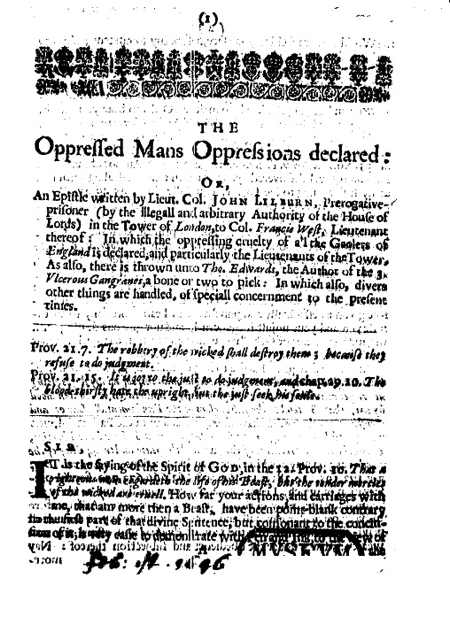
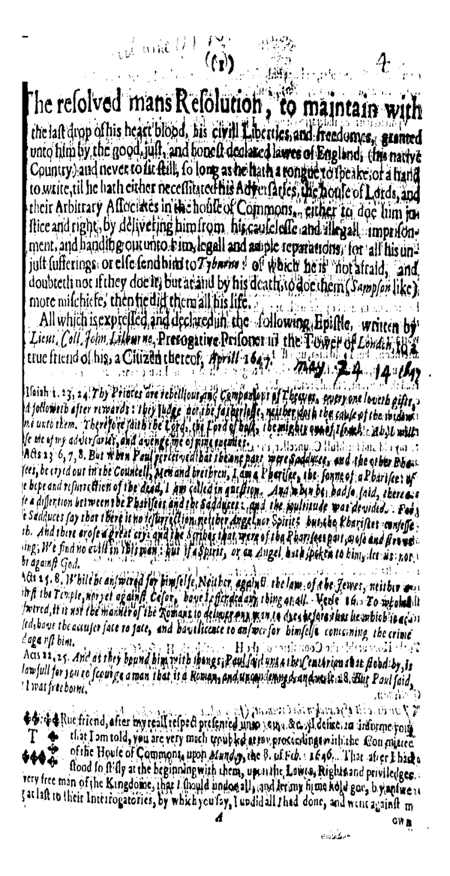
FINIS.


Endnotes

[2] Read Daniel, fol. 149.

[3] pag.

[4] Coll. of decl. pag 254. 336. 382. 508. 613. 705. 711. 716. 721. 724. 716. 721. 724. 730.

[5] Coll. Decl. page 661, 663. protestation and covenant.

[6] Coll. decl. pag. 68, 172, 262, 266, 267, 340, 459. 462, 471, 473, 583, 690.

[7] Col. decl. p. 464, 490, 750.

[8] Col. decl. p. 214.

[9] Col. declar. p. 66.

[10] let., 22. 16. 15. 16. 17.

[11] Col. declar. 666. 673.

[12] Col. Declar. 4.

[13] Col. declar. p. 264. 281. 494. 497. 654. 694. 696.

[14] Col. declar. p. 738. 140. 845.

[15] Pag. 660.

[16] Decl. 460. 498. 666. 673.

[17] Magna Charta 29. Sir E. Cook. 2 part Instit. fol. 28. 29. Rot. 2. e. 3.

[18] Col. declar. 6, 7, 8.

[19] 5. Ed. 3. 5. 25. Ed. 3. 4. 28. E. 3. 3. 37. Ed. 3. 8. 38 Ed. 3. 9. 42 Ed. 3. 3. 17 Ri 2. 6. Rot. Parl. 43. E. 3. Sir lo. Alces case, num. 21, 22, 23, &c. lib. 20. fol. 74. In case declar. Marshalses, see Cook, 2. part. Instit. fol. 464

[20] Pat. Instit. 51.

[21] Rot. part 2. 1. H. 4. mem. 2. num. 1. 27. Instit. f. 11. Book declar. 58, 39, 278, 845.

[22] 2 part. instit. fol. 52, 53.

[23] col. declar. 723.

[24] See Cook 2 part instit. f. 187.

[25] 3. E. 33. 2. R. 2. 5. 37. E. 3. 18 38 E. 3. 9. 12. R. 2. 11. 17. R. 2. 6. 22. p. & M. 3. 1. El. 6.

[26] 9. H. 3. 29. 2. E. 3. 8. 5. E. 3. 9. 14. E. 3. 14. 11. E. 2. 10.

[27] col. declar. 127, 174, 244, 253, 282, 284, 285. 312, 313. 321, 322, 467, 490, 514, 516, 520, 521, 532, 533, 534, 535, 537, 539, 541. 543, 555, 560.

[28] Cromptons jurisdictiõ of courts, fo. 84 Hon. 7. 18. H. 7 14. 1. H. 7 27. Parliament 42. 76 33. H. 6. 17. d-judged accordingly prerogative. 134.


18. John Lilburne, The Oppressed Mans Oppressions declared (30 January, 1647)

Title ID: T.87 John Lilburne, The Oppressed Mans Oppressions declared (30 January, 1647).

Estimated Date of Publication: 30 January, 1647.

Thomason Tracts Catalog Information: TT1, p. 490, E. 373/1.

Full Title

The Oppressed Mans Oppressions declared: Or, An Epistle written by Lieut. Col. JOHN LILBURN, Prerogative-prisoner (by the illegall and arbitrary Authority of the House of Lords) in the Tower of London, to Col. Francis West, Lieutenant thereof: In which the oppressing cruelty of all the Gaolers of England is declared, and particularly the Lieutenants of the Tower· As also, there is thrown unto Tho. Edwards, the Author of the 3. Vlcerous Gangraenes, a bone or two to pick: In which also, divers other things are handled, of speciall concernment to the present times.

Prov. 21.7. The robbery of the wicked shall destroy them; because they refuse to do judgment.

Prov. 21.15. It is joy to the just to do judgment, and chap. 29.10. The blood-thirsty hate the upright but the just seek his soule.


[1]

Sir,

IT is the saying of the Spirit of God, in the 12. Prov. 10. That a righteous man regardeth the life of his Beast, but the tender mercies of the wicked are cruel. How far your actions, and carriages with me, that am more than a Beast, have been point-blank contrary to the first part of that divine Sentence, but consonant to the conclusion of it; is very easie to demonstrate with Pen and Ink, to the view of [2] the World; and as facill to your face, before any competent Judges to justifie and prove: And this is the Theme I have chosen a little to insist upon at this present time: but being resolved, to be as concise as I may, I shall not now make any ample repetition of your harsh dealing with me at the first; in divorcing me by the Law of your own Will from my Wife, and getting the Lords to make an Order to bear you out in it after you had done it; and, that I should speak with none of my friends, but in the presence and hearing of my Keeper, &c. Which cruell Order, meerly obtained and got by your solicitation, the Reader may read in the 35. p. of Vox Plebis. Therfore, in regard that the Author of that book hath pretty wel discovered your cruel and illegal dealing with me, at my first coming to the Tower, especially in the 45, 46, 47, 48, 49, pages thereof: And the Author of the said book, called Regal tyrannie discovered, in the 48, 49, pages, And my self hath pretty well laid it open in the 16, 17, 18, 20. pages of my printed Relation before the Committee of the honourable house of Commons, Novemb. 6. 1646. called An Anatomy of the Lords tyrannie, to which I refer the Reader, and in regard you are not ashamed of your cruel and illegal carriages towards me, but persevere in them (as though you would justifie one tyrannie, with backing it with continual acts of tyrannie) I shal therfore go on as effectually and punctually as I can, more fully to anatomise you, and your unjust, illegal, cruel, and unrighteous dealing with me, and for matter of fact, shal say nothing to your charge, but what I wil justifie before any legal Authority in England.

But in the first place, I desire to let you understand, that I am a free-born English-man, and have lived a legall man thereof all my dayes, being never yet convicted of any attempt or design undertaken, or countenanced by me, that did tend to the subversion of the Fundamentall Lawes and Constitutions thereof; but have alwayes sided with the Parl. it self, who hath pretẽded nothing so much, as the preservatiõ of the laws, liberties, & Fundamental Freedoms of Englãd, and the peace and tranquility of the peoples as you may read in their own Declarations, 1 part vol. Dec. pag. 172, 195, 214, 281, 342, 464, 498, 663, 666, 673, 750. for the preservation of which, I have constantly, couragiously, and as freely adventured my life, as any of themselves, what ever he be: And therfore in every particular, have just and grounded cause to expect the utmost priviledge and benefit that the Law of England will afford any man whatever, that is under the obedience and subjection thereof: [3] Nay ever, having to do with those men as my Judges, that made all or the most of these Declarations, and who have also declared, it lyes not in their power to inslave or invasalize the people, being trusted for their good, not for their mischief, to provide for their weal, but not for their woe, 1 part Col. Dec. pag. 150. 214. 266. 267. 494. 497. 636. 659. 660. 694. 696. and who in these and other of their own Declarations, imprecate and pray that the wrath and vengeance of Heaven and Earth may fall upon them, and theirs, when they cease actually to performe what verbally they there declare, unto which I say AMEN: And there they protest, vow, and swear, they will maintain the fundamentall Lawes, and Liberties of the people, and therefore in that respect, you cannot groundedly in the least, think, that I should Issacar-like stoope willingly unto any other burthens, impositions, or Commands layd upon me, by you, or any other whatsoever, that are not warrantable and justifiable by the fundamentall Lawes of the Land, and whether your practises have been so with me, I will compare them to the Law, and leave every rationall man to judge.

First I do not finde any Law that makes Prisons, places of execution, punishment, or torment, but onely places of safe custody: for, the Law of England (as Sir Edward Cooke in the second part of his institutes fol. 28. excellently declares) is a Law of mercy, (yet as he then said, so I much more say now) it is now turned into a meer shaddow, which is the most we now enjoy of it) and therefore as the author of the late booke, called Liberty vindicated against Slavery, very wel saith p. 7. from Sir Ed. Cook in the 1. part of his instit. f. 260. that by Law, prises are ordained not for destruction, but for securing of mens persons, until they be brought forth unto due & speedy tryal, (for being in prison, they are under the most especiall protection of the Law, and the most tender care thereof) and are therefore to be humanly, courteously, and in all Civility, ordered and used; otherwise Goalers are not Keepers, but tormentors and executioners of men untryed, and uncondemned, but this were not (salvo custodire) to keepe men in safety, weich the Law implyes (and is all it requires) but (destruere) to destroy before the time, which the Law abhors and detests, yea and that prisoner (though never so notorious in their crimes) may be the more honestly and carefully provided for, and the better and more civilly used, and to the end, that Goalers and [4] Keepers of prisons, should not have any colour or excuse, for exacting any thing from prisoners, (under what colour or pretence soever, whether the same be called fees, or Chamber-rent) who are in custody of the Law: It is provided, and declared by the Law, that all Prisons and Goales what ever, be the Kings, for the publike good, and therefore are to be repaid and furnished as prisons at the common Charge, see Cooke on the 1. E. 2. Statutum de frangentibus prisonum, in his 2. part institutes fol. 589. and on the 26. Chap. of Magna Charta fol. 74. Ibem, and on the statute of Westminster.

The first Chap. 26. fol. 209. 210. Ibem.

Yea and the Law takes care that in case the prisoner when he is in prison, have no meanes of his own to live upon, that then by the publike he is to be maintained, 14. Eliz. 5. 21. Iames 28. Vox Plebis, pag. 57. for a freeman of England (as I am) “is not brought to prison to be starved with cold, or hunger, but to the end justice upon him may be done: The prison, at most, in Law, is but a safe preserver, but not a distroyer of the prisoner, who with all convenient speed according to Law, is to come to his tryall, and either according unto Law to be condemned, or else to be delivered in convenient time without delay, 4 E. 3. 2. See my answer to Mr. Pryn, called Innocency and Truth justified, pag. 32. who by Law is never to remaine in prison above 6. moneths at most, for Goale deliveries are by the 4. E. 3. 2. to be kept and made 3. times a yeare, which is once in foure moneths, and oftener if need shall be.

And as the authour of Vox Plebis pag. 55. saith, out of “Stamf. pl. Cor. f. 30. Imprisonment by Law, is (neither ought to be) no more then a bare restraint of Liberty, without those illegall distinctions, of close and open imprisonment, and therefore Bracton fo. 18. saith, that if a Goaler keepe his prisoner more close then of right he ought, whereof the prisoner dieth, this is fellony in the Goaler.

And Horne, in the mirrour of Justice pag. 288. “saith that it is an abusion of the Law that prisoners are put into Irons, or other paine, before they are attainted. And pag. 34. 36. he reckons the sterving of prisoners by famine, to be among the crimes of homicide in a Goaler.

And we finde in the 3. E. 3. Fitz. H. Tit. pl. Cor. 295. “that it [5] was fellony at Common Law, in Goalers to compell their prisoners by hard imprisonment to become approvers, whereby to get their goods: which Law is since confirmed by the statute of 14. E. 3. Chap. 10. with some inlargement; as to under keepers of prisons, and the penalty of the Law, and that Goalers having done this, have been hanged for it; you may read 3. E. 3. 8. Northampton, Fitzh. pl. Cor. 295. and else-where, but this for a tast to them.

In the second place, I will tell you what the Law saith about Goalers Fees. The mirrour of Justice pag 285. saith that it is an abusion of the Law, that prisoners or others for them, pay any thing for their entries into the Goale, or for their goings out: this is the Common Law; there is no see at all due to any Goalers whatsoever by the common Law. See what the Statutes say. The statute of Westminster 1. Chap. 26. being the 3. E. 1. 26. saith, that no Sheriffe, nor other the Kings Officer, take any reward to do his Office, but shall be paid of that which they take of the King, and he that so doth shall yeeld twice as much, and shall be punished at the Kings pleasure, under which word Officer, is concluded Goaler, Coronor &c. so Sir Edward Cooke 2. part institutes fol. 209. Stamf. pl. Cor. 49. nay, by the statute of 4. E. 3 10. Goalers are to receive theeves, and fellons, taking nothing by way of fees for the receipt of them, so odious is this extortion of Goalers, that very theeves and fellons are exempt from payment of fees. It is true, that by an incroaching statute upon our liberties, made in the 23. H. 6. 10. there is a fee given to the Goaler to be paid him by his prisoner, but yet it is very small, the words of the statute are those; “nor that any of the said Officers and Ministers by occasion or under colour of their Office, shall take any other thing by them, nor by any other person to their use, profit, or availe of any person by them or any of them to be arrested, or attached, nor of any other of them for the omitting of any arrest or attachment to be made by their body, or of any person by them or of any of them, by force or colour of their Office, arrested or attached for fine, fee, suit of prison, mainprise, letting to baile, or shewing any case for favour to any such person so arrested, or to be arrested for their reward or profit but such as follow; that is to say, for the Sheriffe 20. d. the Bayliffe which maketh the arrest or attachment 4. d. and the Goaler, [6] if the prisoner be committed to his ward four pence; and that the Sheriffe, under-Sheriffe, Sheriffes Clerk, Steward, or Bayliffe of Franchise, Sheriffe or Bayliffe, or Coroner, shal not take any thing by colour of his office by him nor by any other person to his use of any person for the making of any return or pannell, and for the copy of any pannel, but 4. d.

“And it followes in the same Statute, that all Sheriffes, under-Sheriffes, Clerks, Bayliffes, Goalers, Coroners, Stewards, Bayliffes of Franchises, or any other Officers or Ministers, which do contrary to this Ordinance in any point of the same, shall lose to the party in this behalf indammaged or grieved, his treble dammages, and shall forfeit the sum of 40. l. at every time they or any of them do the contrary thereof in any point of the same, whereas the King shall have the one half to be employed in the use of the house, and in no otherwise, and the party that shall sue, the other half.

But (as Sir Edward Cook well observes, on the 25. chap. of Magna Charta, 2. part Institut. fol. 74.) after the rule of the Common-Law was altered, and that the Sheriffe, Coroner, Goaler, and other the Kings Ministers, might in some case take of the subject; it is not credible what extortions and oppressions have hereupon ensued. So dangerous a thing, it is, to shake or alter any of the Rules or Fundamental points of the Common-Law, which in truth are the main Pillars and Supporters of the Fabrick of the Common-wealth, as else-where I haue noted more at large viz. fol. 51, 210, 249. ibim. see the Preface to the 4. part of his Reports and the 4. part of his Institutes cap. of the High Court of Parliament, f. 41.

Now sir, having laid this sure foundation, I will assume the boldnesse, to compare your dealings with mee, to the fore-mentioned rules that the Law prescribes you; And first to matter of usage, you know very well, you of your own head at first kept my wife from me, and made me a close prisoner, as in the fore-mentioned bookes pag. it is truly declared.

And then secondly, although you could not but know that by the Lords, &c. in the Star-Chamber, I, for about four years together before this Parliament, under-went a great destruction by them both in my body, goods, and trades and since this Parliament, have spent many hundred pounds to obtain my just reparations (besides other [7] great losse I have had) yet have not got a penny, and being a younger brother, and in Land have not 6. d. incoming in the year; and being robbed of my trade, calling, and livelyhood, by the Merchant-Monopolizers: so that I could not with freedome transport one Cloth into the Low-countries, to get any lively-hood thereby: all which, above a year agoe, I was necessitated publikely to declare, in answer to William Pryns lyes and falshoods, in my book called Innocency and Truth justified, which there you may read, especially in pag. 39, 43, 47, 48, 62, 65, 70, and how being committed to your custody in the Tower, the chargeablest Prison this day in all England, and where I am denyed the just and legal usage and allowance that the King himself used to allow all prisoners committed to this place, although those that had great estates of their own, into their own hands and possession, whose allowance was to find them diet, lodging, and pay their fees, Vox Plebis, p. 50, 56. 57.

Nay, when I came in, and desired you, that I might have my diet from my wife out of the town, which I did for two reasons.

First, for safety, having heard much of sir Thomas Overburies being poysoned when he was a prisoner in the Tower.

Secondly, for the saving of money, which stood me much upon; but you absolutely denied me that legal and just priviledge, and tyed me either to fast, or haue my diet from the Cookes in the Tower.

Thirdly, being thus committed to this extraordinary chargeable expensive place, and being in so mean a condition, as I must ingeniously confesse I was, you took in the third place, the ready way to sterve & destroy me and of your own head, ordered your Warders to take the names and places of habitation, of all those that came to see me, or speak with me, a destructive bug-bear to any captived prisoner, which the Law of England doth not in the least authorize and inable you to do: but this was not all, but in the fourth place, my friends, though they gave their names, were by your Warders, set on by your self (for upon your score, I must, and do lay it all) exceedingly in words abused; and divers of them turned away, and not suffered to come and speak with me: O bloody and cruell man ! what is this else, but an absolute Declaration of your resolved intention, to destroy me in my imprisonment under your custody? which the Law abhors: but it for the sake of the Law, or for my sake, you will not square your [8] dealings with me, according to the known and declared law of the kingdome, then for your own sake, I desire you to remember your Predecessour, Sir Gervose Elmayes, who was indicted by the name of Gaoler of the Tower of London, and hanged upon Tower-hill, for consenting to the poysoning of Sir Thomas Overbury, Vox Plebis, pag. 48.

In the fifth place, seeing by all the fore-mentioned wayes & meanes you could not scare all my friends from me, and so by consequence, destroy me.

Then you devise another way, and set one of your old Mastive dogs upon me, to baite and to worry me with lyes, reproaches, and calumniations: and for that end, printed and published a most base & scandalous book against me, thereby to make me odious to all men whatsoever, that would believe that book, which was published against me at such a time; when by your self, my hands were fast tyed behind my back, being kept by your order very strictly from Pen, Ink, and Paper, and so in a condition unable publikely to vindicate my self, and much importunity was I forced to use to your selfe, before I could obtain leave from you to answer it, and necessitated to tye my selfe by promise to such and such conditions: and amongst the rest, that you should read it all over, before it was published: And I, for my part, performed my promise, and was necessitated to give the originall into your hands in such haste, that I could not take a Copy of it: out of whose hands, I could not get it, til I was in some respect necessitated to an arbitration: and being not able to doe what I would for my own vindication, I was in a manner compelled by you to be content with what I could do, which was to accept a submission from him for my wounded, rent, and torn reputation by him: although, if I could have accomplished what I desire, I should first have published my answer to his lyes: and then if he had had a mind put it to arbitration, but necessity hath no other Law but a stooping to it: but I was in hope, that I should have found so much candor and ingenuity in you, and your Agent, old John White, as that I should not have had the like abuses from you after that arbitration, that I had before it, from you both· but in regard that he at the gaol, as my friends informe me, doth not cease in his rancour and venim against me; I must be necessitated to publish my answer to him; especially, seeing as I conceive, Thos. Edwards the cankered Gangrena [Editor: Illegible word] in confederacy with him: But [Editor: Illegible words] the inserting of his recantation, or acknowledgment, and referre the [9] Reader for a full relation of that arbitration, to the 59, 60, 61, 62, 63 pages of my late book, called Londons Liberty in Chains discovered; the aforesaid acknowledgment thus followeth:

I John White, one of the Warders of the Tower of London, doe acknowledge, that I have unjustly wronged Lieut. Col. John Lilburn, in, and by writing, and publishing in print, in such sort as I did; that he was the Writer, Author, or Contriver of a book called Liberty vindicated against Slavery, and of a printed letter thereunto annexed; and of a Book or Treatise, called An Alarum to the House of Lords: for all which, and for the unjust and scandalous matters and language alleadged and used by me, in my said booke, reflecting upon the said Lieut. Col. Lilburn, I am heartily sorry: and in testimony thereof; I haue hereunto subscribed my hand the 8. day of October, 1646.

Iohn VVhite.

Subscribed, pronounced, and
accepted, the 9. Day of
October, 1646. in the
presence of us,

John Strangewayes. } Knights.
Lewis Dyves.
John Glanvil.
William Morton.
Henry Vaughan.

Christopher Comport, Warder in the Tower.

[10]

Sixthly, after all this, by meanes of my wifes Petition, which was delivered to the house of Commons 23. Septemb. 1646 and which you may read in the last mentioned book. pap. 65, 66, 67, 68 &c. by means of which, there was a Committee of the honourable house of Commons appointed, to hear and receive my complaint against the Lords, and the 6. of Novemb. 1646. was the last time I was before the Committee; where I had an opportunity, in part, to declare unto them, your illegal dealing with me: which Declaration, you may read in the 17. 18, 20. pages of that relation, now in print; and I must confesse unto you, I did think that you durst not have run the hazzard of persevering in your illegal dealings with me: but in regard you doe, it cleerly demonstrates unto me, that you judge the streames of Justice so muddy and corrupted (by the interest and power of your Lords, and their factions, who would have no other rule, but their own base and corrupt will to walk by, and therefore lay the rule of the Law and Justice aside) that they will never run cleer, nor purely again, to punish such transgressors as you are.

But that you may know (although I have had exceeding hard measure, in being so long delayed in the making of my report) that I am not out of hopes, not in despaire, I give you this fresh charge, and tell you, that after I had done with the Committee, your next illegall designe that you executed upon me, was, that my friends could not-passe your guard, unlesse my keeper were there present to conduct them unto me; by means of which, some of them have been forced to come four severall times, before they could find him at the Gate; & others have been forced to stay, and sit in the guard an hour, and sometimes two, expecting his coming; without whose presence, they could not have accesse to me; and divers of them in the time of their stay at the Guard, examined whether they be not Independents, or no; & whether they never preached in Tubs, or no : And if they answer crosly to the questions, as well they may, then they are fallen upon, and both they and I in words exceedingly abused: and I am told, that an old tall man in black, with a great staffe in his hand, is not wanting to play his part, which I judge to be Mr. White.

Now sir, is not this the height of illegality cruelty, tyrannie and bloud-thirstinesse in you, thus to deal with me; indevouring thereby strongly to scare away all my friends from me? For, who in so many difficulties and abuses would come to visit a man, unlesse he bore a [11] very great affection to him: the which, if he do, the continual meeting with these base and unwarrantable affronts, in conclusion will make him weary.

And truly sir, let me tell you, this is not to use me with civility, and humanity in my imprisonment, as the Law requires I should: but this is to torment, punish, and destroy me, which, the Law, and all just and honest men abhor and detest.

In the 7. place, being in the condition that I am in, and being guilty of no legall crime in the world; unlesse it be for being over honest and zealous for the preservation of the just and publique Liberties of the Kingdom; I know no reason, why I may not enjoy the utmost priviledge and liberty in the Tower, that any prisoner in it doth enjoy: yet notwithstanding, not many weeks agoe, I was but going with a fellow-prisoner in the path that leads to the Record-office; and coming back to my Lodging under the Gate, that is just against the Traytors Gate, I met your pretended-Gentleman-Goaler, and immediatly Mr. Comport, my Landlord and Keeper, came and delivered a message from you to me, which was to this effect: That Mr. Lieutenant did understand, that I was beyond the Ring; but it was his pleasure, that I should forbear to go any more beyond it: Vnto which, I replyed, Landlord, I had only thought, that to go beyond the Ring, had been for a man when he came to it, to have turned on the right hand, and so to have gone, as if he would have gone out at the Gate, which I did not in the least: for I turned on the left hand with one of my fellow-prisoners, and walked in the path that goes to his Chamber, and divers other Chambers of my fellow-prisoners, which path they do and may walk in every day in the week, and every hour in the day. And therefore, tell your Master from me, I shall not obey his order, for I have as good right to enjoy any priviledge within the Tower, as any prisoner in it: and therefore will walk, that way again, seeing all my fellow-prisoners enjoy the same liberty.

In the 8. place, the other night there being a friend with me about 6 or 7 a’clock at night, I walked out of my chamber with him; which is a priviledge that all my fellow-prisoners enjoy: and he having a candle and lanthorn in his hand, passing under Cole-Harbour Gate, I was roughly and suddenly demanded whither I went? And I replyed, along with my friend, to conduct him as farre as my liberty would extend (which was down to the Ring, which is, as I conceive, [12] at least three or foursore yards, on this side of the gate where your guard stands) I was replyed unto in these words, Sir, you shall not goe: At which, looking well about me (it being very dark) to see who it was, that was so malipert, I perceived it to be your self (who had with you, as I conceived, some of your Warders) unto which I replyed: Truly sir, I do not like the word shall; it is but unhansome language, to tell me, I shall not go.

No sir, I say (said you) you shall not go; for you ought not to stir out of your chamber after candels are lighted.

Truly sir (said I) I know no such order. Vnto which, you replyed, Well, then sir, I now give you such an order: and I bid you give it to these that would obey it; for I would not: and I gave you the reason of it; which was, that I was a free-born Englishman, a Kingdom that pretends (at least) to be governed by Law, and not by Wil, & I am not to be subject unto those orders in my imprisonment, that have no other Warrant, but the Goalers Will. Neither will I willingly be subject in the Tower unto any other orders, but what are consonant and agreeable to the fundamental Laws of the Kingdome.

Vnto which you replyed; Sir, you shall obey my orders, and I will make you.

Sir, said I, I will not obey your orders; nor you shall not make me: And I tell you to your face, I scorn both you and your orders, and that I value you not, the paring of my naile.

Vnto which, you replyed, Sir, I will make you; for I will locke you fast enough in your chamber: And I bid you do your worst, that either you could, or durst do, I cared not a straw for you: But I bad you take notice of this, by the way; that if you locked me up by the power of your own unbinding will, and did not make your doores very strong, I would make work for your Carpenters, by breaking them into as many pieces as I could.

You replyed, you would make them up again. And I told you, I would break them again.

You told me, you ordering us to keep our Chambers after candle was lighted, was for your own security.

I shall now take liberty, to return you a more ful answer to this, then I did before to you, which is this; That I for my part, for all the gold in London, would not give just cause to be counted so base [13] and unworthy, to do upon deliberation that action, that I would not justifie to the death: But if I should in the least, step aside, I should contract unto my self that guilt, which I am confident, all the enemies I have in England, are not able in the least to fixe upon me: For, I understand by the Law of this Kingdom, that he that is committed to prison for Felony, or Treason; although really and truly he be guilty of neither, yet if he break prison, and be taken again, he shal dye like a Fellon or Traytor that is legally convicted, 1. E. 2. de frangentibus prisonam. See Cookes 2. part. instit. fol. 590, 591. For his slight, in the eye of the Law, argues guiltinesse.

And besides, my friend and I had a horn Lanthorn and Candle, which put all out of suspition of going out in the dark.

But thirdly, what ground have you, vpon any pretence what ever framed by your self, to lock me up in my chamber, as soone as candels are lighted, seeing I am in a moated and double-walled Prison, where you have not only a Train-bond, but also great store of your Warders to secure me?

And therefore, I tell you plainly, I shal never condescend to bee locked up sooner then that convenient hour of 8. a clock, the accustomed hour of the place, which is much sooner then they are in other prisons, that I have been in.

Fourthly, if under pretence of your security, I should give way for you to confine or lock me up in my chamber at candle-light, which then was before five a clocke, may not you as well and as groundedly upon the same pretence (if you please to say it is for your security) keep me locked vp in my chamber till 12. a clocke; yea, the whole day, if you please: And if I should suffer this in the least, what am I lesse then traitorous to my selfe, and to my liberties, to give you a power by your own meer will, to make and impose a Law upon me, whensoever you shall please to say that its for your securitie; when the Law provides and enjoynes you no more, but to keep me in safe custodie within your prison, and to use me and all that come to me, civillie, and with all humanitie, and leaves me not in the least to your will, but only in some extraordinarie cases, as in doing or offring violence to the Goaler, or Goalers, or to my fellow-prisoners, to the apparent breach of the peace of the prison: and yet in this, the Law is extraordinarie tender of the prisoners safetie: but none of this I have not in the least done, either [14] to you, or the poorest boy belonging to you, not by Gods assistance wil not: but yet on the contrarie, before you shal make me a slave to your will, you shal have the heart-bloud out of my body.

Now in the last place, I wil compare the fees taken and demanded in the Tower with those the Law gives; and what they are, you may fully read before.

Now, by the Author of Vox Plebis, who to mee seemes to bee a knowing man in the practises of the Lieutenants of the Tower, who in his 48. 49. pages, saith, That there is demanded for the admittance of an Earl I 60. l. for a Baron 80. l. for a Knight and Baronet 70. l. for a Baronet 60. l. for a Knight 50. l. and for an Esquire 40. pound, and 30. s. a week of every prisoner for liberty to buy and dresse his owne diet, and 10. s. 15. s. 20. s. per weeke, for their Chamber-rent, and of some more.

For Sir Richard Gurney sometimes Lord Mayor of London, & now prisoner in the Tower, hath paid as I have heard him aver it 3. l. a week for his chamber-rent; and in the time of a Predecessour of yours, dieted 3 weeks at the Lieutenants table; for which hee had the impudencie to demand of him for it 25. l. per week. ô horrible and monstrous extortion and oppression: and yet this is not all, for the last mentioned author in his 48. pag. saith, There is a new, erected Office, and an intruded Officer, called the Gentleman Goaler, one Yates, a busie fellow, who pretends to a fee of 50. s. to be paid him, at the going away of every prisoner, pag. 51. ibim.

But yet this is not all: for in p. 49. of the late printed book, called Regal Tyrannie discovered, he saith, that the Gentleman Porter demands for his fee 5. l. and a mans upper garment: 40. s. to the Warders, 10. s. to the Lieutenants Clarke, 10. s. to the Minister; and divers of my fellow-prisoners tell me, that their Keepers have and do demand of them, either their diet, or 5. s. a week, for locking them up at night in their Chamber, and opening their chamber-dores.

O horrible and monstrous injustice, oppression, and crueltie, to demand and take these fees; whereas, by Law, there is not one farthing taken of all these fees due to be paid by the prisoner, but one bare great at most, and that given away by an oppressing and incroaching law upon our antient and just liberties, as is before truly observed.

And yet prisoners are detained in prison by your will, after they [15] are legally discharged, because they will not pay these undue and unjust fees, which at this very day is Sir Henry Andersons case, and hath formerly been others; as the Author of Vox Plebis truly observes: although the arrantest Rogue & Thief that ever breathed, had, or hath, as true a right to any purse that ever he did, or shal take from an honest man upon the high-way by force and violence, as you or any other hath to any of the fore-mentioned fees. O yee proud and impudent man, that dare assume unto your selfe of your own head, more then a regal power, to levie and raise mony by the law of your own will, vpon the free people of England.

Sir, let me tel you, this very thing was one of those things, that was the Earl of Straffords great Crimes, for which hee paid very dear; and it is not impossible, but you and others that use it, may pay as dear for it in conclusion: therefore, look to it, and thinke of it.

And if you please to read the Petition of Right, made by the Lords and Commons unto this King, in the 3. of his Raign, you shall find in the beginning of it, they shew him that by the statute of the 34. E. 1. called Statutum de tallagio non concedendo; that no tallage or aid shall be laid or levied by the King or his Heires in this Realm, without the good will and assent of the Arch-bishops, Bishops, Earles, Barons, Knights Burgesses, and other the free-men of the Commonalty of this Realm, and by authority of Parliament holden in the 25. E. 3. it is declared, and enacted; that from thence-forth no person should be compelled to make any Loanes to the King against his will; because such Loanes were against reason, and the franchise of the Land, and by other Lawes of this Realme, (viz. 1. E. 3. 6. 11. R. 2. 9. 1. R. 3. 2.) it is provided; That none shall be charged by any charge or imposition, called a benevolence, nor by such like charge by which the statutes before-mentioned, and other the good lawes and statutes of this Realm, your subjects have inherited this freedome; that they should not be compelled to contribute to any taxe, tallage, aid, or other like charge, not set by common consent in Parliament. All which, the King confirmes.

And by the statute made this present Parliament, that abolished Ship-money; All and every the particulars, prayed or desired in the said Petition of Right, shall from henceforth be put in execution accordingly, and shall be firmly and strictly holden and observed, as in the same Petition they are prayed and expressed: yea, in this very statute it is [16] declared and enacted to be against Law, for his Majesty upon any pretence what ever, to levie money of the people of England, without common consent in Parliament.

And truly sir, let me tell you without fear or flattery, that if your great Masters the Lords, & the true prerogative friends of the house of Commons, had any true and reall intentions to preserve the Fundamental Lawes and Liberties of England, or had any time to spare (to punish those that justly and groundedly infringe them, and doe, as much as in them lies, to destroy them) from their weighty employment, of dividing great and vast summes of the Common-wealths money amongst themselves, without either doing justice and right in the like nature to any man breathing, unlesse it be themselves, or some of their sons, kinsmen, or near friends; whose Principles are to serve their ends to the breadth of a haire in all they enjoyn them; they would scorn to give cause to be reputed so base and unworthy as they are, to deny the King the power (unto whom ever and anon, they give such glorious and transcendent titles unto) to levie and raise money without common consent in Parliament; when they allow every paltery Jaylor in England to do it at his pleasure; yea, and for any thing I can perceive abet and countenance him in it: for they will not, nor have not done, all this long Parlament, any man any effectuall Justice against them that have complained of them, but every man is crushed, and in a manner destroyed, that meddles any thing to the purpose with them.

I pray sir, tell me, whether this be to keep the Solemn League and Covenant (which now is made a cloak for all kind of knavery and villanie) which they and you took with your hands lifted up to the most high God, and swore to maintain the Fundamental Lawes and Liberties of the Kingdome: But this I dare boldly tell you, you never intended it, as by your practises, appears.

But sir, in the second place, I should desire to know of you, the reason why Jaylors are so impudent and oppressive as they are, and go so scot-free from punishment (though often complained of) as they do.

Truly, for my part, I am not able to render any more probable one then this; That is may be some powerfull Parliament-man, or men, are sharers with them in their profits (for as grose, if not groser things, are commonly reported, yea printed of some of them: See the 99, 100, 101, 102, 103, &c. pages of the fore-mentioned book, called Regall [17] Tyrannie discovered) and therefore must, and do improve their interest and power, to protect them in their knaveries and oppressions. For, within these few daies, I was talking with an understanding knowing Gentleman, that came to visit me; and he told me, he durst venture his life to make it evident to any rationall man in the world; that there is one Goaler about this Citie, that makes of his Prison above 20000, l. a year, and commits all manner of villanies, and yet no Justice can be had against him, though hee hath often and powerfully been complained against to the Parliament it self, where he said, he had more favour, countenance, and protection, then the honest man that complained of him; yea, more then them all, put all in one.

Now sir, in the last place, I come to acquaint you, what monies I have paid, since I came to the Tower for my Chamber-rent only; the 10. of July last I came hither, and you sent me to the Lodging where I am, with extraordinarie strict and severe command upon my Keeper, who within certain daies after I came to him, demanded chamber-rent of me at a great deale higher rate then I pay, and I told him necessitie had no law; and I therefore desired him to ask me reasonably, and he should see what I would say to him: So at last, he asked me 15. s. a week, I told him I knew well the lawes of all Prisons in England and 15. s. a week was a great deale of money for bare Lodging; but in regard it was with me, as it was, conditionally that hee for his part would use me, and those my friends that should come to to see me, with civilitie and humanitie, I would give him 15. s. a week, and find my own linnen besides, protesting unto him, that the first time he used me, or any that came to see me, churlishly, I would not pay him one peny more of money; and I must ingenuously confesse, I have no cause in the least to complain of the man in point of civilitie, nor he of me in performing my promise: for I have paid him, though it hath been with some straights to me, betwixt 20. and 30. l. which I am now able no longer to pay.

And therefore I desire you, according to your duty which by law you are bound unto, to provide me a prison gratis: for I professe unto you, no more rent I can, nor will pay, though it cost me a dungeon (or as bad) for my pains. And truly, Sir, I shall deale ingeniously with you, and give you the true reason wherefore I condescended to pay chamber-rent at first, and have done it so long; It was because I had extraordinary potent adversaries to deale withall, viz. [18] the House of Lords, or Peeres, as they are called, who had pretty-well managed their dealings with me like tyrants, in keeping very strictly my friends from me, and also pen, ink, and paper, that so I was debarred of all ability in the world, to publish to the view of the whole kingdome, my own innocency, and their inhumane and barbarous tyranny, which they knew well enough I would doe, if I had not been debarred of all meanes to doe it, and then fell upon me, and transcendently sentenced me to pay 4000. l. &c. and illegally and unjustly entred notorious crimes against me in their records. And you know I told you at my first comming to the Tower, I was refreshed at the hopes of my being freed from my close imprisonment; but your falling so heavily upon me as you did, struck me to the heart and made me beleeve it was possible I might have been destroyed before I should have an opportunity publickly to cleare my own unspotted innocency in reference to the Lords, and to anatomize their tyranny; both of which my soul thirsted after: and therefore if I had been able, I would have purchased an opportunity to have done it, though it had cost me 20. l. a week. And truly, Sir, I have done my doe, and in despite of all the Lords, published, and truly and faithfully stated my cause to the view of the whole Kingdome. First, in my Wives Petition, delivered by her to the House of Commons, Septem. 23. 1646. which I pen’d and framed my selfe without the help or assistance of any Lawyer in England. And secondly, in my Book called, Londons Liberty in Chains discovered. And thirdly, twice before the Committee of the Honorable House of Commons. The last discourse of which I published to the view of all the Comons of England, and called it, An Anatomy of the Lords tyranny. And besides, some of my friends, or well-wishers have done it excellent well for me, in those two notable Discourses called, Vox Plebis, and, Regall Tyranny discovered, which will live when I am dead; and be (I hope) as good as winding-sheets unto the Lords; and therefore I am now ready for a Dungeon, or Irons, or Death it self, or any torture or torment that their malice can inflict upon me; and seeing that I cannot by any means I can use, get my report made to the House of Commons, and so enjoy justice and right at their hands, (which I beg not of them as a Boon, but chalenge of them as my due and right) by reason of the Lords, and the rest of their Prerogative Co-partners influence into the House Commons, to divert them from the great [19] affairs of the Kingdome, in doing justice and right unto the oppressed, and putting them upon making Lawes, Edicts, and Declarations, to persecute and destroy the generation of the righteous, and so bring the wrath and vengeance of heaven and earth upon them and theirs: (Read Mr. Thomas Goodwins Sermon preached before them Feb. 25. 1645. called, The great Interest of States and Kingdomes) and also lay a great blot of reproach upon them by all the rationall men in the world, for endevouring to destroy a generation of peaceable and quiet-minded men, that have contributed all they had and have in the world, for their preservation; and by whose undaunted valour and blood-shed, as principall instruments they enjoy liberty at this day, to sit in the House of Commons, and to be what they are. (Sure I am, the Spirit of God saith, That he that rewardeth evill for good, evill shall not depart from his House, Prov. 17. 13.) And yet for any thing I can perceive, the best reward is intended these men from those they have done so much for, is ruine and destruction, that so that Antichristian office and fanction of Priesthood, newly transformed into a pretended godly and reformed Presbyter, may again be established, although by the second Article of the Covenant (now more magnified by the sonnes of darknesse add blindnesse, then the Book of God) they have expresly sworn to root up that Function by the roots. The words of the Covenant are, That we shall in like manner, without respect of persons, endevour the extirpation of Popery, Prelacy, (that is, Church government by Archbishops, Bishops, their Chancellors and Commissaries, Deans, Deans and Chapters, Arch-Deacons, and all other Ecclesiastical officers depending on that Hierarchy) superstition, heresie, schisme, prophaneness, &c. Mark the sentence, And all other Ecclesiasticall Officers depending on that Hierarchy. In the number of which are those pretended reformed presbyter-Ministers, that either sit in the Assembly, or are in any other place in the Kingdom, that officiate by vertue of their Ordination, which they had from the Bishops, or any, by vertue of their Authority. And I will maintain it with my life, that he is a forsworn man (whether he be Parliamentman or other) that hath taken the Covenant, and doth contribute any of his assistance, to maintain, preserve, and uphold that Ordination of the Presbyterian Ministers, that they received from the Bishops; or punish, any man for writing preaching, or speaking against it, or any other wayes endevouring the destruction or extirpation thereof. For the expresse [20] words of the Covenant are, that we must endevour the extirpation of all Officers (without exception) depending on that Hierarchy; part of which, all the fore-mentioned Ministers are, being ordained Priests and Deacons by the Bishops, and have no other Ordination to this very day, but what they had fro them. But if they shal say, they were ordained by them not as Bishops, but as Presbyters; I answer, This is a simple foppish distinction: For as well may the Bishops say, They were not ordained by the Pope, or his Bishops, quatenus as Pope or Bishops but quatenus as Presbyter, or Presbyters, and so are in every particular as lawfull Ministers as any of these men that have their ordination from them, and yet have endevoured to draw the whole Kingdom into a Covenant sinfully to extirpate them that are Christs Ministers upon their own Principles, as really, truly, and formally, as any of themselves. But in the second place, if they were ordained Presbyters by the Bishops, not as Bishops, but as Presbyters, then are these present reformed Ministers lesse then Presbyters. For the Author to the Hebrewes, chap. 7 v. 7. saith, Without all contradiction, the lesse is blessed of the better, or greater. And I desire the learned Presbyters to shew me one example in all the New Testament, that ever any Officer ordained another Officer in the same Office and Function that he himselfe was in. Thirdly, I desire to know of these reformed Presbyterian Ministers, that seeing as they themselves confesse, the Bishops Office and Function was and is Antichristian, how is it possible their Ministeriall Function, or Ordination, can be Christian, that like a streame flowed from them the fountain? Sure I am, Job demands this question; Who can bring a clean thing out of an unclean? And by the same Spirit of God he answers; Not one. Job. 14. 4. And James interrogates, saying, Doth a Fountain send forth at the same place, sweet water and bitter? Or can the Fig-tree, my brethren, beare Olive-berries? either a Vine; Figges? Therefore in a positive negation he concludes, that no Fountain can both yeeld salt water and fresh.

And therefore seeing THOMAS THE GANGRENA, the Rabshakeh Champion of the new sprung-up Sect in England of Presbyters, who may more truly and properly, be called Schismatickes, then any of those he so brands; for they have separated from their Ghostly Fathers the Bishops, and yet are glad to hold their ordination, and are therefore schismaticall.

[21]

And therefore seeing in his last GANGRENA he hath fallen so point-blank upon me, for no other cause but for standing for the Fundamentall Lawes of England; which, if he had not an absolute desire to be notoriously forsworn, he might know his Covenant binds him to doe the same. But seeing he there playes the simple man to fight with his own shadow, and doth not in the least meddle, for any thing I can perceive (by so much as I have read of his Book, which, so near as I could find, was every place where I was mentioned) with the Statutes and other Legall Authorities, as I cite in my wives petition, and else-where, to prove, That all the Commoners of England ought in all criminall cases to be tryed by their Peeres, that is, Equals; and that the House of Lords, in the least, are not the Peeres of Commoners: And therefore seeing seemingly by that ulcerous book, he hath given me something to answer that concerns me, I will really and substantially give him something to answer, that in good earnest concerneth him, and all the rest of his bloody-minded pretended reformed fellow-Clergy Presbyters; that lying, deceitfull, forsworn, and bloody Sect, of whom it is true that the Prophet said of the Prophets of old, That they make the people to erre, and bite with their teeth, and cry peace; and he that putteth not into their mouthes, they even prepare warre against him, Micah 3. 5. And that at present I have to put to him to answer, shall be certain Arguments which I made when I was close prisoner in irons in the Fleet, against the then Episcopall Ministers of the Church of England, and will serve in every particular, against the present Presbyteriall Ministers, and you shall find them thus laid down in the 23. page of my Book called, An Answer to 9. Arguments written by T.B. and printed at London 1645.

First, This every lawfull Pastor, Bishop, Minister, or Officer in the visible Church of Christ, ought to have a lawfull call, and be lawfully chosen into his Office, before he can be a true Officer in the Church of Christ, Acts 1. 23, 24, 25. & 6. 3. 5, 6. & 14. 23. Gal. 1. 1. Heb. 5. 4.

But the Ministers and Officers in the Church of England, (as well Presbyterian as Episcopall) have not a lawfull call, neither are lawfully chosen to be officers in the Church of Christ. See the Book of Ordination of Bishops, Priests, and Deacons, as also the Directory, and compare them with the Scripture.

[22]

Therefore all your Ministers are false and Antichristian Officers. Rev. 9. 3. and 13. 2. and 16. 13.

Secondly; the doing of those actions that belong to the execution of an Office, doth not prove a man to be a lawfull Officer, but a lawfull power instating him into his Office. Acts. 8. 4. 11. 19. 20. and 18. 24, 25, 26. 1 Cor. 14. 29. 30, 31. 1 Pet. 4. 10.

But all the Ministers in the Church of England have nothing to prove the lawfulnesse of their standing in the Ministery, but the actions of a Minister, and are not in the least able to prove that they are instated into their Ministery by vertue of a lawfull power and authority.

Therefore they are no true Ministers of Christ, but false and Antichristian Ministers of Antichrist.

Thirdly, againe in the third place upon your own grounds I frame this Argument.

Those that by their Ministery do not accomplish the same ends, that the Ministery of the Apostles did, are no true Ministers.

But the Ministers of the Church of England do not accomplish the same ends by their Ministery, that the Ministery of the Apostles did, 1 Cor. 11. 2.

Therefore your Ministers are no true Ministers of Iesus Christ.

But Gangrena one word more at present to you, seeing in the 217. 218. pages of your late 3. Gangrena, you fall so exceeding heavie upon me, and my honest Camerade Mr. Overton, and say that these 2. audacious men, their dareing bookes shall escape without exemplary punishment, and instead thereof be countenanced and set free, I do as a Minister pronounce (but I say it is as one of Sathans) that the plague of God will fall upon the heads of those that are the cause of it.

Come Antagonist, let us come to a period; for I hope, for all your mallice you are not yet so farre gone beyond your selfe as to desire to have me hanged or killed, and then condemned and adjudged, and therefore I will make you 2. faire propositions.

First, (in reference to the Lords whose Goliah and Rabshaca-like Champion you are) that if you please to joyne with me in a desire to both Houses, I will so far go below my selfe, and my present appeale [23] now in the House of Commons, (alwayes provided it may be no prejudice to the benefit I justly expect from my said appeale) and joyne with you in this desire, that there may be by both Houses, a proportionable number thereof, mutually by themselves chosen out, to set openly, and publickly in the painted Chamber, where I will against you by the established Lawes of this Land, maintaine against you and all the Lawyers you can bring, this position (which is absolutely the contest betwixt the Lords and me) THAT THE LORDS AS A HOVSE OF PEERS, HATH NO JVRISDISCTION AT ALL OVER ANY COMMONER IN ENGLAND, IN ANY CRIMINALL CASE WHATSOEVER, and if you will, I will wholly as in reference to the contest betwixt you and me, stand to the vote, and abide the judgement and sentence of that very Committee, whose vote upon the fore-mentioned tearmes, if you will tye your selfe, I will tye my selfe, either actively to execute, or passively to suffer and undergo it.

In the second place, because so farre as I am able to understand your meaning, in your fore-mentioned pages, you would have me dealt withall, as the Earle of Strafford, and the Bishop of Canterbury was, for indeavouring (as you say) with so much violence, the overthrow of the three Estates, and the Lawes of the Kingdome, and in the stead of the fundamentall Government and constitution of this Kingdome, to set up an Vtopian Anarchy of the promiscuous multitude and the lusts and uncertains fancies of weake people, for Lawes and Rules.

Now in regard of the distractions of the Kingdome which are many, and that they might not be made wider by new bookes from either of us, I shall be very willing for peace and quiets sake, to joyne with you in a Petition to the House of Commons, to appoint a select Committee publickly to examin all things that are a misse in your bookes and myne, and to punish either, or both, according to Law and Iustice without partiality, and I appeale to all rationall men in the world, whether I have not offered fayre or no.

But in regard I know not whether you will imbrace my preffer, I shall speake a little more for my selfe, and reduce all to these three heads.

First, whether the Lords have by the known Law of the Land any jurisdiction of the Commons, or no?

Secondly, whether in the Parliaments own publick declaration in Mr. Prinns soveraigne power of Parliaments, and in the Assemblies [24] exhortation to the solemn legall Covenant, and other Presbyterian books, licenced by publike authority, and others sold without controule, there be no more said to justifie and maintain, that which Gangrena calles Vtopian Anarchy, then in any bookes whatsoever published by these he calles Sectaries.

Thirdly, whether or no that out of my own words, in my booke, called INNOCENCIE AND TRVTH JVSTIFIED, there can any thing be drawn to justifie the Lords in that which now I condemn them in? as Gangrena affirmes, pag. 157. 158.

For the first, see what the ninth Chapter of Magna Charta saith.

No freeman shall be taken or imprisoned, or be disseised of his free hold, or Liberties, or free Customes, or be outlawed, or exiled, or any otherwise destroyed, nor we will not passe upon him, nor condemn him, but by lawfull judgment of his PEERS, or by the Law of the Land.

See the 3. of E. 1. ch. 6. And that no City, Borough, or Towne, nor any man be amerced without reasonable cause, and according to the quantity of his trespasse, 9. H. 3. 14. that is to say, every free man, saving his freehold, a Merchant saving his Merchandise, a villain saving his waynage, and that by his or their Peers.

Now here is the expresse Law of the Land against the Lords jurisdiction over Commons in criminall cases.

Now in the second place, let us see what one of the ablest expositors of the Law that ever writ in England, saith, of this very things and that is Sir Edward Cooke, in his exposition of Magna Charta 2. part institutes, which book is published by two speciall orders of the present House of Commons, as in the last page thereof you may read: who, in his expounding the 14 Chapter of Magna Charta, p. 28. saith, Peers signifies, Equalls, and pag. 29. he saith, the generall division of persons by the Law of England, is either one that is noble, and in respect of his nobility, of the Lords House in Parliament; or one of the Commons of the Realms, and in respect thereof, of the House of Commons in Parliament, and as there be divers degrees of Nobility, as Dukes, Marquesses, Earles, Viscounts, and Barrons, and yet all of them are comprehended within this word, PARES; so of the Commons of the Realme, there be Knights, Esquires, Gentlemen, Citizens, Yeomen, and Burgesses of severall degrees, and yet all of them of the COMMONS of the Realme, and as every of the Nobles [25] is one Peere to another, though to be of a severall degree, so is it of the Commons; and as it hath been said of men, so doth it hold of Noble-women, either by birth, or by marriage, but see hereof Chap. 29.

And in Chap. 29 pag. 46. Ibim: he saith, no man shall be disseised, that is, put out of seison, or dispossessed of his freehold (that is) Lands, or livelihood, or his liberties, or free Customs, that is, of such franchises, and freedoms, and free Customs, as belong to him by his birth-right, unlesse it be by lawfull judgment, that is, verdict of his equalls (that is men of his own condition) or by the Law of the Land, (that is, to speake it once for all) by the due course, and processe of Law.

No man shall be in any sort destroyed, (to destroy id est; what was first built and made, wholly to overthrow and pull downe) unlesse it be by the verdict of his equalls, or according to the Law of the Land.

And so saith he is the sentence (neither will we passe upon him) to be understood, but by the judgment of his Peers, that is equalls, or according to the Law of the Land, see him page 48. upon this sentence, per judicium Parium suorum and page 50. he saith it was inacted that the Lords and Peers of the Realme should not give judgment upon any but their Peers: and cites, Rot. Parl. 4. E. 3. nu. 6. but making inquiry at the Record-Office in the Tower, I had this which followes, from under the hand of Mr. William Colet the Record-Keeper.

Out of the Roll of the Parliament of the fourth yeare of Edward the third.

The First Roll.

Records and Remembrances of those things which were done in the Parliament summoned at Westminster, on Munday next after the Feast of Saint Katherine, in the yeare of the Reigne of King Edward the third, from the Conquest, the fourth, delivered into the Chancery, by Henry de Edenstone Clerk of the Parliament.

The judgement of Roger de Mortimer.THese are the Treasons, Felonies, Wickednesses, done to our Lord the King, and his people, by Roger de Mortimer, and others of his confederacie. First of all, whereas it was ordained at the [26]Parliament of our Lord the King, which was held next after his coronation at Westminster, that foure Bishops, foure Earles, and six Barons, should abide neere the King for to counsell him; so alwayes that there may be foure of them, viz. one Bishop, one Earle, and two Barons, at the least. And that no great businesse be done without their assent, and that each of them should answer for his deeds, during his time. After which Parliament, the said Roger Mortimer, (not having regard to the said assent) took upon himself Royall power, and the government of the Realm, and encroacht upon the State of the King, and ousted, and caused to be ousted, and placed Officers in the Kings House and else-where throughout the Realm at his pleasure, of such which were of his mind, and placed John Wyard and others over the King, to espy his actions and sayings; so that our Lord the King was in such manner environed of such, as that he would not doe any thing at his pleasure, but was as a man which is kept in Ward.

Also whereas the Father of our LORD the KING, was at Kenilworth, by ordinance and assent of the Peeres of the Land, there to stay at his pleasure for to be served as becommeth such a Lord, the sayd Roger, by Royall power taken unto himselfe, did not permit him to have any money at his will; and ordered that hee was sent to Barkly Castle, where, by him and his, he was traiterously and falsly murthered and slain.

But that which is to my purpose, is Roll the second, being the judgement of Sir Simon de Bereford, which verbatim followeth thus.

The Second Roll.

ALso, in the same Parliament, our Lord the King did charge the said Earles and Barons, to give right and lawfull judgement, as appertained to Simon de Bereford, Knight who was aiding and counselling the said Roger de Mortimer in all the treasons, felonies, and wickednesses, for the which, the foresaid Roger so was awarded and adjudged to death, as it is a known and notorious thing to the said Peeres, as to that which the King intends.

The which Earles, Barons, and Peeres, came before our Lord the King in the same Parliament, and said all with one voyce, that the foresaid Simon was not their Peere, wherefore they were not bound to judge him as a Peere of the Land.

[27]

But because it is a notorious thing, and known to all, that the aforesaid Simon was aiding and counselling the said Roger in all the treasons, felonies, and wickednesses abovesaid, (the which things are an usurpation of Royall power, Murther of the Liege Lord, and destruction of Blood-Royall) and that he was also guilty of divers other felonies and robberies, and a principall maintainer of robbers, and felons: the said Earles, Barons, and Peeres did award and judge, as Judges of Parliament by the assent of the KING the same Parliament, that the said Simon as a traitor, and enemy of the Realm, be drawn and hanged. And thereupon it was commanded to the Martiall, to doe execution of the said judgement. The which execution was done and performed the Munday next after the Feast of St. Thomas the Apostle.

In the same Roll.

Agreement not to bee drawn into example.And it is assented and agreed by our Lord the King, and all the Grandees in a full Parliament, that albeit the said Peeres, as Judges of Parliament, took upon them in the presence of our Lord the King, to make and give the said judgement by the assent of the King, upon some of them which were not their Peeres, and that by reason of the murder of the Liege Lord, and destruction of him which was so new of the Blood-Royall, and sonne of the King; that therefore the said Peeres which now are, or the Peeres which shall be for the time to come, be not bound or charged to give judgement upon others then upon their Peeres, nor shall doe it: (But let the Peeres of the Land have power) but of that for ever they be discharged and acquit, and that the aforesaid judgement now given, be not drawn into example, or consequent for the time to come, by which the said Peeres may be charged hereafter, to judge others then their Peeres against the Law of the Land, if any such case happen, which God defend.

Agreeth with the Record,

William Colet.

[28]

It is the saying of the spirit of God Eccle. 4. 9. 12. two are better then one, and a threefold cord is not easily broken, so that to prove my position true for all the Rabshaca Language of Gangrena, I have first the fundamentall Law point blank on my side, and 2. the Judgment of one of the ablest Lawyers that ever writ in England and his Judgment authorised (as good and sound) by the present House of Commons, to be published to the view of the whole Kingdome, and 3. the Lords own confession, for if you marke well, the 2. last lines, of the forecited record, you shall finde, they ingeniously confesse and declare, that it is against the Law of the Land, for them to judge a Commoner, and for further confirmation of this, reade Vox Plebis pag. 18. 19. 36, 37, 38, 39. 40, 41, 42. 44. 45. But if the Vicerous Gangrena please to read a late printed booke, called Regall Tyranny discovered, he shall finde that the author of that Book, in his 43, 44, 45, 46, 47, 86. pages, lays down many strong arguments to prove, That the House of Lords have no Legislative power at all. And in his 94, 95, 96, 97. pages, he declares & proves, That before will the Conqueror subdued the rights and priviledges of Parliaments, [the King and the Commons held and kept Parliaments without temporall Lords, Bishops, or Abbots. The two last of which, he proves, had as true and as good a right to sit in Parliament, as any of the present Lords now sitting at Westminster, either now have, or ever had.

For the second thing, which is, Whether or no there be not in the present Parliaments Declarations, and in the Assemblies exhortation to take the Covenant, and in Mr. Prynnes Soveraigne power of Parliaments, and other Presbyterian books publickly licenced, and others sold without controll, as much, if not more, said, to set up, or maintain that which Gangrena calls Vtopian Anarchy, then in any Book what ever published by those he calls Sectaries: And I averre it positively, There is, and shall joyn issue with Gangrena to prove it in every particular. Therefore let him publish an exact Catalogue of any of our Positions, when he pleaseth, and I doubt not, but to make it evident, that it cannot justly by them be counted any vice in us, to tread in their steps, especially seeing they have accounted them so full of piety, truth and honesty; as they have done.

Now first, for the Parliaments Declarations, read but the Kings answers to them, and you shall easily see he layes it as deeply to their charge of endevouring to set up Anarchy, as Gangrena doth either [29] to mine or Mr. Overtons; yea, and instances the particulars, and tels them plainly, The Arguments they use against him, will very well in time-serve the people to turn against themselves.

And as for Mr. Prynnes Soveraigne power of Parliaments, I never read more of that Doctrine (in any Book in all my life) that Gangrena so much condemnes in me, &c. then in that very Book, which is licenced by Mr. White, a member of the House of Commons, and in his dayes as stiffe a Presbyterian as Gangrena himselfe. See his 1. part Sover. pag. 5, 7, 8, 9, 19, 26, 29, 34. 35, 36, 37. But especially 42, 43, 44, 47, 57, 92. And 2. part, pag. 41, 42, 43, 44, 45, 46. & 73, 74, 75, 76. & 3. part. 11, 12, 13, 14, 15, 16, 17. & 61, 62, 63, 64, 65. & 131, 132, 133.

And 4. part, pag. 10, 11, 15, 16. See his Appendix there, unto pag. 1, 2, 3, 4, 5. and 11:12, 13, &c.

Besides these, see the first and second part of the Observations; Maximes unfolded; the case of Ship-money briefly discoursed; A new Plea for the Parlement; A fuller Answer to a Treatise, written by Dr. Fern, with divers others.

Now for the third thing, which is the tryumph Gangrena makes in his 3 part Gangrena, pag. 158. which is, that in my book, (called Innocency and Truth justified, which I published the last year, 1645.) I give that to the Lords, which now I in 1646. in many wicked Pamplets would take away from them: such new light, saith he, hath the successe of the new modell; and the recruit of the house of Commons brought to the Sectaries: Well I will the man stand to this? if hee will, then I desire the impartiall Reader to judge betwixt us, and turn to the 11, 12, 36, 37, 74. pages of that book: in which pages, is contained all that any way makes to his purpose; or else turn to the 157 pag. of his book, and see, if in all my words there quoted by him, there is any thing that carryes the shadow of giving that to the Lords, that now I would take from them; for there I am a reasoning with Mr. Pryn, or the house of Commons, not upon my principles, but their own.

And therefore, I say, a Committee of the house of Commons, is not the whole Parliament; no, nor the whole house of Commons it self, according to their own principles, which is the only clause he can fix upon.

And good Mr. Gangrena, is it not as just, and as man-like in me, [30] if I be set upon, by you, when I have no better weapons to cudgell you with, then your own, to take them from you, & knock your pate, as to make use of my own proper weapons, to cut you soundly, or any other man that shall assault me to the hazzard of my Being; & this is just my case, that you count such a disgrace unto me.

But say you there, I have owned their legislative power, and their judicative power over Commons: Therefore, you draw an inference to condemn me from mine own practise. Alas man! may not I lawfully seek or receive a good turn from the hands of any man; and yet as lawfully do my best, to refuse a mischief from him?

But secondly, I answer, what though the 4. of May, 1641. I stooped to a tryal at the Lords Barre, upon an impeachment against me, by the King, doth that ever the more justifie their Authority, or declare me to be mutable and unstable? No, not in the least; for you cannot but know the saying of that most excellent Apostle Paul, 1 Cor. 13. 11. When I was a child, I spake as a child, I understood as a child, I thought as a child: but when I became a man, I put away childish things, So say I to you; five or six yeares ago, I knew nothing but the Lords Jurisdiction was as much more above the House of Commons (over Commons) as their Robes and Grandeur in which they sate was above them; especially seeing at all Conferences betwixt both Houses, I see the members of the house of Commons stand bare before the Lords: for which action I now see no ground for, especially having of late read so many bookes which discourse upon the Lords jurisdiction, which was upon this ground about a moneth or six weeks.

A Gentleman, a Member of the house of Commons, and one that I believe, wisheth me well, bid me look to my self; for to his knowledg, there was a design amongst some of the Lords (the grounds of reasons of which, he then told me) to clap me by the heeles, and to fall so heavie upon me, as to crush me in pieces, or else make me at least an example, to terrifie others, that they should not dare to stand for their Rights.

And being thus fore-warned, I was half armed, which made me discourse upon every opportunity with any that I thought knew any thing of the Lords Jurisdiction, and I found by a generall concurrence, that the 29. Chap. of Magna Charta, was expresly against the Lords Jurisdiction over Commoners in all criminall cases: And upon that ground I protested against them: and then upon further inquiry [31] I found Sir Edward Cooke Judgment expresly against them, and is before recited: which book, Mr. Gangrena, I must tell you, is published since my first tryall before the Lords, and was not publikely in being when I then stooped unto their Jurisdiction; and then coming prisoner to the Tower, one of my fellow-prisoners very honestly told me of the fore-mentioned Record of Sir Simon de Bereford, which presently with all speed under M. Colets hand I got out of the Record-Office:

All which just and legall authorities and testimonie makes me so stiffe against the Lords, as I am; and I hope I shall continue to the death against them in the thing in question betwixt us, as unmoveable as a brazen Wall, come hanging, come burning, or cutting in pieces, or starving, of the worst that all their malice, and the ulcerous Gangrena Priests put together can inflict: For all that I principally care for, is to see if the thing I engage in, be just; and if my conscience upon solid and mature deliberation, tell me it is, I will by the strength of God, if once I be engaged in it, either go through with it, or dy in the midst of it, though there be not one man in the world absolutely of my mind, to back me in it.

But lastly, admit in former times, I had been as absolute a Pleader for the Lords Jurisdiction over Commons, as now I am against them.

Yet truly, a man of Mr. Gangrenaes coat, is the unfittest man in the Kingdom to reprove me for it: For his Tribe, I mean of Priests and Deacons, those little toes of Antichrist, now called reformed Presbyters, are such a Weather-cock, unstable generation of wavering minded men, as the like are not in the whole Kingdome.

For their Predecessours in Henry the 8. dayes, were first for the Pope. and all his Drudgeries, and then for the King and his new Religion, and then 3. in his time, returned to their vomit again: and then 4. in Edward the 6. dayes, became by his Proclamation godly reformed Protestants: and then 5. in Queen Maries dayes, by the authority of her and her Parliament (which Parliament, I do aver it, & will maintain, had as true a ground to set up compulsive Popery, as this present Parliament hath to set up compulsive Presbytery) became for the generality of them bloudy and persecuting Papists: And then 6. by the Authority of Queen Elizabeth and her Parliament (who had no power at all, no more then this present Parliament, to wrest the Scepter [32] of Christ out of his hands, and usurpedly to assume the Legislative Power of Christ, to make Lawes to govern the Consciences of his people; which they have nothing at all to do with, He having made perfect, compleat, and unchangeable, Lawes himself, Esa 9. 6, 7, and 33. 20, 22. Acts 1. 3. and 3. 22, 23. and 20. 26, 27. 1 Cor. 11. 1, 2. 1 Tim. 6. 13, 14. Heb. 3. 2, 3, 6) became again a Generation of pure and reformed Protestants, and have so continued to this present Parliament: But now like a company of notorious forsworn men (who will be of any Religion in the world, so it carry along with it profit and power) after they have for the generality of them, taken and sworn six or seven Oaths, that the Bishops were the only true Church-government, and that they would be true to them to the death.

Yet have now turned the 7th. time, and ingaged the Parliament and Kingdom in an impossible-to-be-kept oath and Covenant, to root up their ghostly Fathers the Bishops as Antichristian, from whom, as Ministers they received their Life and Being.

Yea, and now the 8th. time haue turned & fallen from that Covenant and Oath, by which they made all swear that took it; not onely to root out Bishops, but all Officers whatsoever that depend upon them: in the number of which, are all themselves, having no other ordination to their Ministery, but what they had from them, and so are properly, really, and truly dependents upon them; and yet now of late have by themselves and instruments, as it were forced the House of Commons to passe a vote, to declare themselves all forsworn, that had a finger in that vote, and so a people not fit to be trusted: For, by their late Vote, no man what ever must preach and declare Jesus Christ; but he that is ordained; that is to say, unlesse they be depending on the Bishops by Ordination, or else on the Presbyters, who are no Presbyters, unlesse they depend on the Bishops for their Ordination; for they have no other: and what is this else, but to punish every one that shal truly endeavour the true and reall performance of the Covenant? Truly, we have lived to a fine forsworn age, that men must be punished, and made uncapable to bear any office in the Kingdome, if they will not take the Covenant.

And then if they do take it, it shall be as bad, if they will not forswear themselves every moment of time, that the Assembly shal judg it convenient, and the house of Commons vote it.

And truly, there is in my judgment a good stalking-horse for this [33] practise in the Assembly of Dry-vines (alias Divines, Deut. 32. 32, 33. Esa 44. 52.) Exhortation to take the Covenant, in these words, and if yet there should any oath be found, into which any Ministers or others have entred, not warranted by the Lawes of God and the Land, in this case, they must teach themselves and others, that such Oaths call for, repentance not particularly in them; that is to say, that neither the Covenant, nor any other Oath whatsoever, that they have before, or hereafter shall take, binds them any longer then the time that they please to say it, is not warrantable by the Lawes of God, & the Land, and so by this Synodian Doctrine, a man may take a hundred Oaths in a day, and not be bound by any of them, if he please.

Besides, I would fain know, if by the Parliaments so eager pressing of the Covenant, they do not presse the hastening of many of their own destructions: For by the Covenant every man that takes it, is bound thereby to maintain and preserve the fundamental lawes of the Kingdome, with us every day troden under foot, by some of the members of both Houses arbitrary practices, not onely towards Cavaliers, (for which they have some colour by pleading necessity) but also towards those of their own party, that have as freely and uprightly adventured their lives to preserve the lawes and liberties of the Kingdome, as any of themselves: for justice and right effectually they have scarce done to any man that is a suiter to them. And therefore I here chalenge all the Members of both Houses, from the first day of their sitting to this present houre, to instance me, that man in England, that is none of themselves, nor dependance upon themselves, that they have done effectuall justice to, though they have had thousands of Petitioners and Complainants for grand grievances before the Parliament; some of which have, to my knowledge, even spent themselves with prosecuting their businesse before them, and run themselves many hundred pounds thick into debt to manage their businesse before them, and yet to this houre not one peny the better; and yet they can finde time enough since I came prisoner to the Tower, to share about 200000. l. of the Common-wealths mony amongst themselves, as may clearly be particularized by their owne newes bookes licenced by one of their own Clerkes. O horrible and tyrannie all wickednesse. Was a Parliament in England ever called for that end, as to rob and poll the poore common people, and to force those that have scarce bread to put in their mouthes, to pay excise, [34] and other taxations, or else to rob and plunder them of all they have, and then share it amongst the members of both houses; as 10000. l. to one man, 6000. l. to another, 5000. l. &c. to another, and this many times to those that never hazarded their lives for the Weal-publique; no, nor some of the never intended, I am confident of it, good to the generality of the people; but that they should be as absolutely their vassals & slaves (if not more) as ever they were the Kings. O thou righteus and powerfull Judge of Heaven and Earth that of all the base things in the world, hatest & abhorrest dissemblers & hypocrites. Jer. 7. 9, 10, 11. 12. to 16. Matth. 23, deal with these the greatest of Dissemblers thy self, who like so many bloudy and cruell men, have ingaged this poor Kingdom in a bloudy and cruell war, pretendedly for the preservation of their lawes and liberties; when as God knowes by a constant series of actions, they declare they never truly and really intended any such thing, but meerly by the bloud and treasure of the people, to make themselves tyrannicall Lords and Masters over them: So that for my part, if I should take the Covenant, I protest it before the God of Heaven and Earth, without fear or dread of any man breathing, I should judge it my duty, and that I were bound unto it in duty, in conscience, by vertue of my oath, to do my utmost to prosecute even to the death, with my sword in my hand, every member of both houses, that should visibly ingage in the destruction of the fundamentall Lawes & Liberties of England, and prosecute them with as much zeal, as ever any of them prosecuted the King: for tyrannie, is tyrannie, exercised by whom soever; yea, though it be by members of Parliament, as well as by the King, and they themselves have caught us by their Declarations and practises, that tyrannie is resistable; and therefore, their Arguments against the King, may very well serve against themselves, if speedily they turn not over a new leaf: for what is tyrannie, but to admit no rule to govern by, but their own wils? 1 part col. declar. pag. 284, 694.

But Tho: Gangrana, one word more to you; your threatening to write a book against liberty of Conscience, and toleration of Religion: I pray let me ask you this question, if the Magistrate, quatenus as Magistrate, be Judge of the Conscience, and thereby is indowed with a power to punish all men that he judgeth, conceiveth, or confidently believeth, are erroneous and hereticall; or, because in Religion he differeth from the magisterial Religion in the place where he lives; Then I pray tell me, [35] whether all Magistrates, quatenus as Magistrates, have not the very same power? And if so, then doth it not undeniably follow, that Queen Mary and her Parliament did just in her dayes, in making a law to burn those Heretiques, that dissented from her established Religion? who were as grose in their tenents in the then present Magistrates eyes, as any of your Sectaries tenents are now in the present Magistrates eyes: and if you, and your bloody-brethren of the Clergy-Presbytery, shal ingage the present Parliament and Magistracie, to prosecute the Saints and people of God, under pretence of heretical Opinions, I wil upon the hazzard of my life justifie and prove it against you, and the present Parliament, that you and they thereby justifie Q. Mary in murdering and burning the Saints in her dayes; yea, and all the bloudy-persecuting Roman Emperors, that caused to be murdered thousands of the Saints, for bearing witnesse to the testimony of Jesus; yea, and all the persecutions of the Jewes, against Christ and his Apostles; yea, and the putting them to death, and so bring upon your own heads all the righteous bloud shed upon the Earth, from the dayes of righteous Abel, to this present day, Mat. 23. 29, 30, 32, 33, 34, 35. which I warrant you will bring wrath and vengeance enough upon you.

Now Mr. Lieutenant, a few words more to you, and so conclude; I desire you in the next place, not only to provide me gratis, a prison-Lodging, for I can pay Chamber-rent no longer; but also to provide me my diet, according to the custome of the place; for you cannot but know, and if you do not, I now tell you that the King was alwayes so noble and just, as to do it to all the Prisoners he committed to this place, of what quality soever: of the truth of which, [1] Col. Long, Col. Hollis, and Mr. Selden, &c. now members of the house of Commons, can informe you; and how that themselues, when they were the Kings prisoners here in the 3. of His Raign (for speaking and acting freely in the Parliament) were maintained by the King, according to their qualities, though some of them had great estates of their own, in their own possessions and enjoyments; and now, as the newes-books tell me, are voted 5000. l. a piece, for their then illegal sufferings.

And Sir, the Lords who committed me hither, have in a great measure the Kings Revenue in their hands at their dispose; and therefore, I expect, now I seek for it, they shall be as just as their Master (whom they have so much condemned for injustice) and provide for me, [9/36] according to my quality. And, Sir, I must tell you, that I am very confident I have as many noble qualities in me, and as much of a man in every respect, as any of those that sent me hither; (For Titles of Honour, without Honesty and Justice, are no excellenter then a gold ring in a Swines snout;) Yea, and have given as large a declaration of it to the view of the world, as any of them, what ever, hath done. And therefore, Sir, if they shall deny me this peece of justice and equity, I will, by Gods assistance, tell them as well of it, as ever they were told in their lives.

But, Sir, in the third place, if this faile me, I desire you to speake to them to allow me interest for my two thousand pounds, (it being scarce twice so much as I have spent since I first became a suiter for it,) that they the last year decreed me, for my illegall, bloody, barbarous, and inhumane sufferings by the Star-Chamber; which, I dare confidently say, were more tormenting then all the sufferings of the above-mentioned Gentlemen and their co-partners. (See my printed Relation of it made at the Lords Barre 13. Feb. 1645.) For which, as I understand, there is 50000. l. reparations voted them by the House of Commons,) that so I may have something of my own to live upon. For without some of the three fore-mentioned things be done for me; I must either perish, or run exceedingly into debt, which, I professe, I am very loath to to doe: or lastly, live upon the alms of my friends, which, I confesse, is not pleasant unto me. And besides, the freest horse, or horses in the world, with continuall riding, may not onely be wearied, but also jaded and tyred.

But if they will not yeeld that I shall have my lodging gratis, and my diet found by them, nor interest for my many yeares expected, and long-looked-for 2000. l. that last yeare they decreed me; nor the remainder of my just Arrears, (which yet is divers hundreds of pounds, that I faithfully, valiantly, and dearly earned with the losse of my blood) to maintain and keep me alive, and my wife and small children.

Then, as my last request, I intreat from you, to desire them to call me out to a legall tryall, and by the law of the Kingdome, (but not their arbitrary wils) either to be justified or condemned. And here, under my hand, I professe, I crave nor desire, neither mercy nor favour at their hands, but bid defiance to all the adversaries I I have in England, both great and small, to doe the worst their [37] malice can unto me; alwayes provided, I may have a legall tryall, by my Peeres, my Equals, men of my own condition; according to the just, established, unrepealed, fundamentall law of the Land, contained in Magna Charta, and the Petition of Right: And truly, Sir, if upon these tearmes they will not call me out, but resolve to keep me here still, I will, by Gods assistance, before many moneths be expired, give them cause (with a witnesse) to call me out: for here, if I can help it, I will not be destroyed with a languishing death, though it cost me hewing to peeces as small as flesh to the pot. For if it had not been that my report hath lain so long dormant in the hands of Col. Henry Martin, the glory of his Age amongst Parliament men, for a lover of his Countrey; whose credit and reputation I ingeniously confesse, I should be very loath in the least (if I could avoid it) to bespatter.

But in regard by all the meanes and friends I can use to him, I cannot get him to make my report; though I desire nothing at his hands but a bare indeavour of the discharge of his duty, to quit himselfe of it, let the issue be good or bad, all is one to me, so it were but done, or endeavoured to be done: I had long since made a formal appeal to the people, but in regard of my constant hard usage both from divers Lords and Commons and their Jaylors, and other instruments, & the many unresistable prickings forward of my own spirit, which presseth me rather to hazzard the undergoing of Sampsons portion, Judg. 16. 21. then to be forced to degenerate from the principles of Reason (the King or chiefe of all Creatures) into the habit of a bruit beast, and so to live a slave or vassal under any power under the Cope of Heaven, whether Regal or Parliamentary or what ever it be.

And therefore, having now with a long deliberated deliberation, committed my wife and children to the tuition, care, and protection of a powerful God, whom, for above these ten years, I haue feelingly, and sensibly known as my God in Jesus Christ; who with a mighty protection, & preservation hath been with me in six troubles, and in seven, and from the very day of my, publique Contest with the Bishops; hath inabled me to carry my life in my hands, and to have it alwayes in a readinesse, to lay it down in a quarter of an hours warning, knowing that he hath in store for me a mansion of eternal glory.

All these things considered, I am now determined, by the strength of God, if I speedily haue not that Justice, which the Law of England [38] affords me, which is all I crave, or stand in need of, no longer to wait upon the destructive seasons of prudentiall men: but forthwith to make a formal Appeal to all the Commons of the Kingdome of England, and Dominion of Wales, and set my credit upon the tenters to get money to print 20000. of them, and send them gratis to all the Counties thereof: the ingredients of which shall be filled with the Parliaments own Declarations and Arguments against the King, turned upon themselues, and their present practise, and with a little Narrative of my Star-chamber tyrannicall sufferings; and those I haue there to complain of, are first Dr. Lamb, Guin, and Aliot, for committing me. And 2. Lord-Keeper Couentry, Lord Privie-Seal Manchester (that corruptest of men, whose unworthy Son, is now, and hath been for some years, the chiefe Prosecutor of my ruine, for no other cause, but that I have been honest, valiant, and faithfull, in discharging the trust reposed in me, which he himself was not) my L. Newburgh, old Sir Henry Vane (a man as full of guilt, as any is in England, whose basenesse & unworthinesse I shall anaromize to the purpose) the L. chiefe Justice Bramston, & Judg Jones, who sentenced me to the Pillory, and to be whipt, &c. And then 3. Canterbury, Coventry, Manchester, Bishop of London, E. of Arundel, Earle of Salisbury, Lord Cottington, L. Newburgh, Secretary Cook, & Windebanke, who sentenced me to ly in irons, and to be starved in the prison of the Fleet; With a short Narrative of my usage by Lords and Commons this present Parliament; and conclude with a Declaration of what is the end, wherefore Parliaments by law ought & should be called which is, to redresse mischiefes & grievances, &c. but not to increase them, 4. E. 3. 14. & 36. E. 3. 10. to provide for the peoples weal, but not for their woe, Book Declar. 1. part. pag. 150. and yet notwithstanding all the trust reposed in them, and all the Protestations they have in their publique Declarations, made, faithfully, without any private aimes, or ends of their own, to discharge it: And notwithstanding all the bloud and money, that hath been shed, and spent at their beck and commands, I would fain have any of them to instance me any one Act or Ordinance, since the wars begun, that they have done or made, that is for the universall good of the Commons of England, who have born the burthen of the day. Sure I am, they have made several Ordinances to establish Monopolies against the Fundamental Lawes of the Kingdom, and thereby haue robbed free-men of their trades and liveli-hoods, that at their command have been abroad a [39] fighting for maintaining the Law; and in practise, annihilated Magna Charta, and the Petition of Right: So that a man (though of their own Party) may perish, if committed by a Parliament-man, or Parliament men, before he can get the Judges to grant an Habeas Corpus, to bring him and his cause up to their Bar, there to receive a tryal (secùndum legem terræ) that is according to the Law of the Land, although the Judges be sworn by their oathes to doe it.

So Sir, desiring you seriously to consider of the premises, which I could not conveniently send you, but in print, I rest

Your abused Prisoner, who is resolved
to turn all the stones in England,
that lye in his way, but he wil have
right and justice against you,

From my illegall and chargeable
captivity in Cols-harbour in
the Tower of London, this 30
Jan. 1646.

John Lilburn, semper idem.

FINIS.


Endnotes

[1] Who as I have lately heard, confessed hee spent his Maj. 1500. l. while he was a prisoner heere.


19. John Lilburne, The resolved mans Resolution, to maintain with the last drop of his heart blood, his civill Liberties and freedomes (30 April 1647)

Title ID: T.95 John Lilburne, The resolved mans Resolution, to maintain with the last drop of his heart blood, his civill Liberties and freedomes (30 April 1647).

Estimated Date of Publication: 30 April 1647.

Thomason Tracts Catalog Information: TT1, p. 506, E. 387/4.

Full Title

John Lilburne, The resolved mans Resolution, to maintain with the last drop of his heart blood, his civill Liberties and freedomes, granted unto him by the good, just, and honest declared lawes of England, (his native Country) and never to sit still, so long as he hath a tongue to speake, or a hand to write, til he hath either necessitated his Adversaries, the house of Lords, and their Arbitrary Associates in the house of Commons, either to doe him justice and right, by delivering him from his causelesse and illegall imprisonment, and out unto him, legall and ample reparations, for all his unjust sufferings or else send him to Tyburne: of which he is not afraid, and doubteth not if they doe it, but at and by his death, to doe them (Sampson like) more mischief, then he did them all his life. All which is expressed and declared in the following Epistle, written by Lieut. Coll. John Lilburne, Prerogative Prisoner in the Tower of London, to a true friend of his, a Citizen thereof, Aprill 1647.

Isaiah 1.23, 24. Thy Princes are rebellious and Companions of Thieves, every one loveth gifts, and followeth after rewards: they Judge not the fatherlesse, neither doth the cause of the widow come unto them. Therefore saith the Lord, the Lord of host, the mighty one of Israel, Abel will use me of my adversaries, and avenge me of mine enemies.

Acts 13 6, 7, 8. But when Paul perceived that the one part were Sadduces, and the other Pharasees, be cryed out in the Councell, Men and brethren, I am a Pharisee, the sonne of a Pharisee: of little hope and resurrection of the dead, I am called in question. And when be had so said, there arosee a dissertion between the Pharisees and the Sadducees: and the multitude was devided. For the Sadduces say that there is no resurrection neither Angel nor Spirit: but, the Pharisees confesse both. And there arose a great cry: and the Scribes that were of the Pharisees part, arose and strove saying; We find no evill in this man: but if a Spirit, or an Angel hath spoken to him, let us not fight against God.

Acts 15.8. While he answered for himselfe, Neither against the law of the Jewes, neither against the Temple, nor yet against Caesor, have I offended any thing at all. Verse 16. To whom it was answered, it is not the manner of the Romans to deliver any man to die before that he which is accused, have the accuser face to face, and have licence to answer for himselfe concerning the crime against him.

Acts 22.25. And as they bound him with things, Paul said unto the Centurion that stood by, is it lawfull for you to scourge a man that is a Roman, and be condemned, and verse 28. But Paul said, that I was free borne.

This tract contains the following parts:

  1. The resolved mans Resolution
  2. To the Honourable Committee of the Honourable House of Commons, for suppressing of scandalous Pamphlets. The humble Addresses of Lieut. Col. John Lilburne, Prerogative Prisoner in the Tower of London. Feb. 8. 1646.
  3. The proceedings of Mrs. Walter in the Parliament with the House of LORDS
  4. A note of all the Swords, Belts, and Holsters for Pistols, and Bandeliers That Major Liburne caused to be brought into the Magazine at Boston.


[1]

TRue friend, after my reall respect presented unto [Editor: illegible word] &c. I desire to informe you that I am told, you are very much troubled at the proceedings with the Committee of the House of Commons, upon Munday, the 8. of Feb. 1646. That after I had stood so stifly at the beginning with them, upon the Lawes, Rights and priviledges every free man of the Kingdome, that I should undoe all, and let my firme hold goe, by answering at last to their Interrogatories, by which you say, I undid all I had done, and went against my [2] owne declared principles, and not only so but by owning my book, have exposed my selfe to a great deale of hazard and danger, which I might easily have avoyded, if I had not answered their Interogatory.

Vpon serious consideration hereof, I judge my selfe bound in duty to my selfe, to write these lines unto you, for your satisfaction, and my own vindication, and therefore J shall begin to give you so true and reall a Narrative of my whole proceedings with them, as the utmost of my memory will inable me, part of which you your selfe were an eye and eare witnesse unto, and it was in this manner. About 9. o clock upon the foresaid Munday, Lewis a servant to the Sergeant at Armes came to my lodging in the Tower, and shewed me a Warrant he had to take my wife into safe custody, for dispersing some of my last bookes, and I told him it was very hard, for any Committee of Parliament, to send forth a warrant to make my wife a Prisoner, before they had heard her speake for her selfe, or so much as summoned her to appeare before them, and I plainly told him it was more then by law they could justifie, but however, I bore so much honourable respect unto the House of Commons, and all its Committees, that I would not perswade my wife to contempt their warrants, but if he pleased to take my word for her appearance, I would ingage my life for her, that she should be punctually at the houre appointed, to waite upon the Committee to know their pleasure: which ingagement he was pleased to take, but with all told me, he had brought a warrant to the Lieutenant of the Tower, to carrie me before the Committee at two a clock in the afternoon, but I told him, unlesse I see and read the warrant, I should not goe, but by force and compulsion, and therefore if he pleased to goe with me to the Lieutenant, and get him to let me read the warrant, I should readily obey it, which he did accordingly, but time being very short, I considered with my selfe what was most fit for me to doe, for I assured my selfe I was to goe before those, divers of which, would bend all their insensed mallice and indignation against me, and make use of all their power and wits, to intrap and insnare me, and therefore, I lifted up my soule to my old and faithfull Counceller, the Lord Jehovah and in my ejaculations, pressed my Lord and master, with a great deale of grounded confidence and cleernesse of spirit, to declare and manifest his faithfullnesse, in being present with me, to counsell, direct, incourage and stand by me, according to his promise of old (made unto me) in the tenth of Matthew, and to his praise and glory I desire to speake it, he presently came into my soule with a mighty power, and raised me high above my selfe, and gave me that present resolution that was able to lead me, with a great deale of assured confidence to grapple with an whole host of men; But in my owne spirit I was led presently to take care, to doe something for my wife as the weaker vessell, that so she might not be to seek in case she were called before them, and for that end, I drew her presently up a few lines, which I read unto her, and gave her instructions, that upon the very first question they should aske her, she should give them her paper, as her absolute answer to their question: unto which she readily assented and set her name to it, which verbatum thus followeth.

To the Honourable the Committee of the Honourable, the House of Commons, for suppressing of scandalous Pamphlets.

The humble addresses of Elizabeth Lilburne, wife to Lieut. Col. John Lilburn, prerogative prisoner in the tower of London. Feb. 8. 1646.

Gentlemen,

YOu have all of you taken the Covenant, (for you have made an Order, that no man shall sit in your House, that will not take it) where you have sworn to maintain the fundamentall Lawes of the Kingdome, and for you to examine me upon Interrogatories, is contrary to the fundamentall Law of the Kingdome, (and for me to answer to them, is to be traiterous to my owne liberty) or for you to proceed by any other rules to punish me, for any reall or pretended crime, but what is declared by the Law, is unjust and unrighteous, and therefore I humbly intreat this honourable Committee, seriously [3] to read and consider the Statute of the 42. of Edward the third, Chapter 3. which thus followeth. “Item, At the request of the Commons by their Petitions put forth in this Parliament, to eschew the mischiefes and dammage done to divers of his Commons, by false accusers which often times have made their accusation more for revenge, and for the benefit and for the profit of the King, or of his people, which accused persons, some have been taken[Editor: illegible word] which the Parliament is. and sometime caused to come before the Kings Counsell, by writ otherwise upon grievious paine against the Law: It is assented and accorded, for the good governance of the Commons, that no man be put to answer without presentment before Iustices, or matter of record, or by due processe and writ originall according to the old Law of the land, and if any thing from henceforth be done to the contrary, it shall be void in the Law, and holden for errour. And sutable to this is the 29. chap of Magna Charta, and the 5. E. 3. 9. and 25. E. 3. 4. and 18. E. 3. 3. 37. E. 3. 18. which are all and every of them confirmed by the Petition of Right, made in the third yeare of the present King, which expresly saith. “No man ought to be adjudged, but by the lawes established in the Realm, and not otherwise, which Petition of Right, you your selves have in every point confirmed, as appeares by the Statute that abolisheth the Star Chamber, and by the Statute that abolisheth Ship money, and you your selves with your hands lifted up to the most high God, have often sworne, vowed, protested and declared, you will maintaine preserve and defend, the fundamentall lawes of the land, and square your actions accordingly, and imprecate the wrath and vengeance of the great God of Heaven and Earth to fall upon you, when you [Editor: illegible word] to performe what there you sweare to, and declare, and therefore Gentlemen, what thoughts soever of displeasure you have towards me, I hope you will be so tender of your own honours and reputations, that you will not in the least indeavour to deale with me contrary to the true intent and meaning of the forementioned lawes, but if you should, I cannot stoop unto any tryal that is contrary to the pattern of the forementioned honest, just and good lawes, and if you please to let me [Editor: illegible word] the benefit of them, I shall be ready to joyne issue with you, whensoever you please, and legally to answer whatsoever I have said and done and so I humbly take my leave of your honours, and rest.

Febr. 8. 1646.

Your servant, Elizabeth Lilburne,

And having finished hers, and taken care to get a copy of it, I begun to thinke what to doe for my selfe, and being very confidently perswaded, that they would shew me my book, and aske me if I would owne it for mine, because this was their method the last yeare with me, as you may fully read in a printed Epistle I writ to you last yeare, when I was a prisoner under the sergeant at Arms of the house of Commons, which Epistle is dated July 14. 1645.

And in my answer to William Prinns notorious lyes and falshoods,[1] called Innocency and truth justified, pag. 6. 13, 14. 15. 16.

And therefore it fell to my pen and ink, but before I had writ a quarter of that I intended, my selfe to give into the Committee, my keeper came, and told me it was past one a clock, and therefore full time for us to be gone, being we were to be there by two, and in regard it was so very cold, we marched all the way by land, and comming to the outward Court of wards before the Committee sate I fell to perfect what I had begun, and as I was at worke, out came to me a Citizen and told me there was a young Gentleman in a fur jacket who looked something a squire, pressed with a great deale of choler and indignation, that I might be imediately called in to answer for my notorious crime, for writing the Oppressed mans appressions declared, which I say is a book of truth and honesty, and just as I had done, I was called in before the Committee, where I found (as I conceived them) a great many of the little better then theevish catch-poule Stationers, whose trade it is for divers of [4] them illegally and little better then felloniously, to breake open honest mens houses and the Theeves and Rogues, carry away their true and proper goods, [2]and a very large company of Parliament men, as ever I see at a Committee to my remembrance before, and looking well about me, the most of them were to me men of new faces, and one of them appeared to me, to be one of Pryns infants or Minors, not above 18. yeares old as I conceived, but amongst them all I see not the face of one of my old acquaintance. And after I had rendered my respects to Mr. Corbet, the Chair-man thereof, he took a little book and read the title of it, The Oppressed mans Oppressions declared, &c. and also turned to the last end of it, and read the conclusion, which was subscribed Iohn Lilburn semper idem, and told me he was commanded by the Committee, to ask me this question, whether I would own that book for mine or no? unto which I answered. Sir, with the favour of this honourable Committee, I shall humbly desire to speake a few words, well said Mr. Corbet, answer to the question.

Sir, said I, if you please to give me leave to speak, well and good, if not, if you please to command me silence I shall obey you. Saith he the question is but short therefore answer to it, either I or no, Sir said I, I am now past a schole boy, and have long since learned to say my A, B, C, after my master, but have now attained to a more ripe understanding, so that I am now able to speak without being dictated unto what I should say, and therefore if you please to give me leave to speak my own words in my owne manner and forme, well and good, if not, I have no more to say unto you: Sir saith he, the question is but short, therefore you are commanded to give a possitive answer to it, unto which I replyed, Sir if you will not let me speak my owne words, in my owne way, I will neither tell you, whether I will owne it or disavow it, and with that he took his pen and writ part of what I said, and read it to me. Sir said I, what you have writ, is not full what I said, and therefore if you please to give me pen, inke and paper, I shall write what I said my selfe, and set my hand unto it, which he refused, but divers of the Parliament men, pressed him to keep me to the question. Vnto which I said, Gentlemen, if you please to give me leave to speak, well and good, if not lets come to an issue and command me out of doores, for I will not answer you till I have free liberty to speak, upon which one or two of the Committee said, let him speak, but saith Mr. Corbet, if after you have liberty for to speake, will you returne a possitive answer to the question? yea, Sir said I, that I will, well then speak said he speak. Sir said I what I have to say, is in the first place; in reference to the house of Commons, for apprehending with my selfe, that my carriage and speeches this day before the Committee, may be represented to the honourable House of Commons, to my detriment and dammage, I therefore judge it convenient for me to fortifie my self as wel as I can, and therfore I desire humbly to declare, that I own the constitution of the honorable house of Commons, as the greatest, best, and legallest interest, that the Commons of England have for the preservation of their Rights and Liberties, and I doe not only owne their constitution but also I honour their authority and power, and the power and authority of all Committees, legally deriving their power therefrom, and shall readily and cheerfully, yeeld obedience to all their commands, provided they act according to the rules of justice, and to the good knowne lawes of the hand, but not otherwise.

And in the second place, I desire to speake a few words of my thoughts of this Committee, but I was exceedingly interrupted, not only by the Chairman, but also by other Members of the House, and very much pressed to give an answer to the question, which made me say, Mr. Corbet, if you please to let me goe on in my own way, well and good, if not I have no more to say to you, for I came not hither of my owne head, to make a complaint unto you of my own, but I was sent for by you, (as I conceive) in a criminall way, to answer something before you, in which regard, it behoves [5] me to stand upon the best guard that either law, reason, or judgement can furnish me with, and being that I apprehend, I am so much concerned in my present appearance before you, it exceeding much concernes me, to be very considerate and wise, in managing my business before you, therefore if you please, let me goe on to speak out what I have to say, and I thinke in conclusion, I shall give you as possitive an answer to the question as you desire.

So up stepped a welth Gentleman, one Mr. Harbert, as I remember his name, & desired Mr. Corbet to let me speak on, for saith he, you hear him promise to give you a possitive answer to your question.

Well then saith Mr Corbet, but will you as soone as you have spoken give a possitive answer to the question? Yea, Sir said I, (and clapt my hand upon my breast) upon my credit and reputation will I, then goe one saith he.

Well then Sir said I, two words concerning this Committee, and that at present I have to say is this, that I looke upon this Committee, as a branch deriving its power from the House of Commons, and therefore honour it, and I looke upon you in the capacitie you sit here, as a Court of justice, and I conceive you look upon your selves in the very selfe same capacity, but in case you do not, I have no more to say unto you, neither if ye be not a Court of Justice, doe I conceive have you in law, any power at all to examine me. But none of them replying upon me, made me take it for granted, they took themselves for a Court of justice, and therefore I went one and said, if you so doe, that is own your selves for a Court of justice, then I desire you to deale with me as it doth become a Court of Justice, and as by law you are bound, which is to let me have a free, open, and publique hearing. For Gentlemen, you have all of you taken the Covenant, in which you have lifted up your hands to the most high God, and sworne to maintaine the lawes of the Land. And it is the law of the land, that all Courts of Justice ever have been, are, and ought to be held openly and publiquely, (not close like a Cabinet Counsell) from whence no Auditers are, or ought to be excluded, [3] and therefore as you would not give cause to me to Judge you a company of forswarne men, I desire you to command your doore to be opened that so all the people, that have a mind to heare and see you, and beare witnesse, that you proceed with justice and righteousnesse, may without check or comptrole, have free accesse to behold you, they behaving themselves like civill men. But here arose a mighty stir by some Parliament men, who declared, fiery indignation in their very countenances against me, but especially, a Gentleman that sate on the left hand of the forementioned Gentleman in the fur jacket, who pressed vehemently to hold me close to the question, and keep to their Committee proceedings, but truly I conceived the Gentleman to be but a very young Parliament man, and one that neither had read, nor understood the lawes of England, and therefore Sir said I to him, to stop your mouth, I tell you, I blesse God, I am not now before a Spanish Inquisition, but a Committee of an English Parliament, that have sworne to maintaine and preserve the lawes of the Kingdome, and therefore Mr. Corbet, I know you are a Lawyer, and know and understand the lawes of the Kingdome, and I appeale to your very conscience, whether my desire of an open and publique hearing, be any otherwise then according to Law, sure I am Sir, it was the constant practise of this very Parliament at the beginning thereof that in all their Committees whatever, where they sat to heare and examine criminall causes, that they alwayes sate open, and I speake it out of my own knowledge, that you were then angry with any man amongst your selves, that did presse or move that you might sit in a cabinit and clandestine way, and truly Mr. Corbet, I thinke this Committee would take it very ill at my hands, if I should affirm you are more unjust & unrighteous now, then you were at the beginning for I my self, had about halfe a score publique hearings at a Committee about my Star-Chamber businesse, and therefore being now before you, upon a businesse in my thoughts, of as much concernment to me as [6] that was: I beseech you, let me have the same fare and just play now, that then I had, and give not [Editor: illegible word] just cause to me and others, to say your actions and proceedings are unrighteous and unjust and therefore you sit in holes and corners, and dare not abide the publique view of your actions which will be too clear a demonstration to all the world, that your deeds are evill, Iohn 3. 10, 21. Well Sir said Mr. Corbet here is company enough to heare you, therefore you may goe on, true it is Sir, here is enough of my enemies but I see never a one of my friends: therefore if you please to command the doore to be not wide open, well and good, if not I will not say one word more unto you, so I was commanded to withdraw, which I did. And being called in againe, Mr. Corbet told me, he was commanded by the Committee to aske me the question againe, whether I would owne the book or no? But I told him I was the same man now, that I was when I withdrew, and therefore I said unlesse they would command and order the doore to be openned, that every man that had a mind to come in, might come in without let or molestation, I would returne as answer it all.

With that one of the Gentlemen said, the doore is open, and so it was, and whether they had given a private Order to the doore keeper so to doe I know not. Well Mr. Corbet said I, it is not an accidentall or casuall openning of the doore will serve my turn, but an orderly and legall openning of it, as that which ought to be done of right and justice, and therefore Mr. Corbet, it you please as you are Chair-man of this Committee, to command the doore to be set and stand wide open, I shall goe on, if not, I shall be silent.

Well then doore keeper (saith he) set open the doore, now Sir said I, with your favour, I shall expresse my selfe a little further to this Committee, whereupon I openned a written paper I had in my hand, and began to looke upon it, but Mr. Corbet told me, the question was so short that it needed no long answer to it, and therefore I might spare the labour of using my paper. Good Sir [Editor: illegible word] I beseech you, afford me but so much priviledge as you doe every mercenary Lawyer, that pleads his Clients cause for a fee before you, to whom you never deny the benefit of pleading by also help of his notes or papers, and I know no reason why I should be denyed the same priviledge in my own case, and therefore I humbly intreat you, to afford me the benefit of looking upon my own paper, but said Mr. Corbet, how came you to write these paper? did you know before hand what we would say to you? O Sir said I, you may remember I was severall times before you in this manner the last year, and I very well remember the method of your illegall proceedings with me then, [4]and being by you summoned now again to come before you, I did very strongly conjecture, that you would tread in the method of your old steps of Interrogatories, and therefore I judged it but wisedome and foresight in me, to fit my selfe for you, and accordingly I have writ down the substance of what I haue to say to you in this paper, saith Mr. Corbet, give me the paper and we will consider of it, no Sir said I, I beseech you excuse me, for you have been so hasty with me, that I had no time to copy it over, and I doe not love to part with my papers in this nature, without keeping copies of them, but if you please to let me goe on, either to read it to you, or to say it by heart to you, now and then looking upon it I shall very willingly give you a true copy of it under my hand. I pray you Mr. Corbet, said the aforementioned, Mr. Harbert let him goe on, which he assented unto, and I purposely past over the preamble of it, having already as I told them touched upon it, and begun in that place, where mention is made of the Star-Chamber. With which Sir William Strickland interrupted me, and said Mr. Corbet, I doe not like nor approve of raiking up these things, much lesse in comparing us to the Star Chamber, therefore I wish Mr. Lilburne would be perswaded to for beare these dishonourable expressions, for they are not handsome. Good Mr. Corbet I beseech you heare me a little, for under Sir Williams favour, I doe not compare you to the [7] Star Chamber, but if you would not be compared unto it, then you must not walk in its unjust, and illegall ways, but Sir said I, for Sir Williams further satisfaction, I desire to let him know, I doe honour the true and just power of the House of Commons, as much as himselfe, and have adventured my life and blood, for the preservation thereof, as cordially, really and heartily, in the singlenesse and uprightnesse of my soule, as any man that at this day sits within the Walls of that house, whatever he be, and I have still the same love and affections, to the just interest of that house, and the same zeale to maintaine it that ever I had, and it doth not in the least repent me of what J have formerly done or suffered for it, though I thinke by their late dealings with me, I have as true and grounded cause administred unto me by them, to repent as any man in England either hath or ever will & therefore Sir, under your favour, although I be very unwilling like a simple man, to part with my just & legal rights to this Committee, a branch of the Honourable House of Commons, it doth not in the least therefore follow, that I am disaffected or disrespective of the just interest & power of the House of Commons, but rather it doth follow, that I am the same man now that ever I was before & Sir under your favour I tell you, it is neither for the honour, interest nor benefit of the house of Commons, for any of its Committees, to swallow down or destroy, the publique interest and liberties of the people, the preservation of which, (by their owne Declarations [5] ) being the principall end wherefore the people chuse and trusted them to sit where they doe, and therefore Sir, I pray you, let me goe on, which was granted, but before I could get through my paper, there was a great hurly burly amongst the Parliament men, being extreamly nettled at my paper which many of them expressed in their speeches to Mr. Corbet, and desired him to silence me in the way I then was in, and hold me to the question-Gentlemen said I this is very strange proceedings, that you will neither let let alone, nor let me speake. Be it knowne unto you, that I conceive J stand in need neither of mercy nor favour from you, but only what reason, Law and justice affords me, neither doe I crave any other priviledge at your hands, but what the Earle of Strafford injoyed from you, (although you your selves judged him the greatest of offenders) which was a free and uninterrupted liberty to speak for himselfe, in the best manner he could, and to make the best defence for himselfe, that possible all the wit and parts he had, would inable him to doe, and sure I am this is a priviledge due by law to every Mutherer, Rogue, & Theefe, [6]which I am sure the arrantest Villaine that is arraigned at Newgate Sessions (for the notorioust of crimes) injoyes this priviledge as his right by law, to speake his owne words, in his owne manner, for the best advantage of himselfe, to his own understanding, and it is very strange to me, that I who am a free man of England, and am not conscious to the committing of a crime against the Law, shall not be suffered by a committee of Parlament, that have solemnly sworne to maintaine the lawes, to injoy that legall priviledge to speak my owne word; in my owne manner, for my most advantage and best defence, that is [Editor: illegible word] nor legally, nor cannot be denyed, at any Assizes or Sessions, to the most capitall, bloody, and arrantist Rogue in England. Truly Gentlemen, I must plainly tell you, I never was convicted of any crime at all that did in the least disfranchise me of my hereditary and legall Rights and Liberties, nor ever was legally in the least made uncapable of injoying the utmost benefit and priviledge that the law of England will afford or hand out to any legall man of England, But have at your command, many times and often adventured my life and all that I had in the world, for the maintenance and preservation of the lawes and liberties of England, with as much uprightnesse of heart and as much man love, courage and resolution, as any member of the House of Commons what ever he be, and therefore I tell you before this Committee, or any power in England, what ever it be, shall rob me of my just exacted recompence of reward for all my labours, travels and hazards (which recompence of reward [8] is the injoyment of the just priviledges and benefits of the good lawes of the Kingdome, I will spend my heart blood against you, yea, if I had a million of lives, I would sacrifice them all against you, and therefore seeing you have all of you solemnly lifted up your hands to the most high God: and sworne to maintaine the Lawes of the Kingdome, I desire you for your owne credits sake to deale with me so, as not to give me to just cause, to avouch it to your faces, you are a company of forsworne men, and so to publish & declare you to the whole Kingdome. VVith this Mr Wever, Burgesse for Stamford spoke, “Mr Corbet, I conceive such reproachfull and dishonourable expressions as Mr. Lilburn gives us to our faces, is not to be induced or suffered, and therefore I beseech you, let us be sensible of the honour due to our Authority, and the house whereof we are Members.

Good Mr. Corbet, I intreat you heare me, for J desire to let that Gentleman know; J am very confident I have not you said any thing that is dishonourable to the legall and just interest and power either of this Committee, or the house of Commons whereof you are Members, and Sir if I should, I conceive you are enough to beare witnesse against me, and I thinke you judge your selves sufficiently indowed with power to punish me if I should doe as that Gentleman pretends, I have done, and truly Mr. Corbet, J must againe aver it before you, that I am no contemner nor despiser of the just and legall authority of the house of Commons, neither doe I desire to affront or reproach this Committee, but I pray consider, I am but a man, and a prisoner under many provocations, and to be so rufly falne upon as I am, by halfe a dozen of you at a time, and interrupted in making my legall defence, and not suffered to speake my own words, is very hard and it is possible hereby, I may be provoked to heat, and in heat say that that is not convenient and fitting, the which if J should doe I hope you Mr. Corbet, have understanding enough to iudge, and to reprove me for it, and truly Sir upon your reproofe, if I can possibly apprehend and see I have done amisse I shall presently cry you peccavic.

But here abouts, my wise seeing Mr. Wever so furious upon me as he was, burst out with aloud voice & said, “I told thee often enough long since, that thou would serve the Parliament, and venter thy life so long for them, till they would hang thee for thy paines, and give thee Tyburn for thy recompence and I told thee besides, thou shouldst in conclusion find them a company of unjust, and untighteous judge’s, that more sought themselves, and their owne ends, then the publique good of the Kingdome, or any of those that faithfully adventured their lives therefore.

But J desired Mr. Corbet, to passe by what in the bitternesse of her heart being a woman she had said unto them, and desired him to let me conclude my paper, and then J would give him a possitive answer to their question, which was granted, and I read out my paper, the true copy of which at large thus followeth.

To the Honourable Committee of the Honourable House of Commons, for suppressing of scandalous Pamphlets.

The humble Addresses of Lieut. Col. John Lilburne, Prerogative Prisoner in the Tower of London. Feb. 8. 1646.

MAy it please this honourable Committee, this any I see and read a warrant under the hand of Mr. Miles Corbet, directed to the Lieutenant of the Tower, to bring me before your honours, sitting in the inner Courts of wards, at two a clock this present afternoon, but no cause wherefore is expressed in the warrant therefore in the first place, I desire and humbly entreat this honourable Committee, to take [Editor: illegible word] [Editor: illegible word] [Editor: illegible word] [Editor: illegible word] and [Editor: illegible word] the constitution, authority and power of the honourable [9] house of commons, and looke upon it in its constitution, at the greatest and legall, best interest that the Commons of England both, and of all the Committees thereof, that legally and justly derive their power therefrom, and act according to the Law and just customes of Parliament, within their bounds, unto all whose commands so farre as the established law of England requires me, I shall yield all cheerfull and ready obedience, but having the last yeer very large experience of the arbitratry and illegall proceedings of some Committee or Committees of the House of Commons, and the Chair-man or Chair-men thereof, and fearing to meet with the like now againe, by way of prevention I am necessitated humbly to declare unto this honourable Committee, that in the dayes of the Star-Chamber, I was there sentenced for no other cause, but for refusing to answer to their interrogateries or questions, and upon the 4. of May, 1641. the honourable house of Commons, whereof you are Members upon the report of Mr. Francis Rouse made these ensuing Votes.

Resolved upon the question.

That the sentence of the Star Chamber given against John Lilburn is illegall and against the the liberty of the Subject, and also bloody, wicked, cruell, barberous and tyrannicall.

Resolved upon the question, that reparations ought to be given to Mr. Lilburn for his imprisonment, sufferings and losses, sustained by that illegall sentence.

Here is your own iust and legall Votes in my own case, to condemne as illegall and uniust; all inquisition proceedings upon selfe accusing interrogatories, and your Votes are sutable to the ancient and fundamentall lawes of this land, as appeares by the 29. chap. of Magna Charta, and the 5. E. 3. 9. and 25. E. 3. 4. and 28, E. 3. 3. and 37. E. 3. 18. and 42. E. 3. 3. the words of which last cited Statute thus followeth.

“Item at the request of the Commons by their Petitions, put forth in this Parliament, to escew the mischiefes and dammages done to divers of his Commons by false accusers, which often times have made their accusations more for revenge and singular benefit, then for the profit of the King or of his people, which accused persons, some have been taken, & sometime caused to come before the Kings Counsel by writ or otherwise, upon grievous paine against the law. It is assented and accorded, for the good governance of the Commons, that no man be put to answer without presentment before Iustices or matter of record, or by due processe and writ originall, according to the old Law of the land, and if any thing from henceforth be done to the contrary, it shall be void in the Law, and holden for errour. [7]

All which forementioned good Lawes are all and every of them confirmed by the Petition of right made in the third year of the present King Charles, which expresly saith, no man ought to be adjudged but by the lawes established in the Realme, and not otherwise, which Petition of right, you your selves in this present Parliament have in every point confirmed, as appeares by the statute that abolisheth the Star-Chamber, and by the Statute that abolisheth Ship-money and you your selves with your hands lifted up to the most high God, have often sworne, vowed, protested and declared, you will maintaine, preserve and defend the fundamentall lawes of the land, and square your actions accordingly, and imprecate the wrath and vengeance of the great God of Heaven and Earth to fall upon you, when you cease to performe what there you sweare to and declare. And therefore honourable Gentlemen, what thoughts soever of indignation and displeasure you have towards me, I hope you will be so tender of your owne honours and reputations that you will not in the least endeavour, to deale with me contrary to the pattern and meaning of the formentioned honest, just and good lawes, and if you please to let me enjoy the benefit of them, I shall be ready to ioyne issue with you, whomsoever you please, without craving any mercy, pity or compossion at your hands, and legally to answer whatsoever J have said or done.

[10]

But under the favour of this honourable Committee, I doe humblie conceive it will neither be just nor honourable for the house of Commons to punish me either for a pretended or reall crime committed by me in a hard, tedious, provoking and uniust imprisonment, while my case is depending before themselves, and I by themselves extreamly delayed in receiving iustice and right, therefore I make it my humble suite unto this honourable committee, to represent my iust desire to the honourable house of commons, that they would first adiudge my cause betwixt the house of Lords and me, which hath been dependant before them about this 8, moneths, and either according to the lawes and constitutions of the land, iustifie me or condemn me, and then in the second place, when they have done righteous and true iudgement in this, then I desire them if they have any reall or pretended crime or crimes to lay to my charge, committed by me in my present, hard, unjust and extraordinary provoking imprisonment, whilst J am managing my businesse before them, that then they would proceed according to law with me, and according thereunto to punish me without mercy or compassion, which proposition I hope is so rationall, that in iustiece it cannot be denied me. So humbly taking leave of your honours, I subscribe my selfe.

From the outward Court
of Wards 8. day of
February. 1646.

A true and faithfull servant to the
honourable House of Commons,
to be commanded
by them according
to law and justice
but no further.

John Lilburne.

And having concluded my paper, now Mr. Corbet said I, if you please lets goe to the question, well then said he will you renounce this booke or no? Sir said I, I had rather give you leave to heugh me in ten thousand peeces, then renounce any act of mine, done by me upon grounded, mature and deliberate consideration, and therefore Sir, somethings before hand premised, J shall give you a possitive and satisfactory answer to the question.

And therefore in the first place, I desire you and all here present to take notice, that I doe not return you an answer to your question out of any opinion that J am bound in duty or conscience unto your Authority to doe it, because you command me to doe it, for I know J am (actively) only to obey you in lawfull things, which this is not in the least, for by law no man what ever is bound to betray himselfe.

Nor secondly, J doe not return you an answer to it, as though I were bound by any law in England there to; for I have before punctually proved it to your faces out of my paper, that it is altogether unlawfull by the law of the land, to presse or force me to answer to interrogatories. Neither lastly, doe I answer your interrogation, out of any base tymerousnesse to betray the liberties & priveledges of the lawes of England, or to save my from selfe your insenced indignation, and therefore protesting that my answering your question, neither is, shall or justly can be drawn into president in future time, to compell me or any other free men of England, to answer to interrogatories, and therefore having (premised these things) affirmatively, I return you an answer to your question out of this consideration, that when I pend that book, I was inwardly exceedingly pricked forward to it, and framed it, with a resolution to lay down my life in the justification of it. And secondly, J return you an answer to the question out of this consideration, that upon your summons, I came before you with an absolute resolution to [11] owne and avow that booke, (though I have been much by some of my friends perswaded to the contrary) alwayes provided I could get somethings effected before I did owne it, which I have already done, (that so I might set it in a way to come to a legall justification.) For first J have got the doore openned, that so I might have a publique hearing as my right by law. And secondly, J have obtained liberty (though with much a doe) to declare before you, in the presence and hearing of all these people, the illegallity of all yours, and all other Committees proceedings, inforcing the free men of England, (against the known and fundamentall lawes, of the land, and your own oathes,) to answer to selfe accusing interrogatories, and now having fully effected what I desired and thirsted after, I come now with as much willingnesse and readinesse to answer to your question, as you are to have me answer to it, and avowedly I tell you, I invented, compiled and writ that booke, and caused it to be printed and dispersed, and every word in it I will own and avouch to the death, saving the Printers Erratas, which if you please to give me the booke, and liberty of pen and inke. I will correct and amend them under my own hand, and return you the booke again, with my name annexed, under my own hand at the conclusion of it. Well then said Mr. Corbet, take the book and pen and inke, and goe mend it, truly Sir, said I, I have but one good eye to see with, and yet for that, I am forced to use the helpe of spectacles, and I have very much this day wrained the strength of my eyes, with reading and writing, and besides the booke is five sheets of paper, so that it is almost impossible for me seriously and carefully (with my weak eyes) to read it over this night, but if you please to give me but any reasonable time, I will be very punctuall in returning it to you againe; so I had tell Wednesday in the afternoone given me, and accordingly I amended the faults under my own hand, which principally were litterall and verball faults, and at the conclusion of the booke. I writ, examined and avowed by me John Lilburn, 10. Feb. 1646.

And upon Wednesday, I inclosed the book with a copy of my forecited paper that I read at the Committee) in a letter sealed to Mr. Corbet the Chairman of the foresaid Committee, the true copy of which letter thus followeth.

Sir,

ACcording to my promise, I have corrected the Printers Erratas, and subscribed my hand thereto, and sent you back inclosed the very book you delivered to me with a true copy of my paper I read before you at the Committee, which is all I have at present to trouble you with, but to subscribe myselfe.

From my prerogative,
illegall and tyrannicall
imprisonment, in the tower of London

A true and faithfull friend to the
Common wealth of England, and
your reall servant, if you will be
true to the publique trust reposed in you,
and act for the preservation of the fundamentall lawes
of the land, Iohn Lilburn.

But after this little digression, J return to the rest of that which followed at the Committee, which was to this effect, as soone as I had ownd the book, and received the book from Mr. Corbet, I said Gentlemen, you having as I perceive done with me, I shall humbly crave liberty to make one motion to this Committee, for the discharge of my wife, for by vertue of your warrant she is a prisoner, for dispersing some of my bookes, and truly gentlemen she is my wife, and set at worke to doe what she did at the earnest desire of me her (unjust imprisoned) husband, and truly I appeale to every one of your own consciences, whether you would not have taken it very ill at the hands of any of your wives? if you were in my case, and she should [12] refuse, at your earnest desire to doe that for you that she by my perswasions hath done for me, therefore I intreat you to set her at liberty, and set the punishment of that her action upon my score, so with one consent she was discharged, for which I thanked them. Now Gentlemen with your favour and patience I humbly intreat you to heare me but one word more, which is this, I was the other day robd or at least plundered, and had my house violently, forceably, & without any colour of law or conscience entred, & an Iron latch drawn, as I am informed by one Whittaker a book-seller, who dwels in Pauls Church-yard, who with others like high contemners and violaters of the law, loaded away, as I am informed three porters with my true and proper goods, that I bought with my owne proper monie, and he pretended he did it by vertue of a warrant from this Committee, therefore I humbly desire to know, whether this Committee will avow his action, and heare him out in what he hath so done? No saith Mr. Corbet, he had no such power from this Committee, as forceably to enter your house, nor to meddle with any of your goods or bookes, but only at randome to seize upon all of this booke where he could find them. Well gentlemen, then here is a high act of violence and contempt of the law committed, for here is my house by violence entered, and so many of my goods as they pleased to seize upon carried away, none belonging to me being present to see what they did, and my doores by them left wide open, for any that had a mind to goe in and take away, and rob me of all the rest of my goods that they left, for which actions I hope I shall obtaine justice in time, but in regard you say your warrant did not authorize him to take any of my bookes, but The Oppressed mans Oppressions declared, and yet he tooke away abundance of severall other bookes besides that, which I bought with my monie I hope this honourable Committee will be so just as to command him faithfully to restore me them all again, or at least all but the hundred of the present bookes in controversie, and I was fairely promised I should have them, but as yet I have found no performance at all, though truly I doe conceive there was as many books carried away by him as stood me in about twenty or thirty pounds, for there was the greatest part of a thousand of my bookes, called London Charters, the printing of which with the paying for the copies of the originall Charters, &c. (which I had out of the Record office in the Tower) cost me almost twenty pounds, besides a great many of severall other sorts. And at my withdrawing, the people cryed out, they never would answer to close Committees any more, being the doores by law ought to be open, which they never knew before. Now friend, I know you are acquainted very well with some able and honest Lawyers, and therefore I pray doe me the favour as inquire of them, whether all these things laid together, it be not an act of Fellony in the forementioned Whittaker, &c. thus forceably to enter my house, and without any reall or pretended warrant to take away my goods; but if it be not fellony, I desire to know of them, what effectuall course, I may take in law, to obtaine my just and legall satisfaction for this illegall wrong, and making these catch-poule Knaves (who are as bad if not worse then the Bishops Rookes and Catch-poules) examples to all their fellow Knaves and Catch-poules.

Thirdly, I desire to know, whether by law, any free mans house in England can be broken open, or forceably entered under any pretence whatever? unlesse if be for fellony and treason, or a strong and grounded suspition of fellony or treason, or to serve an execution after judgement for the King?

Fourthly, if any person or persons whatever, shall indeavour to break open, or forceably enter my house, or any other free mens of England, upon any pretence what ever, but the forementioned, or some other that is expresly warrantable by the known law, whether according to Law or no, I may not stand upon my owne defence in my owne house being my Castle and Sanctuary, and kill any or all of those that so illegally (though under specious authoritive pretences) shall assault me.

[13]

Fiftly, whether in law it be not as great a crime in the foresaid Whittaker, &c. forceably to enter my house, and carrie away my own goods lawfully come by, under a pretence of a warrant signed by a single Member of the House of Commons, commonly called a Chair-man of a Committee. As for Sir William Beacher Clark of his Majesties Privie Counsell, Old Sir Henry Vaine a Privie Counceller, and (if I mistake not then) Secretary of State, and Mr. Laurance Whittaker that old corrupt Monopolizer, now Member of the House of Commons; by vertue of Regall, or Councell-Board authoritie, to search the pockets, or break open the study doors of the Earle of Warwick, the Lord Say, Mr. Hambden, Mr. Pym, Mr. [Editor: illegible word] or any other of those that was so served after the breaking up of the short Parliament, for which by this present Parliament (as I am credibly informed from knowing and good hands) Sir William Beacher was committed to the Fleet, Mr. Laurance Whittaker to the Tower, and old Sir Henry Vaine, who as it is credibly said was this principall actor in this businesse, and was in this present House of Commons, strongly moved against, againe, and againe, and in all probability had sparred soundly for it, if it had not been for the interest that his Son young Sir Henry had in Mr. John Pym, and the rest of his bosome associates, who as it plainly (now appeares, for ends besides the publique, had use to make of him against the Earle of Strafford, who was one of the chiefe men that stood in their way, and hindred them from possessing themselves of those high and mighty places of honour and profit that is now too much apparent they then aspired unto, and therefore truly when I seriously cast my eye upon their continued serious of actions, (especially of late) my conscience is overcome, and J am forced to thinke that there is a great deale of more truth in many of the charges fixed upon them, in those two notable Declarations of the Kings, (then at the first reading of them, I conceive there was) the first of which is the 12. of August, 1642. and begins book Decl. 1. part pag. 514. some notable passages of which Mr. Richard Overton and my selfe have published in the 6 pag. of out late discourse, called The out-Cry of Oppressed Commons unto which I shall desire to ad one more, and that is of their partiallity in judgement, which the King chargeth them with (ibim) page 516 “That they threw out of their house some Monopolizers, as unfit to be Law-makers, because their principles was not fit for the present turns of the powerfull party there, and kept in other as great Monopolizers as those they threw out, because they did comply with them in their ends, and the King instances Sir Henry Mildmer, and Mr. Laurance Whittaker, both of whom, for all their transgressions, still sit in the House. And if it be an act of treason to exercise an Arbitrary and tyrannicall power (for so it was charged upon the Earle of Strafford, &c.) then I will maintain it, Mr. Laurance Whittaker is guilty of it, for he hath severall times done it unto the free men of England, yea upon me in particular, as at large you may read in my book called Innocency and Truth, justified, to the apparent hazard of my life and being, for which I will never forgive him, tell he hath acknowledged his fault, and made me legalland just satisfaction, the which if he do not the speedier, seeing by his unreasonable priviledge, as he is a Parliament man, that by law I cannot meddle either with his body or goods, I will by Gods assistance (seeing I have no other remedy) pay him with my pen, as well as ever he was paid since his eyes was open, cost it what it will and therefore I now advise him, if he love his owne reputation, without any more adoe to acknowledge his fault by giving me legall satisfaction.

The King second Declaration, is an answer to the two Houses Declaration of the proceeding of the Treaty at Oxford 1643. and in the second part book Decl. pag. 100 printed Anno 1646. where in pag. 101. he chargeth them possitively, “that the maintenance and advancement of Religion, justice, liberty, propriety and peace, are really but their stalking horses and neither the ground of their warre nor of their demands, and I for my part must ingeniously protest and declare unto you, that the dealings of both houses with me, and others of the [14] Kingdomes best friends is such, that as sure as the Lord lives, I should sin against my own soule, if I should not really beleeve this particular charge of his Majesties to be most undeniable true and just, and to my understanding he there gives notable demonstrations to evince and cleare the forementioned charge, I shall only instance that in pag. 112. 113. VVhere his Majestie framing an answer to something they say in their Declaration about the Iudges, and Members of Parliament, he saith. “That by never having appeared at all in the favour, excuse or extenuation, of the fault of those Iudges (who are to answer for any unjust judgement, in all which his Majesty left them wholly to their consciences, and whensoever they offended against that, they wronged his Majesty no lesse then his people.) And by his being yet so carefull of those Lords and Gentlemen, it may appeare that his Majestie conceives, that those only adhere to him, who adhere to him according to law. And whether the remaining part of the Houses be not more apt to repeale their own impeachments and proceedings against those Iudges, (if they conceive they may be made use of and brought to adhere to them) then his Majestie is to require they should, may appear by their requiring in their 14 propositions, that Sir John Bramston (impeacht by them selves of so great misdemeanors) may be made chiefe Iustice, and by their freeing and returning Iustice Barkly, (accused by themselves of high Treason) to sit upon the bench, rather then free and imploy Iustice Mallet, who was not legally committed at first, but fecht from the bench to prison by a troop of Horse, and who after so many moneths imiprisonment, remaines not truly impeacht, but wholly without any knowledge of what crime he is suspected.

And indeed their partiallity in doing justice and judgement, appeares in no one man in England (I thinke more, then in old Sir Henry Vaine, who by all men that I can talke with that knowes him and his practises, renders him a man as full of guilt (in the highest nature) and court basenesse, as any man what ever that was there. For I have credably been told by one that sate in the short Parliament, “that he was the maine and principall man, that instrumentally brok up that Parliament, for in the House in the Kings name he strongly moved for twelve Subsidies, when he had no such Commission from his Majestie, but did it of purpose to set the Parliament in a heat, and make them fly high against the King, of which heat he took advantage, and then went to the King, and incensed him against them, and thereby provoked him to break it up, on set purpose to save himselfe from being questioned about his dangerous and desparate Monopoly of Gun-powder, and other of his illegall Knaveries, in which he was deep enough even over both boots and shooes. For Sir Iohn Eveling was the old powder master, and then Sir Henry Vaine stept in, and justled him out, and got in one Mr. Samuel Cordwell one of his own servants that waited upon him in his Chamber, who had the sole Monopoly of making all the powder in England, and furnished power for [Editor: illegible word] into the Tower, which powder was sold out commonly for 18. per. l. at the first hand, besides the charge of getting first a warrant from the Counsell board, to the Lord Newport, then master of the Ordinance, to sell such and such so much powder, which warrant besides the losse of time and trouble, cost deare enough, then there was a second warrant from the Lord Newport, to be obtained to the officers of the Ordnance to deliver the powder out, according to the warrant of the Counsell board, and then there was a third warrant to be got from the officers of the Ordnance to the particular Clarke that kept the powder, all which besides trouble, cost, money, besides a fee of a mark which was paid by the buyer to the officers of the Ordnance, for every last of powder they delivered, and the forementioned Cordwell, Sir Henry Vaines Gun-powder Agent, constantly ingaged to bring in every moneth to the Tower 20. last, there being 24. barrells in every last, and 100.l in every barrell, and besides he (as the principall instrument of setting this dangerous Monopoly on foot) forced the Marchants, and sea men, many [15] times for divers dayes together, to stop their viages to their great and extraordinary detriment, till they would give large bribes, or were forced to use some other indirect means, to obtaine his warrant, &c. to get powder out of his unjust Monopolizing hands to furnish their ships, for which notwithstanding they were forced to pay above double the price for it, (nay almost trible) according to the rate it was sold at before his Monopoly.

Yea, and by this meanes, he wickedly and illegally disfurnished all the Countryes in the Kingdome, as is notoriously known to all the Deputy Lieutenants, by meanes of which he laid the King some open to the invasion and over-running of a forraign enemy, which did create, nourish and foment, strange and strong jealousies in the people, that there was some strange and desparate designe upon them to inslave and invasolize them, which was no little occasion of our present warres, by blowing of coales to the fomenting and increasing of devisions betwixt the King and the people.

Yea, and besides all this, he was not one of the least of Canterburies Creatures, being not a little active in the Star-Chamber, to serve his ends, the smart of which with a witnesse, I am sure my shoulders felt. For upon the 13. of Feb. 1645. in the 13. yeare of the present King, the Lord Coventry, Earle of Manchester, Lord Newburgh, old Sir Henry Vaine, Judge Bramstone, and Judge Jones, in the Star-Chamber sentenced me for refusing to take an illegall oath to answer to their Interrogatories to pay to the King 500.l to be bound to my good behaviour to be whipt through the street to Westminster, and there to be set upon the Pillory, and then to remaine in prison tell I conformd to their tyrannicall commands. Which decree or sentence you may at large read in the 1, 2, 3. pages of my printed relation of my Star-Chamber sufferings, as they were presented by my Counsell, Mr. Bradshare, and Mr. Iohn Cook, before the Lords at there Bar, and proved by witnesses, the 13. Feb. 1645. the barbarous execution of which you may read not only in that relation, but also in a large relation of it, made and printed by me, that yeare I suffered, called the Christian mans tryall, and lately reprinted by Mr. William Larnar in Bishops-gate street, and in my bookes also then made, called, Come out of her my people, the afflicted mans Complaint, A cry for justice, my Epistle to the Aprentizes of London, and my Epistle to the Wardens of the fleet, which foresaid sentence the House of Commons after a long and judicious examination and debaite, thus voted.

Die Martis, May 4. 1641.

Mr. Rouse this day reported Iohn Lilburn his cause, it was thereupon ordered and resolved upon the question as followeth.

Resolved upon the question,

That the sentence of the Star-Chamber given against Iohn Lilburn is illegall and against the liberty of the Subject, and also bloody, wicked, cruell, barbarous and tyrannicall.

Resolved upon the question.

That reparations ought to be given to Mr. Lilburne for his imprisonment, sufferings, and losses sustained by that illegall sentence.

Ordered that the Committee shall prepare this case of Mr. Lilburnes to be transmitted to the Lords, with those other of Doctor Bastwicks, Doctor Leighton, Master Burton, and Mr. Pryn.

Hon. Elsing Cler. Dom. Com.

And though it was a matter of foure yeares before I could get this my ease transmitted to the Lords, the obstructing of which I cannot attribute to any, but principally to that old crafty Fox, Sir Henry Vaine, (who I am confident of it hath long since deserved the Ax or Halter) and and his powerfull interest and influence, especially by his sonne, young Sir Henry, though (Mathiavel like) he faces and lookes another way, who for all his religious pretences, I for [16] my part thinke to be as crafty (though not so guilty a) Colt as his Father, which I beleeve I could easily and visibly demonstrate, which I groundedly apprehend I have sufficient cause administred unto me to doe, especially for some suttle, cunning, but mischievous late underhand dealings by as guilded instruments as himselfe, but at present for my own interest sake I will spare him, though (my fingers itches,) yet I must tell him, I am very confident for all his disguises, he will shortly be known to consciencious, men, to be but at the best (if he be no more) then one of the prerogative quench coales, to keep the people in silence, from acting and striving to deliver themselves from slavery and bondage.

And when, came amongst the Lords, they the 13, Feb, 1645 decreed, that that sentence, and all proceedings thereupon shall forth with before ever totally vacuated, obliterated, and taken of the file in all Courts where they are yet remaining, as illegall, and most unjust, against the liberty of the Subject, and law of the land, and Magna Charta, and unfit to continue upon Record, and that the said Lilburn shall be forever absolutely freed, and totally discharged from the said sentence and all proceeding, thereupon, as fully and ample as though never any such thing had been, &c.

Which where you may at large read in the foresaid relation, yea, and by an other decree, ordered me to [Editor: illegible word]. And down into the House of Common, they send my Ordinance for their concurrance, which is there again blockt up, as I may too justly conceive by the powerfull and unjust interest of the forementioned old, tyrannicall Monopolizer, Sir Henry Vaine, for which by Gods assistance, seeing I have no other remedy, nor meanes left me, to obtain my right, and the Iustice of the Kingdome, I am resolved to pay him, (and all that I can groundedly know and heare joynes and concur, with him to destroy me, and hinder me of justice and my right which should preserve me and keep me and mine alive) cost it hanging, burning, drowning, strangling, poysoning, starving, cutting to peices, or whatever it will or can, yea, though it tooke me all the interest I have in the world, in any or all the great ones there of, put Lien. Gen. Cromwell into the number.

And therefore J desire not only your selfe, (but all impartiall Readers that reads these lines) to judge whether it be not the hight of partiallity and injustice in the House of Commons, to suffer him to sit and vote there, especially they having throwne out divers others, for ten times lesse faults then he is publiquely known to be guilty of, and I desire you to satisfie me, whether or no the people for their owne wellfare are not bound, and may not groundedly petition the House of Commons to throw out him, who is so great a transgressor and violater of the Lawes of England, and therefore altogether unfit to be one of those that maketh and gives lawes unto the free men of England, for in my apprehension if there were no more to be laid unto his Charge, but to have been so unjust and unrighteous a Iudge, as to have had a finger in inflicting a sentence that is voted by the house of Comons in the dayes of their verginity, purity and uncorruptnesse, (to what it is visibly now, yea, himselfe sitting as a Member there) to be not only illegall, and against the liberty of the Subject, but also bloody, wicked, cruell, barbarous, and tyrannicall, it alone were legally and justly cause enough for ever to eject him. O England, England! woe unto thee! when thy chosen preservers turne to be thy grand destroyers, and in stead of easing thee of thy grievances, with a high hand of violence protect from justice those that commit them, and thou seest it and knowest it, and yet art like a silly Dove without heart, and dares not open thy month wide to reprove it, and indeavour by petition or otherwise the amending of it, surely and undeniably that body, who, or what ever it be that is not able to evacuate its exerements, is nigh unto the giving up the Ghost, or bursting out into such botches and ulcers, that it shall be an eye sore to all that behold it, and stinke in the nostrels of all men, that have their senses.

[17]

But with your patience, I will trace this old Fox a little further, and see how he hath plaid his cards since this Parliament sate, and to let pass his unfaithfull dealings with his master the King, whose Secretary of State he was, and yet could not, or would not keep his secrets, (which is an act base enough in itselfe) although as J have been told by one very neare and deare unto him, his places he injoyed under the King, were worth to him, 8000 l. per annum, but having as before as truly observed, before this Parliament (by acts of basinesse done, as he was a Courtier and a Courtiers Counseller) ran himselfe over boots and shooes and seeing that it was impossible for him and all his confederates, to break of this Parliament, as they did the late short Parliament, therefore it behoved him for the safety of his own head, to lay his designes so, as that he might by the swaying party merit preservation to himselfe, which to doe, being as he was a Secretary, privie to all the King and Courts principall secrets, though he was under an Oath, and the strictest obligation of secrecie that could be, yet they must all out, and out they went, as in the case of the Earle of Strafford, of which I have, heard some great ones say, it was scrued to the highest pin, if it were not higher then in honestly and justice it should, but all this was done, that he might not only save himselfe, but gaine an esteeme in the present Parliament, and so be in a possibillity, by the interest of his son, Sir Henry, (although to men that were halfe blind, there was, and I thinke still is a seeming enmity betwixt him and his Father) in time to make himselfe amends, for his 8000.l a yeare by his places, which by differring of the King (to save himselfe) he was likely to loose, (and indeed it is commonly reported, that in his place as one of the Committee of the King revenue, he hath learned to lick his own fingers well) and the first or grand step of honour he attained to, by the Parliament, was to be made Lord Lieutenant of the County of Durham, and the wars comming one betwixt the King and Parliament, to indeare himselfe againe unto the King (knowing that the chance of warre was doubtful) he sent his second son, Sir George Vaine to waite upon and serve the King, who in person was actuallt at, and in the battell of Edge-Hill, with the rest of his fellow Courtiers, but to make up his case the more with the King, though himselfe stand with the Parliament, where as a seeming friend to them, he was able to doe the King truer service, yea, and did it then if he had been with him, for instead of protecting, preserving, securing and defending the County of Durham, (of which he was Lieutenant) according to the duty of his place, and those many importunare desires expressed unto him by the well affected Gentlemen of the Country, which were all in vaine, for in stead of preserving the Country, he sent his Magazine of Armes from his Castle at Raby, (by his two principall servants, Mr. William Conyers Steward of his land, and Mr. Henry Dingly his Soliciter at law) as a present for the King, to the Earle of New-Castle, then in Armes at New Castle against the Parliament, who might then have been easily supprest at his comming to New Castle, if old Sir Henry Vaine had been true to his trust the Parliament reposed in him.

And that he sent them is visible enough, for they carried them openly and avowedly in the day time through the Country, boasting of their act both in their going and comming, and at New Castle from the hand of one of the Earles servants or Officers, received, a note for the receipt of those armes, that so when time should serve, Sir Henry Vaine might have it to justifie his good service done for his Majestie in being the principall instrument of raising the Earle of New Castles Army, and giving the King so great a footing in the North as there he had, for his Armes being sent to the Kings Generall so openly, publiquely and avowedly as they were, though his person were with the Parliament, yet it made all people there to conclude that he was himselfe absolutely for the King against the Parliament, which presently (his influence in those parts being great) got the Earle of New Castle a mighty repute and credit, and made those that were really for him to be impudent and bold in their attempts, and [18] made abundance of Newters then to declare, (all or most of whom might at the first have been made serviceable to the Parliament, if they had been lookt to betimes) and the most of those few of cordiall, well affected Gentlemen, were immediately forced to fly and leave all they had behind them, and the rest that stayed, were immediately taken prisoners and destroyed, (as well as the other) in their estates, for which Sir Henry Vaines land and estate, ought in justice and conscience to goe to the last penny of it, to make them satisfaction, being the true instrumentall cause of all their losses, woe and misery, and of all the woe and misery of the whole North, occasioned by the Earle of New-Castles forces, and those that were necessitated to be raised to destroy them, which if they had never had a being, there had never been no need of the Scots comming into this Kingdome to our deare bought ayde, the evill consequences of whose comming, I am afraid England this twise seaven yeares will not [Editor: illegible word] of without a great deale of blood shed and misery, the yoak of Presbyterian bondage alone, (besides then co-operations, if not co sharing in the Civill government of England, to the unspeakable prejudice to the freemen thereof) which they brought with them over Tweed to this Kingdome, which is likely to prove 100. times worse then the tyranny and Lordlinesse of the Bishops. One thing more about Sir Henry Vaine I desire you to take notice of, and that is further to demonstrate, that his servants carried the Armes, not of their owne heads, but by his command, or at least good liking, is this, that he never complained to the Parliament of it, nor never indeavoured to have them punished for it, but rather protected and defended them, so that those that complained of them, as well as of himselfe, by reason of his greatnesse, could never be heard nor obtaine justice, though it was with some zeale followed by my Father, & my Vnkle Mr. George Lilburn, with other Gentlemen of the same Country, as you may partly read in Englands Birth Right pag. 19. 20. 21.

All this while, if the King lost the day and the Parliament prevailed, here was himselfe and his son, young Sir Henry to make good his interest here, so that of which side soever the [Editor: illegible word] went, the old crafty Fox was sure in his owne thoughts co stand upon his leggs, and be no looser, but perceiving the King likely to goe down the weather, by the Scots comming in, he whistles away his son Sir George Vaine from the Kings Army. And though the Parliament had upon the 20 May 1642 voted. That when soever the King in both war upon the Parliament, it is a breach of the trust reposed in him by his people, contrary to his oath, and tendeth to the dissolution of this Government. And that whosoever shall serve or assist him in such warres, are Traitors by the fundamentall lawes of this Kingdome, and have been so adjudged by two Acts of Parliament, viz. 11. R. 2. and 1 ll. 4:

And yet notwithstanding, though Sir George Vaine did both serve and assist the King actually at the battell at Edge-Hill, yet as soone as any footing by the Parliament is gotten in the County of Durbam, he is by his Father, (and I thinke I might say brother too) for it is impossible if young Sir Henry were honest and true to the publique interest of his Country, according to what he seemingly professes, and would be thought to be, that his father and brother should doe such actions as they have done and dayly doe, and escape scot free, and no man to be heard that complains of them, but rather crushed and destroyed, which could not be, if he and his interest did not support them in all their basenesse) I say Sit George is by his Father sent down into the Country, as the only fit man to govern it, by deserving well at the hands of the Parliament for being with the King at the battell of Edge-hill, and therefore his made the receiver of the Kings sequestered revenue there, worth to his particular a great many hundreds pounds per annum, and is also made chiefe Deputy Lieutenant, yea, as it were Deputy Lord Lieutenant, Iustice of peace and quorum, Committee man and Chair-man of the Committee, and hath also the Posse commitatis of the whole County put into his hands, as being the fittest [19] man to be High Sheriffe there, yea, and now in that County, whatever a King is in his Kingdome, that saying of Daniel chap. 5, 19. concerning the power of Nebuchadnezzar being too truly verified of him and his father, in reference to their acted and executed power in that poor County, that whom they will they set up, (yea, even as arch blades as Sir George himselfo) and whom they will they pull down, and all the people there in a manner tremble and feare before them.

But this is not all, for the Parliament upon the clearing of the Country, sent a Magazine of Ammunition and Armes downe, which was landed and laid up at Sunderland in the possession of my Vnkle, Mr. George Lilburn, one of the Deputy Lieutenants, and Iustices of Peace, &c. of the County, which Sir George Vaine by his supreame prerogative sent for away, and put into his Fathers Castle of Raby and laid in store of Provisions there, but I will not say he sent for some scores of Cavieliers from a Castle in Yorkshire to come and take possession of it so soone as he had so done, but this I will say, that they did come and take possession of it with a great deale of ease, and it cost the Country some thousands of pounds before they could take it againe. So here you have at present a briefe relation of the game that Sir Henry Vaine hath plaid this many yeares together, by meanes of which he hath got a great estate, but I may say an ill estate, to leave to his son Sir Henry principally, a man for all the experience I have had of him, (and I have had not a little) no whit inferior in my apprehension to his Father in Mathiavels principles, for all his guilded professions, and truly it is very strange to me what the Family of the Vaines hath deserved of this Kingdome, that they must have so many thousands pounds a yeare out of the Kingdomes Revenue, in its present great and extraordinary poverty, as they have, never any of which ever hazarded the shedding of one drop of blood for the Parliament or Kingdome. And besides the two sonnes before mentioned, there is a third lately come out of Holland that was a Captain there, and though he hath not one foot of Land in the County of Durham, yet he is as I am informed lately made a Iustice of peace, and hath besides profitable and gainefull Offices there. I pray Sir, what doe you thinke such doings as this (of which the Parliament is full, as I could easily declare) doth portend to the whole Kingdome, doe you thinke that it portends lesse then absolute vassolage and slavery to the whole Kingdome, by a company of base and unworthy men, setup by the people, whom they may if they please pull downe by calling them home, and chuse honester men in their places, in a new Parliament to call them to a strict accompt, without doing of which the lawes and liberties of England are destroyed, and our proprieties utterly overthrow, that doe and will tyrannise ten times worse over us, then ever our prerogative task-masters of old did.

Sir, sure I am by the antient, good, just and unrepealed laws of England, it is inacted, that a Parliament should be holden every yeare once or more oftner if needed again for the maintenance of the lawes, and the redresse of divers mischiefes and grievances which dayly happen, 4. E. 3. 14. and 36. E. 3. 10. And by the act made this present Parliament in the 16. yeare of the King, called an Act for the preventing of inconveniences hapning by the long intermission of Parliaments, there it is provided, in case the King doe not performe his duty to the Kingdome, in summoning of Parliaments as he ought; that then we shall have a Parliament once in 3. yeare whether he will or no, as appeares by the Act itselfe, which most excellent. Act is altogether fruitlesse to the Kingdome, if we must have a perpetuall Parliament, and therefore an everlasting Parliament is the greatest abridgement and detruction to our lawes, liberties, and proprieties that possibly can be imposed upon us, the present Parliament men being in their owne principles unpuestionable, lawlesse, & uncontrowleable (and so art a kind of Monsters, rather of the Divells creation then Gods, for he never created and made any man lawlesse) during all whose sitting as they by their actions order the matter, we have no propriety in our [20] lives, liberties, estates or trades, for all of them are subject to be destroyed by a Vote, and that sometimes it may be carried but by the Vote of one of Dr. Bastwicke [Editor: illegible word] or [Editor: illegible word] or Pryns Minors or Infants, it may be but of 18. yeares old, [Editor: illegible word] year as younger [Editor: illegible word] [Editor: illegible word] to be by law that can sit in that House, nay to such a hight of tyrannie are these [Editor: illegible word] [Editor: illegible word] grown, that they by Vote (without law or reason) take our liberties from us, upon any [Editor: illegible word] and false report of any of their Members, or any of their [Editor: illegible word] Catch poale without either the hearing us speak for ourselves, or so much as telling us the cause wherefore we are imprisonned, and this the last yeare in every particular was my portion, by the meanes of William [Editor: illegible word] the Speaker of the House of Commons, Dr. Bastwicke and that base and low order fellow, Col. Edward King, who divers yeares agoe deserved to be hanged for betraying the trust reposed in him by the Parliament, and this was lately the portion of Major [Editor: illegible word] by the means of M Hollis, Sir Walter Earle, Sir Phillip Stapleton, Sir Sam. Luke & the rest of their right trusty and doubty Associates. O brave Parliament! Which by its constitution and primitive practises, was a Bulwarke to secure the Commons of England from being carved up and destroyed, by the prerogative and wills of the Kings of England, but having now [Editor: illegible word] first station, destroyes us with unknown, unlimited and arbitrary priviledges, more then all the prerogatives of any King of England, since the first day of Magna Chartas establishment and are unaccomptable for any thing they say and doe, yea, and doe not only act the Parliamentary power, but also a regall power, yea, and though they count themselves the greatest Iudges in the Kingdome, yet contrary to law, justice, reason, and conscience, take upon them for fees, (which I may call bribes), to plead causes before Iudges of their own making, who dare as well eate their fingers ends, as displease them, and then in conclusion it may be the very same causes by way of appeale comes before themselves as supreme Iudges, and judge you how those causes must goe in which they have been, and it may be are Hackney Counsellers, which they ought not in the least to be, it being not only contrary to law, but the oathes of Iudges that any Iudge should give Counsell or be a Counseller.

Yea, Parliaments in former times used to be so carefull in the discharge of their Duties for the welfare of the people that did chuse and be trust them, that they would impose nothing upon the people that might be a burthen to them, without acquainting them first with [Editor: illegible word] Sir Edward Cooke that learned Lawyer in the 4. part of his Institutes Chap. of the high Court of Parliament, fol. 14 declares his words are as followith, which is printed by the present Parliaments Speciall order.

It is also the law of the Parliament, that when any new device is moved on the Kings behalfe in Parliament, for his aid or the like, the Commons may answer that they tendred the Kings estate and are ready to aid the same, only in this new device they dare not agree, without conference with their Countries, whereby (saith he) it appeareth that such conferences is warrantable by the law and custome of Parliament. And folio 34. (he saith) that at the Parliament holden in the 9 Edw.3 when a motion was made for a subsidy to be granted of a new kind, the Commons answered, that they would have conference with those of their severall countries and places, who had put them in trust, before they treated of any such matter. See my booke called Innocency and truth justified, pag. 60.

But now things by the present Parliament are so carried, as if they were absolute Lords overal the estates of all & every individuall in the Kindom, that chuse and trusted them, and as though they might leavie upon them at their wills what they pleased, and dispose of it how they pleased, even to their own particular pockets to the inrichment of their particular selves. See the Opressed mans Oppressions declared, pag. 22, 35. Regall Tyrannie p. 101, 104, 105, 106. and Londons account.

[21]

So that the People now, are without a Bol-worke to preserve them from being followed up by unlimited prerogative & unknown priviledges exercised by them [Editor: illegible word] by their own principles if they vote to set up popery on the turkish Alkoran [Editor: illegible word] [Editor: illegible word] [Editor: illegible word] [Editor: illegible word] it because they vote and declare it, and if they vote into their owne pockets [Editor: illegible word] [Editor: illegible word] (we must give) them unto them, or if they vote to monopolise unto themselves, all our wives and children we must part with them to them, because, they vote it, and have no remedy in helpe ourselves, because we have trusted them, (O brave Parliament principles) though we never intended them in the least any power at all to doe what they list, nor any other power, but only rationally to the best of their understandings. (according to justice [Editor: illegible word] right reason) and provide for our greater happinesse and better well being, which they them selves before they had got the King and his party downe, did honestly confesse, book Decl. I pag. [Editor: illegible word] to call the Iudges to an account, and to punish them if they should pervert the law and justice of the Kingdome, either by the Kings flatteries, letters, commands or threats, which the law expressly saith, they are not in the least to regard, in the administration of justice, 9. [Editor: illegible word] [Editor: illegible word] [Editor: illegible word] [Editor: illegible word] [Editor: illegible word] E. 5. [Editor: illegible word] [Editor: illegible word] E. 3. 9. 14 E. 3. 14. 11., [Editor: illegible word] [Editor: illegible word]. And if they see cause to call the Lord Treasury &c. to account, to know and see, if the publique Treasure of the Kingdome be [Editor: illegible word] [Editor: illegible word] [Editor: illegible word] according to the end and uses that it is assigned [Editor: illegible word] [Editor: illegible word] for the good preservation, safety and protection of the Kingdome and not to be imbezzled or wasted in ends or uses not warrantable nor justifiable.

But they were never in the least be trusted with a power to protect and beare out their own Members in all manner of treachery and basenesse committed by them against the Kingdome, (as I could easily instance they have, done to divers) and to cheat and cozen them of great and vast sums, of their, money, and yet not to be liable to be called to any account for it. See Mr. Andrew Burrells, Remonstrance to the Parliament of England, and the state of Irish affaires presented to the Parliament by the Committee of adventures in London, for Ireland, and Regall Tyranny Pag. 101, 102, 103, 104, 105, 106 in which pages it is declared, that a right reverend Gentleman of the House of Commons, Sir John Clotworthy and his agent Mr. Davis, have put in their particular pockets, 97195 l. of the money raised for the relief of Ireland, and I have heard that the foresaid Committee of Londoners had [Editor: illegible word] Sir John Clotworthy to the purpose in the House of Commons, about 2400 l. that they possitively say he hath in his hands, if as I am informed, he had not by a great deale of industry found some very great Citizens tardy (contrary to the law,) in transporting beyond the Seas, Silver and Gold, who improved all their interest to keep him from complaining, and it is thought prevailed on purpose with the said Committee to cease prosecuting, Sir John Clotworthy that so he might cease prosecuting them, for their transportations, nay it is verily though some lickt their fingers soundly about this businesse, for I have from very good hands heard, there are some notable blades about London, that can easily discover so many great men about London capitally tardy with transporting of the Kingdome treasure beyond the Seas, that if there were any that would doe impartial justice swiftly securing the penalty of the lawes, divers hundreds of thousands of pounds might easily be raised to be put into the publique purse, only it were worth the Commons of Englands serious looking to it that three quarters of it were not put into particular Parliament mens pockets. Oh for a new chosen Parliament to find out that almost unfathomable knavery that is amongst divers of this Parliament, about mighty sums of the publiques money. I dare boldly aver it, that all the businesse against Strafford, Canterbury, Lord Keeper Finch, Lord Chief Iustice Brimstone, brethren Iudge Bartlet, Barron Trever, Sir George Ratcliffe, The Farmers of the Custome-house, Alderman Abell, Mr.Calvert and the rest of their Cater-piller Monopolisers was never when they were openned, [22] more odious to the people, then the villanny and roguery of divers of the present Parliament men would evidently appeare, if there were any uncorrupted and impartiall judges to lay it open, which as they are, is impossible to be found or had, they being generally and [Editor: illegible word] (in a manner) so corrupted with fingering the States money, that for my part I am very [Editor: illegible word] of it, they dare not rip up one anothers knavery, for feare he that first begins gets a [Editor: illegible word] himselfe before he hath done. Yea, I have observed it for divers moneths together, that it is a common practice in the House of Commons, that as soone as a Soldier is chosen a Parliament man, of whose honesty, valour and boldnesse, many people had high thoughts of, but [Editor: illegible word] him, and low up his lips, which gifts doe Ezekiel 23. 8. Deut. 16. 19 Eccles. [Editor: illegible word] within a moneth or six weekes very commonly, order that he shall have his Arrears cast up and paid him, or else a Vote for 4 or 5000, l. for one losse or another, so that for my part I [Editor: illegible word] though a man be never so gallant when he is in the field, yet such bewitching baites of money &c. is in the House of Commons, that as soone as he comes to sit there, he is in my thoughts three quarters spoyled, yea, and it may be in a very little time will be an enemy to that gallantry and down right honesty, he in the field professed so that for my part, of all the late Commanders that have been chosen to sit in the House, (they are so taken with the Silver baites of that House) that I profess for my part? will not give a groat a dozen for them, (to doe the Common wealth service in their present place) unlesse it be one or two at most amongst them, therefore say I, let us earnestly contest for the inioyment of our iust, nationall liberties and the long and antient just laws of England to have every yeare a fresh and new Parliament, to call this to an account for all our money they have had, and all the iniustice they have done us without which we are destroyed, both in our lawes, liberties and proprieties, but if any shall [Editor: illegible word] the Kingdome in generall will find; great hazards by a new choise, I say no, for it never such base men be chosen, if we have a fresh Parliament every yeare, to sit three or four score dayes at most, it will be as a rod kept over their heads to awe them, that they shall not dare to doe the Kingdome one thousand part of that iniustice that this Parliament hath done, for feare the next Parliament they shall be questioned, and then loose their heads or estates. Therefore in the Kingdomes good in generall, it is worth the indeavouring to get the same proviso in an annuall act, that now is in the trianiall made the 16. yeare of the King, & to settle the government of the Kingdome, either by the King againe, or some other way that the Parliament shall think fit, by chusing out a Committee amongst themselves to manage the great affaires of the Kingdome, till the next free and new chosen Parliament, for now we are under a Law, when Parliament men please to destroy us, and when the Law will not reach us, then their wills shall, tell which be done, England shall never inioy iustice, impartiallity, but be in the absolute condition of as perfect vassolage and slaverie, as either the Turks in Turky, or the pesants France, or the Boors in Flanders having neither the inioyment of liberty nor propriety now; it being I wil maintain it, the greatest act of breach of trust that ever the King did in his life when he passed the Act called the Act to prevent inconveniencies, by untimely dissolving the Parliament, made 1641. to let both houses sit as long as they pleased, and so make sitting in Parliament a Monopoly and heriditary to them and their heires for ever, which is such a palpable and visible violation of our essentiall and fundamentall liberties, that it is lesse to be indured by the honest free men of England, then any act of iniustice, or violence that ever he did to us in his life; for this is to universall that it absolutely destroyes both our lawes, liberties, trades, and proprieties, and makes us all perfect and absolute slaves, but Parliament men and their new made and created creatures, there being nothing wanting but the Kings consent to the twelfth Proposition, that both houses by law may levie upon the People, what money they please, and doe with it what they please, and never be accountable, and therefore I will add a [23] fift thing, to those things of greatest evill mentioned by me in my Epistle dedicatory, before my booke called The Charters of London, and pray from the Popes unwritten [Editor: illegible word], Kings unlimitted Prerogatives, Parliaments unknown priviledges, the Lord Major, Court of Aldermen, and the rest of the prerogative Common-Counsell men of London, implicite saith, but especially from an everlasting Parliament, Good Lord deliver honest John Lilburne.

Now Sir, I come to speak a few words unto the state that you are in by reason of the trouble I have brought upon my selfe, (a you thinke) by owning of my booke, to which I answer.

Alasse! I professe it seriously, death it selfe is more acceptable to me, then to live, and be without cause destroyed in a Gaole, what should I be affraid of? For I assuredly know God in Iesus Christ, is my reconciled father, in the strength of which I have walked stedfastly above these ten yeares, so that I without doubt know he hath instore for me a crown of eternall glory in the Kingdome of glory, And cursed be he that is afraid of war that shall die, and of the feare of man which shall be made as grasse, and forget test the Lord his maker, that stretcheth forth the heavens, and laid the foundations of the Earth, Esay 11. 12, 13. And truly to extraordinary large experience have I had of God, unfathomable loving kindnesse and truth, that there is nothing but sinne can make me afraid, (For the Lord is on my side, I will not feare what man can doe unto me, Psal. 118. 6. and 56, 4. 11. Heb. 13. 6) which I am principally tyed from by that overflowing, bounty, & goodnesse, that I have taisted in God.

And for my wife and children which most troubles me, unto whom I ought, and I hope have and doe beare a husband and fatherly affection unto, yet alasse, shall I for love of them sin against my owne soule, and be silent, when my conscience from sound grounds tells me God would have me to speake, to reprove the perversnesse and stiffe neckednesse of an Hypocriticall, uncircumcised, in heart generation of men, that under specious pretences goe about to inslave their native Country, and so by consequences strongly endeavour to destroy my wife and Children as well as my selfe, who must undeniably perish, if I should live with them, if the law and justice of the Kingdome be overthrowne, which cannot in likelyhood be avoyded, if God should not open the mouthes of some to speake, reprove and informe, and God having betrusted me with a Talent, yea, and by my unjust imprisonment, put on opportunity into my hand to improve it for his advantage and glory, accursed should J be in my own apprehension, if I should tye it up in a Napkin and hide it.

And besides when all ordinary meanes failes, to contest for my right (without the injoyment of which, my wife and children in the eye of reason must perish and be destroyed) In my understanding is the only way to obtaine it, but if in the persuit of my present contest I should loose my life, I can lay it downe with a great deale of comfort, and commit my wife and children with a great deale of confidence, in the faithfullnesse and care of God, who hath manifested so much unto me in all the straites and extremities that ever I was in, for the faithfull discharge of my duty to him in endeavouring to keep my consolence unspotted before him, I pray read my Epistle dated 11. Nov. 1638 and printed at the latter end of my answer to Pryn, called Innocency and truth justified.

Besides, in my present imprisonment, I am stript of all industrious meanes to provide for my wife and children, and am much more in the rode way by expences to destroy them, then to lay up six pence for their future subsistance, and which it long continued, in the eye of reason, I must either eat them, or they me. And therefore being in many straights in my owne spirit, and under many capitall oppressions, contrary to the law and justice of the Kingdome, I looked up to God, and pluckt up my resolution, and put pen to Paper on purpose if it were possible to give them a provocation to bring the forth to a publique tryall, that so it possible I could I might [24] know what I must do, and yet so carrying my businesse; that I would in my own apprehension have the law of the land of my side, and advantages sufficient to render my adversaries [Editor: illegible word] and contemptable for their unjust proceedings with me and therefore it was that I that proposed before the forementioned Committee owned my book in that manner that I did, which if I had not, the credit of the book would have been blasted, and divers other great inconveniences to me would have followed.

And therefore knowing very well, that though divers in the house of Commons were [Editor: illegible word] the book; yet by law they themselves in their Arbitrary way, could not try me for it, the which if they should or had attempted, I should have shewed them their owne Oathes and Declarations, where they sweare and declare to maintain the lawes and liberty of the land, and should, as shall say to them as Tamer said to Judah after he had in his unadvised rashnesse condemned him to death for being with child by what [Editor: illegible word] but when she was brought forth she said to Judah her Father in law saying, saying to the man who [Editor: illegible word] are, am I with child, [Editor: illegible word] I pray thee, [Editor: illegible word] these, the signes and [Editor: illegible word] and [Editor: illegible word]. And Judah acknowledged them and said, she had been more righteous than I am because I gave her not to Shiloh my son and he knew her agonie more Ge. 38, 14, 15, 16 &c.

Even so should I have said, if they should have falne upon me with fury to have tryed me (for writing my booke) In their Arbitrary and Parliamentary ways (and falne upon me with as much heat for standing upon my legall priviledge, as Judah did upon Tamar, when he judged her to be burnt) whose Oathes? whose Covenants? whose Declaration and Protestations are all these? In all of which you have solemnly ingaged before the presence of the great God of Heave at Earth and all the world, that you will maintaine the lawes and liberties of the land. Yes, the House of Commons in their most excellent Declaration of the 19. April; 1646. book [Editor: illegible word] part folio, 879 expresly say, that although the necessity of the war given some disturbance to all proceedings, stopped the usuall course of justice, inforced the Parliament,for the preservance of this court to impose and require many great and unusuall payments from the good subjects of the Kingdome, and to take extraordinary wayes for procuring of moneys for their many pressing reasons, it having pleased God to reduce our affaires into a more hopefull condition then heretofore we doe declare, (marke this well) That we will not, nor any by colour of any authority derived from us, shall interrupt the ordinary course of justice in the severall Courts and Iudicatories of this Kingdome, nor inter meddle in cases of Private interest of [Editor: illegible word] where determinable, unlesse it be a case of maleadministration of justice where we shall see and provide, that right be done,and punishment inflicted as those shall be [Editor: illegible word], according to the laws of the Kingdome, and the trust reposed in us, which else where they say, is to provide for the peoples weale, but not for their woe and in other of their Declarations they declare, That the law, and the ordinary course of justices is the common birthright of every subject of England, and that the Law is in case of tryall, they declare it to be one and the same with that expressed in my forementioned paper, see 1. part book Declaration pag. 4, 7. 38. 39. 77. 278. 458. 459. 660. 845. see also The Anatomy of the [Editor: illegible word] pag. 8, 9, 10. The Out-cryes of Oppressed Commons, pag. 7, 8. and Vex Plebis, pag. 13, 14, 15, 16 &c.

And therefore if I be in an error, or have committed an evill in the judgement of the Parliament, for standing upon my legall priviledges against them, verily by the men whose are these, am I seduced, deluded, and led into error, discerne I pray you, whose are these, these Remonstrances, Declarations, Protestations, Oathes, Vowes, and Covenants, the benefit of which I ought to infer the which if they let me, I shall let you know I was not, nor am not altogether [Editor: illegible word] to know my owne priviledges at the Common Law, for I know it they indict me, (tell they have wholly altered the government) it must be in the Kings name, and for committing a [25] crime against him, & this is expresly the form of their indictment & I am sure I can be found guilty of no crime committed against him, unless it be at their command, for drawing my sword & fighting against him and his Army, & in this I shall plead their own Ordinances and Declarations, where they promise to beare me harmlesse for so doing, and I am sure this is a good and sufficient plea before one of their owne Iudges, who hath no other power but what he derives from one of their owne Ordinances, which if he shall hang or destroy me, or any man, for actions done expresly in obedience to their Ordinances, for any thing I know he ought to be hanged as a wilfull murtherer for destroying me for doing actions in obedience to that power (and expresly commanded by them) from which he hath all his power, and hath no other power to sit as a Iudge, but by vertue of an Ordinance of the two Houses.

But if they should condemne me for this action, what doe they else but condemne in me the whole Parliament, and all that have in these warres adhered to them.

But if they should happen to indict me, for acting, committing, or indeavouring to act, or commit treason, rebellion, or insurrection against the Parliament, I very much question according to Law, and the present constitution of the Kingdome, whether any such indictment can be made or no, but if it can? I wonder then the Parliament doth not then try the Cavieleers in the severall prisons of London, that avowedly and professedly have drawn their swords against them to destroy them, yea, and glory in it as their duty so to doe, and truly it is the greatest injustice in the world, to let those goe scot free that are guilty in the highest nature, and to punish him or them that is not in the hundred degree so guilty, and yet this is my case, where if here I could not defend myselfe, (although believe I should be able to give them good store of strong and pulling reasons, which now I will not communicate to you) but yet they would goe one and presse me to plead to the indictment, I should desire to see and know, whether or no, my Iury of twelve men of my equalls were all legall men or no, yea, and something more besides.

And in the first place, if I were indicted for treason, I might by law, except against 35. Jury men without rendering any reason for it, see the 32. H. 6. folio. 26.[Editor: illegible word] H. 7. folio 19 Stam. Pleas Crowne, folio 198, Cookes 3. part Institutes, folio 24. and 27. and then I might except against so many as I could declare bore me a particular mallice for pre-judgement is a good challenge by the law, for the common law of the land, that a Iury men must be in different and impartiall before he be sworne, see Stamfords Pleas of the Crowne, lib. 3. folio 158. and Britten in his discourse of the lawes of the Land, folio 12. and 25. [Editor: illegible word] 3. chap. 3, 12. Ass. plea. 30 Bre-Challenge 42. 101. 120. 142. 156. [8]

And so within the compasse of malicions men against me would come all the Presbyterians, that have taken the League and Covenant, in the second Article of which [Editor: illegible word] part fol. 4. 2. 5. they have illegally and unjustly sworne to destroy and extirpate all Heretiques one of which they judge me to be, because I will not take that ilegall Oath, nor be conformable to Scotch, Antichristian Presbytery, and so have sworne to destroy me, before I be legally convicted, which in wicked and unlawfull.

For a man bound by an Oath before, to doe that which he is to doe upon the indictment; evidence and proofe thereof, is partiall, and not in different, see Cookes 1. part institutes libr. 1. chap. 12. sect. 234. pag. 156. who saith expresly, Jurors must be men without all exceptions.

And by the Statutes of 1. H. 5. 3. and 1. H. 6. 19, It is inacted, that no parson shall be admitted to passe in any inquest (or Iury) upon tryall of the death of a man, or in any inquest betwixt party, or party in plea reall, nor in plea personall, whereof the debt or the dammage declared, amount to [26] forty markes, if the same person, (or Jurer) have not lands or tenements of the yearly value of forty shillings, alwayes provided that the party to be tryed doe make his challenge. And by the Statute of 17. Eliz chap. 6. It is inacted, that in all cases where any Juror to be returned for tryall of any issue, or issues ioyned in the Kings bench, Common pleas, and the Exchequer, or before any courts of assize, shall every one of them have estate of free hold in lands, tenements or Hereditaments to the yearly value of 4. l. at the least, and the Sheriffe or other Ministers, unto whom the meeting of the Pannell shall appertaine, shall not returne in any such pannell, any person, unlesse he may dispend foure pound by the yeare at the least, of free hold out of ancient demesne, within the county where the issue is to betryed, upon paine to forfeit for every person so returned in any such pannell that cannot dispend 4. l. free hold, 20s.

It is true that by the Statute of the 33. H 8. 13. it is inacted. That every person and persons being the Kings naturall Subject borne, which either by the name of a Citizen, or of a freeman or of any other name, doth injoy and use the liberties and priviledge, of any City, Burrough, or Towne where be dwelleth, and make his abode, being worth in moveable goods and substance to the cleare value of 40 l, be from henceforth admitted in try all of murthers and felons in every session, and Gaole delivery kept and holden in and for the liberty of such Cities, Burroughs and Townes are, albeit they have no freehold, provided alway, that this act doe not extend in any manner of wise, to any Knight, or Esquire, dwelling, abiding, or resorting in, or to any such City, &c. And I, by vertue of having been a Lieutenant Colonel, am an Esquire, as may easily be proved one of the Herauld of Aimes Office, and therefore in what place soever I am or shall be tryed may lawfully make my exceptions against every man of my Jury that is not worth in free land 4.l. per annum.

And besides, if none of these will doe me good, I have this last remedy that I am confident, I shall legally and fully prove any charge whatever, that in that booke I lay upon the Parliament in generall, or any member of it in particular, if I may from them injoy the benefit of the law, and then I pray what doe they gaine or I loose by owning and avowing the foresed booke.

But if you thinke that by owning of my booke, they are there by so exasperated, that I had the hazard of being destroyed by them by an act of power and will, to which I answer, by that law neither you nor any man in England is safe, but liable to be destroyed at their pleasure, yet the lesser part of themselves, are liable by that law every houre to be destroyed by the loss of the Major part, and then the Major part are liable every houre to be destroyed for a company of Tyrants and for sworne perjured men (for the king all their Oaths which they have taken to mantaine the law of the Kingdome, and like absolute Tyrants have made their will a law) by any company or multitude of men stronger then themselves, which if they should goe this way to work they would every houre be justly in feare of, but if they should be so farre be stuped and besotted as to run the hazard of their owne deserved ruine by destroying me by an act of power in cold blood, by the law of their owne will, I for my owne particular should be no looser by my translation from an earthly death, to an eternall life, and therefore I feare not their malice, nor care not a straw for the worst they can doe to me, being (notwithstanding the feare of your selfe, and other of my friends) resolved so to provoke them, that they shall either be necessitated & forced out of meer fear or shame to do me justice & right, by making & hearing my report (now in the hands of sluggish Mr. Henry Martin, whose prisoner principally I now am) judging my case, and setting me free at liberty, and giving me legall reparations for my illegall and unjust sufferings, or else out of meere madnesse, furie and revenge, to send me to Tyburne to be rid of me, of which I am not in the least afraid, and doubt not but if God should so forsake them, and the Devil so farre lead them as there to bring me, but at and by my death, I [27] should (Sampson like, Iudges 16. 18. 29. 30.) doe them more mischiefe then I did them all my life, by pulling away the two maine pillars, that upheld their unfairly to be [Editor: illegible word] in house of tyranny.

And therefore, if you would avoid the evill you feare to come upon me, I entreat you to presse Mr. Martin (with whom I know you are acquainted) to make my report to the house, which he hath so unjustly kept in his hands so many moneths, to my unspeakable prejudice, and the unconceiveable prejudice of the whole Kingdom, and if he should say, that their house are not in a temper to doe either me, or the Kingdome concerned in me, justice, or right, and therefore it is better forborne then made, lest their house by Vote confirme what the Lords have done to me, to answer which I must tell you, I am as sure as that I am a man, that I have the Law of England on my side against the Lords, and which I thinke is unanswerably demonstrated in the forementioned books, and therefore let their house be in never so bad a temper, I most earnestly intreat you to presse him to endeavour to make it, and so quit his hands of it, I care not what the issue be, so he doe but discharge his duty, by attempting and endeavouring to make it, and take some of his Comrades to beare witnesse of it and send me the names of those that in that House stand up against me to hinder and pervert the justice of the Kingdome, in this particular case of mine, and I shall thinke him an honest man, and that he hath done his duty in endeavouring to obtaine justice and right for me, at the hands of those that ought impartially to hand it out to me, or the meanest Commoner and legall man of England, but this Sir I doe assure you, that if I can upon good grounds know the names of those that interpose their power & parts to hinder me of that justice and right which is my due in this particular, by the good, just and unrepealed law of the Kingdome, I will pay them with my pen upon the posts of London, and to the view of the whole kingdome, as well as all the wit, braines and parts I have will in able me to doe, cost it what it will, I pray Sir presse Mr. Martin but to indeavour the making of my report, for while it is in his hands, I am tyed in a manner by him hand and foot, and cannot as I would stir for my own good, till he hath rid his hands of it, one halfe of whose ill dealing with me, I should never beare nor take from all the professed adversaries I have in the world, which I must be necessitated in a large Epistle shortly to signifie to him, and publish his dealing with me to the world.

In the next place, if you desire to prevent that evill that you feare will be fall to me, then I pray you improve your utmost interest amongst the Commons of England in City and County, to petition to the House of Commons, either according to justice and right, to justifie or condemne me, and in case they will not receive, read and satisfactorily answer their Petitions, then I intreat you improve all your interest in them, to get them publiquely and avowedly to remonstrate and declare the Parliaments unjust dealings with them to all their fellow Commons of England, that I may not be necessitated to run the hazard of making my single appeale against them to all my fellow Commons, as well in the Army, as City and Country, which before I will be destroyed in prison without cause, I both must and will doe, though I should loose my life the next day after for so doing.

But now before I conclude, in regard I intend to make this Epistle publique, I will communicate to your consideration, two things of speciall concernment to me, and the first is a peace of justice of the House of Lords in its kind, as excellent as theirs to me is, and it is the case of one Mrs. Elizabeth Walter, the breviat of which as she her selfe gave it me in writing with her [Editor: illegible word] subscribed to it, I shall recite here verbatum, saving some of the Marginall notes.

[28]

The proceedings of Mrs. Walter in the Parliament with the House of LORDS

SHrove-Sunday last is seaven year since my husband left me in this tomn with three children, a house and family, and left me but seaven pence for the reliefe of me and them. I followed him into the Country two hundred miles of this place, and came to him where he was in one Chapels house, who wrought such dissention betwixt us, that as soone as he see me, he took the Bible and by the Contents of that book he swore he would never more live with me, and fell to beat me most cruelly, and turned me out of doors.

1 My first Petition was the beginning of this Parliament.

2 See their Order of the 2. Iune 1641.

3 See their Order of the 23. Iun. 1641.

4 See their Order of the 27. Novemb. 1641.

5 See their order of the 10. July, 1641. and 2. of Aprill, 1642.

6 Vpon the 12. May, 1642.

7 See their order of the 13. May, 1642.

8 See his notable Decree, made 13. May, 1642.

9 See their order of the 1. Iune, 1646, and the Commissioners order of the 22. June, 1646.

10 See their order of the 23. Nov 1646, and their order of the 1. Feb. 1646.

11 See their order of the 28. Nov. 1646.

12 See the Moderate Intilligence, upon the 23. Feb. 1646.

13 See their order of the 18. Feb. 1646.

14 See their fatall order of the 23. Feb. 1646.

15 Whose husband Mr. Stavely, was lately high Sheriffe of Leicester-shire, and a Committee man, and whose said, wife is suspected extraordinarily guilty of a kind of processed & open incontinency, yet the house of Lords committed him prisoner to theFleet about two years ago, for refusing to pay her Alley money, to support her in her professed wickedness, where they have kept him prisoner to this very day, a brave contradicting peece of justice, and worthy to be founded out abroad for their Lordships deserved commendations.

On which I returned back to London, and put it to the House of Peers, 1 for some reliefe for me and my children: who sent for my husband up, 2. and at a full hearing, my husband being in place, before three score Lords, having nothing to alledge against me but that he would not live with me, they then ordered by his owne consent out of two hundred pounds a yeare, to pay me three score pounds a year and further what Estate should fall to him, either by the death of Grand-mother or mother, I should have the one halfe thereof, for the reliefe of me and my three children, 3. which is five hundred pounds a yeare more, All which orders my husband would never obey, but still stood under contempt. 4. The the house referred it to the Iudges, Foster and Heath, 5. to draw a sequestration for my life, according to Law, which they did, 6. and Brought it to the house, and the House confirmed it, 7. and ordered it to my Lord Keeper, who decreed it in Chancery, 8. and set it out under the greatfuale of England, I having all this while received nothing from the Estate, the great seale being made voide, I petitioned to the house in May last, 1646, for the new broad seale, which was granted me 9. and I therewith sequestred part of the Estate, but never received but one five pounds thereof.

In the meane time my husband petitions to the house for a re-hearing, (alledging he could prove incontinency against me) it was granted him, and comming with our Counsell to the barre, my counsell pleaded his severall contempts, at which time we were dismissed, then he petitions againe, gets of his contempt, paying me my arrears, 10. which was five hundred pounds, before he should have a re-hearing, then be petitions againe, and then I was ordered to suspend the arrears till after the hearing, 11. then we had a hearing Counsell of both sides meet, without [29] witnesses, on his side there was nothing or little proves, and he feared no small aspertions were laid upon me, 12. then the Lords refered it is all the judges that know what alley money was due to a woman by the law, 13. who reported there was second among his obeyers, they dissinnulled all their former orders and took of their former stations 14. and dismissed the cause, though my Counsell cited to them severall cases, of women that were found guilty of incontinency, As Stavely, 15. Dutton and others.

I have spent above foure hundred pounds in the suite, and now and left without reliefe as at the beginning.

The Judges report was but verbal which is not ordinary.

At the giving me an estate, there was three score or four score lords, at the taking it away, there was not above twelve or fourteen, and two of them testified against it, which was my Lord North and Moulgrave.

My Counsell were Mr. Maynard, Mr. Herne, and Mr. Nudigan.

Elizabeth Walter.

Now I pray you friend judge and consider, whether or no these Lords be not a company of brave and gallant conscionable men, fit to be our Law makers indeed, that can make a poore Gentlewoman dance above 6. yeares attendance for a little reliefe to keep her and her children alive, (for you see that when her husband left her, he left her with seven pence, and did not forsake her for any undutifullnesse or incontinancy but rather that he might have elbow room enough to live as incontinent as his lust pleased) and yet in conclusion to expose the poore Gentle-woman and her three children in the eye of reason to a perishing and starving condition, after she hath spent above 400. l. to obtaine that at their hands, that in it selfe is as just, equitable and conscionable, as anything in the world can be, (and after they have made her order upon order, for the possessing of her just desire, so full I thinke for I have read them all) as it is possible to be comprised in paper, and I desire not only you, but all the Ladyes and Gentlewomen in England, yea, all the Fathers of Feminine creatures, to consider what a sad thing it is, that if they shall bring up their daughters well, and bestow large portions upon them, and marrie them, and their husbands shall live with them till he hath got three or foure children upon them, and then at his pleasure without any just cause given him by his wife, (for the satisfying of his lust, upon a whore or whores) shall leave his wife and children to the wide world, and not allow them six pence to live upon, and then (which is worst of all) to be In such a condition, that they have no legall way to compell him to doe it, (for it seemes by the gallant, but not unspotted justice of the House of Lords to this Gentle woman, there is none) and yet they can find some to commit Mr. Stavely to prison, for refusing to pay his wife ally-money, who I my selfe have heard him, say, lives in the highest professed, and open incontinency that a woman can, I pray answer me this, whether these very Lords doe not by these two forementioned actions visibly declare, that they are greater friends to whores and Rogues then to honest chast men women? whether injustice oppression be not more delightsome to them, then justice, righteousnesse and truth? and whether or no it is possible to be in a worse a sadder condition, then when such men as these sit at the Helm, and govern the stearn of it, not by true, just, rationall principles, but by the crooked, injust and perverst principle of their owne crooked, partiall, and depraved wills. Oh England, England! woe, woe unto thee, in this thy present sad condition, which thou feelt, will not feel, and which thou feelest, but wilt not feele, but stoop Isakar like, unto the burthen, and not take any rationall course [30] for thy preservation, from being as arbitrary and a prey to every forthright enemy, which of necssity thou must be in conclusion, in the way that is now stood, lastly if the Lords of Commons, or both of them put together, may doe unto thee what they please, without any controle, because they are thy Magistrates, and thou with all submission must stoop unto it, then of necessity thou art guilty as a wilfull murtherer, in shedding the blood of all the Cavieliers, for endeavouring to protect their King from thy violent and furious hands, who is a hundred times more secured and fortified, when the expressed and declared law of the Kingdome, then the Parliament is, who now doe what they list, yea, levie money upon us, and put it in that own pockets, and pretend we must not question them, and take them wherefore they doe so, because, we have trusted them. Oh brave Parliament principles indeed! fitter for the great Turke, then for English Parliament men.

The second thing I shall declare to you, is the scandalous and base dealing of William Prin with me, a fellow so unworthy and base, and so fraught with malice and bloodthirstinesse, and so habituated in telling lyes and falshoods, that a man of unspotted worth, honour and integritie, would scorne (as Iob saith chap. 30. 10) to set him with the dogs of his flock, who at about this 3. yeares hath been an agent in the hands of the Divell, maliciously and causelessly to indeavour (with all his might) the destruction of the generation of the righteous, purchased with the blood of the Lamb in this land and Kingdome, and either to have them burnt, hanged, kild, or banished, of which when I as a welwisher advertised him, as you may read in my printed Epistle to him, dated 7. Ianuary 1645. and in my printed reasons delivered into the Committee of Examinations, dated 23. Iune, 1645, the man was fild so full of fury as though he would eate me up at a mouthfull, and tossed and tumbled me at Committees, so as if he would have beat me to dust and powder, as you may partly read in my printed Epistles, dated 25. Iuly, 1615. and December 1645. Yea, and one day in Westminster Hall laid violent hands upon me, having my sword in my hand, to provoke me to strike him, that so I might loose my hand by striking in the face of the Judges, sitting in the Kings bench to Westminster hall, and afterwards his two great Comrades Dr. Bastwick and Col King, having by the Speakers meanes, (Prins Patron) got me uniustly clap by the heeles, from the 19. of Iuly 1649. to the 14. of October. 1645. I was by the whole house of Commons honourably released, as you may read in the 34. pag. of Innocency and truth justified, but yet in that unjust and unrighteous imprisonment, I was ordered by the House of Commons to be tryed at New-gate Sessions for my life, by the powerfull influence of Mr. Speaker and Mr. Gline, Recorder of London, in which businesse I have just cause to thinke that Pryn had more than a finger, because this when he see I was likely honourably to be delivered as a spotlesse and innocent man, he frames a booke, and publisheth it Cum privilegio and dedicates it to Mr. Speaker, in which book called The Lyar confounded, he possitively accuseth me of a most transcendent crime, viz. that I have conspired with other Separates and Anabaptists to toot out the Members of this Parliament by degrees, beginning with Mr. Speaker, whom if they could cut off (the Limb) all the rest would easily follow: and if this succeeded not, then to suppresse and cut off this Parliament by force of Armes, and set up a new Parliament of our owne house and faction, by this hainess charge, Pryn manifesteth himselfe a perfect Knave, and enemie to the Kingdome, in that he knew me guilty of such a thing, and never to this day durst question me or prosecute me for it, and if it be but one of his false malicious suggestions, then he proves, and declares himselfe a lyar to fix so notorious a falshood upon him that now, as well as formerly in this and all other things, bide defiance to him, see my answer to this in the 25. page of my booke called Innocency and truth Justified, yea, and in the same false scandalous and transcendent lying booke of his, beside scores of lyes, he fathers positively 13. or, 14. upon me in lesse then I, [31] lines as I have truly declared in the 4, 5, 6. pages, of the last mentioned booke and there offered to his face, publiquely to prove what there I say against him, but the lying and paulterry fellow durst never embrace my challenge there made to him, and never so much as in any of his late voluminous lines, return one word of answer that ever I could see to what there I justly fix upon him, and therefore by his silence in their particular, though he durst printed scores of sheets since, have given me just cause now to proclaime him so notorious and base a lyar, that he is not ashamed to tell and publish above a dozen in 8. lines.

But the cowardly unworthy fellow, like one of Satans brood, who was a lyar from the beginning, John 8. 44. knowing that I was fast by the heales under a great indignation of the house of Lords, and knowing that my businesse by way of appeale was depending in the house of Commons, and ready for a report, that he might blast my reputation and credit, and so by consequence destroy me and mine, some weekes agoe at the house of Commons but, (as I have been informed from many good hands) made a most false groundlesse and lying report of me, that I was in their debt above 2000. l. which I had little [Editor: illegible word] them of and in his late booke published since, and dedicated to the House of Commons, called the Sword of Christian Magistracy supported, in the 10. 11. pages of his Epistle, he strongly endeavours to make me more odious and capitall, then the late beheaded Arch Bishop of Canterbury, and there and else where in his base lying booke, press to them to punish me as severely as they did him, although I am confident he is not able to fix any crime upon me, but that I am honester and juster then himselfe, and stands for the lawes and liberties of England, which he endeavours to destroy and overthrow, and set up a perfect tiranny, as by his late printed books is to evident, and though in this book as well as the Epistle, he hath so many bitter charges against me, yet in regard I have proved him so base and notorious a lyar already, which by his not vindicating of himselfe, he to my understanding grants to be true, I shall only at the present returne as briefe an answer as I can, to that most notorious lye of his laid downe in the 12. p. of his said Epistle, (after he hath expressed the Lords li nity to me, in not murthering and destroying of me as he would have them, for no crime in the world, but for maintaining the just and good lawes of the Kingdome, which they have all often sworne to preserve,) he expresseth himselfe in these words.

And yet this obstinate seditious ungratefull wretch, in stead of a having pardon for his most insolent unsaintlike Libele, [9]contempts against the whole House of Peers, and severall particular Members of it, because your honourable House of Commons, will not tolerate him upon his Libelleus Petition, (against all Law and justice, in front of the Lords, [10]and their priviledges) in this his mutinous Libell, (viz. The Oppressed want oppressions declared) railes more upon your honours then the House of Peers, not only clamouring, upon you for arrears of pay, (when as there is not one farthing due unto him, for ought he could make appeare upon the reference of his Petition to the Committee of Accounts, who gave him a charge of above 1100. l. received from the Earle of Manchester and his officers only, besides free quarter which he tooke, of which he never yet gave it his account) but like a most seditious unworthy creature, confederated with some Malignants, in the Tower (who have furnished him with mistaken law and Records, to drive on their designes,) he threateneth you, &c.

Now for answer to which charge of 1100. l. that he falsely saith I [32] received, for my owne vindication to the world, I shall give you this account, that by Commission under the hand and feete of the Clark of Manchester, dated the 7 day of October, [Editor: illegible word] I was made Major of a foot Regiment to Col. Edward King, and then the 16. of May, [Editor: illegible word] I was made Lieutenant Colonel to the Earle of Manchesters Regiment of Dragoons, which lasted till about or unto the last of Aprill, 1645 at which time I delivered the Troop and payment up to Col. John Obely neare Abington. By the first Commission there is due to me some 125. for 223. dayes service, at 24. s. per diem, and by the second Commission there is due to me 612. l. 10. 11. for 350. dayes service at 31. s. per diem, both being [Editor: illegible word] 2. s. of all which during my service under the Earle of Manchester (I aver it) I never received 200 l. as pay for all Pryns lyes, tis true, that upon the 20. of December, 1645. I received of Mr. Nesthrop, Col. Kings Treasurer, at Mr. Tilsons House in Boston, by the hands of Mr Stoddert then my Lieutenant, now a Captaine In Sir Harthesse Wallers Regiment, the sum of 51. l. 1. s. 10. d. for so much hid out for Col. King at London by his own order, [Editor: illegible word] guilt Sword, a Plush Coat with [Editor: illegible word] and Silver Cloths 10. year as of Bluth for his wives german Cornet and rich banners, two pairs of Stockings, one Crimson velvet saddle, one his maidens saddle, and one Scarlet saddle with furnitures, three pair of bouissers sutable, and a box and padlock to pack them in, and then also I laid out for him 25. l, 1. s. 6, d. and delivered him in a bill of particulars, and received my money of his man, for 7. year as of fine gray cloth, with fur trimming, three paire of spurs, soldiers bootes, Gloves, a Barter scale, a Part [Editor: illegible word] [Editor: illegible word] and forty paire of great Port for portage and carriage from London to Boston of 255. l. or 2. d. per. l. But I hope Col. King doth not intend to make either me or the State to pay for all that this bravery.

After this I laid out for divers other particulars mentioned in a note, which I gave unto him and his clarke, 23. l. [Editor: illegible word]. s. [Editor: illegible word]. d. which money I received In February, 1643. and being [Editor: illegible word] of the town of [Editor: illegible word] under John, that often occaision to lay out small sums of money so that all things to the value of above 50. l. the particulars of which I alwayes gave him and his clearke under my hand, and received my money in reference to such a note dated such a day) as by my notes and receites under my own hand with him and his Clarke willfully opened. I also the 13. Ianuary 1643. at Lincolne, received of his Clarke 200. l. which was laid out is followeth. Paid to Captaine Cottons for the Colonels company, and Lieutenant Cols. [Editor: illegible word] and Capt. Bres at a little towne within halfe a mile of [Editor: illegible word] upon the hill in the house neare the heath, [Editor: illegible word] [Editor: illegible word] paid to Capt. Durings Capt. 15. I, paid to Capt. Wrogs [Editor: illegible word] I, paid to him that Commands Capt. Aryes men as Quartermaster upon the beating up of their Quarters neare Lincole, 4. l. that he is to be accountable for, and six pound for himselfe by the Cols: order, paid by his order to Iohn Deon and Iohn Hugger two of his Soldiers, to carrie them to Cambridge 2. l. laid out to my Soldiers as per my rowle of the 27. December appears 27. l. 3. 2. [Editor: illegible word] d. paid for wringing at these fights: Lincolne, 33. paid for carrying [Editor: illegible word] at severall times to [Editor: illegible word] and Stedford, 11. l. 4. d. and this note his Clearke and my selfe did a little while after the said 13. Ianuary perfect, and he received particular [Editor: illegible word] from the severall Officers upon their acknowledging they had received the above said sum of me, and I dare boldly say it, I was as exact in perfecting all such accounts as this with his work, as an [Editor: illegible word] [Editor: illegible word] [Editor: illegible word] England is in keeping his bookes, as by the notes of particulars in his hands will manifestly appeare, and then for my Soldiers with him, they were so constantly mustered under the Collonels nose by one of his owne creatures, that it was impossible if his man had a mind unto it, to have paid the leavie, especially either I or any under my particular command, being in enmity with his Muster master, and besides I aver it, that if one would we made a muster, and the next weeke we made another, if my one of the Soldiers that was in his [33] muster route the week before, were absent by sicknesse the second time, although he lay, sicke in the very same Towne, and though we named the house where she was sick, and were ready to goe to shew him to the Muster Master, yet so exact was Col. King. that I nor my Lieutenant was not trusted with the pay of my particular sick Soldiers, and as for the payment of them, their money was most commonly received and paid by my Lieutenant, yet I commonly gave the receipt for it under my hand, in as exact a way as it was possible to make it, viz. received such a day, so much money, far so many dayes pay, for my Ensigne, two Sergeants, three Corperalls, and so many common Soldiers. My Lieutenant, himselfe usually received his owne money, and I received of Tho. Hunter the Cols. man at three severall payments, about three score pound is, which in my receipts I mentioned as my owne particular pay.

Besides this in February and March, 1643. I received of the said Thomas Hunter and one Mr. Browne, by Col. Kings appointment, betwixt two and three hundred pounds, in part of payment for divers things delivered at his earnest defence in his straights, into his Magazine at Boston, at least by 20. l. in the hundred cheaper then he there paid at the same time for the like, the exact copy of which particulars, as I had them under the hand of his to one Magazine keeper (the originall it selfe to my remembrance being delivered to Mr. Weaver at Lincolne) thus followeth.

A note of all the Swords, Belts, and Holsters for Pistols, and Bandeliers That Major Liburne caused to be brought unto the Magazine at Boston.

February 5. 1643. Received from London by Major Lilburne appointment, two hundred and ninety Swords, were received immediately after by Major Lilburnes appointment, five hundred Swords, Feb. 1643. Received from Thomas Forman at Lyn, by Maior Lilburnes appointment, one chest of Swords, containing two hundred, received in Aprill, after from Major Lilburne, that his men brought into the Magazine and allowed them to my son Shepherdson, twenty Swords, so I received in Swords 1010.

Received of Major Lilburn 80. pair of Holsters for Pistols, and three hundred belts for Swords, received of Mr. Wood and Mr. Wind by Major Lilburnes appointment, we soon found collers of [Editor: illegible word], pistol bandaleers were received take the Magazine from Major Lilburn, but what moneyes hath bought it paid in for most of them I know not.

By me Richard Coney keeper of the Magazine in Boston.

Now if you please to read the 42, 43, 44. and 46. pages of Innocency and Truth iustified, and the 2, 4, 5, 6, 7, 8, 9. pages of my painted Epistle to Iudge Reeves; called The iust mans iustification you shall largely and particularly see the cause of Kings killing [Editor: illegible word] [Editor: illegible word] which was principally for his endeavouring in my apprehension to being [Editor: illegible word] for our fatall [Editor: illegible word] at Newarke, at which time, all accounts betwixt him his clarke and me was even saving my owne particular pay, and betwixt 100. and 100. l. for the foresaid swords, [Editor: illegible word] [Editor: illegible word] [Editor: illegible word] when I was going away, I brought him in a true account [Editor: illegible word] any band what was due to me for them, and what I had received, and I am sure this was his answer, he had no money in booke then, but as soone as any came in he would care to pay me, so away I went to Bedford, any Generall, as in the two last mentioned bookes, you may read, and afterwards to Lincoln, [34] where we had notable bussing, to bring King to a Councell of Warre, for his grosse and palpable knaverie and treachery, but we could not bring him to the touchstone, because the Earle of Manchester and his two Chaplins, Ash and Good, protected him in his basenesse, after that being at the seidge of Yorke, Mr. Tredwell a Cutler, living now at the Lyon near Fleet-Bridge, pressing me to perfect the account with him for the Swords I had of him, and being in a straight how to get my money from King, who I knew was mad at me, for protesting him so hard, I went unto Dr. Staines and complained to him, who gave me this insuing warrant.

“By vertue of my Commission of Auditor Generall for the whole Association and Army, and by vertue of my Lord of Manchesters present Order, these are to require you to give an accompt, what moneyes or payments have been made to Major Iohn Lilburn, Captaine Elbert Lilburn, and Captain Lieutenant Henry Lilburn, and to send it by the bearer hereof, Given under my hand, by my Lord of Manchesters warrant this 11. of Iune, 1644:By vertue of my Commission of Auditor Generall for the whole Association and Army, and by vertue of my Lord of Manchesters present Order, these are to require you to give an accompt, what moneyes or payments have been made to Major Iohn Lilburn, Captaine Elbert Lilburn, and Captain Lieutenant Henry Lilburn, and to send it by the bearer hereof, Given under my hand, by my Lord of Manchesters warrant this 11. of Iune, 1644:

“Also you are to give an account under your hand, what moneys Major Iohn Lilburne hath received of you for Swords, Belts, Bandaleers, Holsters, delivered into the Magazine of Boston.

To Thomas Howet Clerke to Col. King
and pay master to the forces there.

per me Will. Staine.

This warrant I sent away to Boston by a carefull hand to my wife, to follow the Clarke, Kings meniall servant for an account, but none she could get, and then after Marston-Moore we came into Lincolnshire, where I met with the foresaid Mr. Tredwell, who pressed me for some money due to him for the foresaid Swords, and I went to Col. King with him then at Boston, and after an outside complement in his Hall, I told him I had got Auditer Generall to send his warrant to his man for an account, but it would not be obeyed, and therefore I was come to him my selfe with my friend to desire him to pay me the rest of the money due to me, for the Swords, he had had of me, that so I might pay my friend that which I owed him, for some of them, whereupon he told me he had none of me, unto which I replyed you will not offer to say so, for at your earnest intreaty I provided them for you, at cheaper rates a great deale then here you could have them, and by your expresse order delivered them unto your Magazine keeper, who under his hand hath acknowledged unto me the receipt of them, and you your selfe hath often been at the Magazine with me to view them, and thanked me for the cheapnesse and goodnesse of them, and hath also under your owne hand sent me divers orders for the issuing them out, at which the man was in a mighty fury, and fell a raging at me, and bid me before my friend as if I had been a dog, get me out of his doors, wherupon told him he was a base impudent lying fellow, and if he durst manifest so much manhood as to come out of his own doores, I would cudgell his coat for abusing me, but he plaid the coward and durst not stir, and so we parted. Now let all the rationall men in England judge where the fault was that my account was not made up, and upon this Mr. Tredwell and my selfe went to Lincoln, where we fully made Lieutenant Generall Cromwell acquainted how it was with us, who by his earnest importunity with the Earle of Manchester, got him as I remember to order Mr. Weaver to pay Mr. Tredwel 140. l. which he received of him, and [Editor: illegible word] I perceiving before first left Boston, that Col. King intended to play the Knave with me. I reserved above 200. paire of my Houlsters which he should have had from me in my owne hands, and afterwards got Mr. Jackson of Boston in his shop to sell some of them for me, and the rest by the Earle of Manchesters expresse order, Col. Edward Rossiter in his necessity had of me, for which and [35] remember I received 40. l. of M. Weaver, and besides reserved about 20. l. worth of Sword belts which I was necessitated to bring to London, and have them still in my owne hands, and should willingly take for them lesse by 5. l. then what they cost me, and so much for King.

And now in the second place, for money received by me when I was Lieutenant Colonel of Dragoones, in which service I am sure I spent divers moneths and never received a penny, no not so much as to buy me a horse shooe, being forced to lend my Soldiers money divers times to shooe their horses, part of which I lost for my reward, and I am sure that from Feb 1643. to September 1644. which was 7. moneths time, I received not six pence pay, and then as we marched to Banbury leager, at Daintery towne, I and other of my Officers received at the hands of the Northampton Committee. 800. l. as part of six weekes pay, 215. l. of which Major Evers, my Major had for his troop, and Capt. Beamont 105. l. for his troop, and Capt. Abbot, 180. l. for his troop, and my selfe for my troop 220. l. which then by my muster route and debenter daited from the 25. March, to the 26. of August, 1644. [Editor: illegible word] being 22. weekes consisted of my selfe, Lieutenant, Cornet, Quarter-master, two Sergeants, three Corporalls, two Drums, and 85. common Soldiers, which said money at that Townes end was immediately paid to the troop, every Common Soldier having out of it five weekes pay to pacifie the mutinie they were in, and I am sure there was not one Soldier in the muster route but had it to a penny, and the Officers staid for theirs till we came to Banbury, where I sent my Quarter-master and other Quarter-masters to Mr. Golson the Treasurer for the rest of the six weekes pay, which every troop then and there received, and I am sure mine was faithfully disposed of according to the Muster Route to a penny, only as I remember, one or two had lost their lives at the Castle before the last money came, and then after that seidge we marched to the seidge of Crowland, a service hard and difficult enough, Where my Cornet received 100. of the Cambridge Committee, in part of the foresaid debenter, out of which I paid my Officers and all my Soldiers then in being 14 dayes pay, Which according to the rules and practice of Warre I thinke is more then I needed in strictnesse to have done, for 14 dayes pay according to the forementioned Debenter comes to almost 130. l. all the slaine and dead payes of which tell the next muster, I might if I Would justly have made my own. and then in my absence at Stamford as I remember my Lieutenant made a new muster, from Whom I received three Weekes pay, and he himselfe paid the Soldiers their pay, I thinke iustly, for when I came down to them at Sir Richard Stones, neare Huntington, heard no complaints from any of them, Where I also paid them 14 dayes pay I had received for them at London, and they having lately at Melton Mobury had a Skirmish with Sir Marmaduke Langdon, some of my Soldiers were wanting which my Lieutenant told me he did confidently believe were slaine, upon which at his desire, as I remember I paid three Soldiers that he had listed since the last muster, but I was a looser by the bargain, for the Soldiers supposed to be slaine were only prisoners, whose pay after their deliverance I faithfully in Glocestershire, paid unto them, and this is all the pay to a penny I received as an officer of Dragoons, being in all 91, dayes pay, wch for me, comes to 92. l. And after this being in London, Dr. Staines told me my brother Robert owed him 10. l. which he lent him, which he intreated me to pay him, which I condiscended to, if he Would get me a Warrant from my Lord for 20. l. which he did, and I received ten pounds of the Treasurer, and he ten pound more, and I gave him a receipt for 20. l. So here is a true account for all the money and pay I received, and I was never unwilling to come to a true accompt, but having alwayes truly sought for it, for when the new Modell was a framing, I was by no meane man profited a good command in it, but seeing that visibly there was such bitter designes against the poore people of God, who then as well as now were strongly indeavoured to be destroyed by them who with all their might they had indeavoured to preserve, and also the lawes and iustice of the Kingdome to my understanding [36] in a very bad condition, I plainly told Lieutenant Generall Cromwell, I would die for Turneps and Carrets before I would fight to set up a power to make my selfe a slave, which expression be relished not Well, Whereupon I told him Sir I Will (if I Were free to fight againe) never serve a iealous master While I live, for the Parllament by their late Vote hath declared a iealousie in all men, that Will not take the Covenant, Which I can never doe, nor any other of their oathes, and therefore seeing I have served them faithfully, and they are grown iealous of me Without cause, after so much assured experience of my faithfullnesse, I Will never in the mind I am now of serve them as a Soldier, While I breath, let them get Whom they please and doe what they please.

And upon my ceasing the life of a Soldier, I with much industry and difficulty upon the 10 November, 1645, got a Petition read in the House of Commons for my Arrear, which Petition you may read verbatum with the Houses answer to it, in the 64, 65, 66, 67. pages of Innocency and Truth iustified, where you will find they order: That it be refered to the Committee of accounts, to cast up and state the accounts of Lieut. Col. Lilburn, and to certifie What it due to him to this house.

Ordered that it be referred to the Committee of accounts to call Col. King, and Dr. Stane before them and to state their accounts, and What is due to Lieut. Col. Lilburn from either of them.

And though it were strange to me to be referred to William Prin my mortall, malicious and deadly enemy, yet I went to the Committee of accompts, and what passed betwixt us, you may read in the 68, page of the last mentioned book, the sum of which was, William Pryn being in the chair, tendered to me an oath, which was to this effect, that J should sweare what was due unto me, and what I had received, and what free quarter I had had, what horses and armes from the State, which oath for the reasons there mentioned I refused to take, and am still resolved rather to loose all my money, & to be hanged, before I will make my self such a slave, by depriving my selfe of the benefit of the good and just law of England, by taking such a wicked and unlawfull oath, knowing very well that by the law of England, as well as the Law of God, a man is not bound to sweare against himselfe, where either his own honour, credit or profit is concerned.

And therefore having besides been plundered of divers of my papers concerning my Soldiers and Muster rowles at the seidge of Nowark, where by Kings meane I lost foure horses, my port mantle and cloathes, &c. to the value of almost 100.l. and was stript from the Crown of the head to the sole of the foot, and forced to march divers miles without either hat, cap or Perewig, (having lately before lost my haire with sicknesse and cruell usage in Oxford Castle, by William Smith, that mercilesse Turke) breaches or dublet, bouts or shoots, over hedge and ditchs for the safety of my life.

By reason of the losse of which papers, it was impossible for me upon my oath to give an exact account, and besides I never in my service dreamt of any such thing, walking then by that rule that was established in the Ordinances then in being, thinking that if the Army Comittee that was set over us to looke to us [11]and the Counsell of Warre that was to punish us for any the least misdemeaner committed, had nothing to say to me nor accuse me of, that I should have had my accounts [37] audited and signed by those persons named in the Ordinances under whom I served and not be brought to a Committee at London, that was not in being when I ingaged my life nor had all the while I was a Soldier no power over us, nor never was in the field to know that belongs unto a Soldier, and are meerly in my apprehension intentively erected to cheat and insnare honest & faithful Commanders of their just due, though for my part I do acknowledge I have no particular charge concerning my selfe against any of that Committee but Pryn.

And when I told them I had my commissions ready to justifie my service, and craved so much money as my right for my faithfull service, and therefore desired them to let me receive a charge what moneys, &c. they could fix upon me, and I shall either acknowledge it or disprove it, but they told me they could doe nothing in my businesse unlesse I would take the oath, then I told them I must and would repair againe to the House of Commons that sent me thither, so I was dismist without receiving any charge, though I earnestly desired it, and so it remained and I followed my other businesse about obtaining reparations from the houses about my Star-Chamber sufferings, which when I had got it into a good forwardnesse to divert and disinable me to follow it by Pryns meanes, as I conceive, I was summoned to come before the Committee of Accounts with a warrant in these words.

By vertue of an Ordinance of Parliament of the 12. of February, 1643. for taking the generall accounts of the Kingdome, these are to require you to appeare before as of the Committee indicted by the said Ordinance at the House of Sir Freeman in Cornwell London, on Wednesday, next at ten of the clock in the forenoone hereof faile you not dated the 9. of March, 1646.

To Lieut. Col. Iohn Lilburne.

Authony Biddul, Thomas Hodges.
Robert Ellis, Iohn-Gregory.
Thomas Bramfield, Henry Hunter.
Richard Burren, Humplrey Foord.

And comming before them, I desired to know their pleasure with me, and Mr. Pryn being in the Chair told me to this effect, Lieut. Col. you were some months agoe with us, by vertue of an order of the House of Commons about your accompts, and we gave you time ever since to state them, but we hearing nothing from you, according to our expectation about them, wee have sent for you to cleare your selfe of above two thousand pounds that is fixed upon you to be received of Mr. Goulsone the treasurer, Mr. Weaver, and Col. King, unto which I replyed to this effect, with the favour of this Committee, I by my owne seeking procured the Order from the House of Commons that gave you particular cognizence of my accounts, and accordingly I of my own accord brought it to you, being not compelled thereunto by any man, according to that which I conceived just I earnestly desired of you, that the parties concerned in my accounts might by you be summoned to come before you, that face to face I might receive a charge of what monys they had paid me, that so I might either confess it or disprove it, and then when your certificate for that which is behind, as due to me, which I am very confident in divers hundreds of pounds for any pay, for my hazardus, faithfull and industrious service, and truly Gentlemen, you refusing this unto me as you did, and would have had me upon my oath to have charged my selfe, which I for my part though you have an Ordinance of Parliament to authorise you so to doe, did, and still doe conceive it unjust, and therefore without hope from [38] you departed to seeke my right, in a more legall and just way from those that sent me, and these was the tearmes upon which we then parted, and I am sure you neither desired not commanded me any more to come to you, neither did I promise to come to you, and besides this losse of time, is no losse to you nor the State, but to me, in which debt the State is, and as I to them, and assure your selves, if I had not assuredly known that the State is in my debt, I would never have taken so much paines, to have run through so many difficulties to have got my accounts audited.

And set the 2000. l. and above, you say I am to account for, it is very strongs to me how it is possible to fix such a charge upon me, having never received I am confident 200. l. of the Earle of Manchester, or any under him, for all my service under his command [12]and for the money for my Soldiers, it was most commonly paid unto my officers, and besides it was so little, and so seldome, and so well knowne before we received it, to the Soldiers, how much it was, that it was impossible for me or any under me, to count them, much lesse of any such sums, to be compared to 2000. l. And therefore I make it my earnest desire unto this Committee, that I may receive a particular charge from you in writing, and that I may not be tyed up to a few dayes to answer it, but that I may have some competent time allowed me, that so I may not be hindred or disinabled to perfect my businesse now depending before the Lords, which I have already made a good progresse into, and have got a decree for 2000. l. for my Star Chamber sufferings, and am dayly to waite upon them to perfect an ordinance they intend to make and send downt to the house of Commons, to inable me effectually to receive the full benefit of their decree, and I hope Gentlemen, you wil not hinder me to follow my business, by comanding me to wait here upon you, when I must of necessity be waiting upon the Lords or the Commons, and if you should command me to waite here, and I not come, by reason of my businesse at Westminster, which I am sure some of you knowes of, you would goe neare to take it for a contempt, yea, and for it, it may be clap me by the heels, by meanes of which my businesse with the houses would utterly be undon, and therfore I desire some competent time, but as I remember it was possitively told me they could not give me such a particular charge as I desired, before I had taken the oath, but yet divers of the Merchants said, God forbid they should hinder me from following my businesse at Westminster, especially seeing as one of them said, my businesse before the mass obtained by my own solicitation, which they conceived I would not so earnestly have followed unlesse it had been for my owne advantage, and hoped for benefit, notwithstanding the charge of 2000. l. against me, but Mr. Pryn pressed that I might speedily come againe, that so the state might not suffer by reason of the moneys I had received, and before them stood charged with. Truly Gentlemen for all this charge, I am very confident shall make it evident that I have been, and am as free from defrauding the State, or any of my officers or Soldiers of a penny as any man in England that ever the Parliament imployed, and I am sure that I am not in the Parliaments debt, but they in mine, and seeing that which I seeke from them is but some hundreds of pounds, and the businesse I am now of following of concernment to me, [39] two thousand pounds thick, I pray give me leave for a time to lay the lesser concernment aside, that so I may not be disinabled to prosecute the obtaining of the greater, and Sir, if you Mr. Pryn thinke I am not responsible to answer the charge, you may either put in a barre to make stoppage of the money I expect to receive by my decree, or else I will put you in good securitie to answer this charge. With which the Committee was satisfied, and demanded of me what time I would demand, but I told them I conceived it not convenient for me to make my demand, before I heard how long time they were willing to give me, and they bid me take a moneth or six weeks, for which I thanked them, but withall told them, I would be with them sooner if I got my businesse done, but if I could not get it done, I told them I thought I should scarce be able to wait upon them, tell I had perfected that, so they left it indifferent. And this relation which here I have made for the substance of it, is a reall truth, I doe protest it in the sight and presence of God, and therefore dear friend. I pray you judge and consider seriously of the bitter and implacable mallice of this lying and base follow William Pryn, for I doe assure you to my remembrance I failed not to be at Westminster every day the Parliament sate, to follow my foresaid businesse, from the day of my being before the said Committee of accounts, to the day of my unjust imprisonment, in New gate by the Lords, which I am confident of, William Pryn by his secret and close designes had a finger in, and that he laboured by all the ways as he could to hinder me from obtaining my said two thousand pounds, for immediately upon my good successe in the Lords house, his brother in Evill Doctor Bastwick, put in his businesse of purpose to clog mine , so they all sate still before I had likely without rub to obtaine my just desire, and being a Presbyter, obtained quick dispatch there, and as I was informed foure thousand pounds, for his damages, although I am confident of it, my bodily sufferings was twenty times more then his, and I am confident of it in the eye of reason there was twenty times more visible ground for his sufferings then mine, I having not writ a line against the Bishops, not medled with them, tell they forced me to flye London, and hee had avowedly writ divers provoking, and invective bookes against them before his sentence in the Star-Chamber. And besides I am confidently perswaded Pryn was the maine instrument to provoke his [Editor: illegible word] our Tyburne deserving comrad?, and extraordinary great associate, Colonel Edward King to arrest me upon he 14. of April 1646. in a false and fained action of two thousand pound, for calling him Traytor, which I aver he is to the Parliament (if a man can commit treason against them) having as will easily be proved, (if the Parliament would doe any justice upon knaves and Villains) betrayed his trust reposed in him derivitive from and by the Parliament at Crowland, which said unjust arrest did not only disinable me to follow my businesse, but necessitate me to write that fatall Epistle to Judge Reeve, dated the 6. of Iune, 1646, now in print, and called the Iust mans Iustification, in which I have so truly, and lively pictured, the said unworthy fellow King, that I beleeve all the picture drawers in England cannot mend it, and being necessitated by way of defence to touch the Lord of Manchesters exceeding guilty conscience for protecting Col. King from the gallowes, contrary to justice and right and the Law martiall established by ordinance of Parliament under which authority they both fought, though Jam apt to thinke neither of them ever kild anything that had more danger in it then a Rat, yet I say forth at very Epistle the Earle of Manchester as to me is visibly caused me upon the 10. of Iune 1646. to be summoned up to the Lords barre, who by law are none of my Iudges [13]being not my Peers and Equalls, and there himselfe [40] being Speaker, would contrary to law have killed me upon interrogation, for which I had necessitated in writing to protest against that which protest you may read in the 5.6 in The Free mans freedome vindicated, let which they unjustly committed me, and for which to this day I lye by the heeles, so not doubting but I have fully justified your objection, I commit yet to God, and rest, your faithfull and true friend ready to lay downe his life for the liberties of his Country. John Lilburn.

From my unjust captivitie in the Tower of London, for the almost destroyed lawes and liberties of England, which condition I more highly prize though in misery enough outwardly, then the visablest best condition of any Member whatsoever that sits in either or both houses, being all and every of them for sworne, having all of them taken oathes to maintaine the Lawes and Liberties of the Land, and yet in their dayly practice destroy them of which sin and wickednesse they are all of them guilty, in regard they all sit there in silence, and doe not publiquely and avowedly to the whole Kingdome according to their duty declare their dislike of their crooked, unjust and Englands destroying wayes, this 30. April. 1647.

John Lilburne.

FINIS.


Endnotes

[1] Which he was so free of, that he did print 13. or 14. in eight lines, as you there may read, pag. 4, 5, 6. see also pag. [Editor: illegible word]. ibim.

[2] As lately Whataker the Book-seller, did mine the other day, loading away 3. Porters with my proper and truly come by goods, for which by Gods assistance I intend to arraign them as fellons, and hang them if Law will doe it.

[3] See Mr. Pryns relation of Colonell Fines his tryall, pag. 11, 12, 13. and Regall Tyranny discovered, pag. 81, 81, 83.

[4] Which you may fully read in the forementioned Epistle daited Iuly 25. 1645. and Innocencency and Truth justified.

[5] See the Out cryes of Oppressed Commons. pag. 4, 5, 6, [Editor: illegible word] and Regall Tyranny pag. 33, 34, [Editor: illegible word], 72, 73.

[6] See 1. H. 7. fol. [Editor: illegible word] in Sir Humphrey Straffords case.

[7] Which the Parliament is.

[8] See 28. E. 3. 13. [Editor: illegible word] H. 6. 29.

[9] Thought a calumnister for my books are no Libels having my name to them to justifie them.

[10] Who I say justly deserves it, for treading under their feet the fundamentall lawes and liberties of England, as in my case they have done which will sustain against the [Editor: illegible word] and all thy gangling lying associates in England.

[11] See the Ordinance for the Earle of Manchesters Army of the 25. July 1642. b. d, 2. pt. f. 275, 276. 278. and of the 10. Aug. 1643. fol. 286. and of the 11. Oct. 1643. f. 360. and of the 20. Jan. 1643. f. 413. 414, 415. 416. and of the 15. May 1644. f. 492, 493. and of the 26. Sept. 1644. f. 451, 452. and compare them altogether and see if the Committee of accounts, or their selfe accusing oath be in any of them, and if not, why am I required to take it.

[12] It is true, when I was a prisoner in New gate by the House of Commons, they upon the petition of some of my friends in London, (which you may read in Innocency and Truth justified, pag, 29. lent me 100. l. which I was told was in part of my arrears, though I did, and still doe loke upon it, as a gratitude of the house, for so unjustly imprisoning me, as then they did, or else of Mr. Speaker who was the principall instrument of clapping me by the heeles, without ever hearing me speake one word for my selfe or examining one witnesse against me, or ever to his day telling me wherefore I was so imprisonned.

[13] See Magna Charta, Chap. 29. and the Petition of Right which confirmes it Cooke 2. part institutes fol. 27, 38, 46, 47, 48. Vox Plebis, pag. 32, 33, 39, 40, 41. Regall tyranny, page 43, 44, 75, 76. Londons Liberty in Chains discovered, pag. 68, 69, the Oppressed mans oppressions declared, pag. 17, 18, 19, the Outcryes of oppressed Commons, pag. 2, 3, 4, also the Anotomy of the Lords tyranny.


20. John Lilburne, Rash oaths unwarrantable: and the breaking of them as inexcusable (31 May, 1647)

Title ID: T.97 John Lilburne, Rash Oaths unwarrantable (31 May, 1647).

Estimated Date of Publication: 31 May, 1647.

Thomason Tracts Catalog Information: TT1, p. 513; Thomason E. 393. (39.)

Full Title

Rash Oaths unwarrantable: And the breaking of them as inexcusable. Or, A DISCOURSE, shewing, that the two Houses of Parliament had little ground to make those Oaths they have made, or lesse ground to take, or presse the taking of them, being it is easie to be apprehended, they never intended to keep them, but onely made them for snares, and cloaks for knavery, as is clearly evinced by their constant arbitrary and tyrannicall practices, no justice nor right being to be found amongst them; by meanes of which they have declaratorily, and visibly lost the very soule and essence of true Magistracy, (which is, the doing of justice, judgment, equity and right) and are become a dead carkasse. In which is also a true and just DECLARATION of the unspeakable evill of the delay of justice, and the extraordinary sufferings of Lievtenant Colonell John Lilburne, very much occasioned by M. Henry Martins unfriendly and unjust dealing with him, in not making his Report to the House. All which with divers other things of very high concernment, are declared in the following discourse, being an Epistle written by Lievtenant-Colonell John Lilburne, Prerogative-prisoner in the Tower of London, to Colonell Henry Marten, a Member of the House of Commons, and Chaire-man to the Committee for consideration of the Liberties of the Commons of England. May 1647.

Eccles. 5.2.4. Be not rash with thy mouth, and let not thy heart be hasty to utter any thing before God; but when thou vowest a vow unto God, deferre not to pay it: for he hath no pleasure in fooles: pay that which thou hast vowed

Numb. 30.2. If a man vow a vow unto the Lord, or sweare an oath to hind his soule with a bond, hee shall not breake his word, he shall do according to all that proceedeth out of his mouth.

Deut. 23.21. VVhen thou shalt vow a vow unto the Lord thy God, thou shalt not slack to pay it: for the Lord thy God will surely require it of thee, and it will be sin to thee.

Jer. 4.2. And thou shalt sweare the Lord liveth, in truth, in judgment, and in righteousnesse.

Ezek. 17.15,16,19. Shall he break the Covenant, and be delivered? As I live, saith the Lord God, surely in the place where the king dwelleth that made him king, whose oath he despised, and whose covenant he brake, even with him in the middest of Babylon he shall die; and my covenant that he hath broken, even it will I recompence upon his own head.

Hos. 4.2,3. By swearing, and lying, and killing, and stealing, and committing adultery, they breake out, and bloud toucheth bloud; therefore shall the land mourn.

Ier. 6.19. Heare O earth, behold I will bring evill upon this people, even the fruit of their thoughts, because they have not harkened to my words, nor to my law, but rejected it.

This tract contains the following parts:

  1. Rash Oaths unwarrantable
  2. To the right honourable and supreme Authority of this Nation, the Commons in Parliament assembled. The humble Petition of many thousands, carnestly desiring the glory of God, the freedome of the Common-wealth, and the peace of all men ("THat as no Civill Government is more just in the constitution, then that of Parliaments")
  3. To the honourable the Committee of Parliament sitting in the Queens Court at Westminster, Colonell Lee being Chaire-man (19 March, 1646)
  4. To the Right Honourrable, the Commons of ENGLAND assembled in PARLIAMENT. The humble Petition of divers well-affected Citizens ("THat as the oppressions of this Nation, in times fore-going this Parliament were so numerous and burthensome")
  5. TO THE RIGHT HONOVRABLE THE COMMONS OF ENGland assembled in Parliament. The Humble Petition of divers well affected people in and about the City of London. ("THat as the Authority of this Honourable House is intrusted by the people for remedie of their grievances")
  6. To the Right Honourable the Commons of England Assembled in Parliament. The humble Petition of many thousands of well affected People ("THat having seriously considered what an uncontrouled liberty hath generally been taken")
  7. The Armies Petition. TO HIS EXCELLENCY SIR THOMAS Fairfax, Generall for the Parliaments Forces. The humble Petition of the Officers and Soldiers of the Army under your Command ("THat ever since our first ingagement in the service for the preserving the power of this Kingdome in the hands of the Parliament")
  8. A Declaration of the Lords and Commons assembled in Parliament (30. March, 1647)
  9. Endnotes


Rash Oaths unwarrantable: And the breaking of them as inexcusable

[1]

SIR, When Israel degenerated from the Law of her Soveraigne Lord and King, and followed her own crooked wayes, the Lord himself, as one that was [2] not delighted in her destruction, but rather with her preservation, cries out again her, to make her ashamed of the evill of her wayes. How is the faithfull city become a harlot? it was full of judgement, righteousnesse lodged in it, but now murderers. Thy silver is became drosse, thy wine mixt with water. Thy Princes are rebellious and companions of theeves: every one loveth gifts, and followeth after rewards; they judge not the fatherlesse, neither doth the cause of the widdow come unto them. Therefore saith the Lord, the Lord of hosts, the mighty one of Israel, ah, I will ease me of my adversaries, and avenge me of my enemies, Isa. 1.21,22,23,24.

Sir, an enemy to you he is not, that shall cordially and heartily tell you of your faults, with a desire to reclaim you from the evill of your wayes by so doing, Psalm 141.5. which task though unpleasant in it selfe, he that never in his life knew how to flatter, nor play the hypocrite and dissembler, is urgently necessitated now for his own preservation, to undertake.

And therefore Sir, to give you your due and right, I must ingenuously acknowledge, that I have for a long time looked upon you, as one of the great pillars of the Liberties of the Commons of England, and your name amongst all just and unbiassed men, hath been extraordinary famous this present Parliament therefore, and for this you suffered an expulsion of the House, and a reproachfull and unjust imprisonment in the Tower of London, by the guilded men of the time who (you then discovered) carried two faces under one hood; & many moneths (if not some yeares) you continued an ejected person from your just place in the House: And since your re-admission again, have there in your Speeches behaved your selfe so gallantly for your Countrey, that your name and fame hath loud been spread abroad by it: Yea give me leave to tell you, that one of your own Members esteemed very honest, but by me too prudentiall; that is to say, too cowardly, and too much for himselfe and his selfish interest, in a time when a Northern tempest was likely to arise, told me in the Tower, that the true lovers of their Countrey in England were more beholden unto M. Henry Marten for his sincerity, uprightnesse, boldnesse and gallantry, then to halfe, if not all those that are called conscientious men in the House. And truly Sir, having had the happinesse (for so I esteemed it) often to be in your company, I have admired those gallant discourses for the Liberty of this Nation that have flowed from you so that when I first made my appeale to the House of Commons the 16. of June 1646. and heard that my businesse was referred to a Committee where M. Marten had the Chaire, I was not a little refreshed, being even where I would have wished and desired to be; thinking that you, of all the men in the House of Commons, would have been the most sensible of me and my condition: But must deale truly with you, I found it otherwise: For after, by the earnest sollicitation of my wife and friends, you and the Committee had examined my businesse,[3] and passed (as I was informed) gallant and excellent Votes upon it; but yet you (by your negligence and delay, if not wilfulnesse) exasperated the spirits of the House of Lords against me, and exposed me to their mercilesse fury and devouring indignation, by delaying my Report: And truly Sir, I must give this commendation of them, That the tender mercies of the House of Lords are cruelty: For, upon your examining my businesse, and not reporting it, they tooke courage to themselves, and lock'd me up most illegally, barbarously and tyrannically in New gate above three weeks close prisoner, from the society of my wife, children, or friends; and would neither suffer me to receive either meat, drink, money, nor any other necessaries, from the hands of my wife, maid, or friends; nor suffer my wife to come into the Prison-yard to speake with me before my Keepers out of my window; the story of which you may more fully read in the 23, 24, 25, 26, 27, 28, 29, 30. pages of my late printed Book called Londons Libertie in chaines discovered; and in my Speech before your selfe (at the Committee) now in print, and called An Anatomie of the Lords tyrannie, pag. 3, 4, 5, 6. and in the second Edition of the Outcries of oppressed Commons, pag. 21, 22, 23. All this while my wife and friends following you day by day, with all the importunity in the world, to beg and intreat of you to make my Report, for want of which I was likely to be destroyed by the devouring House of Lords; but you would not do it: so that in some sense I may complaine with Iob (in reference to you, and the rest of my timorous friends in the House) My kinsfolke have failed me, my familiar friends have forgotten me, and mine acquaintance are verily estranged from me, Job 19.13,14. which did hearten the tyrannicall House of Lords, further to go on with their cruelty and tyrannie towards me; and then upon the 11. of July 1646. at their Barre, past a most lawlesse, illegall, and unjust sentence against me, To pay foure thousand pound to the King, to be seven yeares a prisoner in the Tower of London, and for ever to be uncapable to beare any Office or Place in military or in civill government, in Church or Commonwealth, as more at large you may read in the Sentence it selfe, printed in the 30, 31, 32, 33, 34. pages of a little book called Vox Plebis: and what illegall cruelty and tyrannie I have since suffered and indured in my imprisonment in the Tower of London, even to the hazzard of my life and being, and the destruction of my wife and helplesse children, you may largely read in severall printed Books; as Liberty vindicated against Slavery, pag. 16, 17, 18, 19, 22, 23. Londons Liberty in chaines discovered, pag. 31, 32, 33, 34. Regall tyranny discovered, pag. 1, 47, 48, 49, 62, 63, to 78. but especially in my late Epistle to Col. West the Lievtenant of the Tower, called, The oppressed mans oppressions declared.

And after the fore-mentioned Sentence, being committed to the Tower, there to be kept onely in safe custody for seven yeares, as by the Warrant you [4] may read printed in Vox Plebis, pag. 34, 35. I was by the Lievtenant thereof with out ground or cause, most illegally divorced from the society of my wife, first by himselfe, who afterwards obtained by his owne solicitation, an Order for his indemnity from the Lords, the severity of which by him was executed upon me for above eleven weeks together, as by the fore-mentioned Books you may fully understand, and when by my wives Petition, and my owne, both of which you may read in the 65, 66, 67. 68, 69, 71, 72. pages of my Book called, Londons Liberty in chaines, I had obtained the just priviledge to be heard before a Committee appointed by the House of Commons on purpose, where you your selfe againe (to my then great refreshment) was in the Chaire, before whom I had two hearings upon two severall dayes, and I must ingenuously confesse, I had as faire and just play before you, as any man in England could desire, having free liberty, with out interruption, to speake whatsoever I in my owne understanding, conceived might be for my benefit and advantage, to your praise and honor, in that particular of your well doing I desire to speake it, and my last discourse then with you and the Committee, was so abundantly satisfactorie and well pleasing unto you that your selves by speciall order the 6. Novem. 1646. commanded me to bring it in unto you in writing, upon the 9. of Novem. next, which I accordingly did and since printed it, not doubting then but within fourteen daies after, I should have been a freeman, freely set at libertie as unjustly imprisoned, and against the good and knowne Law of England, for as high as this, if not higher, I have been informed was the result of the Committee then, and the temper of your House towards justice a thousand times better then now it is.

Sir, I must confesse, I desired you then upon some weighty reasons which gave you, to forbeare the Report foure or five daies, but when I see that thing fell not out according to my expectation, I sent immediately to you with all earnestnesse speedily to make my Report, and you gave those I sent to you very faire words, which truly I must tell you, would not fill the bellies of me, my wife nor children, nor procure us money to buy bread to doe it; whereupon having high thoughts of your honesty, and your gallant integrity to the love of the Liberties of the Commons of England, grounded (as I conceived) upon a good foundation, and backed with high and resolved resolutions, I did not onely with all the honourable respect I could, send my wife unto you, to beseech and intreat you, to be sensible of my trying condition, and to doe me and all the Commons of England (who were and are not a little concerned in me) that justice and right, as without further delay to make my Report to the House for me, but I also sent unto severall of my friends in the House and City, in the most candidest manner I could, that I knew had a familiar acquaintance with you, earnestly pressing them to improve all their interest in you, to get you to make my Report, [5] and when I could not prevaile with you that way, I writ a few importuning lines to you, and the like to others of my friends, which I knew were dear unto you, and when that would not doe, I sent some of your owne Countrey-men unto you, whose Commissioner and representer you are, to improve their utmost interest in you, and I also gave you a gentle touch or two in print of my great suffering by your neglect. Sir, in short, wanted I a wife, I should not I am confident of it, use so much wooing to the fairest and vertuest woman in England, though with a rich portion in Lands and money, to obtaine her for my wife, as I have done to you to make my Report, having (I protest it before the presence of God) left no just meanes (and others though I perish, I will never take) unattempted, that all the wits and braines I have could think of, to obtaine this peece of reasonable justice at your hands to make my Report for me to the House, which you are bound in duty, conscience, justice and honour to doe for mee long since, without one tenth part of that importunate solicitation, that I for the greatest part of a yeare together have used to you.

Sir, I pray remember the 29. Chap. of Magna Charta, which requires you not only to doe impartiall justice, but speedie justice without delay: the unrighteous Judge though at last he did justice, yet he is called the unrighteous Judge because he would not do it speedily, but suffered the poor widdow to pump and importune him for it; but say I to you, I wish my Judges were not worse then the unrighteous Judge.

But Sir, seeing it is to no purpose, I can no longer now forbeare, but must write you my mind to the purpose, cost it what it will, being now at present as carelesse of you, as you are and have been of me, and my long (but I will not say unsupportable) sufferings, though I might truly say it, if it were not that I had a full, faithfull, and soule-satisfying God, to rest and rely upon, and the distresses and hardly to be undergone portion of my wife and little infants: But Sir, I beseech you, give me leave, before I lansh into the deep, a little mildly to expostulate with you, in a friendly way before we fall out, and to demand this question of you, what I have said or done to you, to give you any tolerable cause to deale thus with me, as you have done, as by your delay of your duty to destroy me, and given me too just cause in reference to you, to say with David, Psal. 55.12,13,14. For it was not an enemy that reproached me, then I could have borne it: neither was it he that hated me, that did magnifie himself against me, then I would have hid my self from him; but it was thou, ah man, mine equall, my guide, and mine acqaintance, we took sweet counsell together: And truly Sir, the evill doings of a friend are the most piercing and wounding, and the least to be indured, and the most odious to God, and detestable amongst all rationall and gallant men, Jer. 9.4. to the 9. Ch. 12.6. and Ch. 20.10,11,12. But Sir, if you have nothing to lay to my charge in reference to your self, I desire to know if you have any thing to accuse me of in reference to the[6] publike, have I deerted my interest? or betraid the Liberties of my fellow Commons of England? or have I been sluggish, slothfull, or cowardly in mannaging the businesse I have in hand? or have I been impatient in my sufferings, & by my madness and folly destroyed my business? or given grounded advantage to my adversaries? If all or anie of these can be justly laid to my charge, I desire not to be spared.

But Sir, if you can say nothing against me by way of miscarriage to you in particular, or the publike in generall, then I pray you give me leave to demand of you this question, What have you to say for your selfe, that you have thus delayed to make my report, and thereby over and over, againe and againe have hazzarded my destruction and utter ruine, contrary to law, honesty, justice, reason and conscience?

If you should say, it is not seasonable, and that the temper of your House is such that to make it, it would do me nor the Kingdome no good, but rather a mischief, in hazzarding the confirmation of the Lords tyranny towards me by a vote of your House, whose spirits are extreamly exasperated against me above all men in England. To answer which, what do you else then hereby give me too just cause to say of your House, in which so many that professe honesty sit, though it bee but little demonstrative by their actions, that you are a corrupted and degenerated generation of men, that are fallen from doing of Justice to the executing of Tyranny, and from maintaining, defending, and protecting (according to your duty, and the end of your sitting where you do) the Lawes and Liberties of the Commons of England, to the betraying, subverting and destroying them, and so have all of you forfeited your trust, and your Parliamentary power, which (as you your selves say, 1. par. Book Decl. p. 150.) was given you to provide for the Peoples weales, but not for their woes, and have thereby absolutely absolved and discharged the people from all subjection to you, and given them cause that sent you, to call you home, and chuse honester men in your places, to call you to a strict accompt for all your tyranny, oppression and trechercy, and know what you have done with all their money; which they may justly (by your own arguments against the King) do: See the second Edition of the Outcries of oppressed Commons, p. 4, 5, 6, 7, 14, 15, 16, 17, 18.

And in case of disobedience from you to your trusters, and impowers the severall Shires, Countreyes, and Corporations that choose you, what do you else, then thereby give them cause to look upon you, as you have this foure or five years looked upon the King, and deale by you, as you have dealt with the King, even to wage war against you, for betrayers of your trust, which they and the whole Kingdome reposed in you, who are now degenerated from a just House of Parliament (the end of calling of which by the Law, is to redresse mischiefs and grievances that daily happen, 36. E. 3.10. but not to augment and wholly increase them) into a conspiracy and consederacy of lawlesse, unlimited, and unbounded [7] men, that have actually destroyed the Lawes and Liberties of England, and that will have no rule to walke by but their owne corrupted and bloody wills, and thereby have set up the highest Tyranny that can be set up in the world, against which, by your owne principles, the Kingdome may justly rise up in Armes as one man, and destroy all the fore-said conspirators without mercy or compassion, as a company of devouring Lions, ravening Wolves, and crafty Foxes, that would destroy the poore flocks of lambs, and sheep of this distressed Kingdome, the people and Inhabitants thereof; for take away Law (as the Parliament in a transcendent measure hath done) and deny us justice and right, as is constantly in a great measure done unto us by the Parliament: And what are we now better then the brute beasts of the field? the weakest of which are torne in pieces, devoured, and destroyed by the strongest, for remedies of which the Parliament against the King took up Armes, and when they had no Law of the Kingdome to warrant them in so doing, they make use of the law of nature and reason, and tell the King, Book Dec. 1 part pag. 207.

That this Law is as old as the Kingdome, that the Kingdome must not be without a meanes to preserve it selfe; but in which of our Statutes this is writ, I never yet could heare, see, nor read of, and am very sure it is no where but in their own Declarations, and ingraven in the heart of man as a principle of nature and reason, which as they very well and justly say, teacheth a man or Kingdome to preserve its selfe, 1 part Book Dec. pag. 84. 93, 94. 112, 123. 202. 465. 466. 726, 728. see 2. Edition of the Outcries, pag. 12, 13.

And if this Doctrine be true, as you avouch it is, then it will much more serve against your selves then the King, because the King is so fenced about with the Lawes of the Kingdome, that it is impossible for a man or Magistrate to bee more, and if you are but a betrusted power, impowered protempore, by the people, for no other end in the world, but to provide for their weale and happinesse, and to redresse their mischiefs and grievances unfortified at all, by the established knowne and declared Law of the Kingdome, degenerate from your trust, destroy their Liberties, and trades, overthrow their Lawes, and the Bounds that establish meum & tuum, and tyrannize over their persons ten times worse then ever the King did, or his wicked and evill Ministers of Justice, the Judges and Patentee Monopolizers, especially all of whom you cannot deny but he at the beginning of your Session surrendred up to you to be punished by you according to Law & Justice, which in them you extreamely perverted and tooke bribes, for the acquitting the capitallest of them, and otherwise made use of them to do more mischiefe since to the Common-wealth then ever they had done before, by assuring any thing for Law that you would propound to them, by meanes of which you with your wicked and unbounded Priviledges, have dared to exercise the absolutest [8] and grandest tyranny over the lives, liberties, trades, properties, and estates of the Freemen of England, that ever was, I dare positively aver it, since it was a Nation, governed by an established and declared Law, to your eternall and everlasting shame I speake it: so that truly, if the Freemen of England seriously look upon all your late publike, and to us visible actions, and compare them with their former enjoyments, they may justly take up Miach's lamentation and say with him to you, The good man is perished out of the earth, and there is none upright amongst you men: they (or you) all lie in waite for blood: they (or you) hunt every man his brother with a net: that they, or you, may do evill with both hands earnestly, the Prince asketh and the Judge asketh for a reward, and the great man he uttereth his mischievous desire, so they wrap it up, (therefore woe unto the Parliament, for) the best of them is as a briar, the most upright is sharper then a thorne hedge, the day of thy watchmen, and thy visitation cometh, now (with a vengeance) shall bee their perplexity; therefore, O all ye understanding Commons of England, in reference to your Parliament Trustees, trust ye not in a friend, put ye no confidence in a guide, for your enemies are the men of your owne House, Micah 7.2,3,4,5,6.

Therefore M. Martin, I professe it before you, and all the world, that were I rationally able, I would make no scruple of conscience to help forward with my sword in my hand, the distruction of every lawlesse, tyrannicall, treacherous man amongst you, that I should groundedly know to be a ring-leader in the fore-said transcendent vilenesse, then I should to help to destroy so many rats or devouring vermin; and by your owne fore-mentioned Principles, Declarations, Protestations, Oathes, Actions and doings, it will undeniably be justified to be lawfull for all the Commons of Englands to do the same towards you.

But now Sir, let us come to some particulars, in the first place the 29. Chap, and the most excellent Petition of right, which I call the English-mans legall treasure, doth clearly condemne all the practises amongst you, for they expressely say, that no Freeman shall be taken and imprisoned, or be disseized of his freehold or liberties, or free-customes, or be out-lawed, or exiled or any otherwise destroyed, nor we will not passe upon him nor condemne him, but by lawfull judgement of his Peers, (that is to say equalls, or men of his owne condition) or by the Law of the Land. We will sell to no man, we will not deny or defer to any man either iustice or right, and that no man be imprisoned without cause shewed, or expressed in his Warrant of Commitment, nor no man refused Habeas Corpus's for any cause whatever, nor no man taken by Petition, nor suggestion made to our Lord the King, nor his Counsell, unlesse it be by Indictment or Presentment of his good and lawfull People of the same neighbourhood where such deeds be done, (25. E. 3.4.) in due manner, or by Processe made by Writ Originall at the common Law; nor that none be put out of his Franchises, nor of his Free-holds, unlesse he be duly brought in to answer, and fore-judged of the same by the [9] course of the Law, and that no man hereafter be compelled to make or yeeld any guift, bond, benevolence, taxe, or such like charge, without common consent by Act of Parliament; Now compare your daily and hourly actions to those good, just, and unrepealed Laws, and blush for shame.

But to wipe all this off, you will it may be say the same, that is said in your Declaration of the 17 of Aprill 1645, Booke Decl. 2 part pag. 879. That the end of the Primitive institution of all government, is the safty and weale of the people, which is above all Lawes, and therefore the Kingdome being imbroyled in warre, necessitated, nacessitie compells you to doe many actions contrary to the knowne Lawes of the Land, without the doing of which actions, wanting the puntillo of the Kings consent, you could not save your selves, nor the kingdome, will admit all this for a truth, I pray then why doe you impose such illegall, devilsh, impossible to be kept, contradicting Oaths, and Covenants, upon all the Freemen of England? upon such sever penalties that all men must be disfranchised or destroyed that will not take them, and in them without any provisoes, cautions, limitations, or declared exceptions, and reservation, tye them to maintaine the Law of the Land, and the lawfull rightes and liberties of the Subjects of England, is not this to force men to sweare to contradict and oppose to the death all your actions, and to destory you for doing those actions, because they are contrary to the Law, and Liberties of England? O yee, forsworne men, for so I may call you all, that have taken these illegall, damnable, hellish, and soule insnaring Oaths, because ye do your selves, and suffer to be done daily, such things as tends to the absolute distruction of the Lawes, and the lawfull Liberties of the freemen of England, which by all these Oaths you have sworne to maintaine and defend, with all your might, and yet there is not one just, nor righteous man amongst you, that dare avowedly and publiquely, to the whole Kingdom protest against all the rest, but by parsilent patient and constant seting there owne approve of all their actions: O ye unworthy forsworne men in the highest degree, for this may too justly be the stile, and title of all, and every one of you without exceptions, in the condition of the visablest best of whom, for Millions of Gold I would not be, for if perjuries, swearings, and false swearings be so odious, abominable, and detestable unto God as in Scripture he declares they are, read Exod 20.7. Lev. 19.11.12 Num. 30.2. Deut. 23.21.22.23. Psal. 15.4. Eccl. 5.4.5. Ezek. 17.13.14.15.16.17.18.19. Jer. 24.10, Zek. 5.3.4.9.8.16.17.

Then woe, woe, and vengance upon earth is your undoubted portion, it and everlasting woe, and indignation in the world to come.

[10]

But that I may not be sentenced for rashnes in saying this which is not in your Oaths, and Covenants, I will site your owne words, and leave them to your judgement to passe sentence upon them.

First, in your Protestation of the 5 of May 1641, I find you sweare in these words, To maintaine and defend the lawfull Rights and Liberties of the Subject, and every person that maketh this Protestation, in whatsoever he shall doe in the lawfull pursuance of the same.

And secondly, in your Vow and Covenant, which you commanded to be taken throughout the whole Kingdome, You vow in the presence of Almighty God the Searcher of all hearts that you doe in your Conscience beleeve, that the forces raised by the two Houses of Parliament, are raised and continue for their just defence, and for the defence of the true Protestant Religion, (which what that is I thinke never a one of your selves knowes,) And Lawes and Liberties of the Subject, against the Forces raised by the King and a little below you all that tooke that Oath, declare, vow, and covenant, to assist all persons that shall take this Oath, in what they shall doe in pursuance thereof and if so, then I aver it for a truth, that all the men of England that have taken this Oath, are bound to assist me, or any other whatsoever that shall oppose the Lords and Commons sitting at VVestminster, for their apparant indeavoring the distruction of the Liberties of the Subject.

And in the third place, in the preamble to the League and Covenant, fram'd in Scotland, and most basely, illegally, and unjustly, obtruded upon England, and the Freemen thereof, with an unsupportable penalty, I find that amongst the things, the Fraimers of it had before their eyes, this is one, viz.

The true publique Liberty, safety and Peace of the Kingdome, wherein every ones private condition is included, And in the third Article of the Covenant, you and all those that took it, sweare sencerely, really, and constantly, in your severall conditions, to endeavour with your estates and lives, mutually to preserue the Rights and Privileges of the Parliament; and the leiberties of the Kingdome, and I am sure the Parliament hath often declared (though in action; they have visablely denied it) that they have no Privileges for the destruction of the Kingdome, but for the preservation of it, nor no Privileges for the over-throwing of good and wholsome Lawes, but [11] for the defending and preseruing of them, nor no Privileges for the trampling under their feet the Liberties of the Kingdome, but to maintaine them in their luster and glory, and what they are, you may in part read before, and in your owne Declaration.

First part booke Decl. page 6. 7. 38. 39. 77. 123. 201. 202. 209. 277. 278. 458. 459. 548. 660. 720. 845. see the second edition of the out-cryes of oppressed Commons. page 8.

I shall give you but one notable instance, of the most rememberable Vengence of God upon the Hungarians for breaking and violating their Faith and Covenant, made with the Turke, and it is in the Turkish History made of the Life of Amurath the second, the sixt King of the Turkes: In which History the fourth edition, printed by Adam Islip, 1631, I read that the Hungarians, were much distressed by inrods and spoyles made by the said Amurath, whereupon the States and great men of Hungary chused Vladislaus King of Polonia, for their King, and Captaine Generall, and he made that, famous man Huniades his Generall in Transliluania, who obtained severall most notable Victories against the Turkes as you may read in the foresaid History folio 267. 269. 273. 277. one of which is extraordinary remarkable; that Huniades with 15000. fought a pitcht-field with about 80000. Turkes and after five houres there fell a feirce and bloody fight, totally overthrew the Turkes by [Editor: illegible word] dint of sword, and just about that time Scanderbeg that famous Warrier, and wonder of his age for gallant achevements, revolted from the Turke, which with his great losses be the valiant Hungarians, so terrified old Amurath, that in a very great feare of himselfe and his Kingdome, he made a peace, (to his owne particuler great losse,) for ten yeares with the Hungarians, the capulations whereof were, First, that Amurath withdraw all his forces and garrisons, should clearely depart out of Seruia, and restore the same unto the possession of George the late Dispot, the right Lord and Owner thereof. (then in armes and confideracy with the Hungarians) Delivering also freely unto him his two sonnes Stephen and George, who was bereft of their sight, he had long time keept in straite prison. Also, that from henceforth he should make no claime unto the Kingdome of Moldavia, nor to that part of Bulgaria, which he had in the late Warres lost, And finally, that he should not invate nor molest the Hungarians, nor any part of the kingdome, during the whole time of that peace, and to paie 40000. Duckats for the Ransome of Carambey one of his Generalls, which conditions by solome Oath were confirmed, King, Vladislaus taking his Oath upon the Holy Evanglets, and Amurath (by his Ambassoders) upon their Turkish Alcoron,[12] inviolable to observe the ten yeares peace, and Amurath forthwith faith fully performed those things that he was presently to doe, follo 292. but by the perswadtion of divers Princes, but especially of Iulian the Cardinall, the Popes Legat, who in his large and set speech in a full convention, urged that against a perfidious enemie, (as the Turke was) it is lawfull for a man to use all cunning, force and deceit, deluding craft with craft, and fraud with fraud, and saith he, by craft the Turke first passed into Europe, and by little and little he crept into that Kingdome, and never kept faith with any. It is sometimes lawfull for the common-weale sake, neither to stand to our Leauges, neither to keepe our faith with them that be themselves faithlesse; lawfull saith he it is to breake unlawfull Oaths, especially such as are thought to be against right reason, and equitie, therefore saith he make no conscince of the League you made with the Infidell, upon which the King Vladislaus condescended to be absolved by the Cardinall, from his Oath and Covenant, and prepaires for wars against the Turkes, and the Turke with his army met him, and pitched battle within Arvarna, that fatall place to the Hungarians, and when the battle came close to be joyned, it was cleare of the Christians sides, who had put to flight both the wings of the Turkish armie, insomuch that Amurath dismayed with the flight of his Souldiers, was about to have fled himselfe cut of the maine battle, had he not bin stayed by a common souldier, who laying hands upon the raines of his bridle stayed him by force, and sharply reproved him for cowardize: And Amurath seeing the great slaughter of his men, and all brought into extreame danger, beholding the picture of the crucifix in the displayed ensignes of the voluntarie Christians, pluckt the writing out of his bosome, wherein the League was comprised, and holding it up in his hand with his eyes cast up to Heaven, said.

Behold thou crucified Christ, this is the League thy Christians in thy name made with me, which they have without cause violared. Now if thou be a God, as they say thou art, and as we dreame, revenge the wrong now done unto thy Name, and me, and shew thy power upon thy perjurious people, who in their deeds deny thee their God. Whereupon there began a most cruell and feirce fight, the successe of which within alittle while wholy fell to the Turkes, who having slaine King Vladislaus, and discomforted his Army, Huniades that most valiant Captaine was forced to fly for his life, and it is observable, that in this battle were destroyed all the chiefe Authors and Actours (yea Iulian himselfe) in breaking the Oath, Covenant, and League, they had made with the Turke, Folio 297. 298. which overthrow proved a fatall and dismall blow to the Hungarians, which may be a good warning to all men in the world, [13] not rashly to enter into an Oath or Covenant, but delibrately, and with a resolved resolution enviolably to keepe and observe it, which is impossible for any man breathing to do yours.

For first I read in the 1 Eliz. Chapter 1 that all and every Arch-Bishop, Bishop, and all and every other Ecclesiasticall Person, and other Ecclesiasticall Officer, and Minister, of what estate, dignity preheminence, or degree, soever he or thay be, or shall be, and all and every temporall Judge, Justice, Mayor, and other lay or temporall Officer, and Minister, and every other person having your highnesse sees or wagges within this Realme, or any your Highnesse Dominions &c. shall take that Oath following, viz.

THat the King is the onely supreme Governour of this Realme, and of all other his Highnesse Dominions and Countries, as well in all Spirituall or Ecclesiasticall things or causes, as Temporall.

And a little below all that takes it (which all you Parliament men) must and ought to doe, or else you cannot sit, as by the Statute of the 5 Elz. 1. appeares, sweares and promises, that from henceforth I shall beare faith and true Alleagence to the Kings Highnesse, his Heires, and lawfull Successors, and to my power shall assist and defend all jurisdictions, priviledges, prehemanencies, and authorities, granted or belonging to the Kings Highnesse, his Heires, and Successors, vnited and annexed to the imperiall Crowne of this Realme.

And by the Oath of Allegiance inacted the 3 of Jam. chapter 4. which principally and originally was made for Popish Recusants to take and for such men of England as traviled beyond the Seas to serve any Forraigne State, or Prince, though of late yeares as I am informed, imposed upon all Members of Parliament before they are admitted to sit there, in which Oath, you and every one that takes it, sweares and declares in your Conscience before God and the World▪ that our Soveraigne Lord King Charles is lawfull and rightfull King of this Realme, and of all other his Majesties Dominions and Countries, and that the Pope, neither of himselfe, nor by any Authority of the Church on Sea of Rome, or by any other [14] meanes with any other, (marke the last clause well) hath any power or authoritie to despose the King, or to dispose any of his Majesties kingdomes or dommious, or to authorise any Forraigne Prince to invade or annoy him, or his countries, or to give lisceuce or leave to any of them to beare Armes, raise Tumults, or to offer any violence or hurt to his Majesties Royall Person, State, or Government, or to any of his Majesties Subjects within his Dominions.

And a little below, he that takes that Oath sweares, I will beare Faith and true Allegiance to his Majestie, his Heires, and Successors, and him, and them will, defend to the uttermost of my power, against all conspiracies and attempts whatsoever, (marke the word whatseover) which shall be made against his or their Persons, their Crowne and Dignitie, by reason or colour of any such Sentence or Declaration, or otherwise, (make the word otherwise well,) and will doe to my best endeavour to disclose or make knowne unto his Majesty, his Heires, and Successors, all treasons and treacherous conspiricies, which I shall know or heare of, to be against him or them, And below the Oath saith, I do beleeve, and in conscience am resolucd, that neither the Pope, nor any person whatsoever, (note the foure last words well) hath power to absolue me of this Oath, nor any part thereof, which I acknowledge by good and full authoritie to be lawfully ministred unto me, and doe renounce all Pardons and Dispensations to the contrary, and all these things I do plainly & sincerely acknowledge and sweare, according to these expresse words by me spoken according to the plaine and common sence, and understanding of the same words, without any equevocation, or menthall evation, or secret reseruation, whatsoever: And I doe make this recogniction and acknowledgemeni heartily, willingly and truly, upon the true faith of a Christian. So helpe me God, And adde unto these your fore-mentioned Covenants, and upon them all I conclude it is impossible for any man breathing to keepe them.

Now Sir, set aside the evill ingredients of these two Legall or Statute Oaths fore-mentioned, which were easie in my judgement to be evinsed, especially that clause of the Oath of Supreamicy, recorded 1 Eliz. 1 the expresse words of which are, That the King is the onely Supreme Governour of this Realme, and of all other his Highnesse Dominions and Countries, as well in all Spirituall or Ecclesiastiall things or causes, as Temporall.

To say nothing of the Temporal part of it, I will desire you to satisfie me in two or three things of the Spirituall.

First, whether or no Jesus Christ, by God the Father was not appointed [15] to be the perfect Law-maker, and Law-giver, unto his visible Church on earth under the Gospell? and so to settle it, that there should be no roome at all left for Kings, Parliaments, or any other power on earth to adde to, or detract from what he by the eternally and everlasting assigament of his Father was to doe in that particuler?

Secondly, whether or no he hath beene faithfull in executing fully the will of his Father in this particuler?

Thirdly, whether or no, to deny his faithfulnesse, or to set up in the Spirituall Church, House, or City of Jesus Christ; the dictats, lawes, or injuntions, or commands of Kings, Parliaments, or any other earthly power whatsoever be not an absolut denyall of the faithfulnesse of Jesus Christ, a calling the Scripturea lie, and false thing and a Declaration that he that we owne of our annointed Mesias or Seviour is a Theese Deluder, and false Prophet, and not the true reall and great Prophet, professed of old to be sent into the world, as the Atoner of man unto God, the King of Saints, as well as the King of Kings, unto whom all power in Heaven and Earth was to be committed, to make absolute, perfect, sperituall Lawes. unalterable, unchangable, by any King, Parliament, or Potentats whatsoever?

Fourthly, whether there can be greater treason committed on earth, by man against Jesus Christ, then to disclaime and renounce him and his absolut Kingship? by swearing that either the Pope, or any King, Parliament, or Potentats, are the head, or onely supreame Governour in their severall Kingdomes Dominions, or Jurisdictions, in all Sperituall or Ecclesiasticall things or causes?

Lastly, whether Kings, Parliaments, and Magestraites, as Kings, Parliaments, and Magestrates, have any thing at all to doe with the Sperituall House, City, or Church of Christ on earth? and whether that if any of them clame any interest, power, or authority, in the Church of Christ, it be not by vertue of their Saintship? not Kingship, and whether or not the worship and service of the soule, spirit, or inward renewed man, be not the absolute alone and onely right of God? and as much his single due without compettitors, as the obedience and subjection of the body, outward man, and estate is the right and due of Caesar, Kings, Parliaments, or Potentats?

But Sir to returne back againe unto the Oath; I beseech you let me aske you, whether are not those men forsworne that have taken the formentioned [16] Oaths, and then within a little while after give men commissions to fight with, kill and slay the very same man they had so sworne unto, for the tenor of the Earle of Essex Commission was to kill and slay all those that opposed him, and in the head of that Army who opposed him was the King, who was as possibly to have been killed in the battle as any other in the Army. Nay Sir, is it not the highest of contradictions, that when you have authorized men three or foure yeares to fight against the King and have taken him prisoner and so keep him, yet you shall force men, (although they be freely chosen by their Country before you will admit them to set in your house,) to take the fore recited Oaths to be true to the King: truely for my part the Oaths to me are so notablely penned, that I know not with what evasions or distinctions, you, or any of you that have taken the said Oaths, are able rationally to free your selves, (considering your actions) from being forsworne and perjured if a man may so call it befor conviction. I pray you Sir, give me leave here to recite your late negative Oath, and so whether it be not point blank against the Oaths of Allegience and Supremisie, before recited, the negitive Oath begins thus,

I A. B. do sweare from my heart, that I will not directly nor indirectly adheare unto or willingly assist the King in this Warre or in this cause against the Parliament, nor any forces raised against the two Houses of Parliament in this Cause or Warre, and I do likewise sweare that my comming and submitting my selfe under the power and protection of the Parliament, is with any manner of designe whatsoever, to the prejudice or proceeding of this present Parliament, and without the direction, privity, and advise of the King, or any of his counsell or Officers other then what I have now made knowne, so helpe me God, and the contents of this Booke.

This is the Oath that all the Cavaliers take (or by your orders ought to take.) before they can make their composition, therfor I pray you let me aske you these question.

First, whether or no this Oath called the Negative Oath, be not absolutly point blanke opposit against the Oaths called the Oaths of Suppremisie and Allegience?

Secondly, whether or no, are not all those Cavaliers that take this Negative Oath that have taken the two former absolutly forsworne and perjured, [17] and what trust or confidence is to be put in perjured Persons, I leave you to judge;

Thirdly, Whether or no, are not the Parliament it self the maine instruments of these mens perjury, in forcing many times this negative Oath and others upon them against their wills, mindes, and consciences, and so for any thing they know, send them headlong to the devill, which is one of the most wickedest actions in the world:

Now Sir to conclude this point; I would faine in the third place know, how it is possible for any of you to swaer in truth, in judgement, and in righteousnesse, as you ought. Iere. 4.2. When you take or make Oaths by formes, the ingredients of which admits in your own understandings of various interpretations, so that you are but in a doubting condition, whether that sense you take it be the true sense, or no? and so hereby the end of an Oath is frustrate in you, for by Gods appointment, it ought to be the end of all controvercy and strife. Heb. 6.16. but to you these Oaths are but the beginning of them, and so in that preticular alone altogether unlawfull.

Fourthly, Seeing Iesus Christ in the fist of Matth. 34.35,36,37. expresly saith, Sware not at all, neither by heaven, for it is Gods throne; nor by the earth, for it is his foot-stool; neither by Hierusalem, for it is the city of the great King. Neither shalt thou swear by thy head, because thou canst not make one haire white or black. But let your communication be yea, yea, nay, nay; for whatsoever is more then these, commeth of evill. and the Apostle Iames, chap. 5 12. saith, but above all things my brethren, sware not neither by heaven, neither by the earth, neither by any other Oath: but let your yea, be yea; and your nay, nay; lest ye fall into condemnation.

And seeing that in all the New Testament, there is not the least rule at all, for any that professe the fear of God, to forsware at all, in any case whatsoever, unlesse it be, that a ground for swearing can be fetched from that of the sixth of the Hebrewes. 16. which if it can, it is but in one case only, namely, for confirmation of that truth which a man delivers for the ending of all strife, as I conceive betwixt party, and party, but that which a man swears, he must be sure of it, and that hee knowes it in his own knowledge to be true, or else hee sweares not as God requires, as before is truly observed.

[18]

Now Sir, these things premised and seriously considered, I desire to know of you, from whence you, or any Parliament upon earth fetcheth and derives your Power, Ground, or Authority, to make and impose such formes of Oathes, as the Oathes of Supremacy and Allegiance are? or the Oathes of your Vowes and Covenants before mentioned are? that have not only so many dubious things in every one of them, but also are expresly against the positive command of Christ, the Anointed King of Saints as well as King of kings, and by whom Kings rule; for my part I protest it freely before the God of heaven and earth, I think it as lawful for me to cut mine own throat, as to take all or any of your fore nentioned unwarrantable Oathes, for he that hath said, Thou shalt not kill. hath also said, thou shalt not in that manner swear. And I would fain know of you, what confidence the Parliament upon sollid grounds, can put upon any men in England that are so ready and willing to swallow your oathes? that now are become nothing else but cloaks of knavery, and breeders of strife and mischief? therefore for shame say them all down and presse them no more upon any man whatsoever for he that consciensiously maks nothing of an Oath, will make as little of breaking his Oath whensoever it shall make for his profit, ease or preferment, whereas to him that conscienciously scruples an Oath, his bare word, promise, or ingagement, is the sencerest tye in the world, which he would not willingly violate for all the earth.

But Sir, to return to your forementioned grand Objection, That your Houses are not in a temper to hear my report and to do me justice upon it, I pray Sir what is the reason of it? Is it because there is a Faction of great men in it that hates my person? and therefore though my cause be never so just, yet they will do me no right? and if so, then I tell you plainly without fear they are a company of Factious knaves, and not a company of righteous Judges, who ought in judgement to be so impartial that they should not regard or respect persons, but the justnesse of their cause.

Or Secondly, it is because I have not the Law of the Land sufficiently on my side, and if so, it is the easier judged against me, but why did you receive and approve of my appeple to your house at first, but know Sir, that although I be no Lawyer, yet I dare throw the gantlet to all the Lawyers in England; and against them all before any Legall Barre in England will plead my own cause my selfe, and justifie and prove the Lords proceedings with me, to be point blanke against the good, old, and unrepealed [19] Law of England; and this I will do at my at most, perrell, yea let the Lords (in the front) put their lying Champion William Prinn, the basest and lyingest of men who in less then eight lines, hath told and printed twelve or thirteene notorious lyes against me, see Inocencie and truth justified, page 4. 5. 6. and hath such a firey zeale to my distruction that in his late booke called, The Sword of Christian Majestracy supported, hee would have the two Houses without Law, by the power of their owne wills to hang me, for no other cause in the world, but for being zealous and couragious in standing for the Laws and Liberties of England: which you and he have sworne, vowed, and covenanted, to maintaine, preserve, and defend, and for which you have shed (at least in pretence) so much English blood Oh brave Prinn! a fit man indeed to be a Privy-Counseller to the great Turke. whose will is his Law.

Or in the third place, it is because the Lords are so great that you dare not do me justice and right? for feare of displeasing them, and if so, why doe you not tell the Kingdome so (for it is not a little conserned in the contest betwixt the Lords and my self) that we may follow your former pattren, to know the names of them, among them that are enemies to our Liberties and just Freedome, and so indeavour to give them their just deserts: For I read in the 547 548. pages of the first part book Declaration, that upon a lamentable Petition of many thousands of pore people in and about the City of London, the House of Commons appoynted a conference with the Lords, where Mr. Hollis, whose actions demonstrats thereby his ambition is not to be lesse then a Duke, or a petty King, though not in title yet in power and domination one of the chiefest stickler then against the King, in the whole house, (and one of the chiefest Beginners, Causers, and Promoters of the by-past warres against the King) pressed the Lords at there Barre, to joyne with the house of Commons in their desire about the Militia, and further (with many expressions of the like nature) desired in words to this effect, that (if that desire of the House of Commons were not assented too) those Lords who were willing to concur in would find some means to make themselves knowne, that it might he knowne who were against them, and they might make it knowne to them who sent them: yea in page 557 ibim it is positively aver'd, that he required the names of all those of that House which would not discharge that they then called ther Kingdom, so the Juncto?? notable Declaration at Oxford, the ninteenth of March 1643. page 10. 11. 12. and Mr. Hollis his owne printed Speech, and if this fore recited practis were just then, it is also in the like case just now, yea and the rather[20] because our case is ten times worse now then it was then, and our Lawes and Liberties (principally by the House of Lords means, and their Arbitrary confederates in the House of Commons) are now a giving up (to the eyes of all rationall and knowing impartiall men) their last breath; yea, and verily there is but one step betwixt Us the Commons of England and perfect and absolute slavery, which I for my part had rather be hanged, if it were possible, ten thousand times over then indure; but Sir, remember that you in your excellent Declaration of the 19. May 1642. 1. part book Declaration. pag. 207. tell us, that this law is as old as the Kingdom, that the Kingdom must not be without a means to preserve it self; and I say by your own declared principles, that if you, our ordinary and legall means, will not preserve us, but rather destroy us, we may justly by extraordinary and rationall means preserve our selves, and destroy you our treacherous destroyers.

Or lastly, is it be cause your House hath already done the last Act of Justice that ever they intended to doe for the Commons of England, (there Impowerers, Lords, and Masters,) and therefore I cannot expect the making of my report: indeed Sir, I ingniously confesse unto you, I think this is the true reason indeed, though you do not in plain English words tell us as much, yet by your actions you undeniablely declare it; for truly many say that there is no Iustice nor right to be had at your hands; and for our Laws, they only serve you to destroy us at your pleasure, or to serve your ends, when your hot burning malice is incensed against us; which if they serve for your ends, they shall be your engines tu undoe us. But they do not in the least serve to defend or protect us against you, but when we should use them against any of you, as justly we may: See your own excellent Declaration of the 26. May 1642. 1 part book Declar. p. 278. Sir Ed. Cookes 4. part institut. chap. of the High Court of Parliament; they are esteemed and made by you of no more worth and strength, then Samsons green withes, with which he was bound, which at his pleasure he brook, as a thred of tow is broken, when it toucheth the fire. Iudg. 16.9.

As for instance by the 1. Eliz. cap. 2. it is inacted, That whosoever shall [21] not diligently and faithfully, having no lawfull or reasonable excuse to be absent, indeavouring themselves to resort to their Parish-Churches or Chappels accustomed, or upon reasonable let thereof, to some usuall place where Common Prayer, and such service of God (marke it well) shall be used, shalbe dealt with as is contained in the foresaid Statute, which Statute is confirmed by the stat of the 23, Eliz cap. 1. and the penalty increased, as there you may read, which Statutes are also confirmed by 29. Eliz. 6 & 35. Eliz. 1.3. Jam. 4. Now Sir, I pray you take notice that these and the like laws, doth not say, He that will not come to Church to hear Sermons, or Directory, but he that doth not come to some usuall place where Common Prayer, and such, (marke that) service of God shall be used, shall be punished so and so, as in 1. Eliz chap. 2 and by the 23. Eliz. chap 1. He that doth not repaire to some Church, Chappell, or usuall place of Common-Prayer, shall forfeit 20 l.a moneth, and be bound to his good behaviour, &c.

And the other Statutes all refer still, to the place where Common-prayer is used, see the Statute of Conventicles, being the 35▪ Eliz. chap. 1.

Now Sir the present Parliament having taken away the Common-Prayer, and set up a Directory, which these lawes never knew, nor mention; the sting of these Lawes are gone in that particular; for how can I in Iustice, be Indited for not comming to heare Common-Prayer, when the Parliament (that now exerciseth an absolute law-making, and regall power) will not suffer it, under severe penalties to be read or remain in being in Parish Churches.

And that the Parliament hath taken away Common prayer appears, by their printed Ordinance of the third of January 1644. and by their Ordinance of the twenty three of August 1645. Booke Declaration 2 Part, Folio 715. 716. yea in the last recited Ordinance, the Parliament ordaines, that the said Booke of Common-Prayer should not remaine, or be henceforth used in any Church, Chappel, or place of publick Worship within the Kingdom of England and Dominion of Wales, and that the Directory for publick Worship should be from thenceforth use, pursued and observed; And is further ordained there;

That if any Person or Persons whatsoever, shall at any time or times hereafter use, or cause the aforesaid Book of Common-Prayer to be used, in any Church, Chappell, or in any other publick place of Worship, or in any other private place or Family whatsoever within [22] the Kingdome of England, and Dominion of Wales, that then every free Person offending therein, shall for the first offence forfit the sum of 5. l.for the second offence the sum of ten pound, and for the third offence, shall suffer one whole yeares imprisonment, without baile or main prise.

And is it therefurther ordained, that all Common-Prayer Bookes remaining in Churches or Chappells, shall within a moneth after the pulishing of this Ordinance, be by the Church-Wardens, &c. under the penalty of forty shilling carried unto the Committes of the respective Countries, where they shall be found, to be disposed of as the Parliament shall direct.

And besides the Parliament by Order and Ordinance, hath not as yet to this day appointed any punishment at all, for men that doe not come to their parish Churches or Chapples to heare sermons, or the Directory, or that meet in privat houses, commonly called Convinticles: Therefore though I stay seven yeares from Church, and constantly meet in private houses, there is by the Parliaments principalls neither Law nor Ordinance in force for any Judge or Justices of the Peace to indict me or any other, or any otherwise to molest or trouble me.

And as for the Ordinance of the 26 of Aprill 1645 and the Order of the House of Commons, the 31 of December 1646 they onely declare they dislike and their intentions to proceed against all such persons as shall take upon them to preach, or expound the Scriptures in any Church or Chappell, or any other publike place, except they be ordained either here, or in some other reformed Churches, &c. but it saith not a word to any of those that heare them, or any that comes not to their parish Churches but meet in privat houses, neither doth it authorise any Judges, Justices of peace, or any other persons whatsoever, to punish those unordained preaching persons, but reserves the power of punishment to themselves, without declaring as yet what it is.

And yet notwithstanding all this, That all men that use the Common-Prayer, are liabell to the punishments before recited, multitudes of honest, godly consciencious persons well-affected men to the Parliament, & who have ventred al they have for its preservation, are continually indicted and punished by the Parliaments Judges and Justices of peace, for not comming to there Parish Churches to heare common prayer, for there are no other Statutes to authorise them to punish any for not comming to their parish Churches, but those very Common prayer Statutes, O brave Parliament Justice, what is this else but perfect iugling, or playing at Hocus pocus?

[23]

Sir, I beseech you let me aske you this question, if an Ordinance of Parliament be not as strongly valievd, and as forciable to take away a Law, as coutrary to the Law, to create and impower a Judge or Justice to execute a Law in force? and whether or no that Judge that is made by Ordinance of Parliament be not an absolute Murtherer, and a Contemner of the Parliaments authoritie. (in the opinion of all that hold the present Parliaments principalls,) if he shall take away a mans life, or otherwise punish him for transgressing of a Law, which the Parliament by Ordinance hath taken away, and I said a sever penalty upon any man that shall obserue or doe the thing injoyned and commanded by that Law? & how can a Judge in truth and righteousnesse sweare to execute the Law when hee hath not [Editor: illegible word] power in him, but is made by a power opposet to the Law, see the 27. Hen. 8.24.

In the second place by the Statutes of 1 Edw. 6 chap. 12. &. 39. Eliz. chap. 15. the stealing of Horses, Geldings, or Mares, and the fellonous taking away in the day time (as well as the night,) of any money, goods, or cattle, being of the value of five shillings, or upwards, in any dwelling house or houses, or any part thereof, or any out-house or out-houses be longing, and used to, and with any dwelling house or houses, although no person shall be in the said house or out-houses, at the time of such fellonie committed, shall in both cases loose the benifit of their Clergy, and die without Mercy.

And yet the present Parliament gives authority to divers persons; to doe both the forementioned things, that is to say, to take horses and goods away by force, against the wills and minds of the Owners, and that before they be legally convicted, of any crime, which although they sweare to maintaine the Law, yet this is absolutly against the Law, as Sir Edward Cooke there owne magnified author in his third part instituts chapter 103. folio 228. declares, which Booke is published by their own authority and command, and he there expressely saith, that regalarly the goods &c. of any Delinquent cannot be taken and seized to the Kings use, before the same be fofited.

Secondly, the same cannot be inuentoried, and the Towne charged therewith before the Owner be indicted of record.

And amongst other authorities, as Britton, Fleta, Bracton, &c. which he there makes use of, he sites the 1 Richard the third chapter 3. by which it is inacted and declared that neither Shriffe Escheater Bayliffe, [24] of franchise, or any other person take or seize the goods of any person arrested, or imprisoned for suspiton of fellony, before he be convicted or attaint of the fellony, according to the lawes of England, or before the goods be other wise lawfully forfeited upon paine to forfit double the value of the goods so taken to the party grieved.

From which and the other Authorities he there makes use of, he saith these two conclusions are manifestly proved.

First, that before indictment, the goods or other things of any Offender cannot be searched, inventored, or in any sort seized, nor after indictment seized, and removed, or taken away before conviction or attainder.

Secondly, that the begging of the goods or state of any Delinquent accused or indicted of any treason, fellony, or any other offence, before he be convicted and attainted, is utterly unlawfull, because before conviction and attainder, as hath been said, nothing is forfeited to the King, nor grantable by him: And besides it either maketh the prosecution against the Delinquent more principitate, violent, and undue, then the guiet and eqaall Proceeding of the Law and Justice would permit, or else by some under-hand compossition and agreement stop or hinder the due course of Justice, for examplary Punishment of the Offender.

And lastly, (saith he) when the Delinquent is begged, it dischargeth both Judge, Jurour, and Witnesse, to doe their duty.

And yet for all this, many times the Souldiers imployed by the Commanders of the Parliaments presents warre, are commanded and inioyned be their Commanders authorised thereunto by authoritie derived from the Parliament, to take away Horses goods, &c. for the supportation and preservation of the present forces, which it may be at that time were in great necessitie and danger, and the souldiers refusing in that particuler to obey his or there Commander might by the Articles of Warre made by Ordinance of Parliament hazard his life, yea and it may be actually hanged first, yet poore men when the Parliament have served their turnes of him or them, to pay him his Arreares, for all his hazards and dangers, hee is by their Judges and Ministers (made be the Parliament it[25] selfe) for the very fore-mentioned actions done in obedience to their commands, arraigned, indicted, and hanged as a fellon therefore; see the Marginall Notes of the second Apology of Sir Thomas Fairfax's Souldiers, (this is just as the builders of Noa's Arke were served) for (or after) their making it: Oh admirable Parliamentary Justice! worthy for their praise to be recorded to future Generations, as an everlasting memoriall of their unpresidented justice and gratitude; and yet if any particular man of the Parliament, or any of their vermine Catchpoles, have a spleen at a man, it is easie for him to get a Warrant from the Chaire-man of some particular private Committee, to go and search such a mans house that never professed enmity against the just proceedings of Parliament, and breake open his doors, and take away (at their pleasure) so many or much of his proper goods, as they please; Oh pure Justice! without spot or blemish!

Nay, any of their Catchpole Rogues or Caterpillars can forceably enter any freemans house, when none is in it, and load away divers Porters with his proper goods, and that without the seeming Authority of any Law or Statute, Order, or Ordinance of Parliament, nay without the Warrant of any private Committee, though in Law such a Committees Order is not worth one straw; yea, and when this is complained of to a Committee of Parliament, not one dram of justice can be had for it: And truly Sir, besides other instances of this, I will onely aver it to be lately my owne, for one of M. Corbets and Justice Whitakers Catchpoles (Whitaker the Bookseller in Pauls Church-yard London) did the very forementioned thing to me, of which I complained at my last being before a Committee of your House, but could not have one dram of Justice, though I pressed it hard; see the relation of it in print, called The resolved mans Resolution, pag. 12. 13.

Sir, I pray, is not this unspotted Justice? and yet, is it not as good as the generality of that which now adaies flowes from both Houses?

In the third place, by the Statute of the 27. Eliz. Chap. 2. it is inacted that all and every Jesuites, Seminary Priests, and other Priests whatsoever (marke the word whatsoever) made and ordained out of the Realme of England, or other her Highnesse Dominions, or within any of her Majesties Realmes, or Dominions, marke well the word within, by any Authority, Power or Jurisdiction, derived, challenged, or pretended from the See of Rome since the first yeare of her Reigne, shall within forty daies after the end of that Session of Parliament, depart out of the Kingdome, &c.

And be it further enacted, That it shall not be lawfull to or far any Jesuite, Seminary Priest, or other such Priest, Deacon, or religious or Ecclesiaslicall person whatsoever, being borne within this Realme, or any other her highnesse Dominions, and [26] heretofore since the said Feast of the nativity of S. John Baptist, in the first yeare of her Majesties Reigne, made, ordained, or professed or hereafter (marke the word hereafter) to be made, ordained, or professed by any Authority, or Jurisdiction, derived, challenged or pretended from the See of Rome, by or of what name, title or degree soever the same shall be called or known, to come into, be or remaine in anie part of this Realm, &c. (mark the last sentence well) after the end of forty daies, otherwise then in such speciall cases, and upon such speciall occasions onely, and for such time only as is expressed in this Act: and if he doe, that then every such offence shall be taken and adjudged to be high Treason, and every person so offending, shall for his offence be judged a Traytor, and shall suffer losse, and forfeit as in case of high Treason.

And it is there further enacted, That whosoever shall wittingly or willingly receive, relieve, comfort, aid or maintaine any such person before-mentioned, being at liberty out of prison, knowing him to be such as before is expressed, shall also for such offence be adjudged a fellon, without benefit of Clergie, and suffer death, lose and forfeits, as in case of one attainted of Fellony.

And this Parliament hath made a solemne League and Covenant, and voted, that no man shall sit in Parliament without taking it, nor no man beare any Office without taking it, and you have voted, and in severall places made the Freemen of England uncapable to give a voice to choose an Officer, if they will not take it; in the second Article of which unjust, unrighteous and wicked contradicting Covenant, all those that take it, sweare to extirpate Popery, 1 part Book Deel. fol. 425. and yet notwithstanding the Judges and Justices of peace made by the present Parliament, force the Freemen of England against their wills and minds, and the Allegation of the fore-mentioned Law and Covenant, to pay Tythes (the root and support of Popery) to a generation of new upstart Romish Priests, (or Synodian Sion Colledge Jure divino men) that have no other Authority and Power to stand by in their function of Presbyterie, but what they challenge and derive from Rome, having alreadie avowedly in print renounced and scorned any Jurisdiction, either from the Parliament, or the people of their Parishes, by vertue of which their owne avowed claime, they are ipso facto, within the lash and reach of the fore-mentioned Statute, and may by any Freeman of England be indicted at the Assizes or Sessions, for Traytors, and ought without mercy (by the strength of that Law) to suffer as Traytors; and all those that pay Tythes or otherwise maintaine them, after they know they have renounced the deriving of their Power and Jurisdiction from the Parliament, and challenge it Jure divino, derivitive from the Pope, may be indicted as Fellons, and ought to die as Fellons.

Now Sir, is it not a piece of gallant justice in the Parliaments Judges, Justices, and illegall Committee-men? to put freemens persons in prison without Baile or Maineprize, and to plunder (and I think I may say rob) divers of them [27] of their goods and cattels, for refusing to support Popery (after they have sworne to extirpate it) by paying of Tythes to a company of Popish Presbyterian Priests, that scorne to derive any power from the people of their Parishes, and have already publikely and avowedly renounced the Parliaments Power and Authority, and doe actually and really claime and assume unto themselves an Ecclesiasticall or Clergie Authority derivitive from Rome.

Fourthly the Law of England hath provided an universall remedy, for all the men of England to recover their debts by, from those that are indebted to them, the benefit of which Law, the present Parliament both doe and will injoy, and at their pleasure will sue anie freeman in England that is not one of themselves, but are so fortified with their big swolne priviledges, that no man shall dare to meddle either with their persons or estates, though they owe never so much, and yet divers of them will neither (of themselves) pay use nor principall, although originally the exemption of their persons from Arrests be not a priviledge given them for themselves in reference to their particulars, but for the good of the Kingdome and People that choose them, that so by the malice of any prerogative man, or enemy to the just Libertie of the Commons of England, they might not by malicious Arrests be molested, troubled diverted or hindered, for doing their Countrey faithfull service in the place they had chosen them unto: But when this priviledge was first given them, (which in its selfe is just in its institution, though now by the present Parliament-men abused in its execution, it remained in them but for certaine weeks, for then Parliaments were very short, being by the ancient and just unrepealed Law of the Land, to be chosen once every year or oftner if need required, 4. E. 3.14. & 36. E. 3.10. it being impossible to be conceived that ever they thought then, that any Parliament in England should remaine seven years to the cheating, cozening, and devouring of particular multitudes of men of their particular debts, which now are likely by some Parliament-men, to be so long owing them, that they will not be claimable or recoverable by Law, when this Parliament is ended, which by its long sitting is, and is more evidently like to be the greatest subversion of Englands Lawes, Liberties, and Freedomes, of any thing that ever was done in England: King Charles his seventeen years mis-government before this Parliament (as you in your Declarations call it) was but a flea-biting, or as a mouldhill to a mountain, in comparison of what this everlasting Parliament already is, and will be to the whole Kingdome, and therefore I say, and will maintaine it upon the losse of my life, that the Commons of England may bid adieu to their Lawes, Liberties, Freedomes, Trades and Properties, unlesse they speedily take a course for the electing of a new Parliament, for the Members of this Parliament (many of them to my knowledge) judge themselves subject to no rule, nor to be governed by any law, but say, [28] that they are above Magna Charta, and the most excellent Petition of Right, and may abolish them, although there be divers things in them so founded upon the principles of pure reason, (which by the fundamentall Maximes of the Law are unalterable, Doctor and Student, Ch. 2. fol. 4, 5. see Innocency and truth justified, p. 62.) and the Morall Law of God, that it is impossible for any power whatsoever to abolish them, that is not greater then God, or hath not derived a just power from him to dispence with his unchangeable Lawes, one of which is, That Justice shall never be sold▪ nor impartially administred, which is with other most excellent, rationall and unalterable things ratified expressely, in the 29. Ch. of Magna Charta, besides all the rest of most excellent things in those two Lawes confirmed, many of which are of universall concernment to all the sons of men, under any just Government in the world: and as for those things contained in them, that are rationally in processe of time upon just experimentall grounds alterable, and changeable, if you will give us better in their places, doe when you will, without the doing of which by your own grounds and principles, you cannot justly change them, being impowered and chosen by us to provide for our weale, but not for our woe, to provide for our better being, but not for our worse being. 1 part Book Dec. p. 150.

Againe, fifthly, the Law of England hath provided, That whosoever breaks the peace shall be punished, or whosoever layes violent hands upon a man, and if any man doe it to a Parliament-man he will trounce him for it, but they themselves can breake the peace, and lay violent hands without cause upon the Freemen of England, and then make what lying reports to the House they please, and get their bodies committed to prison, and that without hearing them, and all this did M. Hollis and Sir Walter Earl the other day to Major Tuliday.

Againe, sixthly, you your selves have declared, that you have received Petitions for the removall of things established by Law, and (say you) we must say, that all that know what belongeth to the course and practice of Parliament will say, that we ought so to doe, and that our Predecessors and his Majesties Ancestors have constantly done it, there being no other place wherein Lawes that by experience may be found grievous and burthensome can be altered or repealed, and there being no other due and legall way, wherein they which are aggrieved by them can seeke redresse; 1 part Book Dec. p. 720. Yea, and in severall of your Declarations you have defended and maintained, that the concourse of people at Westminster to deliver and waite for answer to their Petitions is both just and lawfull, 1 part Booke Dec. p. 123. 201. 209.

And yet now of late you are growne to that passe, that you reject and will not receive Petitions if they crosse your humours, although they be for nothing but the obtaining Justice, according to the just and unrepealed long practised Law [29] of England, and this was the case of the honest Buckinghamshire and Hartfordshire men in their late Petition: see the scond Edition of the Outcries of oppressed Commons, p. 9, 10, 11, 12.

Yea, and when divers honest Citizens of London, and as firme friends to you in the day of your straits as any was in England, were about a Petition for the redresse of divers things amisse, and the establishment of their just Lawes and Liberties, for which divers of them by your command, have freely ventured their lives: the Petition by one of your informing Catchpoles, was stollen out of M. Thomas Lamb's house, and by M. Glyn Recorder of London, and one of your owne Members brought into your House, and there in a great heat voted (as I am informed) a seditious paper, which whether it be so or no, let the world judge by the copie of it, which thus followeth.

To the right honourable and supreme Authority of this Nation, the Commons in PARLIAMENT assembled.

The humble Petition of many thousands, carnestly desiring the glory of God, the freedome of the Common-wealth, and the peace of all men.

Sheweth,

THat as no Civill Government is more just in the constitution, then that of Parliaments, having its foundation in the free choice of the people; and as the end of all Government is the safetie and freedome of the governed, even so the people of this Nation in all times have manifested most heartie affections into Parliaments as the most proper remedie of their grievances; yet such hath been the wicked policies of those who from time to time have endeavoured to bring this Nation into bondage; that they have in all times either by the disuse or abuse of Parliaments deprived the people of their hopes: For testimony whereof the late times foregoing this Parliament will sadly witnesse, when it was not onely made a crime to mention a Parliament, but either the pretended negative voice, (the most destructive to freedome) or a speedie dissolution, blasted the fruit and benefit thereof, whilst the whole Land was overspread with all kinds of oppressions and tyranny, extending both to soule and body, and that in so rooted and setled a way, that the complaints of the people in generall witnessed, that they would have given any thing in the world for one six moneths freedome of Parliament. Which hath been since evidenced in their instant & constant readinesse of assistance to this present Parliament, exceeding the Records of former ages, and wherein God hath blessed them with their first desires, making[30] this Parliament the most absolute and free of any Parliament that ever was and enabling it with power sufficient to deliver the whole Nation from all kinds of oppressions and grievances, though of very long continuance, and to make it the most absolute and free Nation in the world.

And it is most thankfully acknowledged that ye have in order to the freedome of the people suppressed the high Commission, Star-Chamber, and Councelle Table, called home the banished, delivered such as were imprisoned for matters of conscience, and brought some Delinquents to deserved punishment. That you have suppressed the Bishops and Popish Lords, abolished Episcopacy, and that kind of Prelatick persecuting government. That ye have taken away Ship-money and all the new illegall Patents, whereby the hearts of all the well-affected were enlarged and filled with a confident hope, that they should have seen long ere this, a compleat removall of all grievances, and the whole people delivered from all oppressions over soule or body: But such is our miserie that after the expence of so much precious time, of blood and treasure, and the ruine of so many thousands of honest families in recovering our Liberties, we still find this Nation oppressed with grievances of the same destructive nature as formerly, though under other notions; and which are so much the more grievous unto us, because they are inflicted in the very time of this present Parliament, under God the hope of the oppressed. For, as then all the men and women in England were made liable to the summons, attachments, sentences, and imprisonments of the Lords of the Councell-boord, so we find by wofull experience and sufferings of many particular persons, that the present Lords doe assume and exercise the same power, then which nothing is, or can be more repugnant and destructive to the Commons just liberties.

As then the unjust power of Star-Chamber was exercised in compelling of men and women to answer to Interrogatoties tending to accuse themselves and others; so is the same now frequently practiced upon divers persons, even your cordiall friends that have been, and still are punished for refusing to answer to questions against themselves, and nearest relations. As then the great oppression of the high Commission was most evident in molesting of godly peaceable people, for non-conformity, or different opinion and practice in Religion, judging all who were contrary-minded to themselves, to bee Hereticks, Sectaries, Schismaticks, seditious, factious, enemies to the State, and the like; and under great penalties forbidding all persons, not licenced by them, to preach or publish the Gospel: Even so now at this day, the very same, if not greater molestations, are set on foot, and violently prosecuted by the instigation of a Clergy no more infallible then the former, to the extreame discouragement and affliction of many thousands of your faithfull adherents, who are not satisfied that controversies[31] in Religion, can be trusted to the compulsive regulation of any: And after the Bishops were suppressed, did hope never to have seen such a power assumed by any in this Nation any more.

And although all new illegal Patents are by you abolished, yet the oppressive Monopoly of Merchant-adventurers, and others, do still remain to the great abridgement of the liberties of the people, and to the extreme prejudice of all such industrious people as depend on cloathing, or other woollen manufacture, (it being the Staple commodity of this Nation,) and to the great discouragement and disadvantage of all sorts of Tradesmen, Sea-faring-men, and hindrance of Shipping and Navigation. Also the old tedious and chargable way of deciding controversies, or suits in Law, is continued to this day, to the extreame vexation and utter undoing of multitudes of Families; a grievance as great and as palpable as any in the world. Likewise, that old, but most unequall punishment of malefactors, is still continued, whereby mens lives and liberties are as liable to the law, and corporall pains as much inflicted for small as for great offences, and that most unjustly upon the restimony of one witnesse, contrary both to the law of God, and common equity, a grievance very great, but litle regarded. Also tythes, and other enforced maintenance are still continued, though there be no ground for either under the Gospel; and though the same have occasioned multitudes of suites, quarrels and debates, both in former and latter times. In like maner, multitudes of poore distressed prisoners for debt, ly still unregarded, in a most miserable and wofull condition throughout the Land, to the great reproach of this Nation. Likewise Prison-Keepers, or Goalers, are as presumptuous as ever they were, both in receiving and detaining of Prisoners illegally committed, as cruell and inhumane to all, especially to such as are well-affected, as oppressive and extorting in their Fees, and are attended with under-officers, of such vile and unchristian demeanour, as is most abominable. Also thousands of men and women are still (as formerly) permitted to live in beggery and wickednesse all their life long, and to breed their children to the same idle and vitious course of life, and no effectual meanes used to reclaim either, or to reduce them to any vertue or industry.

And last, as those who found themselves aggrieved formerly at the burdens & oppressions of those times, that did not conform to the Church-government then established, refused to pay Ship-money, or yeeld obedience to unjust Patents, were reviled and reproached with nicknames of Puritans, Hereticks, Schismaticks, Sectaries, or were tearmed factious or seditious, men of turbulent spirits, despisers of government, and disturbers of the publike peace; even so is it at this day in all respects, with those who shew any sensibility of the fore-recited grievances, or move in any manner or measure for remedy thereof, all the reproaches, [32]evills, and mischiefs that can be devised, are thought too few or too little to bee said upon them, as Roundheads, Sectaries, Independents, Hereticks, Schismaticks, factious, seditious, rebellious disturbers of the publike peace, destroyers of all eivill relation, and subordinations; yea, and beyond what was formerly, nonconformity is now judged a sufficient cause to disable any person though of known fidelity, from bearing any Office of trust in the Common-wealth, whilest Neuters, Malignants, and dis-affected are admitted and continued. And though it be not now made a crime to mention a Parliament, yet is it little lesse to mention the supreme power of this honourable House. So that in all these respects, this Nation remaineth in a very sad and disconsolate condition; and the more, because it is thus with us after so long a session of so powerfull and so free a Parliament, and which hath been so made and maintained, by the aboundant love and liberall effusion of the blood of the people. And therefore knowing no danger nor thraldome like unto our being left in this most sad condition by this Parliament, and observing that we are now drawing the great and weighty affaires of this Nation to some kind of conclusion, and fearing that ye may ere long bee obstructed by somthing equally evill to a negative voice, and that ye may be induced to lay by that strength, which (under God) hath hitherto made you powerfull to all good workes: whilest we have yet time to hope, and yee power to help, and least by our silence we might be guilty of that ruine and slavery, which without your speedy help is like to fall upon us, your selves and the whole Nation; we have persumed to spread our cause thus plainely and largely before you: And do most earnestly entreat, that ye will stir up your affections to a zealous love and tender regard of the people, who have chosen and trusted you, and that ye will seriously consider, that the end of their trust, was freedome and deliverance from all kind of temporall grievances and oppressions.

1. And that therefore in the first place, ye will bee exceeding carefull to preserve your just authority from all prejudices of a negative voice in any person or persons whomsoever, which may disable you from making that happy return unto the people which they justly expect, and that ye will not be induced to lay by your strength, untill ye have satisfied your understandings in the undoubted security of your selves, and of those who have voluntarily and faithfully adhered unto you in all your extremities; and untill yee have secured and setled the Common-wealth in solid peace and true freedome, which is the end of the primitive institution of all governments.

2. That ye will take off all Sentences, Fines and Imprisonments imposed on Commoners, by any whomsoever, without due course of Law, or judgement of their equalls: and to give due reparations to all those who have been so injuriously dealt withall, and for preventing the lke for the time to come, that yee [33] will enact all such Arbitrary proceedings to bee capitall crimes.

3. That ye will permit no authority whatsoever, to compell any [person or persons to answer to questions against themselves, or nearest relations, except in cases of private interest between party and party in a legall way, and to release all such as suffer by imprisonment, or otherwise for refusing to answer to such Interrogatories.

4. That all Statutes, Oathes and Covenants may be repealed so farre as they tend, or may be construed to the molestation and ensnaring of religious, peaceable, well-affected people, for non-conformity, or different opinion or practice in Religion.

5. That no man for preaching or publishing his opinion in Religion in a peaceable way, may be punished or persecuted as hereticall, by Judges that are not infallible, but may be mistaken (as well as other men) in their judgements, least upon pretence of suppressing Errors, Sects or Schisms, the most necessary truths, and sincere professors thereof may be suppressed, as upon the like pretence it hath been in all ages.

6. That ye will, for the encouragement of industrious people, dissolve that old oppressive Company of Merchant-Adventurers, and the like, and prevent all such others by great penalties for ever.

7. That yee will settle a just, speedy, plaine and unburthensome way, for deciding of controversies and suits in Law, and reduce all Lawes to the nearest agreement with Christianity, and publish them in the English Tongue, and that all processes and proceedings therein may be true and also in English, and in the most usuall Character of writing, without any abreviations, that each one who can read, may the better understand their owne affaires; and that the duty of all Judges, Officers, and practicers in the Law, and of all Magistrates and Officers in the Common-wealth may be prescribed, and their fees limited understrict penalties, and published in print to the view and knowledge of all men: by which just and equitable meanes, this Nation shall be for ever freed of an oppression more burthensome and troublesome then all the oppressions hitherto by this Parliament removed.

8. That the life of no person may be taken away, under the testimony of two witnesses at least, of honest conversation; and that in an equitable way ye will proportion punishments to offences, that so no mans life may be taken, his body punished, nor his estate forfeited, but upon such weighty and considerable causes as justly deserve such punishments; and that all prisoners may have a speedy tryall, that they be neither starved, nor their families ruined, by long and lingring imprisonment; and that imprisonment may be used onely safe custody untill time of triall, and not as a punishment for offences.

[34]

9. That tythes and all other enforced maintenance, may be for ever abolished, and nothing in place thereof imposed; but that all Ministers may be paid onely by those who voluntarily contribute to them, or chuse them, and contract with them for their labours.

10. That ye will take some speedy and effectuall course to relieve all such prisoners for debt, as are altogether unable to pay, that they may not perish in prison through the hard-heartednesse of their Creditors; and that all such as have any estates, may bee inforced to make paiment accordingly, and not to shelter themselves in prison to defraud their Creditors.

11. That none may be Prison-keepers, but such as are of approved honestie, and that they may be prohibited under great penalties to receive or detaine any person or persons without lawfull warrant: That their usage of prisoners may be with gentlenesse and civility, their fees moderate and certain, and that they may give security for the good behaviour of their under-Officers.

12. That ye will provide some powerfull meanes to keep men, women, and children from begging and wickednesse, that this Nation may be no longer a shame to Christianity therein.

13. That ye will restraine and discountenance the malice and impudency of impious persons, in their reviling and reproaching the well-affected, with the ignominious titles of Round-heads, factious, seditious and the like, whereby your reall friends have been a long time, and still are exceedingly wronged, discouraged, and made obnoxious to rude and prophane people, and that ye wil not exclude any of approved fidelity from bearing office of trust in the Common-wealth for non-conformity; but rather Neuters and such as manifest disaffection or opposition to common freedome, the admission and continuation of such being the chief cause of all these our grievances.

These remedies, or what other shall seem more effectuall to your grave wisdomes, we humbly pray may be speedily applied, and that in doing thereof, ye will be confident of the assistance of your Petitioners, and of all considerate well-minded people, to the uttermost of their best abilities, against all opposition whatsoever, looking upon our selves as more concerned now at last to make a good end, then at the first to have made a good beginning: For what shall it profit us, or what remedy can we expect, if now after so great troubles and miseries this Nation should be left by this Parliament in so great a thraldome, both of body, mind, and estate?

We beseech you therefore, that with all your might whilest he have time, freedome and power, so effectually to fulfill the true end of Parliaments in delivering this Nation from these and all other grievances, but none may presume or dare to introduce the like for ever.

[35]

And we trust, the God of your good successe, will manifest the integrity of our intentions herein, and that our humble desires are such, as tend not onely to our owne particular, but to the generall good of the Common-wealth, and proper for this Honourable House to grant, without which this Nation cannot be safe, or happy: And that he will blesse you with true Christian fortitude, suitable to the trust and greatnesse of the worke yee have undertaken, and make the memory of this Parliament blessed to all succeeding Generations.

Shall ever be the fervent desire o your humble Petitioners.

And the Prerogative-men of London, which are ready to be Associates with you in inslaving the people, petition against it, and had thanks returned to them for it; and M. Lamb sent up for to a Committee as a Delinquent, and divers hundreds of his Fellow-petitioners came up with him, with a Certificate to avow the Petition, which was as followeth.

To the honourable the Committee of Parliament sitting in the Queens Court at Westminster, Colonell Lee being Chaire-man,

The humble Certificate of divers persons here present interested in, and avouching the Petition lately referred to this Committee by the right honourable the House of Commons:

Humbly certifying,

THat the Petition entituled, The humble Petition of many thousands earnestly desiring the glory of God, the freedome of the Common-wealth, and the peace of all men; and directed to the right honourable and supreme Authority of this Nation, the Commons in Parliament assembled, Is no scandalous or seditious Paper, as hath been unjustly suggested, but a reall Petition, subscribed, and to be subscribed by none but constant cordiall friends to Parliament and Common-wealth, and to be presented to that honourable House with all possible speed, as an especiall meanes to procure the universall good of this long inthralled and distracted Nation. And we trust this honourable Committee will in no measure dishearten the People from presenting their humble considerations, reasons, and petitions to those whom they have chosen, (there being no other due and begall way wherein those that are aggrieved can find redresse [1]) but rather that you will be pleased to give all incouragement therein: In assured hope whereof we shall pray, &c.

But the Citizens with their Certificate could not be permitted to deliver it, but were with violence thrust out of the Committee-Chamber, and a Guard called for to set them packing with a vengeance: and being below in the Court of Requests, some of them desired M. Nicolas Tew audibly to read the Certificate to the whole company, that so all of them might fully understand it; for which [36] action he was by the said Committee (without any authority at all then from the House) committed prisoner to the Serjeant at Armes, where to this day hee remaines; a most unjust and illegall action, and tending to the utter destruction of the greatly impoverished man, by his often late and most illegall and unjust vexatious imprisonments, first, by the House of Lords to the Fleet, secondly, he was most illegally by the present Lord Mayor of London, fetched out of his shop and committed to New gate, for having had in his custody one of the Petitions promoted by the Citizens of London: and now thirdly, most illegally committed by M. Hollis, and the rest of his arbitrary and tyrannicall Committee, who had not the least power either by Law or from the House so to doe it.

And when the said Committee rise, the said Citizens by M. Denzill Hollis Sir Philip Stapleton, Sir Walter Earle, and reverend Sir Samuel Luke, with other of their right worthy comrades, the planters of tyranny, injustice and oppression, were abused and called by some of them rogues, villains, seditious, factious fellowes, and violent hands laid upon them, offering to beat and cane them, and to draw their swords upon them, and haled and pulled some of them to make them prisoners by the law of their owne will, and then the fore-mentioned Members of the House made a most false, unjust and untrue report the next day unto the House of the said Citizens carriage, and particularly of Major Tulidah, by meanes of which the House of Commons outstripped the Pagan Judges of Paul in injustice, Act. 25.17. and past a vote to commit or condemne Major Tulidah to prison, without hearing or examining any witnesses against him, or so much as hearing him to speake one word for himselfe, although he waited then at the door of purpose expecting to be called in to speake for himselfe, which was not affoorded unto him, (his fore-mentioned adversaries being both Informers, Jurors and Judges) but without any more adoe clapt by the heels.

Which act of the House of Commons is an act of so much basenesse and injustice, that the very Heathen and Pagan Romanes will rise up in judgement against these imaginary pretended Christians, who by the single light of nature were able to answer Pauls adversaries, when they would unjustly have had judgement against him, that it is not the manner (or Law) of the Romanes (then Infidells, Pagans, and Heathens,) to deliver any man to die, before that he which is accused, have the accusers face to face, and have license to answer for himself concerning the crime laid against him, Act. 25.17.

But Major Tulidah being in prison as well as M. Nicholas Tue, their fore-said friends and fellow-Citizens the next day framed a Petition to the House of Commons.

Upon the reading of which Petition, M. Denzill Hollis, and Sir Philip Stapleton, knowing their owne guilt and how basely and unworthily they had abused [37] not onely the said Major Tulidah and his friends, but also the House, in telling and reporting unto them such lies and falshoods of them as they themselves had done, they themselves being the truly guilty persons, and knowing very well that if Major Tulidah, &c. had comed to the Bar, as both he and his friends desired, their basenesse, lies, and falshoods, would have been laid open to their faces before the whole House: to prevent which they themselves became and were the principall instruments at the hands of the House to get him his liberty, although themselves were the principall instruments to get the House to clap him by the heels, yea and have set their agents and instruments also upon honest M. Tue, to get him to frame a few lines by way of Petition to the House for his liberty, which he absolutely refusing, to this very day remaines in the messengers hands a prisoner at Westminster, to the apparent ruine and destruction of the poore man, contrary to all Law and Justice, there being no colour of law or justice for his first commitment, and as little law fot the continuation of it; which clearly appeares by the Speakers arbitrary and tyrannicall Warrant, which thus followeth.

BY vertue of an Order of the House of Commons, these are to require you, that Nicholas Tue now in your custody, be continued in safe custody untill the pleasure of the House be signified to you to the contrary: And for so doing this shall be your Warrant.

Dated the 19. of March, 1646.

William Lenthall, Speaker.

To Edward Birkhead Esquire, Serjeant
and Armes attending the House of Commons.

I do nominate and appoint George Brag,and Henry Radley, Gentlemen, to be my lawfull Deputies, for the due execution of this Warrant, dated the 19. of March, 1646.

Edward Birkhead Serjeant at Armes.

I pray Sir, be judge your selfe, whether this Warrant of M. Speakers be not absolutely point-blank against the Law, (which you have all sworne to maintaine) and against the very words of the most excellent Petition of right, made in the third yeare of the present King, which expressely requires, that in all commitments, the cause of the commitment shall be expressed, which is not in this, and so poor M. Tue is deprived of his legall and hereditary priviledge, to seek at Kings-Bench Barre, &c. for a habias corpus, and the rather because this tyrannicall warrant hath no legall conclusion as it ought to have, viz. and him safely to keep untill he be delivered by due course of Law, as Sir Edward Cook your owne learned Oracle of the Law declares in his 2. part of Institutes fol. 52. which is printed by your own special order, and yet by your House (or at least your Speaker) who ought to bee the Conservators of the Law, and severe punishers of the violators of it, poor M. Tue must be without the least shadow of cause disfranchised, spoyled and robbed of [38] the benefit of the Law, and must by your wills remaine in prison till it be the pleasure of your House to do justice, which I am confident in the way you goe, and have lately gone, must be till doomes-day in the afternoone, for I am sure, you have lost the very soule, essence, and being of true Magistracie, which is to doe justice, judgement, and right, and to relieve the afflicted, the helplesse, fatherlesse, and widdow, and to let the oppressed goe free; and are I will maintaine, degene rated into the notoriousest packe of Tyrants that ever in the world were assembled together since Adams creation, that professed Humanity, Morality, and Christianity, minding visibly nothing in the world, but pleasure, oppression, tyranny, cheating and couzening the whole Kingdome of its treasure and revenue, trades, lives, bloods, liberties, and properties; for which (I protest before the Almighty God) in my judgement, you deserve nothing but to be pulled out by the eares, and throwne out to the dunghill, and be trodden under-foot by all men that have but the least sparks of justice, honor, conscience or honesty in them, & I profess I cannot fully acquit one man of you that sits there, being all of you (in the eye of both law and reason) Accessaries unto the Principals, by your base, silent, tame and patient sitting there, and not protesting against their Actions professedly and publikely to the whole Kingdome, Acts 7.58. compared with Chapter 8.1, & Ch. 22.24. where Paul positively accuseth himselfe, for being guilty of the murder and blood of righteous Stephen, although wee read not that he either was an actor in throwing him out of the City, or stoning him, but only that he stood by and see it, but declared nothing against it; therefore say I to you, partake not with them in their evills by continuing with them, but be divided from them, least you partake of their plagues, which must unavoidably, speedily, and powerfully come upon them, to their transcendent and exemplary destruction, if God be (as undoubtedly he is) a God of righteousnesse, justice, and truth.

But now Sir, seeing that to maintaine the good Lawes of the Land and to abolish the bad ones, and to redresse the mischiefs and grievances that daily happen, 4. E. 3.14. & 36. E. 3.10. see The resolved mans Resolution, pag. 19. are the maine and principal ends wherefore Parliaments are called, and being it is impossible for you the peoples chosen and betrusted Stewards or Commissioners to know the grievances of the people, your Empowerers, earthly Creators, Lord and Masters, if you take away the liberty of declaring them unto you, which you have done, let me a little demonstrate, whether or no that you, by your late burning their Petitions &c. refusing to hear their grievances, have not positively and visibly declared that you have forfeited your essence and being, & absolutely nullified the end of your sitting, and are from a company of faithfull and carefull Shepheards, appointed to preserve the being and well-being of this poore Common-wealth, become to be a company of devouring Lions and ravening Wolves[39] who deserve to have all the Mastie Doggs in the Kingdome let loose about your eares, to worry and pull you in pieces, and so destroy you, before you have totally wasted and destroyed this poore Kingdome, already in the hie rode way to be destroyed by you.

But to returne to the Citizens Petitions to your House, after they had been so sleighted about their Certificate, by the aforesaid Committee, and so abused by M. Hollis, Sir Philip Stapleton, and Sir Walter Earle, that base coward, that ran away, betrayed, or at least in a ground lesse pannick feare, deserted Dorchester in Dorsetshire, when it was well and plentifully provided with Ammunition, &c. and also so behaved himselfe at Corfe-Castle, that he deserves to bee stiled the chiefe of base, unworthy, and cowardly men; and after that M. Nicholas Tue, and Major Tuliday, was (as is before declared) most unjustly imprisoned, the said honest Citizens presented the House with a Petition, which thus followeth:

To the Right Honourrable, the COMMONS of ENGLAND assembled in PARLIAMENT. The humble Petition of divers well-affected Citizens.

Sheweth,

THat as the oppressions of this Nation, in times fore-going this Parliament were so numerous and burthensome, as will never be forgotten; so were the hopes of our deliverance by this Parliament, exceding great and full of confidence, which as they were strenthned by many Acts of yours in the begining, specially towards consciencious people, without respect unto their judgments or opinions; So did the gratitude of well-minded people exceed all president or example, sparing neither estates, limbs, liberties, or lives, to make good the authourity of this Honorable House, as the foundation and root of all just freedome.

And although we many times observed to our grief, some proceedings holding resemblance rather with our former bondage, then with that just freedome we expected: yet did we impute the same to the troublesomenesse of the times of war, patiently and silently passing them over, as undoubtedly hopeing a perfect remedy so soon as the warres were ended: but perceiving our expectations altogether frustrate, we conceived our selves bound in conscience, and in duty to God,[40] to set before you the generall grievances of the Common-wealth, and the earnest desires of ingenuous well-minded people: and for that did ingage in promoting the Petition in question, in the usuall and approved way of gathering subscriptions, with full intention to present the same to this Honourable House so soon as it should be in readinesse: but as it appeareth, a Copy thereof was unduly obtained, and tendred to this Honourable House under the notion of a dangerous and seditious Paper: Whereupon this House was pleased to order the Petition to the Committee, whereof Col. Lee is Chairman; and Mr. Lambe at whose House it was said to be found, to be there examined concerning the same.

Whereupon your Petitioners conceived it their duty to own and avouch the said Petition, & for that end, in a peaceable manner attended that Committee with this humble Certificate herunto annexed, to be offered ro their wisdomes as oppor tunity should be ministred: but through some small miscarriage of some few persons (for which your Petitioners were much grieved) your Committee took so suddain and high displeasure, as to command your Petioners to withdraw threatning to remove them with a guard, before they had time to turn themselves.

Whereupon your Petitioners caused the Certificate to be publikely read in the Court of Requests, to take the sence and allowance of many persons who had not before seen the same, with intent still to present it; which though endeavoured to be utmost, was absolutely refused to be received, but to our astonishment, occasion was taken against our friend M. Nicholas Tue that read the same, so far, as that he stands a prisoner to that Committee, and much harsh language, with threatnings and provocations issued from some of the Committee, towards some other of our friends purposely (as we verily beleeve) to get some advantage, to represent us odious to this Honorable House, whose persons and authority hath been as deare in our esteeme as our very lives. And therefore, wee have just cause to complaine to this Honorable House,

1. Of unjust usage from those that endeavoured to interrupt the gathering of hands in a peaceable way, or to possesse this Honorable House with evill suggestions concerning the intention and purpose of the said Petition.

2. Of hard measure from your Committee in the particulars fore-mentioned contrary to what we have deserved, or should have found in former times.

3. Neverthelesse, our liberties, to promote Petitions to this Honorable House is so essentiall to our freedome, (out condition without the same being absolute slavery) and our hope of justice from this Honorable House, is so essentiall to our freedome, our condition, without the same being absolute slavery: And our hope of justice from this Honorable House so great, in protecting us therein that we are not discouraged by what hath passed, but in confidence thereof, do humbly intreat,

[41]

First, That ye will be pleased to declare our freedome, to promote, and your readinesse to receive the said Petition, which we cannot but still looke upon, as tending to the generall good of this Nation.

Secondly, That our friends may be inlarged and that Ye will discountenance the officiousnesse of such over-busie informers, as have disturbed the iust progresse of that Petition.

We are not ignorant, that we have been, and are like to be represented unto you, as Hereticks, Schismaticks, Sectaries, seditious persons, and Enemies to Civill-government, and the like: but our said Petition is sufficient to stop the mouthes of such calumniators, and declare us to be not only sollicitors for our own particulars, but for the generall good of the Commonwealth, and will minister a just occasion to suspect the designes of those, that so frequently asperse us, though their pretences be never so specious. And we trust your wisedomes will timeously discover and prevent any evill intended against us.

And whereas Major Tuledah stands committed by Order of this Honourable House, for some conceived misbehaviour towards some Members of your said Committee; we humbly intreat, that he may be forthwith called to your Barre, and be permitted to answer for himselfe, and that witnesses may be also heard on his behalfe, which justice could never yet be obtained, that so this honourable House may be rightly and fully informed, concerning his cause and demeanour of those Members, the suddain imprisonment of our friends being very grievous unto us.

And your Petitioners shall pray.

The specified certificate you will read before in pag. 35.

But finding no benefit to themselves by this Petition, although they followed it extraordinary close, and at the doote presented it to all the Members in print, and therefore imediately upon it they frame another, and having got a competent number of hands to it, they presented it in writing, And afterwards in print, to all the Members that would receive it, the true copy of which thus followeth.

TO THE RIGHT HONOVRABLE THE COMMONS OF ENGland assembled in Parliament. The Humble Petition of divers well affected people in and about the City of London.

Sheweth,

THat as the Authority of this Honourable House is intrusted by the people for remedie of their grievances, so hath it been their uncustomed and undoubted liberty in a peaceable manner to present unto this House what [42] soever they deemed to be particular or generall grievances: And as ye gave encouragement unto others in the use of this just Liberty, reproving such as endeavour to obstruct the peaceable promoting of Petitions, so did we verily hope to have found the like countenance and protection in promoting our large Petition: but no sooner was the promoting thereof discovered, but Mr. Glin Recorder as is commonly reported, hastily and untimely brought it into the House, exclaiming against it, as a most dangerous and sedition, paper, and shortly after the Common Counsel in like manner prejudged it, as guilty of danger and sedition, though both without any grounds or reasons affixed, that we know of.

And as the worke of Mr. Recorder was the occasion (as we conceive) of an inquiry after the promoters, so also of the hard measure we found at Col. Lieghs Committee, where occasion was suddenly taken to threatten or remove by guard, to imprison Nicholas Tew, one of the Petitioners, the rest being reviled with odious titles of factious and seditious Sectaries and Major Tulidah another of the Petitioners, not only reviled and reproached as the rest, but violently hauled, and most boysterously used by Sir Philip, Stapleton, and Col. Hollis, who made offer as if they would draw their Swords upon the Petitioners, and Sir Walter Earle lifting up his Caen in a most threatning manner, took another by the shoulder: all which is ready to be certified by sufficient witnesses, and which we doe verily beleeve was done purposely, out of their hatred to the matter of the Petition, to render us as a turbulent people to this Honourable House, to begit a mislike of our Petition, and to frustrate our endeavours in promoting thereof.

Unto which their misinformation of this honourable house, as we have cause to suspect, may be imputed the occasion of the sudden imprisonment of Major Tulidah without heating of him, and our so long and tedious attendance for answer to our last Petition and Certificate, and the misapprehension of this honourable house of our desires in that Petition: For we did not desire (as your answer importeth) that this house should declare their liking or disliking of our large Petition, being not then promoted nor presented by us, but that you will be pleased to vindicate our Liberty, to promote that Petition, notwithstanding the hard measure we had found, and the aspertions cast upon it, to release the party imprisoned by the Committee, meaning Nicholas Tew, to discountenance those that obstructed the gathering of subscriptions, to call Major Tulidah to your Bar, and to heare witnesses on his behalfe, that so he might be also rightly informed, as of his cause, so of the demeanor of some members of that Committee.

Now for as much as the more we consider the generall grievances of the [43] Common wealth, the greater cause we still find of promoting of the large Petition, as not discerning any thing of danger therein▪ except in some corruptions yet remaining, nor of sedition, except as before this Parliament it be in some mens esteemes seditious to move, though in the most peaceably manner for remedy of the most palpable grievances; and for as much as we are hopefull this Honourable House will in due time have good use thereof, for the discovery of such as are ingaged either directly or by Relations in those corruptions, for removall whereof the Petition is intended, and not knowing for what end so great an effusion of the blood of the people hath been made▪ except to procure at the least the particulars desired in that Petition, and that we might know our selves so farre at least to be free men and not slaves, as to be at liberty to promote Petitions in a peaceable way, to be Iudges of the matter thereof, and for our time of presenting them to this Honourable House, without let or circumvention.

We humbly intreat that ye will be pleased

1. To weigh in equall Ballance the carriage of Mr. Recorder, and that of the Common Counsell in this weighty cause of prejudging Petitions, and to deale with them as the cause deserveth.

2. To consider of how evill consequence it is, for your Committees to to assume a power of imprisoning mens persons, without your Commission, and that ye will not passe over this in this Committee.

3. To receive the Testimonies concerning Sir Philip Stapleton, Col. Hollis, and Sir Walier Earle, and to deale with them according to the ill consequences of their violent demeanour, and misinformation of this Honourable House, tending to no lesse then the obstruction of Petitions the gleatest mischiefe that can befall a people in time of Parliament.

4. That Nicholas Tew may be wholly inlarged, and that no man may hence forth be committed by an Arbitrary power, as he at the first was, nor without cause shewed, though by lawfull Authority.

5. That ye will as yet suspend your sense of our Large Petition, untill such time as the Petitioners shall judge it fit to present the same as a Petition unto your wisedomes.

And as in duty bound we shall pray, &c.

But this Petition being against Mr. Hellis, and Sir Philip Stapleton, the Captains and heads of the subverters of our Lawes, liberties, and freedomes, after it was debated, it was, as your Diurnall tells me, upon the 20 of May, [44] 1647 Voted, 1. To be a high breach of Priviledges. 2. That it was seditious. 3. That this Petition and the former, intituled, The humble Petition of many thousands, &c. should be burnt at the Exchange in Cornewell, and the Pallace yard at Westminster, Saterday next. Which as I am informed was accordingly done, by the hands of the common hang-man.

Vpon which the petitioners not being willing to be bafled out of their liberties in making known their grievances; (without the injoyment of which they are perfect [2] slaves) they resolve to attempt a Petition once more, though divers of them rather desired to remonstrate against you to the whole Kingdome, for a company of tyrannicall destroyers, and treacherous betrayers (contrary to your oaths, and the duty of your places) of the Lawes, Liberties, and Freedomes of England And having discoursed my selfe with some of them, and perceiving they were resolved to petition once again, I told them I conceived they had nothing else to petition for, as things at present stood with your house, but these two things, viz. That seeing the House had voted they had broken their priviledges, by petitioning unto them for redresse of their grievances, without declaring wherein, how▪ or after what manner, or giving any reasons at all, wherefore they burnt their honest Petition, that therefore they would be pleased forthwith, publiquely and distinctly to declare unto the whole Kingdome, what their priviledges are, and when, how and after what manner they came by them, that so in future time through ignorance, in not knowing their priviledges, they might not run upon the pricks of their iudignation, and the Hang-Mans.

2. That they would also be pleased to declare and dictate to them, what, (how and after what manner) they should petition for; the next time they would vouchsafe to give them leave to Petition to them, that so their Petition might not againe be burnt by the hands of the common Hang-man; and I withall told them the house of Commons answer to their last Petition, did necessarily and iustly lead them as it were by the hand, to such a petition as this; but they rejected it, and framed one of their owne, the Copy of which thus followeth.

To the Right Honourable the Commons of England Assembled in Parliament. The humble Petition of many thousands of well affected People.

Sheweth:

THat having seriously considered what an uncontrouled liberty hath generally been taken, publiquely to reproach, and make odious persons of eminent and constant good affection to Parliament and common wealth, [45] how prevalent indeavours have been, to withhold such from being chosen into places of trust or Counsell, how easie to molest, or get them into prisons, how exceedingly liable to misconstruction, their motions and Petitions in behalfe of the publique have lately been.

When we consider what grudgings and repinings, have sinistrously been begotten, against your most faithfull and successefull Army: what arts and devises, to provoke you against them and to make you jealous of them; what hard measure some of them, both Officers and Soldiers have found in divers respects in sundry places?

When we consider, what change of late hath importunately (though causlessely) been procured of the Committee of Militia in the City of London, and how that new Committee hath already begun to remove from Command, in the Train'd bands and Auxiliaries, persons not to be suspected of disaffection or newtrality but such as have been most zealous, in promoting the safety of Parliament and City.

When we consider how full of Armies our neighbour Countries are round about us, and what threatning of forrain forces, wee are even astonished with griefe as not able to free our selves from apprehension of eminent danger, but are strongly induced to feare some evill intentions of some desperate and wilfull persons, yet powerfully working to blast the just ends of this Parliament, and re-imbroile this late bleeding and much wasted Nation in more violent warres, distempers and miseries.

And as our earnest desires of the quiet and safety of the Common wealth, hath necessitated these our most sad observations: So are we constrained to beleeve, that so dangerous an alteration, could not so generally have appeared, but that there is some great alteration befaln, both in Counsels and authorities throughout the land; which we verily conceive ariseth from no other cause, but from the treacherous policie of enemies, and weaknesse of friends, in chusing such thereinto, as have been unfit for those imployments, some whereof (as is credibly reported) having served the enemie in Armes, some with moneys, horse, ammunition, or by intelligence, some in Commission of Array, some manifesting constant malignity in their actions, speeches, or standing Newters in times of greatest tryall, some culpable of notorious crimes; others lying under heavie accusations, some that are under age, or such who are at present ingaged in such courses as in the beginning of this Parliament were esteemed Monopolies.

Now may it please this honourable House, if such as these should remain, or may have privily crept into our Counsells or Authorities (as by the forecited considerations, we humbly conceive cannot but be judged) what [46] can possibly be expected, by those who have been most active and faithfull in your service but utter ruine or the worst of bondage.

For prevention whereof, and of those dangers, warres and troubles that are generally feared: we are constrained earnestly to intreat.

1. That you will be pleased instantly to appoint a Committee of such worthy members of this honourable House, as have manifested most sincere affections, to the well affected, and to authorize them to make speedy and strict inquirie after all such as are possessed of places of Counsell, trust, authority or command, who according to law, Ordinances, Reason, or safty, ought not to be admitted: and that all persons without exception may be permitted and incouraged, to bring in accusations, witnesses, or testimonies for the more speedy perfecting of the worke: and that you will forthwith exclude all such out of all offices of counsell, trust Authority or command, against whom sufficient cause shall be proved, without which we cannot see how it is possible for the well affected to live either in peace or safety.

2. That you will countenance, protect, and succour the cordiall well affected in all places, according to their severall cases and conditions, especially in their addresses with petitions.

3. That you will be pleased to condiscend unto all the just and reasonable desires of your Commanders▪ Officers, and Soldiers, by whose courage and faithfulnesse▪ so great services have been performed, and severely to punish all such as have any way sought to alienate you from them.

4. That the Militia, of London may be returned to the custody and disposing of those persons of whose faithfullnesse and wisedome in managing thereof, you have had great experience, and that none may be put out of Command in the Trained Bands, or Auxiliaries, who have been and are of known good affection to the Common wealth.

All which we humbly intreat may be speedily and effectually accomplished, according to the great necessity and exigency of these distracted times, and as in duty bound, we shall pray, &c.

And having presented it in writing, a day, two or three after they presented it publiquely in print to the members of the House, the issue of which as I have it out of your own Diurnall was thus.

Die Mercuris 2 Junii. 1647

A Petition stiled, the humble Petition of many thousands of well affected people, was this day read.

[47]

The question being put, whether an answer shall be given to this Petition at this present, the house was devided the yeas went forth

Sir John Evelin of Wilts, Sir Michael Levisay tellers for the yea, with the yea, 112.

Mr. Hollis, Sir William Luis, tellers for the no, with the noes 128 so that the question past with the negative.

But the Petitioners going up some few dayes after for an answer to their petition, and being extreamly in base provoking and insufferable language abused by that worshipfull Gentleman, Major Generall Massie, &c. which provoked divers of them to send in a paper to Mr. Speaker as their last farewell, the copy of which thus followeth.

Mr Speaker, divers Citizens have been here attending for an answer of a Petition delivered by Sir William Waller on Wednesday last, their desire is that the house may be acquainted that the petitioners have seen the Vote of the House, and have discharged themselves from further attendance for the present, and will notwithstanding still seeke just and equitable meanes for to ease the grievances of this poore distracted Kingdome, and comfortably put an end to the groanings of this miserable distressed nation.

And having sent it in, away they came, and now in my apprehension have no other course to take, but to remonstrate and justly to declare to all the Commons of England, and the Army, the unpartaleld, illegall and tyrannicall dealing of the House of Commons with them, and to presse them by force of Armes to root up and destroy these tyrants, which without any scruple of conscience they may doe, if it were lawfull for the two Houses to levie warre against the King for tyranny declared by them, seeing I am sure there is a hundred times greater and more visibler, and if it be true as Sir Simon Synod, and the John of all Sir Johns now cryes out and sayes that it is not lawfull in any case to fight against the legall Magistrate, then I am sure Sir John and Sir Simon are a company of grand Traytors, and ought principally to be hanged, for being the chiefe Incendiaries in their Pulpets, &c. to the by past warres against the King, who I will justifie it upon the losse of my life, by the established law of England, the declared government thereof, is a thousand times more fenced about and secured, (so farre as Law can secure) then the unjust, law and liberty destroying Lords and Commons assembled at Westminster are.

And secondly, I will justifie it, that if the principalls, or law of reason and nature for preservation take be a sufficient ground to take up Armes against the King and his party as the Houses of Parliament have declared they are, then the Kingdome and Arm, have much more true grounds to take up [48] Armes against them for tyranny visibly, avowedly, and professedly acted, a hundred times more higher and transendent then ever he did, that is yet declared. And a most reall difference there is betwixt the action of them two in this particular.

I clearly find by all that J can yet read of either side, published to the view of the Kingdome, (and J thinke that I have read and wayed almost all that is extant) that the King by the law of his will did not impose Monopolies and Ship money, &c. vpon the free men of England, but was made to beleeve by his Judges and Counsell at Law, (being those helpes or assistance that the law of the Kingdom had appointed him to be counselled by out of Parliament) that he might impose those things by right, or force of the Law of the Kingdome. See the dispute in Mr. Hamdens case of Ship-money, in the latter end of Judge Huttons Judge Crookes arguments against Ship money, pag. 2 3. 4, 5 printed by authority of this present Parliament, and the Declarations of both sides, 1. and 2. part Col. Decl. And indeed to speake according to the declared Law of England, the Iudges and his counsell at Law were principally to be blamed, and not the King. See your own Remonstrance of the 19 May, 1642. 1. part book Decl. pag. 199. 304. and the reason in Law is because,

"the Law commands the Judges and Justices of peace, and all the rest of the Administrators of it, not to delay or disturb common Iustice and right, for any command from the King, for any other) signified by the Great Seale, or privie Seale, or any other wayes, and though such commands doe come the Iudges and Iustices shall not therefore leave to doe right in any point, but shall doe common right, according to the common Law, as though never any such command had been, see the 29 chap of Magna Charta, and 2. E. 3 8. and 14. E. 3.14. and 11. R. 2.10

And to performe this in every particular, every Iudge and Iustice of peace is sworne, as appeares by their oathes recorded in Poultons book of Statutes, folio 144. and made in the 18. yeare of Edward 3. Anno; 1344. which also you may verbatum read, in the 29: pag. of a late printed book called Regal tyranny. And it was the duty by law that this Parliament ought to the whole Kingdome, to have made all those false and wicked Ship-money Judges examples of terror to future generations. (As King Alfred before the conquest did for as Andrew Horne in his miror of Iustice pag. 296. saith,

"that Iudges and their Ministers who destroy men by false judgement, ought to be destroyed as other murtherers, which King Alfred did, who hanged in one yeare 44.

Iudges as murtherers, for their false judgements against the Law, whose particular crimes and names he specifieth pag. 296. 297 298 299 300. &c. But to your everlasting shame be it spoken, you [49] took bribes of some of them, after the King had surrendred them up to your justice, and after that you had impeached them of high Treason, and imprisoned them, you set them at liberty to sit upon the seat of justice [3] to passe sentence upon the lives, liberties and properties of the free-men of England, and if I mistake not, one of them continues a Judge in your Commission to this very day, by meanes of which base and wicked practises of yours, (I meane the two Houses) this poore Kingdome under the pretence of Law, hath bin by you fild with more oppression & injustice, then ever it underwent in so short a time since the Norman Conquest, there being neither pure Iustice nor Right to be had according to law at the hands, either of your Iudges or Iustices of peace, being in every particular as corrupt as either the House of Lords or Commons, Tyburne, or at least to row at Oares as slaves, being the fittest portion for the most part of them, there being never such out-cryes in the Kings time against has Judges and Justices, as yours denying dayly the benefit of Magna Charta, and the Petition of Right, to any free-man that a knavish Parliament man appears against; as I could easily enumerate divers instances if it were seasonable, but I will keep it in banke for a representation for the Army or the next Parliament, where I hope they will take speciall care, what ever they doe with the present base Judges and Iustices of peace; to provide an act of Parliament, that we may have our lawes (where they are ambigues and doubtfull) made as plaine as can be made, and all our proceedings in law in English, briefe and short, in plain English words, and quickly to be discided. And that it shall be treason in any Iudge, or Iustices, by vertue of any command whatsoever, to pervert the Common law, and the Common Iustice of the Kingdome, and without such a law, and an Annuall Parliament to see it executed, the constitution of which in point of Elections, had extraordinary need to be amended, for now some Counties chusing about 50. As Cornewell and others none, as the County of Durham, and their corporations many times made by bribes given to corrupt Courtiers, to obtaine the Kings Letters, patents, (which meerly flowes from his will) to inable them to chuse two Burgesses for Parliament, in divers of which petty and paultery Corporations throughout the Kingdome, any base fellow, for 20. or 30 l. may by so many voices as will make him a Burgesse of Parliament▪ and divers of these corporations, consisting for a great part of Inns and Ale houses, will be sure to chuse no other Parliament men▪ but such as are given to deposednesse, expensivenesse, wickednesse, and drinking, or at least some Ninnie and Grose, wrictor by a great man, that as Dr. Bastwick [50] saith, hath no more wit in him, then will reach from his nose to his mouth. And this is the true reason why our Parliament men in all ages have so little regard to the Common and iust liberties of the Kingdome, or to the iustice and equity of the lawes they make. And therefore as I said in the 54. pag. of Londons Liberties, so I say now to you, that it would be more rationall and a great deale fuller of justice and equity, to destroy all these illegall Corporations, and fix upon them the certain number of Parliament men, be they 600. 500. or 400. or more or lesse, as by the common consent shall be thought most fit, and equally to proportion to every Country, to chuse a proportionable number, sutable to the rates, that each County by their bookes of rates, are assessed to pay towards the defraying of the publique charge of the Kingdome, and then each County equally and proportionably, by the common consent of the people thereof, to divide it selfe into Divisions, Hundreds, or Weapontacks, that so all the people (without confusion or tumult) may meet together in their severall divisions, and every free man of England, as well poore as rich, whose life estate &c. is to be taken away by the law, may have a Vote in chusing those that are to make the law, it being a maxim in nature, that no man iustly can be bound without his own consent, and care taken that this may be once every yeare without faile, and to hold for a certain number of dayes, without which this Kingdome will never be free from warres, misery and commotions; but from this present Parliament, I neither looke for good to my particular selfe, or the Kingdome in generall, the constant and uninterrupted serious of all your visible actions, being a visible and cleare demonstartion to the eyes of every unbiosed, impartiall and rationall man in England, of an absolute violation of the lawes and liberties of England, and setting up a perfect tyranny, declaring thereby both in the sight of God and man, that you have sold, and given up your selves to worke and act all manner of wickednesse and impietie, admitting no other rule either of reason, law, or justice, to square your actions by, but your own perverse and crooked wills, being an absolute kind of monsters of the Divells, but not of Gods creation, who never made any man lawlesse as you avowedly professe your selves to be, robbing and poling the poore Kingdome by all manner of illegall taxations, Excise, &c. and then sharing it amongst your selves, making nothing of fifty thousand pounds at one breakfast in one morning, for ten of your owne Members, viz. Mr Denzel Hollis. Mr Walter Long, &c. and for all your Hypocriticall, cheating, and selfe denying Ordinance, within a little while after, (as I am informed) in state Mr. Long (as I am told) worth five thousand pounds per Annum, viz. the Register of the Chancery, and make the two Speakers, (both of whom have been impeched if not of treason, yet of high misdemeanors, & were never yet iustly [51] cleared and acquitted) keepers of the great Seale of England, to raise up their justly lost repute with the people, thereby declaring that it is your study and delight, to make use of the corruptest and basest of men amongst you, to tyrannize over the people, and yet the worst amongst you are so pure and holy, that you must not be touched, questioned, or called to an account for any thing that you say or doe, so that your pretence to all our liberties, estates, trades proprieties and lives, is not the law of the kingdome, [4] but your owne inherent corrupt lusts, and unbounded wills, so that the difference betwixt you and the King is visible enough, and that we have got by our exchange of our former government for your tirannicall domination, for I never read not heard that the King in the worst of his raign, within it selfe simply considered, was I thinke bad enough and not to be justified, and which I my selfe felt as much as any man in England, (yet compared to yours was glorious and beautifull) for did he ever cause to be burnt by the hands of the Common hangman, the Petitions of those that he by his Declarations had invited to Petition to him, and who in his greatest straites, had been most hazardous for him, and truest and firmist to him, both of which you have done, as is before proved. Neither in the second place, did I ever read that he did proclame and declare such men to be Rebells and Traitors, but for going about to make their just and pressing grievances knowne, which you have done to the Army, (yea, to such an Army, as I thinke I may iustly say in every particular the world never had any) as may larger appeare by their Petition, and your declaration, which as it is printed by themselves, or some of their friends, thus followeth.

The Armies Petition. TO HIS EXCELLENCY SIR THOMAS Fairfax, Generall for the Parliaments Forces The humble Petition of the Officers and Soldiers of the Army under your Command.

Sheweth,

THat ever since our first ingagement in the service for the preserving the power of this Kingdome in the hands of the Parliament, we have in [52] our severall places served them with all faithfullnesse, and although we have laine under many discouragements, for want of pay and other necessaryes, yet have we not disputed their commands, disobeyed their Orders, nor disturbed them with petitions, nor have there any visible discontents appeared amongst us, to the incouragement of the enemie, and the impediment of their affaires, but have with all cheerfullnesse done Summer service in Winter seasons, improving the utmost of our abillities, in the advancement of their service, and seeing God hath now crowned our indeavours with the end of our desire (viz. the dispercing of the pulique Enemie, and reducing them to their obedience) the King being now brought in, our brethren the Scots now satisfied and departed the Kingdome, all danger seemingly blown over, and peace in all their quarters.

We (imboldned by the many fold promises and Declarations to defend and protect those that appeared and acted in the service) doe herewith humbly present to your Excellency, the annexed Representation of our desires, which we humbly beseech your Excellency to recommend or represent in our behalfe unto the Parliament, and your Petitioners shall ever honour and pray for your Excellency, &c.

The humble Representation of the desires of the Officers and Soldiers of the Army, under the command of his Excellency Sir Thomas Fairfax, presented first to his Excellency, to be by him presented to the Parliament.

1. Whereas the necessity and exigency of the warre hath put us upon many actions, which the law would not warrant, nor we have acted in a time of setled peace, we humbly desire that before our disbanding, a full and sufficient provision may be made by Ordinance of Parliament, to which the royall affent may be desired) [5] for our indemnity and security in all such cases.

2. That Auditors and Commissioners may be speedily appointed and authorized to repaire to the Head quarters of this Army, to audite and state our accompts, as well for our former service, as for our service in this Army, and that before the disbanding of the Army, satisfaction may be given to the Petitioners for their Arrears; that for the charge trouble and losse of time, which we must otherwise necessarily undergoe in attendance for obtaining of them, may be prevented, we having had experience that many have been reduced to miserable extremity, even [53] almost starved for want of reliefe, by their tedious attendance, and that no Officer may be charged with any thing in his accompts, that doth not particularly concerne himselfe.

3. That those who have voluntarily served the Parliament in the late war, may not hereafter be compelled by presse or otherwise, to serve as Soldiers out of this Kingdome, nor those who have served as Horse-men, may be compelled by presse, to serve on foot in any future case.

4. That such in this Army, as have lost their lives, and the wives and children of such as have been slaine in the service, and such Officers and Soldiers as have sustained losses. or have been preiudiced in their estates, by adhering unto the Parliament, or in their persons, by sicknesse or imprisoment under the Enemy, may have such allowance, and satisfaction, as may be agreeable to iustice and equity.

5. That till the Army be disbanded as aforesaid▪ some course may be taken for the supply thereof with money, whereby we may be inabled to discharge our quarters, that so we may not for necessaries be forced to be beholding to the parliaments Enemies, burthensome to their friends, or oppressive to the Country, whose preservation we have alwayes indeavoured, and in whose happinesse we shall still reioyce.

Courteous Reader,

[Editor: the following section is very poorly scanned and parts are unreadable.]

The foregoing is a true copy of the Petition promoting in the Army, which the Parliament are too much offended with, and therefore let the righteous God and all ingenious men iudge, if the desires of this Army be not rationall, iust and equitable, and let the Lord of Heaven and Earth behold what here is desired, to occasion such a Declaration against this innocent Army or any the Officers thereof, as is here unto annexed, and let men that love just freedome and hate tyrants, looke about and consider if it be not the ??? of those few men that abuse the Parliament, maliciously making odious reports to the House of the actions of that Army, in the worse sence they can devise, as Stapleton, Hollis, Luke, and Earle, lately did in the like ??? abominable act of cōmitting Ma. Tulidah without ever hearing what he had to say for himselfe, an iniurie so much formerly complained of by the officers and an act of the highest iniustice in the world to condemn ... ??? and when both his friends and himselfe did most ??? might be brought to their barre, that the ... ??? informed of the demeanor of these Members ... ??? that Major Tulidah should discover them at the ... ??? enemies to the legall and iust liberties of the[54] people, (which to prevent) they became the only instruments to get him his liberty, and without hearing they forthwith got him released.

A Declaration of the Lords and Commons assembled in Parliament.Die Martis, 30. Martii. 1647.

THat the two Houses of Parliament having received information [6] of a dangerous Petition, with representations annexed, tending to put the Army in a distemper and muteny, to put conditions upon the Parliament, and obstruct the reliefe of Ireland, which hath been contrived and promoted by some persons in the Army. They doe declare their high dislike of that Petition, their approbation and esteem of their good Service, who first discovered it and of all such Officers and Soldiers as have refused to joyne in it, and that for such as have been abused, and by the parswasion of others drawn to subscribe it; if they shall for the future manifest their dislike of what they have done, by forbearing to proceed any further in it, it shall not be looked upon as any caus to take away the remembrance & sence the houses have of the good service they have formerly done, but they shall still be retained in their good opinion, and shall be cared for with the rest of the Army in all things necessary and fitting for the satisfaction of persons that have done so good and faithfull service, and as may be expected from a Parliament, so carefull to performe all things appertaining to honour and justice; as on the other side it is declared, that all those who shall continue in their distempered condition▪ and goe on in advancing and promoting, that petition shall be looked upon and proceeded against as enemies to the State, and disturbers of the publique peace.

Die Martis 30. Martii. 1647.

Ordered by the Lords assembled in parliament, that this Declaration be forthwith printed and published.

John Brown Cler. Parliamentorum.

Now Sir to conclude the tyrannicall house of Lords having most illegally, barbarously, tirannically, and unjustly committed me to prison, and sentenced me, under whose tyranny you are willing to suffer me to perish and then by your and their whisling, and barking Curs to bespatter and reproach me in print, thereby strongly indeavouring to make me as odious in the eyes of the sons of men, as Job was in all his botches, and alasse poore I, must [55] be kept in prison ... ??? without pen or inke, accesse of friends or any ... ??? and so deprived of all means to vindicate my ... ??? write in my owne behalfe, and set my name to ... ??? alwayes ready to owne and iustifie my lines, and to seale then with my ??? blood, yet my wife must be made a prisoner, and fetched up to your arbitrary Committees for dispersing of my bookes, and the book women in Westminster Hall that sell them, must have then shops and houses searched and rob'd of all my bookes, by your Catch poules, and if you suspect any for printing of them, they must be sure to be dealt worse with then if they were Traytors and enemies to their Country, and have their houses rob'd, and spoyled of their goods and presses, with which they earne bread for them and their families and carried away by force, before any legall tryall, or conviction of any crime, contrary to the lawes of the land, which possitively declares, that no free man of England forfeits his lands, goods or livelyhoods, tell he be convicted of a crime. 1 R. 3.3. Cookes 2. part institutes, chap 103. fol. 228. 229. See the Petition of Right, yea and their bodies imprisoned most tyrannicall and illegally, without baile or maineprize, although there be no collour in law for the pretended cause of their commitment, nor no power in law for any Committee of your house to commit a printer, or any other free man in England to prison. See the law authorities mentioned in Judge Jenkins late printed papers. And when the prisoner according to the law of the Kingdome sues for a Habias Corpus, which legally cannot be denyed to any prisoner whatsoever, and by vertue thereof be brought before the present Judges of the Kings bench, Justice Bacon, and Justice Rowles yet contrary to law and their owne oathes (which oaths are before mentioned) they refuse to deliver the prisoner so uniustly imprisoned, or to take baile for his forthcomming, but returne him back to prison againe, there contrary to law and iustice to be kept without bail or maineprize. Oh horrible tyrannie oppression, and iniustice, and yet as I am certainly informed, this was the case of Mr. Thomas Paine a Printer the last tearme.

Nay your Catchpoules by their owne power, can and have forceably entered and felloniously and illegally carried away my proper and truly com'd by goods to a large value, for which though I complained to your Committee, yet could I not obtaine from their hands one dram of Justice, See my examination before them, called the resolved mans resolution, pag. 12.

Nay, this is not all for when your members and the Lords and their catchpoules creatures, have sufficient railed at me, and reproached me, and tyed up my hands; by depriving me of all meanes (as they thought) to publish any thing for my owne defence, then they as I conceive ioyne together, and git[56] some lying Presbyter assemblie man or other, (for the Author concealing his name, and I not able to find it out, I apprehend, and iustly conceive I have iust cause to lay it to them, it being so sutable to the constant meanes, they and their Creatures, use to set up their new reformed Kingdome) to frame, contrive and publish to the view of the world, a Recantation in my name (that J my selfe, though my name be to it, had not the least finger in, or knowledge of) thereby to render me odious to the purpose, and to declare me a weather cock follow, and as ???, and easie in changing my former avowed just principles, as the Lords and Commons, and assembly men at Westminster are, to change theirs; But Sir, if God permit, I shall take a more fit oppertunity to anotomize that grosse peice of Parliamentary, assembly knavery. And therefore I must plainly tell you, seeing the Lords and Commons at Westminster have dealt so barbrously and illegally with me as they have done, [7] and are worse then the unrighteous Iudge, that upon no importunity will doe me Justice, I am now in good sober resolved earnest, determined to appeale to the whole Kingdome and Army against them, and it may be thereby come quittance with them, and measure unto them as they have measured to me, and doubt not but to make it evident, that though some of your members call the Army Rebells and Traitors, for contesting with those that gave them their power and authority; that they themselves are reall Rebells and Traitors, to the trust reposed, in them by the free people of England, their Emperors, Lords, and Masters. And that the Army are really and truly a company of Rogues, Knaves, and traiterous Villains to themselves and their native Country, if they should disband upon any tearmes in the world, till they have brought them to examplary Justice, and made them vomit up the vast sums of the publiques money, that they have swallowed down into their devowring canniball mawes, and firmly setled the peace and iustice of the Kingdome, which that they may faithfully and cordially doe is and shall be the daily prayer of him that hath been and will be againe, your true friend if you will repent of your remissenesse and slacknesse, and manifest your selfe to be more firme, active, and valourous for the good of your Country, Iohn Lilburn.

From my uniust Captivitie in the Tower of London, for the (visably almost destroyed) Lawes and Liberties of England, which condition I more highly prize though in misery enough outwardly, then the visiblest condition of any member whatsoever, that sits in either or both houses, being all and every of them, apparently, palpably and transendently forsworne, having all of them taken Oaths upon Oathes, to mainetaine the lawes, liberties and freedome of the land and yet in their dayly practice overthrow and destroy them, of which sin and wickednesse, they are all of them guilty, in regard you all sit there in silence, and doe not publiquely and avowedly to the whole Kingdome according to your duty, manfully protest against, and declare your dislike of their crooked, uniust and Englands destroying wayes,this 31. of May 1647.

FINIS.


Endnotes

[1] Declarat. 2. Novemb. 1642. 1. part book Decl. p. 720

[2] Read your owne words, in Col. decl. pag. 720.

[3] Which if they had bin made examples of terror you would have got no Iudges to have executed your arbitrary, illegall and tirannicall commands.

[4] For Col. Burch a Member of the House of Commons, before another Member and the Lieutenant of the Tower, did aver before them the other day to iudge Ienkins when he questioned the legality of their proceedings, that they did not stand upon the Law, nor warrant their actions thereby, but saith he we have conquered you by the Sword, and by the Sword we will hold it. Therefore looke about you Free men of England, give the Tyrants their deserts.

[5] In this we desire no more then the City and Parliament have done before us, notwithstanding their many notable and home Declarations against the King

[6] The informers are said to be Col. Rossiter, and Col. Harlow, both members of the House of Commons, and the Army likewise.

[7] And not with me, but also with M. Overton his wife and brother, and Mr. Larners man and maid, who are all yet in person, and can have nor obtain any iustice from either of your houses.


21. John Lilburne, Jonahs Cry out of the Whales belly (26 July, 1647)

Title ID: T.104 [1647.07.26] John Lilburne, Jonahs Cry out of the Whales belly (26 July, 1647).

Estimated Date of Publication: 26 July, 1647.

Thomason Tracts Catalog Information: TT1, p. 538, E. 400/5.

Full Title

John Lilburne, Jonahs Cry out of the Whales belly: Or, Certaine Epistles writ by Lieu. Coll. Iohn Lilburne, unto Lieu. Generall Cromwell, and Mr. John Goodwin: Complaining of the tyranny of the Houses of Lords and Commons at Westminster; and the unworthy dealing of divers (of those with him that are called) his Friends.

Jonah. 2.2, 3, 4.

I cryed, by reason of mine affliction, unto the Lord, and he heard me; out of the belly of hell cryed I, and thou heardest my voice.

For thou hadst cast me into the deepe, in the midst of the seas, and the floods compassed mee about: all thy billowes and thy waves passed over me.

Then I said, I am cast out of thy sight, yet I will looke againe towards thy holy Temple.

Jer. 20 10, 11, 12.

For I heard the defaming of many, feare on every side. Report, say they, and we will report it: all my familiars watched for my halting, saying, peradventure he will be intised, and we shall prevaile against him, and we shall take our revenge on him.

But the Lord is with mee, as a mighty terrible one: therefore my persecuters shal stumble, and they shal not prevaile, they shal be greatly ashamed, for they shal not prosper, their everlasting confusion shal never be forgotten.

But, O Lord of hosts, that triest the righteous, and seest the raines and the heart, let me see thy vengeance on them: for unto thee I have opened my cause.

Micah. 7.5.

Trust yee not in a friend, put yee not confidence in a guide.

Esay 63.9.

In all their afflictions he was afflicted, and the Angell of his presence saved them, in his love, and in his pitie he redeemed them.

This tract contains the following parts:

  1. To Lieu. Generall Cromwell at his house in Drury Lane (27 March, 1647)
  2. To his much honoured and much respected friend, Mr. John Goodwin, at his House in Swan-Alley, in Colemanstreet (13 Feb., 1646)
  3. A second letter to Leiu. Generall Cromwel (10 April, 1647)
  4. For the Honorable Lieutenant Generall Cromwell, this present at St. Albans (22 June, 1647)
  5. For Lieutenant Generall Cromwell this with speed, present at Wickham (1 July, 1647)
  6. Letter to Lieutenant Generall Cromwell into the West, Decemb. 9. 1645.
  7. Postscript
  8. Letter written to Coll. Henry Martin, 2 Member of the House of Commons, by Leiu. Col. Iohn Lilburn Iuly. 20. 1647.


[1]

TO THE MAN WHOM GOD HATH honoured,

and will further honour, if he continue honouring him, Lieu. Generall Cromwell at his house in Drury Lane, neare the red-Lion this present.

Much honored Sir,

IT is the saying of the wise man, That he that rewardeth evill for good, evill shall never depart from his house, the justnesse of which divine sentence ingraven in nature, hath even ingaged morall Heathens to a gratefull acknowledgement of favours received, and hath been a sufficient obligation conscientiously to ty them, to acts of [2] retribution to those for whom they have received them; and therefore (not only below a Christian, but a very morall Heathen, and Pagan should I judge my selfe if I should bee forgetfull of your seasonable favours, much more if I should returne contrary effects unto you, which with all thankfullnesse I must acknowledge, seeke compassion [Editor: illegible word], mee in my hands and chaines even when I was at deaths doore, and was principally instrumentall in delivering me from the very gates of death, in Anno 1640. and setting me free from the long and heavy Tyranny of the Bishop: and Starchamber, even at that time when I was almost spent, which to me is so large an Obligation that I thinke while I live it will be engraven upon my heart as with the point of a diamond many particular respects since then, I must ingemiously confesse I have cause to take notice of [Editor: illegible word] you; and one large one of late since I came into present captivity, which was for that large token you sent me, for which now in writing I returne you many thanks.

Sir I dare not now by way of boasting take upon me to enumerate my hazardous actions, which hath flowed from the truth of my affections to you in doing you reall and faithfull service, in maintaining the honour of your person, and your just interest, which was all the retrabution that I in my poore condition, could answer all your kindenesses with, and truly if I be not mistaken I thinke I have been faithfull, cordiall, harty, sincere and hazardious, in dischaging my ingaged affection and duty to you, and the more high hath my thoughts been towards you, for that I have apprehended in you, in your service abroad, an affectionate, cordiall, and free hearted spirit to the poore people of God: unto whom in times by past you have been as a Sanctuary, and hiding place, and God hath honoured you sufficiently for it, not only in giving you extraordinary large roome in the affections of thousands, and ten thousands of his chosen ones, but in hanging upon your back the glory of all their archeivements, by meanes of which you have been made mighty and great, formidable and dreadfull in the eyes of the great ones of the world, and truly my selfe and all others of my mind that I could speak with, have looked upon you as the most absolute single hearted great man in England, untainted or unbiased with ends of your owne. But deare Sir, give him leave that presumeth to say and that without flatery, he honoureth you as he doth his owne life and being, that looking as a dilligent spectator upon your actions and carriages, for this many moneths together, It hath struck him into an amase and filled his spirit as full of boylings and turmoylings as ever Jeremiahs was, when he said thy word is within me like a burning fire shut up in my bones, and I am weary with forbearing, and I could not stay Jer. 10. 9. and truly Sir I was in paines and traveil how to behave my selfe towards you, and faine I would have writ my minde freely and plainly unto you, but truly unto my owne shame I must really acknowledge, I have been like Jonah who fled from the presence of God and the errand he had to imploy him upon. Jonah, 1. 3. &c. and I have withstood those many pricking motions, which I beleeve flowed from his spirit, and have either too much preferred my own ends, or my base carnall reasons, before the Dictates of God, but now am not able for all the world to forbeare any longer, being lately forced, nolens volens, without rest or sleep, most seriously to meditate upon these following sayings of God, Exodus 23. 6. 7. 8. Thou shalt not wrest the judgement of the poore in his cause. Keep thee farre from a false matter, and the innocent and the righteous stay thou not: For I will not justifie the wicked. Thou shalt take no gift: for the gift blindeth the wise, and perverteth the words of the righteous. O deere Cromwell, the Lord open thy eyes, and make thy heart sensible of those snares that are laid for thee in that vote of the House of Commons of two thousand five hundred pounds per annum.

[3]

And Deut. 16. 17. God saith expresly, Thou shalt not wrest judgement, then shalt not respect persons, neither take a gift: For a gift doth blind the eyes of the wise, and pervert the words of the righteous. And truly being very fearfull and jealous in my own soule, that some of my true friends, with whom I have talked of your selfe very freely of late, should shortly hit me in the teeth by reason of my silence to you, and too justly upbrayd me with that saying of Ecclesiasticus. chap. 20 vers. 29. Presents and gifts blind the eyes of the wise, and stop his mouth that he cannot reprove. And therefore, Sir, give me leave to say unto you in the words of Ioh. chap. 32. 21, 22. Let me not, pray you, accept any mans person, neither let me give flattering titles unto man, for I know not to give flatering titles: in so doing my maker would soon take me away. Now deer Sir, knowing that you cannot but know, that it is a saying of the Spirit of God, That faithfull are the wounds of a Feiend, but deceiptful are the kisses of an Enemy. I come now downright to unbowell my mind unto you and truly to tell you, that in my thoughts I look upon the redeemed ones of Iesus Christ in England, in as low and sad a condition, almost as the Jews were in the third of Esther, when Haman upon this false suggestion to K Hashverosh [That there is a certain people scattered abroad, and dispersed amongst the people in all the provinces of the Kingdome, and their lawes are divers from all people, neither keep they the Kings lawes, therefore it is not for the Kings profit to suffer them] had obtained a Decree to destroy them all; and therefore as poore Mordicai in the bitternesse of his spirit in the fourth chapter, sayd unto Queen Esther, so say I to thee, thou great man Cromwell, Think not with thyself, that thou shalt escape in the Parliament House, more then all the rest of the Lambs poore despised redeemed ones, and therefore, O Cromwell, if thou altogether holdest thy peace, (or stoppest or underminest as thou dost, our and the Armies petitions,) at this time then shall enlargement and deliverance arise to us poore afflicted ones, (that have hither doted too much upon thee, O Cromwell) from another place then from you silken independents, the broken reeds of Egypt in the House and Army) but thou and thy Fathers House shall be destroyed: but who knoweth whether thou art come out of thy sicknesse, and to such a height in the kingdome, for such a time as this.

And therefore if thou will pluck up thy resolutions, like a man that will persevere to be a man for God, and goe on bravely in the feare and name of God, and say with Esther, If I perish I perish; but if thou would not, know that here before God I arraigne thee at his dreadfull Barre, and there accuse thee of delusions and faire words, deceitfully, for carrying us, our wives and children into the Hamon-like tyrannicall clutches of Holles and Stapleton (both now impeached): and the rest of that bloody and devouring faction, that hath designed us to utter ruine and destruction, and this land and kingdome to vassalage and slavery against whom we are sufficiently able to persevere our selves, if it were nor for thee, O Cromwell, that art led by the nose by two unworthy covetous earth-wormes, Vaine and St. John (I mean young Sir Henry Vaine, and Sollicitor St. Iohn) whose basenesse I suffiiciently anatomized unto thee in thy bed above a yeare agoe in Colonel Montagues house in the Pears, as thou canst not but very well remember, and which I am resolved to the purpose shortly to print. [1] O Cromwell, I am informed this day by an Officer out of the Army, and by another knowing man yesterday, that came a purpose to me out of the Army. That you and your Agents are likely to dash in pieces the hopes of our outward preservation, Their petition to the House, and will not suffer them to petition till they have laid down their Armes, because forsooth you have engaged [4] to the House they shall lay down their Armes whensoever they shall command them, although I say no credit can be given to the Houses Oathes and engagements, to make good what they have promised. And if this be true, as I am too much afraid it is; then I say, Accursed be the day that ever you had that influence among them; and accursed be the day that ever the House or Commons bribed you with a vote of 2500. l. per annum, to betray and destroy us. Sir, I am jealous over you with the hight of godly jealousie, that you like Ephesus have forsaken your first love and zeale [2], for which I am most heartily sorry, and should be very glad I were mistaken, and upon manifestation of which from you, I should very gladly cry you peccavi for my present heat: But Sir, if these Army newes be true, I must bid you for ever Farewell, and must hereby declare my selfe an avowed enemy to your selfe-pecuniary interest, and all your copartners, and shall with more zeale bend all my abilities against you all, and unmask you to my friends, then my adversaries the tyrannicall and arbitrary Lords, doe the worst you can to my throat, which you used jestingly to say, you would cut so soon as ever I fell out with you.

Sir, I have but a life to lose, and know that to die to me is gaine, being now crucifiedto the world and it to me, and being now sufficiently able to trust God with my Wife and Children; but by the strength of God I am resolved Sampson like, to sell my life at as deare a rate as I can, to my Philistine Adversaries, that shall either by force without law, endevour to destroy me, or by treachery to undoe me. And if the Army doe disband before they petition, I, and all such as I am, must truly lay the whole blame upon you, and truly declare the House of Commons bribe Cromwel to betray the liberties of England into their tyrannicall fingers. Sir, is it not the Generals Commission to preserve the lawes and liberties of England. And how can he & those with him, without being esteemed by all men (that are not bribed, or preferre their own base interest before the common safety) the basest of men, to lay down their Armes upon any conditions in the world, before they see the lawes and universall well known liberties of England firmly setled; especially seeing, as I will undertake publickly, and I hope shortly to prove, the Parliament tyrannizeth ten times more over us then ever the King did [3]: and I will maintain it, that by the law of this Kingdome, it is ten times easier to prove it lawfull for us to take up Armes against them in the wayes they now go, then it was for them to take up Arms when they did, against the King. And I professe I would doe it, if I were rationably able to doe it to morrow. For, if, as they have often said, That tyranny be resistable, then it is resistable in a Parliament as well as a King. Sir, I am not mad, nor out of my wits, but full of apprehensions of slavish consequences, reason and zeale, and should bee glad it could speedily and iustly be cooled by you, before it flame too high, which you will further understand I have grounded cause to make it, if you seriously read and ponder this inclosed Letter sent to Mr. Iohn Goodwin, which with this, I have sent by the gravest, wisest, and fittest messenger I could think of, and though a Feminine, yet of a gailant and true masculine Spirit.

[5]

And so I commit you to the wisest disposing of our wise God, and shall rest till I heare from you.

From my soule-contented captivity
in the Tower of London, for the
Lawes and liberties of England, against
the tyranny of the house
of Lords, and their asociates,
Lords would be, this 25 March, 1647.

Yours in much iealousie of you,

Iohn Lilburne.

To his much honoured and much respected friend, Mr. John Goodwin, at his House in Swan-Alley, in Colemanstreer, these.

Honoured and worthy Sir,

I Am necessitated to write a few lines unto you, about a businesse that doth very much concerne mee, but in the first place, I desire to make my engaged acknowledgement unto you, and your congregation for your large kindesses manifested unto me in this my present imprisonment in supplying my necessities in which particular I must ingeniously confesse I am more obliged to you singly, then to all the Congregations in and about London, and yet notwithstanding, have in some other things just cause to think my selfe more injured by some of your congregation then by all the avowed and professed adversaries I have in England; for against them I have a defence, but against a secret adversary (being a pretended friend) I have none, but am thereby subject to an unapprehended destruction. That which I have to lay to the charge of some of your members, is, That they have improved all their power, interest, and ability, to hinder all effectuall meanes (whatsoever) that tended to procure my deliverance from a tyrannicall captivity, and not only mine, but all the rest of my afflicted fellow-Commoners that are in the same affliction with me, (as Mr Richard Overton, his wife and brother, Mr. Ioh: Musgrave, Mr. Larners servant, &c.) for besides what they have done in London to crush all Petitions that tended to my just deliverance, they have improved their interest to destroy the Petition of Buckingham shire, and Hartford Shire, which was principally intended for the good of the prerogative Prisoners, my selfe, Mr. Overton, &c. for upon Monday last Lieut. Collonell Sadler came to the Rendezvous at Saint Albones and therein the name of diverse knowing men of Mr. John Goodwines Congregation, improved all his interest utterly to destroy the Petitioner, so that what he did then, and Mr. Felke an Independant Minister, who lives at or about Hartford, who being lately at London, brought downe such discouraging newes, that some of eminent quality of the Petitioners told me in these words, That if it had not been for the base, unworthy, undermining dealing of some of Mr. John Goodwins Congregation, they had had a thousand subscriptions for an hundred they have now, and a thousand to have come in person with the Petitioner for every hundred they had.

Sir, I cannot but stand amazed to thinke with my selfe, what should be the ground and reason of these mens preposterous actings, point blanke destructive to the welfare of every [6] honest man in the Kingdom, and particularly the destruction of [4] me and my poor distressed Family and truly in my own thoughts, I think I could easily fix upon those worldly wise prudentiall men in the Parliament, [5] that set them at work on purpose to keep: the people from seeking for their owne liberties and freedomes, that so they may not be disturbed in the enjoyment of their great and rich places, which I am afraid they prise above the welfare of all the godly men in England, and the Lawes, liberties and freedomes thereof for all their great and gilded professions, and truly as much cause have I administred to me, particularly and publiquely to fall foule upon them, and their proud, imperious, unjust; and selfe interests, as they under-hand have fallen upon me, my liberty and welfare, but by reason of those many engagements, by which I stand obliged to your selfe, for your so stout & deep engagement for the publick welfare of all those that thirst after either morrall, or religious righteousnesse: I could do no lesse but write these lines unto you, before I put my necessitated resolution unto reall action, and earnestly to entreat you to spare so much time from your weighty emploiments, as to do mee the favour to let me speake a few words with you, and if you please to bring Mr. Price along with you.

So with my truest respect presented to you, I commit you to the protection of the most High, and rest,

Your true and reall friend to serve you,

Jo. lilbvrne

From the Tower this
13. of Feb. 1646.

A second letter to Leiu. Generall Cromwel, to presse home the former.

Honored Sir;

I writ a large letter to you of late, and by the bearer of it I received a verball answer from you, & by an other freind of Bristow at a distance I understood a little from you, but neither of them satisfactory to me, nor any thing else that I have lately heard from you, or any of your over wise friends, that are not able to trust God with three halfe penne, so that my spirit is as high as it was when I last writ to von, and altogether unsatisfied. But in regard my soul earnes towards you I cannot but once again by this true friend write two lines unto you, to tell you that I canot sit still though I dy for it and see you that are reputed honest conscientious men be the betrayers and destroyers of your poore native Countrey, and the lawes and liberties thereof. [6]

[7]

I can now say no more at present, but that I was yours, and still am Englands Cordiall Freind,

John Lilburne.

Aprill 10. 1647.

For the Honorable Lieutenant Generall Cromwell, this present at St. Albons.

Honoured Sir,

NOthing indears my heart so much to any man, or men in the world, as honestie, integritie, and justice: the contrarie of which makes me abhor those in whom I find it, although never so great and potent Sir, I shall without much complement, return you many and hearty thankes for your active paines, and upon those representations I have of your present courage, I doe assure you I would willingly be a Pioneer with you, and hazard, if I had them, a million of lives for you: But never was I so afraid of all mine enemies, as of divers of those great ones I have looked upon as your chieife Councellors. Sir, your delay hath given extraordinarie heart to your adversaries (who under hand make large preparations against you) and unexpressible sadding of spirit to all your cordiall friends, insomuch that I for my part, have even despaired of any good from you: the which hath not in the least quenched my resolutions, but more fully fixed me with magninimity flowing from the God of valour and courage, to die upon my own and my old principles: I am very confident that if you delay a few dayes longer, you unavoidably involve this kingdome in a large effusion of blood [7]. What I have to begge and intreat of you as for my life, is First, immediatly to march with a Declaration of peace and love to the body of the Citie; the doing of which will enable your friends here, I confidently hope, to doe your worke for you in sequestiring the [Editor: illegible word] Members. As for justice at present you nor any one else cannot expect it. For the iudges at Westminster House by Law are no Iudges See the 17 H. 8. 26. and and Ordinance of Parliament by law can take away no mans life, I am sure of it. See the 2 part instit. fol. 41. 40. & part. fol. 22. & 4. part. fol. 23. 25. 45. 10. [Editor: illegible word] [Editor: illegible word] [Editor: illegible word] Declaration. But if you should say, it is but iust that an Ordinance should take away the lives of those that have made them take [8] away the lives of others, yet I say the most of the members are so guilty, that they will never condemne thee.

The second thing I begge of you, is, That with all candor you endevour to understand the King, and let him understand you, and deale with him as becomes honest men that play above boord and doe their actions as in the sight of God, for the good of all. I have in this particular fully by word of mouth, communicated my mind to Tim Trevers, to be communicated to you: And this if I were with you, upon my life I durst dispare against you all, this as thngs stand, both in point of policy, honesty, and conscience, you must apply to the King, without which the peace of the Kingdome can never be setled: and he Parliament having so tyrannized, that they are grown as hatefull to Iust men, as the Divell: And doe confidently beleeve hee will grant any thing that is rationall that you or the Kingdome can desire at his hands, for their future good, security and preservation.

Now one thing I shall propound to your consideration, That you be not decrived by your Scout-master generall, Wetson who I am apt confidently to beleeve, will never honestly and uprightly adventure the taking of his finger either for God, his Countrey, or the Army, further then he may be thereby of the stronger side and be a gainer. As for Dr. Stanes, whatever you think of him, I averre he is a iuggling knave the which I told you above two yeares agoe at Ilchester, and I will justifie it, and am confident, will deceive you in the day of triall. And as for Nath Rich, you your selfe know him to be a iuggling paltry base fellow: Remember what you told him to his face in his own Chamber in Fleetstreet before me and my wife, and two more, at the time Manchesters treason was upon examination. And besides, his own Captain Lieutenant in my chamber, some weekes since, shewed me such letters of his to him under his own hand, that gives mee cause to iudge him fully to be a iuggling, dissembling, treacherous, Hen-hearted base fellow, which I desire you and all the honest men in the Army to beware of, as of a plague and pest. And if hee shall finde himselfe aggrieved at it, I say, tell him I will to his teeth, with my sword in my hand in any ground in England, iustifie what I say [8], Sir, in the way of iustice, and single-hearted righteousnesse, in the midst of all miseries, I am

22. Iune, 1647,

Yours untill death,

Iohn Lilburne.

The Bearer by word of mouth hath from me more to say to you.

For Lieutenant Generall Cromwell this with speed, present at Wickham.

Honored Sir.

MY thoughts about the procedings of some of your great ones in the Armie, have been exceedingly perplexed, which hath set my braines upon an unwearied study, which in an Epistle would be too large to expresse unto you, onely I cannot (for [9] former engagements sake, and the common good) but reaquaint you with the opinion of them before I print them.

You cannot but know that you severall times, in a forcible manner kept mee in Manchesters Army, when I would (for that basenesse and treachery acted there) have deserted it, and have betaken my selfe to travels; Remember our discourse at Banbury, &c.

And you know when he and you came to contest, I stood close to you, and to truth and Justice then on your side, without feare or double ends: Although both Watson, your Scout-master Generall, and Staines your Master-master Generall, with Coll. Nat. Rich, ypur daring, plaid the paltry Knaves, and jugled with you, of which in part you complained before me and my wife, to Rich his face, in your owne chamber at Dillinghams house, and called him before us, base Rascall, and cowardly and perfidious fellow, with much more I very well remember.

You cannot but know that all my present sorrowes are come upon me by Manchesters meanes and his creatures, for my zeale to truth and justice, against him and all his treacherous confederates, who had (as I conceive) eare now got the gallowes, if you had followed him with as much vigour and strength as you should, and I was made beleeve you would. But you plucke your head out of the [9 coller, and I was catched in the bryers, and have been exposed to a thousand deaths by my imprisonment, &c. must illegally, barbarously and tyrannically, and the House of Commons would do me no justice; though I turned (I think) as many stones to procure it, as any man whatsoever in England could But was betrayed and umworthily disserted, both by your selfe, Henry Martin, [] and all my friends there, whose actions to me are nothing else but declarations of your selfe seekings, without purely eyeing either Trust or Justice: for which God undoubtedly will lash and scurge you. And when I saw that they would not heare, regard, or receive, but burnt, or sleighted all those just Petitions; I set underhand on foot, for Justice and my liberty, I applyed my selfe vagarously unto the honest blades, the private Souldiers, I meane, of the Army, though I have nothing to speake of your gallant Generall (to me in a manner a stranger) but prayses.

And when by much industry with much opposition from your selfe and others of your fellow Grandees in the Army, I had been instrumentall with the expence of a great deale of money and withall the interest and industry I had in the world; acted both night and day to settle the Souldiers in a compleat and just posture, by their faithfull agitators chosen out by common consent from amongst themselves, as resolute for and just instruments to effect my Liberty, to give a checke to tyranny, and settle the peace and justice of the Kingdome, not looking for any good at all from your selfe, and the rest of your fellow great ones, that truly in my apprehension are transendently degenerated, & have bought and sold, (and intend visibly more fully to do it) the Lawes, Liberties and Justice of the Kingdom for your owne ends and greatness, which opinion is every day confirmed and strengthned in me, in that you have not only done it alreadie, but goe on still and intend more fully to do it, in that in a manner you have rob’d, by your unjust subtiltie and shifting trickes the honest and gallant agitators, of all their power and authority, and solely placed them in a thing called a Counsell of Warre, or rather a Cabinet Junto of seven or eight proud selfe ended fellowes, that so you may without controule make up your owne ends; [10] for I know your practises of old, which I am credibly informed is lately renued; and the chiefest of them before mentioned, whom I &c. have experience sufficiently of, are as base as base can be; And will sell Christ, their Country, friends, relations, and a good conscience for a little money or worldly honour. And yet some of them must be the chiefe and only men to place and displace all Officers in the Armie.

And the aforesaid two general Officers were as I am confidently informed from a good hand moved for by your selfe at a Councell of Warre, to be the mannagers of the charge against the eleven Members, although yourselfe, I dare aver it, believes, That put them both together, they have not so much courage as to encounter with a Wesell or a Poalecat much lesse with such sons of Anak, as the eleven Members are, and I am sure both of them put together hath not so much honestie, as will fill a Tailors thimble, much lesse so much as will make them deny their lives, liberties and interests; which of necessitie they must have that resolutely and faithfully undertake that imployment, yet, as I am tould, they had been the men, if your wise son Ireton had not been apprehensive that the Councell of warre had lost all their braines at their departure.

Sir, in short, what I heare not once, twise, thrise, nor a dozen times from you hath so perplexed my spirit, and fil’d me with amazement, that thereby I must as a faithfull plaine dealer tel you, that I am necessitated wholly to withdraw my present good thoughts from you and others with you, and must and will print my conceptions to the view of the world, that so you may delude, and destroy honest simple hearted, plain dealing men no longer, cost it what it will, I valew it not, being necessitively compelled either to remove every stone that lyes in my way, that hinders me, from obtaining my just ends, Justice and my just liberty; or else to power out my bowels upon them with lifting them, and I sufficiently heare of the Jeeres, plottings and contrivings, of your favourites against me and all such as I am.

Therefore doe you and they looke to your selves as well as you can, for the uttermost of my strength and interest shall speedily be amongst you publiquely, unlesse you speedily and effectually, without complement take some speedy course, that I face to face may speake my mind to your selfe, of which I desire a positive and satisfactory answer within foure dayes at the farthest: I desire no favour from Lords or Commons &c. but if I have transgressed the Law: let me fully be punished by the Law, [11] but not destroyed in prison without and against Law, which if I can help it, I will not be without a witnesse; or if I have done no evill, which my adversaries declare I have not, in that as yet they have layd nothing to my charge: then I require immediatly to be delivered with just reperations, and this I know lies in your power to effect in three dayes if you please. And so desiring the God of Councell to direct you, I rest,

From my causelesse captivity
in the Tower of London, this
first of July, 1647.

Your true friend in the
wayes of Justice and
Truth till death,

Iohn Lilburne.

[12]

I shall conclude with the Copie of a letter I sent Lieutenant Generall Cromwell into the West, Decemb. 9. 1645.

Deare and Honourable Sir:

THe endearednesse of my affections towards You, for those excellencies that I have seene in you, and for those reall respects that I have enjoyed from you (but especially in that God hath honoured you and counted you worthy to be a Patron to his people) ties me to have high and honourable thoughts of you, and by how much the more my esteeme is of you, by so much the more do I judge it my duty to speak my mind freely and planely to you (although in the eye of the world, yea by thousands of degrees below you) and I hope you will make no other constructions of my words, then that they are the cleare demonstrations of the cordiall affections of a reall, plaine and single hearted friend of yours, who you very well know was never skilfull in the wicked art of flattery, colloging, or disimulation.

From my Brother have I by two letters received an invitation (as comming from your selfe) to come down into the Army, but I beseech you give me leave to informe you that the foyles, affronts and undermining usages that I met with (not from you but others of more quality then honesty, when I was last in the Army, hath stucke in my stomack ever since, & could never yet be disgested by me, & though I do protect, I highly honour your selfe, and could willingly (if I know my owne heart) lay downe my life for you, your honour and reputation, as soone as for my father that begot me, or the dearest friend I have upon the face of the earth; Yet so deepe impression hath the dealings with my selfe, and others of my deare friends, that I have taken notice of both before that time, and since, (from one and the same parties) taken upon my spirit that I have many times, and still do in a manner scorne to take imployment under those persons, where the son or sons of Machiavel hath such sway, power, and authority, by advice, policies and counsels, as the party or parties that I know abused me hath in your Army, and give me leave without passion, to tell you, that I say you your self harbour in your brest a Snake or Snakes, although you will not know it, yea, and I say, there are those that have no small influence into you, that if the wheele of honour and profit shall turne round every day in the weeke, they are able to carry themselves so that they shall be no losers by it, yea, and are able (and have principals to do it) to give the tastiest words in the world to you, or any other honest man they deale with when they intend to cut your throat and supplant and undermine you, and this I am able to make good: Sir you may remember what you used to say, That it was the greatest honour and glory that my Lord of Manchester ever had in the world, that he was a Commander of so many of Gods people: and give mee leave to say the same to you, and also give mee leave to tell you, that, that which lost my Lords estimation amongst Gods people was the harkning to the evill advice of those that had as specious pretenses as those I meane above you, and I wish that your harkning to theirs may not eclips (though I hope it will never lose) that respect that flowes from Gods people towards you: Sir I run not at random but speake upon grounds from something lately come unto my knowledge and observation, and I have now discharged my duty and my conscience, take it as you please, and when you and I meet I shall clearly lay downe my grounds unto you, if you please to give me leave, which I shall take for a greater honour, then if I had been one in the new Model of Dukes & Barons, lately so made by vote; for my part I will not take upon me now to give you advice, but shal leave you to the wise Counseller of all his, [13] who tels me honesty is the best policy, and uprightnes begets bouldnes, neither have I any thing now to desire of you for my selfe, or any of my friends, being resolved by the goodnesse of God patiently to be content with my portion, though it be but bread and water, with the enjoiment of the cordial affections of the simple and contemned people of God, and rather here hazard my selfe in seeking for justice and right which is my due, then to go abroad to venter my life againe in fighting I know not wherefore, as I have done hitherto, unlesse it be to set up tyranny, violence, injusice, and all manner and kind of basenesse, so craving pardon for my boldnesse (and it may be too plain lines) I commit you to the protection, of the most High, with as much sincerity and uprightnesse as I doe my owne soule.

And shall ever remaine,

Your faithfull, plain and truth-telling friend and servant,

London this 9. Decemb. 1645.

John Lilburne.

The Postscript.

It may be divers may demand to know the reason wherefore I write, and caused to be printed, the fore-going Epistles; unto whom at present I returne this answer. That because the Army under Sir Thomas Fairfax, is not now an Army acting by a Commission, either from the King, or the two Houses: for although they were raised by an Ordinance of the Lords and Commons assembled at Westminster, for the defence of the King and Parliament, the true Protestant Religion (not the Scotch, Iewish, Antichristian inslaving Presbytery) and the Lawes and Liberties of the Kingdome (not the Arbitrary wills of the Houses) as appeares by the Ordinance of the 15. Feb. 1644. 2. part. book Declar. fol. 599 which positively commands Sir Thomas Fairfax from time to time, to submit to, and obey all such orders and directions as he shall receive from both Houses of Parliament, or from the Committee of both Kingdomes. Yet now he and his Army apprehending and beleaving that the wicked and swaying Faction in both Houses, would destroy them, and inslave the whole Kingdome, doe not onely dispute the two Houses orders and commands, but also positively disobey them, as unjust, tyrannicall, and unrighteous: And being now thereby dissolved into the originall law of Nature, hold their swords in their hands for their own preservation and safety, which both Nature, and the two Houses practices and [12] Declarations teaches them to doe, and justifies them in, and now act according to the principles of Saifety, flowing from Nature, Reason, and Justice, agreed on by common consent and mutuall agreement amongst themselves; in which every individuall private Souldier, whether, Horse or Foot, ought freely to have their vote, to chuse the transactors of their affaires, or else in the sight of God, and all rationall men, are discharged from obeying, stooping or submitting to what is done by them.

And that they doe now act upon the foresaid Principles, is cleare by their printed ingagement of the 5. of July 1647. called, A solemne engagement of the Army under the command of his Excellency Sir Thomas Fairfax, read, assented unto, and subscribed by all Officers and Souldiers of the severall Regiments as the generall Rendezvous neer Newmarket, [14] In which agreement, or solemn engagement, they say, “That the Souldiers of this Army (finding themselves so stopt (as before they there declare) in their due & regular way of making known their just grievances, and desires to, and by their Officers) were inforced to an unusual (but in that case necessary) way of correspondencie and agreement amongst themselves, to chuse out of the severall Troops & Companies, severall men, and those out of their whole number, to chuse two or more for each Regiment, to act in the name and behalfe of the whole Souldery of the respective Regiments, Troops, and Companies.

And a little further they expresse themselves thus: “We the Officers and Souldiers of several Regiments hereafter named, are now met at a general Rendezvouz, have subscribed unto the said solemne engagement, and doe hereby declare, agree, and promise, to and with each other, and to and with the Parliament, and Kingdome, as followeth.

“First, that we shall cheerfully and readily disband, &c. having first such satisfaction and security in these things, as shall be agreed unto BY A COVNCELL TO CONSIST OF THOSE GENERALL OFFICERS OF THE ARMY (who have concurred with the Army in the premises) WITH TWO COMMISSION OFFICERS, AND THE SOVLDIERS TO BE CHOSEN FOR EACH REGIMENT, who have concurred, and shall concurre with us in the premises, and in this agreement. And by the Major part of such of them who shall meet in Councell for that purpose, when they shall bee thereunto called by the Generall. Secondly, that without such satisfaction and security as aforesaid, we shall not willingly disband nor divide, nor suffer our selves to be disbanded or divided.

So that by these words in their agreement, you see the foresaid position proved, that they act by mutuall consent, or agreement. Now to have this agreement, or solemne ingagement invaded or broken, either by the subtilty, fraud, or power of the Officers, and a power assumed by themselves, to act all their chiefe businesse contrary to this Agreement, is an action that merits a kicking (if not worse) out of the Army, to all those Officers (be they what they will be) that were chiefe actors and contrivers of it.

For the most Divellish, subtile, undermining and destroying way that can bee taken by the greatest haters of the Army, Stapleton, Holles, or the Assembly, to destroy and overthrow them, and to have their wills not onely of them, but also of all that wish them well, is by their pecuniary charmes, flateries, gifts, bribes, promises, or delusions, to put the officers by their agents upon the invading and infringing the essentiall and common rights of the Army before expressed, which within a little while will beget such pride, scorne and contempt in the Officers against the Souldiers (who to their eternall praises be it spoken, did the work to their hands, and acted at the beginning like prudent and resolved men, when all or most of the Officers sate still like so many Drones and Snekes) as will breed unquenchable heart-burnings in the Souldiers against them, which will speedily draw them into discontents and factions against them, which of necessity wil speedily break out into civil broyls amongst them, & so undoubtedly destroy them: for what occasions all the warres in the world, but invading of rights? And what occasioned all the late broyles betwixt the King and the two Houses, but the invasion of rights? And what hath occasioned the present difference betwixt the two Houses and the Army, but the two Houses invading their rights, and endeavouring to make them slaves, by arbitrary Lording over them, by proclaiming them traytors, for endeavouring to acquaint them with their grievances, and invasion of the common and agreed [15] of rights before mentioned of the privat Souldiers of the Army by the Councell of Warre, &c. will evedently and apparantly occasion the same betwixt the Officers and Souldiers of the Army: And therefore accursed be he that is the causer or contriver of it. For if it be treason in a Kingdome (as Strafford and Canterbury found it to be) to endevour the subversion of the fundamentall Lawes and Rights of the Kingdome; can it bee lesse then treason in the Army for any of their Officers to endeavour the subversion of their essentiall, fundamentall Lawes, Rights, and agreements expressed in their foresaid solemne Engagements. And truly, being more then jealous, that it was the study, labour and practice of some Officers in the Army, to invade the foresaid rights of the privat Souldiers of the Army, which it continued in, will destroy them, and so by consequence the whole Kingdome and my selfe: For if they doe not deliver us from vassalage, wee are perfect slaves, and so made by the treachery of our Servants, our Trustees in Parliament. And therefore out of love and affection to my native countrey, and my owne Being, I could doe no lesse then by my writing, &c. endevour the prevention of it, and also give a hint of those that my often intelligence told me againe and again, were like to be the most pernitious instruments in it, which is before named. And seeing my writing was to no purpose, nor took not any such effect as I hoped it would, but rather procured me menaces and threats, which I value no more then the wind that blowes, fearing no man in the world, nor caring for the favour or friendship of any in the world whatsoever he be, no further then I find him just and honest, at least morally so: And therefore in mercy to my own Being, and the well being of my native countrey, I can doe no lesse then publish the fore-going Letters as an Alarum to all the privat Souldiers in the Army, and to all their honest Officers, that really, cordially, and heartily desire the settlement of all mens just interest in England, whose principles are not destructive to cohabitation and humane neighbourhood and society, that they may awake out of their sluggish dreames, before their and the Kingdomes enemies surprize them, beat up and destroy them in their quarters; which I am confident will speedily and unavoidably be their portion, unlesse they have extraordinary watchfull eyes over Nico. Machiavils chiefe sonnes amongst them, and preserve their fore-mentioned agreement intire, and doe what they intend to doe quickly and resolvedly, their delayes already having amongst thousands that honoured them, shaken their reputation: And if any guilded or varnished Scribe or Pharisee, as tythe monging Noe or Marshall who were principall instruments to bring the Scotch, and the Divels Fetters (the Covenant) into this Kingdome, almost to the ruine (I am sure to the perjury) thereof find themselves agreiv’d, I desire to let them know, that Fiat justitia ruat Celum is my Motto, and if I perish, it shall be in the following of justice for justice sake.

16. of July 1647.

John Lilburne.

[16]

A Copy of a Letter written to Coll. Henry Martin, 2 Member of the House of Commons, by Leiu. Col. Iohn Lilburn Iuly. 20. 1647.

SIR,

YOur Delitory and unjust delaying to make my Report to your House according to your duty, hath so hastned forward the ruin & destruction of me, my wife & tender infants, and riveted the House of Lords fast in their tyrannicall domination, That I cannot now style you either a friend to me, the Common-wealth, or to justice truth, or honesty, and of all men in the world I should least have dreamed to have found such unworthy and unjust dealing from you; But yet notwithstanding, by reason of a Paper come from the Army, a copy of which I have even now seen, (which desires of the House of Commons that I, &c. may immediately, and legally be tried, or if the great Affaires of the Kingdome will not suffer them to debate my businesse at present that then I may be bailed,) I therefore desire you to acquaint the House, that the Law of the Land is cleare and plaine, that the Lords in the case in controversie betwixture and them, have no Jurisdiction at all over me, or any Commoner of England whatsoever, and I have justly protested against them, and legally appealed [13] above a year ago to your House for justice against their insufferable usurpations and incrochments; (the enjoyment of which is principally hindred by your selfe) and therefore I require according to Law, justice equity, conscience and reason either to be justified or condemned by your House, which is done in an houre there being nothing wanting but your Report of it, and their Judgement upon it. And as for baile, I wil by the goodnesse of God be cut in a thousand pieces, before I will in this case stoop the breath of one heire, or do any act that in my owne understanding shall declare my owning of their Iurisdiction in the least over me, which my giving baile, or so much as my Parroule would do, which in my apprehension would be a granting that their most devillish tyrannicall illegall sentensing of mee, to pay 4000 l’, and to be seven yeares in prison, and forever to be disfranchised of the Liberties of an English man, were just and legall: And therefore if you will discharge your duty after above a years unjust delay in making my Report to your House, I shall yet thanke you but if you will not, the blood, and ruine of mee and mine, be upon the head of you and your posterity, and the righteous and just God of heaven and earth, either incline your heart to make my Report for me now at last (let the issue be what it will be, I care not, as I fully told you in my last large Epistle to you of the 31. of May 1647. now in print. pag. 4, 5, 6.) or else speedily avenge my cruell suffering (by your means) without mercy or compassion upon you and yours, Sir in short, if your House will (as they ought) give me my Liberty, without intanglements, I will take it, if not, I am resolved to sticke so close to my just cause, till I be forced to eat my own flesh for want of bread, which in the eye of humaine reason cannot be long before I be forced to doe it, but assure your selfe that if the putting forth all the resolution in a man that for this ten years, never feared death, tortures, nor torments; (no, not yet knew what belong’d to base feare,) will save me or do me good, I will by the strength of God leave no meanes whatsoever unattempted or unassaid, though it lose me all the earthy props and relations I have in the world; and I advise you, as a friend, to look well to yourself, & do not continue such insupportable burthens upon mee by your delay of justis, after suffering ship-wracke of my estate and fortunes, by the grand tyrannicall Tyrants of England, for above ten yeares together, as I am not able longer to beare without evident destruction to me & mine, & so at present I rest, & with I could subscribe my self:

Your Servant

John Lilburne.

From my causelesse and most unjust Captivety in the Tower of London, the place of my fixed and resolved resolution, to spend the last drop of my heart blood against the House of Lords Vsurpations over the legall rights and freedoms of all the Commons of England, Iuly 20, 1647.


Endnotes

[1] See the last page of the Outcries of the oppressed Commons, and the Resolved mans Resolution. p. 6. 7. 8. 9, 10.

[2] Which is very probable: for Peter to save himselfe forswore and denyed his Master, Matth. 26. 72. 73. yea, and for feare play also the hypocrite and dissembler, for which Paul reproved, and blamed him to his face, Galat. 2.

[3] See my printed Epistle to Colonel Martin, of the 31. of May, 1647. page 6, 7, 8, 36, 37, 38, & 48, 49, to 56. And see the first part of the justification of the Kings Government against the Parliament, page 3, 4, 5, to the end. And Mr. Richard Overtons Appeale, dated Iuly 1647.

[4] Who hath never beene out of the clutches of tyrants this ten years, who have severall times made me spend my selfe to my very [Editor: illegible word].

[5] The chief of which I conceived to be you & Sir Hen. Lilburn and Soliciter Sr. John, whose aims I conceived are to be Lord Treasures & Lord Keeper, or if they misse of the titles, yet to enjoy the power and profit thereof, or else to be as neare it as may be.

[6] For while you sit in the House in silence, and publish nothing to the publike view, of your dislike of the base things that are continually Acted in the House, you are in the sight of men approvers of them all, yes, and treacherous betrayers of your Friends and Country. Who think all is well, because that you are reputed honest men sit there, and they see nothing of your dislike of any thing done there, and therefore are subject to be [Editor: illegible word] kept with security till destruction be even at their dores, and ready [Editor: illegible word] upon them, whereas if ye plaid the faithfull watchmen to your native Country [Editor: illegible word] [Editor: illegible word] [Editor: illegible word] warne them betimes of the danger they are in, by the tyrannicall [Editor: illegible word] villans amongst you, they would easily be awakned and provide for their own safety, by the speedy destruction of those that would destroy them which is but just and reasonable. 1 part book Declarations page 150.

[7] For your adversaries in Parliament being so false and faithlesse, as by their constant actions they have declared themselves to bee, they will give you good words, & their faith and promises, to lull you asleep, that so underhand in the time of your Treaty, they may themselves to be able to cut your throats; which is the daily worke they secretly go about: And then have at you with a vengeance.

[8] And this I say to you, that it is but iust and fit that those that pretend to bee reformers, reforme first at home, lest they render them ridiculous to all that seriously look upon their actions.

[9] Accursed bee the vote of the House of Commons, which voted you 2500 l. per annum, which vote and nothing else hath kept Manchesters head upon his shoulders.

[10] Reade my late Epistle to him, page 1, 2, 3. 4, 5. 6, &c. now in Print. Dated 32. of May. 1647.

[11] And by the Law of this Kingdom (which by all your oathes you your selfe have sworn to maintaine) there ought to bee Gaole deliveries three times a yeare, and more oftner if need required, 4. Ed. 3. 2. see the oppressed mans expressions declared. pag. 3. & 4. part. Iustis. cap. 30. pag. 168. 169. And all this is for that end, that the prisoner may have according to the 29. chap. of Magna Charta, & the Kings Coronation oath) speedy Justice, & not be destroy’d by a long lingring imprisonment, which the Law abhorres, and therefore the late impeached members in their own case, lately in their petition to the House, tells them, That delayes of Iustice is equally forbidden with the deniall of Iustice, and yet I have above a whole yeare been imprisoned by the Lords, and can come to no triall, though I have with earnestnesse sought it, neither have I any accusation of crime layd unto my charge, or so much as any witnesse or informer to appeare against me, to the transcendent violation of all the lawes of the land, and contrary to all Rules of proceedings in the way of Justice, as the foresaid petitioners averre, who although they bee impeached of treason in the highest nature, and the particulars of their impeachment declared, and prosecuters with witnesses upon oath ready avowedly to make it good, yet are they suffered to walk at liberty by the Parliament, contrary to the declared and known law of the land, and the universall practice of the lawes of the Kingdome in all Ages; yea and their own in the case of the Earle of Strafford, Bishop of Canterbury, Judge Battiet with many others, who they required and caused immediatly to be secured and imprisoned upon a generall impeachment, without declaring any particulars in the least. O brave iudging Parliament, who have forget to be iust, and visibly mind and practice nothing but playing at Hocus Pocus, and the protecting of treason, cheating, knavery and roguery in each other, for which they deserve the most transcendent punishment that ever amongst men was inflicted vpon Villaines, Tyrants, and Traytors, to their trust.

[12] See the 1. part. bo. declar p. 44. 93, 94, 150, 202, 205, 307, 382, 277, 269, 279, 446, 496, 637, 690, 700, 797, 722, 723, 716, 728

[13] Which Appeale you may reade in the Free mans Freedome vindicated, pag. 9, 10, 11.


22. John Lilburne, The Juglers Discovered (28 September, 1647)

Title ID: T.110 [1647.09.28] John Lilburne, The Juglers discovered (28 September, 1647).

Estimated Date of Publication: 28 September, 1647.

Thomason Tracts Catalog Information: TT1, p. 561, E. 409/22.

Full Title

THE IVGLERS DISCOVERED, In two Letters writ by Lievt. Col. John Lilburne, prerogative prisoner in the Tower of London, the 28. September, 1647. to his Excellency Sir Thomas Fairfax, Captaine Generall of all the forces in England and Wales, discovering the turn coat, Machiavell practisers and under-hand dealings of Liew. Gen. Cromwell, and his soone in law, Commissary Generall Ireton, and the rest of their Hocus Pocus faction in his Excellencies Counsell of Warre, the first of which Letters thus followeth. Unto which is annexed some advice to the private Soldiers.


[1]

THE IVGLERS DISCOVERED, In two Letters writ by Lievt. Col. John Lilburne

Honoured Sir,

I Have yesterday seen a paper comming from yourselfe, and your Councell of Warre, wherein there is mention made of my selfe, & and though it doe not reach what I stand in need of, yet can I not but judge my selfe very much obleiged unto your honour, and the rather because the first motion made unto you by my true friends the Adjutators, found such a noble and respective acceptation at your hands, (as my intilligence gives me to understand it did) though it received obstructions from others, Viz. Commissary Generall Ireton. &c. from whom I might have challenged more interest then from your selfe. I beseech your Excellency give me leave to state my case unto you, which is thus, upon the 10. Iune 1646. I was by warrant from the House of Peers, brought to their barre, to answer such things, as I stood charged with before their Lordships, concerning a Pamphlet intituled, The just mans justification, or a letter by way of plea in bar, and hereof he shall not faile, as he will answer the contrary at his perrill. Which said Order you may verbatum read in the 3. pag. of my book called the free mans freedom vindicated: in which you may also read what passed betwixt us at their bar, as also my protest I delivered in against them, and my formall Appeal which I sent unto the house of Commons from Newgate. And being there, I was by their Speaker, the Earle of Manchester, pressed at their bar (inquisition like, against all law, and justice) to answer to Interrogatories against my selfe, without having any visible accuser or any accusation at all laid unto my charge, which I pleaded at their bar, was against the very fundamentall lawes of the land, and so declared by themselves, the 13. of February, 1645. in my own case, against the Star-Chamber, but being eagerly pressed to answer their interrogatories, I was driven to my last refuge, to protest against their assuming a jurisdiction over me in a criminall case, being a Commoner, for which and nothing else, I was most illegally the 11. Iune, 1646. committed by them to Newgate, as your Excellency may read in the 7. pag. of my book, called the free mans freedome vindicated, now with the rest of my bookes in the hands of Mr. Saxby, and the 16. of Iune 1646. I sent my Appeale (appealing from their jurisdiction) to the House of Commons, which Appeal you may read ibim. pag. 9, 10. 11. which said appeale the House of Commons received read, and approved of, and committed it and my cause to a Committee where Col. Martin had the chaire, who twice examined the businesse, but I could never get him to make his report unto the House to [2] day, upon whose delay the Lords took courage and the 22 Iune 1646 sent for me up to their barr, where they commnaded me to kneele, which I absolutely refused, and stood stifly to my said appeale, upon which they committed me close prisoner to Newgate, and also ordered that I should not be permited Pen, Ink, or Paper, or any to speak with me, or to have acces to me in any kind, which order you may read in halfe a sheete of paper called the Just man in Bonds, now also in Mr. Saxbyes hands; which said order was so barbarously executed upon me, by Ralph Bristo the Clarke of Newgate, that my wife was not permitted to come into the prisonyard to speak with me out of my window, neither was shee, my, servant, nor any of my friends permitted to deliver into my hands, either meat, drink, money, or any other necessaries, till the 11 of July 1646. upon which day by a Warrant I was brought to the Lords Barr againe, Mr. Sargant Finch, Mr. Hayle, Mr. Glover, and Mr. Hearne. of purpose to be supprised, they having had as I was informed, 3 or 4 Lawyers constantly at worke all the time I was close, secretly to draw up a charge against me, As you may more fully read in the 12, 13, 14, 15. pages of my Annotamy of the Lords tyrannay. and being at their barr I refused againe to kneel or or to doe any action that might declare a subjection to their jurisdiction, telling them I was resolved to spend the last drop of my heart blood in iustification of my Appeale to the House of Commons * whereupon they then and there for so doing, sentenced me in two severall sentences, to pay to the King 4000. l. to be imprisonned in the (extraordinary chargeable prison of the) Tower of London, for 7. yeares, without, according to the custome of the place allowing me subsistance, and that I be for ever uncapable to beare any office or place, in military or in civill government, in Church or Common wealth, as more at large in the sentence it selfe, printed in Vox Plebis, pag. 31, 32 33. 34. you may please to read. And being by warrant that day sent to the Tower, where in my judgement I was very hardly used in many particulars, but especially in being compulsively & strictly devorced from my wife, (that meet helpe that the wise and mercifull God had provided for me, to beare part of my afflictions) tell the 16. of September, 1646. about which time both shee and my selfe petitioned againe to the House of Commons, which you may be pleased to read in the last end of my book called Londons liberty in Chains, with which Petitions shee with some scores of Gentlewomen her friends and mine, followed the House day by day, with the importunate widowes crys for justice, to men abundantly more unjust then her unrightous judge, that upon no importunitie for these six yeares together, will doe me one dram of effective justice, though I dare boldly say I have spent one way and another, in following them, above a thousand pound. But with her importunitie, the same Committee with some additions as I remember, was appointed by the house fully to here and report my businesse, and after the greatest part of twenty dayes waiting. I got the Committee fully to heare me, upom the 6. November 1647. at which time, Lievt. Gen. Cromwell, Col. Fleetword, and Maior Harrison now with you were present, and so fully heard and know the whole state of my businesse that if their memory had not been very forgetfull, I should have thought they should have been able fully to have directed the Councell of Warre, to have desired something of the House of Commons, that might really have been good for me, viz. without delay to have adiudged my cause and appeale, either to my iustification, or condemnation, which is the chiefest thing is the first place I desire, and which may easily be done in one houre.

Vpon the hearing fully of all businesse, so that in 7. yeares time I know not what more effectually to say then then I did, I was commanded by that Committee, by the 9. of Novemb, 1646. to bring in writing what by word of mouth I had said to them, which I accordingly [3] did, and since printed it, and intituled it an Annotamy of the Lords tyrannie. And have since that time with all my might, by all the wayes and meanes I had in the world, indeavoured with Mr. Martin to make my report to the house, as you may fully understand, by reading the first part of my epistle to him, dated the 31. of May last, (which in print I lately sent unto your Excellency) and, in this inclosed epistle sent unto him yesterday, Which is now printed in the last pag. of my book, called Ionahs cryes out of the Whales bellie. but what should be the reason why he will not doe it, I cannot tell, unlesse it be that he is conjoyned in interest with the Lords, to buy, sell or betray the liberties of all the Commons of England, who are all and everie of them concerned in the Lords arbitrary and tyrannicall dealing with me, for what is my case to day, may be their case to morrow, and seeing by intreaties and faire words, I could doe nothing with him, But in answer to the forementioned letter, he sent me a letter in which he gives me information, that he hath proferred 20. times to make my report, but the house would not heare him, and he also promiseth me to doe it the first opportunitie he hath; which he did performe the 14. Sept. 1647. which hath given me ful satisfaction, which I have acknowledged to him in my late two printed letters to him.I underhand in City and Country applyed my selfe vigorusly to my friends and fellow Commons, strongly to petition to the House of Commons, to adjudge my cause, and either to justifie me or condemne me, for favour or mercy I craved none from them but only law and justice, some of whose petitions, by the interest of a company of tyrannicall, treacherous Villains there, Hollis and Stapleton, &c. was slighted and would not be received, and others they burnt by the hands of the Common Hang-man, and for ever to terrifie the Commons of England againe to petition for justice or their liberty, they most illegally and uniustly caused severall of the Petitioners to be imprisonned, for which action alone, by the principles of justice and reason, they deserve in my judgement to be hanged. And when I see that all my importunity and all the faire meanes I could use, would doe me no good; and knowing that▪ it was as bad as murther in me, to leave any meanes whatsoever unattempted for my own preservation, being by my tyrannicall imprisonment likely to be murthered and destroyed, without and against all law, and justice, and being in my own soule confidently perswaded, that if I sate still I must perish, I made a vigorus and strong attempt upon the private Soldiery of your Army, and with abundance of study and paines, and the expence of some scores of pounds, I brought my just, honest, and lawfull intentions, by my agents, instruments, and interest to a good ripenesse, not daring to meddle with the Officers, having had so large experience of the selfeishnesse, and timerousness of the chiefest of them, sitting in the House of Commons, who I had sufficiently tryed, to see what mettle they were made of, and found them quivering spirited, overwise, prudentiall men, not any one of them that I could heare of at any time daring to carrie a high, though just Petition into the House, to deliver it, and speake unto it, so that at present they were to me become reprobate silver, and therefore knowing by the morrall law, that murther was odious in the sight of God, especially selfe murther, I durst not but doe the uttermost that I could to preserve my selfe, which in my understanding could by no other meanes in the world be effected, but by men that had swords in their hands, and resolution in their spirits, which I beleeve had been done ere now to the purpose, if I had imbraced their earnest desire to breake prison and goe to them, which for divers weighty reasons I could not, and truly Sir give me leave to tell you without feare or dread, had I come, and could have got so many to have followed me, as would dare inabled me with my sword in my hand, to have done justice and execution upon those grand treacherous fellows, and tyrants at Westminster,, that [4] have not only tyrannised over me, but the whole kingdome, I should have made no more scruple of conscience with my own hands to have destroyed them, (who have destroyed all law and justice, equity and conscience, and destroy us by their arbitrary and tyrannicall wills) then to have destroyed so many Weasels and Poule-Cats; but I hoped the great worke of the kingdome would speedily be done, by more abler and wiser instruments then I judged my selfe to be, but when I see and heard of divers great ones in your Army to coole the businesse on foot, I sent my wife then big with child, and severall other Agents down to St. Albons, to revive my earnest desire, with those I had an interest in, for the obtaining of my just ends, iustice, and my iust liberty, never in my life time coveting or desiring the interest and power of your Army to be a clooke or covering for any of my misdoings; making alwayes so far as I knew, the law of the land the square of my actions, in reference to civill things amongst men, having alwayes this rule of true reason and justice before me, to doe to every man, as I would have all men doe to me, but understanding from time to time of plotted and contrived tricks put upon me &c, by some faire outsides under your Who I have named in my booke called Ionahs cry, and in an Epistle to Lievt. Gen. Cromwell, bearing date 13. Aug. 1647. and lately printed with my two letters to M. Hen. Martin. command, (although I never heard any thing of your gallant, just and magnanimous selfe, either in reference to me or the publique, but what deserves my choisest thankes and praises, and the rather for that I am as it were a meere stranger to you) which now to you, J iudge it altogether inconvenient to take the boldnesse to complaine of, but hearing from time to time, I was not forgot amongst those, that have no more ends then I have, viz. iustice, and the universall good and benefit of all iust interests in England. I waited with as much patience as my unsimpothized with condition would inable me to doe, for the good houre of my iust and long expected liberty, iustice and reparation, procured for me, by the meanes of your selfe, and those men of honour and justice with you.

But most Noble, and most Honoured Gen. give me leave without your displeasure, truly to tell you, that though I must (as you justly and truly deserve from me) returne you extraordinary hearty thankes, for your chearefull willingnesse to give countenance to anything that may justly be undertaken, (in my doulfull and sad condition) to procure for me justice, and my just freedom; yet I am apt to think there is intentively some tricks put upon me, by some of the contrivers The cheif contrivers I iudge to be King, Crumwell, and his son Prince Ireton. who are the principall instruments that keep me in prison, because I will not comply with their turncoat Lordly interest, and yet at that time durst not well, but seem to doe something far me in regard of the honest Adjutaters impertunitie, about it, but yet by their subtilty did it in such a manner that they were sure would doe me no good. of that paper to the House of Commons, Dated at Reading Iuly 19. 1647. sent by your Excellency and your Councell of Warr, for most Noble Sir, the thing that will doe me good is vigorrously to presse the House of Commons, to command Mr. Martin to make my report unto their House, and then to adjudge my cause, for either the House of Lords have by law a Jurisdiction over me, and all the Commons of England? in crimminall cases, or they have not, and in my protesting against the Lords juridiction, in crimminall cases, and appealing to the House of Commons, as my leagall & proper judges I have either done evill, & illegally, or else justly and legally, If I have done evilly and illegally I crave no favour at their hands, but desire them to condemne me, that so I may know what to trust to, that so I may vse some meanes to the King &c. for to the House of (Lords I will never in this apply my selfe.) For the takeing of my 4000l. Fine, and restoring me to my liberty and freedome, and not be forced [5] all my dayes to live in prison, and in the conclusion be forced to strave for want of bread, or else to eat my wife and children,

But if in my protesting against the Lords jurisdiction in crimminall cases, and appealing to the House of Commons as my proper and legall Iudges, I have done well and legally, why doe the house of Commons suffer me to be kept in prison, and not adiudge my cause, and deliver me with iust reparation, and a iust punishment upon the causers of my causelesse torments and sufferings, and this alone is the thing most noble Generall, I want and stand in need of, which only will doe me good, and which in it selfe is such a rationall and equitable peece of justice, as by no iust man can be denyed.

For alas, most noble Generall, what will liberty in England, without iudging my cause (and Appeale) doe me good, am I not subiect every houre in the Kings name and behalfe? though it may be against his previty, will or mind, to have my body cast into prison, for the 4000. l. which by that uniust fine I in law owe him? or if my body by absence cannot be seized upon, is not that little that I have liable by the law every houre to be seized upon? yea, and the very beds that my distressed, helpelesse, and unpittied wife and children lye upon, subiect to be taken from under them, yea, and stript of their very wearing clothes They were, And truly Sir, so large experience have I of the mercilesse and cruel temper of my adversaries, that I will not trust in the least, to the mercie of the mercilesse Lords at westminster, or their cruell and mercilesse confederates, in the House of Commons, Assembly, or Common Counsell of London, any of whom I am sure, would willingly, Vote, Petition, or Remonstrate me to death.

And againe Sir, should I put in baile as your paper desires, I should run my selfe into such a snare, as I should never get out of again while I live, but thereby should like a foolish fellow, undoe all that in the heat of the fire I have been doing almost this 14. moneths, viz. preserving and defending the liberty of all the Commons of England, against the tyrannicall invasions of the House of Lords: For whose prisoneram I? surely the House of Lords, and no others, (unlesse it be negligent Henry Martins) and to whom must I put in security? surely to no other then the Lords. And undoubtedly I should both in reason and law, by so doing iustifie the illegallitie and uniustnesse of their sentence past against me, and not only so, but also iustifie their iurisdiction and power over all the Commons of England in criminall cases, which were an act, that would not only as much as in me lyes, destroy the best and fundamentallest Lawes of England, (viz. Magna Charta, and the most excellent Petition of Right, &c.) But also destroy and overthrow the rationall, naturall, nationall, and legall liberties of my selfe and all the Commons of England, which would be an act in my iudgement, not only of the greatest businesse in the world, but also of the greatest treason that I could commit against the land of my nativitie and my own being, of which wickednesse I would not iustly be esteemed guilty for all the gold in the world.

Now most noble and heroicall Generall, if it should be obiected against me, that the House of Commons, are full of the great and weighty affaires of the Kingdome, and therefore want time to debate and adiudge my particular businesse, to which I answer and say, I am confident they have not a businesse of greater weight and consequence before them, then mine in the latitude of it is, for it is concerning the escentiall and fundamentall liberties of themselves, of me, and of all and every individuall Commoner of England, and I wonder what greater businesse they can spend their time about, then a businesse of so grand and universall concernment, without the settlement of which, it is easily to be evinced, that all that you have done with your swords, and they with their tongues is to no more purpose then to blow [6] in the aire, for invasion of rights, was the true cause of all the present warres, and their so visible invading of the just and legall rights, and freedomes of all the Commons of England, is not the way in the least to pacific and still them, but to foment and newly increase them, and make them a fresh flame out againe Espccially when the Commons of England, shall see the most base and wicked juglings of L. G. Cromwell, and his' son Ireton: whose power & interest in the Army (by those 4 grandiuglers means, viz. Lord Say, Lord Wbarton, young Sir Hen. Vaine, and Soliciter St. Iohn) is now vigorusly improved to support & uphold the Lords usurpations, tyranny, and grand opprossions, that so they may merrit, to be voted by them to be domincering, tyrannising Lords with them, or else why am I kept in prison by them, seeing it is every houre in the day in their power to deliver me if they pleased. with strong violence which if it doe, I hope it will be to their fatall and finall destruction: which I with all my might and strength with as much earnestnesse as Sampson prosecuted the Philistems, should helpe forward, though I should thereby pull the roofe of the house about my eares as he aid.

And truly Sir I cannot thinke that the House of Commons are so mindfull of the good of the kingdome, that the providing therefore, so straightens them, that they have no time to heare my report, and adiudge my cause. Sure I am since my report was ready, they have found time enough to vote and devide among themselves like wicked stewards, hundreds of thousands of pounds of their masters the Common wealths money, and I am sure they can find time enough to vote all the Commons of England slaves, by voting their honest and iust Petitions, to be burnt by the hands of the Common Hangman, yea and to vote and declare them Rebe'ls and Traytors to the kingdome, (which principally is themselves) for endeavouring by petition to make known their grievances to them their servants, whom they chuse and trusted to provide for their weal but not in the least for their woe, 1. part book Decl. p. 150. And besides they can find time to violate the lawes and iustice of the kingdome, by voting the 11. Members particularly impeached of no lesse then high treason, by accusers ready to prosecute and make good at their perrils their charge and impeachment, to have liberty without securitie to travell where they please for six moneths, and yet can find no time in 13. moneths to deliver me from the tyranny of the Lords, who originally laid no crime nor legall charge to my charge, nor never in the least produced any accuser or witnesse against me, but meerly imprisoned me because I would not be a slave to their tyrannicall wills and unbounded lusts, which is the hight of iniustice. See Vox Plebis, pag. 10, 11, 12, 13, 14, 15, 18, 19. &c. See my Annotamy of the Lords tyranny, p. 8.9.10. and my book called the resolved mans resolution, dated 30. April 1647. p. 3, 4, 8, 9, 10. See also regall tyranny, from the 62. 63. to the 84. pag. Besides Sir, if I had doe evill, add lying in prison after so many Gaole detiveries, and being so strongly committed by those, that I am confident never a Iudge in Westminster Hall, dare grant me a Habias Corpus against; there being no visible and formall power in England but the House of Commons, to save me from Arbitrary destruction, they ought by law, though never in my selfe so guilty of violation of the law, being the Lords have let so many Gaole deliveries passe, and hath never called me oat to erye me by law, nor yet to this day hath laid no legall crime to my charge, for by the law of England (which they havee often sworne to maintaine) there ought to be Gaole deliveries held 3. times a yeare, or oftner if need require, either for the condemning or acquitting all prisoners whatsoever, 5 Ed. 3 2. 4. part Sir Edward Cookes institutes, folio. 168, 169. See the oppressed mans oppressions declared. pag. 3. And Ionah cryes outt of the Whales belly pag. 10. See also the beginning of Vox Plebis.

[7]

And Sir, give me leave to tell you, I am as free a man, and have as good a right to the benefit of all the lawes in England as any Member of the House of Commons what ever he be, (as they confesse in their own Declarations, cited by me, in the Outcryes of Oppressed Commons, for all their vapring with their big swolne blatherly priviledges, they having none at all in referrence to the Commons of England. But freedome from arrests, and that but for a short time, and that not for aprentiship, much lesse for ever, being as lyable to the law as any other man, either for the breach of the peace, Fellony or Treason, as Sir Edward Cooke their own learned oracle declares in the 4 part of his institutes, chap. high Court of Parliament, fol. 25. And I find by his discourse there, that they have no priviledges by law in referrence to the King, but freedome of speech and debate, and that he shall not take notice of any thing done and debated among themselves, tell they themselves in a Parliamentary way transmit the cognisance of it to him. And if this be true as that learned Lawyer, &c. declares it is, then I humbly desire the pressing of this argument unto the house without any more dispute, at least at present to deliver me, because I have laine so long in prison without any legall accusation at all, or legall tryall, or so much as without any prosecuter or informer against me at all, which is against all law and iustice in the highest degree whatsoever, for the words of their own late Vote in the behalfe of the eleaven impeached Members is.

That by the law of the Land, no Iudgement can be given to suspend (and therefore much lesse to imprison) those members from sitting in the House, upon the papers presented by the Army, before particulars produced and proofs made, & if this be true, then I am sure they are most unjust in not delivering me, who orriginally never had any charge at all against me, nor never see prosecuter nor witnesse examined against me, to this very day; O hight of injustice, and partiallity? thus to vote, and thus contrary to that vote, to deale with me, who am equally free and intaled to the Law of the Land as any of their Members.

But yet most Noble sir, give me leave to aver unto you that I am not only illegally imprisoned, but that their vote in favour of their impeached members is most illegall in it selfe, and against the law, and the practises of the law in England, or else they themselves violated it in the highestd degree with the Earle of Straford, who upon a generall charge of high treason, without mentioning particulars, further then for endeavouring to subvert the Fundamentall Lawes, without nameing any witnesses or prosecutors, unlesse it was their own Clarke, and yet required at the nick of time, not only to sequester him, from the House of Lords, but also to secure his body in prison, which was accordingly done at the very instant, and then, and not before examined witnesses against him, and out of their examinations, drew particular articles, to make good their generall Charge, and I have from good hands been told, Mr Hallis under hand, was one of his chiefe prosecutors, and sat up many a late night to beat his braines to destroy him, and therefore just, or not just, it is but just, that he himselfe should [Editor: illegible letter]aft of his own law, which he &c. is so farr from doing, that he is yet at liberty, and voted by the House to have leave for 6 monthes to goe whether he pleaseth, the which if the Army with patience suffer, I am sure their credet is lost forever, And now it is too apparent that Cromwell and Ireton, there these impeachers, with their fore mentioned associates here at Westminster, desired no more but to be rid of their company, that so they might not stand in their way, as an antifaction to hinder them from their tyranicall intended tyrany and Lordly domination, now as apparant to any impartiall observant rationall man as the Sun that shines at noone day. and all men will conclude they can prove nothing against them. Sir I have stated my case to you, and must crave pardon for my teadiousnesse, leaving all to your judicious and wise consideration, to doe in it as God, justice, humanity, and conscience shall direct you; craving nothing from your power to justifie or protect me in any evill, or wickednesse; but only that I may have justice and faire play above board, and upon them tearmes I bid defiance to all the adversaries I have in England; to doe the worst they can to me, only I humbly [8] and earnestly supplycate you, that what you shall resolve to doe for me, you doe it speedily and vigorously, for perrish I can not, nor will not if I can help it, and if nothing will serve the 2 Houses but my causlesse destruction, I am nesscesitated like a plaine dealer, that feares no cullers, to protest unto your Excellency that if speedily they will not doe me justice I will appeale to all the Commons of England, and the private Soldiers of your Army, Which I had done eare now if I had not been deluded With faire words, and cheated with faire promises, and doe the best I can to set them about their eares, to cut their tyrannicall throats, though I perish with them; so committing your Renowned Excellency, to the faithfull protection, care and direction of your wise and powerfull God, desireing of him for you, that your heart may be kept upright, and sinscere before him, tell the Glorious and joyfull appearing of our Capt. Gen. the Lord Iesus Christ, and so I humbly take my leave and subscribe my selfe

From my watch Tower, in the Tower of London, this 22. Iuly, 1647.

Sir, Your Excellencies cordiall, obleiged and faithfull servant for the common good of his Country, ready to spend his heart blood with you.

Iohn Lilburne.

The second Letter thus followeth.

For his Excellency, Sir Thomas Fairfax, this at Kingstone present with speed.

NOble and right worthy Gen. vouchsafe unto me I beseech you leave, to present unto your Excellency, the gratefull acknowledgement of my heart for your Excellencies senceablenesse of my afflictions, and your readines and willingnesse to improve your interest to abaite them, and particularly for your late Noble favour which I was made partaker of, by the hands of your Secretary; and give me leave humbly to acquaint your Excellency, that by my wise who hath bin all the by past weeks at Kingson, to see what she could do for my liberty, I received a message by her coming from some of no small influence and Viz Mr. Allen one of the Adjetators for L. G. Cromwels Regiament, and his Officious and extraordinary creature in the imploying of al his subtilty and parts to make fruitlesse the honest negotiations of the honest and uncorrupted adjetators, and to support the usurping Lords in their tyrannicall oppressions, as I have largely declared unto himselfe in my letter unto him of 23 August 1647, parts that I should petition to the Lords for my liberty as the only way to procure it, which advice is as acceptable to me as to desire me with my own hands to cut my own throt, and little should I have exspected to have received any such prenitious distructive advice (to justice and true freedome) from the mouthes of any in your Army, that hath eminently pretended to be patrons of true, and impartially justice, and the Commons true legall and well knowne privelidges; & therfore fearing that by the destructive advice, or incinuating interest of some about you that pretendedly would serve me, you should be put upon some addresses to the Lords for me, the thoughts of which I can not but in iustice and honesty abhor and detest, and had rather desire to rot here then not with all my interest as farre as I am able to hinder such a thing, for to the barr of the great interest of the Commons of England I have appealed in the iustifiing and pre¦senting of which appeal I will live and die; stand or fall I desirnothing but either legall iustification or condemnation and theree¦ore most Noble Gen. if there be no other meanes within your [9] power to ease me of my sorrowes and to obtaine iustice, for me and all the Commons of England concerned in me, but by applycation to the Lords, I most humbly and most earnestly beseech and intreat your Honour to disist and throw my businesse behind your back, and forever to bury it in the grave of forgitfulnesse, and truly I cannot but apprehend that this advice flows from the same intrest, that over ruled the rational & just disenters at that councell of Warr, that sent up their desires to the Parliament the other day, that I might put in bail for my liberty, the snares of which desires I took the boldnesse largely to evince in my letter of the 22 July 1647. to your Honour.

And Noble sir, though it should or might be said to me that the Lords are growne, very gallant, and for now in honesty outstrip the present House of Commons, & therfore sit for me to comply with and addresse unto; yet give me leave to tell your Excellency, I walk not, nor act not from accidents, but from principals, and being throughly perswaded in my own soule they are iust, righteous, and honest, I will by Gods goodnesse never depart from them though I perish in maintaining them; and not only the principals of reason, but the known and iust law of England, and the experience of all ages tels me, that the usurpations of illegall prerogative Lords, over honest and free Commons: is not only distructive to true justice and right reason (the fountaine of all iust lawes) but also to all true and iust freedome, and therefore I both must and will run the hazard of spending my heart blood, to root up and destroy their illegall and uniust usurpations, being now so deeply ingaged, and can never willingly without being a Trayter to my self and Country, consent in this to close, with them, knowing very well, that it is an easie thing for a scholmasters to make a timerous boy for the saving of himselfe, to say and doe what he pleaseth, when he hath taken him in a notorious crime, and hath got his breeches downe, with a good rod in his hand, to whip him soundly, and yet as soone as tha: present feare is over, to be as ready as ever, to run into the same transgression, and truly most Noble Sir, give me leave to think, that if the present House of Lords were truly and in good serious earnest, resolved to repent of their evils, and amend their wayes by doing unbiased justice and right, they would of themselves without any addressing unto, have forthwith done justice and right to me, and other afflicted one whom they have by unmerciful imprisonments contrary to all equity, reason, law, and justice, yea and I dare boldly say it, against the light of their own consciences; And truly Sir, give me leave to assure your Honour from the mouthes of some of themselves, to some of my true friends. I might at the first Contest with them have had my liberty, &c. from them, if I would in any way of my own framing, have made but any addresses to them. And truly Sir give me leave in the sincerity and uprightnesse of my heart before the presence of God to tell you, it is meerly a principle of conscience within me, to justice and honesty, and not any wilfull stubbornnesse▪ or base selfe ends of my owne, that makes me I cannot, ingeneously professing unto your honour, I received more, iustice and courtesie in three moneths from the House of Lords, then I have done almost in seaven yeares from the House of Commons. And I doe protest before the Almighty, (and I appeale unto the Lord Wharton to beare Ʋnto whom I shewed my protest before I delivered it, and told him both what I must and would and offered him to doe any thing that the Lords in reason or iustice could require of me, so they would not force me to to their bar. See the 4. pag. of my booke, called the free mans freedome vindicated. me witnesse) that I did the utmost that in me laid by way of gratitude and thankefulnesse unto them to hinder a contest with them, but the revenging mallice of the Earle of Manchester (who I am apt to think had long since lost his head, for his base and palpable treacherie, and transcendent wickednesse, if Lievtenant Generall Cromwell had effectually discharged his duty to the whole kingdome as he ought to have done) at me, for ingaging with Lievtenant Generall Cromwell, in his just cause against him, would be satisfied with no reason, but the crushing me to peices, by whose meanes principally, with Col.[10]Edward King, one of his treacherous wicked confederates, I suffer all that I doe at this day, See my printed narrative to the Adjutators of the 21. August 1647. printed at the last on of the 2. Edition of my Epistle to Iudge Reeves. and I dare confidently affirme it, that if I could have addressed to them since my Appeale to the House of Commons, I might have had solid grounds, not only to have had my liberty: and my fine of 4000. l. taken of, but also some thousands of pounds by their meanes in my purse, which now in my thoughts is a very great hazzard whether ever I shall injoy or no.

Therefore to conclude all. I shall humbly state a case unto your Excellency, and leave the application of it to your selfe, which is this. An honest and a true man is following his lawfull occasions, and there meets with him a company of bloody Murtherers, Theeves and Robber, who being stronger then he, set upon him, and attempt the taking away his purse and life, and whiie he is strugling with them, by comes a company of honest and true men, stronger then the Rogues and Theeves, unto whom the honest, almost destroyed man addresseth himself, and acquaints them truly & fully with his present case, and pittifully cryes out to them for helpe, but they though they seeme to pittie him in words, passe by him and doe not effectually rescue him, by meanes of which he is not only rob'd, but also slaine and destroyed. Now the question is, whether by the law of humanity, nature and reason, the aforesaid honest passengers were not tyed in duty and conscience without any more dispute, to have at least rescued the honest oppressed man, and have set him free? (or at least to have secured him and them to the next just Magistrate) and endeavoured the obtaining of iustice for him, upon those that would have destroyed him. And then the second question is, whether or no that in the case before mentioned, they suffer him (being easily able to rescue him) to be robd and murthered? whether in the sight of God and all iust men, they be not cleerly accessaries of the robberie and murther? and as guilty of it as those that committed it. So craving pardon for my boldnesse and tediousnesse, I commit you as my owne soule to the carefull and powerfull protection of the Lord Iehovah, desiring of him for you, to mainetaine and uphold you, in your integrity and true plain uprightnesse, that you may shine and be truly glorious in the eyes of our Lord and master, and all iust men, I humbly take my leave and rest.

From my causelesse and uniust inthralment, in the Tower of London, this 21. of August, 1647.

Sir, your most devoted faithfull servant, that without feare or flattery highly honours you. John Lilburne.

Advice to the Private Soldiers.

SIRS,

MY best advice at your earnest desire, unto you and all the privat Soldiers of your Army is: to the death to contest for the preservation and performing of your Solemn ingagement, made and subscribed at New Market the 5. th. July 1647. especially in the first branch thereof: and not to suffer any thing to be acted or done in the Army, to the violation thereof, but forthwith vigorously to demand justice upon every person, though never so great, that you can prove hath or doth attempt the infringment of it, and to set a brand of infamy upon him as a deceiver, and a man not fit to be intrusted, and also immediately to require an account of your respective Adjutators, what they have been doing all this while: and suffer not one sort of men too long to remaine adjetators, least they be corrupted by bribes of offices, or places of preferment, for standing waters though never so pure at first, in time putrifies, and also instantly presse your Adjutators to move vigorously for the imediate and totall purgeing of the House of all those that sat in Mr. Pellums factious traiterous Juncto: who are so declared already by your Army? by whose illeagall pretended and unbinding votes, a new Warr was defacto raised and leavied in the Kingdome, to the visible hazard [12] of the ruine and utter destruction there: and if you doe not this effectually, but for the factious Lordly ends of some great ones (as L. G. Crumwell, Commisary Gen, Ireton) suffer that factious illeagall Combination and assembly of men, to run away with the name and power of a true House of Commons, then it will evidently follow, that your Generall and your whole Army, and all those members of the House that came to you, and adheared to you, are all Parliament Rebels and traytors, inforceably opposing them, and marching up against them in all Warrlick manner, as you have done, and by your Remonstrances, declarations, and proposals, declaring that whole assembly of Mr. Pellumes JunctoSee the latter end of the Armies Remonstrance of 18. August, 1647. published to the whole Kingdome, by the spesciall order of the present House of Peeres, 20. Aug. 1647. see also the Adiutators proposals or addresses 5th, and 14. August, 1647. subscribed by 53 of their hands, and printed by the Armies printer.blades to be usurpesr of a Parliament power, Traytor and enmies to their Country, and the trust reposed in them, ands fit to beseverely punished, and not fit to be continued any longer as Iudges in the Kingdome, or their own causes; and their sitting still in the House will reader all the orders and ordinances made while they there sit to be questionable, as unvailed and unbinding, being made by the cōcurrant votes of so many as you your selves, & al those members that concurd with you, (but espescially the present House of Lords) have so visibly and publiquely declared Traytors to the whole Kingdome, and therefore are not fit to be law makers, nor Iudges in their own causes, and the greatest and weightiest things of the Kingdome, and besides how can you, or any that have adheared to you (in iustice) presse for the punishing of any in London, that was active in leaving War against you the Kingdoms & Parliaments Army, as you call your selves, in your notable and large Remonstrance of the 18 August 1647. seeing what they did, was in obedience to Parliament authority, if you suffer the most, or any of Mr. Pellums Iuncto Blades, to set in the House, and so to goe scot free without punnishment, for to let the principals, (the Parliament men) goe free without punnishment, and to punnish the accessaries, the Citizens) for putting in execution their orders and ordinances; is the greatest in iustice that can be acted in the World, and besides, if that any of the Juncto Blades that sat in the House, when the votes passed, for leavying a new warr on the Kingdome, sit still in the House and so gac on unpunnished: & the active zealous Presbyter Citizens that did obey, & execute their Ordinances, shall any way be punnished, therefore what will this else, but be a iust ground to all rationall men to combine together, and resolve in future time, never to obey any more orders, Ordinances of Parliament: least they be by the Parliament soundly punished therefore: And for Sir Thomas Fairfax to command a Soldier to goe charge such an enemie, and do the best he can to kill him, and when the obedient Soldier hath zealously put his command in execution, and for Sir Thomas when he hath done to goe about to hang the Soldier for his paines, is not only the hight of in iustice, but is also the ready way to breed a muteny in his Army that in future times, his commands will never be obeyed. and grant that Iuncto to be a House of Commons in any sence, and all the late active zealous Citizens against you are acquited thereby from all their Junquits and made iust persons, and your selves the Traytors and transgressors, and it may be, before you be a yeare older, yee may get your recompence by loosing your lives at Tiburne, or else wheare, as you will iustly diserve it. In this particular you play the Iuglers, or suffer your selves to be foold, and doe not effectually see fulfilled, your own forementioned Declarations.

Therefore say I, immediately presse vigorusly for the totall purging the House of all that sate with Mr. Pillam, that so there may be way made for the exemplary punishing of the Lord Maior of London, and all the chief ring-leaders, actors in the late desperate and trayterous ingagement. And also presse for moneys to pay your quarters, the want of which will speedily (by free quarter) destroy the Army in the poore country peoples affections, whose burthens are intolerable, in paying Excise for that very meat the Soldiers eate from them gratis, and yet paying heavie taxations besides, and being also lyable by the Persons and Impropriators, to be every [11] yeare robbed of the tenth part of their labours, stock, i and increase, under the name of payment of Iewish Tythes, long since by the death of Christ abolshed, Heb. 7. 5. 11. 12. 18. 19. 17. & 9. 9. 12. 14. 16. & 10. 1. 12.

And if they be any thing stuborne in this particular of parting with their proper goods, to those that never sweat for it, then by the late Independant Ordinance of Parliament, they are subiect by the Arbitrary pleasure of two Iustices of peace to pay them trible. Also it is worth your consideration to presse that the publique treasure of the kingdome may be taken out of that uncertaine, cheating and cosoning way of receiving and paying, that now it is in, and put immediately into the old, experienced, sure, and undeceiving way of the Exchequer, by meanes of which the Kingdome may be sure to know what is done with their money.

And without which both they and you wil be everlastingly consumed and cheated Read a late notable book intituled an eye salve for the Army. but above all presse for the immediate doing of impartial iustice without any more delay to all men without exceptions, that are under oppressions & suffer wrong, & down withal sorts and kinds of Monopolies, that so all the people may injoy their birth right, free trade. And take effectuall care of all our lawes and the proceedings therein, may be translated speedily into English that so the people may speedily inioy some fruits by all your baffling and gallant promises, and may no longer have overmuch cause to say as now commonly they doe both in City and Country, that you have cheated and guld them▪ with faire and plausible Declarations, which when you made, you never intended (as by your present actions you fully declare) to endeavour the fulfilling of, but made them as stalking Horses to attaine your own ends, (of present power, and future expected honour and profit, and so suck the people dry, and make them slaves,) as the Grandees in Parliament have done with all their Declarations.

But above all the rest be sure not to trust your great officers at the Generalls quarters, no further then you can throw an Oxe, for they are generally corrupted, and to the true and legall liberties of the Commons of England are turned enemies and reprobates, being grown Lordly and selfeish in the highest nature (having by their plausible but yet cunning and subtile pollicies, most uniustly stolne the power both from your honest Generall, and your too flexible Adiutators, and devolved it upon a company of corrupt Linsey woolsey men sitting at Westminster.Who I am sure are not short in acting all manner of tyranny and appression whasoever, that may render a power or Magistracy, to be for fitters of their trust, and degenerate from the true Magistrates into reall Tyrants.That in Iune or Iuly last declared you Traytors for endeavong by petition to make knowne your grievances to them, and in August last, voted and leavied a warre against you, intentively to have murthered and destroyed you. Whose principall care in all their visible actions, is to rob and pole the poore kingdome of all their treasure, and share it by thousands and ten thousands, amongst themselves, and to doe effectuall iustice and right to no man, but themselves, kindred and friends. Who by the serious of all their visible actions, intend when the people are poore enough to make both them and you their vassells and slaves, and themselves domineering Lords and masters over you, and your aforesaid officers present carriage being such, as that they give too iust cause to me, &c, to aver it under my hand, with sorrow and griefe, that as sure as I beleeve there is a God, so surely doe I beleeve that they are ioyned with the Lords against me, and become the principall instruments to keep me fast in my uniust imprisonment, witnes my hand this 8. Sept. 1647.

Iohn Lilburne.

FINIS.


23. [Signed by Several, attributed to John Lilburne], Englands Freedome, Souldiers Rights (14 December 1647)

Title ID: T.123 [Signed by Several, attributed to John Lilburne], Englands Freedome, Souldiers Rights (14 December 1647).

Estimated Date of Publication: 14 December 1647.

Thomason Tracts Catalog Information: TT1, p. 577, E. 419/23.

Full Title

[Signed by Several, attributed to John Lilburne], Englands Freedome, Souldiers Rights: Vindicated against all arbitrary unjust Invaders of them, and in particular against those new Tyrants at Windsore, which would destroy both under the pretence of Marshall Law. Or, The just Declaration, Plea and Protestation of William Thompson, a free Commoner of England, unjustly imprisoned at Windsore. Delivered to his Excellency Sir Thomas Fairfax, and that which is called his Councell of Warre, the 14 of December, 1647. Unto which is annexed his Letter to the Generall, wherein the said Plea was inclosed. Also a Petition of the rest of his Fellow-Prisoners to his Excellency.

This tract contains the following parts:

  1. Englands Freedome, Souldiers Rights
  2. William Thompson, Letter to his Excellency Sir Thomas Fairfax Knight, Captain-Generall of the Forces in the Nation for Imperiall Justice and Libertie, these present (14 Dec. 1647)
  3. Petition To the right Honourable his Excellency Sir Thomas Fairfax Knight, Captain Generall of all the forces raised in the Kingdome of England. The humble Petition of some of your Excellencies Officers and Souldiers, being under the custody of the Marshall Generall


[1]

Englands Freedome, Souldiers Rights

May it please your Excellency,

I am by birth a free Commoner of England, and am thereby intailed or intituled unto an equall priviledge with your selfe, or the greatest men in England, unto the freedome and liberty of the Lawes of England, as the Parliament declares in their Declaration of the 23. of October, 1642. 1 part Book Decl. pag. 660. And the 29. Chap, of Magna Charta expresly saith, That no man shall be taken or imprisoned, or be disseised of his Freehold or Liberties, or free customes, or be outlawed or exiled, or any other wayes destroyed, nor past upon nor condemned, but by the lawfull Iudgement of his Peers (or equalls) and that by due course, or processe of the Law of the Land, [1] which expresly saith, that no man shall be taken or restrained of his liberty, by petition or suggestion (made unto whomsoever in authority) unlesse it be by indictment or presentment of good and lawfull men where such deeds be done: and that no man whatsoever be put to answer (any crime whatsoever) without presentment before justices or matter of record, or by due processe and Writ originall, according to the old Law of the Land: and if anything from henceforth be done to the contrary, it shall be void in law, and holden for [2] error.

Therefore Sir, for you who are a Generall of an Army, and other of your [2] Marshall Officers, who are no Civill Court of Justice, nor authorized with the least legall power in the world to administer Justice, and execute the Law of the Land, upon, or unto any of the Commoners of England, to dare or presume to restraine, imprison, trie or meddle with me, as you have done, who am in no other capacitie in the world, but barely and altogether as a Commoner of England, is the height of arbitrarie tyrannie, injustice and [3] oppression, and an absolute destruction of the very fundamentall Lawes of England, the bare endeavouring of which cost the Earl of Strafford his head. And what the doome of him is that destroyes the fundamentall Lawes of the Land, I shall give you out of the words of your own friend Mr. St. John, in his Argument of law concerning the Bill of Attainder of high Treason of Thomas Earl of Strafford, at a Conference in a Committee of both Houses of Parliament, printed by G.M. for John Bartlet at the signe of the gilt Cup neere S. Austins Gate in Pauls Church-Yard 1641. who in the 70. page thereof saith. That the destruction of the Lawes dissolves the arteries & ligaments that hold the Body together: he that takes away the Lawes, takes not away the allegiance of one Subject alone, but of the whole Kingdome: it was (saith he) made treason by the Statute of the 13. Eliz. for her time, to affirme, that the Lawes of the Realms do not bind the descent of the Crowne; no Law, no descent at all: No Lawes, saith he, no Peerage, no ranks or degrees of men; [4] the same condition to all. Jt’s treason to kill a Judge upon the Bench, this kills not the Judge, but the Judgement. And in pag. 71. he saith, Jt’s Felonie to imbezell any of the Judiciall Records of the Kingdome; this, viz. the destruction of the Law, sweeps all away, and from all.

It’s treason to counterfeit a twenty shilling piece, here is a counterfeiting of the Law, we can call neither the counterfeit, nor the true coyne our owne.

It’s Treason to counterfeit the great Seale for an Acre of Land, no property [3] hereby (viz. the destruction of the Law) is left to any Land at all: nothing Treason now, either against King or Kingdome, no Law to punish it.

And therefore I advise you as a friend to take heed that you go no further on in your illegall, arbitrary, tyrannicall and Law-destroying practises with and towards me, least when for your owne lives you claime the benefit of the Law, you be answered in the words of your foresaid friend in pag. 72. “That he in vaine calls for the help of the Law that walks contrary unto Law, and from the Law of like for like; hee that would not have others to have Law, why should he have any himselfe? why should not that be done to him, that himselfe would have done to another? It is true, (saith he Ibid.) we give Law to Hares and Deers, because they be beasts of chase, but it was never accounted either cruelty or foule play to knock Foxes and Wolves on the head as they can be found, because these be beasts of prey: the Warrener sets traps for Poulcats and other vermine, for preservation of the Warren.

And in pag. 76. hee saith, in the 11. R.2.. Tresilian, And some others attainted of Treason for delivering opinions in the subversion of the Law, and some others for plotting the like. [5]

But if you shall object, that you deale with me as you are a Generall and Officers of an Army by Marshall Law, for endeavouring to make mutinies or tumults in your Army, or by blasting and defaming your reputations, and so drawing your Souldiers from their affection and obedience unto you.

I answer in the first place, there can in this Kingdome be no pretence for Marshall Law, but when the Kingdome is in a generall hurly-burly and uproare, and an Army or Armies of declared enemies in the Field, prosecuting with the sword the destruction of the whole, and thereby stopping the regular and legall proceedings of the Courts of Justice from punishing offenders and transgressors.

But now there being neither Army nor Armies of declared enemies in the field, nor no Garrisons in the possessions of any such men, nor no generall hurly-burlies and uproares by any such men in the Kingdome, but all such are visibly subdued and quieted, and all Courts of Justice open and free to punish offenders and transgressors; and therefore even to the Army it selfe and the Officers and Souldiers therein, there is no reason or ground for exercising of Marshall Law, much lesse over Commoners that are not under the obedience of the Army, which is my cause.

And that in time of peace, there neither is, nor can be any ground of exercising and executing of Marshall Law; I prove out of the Petition of Right, [4] which was made in the third yeare of the present King, and is printed in Pultons Collection of Statutes at large, fol. 1431.1432. which expresly saith, that by Authoritie of Parliament, in the 25. yeare of the Reign of King Edward the third, it is declared and enacted, “That no man should be forejudged of life or limb against the forme of the great Charter and the Law of the Land, and by the said great Charter, and other the Lawes and Statutes of this Realme, no man ought to be adjudged to death, but by the Law established in this Realme. [6]

“And whereas no offender of what kind soever is exempted from the proceedings to be used, and punishments to be inflicted by the Lawes and Statutes of this your Realme: Neverthelesse of late divers Commissions under your Majesties great Seale have issued forth, by which certaine persons have been assigned and appointed Commissioners, with power and authority to proceed within the land, according to the justice of Martiall Law, against such Souldiers and Mariners, or other dissolute persons joyning with them, as should commit any murder, robberie, felonie, mutinie, or other outrage or misdemeanor whatsoever, and by such summarie course and order, as is agreeable to Martiall Law, and as is used in Armies in time of Warre, to proceed to the triall and condemnation of such offenders, and them to cause to be executed and put to death according to the Law Martiall. By pretext whereof your Majesties Subjects have been by some of the said Commissioners put to death, when & where, if by the Lawes and Statutes of the land they had deserved death, by the same Lawes and Statutes also they might, and by no other ought to have been judged & executed. [7] And also sundry grievous offendors, by colour thereof claiming an exemption, have escaped the punishment due to them by the Lawes and Statutes of this your Realme, by reason that divers of your Officers and Ministers of Justice have unjustly refused, or forborne to proceed against such offendors according to the same Lawes and Statutes, upon pretence that the said offendors were punishable onely by Martiall Law, and by authoritie of such Commissioners as aforesaid. Which Commissions, and all other of like nature, are wholly and directly contrarie to the said Lawes and Statutes of this your Realme.

Therefore Sirs, if you have any care of your own heads & lives, (though you [5] have none of the Liberties and Freedoms of England ) I again as a friend advise you, to take heed what you doe unto me anie further in your illegall, arbitrarie and tirannicall way that hitherto you have proceeded with me; for largely understand that Canterbury and Strafford were this Parliament questioned for their arbitrarie and tirannicall actions that they did and acted manie years before, and the Lord Keeper Finch was by this Parliament questioned for actions that he did when he was Speaker of the House of Commons in the third of the present King An. 1628. and forced to flie to save his head.

In the second place I answer, that if since the warres ended, it was or could be judged lawfull for your Excellency and your Councell of Warre to execute Marshall Law: yet you have divested your selfe of that power upon the 4. and 5. of June last at Newmarket Heath, you owned the souldiers and joyned with them, when they were put out of the States protection and declared enemies and further associated with them by a mutuall solemne ingagement, as they were a Company of free Commoners of England to stand with them according to the Law of Nature and Nations, [8] to recover your owne and all the peoples Rights and Liberties; the words are these: We the Officers and Souldiers of the Army subscribing hereunto, do hereby declare, agree and promise to and with each other, that we shall not willingly disband nor divide, nor suffer our selves to be disbanded nor divided, untill we have security; that we as private men, or other the free-borne people of England, shall not remaine subject to the like oppression, injury, or abuse, as have been attempted. [9]

Hereby it appears, that from this time you and the souldiery kept in a body and so were an Army, not by the States or Parliaments will, but by a mutuall agreement amongst all the Souldiers, and consequently not being an Army by the Parliaments wills; they were not under those rules of martiall Government which were given by the will of the Parliament: and your Excellencie could no longer exercise any such power over them, as was allowed you by those Martiall Laws; nay, the Souldiers keeping in a body, and continuing an Army only by mutuall consent, did by their mutuall Agreement or Ingagement, constitute a new kind of Councell, wherby they would be Governed in their prosecution of those ends for which they associated, and made every Officer incapable of being in that Councell, which did not associate with them in that Ingagement. The words of the Agreement or Ingagement are these: “we do hereby declare, agree, and promise, to and with each other, that we shall not willingly disband, nor divide, nor suffer our selves to be disbanded or divided without satisfaction in relation to our grievances and desires heretofore [6] presented, and security that we as private men or other the free-born people of England, shall not remain subject to the like oppression and injury as hath been attempted, and this satisfaction and security to be such as shall be agreed unto by a Councell to consist of those generall Officers of the Army, who have concurred with the Army in the premises, with two Commission-Officers, and two Souldiers to be chosen for each Regiment, who have concurred and shall concurre with us in the premises and in this Agreement.

So that your Excellency is so far from having a power to exercise the old Martiall Discipline, that you would have been no Officer nor Member of the Councell appointed to govern them, unlesse you had associated with them, and by that Association or mutual Ingagement, the Souldiers were so far from allowing to their Generall, who ever it should have been (for at that time it was uncertain) the power of exercising the old Martiall Discipline, that according to the Ingagement, no Officer or Souldier can be rightly Cashiered unlesse it be by the Councell constituted by that Ingagement: so that your Excellencie by your own Ingagement have put a period to your power of exercising your old Martiall Discipline, and whatsoever Discipline shall appear to the Army to be necessary, must be constituted by the mutuall consent of the Army or their representatives, unlesse you and they will disclaim the Ingagement at Newmarket, and those principles upon which you then stood, and yeeld up your selves to the Parliaments pleasure, as their hirelings, to serve their arbitrarie power, like Turkish Janisaries.

In the third place I answer, that it is against reason, law, conscience, justice and equitie, to subject me at one and the same time, or any other free Commoner of England, under the sting and power of two distinct Lawes, and such a bondage as is insupportable, and such a snare of intanglement, that no mans life whatsoever can be safe or secure under it, that I shall be liable to be questioned and destroyed by the common Law of the Kingdome, and then be at the wills of mercenarie Turkish Iansaries, (in case the common Law will not reach me) to be questioned and destroyed by an unjust arbitrarie Marshall law; and if it can be justly proved against me that I have made any tumults, the Law and the ordinary Courts of Justice are open, by which and by no other rules and proceedings I ought to be tried, and if it be said or can be proved, that I have belied or scandalized the General), to the taking away of his good name, &c. yet scandalum Magnatum is not to be tried by Martial Law, nor yet either by the House of Commons, or the House of Lords, but only & alone (now the Star Chamber is down) by an Action at Common Law, [10] by a [7] Jurie of my equalls, and no where else, it being a Maxime in Law, That where remedy may be had by an ordinary course in Law, the party grieved shall never have his recourse to extraordinaries: [11] And besides, for you to proceed with me, and to be both Parties, Jurie and Judges, is a thing that the Law abhorres. [12]

In the fourth and last place I answer, that the Parliament it selfe, neither by Act nor Ordinance can justly or warrantably destroy the fundamentall liberties and principles of the common Law of England, it being a Maxime in law and reason both, That all such Acts and Ordinances are ipso facto null and void in Law, and bind not at all, but ought to be resisted and stood against to the death.

But for them to give you a power by Marshall Law, or under any other name or title whatever, by your arbitrary tyrannicall wills without due course and processe of Law, to take away the life or Liberty of me, or any free Commoner of England whatsoever, yea, or anie of your owne souldiers in time of peace, when the Courts of Justice are all open and no visible declared enemy in Armes in the Kingdome readie to destroy it, is an absolute destroying of our fundamentall Liberties, and a rasing of the foundation of the Common-Law of England. [13]

Ergo, such a power of arbitrary Marshall Law, cannot justly by the Parliament in time of peace, &c. be given unto you, nor (if it were) be justly or warrantably executed by you.

And besides, both Houses themselves by an Ordinance (unlesse they alter the whole Constitution of this Kingdome) can take away the life of no free Commoner of England whatsoever, especially in time of peace.

And therefore that which is not within their own power to do, they cannot by an Order or Ordinance grant power to Sir Thomas Fairfax &c. to do, it being a Maxime in nature, That beyond the power of being there is nor can be no being.

[8]

But it is not in the power of the Parliament, or the two Houses, or the House of Commons themselves, as the present Constitutions of this Kingdome stands, either by Order or Ordinance to take away the life of any free Commoner of England. [14]

Ergo, they cannot by an Ordinance or Order, especially in times of peace, give power to Sir Thomas Fairfax by Marshall Law, (unlesse they totally alter the Constitutions of the Kingdome) to take away the life or lives of any free Commoners of England, ( which all Souldiers are as well as others [15] ) and therefore it is absolute murder in the Generall and the Councell of Warre, now to shoot to death, hang or destroy any Souldier or other Commoner whatever by Marshall Law.

And therefore I doe the third time as a friend advise you, to cease your illegall, arbitrarie, tirannicall Martiall Law-proceedings with me that am no Souldier, and so not under the least pretence of your Martiall Jurisdiction, least in time to come you pay as deare for your arbitrarie illegall proceedings with me, as Sir Richard Empson and Mr. Edward Dudley Justices did, who as Sir Edward Cooke declares in his 2. & 4 part of his Institutes, were very officious and ready “to execute that illegall Act of Parliament made in the 11.H.7. chap. g. which gave power unto Justices of Assize, as well as Justices of the Peace (without anie finding or presentment by the verdict of twelve men, being the ancient birth-right of the Subject) upon a bare information for the King before them made, to have full power and authoritie by their discretions to hear & determine al Offences or contempts committed or done by anie person, or persons against the form, ordinance, effect of anie Statute made and not repealed, &c. by colour of which act of Parliament, shaking (saith he) this fundamentall Law (viz. the 29. Chapter of Magna Charta ) it is not credible what horrible oppressions and exactions, to the undoing of infinite numbers of people, were committed by them, for which (though I cannot read they shot anie [9] man to death, and though they had an expresse Act of Parliament to beare them out, abundantly lesse questionable “then an Ordinance for exercising Martial Law) they were both indicted of high treason both by the common Law and Act of Parliament, and in the 2. yeare of Henry 8. they both lost their heads. [16]

Therefore, from all the premises by way of conclusion. I draw up this protestation against you, that by the Laws and constitutions of this Kingdome, you have not the least Indicative power in the world over me; therefore, I cannot in the least give you any Honour, Reverence or Respect, either in word, action, or gesture: and if you by force and compulsion compell me again to come before you, I must and will by Gods assistance keep on my Hat, and look upon you as a company of murderers, Robbers and Theives, and doe the best I can to raise the Hue and Crie of the Kingdome against you, as a company of such lawlesse persons, and therefore if there be any Honor, Honesty and Conscience in you, I require you as a free-born English man, to doe me Justice and right, by a formall dismissing of me, and give me just reparation for my monethes unjust imprisonment by you, and for that losse of credit I have sustained thereby, that so things may goe no further; or els you will compell and necessitate me to study all waies and meanes in the world to procure satisfaction from you, and if you have any thing to lay to my charge, I am as an Englishman ready to answer you at the common Law of England, and in the mean time I shall subscribe my selfe

From my arbitrary and most
illegal imprisonment in Windsore,
this 14. Decemb. 1647.

Your servant in your faithfull
discharge of your dutie to
your Masters (the Commons
of England) that pay you your wages,

William Thompson.

The forementioned Letter thus followeth.

To his Excellency Sir Thomas Fairfax Knight, Captain-Generall of the Forces in the Nation for Imperiall Justice and Libertie, these present.

May it please your Excellency,

I Here present unto you a Declaration and Protestation against the illegall and unjust proceedings of your Counsell of Warre against me, I being a free Commoner of England, as in the presence of the just God, before whose [10] Tribunall both you and I shall stand to give an Account of all ungodly deeds committed against him. And so I rest,

Decemb. 14. 1647.

Your Excellencies servant, if you
are a true servant to the most
excellent God for justice and righteousnes in the earth,
without respect of persons.

William Thompson.

The Petition thus followeth.

To the right Honourable his Excellency Sir Thomas Fairfax Knight, Captain Generall of all the forces raised in the Kingdome of England.

The humble Petition of some of your Excellencies Officers and Souldiers, being under the custody of the Marshall Generall.

Sheweth,

THat whereas there are mis-presentations of the intentions of the late Agents of the Army and their adherents, by men of corrupt minds, who would make all the end of your own and your Armies noble and valiant Atchievements (under the power of God) fruitlesse; and would destroy Justice and righteousnesse from amongst men; and instead of common good, and equall distribution of justice, would advance a particular selfish interest: and to accomplish their unworthy selfish ends, amongst many other scandals cast upon the late Agents, they have blazed abroad that they intended to murther the King, and that one of them should affirm it was lawfull: And wheras this was reported by one L. C. Henry Lilburne; it being altogether most abominable in our eyes, and detracts from the purity and righteousnesse of our Principles; tending only to make us odious to the People, for whose good alone we have run not only all former, but also these late hazards.

Wee therefore desire that the said L. C. Hen. Lilburne may be speedily sent for to testifie upon Oath (as in the presence of God) who used those words, where those words were used, and when: and what in particular the words were; That so, such a person may come under a publique cognizance, and your Excellencies faithfull servants and souldiers may free themselves and others from such aspersions.

And your Petitioners shall ever pray, &c.

Will. Eyers. John Wood. John Crosseman.

Will. Bray. George Hassall. Tho Beverly.

Will. Prior. Will. Everrard. Will. Thomson Commoner.

FINIS.


Endnotes

[1] See Sir Ed. Cooks Exposition hereof in his 2. part Institut. fol. 46, 47, 50, 51.

[2] See the 5. Ed. 3. 9. & 25. Ed. 3. 4. & 28. Ed. 3. 3. & 37. Ed. 3. 18. & 42. Ed. 3. 3. and the Petition of Right in the third of the King and the Statutes that abolished the Starre-Chamber and Ship-money, made this present Parliament; and Lievtenant-Colonell Lilburnes Booke called The Resolved Mans Resolution, p. 2, 3, 8, 9. and his Grand Plea against the Lords, p. 7, 8, 9.

[3] VVell saith Sir Edward Cooke in the 2. part of his Institutes fol. 48. that every oppression against Law, by colour of any usurped authority, is a kind of destruction: for when any thing is forbidden, all that tends to it is also forbidden: and it is ( saith he ) the worst oppression that is done by colour of justice. See also Lib. 10. fol. 14. in the case of the Marshalsea.

[4]] And therfore you, with your dealings with me, that am meerly a free Commoner of England, and so not in the least under your Marshall Discipline (but solelie and onelie under the discipline of the knowne, declared and established Lawes of England ) by your arbitrarie tirannicall actings upon me, have absolutelie as much as in you lies, destroied the fundamentall Lawes of England, and therfore are as absolute Hedge-breakers and Levellers as ever were in this Kingdome.

[5] Read also to this purpose Mr. John Pyms Speech against the Earl of Strafford, the 12. of April 1641. printed by John Bartlet, but especially p. 5.6.8.9.13.18.23.24.

[6] See the 9.H.3.29.5.Ed.3.9. & 25.Ed.3.4. & 28.Ed.3.3.

[7] Yet it is very observable, that at the very time when this Martiall Law complained of was executed, the King had warres with France, a forraigne enemy, but there is no such thing now; and therefore the Army, or the grand Officers thereof have not the least shadow or pretence to execute it in the least, or to deale with me a free Commoner, as they have done.

[8] See the late Plea for the Agents.

[9] See the ingagement in the Armies Book of Declarations, pag. 25.26,27,28.

[10] As is cleare by the Statutes of 3. Ed. 1. 33. & 37. Ed.3.18. & 38.Ed. 3.9. & 42.Ed. 3.3. & 2.R.2.5. & 12.R.2.11. 5. part Cooks Reports, pag. 125. & 13.H.7.Kelway. & 11.Eliz. Dier 285. & 30. Assize pla. 19. & Liev. Col. Lilburnes Grand Plea of 20. Octob. 1647. pag.7.8.

[11] See Vox Plebis pag. 38. & Lievt. Col. Jo. Lilburnes Anatomie of the Lords Tirannie, pag.10.

[12] See 8.H.6.fol.21. & 5.Eliz. Dier 220. & Dr. Bonhams Case, 8. part of Cooks Reports, & Lieut. Col. Jo. Lilburnes grand Plea, pag.10.

[13] But besides all this I doe confidently believe, that the Parliament never gave power unto the Generall since the Wars ended, to execute Marshall Law; neither doe I believe that some chiefe Executors of Marshall Law have any legall Commission from the Parliament, who never that I could heare of, ever gave power unto the Generall of himselfe to make generall Officers: and besides, all the Parliament-men that are Officers in the Army were (as I have been groundedly told formerly) taken off by an Ordinance of Both houses, which was never replealed since.

[14] See Sir Ed. Cooks 2. part Institut. fol. 47, 48. & 3. part, fol. 22. & 4. part, fol. 23.25. 48. 291. all of which Bookes are published for good Law to the Kingdome by two speciall Orders of the present House of Commons, as you may read in the last page of the 2. part Institut. see also the Petition of Right.

[15] See the Armies Declaration of the 14. June, 1647. Book of their Declarations, pag. 39. and their Letter from Roiston to the Lord Mayor of London of the 10. June, 1647. which the Printer hath neglected to print in their Book of Declarations.

[16] See 2. part Instit. fol. 51. & 4. part, fol. 41. 196, 197. but especially read their Jndictment verbatim set downe ibid.fol.198,199.


24. John Lilburne, A Defiance to Tyrants (28 January, 1648)

Title ID: T.132 John Lilburne, A Defiance to Tyrants (28 January, 1648).

Estimated Date of Publication: 28 January, 1648.

Thomason Tracts Catalog Information: TT1, pp. 586–7, E. 520/30.

Full Title

John Lilburne, A Defiance to Tyrants. Or The Araignment of Two Illegall Committees. viz. The close Committee of Lords and Commons appointed to examine the London Agents. And the Committee of Plundered Ministers. In two Pleas made by L.C. Lilburne Prerogative Prisoner in the the Tower of London. Wherein is clearely Declared the unjustness, arbitrariness, and absolute unlawfulness of the late proceedings of that close Committee of Lords and Commons against the London Agents. And also, Proving all the proceedings of the Committee of Plundered Ministers in summoning and imprisoning severall Citizens of London, for refusing to pay Tythes, to bee an absolute subversion of the fundamentall Lawes of the Land, and Treason of as high a nature as any the Earle of Strafford lost his head for; They making their Will a Law unto the Kingdome; There being no Law at all in the Kingdome, whereby the London-Priests can claime Tythes, or recover them from any of their Parishoners.
London, Printed for the information of all men, that are not willing to be Priest-ridden and to the slaves to Tyrannie and oppression.

This tract is contains the following parts:

  1. A PLEA Made by L. Col. John Lilbvrne, Prerogative Prisoner in the Tower of London, the second of Decem. 1647. Against the proceedings of the close and illegall Committee, of Lords and Commons
  2. Postscript


[1]

A PLEA Made by L. Col. John Lilbvrne, Prerogative Prisoner in the Tower of London, the second of Decem. 1647.

Against the proceedings of the close and illegall Committee, of Lords and Commons appointed to examine these that are called London Agents, with divers large additions; unto which is annexed a Plea for the said Citizens of London against the Committee for plundered Ministers, for their illegall imprisoning them for refusing to pay Tithes.

ALL Magistracy in England, is bounded by the known and declared Law of England [1] and while they Act according to Law, I am bound to obey them, but when they leave the rules thereof, and walk by the arbitrary rules of their owne wills, they do not act as Magistrates, but as [2] Tyrants, and cannot in such actings challenge any obedience, neither am I bound to yeeld it, but am tied in conscience and duty to my selfe and my native Countrey therein to resist and withstand them, and if their Officers goe about by force and violence to Compell mee to obey and stoop unto their arbitrary and illegall command; I may, and ought, (if I will be true to my native and legall freedomes) by force to withstand him or them, in the same manner that I may withstand a man that comes to rob my house, or as I may withstand a man, that upon the high way by force and violence would take my purse or life from me.

And therefore all Warrants comming from any pretended or reall Committees of Lords and Commons to command me before them, that are not formed according to the Law of England, I ought not to obey, but withstand and resist upon paine of being by all the unbiased understanding men of England esteemed a betrayer and destroyer of the Lawes and liberties of England, for the preservation of which I ought to contest as Naboth did with King Ahab for his vineyard, 1 King. 21, 2, 3, 4, 13. And by the Law of England, no warrant or processe ought to issue out to summon up any man to any Court of Iustice of England whatsoever, till a complaint by a certaine prosecutor be filed or exhibited, in that Court of justice, from whence the warrant, processe or Summons comes, which warrant, processe, or Summons ought expresly to containe the Nature of the Cause to which I am to answere, [3] and the name of my prosecutor or complainants, or else it is not legall, and so not binding, but may and ought to be resisted by mee, and the Court must be sure to have legall jurisdiction over the causes.

Secondly, All the Capacities that either the house of Commons or Lords can sit in, is

First, either as a Councell, and so are to be close, (and for any man whatsoever in that capacitie to come, or offer to come in amongst them, that do not belong unto them, is unwarrantable, and so punishable [4] or else,

Secondly, as a Court of justice, to try and examine men in criminall causes, and in this capacitie they or any of their Committees ought alwayes to Sit open, for all [2] peaceable men freely to behold and see, [5] or else I am not bound to goe to any triall with them, or answer them a word, and therefore in this sence most illegall is the close Committee of Lords and Commons, for examining those (they call) London Agents, or any other whatsoever.

And, Thirdly, that close Committee is most illegall, being a mixture of Lords with Commons, seeing the Lords are none of their or my Peers and equall by Law, and so cannot; nor ought not to be there to be my examiners, tryers, or Iudges, and a traitor I am to the Lawes and liberties of England, if I stop or submitt to the Iurisdiction or power of such a mixt Committee. [6]

Thirdly, it is contrary to Law, and expresly against the Petition of right, either for this Committee of Lords and Commons; or any other Court of Iustice or Committee whatsoever, to force me or any man to answer to interrogatories against my selfe, or my neer relations.

Fourthly, Neither can they legally goe about to try or punish me for any crime that is triable or punishable at Common Law. [7]

Fifthly, and if in case there be no Law extant to punish their pretended London Agents for doing their duty in prosecuting those just things, that the Parl. hath often declared is the right and due, of all the free men in England, they ought to goe free from punishment; for where there is no Law there can (saith the Apostle Paul ) be no transgression [8] but if that Committee or any other power in England shall Commit mee, or any Commoner in England to prison for disobeying their illegall and Arbitary Orders, it is more then by Law they can do; neither ought I to goe to prison, but by force and violence (which I cannot resist) and I ought to see that the warrant be legall in the forme of it, that is to say, that it be under hand and seale and that he or they in law, have power to Commit me, and that the warrant containe the expresse cause wherefore I am Committed, and also have a Lawfull conclusion, viz: and him safely to keep untill he be delivered by due course of Law, and noy during the pleasure of this house or Committee, or till this house or Committee do further Order [9] and I may & ought to read the Warrant, and to have a copy of it, if I demand it, without paying any thing for it; and if I be Committed for any Crime not mentioned in the Statute of Ed. 3. Cap. 15. [10] I am Bailable, which I may and ought to tender in person to the parties that Commit me, either (if I have them by me) before I goe to prison, or else as soone as I am in prison, or as soone as I can conveniently get fit baile for me; and in Case I be legally Committed, both for power Matter and forme, and be kept in prison after I have proffered baile (as before) I may bring my action of false imprisonment and recover damages therefore: but besides knowe this, that there is not one farthing token due to the serjant at arms or any other Officer whatsoever, that carries me, to prison, neither is there one peny due to any Goaler whatsoever for fees from me but one bare groat at most; [11] and when I am in prison, I ought to be used with all civillity and humanitie: for that great Lawyer, Sir Edward Cook expresly saith, [12] That imprisonment must onely be safe custody, not a punishment, and that a prison ought to be for keeping men safe to be duly tryed, according to the Law and custome of the land but not in the least to punish or destroy them, (or to remaine in it till the party committing please:) and he further saith, in his exposition of the 26 Chap. of Magna Charta. [13] that the Law of the Land favouring the libertie and freedome of a man from imprisonment, and so highly hating the imprisonment of any man whatsoever, though Committed or accused of heinous and odious crimes that by Law it self is not bailable, yet in such a case it alowes the prisoner the benefit of the Write called de odio & aria anciently called breve, de bono & Malo to purchase his liberty by, which [3] (he saith) he ought to have out gratis, which Write is in force to this day, and therefore [he saith ibid:] that the Iustices of Assise, Iustices of Oyer and Terminer, and of Goale delivery have not suffered the prisoner to be long detained but at their next comming have given the prisoner full and speedy Iustice, by due tryall without detaining him long in prison. Nay [saith he] they have been so farre from allowance of his detaining in prison without due tryall, that it was resolved in the case of the Abott of St. Albon by the whole Court, that where the King had granted to the Abott of St. Albon, to have a Goale, and to have a Goale delivery, and divers persons were committed to that Goale for fellony, and because the Abott would not be at the cost to make deliverance, he detained them in prison long time without making lawfull deliverance, that the abbot had for that cause forfeited his franchise and that the same might be seized into the Kings hand.

And in case the party be Committed to prison unjustly, and no Baile will be taken for him, he ought to require a Copy of his Mittimus and to have it gratis, and if I should demand it and it would not he given me, I would not goe unlesse I were Carried by Force, by head and heels, and then I would cry out Murder, Murder, [14] and do the best I could to preserve my selfe tell I had got a Copy of it; for many times, when a man comes to prison the dogged Gaolers will refuse to let me have it [which may be a great detriment unto me] and if I stirre or bussle for it, his will shall be a Law unto me, to dungion me, boult and fetter me, contrary to Law It being [as Andrew Horne saith in his excellent booke called the Mirrour of Iustice in English, Chap. 5. Sect. 1 devision 54. page 231] an abuse of Law that a prisoner is laden with Irons, or put to paine before be he adtained of fellony. &c. And when I am thus in prison [committed by what authority soever] the first thing that I am to doe is to send my friend [be he what he will be] as well a private understanding resolute man, as a Lawyer] for either my selfe or any one I will appoint, may, and ought to plead my cause before any Iudge in England, as well as any Lawyer in the Kingdome, and neither ought by the Iudge to be forbidden, snub’d or browbeaten] to the Chancery for a habeas corpous, if it be out of terme: for as Sr. Edw. Cooke on the 29 Chap. of Magna Charta well [15] saith the Chancery is a shop of Iustice alwayes open, and never adjourned, so as the subject being wrongfully imprisoned; may have Iustice for the Liberty of his person as well in the Vacation time, as in the Tearme, but if it be Tearme time it is most proper to move for the habias corpus at the Kings bench barre, and if the Iudges refuse to grant it unto you [it being your right by Law as the Petition of Right fully declares [16] and the Iudges by their oath [before printed page 10. 34.] are bound to execute the Law impartially without giving care in the least to the unjust command of the parlm. or any other against it, then you may by the Law indict the Iudge or Iudges for perjury, and if then they shall deny you the benefit of the Law, I know no reason but you may conclude them absolute tirants, and that the foundation of Government is over turned and you [as the Parliam. hath taught you] are left to the naturall remedy to preserve your selves which selfe preservation they have declared no people can be deprived of; see their declarations 1 part booke declar. pag. 207.6, 90, 728, 150.

From my Arbitrary, tyranicall, and
Murthering imprisonment in the
Tower of London this 2 of Dec.
1647.

Iohn Lilbbrne, in adversity and prosperity,
and in life and death, always one    
and the same for the liberties of himselfe  
and his native Country.  

[4]

Postcript.

BUt while I was concluding this second edition of the London Agents plea, with the fore-expressed additions, newes is brought me that the Committee of plundred Ministers, summons up Londoners and commits them for none payment of Tythes; for whom I frame a Plea thus. That the houses of Parliament, have already made two Ordinances about Tythes of the 8. of Novem. 1644. and the 9. of August 1647. & by those Ordinances referred the London -Parsons, or Ministers in London, to get their Tyhes according to the statute of the 37. H. 8, 12. which Statute authoriseth such, and such men to be Commissioners therein nominated, or any six of them to make a decree, which decree shall be as binding to the Londoners as an expresse act of Parliament, in which they give the Parsons two shillings nine-pence in the pound, for all house rents, &c. which the Londoners are bound to pay unto their Parsons, if the said Decree had (as by the foresaid Statute it ought to have been) entered upon record in the High Court of Chancery, which it never was nor is not there to be found as Mr. Narborow the Lawyer in Roben-Hoods Court in Bow-Lane London, proved by Certificate under the record-Keepers hand, before Alderman Adams, when he was Lord Major of London; in a case betwixt Parson Glendon of Barkins by Tower-Hill, and one of his Parishoners, viz. Mr. Roberts a Marchant, as I remember, for I was by, and heard all the Plea.

And therefore the Parsons of London, can neither by law nor those Ordinances, recover or justly require, one farthing token of tythes from any Citizen of London.

And for the Committee of plundered Ministers by any pretended authority that yet is visible, to take upon them to execute those Ordinances, or to compell the Citizens of London to pay tythes to their Parsons or Ministers, they have no more authority, or right to do it, then a Theefe hath upon the high way to Rob me of my Purse, or life, and for them by the Law of their own will, to take upon them to send Summons to any freeman of England, and to force them to come before them; and without due processe of [17] Law; to pay so much money to the Parsons, upon any pretence whatsoever, & for unwillingnesse to pay, to commit him or them to Prison, is a crime in my judgement of as high a nature in subverting our fundamentall Lawes and liberties, and seting up an Arbitrary Tirannicall Government, as the Earle of Straford was accused of; and lost his head for: and as well doe the actors in this arbitrary Committee deserve to die for these actions, as traiterous subvertors of our lawes, as the Earle of Straford did for his; against whom in the fist Article of his additionall impeachment of treason, it is alledged, against him, That hee did use and exercise a power, above, and against; and to the subversion of the said fundamentall Lawes, extending such his power, to the goods, free-holds, inheritances, liberties, and lives of the people.

And in the six Article of his said impeachment it is laid unto his charge, as a transcendent treasonable crime, That the said Thomas Earle of Strafford, without any legall proceedings, and upon a paper Petition of Richard Rolstone, did cause the said Lord Mount Norris, to be disseized and put out of possession of his free-hold & inheritance, without due processe of Law.

And in the seventh Article, he the said Earle is charged, That in the terme of holy Trinity in the 13 yeare of his now Majesties raigne, did cause a case, commonly called the case of Tenures upon defective Titles, to be made and drawne up wihout any Iury or tryall or other legall processe, without the consent of parties, by colour of which lawlesse procedings, divers of his Majesties subjects (and particularly the Lord Tho: Dillon) were outted of there possessions and disseized of there free-hold by colour of the same resolution, without legall preceedings, whereby many hundreds of his Majesties subjects were undone and their families utterly ruinated.

And in the 8. Article, he is impeached, That upon a petition of Sr Iohn Gilford Knight, the first day of Febr. in the said 13 yeare of his Majesties raigne, without any legall processe, made a decree against Adam Viscount Loftus of Elie, and did cause the said Viscount to be imprisoned and kept close prisoner, on pretence of disobedience to the said decree or order; & without any Legall proceedings, did in the same 13 yeare imprison, George Earle of Kildare against law, thereby to inforce him to submit his [5] title to the manner and Lordship of Castle Leigh (being of great yearly value) to the said Earl of Strafords will and pleasure, and kept him a yeare a prisoner for the said cause, two moneths he kept him close prisoner [18], &c.

Now the Parliament it selfe or the Members thereof, being as Sr. Edward Cooke well declares (In his 4 part Institutes published for good Law by their owne speciall orders) as subject to the Law, as other men (saving in the freedome of arrests, that so their persons may not be hindred from the discharge of their trust in the house, which their Country hath reposed in them) and unto whome till it be repealed, it is a rule, as well as to any other man in England whatsoever, especially in all actions or differences betwixt party and party; and that Parliament man that still say, that any Committee of Parliament, or the whole house is the Law, shews, and declares himselfe either ignorant of the Law, or a voluntary and willfull deceiver: for what is within their breasts I neither can know, nor am bound to inquire after for to know or take notice of, [19] neither is any thing therein (till it be legally put in writing, legally debated, passed, and legally published) binding in the least unto me or any man in England: and indeed to speak properly, the Parliaments worke is to repeale old Laws and to make new ones, to pull down old courts of justice and erect new ones, to make warre and conclude peace, to raise money and see it rightly and providently disposed of (but themselves are not in the least to finger it [20]) it being their proper work to punish those that imbezle and wast it, but if they should finger it and wast it, may not the Kingdome easlly be cheated of its treasure, and also be left without meanes to punish them for it; and most dishonorable it is, and below the greatnesse of Legislators stoop to be executors of the Law, and indeed it is most irrationall and unjust they should for if they doe me injustice I am rob’d and deprived of my remedy, and my Appeale it being no where to be made, but to them, whose worke it is to punish all male or evill administrators of justice: and therefore I wish they would seriously weigh there own words in their declaration of the 17 of Aprill, 1646. 2 part booke declarations pag 878. where to the whole Kingdome they declare, that they will not nor any by colour of any authority derived from them, shall interrupt the ordinary courts of justice in the severall Courts and Iudicatories of this Kingdome, nor intermeddle in cases of private interest, other where determinable, unlesse it be in case of male administration of Iustice, wherein we shall see [say they] and provide, that might be done, and punishment inflicted, is there shall be occasion, according to the Lawes of the Kingdome, and the trust reposed in us.

And therefore seeing that by the Law of their owne will, without due course processe of Law, or any visible shadow or colour of Law; the Committee of plundered Ministers will Rob the Citizens of their proper goods, which is not in the least justifiable for as Iudge Cook in the sixty first pag of his Argument in Mr. Hampdens Cause against ship money, saith, that the Law book called the Dr. and Studient, Chap. 5. pag. 8 setting down, that the Law doth vest the absolute, propertie of every mans goods in himself; and that they cannot be taken from him but by his (legall) consent, saith, that is the reason, if they be taken from him, the party shall answere the full value, thereof in damage, and so (saith judge Crooke ) I conceive that the party that doth this wrong to an other, shall besides the damages to the party, be imprisonn’d and pay a fine to the King, which in the Kings bench is the tenth part of as much he payeth to the party, so then if the King will punish the wrong of taking of Goods without consent between party and party, much more will be not by any prerogative take away any mans goods without his assent particular or generall.

But it they will either have your goods or your libertie from you by the Law of their own wills, be sure you play the Englishmen, not foolishly or Willingly to bettray your liberty into their hands, but in this case, part with them as you would part with your purse to a Theefe that robs you upon the high way, for the forementioned Lawyer in the forementioned 8 pag. saith, that by the prime Laws of reason and nature (which are the Laws of God) it is lawfull for a man to defend himselfe against an unjust power, so hee keep due distance, so that if they will have your goods, let them distraine for them, and then you may replevy them, and thereby at law try the title of their right, and if they will imprison your person, go not but by force, & be sure to stand upon the legality of the warrant, which that you may fully and truly understand the forme of it; I shall give you at large the words of Sr. Edward Cooke in the 2 part of his institutes fol. 590, 591, 592 published by the Parliaments owne authority for good Law, who being expounding the Statute of breaking prison, made in the 1. E. 2. upon the words, with out cause, &c. fo 590. expresly saith, this act speaking of a cause is to be intended of a lawfull cause; and therefore false imprisonment is not within this act.

Imprisonment is a restraint of a mans liberty, under the custody of another, by lawfull warrant in deed or Law lawfull warrant is, when the offence appeareth by matter of record, or when it doth not appeare by matter of Record.

[6]

By matter of Record, as when the party is taken upon an Inditement at the suite of the King, or upon an Appeal at the suite of the Party: when it doth not appeare by matter of Record, as when a felony is done, and the offender by a lawfull Mitimus is committed to the Goale for the same. But between these two cases, there is a great diversitie: For in the first case, whether any Felony were committed, or no, If the offender be taken by force of a Capias the warrant is Lawfull; and if he breake Prison, it is a felony albeit no felony were committed. But in the the other case, if no felony be done at all, and yet he is committed to prison for a supposed Felony, and breake Prison, this is no Felony, for there is no cause. And the words of this Act, are [21] [ unlesse the cause for which he was taken require such a judgement ] so as the cause must be just, and not feigned; for things feigned require no judgement.

If A. give B. a mortall wound, for which A. is committed to Prison, and breaketh Prison, B. dyeth of the wound within the yeare, this death hath relation to the stroke; but because relations are but fictions in Law, and fictions are not here entended, this escape is no felony, 11 H. 411 Plowd. Coun. 401 Coler case.

Seeing the weight of this businesse, touching this point, to make the escape, either in the party, or in the Goaler felony, dependeth upon the lawfullnesse of the Mitimus, it will be necessary to say somewhat hereof: First, It must be in writing, in the name, and under the Seale of him that makes the same, expressing his office, place and authority, by force whereof he maketh the Mitimus, and to be directed to the Goaler or keeper of the Goale or Prison: Secondly, It must containe the case [as it expresly appeareth by this Act [22] unless the cause for which be mistaken &c.] but not so certainly as an Inditement ought, and yet with such convenient certainty, as it may appeare judicially, that the offence requires such a judgement; as for high treason, to wit, against the person of our Lord the King; or for the counterfitting of the money of our Lord the King; or for Petty Treason; namely, for the death of such a one, being his master; or for felony, [Editor: illegible word] for the death of such a one, &c. or for Burglary or Robery, &c. or for fellony, for Stealing of a House, &c. or the like, so as it may in such a Generality appeare judicially, that the offence requires such a judgement. [23]

And this is proved both by reason, and authority. By reason; first, for that it is in case of felony [of which doth induce, or draw on the last Punishment ] and therefore ought to have convenient certainty, as it is aforesaid. Secondly, Also it must have convenient certainty, for that a voluntary escape is felony in the Goaler. Thirdly, If the Mitimus should be good generally [ for felony ] then, as the old rule is, [ the ignorance of the Iudge should be the calamity of the innocent: ] for the truth of the case may be, that he did steale Charters of Land, or wood Growing, or the like, which in Law are no felonies; and therefore in reason, a case of so high a nature concerning the life of man, the convenient certainty ought to be shewed.

By Authority, The constant forme of the inditement, in that case for escape, either by the Party, or voluntarily suffered by the Goaler, is, That he was arrested [ for suspicion of a certaine felony, namely, for the death of a certain man, M. N. feloniously, slaine, or the like; for the inditement must rehearse the effect of the Mitimus, which directly proveth, that the cause in such a generall certainty ought to be shewed. vid. 25 E. 3. fol. 42.

Also if a man be indited of Treason, or indited or appealed for Felony, the Capias thereupon, whereby the party is to be arrested, comprehendeth the cause ( and therefore much more the Mitimus ) where the party is to be arrested, having no such ground of Record, as the Capias hath; must, pursuing the effect of the Capias, comprehend the case in convenient certaintie, 25 E. 3. fol. 42. Pl. 32. there ought to be a certaine cause; and in the same leafe Pl. 35. in case of breaking of Prison, the cause of the Imprisonment ought to be shewed.

If a man bee indited ( that hee breake Prison feloniously, &c.) generally, it is not good; for the indictment ought to rehearse the specialtie of the matter according to the Statute, that he being Imprisoned for felony, &c. brake Prison: We have quoted many other bookes, which though they be not certainly reported, as might have been wished, yet the judicious Reader will gather fruit of them. But see before the exposition of Magna Charta, Chap. 29. [ by the law of the Land ] and observe well the words of the Writ of Habeas Corpus, for a direct proofe, that the cause ought to be shewed.

Lastly, see, hereafter in the exposition of the Statute of Articuli cleri the resolution of all the Iudges of England; the answer to the 21 and 22 objections, which we will in no sort abridge for the Excellency thereof; but referre you to the fountain themselves.

Hereupon it appeareth, that the common Warrant or Mitimus, to answer such things as shall be objected against him, is utterly against law.

Now as the Mitimus must containe the cause, so the conclusion must be according to law; viz: The Prisoner safely to be keepe, untill he be delivered by due order Law, and not until be that made it, shall give order or the like.

Iohn Lilburne.

Ian. 1648.

FINIS.


Endnotes

[1] See the Petition of right and Sr. Edw Cooke, 4. part institutes, Chap. high Court of Parliament.

[2] See King. Iames his speech to the Parl. at White Hall. [Editor: illegible word] and 1 p. book Decl. p. 150. & my Book called the out crye of oppressed Commons. p. 16. 17. 18. and my Epistle to Mr. Martin of the 31. May. 1647. called Rash Oaths & p. 56.

[3] See Cooke 2 part institutes upon the 29. Chap. of Magna Charta. fo. 52. 53. & 590. 591. & regall tirany, p. 78. 79. 80. 81. & vox plebis, p. 37. & my plea before Mr. Marten of the sixt. Nov. 1646. called an anatomy of the Lords tirany. p. 5. 7. 8.

[4] See Cooks 2 part. insti. foll. 103. 104. & 4 part insti. Chap. High Court of Parlm. and the book called the manner of holding Parlmts. Mr. Prins relation of the triall of Coll. Nath. Fints, p. 13. & regall tirany. p. 82. 83.

[5] See 2 part institutes, fol. 103. 104. & my Book called the resolved mans resolution, p. 56 and regall tyrannie p. 81. 82, 83. and Mr. Prins relalation of Col. Nath. Finis his tryall. p. 11, 12, 13.

[6] See my gran plea and my letter 11. Nov, 1647 to every Indviduall Member of the house of Commons. See Sr. Edw. Cooks exposition of the 14 and 29 Chap. of Magna Charta in his 2 part institutes & regall tyrannie p. 43, 44, 72, 73, 74, 85, 86. & vox plebis p. 38, 39, 40, 41, 42, and my apistle to the L. of the Tower the 30. Ian. 1646. called the opressed mans opressions declared pa. 17, 18, 19.

[7] See vox plebis p. 38. my Anatomy of the Lords tyrannie. p. 10. and Thompsons plea against Marshall Law.

[8] Rom. 4. 15. Englands birthright p. 1, 2, 3, 4. & the resolved mans resolution p. 24, 25, 26.

[9] See the proves in the third Marginall note at the letere c.

[10] which Statute you may read before p. 6. & take notice of this, that all misdemeanours whatsoever are bailable.

[11] See the 3 E. 1 Chap. 26 & 4 E. 3, 10, & 23. H. 6, 10 & Nast. plea fo. 31. 7. vox plebis p. 55, 56, 57, & my late Epistle to Col. West late Leift of the Tower called the oppressed mans oppression declared p. 3, 4. 1 part Cooks insti. Lib. 3, chap. 13, Sect, 701. fol. 368, where he positively declares it was the native and ancient rights of all English men, both by the statute and common Law of England, to pay no fees at all to any administrators of Iustice whatsoever, or any Clearke or officer whatsoever, officiating under them, who were onely to receive there Fees, Wages, and Salleries of the King, out of the Publique treasure. See also a part institutes fol. 74. 209. 210. the Publique treasure of the Kingdome being betrusted with the King for that and such ends: see also that excellnt booke in English, called the Mirror of Iustice Chap. 5. Sect. [Editor: illegible word] pag. 231, and Iudge Huttons argument in Mr. Hamdens case: against ship mony, pag. 41.

[12] See 1 part institutes lib, 3, Chap, 7, Sect. 438 fo. 260 & the 2 part fo. 43, 315, 590. see my book called the oppressed mans oppressions declared p, 3 vox plebis p. 47, 55. 56. & liberty vindicated against slavery p, 14, 15, 16.

[13] in his 2 part institutes fol. 42, 43. which is exceding well worth your reading see fo. 315, 316. 590, 591 see the mirrour of Iustice in English Chap, 5, Sect. 1. devision, 53, 54, 55, 57, 58, pag. 231.

[14] only this is to be taken notice of, that if I commit an offence before the view of a Iudge or Iustices sitting upon the Bench I ought to goe to prison with or by his verball command, with any officer of the Court he shall Command me to goe with, only he ought to enter a Mittiter and send it after me when the Court riseth, and I may if I please proffer him baile to answere the Law when he Committe me, which he ought not to refuse and if he do, it is fals imprisonment if my pretended or reall crime were bailable and my action I may have against him.

[15] in his 2 part institutes fo. 52. 53. in which pages you may read the very words of an habeas Corpus as also in the 79. 80. 81. pages of Regall tirany where you may have them in English, as well as Latin.

[16] upon which habeas corpus, if you be brought up to the barr, you ought if wrongfully imprisoned, clearely to be discharged without baile, & with baile if justly imprisoned if your crime be bailable or else the Iudge forsweares himselfe for which you may indict him for perjury and also have an action at Law: for false imprisonment against him that falsly committed you, or they that forced you hither, yee & in diverse cases against the Iaylor himselfe, who ought not by Law [upon their perills] to receive or detaine you, but by a legall warrant flowing from a legall power, as before I have more fully noted, see also 1. p. book decla. pa. 205.

[17] And what due processe of Law is, you may read in the 2 part instituts upon the 29 Chap. of Magna Charta, and vox plebis pag. 11, 12, 14, 15, &c. and my booke called The resolved mans resolution, page 3, 4, 5, 6, &c. and my grand Plea against the Lords, and Thompsons Plea against the new tirants at Windsore executing Marshall Law.

[18] All which charges you may at larg reade in the 123, 124, 125 pages, of a book called Speeches and Passages, printed for W. Cooke, a. Furnivalls-Inne gate in Holborne, 1641.

[19] see Englands birthright p 3. 4. 5, 6, 7, 8.

[20] for the third Article in the first impeachment of the Earle of Straford in the abovesaid book pag 118 runs thus; that the better to inrich and in able himselfe to to go thorow with his traiterous designes, he hath detained a great part of his Majesties revenue, without giving legall account, and hath taken great sums out of the Exchequer, converting them to his owne use when his Majesty was neccessitated for his owne urgent occasions, and his army had been along time unpayd.

[21] See Magna Charta Chap. 1.

[22] 9 E. 4. 26. 41. ass. 5. 22. E. 3. Coron. 242, 243, 248. 43. E. ibid. 424. 3. E. 3. ibid. 312, 328, 333, 345, 346. 2. E. 3. fol. 1. 26. ass. 51. 21. E. 3. 13. 27. ass. 42. 27. ass. pag. 116. 15. E. 2. Coron. 38. 9. H. 4. 1. 10. H. 4, 7. 11. H. 4, 11. 8. E. 2. Coron. 422, 430, 431. 27. H. 6. 6, 7. 36. H. 6, 33. 1. R. 3. cap. 3. 2. H. 5. cap. 7. 21. H. 7, 17.

[23] 25 E. 3. 42. B. Coron. 134. 32. E. 3. Coron. 248. 9. E. 4. 52.


25. John Lilburne, A Declaration of some Proceedings of Lt. Col. John Lilburn (14 February, 1648)

Title ID: T.136 [1648.02.14] [John Lilburne], A Declaration of some Proceedings of Lt. Col. John Lilburn (14 February, 1648).

Estimated Date of Publication: 14 February, 1648.

Thomason Tracts Catalog Information: TT1, p. 592, E. 427/6.

Full Title

[author not clear, but signed by John Lilburne, John Wildman, John Davies, Richard Woodward], A Declaration of some Proceedings of Lt. Col. John Lilburn And his Associates: With Some Examination, and Animadversion upon Papers lately Printed, and scattered abroad. One called The earnest Petition of many Free-born People of this Kingdome: Another The mournfull Cries of many thousand poor Trades-men, who are ready to famish for want of Bread, or, The Warning Tears of the Oppressed. Also a Letter sent to Kent. Likewise a true Relation of Mr. Masterson's Minister of Shoreditch, Signed with his owne hand. Published by Authority, for the undeceiving of those who are misled by these Deceivers, in many places of this Kingdom.

Prov. 18.17. He that is first in his Cause, seemeth just, but his neighbour commeth and feareth him.

2 Tim. 3.13. But Evill men, and Seducers, shall wax worse, deceiving, and being deceived.

London. Printed for Humphrey Harward, and are to be sold at his Shop, the Crown and Bible at Budge-Row-End, near Canning-street. Anno Domini 1648.

This tract contains the following parts:

  1. A Declaration of some Proceedings
  2. At a meeting in Well-Yard, in, or neer Wapping, at the house of one Williams a Gardiner, on Monday the 17 of Ianuary. 1647.
  3. [18 January 1648] [Anon.], [The Petition of 18 January 1648], To the Supream Authority of England, the Commons Assembled in Parliament, The earnest Petititon of many Free-born People of this Nation. [n.p.].
  4. [22 January 1648] [Anon], The Mournfull Cryes of Many Thousand Poor Tradesmen, who are ready to famish through decay of Trade. Or, The warming Tears of the Oppressed. [n.p.].


[1]

A Declaration, &c.

THere can be nothing more evident to any that will give themselves leave maturely to weigh and compare the past and present state of affaires in this Kingdome with an impartiall Judgement, than that all the pressures formerly imposed, the late Warre, the present distempers, and future threatned danger thereby, doe all grow out of the same root, and flow from the same fountaine; and will lead, if they be pursued, to one and the same end, Even that which was first in the intention of the first Designers, The setling of Tyranny, and inslaving the People. And although he that shall look upon these things only en passant, will scarce believe that such different Principles and pretentions as are held out to view, should serve the same ends. And though it should seem there could be nothing at greater distance to the intention [2] of some, who are abused into these distempers, than to promote slavery and hasten ruine. Yet they who are uninteressed and uningaged in them, and instructed in, and convinced of the Grand Designe of those who began our troubles, and how it is still carryed on; can both see the Artifice by which they are raised and fomented, and the End to which they tend, and where at they are like to arrive; There is no need to reckon up what the state of this Kingdom was before the breaking out of these troubles, being in such condition of wealth, and all mnaner of prosperity, as made it the Subject of Envie to those who knew not what was designed against it. But no lesse than an absolute Tyranny would please the King, to command the hearts of his people by a just Government, according to the Lawes, and the Limits of his Trust, and thereby to command their persons, and purses, and all; for the good of all, was beneath Royallity. And that it was fitter for a King to take, than ask, was then State Doctrine, and the practise suitable. We were to be modelled to a forreign pattern, and in pursuance thereof, all manner of Arbitrary exactions, and impositions were laid upon the people, the particulars will not be forgotten this Age, and need not a recapitulation. A Consumption had seized the people, and their usuall Physick was denyed them; and when twas grown dangerous even to sigh for a Parliament, the Kings necessities by the stirres in Scotland inforce him to call one. But that was not the first the King had broken, and he then knew well enough when it would not serve his turne, and verefie Edicts, How to keep it from serving the people for the recovery of their Liberty: His necessities encrease; this present Parliament is called; and in regard of so many broken before, this [3] was not able to serve the necessities of the Kingdome, unlesse it were put beyond his power to break; And therefore was continued by Law till the Houses by joynt consent should dissolve it; Now the King being fast, as to usuall Court Stratagems, hath recourse to force, deales with one Army, tempts another, frustrate in both; impeacheth Members, comes himselfe to fetch them, nothing takes; He retires into the North, resolves a Conquest of the Parliament, the People, the Lawes, and though to blind the short-sighted multitude, He forbids the repaire of Papists to the Court, yet his principall Assistants in it are those his good Subjects; He set up his Standard, raiseth an Army, maketh Warre against the Parliament and Kingdome, and put it to the tryall of the Sword, whether he shall govern by the Lawes, or by his Will without Law. In the prosecution of which appeal to the Lord of Hosts, he hath lost his Cause, which stands determined against him by a full Conquest of all his forces; And thereby an happy opportunity given, not only to deliver from those late Exactions, and to make their returne impossible, but for the recovery and establishment of all that just Freedome that may make a people happy, as they stand in the Naturall Constitution, and Civill Consociation, and distinct and mutuall relations of the people of England; if themselves hinder not.

The way of force being at an end, but there being no end of the malice of our Enemies, but the slaverie of the Nation, and the ruine of all those faithfull Patriots that hath hitherto hindred it.

They convert now their whole industry to the mannage of that Maxime ( Divide and Rule ) as to the only Engine left them to attaine their ends, yet this is not now first in [4] practice amongst them, it hath had its part during all the time of the Warre (though not so strenuously pursued, while they had other hopes) by raising and fomenting of factions, and divisions in all places, Armies, Councels, Cajoling all sorts by all those Artifices, whereby their Interests, humours, and discontents, might be wrought upon. Thus they have had their Emissaries under every disguise, who have laboured to divide the people among themselves; and Characterize that division by distinguishing Names, and to divide them all from the Parliament by severall pretences; that it being naked of the protection of their force, might be unable to protect the people by their Authority. The Pulpits have served the Kings Interest, while they thought they pursued their owne. (The Instruments putting them on, being a New Malignant party, under a disguise, they not discerning they were acted by the old one, through the entremise of these,) and while they have divided the people, they have left them lesse able to defend themselves: Division among themselves is not al, they divide also from the Parliament: for the people being wont to believe what ever they hear from that place, by those men, have from thence been abated in their respect and opinion of the Parliament. Hence the City Remonstrance, and hence the first visible turne to their Actings toward the Parliament: The same Instruments tell the souldiers of their Arrears, strengthen their reflections upon their merit, help them to heighten the sense of their present wants, and sufferings, and in the meane time labour all they can possibly, both in the Houses, and among the people, to hinder the advancing or levie of moneys to satisfie them. And what workings there hath been, both toward, and in the Army under the [5] Command of Sir Thomas Fairfax, to breed faction and division there, to irritate it, or to break it, by whom it was done, and whose interest those men carried on, all men know. And how incredible soever it seem, yet even the Cries for liberty, endeavors of levelling perfectly play the Kings Game; his Tyranny can with greater ease overflow a levell, then where it meets with the opposition of the power of the Kingdom in the Parliament. The Instruments of those designes, know that it is impossible for Tyranny ever to grow again upon Us, till that power be taken away, or disabled, by which it hath been broken, and our right recovered; and that so long as the people acknowledge their Protectors, and own their Protection, they will be safe under it. The Woolves perswade the Sheep, if the Dogs were away, there would be a happy peace between them. The difficulty now is, to make the Sheep believe they are Woolves that make the overture.

The truth is, tis the greatest pity in the world that plain and simple integrity, and well-meaning innocency should be deceived. But their unhappinesse is, there is nothing easier, it is necessary the Serpent & the Dove should go together, else he that only consults his own Candor and Integrity, will never believe that another mans Propositions or Designs have any worse principle. When Absolon went about to dethrone his father, there followed him three hundred men from Jerusalem, that went in the simplicity of their hearts, knowing nothing: the man pretended only a Religious Vow, and these poor, believed him, And every age produceth sufficient numbers of as little foresight; and there is no doubt, but if many among those that promote the dividing destructive Agreement of the people, and indeavor an Anarchicall levelling, [6] had had but as much light to have judged the designs of their leaders, and to have foreseen the end of their motions, as they have good meaning, their Musters had never swelled to the numbers they account them, though in that there is very little credit to be given to their own Roll.

It hath not been the least part of the Art of those that drive on these designs, to imploy such to serve their turns, whose former merit might seem to priviledge a mistake in their duty, and that it must be ingratitude at least, if not cruelty in the Parliament to proceed to any severe animadversion against men of so much merit as the Leaders, or so large and good affection as their followers.

In which Stratagems, they have not failed, for by the Parliaments lenity and forbearance toward such men, (in hope they would see their mistakes, and return to the wayes of their duty and safety,) they are grown to that height, both by making Combinations; Printing and dispersing all manner of false and scandulous Pamphlets and Papers against the Parliament, to debauch the rest of the people, gathering monyes, and making Treasurers and Representors of themselves, as it is necessary to obviate by present and effectuall means. And the Parliament can no longer suffer them in these seditions wayes, without deserting their trust in preserving the Peace of the Kingdom and the freedome and property of peaceable men.

Among all the Instruments they have out witted to carry on their designs with this sort of people, there are none have visibly done them more service then Lieutenant, Col. Iohn Lilburn, a man who hath made himselfe sufficiently known to the world, by those heaps of scandalous Books and Papers that he hath either written, or [7] owned against the House of Peers, and such as have done him greatest courtesies; filled with falshoods, bitternesse, and ingratitude, whereby he hath given himself a Character sufficient to distinguish him (with the Judicious) from a man walking according to the rules of sobriety, and the just deportment of a Christian: ’Tis true, he suffered much from the Bishops, in the time of their exorbitancies, and he was one of the first the Parliament took into their care for liberty and redresse. But the present temper of his spirit, gives some ground to beleeve, that he added much to the weight of his pressures, by his want of meeknesse to bear what Providence had laid him under.

’Tis also true, that he hath done good service for the Parliament, and adventured his life, and lost of his blood in the Common Cause. But some that know him, well observe, that he brought not the same affections from Oxford, that he was carried prisoner thither withall, though indeed he hath also done service since that time. And the Parliament hath not been unmindfull either of his sufferings, or of his services, but hath given him severall sums of money, notwithstanding the Committee of Accounts reported to the House, that in their judgements there was nothing due to him.

But let his services be as great as himself, or his friends will have them, yet ’tis possible for a man to reflect too much upon his own desert, and mens overvaluing their services, have oftentimes produced such subsequent Actions, as have buried their first merit in a punishment.

It is very probable, many of those that he misleads into these dangerous Actions, look upon him as a Martyr in the Cause against the Bishops; and believe that all his zeal is only for the promotion of Righteousnesse, and [8] just things, and for the Vindicating and Asserting the peoples liberty against Oppression and Violence, and that only by Petition, and indubitably just, and allowed way for all men to seek their grievances by, and by which they may without offence, addresse to any authority or greatnesse whatsoever.

To take off this disguise, and disabuse well meaning men, who cannot judge him by his Character drawn of himself, by himself, in his severall books; It will be necessary to give the world a Narrative of what his deportment and carriage was toward the House of Peers, upon which he was imprisoned, it having yet been spread to the World, only as he and his friends have pleased to dresse it, all which is taken out of the Records of that House, and is as followeth.

UPon the publishing of a Book by him written, called, The just mans Iustification, and complaint thereof made to the House; It was Ordered the 10. of Iune, 1646. That Lieutenant Colonel Iohn Lilborne shall appeare, and answer such things as he stands charged with, concerning a Book entituled, The just mans Iustification. The 11. of Iune he appeared, and there delivered at the Barre a paper, entituled, The Protestation, Plea, and Defence of Lieut. Col. Iohn Lilborn, given to the Lords at their Barre, the 11. of Iune, 1646. with his Appeal to his proper and legall Tryers, and Judges, the Commons of England assembled in Parliament. In which Protestation, after he hath acknowledged an Obligation to the House, for dealing justly and honourably with him in a Parliamentary way, in a businesse of his, lately before that House, you that he [9] would not submit to any Judgement of this House against him in a criminall Cause; but would rather undergoe all deaths or miseries which the wit of man can devise, or his power and Tyranny inflict; And closeth his Protestation in these words, Therefore doe from you, and from your Bar, as Inchroachers and usurping Judges, appeal to the Barre, and Tribunal of my competent, proper, and legall Tryers and Judges, the Commons of England assembled in Parliament: which Protestation being contrived, and prepared by him upon premeditation, and given in at the Barre with so much contempt of and affront unto the Priviledges of this House, It was upon consideration thereof had, Ordered that the said Lieutenant Collonel Iohn Lilborn should stand committed to Newgate, for bringing into the House a scandalous and contemptuous paper, And that the Keeper of Newgate doe keep him in safe custody.

The 23. of Iune following, the House Ordered he should be brought into the House as a Delinquent, being formerly committed as a Delinquent. At which time being brought to the Barre according to the said Order, he refused there to kneele, which is the constant posture, and so known to be; and accordingly practised by all who are sent for as Delinquents by either of the Houses. And upon that refusall, the House Ordered, That he should for that his contempt to the House, be committed close prisoner to Newgate, And that none be suffered to resort to him, nor any pen and inke to be allowed him, untill the House should take further Order therein, And it was then further Ordered, That the Kings Counsell, with the assistance of Mr. Hailes, Mr. Herne, and Mr. Glover, should draw up a Charge against [10] him with all convenient speed, and that they should advise with the Judges herein, and acquaint them with precedents: Which Charge being by the said Councell drawn up into certaine Articles, and brought into the House by Mr. Nathaniel Finch, his Majesties Serjeant at Law. Iuly 10. Containing matter of high crimes, and misdemeanors, (and such as only concerned the House of Peers in the Priviledges thereof, and some of their Members, of which matters, We are certainly the unquestionable and undoubted Judges) which Charge was then and there read. And it was then Ordered, That the said Iohn Lilborne should be brought to the Barre next day, which was done accordingly. And he being there, was required to kneel at the Barre (as is usuall in such cases) and to hear his Charge read, that he might make his defence thereto, he did not only refuse to kneel, as before he had done, but when the House commanded his Charge to be read, he said he would not hear, and upon reading thereof he stopped his eares with his finger. Being commanded to withdraw (after the House had taken this his contemptuous carriage into consideration) it was Ordered, That he should be called in again, and admonished, and told, that by his stopping of his ears, his ill language, and contemptuous and scornfull deportment, he had deprived himself of what favour he might have had in the House. And commanded him againe without stopping of his ears to hear his Charge. He answered, he had appealed from this House (as not his competent Judges) to the House of Commons, to which he would stand so long as he had any bloud in his body. The House again commands his Charge to be read, and he again told them he would not hear it, And accordingly [11] he again stopped his eares while it was reading, being asked what he said to his Charge, he answered he heard nothing of it, had nothing to doe with it, tooke no notice of it, but would stand to his Protestation, having appealed from this House, and protested against it, as unrighteous Judges, to those Judges who were to judge him and them, namely the House of Commons assembled in Parliament. Being again commanded to withdraw, the House took his refusall as an Answer pro Confesso to the whole matter of his Charge. And taking into consideration, the high contempt to the honour and dignity of the House of Peers, shewed by his words and speeches at the Barre, which were also contained in his Charge. It was amongst other things adjudged, That Lieutenant Colonel Iohn Lilborne for his high contempt to the honour of the House, should be imprisoned in the Tower of London, during the pleasure of the House. And upon consideration of the whole matter of his Charge, it was likewise amongst other things adjudged, that he be imprisoned seven years.

Had this Contemptuous carriage been shewed to the meanest Court in the Kingdome, or to a single Justice of the Peace, he would certainly have been committed for misbehaviour. Courts and Magistrates are no longer able to execute the duty of their places, and discharge their trust in the administration of Justice, than they keep up and maintain their Dignity and Authority from the tramplings and contempt of Delinquents. And there is no doubt but these approaches made by Lieutenant Colonel Iohn Lilborne, and carried even within the walls of the Lords House with so little losse, was a maine encouragement to that generall assault and force upon both [12] Houses, upon the 26, of Iuly last, by that Rable of Reformadoes, and of the Prentices set on and encouraged, by the known Malignant -then- ruling-part of the City. This carriage of his might seem sufficient to discover the Man, and being known, might warn every well-tempered and peaceable disposition, to take heed of engaging in any Designe that may be the conception of such a Spirit: the birth whereof can portend nothing but Distraction and confusion. And the better yet to undeceive welmeaning men, who may perhaps believe the Results and productions of the late frequent, and numerous meetings of him, and his party, in and about the City, are of a contrary complexion and tendency, and can serve no other end than a firme and speedy setling the peace and tranquillity of the Kingdome, which all good men desire and should promote; They may here take notice of what was delivered to the Houses of Parliament, by Mr. Masterson Minister of Shoreditch, who was present at one of those meetings, And which was also (after many denials, tergiversations, and prevarications, by the said Lieutenant Colonel Iohn Lilborne, and the lie given (or words that signified as much) to Mr. Masterson in the House of Commons (who was confronted there with him at the Barre) confessed by himselfe, in every particular one only excepted. The whole Relation whereof is here printed from the Copie, signed by the said Mr. Masterson with his own hand, and is as followeth.

[13]

At a meeting in Well-Yard, in, or neer Wapping, at the house of one Williams a Gardiner, on Monday the 17 of Ianuary. 1647.

THere were Assembled Lieutenant Colonel Iohn Lilburn, Iohn Wildman, (with many others) debating a Petition, when I and one Robert Malbor of Shorditch Parish came in; anon after we entred the Room, one Lieutenant Lever Objected against the manner of their Proceedings, and said, That he liked well enough the particulars of the Petition, but he did not like the manner ( namely ) of Petitioning the House of Commons, for ( said he ) They have never done us any Right, nor will they ever do us any: To this Lieutenant Colonel Iohn Lilburn Answered, We must, said he, own some visible Authority for the present, or else we shall be brought to Ruine and Confusion: but when we have raised up the spirits of the people through the whole Kingdom ( whether it be nine dayes hence, or a moneth, or three moneths, when the House shall be fit to receive an Impression of Justice ) We shall FORCE them to grant us those things we desire.

Lieutenant Colonel Iohn Lilburn did then and there Affirm, That the People of London had appointed ten or twelve of their Commissioners, ( whereof he the said Lilburn was one ) though he said likewise, that the honest Blades in Southwark did not like the word Commissioners. These Commissioners were appointed to promote the Petition, and send out Agents into every City, Town, and Parish, (if they [14] could possibly) of every County of the Kingdome, to inform the people of their Liberties and Priviledges; and not only to get their hands to the Petition, for (said he) I would not give three pence for ten thousand hands.

A plain man of the Company Objected against that way of Proceeding, thus: Mr. Lilburn (said he) we know that the generality of the People are wicked, and if (by the sending abroad of your Agents into all the Parishes of the Kingdom) they come to have power and strength in their hand, We may suppose, and fear they will cut the throats of all those who are called Roundheads, that is, the honest, godly, faithfull men in the Land. Lieutenant Colonel Lilburn Answered, Pish (said he) do not you fear that, he that hath this Petition in his hand, and a Blue Ribband in his Hat, need not fear his throat cutting; or this Petition in your hand, will be as good as a Blue Ribband in your Hat to preserve your throat from cutting. It was further Objected by one of the Company that sat at, or neer the upper end of the Table, That it was not fit to disturb (or to that purpose) the House at this time, seeing they had made such excellent Votes concerning the King, and had appointed a Committee to hear, and report all our grievances. Lieutenant Colonel Lilburn Answered, Do you know, said he, how those Votes were procured? (or words to that effect.) Some Answered, No; nor did they care, since the Votes (as they apprehended) were so excellent; Lieutenant Colonel Lilburn said he could tell them. There was (said he) a bargain struck between Crumwell, Ireton, and the King, and the bargain was this, They (namely Lieutenant Generall Crumwell, and Commissary Generall Ireton ) by their influence on the Army, should estate the King in his Throne, Power, and Authority; and for their Reward, Crumwell should receive [15] (or had received) a Blue Ribband from the King, and be made Earl of Essex, and his son Ireton, either Lord Lieutenant, or Field Marshall of Ireland: and this he ( the said Lieutenant Colonel Lilburn) said he would make good to all the world.

Lieutenant Colonel Lilburn said further, that certain Information of this comming to a Member of the House of Commons, our good (or best) friend: I need not name him, said he, I suppose you all know him; his father was a Parliament man, and a Knight, but he is dead, and this Gentleman his son is of his Christian name (as they call it) a man of a good Estate. This Gentleman, said he, takes upon him a noble Felton resolution, that (rather then a Kingdome should be inslaved to the lust of one man) he would dispatch him ( namely Crumwell) wherever he met him, though in the presence of the Generall Sir Thomas Fairfax himself, and for that end, provided, and charged a Pistoll, and took a Dagger in his Pocket, that if the one did not, the other should dispatch him. The said Lieut. Col. Iohn Lilburn, (being asked how it came to passe that he did not effect it, and Act according to his resolution? Answered, The Gentleman (said he) communicating his resolution to a Member of the House of Commons, a Knight whom he judged faithfull, the Gentleman was by this Knight shut up in his Chamber in White Hall a whole day; and the Knight dispatched an expresse to Crumwell, to inform him of the Gentlemans Resolution; whereupon, Crumwell (apprehending his person in danger) called a pretended day of Humiliation; there he was reconciled to the Officers of the Army, drew up a Declaration to the House, which begat and produced those Votes. Vpon this John Wildman said, That he knew three other men (at the same time) had taken up the same Resolution of killing Crumwell, and there was not one of them that knew the Intentions of another: [16] likewise the said Iohn Wildman said, That he would never trust honest man again for Crumwels ake.

Lieutenant Colonel Lilburn, and the said Iohn Wildman (speaking promiscuously in the Commendation of the said Petition) one or other or both of them affirmed, That this Petition was of more worth and value, then any thing they had ever yet attempted; and that some great Malignants (as they are called) told them, that if they were not ingaged to the person of this King, and had personally served him, they would ingage with them; and the said Malignants gave them incouragement to go on with it, saying, it was the most rationall piece that they had seen: And that they (the people assembled) might understand how the Petition had wrought already, they affirmed that it (the Petition) had made the Lords House to quake, and the Commons themselves to stinke: and that before the Petition was two dayes old, or had been two dayes abroad, the Lords (I shall not need to name them, said he, but the greatest Earls of them in Estate, in Authority and Popularity) sent to us a creature of their own to Article with us, and offered (so we would desist from promoting the Petition) to consent to all our priviledges and liberties that we desired in our Petition, so that we would abate them their Legislative power. Lieutenant Colonel Lilburn said further, When they saw we would not desist, they (the Lords) offered us thirty thousand pounds, if we would yet sit down, and lay the Petition aside: nay, more said he, but here the said John Wildman interrupted him, and said, Prethee do not tell all, but Lilburn replied, He would, and they should hereby see their (the Lords) basenesse, whereupon going on, he said, This morning they sent to this Gentlemans Chamber ( laying his hand upon Wildman) at the Sarazens head in Friday-street, and offered him, that if we would forbear to Promote [17] this Petition, they would be content for their heirs and successors, to cut off the Legislative power from them by Ordinance or Act for ever, so we would let them quietly injoy the Legislative power for their lives.

Lieutenant Col. Lilburn told them, That they (the Commissioners) had their constant meetings on Mondays, Wednesdays, and Fridays in the evening at the Whalebone; and the other three dayes at Southwark, Wapping, and other places, with their friends; and that upon the next Lords day they were to meet at Dartfort in Kent, to receive an account of their Agents, (from Gravesend, Maidstone, and most of the choice Townes in that County) how they had promoted the businesse there.

Lieutenant Colonel Lilburn drawing a Paper-Book from under his short Red Coat, and turning over the leaves of it, told them that there were certain Letters, one to Colonel Blunt, another (as I remember) to Sir Anthony Welden; and that he said, he wrote himself likewise divers Letters to our friends the well-affected of such and such a County, whose names I remembred not: he the said (Lieutenant Colonel) told them likewise, That because the businesse must needs be a work of charge (there being thirty thousand Petitions to come forth in Print to morrow, and it would cost money to send their Agents abroad, though the honest souldiers now at White Hall would save them something in scattering them up and down in the Counties) they had therefore appointed Treasurers, namely Mr. Prince, Mr. Chidly, and others, and Collectors, (whose names as I remember, he did not reade) who should gather up from those that acted with them, of some two pence, three pence, six pence, a shilling, two shillings, half a Crown a week: and thus promising to meet them the next night, he tooke leave.

[18]

But immediately before his departure told them, that they shut him up in the Tower the night before, but they should not have his company these fourteen nights for it. This is the summe and sence of that which was delivered, and affirmed in the House of Lords, at the conference, and in the Commons House by

Geo: Masterson.

BY this testimony of Mr. Masterson (which was all but one particular, as was said before, confessed by Lieutenant Colonel Iohn Lilburn himselfe) Its hoped all men truly conscientious will take heed how they comply with these men, who have conceived those black designes in the dark, and think to bring them forth by murders and assassination; certainly these Councels look as if they were suggested from him that is a Murtherer from the beginning, and yet many are drawn into the same guilt, danger, and disservice to the peace of the Kingdome. The Conspiracy seemes to be formed, and the actings to be at hand, Treasurers chosen, Collectors appointed, moneys gathered, Emissaries sent abroad to stirre up the people; Murders and assassinations are undertaken, and Lilburn, and Wildman know the Instruments. Can any man now that desire to have Peace, and prosperity setled, and conserved, and that abhorres to think of Confusion of all things, and the effusions of innocent bloud, wonder if the Parliament takes care in discharge of their Trust, to make abortive these monstrous conceptions, and prevent the like for the future, by present securing in order to punishing the Authors of these ?

To say any thing further upon this relation seems [19] needlesse, it being not imaginable, That after so clear and full a discovery, there should be found any man, either so simple, or so wicked, as not to discover the monster under the mask, to see the danger, hate the design, and feare the Event; and that will not flie from the Councels & Companies of these Pests and Incendiaries, who while they cal themselves Christians, do yet project, or else at least conceal, and applaud designed murthers and assassinations. And that all men may the better see, what is like to be the end to which these actions tend, let them here take this account given from a sure hand in forreign parts, Namely, that a Priest, a Chaplaine of a forrain Minister of State, whose name (which is to be concealed) seemes to make him an English man, was lately employed hither as a Spie, and at his returne gives this account to his Master, and to other Confidents, That there are foure hundred Missionaries now in London, and in the Army, under severall disguises, and that some of them act the Preacher, all which, with all diligence attend the service of their Mission, with hope to give a very good account to their Superiours: Are not these Designes, these Councels, and the violent carrying thereof, more like to be the Doctrine of those Wolves under Sheeps skins, than of any man that hath resigned up himself to be led by the Spirit of God?

But that which covers all is, that you doe but Petition, and addresse to the House of Commons, with much seeming respect and deferencie. But, what account you make of their Authority, is seen by Lieutenant Colonel Lilburns Answer to Lieutenant Levet his Objection, and what account of all the Parliament hath done, in asserting and vindicating the just freedome of the Nation, is seen [20] in the said objection. And how farre you meane to attend upon, and acquiesce in the Judgement of the House, to which you addresse, is likewise seen in some of the Letters mentioned by Mr. Masterson, to be sent to their friends, the wel-affected of such and such a County. That, to all the peaceable and wel-minded people in Kent, who desire present Peace, Freedome, Justice, and common Right, and good of all men, is, as followeth, the Originall whereof is ready to be produced when occasion is.

Worthy Gentlemen, and dear Friends,

OVr bowels are troubled, and our hearts pained within us, to behold the Divisions, Distractions, heart-burnings, and contentions which abound in this distressed Nation, and we are confounded in our selves upon the foresight of the confusion and desolation, which will be the certain consequence of such divisions, if they should be but for a little time longer continued; there are now clouds of bloud over our heads again, and the very rumors and fears of Warre hath so wasted Trading, and enhaunsed the price of all food and cloathing, that Famine is even entring into your gates; and doubtlesse, neither pen nor tongue can expresse the misery, which will ensue immediately upon the beginning of another Warre; Why therefore O our Country men, should we not every man say each to other, as Abraham to Lot, or Moses to [21] the two Israelites, Why should we contend each with other, seeing we are brethren? O that our advice might be acceptable to you, that you would every man expostulate each with other, and now while you have an opportunity, consider together, wherefore the contention hath been these six or seven years! Hath it not been for freedome and Instice? O then propound each to other the chief principles of your freedome, and the foundation of Iustice, and common Right, and questionlesse, when you shall understand the desires each of other, you will unite together inviolably to pursue them.

Now truely in our apprehensions, this work is prepared to your hands in the Petition, which we herewith send to you; certainly, if you shall all joyne together to follow resolutely, and unweariedly, after the things contained in that Petition, the bloud and confusion which now threaten us may be prevented, and the sweet streames of Iustice will run into your besomes freely without obstruction; O that the Lord may be so propitious to this tottering Nation, as to give you to understand these things which belong to your Peace and welfare!

Many honest people are resolved already to unite together in that Petition, & to prosecute the obtaining it with all their strength; they are determined, that now after seven years waiting for Justice, Peace, and Freedome, they will receive no deniall in these requests which are so essentiall to their Peace and Freedome; and for the more effectuall proceedings [22] in this businesse, there is a Method and Order setled in all the Wards in London, and the out Parishes and Suburbs; they have appointed severall active men in every Ward and Division, to be a Committee, to take the speciall care of the businesse, and to appoint active men in every Parish, to read the Petition at set meetings for that purpose, and to take Subscriptions, and to move as many as can possibly, to goe in person when the day of delivering it shall be appointed; and they intend to give notice of that time to all the adjacent Counties, that as many of them as possibly can, may also joyne with them the same day; and the like orderly way of proceeding is commended to severall Counties, to whom the Petition is sent, as to Hartfordshier, Buckingham, Oxford, Cambridge, Rutlandshier, &c. And we cannot but propound to you the same Method, as the best expedient for your union, in pursuing after a speedy settlement of your Peace and Freedome, therefore in brief we desire,

1. That you would appoint meetings in every Division of your County, and there to select faithfull men of publick spirits, to take care that the Petition be sent to the hands of the most active men in every Town, to unite the Town in those desires of common right, and to take their subscriptions.

2. That you would appoint as many as can with convenience, to meet at Dartford, the 23. of this present January, being Lords day, and we shall conferre with you about the Matters that concerne your Peace, and common good and Freedome.

Wee shall at present adde no more but this, that to serve [23] you, and our whole countrey in whatsoever concerns its common peace and wellfare, is, and alwayes shall be, the desire and joy of

Your most Faithfull Friends and Servants
which came from London from
many other friends upon this
Service,

Dartford this 9. of Jan.
1647.

Iohn Lilburn.
Wildman.
Iohn Davies.
Richard Woodward.

VVell minded People,

YOU who are apt to resolve and Act upon the bare consultation of your own unexperienced innocency, look to your selves, there is a design upon you; you perhaps cannot believe, that this tendernesse and trouble of Bowels professed, should tend to tear out your owne; that these breathings after Justice should subject you to the worst Tyranny, and that these men are reducing the Kingdome into Atomes, while they cry out, and complaine of Division; but a Poyson is offered you in this sweet wine, and all these sugred words serve but to sweeten [24] that Pill in your mouth, which will be bitternesse in your belly; there is a hook in the Bait, and all those seeming prudentiall directions in the close of this Letter, serve but to teach you how to destroy your selves with the greatest dexterity and infallibility. The poyson is in the middle, which (if you will take these State-Montebanks words) many honest people are resolved already to take, that is, To unite together in the Petition, and to prosecute the obtaining of it with all their strength; and they are determined, that now after so long waiting for Iustice, Peace, and Freedome, they will receive no denyall in these requests: Here’s the second part of the 26 of Iuly, to the same Tune to a syllable: There was a Petition, and so is here; there was an Vnion of the Rabble, so here must be an Vnion; there was an Horrid, and Barbarous force and violence; here must be a Prosecution with all their strength: The people of divers whole Counties solicited to be present at the delivery of it, and must be ingaged to it by presubscriptions: Can this, all their strength, all this number, this determination to take no deniall, be lesse then a War, or lesse then a forcing of the Legislative power ? Be warned to take heed of such dayes works as the 26 of Iuly, it hath, and will cost some dear: Only the difference is, The Actors in this intended Rebellious and Treasonable force, in the judgement of these infallible Censors of Piety and Honesty, must be honest men: But if they be men so qualified, let them take heed of this Conspiracy, that they may continue so still, and let not those nimble Prestigiators juggle them into Sedition and Treason, before they consider whither they are going.

[25]

The Truth is, you mean to stir up the people, and make your selves the leaders; and then ’tis not one man alone that wil be armed with Pistol and Dagger. And it will not be then, either a Blue Ribond in the Hat, nor a Petition in the Hand, that wil be a sufficient defence to any of those, whose either Religion and Conscience, Wisdom and Judgment, Integrity and sense of Duty, or more large Estate, and desire to defend his propriety, shal have made them the object of your levelling fury. But any one of those qualifications may make a man as guilty to you, as to write and read did those, who had the unhappiness of so much learning in the days of your Predecessors, Iack Straw and his Associats.

But let us examine your Petition it self, magnified, as Lilburn and Wildman affirm, by the greatest Malignants, for the most rational Peace they had seen, and which they perswade them by all means to promote, an acknowledgment of theirs to be specially noted they have never yet been so zealous for the peace of the People, if it took not beginning from their suggestions, ’tis certainly promoted by their help. They also giving out that no man is more the Kings then Lilburn; And ’tis known to all, that while Lilburn was in the Tower, he still maintained a close Conversation and aquaintance with the principle dangerous men and especially with David Jenkins, now a prisoner in New-gate for his Treasons. But if it be a Petition to the House, why is it Printed and Published to the people, before the presenting of it to the House ? Is it to get the approbation of multitudes? What need of that? If what is asked be reasonable and just, and good for the publike, it needs no other qualification for its acceptance, nor arguments for its grant; though it were only the private suggestion of a single man: If it be not so, the Petitioners, though very many more then wil own this, ought not to be gratified with the wrong of all the rest. The whole Iudgment of the Kingdom, is in the Iudgment of the Houses; you [26] can represent your own pressures, but not those of all the Kingdom, for you are not all the Kingdom. You may account that your pressure, which others, and as many as you, may judg their benefit; and the Houses trusted by all, must judg what is good for all.

To the Supream Authority of England, the Commons Assembled in Parliament.

The earnest Petition of many Free-born People of this Nation.

SHEWETH,

THAT the devouring fire of the Lords wrath, hath burnt in the bowels of this miserable Nation, until its almost consumed.

That upon a due search into the causes of Gods heavy Judgments, we find [1] that injustice and oppression, have been the common National sins for which the Lord hath threatned woes, confusions and desolations, unto any People or Nation; Woe (saith God) to the oppressing City. Zeph. 3. 1.

That when the King had opened the Flood-gates of injustice and oppression [2] upon the people, and yet peremptorily declared that the people, who trusted him for their good, could not in, or by their Parliament require any account of the discharge of his trust; and when by a pretended negative voice [3] to Laws, he would not suffer the strength of the Kingdom, the [4]Militia, to be so disposed of, that oppression might be safely remedied, & oppressors brought to condign punishment but raised a War [5] to protect the subvertors of our Laws and Liberties, and maintain Himself to be subject to no accompt, even for such oppressions, and pursuing after an oppressive power, the Judg of the Earth, with whom the Throne of iniquity can have no fellowship, hath brought him low and executed fierce wrath upon many of his adherents.

That God expects Justice from those before whose eyes he hath destroyed an unjust generation Zeph. 3. 6. 7. and without doing justly, [27] and releeving the oppressed, God abhors fastings and prayers, and accounts himself mocked. Esa. 5 8. 4 5, 6 7. Mic. 6. 6, 7, 8.

That our eyes fail with looking to see the Foundations of our Freedoms and Peace secured by this Honorable House, and yet we are made to depend upon the Will of the King, and the Lords, which were never chosen or betrusted by the People, to redress their grievances. And this Honorable House, which formerly declared, that they were the representative of al England, & betrusted with our Estates, Liberties and Lives, 1 part Book of Decla. 264. 382. do now declare by their practise, that they will not redress our grievances, or settle our Freedoms, unless the King and the Lords will.

That in case you should thus proceed, Parliaments wil be rendered wholly useless to the People, and their happiness left to depend solely upon the Will of the King, and such as he by his Patents creates Lords; and so the invaluable price of all the precious English blood; spilt in the defence of our freedoms against the King, shal be imbezelled or lost; and certainly, God the avenger of blood, wil require it of the obstructors of justice and freedom. Iudges 9. 24.

That though our Petitions have been burned, and our persons imprisoned, reviled, and abused only for petitioning, yet we cannot despair absolutely of all bowels of compassion in this Honorable House, to an inslaved perishing people. We still nourish some hopes, that you wil at last consider that our estates are expended, the whole trade of the Nation decayed, thousands of families impoverished, and merciless Famine is entered into our Gates, and therefore we cannot but once more assay to pierce your eares with our dolefull cries for Iustice and Freedom, before your delays wholly consume the Nation. In particular we earnestly intreat:

First, That seeing we conceive this Honorable House is intrusted by the People, with all power to redress our grievances, and to provide security for our Freedom, by making or repealing Laws, errecting or abolishing Courts, displacing or placing Officers, and the like: And seting upon this consideration, we have often made our addresses to you, and yet we are made to depend for all our expected good, upon the wils of others who have brought all our misery [6] upon us: That therefore in case this Honorable House, wil not, or cannot, according to their trust, relieve and help us; that it be clearly declared; That we may know to whom, as the Supream power, we may make our present addresses [28] before we perish, or be inforced to flie to the prime Laws of nature [7] for refuge.

2. Thus as we conceive all Governors and Magistrates, being the ordinance [8] of man, before they be the ordinance of God, and no Authority being of God, but what is erected by the mutuall consent of a People: and seeing this Honorable House alone represents the People of this Nation; that therefore no person whatsoever, be permitted to exercise any power or Authority in this Nation, who shal not clearly and confessedly, receive his power from this House, and be always accountable for the discharge of his trust, to the People in their Representers in Parliament: If otherwise; that it be declared who they are which assume to themselves a power according to their own Wills, and not received as a trust from the People, that we may know to whose Wils we must be subiect, and under whom we must suffer such oppressions, as they please, without a possibility of having Iustice against them.

3. That considering, that all iust Power and Authority in this Nations, which is not immediately derived from the People, can be derived only from this Honorable House, and that the People are perpetually subiect to Tyranny, when the Iurisdiction of Courts, and the Power and Authority of Officers are not clearly described, and their bounds and limits [9] prefixed; that therefore the Iurisdiction of every Court or Indicature, and the Power of every Officer or Minister of Iustice, with their bounds and limits, be forthwith declared by this honorable House; and that is be enacted, this the Iudges of every Court, which shal exceed its Iurisdiction, and every other Officer or Minister of Iustice, which shal intermedle with matters not coming under his Cognizance, shall incurr the forfeiture of his, and their whole estates. And likewise, that all unnecessary Courts may be forthwith abolished; and that the publike Treasury, out of which the Officers solely ought to be maintained, [10] may be put to the lesse Charge.

4. That whereas there are multitudes of Complaints of oppression, by Committees of this House, determining particular matters, which properly appertains to the Cognizance of the ordinary Courts [11] of Iustice; and whereas many persons of faithful and publike spirits, have bin, and are dayly molested, vexed, Imprisoned by such Committes, sometimes for not answering Interrogatories, and sometimes for other matters, which are not in Law Criminall; and also without any legal [29] warrants expressing the cause, and commanding the Jaylor safely to keep their bodies, untill they be delivered by due course [12] of Law; And by these oppressions, the persons and estates of many are wasted, and destroyed: That therefore henceforth, No particular cause, whether Criminal or other, which comes under the Cognizance of the ordinary Courts of Iustice, may be determined by this House, or any Committee thereof, or any other, then by those Courts, whose duty it is to execute such Laws as this honorable House shal make; and who are to be censured by this House in case of injustice: Always excepted, matters relating to the late War, for Indempnity for your Assisters; and the exact Observation of al articles granted to the adverse [13] Party: And that henceforth, no Person be molested or Imprisoned by the wil or arbitrary powers of any, or for such Matters as are not Crimes, [14] according to Law: And that all persons Imprisoned at present for any such matters, or without such legall warrants as abovesaid, upon what pretence, or by what Authority soever, may be forthwith releast, with due reparations.

5. That considering its a Badg of our Slavery to a Norman Conqueror, to have our Laws in the French Tongue, and it is little lesse then brutish vassalage to be bound to walk by Laws which the People [15] cannot know, that therefore all the Laws and Customs of this Realm be immediately written in our Mothers Tongue [16] without any abreviations of words, and the most known vulgar hand, viz. Roman or Secretary, and that Writs, Processes, and Enroulments, be issued forth, entered or inrouled in English, and such manner of writing a aforesaid.

6. That seeing in Magna Charta, which is our Native right, it’s pronounced in the name of all Courts, That we wil sel to no man, we will not deny, or defer to any man either Justice or Right, notwithstanding we can obtain no Justice or Right, neither from the common ordinary Courts or Judges, nor yet from your own Committees, though it be in case of indempnity for serving you, without paying a dear price for it; that therefore our native [17] Right be restored to us, which is now also the price of our blood; that in any Court whatsoever, no moneys be extorted from us, under pretence of Fees to the Officers of the Court, or otherwise: And that for this end, sufficient sallaries or pensions be allowed [30] to the Iudges, and Officers of Courts, as was of old, out of the common Treasury that they may maintain their Clerks and servants, and keep their Oaths uprightly; wherein they swear to take no money, Cloaths, or other rewards except meat and drink, in a smal quantity, besides what is allowed them by the King; and this we may with the more confidence claim as our Right, seeing this honorable Horse hath declared, in case of Ship-money, and in the case of the Bishops Canons that not one peny, by any power whatsoever, could be leavied upon the people, without common consent in Parliament, and sure we are that the Fees exacted by Iudges and Clerks, and Iaylors, and all kind of Ministers of Iustice, are not setled upon them by Act of Parliament, and therefore by your own declared principles, destructive to our property; [18] therefore we desire it may be enacted to be death for any Iudg, Officer, or Minister of Iustice, from the highest to the lowest, to exact the least moneys, or the worth of moneys from any person whatsoever, more then his pension or sallary allowed from the Common Treasury. That no Iudg of any Court may continue above three yeares.

7. That whereas according to your own complaint in your first Remonstrance of the [19] State of the Kingdom, occasion is given to bribery, extortion and partiallity, by reason, that judicial places, and other Offices of power and trust, are sold and bought: That therefore for prevention of all iniustice, it be forthwith enacted, to be death for any person or persons whatsoever, directly or indirectly, to buy, or sell, or offer, or receive moneys, or rewards, to procure for themselves or others, any Office of power or trust whatsoever.

8. Whereas according to Iustice, and the equitable sense of the Law, Goals and Prisons ought to be only used as places of safe custody, until the constant appointed time of tryall, and now they are made places of [20] torment, and the punishment of supposed offenders, they being detained many years without any Legal tryalls: That therefore it be enacted that henceforth no supposed offender whatsoever, may be denyed his Legal tryall, at the first Sessions, Affixes, or Goal delivery, after his Commitment [21] and that at such tryal, every such supposed offender be either condemned or acquitted.

9. Whereas Monopolies of all kinds have been declared by this honorable House, to be against the Fundamentall Laws of the Land, and all such restrictions of Trade, do in the consequence destroy not only Liberty but property: That therefore all Monopolies whatsoever, [31] and in particular that oppressive Company of Merchant Adventurers be forthwith abolished, and a free trade restored, and that all Monopolizers may give good reparation to the Common-wealth, the particular parties who have been damnified by them, and to be made incapable of bearing any Office of power, or trust, in the Nation, and that the Votes of this House Novemb. 19. 1640. against their siting therein, may be forthwith put in due execution.

10. Whereas this House hath declared in the first Remonstrance of the [22] State of the Kingdom, that Ship-money, and Monopolies, which were imposed upon the people before the late War, did at least amount to 1400000 l. per annum, and whereas since then, the Taxes have been double and treble, and the Army [23] hath declared that 1300000 l. per annum, would compleatly pay all Forces and Garisons in the Kingdom, and the Customs could not but amount to much more then would pay the Navy, so that considering the vast sums of moneys, raised by imposition of money, the fifth and twentieth part, Sequestrations, and Compositions, Excise, and otherwise, it’s conceived much Treasure is concealed: that therefore an Order issue forth immediatly from this Honorable House, to every Parish in the Kingdom, to deliver in without delay to some faithful persons, as perfect an accompt as possible, of all moneys Leavied in such Town, City, or Parish; for what end or use soever, since the beginning of the late War, and to return the several receivers names, and that those who shal be imployed by the several Parishes in every Shire or County, to carry in those accompts to some appointed place in the County, may have liberty to choose the receiver of them, and that those selected persons by the several Parishes in every County or Shire, may have liberty to invest some one faithful person in every of their respective Counties or places, with power to sit in a Committee at London or elsewhere, to be the General Accomptants of the Kingdom, who shal publish their Accompts every moneth to the publick view, and that henceforth there be only one Common Treasury where the books of Accompts may be kept by several persons, open to the view of all men.

11. Whereas it hath been the Ancient Liberty of this Nation, that all the Free-born people have freely elected their Representers in Parliament, and their Sheriffs and [24] Iustices of the Peace, &c. and that they were abridged of that their native Liberty, by a Statute of the 8. H. 6. 7. That therefore, that Birth-right of all English men, be [32] forthwith restored to all which are not, or shal not be legally disfranchised for some criminal cause, or are not under 21 years of age, or servants, or beggers; and we humbly offer. That every County may have its equal proportion of Representers; and that every County may have its several divisions, in which one Representer may be chosen, and that some chosen Representatives of every Parish proportionably may be the Electors of the Sheriffs, Iustices of the Peace, Committee-men, Grand-jury men, and all ministers of Iustice whatsoever, in the respective Counties, and that no such minister of justice may continue in his Office above one whole year, without a new [35] Election.

12. That all Statutes for all kind of Oaths, whether in Corporations, Cities, or other, which insuare conscientious people, as also other Statutes, injoyning all to hear the Book of Common Prayer, be forthwith repealed and nulled, and that nothing be imposed upon the consciences of any to compel them to sin against their own consciences.

13. That the too long continued shame of this Nation, viz. permission of any to suffer such poverty as to beg their bread, may be forthwith effectually remedied: and to that purpose that the Poor be enabled to choose their Trustees, to discover all Stocks, Houses, Lands, &c. which of right belong to them, and their use, that they may speedily receive the benefit thereof; and that some good improvement may be made of waste Grounds for their use; and that according to the promise of this honorable House, in your first Remonstrance, care be taken forthwith to advance the native commodities of this Nation, that the poor may have better wages for their labor; and that Manufactures may be increased, and the Herring-fishing upon our own Coasts may be improved for the best advantage of our own Mariners, and the whole Nation.

14. Whereas that burthensom Tax of the Excise lies heavy only upon the Poorer, and most ingenious industrious People, to their intolerable oppression; and that all persons of large Revenues in Lands, and vast estates at usury, bear not the least proportionable weight of that burthen, whereby Trade decays, and all ingenuity and industry is discouraged: That therefore that oppressive way of raising money may forthwith cease, and all moneys be raised by equal Rates, according to the proportion of mens, estates.

[33]

15. That M. Peter Smart, Doctor Leighton, M. Ralph Grafton, M. Hen. Burton, Doctor Bastwick, M. William Prinne, Lievt. Conell Iohn Lilburne, the heires and executors of M. Brewer, M. Iohn Turner, and all others that suffered any cruelty, or false illegall imprisonment, by the Star-Chamber, the high Commission, or Councell-Board, as M. Alderman Chambers, and all others that suffered oppression before the Parliament, for refusing to pay illegall imposts, customes, or Shipmoney, or yeeld conformity to Monopolizing Patentees, may (after 7. years attendance for justice and right) forthwith by this House receive legall and just reparations out of the estates of all those without exception, who occasioned, acted in, or procured their heavy sufferings, that so in future Ages men may not be totally discouraged to stand for their Liberties and Freedomes, against Oppressors and Tyrants.

16. Whereas we can fix our eyes upon no other but this honourable House for reliefe in all these our pressing grievances, untill we shall be forced to despaire, we therefore desire, that the most exact care be had of the right constitutions thereof: And therefore we desire that all Members of this House chosen in their Nonage, may be forthwith ejected, and that all Votes for suspension of Members from this House may be forthwith put in execution; provided, that the House proceed either finally to expell them, that others may be elected in their stead, or they be restored to serve their Countrey: And likewise that all Lawyers who are Members of this House (by reason of their over-awing power over Judges of their owne making) may wholly attend the peoples service therein, and that every of them may be expelled the House who shall hereafter plead any cause before any Court or Committee whatsoever, during his Membership in this House: And we further desire, that every Member of this House may be enjoyned under some great penalty, not to be absent above three dayes, without the expresse license of this House, and not above one month without the licence of the place by which they are betrusted: And likewise that no Law may be passed, unlesse two third parts of all the Members of this House be present, and that the most speedy care be had to distribute Elections equally throughout the Nation.

Now whereas the particular requests in our Petitions, are for the most part never debated in this House, but when we are at any time rightly interpreted in our meanings and intentions, we onely receive thankes for our good affections, or [34] promises that in due time our desires shall be taken into consideration, and by such delayes our distractions are daily increased, and our burdens made more heavy; therefore we desire, that a Committee be forthwith appointed by this honourable House, who may be enjoyned under some penalty, to sit from day to day, untill they have debated every particular of our requests, and reported their sense of the justnesse and necessity of them to this House, that we may attend for an answer accordingly; and that a time be fixed when such a Committee shall make their report. And we further desire the same Committee may be invested with power to heare all our other complaints, and offer sutable remedies to this honourable House, and to bring in the Appeales of any persons from the Iudges at Westminster, to this honourable House, against their injustice, bribery, or illegall delay and oppression.

Now O ye worthy Trustees! let not your eares bee any longer deafe to our importunate cries, let not our destruction be worse then that of Sodome, who was overthrown in a moment. Let us not pine away with famine and bee worse then those who die by the sword. Oh dissolve not all Government into the prime Lawes of nature, and compell us to take the naturall remedy to preserve our selves, which you have declared no people can bee deprived of [26]Oh remember that the righteous God standeth in the congregation of the mighty, and judgeth among the gods, and saith, How [27] long will ye judge unjustly, and accept the persons of the wicked, defend the poor and fatherless, do justice to the afflicted and needy, deliver the poor and needy, and rid them out of the hands of the wicked,

And your Petitioners shall ever pray, &c.

[35]

’TIs indeed called a Petition, but the whole frame and matter of it is nothing else but a Calumnie against those they seem to petition, charging upon their account all those Evills that are upon the Kingdome, and a great number more imaginary ones which they have created, and make men believe they are pressed with; and publish all this to the Kingdome, to render the Parliament odious to the People, to divorce their affections, and withdraw their assistance, without which, the Common Enemy know very well, they are not able to settle the peace and tranquillity of the Kingdome from forraigne and domestick Force, and calme and compesce those civill and intestine æstuations, the remaining distempers of our late (almost mortall) Disease, ( of which the motions of the Petitioners are a very considerable part ) that thereby a faire way might be paved for a free and equall course of Law and Justice, (which is a fitter meanes to preserve peace, then restore it ) whose lower voice cannot be heard while the Drums beat, or the People tumultuate. It pursues that common and hatefull Maxime, Calumniate boldly, something will stick. It runs in generals, which ever covers deceipt: why descend you not to particulars? The Cries are loud against injustice, oppression, bribery, exacted, extorted Fees, and can you name no man that is guilty? You would make all the World believe you were in an iron furnace, and that the Kingdome were an Hell to its Inhabitants; and yet tell not who hurts you: But ’tis easier to calumniate then accuse, and yet to accuse, then to prove. Be not abused by them that serve their designes by you; Accuse no man falsly, though upon others informations; look upon the File in which false [36] accusers march, and consider who may be like to the Leader. A good name is above riches, ’tis sooner taken away then restored: name those Oppressors you complaine of, bring forth the matter and the proofe, and then if you have not justice, you may have reason to complaine. You complaine of unnecessary Courts, and Courts exceeding the limits of their jurisdiction, you desire the one to be abolished, and the other to be limited; neither is here any particular: Hath not this Parliament taken away the Starre-Chamber, High Commission, all the Bishops Courts, the Cours of Wards ? and are not all the jurisdictions of the other Courts well knowne? What have any of the Petitioners suffered by those Courts transgressing their limits? or what are the unnecessary Courts you meane? was it your modesty, or want of matter, that you omit particulars? Untruths are boldly affirmed upon heare-say; why are you silent in the things that presse your selves?

A word or two to your Margent, and then the particulars of the Petition it selfe shall be a little toucht upon. The Margent you have filled, with Authorities and Quotations of Magna Charta, Statutes, Comments on them, Declarations of &c. Speeches in Parliament; to what purpose serve these? Would you have the Parliament bound in their Parliamentary proceedings by precedent Lawes ? Were not those Lawes made by Parliament, and is it not the proper work of the Parliament, to repeale, as well as to make Lawes? Els why doe you desire in your twelfth Particular, to have the Statutes there mentioned repealed? Either put out your Margent, and deceive not the ignorant with a shew of that which signifies nothing, or els reconcile it with your text; unlesse you meane to say, you will appoint the Parliament what Lawes they shall repeale, [37] and by what they shall govern themselves. If it be onely to tell them what hath been done before, you may take notice, that there are those in that House, to which you addresse, that can as well tell what the Law now is, or heretofore was, without your index, as they are able to judge what is necessary for the present or for the future, without your advice or intimation. But you would faine make the People believe, the Parliament neither have wisdome enough to know how, nor fidelity enough to make them willing to discharge their trust, unlesse you direct and incite them.

The Petition is large; to give it an answer in proportion, were to write a volume, which few could buy, and fewer would read: and perhaps there is something of policy in the length, least their seduced numbers should be satisfied by a just confutation. Yet because perhaps there are some among them of that sort of people, to whom a word is enough; therefore they may please to consider, ’Tis called onely the Petition of many Free-borne people of this Nation; ’tis not then, by your own confession, of all, or of the major part: remember this, and be modest for once, act not as if you were all. But why many Free-borne People of this Nation? are there any Englishmen that are not Free-borne? why doe you distinguish your selves? what need of that Epithete, while you addresse to the House of Commons, who have asserted, and by the blessing of God upon the Councells and Forces of the Parliament, vindicated the English Freedome from the Common Enemy, under the slavery of whom, by these your dividing distempers, and weake and out-witted designes, you seek to returne, and carry the Kingdome with you.

[38]

To give it the more Authority, the prefacing part of it is forc’d to speak Scripture; but not with the Idiome of the Spirit that wrote it, your Hebrew hath much of Ashdod, the breathings of that Spirit are purity and peace; and the fruits of that Spirit are love, joy, peace, and the rest of that Catalogue.

You begin with a sad complaint, that the fire of the Lords wrath hath been among us, which must be acknowledged; and it may be justly conceived it is so still; what meane else the distempers of the people, that will not be healed, and the actings of division, together with the Cries for peace? But to say as you do, that it is almost consumed, were to lie against the truth, and sin against that mercy which he hath remembred in the middest of his wrath. This Kingdome hath found the effects of the rowlings of his bowells, while it hath been under his chastising rod, that bush hath burned, but ’tis not consumed; and ’tis an evidence that God is in it. ’Tis true, in many places of the Land the scarres of great wounds remaine, but not as in Germany; the lands in England are not untilled for want of men, the thistles grow not in the furrowes of the field, the Oxen are yet strong to labour, and the Sheep bring forth their thousands; if you had not intended an ill use of the complaint, the matter would have borne a mixture of thanks: but it seems you had rather God should lose the praise of his mercy, then you would omit this Engine, to move the People to murmure and discontent.

’Tis true, that for injustice and oppression God hath threatned woes, confusion and desolation to any People or Nation; but if your search had been as due as you affirme it was, you might have found other besides those, which you may light upon perhaps, if you would make a review. [39] It is not to be denied, that oppression and injustice cause loud cries to heaven, onely remember justice is to render to every one his owne, and not to doe to another what you would not should be done to you.

The rich may be oppressed as well as the poore, propriety is to be preserved to all: and a poore man that oppresseth the poore, is like a sweeping raine that leaveth no food.

You observe the Kings oppressions and how God hath brought him low, and executed fierce wrath upon his adherents. Why will ye suffer your selves to be abused by those adherents, into those dividing destructive courses whereby you contribute directly to the restoring of the Kings affaires; you are acted by his Counsells, and you will not see it, and every man shall be the Enemy of the people that tels you of it, and if his party shall againe get head to the indangering of the Kingdome, which God forbid, thank your owne petulant importune and unseasonable interpellations of those Councells, by which through the blessing of God, your deliverance had been perfected, if your selves had not hindred; can you believe the Kings Counsells are changed: or that he wants a party waiting an oportunity to bring that upon you which you feare and complaine of? why doe you then give them hope and the Parliament worke, who have yet so much to doe to preserve the vitalls and recover strength, that they cannot attend to prescribe a topike to cure the Morphew on the face? trust them with your cure, and allow it time, over-hasty ones prove palliate ones, and not found. It is the Patients part to declare his griefe, and take his Physick, but he must let the Physitian write the Recipe, if he desires the cure should succeed.

[40]

That your Petitions were burned, and your selves imprisoned onely for petitioning, serves to irritate and inrage those whom you have misled and deceived, a Petition may well deserve to be burned and the Petitioners punished, if the matter be unjust, false, scandalous, seditious, read over some of your old copies, and see if there be none of those faults, ’tis true, it is your liberty to Petition, and it is also your duty to acquiesce in the Parliaments jugement upon it; a Petition is to set forth your grievances, and not to give a rule to the Legislative Power, if you meane it shall be an Edict, which you must compose, and the Parliament must verifie, call it no more a Petition.

You say your Estates are expended, how come you then to lay Contributions upon your selves for the promoting these destructive designes: is that the way to reimburse your selves? or is it to enable you to fly to the prime laws of nature for refuge? your Margent will teach the Legislative Power to suspect you, and that if you be not wicked, it is because perhaps you may not have oportunity or strength enough, which it will be therefore their care to prevent: and however perhaps it may be true, that these sad troubles have caused some diminution in your Estates, yet if you had used as much diligence since in your owne callings, as you have done in those you lesse understand, and had let out the current of your thoughts, which have been misimployed about Politiques, to the Oeconomy of your families, the account of losse had not run so high, and your private reflections (if ever you assume the trouble of viewing your selves) had imbraced you with the smiles of a sweeter peace within, and your actions abroad had lesse procured the guilt of others.

[41]

Thousands of families you say are impoverished, and mercilesse Famine is entring into your Gates, and therefore You will once more essay to pierce their ears with your dolefull cries for Justice and freedome, before the Parliaments delayes consume the Nation. What justice, what freedom is it you mean? Which of all the particulars in your Petition being granted, will be able to turn this famine you so aggravate, into a plenty ? what an odious aspersion is this, to lay upon the Parliament, to make them hatefull to all men? To tell the World in Print, That there is something in their power (for otherwise you say nothing) that they delay, whereby this Dearth and Famine, as you call it, is upon the Kingdom? Have you learned this from those of old? That whenever Famine, Pestilence, or any publicker calamity, invaded the World from the just hand of God, then to cry out, Throw the Christians to the Lions, attributing to them the cause of all, as you do now to the Parliament. Do you not know that the unseasonable seed-time in 1646. and the unkindly Spring following, might well cause a Dearth, which is not yet in England, (through the mercy of God) as it is in other places ? And do you think it is in the power of the Parliament to give a Law to the Heavens, to restrain the Pleiades, or loose Orion, to give or withhold rain? can the Parliament make windows in heaven, or create a plenty? Why do you say you care not what, and abuse the people without blushing?

Your large Petitory part in 16 Articles, might well receive a very short Answer, That it offers many things as grievances that are removed, desires many things that [40] are already granted, of which you will take no notice, that you may multiply the Odium, mistake the present state of things, as if all were an unformed matter, or abrasa tabula fitted for the projection of a new modell, or for the compiling of a new body of Laws.

He that will build a City upon a Plain, hath the place obedient to his projections, and succeptible of any form; And if he be not prejudiced by forreign extrinsicall observations, to which he will conform his lines, he may exemplifie the best Ideas his minde offers him: But he that would reedifie or beautifie an old one, will meet with many things that will not submit to pure technicall rules; And where it will not, it is not presently to be pulled down, or set on fire. Rome had a greater beauty and uniformity as it was built by its first Kings, then after the Burning by the Gaules, and Rescue by Camillus, where each man built as it was most Commodious for him, and not as it was most comely, or convenient for the whole: And yet Catiline and his Complices were judged Traytors for designing to burn it, and it was only becoming Nero to put it into flames.

The dispute is not now of what is absolutely best if all were new, but of what is perfectly just as things now stand: It is not the Parliaments work to set up an Vtopian Common-Wealth, or to force the people to practise abstractions, but to make them as happy as the present frame will bear. That wise Lawgiver of old, acknowledged that he had not given his people the Laws that were absolutely best, but the best they were able to receive. The perfect return of health after sicknesse, is to be left to nature [43] and time; he that will purge his body, till there remain nothing peccant, will sooner expell his life, then the cause of his sicknesse. And he that out of a desire to repaire his house, shall move all the foundations, will sooner be buried in the ruines of the old, then live to see the erection of a new structure.

1. You forget that universall rule of Justice (to do as you would be doneby) which is not only one of those con-nate and common Notions which are written in the hearts of all, which every one capable of reason, and under wrong, can quote from that internall writing, though he that inferrs the injury, will not: And it is given also as a Compendium of the Law, and an Universall rule of Christian Practice, by him who is the one Lawgiver, who is able to save and to destroy; To whose Commands and Dictates, whoever will profess contradiction, and pursue a contumacious disobedience, is more worthy the name of a Renegado then a Christian.

Upon forgetfullnesse of this rule it is, that you would by force spoil the Lords of their part of the Legislative power, which they hold by a claim of an older date then any of the Petitioners can shew for their Land: Ask your selves the question, Would any of you be content to be disseized of his Land, to which he can derive a title, or prescribe to for so long a time? And your contumelious expression of Patent Lords might have been spared, seeing the Houses have resolved that none shall be made Peers of Parliament hereafter, but by consent of both Houses, whereby your Representors and Trustees have a Negative voice against any such Creation for the future? [44] Were it not to inlarge this particular beyond what is intended for the rest, you might be informed, That there were Princes of the people, and heads of the Tribes, amongst the Israelites; and the first choyce of them, when they were new come up out of Ægypt, and were then receptive of any form, was not by the people, but by Moses; and as it is expresse of the Priesthood, so it is evident in the rest of the Tribes, that the first of the first line was still Prince of the Tribe.

And the longest lived, best governed, most Potent and florishing Common-wealths that ever the sun saw, have alwayes had their Orders of Nobility or Patricians, in succession from Father to Son, preserved with a kinde of Religion in a cleer distinction from the people: Those two of Old Rome, while a Common-wealth, And Venice at present, are known Examples. But this particular with divers others concerning Government, require a fuller Tractate then this occasionall glaunce.

2. Secondly (besides their right ) there is at least a very great conveniency, if not a necessity, that the Legislative power should be in several and distinct bodies for the review of what might else be perhaps at first overseen: There is scarce any man but findes, that revising in the morning his evenings conceptions, he meets with something or other to be added or altered.

3. Are not all Officers and Ministers of Iustice, and all other Civill Officers, all military Officers both by sea and land, chosen, and put into their places, by both Houses of Parliament, wherein, as in all other things, the Commons have a Negative Vote ?

[45]

4. Is not there a Committee that hath been a good while since appointed to receive Informations of grievances, and propound them with remedies to the House ? What addresse have you made to them? Have they refused to take your Informations? Why doe you complain before you have been refused redresse?

5. You complaine of the imprisonment of faithfull and publike spirits, for matters not criminall, and would have no imprisonment to be but for crimes, according to Law. But are there not some actions in these unsetled times that may deserve a punishment, for which no former Law hath explicitely provided any? You would have no man kept in prison longer, than till he be delivered by due course of Law. You know there are two wayes of delivery by due course of Law; And he that hath deserved the one should not complaine he is still a Prisoner; And for what is a Crime, the party guilty is no Judge; it cannot be denyed, that as the Parliament is the supream Judge, so it is the most competent; and if they Judge it necessary, that seditious Incendiaries should be restrained, for the Peace of the Kingdome, must they give an account to the Delinquents of the reason of their Actions?

6. You would have the Lawes in our known tongue, and all writings and proceedings in the present knowne hands; they have been so heretofore; What are you now the better for it? Which of you understand the Saxon Lawes, written in the then vulgar tongue? And the Norman-French, though not then Nationall, yet was very generally understood. And if most of the Petitioners shall look upon the language of two or three Centuries past, they will meet with so many words they understand [46] not, as will disable their understanding of the sense of those they doe. And if those which are in other tongues, were in English, there were a possibility you might mistake them, as well as you doe those that already are so. And if there should be a disuse in the Courts, of writing those hands which now are obsolete to vulgar use, the reading of those hands might in time come to be lost, and thereby a losse of all the Records that are written in them.

7. If any shall denie to doe you Justice, according to Magna Charta, unlesse he may sell it, why doe you not accuse the man ? Strike not through all by such oblique insinuations, but let the guilty bear his shame and punishment. You might have taken notice, that the Parliament hath doubled the salaries of the Judges: but to pay all ministeriall Officers from the publick Treasurie, were to waste the States treasure to maintaine the quarrels of the contentious against them that are peaceable.

8. You would have no Judge continue for above three years; What shall he doe the rest of his life? Were not this to put them upon the temptation of the unjust Steward? You will say he may returne to private practice at the Barre againe. Will any of you when he hath set up for himself for the space of three yeares, be content to serve journeyman for the rest of his life? If it be so comely or easie a matter, Why did Lieutenant Colonel Lilburn refuse the Command of a Troup of Horse offered him in the Army of Sir Thomas Fairfax, because he had the title of a Lieutenant Colonel before, And would not accept of lesse than a Regiment? Consider who they are that binde heavie burthens for other men, and grievous to be borne, but themselves will not touch them with one of their fingers.

[47]

9. For the buying of Offices; suppose both parties agreed, yet he must have a large purse who can buy of a Parliament, and ’twill be hard where so many must be bribed to be secret in all.

10. For that speedy tryall of offenders; your desire may interferre with Justice, matter cannot be alwayes presently proved, Will you free a man accused of murther done the day before the Assises, because that which hath vehement presumptions, cannot have a legall Evidence till some dayes after.

11. The Monopolies you so much complain of are condemned by Law, You may take your course against any, and no man can hinder you. If there be any Monopolizer in the House, why doe you not declare it to the House, and prove it? Have they not formerly put out some for that offence? if there be none there, that piece might have been spared.

12. You complain, That the Members of the House of Commons are chosen onely by Free-holders, and not by all the free-borne people of the Kingdome. If you conceive it be an Injury to all the rest, that they are chosen only by Free-holders, Consider seriously, and then tell Us, whether it be not an injury to all the rest, that they so chosen must be directed and ordered by you. Tell the world how you came by your Priviledge, To make a Collection of such as this is, of some things good; with a mixture of divers mistakes in the rest, and then magistically obtrude it upon the House, presently to passe and confirme, the highest affront to the Legislative power, and the highest injury to your free-borne fellowes that can be well imagined.

13. You take notice of the shame of the Nation, by [48] the begging of the poor, and it is undeniably a great one, and Peace being setled, the remedy of it were one of the most desirable things to be undertaken, and this Kingdom wants not materialls for industry, and there is not any doubt, that the encouragement of fishing in this Kingdome, might produce it a profit of exceeding value; but doe You not know that the Parliament hath had so hard a taske to preserve the Land, that they have had no time left to improve those advantages of the Sea ? neither can they give industry to men, which if any will exercise in it, they may be sure of all acceptation. And certainly that, and divers other things for the good of the Kingdome have been thought upon by the Parliament (though you would faine have the world believe they mind nothing, unlesse You be their remembrancers) and had been in effect before this time, had not such consultations been diverted by the necessity of providing against these, and some other distempers. In the meane time, till care can be taken for prevention of beggery, increase not their number by the addition of your selves; neglect not your Callings, forbear your clandestine Contributions, You may perhaps thrive in your own way, but your unhappy and ill advised Statizing will ruine your selves, and hath a naturall tendency to the ruine of the Kingdome.

14. You complaine of the heavie burthen of the Excise, and there again you pretend to be the Advocates of the poore, but in nothing are you more the Kings Atturneys, That standing and constant Revenue being that, which of all others with greatest case, supplyed the Exigencies of the Warre when it was hottest, and contributed most to the breaking of the Enemy. Every thing [49] must serve to heighten your discontent, and to stirre up the ignorant people. Otherwise tis obvious enough to every discerning eye, that as tis least grievous of all other wayes, because it passeth from a man unseen, so it cannot but be most Equall, because every man is in a sort his owne assessor, it being in his owne power by his frugallity, to reduce it to as small a summe as he please, the greatest burthen of it lying upon things not necessary, lesse necessary, or, if necessary, yet there in such a proportion, as those which are for the use of the richer sort have the greatest imposition, there being nothing but only strong beer, wherein the poore seeme to be touched, which for the too much abuse of it, and that even by the poore, it may justly afford something toward the maintenance of the publick, while it is so deeply accessary to the undoing of many private persons. For that other, that it is the decay of Trade, and the discouragement of all ingenuity and industry, You may, if you will but send some of your Emissaries into the united Provinces, be informed there, That that people could never find a foundation of money for those vast charges they were forc’d to be at, to defend themselves from those who tyrannized their Liberties, and to settle the free State they have since managed, till they had fallen upon the Excise; And that notwithstanding it, their Trade is so growne upon them since, that they have in a great measure engrossed it from the rest of Europe, and yet have little matter to raise it upon, but their Industrie, which is not so discouraged by the Excise, but it produceth that effect, and were worth our Imitation; but there was but a word intended, If twere necessary, there is nothing more easie than to justifie this way of Levie by Excise, before all other wayes whatsoever.

15. You doe very magisterially appoint the House how [50] to regulate their Members, and especially those of the long robe, who by no meanes may exercise their calling, because they are called thither to serve the publique; Other Gentlemen have their rents and profits come in without their owne particular care, and they who have trades can drive them by their partners and servants, only these whose employments must be personall must needs suffer losse in their Estates, because they are Members. And what reason is there why a just Judge, who judgeth according to Law, and proceeds according to the rules of the Court, should be awed by, or afraid of, the person of any, though a Member of the House? for though that House be a Iudge of the Iudges, yet the Judge in his Court is Superiour in that qualification to whosoever pleads at his Barre.

Your Epilogue might have been spared; the first part of it, in regard the Committee You desire hath been long appointed, to whom any man hath Liberty to bring his grievances, and there is doubt they will be received, and their sense of the justnesse and necessity of them be reported to the House, though tis probable ’twill not please you concerning yours, unlesse it be your own sense also.

Your second might be with more Justice retorted; Poore deluded people! When will yee begin to turne a deafe Eare to those who seduce you? When will you remember your duty, and come out of your dreame, in which you have believed that you are all the people, and therefore supreame, and have arraigned all men in a suitable Style? Act not a part, dissemble not with Heaven, remember you are in the light and view of omniscience; Complain not of Famine before you feele it, lest you provoke him that can send it. There is a difference between scarcity and Famine. God is the God of order, forbear to endeavour any further to dissolve all government [51] into Confusion, lest you compell the Parliament to prevent it in your just punishment; Remember that God stands in your Clandestine Conciliables, as well as in the Congregation of the Mighty, and as he requires of Magistrates to defend the poore and needy, so he hath also forbidden to countenance a poore man in his cause.

Together with this Petition, there was at the same time brought to the House of Commons, by Colonel Barkstead, another scandalous printed paper, of which two quires had been delivered to one Lazarus Tindall, a private souldier of Captaine Groomes Company, in the Regiment of the said Colonel, the papers were delivered to him, to spread among the souldiers of that Regiment, and that same person that delivered them, told him he should have one thousand of the large Petitions also, to disperse in that Regiment, so soon as they were reprinted, which they were about to do in a smaller leter, for the saving of charges. By which it appears that paper also springs from the same root with the foresaid Petition, of which it also takes notice, and helps to promote the same ends with it; and who ever shall put himselfe to the trouble to read them both, will finde them speak the same Language, and discern the same spirit in them both; and is yet more evident by the latter clause of the first Marginall note, which were Lilburns words to a syllable, at the Barre of the House of Commons; And by that paragraph of the paper, which begins [have you not upon such pretences] &c. which were Wildmans words at that meeting in Well-yard, which is mentioned in Mr. Marstersons relation, and at the Commons Barre; and by the last clause of the next paragraph, which were the words of Lilburn and Wildman, or one of them, at the Barre of the House of Commons, and are also to be found in the Petition it selfe, so as a very dim sight may discerne it to be a Whelp of the same litter.

[52]

The mournfnll Cryes of many thousand poor Tradesmen, who are ready to famish through decay of Trade.

Or, The warning Tears of the Oppressed.

OH that the cravings of our Stomacks could be heard by the Parliament and City! Oh that the Tears of our poor famishing Babes were botled! Oh that their tender Mothers Cryes for bread to feed them were ingraven in Brasse! Oh that our pined Carkasses were open to every pitifull Eye! Oh that it were known that we sell our Beds and Cloaths for Bread! Oh our Hearts faint, and we are ready to swoon in the top of every Street!

O you Members of Parliament, and rich men in the City, that are at ease, and drink Wine in Bowls, and stretch your selves upon Beds of Down, you that grind our faces, and flay off our skins, Will no man amonst you regard, will no man behold our faces black with Sorrow and Famine? Is there none to pity? The Sea Monster drawes out the brest, and gives suck to their young ones, and are our Rulers become cruell like the Ostrich in the Wildernesse? Lament. 4.3.

OH ye great men of England, will not (think you) the righteous God behold our Affliction, doth not he take notice that you devour us as if our Flesh were Bread? are not most of you either Parliament-men, Commitee-men, Customers, Excise-men, Treasurers, Governors of Towns and Castles, or Commanders in the Army, Officers in those Dens of Robbery, the Courts of Law? and are not your Kinsmen and Allies, Colectors of the [53] Kings Revenue, or the Bishops Rents, or Sequestratours? What then are your ruffling Silks and Velvets, and your glittering Gold and Silver Laces? are they not the sweat of our brows, & the wants of our backs & bellies?

Its your Taxes, Customs, and Excize, that compells the Countrey to raise the price of food, and to buy nothing from us but meer absolute necessaries; and then you of the City that buy our Work, must have your Tables furnished, and your Cups overflow; and therefore will give us little or nothing for our Work, even what you [28]please, because you know we must sell for moneys to set our Families on work, or else we famish: Thus our Flesh is that whereupon you Rich men live, and wherewith you deck and adorn your selves. Ye great men, Is it not your plenty and abundance which begets you Pride and Riot? And doth not your Pride beget Ambition, and your Ambition Faction, and your Faction these Civil broyles? What else but your Ambition and Faction continue our Distractions and Oppressions? Is not all the Controversie whose Slaves the poor shall be? Whether they shall be the Kings Vassals, or the Presbyterians, or the Independent Factions? And is not the Contention nourished, that you whose Houses are full of the spoils of your Contrey, might be secure from Accounts, while there is nothing but Distraction? and that by the tumultuousnesse of the people under prodigious oppression, you might have fair pretences to keep up an Army, and garrisons? and that under pretence of necessity, you may uphold your arbitrary Government by Committees, &c.

Have you not upon such pretences brought an Army into the bowels of the City? and now Exchange doth rise already beyond Sea, and no Merchants beyond Sea will trust their Goods hither, and our own Merchants [54] conveigh their [29]Estates from hence, so there is likely to be no importing of Goods, and then there will be no Exporting, and then our Trade will be utterly lost, and our Families perish as it were in a moment.

O ye Parliament-men hear our dying cry, Settle a Peace, settle a Peace! strive not who shall be greatest untill you be all confounded. You may if you will presently determine where the supream Power resides, and settle the just common Freedomes of the Nation, so that all Parties may equally receive Iustice, and injoy their Right, and every one may be as much concerned as other to defend those common Freedoms; you may presently put down your Arbitrary Committees, and let us be Governed by plain written Lawes, in our own Tongue, and pay your Ministers of Justice out of a common Treasury, that every one may have Justice freely and impartially.

You have in your hands the Kings, Queens, and Princes Revenue, and Papists Lands, and Bishops, and Deans, and Chapters Lands, and Sequestred Lands, at least to the value of eighteen hundred thousand pounds by the year, Which is at least five hundred thousand pounds a year more then will pay the Navy; and all the Army, and the Forces which need to be kept up in England and Ireland; and out of that the Kingdoms debts would be paid yearly; whereas now you run further into Debt daily, and pay one thousand pounds by the day at least for use Money. Besides you may if you will Proclaim Liberty, for all to come and discover to a Committee of disingaged men, chosen out of every County, one for a County, to discover to them what Monies and Treasure, your own Members, and your Sequestrators, &c. have in their hands, and you may by that means find many Millions of Money to pay the publique Debts. You may find 30000. li. in Mr. Richard Darley’s hand, 25000. li. in Mr. [55] Thorpes hand [30] , a Member of Yours, who first Proclaimed Sir Iohn Hotham Traytor. And thus you may take off all Taxes presently, and so secure Peace, that Trading may revive, and our pining, hungry, famishing Families be saved.

And O ye Souldiers who refused to disband, because you would have Iustice and Freedom, who cryed till the Earth ecchoed, Iustice, Iustice; forget not that cry, but cry speedily for Peace and Iustice, louder then ever. There is a large Petition of some pittifull men, that is now abroad, which contains all our desires, and were that granted in all things, we should have Trading again, and should not need to beg our Bread, though those men have so much mercy, as they would have none to cry in the Streets for Bread.

Oh though you be Souldiers, shew bowels of Mercy and Pity to a hunger-starved People; Go down to the Parliament, desire them to consume and trifle away no more time, but offer your desires for us in that large Petition, and cry Justice, Justice; Save, save, save the perishing People; O cry thus till your importunity make them hear you.

O Parliament men, and Souldiers! Necessity dissolves all Laws and Government, and Hunger will break through stone Walls; Tender Mothers will sooner devour You, then the Fruit of their own womb, and Hunger regards no Swords nor Canons. It may be so great oppressours intend tumults, that they may escape in a croud, but your food may then be wanting as well as ours, and your Arms will be hard dyet. O heark, heark at our doors, how our children cry Bread, Bread, Bread; and we now with bleeding hearts, cry once more to you, pity, pity an oppressed, inslaved People: carry our cries in the large Petition to the Parliament, and tell them, if they [56] be still deaf, the Teares of the oppressed will wash away the foundations of their houses. Amen, Amen, so be it.

It seemes to be written by some of the Professors of Rhetorick in Newgate, or Ludgate, whose long practice of that kind of Oratory had made him as great a stranger to truth, as to blushing. The whole matter of it composed of so grosse an hypocrisie, that it scarce deserves that name; mixed with impudency, and lyes, of the same Genius with the Petition, boldly affirming in generals, and brings not forth one particular with proofe. Where are those famishing babes? and where are those pining carkasses ? Why are they not brought forth to the view of some pitifull eye? You cry for pitie, why shew you not the object ? Where are those faces black with sorrow and famine ? Spend no longer your breath in vaine, Let the famishing pined Carkasses, those black faces be seen, the view gives a deeper impression then heare-say. If you be not of those that have said in their hearts, There is no God, (though your paper abuse the repetition of that sacred Name) Remember that the al-seeing God beholds your hearts, and knowes your distempers, murmurings, and black designations as well as your wants, And sees with what a frontlesse boldnesse you affirme any thing, be the untruth never so notorious. The language looks more like the ebullition of wine than the cries of want.

You complaine of the rising of the Exchange abroad, that Merchants will not trust their goods hither, and our Merchants convey their Estates. And what is the reason thinke you they doe so? (if the matter of fact be true) Why an Army is brought into the bowels of the City. Doth one Regiment of Horse, and one of Foot make an Army in your account? And is White-hall, and the Mewes, in the bowels of the City? The Parliament hath had a [57] guard these five yares; when it was furnished from the City, and places within the lines, it was held a great grievance. And what security the Parliament had by it was evident on Monday the 26. of Iuly last, when either by the Cowardise, or Complyance of the then guard, so horrid and dishonourable a violence was put upon the Houses by an inconsiderable Rabble of people. And what a danger to trade these Regiments are like to be, You might be able to judge, if you would but make an Estimate of the Millions the City suffered in, when the whole Army, whereof these Regiments are a part, marched in Armes through the City, upon the sixt of August, after they had been sufficiently irritated by some of the City: Yet you are not able to bring so much as a loaf of bread to the account of losse to the City by all their march, though the shops were open, and the market furnished.

But you would faine use any pretence to remove these faithfull forces, because you see as long as they are here, you will hardly be able to make use of your pistolls and daggers, or to dissolve all Lawes and Government, or to have recourse to the prime Lawes of Nature. But indeed twere worth the enquirie, what it is that causes this great exporting of Estates, and that hinders all importation, ’tis certainly a disease that must needs destroy, though not in a moment. There hath been a good while a rumour of a pestilence that walketh in darknesse; And hath been known to have infected some that frequent your meetings, and are accounted as your own; and this rumour is not a whispering, it hath spoken almost as loud as some of your Cries for bread, And ’tis the Doctrine of Parity or levelling, bringing all mens Estates to an Equallity; A notion that Merchants, and men of great Trade, are as little edified with, as either the Lords are with being devested of their Honours, and part in the Legislative power, or other Gentlemen to part with [58] their Lands, and therefore having so good meanes to put them out of your reach, which other men have not, may perhaps transport them, not willing their large personall Estates should come under your Distribution, from which there can be no recovery. And if you thinke that Merchandize be good for the Kingdome, and if you have any care of that good, you must consider how to satisfie Merchants, that you intend not to levell; for their Trade runs such an hazzard, and must be managed with such a diligence, and industry, as will hardly receive incouragement from your Vtopian parity. And however the Croud of those that follow you intend no such thing, but thinke these are wayes to secure their own property; yet just suspition is upon many of you. And tis not your bare deniall will serve, good words will not satisfie. You know who said Hayle Master, when the salutation was a watchword. It might be thought there would be nothing of greater deferency and respect, than the addresse of your Petition in the superlative inscription, yet Lilburn told you at the meeting in VVellyard, that when you had once raised the spirits of the people, you would then force the House to grant what you ask. Confide not in your present intentions, remember Hazael. There is not the most clear and Candid soule amongst you that knowes to what (now abhorred) actions he may be driven by the violence of the people, if that Sea shall once break over his bankes, and twill not be then in their power to stop, but only is his that calmeth the Sea and rebuketh the raging of the people, who can say to both, hitherto shalt thou come and no further, and here shall thy proud waves be stayed. But to passe by all the rest, be perswaded to examine the truth of fact with a little more care when you compose your next seditious Harangue; You may take notice, how ill your intelligence hath been in this; It’s possible indeed, much of the publique money may be in Collectors, Receivers, [59] and sequestrators hands, and it were a meritorious service to the Common-wealth to discover it, and would no doubt be of universall acceptance; but be sure you be rightly inform’d, accuse no man falsly, specially in print, ’tis against Charity, to which Grace no Christian should be a stranger. Bring the particulars and proofes to the House, that a course may be taken to bring that money in to supply the necessities of the Common-wealth, which are great; some paines taken to the purpose in this service, will be more worth than all your Petitioning. But for these particulars here produced, they are so farre from truth, as makes your whole paper suspected to proceed from the Father of lyes. You say there is 25000. l. in Mr. Thorps hands, a Member of the House of Commons. He was never appointed or authorised Treasurer, or Collector of any publique moneys, either by the Parliament, or any Committee, or any others, nor ever received one penny of the publique moneys. Mr. Richard Darley was indeed appointed to receive some moneys in the East riding of Yorkeshier, But he never received more himselfe than sixty three pound or therabouts, which was upon occasion of calling the Sequestrators of Beverly to account; At which time his Deputy receiver, Mr. Richard Thornton, being not there, he received it himselfe, and put it to account. All other moneys were received by his said Deputy, who hath from time to time paid out the same, according to such Orders as he received for that purpose. Mr. Darley knowes not particularly what is at present in his Deputies hand, in regard he is here at London, attending his service in the House of Commons, and his Deputy is in Yorkeshier, neither yet can he tell whether he may not have already accounted with the Committee of the County; how ever he knowes it cannot be any great summe, and the account for the whole is ready, when [60] it shall be called for. And so is also the money remaining, when Order shall be given for it. But your famous mistake, is that of your margent concerning Mr. Speaker, The truth of which story upon through inquiry, instead of what you have Printed, is clearly thus, That Mr. William Lenthall Speaker of the House of Commons, never purchased Land, either in his own, or any other mans name since these troubles; neither did Mr. Cole purchase any for him; Mr. Cole died not suddenly, but of a Fever, and that after ten or twelve days sicknes; his wife is still a widdow, and not married either to Lawyer, or any other; there is no sute against her by Mr. Speaker, nor cause of any. You say an hundred such discoveries might be made as this latter, and indeed its true, they may be done with great ease, it is but to sit down and write an hundred particulars what comes upermost, taking only care there be never a true word in them, which the suggestor of this will easily enable you to do, and then there will be an hundred such discoveries made; but indeed he that would take paines to examine both your Petition, and this Paper, and had so little to do with precious time, as so to imploy it, might finde among your Complaints, Suggestions, & Calculations, some convenient number of truths of the same Complexion with these: But as you may know the Lion by his claw, so you may know the Devill by his tongue, he is a liar, and the Father of lies; and certainly this your mistaken confidence may be sufficient to command belief from such as are content to be deceived in all your Generals, for information in which, it is not credible you would take more care, then in these particulars, which both concerned the reputation of particular Gentlemen, and whereof the truth might be inquired out. But now how will you do these Gentlemen right in this, and give them reparations ? perhaps your scandalous Paper, by the great diligence of your selves, and Emissaries to spread them, may come to [61] many hands where their just defence may not follow, and perhaps they may escape more proper uses, so as to remain when the Gentlemen shall be at rest, and be a black Epitaph upon their innocency, and an unjust and unworthy Blot upon their fair reputation. If any man shall after this be misled by these guides, it will not be an easie matter to undeceive him, but he is to be Pitied, as one of those who being fallen out with truth, is given up to strong delusions to beleeve a lye. Be yet advised not to feign a necessity, and hold out that as a Vail to your Resolution to dissolve all Laws of Government, it may confound propriety, and levell Estates, the thing perhaps that some aime at: But it may cause a promiscuous mingling of blood too, and in such a confusion as you seek to introduce, it is not impossible you may lose your own in the Croud. Call not up therefore more spirits then you know how to conjure down, your Spels may fail you, there may be some have Pistols and Daggers, that neither care for your Spels nor you, nor your Petition neither. While you plot tragedies, and indeavor thus to bring them upon the Stage, take heed there enter not some who will neither take their Cu from your Prompter, nor Act according to your Poets design.

We shall adde noe further trouble to the Reader, and indeed very much of this might have been spared, as to those who have their parts exercised to diseern good and evill. The evill of this is so written, that they that run might read it, if prejudice did not blinde them, if perhaps there be not also some that do not see, because they will not see; but because there are some, who in the simplicity of their hearts, have followed those Impostors, let them suffer themselves to make halt in this furious march, and a little to consider their leader, and then think whither they are going; let them take a measure of Lilburn by his books filled with falshoods and bitternesse; by his ingratitude to those who [62] have obliged him, by that behaviour in the House of Lords, that wants a name; by the Pistoll and Daggar he speaks of, by which murder was designed, which he cals a noble resolution, by his company, the most desperate Malignants, by their opinion of him, as being wholly the Kings, by all these Actions which tend to stir up the people, to force the power which your Petition acknowledgeth supream, and thereby to dissolve all Government, and mingle all with ruine; then judge impartially, if this be the Character of a Christian, or a Banditto; of a man acted and guided by the Spirit of God, or moved and driven by the Devill: And think if it be becoming men professing Religion to be found in these wayes. To be Religious is no more in despising forms then in adoring them, The power of it is in Conforming the will of man to the will of God, and in all the goings out of that will, either into affection, or action, with an unreserved resignation to give up tho man to be guided still by the eternall rule of truth and gooddesse, of which there is sufficient, and cleerely enough laid down in the word of truth, for direction in all things to him that humbly seeks it, of which You should have made more use in sincerity and humility to direct your selves, and lesse in prevaricating and misapplyng it with a spirit of bitternesse, to make it serve for the language in which you would falsly accuse, not your brethren, but your confessed Superiours. Be perswaded to study to be quiet, and doe your owne businesse, to live in peace, and the God of love and peace shall be with you; and leave the publique affaires to those, to whom God and the Kingdome hath committed them; abuse not lenity, but make use of thus much for your faire retreat, and charge no more, nor undertake any further to practise till you be a great deale better studied in, and have more universall comprehension of, that very important, and yet very little known art of Statizing.

FINIS.


Endnotes

[1] Amos 5. 9, 10. 11. 12. Micah 2. 2. 3. Micah 3. 3. 4. 9. 10. 11. 12. Habba 2. 8. 17. Joel 3. 3.

[2] See the Remonstrance of the State of the Kingdom, Decem. 1641. p. 5, 6, 7, 8, 9, 10, 11, 14, 15.

[3] See the Kings Answer to the Parliaments Remonst. of May 19 1642. 1 part book Decla. page 254, 284, 285. See the Kings Answer to the Parl. Decla of May 26. 1641. page 298.

[4] See the Ordinance for the Militia, Feb. 1641. 1 book Decla. page 89 & pa. 96, 105, 106, 114, 126, 175, 176, 182, 243, 289, 292.

[5] See the Parliaments Votes May 20, 1642 1 part Book Decla, 219, see also page 509, 576, 577, 580, 584, 617.

[6] See the Kings Decla. of the 12 Aug. 1642. 1 part book Decla. page 522, 526, 528, 548, & pa. 617.

[7] See 1 part book decla. pa. 44. 150, 382, 466, 637, 690.

[8] See Col. Nath. Fines his Speech against the Bishops Canons, made in 1640 in a book called Speeches and Passages of Parliament, from 3 Nove. 1640. to June 1641, page 50. 51, 52.

[9] See your Remonstrance of the state of the kingdom, book decla. pag, 6, 8. See also the Acts made this Parliament, that abolished the Starchamber and High Commission.

[10] See the Statute of Westmin. 1, made 3 Edw. 1 chap. 26, & 20 Edw. 3, 1, and the judges oath made in the 13 Edw. 3, Anno 1344, recorded in Pultons collections of Statutes fol. 144.

[11] See the 29. chap. of Magna Charta, and Sir Ed. Cooks exposition upon it, in his 2, part instit. fol. 187, and the Petition of Right.

[12] See the Petition of Right made in the 3 of the King, & Sir Edward COOKS 2 par, insti. fol. 52, 53, 589, 590, 591.

[13] See Psal 15, 4.

[14] See Rom 4, 15.

[15] See the 36 Edw. 3, 15, and 1 Con. 14, 7, 11, 16, 19, 23. See also the English Chronicles, in the Raign of Wil. the Conqueror.

[16] See Deut 30, 12, 13, 14.

[17] See Sir Ed. Cook in his 1 part insti. lib, 3 chap 13, Sect, 701, fol, 308, where he positively declares it was the native & ancient Rights of all Englishmen, both by the Statute & Common Law of England, to pay no Fees at all to any Administrators of justice whatsoever. See also 2 part insti. fol, 74, 209, 210, and 176, and he there gives this Reason, why Judges should take no fees of any man for doing his office, because he should be free, and at liberty to do justice, and not to be fettered with golden fees, as fetters to the subvertion or suppression of truth and justice.

[18] See the Articles of high treason in our Chronicles against Iudg Tresilian, in Rich. the seconds time.

[19] See 1 part book decla. p. 9.

[20] See Sir Edward Cook 1 part Insti. lib. 3 Cha. 7. sect. 438 fol. 260. who expresly saith, that imprisonment must be a safe custody, not a punishment; and that a prison ought to be for keeping men safe, not to punish them See also a par. instit. fol. 589. 590. 591.

[21] See the Statute of the 4. E. 3. 2. 12 R. 2. 10.

[22] See 1 part book decl. pa. 14.

[23] See the Armies last Representation to the House.

[24] 28. Edw. 1 Chap. 1, 18, and 13. See 2 part Instit. fo. 174-175 where Sir Ed. Cook positively declares that in ancient times by the common law of England, the Coroner, the high Sheriff, Iustices of Peace, Verderors of Forests yea and in times of war, the leaders of the Counties soldiers, were chosen in ful county by the freeholders.

[25] It hath been a maxime amongst the wisest Legislators, that whosoever means to settle good Laws, must proceed in them with a sinister, or evil opinion of all mankind; and suppose that who soever is not wicked, it is for want of opportunity & that no State can be wisely confident of any publick minister continuing good longer then the Rod is over him.

[26] See your Declaration of May 19. 1642 1 book dec. pag. 207. And your Declaration Nov. 1642. pa. 728. as also pa. 150.

[27] Psal. 83. 1, 2, 3, 4.

[28] And since the late Lord Mayor Adams, you have put in execution art illegall wicked docree of the Common Councels whereby you have taken our goods from us. If we have gone to the Inns to sell them to country men; and you have murdered some of our poor wives that have gone to Innes to finde country men to buy them.

[29] The Merchants have already kept back from the Tower, many hundred thousand pounds, and no bullion is brought into the Tower, so that mony will be more scarce daily.

[30] M. William Lenthall, Speaker of the House, to cover his cozenage, gave 22000 li. to his servant Mr. Cole, to purchase land in his own name, though for his use; which he did, and then died suddenly, and the land fell to his son, and the widdow having married a Lawyer, keeps the land for the childes use, and saith he knows not that his predecessor received any mony from the Speaker, and now Mr. Speaker sueth in Chancery for the land. A hundred such discoveries might be made.


26. John Lilburne, The Peoples Prerogative and Priviledges (17 February, 1648)

Title ID: T.137 [1648.02.17] John Lilburne, The Peoples Prerogative and Priviledges (17 February, 1648).

Estimated Date of Publication: 17 February, 1648.

Thomason Tracts Catalog Information: TT1, p. 593, E. 427/4.

Full Title

John Lilburne, The Peoples Prerogative and Priviledges, asserted and vindicated, (against all Tyranny whatsoever.) By Law and Reason.

Being A Collection of the Marrow and Soule of Magna Charta, And of all the most principall Statutes made ever since to this present yeare, 1647. For the preservation of the peoples Liberties and properties.

With cleare proofs and demonstrations, that now their Lawes and Liberties are nigher Subvertion, then they were when they first began to fight for them, by a present swaying powerfull Faction, amongst the Lords, Commons, and Army, that have already de facto, levelled our Lawes and Liberties to their Arbitrary and Tyrannicall Wills and pleasures, so that perfect Vassalage and Slavery (by force of Armes) in the nature of Turkish janisaries, or the Regiments of the Guards of France, is likely (to perpetuitie) to be setled, if the people doe not speedily look about them, and act vigorusly for the preventing of it.

Compiled by Lievt. Col. John Lilburne, prerogative Prisoner in the Tower of London, and published by him for the instruction, information and benefit of all true hearted English-men.

London, Printed in the yeare, when some of the mercinary Officers and Souldiers of Sir Thomas Fairfaxes Army, that were pretendedly raised for to fight for the Liberties and Freedomes of England, avowedly drew their Swords at the House of Commons doore, to destroy those that really stood for their Lawes and Liberties, 1647.

This tract contains the following parts:

  1. To all the peaceable and well minded people of the Counties of Hartfordshire and Buckinghamshire,
  2. A proeme, to the following collection and discourse
  3. The Bill of Atainder that passed against Thomas Earle of STRAFFORD.
  4. Other Documents
  5. A Defence for the honest Nown substantive Soldiers of the Army, against the proceedings of the Gen. Officers to punish them by Martiall Law.
  6. Plea of William Thompson, Englands Freedome, Souldiers Rights (14 Dec., 1647)
  7. Letter To his Excellency Sir Thomas Fairfax Knight, Captaine. Generall of the Forces in the Nation for Importiall Justice and Libertie
  8. Petition To the right Honourable his Excellency Sir Thomas Fairfax Knight, Captain Generall of all the forces raised in the Kingdome of England.
  9. The humble Petition of some of your Excellencies Officers and Soldiers being under the custodie of the Marshall Generall
  10. Postscript
  11. To the Right Honourable the Lords and Commons assembled in both Houses of Parliament. The Humble Petition of Henry Moore Merchant.
  12. A new complaint of an old grievance, made by Lievt. Col. Iohn Lilburne, Prerogative prisoner in the Tower of London. Novemb. 23, 1647. To every Individuall Member of the Honourable House of Commons
  13. A Defiance to Tyrants. Or a Plea made by Lievt. Col. Iohn Lilburne Prerogative Prisoner in the Tower of London, the 2. of Decemb. 1647.
  14. Postscript
  15. The Proposition of Lievt. Col. John Lilburne, prerogative prisoner in the Tower of London, made unto the Lords and Commons assembled at Westminster, and to the whole Kingdome of England (2 Oct. 1647)


To all the peaceable and well minded people of the Counties of Hartfordshire and Buckinghamshire, who desires present peace, freedome, justice, and the common right and good of all men, but more particularly, to all those honest Nown substantive men, that were the promoters and managers of that affectionate Petition for my self, and Mr. Richard Overton, to the House of Common, (about 12. moneths agoe, which is printed in the 10. and 11. pag of the second edition of our book called the Outcryes of oppressed Commons. ) But in a most especiall manner to my honest friends, in and about Watford, that lately were in trouble severall Sessions at St. Albans, for not comming to their parish Church to heare Common prayer, &c.

WOrthy Gentlemen, and dearest Country-men. The sencible knowledge of the sufferings of you last named, by your severall times sending to me, and comming to me for advice, drew out my heart according to my weake talent, to bend my braines to the study of something that might be for the effectually future good of yours, (to whom I have so many indeared obligations,) and all the rest of your neighbours, which I here present unto your courteous acceptation in this following discourse, or small collection of Statutes, being necessitated to acquaint you, that J have not a little been tossed and tumbled by the mallice of corrupt minded men (who because their deeds are evill, and therefore cannot endure they should come to the view of the Sun) and the presses have been as much as I, or else you had some weeks ago had it presented in print to your view, but being (upon the 19. of Ian. last,) by the House of Commons clap. by the beeles for traiterous and seditious practises against the State, that is to say (as I interpret it) for my carnest and honest endeavouring to promote a righteous, iust, and gallant petition (for the good of my poore Country) which I sent unto you some weeks agoe with a letter, which letter is partly for my vindication, I am necessited bert to insert; which thus followeth virbatum.

WOrthy Gentlemen and deare Friends. The fervency of your love to me, and your endeavours for my freedome, by petitioning the Parliament, hath taken such deep impression upon my heart that I cannot but often renew my thankfull acknowledgement, and study to serve you in particular, while I endeavour to serve my whole Country in Generall. And truly the best service that I can doe you in this iuncture of time, in my opinion is to study your peace: For if the red Horse of Warre should againe enter into our gates, the paile Horse of famine will certainly tread upon his heeles, and then nothing can be expected but desolation, now the only effectuall meanes to establish your peace, is the healing of divisions and that only can be effected by uniting in the common principles of freedome and iustice, and for that end is the Petition which I have sent you framed, certainly if all the people did but heare the freedome which we petition for opened. And if you did informe them, that those you account the price of your blood, and that you should never disagree nor think any thing worth a war, if those principals of freedom & justice were setled, & if it were cleared to them of how great concernment it is to gaine the speedie settlement of those, if I say some paines were taken in this way, I am perswaded all people would ioyne together as one man, to cry uncessantly to the Parliament for establishing those foundations of iustice and freedome, that their peace might be secure to them.

O, my friends, that God would give you light and power, to see and endeavour after the things which belong to your peace and freedome, before they be hid from your eyes, there is now an opportunity and if this be neglected, I feare God will not betrust us with another, and in reason if we doe not act speedily and vigorously it will be impossible to prevent Warre and confusion. Now in your actings in this businesse, I desire if my advice might be of any weight with you.

First, that in such places as you cannot gaine liberty to have the Petition read on the first day in the week in the meeting house, there desire as great a meeting of the people some other day as you can get, and read the Petition, and explain it, and then select some active men as Trustees, to take care for gaining subscriptions. 2. Engage as many persons as possible you can, to come to London with the Petition, and to try resolutely to the Parliament, Iustice, Iustice, and we intend to give you notice when we intend here to deliver it, that at the same time you may come up. 3. If you can chuse an Agent to reside here at London constantly to give you constant Intelligence of all affaires and to send you books for your information, bought by a publique stock, which you should be trust with your Agent, J conceive this would be of great concernment to your peace and welfare. I have no more to trouble you with at present, but only to tender you the service of.

Your most faithfull servant that now
againe earnestly desires you with all your might to promote
the Petition.

London this 8th. of Janu. 1647.

Iohn Lilburne.

[page]

A proeme, to the following collection and discourse.

WHen Israel would turne their backs upon God, (who alone was their King, 1 Sam. 10. 19. & chap. 12. v. 12. 17. 19.) and be like all the Heathen and Pagan natitions round about them, to have a King to rule over them. Deut. 17. 14. God himself layes this expresse command upon them, that they shall in any wise set a King over themselves, from amongst their brethren, and that they shall not in any wise set a stranger over them, which is not their brother, but (saith God) he shall not multiply Horses to himself, nor cause the people to return to Ægypt (that is to say, to vassalage, slavery, or the house of bondage.) Neither shall he multiply wives to himself, that his heart turne not away, neither shall he greatly multiply to himself, silver & Gold.

And it shall be when he sitteth upon the Throne of his Kingdome, that he shall write him a copy of this law in a book, out of that which is before the Priests the Levits. And it shall be with him, and he shall read therein all the dayes of his life, that he might learne to feare the Lord his God, to keep all the words of this law, and these statutes and do them. That his heart be not lifted up above his brethren, (marke that well) and that he turne not aside from the commandement, to the right hand or to the left. Deut. 17, 15, 16, 17, 18, 19, 20.

Here is a cleare declaration by God himself, that Kings (the single greatest of Magistrates,) are not to walke (and act upon the people) by the rules of their own wills, but by the law of God, which is as binding to them as the meanest of the people, (and for my part I say and aver, that, that man (whether King or Parliament man) that declares himself to be lawlesse, was never in that condition of Gods creation but of the Divils (And pertinent to this purpose is the complaint of our antient English Lawyer Andrew Horne, in his Mirror of Iustice in English, ch. 5. Sect. the first, division the first, and second, pag. 225. where complaining of the abusions of the Common law, he saith, the first and chiefe abusion is, that the King is above the law, whereas he ought to be subiect to it, as it is contained in his oath. Which as Sir Richard Hutton, one of his own Iudges in his Argument in Mr. Iohn Hampdens case against Ship-money, pag. 32. (which argument was made before this Parliaments doctrine was broached) saith, that by the Kings Oath, he agrees to give consent to such lawes, as shall (in Parliament) be propounded for the profit and good of the Kingdome, and he further declares, that he is to rule and govern thereby, see also the petition of Right in the following pages, 1. 2, So that by this it clearely appeares, that in his own imagination, nor the opinion of his Iudges, he is neither omnipotent nor unlimited, but his office is an office of trust, conferred upon him for the good of the people. And therefore saith our forementioned Author ( Andrew Horne ibim.) the second abuse of the common Law is, That whereas Parliaments ought to bee for the salvation of the soules of Trespassors, twice in the yeare at London, that they are there but very sildome, and at the pleasure of the King, for subsidies and collections of Treasure, &c. And the Act made the first yeare of this Parliament, in the 16. of the present King, called an Act for the preventing of inconveniences hapning by the long intermission of Parliaments, expresly saith.

Whereas by the Lawes and Statutes of this Realm, the Parliament ought to beholden at least once every yeare, for the redresse of Grievances &c. Which Lawes and Statutes are the 4. Ed. 3. 14. & 36. Ed. 3. 10. (which are printed virbatim in the following discourse, pag. 9. 12.) and which are expresly ratified and confirmed to be duly kept and observed. In which Acts the Parliament are prescribed their worke what to doe, which is to maintaine the Lawes, and redresse the mischiefes and grievances that dayly happen, but not in the least to our destroy Lawes, unlesse they give us letter for them, nor to make our mischiefes and grievances greater, nor to rob and poule the Kingdome [page] of their treasure by taxations, Excize, &c. and then share it by thousands and ten thousands amongst themselves, which is expresly against the Lawes of the kingdome, for Fee [Editor: illegible word] in trust, (and they are no more at most,) by the Law of this Land, can give nothing to themselves, and therefore their sharing (as daily they doe) the Common wealths money amongst themselves, is no better then absolute state robbery, against whom an indictment, or an Action of recovery, (if not of death [1] , ought in equity and reason to lye as well as against robbing and cheating servants and stewards. And for them for ever to shelter themselves from the lash and stroak of justice, or for ever from being called to accompt, for all their Cheats, Robberies, and murthers, by getting the Kings hand to an Act to make them an everlasting Parliament, no more lyes in the Kings power Justly and legally to do, then to give them power to make usual absolute Vassels and Slaves, and to destroy all our Lawes, libertys and propertys, and when they have so done, then to cut the throats of all the men in England besides themselves, therefore it behoves the people to keep up the interest of a Parliament, but yet annually at least to chuse new Parliament men, to call their predicessors to a strick accompt, and for my part I conceive that not onely by the rules of equity and reason, but by the strength of the Law of the land, ( which requires a Parliament to be chosen and held at least ouce every yeare ) the people that are willing in the severall Sheires, Cities and Burrowes, may call home their Parliament men; and send new ones in their places to call them to accompt; and to make Laws to punnish such betrayers of their trust, as men, as full of unnaturalnesse, as those that murder and kill their owne fathers; which is an act abhorred even amongst bruts, and yet this very thing is acted upon us by the grandees amongst our trustees; who themselves have told us, that it is as old a law, as any is in the Kingdom, that the Kingdome never ought to be without a meanes to preserve it selfe, 1. part book decl. pag. 207. & pag. 690. And that those things which are evell in their owne nature, cannot be the subject of any command, or induce any obligation of obedience upon any man, by any authority whatsoever, 1. par book pecl. pag. 201. & pag. 150. And therefore, the conclusion that I draw from Gods subjecting of all men equally alike to his law, is by way of advice to all my Countrymen, earnestly to prosecute the obtaining the things desired in the 3 first heads of our great Petition especially (for promoting of which, I am lately as a trayter committed by the House of Commons) that the powers of King, Parliament and people may be destinctly and particularly declared and setled, that we may be no longer in confusion, by having the little ones to be subject to the punishment of the law, & the great ones to be (subject to none, but their lusts & the law of ther own wils, & therfore I do with confidence beleeve those expressions of my imprisoned Comrade Mr. Iohn Wildman in the 11. pag. of his late masculine English peace called truths triumph or treachery anatomized, where he saith, that he beleeves the freedome of this Nation will never be secured, until the extent of the power and trust of the peoples representatives, and the peoples reservations to themselves be clearly declared in reference to the Legislative power.

And for my particular, after the grand and superlative Apostacie of so tall a Caeder as Lievt. Gen. Cromwell [2] pretended to be, for the liberties and freedomes of the people of this nation? I shall never hereafter in state affaires, (for his sake) trust either my father, [page] brother, or any other relations I have in the world, but shall always to all I converse with, inculcate the remembrance of that deare experienced truth or maxime, recorded in the margent of our forementioned large Petition, which is “That it hath been a maxime amongst the wisest Legislators that whosoever meanes to settle good lawes, must proceed in them with a sinister opinion of all mankind, and suppose that whosoever is not wicked, it is for want only of the opportunitie, And that no state can wisely be confident of any publique Ministers continuing good, longer then the rods is held over there heads.

Now as God hath made all men subject to his lawes alike, so in the.

Second place, he hath been very sure, positive, and plain in his lawes: see Gen. 2. 17. and 9. 5. 6. Ex. 20. see also the the 10. 11. 13. 14. pages of my Epistle to Iudge Reeves edition the 2. where these particulars are largely and pithly discursed.

But Iuglers, deceivers, deluders, and Tyrants’s study how to make their Lawes ambiguous and doubtfull, that so the people may continually be together by the eares, in the true understanding of them, that so the mysterious and jugling lawyers (who are the principall makers of them) may under pretence of opening them, continualy pick the peoples pockets, with a kind of Hocus Pocus or Clenly conveiance; and have made them so voluminous, that it shal be almost impossible for an ordinary man ever to reade them over, or if he doe reade them over yet, it shall be impossible for an ordinary braine to carry all the contradictions of them, one against another in his head.

Thirdly, God gave all his lawes, and the proceedings therein to his people, in their owne mother tongue, and commanded them to teach them to their Children and Servants (and that their Iudges that did execute them, should sit openly in the Gates) and judged it farre below, and beneath that Iustice that is inherant in him, to give his Lawes, or any proceedings in them; so unto his people, that it was impossible for the most of them, to know them, read seriously for proofe hereof. The forementioned pages of my Epistle to Iudg Reeves, for writing of which al my present troubles are come upon me.

But juglers, deceivers, deluders, and tyrants, will have their lawes not in the peoples mother tongue, but will have them put into Lattin, or French; that so the people that are governed by them, may never come to understand them, [3] that so their lives liberties and estates may be at the wills of those that ride and tyrannise over them, (as Mr. Daniel in his history well observes the people were in Will, the conquerours time,) and if possible they git their pleadings to be in English, as the people of this Kingdome did theirs (with much strugling in Edward the thirds time) as appeares by that remarkable statute of the 36. Ed. 3. chap. 15. printed in the following discourse page 12. yet they shall be fettered with this bondage, that their [Editor: illegible word] proces, and procedings shall be in Lattin, and that in such a hand, that not one lattin scholler in twenty shall reade them, and if any follow the command of God, to teach the people the understanding of their Lawes; O cry the knaves and tyrants like Bishop Gardiner in the book of Marters, open this doore and we are all destroyed; and therefore by any meanes suppresseall such schooles as Henry the third did those schooles, that were in his dayes set up to teach the people the knowledge of Magna Charta; as Sir Edward Cook well declares, in the 3. page of his proeme to his 2. part institutes. And therefore it is that those makke bate firebrand Lawyers in the House of Commons; have bin so transendently active, to burne and crush in peeces all such honest, and just petitions as have desired our lawes and proceepings therein, [page] may be put into a short plain and easie to be understood method in the English tongue, yea and have made it their study, to grinde to powder the promoters of all such iust & honest, petition as they and their accomplisses lately did in Mr. Iohn Wildmans case and mine, and indeed to speak truly without feare, they are the grand supporters of all corrupt interests in the Kingdome, that make it their study to keepe the people in bondage, and vassolage, and therefore O ye Commons of Enland as one man cry out by petition, speedily to the Parliament; to throw them all out of the House as unsavery salt never to sit there any more unlesse as assistance, who I will maintaine it with my life, have been and still are, (for the preservation of their owne corrupt interest) no small instruments, in the by past and present subversion of our liberties; and occasion of the blood shed, and late warre in the Kingdome, and the main hinderers of the granting, setling and accomplishing, of those many just and righteous things that hath so often bin petitioned for to the Parliament, though hither to all in vaine. O therefore cry, and cry mightily against them as the vermine of the House and Common-wealth.

But because I have longed and still doe, to have this collection abroad, I shall draw towards a conclusion: and let my Country men here reape the benefit of the answer I sent to the querys of some of my friends, mentioned in the Epistle Dedicatory (which was the originall and principall occasion of my compiling this book) which thus followeth.

By the statute of Westminster the first, made in the 3. of Edward 1. chap. 26. (which you may reade verbatim in the 7. page of the following collection) their are no fees due from any free man of England to any Officer of Iustice whatsoever, but what they have immediatly from the publique treasure of the Kingdom, for ther sallories or wages; and it is against a Iudges Oath to take any: whose oath you may at large read in the 10. page following, read also that remarkable page in the merror of Iustice pag. 258. 233. for the proof of this, but especially read the marginall notes in the 69. page following and he that exacts any, shal by the formencioned statute pay back again twice as much &c. but it is true by some latter statues (as the 23. Hen. 6. chap. 10. which you may reade verbatim in the 18. 19. following pages) and 33. Hen. 6. 12. and 21. Hen. 7. 17. &c.) there are some small fees to be paid. And also Sir Edward Cook in the 1. part of his institutes (lib. 3. chap. 13. sect. 70. fol. 368.) saith such reasonable fees as have been allowed by the Courts of justice of an ancient time, to inferior ministers and attendants of Courts for their labour and attendance if it be asked and taken of the subject it is no extortion.

But there is none at all due for entring and recording of apperance, nor for the removing upon a Certionary.

But against Sir Edward Cooks opinion in this particular, I offer this to consideration, that by the Petition of right the King himselfe with all his Lords, cannot justifiably lay a penny upon; (nor take a penny from) the meanest man in England, without common consent in Parliament and if the King &c. the greater cannot doe it, then undeniably the Iudges or justices the lesser can much lesse doe it. And besides by the same right, that under pretence of dues or fees by their arbitrary wills and pleasures, they take one farthing from you or me, they may take a penny, yea a shilling, ye a pound, yea a thousand pound, and so ad infinitum, and so Levell and destroy al property of meum & tuum; [see for the power of an act of Parliament, the notable arguments of Iudg Hutten & Iudg Crooke in the case of ship money, but especialy the Parliaments votes annexed to those arguments] for which very thing divers of the Iudges in the case of ship money, were this very Parliament impeached of Treeson, and the Bishops for makeing their cannons by the Kings single authority to binde their Cleargies pursses without authority of Parliament, were for that and the like defunct of all their power [4] .

[page]

a. The presentment is often brought in English; but it it must be entred and recorded in lattin by the statute of the 16. Ed. 3. 15. which you may reade in the 12. following page and no processe is to be awarded, but if the presentment is entred and recorded in lattin; &c. the presentment must mention the offence, and so must the writ or processe, as clearly appeares in the last forementioned most notable and remarkable stature; see also Sir, Edward Cooks second part instituts upon the 29. chap, of Magna Charta fol. 51. 52. 53. see Vox plebis page 37. and the merror of Iustice chap. 5. sect. 1. division 98. page 238, nay the last author (in his 233. page division 71.) saith that it is abuse of the Common Law, that any plaint is received to be heard without sureties present, to testifie the plaint to be true.

3. The Iustices siting upon the bench, may verbally commit a man for an offence Iying under their cognizance, but there must be a Mittimus or Commitment entred upon Record: See the 14. Henry 7. fol, 8. in Sir, Thomas Greenes case. See also the 70. page of the following discourse.

4. The Iustices of peace cannot continue a man bound above two or three Sessions at most, and if they continue him more, they may as well continue him for thirteen, and so for thirteen score, for it is a vexation, and the Law gives him remedie, by an action of the case, against the Iustices, wherein they shall be fined to the King for the vexation, and pay damages to the partie Plaintiffe.

5. An Indictment for extortion, must be in the proper County before the Iustices of Oyer and Terminer, or Iustices of the peace.

6. Vpon an arrest, the Officer must declare at whose suit, for what, and what returne the processe hath, see the Countesse of Rutlands case of arrest, in the sixt part of Cookes Reports.

7. For a Plea against an Indictment, for not comming to Church to heare Common Prayer, &c. It is framed to your hand, in the 20, 21, 22, 23. pages of my large Epistle to Col. Henry Martin of the 31. of May, 1647. called Rash Oaths, to which I referre you.

8. Though you be committed justly and legally, be sure as soon as you are committed (if possible you can) proffer legall Baile, in person to those that commit you, but for this I wholly referre the Reader to the 70, 71, 72. pages of the following discourse, in which I have given some directions to my Country men, how to guide themselves by the rules of the Law of England, in all ordinary molestations that can befall them, by Knaves malicious men, or Tyrants, saving in the point of panniling of Iuries upon them, in case they come to any triall for their lives, &c. and for that point, I doe wholly referre the Reader to the 24, 25, 26. pages of my notable book called the Resolved mans resolution (where also the cheats and illegallities of Committees procedings are anotamised) and to the 1. part of Sir Edward Cooks Inst. lib. 2. chap. 12. Sect. 234, fo. 156, 157. and his 3. part fo. 32. 33. My labours herein I [Editor: illegible word] may find a courteous acceptation at the hands of my oppressed friends and Country-men, and I have my reward, and shall therein reioyce, and be incouraged for the future improvement of my poore talent to doe them further service.

From my causelesse captivitie in the Tower of
London, upon a now account, this 17, of Feb.
1647.

Iohn Lilburne.

[page]

For upon the 19. of Ian. last, the House of Commons committed me to prison, as their prisoner, for treasonable and seditious practises against the state. And unto the power of the House in committing me J stooped, but at their doore desired to be committed by a legall Warrant, which by their own Law (published in Sir Edward Cooks institutes) Votes, and Ordinances, all warrants of commitments whatsoever ought expresly to containe the certaine particular case, wherefore a man is committed, and ought to conclude, and him safely to keep till he be delivered by due course of Law, and for the full proof of this, read the 68, 69. pages of the following discourse, and the 11, 12, 13, 14, 15. pages of Mr. Iohn Wildmans late defence, called Truths Triumph, or Treachery anotamised.

But if the Warrant be in generall words, and be also to keep him during their pleasure, and made by the Parliament, the prisoner is murthered and destroyed by such an imprisonment. For he must either stoop to their wills, and so betray his liberties and sin against his own soule, or else he must remaine in prison till he starve and rot, before any Iudge in Westminster Hall will grant him a Habeas Corpus to bring him up to the barre of Justice, either to receive his punishment according to Law, or else his liberties as uniustly imprisoned, and this made me the other day at the House of Commons, to contest for a legal warrant, before I would go to Prison; but that mercinary Turkish Ianisary, Col. Baxster laid violent hands upon me, telling me expresly he was not either to reason or dispute the Houses commands, but to obey them; & caused his Soldiers to draw their swords upon me, & in halling of me away by force & violence he stabed Magna Charta, & the Petition of Right & c. to the very heart and soule, & did asmuch as in him lyes, by that act destroy all our Lawes and liberties, for if authority must be backt with the sword, to put in execution all their unjust commands, then farwell all law and liberty forever, and accursed be the day, that ever the Parliament raised an Army to fight for the preservation of our lawes and liberties, if now they convert their power, and turne their swords and guns against us by force of armes to destroy our lawes and liberties.

6. Feb. 1647.

John Lilburne.

[1]

In the third yeare of the reign of Charles, King of England, Scotland, France, and Ireland.

AT the Parliament begun at Westminster the seventeenth day of March. An. Dom. 1627. in the third yeare of the reigne of our most gracious Soveraigne Lord, Charles, by the grace of God, of England, Scotland, France, and Ireland, King, Defender of the Faith, & c. And there continued untill the 26. day of Iune following, and then prorogued unto the 20. day of October now next ensuing: To the high pleasure of Almighty God, and to the weale publique of this Realme, were enacted as followeth.

The petition Exhibited to his Majestie by the Lords Spirituall and Temporall, and Commons in this present Parliament assembled, concerning divers Rights and Liberties of the Subiect; with the Kings Majesties royall answer thereunto, in full Parliament

To the Kings most Excellent Majestie.

HVmbly sheweth unto our Soveraigne Lord the King, the Lords Spirituall and Temporall, and Commons in Parliament assembled, That whereas it is declared and inacted by a Statute made in the time of the reigne of King Ed. the first, commonly called Statutum de Tallagio non concedento, [5] That no tallage or aid shall be laid or levied by the King or his Heires in this Realme, without the good will and assent of the Arch Bishops, Bishops, Earles, Barons, Knights, Burgesses, and other the free men of the Commonalty of this Realme. And by authority of Parliament holden in the five and twentieth yeare of the reigne of King Edward the third, [6] it is declared and inacted. That from thenceforth no person should be compelled to make any loanes to the King against his will, because such loanes were against reason, and the franchise of the Land. And by other Lawes of this Realme it is provided, that none should be charged by any charge or imposition, called a Benevolence, nor by such like charge, [7] by which the Statutes before mentioned, and other the good Lawes and Statutes of this Realme, your Subjects have inherited this Freedome. That they should not be compelled to contribute to any tax, tallage, aid, or other like charge, nor set by common consent in Parliament. 1. R. 3. 2.

Yet never the lesse of late, divers Commissions, directed to sundry Commissioners in severall Counties, with instructions have issued; by meanes whereof your people have been in divers places assembled, and required to lend certaine summes of money unto your Majestie, and many of them upon their refusall so to do, have had an oath administred unto them, not warrantable by the Lawes or Statutes of this Realme, [8] and have been constrained to become bound to make appearance, and give attendance before your privie Councell, and in other places: and others of them have been therefore imprisoned, confined, and sundry other wayes molested and disquieted. And divers other charges have been laid and levied upon your people in severall Counties, by Lord Lievtenants, Deputy Lieutenants, Commissioners for Musters, Iustices of Peace, and others by command or direction from your Maiesty, or your privie Councell, against the Lawes and free customes of the Realme. [9]

And where also by the Statute called THE GREAT CHARTER OF THE LIBERTIES OF ENGLAND, [10] It is declared and enacted, That [2]no freeman may be taken or imprisoned, St. 37. Ed. 3. 18. or be disseized of his Free hold, or Liberties, or his free Customs, or be outlawed or exiled, or in any manner distroyed, but by the lawfull iudgement of his PEERS, or by the Law of the Land. St. 38. Ed. 3. 9.

St. 42. Ed. 3. 3.And in the eight and twentieth yeare of the reigne of King Edward the third, [11] it was declared and enacted by authority of Parliament, That no man of what estate or condition that he be, should be put out of his Land, or Tenements, nor taken, nor imprisoned, nor disherited, St. 17. R. 2. 6. nor put to death without being brought to answer by due processe of Law.

Neverthelesse against the tenour of the said Statutes, and other the good Lawes and Statutes of your Realme to that end provided, [12] divers of your Subiects have of late been imprisoned without any cause shewed: [13] And when for their deliverance they were brought before your Iustices by your Majestics Writs of Habeas corpus, there to undergoe and receive as the Court should order, and their Keepers commanded to certifie the causes of their detainer, no cause was certified, but that they were detained by your Maiesties speciall command, signified by the Lords of your privie Councell, and yet were returned back to severall prisons without being charged with any thing to which they might make answer according to law.

And whereas of late great companies of Soldiers and Marriners have been dispersed into divers Counties of the Realme, and the inhabitants against their wills, have been compelled to receive them into their houses, and there to suffer them to sojourne, against the Lawes and Customes of this Realme, [14] and to the great grievance and vexation of the people.

And whereas also by authority of Parliament, in the five and twentieth yeare of the reigne of King Edw. the third, [15] it is declared and inacted, that no man should be fore iudged of life or limbe against the form of the Great Charter and the Law of the land; And by the said Great Charter, and other the Lawes and Statutes of this your Realme, no man ought to be adiudged to death, but by the Lawes established in this your Realme, [16] either by the Customs of the same Realme, or by acts of Parliament. And whereas no offender of what kind soever, is exempted from the proceedings to be used, and punishments to be inflicted by the Lawes and Statutes of this your Realme: Neverthelesse, of late divers Commissions under your Majestes great Seale have issued forth by which certaine persons have been assigned and appointed commissioners with power and authority to proceed within the land, according to the Iustice of Martiall Law, against such soldiers and Martiners, or other dissolute persons joyning with them, as should commit any murther, robberie, felony, mutinie, or other outrage or misdemeanor whatsoever, and by such summary course and order, as is agreeable to Martiall Law, and as is used in Armies in time of warre, to proceed to the tryall and condemnation of such offenders, and them to cause to be executed and put to death according to the Law Martiall.

By pretext whereof some of your Maiesties Subjects have been by some of the said Commissioners put to death, when and where, if by the Lawes and Statutes of the Land they had deserved death, by the same lawes and statutes also they might, and by no other ought to have been iudged and executed. [17]

And also sundry grievous offendors by colour thereof, claiming an exemption, have escaped the punishments due to them by the Lawes and Statutes of this your Realme, by reason that divers of your officers and Ministers of Iustice have uniustly refused, or forborne to proceed against such offendors according to the same Lawes and Statutes, upon pretence that the said of fendors were punishable only by Martiall law, and by authority of such Commissions as aforesaid, which Commissions and all other of like nature are wholly and directly contrary to the said Lawes and Statutes of this your Realme.

The Petition. They doe therefore humbly pray your most excellent Maiestie, that no man hereafter be compelled to make or yeeld any gift, loane, benevolence, tax, or such like charge, without common consent by act of Parliament. And that none be called to make answer, or take such oath, or to give attendance, or be confined, or other ways molested or disquieted concerning the same, or for refusal thereof. And that no Freeman, in any such manner as is before mentioned, be imprisoned or detained. And that your Maiestie would be pleased to remove the said Soldiers and Marriners, and that your people may not be so burthened in time to come. And that the foresaid Commissions for proceeding by Martiall Law, may be revoked and annulled. And that hereafter no Commissions of like nature may issue forth to any person or persons whatsoever to be executed as aforesaid, lest by colour of them any of your Maiesties Subiects be distroyed or put to death contrary to the lawes and franchise of the land.

All which they most humbly pray of your most excellent Maiesty, as their rights and liberties, according to the Lawes and Statutes of this Realme. And that your Maiestie would also vouchsafe to declare that the awards, doings and proceedings, to the prejudice of your people, in any of the premisses, shall not be drawn hereafter into consequence or example. And that your Maiestie would be also graciously pleased, for the future comfort and safety of your people, to declare your royall will and pleasure, That in the things aforesaid all your officers and Ministers shall serve you according to the Lawes and Statutes of this Realme, [18] as they tender the honour of your Maiestie, and the prosperity of this Kingdome.

Which Petition being read, the second of Iune, 1628. The Kings answer was thus delivered unto it.

THe King willeth that right be done, according to the Lawes and customes of the Realme; And that the Statutes be put in execution, that his Subiects may have no cause to complaine of any wrong or oppression, contrary to their iust Rights and Liberties, to the preservation whereof, he holds himself in conscience as well obliged, as of his Prerogative.

But this answer not giving satisfaction, [19] the King was againe petitioned unto, that he would give a full and satisfactory answer to their Petition in full Parliament.

Whereupon the King in person, upon the seventh of Iune, made this second Answer.

My Lords and Gentlemen,

THe answer I have already given you, was made with so good deliberation, and approved by the iudgements of so many wise men, that I could not have imagined but that it should have given you full satisfaction; but to avoid all ambiguous interpretations, and to shew you that there is no doublenesse in my meaning, I am willing to please you in words, as well as in substance; Read your Petition, and you shall have an answer that I am sure will please you.

And then causing the Petition to be distinctly read by the Clerk of the Crowne, The clerke of the Parliament read the Kings answer thereunto in these words.

[4]

Soit droit fait come est desire. Which is in English, Let Right be done as is desired.

Which being done, the King in person said thus.

THis I am sure is full, yet no more then is granted you in my first Answer; for the meaning of that was, to confirme all your Liberties: knowing according to your own Protestations, that you neither meane, nor can hurt my Prerogative: And I assure you my Maxime is, That the peoples Liberty strengthens the Kings Prerogative, and that the Kings Prerogative is to defend the peoples Liberties.

Ye see now how ready I have shewed my self to satisfie your demands, so that J have done my part, wherefore if this Parliament have not a happy conclusion, the sinne is yours, I am free of it.

And on the last day of the Session, being Iune 26. 1628. His Maiesties speech to both Houses before his Royall assent to the Bils, was this.

My Lords and Gentlemen:

IT may see me strange that J come so suddainly to end this Session, therefore before I give my assent to the Bils, I will tell you the cause, THOUGH I MVST AVOW THAT I OWE AN ACCOVNT OF MY ACTIONS TO NONE BVT GOD ALONE. It is known to every one, that a while agoe the House of Commons gave me a Remonstrance, how acceptable every man may iudge, and for the merit of it I will not call that in question, for I am sure no wise man can justifie it.

Now since I am certainly informed, that a second Remonstrance is preparing for me to take away my profit of Tonnage and Peundage (one of the chiefe maintenance of the Crown) by alledging, that I have given away my right thereof, by my answer to your Petition.

This is so preiudiciall unto me, that I am forced to end this Session some few houres before I meant it, being willing not to receive any more Remonstrances, to which I must give aharsh answer.

And since I see that even the House of Commons begins already to make false Constructions of what I granted in your petition, lest it be worse interpreted in the Country, I will now make a declaration concerning the true intent thereof.

The profession of both Houses, in the time of hammering this petition, was no wayes to trench upon my Prerogative, saying they had neither intention nor power to hurt it.

Therefore it must needs be conceived, that I have granted no new, but only confirmed the ancient Liberties of my subiects. Yet to shew the clearenesse of my intentions, that I neither repent, nor meane to recede from any thing I have promised you, I doe here declare. That those things which have been done, whereby men had some cause to suspect the Liberty of the subiects to be trench’t upon (which indeed was the first and true ground of the petition) shall not hereafter be drawn into example of your prejudice: And in time to come (IN THE WORD OF A KJNG) you shall not have the like cause to complaine.

But as for Tonnage and Poundage, it is a thing I cannot want, and was never intended by you to aske, never meant (I am sure) by me to grant.

To conclude, I command you all that are here, to take notice of what I have spoken at this time, to be the true intent of what I granted you in your petition: But especially you, my Lords, the Iudges, for to you only, under me, belongs the interpretation of Lawes: for none of the Houses of Parliament, joynt or separate (what new doctrine soever may be raised) have any power, either to make or declare a Law without my consent.

This Petition of Right, with the foregoing answer unto it, you shall find printed verbation in the 1431, 1432, 1433, 1434. pages of Francis Pultons collection of the Statutes at large, printed Cum Privelegio, 1640. And unto this I shall annex divers of the most materiallest Statutes for the [5] peoples liberty, so that those that have not 40. s. to lay out for the Book of Statutes, nor time to read it over, may for a few pence in this following Plea, or Collection read their chiefest freedomes, that the Statute law of England gives them, which I must confesse are very slender and short to what by nature and reason they ought to be, and so deare to come by, that they rather seeme bondages then freedomes, by reason of pleading them by Hackney, mercenary Lawyers, (whose riches and livelyhood are got by hood-winking the law, and breeding strife and contentions) among the People, and by the corruptions of the Iudges in all ages in executing of them, who continually rather serve the will and lust of the King, or other great men, that helpe them to their places, then the rules of either law, equity, reason, conscience, or justice, and the misery of the people of this Land it is, that there is so many Lawyers in the House of Commons the Law-makers, that it is a vain thing to expect while it is so, (especially they being suffered to plead causes before Judges of their own making, and being Parliament men, they dare not displease them, which brings in a manner all the fat & large grists in Eng. to their mills) a remedy or relief against all those inslaving & distroying abuses of the law, and the execution thereof; and slaves you are, and slaves you must be, doe the best you can, till you take a particular and effectuall course to provide a thorough remedie for these insufferable maladies, and if my advice may be of any weight with you, I desire you seriously to read and weigh it, as I have laid it down in my former bookes [20] and put it but in execution, and I am sure it will cure you. But to goe on to the main thing I intend, which is to give you the foregoing promised collection out of the foresaid book of Statutes at large, I shall begin with the 14. 26. 28. & 29. chaps. of Magna Charta, confirmed in the 9. yeare of Henry the third, which you shall find in the find book of Statutes, fol, 3. 4. which thus followeth, chap. 14.

How Men of all sorts shall be amerced, and by whom.

St. 3. Ed. 1. 6. Regist fol. 86. 184. 187. V. N. B. fo. 47. Fitz. N. B. f. 75. a.A Free man shall not be amerced for a small fault, but after the manner of the fault. And for a great fault after the greatnesse thereof, saving to him his confinement. And a Merchant likewise saving to him his merchandise. And any others villaine then ours shall be likewise amerced, saving his wainage, if he fall into our mercy. And none of the said amerciaments, shall be assessed, but by the oath of honest and lawfull men of the vicinage. Earles and Barons shall not be amerced but by their PEERS, and after the manner of their offence. No man of the Church shall be amerced after the quantity of his spirituall Benefice, but after his lay tenements, and after the quantity of his offence. 3. Ed. 1. 6.Fitz Act. fur. left. 34. Br. Amercement. 2. 25. 33. 32. 53. 65. 10. H. 6. fo. 7. 7. H. 6. fo. 13. 19. Ed. 4. fo. 9. 21. Ed. 4. fo. 77. 28.Act. pl. 26. Cook l. 8. fo. 28, 59.
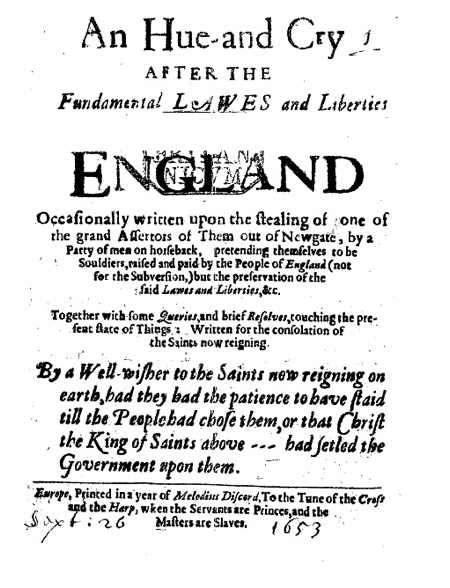
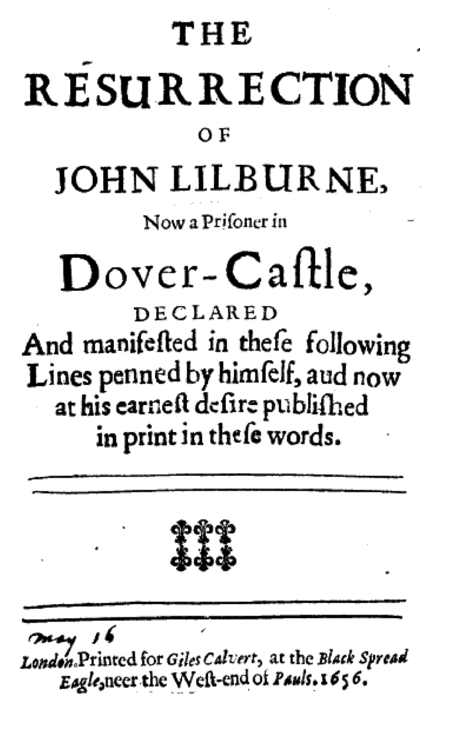
Chap. 26. Inquisition of Life and Member.

NOthing from hence shall be given for a [Editor: illegible word] of Inquisition, not taken of him that prayeth Inquisition of Life or Member, but it shall be granted freely, and not denyed, Stat. 3. Ed. 1. 11. Stat. 13. Ed. 1. 29. Regist. fo. 133. 134.

Chap. 28. Wager of Law shall not be without Witnesse.

Fitz. Ley 78. Bro. Ley 37. Co. inst. fo. 168. a.NO Bailife from henceforth shall put any man to his open Law, not to an oath, upon his own bare saying without faithfull witnesses brought in for the same.

[6]

Chap. 29. No man shall be condemned without tryall. Iustice shall not be sold or deferred.

10. Ed. 4. fo. 6. Dyer fo. 104. Cook li. 5. fo. 64. lib. 10. fol. 74. lib. 11. fo. 99, Regist. fo. 186. Col. pla. fo. 456.NO Freeman shall be taken or imprisoned, or be disseised of his freehold, or liberties, or free customes, or be outlawed, or exiled, or any otherwise distroyed, nor We will not passe upon him, nor condemne him, but by lawfull judgement of his PEERS, or by the law of the land. We will sell to no man, We will not deny or deferre to any man either justice or right. Stat. 2. Ed. 3, 8. Stat. 5. Ed. 3. 9. Stat. 14. Ed. 3, 14. 28. Ed. 3. 3. Stat. 11. R. 2. 10.

The 3. Edward the 1. fol. 25. There shall be no disturbance of free Election.

Cook li. 8. f. 38. 59.ANd because Elections ought to be free, the King commandeth upon, great forfeiture, that no man by force of Armes, nor by malice, or menacing shall disturbe any to make free Election St. 9. Ed. 2. 14.

The 3. of Edward the 1. Chap. 6. fol. 25. Amercement shall be reasonable and according to the offence.

Bro. Amerciamẽ: 6. 9. 11. 13. 20. 25. 27. 28. 31. 32. 35. 37. 39. 43. 44.ANd that no City, Borough, nor Town, nor any man be amerced without reasonable cause, and according to the quantity of his Trespasse, that is to say, every freeman, saving his freehold, a Merchant saving his Merchandise, a Villain saving his waynage and that by his or their PEERS. St. 9. H. 3, 14. V. N. B. fo. 47. Regist. fo. 187.

The 3. Edward the 1. Chap. 15. fol. 27. Which prisoners may be made mainpernable, and which not. The penalty for unlawfull bailement.

ANd forasmuch as Sheriffes, and other, which have taken and kept in prison persons detected of felony,Bro. Mainprise 11. 56. 78. and incontinent have let out by replevin, such as were not replevisable, and have kept in prison such as were replevisable, because they would gaine of the one party, and grieve the other: And forasmuch as before this time it was not determined, which persons were replevisable, and which not, but only those that were taken for the death of man, or by commandment of the King, or of his Iustices, or for the Forest: It is provided and by the King commanded,Dyer fo. 170. Fitz. Mainprise 1. 40. that such prisoners as before were outlawed, and they which have abiured the realm, provers and such as be taken with the maner, and those which have broken the Kings prison, theeves openly defamed and known,Bro. Mainprise 54, 57, 59, 60, 75, 78. and such as he appealed by provers, so long as the provers be living (if they be not of good name) and such as be taken for house burning feloniously done, or for false money,Cook li. 11. fo. 29. Fitz. Mainprise 39. or for counterfeiting the Kings seale, or persons excommunicate, taken at the request of the Bishop, or for manifest offences, or for treason touching the King himselfe, shall be in no wise replevisable by the common Writ, nor without writ. But such as be indicted of Larceny by Enquests taken before Sheriffes or Bailifes by their office, or of light suspition, or for petty Larceny, that amounteth not above the value of 12. pence, if they were not guilty of some other Larceny aforetime, or guilty of receit of felons, or of commandment or force,Bro. Main. 6. 9. 11. 19. 22. 30. 48. 50. 51, 53. 58, 63, 64. 73. 78, 91. 94. 97. or of aid of felony done, or guilty of some other trespasse, for which one ought not to lose life or member, and a man appealed by a prover after the death of the prover (if he be no common theefe nor defamed) shall from henceforth be let out by sufficient surety, wherof the Sheriffe will be answerable, and that without giving ought of their goods. And if the Sheriffe or any other, let any goe at large by surety that is not replevisable, if he be Sheriffe or Constable, or any other Baylife of fee, which hath keeping of [7] prisons, and therefore be attainted, he shall lose his fee and office for ever. And if the under Shereffe, Constable,V. N. B. fo. 40. or Baylife of such as have fee for keeping of prisons, doe it contrary to the will of his Lord, or any other Baylife being not of fee, they shall have three yeares imprisonment, and make fine at the Kings pleasure. And if any withhold prisoners replevisable, after that they have offered sufficient surety,V. N. B. fo. 41. he shall pay a grievous amerciament to the King. And if he take any reward for the deliverance of such, he shall pay double to the prisoner, and also shall be in the great mercy of the King, St. 27. E. 1. 3. St. 3. H. 7. 31, & 2. P. &. M. 13.Regist. fo. 83. 268.

The 3. of Edward 1. Chap. 26. fol. 30. None of the Kings Officers shall commit extortion.

Rast. pla. fo. 317.ANd that no Sheriffe nor other the Kings Officer, take any reward to doe his office, but shall be paid of that which they take of the King, and he that so doth, shall yeeld twice as much, and shall be punished at the Kings pleasure. St. 23. H. 6. 10. 4. H. 3. 10. Cook Inst. 308. b.

The 25, of Edward the 1. Chap. 2. 3. 4. fol. 75, 76. Iudgement given against the said Charter, shall be void.

ANd we will that if any judgement be given from henceforth contrary to the points of the Charters aforesaid by the Iustices, or by any other our Ministers that hold Plea before them against the points of the Charters, it shall be undone and holden for nought.

Chap. 3. The said Charters shall be read in Cathedrall Churches twice in the yeare.

ANd we will that the same Charters shall be sent under our Seale to Cathedrall Churchers throughout our Ralme, there to remain, and shall be read before the people two times by the yeare. 28. Ed. 3. 1.

Chap. 4. Excommunication shall be pronounced against the breakers of the said charters.

ANd that all Arch Bishops and bishops, shall pronounce the sentence of Excommunication against all those that by word, deed, or councell, doe contrary to the foresaid Charters, or that in any point break or undoe them, And that the said curses be twice a yeare denounced and published by the Prelates aforesaid. And if the same Prelates or any of them be remisse in the denunciation of the said sentences, the Arch Bishops of Canterbury and Yorke for the time being, shall compell and distrain them to the execution of their dutyes in forme aforesaid.

The 28. of Edward the 1. Chap. 1. fol. 80. A confirmation of the great Charter, and the Charter of the Forest.

THat is to say, That from henceforth the great Charter of the Liberties of England granted to all the Commonalty of the Realme, and the Charter of the Forest in like manner granted, shall be observed, kept, and maintained in every point, in as ample wise as the King hath granted, renewed, and confirmed them by his Charters. And that the Charters be delivered to every Sheriffe of England, under the Kings Seale, to be read foure times in the yeare before the people in the full County that is to wit, the next County day after the Feast of St. Michael, and the next County day after Christmas, and at the next County after Easter, and at the next County after the Feast of St. Iohn. And for these two Charters to be firmely observed in every point and article (where before no remedy [21] was at the Common Law) there shall be chosen in every Shire Court by the Commonalty of the same Shire, three substantiall Men, Knights, or other lawfull, wise, and well disposed persons which shall be Iustices sworne and assigned by the Kings Letters Patents under the great Seale, to heare and determine (without any other Writ, but only their Commission) such Plaints as shall be made upon all those that commit or offend against any Point contained in the foresaid Charters, in the Shires where they be assigned, as well within Franchises as without: And as well for the Kings Officers out of their places, as for other: and to heare the Plaints from day to day without any delay, and to determine them, without allowing the delayes which be allowed by the Common Law. And the same [8] Knights shall have power to punish all such as shall be attainted of any Trespasse done, contrary to any point of the foresaid Charters (where no remedy was before by the Common Law) as before is said, by Jmprisonment, or by ransome, or by Amerciament, according to the Trespasse, &c.

The 28, of Edward the 1. Chap. 8. fol. 83. The Inhabitants of every County shall make choise of their Sheriffes being not of Fee.

Stat. 9. E. 2. Stat. 14. E. 3. 7. 28. Ed. 1. 1. THe King hath granted unto his people, that they shall have election of their Sheriffes in every Shire (where the Shrivalty is not of fee) if they list. Chap. 13.

The 28. of Edward the 1. Chap. 13. fol. 83. What sort of persons the Commons of Shires shall chuse for their Sheriffes.

ANd for as much as the King hath granted the election of Sheriffes to the Commons of the Shire, the King will that they shall chuse such Sheriffes, that shall not charge them, and that they shall not put any Officer in authority for rewards or bribes. And such as shall not lodge too oft in one place, nor with poore persons or men of religion. St. 9. E. 2. The Statute of Sherifes.

The 34. Edward the 1. Chap. 4. fol. 91. All Lawes, Liberties, and Customes confirmed.

WE will and grant for us and our heires, that all Clerkes and lay men of our land, shall have their lawes, liberties, and, free Customes as largely and wholly, as they have used to have the same, at any time when they had them best. And if any Statutes have been made by us or our ancestors, or any customes brought in contrary to them, or any manner article contained in this present Charter: we will and grant that such manner of statutes and customes shall be void and frustrate for evermore.

The 34. of Edward the 3. Chap. 6. fol. 92. The curse of the Church shall be pronounced against the breakers of this Charter.

ANd for the more assurance of this thing we will and grant that all Arch Bishops and Bishops for ever, shall read this present Charter in their Cathedrall Churches twice in the year, and upon the reading hereof in every of their Parish Churches shall openly denounce accursed all those that willingly doe procure to be done any thing contrary to the tenour, force and effect of this present Charter in any point and article. In witnesse of which thing we have set our Seale to this present Charter, together with the Seales of the Arch Bishops. Bishops, &c. which voluntarily have sworn, that as much as in them is, they shall observe the tenour of this present Charter in all causes and articles, and shall extend their faithfull aid to the keeping thereof, &c.

The 1. of Edward the 3. Chap. 5. fol. 115. None shall be compelled to goe to war out of the Shire where he dwelleth: But &c.

ITem, the King will that no man from henceforth shall be charged to arme himself, otherwise then he was wont in the time of his progenitors Kings of England. And that no man be compelled to goe out of his shire, but where necessity requireth, and suddain comming of strange enemies into the Realme. And then it shall be done as hath been used in times past for the defence of the Realme. St. 15. Ed. 3. 7. St. 4. H. 4. 13. 25. Ed. 3. 8.

The 2. Edward the 3. Chap. 8. fol. 118. No commandement under the Kings seale, shall disturb or delay justice.

Item, it is accorded and established, that it shall not be commanded by the great Seale nor the little Seale, to disturb or delay common right: and that though such commandements do come, the Iustices shall not therefore leave to doe right in any point. St. 9. H. 3. 29. St. 5. Ed. 3. 9. St. 14. Ed. 3. 14.

[9]

The 4. of Edward the 3. Chap. 8. fol. 120. The authority of Justices of Assise, Gaole delivery; and of the peace.

33. Ed. 1. 30. 20. Ed. 3. 6. Fitz. N. S. fo. 251. 1. Ed. 3. 16. 18. Ed. 3. 2. 34. Ed. 3. 1. 13. R. 2. 7. ITem, it is ordained, that good and discreet persons, other then of the places, if they may be found sufficient, shall be assigned in all the Shires of England to take Assises, Iuries, and certifications, and deliver the Gaoles. And that the said Iustices shall take the Assises, Iuries, and certifications; and deliver the Gaols at the least three times a year, and more often if need be. Also there shal be assigned good and lawfull men in every County to keep the peace. And at the time, of the assignments, [Editor: illegible word] shall be made, that such as shall be indicted or taken by the said keepers of the Peace, shall not be let to mainprise by the Sheriffes nor by none other ministers, if they be not mainpernable by the Law. Not that such as shall be indicted, shall not be delivered but at the Common Law. And the Iustices assigned to deliver the Gaoles, shall have power to deliver the same Gaoles of those, that: shall be indicted before the keepers of the peace. And that the said keepers shall send their indictments before the Iustices, and they shall have power to inquire of Sheriffes, Gaolers, and other, in whose ward such indicted persons shall be, if they make deliverance or let to mainprise any so indicted, which be not mainpernable, and to punish the said Sheriffes, Gaolers, and others if they doe any thing against this Act.

The 4. of Ed. 3. Ch. 10. fol. 122. Sheriffes & Gaolers shal receive offenders without any thing taking.

ITem, whereas in times past Sheriffes and gaolers of Gaoles, would not receive theeves, persons appealed, indicted, or found with the maner, taken and attached by the Constables, and townships, without taking great fines and ransomes of them for their receit, whereby the said Constables and Townships have been unwilling to take theeves and felons, because of such extream charges, and the theeves and the felons the more incouraged to offend: It is inacted that the Sheriffes and Gaolers shall receive and safety keep in prison from henceforth such theeves and felons, 3. E. 1. 26. 11. Ed. 4. fol. 4. 32. H. 6. 10. by the delivery of the Constables and townships, without taking any thing for the receipt. And the Iustices assigned to deliver the Gaole, shall have power to heare their complaints that will complain upon the Sheriffes and Gaolers in such case, and moreover to punish the Sheriffes and Gaolers of they be found guilty.

The 4. of Edward the 3. Chap. 14. fol. 122. A Parliament shall be holden once every yeare.

ITem, it is accorded, that a Parliament shall be holden every yeare once, and more often if need be Stat. 36. Ed. 3. 10.

The 14. of Edward the 3. Chap. 5. fol. 133. Delayes of iudgement in other Courts shall be redressed in Parliament.

ITem, because divers mischiefes have hapned, for that in divers places, as well as in the Chancery as in the Kings Bench, the common Bench, and in the Eschequer before the Iustices assigned, and other Iustices to heare and determine deputed, the judgements have been delayed, sometime by difficulty, and sometime by divers opinions of the Iudges, and sometime for some other cause: It is assented, established, and accorded, that from henceforth at every Parliament shall be chosen a Prelate, two Earles, and two Barons, which shall have commission and power of the King, 2. H. 7. fo. 19 & 22. Ed. 3. fo. 3. to heare by petition delivered to them, the complaints of all those, that will complain them of such delayes or grievances done to them, and they shall have power to cause to come before them at Westminster, or else where the places of any of them shall be, the tenor of records and processes of such judgements so delayed, and to cause the same Iustices to come before them, which shall be then present to heare their cause and reasons of such delayes. Which cause and reason so heard, by good advice of themselves, the Chancellor, Treasurer, the Iustices of the one Bench and of the other, and other of the [10] Kings Councell as many, and such as they shall thinke convenient, shall proceed to take a good accord, and make a good judgement. And according to the same accord so taken, the tenor of the said record, together with the judgement which shall be accorded, shall be remanded before the Iustices, before whom the plea did depend. And that they hastily goe to give judgement according to the same record. And in case it seemeth to them, that the difficultie be so great, that it may not well be determined, with our assent of the Parliament, that the said tenor or tenors shall be brought by the said Prelates, Earles, and Barons unto the next Parliament, and there shall be a finall accord taken, what judgement ought to be given in this case. And according to this accord, it shall be commanded to the Iudges, before whom the plea did depend, that they shall proceed to give judgement without delay. And to begin to doe remedy upon this ordinance: It is assented, that a commission and power shall be granted to the Arch-Bishop of Canterbury, the Earles of Arundell, and Huntington, the Lord of Wake, and the Lord Ralfe Basset, to endure till the next Parliament. And though the ministers have made an oath before this time, yet neverthelesse to remember them of the same oath: It is assented, that as well the chancellor, treasurer, keeper of the privieseale, the Iustices of the one Bench and of the other, the Chancellor, Barons of the Eschequer, as the Iustices assigned, and all they that doe meddle in the said places under them, by the advice of the same Arch-Bishop, Earles, and Barons, shall make an oath well and lawfully to serve the King and his people. And by the advice of said Prelate, Earls and Barons, be it ordained to increase the number of Ministers when need shal be, & them to diminish in the same manner. And so from time to time when officers shal be newly put in the said offices, they shal be sworn in the same maner, St. 27. El. 8 Regist. fo. 17. Rast. Pla. fo. 30.1.

The Oaths of the Iustices, being made Anno, 18. Ed. 3. & Anno Domini 1344. fol. 144.

YE shall sweare, that well and lawfully ye shall serve our Lord the King, and his people in the office of Iustice, and that lawfully ye shall councell the King in his businesse, and that ye shall not councell, nor assent to anything, which may turne him in damage or disherison by any maner, way, or colour. And that ye shall not know the damage or disherison of him, whereof ye shall not cause him to be warned by your selfe, or by other, and that ye shal doe equall Law, and execution of right to all his subjects, rich or poore, without having regard to any person. And that ye take not by your self or by other prively nor apartly, gift nor reward of gold nor silver, nor of any other thing which may turne to your profit, unlesse it be meat or drinke, and that of small value of any man that shall have any plea or processe hanging before you, as long as the same processe shall so be hanging, nor after for the same cause. And that ye take no fee, as long as ye shall be Iustice, nor robes of any man great or small, but of the King himself. And that ye give none advice nor councell to no man great nor small, in no case where the King is party. And in case that any of what estate or condition they be, come before you in your sessions with force and armes, or otherwise against the peace, or against the forme of the Statute thereof made, to disturb execution of the common law, or to menace the people,2, Ed. 3. 3. that they may not pursue the Law, that yee shall cause their bodies to be arrested and put in prison. And in case that be such, that yee cannot arrest them, that ye certifie the King of their names, and of their misprision hastily, so that he may therof ordain a convenable remedy. And that ye by your selfe nor by other, privily nor apertly, maintain any plea or quarrell hanging in the Kings Court, or elsewhere in the country. And that ye deny to no man common right, by the Kings letters, nor none other mans, not for none other cause, and in case any letters come to you, contrary to the law, that ye doe nothing by such letters, but certifie the King thereof, and proceed to execute the law, notwithstanding the same letters. And that yee shall doe and procure the profit of the King, and of his Crown, with all things where ye may reasonably doe the same. And in case ye be from henceforth found in default in any of the points aforesaid, ye shall be at the Kings will of body, land and goods, thereof to be done as shall please him, as God you help and all Saints.

[11]

The 10. of Edward the 3. Chap. 1. fol. 143. The Iustices of both Benches, Assise, &c. shall doe right to all men, take no fee but of the King, nor give councell where the King is party.

FIrst, we have commanded all our Iustices, that they shall from henceforth doe equall Law and execution of right to all our subjects rich and poore, without having regard to any person, and without omitting to doe right for any letters or commandement, which may come to them from us, or from any other, or by any other cause. And if that any letters, writs, or commandements come to the Iustices, or to other deputed to doe law and right, according to the Usage of the Realm, in disturbance of the Law, or of the execution of the same, or of right to the parties, the Iustices and other aforesaid shall proceed and hold their Courts and processes where the pleas and matters be depending before them, as if no such Letters, Writs, or Commandements were come to them: And they shall certifie us and our Councell of such Commandements, which be contrary to the Law, as afore is said. And to the intent that our Iustices should doe even right to all people, in the manner aforesaid, without more favour shewing to one then to another, we have ordained and caused our said justices to be sworne, that they shall not from henceforth, as long as they shall be in office of Justice take fee nor robe of any man, but of our self, and that they shall take no gift nor reward by themselves, nor by other privily nor apertly of any man, that hath to doe before them by any way, except meat and drink, and that of small value, and that they shall give no councell to great men or small, in case where we be party, or which doe or may touch us in any point, upon pain to be at our will, body, Lands, and goods, to doe thereof as shall please us, in case they doe contrary. And for this cause we have increased the fees of the same our Iustices, in such manner as it ought reasonably to suffice them, St. 2. Ed. 3. 8. St. <11 class=""> R. 2. 10. Regist fo. 186.

The 25 of Edward the 3. Chap. 8. fol. 155. None shall be bound to find men of armes, but by tenure or grant by Parliament.

ITem, it is accorded and assented, that no man shall be constrained to find men of Armes, hoblers nor Archers, other then those which hold by such services, if it be not by common assent and grant made in Parliament, St. 1. Ed. 3. 5. St. 4. H. 4. 13.

The 28. of Edward the 3. Chap. 7. fol. 178. No Sheriffe shall continue in his office above one yeare.

ITem, it is ordained and established, that the Sheriffe of the Counties shall be removed every yeare out of their offices,a. H. 7. fol. 5. so that no Sheriffe that hath been in his office by a yeare, shall abide in the same office the year next following. And that no Commission be made to him thereof, or renued for the same yeare following. St. 14. 8. 3. 7. 32. Ed. 3. 9. 23. H. 6. 8. Rast. pl. fo. 202.

The 34. of Edward the 3. Chap. 4. fol. 180 What sort of people shall be returned upon every Iury.

ITem, because that Sheriffes and other ministers often doe array their panels in maner of Inquests of people procured and most far off from the Counties, which have no knowledge of the deed whereof the Inquest shall be taken, it is accorded that such panels shall be made of the next people, which shall not be suspect nor procured. And that the Sheriffes, Coroners, and other ministers, which doe against the same, shall be punished before the Iustices that take the said Inquest, according to the quantity of their Trespasse, as well against the King as against the party, for the quantity of the damage which he hath suffered in such maner. St. 31. B. 1. St. 28. E. 1. 9. 20. Ed. 3. 6. 42. Ed. 3. 11. Regist. fo. 178. Regist. pla. fo. 117.

[12]

The 36. of Edward the 3. chap. 10. fol. 186. A Parliament shall be holden once in a yeare.

Item, for the maintenance of the said Articles and Statutes and redresse of divers mischiefs and grievances which dayly happen, Parliament shall be holden every yeare, as an other time was ordained by a Statute. St. 4. Ed. 3. 14.

The 36. of Edward the 3. chap. 15. fol. 187. Pleas shall be pleaded in the English tongue and inrolled in Latine.

ITem, because it is often shewed to the King, by the Prelats, Dukes, Earles, Barons, and all the Comminalty, of the great mischiefes which have happened to divers of the Realme, because the Lawes, Customs, and Statutes of this Realme, be not commonly holden and kept in the same Realm for that they be pleaded, shewed & judged in the French tongue, which is much unknown in the said realm, so that the people which do implead or be impleaded in the Kings Court, and in the Courts of other have no knowledge nor understanding, of that which is said, for them or against them by their Serjeants & other Pleaders: And that reasonably the said Lawes and Customes the rather shal be perceived and known & better understood in the tongue used in the said Realm, & by so much every man of the said Realm may the better govern himself without offending of the Law, and the better keepe, save, & defend his heritage and possessions: and in divers regions and countryes, where the King, the Nobles, and other of the said Realm have been, good governance and full right is done to every person, because that their Lawes and Customes be learned and used in the tongue of the Country: The King desiring the good governance and tranquility of his people and to put out and eschew the harmes and mischiefs which do or may happen in this behalf, by the occasions aforesaid hath ordained, and established, by the assent aforesaid, that all Pleas which shall be pleaded in any Courts whatsoever before any of his Iustices whatsoever, or in his other places, or before any of his other minister whatsoever, or in the Courts and places of any other Lords whatsoever, within the Realme, shall be pleaded, shewed, defended, answered, debated, and iudged, in the English tongue, and that they be entred and inrolled in Latine. 46 Ed. 3. fo. 21. Dyer fo. 2. 99. Cooke li. 8. fo. 163. li. 10. fo. 132. Co. inst. 304. And that the Lawes and Customes of the same Realme, Termes and Processes be holden and kept, as they be and have been before this time, and that by the ancient tearmes and formes of Pleaders, no man be prejudiced, so that the matter of the action be fully shewed in the Declaration and in the Writ. And it is accorded by the assent aforesaid, that this ordinance & Statue of pleading, begin and hold place at the fifteenth of St. Hillary next coming.

The 37. of Edward the 3. chap. 18. fol. 190. The order of persuing a Suggestion made to the King.

ITem, though it be contained in the great Charter, that no man be taken or imprisoned, nor put out of his freehold, without processe of the Law, never the lesse divers people make false suggestion to the King himselfe as wel for malice as otherwise, whereof the King is often grieved,St. 9. H. 3. 29. and divers of the Realm put in damage, against the forme of the same Charter: Wherefore it is ordained, that all they which make such Suggestions shall be sent with the same suggestions, before the Chancellor, Treasures and his grand Counsell, St. 38. Ed. 3. 9. and that they there finde surety to pursue their suggestions, and incurre the same paine that the other should have had if he were attainted, in case that his Suggestion be found evill. And that then processe of the Law be made aganst them without being taken and imprisoned against the form of the said Charter and other Statutes. St. 25. Edward. 3. 4. 42. Ed. 3. 3.

The 42. of Edward the 3. Chap. 1. fo. 93. A confirmation of the great Charter, and the Charter of the Forest: And a repeale of those Statutes that be made to the contrary.

AT the Parliament of our Lord the King, holden at Westminster the first day of May, the two and fortieth yeare of his reigne: It is assented and accorded, That the great Charter, and the [13] Charter of the Forest be holden and kept in all points, and if any Statute be made to the contrary, that shall be holden for none.

The 8. of Richard the 2. Chap. 2. fol. 217. No man of Law shall be a Iustice of Assise, or Gaole delivery in his own Country.

ITem, it is ordained and assented, That no man of Law shall be from henceforth Iustice of Assises, or of common deliverance Gaoles in his own Country. And that the chiefe Iustice of the common Bench be assigned amongst other to take such Assises, and deliver gaoles, but as to the chiefe Iustice of the Kings Bench it shall be, as for the most part of an hundred yeares last past was wont to be done, St. 13. H. 4. 2. 33. H. 8. 24.

The 8. of Richard the 2. Chap. 4. fol. 218. The penaltie if a Iudge or Clerke make any false Entry, rase a Roll, or change a verdict.

ITem, at the complaint of the said Communalty made to our Lord the King in the Parliament, for that great disherison in times past was done of the people, and may be done by the false entring of pleas, rasing of Rolles, and changing of verdicts: It is accorded and assented, that if any Iudge or Clerke be of such default (so that by the same default there ensueth disherison of any of the parties,) sufficiently convict before the King and his Councell by the manner and forme, which to the same our Lord the King and his Councell shall seem reasonable, and within two yeares after such default made, if the partie grieved be of full age, and if he be within age, then within two years after that he shal come to his ful age, he shall be punished by fine and ransome at the Kings wit, and satisfie the party. And as to the restitution of the inheritance desired by the said Commons, the party grieved shall sue by Writ or otherwise according to the Law, if hee see it expedient for him. St. 8. H. 6. 82.

The 12. of Richard the 2. Chap. 80. fol. 323. How many Iustices of peace there shall be in every County: and how often they shall keep their Sessions.

ITem, it is ordained and agreed, that in every Commission of the Iustices of Peace, there shall be assigned but six Iustices, with the Iustices of Assises, and that the said six Iustices shall keep their Sessions in every quarter of the yeare at the least, and by three dayes if need be, upon pain to be punished according to the discretion of the Kings Councell, at the suit of every man that will complain: And they shall inquire diligently among other things touching their offices, if the said Majors, Bailifes, Stewards, Constables and Gaolers have duly done execution of the said Ordinances of servants and labourers, beggars and vagabonds, and shall punish them that be punishable by the said paine of an hundred shillings, by the same paine, and they that be found in default, and which be not punishable by the same pain, shall be punished by their discretion. And every of the said Iustices shall take for their wages foure shillings [22] the day, for the time of their foresaid Sessions and their Clerke two shillings of the fines and amerciaments, rising and comming of the same Sessions, by the hands of the Sheriffes. And that the Lords of franchises, shall be contributary to the said wages, after the rate of their part of fines and amerciaments aforesaid. And that no Steward of any Lord be assigned, in any of the said Commissions. And that no association shall be made to the Iustices of the peace after their first Commission. And it is not the intent of this Statute, that the Iustices of the one Bench, or of the other, nor the Serjeants of the Law, in case that they shall be named in the said Commissions, shall be bound by force of this Statute, to hold the said Sessions foure times in the yeare, as the other Commissioners, the which be continually dwelling in the Country, but that they shall doe it, when they may best attend it.

[14]

The 13. of Richard the 2. Chap. 6. fol. 225. How many Serieants at Armes there shall be, and with what things they shall meddle.

ITem, at the grievous complaint made by the Commons to our Lord the King in this Parliament, of the excessive and superfluous number of Serjeants at Armes, and of many great extortions and oppressions done by them to the people: The King therefore doth will that they shall be discharged, and that of them and other there shall be taken of good and sufficient persons to the number of thirty, and no more from henceforth. And more over the King prohibiteth them to meddle with any thing that toucheth not their office. And that they doe no extortion nor oppression to the people, upon pain to loose their office, and to make a fine and ransome at the Kings pleasure, and full satisfaction to the party.

The 20. of Richard the 2. Chap. 3. folio 243. No manshall sit upon the Bench with the Iustices of Assise.

ITem, the King doth will and forbid, that no Lord, nor other of the Country, little or great, shall sit upon the Bench, with the Iustices, to take Assises in their Sessions in the Counties of England, upon great forfeiture to the King: and hath charged his said Iustices, that they shall not suffer the the contrary to be done.

The 2. of Henry the 4. Chap. 23. fol. 253. The fees of the Marshall of the Marshallsey of the Kings house.

ITem, whereas the Marshall of the Marshallsey of the Court of our Lord the Kings house, in the time of King Edward, grandfather of our Lord the King that now is, and before was wont to take the fees, which doe hereafter follow, that is to say, of every person that commeth by Capias to the said Court, foure pence: and if he be let to mainprise till his day, two pence more: and of every person which is impleaded of trespasse, and findeth two mainpernors to keep his day, till the end of the plea, to take for that cause two pence of the defendant: and of every person committed to prison by judgement of the Steward, in whatsoever manner the same be, foure pence: of every person delivered of felony, and of every felon let to mainprise by the Court foure pence: which fees were wont to be taken and paid in full Court, as the King hath well perceived by the complaint of the said Commons thereof made in the said Parliament: The same our Lord the King, to avoid all such wrongs and oppressions to be done to his people, against the good customes and usages made and used in the time of his progenitors, by the advice & assent of the Lords Spiritual & Temporal, & at the supplication of the said Commons hath ordained and established, that if the said Marshall or his Officers, under him, take other fees then above are declared, that the same Marshall and every of his Officers, shall loose their Offices, and pay treble damages to the party greeved, and that the party greeved have his suit before the Stewards of the said Court for the time being.

Also it is ordained and established, that no Servitor of Bills that beareth a staffe of the same Court, shall take for every mile from the same Court to the same place, where he shall do his service any more then one penny, and so for 12. miles twelve pence, and for to serve a Venire facias 12. homines, &c. or a Distringes out of the same Court, the double. And if any of the said Servitors of Bills doe the contrary, he shall be punished by imprisonment, and make a fine to the King after the discretion of the Stewards of the same Court, and also be forejudged the Court, and the same Steward shall have power to make proclamation at his comming to the said Court, in every Country from time to time of all the articles aforesaid, and thereof to execute punishment as afore is said. 9. R. 2 9.

The 4 of Henry the 4 Chap. 23. fol. 259. Iudgements given shall continue untill they shall be reversed by attaint or error.

ITem, where as well in plea reall as in plea personall after judgement given in the Courts of our Lord the King, the parties be made to come upon grievous pain, sometime before the King himself, sometime before the Kings Councell, and sometimes to the Parliament, to answer therof of new, [15] to the great impoverishing of the parties aforesaid, and in the subverson of the Common law of the land:19. H. 6 fo. 39. Dyer fo. 315. 321. 376. it is ordained and established, that after judgement given in the Court of our Lord the King, the parties and their heires shall be thereof in peace, untill the judgement be undone by attaint or by error, if there be errors, as hath been used by the Law as in the time of the Kings progenitors.

The 5. of Henry the 4. Chap. 5. fol. 261. It shall be felony to cut out the tongue, or pull out the eyes of the Kings liege people.

ITem, because that many offenders doe daily beat, wound, imprison, and maime divers of the Kings liege people, and after purposely cut their tongues, or put out their eyes. It is ordained and stablished, that in such case the offenders that so cutteth tongues, or puts out the eyes of any the Kings liege people, and that duly proved, and found, that such deed was done of malice prepensed, they shall incur the pain of felony.

The 5. of Henry the 4. Chap. 10. fol. 263. Iustices of peace shall imprison none but in the Common Gaole.

ITem, because that divers Constables of Castles, within the Realme of England be assigned to be Iustices of Peace, by Commission of our Lord the King, and by colour of the said commissions they take people to whom they beare evill will,Cook li. 9. fo. 119. and imprison them within the said Castles, till they have made fine and ransome with the said Constables for their deliverance: It is ordained and established, that none be imprisoned by any Iustice of the Peace, but only in the common Gaole: Saving to Lords and other (which have Gaoles) their franchise in this case.

Now comes in some Statutes of palpable Bondage, about chusing Parliament men, &c. The first I shall give you is the 1. of Henry the 5. Chap. 1. fol. 274. What sort of people shall be chosen, and who shall be the choosers of the Knights and Burgesses of the Parliament.

FIrst, that the Statuts of the election of the Knights of the Shirs to come to the Parliament be holden and kept in all points: adioyning to the same, that the Knights of the Shires, which from henceforth shall be chosen in every Shire, be not chosen unlesse they be resident within the Shire where they shall be chosen,Rast. pl. fo. 446. the day of the date of the Writ of the summons of the Parliament. And that the Knights and Esquires and other which shall be choosers of those Knights of the Shires be also within the same Shires in manner and forme as is aforesaid. And moreover, it is ordained and established, that the Citizens and Burgesses of the Cities and Boroughs be chosen men, Citizens and Burgesses residant, dwelling and free of the same cities and boroughs, and no other in any wise. 7. H. 4. 15. 8, H. 6. 7. 10. H. 6. 2. 23. H. 6. 15.

The 2. of Henry 5. Chap. 1. and 3. fol. 282. What sort of men shall be Iustices of the Peace.

FIrst, that the Iustices of the peace from henceforth to be made within the Counties of England, shall be made of most sufficient persons dwelling in the same counties, by the advice of the Chancellor and of the Kings Councell, without taking other persons dwelling in forain Counties to execute such office,1. Ed. 3. 16. 34. Ed. 3. 1. except the Lords and Iustices of Assises now named, and to be named by the King and his Councell. And except all the Kings chiefe Stewards of the Land and Seigniories of the Duchie of Lancaster, in the North parts and in the South, for the time being. 13. R. 2. 7.

[16]

Chap. 3. Of what estate those Iurors must be, which are to passe touching the life of man, plea reall, to forty markes damages.

ITem, the King considering the great mischiefes and disherisons, which daily happen through all the realm of England, as well in case of death of a man, as in case of freehold, and in other cases by them which passe in enquests in the said cases, which be common Iurors and other, that have but little to live upon, but by such inquests,2. H. 7. fo. 13. 10. H. 7. fo. 14. 9. H. 5. fo. 5. 10. H. 6. fo. 7. 8. 18. 7. H. 6. fo. 44. Dyer fo. 144 Cook Inst. part 1. 171. a. Rast. pl. fo. 117. and which have nothing to loose, because of their false oaths, whereby they offend their conscience the more largely: and willing thereof to have correction and amendment, hath ordained and established by assent of the Lords and Commons aforesaid, that no person shall be admitted to passe in any enquest upon tryall of the death of a man, nor in any enquest betwixt party and party, in plea reall, nor in plea personall, whereof the debt or the damage declared, amount to forty marks, if the same person have not Land, or Tenements of the yearly value of forty shillings, above all charges of the same, so that it be challenged by the party, that any such person so impanelled in the same cases, hath not Lands or tenements of the yearly value of forty shillings above the charges as afore is said. 28 Ed. 3. 13 8. H. 6. 29.

The 8. of Henry the 6. Chap. 7. fol. 304. What sort of men shall be choosers, and who shall be chosen Knights of the Parliament.

ITem, Whereas the election of Knights of Shires, to come to the Parliament of our Lord the King, in many Counties of the Realm of England, have now of late been made by very great outragious and excessive number of people, dwelling within the same Counties of the Realm of England, of the which most part was of people of small substance, [23] and of no value, whereof every of them pretended a voice equivalent,1. H. 9. 1. 10. H. 6. as to such elections to be made, with the most worthy Knights and Esquires dwelling within the same Counties, whereby manslaughters, riots, batteries, and divisions among the Gentlemen, and other peoples of the same Counties shall very likely rise and be, unlesse convenient and due remedy be provided in this behalf:2. 6. H. 6. 4. 11. H. 4. 2. 23. H. 6. 15. Raft. pl. fo. 440. Our Lord the King considering the premisses, hath provided, ordained, and established by authority of this present Parliament, that the Knights of the Shires to be chosen within the same Realm of England, to come to the Parliaments of our Lord the King, hereafter to be holden, shall be chosen in every County of the Realm of England, by people dwelling and resident in the same Counties, whereof every one of them shall have land or tenement, to the value of forty shillings by the year at least, above all charges, and that they which shall be so chosen shall be dwelling, and resident within the same Counties. And such as have the greatest number of them, that may EXPEND FORTY SHILLINGS by yeare, and above, as afore is said, shall be returned by the Sheriffes of every County Knights for Parliament, by Indentures sealed betwixt the said Sheriffes, and the said choosers so to be made. And every Sheriffe of the Realm of England shall have power by the said authority to examine upon the Evangelistes every such chooser, how much he may expend by the yeare: And if any Sheriffes return Knights, to come to the Parliament contrary to the said Ordinance the Iustices of Assises in their Seasions of Assises shall have power by the authority aforesaid, thereof to enquire. And if by enquest the same be found before the Iustices, and the Sheriffes there of be duly attainted that then the said Sheriffes shall imncurt the pain of an hundred pound, to be paid to our Lord the King, and also that he have imprisonment by a yeare, without being let to mainprise or baile, And that the Knights for the Parliament returned contrary to the said Ordinance, shall loose their wages. 10. H. 6. 2.

[17]

Provided alwayes, that he which cannot expend forty shillings by yeare, as afore is said, shall in no wise be chooser of the Knights for the Parliament. And that in every writ that shall hereafter goe forth to the Sheriffes, to choose Knights for the Parliament, mention be made of the said Ordinances.

The 18. of Henry the 6. Chap. 11. fol. 332. Of what yearely value in lands a Iustice of Peace ought to be.

ITem, whereas by Statutes made in the time of the Kings noble Progenitors, it was ordained,1. Ed. 3. 16 18. Ed. 3. 2. 13. R. 2. 7. 17. R. 2. 10. that in every County of England, Justices should be assigned of the most worthy of the same counties, to keep the peace, and to doe other things, as in the same Statutes fully is contained, which Statutes notwithstanding, now of late in many Counties of England the greatest number have been deputed and assigned, which before this were not wont to be, where of some be of small behaviour, by whom the people will not be governed nor ruled, and some for their necessity doe great extortion and oppression upon the people, whereof great inconveniences be likely to rise daily, if the King therefore does not provide remedy; The King willing against such inconveniences to provide remedy, hath ordained and established by authority aforesaid, That no Iustice of peace within the Realm of England in any County, shall be assigned or deputed, if he have not lands or tenements to the value of 20. l. by yeare: and if any be ordained hereafter to be Iustices of peace in any County, which hath not lands or tenements to the value aforesaid, that he there of shall give knowledge to the Chancellor of England for the time being, which shall put another sufficient in his place, and and if he give not the said knowledge (as before) within a moneth after, that he hath notice of such Commissions, or if he sit or make any warrant or precept by force of such Commissions, he shall incur the penalty of 20. l. and neverthelesse be put out of the Commission as before, and the King shall have the one half of the said penalty, and he that will sue for the King the other half, and he that will sue for the King, and for himself, shall have an action to demand the same penalty by writ of debt at the common Law.

Provided alwayes, that this Ordinance shall not extend to Cities, Towns, or Boroughs, which be Counties incorporate of themselves, nor to cities, towns, or boroughs, which have Iustices of peace of persons dwelling in the same by commission or warrant of the King, or of his progenitors. Provided also, that if there be not sufficient persons having lands & tenements to the value aforesaid, learned in the Law, and of good governance within any such County, that the Chancellor of England for the time being, shall have power to put other discreet persons learned in the Law, in such Commissions, though they have not lands or tenements to the value aforesaid, by his discretion. 27. H. 8. chap. 24.

The 20. of Henry the 6. Chap. 8. fol. 336. In what case the Kings Purveyors that would take Cattell, may be resisted.

ITem, it is ordained by the authority aforesaid, that the Statutes before this time made of Purveyors and buyers, shall be holden and kept, and put in due execution. And in case that any purveyor, buyer, or taker, will take and make purveyance, or buy any thing to the value of forty shillings,28. Ed. 3. 12. or under of any person, and make not ready payment in hand, that then it shall be lawfull to every of the Kings liege people to retain their goods and cattels, and to resist such purveyors and buyers, and in no wise suffer them to make any such purveyances, buyings, or takings: And to keep the peace better, every constable, tithingman, or chief pledge of every town or hamlet, where such takings or purveyances shall be made, shall be helping or assistant to the owner, or seller of such things, to be taken [18] against the forme of this Ordinance, to make resistance in the manner aforesaid, in case that such constables, tithingmen, or chiefe pledges be required so to doe, upon pain to yeeld to the party so grieved the value of the things so taken with his double damages: and that none of the Kings liege people be put to losse or damage by the King or any officer for such resistance. And that none of the Kings officers shall cause to be arrested, vexed, or impleaded in the Court of the Marshalsey or elsewhere, any of the Kings liege people for such detaining, or not suffering to be done, upon paine to loose 20. l. the one moity thereof to the King, and the other moity to him which will in such case sue: and that the Iustices of peace in every County, shall have power by authority of this Ordinance, to inquire, hear, and determine as well at the suit of the King, as of him that will sue, of any thing done against this Ordinance, and thereof to make due punishment, and execution, and to award damages to the party plaintife, when any defendant is thereof duly convict, and that upon every action to be taken upon this Ordinance, every party defendant shall be put to answer unto it without the aid of the King, and in such actions to be taken, processe shall be made as in a writ of trespasse, done against the peace, and that in every Commission of Purveyors, buyers, or takers to be made, this Ordinance shall be contained and expressed. And moreover that this Ordinance among other Statutes of purveyors, buyers, or takers before this time made,2. H. 6. 2. 36. E. 3. 6. shall be sent to the Sherifes of every County of England to proclaim and deliver the said Statutes, and Ordinances in the manner and forme contained in the Statute of purveyors and buyers, made the first year of the reign of our said Lord the King, upon the paine contained in the Statute. And moreover the King will and commandeth, that the Statute made the 36. year of King Edward, late King of England, the third after the conquest, touching the purveyors of other persons then of the King, shall be put in due execution. 2. H. 4. 14.

The 23. of Henry the 6. Chap. 10. fol. 340. No Sheriffe shall let to Farme his County or any Bailiwick. The Sheriffes and Bailiffes fees and duties in severall cases.

ITem, the King considering the great perjury, extortion, and oppression, which be, and have been in this realme, by his Sherifes, under Sherifess and their Clerkes, Coroners, Stewards of franchises,20. H. 7. fo. 12. 21. H. 7. fo. 36. 4. H. 4. 5. Kel. fo. 108. 21. H. 7. fo. 16. Rast. pla. fo. 318. Coke. pla. 365. 3. E. 1. 26. Dyer. fo. 119. Bailifes and keepers of prisons, and other officers in divers counties of this realm, hath ordained by authority aforesaid, in eschewing of all such extortions, perjury, and oppression, that no Sherife shall let to farme in any manner his county, nor any of his Bailiwicks, Hundreds, nor wapentakes, nor that the said Sherifes, under Sheifes, bailiffes of Franchises, nor any other Bailiffe, shall return upon any writ or precept to them directed to be returned, any inquests in any panell thereupon to be made, any Bailiffes, officers, or servants to any of the officers aforesaid, in any panell by them so to be made, nor that any of the said Officers and Ministers, by occasion or under colour of their office, shall take any other thing by them, nor by any other person to their use, profit, or avail, of any person by them, or any of them, to be arrested, or attached, nor of any other of them, for the omitting of any arrest or, attachment to be made by their body, or of any person by them, or any of them, by force, or colour of their office arrested or attached for fine, fee, suit of prison, mainprise, letting to baile, or shewing any ease or favour to any such person so arrested or to be arrested for their reward or profit, but such as follow, that is to say. For the Sheriffe twenty pence, the Bailiffe that maketh the arrest or attachment foure pence, and the Gaoler,if the prisoner be committed to his Ward, foure pence. And that the Sheriffe, under Sheriffe, Sheriffes Clerke, Steward, or Bailiffe of [19] Franchise, servant or Bailiffe, or Coroner shall not take any thing by colour of his office by him, nor by any other person to his use, of any person, for the making of any return or panell, and for the copy of any panell, but foure pence, and that the said Sheriffes and all other officers and Ministers aforesaid, shall let out of prison all manner of persons by them or any of them arrested, or being in their custody by force of any writ, bill, or warrant, in any action personall, or by cause of indictment of trespasse, upon reasonable sureties of sufficient persons, having sufficient within the counties where such persons be so let to bail or mainprise,Fitz. N. B. fo. 251. B. Plow. fo. 60. Coke. l. 10. fo. 101. 37. H. 6. fo. 1. Plow. fo. 60. Dyer fo. 118. 323. 364. 7. Ed. 4. fo. 5. Coke li. 3. fo. 59. li. 10. fo. 99. Rast. pla. fo. 371. 31. El. 9. Dyer fo. 25. to keep their dayes in such places as the said writs, bils, or warrants shall require. (Such person or persons which shall be in their Ward by condemnation, execution, Capias ut lagatum or excommunicatum, surety of the peace, and all such persons, which be or shall be committed to ward by speciall commandement of any Iustices, and vagabonds refusing to serve according to the forme of the Statute of Labourers only except.) And that no Sheriffe, nor any of his officers or Ministers aforesaid, that take or cause to be taken, or make any obligation for any cause aforesaid, or by colour of their office, but only to themselves, of any person, nor by any person, which shall be in their Ward by the course of the law, but by the name of their office, and upon condition writen, that the said prisoners shall appeare at the day contained in the said writ, bill or warrant, and in such places, as the said writs, bills, or warrants shall require. And if any of the said Sheriffes or other Officers or Ministers aforesaid, take any obligation in other form by colour of their offices, that it shall be void. And that he shall take no more for the making of any such Obligation, Warrant, or precept by them to be made, but foure pence. And also that every of the said Sheriffes shall make yearly a deputy in the Kings Courts of his Chancery, the Kings Bench, the Common Place, and in the Exchequer of Record, before that they shall return any Writs, to receive all manner of Writs and Warrants to be delivered to them: And that all Sheriffes, under Sheriffes, Clerkes, Bailiffes, Gaolers, Coroners, Stewards, Bailiffes of Franchises, or any other officers or ministers, which doe contrary to this Ordinance in any point of the same, shall loose to the party in this behalfe indamaged, or grieved his treble damages, and shall forfeit the summe of 40. l. at every time that they or any of them doe the contrary thereof in any point of the same, whereof the King shall have the one halfe to be imployed to the use of his house, and in no otherwise, and the party that will sue the other halfe. And that the Iustices of Assises in their Sessions, Iustices of the one Bench and of the other, and Iustices of the Peace in their County, shall have power to enquire, heare and determine of office without speciall Commission, of and upon all them that doe contrary to these Ordinances in any article or point of the same. And if the said Sheriffes return upon any person Cepi corpus or Reddidit se, that they shall be chargeable to have the bodies of the said persons at the dayes of the returns of the said Writs, Bills, or Warrants, in such form as they were before the making of this Act.

The 1. of Richard the 3. Chap. 3. fol. 385. Every Iustice of peace may let a prisoner to mainprise. No Officer shall seise the goods of a prisoner untill he be attainted.

FOrasmuch as divers persons have been dayly arrested and imprisoned for suspection of Felony, somtime of malice, and sometime of a light suspection, and so kept in prison without baile or mainprise to their great vexation and trouble: Be it ordained and established by authority of this present Parliament, that every Iustice of peace in every Shire, City, or Town, shall have authority, and power by his or their discretion, to let such prisoners and persons so arrested, to [20] Baile or Mainprise, in like forme as though the same prisoners or persons were indicted thereof of record before the same Iustices in their Sessions: and that Iustices of Peace have authority to enquire in their Sessions of all manner escapes of every person arrested and imprisoned for felony.Rep. 3. H. 7. 3. 1. & 2. P. & M. 13. 7. H. 4. fo. 47. 44. Ass. Pl. 14. 43. Ed. 3. fo. 24. And that no Sheriffe, under Sheriffe not Escheater, Bailiffe of franchise, nor any other person, take or seize the goods of any person arrested or imprisoned for suspition of felony, before that the same person so arrested and imprisoned, be convicted or attainted of such felony according to the Law, or else the same goods otherwise lawfully forfeited, upon pain to forfeit the double value of the goods so taken, to him that is so hurt in that behalfe, by action of debt to be pursued by like processe, judgement and execution, as is commonly used in other actions of debt sued at the Common law. And that no essoin, or protection be allowed in any such actions Nor that the defendant in any such action be admitted to wage or doe his Law.Cook li. 1 fo. 171. 26. Ass. pl. 32.

I shall here give you a clause of the 2. and 3. of Edw. 6. Chap. 13. fol. 867.

And be it further inacted by authority aforesaid, that if any person doe substract or withdraw any manner of tyths, obventions, profits, commodities, or other duties before mentioned, or any part of them contrary to the true meaning of this act, or of any other act heretofore made, that then the party so substracting, for withdrawing the same, may or shall be convented and sued in the Kings Ecclesiastical court, [24] by the party from whom the same shal be substracted or withdrawn, to the intent the Kings Iudge Ecclesiasticall shall and may, then and there, heare and determine the same according to the Kings Ecclesiasticall Lawes. And that it shall not be lawfull unto the Parson, Vicar, Proprietory, Owner, or other their Fermors, or deputies contrary to this act, to convent or sue such withholder of tithes, obventions, or other duties aforesaid, before any other Iudge, than Ecclesiasticall. And if any Arch-Bishop, Bishop, Chancellor, or other Iudge Ecclesiasticall, give any sentence in the foresaid causes of tithes, obventions, profits, emoluments and other duties aforesaid, or in any of them (and no appeale no prohibition hanging) and the party condemned doe not obey the said sentence, that then it shall be lawfull to every such Iudge Ecclesiasticall, to excommunicate the said party, so as afore condemned, and disobeying, in the which sentence of excommunication, if the said party excommunicate wilfully stand and endure still excommunicate, by the space of 40. dayes next after, upon denunciation and publication thereof, in the Parish Church, or the place, or Parish where the party so excommunicate is dwelling, or most abiding, the said Iudge Ecclesiasticall, may then at his pleasure signifie to the King in his court of Chancery, of the state and condition of the said party so ex communicate, and thereupon to require processe Deexcommunicate capiendo, to be awarded against every such person, as hath been so excommunicate.

The 13. of Elizabeth, Cha. 12. fol. 1099. Reformation of disorders in the Ministers of the Church.

3. Ed. 6. 12. 5. Ed. 6. 1.THat the Churches of the Queens Majesties Dominions may be served with Pastors of sound Religion: be it inacted by the authority of this Present Parliament, That every person under the degree of a Bishop, which doth, or shall pretend to be a Priest or Minister of Gods holy word and Sacrament, by reason of any other forme of institution, Consecration, or ordering, than the forme set forth by Parliament in the time of the late King of most worthy memory, King Edward the sixth, or now used in the reign of our most gracious Soveraign Lady, before the feast of the Nativity of [21] Christ next following, shall in the presence of the Bishop or Guardian of the spiritualities of some one diocesse, where he hath, or shall have Ecclesiasticall living, declare his assent, and [25] subscribe to all the Articles of Religion, which only concerne the confession of the true Christian faith, and the doctrine of the Sacraments, comprised in a book imprinted, entituled, Articles, whereupon it was agreed by the Arch-Bishops, and Bishops of both Provinces, and the whole Clergie in the Convocation holden at London in the yeare of our Lord God, a thousand five hundred sixty and two, according to the computation of the Church of England, for the avoiding of the diversities of opinions, and for the establishing of consent touching true Religion, put forth by the Queens authority: and shall bring from such Bishop or Guardian of spiritualties, in writing under his seale authentick, a testimoniall of such assent and subscription, and openly on some Sunday in the time of some publique service afternoone, in every Church where by reason of any Ecclesiasticall living he ought to attend, read both the said testimonial, and the said Articles upon pain that every such person which shall not before the said Feast doe as is above appointed, shall be [26] ( ipso facto ) deprived, and all his Ecclesiasticall promotions shall be void, as if he then were naturally dead.

And that if any person Ecclesiasticall, or which shall have Ecclesiasticall living, shall advisedly maintaine or affirme any doctrine directly contrary or repugnant to any of the said Articles, and being convented before the Bishop of the Diocesse, or the Ordinary, or before the Queens Highnesse Commissioners in causes Ecclesiasticall, shall persist therein, or not revoke his error, or after such revocation eftsoones affirme such untrue doctrine: such maintaining or affirming, and persisting, or such eftsoon affirming, shall be just cause to deprive such person of his Ecclesiasticall promotions: And it shall be lawfull to the Bishop of the Diocesse, or the Ordinary, or the said Commissioners, to deprive such persons so persisting, or lawfully convicted of such eftsoones affirming, and upon such sentence of deprivation pronounced, he shall be indeed deprived.

And that no person, shall hereafter be admitted to any Benefice with Cure, except he then be of the age of three and twentie years at the least, and a Deacon, and shall first have subscribed the said Articles in presence of the Ordinary, and publikely read the same in the Parish Church of that benefice with declaration of his unfained assent to the same. And that every person after the end of this Session of Parliament to be admitted to a benefice with Cure, except that within two moneths after his induction, he doe publiquely read the said Articles in the same Church, whereof he shall have Cure, in the time of Common Prayer there, with declaration of his unfeined assent thereto, and be admitted to minister the Sacrament within one yeare after his induction, if he be not so admitted before, shall be upon every such default, ipso facto, immediately deprived.

And that no person now permitted by any dispensation or otherwise, shall retain any Benefice with cure, being under the age of one and twenty years, or not being Deacon at this least, of which shall not be admitted as is aforesaid, within one year next after the making of this act, or within six moneths after he shall accomplish the age of 24. yeares, on pain that such his dispensation shall be meerly void.

And that none shall be made Minister, or admitted to preach or administer the Sacraments, being under the age of 24. years, nor unlesse he first bring to the Bishop of that Diocesse from men known to the Bishop to be of sound Religion, a Testimoniall both of his honest life, and of his professing the doctrine expressed in the said Articles: nor unlesse he be able to answer and render to the Ordinary an accompt of his faith in Latine, according to the said Articles, or have speciall gift and ability to be a Preacher: nor shall be admitted to the order of Deacon or Ministry, unlesse he shall first subscribe to the said Articles.

[22]

And that none hereafter shall be admitted to any Benifice with Cure, of or about the value of thirty pounds yearly in the Queens Books, unlesse he shall then be a Batchelour of Divinity, or a Preacher lawfully allowed by some Bishop within this Realme, or by one of the Universities of Cambridge or Oxford.

And that all admissions to Benefices, Institutions, and inductions to be made of any person contrary to the forme or any provision of this Act, and all tolerations, dispensations, qualifications, and licences, whatsoever to be made to the contrary hereof, shall be meerly void in law, as if they never were.

Provided alway, that no title to conferre or present by [27] lapse, shall accrue upon any deprivation, ipso facto, but after six moneths after notice of such deprivation given by the Ordinary to the Patron.

The 1. of Iames Chap. 10. fol. 1 262. Nothing shall be taken for the report of a Case referred by any Court

FOrasmuch as all exactions, extortions and corruptions are odious, and prohibited, in all well governed Common-weales, Be it inacted, that no person, to whom any order or cause I shall be committed or referred, by any of the Kings Iudges, or Courts at Westminster, or any other Court shall directly or indirectly, or by any art, theft, colour or device, have, take, or receive, any money, fee, reward, covenant, obligation, promise, agreement, or any other thing, for his report or Certificate by writing, or otherwise, upon pain of the forfeiture of 100. l. for every such Report or Certificate, and to be deprived of his office and place in the same Court: the one moity of the said forfeitures to be our Soveraign Lord the King, his heires and successors, the other moity to the party grieved, which will sue for the same, at any time during the said suit, or within one yeare after the same cause discontinued or decreed, and in his default of such suit to him or them that will sue for the same, by originall Writ, Bill, plaint, or Information in his Majesties high Court of Star Chamber, or in any his Majesties Courts of Record at Westminster, in which suit, by Writ, Bill, plaint, or Information, no wager of Law, Essoin, Priviledge, Supersedeas, Protection, or any other delay, shall be suffered or admitted.

Provided neverthelesse, that it shall be lawfull for the Clerke to take for his paines for writing of every such Report or Certificate, 12. d. for the first side, and 2. for every side after, and no more, upon paine to forfeit 10. 2, for every peny taken over and above the said summe, to be had and recovered as aforesaid.

Having given you the most materiall Statutes, that I conceive at present makes for your most advantage, that I can find in the Statutes at large, I shall here insert three or foure Statutes made this present Parliament, that in my judgement is extraordinary well worth your knowledge and understanding, the first thus followes.

*

Anno 17. Caroli Regis.

An Act for regulating of the Privie Councell, and for taking away the Court commonly called, the Star Chamber.

WHereas by the GREAT [28] CHRTER many times confirmed in Parliament, It is inacted, that no freeman shall be taken or imprisoned or disseised of his free hold or Liberties or free Customes, or be [23] Outlawed or exiled or otherwise destroyed, and that the King will not passe upon him, or condemne but by lawfull judgement of his Peers, or by the Law of the Land; And by another Statute made in the [29] fifth yeare of the Reigne of King Edward the third, It is inacted, That no man shall be attached by any accusation, nor fore-judged of life or lim, nor his Lands, Tenements, Goods, nor Chattels seised into the Kings hands against the forme of the GREAT CHARTER, and the law of the land. And by another Statute made in the five and twentieth year [30] of the reigne of the same King Edward the third, It is accorded, assented and established, that none shall be taken by position, or suggestion made to the King or to his Councell, unlesse it be by Indictment or Presentment of good and lawfull people of the same Neighbourhood where such deeds be done, in due manner, or by Processe made by Writ originall at the Common Law, and that none he put out of his Franchise or Free-hold, unlesse he be by duty brought in, to answer, and fore-judged of the same by the course of the Law, and if any thing be done against the same, it shall be redressed and holden for none. And by another Statute made in the 28 year [31] of the Reign of the same King Edward the third, It is amongst other things inacted, that no man of what estate or condition soever he be, shall be put out of his Lands or Tenements, nor taken nor imprisoned, nor disinherited, without being brought in to answer by due processe of Law. And by another Statute made in the 42. yeare [32] of the Reign of the said King Edward the third. It is enacted that no man be put to answer without presentment before Iustices, or matter of Record, or by due Processe and Writ originall, according to the old Law of the Land, and if any thing be done to the contrary, it shall be void in Law, and holden for error. And by another Statute made in the 36. year of [33] the same King Edward the third, It is amongst other things inacted, That all Pleas which shall be pleaded in any courts before any the Kings Iustices, or in his other places, or before any of His other Ministers, or in the Courts and places of any other Lords within the Realm, shall be entred and enrolled in Latine. And whereas by the Statute made in the third yeare of King Henry the seventh, power is given to the Chancellour, the Lord Treasurer of England for the time being, and the Keeper of the Kings Privie Seale, or two of them, calling unto them a Bishop and a Temporall Lord of the Kings most honourable Councell, and the two chiefe Iustices of the Kings Bench and common Pleas for the time being, or other two Iustices in their absence to proceed, as in that Act is expressed, for the punishment of some particular offences therein mentioned. And by the Statute made in the one and twentieth yeare of King Henry the eighth, The President of the Councell is associated to ioyne with the Lord Chancellour and other Iudges in the said Statute, of the third of Henry the seveth mentioned, But the said Iudges have not kept themselves to the points limited by the said Statute, but have undertaken to punish where no law doth warrant, and to make Decrees for things having no such authority, and to inflict heavier punishments then by any law is warranted.

And forasmuch as all matters examinable, or determinable before the said Iudges, or in the Court commonly called the Star-Chamber, may have their proper remedy and redresse, and their due punishment, and correction by the Common Law of the Land, and in the ordinary course of justice elsewhere; And forasmuch as the reasons and motives inducing the erection and continuance of that Court doe now cease, and the proceedings, Censures, and Decrees of that Court, have by experience been found to be an intolerable burthen to the Subiect, and the meanes to introduce an Arbitrary power and Government, And forasmuch as the Councell Table, hath of late times assumed unto it self a power to intermeddle in Civill causes and matters, only of private interest between party and party, and have adventured to determine the [24] Estates and Liberties of the Subiect, contrary to the Law of the Land, and the rights and priviledges of the Subiect, by which great and manifold mischiefes, and inconveniencies have arisen and hapned, and much incertainty by meanes of such proceedings hath been conceived concerning mens rights, and estates; For setling whereof, and preventing the like in time to come.

Be it Ordained and Enacted by Authority of this present Parliament. That the said Court commonly called the Star-Chamber, and all Iurisdiction, power, and authoritie, belonging unto, or exercised in the same Court, or by any of the Iudges, Officers, or Ministers thereof, be from the first day of August, in the yeare of our Lord God, 1641. clearly and absolutely dissolved, taken away, and determined, and that from the said first day of August, neither the Lord Chancellour, or Keeper of the great Seale of England, the Lord Treasurer of England, the Keeper of the Kings Privie Seale, or President of the Councell, nor any Bishop, Temporall Lord, Privie Councellor, or Iudge, or Iustice whatsoever, shall have any power, or authority to heare, examin, or determin any matter, or thing whatsoever, in the said Court commonly called the Star-Chamber, or to make, pronounce, or deliver any Iudgment, Sentence, Order, or Decree, or to doe any Iudiciall, or Ministeriall Act in the said Court; And that all and every Act, and Acts of Parliament, and all and every Article, clause and sentence in them, and every of them, by which any Jurisdiction, power, or authority is given, limited, or appointed unto the said Court commonly called the Star-Chamber, or unto all or any the Iudges, Officers, or Ministers thereof, or for any proceedings to be had, or made in the said Court, or for any matter, or thing to be drawn into question, examined, or determined there, shall for so much as concerneth the said Court of Star-Chamber, and the power and authority thereby given unto it, be from the said first day of August repealed, and absolutely revoked and made void.

And be it like wise enacted, That the like jurisdiction now used and exercised in the Court before the President, and Councell in the Marches of Wales, and also in the Court, before the President, and Councell established in the Northern parts: And also in the Court, commonly called the Court of the Duchy of Lancaster, held before the Chancellor, and Councell of that Court: And also in the Court of Exchequer, of the County Palatine of Chester, held before the Chamberlain and Councell of that Court; The like iurisdiction being exercised there, shall from the said first day of August 1641; be also repealed, and absolutely revoked and made void, any Law, prescription, custome, or usage, Or the said Statute made in the third yeare of King Henry the seventh; Or the Statute, made the one and twentieth of Henry the eighth, Or any Act, or Acts of Parliament heretofore had, or made to the contrary thereof in any wise notwithstanding; And that from henceforth no Court, Councell, or place of Iudicature shall be erected, ordained, constituted, or appointed within this Realm of England, or Dominion of Wales, which shall have, use, or exercise the same, or the like Iurisdiction, as is, or hath been used, practised, or exercised in the said Court of Star-Chamber.

Be it likewise declared, and enacted by authority of this present Parliament, That neither his Majestie, nor his Privie Councell, have, or ought to have any Iurisdiction, power or authority, by English Bill, Petition, Articles, Libell, or any other Arbitrary way whatsoever, to examine or draw into question, determine, or dispose of the Lands, Tenements, Hereditaments, Goods, or Chattels, of any the Subiects of this Kingdome; But that the same ought to be tryed, and determined in the ordinary Courts of Iustice, and by the ordinary course of the law.

And be it further provided, and enacted, That if any Lord Chancellor, or Keeper of the great Seale of England, Lord Treasurer, Keeper of the Kings privie Seale, President of the Councell, Bishop, Temporall Lord, Privie Councellor, Iudge, or Iustice whatsoever, shall [25] offend or doe any thing contrary to the purport, true intent and meaning of this Law, Then he or they shall for such offence, forfeit the summe of five hundred pounds of lawfull money of England, unto any party grieved, his Executors, or Administrators, who shall really prosecute for the same, and first obtain judgement thereupon, to be recorded in any Court of Record at Westminster, by action of Debt, Bill, Plaint, or Information, wherein no Essoine, Protection, Wager of Law, Aid, Prayer, Priviledge, Injunction, or Order of restraint shall be in any wise, prayed, granted, or allowed, nor any more then one Imparlance. And if any person, against whom any such Iudgement, or Recovery shall be had as aforesaid, shall after such Iudgement, or Recovery offend again in the same, then he, or they for such offence, shall forfeit the summe of one thousand pounds, of lawfull money of England, unto any partie grieved, his Executors, or Administrators, who shall really prosecute for the same, and first obtaine Iudgement thereupon to be Recorded in any Court of Record at Westminster, by action of Debt, Bill, Plaint, or Information, in which no Essoine, Protection, Wager of Law, Aid, Prayer: Priviledge, Injunction, or Order of Restraint, shall be in any wise prayed, granted, or allowed nor any more then one Imparlance. And if any person against whom any such second Iudgement, or Recovery shall be had as aforesaid, shall after such Iudgement, or Recovery offend againe in the same kind, and shall bee thereof duly convicted, by Indictment, Information, or any other lawfull way, or meanes, that such persons so convicted, shall be from thenceforth disabled, and become by vertue of this Act incapable, Ipso facto, to beare his, and their said Office, and Offices respectively, and shall be likewise disabled to make any Gift, Grant, Conveyance, or other disposition of any his Lands, Tenements, Hereditaments, Goods, or Chattels, or to make any benefit of any Gift, Conveyance, or Legacy to his own use.

And every person so offending shall likewise forfeit and loose unto the party grieved, by any thing done contrary to the true intent and meaning of this Law, his trebble dammages, which he shall sustain, and be put unto by meanes, or occasion of any such Act, or thing done, the same to be recovered in any of His Majesties Courts of Record at Westminster, by Action of Debt, Bill, Plaint, or Information, wherein no Essoine, Protection, Wager of Law, Aid, Prayer, Priviledge, Injunction or Order of Restraint, shall be in any wise Prayed, Granted, or Allowed, nor any more then one Imparlance.

And be it also provided and enacted, That if any person shall hereafter be committed, restrained of his liberty, or suffer imprisonment by the Order or Decree of any such Court of Star-Chamber, or other Court aforesaid, now, or at any time hereafter having, or pretending to have the same or like jurisdiction, Power or Authority to commit, or imprison as aforesaid; Or by the Command or Warrant of the Kings Maiestie, his Heires or Successours in their own person, or by the Command or Warrant of the Councell-board, or any of the Lords, or other of his Majesties Privie Councell, that in every such case every person so committed, restrained of his libertie, or suffering imprisonment upon demand or motion made by his Councell, or other employed by him for that purpose, unto the Iudges of the Court of Kings Bench, or Common Pleas, in open Court, shall without delay, upon any pretence whatsoever, for the ordinary Fees usually paid for the same, have forthwith granted unto him a writ of Habeas Corpus to be directed generally unto all and every Sheriffs, Gaoler, Minister, Officer, or other person in whose custody the party so committed or restrained shall be, and the Sheriffs, Gaoler, Minister, Officer, or other person, in whose custody the party so committed or restrained shall be, shall at the return of the said writ and according to the command thereof, upon due and convenient notice thereof given unto him, at the charge of the party who requireth or procureth such Writ, and upon security by his own bond given, to pay the charge of carrying back the prisoner, if he shall be remanded by the Court, to which he shall be brought, as in like cases hath been used, such charges of bringing up [26] and carrying back the prisoner, to be alwayes ordered by the Court, if any difference shall arise thereabout, bring or cause to be brought the body of the said party so committed, or restrained, unto and before the Iudges or Iustices of the said Court, from whence the same writ shall issue in open Court, and shall then likewise certifie the true cause of his deteinour, or imprisonment, and thereupon the Court within three Court dayes after such return made and delivered in open Court, shall proceed to examine or determine whether the cause of such Commitment appearing upon the said return be just and legall, or not, and shall thereupon doe what to justice shall appertain, either by delivering, bailing, or remanding the prisoner. And if any thing shall be otherwise wilfully done or omitted to be done by any Iudge, Justice, Officer, or other person afore mentioned, contrary to the direction and true meaning hereof, That then such person so offending shall forfeit to the party grieved, his trebble dammages, to be recovered by such meanes and in such manner, as is formerly in this Act limited and appointed for the like penaltie to be sued for and recovered.

Provided alwayes and be it enacted That this Act, and the severall Clauses therein contained shall be taken and expounded to extend only to the Court of Star-chamber, and to the said Courts holden before the President and Councell in the Marches of Wales, and before the President and Councell in the Northernparts; And also to the Court commonly called the Court of the Dutchy of Lancaster, holden before the Chancellor and Councell of that Court: And also in the Court of Exchequer of the County Palatine of Chester, held before the Chamberlain and Councell of that Court; And to all Courts of like Jurisdiction to be hereafter erected, ordained, constituted, or appointed as aforesaid, And to the warrants and Directions of the Councell board, and to the Commitments, restraints and imprisements of any person or persons made, commanded, or awarded by the Kings Majestie, his Heires or Successours in their own person, or by the Lords and others of the Privie Councell, and every one of them.

And lastly, provided, and be it enacted, That no person or persons shall be sued, impleaded, molested, or troubled, for any offence against this present Act, unlesse the party supposed to have to offended, shall be sued or impleaded for the same within of two yeares at the most after such time wherein the said offence shall be committed.

Anno XVII. Caroli Regis.

An Act for the declaring unlawfull and void the late proceedings touching Ship money, and for the vacating of all Records and Processe concerning the same.

VVHereas divers Writs of late time, issued under the Great Seal of England, commonly called Shipwrits, for the charging of the Ports, Towns, Cities, Boroughs, and Counties of this Realm respectively, to provide and furnish certain Ships for his Majesties service: And whereas upon the execution of the same Writs, and Returnes of Certioraries thereupon made, and the sending the same by Mittimus into the Court of Exchequer, Processe hath bin thence made against sundry persons pretended to be charged by way of contribution, for the making up of certain sums assessed for the providing of the said Ships, and in especiall in Easter Tearm, in the thirteenth yeare of the Reign of our Soveraign Lord the King that now is a Writ of Scire facias was awarded out of the Court of Exchequer, to the then Sheriffe of BUCKINGHAM-SHIRE, against IOHN HAMDEN Esquire to appeare and shew cause, why hee should not be charged with a certain summe so assessed upon him, upon whose appearance and [27] demurrer to the proceedings therein, the Barons of the Exchequer, adiourned the same case into the Exchequer Chamber, where it was solemnly argued divers dayes and at length it was there agreed by the greater part of all the Justices of the Courts of Kings Bench, and Common Pleas, and of the Barons of the Exchequer there assembled, that the said Iohn Hambden should be charged with the said summe so as aforesaid assessed on him; The maine grounds and reasons of the said Iustices and Barons which so agreed, being that when the good and safety of the Kingdome in generall is concerned, and the whole Kingdome in danger, the King might by writ under the Great Seale of England, command all his Subjects of this his Kingdom, at their charge to provide and furnish such number of Ships with Men, Victualls, and Munition, and for such time as the King should think fit, for the defence and safegard of the Kingdome, from such danger and perill, and that by Law the King might compell the doing thereof, incase of refusall, or refractarinesse, and that the King is the sole Iudge both of the danger, and when, and how the same is to be prevented, & avoided, according to which grounds & reasons, at the Iustices of the said courts of Kings Bench, & Common Pleas, & the said Barons of the Exchequer having bin formerly consulted with by his Majestis command, had set their bands to an extraiudiciall opinion expressed to the same purpose, which opinion with their names thereunto was also by his Maiesties command inrolled in the Courts of Chancery, Kings Bench, Common Pleas, and Exchequer, and likewise entred among the Remembrances of the Court of Star-Chamber, and according to the said agreement of the said Iustices, and Barons, judgement was given by the Barons of the Exchequer, that the said IOHN HAMPDEN should be charged with the said summe so assessed on him; And whereas some other Actions and Processe depend, and have depended in the said Court of Exchequer, and in some other Courts against other persons, for the like kind of charge, grounded upon the said Writs, commonly called SHIPWRITS, all which Writs, and proceedings as aforesaid, were VTTERLY against the Law of the Land.

Be it therefore declared and enacted by the Kings most Excellent Maiestie, and the Lords and Commons in this present Parliament assembled, and by the authority of the same, That the said charge imposed upon the Subject, for the providing and furnishing of Ships, commonly called Ship-money, and the said extraiudiciall opinion of the said Iustices and Barons, and the said Writs, and every of them, and the said agreement or opinion of the greater part of the said Iustices and Barons, and the said Iudgement given against the said IOHN HAMPDEN were, and are contrary to, and against the Lawes and Statutes of this Realm, the right of property, the liberty of the Subiects, former resolutions in Parliament, and the PETITION OF RIGHT made in the third yeare of the Reign of his Maiestie that now is.

And it is further declared and enacted by the authority aforesaid, That all and every the Particulars prayed or desired in the said PETITION OF RIGHT, shall from henceforth be put in execution accordingly, and shall be firmly and strictly holden and observed, as in the same PETITION THEY ARE PRAYED AND EXPRESSED, and that all and every the Records and Remembrances of all and every the Iudgement, Inrolements, Entry and proceedings as aforesaid, and all and every the proceedings whatsoever, upon or by pretixt of colour of any of the said Writs, commonly called Shipwrits, and all and every the Dependents on any of them, shall be deemed and adiudged to all intents, constructions, and purposes to be utterly void and disannulled, and that all and every the said Iudgement, Inrolments, Entryes, Proceedings, and Dependents of what kind soever, shall be vacated and cancelled in such manner and forme as Records use to be that are vacated.

[28]

Anno XVII. Caroli Regis.

An Act for the prevention of vexatious proceedings touching the Order of Knighthood.

VVHereas upon pretext of an antient custome, or usage of this Realm of England, The men of full age being not Knights, and being seised of Lands or Rents, of the yearly value of forty pounds, or more (especially if their seising had so continued by the space of three years next past) might be compelled by the Kings writ, to receive or take upon them the order or dignity of Knighthood, or else to make Fine for the discharge or respite of the same; Severall Writs about the beginning of his Majesties reign issued out of the Court of Chancery, for Proclamations to be made in every County to that purpose, and for certifying the names of all such persons, and for summoning them personally to appeare in the Kings presence before a certain day, to be there ready to receive the said Order or Dignity: Vpon returne of which writs, and transmitting the same with their Returns into the Court of Exchequer, and upon other Writs for further inquiry of the names of such persons issuing out of the said Court of Exchequer, Processe by Distringas was thence made against a very great number of persons, many of which were altogether unfit, in regard either of estate or quality, to receive the said Order or Dignity, and very many were put to grievous Fines and other vexations for the same, although in truth it were not sufficiently known how, or in what sort, or where they, or any of them should, or might have addressed themselves for the receiving the said Order or Dignity, and for saving themselves thereby from the said Fines, Processe, and vexations: And whereas its most apparent that all and every such proceedings, in regard of the matter therein pretended, is altogether uselesse and unreasonable; May it therefore please your most Excellent Maiestie that it be by authority of Parliament declared and enacted.

And be it declared and enacted by the Kings most excellent Maiestie, and the Lords and Commons in this Parliament assembled, and by the authority of the same, That from henceforth no person or persons of what condition, quality, estate or degree so ever shall at any time be distrained or otherwise compelled by any writ, or processe of the Court of Chancery, or Court of Exchequer, or otherwise by any meanes whatsoever, to receive or take upon him or them respectively, the Order or Dignity of KNIGHTHOOD nor shall suffer or undergoe any fine, trouble, or molestation whatsoever, by reason or colour of his or their having not received, or not taken upon him or them the said order or dignity: And that all and every Writ or Processe whatsoever, and all and every proceeding which shall hereafter be had or made contrary to the intent of this Act, shall be deemed and adiudged to be utterly void: and that all and every Processe proceeding, and Charge now depending by reason or colour of the said pretended custome, or writs aforesaid, or of any the dependants thereof, shall from henceforth cease and stand, be and remain discharged and utterly void; Any former Law or Custome, or any pretence of any former Law or Custome, or any other matter whatsoever to the Contrary in any wise notwithstanding.

I shall conclude this collection at present with the Bill of Attainder, past against Thomas Earl of Strafford this present Parliament, as I find it printed in the 303. pag. of a book printed for Will. Cook at Furnifalls Inne gate in Holbourne 1641. called Speeches and Passages of this Parliament, from the 3. Novemb. 1640. to this instant Inne 1641. which thus followeth.

[29]

The Bill of Atainder that passed against Thomas Earle of STRAFFORD.

VVHereas the Knights, Citizens, and Burgesses of the House of Commons, in this present Parliament assembled, have, in the name of themselves, and of all the Commons of England, impeached Thomas, Earle of Strafford of high Treason, for endeavouring to subvert the Antient and Fundamentall Lawes and Government of his Maiesties Realms of England and Ireland, and to introduce an Arbitrary and Tyrannicall Government against Law in the said Kingdoms; and for exercising a tyrannous and exhorbitant power, over and against the Lawes of the said Kingdomes, over the Liberties, Estates, and Lives of his Maiesties Subiects; and likewise for having by his own authority, commanded the laying and asseising of Soldiers upon his Subiects in Ireland, against their consents, to compell them to obey his unlawfull commands and orders made upon paper Petitions, in causes between party and party, which accordingly was executed upon divers of his Maiesties Subiects in a warlike manner, within the said Realm of Ireland; and in so doing did LEVIE WARRE against the Kings Maiestie and his liege people in that Kingdome; And also for that he upon the unhappie Dissolution of the last Parliament did slander the House of Commons to his Maiestie, and did councell and advise his Maiestie, that he was loose and absolved from the rules of Government, and that he had an Army in Ireland, by which he might reduce this Kingdome; for which he deserves to undergoe the pains and forfeitures of high Treason.

And the said Earl hath been also an Incendiary of the wars, between the two Kingdoms of England and Scotland: all which offences have been sufficiently proved against the said Earle upon his impeachment.

Be it therefore enacted by the Kings most Excellent Maiesty, and by the Lords and Commons, in this present Parliament, and by authority of the same, that the said Earl of Strafford for the hainous crimes and offences aforesaid, stand, and be adiudged and attainted of high Treason, and shall suffer such pain of death, and incurre the forfeitures of his Goods, and Chattells, Lands, Tenements, and Hereditaments of any estate of free-hold or Inheritance in the said Kingdoms of England and Ireland, which the said Earl, or any other to his use, or in trust for him, have or had the day of the first sitting of this present Parliament, or at any time since.

Provided that no Iudge or Iudges, Iustice or Iustices whatsoever, shall adiudge or interpret any Act or thing to be Treason, nor in any other manner than he or they should or ought to have done before the making of this Act, and as if this Act had never been had or made. Saving alwayes unto all and singular persons and bodies, politique and corporall, their Heires and Successors, others then the said Earl and his Heires, and such as claim by, from, or under him, all such right, title, and interest, of, in, and to all and singular, such of the said Lands, Tenements, and Hereditaments, as he, they, or any of them, had before the first day of this present Parliament, any thing herein contained to the contrary notwithstanding.

Provided that the passing of this present act, and his Maiesties assent thereunto, shall not be any determination of this present Sessions of Parliament, but that this present Session of Parliament, and all Bills and matters whatsoever depending in Parliament, and not fully enacted or determined. And all Statutes and Acts of Parliament, which have their continuance untill the end of this present Session of Parliament, shall remain, continue, and be in full force, as if this Act had not been.

[30]

Now after these small collection of Statutes. I shall give you some generall heads of things that I conceive are very necessary for you to know, for the preservation of your lives, liberties, and estates, in this murdering robing plundering, and law and liberty destroying age, and because tythes are of such concernment to al the honest & nown substantive freemen of England; and so dayly a grievance to the conscientious and moral iust men of this Kingdome, by reason of the Priests and persons coveteous indeavouring to rob the people of there truly comeby goods, which they have no right unto, either by the Lawes of God, reason, equity or nature, against which that you may be the better fortified, I shall insert here the plea and answer of William Browne unto the bill of the parson of Stepny, with some marginall notes upon it, and some other things depending upon it. The plea thus followeth.

The Plea & answer of William Brown,

one of the defendants to the Bill of complaint of Josuah Hoyle, intituled by the said bil Doctor of Divinity, and vicar of the Parochiall church of Stepney, alias Steben heath in the County of Midlesex pretended debtor to the Kings Majesty that now is.

THe said defendant by protestation not confessing nor acknowledging any thing in the said bil of cõplaint material against the said defendant to be true, but rather devised & set forth of purpose to put him this defendant to wrongfull vexation costs and charges, and expences in Law; for plea saith, that by the plantifes own shewing forth, the complainant hath no just cause to sue this defendant upon his said bill in this honourable Court, neither is this defendant compellable to answer the same, for that the said complainant by his said bil alleadgeth and saith, that there is and time out of minde (where of the memory of man is not to the contrary) hath been an ancient custome and usage that the inhabitants of the said parish, have alwayes paid unto the Vicars of the said parish for the time being, a composition rate for milch Cowes, orchards, gardens, lands, and sowes, and oblations of poultry, as in the said bil of complaint is set forth, which if any such custome and usage be, the same is triable at the COMMON law, [34] and not in this honourable Court upon the said bill of Complaint: And therefore this Defendant humbly prayeth judgement of this honourable Court, whether he shall make any further answer to the said complainants, Bill of Complaints. Neverthelesse if he this Defendant shall be ordered to make any further, or other answer unto the said Complainants Bill of Complaint, then and not otherwise, this Defendant, all benefit and advantage of exception to the uncertainties & insufficiencies of the said Complainants [31] said Bill, still to this Defendant now, and at all times hereafter saved, for further answer thereunto, this Defendant saith; That be verily beleeveth it to be true, that for some hundred of yeares while the Kingdome groaned under the Papall yoake, and was subiect to the Popes supremacie, Tyths and certaine manner of Tything and other oblations were exacted and taken by the PAPALL Bishops, Parsons, Vicars, and Curates of many Parishes, and of a great part of this Kingdome, untill the Popes supremacie and iurisdiction within this kingdome, and all appeale to the sea of Rome were abrogated and annulled by divers severall Statutes. [35] And this Defendant verily beleeveth, that the Popish Bishops, Parsons, and Vicars, and their substitutes, since retained and continued in the Church of England, did afterwards receive and take tythes, and certain manner of tything and other oblations of several parishes within this kingdome, for their wages, Cure and reading the Book of Common Prayer. [36] And this Defendant saith, that the said Inhabitants of the said Parish, in the said bill mentioned or any of them, did never pay or were ever accustomed to pay unto any Vicars of the said parish, the said composition for milch Cowes, Orchards, Gardens, Lands, and Sowes, or other oblations as in the said bill is, and set forth, or any other composition or rate for the same, but only to such Vicars thereof as were made and ordained Ministers by the Bishops, some or one of them. And what composition or rate for milch Cowes, Orchards, Gardens, Lands or Sowes, or other oblations the said Inhabitants or any of them did pay unto any of the said Vicars for the time being of the said parish in the said Bill mentioned, since the abolishing of the Popes supremacie, the same was payed for officiating, reading the book of Common Prayer, and administring, the Sacraments, and preaching according to the Canons and constitutions of the Bishops and their Clergie,[37] And what composition rate for tythes or other oblations this Defendant or any of the said Inhabitants have payed unto the said Complainant, the same was unduly exacted by the Complainant, so as the said complainant hath no right nor title by colour of any such prescription or custome to have and demand the said composition rate, for the premises or any of them, on this Defendant, as in the said bill is set forth and demanded, for that by authority of this present Parliament the function and Ministrie of Bishops, Parsons, and Vicars are abrogated and avoided.[38] And likewise the book of Common prayer, and the administring of the Sacraments, and preaching according to the Bishops Canons and injuctions by authority of this present Parliament, utterly taken away and disannulled. [39] And this Defendant doth conceive no tyth or composition rate for tyth, nor any other oblations for Poultrie are due by law, but have been taken no otherwise then by Iewish or Popish institution, [40] and provision, as by the Statute made for the payment of tythes, and oblations, whereunto reference being had will appeare, the same being made only for the maintenance of the Popish and [32] prelaticall Clergie and Ministrie and no other. And he this Defendant beleeveth is to be true, and hopeth to prove, that neither by the law of God nor man, any tyths, composition, rates for tyths, or other oblations for poultrie ought to be paid to any persons or Vicars or other Ecclesisticall Minister, or Ministers whomsoever, for this Defendant saith, that by the Parliaments Protestation made by authority of this present Parliament the 5. day of May, 1641. against popery and popish innovations, all Lawes, Customes, Acts and Ordinances for the payment of tyths or manner of tything, rare or composition for tyths or other oblation to any parson or Vicars of any parish within this Kingdome, their names and offices being Popish and Antichristian, the same having no foundation in the word of God are utterly void and null. And this Defendant denyeth that he ever did, nor now doth combin, practice, or confederate with the other Defendants named in the said Bill or any of them, or with any other person or persons whatsoever to wrong the said Complainant, as in the said Complainants bill is untruly suggested. And without that this defendant had & depastured within the said Parish, eight and twenty Cowes within the said parish, as in the Complainants bill is alledged, or that the Complainant is Debtor or Accountant to the King, or that the said Complainant is unlawfully intituled to have, receive, and take the Viccarage, tyth, or the composition, rate for tyth, and the said oblations as were formerly payed to the POPISH VICCARS, HIS PREDICESSORS if in case the same had been payed, as is the said bill is alledged. And without that any other matter or thing in the said bill of complaint contained materiall or effectuall to be answered unto, and not herein fully answered unto, confessed and avoided, traversed or denyed is true: therefore this Defendant humbly prayeth to be dismissed out of this honourable Court, with his reasonable costs and expences in this behalfe wrongfully had and sustained.

Mr. Fage Senior Councellor.

But what just proceeding Mr. Brown had upon this Plea before the present Barons of the Exchequer, his own Petition to themselves, and to the House of Commons against them, will very fully demonstrate, the first of which thus followeth.

To the Right Honourable His Majesties Barons of the Court of Exchequer.

The humble Petition of William Brown.

SHEWETH,

THat Iosua Hoyle now Vicar of the Parish of Stepney, ever since he got the Vicarage hath been very troublesome, and vexatious, to your Petitioner, and other the Parishioners there, endeavouring by illegall, forcible and indirect wayes and meaness, to extort from them tythes, and certaine manner of tything, which by law he could not demand nor they compelled to pay, as by their learned councell, they are informed and hope to prove, if they may have the benefit of the Law, which is the inheritance of every free-borne, English-man.

That under colour of the Ordinance for tythes the said Mr. Hoyle did take from your petitioner goods of a considerable value, for which your petitioner hath no satisfaction.

That the said Mr. Hoyle the more to vex your petitioner, causelesly served your petitioner [33] with a Subpena to answer a bill in the Court of exchequer for pretended tythes, and other duties to which Bill your petitioner in Michaelmas terme last, answered by advise of his Councel learned in the Law, divers other of the said parishioners being named defendants in the said Bill, but not served till Easter terme last, of purpose to put them to the more charges, and weary them out with Multiplicity of Suits, and unnecessary Expences in Law.

That the said Mr. Hoyle procured an Order of this Court that your Petitioner should shew cause by a certaine day in the last Terme why your petitioners Plea, and Answer, should not be taken of the file as scandalous, and your Petitioner ordered to pay cost, and make a further and better answer.

That your petitioner in obedience to the order of the Court by his councell Mr. Norbery and Mr. King, attended several dayes to shew cause for allowing his plea and answer, but when that cause was called upon, your petitioners Councellours were not suffered to shew forth to the Court the sufficiencie in Law of your petitioners said plea and answer, Baron Atkins telling your petitioners counsellers that Mr. Fage who subscrib’d the same, his hand should never be received again in that court, & further threatn’d your petitioners councellours saying that if they or any other Councellours should appeare in any such cause, should be debarred from pleading in that Court, whereupon though the said Mr. Norbery & Mr. King were prepared able and ready & had undertaken to maintain your petitioners said plea and answer to be good and sufficient in law, was so over awed by Baron Atkins that for feare to offend him and the Court they were silenced, and so without further debate, or Councel heard, your petitioners Plea was over ruled, and this Answer Judged scandalous, and insufficient, and your petitioner further; ordered to pay forty shillings cost, and make further answer.

That your petitioner is a free-man of England, and by the great Charter of Liberty ought to be under the protection of the Law, and ought not to be condemned unheard, neither agreeth it with the honour and justice of this Court to deny Councell to plead and open their Clyents cases as was done in your petitioners case, which your petitioner hopes you will rectifie and alow his Councel to be reheard, and to set forth the sufficiencie in Law, of his Plea and Answer, whereby your petitioner may not have cause, or occasion, to Appeale from this Court, or complaine of you to the Parliament for obstructing of Justice, which if your petitioner receive not timely redresse, and reliefe, in the Premises, he must be constrained to do.

That without ever any order, or further processe serving the said Mr. Hoyle for want of further answer hath prosecuted severall processes of contempts against your petitioner, and threatned to lay your petitioner in Goale, upon a Commssion of Rebellion for the same, and hath served your petitioner with a Subpena for forty shillings cost upon your petitioners first plea, and answer, which Mr. Hoyle will without doubt do, if your honour give not present order for stay of further proceedings upon the said last Subpena, and processe of contempt already taken out against your petitioner.

Your Petitioner therefore humbly prayeth, that you wil be pleased for the love and honour of justice and removeing the cause of your petitioners appeale from this Court and complaining of you, that you will give direction for stay of the said cost and proceedings upon the said processes of contempts against your petitioner, and that you wil declare and order that your Petitioners councel may be reheard without check or offence and allowed freely to shew out to the Court the sufficiencie [34] in Law of your petitioners plea and answer to the end there may not be a failure of justice through you, and your petitioner left without relief or remedy, by being denied to be heard upon the mirit and equity of his cause according to Law, which in the worst of times, by the worst Iudges was never done to any either in the case of ship-money, or any other cause as Burton Prinn. and Bastwicks cases, all which your petitioner refereth to your honourable consideration.

And prayeth as before he hath prayed. &c.

William Browne.

To the right honourable the Commons assembled in Parliament, the humble petition of Will Brown of Stepney alias Steben heath in the County of Midlesex.

SHEWETH

THat Josua Hoyle, Vicar of the parish of Stepney aforesaid, in Michaelmas terme last, exhibited his bill in the Court of exchequer against your petitioner, and divers other parishioners there, for substraction of tythes, to which bill your petitioner by his learned councell pleaded and answered the same terme, but the said Mr. Hoyle obtained an order from that Court, for your petitioner to shew cause, why his plea, and answer should not be taken of the file as scandalous.

That your petitioner according to the order of that Court, the 18. May last, by his counsell Mr. NORBERY and Mr. KING offered to the Court to maintaine his said plea and answer, to be good and sufficient in Law, but Baron Atkins one of the Barons of that Court, would not suffer your petitioners councel to open your petitioners cause, in a threatning manner telling them, that the Councellour who subscribed your petitioners Plea and answer, should never be allowed in that Court, and if they (meaning Mr. NORBERY and Mr. KING ) or any other Councellour did appeare in any such cause, they should never againe plead in that Court, and so your petitioners said councell were overawed, and silenced, that without further heareing, or debate, the Court adjudged your petitioners plea, and answer scandalous; and further ordered Mr. Fage who signed the same, his hand should never be allowed to any pleadings in that Court, and your petitioner to pay forty shillings cost to Mr. Hoyle as by the order in the Court in that cause will appeare, which doing of the said Baron Atkins and the said last recited Order are contrary to the rule of justice, and the great Charter of Liberty, wherein it is said Iustice and Right shall de denied to no man.

That the said Mr. Hoyle since, without ever serving the said Order upon your Petitioner, having procured severall processes of contempts against him, for want of further answer, and served him with a Subpena for the 40. s. cost, your petitioner thereupon having petitioned the Barons of that Court for justice, and to have libertie to show forth to the Court, the sufficiencie in law of the said plea and answer, which Mr. NORBERY and Mr. KING had before undertaken to your petitioner to doe, and offered to the Court if they might have been heard, (as they were [35] not) to have maintained for good and sufficient in law, which petition here unto annexed, Baron Trevers having read and acquainted his Brother Atkins with the contents thereof, Baron Atkins replyed and said, let Brown complain if he will, I have done him justice, his businesse shall be no more heard. And thus your Petitioner being deprived, and destitute of all meanes of obtaining right and justice in that Court, is constrained for his own safetie, to for sake his own house and familie, and live as an exile and fugitive, Mr. Hoyle threatning to cast him into prison, upon the said Barons Order, which doubtlesse he will doe to your petitioners undoing, unlesse your petitioner be protected by the justice of this honourable house.

That your petitioner hath largely and many wayes manifested his good affection to the Parliament, in his free and voluntary gifts and contributions, over and above his abilitie, and by his ready payment of all taxes and assessements, having long voluntarily served the Parliament in this war against the enemy, to the often endangering his life, and the much impoverishing his estate, having lost 16. Horses in the Parliaments service, for which he hath not had one penny satisfaction, besides almost 200. l. due to him in Arrears for his service as a Wagoner.

That as your Petitioner is informed Mr. Hoyle by law, cannot sue your petitioner in any Court for substraction of Tyths, then in the Court Christian so called, [41] the same being now taken away by authority of Parliament. [42] And so Mr. Hoyle if in case the same were due, as they are not, he hath no meanes or the recovery of the same, but by the Ordinance of this present Parliament, which your petitioner did never oppose whensoever the said Mr. Hoyle did take your petitioners goods upon the same, as sometimes he did amounting to a considerable value.

Your Petitioner therefore humbly prayeth this honourable House will be pleased to take your Petitioner under protection, to stay the contempts and illegall proceedings of Mr. Hoyle in that Court against your petitioner, and to call the said Barons of the Exchequer, and in particular Baron Atkins before you, to answer this Petition, to the end according to your many Declarations, Promises, and Protestations, instice may not be obstructed, or your Petitioner denyed the benefit of the law, or priviledge of a free borne Denizon. And the said Barons receive such condigne punishment for their uniust dealing and proceedings against your Petitioner, as shall seeme meet and agreeable to the wisedome and iustice of this honourable House. The like not any of the Iudges in the worst of times durst ever doe, that ever your Petitioner heard of: And your Petitioner if he may be protected and allowed by this honourable House, to prosecute this Petition, he will give securitie to make good the contents thereof.

And as in duty bounden, your Petitioner
shall ever pray, &c. Will Brown.

Take notice and marke it well, that though tyths are by law to be sued for in Ecclesiasticall Courts only, yet trebble damages for none payment of tyths, are to be sued for by the same Statute of the 2. and 3. Ed. 6 13. in Civill Courts at the Common Law, and therefore the best plea to a bill of trebble damages, is that you owe the Parson, &c, no tyths at all, and put him to prove the first.

[36]

Here you see what gallant Iustice is to be found amongst the Iudges at Westminster Hall that the pleaders of honest causes cannot be suffered to presse the law freely for their Clyents, but must be threatned and commanded to hold their peaces before they have pressed fully either law or reason for those that hire them to be their mouths to doe it for them.

Is this to performe their oath? which you may read before, pag. 10. In which they sweare to doe equall law, and execution of right to all kinds of men, rich and poore, without having regard to any person, or persons whatsoever; And that they shall deny to no man common right, by the Kings letters, nor none other mans, nor for no other cause, and in case any letters or commands shall come to them, contrary to the law, that they shall doe nothing by such letters or commands, but proceed to execute the law not withstanding.

Or is not this their dealing, with Mr. Brown and his Councell a cleare demonstration of their breaking their Oaths? and absolutely forswearing themselves. And therefore seeing neither Mr. Brown, nor no man else that complains to the parliament against the injustice of the Iudges, can get the least justice against them, is not this, and other of their visible breaking of their Oaths a true and legall cause to indict them for perjury? upon which if conviction follow, they are ipso facto, disabled for ever to sit Iudges any more, or to be witnesses in any causes whatsoever, betwixt party and party.

For this is to be taken notice of, that if a Iury bring in a false verdict against the expresse evidence given in unto them, that thereupon by law, they are to have their houses rased down to the ground, and never to be built againe, their trees puld up by the roots, their ground to lye fallow and wast, without tillage or use, their names and their childrens to be infamous, reproachfull, and contemptable, &c. And therefore without doubt, the Iudges punishment for palpable injustice, must needs be much more then theirs. And an excellent piece of justice, and worth the highest commendation, it was in King Alfred, to hang 44. Iustices in one year as murtherers, for their false judgments [43] .

But seeing the Parsons, Vicars, & curates cannot recover their tyths by law, they have unjustly & illegally got up a custom, to come or send their illegall Agents into mens grounds or houses, to take away their goods and chattells, and men are so foolish as to let them, although [37] by law, if any man under any pretence of authority whatever, shall dare to endeavour by force to come into a free-mans house, unlesse it be under pretence of Treason or Felony committed, or suspition of Treason, or Felony, or to serve an execution after Iudgement for the King, the free man may stand upon his guard, as against so many Theeves and Robbers; and if he shoot or kill them every one, I know nothing to the contrary, but they have their mends in their own hands, and they, or none for them, can iustly requre any of him or them, that so in his or their own legall defence destroyes them.

And if they take away your goods as usually they doe, you have your remedy at law by way of Replevie to get [44] your goods againe, putting in baile to the Sheriffe to answer the law against him that distrained your goods, & so you shall bring him to a tryal at law to prove his title or clame to your goods, and this I conceive to be cleare from the Statutes of Marle bridge, in the 52. H. 3. Anno 1267. Chap. 1, 2, 3, 4. 15, 21. and 3. 8. 3. Chap. 17. Compared with Sir Edward Cooks Exposition upon those severall Statutes, in the 2. part of his Institutes, fol. 103, 104, 105, 106, 107. 131, 132, 133. 139. 140, 141. 193, 194, and his discourse in his first part Justitutes, lib. 2. chap. 12. Sect. 219 fo. 143.

But that you may not rest in an implicite beliefe, I shall give you the fore mentioned Statutes verbatum, which thus followeth.

Chap. 1. fol. 16. The penaltie for taking a distresse wrongfully.

WHereas at the time of a commotion late stirred up within this Realme, and also sithence many great men, and divers other refusing to be justified by the King and his Court, like as they ought and were wont in the time of the Kings noble progenitors, and also in his time, but took great revenges and distresses of their neighbours, and of other, untill they had amends and fines at their own pleasure. And further some of them would not be iustified by the Kings Officers, nor would suffer them to make delivery of such distresses as they had taken of their own authority: It is provided, agreed, and granted, That all persons as well of high as of low estate, shall receive Iustice in the Kings Court. And none from henceforth shall take any such revenge or distresse of his own authority without award of our Court, though he have dammage or injury, whereby he would have amends of his neighbour either higher or lower. And upon the foresaid [38] Article it is provided and granted, that if any from henceforth take such revenges of his own authority,11. H. 4. fo. 2. 47. Ed. 3. fo. 7. 18. Ed. 3. fo. 48. 41. Ed. 3. fo. 26. 17. Ed. 3. fo. 9. without award of the Kings Court, (as before is said) and be convict thereof, he shall be punnished by fine, and that according to the trespasse. And likewise if one neighbour take a distresse of another without award of the Kings Court, whereby he hath damage, he shall be punished in the same wise, and that after the quantitie of the trespasse. And neverthelesse sufficient and full amends shall be made to them that have sustained losse by such distresses.

Chap. 2. None but suiters shall be destrained to come to a Court.

41. E. 3. fo. 26. 47. E. 3. fo. 7. Fitz. Barre. 281. MOreover none (of what estate so ever he be) shall distrain any to come to his Court, which is not of his Fee, or upon whom he hath no Iurisdiction, by reason of Hundred, or Bayliwick, nor shall take Distresses out of the Fee or place where he hath no Baliwick or Iurisdiction. And he that offendeth against this Statute, shall be punished in like manner, and that according to the quantitie and qualitie of the Trespasse. 3. Ed. 1. 16. Regist fo. 97.

Chap. 3. A Lord shall not pay a Fine for distraining his Tenant.

Fitz. Rascous 20. Bro Trespas 16. 384. Fitz. Dan. 10. Fitz. Heriot. 5. 5. H. 7. fo. 9. 9. H. 7. fo. 14. 10. H. 7. fo. 2. 10. Ed. 4. fo. 7. 9. H. 6. fo. 20. Fitz. Trespas 196. 3. Ed. 1. 17. Fitz. N. B. fo. 102. c. V. N. B. fol. 48. IF any, of what estate soever he be, will not suffer such Distresses as he hath taken, to be delivered by the Kings Officers, after the Law and Custome of the Realme, or will not suffer summons, Attachments, or Executions of Iudgements given in the Kings Court, to be done, according to the Law and Custome of the Realme, as is aforesaid, hee shall be punished in manner aforesaid, as one that will not obey the Law, and that according to the quantitie of the Offence. And if any, of what estate soever he be, distrain his Tenant for Services and Customes being due unto him, or for any other thing, for the which the Lord of the Fee hath cause to distraine, and after it is found, that the same services are not due, the Lord shall not therefore be punished by Fine, as in the cases as foresaid, if he doe suffer the Distresses to be delivered according to the Law and Custome of the Realme, but shall be amerced as hitherto hath been used, and the Tenant shall recover his damages against him.

Chap. 4. A distresse shall not be driven out of the County. And it shall be reasonable.

Fitz. Barre. 120. 275. Fitz. Distresse 1, 2. 16. Fitz. Avowry 192. 30. Ass. pl. 38. 29. Ed. 3. fo. 23. Kel. fo. 50. 41. Ed. 3. fo. 26. 29. Ed. 3. fo. 24. 41. Ed. 3. fo. 26. 3. Ed. 1. 16. 1. & 2. Ph. & M. 12. 51. H. 3. 28. Ed. 1. 12.NOne from henceforth shall cause any distresse that he hath taken, to be driven out of the County where it was taken. And if one neighbour doe so to another of his own authority, and without judgement, he shall make fine (as above is said) as for a thing done against the Peace. Neverthelesse, if the Lord presume so to doe against his Tenant, he shall be grievously punished by amerciement. Moreover Distresses shall be reasonable, and not too great. And he that taketh great and unreasonable distresses, shall be grievously amerced for the excesse of such distresses. Regist. fo. 97.

Chap. 15. fol. 20. In what places Distresses shall not be taken.

IT shall be lawfull for no man from henceforth, for any manner of cause, to take Distresses out of his [39] Fee, nor in the Kings high way, nor in the common street, but only to the King or his Officers, having speciall authority to doe the same.

Chap. 20. fol. 21. None but the King shall hold plea of false Iudgement.

Raft pla. fo. 216. Regist. fo. 98. 183. St. 9. Ed. 2. 9. Fitz. N. B. fo. 90. 173. Co. lib. 8. fo. 60. 7. H. 7. fo. 1. 22. Ed. 4. fo. 49. Fitz. Barre. [Editor: illegible word] Fitz. Trespas 188.NOne from henceforth (except our Lord the King) shall hold in his Court any Plea of false judgement, given in the Court of his Tenants: For such Plea specially belongeth to the Crown and Dignitie of our Lord the King Regist. fol. 15. V. N. B. fo. 16. Fitz. N. B. fo. 17. Raft. pla. fo. 342. Coke pla. fo. 395.

Chap. 21. fo. 21. Who may take Replevins of Distresses.

IT is provided also, that if the Beasts of any man be taken, and wrongfully withholden, the Sheriff, after complaint made to him thereof, may deliver them, without let or gainsaying of him that tooke the Beasts, if they were taken out of Liberties. And if the Beasts were taken within any Liberties,Fitz. briefe 511. 842. Fitz. Avowry 87. 221. 231. and the Bailiffes of the Libertie will not deliver them, then the Sheriffe, for default of those Bailiffes, shall cause them to be delivered, Regist. fo. 82. &c.

The 3. of Edward the 1. Chap. 17. fol. 27. The remedie if a distresse be impounded in a Castle or Fortresse.

IT is provided also, that if any from henceforth take the Beasts of other, and cause them to be driven into a Castle or Fortresse, and there within the close of such Castle or Fortresse,Fitz. Faux Iudgment 7, 8. 10. 14. 26. 18. Ed. 3. ch. 6. doe withhold them against gage and pledges, whereupon the beasts be solemnly demanded by the Sheriff or by some other Bailiffe of the Kings at the suit of the plaintiffe, the Sheriffe or Bailiffe taking with him the power of the Shire or Bayliwick doe assay to make Replivin of the Beasts, from him that took them, or from his Lord, or from other being servants of the Lord (whatsoever they be) that are found in the place, whereunto the beasts were chased: if any deforce him of the deliverance of the Beasts, or that no man be found for the Lord or for him that tooke them, for to answer and make the deliverance,Dyer. fo. 245. Bro. Riot.. 2. 3. Bro. Parl. 198. Fitz. Return de Viscount 17. Co. Inst. 145. [Editor: illegible word] 3. Ed. 1. ch. 17. Fitz. N. B. fo. 68. V. N, B. fo. 44. after such time as the Lord or taken shall be admonished to make deliverance by the Sheriffe or Bailiffe, if he be in the Country, or neere, or there whereas he may be conveniently warned by the taker, or by any other of his to make deliverance, if he were out of the Countrey when the taking was, and did not cause the Beasts to be delivered incontinent, that the King for the trespasse and despite shall cause the said Castle or Fortresse to be beaten down without recovery: And all the damages that the Plaintife hath sustained in his beasts, or in his gainare, or any otherwise (after the first demand made by the Sheriffe or Bailiffe of the beasts) shall be restored to him double by the Lord, or by him that tooke the beasts, if he have whereof: and if he have not whereof, he shall have it of the Lord, at what time or in what manner the deliverance be made after that the Sheriffe or Bailiffe shall come to make deliverance. And it is to wit, that where the Sheriffe ought to return the Kings writ to the Bailife of the Lord of the Castle, or Fortresse,Bro. Riot. 2. 3. 52. H. 3. 3. 13. Ed. 1. 39. V. N. B. fo. 43. 44. Regist. fo. 85. 52. H. 3. 21. Regist. fol. 81. Fitz. N. B. fo. 68. F. or to any other to whom the return belongeth, if the Bailife of the Franchise will not make deliverance after that the Sheriffe hath made his return unto him, then shall the Sheriff doe his office without further delay, and upon the foresaid paines. And in like manner deliverance shall be made by Attachment of the plaintife made [40] without writ, and upon the same paine. And this is to be intended in all places where the Kings writ lyeth. And if that be done in the Marches of Wales, or in any other place where the Kings Writs be not currant, the King which is soveraign Lord over all, shall doe right there unto such as will complain.

Now after this businesse of Tyths, which by the universall complaint against it all over the Kingdome, appeares to be an intollerable, and insupportable burthen, I shall a little open unto you, another mischiefe of far more dangerous consequence, and that is the subvertion of our fundamentall lawes and liberties; and the exercising of an Arbitrary, Tyrannicall government, which I find to be the principall crime laid to the charge of the late Earl of Strafford, for which he lost his head upon the Tower Hill at London, in the yeare 1641. And that it was his principall crime, appeares clearly to me by his Bill of Attainder, which you may read before, pag. 29. and by the first Article of his impeachment, which as I find it printed in the 117. pag. of a book called Speeches and Passages of this Parliament, from the 3. of Novemb. 1640. to Iune 1641. printed for Will Crook at Furnifalls Inne gate in Holbourne. 1641. The very words of which thus followeth.

That he the said Thomas Earl of Strafford, hath traiterously endeavoured to subvert the fundamentall lawes and government of the Realmes of England and Ireland, and in stead thereof to introduce an Arbitrary and Tyrannicall Government against law, which he hath declared by trayterous words, councells, and actions, and by giving His Majestie advice by force of Armes, to compell his loyall Subiects to submit thereunto.

Now whether this very traiterous crime of the Lord of Strafford, be not really acted since the warres ended, both by the present House of Lords, and by the present Grandees in the Army, I thinke is obvious to every knowing, rationall, understanding, unbiased mans eye in England; in that both of them have taken upon them to meddle with things not within their cognizance or jurisdiction, and to out men of their lives, liberties and properties, without any legall processe and proceeding, all the ordinary Courts of Iustice in England being open, where only and alone all causes whatsoever between party and parties desidable by the lawes of this land, are to be tryed and determined and no where else, it being as lawfull for a Iudge, Iustice of peace, or a Constable to make Laws, as for a House of Lords to execute Laws, their legall and proper work, at most upon their own usurped principalls being to make new laws & repeal old laws, to give their consent to raise mony for the preservation of the publique, and to see it be rightly disposed of, (but they themselves ought not in the least to finger it, much lesse by votes to give it to each other, [41] it being contrary to the Law of England for Fefees in trust (which they would have us to believe they [45] are) to give any thing to themselves), to punish all male Administrators of Iustice, and to heare and redresse all appeales upon eronious judgements, given or made in any of the Courts in Westminster-Hall, or elsewhere.

Yet notwithstanding have they Arbitrarily and Tyrannically summoned and convened men before them (for things desireable, and determinable only at Common Law) without any due processe of Law, and have taken upon them, contrary to all law, Iustice equitie, and conscience, to be both Informers, Prosecutors, Witnesses, Parties, Iurie, and Iudges, and thereupon have past most illegall, arbitrary, and tyrannicall censures upon the free Commons of England, and thereupon have distroyed and outted them of their lives, liberties, properties, free holds and estates, when as by the fundamentall law of the Land, no Iudge whatsoever, can be Iudge of matter of Law and fact both, it being the proper right of the Iury of 12. men. of a mans Peers or Equalls to be Iudge of matter of fact, which must be proved by legall witnesses duly sworne, and not by the Complainer, Prosecutor, or Partie, and then the Iudge is only to be Iudge in matter of Law.

But in the first place I shal begin with the Grandees or Councel of war of the Armie, who have the most desperatest apostatised from their principles, that it is possible for men to do, and from their pretended patronising of the peoples liberties, and Arbitrarily, and Tyrannically have sought the ruine and utter destruction of all those amongst themselves, that have stuck close to the interest of the People, although they themselves made use of the very same persons and Principalls, to preserve themselves against that which they themselves called Tyranny in Mr. Hollis, and Sir Phillip Stapleton, &c. And that they have so done, I prove by the Pleas of Will. Thompson a late Corporall in the Army, Iohn Crosman a Trooper, John Engram late Capt. Lievt. of the Life Guard, and the Plea for the late Agents, made in Novemb. 1647. Which thus followeth.

[42]

A Defence for the honest Nown substantive Soldiers of the Army, against the proceedings of the Gen. Officers to punish them by Martiall Law.

First. THe arbitrary Government of the Army by Law Martiall (which is only necessary when an Army is marching against its enemy, or when no other Court of Iustice in a Land are open and free) was wholly dissolved at the Rendezvouz at New market, upon the 4. and 5. of Iune last, and this I prove by these following reasons.

1. They associated themselves only as a company of free Commons of England, to stand together upon the just principles, and law of nature and nations, to recover their own and all the peoples just rights and liberties, see the solemn Engagement upon Iune 4. The words are these We the Officers and Soldiers of the Army subscribing hereunto, doe hereby declare, agree, and promise to and with each other, that we shal not willingly disband, nor divide, nor suffer our selves to be disbanded nor divided, untill we have security, that we as private men or other the free-born people of England shall not remaine subject to the like oppression, iniury, or abuse as have been attempted. Compare the latter end of page the 4. with page 5. And upon their march towards London, in prosecution of his design, whereupon they associated, the General declared in his letter to the City, that they as English men insisted upon the settlement of the peace of the Kingdome, and the liberty of the Subject, which they had right to demand. See the letter from the Generall, and the Generall Officers at Royston upon Iune 10. page 2. 3. And in their further opening of their meaning and intentions in their agreeing together, or associating as before, they declared upon Iune 14. That they were not a mercenary Army, hired to serve the arbitrary power of a State, but continued in armes in judgement and conscience for the defence of their own and the peoples iust rights and liberties. Now the Army thus refusing to serve the Arbitrary power of the State and agreeing together as English men, to stand upon Principles of Right and Freedome, From hence.

1. Its cleare, that the Officers and Soldiers kept in a body, and so were an Army not by the wil of the State, but by their own mutuall Agreement.

2. From thence its as cleare that they not being an Army by the States will, they were not under those rules of Martiall Government, which were given by the will of the State to rule those which were a Military body or Army by their will and power.

3. From thence its also as cleare, as they continuing an Army at that time, not by the States will, power or Command, but their mutuall Agreement, they could be under no other government as an Army but such as they did constitute or appoint for themselves by mutuall agreement, and this leades to 22. Reason, proving the dissolution of the Armies government by Martiall Law.

4. The Soldiers with some Officers of the Army, having by mutual agreement gathered themselves into, or at least continued themselves a Military body or Army, to stand upon principles of right and freedom, did by the same mutual agreement with or engagement to each other frame, constitute or appoint, a forme of government for themselves in their prosecuting that iust design of common right and freedome so themselves and the nation.

The wordes of the Engagement, pag. 4. 5. are those. Wee doe hereby declare, agree, and promise to and with each other, that wee shall not willingly disband, nor divide, nor suffer our selves [43] to be disbanded or divided without satisfaction in relation to our grievences and desires heretofore presented, and security that we as private men or other free borne people of England shall not remaine subject to the like oppression and iniury as have been attempted, and this satisfaction and security to be such as shall be agreed unto by a Councell to consist of these generall Officers of the Army (who have concurred with the Army in the promises) with two Commission Officers, and two Soldiers to be chosen for each Regiment, who have concurred and shall concurre with us in the promises and in this agreement. Hereby a new Councell was constituted contrary to all Martiall Law, and Discipline, by whom only they ingaged to be ordeered in their prosecution of the ends for which they associated, and by consequence seeing they continued an Army by their own wils, and only to prosecute those ends of common right and freedome, this Engagement to be ordered only by that new Councell in their prosecution of those ends, extends to a whole rule of them as an Army.

Now that this Councell was wholly new, and in a way diverse or different from all Martiall Courts or Councels of Warre, that ever the sun beheld in a mercenary Army, and as different from the Councell by which this Army was formerly governed appeares thus.

1. The Members of this Councell by which they ingaged to be ordered, are different wholly from the Members of all former Councells in the Army.

1. The quallity of them is different, none but such as concurred in disobeying the Parliament, and in the Principles of common right and freedome, upon which they stood, were to be Members of this Councell, neither the Generall, nor the Lievtenant Generall themselves were to be Members of this Councell unlesse they had concurred in owning the Regiments refusall to disband, and in their ingagement or association, and by consequenes they had been no Officers, as will appeare hereafter.

In this all the Orders of Warre and Martiall Lawes were broken, for if the Generall, Lievtenant Generall, and Commissary Gen. Ireton, had not concurred, they could not all have cashiered one Officer that did concurre, all the Soldiers had beene Engaged to oppose them, pay they could not have cashiered one Soldier that joyned in the Engagement, for they promised each to other, not to suffer themselves to be divided before the ends of their Engagements was accomplished.

2. The station of the Members of this new councel in this Army was different from the station of al Members of former Councels, by the Engagement there was to be two Soldiers in no office out of every Regiment to have voices equall to the Generall himself in all votes, a thing never practised nor heard of man Army serving the will of a State.

3. The number of the Members of this Councel is different from al customes and rules of Martiall Discipline.

In this Councel, there was to be but foure of every Regiment with the General Officers which concurred, thus this Councel differed from all Customes in any Army in respect of the Members whereof it was constituted.

2. This new Councell differed from the rules of Warre in the manner of its constitution, this was not to be constituted by the Gens. wil or according to the degrees or officer of men in the Army, but in a Parliamentary way by the Soldiers free election, the Gen. it bound from calling an Officer to the Councell unlesse he be chosen by his Regiment.

3. Reason, proving the dissolution of Martiall Government in the Army.

The Gen. in associating with the Soldiers did in the very Engagement, give away all his power of exercising Martial Disciplin, he engaged to them & they to him, that they would not suffer themselves to be disbanded or divided, till the ends of their uniting were obtained. Hereby he [44] divested himselfe of his arbitrary power of cashlering Officers and Soldiers at his pleasure, the cashiering one Officer or Soldier which associated with the body of the Army in the engagement, is a disbanding, at deviding one part of the Army from another, which he & the Army mutually reciprocally engaged, neither to attempt nor suffer; likewise by this engagement he divested himself of power to command the Soldiers to march to what distance he pleaseth one from an other, this is, an other kinde of dividing the Army which he enaged neither to effect, nor suffer.

4. Reason, proving the dissolution of the Government of the Army, by Law Martiall.

The whole Army by agreement or joynt consent cashiered all Officers at New maker Heath, that would not associate with them, and engage to stand for common right and freedom, though against the Parliament, and so they booted divers Officers out of the field, unhorsed some and rent their cloathes, and be at them: & this in the face of the General which acts weare death by Martiall Law; but this was an actuall declaration that the Army did admit of Officer, by mutuall agreement onely, and therefore Government by law Martiall was dissolved unlesse it had been established by mutuall consent throughout the Army, for Officers at that time being only admitted by mutuall consent they could have no power, but what was betrusted to them by the Soldiers.

2. Plea, But in case the Government of the Army by Law Martiall had not been dissolved by a mutuall ingagement, yet the very being of peace did dissolve it, for in the Petition of [46] Right its declared if a person ought to be adjudged by Law Martiall except in time of Warre and that all Commissions given to execute Martiall Law, in time of peace are contrary to the Lawes and Statutes of the Kingdome, and it was the Parliaments complaint that Martiall Law, was then commanded to be executed upon Soldiers for robbery, mutiny, or murther.

And it was setled as the undoubted right of every Englishman, that he should be punishable only in the Ordinary Courts of justice, according to the Lawes and Statutes of the Kingdome. By all this it appeares that it is illegall and unjust for the Officers of the Army to try or punish any Agent, or other by Law Martial, upon pretence of Muteny or any other offence: the whole Army stand as Englishmen, and if they offend are not exempted from the proceeding against them, and punishments to he inflicted upon them, by the lawes, and statutes of the Kingdome, and therfore cannot in Iustice be subject also to law martiall, so that all Agents and Soldiers now accused for mutiny, for their late prosecution of publick freedome, according to the agreement of the people, without their Officers consent shall unworthily betray their owne and their Countryes Liberty, if they shall submit to be tryed in any other way then by the knowne Lawes and statutes of the Land.

The forementioned Plea of William Thompson (who was lately a Corporal in Colonell Whaleyes Regiment, and was formerly cashiered at the head thereof, and yet after that imprisoned and indeavoured to be hanged for his honesty) thus followeth.

[45]

Englands Freedome, Souldiers Rights:

Vindicated against all Arbitrary uniust Invaders of them, and in particular against those new Tyrants at Windsore, which would destroy both under the pretence of Marshall Law.

OR,

The just Declaration, Plea and Protestation of William Thompson, a free Commoner of England, unjustly imprisoned at Windsore.

Delivered to his Excellency Sir Thomas Fairfax, and that which is called his Councell of Warre, the 14. of December, 1647.

Unto which is annexed his Letter to the Generall, wherein the said Plea was inclosed. Also a Petition of the rest of his Fellow-Prisoners to his Excellency.

May it please your Excellency,

I Am by birth a free Commoner of England, and am thereby intailed or intituled unto an equall priviledge with your self, or the greatest men in England, unto the freedome and liberty of the Lawes of England, as the Parliament declares in their Declaration of the 23. of October, 1642. 1 part book Decl. pag. 660. And the 29. Chap. of Magna Charta expresly saith, ‘That no man shall be taken or imprisoned, or be disseised of his Freehold or Liberties, or free customes, or be outlawed or exiled, or any other wayes destroyed, nor past upon nor condemned, but by the lawfull Iudgement of his Peers (or Equalls) and that by due course, or processe of the Law of the Land [47] , which expresly saith, that no man shall he taken or restrained of his libertie, by petition or suggestion (made unto whomsoever in authority) unlesse is be by indictment or presentment of good and lawfull men where such deeds be done: and that no man whatsoever be put to answer (any crime whatsoever) without presentment before Iustices or matter of record, or by due processe and wrsit originall according to the old law of the land, and if anything from henceforth be done to the contrary it shall be void in law, and holden for [48] error.

Therefore Sir, for you who are a Generall of an Armie, and other of your Marshall Officers who are are no Civill Court of Iustice, nor authorized with the least legall power in the world to administer Iustice, and execute the law of the land, upon, or unto any of the Commoners of England, to dare or presume to restraine, imprison, trie or meddle with me as you have done, who am in no other capacitie in the world but barely and altogether as a Commoner of [46] England, in the height of arbitrary tyranny, injustice and oppression, and an absolute destruction of the very fundamentall Lawes of England, [49] the bare endeavouring of which cost the Earl of Strafford his head. And what the doome of him is that destroyes the fundamentall Lawes of the Land, I shall give you out of the very words of your own friend Mr. St. Iohn, in his Argument of law concerning the Bill of Attainder of high Treason of Thomas Earl of Strafford, at a conference in a Committee of both Houses of Parliament printed by G.M. for John Bartlet at the signe of the gilt Cup neer St. Austins Gate in Pauls Church Yard. 1641, who in the 70. page thereof saith, That the destruction of the Lawes dissolves the arteries and ligaments that hold the body together he that takes away the Laws, takes not away the allegiance of one Subiect alone, but of the whole Kingdome it was (saith he) made treason by the Statute of the 13. Eliz. for her time, to affirme, that the Lawes of the Realme doe not bind the descent of the Crowne; no Law, no descent at all: No Laws, (saith he,) no Peerage, no ranks or degrees of men [50] ; the same condition to all. It’s treason to kill a Iudge upon the Bench, this kills not the Iudge, but the Iudgement. And in page 71. he saith, Its felony to imbezell any of the Iudiciall Records of the Kingdome; this, (viz. the destruction of the law,) sweeps all away, and from all.

Its treason to counterfeit, a twenty shilling piece, here is a counterfeiting of the Law, we can call neither the counterfeit, not the true coyne our own.

Its treason to counterfeit the great Seale for an Acre of Land, no property hereby (viz. the destruction of the Law) is left to any Land at all: nothing treason now, either against King or Kingdom no law to punish it.

And therefore advise you as a friend to take heed that you goe no further on in your illegall, arbitrary, tyrannicall and law-destroying practises with and towards me, least when for your own lives you claime the benefit of the Law, you be answered in the words of your foresaid friend in pag. 72. “That he in vaine calls for the help of the Law, that walkes contrary unto Law, and from the Law of like for like; (he that would not have others to have law, why should he have any himself? why should not that be done to him, that himself would have done to another it is true, (saith he Ibid. ) we give law to Hares and Deers because they be beasts of chase, but it was never accounted either crueltie or foule play to knock Foxes and Wolves on the head, as they can be found, because these be Beasts of Prey; the Warrener set, traps for Pooulcats and other vermin for preservation of the Warren.

And in pag. 76. he saith, in the 11. R. 2. Tresilian, And some other attainted of treason for delivering opinions in the subversion of the Law, and some other for plotting the like [51] .

But if you shall object, that you deale with me as you are a Generall and Officers of an Army by [47] Marshall Law, for endeavouring to make mutinies or tumults in your Armie, or by blasting and defaming your reputations, and so drawing your Soldiers from their affection and obedience unto you.

I answer in the first place, there can in this Kingdome be no pretence for Martiall Law, but when the Kingdome is in a generall hurly burly and uproare, and an Armie or Armies of soldiers and enemies in the Field, prosecuting with the sword the destruction of the whole, and thereby stopping the regular and legall proceedings of the Courts of Iustice from punishing offenders and transgressors.

But now there being no Armie nor Armies of declared enemies in the field, nor no Garrisons in the possessions of any such men, nor no generall hurly-burlies and uproars by any such men in the Kingdome, but all such as are visibly subdued and quieted, and all Courts of justice open and free to punish offenders and transgressors; and therefore even to the Armie itselfe and the Officers and Soldiers therein, there is no reason or ground for exercising of Martiall Law, much lesse over Commoners that are not under the obedience of the Army, which is my case.

And that in time of peace, there neither is, nor can be any ground of exercising and executing of Martiall Law; I prove out of the Petition of Right, which was made in the third yeare of the present King, and is printed in Pultons Collection of the Statutes at large, fol. 1431, 1432. [52] which expresly saith, that by authority of Parliament, in the 25. year of the Reign of King Edward the 3. it is declared and enacted, “That no man shall be forejudged of life or limb against the forme of the great Charter and the law of the land, and by the said great Charter, and other the lawes and Statutes of this Realme, no man ought to be adiudged to death, but by the law established in this Realm [53] .

“And whereas no offender of what kind soever is exempted from the proceedings to be used, and punishments to be inflicted by the lawes and Statutes of this your Realme: Neverthelesse of late divers Commissions under your Maiesties great Seale have issued forth, by which certaine persons have been assigned and appointed Commissioners, with power and authority to proceed within the land, according to the iustice of MARTIALL LAW, against such Soldiers and Marriners, or other dissolute persons ioyning with them, as should commit any MVRDER, ROBBERIE, FELONIE, MVTINIE, or OTHER outrage or misdemeanor whatsoever, and by such summarie course and order, as is agreeable to Martiall Law, and as is used in Armies in time of Warre, to proceed to the tryall and condemnation of such offendors, and them to cause to be executed and put to death according to the Law Martial. By pretixt wherof your Maiesties Subiects have bin by some of the said Commissioners put to death, when and where, if by the lawes and Statutes of the land they had deserved death, by the same lawes and Statutes also they might, and by no OTHER ought to have been been iudged and executed [54] . And also sundry grievous offendors, by colour thereof claiming an exemption, have escaped the punishment due to them by the lawes and Statutes of this your Realm, by reason that divers of your Officers and Ministers of Justice have uniustly refused, or forborn to proceed against such offendors according to the same laws and statutes, upon [Editor: illegible word] that the said offenders were punishable only by [48] Martiall Law, and by authority of such Commissioners as aforesaid. Which Commissions AND ALL ORDER OF LIKE NATURE, are wholly and directly contrary to the said lawes and Statutes of this your Realm.

Therefore Sirs, if you have any care of your own heads and lives, (though you have none of the Liberties and Freedomes of England ) I againe as a friend advise you, to take heed what you doe unto me any further in your illegall, arbitrary, and tyrannicall way that hitherto you have proceeded with me; for I largely understand that Canterbury and Strafford were this Parliament questioned for their arbitrary and tyrannicall actions that they did and acted many years before, and the Lord Keeper Finch was by this Parliament questioned for actions that he did when he was Speaker of the House of Commons in the third of the present King, An. 1628. and forced to flie to save his head.

In the second place I answer, that if since the warres ended, it was or could be judged lawfull for your Excellencie and your Councell of Warre, to execute Marshall Law: yet you have divested your self of that power upon the 4. and 5. of June last, at Newmarket Heath, you owned the Souldiers and joyned with them, when they were put out of the States protection, and declared enemies, and further associated with them by a mutuall solemn ingagement, as they were a Company of free Commoners of England to stand with them according to the Law of Nature and Nations [55] , to recover your own and all the peoples Rights and Liberties, the words are these; We the Officers and Soldiers of the Army subscribing hereunto, doe hereby declare, agree and promise to and with each other, that we shall not willingly disband nor divide, nor suffer our selves to be disbandad nor divided untill we have security; that we as private men, or other the free borne people of England, shall not remain subiect to the like oppression, injury, or abuse as have been attempted. [56]

Hereby it appeares, that from this time you and the Souldiery kept in a body, and so were an Army, not by the States or Parliaments will, but by a mutuall Agreement amongst all the soldiers, and consequently not being an Armie by the Parliaments wills, they were not under those rules of Martiall Government which were given by the will of the Parliament and your Excellency could no longer exercise any such power over them, as was allowed you by those Martiall Lawes; nay, the Soldiers keeping in a body, and continuing an Army, only by mutuall consent, did by their mutuall Agreement or Ingagement, constitute a new kind of Councell, whereby they would be governed in their prosecution of those ends for which they associated, and made every Officer incapable of being in that Councell, which did not associate with them in that Ingagement. The words of the Agreement or Ingagement are these: “we doe hereby declare, agree, and promise, to and with each other, that we shall not willingly disband, nor divide, nor suffer ourselves to be disbanded or divided without satisfaction in relation to our grievances and desires heretofore presented, and securitie that we as private men or other the free-born people of England, shall not remain subject to the like oppression and injury as hath been attempted, and this satisfaction and security to be such as shall be, agreed unto by a councell to consist of those generall Officers of the Army, who have concurred with the Armie in the premises, with two Commission Officers, and TWO SOVLDIERS to be chosen for each Regiment, who have concurred, and shall concurre with us in the premises and is this Agreement.

So that your Excellency is so farre from having a power to exercise the old Martiall Discipline; that you would have been no Officer or Member of the Councell appointed to governe them, unlesse you had associated with them, and by that Association or mutuall Ingagement, the [49] Soldiers were so far from allowing to their Generall, who ever it should have been (for at that time it was uncertaine) the power of exercising the old Martiall Discipline, that according to the Ingagement no Officer or Soldier can be rightly cashiered unlesse it be by the Councell constituted by that Engagement: so that your Excellency by your owne Engagement have put a period to your power of exercising your old Martiall Discipline, and whatsoever Discipline shall appear to the Army to be necessary, must be constituted by the mutuall consent of the Army, or their representatives, unlesse you and they will disclaim the Engagement at New market, and those principles upon which you then stood,[57] and yeeld up your selves to the Parliaments pleasure as their hirelings to serve their arbitrary power, like Turkish Janisaries.

In the third place I answer, that it is against reason, law, conscience, justice and equity, to subject me at one and the same time, or any other free Commoner of England, under the sting and power of two distinct Lawes, and such a bondage as is insupportable, and such a snare of intanglement, that no mans life whatsoever can be safe or secure under it, that I shall be liable to be questioned and destroyed by the common Law of the Kingdome, and then be at the wills of mercenarie Turkish Ianisaries (in case the common Law will not reach me) to be questioned and destroyed by an unjust arbitrary Martiall law; and if it can be justly proved against me that I have made any tumults, the Law and the ordinarie Courts of justice are open, by which and by no other rules and proceedings J ought to be tryed, and if it be said or can be proved, that I have belied or scandalized the Generall, to the taking away of his good name, &c. yet scandalum Magnatum is not to be tried by Martiall Law, nor yet either by the House of Commons, or the House of Lords, but only & alone (now the Star-Chamber is down) by an Action at comon Law [58] , by a Jurie of my equals, & no where else, it being a Maxime in Law, That wher remedy may be bad by an ordinary course in law, the party grieved shall never have his recourse to extraordinaries [59] : And besides for you to proceed with me, and to be both Parties, Jury and Iudges, is a thing that the Law abhorres [60] .

In the fourth and last place I answer, that the Parliament it selfe, neither by Act nor Ordinance can justly or warrantably destroy the fundamentall liberties and principles of the common Law of England, [61] it being a maxime in law and reason both, That all such Acts and Ordinances are ipso facto null and void in law, and bind not at all, but ought to be resisted and stood against to the death.

But for them to give you a power by Marshal Law, or under any other name or title whatever, by your arbitrary tyrannicall wills without due course and processe of Law, to take away the Life or Liberty of me, or any free Commoner of England whatsoever, yea, or any of your own Soaldiers in time of peace, when the Courts of Iustice are all open, and no visible [50] declared enemie in Armes in the Kingdome ready to destroy it, is an absolute destroying of our fundamentall Liberties, and a rasing of the foundation of the Common Law of England. [62]

And therfore such a power of Arbitrary Marshal Law, cannot justly by the Parliament in time of peace, &c. be given unto you, (nor if it were) be justly or warantably executed by you.

And besides, both houses themselves by an Ordinance (unlesse they alter the whole constitution of this Kingdome) can take away the life of no free Commoner of England whatsoever, especially in time of peace.

And therefore that which is not within their owne power to do, they cannot by an Order or Ordinance grant power to Sir Thomas Fairfax &c. to do, it being a Maxime in nature, That beyond the power of being there is nor can be no being.

But it is in the power of the Parliament, or the two Houses, or the House of Commons themselves, as the present constitutions of this Kingdome stands, either by Order or Ordinance to take away the life of any free commoner of England. [63]

And therefore they cannot by an Ordinance or Order, especially in times of peace, give power to Sir Thomas Fairfax by Marshall Law, (unlesse they totally alter the Constitutions of the Kingdome) to take away the life or lives of any free Commoners of England, ( which all Souldiers are as well as others, [64] ) and therefore it is absolute murther in the Generall and the Councell of Warre, now to shoot to death, hang or destroy any Souldier or other Commoner what ever by Marshall Law, for which they may be indicted at the Kings Bench barre.

And therefore J doe the third time as a friend advise you, to cease your illegall, arbitrary, tyrannicall Marshall Law proceedings with me that am no Souldier, and so not under the least pretence of your Marshall Iurisdiction, least in time to come you pay as deare for your arbitrarie illegall proceedings with me as Sir Richard Empson and Mr. Edward Dudley Iustices did, who as Sir Edward Cook declares in his 2. and 4. part of his Institutes, where very officious and ready to execute that illegall Act of Parliament made “in the 11. H. 7. cap. 3. which gave power unto Iustices of Assize, as well as Iustices of the Peace (without any finding or presentment by the verdict of twelve men, being the ancient birthright of the Subject) upon a bare information for the King before them made, to have full power and authority by their discretions to heare and determine all Offences or contempts committed or done by any person, or persons against the form, ordinance, effect of [51] any Statute made and not repealed, &c. by colour of which Act of Parliament, shaking (saith he) this fundamentall law ( viz. the 29. Chapter of Magna Charta ) it is not credible what horrible oppressions and exactions, to the undoing of infinite numbers of people, were committed by them, for which (though I cannot read they shot any man to death, and though they had an expresse Act of Parliament to beare them out, abundantly lesse questionable then an Ordinance for exercising Marshal Law) “they were both indicted of high treason both by the Common Law and Act of Parliament, and in the 2. yeare of Henry 8. they both lost their heads

Therefore from all the premises by way of conclusion, I draw up this protestation against you, that by the lawes and constitutions of this Kingdome, you have not the least Iudicative power in the world over me; therefore I cannot in the least give you any Honour, Reverence, or Respect, either in word, action, or gesture: and if you by force and compulsion compell me againe to come before you, I must and will by Gods assistance keep on my hat, and look upon you as acompany of Murderers, Robbers, and Theives, and doe the best I can to raise the Hue and Cry of the Kingdome against you, as a company of such lawlesse persons, and therefore if there be any Honour, Honesty, and Conscience in you, I require you as a free borne Englishman, to doe me justice and right, by a formall dismissing of me, and give me just reparation for my moneths unjust imprisonment by you, and for that losse of credit I have sustained thereby, that so things may goe no further; or else you will compell and necessitate me to study all wayes and means in the world to procure satisfaction from you, and if you have any thing to lay to my Charge, J am as an English man ready to answer you at the common Law of England, and in the meane time J shall subscribe my self

Your servant in your faithfull discharge
of your duty to your Masters
(the Commons of England) that pay you your wages,

William Thompson.

From my arbitrary and most
illegall imprisonment in Windsore,
this 14. Decem. 1647.

The forementioned Letter thus followeth.

To his Excellency Sir Thomas Fairfax Knight, Captaine. Generall of the Forces in the Nation for Importiall Justice and Libertie, these present. [65]

May it please your Excellency,

I Here present unto you a Declaration and Protestation against the illegall and unjust proceedings of your Councell of Warre against me, (I being a free Commoner of England) as in the presence of the just God, before whose Tribunall both you and I shall stand to give an account of all ungodly deeds committed against him. And so I rest,

Your Excellencies servant, if you are a true
servant to the most excellent God for justice
and righteousnesse in the earth, without respect of persons.

William Thompson.

Decemb. 14. 1647.

[52]

The Petition thus followeth.

To the right Honourable his Excellency Sir Thomas Fairfax Knight, Captain Generall of all the forces raised in the Kingdome of England.

The humble Petition of some of your Excellencies Officers and Soldiers being under the custodie of the Marshall Generall.

Sheweth,

THat whereas there are misrepresentations of the intentions of the late Agents of the Army and their adherents, by men of corrupt minds, who would make all the end of your own and your Armies noble and valiant Atchievements (under the power of God) fruitlesse, and would destroy justice and righteousnesse from amongst men; and in stead of common good, and equal distribution of justice, would advance a particular selfish interest: & to accomplish their unworthy selfish ends, amongst many other scandals cast upon the late Agents, they have blazed abroad that they intended to murther the King, and that one of them should affirm it was lawfull: And whereas this was reported by one Lievt. Col. Henry Lilburne; it being altogether most abominable in our eyes, and detracts from the purity and righteousnesse of our Principles; tending only to make us odious to the people, for whose good alone we have run not only all former, but also those late hazzards.

We therefore desire that the said Lievt. Col. Henry Lilburne may be speedily sent for to testifie upon Oath (as in the presence of God) who used those words, where those words were used, and when: and what in particular the words were; That so, such a person may come under a publique cognizance, and your Excellencies faithfull servants and souldiers may free themselves and others from such aspertions.

And your Petitioners shall ever pray, &c.

Will. Eyers. Iohn Wood. Iohn Crosseman.

Will. Bray. George Hassell. Tho. Beverly.

Will. Prior, Will. Everrard Will. Thompson Commoner.

The forementioned plea of Iohn Crosseman, which with his own hands he delivered to the Generall himself, thus foloweth.

TO HIS EXCELLENCY SIR THOMAS FAIRFAX, AND ALL his Officers that pretend to be Executors of Martiall Law.

May it please your Excellency.

I Was convened the 16. December last before certaine of your Officers, that pretendedly called themselves a Court Marshall, who attempted to try me by Marshall Law, for certaine pretended crimes, specified in a paper by way of Articles, exhibited by a namelesse prosecuter, 20. dayes after I was a prisoner, only the said Articles were signed by Henry Whaley who calls himself Iudge Advocate. And the same day and time unto the said Officers I delivered in a paper under my hand intituled, Iohn Grosseman his Plea, against the proceedings of the Generall Officers, to punish him by Marshall Law. And after much debate by the said Officers upon the said Plea, [53] the said Officers seemed to be unsatisfied with it, and therefore gave me time till this present Munday, the 20. day Decemb. 1647. to consider with my self, whether J would stand unto the said plea, or give in any other answer.

Having thereupon largely considered with my self upon the ends of our late taking up Armes, I can in my own conscience judge them to be no other, but for the destruction of all arbitrary, tyrannicall power in whomsoever, the preservation of our Lawes and Liberties, and the punishment of all those that have endeavoured the destruction of them. And having since the delivery of the said plea read the Petition of Right, from end, to end; And William Thompsons plea, delivered to your Excellency, &c. upon the 14. Decemb. 1647. now in print, intituled Englands Freedome, Souldiers Rights, [66] upon the deep and weighty consideration of all which, J am compelled, out of the sense of avoyding the being too justly esteemed by all understanding, rationall men, a traytor, and subverter of the Lawes and liberties of England, to stand unto my said Plea, without any further answer then this.

That the government of the Army by Law Marshall, is only necessary when the Kingdome is invaded by a forraign enemie, or in a generall hurly burly in it self, being ready to march against a declared professed enemie ready to destroy it with fire and Sword, and thereby shut up the legall administration of iustice upon Transgressors and Offenders in the ordinary course thereof.

But now there is no forraigne enemie upon the march against England, nor no generall Hurly Burly in the Kingdome by professed and declared enemies against the peace thereof ready to destroy it with fire and sword, but all at the present is visibly in peace and quietnesse, and the Courts of iustice all open to punish all manner of offenders whatsoever, (yea Souldiers in Armes that have taken the States pay [67] ) who only in times of peace (as this is) are solely to be punished by the rules and proceedings of the known and declared law of England, and by no other rules whatsoever.

And therefore it being now time of peace, there is no need of Marshall Law, neither can your Excellency, nor any other under you upon any pretence whatsoever, derived from any power whatever, execute it upon paine of being esteemed and iustly iudged to be absolute executers of an Arbitrary and tyrannicall power, and grand destroyers of our Lawes and liberties, and so in time may receive the Earle of Straffords doome, one of whose principall crimes I understand was, That he in Ireland, in time of peace (when he was Generall of an Army on foot) shed the blood of Warre, by executing a Souldier by Marshall Law, when the Courts of iustice were open.

And therefore I doe absolutely protest against the name and power of your pretended Court Marshall. And doe further declare, that I iudge my self bound in conscience with all my might power, and strength, both by words, actions, and gestures, now I know so much as I doe, to oppose, as the case now stands, all Marshall Courts whatsoever, and to judge my self a Traytor to the lawes and liberties of England, if I should doe any action that might but seeme to support, or countenance that law and liberty destroying power of Marshall Law, and can neither esteem nor iudg him an honest, iust, & troubled English man, that now hereafter (so much in [54] print being declared against it) either executes it, or stoops unto it, So with my humble service rendred to your Excellency, I commmend you to the tuition of the just and powerfull God, and rest,

From my uniust captivity and imprisonment in
Windsore, which is both against the
Law of England, and our Agreement at
New Market, (the 4. and 5. Iune last)
this 20. of Decemb. 1647.

Your honours faithfull servant
and Souldier to the death, so
you turn not the mouth of your
own Cannons against me to destroy me.

Iohn Crosseman.

The forementioned Letter or Plea of Captain John Ingram, thus followeth.

To his Excellency Sir Thomas Fairfax, these present.

May it please your Excellency,

I Was condemned the 20. Decemb. 1647. by divers Officers assembled together in the manner of a Court Marshall, for speaking before them my own Conscience and judgement with sobernesse, about Maior Cobits businesse. Now in justification of my self, I must declare unto your Excellencie, that in all Councells whatsoever, the members thereof ought without check, controule, molestation, or feare of ruine and destruction, freely to speak and declare the dictates of their iudgement and consciences. And undoubtedly the denyall thereof, would render all Councells whatsoever, uselesse and vaine. And its no lesse then the hight of tyranny in any prevailing partie in a Councell to usurp such a power, as by terrors, censures, or force, to stop the mouths of those who are of different opinions, and against whose arguments or saying they offer no reasons.

And its no Iesse against law, and justice, yea, the common light of nature, for the members of that Councell (who were the only offended parties, to assume to themselves to be prosecutors, witnesses, Iury and Judges, as they did in my case.

And therefore I am resolved in the strength of God, never to betray my innocencie, by acknowledging an offence according as the censure, of my accusers require, when my conscience beares me witnesse, that as in the sight of God I did my duty, so I doe freely declare, that I am still clearely satisfied. That since our association by mutuall Ingagement at New-Market to stand as free Commons of England, for common right and freedome. And since our constituting a new Councell to be our directer in the manner of prosecuting those publique ends of justice, right and freedome, there is no assembly, but that new constituted Councell only which is a competent Iudge of the Actions of any Member in the Armie, and in his prosecution of the ends aforesaid. And of this nature I conceive was Maior Cobits case. [68]

And I must further declare, that I am not only willing, but I account it my honour to be under your Excellencies conduct, so long as you shall act according to the first principles manifested in the Commission I received from your Excellency, according to the publique declaration of the Souldiery upon Triplo Heath, for Iustice, Iustice. And according to the Solemn Ingagement, neither shall any man be more obedient to your, Excellencies commands, tending to those ends, then my self.

[55]

But I must declare, that I clearely apprehend the highest injustice of executing Marshal Laws in time of peace, those lawes are appointed for cases of necessity and extremitie, when the Armie is marching against an enemie, and its then only justifiable, either because other Courts of justice are not open, or there cannot be a timely prosecution of offenders in those Courts. But when all other Courts of justice are open, and no enemie in the field to obstruct a free accesse to them, and when every Souldier is punishable in those Courts, and by the known lawes of the land for any crime or offence; I conceive common justice dictates Marshall Lawes to be null otherwise two Courts not subordinate each to other, claiming the iurisdiction over a Souldier supposedly offending, when the Known Lawes shall have acquitted him, he may suffer by the will of a Court Marshall. And therefore the Petition of Right complained of executing such Marshall Lawes in time of peace. Which Petition being granted, it remaineth as a valid Act of Parliament against it. And the Earle of Strafford was impeached of High Treason for proceeding against and condemning the Lord Mount Norris by Marshall Law, [69] though the sentence was not executed.

Upon all these considerations, I cannot but be confident that the justice and conscience which dwels in your Excellencie, will compell you to restraine the proceedings of that Assembly of Officers against me, who are my accusers. And I hope your Excellencie is so carefull of your honour and reputation in the peoples eyes, that you will not suffer my place to be taken from me, unlesse my declining from the ends for which I associated with the Armie can be proved against me, or else some crime which according to law and justice merits such a censure. And I am not yet conscious to my self of the least unfaithfullnesse, but doe remaine as ever,

December 23.
1647.

Your Excellencies humble servant Iohn Ingram, whom
since they have cashiered because he was too honest and quick
sighted for them, and whom I heare hath a larger discourse
comming out against their unjust proceedings with him.

The proceedings of the Grandees at Windsore being so furious, unjust, and illegall as they were, in which they led the Generall on hoodwink as their stalking Horse, to the pits brink of his own ruine and destruction, and to the Apparent hazzard of shedding more innocent and precious blood, of extraordinary choice English men, and sweet Christians, and to the visible rooting up by the roots of the fundamentall lawes and liberties of England, and in its place set up and executed an arbitrary, tyrannicall government of Marshall Law: by the rules and justice of which, they might have as well, as justifiably, and as warrantably condemned to death all the free men of England, as those Souldiers they did. The serious meditating upon all which, perplexed my very spirit, and therefore I drew out my pen to make an assay upon the Generall, thereby if it were possible to stop those most desperate and unjust proceedings. The substance of which Letter thus followeth.

To his Excellency Sir Thomas Fairfax, these present.

May it please your Excellency,

HAving heard that your Excellency should say there was a great deale of reason in your apprehension in Thompsons plea, And you wished the Officers would well weigh it, and returne an answer to It.

[56]

And being yesterday at the House of Commons doore, I met with divers of your Officers, and in particular with Quarter Master Generall Ireton, who in his discourse with me, was pleased to say, That the late Plea for the Agents was full of falsehoods and mistakes, and my self in discourse came close to him before many people, and proferred him to maintaine before any competent Iudges in England, upon the perill of a sufficient disgrace to prove by the genuine sense of your own Declarations, and the Lawes of England, that there was not a false nor mistaken sentence in it all.

Now may it please your Honour, having many Obligations, upon me to your particular selfe, not only as I am an English man, but also as a sufferer. And being much perplexed in my own spirit at those many late unworthy actions that are done, pretendedly by vertue of your Authority, by men of a powerfull and corrupt influence in your Armie, the disgrace and danger of which lyes very deep upon your selfe, which I am afraid in conclusion will cost you very deare, yea, the head upon your shoulders, if you persevere or suffer them to persevere in their late murthering, arbitrary, tyrannicall, illegall wayes; and therefore out of that reall and strong affection, that I truly beare unto your Excellency, J am compeld to propose and offer unto your Honour, that if you please under your hand to grant safe comming and going to my self and a friend or two, and indempnitie for our discourse, upon the debate, we will come and waite upon your Excellency at Windsore; And against all your Officers in and belonging to your Army, maintaine the legallity and rationality of every line and sentence of Thompsons Plea, and the Plea for the Agents (the printers faults excepted) your Excellency in your own person at the dispute, sitting as Moderator and Iudge. So with my heartiest and truest service presented to your Honour, I humbly take my leave of your Excellency, and rest.

From my most iliegall and unjust
Captivity, which I am confident
is continued by the powerfull
influence of some great Officers
in your Armie, [70] this 23.
December 1647.

As true and faithfull a servant to you, as any
you have in your Army, though an absolute
abhorrer and detestor of the late actions of
your pretended Councell of Warre.

John Lilburne.

Postscript.

Sir,

I have assigned the prisoners at Windsore to waite upon your Excellency for an answer to this my Letter, and I desire further to let you know, that if your Officers be unwilling to imbrace my desires herein, It will be a cleare demonstration to your Excellency, and all the people of the whole Kingdome, that they have jugled with, deceived and deluded you, and brought you into life and honour destroying snares.

Iohn Lilburne.

This letter of mine was delivered to the Generals own hands as I have been informed by some that was by, but I have not received the least answer unto it, which makes me conclude, that Cromwell and Ireton, and there under Creatures are convinct in their consciences, that there is not the least shaddow or ground in the world, for them in times of peace to execut [57] Marshall Law, the full knowledge of which, they would not willingly the Generall should be possessed with, as it is probable at such a dispute as before I offer and am ready to performe, he might be, and so might be sorry, for that murder committed upon the Soldier, that was shot at Ware, for which I am sure Cromwell, Ireton, Paul Hobson, yea and my Brother Henry Lilburne (if he were one that had a hand in the causing of him to be shot) as well as all others that had, may by the Law of England be apprehended, indicted, and tryed as wilfull murderers; and I am sure in the eye of the Law of God or England, no plea can save their lives, in any one of whose condition, (in the eye of the Law, to be tyed to live in England) that had a hand in that mans willful murder I would not be for al the gold in England, and let me without contempt, give this advice to the two great forementioned Nimrods of the Army, (whose present power is bent to suppresse our fundamental laws and liberties, and to build up, and establish the highest of Tyranny and protect Tyrants) to turne over a new leafe and turne honest, if they have any graines thereof left within them, and bend not their parts and power, to plead for and protect the present tyrannicall House of Lords in their unjust usurpations, and to destroy me in my unjust imprisonment (which I know is only continued by their power and meanes) for doing my duty to my selfe, country, and posterity, to oppose them therein, least they necessitate and compell me for the preservation of my selfe, wife and children, to finde out a man that shall dare, in the hight of all there unlimited potency, and unbounded greatnesse, to indict them both for murderers, at the Kings bench barre, or elsewhere, and shall dare to indict the judges for perjury &c. if they shall dare to obey any command in England, that shall command them not to doe justice and right in that particular.

And now O unworthy and dishonourable Cromwell, (that I averre and will justifie to thy face) that brought and drew me into my first contest with the Earle of Manchester, and when thou hadest served thy ends of me, viz. to helpe to pull him downe from His Major Generall-ship) left me in the Bryers to be worried, and torne in peeces by him; and now keepest me in Prison (to the apparent hazard of my totall destruction) by thy power and influence, for being true to those principles of reason, truth and iustice, that I will iustifie to thy face, thou wast as high in as my selfe, when thou engaged me against Manchester, the Earle of Essex &c. though now thou art visably and desperately apostatized from them, to thy shame & eternall dishonour be it spoken, but seeeing (as my owne soule tells me) by thy meanes, I cannot get one dram of iustice, at the hands of the House of Commons, upon my complaint aganst the present tyrannicall usurping house of Lords, I here proclame an open defiance to thee as a professed enemy to the fundamentall lawes and liberties of my native country, to doe the worst they can do to me, a man in some sence almost devoured, by the Tyranny of thy fellow grand Tyrants in England, under which I have transendantly suffered this eleven yeares together, and therefore seeing that thou and the rest of thy Tyrannicall confederates in this present house of Lords, and their [Editor: illegible word] Speaker Sr. John, and Nat. Fines, &c. in the house of Commons necessituously compells me to [Editor: illegible word] [Editor: illegible word] straits and extremities as you do [Editor: illegible word] [Editor: illegible word] my own subsistance from me, [71] & yet according to Law, & the Iust custom of the Tower where [58] I am Prisoner wil not allow me a subsistance according to my quality, out of the publique treasure, or those that most uniustly and illegally commited me, by meanes of which in the eye of reason I am likely shortly to perish, and be destroyed, yet in these great straits, in the might and Strength of God I say to thee O Cromwell, with an undaunted resolution, as the the three children did to that grand Tyrant Nebuchad-nezzar, when he was ready to throw them into the hot fiery furnace, O Cromwell I am not carefull for all thy greatnesse, to tell thee thy owne; and to let thee to know that the God whom I serve, is able to deliver me, from thy power, and greatnesse; But if not, be it known unto thee O Cromwell, that I will not serve thee nor worship or stand in feare of thy tyrannicall power, or that golden or painted Image, the present House of Lords, which in thy Imaginations and fancy thou hast lately set up, that so in time thou mayest be one thy selfe.

Now upon these Pleas and Protestations of the forementioned honest men, comming so thick upon them, with the gallant and heroicall carriage of divers of the other prisoners at Windsore, with the late thunders of Mr. Sidgwick and precious Mr. Saltmarsh, these new Tyrants the Grandees, had such a curb put into their mouth, that it so stopped the furiousnesse of their bloody and murthering Carreare, that they were (as my often Intelligence gives me to understand) confounded and amazed amongst themselves, and therefore set their Imps and underhand pentionary Agents at worke, to perswade the honest Agent Prisoners to close in love and union, with some litle kind of (though it were but seeming) reluctancy of spirit, [72] and then the Generalls almightinesse (in whom those sicofantising Grandees, place as great an omnipotency as ever the Courtiers or Cavialeers did in the King, the more to serve their wicked and desperate ends for this I dare confidently say, if his Excellency would not let his Creator Cromwell rid him, he should shortly and as scarcely charge him with as impeachment of Treason, and breach of trust, as ever he did the Earle of Manchester, by meanes of which, his Lordship hath of late been very tame and gentle to his greatnesse Lievt. Gen. Cromwell ) should pardon all their iniquities, and passe by all their transgressions, and forthwith one of Ahabs fasts is called, that so they may more closely and cowardly smite with the fist of wickednesse, that being too much the apparent end of all their howling lamentations, Which God accounts but nothinge unto him, and without amendment of wayes and doing justice and iudgement, reliving the afflicted and oppressed, and breaking all the heavie yoaks, are odious and abommable in his sight Esay. 18. 4, 5, 6, 7. and Mic ah 5, 6, 7, 8.

And after the first (which was by their Diurnall Mercuries sufficiently blown and sounded over London) to salve up their own reputations and credits, which then was very much blasted, and to preserve their own; offering greatnesse, the tumbling down of which they were afraid of by the great Hatchets the State hath struck at their roots with, in their thundring discourse for the King and his answering of the late 4. bills before they were sent him, both of which were seminall demonstrations, to high and mighty Cromwell and Ireton, that the Scots would outbid them and get away their late admired and dotted upon darling the King from them, [73] and then spoil all their expected Court greatnesse, in wearing a welsh Gue Gue, the George and a bleue ribbin, with [50] the title of ( at least ) Earl of Essex, and Lievtenant, or Generall Field Marshall of Ireland, and so perceiving thereby that the interest of the Scots was likely to be joyned with that of the Kings and so Royallisme and Presbytery would shortly swallow up forceable and factious Independency, especially if the interest of the honest Nown-Substantive Levellers (as the King their Quandum good Lord (in his message left at Hampton Court when they sent him to the Isle of Whight ) lately christned them, as he had severall times done the Parliament, in his severall Declarations published the beginning of these warrs) should not be indeavoured to be united to them againe, that so now in their necessity and straights, they might once againe make close stooles of them to shit in, and when they had done, to throw them behind the doore (as formerly they had) as unfit to remaine in their fight till they needed them againe.

And therefore to kill two birds with one stone upon their fast they release the prisoners as the mind of God, when without doubt they had resolved it before, as the only expedient to reinbalm their justly lost reputation. And secondly as the only meanes to reimpinioante them into the good thoughts of those men, they and their late royall friends lately christned Levellers, and to add strength unto the last, the two chiefe of the Grandees Cromwell and Ireton, came to the Parliament to heighten them in their votes against the King, because he had forsaken his first love, and would not be content with that price that they would give him, to let them reign and rule under him, the which if he would have taken, no doubt but he might have com’d in to have joyntly with them oppressed and rid the people, but because it may be the Scots scared if he came in by the Grandees of the Army, they and hee might joyn together to chastise them for all their old former provocations given unto both, and therfore out of meer safety (it may be) to themselves outbid the Grandees to gaine the Kings affection, at which they are mad, and therefore to preserve their own greatnesse, and to gaine if it be possible, the lost affections of the honest Nown-Substantive Englishmen, they flie high both against him and the Scots, that so they may if possible induce them to joyne with them in a new war, (which is their interest and trade) without giving or offering unto the people the least valuable consideration for all the blood they have already lost, and are more amply like to loose upon the ingaging in a new warre, yea, or intending them any, which for my part I doe abhorre, [74] and shall disward, and hinder by all the interest I have in England, not to undertake, unlesse the antient hereditary, just and native right of all Englishmen indiffinently, be particularly and clearly holden out unto them, and secured with strong and good security, that so Englishmen as Englishmen may be united, and then when that is done, my heart blood I will venture against any interest in the world that shall fight against it. For to fight as hitherto we have done, to pull downe own sort of Tyrants to set up another as had if not worse then the former, I think is the greatest madnesse in the world.

Now having at present done with the Grandees of the Army, there being so much truly declared of them in that most notable book called Putney Protects, (the truth of which, the brazen facest of their Champions dare not with his pen deny, no [60] not forsworne Lieutenant Edmond Chillington himself, their choice darling) that it here saves me a labour.

But before I come to touch upon the arbitrary tyrannicall proceedings of the present House of Lords, I shall first insert another piece of injustice (which should have come in before) of the Iudges in Westminster Hall, from whose grose and habituated injustice ariseth the principall miserie of this Nation, from age to age, who immediately before this Parliament, gave away all the estates of all the free men of England at one judgement to the King, for by the same right he by his wil could by his Ship-writs take six pence from us, he may take all we have, and by the same right he takes our estates, he may take all our lives. And if for that judgement they had all been hanged that had a hand in it, as by the practice of this Kingdome, in like or lesser cases, Iudges hath been, these that now survive them would have been wary so visibly to forsweare themselves by doing palpable iniustice as they doe. For the forementioned learned Author Andrew Horne in his merror of justice, pag. 238. devision 108. saith expresly. That it is an abuse, that Iustices and their Officers, who kill people by their false iudgement, be not destroyed as other murderers, which King Alfred caused to be done, who caused 44. Iustices in one year to be hanged as murderers for their false iudgements.

The case that I shall set down, is Mr. Henry Moores, my Quandum fellow prisoner in the Fleet, and the most lamentable and deplorable unjust dealing of the Iudges with him, you may briefly understand by his Petition which thus followeth.

To the Right Honourable the Lords and Commons assembled in both Houses of Parliament.

The Humble Petition of Henry Moore Merchant.

SHEWETH, That whereas your Petitioner in Hillary Tearm Anno 16. Caroli Regis, after a verdict, obtained a Iudgement in his Maiesties Court of Kings Bench of 7000. l. debt and 7. l. 12. d. dammages against Thomas Wright who afterwards was charged in execution for the same, in the custodie of Sir Iohn Lenthall Knight, then and yet Marshal of the said Court, and the said Wright being so in execution for Composition, offered your Petitioner above 8000. l. and security for the residue of the said debt, all the same appearing to be true by Records and by proceedings in Chancery under the Great Seale of England, but before any part thereof satisfied, the said Sir Iohn Lenthall suffered the said Wright to escape out of Execution.

Your Petitioner therefore in Hillary Terme 17. Caroli Regis. Ten dayes before the end of that Terme, caused an action of debt to be brought for the said 7007. li. 12 d. at your Petitioners suit for the said escape, and then filed a declaration against the said, Sir Iohn Lenthall for the same. But the said Sir Iohn to deprive your petitioner of the said debt, and all remedie for the same, in Trin. 18. Caroli Regis, notwithstanding your Petitioner had severall Rules against Sir Iohn Lenthall for judgement upon his declaration so filed in Hillary 17. He the said Sir Iohn Lenthall procured an Order to be made by Sir Iohn Brampston Knight, and Sir Thomas Mallet Knight in open Court, that your petitioners Declaration filed in Hillary 17. should be filed as of Easter Tearme the 18. contrary to justice, the law of this Kingdom, the libertie of the Subjuct, and the rules of the said Court, as your petitioner is advised. And for that your petitioner being so advised that the said Order doth utterly barre your petitioner of his said debt. Your Petitioner severall times publiquely in Court and otherwise moved the Iudges to alter the same, but could not prevaile, as appeareth by the Order of the said Court, and for that, that notwithstanding your petitioners earnest solicitation for his judgement due by the rules of the [61] said Court for the space of above foure yeares together, and his great expence after 15. Orders made in the said Court, the now Iudges of the said Court, Mr. Iustice Bacon, and Mr. Iustice Roll hath confirmed the same, as appeareth by an Order by them made, per Hillar. 22. Caroli Regis now readie to be shewed.

In tender consideration of the premises, that your petitioner according to the Law filed his declaration in Hillary 17. when the prisoner was escaped and at liberty, and for that the said Iudges Order contrary to Law barreth your petitioner from prosecuting upon that declaration, and bindeth your petitioner to file his declaration as of Easter terme 18. Caroli, when the said Marshall aleadged that he had retaken the said prisoner again and that he was dead, and that your petitioners debt is destroyed by the said Iudges Order, to your petitioners dammage above 10000l. And for that other debts may be destroyed by the like. If men be barr’d from the benefit of their just Records duly fil’d as the petitioner is, contrary to the Lawes of the Kingdome, and the libertie of the Subiect, which appeares to be done (in this Cause) by the Orders themselves.

Your Petitioner humbly craveth releife according to his damages. And your Petitioner shall pray.

Henry Moore.

Which petition the said Moore delivered to Col. Henry Martin, and divers other Parliament men, but can not so much as get his petition read in [75] the House, upon whom he hath long attended, and still waiteth, & most earnestly, and deplorably cryeth out to be releived from this intollerable oppression, by which the said Moore is damnified (as in his printed complaints to the House he declares) above ten thousand pound, to the hazzard of his utter ruine.

Now I shal here crave the liberty, to insert the epittomy of my own cruel & barbarous sufferings, with this desire to al that reads it, seriously to consider that what hath befaln me, by the cruell tyrany of by past Tyrants and oppressors, if not strongly remedied and repaired, may for future be incouragement for the present Tyrants to inflict (when they dare for fear of being dismounted) the like if not worse upon the first Nown-Substantive Englishman, that shall resolutely stand in their way. [76] The summe of what I have here to insert, I shall lay down in the very words that I delivered in print to the Members of the House of Commons at the House doore, the 23. Novemb. last, which thus followeth.

[62]

A new complaint of an old grievance, made by Lievt. Col. Iohn Lilburne, Prerogative prisoner in the Tower of London. Novemb. 23, 1647. To every Individuall Member of the Honourable House of Commons.

SIR,

MY exceeding urgent necessities, and my extraordinary sufferings by your neglect in doing me justice and right, according to your many oaths and declarations, presseth me above measure still to play the part of the poore importunate widdow, mentioned in the Gospel, and to resolve whatever befalls and never to give over till I have attained her end, viz. Iustice.

You may please truly to take notice (and the rather because many of you are new Members that in the year 1637. and 1638. I suffered a most barbarous sentence by the Star Chamber, occasioned by two false oaths sworne against me by Edmond Chillington, [77] now a Lievtenant under Col. Whaly, and by my refusing to answer interrogatories against my self, in executing of which sentence the 18. of April 1638. I was tyed to a Cart-tayle at Fleet bridge, and whipt through the streets to Westminster, and had given me above the number of 500. stripes, with a threefold knotted corded whip, the weeles made in my back thereby being bigger then Tobacco pipes, &c. And set two houres upon the Pillory bare head in an extraordinary hot day, and a gag put into my mouth above an houre, to the almost renting of my jawes in sunder. See my printed relation of my businesse before the Lords bar the 13. Feb. 1645. where all this with much more is proved upon Oath.

And upon that very day, 10. Iudges of the said Star Chamber made an Order to murther and starve me, [78] the very words of which Order being, that the said Iohn Lilburn shall be laid along with irons on his hands and leggs, in the wards of the Fleet, where the basest and meanest sort of prisoners are used to be put and that the Warden of the Fleet, take especiall care to hinder the resort of any persons what soever unto him, and particularly, that he be not supplyed with money from any friend. And yet they not any for them during all my imprisonment never allowed me the value of one farthing taken to live upon, but executed the said Order upon me with so much barbaritie, that my pining, tormenting condition, was a thousand times worse, and lesse to be indured, then any sudden death whatever, under which without doubt I had perished, had it not been for the timely rellese of this Parliament, by which said sufferings I was rob’d of a profitable trade, in the flower of my dayes.

And being by you set at liberty the first weeke of your sitting, I was by the malice of one Littleton a Courtier, by the Kings especiall command arrested of high Treason, and the 4. May 1641. by the Kings own direction, I received a kind of an Arraignment at the Lords bar, where the said Littleton most falsely swore point blanke against me, to the apparant hazzard of my life and being if he had not been contradicted by the oath of his own friend Mr. Andrewes a Counceller, upon which day and at that very time, the House of Commons were so sencible of my sad and suffering condition, that they were pleased upon the report of Mr Francis Rouse to make these Votes for me.

[63]

Resolved upon the question, That the sentence of the Star Chamber given against Iohn Lilburne, is illegall and against the liberty of the Subiect, and also bloody, wicked, cruell, barbarous, and tyrannicall.

Resolved upon the question, that reparations ought to be given to Mr Lilburne, for his imprisonment, sufferings and losses sustained by that illegall sentence.

And yet I never had to this houre one penny of reparations, although J dare safely say it, I have spent above a thousand pound one way and another in following you therefore, above the space of seaven yeares, which is alonger time, for any thing, I can read of in Scripture, then ever the importunate widow followed the unrighteous Iudge ( that neither feared God nor reverenced man ) and yet obtained justice at his hands.

That upon my deliverance, by the assistance of one of my friends, I betook my self to a trade for my livelyhood, and of my own and my foresaid friend, stockt it with almost 1500. l. ready money, and the late wars comming on, at the desires of many eminent men of this Kingdome my then choice friends, I left my trade, and in iudgement and conscience girded my sword unto my thigh, with an honest resolution to spend my heart blood for the preservation of the lawes and liberties of my native country, which then the Parliament by their Declarations, made me and the Kingdome believe was endeavoured to be destroyed by the King and his evill Councell. And having like a man of undaunted resolution adventured my life at Edgehill and Brainford, with good and advantagious successes to the Parliament, though with ill to my self, being to a good value plundered at both places, and at the last taken prisoner, where by the inhumaine barbaritie of severall Lords and others, I was divers times in danger after quarter given ( before I came at Oxford) to be hung in pieces, being pinioned with my armes behind me, and tyed to another, and forced on foot through all the dirt and mire to march two dayes together. And being arrived a prisoner at Oxford Castle, J was visited by foure Lords, ( viz. the Lord Newarke, now Marquesse of Dorchester the Lord Dunsmore, now Earle of Chichester, the Lord Mattravers now Earle of Arundell, and the Lord Andiver ) as messengers from the King ( as they told me ) and in his name proferred whatever in reason I could desire, in his then prosperous condition, so J would forsake the Parliament, and my present principles, and desire his pardon which they all unanimously promised to get for me, but I told their Lordships they were mistaken in me if they thought I was to be courted out of my principles, and as for his Maiesties pardon I told them I scorned either the craving or accepting of it, having in obedience to the Parliaments then commands done nothing but what I did then believe was just and legall, and for which I would willingly lay my life down, and the desiring or accepting of a pardon would argue guiltinesse, which I told them I believed I had no need to confesse. Whereupon I was clapt in irons night and day, forcd to lye in my cloaths upon the flore, lockt up close in a Chamber, when I had not a penny of money about me, being lately plundered of all I had, and a centry set at my doore, that I could not speak with any of my fellow prisoners, to borrow a penny to buy me bread, by meanes of which I was exposed to the greatest of straights, and immediately in irons arraigned as a Traytor, before Sir Robert Heath, and Sir Thomas Gardner, &c. for levying war against the King, by authoritie from the Parliament, and I pleaded to my indictment, telling the Iudge, I girded my sword unto my thigh in judgement and conscience, by vertue of the greatest authority in the land, with a resolution to speed the last drop of my blood, for the preservation of the just lawes and liberties of my native country, being seduced thereunto by no flesh alive, acting not by an implicite faith, but upon principles of iudgement and understanding, in the defence whereof I told him I was then as ready to dye by a halter, as before I had been either by a Bullet or a Sword, and having escaped that danger of hanging by a letter of the Speakers of this House, threatning unto them, Lex taliones, As you may read in the first part book Decl. 802. 803.

[64]

I contracted there, by hard usage, a desperate and dangerous sicknesse, of which I lay speechlesse divers dayes, the inhumanity of the barbarous Marshall Smith, being such toward me, that he would neither suffer Phisitian, Apothecary, Surgion, nor Nurse to come neare me, and though some Gentlemen then in bonds with me, got a poore half starved Prisoner to looke to me, yet he was clapt up twice close Prisoner for helping me in those great straights, and I could not freely inioy his helpe, till I purchased it for money at the hands of one of Smiths cruell tormentors.

By which imprisonment (besides my large expences there) I lost at London in debets, &c. (my Debtors taking the advantage of my araignment for treason, would as they said pay us Traytors debts ) about 600. l. every penny of which lay upon mine own particular shoulders. And comming out with the same Principles I went in, I be took my selfe to my sword againe, having refused here at London; divers places of ease profit & honour & with much resolution & integritie, in the midest of many discouragements, I fought under the Earle of Manchesters command so long, tell (by his and others visible apostatising from the first declared ends, and by the wickednesse, treachery basesse, and perfidiousnesse J found there) I had lost all my principles, and could not for all the world any longer kill Caveleeres, in whose service I was plundered the third time at Newarke, to the value almost of 100 l. besides many scores of pounds of my owne mony in that service I spent, more then ever there I received, there being due unto me at this day, for my arreares there, the greatest part of a thousand pounds, as I doubt not upon just and true grounds clearely when you please to make appear.

That at the laying down my command [79] J rigorously, with all the interest J had in England betook my selfe to an earnest prosecution to obtaine at the hands of your house, my iust and long expected and promised reparations from my cruell Star-Chamber Iudges, (one of which viz. old Sir Henry Vaine sits in your House at this day) in the following of which I met with such hard and unreasonable measure (not only from the hands of your house it self, [80] but also from its Committees, in being causlesly tossed and tumbled [65] out of the hands of one Messenger to another, and from one Goale to an other) that it made me almost as weary of the Land of my nativity as ever the Israelites were of Aegipt when the cruell Tyrant Pharoah made them to make bricks without straw, especially when I considered that all this was done unto me by those for the saving alive, and preserving of whom, J had so often, freely, and resolutely, with my sword in my hand adventured my life, and in the dayes of their greatest straights and calamities been as faithfull to them, as ever Jonathan was to David, when he hazzarded ruine and distruction from his father for siding with him. Yea, and if it had then been in my power, could have done a thousand times more then I did, verily believing they would have performed their just Declarations to the Kingdome. But before the storm of your indignation was well blown over the fearcenesse of which had almost overwhelmed me, behold such a furious tempest the 10. of Iuly 1646. ariseth against me by the House of Lords, as if it would have blown me into an other Horzian, or have Metamorphased me into the shape and habit of a bruit beast, and have robbed me of all things that might give me the denomination of a man, LEVELLING thereby the Liberties and freedomes of all the Commons of England, unto their arbitrary, Lordly wills. And having about 18. moneths ago fled unto you (as justly I might) for shelter, protection, and justice against them, which by my severall Pleas before your Committees I have proved you ought long since to have afforded me; and having the 11. of this instant in halfe a sheete of Paper, presented (here at your doore, as now I doe to your hands) an abstract of the Lords tyrannicall; illegall dealing with me. And of all by way of Plea, I have for my selfe to say; with a desire to stand or fall under your Judgement there upon, which yet J cannot obtaine from you, and therefore referring you to that Abstract, and to my Grand Plea before Mr. Maynard upon the 20. October last, and my Additionall Plea annexed unto it, for all the particulars I crave and challenge at your hands as my right and due. I adjure you before Heaven and Earth, and before the Lord Yehovah, and his mighty and glorious Angells, without any more delay, to adjudge my cause betwixt the Lords and me, either to my justification or condemnation; and to doe me Justice and right by helping me to my owne, kept from me by you, and doe not by your 7. yeares delay of justice, lay more provocations upon me, then my strength and ability is able to beare, and then go about to distroy me, for my crying out of your oppression; when in the eye of reason I have no other remedie left me in this world but that, or to distroy my selfe, wife and Children, which even nature it self abhores or else to live upon the kindnesses of those, that in future time to my reproach shall (as some from whom I should little have expected it have lately done) hit me in the teeth with it, which makes the proffer of their courtesies a scorn unto me, and the thoughts of not being able to repay them againe; a burthen to my spirit. And therfore to conclude, let me in the bitternesse of my spirit, say unto you as the unrighteous Judge said unto himselfe, although by your actings towards me, you declare that you neither feare God, nor, reverence him, yet for my necessitie and pressing importunities sake, now at last to doe justice and right; for if I must dye by yours, and the Lords murthering oppression, I am resolved if I can helpe it, I will not dye alone, nor in a corner in silence. Therefore helpe me unto my owne, to leave subsistance unto my Wife and Children, that they may not beg their bread when I am dead and gone. And if nothing but my blood will serve my cruell adversaries, if they be men, I challenge the stoutest of them in England, hand to hand, with his sword in his hand like a man, to put a period to my dayes, being ready to answer any man in England, Lord or Commoner, that hath any thing to lay to my charge: Either.

First as a nationall man: Or,

Secondly, as a resolved man; Or,

Thirdly, as an English man.

[66]

In the last of which I shall desire no more favour then every Trayter, Rogue, or Murtherer, that is arraigned for his life at Newgate Sessions injoyes, viz. the benefit of the declared known law of England. And so at present I rest.

From my most illegall, starving,
and murthering tyrannical, imprisonment in
the Tower of London, this 23 Novem.
1647. going into the eight yeare of my
fruitlesse expecting justice from the deafe
and hard hearted house of Commons.

Your oppressed friend,
that loudly cryes out to you for iustice and
right.

Iohn Lilburne.

Be pleased to take notice, that divers hundreds of this halfe sheete of paper I delivered the day of the date of it to the Parliament mens own hands at their doore, and the Soldiers, and the by Standers, and while I was delivering them at there doore out came Mr Iohn Ashe the clothier to me, (a man that hath fingered about ten thousands pounds for his pretended losses of the States mony, besides what he hath got as Chair man to the Committe for composition at Gold Smiths Hall, which if common fame he not a lyar, hath been largely profitable to him, as well as other of the like places are said to be to others of his bespoted bretheren) and told me to this effect, that he had formerly honoured me for my great sufferings, but I had of late Ioyned with David Ienkins to destroy this Parliament, which he was pleased to say was the bases and foundation of the peace, and being of this distressed Commons wealth, for which I very well deserved to be executed, as he said; unto which, with a good resolution I replyed: (having my back against their house doore.) to this purpose: Sir, I scorne your words and charge, of joyning with Iudge Ienkins, or any other whatsoever, either to destroy the Parliament, or the Common wealth, for I am the same man in principles, that ever I was, and as true to mine, as Iudge Ienkins is to his, though you, and the most of the Members of your Home, be changed from yours, & Sir I tel you, that before ever I see Judg Jenkins face, I had law enough to deale with twenty such as you are, though I confesse I have lost nothing in that particular, by my acquaintance with him, but have gained, much by my imprisonment with him, in the knowledge of the Law, but Sir, I retort your owne words, back upon you, and averre that it is you, and such as you are, by that palpable injustice, that so acted by you, that will not only destroy this House, but hazzard the totall distruction of the whole Kingdome, for I my selfe have waited upon you seaven yeares for Iustice, to my large expence, but yet cannot obtain one dram of right, from your hands, although you can finde time enough to shaire the Common, wealths money amongst your selves, by thousands and ten thousands, & whereas you say, that I deserve to be executed, I would have you to know, I scorne your courtesie or mercy, and desire you from me to tell your house, that I am ready to answer the whole house or any particular Member in it according to the Law of the Kingdome, at any barre of Iustice in England, when and where they please, without craving or desiring the least drame of favour or Courtisie at their hands, and here upon the Gentleman went away as though he had had a flee in his Eare.

And by and by came out of the House an ancient man (as I was told, called Mr. Jenner ) and he rufly demanded where the man was that delivered those bookes, one of which he had in his hand, and I having my back fast against their doore, and looking him full in the face, told him after this manner, that I was he, that not only delivered them, but also made them, and would justifie them to the death; saith he can you expect any good at our hands to give as such language as at the conclusion of it you doe? unto which I replyed; Sir, I wish you had not given me too much cause, by your delaying to doe me justice, and right, and tossing and tumbling [67] as you have done from one Goale to another, to give you a great deale [Editor: illegible word] whereupon hee departed and left me, and I went on giveing away the aforesaid papers.

But now in regard I can neither obtaine law nor justice, at the hands of the House of Commons, either upon my Star-chamber Iudges, nor yet upon, nor against the present House of Lords, most barbarous, tyrannicall, arbitrary, and murdering dealing with me, and seeing it is clearely discovered every day more then other, and obvious in my apprehesion to every rational mans eye, that the designe of the present seeming sanctified swaying faction; (which who they principally are, I have named before) is totally to subject the freemen of this Kingdome to vassaledge and slavery, and subdue there fundamentall lawes and liberties, by crushing in peices (arbitrarily and tyrannically,) every cordial hearted and Noun-Substantive English man, that due peepe out in the least to owne his freedome and liberties, or stand for them, thereby demonstrating that they have learned their lesson well, from that old guilded Fox the Lord Say, whose maxime it is (if he be not wronged) that it is as dangerous to let the people know their liberties and freedomes, as to let a stomackt House know his strength, and therefore it is, that my Lord and the rest of his new factionated Independents (who in my Judgement are grown more tyrannicall already, then either the Episcopalls of old, or the late swaying Presbyterians I have so many Beagles and Cur-doggs; not only to snarl at, but to bite the shins of every man they can find out, that dare presume to write, print, or publish any light or information to the people; and if they hold on but a little longer as they have begun, it is to be feared they will make it death, as the great Turke doth, for any man to keep a printing presse. And seeing they have (in my eyes) laid aside the studying the Gospell of truth and peace, or practising any thing that is commended by it, and are totally studying and practising of Machiavell and are closing and dabbing with the interest of the publique Priests, to make the publique pulpits sound forth their rotten praises, and uphold their new confused Babell sandy interest, though in this book (by reason of the great distractions of the kingdome) I thought to have been very tender of the House of Commons and its committees: yet because slavery and tyranny is already got over the threshold, I must furnish my friends with some weapons to keep it out of the kitchine and Hall, least it get possession speedily of the whole house, and for that end I shall insert my Defiance to Tyrants in a plea, which thus followeth.

A Defiance to Tyrants.

Or a Plea made by Lievt. Col. Iohn Lilburne Prerogative Prisoner in the Tower of London, the 2. of Decemb. 1647. Against the proceedings, of the close and illegall Committee of Lords and Commons, appointed to examine those that are called London Agents, with divers large additions, unto which is annexed a Plea for the said Citizens of London against the Committee for plundered Ministers, for their illegall imprisoning them for refusing to pay Tithes.

ALL Magistracy in England, is bounded by the known and declared Law of England, [81] and while they Act according to Law, I am bound to [68] obey them, but when they leave the rules thereof, and walk by the arbitrarie rules of their own Will, they doe not act as Magistrates, but as [82] Tyrants; and cannot in such actings challenge any obedience, neither am I bound to yeeld it, but am in conscience and duty to myself and my native Country, therein to resist and withstand them, and if their Officers goe about by force and violence to Compell me to obey and stoop unto their arbitrary and illegall command; I may, and ought (if I will be true to my native and legall freedoms) by force to withstand him or them, in the same manner that I may withstand a man that comes to rob my house, or as I may withstand a man that upon the highway, by force and violence, would take my purse or life from me. [83]

And therefore all Warrants comming from any pretended or reall Committees of Lords and Commons to command me before them, that are not formed according to the Law of England, I ought not to obey, but withstand and resist upon paine of being by all ambiused understanding men of England esteemed, a betrayer and destroyer of the Lawe, and liberties of England, for the preservation of which, I ought to contest as Naboth did with King Ahab for his vineyard, 1 King. 21. 2, 3, 4, 13. And by the Law of England, no warrant or processe ought to issue out to summon up any man to any Court of Justice in England whatsoever, till a complaint by a certain prosecutor be filed or exhibited, in that Court of justice, from whence the warrant, processe, or Summons comes, which warrant, processe, or Summons ought expresly to containe the nature of the cause to which I am to answer, and the name of my prosecutor or complainants, or else it is not legall, and so not binding, but may and ought to be resisted by me, and the Court must be sure to have legall jurisdiction over the causes,

Secondly, All the Capacities that either the House of Commons or Lords can sit in, it.

First, Either as a Councell, and so are to be close, (and for any man whatsoever in the Capacitie to come, or offer to come in amongst them, that doe not belong unto them, is unwarrantable, and so punishable, [84] or else.

Secondly, As a Court of Iustice, to try and examine men in criminall causes, and in this capacitie they or any of their Committees ought alwayes to Sit open, for all peaceable men freely to behold and see, [85] or else I am not bound to go to any tryall with them, or answer them a word, and therefore in this sense most illegall is the close Committee of Lords and Commons, for examining those (they call) London Agents, or any other whatsoever.

And Thirdly, that Close Committee is most illegall, being a mixture of Lords with Commons, seeing the Lords are none of their or my Peers and Equalls by Law, and so cannot, nor ought not to be [69] there, to be my examiners, tryers or Judges, and a traytor I am to the lawes and liberties of England, if I stoop or submit to the jurisdiction or power of such a mixt Committee. [86]

Thirdly, It is contrary to Law, and expresly against the Petition of right, either for this Committee of Lords and Commons; or any other Court of justice or Committee whatsoever, to force mee or any man to answer to interrogatories against my self, or my neer relations.

Fourthly, Neither can they legally go about to try or punish me, for any crime that is triable or punishable at Common law. [87]

Fiftly, and if in case there be no Law extant, to punish their Pretended London Agents for doing their duty in prosecuting those iust things, that the Parliament hath often declared is the right and due of all the free men in England, they ought to goe free from punishment, for where there is no Law, there can (saith the Apostle Paul ) be no transgression, [88] but if that Committee or any other power in England shall Commit me, or any Commoner in England to prison, for disobeying their illegall and Arbitrary Orders, it is more then by Law they can doe, neither ought I to goe to prison, but by force and violence (which I cannot resist) and I ought to see that the warrant be legall in the form of it, that is to say, that it be under hand and seale, and that he or they in law have power to commit me, and that the warrant contain the expresse cause wherefore I am committed, and also have a lawfull conclusion, viz., and him safety to keep untill he be delivered by due course of Law, and not during the pleasure of this House or Committee, or till this house or Committee doe further order, and I may and ought to read the warrant, and to have a copie of it, if I demand it, without saying any thing for it, and if I be committed for any crime not mentioned in the statute of 3. Ed. 1 Chap. 14. 4. I am Baileable, which I may and ought to tender in person to the parties that Commit me, either (if I have them by me) [89] [90] before I goe to prison, or else as soone as I am in prison, or as soon as I can conveniently get fit baile [70] for me; and in case I be legally committed, both for power, matter and for me, and be kept in person after I have proffered baile (as before) I may bring my action of false imprisonment, and recover damages therefore: but besides know this, that there is not one farthing token due to the Serient as Armes or any other Officer whatsoever, that carries me to prison, neither is there one peny due to any Gaoler whatsoever for fees from me, but one bare groat at most; I and when I am in prison, I ought to be used with all civilitie and humanitie; for that great Lawyer, Sir Edw. Cook expresly saith, in That imprisonment must only be a safe custodie, not a punishment, and that a prison ought to be for keeping men safe to be duly tryed, according to the Law and custome of the Land, but not in the least to punish or destroy them, (or to remaine in it till the party committing please) and he further saith, in his exposition of the 26. chap. of Magna Charta, that the Law of the Land favouring the libertie and freedome of a man from imprisonment, and so highly hating the imprisonment of any man whatsoever, though committed or accused of heinous and odious crimes, that by law it self is not baileable, yet in such a case it allowes the prisoner the benefit of the Writ called de odio & aria, anciently called breve, de bono & Malo to purchase his liberty by, which (he saith) he ought to have out gratis, which writ is in force to this day, and therefore (he saith ibid.) that the Iustices of assize, Iustices of Oyer and Terminer, and of Gaole delivery have not suffered the prisoner to be long detained, but at their next comming have given the prisoner full and speedy iustice, by due tryall without detaining him long in prison. Nay (saith he) they have been so far from allowance of his detaining in prison without due tryall, that it was resolved in the case of the Abot of St. Albon, by the whole Court, that where the King had granted to the Abott of St. Albon, to have a Gaole, and to have a Gaole delivery, and divers persons were committed to that Gaole for felony, and because the Abott would not be at the cost to make deliverance, he detained them in prison long time without making lawfull deliverance, that the Abott had for that cause forfeited his franchise, and that the same might be seized into the Kings hand. [91] [92] [93]

And in case the party be committed to prison unjustly, and no Baile will be taken for him, [71] he ought to require a Copy of his Mittimus, and to have it gratis, and if I should demand it and it would not be given me, I would not goe unlesse I were carried by force, by head and heeles, and then I would cry out Murder, Murder, [94] and doe the best I could to preserve my self till I had got a Copy of it; for many times, when; man comes into prison the dogged Gaoler will refuse to let me have it (which may be a great detrimnet to me) and if I stirre or busle for it, his will shall be a Law unto me, to durgean me, belt and fetter me, contrary to Law. It being (as Andrew Horne saith in his excellent book called the Mirrour of justice in English, Chap. 5. Sect. 1. devision 54. pag. 238.) an abuse of Law, that a prisoner is laden with irons, or put to paine before he be attainted of fellony, &c. And when J am thus in prison (committed by what authority soever) the first thing that J am to doe, is to send my friend (be he what he will be) as well a private understanding resolute man, as a Lawyer) for either myself, or any one I will appoint, may and ought to plead my cause before any Iudge in England, as well as any Lawyer in the kingdome, and neither ought by the Iudge to be forbidden, snub’d, or browbeaten) to the Chancery for a Habeas Corpus, if it be out of Tearm: for as Sir Edward Cook on the 29. chap. of Magna Charta well [95] saith, the Chancery is a shop of iustice alwayes open, and never adiourned, so as the subiect being wrongfully imprisoned; may have justice for the liberty of his person as well in the Vacation time, as in the Tearme, but if it be Tearm time, it is most proper to move for the Habeas Corpus at the Kings bench barre, and if the Judges refuse to grant it unto you (it being your right by Law, as the Petition of right fully declare, [96] and the Iudges by their oath (before printed pag. 10. 36.) are bound to execute the Law impartially, without giving care in the least, to the unjust command of the Parliament, or any other against it) then you may by the Law indict the Iudge or Iudges for Perjury, and if then they shall deny you the benefit of the Law, I know no reason but you may conclude them absolute Tyrants, and that the foundation of Government is overturned, &c you (as the Parliament hath taught you) are left to the naturall remedy to preserve your selves which self preservation, they have declared no people can be deprived of; see their declarations, 1. part book decl. p. 207. 690. 728, 150.

From my arbitrary, tyrannicall, and
Murthering imprisonment, in the
Tower of London this 2. of Decemb.
1647.

Iohn Lilburne, in adversity and prosperity,
and in life and death, alwayes one
and the same for the liberties of himself,
and his native Country.

Postcript

BVt while I was concluding this second edition of the London Agents plea, with the foreexpressed additions, newes is brought me that the committee of plundered Ministers, summons up Londoners, and commits them for non payment of Tythes; for whom I frame a Plea thus. That the houses of Parliament, have already made two Ordinances about tythes of the 8. of Novem. 1644. and the 9. of August 1647. and by those Ordinances referred the London -Parsons, or ministers in London, to get their tythes according to the statute of the 17. H. 8. 12. which statute authorised such, and such men to be Commissioners as are therin named, or any six of them to make a decree, which decree shall be as binding to the Londoners as an expresse act of Parliament, in which they give the Parsons two shillings nine-pence in the pound, for all houserents, &c. which the Londoners, are bound to pay unto their parsons, if the said decree had (as by the foresaid statute it ought to have been) entred upon record in the High Court of Chancery, which it never was nor is there to be found as M. Narborow the Lawyer, in Roben-hoods court in Bow-lane London proved by certificate under the Record-keepers hand, before Alderman Adams, when he was Lord Mayor of London; in a case betwine Parson Glendon of Barkins by Tower-hill, and one of his Parishoners, viz. Mr. Robert a Merchant, as I remember for I was by, and heard all the Plea.

[72]

And therefore the Parsons of London, can neither by Law nor those Ordinances, recover or justly require, one farthing token of Tythes from any Citizen of London.

And for the Committee of plundered Ministers, by any pretended authority that yet as visible, to take upon them to execute those Ordinances, or to compel the Citizens of London to pay tythes to their Parsons or Ministers, they have no more authority or right to due it, then a Thief hath upon the high way to rob me of my purse, or life, and for them by the Law of their owne will, to take upon them to send Summons to any Free-man of England, and to force them to come before them; & without due processe of [97] law, to pay so much money to the Parsons, upon any pretence whatsoever, and for unwillingnesse to pay, to commit him or them to prison, is a crime in my Judgement of as high a nature in subverting our fundamentall lawes and liberties, and seting up an Arbitrary Tyrannical government, as the Earle of Strafford was accused of; and lost his head for; and as wel do the actors in this arbitrary Committee deserve to dye for these actions, as Trayterous subverters of all lawes, as the Earle of Strafford did for his, against whom in the fift Article of his aditionall Impeachment of treason, it is alledged against him, That he did use and exercise a power, above and against; and to the subversion of the said fundamentall Lawes, extending such his power, to the goods, free-holds, inheritances liberties, and lives of the people.

And in the sixt Article of his said impeachment, it is laid unto his charge, as a transcendent treasonable crime, That the said Thomas Earle of Strafford, without any legall proceedings, and upon a paper Petiton of Richard Rolstone, did cause the said Lord Mount Norris, to be disseized and put out of possession of his free-hold and inheritance, without due processe of Law.

And in the seventh Article, he the said Earle is charged, That in the terme of holy Trinity, in the 13. yeare of his now Maiesties raigne, did cause a case commonly called the case of Tenures upon defective Titles, to be made and drawne up without any Iury or Tryall, or other legall Processe, without the consent of parties, by colour of which lawlesse proceedings, divers of his Maiesties subiects (and particularly the Lord Tho. Dillon) were outed of their possessions, and disseized of there free-hold, by colour of the same resolution without Legall proceedings, whereby many hundreds of his Maiesties Subiects were undone, and their Families utterly ruinated.

And in the 8. Article, he is impeached, That upon a petition of St. Iohn Gilford Knight, the first day of Febr. in the said 13. yeare of his Maiesties raigne, without any legall processe, mode a decree against Adam Viscount Loftus of Elie, and did cause the said Viscont to be imprisoned and kept close Prisoner, on pretence of disobedience to the said decree or order; and without any Legall proceedings, did in the same 13. yeare imprison. George Earle of Kildare against law thereby to inforce him to submit his Title to the Manner and Lordship of Castle Leigh (being of great yearly value) to the said Earle of Strafford, wil and pleasure, and kept him a yeare Prisoner for the said cause, two Monethes whereof he kept him close Prisoner, [98] & c.

[73]

Now the Parliament it selfe or the Members thereof, being as Sr. Edward Cook well declares (in his 4, part instituts, published for good Law, by their own speciall orders) as subject to the Law, as other men (saving in the freedome of arrests, that so their persons may not be hindred from the discharge of their trust in the house, which their Country hath suposed in them) and unto whom all it be repealled, it is a rule, as well as to any other man in England whatsoever, especially in all actions or differences betwixt party and party and that Parliament man that shall say, that any Committee of Parliament, or the whole houses is the Law, shewes and declares himselfe either ignorant of the Law, or a voluntary & wilfull deceiver: for what is within their breasts I neither can know, nor am bound to enquire after for to know or take notice of, [99] neither is any thing therein (till it be legally put in writing, legally debated, passed, and legally published) binding in the least unto me or of any man in England: and indeed to speake properly, the Parliaments worke is to repeale old Lawes, and to make new ones, to pull downe old Courts of Justice, and erect now ones, to make warre and conclude peace, to raise money, and see it rightly and providently disposed of (but themselves are not in the least to finger it [100] ) it being their proper work to punish those that imbezle, and wast it, but if they should finger it and wast it, may not the Kingdom easily be cheated of its treasure, and also be left without meanes to punish them for it? and most dishonourable it is, and below the greatnesse of Legslators, to stoop to be executors of the law, and indeed it is most irrationall, and unjust they should, for if they doe me injustice I am robed and deprived of my remedie, and my Appeale, it being no where to be made but to them, whose worke it is to punish all male or evill administrators of justice: and therefore I wish they would seriously weigh their owne words in their declaration of the 17. of Aprill, 1646. 2. part book declaration, page 878. where to the whole Kingdome they declare that they will not nor any by colour of any authority derived from them, shall interrupt the ordinary course of justice in the severall Courts and Iudicatories of this Kingdome, nor intermeddle in cases of private interest, otherwhere determinable, unlesse it be in case of male administration of Iustice, wherein we shall see [say they] and provide, that right be done, and punishment inflicted, as there be occasion, according to the lawes of the kingdome, and the trust reposed in us.

And therefore seeing that by the law of their owne will, without due course or processe of Law, or any visible shadow or colour of Law; the Committe of plundered Ministers will Rob the Citizens of their proper goods, which is not in the least justifiable, for as Iudge Crook in the 61. pag. of his Argument in Mr. Hampdens Cause against ship money, saith, that the Law book called the Dr. and studient, chap. 5. pag. 8. setting down, that the Law doth vest the absolute, property of every mans goods in himself; and that they cannot be taken from him but by his (legall) consent, saith, that is the reason if they he taken from him, the party shall answer the full value thereof in damage, and so (saith Iudge Crook ) I conceive that the party that doth this wrong to another, shall besides the damages to the party, be imprisoned and pay a fine to the King, which in the Kings bench is the tenth part of as much as he payeth to the party, so then if [74] the King will punish the wrong of taking of Goods without consent between party and party, much more will be not by any prerogative take away any mans goods without his assent particular or generall.

But if they will either have your goods or your libertie from you by the Law of their own wills, be sure you play the Englishman, not foolishly or willingly to betray your liberty into their hands, but in this case, part with them as you would part with your purse to a Theefe that robs you upon the high way, for the forementioned Lawyer in the forementioned 8. pag. saith, that by the prime Laws of reason and nature (which are the Lawes of God) it is lawful for a man to defend himself against an unjust power, so he keep due distance, so that if they will have your goods, let them distraine for them, and then you may replivie them, and thereby at law try the title of their right, and if they will imprison your person, goe not but by force, and be sure to stand upon the legallity of the warrant, which that you may fully and truly understand the forme of it; I shall give you at large the words of Sir Edward Cook in the 2. part of his institutes, fol. 590, 591, 592. published by the Parliaments own authority for good law, who being expounding the Statute of breaking prison made in the first E. 2. upon the words, without cause, &c. fo. 590. expresly saith this act speaking of a cause, is to be intended of a lawfull cause; and therefore false imprisonment is not within this act.

Imprisonment is a restraint of a mans liberty, under the custodie of another, by lawfull warrant indeed or in law, lawfull warrant is, when the offence appeareth by matter of record, or when it doth not appeare by matter of Record.

By matter of Record, as when the party is taken upon an Jndictment at the suit of the King, at upon an appeale, at the suit of the party: when it doth not appeare by matter of Record, as when a felony is done, and the offender by a lawfull Mittimus is committed to the Gaole for the same. But between these two cases, there is a great diversitie: for in the first case, whether any felony were committed, or no, If the offender be taken by force of a Capias, the warrant is lawfull, and if he break prison, it is felony, albeit no felony were committed. But in the other case, if no felony be done at all, and yet he is committed to prison for a supposed Felony, and break prison, this is no felony, for there is no cause. And the words of this Act [101] are, unlesse the cause for which he was taken require such a iudgment, so as the cause must be just, and not feigned, for things feigned require no judgement.

If A. give B. a mortall wound, for which A. is committed to Prison, and breaketh prison, B. dyeth of the wound within the yeare, this death hath relation to the stroke, but because relations are but fictions in Law, and fictions are not here intended, this escape is no felony, 11. H. 4. 11. Plowd Coun. 408. Coler case.

Seeing the weight of this businesse, touching this point, to make the escape, either in the party, or in the Gaolers felony, dependeth upon the lawfulnesse of the Mittimus, it will be necessary to say somewhat hereof: First, it must be in writing, in the name, and under the seale of him that makes the same, expressing his office, place and authority, by force whereof he maketh the Mittimus, and is to be directed to the Gaoler or keeper of the Gaole or prison: Secondly, it must containe the case (as it expresly appeareth by this [102] Act, unlesse the cause for which he was taken, &c.) but not so certainly as an Indictment ought, and yet with such convenient certainly, as it may appeare judicially, that the offence require such a iudgement; as for high treason, to wit, against the person of our Lord the King; or for the counterfeiting of the money of our Lord the King; or for petty treason; namely for the death of such a one, being his master; or for felony, to wit for the death of such a one, &c. or for Burglary or [75] Robbery, &c. or for felony, for stealing of a Horse, &c. or the like, so as it may in such a generality appeare judicially, that the offence requires such a judgement.

And this is proved both by reason, and authority. By reason; first, for that it is in case of fellony, ( which doth induce, or draw on the last punishment ) and therefore ought to have convenient certainty, as it is aforesaid. Secondly, Also it must have convenient certainty, for that a voluntary escape is felony in the Gaoler. Thirdly, If the Mittimus should be good generally, ( for felony ) then, as the old rule is, ( the ignorance of the Judge, should be the calamity of the innocent: ) for the truth of the case may be that he did steale Charters of Land, or wood growing, or the like, which in law are no felonies and therefore in reason, in a case of so high nature, concerning the life of man, the convenient certainty ought to be shewed.

By Authority, the constant forme of the Jndictment, in that case for escape, either by the party, or voluntarily suffered by the Gaoler, is, That he was arrested for suspition of a certaine felony, namely, for the death of a certain man, M. N. feloniously slaine, or the like; for the Indictment must rehearse the effect of the Mittimus, which directly proveth, that the cause in such a generall certainty ought to be shewed, vid. 23. E. 3. fo. 48.

And if a man be indicted of treason, or indicted or apealed for felony, the Capias therupon, wherby the party is to be arrested, comprehendeth the cause ( and therefore much more the Mittimus ) whereby the party is to be arrested, having no such ground of Record, as the Capias hath; must pursuing the effect of the Capias, comprehend the case in convenient certainty, 21. E. 3. fol. 42. pl. 32. there ought to be a certain cause; and in the same leafe, pl. 35. in case of breaking of prison, the cause of the imprisonment ought to be shewed.

If a man be indicted ( that he break prison feloniously, &c.) generally, it is not good, for the indictment ought to rehearse the specialty of the matter according to the statute. that he being imprisoned for felony, &c. brake Prison: We have quoted many other books, which though they bee not so certainly reported, as might have bin wished, yet the judicious Reader will gather fruit of them. But see before the exposition of Magna Charta, cap. 29. ( by the Law of the Land ) and observe well the Writ of Habeas Corpus, for a direct proofe, that the cause ought to be shewed.

Lastly, see, hereafter in the exposition of the Statute of Articuli cleri, the resolution of all the Judges of England; the answer to the 21. and 22. objections, which we will in no sort abridge for the excellency thereof; but referre you to the fountaines themselves.

Hereupon it appeareth, that the common Warant or Mittimus, to answer to such things as shall be obiected against him, is utterly against Law.

Now as the Mittimus must containe the cause, so the conclusion must be according to law; viz. The Prisoner safely to be kept, untill he be delivered by due order of Law, and not untill he that made it, shall give order or the like.

John Lilburne.

Ianuary 1647.

I had here an intent largely to have insisted upon the Lords tyrannicall exercise of their illegall usurpations, upon divers of the free Commons of England, besides my self, whom they have most Arbitrarily and tyrannically without all shaddow of Law (saving the lawlesse, [76] unlimitted [103] tyranny of their own meer unbounded wills and pleasures) sent unto severall Gaoles in this Kingdome, but because my time hath been exceedingly prevented, and my intentions frustrated by those late stormes, and ungrounded, fluttering, bellowing, whirl-wind tempests, that hath lately been (most falsely, uniustly and maliciously) raised against me by an English Tertullus Orator, called Mr. Marsterson, the false and lying Sepheard of Shoreditch neer London; whose impeachment of me at the Lords and Commons Barre (of designing the destruction and overthrow of the present Parliament, although it hath made a great ecchoing and noise in the Kingdome) I no more valew then a blast of wind, but let malice it self in all its hight doe the worst it can.

Yet I say by these new stormes, I have been a little diverted from my purpose, in fully painting the Lords at present, and therefore because I judg it more then time to have this discourse abroad, I shall suspend the full execution of my intentions till my late speeches at the House of Commons barre come to the publique view, where I have drawn their Pictures as lively (I beleeve) as any picture drawer in England ever did.

And therefore I shall only at present confusedly fill up this spare paper, and I shall begin with my proposition which I sent to the Speaker of the House of Commons, which he caused to be read in their House, and which verbatum thus followeth.

The Proposition of Lievt. Col. John Lilburne, prerogative prisoner in the Tower of London, made unto the Lords and Commons assembled at Westminster, and to the whole

Kingdome of England, Octob. 2. 1647.

I Grant the House of Lords according to the Statute of the 14. Ed. 3. chap. 5. to have in law a iurisdiction for redressing of grivances, either upon illegall delayes, or illegall iudgements given in any of the Courts at Westminster Hall, provided, they have the Kings particular Commission therefore, and all other the legall Punctilloes contained in that Statute, which jurisdiction and no other, seems to me to be confirmed by the Statutes of the 27. Eliz. chap. 8. and 31. Eliz. chap. 1.

But I positively deny, that the House of Lords, by the known and declared Law of England, have any originall Jurisdiction over any Commoner of England whatsoever, either for life, limb, liberty, or estate, which is the only and alone thing in controversie betwixt them and me. And this position I will in a publique assemely, or before both Houses, in law debate, with any 40. Lawyers in England that are practisers of the Law, and I will be content the Lords shall chuse them every man, and if after I have said for my self what I can, that any three of these forty Lawyers sworn to deliver their judgements according to the known law of England, give it under their hands against me, I will give ever my present contest with the Lords, and surrender my self up to the punishment and sentence of the present Lords and Commons.

Provided at this debate, I may have 6. or 10. of my own friends present to take in writing all that passeth thereupon. Witnesse my hand and seale in the presence of divers witnesses in the Tower of London, this 2. of October, 1647.

Iohn Lilburne.

And to conclude this book, I shall only add a breviate of my grand Plea against the Lords, as I delivered it to the House of Commons, in half a sheet of paper the 11. Nov. which thus followeth.


Endnotes

[1] For Andrew Horne declares p. 219. that it is an abuse of the common Law, that Iustices and their Officers, who kill people by false judgement, be not destroyed, as other murtherers, which King Alfrid caused to be done, who caused 44. Iustices in one yeare to be hanged as murtherers, for their false judgements, and page 241. he saith, that he hanged Arnold because he saved Boylife, who robbed the people by cullour of distresses, whereof some were by selling distresses, some by extortions of fines, &c.

[2] See that notable discourse of him in Putney Projects, and also in a little book, called the Grand Design, and the justification of Sir Iohn Maynard prisoner in the Tower called the Royall Quarrell.

[3] But saith the aincient Lawyer Andrew Horne, in his Mirror of justice, chap. 5. Sect 1. de. 3. page 225. it is an abuse of the common Law of England, that the Lawes and customes of the Realme, with their occasions are not put in writing, whereby they may be known, so as they might be knowne by all men.

[4] See Mr. Nat. Fines his notable speech against the Bishops Cannons made 1640 and printed in a book called Speeches and passages presented for Will-Crook at Furnivals Inne gate in Holborne 1641. page 49. 50. 51. and the house of Commons vote Dec. 15. 1640. ibim. page 328. and the statute made this Parliament that abolished Eccelesiasticall Iurisdiction.

[5] 34. Ed. 1. chap. 1.

[6] 25. Ed. 3. Rot. Par.

[7] 25. Ed. 1. 6. 1. Ed. 3. 6. 11. R. 2. 9. 1. R. 3. 2.

[8] Oaths Ex Officio unlawfull.

[9] All Magistracy in England is bounded by the law thereof.

[10] 9. H. 3. 29.

[11] 28. Ed. 3. 3.

[12] 25. Ed. 3.

[13] Imprisonment without cause shewed is illegall. See also Cooks 2. part institutes, upon the 29. chap. Magna Charta.

[14] Compulsive billiting of Soldiers unlawfull, and it is very observable that the King at the time of this complaint had warres with France.

[15] 25 Edw. 3. 9.

[16] No man ought to be adiudged but by the established lawes. 9. H. 3. 29. 5. Ed. 3. 9. 25. Ed. 3: 4. 18. Ed. 3. 3.

[17] Marshall law altogether unlawfull in England in times of peace especially, and therefore that Soldier of Col. Robert Lilburnes Regiment that was lately shot at the Rendezvouz neere Ware, was meerely murthered.

[18] All the administrators of the law, are to execute their places according to the law and not otherwise.

[19] And the reason was because in this his first answer be doth not grant that the things claimed in the Petition as they are laid down, are the lawes, rights, and liberties of England, and so had left it in the Iudges breasts to have given their Iudgements as well against as with the Petition, but his second answer, let right be done as is desired, is full to the purpose.

[20] Especiall in the 2. Edition of my Plea in bar, to Iudge Reeves reprinted Aug. 1647. and called the iust mans iustification, & my book called the resolved mans resolution, pag. 19, 20. 21, 22. and my epistle to Mr. Martin of the 31. May, called rash oaths unwarrantable, pag. 27. 28. 48, 49, 50. See also Englands Birth Right, pag. 30. 31. 32, 33.

[21] Chap. 8. and 13.

[22] 36. Ed. 3. 12. 14. R. 2. 11. See also the wages of the Clerke of the peace, in the Statutes of 27. H. 8. 16. and 5. Eliz. 12. and 13. Eliz. 25.

[23] This is a Statute of bondage and losse of liberty.

[24] Suits for withholing of tyths shall bee in the Eccllesiasticall Court and no where else.

[25] Dyer fo. 377.

[26] Cook l. 6. fo. 29.

[27] Dyer fo. 377. 346. 369. Co. ll. 6. fo. 29.

[28] 9. H. 3. 29.

[29] 5. E. 3. 9.

[30] 25. E. 3. 4.

[31] 28. E. 3. 3.

[32] 42. Ed. 3. 3.

[33] 36. Ed. 3.

[34] This is a mistake of the councell that drew the plea, for tythes by the statute law of this Kingdome, are only recoverable in the ecclesiasticall courts, and not at the common law, as fully and clearly appeares by the 1 of Ed. 6. chap. 13: and the ecclesiasticall Iurisdiction is totally abolished by act of Parliament, this present Parliament anno Caroli Regis 17. so that by law the Parsons can recover no tythes.

[35] Penalty for maintaining the authority of the Bishop of Rome 5. Eliz. chap. 1. Penalty to draw any subjects from their obedience to the King to the Roman religion. Idem.

[36] The names, functions and stiles of Bishops are taken away. Ord. 9. Octob. 1646. and their Episcopall iurisdiction and power with their tythes, vicarages, personages, &c.

[37] See the 13. Eliz. chap. 12.

[38] Hierarchy exterpated root and branch, and government by Prelacy, whereof Vicars be part. See the Ordinances of the 9. of Octob. and the 16. Novemb. 1646 2. part book decl. fol. 922. 932. see also the Covenant.

[39] See the Ordinances of the 3. Ian. 1644. and 23. August, 1645. Parl. Decl. 2. part fol. 715. 716.

[40] Tyths are not due iure divino, and at this present there is no law to compell their payment Cook Rep. 2. Quen. d. Winchester.

[41] 2. & 3. Ed. 6. 13. Coe. li. 2. fol. 43.

[42] See the act of the 17. of C.R. for abolution of Ecclesiastical jurisdiction.

[43] See Andrew Horns mirror of iustice in English, chap. 5. Sect. 1. pag. 239. 240. 241. 242. &c. printed for Mat. Walbank at Grays Inne gate, 1646 where all their crimes are set down, which book is most extraordinarily well worth your reading.

[44] Which writs of Replevy, you may have out of the Cusiters office belonging to every County, but get at one and the same time a writ of Replevin, a writ of Alias and a writ of Pluries, which last Writ runs with a penaltie, and if the Sheriff doe not execute it, there lyes an attachment against him, and in case he return that the goods are sold, and gone before he could repleve them, or drove into another County, then you may have a Capias in witbernam to distrain and take the parties own goods, that caused the first goods to be distrained, or any of those that had a hand in distraining, and no supersedeas whatsoever will lye to controule, or dam the writ, or hinder the execution of it, which writs with all other in force, you may read in the Law book called the Register, by the help of which, you may make all the Parsons in England goe whistle for their Tyths Which Register doth very well deserve your care and pains by authority to be translated into English.

[45] And it is but a bad belief, so I say and wil maintain it against all the procters of the present House of Lords have in England, that they have no more right to their pretended legislative power then a thiefe that by force take my purse from me. Nor no more right to be called the legislator of England, then a man to be called an honest womans husband, that by force and violence robs her of her virginitie, and so commits a rape upon her, and by threat to save her life compells her to hold her peace. And I desire all the Commons of England seriously to consider how the Lords that flow from William the Conquerers sword, and the meer will of his successors can rationally pretend to a legislative power, when in their joynt Declarations with the present House of Commons they have declared the King their Creator hath none, but is bound by his Coronation oath to pass all such lawes as the folk or Commons shall chuse, and what greater evill can there be in the world, then seeing that all legislative power in the nature of it is Arbitrary, that for life an arbitrary power should be placed in the Lords, and heriditary in their sons, be they fooles or knaves, therefore up with them by the roots, and let no power hereafter be exercised in England, but what acknowledgly flowes as a trust from the people, or their Representatives, and who are subiect as other men to the Lawes.

[46] See Paultons collection of statutes p. 1431. 1432.

[47] See Sir Edw. Cooks Exposition hereof in his 2. part Institut. fol. 46, 47, 50, 51.

[48] See the 5. Ed. 3. 9. & 25. Ed. 3. 4. & 28. Ed. 3. 3. & 37. Ed. 3. 18. & 42. Ed. 3. 3. and the Petition of Right in the third of the King, and the Statutes that abolished the Starre-Chamber and Ship-money, made this present Parliament; and Lievtenant Col. Iohn Lilburnes Book called the Resolved mans Resolution, p. 2, 3, 8, 9. and his Grand Plea against the Lords, pag. 7, 8, 9.

[49] Well saith Sir Edward Cook in the 2. part of his Institutes fol. 48. that every oppression against law by colour of any usurped authority, is a kind of destruction: for when any thing is forbidden; all that tends to it is also forbidden; and it is ( saith he ) the worst oppression that is done by colour of justice. See also Lib. 10. fo. 74. in the case of the Marshalsea.

[50] And therefore you, with your dealings with me, that am meerly a free Commoner of England, and so not in the least under your Marshall Discipline (but solely and only under the discipline of the known declared, and established Lawes of England ) by your arbitrary, tyrannicall actings upon me, have absolutely as much as in your lyes, destroyed the fundamentall Lawes of England, and therefore are as absolute Hedge breakers and Levellers as ever were in this Kingdome.

[51] Read also to this purpose Mr. Iohn Pyms speech against the Earl of Strafford, the 12. of April, 1641 . printed Iohn Bartlet, but especially p. 5. 6. 8. 9. 13. 18. 23. 24.

[52] And in the 1. 2. 3. pages before.

[53] See the 9. H. 3. 29. 5. Ed. 3. 9. & 25. Ed. 3. 4. & 28. Ed. 3. 3.

[54] Yet it is very observable, that at the very time when this Martiall Law complained of was executed; the King had warres with France, a forraign enemie, but there is no such thing now; and therefore the Army, or the grand Officer; thereof have not the least shadow or pretence to execute it in the least, or to deale with me a free Commoner, as they have done.

[55] See the late Plea for the Agents, printed before. pag. 42, 43, 44.

[56] See the ingagement in the Armies book of Decl. pag. 24, 25, 26, 27.

[57] And if you do what are you better then a company of Rebels & Traytors to the Parliament, for your then opposing their power, authority, orders, and ordinances.

[58] As is cleare by the Statutes of 3. Ed. 1. 33. & 37. Ed. 3. 18. & 38. Ed. 3. 9. & 42. Ed. 3. 3. & 2. R. 2. 5. & 12 R. 211. 5 part Cookes reports. pag. 125. & 13. H. 7. Kelway & 11. Eliz. Dier. 285. & 30. Assiz. pla. 19. & Liev. Col. John Lilburnes Grand Plea of 20. October 1647. pag. 7. 8.

[59] See Vox Plebis pag. 38. & Lievt. Col. Jo. Lilburnes Anatomie of the Lords Tyranny, pag 10.

[60] See 8. H. 6. fol. 21. & Eliz. Dier 220. & Dr. Bonhams case, 8. part of Cooks Reports and Lievt. Col. Jo. Lilburnes grand Plea, pag. 10.

[61] See Mr. Henry Martins answer to the Scotchpapers, called the Independency of England at the last end.

[62] But besides all this I doe confidently believe, that the Parliament never gave power unto the Generall since the wars ended to execute Martiall Law, neither doe I believe that some chiefe Executors of Martiall Law, have any Legall Commission from the Parliament, who never that I could heare of, ever gave power unto the Generall of himself to make generall Officers: and besides, all the Parliament men that are Officers in the Army were, (as I have been groundedly told formerly) taken off by an Ordinance of both Houses, which was never repealed since.

[63] See Sir E. Cooks 2 part institut. fo. 47, 48. & 3. part, fol. 22. and 4. part, fol. 23. 25. 48. 291. all of which bookes are published for good law to the Kingdom by 2. speciall Orders of the present House of Commons, as you may read in the last pa. of the second part institut. see also the Petition of Right.

[64] See the Armies Declaration of the 14. Iune, 1647. Book of their Declarations, pag. 39. and their Letter from Royston to the Lord Mayor of London, of the 10. Iune. 1647. which the Printer hath neglected to print in their book of Declarations.

[65] See 2. part Instit. fol. 51. & 4. part. fol. 41. 196. 197. but especially read their Jndictment virbatim set down ibid. fo. 198, 199.

[66] Which you may read before, pag. 1, 2, 3, & 45, 46, 47, 48, 49, 50, 51.

[67] For whom the Statute law in such a condition, hath appointed punishments to be inflicted upon them in the ordinary Courts of iustice, either for false musters, cheating the Soldiers of their pay, or for [Editor: illegible word] giving them leave to depart, or for the Souldiers going from their Cullours without lawfull leave, or for imbeasing Horse or Armes, &c. See the 18. H. 6. 19. and 2, and 3. Ed. 6. 2. and 4. and 5. P. and M. chap. 3. and 5. Eliz. 5. and 5. Iames. 25.

[68] Whom those godly, pious and righteous Gentlemen of the Councell of Warre tryed for his life, for no other crime, but for his honesty, in prosecuting that just paper called The Agreement of the People, and his life was saved but by two voices, O malicious and bloody men!

[69] See the 5. Article in the impeachment of the Earl of Strafford. See also the 15. and 19. Article of that Impeachment.

[70] Viz. Lievt. Gen. Cromwell, & his politique Sonne in Law, Com. Gen. Ireton, who are I will maintaine it the principall supporters, upholders, abetters, preservers, and defenders of the usurping House of Lords, in all their usurpations, illegall oppressions, tyranny, and murthering crueltie, for which if there were any justice to be had, they deserved better to be impeached of High Treason, for subverters of our lawes and liberties, then the Earle of Strafford, did in that before their eyes, they have seen his severe punishment, and yet walk in his steps.

[71] For the Parliament owes me for my just arreares, the greatest part of a 1000. pound and my Ordinance for 1000. l. reparations against my uniust Star-chamber Iudges, hath layd dorment in their house this two yeares, although since then, I know severall of there owne Members, to whom out of the publique money they have given 5000 l. a a peece unto that I will upon the losse of my life evidently make it good, never suffered one hundreth part, of that which I did before this Parliament, and yet I am told some of them have received all there 5000. pounds.

[72] And then they and some of there Pencionary Imps, lyingly get their Diurnall Mercuries to print to the view of the whole Kingdome, that they all had acknowledged their faults, and cry’d peccavie, when as some of them that are named in the Diurnall so to doe, have told me that it is the falsest lye in the world, for they never did any such thing, but ever did and still doe abhorre the thoughts of such a base and wicked acknowledgement.

[73] For opposing whose interest till the peoples liberties were first setled, they sought the ruine and destruction of all those in the Army that appeared against it.

[74] Which is clearely evident, by both their pleading and plotting for the supportation of the Lords usurped Legislative power, which I will maintaine it against Cromwell and Ireton, they have no more right to, instrict justice, then a thiefe and robber hath to a purse which he takes by force upon the high way, which pretended legislative power alone, hath brought all the warrs upon this Kingdom, for if they at first had concurred to the Ordinance of the Militia, the King could never have been able to have raised an Army, and to continue an arbitrary power for life, and also hereditarily to their heires, be they fooles or knaves, is the greatest vassalage and bondage that can be, therefore I say again down with them.

[75] It is worth the taking notice, the Speaker is Sir John Lenthalls brother, and it is almost grown to a common proverb in England, that Parliament mens neer Allyes as well as themselves are above the reach of all law and justice, which I am sure if they look not speedily well about them, will destroy them every man.

[76] And it is the clearest demonstration to me in the world, that the present men in power alwayes intended to walk in the oppressive & tyranous ways of the Star-chamber, High commission, & councel board, in that they have done no man effective iustice or right that suffered by them, least their own Acts should be binding presidents to pay their own Acts should be binding Presidents, to pay themselves by in future times.

[77] The substance of which, with my defence against them in open Star Chamber, and when I stood upon the Pillory at Westminster, you may largely read in the relation of my first sufferings, called The Christian mans tryall, reprinted by Will. Larner 1641. now dwelling at the black boy within Bishops. Gate.

[78] Which Order you may read at the last end of my above mentioned relation.

[79] Which I did upon this ground, at the first medalizing of Sir Tho. Fairfaxes Army, the Parliament voted that none should beare office in that new Modell but he that would take the Covenant, whereupon though I was profered better imployment then before I ever had, yet I told Lieu. Generall Cromwell whose white Boy then I was, that upon them tearmes I scorned to be so base as ever againe to draw my sword for the Parliament, for hitherto I had served them, faithfully and uprightly out of principles of Conscience, and not as a Mercenary, for their money, and what [Editor: illegible word] soever he was, that should grow iealous of me without a cause. I would never againe upon any tearmes in the world serve that Master any more. As for, the Covenant every Knave and Rascal that had no more conscience then a dog, would take either it or any other with whatsoever for his own advantage, and for his gaine and profit breake it as soon as he had taken it, but J told him, I for my part was compelled to be honest out of a principle of conscience, and not out of the force of Oaths. And besides I for my particular would never be such a Traytor to the lawes of my God, and to the liberties of my native Country, as to take such an insnaring, intangling, dishonourable Scotch Oath.

[80] Who by Mr. Speakers meanes Commiteed me at eight a clock at night, without hearing me, though at your doore, or without seeing those that accused me, and afterward made an Order to arraign me for my life at Newgate Sessions, and yet releast me without telling me wherefore I was imprisoned. See my book called Innocency and Truth iustified.

[81] See the Petition of right, and Sir Edw. Cooks 4. part institutes, Chap. high Court of Parliament.

[82] See King Iames his speech to the Parl. at White Hal 1609. and 1. par. book Decl. pag. 150. and my book called the Outcryes of oppressed Commons. pag. 16, 17. 18. and my Epistle to Mr. Martin of the 31. May 1647. called Rash Oaths, pag. 56.

[83] See Cooks 2. part inst. upon the 329. chap. of Magna Charta, fo. 52. 53. and fo. 590, 591. and regall Tyrany, p. 78. 79. 80, 81. and Vox Plebis, p. 37. and my plea before Mr. Martin of the 6. Novem. 1646. called an anatomy of the Lords tyrany, pag. 5. 7. 8.

[84] See Cooks 2. part. inst. fol. 103. 104. & 4. part inst. Chap. High Court of Parlm. and the book called the manner of holding Parlmts. & Mr. Prinns relation of the triall of Col. Nath Fines. p. 13. and regall tirany, pag. 82, 83.

[85] See 2. part inst. fol. 103, 104. and my book called the resolved mans resolution, p. 56. and regall tyrany p. 80, 82, 83. & Mr. Prinns relation of Col. Nath. Fines his tryall, p. 11, 12, 13.

[86] See my grand plea, and my letter 11. Nov. 1647. to every Jndividuall Member of the House of Commons, See Sir Edw. Cooks exposition of the 14. and 29. Chap of Magna Charta in his 2. part inst. and regall tyranny, p. 43, 44, 72, 73, 74, 85, 86. and Vox Plebis, pag. 38, 39, 40, 41, 42. and my Epistle to the Lievt. of the Tower the 13. Ian. 1646. called the oppressed mans oppressions declared, p. 17. 18, 19.

[87] See Vox Plebis, p. 38. my anatomy of the Lords tyrany, p. 10. and Thompsons plea against Marshall Law.

[88] See Rom. 4. 15. Englands Birth right, p. 1. 2, 3, 4, and the resolved mans resolution, p. 24, 25, 26.

[89] See the proofes in the third Maginall note at the letter C.

[90] Which Statute you may read before, p. 6. and take notice of this, that all misdemeanore whatsoever are Baileable.

[91] I See the 3. E. 1. c. 26. and 4. E. 3. 10. and 23. H. 6. 10. Rast. plea. fo. 31. 7. Vox Plebis. p. 55, 56. 57. and my late Epistle to C. West late Liev. of the Tower, called the oppressed mans oppressions declared, p. 3, 4. 1. part Cook inst. Lib. 3. chap. 13. Sect. 71. fol. 368. where he positively declared, it was the native & ancient, rights of all Englishmen, both by the Statute and Common Law of England, to pay no fees at all to any administrators of justice whatsoever, or any Clarke or Officer whatsoever officiating under them, who were only to receive their Fees, Wages, and Salleries of the King, out of the publique treasure. See also 2. part inst. fol. 74. 209. 210. The Publique treasure of the Kingdom being betrusted with the King for that and such ends: see also that excellent book in English, called the Mirror of justice, chap. 5. Sect. 1. pag. 231. and Iudge Huttons argument in Mr. Hamdens case against ship money, pag. 41.

[92] See 1. part inst. lib. 3. Chap. 7. Sect. 438. fo. 260. and the 2. part fo. 43, 315, 590. see my book called the oppressed mans oppressions declared, p. 3. Vox plebis p. 47, 55. 56. and liberty vindicated against slavery, p. 14, 15, 16,

[93] in his 2. part inst. fol. 42, 43. which is exceeding well worth your reading, see fo. 315, 316, 590, 591. see the mirror of justice in English, chap. 5. Sect. 1. devision 53, 54, 55, 57, 58. pag. 231.

[94] Only this is to be taken notice of, that if I commit an offence before the view of a Iudge or Iustices sitting upon the Bench I ought to goe to prison with, or by his verball command, with any officer of the Court he shall Command me to goe with, only he ought to enter a Mittiter & send it after me when the Court riseth, and I may if I please proffer him baile to answer the Law when he Commits me, which he ought not to refuse, and if he doe, it is false imprisonment, if my pretended or reall crime were baileable, and my action I may have against him.

[95] In his 2. part inst. fo. 52, 53. in which pages you may rend the very words of an Habeas Corpus, as also in the 79, 80, 81. pages of Regall tiranny, where you may have them in English, as well as Latin.

[96] Vpon which Habeas Corpus, if you be brought up to the barre, you ought if wrongfully imprisoned, clearely to be discharged without baile, and with baile if justly imprisoned if your crime be baileable, or else the Iudge forsweares himself, for which you may indict him for perjury, and also have an action at Law for false imprisonment against him that falsely committed you, or they that forced you hither, yea, and in divers cases against the Gaoler himself, who ought not by law (upon their perills) to receive or detaine you, but by a legall warrant flowing from a legall power, as before I have more fully noted. See also 1. p. book decl. p. 201. And you are to know, that any house keeper that stand not committed of crimes, but are legall men, paying scot and lot (though they be no subsidie men) are good baile, and if refused, you have your action of false imprisonment against him that so doth, and you are further to know, that if the prisoner he in a Country Gaole, who is to be brought up to the Bar in Westminster Hall upon the Habeas Corpus, that he is only to beare his owne charges, but by law is not bound to beate the Gaolers, or to pay him any thing for bringing him.

[97] And what due processe of Law is, you may read in the 2. part institutes upon the 29. Chap. of Magna Charta, and Vox Plebis pag. 11, 12, 14, 15. & c. and my book called The resolved mans resolution, page 3, 4, 5, 6. & c. and my grand plea against the Lords, and Thompsons plea against the new Tyrants at Windsore executing Marshall Law.

[98] All which you may at large reade in the 123, 124, 125. pages of a book called Speeches and Passages printed for Wil. Cook. at Furnivalls-Inne gate in Holburn, 1641.

[99] See Englands Birth-right p. 3, 4, 5, 6, 7, 8.

[100] For the third Article in the first impeachment of the Earle of Strafford in the above said book page 118. runs thus; that the better to inrich and inable himselfe to go thorow with his traiterous designs, he hath detained a great part of his Maj revenue, without giving legal account and hath taken great sums out of the Exchequer, converting them to his own use, when his Maiesty was necessitated for his owne urgent occasions, and his Army had been a long time unpaid.

[101] See Magna Charta, Chap. 29.

[102] 25. E. 3. f. 42. B. Coron. 134. 32. li. 3. Coron. 248. 9. E. 4. f. 52.

[103] 9. E. 4. f. 26. 41. ass. 5. 22. E. 3. Coron. 242, 243, 248. 43. E. ibid. 424. 3. H. 3. ibid. 312. 328. 333, 345. 346. 2. E. 3. fo. 1. 26. ass. 51. 22. E. 3. 13. 27. ass. 42. 27. ass. pag. 116. 15. E. 2. Coron. 38. 9. H. 4. 1. 10. H. 4. 7. 11. H. 4. 11. 8. E. 2. Coron. 422. 430. 431. 27. H. 6. 7. 39. H. 6. 33. 2. R. 3. cap. 3. 2. H. 5. cap. 7. 21. H. 7. 17.


27. John Lilburne, The Prisoners Plea for a Habeas Corpus (4 April, 1648)

Title ID: T.140 [1648.04.04] John Lilburne, The Prisoners Plea for a Habeas Corpus (4 April, 1648).

Estimated Date of Publication: 4 April, 1648.

Thomason Tracts Catalog Information: TT1, pp. 606–7, E. 434/19.

Full Title

John Lilburne, The Prisoners Plea for a Habeas Corpus, Or an Epistle writ by L.C. Joh. Lilburne prerogative prisoner in the Tower of London the 4. of Aprill, to the Honourable Mr. W. Lenthall Speaker of the House of Commons. In which is fully proved, that the Judges are bound by Law and their Oaths to grant a Habeas Corpus to any prisoner whatsoever that craves it, by whomsoever committed, and to deny it (whosoever commands the contrary) is to forsweare themselves, for which they may be in Law indicted for perjury, and upon conviction, are for ever to be discharged of their office, service and councell. In which is also declared the usurpation of Mr. Oliver Crumwell, who hath forcibly usurped unto himselfe the Office of L.G. in the Army, for almost 12. moneths together, and thereby hath robbed the Kingdome of its treasure, under pretence of pay, which he hath no right unto, and by the power of the said Office hath tyrannized over the lives, Liberties, and estates of the freemen of England in a higher manner then ever Stratford or Canterbury did, all which John Lilburne will venture his life according to the Law of the Land to make good, unto which he hath annexed his Epistle which he writ to the Prentices of London the 10th of May 1639 when he was like to be murdered in the Fleet by the Bishops, as now he is like to be murdered in the Tower, by Crumwell and his tirannicall fellow Grandees.

This tract contains the following parts:

  1. The Prisoners Plea for a Habeas Corpus
  2. To the Honourable the Iudges of the Kings Bench. The Humble Petition of Levt. Col. Iohn Lilburne Prisoner
  3. Letter To all the brave, couragious, and valiant Apprentizes of the honourable City of London, but especially those that appertain to the worshipfull Company of Clothworkers


[1]

The Prisoners Plea for a Habeas Corpus

Or an Epistle writ by L.C. Joh. Lilburne prerogative prisoner in the Tower of London the 4. of Aprill, to the Honourable Mr. w. Lenthall Speaker of the House of Commons. In which is fully proved, that the Iudges are bound by Law and their Oaths to grant a Habeas Corpus to any prisoner whatsoever that craves it, by whomsoever committed, and to deny it (whosoever commands the contrary) is to forsweare themselves, for which they may be in Law indicted for perjury, and upon conviction, are for ever to be discharged of their office, service and councell. In which is also declared the usurpation of Mr. Oliver Crumwell, who hath forcibly usurped unto himselfe the Office of L.G. in the Army, for almost 12 moneths together, and thereby hath robbed the Kingdome of its treasure, under pretence of pay, which he hath no right unto, and by the power of the said Office hath tyrannized over the lives, Liberties, and estates of the freemen of England in a higher manner then ever Straford or Canterbury did, all which John Lilburne will venture his life according to the Law of the Land to make good, unto which he hath annexed his Epistle which he writ to the Prentices of London the 10th of May 1639 when he was like to be murdered in the Fleet by the Bishops, as now he is like to be murdered in the Tower, by Crumwell and his tirannicall fellow Grandees.

Mr. Speaker.

IT is the saying of the Spirit of God, That a righteous man regardeth the life of his Beest: but the tender mercies of the wicked as cruelty, Prov. q12. 10. And if a righteous man regardeth the life of his beast much more of a man, that did or doth him service; but he that to such a one rewardeth evill for good, declares to the purpose, that his tender mercies is cruelty indeed; but whether your dealings in particular, and the dealings of your House in generall have been so up or down, yea or no, I will not now determine, but at present leave it to the consciences of you and them [if you have any left] to Iudge.

But Sir, give me leave to put you in minde that I have contrary to all Law and Iustice been [Editor: illegible word] almost two yeers a prisoner in the Tower of London; committed originally by those [viz. the House of Lords] that at your Bar the 19. Ian. last I averred and in some good measure proved [2] by Law had no more power to control me then so many Turks or Tarters hath; But that day I was by Vote of your House a new committed to prison, who if you please believe the learned opinion of your brother Lawyers, Mr. William Prin, declared in his late plea for the Lords jurisdiction over Commoners, your House in Law hath not so much power to restrain me, as the Lords hath, and they none at all.

But howsoever, whether they have or have not, I ought by law when I am committed, by whomsoever to be brought to a [2] speedy triall, as is excellently well proved and illustrated by Sir Edward Cooke in this exposition the 29 Chap of Magna Charta [3] The Law of England is extreame tender and favourable of a mans freedome and libertie. And therefore it hath appointed officers and ministers, to deliver to the Gaole three times a yeere or oftner [4] if need be, because in the eye of the Law, the prison is a bad, or a hard mantioin or dwelling And besides that all men committed for any trespasse whatsoever for which he is not to lose life or member shall be [5] bailed, from Goale by the common law of England saith Sir Edward Cooke being the pledge or surety of him that could finde noe other, and therefore by the ancient common law of England, Treason or Felony (in case the party that had committed it, could find good baile) was baileable; And in case the prisonner be long there should be, detained in prison, and denied to be bailed according the law, the law hath provided a Habeas Corpus [6] for his remedie to bring his body and cause up before the Iudges, with a Habeas Corpus is not to be denied to any that craves it, whether he be baileable or [7] noe. [8]

And to deny it to any man what ever that craves it, let his cause which he is comitted for be it what it will, is to deny him the benefit of the Law of the Land, for upon the returne of the Habeas Corpus, it doth not Iudicially appeare for what cause he is in prison, but if on the returne it will appeare: and if upon the returne it doth appeare, that he is imprisoned contrary to the knowne and declared Lawes of the Land; the Iudges are bound by their Oathes without any more adoe to deliver him whosoever commands to the contrary; And if it appeare, that he is legally committed for a crime in Law, that is bailable, they are to baile him, and if his crime be not bailable, they are to turne him back from whence he came, and all this clearly appeares “by Sir Edward Cooke, upon the 29 chap, of Magna Charta fol. 55. published by your selves, Law; And by the Iudges answere to the 25 Articles or objections that Richard Bancroft Archbishop of Canterbury, exhibited in the name of the whole Clergy (then high enough) in Michaelmas Tearme, in the the third yeer of King Iames, to the Lords of the privy counsell against the Iudges of the Realme, for incroaching (as they supposed upon their Ecclesiasticall jurisdiction, where in their own Article, they complaine against the Iudges in Westminster have that they command and cause the Sheriffe to bring before them into their Courts, parties so committed by the Ecclesiastical Iudges, to prison, that by the Laws of the Land, they ought not to deliver untill the Ecclesiasticall Courts were satisfied, and yet by their owne discretion set them at liberty; without notice thereof given to the Ecclesiasticall Iudges, &c. Vnto which al the Iudges of England, and all the Barrons of the Exchequer, upon mature deliberation & consideration, in Easter Tearme following with one unanimous consent, “that if the party imprisonned be in Law not bailable, yet we ought [say they] upon complaint to send the Kings Writ [of a Habeas Corpus] for the body and the cause, And if in the returne no cause, nor no sufficient cause appeare, then we doe [as we ought] set him at liberty; otherwise upon removing the body, the matter appeare to be of Ecclesiasticall cognizance, then we remit him againe, and this we ought to doe in both cases, say they. And in the 22 Article the Clergy complains, “that some of the temporall Iudges are grown to such an innovating humor upon their jurisdiction given them by Law, that they have delivered certaine lewd persons fined and imprisoned by them, for greivous crimes, to the treading the Kings supreame Ecclesiasticall authority under their feet: unto which the Iudges answer, We doe not neither will we in any wise impunge the Ecclesiasticall authority, In any that pertaines unto it, but if any by the Ecclesiasticall authority commit any man to prison, upon complaint unto us that he is imprisoned without just cause, and if they will not certifie unto us the particular cause, but generally, without expresing any particular cause, whereby it may [3] appeare unto us to be a matter of Ecclesiasticall cognizance, and his imprisonment just, when we doe and ought to deliver him, and this is their fault, and not ours; and although some of us have dealt with them to make some such particular Certificate to us, whereby we may be able to Iudge upon it as by Law they ought to doe, yet they will by no meanes doe it and therefore their error is the cause of this, and no fault in us, for if we see not a just cause of the parties imprisonment by them, then we ought, and are bound by Oath to deliver him; And they shall conclude, that the Iudges doing what they ought, and by their Oaths are bound to doe, they are not, nor ought no to be questioned therefore.

And that a Habeas Corpus, is not by law to be denied to any prisonner, whatsoever his crime be, by whomsoever committed, I further make appeare thus.

First, a man in execution for debt, is by the Law of the Land not bailable, and yet a Habeas Corpus cannot nor ought to be denied [9] to him.

Secondly, a man excommunicated is not baileable by Law, and in Law a Habeas Corpus cannot nor ought not to be denied to him [10] such, and soe for all offences whatsoever; And among our remedies against unjust imprisonment, the Law of the Land offers this remedy amongst many others, as the Writ de homine replegiando and the Writ de odia et atia and the Writ ponendo sigilium and the Writ of false imprisonment, and an action of his [11] case, upon a false returne made upon such a Habeas Corpus.

Thirdly, It is against the Iudges Oath to deny it, in which Oath, he sweares to do equall Law and execution of right to all people, rich or poore, without having regard to any person; and that may deny to no man common right, by the Kings letters, nor none other mans, nor for no other case and in case any letters come to you, contrary to the Law, that ye doe nothing by such letters, nor notifie the King thereof, and proceed to execute the law, not understanding the [12] letters.

But a Habeas Corpus is part of the Law of the Land, which the Iudges ought to grant to all men that demand them, by whomever committed, although their crimes be unbaileable. Therefore the Iudges denying of it to any man whatsoever that craves it against their Oath, by doing of which they forsweare themselves and so are liable to be indicted for perjured persons, upon conviction of which they for ever to forfeit their places and are for ever to be uncapable to be Counsellers, &c. as appeares by an act of Parliament of the 11 H. Rot Parl. no. 28/38 m. not printed in the statute booke, but is printed in the 3 [Editor: illegible word] instituts fol. 224. 22.

Fourthly; To deny a Habeas Corpus is against Magna [13] Charta, and the Petition of Right made in the third of the King, and the act that abolished [14] the Starre-Chamber made in the [Editor: illegible word] of the King, yea against your own declarations, as appeares, part dec. pag. 6, 8.

Fifth, To deny it, is to rob the people of their declared and [Editor: illegible word] birthright, viz. the Law of the [15] Land, and so to deny all the ends wherefore we fought in the late Warrs against the King, which was principally to preserve our Laws and Liberties.

Sixtly, To deny it, is to contemne the declared authority of Parliament, who in all their [Editor: illegible word] Protestations, Vows, Covenants and Declarations have sworne, Vowed, promised and declared they will maintaine unto the people their Laws and Liberties, and againe and againe imprecated the wrath and vengeance of Heaven to fall upon them when they doe [4] it [16] not solemnly declaring they have no aimes at themselves, but wholly at the publique; But Habeas Corpus, is an essentiall part of their Laws and liberties.

And therefore to deny it, is to contemne the Parliaments authority. And for intending them to suffer it, is to render them a company of forsworne men, and so never fit hereafter to be trusted.

But if it shall be objected that if you should maintaine the lawes you could not now, or in your by past straights, preserve your selves and the Kingdome against the King.

To which I answer, there is a great disproportion in reason (and so adjudged by your selves [17] betwixt that Law which concernes a single person, the King (who had so much caused the Laws to be broken as in your first Remonstrance you declared before this Parliament as he did) and his prorogative, and betwixt that law that concernes millions of people (that never had a hand in being guilty in any such thing,) viz. all that are or hereafter shall be in the Kingdome.

And besides, though the people in assisting you against the King, suffered you in the time of open and denounced warre, to doe, and did themselves, many things that were not consonant to the strickt letter of the Law of England, walking then in that great extremity by that rule of right reason, that universall safety is above all Law, and that necessity hath no law, which caused them at present to winke, at the stopping the usuall and ordinary course of justice, and to beare with many other enormities in you besides, especially in the arbitary proceedings of your illegall committees yet they never assisted you against the King, with any such intention to helpe you subdue him or his exorbitant and Tirannicall will, that you should then become their arbitrary Lords and masters (and they your perfect vassalls and slaves) and tread under your feet their rationall and fundamentall Lawes and liberties; and destroy their properties; but rather, that they might by you, be set in a better condition then you found them, and their Lawes and liberties in a purer streame and Channell, by regulating the insufferable exorbitancies of the Court of Justice, and abridging both the delayes and charges of Law Suites, &c. according to your promise in your Masculine first Remonstrance 1 Part booke decla page 15. and that at the ending of the warrs (which you in your late declaration against the Scots Commissioners, of the fourth of March, 1647. declare is now at an end page, 5. 16.) they might by you, according to your many Solemne declarations and ingagements, be put in the full possession and injoyment of the deare-bought-fruit of all their labours, expences, travells and hazards that they have raised in assisting you in the late warre against the King, principally so their Laws and liberties: and all this you fully [Editor: illegible word] your excellent declaration of the 17 of April. 1647. 2 part dec. page. 879. where you declare, “It is your intentions and earnest desires to obtaine the end of the primitive institution of all government, viz. the safety and weale of the people and though by the necessity of the warres, (you confesse) you have been compelled to doe many irregular things, yet upon the reducement of your affaires; We doe declare (say you) that we will not, nor any by colour of any authority derived from us, shall interrupt the ordinary Courts of Justice) in the severall Courts and judicators of this Kingdome, nor intermediation in cases of private interest otherwhere determinable, unlesse it be in case of maladministration of justice, wherein we shall see and provide that right be done, and punishment inflicted as there shall be occasion, according to the Lawes of the Kingdome, and the Trust reposed in us.

But the warrs are ended, and your affaires (if you by your covetuousnesse and selfishness: (unjustly deviding the publique treasure against Law, reason and justice amongst your selves] spoiled them not againe] reduced to a very good condition, the ordinary courts of justice being all open, where solely, only, and alone the Law ought to be executed, if not in the least degree pertaining to your House; the executing of the Law making or legislative power, being their proper and sole worke.

And therefore if you would ever be reputed for honest men, [who it is commonly said are alwayes as good as their words) then it is high time for you to make good your declarations, and to [5] take the exercising of all your arbitrary and illegall power in executing Laws, and let the pordinaryand proper Courts of Iustice only doe it, lest the people never give credit to you any more for men of faith, truth or honesty; but by your tirannising over them and robbing them of the benefit of their Laws, they be necessitously provoked and compelled to rise up against you, and reward you for all your cruelty, with the severity exercised upon them, as you have rewarded for all their love, bounty and kindness, towards you; and when you cry out to them for law and justice they Preach unto you your owne doctine, which by soliciter St. Iohn, you preached to the Earle of Straford, in his argument of Law against him pag, 70. vizt.

That he in vaine calls for the helpe of the law, that walks contrary unto Law, and unto the Law of like for like he that would not have others to have law, why should he have any himselfe? Why should not that be done to him, that he himselfe would have done to another? its true (saith he) we give law to Harrs and Deare, because they be beasts of Chase, but it was never accounted either cruelty or foule play to knocke Foxes or Wolves on the head, as they can be found, because they be beasts of prey; The Warrenner sets traps for Poulcats, and other vermine for preservation of the Warren.

And that cruell tirant Adoni-Bezek, found the righteous God, a just executer of the Law of like for like upon him, who after his thumbs and his great toes were cut of; said, three score and ten Kings having their Thumbs, and their great toes cut off, gathered their meat under my table and leave done, so God saith the Pagan] hath required me, Iudges 1. 6, 7. And saith the Apostle James chap. 2. 13. he shall have judgement without mercy that hath shewed no mercy.

But Sir if you should object against me, as some ignorant men doe, that your House is above the lawes of the Land, and therefore are not tied by them, nor bound to act according to them.

I answer positively no: you are not in the least above the laws, but while they are Laws and unrepealed, they are as binding unto you, as the meanest men in England, and you have no priviledge of exemption from the lash of them, either for treason, Felony or breach of the [18] peace) And excellent well worth observation is that of Sir Ed. Cooke in his 4. pt. instit. ch. high Court of Parli. fol. 37. where speaking of the attainder in Parliament of Thomas Cromwell Earle of Essex in the 32. H. 8. who by the Parliament was condemned of high Treason, & yet was never called to answer in any of the Houses of Parliament: of the manner of whose proceedings against him, he saith, let oblivion take it away, as it may be, if not, however let silence cover it; for saith he, the more high and absolute the jurisdiction of the Court is, the more just and honourable it ought to be in the Proceeding, & to give example of justice to inferiour Courts, which kinde of proceedings of the Parliament with the aforesaid Earle, he condemnes as altogether illegall, and cites the 29. chap. of Magna Charta, &c. to prove it against the Law of England; and to prove it to be against the Law of God, he quotes [Editor: illegible word] 3. 9. & 18. 21. & Devt. 17. 10. & 19. 15. 17. & Iosh. 7. 19. 20. 12. 23. Iudg. 20. 21. 3. 4. & Iob. [Editor: illegible word]. And that it is against the Law of reason ingraven in the hearts of Heathens, he cits Act 25. [Editor: illegible word] where the very Pagan Magistrates, answer to the Jews, when they pressed for judgement against Paull, “That it is not the manner [or Law] of the Romans to deliver any man to die, before that he which is accused, have the accuser face to face, and have license to answer for himselfe concerning the crime laid against him; who when they were to send him prisoner to atone, by the very light of Nature declared, “That it seemed unreasonable, to send a Prisonner and not with all to signifie the crime laid against him, Act. 25. 27. And in fol. 35. ibi. he saith that by Order of Law a man cannot be attained of high treason, unlesse the offence in law be high Treason, [6] he ought not to be attained by generall words of High Treason by authority of Parliament at some time hath been used) but high teason ought specially to be be pressed that the Court of Parliament is the highest and most honourable Court of justice, and ought (as hath been said) give example to inferior Courts. And in pap 14. ibim, declaring the danger that ensueth to the Kingdome when any of the maxims, or fundamentall Law of the Kingdome is altered, which was granted by Empson and Dudlys rigid, executing that unjust act of Parliament of the 11 H. 7. 3. he hath these words. A good Caveat to Parliaments to leave all causes to be measured by the Golden and streight [Editor: illegible word] word of the Law and not to the inceraine and crooked Cord of discretion or will or pleasure.

But Secondly, I put a cleare distinction betwixt your Legislative power, and jurisdictive power and I grant you have a legall proportion of Legislative power inherent in you according to the present constitution of the Kingdome; to repeale those Laws that are amisse, and to make better in their places, always provided you walke by the rules of common equity and reason, which I positively conceive and Iudge, a Law to all Legislators in the world.

And therefore for you to goe about to punish me, or any other man whatsoever, for any pretended crime whatsoever by an unknowne Law, made after any fact is committed, I am absolutly of opinion is the greatest injustice in the world. And that I illustrate thus.

My action done or acted, is either a crime or no crime, a crime it cannot be, unlesse it be a transgression of a knowne and declared Law in being before the act done, (so saith the Apostle where there is no Law there can be no transgression, Rom 4. 15.) and if so, to punish me for that act, which is no crime, or at least was no crime declared when I committed it, or to punish me any other wayes; or by any other manner, then by that law against which I have transgressed is expressed, and prescribed, is the highest of injustice, and the most righteous and justest man in the world, under such principall or tenets, can never be safe, being always in liberty, estate, and life; liable to be leveled or destroyed, by the will, mallice and pleasure of the present swaying grand faction, in which condition a man differs nothing from a brute beast, but a shape. And therefore Mr. Speaker all your Legislative power put forth to make a Law to punish men after their pretended crimes committed: I judge to be the desperatest injustice and wickednesse that ever was committed, or acted in the world, by men that had professed and fought for Law and justice all which are so fully proved, in the 1, 2, 3, 4. pages of Englands birthright, and the 11, 12, 13, 14, 15. pages of the second edition of my epistle to Iudge Reves, and in the 11, 12, 13, 14. pages of Mr. Wildmans Truths Triumph, And in the proem of my late booke, called the peoples prerogative, and the 12. 13, 14, 15. 16. &c. Sir Iohn Maynards case truly stated, And the Plea of A. B. a Citizen of London published by Lionel Harbin Gentleman pag. 11, 15, 76, 17, 18. That I at present judge it is irrationall to adde any more reasons to justifie them, then to light a candell to the Sun when it shins in its brightnesse.

And therefore Mr. Speaker I earnestly intreat you, and by the duty of your place require you, to communicate these lins to your House, in the conclusion of which I humbly from them desire.

First, to yeild me my two thousand pounds, already adjudged me from my Starr-Chamber (bloody and cruell) judges, or else.

Secondly, if they judge it not proper by law, for the jurisdiction of their House, that they would throw it out of doores, and totally leave it to the common Law. Always provided that I may without interruption, have my legall remedy against the Earle of Salisbury, and old Sir Henry Vane my potent and bloody adversaries, who by their inhumane and unparleled decrees in Starr-Chamber in the yeers 1637. and 1638. passed against [19] me, would have murdered, starved and destroyed me, And.

Thirdly, that your House immediatly give me but one half of my arreares, that they justly owe me (for the whole) to inable me to live, and follow my businesse, And.

[7]

Fourthly, that they adjudge my appeale against the Lords, that so I may one way or another get my liberty, or else freely and wholy leave me to the common Law, without over awing or terrifying the Iudges from granting me a Habeas Corpus, which I conceive you cannot in the least legally forbid them to be, especially considering by the forementioned act that abolisheth the Starre-Chamber, you have enacted a pennalty, upon all these Judges that shall deny a Habeas Corpus to any that demand it, although committed by the King himselfe; yet the Iudges are there in joyned without delay or any pretence whatsoever to grant it.

And therefore Mr. Speaker, I earnestly intreat you throughly to acquaint your House with my present necessitated desires, and to take some effectuall course, that by their meanes I may not starve in Prison, as in the condition I am in now of necessity in time [20] I must, if you keep me in prison (and lay no blame at all to my charge) and allow me not the value of one farthing token to live upon, to keep me, my wife and little children alive, and yet keep almost three thousand pound of my just and legall right from me, which is now all (after my 11 yeers sad sufferings) I have left me in the world to pay my debts and to live upon.

But Sir if you and your House will not take some speedy and effectuall course for my legall releise, seeing that a Habeas Corpus is my right by Law, and seeing the last Tearme I could get never a Lawyer to move for one for me, although I indeavoured it, as much as if my life had lain upon it, and yet could not prevaile with any to venture to doe it for feare the indignation of your House or the Grandees of the Army would destroy [21] them as without legall ground it hath done others, the power and tyranny of whom doth totally over awe them, of which every thing your selves remarkably combine in the 8 page of your forementioned first Remonstrance; And seeing them in Prison, I cannot come to the Kings Bench Barr to move for my selfe, if your House will, doe any thing that is sutable to Law and justice, which is all the mercy and pitty I crave at your hands, then I must of necessity be compelled as you in your great straights did, to cry out to all those, that had any sence of dignity, honour or honesty, to come in to aide a distressed State 1 part bo. decl. p. 98 earnestly and mournfully, to cry out allowd to all the honest Noune [8] substantive men in and about the City of London, to pitty and commemmorate my distressed and oppressed estate and condition; and rather then to suffer me to be murdered and starved in Prison by the Tyranny of Cromwell and his Grandees that have now visably turned their backs of God, (of the Liberties their native Country, of common honesty, humanity and justice) to use the utmost indeavours to bring me to the Bar of justice, there to receive a tryall according to the knowne Law of England for my life, and that justice without partiallity, mercy, pitty or compassion may be executed upon me, either to my condemnation or justification, which is all the favour, pity or compassion crave from all the adversaries I have in the world.

And for that end Mr. Speaker, I shall with all earnestnesse and industry, indeavour to get as many of them as I can the first day of the next Tearme to get up by 6 or 7 a clocke in the morning, in person to Westminster hall, and deliver me a Petition to the Iudges there sitting, in the very following words.

To the Honourable the Iudges of the Kings Bench.

The Humble Petition of Levt. Col. Iohn Lilburne Prisoner in the Tower of London.

Sheweth

THat your Petitioner is an Englishman, and thereby intailed, and intituled to the benefits of all the Laws of England which by your Oaths [22] you are sworne indifferently and equally without feare or partiallity to administer gratis to all pertsons rich and poore, without having regard to any person, notwithstanding any command whatsoever to the contrary.

Now for as much as a Habeas Corpus is part of the Law of England, and ought not by Law to be denied to any man [23] whatsoever that demands it, which though your Petitioners earnestly indeavoured the last Tearme to obtaine, yet cannot prevaile with his Counsell to move for it, although he hath almost this two yeers been detained in prison in the Tower of London, without all shaddow of Law or justice and by the Lievtenant thereof, hath been divorced from the society of his wife, debarred from the free accesse of his friends, deprived of the use of Pen, Inke and Paper: all which usages are against the expresse, Lawes and Statutes of the Land; your Petitioners birthright and inheritance.

Therefore your Petitioner humbly prayeth, according to his right, and your Oaths, the benefit of a Habeas Corpus (and that he may have it gratis according to the Law of the land and your Oathes) to bring his body and cause before you in open Court, there to receive your award and judgement, according to the declared Law of England.

Iohn Lilburne.

And your Petitioner

[9]

And now Mr. Speaker I desire to acquaint your House, with my intentions to bring my self up to the Kings bench barre, the first day of the next Tearme, who I hope will not so far subvert the law, as to goe about to hinder me, but there meet me according to law and justice, with whatsoever they have to lay unto my charge, and not still keepe me in Prison, by will and force of Armes, without laying any crime at all unto my charge, and there think to murder or starve me, unlesse I will stoope to their tyrannicall lusts and wills; which if they doe Mr. Speaker, it is not the most palpable iniustice that I have undergone by you in particular and them in generall, as I sinceerly evinced and fully proved to your faces in my speech the 19. of Ian. last at your open barre, which you may now reade in my Whip to the House of Lords page 19. 20. 21. 24. 25. 26. But if they shall doe this, then I shall absolutly conclude the levellers, viz. Cromwell and his grandee [24] faction hath in good earnest already de facto levelled all our lawes and liberties, to their own corrupt lusts and wills, and have made England already, to become like Turkey, London like Constantinople, the Army (that was raised to preserve our lawes liberties and freedomes) like the great Turks guard of Janisaries, that will put all his commands in execution, whether it be right or wrong, And White Hall and the Muse, like the Seralia (in Constantinoppe being the place of Rendezvouz or lodging of the tyrants, mercenary law and liberty destroyers.

For truly Mr. Speaker I must say and averre it that Mr. Oliver Cromwel hath destroyed all our lawes and liberties and properties, and set up an absolute tyrannicall arbitrary Government by sword (and principally over all those that have fought in the sincerity of their hearts for the Parliament and their Country) far worse then ever Strafford or Canterbury attempted to doe, for which they lost their heads, who yet in comparison to him were but fooles and chickins, scarce daring to think what he hath executed and acted. But Mr. Speaker if you would know the reason, why I doe not call him Leivt. Gen. Cromwell, it is because I would correct a vulgar cheat amongst the people, which of right take him now to be Lievt. Gen. to the Army, when as indeed and in truth he is no such thing rightfully; for if the modellising of the present Generalls Army by the self denying (alias cheating) Ordinance, no member of either House was to have any Office in the Army, yet at the speciall desire of divers honest petitioners in London (who now are by Cromwell christened Levellers) & the General & his Councell of War, the Parliament by speciall Ordinance made Mr. Cromwell Leivt. Gen. of the Horse of that Army for six moneths (reserving still for ought I ever could hear, the sole making of Generall Officers (of the Army) in their own hands, and never gave it in the least to the Generall and after the expiration of the six moneths, continued him by an other speciall Ordinance for six moneths longer, but I could never heare that after the expiration of that six moneths they redeemed it againe; And if they did (which I confidently believe the contrary,) yet I am sure about a yeare agoe, he, (and as I remember all the rest of the Colonells in the Army, that were barely made members of the House) were by speciall Ordinance taken from their commands in the Army, so that I am confident I may safely and positively cal him a palpable usurper, of his present place and Office of Leivt. Gen. of the Army; and if so, then he is no better them a Robber, and a Theif, in forcing money from the Parliament and People (as he hath done, for his pay; and ought in equity and justice at least to make restitution of every penny he hath taken since he was cashiered, and hereafter to retire out of the Army (that Soldier being no better then a foole thatß will obey him) and take no more.

Nay he is not only a Theife, a Robber and usurper but he is an absolute murderer too. which I will maitain upon my life to prove him to be at the Kings bench bar, and there or at the Assises in Hertford sheire he may and ought by the declarad law of England to be indicted, and ought in justice, law and conscience to loose his life for that wilful, malicious premeditated and forethought of murther that he committed upon the Soldier of my brother Col. Robert Lilburnes Regiment, for Mr. Cromwell being indeed and in truth no Officer but a palpable usurper, had not the least shaddow [10] or colour to meddle to adiudge the Soldier to death or cause him to be shot for any pretended marshal crime whatsoever, but.

Secondly, if Mr. Oliver Cromwell should prove himself an Officer of the Army then, (which I am confident he never can iustly or legally doe,) yet that would doe him no good to save his life [25] for that murder, for it being done in a time of peace and not of warre [although an Army be up in in the Kingdome] and all the ordinary Courts of justice free and open, where law and iustice is dispenced and administred according to its usuall manner, where only and alone all Soldiers as well as all other Englishmen, that are no Soldiers ought by the law of this land to be punished and no where else, the law having made particular provision therefore, yea almost for every crime that in time of peace, is imaginable a Soldier can commit, all which is fully proved in the 11. pag of the forementioned Plea of A. B. Citizen of London, and in my forementioned book called the Peoples prerogative. pag 42, 43, 44, 45, 46, 47, 48, 49, 50, 51, but especially pag 53, 54. and in the 55, 56. pages thereof, you may read my letter which I sent to Windsor to the Generall, the 23. Decemb. 1647. by way of challenge, to all the Officers in his Armie, to dispute that point with them before the Generall, viz. that it now being time of peace he nor his Counsell of War cannot by Marshall Law put any man whatsoever (Souldier or othere) to death, but it is absolute murther. And is so declared by your own authoritie in your premitive puritie and virginitie, in the 3. part of the Lord Cooks institutes, chapter of murder, fol. 52. Where he positively declares, it hath in law been often so resolved, and there gives strong and undeniable reasons for it, and I am sure the Earle of Strafford paid for it to the purpose. And therefore Mr. Speaker I doe absolutely conclude Mr. Oliver Cromwell to be a murderer, with which I now charge him, and require you as you will hereafter answer it, to acquaint your house that J doe hereby require him at their hands as a murderer of a Souldier of Co. Ro. Lilburnes Reg. neer Waire, this last Winter, 15. No. 1647. called Rich. Arnell, And that they forthwith commit him as a murderer, to prison, without Baile or maoinprise according to the law of the land, and I Iohn Lilburne am ready to enter into securitie according to Law, to prosecute him, and to make good the charge upon my life against him, by way of indictment according to the known law of the land, either at the Kings bench bar in Westminster Hall, or else at Hartford Assises.

Sir you may please to remember, that at your open barr the 19. of Ian. last, I delivered a formall impeachment against him, and his sonne in Law the pretended Comissary Gen. Ireton, being the very same things but in a farre transcendent nature, that they positively accused Mr. Hall is &c. of reason for; And I offered before you all (as you very well know) upon my life to make it good, and am still ready and willing to doe it, but the justice you did the kingdome was to commit me to prison for my faithfulnesse and therefore truly Sir, J must in good earnest tell you, that my urgent oppressing necessitie, and your, & Sir Henry Vaine, and Cromwels, unparraleld cruelties toward me are so great and transcendent, that unlesse I speedily injoy, and really possesse some effectuall justice from you, J must be compeld to throw all care and feare aside, and pluck up the same resolution in reference unto you, that I did towards the Bishops after they had caused to give me upon the 18. of Aprill 1638. with knotted cords 500. stripes in lesse then 2. houres time, and set me upon the pillorie imediatly after, and there put a gag in my mouth for an houre and a halfe to the almost renting my iawes in sunder, and imediatly after this, in the common Gaole of the Fleete laid me in Irons upon both my armes and legs, night and day, all which was done unto [11] me by the bloody and wicked decree of mercilesse and barbarous Sir Henry Vaine Senior, and the Earle of Salsbury, Lord Chiefe Iustice Bramston, & c. at which time J sent Canterbury and the rest of his bloody brethren word, that for all that, they had caused to be done unto me, or could farther doe unto me, I was not in the least afraid of them, for J neither feared an Axe at Tower Hill, nor a Stake in Swithfield, nor a Halter at Tyburne nor whipping at a Carts arsse, nor a Pillorie in the Palace yard, nor gagging, nor cutting of eares and nose, nor burning in the fore head and cheecks, nor yet banishment with Iohn to Pthmos. For I verily believe if you should send me thither I shall there find Christ, which by his spirit will unfold the revelation unto me, and then I would write it and send it abroad into the world, which would vex you as ill as Sampson did the Philistines, and prove as fatall to your decaying, tottering, spirituall, Babiloniabn Anti-Christian Kingdome, as his Foxes with fire brands at their tayles, were to the Philistines Corne. And therefore as you love your almost ruinated Kingdome, looke to it, and know that the faster you kick, the harder J will spur you, and the more you fling the closer I will stick and cleave fast unto you, for you are plants (which I groundedly know) the Lord never planted, and therefore undoubtedly he will pluck you up Mat. 15. 13. And therefore by the might power and strength of my God. Psal. 118. 14 Esay 12. 2. who is the worker of all my workes in me, and for me, Esay 26 12. I am resolved come life or death, seeing you by force have called me to it, to shew my self valiant for the truth of God, Jer. 9. 3. which message Mr. Speaker you may read in the 34. pag of my book called, Come out of here my people, printed at Amsterdam, 1639.

And truly Mr. Speaker, if you compell and force me to such a course, J shall deale ingeniously with you, and acquaint you before hand, with my epistle J writ to the Apprentices of London upon the 10 of May, 1639. the copy of which I shall hereunto annex, the effects of which was like to have saved Derrick the Hangman a labour, in reference to the Bishop of Canterbury, the like of which in reference to you and Cromwell, &c. I shall not feare to write againe, and set my credit upon the tenter hooks, if it be possible to get money to print enough to send all over England, let the issue be what it will, I can but dye, and say I, better any way, then to be murdered and famished by you in a hole and a corner in silence. But I am confident I shall fix such a charge upon Cromwell, &c. as shall clearly make them apparent to be the arrantest Iuglers, Dissemblers, Hypocrites, Apostates, and Lyars, that ever breathed in the world, that professed honesty, [26] and sincerity, yea to be tyrannicall monsters in comparison of Strafford, and Canterbury, who were esteemed bad enough in their generation.

For though the Earle of Strafford caused to be condemned the Lord Mount Norris, a Member of the Irish Army, by Marshall Law, over which Army the Earle was Generall by lawfull Commission, which act of his notwithstanding, was objected against by your house as an act of treason in subverting the law, which act was strongly pressed upon him as a most hainous crime, by Mr. Glyn, Recorder of London, and a member of your house being assigned so to doe by you, to which he made a more notable defence for himself by a thousand degrees, then J am confident Cromwell is able to make to justifie his Martiall Law actions, whose defence you may partly read in a printed relation thereof, printed 1647 pag 11, 12, 13.

Yet though he were esteemed very bad in his generation, he never had so much impudence, to meddle with, or endeavour to condemne to death a meer Commoner, as Mr. Cromwell hath done in the case of William Thompson a meer Commoner, as he hath fully proved himself to be, in his true and impartiall printed relation, dated from White Hall the 12. March, 1647. whom upon the 26. Feb. 1647. he took from the House of Commons doore, and most illegally by word of mouth, and force of Armes committed prisoner to his Mercinary Janissaries at Whitehall, where to the utter levelling & subverting of Magna Charta, and the Petition of Right, &c. he hath passed upon him a sentence by Marshall Law, to be shot to death, and your House (who should be the preservators and conservators of the lawes and liberties of England) take no notice of the poore mans dying condition, to redeem him as you ought in duty and conscience to doe, out of the clutches of that [12] grand Vsurper and Tyrant Cromwell, and to punish him, &c. severely therefore, but by your silence you rather seem to justifie that murdering and tyrannicall action, yea and so carrie yourselves in it, as though you were resolved without check or comptroule, to give him leave to murder and destroy all the honest men in England at his will and pleasure, that he beares a malice to the full discovery of the evill consequence of which single president of Thompson, will be worth the Kingdome, knowledge, which in due time to your eternall shame amongst men, it may be they may enjoy, which is may be may in time bring Cromwell for all his arbitrarie proceedings against and subvertion of the fundamentall law of the land, to the punishment of Empson and Dudley Privie Consellours to Henry 7. who yet had an Act of Parliament to authorise their proceedings of whom and their arraignments and ends, you may read in the 2 part institutes fo. 51. and 3. part. fo. 208. and 4. part fo. 41, 196, 197, 198. and in Iohn Speeds Cronicles, fol. 978, 983.

But Sir, before J totally conclude, I cannot but acquaint you, what a lying, desperate, and malicious design, Cromwell some moneths agoe had to destroy me, and take away my life, who by his mercenary Emisaries, Paul Hobson, and Lievt. Col. H. L. groundlesly raised a report all over the Army, that I had told the foresaid Leivt. Col. that some of the late Agents had a design or intention to murder and kill the King, which was and is the most notoriousest and falsest lye in the world, for I doe protest before men and Angels, I never said any such thing in all my life to any man breathing, nor never was so told from any of the Agents or any of their friends and I will iustifie what I now say with my life, against any man breathing that shall have so much basenesse and impudency to affirme the contrary against me, viz. that ever he heard me say such words, yet upon this complotted and contrived lye of Cromwell, and his pencionary creatures (for no other can I iudge it) he writ his Letter to Col. Whaty, the Kings Gaoler at Hampton Court, that he had certain intilligence of the Agents intent to murder and kill the King, which letter Whatey shewed to the King, upon which false suggestion and lye of Cromwell and his confederates own framing, the King fled (no doubt with Cromwells privitie, knowledge, and good liking) into Cromwells mouse trap in the Isle of Whight, and after his departure it was bruited by Cromwells instruments, all up and down the Armie, City, and Country, that J was the original reporter of it, from whence to the hazard of my life they drew this inference, viz. That Iohn Lilburne in the Tower, who pretendedly stood so much for law and iustice, was one of the Conspirators to kill or murder the King, without all shadow of law, and further said, that he that without all collour of law would not stick to have a hand in murdering the King, would not stick without all collour of law, if he had power in his hands, to destroy all those that stood in his way, thereby measuring me by their own practises, and by their own principles, laid down by their darling Solicitor St. Iohn, in his plea, of Law against the Earle of Strafford) and therefore it is necessarie (said they) to keep him fast in the Tower, & this, or the substance of it with much confidence was reported by men of qualitie to divers desperate Cavaliers on [27] purpose (as I cannot but conceive) to set them upon me to stab me or cut my throat, some of whom told me of it againe, protesting they could not believe that report of me, but I wondered and stood amazed from whence it should arise, having for my self protested againe and againe upon many discourses with my friends, &c that J could never see any law in being in England to inable the two Houses of Parliament it selfe, to draw up a charge or impeachment against the King, to inable them formally and judicially to try him for his life, either for willfull murder or misgovernment, &c. and to take away his life by a law made ex post facto, I then declared, and for my part still doe thinke is not just, And an impeachment by the Parliament, which they iudged legall was the [13] highest that ever I knew any man to attempt [28] or desire) which I could never learn perfectly till I lately spoke to him of the Agents that were in prison at Windsor, and see and read their petition to their Generall, earnestly to presse and desire him to search into the bottome of that false and groundlesse Report which its believed usurping, tyrannising, Cromwell, would never suffer him to doe, he being his Lord and Master, a copy of which petition you may read at large in the 52. pag. of my forementioned book, called the Peoples prerogative, but I must take a fit time of purpose to discover fully this desperate plot of Cromwell, and his associates against my life, and the reputation, and lives of the gallant and honest Agents, and their Noun Substantive Associates, who by him and his fellow Tyrants, are nicknamed and baptized Levellers, which title (as I have in my last printed book fully proved) is only proper for himself, and his fellow grandees, who have already actually Levelled all our liberties, lawes, properties, and lives, to their tyrannicall, lawlesse wills and pleasures, so that really the quandom free men of England, cannot say they can injoy any of them, longer then the Grandees will and please, yet to that hight of tyranny are they grown in the very Army, that even in the Generalls Regiment of Horse, some of their weather cock Mercinary Officers, have already commanded the Souldiers, not to goe or ride a mile out of their quarters without leave at their perils, not to talke nor discourse of newes, or of state affaires, with any Countrymen or Souldier, so that if they doe a little longer proceed as they have already begun, verily, verily, Englishmen shall not differ from bruit beast but in shape, and shall be worse then ever our Ancestors were in that tyrannicall age of William the Conquerer, whose tyranny, is lively set forth in the beginning of that notable book called Regal Tyranny, a true parallell of which, if I have no more imployment then I find in a prison, may shortly be the worke of my pen, but at present I shall take my leave of you, desiring now at last for you if it be possible you may turne honest and doe me some justice, before feare, vengeance, and iudgement sweep you from off the land of the living, to the place of recompence of all Tyrants and oppressors, and so I rest.

from my most illegall, and murdering imprisonment it the Tower of London this 4. April, 1648. going in the eight yeare of my fruitlesse expecting justice from the House of Commons, who now make it their principall study and worke, to cheat and deceive the poore people of the Kingdome of their money, in raising it for other pretences, and then share and devide it by thousands and ten thousands amongst themselves, and suffer the poore Widowes and Orphants, that have lost their husbands and fathers in the wars, (and have long waited at their doores for their deare bought wages, without pittie, reliefe or compassion) to dye and starve for hunger and cold, whose blood cryes loud in the eares of the Lord of hosts for wrath and vengeance upon them.

Yours to serve you (if you would
but faithfully serve your native Country) till death, Iohn Lilburne,
that neither feares a Tyrant
nor loves an Oppressor.

[14]

The forementioned Letter to the Apprentices of London thus followeth:

To all the brave, couragious, and valiant Apprentizes of the honourable City of London, but especially those that appertain to the worshipfull Company of Clothworkers, (of which company, if J live I hope to be a Free man.)

THe kind and heartie salutation, together with the grievous deplorable complaint of me Iohn Lilburne, a most miserable, distressed, and cruell, oppressed, exceeding close prisoner in the Common Gaole of the Fleet, against all law, equitie, iustice and conscience, in which condition I am like to be murthered and devoured, in my innocency, and for my courage and boldnesse for my Prince and Country, against the Capitall and open enemies thereof, the traiterous Prelates and their most wicked confederates, and for my love to the welfare, and prosperitie of all my faithfull fellow-Subiects and Apprentizes.

WOrthy fellow Prentizes it is a Maxim in mortality, that the glory of the great and Soveraigne Creator, and the Common good of the Kingdom or City, ought to be preferred before a mans own particular liberty or welfare.

The knowledge and consciousnesse of which, hath made me for the glory of my God, the good of my Country, and the future good of you my fellow Prentizes, to abdicate all, and hazard and jeopard my estate, hopes, and fortunes in his world (which in outward liklihood would have been no small portion) yea my sweet life and liberty. For being banished from my Masters service (who liveth neare Londonstone) in June or July next will be two yeares; for no offence nor trespas in the world but only because the Prelats knew that I was a familiar acquaintance and Visiter of that Noble and renowned D. Bastwick, who stood out valiantly, bravely and couragiously against them, for the honour of his God, the good of his Prince and Country, and the prosperity of you my fellow Prentizes.

My exilement was into Holland, where I spent my time, not like a drone, but for the welfare of England, and all true hearted English men, I both with my purse and person laboured both night and day, for the accomplishment of which, I both early and late without wearinesse, travelled without the assistance of any mans purse but my owne, and my industry, by boat, and shiping by water, and on my feet by land, of which the enemies here to the King and State being informed by their Scouts in Holland they out of mallice, and envie at me for my good service to this land, at my coming over againe cast me in the Gate house prison in Decemb. last was 12. Moneths, but as the Lord ordered it by his overruling providence, it was for a thing I was cleare of (as I truly declared unto the Nobles, and Peere; of the land when I was before them) [29] yet they kept me wrongfully in Prison ever since; against all law iustice equity, and conscience, exercising such bloudy tyranny, murdering cruelty, devouring oppression (in laying me in Irons, keeping me 15. months together closs Prisoner keeping my victuals & friends from me, & beating threatning & most shamfully abusing those that came to see me & relieve me, threatning & exercising cruelty upon the poor Prisoners, that but seem to favour & pitty me) that the like example of cruelty I dare maintain it, is not to be found among the Heathent, and pagans, Turkes and Infidels, (as I have truly in my late grievous lamentaced and just complaint to the right honourable the Lord Major of the City of London intituled A Cry for Justice and the right worshipfull Aldermen his brethren, and all the rest of the grave and worthy Citizens published and which I have more largely in 3. severall bookes in print, being forced by unheard cruelty thereunto) declared and published unto the view of England, Scotland, Ireland and Holland, which if you be pleased to inquire after, you may meet with in the City.

[15]

But now to come to the thing, I desire of you my fellow Apprentizes, it is but thus much, that [Editor: illegible word] I am in the hands and custodie of corrupt cruell, oppressing, murthering, poysoning, starving, spendthrift Hangmen jaylors (as I have truly declared in my last weeks complaint before named true Coppy of which I have sent you) and seeing all hopes of lively hood is taken away from me and that I now live and subsist by the miraculous power and providence of the great omnipotent God of Heaven and earth. And I having had a grievous and dangerous sicknesse well nigh these 11. moneths by reason of my cruell whiping, to the number of at least 500. strips; [30] and long lying in Irons upon both hands, and leggs night and day, with other barbarous tyranny and cruelty: and seeing that now my friends are not suffered to come at me, to look to me in my weaknesse nor bring me victualls, and I daring not to eate any for feare of being poysoned (as I truly told the Warden not many dayes agoe) but what my owne friends deliver into my own hand, in regard severall Prisoners have here been poysoned and other murthered, for one of which Murry my upper keeper was arraigned at Newgate, and my under keeper hath been a Hangman, being fittest for that imployment, being of such a doged churlish and cruell disposition that he seemes to be a man without humanity.

It is consideration of all the premises, (most worthy fellow Apprentizes) with multitudes of more deplorable grievances, which time will not suffer me to set down, I being now out of all forward hopes, if you get not speedy redresse for me, but that shortly my life and blood in cruell close imprisonment will be shed and taken away.

Threfore my earnest and importunate request & desire unto you, (my loving fellow Apprentizes) is but this, that you would be pleased to take my aforesaid, iust and miserable complaints which I have sent you, and by hundred or thousands goe in a faire and peaceable way in my behalfe to the honourable Lord Maior of this City, and desire him that it may be read to him in your hearing, and importune him without rest, that J may be forthwith removed out of this murthering Prison, to any other prison in the City for the safty of my life, where if I may have but some liberty of a faithfull subiect which my supported innocency doth challenge for me, and which the Lawes of my Soveraign Lord King CHARLES doth afford unto me, I will put in sufficient honesty without exception for my safe imprisonment, to answer at all times, whatsoever shall be offered against me, by the mightiest and potentest of my enemies.

But take notice of this, that for my own part (God is my witnes) I doe not send unto you to cause a tumult, or uproare, that so, for feare of the Law, and the rigor of justice for my offence, J may escape by flight, and so save my life, no, J scorne now to flee for I was never borne to be a son [Editor: illegible word] for to flie, and my unspotted and untainted innocencie is such that I dare with inward peace and boldnesse abide the touchstone, and the extremitie of the Law, and a publike tryall before the honest potentate in England, for I desire no mercie nor favour at any of my adversaries hands, but only the benefit of my Soveraigns Lawes, and in the maintaining of my innocency. I doe here proclaime it, that if I had absolute libertie to goe whether I please, J would scorne to flie, for I am resolved by the might and strength of my God, for the honour of my King and Country, and the good of future generations, to fight it out so long as I have a legge to stand on,s and to wage professed warre so long as I have drop of blood in my boddie, with the domestick and homebred enemies of the King and State, for I have a Souldiers heart within my innocent breast. And with my capitall adversaries, the chiefe of which is the devill, that devouring Lyon, and the Prelate of Canterbury, that guilty Traytor, (as upon the losse of my life I will maintaine) and with the Lord keeper Coventry, that uniust and unrighteous Iudge (that passed a wicked and unlawfull censure upon me) and My Gaolers, those murthering, poysoning starving, and grand oppressors: against all of which by the strength of God, (if I live) I will prosecute the Law for all my wrongs sustained by them.

Oh! therefore my fellow Apprentizes, I cry out unto you, to provoke you to zeale for God, and [16] his glory, and to courage and boldnes to stand for liberties and priviledges, which are granted to us by the Parliament lawes of this Land, against the wicked Prelates supported with the power assistance of the unjust Lord keeper.

My hope is I shall not need to presse you with multiplicity of arguments (oh my fellow Prentizes) to fulfill my forced desire in regard it was so just and equall, and in regard I am like to be murthered for innocency, and eye for eye, tooth for tooth, skin for skin, and all that a man has will he give for his life, for the safty of which I am pressingly forced to send in this manner unto you.

The fulfiling of what I desire you, cannot in the least, lay ye open to the punishment or sentence of Justice, in regard my iust complaint doth arise from lawlesse oppression, and wrong, for deliverance from which I have already used exceeding much faire, peaceable and lawfull meanes from time to time, without intermission, with multitudes of humble petitions both to the King and the Nobles joyntly, and severally, yea and with mornfull petitions supplicated the Illustrious Queen of Bohemia to solicite the King her Brother about me, which I caused to be sent to my friends; and acquaintance at the Hage, to be delivered to her; but by reason of the greatnesse of the Prelate of Canterbury, and the Lord Keeper, and the Warden of the Fleet (from all of which I have suffered the height of misery and wrong, I can have no redresse or answer to any of them that they daily load me with more and more cruelty, for my complaining of purpose to take away my life for my unspoted innocency,

Wherefore unto all you stout and valiant Prentizes, I cry out murther, murther, murther and murther, wherefore as you pitty the most miserable and deplorable condition of me who am your stout and coragious (though sore) afflcted fellow Prentize, give the Lord Major no rest, till I by the assistance of the noble Lord protector, fullfill my just and equall desire, that so my innocent blood may be preserved, that I may live in future time, to doe my King and Country and this honourable and noble City, of which I am a most oppressed member, faithfull and true service; which if I were delivered from my cruell condition, and were well of my weaknesse and sicknesse which I have had for many moneths together, were able to doe, if need did require, another with sword or Pen. For if I have a good cause to ground my quarrell upon ‘I durst venture to combat with any man whatsoever, that steps upon the ground though perished in the battell, for my Mother did not beare me to be a Coward, or a Son of base and slavish feare.

Now if you should inquire what I am, I truly answer in the expression of the world, ‘I am the second Son of a Gentle man in the North parts of England, 200. miles from hence, descended of an ancient and worshipfull Family (according to the estimation of the world) and about twenty and two yeares of age: whose predecessors have been men of valour, and did with their Swords good service to that noble Prince Henry the 8. at the conquest of Bulloign in France, and my Father in his youthfull dayes in his service at the Court, wore a gold Chain as the badge and livery of an Illustrious and Noble Earl of this land.

‘And for my Mother she was a Courtier borne, bred, and brought up, where she ended her days whose Father was a Houshold Officer to that famous Queen Elizabeth, and afterwards to Royal King James. But alas, alas my kindred, though some of them be rich and great in the world have all long since left me, in regard of the greatnesse of my adversaries whose power they are afraid of, and I have not one of them to stand by me: wherefore if my fellow Apprentizes doe not now at a pinch lend me some spedie help, now my life lyes at the stake, and is like every hope to be taken away by bloody Gaolers in the Fleet, I am like in a few dayes to perish in my distressed condition, for verily there is but a step betwixt me and death.

So remembring my kindest love unto you all, desiring speedily to heare from you, and what good successe you have, I commit you to God and rest.

Your faithfull, stout and couragious fellow Apprentize (though now in the depth of miserie and distresse) Iohn Lilburne.

From the murdering prison called the Fleet, the cruellest Gaole I think this day under the sunne, the 10. day of this 5. moneth of May, in the yeare of remembrances 1639.


Endnotes

[2] As you may read in my late printed speech, called a Whip for the present house of Lords, pag. 14, 15, 16, 17. and which is absolutly and fully proved by Mr. Lionel Harbin in his plea the 17. present for the imprisoned Aldermen of London, &c. pag, 11, 15, 16, 17,

[3] in the 2 part instit. fol. 42, 43, also fol. 186, 189, 515 and 1 part instit. lib. 3, chap, 7. Sect. 438. fol. 260. the oppressed mans oppressions declared pa. 1. 3. 4. & a Whip for the Lords pag, 2, 25.

[4] 4 E. 3. chap, 2, printed in the peoples prerogative pag. 6.

[5] See 3. Ed. 1. 15. printed in the peoples P. pag. 6.

[6] See 2 part instit. fol. 186. 189.

[7] See 2 H. 5. ch. 2. & 11, ch. 10. Pettion of Right in the C. R. bag case 11. part works reports & 2. p. insti. fol. 615. 616.

[8] which you may read at large in the 2. part instit. fol. 191, 602. to fol. 618.

[9] 2 H. 5, ch. 2. and 11. H. 6. chap. 10.

[10] 2. part insti. fol. 614. 615. 616.

[11] See 2. part insti. fol. 42. 43. 53. 55. 187.

[12] See his Oath at large printed in Pultons coll. of statutes fol. 154. and my late booke called the peoples prerogative pag. 10.

[13] bide 2. part insti. fol. 53. 55.

[14] both which you may read in the people perrogative page 1, 2, 3, 23, 24, 25.

[15] 1 part bo. dec. page 7. 38, 39, 77, 201, 278, 459, 650, 660, 845.

[16] See and compare together 1 part bo. decl. p. 17. 18, 214, 264-266, 267. 340. 462, 464. 466. 473, 588, 666, 673, 690. 750.

[17] 1 part boo. decl. 205, 266, 276, 687, 690, 700.

[18] 4 part insti. chap. high Cou. Parli. fol. 25. 1 part boo. decl. p. 48. 278.

[19] Which bloody sentences you may at large read 1, 2, 3, 4. p. of my relation before the Lords Feb. 13. 1645.

[20] See my lamentable complaint made at your Barr in my speech on the 29 Jan. 1647. called a Whippe for the Lords pag. 20. 21. 22.

[21] For I know and am able to prove it that whem Cromwell and his confederates accused the eleven Members of Treason, they had all their matter in a manner against them to seek, and I will prove to this effect to Crumwells face, that when by the Counsell, &c. it was demanded of him, both at St. Albons, and Colbracke what he had against Sir Iohn Maynard, he positively answered he at present did not well know, but he was a busie prating man, and therefore must be in, that soe he might be taken out of the way.

[22] Which is printed in Pultons col. of Statutes fol. 144. and the people prorogative p. 10.

[23] See 2 H. 5. cha. 2 Petition of Right 3. C R. the act that abolisheth ship money 17. C. R. 2 part insti. fol. 53. 55. 65. 615 616. See 26. ch of Magna Charta and Sir Ed. Cooke exposition upon it, fol. 42 & 3 Ed. 1. ch. 26. and the exposition upon it in 2 part insti. fol. 210. and the Statute of the 11 H. 4 Nu. 28. not printed in the Stat. book but is printed in the 3 pt. insti. fol. 146. 224. 225.

[24] For in my Whip for the Lords I have fully proved that fact that the absolutest Levellers in England, are those honest men they nick-name Levellers to be the principall supporters of liberty and property in the whole Kingdome page 2. 3.

[25] For I am sure the Earle of Strafford was generall of an Army in Ireland by legall Commission, and did but doe that which, many generalls there before him had done, and by Martiall law caused the Lord Mount-Norris to be condemned to dye, and by this Parliament he was therefore strongly impeached of treason, and amongst other things lost his head therefore, and yet the Lord-Mount Norris is alive to this day, but the Soldier condemned by Cromwell an Vsurper is shot to death in the time of full peace, Ergo, he undeniably deserves to dye.

[26] Which is already prittie well done in those two looks called Putney Proiects, and Westminster proiect.

[27] And yet at the same time Cromwels agents and instruments amongst honest men in London, reported me to be an absolute Cavilier, and stuck not with confidence to declare J was commonly drunk with Judge Ienkins, &c. in the Tower, hoping thereby to destroy my reputation amongst honestmen for ever.

[28] But yet in reason and equity J cannot apprehend a reason, why a King (who is but a meere creature as well as any other man, and at most is but a Magistrate of trust) for murder, he could not be as liable to punishment amongst men, as any other man, (though I confesse I never could see any thing by the Law of England to declare the King of England so) for this I am sure of, God the Supream King, never created any man whatsoever lawlesse, which he must be, that is free and above the punishment of all law, and I am sure nature and reason teacheth me to hold or tye my Fathers hands, (at least) if with them he should doe so unnaturall a thing as to goe about to destroy me, and therefore seeing in my apprehension there is a defect in this particular in the Law of England, I shall for the future wish, desire, and endeavour by all the full and iust wayes and meanes, that all whatsoever may be bounded by law, and subject to the punishment of the Law, professing before all the world, that J know nothing that makes a man a Magistrate over me but law, and while he walkes by the rules of that Law which make him a Magistrate, I shall own him as a Magistrate, but when he tramples it under his feet, and walkes by the law of his own will, I for my part in such a condition cannot own him for a Magistrate.

[29] see my examinations and defence at the Star-Chamber barre &c. called the Christian mans tryall reprinted by William Larnar at the black boy in Bishops gate street.

[30] Which with much ire was punctually shewed before the Lords upon oath the [Editor: illegible word] Feb. 1645. as in the printed relation thereof, you may reade page. 3. 4.


28. John Lilburne, The Oppressed Mans importunate and mournfull Cryes to be brought to the Barre of Justice (18 April, 1648)

Title ID: T.125 [1648.04.18] John Lilburne, The Oppressed Mans importunate and mournfull Cryes to be brought to the Barre of Justice (18 April, 1648).

Estimated Date of Publication: 18 April, 1648.

Thomason Tracts Catalog Information: Not listed in TT.

Full Title

John Lilburne, The Oppressed Mans importunate and mournfull Cryes to be brought to the Barre of Justice, or, An Epistle writ by Lievt. Col. John Lilburne (without all shadow of Law and Justice, imprisoned in the Tower of London.) For all the moral honest Englishmen, in and about the City of London, whether Episcopalls, Presbyterians, or those commonly called Sectaries of what kind soever, Iohn Lilburne prisoner in the Tower of London, the 7. Aprill, 1648. sends heartie and respectfull salutations. In which he mournfully cries out to all men that have any sense of pietie, honour, honesty, pittie, compassion, christian simpathy, humanity, or English fellow feeling, to pittie and compassionate his pining languishing, and worse then sudden dying estate and condition. And the first day of the next Tearme being the 19 present, deliver his Petition hereunto annexed to the Judges of the Kings Bench in Westminster Hall, for a Habeas Corpus to bring him before them to receive a legall tryall, either to his iustification or condemnation, the severitie and stricktnesse of the law being all the mercie and pittie he craves from all his adversaries, chusing and desiring any speedy death in the world rather then to be mudered or starved in prison, which is likely shortly to be his unavoidable portion, if much longer he be continued in his uniust captivitie.

The second Edition, with an Addition reprinted the 18. Aprill. 1648.

This tract contins the following parts:

  1. Epistle (7 April, 1648)
  2. Petition (18 April, 1648)


The Oppressed Mans importunate and mournfull Cryes to be brought to the Barre of Justice

[1]

VVOrthy Gentlemen, and fellow Country men, the Law of this Land is equally and alike our common birthright and inheritance (for all the distinguishing, deviding names amongst us) unto which the meanest man in England is as much intituled and intaled unto, as the greatest Subiect, and the parting with the priviledges therof (to any whatsoever) and the stooping or submitting to any arbitrary or unlimitted government (in any whomsoever) was by this present Parliament in the day of their straits, adjudged a prophannesse like Esaus, in selling their Birth right, and subiecting them and their posterities to vassalage and slavery, for the preventing of which, they exhort all the true hearted patriots of England, to stick close unto them, who then as they declare were ready to lay down their lives for the preservation of their lawes and liberties at the greatest earthly treasure and jewell that could here be possessed, 1. part [Editor: illegible] [2] pag. 660. In the destruction of which we become beasts, and are no more men but in shap. 1. part book dicl. pag. 140, 163. 201. And all liberty and property of meum and tuum is thereby totally levelled, destroyed, and confounded, for the avoiding and preventing of which, that much to be honoured Lawyer Sir Edward Cook, which deserves the highest praises from the plain and well minded people of England, of any Lawyer that ever lived therein, for that most inestimable pains of his, in compiling in English his Foure parts of his Instituts, which discovers so much of the peoples rights by law, that I am confident this present degenerated Parliament, and the present cowardly, corrupt, make-bate, lincie-woolsie generation of Lawyers, wish every one of them burnt, though I heartily wish and desire that every man in England, that hath any spare money and time would buy them, and read, and study them, as the absolutest discoverers of the true mind of the Law of England, of all the Lawyers workes that yet are extant in England, in the 2. part of which, in his exposition of the 29. chap. of Magna Charta, so. 51. he exhorts the Parliament it self. That in stead of the ordinary and precious tryall by the law of the land, they bring not in absolute, and partiall tryalls by discretion, or will or pleasure, For saith he most excellently, fol. 56. ibim. the law is the right line, whereby iustice distributive is guided and directed, and therefore all the Commissions of Oyer and terminer, of Gaole deliverie, of the peace, &c. have this clause, viz. To doe what belongs ( or appertains ) to iustice and law, and the custome of England. And that (saith he) which is called common right in the 2. Ed. 3. is called common Law in the 14. Ed, 3. &c. and in this sense it is taken, where it is said, that the thing or partie stands right in the court, that is to say, to the Law in the court.

Secondly, The law (saith he) is called right in opposition to wrong, or because it discovereth that which is tort, crooked, or wrong, for as right signifieth law, so tort, crooked, or wrong, signifieth iniurie, for iniurie is the contrary of right, and a right line measures it self and a crooked line, hereby the crooked cord of that which is called discretion, appeareth to be unlawfull, unlesse you take it as it ought to be, viz. discretion is to discern by the law what is iust.

Thirdly, Law (saith he) is called right, because it is the best birth right the subiect hath, for thereby his goods, lands, wife, children, his body, life, honour, and estimation are protected from iniurie and wrong, it being (as he saith) the surest sanctuarie that a man can take, and the strongest fortresse to protect the weakest of all, to every one of us there comes a greater inheritance by right, and the law, then by our parents, See also fol. 63. 97. ibim. and the 4, 5, 6. pages of my after mentioned Plea for a Habeas Corpus.

And truly Gentlemen, I cannot but acquaint you, that almost for this [3] eleven yeares together, I have suffered abundance of lawlesse, bloody, wicked, cruell, barbarous, and tyrannicall [1] oppression, and never had legally to this houre any crime laid unto my charge, neither doth my conscience in reference to man accuse me of any, neither now I am confident can any be laid to my charge, unlesse it be for maintaining my self to be a man and not a beast, and standing for the lawes and liberties of my native Country, and keeping up as much as in me lyes, the right of propertie in meum and tuum, from being levelled and destroyed.

And yet even in the Tower of London, without all shadow or cullour of law and iustice, is my bodie unjustly detained in prison, by the Lievtenant thereof, by the power of armed men, who continually rob me of the priviledge of an English man, in debarring my friends from having free accesse to me, so that being in a manner destroyed in outward things, by reason of my long sufferings and large expences to preserve my self from utter ruin by my great and potent enemies, and having my own to the value of almost 3000. l. kept from me by the powerfull inflvence of the present Earle of Salisbury, old Sir Henry Vaine, my cruell Star Chamber Iudges, Mr. William Lenthall Speaker, my heavie adversarie, that hath maliciously and unjustly tost and tumbled me from Gaole to Gaole, and Mr. Oliver Cromwell, that usurper and murderer, who by his tyranny and usurped armed power, doth so over awe the major part of the Parliament, that they neither can, nor dare doe any man justice and right that he hates, being at present fit for nothing so much as to weare blew Iackets with Cromwells badges upon their armes, as his vassells and slaves.

And having never had to this day any allowance at all (as by law I ought to [2] have) from those that uniustly committed me, in the eye of reason I must of necessitie without your compassionate and resolved help speedily perish in a hole and a corner, which to doe in a fearefull and amazed silence, I had rather chuse to be cut in ten thousand pieces, or perish by the severest hand of iustice, neither indeed can I sit still or acquiese, in the deniall of justice or deliverance unto me, till I see it, that the use of any more meanes is in vaine, no more then I can cease to eate my meat, or weare my cloths to keep me warme. For as Christ [4] saith, Mat. 11. 17. J have mourned unto them (that would causlesly destroy me) and they will not lament, and I have piped unto them, and yet they will not dance, and what to doe the next but what now I doe, I know not, secret things belonging unto God, but revealed things to me, and the generation in which I live, and therefore as a rationall creature (which is the image of God in which he created man) I act by those dictates, God dictates unto me as such a creature, the dictates of which are that it is as lawfull for me by the light of nature and the law of God (which hath commanded me to do no murder, and if not upon another then much lesse upon my selfe, and a murderer I am if I patiently and sottishly suffer another to murder me, without using all meanes whatsoever for my own preservation, and therefore I iudge it as lawful for me) by all meanes possible to preserve my life from beastlike, Barish & wolvish men, as from the destruction of savage beasts, bares, and wolves themselves, which for my president in my judgement was continually practised by Paul himself, who in his straits made use of meanes for his own preservation in as high a nature as I have ever done, yea, and set his Iudges together by the eares Acts 24. And for my part, I iudge the second table as much the law of God as the first table, and as wel worth my laying down my life for the preservation of it as the first, knowing amongst men no religion worth owning, commending or imbracing, but that which teacheth a man to live justly, honestly, and uprightly amongst the sons of men, and to do to all men as I would be done unto, and if I would have another to doe good unto me, much more am I bound to doe it unto my self, and therefore for those men that place all their religion in prating and talking of religion, I pray God keep me from their airie and Kemero religion, and continue me one of the practisers of the actions of religion, it being Christs rule, to know the tree by its fruit, and James. to iudge of the faith by the workes. And as for those men, that care for no more but to get liberty to meet freely together, to prate and discourse of religion, and will let others without any cause, perish, rot, and be destroyed in prison, without using any meanes for their deliverance or preservation, J thinke may iustly be numbred amongst the Goats which Christ sets upon his left hand, and commands to depart ye cursed into ever lasting fire, prepared for the Divell and his Angells, Mat. 25. 32, 33. to the end, whose condemnation was not for committing evill, but for not doing good to those that were in prison, or nakednesse, &c. And if it be the Apostles rule, that he that will not worke shall not eate, then he deserves without doubt to starve, that will willingly suffer another to tye his hands, and so keep him from working, and sit down in patient silence without the use of all meanes to git his hands untied, that so he may goe to work again to earn his bread again. [5] And if he be worse then an infidell, as the Apostle avers, that doth not provide for his own familie, then surely he is the same, if not worse, if worse can be, that suffers any man by will and pleasure, to take by force and violence, without his consent, that away from him that he hath provided for his familie, and sits down in silence and patience without using all possible meanes to get it againe, especially if it be his trade, or his libertie, which while by imprisonment it is restrained, he cannot follow his trade, upon which the life and being of his familie depends, all which in every particular is my case, and therefore J both must and will stirre for my liberty and my right, without the speedy inioyment of which, I and my familie unavoidably perish, therefore in my own thoughts woe be unto me il J doe sit still, and yet in my actings J iudge it my duty and wisedome to goe gradually to worke, in the most iustest wayes that is sutable to christianitie and humanitie, and more then J have already done in a formall, magisteriall way, J cannot see J have to doe, saving the flying to the ordinary Judges in Westminster Hall for justice according to the Lawes of England, and if there J get it not, then J must of necessitie appeale to the body of the people, though it may be it may not help me, yet J must in duty and conscience doe it, (and iustifie it by the Parliaments doing it [3] themselves) though all their eares should be deafe to my cryes and lamentations, and if J perish I perish, but yet I know my portion is with the Lord of glory in heaven, where to goe is for me best of all, yet J must worke, and all my potent adversaries shall not let me: till J have fully finished my course, appointed in the secret decree of my father Jn order to which it was, that J lately pend and printed my Epistle to the Speaker, daited the 4. April, 1648. called the prisoners plea for a Habeas Corpus, in the 7, and 8, pages of which, I have partly expressed my desires to you, as there you may read, and also there printed a petition, which I there do, and still shall earnestly intreat all those amongst you (in the Parliaments words) that have any sence of pietie, honour, honesty, pittie, compassion, christian simpethy, humanitie, or English fellow feeling within your breasts, to goe up in person the first day of the next Tearme by six or seaven a clock in the morning, with that my petition, to the Iudges sitting on the Kings Bench in Westminster hall, being Wednesday the 19 of this present April, About which petition J further earnestly desire to propound these ensuing things to your serious consideration.

1. That upon the next Lords day, and the Lords day after, being the 9. and 16. of this present April, that you improve vigorously, your severall interests to make the petition, &c. as publique as possible you can, either by getting it publiquely read, with the preamble, before it, or else neere or at the meeting [6] places, naile up the plea it selfe, so that the Petition and preamble to it may be read.

2. Appoint frequent meetings in your severall stations, that so you may understand one anothers minds about it, and make your number as considerable as possible you can, for it concernes all your lives, liberties and estates, as well as mine, for suffer your selves to be robbed of the law, or to be murdared in prison, without due tryall or legall conviction, as without your spredy help J am like to be, and I will not give 6 d. for all your estates.

3. I earnestly intreat you at your first meeting amongst any of you, to resolve to send some of you to me, that so J may deliver unto you the Originall of my petition under my own hand, and acquaint you who I have alreadie fixed upon to speak to it when it is delivered in open Court, and see whether you approve of the partie or no, for abilities and resolution, and also that I may deliver three or foure copies of my plea for a Habeas Corpus, corrected with my own hand (for the printer hath made divers erratas) with a desire unto you, with so many of you as your selves shall thinke fit, to carrie one of them to Mr. Iustice Maron and another to Mr. Iustice Rowles, the Iudges of the Kings bench: and desire them to read it, and consider seriously of it against the Tearme, that so they may be fitted with courage and resolution enough not to break their oaths, but to doe me justice and right, according to the good, old, and iust law of the land, whosoever shall command them to the contrary. And I also shall further intreat you to carrie a third copie to Mr. Speaker, and deliver it to his own hands at his house, or else where, with your earnest desire to him, that he will discharge his duty in acquainting the house with my just and legall desires therein contained, that so they nor none of them may run upon the rocks (but at their perills) by commanding the Iudges to forsweare themselves, in not granting me a Habeas Corpus to bring or command my body and cause before them in open court, which is my right by law, As I have largely and fully proved in the foresaid plea, which command I shall look upon (if any such shall be) to be as traiterous a subvertion of the fundamentall lawes and government of England, as in the first Article of their impeachment they charge the Earle of Strafford with who lost his head as a Traytor therefore, as by his bill of Attainder you may read, printed in the 19. pag. of my late book, called the Peoples Prerogative, for I find by the notes of some present at the Earle of Straffords Arraignment, that the principall witnesses against the Earles first article, was Mr. Musgrave (who witnessed to this effect, that the said Earle made his will and pleasure Lord paramount above the law of England about prohibitions, and was angry with Iudge Hatten for granting them, (as Mr. Thorp witnessed he had heard the Iudge say) and in the hearing of Mr. Jo, Musgrave (late prisoner in the Fleet) did about the year 1631. Threaten to clap close by the heels all them that brought them into the Court to plead them before him, though they were & still are part of the antient and iust law of England, upon whose crime for the endeavouring to subvert the law, and introduce an arbitrarie tyrannicall government of will and pleasure. Mr. Iohn Pim in his first speech against the Earle upon Tuesday the 23. March, 1640. and the second day of his tryall, had these words, viz. that the Earle of Straffords crime was a treason far beyond the reach of words, and that no punishment could be thought upon sufficient to expiate crimes of such a transcendent nature.

And Mr. Glyn upon Wednesday the third day of the triall told the Lords at the bar, that the Lord of Strafford was impeached not with simple, but accumulitive Treason, in the masse of which taken in one view, he (the said Earl) should be undoubtedly found the most wicked and exorbitant Traytor that ever was arraigned at the Lords bar, and I am sure to stop habeas Corpesses is as great a Crime in law as to stop prohebitions; but if you should aske me the question whether J did not send my Plea to the Speaker in writing before I printed it.

[7]

J answer no, and the reason was, because if I had so done it is possible my adversaries might have prevented the printing, and publishing of it, neither have I yet sent him one in print, and the reasons of that are,

First, because if I should have sent it by a single friend it is possible he might have bin clapt by the heeles, or have come to some other trouble about it, or if he had not, yet he would not well have dared to have closely followed the Speaker for answer to it, which I much desire, & must strongly endeavour for.

And Secondly, to send it by my Wife is to no purpose at all but to throw it away as wast paper.

First, because that about September 1646. as she was following a Petition for me (being then with Child) at the House of Commons doore, she had like to have been murdered (without any offence in the world given by one Richard Vaughin a gold smith in Foster laine, and then Ensigne to that dayes guard, at which the members of the House were no whit offended, but rather rejoyced at it, the story of which you may reade in the 32. 33. pages of my book called, Londons liberties in Chains.

Secondly, because that by Col. Baxster and his Soldiers, she had like to have bin run through with their swords, for doing that which nature and humanity teacheth her to stick close to her husband in his adversity and affliction, the 19. of Jan. 1647. being that very day, that I my selfe had like to have been murdered by them for no other Crime, but for standing for my legall liberties, given me by the law my Country, as you may read in the relation thereof 24, 25, 26. pages of my Whip, in which regard, especially being great with child, she dare goe no more to the House of Commons to follow my businesse there, least for so doing she be murdered in good earnest, but besides if she durst goe again, yet,

Thirdly, I being so much at enmity with Baxster his under Officers and Soldiers as I am (who are on purpose (against all law and justice) set as a guard to keep the people of England from having free accesse to the House of Commons to seek for justice from them which is such a practise that all Pagan Judges in the world may justly blush at) they will be sure to deny my Wife any accesse at all, and therefore have I judged it altogether in vaine to send her any more to follow my businesse there, for me, And therefore in this Strait I must a little rest upon some of you.

And therefore in the last place, seeing by law that the Parliament it self hath often declared, though your number be never so great that goes up, there is no danger in law unto you carrying your selves (as in the least I doubt not but you will) quietly and peacably. First part book Decl. page 201, 202, 109, 148, 691. 720. so on the contrary, misbehaviour in Westminster Hall the Court siting is very dangerous by the Common Law, as, Sir Edward Cook declares in the 2. part instituts. fol. 549. & 3. part institutes chap. 102. fol. 218, viz. to strick, is the lose of the right hand, &c.

[8]

Therefore to wind up all I most humbly intreat you speedily to publish this in print amongst you to some purpose, that so by the knowledge hereof, your company may be the more considerable, and all of them the better know, how without detriment to themselves, or me, to behave themselves when they got up, the effectuall publishing of which, with the petition to it if you please. I shall take for a very great Obligation, and Tye to remain.

From my most illegall restraint
and imprisonment in the armed
garison of the Tower of London
this 7. of April 1648.

Your faithfull and ingaged Country-man
to serve you in the reall service of his
Country, zealously and Couragiously
to the last drop of his hearts blood.

John Lilburne.

The Petition thus followeth.

To the honourable the Judges of the Kings bench. The humble Petition of Lievt. Col. Iohn Lilburne Prisoner in the Tower of London,

Sheweth,

THat your Petitioner is an Englishman and thereby entailed and intithled to the benefit of all the lawes of England which by your Oaths [4] you are sworne indifferently and equally without feare or partiallity to administer gratis to all persons rich and poore, without having regard to any person notwithstanding any command whatsoever to the contrary.

Now forasmuch as a Habeas Corpus is part of the law of England, and ought not by law to be denyed to any man [5] whatsoever that demand it, which though your petitioner earnestly endeavoured the last Tearme to obtaine, yet could not prevaile with his Counsell to move for it, although he hath almost this two yeares been detained in prison in the Tower of London, without all shadow of Law or Iustice, and by the Lievtenant thereof, hath been divorced from the societie of his wife, debarred from the free accesse of his friends, deprived of the use of pen, inke and paper: all which usages are against the expresse lawes and Statutes of this land, your petitioners birth right and inheritance. [6]

Therefore your petitioner humbly prayeth, according to his right, and your oaths, the benefit of a Habeas Corpus, ( and that he may have it gratis [7] according to the law of the land and your Oaths ) to bring his body and cause before you in open Court, there to receive your award and Iudgement according to the declared Law of England.

John Lilburne.

And your Petitioner shall pray, &c.

Deare Country-men; Since I write this Letter to you I fully understand my Cromwellish-Adversaries have a Designe speedily to send me Prisoner to a Castle, many Myles remote from London: Where I cannot but believe they intend absolutely to murder me in good earnest: And therefore, in the bitternesse of my soule, and the anguish of my spirit, I mournfully implore the effectuall presence, of as many of you as possible can be at Westminster Hall to morrow morning, by six or seven a clock without Stafe or Sword, to deliver my Petition for mee, and I shall rest.

Tower, this 18.
     Aprall, 1648.

Yours in so doing much obleidged,

Iohn Lilburne.

FJNJS.


Endnotes

[1] These are the words and Epithies of the Parliaments Votes of the 4. May 1641. in reference to my Star Chamber sufferings, see innocencie and truth iustified; pag. 65, 72. and my relation before the Lords of the 13. Feb. 1645. pag. 11. wher their votes are printed.

[2] As J fully proved in my speech of the 19. Ian. 1647. at the house of Commons barre, which you may read in my whip for the Lords. p. 21, 22.

[3] 1. book. pag. 197. 255. 278. 496. 636. 666. 700.

[4] Which is printed in Pultons collect, of Statutes fol. 144. and the peoples prerogative. p. 10.

[5] See 2. H, 5. ch. 2. Petition of right, 3. C. R, & the act that abolisheth ship money, 17. C. R. 2. partin. fo. 53. 55. 189. 615. 616. 4, part f. 71.

[6] 2. parinst. f. 56. 63. 97. 526.

[7] See the 26. of Magna Charta, and Sir Ed. Cookes exposition upon it, fol. 42 & 3. Ed. 1. ch. 26. and the exposition upon it in 2. par. in, f. 210. & f. 74. 533, 535. and the stat. of the 11. H. 4. N. 28. not printed for the Stat. book, but is printed in the 3. part inst. fol. 146, 224, 225.


29. John Lilburne, The prisoners mournfull cry, against the Iudges of the Kings Bench (9 May, 1648)

Title ID: T.142 [1648.05.09] John Lilburne, The Prisoners mournfull Cry, against the Judges of the Kings Bench (9 May, 1648).

Estimated Date of Publication: 9 May, 1648.

Thomason Tracts Catalog Information: TT1, p. 619; E. 441. (17.)

Full Title

The Prisoners mournfull cry, against the Iudges of the Kings Bench. OR An Epistle writ by Lievt. Col. John Lilburne, Prisoner in the Tower of London, unto Mr. Iustice Roll: Declaring the illegall dealing of himself, and Mr. Iustice Bacon with him, in reference to his Habeas Corpus.

Vnto which is annexed his two Petitions to the said Iudges, and the Petitions of Mr. William Thompson, and Mr. Woodward &c. in which are contained a Lash for Mr. Oliver Cromwell and other his spaniolised Creatures. With divers other remarkable things worth publique view.

Iohn. 19, 20, 21. For this is condemnation, that light is come into the world, and men loved darknesse rather then light, because their deeds are evill. For every one that doth evill, hateth the light, neither commeth to the light, lest his deeds should be reproved. But he that doth truth commeth to the light, that his deeds may be made manifest that they are wrought in God.

This tract contains the following parts:

  • Epistle unto Justice Hall (1 May, 1648)
  • Petition 19 April, 1648
  • Petition 25 April, 1648
  • Petitions of Mr. Woodwood and Mary Collins
  • Instructions to his Soliciter concerning his Habeas Corpus (19 April, 1648)


The prisoners mournfull cry, against the Iudges of the Kings Bench.

[1]

Honoured Sir,

BEing a sensible English man, I am compelled to struggle for my portion in the Lawes and liberties of my native Country, and according to my previledge and right, after all the Councell in England, that I could rationally pretend to have any interest in, had given over (through feare) the doing of that for me, which by the duty of their places they are bound to doe for me, or any English man else, for his fee; I was necessitated to set my own brains at work to help my self, and reading in that Act that abolished the Star Chamber, I there found, that if any be committed, or re+strained by the Warrant or Order of the King, his Heires or Successors in their own person, or any of his privie Councellors, &c. that in every such case the party committed, upon demand or motion made by his Councell, OR OTHER JMPLOYED BY HIM for that purpose, unto the Iudges of the Court of Kings Bench, or Common pleas in open Court, shall without any delay upon any pretence whatsoever, have forthwith granted unto him, a Writ of Habeas Corpus, &c. And pausing upon that clause, viz. Other imployed by him, my own reason told me, it must be by some man distinct from a professed Lawyer. So that thereby seeing Councell had refused to move for me the Tearme before, I was a casting about upon which of my private friends to pitch upon to doe it for me, Judging it to be my naturally legall right to appoint whom I please, and therefore reasoning the case with others thar knew some thing of the Law, I was put upon a Petition, Councellours at Law telling me, as the case stood with me, a Petition presented in open Court by a friend, is as legall as a motion by a Councellour at the Barre, notwithstanding any rules or orders made by the Court, for the monopolizing profit of the Lawyers to the contrary. Now if this be true [2] in law; you have done me injustice in denying me a Habeas Corpus upon my Petition, and forceing my Solicitor to name Councell to move for it against their wills and minds, who it may be, are afraid of an arbitrary destruction from my potent adversaries, who de facto have already done, it upon divers others. Yet they moved, and you granted me a Habeas Corpus to bring my body and cause before you, which by my Petition upon the 25. April last, I certifie unto you the Lievtenant, will not obey, and sent it to you in open Court by my Solicitor, who before you was ready to make oath of the delivery of the Habeas Corpus, in which Petition I earnestly presse for an Alias, and yet notwithstanding you will not grant it to me though it be my right by Law, whereupon I was delayed (as J conceive by your and my Cuuncells fearfullnes) for 4. or 5. dayes before J could get it moved, and when upon Saterday lost my Councell did move, J am delayed by you (which Sir Edward Cook often saith, is worse then to deny me iustice) and can not obtaine an Alias from you as by Law I ought, and although I understand a returne (whether true or false I know not) is made of my commitments, yet it is neither read in open Court, nor filed in Court, so that I cannot judicially get a Copy of it, to see whether it be true or false, which is a wrong in Law unto me. And that mock return is no Obedience to the Habeas Corpus which commands my body as well as my cause to be returned.

Sir, I also understand that before you will grant me an Alias, you have ordered to heare my Councell upon Tuesday next, upon the return, when as alasse they have many dayes since sent me word, they are altogether unwilling to plead to the illegallity of my Commitment, or any further saving to the point of a Habeas Corpus. And truly Sir, I cannot much blame them, considering they now see Mr. William Thompson a free man of England, and no Souldier, taken away by Cromwell and Ireton from the House of Commons Doore; and violently carried to White-Hall, and there by Marshall Law by them, &c. condemned to dye, to the subvertion of the lawes of the land, for whith they deserve the Earle of Straffords punishment, and you will not doe your duty speedily to relieve him, which it may be they may thinke may shortly be their own case, if they should be bold, and effectually plead the Law for me, and therefore they leave that part of my plea to my self, when I come to the Bar, which I am ready and willing at my perill to undertake, and therefore doe earnestly intreat you, as either iustice or honour dwels within your breast, without any further delay, to grant me another Habeas Corpus, (with a large penalty in it) which is my right by Law, for the denyall of obedience to the first by my Gaoler, is against Law, or which offence he is subiect by law to be fined as the pleasure and discretion of the Court which hee hath disobeyed. And J wish my Councell may have oritory enough to agrivate the offence, and presse for a large fine upon him.

(a) 3 . Ed. . Rot 71. & 79. Corum rege Hilli. & . part inst. fol 53. & 13. & Ed. ?? 39 the exception of it, in 2 part ?? 451. 452. & Rustall's book of entrys folio 502. 606.2. To an action upon the case for false imprisonment, upon which action the party grieved shall recover great damages. (a)

3 He may be indicted for his offence and contempt of the Law, and upon his conviction, he is to be fined, imprisoned, and to be at the mercy of the King. (b) (b) West. 1. being 3. Ed. 1. ch. 15. at the end see also the exposition upon it, 2. part last folio 191. and 28. Ed. 1. ch. 16.

But alasse Sir to what purpose is all this, if J cannot injoy the benefit of the Law from your hands, and therefore Sir, I humbly intreat you to bee an effectuall instrument to command my body before you according to your duty, to plead for my life and the lives of my distressed wife and little children, that are all wrapt up in mine now dying a lingering death, worse then the sword to any heroicall mind, and either effectually according to your oath, doe me speedy justice, without any more fearefull delayes, or else cease to be a Iudge. [3] And therefore let nothing before you be done in my absence about the merit of my cause, for my Councell dare not presse my businesse home, neither can I well presse it upon them, because I have nothing considerable to requite them if they should suffer therefore.

But if you will goe on with your intentions to morrow, then I intreat you that if J cannot speak in person before you, that I may speak unto you by my pen, what my Councell dare not say for me. And that my Plea which J have fitted to plead my self when I shall be brought before you, may be read in open Court with my Councell at the Barre, and J shall so farre willingly lay aside at present my priveledges, as to abide your iudgement upon reading my Plea, and hearing my Councell upon it, for all that I desire is but to be laid to the true touchstone of the Law, and my guilty conscienced adversaries shunning that clearly thereby declare, they are workers of iniquity, and dare not abide the light, Iohn 3, 19.20.21.

Sir my extremities and sufferings are transcendent, and if you will not do me Iustice for Iustice sake, know that I have writ these lines on purpose to leave you without excuse, knowing ther is a righteous God in heaven that judgeth righteously, and hears the sighs and groans of his poore oppressed and distressed Prisoners, and many times even on earth punisheth Iudges with the law of like for like, unto whom J mournfully commit my cause, and now as my last legall hopes, if from your hands I can get no justice, but must be exposed by your hard heartednesse to ruin and destruction, then a desperate disease must have a desperate cure, and the will of God be done, for like a man of mettell and resolution that neither feares Legions of Divells nor men, death nor hell, (assuredly knowing my portion is in heaven with the Lord of glory, in whose bosome I shall one day rest,) I am resolved to perish, but shall take my leave, yet, to subscribe my self

From the Tower of London
1. May, 1648.

Your affectionate friend and servant
Iohn Lilburne.

Jf you please, I intreat you to shew this to your Brother, Mr. Iustice Bacon.

My forementioned first Petition the 19. April, 1648. verbatim thus followeth. To the honourable the Judges of the Kings bench.

The humble Petition of Lievt. Col. Iohn Lilburne Prisoner in the Tower of London,

Sheweth,

THat your Petitioner is an Englishman, and thereby intailed and intituled to the benefit of all the lawes of England which by your Oaths (a) (a) Which is printed in Pultons collect. of Statutes fol. 144. and the peoples prerogative, p. 20. you are sworne indifferently and equally without feare or partiallity to administer gratis to all persons rich and poore, without having regard to any person notwithstanding any command whatsoever to the contrary, though signified under the great (b) (b) See the 9. H. 3. ch. 9. & 2. Ed. 3. ch. & 14. Ed. 3. ch. 14. & 11. R. ch. 10. and the Petition of Right, the 3d.C. R. & 2. part inst. fo. 56. & 4. part inst. fo. 68. Seale or the little Seale, or any otherwise, yet it shall not delay, or disturb common right, nor you cease to doe it in any point according to the law of the Land.

Now forasmuch as a Habeas Corpus is part of the law of England, and ought not by law to be denyed to any man (c) (c) See 2. H, 5. ch. 2. Petition of right, 3. C. R, & the act that abolished the the Star-Chamber 17. C. R. & 2. part inst. 53. 55. 189. 615. 616. & 4. part f. 71. whatsoever that demand it, which though your petitioner earnestly endeavoured the last Tearme to obtaine, yet could not prevaile with his Counsell to move for it, although he hath almost this two yeares been detained in prison in the Tower [4] of London, without all shadow of Law or iustice, and by the Lievtenant thereof, hath been divorced from the society of his wife, debarred from the free accesse of his friends, deprived of the use of pen; inke and paper: all which usages are against the expresse Lawes and Statutes of this Land, your Petitioners Birth-right and inheritance. (d) (d) 2. pa inst. f. 56. 63, 97. 5 26. and 4. part folio. 41.

Therefore your Petitioner humbly prayeth, according to his Right, and your Oaths, the benefit of a Habeas Corpus, (and that he may have it Gratis, (e) (e) † See the 26. of Magna Charta. and the exposition upon it in the 2. part inst. fol. 42. & 3. Ed. 1. ch. 16. and the exposition upon it in the 2. par. in. f. 210. see also f. 74. 533, 535. and the stat. of the 12.H.4. No. 28. not printed in the Stat. book, but is printed in the 3. part inst. fol. 146. 224, 225. according to the law of the Land, and your oaths) to bring his body and cause before you in open Court, there to receive your award and Iudgement, according to the declared law of England.

Tower the 19. April,
1648.

And your Petitioner shall pray,
Iohn Lilburne.

My forementioned second Petition of the 25. April 1648. thus followeth.

To the Honourable the Iudges of the KINGS BENCH, The humble Petition of Lievt. Col. John Lilburne, Prisoner in the TOWER of LONDON.

SHEWETH,

THat upon a Petition delivered to your Honours upon Tuesday last, being the 19 present you were pleased to assigne councell to move for a Habeas Corpus to bring your Petitioners body and cause before you, which accordingly you were pleased to grant upon their motion, and to make the writ retournable this present Tuesday, at which time, after a long causlesse and unjust imprisonment, your Petitioner hoped to have bin brought before you to have pleaded for his life, which hath bin strongly endeavoured by his potent adversaries, in his unjust imprisonment, to be taken away from him, having kept him most illegally in a chargeable imprisonment, almost two years together, without ever laying any crim legally to his charge, or bringing him legally to any Bar of justice to a legal Tryal, keeping almost 3000l, of his own proper right from him, and in his hard and extraordinary chargeable imprisonment have not yet allowed your petitioner a peny to live upon although an allowance according to his quality, be his right by the custom of the place where he is a Prisoner, divers rich Members of the present house of Commons having from the present King enjoy'd the same, (*) (*) Mr. Walter Long confessed about a year agoe, he spent the King whilest he was Prisoner in the Tower, 1500. l. in Wine and good Cheere, and yet by this Parliament he had 5000, l. voted him for his said sufferings, and so had Mr. Seldon and all the rest of his fellow sufferers, & some of them it is said have already received all their money. not withstanding the peaceable possession of their great estates in the begining of his raign.

Yet notwithstanding this, and all other earnest endeavours, your Petitioner hath with unwearied industry used to bring himself to the Bar of Iustice, there to receive but so much favour as [5] every Traytor, Murderer, or Rogue ought to enioy, viz, the benefit of the Law, professing unto you that is all the Favour, Mercy, Pitty, and Compassion he craves at the hands of all the Adversaries he hath in the World, chusing rather to expose himselfe to any death in the World, then to a languishing tormenting death in a murthering Goale, which your Petitioner cannot but feare is the determined resolution of his bloody and cruell adversaries, in that Col. Robert Tichburne, the present Goaler of the Tower, refuseth to returne the Body and cause of your Petitioner before your Honours according to the legall command of the said Writ of Habeas Corpus.(†) See the 29. ch. of Magna Charta, and the exposition upon it, in the 2. part. instituts. fol, 46. &c. and the Petition of Right 3.C. R.and the act that abolished the Star-chamber the 17. C. R. and the 5.R.2, Rot. Parl. num. 45. and 1. H. 4. num 79, and 5. H. 4. chap. 6. & 8. H. 6. ch. 7. and 11.H.6. chap. 11. 23. H. 6. ch. 11. 15. and 4. H. 8. ch. 8. and 1 and 2. P. and M. ch. 10. and 4. part insti. fol. 25. 1. par, decl. p. 48. 2. 278.

Now forasmuch as your Petitioner doth aver, and offers upon his life to mak it good by Law, that although your Petitioner be committed by two pretended Warrants, yet the Courts that made them, have not the least shadow or colour in law to commit your Petitioner, being they are not, nor never were intrusted by law either divided or conioyned to by the executors of it; (†) and though they had a legal jurisdiction in Law to commit your Petitioner (which they have not) yet by both their warrants ther is no legal crime at all expressed wherefore they commit your Petitioner (generall charges in Law being no charges nor crimes (*) ) and therefore there is no colour in Law for his imprisonment or detention.

(*) 2, par. insti. fo. 52. 53, 315. 318, 591. 615. 616. and 4 pert fo. 39. 1. part book dec. pag. 38. 77. 201. 845. and the votes upon the impeachment of the 11 memb. the petition of Right the 3. C. R. and the act that abolished the Star-chamber 17. C. R. printed in my book called the peoples prerogative page 22. 23. 24. 25. 26.Wherefore your Petitioner most humbly prayeth a second Writ, with a strict and severe penalty in it, according to Law, to command his body and cause before you, and that according to the duty of your places, you forthwith grant it to your Petitioner without any further motion of Counsell, it being as legall for your Petitioner to move for it by his Petition, or by any friend he shall depute and appoint, as by a Councellor.

Aprill 25. 1648.

And he shall pray, &c.
John Lilburne.

The forementioned Petitions of Mr. Woodward, and Mr. Thompson, &c. thus followeth.

To the Honourable the Iudges of the Kings Bench. The Humble Petition of Richard Woodward, and Mary Collens, prisoner in the White Lyon Southwarke.

Sheweth,

THat your Petitioners are freeborne people of the English Nation, and are thereby intailed, and intituled to the benefit of all the Lawes of England, which by your oaths (a) you are sworn indifferently and equally without feare or partiallity to administer Gratis, to all persons rich and poore, without having regard to any person, notwithstanding any command whatsoever to the contrary, though signified under the great Seale, or the little Seale, or any [6] otherwise, yet it shall not delay nor disturb common right, nor you cease to doe it in any point (b) according to the Law of the Land.

Now for as much as a Habeas Corpus is part of the Law of England, and ought not by Law to be denyed to any man whatsoever that demands it, (c) it being your Petitioners Birthright and inheritance, who are now detained in hard durance contrary to Law and Iustice without baile or Mainprise (d) (d) 1. part inst. lib. 3. ch. 7. Sect. 439 fo. 260. & 2. part inst. fo. 42, 43. 53. 54. 125. & 3. Ed. 1. ch. 25. See Sir Ed. Cooks exposition upon it, 2. part inst. fo. 186, 189, 190, 315. see also 1, and 2. P. and M. chap. 13. though it hath often been proferred to those, &c. that causlesly committed your petitioners to prison, where they violently and illegally keep them without bringing of them the last Assizes to a tryall at Law, as by Law they ought to have done.

Therefore your petitioners humbly pray, according to their right, and your Oaths, the benefit of a Habeas Corpus (and that they may have it Gratis according to the Law of England, and your Oaths) to bring their bodies and causes before you in open Court, there to receive your award and judgement according to the declared Lawes of England.

18. April, 1648.

And your Petitioners shall pray, &c.
Richard Woodward.
Mary Collens.

To the Honourable the Iudges of the Kings Bench. The humble Petition of William Thompson a free Commoner of England, and no Soldier.

SHEWETH,

THat the lawes of England are your petitioners inheritance (a) (a) 2. part institutes fol. 56. 63. 97, 526. and 4. part insti. fo. 41. and birthright, by vertue of his being an Englishman, by which inheritance he hath this priviledge, that he shall not be restrained of his liberty, imprisoned, past upon, or condemned, but by the declared lawes of England (b) (b) see the Petition of Right made in the 3. C. R. confirmed this Parliament in every particular by the act that abolisheth ship money, see also the act that abolished the Star-Chamber, 17. C. R. and 2. part insti. fo. 46. 47. 50. viz, by a sworn Iudge of the law, in the ordinary Courts of justice, and by a grand jury and a petty jury of 24, legell men of his equals, and of the neighbour-hood, where the crime is pretended to be committed who are Iudges of matter of (c)fact) they are the very words of the Petition of Right, yet notwithstanding may it please you honours, so it is that in Feb. last, your Petitioner was without any the least shadow or colour in law, (c) See 1. part insti. lib. 2. chap. 11. sect. 193. fol. 135. and chap. 12. sect. 134. fo. 155. 157. and 13. Ed. 1. ch. 38. and 28. Ed. 2. ch. 9. and 34. Ed. 3. ch. 4. and 42. Ed. 3. ch. 11. taken without any warrant in writing by the power of armed Soldiers, and carried by force of Arms prisoner to the Marshall generall of the Army, by vertue of the verball commands of some pretended officers of the Army, and hath ever since been by force of armes against all law and justice kept prisoner in White Hall, [7] where he hath been most barbarously and inhumanly used, and his life endeavoured to be taken away from him by the pretended power of Marshal law, to the high & transcendent violation of Magna Charta the Petition of Right, and all the fundamentall lawes of England, it being declared by that learned Lawyer Sir Edward Cook in the 3. part of his institutes chapter of murder fo. 52. (which book is published by this present House of Commons for good Law) that for a generall of an Army or any other that hath Commission of Marshall authoritie in time of peace (as now it is, and is so declared by the Parliament in their last Declaration against the Scotch Commissioners) to hang, or execute any man whatsoever (Souldier or other) by culler of Marshall Law, it is absolute Murder, and hath been in Law often so adjudged, as he there declares.

Now forasmuch as your honours are Iudges of the Law, and sworne impartially to doe equall execution there of, your Petitioner therefore craveth the benefit of a Habeas Corpus gratis, his undoubted right by law, to command his body and cause before you in open Court, thereto receive your award and iudgement, according to the declared Law of England.

White-Hall this 18.
April 1648.

And your petitioner shall pray, &c.
William Thompson.

To fill up this wast paper, I shall desire the Reader to cast his eyes upon my Instructions about my Habeas Corpus, which I gave unto my Soliciter, which thus followeth.

Sir,

I am in some sence sorry you named my Councell at all, for I could have wished I had laid a moneth in prison longer, so it had been put upon this issue, to have demanded the Iudges answer possitively, whether upon the bare Petition they would have granted me the Habeas Corpus or no-

For First, I am sute it is as much my right by a Petition, as a thousand motions, and as they would have done me an inconvenience in denying it, so I am sure I should have done them a greater in conclusion, which in my own thoughts would have been equivalent to my losse.

Secondly, This way in not granting it without the motion of a Lawyer, destroyes out native and legall rights, for if I authorise you to doe it for me in the case I am in, the Iudge by Law ought to heare you for me as well as any Lawyer in England, as appears by the Act that abolisheth the Star Chamber. 17. C. R.

Thirdly, This destroyes all poor oppressed men, that have not a Fee to see a Lawyer, who commonly will but move his lips very faintly without it, whereas if the right of Petitioning were kept up, divers that perish and are destroyed in prison would be relieved thereby.

Fourthly, This is destructive to the lives and being of all oppressed men, that are committed by potent adversaries, as I am, having both houses and the Grandees of the Army to deale with, the single Grandees of the Army, having already crushen and banished by power and force, tall Cedars in comparison of such little shrubs as Mr. Narborow, and Mr. Cook, unto whom I am so much oblieged, that I am not free to presse them to doe that for me, that that Lawyer must doe that will doe my businesse as it ought to be done, their professions being their livelyhood, for any thing I know, and if for their honest, resolved resolution in my businesse they should suffer, I am not able to require them, and truly I am afraid they cannot effectually doe me service in the [8] present case, but they must run the hazzard of their own unavoidable ruine, and therefore when you give them their fees, presse them to this or nothing, viz.

To keep the Iudges close to the right of a Habeas Corpus, to be granted to whoever craves it, by whomsoever committed, and that he is not, nor ought not, nor cannot judicially take cognizance by whom, or for what I am committed, till it appeare legally and judicially in open Court before him, and it is my positive instructions, they shall not tell the Iudge by whom I am committed, and if the Iudge himself shall tell them by whom I am committed, and so thinke to bull me and them, I desire them with all their skill to wave that, and presse for a Habeas Corpus, and then upon the return it will appeare, and I am sure judicially, they or he cannot fix their judgements upon reports, all that I desire is but a Habeas Corpus, to come to the Barre to plead my cause my self, and I shall easily my self make it appeare by law, that these that committed me, have not the least shadow or cullour in Law to do it, all that I desire without further dispute, is but to have the Iudges Negative or Affirmative, by vertue of my right in demanding of it, for the Iudge ought not to inquire by whom J am committed, neither ought they to tell him, but it is enough I am in prison, which you may make Oath of, and it is his duty upon my demand to grant me a writ to bring my body and cause before them, and let them deny it at their perill, for if they doe J weigh it not at all, for yet I am not totally prison sick, and I desire no more advantage to trouble them in due time, as bad as a nest of Hornets or Wasps, but their positive deny all. Present my hearty service to Mr Sommers my Attorney, and desire a bill from him, and Make his last Tearmes businesse even, only take notice I sent him 20. s. and bid him expect and look for the Gaolers answer, and speedily send it to me, but in treat him hereby to goe no further without my further instructions, and I shall rest.

19 April 1648.

Yours to serve you, John Lilburne.

Now O all true hearted English men that love justice and reall actions, more then persons and sactions, seriously consider and way my unparaleld condition who was brought into my contest with the House of Lord by Mr. Oliver Cromwell (that usurper tyrant theefe and murderer as in the 9. to 11. p. of my late plea for a Habeas Corpus I fully prove him to be, and am still ready at the Kings Bench-bar to make it good with my life) and when he had brought me into the briars, ther like a base & perfidious man leaves me to be scratched in peeces, and not only so: But in the third place, joyns with the Earl. of Manchester, &c. (whom he had imeached of Treason, (and against whom he had engaged me) to destroy me, because I will not stope to the jurisdiction of the House of Lords over Commoners, although by law they have no more then so many Tinkers and Chimny sweepers have, as is fuller proved in my books called the fice mans freedom vindicated, the Anotamy of the present House of Lords, The oppressed mans oppression declared, The Out-cryes of oppressed Commoners, my Grand Plea before Mr. Maynara of the house of Commons 20. October 1647. The People prerogative, and my Whip for the house of Lords, and in the books called Sir John Maynards case truly stated, The Royall Quarrell The Plea and Protest of A. B. a Citizen of London, and the late printed Petitions of the imprisoned Aldermen of London, and yet though by all these books the Lords jurisdiction over Commoners in any case by law is levelled with the earth, yet nothing will serve Cromwells [Editor: illegible word] for my opposition to the Lords in maintaing my own liberties, but my blood, although if he would have helpt me to my liberty, and that which the Parliament iustly owes me, I have offered him to leave the Kingdom, and totally to refer all differences betwixt us to the finall determination of his own Generall, and for my contest with the Lords wholly to the house of Commons, or the Judges of the Common law, none of which he will imbrace, and therefore judge righteously betwixt us.

FINIS.


30. John Lilburne, The Lawes Funerall (15 May, 1848)

Title ID: T.143 [1648.05.15] John Lilburne,The Laws Funerall(15 May, 1648).

Estimated Date of Publication: 15 May, 1648.

Thomason Tracts Catalog Information: TT1, p. 621; E. 442. (13.)

Full Title

The LAWES Funerall. OR, An Epistle written by Lieutenant Col. JOHN LILBURN, Prisoner in the Tower of London, unto a friend of his, giving him a large relation of his defence, made before the Judges of the Kings Bench, the 8. of May 1648. against both the illegall commitments of him by the House of Lords, and the House of Commons, and how that the Judges in open Court, were necessitated to confesse, there is by neither of the commitments any crime in Law laid unto his Charge, yet though he was imprisoned for nothing, being committed by a superiour Court the Lords, and that upon a Sentence, they could not release him, but remanded him back again Prisoner unto the Tower, which is a full Declaration, there is no Law left in England now, but that the people thereof must be governed by the lust, will and pleasure of the House of Lords, &c. and though they deale never so unjustly with them, to the causelesse destruction of their Lives, Estates, and Families, yet the Judges of England (being in deed and in truth meere Ciphers) cannot remedy it, because it is done by their superiours, the House of Lords; wherefore the said Iohn Lilburne doth declare his sorrowfulnesse in his great mistake, in zealously stirring up the people of England to stand up to maintain their Lawes, seeing they have none in being, but the will of the Lords, and therefore according to his promise, to the Judges in open Court; he provokes all the Commons of England out of all the Counties thereof, to hasten up to Westminster to the Lords house, and there suffer the Lords (who now have conquered and subdued all their Lawes) to bore them through their eares as their vassalls and slaves, if they can beare it with patience.

Proverbs 28.1. The wicked flye when none pursueth; but the Righteous are as bold as a Lyon.


The LAWES funerall. Or, An epistle written by Lieutenant Col. John Lilburn

[1]

Deare Sir,

AT your earnest desire, I cannot chuse but give you, and the world, as perfect account as I can, of all that passed before the Judges of the Kings Bench, in reference to my selfe, upon Munday last, being the 8. of this present May. And in the first place, I must intreate you to take notice, of the reason or cause of my being there that day, which was upon my own earnest desire; for looking upon my selfe unavoidably in the roade way of destruction, in the continuance of my causelesse and arbitrary imprisonment, and finding the generality of the House of Commons, [2] (who should be the true and faithfull conservators of the Lawes and Liberties of England) deafe unto Justice, and their eares and hearts sealed up against it, so that of them, I for my part may almost complain, as the Psalmist doth, they are all gone aside, they are altogether become filthy: there is none that do good, no not one; for they eat up the people as they eat bread, and call not upon the Lord. Psal. 14.3.4.

I say, at the serious consideration hereof, musing with my selfe what to do for my own preservation, and the preservation of my wife and little Children (which nature and the Law of God teacheth me to endeavour with all my might) who are all in the eye of reason unavoidably destroyed in my continuance in prison, and I was staved of in my own Conscience, from the use of extraordinary meanes for my deliverance, till I had attempted what the Judges of the law would do for me, whom I lookt upon as my last legall refuge, and supposed they might happily do me some good; but I durst not feede my thoughts with any confident hopes of Justice from them, being they are created, and made Judges by the power and authority of my potent adversaries, and therefore must needes serve their ends, or else be thrown out of their places, yet I was resolved to put all the strength I had to the work; and for that end, I, the 4. of April last writ an effectuall letter to the Speaker of the House, & in print intitulled it, The Prisoners Plea for a Habeas Corpus, & therein print my Petitioned to the Judges of the Kings Bench, for my Habeas Corpus, and because Councell the last Teime had failed me, and durst not move for me; I was necessitated to write another Epistle the 7. of April 1648. to all the morall honest Englishmen, in and about the City of London, whether Episcopall, Presbyterian, or those commonly called Sectaries, and in print intitulled it, The oppressed mans importunate and mournfull cryes, to be brought to the Barre of Justice, in which I earnestly intreat them the first day of the Tearme, being April the 19. 1648. to deliver my Petition for me, and get me a Habeas Corpus, which now I thank them, divers of them did; and procured me a Habeas Corpus, which the Lieutenant of the Tower withstood, and did not carry up my body; whereupon I by a new Petition complained of him to the Judges, but they in my apprehension grew somwhat deafe; upon which I was necessitated the very present to write a rufling letter to Judge Roll, which in print is intituled,

Vpon which letter I had an Alias granted me, with a penalty of 40 l. which the Lieutenant obeyed, and accordingly upon Munday last, sent my body to Westminster, where I arrived betwixt 8. and 9. a Clock, and found both the Judges and my Grandee Adversary, Soliciter, Sr. Iohn, &c. very hard at whispering discourse, neare the Chancery Court, and upon the Judges going to the Bench, I stept to the Barre, and presently the Lieutenant of the Tower was called to make a returne of his Habeas Corpus, whereupon his Servant Mr. Comport and my Keeper, made answer, here was the Prisoner Mr. Lilburne at the Barre,[3] upon which the Judge asked him for the returne, and he told him he was but a Servant, and at the Command of the Lieutenant, had brought up the body of Mr. Lilburne, which was all the returne he had, and immediately the Lieutenant himselfe, as I conceive, gave in the returne, and then Mr. Iustice Bacon demanded of me, where my Councell was, and being standing up upon a high place before the Bench, with a loud voice I answered him, I had none, neither would I have any, but desired to cast the weight of my Cause upon my own abilities, which were sufficiently able to inable me to plead my cause my selfe before them; and therefore Sir, said I, (with a shrill voice) I crave and demand at your hands, as my naturall and undoubted right, the same benefit and priviledge that Paul alwayes injoyed from the hands of the Pagan and Heathen Roman Judges, who alwayes gave him free liberty as his Right to plead his Cause before them, and to speake in the best manner he could for himselfe; but Sir, if you will not follow that just example of the Pagan Roman Judges, Then in the second place, I crave the same priviledge from you, that I injoyed from the hands of the Caviliers at Oxford, who when I stood before Judge Heath for my life, (being arrained in Irons for High-Treason, in levying Warre by the Parliaments Command against the King,) he nobly told me, he would give me the utmost priviledge that the Law of England would afford me, and further declared unto me, it was my right by Law to plead for my selfe, and say whatsoever I could for my selfe, which he freely without any interruption gave me leave to do; and Sir, I hope you will not be more unjust unto me, then the Pagan Roman Judges were to Paul, or the Caviliers to my selfe at Oxford, in denying me my priviledge to speake and plead for my selfe.

Whereupon Mr. Justice Bacon replied, and said, Sir, it is a favour that you are permitted to plead by councell. Sir, said I, by your favour, I doe not judge it so, and besides I desire Mr. Iustice Bacon, with all respect unto you, and desire to let you know: I do not com here to beg boones or courtisies at your hands, but I come here to claime my right, & do with confidence tell you Sir; that it is not only my undoubted naturall right, by the light and Law of nature; yea and by the ancient common Law of England to plead my owne cause my selfe, if I please, but it is also the naturall and undoubted right of every individuall Englishmen, yea and of every man, upon the face of the Earth, in what Countrey soever; and therefore, Sir, I demand from you, liberty to specke frealy for my selfe, not only by the Law of nature, but also by the ancient Common law of England, freely telling you that I Judge my cause of that consequence to my selfe, and all the Commons of England, that I will trust never a Lawyer in the Kingdome to plead for me, and therefore againe demand to as my right, leave to plead my selfe, the which if you will not grant me I have done, and haue no more to say to you, whereupon the Iudges commanded the lawyers to make me roome and called me closse to the Barr, where I did my respect unto them, and [4] they caused the returne to be read, which consisted of my commitment from the Lords the 11 of Iuly 1646, & my commitment from the Commons. 19 Ian: 1647 and a late order of the commons to command the Lievetenant of the Tower, upon removeall of his prisoners not to remove the 4 Aldermen, nor Sir Iohn Maynard, nor my selfe; which returne in the conclusion hereof I shall insert, and then as I conceive because some of the returne was latten, Iudge Bacon askt me if I understood it, and I said, yes, for I had cause enough given me so to doe; whereupon he begun to tell me I might easily perceive I was Committed by the Lords upon a Centence, and begun to amplifie their power, as a superior court, whose actions were not to be questioned or controled by the Judges of the Kings Bench, because they were inferior to them.

Unto which I replied. Sir, I desire the returne may be ordered to be entered upon record, and this I pressed diverse times, and desired that if the Lieutenant had any thing to add to the returne, he might now speak, or else forthwith it might be made a record, and he thereby debarred of making additions to it which was accordingly done, and then I pressed to be hard, and said, Mr. Justice Bacon, I desire to keep you close to my businesse which is thus, I am in prison and having no crime laid unto my charge by those that do commit me, (as clearly appears unto your Honor by the returne, for generalls, you know better then I doe, are no charge nor crimes in Law,) and therefore according to the law I crave leave to make my exceptions against the return, & when I have done, I shall willingly submit my discourse, my cause, and my person to your Judgements and consciences; but I pray, heare what I can say for my selfe and my liberty, or if you will not command me silence, I will obey you; And then Mr. Justice Roll spoke like wise to the Lords power, and would also have staved me of from going on, but I prest still to be heard what I could say against the returne, and he prest me to keepe close unto it, and not be extravigant in medling with impertinences, but I told him, I did not know what he would judge impertinences, & therefore prest hard to be heard, telling him, if I spoke that which by Law I could not Justifie, they might the easier tript up my heales, but I assured him, I was an honorer of Magistracy, as being the chiefe meanes God had appointed to keepe the world in order, and therefore I was resolved to speak with all honour & respect both unto their office and persons; so I had leave granted to go on, and having my plea in a readinesse, writ, I put on my spectacles & held it before me as the Lawyers do there Briefes, and begun, and said as was contained in my paper which I shall give you, as I had pend it before I came to the barre, though I confes I had many bickering interruptions by both the Iudges, which in the best manner my memory will serve me, I shall note in the Magent, as I goe on with my discourse, which thus followeth.

Mr. Justice Bacon, I doe ingeniously confesse, that I judge Universall safety to be above all Law, and that it is the ouldest Law of any in the Kingdom, and therefore [5] I shall not dispute, in the least, the Parliaments irregular actions, that they were necessitated too, for common preservation in the height of the Warres, but the Warres being ended, as they themselves declare they are, (in their late Declaration against the Scotch Commissioners) and thereby the affaires of the Kingdome reduced into a more peaceable and hopefull condition then heretofore; wherefore I may now groundedly from the full streame of all their Declarations, and promises; expect, challenge, and looke for the absolute benefit of the Law, and the common justice of England, in the ordinary courts of Justice thereof; which they have declared, and promised they will not now enterrupt, (See their Declaration of the 17. of April, 1646. 2 Part. Book Declam. pag. 879 and their Ordinance, of none addresses to the King, in Ianuary last, where they promise the people, though they lay the King aside, yet they will notwithstanding governe them by the Law, and not to interrupt the ordinary course of Justice, in the ordinary courts thereof; And therefore Mr. Justice Bacon, I am not a little glad that I stand before you at this Barre of Justice, which is bounded by the Law (where I never was before) for seeing that the great Judge of all the world, Stiles himselfe to be a God of judgement, Esa. 30.18. and further saith of himselfe, That I the Lord love judgement and hate robbery for burnt offerings. Esai. 61.8. and therefore layes his command upon Judges, those gods upon earth, Psal. 82.6. That they shall defend the Poore and Fatherlesse, and doe justice to the afflicted and needy, and deliver them out of the hands of those that are to strong and mighty for thim; and that they shall judge righteously betwixt a man and his brother, & his neighbour, in justifying of the righteous, and condemning of the wicked, without wresting judgement, or respecting persons, but that with judgement they shall beare the small as well as the great; (a) Exod. 18 21. & 23.2.6.8. Deut. 1.16.17. & ch. 16.19. & 25.1. & 2 Ch 10. 19. 6. 7. and above all, that the Judges shall not be afraid of the face of man; for saith he, ye Judge not for man, but for the Lord, who is with yon in judgement; and therefore (saith he) take heed and dee it, for there is no iniquitie with the Lord, nor respect of persons, nor taking (a) of gifts.

(b) Esa. 1.23.24. & Jer. 5.28.29. & 22.16.17.18. & Amos 5.12. & 6 12, 14. Mic. 3. 9. 11. Zek. 8. 16. 17. And as God is thus delighted in doing Justice, and Judgement, so on the contrary side, he hath declared, he asmuch abhorres those that turne Judgement into wormwoode and ganle, and leaves of righteousnesse in the earth, and commits mighty sinnes in afflicting the just, in taking of bribes, and turning aside the poore in the gate, from their right. (b)

And that, Sir, which adds unto my gladnesse is this, that now I stand not before Arbitrary Judges, which judge themselves bounded by no law, or rules, either of God or man, but are left loose unto the reines of their depraved, corrupt[6] (c) 1 Part. insti. Sect. 438. fo. 260. & 2 Part. instit. so. 42 43.46.55.56.115.186.189 190. 526. & 4. Part. instit. fo. 168. lusts and wills; by vertue of which, I have not a little beene tossed and tumbled from Gacle to Gaole, and not for some few houres, dayes, weekes or Moneths; but for some yeares: without having any legall crime laid to my charge, or ever been brought out unto any Legall triall;But Mr. Bacon, here I stand before you, who are sworne, and proper Judges of the Law, Yee of the Law of England, with that learned Lawyer, (d) 2 Part instit. fo. 52.53.315.318.591.615.616. and 1 Hart Book declar. pag. 38. 77. 201. 845 and the Votes upon the Impeachmnewt of the 11. Members, and the Petition of right, 3 C.R. and the Act that abolished the Star-Chamber, 17 C.R. Printed in my Booke, called The Peoples Prerogative, Pag. 22. 23. 24. 25. 26. Sir Edward Coke, often stiles a Law of righteousnesse and mercy, especially, to Prisoners in my case, (c)who have been almost this two yeres imprisoned, First, By the House of Lords; and then Secondly, By the House of Commons, for nothing, as clearely appeares unto you by my Warrants of Commitments, which onely charge me with generals, and generalls are no charge, nor crimes in (d) Law but if they were (as they are not) Yet those (viz. the Lords and Commons) that made them, were never betrusted by the Law, to be the executors of the (e) Law.

(e) See the 14. and 29. Chapters of Magna Charta, and the exposition upon them. 2 Part. instit. fol. 29.46. etc. and the Petition of Right, and the Act that abolished the Star-Chamber, and Rot. Parl. 5. R. 2. num. 45. & Rot. Parl. 1. H. 4: Mumb. 14. numb. 79. & 5. H. 4. chap. 6 & 11. H.6. chap. 11. & 23. H. 6. chap. 11 & 15. & 4. H. 8. chap. 8 & 1 & 2 P.O.M. chap. 10. & 4. Part. instit. fol. 25. amd I. Part. Booke Decl. pag. 48. 278.And therefore, Mr. Justice Bacon, with all honourable and due respects upon your Office and persons, I desire with asmuch brevity as I can, to make my defence against both the Warrants of my commitments, and I shall crave leave to observe this Method.

First, although I grant that the House of Commons and the House of Lords, have by the Law and Custome of England, their proportionable power and interest in the making and repealing of Lawes: yet I do averre that neither devided nor conjoyned, they are not in the least betrusted to execute the Law; but your honours, and the rest of the sworne Judges, Justices of the Peace, and the Constables, &c. are by Law betrusted to be the sole and only executors of it.

And that no Commoner of England, is to be restrained of his liberty, by Petition [7] or suggestion to the King, or to his Councell, unlesse it be by indictement, (f)(f) 5. Ed. 3. ch. 9. & 25. E. 3. ch. 4. & 37. Ed. 3 ch. 18. & 38. E. 3. ch. 9. & 42. Hd. 3. ch. 3. & 11. R. 2. ch. 6. & 2. Part. Instit. fo. 46. and petition of Right, and the Act that abolshed the Starr-Chamber. or presentment of good and lawfull men, where such deedes be done, and no Commoner of England is to be past upon, to lose either life, limbe, liberty, or estate; but by legall Tryall by a Grand Iury, and Petty Iury of his peers or equalls, which Sir Edward Cooke calles the ancient and undoubted Birthright of an Englishman, 4 part insti. fol. 41. before a sworne Iudge of the Law in the ordinary Courts of Justice, the proofes to be in cases of Treason, &c. by two sufficient witnesses at least, plaine and upon their Oathes, (g) (g) See the 14. and 29. Chapter Chapter of Magna Charta, and 2. part instit. fo. 19.46.50. and the petition of Right, and the Act that abolished the Starre-Chamber, and the case of the Corporation of Cambridge. Rot. Parl.5. R.2. Numb. 45. and the notable Plea of A.B. a citizen of London, pag. 24. and 2. part. instit. fo. 25. and I. Ed. 6. chap. 12. and 5. and 6. E. 5 chap. 11. and 13. Eliz. ch. 1. And Mr. Iustice Bacon by Law, a Lord of the Parliament is not so much as to be of the Jury of a Commoner, as learned Sir Edward Cooke declared, 1 part. insti. sect. 234. fo. 156. and if by Law he cannot be of his Jury, much losse can he be his absolute Iury and Iudge both.

And also by the Act that abolisheth the Starre Chamber this present Parliament 17. Car. Rex. it is firmly and strongly inacted, that all Lawes, Orders, Ordinances, Iudgements and Decrees, made in deminution of the 29. Cha. of Magna Charta, and the Lawes before recited, are and shall be null and void in Law, and holden for errour; and therefore at present to conclude this point about jurisdiction, I shall winde it up with Sir Edward Cookes words in his proeme to his 4. part institutes, viz. That the bounds of all Courts are necessary to be known; for as the Body of a man is best ordered, when every particular Member exerciseth its proper duty; so the body of the Common-wealth is best governed, when every severall Court of justice exempteth his proper jurisdiction; But (saith he) if the eye, whose duty is to see, the hand to worke, the feete to go, shall usurpe, and increach one upon anothers workes, as for example, the hands or feet, the office of the eye to see, and the like; these should assuredly produce disorder and darknesse, and bring the whole body out of order, and in the end to distruction; so in the commonwealth, Justice being the main preserver thereof, if one Court should, usurp or incroach upon another, it would introduce incertainty; subvert Iustice, and bring all things in the end to confusion.

But Sir, I shall at present in this place, spare the full opening of my plea, in this particular, and reserve it to the place most fit for it.

And therefore I shall infist upon the 2 part of my plea, which is, that the matter [8] and forme of my Warants of commitments are illegall, the legality of which ought, as Sir Edward Coke declares in his 2. part instit. (which is published by the present House of Commons for good law to the Kingdom, as appeares fol. ult.) who therein fol. 52.590.591. expressely saith, 5. things are essentiall in Law, to the making of a commitment lawfull, viz. 1. That is be by dur Processe or proceeding in Law. 2. That he or they that do commit have lawfull authority. 3. That this warrant or mittimus be lawfull, and that must be in writing under his hand and Seale. 4. The cause must be contained in the Warant or Mittimus, and that not in generall termes, but in particular, as for treason, then for what particular Treason; and of for fellony, then for what particular felony; and if for misdemeanours, then for what particular misdemeanour. 5. The Mittimus containing a lawfull cause, must also have a lawfull conclusion: viz. and him safely to keep untill he be delivered by due course of Law, and not untill the party committing please, or doth further order, or for 7. yeares; Now Mr. Justice Bacon, all and every of these particulars I doe averre, is wanting in both my Commitments. For, first, there was no due Processe of Law against me, no Bill filed, or Indictment preferred, nor no legall complaint exhibited against me, neither did I see any legall prosecutor, before I was originally committed, no, nor not to this present houre, although I have been almost two yeares in Prison; First, in Newgate; and then secondly in the Tower devorsed from my wife, debarred of my friends, deprived of pen, Inck and paper.

But I desire to cease this at present, and go on to the main things. And therefore 2. I aver that by the known Law of this Land, neither of the Speakers of either House, nor neither House themselves, have the least shaddow or colour by any declared and known Law of England, to commit the meanest Commoner of England (that is not one of there members) to prison, either for treason the highest crime (for that is expresly to be tryed by the common Law, by people of the neighbourhood of the same condition, as appeares by the 25 Edward 3 chap. 2. and 1. & 2. Phillip & Mary Chap. 10.) yea, and it lyes not in the whole Parliaments power to punish any man, for any crimes which they shall call treasons, but what is cleerly declared, and fully expressed to be treason by the statute the 25 Edward 3 Chap. a as appeares by 1 H. 4 Chap 10. and the 1 M. Chap 1. Or for breach of the peace, although it be in affronting, beating or wounding of any Parliament man, (for that is expresly ta be tried in the Kings Bench. 5 H 4 Chap. 6. and 11 H. 6 Chap. 11) Yee although a sherife by law, is to pay 100 l. to the King, and to suffer a Years Imprisonment, &c. without Baile or mainprise; for every false returne of a Knight of the Shire, that he makes, yet by Law, neither Houses are to be Judges in this very businesse, so immediately concerning the House of Commons, but it shall be examined and tryed before the Justices of Assises in the Sessions of Assise, 8. H. 6. Chap. 7. & 23. H. 6. Chap. 15. yea the Parl. or the House of Commons, are not to punish those that will not pay them their wages; for their service done in the Parl but the refusers are to be punished by the legall administrators of the Law in the ordinarte Courts of Iustice, 23. H. 6, Chap. 11.

[9]

Now Sir, if the Parliament, or the two Houses either conjoyned or divided, cannot exercise executive Justice in these things so nighly concerning themselves, much less in things more remote, as my case is, who if I were guilty of the thing layd unto my Charge, yet they are only and alone tryable and punishable at the Common Law, and not in an arbitrary uncertain way in either or both Houses, the rules of which certainly no man in heaven or earth knoweth; and saith that worthiest of English Lawyers Sir Edward Cook, in the Proem to the third part of his Institutes: It is a miserable servitude, or slavery, where the Law is uncertain or unknown.

And I know, you know, it is a received Maxim in Law, that the Parliament is not to medle with judging or punishing that which appertains and belongs to the Common Law, but my pretended crimes have their punishments appointed by the Common Law, and are there only to be tryed and punished, and therefore in the least belongs not unto the Parliaments Cognisance or Jurisdiction: Nay, the Parliament men themselves, for Treason, Felony and breach of the Peace, are not priviledged in the least from tryals at Common Law, as appears by the fourth part Institutes, fol. 25. and the Lords and Commons confess the same in their Declarations, 1. part pag. 48. 278. The Common Law of England, which is right reason (or as Sir Edward Cook stiles it, the absolute perfection of reason, 2 part Instit. fol. 179.) hateth all partiality or faction in tryals, which would unavoydably be, if the Lawmakers should in any case be the Law-executioners; and besides the legal benefit of final appeals to the high Court of Parliament, (which I judg in Law to be the whole and intire Parliament and not a single House) would be hereby totally destroyed; for if they should be impowered by Law to be Executers of it, and should (as it is possible they may) do me wrong & injustice, I am thereby, by power, destroyd with out remedy, which the Law abhors; and therefore the wisdom and reason of the Law is such to betrust Judges that rationally are liable to an account in full Parliament, and them only to be sole Executors and Dispensers of the Law betwixt party and party; and not to betrust the whole Parliament, or any part of it, with the executing of the Laws, but only to betrust them, as their fittest work, with a power to repeal those Laws that are amiss, and to establish and make better in their places. But the Laws, while they remain Laws and unrepealed, are as binding by Law to themselves, as the meanest men in England, and they have no priviledg of exemption from them, saving in freedom of speech within their respective Houses, (for which they have an act of Parliament to indempnifie them, as appears by the 4. H. 8. ch. 8.) and freedom from arrests for them and their servants &c. during the sitting of Parliament, which the Law supposeth not to be long; much less seven years, (which is a destruction to our fundamental rights, viz. Annual Parliaments (or at least Annual Elections) as appears by the 4. Edw. 3. cha. 14. & 36. Ed. 3. ch. 10. both which are confirmed this present Parliament by the triennial act in (16. Car. Rex) and yet if any Parliament-mans servant be imprisoned, the House of Commons themselves by Law cannot deliver him, but it must be by a Writ out of Chancery, and the member must make oath, that the party for whom the Writ of priviledg is prayed [10] for, was his servant at the time of the arrest made; all which appears in the Case of one Mr Hall, the 22. of Feb. 18. Eliz. whose servant being arrested and imprisoned, a Committee of the House reported to the House, they could find no presidents for the delivery of him, but in the way before mentioned, whereupon Mr Hall was appointed by the House to go to the Lord Keeper, and to do accordingly.

And if they cannot deliver one that belongs to themselves, and priviledged by the Law of Parliament, (but not by the known & declared Law of the Land) nor punish him themselves, that in the execution of the Common Law of England broke their priviledges, much less in Reason and Justice can they commit or release one that is far remote from them, and doth not by priviledg belong unto them, the last of which is my present case; and therefore no colour in Law hath the House of Commons to commit me to prison.

And as for the House of Lords, the Petition of Right expresly saith, That no man ought to be adjudged to death &c. but by the established Laws of the Land; and the express established Law of the Land is, That no Freeman shall be taken, or imprisoned, or be deseised of his freehold, or liberties, or free customs, or be out-lawed, or exiled, nor condemned, or any otherwise destroyed, but by the lawful judgment of his Peers, viz a Jury of his Equals, of the same neighbourhood where the crime is committed (being brought in to answer by due process of Law, by Indictment, Presentment, or Writ original according to the course of Common Law) but the Lords are none of my Peers or Equals, and therefore are none of my legal Judges, nor have not the least Jurisdiction (in any case whatsoever) in the world over me.

And though they should have a thousand presidents, to shew they have exercised Jurisdiction in the like case of mine, they are worth nothing, because they are all and every of them against the 29 Chap. of Magna Charta; and are therefore expresly declared by the Statute that abolished the Star Chamber, 17. Car. Rex, this present Parliament, to be null and voyd in Law; and to be holden for Errors and false Judgments. And as for presidents against the Lords and Commons Jurisdiction in my particular case, one president against them is of more consequence then a thousand for them, and the reason is evident, because, as Sir Edward Cook often declares, all Courts of Judicature are bottomed upon the Law of the Land: and it cannot be supposed that any Court can be miscognizant or ignorant of its proper Jurisdiction. And for the Lords, they have confessed in the 4. of Edw. 3. Rot. Parl. 2. in the case of Sir Simon De Berisford, that it is against the Law for Peers to try Commoners, and have promised and enacted (or at least ordained) that they neither shall, nor will do the like again, though that occasion were superlative, viz. about the absolute murther of King Edward the second. And

Secondly, although the Maior &c. of the Corporation of Cambridg were, by the Kings Writ out of Chancery, summoned before King Richard the second in full Parliament, and there impeached of horrible Treason, committed and acted in levying War against their soveraign Lord and King, and being expresly within the Statute of Treasons made in the 25 of Edward the 3. Cha. 2. And though they [11] surrendred up the Charters of Cambridg in open Parliament, unto the will and pleasure of the King, as forfeited into his hands by their Treason and Rebellion, yet as to the point of Treason they by their Councel expresly pleaded, that the King and his Lords assembled in Parliament had no Cognizance or Jurisdiction there to medle with Treasons committed by them, and saith the Record, (which under the Register or Record Keepers hand of the Tower I have to shew unto your Honor, if you please to have it read) they alledged divers reasons therefore, and the King and the Lords by their silence allowed of their plea as good in Law, and let them go without any punishment there, for their notorious Treasons, as appeareth Rot. Parl. 5. Rich. 2. membrana: 9. num. 45.58, 59. which is supposed in reason they would never have done, if their own consciences and knowledg had not told them, that by Law they had not the least Jurisdiction in the world over Commoners in any case whatsoever: For if not in Treason the highest, then much less in misdemeanors the inferiorest (which is the most that ever they layd to my charge.)

And if the King and Lords have not Jurisdiction over Commoners, much less the Lords without the King, and much less that House of Lords that hath layd the King, their fountain of power and honor, aside, as unfit to be addressed unto any more, (and yet have not essentially or avowedly altered the Government of the Kingdom;) seeing by their Writ of summons and all their own Declarations, they own nor challenge no power unto themselves but what they derive from him, and therefore by their own principles, and by the Law it self, they have unpowered themselves and totally overthrown and destroyed their Jurisdiction, and now cannot legally or rationally be called a Court of Justice or a House of Parliament in any sence, as clearly appears by the 4 part Instit. chapt. High Court of Parliament fo. 1.366.46. the King being in Law, as Sir Edward Cook there declares, the head, the beginning, and the ending of the Parliament; and in reason it is impossible, where there is no primitive, there should be any derivative: and therefore I do positively conclude, that the Lords have both by Law and Reason unpowered themselves, and destroyed their House from being a House in any sence, and therefore have not the least shadow or colour of Jurisdiction over me, or any Commoner of England.

And besides I find in the time of this present Parliament many Presidents of the House of Commons, in putting out their extraordinary & necessitated power to redeem and rescue the Commons of England out of the devouring paws of the Lords illegal and usurped (a) (a) Here Judg Bacon interrupted me, and told me they could not suffer the Lords to be arraigned before them in that manner that I did, and therefore pressed me to cease all such expressions, unto which I replied, Mr Justice Bacon I cannot make my legal defence for my self, unless I speak against the non-Jurisdiction of the Lords, but to shew my respect to you, I shall avoyd all harsh words as much as the weightiness of my business will suffer; and therefore Mr Justice Bacon, I humbly intreat you I may be suffered to go on, and then when I have done, pass your Judgment upon my defence; so I went on. Jurisdiction over them, as appears, First in Colonel Edward King of Lincolnshire, committed by the Lords to the Fleet, by the power and interest of his then professed adversarie the Lord Willoughby of Parham, and upon his appeal to the House of Commons, in high affront to the Lords[12] pretended Jurisdiction, they released him out of the Fleet about the year 1644.

Secondly Captain Macy belonging to Colonel Manwaring of the City of London, being upon his guard at the Works, seised upon divers letters of the Scotch Commissioners, and broke them open, about which the Commissioners grievously complained to the Lords, who thereupon clapt the said Captain by the heels in the Fleet, and my self with divers others being Solicitors for the Captain to the House of Commons, they honorably to him, and in high contempt of the Lords usurpations delivered him out of prison about the year 1645. and were upon debate to give him a large sum of money for his unjust sufferings.

Thirdly, upon the Lords committing and censuring of me, I appealed to the House of Commons, and they received my Appeal, and ordered me my liberty De die in diem, to follow my Appeal, which in my understanding, is in Law a supersedias both to their Commitment and Judgment.

Fourthly, Mr Richard Overton, who affronted the Lords as much as any man that ever came before them, and protested to their faces against their Jurisdiction over Commoners, and appealed to the House of Commons for Justice against them, and after that appealed to all the Commons of England, and particularly to the General and the whole Army; and yet notwithstanding the Lords approved of his protestation &c. against them, by delivering him by their special order out of the prison of Newgate, without over-ruling him, or punishing him, or his stooping to them.

Fifthly, his Wife and his brother Thomas Overton, walking in some measure in his steps, were justified therein by the House of Commons, in receiving their Appeals; yea and by the Lords themselves, (b) Here I was necessitated, by reason of the Judges often falling foul upon me, to express my self in general words, in this manner, and therefore all their fines upon any of the Commons of England, for not obeying their Warrants or Orders, in order to tryals before them, and refusing to kneel at their Bar in contempt of their Jurisdiction, are illegal, and null and voyd in Law, and all those Goalers, Officers or Ministers, that put them in execution, are subject in Law to make the party molested satisfaction for their wrongful molestation. by delivering them without any punishment or judgment out of prison, and without any their stooping or submitting to them. Sixthly, these very proceedings were the case of Mr William Larner Book-seller, his brother and maid; so that laying all the premises together, it is undeniably evident, that the present House of Lords have not the least Jurisdiction in the world over me or the meanest Commoner of England in any case whatsoever; (for if not in Treason the highest, much less in Misdemeanors the lowest); and therefore all their fines upon (b)Sir John Maynard, Sir John Gayer, Alderman Adams, Alderman Langham, and Alderman Bunce, for refusing to kneel at their Bar, are illegal, and voyd and null in law and reason both, for all the Lords proceedings [13] with them from first to last, are coram non Judice, and the Lieutenant of the Tower &c. liable at Law to make them satisfaction for his unwarrantable executing of their illegal and unbinding Orders and Warrants upon them: And indeed, to speak the truth of the arbitrary and tyrannical proceedings of the House of Lords, they are so illegal and irrational, (c)(c) Here again, the Judges interrupted me, and told me, they must not hear such language of the Lords, and therfore prest me to keep close to my exceptions against the return, or else they could not let me go on; so after I had expostulated it pretty well with them, and being in an extream longing desire to come to the main pinch of the business, very well knowing I had a smooth, but yet a sharp sting for them in the conclusion; I told them at their commands I would at present so far obey them, as skip over part of my matter, and did it to the next line where you shall find this mark (Editor: symbol of a hand). that to set them up in the way they have lately gone in is to pull down all the Judicatures of the Kingdom, and to destroy all the Laws of the Land (in the destruction of which there is a perfect levelling of meum & tuum which is totolly overthrown thereby) and it is also a re-edifying of an arbitrary, tyrannical, unlimited and unbounded Government (worse then Empsons and Dudleys, Straffords or Canterburies, for which yet they all lost their lives) many stories higher then ever the Star-Chamber, High Commission, or Councel Table were, (which yet were arbitrary enough, as appears by the Acts made 17. Car. Rex, for abolishing them) and indeed it behoves all the rich men of England well to look about them in reference to the Lords: For if a company of men, by vertue of their being made Peers by the King or his will and prerogative, may at their pleasure and wills, without all shadow of Law or Justice, fine one Commoner of England more then he either is or ever was worth (as they have done me, upon whom they have set a fine of 4000 l. ) by the same rule of right reason and Justice, they may, at their pleasures, rob all the rich men of England, by Fines, of all that ever they are worth; yea, and by the same reason and justice, share it and divide it amongst themselves, and so have better places abundantly of it then ever the Earl of Dorset had, by being a privy Counsellor and Judg of the Star-Chamber, which yet, if some that well knew him, belie him not, was worth many thousand pounds, per annum, to him in an underhand way; and besides, if the Lords can persevere, and hold on, as they have lately begun, the King was very unwise to call a Parliament, and of, and from them to seek for subsidies, seeing the workmanship of his own hands, (the Lords, by vertue of their having his prerogative stamp upon them,) is able to fine by their wills, a Commoner of England more then he is worth, and therefore may much more legally fine all the Commoners of England at their pleasure, a quarter, half; three quarters, or all they are worth, and so fill the [14] Kings (or their own) Cofers at their pleasure full, and get in to them all the money of England; therefore let rich men look about them in this particular, and in a second regard also, more dangerous then this; forasmuch as it concerns life, let all men, I say, look well about them, for I am confident of this, that I suffer so much Barbarism from Cromwel, and his Creatures, who are not willing to come to a tryal with me, for the Leiutenant of the Tower hath already denyed me the benefit of the Law of England, in not obeying my first Habeas Corpus, and would not suffer me without fresh strugling to come to a legal tryal, and thereby have before the sun convicted themselves of wickedness and unrighteous dealing with me, for saith Christ, John 3.20. Every one that doth evil hateth the light, neither commeth to the light, lest his deeds should be reproved or discovered; I say, I am confident I suffer so much from Cromwel &c. for opposing and throwing down the Lords Tyranny, which he did, and still (is evident) he doth intend to make the arbitrary (yet seeming legal) ax to chop off the head of every man in England, he hath a mind to destroy any otherwise then by wilful murder, as he did Richard Arnal at Ware: and having been under God, the chief Instrument to break him of that damnable and wicked design, he and his Creatures, therefore are as mad at me as so many mad men, &c. Although they have done so much already in destroying the Law, and setting up Arbitrary Tyranny, that I will make it good with my life, divers of them, viz. of the House of Lords, &c. better deserve Tower hill, therefore, then ever Srafford did; but what a company of foolish, silly Creatures are Cromwel, and his confederate Grandees, who would pretend to give those Commoners of England a tryal according to Law and Justice, whose lives they would take away by a tryal before the Lords, (*)(*) (Editor: symbol of a hand) Here I began, and said, Sir, what an errational thing is it for the Lords to go about at their bar to try Commoners for their lives, when as men that know the Law, &c. when as men that know the Law of England, fully knows, that if the present Lords were a true House of Lords, (as before I have fully proved they are not) yet they were not able legally to try one of themselves, for though the body of their House (in case they were twelve or eighteen, and under they cannot be) should be in the nature of a grand Jury, and petty Jury, and so the Judges of matter of Fact, yet they must have a Judg of matter of Law too, and that must be a Lord high Steward, which they neither have, nor are able legally to make, and therefore have no colour of power in Law to try one of themselves, much less a Commoner, that is none of their Peer or equal, whom the Law hath again and again expresly prohibited them to meddle with; but enough for the Lords at present, and now two things more distinctly for the House of Commons.

First, admit, they had a Jurisdiction in executing the Law, (which I have before already fully proved they have not) yet all Courts of Justice established by Law in England, are bound and tyed to Judg no man but by witnesses, sworn according to the Law, they being the evidence to the Jury and Judg, 3. part instit. fol. 163. But[15] they never put Masterson, my accuser, to his oath, in his Information he delivered against me, (although he were but a single informer, never any man of all the large company besides himself appearing against me,) and therefore no shadow or colour for the House of Commons to adjudg or condemn me to prison thereupon, seeing no man whatsoever can be condemned by any Court in England without witnesses, sworn against him according to Law; but if he had delivered what he did deliver against me upon his oath, it had been never the legaller, because they have no power, nor never had to administer an oath, and therefore cannot by the Law of England in the least pretend any Jurisdiction over me in cases Criminal, or any power at all to commit me to prison; for where the Court hath no authority to hold plea of the Cause, there all proceedings are Coram non Judice, and there perjury (though Masterson had sworn never so falsly) cannot be committed; and so against all reason, a man is left at liberty to say without fear of punishment what he please, because it being not in a Judicial Proceeding, no perjury can be committed by Law; and that the House of Commons hath no power to administer an oath is evident, in that the Law gives them none, nor they never practised it; and therefore, if they would now put it in use, they cannot legally of themselves now begin to do it: For as learned Cook saith in his Chapter of perjury, 3. part. instit. fol. 165. An oath is an affirmation or denyal of any thing lawful and honest, before one or more, that have authority to give the same for advancement of truth and right, calling Almighty God, the searcher of all hearts, to witness that his Testimony is true, so that (saith he) an oath is so sacred, and so deeply concerning the Consciences of Christian men, as the same cannot be administred to any, unless the same be allowed by the Common Law, or by some Act of Parliament; neither can any oath (saith he) allowed by the Common Law, or by Act of Parliament, be altered, but by Act of Parliament, no nor a new oath raised, and therefore he declares it to be a high contempt of the Law of England, for any man to administer an oath without warrant of Law, and to be punished by fine and imprisonment, and of all (a)(a) And here I skipped seven or eight lines to this mark (Editor: symbol of a hand.) oaths in use in England: This oath of Confirmation, for deciding and ending of Controversies, is the only and alone warrantable oath by the Law of God, Mat. 5.34, 35, 36, 37. and Heb. 6.16, 17. James 5.12. And as for other oaths, I know no use in the world of them, for those men that do not love things that are excellent, for the excellency inherent in them, will never love nor honor them for oaths sake.) But → the House of Commons wanting a legal power to administer an oath, it is a clear demonstration and proof, that they have no power or Jurisdiction at all in Law, to decide Controversies betwixt a man and his neighbour, especially in times of peace, when all the ordinary Courts of Justice are open, and therefore have no shadow or colour in Law to adjudg or commit any man that is not a Member of them to prison.

[16]

And in (b)(b) But all this president to avoid disputes I skipt over for the Judges prest that the House of Commons owned the Lords Jurisdiction in some cases, to which I answered, I owned it as well as they, and told them I was willing to give the Lords as much Jurisdiction without dispute as they desired, to Judg, condemn and destroy one another, so they would not meddle with me, nor my fellow Commoners: and I was confident, if the Lords distinctly, as a single House, had any Jurisdiction at all in Law, it was but over themselves, and as much of which as they please to take, I am willing without dispute to grant them. the second place, That the House of Commons have no judgment or Jurisdiction by Law, clearly appears by their own confession in the roul of Parlialiament, in the 1. H. 4. Membr. 14. Num. 79. which this present April, I had under Mr. William Riley, the Record-Keepers hand, which at the Bar I am ready to produce, and which thus in English verbatim, followeth.

The third day of November the Commons made their Protestation, in manner, as they made it at the beginning of the Parliament, and over and above declare to the King, That forasmuch as the Judgment of Parliament belongs only to the King, and to the Lords, and not to the Commons, unless it please the King, of his grace especially shewed them, that the said Iudgment was for their ease, and no record shall be made in Parliament against the said Commons, that they are, or shall be, parties to any judgments given, or to be given hereafter in Parliament. To which was answered, by the Archbishop of Canterbury, by the Kings command, that the said Commons shall be Petitioners and Demanders, and that the King, and the Lords, at all times, have had, and shall have by right the Iudgment in Parliament; in manner, as the said Commons have shewed, unless it be in Statute affairs, or in grants and subsidies, or in such things and affairs for common profit of the Kings Realms, the King will have their especial advice and assent, and that this Order be kept in all times to come. And so much at present for the 2d essential of a warrant.

And now I come to give a touch, and but a touch only upon the third ingredient to make a mittimus lawful, and that is, that it be under hand and seal, expressing the office and place of him which makes it, unless the party be committed in the sight of the Judg, sitting in open Court, but there is no seal to mine, and therefore it is illegal, for I was not in the view of my pretended Judges when they committed me.

But Mr. Justice Bacon, I come to the fourth thing, upon which, at present, as one of the principal essentials, I shall stifflly stand, which is, That the warrants of my Commitments, both from Lords and Commons now returned before you are illegal, there being nothing but generals laid unto my charge by them, which is no charge nor crime in Law; and therefore, both my warrants wanting a legal and a particular cause in them, there is no colour in Law to keep my body in prison by vertue of them. Now to prove that Generals are no crimes nor charges in Law, though the dayly and continual practises of all the Courts of Iustice in England prove it, yet for illustration sake. I shall crave leave to alledg some legal Authorities. And in the [17] First place, I shall begin with the Judgement of Sir Edward Cooke upon the Statute of breaking of prisons, made 1 Ed. 2. who in his 2. part institutes fo. 591. expresly saith,

seeing the weight of this businesse touching this point, to make an escape either in the party or in the Gealours Fellony dependeth upon the lawfulnesse of the Mittimus, it will be necessary to say somwhat hereof. First, it must be in writing, in the name, and under the seale of him that makes the same, expressing his Office, place, and authority; by force whereof he makes the Mittimus, and it is to be directed to the Goaler, or Keeper of the Goale or Prison.

Secondly, it must containe the cause (as it expresly appeareth by this Act, (*)(*) 25. Ed. 3. Coran. 134. and 32. Ed. 3. Coram. 248. and 9. Ed. 4. fol. 52. unlesse the cause for which he was taken, &c.) but not so certainly as an indictment ought, and yet with such convenient certainty, as it may appeare judicially, that the offence requires such a judgement; as for High-Treason, to wit, AGAINST THE PERSON OF OVR LORD THE KING; or for the counterfetting of the money of our Lord the King, or for petty Treason; namely, for the death of such a one, being his Master, or for Fellony to wit, for the death of such a one, &c. or for blurgary, or robbery, &c. or for Fellony; for stealing of a horse, &c. or the like, so as it may in such a generality appeare judicially, that the offence required such a judgement, and he there further goes on & gives divers arguments & reasons, & scites abundance of law authorities to prove, that a particular cause, ought by Law to be expressed in every Mittimus or Warrant of Commitment.

My second proofe to prove generalls, are no charge in Law, is the deliberate and resolved opinion of all the Judges of England in the 3, yeare of King Iames, (which was a time of full peace; wherein the law had its free currant, without the threates of Marciall or the checks of Prerogative arbitrary power, and therefore the Judgement is of more weight) who in their answer to the 22. object, on or article of Archbishop Bancroft, and to the whole Clergy of England, hath those very words,

we do not, neither will we in any wise impugne the Ecclesiasticall authority in any thing that appertaineth unto it, but if any by the Ecclesiasticall authority, commit any man to prison, upon complaint unto us that he is imprisoned without just cause, we are to send to have the body, and to be certified the cause, and if they will not certifie unto us the particular cause, but generally without expressing any particular cause whereby it may appeare unto as to be matter of ecclesiasticall cognizance, and his imprisonment be just then we do and ought to deliver him and this (say the Judges) is the Clergies fault and not ours, and although some of us have dealt with them to make some such particular Certificate to us, whereby we may be able to judge upon it as by Law they ought to do, yet they will by no meanes do it, and therefore their errour is the cause of the thing they complaine of, and no fault in us,

for if we see not a just cause of the parties imprisonment by them, then we ought and are [18] bound by Oath to deliver him, and sutable to this is their answer to the Clergies 21. Article, which Articles and answers are recorded in 2. part instit. fo. 614.615.616. My 3. proofe to prove that Generalls are no crimes in Law, is out of the 4. part instit. fo. 39. where the Lord Cooke expresly saith,

That a man by law cannot be attainted of High-Treason, unlesse the offence be in Law high treason (for where there is no law there can be no transgression, Rom. 4.15.) he ought not to be attainted by generall words of high treason by authority of Parliament (as sometime hath been used) but the high treason ought to be specially expressed, seeing that the Court of Parliament is the highest and most honourablest Court of Justice, and ought (as hath been said) to give example to inferiour Courts.

And besides, all this seemes to me, to be clearly and evidently held forth by those 2. notable statutes, viz. The Petition of Right, 3. Car. Rex, & the Act that abolished the Starre-Chamber in 17. Car. Rex, So that from all that hath been said to this 4. head alone, I am confident, I may in Law challenge my liberty and freedom from your honours hands without bayle, as my undoubted and unquestionable right by Law, and which you neither can, nor ought by Law to denye unto me, seeing that by both the Warrants of my Commitments, I am rendred a just and an innocent man, there being by them not the least pretence of a legall crim: laid unto my Charge, for Generalls is (as is already fully proved) no Charge nor crimes in Law; And also hath been so adjudged and declared by the present two Houses of Parliament, as if it were requisite I could particulerise fully unto you, & 3. instances at present, I shall only give you, viz. the 5. Members, and the Lord Kimbolton, and the Lord Major Pennington, and the late 11. Members, whose cases you may reade 1 part. Booke Decler. pag. 38. 77. 201. 845. but being I am here principally to pleade Law, and not Ordinances, I shall forbeare to inlarge my selfe thereupon, and yet before I conclude, shall with your Honours leave, speake a few words, to the fift and last ingredient to make a Mittimus lawfull.

Viz. That it have a legall conclusion, in these words, and him safely to keepe, untill he be delivered by due course of Law, and not for 7. yeares, nor untill the party committing doth further order, which legall conclusion is wanting in both my Commitments, and therefore illegall.

Which most desperate Co~mitments being illegall in all the 5 essentialls, I may call and doe call them impoysoned Arrowes, shot through the principall vitall of Englands liberty; (but here both the Judges interrupted me to the purpose, and would not let me goe on with my Retorick, so that I was necessitated for leare I should not be suffered to plead my conclusion, which I looked upon to be the strength of all my work, & therefore was forced to skip over divers leaves to the objection,) and the cheife authors of them not deserving, to be named or stiled the patrons of their Country, no not so much as well wishers to the liberties[19] thereof, for here is Law, equitie, and Justice dethroned, and absolute will, or blinde lust challinging the proper imperiall seate of England, the Commitments drawes the black line over the name of Englands Freedom, yea, the line of confusion upon the Kingdom, if the Parliament, or both Houses, shall thus actually avow, that they are to governe loose without the restraint of any lawes (mocking the Kingdome thereby, in making Judges to execute the Law) yea, and absolved from all Laws of government, as though it were in their power to dispose of the persons of all the people of England at there will and pleasure, the granting or challenging of which, can be no lesse, then the absolute distroying of all the mutuall relations and dependancy in a Kingdom, or common wealth, yea, & the levelling of all termes of destinction betwixt ruler & ruled, yea hereby the very foundation of property of meum & tuum is totally overturned, & no man can call any thing he possesseth his owne; for my person is nearer to me then my Estate, and he that at his will may dispose of my person, may much more at his will and pleasure dispose of my Estate, And therefore Mr. Justice Bacon this manner of imprisoning, is no better then a two edged sword, whereby the liberties of England is mortally wounded, if not actually cut in peeces, and the Prime Authors of these Commitments in the eye of God, and all rationall men, deserve the highest & exempliariest, of punishments, in thus subverting the very bases and foundations of government, & so unavoydably imbroyling the Kingdom a new in Warrs, to preserve themselves from totall vassellage or distruction; especially, considering that they themselves have done these things, after they themselves have chopt off the heads of Straford and Canterbury for the very same things: and therefore by the strength of reason (if there were no other law in being) they deserve their own executed punishment. Againe, the Law "never instituted a Goale for punishment and destruction, but for a place of safe keeping of a criminall person," that could find no better bayle, where he ought to be kept and intreated with all humanitie, civillity and respect, till he be brought to a speedy tryall; all Goales in England by Law being to be delivered 3. times a yeare at least, or more oftener if neede require. (*)(*) 1 part instit. lib. 3. ch. 7. Sect. 438. fo. 260. and 2. part. instit. fo. 42.43.115.186.189.315. and 3 E. 1. ch. 25. But I have been almost two yeares in prison, and never to this houre had any legall Crime laid unto my Charge, nor cannot be suffered to come to a legall Tryall, though to my extraordinary expences, toyle, hazard, and trouble, I have indeavoured it withall my might; but cannot be admitted to have any benifit of the law which I do averre is the highest of tiranny, being kept in Goale in a languishing condition worse then anysuddaine death, being ever dying and yet not dead.

And therefore I do positively averre, that the Arbitratiness of the Conclusions[20] of my Commitmants, is that wich strikes the Fatall Stroke through the heart Roote of Freedome, and Justice; yea it overturnes overturnes the Foundations of the Kingdome, this very sivgle act, if drawne into president hath a seminall vertue in it, whereby is contained in its selfe, all the distinct species of injustice, whereof the Sun was ever yet spectator.

Yes, this arbitrary Commitment doth Ipse facto enervate, yea evanuate, & null all established lawes of the land, & renders all rowles & records, no better then waist papers, fit for nothing but to light Tobacco Pipes; for to what purpose serves Magna Charta, the Petition of right, and other wholsom Lawes; which say, "no man shall be imprisoned, past upon &c. or any other wayes destroyed, but by the Lawfull Iudgement of his equalls, or by due processe of Law," when as the rule to punish supposed or reall transgressors, shall be mens wills & lusts, as in my case by my Commitments, &c. it is, so that if 500. men shall assume and arrogate to themselves the absolute dominion over the people of the Land, then it may be England shall have 500. distixct lusts unto which they must conforme their actions.

And sure I am, that the dealings of the Lords and Commons with me, demonstrated by their orders of committments, flowes not from any power given them, either by the Law of the Laud, nor from the Indentures betwixt them and their chusers, no nor yet from any word or clause in the Writ of there summons or Elections; and therefore fourthly, it must flow from there CROOKED IVSTS, DEPRAVED VVILLS, and ARBITRARY PLEASVRES, by which with naked faces they declare themselves to be limitted by no boundary, unaccountable and obnoxius to no censures for any possible abuse whatsoever that can becommitted by them, for by these committments they evidently declare there is no rule whereby to measure the rectitude or obliquitie, justice or injustice of their Government and actions,

and by consequence they are under an impossibilitie to render an account of their wayes and doings (and so by consequence, the people of England are in the absolutest road way of perfect slavery that is upon the earth) this the Parliament, or the Lords and Commons would have the World to beleive they abhord in the King,

as appeares by there last declaration against him, in which they shew the reasons of their votes not to make or to receive, any addresses to, or from him, for in Page 12, they say

the King hath laid a fit foundation for all tiranny, by that most destructive maxime of his, viz. that he oweth no account of his actions to any but to God alone,

but by the warrants of my co~mitments it seemes this wicked and heathenish Maxim, is Iudged by the makers thereof not to be to sweete a morsell for their own Pallets, though in their said declaration they judge it to sweet for the Kings, and therefore to conclude this point if this honorable Court of Justice, the Judges whereof are sworne to Judge according to the Law, and not lust, will nor pleasure, will Judge these arbitrary Committments of mine [21] to be legal, then I make my humble desire unto you the Judges thereof,

that you would cousen and deceive the people of the Kingdome no longer, by assuming unto your selves the name of Judges of the Law, but rather translate your Titles into the name of Judges of lust, will and pleasure, that so the people may expect the legall administration of the Law, no longer from you:

and so I have done with the Fift, and last ingredient to a legall Mittimus. Now Mr. Justice Bacon, seeing it is objected both by you, and Mr. Justice Roll, that my Commitment from the Lords, is rather a Sentence, Judgement, or Decree, hen a bare Mittimus, and therefore being a judgement by the Lords, a higher Court, for 7. yeares imprisonment; I cannot be delivered by this Court, which being inferiour to it, cannot reverse it, nor be Judges of it.

To which Mr. Justice Bacon, I answere, First, I doe not seeke unto you at present for reversement of my Sentence, which is 4000. l. fine, and perpetuall disfranchisement of the Liberties of an Englishman, as well as seven yeares imprisonment: But I come unto you as Judges of the Law (who are sworne impartially to doe me Law and Justice, notwithstanding any command whatsoever, by any whatsoever to the contrary,) for my personall liberty, which is my undoubted right by Law, for any thing that judicially appeares before you, upon the Warrants of my commitments. For I have already fully proved unto you, there is not legally the least crime in the world laid unto my charge, and therefore no rules in Law for you to send me backe againe to prison.

But secondly, I answer, that I have already proved the Lords are none of my legall Judges, and therefore all their proceedings with me from first to last, are corum non judici, Yea, even their Sentence and Commitment it selfe, for being it is against the 29. Chap. of Magna Charta, (it is void and null in Law) which expressely saith, That no Freeman shall be taken or imprisoned, or be dissesed of his Freehould, or Liberties, or free Customes, or be Outlawed, or exiled, or any otherwise destroyed, nor past upon, nor condemned by the lawfull judgement of his equals, or by the Law of the Land, which Law of the Land is expounded by the Statute of the 25. Ed. 3.4. & 37. Ed. 3.18. and Sir Edward Goke in his 2. part instit. fo. 50.51. to be by due Processe of Law, viz: That none shall be taken and past upon. &c. by Petition or suggestion made to our Lord the King, or to his Counsell, undesse it be by indictment, or presentment of good and lawfull men, where such deeds be done, in due manner, or by Writ originall at the Common Law, being brought in to answere by due Processes, according to the common and olde Law of the Land, all which &c. is confirmed by the Statute that abolished the Starre-Chamber, this present Parliament, 17. C. R. and all Acts, Ordinances, Orders, Judgements and Decrees, made contrary thereunto, or in diminution thereof, are thereby declared, ipso facto, to be null, and voide in Law, and are to be holden for errors and false judgements, which totally barrs and overthtowes all Presidents whatsoever to the contrary,[22] yea although the Lords had a million of them. (And excellent to this purpose, is Sir Edward Cookes Commentary upon the 3. Ed. 1. chap. 15 but especially, his Commentary upon these words, viz. Or Commandement of the King, First, faith he, the King being a body politique, cannot command but by matter of Record; for the King commands, and the Law commands, are all one, for the King must command by matter of record according unto the Law. Secondly, When any Judiciall Act, is by Act of Parliament referred to the King, it is understood to be done in some Court of Justice, according to the Law. And the opinion of Gascoine, Chiefe Justice, is notable in this point, that the King hath committed all his power judicall to divers Courts, some in one Court, some in another, &c. and because some Courts, as the Kings Bench, are Coram Rege, and some coram Justiciariis, therefore the Act saith, by the commandernent of the King, or his Justices.

Hussey Chiefe Justice reported, that Sir John Markham said to King Ed. 4. that the King could not arrest any man for suspition of Treason, or Fellony, as any of his Subjects might, because if the King did wrong, the party could not have his action: if the King command me to arrest a man, and accordingly I doe arrest him, hee shall have his action of false imprisonment against me, albeit he was in the Kings presence; resolved by the whole Court in 16. H. 6. which authority might be a good warrant to defend his said opinion to Ed. 4.

The words of the Statute of the 1 R. 2. chap. 12. are, unlesse it be by the Writ, or other commandement of the King; and it was resolved by all the Judges of England, that the King cannot doe it by any commandement, but by Writ, or by order, or Rule of some of his Courts of Justice, where the cause dependeth.

And saith Bracton, the King can doe nothing, but what he can doe by Law; So as (saith the Lord Cooke) the command of the King, is as much as to say, as by the Kings Courts of justice; for all matters of Judicature, and proceedings in Law, are distributed to the Courts of Justice, and the King doth judge by his Justices, 8 H. 4. fol. 19. & 24. H. 8. chap. 12. and regularly no man ought to be attached by his body, but either by proces of Law, that is, (as hath been said, by the Kings Writs, or by Indidctment, or lawfull warrant, as by many Acts of Parliament is manifestly inacted and declared, which are but expositions of Magna Charta, and all Statutes made contrary to Magna Charta, which is Lex terrae, from the making whereof untill 42 Ed. 3. are declared and inacted to be void, and therefore if this Act of Westminster 1. concerning the extrajudiciall commandement of the King bee against Magna Charta, it is void, and all resolutions of Judges concerning the co~mandement of the King, are to be understood of judiciall proceedings, a part insti. fo. 186.187.)

Therefore Mr. Justice Bacon, it is to no purpose for you to tell me, I am committed by a higher Court, and therefore you cannot legally deliver mee, [23] for I aver unto you, and have already sufficiently proved it, that I am commitmitted contrary to Law and Justice, and therefore you being Judges of the Law, and not of Presidents, grounded upon will and pleasure; You are to take notice of nothing but Law, and therefore I demand and require my liberty at your hands, as my undoubted right and due by Law, which you can neither in justice, honour, nor conscience deny unto me.

But admit the Lords to be a superiour Court of justice to the Kings Bench in some cases, yet if they walke beyond their bounds and limits set them by the Law, and meddle with that which by Law they have no Jurisdiction of, in that case they are no Court of Justice, either to you or me, but a company of despisers and contemners of the Law; all whose actions and decrees made and done in such cases, are but meere affronts unto the Law, and unvalid and unbinding, either to you, or me, or any other man in England; in disobedience to which, they by Law are not capable of a contempt or affront, nor cannot legally punish any in such a case, either with fine or imprisonment, as for instance.

First, if a court of SESSIONS, (which is a Court in many cases by Law) questions me for my Freehould, and I give them contemptuous words for medling with that which they have no Jurisdiction of, they by Law can neither fine nor imprison me therefore.

Secondly, the same holds good in the COMMON PLEAS, which is an unquestionable administrative Court of Justice in divers cases, yet if they go about to hold plea of murder before them, if the party refuse to answere them, It is in Law no contempt of the Court, And if the Court shall therefore fine and imprison him, it is illegall, erronious, and unbinding, because in Law they have no Jurisdiction of such cases.

Thirdly, and pertinent to this purpose is BAGGS CASE, in the 11. Part of Cooks Reports, who being summoned before the Mayer of Plimoth. in open Court called him cozening Knave, and bade him come kisse, &c. For which the Mayor Disfranchised him, and it was resolved in Law, that the the Disfranchisment was illegall, and the reason of is was, because it was not according to Law, for that the Mayor in Law had no power to doe it.

Fourthly, sutable to this is the complaint of ARCHBISHOP BANCROFT, and the Judges answer to it, which said Archbishop in his 22. Article to the Lords of the Privie Counsell, in the 3. of King James, complaines against the Judges of the Courts of Justice in Westminster Hall, for affronting the actions, proceedings, and Censures of the High Commission Court, which was erected by Act of Parliament, viz. 1 Eliz. and had power by King Iames his Letters Patents to Fine, and IMPRISON, and yet as he complaines, (as you may read 2 Part. instit. fo. 615. & 4 Part. instit. fol. 335.)

The Judges were growne to that innovating humor of late, that whereas certaine lewd persons, (two for example) one for notorious Adultery, and [24] other intollerable contempts, and another for abusing of a Bishop of this Kingdome, by threatning speeches, and sundry rayling tearmes, no way to be endured, were thereupon fined and imprisoned by the High Commissioners, till they should enter into bonds to performe further orders of the said Court, the one was delivered by HABEAS CORPVS out of the Kings Bench, and the other by a WRIT out of the Common Pleas, and sundry other prohibition have been likewise awarded to His Majesties said Commissioners upon these suggestions, that they had no authority to fine or imprison any man, &c.

Which practices and doings the Judges in their answers thereunto, justifie to be legall, and no more then that which they are bound unto by their Oath, for that the high Commission had gone beyond the legall power of their jurisdiction, having no power by law to fine and imprison in those cases; and therefore, the Law, being the surest Sanctuary, that a man can take, and the strongest fortresse to protect the weakest of all, it ought not to be denied to the meanest man that demands it, against the greatest seeming legall oppressor, that act of violence or wrong, being most hatefull of all others, when it is done by uncontinuance of justice, and therefore that man which legally indeavours deliverance from it, ought from the judges of the Law by Magna Charta, to have it freely without sale, fully without any deniall, and speedily without delay, in which regard the aforesaid Judges, did not only justifie their forementioned legall practice, but also fall very foule upon the Arch-Bishop &c. for taxing the Judges and Iustice of the Kingdom, confidently averring, that for lesse scandalls then his, &c. in taxing the Iustice of the Kindow, divers have been severely punished, And Sir Edward Cooke in the 4 part of his institutes, Chap. of the high Commission Court, in causes Ecclesiasticall, fo. 331.332.333.334 335. instances divers others, that for notable Ecclesiasticall crimes, were fined and imprisoned by the high Commissioners, and upon demanding their right from the Judges of the Courts of Justice in Weslminster Hall, they were relieved and released by them, by the strength of those nerves and sinewes of the Law Prohibitions and Habeas Corpusses.

But above all the rest that he there mensions, Iohn Simpsons case in the 42. Eliz. is the most remarkable to my purpose, which Simpson being accused for committing adultery with the Wife of Edward Fuste (over which case by Law the high Commissioners had Iurisdiction) whereupon the high Commissioners issued out there warrent to Richard Butler Constable of Aldrington in the County of Northamton, for attaching and arresting of the body of the said Simpson, which in Law is an imprisonment upon the attachment of his body, and the Constable takes on William Iohnson servant of the said FUSTE to assist him in the serving of his Warrant which warrrant the Coxstable served upon him and read it unto him, notwithstanding the Said SIMPSON resisted him, and in his owne dofence (shewed him) slew the the said Iohnson, that came in aide of the said Constables, for which he was as a wilfull [25] murderer, Committed to Northampton Goale, and indicted before the Judge by the coroners inquest of wilfull murder, supposeing the said Warrant to Lawfull, but the matter being very mighty, the Justices of assise thought not good to proceed against him at those assises but deferred it till the next assises, at what time after this long time of deliberation, and upon conference with other judges of the law it was resolved, that the statute of the 1 Eliz. gave no power to the high commissioners to make any warrant to arrest the body of Simpson in that case, but that they ought to have proceeded by citation,

And therefore going beyond there legall power (although by the Queens letters patents, expresse authority is given to the high comissioners to send for the body of any offender, &c.) Simpson in killing the said IOHNSON, had committed no wilfull murder, but only defended himselfe and his liberties, and so it was found by the Jury, & he acquitted of murder.

From all which I observe, first, that all Iudges of all Courts of Justice in England, are bound toact within the compasse of there jurisdiction given them by Law.

2 I observe that the Iudges of any Court going beyond their legall Iurisdiction, may, and ought by Law to be resisted, which resistance is no contempt of the law, not punishable by it.

3 That the Iudges of the Law, are bound in duty and concience by Law to judge all causes that comes before them according to Law, which both the single order of the Lords, and the single order of the Commons, is inferiour, or in subordination unto, as well as the royall letters pattents of the King or Queen, which yet those Noble Iudges according to Law, threw behind their backs, and acquitted the said SIMPSON of Murder, inkilling of IONHSON in his doing actions in pursuance, and by vertue of the authority of the said Letters Pattents, And therefore much more ought you to acquit and set my body at liberty without any more adoe from the Lords 7. yeares imprisonment, being their imprisonment of me, though grounded upon their decree or Judgement, is contrary to the expresse declared and constant received fundamentall Lawes of England, and though divers men in former ages, have been so sottish or fearfull, to part with their legall Liberties to the Lords, and have stooped unto their Iudgements, Orders and Decrees, yet that is no prejudice or hinderance unto me, from the injoyment of mine, who now demands them at your hands as my right by Law.

4. And lastly, seeing as is before undeniably proved, that the King (the Major) is the primitive, and the Lords (the Minor) are but the derivative and seeing it is before also fully proved, that the Letters Pattents of the King, the primative, is not to be set in compitition with the Law, it will strongly and undeniably follow, that the orders of the single Lords, who are but the derivitive, cannot keepe me in prison contrary to the Law; but that they ought by you without any further delay, being illegall in themselves to be judged so by you, as well as the King [26] or Queenes Letters Patents, were by your predecessours, and my body by you to be set at liberty, though it hath seemingly affronted their orders, as well as the life of the said SIMPSON, was saved by your predecessours, although he had slaine the said IOHNSON in affront of their superiours Letters Patents, and not to necessitate me for my reliefe and preservation to SIMPSONS remedy, which though bloody in it selfe, yet is justifiable by Law and reason, by which I may defend my liberties and life, against all those that in the executing of urjust illegall orders and decries would rob me of them and if in my own defence to save my life, I be necessitated and compelled to destroy him or them, that without Law would keep me in prison, and so destroy me by famine, or by sicknesse &c. his life be upon his owne score, for in such a case I am free from his Blood, and therefore Mr. Iustice Bacon to wind up all, I shall conclude in the words of learned Sir Edward Cooke in his epilogue to the 4 part of this institutes which I read ther.

And you honourable and reverent Judges that do sit in the high tribunals and courts or states of Justice, feare not to do right to all, and to deliver your oppinions Iustly according to the Laws: for feare is nothing but a betraying of the succors that reason should afford. And if you shall sincerely execute Justice, be assured of three things.

First, though some may maligne you, yet God will give you his blessing.

Secondly, that though thereby you may offend great men and favourites, yet you shall have the favourable kindnesse of the Almighty, and be his favourites,

And lastly, that in so doing, against all scandalous complaints, and pragmaticall devises against you, God will defend you as with a shield; for the Lord will give a blessing unto the righteous, and with his favourable kindnesse he will defend him as with a shield.

And now dear Sir, having done with my set speech, being often as before I declare, interrupted by both the Judges, and compelled to skip over divers remarkable things in it, as I have before also noted and declared, which in my judgement was not fairely not justly done of the Judges unto me, who ought to have given me freedom of speech, (*)(*) As the Lords in 1641. did give me, and the Commons in Ian. last, as you May reade in my Whip for the Lords, pag. 10.11.19. and then to have judged what I said; so as soone as I had done with a conge made unto them both, (though I confesse I spoke most commonly to Mr. Justice Bacon, because I judged him to be the corum; or the senior) I said now Sir, I have done, and shall submit what I have said and pleaded unto your Judgements and Consciences, desiring that if you conceive the businesse to be of that weight, that it requires any more debate, that you will take the time of 2. or 3. [27] seriously to consider of it: whereupon Judge Bacon asked me, if I had any counsell to maintain what I had said, and I told him no, neither did I need any; for I was able enough my self to do it, and did offer him not only in Law, but with my life to make it good; professing unto him, that I was very consident, that Lawyer was not in England, that durst, or would say, one quarter of that for me, that now before them I had said for my self, because my adversaries were transcendantly pocent, who by their wills and pleasures, had in some kind destroyed men of more power and greatnesse, then all the Lawyers at the Bar; and therefore Sir, though I am acquainted with some Lawyers, that sometimes plead at this Bar. yet peradventure, my respects and obligations may be such unto them, that it cannot stand with honour, justice, or conscience, for me to desire them to plead my cause, seeing I am confident, they cannot do it with safety, and for me to expect that from them, or put that upon them, that in mine owne conscience I do verily believe will be their ruine in their practise and lively hoods, when I am not able in any reasonable manner to requite them, I should in my owne thoughts, render my selfe the basest and unworthless of men.


Whereupon Mr. Justice Bacon, begun to speake and to make a kind of reply or answer, unto divers of the things I had infisted upon, and told me, that Sir Edward Cooke, in the 4. Part of his instituts, whom he did see I had very much studied, saith, That no inferiour Court could meddle to question Judgements of Parliament, and after a pretty large speech, told me, I was committed upon a centence from a Superiour Court, whose judgements by Law, they neither were able, nor could controule, and therefore must of necessity remand me back again, and after he had done, I replyed, Sir, it is true, the Judgements of Parliament is not to be questioned by inferiour Courts, alwaies provided, they meddle with that, which by Law appertaines to the Judgement of the Parliament, which the executing of Lawes, in the Originall Judgeing and desiding of deferences doth not the least; And besides, Mr. Justice Bacon, you doe not, I hope, in Law Judge the Lords House singly, or the House of Commons single, to be the Parliament; true it is sir, severall statutes in Queene Elizabeths time, as the 27. Chap. 8. & 31. ch. 1. provides, That if any find himselfe agreeved by false judgements in the inferior Courts, he shall, if he please, by a Writ of Error, sue in the high Court of Parliament (which I cannot beleeve in Law is meant the Lords House [(*)] (*) This long margin note has been converted into an endnote. single) for the further and due examination of the said judgement, in such manner, [28] as is used in erroneous judgments in the Court of Kings Bench; but the law gives not the Parliament, much lesse the single House of Lords, the least cognizance in the world, originally to meddle with any thing betwixt party and party, and if they doe, I am sure by the law in force at this day, it is corum non judicii; but the Lords originally summoned me to their Bar, be for any charge exhibited, or any indictment proferred, or any visible complanant or prosecutor appearing, and their high commission and Spanish Inquisition-like, examined me upon interrogatories, and so committed me to prison, for which they have no shadow of ground in law: Whereupon Mr. Justice Roll stept up, & confirmed that which his Brother Bacon had already said, telling me, that the Chancery, and the Court of Admirals proceedings were diverse from those statutes I had alleadged, as well as the proceedings in Parliament were, and yet were Lex terrae, and it is positively (said he) the law of the Land, that an inferiour court as ours is, cannot reverse the judgment of a superiour Court, as the Lords are, which we must of necessity do, if we should release you, which we cannot doe if we would, without medling with the merit of the cause from the beginning, and then the way ought to be by writ of Errour, which said he will not [29] lye in this Court, in a Judgment given in the Lords House; and therefore you must rest content, & it had been well for you, you had pleaded these things before the Lords in your plea there aaginst their jurisdiction; Sir, said I, I did so, and they sent me to prison therfore, & not only so, but in Newgate close imprisoned me therefore, and would not suffer my; wife to come into the Prison yard, so much as to speak with me; I also appealed to the House of Commons: and solely put my selfe upon their Justice and Judgement, but I sound them, for almost these two years together deaf, both unto Justice, Law and reason; and now as my last legall refuge, I come to you, after I have been almost two years in Prison for nothing, as clearely appeares by the whole return, which only consists in generals, & generals are no crimes in Law; therefore Sir, J beseech you, tell me whether the Law of England be so imperfect, that it hath provided no remedy, to preserve a man from destruction, by lust, will and pleasure, but if it have not, then Sir, I must ingenuously tell you, so much am I an Englishman, and free from the principals of slavery, that though I have suffered, and undergone with some kind of patience, almost two yeares imprisonment, without any cause, but onely by the power of lust, will, and pleasure, that I professe before you both, and this whole auditory, that were I this day put to my choise, I had rather chuse to combate one by one, with 20. of the stoutest men that steps upon English ground, though I were sure to bee cut in a thousand pieces thereby, then willingly to be Captived in Prison, two yeares longer, by the power of Lust, will and pleasure, without the hopes of any remedy but from those that tyrannize over mee, FOR TO BE A SLAVE IS BELOWE ME, or any man that is a man, but if this be good Law which you, declare unto me then, perfect slaves are we indeed.

Again Sir, is for that Law of Parliament you talk of, I had thought England had had but one Law to be governd by, & hat that had bin a visible and a declared Law, and not a Law in mens breasts, not to be knowne till they please to declare it, and then when they do, it shall every day crosse it self, and ebbe and slow according to successe. Sir, this is no Law at all, and therefore, here can bee no transgression against it, but if you mean a Law in being, but yet kept so close in holes and corners that none can come to see it, or read it, but only the executors of it, this is as bad as no Law at all, and as good living in Turky, as under such an unknown Law: But Sir, to lay aside all these dubious disputes about Jurisdiction, and Parliament Laws, and Laws in the ordinary Courts of Justice; and suppose the Lords have a power of Jurisdiction in the present case to sentence me, if really I had committed a crime, and suppose (but no more) that you are an inferiour Court, and cannot legally reverse or take cognizance of [30/31] their Judgments, yet I desire to keep you close to my return, which shew, clearly, that I am imprisoned for nothing, and thereby rondred an innocent and just man, and therefore I demand positively your judgments in that, whether it be so or no; And secondly, whether the Law hath not provided a remedy for me, and for my deliverance from under any power in England, in case I be imprisoned by them for nothing; unto which, as I remember, both the Judges spoke to it in the foregoing manner, and if I wrong them not (which I would be very leath to do) in the conclusion of their spaeches, both of them ingenuonsly confessed, that by my return it did appear. I was imprisoned without any crime in law, laid unto my charge, but yet being committed by a superiour Court the Lords, and that upon a sentence they could not in Law relieve me. Whereupon I earnestly pressed to be heard but a few words more, which was granted, and I very soberly said, Mr. Justice Bacon, I have been forth in service to fight for the Laws and Liberties of England, against those men that the Parliament made me and divers others believe, would have destroyed them, and I was I confesse, very zealous to presse others to do as I did; But Sir, had it then been told me by those that set me at work, or had I in my own breast believed it, that the issue of all our fightings should have beene centured in making the people of the Kingdom slaves, or that all our fighting should have contributed to nothing so much, as to inable a company of men sitting here at Westminster, called LORDS and COMMONS, arbytrarily by their lusts, wils, and pleasures, to have raigned and ruled over us, I would have been so far from killing of Cavaseers, that I would rather with my own hand; have beene my own executioner, then to have murdered men to satisfie the lusts of others: But seeing it is as it is, and that I have been so grosly mistaken in these mens promises, oathes, Declarations, and ingagements, which now they judge as nothing, but have throwne them all behind their backes, I shall recant my error in beleeving of them, and perswading others to doe it, and shall desire to be setled in that which is truth, which is now to beleeve them noemore, and instead of being zelous to provoke the People to stand up for thiere Lawes at their commands,

I shall be very sorry for that error or mistake, or I clearely see there is none in England of any more strength then a piece of soft wax, nor the People by there great Lordly promises, were never intended other then to be Vassels, and slaves,[(*)](*) This long margin note has been converted into an endnote. and therefore Sir, I shall now convert all my zeale, to presse all the Commons of England out of all the Counties thereof, to hasten up to Westminster to the Lords House, and there at their dore suffer the Lords to [32/23] bore them through their cares as their Vassals and slaves, being their actions clearly and dayly declare, they never intended them any freedom, Law, or Justice, and absolutely it is a vaine thing, and time meerely lost from their hands to expect any;

so Judge Roll, concluded and said they were upon their Oathes, and as Judges of the Law, they could do no other but remand me to prison againe, unto which ipaciently stooped, and came away, but had much ados to get out of the Hall, by reason of the extraordinary crowde.

And the next day sending to see what was entered in the booke about me, the Clarke or Regester sents me a paper in these words.

Munday after five weekes of Easter in the 24. of King Charles. Iohn Lilburne Gentleman brought here (Tower of London.) into the Court upon an Habeas Corpus, by Robert Titchburne Esquire, Lieutenant of the Tower of London, and the returne of the said Habeas Corpus, being read, he being committed by the Lords and Commons in this Parliament of England assembled,it is ordered that he shall be remitted.

O superlative Justice, was ever any man committed or remanded to prison before? by those Judges that in open Court declare he hath been already almost 2. yeares in prison for nothing? and now also they have no crime to lay to his charge, which is my case; but to draw to a conclusion, I desire to fulfill my promise, and give you a sight, of the returne which thus followeth.

[33/24]

J Robert Titchbourne Esquire, Keeper of the Tower of London, according to a shore Writ of our Lord the King, to this scedule annexed, certifie, That Iohn Lilbourne Gentleman, in the said Writ mentioned, was committed, and is detained in my custody, by vertue of an Order made the eleveth day of Iuly, 1646 by the Lords in the present Parliament of England, assembled, and then sitting, the tenour and scope of which Order followeth in these words.

Die Sabbati undecimo Iulii. 1646.

ORdered by the Lords in Parl. assembled, That John Lilburn (being sentenced by this House) shall for his high contempt and misdemeanour done to this high Court, according to the said sentence, stand committed to the Tower of London, for the space of 7. yeares next after the date hereof. And that the Lieutenant of the said Tower of London, his deputy or deputies are to keepe him in safe custody accordingly; And that he do take care that the said L. C. John. Lilburn do neither contrive, publish, or spread any seditious or libellous Pamphlets, against both or either Houses of Parliament.

Iohn Browne, Cler. Parl.

To the Lieutenant of the Tower of London, his Deputy or Deputies.

And further I certifie our Lord the King, that afterward, to wit, upon the 18. day of Ian. 1647. It was ordained by the Commons in the said Parl. assembled, as followeth in these words Die Martis 18. Ian. 1647. Resolved &c. That the Lieutenant of the Tower be hereby required to bring up to the Bar of this House, to morrow morning at nine of the Clock L. Coll. Iohn Lilburne, his Prisoner.

Hen. Elsynge, Clar. Parl. D. Com.

By vertue of which, I the said Rob: Tichbourn the said Iohn Lilbourn brought up to the laid House of Commons in the said Parl assembled, by whom afterward, the said Iohn Lilburne was againe committed, to wit, upon the 19. day of Jan. 1647. to my custody, and in like manner is detained by vertue of an order made by the said Commons in Parliament assembled, the tenour of which order followeth in these words.

By vertue of an Order of the House of Common, these are to require you to receive from the Sergeant at Armes, or his Debutie. the body of L. Col JohnLilbourne, into the Tower of London, and him there to detaine in safe Custody, as your Prisoner, in Order to his tryall according to Law, be being committed for treasonable and seditions practices against the state, and for so doing, this shall be your warrant.

Dated Jan. 19. 1647. Wil. Lenthall Speaker.

To the Lieutenant of the Tower of London.

The said Iohn Lilburn is also detained in my Custodie, by vertue of another Order made by the said Co~mons in the said Parl, assembled, the tenour of which Order follovveth in these words Die Martis 18 April. 1648. Resolved,&c that the 4. Aldermen of London, Col Lilburne for Iohn May and, do continue in the Tovver vvithout being removed from thence. H. Elsing. Cler. Parl. D. C.

These are the causes of the keeping and detaining the said Iohn Lilburne in my custody, whose bodie before our Lord the King, at the day and place in the said vvrit contained, I have ready, as by the said vvrit is commanded. Robert Titchburne Keeper of the Tovver of Lonodn.

So deare friend, with my service presented to you, I rest, yours faithfully, John Lilburne.

Tower the 15. of May. 1648.

FINIS.


Endnotes

[1] (*) And it is the most irrationall thing in the world, to say, that legally no Law can be binding, but that which is made by the consent of the King, Lords and Commons; and yet to prefer a single judgement of the Lords, made without all forme, shaddow, colour or pretence of Law; above all the Acts of Parliament made for 3. or 400. yeares together, for this I will offer to all the Lawyers in England, and challeng them, to shew me one Statute, or a peece of a Statute, to justifie the Lords proceedings against me in Law, and I will be willing to lose my head, and to bee cut in ten thousand peeces; and besides, it is most irrationall for the Lords, who never pertended to any power, but what they derived from the King, to immagine or go about to make the world beleeve, that they can by their wills destroy all the Lawes of England, (as in their dealing with me they have done) when the King their fountain of power, can doe no Judiciall action, but by his Courts of Justice; and that in the legall method, manner, or processe of the Law (although by Law a thousand times more is given and instated into him, then unto all the Lords of England) and for the truth of this, see the 2 part inst. f. 168, 186. 187). yea, if the King imprison me illegally by his owne Warrant, either in matter or form, I have my remedy against him at law, as appears by the Act that abolished the Star-Chamber; and therefore, it is the height of erationally, to conceive, or say, that the Lords will, shall be Lord Paramount, above the will of the King, their Fountain and Creator, and the power of the Law, which is above Him, from whom they derive all they have, or can pretend vnto; and I am sure the law tells me, that in the Courts of Justice, which is established and bounded by the law, and is administred, adjudged, and executed by sundry Judges and Ministers of the Law, is betrusted a full and ample power, for tryall of property of lands and goods, and for the conservation of the people of this Realm in peace and quietnesse; but I am sure by the Judges remitting of me back to prison there is a failer of Justice (which the Law abhors) and an insufficiency in the Law to deliver me from destruction, by lust, will and pleasure, and therefore without dispute slaves are the people of Eng. in the highest and slaves they must continue, if they spedily rouse not up their spirits, & stand stifly for their rights.

[2] (*) Yea the most miserablest of slaves, being first in subjection to a Statute Law, and if they transgresse that, then the Judges of the Law are ready to distroy both life, and Estate therefore; secondly, to a Law of Ordinances, and if they transgesse that which is sufficiently contradictory in it selfe, then they shall by one Arbitrary Committee, or other hazard, the losse of all they have, with out any witnesses sworne against them, or any Jury pannelld, or it may be any complaint in writting preferrd against them, but they shall be distroyed by the will, and descretion of the Committee, for such proceedings contrary to the fundamentall Law of the Land, both Dudley and Emson Privie Councellers, were hanged though they had an Act of Parliament to authorize their doings, as appears 2. part. insti. fo. 51. 3. part insti. fo.2. 8. and 4. part. insti. fo. 41. 196. 197. 198. but yet if a man be never so observant of both the Law, and Parliament Ordinances, yet thirdly, Parliament Lords and Commons have a Law paramount above them both, and which as pleasure shall null them both, and neither of them shall be any protection unto you, and that is their law of will, lust and pleasure, more exercised & put in use by them, then both the former; so that of necessitie slaves in the highest are all Englishmen, now being under 3. distinct Lawes for their destruction; but can injoy the benefit of never a one, for their preservation, and therefore for the Parliament to make Judges of the Law, to execute it, is but a mocking and cheating of the people; for they have left them none to execute, but have superseded it every line, with the Law of thir lusts, wills, and pleasures, for all their lying promises in all their Declarations to the contrary, & therefore all ye true harted Englishmen,awake, awake, & looke wel about before the midnight of slavery seale upon you.


31. [John Lilburne], To the Right Honourable, the Commons of England in Parliament Assembled (11 September, 1648)

Source

Title ID: T.151 [1648.09.11] [John Lilburne], To the Right Honourable, the Commons of England in Parliament Assembled (11 September, 1648).

Estimated Date of Publication: Written in March 1647; published around 11 September 1848.

Thomason Tracts Catalog Information: TT1,p. 675,; E. 464. (19*)


To the Right Honourable, the Commons of England in Parliament Assembled

[1]

The humble Petition of thousands wel-affected persons inhabiting the City of London, Westminster, the borough of Southwark, hamlets and places adjacent.

With the Parliaments Answer thereunto.

SHEWETH,

THat although we are as earnestly desirous of a safe and well-grounded Peace, and that a finall end were put to all the troubles and miseries of the Common-wealth, as any sort of men whatsoever: Yet considering upon what grounds we ingaged on your Part in the late and present Wars, and how far (by our so doing) we apprehend our selves concerned, Give us leave (before you conclude us by the Treaty in hand) to acquaint you first with the ground and reason which induced us to aid you against the King and his Adherents. Secondly, What our Apprehensions are of this Treaty. Thirdly, what we expected from you, and do still most earnestly desire.

Be pleased therefore to understand, that we had not ingaged on your part, but that we judged this honorable House to be the supreme Authority of England, as chosen by, and representing the People; and intrusted with absolute power for redresse of Grievances, and provision for Safety: and that the King was but at the most the chief publike Officer of this Kingdom, and accomptable to this House (the Representative of the People, from whom all just Authority is, or ought to be derived) for discharge of his Office: And if we had not bin [2] confident hereof, we had not bin desperately mad to have taken up Armes, or to have bin aiding and assisting in maintaining a War against Him; the Laws of the Land making it expresly a crime no lesse than Treason for any to raise War against the King.

But when we considered the manifold oppressions brought upon the Nation, by the King, his Lords and Bishops; and that this Honourable House declared their deep sense thereof; and that (for continuance of that power which had so opprest us) it was evident the King intended to raise Forces, and to make War; and that if he did set up his Standard, it tended to the dissolution of the Government: upon this, knowing the safety of the People to be above Law, and that to judge thereof appertained to the supreme Authority, and not to the supreme Magistrate, and being satisfied in our Consciences, that the publike safety and freedom was in imminent danger, we concluded we had not onely a just cause to maintain; but the supreme Authority of the Nation, to justifie, defend and indempnifie us in time to come, in what we should perform by direction thereof; though the highest.

And as this our understanding was begotten in us by principles of right reason, so were we confirmed therein by your own proceedings, as by your condemning those Judges who in the case of Ship-money had declared the King to be Judge of Safety; and by your denying him to have a Negative voice in the making of Lawes; where you wholly exclude the King from having any share in the supreme Authority: Then by your casting the Bishops out of the House of Lords, who by tradition also, had bin accounted an essentiall part of the supreme Authority; and by your declaring to the Lords, That if they would not joyn with you in setling the Militia, (which they long refused) you would settle it without them, which you could not justly have done, had they had any reall share in the supreme Authority.

These things we took for reall Demonstrations, that you undoubtedly knew your selves to be the supreme Authority; ever weighing down in us all other your indulgent Expressions concerning the King or Lords; it being indeed impossible for us to believe, that it can consist either with the safety or freedom of the Nation, to be governed either by three or two Supremes, especially where experience hath proved them so apt to differ in their Judgments concerning freedom or safety, that the one hath bin known to punish what the other hath judged worthy of reward; when not only the freedom of the people is directly opposite [3] to the Prerogatives of the King and Lords, but the open enemies of the one have bin declared friends by the other, as the Scots were by the House of Lords.

And when as most of the oppressions of the Common-wealth have in all times bin brought upon the people by the King and Lords, who nevertheless would be so equal in the supreme Authority, as that there could be no redress of Grievances, no provision for safety, but at their pleasure. For our parts, we profess our selves to be so far from judging this to be consistent with freedom or safety, that we know no greater cause wherefore we assisted you in the late Wars, but in hope to be delivered by you from so intolerable, so destructive a bondage, so soon as you should (through Gods blessing upon the Armies raised by you) be inabled.

But to our exceeding griefe, we have observed that no sooner God vouchsafeth you victory, and blesseth you with success, and thereby inableth you to put us and the whole Nation into an absolute condition of Freedom and Safety: but according as ye have been accustomed, passing by the ruine of the Nation, and all the blood that hath been spilt by the King and his Party, ye betake your selves to a Treaty with him, thereby putting him that is but one single person, and a publike Officer of the Common-wealth, in competition with the whole Body of the People, whom ye represent; not considering that it is impossible for you to erect any Authority equall to your selves; and declared to all the world that you will not alter the ancient Government, from that of King, Lords, and Commons: not once mentioning (in case of difference) which of them is supreme, but leaving that point (which was the chiefest cause of all our publike differences, disturbances, wars, and miseries,) as uncertain as ever.

In so much as we who upon these grounds have laid out our selves every way to the uttermost of our abilities: and all others throughout the Land, Souldiers and others who have done the like in defence of your supreme Authority, and in opposition to the King, cannot but deem our selves in the most dangerous condition of all others, left without all plea of indempnity for what we have done; as already many have found by losse of their lives and liberties, either for things done or said against the King; the law of the land frequently taking place, and precedency against and before your Authoritie, which we esteemed supreme, and against which no law ought to be pleaded. Nor can we possibly conceive how any that have any waies assisted you can be exempt from the guilt of murderers and robbers, by the present laws in force, if you [4] persist to disclaim the supreme authoritie, though their own consciences do acquit them, as having opposed none but manifest Tyrants, Oppressors, and their adherents.

And whereas a Personall Treaty, or any Treaty with the King, hath been long time held forth as the onely means of a safe and wel-grounded Peace; it is well known to have been cryed up principally by such as have been alwaies dis-affected unto you; and though you have not contradicted it, yet it is believed that you much feare the issue thereof; as you have cause sufficient, except you see greater alteration in the King and his party then is generally observed, there having never yet been any Treaty with him, but was accompanied with some underhand-dealing; and whilst the present force upon him (though seeming liberty) will in time to come be certainly pleaded, against all that shall or can be agreed upon: Nay, what can you confide in if you consider how he hath been provoked; and what former Kings upon lesse provocations have done, after Oaths, Laws, Charters, Bonds, Excommunications, and all tyes of Reconciliations, to the destruction of all those that had provoked and opposed them: yea, when your selves so soon as he had signed those Bills, in the beginning of this Parliament saw cause to tell him, That even in or about the time of passing those Bills, some designe or other was on foot, which if it had taken effect, would not only have rendred those Bills fruitlesse, but have reduced you to a worse condition of confusion, than that wherein the Parliament found you.

And if you consider, what new Wars, Risings, Rovolting invasions, and plottings have been since this last cry for a Personall Treaty, you will not blame us if we wonder at your hasty proceedings thereunto: especially considering the wonderfull Victories which God hath blessed the Armies withall.

We professe we cannot chuse but stand amazed to consider the inevitable danger we shall be in, though all things in the Propositions were agreed unto; the resolutions of the King and his party have been so perpetually violently and implacably prosecuted and manifested against us; and that with such scorn and indignation, that it must be more than such ordinary Bonds that must hold them. And it is no lesse a wonder to us that you can place your own security therein, or that you can ever imagin to see a free Parliament any more in England.

The truth is (and we see we must either now speake it, or for ever be silent,) We have long expected things of an other nature from you, and such as we are confident would have given satisfaction to all serious people of all Parties.

[5]

[As,]

1. That you would have made the supreme authoritie of the people, in this Honourable House, from all pretences of Negative Voices, either in the King or Lords.

2. That you would have made laws for election of representatives yearly and of course without writ or summons.

3. That you would have set expresse times for their meeting Continuance and Dissolution: as not to exceed 40. or 50. daies at the most, and to have fixed an expresse time for the ending of this present Parliament.

4. That you would have exempted matters of Religion and Gods worship, from the compulsive or restirictive power of any Authority upon earth, and reserved to the supreme authoritie an un-compulsive power only of appointing a way for the publick, whereby abundance of misery, persecution, and heart-burning would for ever be avoided.

5. That you would have disclaimed in your selves and all future Representatives, a power of Pressing and forcing any sort of men to serve in warrs, there being nothing more opposite to freedom, nor more unreasonable in an authoritie impowered for raising monies in all occasions, for which, and a just cause, assistants need not be doubted: the other way serving rather to maintain injustice and corrupt parties.

6. That you would have made both Kings, Queens, Princes, Dukes, Earls, Lords, and all Persons, alike liable to every Law of the Land, made or to be made; that so all persons even the Highest might fear and stand in aw, and neither violate the publick peace, nor private right of person or estate, (as hath been frequent) without being lyable to accompt as other men.

7. That you would have freed all Commoners from the Jurisdiction of the Lords in all cases: and to have taken care that all tryalls should be only by twelve sworn men, and no conviction but upon two or more sufficient known witnesses.

8. That you would have freed all men from being examined against themselves, and from being questioned or punished for doing of that against which no Law hath bin provided.

9. That you would have abbreviated the proceedings in Law, mitigated and made certain the charge thereof in all particulars.

10. That you would have freed all Trade and Merchandising from all Monopolizing and Engrossing, by Companies or otherwise.

11. That you would have abolished Excise, and all kind of taxes, except subsidies, the old and onely just way of England.

12. That you would have laid open all late Inclosures of Fens, and other Commons, or have enclosed them onely or chiefly to the benefit of the poor.

[6]

13. That you would have considered the many thousands that are ruined by perpetuall imprisonment for debt and provided for their anlargement.

14. That you would have ordered some effectuall course to keep people from begging and beggery, in so fruitfull a Nation as through Gods blessing this is.

15. That you would have proportioned punishments more equal to offences; that so mens Lives and Estates might not be forfeited upon trivial and slight occasions.

16. That you would have removed the tedious burthen of Tythes, satisfying all Impropriators, and providing a more equal way of maintenance for the publike Ministers.

17. That you would have raised a stock of Money out of those many confiscated Estates you have had, for payment of those who contributed voluntarily above their abilities, before you had provided for those that disbursed out of their superfluities.

18. that you would have bound your selves and all future Parliaments from abolishing propriety, levelling mens Estates, or making all things common.

19. That you wovld have declared what the duty or businesse of the Kingly office is, and what not; and ascertained the Revenue, past increase or diminution, that so there might never be more quarrels about the same.

20. That you would have rectified the election of publike Officers of the Citie of London, and of every particular Company therein, restoring the Comunalty thereof to their just Rights, most unjustly with-held from them, to the producing and maintaining of corrupt interest, opposite to common Freedom, and exceedingly prejudicial to the Trade and Manufactures of this Nation.

21. That you would have made full and ample reparations to all persons that had bin oppressed by sentences in High Commission, Star-Chamber, and Counsel Board, or by any kind of Monopolizers or Projectors; and that out of the Estates of those that were Authors, Actors, or Promoters of so intollerable mischiefs: and that without much attendance or seeking.

22. That you would have abolished all Committees, and have convayed all businesses into the true method of the usuall Tryalls of the Common-wealth.

23. That you would not have followed the example of former tyrannous and superstitious Parliaments, in making Orders, Ordinances, [7] or Laws, or in appointing punishments concerning opinions or things super-natural, stiling some blasphemies, others heresies, when as you know your selves easily mistaken, and that divine Truths need no humane helps to support them: such proceedings having bin generally invented to devide the people amongst themselves, and to affright men from that liberty of discourse by which Corruption and tyranny would be soon discovered.

24. That you would have declared what the businesse of the Lords is, and ascertain their condition, not derogating from the Liberties of other men, that so there might be an end of striving about the same.

25. That you would have done Justice upon the Capital Authors and Promoters of the former or late wars, many of them being under your power: Considering that mercy to the wicked, is cruelty to the innocent: and that all your lenity doth but make them the more insolent and presumptuous.

26. That you would have provided constant pay for the Army, now under the command of the Lord General Fairfax, and given rules to all Judges, and all other publike Officers throughout the Land, for their indempnity and for the saving harmlesse all that have any waies assisted you, or that have said or done any thing against the King, Queen, or any of his party since the beginning of this Parliament, without which anie of his party are in a better condition then those that have served you; nothing being more frequent with them, then their reviling of you and your friends.

The things and worthy Acts which have bin done and atchieved by this Army and their Adherents (however ingratefully suffered to be scandalized as Sectaries, and men of corrupt judgements) in defence of the just authority of this honorable House, and of the common liberties of the Nation, and in opposition to all kind of tyranny and oppression, being so far from meriting an odious Act of Oblivion, that they rather deserve a most honorable Act of perpetual remembrance, to be as a pattern of publike vertue, fidelity, & resolution to all posterity.

27. That you would have laid to heart all the abundance of innocent blood that hath bin spilt, and the infinite spoil and havock that hath bin made of peaceable harmless people, by express commissions from the King; and seriously to have considered whether the justice of God be likely to be satisfied, or his yet continuing wrath appeased, by an Act of Oblivion.

These and the like we have long time hoped you would have minded, [8] and have made such an establishment for the generall peace and contentfull satisfaction of all sorts of people, as should have bin to the happines of all future generations, and which we most earnestly desire you would set your selves speedily to effect; whereby the almost dying honour of this most honourable House, would be again revived, and the hearts of your Petitioners and all other well-affected people, be afresh renewed unto you, the Freedom of the Nation (now in perpetuall hazard) would be firmly established, for which you would once more be so strengthned with the love of the people, that you should not need to cast your eyes any other waies (under God) for your security: but if all this availeth nothing, God be our Guide, for man sheweth us not a way for our preservation.

The House received this Petition, and returned answer thereunto, which was to this effect, viz. That the House gave them thanks for their great paines, and care to the publike good of the Kingdom, and would speedily take their humble desires into tdheir serious considration.

FINIS.


32. John Lilburne, A Plea for Common-right and Freedom (28 December, 1648)

Title ID: T.171 [1648.12.28] John Lilburne, A Plea for Common-right and Freedom (28 December, 1648).

Estimated Date of Publication: 28 December, 1648.

Thomason Tracts Catalog Information: Thomason E. 536. (22) [page not found].

Full Title

John Lilburne, A Plea for Common-right and Freedom. To His Excellency, the Lord General Fairfax, and the commission-officers of the armie. Or, the serious addresses, and earnest desires of their faithful friends, inhabiting in the cities of London and Westminster, the borough of Southvvark, Hamblets, and places adjacent: promoters and presenters of the late large-petition of the eleventh of September, MDCXLVIII. As it was presented to his Excellency, Decemb. 28. 1648. By L.C. Iohn Lilburn. George Middlemore. Rob. Davis. Ed. Tench. Dan. Linton. Will. Bottome. Rob. Cobbett. Richard Overton. Iohn Harris. Tho. Dassern. Tho. Goddard. Tho. Prince. Sam. Blaicklock. Andr. Dednam. Iohn Walters. Rich. Pechel.
London, Printed by Ja. and Jo. Moxon, for Will. Larnar, at the signe of the Black-Moor neer Bishops-gate. 1648.


A Plea for Common-right and Freedom

[1]

TO HIS EXCELLENCY

The Lord General FAIRFAX, and the Commission-Officers of the Army.

The serious Addresses, and earnest Desires of Your faithful Friends, inhabiting in the Cities of London and Westminster, the Borough of Southwark, Hamblets, and Places Adjacent. Promoters and Presenters of the late Large Petition, of the eleventh of September, 1648.

Sheweth,

THat upon serious consideration of a perverse and partial demeanour of a prevalent party in Parliament towards those who stood firm to them in their greatest necessities, and how by insensible degrees they brought in divers Interests directly opposite and destructive to them; and under pretence of zeal to God, joyned in Covenant for their extirpation, under the notion of Sectaries: and how, notwithstanding their beginnings were gentle, and the most plausible Interpretations put upon their doings, yet in short space after, violent effects followed; as, the erection of the Inquisition Committee, where Collonel Leigh had the Chair, the burning of Petitions by the hand of the Common Hang-man, Imprisoning Petitioners, the persecuting Ordinance against what they were pleased to call Heresie and Schisme, and those several oppressive Ordinances, enforcing tripple Damages for non-payment of Tythes; all which gave rise to the cruel Remonstrance of the then Common-Councel of London, and to many desperate and treasonable engagements: From all which proceeded a violent opposition against the Army under your command, as, an Army of Sectaries: and so passed on from one degree of evil to another, until at length they brought themselves into a most miserable and dangerous condition, being neither able to help themselves nor others, but are justly at the mercy of chose they despised, serving only as the Pillar of Salt, warning all men to beware how they forsake their just principles, or neglect [2] their first and fastest friends, or their counsels, or let ship opportunities of doing good, for any allurements in the world. And we heartily desire it may prove so to every one of you in particular, and to the whole Army in general, and we are yet hopeful it will be so; though when we call to mind how and with what danger we appeared with Petitions to the Parliament in your behalf, and with what extreme hazard of our lives, and all we had, we made way for your easie and unbloudy entrance into Southwark, and passage to and through the City, whereas others whom you immediately took into your bosoms, and rejected us, either durst not, or would not own you: When we call to mind how our wholesom counsels all along have bin rejected, as about a guard for the Tower and City, by well-affected house-keepers in and about the City and Borough, as a means to continue trade and quietness, and not by a new raised Regiment of a mercenary establishment, as those others ill advised, which by its consequence proved to be but partial and pernitious counsel. When we consider how exceedingly we were condemned in our solicitous endeavours for purging the House of those corrupt members that voted the King to London, and denounced war against you, though you your selves had Remonstrated the same, and when mischiefs have since besain for want thereof. When we remember how unkindly (to say no more) many were used for endeavouring the performance of your engagements, promises, and declarations, and what troubles and dangers befel the Nation and this Army for default therein; and how for all our most affectionate endeavours for common Peace and Freedom, we were rewarded only with the groundless aspersion of Levellers, and other vile reproches; whilst those who most abused us, were still most acceptable with you.

These and the like evil effects we thought worthy our fear, and of your serious consideration, and enquiry from what evil influence they might proceed, that so there might be timely prevention before it grew too powerfull.

Yet were we not so alienated by any hard measure we had found, but that (your necessities being urgent through the general risings, invasions and revolts) we (ceasing to dispute our grievances) cordially assisted you in our several places to the utmost of our power, as hoping thereby to have buried the remembrance of all [3] dis-satisfactions, and God blessing your endeavours against the enemy, to incline you both really and affectionately to the settlement of the Peace of the Nation upon those grounds of Common Right and Freedom, which had been long held forth, and were well understood and approved by the Army and their friends in all places; as appeareth by their general concurrence in our large Petition of the 11. of Septemb. 1648.

And we were very much satisfied, that your last Remonstrance terminated in proposing An Agreement of the People, as the only proper means for quieting the long and wofull distractions of the Nation, and the matter of our foresaid Petition of the 11. of Sept. as requisite to be seriously considered: both which intimated a neerer compliance with our desires than we had formerly found; but much more satisfactory it was, that you allowed us to chuse out certain friends from amongst us, to be joyned with you, in the drawing up of an Agreement for the People, to be offered unto them for their union therein.

And which (though with great expence of time and much contest) was at length effected: so that our hopes revived, and our confidence was great, that the work would then go on currantly amongst you without stop or interuption.

But since the same hath been tendered to the consideration of your Councel, the long time spent already therein, and the tedious disputes and contests held thereupon, and that in things so essential unto our Freedom, as without which we account the Agreement of no vallue: for what freedom is there to Consciencious people where the Magistrate shall be intrusted with a Restrictive power in matters of Religion? or to judge and punish in cases where no Law hath been before provided? which are the points that as yet remain in suspence, and about which most of the time hath been spent; though they are such as wherein all the cordial friends of this Army are fully satisfied, as clearly appeareth by their adbering to our foresaid Petition of the 11. of Septemb. And when we consider how many in this Councel have appeared in behalf of these unreasonable Powers in the Magistrate, how they have been countenanced that have spoken for them, and how dis-countenanced that have spoken against them, and that at length, Interests directly opposite to Freedom of Conscience in point of Gods [4] Worship, are nevertheless called for to receive satisfaction, whose principles and Covenant lead to no less then persecution in matters of that nature, and which (upon the least hope of power) they have eagerly practised, as, in Col. Leighs Committee; and since at present reproches of Leveller, Jesuite, and the like, begin a fresh to be as rife as ever, which usually have fore-run the destruction of good endeavours.

We profess; these are such manifest effects of evil influences, and do so evidently demonstrate, that both you and we are almost overgrown with destructive Interests, and administers so much occasion to doubt the Agreement pretended, is not really, or not effectually intended in that fulness of Right, Freedom, and Redress of Grievances, as all true hearted friends expected: That we deem it a fresh, worthy all our fears, and of your more then ordinary intention, to discover from whence those evil and dangerous effects do proceed; lest before you are aware (as it befel the wel-minded Members in Parliament) you be entangled in such perplexities, that when you would, it shall not be in your povver to help your selves, or to free this Common-vvealth from misery and bondage. All which, as a people under God preserved by you, and embarqued in one and the same bottom vvith you, and vvhose preservation in honour and prosperity vve heartily desire: We judged our selves bound in Conscience thus timely to advertise you of. And doe most earnestly entreat, that you vvould bend your utmost endeavours both joyntly and severally, to a full and cleer discovery of the original and grovvth of any evil that threatens your disturbance or obstruction in your pursuance of the Peace and Freedom of the Common-vvealth; and by all good means to prevent your and our being overgrovvn vvith destructive Interests, or vvith persons promoting the same: that you vvill employ all your might to the speedy Production of so full and ample Agreement for the people, as (to the restoring all true Freedom, and for removing of all knovvn Grievances) may deserve the stamp of so successful an Army, and that therein you would have regard to what is right, and consisting vvith the Freedom of your most faithful Friends, trusting God vvith the success, rather than to deviate from Principles of Right, and for politick ends become pleasers of unreasonable men, who pretend Conscience for power to deprive us of the very life of all our Liberties, [5] as in the particulars forementioned is fully manifested, and who when you shall need them will (as they have done) prove but as a broken reed, that to these just and necessary ends you will instantly reduce your Councel into a certain method of orderly proceeding, which will much conduce to the furthering and clearing of your debates and resolutions, wherein we are now exceedingly concerned.

As first, to agree what certain number of Officers, and no lesse, shall make a Councel, which we humbly conceive, ought not to be lesse, than the major part of the Commission Officers, at the Head Quarters, and adjacent thereunto, not excluding of others.

2. That all persons in Councel may sit in a distinct orderly way, so as they may be observed by the President when they are inclined to speak.

3. That you will agree how many times any person may speak to a Question.

4. That you will free your Determinations from all pretences of a Negative Voice, and from all dis-countenance and check by any superior Officer.

And being so regulated, 1. That you will consider and resolve, what is the most proper way for advance of Officers so as to preserve them intire to the interest of the People, and from a servile condition, or necessary dependance upon the favour or will of any: and seriously to consider, whether your Articles of Martial Law (as now they are) are not of too Tyranous a nature for an Army of Free-born English men, and to reduce the same to reason and an equal constitution.

2. To take special care of the principles of any Officer to be admitted, that they be not tainted with those of Arbytrary power or of [1] persecution for matters of Religion.

3. That there be no disbanding of any sort of men, but by consent of the General Councel nor admission or listing of any for Horse or Foot, but according to provision made by the said Councel; it being reported that very many of late are listed of bad and doubtfull condition: by all which means, if conscionably observed, (and we trust you will not be the lesse sencible because we advise) the growth of any corrupt interest will be effectually prevented. And if it shall seem good or any way usefull unto you, we shal [6] chuse and appoint four of our Friends alwayes to attend and assist though not to Vote with you. Nor will these things or these desires of ours seem strange unto you, if you shall consider at how high a rate we have al-along vallued our just Liberties; and how by breaking all Authoritie you have taken upon your selves the care, protection and restoration thereof, you will not only cease to wonder, but resolve, that we have cause to mind you thereof, and of whatsoever we observe may be prejudicial thereunto, being well assured, that is highly concerns you in the condition you have put your selves, not to be strait or narrow hearted to your friends in point of Liberty, or removal of known grievances, but to be as large in both as the utmost reason of these knowing Times can plead for or desire; and as lesse then that is not expected from you in the Agreement you have in hand; So if lesse in a tittle, it will not be regarded, but very much under-vallue your Affection to the Common wealth, as, being that without which your extraordinary proceedings, in overturning all the visible supream authority of the Nation, can never be justified before God or man.

And therefore as in all your Remonstrances, Papers, and Declarations you have made the Liberties of the People your Banner and Standard, for which you have contested: so (now you having assumed all Power into your own hands) let it appear to the world you meant so indeed: and as no strength hath been able to hinder you, so now let no craft or policie of man hold you in suspence till new troubles arise, and the season be over; but since you are thus far ingaged, do it with all your might, that God may be glorified in your successe, we and all good men encouraged to stand by you, and the People enjoy their long wished for Peace, whom wee desire may be made absolutely Free and Happy by this Army for which ends only it was raised; that so this Army, your Excellency, and the worthy Officers thereof may be the joy and rejoycing of this Nation to all future Generations.

Signed by us in behalf of our selves and our Friends that sent us. Decemb. 28. 1648.

Iohn Lilburne.

George Middlemore.

Rob, Davis.

Ed. Tench,

Dan. Linton.

William Bottome.

Robert Cobbet.

Richard Overton.

Iohn Harris.

Tho. Daffern.

Tho. Goddard.

Thomas Prince.

Sam. Blaicklock.

Andr. Dednam.

Iohn Walters.

Rich. Pechel.


33. John Lilburne, Englands New Chains Discovered (26 February 1649)

Title ID: T.182 [1649.02.26] John Lilburne, Englands New Chains Discovered (26 February 1649).

Estimated Date of Publication: 26 February 1649.

Thomason Tracts Catalog Information: TT1, p. 726; Thomason E. 545. (27.).

Full Title

John Lilburne, Englands New Chains Discovered; or The serious apprehensions of a part of the People, in behalf of the Commonwealth; (being Presenters, Promoters, and Approvers of the Large Petition of September 11. 1648.) Presented to the Supreme Authority of England, the Representers of the people in Parliament assembled.

By Lieut. Col. John Lilburn, and divers other Citizens of London, and Borough of Southwark; February 26. 1648. whereunto his speech delivered at the bar is annexed.


Englands New Chains Discovered

[1]

Since you have done the Nation so much right, and your selves so much honour as to declare that the People (under God) are the original of all just Powers; and given us thereby fair grounds to hope, that you really intend their Freedom and Prosperity; yet the way thereunto being frequently mistaken, and through hast or error of judgement, those who mean the best, are many times mis-led so far to the prejudice of those that trust them, as to leave them in a condition neerest to bondage, when they have thought they had brought them into a way of Freedom. And since woful experience hath manifested this to be a Truth, there seemeth no small reason that you should seriously lay to heart what at present we have to offer, for discovery and prevention of so great a danger. And because we have bin the first movers in and concerning an Agreement of the People, as the most proper and just means for the setting the long and tedious distractions of this Nation, occasioned by nothing more, than the uncertainty of our government; and since there hath bin an Agreement prepared and presented by some Officers of the Army to this honourable House, as what they thought requisite to be agreed unto by the People (you approving thereof) we shall in the first place deliver our apprehensions thereupon.

That an Agreement between those that trust, and those who are trusted hath appeared a thing acceptable to this honorable House, [2] his Excellency, and the Officers of the Army, is as much to our rejoycing, as we conceive it just in it self, and profitable for the Common-wealth, and cannot doubt but that you will protect those of the people, who have no waies forfeited their Birth-right, in their proper liberty of taking this, or any other, as God and their own Considerations shall direct them.

Which we the rather mention, for that many particulars in the Agreement before you, are upon serious examination thereof, dissatisfactory to most of those who are very earnestly desirous of an Agreement, and many very material things seem to be wanting therein, which may be supplyed in another: As

1. They are now much troubled there should be any Intervalls between the ending of this Representative, and the begining of the next as being desirous that this present Parliament that hath lately done so great things in so short a time, tending to their Liberties, should sit; until with certainty and safety they can see them delivered into the hands of another Representative, rather than to leave them (though never so small a time) under the dominion of a Councel of State; a Constitution of a new and unexperienced Nature, and which they fear, as the case now stands, may design to perpetuate their power, and to keep off Parliaments for ever.

2. They now conceive no less danger, in that it is provided that Parliaments for the future are to continue but 6. moneths, and a Councel of State 18. In which time, if they should prove corrupt, having command of all Forces by Sea and Land, they will have great opportunities to make themselves absolute and unaccountable: And because this is a danger, than which there cannot well be a greater; they generally incline to Annual Parliaments, bounded and limited as reason shall devise, not dissolvable, but to be continued or adjourned as shall seem good in their discretion, during that yeer, but no longer; and then to dissolve of course, and give way to those who shall be chosen immediatly to succeed them, and in the Intervals of their adjournments, to entrust an ordinary Committee of their own members, as in other cases limited and bounded with express instructions, and accountable to the next Session, which will avoid all those dangers feared from a Councel of State, as at present this is constituted.

3. They are not satisfied with the clause, wherein it is said, that [3] the power of the Representatives shall extend to the erecting and abolishing of Courts of justice; since the alteration of the usual way of Tryals by twelve sworn men of the Neighborhood, may be included therein: a constitution so equal and just in it self, as that they conceive it ought to remain unalterable. Neither is it cleer what is meant by these words, (viz.) That the Representatives have the highest final judgement. They conceiving that their Authority in these cases, is onely to make Laws, Rules, and Directions for other Courts and Persons assigned by Law for the execution thereof; unto which every member of the Commonwealth, as well those of the Representative, as others, should be alike subject; it being likewise unreasonable in it self, and an occasion of much partiality, injustice, and vexation to the people, that the Lawmakers, should be Law-executors.

4. Although it doth provide that in the Laws hereafter to be made, no person by vertue of any Tenure, Grant, Charter, Patent, Degree, or Birth, shall be priviledged from subjection thereunto, or from being bound thereby, as well as others; Yet doth it not null and make void those present Protections by Law, or otherwise; nor leave all persons, as well Lords as others, alike liable in person and estate, as in reason and conscience they ought to be.

5. They are very much unsatisfied with what is exprest as a reserve from the Representative, in matters of Religion, as being very obscure, and full of perplexity, that ought to be most plain and clear; there having occurred no greater trouble to the Nation about any thing than by the intermedling of Parliaments in matters of Religion.

6. They seem to conceive it absolutely necessary, that there be in their Agreement, a reserve from ever having any Kingly Government, and a bar against restoring the House of Lords, both which are wanting in the Agreement which is before you.

7. They seem to be resolved to take away all known and burdensome grievances, as Tythes, that great oppression of the Countries industry and hindrance of Tillage: Excise, and Customs, Those secret thieves, and Robbers, Drainers of the poor and middle sort of People, and the greatest Obstructers of Trade, surmounting all the prejudices of Ship-mony, Pattents, and Projects, before this Parliament: also to take away all Monopolizing Companies of Marchants, the hinderers and decayers of Clothing [4] and Cloth-working, Dying, and the like useful professions; by which thousands of poor people might be set at work, that are now ready to starve, were Marchandizing restored to its due and proper freedom: they conceive likewise that the three grievances before mentioned, (viz.) Monopolizing Companies, Excise, and Customes, do exceedingly prejudice Shiping, and Navigation, and Consequently discourage Sea-men, and Marriners, and which have had no smal influence upon the late unhappy revolts which have so much endangered the Nation, and so much advantaged your enemies. They also incline to direct a more equal and lesse burdensome way for levying monies for the future, those other fore-mentioned being so chargable in the receipt, as that the very stipends and allowance to the Officers attending thereupon would defray a very great part of the charge of the Army; whereas now they engender and support a corrupt interest. They also have in mind to take away all imprisonment of disabled men, for debt; and to provide some effectual course to enforce all that are able to a speedy payment, and not suffer them to be sheltered in Prisons, where they live in plenty, whilst their Creditors are undone. They have also in mind to provide work, and comfortable maintainance for all sorts of poor, aged, and impotent people, and to establish some more speedy, lesse troublesome and chargeable way for deciding of Controversies in Law, whole families having been ruined by seeking right in the wayes yet in being: All which, though of greatest and most immediate concernment to the People, are yet omitted in their Agreement before you.

These and the like are their intentions in what they purpose for an Agreement of the People, as being resolved (so far as they are able) to lay an impossibility upon all whom they shall hereafter trust, of ever wronging the Common wealth in any considerable measure, without certainty of ruining themselves, and as conceiving it to be an improper tedious, and unprofitable thing for the People, to be ever runing after their Representatives with Petitions for redresse of such Grievances as may at once be removed by themselves, or to depend for these things so essential to their happinesse and freedom, upon the uncertain judgements of several Representatives, the one being apt to renew what the other hath taken away.

And as to the use of their Rights and Liberties herein as becometh, [5] and is due to the people, from whom all just powers are derived; they hoped for and expect what protection is in you and the Army to afford: and we likewise in their and our own behalfs do earnestly desire, that you will publikely declare your resolution to protect those who have not forfeited their liberties in the use thereof, lest they should conceive that the Agreement before you being published abroad, and the Commissioners therein nominated being at work in persuance thereof, is intended to be imposed upon them, which as it is absolutely contrary to the nature of a free Agreement, so we are perswaded it cannot enter into your thoughts to use any impulsion therein.

But although we have presented our apprehensions and desires concerning this great work of an Agreement, and are apt to perswade our selves that nothing shall be able to frustrate our hopes which we have built thereupon; yet have we seen and heard many things of late, which occasions not only apprehensions of other matters intended to be brought upon us of danger to such an Agreement, but of bondage and ruine to all such as shall pursue it.

Insomuch that we are even agast and astonished to see that notwithstanding the productions of the highest notions of freedom that ever this Nation, or any people in the world, have brought to light, notwithstanding the vast expence of blood and treasure that hath been made to purchase those freedoms, notwithstanding the many eminent and even miraculous Victories God hath been pleased to honour our just Cause withall, notwithstanding the extraordinary gripes and pangs, this House hath suffered more than once at the hands of your own servants, and that at least seemingly for the obtaining these our Native Liberties.

When we consider what rackings and tortures the People in general have suffered through decay of Trade, and deernesse of food, and very many families in particular, through Free-quarter, Violence, and other miseries, incident to warre, having nothing to support them therein, but hopes of Freedom, and a well-setled Common-wealth in the end.

That yet after all these things have bin done and suffered, and whilst the way of an Agreement of the People is owned, and approved, even by your selves, and that all men are in expectation of being put into possession of so deer a purchase; Behold! in the close of all, we hear and see what gives us fresh and pregnant cause [6] to believe that the contrary is really intended, and that all those specious pretenses, and high Notions of Liberty, with those extraordinary courses that have of late bin taken (as if of necessity for liberty, and which indeed can never be justified, but deserve the greatest punishments, unless they end in just liberty, and an equal Government) appear to us to have bin done and directed by some secret powerful influences, the more securely and unsuspectedly to attain to an absolute domination over the Common-wealth: It being impossible for them, but by assuming our generally approved Principles, and hiding under the fair shew thereof their other designs, to have drawn in so many good and godly men (really aiming at what the other had but in shew and pretense) and making them unwittingly instrumental to their own and their Countries Bondage.

For where is that good, or where is that liberty so much pretended, so deerly purchased? If we look upon what this House hath done since it hath voted it self the Supreme Authority, and disburthened themselves of the power of the Lords. First, we find a high Court of Justice erected, for Tryal of Criminal causes; whereby that great and strong hold of our preservation, the way of tryal by 12. sworn men of the Neighborhood is infringed, all liberty of exception against the tryers, is over-ruled by a Court consisting of persons pickt and chosen in an unusual way; the practise whereof we cannot allow of, though against open and notorious enemies; as well because we know it to be an usual policy to introduce by such means all usurpations, first against Adversaries, in hope of easier admission; as also, for that the same being so admited, may at pleasure be exercised against any person or persons whatsoever. This is the first part of our new liberty. The next is the censuring of a Member of this House, for declaring his judgement in a point of Religion, which is directly opposite to the Reserve in the Agreement concerning Religion. Besides the Act for pressing of Sea-men, directly contrary to the Agreement of the Officers. Then the stoping of our mouths from Printing, is carefully provided for, and the most severe and unreasonable Ordinances of Parliament that were made in the time of Hollis and Stapletons reign, to gag us from speaking truth, and discovering the tyrannies of bad men are refered to the care of the General, and by him to his Marshal, to be put in execution; in searching, [7] fining, imprisoning, and other waies corporally punishing all that any waies be guilty of unlicensed Printing; They dealing with us as the Bishops of old did with the honest Puritan, who were exact in geting Laws made against the Papist, but really intended them against the Puritan, and made them feel the smart of them: Which also hath bin, and is dayly exercised most violently, whereby our Liberties have bin more deeply wounded, than since the begining of this Parliament; and that to the dislike of the Souldiery, as by their late Petition in that behalf plainly appeareth. Then whereas it was expected that the Chancery, and Courts of justice in Westminster, and the Judges and Officers thereof should have bin surveyed, and for the present regulated, till a better and more equal way of deciding controversies could have bin constituted) that the trouble and charge of the people in their suits should have bin abated: Insteed hereof, the old and advanced fees are continued, and new thousand pounds Annual stipends alotted; when in the corruptest times the ordinary fees were thought a great and a sore burden; in the mean time, and in lieu thereof, there is not one perplexity or absurdity in proceedings taken away. Those Petitioners that have moved in behalf of the people, how have they bin entertained? Somtimes with the complement of empty thanks, their desires in the mean time not at all considered; at other times meeting with Reproches and Threats for their constancy and publike affections, and with violent motions, that their Petitions be burnt by the common Hangman, whilst others are not taken in at all; to so small an account are the people brought, even while they are flattered with notions of being the Original of all just power. And lastly, for compleating this new kind of liberty, a Councel of State is hastily erected for Guardians thereof, who to that end are possessed with power to order and dispose all the forces appertaining to England by Sea or Land, to dispose of the publike Treasure, to command any person whatsoever before them, to give oath for the discovering of Truth, to imprison any that shall dis-obey their commands, and such as they shall judge contumatious. What now is become of that liberty that no mans person shall be attached or imprisoned, or otherwise dis-eased of his Free-hold, or free Customs, but by lawful judgement of his equals? We entreat you give us leave to lay these things open to your view) and judge impartially of our [8] present condition, and of your own also, that by strong and powerfull influences of some persons, are put upon these and the like proceedings, which both you and we ere long (if we look not to it) shall be inforced to subject our selves unto; then we have further cause to complain, when we consider the persons: as first, the chief of the Army directly contrary to what themselves thought meet in their Agreement for the People. 2. Judges of the Law and Treasurers for monies. Then 5. that were Members of the Lords House, and most of them such as have refused to approve of your Votes and proceedings, concerning the King and Lords. 2. of them Judges in the Star-chamber, and approvers of the bloudy and tyrannical sentences issuing from thence.

Some of your own House, forward men in the Treaty, and decliners of your last proceedings; all which do cleerly manifest to our understandings that the secret contrivers of those things doe think themselves now so surely guarded by the strength of an Army, by their dayly Acts and Stratagems, to their ends inclined, and the captivation of this House, that they may now take off the Vail and Cloak of their designes as dreadlesse of what ever can be done against them. By this Councel of State, all power is got into their own hands, a project which hath been long and industriously laboured for; and which being once firmly and to their liking established their next motions may be upon pretense of ease to the People, for the dissolution of this Parliament, half of whose time is already swallowed up by the said Councel now, because no obstacle lies in their way, to the full establishment of these their ends, but the uncorrupted part of the Souldiery, that have their eyes fixed upon their engagements and promises of good to the People, and resolve by no threats or allurements to decline the same; together with that part of the people in Citie and Countries, that remain constant in their motions for Common goods and still persist to run their utmost hazards for procurement of the same, by whom all evil mens designes both have, and are still likely to find a check and discovery. Hereupon the grand contrivers fore-mentioned, whom we can particular by name, do begin to raise their spleen, and manifest a more violent enmitie against Souldiers and People, disposed as afore-said, than ever heretofore, as appeareth by what lately past, at a meeting of Officers, on Feb. 22. last, at White-Hall, where after expressions of much [9] bitternesse against the most Conscientious part of the Souldiery, and others, it was insisted upon, (as we are from very credible hands certainly informed) that a motion should be made to this House for the procurement of a Law enabling them to put to death all such as they should judge by Petitions or otherwise to disturbe the present proceedings; and upon urging that the Civil Magistrate should do it, It was answered, that they could hang twenty ere the Magistrate one. It was likewise urged that Orders might be given to seize upon the Petitioners, Souldiers, or others, at their meetings, with much exclamation against some of greatest integritie to your just Authority, whereof they have given continual and undenyable assurances. A Proclamation was likewise appointed, forbidding the Souldiers to Petition you, or any but their Officers, prohibiting their correspondencies: And private Orders to be given out for seizing upon Citizens and Souldiers at their meetings. And thus after these fair blossoms of hopefull liberty, breaks forth this bitter fruit, of the vilest and basest bondage that ever English men groan’d under: whereby this notwithstanding is gained (viz.) an evident and (we hope) a timely discovery of the instruments, from whence all the evils, contrivances, and designes (which for above these eighteen moneths have been strongly suspected) took their rise and original, even ever since the first breach of their Promises and engagements made at New Market, Triploe Heath, with the Agitators and People. It being for these ends that they have so violently opposed all such as manifested any zeal for Common Right, or any regard to the Faith of the Army, sentencing some to death, others to reproachfull punishments, placing and displacing Officers according as they shewed themselves serviceable or opposite to their designes, listing as many as they thought good, even of such as have served in Arms against you: And then again upon pretence of easing the charge of the People, disbanding Supernumeraries, by advantage thereof picking out, such as were most cordial and active for Common good; thereby moulding the Army (as far as they could) to their own bent and ends premised; exercising Martial Law with much cruelty, thereby to debase their spirits, and make them subservient to their wils and pleasures extending likewise their power (in many cases) over persons not Members of the Army.

And when in case of opposition and difficult services, they have [10] by their creatures desired a Reconciliation with such as at other times they reproached, vilified, and otherwise abased; and through fair promises of good, and dissembled repentance gained their association and assistance, to the great advantage of their proceedings: yet their necessities being over, and the Common enemy subdued, they have sleighted their former promises, and renewed their hate and bitternesse against such their assistances, reproaching them with such appellations as they knew did most distaste the People, such as Levellers, Jesuites, Anarchists, Royalists, names both contradictory in themselves, and altogether groundlesse in relation to the men so reputed; meerly relying for releese thereof upon the easinesse and credulity of the People.

And though the better to insinuate themselves, and get repute with the People, as also to conquer their necessities, they have bin fane to make use of those very principles and productions, the men they have so much traduced, have brought to light: yet the producers themselves they have and doe still more eagerly maligne than ever, as such whom they know to bee acquainted to their deceipts, and deviations and best able to discover the same.

So that now at length, guessing all to be sure, and their own (the King being removed, the House of Lords nulled, their long plotted Councel of State erected, and this House awed to their ends,) the edge of their mallice is turning against such as have yet so much courage left them as to appear for the well establishment of Englands Liberties: and because God hath preserved a great part of the Army untainted with the guilt of the designes aforementioned, who cannot without much danger to the designers themselves be suppressed, they have resolved to put this House upon raising more new forces, (notwithstanding the present necessities of the People, in maintaining those that are already) in doing whereof, though the pretence be danger, and opposition, yet the concealed end is like to be the over-ballancing those in the Army, who are resolved to stand for true Freedome, as the end of all their labours, the which (if they should be permitted to do) they would not then doubt of making themselves absolute seizures, Lords and Masters, both of Parliament and People; which when they have done we expect the utmost of misery, nor shall it grieve us to expire with the liberties of our native Country: for what good man can with any comfort to himself survive then? But [11] God hath hitherto preserved us, and the justice of our desires, as integrity of our intentions are dayly more and more manifest to the impartial and unprejudiced part of men; insomuch that it is no smal comfort to us, that notwithstanding we are upon all these disadvantages that may be, having neither power nor preheminence, the Common Idols of the world; our Cause and principles, do through their own natural truth and lustre get ground in mens understandings, so that where there was one, twelve moneths since, that owned our principles, we beleeve there are now hundreds, so that though we fail, our Truths prosper.

And posterity we doubt not shall reap the benefit of our endeavours, what ever shall become of us. However though we have neither strength nor safety before us, we have discharged our Consciences, and emptied our breasts unto you, knowing well that if you will make use of your power, and take unto you that courage which becomes men of your Trust and condition, you may yet through the goodnesse of God prevent the danger and mischief intended, and be instrumental in restoring this long enthralled and betrayed Nation into a good and happy condition.

For which end we most earnestly desire and propose, as the main prop and support of the work, that you will not dissolve this House, nor suffer your selves to be dissolved, until as aforesaid, you see a new Representative the next day ready to take your room; which you may confidently and safely insist upon, there being no considerable number in the Army or else-where, that will be so unworthy as to dare to disturb you therein.

2. That you will put in practise the self-denying Ordinance, the most just and useful that ever was made, and continually cryed out for by the people; whereby a great infamy that lies upon your cause will be removed, and men of powerful influences, and dangerous designes, deprived of those means and opportunities which now they have, to prejudice the publike.

3. That you will consider how dangerous it is for one and the same persons to be continued long in the highest commands of a Military power, especially acting so long distinct, and of themselves, as those now in being have done, and in such extraordinary waies whereunto they have accustomed themselves, which was [12] the original of most Regalities and Tyrannies in the world.

4. That you appoint a Committee of such of your own members, as have bin longest establisht upon those rules of Freedom upon which you now proceed; to hear, examine, and conclude all controversies between Officers and Officers, and between Officers and Souldiers; to consider and mitigate the Law-Martial; and to provide that it be not exercised at all upon persons not of the Army: Also to release and repair such as have thereby unduly suffered, as they shall see cause: To consider the condition of the private Souldiers, both Horse and Foot in these deer times, and to allow them such increase of pay, as wherewithal they may live comfortably, and honestly discharge their Quarters: That all disbanding be refered to the said Committee, and that such of the Army as have served the King, may be first disbanded.

5. That you will open the Press, whereby all trecherous and tyranical designes may be the easier discovered, and so prevented, which is a liberty of greatest concernment to the Commonwealth and which such only as intend a tyrannie are engaged to prohibit: The mouths of Adversaries being best stopped, by the sensible good which the people receive from the actions of such as are in Authority.

6. That you wil (whilst you have opportunity) abate the charge of the Law, and reduce the stipends of judges, and all other Magistrates and Officers in the Common-wealth, to a less, but competent allowance, converting the over-plus to the publike Treasury, whereby the taxes of the people may be much eased.

7. But above all, that you will dissolve this present Councel of State, which upon the grounds fore-mentioned so much threatneth Tyrannie; and mannage your affairs by Committees of short continuance, and such as may be frequently and exactly accountable for the discharge of their Trusts.

8. That you will publish a strict prohibition, and severe penalty against all such, whether Committees, Magistrates, or Officers of what kind soever, as shall exceed the limits of their Commission, Rules, or Directions, and encourage all men in their informations and complaints against them.

9. That you will speedily satisfie the expectations of the Souldiers in point of Arrears, and of the people in point of Accounts, in such a manner, as that it may not as formerly, prove a snare to [13] such as have bin most faithful, and a protection to the most corrupt, in the discharge of their trust and duties.

10. That the so many times complained of Ordinance for Tyths upon treble damages, may be forthwith taken away; all which, together with due regard shewed to Petitioners, without respect to their number and strength, would so fasten you in the affections of the people, and of the honest Officers and Souldiers, as that you should not need to fear any opposite power whatsoever: and for the time to come, of your selves enjoy the exercise of your Supreme Authority, whereof you have yet but the name onely; and be inabled to vindicate your just undertakings; wherein we should not onely rejoyce to have occasion to manifest how ready we should be to hazard our lives in your behalf, but should also bend all our studies and endeavours to render you Honorable to all future generations.

Febr. 26.

[14]

Febr. 26. 1648. Being ushered in by the Sergeant at Arms, and called to the Bar, with all due respects given unto the House, Lieutenant Colonel John Lilburn, with divers others, coming to the Bar next the Mace, with the Address in his hand, spake these words, or to this effect, as followeth.

M. Speaker,

I am very glad that without any inconvenience unto my self, and those that are with me, I may freely and cheerfully address my self to this honorable House, as the Supreme Authority of England (time was when I could not) and it much refresheth my spirit, to live to see this day, that you have made such a step to the Peoples Liberties, as to own and declare your selves to be (as indeed you are) the Supreme Authority of this Nation.

M. Speaker, I am desired by a company of honest men, living in and about London, who in truth do rightly appropriate to themselves, the Promoters, Presenters, and Approvers of the late Large London Petition of the 11. of Sept. last, (which was the first Petition I know of in England, that was presented to this honorable House against the late destructive Personal Treaty with the late King) to present you with their serious apprehensions; And give me leave (I beseech you) for my self and them, to say thus much; That for the most part of us we are those that in the worst of times durst own our Liberties and Freedoms, in the face of the greatest of our adversaries; and from the begining of these Wars, never shrunk from the owning of our Freedoms, in the most tempestuous times, nor changed our Principles: Nay Sir, let me with truth tell you, that to the most of us, our Wives, our Children, our Estates, our Relations, nay our Lives, and all that upon earth we can call Ours, have not bin so highly valued by us, as our Liberties and Freedoms; which our constant Actions (to the apparent hazard of our Bloud and Lives) have bin a cleer and full demonstration of, for these many yeers together.

And M. Speaker, give me leave to tell you, that I am confident our Liberties and Freedoms (the true and just end of all the late [15] Wars) are so deer and precious to us, that we had rather our Lives should breath out with them, than to live One moment after the expiration of them.

M. Speaker, I must confess I am to present you with a paper, something of a new kind, for we have had no longer time to consider of it, than from Thursday last, and Warrants (as we are informed) issuing out against us to take us, from those that have no power over us; we durst not well go our ordinary way to work, to get Subscriptions to it, lest we should be surprised before we could present it to this honorable House, and so be frustrated in that benefit or relief that we justly expect from you; and to present it with a few hands, we judged inconsiderable in your estimation, and therefore chuse in the third place (being in so much hast as we were to prevent our eminent and too apparent ruine) in person to bring it to your Bar, and avowedly to present it here: And therefore without any further question, give me leave to tell you, I own it, and I know so doth all the rest of my Friends present; and if any hazard should ensue thereby, Give me leave resolvedly to tell you, I am sorry I have but one life to lose, in maintaining the Truth, justice, and Righteousness, of so gallant a piece.

M. Speaker, We own this honorable House (as of right) the true Guardian of our Liberties and Freedoms; and we wish and most heartily desire, you would rouse up your spirits (like men of gallantry) and now at last take unto your selves a magnanimous resolution, to acquit your selves (without fear or dread) like the chosen and betrusted Trustees of the People, from whom (as your selves acknowledge and declare) all just power is derived, to free us from all bondage and slavery, and really and truly invest us into the price of all our bloud, hazards, and toyls; Our Liberties and Freedoms, the true difference and distinction of men from beasts.

M. Speaker, Though my spirit is full in the sad apprehension of the dying condition of our Liberties and Freedoms: Yet at present I shall say no more, but in the behalf of my self and my friends, I shall earnestly entreat you to read these our serious Apprehensions seriously, and debate them deliberately.

Friends,

This we have adventured to publish for the timely information and benefit of all that adhere unto the common interest of the people, hoping that with such, upon due consideration, it will find as large an acceptance, as our late Petition of Sept. 11. 1648. And we thought good (in regard we were not called in to receive an answer to the same) to acquaint you, that we intend to second it with a Petition sufficiently subscribed, we doubt not with many thousands, earnestly to solicite for an effectual Answer.

FINIS


34. John Lilburne et al., The Hunting of the Foxes (21 March 1649)


Source

John Lilburne, title (date). http://davidmhart.com/liberty/Levellers/Lilburne/Folder/T123.html

Title ID: T.185 [1649.03.21] [Signed by Robert Ward, Thomas Watfon, Simon Graunt, George Jellis, William Sawyer (or 5 "Beagles"), but attributed to Richard Overton or John Lilburne], The Hunting of the Foxes (21 March 1649).

Estimated Date of Publication: 21 March 1649.

Thomason Tracts Catalog Information: TT1, p. 732; Thomason E. 548. (7.)

Note

The page numbers refer to the page numbering in the original pamphlet. Sometimes page numbers were missing or there were duplicates. On many occasions the text in the margin notes is unreadable as a result of poor scanning of the original.

Full Title

[Signed by Robert Ward, Thomas Watfon, Simon Graunt, George Jellis, William Sawyer (or 5 "Beagles"), but attributed to Richard Overton or John Lilburne], The Hunting of the Foxes from New-Market and Triploe-Heaths to White-Hall, by five small Beagles (late of the Armie.) Or The Drandie-Deceivers Unmasked (that you may know them.) Directed to all the Free-Commons of England, but in especiall, to all that have, and are still engaged in the Military Service of the Common-Wealth. By Robert Ward, Thomas Watson, Simon Graunt, George Jellis, and William Sawyer, late Members of the Army.
Printed in a Corner of Freedome, right opposite to the Councel of Warre, Anno Domini, 1649.

The Tract contains the following parts:

  1. The Hunting of the Foxes, etc.
  2. To his Excellency Tho. Lord Fairfax, and his Councel of Officers
  3. The Examination and Answers of ROBERT WARD, before the Court Martiall, March 3. 1648 (and others)
  4. To the Supreme Authority of the Nation, The Commons assembled in Parliament: The humble Petition of the Souldiery under the Conduct of THO. Lord FAIRFAX. (24 March, 1649)


[1]

The Hunting of the Foxes from New-Market and Triploe-Heaths to White-Hall, by five small Beagles (late of the Armie.)

When we remember our solemn Engagement at Newmarket and Triploe-Heaths, and but therewith consider and compare the strange actings that have been, and still are carried on in the name of the Army (as if upon the accompt of that Engagement) we are even startled at the palpable contrariety and disparity that appeareth betwixt them; for the difference is as great and as wide, as betwixt bondage and freedom: So that it hath put us upon consideration to finde out and discover, where the fault lurketh; and upon serious thoughts, wee cannot impute the declinings of the first Principles of the Army, to the Army it self, but rather to some Persons of private and dangerous interests, usurping and surprising the name of the Army; like as it was said of the 11 impeached Members, concerning the Name and Authority of Parliament, imprinting the face and stampe of that Authority upon their prodigious designs, to the great abuse of the Parliament, as this must needs be of the Army. These, as too many such there be, are Foxes of the deepest kinde, more deceitfull and pernitious than their predecessours; and that such there are, wofull experience puts it out of question: and who they are the print of their footsteps is so evident, that you may trace them from step to step, from hole to hole to their Master Den, where you may finde the whole litter of Foxes in conspiracy, and you may know them by their shapes. Thus then to their footsteps.

When in the times of Stapteton & Hollis, the then faction was aspired to that height of tyranny and insolency, as to overtop the authority and native freedom of the People, threatning generall vassalage to the whole Nation, then the private souldiery (to interpose betwixt the people and their destroiers) drew themselves into that solemn Engagement of June 5. 1647. in the attempting and transaction of which they found no small opposition (as may well be remembred) amongst the Officers; and at that time Cromwell [2] highly dissented, notwithstanding the earnest solicitation and importunity of many friends, til he was forced for fear of imprisonment, to fly to the then engaging souldiery (the day after the first Rendezvous) for refuge, and then Cromwell and Ireton, when they saw no other way to preserve themselves and their interest, engaged in the subversion of that domineering, tyrannical faction, and assuming high offices to themselves, acting as generall Officers, without the election of the soldiery, or Commission from the Parliament, being out by the self-denying Ordinance, and the General having no power to make generall Officers.

And being thus seated, even before they were well warmed in their places, they begin to stomack the sitting of the private souldiers in Councel with them; although it is wel known, that the actions of the Army, moving as an Army, in relation to that Engagement, was, first to be concluded of by a Councell, to consist of those generall Officers (who concurred with the Army in their then just undertakings) with two Commission Officers and two soldiers to be chosen for each Regiment; but a Councell thus modelled, was not sutable to their wonted greatnes and ambition, it was somewhat of scorn to them, that a private soldier (though the Representour of a Regiment) should sit cheek by joll with them, and have with an Officer an equall vote in that Councel: This was a thing savoured too much of the peoples authority and power, and therefore inconsistent with the transaction of their lordly Interest; the title of free Election (the original of all just authorities) must give place to prerogative patent (the root of all exorbitant powers) that Councel must change the derivation of its session, and being from Agreement and election of the souldiery to the patent of the Officers, and none to sit there but commission Officers, like so many patentee Lords in the high Court of Parliament, deriving their title from the will of their General, as the other did theirs, from the will of the King: so that the difference was no other, but in the chang of names: Here was (when at this perfection) as absolute a Monarchy, and as absolute a Prerogative Court over the Army, as Commoners, as ever there was over the Common-wealth, and accordingly this Councel was overswarmed with Colonels, Lieut. Colonels, Majors, Captains, &c. contrary to and beyond the tenour of the Engagement.

[3]

Hence followed secret murmurings & whisperings amongst the Prerogative Officers against the session and power of the Agitators, and at length palpable endeavors broke forth to suppress them: & so soon as the Officers had wound up themselvs to a faction, sufficient to overtop them, and finding the privity of the Agitators in their Councels was an impediment to their evil interest and ambition, then it was openly given out, That they stood as souldiers, only to serve the State, and might not as free Commons insist upon their liberty; and that the ground of their refusing to disband, was, only the want of Arrears and Indempnity, which, how contrary to their Engagement, Declarations, Representations, See. Hear, O heavens, and judge, O earth! for doth not their Declaration of Jun. 14. 1647. in their persons thus speak.

Book Decl. f. 39.“We shall before disbanding proceed in our own and the Kingdoms behalf, &c. especially considering, that we were not a Mercinary Army, hired to serve any Arbitrary power of a state, but called forth and conjured by the several Declarations of Parliament to the defence of our own, & the peoples just Rights & Liberties.

And if of our own, then not to destroy our right of Petitioning, for that is in the number of our own, and so formerly owned by themselves. And further some few lines after they thus proceed.

“The said Declaration stil directing us to the equitable sense of all Laws and Constitutions, as dispensing with the very letter of the same, and being supream to it, when the safety and preservation of all is concerned, and assured us. That all Authority is fundamentally seated in the Office, and but ministerially in the Persons:”

And then to confirm and justifie their motion, as Commoners in behalf of the People, they cite the Presidents of Scotland, Netherlands, Portugall, and others; adding this,

“That accordingly the Parliament hath declared it no resisting of Magistracy, to side with the just principles and law of Nature and Nations, being that Law, upon which we have assisted you; and that the souldiers may lawfully hold the hands of the Generall (and if of the Generall then of Cromwell, Ireton and Harrison) who will turn his Cannon against the Army, on purpose to destroy them; the Sea-man the hands of that Pilot who wilfully runs the ship upon a rock, as our brethren of Scotland argued, and such were the proceedings of our Ancestours of famous memory, &c.

[4]

Here out of their owne mouths it is contest, That the souldiery are not, nor ought to be mercinary; and that the General (and so consequently all the Officers) may be opposed by the souldiery in case of an immanent destruction to them; and how absolutely destructive it is to them, to be deprived of their right as Commoners, and not suffered upon pain of death or cashierment to petition the Parliament, but to be rendred meerly mercinary to the lusts and ambitions of two or three persons, to serve their pernicious ends, let the world judge: This is a case so plain, so obvious and evident, as none can deny, but that it is a palpable subversion of the Right of the Souldiery; and therfore in such a case they are bound to oppose their Officers, and it is no resisting of the General, nor of the Officers, no more than it is a resisting Magistracy, to side with the just Principles and law of Nature and Nations, as themselves have owned and contest, and if they will not stand to it, they must be kept to it.

And besides, if the equity of the Law be superiour (as they say) to the letter, and if the letter should controll and overthrow the equity, it is to be controld and overthrown it self, and the equity to be preserved, then the rule of the same reason doth tell them, that the Officer is but the form or letter of the Army; and therefore inferiour to the equitable or essentiall part, the Souldiery, and to be controlled and overthrown themselves, when they controll and overthrow the Souldiery in the essentials of their being, life, liberty and freedom, as the souldiery are, when by the Officers rendred meerly mercinary, and denied their right of addresse by way of Petition to the Parliament, for to be tortur’d, enslav’d and opprest, and not suffer’d to complain, but tormented and abused for complaining (although to the Parliament, the undoubted right of an English-man) is the highest cruelty, villany and slavery can be imagined, even Tyranny at the height, and therfore to be opposed by the Souldiery.

And thus, and upon these fundamentals of Nature and Reason the Netherlands made their resistance against the King of Spain. Thus rose the Scots up in arms, and entered this Kingdom, immediately before this Parliament, without [5] all formal countenance or allowance of King or Parliament, since owned and justified by this Parliament. Thus this Parliament took up arms against the King: and thus the Parliament of France now taketh up armes: yea thus this Army enter’d upon their solemn Engagement against the oppressing party at Westminster. And thus may the souldiery renue and revive the same, and even oppose, contradict, dispute and overrule the commands of their Officers themselvs to the contrary, and be equally justifiable with the foregoing presidents. But to return to the matter in hand.

When Cromwell and Ireton, and their faction of self interessed Officers thought they had got the souldiery fast by the brain, as to dote sufficiently upon their transaction and conduct of busines, they then decline the Agitators, decline the Engagement, sleight their Declarations and Promises to the people and Army, rendring the Agitatours but as ciphers amongst them, corrupting some with places, overruling and overawing others, and so bringing the transactions of the Army in order to their solemn Engagement, only to themselves, under the impression and name of his Excellency, and his Councel of War, & so by degrees, step after step they cast out the interest of the souldiery from amongst them, destroied the Engagement, and broke the faith of the Army.

So that the honest souldiery not seeing any redresse, the rights and freedoms of the Nation not cleared or secured, no indempnity or security for arrears, or provision for present pay, no determinate period of time set, when the Parliament should certainly end, no publike vindication of the Army from that most horrid Declaration against the souldiery for petitioning, nor of suppressing and burning Petitions, abusing and imprisoning petitioners, &c.

These things the souldiery beholding and observing, endeavored to restore their Agents to a competent power and ability, to make good the faith of the Army to the people, but then they found the hottest opposition from Cromwell and Ireton with his faction of Officers, as who ever cals but to mind the busines of Ware, when Col. Eyer was imprisoned, and M. Arnold a private souldier was shot to death for promoting and assisting the work of the souldiery in reference to the solemn Engagement of the Army, may know.

[6]

And then it may be remembred how insolent & furious Cromwell deported himself against the honest observers of the faith of the Army, it being then made death to observe the Engagement, or but speak for the Agitators: O let that day never be forgotten! let not the bloud of that innocent person be here had out of remembrance, till justice be had for the same; neither let our Engagement or the perfidious perjured subverters thereof be forgotten; for here the Engagement was utterly cast aside, and the Adjutators laid by, and after that no more Agitators would be permitted, but the sentence of death, imprisonment, and cashierments for all that endeavored the reviving thereof was denounced: here the right of the soldiery was clearly destroied, and the Gen. Officers became lords of the name of the Army, assuming the same to themselves, and fitting the impression thereof upon all their future actings, to the abuse and surprisall of the Army; although in deed and in truth no transacting since by Cromwell, Ireton, and their Officers, though in the name of the Gen. Councel of the Army, wil be accounted or imputed to the act of the Army, for it is no Gen. Councel, neither doth it represent the Army, neither hath it the Authority or Commission of the Army therin; for it is another Councel, differing from that of the Engagement of the Army, that was by election, this is by force and obtrusion, in that the soldiery were represented, in this only the Officers, that is to consist of those Gen. Officers concurring with the Engagement, two Com. Officers, and two soldiers chosen out of every Regiment, this is only a Councel of war, whose power doth extend to no transaction in the name of the Army, as Commoners, but only to matters of war, as souldiers: therefore their propositions and tamperings with the King, their march up to London, their violent secluding of so many members from Parl. their triall and execution of the King, of D. Hamilton, Holland, and stout Capel, their erection of the high Court, of the Counsel of State, and their raigning in, & overruling the House, their stopping the Presses, committing violent outrages and cruelties therupon, their usurpation of the civil Authority, &c. are not to be esteemed as actions of the Army, they are not to be set upon the score of the soldiery, for the soldiery hath no mouth in their Councels, neither have they therin to do.

[7]

Thus it may well be conceived, that their clothing themselves with the glorious Garments of that Engagement, with their manifold Declarations, Remonstrances, &c. was but in order to what time hath since made manifest, to heave out Stapleton and that faction, to grasp the sole dominion into their own hands: for by their fair speeches and fawning dissimulations, they courted the Souldiery and honest party of the Common-wealth into a strong delusion, even to believe their lyes, their enchantments, and sorceries: Never were such Saints, such curious Angels of light; Pharaohs Egyptian Sorcerers were short of these in their Art. And when by that means they had compassed their ends against Hollis and his, they were so far from insisting upon the premises of their former promises and vows, that they resolve upon an Hocas Pocas trick with the King, and so set upon the work (to make him a Pandor to their dominion and power, to make him a skreen betwixt them and the people) and they drive it to a bargain, Cromwel to be made Earl of Essex, and that This was delivered by Lieut. Col. Iohn Lilburn, and offered by him to be made good upon his life, at the bar of the House of Commons. (beside his George and blew Ribband) to be a Knight of the Garter, his own son to be Bed chamber-man to the Prince, and his Son in law Ireton, either Lord Deputy of Ireland, or at least Field Marshal General of Ireland, and his own Son (that commanded the Gen. Life Guard) said that the King had cast himself upon his father and brother Ireton, to make his terms for him, and restore him again: [Margin note: This was delivered by Lieut. Col. John Lilburne, and offered by him to be made good upon his life, at the Bar of the House of Commons.] And to that end, they frame expedients sutable to his Prerogative Principles, cunningly interweaving the same in their business called the Proposals for the selling a just and lasting Peace (as they called it) in the heads whereof were couched the several foundations of Regal Tyranny, seating the whole power and authority of this Nation, fundamentally in the Kings will, making the same supreme, or a law paramount, to all the determinations of Parliament: This is the unanimous voice of the 1, 2, and 3. particulars, under the first general Proposal, and the last is a seal to them all. But this expedient failing them, as to their exorbitant intents, they cast off those robes of Royalty with which they had rendred themselves acceptable with the King’s adherents, and laid aside the King and them, finding the way of an Agreement of the People to be much affected and endeavoured after among the Souldiery, they also invest themselves with that Robe, to hide their deformity from the Army; and the better to allay all motions after the same, they confess and acknowledge the excellency and goodness of the premisses, they only find the same unseasonable; and this was drest out in such taking Saint-like [8] language, as the religious people might best be surprised, not suspecting any venemous thing to be lurking under the leaf of their holy and sacred pretences: they call Fasts (a certain fore-runner of mischief with them) cry, and howl, and bedew their cheeks with the tears of hypocrsie and deceit, confess their iniquity and abomination in declining the cause of the people, and tampering with the King; and humbly, as in the presence of the all-seeing God, acknowledge the way of an Agreement of the People, to be the way to our Peace and Freedom; and even then, as soon as they had wiped their eys and their mouths, they proceed even to death, imprisonment or cashierment of all such in the Army as promoted or owned that Agreement; and to fan and cull all such Asserters of the Peoples Freedoms out of the Army, they proceed to disband 20. out of a Troup; by which the honest party of the Souldiery was very much weakned, and all the promoters of Freedom discouraged, and the people struck into desperation; which gave rise unto the second war amongst our selves, and invasion of the Scots: But the same by the great blessing of God being over, they finding the old affection of the Souldiers not yet quenched or much cooled, and great motions in the several Regiments after the Freedom of the Nation; they then formalize again, and to keep the honest party in suspense, and to wait upon their motions, and to cease from their own; and the better to make way to the ambitious intents of those Grandees, they then as a cloke, take up the way of an Agreement again, to present themselves amiable unto us; and a great pudder they make in their Councel about an Agreement, and one they brought forth, but such an one as was most abhorred by such as most fought after the way of an Agreement; so inconsistant it was with the true foundations of equal Freedom and Right; but by this means they so far prevailed over the most constant and faithful friends to the People, as to beget an acquiescence in them for a season, till they in the mean time so far effected their business, as to the introduction of an absolute platform of Tyranie, long since hatched by Ireton, for it was he who first offered that expedient of Government by way of a Councel of State, which was soon after the Armies engagement neer New-market-heath, and which ever since he hath kept in the vail, but now the vail is taken away, and it is now presented to the view of all men; But no sooner was this Monster born into the world, but it devours up half of the Parliament of England, and now it is about adorning it self with all Regal magnificence, and majesty of Courtly attendance, [9] &c. and like the 30. Tyrants of Athens, to head it self over the people: This is, and yet this is not our new intended King, there is a king to succeed, this is but his Vice-roy: O Cromwel! whither art thou aspiring? The word is already given out amongst their officers, That this Nation must have one prime Magistrate or Ruler over them, and that the General hath power to make a law to bind all the Commons of England: This was most daringly and desperately avowed at White-hall; and to this temper these Court-Officers are now a moulding, he that runs may read and fore-see the intent, a New Regality! And thus by their Machiavilian pretenses, and wicked practises, they are become masters and usurpers of the name of the Army, and of the name of the Parliament; under which Visors they have levell’d and destroyed all the Authority of this Nation: For the Parliament indeed and in truth is no Parliament, but a Representative Class of the Councel of War; and the Councel of War but the Representative of Cromwel, Ireton, and Harrison; and these are the all in all of this Nation, which under these guises and names of Parliament, Army, General Councel, High Court, and Councel of State, play all the strange pranks that are play’d.

Deer Countreymen and fellow-souldiers, you that by your adventerous hazards and bloud have purchased a precedency in your Native and just Rights; Consider and weigh these things in your hearts, for surely none are more deeply concerned than your selves, none are more highly infringed of their Rights than you; You are not so much as suffered (how oppress’d or abus’d your selves, how sensible of the miseries of the publike soever) to represent your desires or apprehensions to the Parliament; while you are souldiers, you (in their account) are no Free-men, neither have an equal right in the Common-wealth with other of your fellowmembers therein. The General now tells us, if we will petition, we must lay down our swords; these were his own words unto us. It seems he hath forgot the contest of the Army (in which he concurred) with Stapleton and Hollis about their right of Petitioning as Souldiers; Why then (if this must be their received maxime) did he and the General Councel (as by usurpation they call it) present their petition, since we presented ours, and not lay down their swords and their high places, and petition as private Commoners? We are confident it would be an happy day for England, would they but practise that doctrine they preach unto others; But alas deer friends, it is but in this case with them as in all others, they [10] condemned Stapleton and Hollis, because they were not the Stapletons and Hollis’s themselves; they condemned privat correspondencies with the King, because they were not the corresponders themselves; they condemned the force offered to the Parliament by the tumult of Apprentices, &c. because they were not the forcers themselves; they condemned that monstrous declaration of the Parliament against the Souldiers petitioning; they condemned the imprisoning petitioners, and burning petitions, because they were not the Declarers, Imprisoners, and Burners themselves: As who, that doth but consider their waies, may not plainly discern.

But to trace the foot-steps of those Foxes yet a little further, we shall discover their dealings with us. When they heard that the Soldiers were about a petition in behalf of themselves and the people for whom they had engaged, they thereat were highly offended and enraged, and desperate motions upon it were made in their Conventicle (by themselves stiled the General Councel) some moved for an Act of Parliament, that they might have power to try, judge, condemn, and punish all such, whether of the Army or not of the Army, as should disturb them (as they now call it) by petition to the Parl. or otherwise; and upon the modest reply of one, who desired that the execution of civil affairs, might be left to the Magistrate, Col. Huson answered, we have had tryal enough of Civil Courts, we can hang 20. before they will hang one, and in the Lobby at the Parl. dore, the said Huson breathing out bitter invectives against us Petitioners, who then were waiting at the dore for an answer to our petition, said thus openly, O that any of them (speaking of the Petitioners) durst come into my Regiment, they should never go out; we shall never be quiet till some of them be cut off for examples, and then the rest will be quash’d; there are 10. about this Town that better deserve to be hanged, than those Lords that are at their Tryal before the high Court. And now the Colonels, Lieut. Col. Maj. Capt. of this Gen. Councel, are now moulding up to that sweet temper, insomuch that about March 6. they concluded on the Act, it must now be death to petition, or for any Countryman to talk to us concerning ours and their Freedom: This enforceth us to put you in remembrance of their former words, for out of their own mouths they are judged.

In the Book of the Armies Declaration, pag. 17. we humbly represent in their and our behalfs, as followeth: 1. That whereas it pleased the Honourable Houses of Parliament, having received [11] information of a dangerous Petition in the Army, to declare and immediately to publish in print to the Kingdom, that that Petition did tend to put the Army in distemper and mutiny, to obstruct the relief of Ireland, and put conditions on the Parliament: And declaring the Petitioners if they shall continue in the promoting and advancing that Petition, shall be lookt upon, and proceeded against, as enemies to the State, and disturbers to the publick Peace.

We cannot chuse, but with sadnesse of Spirit be deeply sensible that so humble and innocent Addresse could beget so strange an Interpretation.

Yet now Stapleton and Hollis being removed, are not they in the same steps? do not they call the Humble and Innocent Addresses of the Souldiers to the Parliament, Disturbance to their proceedings, and to the Publick Peace? And do not they seek for worse than a Declaration, an Act of Parliament, to put to death for Petitioning? And even as Stapleton and Hollis would have divided and broken the Army, under the pretence of relief for Ireland, do not these men now do the like? it was formerly opposed and condemned by them, it is now their own expedient.

In the particular charge against the 11. Members, pag. 83. Article 5. That the said M. Hollis, Sr Philip Stapleton, and M. Glyn, have been and are obstructers and prejudices of several Petitioners to the Parliament, for redresse of publick grievances: And the said Mr Hollis, and Sr Philip Stapleton, in the moneth of May, last past, did abuse and affront divers Petitions, offering to draw their swords upon Major Tuleday, and others of the said Petitioners, causing Nicholas Tew to be imprisoned in Newgate, and to be detained a long time there, for no other cause, but for having a Petition about him, which was to be presented to the House: O how carefull were they then, of, the freedom of the People to Petition!

In the eighth Article, fol. 85. Hollis is charged with procuring of the foresaid Declaration against the Souldiers petitioning, as a thing to the great dishonour of the Parliament, to the insufferable injury, the just provocations, discouragement, and discontent of the Army, &c.

O Crumwell, O Ireton, how hath a little time and successe changed the honest shape of so many Officers! who then would have thought the Councel would have moved for an act to put men to death for Petitioning? who would have thought to have seen Souldiers (by their Order) to ride with their faces towards their Horse tailes, to have their Swords broken over their Heads, [12] and to be casheered, and that for Petitioning, and claiming their just right and title to the same? Such dealing as this was accounted in their Representation of Iune the 4. and 5. 1647. to be against the right both of a Souldier and a Subject. And in pag. 33. it thus saith, And if our liberty of Petitioning for our due be denyed us, and be rendred such a crime (as by the said Order and Declaration.) we cannot but look for the same, or worse, hereafter, not only to our selves, but to all the free-born People of the Land in the like case. And so this President (if it stand good) would extend in the consequence of it, to render all Souldiers under this Parliament the worst of slaves, and all Subjects little better. And though there hath been of late in other mens cases, too many dangerous presidents of suppressing Petitions, and punishing or censuring the Petitioners, &c.

Then they could say, (pag. 35.) Let every honest English man lay his hand on his heart, weigh our case, and make it his own, (as in consequence it is) and then judge for us and himself. But if we now lay our hands on our hearts, and weigh their present case, what may we say for them or our selves? we may forbear pronouncing the sentence they have said for themselves and us.

In the Declaration, Iune 14. 1647. fol. 44. We desire, that the right and freedom of the People, to represent to the Parliament by way of Petition, their grievances may be cleared and vindicated.

In the Remonstrance, June 23. 1647. fol. 58. They account the suppressing of Petitioning in the Army, an infringement of the Rights and Liberties, both of Souldiers and Subjects. And (fol. 60. of the same Declaration,) a putting the faithfull servants of the Parliament and Kingdom out of the protection of the Law. Divers other passages of moment out of their own Declarations, Remonstrances, &c. might be cited: but here is sufficient to condemne their violence against, and justifie the Souldiery in Petitioning.

Was there ever a generation of men so Apostate so false and so perjur’d as these? did ever men pretend an higher degree of Holinesse, Religion, and Zeal to God and their Country than these? these preach, these fast, these pray, these have nothing more frequent then the sentences of sacred Scripture, the Name of God and of Christ in their mouthes: You shall scarce speak to Crumwell about any thing, but he will lay his hand on his breast, elevate his eyes, and call God to record, he will weep, howl and repent, even while he doth smite you under the first rib. Captain Joyce [13] and Captain Vernam can tell you sufficient stories to that purpose.

Thus it is evident to the whole World, that the now present interest of the Officers is directly contrary to the interest of the Souldiery: there is no more difference betwixt them, than betwixt Christ and Belial, light and darknesse: if you will uphold the interest of the one, the other must down; and as well you may let them bore holes through your ears, and be their slaves for ever, for your better distinction from free men: for what are you now? your mouths are stopped, you may be abused and enslaved, but you may not complain, you may not Petition for redresse; they are your Lords, and you are their conquered vassals, and this is the state you are in: If a Souldier commit but a seeming fault, especially if by their tentred far fetcht consequences they can make it but reflect on their prerogative greatnesse: Oh to what an height that crime as they call it, is advanced? what aggravations and load is laid upon it? and if there be never an Article in their out-landish Mercinary Articles of Warre, that will touch them; yet they find one in their discretionary conclave, that will doe the businesse, for there must be no standing against the Officers; they must be impeached only by their Peers, the Souldier must not say Black is their eye; if they say the Crow is white, so must the Souldier; he must not lisp a sillable against their treacheries and abuses of the State, their false Musters, and cheating the Souldiery of their pay, though it be their constant and familiar practise: that Souldier that is so presumptuous as to dare to Article against an Officer, must be casheered: Quartermaster Harby was but the other day casheered, but for delivering in a Charge of Delinquency against Lieut. Col. Ashfield, for his perfideous confederacy with treacherous Lilburn, that betrayed Tinmouth Castle: and dayly honest men are casheered for complaining against their Officers: no interest must now stand in the Army, that is against the interest of the Officers, we must all bow to their Lordships, and lay down our necks under their feet, and count it our honour that they will but be pleased to tread upon us, but like worms we must not turn again, upon pain of death, or casheerment. This makes us call to mind the saying of Ireton to honest Major Cobbett of Snow hill, who for joyning with the Agents of the Army asked him, if he were not deluded in his understanding in joyning with the giddy headed Souldiers: and advised him not to run against the interest of himselfe and the Officers. And now we have plainly found what that interest was, it was long a forging, but is now brought forth: but [14] like a Viper, we hope it will gnaw out their own bowels.

But now dear friends, that you may see that their Conclave of Officers at White Hall hath suckt into it the venome of all former corrupt Courts, and interests that were before them, we shall shew you how the Court of the High Commission, the Star chamber, the House of Lords, the King and his Privy Councel are all alive in that Court, called the General Councel of the Army.

First if you do but remember, the King to his death stood upon this principle. That he was accomptable to none but God; that he was above the Parliament, and above the People. And now to whom will these be accomptable? to none on Earth. And are they not above the Parliament? they have even a Negative voice thereover: Formerly the Commons could passe nothing without the concurrence of the Lords, now they dare passe nothing without the concurrence of the Conclave of Officers: we were before ruled by King, Lords, and Commons; now by a General, a Court Martial, and House of Commons: and we pray you what is the difference? the Lords were not Members both of the House of Lords, and of the House of Commons, but those are Members both in the House of Officers, (the Martial Lords,) and in the House of Commons. The old Kings person, and the old Lords, are but removed, and a new King and new Lords, with the Commons, are in one House; and so under a more absolute arbitrary Monarchy than before. We have not the change of a Kingdom to a Common wealth; we are onely under the old cheat, the transmutation of Names, but with the addition of New Tyrannies to the old: for the casting out of one unclean Spirit they have brought with them in his stead seven other unclean Spirits, more wicked than the former, and they have entered in, and dwell there; and the last state of this Common wealth, is worse than the first.

Now as for their High Commission and Star-chamber practises, if you will be pleased to view over an Epitomy of our several Examinations before them; you may have a perfect Embleme of those Courts before your eyes; and to that end (and not out of any vain-glorious folly,) we have subjoyned an Abstract of their Interrogatives, with our Answers; together with their Sentence they passed upon us. But first we desire you to take notice, that the matter which they made the occasion of advantage to proceed against us, was a Paper which we delivered to the General, a Copy whereof (lest you should not have seen it) we herewith present you: and then we shall proceed to our Examinations.

[15]

To his Excellency Tho. Lord Fairfax, and his Councel of Officers.

May it please your Excellencie, and your Councel of Officers,

We have lately made our humble addresse unto the peoples Representors in Parliament, concerning some relief to our selves and the Commonwealth, by way of Petition, the meanest and lowest degree of an English mans Freedome that we know of, and yet the same (to our astonishment) hath much distasted and imbittered divers of our Superiour Officers (in this Councel convening) against us, as we perceive, and that even unto death.

We therefore being willing to avoid all occasion of offence and division, and to cleare our selves from all imputations thereof, that in Justice and Reason may be conceived against us, desire, that you would be pleased to consider, that we are English Souldiers engaged for the Freedoms of England; and not outlandish mercenaries, to butcher the people for pay, to serve the pernitious ends of ambition and will in any person under Heaven. That we do not imagine our selves absolved from the solemn Engagement at Newmarket Heath, but to be still obliged before God and the whole world to pursue the just ends of the same; and you may remember your many promises and Declarations to the people upon that accompt, which like the blood of Abel cries for justice upon the perfidious infringers and perverters thereof in this Army. You may further remember, that it hath been a principle by you asserted and avowed, that our being Souldiers hath not deprived us of our Right as Commoners, and to Petition the people in Parliament, we do account in the number of our Birthrights; and you may remember that in the time of the domination of Stapleton & Hollis, you complained against their then endeavour to suppresse the liberty of the Souldiers to petition, as an insufferable infringement of the right of the Army and people; and we hope you did not then condemn it in them, to justifie it in your selves: when the power was theirs, it was then condemned; but now it is yours, how comes it to be justified? In the point of Petitioning, we expected your encouragement, and not to have manacles and fetters laid upon it: it is not the bare name or shadow thereof will satisfie us, while we are gull’d of the essence of it self; [18] it is a perfect freedome therein we desire, not therein to be subjected under the Gradual Negative voices of a Captain, a Colonel, your Excllency, or this Councel, to passe the test from one Negative voice to another for its approvement, we account as the most vexatious Labyrinth of thraldom that in this point can be devised, worse then all the opposition and infringements of Stapleton and Hollis; we had rather that in plain terms you would deny us our right of petitioning, and pronounce and proclaim us absolute Slaves and Vassals to our Officers, then secretly to rob us of the right it self. God hath in some measure opened our eyes, that we can see and perceive; and we desire plain dealing, and not to be met half-way with smooth Expedients, and Mediums facing both wayes, with specious and fair pretences, to overtake our sudden apprehensions, and unawares steal upon us, and so be defeated, as too often we have been, to the woe and misery of the people, and of us: but The burnt child dreads the fire.

[19]

Further we desire you to consider. That the strength, the honour and being of the Officer, yea and of this Councel (under God) doth consist in the Arme of the Souldier. Is it not the Souldier that endureth the heat and burden of the day, and performeth that work whereof the Officers beareth the glory and name? For what is, or what can the Officer do without the Souldier? If nothing, why are they not ashamed to deny us our right to petition?

We have long waited in silence, even while we could perceive any hopes of any reall redresse from them. But now finding the Military power in an absolute usurpation of the Civill Jurisdiction, in the place of the Magistrate executing that authority, by which the sword of the Magistrate, and the sword of war is incroached into the self same hands under one Military head, which we disclaim and abhorre, as not having any hand or assent therein at all. And we find a strange and unexpected constitution of a Councell of State, Such as neither we or our fore fathers were ever acquainted with, intrusted with little lesse then an unlimited power, & with the whole force both of Sea and Land, into which is combined the most pernitious interests of our rotten State, Lords, Lawyers, Star-Chamber Judges, and dissenters from the proceedings against the King, And which hath already swallowed up half our Parliament, and we fear to be an expedient to cut off our Parliaments, for ever; for if this Councel of State survive the Parliament, how shall we obtain a new Representative, if the Parliament sit but till a new one be ready to take their places, farwell Parliaments farwell Freedoms.

Further we find, the just and legall way of triall by twelve men of the neighbourhood in criminall cases, utterly subverted in this new constitution of an High Court, a President for ought we know, to frame all the Courts of England by, and to which our selves may be as well subjected as our enemies. And considering not one oppression is removed, not one vexation in the Law abated, or one punctillio of freedom restored, or any fair hopes at all appearing, but oppression heaped upon the back of oppression, double cruelty upon cruelty, we therefore from those many considerations, betook our selves as English men to make our address unto the Parliament, as the proper refuge and authority of the people for our and their addresse, in which by birth we challenge a right, as also by the price and purchase of our hazard and blood; and our Civill Rights we cannot yeeld up, we shall first rather yeeld up our lives.

And thus after the weak measure of our understandings, we judge we have given a rationall and full accompt of the occasion and reason of our Petitioning, and we hope satisfactory to your Excellency and this Councell, humbly praying that you will make a charitable and fair construction thereon.

And we further desire, that you will take speciall notice of the serious Apprehension of a part of the people in behalf of the Common wealth, presented to the House by Lievt. Col. John Lilburn, & divers other Citizens of London, and the Burrough of Southwarke, Feb. 26. now published in print. To the which with due thankfulnesse to those our faithful friends the promoters and presenters thereof, we do freely and cheerefully concur, to stand or fall in the just prosecution thereof, as the most absolute medium to our peace and freedom that hath been produced, and we hope it will produce an happy effect upon this Councell, to prevent the otherwise inavoidable dissolation and devision that will ensue upon us all, which to prevent, shall be the faithfull endeavours of.

Sir,

March 1. 1648.

Your Excellencies most humble
45. Servants and Soulders,

Robert Ward. Symon Grant.
47. Thomas Watson. George Jelles.
48. William Sawyer.

[20]

The Examination and Answers of ROBERT WARD, before the Court Martiall, March 3. 1648.

1. Being call’d in before the Court, the President demanded of him whether he owned the Letter, or no: he answered, Yea; and did admire he should be committed to prison for delivering his judgment to them.

2. They asked him where the said Letter was written, and who was present at the writing thereof: He answered, he thought that Court had abominated the Spanish Inquisition, and Star-chamber practice, in examining him upon Interrogatories, contrary to their own Declarations; and he would rather lose his life, then betray his Libertie.

3. They told him, he had not wit sufficient to compose such a Letter: He answered. The Letter he did own; and as for worldly wisdom, he had not much; but he told the Court, he hoped he had so much honesty as would bear him out in this action; and desired them to remember what Paul spake, how that God did chuse the foolish things of the world to confound the mighty.

4. They said, That notwithstanding what he might think of himself touching honesty, they would not be afraid to proceed in Judgment against him: To which he answered, they might do what they pleased, for he was in their hands, and they might take away his life if they would: but he assured they would bring innocent bloud upon their own heads. They answered, They did not much passe what he did say.

5. They did ask why they did print the Letter: To which hee answered, That he had been in prison, and it was impossible he or they should print in prison.

6. They asked how he proved the Civill and Military sword to be both in one hand. To which he answered. That some that sate in Councel with them, did likewise sit in the Parliament and Councell of State, contrary to what they had propounded to the People in their Agreement.

7. They asked what he had to say concerning the Councel of State. He answered, They did consist of corrupt persons; viz. Starchamber Judges, corrupt Lords, dissenters from the Proceedings against the late King, and of taking away the House of Lords: and trusted with [21] little lesse then an unlimited power: now considering the persons, he told them, it seem’d to him very dangerous.

8. They asked him what he had to say concerning the subversion of our Liberties by the High Court of Justice. He answered: that it was a President (for ought he knew) to frame all the Courts in England by; considering that the lesser doth conform it self to the greater, and to which himself might be brought to tryall as well as others and so deprived of all liberty of exception against Triers.

9. They asked what he said concerning that clause, That no oppression was removed; the King and House of Lords being taken away, the chief cause of all oppression. To which he answered, That it was not the taking away of the King and House of Lords that made us free from oppression; for it was as good for him to suffer under the King, as under the keepers of the Liberties of England; both maintaining one and the same thing; viz. the corrupt administrations in the Law, treble dammage for Tythes, persecution for matter of Conscience, and oppression of the poor.

10. They asked what he thought of the serious apprehension of part of the People, in behalf of themselves and the Commonwealth, delivered to the Parliament by Lieutenant Col. John Lilburn and divers others: To which he being about to answer, they put him forth with confidence that he did own it.

After this they were all committed to prison again: and after three hours call’d again before the Court, and there Sentence read; at which time he told the Court, That they might as well take away his coat as his sword, it being his own proper goods, and never drew it against any but the Nations declared Enemies: and he did appeal from them, to a just God, before whom both they and he should one day appear to give an account of their actions: For the speaking of which, they told him, that by the Articles of War he did deserve death. He told them, it was more than he knew; and so was carried again to prison. And for this deportment, the Marshal General told him he had no more breeding then a Pig.

The Examination and Answers of Simon Grant.

The President asked him whether he did own the Letter: He answered, he did. Then they asked him when he saw the Letter: He told them, before he came to the Generall. They demanded, [23] how long before: Hee told them, two hours. They asked, when, and at what house, and where he did see it first? But apprehending they had not wherewithall to condemn him, but High Commission like sought an advantage out of his mouth, he replyed, if they had any thing against him as matter of Charge, he desired that they would draw it up against him, and if they would give him time, he would answer it. Yes (said Colonel Baxter) and then he that wrote the Letter, would write the Answer. To which he replyed, It was his pleasure to say so. Then the Judge Advocate asked him, whether he did apprehend the Martiall Sword and the Magisteriall Sword were encroached into one another. He answered, he did apprehend it was so; because he did see daily, that many Souldiers did go about to draw and pull men out of their houses, as well as the Civill Magistrate, yea and more. Then he was asked whether he did own all the Letter: He answered, he did own it all. They told him, there were many lyes in it; and asked whether he did own them. But he replyed, that (as he conceived) there was none: he had set his hand to it, and would own it. Many more such like catchizing Interrogatories they put to him; but as frivolous as these.

The Examination and Answers of Tho. Watson.

The President first demanded of him, whether he did own the Letter: He answered, he did own it. Then Col. Huson standing in the Court, told him, he had proclaimed open Wars against the Generall and the Councell. He answered, that Colonel Huson had past sentence upon him, it was in vain for him to say any thing. One of them replyed, that he knew not the practice of the Court. He answered, that they had no reason to accuse or condemn him for declaring his mind in reference to his Freedom, because they had declared in their own declarations, that in such things a man might write and speak his own mind freely. Nevertheless (he told them) if they had a Charge against him, and would produce it, he would answer it, if they would give him time; although they were not capable to judge him, because they declared he had abused the General and the Councel: and he had never heard, that they who were the Accusers, ought also to be the Judges.

Colonel Baxter asked him, Who wrote the Letter. He answered [23] He came not to accuse himself or friends. Then he asked where it was written, and in whose house? He answered, In London. Baxter asked, why he gave orders to have it printed so quickly? He replied, How can you prove that? Then the Judge Advocate told him, it would have been better for him if he had confest, he had found more mercy from the Court, for his obstinacie would gain him nothing. To whom he replied, They had a limited power, and could do nothing but what God permitted them, and they must once appear before a righteous Judge: but as for their Censure, he valued it not. So he was remanded back to prison.

The Examination and Answers of George Jelles.

They demanded if he would own the Letter? He answered, he would, his hand was to it. They asked if he did write it? He answered, he did own it; and desired to know whether they would judge him in matters relating to the freedom of the Commonwealth by their Martial Law? They told him they would, being a Souldier. To which he replied, He was also Commoner of England: but if by their Martial Law he must be judged, he desired to know by what Article, in regard he had broken none? It was answered, upon the Article for Mutinie; and it was death. He replied, he had made no disturbance in the Army; and told them, that in the time of the predominance of Stapleton and Hollis, they then declared the Souldiery might petition the Parliament; but now the power was in their hands, the Souldiery had lost the Liberty thereof; and so desired God and the whole world might be Judge betwixt them. And upon his desiring of them to know whether they had seen the Agreement or no, they answered they had. He replied, it was therein concluded, that the Military sword & the Civil sword should not be encroached under one head. They answered, it was so, but that was left to the next Parliament to alter. But we wish they would tell us when that shall be; it is to be feared, it is never intended; for it is scarce imaginable they will ever venture the test of a new Representative, except they keep it under the sword, as they do this: let us have but a free successive Parliament, and wee’ll run the hazard of it.

Thus he that considereth their catching questions, and but remembreth the High-Commission and Star-Chamber proceedings shall find no difference betwixt these Courts, but in name. Wherefore all [24] English Souldiers or Commoners, that have the least spark of true love to themselves and their Countries freedom, are bound now or never, to unite them selves against those Apostates, those Jesuites and Traitors to the people: Those are the Levellers indeed; for what have they not levelled? There is no trust or confidence ever any more to be had in them: for they have broken their faith with all parties, by which they have advanced themselves to this height of dominion into which they are intruded; and now they reigne as Kings, and sit upon the Throne of their Predecessor, whom they removed, to take succession over the people.

And now we shall give you a Copy of their Sentence they passed upon us, the which Baxter being President (as they call it) pronounced as followeth.

Gentlemen; for so I think I may without offence call you, for as yet you are Souldiers, but truly you are not long to continue so: For you are guilty of high crimes, as your Letter here by you owned doth manifest, being scandalous to the Parliament, Counsel of State, High Court of Justice, and tending to breed mutinie in the Army, for which you have in an high measure deserved death; but through the great mercie of the Court that is waved, and truly they have waved the Sentence again and again, and now they are come as low as possibly they can: and it being late, I shall declare unto you your severall Sentences, which are as followeth.

You shall ride with your faces towards the Horse-tailes, before the heads of your severall Regiments, with your faults written upon your breasts, and your swords broken over your heads, and so be cashiered the Army as not worthy to ride therein; & a Proclamation to be made, that none shall receive you into any Troop, Company, or Garison. And this I would have you look upon as a great mercy of the Court.

Which sentence was accordingly executed upon us, in the Great Palace-yard at Westminster, March 6.

Thus you may see to what passe we are brought. What they have done to us, in the consequence thereof it doth extend equally to you all; for what they have done to us to day, you are liable to suffer to morrow. Thus you may see, they are Wolves in Sheeps clothing, Foxes in the habit of Saints; and their foosteps are in some measure traced and laid open unto you, from their beginning of engageing [25] with the Army to their present Residence in White-Hall: So that from hence we may safely conclude with the saying of Col. Disborrough to Mr. Bull: that they did not intend to keep the Engagement, but provided the Acquiessing businesse at Ware on purpose to make void their engagement, we shall say no more at present, only add a coppy of a petition to the Parliament on which the Soldiers of the Army are proceeding.

To the Supreme Authority of the Nation, The Commons affembled in Parliament: The humble Petition of the Souldiery under the Conduct of THO. Lord FAIRFAX.

Sheweth,

That we esteem the liberty of addresse by way of Petition to this Honourable House, a prime and most essentiall part of Freedom, and of right belonging to the meanest member of this Common-wealth.

That we humbly conceive our being Souldiers to be so far from depriving us of our share in this Freedom, as that it ought rather to be a confirmation thereof to us; we having with our utmost hazard of our lives been instrumentall in preserving the same.

That the power of the Officers doth onely extend to the Marshalling and disciplining of the Army, for the better management and execution of marshall Affairs, and that we submitting thereunto, do perform the utmost of obedience that can be required of us as Souldiers. All which notwithstanding, as we are in the capacity of Common-wealths men, we judge our selves as free as any other of the People, or as our Officers themselves, to represent by way of Petition, to this Honourable House, either our Grievances, Informations, or whatsoever else may tend either to the Right of our selves, [26] or the benefit of the Common-wealth. And this is no more then what our Officers themselves have declared to be our Right, and without which we should be our selves the worst of slaves.

That the extraordinary actings of the Army, distinctly of themselves, in reference to the Common-wealth, are grounded upon our solemn Engagement at Newmarket and Triploe Heath, June 14. 1647.

That the Souldiery by that Engagement hath an equall Right and Propriety in and to the Transactions of the Army as Commoners.

That the Officers in matters of that concernment are not (without a free election and consent) the Representers of the Souldiers, as Commoners; but are onely their Conductors in Military matters.

That by vertue of our solemn Engagement, nothing done or to be done, though in the name of the Army, can be taken as the sense or the act of the Army, so as to be imputed to the Army, that is not agreed unto by a Councell to consist of those generall Officers who concur with the Engagement, with two Commission Officers, and two Souldiers to be chosen for each Regiment; or by the major part of such a Councell.

That if your Honors conceive it meet in your actings to concur with the actings of the Army, then it is necessary that with the sense of the Officers you also require the sense of the Souldiers, else not to account of it, or trust to it as the sense of the Army; and without this, we conceive, you cannot be safe, for it is small security, as to the act or faith of the Army, to receive the sense of the Officers, without the concurrence of the Souldiers in Councel, as aforesaid.

That being ejected and deprived of our Right and property in that Councell, we still conceive our selves at freedom to Petition this House; but yet in the late exercise thereof (amongst some of us) we have been very much abused and menaced; and Orders thereupon made by the Generall-Councell, to interrupt our free access to this honorable House, subjecting our petitions for approvement, to pass the Test from Officer to Officer, by which the sense and understanding of the Souldier is surprised and overawed to the pleasure of the Officer, that he must neither hear, see, nor speak but by the eyes, ears and mouth of the Officer; so that the Souldiers right of petitioning is hereby taken from them; for to Petition [27] in that case, can be at most but the bare sence of a few Officers; inconsiderable in comparison of the Souldiery, and so not the minde of the Army, for the Officers disjunct, make not the Army.

That to our great grief we are inforced to complain to this honorable House, that some of us, to wit, Simon Grant, Robert Ward, Thomas Watson, William Sawyer and George Jelles were sentenced by the Court Martiall, to ride with their faces towards their Horse tails; to have their Swords broken over their heads, and to be cashiered the Army, as unworthy therein to bear any Arms, counting it as a mercy of that Court, that their lives were spared; the which sentence was accordingly executed upon them in the great Palace-yard at Westminster, March the sixth: and all was but for petitioning this House, and delivering a paper of account of that action to the Generall-Councell, which is ready, if call’d for to be produced. The consideration whereof doth exceedingly agrieve us, to think that we should in vain undergo our former hardships, that in stead of addition to our Freedoms, we should in this opprobrious manner be rendred the worst of slaves, for we take it as done to our selves: and that to be deprived of our Rights both as Souldiers and English-men, as unworthy to petition or bear Arms, and that by such as are such glorious pretenders to Freedom, is a matter of amazement to us, considering the Crime (as they call it) was no other then above-mentioned.

Wherefore from these weighty Considerations we are enforced to apply our selves again unto this honourable House, and to desire,

First, That as heretofore and according to Right we may be as free to petition this Honorable House, as other our fellow-members in the Commonwealth, and that we may with free and uninterrupted accesse approach with our Petitions (though by enforcement) without our Officers, as the Officers have done in declining of us; and that for our clear satisfaction you would declare unto us, that it is the undoubted freedome of the Souldiery to Petition the Parliament, either singly of themselves, or joyntly with their Officers, or with any other well-affected of the Nation whatsoever, otherwise we cannot but look upon our selves as vassals and mercenaries, bound up by the pleasure and understandings of other men.

[28]

2. That the power of the Officers and present Councel of the Army may extend only to the Marshalling and Disciplinating thereof; and that in matters which concern the Common-wealth, we may not be concluded by these Debates, or any thing of that nature taken as the Judgment of the whole Army, but of the Subscribers only, unlesse we shall personally or deputatively give our approbation and consent thereunto.

3. That you would require a revocation of their Order prohibiting us from Petitioning, but by our Officers.

4. That our forenamed fellow-Souldiers, by Order of this Honourable House, may berestored to their former places in their respective Regiments.

5. That according to our solemn Engagement, we may not be divided nor disbanded either in part or in whole, or any of us engaged for Ireland, or any service whatsoever, untill full satisfaction and security be given us in relation to our Rights both as Souldiers and Commoners, that we our selves, when in the condition of private men, and all other the free people of England, may not be subject to the like oppression and tyrannie as hath been put upon us.

6. That the desires of our former Petition which in most particulars hath been shadowed forth by a Petition of the Officers, as also the serious Apprehensions of a part of the people, in behalf of the Commonwealth, presented to this House Feb. 26 by Lieut. Colonell Io. Lilburn, may be speedily taken into consideration, and effectually accomplished, that so we may be more and more encouraged to venture our lives in the protection and defence of so good and just Authority.

And your Petitioners shall pray, &c.

FINIS


35. John Lilburne, The Second Part of Englands New-Chaines Discovered (24 March 1649)

Title ID: T.186 [1649.03.24] [John Lilburne], The Second Part of Englands New-Chaines Discovered (24 March 1649).

Estimated Date of Publication: 24 March 1649.

Thomason Tracts Catalog Information: TT1, p. 732; Thomason E. 548. (16.).

Full Title

[John Lilburne], The Second Part of Englands New-Chaines Discovered: Or a sad Representation of the uncertain and dangerous condition of the Common-Wealth:

Directed To the Supreme Authority of England, the Representors of the People in Parliament assembled.

By severall wel-affected persons inhabiting the City of London, Westminster, the Borough of Southward, Hamblets, and places adjacent, presenters and approvers of the late large Petition of the Eleventh of September. 1648.

All persons who are assenting of this Representation, are desired to subscribe it, and bring in their Subscriptions to the Presenters and Approvers of the foresaid Petition of the 11 of Sept.

London, Printed in the Year, 1649.


The Second Part of Englands New-Chaines Discovered

[1]

To the Supreme Authority of ENGLAND, the Representors of the People, in Parliament Assembled. THE Sad Representation of the uncertain and dangerous Conditi|on of the Common-wealth: By the Presenters and Approvers of the Large Petition of the 11. of September, 1648.

IF OUR hearts were not over-charged with the sense of the present miseries and approching dangers of the Nation, your smal regard to our late serious Apprehensions, would have kept us silent but the misery, danger, and bondage threatned is so great, imminent, and apparent, that whilst we have breath, and are not violently restrained, we cannot but speak, and even cry aloud, until you hear us, or God be pleased otherwaies to relieve us.

Nor should you in reason be with-held from considering what we present you withal, through any strangeness that appeareth therein; For what was more incredible, than that a Parliament trusted by the people to deliver them from all kinds of oppression, and who made so liberal effusion of their bloud) and waste of their estates (upon pretense of doing thereof) should yet so soon as they were in power, oppress with the same kind of oppressions, which yet was true in the time of Hollis and Stapletons faction, and who, (as the King and Bishops had done before) laboured for an Army to back and perpetuate them therein.

Nor were our Petitions then presented (wherein we justly complained of those oppressions, and fore-warned them of the danger [2] ensuing) the less considerable for their burning them by the hand of the common hangman; Nor the Petitioners the more blame-worthy for being reproched with the names of Atheists, Hereticks, and seditious Sectaries (as now with Jesuite, and Leveller) Aspersions being the known marks of corrupt States-men, and usually working no other effect, but the discredit of the Aspersers. Yet were there then many who believed their reports of us, and they were as impatient with us, for our taxing them with their wicked and pernicious designs, as others are now for our presuming to detect them, who are so high in present power and reputation: But it is now evident, that it is possible for our Physitians to bring us into a more dangerous condition than they found us.

And though experience hath made us wofully sensible, that nothing is more dangerous to any people than their bearing with unjust, covetous, or ambitious practises in those they trust; Yet did we forbear to interpose our judgements, or to oppose those mens designs, until they had made a large progress toward our bondage, and endeavoured to grasp the power of the Army into their hands, thereby to enforce their Tyrannie Upon us; insomuch that it was almost too late to give check to their wicked intentions: so unwilling were we to believe it possible for men who all along pretended liberty and redress of grievances, to degenerate so soon into the grossest Principles and practises of long setled Tyrannies.

And much more do our Consciences bear us witness of our backwardness to believe any evil intentions in those who not only were most vigorous and successful against the common enemy, but seemed so sensible of the injustice and trechery of that prevalent faction in Parliament, as to engage with the utmost of their might, as if they had really intended to deliver the Nation from that dangerous thraldom, so that we both durst, and did many of us, venture our lives upon their fidelity; Yea so powerful, perswasive, and contentful were their first Engagements, Papers, and Remonstrances, so fraught with self-denying Doctrines, tender of the Nation, and satisfaction to all interests; as even regard to the peace lulled all peaceable People into a sound sleep of security, casting all their care upon the General Councel of the Army, as upon a People they thought could never have the face to decline either those principles, or to neglect the performance of so many engagements, [3] promises, and protestations, made as in the presence of the all-seeing God, frequently calling upon him, the searcher of all hearts, to bear witness to their integrity and sincerity therein: Insomuch that we (who alwaies with some warinesse observed them) many times denyed our own understandings rather than we would draw hasty conclusions from evident testimonies of their defection.

But when after they had once sleighted the Agitators, and discountenanced those Officers and Souldiers, who first engaged against the destructive Votes of Parliament; such as stood firm to their engagements at New-market, and Triploe Heath: when we saw they not only neglected them, but adhered to persons sent from Parliament and City, in those corrupted times, and fell immediately to plead for Negative Voyces in the King, and Lords; checking and controuling those that opposed: When we understood their General Councels (which according to their engagements ought to have consisted only of two select Commission Officers, and two private Souldiers, chosen by every Regiment, with such General Officers as assented to the Engagement, and no other) were nevertheless overgrown with Collonels, Lieut. Collonels, Majors, and others, not chosen and many of them dissenters from the said Engagement; and that some few eminent persons presum’d above measure therein, and in effect over-awed and controuled those Councels: and that the contrivance of a Councel of State, was the great engine which those Councels laboured to bring about: when we found them not only to Court the King, by kissing his hand, and the like, and that a correspondency was held between him and the General Officers, and Agents sent to and fro continually, whereby they came to so neer a close, as that their Proposals were not only received, but corrected and amended by the King, before they were sent to the House, till they became very consistent with his ends and Prerogative: and those Officers so engaged thereby, as to be moved to impatience towards any that spake a sillable against this their trafique and intercourse with him: upon which likewise, they concluded an Agreement with the opposing Cittizens of London, without so much as calling the Agitators to advize thereupon. Seeing, Hearing, and Understanding these things, no marvel if we were staggered in our Beleefe of their integrity.

But that a person so deeply charged as the Earl of Manchester, and other grand self-seekers of this House should be entertained with so great respect, and guarded to their places in Parliament, [4] and that notwithstanding the prevailing power of the Army, those who had usurped the Authority of the House, and Voted a new warre, were nevertheless permitted to sit and Vote there, and that contrary to the importunate desires of the Agitators, and the Remonstrance of the Army: and then one of the first fruits of this their conjunction was the passing of an Ordinance for Tythes, upon trebble dammages, which the corrupt Clergy had presented (in the absence of the Speaker) to Pelhams Parliament; and the burning of Mr Biddles Book, by the Common Hangman; and imprisoning his person: and that notwithstanding their glorious March through London, the prerogative Prisoners in the Tower, New-gate, and elsewhere, were utterly neglected, and the Councel of those friends sleighted, who had been instrumental, even to the losse of some, and the hazard of all their lives, to make an easie and unbloudy passage for the Army into Southwark and the City. Upon observation of these and abundant more particulars, which we could enumerate, we concluded, that the Councels of the Army were not steered as at their first engagement, by the select persons chosen thereunto, nor for the ends in that engagement expressed; but by some other powerfull and over-ruling influences, that intended other matters then were pretended, and that laboured by all possible means to convert the honest endeavours of good men in the Army, and elsewhere, and the happy success God had blessed them withall, to the advantage of their Lusts, Pride, and Domination: And as time came on, it more and more appeared, that they intended meerly the establishment of themselves in power and greatnesse, without any regard at all to the performance of their promises and engagements, or any respect to the faith and credit of the Army, or to the peace and prosperity of the Common wealth, and that they walked by no rules or principles either of honesty or conscience; but (as meer pollititians) were governed altogether by occasion, and as they saw a possibility of making progress to their designs, which course of theirs they ever termed a waiting upon providence, that with colour of Religion they might deceive the more securely.

Now that this may appear no slander, we entreat that without partiality, their after proceedings may be throughly scan’d: as first, at Kingston it was proposed by the Agitators, friends of London, Southwark, and the places adjacent, that the Tower, City, and [5] Borough, might be secured by the well-affected Inhabitants, and not by Souldiers, that so trade and traffique might be preserved, which otherwise would be driven away (as it soon after proved) And that it was hoped they tended not to secure any place by Souldiers, when the wel-affected Inhabitants were able to secure it. Which advise proceeded as well from our respects to the City and neighbour places, as upon fears of what we know to be the practise of other Tyrants (and therefore doubted would be exercised by those) namely, the garisoning great Towns, thereby to keep the people, as well in poverty, as in continual aw and subjection.

Which advise, though assented unto by the Agitators, was yet rejected by the grand Officers, and a new Regiment raised, to the further charge of the Common-wealth; the Proposers themselves being dismissed with reproches, and the Agitators thrust out, and not permitted to observe how they were dealt withal.

At which time also its very remarkable with how much height of State they observed the King at Hampton Court, visiting him themselves, and permiting thousands of people dayly to visit him, to kiss his hand, and to be healed by him, whereby his party in the City, and every where, were exceedingly animated, his Agents being as familiar at the head-quarters, as at the Court. Then on a sudden, when, the House complyed not with their purposes, in all hast it was to be purged, and thereupon they publish a large Remonstrance, Aug. 18. stuffed with publike reasons, to shew the justness and necessity thereof: but the House again complying, through the sight of their Remonstrance, though no whit changed in respect of its corruption; & they finding, if it were purged, it would not be for their design; they make nothing of their former resolution, but continue it in its corrupt condition, and sit with them themselves.

Then they fall to work again about the King, and send the propositions of New-castle to him, which they knew, and were agreed he should not sign; in the mean time, they so wrought the King by deep promises, and hopes of restauration, as that he inclined much to countenance the Army, gave out words in their favour, and in his answer to the House, prefer’d their Proposals, before the Parliaments Propositions; in lieu thereof, the great ones of the Army themselves, endeavoured the revival of a Treaty, and some of them in the House, were very violent against motions of no more Address, and expressed it was the sense of the Army that further Address should be made, and that except they would make [6] Addresses of another nature to the King, they could not promise them the assistance of the Army; and accordingly they take pains to work every man at the head-quarters; upon which, petitions were attempted in the Army, in favour of a Treaty, and some conscientious, but weak people, were drawn to second their design, with a Petition for a Personal Treaty, which they had ready at the House dore.

These strange and mysterious proceedings, occasioned a new face of things in the Army, many of the Officers being much distasted thereat, & whole Regiments chusing new Agents to look after the publike, as fearing things were runing head-long into a most dangerous condition: The far greater number of the Officers, would not by any means indure to hear of the Armies compliance with the King, and the Agents finding all former engagements, promises, and declarations broken, and utterly neglected, and the Common wealth in danger of utter dissolution, produce an Agreement of the People, upon grounds of Common Right, for uniting of all unprejudiced people therein; the great Officers very much oppose it a while, as having set up another Interest: but seing the same take with the Army, profes though at present their judgements could not so far close with it as to act for it, yet they would never oppose it. Hereupon the whole frame of the design alters, and the matters in projection with them were how to disengage themselves, and be rid of the King, and how likewise to discountenance and keep under the discerning party in the Army. In order to the first, they cast about how to get the King into the Isle of Wight, where they might both easier keep others from him, and the more entirely possess him themselves; and that he might with willingness be hurried thither, they work upon his fear; suggesting to him, that there was an intention in some violent persons to murder him, and perswade him to leave that in a letter, as the cause of his remove. To make which the more credible, they wrought L. Col. Hen. Lilburn to asperse his brother John (who then stood in the way of the great men of the Army) with a base & abhorrid resolution of being one that intended to murder the King; to the proof whereof they would never suffer the Asperser to be brought (though solicited thereunto by a Petition from divers well-affected persons) but insteed thereof, for that perfideous service, they advanced him to the government of Tinmouth Castle above his brother Robert, where [7] retaining the leven of his Apostacy, which the Gen. Officers had laid in him, he suffered the deserved reward of a perfidious traytor.

And though the General Officers enclined him to this revolt themselves, as well by their example, as by countenancing him in the beginlung thereof; and though for the same he incurred the extreme displeasure of his Father, and Kindred, yet are both his Father and Kindred by the Officers themselves and their Associates aspersed with the fact, as if tainted with guilt and contammination thereof.

Thus did they kill two birds with one stone, framing a Name for them which of all others is most distastefull to the People, and was therefore most likely to beget a beleef of the pretended assassination.

Where (by the way) we desire it may be observed, that notwithstanding the word Leveller was framed and cast upon all those in the Army (or elsewhere) who are against any kind of Tyranny, whether in King, Parliament, Army, Councel of State, &c. And though it was not so much as beleeved to concern those upon whom they cast it, the inventers having often professed as much, yet have they both themselves and by their Instruments industriously propagated the same, and insinuated both this and other slanders of us into the hearts of all the easy and credulous people they could meet withall.

But to returne, The King thus removed, they judge themselves at good leisure to deal with the Agreers for the People, and so suddainly violent they became in that work, that at the first Randezvous neer Ware, they shot a Souldier to death, for pursuing the ends of the Engagement at New-market, and for insisting upon the Agreement for the People; unworthily abused Major Skott, a Member of this House, sent him up a prisoner, and accused him and Col. Rainsborough for appearing in behalf of the Agreement, and therewithall sent Col. Ayres, Major Cobbet, Capt. Bray, and many others after them prisoners to Windsor, where, as Parties, Judges, and Juries, the Officers did what they would against them, sentencing some to death, others to disgracefull punishments, restraining and releasing at pleasure, and with as much Arbitrarinesse as ever was in the world, and could not be diswaded though Mr Saltmarsh and others bore full testimony against the cruelty and injustice thereof. Hereupon at the House they procured at once the imprisonment of five cordial Citizens, for justifying [8] the Agreement of the People, and requiring justice for the blood of the Souldier that was shot at Ware, disfranchized them, and under the notion of London Agents forbad their meetings. And when now they thought they had moulded and qualified the Army to their own bent, and had gratified their complying Officers, with the cruelty upon the Levellers (for so they have stiled all who have manifested any sence of Common Right) and had found that they could be nothing so great, rich, and potent, upon a close with the King, and that it would be impossible for them to hold either Officer or Souldier firm to them, in case of such composure. Hereupon uterly to frustrate his hopes that way, they prevail with the House to Vote no more Addresses; and so vanisht away all their glorious flattery of the King and his Party, and their notorious dissimulation appeared, abusing thereby the Faith of the Army, and making it cleer to all discerning men, that such as could so break with one sort of men, will make no Conscience of keeping faith with any.

Their next work was to new-mould the City, and make it theirs, for which purpose they brought some Regiments of Horse and Foot, to White Hall and the Muse, to the extreme discontent of the City, and provoke them further by keeping their Lord Mayor, and some of their Aldermen in the Tower, without admitting them to a Legal Tryal, though upon Petitions and earnest Desires: at last they were referred to be tryed by the Lords, contrary to the known Law of the Land; but their jurisdiction being disclaimed, after a while they were released without any Tryal at all, their end being accomplisht, which was the terror of the City, and changing the Magistrates thereof, so as should best serve their designes.

About this time also they began to exercise their Marshal power over persons not of the Army, and did sentence Mr William Thomson to death at White Hall. And then also they began to new moddel the Army, and for that end, though the new raised Regiment for the Tower was thought no burthen, yet upon pretence of easing the charge of the Common wealth, the Life-Guard must be disbanded, because consisting of discerning men, faithfull to their Country and former promises, and many others of like principles were pickt out of every Regiment; the designe being by weeding the choisest and best resolved men, to make the Army wholy mercenary, slavish, and the Executioners of a few mens lusts and lawlesse Pleasures.

[9]

All which those good men perceiving and resolving thereupon not to be disbanded according to the Agreement at New market, till the ends therein expressed were fully gained, they were enforced thereunto by Tyrannicall Sentences of Imprisonment and Death (though the Officers themselves had formerly refused to disband upon command of Parliament upon the same grounds and strength of the same engagement:) By all which t’is evident, that according to the maxime of Polititians, they judge themselves loose, where other men are bound; and that all obligations are to them Transitory and Ceremoniall, and that indeed every thing is good and just only, as it is conducing to their corrupt and ambitious interests.

And thus the most hopefull opportunity that ever England had for recovery of our Freedome, was spent and consumed, in such their uncertaine staggering motions, and arbitrary, irrationall Proceedings, whereby all partyes became extreamly exasperated, as People that had been meerly mock’d and cheated by faire promises, and under the most religious Pretences &c. Hereby the Army that had but few moneths before been the joy and hope of all sorts of Rationall People, was made a by-word, a hissing and a Reproach to the whole Nation: insomuch that those (in hope of their large good Promises, and protests in their Declarations) who thought nothing too precious for them, now grudged them bread & were ready to stone them in all places where they came; Trade fled Poverty increased, and discontents abounded, till at length broke out such a flame as no time had ever seen before; and no doubt was the propper issue of such horrid delusion, ministring such matter for a generall Rising and Revolt, as all former policies could never attain to, and more threatning the ruine of the Nation then all the former forces and stratagems of the enemies; and which is rightly to be imputed to the unjust partiall and perfidious dealings of these men.

But when they saw what a strange predicament they had brought themselves into and which they would never beleeve, till it was come upon them (no more then now they will) they had before manifested a greater obstinacy, then now they did a serious Repentance (which yet as the sequell proves, was but a counterfeit) though (as God knoweth) we were overjoyed to beleeve it reall: Acknowledging, with the greatest expressions of sorrow, that [10] they had walked by corrupt Pollitick Principles; That they had been to blame in Actings against honest men; That the name of Leveller, Jesuite or the like reproaches, should never be more heard amongst them, that if ever the Nation be happy, it must be by a conjunction in the Levellers Principles, calling upon all, to lay by all Discontents, to forget and forgive, and to unite all against the Common enemy and promising with greatest asseverations, That if God, upon our joynt endeavors, should be pleased to deliver us out of this Sea of danger, that they would never divide from just Principles, nor in the least discountenance honest men as they have done, nor endeavor to set up a party, but cast themselves upon an agreement of the People for the future settlement of the Peace of the Nation: but how and what performance they have made, that we shall intreat, may be impartially observed in the ensuing story; And for a full and timely proofe of their Relapse, & Discovery of their dissimulation; No sooner had they (through Gods blessing and the assistance of their reconciled friends) finished their worke at Colechester, but presently they call to question certaine Persons, that had appeared at St. Albanes in behalf of Captaine Reynalds, chusing rather to forsake the Service, then to be commanded by Captaines, that had been violent against them, that had drunke the Kings Health upon their knees, and profest they could rather fight against the Levellers then Cavaliers, and these (according to their old wont) they sentenc’d to Death, and soon after releast them, as finding or supposing this kinde of Discipline most essentiall, to the breaking and debasing the spirits of the English.

And because Col. Rainsborough had ever opposed their unjust Proceedings, they withdraw him from the Army, by a plausible, but a Tittular command at sea, where by the straitness of his Commission, he not having thereby the command of the Shippes or Officers, he could neither restrain their Revolt, nor preserve himself from being expulsed at the Seamans pleasure out of that employment.

Then upon his return the ruling Officers finding him as inflexible to their ends as formerly, they put him upon that dangerous and unhappy Service before Pomfret (notwithstanding a Commander had been appointed thereunto by the Committee of Yorke) whether he went with much Reluctancy and discontent, as wondering [11] at the Cause of his being Design’d thither, and expressing as much to his Friends, his sad soul presaging the misfortune, which after befell him. But that which gives greatest cause of grief and suspect to his friends, is, that his Brother receives no furtherance, but rather, all discouragement that may be in searching after, and prosecuting the causers of that so bloody and inhumane a Butchery.

In the North, though during the Service and Necessities of the Army, the Levellers (as they are call’d) were countenanc’d and taken into the Bosome, who thereupon (forgetting all former affronts and disrespects) did liberally hazzard their lives, without suspition of fraud and delusion Yet the Necessities being over, and the enemies subdued) they renew fresh disgraces, and fall into a greater Odium, and contempt than ever.

First, divers Souldiers for Petitioning in the behalfe of Major Reynolds, that he might serve in the room of Major Huntington, were therefore rated, and threatned to have their skulles cutt, and some of them struck for so Petitioning; Major John Obit, who with the extreamest hazard of his life, had regained Tinmouth Castle, where his Superior Commander had through the dangers and Difficulties by storme, refused, and a Member of Parliament taken from his duty there & contrary to the self denying Ordinance, made Governor thereof. Major White, who in all the desperate services in the North, had performed the duty of Lieutenant Colonel, and Major both in the Generalls Regiment, yet because a constant man to his Promises and Principles, was refused the Lieftenant Colonelship, and a man of a more complying Spirit fetch’d from another Regiment to officiate therein.

And this was the usage not onely to these Gentlemen, but to all others whether Officers, or souldiers in North or South (for their Counsells were one in both) that did retaine a sense and Resolution to prosecute those good things intimated in their former Ingagements.

And as before, upon their first great Successe against the City, when now again it justly was expected they should have made use of so notable and unexpected Blessings to the benefit & advantage of the Commonwealth, (as their late repentances, promises and Pretences gave men cause to hope) the event proved, they intended another use thereof, for (having now subdued all their enemies), they proceed with greater confidence to their former purposes, of making themselves absolute masters over the Common-wealth) wherein there yet appears one main obstacle) and that in all Well-minded People (especially in that numerous People that concurred in the Petition [12] of the Eleventh of September) to center in an Agreement of the People, which if not evaded, it would be impossible for them to goe through with their Worke: hereupon againe they cry out for Union, and imploy their Agents to get meetings, and Treaties with those that were most forward for an agreement & contract with them to center in an Agreement, and that the Matter of the Petition of the Eleventh of September (as was desired) should be the substance of that Agreement: There being no full other way then by this yeelding in shew: to amaze this busie watchfull Party, and to keep them quiet, whilst they went on with other pieces of their worke.

For what else, hath all the time spent thereabouts produc’d, but a meer amusing, blinding and deluding all that cordially desired the same, it being (before they left it) so obscur’d and perplext in the sence thereof so short of what was intended, and so corrupted in many perticulars, that those most loathld it, that most desir’d it; in the mean time, whilst they had fixt good mens eyes and thoughts upon that Worke, they secretly and swiftly prosecute their other Designes as principall in their purposes, wherein questionlesse they had not had the assistance of good men, but that it was verily beleeved in shew of driving on their owne Designe, they were really and cordially producing a perfect and complete Agreement of the People, as large both in grounds of Freedome, and redresse of grievances, as the Petition of the Eleventh of September, in the uttermost extent thereof did import.

Many of which Petitioners were not satisfyed but that such an Agreement of the People might then have been obtained without any of those extraordinary sudden and violent Courses lately taken, neither in bringing the Army to the City, breaking the House in pieces, or removing the King by such an extra-judiciall Proceedings and Court of Justice, as had no place in the English Government, and did really foresee, there would be nothing but abuse in their pretence of an Agreement of the People: and that their own domination, in and by a Counsell of State, was the maine thing aimed at, and intended.

The Removing the King, the taking away the House of Lords, the overawing the House, and reducing it to that passe, that it is become but the Channell, through which is conveyed all the Decrees and Determinations of a private Counsell of some few Officers, [13] the erecting of their Court of Justice, and their Counsell of State, The Voting of the People the Supreame Power, and this House the Supreame Authority: all these Particulars, (though many of them in order to good ends, have been desired by Wel-affected People) are yet become, (as they have managed them) of sole conducement to their ends, and Intents, either by removing such as stood in the way between them and the Power, wealth, or command of the Common-Wealth; or by actually possessing and investing them in the same.

And though all this was foreseen by us, yet so perswasive were their insinuations in the ears of many good & well disposed People, both Souldiers and others, that they have been really carried away with beliefe of them, and reliance upon them, and have thought they could not better imploy their time and abilities, then in affording them all furtherance, and assistance that might be.

So that their only Feares remaine upon our Discoveries, to prevent which they use meanes, that either we might not have opportunity to lay open their Treacheries, and Hypocrisies, or not be beleeved if we did it.

In order to the first, They strictly stop the Presse; In order to the second; They blast us with all the Scandalls and false Reports their Witt or Malice could invent against us; and so monstrously wicked have they been in this particular, that they have pry’d into all our Actions, made use of all our acquaintances and friendly intimacies, and in conclusion, have onely produced such scandalls, as have been customarily used by former Statesmen, and such when scan’d and examined, contains both contrariety in themselves, and have not the least ground of Truth, as concerning us.

By these Arts are they new fastened in their Power, till either by opposition from the enemy, which they may well expect God will raise against them, as the deserved Recompence of their vile Apostacy; or by the weight and Violence of their many Injustices which (in the wicked course they are in) must every day be multiplyed, till they be thrown down from their usurped greatnesse.

They have already lost the Affections of all People, and are onely supported by their present strength; but when once those good men that hold them up, shall perceive how instrumentall [14] they are made, contrary to their intentions, in advancing a few lofty and imperious mens designes; and how easy it is for them to convert their abilities & power to better, and more common ends exprest in their former engagements, and with the complaints of the agrieved people, and their owne understandings can furnish them withall, they will then lament that they have so long been out of the way, and set themselves with the utmost courage & resolution to free their distressed Country from the fears and captivity it now groans under. They may talk of freedom, but what freedom indeed is there, so long as they stop the Presse which is indeed and hath been so accounted in all free Nations, the most essentiall part thereof, imploying an Apostate Judas for executioner therein who hath been twice burnt in the hand, a wretched fellow, that even the Bishops and Star-chamber would have sham’d to own. What freedom is there left, when honest & worthy Souldiers are sentenc’d and enforc’d to ryde the horse with their faces reverst, and their swords broken over their heads for but Petitioning and presenting a Letter in justification of their Liberty therein: if this be not a new way of breaking the spirits of the English, which Strafford and Canterbury never dreampt of; we know no difference of things. A taste also of Liberty of Conscience they have given us in the Case of a worthy Member of your House; so as we may well judge what is like to follow, if their Reigne continue. And as for Peace, whilst the supream Officers of the Army are supream in your House, in the Councel of State, and all in all in the generall Counsell of the Army, when the martiall power is indeed supream to the Civill Authority, what Peace can be expected; we professe we see no councells tending to it, but hereof mighty and vast sums of money to be taxed upon the People per mensem, as if warre were become the only trade, or as if the people were bound to maintain Armyes whether they have trade or no; yea, whether they have bread or no.

And as for the prosperity of the Nation; what one thing hath been done that tendeth to it? Nay, hath any thing been done since they were in power? but what increaseth the rancor, hatred, and malice, which our late unhappy differences have begotten amongst us, as if they had placed their happiness and security in the total division of the People, nothing being offered by them, that hath any face of reconcilement in it, nothing of cheerfulnesse or generall satisfaction, the mother of trade & plenty, that might take away the private remembrances and destinctions of partyes, nothing indeed, but what tendeth to implacable bitternesse of spirit, the mother of confusion penury, and beggery.

[15]

Nay what sence of the heavy burdens of the people have they manifested of late, hath it not been by their procurement that the Judges their creatures have a thousand a yeer allow’d to every one of them above the ordinary fees? which were ever esteemed a heavy oppression in themselves: is there any abridgement of the charge, or length of time, in triall of causes? are they touch’d with the generall burthen of Tithes, that canker of industry and tillage? or with that of exize, which out of the bowells of labourers and poor people enriches the Usurers, and other Catterpillars of the Commonwealth: or what have they done to free Trade from the intolerable burden of Customs? except the setting fresh hungry flyes, upon the old sores of the People? What one matteriall thing did they offer unto you in their late Petition, which you gave them so many thanks for terming their desires modest and descreet; when it’s evident by the contents, they did it only to stop the mouths of their Souldiers, & to amuze them into a pleasing dream, whilst they go on with their designe of absolute domination & which should you in the least oppose, you would finde their modesty no more towards you, then towards your excluded members: In the mean time, where is their Charge against those Members? or why finde they not who amongst them have conferred offices upon each other, and upon their Creatures and relations? or who they were that gave so large Donations of thousands and hundreds per annum whilst the Publick Faith is broaken, and Families are ready to starve for emptying themselves to serve the publick necessities; or why discountenance not they all those who have betrayed the trust of Feoffes for Bishops, and Delinquents lands? and are become purchasers themselves of great Estates for very few yeers purchases, the due value rightly considered: or why blame they not the Lord chief justice and Lord chief Baron for keeping their places, which were conferred on them (and the like on others) by this House, when those Members sate there, they have excluded? or why finde they not out those perfidious persons, that have made no conscience of breaking the self-denying Ordinance, and persist therein? or is the reason visible why they have nothing to say against those sorts of men, namely, because these are their own, and their Creatures cases? Oh wretched England, that seeth, and yet suffereth such intollerable Masters. What can be expected from such Officers, who frequently manifest a thirst after the blood of such People, and Souldiers, as are most active for the common Freedom, peace & prosperity of the Common wealth, and against whom they have nothing else to object: or what can be expected from such a Counsel in the Army, as shall agree that the supream authority should be moved to make a Law, That that Counsel of Officers may [16] have Power to have and put to death all such persons, though not of the Army, as they should judge, were disturbers of the Army.

Certainly these things cannot but manifest unto you their very hearts, their inward purposes and Intentions, representing visibly before you and all the World, the most dangerous condition, that ever yet this Nation hath been in: And if there be any Conscience towards God or man to be found amongst you, the whole sinews and progresse of this our sad Representation, is so fully knowne, and fresh in memory, that it is impossible, but it must worke upon all amongst you that are not Co-partners with them in their Designe, or are not engaged (as the Lawyers are) in some corrupt Interest.

But though this long betrayed and miserable Nation should prove so unhappy as that there should not be one found amongst you to owne these known Trueths, which yet ring in every mans eares, throughout the Land; but though feare, or other vile respects, should shut your eyes against the light: it shall be so farre from inducing us, to repent of what we have herein (or in our late Apprehensions) expressed, and set before you, that we shall rejoyce above measure, that we have witnessed to the Trueth; and against all those Delusions and perfidious Stratagems, lay’d by those men to betray and enslave the Common wealth, to their own Pride, Ambition, Lusts, Covetousnesse, and Domination, if not Dukeship, or Kingship; their Creatures discoursing of late, That the Power must be reduced to one: what their meaning is, time (if they be not hindred) Will manifest: but the Premises duly weighed, cloth evidence, what ere it be, it will be as bad, as bad possibly can be.

And as we shall not altogether doubt of the appearance of some in this Honorable House, that will conscionably performe that Supreame Trust which is really and essentially resident in your integrity; what ever may be suggested to the contrary: (it being not others treachery, nor anyes violence, that can divest you of that Authority:) but if you all should fayl therein, as God forbid, yet we shall not doubt, but that what we have here presented, and published, Will open the eyes, and raise the hearts of so conscionable a number of the Souldiary and People in all places, and make them so sensible of the bondage and danger threatned, as that these men, this Faction of Officers, shall never be able to goe through with their wicked intentions.

[17]

It being an infinite shame that they should be suffered to proceed so farre therein, as they have done, there having beene no party hitherto so inexcusable for it is possible, if not probable that the King and his party might at first be induced to offend through error of breeding, long custome, and sway of times, (although that excuse neither him nor them) That Hollis, and that party, might at first be drawne into their violence, against people faithfull to the Common wealth through an erroneous zeale against supposed Sectaries, and for uniformity in Presbytery (though that also but little extenuates their offence) but neither the one nor the other can be imagined to have transgressed against so evident light, nor against so many and great obligations of love, and great respects from the people as this party hath done; So that the intentions, and endeavours of these men, to enslave the Common-wealth, or their continuing of burthens, without any remorse at the dearnesse of food, and the utter losse of trade, exceeds in the nature and measure of it, all the wickednesse of both the other parties put together.

And therefore upon due consideration of the premises and in utter detestation of their most perfidious and treacherous dealing with the Army, Parliament and Common-wealth; we do in behalf of our selves and all wel-minded people, here before this Honourable House, as in the presence of Almighty God, protest against their breaking the faith of the Army with all parties, their dissolving the Councel of the Agitators, and usurping a power of giving forth the sence of the Army to the Parliament and people, also against the shooting of the Souldier to death at Ware, and their cruelties exercised on other persons, to the debasing of their spirits, and thereby new moulding of the Army to their owne designes, then playing fast and loose with the King and his party, till they brought a new and dangerous Warre upon the Nation.

We also protest against their dissembled repentances, as in no measure satisfactory for so abominable offences: we also protest against all their late extraordinary Proceedings, in bringing the Army upon the City, (to the ruine of trade) there breaking the House in pieces without charging the Members particularly: And then judging and taking away of mens lives in an extraordinary way, as done for no other end, but to make way for their owne absolute domination: we also protest against the Election and Establishment of those High-Courts of [18] Justice, as unjust in themselves, and of dangerous Presidence in time to come; as likewise against the Councell of State, and putting some of themselves therein contrary to their owne Agreement: we also protest against all other the like meetings of those officers, that on Thursday the 2. of February last, voted for so bloody a Law, as to hang whom they should judge, disturbed the Army, (as having no power either by such Councels, either to give the sence of the Army, or to judge any Person not of the Army, or to do any thing in reference to the Common-wealth, more then what any, so many fifty Souldiers or persons not of the Army have power and may lawfully do: though all the Generall officers were continually present:) these we protest against, as things unjust abominable and dangerous and declare that our present not seeking for justice or reliefe therein, shall be no bar against us for the future, when we shall see cause to seek for Justice and reliefe therein.

And for the truth of our Judgements herein: we should with gladnesse submit unto the determinations of this Honourable House, were not their High hand as yet held over you. And therefore we are enforced to appeale to a new Representative, equally chosen in such like manner, as is exprest in our serious apprehensions lately presented unto you, and do likewise desire that you would encourage the Army in chusing a Representative, consisting of select Persons chosen by every Regiment of the Army, as at the first at New-market: and shall humbly pray that you will not any more receive the result of a few officers, as the sence of the Army, the officers of an Army having no more power to make Laws for an Army, then the officers of the Common wealth to make Laws for the People; both of them being constituted only for the Discipline, and Government thereof. We hope you will proceed to further an Agreement of the People; according to our late desires in our serious Apprehensions, and also speedily take in hand and effect those other things therein desired, tending very much to the abrogation of the bondage intended.

Thus have we once more unburdened our hearts before you, and faithfully discharged our duties to our Country, giving timely warning of the most dangerous thraldom and misery that ever threatned this much wasted Nation, and much we doubt not, wil, by wisdom mixt with som honest resolutions, be timely prevented: which we shall exceedingly rejoyce to see, that so after so many yeers of sorrow, the people may at length be comforted, and the Land enjoy her rest; and that all the world may be enforced to confess, That There is a reward for the righteous, and that there is a God that judgeth the earth.

FINIS.


36. John Lilburne, Thomas Prince, Richard Overton, The Picture of the Councel of State (4 April, 1649).

Title ID: T.187 [1649.04.04] John Lilburne, Thomas Prince, Richard Overton, The Picture of the Councel of State (4 April, 1649).

Estimated Date of Publication: 4 April, 1649.

Thomason Tracts Catalog Information: TT1, p. 735; Thomason E. 550. (14.).

Full Title

John Lilburne, Thomas Prince, Richard Overton, The Picture of the Councel of State, Held forth to the Free people of England by Lieut. John Lilburn, Mr. Thomas Prince, and Mr. Richard Overton, now Prisoners in the Tower of London, Or, A full Narrative of the late Extra-judicial and Military Proceedings against them. Together with the Substance of their several Examinations, Answers and Deportments before them at Darby house, upon the 28. of March last.
Printed in the Year, 1649.

The Tract contains the following parts:

  1. John Bradshaw, The Narrative of the proceedings against Lieut. Coll. John Lilburn
  2. Lilburn, To the Lieut. of the Tower of London.
  3. Lilburn, Postscript
  4. Overton, The Proceedings of the Councel of State against Richard Overton, now prisoner in the Tower of London
  5. Postscript
  6. Prince, The Narrative of the Proceedings against Mr Thomas Prince
  7. and a later addition?: A Cry for Justice: or; An Epistle written by John Lilburn, To all the grave and worthy Citizens of the famous City of London, but especially to the Right honorable Maurice Abbot, Lord Maior thereof (1639)


[1]

The Picture of the Councel of State, Held forth to the Free people of England.

The Picture of the Councel of State, Held forth to the Free People of England, By Lieutenant Coll. John Lilburn, M. Thomas Prince, and M. Richard Overton.

The Narrative of the proceedings against Lieut. Coll. John Lilburn, thus followeth.

ON WEDNESDAY the 28. of March 1649 about foure or five a clock in the morning, my Lodging at Winchester-house was beset with about a hundred or two hundred armed men, Horse and Foot, one of which knocking at my chamber doore, I rise and opened him the doore, and asked him who he would speak with, and what he would have? He replyed, he was come to take me Prisoner, where upon I demanded of him to see his Warrant, he told me he had one, but had it not here, but as soon as I came to Pauls I should see it; I told him if he walked by the rules of Justice, he ought to have brought his Warrant with him, and to have shewed it me, and given me leave to have coppied it out, if I had desired it; but divers of the foot Soldiers rushing into my roome at his heeles, I desired him to demeane himself like a Gentleman, and not with any incivilities affright my children & family, for if it were nothing but my person he would have, I would but make me ready and go along with him without any more a doe, whither he would carry me, for his power of armed men was beyond my present resisting, or power to dispute, so I desired him and another Gentleman with him to sit down, which they did, and when I was almost ready to go, I demanded of him whether it would not fully satisfie his end, in my going along with him and one or two more of his company in a boate, and I would ingage unto him as I was an Englishman, there [2] should be no disturbance to him by me, or any in my behalf, but I would quietly and peaceably go with him, wherever he would have me; but he told me no, I must march through the streets with the same Guard that came for me, I told him I could not now dispute, but it would be no great conquest to lead a single captive through the streets in the head of so many armed men, who neither had made resistance, nor was in any capacity to do it, and coming down staires into the great yard, I was commanded to stand till the men were marshalled in Rank and File, and two other Prisoners were brought unto me, viz. my Land-lord, Mr. Devennish’s two sons, but for what they knew not, nor could imagine; So away through the streets the armed Victors carry us, like three conquered Slaves, making us often halt by the way, that so their men might draw up in good order, to incounter with an Army of Butter-flies, in case they should meet them in the way to rescue us their Captives from them; so coming to Pauls Church, I there meet with my Comrade Mr. Prince, and after imbraces each of other, and a little discourse, we see our acquaintance M. William Walwin marching at the head of another Partie as a captive, and having understood that our being seised as Prisoners was about a new addresse by way of Petition to the Parliament, intituled the second part of Englands new chains discovered. We could not but wonder at the apprehending of M. Walwin about that, he having for some moneths by past (that ever I could see, or hear of) never bin at any of our meetings, where any such things were managed; But Adjutant General Stubber that was the Commander of the Party coming then to view, I repaired to him, and desired to see his Warrant by vertue of which his men forced me out of my bed and habitation, from my wife and children, and his Warrant he produced, which I read, he denying me a coppy of it, though both there and at White-Hall I earnestly demanded it as my right, the substance of which so neere as I can remember, is from the Committee, commonly stiled the Councel of State, to Authorise Sir Hardresse Waller, and Collonel Edward Whalely, or whom they shall appoint, to repaire to any place whatsoever, where they shal heare Lieut. Coll. John Lilburn, and M. Prince, M. Walwin, and M. Overton are, them to apprehend and bring before the Councel of State, for suspition of high Treason, for compiling &c. a seditious and scandalous Pamphlet &c. And for so doing, that shal be their Warrant.

Signed JOHN BRADSHAW President.


[3]

And in the same paper is contained Sir Hardress Wallers, and Col. Whaley’s Commission or Deputation to Adjustant General Stubber, to apprehend M. Walwin, and my self; who with his Officers, dealt abundantly more fairly with us, then I understand Lieut. Col. Axestell dealt with M. Prince and M. Overton, From which Lieut. Col. if there had bin any harmony in his spirit to his profession, abundance more in point of civility, might have bin expected, than from the other, though he fell much short.

But when we were in Pauls Church-yard, I was very earnest with the Adjutant General, and his Ensigne that apprehended me (as I understood by the Adjutant he was) that we might go to some place to drink our mornings draughts, and accordingly we went to the next dore to the School-house, where we had a large discourse with the Officers, especially about M. Divinish sons, we understanding they had no warrant at all to meddle with them in the least, nor nothing to lay to their charge, but a private information of one Bull their fathers tenant, between which parties there is a private difference, we told them, we could not but stand amazed, that any Officer of an Army durst in such a case apprehend the persons of any Free-man of England, and of his own head and authority, drag him or them out of his house and habitation, like a Traytor, a Thief, or a Rogue, and they being ashamed of what they had done to them, at our importunity, let both the yong men go free. So away by water we three went to White-hall, with the Adjutant General, where we met with our friend M. Overton. And after we had staid at White-hall till about 4. or 5. of the clock in the afternoon, we were by the foresaid Adjutant carried to Darby house, where after about an hours stay, there were called in Lieu. Col. Goldegne, a Coalyard keeper in Southwark, and as some of good quality of his neighbours do report him to have bin no small Personal Treaty man, and also Capt. Williams, and M. Saul Shoe-maker, both of Southwark, who are said to be the Divels 3. deputies, or informers against us; and after they were turned out, I was called in next, and the dore being opened, I marched into the Room with my hat on, and looking about me, I saw divers Members of the House of Commons present, and so I put it off; and by Sergeant Dendy I was directed to go neer M. Bradshaw, that sate as if he had bin Chairman to the Gentlemen that were there present; between whom, and my self, past to this following effect.

Lieut. Col. Lilburn (said he) here are some Votes of Parliament [4] that I am commanded by this Councel to acquaint you with; which were accordingly read, and which did contain the late published and printed Proclamation or Declaration, against the second Part of Englands New Chains discovered, with divers instructions, and an unlimitted power given unto the Councel of State, to find out the Authors and Promoters thereof. After the reading of which, M. Bradshaw said unto me, Sir, You have heard what hath bin read unto you, and this Councel having information that you have a principal hand in compiling and promoting this Book, (shewing me the Book it self,) therefore they have sent for you, and are willing to hear you speak for your self.

Well then M. Bradshaw, said I, If it please you and these Gentlemen to afford me the same liberty and priviledge that the Cavaliers did at Oxford, when I was arraigned before them for my life, for levying War in the quarrel of the Common-wealth, against the late King and his Party (which was liberty of speech, to speak my mind freely without interruption) I shall speak, and go on; but without the Grant of liberty of speech, I shall not say a word more to you.

To which he replyed, That is already granted you, and therefore you may go on to speak what you can or will say for your self, if you please; or if you will not, you may hold your peace, and with draw.

Well then (said I) M. Bradshaw, with your favour, thus. I am an Englishman born, bred, and brought up, and England is a Nation Governed, Bounded, and Limitted by Laws and Liberties: and for the Liberties of England, I have both fought and suffered much: but truly Sir, I judge it now infinitely below me, and the glory and excellency of my late actions, now to plead merit or desert unto you, as though I were forced to fly to the merit of my former actions, to lay in a counter-scale, to weigh down your indignation against me, for my pretended late offences: No, Sir, I scorn it, I abhor it: And therefore Sir, I now stand before you, upon the bare, naked, and single account of an Englishman, as though I had never said, done, or acted any thing, that tended to the preservation of the Liberties thereof, but yet, have never done any act that did put me out of a Legal capacity to claim the utmost punctilio, benefit, and priviledge that the Laws and Liberties of England will afford to any of you here present, or any other man in the whole Nation: And the Laws and Liberties of England are my inheritance and birth-right. And in your late Declaration, published about four or five daies ago, wherein you [5] lay down the grounds and reasons (as I remember) of your doing Justice upon the late King, and why you have abolished Kingly Government, and the House of Lords, you declare in effect the same, and promise to maintain the Laws of England, in reference to the Peoples Liberties and Freedoms: And amongst other things therein contained, you highly commend and extol the Petition of Right, made in the third yeer of the late King, as one of the most excellent and gloriest Laws in reference to the Peoples Liberties that ever was made in this Nation, and you there very much blame, and cry out upon the King, for robing and denying the people of England the benefit of that Law, and sure I am (for I have read and studied it) there is one clause in it that saith expresly, That no Free-man of England ought to be adjudged for life, limb, liberty, or estate, but by the Laws already in being established and declared: And truly Sir, if this be good and sound Legal Doctrine (as undoubtedly it is, or else your own Declarations are false, and lyes) I wonder what you Gentlemen are, For the declared and known Laws of England knows you not, neither by names, nor qualifications, as persons endowed with any power either to imprison or try me, or the meanest Free-man of England, And truly, were it not that I know the faces of divers of you, and honour the persons of some of you, as Members of the House of Commons that have stood pretty firm in shaking times to the Interest of the Nation, I should wonder what you are, or before whom I am, and should not in the least honor or reverence you so much as with Civil Respect, especially considering the manner of my being brought before you, with armed men, and the manner of your close sitting, contrary to all Courts of Justice. M. Bradshaw, it may be the House of Commons hath past some Votes or Orders, to authorise you to sit here for such and such ends as in their Orders may be declared: But that they have made any such Votes or Orders, is legally unknown to me, I never saw them. Its true, by common Fame you are bruted abroad and stiled a Councel of State, but its possible common Fame in this narticular may as well tell me a ly as a truth: But admit common Fame do in this tell me a truth, and no ly, but that the House of Commons in good earnest have made you a Councel of State, yet I know not what that is, because the Law of England tells me nothing of such a thing, and surely if a Councel of State were a Court of Justice, the Law would speak somthing of it: But I have read both old and new Laws, yea all of late that it [6] was possible to buy or hear of, and they tell me not one word of you, and therefore I scarce know what to make of you, or what to think of you, but as Gentlemen that I know, I give you civil respect, and out of no other consideration: But if you judge your selves to be a Councel of State, and by vertue thereof think you have any power over me, I pray you shew me your Commission, that I may know the better how to behave my self before you. M. Bradshaw, I will not now question or dispute the Votes or Orders of the present single House of Commons, in reference to their power, as binding Laws to the people; yet admit them to be valid, legal, and good, their due circumstances accompanying them: yet Sir, by the Law of England let me tell you, what the House Votes, Orders, and Enacts within their walls, is nothing to me, I am not at all bound by them, nor in Law can take any cognisance of them as Laws, although 20. Members come out of the House, and tell me such things are done, till they be published and declared by sound of Trumpet, Proclamation, or the like, by a publike Officer or Magistrate, in the publike and open places of the Nation; But truly Sir, I never saw any Law in Print or writing, that declares your power so proclaimed or published, and therefore Sir, I know not what more to make of you, then a company of private men, being neither able to own you as a Court of Justice, because the Law speaks nothing of you; nor as a Councel of State, till I see, and read, or hear your Commission, which I desire (if you please) to be acquainted with.

But Sir, give me leave further to aver unto you, and upon this Principle or Averment I will venture my life and being, and all I have in the world; That if the House had by a Proclaimed and Declared Law, Vote, or Order, made this Councel (as you call your selves) a Court of Justice, yet that proclaimed or declared Law, Vote, or Order, had bin unjust, and null, and void in it self; And my reason is, because the House it self was never (neither now, nor in any age before) betrusted with a Law executing power, but only with a Law making power.

And truly Sir, I should have lookt upon the people of this Nation as very fooles, if ever they had betrusted the Parliament with a law executing power, and my reason is, because, if they had so done, they had then chosen and impowred a Parliament to have destroyed them, but not to have preserved them, (which is against the very nature and end of the very being of Parliaments, they being (by your own [7] declared doctrin) chosen to provide for the peoples weale, but not for their wo) And Sir, the reason of that reason is, because its possible if a Parliament should execute the Law they might doe palpable injustice, and male administer it, and so the people would be robd of their intended extraordinary benefit of appeales, for in such cases they must appeale to the Parliament, either against it self, or part of it self, and can it ever be imagined they will ever condemne themselves, or punish themselves, nay, will they not rather judge themselves bound in honour and safety to themselves, to vote that man a Traytor and destroy him that shall so much as question their actions, although formerly they have dealt never so unjustly with him; For this Sir I am sure is very commonly practised now a dayes, and therefore the honesty of former Parliaments in the discharge of their trust and duty in this particular was such, that they have declared, the power is not in them to judge or punish me, or the meanest free-man in England, being no Member of their House, although I should beat or wound one of their Members nigh unto their dore, going to the House to discharge his duty, but I am to be sent in all such cases to the Judge of the upper Bench, See 5. H. 4.6. II H. 6. Ch. II see also my plea against the Lords jurisdiction, before the Judges of the Kings Bench called the Laws Funeral. Pag. 8, 9. and my grand Plea against the Lords jurisdiction, made before M. Maynard of the house of Commons; and the foure imprisoned Aldermen of Londons plea against the Lords jurisdiction, published by M. Lionel Hurbin 1648. unto whom by Law they have given declared rules, and direction in that particular how to behave himself, which are as evident for me to know as himself, now Sir, if reason and justice doe not judge it convenient that the Parliament shal not be Judges in such particular cases, that is of so neere concernment to themselves, but yet hath others that are not of their House that are as well concerned as themselves, much lesse will reason or justice admit them to be judges in particular cases, that are farther remote from their particular selves, and doth meerly concern the common wealth, and sure I am Sir, this is the declared Statute Law of England, and doth stand in ful force at this houre, there being I am sure of it no law to repeale it, no not since the House of Commons set up their new Common-wealth. Now Sir from all this I argue thus, that which is not inherent in the whole, cannot by the whole be derived, or assigned to a part.

But it is not inherent, neither in the power nor authority of the whole [8] House of Commons, primarily and originally to execute the Law, and therefore they cannot derive it to a part of themselves.

But yet Sir with your favour, for all this I would not be mistaken as though I maintained the Parliament had no power to make a Court of justice, for I do grant they may errect a Court of justice to administer the Law, provided that the Judges consist of persons that are not Members of their House, and provided that the power they give them be universal, that is to say, to administer the law to all the people of England indefinitely, and not to two or three particular persons solely, the last of which for them to do is unjust, and altogether out of their power: And therefore Sir, to conclude this point, It being not in the power of the whole Parliament to execute the Law, they can give no power to you their Members to meddle with me in the case before you; For an ordinary Court of Justice (the proper Administrator of the Law) is the onely and sole Judge in this particular; and not you Gentlemen, no nor your whole House it self.

For with your favour M. Bradshaw, the fact that you suppose I have committed (for till it be judicially proved, (and that must be before a legal Judge that hath cognisance of the fact) or confessed by my self before the Judge; it is but a bare supposition) is either a crime, or no crime; A crime it cannot be, unless it be a Transgression of a Law in being, before it was committed, acted, or done; For where there is no Law, there is no Transgression. Rom. 4.15. See the 4. part of the L. Cooks Institutes, Ch. I high Courts of Parl. fol. 14. 35. 37. See also my printed Epistle to the Speaker. of the 4. April, 1648. called The prisoners plea for a Habeas Corpus, p. 5, 6. and Englands Birth-right, p. 1, 2, 3, 4. and the second edition of my Epistle to Judge Reeves, p. 11, 12, 13, 14, 15. and M. John Wildmans Truths Tryumph, p. 11, 12, 13, 14. and Sir John Maynards Case truly stated, called The Laws Subversion, p. 9, 13, 14, 15, 16. 38. And if it be a Transgression of a Law, that Law provides a punishment for it, and by the Rules and method of that Law am I to be tryed, and by no other whatsoever, made ex post facto.

And therefore Sir, If this be true, as undoubtedly it is; then I am sure you Gentlemen have no power in Law to convene me before you, for the pretended crime laid unto my charge; much less to fetch me by force out of my habitation by the power of armed men: For Sir, let me tell you, The Law of England never made Colonels, Lieut. Colonels, Captains, or Souldiers, either Bayliffs, Constables, See the Petition of Right, in the 1. C. R. and my book called the Peoples Prerogative, p. 67, 68, 69, 70. or Justices [9] of the Peace: And I cannot but wonder that you should attach me in such a manner as you have done, considering that I have all along adhered to the Interest of the Nation against the common enemy (as you call them) and never disputed, nor contemned any Order of Summons from Parliament, or the most irregularest of their Committees, but alwaies came to them when they sent for me, although their warrant of summons was never so illegal in the form of it, and I have of late in a manner de die in diem, waited at the House dore, and was there that day the Votes you have read, past, till almost twelve a clock, and I am sure there are some here present (whose conscience I believe tells them, they are very much concerned in the Book now before you) that saw me at the dore, and stared wishfully upon me as they went into the House, and I cannot but wonder there could be no Civil Officer found to summon me to appear, but that now, when there is no visible hostile enemy in the Nation, and all the Courts of Justice open, that you (that have no power at all over me) must send for me by an hundred or two hundred armed Horse and Foot, as though I were some monstrous man, that with the breath of my mouth were able to destroy all the Civil Officers that should come to apprehend me, Surely I had not endeavoured to fortifie my, house against you, neither had I betaken my self to a Castle, or a defenced Garison in hostility against you, that you need to send an hundred or two hundred armed men to force me out of my house, from my wife and children, by four or five a clock in the morning, to the distracting and frighting of my wife and children: Surely, I cannot but look upon this irregular, unjust, and illegal hostile action of yours, as one of the fruits and issues of your new created Tyranny, to amuse and debase my spirit, and the spirits of the People of this Free Nation, to fit me and them for bondage and slavery. And Sir, give me leave further to tell you, that for divers hundreds of men that have often bin in the field with their swords in their hands, to encounter with hostile enemies, and in their engagements have acquitted themselves like men of valour, and come out of the field conquerors, for these very men to put themselves in Martial Array against four Mise or Butterflyes, and take them captives, and as captives lead them through the streets, me-thinks is no great victory and conquest for them, but rather a diminution to their former Martial Atchievements and Trophies: And therefore to condude this, I do here before you all, protest against your Power and Jurisdiction over me, in the case in [10] controversie, And do also protest against your Warrant you issued out to apprehend me; And against all your martial and hostile acts committed towards me, as illegal, unjust, and tyrannical, and no way in Law to be justified: Further telling you, that I saw most of the Lord of Straffords arraignment, and (if my memory fail me not) as little things as you have already done to me, were by your selves laid to his charge, as acts of Treason; For which I saw him lose his head upon Towerhill as a Traytor: And I doubt not for all this that is done unto me, but I shall live to see the Laws and Liberties of England firmly setled, in despite of the present great opposers thereof, and to their shame and confusion: and so M. Bradshaw I have done with what I have now to say.

Upon which M. Bradshaw replyed, Lieut. Col. Lilburn, you need not to have bin so earnest, and have spent so much time in making an Apologetical defence, for this Councel doth not go about to try you, or challenge any jurisdiction to try you, neither do we so much as ask you a question in order to your tryal, and therefore you may correct your mistake in that particular. Unto which I said, Sir, by your favour, if you challenge no Jurisdiction over me, no not so much as in order to a tryal, what do I here before you? or what do you in speaking to me? But Sir, seing I am now here, give me leave to say one word more, and that is this, I am not onely in time of peace (the Courts of Justice being all open) fetcht & forc’t out of my house by multitudes of armed men, in an hostile manner, & carried as a captive up and down the streets, contrary to all Law and Justice, but I am by force of Arms still kept in their custody, and it may be, may be intended to be sent to them again, who are no Guardians of the Laws of England, no nor so much as the meanest Administrators or Executors of it, but ought to be subject to it themselves, and to the Administrators of it: And truly Sir, I had rather dy, than basely betray my liberties into their Martial fingers, (who after fighting for our Freedoms, would now destroy them, and tread them under their feet) that have nothing at all to do with me, nor any pretended or real civil offender in England: I know not what you intend to do with me, neither do I much care; having learned long since to dy, and rather for my Liberties, than in my bed: Its true, I am at present in no capacity effectually to dispute your power, because I am under Guards of armed muskettiers, but I entreat you, If you will continue me a prisoner, that you will free me [12] from the military Sword, and send me to some Civil Goal; and I will at present in peace and quietness obey your command, and go. And so I concluded, and was commanded to with-draw, which I did, and then M. William Wallin was called in, and while he was within, I gave unto my comrades M. Prince, and M. Overton, and the rest of the people, a summary account of what had past between me and them: and within a little time after, M. Walwin came out again, and M. Overton was called in next: and at M. Walwins coming out, he acquainted us what they said to him, which was in a manner the same they said to me, and all that he said to them was but this, That he did not know why he was suspected. To which M. Bradshaw replyed, Is that all you have to say? And M. Walwin answered, yes. So he was commanded to withdraw.

And after M. Overton was come out, M. Prince was called in, and after he had withdrawn, they spent some time of debate among themselves, and then I was called in again, So I marched in sutable to my first posture, and went close to M. Bradshaw, who said unto me to this effect: Lieut. Colonel Lilburn, This Councel hath considered what you have said, and what they have bin informed of concerning you, and also of that duty that lies upon them by the command of the House, which enjoyns them to improve their utmost ability to find out the Author of this Book, and therefore to effect that end, they judge themselves bound to demand of you this question: Whether you made not this Book, or were privie to the making of it or no?

And after some pause, and wondering at the strangeness of the question, I answered and said, M. Bradshaw, I cannot but stand amazed that you should ask me such a question as this, at this time of the day, considering what you said unto me at my firsfabeing before you, and considering it is now about eight yeers ago since this very Parliament annihilated the Court of Star-Chamber, Councel bord, and High Commission, and that for such proceedings as these. See the Acts that abolished them, made in the 16. C.R. printed in my Book, called The peoples Prerogative, p. [Editor: missing word]. And truly Sir, I have bin a contestor and sufferer for the Liberties of England these twelve yeers together, and I should now look upon my self as the basest fellow in the world, if now in one moment I should undo all that I have bin doing all this while, which I must of necessity do, if I should answer you to questions against my self, For in the first place, by answering this question against my self, I should [12] betray the Liberties of England, in acknowledging you to have a Legal Jurisdiction over me, to try and adjudge me, which I have already proved to your faces you have not in the least: and if you have forgot what you said to me thereupon, yet I have not forgot what I said to you. And secondly Sir, if I should answer to questions against my self, and to betray my self, I should do that which not onely Law, but Nature abhors: And therefore I cannot but wonder that you your selves are not ashamed to demand so illegal and unworthy a thing of me as this is. And well might I, for M. John Cook, and M. Bradshaw himself were my Counsel at the Lords Bar, against the Star-Chamber, the 13. Feb. 1645. where M. Bradsahw did most excellently open the Star-chamber injustice towards me; and at the reading of their first sentence, he observed to the Lords, that that sentence was felo da fe, guilty of its own death; the ground whereof, being because M. Lilburn refused to take an oath to answer all such questions as should be demanded of him, it being contrary to the Laws of God, Nature, and the Kingdom, for any man to be his own Accuser : Whose words may more at large read in the Printed relation thereof, drawn up by M. John Cook, and my self, p. 3. And therefore in short, were it that I owned your power (which I do not in the least) I would be hanged, before I would do so base, and un-Englishman-like an Action, to betray my Liberty, which I must of necessity do, in answering questions to accuse my self: But Sir, This I will say to you, my late Actions have not bin done in a hole, or a corner, but on the house top, in the face of the Sun, before hundreds and some thousands of people, and therefore why ask you me any questions? Go to those that have heard me, and seen me, and it is possible you may find some hundreds of witnesses to tell you what I have said and done; for I hate holes and corners: My late Actions need no covers nor hidings, they have bin more honest than so, and I am not sorry for what I have done, for I did look well about me before I did what I did, and I am ready to lay down my life to justifie what I have done, and so much in answer to your question.

But now Sir, with your favour one word more, to mind you again of what I said before, in reference to my Martial imprisonment, and truly Sir, I must tell you, Circumstantials of my Liberty, at this time I shall not much dispute, but for the Essentials of them I shall dy: I am now in the Souldiers custody, where to continue in silence and patience, is absolutely to betray my Liberty; for they have [13] nothing to do with me, nor the meanest Free-man of England in this case; and besides Sir, they have no rules to walk by, but their wills and their swords, which are two dangerous things; it may be I may be of an hasty cholerick temper, and not able nor willing to bear their affronts; and peradventure they may be as willing to put them upon me, as I am unwilling to bear them; and for you in this case to put fire and tinder together, to burn up one an other, will not be much commendable, nor tend much to the accomplishment of your ends, But if for all this, you shall send me back to the Military sword again, either to White-hall, or any other such like garison’d place in England, I do solemnly protest before the Eternal God of Heaven and Earth, I will fire it, and burn it down to the ground, if possibly I can, although I be burnt to ashes with the flames thereof, for Sir, I say again, the souldiers have nothing to do to be my Goalers; and besides, it is a maxime among the souldiers, That they must obey (without dispute) all the Commands of their Officers, be they right or wrong, and it is also the maxime amongst the Officers, That if they do not do it, they must hang for it: therefore if the Officers command them to cut my throat, they must either do it, or hang for it. And truly Sir, (looking wishfully upon Cromwell, that sate just against me) I must be plain with you, I have not found so much Honour, Honesty, Justice, or Conscience, in any of the principal Officers of the Army, as to trust my life under their protection, or to think it can be safe under their immediate fingers, And truly I am more afraid honest Capt. Bray hath too much experience of this at Windsor Castle, who though he be but barely committed thither into safge custody, yet (as I from very good hands am informed) the Tryrannical Governour Whichcock, Cromwels creature, doth keep him close prisoner, denying him the benefit of the castle Ayre, keeping not onely pen and inke from him, but also his friends and necessaries with which cruelty &c. he hath already almost murdered and destroyed the honest man; in whose place were I, and so illegally and unjustly used, a flame (if possibly I could, should be the portion of my chamber, although I perished in it. and therefore not knowing, nor very much caring what you will do with me, I earnestly intreat you, if you will again imprison me, send me to a Civil Goal that the Law knows, as Newgate, the Fleet, or the Gatehouse, [14] and although you send me to a Dungeon, thither I will go in Peace and quietness, without any further dispute of your authority, For when I come there, I know those Goalers have their bounds and limits set them by the Law, and I know how to carry my self towards them, and what to expect from them; and if they do abuse me, I know how in law to help my self. And so Sir, I have said what at present I have to say. Whereupon M. Bradshaw commanded the Sergeant to put me out at an other dore, that so I should no more go amongst the people, and immediatly M. Walwin was put out to me, and asking him what they said to him, I found it to be the same in effect they said to me, demanding the same fore-going question of him, that they did of me: to which question, (after some kind of pause) he answered to this effect, That he could not but very much wonder to be asked such a question, however that it was very much against his Judgement and Conscience to answer to questions of that nature, which concerned himself; that if he should answer to it, he should not onely betray his own Liberty, but the Liberties of all Englishmen, which he could not do with a good Conscience, And he could not but exceedingly grieve at the dealing he had found that day; That being one who had alwaies bin so faithful to the Parliament, and so well known to most of the Gentlemen there present, that nevertheless he should be sent for with a party of Horse and Foot, to the affrighting of his Family, and ruine of his credit; And that he could not be satisfied, but that it was very hard measure, to be used thus upon suspition onely; And that if they did hold him under restraint from following his business and occasions, it might be his undoing, which he conceived they ought seriously to consider of.

Then M. Bradshaw said, he was to answer the question, and that they did not ask it as in way of Tryal, so as to proceed in Judgement thereupon, but to report it to the House. To which M. Walwin said, That he had answered it so as he could with a good Conscience, and could make no other Answer, and so with-drew.

And after he came out to me, M. Overton was next called in againe, and then M. Prince, so after we were all come out, and all foure in a roome close by them, all alone, I laid my care to their dore, and heard Lieutenant General Cromwel (I am sure of it) very loud, thumping his fist upon the Councel Table, til it rang againe, [15] and heard him speak in these very words, or to this effect; I tel you Sir, you have no other way to deale with these men, but to break them in pieces; and thumping upon the Councel Table againe, he said Sir, let me tel you that which is true, if you do not breake them, they will break you; yea, and bring all the guilt of the blood and treasure shed and spent in this Kingdom upon your heads and shoulders; and frustrate and make voide all that worke, that with so many yeares industry, toile and paines you have done, and so render you to all rationall men in the world, as the most contemptiblest generation, of silly, low spirited men in the earth, to be broken and routed by such a despicabic contemptible generation of men as they are; and therfore Sir I tel you againe, you are necessitated to break them. But being a little disturbed by the supposition of one of their Messengers coming into the roome, I could not so well heare the answer to him, which I think was Col. Ludlows voyce, who pressed to baile us, for I could very well heare him say, what would you have more than security for them? Upon which discourse of Cromwels, the blood run up and down my veines, and I heartily wisht my self in againe amongst them (being scarse able to contain my self) that so I might have gone five, or six stories higher than I did before, yea, as high as I intended when I came to their dore, and to have particularly paid Cromwel and Hasleridge to the purpose, for their late venome not only against me in the House, but my whole family, Hasleridge saying (as I am informed) in the open House, there was never an one of the Lilburns family fit or worthy to be a Constable in England, though I am confident there is not the worst of us alive that have served the Parliament, but he is a hundred times more just honest and unspoted than he himself, as in due time I shal make it appeare by Gods assistance (I hope) to his shame: But the faire carriage of the Gentlemen of the supposed Councel to me at the first, tooke off the height of the edge of my spirit, and intended resolution, which it may be they shal have the next time to this effect. You your selves have already voted the People under God, the Fountain and Original of all just power, And if so, then, none can make them Laws, but those that are chosen, impowred, and betrusted by them for that end, and if that be true, as undoubtedly it is, I desire to know how the present Gentlemen at Westminster can make it appeare they are the [16] peoples Representatives, being rather chosen by the wil of him, whose head as a Tyrant and Traytor, they have by their wills chopt off (I mean the King) then by the people: whose Will made the Borough Townes to chuse Parliament men, and there by rob’d above nineteen people of this Nation, of their undubitable and inherent right, to give to a single man in twenty for number (in reference to the whole Nation) a Monopoly to chuse Parliament men; disfranchising thereby the other nineteen, and if so in any measure than this, upon their own declared principles they are no Representative of the people, no nor was not at the first, Again, the King summoned them by his Writ, the issue of his will and pleasure, and by vertue of that they sit to this houre, Again, the King by his Will and pleasure combines with them by an Act to make them a perpetual Parliament (one of the worst and tyranicallest actions that ever he did in his life) to sit as long as they pleased, which he nor they had no power to do in the least, the very constitution of Parliaments in England, being to be once every yeare, or oftner if need require, Quere, Whether this act of perpetuating this Parliament by the Parliament men themselves beyond their Commission, was not an act in them of the highest Treason in the world against the People and their liberties, by setting up themselves an arbitrary power over them for ever? Yea, and thereby razing the foundation and constitution of Parliament it self: And if so, then this is nul, if at the first it had bin any thing.

Again, if it should be granted this Parliament at the beginning had a legal constitution from the people (the original and fountaine of all just power) yet the Faction of a trayterous party of Officers of the Army, hath twice rebelled against the Parliament, and broke them to pieces, and by force of Armes culled out whom they please, and imprisoned divers of them and laid nothing to their charge, and have left only in a manner a few men, besides eleven of themselves, viz. the General, Cromwel, Ireton, Harrison, Fleetwood, Rich, Ingolsby, Hasleridge, Constable, Fennick, Walton and Allen, Treasurer, of their own Faction behind them that will like Spaniel-doggs serve their lusts and wills, yea some of the chiefest of them, viz. Ireton, Harrison, &c. yea, M. Holland himself, stiling them a mocke Parliament a mocke power at Windsor, yea, it is yet their expressions at London; And if this be true that [17] they are a mocke power and a mocke Parliament, then,

Quere, Whether in Law or Justice, especially considering they have fallen from al their many glorious promises, & have not done any one action that tends to the universal good of the People? Can those Gentlemen siting at Westminster in the House, called the House of Commons, be any other than a Factious company of men trayterously combined together with Crom. Ireton, and Harrison, to subdue the Laws, Liberties, and Freedomes of England; (for no one of them protest against the rest) and to set up an absolute and perfect Tyranny of the Sword, Will and pleasure, and absolutely intend the destroying the Trade of the Nation, and the absolute impoverishing the people thereof, to fit them to be their Vassals and Slaves; And if so, then,

Quere, Whether the Free People of England, as well Soldiers as others, ought not to contemne all these mens commands, as invalid and illegal in themselves, and as one man to rise up against them as so many professed traytors, theives, robbers and high way men, and apprehend and bring them to justice in a new Representative, chosen by vertue of a just Agreement among the People, there being no other way in the world to preserve the Nation but that alone; the three forementioned men, viz. Cromwel, Ireton, and Harrison, (the Generall being but their Stalking horse, and a Cifer) and there trayterous faction, For the greatest Traytors they are that ever were in this nation, as upon the losse of my head I John Lilburn will by law undertake to prove and make good, before the next free parliament, to whom I hereby appeale. having by their wills and Swords, got all the Swords of England under their command, and the disposing of all the great places in England by Sea and Land, and also the pretended Law making power, and the pretended law executing power, by making among themselves (contrary to the Laws and Liberties of England) all Judges, Justices of peace, Sherifes, Balifes, Committee men &c. to execute their wills and Tyranny, walking by no limits or bounds but their own wills and pleasures, And traytorously assume unto themselves a power to levy upon the people what money they please, and dispose of it as they please, yea even to buy knifes to cut the peoples throats that pay the mony to them, and to give no account for it til Doomes Day in the afternoone, they having already in [18] their wills and power to dispose of the Kings, Queens, Princes, Dukes, and the rest of the childrens Revenue, Deans and Chapters lands, Bishops lands, sequestered Delinquents lands, sequestred Papists lands, Compositions of all sorts, amounting to millions of money, besides Excise, and Customes, yet this is not enough, although if rightly husbanded it would constantly pay above one hundred thousand men, and furnish an answerable Navy there unto: But the people must now after their trades are lost, and their estates spent to procure their liberties and freedoms, be cessed about 100000. pound a moneth, that so they may be able like so many cheaters and State theeves, to give 6. 8. 10. 12. 14. 16, thousand pounds a peice over again to one another, as they have done already to divers of themselves to buy the Common wealths lands one of another, (contrary to the duty of Trustees, who by law nor equity can neither give nor sel to one another) at two or three years purchase the true and valuable rate considered, as they have already done, and to give 4 or 5000 l per annum over again to King Cromwel, as they have done already out of the Earle of Worcesters estate, &c. Besides about four or five pounds a day he hath by his places of Lieut. General, and Collonel of Horse in the Army, although he were at the beginning of this Parliament but a poore man, yea, little better than a begger (to what he is now) as well as other of his neighbours.

But to return, those gentlemen that would have had us bailed lost the day, by one vote as we understood, and then about 12. at night they broke up, & we went into their pretended Secretary, & found our commitments made in these words, our names changed, viz.

These are to will and require you, to receive herewith into your custody, the person of Lieut. Col. John Lilburn, and him safely to keep in your Prison of the Tower of London, until you receive farther order, he being committed to you upon suspition of high Treason, of which you are not to faile, and for which this shal be your sufficient Warrant, Given at the Councel of State at Darbyhouse this 28. day of March, 1649.

Signed in the name, and by the
Order of the Councel of State,
appointed by authority of
Parliament. JO. BRADSHAW.
President.

To the Lieut. of the Tower
of London.

[19]

Note that we were committed upon Wednesday their fast day, being the best fruits that ever any of their fasts brought out amongst them, viz. To smite with the fist of wickedness. For the illegality of this Warrant, I shall not say much, because it is like all the rest of the Warrants of the present House of Commons, and their unjust Committees, whose Warrants are so sufficiently anatomised by my quondam Comrade, M. John Wildman, in his books, called Truths Tryumph, and The Laws subversion, being Sir John Maynards case truly stated, and by my self, in my late Plea before the Judges of the Kings Bench, now in print, and intituled The Laws Funeral, that it is needless to say any more of that particular, and therefore to them I refer the Reader. But to go on, when we had read our Warrants we told M. Frost we would not dispute the legality of them, because we were under the force of Guards of Armed musquettiers: So some time was spent to find a man that would go with us to prison, Capt. Jenkins (as I remember his name) being Capt. of the Guard, and my old and familiar acquaintance, was prevailed with by us, to take the charge upon him, who used us very Civilly, and gave us leave that night (it being so late) to go home to our wives, and took our words with some other of our friends then present, to meet him in the morning at the Angel Tavern neer the Tower, which we did accordingly, and so marched with him into the Tower, where coming up to the Lieut. house, and after salutes each of other with very much civility, the Lieut. read his Warrants: and M. Walwin as our appointed mouth, acquainted him that we were Englishmen, who had hazarded all we had for our Liberties & Freedoms for many yeers together, and were resolved (though Prisoners) not to part with an inch of our Freedoms, that with strugling for we could keep, and therefore we should neither pay fees nor chamber rent, but what the Law did exactly require us, neither should we eate or drink of our own cost and charges so long as we could fast, telling him it was our unquestionable right by Law, and the custom of this place, to be provided for out of the publike Treasure, although we had never so much mony in our pockets of our own, which he granted to be true, and after some more debate I told him, we were not so irrational as to expect that he out of his own money should provide for us: but the principal end of our discourse with him was, to put words in his mouth from our selves, (he being now our Guardian) to move [20] the Parliament or Councel of State about us, which he hath acquainted us he did to the Councel of State, who he saith granted the King in former times used to provide for the Prisoners, but I say, they will not be so just as he was in that particular, although they have taken off his head for tyranny, yet they must and will be greater Tyrants than he, yea, and they have resolved upon the Question, that he shall be a Traytor that shall but tell them of their tyranny, although it be never so visible.

So now I have brought the Reader to my old and contented Lodging in the Tower, where within two, or three dayes of our arrival there, came one M. Richardson a Preacher amongst those unnatural, un-English-like men, that would now help to destroy the innocent, and the first promoters in England (as Cromwels beagles to do his pleasure) of the first Petition for a Personal Treaty almost 2. yeers ago, and commonly stile themselves the Preachers to the 7. Churches of Anabaptists, which Richardson pretending a great deal of affection to the Common wealth to Cromwel, & to us, prest very hard for union and peace, (and yet by his petition since this, endeavors to hang us) teling us, men cryed mightily out upon us abroad for grand disturbers, that sought Crom. bloud for al his good service to the Nation, and that would center no where, but meerly laboured to pul down those in power, to set up our selves: And after a little discourse with him, being all 4. present, and retorting all he said back upon those he seemed to plead for, before several witnesses, we appeale to his own conscience, whether those could intend any hurt or tyrannie to the people, that desires, and earnestly endeavours for many yeers together, that all Magistrates hands might be bound and limited by a just law and rule, with a penalty annexed unto it, that in case they outstrip their rule, they might forfet life & estate, and that al Magistrates might be chosen by the free people of this Nation by common consent, according to their undubitable right, & often removed, that so they might not be like standing waters, subject to corruption; and that the people might have a plain, easie, short, and known Rule amongst themselves to walk by; but such men were all we; and therefore justly could not be stiled disturbers of any, but onely such as sought to rule over the people by their absolute Wills and pleasures, and would have no bounds or limits but their lusts, and so sought to set up a perfect tyranny, which we absolutely did, and stil do charge [21] upon the great men in the Army, and are ready before indifferent Judges to make it good. And as for seeking our selves, we need no other witnesses but some of our present adversaries in the House, whose great proffered places, and courtship by themselves and their Agents some of us have from time to time slighted, scorned, and contemned, till they would conclude to come to a declared and resolved center, by a just Agreement of the People; there being no other way now in the World to make this Nation free, happy, or safe, but that alone. And as for Cromwels bloud, although he had dealt basely enough with some of us in times by-past, by thirsting after ours, without cause, of whom (if revenge had bin our desire) we could have had it the last yeer to the purpose, especially when his quondam Darling, Maj. Huntington, (Maj. to his own Regiment) impeached him of Treason to both Houses: yet so deer was the good of our native Country to us, to whom we judged him then a serviceable Instrument to ballance the Scots, that we laid all revenge aside, hoping his often dissembled Repentances was real indeed; and M. Holland himself (now his favorite) if his 1000. or 1500. l. per annum of the Kings Lands, that now he enjoys, did not make him forget himself, can sufficiently testifie and witness our unwearied and hazardous Activity for Cromwels particular preservation the last yeer, when his great friends in the House durst not publikely speak for him.

And whereas it is said we will Center no where, we have too just cause to charge that upon them; the whole stream of all our Actions (as we told Richardson) being a continued Declaration of our earnest Desires to come to a determinate and fixed center: one of us making sufficient propositions to that purpose to the Councel of State at our last being there and all our many and late proffers as to that particular, they have hitherto rejected, as no waies consistent with their tyranical and selfish ends and designs: and have given us no other answer in effect, but the sending our bodies prisoners to the Tower: and therefore we judged it infinitely below us (as we told him) and that glorious cause (the Peoples Liberties and Freedoms, that we are now in bonds for) & for which we suffer, to send any message but a defiance by him or any other to them. Yet to let him know (as one we judged honest, and our friend) we were men of reason, moderation, and justice, and sought nothing particularly for our selves, more than our common share in the common freedom, tranquility, and peace [22] of the land of our Nativity: We would let him know, we had a two fold Center, and if he pleased of and from himself to let our Adversaries know, we were willing our adversaries should have their choise to which of the two they would hold us to.

And therefore said we in the first place, The Officers of the Army have already compiled, and published to the view of the Nation, an Agreement of the people, which they have presented to the present Parliament, against which we make some exceptions, which exceptions are contained in our Addresses: Now let them but mend their Agreement according to our exceptions, and so far as all our interest extends in the whole Nation, we wil acquiesce and rest there, and be at peace with them, & live and dy with them in the pursuance of those ends, and be content for Cromwel and Iretons security, &c. for the bloud of war shed in time of peace at Ware, or any thing else, and to free our selves that we thirst after none of their bloud, but onely our just Liberties (without which we can never sit down in peace) That there shall be a clause, to bury all things in oblivion, as to life and liberty, excepting onely estate; that so the Common-wealth may have an account of their monies in Treasurers hands, &c.

Or secondly, if they judge our exceptions against their Agreement (or any one of them) irrational, let them chuse any 4. men in England, and let Cromwel and Ireton be 2. of them, and take the other 2. where they please, in the whole nation, and we 4. now in prison, will argue the case in reason with them, and if we can agree, there is an end, as to us, and all our interest, but in case we cannot, let them (said we all) chuse any 2. members of the House of Commons, and we will chuse 2. more, viz. Col. Alex. Rigby, and Col. Henry Martin, to be final umpires betwixt us, and what they, or the major part of them determine, as to us (in relation to an Agreement) and all our interest in the whole land, we will acquiesce in, be content with, and stand to without wavering: and this we conceive to be as rational, just, and fair, as can be offered by any men upon earth: and I for my part, say and protest before the Almighty, I will yet stand to this, and if this will content them, I have done, if not, fall back, fal edge, let them do their worst, I for my part bid defiance to them, assuredly knowing, they can do no more to me, than the divel did to Job: for resolved by Gods assistance I am, to spend my heart bloud against them, if they will not condescend to a just Agreement that may be [23] good for the whole Nation, that so we may have a new and as equal a Representative as may be, chosen by those that have not fought against their freedoms, although I am as desirous the Cavaliers should enjoy the benefit of the Law, for the protection of their persons and estates, as well as my self. I know they have an Army at command, but if every hair on the head of that Officer or Souldier they have at their command, were a legion of men, I would fear them no more than so many straws, for the Lord Jehovah is my rock and defence, under the assured shelter of whose wings, I am safe and secure, and therefore will sing and be merry, and do hereby sound an eternal trumpet of defiance to all the men and divels in earth and hell, but only those men that have the image of God in them, and demonstrate it among men, by their just, honest, merciful, and righteous actions. And as for all those vile Actions their saint-like Agents have fixed upon me of late, I know before God none is righteous no not one, but only he that is clothed with the glorious righteousness of Jesus Christ, which I assuredly know my soul hath bin, and now is clothed with, in the strength of which I have walked for above 12 yeers together, and through the strength of which, I have bin able at any time in al that time, to lay down my life in a quarter of an hours warning. But as to man, I bid defiance to all my Adversaries upon earth, to search my waies and goings with a candle, and to lay any one base Action to my charge in any kind whatsoever, since the first day that I visible made profession of the fear of God, which is now above twelve yeares, yea, I bid defiance to him or them, to proclaim it upon the house tops, provided he will set his hand to it, and proclaim a publique place, where before indifferent men, in the face of the Sun, his accusation may be scand; yea, I here declare, that if any man or woman in England, either in reference to my publique actions, to the States money, or in reference to my private dealings in the world shal come in and prove against me, that ever I defrauded him, or her of twelve pence, and for every twelve pence that I have so done, I will make him or her twenty shillings worth of amends, so far as all the estate I have in the world will extend.

Curteous Reader, and deer Countryman, excuse I beseech thee my boasting and glorying, for I am necessitated to it, my adversaries base and lying calumniations puting me upon it, and Paul and Samuel did it before me: and so I am thine, if thou art for the just Freedoms and Liberties of the land of thy Nativity.

JOHN LILBURN, that never yet changed his principles from better to worse, nor could never be threatned out of them, nor courted from them, that never feared the rich nor mighty, nor never despised the poor nor needy, but alwaies hath, and hopes by Gods goodness to continue, semper idem.

From the Tower of London April 3, 1649.


[24]

Postscript.

Curteous Reader, I have much wondered with my self, what should make most of the Preachers in the Anabaptist Congregations so mad at us foure, as this day to deliver so base a Petition, in the intention of it against us all four; (who have bin as hazardous Sticklers for their particular liberties, as any be in England) and never put a provocation upon them that I know of, especially, considering the most, if not all their Congregations (as from divers of their own members I am informed) protested against their intentions openly in their Congregations, upon the Lords day last, and I am further certainly informed that the aforsaid Petition the Preachers delivered, is not that which was read by themselves amongst the people, but another of their own framing since, which I cannot hear was ever read in any one of their Congregations: So that for the Preachers viz. M. Kiffin, M. Spilsbury, M. Patience, M. Draps, M. Richardson, M. Constant, M. Wayd, the Schoolemaster, &c. to deliver it to the Parliament in the name of their Congregations, they have delivered it a lye and a falshood, and are, a pack of fauning daubing knaves for so doing, but as I understand from one of M. Kiffins members, Kiffin himself did ingenuously confesse upon Lords day last, in his open Congregation, that he was put upon the doing of what he did by some Parliament men, who he perceived were willing and desirous to be rid of us four, so they might come off handsomely without too much losse of credit to themselves: and therefore intended to take a rise from their Petition to free us, and for that end it was, that in their Petition read in the Congregations, after they had sufficiently bespattered us, yet in the conclusion they beg mercy for us, because we had bin formerly active for the Publique. Secondly, I have bin lately told, some of the Congregationall Preachers are very mad, at a late published and licensed booke sold in Popes head Alley and Comhill, intituled, The vanity of the present Churches, supposing it to be the Pen of some of our friends, and therefore out of revenge might Petition against us; I confesse I have within a few houres seen and read the booke, and not before, and must ingenuously confesse, it is one of the shrewdest bookes that ever I read in my life, and do believe it may be possible they may be netled to the purpose at it, but I wish every honest unbyased man in England would seriously read it over.

April 4. 1649.

JOHN LILBURN.


[25]

The Proceedings of the Councel of State against Richard Overton, now prisoner in the Tower of London.

Upon the twenty eighth of March 1649) a partie of Horse and Foot commanded by Lieut. Colonel Axtel (a man highly pretending to religion,) came betwixt five and six of the morning to the house where I then lodged, in that hostile manner to apprehend me, as by the sequel appeared.

But now, to give an account of the particular circumstances attending that action, may seem frivolous, as to the Publick, but in regard the Lieutenant Colonel was pleased so far to out-strip the capacity of a Saint, as to betake himself to the venomed Arrows of lying calumnies and reproaches, to wound (through my sides) the too much forsaken cause of the poor oppressed people of this long wasted Common-wealth: like as it hath been the practice of all perfidious Tyrants in all ages. I shall therefore trouble the Reader with the rehearsall of all the occurrant circumstances which attended his apprehension of me, that the world may cleerly judge betwixt us. And what I here deliver from my pen as touching this matter, I do deliver it to be set upon the Record of my account, as I will answer it at the dreadfull day of judgment, when the secrets of all hearts shall be opened, and every one receive according to his deeds done in the flesh: and God so deal with me at that day, as in this thing I speak the truth: And if the rankorous spirits of men will not be satisfied therewith, I have no more to say but this, to commit my self to God in the joyful rest of a good conscience, and not value what insatiable envie can suggest against me. Thus then to the businesse it self.

In the House where I then lodged that night there lived three families, one of the Gentlemen being my very good friend, with [26] whom all that night hee and I onely lay in bed together, and his Wife and childe lay in another bed by themselves: and when they knocked at the door, the Gentleman was up and ready, and his Wife also, for she rose before him, and was suckling her childe: and I was also up, but was not completely drest, And of this the Gentleman himself (her Husband) hath taken his oath before one of the Masters of the Chancery. And we three were together in a Chamber discoursing, he and I intending about our businesse immediately to go abroad, and hearing them knock, I said, Yonder they are come for me. Whereupon, some books that lay upon the table in the room, were thrown into the beds betwixt the sheets (and the books were all the persons he found there in the beds, except he took us for printed papers, and then there were many,) and the Gentleman went down to go to the door; and as soon as the books were cast a toside, I went to put on my boots, and before the Gentleman could get down the stairs, a girl of the house had opened the door, and let them in, and so meeting the Gentleman upon the stairs, Axtel commanded some of the souldiers to seize upon him, and take him into custodie, and not suffer him to come up: And I hearing a voice from below, that one would speak with me, I went to the chamber door (it being open) and immediatly appeared a Musketier (Corporal Neaves, as I take it) and he asked me if my name were not Mr. Overton: I answered, it was Overton, and so I sat me down upon the bed side to pull on my other boot, as if I had but new risen, the better to shelter the books, and that Corporal was the first man that entered into the chamber, and after him one or two more, and then followed the Lieutenant Colonel, and the Corporal told me, I was the man they were come for, and bade me make me ready: and the Lieutenant Colonel when he came in, asked me how I did, and told me, they would use me civilly, and bid me put on my boots, and I should have time enough to make me ready: And immediately upon this the Lieutenant Colonel began to abuse me with scandalous language, and asked me, if the Gentlewoman who then sate suckling her childe, were not one of my wives, and averred that she and I lay together that night. Then the Gentleman hearing his Wife call’d Whore, and abused so shamefully, got from the souldiers, and ran up stairs; and coming into the room where we were, he taxed the Lieutenant Colonel for abusing of his Wife and [27] me, and told him, that he and I lay together that night: But the Lieutenant Colonel, out of that little discretion he had about him, took the Gentleman by the hand, saying, How dost thou, brother Cuckcold? using other shamefull ignorant and abusive language, not worthy repeating. Well, upon this his attempt thus to make me his prisoner, I demanded his Warrant; and he shewed me a Warrant from the Councell of State, with Mr. Bradshaw’s hand to it, and with the Broad Seal of England to it, (as he call’d it) to apprehend Lieutenant Colonel Lilburn, Mr. Walwine, Mr. Prince, and my self, where-ever they could finde us. And as soon as I was drest, he commanded the Musketiers to take me away, and as soon as I was down stairs, he remanded me back again into the chamber where he took me, and then told me, he must search the house, and commanded the trunks to be opened, or they should be broken open: and commanded one of the souldiers to search my pockets. I demanded his Warrant for that: He told me, he had a Warrant, I had seen it. I answered, That was for the apprehension of my person, and bid him shew his Warrant for searching my pockets, and the house: and according to my best remembrance, he replyed, He should have a Warrant. So little respect had he to Law, Justice, and Reason; and vi & armis, right or wrong, they fell to work, (inconsiderately devolving all law, right, and freedom betwixt man and man into their Sword; for the consequence of it extends from one to all, and his party of armed Horse and Foot (joyned to his over-hasty exorbitant will) was his irresistible Warrant: And so they searched my pockets, and took all they found in them, my mony excepted, and searched the trunks, chests, beds, &c. And the Lieutenant Colonel went into the next chamber, where lived an honest Souldier (one of the Lieutenant Generals Regiment) and his wife, and took away his sword, and vilified the Gentleman and his wife, as if she had been his whore, and took him prisoner for lying with a woman, as he said. He also went up to the Gentleman who lets out the rooms, and cast the like imputations upon his wife, as also upon a Maid that lives in the house, and gave it out in the Court and Street, amongst the souldiers and neighbours that it was a Bawdy-house, and that all the women that lived in it were whores, and that he had taken me in bed with another mans Wife. Well, he having ransack’d the house, found many books in the beds, and [28] taken away all such writings, papers, and books, of what sort or kind soever, that he could finde, and given them to the souldiers, (amongst which he took away certain papers which were my former Meditations upon the works of the Creation, intituled, Gods Word confirmed by his Works; wherein I endeavoured the probation of a God, a Creation, a State of Innocencie, a Fall, a Resurrection, a Restorer, a Day of Judgment, &c. barely from the consideration of things visible and created: and these papers I reserved to perfect and publish as soon as I could have any rest from the turmoils of this troubled Common-wealth: and for the loss of those papers I am only troubled: all that I desire of my enemies hands, is but the restitution of those papers, that what-ever becomes of me, they may not be buried in oblivion, for they may prove usefull to many.) Well, when the Lieutenant Colonel had thus far mistaken himself, his Religion and Reason thus unworthily to abuse me and the houshold in that scandalous nature, unbeseeming the part of a Gentleman, a Souldier, or a Christian (all which titles he claimeth) and had transgressed the limits of his Authority, by searching, ransacking, plundering, and taking away what he pleased, he march’d me in the head of his party to Pauls Church-yard, and by the way commanded the souldiers to lead me by the arm, and from thence, with a guard of three Companies of Foot, and a party of Horse, they forced me to Whitehall; and the souldiers carried the books some upon their Muskets, some under their arms: but by the way (upon our march) the Corporall that first entred the room (whose word in that respect is more valuable then Axtels) confess’d unto me (in the audience of the Souldier they took also with them from the place of my lodging) that the Lieutenant Colonel had dealt uncivilly and unworthily with me, and that there was no such matter of taking me in bed with an other woman, &c. And this the said souldier will depose upon his oath.

When I came to White-hall, I was delivered into the hands of Adjutant General Stubber, where I found my worthy friends Lieutenant Collonel John Lilburn, Mr. Wallwin, and Mr. Prince in the same captivity under the Martiall usurpation: and after I had been there a while, upon the motion of Leiutenant Collonell Lilburne, that Leiutenant Collonell Axstell, and I might be brought [29] face to face about the matter of scandall that was raised, he coming there unto us, and questioned about the report he had given out, there averd, that he took me a bed with an other mans wife; and being asked if he saw us actually in bed together, he answered, we were both in the Chamber together, and the woman had scarce got on her coates, (which was a notorious untruth) and she sate suckling of her child, and from these circumstances he did believe we did lie together, and that he spake according to his conscience what he beleeved: These were his words, or to the like effect, to which I replied, as aforementioned. But how short this was of a man pretending so much conscience and sanctity as he doth I leave to all unprejudiced people to judge: it is no point of Christian faith (to which is so great a pretender) to foment a lye for a wicked end, and then to plead it his beleif and conscience, for the easier credence of his malitious aspertion: but though the words belief and Conscience be too specious Evangelicall tearms, no truely consciencious person will say they are to be used, or rather abused to such evill ends. Well in that company I having taxed him for searching my pockets, and without warrant, he answered; that because I was so base a fellow, he did what he could to destroy me. And then the better to make up the measure of the reproach he had raised, he told us, it was now an opinion amongst us to have community of women; I desired him to name one of that opinion, he answered me, It may be I was of that opinion, and I told him, it may be he was of that opinion, and that my may be was as good as his May be: whereupon he replyed, that I was a sawsy fellow. Surely the Lieutenant Collonel at that instant had forgot the Bugget from whence he dropt, I presume when he was a pedler in Harfordshire he had not so lofty an esteem of himself, but now the case is altered, the Gentleman is become one of the Grandees of the Royall palace: one of the (mock-) Saints in season, now judgeing the Earth, inspired with providence and opportunities at pleasure of their own invention as quick and as nimble as an Hocas Spocas, or a Fiend in a Juglers Box) they are not flesh and bloud, as are the wicked, they are all spirituall, all heavenly, the pure Camelions of the time, they are this or that or what you please, in a trice, in a twinkling of an eye; there is no form, no shape that you can fancy among men, into which their Spirituallities [30] are not changeable at pleasure; but for the most part, these holy men present themselves in the perfect figure of Angels of light, of so artificiall resemblance, enough to deceive the very Elect if possible, that when they are entered their Sanctum Sanctorum, their holy convocation at Whitehall, they then seem no other than a quire of Arch-Angels, of Cherubins and Seraphims, chanting their fals-holy Halelujaes of victory over the people, having put all principalities and powers under their feet, and the Kingdom and dominion and the greatness of the Kingdom is theirs, and all Dominions, even all the people shall serve and obey them, [excuse me, it is but their own Counterfeit Dialect, under which their pernitious hipocrisy is vailed that I retort into their bosoms, that you may know them within and without, not that I have any intention of reflection upon holy writ] and now these men of Jerusalem (as I may terme them) those painted Sepulchers of Sion after their long conjuring together of providences, opportunities and seasons one after another, drest out to the people in the sacred shape of Gods Time, (as after the language of their new fangled Saint-ships I may speak it) they have brought their seasons to perfection, even to the Season of Seasons, now to rest themselves in the large and full enjoyment of the creature for a time, two times and half a time, resolving now to ware out the true asserters of the peoples freedom, and to change the time and laws to their exorbitant ambition and will, while all their promises, declarations and engagements to the people must be null’d and made Cyphers, and cast aside as wast paper, as unworthy the fulfilment, or once the remembrance of those Gentlemen, those magnificent stems of our new upstart Nobillity, for now it is not with them as in the dayes of their engagement at Newmarket and Triploe heath, but as it was in the days of old with corrupt persons, so is it in ours, Tempora mutantur—.

But to proceed to the story: the Lieutenant Collonel did not only shew his weakness, (or rather his iniquity) in his dealing with me, but he convents the aforesaid Souldier of Leiutenant Generalls Regiment before divers of the Officers at White-hall, and there he renders the reason wherefore he made him a prisoner, because said he, he takes Overtons part, for he came and asked him how he did, and bid him be of good comfort, and he lay last night [31] with a woman: To which he answered It is true, but the woman was my wife. Then they proceeded to ask, when they were married, and how they should know shee was his wife, and he told them where and when, but that was not enough, they told him, he must get a Certificate from his Captain that he was married to her and then he should have his liberty.

Friends and Country-men, where are you now? what shall you do that have no Captains to give you Certificates? sure you must have the banes of Matrimony re-asked at the Conventicle of Gallants at White-hall, or at least you must thence have a Congregationall Licence, (without offence be it spoken to true Churches) to lye with your wives, else how shall your wives be chast or the children Legitimate? they have now taken Cognizance over your wives and beds, whether will they next? Judgement is now come into the hand of the armed-fury Saints. My Masters have a care what you do, or how you look upon your wives, for the new Saints Millitant are paramount all Laws, King, Parliament, husbands, wives, beds, &c. But to let that passe.

Towards the evening we were sent for, to go before the Counsell of State at Darby-house, and after Lieutenant Collonel John Lilburne, and Mr. Wallwine had been before them, then I was called in, and Mr. Bradshaw spake to me, to this effect.

Master Overton, the Parliament hath seen a Book, Intituled, The Second Part of Englands New-Chains Discovered, and hath past several Votes thereupon, and hath given Order to this Councel to make inquiry after the Authors and Publishers thereof, and proceed upon them as they see Cause, and to make a return thereof unto the House: And thereupon he Commanded Mr. Frost their Secretary to read over the said Votes unto me, which were to this purpose, as hath since been publickly proclaimed:

Die Martis, 27 Martii, 1649.

The House being informed of a Scandalous and Seditius Book Printed, entituled, The Second Part of Englands New-Chains Discovered.

The said Book was this day read.

Resolved upon the Question by the Commons assembled in Parliament, That this printed Paper, entituled, The Second Part of [32] Englands New-Chains Discovered &c. doth contain most false, scandalous, and reproachful matter, and is highly Seditious and Destructive to the present Government, as it is now Declared and setled by Parliament, tends to Division and Mutiny in the Army, and the raising of a New War in the Common-wealth, and to hinder the present Relief of Ireland, and to the continuing of Free-Quarter: And this House doth further Declare, That the Authors, Contrivers, and Framers of the said Papers, are guilty of High Treason, and shall be proceeded against as Traytors; And that all Persons whatsoever, that shall joyn with, or adhere unto, and hereafter voluntarily Ayd or Assist the Authors, Framers, and Contrivers of the aforesaid Paper, in the prosecution thereof, shall be esteemed as Traytors to the Common-wealth, and be proceeded against accordingly.

Then Mr. Bradshaw spake to me much after this effect;

Master Overton, this Councel having received Information, That you had a hand in the Contriving and Publishing of this Book, sent for you by their Warrant to come before them, Besides, they are informed of other Circumstances at your Apprehension against you, That there were divers of the Books found about you. Now Mr. Overton, if you will make any Answer thereunto, you have your Liberty.

To which I answered in these words, or to the like effect:

Sir, what Title to give you, or distinguish you by, I know not, Indeed, I confesse I have heard by common report, that you go under the name of a Councel of State, but for my part, what you are I cannot well tell; but this I know, that had you (as you pretend) a just authority from the Parliament, yet were not your Authority valuable or binding, till solemnly proclaimed to the people: so that for my part, in regard you were pleased thus violently to bring me before you, I shall humbly crave at your hands, the production of your Authority, that I may know what it is, for my better information how to demean my self.

Presid.]

Mr. Overton, We are satisfied in our Authority.

R. Overt.]

Sir, if I may not know it, however I humbly desire, that I may be delivered from under the force of the Military power, for having a naturall and legall title to the Rights of an Englishman, I shall desire that I may have the benefit of the Law of England, (which Law taketh no cognizance of the Sword). And in [33] case you or any man pretend matter of crime against me, in order to a tryall, I desire I may be resigned up to the Civil Magistrate, and receive a free and legall tryall in some ordinary Court of Justice, according to the known Law of the Land, that if I be found a transgressor of any established declared Law of England, on Gods name let me suffer the penalty of that Law.

Further, Sir, In case I must still be detained a prisoner, it is my earnest desire, that I may be disposed to some prison under the jurisdiction and custody of the Civill Authority: For, as for my own part, I cannot in conscience (to the common right of the people) submit my self in any wise to the tryall or custody of the Sword, for I am no Souldier, neither hath the Army any Authoritie over me, I owe them neither dutie nor obedience, they are no Sheriffs, Justices, Bailiffs, Constables, or other Civil Magistrates: So that I cannot, neither will I submit unto their power, but must take the boldnesse to protest against it.

Presid.

Mr. Overton, If this be your Answer, you may withdraw.

R. Overt.

Sir, I humbly desire a word or two more.

Lieut.

Gen. Let him have liberty.

Presid.

Mr. Overton, You may speak on.

R. Overt.

Gentlemen, for future peace and securitie sake, I shall humbly desire to offer this unto your consideration, namely, that if you think it meet: That you would chuse any four men in England, pick and chuse where you please, and we (for my part, I speak it freely in my own behalf, and I think I may say as much in theirs) shall endeavour to the utmost of our power by a fair and moderate Discourse, to give the best account and satisfaction concerning the matter of difference betwixt us, that we can, that if possible, peace and agreement may be made: And this, after the weaknesse of my small understanding, I judge to be a fair and reasonable way: if you shall be pleased to accept of it, you may, if not, you may use your pleasure, I am in your hand, do with me as you think good, I am not able to hinder you.

Presid.

Mr. Overton, If this be all you have to say, withdraw.

R. Overt.

Sir, I have said.

So I was commanded into a little withdrawing room close by the Councel; and I supposed they would have taken my motion into consideration: But after I had been there a while, I was [34] ordered to the Room again, where Lieut. Col. Lilburn, Mr. Walwine, &c. were.

And now that it may be clear unto the whole world, that we heartily desire the prevention and cessation of all differences and divisions that may be bred and break forth in the Land, to the hazard, if not actuall imbroilment thereof in a new exundation of blood in the prosecution of this controversie, wee do freely from the heart (that heaven and earth may bear witnesse betwixt our integrity to the peace of the Commonwealth, and their dealings with us) make this proffer as to be known to the whole world; that wee (in the first place I may best speak for my self; and I so far know the minds of Lieutenant Col. John Lilburn, Mr. Walwine, and Mr. Prince, that I may as freely speak it in their behalfs) wil, by the Assistance of God, give any four men in England that they shall chuse (although the Lieutenant General, and the Commissarie Generall be two of them) a free and moderate debate (if they shall think it no scorn) touching all matters of difference betwixt us, as to the businesse of the Common-wealth (for therein doth consist the controversie betwixt us) that if possibly, new flames and combustions may be quenched, and a thorow and an hearty composure be made betwixt us, upon the grounds of an equall and just Government. And that the businesse may be brought to a certain issue betwixt us, let them, if they please, chuse two Umpires out of the House, or else-where, and we will chuse two; and for our parts, we shall stand to the free determination or sentence, that these four, or any three of them shall passe betwixt us. Or else, if they please but to center upon The Agreement of the People, with amendments according to our late sad Apprehensions, presented to the House upon the 26 of February 1648, for our parts, we shall seal a Contract of Oblivion for all by-past matters, relating either to good name, life, libertie or estate; saving, of making Accompt for the publick Monies of the Common-wealth: And in such an Agreement we will center, to live and die with them in the prosecution thereof. And if this be not a fair and peaceable motion, let all well-minded people judge.

But if nothing will satisfie them but our bloud, we shall not (through the might of God) be sparing of that, to give witnesse to the Right and Freedom of this Common wealth against their Usurpation and Tyranny, but let them know this, That Building hath a bad [35] Foundation that is laid in the bloud of honest men, such as their own knowledge and consciences bear them record, are faithfull to the common interest and safety of the People: out of our ashes may possibly arise their destruction. This I know, God is just, and he will repay the bloud of the innocent upon the head of the Tyrant. But to return to the Narrative.

After some small space that we had all been before them, we were called in again, first, Lieut. Col. John Lilburn, then Mr. Walwine, and then my self: And coming before them the second time, Mr. Bradshaw, spake to this effect:

Presid.

Mr. Overton, The Councel hath taken your Answer into consideration, and they are to discharge their dutie to the Parliament, who hath ordered them to make enquiry after the Book, intituled, The second part of England’s new Chains, &c. and thereof they are to give an account to the House: And the Councel hath ordered me to put this question unto you, Whether you had an hand in the contriving or publishing this Book, or no?

R. Overt.

Sir, I well remember, that since you cut off the King’s head, you declared (or at least the Parliament, from whence you pretend the derivation of your Authoritie) that you would maintain the known fundamentall Laws of the Land, and preserve them inviolable, that the meanest member of this Common-wealth, with the greatest, might freely and fully enjoy the absolute benefit thereof. Now Gentlemen, it is well known, and that unto your selves, that in cases criminall, as now you pretend against me, it is against the fundamentall Laws of this Common-wealth to proceed against any man by way of Interrogatories against himself, as you do against me: and I beleeve (Gentlemen) were you in our cases, you would not be willing to be so served your selves, (what you would have other men do unto you, that do you unto them.) So that for my part, Gentlemen, I do utterly refuse to make answer unto any thing in relation to my own person, or any man or men under heaven, but do humbly desire, that if you intend by way of Charge to proceed to any Triall of me, that it may be (as before I desired at your hands) by the known established Law of England, in some ordinary Court of Justice appointed for such cases (extraordinary waies being never to be used, but abominated, where ordinarie waies may be had) and I shall freely submit to what can be legally made good against me.

[36]

But I desire that in the mean time you would be pleased to take notice, that though in your eye I seem so highly criminal, as by those Votes you pretend; yet am I guiltie of nothing, not of this paper, intituled, The second part of England’s new Chains, in case I had never so much an hand in it, till it be legally proved: for the Law looketh upon no man to be guiltie of any crime, till by law he be convicted; so that, I cannot esteem my self guiltie of any thing, till by the Law you have made the same good against me.

And further Sir, I desire you to take notice, that I cannot be guiltie of the transgression of any Law, before that Law be in being: it is impossible to offend that which is not; Where there is no Law there is no Transgression: Now, those Votes on which you proceed against me are but of yesterdaies being; so that, had I an hand in that Book whereof you accuse me, provided it were before those Votes, you cannot render me guiltie by those Votes: If I had done any thing in it, since the Votes (provided you had solemnly proclaimed the same) then you might have had some colour to have proceeded against me: but I have but newly heard the Votes, and since that you know I could do nothing.

Presid.

Mr. Overton, I would correct your judgment in one thing: We are not upon any Triall of you; we are onely upon the discharge of our dutie, and that trust committed unto us by the Parliament, to make enquiry after the authors, contrivers and framers of the Book; and having information against your self and your Comrades, we sent for you, and are to return your Answer to the House, howsoever you dispute their Authority.

R. Overt.

Dispute their Authoritie, Sir! That’s but your supposition, and supposition is no proof. And Sir, as you say you are to discharge your dutie, so must I discharge mine. And as for matter of triall, I am sure you taxe me in a criminall way, and proceed to question me thereupon. But Sir, I conceive it my dutie to answer to none of your Questions in that nature, and therefore shall utterly refuse.

Now Gentlemen, I desire you to take notice, that I do not oppose you as you are members of the Common-wealth; for it is well known, and I think to some here, that I have ever been an opposer of oppression and tyrannie, even from the daies of the Bishops to this present time; and the viz. Arraignment of Persecution. Ordinance of Tythes Dismounted. The Game at Scotch and England, etc. Books that I have writ and published do in some [37] measure bear witness thereof, and it is well known, that my practice hath ever been answerable thereunto. I suppose no man can accuse me, but that I have opposed Tyrannie where-ever I found it: It is all one to me under what name or title soever oppression be exercised, whether under the name of King, Parliament, Councel of State, under the name of this, or that, or any thing else, For tyrannie and oppression is tyrannie and oppression to me where-ever I finde it, and where-ever I finde it I shall oppose it, without respect of persons.

I know I am mortall and finite, and by the course of nature my daies must have a period, how soon I know not, and the most you can do, it is but to proceed to life; and for my part, I had rather die in the just vindication of the cause of the poor oppressed people of this Commonwealth, then to die in my bed, and the sooner it is, the welcomer, I care not if it were at this instant, for I value not what you can doe unto me.

But Gentlemen, I humbly desire yet a word or two. I confesse, I did not expect so much civilitie at your hands as I have found, and for the same I return you hearty thanks.

Now whereas you commonly say, That we will have no Bottom, center no where, and do taxe us by the Votes you read unto me, of destruction to the present Government, division and mutinie in the Armie, &c. But here I do professe unto you, as in the presence of the allseeing God, before whom one day I must give an account of all my actions, That in case you will but conclude upon an equall and just Government by way of an Agreement of the People, as was honourably begun by the Generall Officers of the Army, and but free that Article in it which concerns the liberty of Gods Worship from the vexatious entanglements and contradictions that are in it, that so consciencious people might freely (without any fear of an insulting Clergie) live quietly and peaceably in the enjoyment of their consciences, As also to add unto it a Barr against Regalitie, and the House of Lords; As also to make provision in it against the most weighty oppressions of the Land; that thereby they may be utterly removed, and for the future prevented, and the people setled in freedom and safetie : And then, for my part, neither hand, foot, pen, tongue, mouth or breath of mine shall move against you; but I shall with my utmost power, [38] with hand, heart, life and bloud, assist you in the prosecution thereof, and therein center. Try me, and if I fail of my word, then let me suffer.

Presid.

Mr. Overton, If you have no more to say, you may withdraw.

R. Overt.

Sir, I humbly crave the further addition of a word or two. Gentlemen, I desire (as I did before) that I may (according to the common right of the people of England) be forthwith freed from under the power of the Sword, and be delivered into the hands of the Civil Magistrate, in case I shall be still detained a prisoner, for I am so much against the intrusion of the Military power into the seat of the Magistrate, that I had rather you would fetter me legs and hands, and tie me neck and heels together, and throw me into a Dungeon, and not allow me so much as the benefit of bread and water till I be starved to death, then I would accept of the best Down-bed in England, with sutable accommodation, under the custody of the Sword.

President.

Mr. Overton, I would correct your Judgment a litle, you are not under the Military power, but under the Civil authority, for by the Authority of Parliament this Counsel by their Warrant hath sent for you.

R. Overton.

Sir, it is contest, that pro forma tantum, for matter of Forme, inke or paper, I am under the Civil Authoritie, but essentiallie and reallie, I am under the Martial power; for that Warrant by which I was taken, was executed upon me by the Military power, by a Partie of Horse, and divers Companies of Foot in Arms, and in that Hostile manner (like a prisoner of War) I was led Captive to White-hal, and there ever since, till commanded hither, I was kept amongst the Souldiers, and I am still under the same force: Besides, Sir, these men are meer Souldiers, no Officers of the Magistrate of England, they brought no Warrant to me from anie Justice of Peace, neither did carrie me before anie Justice of Peace, but seised on me, and kept me by their own force: Therefore it is evident and deer to me, That I am not under the Civil, but the Martial power.

President.

Master Overton, If this be your Answer, you may withdraw.

[39]

R. Overton.

Sir, I have said.

And so I was conducted to the Room where they had disposed Lieutenant Col. Lilburne and Mr. Walwine: And the next news we heard from them, was, of our Commitment to the Tower, and Master Prince and I were joy nod as yoak-fellows in one Warrant; a Copie whereof is as followeth;


These are to will and require you, to receive herewith into your Custody the Persons of Master Richard Overton, and Master Thomas Prince, and them safely to keep in your prison of the Tower of London, until you receive further Order: They being Committed to you upon suspition of High Treason; of which you are not to fail; and for which this shall be your Warrant: Given at the Councel of State at Darby-House this Twentie eighth day of March, 1649.

Signed in the Name, and by the Order of the
Councel of State, appointed by Authority
of Parliament.

To the Lieutenant of
the Tower.

JO. BRADSHAW President.

Thus all un-interested, unprejudiced persons, (who measure things as they are in themselves, having nothing in admiration with respect of persons, who simply and sincerely mind the freedom and prosperity of the Common-wealth) may clearly see, as in a Glass, by this tast of Aristocraticall Tyranny towards us, a perfect and lively resemblance of the Councell of State; Ex pede Leonem, you may know a Lion by his foot, or a Bear by his paw: by this you may see their nature and kind, what and from whence they are, and whether they tend, by this line you may measure the height depth and breadth of their new Architecture of State, and by making our case but yours, you will find your selves new fettered in chaines, such as never England knew or tasted before; that you may (truly if you will but measure it in the consequence thereof,) break forth and cry out, Their little finger is thicker then our Fathers loines; our Fathers made our yoke heavie, but these adde unto our yoake; our Fathers chastised us with whips, but these chastise us with Scorpions. Who would have thought in the daies of their glorious [40] pretences for Freedom, in the daies of their Engagements, Declarations and Remonstrances, while they were the hope of the oppressed, the joy of the righteous, and had the mighty confluence of all the afflicted and well-minded people of the Land about them, (I principally reflect upon the Victors of the times) I say, who would have thought to have heard, seen, or felt such things from their hands as we have done? Who would have thought such glorious and hopefull beginnings should have vanished into Tyrannie? Who would have thought to have seen those men end in the persecution and imprisonment of persons whom their own Consciences tell them, to be men of known integritie to the Common-wealth; and which is so evident and demonstrative, that thousands in this Nation can bear Record thereof; and that those men should be so devillish, so tyrannicall and arbitrary, as after their imprisonment, to rake hell, and skim the Devill, to conjure out matter of Charge or accusation against them, that they might have their blood, as in our case they have done, sending abroad their blood-hounds to search and pry out in every corner, what could be made out against us, going up and down like roaring Lions seeking how they might devour us; one offering Mistris Prince her Husbands libertie, and the 1000 l. they owe him, if he will but discover what he knoweth (as they are pleased to imagine) against us, and not onely so, but some Members of the House (as Mr. Kiffin confessed in respect of himself) negotiate with the principall Leaders of severall Congregations of religious people about the Town, to promote a petition, which was no other but in order to their bloudy designe against us, that those conscientious people (surprised by their fraudulent suggestions and craft) might (not truly understanding the business) appear in the disownment and discountenance of us, and in the approbation and furtherance of the prosecutors of their bloudy Votes of High-Treason, intentionally breathed out against us: for could they by their delusions overwhelm us once in the odium of religious people, with the venemous contagion of their malicious clamours, bug-bears, reproaches and lies, beget us under the Anathema of the Churches, then they think they may with case and applause cut us off, for that’s the venome lieth under the leafe, how finely soever they zeal it over, that so our friends and [41] brethren (thus surprised and overtaken) may become our Butchers, and think they do God and their Country good service while they slay us; but let them beware how they contract the guilt of our bloud upon their heads; for assuredly the bloud of the Innocent will be upon them, and God will repay it; I speak not this to beg their mercy, I abhorre it, I bid defiance to what all the men and divels in earth or hell can do against me in the discharge of my understanding and Conscience for the good of this Common-wealth; for I know my Redeemer liveth, and that after this life I shall be restored to life and Immortality, and receive according to the innocency and uprightnesse of my heart: Otherwise, I tell you plainly, I would not thus put my life and wel-being in jeopardie, and expose my self to those extremities and necessities that I do; I would creaturize, be this or that or any thing else, as were the times, eat, drink, and take my pleasure; turn Judas or any thing to flatter great men for promotion: but blessed be the God of Heaven and Earth, he hath given me a better heart, and better understanding. But to proceed;

That which is most to our astonishment, we understand of a truth, That Master Kiffin (to whose Congregation my back-friend Axtel is a retainer) Master Spilsbury, Master Patience (who vilified the Book intituled, The Second Part of Englands New Chains, and yet contest he never saw it or heard it read, as by evidence can be made good) Mr. Fountain, Mr. Drapes, Mr. Richardson, Mr. Couset, Mr. Tomlins, and Mr Wade the Schol-master became their Pursuevants or bloud-hounds, to hunt us to the Bar of the House of Commons with a Petition (most evidently and cleerly in pursuance of our bloud) Intituled, The humble Petition and Representation of the several Churches of God in London, commonly (though falsly) called Anabaptists, April 2. 1649. tacitely and curiously in a most Religious vail pointing at, and reflecting upon us, as Interrupters of the Setlement of the Libertie and Freedom of this Common-wealth, headie, high-minded, unruly, disobedient, presumptuous, self-will’d, contemners of Rulers, Dignities and Civil Government, whoremasters, drunkares, cheaters, &c. as if it were not with those men, as with the Publican and Sinner, dis-owning the Book intituled, The Second Part, &c. which at that juncture of time, all circumstances dulie weighed, was an [42] absolute justification of those Votes of High Treason, and of prosecution against us as Traytors, for the tendency of those Votes were vented at us, and that their own knowledge and Consciences tels them to be true, so that they could have done no more in Order to our bloud, then what they did in that matter, so as to hand it off fairly and covertly preserving to themselves the reputation of the Churches of God: and to adde unto their impiety against us, they juggle with the Churches, present it in the name of the Churches of God in London called Anabaptists, and in their names Remonstrate that they (meaning the Churches, as by the title they speak) neither had nor have heart nor hand in the framing, contriving, abetting, or promoting of the said Paper, which though read in several of our publick Meetings, we do solemnly professe, it was without our consent, being there openly opposed by us. Notwithstanding it is notoriously evident, That the generality of the People Dissented from their Petition against us, and as upon good intelligence I am informed, They had scarce ten in some Congregations to sign it, in some not above 2 or 3, in some none, and in the main they had not the Tythe of the people, and yet those men like a Consistory of Bishops, a Synod of Presbyters, or a New-England Classis, presume upon the Assumption of the name of Several Churches of God, as if to themselves they had purchased the Monopolie or Pattent thereof, or as if the persons of Mr. Kiffin, Mr. Patience, &c. were so many several Churches, (hence sprang the papal, Prelatical, and Presbyterial Supremacie over the Consciences of people) and therefore it behoveth the people to have a care of their Leaders.

We have had the name of King, the name of Parliament, the name of the Armie, &c. surprised, abused, and usurped against us by the hand of our exorbitant enemies; but never before, the name of Several Churches of God, and those stiled Anabaptists; Hear O Heavens, and judge O Earth! Was there ever the like Pact attempted or perpetrated amongst the Churches of God? such wickedness is not once to be named amongst them: And I do not doubt but the wel-minded Christian people of those several Churches presented by that Petition, will vindicate themselves from the Aspersion thereby laid upon them; For I cannot beleeve till I see it, That those people would do any thing, or own any thing that might but so much as seemingly tend to our bloud, or our imprisonment; I am [43] confident they abhorre it: And they cannot in Conscience do less then to disavow that Bloudy Petition (as to its tendency against us) and till they do it, they will be sharers in the publick guilt of our imprisonment, yea, and of our Bloud, for (however God may divert the wicked purposes of men,) that Petition is guiltie of our Bloud.

I confesse, for my part, I am a man full of Sin, and personal Infirmities, and in that Relation I will not take upon me to cleer or justifie my self; but as for my Integrity and uprightnesse to the Common wealth, to whatsoever my understanding tels me is for the good of mankind, for the safety, freedom, and tranquillity of my Country, happinesse and prosperity of my Neighbours, to do to my neighbor as I would be done by, and for the freedom and protection of Religious people: I say as to those things, (according to the weak measure of my understanding and judgment) I know my integrity to be such, that I shall freely (in the might of God) sacrifice my life to give witnesse thereunto; and upon that Accompt I am now in Bonds, a protestor against the Aristocratical Tyrannie of the Counsel of State, scorning their Mercy, and bidding defiance to their Crueltie, had they ten millions more of Armies, & Cromwels to perpetrate their inhumanities upon me; for I know they can pass but to this life; when they have done that, they can do no more; and in this case of mine, he that will save his life shall loose it; I know my life is hid in Christ; and if upon this accompt I must yeild it, Welcome, welcome, welcome by the grace of God.

And as for those reproaches and scandals like the smoke of the bottomlesse pit, that are fomented against me, whereby too many zealous tender spirited people are prejudiced against my person, readie to abhorre the thing I do, though never so good, for my person sake, I desire such to remove their eies from persons to things: if the thing I do be good, it is of God, and so look upon it, and not upon me, and so they shall be sure not to mistake themselves, nor to wrong me: And I further desire such to consider, That tales, rumours, slanderings, backbitings, lyes, scandals &c. tost up and down like clouds with the wind, are not the fruits of the Spirit, neither are they weapons of Gods warfare, they are of the devil and corruption, and betray in the users of them an evil mind: It is a certain badge of a Deceiver to take up whisperings and tales of mens [44] personal failings to inflect them to the cause those persons maintain, by such means to gain advantages upon them.

Consider whether the things I hold forth and professe as in relation to the Common-wealth, be not for the good of mankinde, and the preservation of Gods people: and if they be, my personal failings are not to be reckoned as a counter-balance against them. As I am in my self in respect to my own personall sins and transgressions, so I am to my self and to God, and so I must give an account, the just must stand by his own faith: But as I am in relation to the Common-wealth, that all men have cognizance of, because it concerns their own particular lives, livelihoods and beings, as well as my own, and my failings and evils in that respect I yeeld up to the cognizance of all men, to be righteously used against me. So that the businesse is, not how great a sinner I am, but how faithfull and reall to the Common-wealth, that’s the matter concerneth my neighbour, and whereof my neighbour is only in this publick Controversie to take notice, and for my personall sins that are not of Civill cognizance or wrong unto him, to leave them to God, whose judgment is righteous and just. And till persons professing Religion be brought to this sound temper, they fall far short of Christianity, the spirit of love, brotherly charity, doing to all men as they would be done by, is not in them; without which they are but as a sounding brass, and a tinkling cymball, a whited wall, rottenness and corruption, let their ceremonial formall practice of Religion be never so Angel-like or specious.

There is a great noise of my sins and iniquities: but which of my Aspersers Oxe or Asse have I stollen? which of them have I wronged the value of a farthing? They taxe me with filthinesse, and strange impieties, but which amongst them is innocent? he that is innocent, let him throw the first stone, otherwise let him lay his hand on his mouth: I have heard of as odious failings, even of the same nature whereof they tax me (and it may be, upon better evidence) amongst them, laid open to me, even of the highest in present power, as well as amongst eminent persons in Churches, which I ever have counted unworthy to be used as an engine against them in the Controversie of the Commonwealth: But if they will not be quiet, I shall be forced, in [45] honour to my own reputation, to open the Cabinet of my Aspersers infirmities, that the world may see what sort of men they are that say unto others, thou shalt not steal, and steal themselves: I shall be sorry to be forced to it; but if they will not be content, necessity hath no law, I shall (as Mr. John Goodwin said to Mr. Edwards, if he would not be quiet) make all their reputations as a stinking carcasse.

And although they think they have such firm matters against me, let them not be too hastie to pursue me with reproach any further, lest it recoil with a vengeance upon themselves: for it is an old and a true saying, One tale is good till another be told. Therefore let no man judge before the time, lest he be judged; for I am able to vindicate my self to all rationall men, as clear as the Sun at noon day, in what I have done.

Much I might have said as in relation to the illegality of our Apprehension, Commitment, &c. But for the present I shall omit it to further opportunity, or the engagement of some more abler pen: And so I shall commit my self and my wayes to God alone, with chearfulnesse and alacrity of spirit, rejoycing that he hath counted me worthy to bear witnesse once more against the Oppressours of the People, and to suffer for the sake of the poor, against the insulting tyrants of the times.

RICHARD OVERTON.

From my Aristrocraticall
Captivity in the Tower
of London;
April 4, 1649.

Dulce est pro Patria mori.


[46]

Postscript

Courteous Reader, for thy better satisfaction concerning the infamous scandal raised by Lieutenant Colonel Axtel upon me, I thought meet to subjoin hereunto a Copie of an Affidavit concerning the Matter: But I have forborn the publishing of the Deponents name in print, upon his own desire. Yet those of my friends who are desirous, I shall be ready to shew unto them the Originall Copy: A transcript whereof is as followeth.

A. B. of the Parish of St. Anne Aldersgate, Citizen and Pewterer of London, aged thirty six years or thereabouts, maketh Oath, That whereas Lieutenant Colonel Axtel, upon his Apprehending of Mr. Richard Overton, upon Wednesday, between five and sixe of the clock in the morning, being the twenty ninth of March last past, 1649, by an Order from the Councell of State, did raise and make a Report, that he took the said Mr. Overton in bed with this Deponents Wife, that That Report was and is altogether false and scandalous, for that this Deponent and the said Mr. Overton, the Tuesday night next preceding the said Wednesday, did lie both together all that night in one and the self same bed, and this Deponents Wife and his little Childe in another bed of this Deponents house or lodgings. And that the next morning, before the said Lieutenant Colonel Axtel knocked at the door, this Deponent, with his Wife, with the said Mr. Overton, were all up and ready (saving that Mr. Overton had not put on his boots, band and cuffs) and were altogether in a [47] chamber of this Deponents house, where this Deponents Wife was then suckling of her childe: and this Deponent hearing some body knock at the door, went down to open it, which was readily done by a girl of the same house. Whereupon the said Lieutenant Colonel Axtel (meeting this Deponent upon the stairs, and asking him if he were Mr. Overton, to which this Deponent replying, No,) commanded the Musketiers (who attended him) to take this Deponent into their custody, and he himself went directly up into the chamber with some Musketiers attending him. All which this Deponent affirmeth upon his oath to be true.

A.B.

Jurat. 4 Aprilis, 1649.

Rob. Aylet.

FINIS.


[49]

The Narrative of the Proceedings against Mr Thomas Prince, Thus followeth.

Upon Wednesday the 28. of March 1649. about four a Clock in the morning, my house was beset with about 200 Horse and Foot Souldiers with their Arms, one or more of them knocked at my door, my Wife being up with one of my Children (who was very sick) she hearing the knocking, speedily went and asked who was there? Some of them said, Is Mr Prince within? my wife said, yes: one of them said I would speak with him about some Butter and Cheese for Ireland: my wife told them, my husband is not stirring: they sayd, We must speak with him, it is not for his hurt: my wife presently comes running to my chamber and said to me, Husband, what have you done, here is a Troop of horse and many souldiers at the door for you? I gave my wife this Answer, I fear them not, if there were ten thousand Troops: presently my wife went and let them into my house, and being entred, [50] they searched my Cestern and Oven, and three beds, and asked who lay in this bed? and who in that bed? &c. and turned and tossed the bed cloaths: presently after they came to the chamber where I was, with a pistoll and muskets presented against me: I asked them what the matter was? Lieutenant Colonel Axtel told me, I was his Prisoner, and that he did apprehend me for High Treason, I desired to see his Warrant: He said, here is a Warrant from the Councel of State, signed by the Lord President, and sealed with the great Seal: I took it of him, and read it over, and I found it was no Legal Warrant, and so I told the Lieutenant Colonel. Forthwith came my Wife unto me, and said unto the Souldiers, that she knew her Husband had done no harm, and that he cared not for the worst his Enemies could do unto him.

I was joyful to hear the cheerful words of my Wife, And my Wife further said, Is these the men my Husband hath stood for, and adventured his life, as he hath done, and trusted the Parliament in their necessities, above six years past, with above 1000 l. and is yet unpayd? I am sure my Husband is above 2000 l. the worse in his Estate, for assisting them. I said, Good sweet Heart be content, it is not for men I have stood, it is that the Commonwealth might be freed from Tyranny and Slavery, and I am not sorry for what I have done, for I have discharged a good Conscience therein.

I made me ready presently, took my leave of my dear and loving Wife, and went with the Lieutenant Colonel into my shop, where I found one of my servants and divers Souldiers with him, The Lieutenant Colonel asked me if I missed any thing, wished me to search the Souldiers.

I looked upon the Souldiers, and I told them, By their faces they seemed to me to be no such men: I told them, I had better thoughts of them, I, for my part, have done the Souldiers no wrong:

And I doubt not but these men and their fellow-Souldiers will stand for their own and the Peoples just Liberties against all Tyranny in whomsoever.

[51]

And as I was going from my shop in the Lane which doth joyn to my house, there was another party of Souldiers which stood nigh unto my door, and perceiving them in the street and lane, I laught heartily to see so many armed men come for me: I told the Lieutenant Col. one man with a Legal Warrant had been sufficient: The Lieutenant said, they had special Order upon their peril to come: I told him, to come in that manner was suitable to his unjust Warrant: And I also told him, my name is Prince, and that it was usual for Princes to have great attendance.

The Lieutenant Collonel gave a Captain charge of me, to bring me to Paul’s yard, which was performed with a strong Guard following close unto us, after a very little time, came my Friend Lieut. Col. John Lilburn, and Mr William Walwyn, after salutations betwixt us, we went from thence with Adjutant General Stubbard to White-Hall, and there with a very strong Guard of Soldiers was brought unto us our Friend Mr Richard Overton, and there we were kept prisoners until about five a Clock in the afternoon, at that time with a Guard of Souldiers we were brought to Darby-house, within two hours after we had been there, I was called for, I presently went, as was desired, into a room, where I see about ten or twelve men sitting about a large Table, after I had given them a full view, I put off my Hat: I was spoke unto to go nigh Mr Bradshaw, which I did, Mr Bradshaw said unto me, Here is the Votes of Parliament against that printed paper, entituled, The second part of Englands new Chains discovered, which Mr Bradshaw gave unto Mr Frost to read it to me, which he did. Mr Bradshaw likewise told me, Here is an Order of Parliament, giving power to this Councel of State to finde out and examine the Authors, Framers and Contrivers of the aforesaid paper, and to deal with them as they shall see cause, This Councel is informed that you are one of the Authors, Framers or Contrivers of the aforesaid Paper, and you are required to give your Answer.

[52]

After a little silence, I said these words, or to this effect;

Sir, I am an Englishman, and therefore lay claim to all the Rights and Liberties which belongeth unto an Englishman, and God gave me such knowledg, that in the very first beginning of the late Wars I gave my cheerful assistance against those that would rule over the people by their own wills, and upon that account, I adventured my life, and lost much blood in defence of the Common-wealth, and all along to this day have assisted in person and purse, to my utmost abilities, and I am the same man still to withstand Tyranny in any whomsoever.

Sir, I hate no man in the world, only the evil in any man I hate.

Sir, all those good things which my conscience and my actions will witness, I have done in behalf of the Common-wealth, I desire they may be all layd aside, and not come in the ballance, as to hinder any punishment that can be afflicted upon me for breaking any known Law.

Sir, that which makes a man an offender, is for breach of a Law, and that Law ought to be made before the offence is committed. Sir, Although I have fought and assisted against the wills and tyranny of men, yet I have not fought to overthrow the known Laws of the Land, for if there be no Law to protect my Estate, Liberty and Life, but to be left to the will of men, to the power of the Sword, to be abused at pleasure, as I have been this day, contrary to Law, being fetcht from my wife and family. Sir, by the same rule you may send for my wife, and children, and for all my estate, and the next time, if you please, to destroy all my neighbors, nay all in the City, and so from County to County, until you destroy as many as you please.

Sir, I have heard talk of Levellers, but I am sure this is levelling indeed, and I do here before you abhor such doings, and I do protest against them.

Sir, There is a known Law in this Land: if I have wronged any man, let him take his course in Law against me, I fear not what any man in England can do to me by Law, and, Sir, the Law I lay claim unto, as my right, to protect me from violence.

[53]

Sir, the Parliament hath lately declared, they would maintain the Law; but I am sure their and your dealing by me declares to the contrary.

Mr Bradshaw said, Is this your Answer? I said, Yes, then I was commanded to withdraw.

After some space I was called in again, Mr Bradshaw asked me, if I did own or deny that Paper, entituled, The second part of Englands new Chains discovered; and to this I was required by that Councel to give my Answer. To which I replyed:

Sir, At the beginning of the Parliament it was declared, how destructive it was for any man to be examined upon Interrogatories, and Sir, if they had not Declared it, it is my right not to be examined against my self; Sir, God hath given me this understanding, not to wrong my Neighbour nor my Self, if my right hand should take away and betray the liberty of my left, I would cut it off: Sir, the people who is the Originall of all Just Power, hath not given any such power to the Parliament, as to examine men against themselves in criminall Causes, the Parliament cannot give that to others they have not.

Sir, as I said before, if any man in England hath any thing against me, let them take their course by Law, Sir, the Law doth prescribe Rules for the Offender to be brought before a Justice of Peace, and after the Justice hath examined witnesses upon Oath, before the party apprehended, if the offence (although proved upon oath) be Bayleable, the Justice is to take Bayle, if the Justice refuse, the party may arrest the Justice, and have his cost by Law against him, if not Bayleable the party is to be sent to prison, and there to be kept untill the next Session or Assises, and not during pleasure.

Sir, I never heard of any Law that gives you, or any of these Gentlemen that sit here, any just Authoritie to call me here in this manner before you.

Master Bradshaw said, Is this your Answer? I answered yes, then I was bid withdraw.

About an hour after, news was brought unto us, That we [54] were to be sent Prisoners to the Tower, upon suspition of High Treason, we disputed with the Officer, and shewed he had no Legall Warrant to carry us thither as prisoners, notwithstanding (by the power of the sword) we were brought Prisoners to the Tower of London, where we are Rejoycing that we are counted worthy to suffer in bearing Testimony for the Freedome of the People, against their Usurpation and Tyrannie.

From the Tower of London
this 1. day of April 1649.

THO: PRINCE.

FINIS.


A Cry for Justice (1639)

Editor's Note: We do not have the page numbers for this section.

I shall desire to acquaint the Reader, that when the Title page of the fore-going Book was first set, there was an absolute determination to have re-printed all our Examinations together, but for some weighty reasons the intentions are altered, and because I understand that the fury, rage and bloud-thirstinesse of Cromwell, Ireton, Haslerig, and Harrison is most at me, right or wrong to destroy me and have my bloud, I am determined, by Gods assistance, to fill their hands as full with my own pen, as all the brains I have can fill them; and to make them pay a valuable price, if possibly I can, for every hair of my head. And in order to my future intentions, I shall here annex my Outcryes against the Bishops, when they had like to have murdered me in the Fleet, being printed at Amsterdam 1639, intituled

A Cry for Justice: or; An Epistle written by John Lilburn, To all the grave and worthy Citizens of the famous City of London, but especially to the Right honorable Maurice Abbot, Lord Maior thereof,

The most miserable and lamentable complaint of that inhumane, barbarous, savage and unparalell’d cruelty and tyranny, that is causelesly, unjustly, and wrongfully exercised upon me John Lilburn a faithfull Subject to my Prince, Country, and a Prentise of this Honorable City, though now a most deplorable close prisoner in the common Gaol of the Fleet. 1639.

Most Honorable and Noble Lord, The chief cause wherefore God the wise Governour of Heaven and Earth, did appoint Magistrates, was for the good of the sons of men, and that they should do Justice betwixt a man and his neighbour, and that they should hear the grievances of the oppressed, and deliver them from the cruelty of their oppressors.

That wrong, violence and injustice that I have suffered, would be now too long to relate in particular: but it being so insupportable, made me to publish it abroad unto the view of the world, to the perpetuall infamy of my tormentors, the chief of which are the traitorous, bloody, murthering Prelates.

The story of my former misery and wrongs you may, if you please, read at large in three severall Books of mine now in print, and published to the view of England, Scotland, Ireland and Holland. They are called My unjust Censure in the Star-chamber, My Speech at the Pillory, and My mournfull Lamentations. I have not seen them since they were put in print, because the Prelate of Canterbury wrongfully detains well nigh two thousand of them from me: but there are still many thousands of them behinde, and I doubt not but some, who pities my afflicted estate, will convey some of them unto your Lordships hands: In the last of which I have proved, that I am more cruelly dealt with, then bloudy Bonner dealt with the poor Saints and Martyrs in Queen Marys dayes, and that I am denyed that which in England was never yet denyed to any Traytor that ever I read of. And in it I accuse William Laud the Prelate of Canterbury for High Treason, the which I did a yeer agone before Sir John Banks Knight, and will still venture my life upon the proof thereof, if I may have a Legall proceeding. One ground of my accusation is this, the Parliament Laws and Statutes of this Land, as the 25 and 37 of Hen. 8. and the first of Edw. 6. and the first and 27 of Elizabeth, doth enact to this effect, That whosoever goes about to set up or challenge any terrain or domestick Ecclesiastical Jurisdiction, but what doth immediately flow and come from the Imperiall Crown, is (ipso facto) a Traitor, and ought to die without the benefit of Clergie, as more at large in them you may read. Now the Bishop of Canterbury and the rest of his mercilesse brethren, about four yeers agone, in the Censure of the Noble Doctor Bastwick, (now of late much degenerate) there in their open Court at Lambeth, renounced the King and his Authority, and said, They were not beholding to him for their Episcopall Jurisdiction, for they were made Bishops by Jesus Christ, and consecrated by the holy Ghost, and they had their thrones, and were before Christian Kings, and they held the Crowns of Kings upon their heads, and their Maxime was, No Bishop, no King. And if this be not treason, then I think there was never any committed: And this, with much more to this effect, Doctor Bastwick doth declare in his answer to Sir John Banks his Information (as you may read in the tenth and eleventh pages thereof.) And for this (most Noble Lord) was I, against all Law and Justice, laid in irons for a long time together, in a most inhumane manner, and lock’d up close prisoner for these twelve months together, against all Law, and to the violating of the Subjects Libertie: for by Magna Charta, and other Statutes of this Land, which are still in force, but onely the execution of them is thrown in the kennell, neither the Lord Keeper, nor any others ought to commit any of the Kings Subjects close prisoners, unless either for Felony or Treason, and onely in case of an extraordinary crime, and then they must forthwith bring them to their tryall: But by close imprisonment the Law doth not mean that the Kings Subjects should be locked up in rooms; much lesse, that their friends should not be suffered to come to speak with them, and bring them victuals to preserve their lives, as grave Judge Crook, not long since, in his Speech at Westminster-Hall did prove, when he pleaded for the Subjects Liberty. But contrary to the Parliament Laws, yea, and the practice of Heathens and Pagans, I am lockt up close all alone, and cannot be suffered to come to a just tryall; but am kept up so close, that my friends and acquaintance that bring me relief (I being long since deserted of my Kindred) are not suffered to come at me, but are sent away with that they bring me, with all the abuses, reproaches, and revilings that possible may be, by my Keeper. And one that came unto me he hath beaten, and others he hath threatned to kick if they come any more to me; and to others of them he hath most falsly and slanderously reviled me, calling me Rebell and Traytor, telling them that no victuals should come at me: so that I am forced daily, in regard of barbarous cruelty, to cry out aloud at my iron grate, to the prisoners and strangers, to let them know the height of my misery wherein I live: and yet no redresse can I have, but daily more and more cruelty is exercised upon me, and many grievous threats from bloudy murthering Morry my keeper, who threatens to hamper me, and lock my head and legs together for my complaining: This he did the last Lords day at night, and also offered to beat me with his keys, in so much, that at ten a clock at night I was forced to cry out to the prisoners of it. And in this most miserable condition do I remain, though I have been dangerously sick almost these eleven months, which many times hath brought me even unto deaths door; and in regard of my exceeding extremity of pain in my head, by reason of my long closenesse ever since Candlemass Term was twelve months, and my cruell torments besides, I have been constrained (for to get a little ease of my extream pain, which in sudden fits takes me for two or three hours together) to be tied to a constant course of Physick usually once in fourteen dayes, and sometimes oftner: And though of late I had a little liberty to walk once a day in the common prison yard; yet I am now deprived of it by the Warden for complaining of my keepers cruelty, and his shamefull abusing me, and my friends which did but come to look upon me; with whom this was my greatest discourse, that I had tied my self by promise, before I could get that little liberty of walking, that I would not talk with any Friends, therefore I desired them not to be offended, for I durst not talk with them: Yet because they came but to see me, I was deprived of it, and also they that looked to me in my sicknesse and weaknesse kept from me; so that now in my weakness I have none to look to me. In my Grievous and mournfull Complaint already published, I have a little touched the Wardens galled conscience for his cruell oppressions: wherefore he in revenge (it seems) intends to murther me, lest I should by my just complaints make it cost him as dear as the salving up of his wickednesse did, when he was last called to an account, for I have heard the prisoners with open mouth proclaim it, that for making his peace, he gave to the Earl of Bohon ten thousand pounds, and to the fore-man of the Jury one thousand pounds, for which his conscience being troubled, he revealed it upon his death bed: And also to an Officer five hundred pounds to rase out some things which were upon record: yea, I have heard the poor Prisoners proclaim it aloud, that he cozens them of above seven hundred pounds a yeer which belongs to them; and allows them but a small pittance, upon which they are not able to live; and some of them have severall times in the open Chappel cryed out to the Gentlemen prisoners, that they are ready to starve and perish for want of food; yea, so great hath been the barbarous cruelty of the Warden to the poor, that (if the Prisoners reports may be beleeved) poor men here have been forced, for want of food, to eat their own dung: And this had been my own condition, in likelyhood, had not God raised up some compassionate Friends, that were meer strangers unto me before my sufferings; some of which, through all difficulties and reproaches from my Keeper, have brought me food. And though the poor have not by the Wardens means the tenth part of their due, yet to lessen that small means which the poor hitherto hath had (some of which have nothing else in the world to live upon) he hath of late added unto them so many more, (some of which are men of able estates) which he hath put upon the charity, contrary to their Orders, purposely to starve the poor indeed: yea, he hath by force put upon the charity Henry the Hangman, who is under-Turnkey, and hath forty pound land a yeer, as he himself confesseth; and whose vailes besides, as I have heard the prisoners say, are some times better worth then three shillings a day, and this the warden hath done for him, because he is so officious and ready in beating and abusing the poor distressed prisoners, that cry out of the wardens cruelty; and not only the poor prisoners, but also some of those that come to visit and relieve them, some of which he hath beat, and threatned to kick others.

I have heard the prisoners affirm that the revenues of the Fleet hath been cast up to be above threescore thousand pounds a yeer, oh therefore the height of cruelty not to be paralell’d, I think amongst the savage, and barbarous Heathens and Pagans, and which mightily crys unto your Honor, now in our Soveraigns absence, for the wellfare of the City, betimes to be looked unto, and with the assistance of the Noble Lord Protector, to examine out the truth of things, that poor oppressed men may have speedy redress of their wrongs; the greatest part of which, ariseth by reason of the wardens greatnesse with the Bishop of Canterbury and the Lord Keeper, so that they dare not for fear (as I have heard some of them say) complain of him.

Besides my Lord it is notoriously known, that John Morry my upper keeper hath been arraigned at Newgate for murthering a prisoner here in former times, and I think here are other fresh things against him, if poor prisoners might be heard and have justice, which would bear another inditement, and at least manifest him to be too too bloudy a man to have the keeping of poor innocent men; for some in this prison, as it is here reported have been secretly poysoned and lost their lives upon it, and others with eating garlike, and like antidotes have expelled it, and are yet living here to justifie the same; and my dogged under keeper hath been a hangman; whereupon the prisoners at their fallings out with him, do say this verse to his face (viz) Morry the Irish pedler, and Harry the hangman of Cambridge-Shiere, and by these two bloody men, from both of which I have received unsufferable wrongs, my Adversaries intend I shall be killed in a corner.

Because of my untainted innocency, they dare not bring me to a legall publike tryal to the view of the Kingdom; wherefore I am forced by reason of intolerable cruelty injustice and wrong, to cry out unto your Honour, as I have often done at my grate, murther, murther, murther; therefore hear O Heavens, and give care O Earth, and all ye that hear or read this my just complaint and lamentation, bear witness to future generations, that I cry out of violence, wrong, injustice, cruelty, and inhumanity, that I suffer from the trayterous Bishop, and the unjust Lord Keeper, old Sir Henry Vaine, and their bloody Jaylours, which do and will execute their commands, be they never so unjust and unlawful. And how that for my zeal and courage for my God and his truth and glory, and for my ardent love to my Prince and Country, and for my strong desire and indeavour (or the prosperity and flourishing estate of this renowned City, the Metropolis of England, I am like to lose my life and blood by murthering cruelty in close Imprisonment, Therefore, oh all ye brave and worthy Citizens, save, help and rescue me a poor distressed and greatly oppressed young man, from the devouring pawes of devouring Lionish men.

Now my Honorable Lord, I come to make my humble supplication unto your self, which is this, that you would be pleased to take my most deplorable condition into your grave and serious consideration, and after your consultation about it, with your worshipfull brethren the Aldermen of this City, acquaint the honourable Lord protector that noble and courteous Earl of Northumberland, with it (who in part knows it already) but alas alas, I am long since deserted of my kindred and friends, so that I have none that dare follow my business for me, wherefore I am like shortly to perish in my great distress unless your Lorships be pleased in this particular to do something for me.

I desire from your Honours neither silver nor gold, for alas at present it would do me no pleasure, for had I all treasure in the world to buy me victuals, and want a stomack when I should have them, they would nothing avail me: and yet so lamentable is my condition, by reason of my longe closeness and painfull sickness; so that all the favour I desire is but the one of these two things. First that if I be thought to be an offender, that then I may be forthwith brought to a publick tryal, and suffered with freedom to pleade my own just cause again the Bishops, and the Lord Keeper, and old Sir Henry Vaine’s illegall and unjust censure of me which was onely upon this ground: because I refused to take an illegall and unlawfull inquisition oath, which he the Lord Keeper tendred to me, which as I told him to his face in the Star-chamber is against the Statute Lawes of this land; yea against the petition of right, enacted in the 3 yeer of our Soveraign King Charles; yea I told him and proved it to be against the Lawes of God and man, and contrary to the practise of the Heathens and Pagans; (as you may read in the Acts of the Apostles) yet this was the onely ground wherefore he and old Sir Henry Vane, &c. censured me to pay 100 pound, and to be whipt; for there was no witness brought against me face to face, onely there was read two false oaths made by one Edmond Chillington (now a Lieut. in Col. Whalyes Regiment, and one of the principal men that lately caused the Souldier to be shot to death at Pauls) whom the Bishop hired, by giving him his liberty out of New-gate prison for swearing those two false oaths, and doing them other wicked service of the like nature.

My Lord for my own part I desire no mercy nor favour nor compassion from the greatest of my enemies, but onely the benefit of my Soveraignes Lawes, which as I am a faithful and loyal subject to my Prince and Contry, I do according to my priviledge earnestly crave and begg not fearing by reason of my unspotted Innocency the rigour of Justice; for my innocency is such that I fear neither death nor hell, men nor Devills, hanging nor burning; for I assuredly know that when this my miserable life is ended I shall go to my God of glory to be a posessour of an immortall Crowne of glory.

In the second place, if they will not let me have a speedy and legal tryall, then therefore in regard my keepers are such murthering, poysoning and starving fellowes, that I have just cause, in regard of their cruell bloudy threats and inveterate malice at me, to fear that they will either secretly by poison, or else by other wicked cruelty put me to death. I humbly and earnestly desire, that I may be turned over to Bridwell, Newgate, either of the Counters, or any other prison about this City, where my friends may be suffered to come to me and relieve me, and look to me in my weaknesse and great distresse; for I am necessitated with speed to take physick again to ease the extremity of pain which I endure in my head; if my Friends according to law and humanity might be suffered to come to look to me. And for my safe imprisonment, if I may be removed I will put in sufficient security either to the L. Protector, or your self for my forth-coming at all times to answer whatsoever the greatest or capitallest of my enemies shall at any time object against me.

Now, my Lord, I have a little acquainted you with my grievous and just complaint, the particulars of which I offer to justifie and prove, it being such an example of cruelty which is lawlesly and unjustly exercised upon me, which I think cannot be parallell’d in any Nation in the world, where morality and humanity are professed.

Oh therefore, as you are the Noble Governour of this Renowned City, and a Magistrate of good report, make me some powerfull and speedy help against the cruel Warden, whose lawless, unjust, and uncontrollable oppressions are so great (not only to me, but also to-many other poor prisoners) that I think no Prison in the world is able to parallel those just complaints that poor distressed men are able justly to make against him; the chief of which arise from the Bishop, old Sir Henry Vane, and the Lord Keeper’s bearing up the Warden in all his cruelty, for executing with tyranny and rigour their unjust and unlawfull Commands upon those they commit hither to be tormented in our cruel Fleet Purgatory, which if any of the oppressed do but offer to speak of, the Warden and his Officers do labour by lawlesse cruelty to murther them.

Therefore it behoves you, my Lord, and my Lord Protector, now in our Soveraigns absence [being then gone against the Scots] to hear the cryes of poor distressed, and too too much oppressed prisoners, and to ease them according to justice and right, of their intolerable burthens.

For my own part, my distresses and miseries are so great, that I protest before the God of heaven and earth, that I had rather imbrace present death, then still endure the piercing bitternesse of my oppressing torments: yea, I had rather chuse to be banished into the howling and dolesom wildernesse, and left among the Lions, Dragons, Bears and Wolves, those devouring and ramping wilde beasts, then to be as I am, in the custody of the lawlesse, murthering Bishop and Jaylors.

O therefore, if there be any bowels of mercy and compassion in you, most Noble Lord, pity the deplorable condition of me a poor distressed innocent young man, and a Prentice of this Honourable City: And with you, my Lord, I have had occasion to speak face to face about my Masters businesse; and the last piece of service that I did him was in your Honours House. O that I were with you again, that I might with mournfull sollicitations sollicite you for some speedy redresse, which for our Christ his sake I beseech you let me shortly have, lest the continuance in my present and constant misery, cause me to publish this in print, proclaiming it aloud to other Nations, to the publick view of all men, that so they may know my miserable condition. But if I can but have any redresse I shall be ready at your Honours command to do you any service that I am able; and in the interim, I shall with willingnesse sit down in peace and silence. So committing you and all your brave Citizins to the keeping of the Almighty Protector, desiring him to guide your Noble heart uprightly to execute Justice and Judgment in your great place, in these tormenting, oppressing and bloudy times; that so your good name for equity and justice may be had in perpetuity in future generations. So for the present I humbly take my leave, and rest,

Your most miserable distressed, and cruelly oppressed poor Suppliant,

JOHN LILBURN.

All of this I subscribe with my own bloud, which is already almost shed with cruelty: And for the safety of my life, since I was whipt, to the number of above 500 stripes with knotten whip-cords in lesse then an hours space, I have been forced to be let bloud four times.

And because in my most cruell condition I am not suffered to have either pen or ink, neither of which I make use of in the writing of this, I am forced to send it very ruggedly to your Honour, and to crave pardon for those literal faults that you shall finde in it.

From the Fleet, the oppressingest and cruellest prison (I think) that is in the world, the middle of this fifth Month, called May, 1639.

JOHN LILBURN.


37. John Lilburne (et al.), A Manifestation from John Lilburn, William Walwyn, Thomas Price, Richard Overton. (Unjustly) styled Levellers. Intended for their Full Vindication (14 April 1649)

Title ID: T.189 [Signed by John Lilburn, William Walwyn, Thomas Price, Richard Overton, sometimes attributed mainly to Walwyn], A Manifestation from Lieutenant Col. John Lilburn et al. (14 April 1649).

Estimated Date of Publication: 14 April 1649.

Thomason Tracts Catalog Information: TT1, p. 737; Thomason E. 550. (25.)

Full Title

[Signed by John Lilburn, William Walwyn, Thomas Price, Richard Overton, sometimes attributed mainly to Walwyn],A Manifestation from Lieutenant Col. John Lilburn, Mr William Walwyn, Mr Thomas Prince, and Mr Richard Overton, (Now Prisoners in the Tower of London) And others, commonly (though unjustly) styled Levellers.

Intended for their Full Vindication from the many aspersions cast upon them, to render them odious to the World, and unserviceable to the Common-wealth.

And to satisfie and ascertain all Men whereunto all their Motions and Endeavours tend, and what is the ultimate Scope of their Engagement in the Publick Affaires.

They also that render evill for good, are Our adversaries: because we follow the thing that good is.

Printed in the year of our Lord, 1649.


[3]

A Manifestation from John Lilburn, William Walwyn, Thomas Price, Richard Overton. (Unjustly) styled Levellers. Intended for their Full Vindication

Since no man is born for himself only, but obliged by the Laws of Nature (which reaches all) of Christianity (which ingages us as Christians) and of Publick Societie and Government, to employ our endeavours for the advancement of a communitive Happinesse, of equall concernment to others as our selves: here have we (according to that measure of understanding God hath dispensed unto us) laboured with much weaknesse indeed, but with integrity of heart, to produce out of the Common Calamities, such a proportion of Freedom and good to the Nation, as might somewhat compensate its many grievances and lasting sufferings: And although in doing thereof we have hitherto reaped only Reproach, and hatred for our good Will, and been faine to wrestle with the violent passions of Powers and Principalities; yet since it is nothing so much as our Blessed Master and his Followers suffered before us, and but what at first we reckoned upon, we cannot be thereby any whit dismayed in the performance of our duties, supported inwardly by the Innocency and evennesse of our Consciences.

’Tis a very great unhappinesse we well know, to be alwayes strugling and striving in the world, and does wholly keep us from the enjoyment of those contentments our severall Conditions reach unto: So that if we should consult only with ourselves, and regard only our own ease, Wee should never enterpose as we have done, in behalfe of the Commonwealth: But when so much has been done for recovery of our Liberties, and seeing God hath so blest that which has been done, as thereby to cleer the way, and to afford an opportunity which these 600 years has been desired, but could never be attained, of making this a truly happy and wholly Free Nation; We think our selves bound by the greatest obligations that may be, to prevent the neglect of this opportunity, and to hinder as much as lyes in us, that the bloud which has been shed be not spilt like water upon the ground, nor that after the abundant Calamities, which have overspread all quarters of the Land, the change be onely Notionall, Nominall, Circumstantiall, whilst the reall Burdens, Grievances, and Bondages, be continued, even when the Monarchy is changed into a Republike.

We are no more concern’d indeed then other men, and could bear the Yoke we believe as easily as others; but since a Common Duty lyes upon every man to be cautious and circumspect in behalfe of his Country, especially while the Government thereof is setting, other mens neglect is so far we thinke from being a just motive to us of the like sloath and [4] inanimadvertency, as that it rather requires of us an increase of care and circumspection, which if it produces not so good a settlement as ought to be, yet certainly it will prevent its being so bad as otherwise it would be, if we should all only mind our particular callings and employments.

So that although personally we may suffer, yet our solace is that the Common-wealth is therby some gainer, and we doubt not but that God in his due time wil so cleerly dispel the Clouds of Ignominy and Obloquy which now surround us by keeping our hearts upright and our spirits sincerely publike, that every good man will give us the right hand of fellowship, and be even sorry that they have been estranged, and so hardly opinionated against us: We question not but that in time the reason of such misprisions will appeare to be in their eyes and not in our Actions, in the false Representation of things to them and improper glosses that are put upon every thing we do or say: In our own behalfs we have as yet said nothing, trusting that either shame and Christian duty would restrainE men from making so bold with others good Name and Reputation, or that the sincerity of our actions would evince the falshood of these scandals, and prevent the Peoples Beliefe of them; But we have found that with too much greedinesse they suck in Reports that tend to the discredit of others, and that our silence gives encouragement to bad Rumors of us; so that in all places they are spread, and industriously propagated as well amongst them that know us, as them that know us not, the first being fed with jealousies that there is more in our designs then appeares, that there is something of danger in the bottom of our hearts, not yet discovered: that we are driven on by others, that we are even discontented and irresolved, that no body yet knowes what we would have, or where our desires will end; whilst they that know us not are made believe any strange conceit of us, that we would Levell all mens estates, that we would have no distinction of Orders and Dignities amongst men, that we are indeed for no government, but a Popular confusion; and then againe that we have bin Agents for the King, and now for the Queen; That we are Atheists, Antiscripturists, jesuites and indeed any thing, that is hatefull and of evill repute amongst men.

All which we could without observance pass over, remembring what is promised to be the Portion of good men, were the damage only personall, but since the ends of such Rumors are purposely to make us uselesse and unserviceable to the Common-wealth, we are necessitated to open our breasts and shew the world our insides, for removing of those scandalls that lye upon us, and likewise for manifesting plainly and particularly what our desires are, and in what we will center and acquiess: all which we shall present to publike view and consideration, not pertinatiously or Magisterially, as concluding other mens judgements, but manifesting our own, for our further vindication, and for the procuring of a Bond and lasting establishment for the Commonwealth.

First, Then it will be requisite that we express our selves concerning Levelling, for which we suppose is commonly meant an equalling of mens estates, and taking away the proper right and Title that every man has to what is his own. This as we have formerly declared against, particularly in our petition of the 11 of Sept. so do we again professe that to attempt an inducing the same is most injurious, unlesse there did precede an universall assent thereunto from all and every one of the People. Nor doe we, under favour, judge it within the Power of a Representative it selfe, because although their power is supreame, yet it is but deputative and of trust, and consequently must be restrained expresly or tacitely, to some particulars essential as well to the Peoples safety and freedom as to the present Government.

The Community amongst the primitive Christians, was Voluntary, not Coactive; they [5] brought their goods and laid them at the Apostles feet, they were not enjoyned to bring them, it was the effect of their Charity and heavenly mindednesse, which the blessed Apostles begot in them, and not the Injunction of any Constitution, which as it was but for a short time done, and in but two or three places, that the Scripture makes mention of, so does the very doing of it there and the Apostles answer to him that detained a part, imply that it was not esteemed a duty, but reckoned a voluntary act occasioned by the abundant measure of faith that was in those Christians and Apostles.

We profess therefore that we never had it in our thoughts to Level mens estates, it being the utmost of our aime that the Commonwealth be reduced to such a passe that every man may with as much security as may be enjoy his propriety.

We know very well that in all Ages those men that engage themselves against Tyranny, unjust and Arbitrary proceedings in Magistrats, have suffered under such appellations, the People being purposely frighted from that wich is good by insinuations of imaginary evill.

But be it so, we must notwithstanding discharge our Duties, which being performed, the successe is in Gods hand to whose good pleasure we must leave the cleering of mens spirits, our only certainty being Tranquillity of mind, and peace of Conscience.

For distinction of Orders and Dignities, We think them so far needfull, as they are animosities of vertue, or requisite for the maintenance of the Magistracy and Government, we thinke they were never intended for the nourishment of Ambition, or subjugation of the People but only to preserve the due respect and obedience in the People which is necessary for the better execution of the Laws.

That we are for Government and against Popular Confusion, we conceive all our actions declare, when rightly considered, our aim having bin all along to reduce it as near as might be to perfection, and certainly we know very well the pravity and corruption of mans heart is such that there could be no living without it; and that though Tyranny is so excessively bad, yet of the two extreames, Confusion is the worst: Tis somewhat a strange consequence to infer that because we have laboured so earnestly for a good Government, therefore we would have none at all, Because we would have the dead and exorbitant Branches pruned, and better sciOns grafted, therefore we would pluck the Tree up by the roots.

Yet thus have we been misconceived, and misrepresented to the world, under which we must suffer, till God sees it fitting in his good time to cleer such harsh mistakes, by which many, even good men keep a distance from us.

For those weake suppositions of some of us being Agents for the King or Queen, we think it needful to say no more but this, That though we have not bin any way violent against the persons of them, or their Partie, as having aimed at the conversion of all, and the destruction of none, yet doe we verily beleeve that those Principles and Maxims of Government which are most fundamentally opposite to the Prerogative, and the Kings interest, take their first rise and originall from us, many whereof though at first startled at, and disown’d by those that professed the greatest opposition to him, have yet since been taken up by them and put in practise: and this we think is sufficient, though much more might be said to cleer us from any Agency for that Party.

It is likewise suggested that we are acted by others, who have other ends then appear to us; we answer, That that cannot be, since every thing has its rise amongst our selves, and since those things we bring to light cannot conduce to the ends of any but the publike weale of the Nation.

All our Desires, Petitions and Papers are directly opposite to all corrupt Interests; nor [6] have any credit with us but persons well known, and of certain aboads, and such as have given sound and undeniable testimonies of the truth of their affection to their Country: Besides, the things we promote, are not good onely in appearance, but sensibly so: not moulded nor contrived by the subtill or politick Principles of the World, but plainly produced and nakedly sent, without any insinuating arts, relying wholly upon the apparent and universall beleefe they carry in themselves; and that is it which convinces and engages us in the promotion thereof. So that that suggestion has not indeed any foundation in it self, but is purposely framed, as we conceive, to make us afraid one of another, and to disable us in the promotion of those good things that tend to the freedom and happinesse of the Common-wealth. For our being Jesuits, either in Order or Principles, as ’tis severally reported of us; Though the easiest Negative is hardly proved; yet we can say, That those on whom the first is principally fix’d, are married, and were never over Sea: and we think Marriage is never dispenc’d withall in that Order, and that none can be admitted into the Order but such as are personally present. ’Tis hard that we are put to expresse thus much; and haply we might better passe such reports over in silence; but that we beleeve the very mentioning of them publickly, will be an answer to them, and make such as foment them asham’d of such generally condemned wayes of discrediting and blasting the Reputation of other men. For the principles of Jesuits, we professe we know not what they are; but they are generally said to be full of craft and worldly policy; and therefore exceedingly different from that plainness and simplicity that is apparently visible in all our proceedings.

Whereas its said, we are Atheists and Antiscripturists, we professe that we beleeve there is one eternall and omnipotent God, the Author and Preserver of all things in the world. To whose will and directions, written first in our hearts, and afterwards in his blessed Word, we ought to square our actions and conversations. And though we are not so strict upon the formall and Ceremonial part of his Service, the method, manner, and personall injunction being not so clearly made out unto us, nor the necessary requisites which his Officers and Ministers ought to be furnished withall as yet appearing to us in any that pretend thereunto: yet for the manifestation of Gods love in Christ, it is cleerly assented unto by us; and the practicall and most reall part of Religion is as readily submitted unto by us, as being, in our apprehensions, the most eminent and the most excellent in the world, and as proceeding from no other but that God who is Goodnesse it self: and we humbly desire his Majesty daily more and more to conform our hearts to a willing and sincere obedience thereunto.

For our not being preferred to Offices and Places of profit and credit, which is urged to be the ground of our dissatisfaction, we say, That although we know no reason why we should not be equally capable of them with other men, nor why our publick Affection should be any barr or hinderance thereunto: Yet on the other side, we suppose we can truly say of our selves, that we have not been so earnest and solicitous after them as others: and that in the Catalogue of Sutors, very few that are reckoned of us, are to be found. We are very sorry that so general a change of Officers is proposed, which we judge of no small disparagement to our Cause; and do think it best, that in removals of that kinde, the ground should not be difference in opinion, either in Religious or Civil Matters, but corruption or breach of Trust; considering the misery which befalls whole Families upon such Changes; and that discontents are thereby increased: Whereas we hold it necessary that all wayes of composure and acquieting those storms which the preceeding differences and distractions have begotten, be with utmost care and prudence endeavoured.

[7]

And whereas ’tis urged, That if we were in power, we would bear our selves as Tyrannically as others have done: We confess indeed, that the experimentall defections of so many men as have succeeded in Authority, and the exceeding difference we have hitherto found in the same men in a low, and in an exalted condition, makes us even mistrust our own hearts, and hardly beleeve our own Resolutions of the contrary. And therefore we have proposed such an Establishment, as supposing men to be too flexible and yeelding to worldly Temptations, they should not yet have a means or opportunity either to injure particulars, or prejudice the Publick, without extreme hazard, and apparent danger to themselves. Besides, to the objection we have further to say, That we aim not at power in our selves, our Principles and Desires being in no measure of self-concernment: nor do we relie for obtaining the same upon strength, or a forcible obstruction; but solely upon that inbred and perswasive power that is in all good and just things, to make their own way in the hearts of men, and so to procure their own Establishment.

And that makes us at this time naked and defencelesse as we are, and amidst so many discouragements on all hands to persevere in our motions and desires of good to the Nation; although disowned therein at such a time when the doing thereof can be interpreted no other but a politick delivering us up to slaughter, by such as we took for Friends, our brethren of severall Churches; and for whom with truth of affection we have even in the most difficult times done many Services: all which, and whatsoever else can be done against us, we shall reckon but as badges of our sincerity, and be no whit discouraged thereby from the discharge of our duties.

For the dissatisfactions that be upon many good mens spirits, for that they are not ascertained whereunto all our motions tend, and in what they will center.

Though, we conceive, they may have received some general satisfaction from what we have formerly at severall times propounded; yet since they were not disposed into such a form and condition as to become practicable; we have, with the best care and abilities God hath afforded us, cast the same into a Modell and Platform, which we shall speedily present unto the view and consideration of all, as the Standard and ultimate scope of our Designes, that so (in case of approvall) it may be subscribed and returned as agreed upon by the People. And thus far, we conceive, we may without offence or prejudice to Authority, proceed; and which we the rather do, because we know no better, and indeed no other way or means (but by such an Agreement) to remove (as much as may be) all disgusts and heart-burnings, and to settle the Common-wealth upon the fairest probabilities of a lasting Peace, and contentfull Establishment.

The Agreement of the People which was presented by his Excellency and the Officers of the Army to the Right Honourable the Commons, in Parliament, although in many things short (according to our apprehensions) of what is necessary for the good of the Commonwealth, and satisfaction of the People; particularly, in that it containeth no provision for the certain removall of notorious and generally complained of grievances: And although it hath some things of much hazard to the Publick,—yet, had it been put in execution, we should scarcely have interrupted the proceedings thereof, since therein is contained many things of great and important concernment to the Common-wealth. But seeing the time proposed therein for reducing the same into practice, is now past, and that likewise the generality of the people have not, or do not approve of the same, for the reasons (as we suppose) fore-mentioned: We have thought fit to revise it, making onely such alterations therein as we conceive really necessary for the welfare, security and safety of the People, together with additionall Provisions for the [8] taking away of those Burdens and Grievances which may without reall prejudice to the Management of publick Affairs be removed.

And because it is essentiall to the nature of such an Agreement to take its rise from the People, we have therefore purposely declined the presentment thereof to the Parliament: and conceive it may speedily proceed to Subscription, and so to further practice, without any interruption to this Representative, untill the season prefix’d in the Agreement, for the assembling another: By whose immediate succession, without any intervall, the Affairs of the Common-wealth may suffer no stop or intermission.

Lastly, We conceive we are much mistaken in being judged impatient, and over-violent in our motions for the publick Good. To which we answer, That could we have had any assurance that what is desired should have otherwise, or by any have been done; and had not had some taste of the relinquishment of many good things that were promised, we should not have been so earnest and urgent for the doing thereof.

Though we know likewise it hath been very customary in such heretofore as never intended any freedom to the Nation, to except only against the season, and to protract the time so long, till they became sufficiently impowred to justifie the totall denyall and refusall thereof. However, the main reason of our proceeding as we do, is, because we prefer the way of a settlement by an Agreement of the People before any other whatsoever.

And thus the world may clearly see what we are, and what we aym at: We are altogether ignorant, and do from our hearts abominate all designes and contrivances of dangerous consequence which we are said (but God knows, untruly) to be labouring withall. Peace and Freedom is our Designe; by War we were never gainers, nor ever wish to be; and under bondage we have been hitherto sufferers. We desire however, that what is past may be forgotten, provided the Common wealth may have amends made it for the time to come. And this from our soul we desire.

Having no mens persons in hatred, and judging it needfull that all other respects whatsoever are to give way to the good of the Common-wealth, and this is the very truth and inside of our hearts.

From the Tower,
April14. 1649.

John Lilburne
William Walwyn
Thomas Prince
Richard Overton


38. John Lilburne et al., An Agreement of the Free People of England. Tendered as a Peace-Offering to this distressed Nation. (1 May 1649)

Title ID: T.191 [1649.05.01] John Lilburne, William Walwyn, Thomas Prince, Richard Overton, An Agreement of the Free People of England (1 May 1649).

Estimated Date of Publication: 1 May 1649.

Thomason Tracts Catalog Information: TT1, p. 740; Thomason E. 571. (10.)

Full Title

John Lilburne, William Walwyn, Thomas Prince, Richard Overton, An Agreement of the Free People of England. Tendered as a Peace-Offering to this distressed Nation. By Lieutenant Colonel John Lilburne, Master William Walwyn, Master Thomas Prince, and Master Richard Overton, Prisoners in the Tower of London, May the 1. 1649.

Matth. 5. verse 9. Blessed are the Peace-makers for they shall be called the children of God.

London, Printed for Gyles Calvert at the blaclkspread-Eagle at the West end of Pauls, 1649.

The Tract contains the following parts:

  1. A Preparative to all sorts of people
  2. The Agreement it selfe


An Agreement of the Free People of England. Tendered as a Peace-Offering to this distressed Nation

[1]

A Preparative to all sorts of people.

IF AFFLICTIONS make men wise, and wisdom direct to happinesse, then certainly this Nation is not far from such a degree therof, as may compare if not far exceed, any part of the world: having for some yeares by-past, drunk deep of the Cup of misery and sorrow. We blesse God our consciences are cleer from adding affliction to affliction, having ever laboured from the beginning, of our publick distractions, to compose and reconcile them: & should esteem it the Crown of all our temporal felicity that yet we might be instrumentall in procuring the peace and prosperity of this Common-wealth the land of our Nativity.

And therefore according to our promise in our late Manifestation of the 14 of Aprill 1649. (being perswaded of the necessitie and justnesse thereof) as a Peace-Offering to the Free people of this Nation, we tender this ensuing Agreement, not knowing any more effectuall means to put a finall period to all our feares and troubles.

[2]

It is a way of settlement, though at first much startled at by some in high authority; yet according to the nature of truth, it hath made its own way into the understanding, and taken root in most mens hearts and affections, so that we have reall ground to hope (what ever shall become of us) that our earnest desires and indeavours for good to the people will not altogether be null and frustrate.

The life of all things is in the right use and application, which is not our worke only, but every mans conscience must look to it selfe, and not dreame out more seasons and opportunities. And this we trust will satisfie all ingenuous people that we are not such wilde, irrationall, dangerous Creatures as we have been aspersed to be; This agreement being the ultimate end and full scope of all our desires and intentions concerning the Government of this Nation, and wherein we shall absolutely rest satisfied and acquiesce; nor did we ever give just cause for any to beleeve worse of us by any thing either said or done by us, and which would not in the least be doubted, but that men consider not the interest of those that I have so unchristian-like made bold with our good names; but we must bear with men of such interests as are opposite to any part of this Agreement, when neither our Saviour nor his Apostles innocency could stop such mens mouthes whose interests their doctrines and practises did extirpate; And therefore if friends at least would but consider what interest men relate to, whilst they are telling or whispering their aspersions against us, they would find the reason and save us a great deale of labour in clearing our selves, it being a remarkable signe of an ill cause when aspersions supply the place of Arguments.

We blesse God that he hath given us time and hearts to bring it to this issue, what further he hath for us to do is yet only knowne to his wisedom, to whose will and pleasure we shall willingly submit; we have if we look with the eyes of frailty, enemies like the sons of Anak, but if with the eyes of faith and confidence in a righteous God and a just cause, we see more with us then against us,

From our causelesse captivity
in the Tower of London, May 1. 1649.

Iohn Lilburn. William Walwyn.
Thomas Prince. Richard Overton.

The Agreement it selfe thus followeth.

After the long and tedious prosecution of a most unnaturall cruell, homebred war, occasioned by divisions and distempers amongst our selves, and those distempers arising from the uncertaintie of our Government, and the exercise of an unlimited or Arbitrary power, by such as have been trusted with Supreme and subordinate Authority, wherby multitudes of grievances and intolerable oppressions have been brought upon us. And finding after eight yeares experience and expectation all indeavours hitherto used, or remedies hitherto applyed, to have encreased rather then diminished our distractions, and that if not speedily prevented our falling againe into factions and divisions, will not only deprive us of the benefit of all those wonderful Victories God hath vouchsafed against such as sought our bondage, but expose us first to poverty and misery, and then to be destroyed by forraigne enemies.

And being earnestly desirous to make a right use of that opportunity God hath given us to make this Nation Free and Happy, to reconcile our differences, and beget a perfect amitie and friendship once more amongst us, that we may [3] stand clear in our consciences before Almighty God, as unbyassed by any corrupt Interest or particular advantages, and manifest to all the world that our indeavours have not proceeded from malice to the persons of any, or enmity against opinions; but in reference to the peace and prosperity of the Common-wealth, and for prevention of like distractions, and removall of all grievances; We the free People of England, to whom God hath given hearts, means and opportunity to effect the same, do with submission to his wisdom, in his name, and desiring the equity thereof may be to his praise and glory; Agree to ascertain our Government, to abolish all arbitrary Power, and to set bounds and limits both to our Supreme, and all Subordinate Authority, and remove all known Grievances.

And accordingly do declare and publish to all the world, that we are agreed as followeth,

I. That the Supreme Authority of England and the Territories therewith incorporate, shall be and reside henceforward in a Representative of the People consisting of four hundred persons, but no more; in the choice of whom (according to naturall right) all men of the age of one and twenty yeers and upwards (not being servants, or receiving alms, or having served the late King in Arms or voluntary Contributions) shall have their voices; and be capable of being elected to that Supreme Trust, those who served the King being disabled for ten years onely. All things concerning the distribution of the said four hundred Members proportionable to the respective parts of the Nation, the severall places for Election, the manner of giving and taking of Voyces, with all Circumstances of like nature, tending to the compleating and equall proceedings in Elections, as also their Salary, is referred to be setled by this present Parliament, in such sort as the next Representative may be in a certain capacity to meet with safety at the time herein expressed: and such circumstances to be made more perfect by future Representatives.

II. That two hundred of the four hundred Members, and not lesse, shall be taken and esteemed for a competent Representative; and the major Voyces present shall be concluding to this Nation. The place of Session, and choice of a Speaker, with other circumstances of that nature, are referred to the care of this and future Representatives.

III. And to the end all publick Officers may be certainly accountable, and no Factions made to maintain corrupt Interests, no Officer of any salary, Forces in Army or Garison, nor any Treasurer or Receiver of publick monies, shall (while such) be elected a Member for any Representative; and if any Lawyer shall at any time be chosen, he shall be uncapable of practice as a Lawyer, during the whole time of that Trust. And for the same reason, and that all persons may be capable of subjection as well as rule.

IIII. That no Member of the present Parliament shall be capable of being elected of the next Representative, nor any Member of any future Representative shall be capable of being chosen for the Representative immediately succeeding: but are free to be chosen, one Representative having intervened: Nor shall any Member of any Representative be made either Receiver, Treasurer, or other Officer during that imployment.

V. That for avoyding the many dangers and inconveniences apparently arising from the long continuance of the same persons in Authority; We Agree, that this [4] present Parliament shall end the first Wednesday in August next 1649, and thenceforth be of no power or Authority: and in the mean time shall order and direct the Election of a new and equall Representative, according to the true intent of this our Agreement: and so as the next Representative may meet and sit in power and Authority as an effectuall Representative upon the day following; namely, the first Thursday of the same August, 1649.

VI. We agree, if the present Parliament shall omit to order such Election or Meeting of a new Representative; or shall by any means be hindered from performance of that Trust:

That in such case, we shall for the next Representative proceed in electing thereof in those places, & according to that manner & number formerly accustomed in the choice of Knights and Burgesses; observing onely the exceptions of such persons from being Electors or Elected, as are mentioned before in the first third, and fourth Heads of this Agreement: It being most unreasonable that we should either be kept from new, frequent and successive Representatives, or that the supreme Authority should fall into the hands of such as have manifested disaffection to our common Freedom, and endeavoured the bondage of the Nation.

VII. And for preserving the supreme authority from falling into the hands of any whom the people have not, or shall not chuse, We are resolved and agreed (God willing) that a new Representative shall be upon the first Thursday in August next aforesaid: the ordering and disposing of themselves, as to the choice of a speaker, and the like circumstances, is hereby left to their discretion: But are in the extent and exercise of Power, to follow the direction and rules of this agreement; and are hereby authorised and required according to their best judgements, to set rules for future equall distribution, and election of Members as is herein intended and enjoyned to be done, by the present Parliament.

VIII. And for the preservation of the supreme Authority (in all times) entirely in the hands of such persons only as shal be chosen thereunto—we agree and declare: That the next & al future Representatives, shall continue in full power for the space of one whole year: and that the people shall of course, chuse a Parliament once every year so as all the members thereof may be in a capacity to meet, and take place of the foregoing Representative: the first Thursday in every August for ever if God so please; Also (for the same reason) that the next or any future Representative being met, shall continue their Session day by day without intermission for four monthes at the least; and after that shall be at Liberty to adjourn from two monthes to two months, as they shall see cause untill their yeer be expired, but shall sit no longer then a yeer upon pain of treason to every member that shall exceed that time: and in times of adjurnment shall not erect a Councel of State but refer the managing of affairs in the intervals to a Committee of their own members, giving such instructions, and publish them, as shall in no measure contradict this agreement.

IX. And that none henceforth may be ignorant or doubtful concerning the power of the Supreme authority, and of the affairs, about which the same is to be conversant and exercised: we agree and declare, that the power of Representatives shall extend without the consent or concurrence of any other person or persons,

1. To the conservation of Peace and commerce with forrain Nations.

2. To the preservation of those safe guards, and securities of our lives, limbes, liberties, properties, and estates, contained in the Petition of Right, made and enacted in the third year of the late King.

[5]

3. To the raising of moneys, and generally to all things as shall be evidently conducing to those ends, or to the enlargement of our freedom, redress of grievances, and prosperity of the Commonwealth.

For security whereof, having by wofull experience found the prevalence of corrupt interests powerfully inclining most men once entrusted with authority, to pervert the same to their own domination, and to the prejudice of our Peace and Liberties, we therefore further agree and declare.

X. That we do not impower or entrust our said representatives to continue in force, or to make any Lawes, Oaths, or Covenants, whereby to compell by penalties or otherwise any person to any thing in or about matters of faith, Religion or Gods worship or to restrain any person from the profession of his faith, or exercise of Religion according to his Conscience, nothing having caused more distractions, and heart burnings in all ages, then persecution and molestation for matters of Conscience in and about Religion:

XI. We doe not impower them to impresse or constrain any person to serve in war by Sea or Land every mans Conscience being to be satisfied in the justness of that cause wherein he hazards his own life, or may destroy an others.

And for the quieting of all differences, and abolishing of all enmity and rancour, as much as is now possible for us to effect.

XII. We agree, That after the end of this present Parliament, no person shall be questioned for any thing said or done in reference to the late Warres, or publique differences; otherwise then in pursuance of the determinations of the present Parliament, against such as have adhered to the King against the Liberties of the people: And saving that Accomptants for publick moneys received, shall remain accomptable for the same.

XIII. That all priviledges or exemptions of any persons from the Lawes, or from the ordinary course of Legall proceedings, by vertue of any Tenure, Grant, Charter, Patent, Degree, or Birth, or of any place of residence, or refuge, or priviledge of Parliament, shall be henceforth void and null; and the like not to be made nor revived again.

XIIII. We doe not impower them to give judgment upon any ones person or estate, where no Law hath been before provided, nor to give power to any other Court or jurisdiction so to do, Because where there is no Law, there is no transgression, for men or Magistrates to take Cognisance of; neither doe we impower them to intermeddle with the execution of any Law whatsoever.

XV. And that we may remove all long setled Grievances, and thereby as farre as we are able, take away all cause of complaints, and no longer depend upon the uncertain inclination of Parliaments to remove them, nor trouble our selves or them with Petitions after Petitions, as hath been accustomed, without fruit or benefit; and knowing no cause why any should repine at our removall of them, except such as make advantage by their continuance, or are related to some corrupt Interests, which we are not to regard.

We agree and Declare,

XVI. That it shall not be in the power of any Representative, to punish, or cause to be punished, any person or persons for refusing to answer to questions against themselves in Criminall cases.

XVII. That it shall not be in their power, after the end of the next Representative, to continue or constitute any proceedings in Law that shall be longer then Six months in the final determination of any cause past all Appeal, nor to continue the Laws or proceedings therein in any other Language then English, nor to hinder any person or persons from [6] pleading their own Causes, or of making use of whom they please to plead for them.

The reducing of these and other the like provisions of this nature in this Agreement provided, and which could not now in all particulars be perfected by us, is intended by us to be the proper works of faithful Representatives.

XVIII. That it shall not be in their power to continue or make any Laws to abridge or hinder any person or persons, from trading or merchandizing into any place beyond the Seas, where any of this Nation are free to Trade.

XIX. That it shall not be in their power to continue Excise or Customes upon any sort of Food, or any other Goods, Wares, or Commodities, longer then four months after the beginning of the next Representative, being both of them extreme burthensome and oppressive to Trade, and so expensive in the Receipt, as the moneys expended therein (if collected as Subsidies have been) would extend very far towards defraying the publick Charges; and forasmuch as all Moneys to be raised are drawn from the People; such burthensome and chargeable wayes, shall never more be revived, nor shall they raise Moneys by any other ways (after the aforesaid time) but only by an equal rate in the pound upon every reall and personall estate in the Nation.

XX. That it shall not be in their power to make or continue any Law, whereby mens reall or personall estates, or any part thereof, shall be exempted from payment of their debts; or to imprison any person for debt of any nature, it being both unchristian in it self, and no advantage to the Creditors, and both a reproach and prejudice to the Commonwealth.

XXI. That it shall not be in their power to make or continue any Law, for taking away any mans life, except for murther, or other the like hainous offences destructive to humane Society, or for endevouring by force to destroy this our Agreement, but shall use their uttermost endeavour to appoint punishments equall to offences: that so mens Lives, Limbs, Liberties, and estates, may not be liable to be taken away upon trivial or slight occasions as they have been; and shall have speciall care to preserve, all sorts of people from wickedness misery and beggery: nor shall the estate of any capitall offendor be confiscate but in cases of treason only; and in all other capitall offences recompence shall be made to the parties damnified, as well out of the estate of the Malifactor, as by loss of life, according to the conscience of his jury.

XXII. That it shall not be in their power to continue or make any Law, to deprive any person, in case of Tryals for Life, Limb, Liberty, or Estate from the benefit of witnesses on his or their behalf; nor deprive any person of those priviledges, and liberties, contained in the Petition of Right, made in the third yeer of the late King Charls.

XXIII. That it shall not be in their power to continue the Grievance of Tithes, longer then to the end of the next Representative; in which time, they shall provide to give reasonable satisfaction to all Impropriators: neither shall they force by penalties or otherwise any person to pay towards the maintenance of any Ministers, who out of conscience cannot submit thereunto.

XXIV. That it shall not be in their power to impose Ministers upon any the respective Parishes, but shall give free liberty to the parishioners of every particular parish, to chuse such as themselves shall approve; and upon such terms, and for such reward, as themselves shall be willing to contribute, or shall contract for. Provided, none be chusers but such as are capable of electing Representatives.

XXV. That it shal not be in their power, to continue or make a law, for any other way of Judgments, or Conviction of life, limb, liberty, or estate, but onely by twelve sworn men of the Neighborhood; to be chosen in some free way by the people; to be directed [7] before the end of the next Representative, and not picked and imposed, as hitherto in many places they have been.

XXVI. They shall not disable any person from bearing any office in the Common-wealth, for any opinion or practice in Religion, excepting such as maintain the Popes (or other forraign) Supremacy.

XXVII. That it shal not be in their power to impose any publike officer upon any Counties, Hundreds, Cities, Towns, or Borroughs; but the people capable by this Agreement to chuse Representatives, shall chuse all their publike Officers that are in any kinde to administer the Law for their respective places, for one whole yeer, and no longer, and so from yeer to yeer: and this as an especial means to avoyd Factions, and Parties.

And that no person may have just cause to complain, by reason of taking away the Excise and Customs, we agree,

XXVIII. That the next, and all future Representatives shall exactly keep the publike Faith, and give ful satisfaction, for all securities, debts, arrears or damages, (justly chargeable) out of the publike Treasury; and shall confirm and make good all just publike Purchases and Contracts that have been, or shall be made; save that the next Representative may confirm or make null in part or in whole, all gifts of Lands, Moneys, Offices, or otherwise made by the present Parliament, to any Member of the House of Commons, or to any of the Lords, or to any of the attendants of either of them.

And for as much as nothing threateneth greater danger to the Common-wealth, then that the Military power should by any means come to be superior to the Civil Authority,

XXIX. We declare and agree, That no Forces shal be raised, but by the Representatives, for the time being; and in raising thereof, that they exactly observe these Rules, namely, That they allot to each particular County, City, Town, and Borrugh, the raising, furnishing, agreeing, and paying of a due proportion, according to the whole number to be levyed; and shall to the Electors of Representatives in each respective place, give Free liberty, to nominate and appoint all Officers appertaining to Regiments, Troops, and Companies, and to remove them as they shall see cause, Reserving to the Representative, the nominating and appointing onely of the General, and all General-Officers; and the ordering, regulatng, and commanding of them all, upon what service shall seem to them necessary for the Safety, Peace, and Freedom of the Common-wealth.

And in as much as we have found by sad experience, That generally men make little or nothing, to innovate in Government, to exceed their time and power in places of trust, to introduce an Arbitrary, and Tyrannical power, and to overturn all things into Anarchy and Confusion, where there are no penalties imposed for such destructive crimes and offences,

XXX. We therefore agree and declare, That it shall not be in the power of any Representative, in any wise, to render up, or give, or take away any part of this Agreement, nor level mens Estates, destroy Propriety, or make all things Common: And if any Representative shall endevor, as a Representative, to destroy this Agreement, every Member present in the House, not entering or immediately publishing his dissent, shall incur the pain due for High Treason, and be proceeded against accordingly; and if any person or persons, shall by force endevor or contrive, the destruction thereof, each person so doing, shall likewise be dealt withal as in cases of Treason.

And if any person shal by force of Arms disturb Elections of Representatives, he shall incurr the penalty of a Riot; and if any person not capable of being an Elector, or Elected, shal intrude themselves amongst those that are, or any persons shall behave themselves rudely and disorderly, such persons shal be liable to a presentment by a grand Inquest [8] and to an indictment upon misdemeanor; and be fined and otherwise punish’d according to the discretion and verdict of a Jury. And all Laws made or that shall be made contrary to any part of this Agreement are hereby made null and void.

Thus, as becometh a free People, thankfull unto God for this blessed opportunity, and desirous to make use thereof to his glory, in taking off every yoak, and removing every burthen, in delivering the captive, and setting the oppressed free; we have in all the particular Heads forementioned, done as we would be done unto, and as we trust in God will abolish all occasion of offence and discord, and produce the lasting Peace and Prosperity of this Common-wealth: and accordingly do in the sincerity of our hearts and consciences, as in the presence of Almighty God, give cleer testimony of our absolute agreement to all and every part hereof by subscribing our hands thereunto. Dated the first day of May, in the Yeer of our Lord 1649.

John Lilburn.
William Walwyn.
Thomas Prince.
Richard Overton.

April 30. 1649.

Imprimatur. Gibert Mabbot

finis.

London, Printed for Gyles Calvert at the black spread-Eagle at the West end of PAULS.


39. Robert Lockier, John Lilburne, and Richard Overton, The Army’s Martyr (4 May 1649)

Title ID: T.192 [1649.05.04] Robert Lockier, John Lilburne, and Richard Overton, The Army’s Martyr (4 May 1649).

Estimated Date of Publication: 4 May 1649. TT also lists it as April 27, 1650.

Thomason Tracts Catalog Information: TT1, p. 794; Thomason E. 554. (6..

Full Title

Robert Lockier, John Lilburne, and Richard Overton, The Army’s Martyr, Or, A more ful Relation of the barbarous and illegall proceedings of the Court-Martiall at White-Hall Upon Mr. Robert Lockier: Who was shot to death in Paul’s Church-yard upon the 27 day of April, 1649. And a brief Narrative of the Cause thereof. With his Christian carriage and deportment, and his dying Speeches to all his fellow-souldiers at the time of his Execution, as an everlasting witnesse of his integrity to the Rights and Freedoms of the Common-Wealth. With a Petition Of divers well-affected persons, and a Letter of Lieut. Col. Jo. Lilburne, and M. Ri. Overton, Presented to the General in his behalf.

I Kings. 2.5., 6. The blood of War shed in the time of Peace,
Cries out for vengeance; or our Freedoms cease.

Printed at London in the Yeer 1649.

The Tract contains the following parts:

  1. The Army’s Martyr
  2. To his Excellency Thomas Lord FAIRFAX Generall of the English Forces, The humble addresses of divers well affected persons, in behalfe of all those that are under restraint or censure of the Councel of War, or Law-Martiall
  3. The Copy of a Letter written to the Generall, from Lieut. Col. Jo. Lilburn and M. Rich. Overton, Arbitrary and Aristocratical prisoners in the Tower of London, the 27 of April 1649, in behalf of Mr. Robert Lockier
  4. The Postscript to the Reader


[3]

THE ARMIES MARTYR, &c.

WHereas I have been truly informed from many honest and consciencious persons of the life and death of this gallant man M. Lockier) I thought good out of that duty I owe unto him, for to give a perfect and full Relation of the whole matter & cause of his death, for the full satisfaction of all persons that desire to be truly informed: And knowing that it is the duty of every man that lives in a Common-wealth to be as instrumentall as he can, in discovering any thing that may be of Publick concernment; And considering that it is the common practice of Machiavils to colour over their cruell and unjust actions with the vizor of some great good, or prevention of some great evill to the Nation or place where the thing was committed, the better to deceive the simple, and wellminded people; And to keep on that veile of hypocrisie which they have cast over the face of the Common-wealth that they might not question their abominable actions, both towards this poor innocent, and their juglings with the whole Nation; I have therefore taken a little paines to put forth a Narrative of the cause of this their bloody proceedings against him; that people may be possessed that their holinesses may erre and be guilty of as much innocent blood, if they continue in the courses they have walked in of late, as ever Queen Mary or any Tyrants before her: Thus then to the matter: on Tuesday Aprill the 24. 1649. there came orders for the Troop to march forth of the City; and the Souldiers being unwilling to march forth without mony to defray their Quarters: desired pay to put them in a capacity to pay their Quarters there, and be enabled to give satisfaction to the Country which they were to march into: which desires of theirs being not fulfild, they went unto the foure Swannes where their Colours were, and secured them for the present, untill they had the pay that was due to them; being invited by some of Cap. Groves Troop who had secured their colours before them: well then here was a months pay provided for them; but the Clark affirmed that there was 11 dayes pay due more to them then that months, and would have laid five pound with the Quartermaster of the truth of it: But when Col. Whaley came and they disputed how much they were behind, he came down the yard and said there was but [4] five dayes pay due to them: But whether this was a plot of his to cause this stirre or trouble, I know not; but surely it was the trick of a knave in so doing; but to the matter; while they were in dispute about their marching away, there came a fortnights pay out of Essex for them; and on Tuesday night there was an alarm in their quarters about some plot as they say to destroy the Generall and some Officers, and some papers cast abroad to that effect, a meer plot of the Grandees as is conceived the better to countenance their illegall proceedings on some Citizens that night, which because the Souldiers did not march were not ashamed to put it upon them, though they never knew of it; at which time of the alarm, or as they were to goe to their quarters, Captain Savage told them that they should come & receive a fortnights pay more betimes in the morning that they might march away; whereupon they prepared for the march, some having received their monies; but when some came for it, he told them they could not, nor should not receive it, though other Troops had, because they refused to march the day before; whereupon they kept their Colours and would not march except they were made up equall in pay with the rest of the Regiment: But yet so reasonable they were in their demands that they told Col. Whaley and M. Swallow and their Capt. that if they might have but the fives dayes pay which they acknowledged was due to them, with an engagement from their Officers to pay them a days pay every day as they were upon the march till they were made up equall with the Regiment, and a passing by what had been done on both sides, they would march away presently; No, they should not have it because they did not march out to a Rendevouz of the Regiment the day before to Mile-end green, although there were not many above 40 of the three Troopes that marcht forth and came in againe; Yet at length Col. Whaley said that if their Captain should draw out six men of them and carry them before the Generall, they should have it: but they were unwilling that any should be taken out, seeing all had refused marching: being forced thereunto by their unjust command, in commanding them to march without their pay to satisfie their quarters: at length the Generall and Lieutenant Generall came very furiously breathing forth nothing but death to them all, being fetch’d and animated on by that forsworn and perjured tyrannicall Knave Chillington, who can take what he please out of the Souldiers pay for to maintain him in his Domineering courses. But oh how bloody and red did Cromwel look! and the Generall told them that they should be hanged all, and that they did deserve to be hanged presently in the Court: whereupon a Souldier or two went down the Gallery, and desired his Execellency to hear their just desires: [5] No, he would not hear them there; but they must march away presently to White-hall with those Troops that came to guard them thither; there being no resistance offered on the Souldiers part, nor sword drawn, though they have reported since, there were: but Whaley drew his, and Chillington drew his to cut a Souldier, from whose back he rent his cloak. But so much do they thirst after the bloud of those that shall dispute a command of theirs, whether right or wrong, all is a case to them, when it comes to diminish from their lawlesse wils (for it was disputed and affirmed by an Officer of the Army at the Spittle, that souldiers must obey their commands, and not question it, though it be to kill a man, or steal an horse) that to prison they must, and the next day to a Councel of War, as they call it, where their most implacable & bloudy enemies were their Accusers and Witnesses, if not their Judges; who, when they had sworn many things against some of them which they never did (as can sufficiently be proved by good hands) male constructions and consequences on the things done and sworn, whispering in the ears of them that sate in the Councel (no question but to stir up their holy zeal against those that most opposed their ungodly practices.) Now though there were many witnesses of taking the Colours from the four Swans, and carrying them into the Bul-yard; yet none swore, or at least could swear, that he above any other did lay hands on them first, because there were about 40 that huddled or compass’d the Colours about at one time: And though they say he did confesse himself he did it; I say, its no such matter: all that he said, was, that he had a hand in it as well as others. Besides, Capt. Savage would have sworn that M. Joyce had done it; for he came to him, and said, Mr. Joyce, I will take my oath that you were the first man that laid hands on my Colours: But the Gentleman being not able to bear such a grosse Lie, told him, he was at the Generals Quarters that day till almost night to get leave to go see his friends.

But such was their former malice at this gallant man (for his former appearing in the Agreement of the People, when they murdered Mr. Arnold at Ware; and because he would often oppose or dispute their unjust actions) that right or wrong, their Saint-like thirst could be satisfied with nothing but his bloud. Well, die he must the next day by two of the clock, so was the Sentence; Nothing could work upon any of them [for as David saith, There is none of them that doth good, no not one;] for when divers Citizens went with a Petition, desiring his Excellencies mercy and clemency to mitigate the Sentence, and reprieve him but one day more; shewing from the Statutes of the Land, that it could be no lesse then murder to exercise Martial Law in a time of peace; yet this could not prevail with him, the Law is but a dead letter to them, when they must exalt their wils above it; [6] for they make no more conscience of destroying the life of our lives, that is to say, the Law, then a dog doth of eating a shoulder of mutton; for their will is their Law, and their Sword their Justice. Another went to Col. Whaley in the behalf of this poor Innocent, and found him come lately out of bed in his Skie-colour satten wastcoat lac’d with silver lace, and his pantophles dawbed with silver lace, and did present a Petition to his Honor, beseeching his Honour, that he would be pleased to remember mercy to this poor Gentleman, & mitigate the Sentence to any other punishment, so as it was not to the taking away of his life: But after many things passed between them, at last he said, that if it lay in his power to save him, he would not. The like most humble Petition that could be framed by a man, was sent in to the Councel on his behalf, and the rest that were to draw lots for their lives; But nothing would satisfie but his blood; many persons came to visit him that formerly knew him much lamenting his most sad condition, being condenmned for nothing but asking his pay: And indeed that was the thing which did most troubled him, that so small a thing as contending for his pay, should give his enemies occasion to take away his life; which as he often said, had it been for the freedom and liberties of this Nation for which he had engaged these 7 or 8 years, it would have much added to his comfort; Though he was satisfied well enough, that this in asking his pay was far inconsiderable to the taking away of his life in the eyes of God and all unprejudiced men: for he knew it was malice that prevailed over him and not justice; for one would have thought that there being no swords drawn nor affronts to any offered, that if it was such a fault and of such a nature, that a casheerment of the Army, or banishment of the Kingdom would have been punishment enough for his first failling, and faithfull and valiant services performed by him for these seven or eight years; They well knowing that for his duty he hath ever been ready to perform; and never held with any that was unwilling to do that duty which was required of him and his due to performe. Concerning his conversation, he was a man honest, just and faithfull, being able to render an account of his faith in God, and hope of eternal life; and was also able to make good the Cause for which he so long had engaged: which is a difficult thing to many simple guls now in armes, that like so many sheep, will be commanded to kill and do any violence and never question it: for indeed this is that sweet temper these Machavils have so long laboured after; namely the casting forth of all honest and deserving Souldiers that would be active for common good, & listing of such as will kill a man for a morsel of bread; for his civill courtesie, and loving carriage and disposition at all times and to all persons, he may challeng respect [7] from any that knew him; for I think he was beloved of many, and scarce hated of any; he was a man that did extremely desire the freedom of the Common-wealth, as can be witnessed by divers who knew his forwardness in promoting any thing tending thereunto: as when the agreement of the people was broken off at Ware; (by these that pretended it was not Gods time, because they had not gotten to that height of honour which now they say Providence hath brought them) oh how sad was his poor spirit, riding up and down the fields with one or two, where he manifested so much love to the liberties of his native Country, as that he could have lost his life there to have procured it.

For his valour in the field, I scorn to equalize it with the proudest of his enemies that sate in Councell or bore false witness against him: he did much scorn to engage any man for his life, but he would endeavour his utmost to perform it: [Not like Whaly when he engaged Major Bethell to charge a party of the Kings Horse, commanded by the Lord Goring neer Oxford; and promised to charge them with his division at another place; the Major Bethell asked him again and again whether he would do it; he told him he would; who afterward stood still and never charged at all, but suffered 9 troops to fall on 3 broken troops, where the Major was taken, and many kill’d and most desperatly wounded; and for which he received a sufficient check from Crumwel] he was much grieved to see such Taxes, Excise, Tythes and Free-quarter to lye upon the Country, and would not be so exact as many self seeking officers are (when they lye at Free quarter on the poor Country) of their accommodation, either for himself or his horse; I need not blaze his good esteem he had of all persons that knew him; for they do, and can speak more then I can of him, and for him: In his dealing with all men he was just, ever approving of that rule of Christ, that what we would have others do to us, we should to them; and I dare pawn my Salvation upon this truth, that he did as much as could be be discerned, walk by it: failings I will not say but he was subject to as well as others; but if told of his failings, he indevoured amendment; and if any be without sin let him cast the first stone at him: sure I am, he was more conscionable in serving his Nation then Captain Savage that holy man, whose holiness can admit of three men, or two men and a boy to be mustered, and receive pay for them, and send them home to his father in laws house with their horses and let them do their work, and the Common-wealth to pay them: But I’ll warrant the good man will tell you it is a priviledge that we Officers have, being fetcht from the practice of mercenaries beyond the sea; but this is not the first cheat he hath served the state, neither is he alone but many [8] more Officers in the Army, especially those that are married, who can make it their trade to be with their wives more then with their troops & companies; though themselves have denied that to others before they were in that Condition, telling them that he that warreth a warfare intangleth not himself with the things of the world. But now it is no marvell they asperse and envy every man that desireth but to look into the mystery of their iniquity; they may do what they please and no man question them for it; as Captain Tounsell took Mr. Sawyer and cast him into White-hall after he had abused him sufficiently in his own Chamber, there commiting him without any order or charge against him, where he might die and perish for want of food if good people did not relieve him; so I say marvell not at their actions; for whatsoever is pleasing in their own eyes, that they will do to any, as they have done to this true friend to his Countries Freedom. Therefore his bloud I will require at Colonel Whaley’s and Savage’s hand, because said Whaley I knew him two yeers before this time; and Savage knew he desired Justice on him when the troops charged him for dissenting at New-market; and other articles belonging thereunto; and now have they their desires on him.

And thus have I given you a briefe narrative of the cause of this murther, which was executed on him in Paul’s Church-yard, where were many hundred if not thousands, weeping eyes and shreking voyces lamenting so gallant a creature should lose his life. What he said to divers there and in his Coach coming to his execution is here inserted verbatim, or as far as can be remembred.

Mr. Shaw and Mr. Atkinson being come to Pauls, met with M. Lockier coming up Ludgate-hil with a strong guard of Souldiers of Col. Hewsons Regiment before and behind, and he with a friend or two in a Coach, to which they addressed themselves, and acquainted him with what had passed between them and the Generall; to which he answered, Dear friends, (he scarce knowing us) I am ready and willing to dye for my Country and Liberty, and I blesse God I am not afraid to look death in the face in this particular cause God hath called me to.

M. Atkinson.] After that I met him in the yard where he was to suffer, he said the same words, and to the same effect; and then the Guard driving all his friends away, and him, I could not hear what he said.

But I heard (getting to him through favour of an Officer) Colonel Okey to challenge him with untruth, in that he confessed before the Councell of War, that he was guilty of what was charged upon him in reference to mutinie, and now he denyed it: to which he answered that it was not so; Okey said it was, and he could produce many to witnesse the same. [9] Lockier replyed that he knew what he had said well enough, and that ever since he knew what it was to draw a sword he never intended any thing but meerly for the Priviledges and Liberties of the people, and in that he would live and die, and Major Swallow and others said something to him then which I did not hear, but Major Carter made up that discourse and said that it was convenient that this little time he had to spend, it was requisite that he spent it in the best way he thought meet and if he desired to retire himself he might, to which he replyed he did desire to retire himself in private, and that though he did doe or think nothing but what he would have every man to hear, for as his actions from the first to the last have been for publique good, he desired his death might be, and so he knew it would be: For God would make his bloud speak Liberty and Freedom to all England; And then he drew to the wall, and there prayed about a quarter of an houre, and after goes and makes water, and then comes and had discourse with many of the Officers, but what it was I could not well hear, but thus much I heard how he with a couragious and willing heart did undergoe what ever was laid upon him because it was in the behalfe of his Country.

Then I took him by the hand, and he began to say in this manner: friends here I am to suffer what it pleases God to lay upon me, and truly that for my Countreys good and how great a comfort this is to me I am not able to expresse, and therefore friends it is a good, sweet and comfortable thing for to serve God; for he hath set us in a condition to serve him, and given us a rule, and hath purchased for us not only Liberty and Freedom here through his Son, but peace and tranquility hereafter, and a meanes he hath set downe in his word, which we ought to take heed to; For in that he hath declared that Christ is sufficient for all our sinnes, and God would provide fully for all those that sought to God by him: it was not anything would commend us to God, but pure and undefiled actions in the sight of God through the power of Christ and his Word which I fully own and beleeve declared the same, unto which we do well to take heed; for if we will we may do well here and hereafter: here we must serve him in standing up for our Countries Liberties and Freedoms, & they will make much for hereafter, for if we do well we shall be well rewarded. Therefore my dear friends and fellow souldiers, I desire you all to serve God and love him, and honor him: And for me to pray as long as you see me live, that God would carry forth my heart as now you see me carried forth: to which I answered I am overjoyed M Lockier to hear such expressions come from you in which I saw so much Religion, as that it was for me a good pattern to learn by: and not take upon me to [10] instruct one so able as you are. Lockier said, The Lord stablish and strenthen you, and fit you for his work: And not onely you, but all my dear friends, to whom I desire you to commend me dearly; to and for whom I shall pray while I breathe, that God would enable them to stand up faithfully and couragiously for the good of their Country and Liberties: And I pray you let not this death of mine be a discouragement, but rather an incouragement; for never man died more comfortably then I do. And after he and I had embraced each other, he spake a few words to the Officers, and then he desired to speak with his Sister and Cousins, but what passed betwixt them I know not.

And then I heard not what he said to them; but from good hands of them that were close to him, he said thus, Fellow souldiers, I am here brought to suffer in behalf of the People of England, and for your Priviledges and Liberties, and such as in conscience you ought to own and stand to: But I perceive you are appointed by your Officers to murder me; and I did not think that you had had such heathenish and barbarous principles in you, as to obey your Officers in murthering of me, when I stand up for nothing but what is for your good. And then I heard Colonel Okey say, with other Officers, What, do you endeavour to make the souldiers mutinie? Martial, away with him: And setting him in the place where he was to suffer, he pulled off his loose Jacket, and Coat, and Belt, and gave them some to one, and some to another: and after that he went to prayer again in his shirt without his dublet, and after prayer he stood in the place of execution, and all this while, with abundance of courage and undauntedness; for when I desired him to put something upon his face and cover it, he thanked me for my love, but he said, his cause was so just, as that he feared not the face of death; and therefore he stood looking with a gallant courage in their faces, and then came up to the men that were to shoot him, which were six Musketiers, he lifted up his eyes to God, and desired that when he gave them a signe they should shoot, which was the lifting up of both his hands; and immediately he lifting up his hands, they all six shot off their Muskets, and so died this gallant Heart.

M. Watson.] I asked him how it was with him in relation to his eternall condition, and whether that which he had done was not out of passion? and told him that he was to depart this life, the hour of his death was very neer, therefore I desired him if any thing lay upon his Spirit that he would declare it to me; he replyed, I have been a servant to them a long time, and been faithfull, I am burdened in my Spirit because of their unjust proceedings, and for my condition at present, I praise God it is well with me, and I praise God out of obedience to God, I have served my [11] Country and for that I first ingaged, I little thought that they would have proceeded so harsh against me to single me from the rest of my fellows, the fault being one and the same, not that I am sorry that I am singled out by my self, for I am joyfull that I must dye to excuse them, but I see their aime is at my blood, and when they have it they may then be satisfied, though that will give them little satisfaction as to righteousnesse, yet I praise God I am fitted for it and have a witnesse from God that I have served my generation with uprightnesse so farre as I had understanding, and seeing God hath been so pleased to dispose of me, let it come and welcome, death is nothing, it stoppeth my progresse from sorrow to sorrow, I am sure I have a smiling conscience within me and the love of the Father made out to me through the Son, and for death I praise God I fear it not, and so dear friend I leave thee to the disposall of the Almighty hoping to meet thee in word, I meane in spirit, though now we are divided by death; I desire you would joyne in prayer with me, which we did.

Mr. Bunting told him, That he had heard very well of him, that he was an honest consciencious man, and that much of God appeared in him, for which he was glad; now he was appointed to die, it was good for him to make preparation, he having been one of the chief promoters of the late mutinie, which might have occasioned the shedding of much bloud, for which he was sentenced by the Councel of War to be shot; and said that the Councel was very tender in their dealing towards them, and that they desired not to shed bloud; though there were 14 more guilty, yet but him to die: however his intention might be good, yet a Mutinie being of such an high nature, could be adjudged no lesse then death.

Ans. Sir I am condemned, or brought here to dye, I bless my God I can freely submit unto it, having learned to look death in the face, hoping by the merits of the Lord Jesus to have life and salvation; I have done nothing whereof I am accused; I am sentenced as I think by their sixt Article to suffer. An Officer then stept in and said that he did before the Councel acknowledge that he was the chief of the mutinie; which mutinie deserved death: which presently was denied, saying that he was no more concerned then the rest, and for them to take away his life, was very partiall and unjust; but I pray God forgive them, and us all our sins; that it be not laid to their charge; I am sure their dealings with me is bloody for them to take away my life for a supposed crime, for that which might happen; besides I never went forth to uphold a Martiall Law to be executed in a time of peace, it being too cruel for any freeborn Englishman to live under: I went voluntarily forth being invited by declarations [12] of Parliament, to stand by them in the defence of the just rights and freedoms of this Nation, for which I have engaged my life, and for the freedoms and liberties of the people, I now suffer. An Officer steps in and said it was in your own choice you might have left the Army if you would, for why should you continue under the power of it and not to obey. Ans. I am sure I have been faithful I never betray’d my trust. Severall of the Officers desiring him to retire, if possible they might disturbe him, it may be he would be private, the time is but short, therefore think of death. I bless the Lord I can willingly submit to dye; he then withdrew for a while and prayed, and came again discoursing a little with the Officers; called for his Sister and Friends there, came to the Souldiers that were to shoot him, and said, I freely forgive you and all the world; I pray sister forgive them. I am sorry to see that you should be brought to obey your officers to murther me, for you stand as if you were the men appointed to murder me; I pray God forgive you I doe: Whereupon the Officers thrust him away, and said he would make a mutinie among the Souldiers take him away; so being not permitted to speak to them, they shot him, &c. saying they were sorry to see him dye so. A mutineer he lived, and so he died.

But as he was honorable in his life and at his Death; so he was as honorably buried to the trouble of many of his enemies, who could have been contented to have his memoriall to be buried in oblivion, that their wickednesse might not be had in remembrance: But I beleeve he did not so much offend them in his life, but his death shall be a greater terrour to them in crying for vengeance on their heads: the guilt of whose blood doth trouble many of them already as I hear: However he is gone to his grave in peace with confidence in Gods love tto him through Jesus Christ, where he shall rest in his grave and at last stand up in his Lott having his Portion amongst the Just, and crowned with the loving kindnesses and enjoyment of God.

To his Excellency Thomas Lord FAIRFAX Generall of the English Forces.

The humble addresses of divers well affected persons, in behalfe of all those that are under restraint or censure of the Councel of War, or Law-Martiall.

May it please your Excellency,

Forasmuch as the Petition of Right, and other the known Laws of the Land do expresly provide against the exercise of Martiall Law upon Souldiers or others in times of peace, all Courts of Justice being open, and that the deprivation of life thereby in such times hath been adjudged in Law no lesse then murther.

And forasmuch as yet have declared to all the world, That the Army under Your Excellency’s Command was not a meer mercinary Army, hired to serve the Arbitrary ends of a State; but that they took up arms in judgement and conscience, for your own and the Peoples just Rights, the principall whereof are contained in the foresaid Laws and Petition of Right.

And finding neverthelesse those our undoubted Liberties never more encroached upon by the Military power and Law-Martial, Souldiers and others of late being frequently seized, restrained and attacked to death, and to reproachfull punishments without any regard to the Law of the Land, and tryall of twelve sworne men of the neighbourhood: as is manifest in your present proceedings against [12] those Souldiers and others now under restraint, and censure of the Councell of war.

Hereupon we conceive our selves bound in conscience in behalf of the Liberties of the people of England to intreat and claim the benefit of those Liberties contained in the Petition of Right, and other the good Lawes of this Land: and that all persons now under restraint or censure of the Councel of War or Martiall Law, may be remitted to the tryall of twelve sworn men of the neighbourhood, and be proceeded against by due processe of Law; which I humbly conceive your Excellency and the whole army, are both by Law, and your many Declarations engaged to perform, and whereby only you will render your self acceptable to the present, and honorable to future Generations.

Aprill 27. 1649.

Robert Shaw

Thomas Moulson

George Atkinson

Thomas Hawes

Thomas Frisby

Walter Allen.

M. Robert Shaw and the rest went with this Petition, & after that came to White-hall, & there related to the prisoners what they had done in the business, & then M. Atkinson addressed himself, at M. Lockiers request to the Marshall General, & acquainted him with the particular carriage in the business how they had drawn up a Petition to the General, and did desire he would stay till they had an Answer. He replyed, that if so, they should wait upon the Generall for an answer, and meet him at Pauls, for there he was appointed to suffer. And to that end Mr. Shaw, Mr. Atkinson and others went to the Generall, whom they found at Grays Inn in Sir Thomas Withringtons Lodgings, and with much adoe were admitted to speak with him: Unto whom Mr. Atkins spake to this effect; May it please your Excellency, We are come in the behalf of a poor distressed man that is appointed this day, and almost ready to die: in whose behalf we only desire your Excellency be pleased to pardon, or but to reprieve him till tomorrow. And we are the rather incouraged thereunto by Reason of your wonted mercy in this particular. To whom he replyed, You come here about the saving of a souldier, who is already condemned by the Councell of Officers under me, and for a great crime of mutinie, wherein were ingaged many more besides him, at least 15; and I think, in such a high businesse as this is, you never knew a Generall to pardon so many as I have done; and now he is to suffer by course of Martiall Law, and it being past, it cannot be recall’d. To which we answered, Your Excellency hath shewen much mercy to poor men in the like nature, that did deserve more to die then he did: Therefore we were imboldened to sue to your Excellency for him, to which he answered, That he conceived he deserved to suffer as he did, and that it did behove us, if we were his friends, to prepare him for another world; and not to do as we do, to countenance him in any thing that is not regular nor safe; for he had like to have made a great fraction in the City and Army, and for that he is to die, and it lies not in my power to preserve him. Then we did beseech his Excellency to reprieve him but till to-morrow: but he would not condescend to neither. And so much passed to this effect, but nothing at all obtained from him.

[14]

The Copy of a Letter written to the Generall, from Lieut. Col. Jo. Lilburn and M. Rich. Overton,

Arbitrary and Aristocratical prisoners in the Tower of London, the 27 of April 1649, in behalf of Mr. Robert Lockier, tyrannically ordered to be murdered by the pretence of Martiall Law by the Councel of War at White-Hall: M. George Ash, M. Joseph Hockley, M. Robert Osburn, Mr. Matth. Heyworth, Mr. Tho. Goodwin, all of Captain Savage his Troop in Col. Whaley’s Regiment; who by the said Councel were adjudged to cast lots for their lives, and one of them to die.

In which it is by Law fully proved, That it is both Treason and Murder, for any General or Councel of War to execute any Souldier in time of Peace, by Martial Law.

May it please your Excellency,

WEe have not yet forgot your Solemn Engagement of June 5. 1647, whereby the Armies continuance as an Army was in no wise by the will of the State, but by their owne mutuall Agreement: and if their standing were removed from one Foundation to another (as is undeniable) then with the same they removed from one Authority to anoother; and the Ligaments and Bonds of the first were all dissolved, and gave place to the Second; and under, and from the head of their first Station, viz. By the will of the State, the Army derived their Government by Martiall Law; which in Judgment and Reason could be no longer binding then the Authority (which gave being thereto) was binding to the Army: for the denyal of the authority is an Abrogation and Nulment of all Acts, Orders, or Ordinances by that Authority, as to them: And upon this account your Excellency with the Army long proceeded upon the Constitution of a new Councell and Government, contrary to all Martiall Law and Discipline, by whom only the Army engaged to be ordered in their prosecution of the ends, to wit, Their severall Rights both as Souldiers and Commoners, for which they associated; Declaring, agreeing, and promising each other, not to Disband, Divide, or suffer themselves to be Disbanded or Divided, without satisfaction, and security, in relation to their Grievances and desires in behalfe of themselves and the Common-wealth, as would be agreed unto by their Councel of Agitators. And by vertue, & under color of this Establishment, all the extraordinary Actions by your Excellency, your Officers, and the Army have past: Your refusall to Disband, disputing the Orders of Parliament; Impeachment and ejection of Eleven Members; your First and Second March up to London; your late violent Exclusion of the major part of Members out of the House, and their imprisonment without Cause declared, &c. which can no way be justified from the guilt of high Treason, but in the accomplishment of a righteous end, viz. The enjoyment of the benefit of our Laws and Liberties, which we hoped long ere this to have enjoyed from your hands: Yet when we consider, and herewith compare many of your late carriages both towards the Souldiery and other Free-People; and principally your cruell exercise of Martiall Law, even to the Sentence and execution of Death upon such of your Souldiers as stand for the Rights of that Engagement, &c. And not only so, but against others not of the Army; we cannot but look upon your Defection and Apostacy in such dealings, as of most dangerous consequence to all the Lawes and Freedoms of the People.

And therefore, although there had never been any such solemn Engagement by the Army, as that of June 5. 1647. which with your Excellency in point of duty and conscience ought not to be of the meanest obligation, We do protest against your Exercise of Martial Law, against any whomsoever, in times of Peace, where all Courts of Justice are open, as the greatest [15] encroachment upon out Lawes and Liberties that can be acted against us; And particularly against the Trial of the Souldiers of Captain Savage’s Troop yesterday, by a Court Martiall, upon the barbarous Articles of Warre, and sentencing of two of them to death; and for no other end (as we understand) but for some dispute about their pay: And the reason of this our Protestation, is from the Petition of Right, made in the third yeer of the late King, which declareth, That no person ought to be judged by Law Martiall, except in times of Warre; And that all Commissions to execute Martiall Law in times of Peace, are contrary to the Lawes and Statutes of the Land. And it was the Parliaments complaint, That Martial Law was then commanded to be executed upon Souldiers for Robbery, Mutiny, or Murder. Which Petition of Right, this present Parliament in their late Declarations of the 9. of Feb. and the 17 of March 1648, commend, as the most excellent Law in England, and there promise to preserve inviolably, it, and all other the fundamentall Laws and Liberties, concerning the preservation of the Lives, Properties and Liberties of the People, with all things incident thereunto. And the Exercise of Martiall Law in Ireland, in time of Peace, was one of the chiefest Articles for which the Earl of Strafford lost his head; as appears Article 1, in the case of the Lord Mount-Norris (yet alive:) the same by this present Parliament being judged high Treason. And the Parliament it self, neither by Act nor Ordinance, can justly or warrantably destroy the fundamental Liberties and Principles of the Common Law of England: It being a maxime in Law and Reason both, That all such Acts and Ordinances are ipso facto null and void in Law, and bind not at all, but ought to be resisted and stood against to the death. And if the supreme Authority may not presume to do this, much lesse may You, or Your Officers presume therupon; for where remedy may be had by an ordinary course in Law, the party grieved shall never have his recourse to extraordinarie. Whence it is evident, That it is the undoubted Right of every Englishman (Souldier or other) that he should be punishable onely in the ordinary Courts of Justice, according to the Laws and Statutes of the Realm in the time of Peace, as now it is (there being no declared enemy in arms either in field or garrison ready to destroy the Nation with fire and sword, and by their fury and power stop or dam up the ordinary administration of the Law) and the extraordinary way by Court Martiall, in no wise to be used.

Yea, the Parliaments Oracle, Sr. Ed. Cook Declares in the third part of his Institutes Cap. of Murther, fol. 52. that for a General or other Officers of an Army in time of Peace to put any man, (although a Souldier,) to death, by colour of Martiall Law, it is absolute murther in that Generall, or Councel of War, &c. Because, saith he, this is against Magna Charta, ch. 29. and is done by such power and strength as the party cannot defend himself: and here the Law implyeth malic; vide Pasch. 14 fol 3. in Scatcario, The Abbot of Ramsey’s Case, in a Writ of Errour, in part abridged by Fitzh. tit. Scire fac. 112 for time of peace. Thomas Earl of Lancaster being taken in an open Insurrection, was by judgment of Martial Law put to death: in anno 14. Ed. 4. this was adjudged to be unlawfull, because (saith he) he was not arraigned or put to answer in the time of peace; and because the Chancery, and all other Courts of the Kings were then open; in which Law was done to every man, as it wont to be; and that against the Charter of Liberties, because the said Thomas being a Peer and Noble of the Kingdom, should not be imprisoned, nor should the same King passe Sentence upon him, but by the lawfull judgment of his Peers: yet in the time of peace, and without Arraignment or Answer, or lawful Judgment of his Peers, he was adjudged to death. Therefore erecting of Martiall Law now, when all Courts of Justice are open, and stopping the free current of Law, which sufficiently provides for the punishment of Souldiers as well as others (as appears by 13: H. 6: Ch. 18, 19. and 2, & 3 Ed. 6. Ch. 2. 4. & 5. P. & M. Ch. 3. & 5. Eliz. 5. & 1. Jam. 25.) is an absolute destroying of our Fundamentall Liberties, and the razing of the Foundation of the Common Law of England; the which out of duty and Conscience to the Rights and Freedoms of this Nation (which we value above our lives) and to leave you and all Your Councell without all excuse, we are moved to present unto your [16] Excellencie; Earnestly pressing you, well to consider what you doe, before you proceed to the taking away the lives of those men by Martiall Law; least the blood of the Innocent, or the blood of War shed in the time of peace (and so palpable subversion of the Laws and Liberties of England) bring the reward of just vengeance after it upon you, as it did upon Joab the Son of Zerviah, 1 King. 2. ver. 28, 29, 30, 31, 32, 33. and the Earl of Strafford: for innocent blood God will not pardon, Gen. 9. 5, 6. and Rev. 13. 10. and which cannot be expiated but by the bloud of him that shed it, Numb. 35. 33. Deut. 19. 11, 12, 13. and 2 Sam. 11. 12. and 1 King. 21. 19. and 2 King. 9. 7, 8. 9, 10, 26, 33, 36, 37. and chap. 24. 2, 3, 4. and what the people may do (in case of such violent subversion of their Rights) we shall leave to your Excellency to judge, and remain

Sir,
Your Excellencies most watchful observers
Iohn Lilburn.
Richard Overton.

From our Causelesse, unjust, and
Tyranical Captivity in the Tower
of London, April 27. 1649.

The Postscript to the Reader.

Dear Countryman,

WE desire thee to take notice, that M. Robert Shaw, M. Thomas Moulson, M. George Atkinson, M. Thomas Harris, M. Thomas Frisby, and M. Walter Allen, delivered a Petition to the Generalls own hands, to the effect of this Letter, divers houres before the execution of the foresaid gallant and honest M. Robert Lockier; which Petition and the Generals answer, you may at large read in the 3 and 4 pages of the Book called the Armyes Martyr: But nothing would satisfie the Generall but his innocent bloud; and therfore according to the Law of his will, he caused him to be murthered or shot to death in Pauls Church-yard; for whose innocent blood, both by the Law of God and the Kingdome the Generals ought to go without mercy or compassion; and not only his but also all the rest of his Judges and Executioners, for which by the Law of England they are indictable (by any honest English man) in the County where the murther was committed. And that this Act in shooting precious Master Lockier to death, is not only willfull murther in the eye of the law of England, but also Treason, is plainly and undeniably proved, in C. Iohn Ingrams plea, M. Wil. Tompsons plea, and M. Io. Crosmans plea, all of which are printed at large in Lieutenant Col. Iohn Lilburns Book, Printed, Feb, 1647. and called, The Peoples Prerogative, pag. 44, 45, 46, 47, 48, 49, 50, 51, 52, 53, 54, 55, 56. And also in his additions to his second Edition of his Book called, The Picture of the Councell of State: And therefore let us tell the Generall. It may prove in time a vaine thing to him and his officers to protect themselves with their swords from the due course and proceedings of Law; least the people come to preach the same doctrine to the Generall and his Tyrannicall officers, that their darling friend the present Lord Chief Justice St. Iohn preached to the Earl of Strafford in the latter end of his Argument of Law Printed for John Battles, and made against him when he was upon his Tryall, whose words are these, That he in vaine calls for the help of the Law, that walks contrary unto Law, and from the Law of life for life; he that would not have others to have law, why should he have any himselfe? why should not that be done unto him, which he himselfe would have done to another? It is truth saith he, we give law to Hares and Deer, because they be Beasts of Chase; but it was never accompted either cruelty or foule play to knock Foxes or Wolves on the head as often as they can be found, because they be beasts of prey; The warrenner sets traps for Polecats and other vermine for the preservation of the warren,

Tower, May, 4, 1649.

John Lilburn.
Richard Overton

FINIS.


40. John Lilburne, The Legall Fundamentall Liberties of the People of England Revived, Asserted, and Vindicated (8 June 1649)

Title ID: T.197 [1649.06.08] John Lilburne, The Legall Fundamentall Liberties of the People of England Revived, Asserted, and Vindicated (8 June 1649).

Estimated Date of Publication:8 June 1649.

Thomason Tracts Catalog Information: TT1, p. 749, E. 560/14. (2nd. ed.)

Full Title

John Lilburne, The Legall Fundamentall Liberties of the People of England Revived, Asserted, and Vindicated. Or, An Epistle written the eighth day of June 1649, by lieut. Colonel John Lilburn (Arbitrary and Aristocratical prisoner in the Tower of London) to Mr. William Lenthall Speaker to the remainder of those few knights, Citizens, and burgesses that Col. Thomas Pride at his late purge thought convenient to leave sitting at Westminster (as most fit for his and his Masters designes, to serve their ambitious and tyrannical ends, to destroy the good old Laws, Liberties and Customs of England, the badges of our freedom (as the Declaration against the King, of the 17 of March 1648, pag. 23. calls them) and by force of arms to rob the people of their lives, estates and properties, and subject them to perfect vassalage and slavery, as he cleerly evinceth in his present Case etc. they have done) who (and in truth no other-wise) pretendedly stile themselves (the Conservators of the peace of England, or) the Parliament of England, intrusted and authorised by the consent of all the people thereof, whose Representatives by election (in the Declaration last mentioned, pag. 27. they say) they are; although they are never able to produce one bit of a Law, or any piece of a Commission to prove, that all the people of England, or one quarter, tenth, hundred, or thousand part of them authorised Thomas pride, with his Regiment of Souldiers, to chuse them a Parliament, as indeed he hath de facto done by this pretended mock Parliament: And therefore it cannot properly be called the Nations or Peoples Parliament, but Col Pride’s and his associates, whose really it is; who, although they have beheaded the King for a Tyrant, yet walk in his oppressingest steps, if not worse and higher.

John 7. 51. Doth our Law judge any man, before it hear him and know what he doth?

Acts 24. 23. And he commanded a Centurion to keep Paul and to let him have liberty, and that he should forbid none of his acquaintance to minister, or come unto him, (although in ver. 5. he was accused for a most pestilent fellow, and a mover of sedition throughout all the world.)

Acts 25. 27. For it seemeth to me unreasonable (saith the heathen Judge) to send a prisoner, and not withall to signifie the crimes laid against him.

Acts 28. 30. And Paul (in his imprisonment at Rome under the heathen persecutors) dwelt two whole years in his own hired house, and received all that came in unto him.

London, Printed in the grand yeer of hypocriticall and abominable dissimulation. 1649.

The Tract contains the following parts:

  1. Introduction
  2. The Plea it self
  3. (Other material)
  4. The Act Anno XVII Caroli Regis
  5. (other material)
  6. The printer to the Reader


SIR,

FOr distinction-sake, I will yet stile you Mr. Speaker, although it be but to Col. Pride ’s Junto or Parliament, sitting at Westminster, (not the Nation’s, for they never gave him Authority to issue out Writs, elect or constitute a Parliament for them) and you being their mouth, I could not think of any man to whom I could better direct my Lines at present to, (in my great Oppressions by You, and your Lord and Master Cromvvel] then your self: And therefore cannot now chuse but put you in minde, That the 4th. April, 1648. when I was like unjustly to be destroyed by Mr. Oliver Cromwell in my late unjust and tyrannicall Imprisonment in the Tower; I writ you a large Epistle, and stiled it in print, The prisoners Plea for a Habeas corpus; in the 9, 10, 11, 12, 13 pages of which, I positively accuse Mr. Oliver Cromwell for a wilfull murderer, and desire you there to acquaint your House therewith (who then had some little face of a Parliament stamp upon it) and, That I would engage upon my life to prove him to be so by Law: You your selves in your Declaration of the 4th. March, 1647. in answer to the Scotch-Commissioners Papers Declare p. 5. 16. that the subduing the enemies forces in the Nation, (which then were, as you there say, wholly subdued & suppressed) though the Parliament keep up an Army, in a time of peace, when all the ordinary Courts of Justice were open, where only and alone, all Law and Justice ought to be dispensed to all Englishmen in all cases whatsoever, yea, even to Soldiers as well as others; as in the aforesaid pages, and in Mr. Overtons and My printed Epistle to the Generall (in Mr. Lockiers behalf) of the 27 April, 1649. is by Law undeniably proved; which Epistle you may read at the last end of the second Edition of my Picture of the Councell of State: And yet about or upon the 15 Nov. 1647. near Ware in Hertford -shire, He, &c. wilfully and offer-malice murdered Rich. Arnell, a freeborn Englishman; and so shed the bloud of War in the time of Peace, which was Joabs case in reference to Abner and Amasa, 2 Sam. 3. 27. and 20. 10. of whom when David delivered his charge to his son Solomon, he saith thus, Moreover, thou knowest also what Joab the son of Zerviah did to me, and what he did to the two Captains of the host of Israel, unto Abner the son of Ner, and unto Amasa the son of Jether, whom he slew, and shed the blood of war in peace, and put the blood of war upon his girdle that was about his loins; and in his shoos that were on his feet: Doe therefore (saith he) according to thy wisdom, and let not his hoary head goe down to the grave in peace, 1. Kings 2. 5. 6. which charge he accordingly performed; and so delivered himself and his Fathers house from the guilt of innocent blood, ver. 29, 30, 31, 32, 33. And you may also remember that upon the 19 of Jan. 1647. at your Barr I openly delivered a formal charge or impeachment of high Treason (according to your own Ordinances) against the foresaid Mr. Oliver Cromwell, and his subtil machevilian son-in-Law Mr. Henry Ireton, for their notorious doing that in reference to the King; for but the petty acting of which in comparison to theirs, they impeached Mr. Denzill Hollis, Sir Philip Stapleton, &c. of high Treason, (as appeareth in their own Book of Declarations, pag. 81, 82. Article 2 & 3.) and forcibly expunged them your House as Traytors therefore.

And in the foresaid pages of my plea for a Habeas Corpus, I truly acquaint you with the plot and design, Master Cromwell laid to take away my life, for but a little opposition to the King, whose professed and avowed proctors he and [page] his son in Law Ireton were at that time, both openly in your House, and in the Generall Councell at Putney, nay and gave him leave to peruse and correct with his own hands their Proposals and Declarations before they published them. And yet, when the King would be no longer subservient to Oliver and his band of Tigers, they as the principall instruments caused his head to be chopt off as a Traytor and Tyrant for exercising, (as in the Declaration of 17 of March 1648. against him they declare) opression, and arbitrary power against Law, overthrowing the annuall constitution of Parliaments, imprisoning and presecuting of men, for opposing his unlawfull will, for setting up multitudes of projects and monopolize against Law, and so breaking that most excellent Law, the Petition of Right (as they call it there page 7) for endeavouring to bring in the Germain Horse to awe us into slavery and bondage, and by private solicitations, promises of rewards, and threats from him unto the Judges of Law, to cause them to do his will rather then equall Right, and to break his and their own Oaths, for the oppressions of the Councell Table, Star-Chamber, High-Commission, &c. for protecting Delinquents from Justice, for giving profuse donations of yearly salleries and pensions, to such as were found or would be made fit instruments or promoters of tyranny, protecting his own and the Lords servants from arrests and processe of Law, his breach of faith, of oaths, protestations and declarations; unto act which offences were joyned (say you in your said Declaration against him of the 17 of March 1648 pag. 15.) all along a strange obstinacy and implacablenesse, and uncessant labour for the destruction of his people; which (with the unerring truth wherein is no dispensation for Kings) and say I for Parliament-men neither) that no satisfaction shal be taken for the life of a murtherer, but he shall surely be put to death; and that the land cannot be clensed of the bloud that is shed therein, but by the bloud of him that shed it) brought on and effected the worke of Justice upon him.

Of all which crimes and charges, and all your others against the King contained in your foresaid Declaration, I know not three of them, but Cromwell and his Confederates in your pretended House and Army, are as guilty of the like in kind, though under a new name and notion, as the King was of the forementioned (if not more guilty, in that they have so often and largly promised ease and redresse in the same things; encouraged and engaged the people to pour out their monies, and their blouds for seven or eight years together for that very end and no other) and in that they doe the very same things as is obvious and cleer to every rationall and unbiased eye in the whole Nation, and which in a good measure may be evinced in my own particular case, which is my intended task at this time to make appear.

But to save my self a new labour of writing things twise over, I shall here insert my Plea (yet never visible to the People of England) against the late House of Lords, and Wollaston their Gaoler of Newgate, which I prepared for (and carried to) the Committee of Indemnity the 20 of June 1648. Where the Lord Munson had the Chair, (in regard the greatest part of it is almost as pertinent to my present businesse as if it had been purposely framed for it) for the effecting of which I shall (in truth) endeavour without welt or guard) as well as God and those abilities he hath given me, will enable me to state in fact, law, your own Declarations and the Armies, your dealings with me at present; which that I may the better do, I shall here insert my said Plea to the Committee of Indemnitie first, and then unto it, add or joyn what I have besides at present to say for my self and my instant sufferings, but in the first place the plea it self thus followeth.

[1]

The PLEA it self thus followeth.

May it please this Honourable Committee,

I Was commanded by you, upon Tuesday the 13 day of this present June 1648, to bring in an Answer this day to the Petition and complaint of Henry Wollastone Kepeer of the prison of Newgate, in which Petition he complains that I have brought an action at the common Law against him, for detaining me in safe custody according to his duty, by vertue of a Warrant from the House of Lords; and therefore prayes indemnity for his acting therein in obedience to the Authority of Parliament, and his trebble damages, and that at common Law there may be no further proceedings in the said Action. And being demanded by the then Chairman of this Committee whether I had caused such an Action to be commenced, yea or no, I positively declared, I had, and that I had very good ground in Law so to do, considering that the Law of England (which is my Birth-right and Inheritance) requires, That I shall not be deprived of my Liberty but by due processe of Law, according to the Laws of the Land; and that if any shall detain my body in prison without legall Authority, he is liable in Law to make me satisfaction therefore: but Mr. Wollastone had kept me in prison divers weeks by vertue of a pretended Warrant of the single House of Lords, who in Law, I will maintain it, have not the least power in the World to commit my body to prison: yet they did (upon the tenth day of June 1646, laying no crime to my charge) command me to be kept for all my short eternity in this world; for the Warrant is, during their pleasures: and then by another illegall Warrant, within fourteen dayes after, dated the 23 of June 1646, they (for no cause in the world) commit me close prisoner, and command that I be not permitted to have pen, ink nor paper, and that none shall have accesse unto me in any kinde, but onely my Keeper, untill the Lords otherwise please. Which most illegall Warrant Mr. Wollastone executed upon me with a great deal of severitie and barbarism, not permitting my Wife to come into the prison yard to speak with me at a distance out of my grates, nor suffering me to receive either meat, drink, or money, or any other necessaries from the hands of my [2] Wife, servant, or friends, nor suffering me to see their faces when they sent me in my diet: All which usages are against the Laws and Statutes of this Kingdom: and therefore I have cause and ground enough in Law, to seek for my remedy in Law against the said Mr. Wollastone; and I hope the Members of this Committee have taken too many Oaths to maintain the fundamentall Laws of the Land, and the Liberties of the People, then now to go about to deprive me of the benefit of them.

It is true, you sit here by vertue of an Ordinance of both Houses, to indemnifie all those that have acted or done, or commanded to be acted or done, any thing by sea or land, by the Authority, or for the service or benefit of this present Parliament: But under the favour of this Committee, I do conceive, That the said Ordinance, which is your Commission, doth not in the least authorise you to meddle with my present case; forasmuch as I do not prosecute Mr. Wollastone for actions done by the Command and Authority of Parliament, but for actions done directly against their Authority publickly declared in the Laws of the Kingdom, and their own Declarations: and I hope this Committee will not so much undervalue their own House, as to adjudge the House of Lords singly to be the Parliament of England, nor their single Order to be the Parliaments Authority of England: and if not, then I cleerly conceive, that upon your own principles, you have nothing to do with my business before you; neither can I conceive, that you can in the least judge Mr. Wollaston’s illegal and barbarous actions done upon me, to be for the service and benefit of the Parliament, but rather the quite contrary, by rendering them odious and abominable in the eyes of the people, if they shall patronize such tyrannicall doings, after they have taken so many Oathes to maintain the Laws and Liberties of the Kingdom, and caused so much English bloud to be shed pretendedly therefore.

Whereupon, after a little debate amongst the members of this Committee by themselves, my L. Munson the Chairman thereof was pleased to tell me, that the business was weighty, and did concern the Priviledges of the Lords House; and therefore they judged it convenient to put it off till this day, and to acquaint the Lords with it, that so, if they pleased, some of them might here be present: and you also ordered me to fit my self with a formall Answer to the Petition, which accordingly I have done, and with the favour of this Committee, giving me free leave to speak, I am ready to deliver unto you, and do deliver it unto you thus.

My Lord, I read in the Statutes of 4. Edw. 3. ch. 4. and 36. Edw. 3 ch. 10. and in the tyrannical Act made this Parliament 16 C. R. and in the 4 part Cooks Instit. fol. 9. 11. 37. 38. 39. 41. 42. and 1 part Book Decl. pag. 701, 702, that Parliaments are principally called for the maintenance of the Laws, and for the redresse of divers mischiefs and grievances that daily happen; and sutable to this are the ends contained in the Writs that summon them, and the intentions of those that chuse the Members and send them.

And if Parliaments be principally called for the maintenance of the Laws, and redresse of mischiefs and grievances, then not for the destruction of the Laws, nor for the increase of mischiefs and grievances. And therefore when this present Parliament in the dayes of their virginity and primitive puritie, in their Actions, Declarations, and Remonstrances expressed much zeal, [3] for accomplishing of those ends for which they were trusted in providing for the safety of the Kingdom, and peace of the people, which you call God to witness is your only aime, protesting in the presence of the all seeing deity, that the foresaid ends is the only end of all your counsels and indeavours, wherein you are resolved to continue freed, and inlarged from all private aims, personall respects or passions whatsoever, and persevere in the vigorous indevoring to preserve the Laws and Liberties of this Land, though you should perish in the work, [1] calling upon God, that sees your innocency; and that you have no aims but at his glory & the publick good for protection in your straits; I say yet notwitstanding all this, the King to make you odious, and to be deserted of the people, in several of his Declarations Declares that all these were but guilded dissimulations, it being your reall intentions to destroy Liberty and property, meum and tuum, and to subvert the Lawes and introduce new forms of arbitrary government, and to introduce Anarchy, a paritic and confuon by levelling of all degrees & conditions, and to monopolise into your hands all the rich and great places in the Kingdom, for your own particular advantage and profit; and to get such a power into your hands, as thereby to enable you inevitably to destroy all that opposed you; and that the maintenance and advancement of Religion, Justice, Liberty, Propertie, and peace, are really but your stalking horses, and neither the grounds of the war, nor of your demands; and that for all your fair pretences to the people, you will extirpate the Law, root, and branch, alter the whole frame of Government, and leave not any thing like Law, Liberty or Property, introduce Democracy and Parity, and leave nether King, nor Gentlemen; and so the people will too late discover all this to their costs, that they have undone themselves with too much discretion, and obtained nothing by their compliance with you, and adherence to you, but to be destroyed last, 1 part Book Declar. pag. 284, 285, 298, 316, 320, 334, 378, 514, 515, 520, 521, 530, 539, 543, 550, 558. 2 Part, pag. 100, 102, 112, 113, 117. In answer unto all which, to disprove what he saith, and keep up your reputations amongst the people for a company of honest men, that really sought their good, and always intended to be as good as their words, promises, and engagements in your declarations of the 19 of May 1642. 1 Part, Book Decl. Pag 207. you repeat your votes, against which the King excepts, the weight of which lieth in these words: That the Kingdom hath been of late, and still is in so eminent danger, both from enemies abroad, and a popish discontented party at home; that there is an urgent and an inevitable necessity, for puting the Kingdom into a posture of defence, for the safegard thereof; and that in this case of extreme danger, and his Majesties refusall, the Ordinance of Parliament agreed upon by both Houses for the Militia, doth oblige the people, and ought to be obeyed, by the fundamentall Lawes of this Kingdom. By all which (say you) it doth appear, That there is no colour of this tax, that we go about to introduce a new Law; much less to exercise an Arbitrary power, but indeed to prevent it; for this Law (say you) is as old as the Kingdom, That the Kingdom must not be without a means to preserve it self: and in the conclusion of the same Decl. Pag. 214. speaking of the many difficulties you grapple with, the many hazards you undergo in your places, you conclude thus, yet we doubt not but we shall overcome all this at last, if [4] the people suffer not themselves to be deluded with false and specious shewes, and so drawn to betray us to their own undoing, who have ever been willing to hazard the undoing of our selves, that they might not be betrayed by our neglect of the trust reposed in us; but if it were possible the Kings party should prevail, herein yet (say you) we would not fail, through Gods grace still to persist in our duties, and to look beyond our own lives, estates and advantages, as those who think nothing worth the enjoying without the libertie, peace, and safety of the Kingdom; not any thing too good to be hazarded in discharge of our consciences, for the obtaining of it; and shall always repose our selves upon the protection of the Almighty, which we are confident shall never be wanting to us (while we seck his glory.) And in your Declaration of the 26 of May 1642, which is an answer to the Kings Declaration of the 4 of May, about the business of Hull, in the 1 Part Decl. pag. 263. speaking of the new engine of the Malignant party about the King, to beget and increase distrust, and disaffection between the King, the Parliament, and the People; We cannot (say you) be so much wanting to our own innocency, or to the duty of our trust, as not to clear our selves from those false aspersions, and (which is our chiefest care) to disabuse the peoples minds, and open their eyes that under the false shews and pretexts of the Laws of the Land, (frequently interwoven in his Majesties foresaid Declaration) and of their own Rights and Liberties; they may not be carried into the road-way that leadeth to the utter ruine and subversion thereof, and to destroy them both with their own hands, by taking their Lives, Liberties, and Estates out of their hands whom they have chosen and entrusted therewith, and resigning them up unto some evil Counsellors about his Majestie, who can lay no other foundation of their own greatness, but upon the ruine of this Parliament; and in it of all other Parliaments, and in them of the freedom of this Nation: And these are the men that would perswade the people that both Houses of Parliament containing all the Peers, & representing all the Commons of England, would destroy the Lawes of the Land, and Liberties of the Peoples wherein besides the trust of the whole, they themselves in their own particulars have so great an interest of honour and estate, that we hope it will gain little credit with any that have the least use of reason, that such as must have so great a share in the misery, should take so much paines in the procuring thereof, and spend so much time and run so many hazards to make themselves slaves, and to destroy the property of their estates. But remarkable are your words in the same Declaration pag. 267. where you say, You have given no occasion to his Majestie to declare his resolution with so much earnestness, that he will not suffer either or both Houses by their votes without or against his consent to injoyn any thing that is forbidden by the Law, or to forbid any thing that is injoyned by the Law; for our votes (say you) have done no such thing, and as we shall be very tender of the Law (which we acknowledge to be the safegard and custody of all publick and private interests, &c.) And in the same declaration having argued it soundly against the King, for the calumniations and aspersions cast upon you as you are pleased to call them in; p. 270. you have these words, All this considered, we cannot but wonder, that the contrivers of the aforesaid message, should conceive the people of this land to be so void of common-sence, [5] as to enter into so deep a mistrust of those that they have, and his Majestie ought to repose so great a trust in, as to dispair of any security in their private estates, by dissents, purchases, assurances, or conveyances, unless his Majestie should by his vote, prevent the prejudice they might receive therein by the votes of both Houses of Parliament, as if they who are especially chosen and intrusted for that purpose, and who themselves must needs have so great a share in all grievances of the Subject, had wholy cast off the care of the Subjects good, and his Majestie had soly taken it up.

And in your most notablest of Declarations, made about Agust 1642. 1 Part Book Decl. pag. 491. wherein you indeavour to give an account to the world of the justice of your proceedings, in being necessitated to take up armes against his Majesty, who you say was then in armes against you and the Kingdom, for the suppression of the Lawes and Liberties thereof; which you say every honest man is bound to defend, especially those that have taken the late Protestation, in which Declaration you declare, that the long designe which hath been carried on to alter the frame and constitution of the Government of the Kingdom, from Law and Liberty, to slavery and vassaladge, is now come to ripeness; there you go on to declare an Epitome of the Kings dealings with the Kingdom before this Parliament; in which time you say the Lawes were no defence nor protection of any mans right; all was subject to will and power, which imposed what payment they thought fit, to drain the Subjects purse of, and supply those necessities which ill councels had brought upon the King, or gratifie such as were instruments in promoting those illegall and oppresive courses. They who yeelded and complyed, were countenanced and advanced, all others disgraced and kept under, that so mens mindes made poor and base, and their Liberties lost and gone, they might be ready to let go their Religion, whensoever they should be resolved to alter it; and then ennumerate divers strange actions of his done to the Kingdom since this Parliament; and in pag. 494. you declare, that after his ill councel had got him from the Parliament, then they doe work upon him and upon the Queen, and perswade her to retire out of the Kingdom, and carry him further and further from the Parliament, and so possess him with a hatred of it, that they cannot put words bitter enough into his mouth, to express upon all occasions; they make him cross oppose and envy upon all the proceedings of Parliament, incourage and protect all those that will affront it, take away all power and authority from it to make it contemptible, and of less esteem then the meanest Court, draw away the members, commanding them to come to him to York, and insteed of discharging their duty in the service of the Parliament, to contribute their advice, and assistance to the destruction of it, indeavouring an arbitrary Government, a thing (say you) which every honest Morall man abhors; much more the Wisdom, Justice, and Piety of the two House, of Parliament; and in truth such a charge as no rational man can beleeve it, it being unpossible so many several persons as the Houses of, Parliament consist of about 600; and in either House all of equall power, should all of them, or at least the major part, agree in Acts of Will and Tyranny, which makes up an arbitrary Government; and most improbable that the Nobility and chief Gentry of this Kingdom, should conspire to take away the Law by which they injoy their estates, are protected [6] from any act of violence and power, and differenced from the meanest fort of people, with whom otherwise they would be but fellow servants; so having given an answer to his charges laid upon you in pag. 496. you vehemently presse the people to come in to the help of the Parliament (against the Kings forces) And save themselves their Laws and Liberties, and though both they and we (say you) must perish, yet have we discharged our consciences, and delivered our soules, and will look for a reward in heaven; should we be so ill required upon earth, as to be deserted by the people, whom in the next page you tell, nothing will satisfie the King and those evill men with him, but the destruction of this Parliament, and to be Masters of Religion and Liberties, to make us Slaves, and alter the Government of this Kindom, and reduce it to the condition of some other Countryes which are not governed by Parliaments, and so by Laws, but by the will of the Prince, or rather of those who are about him; And therfore in the zeal of your Spirits, you declare your resolved resolutions to continue firme to maintain the Laws and Liberties of your Country, according to your duty; saying, Woe be to us if we do it not, at least doe our utmost endeavours for the discharge of our duties, and the saving of our souls, and leave the successe to God Almighty; and you conclude with these words; and therefore we do here require all who have any sence of piety, honour, or compassion, to help a distressed State, and to come in to our aid and assistance.

And in your reply to the Kings Answer of yours, of 26 May 1642. 1 part Book Declar. pag. 693. you declare with indignation your abhorrance of the Kings charging you by your votes to dispose of the peoples lives, liberties and estates, contrary to the Law of the Land, & throw back the Charge upon himself and those that are about him. And in the next page you say thus, and for that concerning our inclination to be slaves, it is affirmed, that his Majestie said nothing that might imply any such inclination in us, but sure, what ever be our inclination, slavery would be our condition, if we should go about to overthrow the Laws of the Land, and the propriety of every mans estate, and the liberty of his person; for therein we must needs be as much Patients as Agents, and must every one in his turn suffer our selves, what ever we should impose upon others as in nothing we have laid upon others we haue ever refused to do or suffer our selves, and that in a high proportion. And then when you come in the next page to speake of the Kings, charging of you that you afect to be Tyrants, because you will admit no rule to Govern by but your own wills, yea worse then those thirty most perfect Tyrants of Athens, spoken of by Sir Walter Rawley in his third Book of the History of the world, Chap. 9. Sect. 2. you abhor the charge with the height of detestation, and therefore in the next page unto it, being page 696 you say We do still acknowledg that it were a very great crime in us, if we had or should do any thing whereby the title and interest of all the Subjects to their lands were destroyed; which I say of necessitie must be, if they be deprived of the benefit of the Law, which is all I crave at your hands, and which I hope you will not deny me; especially considering in your Declaration of the 10 of June 1642, 1 par. Book Decla. pag. 342, for bringing in mony and plate, you positively declare, that whatsoever is brought in, shall not at all be imployed about any other occasion, then to the purposes aforesaid, which amongst others, are principally for destroying Tyranny, maintaining of Liberty and Propriety, [7] the free Course of Justice according to the known Laws of the Land; but Propriety cannot be maintained, if Liberty be destroyed; for the Liberty of my Person is more neerer to me then my Propriety, or goods; and he that contrary to Law and Justice, robs or deprives me of the Liberty of my Person, the nighest to me, may much more by the same reason, rob and deprive me at his will and pleasure of my goods and estate, the further of from me, and so Propriety is overthrowne and destroyed; and this if done avowedly by you, is distructive to your honours and engagements; yea, & in an absolute violation of all your Oaths and Promises; whereby you will be rendred, by your own actions, in the eyes of the people that trusted you, the basest and worst of men, fit for nothing but desertion, opposition and distruction; Again how can Law be maintained, when the free execution of Justice in the ordinary course thereof shall be hindered by you? which you in your Declaration 23 of October 1642. 1 par. Book. Declar. pag. 656) call the soule and life of all Laws, which ordinary course of Justice, you in your first Remonstrance page 7 call the common birth-right of the Subject of England; And therefore 1 par. Book Decl. pag. 660 you own it as your duty, to use the best of your endeavours that the meanest of the Commonalty may enjoy their own birth-right, freedom and liberty of the Lawes of the Land, being equally intitled thereunto with the greatest subject; and if so? how can you in justice and honour or conscience, deprive and ebereave me of my birth right? the benefit of the Law of the Land, in the ordinary course of Justice in the Judicatures thereof? who have done no actrons either by Sea or Land, but what doth become an honest, true-bred Englishman and constantly in the midst of many deaths, maintaining the Laws and Liberties of my Native Country, which actions are consonant to the Authority of Parliament, and for the service and benefit thereof; and therfore I ought not to be molested and troubled therefore; especially by you, who in your Declarations in the case of the Five Members, declare 1 par. Boo. Decl. pa. 39. you are very sensible that it equally imports you; aswell to see Justice done against them that are criminous, as to defend the just rights and Liberties of the Subjects and Parliament of England; but if you shall stop my proceedings at Common Law against Master Wollaston the Jaylour of Newgate, for keeping me there against Law by the Lords Order, You are so far from punishing the criminous, that you justifie the wicked, and condemn the righteous, break all your Oaths, Protestations and Covenants, that you have taken to maintain the Laws and Liberties of the Kingdom, and dissolve the whole frame and constitution of the Civill Policy and Government of this Kingdom into the originall Law of Nature, which crime you taxe the King with, 1 par. Book. Decl. pag. 690. yea, and thereby become destructive to the being of the Commonwealth, and the safety of the people, the preservation of which is the chief end of the Law, the institution of all Government, as you declare in your Declarations of the 6 of May 1643 & 17 April 1647. 2 part. Book. Decla. fal. 95.879.

For the Illustration of which I desire to observe this Method.

First. I averre that the House of Lords have not the Least Jurisdiction in the world over me in the case in controversie betwixt us; and I am ready upon my life to make this good by the Laws of the Kingdom against all the Judges and Lawyers in England; but I conceive; I have already so fully done it in my [8] three pleas against the Lords, that they are unanswerable, viz. First in my Plea before the Committee of the House of Commons, where Master Henry Martin had the Chaire 6 Novemb. 1646. And Secondly in my Plea the 20 of October 1647. before another Committee of the House of Commons, where M. Iohn Maynard had the Chaire; And Thirdly, in my Plea before the Judges of the Kings Bench, the 8 of May 1648. all three of which I desire to communicate unto your consideration.

And if the Lords by Law have no originall Jurisdiction over me, then no power to summon me, nor no power to try me nor commit me; Wherefore M. Wollaston by Law ought to have refused to have received my body, or detained it in prison, by vertue of their illegall warrant which being both illegall in the power that made it, & in the forme of drawing it up, he is liable to make me satisfaction in Law for executing it, which as present I illustrate out of your own Declarations, which are the most unanswerable arguments against you that I can use, Acts 17 28. Titus 1.12.

And first in your Declaration of the 17 of January 1641. 1 par. Book. Decl. pag. 38. 39. where speaking of the Five Members, you say his Majestie did issue forth severall warrants to divers Officers, under his own hand for the apprehension of the persons of the said Members, which by Law he cannot do, there being not all this time any legall charge or accusation, or due processe of Law issued against them, or any pretence of charge made known to the House of Commons; all which are against the Fundamentall Liberties of the Subjects, and the Rights of Parliament; Whereupon we are necessitated according to our duty to declare, That if any person shall arrest M. Hollis, Sir Arthur Haslerig, Master Pym, Master Hamden, Master Strode, or any of them, or any Member of Parliament, by pretence or colour of any warrant issuing out from the King onely, is guilty of the breach of the Liberty of the Subject, and of the Priviledges of Parliament, and 2. publick enemy to the Common-wealth; and that the arresting of the said Members, or any of them, or any Members of Parliament, by any Warrant whatsoever, without a legall proceeding against them, and without consent of that House, whereof such a person is a Member, is against the Libertie of the Subject, and a breach of Priviledge of Parliament: and the person which shall arrest any of these persons, or any other Member of the Parliament, is declared a publick enemy of the Common-wealth. Yea, and upon the 15 of January 1641, you voted and ordered a Charge to be brought in against Mr. Atturney General Herbert, to require of him satisfaction for his great injury and scandal that particularly he had done to the said Mr. Hollis, &c. and generally to the publick Justice of the Kingdom, in so illegally accusing the foresaid five Gentlemen, without due processe of Law, as appears in your first part Book Declarat. pag. 53. And therefore in your Petition of the 2 Feb. 1641. 1 part. Book Decl. 67. you tel the King, It is your duty to tell him of the injustice done unto the five Members, for impeaching them without due processe of Law, and to require reparations for them. And therefore in your second Petition of the same month, 1 part Book Decl. pag. 76. 77. you tell the King again, notwithstanding all your importunity, the said five Members and the Lord Kimbolton still lie under that heavie charge of Treason, to the exceeding prejudice not onely of themselves, [9] but also of the whole Parliament. And whereas by the expresse Laws and Statutes of this Realm, that is to say, by two Acts of Parliament, the one made in the 37, and the other in the 38 year of the reign of your most noble Progenitor King Edward the 3 its said, If any person whatsoever make suggestion to the King himself of any fault committed by another, the same person ought to be sent with the suggestion before the Chancellor, or Keeper of the great Seal, Treasurer, and the great Councel, there to finde Surety to pursue his suggestion: which if he cannot prove, he is to be imprisoned till he hath satisfied the party accused of his dammages and slander, and made Fine and Ransom to the King: The benefit of these Laws you claim at the Kings hand, and there tell him, he ought not of right and justice to deny it to you. And also in 1 part Book Decl. pag. 101, speaking to the King, you say Your Majesty lays a generall tax upon us; if you will be graciously pleased to let us know the particulars, we shall give a cleer and satisfactory Answer: But what hope can we have of ever giving your Majestie satisfaction, when those particulars which you have been made beleeve were true, yet being produced and made known to us, appeared to be false? and your Majestie notwithstanding will neither punish, nor produce the Authors, but go on to contract new jealousies and fears, upon generall and uncertain grounds, affording us no means or possibilitie of particular answer, to the cleering of ourselves. For proof whereof we beseech your Majestie to consider,

The heavie charge and accusation of the Lord Kimbolton, and the five Members of the House of Commons, who refused no Triall or Examination which might stand with the Priviledge of Parliament: yet no Authors, no Witnesses produced, against whom they may have reparation for the great injury and infamy cast upon them, notwithstanding three severall Petitions of both Houses, and the Authority of two Acts of Parliament vouched in the last of those Petitions.

And in a fourth Petition about the same business, 1 part Book Decl. pag. 123. We beseech your Majesty (say you) to remember, that the Government of this Kingdom, as it was in a great part mannaged by your ministers before the beginning of this Parliament, consisted of many continued and multiplied acts of violation of Laws, the wounds whereof were scarcely healed, when the extremitie of all those violations was far exceeded by the late strange and unheard of breach of our Laws in the accusation of the Lord Kimbolton and the five Members of the Commons House, and in the proceedings thereupon; for which we have yet received no full satisfaction. And in your Declaration of the 19 of May 2642, 1. par. Book Dec. p 200. 201. you are very remarkable, and say, The accusation of the L. Kimbolton, and the 5 Members of the House of Comons, is called a breach of Priviledge; and truly so it was and a very high one, far above any satisfaction that hath yet been given: How can it be said to be largely satisfied, so long as his Majestie laboured to preserve his Atturney from punishment, who was the visible Actor in it? so long as his Majestie hath not onely justified him, but by his Letter declared, that it was his duty to accuse them, and that he would have punished him if he had not done it; so long as those members have not the means of cleering their innocency, and the authors of that malicious Charge undiscovered, though both [10] Houses of Parliament have severall times petitioned his Majestie to discover them; and that not onely upon grounds of common Justice, but by Act of Parliament his Majestie is bound to do it; so long as the King refuseth to passe a Bill for their discharge, alledging, that the Narrative in that Bill is against his Honour; whereby he seems still to avow the matter of that false and scandalous Accusation, though he deserts the Prosecution, offering to passe a Bill for their acquital; yet with intimation, that they must desert the avowing their own innocency, which would more wound them in Honor, then secure them in Law.

And in vindication of this great Priviledge of Parliament, we do not know that we have invaded any Priviledge belonging to his Majesty, as is alledged in his Declaration.

But we look not upon this onely in the notion of a breach of Priviledge, which might be, though the Accusation were true or false; but under the notion of an hainous crime in the Attourney, and all other Subjects who had a hand in it, a crime against the Law of Nature, against the Rules of Justice, that innocent men should be charged with so great an offence as Treason, in the face of the highest Judicatory of the Kingdom, whereby their lives and estates, their bloud and honour are in danger, without witnesse, without evidence, without all possibility of reparation in a legall course; yet a crime of such a nature, that his Majesties Command can no more warrant, then it can any other act of injustice. It is true that those things which are evil in their own nature, such as a false testimony, or a false accusation, cannot be the subject of any Command, or induce any obligation of obedience upon any man, by any Authority whatsoever; therefore the Attourney in this case was bound to refuse to execute such a Command unlesse he had had some such evidence or testimony as might have warranted him against the parties, and be liable to make satisfaction if it should prove false. And further, to prove that they are liable to punishment, that puts in execution the Kings illegall Commands, is must excellently proved, and largely evident from your own words in 1 part Book Decl. pag. 259. 260. 276. 279. 280. 721. 722. 723. 727. 803. where you largely declare, that Alexander Archbishop of York, Robert de Veere Duke of Island, &c. were executed in Richard the Second’s time as Traytors, for putting in execution the commands of the King against the Law: and if they are punishable that execute the commands of the King the Primitive, against Law: then much more by Law is Mr. Wollaston punishable for executing the commands of the single House of Lords the Derivative, against Law: and if in my own defence, when I was in Mr. Wollaston’s custody, I had served him, for his actions done to me in pursuance of the Lords single illegall commands, as Simson of Northampton-shire did Johnson in the 42 of Elizabeth for his doing actions in pursuance of the Queens Letters Patents, contrary to Law, in endeavouring by a Warrant (flowing from the High-Commission, which was established by Act of Parliament, and had legall cognizance of any facts in Controversie grounded thereupon) to imprison his body: for doing of which, Simson (in his own defence, and his Liberties) slew the said Johnson: For which he was justified by the Judges of Assise, and all the Judges of England, as you may read in Sir Edward Cook 4. part Institutes, fol. 333. 334. and in my [11] Plea before the Judges of the Kings Bench, called The Laws funerall, page 24. 25. I say in case I had in my own defence, and the defence of my legall Liberties stain Wollaston &c. for executing the Lords single illegall Orders upon me for any thing I can read in the Law, he had his mends in his own hands.

But to come more close upon your own principles, to prove that a single Order of the Lords cannot stand in competition with the Law, I do it, thus; In all your Declarations you declare, that binding and permanent Laws according to the Constitution of this Kingdom, are made by King, Lords, and Commons, and so is the opinion of Sir Ed. Cook, whose Books are published by your own Order, and who in the 2 part of his Institutes, fol. 48. 157 and 3 part fol. 22. and 4 part fol. 23. 25. 48. 292. saith that Act that is made by King and Lords, in Law binds not, nor by King and Commons binds not, or by Lords and Commons binds not in Law; if so, then much more invalid is the single Order of the Lords made against Law, and can indemnifie no man that acts by vertue of it, and your Ordinances made this Parliament in time of extream necessitie, during denounced Wars, are by your selves in abundance of your own Declarations, esteemed, adjudged, declared but temporary and invalid as durable Laws, which is evidently cleer out of the 1 par. Book Decl. p. 93. 102. 112. 142. 143. 150. 171. 173. 179. 207. 208. 267. 277. 303. 305. 382. 697. 705. 709. 727. your expressions in the last page are, we did and doe say that the Soveraign power doth reside in the King and both Houses of Parliament, and that his Majesties Negative voice doth not import a Liberty to deny things as he pleaseth, though never so requisite and necessary for the Kingdom, and yet we did not nor do say, that such bills as his Majestie is so bound both in Conscience and Justice to passe, shall notwithstanding be law without his consent, so far are we from taking away his Negative voice. And if such Ordinances and Bills as passe both Houses are not Lawes by your own Doctrine, without the Kings Consent; then, muchlesse can the Order of the single House of Lords be Lawes or supersedeas to the Lawes; And besides, when divers honest and well-affected. Citizens, it may be out of a sensible apprehension of the mischiefs that acrue to the Kingdom by having the Supream authority lodged in three distinct Estates, which many times so falls out, that when two Estates grant things essentially good for the wellfare of the Kingdom, the third Estate opposeth it, and will not passe it, which many times occasions war and bloud-shed, to the hazard of the being of the Kingdom; for the preventing of which, they framed a Petition to your House, Entitling it, To the Supream Authority of this Nation, the Commons assembled in Parliament; in which they intreat you to be careful of the mischief of Negative Voices in any whomsoever; which said Petition your House upon the 20 of May 1647. Voted to be burnt at the Exchange and Westminster by the hands of the Common Hangman, and lately as I am informed, there was a Petition of Master John Mildmans presented to your House, and it was rejected by them, for no other cause, but because it had the foresaid title; and therefore you your selves having rejected to be stiled the Supream Authority of this Nation; I can see no ground or reason, how you can upon your own Principles, grant a supersedeas to Master Wollaston to overule my action at law against him; and so de facto exercise the Supream Authority, which in [12] words, you would have the Kingdom beleeve you abhorre; neither can I in reason or Justice conceive, that if now you should own your selves for the Supream Authority of the Nation, and the single and absolute Law-Repealers; and Law-Makers thereof, how you can deprive me of the benefit of those just Laws, viz. Magna Charta, Petition of Right, and the Act that abolished the Star-Chamber, that you have not avowedly and particularly declared to be void, null and vacated, as never to be in use any more in England; Again, you in your Protestation, in your Vote and Covenant, and in your League and Covenant, swore to maintain the Laws and Liberties of the Kingdom with your estates and lives, and make the Kings Person and Authority out subservient thereunto, or dependant thereupon; And you have been so zealous to make Votes to disfranchise all those that will not take your Covenant, as unfit to bear any Office in the Common-wealth, or to give a Vote to chuse an Officer; and can it stand with your Justice and Honour to deny me the benefit of that (viz. the Law) which you have been so zealous in forcing the People of England to swear to maintain? or can you in Justice and Honor, be angry with me for standing for that (viz.) the Laws and Liberties of England,) which you have ingaged, incited and forced, thousands and ten thousands of the people of England, to loose their Lives and Blouds for, which I amongst others have upon zealous and true principles, as hazardously ventured my life for as any man in England? O let such an abominable thing be farre from men of honour, conscience and honesty, and let the fearfull judgments that befell the Hungarians, as it were, from God from heaven for breaking, violating and falling from their faith and Covenant, made with Amurah the Second, the Sixt Emperor of the Turkes Recorded in the Fourth Edition of the Turkes History fol. 267. 269. 273. 277 deterr all Covenant Makers, and Covenant takers from breach of their Oaths, Covenants, and Contracts, the breaking of which is highly detested and abhorred of God as a thing that his soul loaths as he declares in Scripture, as you may read Exo. 20. 7. Lev. 19. 11, 12. Deut. 23. 21, 22, 23. Psal. 15. 4. Eccels. 5. 45. Ezek. 17. 13, 14, 15, 10. 17, 18. Zacab. 5. 3, 4 & 8. 16. 17. Yea I say let the fearfull judgements, wrath and vengeance Recorded by Sir Walter Rawley in his excellent preface to his history of the World that befell Tyrants and Oppressors, who after they had broke their Oaths, Faith, Promises and Lawes made with the People, and then turned Tyrants, deterr you from such practises, but especially the fearfull judgments of God that befel the most execrable thirty Tyrants of Athens, who after the people of that City had set them up for the Conservators of their Laws and Liberties, and who did many things well til they had got power into their own hands, which they had no sooner done, but they turned it poin blank against the people, and fell a murthering, robbing, spoyling and destroying the innocent people, and raised a Guard of three or foure thousand men of their own Mercenary faction, whose destruction was fatall by the steeled resolution and valour of seventy faithfull and brave Citizens, as you may read in Sir Walter Rawleys History Lib. 3. Ch. 9. sec. 1 & 3. Yea the Tyranny of Duke d’Alva cost his Master the King of Spaine the revolt of the Hollanders to his unimaginable losse. But to returne, did not you and the Lords the other day pass Votes and Communicated them to the Common Councel of London [13] to declare to them and the whole Kingdom, you would continue the Government, by King, Lords and Commons? and can it now stand with your Honour and Justice, to goe about to advance a single, illegall Order of the Lords above all the Laws made joyntly by you the Lords and King, and to make Ciphers of your selves and your House as well as of the King? which undeniably you do, if you indemnitie Master Wollaston by superseding my action at Common Law against him; Again, have you not in your Declaration of the 15 of June 1647. (in which is contained your Votes, to lay the King aside and make no more applications or addresses unto him) declared to preserve unto the people their Laws, and to governe them thereby? sure I am these are your own words, having received an absolute denyall from his Majesty: The Lords and Commons do hold themselves obliged to use their utmost endeavous speedily to settle the present Government in such a way as may bring the greatest security to this Kingdom, in the enjoyment of the Laws and Liberties thereof: And can it now stand with your honour and Justice to fall from this and all other your publique Declarations, by denying me the benefit of the Law against Master Wollaston, that unjustly imprisoned me, and Tyrannically and closly imprisoned me, to the hazard of my life and being, and that by an illegall warrant of the Lords, who have no power in Law to commit me, or so much as to summon me before them, in reference to a tryal? much lesse when I do come at their Bar, to deal with me like a Spanish Inquisition, by examining me upon Interrogatories to insnare my self, and refuse to let me see either accuser, prosecutor, indictment, charge or impeachment: but presse me againe and again to answer Interogatories against my self, and so force me to deliver in a Plea, according to my priviledg and the Laws of the Land, against their illegall dealings with me, and then to wave all pretence of any foregoing crime, and commit me the 11 July 1646 to Master Wollaston to Newgate prison during their pleasure for delivering in that my very Plea, which hath not a word in it but what is justifiable by Magna Charta, and the Petition of Right; and then when I am at Newgate, by pretence of a Warrant of the 22 of June after, for Master Wollaston to cause his servants to break into my Chamber and by force and violence to carry me before the Lords, who had, nor have no more Jurisdiction over me by the Laws of England to try me, passe upon me, or condemn me, then so many Turks have: and when I come there, they only look upon me, but lay nothing to my Charge, neither by word of mouth, not writing but passe an Order in these very words,

Die Martis 23. Junij.

Ordered by the Lords assembled in Parliamen, That Iohn Lilburn shall stand Committed close Prisoner in th Prison of Newgate, And that he be not permitted to have pen, ink or paper, and none shall have accesse unto him in any kind, but his Keeper, untill this Court doth take further Order.

And that is when they turn honest and just, which I do confidently beleeve will never be; here is illegality upon illegality, and Tyranny upon the neck of that, and yet Master Wollaston, and that Barish fellow Briscoe, executed it to the height without any scruple of conscience, although they might have as well by vertue of the same Warrant have cut my throat; as have used me as they did, till the 11 of July 1646. at and upon which day they by force of armes, with [14] thirty or forty of the hangmans guard of Halberteers, and against all Law and Justice, carried me before the Lords, upon pretence to hear my Charge read, although the Lords had not, nor have not in Law the least power in the world to try me or to summon me, as hath been notably and undeniably proved in the Case of Sir Iohn Maynard and the four Aldermen, in the releasing of whom as the Lords have done, if ever they had any Jurisdiction over Commoners in any kind whatsoever, they have now totally given it away; for they were all impeached by the House of Commons, and their impeachments transmitted from them before ever they medled with them, which I never was, and yet flew as high in their Protestations and Declarations against the Lords Jurisdiction over them as ever I did, whom notwithstanding for all this, without stooping, submitting, or so much as petitioning, the Lords released, and of their own accord took all their proceedings against them off the file, thereby declaring to the whole Kingdom, that their own consciences told them they had no Authority in Law to go about to try them, being none of their Legall Judges, though they were impeached by the House of Commons, and that they had done nothing but their duty in protesting against them, and their Jurisdiction over them.

Therefore (my Lord Munson) can it stand with the Justice and Honour of your House, in your first Remonstrance to the Kingdom, pag. 6. to cry out so bitterly as you do against the Kings Ministers, who durst be so bold and presumptuous to break the Laws, and suppresse the Liberties of the Kingdom, after they had been so solemnly and evidently declared by the Petition of Right, by committing divers free men of England to prison for refusing to stoop unto the Commission of Loan, whereby many of them contracted such sicknesses as cost them their lives, and detaining others close prisoners for many months together, without the liberty of using Books, pen, ink, or paper, denying them at the comforts of life, all means of preservation of health, nor permitting their Wives to come unto them: And for the compleating of that cruelty, after yeeres spent in such miserable durance, to keep them still in their oppressed condition, not admitting them to be bailed according to Law, and oppressing and vexing them above measure; and the ordinary course of Justice (the common birth-right of the Subjects of England) wholly obstructed unto them: and divers others oppressed by grievous Fines, Imprisonments, Stigmatizings, Mutilations, Whippings, Pillories, Gaggs, Confinements, Banishments after so rigid a manner, as hath not onely deprived men of the society of their friends, exercise of their professions, comfort of Books, use of paper or ink, but even violated that neer union which God hath established betwixt men and their wives, by forced [2] and constrained separation, whereby they have been bereaved of the comfort and conversation one of another. Can all these doings be criminous and wicked in the King’s Ministers? and can your denying of justice for seven yeers together to me, that suffered the grievousnesse of these very torments, be just and righteous? Let God and the world judge, whether [15] you by your actions do not justifie all the foregoing unjust proceedings, nay, and out-strip them, in that you your selves do, or suffer to be done (when you have power enough in your hands to remedy, but will not) divers of the very self same things to some of the very self same men, after (in obedience to your commands, in the sincerity of their souls) they have freely adventured their lives (and so carried themselves in all their actions towards you, that all their adversaries are not able, nor ever were, to lay in law any crime to their charge) for the redresse of all the foresaid grievances? and yet the best recompence you your selves give unto them, is, to tosse and tumble them yeer after yeer, from Gaol to Gaol (without laying any crime unto their charge) denying them the benefit of their Birth-right, the Law of the Land, keeping thousands of pounds of their own from them, and endeavouring in their long imprisonments to starve and murder them, their Wives and Children, by being worse then the King was to your Members, (who allowed them three, foure, and five pounds a man weekly, notwithstanding their own great estates to live upon) in allowing them never a penny to live upon, endeavouring to protect all those unrighteous [3] men that (contrary to Law) have endeavoured to murder and destroy them, and take away their lives and beings from the earth. And all this is my own case and sufferings from you your selves. Therefore Hear, O Heavens! and give ear, O Earth! and the [16] righteous God, and all just men judge betwixt us.

And therefore if there be any truth or resolutions in you to stand to any thing that you say and declare, I challenge at your hands the benefis of all your Declarations and Remonstrances, which are all of my side; and particularly the notablest of Declarations of the 6 of May 1643, and 17 April 1646. which was made before my contest with the Lords, in which you declare (2 par. Book De. so 95. & 879) that although the necessity of war have given some disturbances to loyall proceedings, stopped the usuall course of justice, enforced the Parliament for the preservation of this right to impose and require many great and unusual payments from the good Subjects of this Kingdom, and to take extraordinary wayes for the procuring of monyes for their many pressing occasions; It having pleased God to reduce our affaires into a more hopefull condition then heretofore: We do declare, that we will not, nor any by colour of any authority derived from us, shall interrupt the ordinary course of Justice in the severall Courts of Judicatures of this Kingdom, nor intermeddle in cases of private interest otherwhere determinable, unlesse it be in case of male administration of Justice, wherein we shall so provide, that right be done, and punishment inflicted as there shall be occasion according to the Law of the Kingdom, and the trust reposed in us.

Therefore seeing that you that stile your selvs the fountain and conservatory of the Law, first par. Book Declar. pag. 272 have declared in answer to the Kings Complaint against scandalous pamphlets (which was the originall pretence of the Lords quarrelling with me) that you know the King hath wayes enough in his ordinary Courts of Justice to punish such seditious Pamphlets and Sermons, as are any way prejudiciall to his rights, honour, and authority, [17] pag. 208. and if the King the Superior or Creator of the Lords, must be tyed in this case to the ordinary Courts of Justice, according to the Laws of the King∣dom, then much more the Lords the creature or inferiour to the King; And therefore I hope you will not be angry with me for refusing obedience to the illegall commands of the single Lords, the inferious, or hinder me from ob∣taining Justice, according to Law, upon those that most barbarously executed them upon me, seeing you and the Lords themselves have taught me, and all the people of England, disobedience to the illegall commands of the King the greater, as cleerly appears by your Declarations of July the 12, & July 26, 1642. 1 par. Book Decl. p. 201. 458. 483. The words of which last are, That the Lords and Commons in Parliament do Declare, That it is against the Laws and Liberties of the Kingdom, that any of the Subjects thereof should be com∣manded or compelled by the King to attend him at his pleasure, but such as are bound thereunto by speciall service; And if any Messengers or Officers shall by colour of any command from his Majesty, or Warrant under his Ma∣jesties hand, arrest, take, or carry away any of his Majesties Subjects to any place whatsoever, contrary to their wils, that it is both against the Law of the Land, the Liberty of the Subject, and it is to the disturbance of the publick Peace of the Kingdom; and any of his Majestie's subjects so arrested may law∣fully refuse to obey such Arrests and Commands. To the same purpose you also were and declare, in pag. 93. 95. 112. Therefore, seeing the Law of the Land is so often by you declared to be the undoubted Birth-right of me, as well as the greatest Lord in England, or Parliament man whatsoever, I earnestly crave, and challenge at your hands, as much for my self, as you did at, and from the hands of the King, for the Lord Kimbolton and the five Members, Sir John Ho∣than, and the Lord Maior Pennington, Alderman Foulke, Col. Vean, and Col. Manwaring, viz. the benefit of the Law of England in the ordinary Courts of Justice; which is, not to be taken, or imprisoned, pass'd upon, nor con∣demned but by due Processe of Law, before a Justice of Peace, according to the Law of the Land, and not to be imprisoned but for a particular crime in Law, expressed in the Commitment, by those that have power in Law to com∣mit me; nor to be tried or condemned, but by presentment, &c. before a Ju∣ry of twelve men of my Peers or equals of the same Neighbourhood where the fact was committed; which is, as you declare by Sir Edward Cook in 4 part Institutes fol. 41. the ancient and undoubted Birth-right of all the Subjects of England, and to have my remedy at Law, against all those that shall deal with me contrary to Law. And that you challenged all these things for them before∣mentioned, you may read in your own Declarations, pag. 7. 38. 39. 41. 53. 67. 77. 101. 123. 140. 162. 201. 203. 208. 210. 245. 277. 278. 459. 660. 845. All which I cannot doubt but you will grant unto me, because it cannot rationally enter into my brest to conceive, that you your selves can judge it consonant to Justice to set me, and thousands, and ten thousands of the people of the Kingdom to fight at your command for the preservation of our birth-right the Law, and then for you to deny it unto us, and deprive us of it, and to recompence us with slavery, which we are in, when we lose the benefit of the Law. Surely, this cannot in honour and justice become you, that call your selves the Conservators of the Law. But if you shall avowedly deny me the [18] benefit of the Law, you frustrate your end in making Judges to sit in Westminster Hall to execute the Law, and put a mock upon the people, and dissolve the whole frame and constitution of the civill Policy of the Government of this Kingdom into the originall law of Nature, and leave every man to judge within his own brest what is just and righteous, and thereby necessitate me, whether I will or no, to do that in reference to you, which you in your great straits, did in reference to the King; viz. Appeal to the righteous Judge of all the world, and the judgment of the people to decide the controversie berwixt you, as appears in your own Declarations, 1. part Book Dec. p. 172. 196. 214. 263. 278. 464. 491. 495. 496. 498. 629. 636. 666. 690. 699. 701. 728, and if I perish, I perish. For what greater tyranny can there be in the world, or what greater straits can a man be put to, then to delayed justice, (which is worse th’ll to be denyed) for above seven yeers together, by those that have raised a bloudy war, and pretended for justice: and then, after I have spent above 1000 li. in endeavouring to obtain Justice and my own at your hands, and after I have served you faithfully, and adventured my life in the field for you, and undergone multitudes of other hardships and hazzards at Oxford for you, and carried my self in all my actions towards you unspotted, and that upon you own declared principles: and after all this, to be toss’d and tumbled by you from Gaol to Gaol, year after year, for nothing but my honesty; and can come to no legall tryall, although I have endeavoured it with all my might; and to have by you thousands of pounds of my own kept from me, and not a penny in all my captivitie allowed me to live upon, but in the eye of reason exposed to famish and sterve, or to eat my Wife and Children; O monstrous and unnaturall cruelty! which I will maintain upon my life, is not to be parallell’d in all Queen Marie ’s dayes, nor in the worst of King Charles his Reign.

So (my Lord) I have done with my PLEA,
and take leave to remain a true hearted Englishman,

John Lilburn.

NOw Master Speaker, having finished my Plea to the Committee of Indemnity; I must acquaint you that I brought it to the said Committee, with whom I had some verball expostulations, after which I began to open my Plea, having it fair writ in my hand; which the Committee no sooner saw but presently they left (me according to my desire) to the ordinary course of the Law, where I was necessitated at present to cease prosecution of Wollaston, because I was continually in expectation of my Liberty from the Lords, and therefore judged it but wisdom in me not to provoke them, and also for perfecting of my Ordinance, for my long sought, dear bought, and hard suffered for reparations, from old Sir H. Vane and the rest of my cruel Star-Chamber Judges; which Ordinance with much adoe was at last concluded, though to little purpose as before truly is noted in p. 15, 16. And for my [19] Liberty, I was chiefly beholding for that to my friends in London, who in seven dayes got eight or nine thousand hands to a Petition for me, in the day of your straits by the Cavaleers, and presented it to your House, which my true friend, and faithfull and couragious fellow sufferer Sir Iohn Maynard took the advantage of, and improved the utmost of his interest, and thereby became principally instrumentall both in your House and in the House of Lords for my Liberty then, unto whom I must and do returne the chiefest thanks for it.

But now Sir, seeing my life (for no thing but my honesty, and because I will not be a slave to mens lusts) is so strongly sought for to be taken away by those that have made the largest pretences and promises that can be made in the world to deliver this Nation from thraldom, bondage, vassallage and slavery; and seeing they are such painted Sepulchers that they are like to cozen all the honest men in England with religious cheaters, such as Master Edmond Rozer, with whom as teacher to the Congregation where I was a Member, I walked many yeares in fellowship, and Master William Kiffin who was once my servant, and unto both whom the indearedest of my affections run out unto; to either of which I never gave a provocation to, nor wronged in all my dayes to my knowledge, neither of which (although the first of them and I have been familiar together for almost twenty years) I am confident of it, in reference to my actings to the sons of men, are able to my face to say black is my eye, yet for these men so high and mighty in their pretence of religion, and in their former familiarity and friendship to me, to persecute me bitterly, and write reproachfull books &c. against me and in the day of my calamity (when the great men of the Nation make deep furrows upon my back for nothing) when I am as it were in the Kehnell, and my hands and feet tied, then to beat, buffet, wound me, and pursue my very life; O the height not only of unchristianity, but even of unmanhood it selfe! such actions differing nothing in beastlinesse and brutishnesse from the brutest of Beasts themselves; if it had been enemies (as David did in the like case Ps. 55. 12, 13, 14. that had done it, I could have born it; but for my familiar, bosome, indeared friends, to deal thus with me, and that in the day of my adversity, when my life is hunted for like a Partridge upon the mountains, in this they are more unnaturall then the very Pagans and heathens themselves; for saith Isaiah, cha. 21. 14. The Inhabitants of the land of Tema brought water to him that was thirsty, they prevented with their bread him that fled; and for their making a frothy light, giddy headed fellow of me in their late book called Walwyns wyles, easily deluded and drawn aside, being of no depth in my self; I am confident there is no two men in England that know me, whose consciences are more perswaded of the falsity of that their own assertion in every particular them M. Rozer, and Master Kiffin are, if they would speak the truth from their very hearts, the whole stream of my action extraordinarily well known to both of them for these twelve or thirteen years together, being as a large demonstration that I understand the things I goe about; and am not to be biased with favour, flattery, frowns, nor hard usage; (but act singly and nakedly upon my own principles that I beleeve God distills into my soul) I beleeve as the actions of any man upon the face of the earth are, having never forsaken nor changed my principles [20] from better to worse the space of one hour, from the day of Gods sweet and fatherly discovering, and distinct, and assured making known of his eternall, everlasting and unchangable loving kindnesse in the Lord Jesus unto my soul, to this day, although I am confident it is now above 13 years, since I know God as my loving and reconciled father, that had particularly washed and clensed my soul with the precious bloud of Jesus Christ, and had caused the grace of God to appear in my soul, to teach me (as a reciprocall duty spread abroad in my heart by the overflowings of the fountaine of love within me) to abstaine from all ungodlinesse and worldly lusts and to live soberly and righteously, in this present evill world, doing good to all, but especially to the houshold of Faith, Ingraving with his Spirit upon my heart as with a point of a Diamond those Divine Laws, viz. to doe to all men as I would they should do to me, and in all the carriages of my life to be watchfull over my actings, and not to do evill that good may come of it, and thirdly that seeing that I am bought with a price by Redemption, that therefore I should not be the servant of men (to serve their lusts and wills) but entirely and solely the servant of God, to glorifie him with my body, in righteous and just actions amongst the sons of men, as well as in my soul, in speculation, imagination or adoration; and so at present I leave them to the reflections of their own consciences, if the vanity of the world and the fadeing promotions thereof hath not eat out the life and sensible part of them; into whose secrets now let not my soul (O Lord) enter into. But as for the rest of their subscribing Comrades, being in all six or seven, I know not some of them, only Iohn Price and Richard Arnold I know to be men fitly to deserve the name of Common Baristors, or known Eves-dropers, so detestable and abominable therfore to all truly & really honest unbiased men that know them, that a man shal but defile himselfe to touch them with a paire of tongs, deserving no other answer from me for their indefatigable and restlesse pains to bespatter and destroy me, but either the highest of scorn, or a good cudgell in due time; and so at present I leave them to the serious perusal of their own ugly forms and shapes, lively pictured out in that most excellent and masculine Anatomy of them, by Doct. Brooks in his Law Book entituled the Charity of Churchmen, or a Vindication of (my most choice and honest Comrade and Fellow-sufferer) Master William Walwyn.

But in regard my grand adversaries, and their little Beagles in London, doe continually report me to be a man of contention, and one that is never quiet from broyls, nor never content with any Government, but full of self conceitedness, malice and revenge; it will be very necessary for me to return an effectuall answer to this, before I come to the main thing I intend.

And therefore in the first place, When I was a childe (as Paul saith) I thought as a childe, I did as a childe; but after I came to have any discretion, well nigh twenty years agoe, my Father brought me to London, and bound me Apprentice to Mr. Thomas Hewson near London-stone; whom I served as faithfully about six years, as ever Apprentice served a Master: And though he had no more but my self, and had many thousands of Pounds went through my hands, driving a large Whole-sale trade; yet directly, nor indirectly, I cannot remember that ever I wronged him of a Groat, or the value of it; or that ever all the time I was with him, I was ever branded or taxed with one base visible action; or that I either gave or took a box on the care, or any thing like it, or ever quarrelled [21] with any Flesh alive all the time I was there, (although I had then as much mettle, life and spirit as most young men in London had) only I must confess, my old Master offered me somtimes some abuse, for which I carryed him before the Chamberlain of London, and ever after lived in peace with him: And after that, in all the dayes of my calamity by the Bishops, had the truest and cordiallest friend of him, that ever servant had of a Master in the day of his tryall. And though in his service (keeping only a Ware-house) severall days in the week I had spare time enough, yet I never misspent it, but continually spent it in reading the Bible, the Book of Martyrs, Luthers, Calvins, Bezaes, Cartwrights, Perkins, Molins, Burtons, and Rogers Works, with multitude of other such like Books that I had bought with my own money; till the foresaid Mr. Edmond Rozer, my familiar friend and neighbour, and fellow-professor of Religion, (conversant at my Masters house from the beginning of my coming to him) brought me in anno 1636. acquainted with Dr. Bastwick then prisoner in the Gatehouse, whom after I visited constantly, and for whose service I could have laid down my life; and for my true affection to him, I was forced by the Bishops and their Catchpoles to fly into the Low-Countreys for refuge, just about the time of his Banishment, where I was divers months, and where the Kings Ambassador, Sir VVilliam Boswell, laid for me (as I was informed) severall designes to put me a Ship board, and send me over to England to the Bishops here, for my visible activity there against them, which forced me continually to wear my sword about me; yet in all my time there, I never gave nor took a box on the eare, nor had so much as a single quarrell; and at my coming to England I was in danger enough, and therefore went like a swaggerer disguised, and yet was betrayed by my pretended bosome friend, John Chilliburn servant to old Mr. VVharton in Bow-lane, and so fell into the devouring clutches of the High-Commission, Councell-board, and the Star-Chamber, all three of which had a fling at me: But in all my troubles and tryals by them for divers years together, I never saw or heard of any other prosecutor, but only two most desperate, forsworn, false Oaths of my then familiar acquaintance, Edmond Chillington then Button seller in Cannonstreet, and now a forsworn Lieutenant in Colonell Whaleys Regiment of Horse: which false Oaths he was hired unto by the Bishops and their Chaplins, Mr. Baker, &c. and by means of which he got his own Liberty, and this he did for my curtesie and kindnesse to him in his then captivity, &c. owing me at this day, I am confident of it, upon that account well nigh 30 pounds: by meanes of which Oathes, I had above 500 stripes with knotted cords, given me by the bloody decree of old Sir Henry Vane, &c. and endured a world of other unheard of miseries and barbarous cruelties for three yeers together: and at my deliverance by the Parliament, I could have had his eares for perjury, as easily as to have kissed my hand, if I had been revengefull; but so far was I from that, that I never questioned him for it, but contrarily I required him good for evill, when he was prisoner in Oxford Castle with me, and ready to starve, being destitute both of money and friends there; and to save him alive, I readily lent him both gold and silver, as he very well knowes, by the same token I was without my money long enough; and in the day of his prosperity here, I was fain to ask often enough for it, before I could get it again.

[22]

So here it is true, I was in contestation with the High Commission, Councel-Board, and Star-chamber, but they began with me, and not I with them, (the story of which you may read in my book called the Christian mans tryall, Printed for Mr. V.Vill. Larner) It is true also, I had in them sufferings, many contestations with Gaolers, but it was to preserve my life, when they contrary to Law would have murdered me; but with all my fellow-prisoners, &c. I lived as peaceably, as lovingly and friendly as any man in the world did; and all this contestation was but for the maintaining my legall rights due to me by the Petition of Right, which before the beginning of those troubles I had read, and a little understood: In which contest this Parliament in its Primitive purity hath justified me, in not only by abolishing the foresaid unjust Courts by Act of Parliament; but also in and by their Votes of the 4th. May, 1641. which thus followeth; Resolved upon the Question, That the sentence of the Star-chamber given against John Lilburne, is illegall, and against the liberty of the Subject; and also bloody, wicked, cruel, barbarous & tyrannicall. Resolved also upon the Question, That reparations ought to be given to Mr. Lilburn, for his imprisonment, sufferings and losses sustained by that illegall sentence; Which I confess, I never got to this day, but had been a rich and happy man in reference to the world, if it had been voted I should never have expected any; for then might I have spent my eight years time in my trade beyond sea, that I have in a manner spent in following these Votes; and one way or other 1000 or 1500 pounds to boot; with seven or eight imprisonments besides for nothing.

Well, after this I fought with C. Lunsford, and divers others at Westminster, (who drew first) with my sword in my hand, to save the Parliament mens throats from being cut, conscienciously judging nothing that I had too good to hazard for so just an Authority as I then judged them to be; & they have since well rewarded me for my pains, with 7 or 8 cruell imprisonments, and never told me nor any body else to this hour wherfore, with many strong endeavours to take away my life in the said imprisonments unjustly; but I hope, they especially will justifie me in that contest; however, I from my heart beseech the righteous Lord of Heaven and Earth to judge righteously and impartially betwixt them and me, and to manifest his Righteous judgment betwixt us visibly to the world, that so the sons of men may see it, and behold it, and fear, and tremble before him.

Well, in the next place the Wars begun betwixt them and the King; and truly having seriously read all their primitive most excellent Declarations, and sufficiently my self smarted under the Kings irregular government, in the violating of the Laws of England, the compact betwixt him and his people; which he in my judgment had then notably violated; And not in the least doubtting but they would be as good as their words and Declarations, which were to secure the Peoples Lawes and Liberties to them, and not in the least to seek themselves; to provide for their weale, but not for their woe: and reading in the Scripture, Rom. 13. that the end of the institution of all Magistracy in the world, is for a terror to evill doers, and for a praise to those that doe well; the serious consideration of which, wrought out something in reason in my own thoughts, to ballance the letter of those Laws, (which I then knew were absolutely for the King), somthing like those generall rules or maximes in Law, [23] recorded by that most excellent of English Lawyers, Sir Edw. Cook, in his 4 part. Institut. fol. 330. which are, That although the Law (of England) speak in generall terms, yet it is to be bound up, or accepted, but where reason ceaseth, there the law ceaseth; for seeing reason is the very life and spirit of the Law it self, the Lawgiver is not to be esteemed to respect that which hath no reason, although the generality of the words at the first sight, or after the Letter seem otherwise: And it, in my reason, could not be rationall for any men to appoint a compact to be betwixt two parties, but to bind both equally alike, King as well as People; and not to keep the people bound to the expresse letter of the Kings part, or any others, when the King or that other, shall break his or theirs in twenty particulars, as by Ship-money, Projects, &c. And further, saith Cook, fol. 328. ibid. Such an interpretation of ambiguous things (in Law) is always to be made, that absurdities and inconveniences may be avoyded: but absurdities and inconveniences cannot be avoyded, if the express and single letter of any Law, in reference to a King or Parliament, shall tie or bind me to cut my own throat, or any other wayes destroy my self, or my companions, brethren, or neighbours, which is irrationall or unjust for me to do: 1 Part. Book Decl. p. 150. So upon these or the like grounds, I took up arms in judgment and conscience against the King, and contested with his misgovernment in subduing my legall and native Rights, and in my sufferings and arraignment at Oxford therefore, carried my self with a great deal of resolution and undauntednesse of spirit; for which the Parliament by speciall Declaration of the 17 of December 1642, justified me: which Declaration you may see 1 part Book Decl. pag. 802, 803. yea, and exchanged me very honourably, high above my quality and condition; and at my coming home, some of them that were no mean ones, proffered my wife a place of honour and profit for me, then reputed worth about 1000 l. per annum: which I conscientiously scorned and slighted, professing unto my wife, to her extraordinary grief, that I must rather fight (though it were) for 8 pence a day, till I see the liberties and peace of England setled, then set me down in a rich place for mine own advantage, in the midst of so many grand distractions of my native Country as then possessed it: and so I left old Essex, that had been so generous unto me in giving me almost 300 l. ready money at my deliverance, as Colonel Fleetwood and Colonel Harrison very well know: But him for all that (I say) I left; for his persecuting for non-taking the Covenant, and down to Lincolnshire I posted; to my then two Darlings and familiar Friends, Manchester and Cromwel; where I engaged theartily, [ and spent all Essex his money freely ] and continued in many a desperate service, till Manchester visibly degenerated, and would have hanged me, for being overhonest, and over active in taking in Tikel Castle too soon: which with his visible turning knave, and apparantly betraying his trust at Denmington, in designing his Army, or the best part of it, a sacrifice to the Kings fury, made me engage against him and others of his Associates, with Cromwel, who thereunto sollicited me, and also threw up my Commission; and so his basenesse spoyled a Souldier of me, that I could never fight as a Souldier since; although Cromwel by himself face to face, and by his Agents (I am confident of it) hath from time to time much, and as earnestly solicited me, as is possible for a man to be solicited, to take up command in Fairfax his Army. But no [24] sooner was I by the ears with Manchester, who first began with me, but Mr. Prynn wrote his desperate invective Books against us all that would not be conformable to the Covenant (that Cheat,) and the Scots Presbytery (that every thing and nothing;) and would have had us all destroyed, or banished the Land of our Nativity: so in conscience to God, and safety to my self and brethren (Mr. Edmund Roser, my present unworthy Antagonist, being then my pastor or teacher) I was inwardly compelled to deal with him, that thus sought to destroy the generation of the righteous; and accordingly I wrote him a sharp Epistle, now in print, dated 7 Jan. 1644. which brought upon my back a whole sea of troubles; and a Vote or Votes in the House of Commons past against me: whereupon, without any more adoe, black Corbet and the Committee of Examinations makes me a Prisoner, and tosseth and tumbleth me to the purpose: So before him, upon the 13 of June 1645, was I forced to give in my reasons (now in print) wherefore I wrote that excellent and seasonable Epistle (which was the first avowed publick Cannon I know of in England, discharged against the then insulting Presbyter, for the liberty of the consciences of my present bloudy and malicious persecutors, that now stile themselves the Pastours and Leaders of the Churches of God; but do indeed and in truth, by their unnaturall, unchristian, and unjust actions deserve no other stile, but men fit for nothing but to be the Pastors and Leaders of the Synagogue of Satan.) The whole story of which contest with Mr. Prynn, you may read at large in the beginning of my Book, called Innocency and Truth justified. And I hope my present Adversaries, who pretend themselves to be Leaders in the Churches of God, will justifie and acquit me from guilt or crime in these contests; especially considering that they themselves (that now are so violent in hunting after my bloud, and the bloud of my Associates, in the day of our trouble and calamity, now we are under hatches) durst then do nothing manlike for themselves; but sate in silence like a company of sneaks without souls or hearts.

And then before I well got rid of this broyl, you your self got the House of Commons the 19 day of July 1645. to fall upon my bones, and Vote me to prison I know not wherefore, unlesse it were for riding post from Summerset-shire through twenty dangers to bring you the first news of the Lord Gorings Army being routed at Lampert; for you never told me other to this hour; but yet I was tossed by your own means, from Hunt your Serjeants hands, to the hands of Knight his Deputy; and from thence the 9 of August to Newgate, by that old Patentee Monopolizer Lawrence Whittaker, then Chairman to the Committee of Examination; and when you had got me to Newgate, then you got your Bull-dogs in the House to bait me to the purpose, and also turn’d me over to be araigned at the sessions in Old-baily and so to be hanged at Tyburn; for you appointed Bradshaw your bloody and unjust Lord President, Master Seale and Walker &c. to prosecute me for my life; But after I had sufficiently baited both you and your unjust house; you sent me to Newgate a hundred pound in mony, I thinke to get me to hold my peace, and the 14 of October 1645. most honorably Voted me out of Prison, and so your self being my accuser, prosecuter and Judge, Justified me in this contest, the relation of which you may at large read in that notable book called Englands Birth-right, and in my Epistle of two sheets of paper [25] in print dated 25. July 1645. but especially in my Large Book forementioned, and called Innocency and Truth Justified; and in this contest with you, my old acquzintance Doctor Bastwick, (for whose sake in the Bishops days I underwent more sorrows then is to be found in any ordinary death) fell upon me also, so that likewise I was faine to contest a little with him, but he begunne first.

And after this, viz. upon the 14 day of April 1646. Colonel Edward King arrests me in an Action of 2000 l. at Westminster for calling him Traitor, which was only in truth, for discharging my duty in prosecuting him, for betraying his trust to the Kings Party, while he was my, Colonel in Lincolnshire, and in this contest abundance of your own Ordinances justified me: which while I pleaded them in my Epistle to Judg Reeve of the 6 of June 1646 now in Print, before whom Kings action were dependent; the guilty conscioned Judge grew as angry with me therefore, as the Lawyers in Christs time did at him for reproving the hypocrisie of the Scribes and Pharisees, although nominally he medled not with them, yet their own guilty consciences did inwardly accuse them, which made one of them say, Master, in saying thus, thou reproachest us also, Luke 11. 45. unto whom Christ replyes and saith, vers. 46 &c. We unto you also ye Lawyers; for ye lade men with burdens grievous to be born and you your selves touch not the burthens with one of your fingers. We unto you for you build the Sepulchers of the Prophets; and your Fathers killed them. Truly ye bear witnesse that ye allow the deeds of your Fathers: for they indeed killed them, and you build their Sepulchers. Therefore also said the wisdom of God, I will send them Prophets and apostles, and some of them they shall slay and persecute; That the bloud of all the Prophets which was shed from the foundation of the world may be required of this Generation, from the bloud of Abel. unto the bloud of Zacharias, which perished between the Altar and the Temple: Verily I say unto you it shall be required of this Generation. Wee unto you Lawyers for ye have taken away the key of knowledge, ye entred not in your selves, and them that were entring in you hindred.

And accordingly Judge Reeves being wounded within at the down-right truth of my forementioned Epistle or Plea, that lasheth the base and abominable coruptions of him and the rest of his Brother-Judges, then and now Administrators of the Law; and finding something in it that brands Manchester for an unjust man in his late Generalship, who then was Speaker of the House of Peers, away to him trudgeth the Judge in all post haste with my Book, to get him by his power to be revenged of me, which he was easily provoked and perswaded too, and accordingly the 10 of June 1646. He gets an Order to passe the Lords House, To summon me up to the Lords Bar to answer to such things as I stood Charged before their Lordships with, concerning the writing the foresaid Letter or plea, and when led me to their Bar they dealt with me like a Spanish Inquisition, in examining me against my selfe, which forced me then at the Bar to deliver in my plea in Law, to prove that by the Laws of England they had no Jurisdiction over Commoners, to try them either for life, limb, liberty, or estate, which you may read in my Printed Book, called The Freemans freedom vindicated, which plea and protestation made them mad, and for which they sent me to Newgate, from whence upon the 16 of June I sent my appeal for Justice to the House of Commons against there, which made the Lords [26] madder, whereupon they upon the 22 of June 1646 issuewed out an Order to bring me to their Bar again, where in contempt of their Jurisdiction, I refused to kneel, for which they committed me to the foresaid Wollaston Keeper of Newgate, to be kept close Prisoner without pen, inke or paper, the accesse of my wife or any other friend, which was with rigour sufficiently exercised upon me; till the 10 of July 1646. which day they issued out another Order to bring me again to their Bar, at which when I came, in the height of contempt of their Jurisdiction, I marched in amongst them with my hat on, So not only refused to kneel at their Bar, But also with my fingers stopt both my ears when they went about no read my pretended Charge, for all which they fined me 4000l. to the King, and further sentenced me to be a prisoner seven yeares, or during their pleasure, in the Tower of London, to be for ever disfranchised of being capable to bear any office or place, in Military or Civill Government, in Church or Common-wealth; and accordingly I was committed to the Tower, where I was in the nature of a close prisoner, divorced from the society of my Wife, till the 16 of September 1646. Whereupon a strong warre was made upon the Lords and their Jurisdiction, by the Authors of those two notable Books, called Vox plebis, and Regall Tyranny, and I also paid them prety well my self, in my two large books, Called, Londons Liberty in chaines discovered, and Londons Charters, and by a large Petition of my Wives, and accompanied at the delivery of it with divers of her feminine friends, I got my business to the examination of a Committee of the House of Commons, before whom I appeared, and pleaded the 9th. November, 1646. and had fair play, but waited month after month, and could get no report of it made by reason of the sway and power that Mr. Denzil Hollis, Sir Philip Stapleton, & the rest of their Associates had here in the House of Commons, who were then strong confederates with the Lords in their unjust usurpations, and my then professed enemies, in keeping me from Justice, the benefit of the Law and my right: whereupon I was compell’d and necessitated by a hard, long, and almost starving imprisonment to engage against them; which I did to the purpose, as you may read in my Books, called, The oppressed mans oppressions declared; The out-cryes of oppressed commons; The resolved mans Resolution; and Rash-Oaths. And then the Army turned up the chief of their heals, by a trick of Hocus Pocus, alias, An Impeachment; And then up got Mr. Oliver Cromwell my pretended friend, with whom; and in whose quarrel (for the Liberties of the Common-wealth (as he pretended) at his earnest solicitation of my wife in London, to send for me from the Leaguer then at Crowland; (and by his message delivered unto me for that end, by his brother-in-law Major Desborough, near Sir Will. Russell in Cambridg-shire) I engaged against the Earl of Manchester, &c. and was one of the first Evidences that gave in my testimony against him, before Mr. Lisle then chairman to that committee, where Manchesters impeachment did then depend; but alass, Mr. Oliver impeached him only for this end, (as the sequel fully declares) not in the least for Justice-sake, but only to get him, &c. out of his command) that so he might get in a friend of his own into it that he could rule, and it may be in time himself; both of which he bath compleatly done: but I say Mr. Oliver; by the help of the Army at their first Rebellion against the Parliament, their Lords and Masters, was no sooner up, but like a most perfidious base unworthy [27] man, he turned my enemy and Jaylor, and was as great with Manchester in particular as ever; yea, and the House of Peers were his only white Boyes; Being more then his Judges, and more conformable to his will then the House of commons it self; and who but Oliver (that before to me had called them in effect both tyrants and usurpers) became their Proctor where ever he came, yea, and set his son Ireton at work for them also, insomuch as at some meetings with some of my Friends at the Lord Whartons lodgings, he clapt his hand upon his breast, and to this purpose, professed as in the sight of God, upon his conscience, That the Lords had as true a right to their Legislative and Jurisdictive power over the Commons, as he had to the coat upon his back; and he would procure a friend, viz. Mr. Nath. Fiennes, should argue and plead their said right with any friend I had in England; and not only so, but did he not get the Generall and councell of War at Windsor (about the time when the Votes of no more Addresses were to pass) to make a Declaration to the whole Kingdom, declaring the legall Rights of the Lords House, and their fixed Resolutions to maintain and uphold it? which, as I remember was sent by the General, &c. to the Lords by Sir Hardesse VValler; and to indear himself the more unto the Lords (in whose House without all doubt he intended to have sate himself:) he requited me evil for good, and became my enemy to keep me in prison, out of which I must not stir, unless I would stoop and acknowledge the Lords jurisdiction over commoners, (and for that end he set his Agents and Instruments at work to get me to doe it;) And it became the above-board work of him and his son-in-law, after a little under-hand working, to make all means gone about in the Army for my liberty, ineffectuall, or a snare to me; so that I was pinched and forced for my own preservation, to fall about Olivers cares, and his Sons both, to discover their depth of knavery acted by themselves and agents in their base dealing with me, (who was then almost destroyed in prison by their villany) as you may partly read in my Books, called, The Juglers discovered; Jonah’s cryes out of the Whalesbelly; The Peoples Prerogative; My additionall Plea before Mr. John Maynard of the House; and my Whip for the present House of Lords.

But to fill up the measure of his malice against me, after by my own industry and importunity, I had got a little Liberty, in spite of him and his faction, from your House, he and his Faction got your House again to commit me and Mr. Wildman prisoners as Traytors, upon 19. Jan. 1647. for but mannaging an honest Petition, that did but a little touch upon the Lords power: And yet this very Mr. Oliver hath since been the principall Instrument to pluck up the House of Lords by the roots, as usurpers and encroachers, because they would not joyn with him to cut off the King’s head (for that which he is as guilty of himself) and so take him out of his way, that he might be absolute King himself, as now he is, and more then ever the King was in his life: for he can, and hath taken severall free men of England by the shoulders at the House door, and in Westminster-hall, and by his will, without any due processe of Law, commited them prisoners to his mercinary Janisaries, (as lately he hath done to honest Colnel Chesman, (not of the Army) for but delivering a Letter of his unjustly imprisoned Captains, Cap. Bray, to the Speaker, and soliciting him for an Answer to it.) The like of which Tyranny the King never did in his Reign; and yet by Saint [28] Oliver’s means lost his head for a Tyrant. But the thing that I principally drive at here, is, to declare, that Oliver and his Parliament now at Westminster (for the Nations it is not) having pluck’d up the House of Lords by the roots, as usurped, tyrannicall, and unjust, hath thereby himself justified me in all my contests with them, in denying their Jurisdiction over Commoners by Law.

And although Oliver had his hands full with Poyer, Goring, Holland, Hamilton and Langdale the last yeer; but especially with the generall odium that was then in both Houses against him, upon the notable Impeachment of his Major Huntington, and I then by my absolute freedom was a little up, and could have at my pleasure been revenged of him, if I had so pleased, either by divisions in his Army, which was easily then in my power; or by joyning in impeaching him with Major Huntington; which I had matter enough to do, and was earnestly solicited to it again and again, and might have had money enough to boot in my then low and exhausted condition: yet I scorned it, and rather applyed my hand to help him up again, as not loving a Scotch Interest, as is very well and fully known to his present darling Mr. Cornelius Holland, and also to Colonel Ludlow, and Mr. Thomas Challoner, with other Members that I could name; and which was demonstrated to himself by a Letter I sent him by Mr. Edw. Sexby, whom on purpose I procured to go down to him: the true Copy whereof thus followeth:

Sir,

WHat my Comrade hath written by our trusty Bearer, might be sufficient for us both; but to demonstrate unto you that I am no staggerer from my first principles that I engaged my life upon, nor from you, if you are what you ought to be, and what you are strongly reported to be; although, if I prosecuted or desired revenge for an hard and almost sterving imprisonment, I could have had of late the choice of twenty opportunities to have payd you to the purpose; but I scorn it, especially when you are low: and this assure your self, that if ever my band be upon you, it shall be when you are in your full glory, if then you shall decline from the righteous wayes of Truth and Justice: Which, if you will fixedly and impartially prosecute, I am

Yours, to the last drop of my heart bloud,
(for all your late severe hand towards me)

From Westminster the 3 of August
1648, being the second
day of my Freedom,

JOHN LILBURN.

Which Letter &c. as I have been told by the Bearer, was not a little welcome.

But his dealings with me now manifest that Proverb to be very true, viz. Save a Thief from the Gallows, and for your requitall, he will be the first shall hang you. But to this I shall say no more but what the Spirit of truth saith in Prov. 17. 13. That he that rewards evill for good, evill shall not depart from his house. And being at liberty, not liking in the least the several juglings I observed in [29] divers great ones in reference to the personall Treaty, and that there was nothing worth praising or liking thought of or presented by the Parliament in reference to the Peoples Liberties or Freedoms, (especially considering their late large expences and hazards for the procurement of the settlement of them) I was compelled in conscience to have a hand in that most excellent of Petitions of the 11 of Septemb. 1648. which (I am sure) was no small piece of service to Cromwel and his great Associates: though his Church-men now my chiefest Adversaries, durst not joyn in it, nor own it for very fear. And having been in the North about my own business, where I saw Cromwel, and made as diligent scrutinies into things about him as I could; which I then to my self judged, favoured more of intended self-exalting, then any thing really and heartily (of what before I had strongly heard of him) to the through advancement of those things that were worthy to be accounted indeed the Liberties and Freedoms of the Nation.

And being come to London, my self and some other of my friends, by two Messengers, viz. Mr. Hunt one of Cromwel ’s creatures, and another, sent a Message down to him to Pomfret to be delivered to himself, and to debate it with him, and bring his expresse Answer back again speedily: the effect of which Message was,

That to our knowledge, God had caused him to understand the principles of a just Government, under which the glory of God may shine forth by an equall distribution unto all men.

That the obtaining of this was the sole intended end of the Warre: and that the Warre cannot be justified upon any other account, then the, defence of the peoples right, unto that just Government, and their Freedom Under it.

His Answer to which Message by Mr. Hunt was principally directed to the Independents; some of whom appointed a meeting at the Nags-head Tavern by Blackwell-Hall, and invited Mr. Wildman and my self, &c. thither, whether we went accordingly, and where wee met with Colonel Tichburn, Col. John White, Dr. Parker, Mr. Taylor, John Price, and divers others; where we had a large debate of things, and where the just ends of the War were as exactly laid open by Mr. VVildman, as ever I heard in my life. But towards the conclusion, they plainly told us, The chief things first to be done by the Army, was first To cut off the Kings Head, &c. and force and throughly purge if not dissolve the Parliament: All of which we were all against, and press’d to know the bottom of their center, and in what they would absolutely rest for a future Settlement: and I plainly told them in these words, or to this effect.

Its true, I look upon the King as an evill man in his actions, and divers of his party as bad: but the Army had couzened as the last yeer, and fallen from all their Promises and Declarations, and therefore could not rationally any more he trusted by us without good cautions and security: In which regard, although me should judge the King as arrant a Tyrant as they supposed him, or could imagine him to be; and the Parliament as bad as they could make them; yet there being no other balancing power in the Kingdome against the Army, but the King and Parliament, it was our interest to keep up one Tyrant to balance another; till we certainly knew what that Tyrant that pretended fairest would give us as our Freedoms; that so we might have something to rest upon, and not suffer the Army (so [30] much as in us lay) to devolve all the Government of the Kingdom into their wills and swords (which were two things we nor no rational man could like) and leave no persons nor power to be a counterbalance against them: And if we should do this, our slavery for future (I told them) might probably be greater then ever it was in the Kings time, and so our last errour would be greater then our first: and therefore I pressed very hard for an Agreement amongst the People first, utterly disclaiming the thoughts of the other, ill this was done. And this (I told them) was not onely my opinion, but I believe it to be the unanimous opinion of all my friends with whom I most constantly conversed.

At which the Gentlemen Independents were some of them most desperately cholerick: But my opinion being barked with the Speeches of some others of my Friends, we came calmly to chuse out four and four of a side to debate and conclude of some Heads towards the accomplishment of an Agreement of the People: and (as I remember) their four were Colonel Titchburn. Col. White, Dr. Parker and Jo. Price; and our four were M. William Walwyn Lieutenant Col. Wetton, M. John Wildman, and my self. But John Price sent some of the company to tell us (after we were parted, and some of us drinking a cup of wine below) he would not make one, if Mr. Walwyn was one, for he had a prejudice against him. Unto which I replyed, M. Walwyn had morre honesty and integrity in his little finger, then John Price had in all his body; and therefore No meeting for me, seeing John Price was so base, unlesse Mr. VValwyn was one, though we had but two of a side: but the businesse being much debated and expostulated, Mr. VValwin and John Price both (for peace sake) were at present laid aside: and according to appointment (as I remember) all the other six met the fifteenth of Novemb. 1648, being Wednesday, at the fore-mentioned Nags head; and there, after some debate, unanimously agreed in these words, viz. That in our conceptions, the onely way of Sentiment is.

1. That some persons be chosen by the Army to represent the whole Body: And that the well affected in every County (if it may be) chuse some persons to represent them: And those to meet at the Head-Quarters.

2. That those persons ought not to exercise any Legislative power, but only to draw up the foundation of a just Government, and to propound them to the well-affected people in every County to be agreed to: Which Agreement might to be above Law; and therefore the bounds, limits and extent of the people’s Legislative Deputies in Parliament, contained in the Agreement to be drawn up into a formall contract, to be mutually signed by the well-affected people and their said Deputies upon the days of their Election respectively.

3. To prevent present confusion, the Parliament (if it be possible) may not be by force immediately dissolved; but that the day of its dissolution be inserted in that Agreement, by vertue whereof it shall be dissolved.

4. That this way of Settlement, (if it may be) should be mentioned in the Armie’s first Remonstrance.

5. That the matter of the Petition of Septemb. 11. be the matter to be setled.

Which Agreement of ours (as I remember) was immediately sent away to the Head Quarters at St. Alban’s by Mr. Hilard of Southwark, where (as it was afterwards told us, it was very well accepted and approved of by the [31] great ones there; whose high and mighty Declaration (which by [Editor: illegible word] Windsor, when he pretended to lay down his Commission) against the King coming to our view, we made divers objections against many passages in it, but especially at divers lashes that excitely at the beginning of it hinted at us; which we told some of their friends, could not he put in with a spirit of peace towards us, or intention of good to the Nation, in those good things we desired and propounded for it: But it was with many fair expressions salved up by them; upon which we judged it requisite for some of us to go to Windsor, to speak with Mr. Ireton the Stear-man himself; and accordingly (as I remember) Lieut. Colonel VVelton, Mr. Petty, Mr. VVildman, and my Self met there; and having drawn up our thoughts in writing, we communicated them to Col. Tychburn, Col. VVhite, M. Moyer, and divers others of the Independent Party, who were with us to the Governours house, where we met with Mr. Peters, the grand Journey, or Hackney-man of the Army; and after we had acquainted him with our mindes, we delivered him a copy of our Paper, containing distinctly the Heads of what we desired, and intreated him to deliver them to Commissary Ireton, with whom we desired to discourse about them; who sent us word, at such an hour he would come to our Inn at the Garter, to speak with us about them; and accordingly he did, accompanied with a whole Train of Officers; and a large and sharp discourse we had; our principall difference lying at his desire in the too strict restraining Liberty of conscience, and in keeping a power in the Parliament to punish where no visible Law is transgressed; the unreasonablenesse of which was much spoken against by divers of the principall Officers with him, but especially by Col. Harrison, who was then extreme fair and gilded. And so little satisfaction had we at this meeting, from Ireton (the Army's Alpha and Omega) that we despaired of any good from them, and were in a manner resolved to come away in haste to London, and acquaint our friends with our conceptions, and so improve our Interests forcibly, as much as we could, to oppose their intended designes. But Colonel Harrison coming to us again at ten o clock, according to our desire, we had a private and large discourse with him, and fully and effectually acquainted him with the most desperate mischievousnesse of their attempting to do these things, without giving some good security to the Nation for the future settlement of their Liberties and Freedoms, especially in frequent, free, and successive Representatives, according to their many Promises, Oathes, Covenants and Declarations; or else as soon as they had performed their intentions to destroy the King, (which we fully understood they were absolutely resolved to do, (yea, as they told us, though they did it by Martiall Law) and also totally to root up the Parliament, and invite so many Members to come to them as would joyn with them, to manage businesses, till a new and equall Representative could by an Agreement be setled; which the chiefest of them protested before God, was the ultimate and chiefest of their designes and desires.) I say, we press’d hard for security, before they attempted these things in the least, lest when they were done we should be solely left to their wills and swords; by which, we told them, they might role over us arbitrarily; without declared Laws, as a conquered people, and so deal with us as the poor slavish peasants in [32] France are dealt with, who enjoy nothing that they can call their own. And besides, we plainly told him, we would not trust their bare words in generall onely, for they had broke their promise once already, both with us and the Kingdom; and he that would break once, would make no conscience of breaking twice, if it served for his ends, and therefore they must come to some absolute particular compact with us, or else, some of us told him, we would post away to London, and stir up our Interest against them, yea and spend our blouds to oppose them. To which he replyed to this effect, It was true in what we said; for he must ingenuously confesse, they had once broken [Editor: two illegible words] and the Kingdom, and therefore acknowledged it was dangerous trusting them upon Generals again: But saith he, we cannot stay so long from going to London with the Army in so perfect an Agreement; and without our speedy going, we are all unavoydably destroyed to [Editor: illegible word] (saith he) we fully understand, that the Treaty betwixt the King and Parliament is almost concluded upon: at the conclusion of which, we shall be commanded by King and Parliament to disband, the which if we do, we are unavoydably destroyed for what we have done already: and if we do not disband, they will by Act of Parliament proclaim us Traytors, and declare us to be the onely hinderers of setling peace in the Nation; and then (saith he) we shall never be able to fight with both the Interest of King and Parliament: so that you will be destroyed as well as most, for we certainly understand that Major Generall Brown &c. are underhand preparing an Army against us. And therefore I professe, I confesse, I know not well what to say as your Reasons, they are so strong; but our Necessities are so great, that we must speedily go or perish; and to go without giving you some content, is hazardable too.

Well Sir, (said we) we have as much cause to distrust the Parliament men, as we have to distrust you; for we know what and how many large promises they have made to the Kingdom; and how little they have performed; and we also know what a temptation Honour, Power, and profit are even to those spirits that were pretty ingenuous and honest before; and when you have done your works and goe, as you pretend, forty or fifty of the honestest Members of the House to you; alas, (said we) It will be a mock Power; yet they may finde such sweetnesse and delight in their pretended power, that they may fly to your swords for their protection, and bid us go shake our ears for our Agreement, and go look it where we can catch it. And therefore we will trust generals no more to your forty or fifty Members of Parliament, then to you: for it’s possible, if we leave the Agreement to their framing, they may frame us such a one as will do us no good, but rather make us slaves by our own consents, if signed by us: and therefore we press’d him that we might agree upon a small and absolute Judge of the matter and method of the Agreement, that so we might not spend months and yeers in dispute about it. And therefore we would propound this unto him, That if their honest friends in the Parliament, as they called them, would chuse four from amongst themselves, and the Army four from amongst themselves, and the Independents four from amongst themselves; we that were nick-named Levellers, would chuse four from among our selves; and these sixteen should draw up the Agreement finally, without any more appeal to any other; and we for our parts, so far as all our Interest in England extended, would be [33] willing to acquiesce in, and submit to the determinations of them 16, or the major part of them: And we would be willing the Presbyterian party should be invited and desired to chuse four more to be of equall authority with the other sixteen. Provided, they did it by the first day we should appoint to meet upon.

Which Proposition he approved of extraordinary well, and said, It was as just, as rationall, and as equitable as possibly could be; and said, He doubted not but all Interests would center in it, and ingaged to acquaint them with it: and so we parted, very glad that we were likely to come to some fixed agreement for the future enjoyment of our dear bought, and hard purchased Freedoms.

And the next morning we went to the Gentlemen Independents, that lay the next door to us, who were almost ready to horse for London, and we acquainted them with it, who liked it very well, and with whom we fixed a night for severall distinct meetings in London, to chuse our respective trustees for this work, and also appointed a day to meet at Winsor again about it, and from them we went to Master Holland, who then was the chief stickler, for those they called honest men in the House of Commons, and as I remember we met Colonel Harison, Master Holland, and Captaine Smith a Member, and his Son in Law in the Street, and Master Holland seemed exceedingly to rejoyce at the Proposition. Colonel Harison having told him of it before, which we repeated over distinctly to him, that so in conclusion we might not be gulled through pretence of mistakes or misunderstandings; which we were continually afraid we should meet with; so we went all together to Commissary Generall Iretons chamber to have his concurrence, which of all sides was taken for the concurrence of the whole Army, or at least for the powerfull and governing part of it; he being in a manner both their eyes and ears: so when we came to his Chamber in the Castle, he was in Bed with his Wife, but sent us out word by Colonel Harison as he averred to us, that he did absolutely and heartily agree to the foresaid Proposition, which to avoid mistakes, was again repeated, so we seemed joyfull men of all sides, and apointed a day speedily to meet at Winsor, about it, Master Holland againe and againe engaging for four Parliament men, and Colonel Harison, with Commissary Ireton for four of the Army, as we Londoners had done for each of our tribe; and so to horse we went, and I overtook upon the road the whole gang of Independants, with whom I discoursed again, and acquainted them all fully with the absolutenes of our agreement, which they acquainted their friends with in London, who chose Colonel Tichburn, Colonel Iohn White, Master Daniel Taylor, and Master Price the Scrivener; And for our party, there was by unanimous consent of the Agents from our friends in and about London, at a every large meeting chosen Master William Walwyn, Master Maximilian Petty, Master Iohn Wildman and my Self, and for the honest men of the Parliament as they were called, they had severall meetings at the Bell in Kings-street, and at Summerset-house, where as I was informed, they chose Colonel Henry Martyn, Colonel Alexander Rigby, Master Thomas Challiner and Master Scot, with one or two more to supply the places of those of them that should be absent at any time about their occasions; so when we came to Winsor the Army men had chosen Commissary Generall Ireton, Sir William Constable, and as I remember Colonel Tomlinson, [34] Colonel Baxster, Lieutenant Colonel Kelsey, and Captain Parker, some two of the which last 4 should alwayes make up the number; so we had a meeting in their Councel-Chamber at the Castle, where we were all of all sides present, but only the Parliament men, for whom only Colonel Martyn appeared, and after a large discourse about the foundations of our agreement, we departed to our Lodging, where Colonel Martyn and we four nick-named Levellers, lockt our selves up, and went in good earnest to the consideration of of our Agreement, but much was not done in it there, because of their haste to London to force and break up the Parliament (which Journy at all, was very much opposed by M. Walwyn, and many reasons he gave against their march to London at all) the absolute desolution of which their friends in the House would no ways admit of, although Ireton, Harison &c. commonly stiled it then a Parliament that had forfeited us trust, a mock Parliament, and that if they did not totally dissolve it, but purge it, it would be but a mock Parliament, and a mock power however; for where have we say they either law, warrant or Commission to purge it, or can any thing justifie us in the doing it; but the height of necessitie to save the Kingdom from a new war, that they with the conjunction with the King will presently vote and declare for, and to procure a new and free representative and so successive and frequent free Representatives, which this present Parliament will never suffer, and without which the freedoms of the Nation are lost and gone, and the doing of which can only justifie before God and man our present and formr extraordinary actings with, and against legall Authority, and so all our fighting fruitlesse; and this was their open and common discourse, with more of the like nature; and to those that objected against their totall dissolving or breaking the House, (and the illegalitie of their intended and declared trying of the King, which also was opposed by us, till a new and unquestionable Representative was sitting;) as I am able sufficiently by pluralitie of witnesses to prove and justifie, yea when they were come to London, Ireton, &c. and some Members of the House (in a Chamber neer the long Gallery in VVhite-hall,) had a large conference, where and to whom he stifly maintained the same to their faces, calling this Purg’d Parliament, a mocke power and mocke Parliament, which Members I beleeve if there were a necessity of it, I could produce to justifie it; for I am sure one of them told me the substance of all the discourse immediatly after it happened; So that if it be treason to call this a Pretended Parliament, a mock power, a mock Parliament, yea and to say in plain English, that it is no Parliament at all, then they themselves are the prime, the chief and originall traytors; and if this be true, as true it is; then there is neither Legall Judges, nor Justices of Peace in England; and if so; then all those that are executed at Tiburne, &c. by their sentences of condemnations given against them, are meerly murthered and the Judges or Justices that condemned them are liable in time to be hanged (and that justly) therefore, for acting without a just and legall commission either from true Regall, or true Parliamentary power; see for this purpose the notable arguments in the 13, 14, but especially 15 page of the second Edition of my late picture of the Councell of State: But to returne to our acting to compleat the Agreement, all parties chosen of all sides constantly mett at White-hall after the Army came to town, saying the Parliament men failed, only Master Martin was most commonly there, and a long and tedious tug we had with Commissary Generall Ireton only, yea sometimes [35] whole nights together, Principally about Liberty of Conscience, and the Parliaments punishing where no law provides, and very angry and Lordly in his debates many times he was; but to some kind of an expedient in the first, for peace sake we condescended in to please him, and so came amongst the major part of the 16 Commissioners, according to our originall Agreement, to an absolute and finall conclusion; and thinking all had been done as to any more debate upon it, and that it should without any more adoe be promoted for subscriptions, first at the Councell of Warre, and so in the Regiments, and so all over the Nation; but alas poor fools we were meerly cheated and cozened (it being the principall unhappinesse of some of us (as to the flesh) to have our eyes wide open to see things long before most honest men come to have their eyes open; and this is that which turns to our smart and reproach) and that which we Commissioners feared at the first, viz. (that no tye, promises nor ingagements were strong enough to the grand Juglers and Leaders of the Army, was now made cleerly manifest, for when it came to the Councel, there came the Generall, Crumwell, and the whole gang of creature Colonels and other Officers, and spent many dayes in taking it all in pieces) and there Ireton himself shewed himself an absolute King, if not an Emperor, against whose will no man must dispute, and then shittlecock Roe their Scout, Okey, and Major Barten (where Sir Hardresse VValler sate President) begun in their open Councell to quarrell with us by giving some of us base and unworthy language, which procured them from me a sharpe retortment of their own basenesse and unworthinesse into their teeth, and a CHALLENG from my selfe, into the field besides seeing they were like to fight with us in the room, in their own Garison, which when Sir Hardresse in my eare reproved me for it, I justified it and gave it him again for suffering us to be so affronted: And within a little time after I took my leave of them for a pack of dissembling juggling Knaves, amongst whom in consultation ever thereafter I should scorn to come (as I told some of them;) for there was neither faith, truth, nor common honesty amongst them: and so away I went to those that chose and trusted me, and gave publikely and effectually (at a set meeting appointed on purpose) to divers of them an exact account how they had dealt with us, and couzened and deceived us; and so absolutely discharged my self for medling or making any more with so perfidious a generation of men as the great ones of the Army were, but especially the cunningest of Machiavilians Commissary Henry Ireton: and having an exact copy of what the greatest part of the foresaid sixteen had agreed upon, I onely mended a clause in the first Reserve about Religion, to the sense of us all but Ireton, and put an Epistle to it, of the 15 of December 1648, and printed it of my own accord, and the next day it came abroad; about which Mr. Price the Scrivener and my self had a good sharp bout at Colonel Tichburn ’s house within two or three dayes after, where I avowed the publishing of it, and also putting my Epistle to it of my own head and accord. And after that I came no more amongst them, but with other of my friends, prepared a complaint against their dealing with us, and a kinde of Protest against their proceedings; which with my own hand I presented to the Generals own hands at the Mews, the 28 of December 1648, being accompanied with Major Robert Cobbes, Mr. Thomas Prince, Mr. George Middlemore, [36] Mr. Robert Davies, Mr. Richard Overton, Mr. Edward Tenth, Mr. Daniel Linton, Mr. William Bottom, Mr. John Harris, Mr. Thomas Dafferne, Mr. Thomas Goddard, Mr. Samuel Blaiklock, Mr. Andrew Dednam, Mr. John Walters, and Mr. Richard Pechel; and which was immediately printed by Ja. and Jo. Moxon, for William Larner, at the signe of the Black Moor neer Bishops-gate: within two or three dayes of the delivery of which, I went towards my Journey to Newcastle; and about five weeks after my arrivall in those parts, I heard that the General and his Councel had presented their Agreement to your House: which, when I read the title page of it, I found it to be upon the 20 of January 1648, which is compleat 35 dayes after my publishing of that which is called ours.

And yet in the third and fourth pages of a Declaration of the proceedings of the General in reducing the late revolted Troops, appointed by his Excellency and his Councel of VVar to be printed and published May 22 1649, and signed by their Order, Richard Hatter Secretary, and first printed at Oxford, and then re-printed at London May 23 1649. I finde these very words, viz.

The grounds and manner of the proceedings of these men that have so much pretended for the Liberty of the people, have been as followeth:

There was a paper stiled the Agreement of the people, framed by certain select persons, and debated at a generall Councel of Officers of the Army, to be tendered to the Parliament, and to be by them commended over to the people of the Nation: It being hoped, that such an Expedient, if assented unto, at least by the honest part of the people that had appeared for this common Cause, to which God hath so witnessed, it would have tended much to settlement, and the composing of our differences; at least have fixed honest men to such grounds of certainty as might have kept them firm and entire in opposing the common enemy, and stand united to publick Interest.

The generall Councell of the Army, and the other sorts of men, going then under the name of Levellers (so baptized by your selves at Putney) who (by their late actings have made good the same which we then judged but an imputation) had (as now it appears) different ends and aims, both in the matter and manner of their proceedings: That which was intended by those men, was to have somewhat tendred as a test and coertion upon the people, and all sorts of men and Authorities in the Land: That which these, to wit, the Councell of the Army aimed at, was to make an humble Representation of such things as were then likely to give satisfaction, and unite, and might be remitted to. MENS JUDGMENTS, to be owned or disowned as men were satisfied in their consciences, and as it should please God to let men SEE REASON for their so doing; that so it might not be onely called an Agreement, but through the freedom of it, be one INDEED, and RECEIVE IT’S STAMP OF APPROBATION FROM THE PARLIAMENT TO WHOM IT WAS HUMBLY SUBMITTED.

HEREUPON THOSE OTHER MEN TOOK so much DISSATISFACTION, that they forthwith printed and spread abroad their paper, which was different from that of the Army; using all possible means to make the same to passe: but with how little effect, is very well known. And finding by the Armie’s application to the PARLIAMENT, that they were likely, according to their duty, to STAND BY AND OWN THEM AS THE SUPREME AUTHORITY OF THE NATION, they have by all means assayed to vilipend [37] that Authority, presenting them to the people (in printed Libels, and otherwise) as worse Tyrants then any who were before them.

In which passage of the Generals and his Councel, I shall desire to observe these things, which plainly to me are in the words: and if they can make it appear that I mistake their words as they are laid down, I shall cry them mercy.

First, That they give a false and untrue Narrative of the original occasion of that Agreement, to which by our importunate importunity they were necessitated, and drawn unto that little they did in it as a Bear to the stake, as is truely by me before declared; and which, as the sequell shews, they undertook meerly to quiet and please us (like children with rattles) till they had done their main work; (viz. either in annihilating or purging the House to make it fit for their purpose, and in destroyng the King; unto both which they never had our consents in the least) that so they might have no opposition from us, but that we might be lull’d asleep in a fools paradise with thoughts of their honest intentions, till all was over; and then totally lay it aside, as they have done, as being then able to do what they pleased whether we would or no: for if they ever had intended an Agreement, why do they let their own lie dormant in the pretended Parliament ever since they presented it? seeing it is obvious to every knowing English eye, that from the day they presented it to this hour, they have had as much power over their own Parliament now sitting, as any School-master in England ever had over his Boys. But to them it was presented (who scarce ought to meddle with it) on purpose, that there, without any more stir about it, it might be lodged for ever: For alas, an Agreement of the People is not proper to come from the Parliament, because it comes from thence rather with a command then any thing else; so that its we, and not they that really and in good earnest say, it ought not to do, but to be voluntary. Besides, that which is done by one Parliament, as a Parliament, may be undone by the next Parliament: but an Agreement of the People begun and ended amongst the People can never come justly within the Parliaments cognizance to destroy: which the Generall and the chief of his Councel knew well enough; and I dare safely say it upon my conscience, that an Agreement of the People upon foundations of just freedom gon through with, is a thing the Generall and the chiefest of his Councel as much hates, as they do honesty, justice and righteousnesse, (which they long since abandoned) against which in their own spirits they are absolutely resolved (I do verily beleeve) to spend their heart blouds, and not to leave a man breathing in English air, if possibly they can, that throughly and resolutely prosecutes it; a new and just Parliament being more dreadful to them, then the great day of Judgement spoken so much of in the Scripture. And although they have beheaded the King, yet I am confidently perswaded their enmity is such at the Peoples Liberties, that they would sooner run the hazard of letting the Prince in to reign in his Fathers stead, then further really a just Agreement, or endure the sight of a new Parliament rightly constituted.

Secondly, Its plain to me out of their words, That they positively aver, that their Agreement was presented to the Parliament before ours was published [38] in print; which I must and do here tell both the General and his Councel, is the arrantest lie and falshood under the cope of heaven: for I have truely before declared, and will justifie it with my life, that ours was printed above thirty dayes before theirs was presented; yea, it was printed before theirs was half perfected. But it is no wonder, when men turn their backs of God, of a good conscience, of righteousnesse and common honesty amongst men, and make lies and falshoods, oppression and bloody cruelty their sole confidence and refuge, that then they say or swear any thing; all which, if the Generall and his Councel had not done, they would have scorned and abhorred, in the face of the Sun, to have affirmed and printed so many lies, as in their foregoing words is literally (without wresting) contained.

Thirdly, They positively hint, our dissatisfaction was taken at them for presenting theirs to the Parliament; which is also as false as the former: for 1. Our dissatisfaction was above a month before declared in their open Councel by my self, &c. as Sir Hardresse Waller and divers others of them cannot but justifie. 2. Our dissatisfaction was long before taken, upon the grounds by me before specified: the manifestations of which dissatisfaction I presented to the Generals own hands the 28 of December 1648, accompanied and subscribed with my own name, and fifteen more of my Comrades, in behalf of our selves, and all our friends that sent us, which we also immediately caused to be printed. And their Agreement, as the Title of it declares, was not presented till the 20 of Jan. after.

Fourthly, They say, VVe used all possible means to make ours passe; but with how little successe, they say, is very well known. If they mean, we used all possible means to make ours passe with them, it’s true; but the reason it had no better effect, was because they had no minde to it, it was too honect for them: and I am sure, in the very Epistle to it, it is declarared, That the principall reason of the printing of it, is, that the people might have an opportunity to consider the equitie of it, and offer their reasons against any thing therein contained. And this was all the means, after the printing of it, we used to make it passe. Alasse, we knew the Armies swords were longer then ours, and would by force cut in pieces all our endeavours that we should use against their minds and wils, by reason of the peoples cowardlinesse; and therefore we let ours rest, and were willing to sit still to see them perfect theirs, and never did any thing in it since amongst the people to make it passe, that I know of.

Fifthly, They say, VVe were troubled at their doing their duty, in submitting to authority, and owning the Parliament as the Supreme Authoritie of the Nation: When as alas, it is as visible as the Sun when it shines in its glory and splendour, That CORAH, DATHAN and ABIRAM of old were never such Rebels against Authoritie as the General and his Councel are, nor the Anabaptists at Munster with JOHN of LEYDON and NEPERDULLION were never more contemners of Authority; nor JACK STRAW, nor WAT TILER, nor all those famous men mentioned with a black pen in our Histories, and called Rebels and Traytors, can never be put in any scale of equall balance, for all manner of REBELLIONS and TREASONS against all sorts and kindes of Magistracy, with the Generall and his Councell: And I will undertake the task upon my life, to make good every particular of this I now say, to [39] the General’s face. For did any, or all of them fore-mentioned, ever rebell against their Advancers, Promotors and Creators, as these have done two severall times? Did ever any, or all of them chop off (without all shadow of Law) a KING’s and NOBLES HEADS? ravish and force a Parliament twice? nay, raze the foundation of a Parliament to the ground? and under the notion of performing a trust, break all Oathes, Covenants, Protestations and Declarations, (and make evidently void all the declared ends of the War) which was one of Strafford ’s principal Treasons, and which is notably aggravated against him by M. Pym in his fore-mentioned Speech against him? pag. 9. 11. and under pretence of preserving their Laws, Liberties, and Freedoms, destroy, annihilate, and tread under their feet all their Laws, Liberties, Freedoms and Properties (although they could cite against Strafford the precedent of Trisilian chief Justice, who lost his life for delivering of opinions for the subversion of the Law, as S. John ’s Argument of Law against him, pag. last but one declares; yea, and against the Ship-money Judges, and also the Precedent of Judg Belknap in King Richard the Second’s time, who was by the Parliament banished for but subscribing an opinion against Law, though forc’d by a dagger held to his brest, thereto; yea, and cite also the precedent against him, which was against Justice Thorp in Edward the Third’s time, who was by the Parliament condemned to death for bribery; the reason of which Judgment, they say, was, because he had broken the Kings Oath, that solemn and great Obligation (as Mr. Pym ibid. calls it) which is the security of the whole Kingdom.) All which forementioned, either with pen or tongue by dispute, I wil particularly maintain and make good upon my life, publickly, before the face of the Kingdom, against the stoutest and ablest of their Champions in all their pretended Churches of God, either Independent or Anabaptistical; and that they are altogether unsavoury salt, good for nothing but to be abominated, and thrown out to the dunghil, as fit for nothing but the indignation of God, and the peoples wrath.

And as for their stiling this their own Junto the supreme Authoritie; I know the time not long since, when that stile to be given to the House of Commons single, was accounted an abominable wickednesse in the eye of the chiefest of them: Yea, I also know the time, and unable sufficiently to justifie and prove it, that they were absolutely resolved and determined to pull up this their own Parliament by the roots, and not so much as to leave a shadow of it (frequently then calling it a MOCK-POWER, and a MOCK-PARLIAMENT:) yea, and had done it, if we, and some in the House of our then friends, had not been the principall instruments to hinder them; we judging it then, of two evils the least, to chuse rather to be governed by the shadow of a Parliament, till we could get a reall and true one (which with the greatest protestations in the world they then promised and engaged with all their might speedily to effect) then simply, solely and onely by the wils of Sword-men, whom we had already found to be men of no very tender consciences: But to me it is no wonder, that they own this for the supreme Power, seeing they have totally in Law, Reason and Justice broke the Parliament, and absolutely, by the hands of The Pride, set up indeed a MOCK-POWER, and a MOCK-PARLIAMENT, by purging out all those that they were any [40] way jeolous of, would not vote as they would have them, and suffering and permitting none to sit but (for the major part of them) a company of absolute School boys, that will, like good boyes; say their lessons after them their Lords and Masters, and Vote as they would have them; and so be a screen (as yong H. Vane used to call the King) betwixt them and the people, with the name of Parliament, and the shadow and imperfect image of legal and just Authority to pick their pockets for them by Assessments and Taxations; and by their arbitrary and tyrannicall Courts and Committees, (the best of which is now become a perfect Star chamber, High-Commission and Councel board) make them their perfect slaves and vassals by their constant and continuall breaking and abasing of their spirits; a thing so much complained of against the Earl of Strafford, by the late Parliament at his tryal, especially in M. Pym ’s notable Speech against him, pag. 7. as it is printed 1641, at the later end of a book called Speeches and Passages: where speaking against Oppression, and the exercise of a tyrannicall and arbitrary Power, (the Earl of Strafford ’s sins, which now are become more the great mens of the Army) he saith,

It is inconsistent with the peace, the wealth, the prosperity of a Nation; it is destructive to Justice, the mother of peace; to Industry, the spring of wealth; to Valour, which is the active vertue whereby the prosperity of a Nation can onely be procured, confirmed, and inlarged.

It is not only apt to take away Peace, and so intangle the Nation with Wars; but doth corrupt Peace, and puts such a malignitie into it, as produceth the effects of War, as he there instanceth in the Earl of Straffords Government. And as for Industry and Valour, Who will take pains for that (saith he) which when he hath gotten, is not his own? or who will fight for that wherein he hath no other interest, but such as is subject to the will of another? The ancient incouragement to men that were to defend their Countries was this, That they were to hazard their persons, pro aris & socis, for their Religion, and for their houses; But by this arbitrary way, which was practised (by the Earl) in Ireland and counselled here; no man had any certainty, either of Religion, or of his House, or any thing else to be his own: But besides this, such arbitrary courses have an ill operation upon the courage of a Nation, by IMBASING THE HEARTS OF THE PEOPLE; A servile condition doth for the most part beget in men a slavish temper and disposition. Those that live so much under the Whip and the Pillory, and such SERVILE engines, as were frequently used by the Earl of Strafford, they may have the dregs of valour, sullenness, and stubbornness, which may make them prone to mutinies and discontents; But those noble and gallant affections which put men on brave designes and attempts for the preservation or inlargement of a Kingdom, they are hardly capable of: Shall it be treason to embase the Kings coin, though but a piece of Twelve-pence or Six-pence; and must it not needs be the effect of a greater Treason, to EMBASE THE SPIRITS of his Subjects, and to set a stamp and CHARACTER OF SERVITUDE upon them, when by it they shall be disabled to doe any thing for the service of the King or Common wealth? O most excellent and transcendent saying! worthy to be writ in a Table of gold in every Englishmans house.

[41]

But Sir, I say, No wonder, all the things foregoing rightly considered, they do own you (now as Thomas Pride hath made you) for the supreme Authority of the Nation, although before they would neither submit to the King, nor the Parliament, when it was a thousand times more unquestionably both in Law and Reason, then now you are; but fought against both King and Parliament, their setters up, conquered them, repelled them, subdued them, and broke them both; and so pull’d up by the roots all the legall and visible Magistracy and Authority in the Nation, and thereby left none but themselves, who stand in parallell to none (as they have managed their businesse) but to a company of murderers, theeves and robbers, who may justly be dispossessed by the first force that are able to do it (as Mr. Pym undenyably and fully proves in the foresaid Speech pag. 3. 9. 11.) no pretended Authority that they of themselves and by their swords can set up, having in the sight of God or man, either in [57] Law or Reason, any more just Authority in them, then so many Argier Pirats and Robbers upon the Sea have. And so much in answer at present to the forementioned part of the Generals Declaration.

But now to return back, after this necessary Digression, to my own Story of going down into the North, where &c. I received of my 3000 l. allotted me, for my hard suffered for, deer purchased, and long expected Reparations, 400 l. of Sir Arthur Haslerig, for sequestred Coles and Iron, of Mr. Bowes ’s, and got besides betwixt 100 and 200 l. in Rents, Free-quarter and Taxes having eat out the bowels, soul and life of them, being served in the wood allotted me, (the principall thing in my eye, by old Sir Henry Vane my old bloudy enemy) as is in part declared before in page 15 and 16. who hath Treason and crimes enough upon him, not onely to throw him out of the House, if it were any, but also to send him to a Scaffold or Gallows, as is very notably declared in print in England ’s Birth right, pag. 19. 20. 21. in which pages you may read his Charge of High Treason exhibited against him to the Earl of Essex in anno 1643. by severall Gentlemen of the County of Durham; for his trayterous betraying their Country (and so consequently all the North) to the Earl of Newcastle; for whith &c. he better deserved in Law, equity and reason to lose his head, then either Hambleton, or stout Capel did for theirs, they having betrayed no trust (but had the letter of the Law of England &c, to justifie them in what they did) as he most palpably hath done. And as for his breaking up the little Parliament, his Star chamber wickednesse, and his desperate Gun-powder Monopoly, with his and his sons Sir George Vane ’s late jugglings in the County of Durham. I have pretty well anatomised in my book called The resolved mans resolution, page 13. 14. 15. 16. 17. 18. his very having a hand in the Gunpowder Monopoly alone being sufficient long since to throw him out of your House, as being uncapable to be a Member therein, as cleerly appears by your Votes and Orders of the 19. and 25 of Nov. 1640, one of which, as it is printed in the foresaid Speeches and Passages, pag. 229. thus followeth:

It is ordered upon the Question. That all Projectors and Monopolizes whatsoever, or that have had any share in any Monopolies, or that do receive, or lately have received any benefit by any Monopolies or Patent, or that have procured any Warrant [42] or Command for the restraint or molesting of any that have refused to inform themselves to any Proclamation or project, are disabled by Order of this House, to be a Member thereof, and shall be dealt with as a stranger, that hath no power to sit there.

In the compasse of which Order is both Sir Henry Mildmore and Lawrence Whittaker, and ought in justice, for their notorious Monopolising, to be both long since thrown out of the House.

But again to return: After I had done as much in the North as I could at present do about my own businesse, I came again to London, where I fixed up my resolution wholly to devote my self to provide for the future well-being of my wife and children, and not without the extraordinariest necessity engage in any publick contests again, making it my work to enquire into the true estate of things with the great men that sit at the helm, and whether the bent of their spirits now after they had taken off the King, was to set the Nation free from Tyranny, as well as from some they called principal Tyrants; and whether or no the drift of all their actions were but a meer changing of persons, but not of things or tyranny it self: and truly my observations and inquiries brought me in so little satisfaction in the visible intention of the ruling men, for all their many solemn Ingagements to the contrary, that I looked cleerly at the whole tendency of their ways, to drive at a greater Tyranny then ever, in the worst of the Kings Reign, (before the Parliament) was exercised: at which I bit my lip, but said little, and went to no meeting; which made many of my old faithfull friends be jealous of me, some of whom gave out some private hints, that I had now served my self by my pretended Reparations, and I was thereby quieted, and was become like all the rest of the world, and so there was an end of me. But I confesse, I was in a kinde of deep muse with my self, what to do with my self; being like an old weather-beaten ship, that would fain be in some harbour of ease and rest, and my thoughts were very much bent of going into Holland, where I conjectured I should be out of harms way, and get a little repose. And while I was thus musing, I heard from thence of a most transcendent height and rage that the Kings party there were in, especially about the beheading the late King; so that I judged there was no safety for me there, especially when I called to minde what the Post-master of Burrow-brigs and others in York-shire told me as I came up from Newcastle, which was, that the Cavaliers in those parts were most desperate mad at me in particular, about the beheading of the late King: although I were as far as Newcastle when it was done, and refused to give my consent to be one of his Judges, although I was solicited so to be before I went out of London; yea, although I avowedly declared my self at Windsor against the manner and time of their intended dealing with him; arguing there very stifly, that upon their own principles, which led them to look upon all legall Authority in England as now broken, they could be no better then murderers in taking away the Kings life though never so guilty of the crimes they charged upon him: for as justice ought to be done, especially for bloud, which they then principally charged upon him; so said I, and still say, It ought to be done justly: For in case another man murder me, and a day, a week, or a yeer after my brother or friend that is no legall Magistrate, executes him therefore, yet this is murder [43] in the eye of the Law, because it was done by a hand had no Authority to do it. And therefore I pressed again and again, seeing themselves confess’d all legal Authority in England was broke, that they would stay his tryall till a new and equal free Representative upon the Agreement of the well-affected people, that had not fought against their Liberties, Rights and Freedoms, could be chosen and sit, and then either try him thereby, or else by their Judges sitting in the Court called Kings Bench. But they at Windsor ask’d me how by Law I could have him tryed: I told them, the Law of England expresly saith, Whosoever murders or kils another shall die; it doth not say, excepting the King, Queen, or Prince, &c. but indefinitely, whosoever murders shall die; and therefore where none is excepted, there all men are included in Law: But the King is a man: Ergo, he is included as well as I. Unto which it was objected, that it would hardly be proved, that the King with his own hands kill’d a man: To which I answered, by the Law of England, he that counsels or commissionares others to kill a man or men, is as guilty of the fact, as he or they that do it: And besides, the advantage of trying of the King by the rules of the Law, would be sufficient to declare, that no man is born (or justly can be made) lawlesse, but that even Magistrates as well as people are subject to the penall part of the Law, as well as the directive part: And besides, to try him in an extraordinary way, that hath no reall footsteps nor paths in our Law, would be a thing of extraordinary ill Precedent; for why not twenty upon pretended extraordinary cases, as wel as one? and why not a thousand as wel as twenty? and extraordinary cases are easily made and pretended by those that are uppermost, though never so unjust in themselves. And besides, to try him in an extraordinary way, when the Law hath provided all the essentials of justice in an ordinary way, (and meerly wants nothing (if it do want) but twelve Kings as his Peers or Equals) will nourish and increase in men that erroneous conceit, That Magistrates by the Law of God, Nature, and Reason, are not, no nor ought not to be subject to the penal part of the Laws of men, as well as the directive part of it, which is the bane, ruine and destruction of all the Common-wealths in the world.

I say, the consideration of the things fore-mentioned put me off the thoughts of going to Holland my self: and then I put the query to my self, What course I should (being now a free man) take for my livelihood: for if I and my family lived upon the main stock, which was not very much, (now that I had paid almost all my debts) that would soon waste and be gone; and to take a place for my future livelihood, as I have been offered often, and that a considerable one; that I could not do, for these reasons: First, because I was not satisfied in the present power or Authority to act under them; and so if I should, I should be a supporter of so unjust and illegal a fabrick as I judged an everlasting Parliament (purged twice by force of Arms by the hands of their meer mercenary servants) to be; who were principally raised, hired and paid to kil those they esteemed and judged Bears, Wolves, Foxes and Poulcats: that took up Arms against the true, chast and legally constituted Representative of the Nation, being not in the least hired or raised to be the Masters of their Masters, or the Lawgivers to the legal Law-makers of the Nation in case of necessity. And that an everlasting Parliament is destructive [44] to the very life and soul of the Liberties of this Nation; I thus prove; first by Law, and secondly by Reason.

And first by Law: The Law Books do shew, That a Parliament (which in its own institution is excellent good physick, but never was intended, nor safely can be used for diet, because it is so unlimited and arbitrary) was called and held somtimes twice a yeer before the Conquest, as it declared by Lambert, in his Collection of Laws before the Conquest, amongst the Laws of Edgar, chap. 5. and by Sir Edward Cook, in his margent in the ninth page of his par. 4. Instit. in the Chapt. of High Court of Parliament: which with other of the Liberties of England being by force of arms subdued by the Bastard Norman Conqueror, although he three severall times took his oath after his being owned for King, to maintain their Laws and Liberties, as being not able, nor judging his Conquest so good, just and secure a Plea to hold his new got Crown by, as an after mutuall compact with the people, or their Representatives over whom he was to rule: and therefore, as Cook in the foresaid Chapt. pag. 12. declares, a Parliament, or a kinde of one, was held in his time. See also 21 Edw. 3. fol. 60. and 1 part. Institut. lib. 2. chap. 10. Sect. 164. fol. 110. a. and came to be more frequently used in his Successors time; yea, even to be once in two years in Edward the First or Second’s time; at which notwithstanding the people grumbled, as being an abridgment of their ancient and undoubted Libertie, to meet more frequently in their National and publick, Assemblies, to treat and conclude of things for their weal and better being; the want of which, of ancient time lost this Island to the Romans, as Cook declares, 4 part. Inst. fol. 9. out of Tacitus in the Life of Agricola, pag. 306. whereupon it was enacted in full Parliament in Edw. the Thirds time, That the King (who is their Officer of trust) should assemble and call them together once every yeer, or more often if need require; as appears by the Statute of 4 Edw. 3. 14. But because this was not constantly used by that King, but there sometimes was intervals of three or four yeers betwixt Parliament and Parliament, which was a diminution of the soul and life of all their Liberties, viz. frequent and often constant Parliaments; therefore in the 36 yeer of his Reign annuall Parliaments are provided for again, and also the causes of their assembling declared in these very words:

Item, For maintenance of the said Articles and Statutes, and redresse of divers mischiefs and grievances which daily happen, a Parliament shall be holden every yeer, as another time was ordained by a Statute of 4. Edw. 3. chap. 14. Brit King Charles exceedingly breaking his trust, in the frequent calling of Parliaments, and dissolving them at his pleasure, when they came to treat of any thing that he liked not, and so made them uselesse to the Nation; both which was against his trust, as you notably declare in your Declaration of Novemb. 2. 1642. 1 part Book Decl. pag. 701, 702. And of which you most bitterly complain in your first Remonstrance, 1 part Book Decl. pag. 5. 6. 11. and in pag. 10. 11 ibidem you declare, That his destroying of these two grand Freedom of the People, viz. Frequent, successive Parliaments, and free Debates therein, bad corrupted and distempered the whole frame and Government of the Kingdom, and brought in nothing but wayes of destruction and Tyranny. For the preventing of which for the future, you got an Act to passe in the sixteenth yeer of the late [45] King, and the first yeer of this long-winded Parliament, to confirm every title of the two forementioned Acts for an annuall Parliament: And further there say thus:

And whereas it is by experience found; that the not holding of Parliaments according to the two forementioned Acts, hath produced sundry and great mischiefs and inconveniences to the Kings Majesty, the Church and Common-Wealth; For the prevention of the like mischiefs and inconveniences in time to come, Be it enacted by the Kings most excellent Majesty, with the consent of the Lords Spirituall and Temporall, and the Commons in this present Parliament assembled, That the said [LAST FOREMENTIONED] Laws and Statutes be from henceforth duely kept and observed. And you there go on and enact, that in case the King perform not this part of his trust in calling annuall Parliaments, that then a Trienniall one shall be Called By The Lord Keeper, &c. whether the King will or no.

And there being no provision in this Act, but that the King might break up this Parliament at his pleasure, as before he used to do, and so dis-inable you to discharge your trust and duty to the people, in providing fit remedies for those many grievances then extraordinarily spread over the whole Nation, that the long intermission of Parliaments had occasioned; you therefore presse the King to grant an Act, that the two Houses might not be dissolved but by your own consents; which the King condescended unto the rather, because the Scotch Army was then in the Kingdom, which he longed to be rid of, and which you pretended you could not pay without such an Act; these being the true declared and intended causes of it, both in King and Parliament: There being not one word in the Act that authoriseth the two Houses to be a constant and perpetuall Parliament, which was never so much as intended nor pretended; and which if in the Act it had been absolutely declared, it had been a void and a null Act in it self, as being both against the nature of the Kings trust and Yours: which (as in your Book of Decl. part 1. pag. 150. you declare) is, to provide for the peoples weal, but not for their woe; for their better being, but not for their worse being. For, your Interest and the Kings both being Interests of Trust, as your Declarations do plentifully and plainly declare, 1 part Book Decl. pag. 206. 266. 267. 382. but especially your present Junto’s late Declaration, against the late beheaded King, and Kingly Government of the 17 of March 1648, pag. 2. 11. 13. 15. 16. compared with 24. 25. 27. And all Interests of trust whatsoever are for the use of others, and cannot, nor ought not to be imployed to their own particular, nor to any other use, saving that onely for which they are intended, according to the condition and true intent thereof, 1 part Book Dec. pag. 266. 267. 700. And your trust is onely for the good of the Nation; which is the principall, or onely end of all Government in the Nation; as you confesse in your foresaid Declaration of March 17, pag. 6. and in 2 part Book Decl. pag. 95. 879. And therefore, if you had put the King upon such an Act as the establishing of a perpetuall Parliament, you had thereby destroyed frequent, successive and annually chosen Parliaments; for which you had been Traytors in the highest nature to your trust, in destroying the very PILLARS, LIFE, MARROW and SOUL OF ALL THE PEOPLES LIBERTIES, for the preservation of which [46] they chose you, and which would shortly bring in (as is too evident at this day) greater disorders, confusions, and tyrannies then ever were in all the Kings Reign before; and so wholly and fully make your selves guilty of that which he was but in part (viz. the establishing of a perfect Tyranny by Law) an everlasting Parliament being ten thousand times worse then no Parliament at all; for no such slavery under the cope of heaven, as that which is brought upon the people by pretence of Law, and their own voluntary consents; and no greater Treason can there be in the world committed, then for an interessed Power to keep their Commission longer then by the letter, equitie or intention of their Commissions their Masters really intended they should; especially when it is kept by force of Arms, to the Masters hurt, and the danger of his total destruction, for the meer advancement of their servants and their Associates: all which is the case of your pretended Parliament, whereof you are now Speaker, and that you were never intended to sit so long as you have done, nor to be everlasting. I shall here recite the Act it self verbatim, the onely and alone pretence of a Commission you have, and then take it in pieces by paraphrasing upon it. The Act it self thus followeth:

Anno XVII CAROLI Regis.

An ACT to prevent inconveniences which may happen by the untimely Adjourning, Proroguing, or Dissolving of this present PARLIAMENT.

WHereas great Summs of money must of necessity be speedily advanced and provided for the relief of his Majestie’s Army and people in the Northern parts of this Realm, and for the preventing the imminent danger this Kingdom is in, and for supply of other his Majesties present and urgent occasions, which cannot be so timely effected as is requisite, without credit for raising the said moneys; which credit cannot be obtained, untill such obstacles be first removed as are occasioned by fears, jealousies, and apprehensions of divers of his Majesties loyall Subjects, that this present Parliament may be adjourned, prorogued, or dissolved Before Justice Shall Be Duly Executed Upon Delinquents, publick Grievances redressed, a firm Peace betwixt the two Nations of England and Scotland concluded, and before sufficient provision be made for the repayment of the said moneys so to be raised: All which the Commons in this present Parliament assembled having duly considered, do [47] therefore humbly beseech your most excellent Majesty, that it may be declared and enacted,

And be it declared and enacted by the King our Soveraign Lord, with the assent of the Lords and Commons in this present Parliament assembled, and by the Authority of the same, That this present Parliament now assembled, shall not be dissolved, unlesse it be by Act of Parliament to be passed for that purpose; nor shall be at any time or times during the continuance thereof, prorogued or adjourned, unlesse it be by Act of Parliament to be likewise passed for that purpose: And that the House of Peers shall not at any time or times during this present Parliament, be adjourned, unlesse it be by themselves, or by their own Order: And in like manner, That the House of Commons shall not at any time or times during this present Parliament, be adjourned, unlesse it be by themselves, or by their own Order; and that all and every thing or things whatsoever done or to be done, for the adjournment, proroguing, or dissolving of this present Parliament contrary to this present Act, shall be utterly void, and of none effect.

The true intent and meaning of this Act in the Framers, Makers, and Contrivers of it, was meerly to secure their sitting for some-reasonable time, that so they might be able to apply fit plasters to the great sores of the Nation, and not be broken up suddenly, before they had applyed them to the sores, and laid them on; and their fear was, the King would, as he used to do, dissolve them suddenly; security from which was their onely end in procuring this Act, and not in the least to make this a perpetuall Parliament; which I demonstrate thus:

First, A perpetual Parliament is repugnant to the Act made this Parliament for a Triennial Parliament (which in your Declarations is so highly extolled after the making of both the Acts:) for how can every three yeers a Parliament be begun, if this be perpetuall? which by the Act may be so, if the two Houses please. But in all the Act there is not one word of the annihilating or repealing of the Act for a Trienniall Parliament; which, if it had been intended, it would have mentioned, and not left such a businesse of consequence in any doubtfulnesse whatsoever: and the not mentioning of it, is a cleer declaration to all the Readers of it, That their designe solely in the last Act, was onely to secure themselves from the Kings sudden and quick dissolving them at his wil and pleasure. And therefore,

Secondly, In Law, according to the constitution of our Parliaments, an Adjournment of the Parliament makes no Session; howbeit, before the Adjournment the King gives his assent to some Bils; as is plain out of Cooke, 4 Instit. chap. High Court of Parliament, fol. 27. authorised to be printed by the late Parliament, in its purest purity for good Law.

[48]

Thirdly, In Law there is no Session in a prorogation or dissolution of the Parliament; they are the words of Cook himself, fol. 27. ibid.

Fourthly, This Parliament, as appears by the Act for not dissolving thereof, before mentioned, cannot be prorogued by the Kings but by Act of Parliament: but there had been as yet no Act of Parliament in that behalf: and therefore all the Acts of this Parliament are in law Acts of one Session, as appears by Plowd Com. 33. H. 8. Bro. relation 36. Bro. Parl. 86. Dier 1. M. 85.

Fifthly, In Law, all Acts of one Session, relate to the first day of the Parliament, and all the Acts of such a Parliament are Acts of one day; so the Act for the Triennial, and the Act for this perpetual Parliament, are two Acts of one day, by the Law.

Sixthly, the 4 Edw. 3. chap. 14. & 36 Edw. 3. chap. 10. forementioned, declares that a Parliament ought to be holden once every year, and more often if need be, those very Acts are every clause of them confirmed this Parliament, which also provides, that in case the King break those Laws, and do not annually call Parliaments, as is before declared, that then the Lord Keeper, whether he will or no, shall call a triennial one. Now I would fain know of any rational-man, How an everlasting Parliament doth agree with a Parliament once every yeer, or oftner if need require, or with the intention of those Laws? And how doth a Parliament every three years (provided for as sure as its possible for Law to provide, (in case the King annually should not cal one) agree with a Parliament for ever, which may be by the letter of the perpetual Act, if the two Houses please?

The conclusion of all is this, that at one day in law, the late Parliament passed two Acts, (for, howbeit the one was in the 16 of the King, and the other in the 17 year of the King: yet both in law are Acts of one day) the one saith, the King shall call a Parliament once a year, after the sitting of this Parliament, and in case he doth not, the Lord Keeper, &c. shall call a Parliament three years after the sitting of this Parliament. The other Act in the letter, or litterall construction of it, saith, this Parliament shall sit for ever if the two Houses please. The one will have a Parliament with an end, the other a Parliament without an end: Now the question is, which of these two was the true intent and meaning of the Makers of this Act: for as Learned Cook rationally and well observes in his excellent exposition of the 1 Eliz. chap. 1. 4 part. Institut. fol. 328. (which Act established the power of the High-Commission, that by colour of this Statute did many barbarous and illegall things) such an interpretation of ambiguous and doubtfull things is alwayes to be made, that absurdities and inconveniences may be avoyded; but the highest absurdities and inconveniences in the world would follow, if this last Statute should be taken according to the literall construction of it, and not according to the equity and true intent and meaning of the makers of it, which was not to make this everlasting if they pleased, and so totally to destroy annuall Parliaments, or in the Kings default of calling them, then trienniall Parliaments whether he would or no, but only to secure them from the Kings sudden breaking them up at his pleasure: that so they might sit some reasonable short time to dispatch the great business of the Nation; and that reasonable time cannot by any words (or the true meaning of any) in either of the Statutes, Be rightly [49] interpreted to be above a year at most, especially from the date of the last; for the laws (in the right and true meaning) notwithstanding the last Act, were yet still in force to binde the King to call Annuall Parliaments; but two Parliaments by Law cannot sit together: but without two Parliaments should sit together, (viz. An everlasting one, and an annuall one, which is our right by Law) we cannot enjoy the benefit of those good and excellent Laws, for Annuall Parliaments or oftner if need require. And therefore to take the utmost extent of the length of that time, the two Houses were enabled to sit by vertue of the force and power of the last Act, it could not be above a year at most, from the day of the date of it, and yet they have sate almost eight since, by vertue and colour of that alone, and of nothing else in law, having no other visible Commission under the Sun, to authorise them to destroy our undoubted naturall and legal Rights, of having often and frequent successive Parliaments totally new, which they have done by their long and unwarrantable sitting, principally to enrich the most of themselves, and enslave our spirits.

And that an everlasting Parliament was never intended by that Act, I think their own words printed in December, 1641. which was immediately after the passing that Act, will easily decide the controversie.

And in their or your first Remonstrance of the state of the Kingdom, after excusing of your selves from any invasion of the rights of the Crowne, 1 Part. Book Declar. pag. 16, 17. there is these very expression, viz. The trienniall Parliament, for the matter of it, doth not extend to so much as by law we ought to have required, there being two Statutes still in force, for a Parliament to be once a year: And for the manner of is, (viz. THE TRYENNIALL PARLIAMENT) it is in the Kings power, that it shall never take effect, if he by a timely summons shall prevent any other way of assembling. In the Bill for continuance of this present Parliament, there seems to be some restraint of reall power in dissolving of Parliaments, not to take it out of the Crown, but to suspend the execution of it for THIS TIME AND OCCASION ONLY, which was not necessary for the Kings own security, and the publique peace, that without it we could not have undertaken any of these great charges, but must have left both the Armies to disorder and confusion, and the whole Kingdom to bloud and rapine.

Which words are a plain and cleer demonstration, That the intention of the makers of the foresaid Act was never to make this a perpetuall Parliament, but onely for some reasonable time, to secure their sitting from the King’s sudden breaking them up when he pleased; whose hands were now tied therefrom by this Act: which thing onely is and was the clear meaning of the makers of it.

And that the generall words of a Law, or the literal sense of it, when they hold forth absurdities, and inconveniences, and visible mischiefs, are to be interpreted and controuled by the intent of them that made it, is clear, from their own Oracle Sir Edw. Cook, who in his exposition of the foresaid Statute of 1. Eliz. chapt. 1. in his 4 part Institutes, fol. 330. hath these very expressions: Now that divers and many other Acts of Parliament (BESIDES THIS OF ELIZ.) which are generall in words, have, upon consideration of [50] the mischief, and all the parts of the Act, (for the avoyding of the inconvenience and absurdity that might follow) received a particular interpretation, it appeareth in books in cases of far lesse inconvenience and absurdity.

Plo. Com. in Stowels Case fol. 369. The Preamble is to be considered, for it is the key to open the meaning of the makers of the Act, and mischief which they intend to remedy. The Judges of the Law have ever in such sort pursued the intents of the meaning of the makers of such Acts of Parliament, as they have expounded Acts generall in words to be particular, where the intent hath been particular (which are the words of the Book) And therefore upon that rule it is there adjudged. That where the Statute of 7. Edw. 6. is generall, IF ANY RECEIVER OR MINISTER ACCOUNTANT &c, RECEIVE OF ANY PERSON ANY SUM OF MONEY FOR PAYMENT OF ANY FEES, &c. HE SHALL FORFEIT vi s. viii d. FOR EVERY PENNT. That this do not extend, according to the generality of the words, to the Receiver of common persons, because these words subsequent be added (otherwise then be lawfully may by former Laws and Statutes.) Now the Judges restrained the generality to a particular, to the Kings Receiver onely; for that no Law or Statute was formerly made concerning common persons Receivers, &c. But in the Case in question, as well the precedent clause of Restitution, as the subsequent clause expressing offences in particular, and the words in the same generall sentence, viz. UNDER YOUR HIGHNESSE, &c. and principally the cause of the making of this Act do qualifie the generality of the words. And yet notwithstanding it was resolved by all the Court in the said case of Stradling, fol. 203. a. That the Receiver of common persons were within the words of the said Statute. But there it is said, that if a man consider in what point the mischief was before the Statute, and what thing the Parliament meant to redresse by this, he shall perceive that the intent of the Makers of the Act, was to punish onely the Ministers of the King. And a little after the Judges say, That the stile of this Act is, AN ACT FOR THE TRUE ANSWER OF THE KINGS REVENUES. And by this also the intent of the makers of the Act is to be collected; and these be the words of the Book, which is a far stronger case, then the case in question.

4 Ed. 4. fol. 4. & 12. Every Statute ought to be expounded according to the intent of them that made it, where the words thereof are doubtfull and uncertain, and according to the rehearsall of the Statute; and there a generall Statute is construed particularly, upon consideration had of the cause of making of the Act, and of the rehearsell of all the parts of the Act.

To conclude this point with a generall Rule allowed by all Laws in construction of Statutes, viz. Although the Law speak in generall terms, yet it is so to be bound up or accepted, That WHERE REASON CEASETH, THERE THE LAW CEASETH: FOR, SEEING REASON IS THE VERY LIFE AND SPIRIT OF THE LAW IT SELF, the Law giver is not to be esteemed to respect that which hath no Reason; although the generality of the words at the first sight, or after the letter, seem otherwise. Mark, I intreat you, these last words well, for they are strong and full.

[51]

And much more is there to this purpose: for he is most excellent in his exposition of the said Statute of 1 Eliz. 1. And that this equitable and intentionall manner of expounding Laws in dubious cases, or where absurdities or mischiefs do depend upon the taking of it in the litteral sense, is justifiable, legall and good, is unquestinably demonstrated our of your own 1 part Book Dec. pag 150. in these very words, viz. That there is in the Laws an equitable and literall sense. His Majestie (let it be granted) is intrusted by Law with the Militia; but ’tis for the good and preservation of the Republique, against forraign Invasions and domestick Rebellions: For it cannot be supposed that the Parliament would ever by Law intrust the Militia against themselves, or the Common-wealth that intrusts them to provide for their WEALE, NOT FOR THEIR WOE. So then, when there is certain appearance, or grounded suspicion, that the letter of the Law shall be improved against the equity of it, (that is, the publick good, whether of the body reall, or representative) then the commander going against its equity, gives liberty to the commanded to refuse obedience to the letter: For the Law taken abstract from its originall reason and end, is made a shell without a kernell, a shadow without a substance, and a body without a soul. It is the execution of Laws according to their equity and reason, which (as I may say) is the spirit that giveth life to Authority, the letter kils.

Nor need this equity be expressed in the Law, being so naturally implyed and supposed in all Laws that are not meerly Imperiall, from that analogie which all Bodies politick hold with the naturall, whence all Government and Governours borrow a proportionall respect. And therefore when the Militia of an Army is committed to the Generall, it is not with any express condition, that he shall not turn the mouthes of his Canons against his own souldiers; for that is so naturally and necessarily implyed, that its needlesse to be expressed; insomuch as if he did attempt or command such a thing, against the nature of his trust and place, it did ipso facto estate the Army in a right of disobedience, except we think that obedience binds men to cut their own throats, or at least their companions.

Yea, the very title of the Act in hand literally declares, it was never intended to be perpetuall; no, nor to extend to so long a time as to be mischievous to the Common-wealth, by subduing the Soul of all our Liberties, frequent and annuall Parliaments, elected wholly and totally new; for it is called, An Act to prevent Inconveniences which may happen by the untimely adjourning, proroguing, or dissolving of this present Parliament. Mark the words well, and it puts all out of dispute, that this Act was but meerly done to tie the Kings hands for a certain reasonable time, that so it should not be dissolved untimely: and the Title declares, it was made to avoid Inconveniences, and therefore not to beget and increase them; which it must needs do as is already fully proved, if it destroy frequent, successive, annuall Parliaments.

But yet once again more fuller: Reason and Nature it self saith, yea and the Law of England saith, That when an Act of Parliament is against Common Right, or Reason, or repugnant, or impossible to be performed or kept, the common Law shall controul it, and adjudge this Act to be void: they are the words of the Law, 1 part Dr. Bonham’s Case, fol. 118. & 8. Ed. 3. fol. 3. 30. 33. E cessavit 32. & 27. H. G. annuity 41. & 1 Eliz. Dier 313. & 1 part Cooks Institutes lib. 3. chap. 11. & 209. fol. 140 a. An Act of Parliament that a man shall be a Judge in his own case, is a void Act in Law, Hubbert fol. 120. and the 8 part Cooks Reports in Dr. Bonhams case. See the Army Book Declar at. pag. 35. 59. 61. 63. 143.

First therefore let us begin with Common Right; and we shall easily see this perpetuall Act is against that For it is against common Right, that indebted men (as most, if not all Parliament men are) should not pay their debts. Or that, if any Member of Parliament do any of the People of England wrong (as daily they do) by unjust and unwarrantable [52] disseising of him or them of his land, or dispossessing him of his goods, or blasting of his fame, or doing violence to his person by beating, wounding, or imprisoning, &c. that such persons, during their lives, by a priviledge of Parliament (that was intentionally good and just in its institution, when Parliaments were often and short) should be protected and secured from all manner of question at the Law, by any parties so wronged by them, is absolutely against common Right. Nay, and more, That this should extend to multitudes of persons besides, that are their servants or attendants; and also that any, or all of these shall have the benefit of the Law in any Court of Justice in England at their pleasure, against any man whom they shall pretend wrongs them, are such transcendent and grievous enormities, that common Right abhors; and yet this, with a thousand times as much more as bad as these, are the fruits of a perpetuall Parliament, if they please; which tends to the utter destruction of all mens actions, reall, personall, or mixt, who have to do with Parliament men; as appears expressly by the Statute of Limitations of the 21 of James, chap. 16. which strictly confines all manner of Suits to be commenced within certain yeers after the occasion given.

Secondly, For common Reason: Parliaments were ordained and instituted (as is before truly and legally declared) for remedies to redresse publick and capitall grievances that no where else could be redressed: but it is against reason (and the very end of the Institution of Parliament) that Parliaments should make and create multitudes of publike and insufferable grievances; The law of the Land allowes no protection for any man imployed in the service of the Kingdom, but for a yeer at most, as to be free from Suits; and in many Suits none at all, howbeit he be in such services. But a perpetuall Parliament may prove a protection (in all manner of wickednesse and misdeameanours committed against other men, not of the Parliament, amongst any of whom they may pick and chuse whom they please, to ruinate and destroy) and that not for a yeer, but for ever; which is against all manner of Reason, or the shadow or likenesse of it. And therefore, as young Sir Henry Vane said against Episcopal Government in the beginning of his large speech of the 11 of June 1641 now in print, at a Committee for passing the Bill against Episcopall Government, so say I of an everlasting, or of any Parliament that shall do as you have done, in largely sitting beyond the time of your Commission. &c. That when any thing is destructive to the very end for which it should be, and was constituted to be; and not onely so, but does the quite contrary (as your House in every particular doth) certainly, we have cause sufficient enough to lay it aside; and not onely as uselesse, in that it attains not its end; But is dangerous, in that it destroyes and contradicts its end.

Thirdly, For Impossibilitie: The death of the King in law undisputably dissolves the Parliament, spoken of in the foresaid act, which is pretended to be perpetuall; for the Writ of Summons, that is directed to the Sheriffs, by vertue of which, Parliament-men are chosen, runs in these words: King Charles being to have conference and treaty with, &c. upon such a day, about or concerning (as the words of the Triennial Act hath it) the high and urgent affairs concerning his Majestie (and he writes US) the State, and the defence of the Kingdom and Church of England. But I would fain know how it’s possible for a Parliament to confer or treat with King CHARLES now he is dead: it’s impossible. See 2. H. 5. Cook tit. Parl. 3. part. And therefore the whole current of the Law of England (yea, Reason it self) from the beginning to the end, is expresly, That the Kings death doth ipso facto dissolve this Parliament, though it had been all the time before never so intire and unquestionable to that very hour; and it must needs be so, he being in Law, Yea, and by the authority of this very Parliament stiled, the head, the beginning, and end of Parliaments: See Cooks 4 part Institutes fol. 1. 3. Mr. Pym’s forementioned Speech against Strafford pag. 8. S. John’s forementioned argument against Strafford, pag. 42. And [53] therefore as a Parliament in law cannot begin without the Kings presence in it, either by person or representation, Cook ibid. fo. 6. so it is positively dissolved by his death; for thereby not only the true declared, but intended end of their assembling (which was to treat and confer with King Charles ) is ceased, and thereby a final end is put unto all the means that are appointed to attain unto that end: And therefore it is as impossible for this Parliament, or any Parliament to continue as long as they please, as for a Parliament to make King Charles alive again.

Fourthly, For Repugnancy: That which is but for a time, cannot be affirmed to have continuance for ever [ it is repugnant: ] but this Parliament in the intention of the makers of the Act, was to be but for a time, not above a yeer at most, after the date of the Act, as is before proved and declared from their own words; And therefore it cannot be reputed perpetual, for there is a repugnancy betwixt them.

Again, The King’s Writ that summoned this Parliament, is the Basis in law, and Foundation of this Parliament: If the Foundation be destroyed, the Parliament falls: But the Foundation of it, in every circumstance thereof, is destroyed: And therefore the thing built upon that Foundation must needs fall. It is both a Maxime in Law and Reason.

But if it be objected, The Law of Necessity requires the continuance of the Parliament against the letter of the Law.

I answer, First, Its necessrry to consider whether the men that would have it continue as long as they please, be not those that have created the necessities on purpose, that by the colour thereof they may make themselves great and potent; and if so, then that Objection hath no weight, nor by any rules of Justice can they be allowed to gain this advantage by their own fault, as to make that a ground of their justification, which is a great part of their offence. And that it is true in it self, is so obvious to every unbiased knowing eye, it needs no illustration: but if it shall be denyed by any of their pens, if God please to give further opportunity, I shall prove it to the full.

Secondly, I answer, There can no necessity be pretended that can be justifiable for breach of trusts that are conferred on purpose for the redresse of mischiefs and grievances, when the trust is perverted to the quite contrary end, to the increase of mischiefs and grievances, yea, to the subversion of Laws and Liberties. I am sure, Mr. Pym by their command and order, told the Earl of Strafford so, when he objected the like, and that he was the King’s Counsellor, and might not be questioned for any thing he advised according to his conscience. But saith Mr. Pym pag. 11. He that will have the priviledge of a Counsellour, must keep within the just bounds of a Counsellour. Those matters are the proper subjects of Counsel, which in their times and occasions may be good or beneficiall to the King or Common-wealth. But such Treasons as these, the subversion of the Laws, violation of Liberties, they can never be good or justifiable by any circumstance or occasion; and therefore (saith he) his being a Counsellour makes his fault much more hainous, as being committed against a GREATER TRUST. And in pag. 12. he answers another excuse of his, which was, That what he did he did with a good intention. Its true, saith Mr. Pym, Some matters hurtfull and dangerous, may be accompanied with such circumstances, as may make it appear usefull and convenient; and in all such cases, good intention will justifie evill counsell. But where the matters propounded are evill in their own nature, such as the matters are with which the Earl of Strafford is charged viz. To BREAK A PUBLICK FAITH, to subvert Laws and Government, they can never be justified by any intentions, how specious or good soever they pretended.

And that they have perverted the ends of their Trust more then ever Strafford did, I shall instance at present but in 3 particulars, the main ends of their Trust was to ease the [54] People of their grievances; and what their Grievances were, are excellently reckoned up in the Parliaments first Remonstrance of the state of the Kingdom: First, destruction of their Trades by Monopolize, &c. Secondly, exhausting of their estates to maintain and promote pernitious designes to their destruction. Thirdly, their essentiall Liberties and Freedoms quite destroyed: Where is the remedy now? hath not the Parliament contrary to that, excellent, Law against Monopolize, of the 21 Jame., Chap. 3. of late erected Monopolise by Ordinances, Orders and Votes, (although in the first month of your sitting, you made Orders to throw down Monopolizers out of your House:) as particularly, Whale Oyle, White fine, Wyer, Tynn, with many others; yea, and continuing all the old Monopolies, Merchants, Companies that Trade beyond seas; yea, and set up for eternity that Monopoly of all Monopolies, the Excise; the bare endeavouring of which, they call an unjust and pernitious attempt in the King in the fore-mentioned, Declar. pag. 6.

And then for exhausting of their estates, the King did it by a little Shipmony and Monopolies &c but since they begun they have raised and extorted more mony from the people and nation then halfe the Kings from the Conqueror ever did, as particularly; 1 By Excise. 2 Contributions. 3 Sequestrations of lands to an infinite value. 4 Fifth Parts. 5 Twenty parts. 6 Meal-mony. 7 Saile of plundered goods. 8 Loanes. 9 Benevolences. 10 Collections upon their fast dayes. 11 New Impositions or Customes upon Merchandise. 12 Guards maintained upon the charge of private men. 13 Fifty Subsidies at one time. 14 Compositions with Delinquents to an infinite value. 15 Sale of Bishops Lands. 16 Sale of Dean and Chapters Lands, and now after the wars are done. 17 Sale of King, Queen, Prince, Duke, and the rest of the Childrens revenue. 18 Saile of their rich goods which cost an infinite summe. And 19 To conclude all a taxation of ninety thousand pound a month, and when they have gathered it pretendedly for the Common-wealthes use, divide it by thousands and ten thousands, apeere amongst themselves; and wipe their mouths after it like the impudent Harlot as though they had done no evill; and then purchase with it publique lands at small and triviall values; O Brave Trustees ! that have protested before God and the world, againe and againe in the day of their straits, they would never seek themselves, and yet besides all this divide all the chiefest and profitablest places of the Kingdom amongst themselves; And then thirdly; what regulating of Courts of Justice, and abridging of delayes, and charges of Law suits have they performed as in their first Remonstrance they promised? Nay are they not worse then they were before the wars, and besides, then High-Commission, Star-Chamber and Counsel board were all downe; and have they not now made a Star-Chamber, High-Commission and Councel-Board of most of their petty Committees? but most dreadfull ones of the House and their New-Councel of State? as is evident to be seen in my Comrades and my illegall and arbitrary imprisonment, and cruel close imprisonment Thirdly, Nay have we at all any Law left Master Peters your grand Teacher averred lately to my face we have none?) but their meer wils any pleasures; saving Fellons Laws, or Martiall law, where men-Butchers are both informers, Partie, Jury-men and Judges; who have had their hands imbrued in bloud for above this seven yeares together, having served an aprentiship to killing of men, for nothing but mony, and so are more bloudier then Butchers that kill sheep and calves for their own livelihood, who yet by the Law of England, are not permitted to be of any Jury for life and death, because they are conversant in shedding of bloud of beasts; and thereby, through a habit of it, may not be so tender of the blood of men; as the Law of England, reason and Justice would have men so be. Yea, do not these men by their swords, being but servants, give what law they please to their Masters: the pretended Lawmakers of your house, now constituted by as good and legall a power as he that robs or kils a man upon the high-way.

But to conclude this tedious point, I shall end it with such an Authority, as to the [55] ruling men in your House, must needs knock the Nail on the head, and that is with the Declaration of the Army, (Your Lords, Masters, Law givers, and Law-executers) who in their most excellent of Declaratrons of the 14 of June, 1647. About the just and fundamentall rights and liberties of themselves and the Kingdom, page 40, 41, 42. of their book of Declarations, after they have sufficiently cryed out of Stapleton and his party, for abusing, deluding and over-swaying the house from their true end for which they were assembled together: say thus,

But yet we are so far from designing or complying to have an absolute or arbitrary power fixed or settled for continuance, in any persons whatsoever; as that (if we might be sure to obtain it) we cannot wish to have it so in the persons of any whom we could must confide in; or who should appear most of our own opinions and principles, or whom we might have most personall assurance of, or interest in, but we doe, and shall much rather wish, That the Authority of this Kingdom in Parliament (rightly constituted, that is, freely, equally and successively chosen, according to its originall intention) may ever stand and have its course. And therefore we shall apply our selves chiefly to such things as (by having Parliaments setled in such a right constitution) may give most hopes of Justice and Righteousnesse, to flow down equally to all, in that its Ancient channell, without any overtures, tending either to OVERTHROW that foundation of Order and Government in this Kingdom, or TO INGROSS THAT POWER FOR PERPETUITY INTO THE HANDS OF ANY PARTICULAR PERSONS, OR PARTY WHATSOEVER.

And for that purpose though (as we have found it doubted by many men, minding sincerely the publique good, but not weighing so fully the consequences of things) it may and is not unlike to prove, that, the ending of this Parliament, and the election of a New, the constitution of succeeding Parliaments, (as to the persons Elected) may prove for the worse many wayes; yet since neither in the present purging of this Parliament, nor in the Election of a New, we can promise to our selves or the Kingdom, and assurance of Justice, or other positive good from the hands of men; but these who for present appear most righteous, and most for common good (having an unlimited power fixed in them during life or pleasure) in time may become corrupt, or settle into parties, or factions; or, on the otherside in case of new Elections, those that should succeed, may prove as bad or worse then the former. We therefore humbly conceive that (of two inconveniences the lesse being to be chosen) the main thing to be intended in this case (and beyond which humane providence cannot reach, as to any assurance of positive good) seem to be this, viz. to provide, that however unjust or corrupt the persons of Parliament men, in present, or future may prove, or whatever ill they may doe to particular parties (or to the whole in particular things) during their respective termes or periods, yet they shall not have the temptation of an unlimited power fixt in them during their owne pleasures, whereby to perpetuate injustice or oppression upon any (without end or remedy) or to advance and uphold any one particular party, faction or interest whatsoever, to the oppression or prejudice of the Community, and the enslaving of the Kingdom unto all posterity, but that the people may have an equall hope or possibility, if they have made an ill choice at one time, to mend it in another, and the Members of the House themselves may be in a capacity to taste subjection as well as rule, and may be so inclined to consider of other mens cases, as what may come to be their own. Thus we speake in relation to the House of Commons, as being intrusted on the Peoples behalfe, for their interest in that great and supreme power of the Common wealth (viz.) the Legislative power with the power of finall Judgement) which being in its own nature so arbitrary, and in a manner unlimited, (unlesse in point of [56] time) is most unfit and dangerous (as to the peoples interest) to be fixt in the persons of the same men, during life or their own pleasures. Neither by the originall constitution of this State, was it, or ought to continue so, nor does it (wherever it is, and continues soe) render that state any better then a meer tyranny, or the people subjected to it, any better then vassals; But in all States where there is any face of common freedom, and particularly in this State of England (as it is most evident both by many positive laws and ancient constant custome) the people have a right to new and successive Elections, unto that great and supream trust, at certain periods of time, which is so essentiall and fundamentall to their freedom, as it is, cannot or not to be denied them, or witheld from them, and without which the House of Commons is of very little concernment to the interest of the Commons of England. Yet in this we could not be understood in the least to blame those worthies of both Houses, whose zeale to vindicate the Liberties of this Nation, did procure that Act for the continuance of this Parliament; wherby it was secured from being dissolved at the Kings pleasure, (as former Parliament had been) or reduced to such a certainty as might enable them the better to assert and vindicate the Liberties of this Nation, (immediately before so highly invaded, and then also so much endangered) and those we take to be the principall ends and grounds for which in that exigency of time and affairs it was procured, and to which we acknowledge it hath happily been made use of; but we cannot thinke it was by those Worthies intended, or ought to be made use of to the perpetuating of that supream trust and power into the persons of any during their owne pleasures, or debarring of the people from their right of elections totally new.

But it here it should be objected although the King be dead, yet the Parliament hath altered the Government into a Common-wealth, and so may if they please change the Constitution of Parliaments.

To which I answer, First, that those company of men at Westminster, that gave Commission to the High Court of Justice to try and behead the King, &c. were no more a Parliament by Law, nor a Representative of the people, by the rules of Justice and Reason, then such a company of men are a Parliament, or Representative of the People, that a company of armed Theeves chuse and set apart to try, judge, comdemn, hang, or behead any man, that they please, or can prevail over by the power of their swords, to bring before them by force of arms, to have their lives taken away by pretence of Justice, grounded upon rules meerly flowing from their wils and swords; for I would fain know any Law in England, that authoriseth a company of Servants to punish or correct their Masters, or to give a Law unto them, or to throw them at their pleasure out of their power, and set themselves down in it, which is the Armies case with the Parliament, especially at Tho. Prides late Purge; which I call (and will maintain to be) an absolute dissolution of the very essence and being of the House of Commons; and I would fain see any Law or Reason in Writing or Print to justifie that action, upon any other account, then in hindering them from raising a new Warr, and from destroying the peoples Liberties by their eternall sitting, seeing they keep their power longer by far then their Masters, or impowers the people intended they should, and also employ it to their mischief, by hindering them, (I mean those that had not acted against the Liberties of the Parliament) entering into a mutuall engagement to appoint rules whereby to chuse (seeing they cannot all meet in one place themselves) and impower new Trustees, Commissioners, or Representors, to make equall and just Lawes to bind all, and provide for their future well-being, there being no other may justly, either in Law or Reason; to settle this Nation in peace and quietness, but by one of these two means: First, either by admitting the King in again upon terms: or else, secondly, to lay foundations of a just Government, by an Agreement made amongst the generality of the people capable of it: and if any man upon earth can either by Law or Reason shew me a third way, that hath any more shadow of Justice in it, then for William the Conqueror, or the great Turk by their swords to give a Law unto this Nation, I will forfeit my life.

But secondly I answer, the main end of the peoples chusing of the Members of the House of Commons was not to come to Westminster to set up a common-wealth, especiall to invest all power in themselves, and with that at their pleasure rob and take away (by the rules of their wills) the liberties and lives of those that chuse them, and be unaccountable as long as they live, although they do what they please; therefore I would fain see any bit or shadow of a pretended Commission to this end, either in writing, or tacitly in intention; nay, or so much as in the thoughts of the major part of the Members themselves, when they were impowered; I am sure all their Declarations declare the contrary. And therefore I say, and will make it good against all the tyrannicall Sophisters in England, in a Publique dispute before the People, That the main end wherefore they were sent, was to treat and confer with King Charles, and the House of Peers, about the great affaires of the Nation, &c. and therefore are but a third part, or a third estate of that Parliament, to which they were to come and joyn with; and who were legally to make permanent and binding laws to the people of the Nation; and therefore having taken away two of the three Estates, (through a pretended necessity, for a pretended good end, the accomplishment of which can only justifie this act) that they were chosen on purpose to joyn with to make Laws; the end both in reason and Law of the Peoples trust is ceased; for a Minor joyned with a Major for one and the same end, cannot play Lord paramount over the Major, and then doe what it please; no more can the Minor of a Major, viz. one estate of three legally or justly, destroy two of three without their own consents, or the Authority of a higher power, then all given and deligated for that end intended and declared, which is the People, the fountain and originall of all just power, which they never did in their lives; and therefore the whole power of all is returned to them singly and alone, (but if any part of it is yet inherent in any, then it is in Prince CHARLES as Heir apparent to his Fathers Crown and Throne) over whom (I mean the people) no persons nor power on earth can now set no change of Government whatever, but what is done by their own mutuall consent by AGREEMENT AMONGST THEMSELVES, but with as reall a face of Tyranny, as ever was acted by any Conqueror or Tyrant in the world; unto which whosoever stoops and supports it is as absolute a Traytor both by Law and reason, as ever was in the world, (it not against the King, yet against the Peoples Majesty and Soveraignty, the fountain of all power on earth,) and the present setters up of this Tyrannicall new Commonwealth, considering their many Oaths, Covenants, Promises, Declarations and Remonstrances to the contrary, (with the highest promises and pretences of God for the People and their declared Liberties, that ever was made by men) are the most perjured, perfidious, false Faith and Trust, breakers and Tyrants what ever lived in the world; and ought by all rationall and honest men to be the most detested and abhorred of all men that ever breathed, by how much the more under the pretence of friendship and brotherly kindness they have done all the mischief they have done in destroying our Lawes and Liberties, &c. Is any Treason like Judas his Treason? who betrayed his Lord and Master with a kisse: Is any murder in the world, like that of Joab committed unto Abner and Amasa? who while he kissed and embraced them with the highest [58] declarations of friendly and brotherly affection, stabbed them under the fifth Rib, 2 Sam. 2. 27. & 10. 9, 10. Is any wrong or mischief done unto an ingenuous spirit, so bitter to his soul, as the treachery and baseness of a pretended and familiar friend? No undoubtedly, for against a professed enemy a man hath a fence, for he will not trust him, but is alwayes jealous of him: but against a pretended friend he hath none, for he lyes in his bosome, from whom he fears no ill, but sleeps in security, in the height of which he is ruinated and destroyed: which kinde of dealing was most bitter to Davids soule, which made him say, Psalm 55. 12, 13, 14, 15. For it was not an ENEMY that reproached me, then I could have born it: neither was it he that HATED me, that did magnifie himself against me then I would have hid my self from him. But it was thou, a man, mine equall, MY GUIDE, MINE ACQUAINTANCE. We took SWEET COUNSELL together, and walked into the house of God in COMPANY: Let death seiz upon them, and let them goe down quick into hell, for wickednesse is in their dwelling, and among them, and let the present generation of swaying men, that under the pretence of good, kindness and friendship, have destroyed and trod under their feet all the Liberties of the Nation (and will not let us have a new Parliament) and set up by the Sword their own unsufferable, unsupportable Tyrannicall Tyranny; consider the ends of JWDAS and JOAB, and they shall finde, that for their treachery and blood; the one Hanged himself, and the other was executed in the Tabernacle of the Lord, at the horns of the Altar, whether he fled for refuge and sanctuary, 1 Kings 2. 30, 31. yea, also remember Cains treachery to his innocent brother Abel, Gen. 4, 8, 10, 11, 12, 13, 14.

Thirdly and lastly, I answer, the House of Commons sitting freely within its limitted time, in all its splendor of glory, without the awe of armed men, never in Law, nor in the intention of their chusers were not a Parliament; and therefore of themselves alone, have no pretence in Law to alter the constitution of Parliaments, especially as to free and successive Elections totally and wholly new; neither if ever it had been in the power of a true and reall House of Commons; Yet this present pretended One now sitting at Westminster is now a true House of Commons; as the Armies ancient Declarations doe notably prove; see their Book, Declar. pag. 125, 127, 134, 135, 138, 139, 140, 141, 143. For I would fain, know in Law, where Col. THOMAS PRIDE was authorised to chuse the people of England a Parliament; or to purge away at his pleasure by his sword three quarters of four of the House of Commons, (and so committed the affairs of Parliament to a few, which was never intended by the impowerers, but hath always been holden to be against the honor and dignity of a Parliment, and that no such Commission can or ought to be granted, no not by a legall Authority it self; see 4 part. Cooks Institutes, sol. 42. chap. High court of Parliament) and send whom of them he pleaseth to prison, without charge or declared crime, and to stand at the House door in a warlike posture, with Swords and Muskets to keep out whomsoever he pleased, against the Law and constitutions of Parliaments, which ought to Sit free from the force of Armed men, 4 part. Institut and let none goe into the House, but only those that he knew or did beleeve would vote AS HE AND HIS Masters WOULD HAVE THEM; For shame let no man be so audaciously and sottishly void of reason, as to call Tho. Prides pittifull Junto a Parliament, especially those that called, avowed, protested and declared again and again those to be none, that sate at Westminster the 26 and 27, &c. of July, 1647. when a few of their Members were scared away to the Army, by a few houres Tumult of a company of a few disordred Apprentices: And being no Representative of the people, no nor so much as a shadow of it, much lesse a Parliament, with pretence in Law, reason, Justice or Nature [59] can there be for them to alter the constitution of successive and frequent Parliaments, and force upon the shew of their own wils, lusts, and pleasures, for Laws and rules of Government, made by a pretended, everlasting, nulled Parliament, a Councel of State, or Star-chamber, and a Councel of War, or rather by Fairfax, Cromwell and Ireton. And so much for my unsatisfiednesse in the present Authoritie.

But secondly, In case the Justices either in Law, or by reason of the power that now rules England, had to my understanding been a thousand times lesse unquestionable then it is, and had neither against the rules of reason ejected two parts of three to set up themselves, nor outstrip’d its Commission in sitting longer then they should, nor never had been forced once by the Apprentices, which the Army called and declared Treason, and those that remained a mock and pretended Parliament; and if so, then it was dissolved, being sine die, and could legally meet no more at all: nor once forced by the Army; and then the second time not onely forced, but pick’d and culled, and one of four left behinde, by means of which it was totally destroyed and annihilated, and none left in a manner but such as would do what those that left them would have them: I say, if none of all this had been, I could not with freenesse of my own spirit live upon the sweat of poor peoples brows, by a large Salary for my place, who are fain (now their Trades are gone, their estates spent for the intended recovering of their freedoms (of which notwithstanding they are cheated, and that by their pretended friends) and a famine come upon some parts of the Land, and thousands ready to starve) to pay taxations and Excise for the small beer they drink, and the poor clothes they wear, thousands of Families having never a penny in the world to buy bread for them, their wives and children, but what they earn with the sweat of their brows, and notwithstanding are almost as much without work, as without it: and yet out of the bowels, and pining bellies of these poor people, in this sad and deplorable condition must my salary have come, in case I had taken a publick place upon me: Therefore when I seriously consider how many men in the Parliament, and else-where of their associates (that judge themselves the onely Saints and godly men upon earth) that have considerable (and some of them vast) estates of their own inheritance, and yet take five hundred, one, two, three, four, five, six thousand pounds per annum salaries, and other comings in by their places, and that out of the too much exhausted publick Treasury of the Nation, when thousands, not onely of the people of the world, as they call them, but also of the precious and redeemed Lambs of Christ, are ready to sterve for want of bread, I cannot but wonder with my self, whether they have any conscience at all within them or no, and what they think of that saying of the Spirit of God: That whoso hath this worlds good, and seeth his brother hath need, and shutteth up his bowels of compassion from him, (which he absolutely doth, that any way takes a little of his little from him) how dwelleth the love of God in him ? 1 John 3. 17. These actions and practices are so far from being like the true and reall children of the most high, that they are the highest oppression, theft and murder in the world, thus to rob the poor people in the day of their great distresse, by Excise, Taxations, &c. to maintain their pomp, superfluities, and debauchery; and many of those from whom they take it, do perish and sterve with want and hunger in the mean time; and be deaf and adamant hearted to all their Tears, Cryes, Lamentations and Mournful Howling Groans; without all doubt these pretended godly, religious men have got a degree beyond those Atheists or fools, that say in their hearts, There is no God, Psal. 14. 1. and 53. 1. And these are my reasons (with my resolvednesse of walking by a known rule amongst men, the declared Law of England) for not taking a publik place upon me, though I have often been proffered considerable ones, yea, that very fore-noon the Votes of Treason passed in the House against that honest Book or Addresse for which I am imprisoned, [60] called, THE SECOND PART OF ENGLAND’s NEW CHAINS DISCOVERED.

In the third place, I considered with my self, that seeing I could do neither of these, then I must do one of these two; first, Either follow a Trade; or else, Go and buy, or farme some Land in the Country: and when I considered the grand oppressions there, as by Tythes, which is not onely annually the tenth part of the Husbandmans profit to the lazy, antichristian, time observing Priests; but annually the fourth part of his increase, labour, hazards, yea, and stock too; which Tythes I should sooner be hanged then pay: and not onely so, but also the Taxations and Excise, with that unfathomable gulf of free-quarter, by means of which a great Officer that bore me a spleen (amongst whom I have enemies enough) with a Regiment, or more, or fewer, in two or three nights (with free-quarter) might eat me (by force of arms) out of house and home; and so not only waste the increase, but also destroy the principall. And so for these reasons I was blockt off from going to live in the Country.

Then secondly, for a Trade, I must either follow it in London, or in some other Corporation: and in another Corporation (although the King the root and fountain of them be destroyed, and although I am not onely a Native and free Denizen of England, and served many yeers to learn a Trade in London, yet in any considerable Corporation in England) can I not with indrustry be suffered to follow a Trade or Merchandizing to get me bread, unlesse I be a Free man thereof; yea, Newcastle, the chiefest place in my eye, being nigh the aboad of my Father and kindred, is so grand inhaunsing a Monopolizer, that it monopoliseth the River of Time, yea, and the land for seven miles distance; although it can produce neither Law nor Reason therefore, but onely a large bribing purse of the whole Corporation; which they in that Town say, is so heavie, it will break any private particular mans back: which yet I should not have feared, had there been any equall Law to have been had from the Administrators thereof in any of the Courts of Justice in England, being as well able (at least in my own thoughts) to plead my own case in Law at any Bar against an inhaunsing Corporation, or a Patentee Monopolizer (both of which are against the fundamentall Laws and Liberties of England, as is notably proved by Cook in his exposition of the Statute of Monopolies, 3 part Instit. fol. 181. 182. &c.) as any Lawer in England, it being my undoubted right both by Law (Sec. 28. Ed. 1. chap. 11. and the Statute that abolished the Star-chamber) and Reason, to plead mine own cause, or any of my friends that will chuse and trust me; as any Barristers in the Nation, which I will publickly dispute with any Lawyer any day in the week; and for the unjustnesse of Corporations and Monopolies, which are both sons of one father, read my forementioned Book, called, Innocency and Truth justified, from the 46 page to the 63. and my book called, Londons Liberties in Chains discovered, but especially pag. 21. 22. 36. 38. 41. 43. 44. 45. to 58. And my second part of it, called Londons Charters, pag. 36. 37. to 64. So being for the foregoing reason block’d off from following a Trade any where else but in or about London, where I had the choice of three things.

First, Either to set up a Shop in the City; which I was staved off from, for these Reasons:

First, Because the Court of Aldermen are so oppressive in their Government of the City, setting up their own wills, humours, and irrational ridiculous Customs above both the Law, Reason and their own Charters; which I knowing so well as I do, (and which is pretty well anatomized in my foresaid Books) I should never bear, and so be continually in broils, which was my earnest desire to avoid.

Secondly, A man cannot well keep any considerable Trade in a shop but he must [61] trust much; which a man many times hazard the losse of; especially in these impoverishing times, or else to Law for it, which I never loved (never having had two Suits in my life, that I can remember) not onely for the jangling part of it, but also for the tedious, chargeable, intricate, hazardous uncertainty of the proceedings therein, as the Judges on purpose have made it to get money: for being often in company with an able, and a very honest man for a Lawyer, with other understanding friends, where we had notable discourses of the abuses of the Law, which were particularly instanced to be many, I took special notice of two things he often averred (to his praise I speak it) besides the proceeding for the most part in an unknown tongue, and an unlegible hand as writes, &c. which two things were these, that he would make good;

First, According to the practice in Westminster Hall, ‘If a man lent another man 100 l. 500 l. or 1000 l. &c. and had as good security as any in England can give; yet when the day of payment comes, if the party be a crafty baffling man, and have a good purse, he shall keep a man in the Courts in Westminster Hall three or four yeers in suit, let him do the worst he could, before he could get his money; nay, nor never shall get it neither, unlesse he have a purse also able in some reasonable measure to hold pace with him: but in case in any of that time (by sicknesse, losse or other casualties) he happen to fall poor, and so not able in money to pay fees, &c. its lost for ever: besides all this, the hazards he runs (are sufficient) by being betrayed, bought, and sold by his Solicitor or Atturney, &c. Besides the danger of common Knights of the post, to swear the money’s paid, &c.

Secondly, He did averre, that he would make it good before the Speaker at the Bar of the House of Commons upon his life; that for the Chancery (which trades men upon book accounts &c. are subject often to use, and there is not a decree of 100 l. from one yeares end to the other made in that Court, but jumbling all the decrees together one with another, some suits holding 10, 15, 20, 30 yeares, nay some above, but first and last it costs the P laintief 500 l. for every hundred pound decreed one with another; O brave, honest and reforming Parliament who in three dayes might mend all this easily and plainly by a County record, by which a Suit never need to be of a months continuance, and for which they have often been Petitioned, but yet will not, but suffer it to continue worse then they found it, for all their great promises in their first Romonstances, &c. to the contrary; yea and give their Judges their places freely, and 1000 l. per annum out of the Common-wealths mony, besides all their illegall and unfadomable fees; whereas in the Kings time they had but 200 l. per annum sallery and their fees; and most commonly paid 5, 6, 7, 8, 9000 l for their places, and yet were every whit as just as these are, for any thing that ever I could hear of to to the contrary, and I think I have enquired as diligently into both as any one private man in England hath done; so for these reasons I durst not meddle with a shop in London.

And then in the next place, having multitudes of acquaintance both in City and Country, I had thoughts out of the Cities Freedom to turn Soap-boyler, being a good trade and most vendible for ready mony, and in it I met with these discouragements; viz. First, That there are new Monopolies upon some of the principall materials that makes them double prised to what they used to be, which most commonly are all imported from beyond seas, as oyl, tallow and pot-ashes, for which is paid both custome and Excise, yea and for the very coles that boyles them 4 or 5s. in a Chaldron; and scarce any thing free from Excise that belongs to it, or to the backs or bellies of the men that work it, but the very water; and yet notwithstanding when it is boyled and all hazard run, as spoyling or breaking of vessels, falling of the price of sope, or none vending of it, besides many other accidentall casualties, yet out of the very swet of his brows [62] and the industry and labour of the very fingers ends, there must Excise be paid of so much a Barrell; and that which is worst of all is this, my House which used to be my Castle, and so it is by Law, night or day must be at the Knave Excise mans pleasure, to search and break open for unsealed soape when he pleaseth; nay, notwithstanding all this I must be had to take my oath (after they will not trust me, but have searched what they can) at the Excise Office, that I have made no more but so and so, and it may be I judge such an Oath altogether unlawfull, and therefore cannot take it, and therefore to prison without any more adoe I goe, and must be fined at the will of the chief Excisers, and pay a noble a day to the Serjeant at Armes, besides his mans fees; and if I do take my oath can forswear my self, I hazard the Pillory for perjury besides the wounding of my conscience; but if I be consciencious that I cannot set my conscience upon the tenter-hooks by forswearing of my self; then I am destroyed in my trade by others that will undersell me by this stealing Excise, and swearing soundly to the contrary too, judging it (with Cromwell, as Major Huntington in his impeachment of him declares) no sinne it may be to deceive the deceiver or oppressory and all this lyes upon us; in the first year of Englands Freedom by the Conservators of the Liberties thereof, who yet zealously and for the peoples welfare chopt of the Kings head for tyranny & oppression, although his loynes were never so heavy as their little finger is, O brave, unerring, unswerving and everlasting, nonesuch Parliament;

And therefore last of all I had thoughts towards Winter to buy of my Unkle at Sunderland to lay up some coals at my habitation in Winchester-house, to sell in January and February, and in the mean time to lay out my mony in some adventure for Holland, and there I met with these difficulties: First, although, I was as wary as any man in England could be, to see that Master Devenish title to the house was good in Law, and so I might justly and quietly expect the injoyment of my bargaine from him; And thereby I see First his deeds, and the Parliaments Ordinances thereupon, and Secondly I went and spoke with Master Iohn Cook the Lawyer, who drew up the conveyances betwixt Master Devenish and Master Young, of whom Master Devenish for his life bought all Winchester House in Southwark; by all which, but especially from Master Cooks owne mouth, I cleerly and evidently found Master Devenish had as good a right in all Winchester house, for Master Youngs life both by Law and Ordinance, as its possible for any man in England to have to the cloaths he wears, or any thing else that he possesseth, although he takes the advice of twenty Lawyers in the buying and purchasing of them; which incouraged me to strike a bargaine with him for three years, for as much of the House as I am to pay annually almost 20l. and yet since a Committee of Members with the Trustees of Bishops Lands will needs turne me and the honest man (by force of Armes) out of his Legall possession without any valuable consideration, or rendring at the least any reason wherefore, but only their Soveraigne wills and pleasures. O BRAVE PARLIAMENT JUSTICE! without all doubt this is the liberty of the people, and the Law of the Land, that we have been contesting and fighting for these seven yeers together, or at least as much as they intend (now they have conquered us with our own mony and our own hands) we shall possesse and enjoy this unrighteous molestation, which with their illegall imprisoning of me hath spoyled a coal-Merchant of me for the present.

And in the second place, as my adventuring to Holland, when I came to inquire after the nature of that, I found these difficulties therin, First, A strict Monopoly, that none whatsoever shall ship any white cloth for that place but the Monopolisers themselves, and Secondly a general monopoly upon woollen commodities whatsoever, that unlesse you do as good as tell a lye; I found merchants still continued to be the chief customers, who it [63] seems have a trick to steal whole ship loads of custome for their own use, by means of which they undersell any other merchant, yea and thereby break the backs of new beginners; for being at my first inquiring thereinto with Master William Kiffin my quondam servant, though now my profest and blood-thirsty enemy, he told me a little before, he was one day at the Custome-house, and the chief men there had catcht a poor man that had stolne some custome, for which they were about fining and punishing him, why Master saith he to one of them in Kiffins hearing as he averred to me) will you be so angry with me, and so harsh to punish me for a small toy, when I am but your own scholler, for I am sure its but the other day since by your own directions I helpt you to steal in a manner a whole ship load of uncustomed goods: and you being so well pleased with that, my thinks you should not be so angry with me for stealing a little custome for my self.

But then Fourthly, The Prince was Master of the Sea then, so that I durst not venture it in a English bottom, some of which had laid in the Thames divers weeks loaded and durst not stirre out for want of convoy, which they had sought much for then to the Parliament, but could get none; and to ship it in a Dutch bottom, it did not only give the traid of shipping to the Dutch, and so destroy our English Mariners, but also by law to ship it in Ducth bottom, it is confiscated or at least must pay the custome of Aliens or strangers as appeares by the statutes of 5 R 2. Ch. 3 & 6 R 2 cha. 8. & 4. H. 7. ch 10. & 5. & 6. E. 6 cha. 18. & 1 H. 13. But having bought some cloth and stuffs I was necessitated to run the hazard of shipping them in Dutch bottom; but English woollen commoditie; being so great a drug in Holland as they are by reason of the merchant monopolisers, alias merchant adventurers, that ingrosse the trade to themselves, and buy their cloth here at what rates they please and sell it in Holland as dear a list; and so care not how little they vend so they get mony enough by that they sell and disable all others from trayding, by meanes of which the poor people here that depend upon cloth-making, wanting work are necessitated to leave the land of their nativity and goe to Holland to make cloth for the dutchmen to get bread to keep them alive; whereby they have almost got the English cloth making traid, and our wise, just and long winded Parliament, are willing they should so do, or else almost in nine years time they would have given some satisfactory effectuall answer in those multitudes of Petitions that have year after year been preferred to them, complaining of these unsufferable and destroying grievances, and yet they can assume to themselves a stile of the Conservators of the Liberties of England in the first year of Freedom, but I wonder where it is, for my eyes can see none at all in any kind, but rather more bondage then ever, witnesse now their Treason-trap, &c.

So English cloath being so great a drugg there, that little profit could I expect by my adventure, unless I laid out in the return most of my mony in such Commodities as are monopolized by new Patents, Ordinances, against the Laws and Liberties of England, and if I so did, when they come here (if the Monopolizers catch them) they are all lost; so here is our Freedom, but yet notwithstanding, I did order my factor to lay out the most of my mony there, in such commodities only, being resolved as soon as I could here of the ships arrival in the river of Thames, to boord her with half a dozen lusty resolved blades; and with my own hand to give the chief Monopolizers a brace of pistoll bullets in his guts, or a prior with my Rapier or dager, in case he came to take away my goods from me; and then to run the hazard of a tryal at common Law, to see whether by the Law of God, and of England; I could not justifie the preservation of my self and my goods, from any that come to rob me of them, and rather kill him or them, that would assault me and them, then suffer him or them to take away by force my livelyhood, and so by consequence the life of me and my family, but the counsell of States robbing me of my liberty, by my close imprisonment in the Tower hath frustrated my marchandizing hopes, yea [64] and it may be thereby break me to the bargin, but if they do, when they have seriously call up their gains by it, they will not be six pence the richer, though my wife and little babes may be much more the poorer: But to turn back again to my coming out of the North, besides the thoughts of my future substance, in some honest industrious calling or other, I spent some time at Westminster, to see and satisfie my own understanding how the true sail of things stood at the helm, I mean with the three great men of the Army, viz. Fairfax, Cromwell, and Ireton; and whether I could finde out they had any real thoughts to prosecute their Own Agreement, that so we might have a new, equal, and just representative, which I upon my principles (now they had laid Kingly Government aside) look’d upon as the only and alone earthly salve, to heal and cure the wounds of this distracted and dying Nation, and to make it flourish once again in peace, Trade and all kinde of outward prosperity, and without which our wounds could never be healed or cured by any other means that could be invented or continued, looking in my own thoughts upon the then final sitting remnant of the last Parliament, as a quite contrary interest to the peoples good or welfare; distributive Justice and universall righteousness, being their bane, and that which would be the unavoydable ruine by reason of that horrible guilt they have contracted by their self-seeking unjust wayes upon themselves; the great bug-bear the King being now gone, they would be necessarily led, for the supportation of themselves in the evill of their wayes, and continuance of their intended perpetual Greatnesse, to court, support, and make much of the chief Supporters of all the remaining corrupt Interest in England, as the Priests, and their robbing Tythes, the bane of industry; the Laywers, and their monopolizing pleadings, and all their old and base inslaving corruptions in the execution of the Laws, as bad in a manner as the old bondage of Egypt; and of old and illegall Charter- mongers, the inhaunsers, engrossers, and Monopolizers of Trade, and all the base bond ages thereunto belonging; the peoples freedoms and liberties being the onely thing now dreaded by them as the only engine to pull down all the steps they have long laid for their elective Kingship, and the single injoyment amongst themselves alone (and their vassals, slaves and creatures) of all the great places thereunto belonging, and thereupon depending, which yet they must not immediately do, but go about it gradually, and first get the power of seeming legall authority, into a narrower compasse then it was, in their purged House of Commons; that so that might rule, counsel and direct their mock Parliament; and the Councel of the Army might rule that; by means of which (what with the service of Ireland, &c.) they might so modulize their Army, that it in due time might totally become slavish by obeying without dispute what ever their great Officers command them, and so unanimously elect, and impose upon the people their present generall for their King, as the onely fit, able, and best deserving man in England for that soveraign Place; provided, under hand he would ingage too high and mighty Oliver, and his Son in law Henry Ireton, to be sure to do as they would have him, and in his Kingship to promote those that they would have advanced, that so one of them might not fail after his decease to succeed him; and so in time, with their long continued power and wils, keep it in their Line, as the onely deserving Family in this Nation, who saved it from its enemies (for their own ends) in the day of its distresse; whose battels it fought pretendedly for the Liberties of England, crying out Jehu. like, 1 Kings 10. 16. Come, See my zeal therefore in cutting off the Kings head, &c. and razing out his Family: And undoubtedly it is of the Lord, for he hath prospered me in it (and so he did Judas in betraying Christ) and none hath been able to stand before me, When as, alas, all this successe may be no more but the rod of God to chastise a then more wicked Family, designed by God to that destruction; for the transgressions, sin, or blood thereof; Yet for all this, the heart may be no more upright then Jehu ’s was, [65] vantingly lifted up by his great success, & took no heed at all to Walk in the Law of ( Justice; Truth, and Obedience ) the Lord God of Israel with all his heart, but followed after ( Mans Inventions and Devices ) JEROBOAM’S wickedness, to wit the golden calfs in DAN and BETHEL; for which wickedness and pride of his spirit, (after all his success in fulfilling the express will and command of God in cutting of from the earth Ahabs family, for the transcendent wickedness thereof) yet God begun to plague him, and in those daies cut Israel short ye and afterward for the pride and wickedness of his posterity (unto whom to the fourth generation God gave the Crown of Israel) for Jehu doing well in executing that which was right in his eyes, in utterly ruining of the house of Ahab for their [Editor: illegible word] wickedness, according to the heart and mind of God, vers 13. brought such plagues upon him and his people, that they became a spoil to all their neighbours, and finde their affliction very bitter; insomuch that there was not any shut up, nor any left, nor any helper for Israel chap. 14. 25. And as Jehu to the eyes of men conspired against his Master and killed him, being but a Captain in Israel; so Shalum the son of Jabesh conspired against the last of his race and smote him before the people and slew him, and raigned in his stead, Chap. 15. 10. but because those that followed after took no warning by the righteors and grievous punishment of their predecessors for their wickedness, to walk righteously and justly before the Lord;

Therefore he made their Raignes very short, and full of blood and bitter affliction; and brought their hands to their faces most commonly by Conspiracy, and that many times of their Servants & Captains; as the sequel of the Story shews.

And in my Observations and private discources at Westminster, I apparently found it to be as I feared, their main endevours being closely carryed on to perpetnate this Parliament for ever, and by it, a new (and then) endevoured to be erected Councell of State, and the Councell of Warr, for the future (by the rules of their wills) to govern this declared Free Nation arbitrarily; and to make some Grand examples of terror, as that none for time to come should dare to stir, Which I there clearly saw, to my vexation and trouble, but was inwardly forced to bite my lip and be silent: but that which perplexed me most was that I found promotion and promised hopes of honour and gain had very much changed the principles, and cool’d the zeal of three or four of my familiar acquaintance and bosome friends, that not long before had been visibly and frequently the valiantest, stoutest, ablest Champions for Englands Liberties and Freedomes that I know in the Nation; some of whom very fairly and smoothly dealt often with my self; to be as prudent and wise in acceptation of the favours, and familiar respects of great men, as they had done; and at my coming to town Duke Hamilton, and the stout Lord Capel &c. had newly entred upon the stage for the tryal of their lives, and I confess, I was exceeding curious, in satisfiing my self about the manner of dealing with them, and so up into the court I got and heard the begining of their defence, and afterwards went and spoke with them, looking upon them as part of the people of England unto whom if any injustice was done, it became a president to destroy me, or the most righteous man in England, if the swaying faction pleased, and seeing these men acknowledg themselves subject to the penal part of the Law, as well as the directive part (which the King never did but to his dying hour maintained, those two most ABOMINABLE AND ALL HUMAINE SOCIETY- destroying maximes viz. that he was accountable to no power on earth, (but God alone) as to punishment for any of his actions, though never so wicked: And secondly that the people have no share in Government, I thought my self and the liberties of my native Country concerned in the manner of their trial, though I neither then nor now liked the cause in which they ingaged) as knowing and seeing very well when the hedges and freedoms of our liberties and freedoms have but a gape broken [66/67] downe in them, it is likely in time not only to become a path, but a high road way, to let in such an inundation of illegalities and arbitraries as shall overflow all and tread downe all underfoot, which is plainly to be read in Sir Walter Rawleys remarkable History of the Thirty grand Tyrants of Athens, in his History of the World, lib. chap. 9. sect. 2. fiol. And which in time might become a meanes to pervert all the whole Fabricke of the whole English Government, of which my mind being full, I argued thus with my selfe.

If it be these mens lives they would have right or wrong, then they should have killed them in the heat of bloud and not have given them quarter, or after quarter given should notwithstanding broke, and so have dispatched them by shooting or otherwise killing them in their Chambers or the like; but to reserve them many months, together alive, and bring them out in the face of the Sunne, pretending to take away their lives by the rules of Justice and Law. Well then what is done unto them in this case, must be just in the meanes and method of Justice as well as in the end, and the Law of England being their birthright and inheritance in every punctitio of it as well as mine or any mans in the Nation, and indeed the end of the making of the Law is for transgressors, by the rule of which their actions ought to be measured, the priviledges and benefit of which all their claime ought not to be denied (nay if they be ignorant of their legall priviledges, the Judge ought to instruct and inform them thereof) nay or any stander by else that is present at the tryal, and the law renders this reason, lest the prisoner at the Bar should unjustly lose his life by the errors of the proceedings of the Court, 3 par. insti. fol. 29. 137. Alasse, for a righteous man the Law was never made for him, neither hath he any need to claime the benefit of the severall priviledges of it, because he doth not transgresse it; but because so much malice and wickednesse is in the hearts of the sons of men, that many times the wicked and guilty accuseth the righteous and innocent, therefore the wisdom of our fore-fathers, and the righteousnesse of the Laws they made for us and have left unto us is such ‘that no man though never so notorious in publick fame, is to be esteemed or judged a guilty man or transgressor (in the eye of the law) till he be legally and duly convicted of the crime laid unto his charge by the rules and methods of the Law: the law of England is as much to be magnified, as Sir Edward Cock often stiles it, being a Law of mercy, ‘2 par. insti. fol. 315. favours much the life of man, because of all things in the world it is most precious, fol. ibid 30 see his exposition of magna charta in 2 par. inst. but especially fol. 42, 43. 46, 47. 51. 56. but above all read that most excellentest of all his discourses upon the righteousnesse, equity, safety, and justnesse of the tryall by Juries of 12, (Liber & legalis homo) free and legall men (NEXT) of the neighbourhood in his 1 par. Insti. lib. 2 chap. 12 Sect. 234. which Parliaments cannot destroy nor change, because it is impossible for them to find out a juster or better way of tryall and they are appointed to provide for our weale, but not for our woe, 1 par. book. Dec. p. 150. and not to doe what they list, but what they ought, 1 par. book. dec. p. 172. 206. 214. 266. 267. 383. 494. 497. 499. 656. 660. 666. 696. 706. 707. & 2 par. fol. 95. & Declarat. 17 March 1648. p. 6. 21, 28, 27. For all the idle pratings of any new upstart SONS OF BELIAL amongst us, such as the Author of the late abominable Book called the DISCOVERER [Editor: illegible word] which is commonly reported to be partly Master Frosts Secretary to the thing called the Councell of State, and principally that Apostate IOHN CAN late of Amsterdam, and now of the Parish of Bow, whose conscience by that appeares so broad that it will without doubt lead him to worship with the Turks Alkeron if it were in fashion, and fat livings to be got by so doing; But let all men in Authority and great places that ‘value their own heads and lives; Remember Dudly and Epsons punishments Privy Councellors to Henry the Seventh, for proceeding by the rules of their discretion in trials of [67/56] causes, laying aside the tryals by Juries of twelve men, the ancient and undoubted birthright of the Subject 4 part inst. foli 41. for which they lost their heads as Traytors for subverting the fundamentall Liberties of the people, although they had an Act of Parliament (viz. 11 Hen. 7. ch. 3. recorded 4 par. inst. fol. 40) made by as unquestionable power in Law as ever was in being in England, in a free and full Parliament, consisting of King, Lords Spirituall and Temporall, and Commons; to authorise and bear them out in what they did, of whom you may read most excellently in Cooks inst. viz. 2 par. fol. 51 & 4 par. fol. 41. 197, 198. 199.

And in my musing with my self of their conditionn, my thoughts were something to this purpose, the actions done and acted by them, were either crimes or no crimes, crimes as to men they could not be, unlesse they were transgressions of a knowne and declared law in being in the Nation before their acts were done, (for saith the Spirit of Truth, Where there is no Law there can be no transgression, Rom. 4.15.) and if so then to punish them for their acts (or facts) any other wayes, or by any other rules, manner or methods then is by those Laws against which they had transgressed, is expressed and prescibed, is very grand injustice, and the most righteous and justest men in the world, (under such practises) can never be safe or secure, but are alwayes liable in liberty, estate and life, to be levelled and destroyed by the will, mallice and pleasure, of the present swaying grand faction, in which condition a man differs nothing from a brutebeast, but in shape; But the High Court of Justice, erected to try them, was a pretended Court of Justice, not knowne to the visible and declared law of England (being in its constitution altogether against all the English-Rules of justice, No nor in being when their facts were committed; And therefore had no pretence at all being but a new constitution to meddle with Judging of their facts committed before it had a being or was brought forth into the world. ‘Besides the erection of it (I mean a High Court of Justice) to try men for siding with the King in the late warrs against the Parliament is a meer and cleer giving away, and surrendring up the legallity of their cause into the Kings hands, telling the people in effect hereby, its true we have waged warre against the King, but if his sword had been as long as ours he might easily if he had pleased have hanged us all by the rules of Justice for transgressing a law in being.

But we having by the chance of war prevailed against him alass, we have no law of our sides; by the rules of which we can hang any of his party, but must be forced to take away their lives by the rules of our own wills and power; by rules of pretended Law made after their facts committed, and for the demonstrating of this unto all that have adhered unto us, we Erect a New High Court of Justice by new rules never known in England to try them, that so our friends that have adhered (to us, may see where they are, and betimes provide for their own safety, and never trust or beleeve OUR DECLARATIONS AND REMONSTRANCES ANY MORE; for though we formerly told you we had the Law of our sides; yet by our setting up this High Court of Justice, to be both parties Jury and Judges, we plainly tel you there was no such thing, but that then what we told you was lyes and falshoods, and that you should beleeve its no more: for though then we told you we would maintaine the Law, especially of Liberty and Propriety, and that it was transcendent wickednesse in us to destroy it and by our votes at our wills and pleasures to despose or levell all the peoples estates, liberties and properties; yet now we tell you, we never in our heart intended any such thing, but that our designe was totally (if we did overcome) never to keep any of our promises : but absolutely to destroy all Law, and by our absolute will, by all manner of new erected engins, to debase and breake the peoples Spirits, and to dispose of their liberties, estates and lives by the absolute rule of their own wills, and as a clear demonstration to your understanding that we never intended otherwise, [68/54] we erect this HIGH COURT OF JUSTICE, composed of such persons, as we know will obey and execute the absolute dictats of our wills, be they right or wrong, without ever examining whether our commands be consonant to law, reason, equity, justice or conscience, being of as absolute implicite faith in beleleeving of us (because we have promised they shall raign with us or under us) as ever any papish in the world were believing the Pope.

Thirdly, Admit this had been an unquestionable (representative of the people) Parliament, who by vertue thereof hath had a power to levy what mony they had judged convenient upon the people by general tax for the common safety of the Nation, which act both by law, and reason they may do; yet they cannot in law, equity or reason, lay all that tax upon three or four men alone, and make them bear all the charges of the publick; even so, although the Parliament may erect Courts of Justice, for the good of the people, to administer Law indefinitely to all the people of England alike without exception of persons; yet they can neither by Law, nor Reason, erect a Court of Justice on purpose to try three or four individual persons, and no more because it is against common equity, all Englishmen or people being all born free alike, and the liberties thereof equally intailed to all alike; and therefore in common equity and justice, three or four individual persons ought not to be burthened with an iron yoake, when the universal are only burthened with a wooden one; and therefore in this sence is my judgment, that that high Court of Justice was altogether unlawfull in case those that set it up had been an unquestionable representative of the people, or a legall Parliament, neither of which they are not in the least; but as they have managed their business in opposing all their primitive declared just ends, a pack of trayterous, self seeking tyranical men, usurpers of the name and power of a Parliament. I say considering with my self some such things as these are, I was something diligent at the beginning of their tryal to see and hear all; yea and often conversed with themselves but when I came to hear stout Capel make his defence for himself, (which was before he had any counsel assigned) and so Gallantly and accutely to plead the Law, and demand the benefit of it; which he did as acutely in my judgment, as ever I did hear any man in his own case in my life, alledging fiftly the Statute of 25. Ed. 3. chap. [Editor: illegible word] and cited the very word of those 2 notable Statuts for his benefit, of the 1. Hen. 4. chap. 10. and 11. Hen. 7. chap. 1. the last of which indemnifies the Kings followers in wars, and also cited the first and second of P and M. chap. 10. and pressed therefrom that all treasons should be tryed by the rules of the common Law and not by extraordinary ways and means according to the declared Laws in being citing the petition of right for the proof of that, looking round about him, and saying I am an English man, and the Law is my inheritance, and the benefit of the petition of right my birth-right, if for then saith he looking upon the president, wheres my Jury, I see none of my Jury, that is to pass upon me, I demand the right of my Jury legally pannelled, as my right by Law, without the verdict of whom I cannot in Law he condemned, and when it was replyed upon him by the president, that the members of the Court was the Jury; he most gallantly and resolutely answered to this effect, I hope you will not deny me the benefit of the Law, which you pretend you have fought this Seven years to maintain: I hope, Sir, You will not deny me the benefit of the Declarations of those by whose power you sit. And producing the Declaration (of the pretended House) made the 9th Febr. 1648. To maintain the Fundamentall Lavves of the Nation; he held it forth, and desired it to be read, which was refused by the President, telling him, They knew it well enough: Well then saith he, Here’s a Declaration made but the other day, wherein the Parliament declared: That they are fully resolved “to maintain, and shall and will uphold, preserve and keep the Fundamental Lawes of [69/51] this Nation; for, and concerning the preservation of the Lives, Properties; and Liberties of the People, with all things incident thereunto; with the alterations touching Kings, and House of Lords already resolved in this present Parliament, FOR THE GOOD OF THE PEOPLE: And saith he, It is one of the Fundamentall Liberties of the Subjects of this Kingdom, to be tryed by Juries; and I hope you wil not deny me the benefit of the Parliaments Declaration, and so break it as soon as it is made: but all was to no purpose he must have no Jury, but Councell, if he would; at the denyall of which unto him, I confesse my heart was ready to sink within me, and my spirit was inwardly fill’d full of fire at these wretched men, whose now declared designe was cleer to tread under their feet all the Liberties of England, notwithstanding all their oathes and promises to the contrary; and then in that day in my own thoughts I clearly bid adieu unto all Englands glorious (amongst men) Liberties and dear-bought Freedoms, and much adoe had I in the open Court to containe my self from an avowed detestation of their ABOMINABLE WICKEDNES, my heart was so full; but being withdrawne I was something free in my discourse in all companies I came in but yet upon the principles of the Law and their own Declarations, as being almost overwhelmed to see what I then saw; and severall discourses I had with the prisoners, and divers of my books and law pleas, with Sir Iohn Maynards and the foure Impeached Aldermen I sent them, and much pressed some of them to put their lives upon the hazard of a Plea and protestation against the Jurisdiction of the Court, telling them if they dyed upon that score they would not only dy as lovers of the King their principall, but also of their Country, as brave Englishmen in the eyes of the people; where is if they stooped finally to their Jurisdiction, they might easily perceive they were resolved to sacrifice them, and if they so died they dyed upon a poor and beggarly score; yea in a manner upon the deniall of their own principals; but the Gentlemen having as to me appeared large promises of their lives upon conformity to the Jurisdiction of the Court were meerly gulled thereby of their lives, and could scarce ever beleeve the should dye till the house of death came upon them.

And yet not withstanding this, some of them sent to me, to desire me to be one of their Councell, to plead for them in matter of Law; unto whose friends I returned an Answer to this effect, that I could not be so unworthy in my own estimation, as to plead any plea they could plead for a justification of their actions (though I confessed there were much in law to be said for them; if [Editor: illegible word] as the case stood with them) unlesse it were a plea and protestatian against their Jurisdiction; and so procrastinate their tryall, if it were a possible till a new Parliament; upon which plea, I could willingly have ventred my heart blood for them, because my interest, and the interest of all the free and honest men in England was as much concerned in that fatall president of that abhominable and wicked Court, as Capell or Hambletons life; &c. was but they would not venter there, and so I declined them: And when Holland came to it, a Lady, and some other of his friends came to me, to my house about him; but I was still upon the same string, yet sent him word of severall particulars, in reference to my Tryall and arraignment at Oxford, that was very materiall to his present cause, and if he would call me in the open Court, as a Witnesse; he should see I would speak my minde freely and effectually, although I smarted for so doing; and he appointed a day to call me; whereupon; I went into the Court, and conveyed word so him, I was there, but whether his heart failed him or no, I know not, but he never called me; so when I understood they were all in the way of condemnation I took the third part of Cooks Institutes under my arme to the house doore, and made severall Applications to some of their Judges, and some Parliament men for them, and particularly with Colonel Temple Governour of the Fort near Graves End, and delt with [70] him upon their own Principals, as the most probablest to doe the Prisoners good; and to save their lives, which I confeste I much laboured for, and my Discourse with him was to this effect at the House doore:

Sir, I beseech you, let me ask you one question, What’s that saith he? It is whether you think your House intend in good earnest to take away the lives of the Lord Capel &c? or whether they have only caused them to be condemned in terrorum ? without all controversie said he, they intend to take away their lives, and it is but just they should, and doe not you believe so, No indeed Sir doe I not, and if you please, I will give you some part of my Reasons therefore; I pray let me have them, Well then Sir said I, to say nothing of the Jurisdiction of the Court by which they were tryed (which is very questionable to me) nor of the power of a Parliament to erect such a one, nor yet of the questionablenesse of the legality of your single House, nor of the clearness of the letter of the Law of their sides; which now the King being gone, might put you out of feare of the future power of these men, and make you now they are at your mercy, and you out of fear of present hurt by them; seriously to weigh the Quarrell betwixt you and them in an equall and just balance; which if you do, I am sure you will finde it very disputeable in Law, and something in Reason too, considering many of your late actions; especially if you consider, you never avowedly nor throughly stated your Cause; but begun it upon Commissions for King and Parliament, forced people to take the Oath of Allegiance and Supremacy, Protestation, and two Covenants, in all which you force the people to swear to maintain the Kings Person, Crown and Greatnesse: and this after the Wars begun, letting all Writs and Processe of Law run in his Name, and thereby your selves make him as it were Alpha and Omega to the people; yea, and in severall of your Declarations since the quarrell, you call him the fountain of Honour, and averr he can do no wrong: See 1 part Book Decl. pag. 199. 304. All which doings of yours are enough to make men side with the King, especially those that have great Estates, if it be for nothing but safetie’s sake alone: But I will lay all these aside, and argue with you more closely, upon principles that you cannot dispute against.

1.And therefore in the first place, The Law of England published by your selves; saith expresly, ‘No man of England in things concerning life shall be judged twice for one fact; but if once judicially tryed and acquitted, he never more by Law can be questioned again for that crime, though indeed and in truth he be never so guilty or it, and though it be never so criminous in it self; otherwise there would never be end nor safety: And for the proof thereof I then cited SYERS Case, at the Sessions of the Peace holden at Norwich in the 32 yeer of Queen Elizabeth, and the Judges opinions thereupon, which is notably recorded in Cooks 3 part Institutes chap. 104. of falsifying of Attainders, fol. 230. And my own Case at Oxford, which was to this effect: Being at the Fight at Brainford (which was upon the 12 of Novemb. 1642) taken prisoner in Arms against the King and his party, I was carried captive to Oxford Castle; where not long after my arrivall, the Lord Dunsmore, the Lord Matrevers, the Lord Newark, and the Lord Andover came to the Castle to me from the King, as they said, and proffered me from himself great matters, so I would crave his pardon for the treason I had committed against him, in being in arms against him, and for sake the traitorous Parliament, and return to my obedience (as they called it) to the King: but being then as able in my own thoughts, as any private man in England to argue the equity and Justice of the Parliaments Cause, I was then knowingly ingaged in by the hopes of the performance of their many gallant promises to make people of England free and happy (their then only declared aim and end) and in whose quarrell I would then have laid down a thousand lives, (if I had had them) and for the greatest part of an hour together, by dint of [71] Argument, grounded upon Law and Reason; scorning and contemning all their great proffers of Honour, Riches, and Greatnesse, I held them in play so hotly, that they fell ragingly out with me, and gave up their disputing bucklers; threatning to hang me speedily for a grand Traitor, without any more adoe. At which I laughed, and desired their Lordships to tell me which way they would go to work to take away my life, now they had given me quarter.

Well, say they, We have two strings to our bow, And in the first place, we will arraigne you for a Traytor, for being the chief or Generall of the Prentices, that came down to Westminster and White Hall, and forced the House of Peers, and drove away the King from his Parliament; and so begun the Warrs. Unto which I replyed, Alasse; my Lords, you will be far mistaken there. And I cannot but wonder, that your Lordships should so undervalue your own Honours and Reputations, as so much as once now to mention this. Why Sirrair? said one of them. Why, my Lord? Because your Lordships may remember that the 3 of May, 1641. the King caused Warrants to issue out to apprehend me as a Traytor for this very thing, and others depending upon it; and as a traytor I was apprehended by his Messengers, one of which that night kept me prisoner as a Traitor: and the next morning being 4 of May 1641, as a Traytor I was brought by him to White Hall, where, (as I remember) old Sir Henry Vane and Mr. Nicholas were appointed by the King himself to carry my Impeachment to the House of Peers, at whose Bar I that day appeared (not then understanding their Jurisdiction) and was there that day in your way arraigned for my life, and one Littleton the Lord Keepers Kinsman, swore most bitterly against me: but upon further examination of witnesses, and hearing with patience my own Defence for my self, I was by your whole House (who look’d upon themselves as the highest Judicatory in England) honourably and nobly acquitted, as a person innocent and free of the Kings accusation: of which, my Lords, (said I then) let me plainly tell you, if I were guilty, you were a company of unrighteous and unjust Judges for freeing me from that Accusation: but, my Lords, being judicially tryed therefore, and acquitted by your selves, (who, if my memory fail me not, I saw all at that Tryall) and by your whole House (then extraordinary full as ever I saw it) who judge your selves the highest Judicature in England, I am acquitted thereby (my Lords) by the Law of England, from any more question about that businesse, although it should be granted, I was never so guilty of it. Unto which they replyed (to my remembrance) in these words, A pox on you, for a cunning subtill Rogue, are you so cunning in the Law, that we cannot lay hold of you here? but yet for all your parts, we will have you to the gallows, for leavying Warr upon the traiterous commands of the Parliament against the King: And here (said they) wee are sure the Law will reach you. Whereupon I was immediately after laid in irons, and brought to the Bar before the Lord Chief Justice Heath, Sir Thomas Gardned Recorder of London, &c. and by Indictment, according to the rules of the Common Law, arraigned for a traytor for levying War in Oxfordshire against the King. But my Plea to the businesse of Westminster and the Prentices was admitted for good law, That being once judicially tryed and acquitted, I could no more be troubled therefore: neither indeed was I. But according to the punctilioes of the Law, they gave me all the fair play in the world that the Law would allow me, suffering me to say for my self at the Bar what I pleased, releasing me of my close imprisonment and irons, and allowed me pen, ink and paper (which the Jaylor kept from me) upon my pleading before the Judge; such usages being altogether contrary to law: and that no such usages ought to be exercised in the least upon any prisoner whatsoever, [72/50] that was not beastly rude in his imprisonment; and that no supposed Traitor or Felon by law could be put to any pain or torment before conviction.

And truly, Colonel Temple, I should be very sorry, and blush for shame, especially considering my strong zeal in the Parliaments cause, to see the day that the Parliament of England (at least those that so still themselves) that hath pretended so much righteousnesse and justice, should be no more just to the Cavaliers (against whom they have fought for injustice and and oppression) in denying them the benefit of the Law when they are in their power and mercy, then the Kings Judges were to me, and other of your prisoners, when their lives were in their power and mercy; in the hight of War, and of their ranting prosperity, and yet granted us the benefit of Law in all things we claimed it in, as Capt. Vivers of Bansury, arraigned with me, can witnesse as well as myself.

Now Sir, to make application: the Parliament not long since, when in its power it was more abundantly unquestionable then now it is, (after its new force) condemned Capel Hambleton, Holland, &c. to banishment, for the very crimes laid now to their charge; and therefore in Justice, and Law cannot a second time cause them to be adjudged to die for the very same things. Its nothing to me, nor to the Kingdom, for you to say, that when that Judgment pass’d they had so many friends sitting in the House as over-voted the honest Common-wealth’s-men to the prejudice thereof; for the major part is Parliament, or else there is no parliament: Therefore Sir, I reason thus: Either that wherein that Judgment pass’d was a parliament, or no Parliament; if a Parliament, then their judgment (is to themselves especially) was binding, and the benefit of it they ought not to deny to them whose lives are conserved in it; although it were unjust in it self as to the Nation: But if you, or any other man shall say, it was no Parliament, as having forfeited their trust in treating with the King again, and so their Judgment not valid, then with much more confidence say I, this that now sits is no Parliament, and so by consequence, the High Court of Justice no Court of Justice at all? and if so, then to execute them upon their Judgment, is absolute Murder. But I would fain see that honest and valiant man in your House that durst protest against them for no Parliament.

But Sir, besides this, mark the consequence of it to all we Parliamenteers that have acted under you, and by vertue of your commands, by these Proceedings:

First, You have sold the Bishops Lands, and given them that bought them, as they suppose, good security for their quiet enjoyment of their Purchases: I, but within a little while after, part of the very same Parliament alters their mindes, and being become the major part by forcible Purgations, illegall new Recruits, or by any other tricks or devices, and they vote, all those bargains are unjust, and the Purchasers ought to lose both their Land and Money: where is then that stable security of Parliaments? And yet such doings would be as just as your present dealings with CAPEL, &c. whose precedent creates a precedent for that, and much more of the same nature.

But secondly, The same Parliament that condemded Capel & c. to Banishment, pass’d multitudes of Compositions with severall Cavaliers, as guilty of Treason in the true naure of it, as they: And by the same rule you now condemn CAPEL, &c. to die; after you have judged them to banishment, you may adjudge all the compounding Cavileers to be hanged, after you have adjudged them to composition, and so put the Kingdom (by making people desperate) in an everlasting flame that never will have end, because there is no certainty in any of your proceedings, but are as changeable as the mind that bloweth.

Again, Thirdly, and most principally it is a common maxime in Law and Reason, [73] both, and so declared by your selves, 1 part Book Declarar. page 281. “That those that shall guide themselves by the judgment of Parliament, ought (what-ever happen) to be secure and free from all account and penalties. But divers honest men (as you now judge them) have acted and guided themselves by the judgment of Parliament, as they account you, in taking away the King’s life; and yet by your dealings with CAPEL, &c. they are liable to be hanged as Traytors therefore, if a major part of your very House, by force, or other illegal Tricks, shall vote that act Treason, and all the Actors therein Traitors: So that, Sir, if I have any judgment in me, by this very single act towards them, you shake the very foundation of the validity of all the Parliaments Decrees and Judgments at once, and “make invalid all the Security and Indemnity that those (in equity) ought to enjoy, that have acted by your commands, and guided themselves by the judgment of Parliament: By means of which you will finde in time, you have demolished your own Bulwarks, and destroyed your own Fences. And for time to come, for my part, I shall be a thousand times more wary how I obey all your Commands, then ever I was in my life; seeing you are so fickle and unstable, that no man knows rationally where to find you, or fixedly to what to hold you.

But if you shall object (as some do) That that judgment of Banishment was onely in reference to the peace with the King, and that being broke, you are absolved from that judgment, and not bound by it.

To which I answer no more but this; That was a Judgment upon seirous and solid debate, of long continuance, at the passing of which you acted as individually, and as independently from the King, as ever you did before or since: and therefore in Law, Justice and Conscience you ought to stand to it, and make it good to the Prisoners concerned in it; especially, considering they desire it.

But having in length outstriped an ordinary epistle, and having much matter remaining, judging it more then time this that I have here writen to you, should come to publick view, (although I perish for so doing) I am forced and necessitated abruptly here to break of; and leave the remaining part for a second part to the same tune, if God spare me life and health, and give opportunity, although I be cut in ten thousand peeces therefore; for if every hair of CROMWEL, FAIRFAX, IRETON, HASLERIG, BRADSHAW, and HARRISONS head, were a Regiment or Legion of armed men, I would by Gods assistance in the present righteous cause in which they have deeply imbarqued me, (by their lawless Cruelty and Tyranny) fear them no more then so many butterflyes or motes in the sun; for behold, God is my salvation, I will trust and not be afraid, for the Lord JEHOVAH is my strength, and my song, he also is (long since) become my Salvation, Isa. 12. 2. Therefore will I sing rejoyce and be merry, for he hath fitted me for all manner of deaths; in inabling me through his strength power and presence, any time this twelve years together to carry my life in my hand, and to be always ever since in readiness at a quarter of an hours warning to lay it down; which I shall as freely doe (as eat) in this just and righteous quarrel; viz. The LIBERTIES Of The Land Of MY Nativities AGAINST The APOSTACIES And Tyrannies Of Her Most PERFIDIOUS And TREACHEROUS Professed FRIENDS, and the holding out of Gods Soveraignty amongst the son of men, as being that one, single, individual alone (either in heaven or earth) that is to raign, rule, govern, and give a law by his will and pleasure to the sons of men; the absolute workmanship of his hands or power; And therefore to thee O CROMWEL, O FAIRFAX, O IRETON, O HASLERIG, &c. in the power, might and strength of the Lord God Omnipotent and Almighty, [74] that Raigns and shall Rule for ever and ever; before whom the stoutest Devils in Hell doe quake and tremble; and before whom You are all of you as inconsiderable as motes in the Sun, as the dust of the ballance, on the smallest drop of the bucket: To you, I say, in my present condition, as Shadrach, Meshach and Abednego in their great distresse, (as to the outward man, Dan 3.) said once to your brother Tyrant Nebuchadnezzar; Be it known unto you, that for all your power and worldly greatnesse (with all your armed Jannisaries) that I fear you not, nor am carefull to answer you in the matter in Controveroversie betwixt us; for the God whom (with my soul and body) I serve (with uprightness of heart) is able to deliver me, from the burning fiery fornace, (your cruell close Imprisonment, Banishment, Dungeons, or Death it self) yea, and he will deliver me out of your cruell hands, O (persidious cruel) Tyrants.

But if he will not, Be it known unto you, O (apostatised) Tyrants, that I will not serve you (stoop or submit unto you) nor worship your Idoll or golden Image that you have set up (your Arbitrary power and unlimited greatnesse.)

But least God should give or permit you a larger power over me then he did the Devil over Job to murther me before I can write the second part hereof; therefore I shal now give you the heads of my intentions, and so conclude.

First, From the perplexitie of my spirit with the unjust dealings with Capel, &c. I left Westminster and retired home, resolved in solitarinesse there to abide, where I was grievously tormented with the cryes of poor people who came to me in multitudes for advice in their tedious suits of Law, whose complaints without any hopes of remedy that I could give them, made my house a place of torment to me, which forced me to visit Westminster againe, where

2ly, I heard the certainty of Husons, Whaleys and Major Bartons desperat height at their Councel of War at Whitehall, at or neer upon the 22 of Feb. 1648. to ingage that Councel (vi & armis) to procure by Cromwels means a Law at their pleasure to dispatch me and my honest friends the Whalboneers; which when I examined from friend to friend, and found it to be very true by the attestation of plurality of their own Officers, my spirit was all on fire, (and no Lyon of the Army to me then so full of dread, but I durst incounter with) to consider with my self that all our Liberties and large expectations must Center in this, “That now our lives must be at the absolute wil and pleasure of a company of BLOUDY and INHUMANE Butcherers of men, that had served seven yeers apprentiship to that bloudy and wicked trade of cutting of mens throats for money, and nothing else; who never had kept faith or truth with any sorts of men they dealt with, and yet must now become our Accusers, Prosecuters, Witnesses, Parties, Jury, Judges, and Executioners: At the very thoughts of which I was even confounded in my spirit, and which justly and throughly ingaged me in the chief mannaging of the first and second part of Englands new Chains discovered: The first of which I presented at the Commons Barre, with a speech to it, the 26 Febr. 1648. the second part of which I, &c. had got divers thousands of hands to: the truth of every line of which, (for all its declared treasonable) I will seal with my heart blood; and undertake before a new Representative (TO WHOM I HEREBY AGAIN APPEAL) to prove every charge in it upon my Life. I shall also give the Reasons wherefore I have flown so high, as I have done, which is, because they have thought it just in them to accuse the King, the supreme Magistrate, of Treason; and yet have thought and declared it Treason in me, &c. to goe about the doing of any such thing to Mr. Oliver, that I will maintain it upon my life, more (comperatis comperandis) legally deserves it then ever the King did; And yet though I, &c. trode in the very path [75] that they themselves (I mean both Parliament and Army) chalked out unto us: viz. by Petition, (1 part Book Declar. pag. 123, 201, 202, 548, 720. and Armies Book, Declar. page 17, 33, 35, 44, 60, 61. yea, see page 83. and you shall there finde in the fifth Article, they impeached Mr. Hollis, Sir Philip Stapleton, and Mr. Glynn for Traytors, For obstructing and prejudging of publique Petitions to the Parliament; and yet they adjudged and condemned me, &c. for a Traytor therefore, without so much as ever hearing me to speak for my self; and then after they had condemned me, went about at the Kings-Bench-Bar to try me for my life; unto whom, if I stooped, I was sure to be gone, being already prejudged: Again, I shall also acquaint you with the severall Discourses Mr. Holland, Mr. Hunt. &c. had with me about these Businesses, and the large proffers I had from them, yea, and from Mr. Alexander Rigby as the mouth of Sir Henry Mildmay the Grandees Agent, who had Commission (as he said) to proffer Me and my Comrades large places and preferments; so we would sit still, and let the Grandees goe on with their work: Which I with detestation refused at the house doore, the very FORENOON, I was adjudged a Traytor, and thereupon the same day in the Afternoon, the Votes of Treason past against me, &c. and my Second part of Englands New-chains discovered.

And seeing the Businesse of Scroop ’s men is wrongfully father’d upon me, who never will incite Souldiers not others to declare upon any thing else but our printed Agreement of the 1. May 1649. and that when they do draw their Swords against their General, &c. they shall throw away their Scabbards, and rather fight with him, then treat with him, without either resolving to give or take Quarter; yet I say, seeing this is put upon my score, I hope I shall evidently make it appear (comparatis comparandis) ” That I am able to give 99 in the hundred to any Champion the Generall hath in England, and from Scripture, Law, Reason, and their own Declarations, to make their action appear more just then the Generals severall Rebellions against the Parliament, his Creators, and extraordinary good Benefactors; or his Rebellion and the Parliaments against the King in the late Warrs.

And lastly, I shall shew the falseness and malignity of the late Discoverers designe, of fathering upon me, &c. all the erronious tenents of the poor Diggers at George hill in Surrey, laid down in their late two avowed Books, called, The true Levellers Standard, and The new law of Righteousnesse, to which they have have annexed their names: The Reader; taking notice of which alone, may be an answer to all that abominable lying late Book, called, The Discoverer. And so, Mr. SPEAKER, thanking you for some late kindnesses in your House, I received from you, I take leave to subscribe my self

An honest and true loved, free Englishman; that never
in his life feared a Tyrant, nor loved an Oppressor.

From my close, unjust, and causelesse Captivity,
without allowance, (the legall right of all
men in my case) in the Tower of London,
this 8. of June 1649. The first yeer of
England’s declared Freedom, by the lying
and false pretended Conservators thereof,
that never intended it.

JOHN LILBURN.

FINIS.

[76]

The Printer to the Reader.

REader, As thou the faults herein dost spy, I pray thee to correct them with thy Pen: The Author is Close-Prisoner, knows not why; And shall have Liberty, but knows not when.

But if he Falls; as he hath Liv’d, he Dies
A faithfull Maryr for Our Liberties.


[1] 1 Part. Book Dec. pag. 172, 195, 214, 281, 342, 464, 494, 497, 498, 663, 666, 673, 750.

[2] Was this wicked and illegall in the King? and can your denying my wife (as in my present imprisonment you have don) so much as to see me, or speak with me, or bring me sood to preserve me alive, be legall, just, and righteous in you? Let God and all righteous men judge betwixt you and me in this particular.

[3] As particularly that old guilty Traytor Sir Henry Vane, who was one of the principall men that passed that bloody murdering Sentence in the Star-chamber against me, in the yeer 1637: and whose power (by his crafty Machiavel Sons interest, young Sir Henry) kept me above eight yeers together in suit in the House of Commons, that I could not get one dram of Justice, or reparation against my Star-chamber Judges; although the pursuing of that Suit one way and other, cost me above a thousand pound: Yet at last, when I got an Ordinance for 3000 li. for reparation (not from those that did me wrong, but from the Common-wealth’s Sequestrations) yet in the passing of that Ordinance, steps up John Blackston in the House, (one of Vane’s creatures, for the many thousand pounds sake of the Common-wealths money he hath helpt him to) and he gers all consideration of interest for the forbearance of the money, cut off; so that it would be many yeers before the whole sum allotted would come in: onely there was a thousand or fifteen hundred pounds worth of wood feld of Sir Henry Gibs in Brandsburth Park which Sir Henry Vane, by his power, in the Knights absence and mine both, gets an Order to possesse, although he hath no right unto it: so that my 3000 l. will be well nigh this ten yeers before the annuall rent of the Lands allotted will bring it in: which will scarce be Use for the Principall. Of all which usage, when I came out of the North to the Citie, (immediately after the execution of the King) I complained to Sir Arthur Haslerig, (then my familiar friend) and begg’d of him to deliver a Message for me to Lieut. Gen. Cromwel; in which I acquainted him step by step, how old Sir Henry Vane had without cause, for this twelve yeers together sought my bloud, and had got a good part of it; and I knew that Lieut. Gen. Cromwel had (by his son’s familiarity with him) been of late the staffe and stay of the old Traytor: and therefore I desired him to tell him, I thought there had been out-falling enough betwixt Cromwel and me already, occasioned by himself; but for my part, I desire to have no more jarring betwixt us, and therefore did earnestly intreat him to let old Henry Vane and me alone to stand or fall by our selves: For seeing he would never give over the pursuing of my life, I must be forced to have a touch at his; for I told Sir Arthur, I was resolved either to impeach him or indict him for a Trailer in betraying all the North of England to the Earl of Newcastle and sending his Magazine of Arms to him to Newcastle from Raby Castle, assuring him moreover that if L. G. Cromwel would yet protect him, for all his greatnesse I would try another fall with him, cost it what it would; but as if it were the highest treason in the world for any man in England, but he that is a Parliament man, to say that blacks the eye of any man in that House, old Sir Henry and young Sir Henry Vane are both endeavoured by King Nol to be brought in a-game to the House (having been formerly excluded for three quarter Cavaleers) and to be made Members of the New Councell of State, and King Nol by his Beagles at the Councel of War gets a Vote to passe to desire him to get a law made by the House to authorize that bloudy and tyrannicall Councell to hang poor peal garlick or any other that they should judge worthy of hanging, so that here was a fine mouse-trap for old and young Vane to catch poor John in, not obtained without doubt of the greatest engagement in the World to be King Nols Slaves & Vassals, to ingage with him, and drive on any interest he would have them, for his so seasonable help of them at this their great time of need, against furious Iohn (as they call him) who in Feb. last offered a Committee of Parliament (where S. Arthur then sate Chairman) upon his life upon the Authority of their own Ordinances to prove old sir Henry & his son Sir George Vane both Traytors, & to help them to transport their souldiers for Ireland (out of their states & their trayterous Confederates in the County of Durham) 50000l. and earnestly begd of S. Arthur & the Committee to acquaint the House herewith; but the next news I hear King Olivers paws was laid upon poor Iohn; but if he and his Cozen Prince Arthur come to burn their fingers before they and John hath done, let Oliver thanke himself, and leave Trayterous old Sir Henry Vane and his wicked sons to stand upon their own legs without the help of his Crutches the next time.


41. John Lilburne, An Impeachment of High Treason against Oliver Cromwel, and his Son in Law Henry Ireton Esquires (10 August 1649)

Title ID: T.207 [1649.08.10] John Lilburne, An Impeachment of High Treason against Oliver Cromwel, and his Son in Law Henry Ireton Esquires (10 August 1649).

Estimated Date of Publication: 10 August 1649.

Thomason Tracts Catalog Information: TT1, p. 763; Thomason E. 508. (20.)

Note

For more information about John Lilburne. <http://davidmhart.com/liberty/Levellers/Bios.html#Lilburne Levellers/Bios.html>

The page numbers refer to the page numbering in the original pamphlet. Sometimes page numbers were missing or there were duplicates. On many occasions the text in the margin notes is unreadable as a result of poor scanning of the original.

Full Title

John Lilburne, An Impeachment of High Treason against Oliver Cromwel, and his Son in Law Henry Ireton Esquires, late Members of the late forcibly dissolved House of Commons, presented to publique view; by Lieutenant Colonel Iohn Lilburn close Prisoner in the Tower of London, for his real, true and zealous affections to the Liberties of his native Country.

In which following Discourse or Impeachment, he engageth upon his life, either upon the principles of Law (by way of indictment, the only and alone legall way of all tryals in England) or upon the principles of Parliaments ancient proceedings, or upon the principles of reason (by pretence of which alone, they lately took away the Kings life) before a legal Magistracy, when there shal be one again in England (which now is the leasst there is not) to prove the said Oliver Cromwel guilty of the highest Treason that ever was acted in England, and more deserving punishment and death.

Then the 44 Judges hanged for injustice by King Alfred before the Conquest; or then the Lord chief Justice Wayland and his associates tormented by Edw. 1. Or, then Judg Thorpe, condemned to dye for Bribery in Edw. 3. time; Or, then the two dis-threned Kings. Edw 2. and Rich. 2. Or, then the Lord chief Justice Tresillian, (who had His throat cut at Tyburn as a Traitor in Rich. 2. time, for subverting the Law) and all his associates; Or, then those two grand Traytorly subverters of the Laws and Liberties of England, Empson and Dudley, who therefore as Traytors lost their heads upon Towerhill, in the beginning of Henr. 8. raign; Or, then trayterous Cardinal Wolsey, who after he was arrested of Treason, poysoned himself; Or, then the late trayterous Ship-Money Judges, who with one Verdict or Judgment destroyed all our propertie; Or, then the late trayterous Bishop of Canterbury, Earl of Strafford, Lord-Keeper Finch, Secretary V. Vindebanck, or then Sir George Ratcliff, or all his Associates; Or, then the two Hothams, who lost their heads for corresponding with the Queen, &c. Or, then the late King Charls whom themselves have beheaded for a Tyrant and traytor.

In which are also some Hints of Cautions to the Lord Fairfax, for absolutely breaking his solemn Engagement with his souldiers, &c. to take head and to regain his lost Credit in acting honestly in time to come; in helping to settle the Peace and Liberties of the Nation, which truly, really, and lastingly can never be done, but by establishing the principles of the Agreement of the Eric. People; that being really the peoples interest, and all the rest that went before, but particular and selvish.

In which is also the Authors late Proposition sent to Mr Holland, June 26. 1649. to justifie and make good at his utmost hazard (upon the principles of Scripture, Law, Reason, and the Parliament and Armies ancient Declarations) his late actions or writings in any or all his Books.

Ier. 5. 26, 27, 8, 29. For among my peoyle are found wicked men: they lye in wait as he that setteth snares, they set a trap, they catch men. As a cage usefull of Birds, so are their houses full of deceit; therefore they are become great, and waxin rich. They are waxen fat, they shine; yea, they overpass the deads of the weeked; they judg not the cause, the cause of the Fasthertess, yet they prosper; and the right of the needy doe they not judg. Shall I not visit for those things, saith the Lord? Shall not my soul be avenged of such a Nation as this?

Imprinted at London, Anno Dom. 1649.

The Tract contains the following parts:

  1. The Author to the Courteous Reader.
  2. To all the Affectors and Approvers in England, of the London Petition of the eleventh of September, 1648
  3. TO His honored Friend, Mr. Cornelius Holland, These
  4. My Prayer
  5. Copy of Petition: To the Supream Authority of England, the Commons assembled in PARLIAMENT. The earnest Petition of many Free-people of this Nation ("THat the devouring fire of the Lords wrath")
  6. Sundry REASONS inducing Major ROBERT HUNTINGTON to lay down his Commission, Humbly presented to the Honourable Houses of Parliament, 2 August, 1648
  7. To the Honorable the chosen and betrusted Knights, Citizens, and Burgesses assembled in PARLIAMENT: The humble Petition of divers wel-affected Free-born people of England, inhabiting in and about East-Smithfield and Wapping, and other parts adjacent
  8. The CHARGE of the Commons of England, against CHARLES STUART King of England, Of high Treason, and other high Crimes, exhibited to the High Court of Justice, Saturday the 20 of January, 1648(49)


An Impeachment of High Treason against Oliver Cromwel, and his Son in Law Henry Ireton Esquires

The Author to the Courteous Reader.

COurteous Reader, There wanting room at the conclusion of this Discourse to make a Postscript, I am necessitated to make it upon the back of the Title page, that being the last printed; and to acquaint thee, that divers weeks agoe, this discouse was all in a manner printed, which I have been necessitated to keep in ever since, by reason of a little liberty I obtained of the day time to visit my sick and distressed family, which by sicknes have been sorely afflicted by the wise hand of him that dispenseth all his dealings to those that truly know him in mercy and loving kindnesse, with the bowels of a loving father; yea, in afflictions (his seeming frowns) hath that end in them to draw the souls of his nigher and closer to himself, and that thereby they may truly and substantially see that in the naked injoyment of himself, that is not to be found in all earthly or creature objects or delights; and his wise hand having thought it fit to exercise my faith and patience by taking away both my Sons from me, who were the greatest part of my earthly delight in this world, and brought my wife and daughter even to deaths door; which affliction I must truly acknowledge made me unfit to think almost of any earthly thing, and became unto me a greater tryall of my dependence upon God, then ever I had in my life; especially, being not alone by my self, but a company like Jobs, with many other bitter ones: but my sweet father letting me see his hand in it, and being merciful to me in sparing and recovering my wife and daughter, and hath as it were brought my spirit to its selfe, which hath made me wait for a righteous and hoped for composure betwixt my unrighteous adversaries and my self, and (which if it had come I had burnt this discourse) in whose promises I constantly find nothing but meer delusions: and therefore am compelled in my own spirit to let this fly; and the rather, because Sir Arthur Haflerig, and Colonel Fenwick treacherously and theevishly have not only without any pretence of Law and Justice but their meer wills seized upon above 1000l. of my estate in the North, but also most maliciously detaine it in their hands, and are so resolved to do; which action tends to the apparent ruine and destruction of me and the rest of my Family remaining alive, whose wickednesse in this particular, &c. I have hinted at in the following discourse, pag 6. 8. as also in the 12 page of the late second edition of my Book. Entituled, The legall Fundamentall Liberty of the People of England revived (the 2 last pages of which I also intreat the Reader carefully to peruse) which with other grand oppressions both general and particular remaining upon me in severall particulars; and also seing no rationall hopes of any just composure; I am resolved (being I am in manner a weary of any thing I can see abroad) through the assistance of God to be as prodigall of my pen and life for the future as my bloody and tyrannicall adversaries are of their oppression, cruelty, tyranny and blood-thirstines, and so I rest this Present August 1649. as much as ever

Iohn Lilburn.

[1]

To all the Affectors and Approvers in England, of the London Petition of the eleventh of September, 1648.

but especially to the owners of it, by their subscriptions, either to it, or any other Petition in the behalf of it; and particularly to the first promoters of it, my true Friends, the Citizens of London, &c. (continuing [Editor: illegible word] in their principles, by Offices, Places, or other base bribes or rewards) usually meeting at the Whalbone in Lothbury, behinde the Royal Exchange commonly (but most unjustly) stiled Levellers.

Gentlemen, and worthy Friends,

IT is the saying of the Spirit of God, Prov. 17. 17. That a friend loveth at all times, and a brother is born for adversity. And Prov. 18. 14. There is a friend that sticketh closer then a brother; the last of which sayings, I am able by experience to seal to the truth of; and even amongst you, I have found some, that in the burning heat of the day of my Adversity have stuck closer to me, then my brother; which was not onely largely manifested by your Petitioning for me, when I was prisoner in Newgate, about four yeers ago, and by your effectual Petitioning for me last year, which was the histrumental means of my deliverance out of an almost three years captivity; But also your late unwearied pains taken for me, &c. in divers Petitions of a hazardous nature, at the beginning of my present captivity; which though fruitless in themselves, as to my liberty; yet are strong demonstrations of the continuance of your zealous afflictions to me in particular and to the Liberties of the Land of your nativity; for which I suffer, and am in bonds.

But hearing that you had some thoughts of new motions for me, and my fellow prisoners, I judg it a fit opportunity for me, to visit you with a few lines, and to acquaint you how things at present stand with me. I beleeve the most of you have seen, if not read my late Book of the eight of June, 1649. Intituled, The legal fundamental Liberties of the people of England, revived, affected, and vindicated, in which, from the 43 page to the 59. page. I have fully, both by Law and Reason, undeniably and unanswerably proved, That the present Juncto sitting at Westminster, are no Parliament at all, in any sense, either upon the principles of Law, or Reason, but are a company of usurping Tyrants, and destroyers of your Laws, Liberties, Freedoms, and Properties, sitting by vertue of the power, and conquest of the Sword; from whom, if we will believe their Oracle Mr. John Cook, we may, and ought, if we can, to deliver our selves. His words in the Kings Case stated page 10. are, That all people that live at the beck and nod of Tyrannical men, may and ought to free themselves from that Tyranny if and when they can; for such Tyrants, that so domineer with a rod of Iron, do not govern by Gods permissive hand of approbation or benediction, but by the permissive hand of his providence, suffering them to scourge the people, for ends best known unto himself, until he open a way for the people to work out their own infranchisements.

And in page 22. (saith he) Conquestionely makes title amongst Wolves and Bears, but not amongst men: And in page 8. That a man ruling by Lust, and not by Law, is a Creature that was never of Gods making, nor of Gods approbation, but his permission; and though such men are said to be gods on Earth, its in no other sense, then the Devil is called, the god of this world.

The same Note also the great men of the Army sing, in their late Remonstrance from Saint Albans, Novemb. 16. 1648. p. 48. 67. and in page 22. they say. That when a Magistrate intrusted with a power to protect and preserve the peoples Rights and Liberties, shall rise to the assuming hurtful powers, which he never had committed to him, and indeed, to take away all those foundations of Right and Liberty, and of redress, or remedy too, which [2] the people have reserved from him, and to swallow up all into his own absolute will and power, to impose or take away, yea, to destroy at pleasure; and declaring all appeal herein, to the established equal Judgment, or to any other Judgment of men at all, shall flie to the way of Fame, upon the trusting people (which both Cromwel and Ireton, &c. have already, as really done, as ever the King did,) and by it attempt to uphold and establish himself in that absolute tyrannical power, so assumed over them; and in the exercise thereof at pleasure, such a person in so doing, does forfeit that trust and power he had, and absolve the people thereby, from the Bonds and Covenant of Peace betwixt him and them; does set them free to take their best advantage, and ( if he fall within their power ) to proceed in judgment against him, even for that alone, if there were no more; of all which, in the evil part of it, in the highest, the chief Authors of that Remonstrance are guilty: Therefore out of thy own mouth will I judg thee, thou wicked servant, saith Christ, Luke 19. 22. And saith Paul to his, One of themselves, even a Prophet of their own said, The Cretians are always bers, evil Beasts, slow Bellies: this witness is true; therefore———&c.

Now I say, considering that which is before declared, I cannot upon any terms in the world, either with safety, justice or conscience, as things stand with me at present, give my consent, but hinder as much as I am able, all addresses from you, or any others for me, that shall own those usurping Tyrants as a Parliament, especially by Petition, which was a course (saith the pretended Parliament Solicitor against the King, in his Case stated, page 24.) which Gods people did not take with Rehoboam, for they never Petitioned him (although he was their lawful and supreme Magistrate) but advised him; he refusing their counsel, and hearkened to young and wicked Counsellors, and they cry out, To thy Tents O Israel, and made quick and short work of it.

But I shall rather desire and advise you; by Letter like your selves, address your selves to the Lord Fairfax; by the sword of whom and his Souldiers, I am now in prison for my honesty and innocency, and nothing else, and demand my liberty of him; if he refuse, print it, and do as God, and Reason shall direct you; for it was his and his Souldiers force that fetcht me out of my Bed, the 28 of March, 1649 without all shadow of Law or Justice, and against the tenor of all their own Declarations; the particular pages of which, you may read in my following Letter to Mr. Holland, page 5. And by force of Arms, carryed me to Whitehal, and then to Derby house, before a company of men, that in Law had no more power to commit my body to prison, then so many theeves and robbers upon Suiters Hill have; who by the Rules of their own wills ( as in the second Edition of the Picture of them, I have fully declared ) sent me by force of Arms to the Tower; for all my short eternity in this world.

But I interest you seriously to consider that I cannot advise you to make address to him, as the General of the Nations forces, for he is no such thing; but is meerly a great Tyrant, standing by the power of his own will, and a strong sword, born by his vassals, slaves and creatures, having no commission to be General, either from Law, the Parliament, or from the prime Laws of Nature and Reason.

For First, when he was first made General by both Houses of Parliament, it was expresly against the letter of the Law, which action cannot be justified, either before God or man, but in case of extream necessity; and for the accomplishment of a universall righteous end, viz. The redeeming, setling, and securing the peoples rational and just Rights and Freedoms, and not in the least, for setting up any particular selvish or factious interest.

But secondly, in refusing to disband, &c. he hath rebelled against his Parliament commission, and thereby destroyed and annihilated it; And at New-Market Heath, the fifth of June 1647. betook himself to the prime Laws of Nature, and by common consent of his Officers and Souldiers became their General, and entred into a solemn and mutuall ingagement before God, and one another, for the accomplishment of those righteous ends [3] therein contained, for the good of the Kingdom and themselves, by subscribing his name, or at least expresly assenting thereunto, and approving thereof with solemn ingagement, as is at large Printed in the Armies Book of Declarations, p. 23, 24, 25, 26. by the very letter of which, he, nor his Officers could not govern the Army jointly or severally, by the former Rules or Articles of Martiall Law, no nor so much as make an Officer of the meanest quality, nor put forth any publike Declaration, nor treat with, nor conclude with any in reference to the Army, but by the joynt advice and approbation of their new crected and established councel of Adjutators, which for order and methods sake, the General was betrusted to convene and call together, as the King formerly was Parliaments, or the Lord Mayor of London Common Councels; and yet notwithstanding he and his Officers, like a generation of most perfidious, false, and faithless men, broke all this ingagement to pieces, within less then twenty dayes after it was made, and so annihilated and destroyed his power, authority, or commission, flowing from the consent of the Souldiers, before he had really accomplished any one thing, he, or they ingaged for, and hath since two severall times, put a nullity, or force, upon his originall Creators, Lords and Masters, the Parliament.

And that he and his Officers broke their forementioned solemn ingagements in so short a time. I prove fully out of their own book of Declarations, in which page 36. to 46. I finde a Declaration, dated the 14. of June, 1647. made and published by his Excellency Sir Thomas Fairfax, with the Officers and Souldiers of his Army; (mark it well) for in the very words of it, it is, in Excellency worth all the Declarations that ever the Army made since: and in page 47. to 50. I finde a generall charge against the eleven Members, with a paper delivered with it to the Parliaments Commissioners at St. Albans, the 17. June 1647 by the appointment of his Excellency Sir T. Fairfax, and the Soldiers of the Army under his command; but in the following pages, viz. pag. 51, 52, 53, 54. I finde that the 21, 22, 25. of June, 1647. his Excellency, and his Councel of War alone, without the Councel of Adjutators, representing the Souldiers, according to their ingagement, with letters to, and entered into a Treaty with the Lord Mayor and Common-Councel of London, which was a base, perfidious, treacherous act, and an absolute breach of their solemn ingagement; yea in page 57. June 23. 1647. The General, and twenty eight Grandee, and creature Officers, publish a Remonstrance to the Kingdom, and that in the name of the Army; in which base and abominable apostacie they continued, without ever wiping their mouths, or recanting what they had so unjustly done, as the whole tenor of their Book of Declarations doth declare; yea when the particular charge against the eleven Members comes from them, it comes onely in the name of the General, and his Councel of War, page 94. yea, and all this, with ten times more (as I beleeve the world will shortly and fully see) was done in despite of the Adjutators, or consent of the Regiments, Troops, or Companies; for all those two grand and lying Apostates ( Cornet Den, and Parson John Can, a late cheat at Amsterdam ) confident affirmations to the contrary in their late Printed lying books, intituled the Levellers Design, page 4, 5. and the second part of the Discoverer, page 5. 6. where they aver, That the councel of Adjutators, established by the Armies solemn ingagement, was dissolved and made null by the same power by which they had their constitution; and that it was done by a Petition to the Generall from most of the Regiments, &c. But although I iudg the two forementioned lying base Apostates, to be so abominably vile, that I judg not my excrements mean enough upon equal terms to ballance against them; yet knowing the affairs of the Army then so extraordinarily well as I do, I will ballance life against life, that neither they, nor any man breathing can produce a Petition so much as from one single Troop or Company, much less from a Regiment, and therefore much less from the greatest part of the Regiments, both of Horse and Foot, for calling, home their Adjutators, before the Gen. and his Officers had, as is before mentioned, [4] broke in pieces the solemn engagement again and again (and invasion of Rights and Priviledges was the true declared ground and cause of all the late wars with the late beheaded King, and is really the originall ground of most (if not all) the cruell wars in the world) But if the Souldiers had made such a Petition (which they never did) it were not much materiall I think, for they ingaged something to and for the Kingdom, in reference to the setlement of their Liberties and Freedoms, which I am sure they in no one title ever accomplished or performed, and therefore till that be done, they can not rationally or justly absolve themselves from the true intent or meaning of that engagement.

But I wish those Champions for lies and Apostisie, would instance the place where, the time when, and the Regiments that subscribed and delivered such a Petition, and deal ingeniously with the world, whether it were a free act, or a compulsive one, wrought underhand, by all the snares, policies, tricks, gins, and slights, that possible the Officers could invent, without or below a visible and compulsive force, which can never of right unty that knot; Sure I am, divers of the Adiutators, &c. sent severall complaints to me, &c. to the Tower from St. Albans; Immediately after the solemn ingagement was made, complaining that Cromwel, Ireton, &c. (one of which two pen’d this engagement) would needs then by force and frowns totally break and dissolve it; of which baseness (though then we were not visibly faln out) I told Cromwel very freely and plainly of, as appears by my Letters to him of the 22 of Jun, 1647 and the 1 of July 1647. and in my Advise to the Adiutators of the 16 of July, 1647. All which I caused immediately after to be Printed in my Book, called Jonahs cries out of the whales belly, and the like in my little Book, called the Juglers Discovered; and I am sure it was August following, when the Armies Head quarters were at Kingston, where Cromwel begun to be afraid of the Adiutators apprehending his underhand and night Juglings with the King, to make himself able, like Cardinal Woolsey, to say, I and my King, which he was afraid the Adiutators should take too much notice of, although long before their power and authority was destroyed; and therefore was not willing they should at all remain or lodge at the Head quarters, although Crumwel had weeks, and some moneths before designedly, and of set purpose, with all his power and interest, walked in a continual breaking and trampling the engagement under his feet, and therefore about that time he and his agents set that Petition a foot, to rid the Head quarters of the Adiutators, that they might not so much as see his baseness, but alas, that Petition could not null and destroy that that was broken, nuld in efficacy and power, annihilated long before, but yet I could not for all this ever hear, that Petition was one tenth part so formall as they report it to be.

But from what hath been already said, (and in time will speedily be declared) it is evident that the General and the Officers at St. Albans broke their solemn engagement with their Souldiers and the Kingdom, immediately after it was made, and tyrannically and treacherously invaded their Rights and Freedoms, which bred heart-burnings, and those divisions which the publique enemy (so called) took the advantage of, and so came on the wars; God ever after their abominable and villanous appostacy, filling their hands with troubles and confusions, besides loss of reputation and good name, upon whose score alone lies the true guilt of all the blood-shed in the last years war, and of all the miseries that since have befaln Ireland [1] and this year again is likely, by forraign invasions of strange Nations, and by intestine broyles to befall England; and therefore if you [5] love the Lord Fairfax, tell him, that though people at the present deal by him and Cromwel, &c. as the Parliament used to do with the King, laying all the evill of his actions upon his evill Councellors, yet he and his Officers in their Remonstrance from St Albans, 16. of November 1648. say, That the King himself is the reall Fountain, and true originall, from whom principally all that mischief hath issued, that of late in his Raign hath befaln the Kingdom, being himself the principall Author, and causer of the first and second war, and thereby guilty of all the innocent blood spilt therein, and of all the evils hapning thereby, pag. 17. 19. 23. 24. 61. 62, 64. whose one example, in doing Justice upon, to future Generations, would be of more terror and avail, then the execution of his whole party,; pag. 47. 48. It being (as they say) a most unjust and unconscionable thing to punish inferior Ministers, the accessories, and let the King, the principall, go free, pag. 50.

Even so, though most men now lay the blame of all the Armies apostacy, baseness, perfidiousness and treachery upon Cromwel and Ireton, as the Generals evil Councellors; yet they (his Screen betwixt him and the peoples wrath) being gone from him towards Ireland, he will now appear nakedly and singly, to be as he is in himself, and let him take heed, lest from his by-past constant, signing, assenting to, approving of, and acting in all their perfidiousness, treachery and baseness, with his present carriage, now he stands, as it were a Noun Substantive, upon his own legs, and may now most gloriously act honestly and justly if he please, without their controul or any others (and so regain his lost credit and reputation) if wickedness and baseness be not as largely inherent in his heart, as it is in either Cromwels, or Iretons: I say, let him take heed from all his actings, the knowing and seeing people do not justly conclude him to be the principal Author and causer of all their miteries, distresses and woes; and so in time serve him, as he hath served the King. and only put Cromwel, Ireton, Hashrig, Bradshaw, Harrison, &c. in Hambletons, Hollands, Capels, Gorings, and Owens places, as but accessories or dependants upon Fairfax the principall.

But my true friends, I shall hear take upon me the boldness (in regard of the great distractions of the present times) to give a little further advice to you, from whose company or society (or from some of them) hath begun, and issued out the most transcendent, clear, rational and just things for the peoples Liberties and Freedoms, that I have seen or read in this Nation as your notable and excellent Petition of May 20. 1647. burnt by the hands of the common Hangman, Recorded in my Book, called Rash Oaths unwarrantable, pag. 29, 30, 31, 32, 33, 34, 35. with divers others Petitions of that nature; and the Petition of the 19 of Jan. 1647. Recorded in the following discourse, pag. 45, 46, 47, 48, &c. and the masculine Petition of the 11. of Sept: 1648. so much owned by Petitions out of severall Counties, yea, and by the Officers of the Armies large Remonstrance from St. Albans of the 16. Novemb. 1648. pag. 67, 68, 69. The substance of all which, I conceive is contained in the Printed sheet of paper signed by my fellow prisoners, Mr. Will. Walwin, Mr. Tho. Prince, Mr. Rich. Overton, and my self, dated the 1. of May, 1649. and intituled An Agreement of the free people of England, &c. The principles of which I hope and desire you will make the final Center, & unwavering Standard of all your desires, hazards, and indeavors, as to the future settlement of the peace and government of this distracted, wasted, and divided Nation; the firm establishing of the principles therein contained, being that only, which will really and in good earnest marry and knit that interest, what ever it be, that dwells upon them, unto the distressed, and oppressed Commons, or people of this Nation; yea, the setling of which principles, is that, that will thereby make it evident and apparent unto all rationall and understanding people in the world, that the reall and hearty good and welfare, of the people of this Nation, hath cordially, and in good earnest been that, that their souls have hunted for, and thirsted after in all the late bloody civill wars, and coutests: All the Contests of the Kings party for his will and Prerogative, being meerly [6] Selvish, and so none of the peoples interest; and the contest of the Presbyterlans for their to make-bate, dividing, and hypocriticall covenant, no better in the least; and the present contest of the present dissembling interest of Independents for the peoples Liberties in generall, (read the following Discourse, pag. 27, 28, 29) meerly no more but Self in the highest and to set up the false saint, and most desperate Apostate murderer and traytor, Oliver Cromwel, by a pretended election of his mercenary souldiers, under the false name of the godly Interest, to be King of England, &c. (that being now too too apparently, all the intended Liberties of the people that ever he fought for in his life,) that so he might rule and govern them by his Will and pleasure, and so destroy and envassalize their lives and properties to his lusts, which is the highest treason that ever was committed or acted in this Nation, in any sense or kinde; either first, in the eye of the Law, or secondly, in the eye of the ancient (but yet too much arbitrary) proceedings of Parliament, or thirdly in the eye of their own late declared principles of reason; by pretence of which (and by no rules of Law in the least) they took away the late Kings head, and life, which if there were any Law or Justice in England to be had, or any Magistrates left to execute it, ( as in the least there is not ) I durst undertake upon my life, plainly, evidently, and undeniably, to make good the foresaid unparallalel treasons against the foresaid Ol. Cromwel, upon, & against all the three forementioned principles, viz Law, Parliament, and Reason; yea, and to frame against him such an Impeachment, or Indictment ( which way of Indictments is the true, legall, and only just way of England to be tried at the Common Law, higher and greater then all the charges, against the fourty four Judges ) hanged for false and illegal Judgments, by King Alfred before the conquest; which with their crimes, are recorded in the Law Book, called The mirror of Justice, Printed in English, for Matthew Walbank at Grayes Inn gate, 1646. page 239. 240. 241. 242. 243. 244. 245. See also page 196. 197. 207. ibid.

Or then the impeachment or accusation Of the Lord chief Justice Wayland, and the rest of his brother Judges and Lawyers, tormented in Edward the first his time, and mentioned in Speeds Chronicle, fol. 635.

Or then the impeachment in Parliament, against Judg Thorp, who for taking small bribes against his oath, was condemned to die in Edward the third his time; of whom, you may read in the 3. part. Cooks Institut. fol. 155, 156. and in Mr. Pyms Speech against the Earl of Swafford, in the Book called Speeches and Passages of Parliament, pag. 9.

Or then the impeachment on a charge of the dethroned King Edward the second, in full Parliament, the maner of whose dethroning you may notably read in Speeds Chronicle, fol. 665.

Or then the many Articles of impeachment, of the dethroned King Richard the second, in full Parliament, recorded at large in the Chronicles, or History of Will. Martin, fol. 156. 157. 158. 159. the 8. 10. 12. 15. 21. Articles of which, I conceive most remarkable, as to the people, which are extraordinary well worth the reading; for in them the King himself, in those dark days of Popery, is charged To have perverted the due course of the Law, or Justice, and Right; and that he destroyed men by information, without legal examination, or tryal; and that he had declared the Laws of the Kingdom, were in his own brest (just the same thing do Mr. Peters and other mercenary Agents of the Grandees of the Army, now constantly declare of them) and that by himself, and his own authority (just Cromwel and Ireton like, onely much short of them) he had displaced divers Burgesses of the Parliament, and had placed such other in their rooms, as would better fit and serve his own turn.

Or then the impeachment of the Lord chief Justice Trisilian (who had the worship or honor in Richard the second his time, in full Parliament, to be apprehended in the forenoon, and hanged at Tiburn in the afternoon) with his brother Judges, viz. Fulthorp, Belknap, Cart, Hot, Burge, and Lockton; or their associates, Sir Nicholas Bramble, Lord [7] Mayor of London, Sir Simon Burley, Sir William Elinham, Sir John Salisbury, Sir Thomas Trevit, Sir James Bernis and Sir Nicholas Dodgworth; some of whom were destroyed and hanged, for setting their hands to Judgments, in subversion of the Law, in advancing the Kings will above Law; yea, and one of them banished therefore, although a dagger was held to his brest to compel him thereunto.

Or then the indictment, of those two grand and notorious, traitorly subvertors of the Laws and Liberties of England, Empson, and Dudley, Privy Counsellors to Henry the seventh recorded in Cooks 4. part. Institut. fol. 198. 199 read also fol. 41. ibid. and 2. part. Instit. fol. 51.

Or then the impeachment of that notorious, wicked, and traiterous man, Cardinal Woolsey, by King Henry the eight his Privy Councel, recorded in the 4. part. Cooks Instit. fol. 89. 90. 91. 92. 93. 94. 95. Read especially Artic. 17. 20. 21. 23. 25. 26. 30. 31. 33. 35. 38. 42. in all which, he is charged with Arbitrariness, and subversion of the Law.

Or then the impeachment of the Shipmoney Judges, who in one judgment did as much as in them lay, destroy all the Properties of all the men in England; read the notable Speeches against them, in Speeches, and Passages.

Or then the impeachment of the Bishop of Canterbury, in the late Parliament.

Or then the impeachment, of the Lord Keeper Finch, Earl of Strafford, Secretary Windebank, Sir Richard Bolton, Lord Chancellor of Ireland, John Lord Bishop of Derry, Sir Gerrard Lowther, Knight, Lord chief Justice of the Common Pleas in Ireland, and Sir George Ratcliff, all whose impeachments are recorded in a Book, intituled, Speeches and Passages of Parliament, from November, 1640. to June, 1641. Pag. 76. 77. to 83. and 117. 118. to 143. and 174. and 256. 257. 258.

Or then the Articles or charge against the two Sir John Hothams; the elder of which, kept the King out of Hull, the beginning of these Wars, when the House of Commons durst not command him positively to do it, although they were effectually put upon it, by a motion from the younger, then sitting in the House; and yet they were both beheaded as Traytors, for but endevoring to betray Hull to the King.

Or then the late impeachment of Sir Philip Stapleton, Master Denzil Hollis, and the rest of the eleven Members, whose impeachment of high Treason, is recorded in the Armies Book of Declarations pag. 47. to 50. and pag. 94. 95. 96. &c. And yet the same things, that some of them, in a capital maner, were impeached for as Traytors, their impeachers acted, and did at the very self same time, as is clearly declared in the following discourse, pag. 31. 32. to 39. and page 53. to 62.

Yea, or then the impeachment of King Charls, whom Cromwel and Ireton principally ( Bradshaw being but their hired mercinary slave) have beheaded for a Tyrant and Traytor; whose impeachment is recorded in the following discourse, page 65. 66. 67.

But the principles of the foresaid Agreement, being so detestable and abominable to the present ruling men, as that which they know will put a full end to their tyranny and usurpation, and really ease and free the people from oppression and bondage; that it is something dangerous to those that go about the promotion of it; yet I shall advise and exhort you vigorously, to lay all fear aside, and to set on foot the promotion of it, in the same method we took for the promotion of the foresaid Petition of the 19 of January, 1647, laid down in the following discourse, page 23. 24. 25. And write to your friends in every Country of England to chuse out from amongst themselves, and send up some Agents to you (two at least, from each County, with money in their pockets to bear their charges) to consider with your culd and chosen Agents, of some effectual course speedily to be taken, for the setling the principles thereof (as that onely within an earthly Government, can make you happy) or at least, to know one anothers mindes, in owning and approving the principles thereof; that so it may become to you, and all your friends, your center, Standard, and [8] Banner, to stick together to, in the time of those forraign invasions, and domestick insurrections, that are like speedily to bring miseries enough upon this poor and distressed Nation, and unanimously resolve & engage one to another, neither to side with, or fight for the Cameroes, fooleries, and pride of the present men in power, nor for the Prince his will, or any other base interest whatsoever (the which, if you should fight for, it would be but an absolute murdering of your Brethren and Countrymen, you know not wherefore) unless he, or they will come up to those just, righteous, and equitable principles therein contained, and give rational, and good security, for the constant adhering thereunto; and upon such terms, I do not see, but you may justifiably, before God or man, Joyn with the Prince himself (yea, I am sure a thousand times more justly, then the present ruling men (upon a large and serious debate) joyned with Owen Roe-Oneal, the grand bloody rebell in Ireland ) who if we must have a King, I for my part had rather have the Prince, then any man in the world because of his large pretence of Right, which if he come not in by Conquest, by the hinds of Forraigners (the bare attempting of which may apparently hazard him the lots of all at once, by gluing together the now divided people to Joyn as one man against him) but by the hands of Englishmen, by contract, upon the principles aforesaid (which is easie to be done) the people will easily see that presently thereupon, they will injoy this transcendent benefit (he being at peace with all forraign Nations, and having no regall pretended Competitor) viz. the immediate disbanding of all Armies, and Garrisons, saving the old Cinque-ports, and so those three grand plagues of the people will cease, viz. Free-quarter, Taxations, and Excise, by means of which, the people may once again really say, they injoy something they can in good earnest call their own; whereas, for the present Army to set up the pretended false Saint Oliver (or any other) as their elected King, there will be nothing thereby from the beginning of the Chapter to the end thereof. but wars, and the cutting of throats year after year; yea, and the absolute keeping up of a perpetuall and everlasting Army under which the people are absolute and perfect slaves, and vassals, as by woful and lamentable experience they now see they perfectly are which slavery and absolute bondage is like daily to increase, under the present tyrannicall and arbritrary new erected robbing Government; And therefore rouze up your spirits before it be too late, to a vigorous promotion, and setling of the principles of the foresaid Agreement, as the onely absolute and perfect means to cure you of all your maladies and distempers: So with my hearty and true love presented to all that remain upright amongst you (without being perverted to Apostacy by the pretended Councell of States places or bribes) I commit you to the safe tuition and protection of the most high, the Lord Jehovah, and Almighty, and rest,

Gentlemen, Yours and the Nations faithful, hearty, resolved friend and servant in the midst of all adversity, affactions, trials, and sorrows (that never more in all my life incompassed me round about then now) till death,

JOHN LILBURN.

From my unjust and illegall (though contented) captivity, for my honesty and innocencie, and nothing else (as to man) in close imprisonment, in the Tower of London, without any legall and just allowance of maintenance, this present 17. of July, 1649.

[1]

TO His honored Friend, Mr . Cornelius Holland, These.

Honored Sir,

WIthout preamble, give me leave to visit you with a few lines; and in the first place really to acquaint you with the true cause of my present writing, which is as followeth: I am in Prison, I know not wherefore, and I am confident those that sent me do not, for if they had, they would since the 28. day of March last (being the first day of my Imprisonment) have laid some crime unto my charge (which yet to this day they have not) or if they had been able to do it, they would let me have seen, either my Prosecutor or my Accuser, or at least my Accusation; none of all which to this present day I ever saw, but was condemned by Vote in the nature of a Traytor, uncharged, and unheard which if I may believe the ancient Declarations of the Army, made upon the like [2] dealing as I have lately found, is very hard and unjust measure, as they punctually declare in their Book of Declarations, P. 10. 17. 33. 34. 35. 60. 61. 62. 65. and all this at most but for the suspition of my being active in, or accessary to an intended address to your House, which act is justifiable in a superlative manner, by the very words of your own primitive Declarations, as aboundantly appears in your first part Book of Declarations, p. 123. 201. 202. 548. but especially page 720. and which was not yet never repealed by subsequent Declarations: And for binding and obstructing publique Petitions; it is not long since the Army, or the leaders thereof charged divers of your principal members as traytors therefore, as appears in their Book of Declarations, page 83. 85. the liberty of which they reckon amongst the prime Liberties of this Nation, (for the pretended preservation, of which there hath been almost eight years bloody wars) as appears largely in their forementioned pages, but especially page 44. 118. yea, and waged war with the Parliaments, their Lords, Masters, and Impowrers for abridging them thereof, as clearly appears in their own Declarations, which makes it plain and evident, that such a Declaration made by the House of Commons against their Petition, as the House made, 27. March last, against one they supposed me to have a hand in, was the original and first declared cause of all the Armies contest with, and rebellion against the Parliament. But that I should not only be imprisoned for nothing, but close imprisoned, sometimes from the very society of my wife and children, and ever since the ninth of May, 1649. to be debarred the society and visits of my friends and acquaintance, which the very Pagan Romans would not do to Paul, that pestilent fellow, and a turner of the world upside down, as Tertullus accused him to be; yea, to be mewed up close in my lodging, with a Padlock upon my door, and Sentinels set there at night and day, that I shall not so much as speak at a distance with any of my fellow prisoners, and worse dealt with besides, then the Canibals do with their poor imprisoned Captives, who feed them fat with good cheer against the day of slaughter, or then the States of Holland do their intended to be executed theeves, traytors, or murderers, whom they largely and plentifully provide for in their imprisonment; yea, or worse then King Charls (whom you have beheaded for a Tyrant) did by his prisoners in this very place, unto the meanest of whom, out of the Exchequer he allowed three pound a week for their maintenance during their imprisonment in this place, yea, and to divers of your very members that were men of great estates, and possessed them peaceably in the third, four, fifth, &c. years of his raign, he allowed them four pound and more at week apeece for their diet, when things were cheap to what they are now; and ye for much of my time you proffered me never a peny, and when you do, you do in a mock and scorn proffer me at most but twenty shillings a week, which will do little more then pay for the necessary attendance in the close and extraordinary condition you have put me in, which I confess I refused with as much scorn as it was sent me; which close and extraordinary tormenting condition in the heat of Summer, without permitting me to step out of my lodging to take a little Air; admit you were as unquestionable a power as ever was in England, and than I had really committed treason, cannot in the least by the Law of England he justifiable; the equity and justice of which Law abhors any torture or torment whatsoever to any prisoners, though never so criminous, least that his pain, [3] or torture, or torment should take away his reason, and constrain him to answer otherwise then of his free will, torture forcing many times the innocent person to tell lies, which Law and Justice otherwise abhor; and therefore that never enough to be magnified Lawyer, Sir Edward Cook, saith, That there is no one opinion in all our Law Books, or Judiciall Records (that he hath seen and remembers) for the maintenance of torture or torments, &c. persons being meerly instituted by Law for safe keeping, in order to a speedy triall, but not in the least for punishment or torment, as is most excellently declared by him, in the 1. Part Instit. fol. 160. a. and 2. Part, fol. 42. 43. 186. 315. 316. 589. and 3. Part, fol. 3435. and 4. Part, fol. 168.

And all this present unjust usage of me, to come not onely from the hands of my large pretended friends, whose just interest, according to their own published Declarations, I have with all faithfulness, in the midst of many deaths, for many yeers together faithfully served, and advanced with all my might: But also of those, that would seem to abhor and abominate, the Ruling and Governing by will, and Arbitrary power, as the wickedest and detestablest thing in the world, and so declare it to be, 1. Part. Book Declarations, pag. 172. 195. 214. 264. 281. 342. 464. 492. 494. 496. 498. 663. 666. 690. 699. 728. 750. And that have raised and maintained a bloody war, for seven yeers together, principally for the pretended preservation of the Laws and Liberties of England; that have pulled down the Star Chamber, High Commission, Councel Table, and House of Peers, for oppression, and arbitrary injustice; nay, and beheaded the King (the quondam glory of some of your great ones eyes, [2] as cleerly appears by Putney projects, Mr. John Wildemans, Truths Triumph, pag. 7, 8. and Major Huntingtons charge, delivered to the Parliament, August 2. 1648. against Lieutenant General Cromwel, &c. ) pretendedly for Tyranny, and Oppression, as your selves state his Case in your notable Declaration, about Non-Addresses, dated the 11. of Febr. 1647. and your remarkable Declaration of the 17. of March, 1648. Yea, and have suffered your Solicitor General, Mr. John Cook, notably in Print to state his Oppressions; yea, and to draw most notable pregnant, and cutting inferences from them, as he doth in the 3. 4. 5. 6. 7. 11. 14. 15. 17. 20. 22. 26. 31. 36. 39. 42. pages thereof; two of which onely I shall now make use of: The first is in pag. 22. where he arguing of the right execution of Trusts, saith, That when any is intrusted with the sword for the protection, and preservation of the people; if this man shall imploy it to their destruction, which was put into his hands for their safety, by the Law of that Land, he becomes an enemy to that people, and deserves the most exemplary and severe punishment that can be invented; and this is the first necessary and fundamental Law of every Kingdom: Which if it be true, as you cannot contradict it, it being your own doctrine, then it is easie to make Application, a majore, ad minus. The second is in pag. 42. where he declares, That in pronouncing Sentence against the King, and executing Justice upon him. you have not onely pronounced Sentence against one Tyrant alone, but against Tyranny it self; therefore (saith he there) if any of them (meaning the High Court of Justice, and the Parliament) shall [4] turn Tyrants, or consent to set up any kinde of Tyranny by a Law, or suffer any unmerciful dominecring over the Consciences, Persons, and Estates of the Free-people of this Land; they have pronounced Sentence against [3] themselves. But good Trees (saith he) cannot bring forth bad fruits. But say I, bad fruits, and bad actions, are evident and undeniable demonstrations, That the Trees or Actors of them, are bad and wicked.

Yea, and from those that have declared, All their power and authority, is but a be-trusted power, which they ought, and are bound in duty, to exercise and manage, onely for the ends, and uses they are be-trusted for, and cannot justly imploy it for their own, or another use, then that, for which they are intrusted, (and which is to be discharged, according to the condition, and true intent thereof) which they acknowledge to be onely for the peoples good, safety, and better being; and not in the least, for their hurt, or mischief. 1. Part Book, Declar. pag. 150. 266. 382. 700. 750. Imprecating wrath, Vengeance, Woes, and Miseries to fall upon them, when they do not faithfully discharge their trust, according to the true intent and meaning of it; and who think nothing worth enjoyment in this world, without the Liberty, Peace, and Safety of the Kingdom, and nothing too good to be hazzarded therefore, Pag. 214. An Arbitrary, Tyrannical Government, being that which they say, Every honest Moral man abhors, especially the Wisdom, Justice, and Piety of the Parliament, Pag. 494. And which every honest man ought (say they) to oppose, with the hazzard of all they have, and are; accounting those men most abominably prophane; who to satisfie the Lusts of their own Ambition, are content like Esau, to sell their birth-right, and render themselves, and their posterity, to perpetual slavery, and care not to submit themselves to any Arbitrary and unlimited Government; so they may for their own time, partake of that power, to trample and insult over others, contrary to the Laws and Liberties of England, The Standers for which, with the utmost hazzards of their lives, and fortunes, are those they will joyn to, live and die with, Pag. 660, &c.

Yea, and the same Note do the Ruling men of the Army (in the day of their distress and calamity) sing, in their Declarations; whose words are so glorious, transcendent, and self-denying, that they are enough to ravish the heart of an ingenious, single hearted man, and to make an honest soul to hazzard all he hath in this world to stand by such men, as believing it to be impossible for the hearts of any men to be so wicked, and vile, as ever to go about to think of setting up Tyranny, Oppression, and a meer self-interest, after such expressions; and to make use of all these expressions, for no other end, but the more easily to deceive, and grow strong, to subdue all those that stand in their secret ambitious ways: And that the Armies Expressions in the day of their straits, were most glorious, and ravishing, plentifully appears in their Book of Declarations, Pages [5]37. 39. 40. 41. 45. 46. 52. 58. 61. 62. 76. 101. 105. 110. 118. 119. 126. 128. 132. 137. 142. 144. 150. See also the Officers large Remonstrance, against the late King, dated at Saint Albans, November 26. 1648. Pag. 7. 8. 9. 12. 14. 15. 22. 23. 29. 43. 45. 47. 48. 57. 62. 65. 66. 67. 68. 69.

I say, Sir, considering all the forementioned things, in abborrency, and detestation of that faithless and tyrannical dealing with me, I was resolved, though it had been possible for you and me to live Methusalahs days, never to make any more addresses to you; nor suffer my wife, so far as in me lay, to do it in my behalf, or so much as to come at your door, to speak to any Member of your House, for the least mitigation of your indignation against me. Yet seeing contrary to my many earnest desires, and without my privity, she hath lately been with your self at the House door, about my liberty, who as she relates unto me, was very high with her; as though I had committed against you, little less then the sin against the Holy Ghost, that can never be pardoned; therefore in vindication of my own innocency, and integrity, I cannot chuse, but take this opportunity, to make a fair and ingenuous proposition unto you, that you cannot refuse, if you have but a grain of Ingenuity left in you, which is this.

That if your House please to chuse two men, I will chuse two more, and they shall have power by majority of voyces, in case they cannot agree to chuse an umpire, finally to decide the business betwixt us; and I will be content they shall appoint Cromwel, Ireton, Bradshaw, and all the Orators, or Pleaders; they had against the King, and the beheaded Lords, or as many of them as they please, to plead against me; and I will have none but my self singly, to plead my own cause against them all; and I will venture so far as my 24 or 25 hundred pounds, yet in your hands, will amount unto, five hundred pounds to one hundred, yea, and my head, to the head of him, that in your House principally caused my imprisonment, or any reasonable considerable balance; Provided, the debate may be publike, and that I may have free liberty to speak for my self; and provided, the Scripture, the Book of Statutes, Cooks Institutes, (published by your selves for good Law,) the Parliaments and Armies, Primitive, Printed Declarations, may be the Witnesses and Jury men on both sides; for the aforesaid Arbitrators, or Umpire, to guide their Judgments by. And if I cannot maintain mine own Innocency, and Integrity, against all that can, upon the Rules aforesaid, be said against me, and it be not so determinated, and judged by the major part of the Arbitrators, or Umpire, chosen as before is expressed, I will lose and forfit all I have, yea, and my life to boot: And I think this is so fair, That no rational man under Heaven, can condemn it, or me, if it be refused. But yet to make it more fair, I will give you the advantage of all you can pick out of the first and second part of Englands new Chains discovered; which I will own (although the last be Voted and declared Treasonable) my second Edition of my Picture of the Councel of State; my second Edition of my Printed Discourse with Master Peters, dated 25. of May, 1649. And my late Book of the eight of this present June, intituled, The Legal Liberties of the people of England, revived, asserted, and vindicated; or any thing acted, said, or done, by me, in the managing of them, or any of them.

[6]

Sir, I shall give you time serlously to consider of what I have here writ, and to return me your answer to it, by the first of July next; in which time, if you return me not an effectual answer, to my present Proposition, or procure my present Liberty, and my full enjoyment of my long expected, and dear purchased Star-Chamber Reparations, from bloody old [4] Sir Henry Vane, &c. I hereby leave you, before God, and all the world, without excuse; and am absolutely set at liberty, from all ties of former friendship, to do the best I can, by any ways or means, that to me shall appear just, for my own preservation, by Anatomizing, &c. what I know, either privately, or publikely of you, or the rest of your associates; that for nothing, but because I will not be your slave, would take away my life from me, and thereby destroy my Wife, and young helpless Babes.

Sir, I almost know how your affairs stand beyond Seas, and also in Scotland, Ireland, and this Nation, as well as your self, though you be one of the Councel of State, and I a close prisoner; and I know, that you your self know of it. You stand (for all your present greatness) upon very slippery places (and I cannot but minde you, that at the beginning of your contest with the King, I am confident, he was in number five hundred for your one; but he is laid low, and that by his oppressions.) Yet I must tell you I am now as much an English man, as ever I was in my life, and love the true Liberties of my Native [7] Countrey, as well as ever I did in my days; and you your self very well know, last yeer I hazarded something for them, and was not revengeful; though you may remember, what clear grounds were laid down to you, and several other Parliament men, at a private Table, at the George in Channel-Row, by Master John Wildeman, and Master Edward Saxby, that I had little reason to trust any more. I have sent a true friend, with my wife, on purpose to deliver this unto, and to wait upon you for your answer, let it be what it will; and shall take leave to subscribe my self,

Sir,

From my close, illegal, and causeless
Captivity in the Tower of London,
this 26. day of June. 1649.

A true and real-hearted
Englishman,
as long as I am

John Lilburn.

HAving the same day this Letter was dated, ordered my wife, with another Friend, to carry it to Master Holland, and deliver it to his own hands; at her coming home at night, she tells me, That Master Hunt (one that is very great with Cromwel and Master Holland, and one that formerly I have been very great and familiar with) had been to seek her at Winchester House, the day before; and meeting with her at Westminster, the 26 day of June, he told her, as she told me, to this effect, That he had been to seek her, to know how much money of my three thousand pounds was remaining, that so he might speedily certifie some Parliament men, who were resolved to help me speedily to all my money down and my liberty also; which did so rejoyce her, and overcome her facile credulity, That she judged it not convenient to deliver my Letter, according to my earnest desire to her, lest it might provoke, and came in all haste home to me for my Ordinance and Accounts; which to please her, accordingly I sent, with a Letter to Master Hunt, and a Printed sheet of Paper, which lively states my Star-Chamber sufferings; some hundreds of which, I delivered to the Members at their door, the fourth of September, 1648. In which Letter I acquaint Master Hunt, with my Diffidence, in any of their promises, which I have most constantly found meer delusions; and therefore inclosed my Letter to Master Holland in his, and intreated him to deliver it to him, which I understand from himself, he did, and read it to him: But yet for all my wives extraordinary conceits of her speedy enjoyment of good, and honest things from them, in reference to my self. I writ Master Hunt another Letter, (having fresh in my memory, what I said to Master Peters, in my late Discourse with him, upon the 25 day of May, 1649. which you may read in the second and seventh pages of the second Edition thereof ) which I beleeve did neither please him, nor his great Friends; the true Copy, of which, thus followeth.

[8]

Master Hunt, having of late, for many moneths together, been as full of unbelief in great mens promises as Thomas Didimus, (John 20. 24, 25, 26, 27), was of Christs Resurrection, I cannot chuse but acquaint you, for all the fair dealing my wife supposeth to finde abroad, I am informed, since Hast write to you, That there is one Thomas Verney [5] , that the Councel of State hath lately received his Oath against me, in order to some tryal; the Copy of whose Letters ( dated the eighth, ninth, and eleventh of May, 1649.) I have ordered my wife to bring you; also a Surrey Justice of Peace being yesterday at a friends House in London, declared, He understood I was the third of July next, to be tryed at Croyden Assizes; Reports sometimes are but reports, But if these should be true, I may draw many inferences from them; but whether true or false, I shall not be altogether unprovided.

In the third place, I am newly told it is intended, that I and my three Comrades, shall have our Liberties by an Act of Grace: I confess if upon the day time, and shall come up to my Chamber, and say, All the Gates are opened on purpose, for me to go out, I will take my liberty, and go to my own house, &c. let the Gates be opened by whom they will; but yet an Act of Grace is so ugly a thing, in reference to my own innocency, that I loath the thoughts of it in that sence: For if I had been a condemned Felon, I should have expected at the end of a Session of Parliament, my portion in an Act of Grace; and though I shall not be so much a fool, but to take my liberty by it, yet though I perish for it, I must declare publikely abroad, my Reasons to the Nation, That those that sent us hither, more stand in need of an Act of Grace from us, then we from them.

Sir, I love to be plain with any man I deal with, as abhorring to accomplish my ends upon any man by deceit; and therefore intreat you, to desire Master Holland, to think seriously upon my late Letter to him, That I may have some kinde of [9] answer from him, by the day prefixt, and send me my Ordinance, and the Printed Sheet of Paper I sent you with it: So with my love remembred to you, I rest

Tower, the 29. of June.
1649.

As much an Englishman,
as ever,

John Lilburn.

And accordingly Master Holland sent me a large Letter, dated from Sommerset House, the 2. of July, 1649. But although it takes notice of my foregoing Letter to him of the 26 of June. 1649. yet it hath not one word of a direct answer to the three main things I therein desire of him, that I can read in all his, being meerly a Discourse built upon mistakes; for I must here in a fair way tell him, I have not in the least changed my principles, but he his; as I will upon the hazard of the greatest disgrace in the world, make evidently appear to his face, before any rational men in England, whensoever he pleaseth: Therefore I say, I am no way, by my foresaid Letter, engaged to silence, but am free at Liberty, to prosecute my fixed intentions before the writing thereof; which was to lay a firm foundation for my late promised Second part of the Legal, Fundamental Liberties of the people of England revived, asserted, and maintained; and fully to treat upon all those Heads, mentioned in the last page of it, being 9.

And because I intend, and hope I have matter enough already to make it the master-peece of all that ever I have writ: And because unadvoldably, it must have a dependency on what here follows, which would make it to large to be therein Printed; therefore I must go on with my former intended thoughts, to publish in Print my impeachment of High Treason, (yet never extant to publique view) against Lieutenant General Oliver Cromwel, and his son in law, Commissary General Henry Ireton, as I formerly delivered it openly at the Bar of the House of Commons, the nineteenth of January, 1647. Which with the Preamble, or Introduction thereunto belonging, thus followeth.

[10]

UPon Munday the 17. Jan. 1647. I was at the house of one Mr. Williams a Gardiner in Ratcliff-high-way neer East Smithfield, where I met with divers honest men, Inhabitants thereabouts, about a Petition now on foot; amongst whom was one Mr. Masterson, the Parson or Priest of Shoreditch neer London, who (as since I am told) came pretendedly as a Scrupler, but said never a word there as I heard, coming resolvedly to catch and intrap, as by the sequel of his carriages appears.

For the next day being Tuesday, up he comes with a full careere to the House of Lords, as if he had been running for a fat Benefice (as I was informed) makes a most desperate complaint against Mr. John Wildman and my self, as though under the pretence of managing a Petition, we carried on a desperate design to destroy, or cut the throats of the Parliament men, and the execution of our desperate designs could not be far off for that I bad (as he said) appointed blew Ribbons to be the sign to be worn in our hats to know one another by upon that day.

And after he had given in some such information as this, with much more of the like nature at the Lords Bar where without doubt it was hugg’d to the purpose, and rejoyced in, as the issue of a design of their own brain, to blast (without all peradventure as they thought) the reputation of the original and chief promoters of that transcendent, gallant, and large Petition that so much touches their copy hold, that so if it might be possible the Petition it self might be crusht in the birth, before it had brought forth strength sufficient to pull up their rotten tyrannicall Interest by the rootes.

And after he had done with the Relation at their Bar, having giving the Lords, as it seemes, a flagon of sack and suger, they were in pains (as it appears) till they had communicated some deep draughts of it to their friends of the House of Commons, divers of whose rotten Interests were concerned in it, as the Lords sons and servants, the Patentee, Monopolisers, the Merchant Adventurers, the Lords would be (which are principally the chief of Cromwels Faction, who having now the power of the Kingdom in their own hands, and therefore in their own imaginations can not miss of being (within a little time) made Barons, if not Earls) but especeally (’that grand inslaving Interest) the rotten Lawyers of the House, divers of whom, if the Petition took effect (in disabling all Members of that House that are Lawyers to plead at any Bar of Justice) would deprive some of them of two or three thousand pound per annum, which now they get by their Pleadings by vertue of their beeing Parliament men; for if a mans cause be never so unjust if by large Fees he can get two or three Parliament men to plead it for him, he is sure to carry it, for the Judges dare as well eat their nailes as displease them for fear of being turned out of their places by them, which they more regard then their Oathes which tie them to do impartial Justice; I say, after he had done his Relation at the Lords Bar, a Conference was betwixt both Houses, where he again belcht out his most abominable, malicious and false lyes; and one being present that heard it, came immediatly to me in London, [11] and told me of it, of which I no sooner heard, but immediatly by water, of my own accord, I posted by boat to Westminster, and coming up to the House of Commons door about three or four a clock, I found the House to be risen, and meeting with some of my friends and acquaintance at the door, I told them there, I understood the House of Commons had again dealt worse with me then the Heathen and Pagan Romans dealt with Paul, who when his adversaries desired Judgment against him, they told them, that it was not the maner of the Romans to judge or condemn any man before he which is accused have his accuser face to face, and have liberty to answer for himself concerning the crime laid against him, Act. 25. and yet upon a bare accusation of a single Priest (as I was informed) they had again committed me to the Tower before they heard me speak one word for myself, in which (I told my friends freely and openly they had outstript the Heathen and Pagan Romans in Injustice, who though Paul by Tertullus the Orator, was accused for a pestilent fellow, and a mover of sedition among all the Jews throughout the world, and a Ringleader of the Sect of the Nazarens, Acts 24. yet they would not condemn him before they heard him face to face speak for himself.

And I further told them, this unjust proceeding of the House of Commons against me, was but just the same unrighteous measure that they had meted out before unto me, for about two years ago I had come Post from Sir Thomas Fairfax Army, to bring them glad tidings of his routing of General Gorings Army at Lamport in Somersetshire, and being daily waiting at the House door, I was a few dayes after, by the Speakers means (as I have been since largely told) Voted upon a bare suggestion to Prison, without the House ever so much as calling in my pretended accusers ( viz. Dr. Bastwick, and Colonel Edward King, with whom for divers moneths before, I had not, to the best of my remembrance, changed so much as one word) or ever so much as calling me in, though then at their door to speak one word for my self, they Voted, and Resolved upon the Question, That I should be committed to prison till they please to release me, without telling me to this hour wherefore they imprisoned me; and from their Serjeant at Arms, tossed and tumbled me to Newgate, for refusing (to make of one of their Committees, a High Commission, or Spanish Inquisition,) to answer ( against all Law and Justice ) to their Interrogatories: And then when they had me at Newgate, made an Order of their House, to arraign me at Newgate Sessions, for no less then my life; and Ordered the prime Lawyers about London, viz. Master Bradshaw, Master Steel, Master Walker, &c. to be my prosecuters, and by a law-quirk, if it were possible, to take away my life from me: And yet for all that, they being sufficiently baffled, by my own pen, and the pens of my Friends, they sent me One hundred pounds to Newgate (as may be supposed) to help to bear my charges, [12] and released me by Vote of the House, as an innocent man, after thirteen weeks imprisonment; without all that while laying any thing to my charge, or so much as ever telling me, wherefore they [6] imprisoned me, or who were the prosecutors, or informers against me; and all this was done unto me by Master Speakers malice principally, who though he had not the least pretence or shadow of Crime originally against me, yet thought by provocations laid upon me, to exasperate, and chafe my Spirit; and thereupon, as it were, to force me to do something that might intangle me, and be a colourable ground for him to destroy me; forgetting (although he pretend to be a great Lawyer) that maxime of the Law, made use of by Judg. Hutton, in his Argument in Master Hambdens Case, against Shipmoney, pag. 49. That that which was defective in the Original, is not good by any accident subsequent; or as that learned Lawyer, the Author of that notable Book, called Vox Plebis, pag. 20. 43. hath it, That which is not good, or just, ( but illegal ) in its original or beginning, by tract of time cannot be made just, or lawful. See also my Grand Plea against the House of Lords, pag. 13.

I further told my Friends then, and there. That if I might have but fair play, and free liberty to speak for my self, I doubted not, but to make it as evident as the Sun, when it shined at noon-day, That at that pretended treasonable meeting at Wappin, ( whereas I understood the parson accused me, for plotting the destruction of the Parliament, &c. ) I did the House of Commons in its just and fundamental Interest (simply considered) a peace of the reallest, and best service, that ever with my tongue I did them in my life: And as I said, I was very sure I had done them some real and unspotted services.

For the occasion of that meeting, as I told them, was upon this ground, there being a large Petition a promoting, some Copies of them came into the hands of some cordial, honest, active men about Wappin, who though they had nothing to object against the Petition it self; yet one or more of them, did very much scruple (as I was told, not maliciously, but conscienciously) how they could lawfully act to promote any more Petitions to this House of Commons, seeing that in their Declarations, they had declared (in answer to the Kings Objections, about tumultuous meetings, about Petitions, That desired the abolition of things established by Law,) That they did conceive, that numbers do not make an assembly unlawful, but when either the end, or the maner of their carriage, shall be unlawful. Divers just occasions (say they) might draw the Citizens to Westminster, where many publique and private Petitions, and other causes, were depending in Parliament; and why that should be [13] found more faulty in the Citizens, then the resort of great numbers every day in the Term, to the ordinary Courts of Justice, we know not [7] . And in the same Declaration, Pag. 209. they say, That such a concourse of people (as is before mentioned) cannot in the interpretation of the Law, be held tumultuary and seditious.

And in their Declaration of the second of November, 1642. 1 Part. Book. Declar. pag. 720. They do acknowledg that they have received Petitions for the removal of things established by Law; and ( say they ) we must say, and all that know what belongeth to the course, and practice of Parliament, will say, That we ought so to do, and that both our Predecessors, and His Majesties Ancestors, have constantly done it; there being no other place wherein Laws, that by experience may be found grievous and burthensom, can be altered or repealed; and there being no other due and legal way, wherein they which are aggrieved by them, can seek redress.

And yet notwithstanding all this, That this very Parliament, or House of Commons, that had made these Declarations, Should declare men Traytors, for endevoring to Petition, burn their Petitions, and imprison the persons of divers honest men, meerly for Petitioning for those things they had made us fight for, viz. Our Liberties and Freedom. [8]

All these things laid together, were such discouragements to the Objecter, or Objecters, That at the present (as it was said) they could not in Conscience, nor Honor, go about to Petition so unworthy an Apestatized House any more. Whereupon some of their Neighbors, in and about Wappin, that were zealous in promoting the Petition, appointed a meeting, to debate, and satisfie these Scruples, (if it were possible,) that so they might go unanimously to work, to promote the Petition, which was now much retarded by the foresaid Scruples, the party or parties scrupling, being of some eminency amongst their Neigbors: Unto which meeting, by some Friends, I was earnestly desired to come, and if I could, to bring Mr. John Wildeman with me; which I did.

And the substance of that Discourse was, to convince our scrupling [14] friends or friend, That the Kingdom was in exceeding great distractions, and the people under general Oppressions and Burthens, and trading generally decayed; which had occasioned mighty heart-burnings, and dividings of Spirit amongst the people; and the present House of Commons (though sufficiently corrupted) was the visibly best, and justest Authoritie that was extant in England; the overthrowing of which (as things stood) would bring in such a present Inundation of misery and confusion, into the whole Kingdom, that there would be nothing in the eye of Reason, but cutting of throats every where, and all return into its first Chaos, and the longest Swords to be judges of all, and we might be as soon destroyed in such a general confusion, and hurly burly, as any others. And therefore, I and my friend pressed, That if they either wished well unto themselves, or their Native Countrey, they were tied in duty and conscience, to the uttermost of their power, to preserve the Interest and Being of the House of Commons (so long as it continued a House;) and yet in such a way, That they might not invassalize the people: Both of which, they were told was provided for in this Petition; and to do any thing that might pull down or destroy the present Power and Being of the House of Commons, in the eyes of the people, before things are in some settledness (which would sufficiently be done if they should disclaim them as unworthy to be Petitioned unto any more) were to undo and destroy our selves, especially considering, That they had so lately engaged so high against the King, and the Scots; and therefore it behoved us not so to act, as to increase their adversaries, but rather to strengthen their hands, and the rather as this juncture of time; and yet so to do it, as that the generality of the Commons of England, might be gainers by it, in the knowledg of their particular Liberties; that so if it were possible, they might be united therein, and might thereupon, as one man in the Spirit of Englishmen, stand up, and live, and die each with other, against all Forraign Interests whatsoever.

And as I further told my said acquaintance and friends, That I was [15] confident there was never any one Discourse in England, wherein the true and just Interest of the House of Commons, was more firmly, cordially and strongly maintained, then in that: And if they should punish me for my actions or speeches at that meeting, I should be punished for doing as great (and as real) a peece of service to the Interest of the House of Commons, (and consequently to the Interest of the Kingdom) as ever was done in any meeting by any Member of the House. And this I told them, I doubted not but to make as evident as the Sun, when it shined, if the House would hear me but speak for my self. At which, my Friends were very much refreshed, considering so desperate things were charged upon me by the Priest.

So enquiring if any of them could tell me where Master Sergeant was, I was answered, He was with the Speaker, and the Earl of Manchester, in the Queens Court; and going up thither to finde him, I found him ready with his Mace, to usher the Keepers of the Great Seal unto the Chancery Court. So standing in their way, as they were to come out, I had a minde to face them, to see how they would look upon me; and after they passed by, I could see the Speaker lay his head to the Earl of Manchesters. Whereupon, they both turned about, and stared wishfully upon me, and so did the three Judges that followed them, which were, if I mistake not, Judg Rowls, Judg Phesant, and Baron Atkins; and I looked as wishfully upon them, with an undaunted countenance, thereby demonstrating that unspotted Innocency cheared my heart, and so down stairs they went, and I followed them at their heels to the Chancery, with an earnest desire, to know the matter more fully of Master Sergeant, and truly to know what their House had done upon it, who within a little while, coming out of the Court, I had my opportunity to speak with; who looked very strangely upon me, as though I were now a destroyed man; at which, I smiled, and told him, If ever the House of Commons in their lives, had true ground and cause to thank me for any service, that ever I had done them with my tongue, it was for that nights Discourse, and my there pleading their Cause and Interest. And much more Discourse to the same purpose (as is before mentioned) we had, but I grated very much upon Master Speakers unjust and unrighteous dealing with me. And I told him, I conceived this was one of his new plots, or the Earl of Manchesters: For guilty conscienced men, are always afraid of the shakings of an Aspine-leaf; and would frame and contrive, out of their own brains new plots, and then themselves bring them to light, as contrived against the State and Parliament, That so they might thereby blast all sorts of men that were likely to pinch them. And truely I told him, they were to mine own knowledg, very good at these tricks, for I knew them both of old; at which he was distasted, and told me, the House had taken off my former Order for my going abroad, and had [16] remanded me to the Tower again, and had sent an Order to the Lieutenant of the Tower, to morrow morning, to bring me up to their Bar as a prisoner: I told him, it was but like all the rest of their just dealings towards me; and in this I told him, they cleerly demonstrated to the whole Kingdom, That they had less Justice within their brests, then was in the Heathen, and Pagan Roman Judges, that had nothing but the light of Nature to guide them in their judgment; and yet would not condemn Paul before they heard him, though his Adversaries laid greater things to his charge, then all the men in England are able justly to pretend against me. And as for my going again prisoner to the Tower, I told him, I would now never go upon the old score voluntary, while my eyes were open. And I further told him to this effect, That if their hearts were not totally hardened, and their souls sealed up to do wickedness for ever, they would blush for shame, so much as to talk of committing me to prison, before now after above seven yeers waiting upon them, they had done me some reasonable proportion of Justice; but now again to commit me to prison, after eleven or twelve yeers (as heavy) sufferings, as ever Englishman (that I read of) endured; to the exhausting me of all that ever I have in the world, yea, and more too, by running into debt to buy me bread, and to keep almost three thousand pounds of my Corn from me by force and violence, and to commit me to prison again, without any maner of provision in the world, for me and mine to live upon (after I have made so many mournful cryes and means unto them.) What is this else, but to be more cruel then the very Cannibals themselves? who always feed fat those men that they intend to eat, and devour; and were it not more justice in them, to cause their Guard of Halberders, to knock my brains out, and so put a period to my days, and miseries, then again to send me prisoner to the Tower, either to be starved, or eat the stone walls (which is impossible.) For as the Spirit of God saith by Jeremy in his Lamentations, Chap. 4. 9. Better are they that die by the sword, then they that be slain with hunger: And he gives this Reason of it, For the last pines away, stricken through for want of the Fruits of the Field; whereas he that is slain quickly, endures little or no pain. And how they can conceive in the eye of Reason, (laying all things together) how I should thus long live, and subsist without miracle, (especially, contesting with all the great corrupt Interests of England, who have scores and hundreds of mercinary, pencionary emissaries, in the City and Countrey, with their lyes and falshoods, to rob me of my Reputation and Credit; and with their groundless reproaches, to bespatter me, and make me as black as a Chimny Sweeper, and render me as a man not fit to live in civil or moral Society) is beyond my Reason to apprehend.

[15]

My Prayer.

But O thou Just, Righteous, Powerful and Compassionate God; that sensibly hath been my God and guide about these twise seven years: that hast often refreshed my soul with those fat, and soul satisfying refreshments, that hath made my heart sing and be merry, in the midest of many deaths; and which hast made me lightly esteeme the cruel malice of all my fierce, and murdering Enemies: O thou glorious God, that hath taken me by the arme when I have been ready to fall, and by whose power alone, I have been kept upright before thee, in the midst of many soul piercing temptations; and by whose sweetnesse, discovered unto my soul, I have been drawn after thee, with ready willingnesse of spirit (though backwardnesse of flesh) to follow thee whithersoever thou goest: keep now (for the glory of thy name-sake) my heart sincere and upright before thee, that I neither flag, fall, nor start aside, like a broken bow, but may stick close unto thee, (and to that justice and purity that shines gloriously in thee) to the death.

O Thou compassionatest and sweetest God, who in all the afflictions of thy people art afflicted with them, and hast said, thou hearest their cries, and bottellest up their tears; O now in the greatnesse of straits, when my soul is indeavoured to be over-whelmed; hear now in heaven, the habitation of thy greatnesse, and protect and deliver me from the cruell and bloudy rage, of thy once SEEMING servant, CROMWEL, who if my soul is now able to judge, is visibly become a FALNESTAR, an Apostate from thee, an ENEMY to thee, and a desperate persecutor of thee, in all those where he meets with the shining splendor and the glory of thine owne bright Image of Justice holiness, purity and righteousness; and hath done a thousand times worse thereby, then Peter did, who, though he forswore and denied his Master, yet he never persecuted him in his members, as he hath done, and thereby hath Crucified the Son of God AFRESH, and put him to an open shame: O put a hook in his nostrils, and a bit into his teeth, to curbe his furious drivings to destroy Righthousnesse, Truth, and Justice (from off the earth) the bright shinings of God amongst men; O discover him (to all those that truely know thee) and his wicked opressing and tyrannical accomplices, to be what they are, (and have of late clearly demonstrated themselves to be, to every seeing eye) the SONS OF SATHAN AND WICKEDNESSE, THE PERVERTERS OF TRUTH. JUSTICE, AND ALL KIND OF RIGHTEOUSNESSE; THE DECEIVERS AND SEDUCERS THAT THOU HAST DECLARED SHOULD COME INTO THE WORLD IN THESE LAST DAIES, TO DECEIVE, IF IT WERE POSSIBLE, THE VERY ELECT. O Lord, deal with him according to all his late deserts, in doubling unto him that cup of affliction and sorrow, that he hath of late meated out divers of thy [16] choice and redeemed ones; O thou righteous God, who hast declared, that evil shall shall never depart from the house of him that requires evil for good, let it be so unto him; who causelesly, as thou knowest, hath with all his might and power, sought the destruction and totall ruine of me thy poor servant, who in the uprightnesse of his soul, while he judged him to be thine, adventured all he had in the world for him; O dearest and truest God, seeing thou hast made the spirit of thy poor supplicant, willing from time to time to stoop unto the lowest condition in the world, (that might consist with that knowledge, duty, fealty, he owes unto thee, HIS ABSOLUTE AND UNLIMITED SOVERAIGNE, fairely to reconcile things betwixt us; but nothing wil serve his turne, but the prostrating of the honour and conscience of thy poor servant unto graven Images, and painted Idols, viz. the usurping tyrannical House of Lords: and seeing by his potency and greatnesse (by reason of that absolute commanding power, he hath over an over awing, mercinary, Turkish Army, that now serve not to defend the liberties of their native Country, but the exorbitant tyrannical lusts of men) that thy servant can obtaine amongst men no Justice, nor right, but is hindred of all that tends thereunto, or his powerful influence; he therefore thereby appeals to the great and SOVERAIGNE CREATOR AND OVER RULER OF ALL THE WORLD, FOR JUSTICE AND RIGHT, against this great and mighty (apostatizing) hunting Nimrod, CROMWELL, and solely at thy feet cast his contest with him, earnestly imploring for that glorious and unparallel’d riches sake that shines in Jesus Christ, & for that unspotted Justice and righteousnesse sake, that shines in thy owne selfe; to do justice with thy own Almighty, but stretched arme betwixt us; and visibly before the eyes of the present generation of men, execute impartial judgement between us, that so it may be made manifest to the sons of Men, but especially to the present living generation of thy people, who is principally in the fault, thy servant that now in the ardency of his soul speaks unto thee, or he against whom, in the anguish and bitternesse of his heart and spirit, he complaines of unto thee: O, as thou art a righteous God, and as truth and justice is inherent in thee, and one with thee, judge betwixt us, and visibly avenge upon the guilty one of us, and that speedily; that so if it be thy wil, those heart-burnings, and divisions of spirit may cease, that by our contest is occasioned amongst our native Church-men, but especially amongst thy darlings, by reason of our contestings each with other, who both have been eminent in the eyes of many thousands of those that truely know thee: for that reall integrity to thy truth and glory, that they have Judged to be in us, that so peace and quietnesse, truth and justice, thereby (if it be thy good wil and pleasure) may speedily come unto the land of our nativity; and truth, righteousnesse, joy, comfort, and union of hearts and spirits, may come unto the chosen ones, and glory, honour and peace unto thy great and glorious Name. Amen. Amen.

[17]

But in the conclusion of my discourse, I told Mr Sergeant, that though I would not willingly go to the Tower, yet I would promise him willingly and voluntarily of mine owne accord to come to-morrow morning, ( being Wednesday, 19th. of Jan. 1647.) to the House of Commons, and if they would give me but fair play, and leave at their Bar freely to speake for my selse, I doubt not but to make my base and lying accuser (for all the start he had got of me) ashamed of what he had done: so after I had a little faced the Commissioners of the Great Seal sitting in open Court, and talked a little with some Parliament men, and given them three or four lashes, for their ungrave, unjust, and light credulity, away to my Lodging in London I came, and being up very betimes the next morning, to meet some understanding friends, to confer how, and after what manner the businesse by me should be carried at the House; this man, and the other man, threw in very sollid advise, and pressed me to a careful and diligent observation, but I bid them hold their peace, and talke no more of it to me; for I neither could nor would observe their directions; for I told them to this effect, my heart was all one fire, and my soul did thirst and long to be amongst the Parliament-men, that in the might and strength of my strong God, I might talke to them, and I told them my old refuge in all such cases as this is, was the 10th of Matthew, and I cared for no other counsellor; neither in this case could I regard any but his, who was, and is, the author of that, who in all such cases, had commanded me to take no thought how, or what to speake; promising that it shall be given me in that same hour, what I shall speake, for (saith he) it is not you that speak, but the spirit of your Father that speaketh in you; unto which, an eminent man in the company replied, he lik’d it well, but yet for all that he lov’d to use meanes; But I told him, I lik’d that wel too, but in this case, not knowing what they wil say unto me, or lay to my charge, all discourses to me below the tenth of Mathew was to no purpose, and therefore I pressed againe to be gone to Westminster, for my soul longed to be amongst them, being brim full, and ready for want of vent to overflow; desiring at present, nothing so much from God, as to order their hearts so, as to cause them to give me free leave to speak.

So preparing for the journey, I arrived with other of my friends at Westminster, and being not long at the House door, (where was many friends come downe from London and Southwark, to hear and see how things went) I addressed my self to the Sergeant of the House, to let him know I was there to tend upon the Houses pleasure; And he immediately after came out with his Mace, and CALLED FOR Mr. MASTERSON, THE JUDAS PRIEST, and my selfe; so in we went, and also the Lieutenant of the Tower as my guardian, and having given them that due respect, that I conceived is due unto their just and true authority, (though I owe little or none unto the persons that sat there, by reason of their grosse abusing and most abominable of their righteous authority) the thing that passed, so near as my memory to the utmost punctilio will serve me, I shal faithfully relate unto you. Upon our coming to the Bar, where both my lying accuser and my selfe stood, the Speaker stept up in his Chaire, and commanded Mr. MASTERSON, in the name of the House of Commons, to give [18] them again a narrative of what he yesterday declared to them.

So he very formally begun, and spoke as freely, as if he had learned his Lesson without book; and truly, I could not but stand amazed at the mans impudence, that he durst, with so much confidence, tell so many lies as he did: But giving not much regard unto his accusation, to treasure it up in my memory, being resolved before hand, to take no cognizance of his verball impeachment, which in Law was nothing, I fixed my mind very seriously upon the Lord Jehovah, my old experienced refuge, strength and support, and was a wrestling with him for the incomes of his own self, that so I might speak freely and boldly, in his might and power (if it were possible) to the amazement and terrour of his enemies, amongst those that should hear me; divers of whom, I was confident, would lye in wait to catch and intrap me.

And now and then (the House (in my apprehension) being very full, I cast my eie about me to look upon the countenances of the Members, and to observe their behaviours, most commonly fixing my eie stedfastly upon the Speaker in the Chair: Who as soon as he perceived Mr Masterson had done, beckoned his hand unto me, as I conceived, to have me answer the Priest: but I stood still, and took no notice of his beck; at last, he wished me to say what I could answer for my self unto it: whereupon pausing a little, after a congey made unto him, I opened my mouth to this effect.

Mr Speaker, I desire, in the first place, to premise this, That I look upon, and own this honourable House, in its constitution and power, as the best, legallest, and justest interest, power and authority, that is established in this Kingdom; or that all the Commons of England visibly hath, for the preservation of their lives, liberties and estates: And I doubt not, but so to speak unto you, and so to behave my self before you, this present day, as thereby to demonstrate to you, that I am an honourer, an owner, and a prizer of this greatest English authority and interest; in which, as a free Commoner of England, I have a little share: And therfore, if this honourable House please to afford me Paul’s PRIVILEDGE, that he enjoyed amongst the Heathen and Pagan, Roman Governours, or Magistrates; which was, to hear him speak freely for himself, before they would condemn him: Which liberty and priviledge, I freely and largely enjoyed, at the hands of the Cavalier Judges at Oxford, when I was arraigned in irons, before the Lord chief Justice Heath, and Sir Thomas Gardiner, late Recorder of London, for drawing my sword, and at your comand, adventuring my life, for the great interest of the Kingdom involved, and single represented in this honourable House, in the destruction of which it perisheth; who before all the City and Country, then assembled in Guild-hall in Oxford, gave me free liberty, without the least interruption, to say what I pleased, and to plead for my life, in the best manner that all those abilities God had given me, would inable me [9] to do. The which priviledge, and legall and naturall right, if you please to grant me, I shall speak freely, WITH THIS PROTESTATION, AND SALVO, That I do not speak, nor answer, out of any dutie, or tie, that lies upon [19] me by LAW, FOR ALL CHARGES IN LAW OUGHT TO BE IN WRITING, under the hand, or hands, of him, or them that chargeth, and in that form that the Law requires; and proceeded in, according to the form of the Law of the Land, expressed in the 29 Chapter of the great Charter, and these Laws which expound it, which are mentioned [10] and nominated in the Petition of Right. Which this pretended Vergall charge is not, in the least: And indeed, Mr Speaker, in Law it is no charge at all: neither in the way this Informer is in, can I well have any remedy against him, in case he abuses me; for, as I understand, if he tell twenty lies against me, I cannot punish him; but if he maliciously swear one against me, I have his [11] ears as my mercy, &c. & therfore a Betraier of my Liberties I should be, if I should look upon it as any charge at all, and in that consideration, return an answer to it; and therfore again, saving unto me the rights and priviledges of an English man, which is, to be tried by no other rules or methods, for any reall or pretended crime whatsoever, then what is declared by the known, established and declared Laws of England; nor by, nor before any other Authority or Magistracy, then what the Law hath authorized to be the executors [12] of it: I say, saving, as before I have expressed.

I shall, out of that ingenuity of spirit, candidnesse and integrity of heart that dwels within me; and out of that high and honourable respect I bear to the interest and just authority of this House, Give you, if you please, a free, voluntary, full and perfect relation of all the most materiallest actions, passages and speeches, that have past from me, about this Petition, since it was first begun, to our late meeting at Wapping.

And I shall the rather, at present, lay aside the punctilios of my liberty, which is, not to answer to any Interrogatories, or confesse any thing against my self, till it be legally, fully and punctually proved, because I have longed for such an opportunity as this; and my silence at this time, might, in the prejudiced opinions of some among you, against me, argue in their spirits, my guiltinesse of all the lyes layed unto to [20] my charge; and thereby might, in their own hearts, take me, pro confesso, and conclude me guilty from my silence, but without a grant of free liberty from this House, to speak my mind freely, without any interruption: I shall not say one word more, but remain in perfect silence: So the Speaker commanded us to withdraw, which we did.

And after about a quarter of an houres time, the Sergeant at Arms came, with his Mace, and ushered us in again; and having placed our selves at the Bar, Mr Speaker having a paper in his hand, looked upon it, and said to this effect, Mr Masterson, the House conceives, that you have nothing nigh given them so full a relation of this businesse to day, to Mr Lilburns face, as you did yesterday, when you were single: therfore I am commanded to ask you what you say, to such a thing, and such a thing? and mentioned, as I remember, about some six or seven particulars: The substance of all of his accusation, so near as that little heed I gave unto it, would enable me to collect, was to this effect:

That there was a design (especially by me declared at the foresaid meeting) contrived by me, Sir, to destroy, or cut off, both Houses of Parliament; and that we could not be far from the intention of executing it, in regard I had appoynted blew Ribbons to be worn in the hats of all those that should be saved alive: And that though we did now drive on a Petition to the House, yet it was no more but a cloak, or a colour to raise the people by, that so we might the more covertly make our selves strong enough to destroy them.

But after he had done, the Speaker told me, the House had given me free liberty to say what I pleased: at which I made a congey to him, and mightily raised up my heart to God, with an earnest inward cry to Heaven, now to come in, if ever, with power, strength, wisdom, resolution and utterance; and praised be his name, he heard my inward sighs and cries unto him; and put, as it were, a new heat, and burning fire, into all my veins, and raised up my spirit high, beyond its ordinary temper; and, with a little pause I begun, and said after this manner, with a soft voyce.

Mr Speaker, I take it for no small honour, to be admitted this day, to this great (though just) priviledge, to have free liberty to speak my mind freely, and boldly, without interruption; and having again premised what is before premised, and protested again what is before protested, with a loud and mighty voyce (though with an easy and sensible command over my self) I went punctually on (without the least interruption extemporary) and said,

Mr Speaker, I do here freely and voluntarily confesse it, that I had a hand, or a finger, in drawing the great Petition, with large [13] Marginall notes fixed to it; and that I also had a hand in putting it to the presse, and paying for it: And truly, Mr Speaker, the ground of drawing of it, in my rude standing was this, we have many [21] years been fighting for our liberties and freedoms, and yet the generality of the Kingdom are as far to seek what they are, and where to find them, as ever; and the oppressions, and burthens, are very great and heavy upon the people, as by tyths, taxes, excise, and free quarter, &c. and that which is worst of all, all trading, in a manner, is deaded, and all victuals grown so dear, that famine draws on apace; and this House seems (to us) to be afresh engaged, not only against the King, but also against the Scots: all which laid together, hath occasioned such heart-burnings, divisions and dissentions, in all sorts and kinds of people, saving those now in fat places and offices, that are made rich by the ruins of the Kingdom: In which regard, there was nothing more likely to arise, then a generall confusion; and the people being (as we perceived) united in nothing that concern’d their Common good, as English men; might in their distractions and confusions, destroy their neighbours and friends; which might breed such feuds in City and Country, that one faction or party might be so earnest to destroy another, without hopes of any composer; till a forraign enemy seeing our divisions, distractions and hurly-burlies, came in with an inundation to make a prey of us all, and of the Land of our Nativitie: The consideration of which strook deep into my spirit, and therfore I studied how something might be done speedily to prevent it: And this Petition was brought forth as a salve to heal and cure all our sores and diseases, and to knit the hearts together of all ingenuous men, in every faction or interest, that had but the least spark of a desire to do unto their neighbours as they would be done unto: Which Law is not only the prime Law of Nature, but also the strict command both of the Law and Gospel: And truly Sir, I for my part conceived this Petition so just, necessary and righteous, that if the people closed with it, this House could never so far dishonour themselves, as in the least discountenance it: Nay Sir, I dare here at your Bar with confidence aver it, that there is never a man in England that dare or can speak against the body or scope of it, unlesse it be those that have guilty consciences within them, or those that are of, or allied unto some of those corrupt interests that are therein struck at.

And truly Mr Speaker, I my self look upon that Petition with such admiration and satisfaction of spirit, and of so transcendent concernment to all honest and just men in my native Country; that I count it one of the most glorious morall actions to promote that Petition, that ever God counted me worthy in all my life to have a finger in: And Sir, let me freely tell you: I count it my glory and honour amongst the sons of men, that I have had so great a hand in forwarding of that Petition as a had: And therfore Sir as my crown and glory I shall freely tell you, that as soon as I and some other of my true and faithfull Comrades had caused some thousands of that Petition to be printed. I did the best I could to set up constant meetings in severall places in Southwark to promote the Petition: to which meetings all scruplers and objecters against any thing contained in the Petition, might repair unto for satisfaction: and I did constantly make one at all such meetings, to improve and put forth my abilities, to open and unfold the excellency of that Petition, and to answer all objections against any particular in it: and when there was appointed Trustees in every parish (which only did consist of such as [22] had been, and stil were active, cordial, and untainted faithful men, to the Liberties and Freedome of their Native Country) to take the especial care to promote the Petition effectually and vigorously, in their respective Parishes; I laboured the most I could to set up the like meetings in London; and for that end, diverse cordial, honest, faithful, and Noun substantive English-men met openly at the WHALEBONE behind the Exchange, where by common consent, we chuse out a Committee, or a certaine number of faithful undestanding men (but in regard I abhor to be a betrayer, or a mischievous accuser, I shal not dare without leave from themselves to name their names, but leave you to the information of my illegal and unjust accuser at the Bar, or such other, as from such as he is you can procure it) to withdraw into the next roome, to forme a method, how to promote it in every Ward in the City, and out-parishes, and also in every County in the Kingdome; and for the more vigorous carrying it one, we nominated, as he tels you, two or three treasurers, and a proportion of Collectors, to gather up our voluntary contributions, which were no greater, then some two pence per week, others 3 d. some 4 d. some 6 d. some 12 d. 18 d. 2 s. the highest was halfe a crown per weeke; and this was, and is, the voluntary act of every man in himselfe, and the end of it was to pay for Printing the Petitions, and bearing the charges of those messengers we should have occasion to send downe into the Countries to our friends there to promote the Petitions; and I doe acknowledge, I have been at diverse other meetings in London, and the out-parishes, to promote it withall the might I had: and I do further confesse, that I wrote a Letter, Intituled, To my friends and faithfull Country men in Buckingham-shire, and Hertford-shire, that ingaged for me, &c, in a Petition to this House about 13 moneths agoe, to desire you to hear, judge, and determine according to Law and Justice, my businesse against the Lords, depending in this House, either to my justification, if innocent, or condemnation, if guilty. And the Copy of the Letter I have by me, which when this House shal command me, I shal be ready and willing to produce it at this Bar, the contents of it being to presse them with all their might and interest, to promote this Petition in every parish quite through both the Counties.

I also went to Darfort in Kent, and there was one of those that set my hand to a Letter, subscribed to all the ——— in the County of Kent; and also I set my hand to a Letter to Colonel Blunt, the Copy of both which, at the command of this House, I shal be ready to present unto you at this Bar; and at my comming home, I set my hand to a Letter to Captaine Boine in Kent, and did besides, the best I could to promote the foresaid Petition, not only in London, but in several other [14] Counties besides, and hearing as before is declared in my foresaid discourse at the House of Commons door (the substance of which I againe related at their Bar) that some honest people, in or about Wappin, scrupulled to Petition any more to the House, for the reasons before mentioned in p. 16. 17. (which I gave the House) & being [23] desired by some friends to come to the meeting, to help to answer their objections; I did accordingly, and being at the foresaid place, there were diverse friends met, and the discourse was begun; in which, with many arguments it was declared, that it was our duty to go on with Petitioning to this House againe, for that it was all the visible just power, that was left in the Kingdome, to preserve the peace thereof, and though all members thereof did not act as they should, yet to do any thing that should destroy the power of the whole, it would be a destruction to our selves and the Kingdome, for the people being in that mutinous temper, by reason of their oppessions, and burthens, there was no way to keep them in peace and quietnesse, but by a vigorous proposing and prosecuting of some universal just things to ease them, and for the future to secure them; neither was there any safe or sure way for the people to act in, to make their grievances known and probably hope for redresse, but by Petition, and that to the House of Commons, which was the most our owne interest of any power in England; and no man knew at this nick of time, what just and righteous things might be produced by and from the House, if they should see the people universally own, & close with so just and gallant a thing as this Petition is, and much more to the same purpose, which I cannot well remember: but this I am sure of, that there was not in the whole discourse, one dis-ingaging expression to the interest of this House, but I dare with much confidence aver it, that the whole streame, scope and bent of the whole discourse, was to lift up and preserve the interest of this House, that so it might be the better inabled to do just and righteous things for the whole Kingdome, according to the end of the trust they have reposed in you; and I dare safely aver it, there was not so much as one bit of a mischievous or factious discourse at all; the whole tendency of it being to peace, Justice and Union.

And by-and- by there was an objection raised, as I remember, to this effect: I, but if the generality of the people would joyne in the Petition, and act to save themselves, with vigour and strength, there might then be some encouragement for us once againe to joyne in acting with them, but for any thing could be perceived, the generality of the people were as willing to be slaves, as any were to have them so; and having been so often jaded, had set down with a kind of a resolution to stir no more come what would come; therefore we being but a small number to the whole, our striving in this case, was but to sow the wind.

Unto which Mr Speaker, it was answered, much to this effect, That the great end wherefore God sent man into the world was, that he should do good in his generation, and thereby glorifie God in his generation; and it is said of Christ, that he made it his worke, to go up and down to do good unto all, that he could meet with; and therein he was declared to be like unto his Father, the immitating of which he had required of al of us, that we should do good to all men, and how did we imitate him in this; if our friends, our Country-men, our brethren, were ready to perish, and in their sottishnesse were ready [24] to be destroyed; and God had opened our eyes to see it, and yet we would not do the best we could to save and preserve them, though they were unwilling to save and preserve themselves.

Nay, Mr Speaker, it was there further pressed, that to sit stil in such a universall perishing case as this is, was so far below a Christian, that it was beneath and below the very light of nature and selfe-preservation, that was evinced after this manner, as I am an individual, I am a part of the whole Nation, and if it perish in the eye of reason, I and mine must perish with it; But the whole Nation is in danger of an universal destruction, by oppression, injustice, and decay of Trade, which would speedily bring famine, and that would bring all manner of confusion, by the poor peoples rising up to cut the throats of the rich-men, to get their estates and monies to buy them bread, and to preserve nature, and in this horrible confusion, we should be a prey to every forraigne enemy that would first invade us; and if such a thing should happen, we must become an Aceldoma, a desolation, a wildernesse, a field of bloud: And I clearly see all this before my eies, and yet I wil sit stil and do nothing towards the publique safety (in which I am transcendently concerned and involved) because the far greater part of my neighbours sit down in silence, and are like sots resolved (or ready) to perish in their sottishnesses, and I must perish with them: am I not guilty of mine owne ruine and destruction, if when I see it before me, and sottishly sit downe, and use not my uttermost indeavours to preserve the whole (in the preservation of which, I am preserved) because the rest of my neighbours and friends wil not joyne with me to do it?

Nay, Mr. Speaker, it was further pressed, that in such a case as this is ( which is now the case of the Kingdome ) I am bound and tied in conscience and duty to my selfe, with vigour and strength to act, although my neighbour refuseth salvation, or preservation by me, and commands me not to save him. And it was further illustrated in this manner; my neighbours House is on fire, and I clearly see, if it be not quenched, mine is likely to be burned by it, whereupon I go to my neighbour, and proffer him my helpe to quench it, and he being, it may be in a fright, a fullennesse, a sottishnesse, a mase, a distemper, or a revengefull maliciousnesse refuseth my help, yea, and commands me not to helpe him, but threatens me if I doe; yet notwithstanding all this, I am bound in duty to selfe, and universall preservation to help to do it whether he wil or no, yea, & to pull down his house to help to quench the fire, to keep my owne and my neighbours from being burnt, whereas if none of this were, but that his house were standing, and in no such danger, for me then against his wil and mind, to set my foot over his threshold, I am a transgressor, and an incroacher upon my nighbours rights and properties. In the second place, Mr Speaker, it was answered, That in case my neighbour were a drowning of himself, and I see it, I were bound by the Law of God and Nature, whether he would or no, to save him; nay, but much more, if in his drowning, I were likely to be drowned with him, were I bound to save him (if I can) although he laid a thousand commands upon me to the contrary.

And hereabouts, as I remember, it was further objected; That the people [25] all over the Kingdom were generally very ignorant, and malignant, and hated the Parliament and us, whom they called Roundheads, Independents, &c. for our cordiall adhering to them, under whom they groan under greater oppressions and burthens, then before the Parliament; and for all their expences and fightings, were never a bit the freer, either at present, or in future grounded hopes; and therfore for us (that were for the foresaid reason so faithfull to the generality of the people) to act in this petition, they would but contemn it for our sakes, and be provoked to rise up against us.

Unto which, Mr Speaker, my self, &c. answered to this effect; The people are generally malignant, and more for the King then the Parliament: but what’s the reason? but because their burthens are greater now then before, and are likely to continue without any redresse, or any visible, valuable consideration holden out unto them, for all the bloud and treasure they had spent for their liberties and freedoms; and the reason why they were so ignorant, and did so little inquire after their liberties and freedom, was, Mr Speaker, because, that though the Parliament had declared in generall, that they engaged to fight for their liberties, yet they never particularly told them what they were, nor never distinctly held forth the glory and splendour of them, to make them in love with them, and to study how to preserve them: and for want of a clear declaring what was the particulars of the Kings Rights, and the nature of his office; and what was the Parliaments particular priviledges, power and duty to the people of the Kingdom, that chused and trusted them; and what particularly was the peoples rights and freedoms; they were hereby left in blindnesse and ignorance, and by reason of their oppressions, because they knew no better, doted implicitly upon the King, as the fountain of peace, justice and righteousnesse; without whom, nothing that was good could have a being in this Kingdom: So I told them, Mr Speaker, it was no marvail, that the poor people in this particular, were in FOGS, MISTS, WILDERNESSES AND DARKNESSE; considering, that this House, in their Declarations, had so plaid at fast and loose with them: for though, Mr Speaker, this House voted to this effect, That the King, seduced by evil councel, had made War against the Parliament and people, and that they are traitors that assisted [15] him: And further declared, That he had set up his Standard against the Parliament and people, and thereby put the whole Kingdom out of his protection, contrary to the trust reposed in him, contrary to his oath, dissolving Government thereby; and that he, in his own person, marched up in the head of an Army, by force of Arms, to destroy the Parliament, and in them, the whole Kingdom, their Laws and [16] Liberties.

And yet, Mr Speaker, with the same breath declared, The King is the fountain of justice, and that he can do no [17] wrong; and forc’d the people to take Oaths and Covenants, to preserve his person: and yet, at the same time, gave the Earl of Essex, and all those under him, Commission, To fight with, kill and slay all that opposed [26] them; and declared, the King, in his own person, marched in the head of an Army, to oppose and destroy them; and yet gave them a Commission, to fight for King and Parliament: So that, Mr Speaker, here is riddle upon riddle, and mysterie upon mysterie; which doth even confound and amaze the people, and put them into Woods and Wildernesses, that they could not see or know where they are, or what to think of themselves, or of the Parliament, or of the King: only this they very well know, that their burthens are greater now, then ever they were before; and that they have been made fools, in pretendingly fighting for liberty, which hath brought them into bondage: And that though it was formerly declared, the King had no Negative voyce, or Legislative power, but is bound by his Oath to passe all such Laws, as the people, folk or Commons, shall [18] chuse: Yet now the Parliament send unto him again and again, for his concurrence to their acts; as though the giving of life, soul and power to their actings, were indisputably and inseparably inherent in him; and as though now their consciences told them, they must crave pardon of him for all the actions they have done without him, and against him: O riddles! and unfathomable mysteries! sufficiently able to make the people desirous to be ignorant of their liberties and freedoms, and never to hear of them more; especially, considering they have paid so dear, pretendedly, for the injoyment of them, and yet after five years fighting for them, know not where to find one of them.

But, Mr Speaker, they were told, that in this petition the people had clearly held out unto them, and that upon the undeniable principles of reason and justice, the Kings Rights, the Parliaments, and their own; and that the two former were, and of right alwaies ought to be subservient to the good of the latter: and they were told, it was not so much persons, as things, that they doted upon; and therfore undoubtedly those that should really hold out justice and righteousnesse unto the people, was those that they would be in love with; and therefore in mercy to our selves, and in love and compassion to our native Country, it was pressed, that every man that desired to fulfill his end in coming into the World, and to be like unto his Master, in doing good, should vigorously promote and further this just and gallant Petition, as the principall means to procure safety, peace, justice and prosperity to the Land of our Nativity, and knit the hearts and spirits of our divided Country-men in love again each unto other and in love unto us, which they could not chuse but afford, when they should visibly see, we endeavoured their good as well and as much as our own, there being all the principall foundations of freedom and justice, that our hearts could desire, or long after, in this very petition: And if our greatest end were not accomplished, in our prosecuting of this petition, viz. the Parliaments establishing the things therein desired: yet the promoting of it would beget understanding and knowledge in the people, when they should hear it, and read it, and discourse upon it; and if nothing but that were effected, our labour would not be totally lost; for nothing did more instate Tyrants in the secure promotion of [27] tyrannie, then ignorance and blindnesse in the people: And therefore for the begetting of knowledge, it was requisite it should be promoted; as also, for healing of the divisions amongst the people, and knitting them together in love, that so their minds might be diverted from studying the destruction each of other, to study the destruction of Tyrants, that would in time destroy them all.

And, Mr Speaker, there was one in the company, that made a motion, to this effect, That he did conceive it was more requisite, at present, speedily to second the Armies Declaration, with a petition to encourage this House vigorously to go on, to prosecute their late gallant Votes of Non-Addresses (for so they were called) to which was answered,

That in this petition was contained more then was in all all their Votes, for it struck at the very root of all that Tyrannie that had enslaved, and would enslave us, viz. the Negative voyce in King and Lords, both which the Votes did not; and it was impossible, that there could be an active Member in the House of Commons, but knew that this petition was promoting all over the Kingdom; which did abundantly declare greater encouragement to all those Members of the House, that really intended good unto the Commonwealth, then possible could be in a single complementall petition, signed with 4 or 5000 hands; such a petition being rather fit to puff them up, then upon reall grounds to strengthen and encourage them fully to mind the peoples good; and there was never a Member of the House, whose design, in the largest extent, was no more then the pulling down of the King, that so he might be a King himself: but of necessitie he must receive more satisfaction and encouragement from the knowledge of the promoting this gallant unparallel’d petition (which is a clear demonstration to the Parliament, that those that promote it, clearly understand, that the King and the Lords Tyrannie, and their liberties, are inconsistent) then he could do from a bare complementary petition; which would also be dangerous to our selves, in quashing the vigorous prosecuting of this, that contained the ultimate of our desires, and the sum of all those things, that in this World we desired, to make us happy.

But, Mr Speaker, it was again objected, That seeing this petition struck so much at the House of Lords, as it did, who lately it was said, had concurred with this House in their gallant Votes against the King, it was dangerous to the Kingdoms safety, in this juncture of time to promote it, lest it might occasion a clashing betwixt the two Houses, which would now be very dangerous.

Unto which, Mr Speaker, my self, &c. answered to this effect, That if the Lords had so concurred in these Votes, that they had declared it had been their duty, without dispute, to have concurred to all such Votes as the House of Commons had passed, there had been some ground to have pleaded for a respect unto them from us: But seeing they so passed the Votes, as in the passing of them, they declare it to be their right, to give their deniall to any Votes the House of Commons shall hereafter passe, that doth not please them: we are thereby engaged the rather to go on with our petition, to pluck up [28] this their destructive interest by the roots for future, that had brought all our [19] miseries and woes upon us.

For, Mr Speaker, if the Lords be considered in their Judicative power, we shall find them as guilty of treason, in subverting our fundamentall Laws and Liberties, as ever the Lord of Strafford was: who in his impeachment of high Treason by this House, was accused in the 4. 5. 6. 7. 8. 9. articles, that he had traiterously subverted the fundamentall Laws of England and Ireland, and introduced an arbitrary tyrannicall Government beyond and above Law, in that he had upon papers, [20] petitions and verball complaints, without any due course, processe or shadow of Law (but meerly by the law of his own will) outed divers of the Free-men thereof out of their liberties, properties and free holds, to the ruin and destruction of many of their families.

And truly Mr Speaker, I must aver it, and do aver it before this honourable House, that the House of Lords are as guilty of this traiterous subverting of our fundamentall Laws and Liberties, and introducing and exercising an arbitrary tyrannicall Government, above and beyond all Law and Justice, as he was; and by the law of their own wils, without any due course or processe of Law, have outed divers Free-men of England out of their liberties, properties and free-holds; they themselves being complainents, prosecutors, parties, witnesses, Jury and Judges, have passed most barbarous and tyrannicall censures upon them, to the apparent ruin of them and their families: Yea, and upon me have passed so barbarous and transcendent an illegall sentence, that I am confident the like of it in all circumstances is not to be parallel’d in all the Earl of Straffords tyrannie. And Mr Speaker, let me freely tell you, that unlesse this House do execute upon the present tyrannicall House of Lords, or the mischievous law and libertie-destroying Ring-leaders amongst them, the Earl of Straffords punishment, for what they have already done, and for future take care to prevent their or any others exercise of the like arbitrary and tyrannicall power again, I shall never justifie you for righteous and impartiall Judges, or think that you have discharged your duty either to God or the Commonwealth, who chose and trusted you to preserve their liberties and freedoms, and punish those that destroy them.

The rest of my speech against the House of Lords Legislative power, being already at large printed in the 14, 15, 16, 17, pages, of my answer of the 27 Feb. 1647. to Mr GUALTER FROSTS malicious and false declaration against me, which I entituled, A WHIP FOR THE PRESENT HOUSE OF LORDS, OR, THE LEVELLERS LEVELLED: to which for brevities sake, I refer the Reader, and go on to the next thing in order (being the main thing I intend) as I upon the foresaid 19 day of [29] January, 1647. confidently and avowedly delivered it at the Bar of the House of Commons, which is an impeachment of Treason against Cromwel &c. profering againe and againe upon my life to prove it every tittle at their Bar, which thus followeth.

My charge against Cromwell, and his Son Ireton. And now Mr Speaker, I must acquaint you, that there was occasion adminstred, to talke of Lieutenant General Cromwell, and his late gross apostacy, from patronising the peoples Liberties an Freedomes, and here Sir, it was declared with admiration and astonishment, that Lieut: Gen: Cromwell, who was once the glory of Englishmen, in visibly appearing for Justice and Freedome, both against the King, the Earl of Manchester, and the whole House of Peers, &c. and who had a principall hand in so many gallant Declarations of the Army, in diverse of which freedome, righteousnesse, and Justice was published to the whole Kingdom most gloriously, [21] That this very Lieut. Gen. Cromwell (whose name for honesty once rung and eccho’d throughout England ) should now apostate from his former declared gallantry and honesty, and turne his back upon his owne solemne Declarations, Remonstrances, and Ingagements, and persecute with bitternesse ( even to death and bonds ) righteousnesse, truth and justice, in all those in the Army he met with it in (and now of late become a grand patron, protector and earnest pleader for the preservation of all the grand corrupt and inslaving interests in England ) was a wonder and astonishment, that he that had the gloriest praise and opportunity put into his hands, that ever God put into the hands of an English man, to do good unto his native Country, and to settle the Laws, Liberties, and peace thereof, in their lustre and glory, should be courted out of all his principles, protestations and engagements, by a little selfish, glitering, worldly or corrupt honour, and to convert his power and interest to the quite contrary, to make us slaves and vassals, was the admiration and wonder, for all knowing, observing, and unbiased English men, and the greatest mischief that ever befel the honest men of the Kingdome; having divided them amongst themselves, that formerly were one, in their pursuing the firme establishment of the Common rights and freedomes of their native Country; diverse honest men having his person in admiration, either for advantage sake, or former good services sake, would not see their owne danger and misery, nor willingly would suffer their friends and neighbours to see that fatal ruine and destruction, that by his meanes (and HIS ALONE) was likely speedily to come upon them, and the whole Nation; by means of which we are so divided amongst our selves, that it was impossible, for all the professed enemies we had in England, to have put such a mischievous division amongst us, the bitter fruites of which we had lamentable experience of every day, in that it deprived us of the vigorous pursuing of al effectuall meanes to preserve and secure our selves from that eminent ruine and destruction, that is even at our very thresholds; And therefore it behoved us [30] with all our might to presse hard forward, according to the marginall note of our Petition, to get our Lawes so strictly setled, as though it were impossible that ever an honest man should be borne into the world, to be an executor or administrator of them, we having found it too true a maxime (by experience in Lieut: Gen: CROMWELL alone ) that whosoever meanes to settle good Laws, must proceed in them with a sinister or evil opinion of all man-kind; and suppose (ESPECIALLY AFTER HIS GROSSE APOSTACY) that whosoever is not wicked, it is for want of opportunity; and that no State or People can be wisely (or securely) confident of any publick minister whatsoever continuing good, longer then the rod is over his head.

And Mr Speaker, it was further declared, that though he might now seeme to face about, and to intend just and righteous things to the Kingdome, by reason of his late forwardnesse in the late Votes against the King, for no more Addresses to Him; Yet what rational man could groundlesly judge, that he thereby intended a reall good to the Kingdome? especially considering that in the very neck of those Votes, he and his faction ( that he hath at command at the head-quarters ) published a Declaration to the whole Kingdome, to maintaine the House of Lords in all their tyrannicall usurpations; the continuance of whose Law-making interests, is perfect vassalage and bondage to the whole Nation, as I have before undeniably and fully proved; or the rather, may not any rationall knowing-man conclude, that Lieut: Gen: Cromwel’s, and his Son Ireton’s late spight against the King, did procceed only from animositie and revenge against the King, because he had forsaken them, and accepted of a better bargaine from the [22] Scots, who (for their preservation it may be) were not onely willing to give Him His Negative voice, and an hereafter possession of the Militia, but a present right in it, and possession of it, the which if he enjoyed, the Army-Grandees and their accomplices, could not reigne over the people as they intended to do, for undoubtedly, if the King would have taken, and accepted of their conditions, and stuck close to them, and imbrace no other lovers, they would never have been so angry with Him, but withall their hearts have helped Him to His Crown & Throne againe, which is evident and clear, from Iretons transcendent pleading for Him (and new Addresses to Him) in this House, and the open Councels at Putney, &c. and Mr Speaker, while they accused Mr Hollis and Sir Philip Stapleton, &c. for high Treason, for under hand tamperings with the King; they themselves out-stript them at that very time, in that which they declared a crime in them, for Mr Speaker, their under hand tamperings with the King, were but petty ones to those grand ones these apostates had; for, Mr Speaker, as I said among my friends, I do now aver at this Bar (having my relation from so knowing good hands upon the place, that I dare ingage at my utmost peril before this House, at this Bar, to prove by exceeding good testimony to this effect; That when the proposals of the Army had past the great or Generall Councell of the Army (for so themselves called it, and therefore I wil give it the same name) Commissary [31] General Ireton declared to diverse of the chief Officers, he would send a copy of them to the King, which being opposed by them, be replied, that he was engaged by promise to send a copy to the King, and therefore he would send one, though the General hanged him for so doing. And Mr Speaker, he did send one to the King, and that by the hands of Cromwels own Major, viz. [23] Major Huntington (who then was the bosome and indeared darling of both Iereton and his Father Cromwell, and it ( viz. the Copy of the proposals) was delivered to the Kings owne hands, who read it over, and WITH HIS OWNE HANDS BLOTTED AND RASED OUT WHAT HE MOST DISLIKED, and enterlined it with His own hand in some places, which very Copy thus curtail’d and guelded, the King sent back to Ireton, and IRETON CAUSD THIS GUELDED COPY OF THE KINGS, TO BE PRINTED TO THE VIEW OF THE KINGDOME, AS THE ARMIES [24] PROPOSALS; when as indeed & in truth, Mr Speaker, they were no other, then the Proposals of the King and himself, and therefore no wonder the King to the Parliament so pressed to Treat upon these Proposals as He did; so that here was once declared affection enough to the King.

But Mr. Speaker, I do further aver, and upon my life profer at your command to produce at this Bar, a Gentleman of good quality, and of very much integrity, and a man of much repute amongst all the honest men in the Army; who comming from London to Westminster with me not long since, voluntary and freely told me to this effect, with avowed confidence to justifie it; That Cromwels Son that commands the Generals Life guard, taking notice of his aversonesse to his fathers designes, in his continuall crossing him and his [32] creatures, laboured to draw him over to a compliance with his father, telling him how great a man his father was likely to be in the Kingdome, and thereby able to promote all those that would comply with him; for (saith he) I speake it with confidence, as a thing already done, that the King himself, hath wholly cast himself upon my father and my brother Ireton, to make His tearmes for Him, and restore Him to His Throne againe: [25] And Mr. Speaker, I know the Gentleman that told me this, is a man of so much gallantry, and honesty, that I am confident that he will scorne for all the Cromwels in the world, to deny one sillable he told me; and therefore againe Mr. Speaker, I do offer upon my credit and life (if this House please) to produce him at this Bar, and upon his oath and life to justifie before you, the effectuall substance of what in this particular I have declared unto this Honourable House.

But Mr. Speaker, whether it was the Kings forsaking of Cromwel and Iretons, and running over to the Scots, as those that had bid most for him, (it may be) being necessitated thereunto for their owne preservation, from the fear of an after ruine, from the King and Cromwell; if the King should come in by the means of Cromwell, that had a powerful Army at his command, who both of them (it may be) they thought) might be glad of a fit opportunity to chastise them, for all their iniquities committed against them, and their afforonts put upon them) I say, Mr. Speaker, whether it was the Kings forsaking of Cromwell, that made him face about, and to be now of late so high against Him (for pure love to Justice, and the universall good of his Country it could not be) or that lost condition he might apprehend himself to he in by his apostacy, in the affection of all his old and faithful friends (which it may be he might fear, might produce him a great deal of danger and mischief, (especially his perceiving the Kings staggering in his confidence of him) if not prevented by his speedy fancig about, or at least pretending to justice and righteousnesse amongst men once againe:) I say, whether of these two it were, that had the strongest impression upon him, to worke so speedy a change in him, I know not.

But this, Mr Speaker, I said unto my friends, and do aver unto you, that I was told by a very honest understanding Godly man (as I judge him) and one that is a very great honourer and doter upon Lieutenant Generall Cromwell, and one that hath had many bickerings with me for contesting with him, [26] to this [33] effect, That there was an honest, stour, gallant and godly Gentleman of this House (for so he stiled him to me) and one that had been right for the Parliament, and his Country, all along; who being lately upon very good grounds (in his apprehension) told and informed by a Lady of quality in this Kingdom, that a bargain was struck betwixt Lieut: Gen: Cromwel, and the King, AND THAT CROMWEL WAS TO BE MADE EARL OF ESSEX; and since I have heard from other good hands a confirmation of its AND THAT HE WAS TO HAVE BESIDES A GEORGE AND A BLEW RIBBON, AND BE MADE A KNIGHT OF THE GARTER, &c. AND HIS OWN SON BEDCHAMBER-MAN TO THE PRINCE, AND HIS SON IN LAW IRETON WAS EITHER TO BE LORD DEPUTY OF IRELAND, OR AT LEAST FIELD MARSHALL GENERALL OF IRELAND: And this Member of your House (as he told me) entring into the serious consideration of these things, and believing they might be too true, was even confounded and amazed in himself, that England’s Liberties, and the protecters and preservers thereof, should at once be betraid (and as it were bought and sold (and that by Lieutenant General CROMWEL, a quondam bosom friend; that he that sometimes had been the glory of English-men (for professed honesty publiquely upon the house top) should now become the scorn and basest of his Nation, in under-hand and under-board (while he pretended friendship to honest English-men and their liberties) to stab them to the heart, by betraying them to the King; against whom, for the preservation of them, they had been fighting all this while, was that, Mr Speaker, that confounded and amazed the gallant Gentleman, to think with himself, that if this under-hand bargain betwixt the King and Cromwel should be true (for it seems he believed it was) all the honest men in England (that in the integrity of their hearts had adhered to the Parliament, and vigorously acted against the King) where destroyed and undone, and the liberties of England now in a worse condition, then they were before any of this late bloud shed for them; for by this bargain, if the King were restored upon it, he would have the interest and power of the Army at his beck and command (besides his own party) by means of which, he would be enabled to cut off the head of every honest gallant English man in England, that he had a mind to destroy, and for ever to subdue their laws and liberties, and make the survivers perfect vassals and slaves: The serious consideration of which, with a hot burning zealous indignation, so fired his soul, and elevated his spirit, that he by an unresistable force concluded, that necessarily one man must perish to save the whole Nation; and therfore resolved with himself, that he would be the man that would play the part of a second FELTON, was by an inward compulsion, [34] resolved to go to Windsor (then the head Quarters) and wherever he met Lieutenant Generall Cromwel (either with his pistol or dagger) to dispatch him, as a desperate apostatized Traitor to the liberties of his Country,though he were destroyed when he had so done: And truly, Mr Speaker, as I understand, this had been vigorously attempted by him, if he had not revealed his intention to a Friend of his, another Member of this House, who stop’d him, by force, in a Chamber at White-hall: And this Gentleman that told me the story, speedily hearing of it, wrote a large and pithy Letter to the Lieutenant Generall, of almost a sheet of paper; wherein (to my understanding) he acquitted himself, not only as a Christian, but also as a faithfull English man; for, Mr Speaker, he came to my lodging in [27] London, and told me the effectuall substance of this story, and read unto me the copy of his large Letter, and took the opportunity thereof, to presse me to a patient expectation of the issues of things, and to moderate my heat against the Lieutenant Generall, for he was confident there would be in him a speedy visible change, and he hoped it would be for the good of the Kingdom; the fruit of which he doubted not but I in my particular, might come speedily to reap: And truly, Mr Speaker, I have perceived a kind of a change in Lieutenant Generall Cromwels visible actions ever since: but I wish my understanding could be groundedly satisfied, it were upon reall and just principles, viz. for the good of the Commonwealth: And now, Mr Speaker, if the House do question the truth of this relation, I do believe, within a little time, I shall be able to procure a copy of the Letter; but if I cannot do that now, I will engage my credit and life, to produce my Author at this Bar; who, I am confident, hath so much honesty in him, that he will not deny the truth of what he told me. But truly, Mr Speaker, as for the Gentlemans name of this House, that should have been the Second FELTON, I was not told it; though I confesse, so many circumstances were hinted to me, that I believe at the first guesse I could name him, but I cease that now.

And desire further to acquaint this House, that for all the late seeming changes in Lieutenant Generall Cromwel, I press’d them, they should not be too credulous in believing him, till they see him to be an active instrument, really and effectually to do some transcendent thing, that was for the universall good of all the Commons of England, which I could not fully apprehend in these late Votes of Non-Addresses, simply in themselves considered; for as yet I could see nothing further in them, then a kind of revenge, to pull down the King (because he had withdrawn his affections from them, and at present given them to the Scots) by means of which, they were deprived of their large hopes of rule and domination over the people under him, their [35]sole and only true end enclosing with him; and therfore were now necessitated, for the obtaining the declared ultimate of their desires, viz. the setting up themselves, to pull down him: And if in these Votes they had intended reall good unto the generality of the people, they would have with them, instated them in the possession of some just and gallant freedoms and priviledges, worth their engaging again with and for the Parliament, in a new War; and so to have made them in love with the House, for their justice and goodnesse, handed out unto them; that their lives, nor estates, might not have been dear to them, but with willingnesse they might have freely adventured all they had, in opposing those that opposed them.

Whereas now with these Votes, they had nothing that was of generall good holden out unto them, but the likely hood of a new War, in provoking afresh, to the highest, all the Kings party, the Scotch, and the Zealots amongst the Presbyters; yea, and so passing their Votes, that in themselves rightly considered, they signified nothing; for if the Parliament fac’d back again, and un-voted them the next Week, as it is possible they might, these Votes were but a snare, to hazard the future destruction of those men, that at present should rejoyce at them, and in them: And, Mr Speaker, they were desired to consider, that if we implicitly, and hand over head, without first groundedly knowing what should be the prize of all our hazards and bloud, should again engage against the King, and also against the Scots (who had declared so much enmity, as to root up by the roots, all that would not concur to their every thing and nothing Presbyterie, under the names of Heretiques and Sectaries) who were now likely, upon the Kings interest, to invade the Kingdom: what should we get by it? It’s true, we might be the occasion of shedding much bloud, but in the conclusion it was possible our own might be shed: But suppose we were Conquerours, and the Army by our means did overcome the Scots: what better were we then? nay, were we not worse then, then now we are? and more likely to be made slaves, then now we are? For seeing the Grandees in the Army and Parliament, have declared so much bitternesse and enmity of spirit against all those principles of righteousnesse and justice, that we have promoted and proposed; without the firm establishment of which, it is impossible for us ever to be any other then vassals; and those that rule over us, perfect Tyrants: and if implicitly we should help them to subdue the Scots, we should but thereby the more easily enable them to make the more perfect slaves of us, when we had: whom we might easily see (by their malicious and bloudy prosecuting of our late Friends in the Army) did not anew begin to court us, out of any love to us, or out of any free disposition to do us or the Kingdoms good, but meerly because they had need of us, and did not well know how to go through their work, at present, [28] without us.

[36]

For truly, Mr Speaker, as I told my Friends, I was afraid that the interest of the generality of the Officers, in the Army, but especially the Grandees, was not peace, righteousnesse, justice and freedom, but wars, fightings and [29] catchings; and without the continuance of which, I conceived they could not continue their pride and tyrannicall domination over their Souldiers, and the rest of the people of the Kingdom (and absolutely I conceive their interest to be war) But it was our interest, and the generality of the people of the Kingdom, to prevent wars, if it were possible. But if we must engage in war again, it was our interest and wisdom, so to engage, if it were possible, as that meerly as English men, we might be unanimous in our engagements, either against the Scots, or any other interests whatsoever, that would rob us of our English liberties and freedoms: And, Mr Speaker, I told them both these things were contained in the Petition: For First, if those things were granted unto us, that were desired in the Petition, it was impossible for us to conceive of any thing else: the want of which, is worth the going to war for: And if the Petition were vigorously promoted, and pursued to the House, without all controversy it hath such excellent things in it, so good in themselves; for all sorts and kinds of English men, that if the House and the people should be united in those gallant, just and rationall things, the generall heart-burnings of the Kingdom would be alaied; and confidence in love and respect to each other, would be raised up amongst us; and our union of hearts thereby each to other, as Englishmen, would be as a wall of brasse, for securing the common interest of our Nation: So that neither Scotchman, nor any forraign power in Europe, durst to invade us: so that in the vigorous prosecuting of this Petition, union and love would be increased, and war prevented thereby: whereas nothing in the world will occasion wars so much, as our dis-union and heart-burnings each at other: which is impossible ever to be alaied, but either by the active prosecuting of this Petition, or something like it; that so [37] something that is good for all men, as English-men, might be setled:

But in the second place, if we could not be so speedy in the prosecution of this Petition, so as to get those universall good and just things, therein contained, setled, before the Scots begun to Invade us; yet if upon their march we should enjoy the possession of them, it would make the generality of English-men stand together as one man; and all of them in the spirit, and with the principles of English-men, oppose them: so that the War (if it must be) would be carried on with that vigor and strength, that it were impossible, for all the power in Scotland, if they did the worst they could to destroy our Nation.

Whereas now in our divided condition, they will be sure if they come in, to make a prey of us; for in their comming in, they declare for the King’s Interest, which absolutely unites and knits their owne Kingdom as one man against us; and glues unto them in England, all the Kings party, and of necessity the Presbyters must joyne with their Masters of the Covenant; and risings there will be of necessity, and without all peradventure, all over the Kingdome: and if the Army be united within themselves (as it is a very great question whether they be or no), and were able to deale and grabble with all that opposition it is like to meet with, from those severall parties and interests, that here are like to rise up against it; yet truely Mr Speaker, though I do not like the late apostatized actions of the great men in the Army, I do as little like the Scotch high-flown expressions, to instate the King absolutely into the Militia as His right, and His absolute Negative Voice: And indeed Mr Speakers, it sounds not wel nor justly in my eares, for the Scots, who are and will be free men at home, and will neither (as I am told) allow the King the exercise of the Militia in their Kingdome, nor His Negative Voice, no nor yet the benefit of His Revenue; that they should notwithstanding all this, go about to make us all slaves, by fettering us with His mischievous Negative Voice, and His absolute exercise of our Militia, which seemes to me to be nothing lesse, then a desire to pick a quarrell with us, that so, Mr Speaker, they might come in againe for some more of our guids; therefore Mr Speaker, I cry out for union and peace upon just principles: For the very beginnings of War againe amongst us, would presently destroy that little Trade that is left, and then undoubtedly comes in famine, which is already at our very doores; for Mr Speaker, they were told a story to this effect, That some Wilkesshire Cloathiers, comming to the Sarazens head in Friday-street, had for a truth reported to the Master of the house, that Trading was already so decayed in their Country, that that Cloathier that used to set an hundred poor people at worke, could now scarce set twelve; insomuch, that the poor peoples necessities were growne so great in that Country, that they already begin in companies of six, ten, [38] 12. 20, &c. to meet together in the Market Roads, and to take away the Country-mens Corne, as they carried it to sell at the Market, and before their faces to divide it amongst themselves, but give them their Horses and Sacks againe; and withall tell them, that meer hunger forced and necessitated them to do what they did.

And truely Mr Speaker, things are like shortly to be as bad at London, for want of Trade; for I have heard such grievous complaints from two sorts of people especially, that it would pitty any mans heart (that hath the heart of a man) to hear of the wants and necessities of divers families amongst them, that formerly had lived in good fashion; and they are the Weavers & Cloathworkers; and as for the Weavers, their Trade consisting principally in Ribbons and Laces; but superfluities in such things being laid aside, their Trade was growne exceeding dead, and many hundreds of their families falne into great miseries and wants, by reason that the most part of that little remaining part of their Trade that is left them, is taken from them by French men, Walloons, &c. and that which adds unto their misery, Mr Speaker, is this; That the Lord Major and Court of Aldermen, do put in execution of late A MOST WICKED, ILLEGAL Order, or Ordinance, of their owne making, by reason of which, their Catchpoles, seize upon the goods of the said poor Free-men of London, and beat and wound them, yea, and have committed murder upon some of them, if they come to any Innes, &c. and offer to sell their goods to any but Shop-keepers, who will give them but what they please for them; so that the poor Weavers, though Free-men of London, are not only in miserable poverty, but in the miserablest slavery (in the City where they by name are Free-men) that it is possible for men to be in, and to beat it with patience.

And Mr Speaker, the poor Cloathworkers, who by the expresse Statute-Law of the Kingdom, ought to dresse one white cloath in ever tenne, [30] that the Merchant, Patentee Monopolizers, commonly called the Merchant Adventurers, sends into the Low-Countries, and Denmarke; but now by reason that the chiefest of that Law, Liberty and Trade-destroying Monopoly, are Commissioners of the Custome-House, which in justice, equity and reason, no Trading Merchants whatever, never ought to be, they are deprived of their right in that particular, and crush’d in pieces with potency, and great purses; whereas, in the time of so exceeding great decay of Trade, it were more just and necessary to enable them to dresse the other nine, to set their poor families at work, many of which are ready to starve, then to take one piece of the tenth Cloath from them.

[41]

Mr. Speaker, All these things, with many more that then were minded, represented the miseries of this Kingdom very sad and great, and made the present Speaker there conclude, That if War did come amongst us, of necessity Famine would follow, and that would occasion all the poor people all over England to rise confusedly in hurly burly, and to cut the throats of their rich neighbours, to get their riches to buy them bread to keep them alive: and whether or no they might not as soon fall upon us, that they looked upon as Round-heads, Independent, Sectaries, &c. and so destroy us for our cordial and faithful adherence to the Parliament, whom now the most of them looked upon as those that had brought all their evils and miseries upon them. From all which considerations, it was (Mr. Speaker) with carnestnesse pressed vigorously to promote this Petition all over the Kingdom, as the onely means to heal and cure all our diseases and maladies, the things therein contained being so just in themselves, that none but those that desired to be absolute Tyrants, could speak against them: the obtaining of which would settle peace and quietnesse amongst us, and so cause Trade again to flourish. And Mr. Speaker, to presse this nail home to the head, I do confesse that I further added, that if such a generall confusion (as before is spoken of) should arise, it would then (I was confident of it) be greater security from the rage of the rude multitude, to be known to be

“a vigorous prosecutor of this gallant, just and righteous Petition, (that did as much concern their good as our own) then to wear a blue Ribbon in our hats. And truly, Mr. Speaker, I may now with my pen add this, That blue Ribbons being Sir Thomas Fairfax his Colours, who now with his Army are the grand and strong protection of all those that march under his Colours under which whosoever shall come, may probably think to have safety; yet I was of opinion, and still am, That publick knowledge of a vigorous and strong acting in so transcendent, gallant and just a Petition as this is, in the day of a feared universall storm in England, will be of greater security and protection, then to be one of Sir Thomas Fairfax his Army, and to wear his Colours of blue Ribbons in his hat:

for the Kingdom generally look upon the Souldiers now as their oppressors, and destroyers of their Laws, Liberties and Properties: but the promoters and procurers of the just things contained in this Petition, cannot chuse but be looked on by them as the repairers of their breaches, and the restorers of their Laws and Liberties.

Mr. Speaker, When we were coming away, there was one of the company said, That he heard a rumour abroad, as if the Lords had offered me a large sum of money so I would desist from prosecuting this large Petition; he therefore desired me to give him a true account, whether this report were true or no.

Unto which I answered to this effect, That it was not true; but it was possible it might arise from the report of some Messages I lately had received from the Lord Wharton: And Mr. Speaker, for that particular, I told him to this effect, That not long since, there came a Gentleman of some quality (and a man I look upon as an ingenuous man) to my lodging in London, and told me before two other Gentlemen (friends of mine) to this effect, That my Lord Wharton remembred [42] “his respect unto me, who (he told me, he was very confident)

was my very good friend, and would willingly serve me (and that he did beleeve, cordially) in any thing that lay within his power; and who, as he told me, did very much consider my long suffering condition, by reason of which he did beleeve money was not very plentifull with me, and therefore he was come from him to let me know, that he hath in readinesse a very considerable token for me, which he would send me, if he thought it would not be scorned, but accepted in love and respect.

Unto which (after a little pause) I answered to this effect, That I desired him to present my service to his Lordship, and from mee to thank him for his civility and courtesie towards me; But for me to receive his money, I could not in the least do it: because for me who professed ingenuity, and abhorred ingratitude (as a most dishonourable thing in any man whatsoever) to receive his money, it must needs to me become an obliging engagement, and tie me one way or another to studie how to requite it, which truly I told him, to his Lordship, (as he was now a Patentee prerogative Lord, and exercised a Legislative and arbitrary power by vertue thereof, which I looked upon as altogether destructive to the very being of the Liberties and Freedoms of the Commons of England ) I could not in the least do it: but was absolutely resolved to professe open War with his arbitrary Prerogative-Lordship as long as I had breath in my body, and never to be reconciled unto it: And therefore in short, tell his Lordship from me, that if I were in such great straits, that I had not one penny in all the world (nor knew not where to borrow it) to buy me, my Wife, and Children bread to save us alive, and if in this great strait, his Lordship as he now is, should send me ten thousand pounds in gold, I would scorn to accept, or let my fingers so much as touch one peece of it; or that any that belonged to me, with my consent should do it for me.

But I desired him to tell his Lordship from me, that if he pleased to throw away his arbitrary, tyrannical pattentee, Lordly power, (which was, and would be the ruine of this Kingdome) and would put himself upon the affection of his Countrey, to be chosen a Knight of a Shire, as a well-deserving Englishman, I should then honour him, and be willing and ready to accept of the meanest token that he should send me, though it were but Five shillings, and judg my self obliged to serve him, and should readily doe it, yea, in preserving his reall propriety in his great estate unviolably; yea, and the title of his Honour, hereditary to his posterity for ever. And as I told my friend, Mr. Speaker, the Report might arise from this, which relation is true, and hath not been delivered to me once, nor twice, but oftner. But Mr. Speaker, I shall acquaint you further, that I in part acquainted my friend, how ingenuously I had dealt not only with my Lord Wharton, but the whole House of Peeres; in that I obeyed their first Warrant they sent to me to come to their Barr, the 10th. June, 1646. and immediatly as soon as I was served with it, being about six a clock on the next morning at my own house, (and I was to appear before them at Ten the same morning) I went immediately to my Lord Whartons house; and he being not stirring, I desired his servant to tell his Lordship what had happened; and that in regard I was obliged to their [43] House, for the late Justice they had done for me about my reparations against the Star-chamber Judges, BEING OLD SIR HENRY VANE, &c. I was resolved for ingenuity and gratitudes sake, to vaile my Bonnet to them, as farre as with honesty and a good conscience I could; And therefore it was that I had obeyed their Warrant, and promised to appear at their Barre; which, as I sent him word, was more then by Law I was bound unto: but yet when I came there, I was resolved at their Bar, to protest against their jurisdiction over a Commoner; but I could doe no lesse then acquaint his Lordship with it before-hand, that so if he pleased to save and preserve the honour of their House, he might; if not, I would doe it, if I dyed for it: And if his Lordship pleased, I would meet him at the stroke of Nine a clock at COL. FLEETWOODS in black Fryers, to talk with him further about it, where he appointed to meet me; and away went I, to a friend, and drew up my Protestation, leaving him one copy to print in case I were imprisoned, and I took another, with my hand and seal to it; and accordingly, Mr. Speaker, I met my Lord at Col. Fleetwoods house, who as I remember, was gone abroad, whereupon I walked with my Lord to the black-Fryers bridg, where we had a large discourse about the Lords originall jurisdiction over Commoners; and I shewed him my protestation, the marrow of which he read; and I earnestly intreated him that he would be pleased to speak to the EARL OF ESSEX AND WARWICK, AND MY LORD ROBERTS, who was the principall man that had done all my businesse for me, and tell them from me, I bore so much honourable respect unto them, and their House, that if they pleased to command me to wait upon them, I would; and upon all the rest of the Lords in the house, and freely answer them to any questions that they in honour could demand of me, and I in conscience return an answer to, alwayes provided they talked not with me as a House, nor a Committee from their House, for having been fighting for my Liberties and Freedoms, I protested unto his Lordship before the God of Heaven and Earth, (and so I wish’d him to tell them) that if they forced me to their Bar, I both must and would protest against their incroachment upon the Commoners Rights, and appeal for justice against them to the House of Commons, although I died for it immediatly: And his Lordship told me, he beleeved the House of Commons would not stand by me: and I answered, I was confident they would, for it was their own Interest; but if they would not, I told his Lordship, now I knew my Liberties, I would never betray them while I breathed. And this, my Lord, I tell you further, and do professe it before Almighty God, that if your House will not be ruled by reason, but by their greatnesse think to crush me, and by force engage me in a contest against you, I so well understand the firmnesse of the grounds upon which I go, that I will venture my heart bloud against you, and never make peace with you, till either you have destroyed me, or I have plucked you or your Usurpations up by the roots. So away he went, and kept it off till about one of the clock. And, Mr. Speaker, when I was called in to their Bar, in going in I put no affront upon them, but went bare-head, and gave them three or four conges (with all respect) before I came to their Bar: where they fell a [44] playing the High Commission Court with me, in examining me upon Interrogatories against my self; which forced me to deliver in my Protest against them; so that, Mr. Speaker, I am sure I pick’d no quarrell (nor sought any) with them. But now, Mr. Speaker, being so deeply engaged against them by their own folly as I am, for the preservation of the Laws and Liberties of my native Country, against their trampling them under their feet, in the enjoyment or practise of their usurpations, I will never make peace with them while I live, but studie night and day how to pluck them up by the roots; which I am confident, Mr. Speaker, is also the duty of this House, if they will rightly and truly discharge their duty to the Kingdom, according to that trust they have reposed in them.

The Reader may be pleased to take notice that at the Bar when I was speaking of writing of Letters, I took notice of one of the priests positive Charges, which was that I had writ a Letter to Sir Anthony Weldon of Kent: which I told M. Speaker was the absolutest lye in the world, for I never had a hand in the least in writing or indicting a Letter to Sir Ant. Weldon, neither did I read or heard read any Letter unto him; But M. Speaker said I, there is well nigh forty lyes more as palpable ones as this in his Relation, which I dare with confidence aver it at this bar, it I had in writing verbatim the very relation that he hath now made before this House by word of mouth, (for all his confidence) that I could by multitude of witnesses of upright life & conversation in all their conversings with their neighbours, and of untainted fidelity to the Parliament and the common interest of the Kingdom in the worst of times, punctually prove the greatest part of forty absolute lyes and falshoods, in his present confident relation; and for his averring that I said or it was said at the meeting that we would only make use of the Parliaments name, and of our Petition to them, for a cloak to colour our raising of the people til we were strong enough to destroy them; M. Speaker, I aver it with confidence upon my life there was no such thing spoken at all in the foresaid meeting, or any thing so much as tending thereunto all the time I was there, but the absolute quite contrary; the truth of which I am confident will if need require, be averred upon Oath by the generality of the whole Company then met together.

And therefore Master Speaker I shall draw towards a conclusion; but being that which followed is printed at large in the 17, 18, 19, 20, 22, &c. pages of the forementioned Book Called a Whip for the present House of Lords, I for brevities sake shall here passe it over and refer the Reader if he pleases to the perusing of it there, where also he will find I was like to be murthered at the House door by their Guard, because I would not go to prison but by vertue of a Warrant made according to that forme the law requires all Mittimusses to be; but being overpoured with drawn Swords and bent Muskets, I was forced to the Tower as a pretended Traytor; And therefore to record to posterity the desperate and inveterate malice and hatred of Cromwel and his associats against the Liberties and freedoms of England who to the breadth of an haire are like those wicked men in Christs time unto whom in Mat. 23 13. he thus speaketh: But we unto Scribes and Pharisees Hypocrites, for ye shut up the Kingdom of Heaven against men, for ye neither goe in you selves, neither suffer ye them that are entring to go [45] in; Even so traiterous, bloody and ambitious Cromwell and his wicked associats will neither do good themselves in settling the Liberties of England nor suffer those that would to doe it, therefore woe unto them hypocrites and printed Sepulchers, who for all their fair pretences hate the Liberties of England more then they do the Devil, and rather then the people shall enjoy any real good for all the cost and hazards in seaven yeares wars for their Liberties and Freedoms, and so rid themselves of their Lordly and tyrannicall yoaks, they will shake Kingdoms and Nations, and hazard all yea their own lives by dint of Sword in new and bloody Wars, rather then the people shall enjoy their Liberties, or those without an imprisonment for Traytors that fairely and justly prosecute them; the last war in this Nation and all the innocent blood shed therein, lying principally upon Cromwel and Iretons store for breaking all their faith, promises and engagements made unto the Kingdom for their glorious setling of their Liberties which they not only failed in but begun to set up a selfish and Tyrannicall Interest of their own, and persecuted unto death and bonds the zealous sticklers for the peoples welfare, liberties and freedoms, which begot heart burnings and divisions, and thereby put the people into fury and madnesse, which brought in an inundation of bloudshed. For the demonstrating this in part take here.

A Copy of the Petition (for promoting of which M. Iohn Wildman and I were imprisoned a matter of seven months as Traytors, which thus followeth.

To the Supream Authority of England, the Commons assembled in PARLIAMENT.

The earnest Petition of many Free-people of this Nation.

SHEWETH,

THat the devouring fire of the Lords wrath, hath burnt in the Bowels of this miserable Nation, untill its almost consumed.

That upon a due search into the causes of Gods heavie judgements, we find [31] that injustice and oppression, have been the common Nationall sinnes, for which the Lord hath threatned woes, confusions and desolations, unto any people or nation; Wo (saith God) unto the oppressing City, Zeph. 3. 1.

That when the King had opened the [32] Flood-gates of injustice and oppression [33] upon the people, and yet peremptorily declared, that the People, who trusted him for their good, could not in, or by their Parliament require any account of the discharge of his trust; and when by a pretended negative voice [34] to Laws, he would not suffer the strength of the Kingdom, the Militia, to be so disposed of, that oppression might be safely remedied, and oppressours brough to condigne punishment, but raised [35] a War [36] to protect the subverters of our Laws and Liberties, and maintain Himself, to be subject to no accompt, even to such oppressions, and pursuing after an oppressive power, the Judge of the earth with whom the Throne of iniquity can have no fellowship, hath brough him low and executed fierc wrath upon many of his adherents.

That God expects justice from those before whose eyes he hath destroyed an unjust generation, Zeph. 3, 6, 7. and without doing justly, and relieving the oppressed, God abhors fastings and prayers, and accounts himselfe mocked, Pro. 19. 8. Isa. 10, 11, 12, 13, 14, 15, 16, 17. & 29. 13, 14. & 58. 45, 5, 6, 7. & 66. 2, 3. Jer. 6. 19, 20. & 7. 9, 10, 11, 14. Amos. 5. 6, 7. 15. 21, 22, 23. Mich. 6. 6, 7, 8.

That our eyes fail with looking to see the foundations of our Freedoms and peace secured by this Honorable House, and yet we are made to depend upon the Will of the King, and the Lords, which were never chosen or betrusted by the People, to redresse their grievances. And this Honorable House, which formerly declared that they were the Representatives of all England, and be trusted with our estates, liberties and lives, 1 part Book of Decla. 264. 382. do now declare by their practice, that they will not redresse our grievances, and settle our freedoms, unlesse the King and the Lords will.

That in case you should thus proceed, Parliaments will be rendred wholy uselesse to the People, and their happinesse left to depend solely upon the will of the King, and such as he by his Patents creats Lords; and so the invaluable price of all the precious English bloud, spilt in the defence of our freedoms against the King, shall be imbezelled, or lost; and certainly, God the avenger of bloud, wil require it of the obstructors of justice and freedom, Judges 9. 23.

That though our Petitions have been burned, and our persons imprisoned, reviled, abused, only for petitioning, yet we cannot despair absolutely of all bowels of Compassion in this Honorable House to an enslaved perishing people. We will nourish some hopes that you will at last consider our Estates are expended, the whole trade of the Nation decayed, thousands of families impoverished, and mercilesse Famine is entring into our gates, and therefore we cannot, but once more essay to pierce your ears with our dolefull cries for Justice and Freedom, before your delays wholy consume the Nation. In particular, we earnestly intreat;

First that seeing we conceive this Honorable House intrusted by the People, with all power to redresse our grievances, and to provide security for our Freedoms, by making or repealing laws, Erecting or abolishing Courts, displacing or placing Officers, and the like; and seeing upon this consideration, we have often made our addresses to you; and yet we are to depend for all our expected good, upon the wills of others, who have brought all our misery [37] upon us: that therefore in case this Honourable House will not, or cannot according to their trust, relieve and helpe us, that it be cleerly declared; that we may know to whom as the Supreame power, we may make our present addresses before we perish, or be enforced to flie to the Prime Laws of nature [38] for refuge.

2. That as we conceive all Governours and Magistrates being the [47]Ordinance [39] of men, before they be the Ordinance of God; and no authority being of God approbationally, but what is erected by the mutual consent of a People; and seing this Honorable House alone represent or ought to represent the people of this Nation; that therefore no person whatsoever be permitted to exercise any power or authority in this Nation, who shall not cleerly and confessedly receive his power from this House, and be always accountable for the discharge of his trust, to the people in their representers in Parliament; or otherwise, that it be declared who they are which assume to themselves a Power according to their own wils, and not received as a trust from the People, that we may know to whose Wills we must be subject, and under whom we must suffer such oppressions as they please, without a possibility of Justice against them.

3. That considering, that all just power and Authority in this Nation, which is not immediately derived from the people, can be derived only from this honourable House; and that the People are perpetually subject to Tyranny, when the Jurisdiction of Courts, and the power and Authority of Officers are not cleerly described, and their bounds and limits [40] prefixed: That therefore the Jurisdiction of every Court of Judicature, and the power of every Officer or Minister of Justice, with their bounds and limits, be forthwith declared by this Honorable House, and that it be enacted, that the Judges of every Court, which shall exceed its jurisdiction, and every other Officer or Minister of Justice, which shall intermeddle with matters not coming under his Cognisance, shall incur the forfeiture of his and their whole estates: and likewise, That all unnecessary Courts may be forthwith abolished; and that the publick Treasury, out of which the Officers solely ought to be maintained, [41] may be put to the lesse charge.

4. That whereas there are multitudes of complaints of Oppression by Committees of this House, determining particular matters, which properly appertains to the cognizance of the Ordinary Courts [42] of Justice; and whereas many persons of faithfull and publick spirits have been and are daily molested, vexed, imprisoned by such Committees, sometimes for not answering Interrogatories, and sometimes for other matters, which are not in Law criminal; and also without any legal Warrants expressing the cause, and commanding the Jaylor safely to keep their bodies untill they be delivered by due course [43] of Law: And by these oppressions the persons and estates of many are wasted and destroyed; That therefore henceforth no particular cause, whether criminal or other, which comes under the cognizance of the Ordinary Courts of Justice, may be determined by this House, or any Committe thereof; or any other then by those Courts whose duty it is to execute such Laws as this Honourable House shall make, and who are to be censured by this House in case of injustice: Alwayes excepted, matters relating to the late War, for indemnity for our assisters; and the exact observation [48] of all Articles granted to the adverse [44] Party; and that henceforth no person be molested or imprisoned by the will or arbitrary powers of any or for such matters as are not crimes [45] according to Law. And that all persons imprisoned at present for any such matters, or without such legal Warrants as above-said, upon what pretence, or by what Authority soever, may be forthwith released, with due reparations. See the Armies Book of Declar. pag. 11. 31. 32. 33. 34. 45. 97.

5. That considering its a Badge of our slavery to a Norman Conqueror, to have our Laws in the French Tongue; and it is little lesse then brutish vassalage to be bound to walk by Laws which the people [46] cannot know, that therefore all the Laws and Customs of this Realm be immediately written in our mother-Tongue [47] without any abbreviations of words, and in the most known vulgar hand, viz. Roman or Secretary; and that Writs, Processes, and Enrolments be issued forth, entred, or inrolled in English, and such manner of writing as aforesaid.

6. That seeing in Magna Charta, which is our native Right, it is pronounced in the name of all Courts, That we will sell to no man, we will not deny, or defer to do any man either Justice or Right: notwithstanding we can obtain no Justice, or Right, neither from the common ordinary Courts, or Judges, nor yet from your own Committees, though it be in case of indempnity for serving you, without paying a dear price for it; that therefore our native [48] Right be restored to us, which is now also the price of our blood; that in any Court whatsoever, no moneys be extorted from us, under pretence of Fees to the Officers of the Courts or otherwise; And that for this end sufficient salaries or pensions be allowed to the Judges, and Officers of Courts, as was of old out of the common Treasury, that they may maintain their Clerks and servants, and keep their Oathes uprightly, wherein they swear to take no Money or cloaths, or other Rewards, except meat and drink in a small quantity, besides what is allowed them by the King: and this we may with the more confidence claim as our Right, seeing this honorable House hath declared, in case of Ship-money, and in the case of the Bishops Canons, that not one penny by any power whatsoever, could be levyed upon the people, without common consent in Parliament, and sure we are that the Fees now exacted by Judges and Clerks, and Jaylors, and all kinde of Ministers of Justice, are not setled upon them by Act of Parliament, and therefore by your own declared principles, destructive to our property; [49] therefore we desire it may be enacted to be death for any Judge, Officer, or minister of Justice, from the highest to the lowest, to exact the least moneys, or the worth of moneys, from any person whatsoever, more then his pension or salary, allowed from the common Treasury. And that no Judg of any Court may continue above three years.

[49]

7. That whereas according to your owne complaint in your first Remonstrance of the [50] state of the Kingdom, occasion is given to bribery, extortion, and partiallity by reason that Judiciall places, and other Offices of power and Trust are sold and bought; that therefore for prevention of all injustice, it be forthwith Enacted, to be death for any person or persons whatsoever, directly or indirectly, to buy, or sell, or offer or receive moneys or rewards, to procure for themselves or others any Office of power or Trust whatsoever: See for this purpose 12 R 2. c. 2. & 5. & 6. Ed. 6. c. 16. & 1 patt Cooks Institutes, fol. 3. 6. & fol. 233 b. and 234. a.

8. Whereas according to Justice and the equitable sense of the Law, Goals, and Prisons ought to be only used as places of safe custody, untill the constant appointed time of speedy tryals [51] ; and now they are made places of torment and the punishment of supposed offenders, they being detained many years without any Legall tryals; that therefore it be Enacted, that henceforth no supposed offender whatsoever may be denyed his Legall tryall at the first Sessions, Assizes, or Gaol-delivery, after his commitment [52] end that at such tryal, every such supposed offender, be either condemned or acquitted.

9. Whereas Monopolies of all kindes have been declared by this Honorable House, to be against the fundamentall Lawes of the Land, and all such restrictions of Trade, doe in the consequence destroy not only Liberty but property; that therefore all Monopolies whatsoever, and in particular that oppressive Company of Merchant-Adventurers be forthwith abolished, and a free Trade restored; and that all Monopolizers may give good reparation to the Commonwealth, and to particular parties who have been damnified by them, and to be made incapable of bearing any Office of power or trust in the Nation; and that the Votes of this House Novemb. 19. 1640. against their sitting therein, may be forthwith put in due execution.

10. Whereas this House hath declared in the first Remonstrance of the [53] state of the Kingdome, that Ship-money and Monopolies which were imposed upon the people before the late Warre, did at least amount to 1400000l. per annum: and whereas since then, the Taxes have been double and treble; and the Army [54] hath declared that 1300000l. per annum would compleatly pay all Forces and Garrisons in the Kingdom; and the Customes could not but amount to much more then would pay the Navie: so that considering the vast summes of moneys raised by proposition-money, the fift and twentyeth part, sequestiations, and compositions, excise, and otherwise, it is conceived much Treasure is concealed; that therefore an Order issue forth immediatly from this Honourable House to every parish in the Kingdome, to deliver in without delay to some faithfull persons, as perfect an accompt as possible, of all moneys levyed in such Town, City or Parish; for what use or end soever, since the beginning of the late Warre, and to return the severall Receivers names, and that those who shall be employed by the severall Parishes in every Shire or County, to carry in those accompts to some [50] appointed place in the County, may have liberty to choose the receiver of them; and that those selected persons by the severall parishes in every County or Shire, may have liberty to invest some one person in every of their respective Counties or places, with power to sit in a Committee at London or elswhere, to be the Generall Accomptants of the Kingdom, who shall publish their Accompts every month to the publick view, and that henceforth there be onely one Common Treasury, where the Books of Accompts may be kept by severall persons, open to the view of all men.

11. Whereas it hath been the ancient Liberty of this Nation, That all the Free-born people have freely elected their Representers in Parliament, and their Sheriffs, and [55] Justices of the Peace, &c. and that they were abridged of that their native Liberty, by a Statute of 8th of H. 6, 7. and the 27 H. 8th. 24. That therefore, that Birth-right of all Englishmen, be forthwith restored to all which are not, or shall not be Legally disfranchised for some criminall cause, or are not under twenty one years of age, or servants, or beggars; and we humbly offer, That every County may have its equall Proportion of Representers; and that every County may have its severall Divisions, in which one Representer may be chosen: and that some Representatives of every Parish proportionably may be the Electors of the Sheriffs, Justices of the Peace, Committee men, Grand-jury men, and all Ministers of Justice whatsoever in the respective Counties; and that no such Minister of Justice may continue in his Office above one whole yeer without a new [56] Election.

12. That all Statutes for all kind of Oaths, whether in Corporations, Cities or other, which insnare consciencious people, as also all other Statutes injoyning all to hear the Book of common-Prayer, be forthwith repealed and nulled, and that nothing be imposed upon the consciences of any, to compel them to sin against their own consciences.

13. That the too long continued shame of this Nation, viz. permission of any to suffer such poverty as to beg their bread, may be forthwith effectually remedied; and to that purpose, that the poor be enabled to chuse their Trustees to discover all Stocks, Houses, Lands, &c. which of right belong to them and their use, that they may speedily receive the benefit thereof, and that some good improvement may be made of [51] waste Grounds for their use; and that according to the promise of this Honourable House in your first Remonstrance, care be taken forthwith to advance the native commodities of this Nation, that the Poor may have better wages for their labour, and that Manufactures may be increased, and the Herring fishing upon our own Coasts may be improved for the best advantage of our own Marriners, and the whole Nation.

14. Whereas that burthensom Tax of the Excise lies heavie onely upon the poorer, and most ingenuous and industrious People, to their intolerable oppression; and that all persons of large Revenues in Lands, and vaste estates at usury, bear not the least proportionable weight of that burthen, whereby Trade decayes, and all ingenuity and industry is discouraged; That therefore that oppressive way of raising money may forthwith cease, and all moneys be raised by equall Rates, according to the proportion of mens estates.

15. That Mr Peter Smart, Doctor Leighton, M. Ralph Grasion, M. Hen. Burton, Doctor Bastwick, M. William Prynne, Lieut. Colonel John Lilburn, the Heirs and Executors of M. Brewer, M. John Turner, and all others that suffered any cruelty, or false, illegall imprisonment, by the Starchamber, the high Commission, or Councel-board, as also M. Alderman Chambers, and all others that suffered oppression before the Parliament, for refusing to pay illegall imposts, customs or Ship-money, or yeeld conformity to Monopolizing Patentees, may, after seven yeers attendance for justice and right, forthwith by this House receive legall and just Reparations out of the Estates of all those, without exception, who occasioned, acted in, or procured their heavie sufferings, that so in future Ages men may not be totally discouraged to stand for their Liberties and Freedoms, against oppressors and Tyrants.

16. Whereas we can fix our eyes upon no other but this Honorable House for relief in all these our pressing grievances, untill we shall be enforced to despair, we therefore desire that the most exact care be had of the right Constitution thereof: And therefore we desire that all Members of this House chosen in their Nonage, may be forthwith ejected, and that all Votes for suspension of Members from this House, may be forthwith put in execution; Provided, that the House proceed either finally to expel them, that others may be elected in their stead, or they be restored to serve their Country: And likewise that all Lawyers who are Members of this House (by reason of their over awing power over Judges of their own making) may wholly attend the Peoples service therein; and that every of them may be expelled the House, who shall hereafter plead any cause before any Court or Committee whatsoever during his Membership in this House. And we do further desire, that every Member of this House may be enjoyed under some great penalty, not to be absent above three dayes, without the expresse license of this House; and not above one month, without the license of the place by which they are betrusted: And likewise that no Law may be passed, unlesse two third parts of all the Members of this House be present, and [52] that the most speedy care be had to distribute Elections equally throughout the Nation; and that the extent of the Power and Trust of this honorable House be cleerly declared, with the true end and intention thereof, viz. To make just Laws, binding all alike for the preservation and equal good of all, but not to execute Laws.

Now whereas the particular requests in our Petitions are for the most part never debated in this House, but when we are at any time rightly interpreted in our meanings and intentions, we onely receive thanks for our good affections or promises, that in due time our desires shall be taken into consideration: and by such delayes our destractions are daily increased, and our burdens-made more heavie: therefore we desire that a Committee be forthwith appointed by this Honourable House, who may be enjoyned under some penalty, to sit from day to day, untill they have debated every particular of our request, and reported their sense of the justnesse and necessitie of them to this House, that we may attend for an Answer accordingly: and that a time be fixed when such a Committee shall make their report. And we further desire the same Committee may be invested with power to hear all our other complaints, and offer sutable remedies to this Honourable House, and to bring in the Appeals of any persons from the Judges at Westminster to this Honourable House, against their injustice, briberie, or illegall delay and oppression.

Now O ye worthie Trustees! Let not your ears be any longer deaf to our importunate cries: let not our destruction be worse then that of Sodom, which was overthrown in a moment. Let us not pine away with famine, and be worse then those who die by the sword. Oh dissolve not all Government into the prime Laws of Nature, and compel us to take the naturall remedie to preserve ourselves, which you have declared no people can be deprived of. [57] O remember that the righteous God standeth in the Congregation of the mighty, and judgeth among the gods, and saith, How [58] long will ye judge unjustly, and [53] accept the persons of the wicked? Defend the poor and fatherless, do justice to the afflicted and needy; deliver the poor and needy, and rid them out of the hands of the wicked.

And your Petitioners shall ever pray, &c.

Now judge O Heavens, and give your verdict O ye sons of men, where the Treason is in this Petition, for which M. Wildman and I, as the chief prosecuters thereof deserved seven months imprisonment as Traitors therefore: or rather doth it not declare that Cromwel and the rest of his fellow-binderers of the promotion and accomplishment of the just things therein contained (the establishing of which would have, in the eye of reason, prevented all the late Wars, and all the desperate hazards that were run thereby) are as grand enemies to the Liberties and Freedoms of England, as any of those ever were whom they have destroyed, and as grand Traitors to their trust as ever piss’d against a wall, meerly, soly and only seeking themselves, and their own tyrannicall domination by all their actions, their pretences being but meer stalking-horses thereto; as most cleerly appears by Cromvvel ’s own Majors Impeachment of him to the Parliament, the copy of which thus follows.

Sundry REASONS inducing Major ROBERT HUNTINGTON to lay down his Commission,

Humbly presented to the Honourable Houses of Parliament, 2 August, 1648.

HAving taken up Arms in defence of the Authority and Power of King and Parliament under the command of the Lord Grey of Warke, and the Earl of Manchester, during their severall imployments with the Forces of the Eastern Association; and at the modelling of this Army under the present Lord General, having been appointed by the honourable Houses of Parliament, Major to the now Regiment of Lieutenant General Cromwel, in each of which imployments I have served constantly and faithfully, answerable to the trust reposed in me. And having lately quit the said imployment, and laid down my Commission, I hold my self tied both in duty and conscience to render the true reason thereof; which in [54] the generall is briefly this; Because the Principles, Designes and Actions of those Officers, which have a great influence upon the Army, are (as I conceive) very repugnant and destructive to the honour and safety of Parliament and Kingdom, from whom they derive their Authority. The particulars whereof being a Breviate of my sad Observations, will appear by the following Narrative.

First, That upon the Orders of Parliament for disbanding this Army, Li. Gen. Cromwel and Commissary General Ireton were sent Commissioners to Walden, to reduce the Army to their obedience, but more especially, in Order to the present supply of forces for the service of Ireland: But they, contrary to the trust reposed in them, very much hindred that service, not only by discountenancing those that were obedient and willing, but also by giving incouragement to the unwilling and disobedient; declaring, that there had been much cruelty and injustice in the Parliaments proceedings against them (meaning the Army) and Commissary Generall Letton in further pursuance thereof, FRAMED THOSE PAPERS AND WRITINGS THEN SENT FROM THE ARMY TO THE PARLIAMENT AND KINGDOM, saying also to the Agitators, that it was lawfull and fit for us so deny disbanding, till we had received equall and just satisfaction for our part service; Lieutenant Generall Cromwell further adding. That we were in a double capacity, as Souldiers, and as Commoners; and having our pay as Souldiers, we have something else to stand upon as commoners. And when upon the Rendezvouz at TRIPPLE-HEATH the Commissioners of Parliament, according to their Orders, acquainted every Regiment with what the Parliament had already done, and would further do in Order to the desires of the Army, the Souldiery being before prepared, and notwithstanding any thing could be said or offered to them by the Commissioners, they still cryed out for Justice, Justice.

And for the effecting of their further purposes, advice was given by Lieutenant Generall Cromwel, and Commissary Generall Ireton, to remove the Kings Person from Holdenby, or to secure him there by other Guards then those appointed by the Commissioners of Parliament, which was thought most fit to be carryed on by the private; Souldiery of the Army, and promoted by the Agitators of each Regiment, whose first businesse was to secure the Garrison of Oxon, with the Guns and Ammunition there, from thence to march to Holdenby in prosecution of the former advice, which was accordingly acted by Cornet Joyce; who when he had done the businesse, sent a Letter to the Generall then at Kyton, acquainting his Excellency that the King was on his march towards Newmarket: The Generall being troubled thereat, told Commissary Generall Ireton that he did not like it, demanding withall who gave those Orders; He replyed, that he gave Orders only for securing the King there, and not for taking him away from thence; Lieutenant-Generall Cromwel coming; then from London, said that if this had not been done, the King would have been sent away by the Order of the Parliament, or els Colonel Graves by the advice of the Commissioners would have caryed him to London, throwing themselves upon the favour of Parliament for that Service. The same day [55] Cornet Joyce being told that the General was displeased with him for bringing the King from Holdenby, he answered, that Lieut. Gen. Cromwel had given him Orders at London [59] to do what he had done, both there and at Oxford.

The person of the King [60] being now in the power of the Army, the businesse of Lieutenan-Generall Cromwel was to court his Majesty (both by Members of the Army, and several Gentlemen formerly in the Kings Service) into a good opinion and belief of the proceedings of the Army, as also into a disaffection and dislike of the proceedings of Parliament, pretending to shew, that his Majesties Interest would far better suit with the Principles of Independency, then of Presbytery: And when the King did alledge (as many times he did) That the power of Parliament was the Power by which we fought, Lieutenant-Generall Cromvvel would reply, That WE WERE NOT ONELY SOULDIERS, BUT COMMONERS, promising that the Army would be for the King in the Settlement of his whole Businesse, if the King and his party would sit still, and not declare nor act against the Army, but give them leave onely to mannage the present businesse in hand.

That when the King was at New-market, the Parliament thought fit to send to his Majesty, humbly desiring, that in Order to his safety, and their addresses for a speedy settlement, he would be pleased to come to Richmond; contrary hereunto resolution was taken by the aforesaid Officers of the Army, That if the King could not be diverted by perswasion (to which his Majesty was very opposite) that then they would stop him by force at Royston, where his Majesty was to lodge the first night, keeping accordingly continuall Guards upon him, against any power that should be sent by Order of Parliament to take him from us: And to this purpose out Guards were also kept to preserve his escape from us, with the Commissioners, of whom we had speciall Orders given to be carefull; for that they did daily shew a dislike to the present proceedings of the Army against the Parliament, and that the King was most conversant and private in discourse with them; His Majesty saying, that if any man should hinder his going (now his Houses had desired him upon his late Message of the 12 of May 1647.) it should be done by force, and by laying hold on his Bridle, which if any were so bold to do, he would endeavour to make it his last. But contrary to his Majesties expectation, the next morning, when the King and the Officers of the Army were putting this to an issue, came the Votes of both Houses to the King, of their compliance with that which the Army formerly desired: After his Majesty did incline to hearken to the desires of the Army, and not before: Whereupon at Caversham, the King was continually sollicited by Messengers from Lieutenant-General Cromvval, and Commissary-General Ireton proffering any thing his Majesty should desire, [56] as Revenues, Chaplains, Wife, children, servants of his own; visitation of Friends [61] , accesse of Letters, and (by Commissary-General Ireton ) that his Negative Voice should not be medlest withall, and that had hee convinced those that reasoned against it at the Generall-councell of the Army, as also all this they would doe, that His Majesty might the better see into all our Actions, and know our principles, which lead us to give him all those things out of Conscience; For that we were not a people hating His Majesties person, or Monarchicall [62] Government; but that we like it as the best, and that by this King; saying also, That they did hold it a very unreasonable thing for the Parliament to abridge him of them, often promising, That if his Majesty will sit still and not act against them, They would in the first place restore him to all these, and upon the settlement of our own just rights and Liberties make him the most glorious Prince in Christendome; That to this purpose for a settlement they were making severall Proposals to be offered to the Commissioners of Parliament then sent down to the Army, which should be as bounds for our party, as to the Kings businesse; and that his Majesty should have liberty to get as much of those abated as be could, for that many things therein were proposed only to give satisfaction to others which were our friends, promising the King that at the same time the Commissioners of Parliament should see the Proposals, His Majesty should have a copy of them also, pretending to carry a very equall hand between King and Parliament, in order to the settlement of the Kingdom by him, which besides their own Judgment and conscience, they did see a necessity of it, as to the people: Commissary Generall Ireton further saying. That what was offered in these Proposals, should be so just and reasonable, That if there were but six men in the Kingdom that would fight to make them good, he would make the seventh, against any power that should oppose them.

The Head-Quarters being removed from Reading to Redford, His Majesty to Woborne, the Proposals were given to me by Commissary Generall Ireton, to present to the King; which his Majesty having read told me, be would never treat with the Army or Parliament upon those Proposals, as he was then minded: But the next day his Majesty understanding that a force was put upon his Houses of Parliament by a tumult, sent for me again and said unto me, Goe along with Sir Iohn Barkley to the Generall and [57] Lieutenant Generall, and tell them, that to avoid a new war, I will now treat with them up on their Proposals, or on any thing els in Order to a Peace, only let me be saved in honour and conscience: Sir Iohn Barkley falling sick by the way, I delivered this Message to Lieutenant Generall CROMWELL and Commissary Generall Ireton, who advised me not to acquaint the Generall with it, till ten or twelve Officers of the Army were met together at the Genenerals Quarters, and then they would bethink themselves of some persons to be sent to the King about it; And accordingly Commissary Generall Ireton, Colonel [63] Rainsborough, Colonel Hamond, and Col. Rich, attended the King at Woborne for three houres together, debating the whole businesse with the King upon the Proposals; upon which debate, many of the most materiall things the King disliked were afterwards struck out, and many other things much abated by promises, whereupon his Majesty was pretty well satisfied.

Within a day or two after his Majesty removed to Stoke, and there calling for me, told me he feared an Engagement between the City and the Army; saying, he had not time to write any thing under his hand, but would send it to the Generall after me, commanding me to tell Commissary Generall Ireton, with whom he had formerly treated upon the Proposals, that he would wholly throw himself upon us, and trust us for a settlement of the Kingdome as he had promised; saying, if we proved honest men, we should (without question) make the Kingdom happy, and save much shedding of blood. This Message from His Majesty, I delivered to Commissary Generall Ireton at Colebrook, who seemed to receive it with joy, saying, That we should be the veriest Knaves that ever lived, if in every thing we made not good what ever we had promised, because the King by his not declaring against us, had given us great advantage against our Adversaries.

After our marching through London with the Army, his Majesty being at Hampton Court, Lieutenant Generall Cromwel, and Commissary Generall Ireton, sent the King word severall times, that the reason why they made no more hast in businesse, was because that party which did then sit in the House while Pelham was Speaker, did much obstruct the businesse, so that they could not carry it on at present. The Lieutenant Generall often saying, Really they should be pulled out by the ears, and to that purpose caused a Regiment of Horse to Rendezvouz at Hide-Parke to have put that in execution as he himself expressed, had it not been carryed by Vote in the House that day as he desired: The day before, the Parliament Voted once more the sending of the Propositions of both Kingdoms to the King by the Commissioners of each Kingdom at Hampton Court. Commissary Generall Ireton bade me tell the King, that such a thing was to be done to morrow in the House, but his Majesty need not to be troubled at it, for they intended it to no other end but to make good some promises of the Parliament, which the Nation of Scotland expected performance of: and that it was not expected or desired his Majesty should either Sign them or Treat upon them, for which there should be no advantage taken against the King. Upon the delivery of which Message, His Majesty replyed, he knew [58] not what Answer to give to please all without a Treaty. Next day after this Vote passed, the Lieutenant Generall asked me thereupon, If the King did not wonder at these Votes; I told him no: For that Commissary Generall Ireton, had sent such a Message by me the day before the Vote passed, to signifie the reason of it: The Lieutenant Generall replyed, that really it was the truth, and that we (speaking of the Parliament) intended nothing else by it, but to satisfie the Scots, which otherwise might be troublesome. And the Lieutenant Generall, and Com. Gen. Ireton enquiring after His Majesties Answer to the Propositions, and what it would be, it was shewed them both privately in a Garden-house in Putney, and in some part amended to their own mind.

Nota bene. But before this, the King doubting what answer to give, sent me to Lieutenant Generall Cromwell, as unsatisfied with the Proceedings of the Army, fearing they intended not to make good what they had promised: and the rather because his Majesty understood that Lieutenant General Cromwel, and Commissary Generall Ireton, agreed with the rest of the House in some late Votes that opposed the Proposals of the Army, that they severally replyed, that they would not have his Majesty mistrust them, for that since the House would goe so high, they only concurred with them, that their unreasonablenesse might the better appear to the Kingdom; And the Lieutenant Generall bade me further assure the King, that if the Army remained an Army, his Majesty should trust the Proposals with what was promised to be the worst of his conditions which should be made for him; and then striking his hand on his brest (in his Chamber at Putney, ) bade me tell the King he might rest confident and assured of it; and many times the same Message hath been sent to the King from them both, but with this addition from Commissary Generall Ireton, that they would purge and purge, and never leave purging the Houses, till they had made them of such a temper as should do his Majesties businesse. And rather then they would fall short of what was promised, he would joyn with French, Spaniard, Cavalier or any that would force them to it. Upon the delivery of which Message the King made Answer, that if they doe, they would doe more then he durst doe. After this the delay of the settlement of the Kingdom was excused upon the Commotions of Colonel Martin, and Colonel Rainsborough with their adherents; the Lieutenant General saying, That speedy course must be taken for putting them out of the House and Army, because they were now putting the Army into a Mutiny, by having hand in publishing several Printed Papers, calling themselves the Agents of five Regiments, and the Agreement of the People, although some men had encouragement from Lieutenant Generall Cromwel, for the prosecution of those [64] Papers; and he being further prest to shew himself in it, he desired to be excused at the present, for that he might shew himselfe hereafter for their better advantage, though in the Company of those men which were of different judgments he would often say, that these People were a giddy-headed Party, and that there was no trust nor truth in them; and to that purpose wrote a Letter to Colonel Whaley that day the King went from Hampton Court, intimating doubtfully that His Majesties Person was in danger by them, and [59] that he should keep an Out-guard to prevent them; which Letter was presently shewed to the King by Col. [65] Whaley.

That about six dayes after, when it was fully known by the Parliament and Army, that the King was in the Isle of Wight, Commissary General Ireton standing by the fire-side in his Quarters at Kingston, and some speaking of an agreement likely to be made between the King and Parliament, now the Person of the King was out of the power of the Army: Commissary Gen. Ireton replyed with a discontented countenance, that he hoped it would be such a Peace, as we might with a good conscience fight against them both. Thus they who at the first taking the King from Holdenby into the power of the Army, cryed down Presbyterian Government, the proceedings of this present Parliament, and their perpetuity, and in stead thereof held forth an earnest inclination to a moderate Episcopacy, with a new election of Members to sit in Parliament for the speedy settlement of the Kingdom; and afterwards when the Eleven Members had left the House, and marched thorow London with the Army, the seven Lords impeached, the four Aldermen of London committed to the Tower, and other Citizens committed also; then again they cryed up Presbyterian Government, the perpetuity [66] of this present Parliament. Lieutenant Gen. Cromwel further pleasing himself with the great Summs of money which were in arrear from each County to the Army; and the Tax of sixty thousand pound per Month for our maintenance; Now, saith he, we may be, for ought I know, an Army so long as we live; and since the sending forth the Orders of Parliament for the calling their Members together, Lieutenant Gen. Cromwel perceiving the Houses will not answer his expectation, he is now again uttering words, perswading [60] the hearers to a prejudice against the proceedings of Parliament, again crying down Presbyterian Government, setting up a single Interest, which he calls an honest Interest, and that we have done ill in forsaking it: to this purpose it was lately thought fit to put the A rmy upon the chusing new A gitators, and to draw south of the House of Parliament 60 or 70 of the Members thereof, much agreeing with his words he spake formerly in his Chamber at Kingstone, saying, What sway Stapleton and Hollis had heretofore in the Kingdom! and he knew nothing to the contrary, but that he was as well able to govern the Kingdom as either of them; so that in all his discourse nothing more appeareth but his seeking after the Government of King, Parliament, City, and Kingdom; for the effecting whereof, he thought it necessary, and delivereth it as his judgment, that a considerable Party of the chief Citizens of London, and some of every County, be clapt up in Castles and Garisons, for the more quiet and submissive carriage of every place to which they belong. Further saying, that from the rising of the late Tumult in London, there should be an occasion taken to hang the Recorder and Aldermen of London then in the Tower; that the City might see, the more they did stir in opposition, the more they should suffer: adding, That the City must first be made an example. And since that Lieutenant Gen. Cromwel was sent down from the Parliament for the reducing of the Army to their obedience, he hath most frequently in publick and private, delivered these ensuing heads as his Principles, from whence all the foregoing particulars have ensued, being fully confirmed, as I humbly conceive, by his practice in the transaction of his last yeers businesse.

1. That every single man is Judge of just and right, as to the good and ill of a Kingdome.

2. That the Interest of honest men is the Interest of the Kingdom. And those onely are deemed honest men by him, that are conformable to his judgment and practice: Which may appear in many particulars. To instance but one, in the choice of Colonel Rainsborow to be Vice-Admiral; Lieutenant General Cromvvel being asked how he could trust a man whose Interest was so directly opposite to what he had professed, and to one whom he had lately aimed to remove from all places of Trust: He answered, That he had now received particular assurance from C ol. Raynsborovv, as great as could be given by man, that he would be conformable to the judgment and discretion of Himself and Commissary Gen. Ireton, for the managing of the whole businesse at Sea.

3. That it is lawfull to passe through any forms of Government, for the accomplishing of his end; and therefore either to purge the Houses, and support the remaining Party by force everlastingly: Or to put a period to them by force, is very lawfull, and sutable to the Interest of honest men.

4. THAT IT IS LAWFUL TO PLAY THE KNAVE WITH A [67] KNAVE.

[61]

These Gentlemen aforesaid in the Army thus principled, and as by many other circumstances may appear, acting accordingly, give too much cause to beleeve, that the successe which may be obtained by the Army (except timely prevented by the wisdom of the Parliament) will be made use of to the destroying of all that Power for which we first engaged, and having (for above these twelve months past) sadly and with much reluctancy observed these severall passages, yet we have some hopes that at length there might be a returning to the obedience of the Parliament; and contrary hereunto, knowing that Resolutions were taken up, that in case the Power of Parliament cannot be gained to countenance their Designes, then to proceed without it; I therefore chose to quit my self of my Command, wherein I have served the Parliament for these five yeers last past, and put my self upon the greatest hazards by discovering these Truths; rather then by hopes of gain with troubled minde, continue an assistant or abbettors of such as give affronts to the Parliament and Kingdom by abusing of their Power and Authority, to carry on their particular Designs. Against whom (in the midst of danger) I shall ever avow the truth of this Narrative: and my self to be a constant, faithfull and obedient Servant to the Parliament of England.

Robert Huntington.

August 2.
1648.

Courteous Reader,

Before these REASONS of Major Huntington’s, just after the end of the foregoing Petition, in pag. 53. should have followed the Copy of another, very pertinent to the illustration of Cromwel ’s and his creatures malice at the Liberties of England: But in regard it was forgot, take it here; and it thus followeth.

[62]

To the Honorable the chosen and betrusted Knights, Citizens, and Burgesses assembled in PARLIAMENT:

The humble Petition of divers wel-affected Free-born people of England, inhabiting in and about East-Smithfield and Wapping, and other parts adjacent:

SHEWETH,

THat as this honourable House was chosen by the people to redresse their grievances; so we conceive it our native right to meet together to frame and promote Petitions, for your better information of all such things as are by experience found burthensome and grievous to the Common-wealth, That accordingly this honorable House hath declared, that it ought to receive Petitions, though against things established by Law: That in the use of this our native acknowledged right we (together with Lieutenant Col. John Lilburn, and Mr John Wildman ) were met together in East-Smithfield upon the 17 of January last, and discoursed upon these ensuing particulars, viz. Some scrupled the very petitioning this House any more, as a thing from whence (notwithstanding their having hazarded their lives for their Freedoms) they had hitherto received nothing but reproaches and injuries, and were answered (by one of the persons before-named) to this effect. That it was their duty alwayes, and their wisdome, in this juncture of time, to use their utmost diligence to procure the settlement of the Common-wealth; and that warr, famine, and confusion could no other way in probability be prevented. And it was generally concluded, that the most visible interest of the people was, to uphold the Honor of this House, and to preserve it from contempt.

2. There was likewise an occasionall Discourse about the Right of the Lords to the Law-giving power; And herein was debated the danger of such an Arbitrary authority (as that is in its own nature) residing in any persons during life, and much more of its descending as an inheritance from Generation to Generation, and somthing was added from our sad experience of the mischiefs which have ensued hereupon: In particular, it was declared, how their exercise of that claim might be charged in reason with all the precious blood that hath been spilt in the late War, because the King had never had opportunity to Levie an Army against the people and Parliament, if the Lords had not deferred so long after many sollicitations by the Commons to passe the Ordinance for setling the Militia.

3. It was also accidentally wondred at, why LIEUTENANT GENERALL CROMWELL, and COMMISSARY GENERALL IRETON, should now of late urge, That no more addresses should be made to the King, whereas they have formerly pleaded, [63] that he might be brought in even with his Negative voice. Whereupon Lieutenant Colonell Lilburn related a story, That a member of the House of Commons (having information from a credible person, That the King had promised Lieutenant Gen. Cromwell, a blue Ribbond with a George, and the Earldome of Essex, besides other places of honour and profit to his Son, Commissary Gen. Ireton resolved ) to become another Felton, rather then to suffer his Countrey to be so betrayed: But the Gentleman being disswaded by Friends, and intelligence hereof being sent to the Lieutenant Generall, a Fast ensued at the Head quarters’, and so he concurred with the House in the late Vote against the King. Neverthelesse, in Mr. Wildmans opinion, he was necessitated into such a Turn, because THE SCOTS having bid HIGHER for the King then he had done, his offer was rejected, and they relyed on.

4. Some consideration was had about proportionable assistances towards the charge of printing our Petitions.

5. It being among other things enquired, whether there were any truth in this rumour, That the Lords had sent to Lieutenant Colonell Lilburne, and offered him 3000 l. to desist in the large Petition now abroad. The Lieutenant Col. answered, That it was a false groundlesse report, and that he knew no occasion for it, unlesse it were because a Lord had sent to him, to tell him, he would send him a token of his love, if he thought it would be accepted. To which he answered, That he would not be engaged to any Patentee Lord, and some other words to that effect.

6. There was a relation made by a person, that some poor people in THE COUNTRY did meet together in Companies, and did violently take away the Corn as it was going to Market, saying that it was their great necessity caused them so to do: whereupon, we fearing lest the calamity might be more generall, did ask how we should best preserve our selves in case of such Tumults, because we bore the names of Round heads, INDEPENDENTS, &c. for adhering to the Parliament? and we satisfyed by Lieutenant Colonel Lilburn to this purpose. Friends, The only way for you to be secured is to promote this Petition to the House, that so when the people come to be enformed (by the Petition) of your reall intentions to the common good of the whole Nation, as well as to your own, you will be thereby safer then those which have blew Ribons in their hats, that being the Generalls Colours, and the moderne badge of Protection.

7. It was lastly delivered as from a good hand, That some LORDS were willing their Law giving power should not descend as an Inheritance to their Posterity, and that they were willing to part with their Priviledge of freedom from arrests.

This being the summe and principall matter of what passed at the aforesaid meeting, as we are ready to attest upon our oaths, if we shall be thereunto called; And understanding that our said dear Friends, Lieutenant Colonel John Lilburn, and Master Iohn Wildman (who are therefore deare to us because they have manifested themselves faithfull to the Publique) stand committed by this House, in relation to the said Meeting as [64] Treasonable and seditious practisers against the State. We cannot but be extreamly troubled, not only in regard of their particular sufferings and our own equall concernment, especially upon the consequence thereof, as tending in a great measure to the disinfranchisement of the Nation, from whom the Liberty of complaining must then be taken away, when most cause is given them to complain.

Wherefore your Petitioners do most humbly pray, That Lieutenant Colonel Lilburn, and Master Iohn Wildman, may be forthwith enlarged, our selves secured, and with the rest of our Countrymen encouraged in a peaceable manner, to make their addresses to this Honorable House, and to render fruitlesse the practises of all such as under any coate shall seek to sow discord between you and yours.

And your Petitioners shall pray, &c.

Iames Worts Dennis Liddall Tho. VVilliams Ed. Floyd.
Roger Sawyer George Brown. Iohn Merihust. Rob. Bagesse.
Henry Giding. Edward Pardo. Mich. Reeve. Iohn Sowden.
Tho. Chapman. Tho. Goddad. Iohn North. Rob. Levite.
Valent. Elsign. Tho. Culles. Iohn VVells. Andrew Dedman.

This Petition thus subscribed was (as I remember) delivered to the House of Comons the very same week Master Wildman and my self was first imprisoned as Traytors in reference to the foresaid Petition; but this Petition was to no purpose nor took no effect; which rightly weighed, is a clear demonstration we were not imprisoned for miscarriage in mannaging the Petition, but meerly and barely out of malice and hatred at us for promoting zealously a Petition that tended effectually to the case of the People of their grievances, and make us really Free-men; and therefore from hence &c. And let all unbiased people judge whether Cromewl and his Associates, or my selfe and those he hath nicknamed Levellers, be the real Traytors, disturbers of the peace, and the malicious and wicked hinderers of the Setlers of their Freedoms; but to fill up this sheet and so to conclude, I shall because I often use it, here insert the Charge against the King, which thus followeth,

[65]

The CHARGE of the Commons of England, against CHARLES STUART King of England, Of high Treason, and other high Crimes, exhibited to the High Court of Justice, Saturday the 20 of January, 1648.

The Court being sate, and the prisoner at the Barr, M. Cook Solicitor General, spake thus; My Lord, In behalf of the Commons of England, and of all the people thereof, I do accuse Charles Stuart, here present, of High Treason, and high Misdemeanors: And I do, in the name of the Commons of England, desire the Charge may be read unto Him. Which the Clerk then read, as followeth,

THat the said Charls Stuart being [68] admitted King of England, and therein trusted with a limited Power to govern by, and according to the Laws of the [69] Land, and not otherwise; And by his Trust, Oath, and Office, being obliged to use the power committed to him For the good and benefit of the People, and for the preservation of their Rights and Liberties: Yet nevertheless, out of a wicked Design, to erect, and uphold in himself an unlimited and tyrannical power, to rule according to his [70] will, and to overthrow the Rights and Liberties of the People; Yea, to take away, and make void the foundations thereof, and of all redress and remedy of misgovernment, which by the fundamental Constitutions of this Kingdom were reserved on the peoples behalf, in the right and power of frequent and successive Parliaments, or Rational meetings in Councel: He the said Charles Stuart, for accomplishing such his Designs, and for the protecting of himself and his adherents, in His and Their wicked practices to the same Ends, hath trayterously and maliciously levied VVar against the present Parliament and the People therein [71] Represented.

Particularly, upon or about the 13 day of June, in the yeer of our Lord, 1642, at Beverly in the County of York; And upon, or about the 30 day of July in the yeer above said, in the County of the City of York: And upon or about the 24 day of Aug. in the same yeer, at the County of the Town of Nottingham (when, and where he set up his Standard of war; ) And also on, or about the 23 day of October, in the same yeer, at Edg-Hill, and Keintonfield, in the County of Warwick: And upon, or about the 13 day of Novemb. in the same yeer, at Brainford, in the County of Middlesex: And upon, or about the 30 day of Aug. in the yeer of our Lord 1643, at Cavesham Bridgneer Reading, in the County of Berks: And upon, or about the 13 day of October, in the yeer last mentioned, at, or neer the City of Glocester: And upon, or about the 13 day of Novemb. in the yeer last mentioned, at Newbery in the County of Berks; And upon, or about the 31 day of July, in the yeer of our Lord 1644, at Cropredy-Bridg in the County of Oxon: And upon, or about the 30 of Septemb. in the yeer last mentioned, at Bodmin, and other places neer adjacent, in the County of Cornwal: And upon, or about the 30 day of Novemb. in the yeer last mentioned, at Newbery aforesaid: And upon, or about the 8 day of June, in the yeer of our Lord, 1645, at the Town of Leicester: And also, upon the 14 day of the same month, in the same yeer, at Naseby-field, in the County of Northampton. At which several times and places, or most of them, and at many other places in this Land, at several other times within the yeers aforementioned; and in the yeer of our Lord, 1646, He the said Charls Stuart, hath caused and procured many thousands of the free people of the [66] Nation to be slain; and by Divisions, Parties, and Insurrections, within this Land, by invasions from forrain parts, endeavoured and procured by Him, and by many other evill ways; and meaner, He the said Charles Stuart, hath not only maintained and carryed on the said War, both by Land and Sea, during the yeeres before mentioned; but also hath renewed, or caused to be renewed, the said War against the Parliament, and good People of this Nation in this present [72] year 1648, in the Counties of Kent, Essex, Surrey, Sussex, Middlesex, and many other Counties and places in England and Wales, and also by Sea; And particularly, He the said Charles Stuart, hath for that purpose, Given Commissions to his son the Prince and others, whereby, besides multitudes of other persons, many such as were by the Parliament intrusted and imployed for the safety of the Nation; being by him or His Agents, corrupted; to the betraying of their Trust, & revolting from the Parliament, have had intertainment and Commission, for the continuing and renewing of war and hostility, against the said Parliament and People, as aforesaid. By which Cruel and Unnaturall wars by him the said Charles Stuart, levyed continued, and renewed, as aforesaid, much, Innocent blood of the [73] Free-People of this Nation hath been spilt; many Families have been undone, the Publick Treasury wasted & exhausted, Trade obstructed and miserably decayed, vast expence and damage to the Nation incurred, and many parts of the Land spoyled, some of them even to desolation.

And for further prosecution of His said Evill designs, He, the said Charles Stuart, doth still continue His Commissions to the said Prince, and other Rebels and Revolters, both English and Forrainers; and to the Earl of Ormond, and to the Irish Rebels and Revolters, associated with him; from whom further Invasions upon this Land are threatned, upon the procurement, and on the behalf of the said Charles Stuart.

All which wicked designs, Wars, and evill practises of him the said Charles Stuart have been, and are carryed on, [74] for the advancing and upholding of the personall interest of Will and Power, and pretended Prerogation to Himself and His family, against the Publics Interest, Common Right, Liberty, Justice, and Peace of the People of this Nation, on by, and for whom he was entrusted, as aforesaid.

By all which it appeareth, that He, the said Charles Stuart hath been, and is the Occasioner, Author, and Contriver of the said Unnaturall, Cruel and Bloody Wars, and therein guilty of all the Treasons, Murthers, Rapines, Burnings, Spoiles, Desolations, Damage and Mischief to this Nation, acted or committed in the said wars, or occasioned thereby.

And the said Iohn Cook by Protestation ( saving on the behalf of the [75] People of England, the liberty of Exhibiting at any time bereafter, any other Charge against the said CHARLES STUART; and also of replying to the Answers which the said CHARLES STUART shall make to the Premises, or any of them, or any other Charge, that shall be so exhibited ) doth, for the said Treasons and Crimes, on the behalf of the said People of England, Impeach the said Charles Stuart, as a Tyrant, Traytor, Murtherer, and a publick, & Implacable Enemy to the Common-wealth of England: And pray, That the said Charls Stuart, King of England, may be put to answer all and every the Premises, That such Proceedings, Examinations, Tryals, Sentence, and Judgement may be thereupon had, as shall be agreeable to Justice.

FINIS.


Endnotes

[1] Which they might easily have relieved, if they had pleased, with those forces they disbanded in several places of the Nation, immediately after the making the foresaid Engagement; or with those twenty they the last Spring disbanded, out of every Troop and Company: Part of which, in discontent at their base using of them, run to Laughorn and Poyer, and others; to Goring, Capel, and others, to Sir Marmaduks Langdale, and the Scots: but Cromwel it seems was resolved then. That no forces should go to relieve Ireland, till he went with them, with an absolute Commission to be King of Ireland: Which Commission, though he hath got, yet he may fail of his expected Town, both there and elsewhere.

[2] As is undeniably demonstrated in my following impeachment of Lieutenant General Cromwel, and his son Ireton, at the Bar of the House of Commons, the 19. Janu. 1647. And offered again and again there, upon my life, to make it good.

[3] Which I am sure they deserve, onely I wish, they may not fail of the same punishment; and that Master Cook would be as zealous in endevoring it, as he was in endevoring the Kings; for Justice ought to be impartial, and no great places ought to stop the mouthes of those that are truly prosecutors of it: And let Master John Cook take heed that the Fat Mastership of St. Crosses Hospital, lately conferred upon him, do not stop his.

[4] Who although he be the man that was one of the principal Judges in the Star-Chamber, that past the bloody Sentence against me, by vertue of which, I received five hundred stripes, with knotted Cords, &c. And although he ought to pay me Reparations therefore; and although he by his power in the House, kept me above eight yeers together, that I could not get six pence Reparations; yet when something is allotted me, he by his will seiseth upon about fifteen hundred pounds of it, and none of my just Complaints can be heard against him: And Sir Arthur Haslerig, since my close impersonment, hath by his will and power, seised upon wel-nigh one thousand pounds more. Against both whom in due time, I may live to raise such an hue and cry all over England, for robbing of me, that it may be may cost the stoutest of them a knocking on the head. See the third Part in Folio 56. 221. For although I be in prison, I have no crime laid to my charge, the which if I had, yet upon their own principle (having not been in Arms against them) I cannot forfeit any part of my estate, before a Legal Conviction, according to the Form of the Law in Being, as expresly appears by the Statute of 1 Rich. 3. cap. 3. which is yet in force, and by 2. Part. Cooks Institutes, fol. 48. and 3. Part. fol. 228, 229. Nay, nor my Goods so much as inventored, although I had really committed Felony or Treason: And therefore, their seising upon my estate as they have done, I can judg in Law, to be no better then Robbery and Felony; and seeing they are by force and power protected from the lash of the Law, if there were any Legal Judges to execute it, I have in reason no other remedy left me, but to do the best I can to raise the Posse Comitatus of England upon them, by way of Replevy, to seise upon their estates for my satisfaction, whereever I finde it; which in due time, I may endevor from the force of the Statutes of 52. H. 3. cap. 1, 2, 3, 4, 15, 21. See Cooks Commentary thereupon, in second Part Instit. fol. 103. 104. 105. 106. 107. 131. 139. 140. & 3. Edw. 1. cap. 9. 17. See the Comentary upon them in 2. Part. Instit. fol. 172. 173. 193. 194. 195. & 28. Edw. 3. cap. 11. & 27. Eliz. cap. 13. & 39. Eliz. cap. 25.

[5] Which Thomas Verney, is son to Sir Edward Verney, the Kings Standard Bearer, who was slain at Edg-Hill; which Verney, though he was Traveller, yet is lately become on Agent of the Derby house Committee, and Councel of State, who ( as I am from very good hands informed ) they imployed to the Hague, to lay a design to put the Prince on Ship-board, and so send him for England, to lose his head, as his Father hath done; but Verney being a little discovered, comes lately over into England, and amongst some pretends to be an Agent from the Prince; and upon that score, the Councel of State, imployes him to write Letters of Friendship to me, and to enter into treaty with me, to betray Oxford, &c. to whom I will appoint; that so if I had treated with him, by his testimony, they might have taken away my life for a Traytor, in holding correspondency with the Prince by his Agents; For the refusing to swear I so did, honest young Master Blank, ( being thereunto much perswaded, and promised large bribes, by Sir Arthur Haslerig, but especially upon the 23 of April last, as that alone, for which they would take away my life ) was forced by Sir Arthur Haslerig (the covetous and blood-thirsty Governor of Newcastle ) Ireton, Pride, &c. to run the Gantlop at Saint James, whom they whipped most barbarously and inhumanely therefore, as by his Printed Testimony, under his hand, dated the 20 of April, 1649. now in Print ( in Mercurius Militaris, Number 3) he declares: But knowing Verney before I saw him, I was to hard for the Knave, and have his Letters by me; which I have several times told the Lieutenant of the Tower of.

[6] The full story of which, you may read in my Printed Epistle of two sheets, dated and in my large Book called Innocency and Truth Justified, and in Englands Birthright, Englands misery and remedy, and Englands lamentable slavery.

[7] These are their own words in their Declaration of the nineteenth of May, 1642. 1. Part. Book. Declar. pag. 201, 202. See also pag. 123. 533. 548. 691. See the Armies Declarations, to this purpose. Book. Declar. pag. 10. 11. 17. 23. 33. 35. 44. 60. 61. 62. 83. 85. 118. but especially read the notable Arguments in Master Nathaniel Fines his Speech in the House, the ninth of February, 1640. To justifie popular Petitions, and multitudes delivering of them for the abolition of the things established by Law; which you may read in Print, in the 22. 23. 24. 25. pages, of a Printed Book, intituled, Speeches and Passages of Parliament, Printed 1641. for William Cook.

[8] When formerly they received the poor mens Petitions with threatning language in it, with a great deal of thankfulness, as appears, 1. Part. Book. Declarat. pag. 289. 364. 365. 398. 533. 548. 557.

[9] The enjoyment of which, was but my right by Law, as appears remarkably in the third part of Cooks Institutes, fol. 29. 137. 230.

[10] Which you may at large read, in my plea before Mr Corbet, recorded in the 8, 9, 10, pages of it, being called, The Resolved mans Resolution, and Mr John Wildmans notable defence against Masterson, called, Truths triumphs, pag: 2. 11, 12, 13, 14. and my late Book of June 8. 1649. entituled, The Legall Fundamentals, &c. p. 6, 7, 8, 9.

[11] See Sir Edward Cooks 1 part Institutes, fol. 294. b. and 3 part, chapt. Conspiracy, is very remarkable: fol. 143. & ch. Perjury, fol. 163, 164, 165, 166. and 4 part, fol. 66.

[12] Which I am sure the House of Commons are not in the least.

See my Book, called, The Peoples prerogative, p. 40, 41, 72, 73. and my Book, called, The Laws Funerall, pag. 15, 16.

And my second Edition of my Picture of the Councel of State, pag. 7, 8.

And my Book of the 8 June, 1649. entituled, The Legall Fundamentall Liberties of the People of England revived, pag. 16. 17. And Mr Wildmans Truths Triumph, pag. 2. 17, 18. And the Laws subversion, or Sir John Maynards case stated, pag. 33, 34, 35, 36. The plea or Protestation of Lionel Hurbin, in behalf of the late four imprisoned Aldermen, pag. 10, 11, 14, 17, 18. and the Aldermens Petition of the 23 April, 1648.

[13] Which at the last end hereof, is printed at large.

[14] Yea, and I am confident in a moneths longer time, if Cromwell and his agents in the House had not hindred us, as they did, we had got above a hundred thousand hands to it; the promoting and prosecuting of which, would in all likelyhood have hindred the Wars that followed, the innocent bloud shed therein, lying principally upon Cromwels score for his constant hindering the setling the liberties of the Nation, and prosecuting to death and bonds, the prosecutors thereof, which bread divisions, and they the Wars.

[15] 1 part, Book, Decl. pag. 259, 260, 508, 509, 576, 722, 914.

[16] 1 part, Book, Decl. pag. 580, 584, 587, 617, 639, 690.

[17] 1 part, pag. 199, 304.

[18] 1 part, Book, Decl. pag. 205, 206, 208, 268, 269, 270, 705, 706, 707, 708, 710, 713, 714.

[19] See 1 part Book Decl. pag. 289, 364, 365, 398, 522, 526, 528, 548, 557.

[20] And if these very things should now be judged treason, as they are and were in the Earl of Strafford, I wonder what should becom of all our present Junto at Westminster, and their new thing, called, A Councel of State; undoubtedly the most (if not all) of them, must go to Tyburn, or Tower-hill, there by an halter or axe to receive their just deserts, Amen.

[21] As you may clearly read in the Armies Book of Declarations, page 8. 17. 23r. 25, 26. 32. 33. 35. 37. 39. 40. 41. 45, 46. 52. 58. 61, 62. 76. 97. 101. 105. 110. 112. 118, 119. 132. 137. 142. 144. 150.

[22] For so saith Mr John Wildman in his Truths Triumph, 7. 8. and he was conversant then at the Head-quarters, and knew almost all secrets, See also his Putney projects.

[23] Which Major Huntington confesseth and averreth, in the 6th and 7th pages of his printed reasons for laying downe his Commission, which by way of impeachment against Cromwell and Ireton, he delivered into both Houses of Parliament, August 2. 1648. which because of the pertinency of it, to prove the most of my charge against him, and because it comes from one that then lay at his very heart, and was his choice agent and instrument, in most of his underhand negotiations with the King, then the joy of his heart and the delight of his eyes; I shall incert it verbatim at the last end hereof, and intreat the judicious Reader to peruse it seriously, as as true a piece I believe, as ever was Printed in England, and so I often declared it to be in my thoughts, to diverse of Cromwels owne friends when it was first delivered to both Houses; though I could not joyne with Huntington at that time in the prosecution of it, for Duke Hamiltons hostile invasions sake, though I was often solicited to it by great ones, and I believe then in my lownesse might have had money enough to have done it; but I abhorred it, as Mr Cornelius Holland with other present Parliament-men, very well knowes, and also my reasons therefore.

[24] The Anatomy of which, by Mr. John Wildman, you may fully read in Putney’s Projects. pag.

[25] Which Major Huntington in his foresaid charge, avers to be a truth, pag. 7. he himselfe being the King’s messenger to Ireton with it, which he delivered to him at Colebrook, who received it with joy, and returned by him to the King this answer; that they should be the veriest knaves that ever lived, if in every thing they should not make good whatever they had promised to the King, because the King in not declaring against them, had given them great advantage against their present adversaries, which was the Parliament then sitting at Westminster.

[26] The man is Mr. Hunt, by name, now this present July, 1649. living in Mr Hollands lodgings at Whitehall, and as great a creature of Lieut: Gen: Cromwels now, as ever he was in his life; and now as intimate and familiar with him, as ever.

[27] Then at the Sarazens head in Friday street, with Mr John Wildman, my then bosom Friend, and zealous and bold asserter of Englands freedoms: though now he hath not only lost all his seal, but I am afraid, his honesty, and his principles, and is closed with familiarity and design with Cromwel, although no man in England knows his knavery better then he.

[28] Which I have undeniably proved, in my late Book, of the 8 June, 1649. pag. 34, 35, 36, 37, 38. to be their only design in all their courting of us in the day of their distresse, and that there is no more truth in the promises, and engagements they then made, then in the Devils; who I will never hereafter believe, in whatsoever they say, or swear.

[29] Which is fully witnessed for a truth, by Major Huntington ( Cromwels quondam darling) in the 11 page of his foresaid charge; where he declares Cromwels great rejoycing after his first breaking of the Parliament, and getting the remaining part to own the Army, and settle pay upon them: Now, saith Cromwel, we may, for ought I know, be an Army so long as we live; and that he was as able to govern the Kingdom, as either Stapleton, or Hollis, &c. which he declares to be the principall thing, in all his contests with the Parliament, he sought after.

[30] The Statute of 8 Eliz. Chap. 6.

[31] Ezek. 24. 6. 8. 9. 10. Amos 5. 9, 10, 11, 12. Mic. 2. 2, 3. & 3. 3. 4, 9, 10, 11, 12. Nahum 3 1. 2. 19. Hab. 1. 3. 4, 6. & 2. 8. 11, 12. 17. Joe 3. 6, 7. 8.

[32] by Shipmony, Loanemony, Coat & conduct mony, Patents Monopolies, &c.

[33] See the Remonstrance of the State of the Kingdom Decem 1641. p. 5, 6, 7, 8, 9, 10, 11, 14, 15.

[34] See the Kings Answer to the Petition of Right, and also the Parlia. Remon. of May 19. 1642. 1 part Book Dec. pag. 254. 284, 285. See the Kings Answer to the Par. Dec. of May 26. 1642. p. 298.

[35] See the Ord. for Militia. 1641. 1 Book Dec. p. 89. 105. 106. 114, 126. 175, 176. 182. 243. 283, 292.

[36] See the Par. Votes May 20. 1642. 1 part Book Dec. 259 See also p. 465. 509. 576. 580. 584. 617, 618.

[37] See the Kings Deccla. of the 12 of Aug. 1642. 1 part Book Dec. p. 522. 526. 528. 548. & p. 617. 726, 728.

[38] See 1 part book Dec. p. 44, 150. 182. 426. 637. 690.

[39] See Col. Nath. Fienne’s his Speech against the Bishops Canons, made in 1640, in a book called Speeches and Passages of Parl. from 3. Novemb. 1640. to June 1641. p. 50. 51. 52.

[40] See your Remonstance of the State of the Kingdom, book Dec. p. 6. 8. 15. See also the act made this Parliament, that abolished the Star-chamber and High-Commission.

[41] See the statute of Westminst 1. made 3. Ed. 1. chap. 26. & 20. Ed. 3. 1. and the Judges Oath made in the 18. of Ed. 3. Ann. 1334. recorded in Pultons collections of Statutes, fol. 144.

[42] See the 29. c. of Mag. Charta, & Sir Ed. Cooks Exposition upon it in his 2 part Instit. f. 46. to 57. and the Petit. of Right.

[43] See the Petition of Right made in the 3 of the King, and Sir Edward Cooks 2 part Institutes. f. 52. 53. 315. 589. 590. 591. 615. 616. and 661.

[44] See Psa. 15. 4. Exod. 5. 3. Deu. 23. 21. 22. 2 Sam. 21. 5, 6. Eccl. 5. 4, 5.

[45] See Rom. 4. 15.

[46] See 36. E. 3. 15. & 1 Cor. 14. 7, 8, 11, 16, 19, 23. See also the English Chronicles, in the Reign of Wil. conqueror.

[47] See Exo. 24. 7. & 31. 18. & chap. 34. & Deut. 30. 12, 13, 14. & 5. 1, 5, 24, 27, 31. and 6. 1, 6, 7, 8. and 9. 10. and 11. 18, 19. 20. and 27. 8.

[48] See Sir Edward Cook in his 1 part. Inst. l. 3. c. 13. Sect. 701. fol. 368. Where he positively declares it was the native and ancient rights of all Englishmen, both by the Statutes and common Law of England, to pay no Fees at all to any administrators of Justice whatsoever. See also 2 part Inst. f. 74, 176, 209, 210, and 176. And he there gives this reason why Judges should take no Fees of any man for doing his Office, because he should be free and at liberty to doe justice, and not to be fettred with golden Fees, as fetters to the subversion or suppression of truth and Justice.

[49] See the Articles of high Treason in our Chronicles against. Judg Tresilian, in Richard the seconds time; and the judgment of Justice Thorpe for taking money in Edward the Thirds time, 3 part Cooks Instit. fol. 145, 146, 147: 163: 164: 165.

[50] See 1 part Book Dec. p. 9.

[51] See Sir Ed. Cook 1 part Instit. l. 3. c. 7. sect. 438. fol. 260. a. who expresly saith, Imprisonment must be a safe custody, not a punishment; and that a prison ought to be for keeping men safe, not to punish them. See also 2 part Institut. f. 43. 315. 589. 590. 591. & 3. part fol. [Editor: illegible] 35. & 4 part 168.

[52] See the Statute of the 4 E. 3, 2. 12 R. 2. 10.

[53] See 1 part Book Declar. page 14.

[54] See the Armies last Representation to the House.

[55] 28 Edw. 1. Chap. 8. & 13. See 2 part. instit. fol. 174, 175, 558, 559. where Sir Ed. Cook positively declares that in ancient times by the common Law of England, the Coroner, the high Sheriff, Justices of peace, Verderors of Forests; yea, and in times of Warre, the Leaders of the Counties souldiers, were chosen in full Counties by the Freeholders.

[56] It hath been a Maxime amongst the wise Legislaters, that whosoever means to settle good Laws. must proceed in them with a sinister, or evill opinion of all mankinde, and suppose that whosoever is not wicked, it is for want of opportunity; and that no State can be wisely confident of any publick Minister continuing good, longer then the Rod is over him. It is the opportunity of being ill that must be taken away, if ever we mean to be happy; which can never be done but by frequency of change: Speeches and Passages, pag. 17.

[57] See your Declaration of the 19 of May, 16. 12. 1 book Declarat. pag. 207. And your Declaration of Novemb. 1642. pag. 690. 726. 728. as also pag. 150. See the Armies book of Declarat. p. 39. 40.

[58] Psal. 82, 1, 2, 3, 4.

[59] And I John Lilburn have heard from very good hands [I will not now say, from the Cornets own month] that it was delivered to him in Cromwels own Garden in Drury-lane, Colonel Charles Fleetwood being by.

[60] And yet see the Generals Letter from Cambridge of 6 June 1647, of the Kings providential or accidentall coming to them without the privity of him, or any of his Officers, Armies book of Declarat. p. 22.

[61] Sir Edw. Ford a professed Papist, and one that had broken prison out of the Tower of London, was at that time Iretons constant bed-fellow, at whose lodging constant royall Cabals was held; and yet at the same time Ireton, &c. impeached Hollis and Stapleton for high Treason, for private correspondence with the King. Armies Book of Declar. pag. 81, 82, 83.

[62] Yet read Iretons &c. Remonstrance from St. Albans, and you shall finde the quite contrary; yea, and that the things here they plead for, they there condemn as the highest Treason; as evidently there appears, pag. 15, 16. 17: 22, 23, 24: 32: 48: 50: 62.

[63] Who, I am sure daubed & jugled not as the others did, but spoke his mind freely; for in the tower he give me I. Lilburun a full account of that businesse, yea and sufficiently then told Sir I. Maynard, Commissary Coply &c. of Iretons, &c. Base jugling and underhand dealing, daubing, and dissembling with the King.

[64] See Putneys projects and the 2 part of Englands new Chains discovered, pag. 6.

[65] The designe of which letter was twofold:

1. Under pretence of reall good to the King, whom they now desired to be rid of, as having made all the use of him they could ( being the Scots had bid more for him then they would give ) to get him into a new snare: which in my judgment they plainly confesse in their late Remonstrance of 16 Nov. 1649. pag. 53. The second was, To destroy the new nick-named Levellers for a generation of bloody men, that sought to murder the King, who stood also in the way of their intended tyrannicall Reign; which was a main invention of Cromwels own brain, with the base assistance of my Brother Henry Lilburn, as I long since truly declared in two of my Books, viz. The Peoples Prerogative, pag. 52. And A Plea for an Habeas Corpus, pag. 12. See also The second part of Englands Chains, pag. 6.

[66] See their notable reasons and height of expressed zeal for frequent and successive Parliaments, in their book of Decl. pag. 41. 42. 43. 44. 129. 142. and in the first of their Proposals dated August 1. 1647. they fix upon the certain period of a yeer for ending this Parliament: yea, and in their last Declaration from St. Albans, in pag. 45. 46. complain most bitterly against a perpetuall Parliament, and the ill constitution of this by Burrough-towns, &c. yea also in pag. 65. ibidem propose and earnestly presse again for fixing a certain period to the dissolution of this; and also in pag. 15. 52. 66. 67. propose many excellent things for the future constitution of sure and often successive Parliaments: See my inferences upon all their &c. premisses upon this subject in my last book of the 8 of June 1649. from p. 43. to p. 59. Yea, and in their first article accuse the King of treason & tyranny in not keeping of frequent & successive Parliaments. See also his case stated, p. 7, 11, 14, 17, 18, 20. See Bradshaws Speech against him at his tryal, Jan. 27. 1648. p. 11.

[67] Nay, I Iohn Lilburn am confident, from the whole series of his actions, to prove, that he holds it lawful for a man to commit any manner of wickednesse and basenesse whatsoever that can be named under the sun for the accomplishment of a mans proposed end, whether in it self it be wicked or righteous; yea to cheat, break faith with, and murder the nighest Relations a man can converse with; yea, and for that and onely, to raise Wars upon Wars, to the devastation of Kingdoms and Nations; the peoples lives really and truly being of no more value with him, then so many dead dogs, serving him for no other end, but to be his footsteps to climb up to the top of his Authority, or Elective Knighthood.

[68] Then his induction is better then theirs, that come in by absolute conquest, and now govern us by the sword, as slaves.

[69] But H. Peters saith there is now no Law, but the sword and the wil and pleasure of those that now rule by it. See his discourse with mee, 25. May, 1649. p. 4. 5.

[70] Cromwels, and the rest of the great Swordmens constant practice.

[71] And so, hath Cromwel and Ireton, &c. which I will prove upon my life; and therefore as traitors, ought to dy much more then the King, who till now hath by Parliaments, &c. themselves been often declared not to be subject to the penall part of the Law.

[72] Of which years war Cromwel & Ireton by their cheating, jugling & hindering the selling the liberties of the Nation, are & were more guilty of by thousands of degres then the King or any of his party, and if they had been but honest to their primitive engagements, the wars had never been, upon whose heads alone principally all the blood shed in those wars lyes, say I, Iohn Lilburn.

[73] But I am sure the chief prosecuters of this charge have made us now perfect slaves, and are most superlatively guilty of all that in the next words followeth.

[74] mark this well.

[75] Which as they carry their businesse, they judge to be no more but Cromwel, Ireton, Bradshaw & Haslerig, all the rest being really their slaves in several degrees.


42. John Lilburne, An Outcry of the Youngmen and Apprentices of London: or, An Inquisition after the lost Fundamentall Lawes and Liberties of England (29 August 1649)

Title ID: T.211 [1649.08.29] [Signed by several but attributed to John Lilburne], An Outcry of the Youngmen and Apprentices of London (29 August 1649).

Estimated Date of Publication: 29 August 1649.

Thomason Tracts Catalog Information: TT1, p. 766; Thomason E. 572. (13.).

Full Title

[Signed by several but attributed to John Lilburne], An Outcry of the Youngmen and Apprentices of London: or, An Inquisition after the lost Fundamentall Lawes and Liberties of England.

Directed (August 29. 1649.) in an Epistle to the private Souldiery of the Army, especially all those that signed the solemne Ingagement at Newmarket-Heath, the fifth of June, 1647. But more especially to the private souldiers of the Generalls Regiment of Horse, that helped to plunder and destroy the honest and true-hearted English-men, trayterously defeated at Burford the 15. of May, 1649.

Signed by Charles Collins, Anthony Bristlebolt, William Trabret, Stephen Smith, Edward Waldgrave, Thomas Frisby, Edward Stanley, William White, Nicholas Blowd, John Floyd in the name and behalf of themselves, and the Young-men and Apprentices of the City of London.

Who are cordiall approvers of the Paper, called, The Agreement of the free people, dated May 1. 1649. and the defeated Burford-mens late Vindication, dated the 20. of August, 1649.

LAMENT. 2. 11, 12.

Mine eyes do faile with tears: my bowells are troubled: my liver is powred upon the earth, for the destruction of the daughter of my people, because the children and the sucklings swoon in the streets of the City.

They say to their mothers, Where is corne and wine? when they swooned as the wounded in the streets of the City, when their soule was powred out into their mothers bosome.


An Outcry of the Youngmen and Apprentices of London: or, An Inquisition after the lost Fundamentall Lawes and Liberties of England

[1]

Gentlemen,

We are all of one Nation, and People, it is the sword only that differeth; but how just a title that is over us, your owne private thoughts surely are our determiners, however your actions import: For, it is not imaginable, (except amongst Bears, Wolves, and Lions,) that brethren of one cause, one Nation, and family, can without remorse and secret check of conscience, impose such Iron yokes of cruelty and oppression upon their fellowes, as by the awe and force of your Sword rampant, is imposed upon the people of this Nation; you see it; we are at best but your hewers of wood, and drawers of water; our very persons, our lives and properties, are all over-awed to the supportation only of the raging lawlesse Sword, drench’t in the precious blood of the people, the ancient and famous Magistracy of this Nation, the Petition of Right, the great Charter of England, above thirty times confirmed in open and free Parliament, with all other the fundamentall laws, safeties, and [2] securities of the people, which our Ancestors at an extraordinary dear rate (as with abundance of their blood and treasure) purchased for the inheritance of us, and of the Generations after us, and for which you pretendedly took up arms against the late King and his party, are now all subverted, broken down and laid wast, the Military Power being thrust into the very office and seat of the Civil Authority, The king not onely most illegally put to death, by a strange, monstrous, illegall, arbitrary Court, such as England never knew; Monarchy extirpated (not rectified) without, and besides the consent of the people, (though the actors of that bloody scene have owned and declared them to be the original of all just humane Authority) but even our Parliaments (the very interest, marrow, and soule of all the native rights of the people) put downe, and the name and power thereof transmitted to a pick’d party of your forcible selecting, and such as your Officers (our Lords, and Rulers) have often and frequently stiled no better then a mock Parliament, a shadow of a Parliament, a seeming Authority, or the like, pretending the continuance thereof, but till a new and equall Representative, by a mutuall Agreement of the free People of England could be elected, although now for subserviency to their exaltation and Kingship, they prorogue, and perpetrate the same in the name, and under colour thereof, introducing a Privy Counsell, or as they call it, a Counsell of State, of superintendency, and suppression to all future successive Parliaments for ever, erecting a martiall Government (by blood and violence impulsed upon us) making souldiers to be executioners of Orders and VVartants, pretending to the Civill Authority, and in every particular (notwithstanding, all your famous and glorious Declarations of Freedom and Liberty) dealing with us, as an absolute, conquered and inslaved People The Law being nothing but a mock protection to our lives, liberties and properties; the Judges set apart, for the executors of it, a meer delusion, our Sheriffs, Mayors, Justices of Peace, Constables, &c. being laid by, or made no better then ciphers, (the choise of them, by will without right) appropriated to a few factious men, while the right owners (the people) are rob’d of their free and popular elections of them) as not daring to execute Justice upon the rudest or meanest souldier in England, although the Law sufficiently warrants them thereunto, but contrarywise, Commoners are forceably convened and tryed before a Councell of VVarr, and some sentenced even unto death, others by a private verball order made to run the gantlop, and whipt most barbarously, for refusing to take false and illegall oaths; and the blood of war (expresly against the Petition of right, and for which amongst other crimes, the Earle of Strafford lost his head as a Traytor, shed in times of Peace, as the blood of Mr. Richard Arnell upon the 15. November, 1647. near Ware, of Mr. Robert Lockier the 17. of April, 1649 (so much bewailed and lamented at London) of Col. Poyer, of Cornet Thompson, Mr. Perkins, and Mr. Church, upon the 16. of May 1649 at Burford, contrary to promises, and solemn ingagements at the taking of them, (as their friends lately defeated with them, in their vindication of the 20. of August, 1649 fully declare, pag. 6. 7.) and others yet fresh in our memory doth witnesse: parties of horse and foot, (contrary and in direct defiance, of the due course and process of Law) sent at unseasonable houres, to hale and pull people out of their beds and houses, from their wives and children, without so much as ever summoning of them, and without any crime or accusation showne, or accuser appearing, or the least pretence or shadow of Law produced, some sent into remote Garrisons, where they have been most barbarously used, and indeavoured to be starved, and took from Garrison to Garrison, others lock’d up close prisoners, with centinels night and day upon their doors, and all due tryalls and help at Law, stoop’d and denyed, and no remedy to be obtained, yet free men most barbarously put out of their legall possessions, by force of arms; without any manner of triall at Law, yea the Law damn’d, and stoopt up against them, for recovering of their legall rights and they threatned severely to be punished, if they desist not their suits at Law; yea, and free-mens states never pretended to be within the compasse of the Ordinances of sequestrations, seized on to [3] so great virtue (by some great mens wills, protected by their swords, to do even what they list, without controul) without any manner of tryall or conviction, or any shadow of legall presence, or ever so much as laying any pretended crime to the parties charge; all which are the very (if not higher) crimes, then the Earle of Strafford principally lost his head for, as a Traytor, as clearly appears by his Act of Attainder, and by his large printed additionall Impeachment, 1640. both in English and Irish cases, as clearly appears in the preamble thereof; and in Article 2. 3. 4. 5. 6. 7. 8. But that which is worst of all, the best and most faithfull maintainers of the English Freedomes, are most maligned, abused, and vilified, that it is now become a crime of the greatest perill and penalty, to be faithfull to the declared interest of Parliaments, or rights of the people therein; a thing so dreadfully complained of by the Parliament, in the beginning of their first Remonstrance of December 1641. New Acts of high Treason, to that end devised to ensnare and intrap the most conscientious, so that we cannot talk or discourse of our lost Freedomes, or open our mouths of our oppressions, but we are in as bad a condition, as our Fore-Fathers were, in the daies of VVilliam the Conqueror, (that thought any fact crime enough to intitle him to their estates,) if not worse by being Treason struck; and besides all this, multitudes of pick pocket, murdering taxes are heap’d, and continued upon the old, and in default of payment, souldiers are put upon straining, seizing and plundering of our Masters goods, and houses, for which violence and villany, they must be largely paid, or else they will plunder over again for that; yea and the late large Act about Excize, so transcendent and insnaring in its penalties, that no man well knows how to behave himself in his trading, for fear of being undone; yea, so numberlesse are our most insufferable cruelties, overspreading and wounding the whole Land and people, that our borders are even filled with the lamentations, mournings, tears, sighs and dolefull groans, of the oppressed and inslaved ruinated people. Trade decayed and fled, misery, poverty, calamity, confusion, yea and beggery grown so sore, and so extream upon the people, as the like never was, in England, under the most tyrannicall of all our Kings, that were before these in present power, since the daies of the Conqueror himself; no captivity, no bondage, no oppression like unto that, no sorrow or misery like unto ours, (of being inslaved, undone and destroyed by our large pretended friends, for whose preservation, we could have even pul’d out our very eyes) the people become desolate and forsaken, wandring, pining, and mourning (like those in Jeremies Lamentations, unto whose sorrows, they said, none was like), after their lost fundamentall Laws, their native, and just freedoms, and rights, and there is none to comfort, none to pitty, none to relieve, none to help or to save. Alas, alas for pitty, For,

Your hearts seem to us as obdurate as the flinty rock, as savage and inhumane, as if the flesh and blood, the bones and marrow of the people, were become your meat, as already it is in effect, and instead of incouragement and support to our true friends, and reall relievers (at least in faithfull desire and indeavour) as shall stand in the gap betwixt our destroyers and us, all waies and meanes are used to impoverish, destroy, and suppresse them, and in them to break and vassallage the spirits of all the English, which in all ages have had the preheminency of other Nations, that there may not be so much of gallantry or courage left amongst the people, that one amongst them shall dare to assert or maintaine their freedomes, (which Act is not a little aggravated by M. John Pym, in his remarkable Speech against the Earl of Strafford, as the highest of Treasons against any Nation in Common wealth,) for if any do but murmure and complain, or seek for remedy, though by way of Petition or Addresse to the House, presently their houses, as with Furies, are beset, with armed mercenary Janisaries, Guards, and Centinels, set upon their doores and passages, no consideration had of the terror or affrightment of our Masters, their wives, children, or servants, or of reason, or law, and their persons as Traytors therefore imprisoned, for weeks, and moneths; yea, and close imprisoned from the society of all their friends, without ever so much as ever seeing either informer, accuser, prosecutor, or witnesse, yea, or ever seeing Indictment, Impeachment, or Charge, yea, or [4] face to face, or in their Mittimus’s, or any other formall or legall way, ever so much as having any crime, or presence of a crime laid unto their charge, by those very men before whom they are brought, and who by the rules of their meer will commit them therefore, although the Parliament in severall Declarations have declared, That they have received Petitions for the removall of things established by Law, and we must say, and all that know what belongeth to the course or practise of Parliament will say, that we ought so to do, and that both our Predecessors, and His Majesties Ancestors have constantly done it, there being no other place, wherein Lawes that by experience may be found grievous and burthensome, can be altered or repealed, and there being no other due and legall way, wherein they which are agrieved by them, can seek redresse, and that it is in tumult to deliver Petitions by popular multitudes, a part book of Parliaments Declarations, pag. 123. 201. 202. 209. 533. 548. 691. 720.

Yea, and your very selves, and your jugling Officers quarrell’d with, and took up armes against the Parliament, your creators and originall Lords and Masters, for prohibiting you to petition, and make knowne your grievances to them, and sufficiently envy and exclaime against them for so doing, and impeach some of them as Traytors therefore, as clearly appears in your own book of Declar. p. 10. 11. 17. 23. 33. 35. 44. 60. 61. 62. 83. 85. 118.

And yet nothing but the boundlesse wills and humors of those fore-mentioned men of blood, inrageth and ruleth over us: and is this all the return and fruit, that people are to expect at your hand doth your solemn ingagement at New-market, and Triplo heath, with your Declaratious, Remonstrances, Vowes and Protestations unto us all, center in this bed-roll of cruelties? we pray you give us leave to make inquiry amongst you after those things, and give losers leave to complain. Remember you not with what cheerfullnesse and alacrity our fellow-Apprentices; the glory and flower of the youth of this Nation, and multitudes of our selves yet surviving, ran in to your assistance or of a conscientious intent, to uphold and maintain the fundamentall Constitution of this Common VVealth? viz. the interest and right of the people in their Parliaments, it being most rationall, and unquestionably just, that the people should not be bound but by their owne consent given to their Deputies in Parliament, which by the Laws and customes of England, ought [wholly new] to bee annuall), to deliver and clear the Land from its heavy pressures and bonds, not ingaging in the least, against the person of the king, as king, or with any thought or presence of destroying, but regulating kingship, but meerly for the removall of all those cruelties and oppressions, he had laid upon the people by his will, contrary to Law; this you know to bee true, your owne papers extant to the world are our record and witnesses, as might plentifully be recited, but they are known to all men, that know your affairs, you cannot deny it; but where is the fulfilment of all your glorious words, registered in your book of Declarations? in which pag. 14. you say, you shall through the grace of God, discharge your duties to the Parliament, &c. and also demonstrate, that the good and quiet of the Kingdome is much dearer to you, then any particular concerament of your own; and in pag. 23. the Generall to both Houses in his Letter of the 6. of June 1647. assures the Parliament, it is his study and care to avoid a new war, and (further thus saith) so I find it to be the unanimous desire, and study of the Army, that a firm peace in this Kingdome may be setled, and the liberties of the people cleared, and secured accordingly, to the many Declarations by which we were invited, and induced to ingage in the late warre, most seriously there promising them, they will not meddle to the advancement of any particular parts or interest whatsoever.

And in your solemn ingagement of the 5. June 1647. pag. 26. you promise and ingage to God, the Kingdome, and to each other, that you will not disband, divide, nor suffer your selves to be disbanded, nor divided (either for Ireland, or any other place else) untill we have first such satisfaction [as you say] to the Army, in relation to our grievances, and desires heretofore presented, & such security. [5] That we of our selves (when disbanded, and in the condition of private men) or other the free-born people of England (to whom the consequence of our case ( about petitioning ) doth equally extend) (had to remain subject to the like oppression, injury or abuse, as in the premises hath been attempted and put upon while an Army.

O that there had been an heart in you, to have made this good before your gross apostacy from all your engagements and promises, that hath already occasioned so much misery, warr and bloodshed. Or, oh that yet there were hearts within you vigorously and effectually to go about the accomplishment and fulfilment thereof (and thereby prevent all the miseries, blood-shed and desolations that for want thereof undoubtedly must and will ensue) which you are bound and tyed unto both before God and man, as is (in our judgments) unanswerably proved in the foresaid treacherously defeated Burford mens Vindication, pag. 8. 9. 10.

But to return, in your said engagement, in the fore-recited 26. page, you positively there disown and disclaim all purposes or designes in our late or present proceedings, to advance or insist upon a particular interest, to the overthrow of Magistracy, &c. neither (by you) would we (if we might or could) advance or set up any particular party or interest in the Kingdom [though imagined never so much our own] but shall much rather [as far as may be within our sphear or power] study to promote such an establishment of common equall right and freedom to the whole, as all might equally partake of.

And in that most choyce and best of Declarations made by the whole Army of Souldiers, as well as Officers June 14. 1647, tendered to the Parliament, concerning their just and fundamentall rights and liberties of themselves and the Kingdom, Book Decl pag. 36. 37. you say, That we may no longer be the dissatisfaction of our friends, the subject of our enemies malice [to work jealousies and misrepresentations upon] and the suspicion [if not astonishment] of many in the Kingdom, in our late or present transactions and conduct of business; we shall in all faithfulnesse and cleernesse profess and declare unto you, these things which have of late protracted and hindered our disbanding, the present grievances which possesse the Army, and are yet unremedied; with our desires, as to the compleat settlement of the Liberties and peace of the Kingdom, which is that blessing of God, then which (of all worldly blessing) nothing is more dear unto us, or more precious in our thoughts, we having hitherto thought all our present enjoyments [whether of life or livelihood, or neerest relations] twice but sufficient to the purchase of so rich a blessing, that we, and all the free-born people of this Nation may lie down in quiet under our vines, and under the pious administration of Justice and Righteousnesse, and in full possession of those fundamentall Rights and Liberties, without which we can have little hopes (as to humane condition) to enjoy either any comforts of life, or so much as life itself, but at the pleasure of some men, ruling meerly according to will and power.

And in the same Declaration pag. 38. 39. you further say thus; Nor will it now (we say) seem strange or unreasonable to rationall and honest men, who consider the consequence of our present case, to their own and the Kingdoms [as well as our] future concernment, in point of right, freedom, peace and safety (if from a deep sense of the high consequence of our present case, both to our selves [in future] and all other people) we shall, before disbanding, proceed in our own and the kingdoms behalf, to propound and further some provision for our and the kingdoms satisfaction and future security, in relation to those things especially, considering that we were not a meer mercenary Army, hired to serve any arbitrary power of a State, but called forth and conferred by the severall Declarations of Parliament, to the defence of our own and the peoples full Rights and Liberties: and so we took up arms in judgment and conscience to those ends, and have so continued them, and are resolved, according [6] to your first just desires in your Declarations, and such principles as we have received from your frequent informations, and our own common sense, concerning those our fundamentall Rights and Liberties, to assert and vindicate the just power and rights of this Kingdom in Parliament for those common ends promised against all arbitrary power, violence and oppression, and against all particular parties and interests, whatever. The said Declaration is still directing us to the equitable sense of all Laws and Constitutions (and, as dispensing with the very letter of the Law, and being fundamental, where the safety and perturbation of all is concerned: and assuring us that all authority lies fundamentally vested in the Office, but administerially in the Persons.

And on page 96, speaking in general of purging some evil members out of the Parliament, you declare, “your carriage towards them shall be such, as that the world shall see we aim at nothing of private revenge and animosities but that Justice may have a free course, and the Kingdom be eased and secured, by disenabling such men [at least] from place of Judicature, who desiring no advantage and set up themselves and their party in a generall confusion, have endeavoured to put the Kingdom into a new time of Warr, then which nothing is more abhorrent to us. And in the same Declaration, spending the 42 and 43 pages in most excellent expressions, of the excellency and benefit of frequent and successive Parliaments [totally new] and the mischief, bondage and vassallage of the long continuance of any Parliament, at pa.44 you say, And thus a firm foundation being laid in the authority and constitution of Parliaments, for the hopes at least of common and equitable Right and Freedom to our selves, and all the free born people of this Land; we shall for our parts freely and cheerfully commit our stock or share of interest in this Kingdom into this common bottom of Parliaments, and though it may [for our particulars] go ill with us in one voyage, yet we shall thus hope, [if right be with us] to fare better in another.

And in the last end of that transcendant Declaration, pag. 46. you conclude thus: “We have thus freely and clearly declared the depth and bottom of our hearts and desires in order to the Rights, Liberties and peace of the Kingdom; wherin we appeal to all men, whether we seek anything of advantage to our selves, or any particular party whatsoever, or to the prejudice of the whole; and whether the things we wish and seek for, do not equally concern and conduce to the good of others in common with our selves, according to the sincerity of our desires and intentions (wherein as we have already found the concurrent sense of the people in divers Countries, by their petitions to the General, expressing their deep resentment of these things, and pressing us to stand for the interest of the kingdom therein; so we shall wish and expect the unanimous concurrence of all others, who are equally concerned with us in these things, and wish well to the Publick.

And in p. 52. being writing to the Lord Mayor Aldermen, and Commons of the City of London in Common Councel assembled, it is thus said To conclude, we say from our hearts that our especiall ends are the glory of God, and the good of this whole Land, so my endeavour shall be to prosecute the same without prejudice to the being or well being of Parliaments in generall; the maintenance whereof we value above our own lives or (as we have formerly said) of this Parliament in particular, but together in order to the good and Peace of the Nation, and wish a most tender regard to your City.

And in page 57, 58. its said that, In our last Representation it may appear what desires are, as Members of the Common-wealth in behalf of our selves and all others the cleering, setling and securing of the rights, liberties and Peace of the Kingdom; for justnesse, reasonableness, necessity and common concernment whereof unto all, we dare appeal to the whole Kingdom, and to the world.

[7]

And in page 76 to the Lord Mayor of London, &c. it is said, “ That it is a sudden and substantial settlement of the whole we desire in a generall, safe, and well grounded peace, and the establishment of such good Laws, as may only and readily render to every man their just rights liberties; and for the obtaining of these, not only our intentions had led us too, but we think that all the blood, treasure and labour spent in this War, was for the accomplishing those very things, which are of that concernment both to our selvs and propertie, that neither we nor they can live comfortably without them, and therefore their help is much pressed for to bring things to a happy conclusion, to the satisfaction of all honest mens expectation, and that in all our undertakings we shall be found men of truth, fully and singly answering the things we have held forth to the kingdom in our severall Declarations and Papers, without byas or base respects to any private end of interest whatsoever.

And in page 97. is recorded a notable Proposall to the Parliament from Redding, July 12. 1647. which doth sufficiently condem your late tyrannicall dealing with some of the very parties therein mentioned; The Proposall thus followeth; “Wee doe earnestly desire, That all persons imprisoned in England or Dominion of Wales, not for Delinquency in relation to the last Warre, but for other pretended misdemeanours,) and whose imprisonment is not by the regulated course of Law, but by Order from either Houses of Parliament, (or of Committees flowing from them) may be put into a speedy regular and equitable way of Triall, (or if the necessity of setling the generall affairs of the Kingdom admit not their present triall) then they may have present libertie (upon reasonable security) to their apppearance at a certain day, to answer what shall be charged against them in a Legall way, and that when they should be tryed, if they appear wrongfully or unduly imprisoned, they may have reparation according to their sufferings.

In particular we desire this may be done in behalfe of L. Colonel John Lilborn, Master John Musgrave, Master Overton and others (in their condition) imprisoned in and about London. Read also more fully to this purpose p. 101. 105. 110. 112. 118. 128. 132. 137. so also the large Remonstrance from Saint Albans of the 16. of November 1648. pag 6. 89 12. 14. 15. 22. 23. 29. 43. 45. 47. 48. 57. 62. but especially 65. 66. 67. 68. 69.

But after this large (but yet profitable and necessary) digression, let us seriously expostulate with you and put you in mind of your most wicked and grosse apostacy (such as the world never see or read of before, from men that professe God and godlinesse in a strict manner, and would be reputed the CHOICEST SAINTS in England) and cry out unto you with astonishment and admonition; and thus interrogate your very consciences (where God alone ought to sit King) Oh heare you not the blood of our dear fellow Apprentices, and of the rest of the good People of England spilt for the redemption of this inthraled Nation (especially since your first contest with the Parliament) cry aloud in your ears and hearts (where ever you goe) for vengeance upon you, the peoples perfidious abusers, betrayers and destroyers? Oh do not you hear them cry out unto your very conscences; O give our Fathers, or Mothers, our Brothers, our Sisters, and others of our neer and dear relations, the full and speedy accomplishment of all your forementioned inravishing promises and engagement, by vertue of the power and efficacy of which you stole away their heart, and spirits from all their relations, and made them with willingnesse and cheerfullnesse become sacrifices for your assistance; for that end principally (if not only) that they that survived might enjoy the full and ample fruition of all your glorious promises and engagements, for common freedom, distributive Justice and righteousnesse upon the earth; Oh do you not hear their blood cry unto you? O mock not (nor dally with) God any longer, but without delay, give our friends and country-men the promised price of all our blood, by the full and speedy paying of all your vows, and engagements made unto God [8] for that end, lest for all your perjury, apostacy, and perfidiousnesse he create a mighty and irresistible spirit of revenge amongst the people, and knit together (their otherwise divided hearts, in one, is one man to rise up in one day to destroy you, with a more fatall scouring destruction then you have already destroyed others (yea the highest in the Nation) pretendedly for oppressions, breach of Oaths, Faith and Covenants) yea to sweep you away from the land of the living; with an overflowing deluge of destruction, as the enslaved women about six or seven hundred years agoe, did the Danes in one night throughout England.

Oh do not your hearts at all relent? can you consider this your forecited unparalleled and horrible defection and apostacy, and not tremble and be amazed, and even confounded? Is there lesse remorse of conscience in you then was in Belshazzar, who at his seeing the hand writing upon the wall, hanged his countenance, and his thoughts troubled him, so that the joynts of his loins were loosed, and his knees smote one against another, (though otherwise in as great Jolity and prosperity as any of yourselves or Officers) or have you lesse apprehension of the Majesty of God then was in the heathen Roman Governour Felix, who when he heard Paul reason or Preach of rightousnesse, temperance and Judgement to come trembled and feared, and durst not proceed in fury against him, although much thereunto provoked by his adversaries, Act. 24. since all sense and compunction of conscience is not totally departed from you; hear us therefore in the yearning bowels of love and kindnes we intreat and beseech you with patience and do not abuse us for complaining and crying out, for the knife hath been very long at the very throats of our Liberties and Freedoms, and our burthens are too great and too many for us, we are not able to bear them and contain our selves, our oppressions are even ready to make us despair, (or forthwith to fly to the prime Lawes of nature, viz. the redolent remedy at hand, light it where it will, or upon whom it will) they are become as devouring set in our bones, ready to burn us up, rendring us desperate and carelesse of our lives, prising those that are already dead, above those that are yet living, who are rid of that paine and torment, that we do & must indure, by sensibly seeing and beholding not only the doing, but the daily burial of our native Liberties and Freedoms, that we care not what becomes of us, seeing that we are put into that originall state or chaos of confusion; wherein lust is become a law, envy and malice are become laws, and the strongest sword rules and governes all by will and pleasure; all our ancient boundaries and land-marks, and puld up by the roots, and all the tyes and bonds of humane society in our English horizon totally destroyed and exterpated. Alas for pity.

We had rather die then live this life of languishing death, in which our Masters possesse nothing (to buy themselves or us bread to keep us alive) that they can call their own; therefore it is no boot for us to serve out our times, and continue at our drudging and toyling trades while these oppressions, cruelties and inhumanities are upon us, and the rest of the people; exposing thereby the Nation not only to domestick broyles, wars and blood-sheds (wherein we insure our bodies must be the principall bars) but to forraign Invasions by France, Spaine, Denmark, Sweathland, &c. as was well observed by our endeared and faithfull friends of the forementioned late treacherously defeated party at Burford in their Book of the 20 of August, 1649. Intituled the Levellers vindicated, or the Case of their 12 Troops truly stated, pag. 11. which we cannot but seriously recommend (with them) to your serious perusall and judgement and desire to know of you (but especially the private souldiery of the Generals Regiment of horse, what we understand had a hand in seasing upon and plundering our true friends at Burford) whether you do own the abominable and palpable treacherous dealings of your Generall and Lieutenant Generall Cromwel and their perfidious Officers with them or no? (that so we may not condemn the innocent with the guilty, and may know our friends from our foes) as also to tell us, whether we do approve of the totall deflection of your Army under which it now lyeth, from their Faithful solemn engagement made at Newmarket-heath, June the 5 1647, not one of those righteous men in behalf of the Parliament and people, on which your vow was made, being yet fulfilled or [9] obtained; but on the contrary (as we have before rehearsed) a whole flood-gate of tyrannies are let in upon us, and even over-whelme us; and whether you justify all those actions done in the name of the Army upon your account, and under pretext of that Engagement since the Engagement it self was broken, and your Councill of Agitators dissolved? And whether you will hold up your Swords to maintaine the totall abolition of the peoples choicest interest or freedom, viz. frequent and successive Parliaments, by an Agreement of the People, or obstruct the annuall succession? Whether you doe allow of the late shedding of the blood of war in time of peace, to the subversion of all our Laws and Liberties? And whether you do countenance the usurpation of the fundamental Freedoms of this Commonwealth? as their revocation or nullity of the Great Charter of England, The Petition of Right, &c And whether you do assent to the erection of Arbitrary prerogative Courts that have or shall overrule, or make void, our ancient way of tryals in criminal Cases, by a Jury of 12 men of the neighbourhood? and whether you will assist or joyne in the forcible obtrusion of this Martial and Tyrannical Rule over us? Also whether you will fight against and destroy those of our friends that shall endeavour the composure of our differences, together with the procurement of our Freedoms and settlement of our peace (your plenty and prosperity) accordingly as it was offered by the 4 Gentlemen prisoners in the Tower of London, upon the first of May 1649 (as a peace-offering to this Nation) by the Agreement of the People?

Lastly, We earnestly beseech you to acquaint us, whether from your hands (to your power) we may expect any help or assistance in this our miserable distressed condition, to the removall of those iron bands and yolks of oppression, that have thus inforced us to complain, and addresse our selves thus to your serious consideration.

For we cannot chuse but acquaint you, that we are seriously resolved, through the strength and assistance of God, (with all the interest we have in the world) to adhere to the righteous things contained in our treacherously defeated freinds forementioned late vindication; very much approving of that unparalel’d expedient (of an agreement of the free people,) they propose in the latter end thereof, for the firm setling of the peace, Liberties and Freedoms of this distracted nation, which hath so much justice, righteousnesse and safety in it, that we hope it will in a very short time levell all self interests before it & make it clearly appear to him that claims the greatest personall share in the government of this Nation, that there is no way to obtain the true love of the understanding English people (without which he will never obtain his desired Crown) but by a cheerefull, hearty and reall promotion of such principles therein contained as doe sufficiently tye his hands from cutting the peoples throats, at his will and pleasure, the endeavouring of which, exposed his father to that fatall end that befell him; which may be a seasonable caveat to all Princes &c, to take heed of that desperate rock, viz. the attempting to govern the people by will, and not by Law; by force, and not by love; the onely and alone durable and permanent tie or bond amongst the sons of men; We say that expedient of an Agreement of the free people appears to us to have so much equity righteousnesse and common safety in it, that we are resolved to bury all by-past DISTASTS at the greatest of Englishmen that shall heartily and cordially, signe and put forth their power and interest, to promote the establishment of the principalls therein contained; and in the ADHERING TO, AND STANDING BY, all such as shall be in any danger for walking in such paths, we shall through the strength of the Lord God Omnipotent (to the uttermost of our power and abilities) resolvedly hazard our our lives and all that is dear to us.

For the effectuall promotion of which said Agreement we are necessitously compeld, to resolve in close union to joyn our selves, or our Commissioners (chosen for that end) the Counsel with our foresaid Burford friends, or their Commissioners, and to resolve to run all hazards, [10] to methodize all our honest fellow Prentices, in all the Wards of London, and the out-Parishes, to chuse out their Agents to joyn with us or ours: to write Exhortative Epistles, to all the honest hearted freemen of England, in all the particular Countries thereof, to erect severall Councels amongst themselves, out of which we shall desire (and exhort them) to chuse Agents or Commissioners (impowered and intrusted by them) speedily to meet us and the Agents of all our, (and the Agreement of the People) adherents at London, resolvedly to consider of a speedy and effectuall method, and way how to promote the Election of a new and equall Representative or Parliament, by the Agreement of the free People, seeing those men that now sit at Westminster, and pretendedly stile themselves the Parliament of England, and who are (as they say (although most falsly) in the Declaration for a Free State, dated March 17. 1643, p.17. intrusted, aund authorized by the consent of all the People of England whose Representatives they are) make it their chiefest and principallest work, continually to part and share amongst themselves, all the great, rich, and profitablest places of the Nation, as also the Nations publike treasure and Lands, and wil not ease our intolerable oppressions, no nor so much as of late receive our Particular Petitions having upon Thursday last, August 23 1649. rejected that most excellent of Petitions ready at their door to be presented to them by divers honest men (our true hearted neighbours of Surrey) the true Copie of which for the worth of it although it be at large already printed in Friday Occurences and the Tuesday Moderate,) we desire here to insert.

To the supreme Authority of this Nation, the Commons of England assembled in Parliament:

The humble Petition of the oppressed of the County of Surrey, which have cast in their Mite into the Treasury of this Common-wealth.

SHEWETH,

THat as the Oppressions of this Nation in time foregoing this Parliament were so numerous and burdensome, as will never be forgotten; so were the hopes of our deliverance by this Parliament exceeding great, and full of confidence, which as they were strengthened by many Acts of yours in the beginning, especially towards conscientious people, without respect unto their judgments or opinions; did the gratitude of the wel-minded people, exceed all presidents or example sparing neither estate, limb, liberty, or life, to make good the authority of this honorable house, as the foundation and root of all just Freedom, although we many times observed (to our grief) some proceedings holding resemblance rather with our former bondage: yet did we impute the fame to the troublesomness of the times of War, persistently and silently passing them over, as undoubtedly hoping a perfect remedy, so soon as the Warres were ended: But perceiving our expectations in some particulars frustrated: and considering some late dealings with some of our friends, &c. the consideration of which lies so heavy on our spirit that for prevention thereof, we conceive our selves bound in conscience and duty to God, to set before you once more, the generall grievances of the Commonwealth, and the earnest desires of the ingenious and well-minded people.

First, That the Petition of the Eleventh of September last, and the Agreement of the People may be reassumed, and the particulars therof speedily established.

Secondly, we most earnestly beg, with many other of your faithfull friends in all the Counties of England that that most irksome and intolerable oppression of Tythes, which is retained in no reformed Church, neverthelesse more firmly established then ever by your Ordinance for treble dammages, made in the Parliaments corruption, and yet no Act against it, which causes our hearts to be discouraged, and brought into much fear and doubt of the removall of these and other bondages by this Representative: Wherefore we cannot passe it by, but again intreat, that the Ordinance for Tythes may be speedily revoked, and that a more equall way of maintenance be provided by the publique Ministery.

[11]

Thirdly, That all proceedings in law may be in English, that a short time may be inserted for the tryall of all causes, and that by Twelve men of the Neighborhood, and that none may be debarred of Freedom to plead his own or his Neighbours Cause, [ as by Law any man may and ought to doe, as clearly appears by the Statute of 28 Edw 1 ch.11. ] before any court of Justice, although no Lawyer. And that no member of your House be suffered to plead as a Lawyer, whilst a member thereof.

Fourthly, That some course may be taken for the future, to pay the Army; not laying such intolerable Burthen and taxes on its people which we are not able to bear, And so we shall for ever stand by you an all Representatives for the freedom of the Nation, as formerly. Desiring that we may obtain speedily a new and equal Representative.

We say, considering what is before premised, we are necessitated and compeld to doe the utmost we can for our owne preservations; and for the preservation of the Land of our Nativity; and never (by popular petitions) addresse our selves to the men sitting at Westminster any more, or to take any notice of them, then as of so many Tyrants and Usurpers, and for time to come to hinder (as much and as farr as our poor despised interest will extend to) all others whatsoever from subscribing or presenting any more popular petitions to them: And only now as our last Paper-refuge, mightily cry out to each other, of our intolerable oppressions in Letters and Remonstrances, signed in the behalf, and by the appointment of all the rest by some of the stoutest and stiffest amongst us that we hope will never apostasize, but be able through the strength of God, to lay down their very lives for the maintaining of that which they set their hands to.

You our fellow-Countrymen (the private Souldiers of the Army) alone, being the instrumentall authors of your own slavery and ours; therefore as there is any bowels of men in you, any love to your Native Country, Kindred, friends or relations, any sparks of conscience in you, any hopes of glory or immortality in you, or any pity, mercy, or compassion, to an inslaved, undone, perishing, dying people, Oh help, help! save and redeem us from totall vassalage and slavery, and be no more like brute beasts, to fight against us or our friends, your loving and dear brethren after the flesh: to your own vassalage as well as ours.

And as an assured pledg of your future cordialnesse to us (and the true and reall liberties of the Land of your Nativitie) we beseech and beg of you, (but especially those amongst you that subscribed the solemn engagement at Newmarket heath and the of June 1649) speedily to chuse out from amongst your selves, Two of the ablest and constantest faithfull men amongst you in each Troop and Company, now at last, (by corresponding each with other, and with your honest friends in the Nation) to consider of some effectuall course (beyond all pretences and cheat) to accomplish the real end of all your engagements and fightings, viz. the settling of the Liberties and Freedoms of the people, which can never permanently be done, but upon the sure foundation of a POPULAR AGREEMENT: who (viz. the people) in Justice, gratitude, and common equity, cannot choose but voluntarily and largely make better provision for your future subsistance (by the payment of your ARREARS) then ever your Officer, or this pretended Parliament intends, or you can rationally expect from them; witnesse, their cutting off three parts of your Arreares in four for Free-quarter and then necessitating abundance of your fellow-Souldiers (now cashiered, &c.) to sell their Debenters at two shillings six pence, three shillings and at most four shillings per l. by meanes of which you that keep your Debenters being necessitated to vie with the greatest bidder, in the purchase of the late Kings Lands, they are able to give above 30 years purchase, for that you cannot give a years purchase for; and if you will not give with the most you must have no Land, so that the most of your Debenters are likely to prove waste papers, and those that purchase will have but a slippery security of their possessions, by reason of generall discontents amongst all sorts of people, and particularly by so extraordinarily disengaging and cheating so many Souldiers as they have done, of their just expected recompence of reward.

[12]

And also, as a further demonstration of the cordialnesse of your hearts to us, OUR BURFORD FRIENDS, and our own and our Liberties; we desire you to take some speedy course for the faithfull restoring to the right Owners, all such Horses, Money, Clothes, &c. as you, any of you, plundered or stole from our true friends, (cheated and defeated) at Burford, publish some kinde of Demonstration of your or any of your remorse of Conscience for your being instrumentall in destroying of them there, that stood for your good, freedomes and ARREARS, as much, (and as well) as their own, especially considering they have in their foresaid Vindication made it evident and apparent (and we understand they are at face to face to prove) That both our Generall, and Lieutenant Generall Cromwell broke their faith with them, and treacherously surprised them; and so dealt worse and more vilely with them, then ever they did with the worst of Cavaliers, with whom in that kinde they never broke faith with, in their lives; but more especially we desire the last fore-mentioned thing in your hands; because upon that Trayterous and wicked defeat of those our true Friends, (and wilfully murthering of three of them) that really stood for the Nations interest, Liberties, and Freedoms your Generall and Cromwell, with the rest of their faction made a most transcendent Feast, to insult over the Liberties and freedoms of the servants of the most high God as though by that most vile act, they had subdued and buryed all the Liberties of the Nation in eternall oblivion, and FOYL’D the Lord of life and glory himself, from distilling any more Spirit of Courage and Resolution into any to stand for them; and in that wickedest of Feasts, not onely a great measure imitated Belshazzar, Dan. 5. That made a great Feast to a thousand of his Lords, and fetched out the vessels, that by the spolie of the people of God, his father Nebuchadnezzar had gone to the Temple of the Lord, and drank wine in them, and praised the gods of gold and of silver, of brasse, of iron, of wood, and of stone, but also imitated the greatest of the enemies of Christ, who at the slaying of the two witnesses, Rev. 11. rejoiced over them and made merry and sent gifts one to another (as in Gold and Silver plate, &c. was most largely done to your General Fairfax and Lieutenant-General Cromwell) the reason of which is there rendred, which is, because the two Prophets (of Truth and Justice) tormented them that dwelt on the earth; but with comfort and joy we cannot but serve the next words to them, which is, That within a little season after, the Spirit of life from God entred into them, (as we hope and doubt not, but it will abundantly now doe upon the true defenders for justice and righteousnesse amongst men) and they stood upon their feet, and great feare fell upon them that saw them, and great Earthquakes followed, in the nick of which is proclamation that the Kingdoms of this world are become the Kingdoms of our Lord and of his Christ; and he shall reign for ever and ever; unto which we heartily say, Amen, Amen. So with our hearty true love remembred to you all, expecting your, or some of your speedy answer, we commit you to God, and rest

London this 29. August, 1649.

Your faithful, though abused Countrymen.

Signed in the behalf of our selves, and the unanimous consent of the Agents of the Youngmen and Apprentices of the City of London, that love and approve of the Agreement of the People, dated May 1. 1649. the Vindication of the late defeated men at Burford entituled, The Leveller, vindicated.

   
Charles Collins Anthony Bristlebolt
William Trabret Steven Smith
Ed. Waldegrove Thomas Frisby
Ed. Stanley William White
Nicholas Blowd John Floyd.

FINIS


43. John Lilburne, Truths Victory over Tyrants and Tyranny (16 November 1649)

Title ID: T.215 [1649.11.16] John Lilburne, Truths Victory over Tyrants and Tyranny (16 November 1649).

Estimated Date of Publication: 16 November 1649.

Thomason Tracts Catalog Information: TT1, p. 774, E. 579/12.

Full Title

John Lilburne, Truths Victory over Tyrants and Tyranny. Being the Tryall of that Worthy Assertor of his Countreys Freedoms, Lieftenant Colonell John Lilburne, Defender of the Ancient and known Laws of England, against Men and Devills, whether in King, Parliament, Army, or Councell of State. Guild-hall London, Octob. 26. Freed in open Court, from his unjust and Illegall Charge of High-Treason, and cruell Imprisonment in the Tower, by the unbyassed and just Verdict of this Jewry, whose Names are here inserted; Miles Pettit, Holburn-Condu. Stephen Iles, Friday-street. Abraham Smith, Smithfield. John King Smithfield. Nicholas Murrin, Gosling-str. Thomas Daintie, Cheapside. Edmund Keysar, Holb-bridge Edward Perkins Smithfield. Ralph Packman, Smithfield. William Cummins, Cheap. Symon Weeden, Bredstr. Henry Tooley, Bredstreet. All good men and true.

Printed in the fall of Tyranny. 1649.

The Tract contains the following parts:

  1. Truths Victory over Tyrants and Tyranny
  2. A Copy of a Warrant, sent from the Councel of State, for the Releasement of Lievtenant Colonel Iohn Lilburne from his Imprisonment in the TOWER


[3]

TRUTHS VICTORY Over TYRANTS AND TYRANNY.

I Should before this have given you the Tryall of honest John Lilburne in Print, by Order of the House, but that it was so rediculous on their part, that they cannot endure so much as to hear of it; so farr as I can gather from Mr. Hinde, and others who took his Tryall in Short-writing, (besides my self) being both eye and ear witnesses of their Proceedings against him in that Court.

His Charge was not one Jot lesse then High-Treason (with a new found-diddle) for which that honest Liev. Colonell [4] John Lilburn, was a week before he came to Guild-hall condemned by their Tyrannicall Counsell of State, only they would venter at a legall Tryall, thinking with their bigge looks, and Guards of Souldiers to make honest John and the Iewrie say after them; but it proved otherwise; The most materiall things that the forsworne Iudges did accuse him of, was.

THat he the said Iohn Lilburne did at or about Easter last, 1648, and divers times before and since, against the Peace of the Common-wealth of England, and the Testimony of his owne Conscience (not setting God before his eyes) most perfideously, wickedly, perniciously, and Treasonably write, and cause to be Printed, Published and Divulged divers Papers and dangerous Books of very evill Consequence, to the derogatition of divers Members of Parliament, and the subvertion of the Parliament and present Government by Slanders, Lyes, and false Suggestions cunningly by him insinuated and spread amongst the People, to take off, & divide the People, and alienate their Affections from that just Authority which is set over them for their good and safety, and to bring a low and mean esteem upon the Persons, and a suspition and hatred upon the courses and intentions of the most faithful Members of the Peoples Representative in Parliament, and of other Ministers of State, that are most conscientious in discharging their trust, & are therefore become the utmost object of his wretched spleen and malice.

Here they began to read over his Books, which pleased the People as well, as if they had acted before them one of Ben Iohnsons Playes, for their excellency, I shall give you the names of them, desiring all well affected People to buy them; because they are filled with Law and Truth.

1. His two Pictures of the Counsell of State, in which Books you may see them, as in a glasse, sitting together to cheat the Common-wealth, like a pack of Jugling Knaves.

2. His DISCOURSE with Mr. Peters, in which Peters told him, That there was no Law; whereupon honest Lilburn, replyd, That he & his masters were then a company of Roagues, or Fools, to fight for the Laws, when there were none.

[5]

3. His INPEACHMENT of High Treason against CROMWEL and IRETON, in which there is an excellent Epistle directed to William Lenthall Speaker, to those Knights Gentlemen and Burgesses left by Colonel Thomas Pryde Esq; (late Dray-man in Smithfield ) in his purge to the House of Commons, who with the Assistance of the Army (saith JOHN) are now pulling down the good and old Laws, of the Land, and setting up their own Ambition and Tyrannicall Wills.

4. A HUE and CRY after Sir Arthur Hasterigge Governour of New-castle, and Tyrant of the North.

5. His DISCOURSE with Prideaux some few dayes before his Tryall, in which he plainly made it appear, That this Parliament was Null and VOID; First by the death of the KING, which was by them Illegally acted; Secondly by their owne Arguments.

For at that time when the House was Affronted by some disorderly Apprentices for one afternoon, the next day (like a company of Cowards,) some Thirty or thereabouts, (being but a small part of the House,) fled to the Army about Uxbridge, and would not owne them at Westminster as a House, as they Sate, though Free and without any Force; but wrote to them by the Title of Knights and Gentlemen Sitting at Westminster: And when the Speaker with his Crew was again put into the House, he said, Those which had Acted in their absence was no Parliament; and that all their Acts and Orders were Null and Void: then surely saith he, this is none; for that the Major Part was by Force pulled out of the House, and a Guard set to keep them out, and to awe them who sate to Act according to the Humor of the Grandees; which Prideaux could not deny: The Particulers out of these Papers, with malitious agravations of jeering Iarman, sneaking Keeble, and the puppit Prideaux; they drew up their Indictment, which lasted a whole day the Reading; which when they had ended, they Required honest JOHN to Answer them presently: He said unto them,

Gentlemen,

I Desire time; for have you been this Six Months knocking your heads about this; and must I who am here upon my Life, give you an Answer at this instant; I pray you hold, and [6] make not too much haste to hang True Folkes, you know not how soon it may be your owne Turnes,

Then Ieering Iarman bawl’d out, and said, with vehemency of Malice,

Master Lilburn, either Answer now, or for ever hold your tongue.

But then that Innocent Gentleman, Liev. Colonel JOHN LILBURNE desired, That if he might not be allowed two dayes time to answer their tedious CHARGE, that they would grant him but two houres.

But the States three Beagles yelped out with full mouth, No, no, no, not an inch of Time.

So soon as they had said this, a Scaffold in the Hall fell down, some (being hurt) crying out, which so amazed, and terrifyed the unjust Judges, that for almost the space of an houre, they did nothing but stare one upon another, in which time Mr. Lilburne did so prepare himself for them that when he came to speake, he did confute them with good Law, and honest Reason (telling them, that they had prated like Fools, and knew no more LAW then so many Geese ) whereupon the Lubbers of the Keepers of ENGLANDS LIBERTIES had not a single Sillable to utter in the defence of themselves or MASTERS, but left it to the Iewry, with as many Items and Nodds as they durst give them, to follow their Wills.

But the honest-hearted JEWRY-MEN [being all unbyased men, and such as had no dependency on them by OFFICE or the like] did as justly as honestly and gallantly discharge their Consciences; not fearing their great looks, nor new invented ACTS; but in their Verdict did unanimously declare,

THAT THE PRISONER WAS NOT GUILTY OF HIGH-TREASON.

At which time the People (for Joy) gave a great shout, that made Guild-Hall to ring again, which made his unjust [7] Judges to pull in their hornes, slip off their Gowns, and betake themselves to run, as if they had been so many Gadarines, for fear the PEOPLE should pull them off their seats of JUSTICE by the eares; and in their Passage home, were scoff’d mock’d and derided by Men, Women and Children.

Then was that worthy Champion, and Patriot of his COUNTRY, Lievtenant Colonel JOHN LILBURNE attended back to the TOWER, not onely with the Joy and acclamation of his friends, but of all sorts of PEOPLE; for his unexpected delivery from the cruel pawes of his mercilesse and fell Enemies, who made no other account but to sacrifice to their unlimmited, Tyrannical, lawlesse and unbounded Wills that worthy and gallant Sufferer for his Countreys FREEDOMS, who had been so long, and so cruelly handled by them, and illegally kept their Prisoner without any just Cause, and had so remained all his Life time, had it not been as the common Proverb saith; FOR SHAME OF THE WORLD, AND SPEECH OF PEOPLE.

There was at night Ringing of Bells, and Bonfires in many places of the City of LONDON, and a gennerall joy in his very Enemies, so odious are the now present Juncto sitting at Westminster, that al the Tyrants that ever exerciz’d Power here were not halfe so hatefull to the PEOPLE, or halfe so burthensome to their shoulders, as these perjur’d Hypocriticall Changlings are to the over-ridden People of England, as appears by their love to those that oppose them.

And that the sordid basenesse of both them and their Creatures, may more evidently appear (next the Names and abodes of the Ieury that stood so firmly to the Law, and their fellow-Commoner) I will give you the Copy of his Discharge, signed by Bradshaws own hand.

The Names of the Jury-men.

Miles Pettit, Holburn-Condu. Edmund Keysar, Holb-bridge.
Stephen Iles, Friday-street. Edward Perkins Smithfield.
Abraham Smith, Smithfield. Ralph Packman, Smithfield.
John King, Smithfield. William Cummins, Cheap.
Nicholas Murrin, Gosling-str. Symon Weeden, Bredstr.
Thomas Daintie, Cheapside. Henry Tooley, Bredstreet.

All Good Men and true.

[8]

A Copy of a Warrant, sent from the Councel of State, for the Releasement of Lievtenant Colonel Iohn Lilburne from his Imprisonment in the TOWER.

WHereas Leivtenant Colonel John Lilburne hath been Committed Prisoner to the Tower upon Suspition of High Treason in Order to his Tryal at Law; which Tryal he hath received, and is thereby acquitted.

These are therefore to will and require you, upon sight hereof, to Discharge and set at Liberty the said Lievetenant Colonel John Lilburne from his Imprisonment, for which this shall be your sufficient Warrant.

Given at the Councel of State at White-hall this Eight of November. 1649.

To the Lievtenant of the Tower,
or his Deputy.

Signed in the Name, and by the Order
of the Councel of State, appointed
by Authority of Parliament.

John Bradshaw,
President.

FINIS.

Mr Walwyn, Mr Prince, and Mr Overton, must either lie in Prison till they were starved, or take the new Engagement; and of two Evils they choose the less; and have set their Hands to the new Engagement, which they promise to keep as faithfully as Bradshaw, Vain, or Prideaux have done the Covenant.


44. John Lilburne, A Letter written to Mr. John Price (31 March, 1651)

Title ID: T.226 [1651.03.31] John Lilburne, A Letter written to Mr. John Price (31 March, 1651)

Estimated Date of Publication: 31 March, 1651.

Thomason Tracts Catalog Information: TT1, p. 832; E. 626. (19.)

Full Title

John Lilburne, A Letter of Lieutenant Colonel John Lilburns, written to Mr. John Price of Colemanstreet London, (and a Member of Mr. John Goodwins Congregation) the 31. of March 1651. about the harsh and unequal dealing that his Unckle Mr. George Lilburn, and several others of his Family findes from the hands of Sir Arthur Haslerig. Unto which is annexed Mr. John Price his Answer thereunto.

Parts of text:

  1. JL's Letter to Price
  2. another JL letter to Price
  3. Price's reply
  4. summary of legal documents about his uncle George L.


[1]

A Letter to Mr. John Price

Mr. Price,

HAving for some certain weeks by past, been out of the City in the North, at my coming home, I met with a reproachful caluminons pamphlet, without any Authours name to it, entituled Musgrave muzled, or The month of Iniquiry stopped, Printed by John Meacock of London: and inquiring as diligently after the Authour of it, as posibly I can; I am confidently informed, that it came to the Presse in your handwriting, & that your self in person were at the Printinghouse, to look after the correcting of it, and that you are the Authour of it: And finding my self and some of my night relations, somewhat deeply concerned in it; I have been at some pains in the perusal of it, and it may be, have some thoughts, to deale with it as it deserves: but least any reflexion upon slender grounds should be upon you; I judged it but the part of a man, that hath but either a grain of honestly, or a dram of metall in him, to write these few lines unto you, and to desire of you, if you please within 3. dayes after the date hereof, to let me receive 2 or 3 lines from you, for the [2] disavowing of it to be yours, or else in the failer thereof, I shall take it for granted it is yours; and further if you own it, to avoid any further paper jangling, I shall if you please, give you a meeting face to face, with a few friends of yours and mine; where I doubt not but in every circumstance fully to clear up unto you, that my Father Mr. Richard Lilburn, and my Uncle Mr. George Lilburn, have been as faithful Servants, hearty, as zealous, and as honest unto the Parliament of England, and the true interest of the Nation of England, both before the warrs in the Kings prerogative time, and from the first day of the late warres, to this very hour, as any two Committeemen imployed by the Parl. in any County whatsoever, in the whole Nation of England; & never did, either jointly or dividedly in the whole progress of their Committee actions, or any other actions, any one single act, that in the strictest sense comes within the compass of the Ordinance of sequestration; and that they both have been great losers, and not in the least gainers by the warres and troubles of the Nation; and that they have neither jointly nor dividedly done any one action in all their publick imployments, or by any colour thereof, that justly deserves to have them, or either of them branded, as cozeners and cheaters of the State of great sums of money, as Sir Arthur Hazlerig hath taxed them, or the one of them to be in the Speakers Chamber of late, before divers Members there: and also at Haberdashers-Hall, openly and several times; and although most unjustly he hath sequestred the one of them, and endeavoured the destruction of them both, and their whole posterity; and hath also strongly endeavoured to root them out, for having a name or being in the County, where they have received their first breath, and have had their most constant abode: And that Sir Arthur himself is the man of all them three, guiltiest of every particular thing he chargeth upon them. All which (if you decline a fair and friendly meeting, as is before desired) I give you hereby authority to acquaint Sir Arthur, that if he please to procure an Order from the Parliament, I will meet him at the open barre of their House, upon equal, fair and just tearmes; and in the behalf of my Father and Unckle George, or either of them, I will meet him face to face, and will hazard my life and estate, as far as by Law any pretended crimes against them are capable of punishment, to justifie and make good by credible witnesses, appearing vivâ voce at the [3] barre of the Parliament, at the intire charges of him or them, that they shall judge the offender and guilty party: provided his person and estate may be declared to be as liable to repair wrongs done to the State and us, (I mean the parties aforesaid) as ours may be to repair wrongs done to the State or him: and I think this is fair and honest, especially considering he hath ten times my interest in the Parliament. And that you may a little know, I speak not at random; I must let you know, I lost divers hundreds of pounds about 3. years agoe, that in probability I might have injoyed, had not the malice of a North Countrey Parliament man been, who made use of a charge of delinquency, then prefered against my Unckle, to be revenged of me his Nephew, to my losse and detriment of about 5 or 600 l. that I night justly have expected to have possessed; of which being acquainted, by my faithful and never to be forgotten friend Col. Rigby, I hastned down to the Countrey, and told my Uncle of it, and all the circumstances of it; and further protested to him, his crimes should not be my ruine; and therefore if he would not endeavour to bring his business to a final tryal, that thereby he might be cleared, I would become prosecutor in the States behalf, to bring him to his deserts; but if he knew himself clear, and would endeavour his justification by a final Tryal, I would venter my life and estate with him, and become his Agent to mannage his business for him: upon which I digged into the very bottom of all he was charged with, and came to the Committee of Durham, and before Sir Arthur; and the then Committee, opened his case, and pressed for a set day of hearing; which Sir Arthur and the Committee granted, and caused the Order to be sent to Shadford, his prosecutor, a Delinquent in both the first and second warre, or one of them, (I do aver it at my peril, ingaging to make it good: now Sir Arthurs High Sherief of the County of Durham, whose heart failing him, and his Conscience telling him my Unckle was an honest man, and free from all his false accusations; for he pretended my Unckles power was so great in that Countrey, his witnesses durst not speak the truth against my Unckle; whereupon with my Unckles consent, I moved, that seeing the Gentleman had a Brother sitting in Parliament ( viz. Mr. John Blaxston ) and my Unckle had none, that therefore in regard he might not doubt of fair play, I desired all things betwixt [4] them, by that Committe might be transmitted to Parliament, which the Committee with Sir Arthur unanimously ordered; but after the Order was drawn by Isaac Gilpin their Clark then sitting amongst them, according to all their desires, and openly read: the prosecutor Shadford whispered Sir Arthur; upon which he took the Order, and turned him to the window, and of his own accord blotted out all those lines and words that ordered the transmission; and in their steads with his own hand interlined so many lines and words, as made the Order to amount to thus much in effect, That if George Lilburn would forgive Thomas Shadford, Tho. Shadford should forgive George Lilburn, and prosecute him no further; of which I cryed shame, and thereupon Sir Arthur was over-ruled by the Committee, and the case transmitted to the House of Commons, where by reason of Mr. Blaxstones greatness, my Unckles Petition could not procure a hearing, till he was fain to print a Remonstrance against Mr. Blaxstone and Shadford &c. and delivered it at the House door; upon which it was referred to the Northern Committee, where Sir Arthur got the Chair in the Speakers Chamber; where were present sometimes 12. 16. and more Members of the then House of Commons; and Major John Wildman and my self being my Unckles Councel to mannage his business for him: in the opening of my Unckles cause, I paid Sir Arthur and his unwarrantable dealing in his carriage a Durham to the full, to his face, before the whole Committee; and Mr. Blaxstone had so much of it there, that I have heard it credibly said, with very grief he went home discontented, that he could not have his will of my Unckle; and after that, never stirred out of his Chamber, till he was carried to his grave: and my Unckle in the conclusion, by that very Committee, was honourably acquitted, and commanded to go home; some of them promising him to take care of his report to the House, which being not yet made, Sir Arthur and his Agents the last year, (pending the said report, to the high dishonour of the Parliament,) sequestred him for those very things then charged upon him out of malice, that his Son Thomas Lilburn had so much honesty, as to be the Countries Agent to complain above a year agoe to General Fairfax, &c. at White-Hall, of either Sir Arthur, or some of his Officers, detaining from the Souldiers, great store of their billet [5] money; for want of which they were connived at to take free billet of the Countrey, contrary to an Act of Parliament.

And now Sir, upon the forementioned Ingagement to my Unckle, I have lately and seriously and deliberately digged into the bottom of my Unckles business, that now he is by Sir Arthur troubled, and indeavoured to be destroyed for; and upon my Conscience and life as in the sight of God, I speak it, I judge them also just and honest, as that I judge my self bound in duty before God and man, to discharge my foresaid Engagement to him, and to venture my life and estate for his just preservation, and if I perish, I perish; but if God please to inable him to follow my advise, I doubt not but Sir Arthur shall purchase all the ground he gets of him, by Inches, and sweat for it two: so as a friend, in a friendly way, I expect your speedy answer, and rest

From my House without
Ludgate, at the end
of the Old Baily,
this 31. of March,
1651.

Yours more then ever you
were mine,

JOHN LILBURN.

For Mr. John Price in Colemanstreete, a Member of Mr. John Goodwins Congregation, in London.

[6]

Mr. Price.

I Must confess, I am now as hardly induced to appear again in Print, as ever I was to do any thing in my life; and if any other way in my judgement besides printing, might have preserved my Family from that fatal and causeless ruine Sir Arthur Haslering intends, and hath visibly acted towards them, I should rather now have lost a peece of one of my fingers, then thus publickly to have spoken; but when I seriously consider that story that I have often heard, That the laying of the knife to the Fathers throat, caused the dumb Child in a miraculous way to strain it self, and to cry out for help to save its likely to be destroyed Father I am provoked and compelled to say to my self; and shall I (though lately resolved in my self, by never so much printing silence) hold my peace, when as I visibly and apparently see (at least to my understanding) not only the knife as it were laid to the throat of my Father, but even to the very essence and being of his Family, (and that for no other crime appearing to me, but only because they dare be English-men, to stand to maintain their own rights, and will not be Sir Arthur Haslerings Vassals and slaves, to do what ever he pleaseth?) O God forbid that I should live to that day, to be guilty of that grosse baseness; and therefore have I throne fear aside, once again to appear to the world; yet with this resolution, to spread before my eyes in my writing, both those Acts of Parliament about treason, of the 14. of May, and the 17. of July 1649. upon which at my late Tryal at Guild hall, I was arraigned, and which is printed in the 86. 87. 88. 89. & 90. pages of that Book, called Lieut. Col. John Lilburns Trial; with the constant looking upon which, I hope my pen will be kept from any pretended slip, failings, or distaste towards the State, or the supreme Authority the Parliament of the Common-wealth of England; and therefore this being premised, I must acquaint you (with an intent that the world may know it) that after I had sent you the Copy of the foregoing letter by a friend, on purpose to deliver it to your own hands; but you being gone out, he left it as he told me with your wife. And [7] hearing nothing from you till the time prefixed in my letter was expired, I repaired to your house, and had a pretty large discourse with you; but could not in the least and by you, that you were willing to imbrace or forward any of those just things I had proposed to you in my foregoing letter; but for answer to it referred me to yours, you had lately sent to my house; which at my coming home I found, the Copy of which thus followeth.

To Mr. John Lilburn, as his house without Lud-gate, these present.

SIR,

I Have lately received a letter from you, importing something concerning Sir Arthur Haslering and my self. As for Sir Arthur, I presume him a Gentleman of that honour and Conscience, as that he is able to give a rational account, touching whatsoever he is chargeable withall, either by your self, or any others. As for my self and the Authour of the book you speak of, though I presume my self capable to give satisfaction in a direct answer; yet I have learned so much from your self and others, as never to respond unto questions of that kind; and therefore shall leave you to your liberty, how you please to deal with

April 3. 1651.

Your better friend then you presume,

JOHN PRICE.

Mr. Price,

I Hope you and Sir Arthur judge your cause so honest, that you will abhorre and detest to suppress either this, or an after answer to your fore-named Book, ( for yours by your letter I judge it is ) or to endeavour to punish the dispersers [8] thereof, especially considering you are like to meet with fairer adversaries then your self, that dare set their names to what they do, which it seems you nor Sir Arthurs former Champions durst not; and I promise you, for my part, I shall own and avow before the Parliament it self, what I about this busines shall do; but if you do punish the publishers, and suppress the things themselves; let me tell you, it will to the eyes of all rational men, argue your guilt: therefore in hopes you will be somewhat like men, till the answer to your Book come, take this in good part, with the abstract of the depositions taken in my Unckles case, before the said Committee of Parliament; where Sir Arthur was Chair-man, as is before declared: the Copy of which as they come to me, taken from the hands of Mr. Nicholas Mould, Clarke to the foresaid Committee of Parliament for the Norther Association, thus followeth.

The Abstract of the cause between Mr. Tho. Shadforth, and Mr. George Lilburn, referred to the Honourable Committee for the Northern Association, to be examined by Order of the House, the 5. of March, 1648.

IMprimis, two Warrants were produced, directed to the chief Constables of the County of Durham, and dated at Newcastle Septemb. 12. 1642. Commanding them to furnish the Earl of [9] Newcastle with Horses, to carry Ammunition for the Kings service; and unto these was subscribed George Lilburn, and a seal was set to them by the name, as the Seal of George Lilburn.

George Lilburn being examined, and asked whether the name of George Lilburn subscribed to those warrants produced, and the Seal set to them as his, were his Hand and Seal; he answered that he knew not that it was his Hand and Seal, saying his Hand and Seal had been divers times counterfeited, as he could prove.

For proof that the Warrants were signed and sealed by George Lilburn, Mr. Martin Foster was examined as a witness, who saith, That he was a Captain in the Kings service, under the Earl of Newcastle, and that he saw (as he thinketh) about six years since, about the latter end of November, a Warrant for promoting the Kings service, signed George Lilburn; but whether it were his hand or his Seal, he knoweth nor.

Mr. Foster further saith, That he knew one Chilton was in Col. Hiltons Regiment, under the E. of Newcastle, & that he came into the Regiment before they marched out of the Bishopt. of Durham, which was after the Battel at Yareham, against Sir Hugh Cholmley as he takes it, about Febr. 1642. And that he believes that the said Chilton served for Mr. George Lilburn, because Chilton made an answer for George Lilburn, when the list of the names of those which were charged with Arms in that County, was called over; but he further saith, that he heard that George Lilburn was in prison by the Earl of Newcastles forces, at the time of the raising Col. Hiltons Regiment.

Mr. Shadforth being the prosecutor, examined for information, but not as a witness, saith, that he saw not George Lilburn sign or seal the Warrants produced, dated the 12. of Septemb. 1642. but saith, that George Lilburn did acknowledge voluntarily in the presence of Francis Wren, and others of the Committee of sequestrations at Durham, who were then sitting as a Committee, that he did sign and seal the aforesaid Warrants; saying, that when he signed them, he would have signed 20. more of the like nature, if they had been then offered unto him; for that he was then under a kind of restraint.

In the defence of George Lilburn Esq; against the charge exhibited against him by Mr. Thomas Shadforth.

CAptain Robert Sharp examined, saith, That about the 12. of Septemb. 1642. he was at the Town-house in Newcastle, where he saw sitting Sir Wil. Carnaby, Sir Tho. Liddle junior, and Mr. Liddle Justices of the Peace, who sent twice for M. George Lilburn, who came not, and thereupon a motion was made, that the said George Lilburn should be sent for by Command; and at the third time the said George Lilburn came to the said Town-house, whether by Command or not, he knoweth not; but being come, he was thrust back by the shoulders, disrespectively, and the Kings Souldiers being at that time within 20. yards of the place, where Mr. Lilburn was thus used: the said Rob. Sharp was afraid that they would keep Mr. Lilburn prisoner, and also apprehend him, and [10] so he fled out of Town; for that he knew Mr. Lilburn was well affected to the Parliament, and that the Kings forces had a List of all that were well-affected in that County.

Mr. Robert Carr examined saith,

That he met George Lilburn at Newcastle in 1642. when the E. of Newcastle was raising forces for the King, the particular time he remembers not. And the said George Lilburn did at Sir Thomas Riddles dore, in the Close at Newcastle, complain to him the said Carr, that he was in a sad condition; because Bishoprick Gentlemen would force him against his Conscience to sign a Warrant, and saying further, that he thought he should be sent to prison, and all that he had should be lost; and the said Carre heard at that time, Sir Tho. Riddles man told the said George Lilburn, that his Master required him to come to him.

Mr. Henry Lever examined saith,

That George Lilburn in August 1642. met him at Newcastle, when the E of Newcastle was raising forces against the Parliament; and that the said George Lilburn was then very solicitous to oppose those forces, saying, he would rather die in a halter, then joyn with those forces against the Parliament. And the said Lever saith, that they then resolved that George Lilburn should go to Scotland for help for the well-affected.

Mr. Robert Carr, Mr. George Gray, and Mr. Hen. Lever say,

That in Octob. 1642. the said George Lilburn went to Edenburgh to Mr. Pickering, Agent in Scotland for the Parliament of England, to implore him to acquaint the Parliament with the sad condition of the North, and to desire help for the well-affected from the South, which Mr. Pickering promised to do for them.

Mr. John Smart and Mr. Gilbert Marshall examined severally say,

That Mr. George Lilburn in Octob. 1642. at the meeting of the Countrey, to put the Commission of Array in execution, did oppose it, saying, the Parliament did declare it to be illegal and they; further say, That Mr. George Lilburn had been then imprisoned for his affections to the Parliament, if he had not fled out of Durham privately.

Mr. Robert Sharp, Mr. Rob. Carr, Mr. Henry Lever, Mr. Gilbert Marshall, and Thomas Chilton say,

That George Lilburn was about the 11. of November 1642. for his affection to the Parliament, taken prisoner by one of the Earl of Newcastles [11] Colonels, and was barbarously used, forced to go on foot, pinioned with ropes, arm to arm, with some other well-affected men through the dirt, after the Carriages from Durham to York Gate-house, having neither fire nor bed, meat nor drink, for 3. dayes and 3. nights, and that the said George Lilburn was afterwards removed and imprisoned for above 6 moneths in York- Castle, where he was sometimes in the Dungeon, sometimes in the common Goale. And Martin Foster saith, he saw the said George Lilburn Prisoner in York, in the Kings forces in August 1643.

Mr. John Smart, and Mr. Robert Sharp, examined say,

That in their hearing the said George Lilburn during his imprisonment, was very often above ten times solicited by Mr. Raphe Hambledon to give any small matter to the assistance of the E. of Newcastle, either a Horse or the like and his inlargement should be procured; but the said George Lilburn refused alwayes, saying, he had rather rot in prison then give any thing to that service.

Thomas Chilton examined, being the party mentioned in the Charge to serve for George Lilburn, in Col. Hiltons Regiment, against the Parliamen, saith,

That he never did bear Arms for George Lilburn against the Parliament, neither did the said George Lilburn ever desire him so to do. And Mr. George Gray, Mr. John Smart, and the said Thomas Chilton, said that Col. Hiltons Regiment begun to be raised about the beginning of Decemb. 1642. And Mr. George Gray relates from the said Col. Hiltons month, that the Commission of the said Col. Hilton to raise his Regiment, bore date the 24. of Decemb. And they all say, that the said George Lilburn was a prisoner before that time.

Mr. Gilbert Marshall, Mr. Henry Lever, Mr. George Gray, Mr. Robert Sharp, examined say.

That they having lived in the same Countrey with the said George Lilburn, have alwayes observed, that the said George Lilburn hath been from the first to the last, faithful and active for the [12] Parliaments service, and one of the chiefest incouragers of the well-affected in that Countrey.

Mr. Price,

PEr adventure you may wonder, why in these lines to you I say nothing of Mr. Musgrave, so much reported and calumniated in your Book: truly it is, because he is of parts, resolution and ability sufficient to answer for himself; and by what I have heard from him, will rationally and fully do it in his own time; only as it may be, you may wonder at me for that: so give me leave to wonder at Sir Arthur Haslerig, that he hath lien still all this while, and never indeavoured to take his remedy at Law against Mr. Musgrave, for writing his Book against him; seeing Sir Arthur hath an express Order from the Honourable the Councel of State, to inable him so to do; for truly I and many others can render no reason for Sir Arthurs silence in that particular, unless it be the guilt of Sir Arthurs own Conscience, which tell him Musgrave will, if questioned, justifie and fully prove all or the chiefest part of that which he hath said; which I do verily believe in my very heart, he will very fully be able to do: for as much as I have often heard him say, he can, and desires nothing in the world more, then to come to a legal tryal, or teste. So bidding you adieu at the present, I rest,

A faithful English-man,

From my House this
7. of April 1651.

JOHN LILBURN.

FINIS.


45. John Lilburne, His letter to his dearly beloved wife (March 1652)

Title ID: T.230 [1652.03] John Lilburne, His letter to his dearly beloved wife (March 1652).

Estimated Date of Publication: March 1652.

Thomason Tracts Catalog Information: Not in TT.

Full Title

John Lilburne, L. Colonel Iohn Lilbvrne. His letter to his dearly beloved wife Mrs. Elisabeth Lilbvrne March 1652. Expressing the just reasons and grounds which have inforced him for the preservation of his deare Life & more deare reputation to apologize for himselfe unto the Netherlanders by laying open the true fate of his late Fine & Banishment Eternal from his native countrie.
Printed at Amsterdam: by L. I. Anno Domini 1652.


[1]

L. COLONEL IOHN LILBVRNE. His letter to his dearely beloved wife

Mrs. ELISABETH LILBVRNE,

March 1652.

Expressing the just reasons & grounds which have inforced him for the preservation of his deare LIFE, & more deare reputation; to apologize for himselfe unto the Netherlanders, by laying open the true state of his late Fine & Bannishment Eternal from his Native Countrie.

Whose adorneing, let it not be that outward of plateing the haire, & of wearing of gold, or of putting on of apparell, but the hidden man of the heart, in that which is not corruptible, of a meeke & quiet spirit, which is in the sight of God of great price. For after this manner in the old time, the holy women also who trusted in God adorned themselves, being in subjection unto their owne husbands, even as Sarah obeyed Abraham, calling him Lord, whose daughters ye are, as long as ye doe well, and are not afraid, with any amazement. 1. Peter. 3. 3, 4, 5, 6.

MY DEAREST HEART;

Thine of the 21 of February last, I yesterday received; which is all the letters I have had from thee or any of my friends (since I left England ) in answer to anie of those scores of letters I have writ, And at the reading of thy said letter, I must confess unto thee, my spirit for some houers was not a little troubled, at some expressions therein, but recollecting my thoughts & seriously considering with my selfe, that it is never a fit time for me to fret against God, much less when sorrowes & afflictions are multipled upon me, but much more rather then, then at all other times, sweetly & patiently to see his fatherly & loveing chastiseing hand, in all his seeming frownes & outward tokens of his seemeing displeasure; & with meekenes & quietnes of spirit to stoop unto it, knowing verie well, that although from man I have not deserved in the least what is come upon mee; YET FROM GOD, by reason of those heart-errings & strayings of spirit, that hee in the strict eye of his Justice may behold in me, poor imperfect, fraile & weake man; I have deserved TEN-THOVSAND-TIMES more from him then has befallen me; yet by it, I hope in his owne due time, he will bring aboundance of glory to himselfe & cause a great deale of refinednes of spirit to accrue to me thereby. So that I shall have just cause administred from my good God to say unto him, as righteous & holy Job said of him; Hee knoweth the way that I take when he hath tried me, I shall come forth as gold, Iob. 23. 10. & if it be his pleasure to let this cross I am under to lie upon me, for the tryall of my faith & patience & sonne-like dependance upon him, his Good will & pleasure be done, for I must confess, should I after so much experience of his endeared & fatherly dealeing with me in sixe & seven former troubles, now faint in the day of my causeles daversitie (in reference to the spitefull earthly authours thereof) let it be never so high & great I should undoubtedly conclude against my selfe, with the wise Man in Proverbes the 24. & 10. that my strength were verie small.

And were I to speake unto thee, in the language of a mere rationall Man; and had I no interest at all, in the sweet & spirituall enjoyments of a divine communion with [2] God, to support & uphold my heart & spirit; yet in my opinion, I or any other person, is not worthy the name of a MAN INDEED, that is not so morally honest & just in his waies, that thereby he is inabled upon serious consideration with himselfe, to live aboue all earthly feares whatsoever & not to pine or storme, or spend the vitalls of his spirit, by fretting & chafeing at that which is beyond his power to helpe. But I must confess, thou art but a Woman & in that respect but the weaker vessel & therefore, I must rationaly allow thee the more graines of IMPERFECTION & WEAKENES & the rather at this time, because of thy being with child, which of it selfe alone without more sorrowes added thereunto, is many times to many Woemen, a burthen thorough paine great enough for them to beare.

But MY DEAREST LOVE, after this premised, let me rationally & in coole bloud expostulate a little with thee about thy letter; of which yet I am resolved to make the best interpretation that can possibly be made of it; for true love covers a multitude of infirmities.

And in the first place, thou sayest, comeing to LONDON from THEOBALDS about thy occasions, thou didst heare the Councel of State had heard from me & that I was very busie lookeing after a printing press, & that I spared not to speake my mind freely of the Parliament, the heareing of which with reading what thou hadst red in my letters (the date of which thou namest not) is no small addition of sorrow thou saiest to thy troubled state. & then; thou tellest me, that as yet they have not medled in Seazeing of mine Estate. & one askeing Sir ARTHVR HASILRIGE what he intended to doe about the fine the Parliament-house allotted me to pay unto him, he answered he would keepe the power in his owne hands & thou shouldst fare, thereafter as I behaved my selfe. & then thou fallest into a little harsh expostulateing with me & tellest me, thou knowest thy miserie & wellfare lies more in me then in them, & dost querie whether for easeing of my stomack, I will expose my poore children to beg; & biddest me, not for ever to be thy prosecutor, &c. And then in the post-script or addition to thy letter, thou namest me a friend of thine that was with the GENERALL & dined with him, where Sir ARTHVR HASILRIGE also dined, & the GENERAL told thy friend, I should not be three moneths in the condition that I am in & that Sir ARTHVR HASILRIGE said if I would be quiet, he would meddle with nothing that I had left thee, & thou sayest the relation of this to thee, was a great refreshment to thy spirit & then injoynest me either to be quiet, or else never write a line more unto thee.

Now my DEAREST JOY! calmely I beseech thee with patience, judgement, understanding & the affection of a wife that hath a faithfull & loveing husband, though wrapt up in manie afflictions & peirceing outward tryalls, read my Answer or Apologie with seriousnes & deliberation & lay it not behind thy back, through the tediousnes of it, before thou hast red it.

And therfore in the first place I must deale truly with thee and tell thee; that though thou & my sweete babes are as deare & precious to me as any such relations are to any man upon, the earth: Yet I must trulie say & in reason averr it, that my owne personall selfe, or my owne personall being, is neerer & dearer to my individuall selfe ( & so ought to be in reason & Iustice esteemed, according to that speech in Iob Skin for Skin & all a man has will he give for his life ) then either thee or my children divided or conjoined. But yet besides that, give me leave to aver that there is something else more valued by me then either [3] thee, or my deare infants, nay or then my owne life; & thar is first my reputation, as a Christian & an honest & just man.

And secondly my inward peace with God & mine owne conscience. And that mine owne life & the preservation of it ought in Reason, Iustice & Conscience, by me to be preferred before the preserving both thee & my children from begging, if it were possible for thee or me to imagine (forgetting what the prophet Daved saies Never saw I the righteous forsaken nor his seed begging their bread ) or fancy such a thing could ever come to pass. I confess, thou maist be exposed to learne to want as well as thou hast learnt to abound. and, if thou doest; transcendently better, then either thee or I, have done it before us, Ac. 20. 34. 1 Cor. 4. 11, 12, 13. 1 Thessal. 2, 9. 2 Thessal. 3, 8. & Heb. 11. Yea our Lord & Master Christ could say of himselfe, the foxes have holes & the birds of the aire have nests, but the Sonne of man hath not where to lay his head. Yea & for my part, I must deale freely with thee, I thinke it is one of the happyest & blessedest conditions in the world to be in such a frame of spirit. and yet he that is not so, is so far from the height of a true Christian, that he is below the temper of manie considerate heathens. And; as for greatnes or garishnes in the world, at the best, rightly considered, what is it worth? or what soule-satisfaction, is to be had in it? I am sure of it, in the day of the frownes of God, or in the ecclipseings of the bright shineing of the beames of his glorie, it is no better a solace or cover, then Jonahs Gourd or a spiders webb. and honest & precious Paul had learn’t to say, haveing food & raiment, let us bee therewith content. But to come more closer. the Parliament or rather the secret & somewhat open contrivance of the Lord Generall Cromwell, hath bannished me without ground, or the least colour or shadow in Law, into a strange Countrie where by some of the Magistrates thereof I am imagined to be one of the Parliaments spies & by some of the mad or ranting crue of the Cavaliers (for being formerly a zelot for the Parliament) I have bin really sought for, & enquired after by them as a traitor & rogue. Now the single question between me & thee, lies heere; whether my Life is not rationally to be thought hereby to be in some danger. Which I am sure it is, especially if warrs should arise betwixt this people & England. and if so; the next question is, whether I am more bound in duty & conscience before God and man, to run the apparent hazard of mine owne personall ruine & totall & final destruction & annihilation by being quiet & sitting still, as thou callest it & wouldst have me, & thereby probably preserve a little estate for thee & my children to farewell & goe a little in the fashion of the world: or in writeing & printing for mine owne defence & thereby rationally endeavouring to preserve my life, which both the Law of God, Nature, & Humanitie, ties me to use all just meanes to doe: although thereby I run the apparent hazard of exposeing thee & my children by the lawles & arbitrary wills of some great-men to be robbed of mine estate, in the looseing of which, you are all probably exposed to a great deale of sorrowes & wants. Now this being really and without dissimulation or straines of witt my case. I refer it to thy selfe with thine owne choicest-freinds to judge of my condition; only adding this, that I must truly confess unto thee, should I in the least believe, thou as my wife, only lovest me to enjoy an estate by me, for thy more handsome & plentyfull liveing in the world; I should as little value such a love or the roote from whence it springs, as by thy letter, I may too groundedly without straineing it, imagine thou valuest my preservation.

But secondly; there is a thing in the world more valued by me then my life, & that is my reputation amongst men, but especially as I am a Chrictian & profess the feare & [4] dread of Iehovah; the preservation of the reputation of which I am to maintaine with all tendernes & earnestnes, by all the obligations, that can lie upon a man of conscience & honestie. And to evince this, first as I am a man, the wisest of men Ecclesiastes 7, 1. Saith by the spirit of God, A good name is better then precious ointment. & saith the Apostle Peter to the Saints to whom he writt his Epistles let none of you suffer as a murtherer or as a theife, or as an evill doer 1 Peter 4. 15. and shall it not be presumed, that I doe now heere in the eyes of the strangers amongst whom I live, suffer as the highest of evill doers, whilest I sit still in silence, being fined seven thousand pound & bannished for ever out of my native Countrie, by my owne pretended freinds & partie the Parliament of England, who are commonly reputed, or at least would be judged & esteemed to be a wise, judicious & honest just people; who in common charity by all men, that know not the bottome of things, may be presumed would abhorre & detest to deale so severely with any man, especially one of their owne partie, as they have done with me, but for some notorious transcendent wickednes or crime, & though thou & many hundreds more in England (as thou saiest) verie well know the grounds of my bannishment as well as I can declare them, yet shall I not here be presumed while I remaine in silence (& it may be, bee strongly judged, by all strangers amongst whom now I live (& whom I must for mine owne safety & well-being endeavour to satisfie, please & content as well as I must doe thee) to bee so base & transcendently unworthie a fellow, that I am not fit to be converst with, but to be hist & kickt out of all honest ingenuous & civil mens companie; nay, may not the Magistrates here rationally upon the presumption of the premises, justly conclude & say against me, seeing the Parliament the Governours of England have judged him unfit to breath in that aire where he received his first breath, why should we suffer such a base unworthy fellow, so used by his owne freinds & Countreymen, to breath in our ayre? nay, thereupon may they not much more rather then the Parliament, upon purer grounds of equitie & of reason bannish me from hence, as a most wicked and pestilent fellow, that is able to corrupt with basenes & wickednes any place whereever hee comes and abides and I pray thee, if such a thing through my silence should happen unto me, send me word where you imagine, in safety, I can next set my foote. But how ever, whether this last thing should ever happen or no, may I not justly blush to come into any ingenuous mans Companie, or to walke the streets where I am knowne, whilest by my silence I lie under the odium of such a severe sentence as I doe. & shall I be tied for ever to the spending my breath without end in declaring the ground of my bannishment? & may I not whilest I remaine in silence be judged by those, to whom in private I give a narrative of it unto, to imagine & thinke, that that is false & vntrue which I say unto them? or if it were not, I would not be wanting to publish to the view of the world, the grounds of that which in private I say is so unjustly, illegally & unrighteously decreed against & inflicted upon me Nay doe I not by my continued silence, lay open the profession & feare & name of that God, that I have endeavoured to hold forth unto the world to reproch; which is a sinn so much complained of in Scripture & dehorted from, by the Spirit of God. The contrarie of which evill, with all tendernes & hazard, ought to be zealously endeavoured, by all the redeemed ones of the Lambe of God. Nay; doe I not absolutely by my silence, not only forfeit my good name as a man, but as a Christian; then the giveing of just grounds to doe either of which, I had rather, if it were possible, an hundred times over perish & be destroyed. & this I know, would be abundantly more rejoyceing to my adversaries, then the enjoyment [5] of hundreds of such estates as mine is. And therfore patiently beare with me I pray thee in printing my condition.

But, lastly; my inward peace & tranquillitie of mind, with God the cheifest fountaine of comfort & my owne Conscience compels me to it. For alas, to Justifie the wicked, in the sight of God is as abominable, as to condemne the righteous. And should I be silent, after the plucking up all the Lawes & Liberties of England by the rootes, as in my Sentence they are, nay razeing & Levelling of all the foundations of Libertie & Propritie in the English Nation, by arbitrary will & tyranny, & that after the solemnest printed & published declarations to the contrary, that ever were made by men professing Christianity: I should tacitly be the justifier, of the highest treacherous wickednes, that ever was acted (I thinke) by men professing the feare of God or common Honestie. And should I doe this, how could I with comfort looke God in the face, or appeare before him, to lift up my supplications to him: if I should by my silence approve & justifie, that evill in my Sentence committed against me & all the Lawes & liberties of the people of England, as deepely in some sense concerned in it, as my selfe. For, alas! by my president what man in the Nation of England, can call his Estate, his wife, his children, nay his life his owne? for by the same rule, & that with as much shew & colour of justice, as by their arbitrarie way they have voted-away my estate & bannished me, might they as justly have taken away my life & my childrens also, and so have extinguished me & my posteritie from of the Earth. Which I am verie confident they would have done at the same time, if they had durst, for feare of raiseing to themselves a greater inconvenience, then my life could be imagined would be to them.

Nay; have I not bin in the feild & shed or helpt to shed the blood of my Countreymen, for the Liberties & freedomes of my Nation; & shall I after that, at once by my silence, be consenting to the grubbing them all up by the rootes? & burying them in the grave? O! Should I follow thy advice & counsell, I might justly feare, that that blood, which I have shed or caused to be shed in the feild for Englands Liberties, might dog me at the heeles & gnaw me at the verie Conscience, that I should never rest, night nor day in peace or quietnes, either sleepeing or wakeing. And therefore, I must speake & leave the issue to God. And it is impossibie I should hold my peace, though I should immediately perish therefore.

O! my dearest; thou knowest, & I appeale to thine owne Conscience, whether I have not studied & laboured with all industrie, ever since God miraculously wrought that glorious deliverance for me at Guild-hall & thereby gave me my life for a prey, to keepe out of their clutches; & to give the Generall nor the Parliament, no provocations to fall upon me. as for instance, when by a cleare & faire vote, I was legally chosen by the people a common-counsel-men in London; did I not take it patiently & sit downe in silence, although the Parliament arbitrarily voted me out of it. And, when after that, I had a desire to studie the Law & entred my name at the Temple, & paid my money & was diened by the Parliaments Attorney-generall to be admitted unto that common English right, did I not sit downe without Struggleing for satisfaction for that Injurie done? Did I meddle with Hasilrig, till he struck at the verie rootes of my whole Family, to extirpate them from the Earth, & so in their Countrie demeane himselfe towards them & their relations, that rationally I would not give sixe-pence a Yeare, for as much Land there, as my little Estate is worth. Did I not, I appeale to thine owne knowledge, demeane my selfe with all faire & industrious care & respect to [6] the Generall, though now he was the principal man to send me packing. I pray thee consider all these things seriously, & the Lord give thee wisedome and understanding & a willingnes with patience, to suffer that which the most high shall permit wicked and cruell men to inflict upon me or thee. And for thy estate, if they want it & will have it, let it goe cheerfully; for I am confident, it will be a choakepeare to them, when God will be a portion of fullnes & of joy & rejoyceing unto thee & me, if thou canst stay but thy heart upon him. And as for thy being refreshed at Hasilrigs words, about letting thee alone with my estate, according to my demeanour:

Alas poore guilty man! he will not find a Schoolboy of me, to be kept in awe by a rod or a ferula; and I must truly tell thee I had rather be without an estate, then to enjoy one, onely at his will & pleasure.

And as for that other expression of the Generall, who said if I were quiet, I should not be three moneths in my present condition. I confess I know not what it meanes, unless by that time he intends, I shall be in a worse condition then I am. for it was hee & hee alone in the House, that 2. or 3. daies after the 20. of Januarie last (when my honest & true freinds in London, had delivered that day their petition, for the revokeing of my sentence) that told the speaker openly in the House, that upon his Conscience, the sentence which the Parliament had lately passed against me, was as just a sentence, as ever that House passed in their lives. And therefore let him with good words deceive thee & thy credulous freinds, for he shall never cozen me againe. I know him now too well, to be implacable & never heartily to be reconciled, where he takes a thorow grudge, and though he give never so many faire words, & pass never so many solemne promises to the contrarie.

And I appeale to thee, what safetie for my life, I could have, were I againe in England, where his single wil is a Law. might he not? were I theere, watch his opportunitie, when he is little faster rivetted in his unlimited & a thousand times more then kingly power, and somewhat more freed from his feares of forreigne Nations, that peradventure are upon him; as easily & as justly, arbitrarily take away my life, as he hath arbitrarily bannished me & fined me seven thousand pounds. For indeed & in truth the House of Parliament may beare the name of things, but in reality, it is but his screene, he himselfe alone as to man, being the Alpha & Omega of all there cheife results. And it may be in pettie things, he may give them leave to use the people as they please; so they will without kicking or preating, let him doe with them in all great affaires, what he list.

My sweetest love! Canst thou rationally, or any that really wisheth me well, so much as imagine, that my life were I againe in England, (or the life of any man now there, whom the Generall inwardly hates,) can be in any proportion of securitie, till the sitting of a new Parliament, which he hath so often & solemnly promised to the Nation, but never intends to performe it; or that they ever shall enjoy it, but shall be eternallie ruled by a standing power unaccountable either to God or man, molded, framed & culled in a manner, wholly according to his pleasure, till the peoples backs be as goods as broken with the weight thereof. And therefore, as a man that for a longer time, then thy expected season, have in mine owne thoughts bid adeiu to England, & to all that outward tranquilitie & content, that thou & I not manie moneths agoe promised unto our selves, under our owne vines to enjoy in peace, & for all the rest of thine affaires conteined in thy letter, I leave all whollie to thy selfe, to doe what thou wilt & how thou pleasest. Haveing [7] allreadie in divers former letters writ my nimd so fully & largely unto thee, that I hope, before thou seest this, thou wilt not be to seeke, what to doe with thine affaires, nor with those persons mentioned in thy Letters, who I hope, for all thy hard thoughts, will deale honestly with thee. But if thou art to seeke in thy busynes, blame thine owne selfe, for sending me only one letter in 5. or 6. weekes after my departure from thee. Although I left thee full directions, where & how, constantly to send to me, while I was with thee. But the entercourse of letters, thou desirest to cut of; so that I am forced, to send this printed, into England; where I hope some of my friends will get it reprinted for me, & then send a Copie of it to thee. After which thou maist expect my Apologie printed in Dutch & English; the which, if the Printers had not bin verie slow & dull, had bin with thee, ere this. So with my truest & sincerest love presented to thee, with my heartyest & serventest prayers to God, for thee & my sweet babes, I commit thee to the protection of the Lord Iehovah my strong defence & rest,

Thine owne Heart

John Lilbvrne.

From my Lodgeing in the Holyway street in Amsterdam, this 4. of March old or English style, being the 14. of March new or Dutch-style in the yeare of Christ 1652.

Post-script.

My deare, being tied up by thy selfe as it were, from sending any more written letters unto thee: haveing a vacancy here, to fill up the sheet: I cannot but earnestly intreat thee, very seriusly to cast thyne eye upon thine & my brother the Colonels petitions for me to the Parliament, recorded at the latter end of the printed booke of my late tryall at Guil-hall: & there thou shalt find, how great a mercy it would have bin esteemed by thee, that then they would have spared my life & have exposed me to that condition that now I am in, which then thou wouldest have taken for a singular mercie & favour. But thou hadst then full experience by their dealeing with thee, of the truth of that sayeing, The tender mercies of the wicked are crueltie. And why thou shouldst now be so much troubled as by thy letter I perceive thou art. I doe no know considering, that my life in probability is now out of their danger. I profess unto the before God, the world & mine owne conscience, that although I doe as much sympathize with thee & thy afflicted condition (especially considering it hath bin for so many yeares & so full if bitternes, dangers & hazards to thee, in thy faithfull endeavours for my preservation all along) as its possible for any man in the world to be towards his nighest & dearest relations: yet give me leave in faithfullnes & truth to averr unto thee, that it is impossible to the utmost of my understanding, for me to doe or say more unto thee for thy supportation in thy condition, & to maintaine mine owne inward peace & commerce with God, then I have allready done. & therefore shall I trouble thee in print to read some of those lines, that in letters I have sent unto thee since my sentence of bannishment was passed upon me. The coppie of the first of which thus followes.

[8]

For my faithfull deare & lovenig wife Mrs. ELISABETH LILBVRNE.

Army house at Theobalds, these deliver.

My dearest & truest love;

May the sweetest smiles of the Almighty in the face of Jesus Christ, be apprehended by thee & enjoyed in thee, to the sweet refreshment of thy heart & spirit, as, I bless God, they are to mine at this present time, in abundant manner, & may the protection of the Almightie the glorious support of him that rules in heaven & earth, bee (especially at this time) handed out unto thee; to the cheereing of thy precious soule & the aboundant support of thy droopeing spirit. Nay, may all those glorious comforts & unspeakeable joyes & rejoyceings, that either thy soule or mine hath bin wrapped up in, in the day of our greatest adversities, bee a fresh in a plentifull manner powred out into thine heart & into thy spirit, to the stedfast staying of thy soule upon the Lord Jehovah (our rock & defence) without amazement of heart, troublednes of mind or perplexitie of spirit: as, I bless his holy & glorious name, mine is; with aboundance of inward tranquillitie of mind, that keepes my soule in a sweet frame & temper of quiet peace & rest, the tideings of which from thee my dearest love, would more refresh my heart & spirit, then the enjoyment of all the delights in the world, besides thy selfe. O my dearest selfe, I begg of thee as the greatest boon thou canst afford me, that all that froward passion & foolish heat & distemper that at any time thou hast seene in me, may for ever be buried in the grave of forgetfullnes & the fresh heart burneings of that tender love of thine, wherewith at first thou lovedst me, when thou madest mee the cheifest object on earth of thy delight, be afresh revived in thy soule towards me. & then my present bannishment, yesterday decreed by Parliament against me, will be less then a fleabiteing unto me. So, longing to see thee here at London this night, with this bearer thy endeared true friend and mine whom I have on purpose sent unto thee, to bring thee unto me, I commit thee to the sweet protection of my endearedest father, that liveth and abideth sensibly and plentifully in my soule & rest,

From London
Januar 16. 1652.

Thy owne indeared heart

John Lilburne.

The Copie of my second letter unto thee, Thus followeth.

My sweetest Love,

In my present condition I bless God, I have no trouble nor perplexitie at all, but only that thou art troubled and how to revive or refresh thee my dearest, I know no meanes more direct, then to importune the Lord of life & glorie to doe it for thee and therfore may the fresh and sweetest smiles of his heart-cheereing countenance fully and plentifully shine upon thy soule, to the stable staying of thy heart and spirit upon him alone, and to the cleare inableing thee to see a greater excellency, glorie, beautie and fullnes in himselfe, then in husband, children, or other relations, or any of the dunghill delights of riches, or any outward worldly contents whatsoever. Which shall be the continuall prayer, of thy most indeared and faithfull husband,

From my imprisonment under the Sergeant
at Armes his Deputy, this 19 of January 1652.

John Lilburne.

Printed at Amsterdam, By L. I. Anno Domini 1652.


46. John Lilburne, His Apologeticall Narration (April, 1652)

Title ID: T.231 [1652.04] John Lilburne, His Apologeticall Narration (April, 1652). This is a bilingual edition with the Dutch in one column and the English in another. The online version has only the English version. The Dutch version was in normal font; the English version was in italic, which we have preserved.

Estimated Date of Publication: April, 1652.

Thomason Tracts Catalog Information: TT1, p. 869; E. 659. (30.)

Full Title

John Lilburne, L. Colonel John Lilburns apologetisch verhael, nopende d’onwettelijcke ende ongerechtige sentenie vande verbeurte van 7000 poundt sterlinghs ond’ eeuwigh bannissement, tegens hemgewesen onde over hemge-executeert door ’t Parlement van Englandt in January 1652. L. Colonel John Lilburne his Apologetical Narration, Relateing to his illegal & unjust Sentence of 7000 pounds fine & perpetuall banishment Decreed & Executed upon him by the present Parliament of England January 1651.

t’Amsterdam, Ghedruckt in Aprill 1652, by L.I. Amsterdam, Printed Aprill., 1652 by L.I.


Apologeticall Narration, Relating to his illegal & unjust Sentence of 7000 pounds fine & perpetuall bannishment Decreed & Executed upon him by the present Parliament of England.

Title page

Apologeticall Narration, Relating to his illegal & unjust Sentence of 7000 pounds fine & perpetuall bannishment Decreed & Executed upon him by the present Parliament of England.

January 1651/52

Directed to the People of the united Nether-Lands, the place of his present abode, wherein the judicious reader will observe divers mystyerious passages of State, in reference unto the present condition of Affaires in England.

Are they servants of their Countrie ? I speake as a foole, I am more: in labours more abundant; in stripes above measure; in prisons more frequent, in deaths oft of the worse than Jewish Prelates & Star-Chamber-Lords, received I above 500 stripes at once. 4. times have I lain in irons, & thrice bin arraigned for treason; once I hav stood on the Pillory, & was gagg'd; many times close imprisoned, from sight of my Wife & nighest Freinds, in wearynes, painfulnes, & Bannishment; in watchings often; in hunger, and thirst, in fastings often; in cold & nakednes. I take pleasure in infirmities, in reproaches, in necessities, in persecutions, in distresses, for Righteousnes sake: for when I am weake, then am I. I am become a foole in glorying; ye have compelled me.

Amsterdam, Printed Aprill., 1652. by L.I.

Generosisime ac Vigilantissimo D: Domine

DE LILBVRNE

Militum Præfecto,
Paternis sedibus ostracismo exuli, aliunde Fortunæ regressum Expectanti,

EPIGRAMMA

In ejus defensionem Apologiticam.

Virescit vulnere virtus.

Quid Lilbvrne times? nullus sine Marte Triumphus:
     Si pateris, vincis victus, & exul ovas.
Miles ubique domi est, Patriâ non exulatusquam:
     Quo labor est major, Gloria major erit.

Externus ad Exurnunt.
Dabit fortuna regressum.

[1]

Lieft. Colonell I. Lilburne his Apologeticall Narration, in reference to his late illegall and unjust Banishment; directed to the people of the united Provinces.

Gentelmen.

GOd the absolute soveraigne Lord of all mankind, who governs and rules the Heavens and the Earth and disposeth of all things therein at his beck and pleasure and for the manifestation of his owne glory & praise, for which all the workemanship of his hand was created, whose various dealeings with the Sonns of men and the certaine and particular grounds and reasons thereof are past finding out by us, raiseing up some and abaseing others according to his owne good will & pleasure; is in all his wayes and dealings with man, faithfull and true, yea most just and righteous, and happy is he amongst men, in the various dispensations of God, in the ebbings and flowings thereof, that is able truly, sincerely and heartily so to say; for in so doeing, there is peace & tranquillitie of mind; in the enjoyment whereof; the poore creature is at rest and content. The possession of which is more excellent then aboundance of riches, and rather to be chosen then much fine gold.

I the penman hereof, have aboundantly tasted of Gods tossing and tumbling dealings with me in this World, which to me as a mere man hath bin nothing but a vale of teares, yea a pilgrimage, full of [2] sorrowes and afflictions to my earthly house of clay. For in my tender yeares, when I was about twentie yeares old, in the yeare 1637, by the Bishops, I was forced to flie out of England into these parts for shelter, the usuall and most noble receptacle among all the parts of the earth of many a brave and gallant christian spirit. And at my goeing back into England, in the same yeare I was apprehended there and imprisoned by them; and after that I was imprisoned by the Lords of the Kings Counsell; after which I was imprisoned by the Iudges of the Star-chamber, by whom for about three yeares together, I suffered the execution of one of the most cruell sentences, that I thinke any of you in any Historie whatsoever, hath read to be inflicted upon a man that lived after the undergoing it. the narrative of which, as it was printed in England Anno 1645, I shall by and by communicate unto you. After all which, being released by the Parliament, in November 1640 (the present Generall Cromwell being the cheifest instrument thereof) I was againe imprisoned May third 1641, by the speciall command of the late King himselfe, and the next day after by his speciall order, was arraigned as a Traitor for my life, in an extraordinarie full house of Peeres at West-minster, where comeing of, with honour and credit, the warrs betwixt King and Parliament shortly after comeing on (be haveing by a speciall act of Parliament made them a perpetuall Parliament, to sit as long as they pleased, and thereby having formally given up to them that power which formerly by Law was invested in himselfe) I according to my understanding and duty in judgement [3] and conscience, tooke up Armes as an officer and Captaine under the Parliament, for the vindication and establishment of the freedomes of our Nation, and war at Edge-hill battle October three and twentie 1642. where I did that which became a man of honour and reputation, valueing the Liberties of his Countrie above his life and blood. After that I was in that bloody shirmith at Brainford the twelfth of November following, where like a man of Principles, that choosed rather to die upon the place, then to betray his engagements and undertakeings, I was one of those 700 that gave a soldierlike opposition to the Kings whole Armie for many houres together, and consequently saved his then takeing of London, at which Skirmish being encompassed by the Kings Army, I my selve being taken prisoner, was led captive to Oxford, where after many courtings from the King by severall great Lords yet alive in England, to alter my principles and leave the Parliaments cause I had engaged in; upon the refusal whereof, I was laid in Irons and in them before the Lord chiefe justice Heath as a traitor arraigned for my Life the second time. After which and allmost a yeares most cruell captivity there. I was honourably exchanged by the Parliaments Generall the Earle of Essex, for a special darling of the Kings, Sir Iohn Smith Knighe Banneret, who was so knighted in the feild by the King, for regaining his standard when lost at Edge-hill battle.

And being at liberty comeing home to London, finding in my apprehension some Kind of persecution in the Earle of Essex his [4] Army, about principles of Religion, unto which the temper of my spirit was very much averse, being in my self a great lover of freedome and liberty, especially Christian Liberty, in which by the Apostle of our supreme Lord and Soveraigne, we are enjoyned to stand fast; as the most transendent and excellencest thing in the world, that a man of virtue and of an ennobled mind can take delight in, nay as a thing of that worth in it selfe simply considered, that the enjoyment of all the earthly delights in the world without it are not worth the regarding or delighting in: I say out of the consideration I left the Earle of Essex and his Army, and all those high obligations that he had put upon me (not only in my exchange but also in furnishing me with almost 300 pound in ready mony and proffering me what command under him I had a mind unto) and I went unto Lieut. Generall Cromwell in Lincolnshire, who I knew seemed to have a spirit for freedome at that time very suitable to mine owne. And there I found him under the command of the Earle of Manchester, under whose command, first as Major in Colonel Kings Regiment, secondly as Lieut. Colonel to the Earle of Manchester his owne Regiment of Dragoones, I served for divers moneths with heartynes, zeale and mettle, till after Marston-Moore-Battle, I was sent with part of my regiment to quarter in Tickle-towne in yorkeshire, with orders to keepe the Enemie in the Castle there, from comeing out to heat up any of the Quarters of our Armie. In stead of the doeing whereof, I drained the Castle-moat, and tooke in the Castle it selfe, without the loss of the blood or life of any of my men. For which my Generall the Earle of Manchester, because I wanted the formalitie of a full and positive commission to doe what I did, would needs [5] hang me, which so discouraged me from continuing to be a soldier, as that from that day, to this houre, it totally spoiled a soldier of me, to fight any more in the Parliaments quarrell. Whereupon, a little while after, in the yeare 1644 I laid downe my Commission, and have continued ever since out of Armes unto this day. But the Earle of Manchester for divers other high Miscarriages, being brought upon the Stage and questioned in Parliament by Lieutenant Generall Cromwell, my then most intimate and familiar bosome frind. Hee very much pressed me and prevailed with me, to put my helping hand to his in prosecuteing against the said Earle of Manchester, which with some Zeale I accordingly die, apprehending him upon very good grounds, to be a Traitor to his trust, which begot me no small indignation from all the Earles interest or freinds, which were then very potent in both houses of Parliament and in the city of London. Whereupon, I was in May 1645 by a Committee of the house of Commons caught by the back, and getting free of that trouble on the 19 of Iuly after by a vote of the House of Commons, (I could never tell certainly what for unto this very day) I was voted a prisoner by them into their sergeans at armes custodie, who after that he had used me very roughly, committed me to one of his deputies, called M. Knight. Where being not a little troubled at my causeles imprisonment, I put pen to paper and complained thereof. Which occasioned a Committee of the House of Commons by their order of the 9 of Aug. 1645 to send me to New-Gate, the usuall prison for theives and murderes & such infamous & debauched malefactors Which Committment the House it selfe by speciall vote August 11 1645 approved of. And afterwards, the said House of Commons, made a speciall order [6] dated August 26 1645 to try and dispatch me for my life, at the Sessions there. But struggleing with my tongue and pen very hard, printing my condition in severall bookes, they paid me an hundred pound of moneyes which they owed me and by their order of the fourteenth of October, they honour ably discharged me from that imprisonment, as a just and innocent man, without any tryall at all. After which, I was without ground or cause, upon the fourteenth of April 1646 arrested by one of the Earle of Manchesters Champions, in an action of 2000 pound, for pretended words. Whereupon, I was forced for my defence to fly to my pen againe, and to write and print a Booke by way of Plea, called the Iust-mans Iustification. Some passages in which, touching a little upon the Earle of Manchesters reputation, be being then Speaker of the house of Peers, got me by their order dated the 10 of Iune 1646 summoned up to the Lords barr, about that booke at whose bar, under my hand and seale, I delivered a protestation, against their assumeing a jurisdiction over Commoners, which I there maintained to be against the 29 chapter of Magna-Charta & the Petition of Right, two of the most principal, knowne, & eminentest Lawes of England, and the absolutest legal safeguards of the Liberties of the People there; and which doe positively and expresly declare, that the Commons of England, shall be tried by none whatsoever, but their equalls. For the delivery of which Protestation, they the same day committed me to New-gate-prison, where the 16 of Iune 1646, I appealed against them to the house of Commons, as destroyers of the Liberties of the Commons of England, and in print intitled it the [7] Freemans freedome vindicated. But the Lords being very angry therefore, by another order of theirs dated the 22 of Iune 1646, forced me againe up to their bar, where I to the height persevered, according to the declared Lawes of England, in a stif deniall of their jurisdiction over me. For which they sentenced me to pay 4000 pound to the King, for ever to be uncapable to beare any office in Church or Common-wealth, either martial or civil, & to lye seven years a prisoner in the Tower of London, unto which place accordingly I was committed, where I remained till about the latter end of the yeare 1648. during which Imprisonment, the Lords haveing for 16 or 17 weekes divorced me from the society of my VVife, and other waies used me most barbarously, which did not a little trouble me, and made me the more eagerly pursue my Study, and print severall treatises against the Lords illegal dealeing with me. In which time it fell so out, that by the Rebellion or Contestation of the Army against the Parliament, which was about May 1647, Leiutenant Generall Cromwell grew to have power enough in his hands, at his pleasuer to redeeme me out of my illegal and unjust captivity; which was originally occasioned, by his importunate ingageing me in his quarrell against the said Earle of Manchester. But he, to my understanding, shakeing hands with the said Earle (who then was serviceable enough to his ends) (rather complied with him to keepe me in prison, unless I would acknowledge the Lords jurisdiction over me, then any way in the least to improve his interest for my freedome. VVhich dealing of his with me, I looked upon (to speake as civilly as I can) as a most abominable and detestable peice of unhandsomnes and unworthynes; and with my pen fell point blanck upon him therefore, and printed severall high discourses against him, which beget [8] the first quarrell between him and me. But being that yeare, vix. 1648 (by a petition to the house of Commons, signed by many thousands of my frinds in London, that intirely loved me, for standing for their English freedomes and native rights,) freed by an ordnance of both houses of Parliament from my said unjust imprisonment, by the house of Lords and every part of their forementioned sentence.

Afterwards, the difference betweene Lieutenant Generall Cromwell and my selfe, seemed very fully to be composed. And after the warrs (occasioned in England, by Duke Hamiltons invasion &c.) were over, the Armie besides many former declarations, published a large Remonstrance, dated at Saint Albanes, the 16 of November 1648, about bringing the King to Iustice, and breaking or dissolveing the Parlament. At which my selfe and divers others of my acquaintance, being very fearfull, that they intended to pull up by the rootes all the civil power and Magistracy of the Nation, & for the future to governe us by their wills and swords, as a conquered people; we laid our heads together and sent four commissioners downe to them at Windsor, whereof my selfe was chosen one, the other three being Major Iohn Wildman, Mr. William Walwijn, and Mr. Maximilian Petty. Where, and in their journeying towards London, we had many large & gallant promises from them, for the speedy and immediate establishing of successine and bounded Parliaments, upon a firme and popular agreement, to be signed by the People of England Which was then by themselves printed & declared to be the only rational, just, & firme way to settle & establish the Liberties of England. But, within few daies after their comeing to London judgeing that Comissary Generall Ireton (Litely [9] dead) (who what then the axelres upon which all the affaires of the Army turned) with others of the great officers of the Armie, had visibly declined, that which they engaged to us to performe; I for my part, made my protest to their faces against them, and in faithfullnes to those that sent me, gave them at a publique meeting, assembled for that end, an exact account of what had passed betwixt them of the Army, and us their commissioners, upon which, divers of them being much unsatisfied; severall of the cheifest of them, joyned with my selfe, and drew up and signed a serious Adress, and delivered is to Generall Fairfax, the 28 of December 1648; which they immediatly caused to be printed, with their names thereunto annexed, and about the next day after, I tooke my journey into the North, to mine owne Countrie, being 200 miles from London, and at my comeing home to London againe (which was after the King had bin tried and executed) upon discourse with my freinds, who valued their freedomes as their most choisest jewells; to our understandings, we found the State of things as in reference to our freedomes (for which principally we had bin fighting) in a very dangerous, sad, and deplorable condition. VVhereupon, being chosen by my said freinds; the 26 of February 1648, I presented at the bar of the Parliament, a large representation of their sad apprehensions, whereunto an abundance of their names were annexed: which afterwards we called in print, Englands new chaines discovered.

But finding no redress at all thereby; we had prepared and were getting subscriptions to a second part, full of mettle & gallantry, but, before we could present it to the Parliament, they haveing knowledge of it, voted it treasonable, upon which March 27, 1649, three of my freinds [10] were fetched out of their beds vid: Mr. VVilliam VVallwin, Mr. Thomas Prince, and Mr. Richard Overton, and my selfe was fetched by four a clock in the morning out of my bed from my wife and children by above an hundred armed horse and foot, and in a most disgracefull manner carried captive through London streets: although I had waited the very day before and severall daies before that, at the Parliament doore about my occasions, as was very well knowne to the cheifest of those which procured the foresaid vote (my Lord Generall Cromwell being the principall) and caused my apprehension to be in such a hostile manner, VVhich was done on purpose to amuse, daunt and fright the spirits of the People, that they might not dare any more, so much as humbly petition or supplicate for their freedomes. And being brought before the Councel of State, unto whom the Busynes by Parliament was referred, after a large and a resolute expostulation of the Busynes with them (since printed and reprinted in England, and called the Picture of the Councel of State) they committed me and my three Comrades to the Tower of London for treason, and within a little while after my committment, Sir Arthur Haselridg by his will and pleasure, seazed upon all my estate in the North-Country that he could lay his hands on, without due process of Law, or any command of Parliament so to doe. And I was also locked up close prisoner, and at the beginning of my close imprisonment, not suffered to enjoy so much as the sight of my wife and children, and had not a penny allowed by them which dealt them with me, to buy me bread, till I was forced to make many loud and bitter out cries of the barbarous crueltie exercised upon me of which my adversaries in the Parliament, takeing advantage (which [11] were principally the intrest, freinds and creatures of my Lord Generall Cromvvell) they caused me upon the five and twenty and six and twenty of October 1649 in an extraordinary manner, to be arraigned at the guild or towne Hall in London, before about fourty Iudges as a traitor, for pretended breaking of their Lawes, made divers Moneths after the first day of my Imprisonment, and never laid unto my charge at all the thing for which I was first committed, but only things pretended to be done by me, after so many insufferable provocations and burthens laid upon me, as it was almost impossible for the strength of a man to beare or undergoe. Yet through the goodnes and loveing kindnes of God the constant support of all innocent and just men in distress, after allmost two whole daies dispute in Law, betwixt my selfe singly on the one parte, and the Iudges, the Attorney Generall & other Councel for my Adversaries on the other; and after they had denied me all those legall liberties and priviledges, that by the declared Law of England were and are my undoubted Birth-right; and which they never denied to the greatest traitor, or the archest Irish Rebel that ever was arraigned in England, since the first day of this Parliaments sitting, which began November the 3, 1640; I was most gloriously delivered, by the cleare and entire verdict of a Iury of twelve Londouers, being my Peers and equals (the Law requireing me to be tryed only by such a number of legal and good men of my neighbourhood) of their owne choosing, with the greatest acclamations and shoutings for joy by the people (although many and strong guards both of horse and foote were, to overawe the People, placed in the Towne-Hall, Court-yard and in the streets and lanes round about the said place of tryall) [12] that I beleivs have bin heard in London for soms ages past. which Ioy and rejoyceing of the People, they further expressed by their immediate makeing of an abundance of Bone-fires, through all the streets of London. Which so terrified, amazed and affeighted the guilty Consciences of my corrupt Iudges, (who made it plainly appeare by the whole mannage of their Busynes against me, that they were resolved right or wrong, if possible, to take away my life) that they were forced to procure themselves to be guarded by troopes and Companies of Horse and Foot to their Houses. The Narrative of which triall is in England since printed in two parts, in about thirtie sheets of Paper.

And thorough the wonderfull providence of God, and beyond the expectation of all my friends and relations; my life was given me as a prey, and my deliverance from Imprisonment, thereupon followed. After which, Generall Cromwell comeing out of Ireland, delivered my petition to the Parliament for me; to procure me about sixteene hundred pound sterling, being the remainder of my legal satisfaction, formerly ordered me, for my Barbarous and cruell sufferings by the Byshops and Star-chamber. and the afternoone of the same day, he tooke order with his speciallest freinds in the Councel of State, to perfect my Buysines for me in his absence, being the next day himselfe to goe into Schotland. which actings of his being made knowne unto me by a Colonel, seent unto me (as he told me) from one of the cheifest members of the Councel of State and my very loveing freinds; with a desire from the said member, that out of Gratitude, Respect and complement, I would wait upon the Generall, and accompanie [13] him some miles on his way, in his journey towards Scotland. which in the most respective manner, which I could, I did, (to the extraordinary advantage of him and his affaires at that season) being accompanied with some of my Comrades, one of which was & is reputed a man as able in parts, as any is in England. And as Tomam-high-Cross which is about 5 miles from London, the Generall lighting out of his Coach, did with much show of respect and Complement salute us. & after we came to VVare, which is 20 miles from London, he invited us to sup with him, which we did accordingly at his owne table. and the next morning, we accompanied him five miles further, and takeing my leave of him, in the open view of his traine of followers, he imbraced me in his Armes, with the most solemnest protestations, that likely could be made by a man; That if God blessed him, & that ever he returned to England againe in peace and health, he would put forth all his power and interest that he had in the world, to make England enjoy the real fruit of all the Armies promises in their declarations (the chiefest of which are successive Parlaments, equally chosen by the People, as in severall their owne declarations has bin avowed) and to make the People of England, the most absolute free Nation on the Earth, not in words but in deeds. And after he had sufficiently imbraced or cajoled me, he also embraced and cajoled my Camerades and declared the same to them.

From which time after, being before wearyed with tossings & tumblings in the world, and very much put into a beleife, by the Generalls transcendent promises (which I judged reall & faithfull & conscientious, measuring them by the integrity of mine owne heart, which has alwayes hated dissembling) that there needed no more strugleings in England by us for our Liberties, if the divine hand of Providence should bless him [14] with victory and conquest in his present undertakeings. And besides; haveing many entreaties to sit still, from my faithfull and endeared wife, that haveing unweariedly laboured to the often hazard of her life, for my releife and preservation, dureing the whole course of all my former troubles; was at my last tryall with insupportable greife and care for my Life, which she by her often fruitles journyes, petitions and sollicitations to the Parliament & Members thereof, judged to be no other then absolutely lost, little less then perfectly distracted; I totally thereupon devoted my selfe to the mannageing of my private affaires, & neither openly nor secretly medled or made with the Generall or the Parliament, in any manner of way to seeke for the establishment of the peoples long promised and expected Liberties, that might in the least give them any ground of suspicion to interpret, surmize, or pretend that I went about any thing, that might aime at the undermineing of their Authoritie, disturbe their peace, or put the least seeming affront upon them, or either of them: but was as observant of them to the uttermost of my understanding as ever I was of the nighest relations I had in the World; and as carefull to walke uprightly and evenly before them, as ever I was of any thing I did in my life; and to the distast of some of my faithfull freinds, avoided to come at all manner of meetings, that might give them ground in the least to grow jealous of me And yet have they lately fined me seven thousand pound sterling, and for ever bannished me out of my native country, upon paine of death never to returne thereunto againe. But yet in their [15] votes of the fivetienth of Ianuary, and their Act of Parlament of the thirtienth of Ianuary 1651 Olde stile, by which I am bannished, they lay no more breach of any of their Lawes unto my charge, then I am able to lay to the charge of the child in the mothers wombe: Although England be a Nation for many Ages and generations by past, bounded with, and governed by, a written knowne and declared Law; the encroaching upon which, was the onely pretended ground of the Parlaments Quarrel, fighting with, and proceeding against the late King Charles, so far as to the takeing away of his life.

And in aboundance of their declarations, published to the view of the People of England, They have most solemnly declared before God and the World, to maintaine their Lawes and and governe them thereby, and not to rule, over them arbitrarily; wishing themselves accursed, when they should breake this their promise. And they have declared by their Authority, that the Law is that, which puts a difference betwixt good and evill, betwixt just and unjust; if you take away the Law all things will fall into confusion, every man will become a Law unto himselfe, which in the depraved condition of humane nature, must needs produce many greate Enormities. Lust will become a Law, and Envy will become a Law, Coveteousnes & Ambition will become Lawes; and what Dictates, what Decisions such Lawes will produce, may easily be discerned. And also, That the Law is the Safeguard, the Custody of all private Interests. your Honours, your Lives, your Liberties, and Estates, are all in the keeping of the Law, without this, every man hath a like right to any thing.

[16]

Yea, and though in their charge which they exhibited against the late King Ianuary 20, 1648, upon which they tooke away his life, they charge him that he indeavoured to erect & uphold in himselfe a unlimited and Tyrannicall power, thereby to rule according to his will, and to overthrow the Rights and Liberties of the People. Yet to sweeten themselves in the affections of the People after the Kings death, in their Declaration of February the 9th 1648, they positively declare, that they are fully resolved to maintaine, and shall and will uphold, preserve and keepe the fundamentall Lawes of the Nartion, for and concerning the preservation of the Lives, Properties and Liberties of the People, with all things incident thereunto. And in their Declaration shortly after that, dated March. 17, 1648, they doe the same and goe to particulars; stileing the petition of Right that most excellent Law (as indeed it is being the most transcendent and choycest jewell, that English men have in reference to their legal rights and privileges, and which was our forefathers knowne Inheritance, before the Conquest of William Duke of Normandy) as in the last recited declaration page 23 they declare.

And besides, it is two of the undoubted privileges of the English People, and two of the undoubted maxims of their Law; First, that their crimes are only to be punnished by the rules of their Law in being, printed and publicly declared before their facts were committed.

2. That their punnishment is only to be decreed, to be executed upon them by the sworne and declared executors of the Law, constituted and set up in the Courts of Iustice for that end and who are to walke an act, only by the rules [17] prescribed by those Lawes, and not in the least, by the unsvvorne arbitrary Lawmakers the Parliament; who by the declared Law of England, cannot in the least meddle with the inflicting punnishment upon the meanest and most seemingly vilde or contemptible English Man, who is without the verge of their owne dores. Neither can they legally or rationally erect or set up a new Court of Iustice, to appoint any Iudges whatsoever, on purpose to try one, two, or three individuall persons and no more. Because it is against common sense equity and the implyed rules of their trust, all English men or people being all horne free alike, and the Liberties thereof equally entayled to all of them alike, and therefore in common sense, equity and Iustice, one two or three individuall Persons, ought not to be burthened whith an iron yoake, when the Vniversality are only burthened with a wooden one.

And suitable to these most righteous Maximes of the Law of England, are the most glorious and righteous dealings of the Soveraigne Lord of Heaven & Earth, Who abhorred to punish his subjects (or the workemanship of his hands) the sonns of men, before he had given them a Law, and declared it to be their Rule to walke by. And therefore Genesis the 2 the 17 and 18, Saith God to Adam in Paradise, of every tree of the Garden thou mast freely eat, but of the tree of the Knowledge of Good and evill, thou shalt not eat of it, for in the day thou eatest thereof, thou shalt surely die. And saith the Apostle Paul, who spake by the Spirit of God, where there is noe Law, there is no [18] transgression Rom. 4. 15. And saith the Apostle Iohn, Sinn is the Transgression of the Law 1. Iohn 3. 4.

2. As God gave Man a Law before he punnished him, so, as man encreased, he gave it universally unto all, Gen. 9. Whosoever sheds mans blood, by man shall his blood be shed, for in the image of God made he man &c. So likewise, when he came to give a Law to the Israelites, as a Nation in whom he tooke a speciall delight, he doth not only give them a Law in plaine words without ambiguous termes, short and in their owne tongue, unto which they were required to give their consent, and gave it: but he also declares it universally given to al men and woemen, rich and poore, Without any exception. All which is evident; plame and cleare in Exod. Chap. 20. and chap. 24. and Chap. 31. and Chap. 34. And Deuteronomy Chap. 5. Chap. 6 Chap. 9 and Chap. 11, Chap. 27. and Chap. 30. & 31.

But that the Lord Generall Cromwel, whith whom I had so faire a correspondency, as I imagined I had, and who in his owne Gallorie, about three moneths agoe, upon a serious and long discourse betwixt him and me (none benig present then but us two) did declare Solemnly to me, he had buryed the remembrance of all by past things, betweene him and me, in the Grave of forgetfullnes, and assured me that I should upon all Iust occasions which I had to use him, find him readie to doe me all frindly Offices. That hee I say should be so Zealous! to have the foresaid unjust Sentence currantly to goe on and pass against me, is to me matter of wonder and astonishment. And that the Lord Generall Cromwel [19] was Zealous, to have the said Sentence of 7000 pount fine and perpetuall bannishment to be decreed against and executed upon mee, I have these grounds to beleve.

(1) Because, a familiar acquaintance of his, within a few daies after the Sentence was passed against me, told me at West-Minster, that severall daies before it past in the Parliament house, the General in a Cabal of seven or eight Parliament men, decreed my Sentence in his owne-chamber.

(2) But secondly and Principally because upon the delivery of a large Petition (the coppy whereof you shall finde at the Conclusion hereof) on my behalfe to the Parlament the 20 of Ianuary last, signed & presented, by great store of my friends, it being the very day in vvhich I was called to their Burr, to have the Sentence read against me, a Parliament man told me, that two or three days after, he conceived there were some-flaggings in the Spirits of some that had showed themselves formerly very Zealous for my Sentence: to animate and hearten whom to presevere, the Generall speakeing upon an other subject nothing relating to my busines, openly in the Parliament House, brought in a Parenthesis by head and shoulders, (when clapping his hand upon his brest,) he expressed him-selfe in these very words or to this effect. M. Speaker, upon my Conscience, the Sentence of this House, which you have lately passed against Leiutenant-Colonel Iohn Lilburne, is as just and as righteous a Sentence, as ever was passed by this house. I say ! I am much to seeke to render the reasons, why the [20] Generall should be so Zealous, for this unrighteous illegal Sentence to be executed upon me, it benig scarcely to be imagined, that a man of such honour and Conscience as he professeth him-selfe, and by some is beleeved to be, should carry revenge so long in his mind, after severall serious, formall and every way seemeing reconciliations. But the more doe I wonder, that it should burne so hot in his brest, as not to suffer him to waite for some hand some and at least semingly just occasion, to express it against me, but that he should choose such an occasion to execute it upon me, when I am confident of it, he had no pretence of a provocation given him by me, in any sense whatsoever. Surely there must be something else in hatching by him, which peradventure he might imagine, might receive some opposition by me, should I remains in England at the declareing of it. And when it was lately told me, by some of understanding, in Office in his oune Army, that some of his new Sycophants made it their worke, to solicithe Officers of the Army, to improve their interest in the Army, to get them to declare Generall Cromwell King of England; I could scarcely beleeve it then, but since, laying the Princely State, that his House is lately arrived to, and the Kingly State, that his sonn in Law Ireton lay in at Somerset House, And afterwards was buryed in (which a Knowing man belonging to the Parliament House told me would cost 50000 pound Sterling,) with other circumstances together. I doe not now stagger in my beleef, that such a thing hath bin and still is in present designe by him, and cannot now render a more probable reason of the ground of his desire to bannish me, [21] then his feare of my opposition to that very thing.

But how ever bannished I am from my native Countrey, and of all the places of the whole Earth, I could not imagine with more safety and content of mind whereto ratire my selfe unto in a condition of so much intended mischeife against me, as mine is, but into the united Provinces, the common receptacle of wearyed, tossed and bannished men: being a place, which to your honour and praise, I must needs in truth say, is of the greatest free dome, that I have red or heard of any upon the whole Earth. And amongst all the Citties thereof, I choos out Amsterdam, more famous for freedome, and flourishing thereby, more then all therest.

And since my arrivall in these parts, have met with some things which in my judgement make it absolutely necessary for me thus to Apologize, and thus to lay open my condition unto you. The first was at my being in Middelboroug; where one of the Magistrates askeing a freind of mine for me, he told him I was lately bannished by the Parlament. Yes; saith the Gentleman, a verie good pretence for the Parliament to send over a man of braines at this time, to spie out our doeings, and thereby the less to be discerned, in his giveing them Intelligence.

(2) Since I came to Amsterdam, lieing at an English Inne or Harbour, the first night I came; I have since had word brought me, that the next day there came to that House, two or three English Gentlemen, supposed to be some of the Kings party, and diligently enquired, calling aloud and demanding, where is that rogue and traitor Lilburne, uttering many other unhand some speeches concerning me.

[22]

(3) And thirdly, I have by some that I have very good cause to beleive, really wished me well, bin told that some of the natives and inhabitants of this place, very much to them reproached me, as a meane, base and unworthy fellow, as if I were a rogue and had bin whipt therefore.

In serious consideration of all which; in order to my oune safety, I judged my selfe bound to make this Apologie, and in this place to add in answer to the last of the three things: that it is not the thing or punnishment, that a man suffert, which renders him base and unworthy; but the evill and wickednes, that is the cause wherefore he suffers that punnishment. For the whole current of the volumne of truth declares; that the best, most virtuous and choisest of men, have suffered the greatest of Punnishments (witness Ioseph, Moses, David, Ieremy, Daniel and his three Camerades; Paul, our Lord him selfe, some of his Apostles, in a word all that cloud of Martyrs mentioned in the 11 to the Hebrewes) not for their evil and wickednes, but for their virtue, uprightnes and Integritie. Which whether my whipping were upon the last mentioned score, yea or no, I present unto you heere a short Narrative of the manner and cause of it, and other my sorrowes therupon depending, as it was printed and published in England in the yeare 1645; which I beseech you, without præjudice, seriously read and then judge. And it thus followeth.

[23]

A true relation of the materiall passages of Lieut. Col. Iohn Lilburnes sufferings, as they were represented and proved before the Right Honourable, the House of Peeres, in Parliament assembled, the 13. day of this instant Feb. 1645. Unto which is annexed their Lordships order, made upon the hearing, of the cause.

MR. BRADSHAW, and Mr. COOKE being assigned for Counsell with the said Mr. Lilburn; Mr. BRADSHAW, having succinctly, and so truly opened the case, as if he had been an eye-witnesse of his Clyents sufferings; and acquainted their LORDSHIPS, that the same had received a full and solemn heaving before a Committee of the honourable HOVSE of COMMONS: upon whose report it was by that honourable HOSVE, May 4. 1641. Resolved upon the question, That the sentence of the Star-Chamber given against Iohn Lilburne, is illegall, and against the liberty of the Subject, and also, BLOODY, WICKED, CRVEL, BARBAROVS, and TYRANNICAL, and likewise furt her Resolved upon the Questions; that, reparations ought to be given to Mr. Lilburne, for his inprisonments, sufferings, and losses, susteyned by that illegall sentence, And now my LORDS they have transmitted them up to your LORDSHIPS, by whose noble favour and justice we are now before your Honours, to lay open the illegallity [24] of that sentence, and all the procedings thereupon, and to crave your Lord ships justice for reparations, proportionable to our Clyents sufferings.

And in the first place he presented an order, whereby Mr. Lilburn was first illegally attached, and committed to the prison of the by shops Gate-house by the members of the high commission court; which was reade in those wards.

Sexto Decemb. Anno Dom. 1637.

Emanavit Attach. Direct. Wragge, & Flaamsteed, pro Corporis Capt. Iohannis Lilburne de Civitate London, ad immediate admittend &c. Signat per Lambe, Gwyn & Aylett. } Ex directione Baker Cleri. Cappellani Lond.

Exam. Edwardus Latham Reg. Regij. Deput.

The English of wich thus followeth, The sixt of Decemb. 1637.

There issued an attachment directed to Wragge and Flaamsteed, for the taking of the body of Iohn Lilburn, of the City of the Lond. and to bring him imediatly, &c. Signed by Lambe, Gwyne, and Aylett. } By direction of the Court. Baker Clark chapline.

Examined by Edward Latham Deputy of the Register.

Which order being read, Mr. Bradshaw observed, that the original imprisonment it self, was illegal; because they never convented Mr. Lilburn to speak for himself, nor examined him upon any crime, but my Lords, it is no marvel that such kind of injustice as this, proceeded from those High Commissioners, because it was their usuall practice to be attachers, judges, jaylors, [25] and executiones themselves, without regard of any legal way of proceedings, then M. BRADSHAW in the second place desired their Lordships, that the sentence against M. Lilburn in the Star-chamber, might also be read, which was accordingly done. viz.

In Cam. Stel. coram Conc. Ibidem 13. Die Feb. Anno Decimo tertio Car. Reg.

Lord Coventry, Lord Keeper, &c.

Whereas upon information to this Court, the 9th of this instant Febr. by Sir IOHN BANCKS knight, his Maiesties Aturney general, that Iohn Lilburn, and Iohn Wharton then present at the Barre, were the 24. of lan. last, ordered to be examined upon interrogatories, touching their unlawfull printing, publishing, and dispersing of libellous and seditious bookes, contrary to the decree of this Court, which was verified by Affidavitt, and being brought up to the Office to appear and be examined, the saith Lilburn refused to [1] appear, &. both of them denyed to take an oath to make true answer to the interrogatories, as appeared by the certificate of Mr. Goad, Deputy, Clark of this Court. The Court did on that day order, that their appearances should again be recorded, they being present in Court as aforesaid; And that in respect the said delinquents did then again contemptuously refuse, to take their oaths, tendred unto them in open Court, they should be remanded to the prison of the Fleet, there to remain close prisonners, until they conform themselves [26] in obedience to take their oaths, and be examined, and that unlesse they did take their oaths, and yeild to be examined by munday night then next following, and now last past, their LORDSHIPS would on this sitting day, proceed to a censure against them for their contempts therein.

Now this day the said Lilburn and Wharton, being again brought unto the Barr; his Majesties said Atturney informed this Honourable Court, that they still continued in their former obstinacy, and contemptuously refused to take their oaths, to make true answer to the [2] interrogatories, although they had been sent for, and their oaths offered to be give unto them, by M. Goad Deputy, Clerk of this Court; who now certified the same in Court. And therfore his Maiesties said Aturney humbly prayed on his Maiesties behalf, that their Lordships would now proceded to censure against the said Delinquents for their great contempts and Disobedience therein. Whereupon their Lordships endeavoured by fair perswasions to draw them to conformity and obedience, and withall offered, that if yet they would submit and take their oathes, their Lordships would accept thereof, and not proceed to censure against them, but such was the insufferable disobedience and contempt of the said Delinquents, that they still persisted in their former obstinacy, and wilfully refused to take their oaths: In respect whereof, [27] the whole Court did with an unanimous consent, declare & adiudge the said Lilburn & Wharton guilty of a very high comtempt, & offence of dangerous consequence, and evill example, and worthy to undergoe a very sharp, exemplary and severe censure, which may deterre others from the like presumptuous boldnes, in refusing to take a legal [3] oath, without which many great & exorbitant offences to the prejudice and danger of his Majesty, his Kingdoms, and loving Subiects might go away undiscovered, and unpunished, & therefore their Lordships have now Ordered, Adjudged, and Decreed, That the said Lilburn, and Wharton, shall be remanded to the Fleet, there to remain untill they conform themselves in obedience to the Orders of this Court, and that they shall pay five hundred pounds a peece, for their severall fines to his Majesties use. And before their in largements out of the Fleet, become bound with good sureties for their good behaviour: And to the end that others may be the more deterred from dareing to offend in the like kind hereafter, The Court bath further ordered and decreed. That the said Iohn Lilburne shall bee whipt through the streets from he Prison of the Fleet unto the Pillors, to be erected at such time, and in such place as this Court shall hold fitt and Direct, and that both he and the said Wharton shall be both then set in the said Pillory and from thence be returned to the Fleet, there to remaine according to this Decreet.

Iohn Arthur Dep.

At the concluding of which M. Bradshaw, [28] observed that this sentence was Felo de se guilty of it’s owne death, the ground whereof being be cause M. Lilb. refused to take an oath to answer to all such questions as should bee demanded of him, it beeing contrary to the awes of God, nature, and the Kingdome, for any man to be his own accuser, the execution of which cruel and bloody sentence was prooved by severall witnesses of quality and good repute upon oath at their Lordships barre, the substance of whose testimony was. In the first place, M. Thomas Smith Marchant, upon his oath declared to their Lordships, that he saw M. Lilb. tyed to a Cart at Fleetbridge being stript from the wast upward, and whipe from thence to West-minster, and that so neare as hee was able to judge every 2. 3. or 4. steps he had a lash, with a whip, that he was sure had 2 or 3 cords tyed full of knots, and for the number hee did not judge them so few at 500. and he thought that if he should say 500. and 500. he should not say amisse; but 500. he was confident was the least, and that he saw him set upon the Pillory, &c. the officers being very cruel towards him, or any that spoke unto him.

The next witnesse was Mrs. Mary Dorman, the substance of whose testimony upon hath was, that the saw Mr. Lilburne whipt from Fleet bridge to West-minster, in such a barbarous, and cruell manner, that she was not able to expresse it, and that thee did beleeve both his shoulders were swelled almost as big as a penny loase, with the bruses of the knotted Cords: and that she did see him set upon the Pillory immediately, above the space of 2 hours bare head, the sunne shining very hot, and he took occasion to declare the [29] unjustnesse of his sentence, upon which the warden of the Fleet caused him to bee gagged, above an hour, and did it with such cruelty, that he made his mouth to bleed.

Mr. Higs his Chirurgion testified upon oath, to this effect, that he did not see his patient Mr. Lilburne whips, but being desired to performe the office of a Chirurgion to him, be that day drest his backe, which was one of the miserablest that ever he did see: for the wheales in his back, made by his cruel whipping, were bigger then Tobacco-pipes, and that he saw him set in the Pillory, and gagged.

And Mr. Thomas haws upon oath testified to this effect, that he did see Mr. Lilburn set upon the Pillory above (as he judged) the space of 2. hours, the Sunn shining very hot, and they would not suffer him to have any cover upon his head, and he taking occasion to speake of the Bishops cruelty towards him, and how unjustly they had caused him to be deale with, the warden of the Fleet caused him to be gagged in such a cruel manner, as if he would have torne his jawes in peeces, in so much that the blood came out of his mouth.

In the next place, A second Sentence made in the inner Star-Chamber was read, which thus followeth.

At the inner Starr-Chamber the 18 of April, Anno Dom. 1638 present. Lord Arch-Bishops of Canterbury; Lord Keeper; Lord Treasurer: Lord Privy seale: Earle Marshall: Earle of Salsbury; Lord Cottington; Lord Newburge, Secretary Cooke, and Secretary Windebanke.

Whereas John Lilburne Prisoner in the Fleet, by Sentence in Star-Chamber, did this day suffer Condigne punishment [30] for his severall offences, by Whipping at a Cart, and standing in the Pillory; and as their Lordships were this day informed during the time that his body was under the said execution, Audaciously and wickedly, did not only utter sundry Scandalous speeches, but likewise scattered divers Coppies of sedicious Books amongst the People that beheld the said execution, for which very thing, amongst other offences of like nature, he hath beene Censured in the said Court, by the aforesaid sentence; It is therefore by their Lordships ordered, that the said Iohn Lilburne, should de laid alone with yrons, on his Hands and Leggs, in the wards of the Fleet, where the basest and meanest sore of Prisoners are used to be put; And that the Warden of the Fleet, take especial care to hinder the resort of any persons whatsoever unto him; And particulary, that he be not supplyed with money from any friend: And that he take especiall notice of all letters, writings and Books brought unto him, and seiz and deliver the same unto their Lordships: And take notice from time to time who they be that resort unto the said prison, to visite the said Lilburne, or to speake with him, and informe the Board thereof. And it was lastly ordered, that all persons that shall be hereafter produced to Receive Corporal punishment, according to the decree of that Court, or by order of the Board, shall have their garments, searched before they bee brought forth and neither writing nor other things suffered to be about them; and their hands likewise to be bound, during the time they are under punishment, wheretogether with the other premisses, she said Warden of the Fleet, is hereby [31] required, to take notice, and to take especial care, that this their Lordships order be accordingly observed.

Examined per Dudley Carleton.

And the execution of this latter Sentence in a most Barbarous and inhumane manner, was punctually proved by sufficient witnesses: the substance of which thus followeth. viz, Mr. Higs his Chirurgion testified, that that night Mr. Lilburne suffered, he was had back to the Fleet, & repaireing to D. Grant, to crave his advice, he advised him to let his patient blood, to prevent a Feaver, and hee accordingly came the next morning to the Fleet to let his patient blood and dresse his sores, but he found him locked up close in a room, and was by the Officers of the Fleet denied accesie unto him: whereupon he immediatly went to the warden being then at Westminster, who denied him accesse to the said Mr. Lilburne, till the afternoone that he came home; which was a great act of Crueltie, and much to the danger of Mr. Lilburns health and welfare, and the next day they removed him downe to the Common Goale, where they laid him in Irons, and severall times wounded him to the extreame hazard of his life, and severall times denied me accesse to him in his extremity.

Dr. Hubbart Iust of the Peace, made oath to this effect; that when Mr. Lilburne mas prisoner in the Fleet, he was desired as Phisition to visite him, and going so to do, hee was againe and againe denied accesse to him, but upon much importunity to the warden, he was admitted to him, whom he found in an extreame violent Feaver, [32] lying in Irons upon both hands and leggs, to the extreame hazard of his life.

Mrs. Mary Dorman further declared that after Mr. Lilburne had suffered, thee went often to visit him; who was laid in yrons, and his freinds denyed accesse to him; and that the officers of the Fleet strongly indeavoured to starve him; so that many times his freinds were forced to bring his meat to the poor mans bag, and give them mony to convey it to him through a hole in a wall betwixt them and him.

M. Th. Haws further declared that after Mr. Lilburne suffered, he often went to visit him, and was beate by the Iaylors and was in danger to have lost his life for so doing, and that they so strongly laboured to starve Mr. Lilburne, that they were forced to convey his dyet to him by the the poor men that begged at the grate, but the Iaylors finding out that Mr. Lilburne got his diet that way, they dealt so cruelly with the poor men, that Mr. Lilburne was deprived of that way of reliefe and then his friends got the sonne of one Archer, that was a prisonner in the next room to him, (for accusing the Deputy of Yreland for murthering one Esmond,) to convay his victuals to him: which was done by stealth through a hole where a board was pul’d up in his fleore, when the rest of the prisoners were at the Chappel at service; And my Lords divers times the conveying of his meat to him, cost him and his friends upon the prisoners, &c. more then the meat it selfe.

[29]

Robbert Ellis late fellow prisonner with Mr. Lilburne in the Fleet, declared upon oath before their Lordships, than the Officers of the Fleet having brought him into the common Goale of ye prison, dealt with him very Barberously & cruely, laying him for a long time in jron chaines, detaining his friends and his dis from him, and at divers times had very neere kild and murdered him, had he not assisted him. Because of which they took his bed from him and cast him out of the Charity and kept him the space of 5 weekee in a filthy hole or dungion and had almost murdered him & afterwards sent him to the Kings Bench prison, that so they might the better have their wills on M. Lilb. &c.

The honorable Lords being satisfied about th’ unrigteousnesse and illegallity of these proceedings, M. Bradshow said that he conceaved that there was no man in the Kingdome whose sufferances were so great, as these of his Clients. For a Gentleman to be so cruely tortured, and whipt, pillored, gaggad, shut up close prisonner, loden with yron chaines, beaten and wounded, & that against all lawes, is an unheard of cruelty, and therefore it is to be hoped, that for such unparralled sufferances and oppressions, the good hand of your Honorable Lordships justice wil allow & affoord him unparralled Dammages, & although many of his judges, who did him these injuries are now dead, nevertheles that he hoped that the good of your Lordships justice, jointly with the House of Commons, shal wel reach so farre; as to seize upon their remaining goods & estats and to make him a speedy, rich and unparalled satisfaction.

For by force hereof, that with followeth and much more might have been alledged and noted, as indeed Mr. Cooke had purposed to doe, except the Counsell had perceived that upon the meere relation [30] of those terrible torments and suffrances inflicted on him, there was already a noble spirit of Iustice flowing in their Honorable Lordschips veines: For what hert so hard but must meeds mels, to heare of a poore Gentleman so cruely dealt withsmuch more there Honorable Lordschips, whose blood is so noble, must therefor meeds be more sensible of such an unchristian dealing and dishonour unto a poore Gentleman, than ignoble spirits kan have.

The punishment inflicted on him may be reduced to 4 Heads.

1. His Imprisonement, wherby a man is buried alive, looseth his comfort & the enjoyment of his five senses, and is made Corpus immobile legis. True it is, that this in himselfe is the easiest of all corporal punishments: but the continuance there of makes it such a lingering consumption, that it is better to lay one houre one the racke, then to lay one year in prison. It is better to be once wet unto the skin, than to stand continualy under a dropping canal. Especialy for an active and liuely spirit there is nothing so painefull, as to be deprived of his freedome, and therefore that same actiue Theseus was condemned alone to sit stil. Of this misery there is no end, as the heathen persecuting tyrants said Nondum tibi redii in gratiam. To deliver man out of paine had alwayes ben accounted a favour: But the imprisonement of M. Lilburne was aggravated with three further degrees.

The first, A clot imprisonment, where his nearest friends meight not come to him. We find not, that any of the primitive Christians were soe dealt with by the Tyrants, for than that heavy charge in the Scripture, I was in prison & thou hast [31] not visited me, could have been answered Iea, & sometimes the Chirurgien himselfe was deined to come to Mr. Lilburne to care him; as alsoe the Phisician when he laid in a burning feaver; a cruelty unheard of even amongst Turks, for they ever haue a care of their slaves in their sicknesses, & fatten them that the better they may be enabled to beare their labour and beatings: but it is more than excident enough, that those that were Mr. Lilburnes malicious ennemies, were but too much thirsting after his blood.

The second, Those which kept him, had order to have a care that no mony be conveyed to him; which was a signe they intended to have starved him. The Prophet sayes: It is beter to die be the Sword than by famine: which is the greatest of all torments. For al torments can yet be boren with patience except onely famine; for the more man thinks on it to beare it patiently, the more it rules violently: Doubtesse had not some poore fellow prisonners been stirred up with compassion, Mr. Lilburne had been starved. A farre more grieveous punisment than any of the 4 usual amongst the Romains, as lapidatio, combustio, decollatio & strangulatio. That is to say, stoneing, burning, beheading and hangingh. How severely, yet justly, have ofter times the same judges punished, when onely a man had a purpose to impoison or to murther another? The inducements to murther, yea the giueing a man the lye, as being a preparatiue to murther, by provoking to strife and quarrel, how censurable was that in that Court? a multo fortiori, how much more, and with how much stronger reason in this case, where already so many crueltys were exercised, that in all likelyhood death had followed, had not God through his extraordinary mercy supported him in these grieveous sufferances. These [32] unjust judges for this their transgression not onely of all the bounds of humaine equity, but alsoe all the rules of their owne ordinary preceedings, ought to give Mr. Lilburne just satisfaction.

Thirdly, this Imprisonment lasted about there years, til he acquainted the Parlement with his Cause & was delivered by them. The first motions of anger are often times not in the power of man: Because he would not accuse him selfe as they would he should doe, (which was at his offence) They maight in an heat of passion have caused him to be committed, & meight have suffered the sunne to goe downe upon their anger; Yea the Moone meight have made once her Circuit or prearroganation, or the heat of the Summer meight haue melted their frozen conscience, or the cold winter meight yet have assuaged the fervancy of their indignation: But no, their indignation and malice continued three yeares, and had he not been rescued by the Iustice of the Parlement, very like he had continued for ever in that condition.

2. His whipping, a very paineful and thamefull punishment. To be beaten with a whipp or a rod, is for slaves and sturdy rogues and knaves. In the eleventh jeare of Elisabeths reigne, there was one Cartwright that had brought a slave out of Russia and would cruely whipp him: for which he being cald in Question, it was concluded, that England was too pure an aire, for slaves to dwel in. And often hath it been resolved in the Star-chamber that no Gentleman whatever offence he meight have committed meight be whipt; yet it is known, wel enough, that the Ancestors of John Lilburne are ancient Gentlemen; where of his judges alsoe could not be ignorant: Especialy the Earle Marshal; who hath it is presumed the meanes of knowing antienst families of the Kingdome, And yet they have caused him to be whipt in such a manner, that the like me never read of amongst the Assirians, Persians, Greecks and Romains.

For First, It was from the Fleet to West-minster (aboue an houres going) where a great multitude and concourse of people looke on him, as though he had been some poore & base slave.

Secondly, he receaved every two or three steps a stroke, in all at least 500 strokes: For a certain merchant M. Smith, that went along with him, testified, that as much he could judge, Mr. Lilburne receaved 500 or 1000 strokes: of the formost he was sure and certain: and that with a whip of three cordes, having at least 20 knops upon it.

Amongst the Romaines never any mælofactor received aboue 40 strokes and each strippe was accounted for three strokrd: for the whip had three cordes and but one knot at the end of each corde of every thong, [4] S. Paul received 39 stripes, which was but thirteen blowes. Not long since in Orleans A Priest was sentenced to be whipt for fornication, having abused a poor maid, telling her that their popish St. Francis would come and lie with her such a night, at which time he personated and feigned himself to be St. Francis, and was taken in bed with her; and it was earnestly pressed by the Kings Advocates, that he might receive fourteen blowes with a three corded whip, which is constantly used for such castigations because it was an abbominable wickenes: but the Iudges would not suffer him to have above thirteen blowes, because ampliandi sunt favovores favours are to be inlarged, and in doubtfull matters it must all allwayes be presumed for clemency and [34] gentlenes, according to which accompt, Mr. Lilburne received 10000 stripes: For in every blow there was twenty stripes, by reason of the twenty knots, which being multiplied, is 10000, and in every stripe there was shame and pain, compression of the flesh, brusings and effusion of blood.

3. The Pilory, a punishment something painfull, but exceeding shamefull, and most terrible to a generous nature, to stand two hours in the open vieu of all men, as if he had been unworthy to tread upon the earth, the sun shining very hot upon him, and not suffered to keep on his hat, and this immediately after his cruell whipping, that so they might put him to all the torture and pain that they could, argues abundance of wrath and malice.

This punishment of standing upon the pilory, was first invented for Mountebancks and cheats, that having gotten upon bancks and formes, to wrong and abuse the people, were exalted in the same kind, to stand conspicuous to the view and open shame of the people, but for a Gentleman to be so served, was never heard of, unlesse by that cruell Court.

4. Gagging, an unmanly and barbarous cruelty, to be exercised upon beasts, not men, for man differs from brutes, both ratione & oratione, in reason, & speech, A punishment never heard of in any age, cutting out of tongues, and perforation in cases of blasphemy have been heard of, but never in a matter of such a nature; and this to continue for above an hour till the blood [35] gucht out of his mouth, as if they would have pluckt his jawes in peeces, and all this for nothing, O insufferable torments!

So that by his imprisonment he was made a stock, a dead trunk, or picture of a man, that hath eyes and sees not, hands and handles not, &c. by whipping they indeavoured to make him a rogue, or a slave, by the third punishment of the pilory, to make him a cheater, guilty of forgery and perjury, and by gagging, to make him a beast, and so upon the whole matter to deprive him of his reasonable soul, such cruelties that were never invented but by Tygers and Wolves, in humane shapes, feritas Luporum, in humana figura. But then the persons that were so cruel and Tyrannicall aggravates the offence.

This cruelty was commanded to bee executed by an eminent Court of Iustice, professing Christianity pessima est injustitia quę fit sub colore justitie: Tis the greatest injustice to oppresse and doe injurie under a pretence of justice, how often was it resolved in that Court, that for a Iustice of Peace or Constable to commit a riot, was Tenne times more severely punishable then in a common person, Because it is to use or rather abuse that sword of Authority, to commit or countenance an unlawfull action, which was ordained and put into their hands to suppresse it.

2. The Eminency of the persons augments the offence, qualitas persone auget peccatum; for a Gentleman to act against the rule of the Law and Gentility, is more reprehensible then in vulgar persons; It was called the Court of Star-Chamber, from the eminency of [36] the persons, which were judges Stars of the greater magnitudes, as being the highest Court of ordinary Iustice; but M. Lilburnes judges instead of putting on the garment of Iustice, were cloathed from head to Feet and their conscience oyled and moistned with cruelty and injustice, mixed with the most poysoned malice that ever entred into the hearts of any judges.

And though some of them be dead, yet justice lives though the party bee dead, whatsoever becomes of them, their estates ought to make satisfaction according to their own rules, qui non luet in corpore solvat in bursa, be that suffers not in his body, must suffer in his purse.

A principall actor in this bloody Tragedy, was the Lord Keeper Coventry, not lesse eminent in cruelty then in place, judge of the highest state of mercy, the Chancery, which abated the edge of the Law, when it is too keen; For the chiefe judge of mercy to degenerate into a savage cruelty, not heard of amongst the Barbarians, how haynous is it? Not to speake any thing of the decapitated Arch-Bishop, that monster of cruelty and subtlety, whose estate we feare is dead with him, and therefore litle can bee expected from it.

The Bishop of London then Lord Threasurer, was a principall sentencer of Mr. Lilburne; by their own Cannons; no Bishop ought to have a hand in blood, because they pretend to be mild Shepheards, But Cruelty was their Genius.

3. The Earl of Arundel was of an in bittered spirit against Mr. Lilburne, nothing but Corporell punishment would alay the heat of his malice, who being Earl Marshal, could not be ignorant that Iohn Lilburne was a Gentleman & that of an [37] anncient & worthy family, For him that by his place was to protect all Gentlemen from injuries & scornes, to bee active in the infflicting such Corporall Ignominoue cruel punishments upon a Gentleman! is a transcendent transgression against the Lawes of State and Honor. It hath beene Censurable in that Court, to speake Contemptious words of a Gentleman, and how often had hee ordered satisfaction, for saying such a one is no Gentleman, and yet the same Court & persons not onely to say a Gentleman is a Rogue, but so to use him as Mr. Lilburne was, is the greatest scandall to the publick Iustice of the Kingdome, that hath been heard of.

4. The Iudges Assistants that are called the Fathers of the Law, and are said to carry the Law in their breasts, for them to begin and promote such an unjust and illegall sentence, For them that are set as Centinels to watch over and preserve the peoples liberties, to betray a poore Gentleman into the hands of mercilessemen, was an offence of an exceeding high nature, for had they declared the Illegallity of those proceedings, and protested against it, as by vertue of their places (in duty) they ought to have done, it might have prevented the sentence. If the proceedings had beene regular by informations, and examinations, or ore tenus, as it was not, unlesse there had beene some direct proofe or speaking Circumstance or very probable presumption, that Mr. Lilburne had been Guilty of some high crime, it had been a grievous thing in them to have assisted in so cruel punishments: but when the pretence was no other, but concerning some of Doctor Bastwicks, Mr. Burtons, or Mr. Prynus Booker, which they knew could not be any breach of the [38] peace, and that in the Star-Chamber, wherethere was no information, as in Mr. Lilburnes case to administer an oath was all one, with the High Commission, and directly contrary to the Petition of Right made in 3 Car. and Justice Iones had no reason for insticting the Corporall punishment.

But because Mr. Lilburn was a young man, therefore it was fit he should be punished. Is not his to turn Iustice in to Wormwood? such Iudges have ever been the most dangerous posts to a State and Kingdomes and in former times for lesse offence, most severely punishe in their persons and estates. The Lord Cottington thirsted exceedingly after the blood of this poore Gentleman, and the High Commissioners had their hands as deep as any of the rest, in regard that by their warrant he was first committed; the most unjust and Tyrannicall that ever was heard of, to command a poore Gentlema to bee sent to prison, without conventing him before them, or asking him whether hee was guilty of any misdemeanor; a meer usurpation of authority, taking the Sword of Iustice into their own hands, not Caring to destroy a poore Gentleman, so as they might Curry favour with the Prelates their Grand Patrons, those high Commissioners making themselves Iudges, Iaylors, and Executioners, and what not? to destroy the innocent?

It is considerable what punishment the Iaylors and excutioners of this cruel sentence have deserved; for however if a writ be directed to a Sheriffe Commanding him to take the body of one who is a Peere of the Realme, or a priviledged person, the Officier is excused by his warrant, yet when punishments are clearly [39] against the Law of God, Nature, and Nations, which prohibit all such cruelties and inhumanities: To make them bleed for the blood of Mr. Lilburne, would bee an honourable peece of Iustice, and a President of much safety to the subjects in after times, and officers would not dare to be so unmercifully Cruel; as the Sheriffs smarted for the Ship-mony, though they had processe from the Exchequer.

Mr. Lilburnes sufferings are beyond expressions, and no honest heart but is feelingly sensible of every blow that was-given him; In his Imprisonment, Wipping, Pillory, Gagging, Beatings, Hongerbiteings, and the Trons laid upon him. Every true hearted Englisman, that stands for the Laws and Liberties of the Subject, was so used, and abused; for it might have beene any such mans case, as well as his. His estate quite exhausted by their cruelties. His Trade lost, whereby he gained his livelyhood, beeing before that time in a hopefull way of a marchant, and well known to bee very industrous in his calling; A man Active for the publique, and by his Merits hath procured the title of Lieutenant Colonel in the present wars in the yeare 1644. What dammages the Parliament will be pleased to adjudge and order him, hee humbly submits to their great wisedomes and Honourable Iustice: Certainly not any of them would have suffered so much for ten Thousand pounds.

It is the Lords great mercy that he is yet alive, having conflicted with, & gone through such a sea of Punishments & [40] miseries: True it is, that in point of reparations, there is no proportion between monies and such corporall punishments, to a generous spirit: yet as there was never more indignity and a greater dishonour to the justice of the Kingdom, then by this wicked sentence, and the cruel execution thereof, thereby proclaiming it to all the world that an English Gentleman must be made a slave to satisfie the malicious and verulant humors of a Tyrannicall Court of Iustice.

So it will be a very great honour and reparation to the publique justice of this Land, to give and adjudge Mr. Lilburne exemplary and proportionable dammages to be levied out of the estates of his unjust and malicious Iudges, through whose injustice he not onely suffered such cruelties for three yeares, that not one of them would have suffered the like, nor received one of his stripes for many thousands, but loft his trade and livelyhood.

The judiciall law, was blood for blood, an eye for eye, tooth for tooth, &c. Daniels accusers were cast into the Den of Lyons, with their wives and children, though Daniel had no hurt, by a miracle of mercy, by the equity and morality whereof, Mr. Lilburne ought to have good and proportionable reparation out of the estates of his unjust judges and tormentors who sought for his blood: but that God preserved him by his extraordinary love and favour.

If the Reader desire to know what necessity there is in exposing this to publike view, It is answered. That all men may be hereby incouraged to praise God, and return thanks to the Parliament, for suppressing that Tyrannicall Court of Star-chamber, which was worse then that of Pluto or Rodomanthus, for those punishments [41] are supposed to be just: The Romans will give twenty pounds for a model or picture of Nero, Heliogabalus, Caligula, or those monsters of mankind, that so they may take occasion to praise God that they live not in the times of such cruell Tyrants.

Secondly, that all drooping spirits may chear up and be incouraged that Iustice will run down like a mighty stream, when it shall be executed upon the greatest offenders: as now there is good hopes that M. Lilburne shall by Ordinance of Parliament have speedily good dammages, answerable to his great sufferings, ordered and adjudged him to be raised out of the estates of his unjust Iudges, that may be paid unto him without further expence, who hath been at such extraordinary charges about the same, that so his reparation may be not onely just, but seasonable, by which he shall be obliged to venter his life, and all that is dear to him, as formely he hath done (to the incouragement of others) and for his honorable Iudges in Parliament assemble.

The aforementioned Order thus followeth:

Die Veneris, 13. Febr. 1645.

Where as the cause of John Lilburne Gentleman came this day to a hearing at the Barre by his Counsell, being transmitted from the House of Commons, concerning a sentence pronounced against him in the Star-chamber 13. Febr. anno 13. Car. Reg. and after an examination of the whole proceedings, and a due consideration of the said sentence, It is this day adjudged, ordered, and determined by the Lords in Parliament assembled; That the said Sentence, and all proceedings thereupon, shall forth with be for ever [42] totally vacuated, obliterated, and taken of the file in all Courts where they are yet remaining, as illegall, and most unjust, against the liberty of the Subject, and Law of the Land, and Magna Charta, and unfit to continue upon Record. And that the said Lilburne shall be for ever absolutely freed, and totally discharged from the said Sentence, and all proceedings thereupon, as fully and amply, as though never any such thing had been. And that all estreat and proces in the Court of Exchequer for leveing of any fine, (if any such be) shall be wholy cancelled and made void, Any thing to the contrary in any wise notwithstanding.

JOH. BROWNE,

Clericus Parliamentor.

What hath bin before already said, I suppose may be sufficient to evince, the manner, ground & cause of my whipping & that it was not executed upon me, as the recompence of that which the Law of England calls roguery or vilany in the least, but only arbitrarily inflicted upon me as a meanes to terrifie others and to breake & debase my spirit, because I would not like a fole betray mine owne innocency & the Liberties of the English Nation, into the mercyles & encroaching hands of the cruell Bishops & Starr-chamber Lords. And so much for that point.

Now a word or two in the second place to those Gentlemen that enquired for me at my lodgeing & with open mouth reproached me as a traitor & vilaine, to whom I say no more but this. It is true I [43] was a zelot & in armes for the Parliament, against the late King, in the beginning of the ware; & I am yet of Opinion I had verie good grounds in Law & Equity to justifie me therein. But yet while I was in Armes, I was a manly & a faire adversarie & never base or uncivil to anie man whatever that fell into the power of my mercy, or became my prisoner, (and they were not few who came into such a condition) allwayes judgeing it so infinitely below a man of Conscience, honour or gallantrie to be cruell or unhandsome to his adversarie, when his wheapon it out of his Land, or he any other way at his mercy: That I have scarce judged him so much as a man, that hath practis’d it, and still can give him whatever he bee, no other name, but either a perfect unmanly coward, or a base insulting Tyrant, that doth practice it.

Its true, I doe confidently beleive that the greatest designe of the chiefest of my adversaries in Banishing of me, was their hopes, that the remembrance of my former zeale for the Parliament might cause me in my travailes by some desperate Roialist or other in some base way to be murthered. At which I beleive they would not a litle rejoyc that they had so got rid of me, & bin so handsomly reveng’d of me, for the late foile that was given to their malice through the goodnes of God, at my late triall & acquittall at the Guild or Towne-Hall of London. But unto them & all such, as those, that it may bee they hope may doe me a mischeife, I say no more but this, That although Paul by his preaching & Doctrine, pluckt up all the Heathen worship by the rootes & in that respect could not choose but be steemed by them as [44] the pestilentest of their adversaries: yet in the day of his great distrest, when that by his Shipwrack he was fallen into the hands of the Barbarians, he himselfe or the author of that History gives this testimony of them, That the Barbarous people shewed him & his companie no little kindnes. For they kindled a fire & received them every one, because of the present raine & because of the cold, Act. 28. 2. & saith he verse 7, in the same quarters were possessions of the cheife man of the Island, who received us & lodged us three days courteously. And I know that Pauls God is my God & therefore shall stay & comfort my selfe with that saying of his, Rom. 8. 31. If God be for us who can be against us, for it is hee that hath the hearts of all the sonns of men in his hands, & as the rivers of water he turneth them whither soever he pleaseth, Proverbes 21. 1. And he hath ability enough in him, when a mans waies are pleasing before him, to make his greatest Enemies to be at peace with him. Proverbes 16. 7. And so much to this second head.

But thirdly & that principally & mainly; I heere desire to say a litle, to take of any surmise of the Parliaments being in yest in their passing their Sentence upon me; & rather passing it upon me for some cloake, the more easily to enable me without being discerned to serve their ends in being a spye & to give them intelligence, then out of any reall designe of mischeive to me.

Vnto which I shall now alledge something to the contrary & in the first place; to be a spie upon any termes in the world, is so contrary to my disposition & frame of spirit, that I had rather be hanged [45] then give reall cause to be judged so absolute a knave & dissembler as a spie must be. Who if he be an Artist indeed in that profession, & will corne a large salarie from his Master that exemploies him; hee must with his tongue & expressions & seemeing zealous protestations seems highly visibly to be that, to which in his heart he is the quite contrary, & must hugg that man in his bosome, as his most indeered freind & seeme to unbowell his verie soule unto him, at the same time he intends to betray him & to cut his throate. And all this I the more know to be true, because I my selfe have been served so, in my last imprisonment in the tower, by severall of my adversary Mr. Scot his spies.

And also a spie must be a raniing Company-keeper & spend at no aime, on purpose to get men high into drinks, that thereby he may the easilyer know the bottome of their heart, it being not so common as true a proverbe; that, when drinke is in witt is out. All which are so contrarie to my genius & temper of spirit, that I have not poison more than Practiseing of any of them.

True it is I beleive Mr. Scot, Secretary of State to the Councel of State in England, hath abundance of agents or spies in this Country & France, yea & in all the Counties of England it selfe, & divers of them as high Cævaliers & Presbyterians, as any men in the Earth that have fought against the Parliament, & also men of other principles, one of which I believe I found at Middleborough & some other Citties in this Land, since my comeing into those parts. All or most of whom, may peradventure say as much for themselves & with as much confidence, as I have yet done. And therfore in order to mine owne peace & safety [46] I shall take liberty to insert that here, that I believe will put the point out of all doubt.

I was Councelor Proctor for my Vncle George Lilburne Esquire, & one Mr. Josiah Primate, &c. About a Colliery taken from them, in the County of Durham, by force & violence by Sir Arthur Hasilrig, which he by his Certificate computes to be morth 5 thousand Pounds Sterling per Annum, about which Colliery the said, Mr. Primate preserred a Petition to the Parliament upon the 23 of December 1651. in the Delivery and mannagement of which I appeared, as by the declared Law of England I might justifieably doe. The Copie of which Petition thus followeth.

To the supreme Authority of this Nation, the Parliament of the Commonwealth of England, The humble Petition of JOSIAH PRIMATE of London Leather-Seller.

Sheweth,

That your Petitioner by his under Tenants, George Lilburne Esquire and George Gray the younger Gentle-man, both of the Countie of Durham, being in the yeare 1647, 1648 & 1649 in a just & quiet possession of the Colieryes or Scames of Coale in Harraton in the Countie aforesaid, called the five-quarter and nine-quarter Coale (& haveing spent neere two thousand Pound to win the same) which lay drowned and lost from 1642 to 1647. Sir Arthur Hasilrig in September 1649, procureing [47] Colonel Francis Wren one of the Committee of that Countie, and Colonel George Fenwick, to joyne with him; made an Order (against which the rest of the said Committee present protested) to sequester the said Collieries, under colour of an untrue suggestion, that Sir William Armyn had sequestred the same in 1644, as belonging to one Thomas Wruy a Papish delinquent, & thereupon the said Sir Arthur, violently dispossessed your Petitioners Tenants & seazed their goods, & let the said Colliaryes to Colonel Francis Hacker and severall of the Officers of his owne Regiment.

That your Petitioner hath petitioned to the Commissioners for compounding, for releife; but by the power & Influence of the said Sir Arthur, upon most of the said commissioners, your Petitioner hath bin delayed & deined the ordinary course of proceeding in all Courts of Iustice; and at last comeing to heareing, the said Sir Arthur, appeared every day of the heareing, & tooke upon him, not only to plead against your Petitioner (which is humbly conceiv’d to be contrary to Law, he being a member of the supreme Authoritie) but also autoritatively to prejudge your Petitioners case, and to direct the said Commissioners, what to judge therein; and by his power & influence upon the said Commissioners, he overawed most of them, and after full heareing, judgement being respited from day to day, the said Sir Arthur kept private correspondency, with some of the said Commissioners, about finding some new colour or pretences to detaine your Petitioners possession from him: whereupon he produced new-pretended evidence after full heareing, and thereupon the major part of the said Commissioners, not dareing (as is humbly conceived) to oppose the will and pleasure of the said Sir Arthur, [48] have contrary to cleare evidence before them, for your petitioner, refused to releive him, and have punctually pursued in their judgement the direction publickly given them by the said Sir Arthur.

That the said Commissioners being the only persons authorized by the Parliament to heare and determine all cases about sequestred Estates, your Petitioner can not be releived from the oppression and Tyrannie of the said Sir Arthur, save by the Parliament or their speciall order and direction. And your Petitioner hath bin kept from his possession above two yeares, and the said Sir Arthur hath declared the said Colliaries, to be worth at least five thousand pound per Annum.

May is therefore please the Parliament in respect to the public Iustice of the Commonwealth, to cause the truth of the præmises to be speedily examined; and to provide for your Petitioners releife, from the oppression and Tyrannie of the said Sir Arthur Hasilrig, and for the dispensation of Iustice, without feare or favour, as to your wisedomes shall seeme most just,

And your Petitioner shall pray, &c.
Josiah Primate.

Which petition being by the Parliament referred to a Committee to Examine it, who spent twelve or thirteene large heareings thereupon, and upon the 15 of Ianuary 1651 new style, the Chairman thereof Mr. Hill made his report to the house, but what it was we never were permitted to see nor to heare red. And as some Members of Parliament have since told me, he made his report quite contrary to, or short of the evidence that was given in, whereupon the Parliament, [49] the said fifteenth day of Ianuary, voted the foresaid Mr. Primates petition to be false, malicious and scandalous, and voted Mr. Primate to pay seven thousand Pound, or to lie in Prison till he pay it; which is all his punishment. And then the same day they passed certaine votes against me, which as they themselves by speciall order of the 17 of Ianuary have Printed them, verbatim thus follow.

Resolved, &c.

That the fine of three thousand Pounds be imposed upon Lieutenant Colonel John Lilburne, to be paid to the use of the Commonwealth.

That he be fined 2000 Pounds more, to be paid to Sir Arthur Hasilrige for his dammages; & 2000 Pounds more to be paid to James Russel, Edward Winslow, William Molines, and Arthur Squib Esquires, foure of the Commissioners for compounding, that is to say, to each of them 500 Pounds for their dammages.

Resolved, &c.

That Lieut. Col. John Lilburne be banished out of England, Scotland and Yreland, and the Yslands and Territories thereunto belonging, and not to returne into any of them, upon paine of being proceeded against as a felon and in case of such returne shall suffer death accordingly.

Resolved, &c.

That Lieut. Col. John Lilburne, doede part out of England, Scotland and Yreland and the Yslands and Territories [50] thereof, within 30 daies now next comeing, and in case the said John Lilburne, shall after the said thirtie dayes, be found within England, Scotland or Yreland, or the Yslands and Territories thereunto belonging, or any of them; the said Lieut. Col. John Lilburne, shall be proceeded against as a felon, and shall suffer the paines of death, accordingly.

Resolved, &c,

That the Sergeant at Armes attending the Parliament, do apprehend the said Lieut. Col. John Lilburne, and bring him to the barr of this House, upon tuesday morning next, to receive the judgement of Parliament aforesaid, and that Mr. Speaker doe direct a warrant to the Sergeant at Armes accordingly.

But being my selfe at the Parliament doore when these votes past, & understanding what they had done, although they sate (to my remembrance) a good while after candle-light: I staid, and when the Sergeant at Armes came forth with his mace and the Speaker, I spoke to him in these words, or to this effect. Mr. Sergeant, I understand, the House hath this day passed some votes against me, in which regard I staid on purpose, to soe if you have any thing to say to me, unto which he replied, No Sir, I have no warrant yet to meddle with you, and therefore you may goe whether you please. Well, Sir, if you have none to night, I will promise you, to wait upon you to morrow morning, to see whether then you will have any or noe: & being as good as my word, the next day being Fry-day Ianuary the 16, he Committed me to the Custodie of his Deputie Mr. Parsons, where I remained till Tuesday morning next (as it was ordered in the last vote) which was Ianuary the 20, and comeing to the Parliament doore I [51] was ushered into the bar by the Sergeant at Armes, haveing his more upon his shoulder, where Mr. Speaker, as the month of the House, expressed himself in these words or to this effect.

Lieut. Col. Lilburne, you are Commanded by this House to kneele, unto which I answered in these words, or to this effect: Sir, with all submission to this honorable House, I desire first a little Libertie to Speake. No Sir, said hee, you are not permitted to speake at all, but commanded to kneele. Well then, Sir, said I, with all submission I stoope unto your Sentence, that you have allreadie past upon me, but I can not kneele.

Lieut. Col. Lilburne, said hee, the House commands you to kneele. Well then, Sir, said I, to be short with you, I neither can kneele, nor will I kneele; withdraw then said hee, which I die accordingly, makeing them two or three congies at my goeing out, the which also I die as I came in. Whereupon, as I was informed, seeing that I would not kneele, at their bar to receive my Sentence, they voted to draw up an Act of Parliament to bannish me; and passed another vote by way of punishment, to take of ten dayes of the time, they had formerly given me to depart the land in. Although upon the Fryday at night before, I with my keeper went to the Sergeants House, and spoke to him to this purpose. Mr. Sergeant, I understand the Parliament Sitts to morrow, to choose the Commissioners for regulateing the Law, and I know it is their usuall manner, to Command all men that comes to their bar, (that they looke upon as delinquents or offenders,) to receive their Sentence at their bar kneeling. And truly, Sir, I have no desire at all to affront them, or to vexe them more then they are, for I beleive they are vexed enough allready at me. And therfore I beseech you, oblige me so far [52] unto you, as to tell the Speaker & some other Members, whom you please, from me, That when upon Tuesday I shall come to their bar, to receive ther Sentences I shall not kneele, although they should Order you with your mace at their bar to knock my braines out, and Sir if you please to give me leave, I will render you my reason, and it is this. I know when any kneeles at your bar to receive a Sentence, the Parliament lookes upon that action or gesture of kneeling, us a demonstration of a mans owne convincement in his owne conscience, that he is Guiltie: and therby does deserve such a Punnishment, as by that Sentence is past upon him; the which if I should doe, I were in my owne understanding the veryest Rogue in the world, because my conscience & soule tells me, that I have done no evill, nor broke none of the Parliaments Lawes, but followed (as by the Lawes of England I may justifieably doe) an honest just and righteous busynes, in a just & honest way, without useing any base or wicked ungodly meanes, to effect my designe in it. And what ever Mr. Hill hath reported to the House, I am sure of it, we have fully proved every clause and circumstance contained in our Petition, save only that clause, of Sir Arthur Hasilrige his private corresponding with some of the Commissioners of Haberdashers Hall. But if we had not proved the Petition, there is no Law extant in England to inable the Parliament in the least, to pass such a Sentence upon mee: And therefore for me in words, actions or gesture, to doe the least circumstance, to make the Parliament beleive that I in myne owne Conscience was convinced that they had passed a just Sentence upon me; I had rather, Mr. Sergeant, be cut in ten thousand peices, then be such a Rogue and Traiter, [53] to myn owne liberties and the Nations; & therfore I beg of you before hand to tell them as much from mee, that so they may avoid, if they please, their forceing me on Tuesday next to affront them & he afterwards assured me, that the next day being Saturday, he told twentie or thirtie of the Members of Parliament of it, so that they put the affront upon themselves and not I. But upon the said tuesday, after that I was withdrawne out of the House and set at libertie to be gone as soone as I pleased, there being great store of Cityzens my very good freinds as the doore, (who were persons that had allwayes faithfully adheared to the Parliaments cause) with a Petition for the revokeing of my bannishment: the Petition being called for in, was red and debated, but laid aside, without giveing any answer to the Petitioners. The Copie of which Petition as since it is Printed in England, thus followeth.

TO THE Svpreme Avthority The PARLIAMENT Of the COMMON-WEALTH Of England,

The Humble Petition of many well afected people inhabting the City of London, Westminster, Soutwark and parts adjacent, in behalfe of the just Liberties of the free People of England highly concerned in the Sentence against L. Col. Iohn Lilburn.

Hvmbly Shewing,

THat if the manyfold Services, and extreme Sufferings, of Lieut. Col. John Lilburne, in oposition to Tyrany, [54] and Oppression, and how instrumentall he hath been in the removall of divers sorts of oppressors, his wonderfull Deliverances and clear acquitments by leagall Tryalls, from all former axusations, without the least stayne to his reputation; if all these could be forgotten, and that he stood in our thoughts, but as the meanest of well affected persons, (and such as the least we must allow him, having in all times adhered to Parliaments) yet in your late proceedings towards him, and heavy Censure upon him, wee aprehend out native rights so much concerned, that wee never conceived a greater cause of speedy application to you for redress, then upon this sad occasion.

For certainly, it cannot be denied, but if he be really an offender, he is such by the breach of some law, made and published before the fact, and ought by due processe of Law, and verdict of twelve men to be thereof convict, and found guilty of such Crime, unto which the Law also hath prescribed such a punishment agreeable to that our fundamentall Liberty; which enjoyneth, that no freman of England, should be adjudged of Life, Limbe, Liberty, or Estate but by Iuries; a freedome which Parliaments in all ages Contended to preserve from violation; as the Birthright, and Chief inheritance of the People, as may appeare most remarkably in the Petition of Right, which you have stiled, that most excellent Law.

And therefore we trust upon second thoughts (being the Parliament of England) you will be so far from bereaving us (who have never forfeited our right) of this our native right, and way of [55] Tryalls by Iuryes, (for what is done unto any one may be done unto every one) that you will preserve them entire to us, and to posterity, from the encroachments of any, that would inovate upon them. And if the originall of the unhapy differences betweene Sir Arthur Haslering and Mr. Lilburne, be duly weighed, (being as wee are informed) it will appear, that Sr. Arthurs stoppage of monies due to Mr. Lilburn, without Legall process, was the first occasion thereof.

And it is believed, that if Mr. Primats cause [wherein Sir Arthur and Mr. Lilburne have been ingaged: had as any time either as first or last been admitted to a Tryall at law, and had passed any way by verdict of twelve sworne men; all the trouble and inconveniences arising thereupon had been prevented: the way of determination by Major votes of Committees, being neither so certaine nor so satisfactory in any case as by way of Iuries, the benefit of Challenges and Exceptiones, and unanimous Consent, being all essentiall Priviledges in the latter: whereas Committees are tyed to noe such rules, but are at liberty to be present or absent at pleasure; besides Iuries being birthright, and the other but new and temporary, men doe not, nor [as wee humbly conceive] ever will acquiesse in the one as in the other; from whence it is not all together so much to be wondered at, if upon dissatisfactions, there have been such frequent printing of mens cases, and dealings of Committees, as there have been; and such harsh and inordinate heats, and expressions between partyes interested, such sudden and importunate appeales to your Authority, being indeed all alike out of the true English roade, and leading into nothing but trouble and [56] perplexity, breeding hatred and enmities betweene worthy families, affronts and disguste betweene persons of the same publique affection and interest, and to the rejoycing of none but publique adversaryes, all which and many more inconveniences can only be avoyded, by referring all such cases to the usuall tryalls and finall determinations of Law.

And whereas you have censured M. Lilburne 7000 l. fine and to perpetual Banishment, and to dye as a fellon if he return, we are exceedingly afflicted in our spirits thereby, not onely because he hath not had the usuall way of tryall by Iury, which yet weight very much with us; nor for that we beleeve he hath followed Mr. Primats cause out of strong persivasion of the justnesse thereof, (the Cause in it selfe as we have been informed being very intricare and hard to be understood, and so did not willfully or intentionally carry it out against his Conscience, some of the Commissioners wishing to God it had therefore never came before them,) nor for that we believe him innocent of any willfull breach of Parliament priviledge, in delivering printed Petitions, before the Original was presented unto you, [that being never before published, to be a breach though all these adde to our grief, yet the main of our affliction ariseth from the destructivenesse of the Sentence, as being therein contrary to that other our fundamentall native right, which injoyus that Fines should have regard to the qualities of the persons: a plowman savting his wainage, [57] and a merchant his merchandise; whereas, this if relating to his Estate, we believe it so ferre from preserving him in his quality, as that it leaves him self, his wife and children without sustenance, if in relation to his person, his affection to Parliaments, and zeal to publick freedome; renders all forreigne Nations so unsafe to him, as that in effect he is banished into a Wildernesse, and exposed naked to the fury of bears and lious.

The premises duly weighed, and for that (as we are informed) the parties accused and censured, have had no means to see what report hath been made by the Honorable Committee, not have had the Liberty of exceptions thereunto, in like Cases granted, and in that many well affected people that heard the Dabates, and Evidences on both sides, are unsatisfied both in point of possession, and title to the Collary in question; that the honor of Parliament may stand immaculate, our native fundamentall rights inviolable, and all those Gentleman concerned in this Cause left, without any the least grudging, or just complaint.

We have deemed our selves bound in Conscience in most humble manner to intreat,

I. That you will be pleased to recall your forementioned grievous Sentence upon Lieut. Col. John Lilburn, and the rest concerned therein.

II. To give free Liberty to Mr. Primate to prosecute his Cause, both for Title, and possession at the Common Law, & therein to make use of what counsell he shall think fit.

[58]

III. That Sir Arthur Haslering be referred to take his course at Law, for whatsoever injuries conceived to be done unto him by Lieut. Col. John Lilburn or any others, as was granted in M. Musgraves Case with the said Sir Arthur; and that Mr. Lilburn or any others may have the same liberty against Sir Arthur, if they conceive any cause.

IV: That you will appoint some speedy course for the receiving and answering of Petitions, that so men through long attendance, be not enforced unto wayes displeasing or inconvenient.

V. That you will very tenderly regain, and maintain every one of our fundamentall Native rights, as you would the very being and just constitution of Parliaments, that being a principall part of our Native-rights.

Lastly, that you will be pleased to conceive rightly of this our humble application to you at this time, upon this weighty occasion; and to admit no harsh construction, or sinister suggestion thereupon, but to believe that in the sincerity of our consciences, we have aimed onely herein at the glory of God, the honour, peace, and safety of Parliament and Commonwealth. And if by your favourable acceptance we shall be made any wayes instrumentall to those just ends, it shall dessolve us into true thank-fullnesse, and as in duty bound,

We shall ever pray, &c.

Presented January
the 20. 1651.

AFter which the said freinds of mine drew up another as they hoped much more effectuall, then that foregoeing. [59] & upon the Tuesday after being Ianuary the seven and twentieth went up with it to the Parliament House, but could not that day get it reed. Vpon which I that night sup’t with about two hundred of them, as an House behind the Exchange in London, and the next morning went to the Speaker of the Parliament and told him, that ou the morrow being Thursday, I intended by Gods assistance, to take my journey for beyond sex, and therfore intreated him to give me his pass, but he told me he durst not for his hanging give me a pass, unto which I replied; Sir, that is very strange that your house will command me, upon paine of death to leave England by such a day [which I am willing to doe] and yet you will not enable me by your pass to be gone. For want of which it is very probable, when I come at the sea-side, your officers of the Custome-house, will stop me, and yet because I am not gone out of England, before such a day, I must be hanged. What is this else, but to lay a snare for my life? for you command me upon paine of death to be gone, and yet you will not give me your pass to enable me to goe, although it be almost impossible, without it for me to get away.

Wel saith the Speaker, I dare not for my Life give it you. So I was forced to depart without it. And the next morning being Thursday Ianuary 29, I tooke horse at Finsbury-Stables by Moore-feildes & rid through London & South-warke, being accompained with great store of my friends on horse-back, who brought me divert miles on my yourney. And the next day I came to Dover, from whence I wrote a Letter to London, to divers honest and Religious men of severall opinions, who are very zealous for the speedie electing of a New Parliament in England, [60] at the maine & principal part, of that libertie they have bin so long contesting for & which hath bin often promised by the Generall & his Army [see the booke of their Declarations page 42, 43, 44, 112, 129, 142, 156. See also their large Remonstrance from Saint Albans, dated November 16. 1648. page 15, 45, 46, 52, 65, 66, 67. See also their printed Agreement presented to the Parliament on Saturday Ianuary the 20. 1649] & about which the said religious persons upon Tuesday after intended to keepe a public fast, which I knowing of wrote thus unto them.

For his much honored Freinds Mr. JOHN SIMSON Mr. Feake, Mr. William Kiffin or any one of them, to be communicated to the rest of their freinds that are to meet on tuesday next at Alhallowes in London, to keepe the fast there, these.

Gentlemen,

THe wise providence of God being so pleased, as to permit so harth a Sentence to be Executed upon me as bannishment out of my native Countrie: though I bless God I have peace and tranquillitie in my owne mynd: yet being but flesh, as wellas other of the sonns of Adam, in whom heere below dwells no perfection, I doe make it my serious & earnest desire to you all, in your supplications to God, at your next meeting at All-hallowes & in other places, as God shall lead out your hearts, to mind my condition at the throne of Groce & to desire of the Lord [the Rock and portion of his chosen ones] to be an hideing place unto [61] me in my exilement & to keepe my soule upright & sincere before him and to sweeten his chasticeing & correcting hand unto me out of it, & to bring glorie & honour to his great name & good unto his chosen ones: and in my absence, to be an husband and father, unto my nighest & tenderest relations, that I leave behind me. So with my truest Love in the sweetnes of Iesus Christ presented unto you all, desireing the Lord to bless & prosper you in all your righteous & just undertakeings; & to make you valiant, couragious and undanted for the truth of God, & not by or for the frownes of men, to be so overawed, as to hold your peace, in the day that the power of God is upon any of your spirits, to convince you that God is about the spreadeing and displaying the bright beames of his glory and excellency, amongst the Sonns of men. I commit you to the safe and almighty protection, of the most high & rest

Dover the 31 of January
1651 old style
at 10 aclock in the
night.

your faithfull
Freind and
Conntryman

J. Lilburne.

ANd being forced at Dover to make use of the Parliaments printed votes about my bannishment, for my pass, I was by the Officers let goe, and in a few houres time I arrived safe at Oftend; & upon the 8 of February last, arrived (by Gods blessing) at Amsterdam, the place of my desired rest & abode, where within a few dayes after, I found at printed act of Parliament, which as is it exprest, in the notablest of English newes books, called Mercurius Politicus thus foloweth.

[62]

Januarie the 30 the Parliament passed an Act for executeing of the judgement against Lieut. Col. J. Lilburne as foloweth,

WHereas upon the 15 day of Ianuary in the yeare of our Lord 1651, a judgement was given in Parliament, against the said Lieut. Colonel John Lilburne, for high crimes and misdemeanours by him committed, relateing to a false, malicious & scandalous Petition, & the judgement thereupon given, as at large appeareth: Be it therefore enacted by this present Parliament, and the Authoritie of the same, That the fine of three thousand pounds imposed upon the said John Lilburne to the use of the Commonwealth, by the judgement afore-said, shall be forthwith levied by due process of law, to the use of the commonwealth accordingly. And be it further enacted, That the sum of two thousand pounds, likewise imposed by the said judgement upon the said John Lilburne to be paid to Sir Arthur Hasilrige for dammages, & the sum of two thousand pounds likewise imposed by the said judgement upon the said John Lilburne, to be paid to James Russel, Edward Winslow, William Molins & Arthur Squib, in the said judgement named; that is to say, to each of them five hundred pounds for their dammages, shall be forthwith paid accordingly: and that the said Sir Arthur Hasilrige, James Russel, Edward Winslow, William Molins and Arthur Squib, their Executors and administrators, shall have the like remedy and proceedings at Law respectively, against the said John Lilburne, his heirs, Executors, Administrators and Assignes, for the respective sums so given to them by the said judgement, as if the said respective sums had been due by several Recognizances in the nature of a [63] statute staple, acknowledged unto them severally by the said John Lilburne upon the said 15 day of Ianuary in the yeare of our Lord 1651. And be it likewise enacted by the Authority aforesaid, that the said John Liblurne shall, within 20 dayes to be accounted from the said 15 day of Ianuary 1651, depart out of England, Scotland, Yreland & the Yslands territories & Dominons thereof. And in case the said John Lilburne at any time after the exspiration of the said 20 dayes, to be accounted as aforesaid, shall be found, or shall be remaining within England, Scotland, Yreland or within any of the Yslands, Territories or Dominions thereof: The said John Lilburne shall bee & is thereby judged a felon and shall be executed as a felon, without benefit of Clergie.

And it is lastly enacted by the Authoritie aforesaid that all & every person & persons, who shall after the exspiration of the said 20 dayes, wittingly relative, harbour, or conceale the said John Lilburne, he being in England, Scotland or Yreland, or any the territoreis, Yslands or Dominions thereof, shall be hereby judged accessorie of felonie after the fact. & all Iudges, Iustices, Majors, Bailiss, Sherifs & all other Officers, as well military as civil, within their respective places, are hereby required to be aiding & assisting in apprehending the said John Lilburne & in putting this act in due Execution.

The laying of all which the forementioned præmises together, I am confident, to any understanding rationall man, will be a cleare convincement, that the Parliament hath bannished me in good earnest & intended it as the greatest mischeif to me; that with any colourable pretence [64] they could inflict upon me & never in the least by the whole, or any part of them intended it as a cloake or colour to enableme the better to be a spie for them. All which duly and seriously considered; I hope I shall in these parts find a quiet & peaceable aboad in your Land, while I walke honestly, civilly & peaceably; without medling or makeing with any of your affaires, in the least, either directly or indirectly; whith thorough the strength and assistance of the most high, shall be my earnest study & endeavour.

But least I should fall short, in this my Apologie to you, in expressing all that rationally might procure from you a good opinion towards me, or at least not so evil an one as peradventure some that wisheth me evill may endeavour to beget in you towardomes give me leave, without being judged tedious; before I conclude, shortly at present to answer but two objections, that may be made against me, & the.

First is, that it can scarse be imagined possible, that so wise & understanding a people as the Parliament of England are commonly reputed, & would be thought to be; would bannish & sine a man seven thousand pound, especially one of their owne partie, as they have done me, but upon cleare & evident grounds in Law, inableing them thereunto, and for some notorious wickednes.

Secondly, It may be imagined (because amongst many it is commonly brusted & reported) that I am a Leveller, that is to say, one that would have all things common and have no Magistrates at all, and therfore very fit for the Parliament, not to suffer me to alide under their government.

Vnto the first of which I answer, that [65] the Parliament hath nosin all that they have passed against me, exprest any crime at all that they judge me guiltie of for which they have bannished me. Its true; in the fore mentioned act of the 30 of Ianuary last, they say a judgment was given against me in Parliament, for high Crimes & misdemeanours by me committed, relateing to a false, malicious and scandalous Petition, heretofore presented to the Parliament, by one Josiah Primate of London, &c. But they doe neither in their said act nor any where else particularly name, what those high Crimes and misdemeanours are, which I have committed in reference to that Petition, and generall Charges by the Law of England, signifie nothing, as all in the Parliament, that understand the first rudiments of the Law of England, verywell know, the which they themselves have often so declared, as particularly in the Case of the Lord Kimbolton (now Earle of Manchester) & the five Members impeached with him by the King, in Ianuary 1641. as appeares by the first part of the Booke of their Declarations, page 35, 38, 53, 67, 77, 101, 123, 201, 203, 210, 278. the same they did in their vindication of Sir John Hotham, who was declared Traitor by the King, as appeares in the same booke page 162. The which is also evident, in the vindication of Isaac Pennington, Lord Major of London, Alderman Foulke, Colonel Ven and Colonel Manwareing; who being declared Traitors by the King in generall termes; in the foresaid booke page 345 it is positively averred in their behalfe, that it is against all the rules of Law & Iustice, so much as to imprison a man upon a Generall Charge, much more to fine or bannish him. All which, divers of those Parliament men, who now sit in the house at Westminster have fully cleared & [66] put out of all doubt, in their late votes passed in the Case of Mr. Hollis, Sir Philip Stapleton, and the rest of those eleven impeached Members of Parliament: who being the fifteenth of Iune 1647 impeached of treason by the Armie in a Generall way; the then house of Commons, voted that Charge, to be no Charge in Law, which vote the present Generall & the rest of the Officers of the Armie, did then rest in, as a legal and just vote, & accordingly waved their Generall Charge, & brought in, in Iuly after, a particular one, all which appeares by the booke of the Armies Declarations page 47, 48, 70, 79, 80. Also, the knowne and declared Law of England is cleare in this point, that Generall Charges in Law art nothing, as clearly appeares by that Oracle of the Law of England my Lord Cooke, in his fourth part of his Institutes Chap. High-court of Parliament fol. 39. And the second part of his institutes fol. 591, & 614, 615, 616. in which last three pages is recorded, the deliberate & resolved opinion of all the judges in England in the third yeare of King James, upon a verie high contest with & against all the Clergie of England which judgement doth absolutely & aboundantly confirme the point.

And both the foresaid bookes, by the house of commons special order, about teen yeares agoe were published to the English people, for good & sound law. See also to this purpose, that notable printed argument in Law, made by Sergeant Bramston, late Lord cheif Iustice of England and by Mr. Selden, and Mr. Calthrop and by Mr. Noye, all famous and learned men in the Lawes of England, upon the writ of habeas corpus in the Court of Kings Bench, in the third yeare of the late King Charles; in those famous [67] and remarkeable cases, of those then Heroique Champions for Englands liberties, Sir John Elliot, Sir Thomas Darnel, Sir John Corbet, Sir Walter Earle, Sir John Henningham & Sir Edward Hampden.

So that by the cleare and distinct voice of the Law of England, as also by the voyce of this Parliaments and Armies declarations; the Parliament of England have laid no Crime in Law unto my Charge, for which they have fined me 7000 pounds and Bannished me for ever out of my native Countrie upon paine of death never to returne againe. And I am sure of it they themselves, in the first part of their booke of Declarations, page 660, doe declare, It is their duty to use their best endeavours that the meanest of the people of England may enjoy ther owne birth-right, freedome and libertie of the Lawes of the Land, being equally intitled thereunto, with the greatest Lord or Earle in the Nation. yea the Lawes of England in the Law-bookes thereof, are called the great Inheritance of every English man, yea the inheritance of inheritances, without the enjoyment of which inheritance, an English man hath no inheritance at all. For by the Lawes of England comes to every English man a greater inheritance then by his parents, Edward 6 fol. 36. and Lord Cookes commentary upon the Englis Magna Charta, called his second part Institutes fol. 51. 63. 97. But fully to Anatomize the illegalitie of the Parliaments Sentence so past upon me, would require many sheetes of paper; which by Gods assistance shall be my next taske after the printing of this; where if it be possible shall be a narrative of the whole proceedings of the Parliament and their Committee in almost those 20 dayes, that betwixt them, they spent upon that busynes, about which I am bannished.

[68]

Where I doubt not but by the strenght of God, all circumstances considered, clearly by the Law of England to evince and fully to prove, that the Sentence of this Parliament (whose actings say it is in their hearts never to rise or suffer a new Parliament to sit in England, though by the Law yet in force, there ought to be one every year, or oftner if need require) which they have past upon me is equivalent, or equall in wickednes, illegality & injustice, with that Sentence of the Starr-Chamber which the Bishops & the Lords there passed against me, and which is mentioned before in this Apologie page 23. which they themselves the 4 of May 1641 voted not only to be illegall and against the libertie of the subject, but also bloor die, wicked, cruell, barbarous and tyrannicall. and so much at present to that point.

Now, as for my levelling of proprietie & Magistracy, I answer: I have now bin about 15 yeares upon the public stage of troubles and sorrowes; and little and great I have writ with mine owne hands and caused to be printed about 40 bookes. in which if there be one page, argument, line or syllable in them all, or any one of them, so much as tending to such a thing, I will be willing to loose my life therfore: nay if in them all put together there be not the highest and most rationall arguments to the contrarie, that Law, reason, or experience can afford: let me lie under this grandbrand of infamie, to perpetuity.

Nay; in my opinion and judgement, this Conceit of Levelling of propriety and Magistracie is so ridiculous and foolish [69] an opinion, as no man of braines, reason or ingenuitie, can be imagined such a sot as to maintaine such a principle, because it would, if practised destroy not only all industry in the world, but raze the very foundation of generation, and of subsistence or being of one man by another. For as for industry and valour by which the societies of mankind are maintained and preserved, who will take paines for that which when he hath gotten is not his owne, but must equally be shared in, by every lazy, simple, dronish sot? or who will fight for that, wherein he hath no other interest, but such as must be subject to the will and pleasure of another, yea of every coward and base low spirited fellow, that in his sitting still must share in common with a valiantman in all his brave and noble atcheivements? The ancient incouragement to men that were to defend their Countrie was this; that they were to hazard their persons for that which was their owne, to wit, their owne wives, their owne children their owne Estates. And this give me leave to say, and that in truth, that those men in England, that are most branded with the name of Levellers, are of all in that Nation, most free from any designe of Levelling, in the sense we have spoken of only, divers of those reputed Levellers are men of a strong and sound reason and of an upright and just conscience, and persons that highly long for the true and reall freedome of the English Nation. Some of the cheifest of whom haveing often argued at a place called Putney about foure miles from London, and and severall other places, with the present Generall and the cheife Officers of the Armie, and maintained amongst other things, That their late warrs and late fightings with the King and their late extraordinary actions in opposeing the [70] Parliament (their Masters) and purgeing of them, by takeing out from amongst them with force of armes whom they pleased, could never be justified in the least measure, either before God or man, save by a speedie and actuall instateing the English people in the highest and purest of freedomes, that the prime Lawes of Nature or reason, could instate them in. The want of the doeing of which, would fill the Nation with nothing but continuall heart-burnings and warre, the which experience hath since proved.

But in the doeing of that for which they so strongly argued, the Generall very well knew, it would Level that princely greatnes and absolute Dominion more then Imperiall, that his unsatiable ambition swell’d after the perfect injoyment of, a thousand times more then the preservation of the nation from blood and future warrs.

Therefore to blast and bassle all their strong reasons, and answer all their fortified arguments, he makes it his worke to render their persons odious in the eyes of the people of England, and he and his crafty subtil son Ireton (lately deceased) in the yeare 1647, baptized them Levellers at Putney, the place where at that time the Armies head-quarters lay and where these foresaid disputes were most frequently and commonly held, in the Church or meeteing place thereof.

[71]

The discoverie of the said great Officers Apostaties and Juggleings there, is lively set forth in a treatise printed at London in the same yeare, being writt by one John Lawmind and intitled Putney-projects, or the old Serpent in a new forme. Which ere long may probably be translated into Dutch.

And the said Generall and his sonn-in-law Ireton, haveing both the public power and the public purse of England at their command, did by their agents toungs and penns quickly disperse the said slanders that they my foresaid freinds would levell all propriety in the Nation, which was for a great while strongly by the people of England beleived, and that wee were men in our Principles, really Levellers of Wives, Magistrates, Estates, and all relations whatsoever; till in the imprisonment of my three fore-mentioned Camerades, Mr. Walwyn, Mr. Prince, Mr. Overton, which my selfe, we were forced for our owne vindication to publish two sheetes of paper with all our names to them and print the greatest part of 20000 of them and send them gratis all over England.

The one is called a Manifestation dated April 14. 1649. The other is intituled an Agreement of the free people of England, dated May 1, 1649. In the last of which are contained the full and whole desires of us and our foresaid freinds, in reference to civil Government; in the enjoyment of which, we should fully acquiess. The which discourses you may please to expect in Dutch, for to give you them at this time, would make this Apologie too large and therfore with my hearty [71] salutes presented to you all, I take leave to subscribe my selfe,

Gentlemen,

Your freind in all just & honest
wayes to serve you, being a true
bred & a plaine hearted Englis-man,
that honours all men in the
world that love their liberties
& freedomes,

John Lilbvrne.

From my studie in the
Holy-way streat in Amsterdam
this present 3
of Aprill 1652.

FINIS.


Endnotes

[1] Lilb. did enter his name but refusing to give them money, they put out his name.

[2] they never shewed the interrogatories to Lilburn, though be desired the sight of them, that so he migt know what he did sweare too.

[3] The sum of which was, you shal swear to make true answer to all things that are asked you, so help you God.

[4] M. Godwyn, Moses, and Aaron.


47. John Lilburne, As you Were (May 1652)

Title ID: T.232 [1652.05] John Lilburne, As you Were (May 1652).

Estimated Date of Publication: May 1652.

Thomason Tracts Catalog Information: Not listed in TT.

Full Title

John Lilburne, As you Were, Or, The Lord General Cromwel and the Grand Officers of the Armie their Remembrancer Wherein as in a glass they may see the faces of their Soules spotted with Apostacy, Ambitious breach of promise, and hocus-pocus-juggleing with the honest Soldiers and the rest of the Free-people of England. to the end that haveing seene their deformed and fearfull visage, they may be returning to doe their first pretended workes, wipe of their spots, mend their deformities & regaine their lost Credit: in a word, save themselves and the gaspeing Libertyes of the surprized and enslaved English Nation: least enlargement and deliverance arise to the English from another place, but they and their Fathers house shall be destroyed. Ester 4. and 14. All which is contained in a Letter directed to the Lord Generall Cromwel, to be communicated to the Grandees of his Army, written by L. Colonel John Libvrne May 1652 from his Lodging in the pleasant Citty of Refuge seated upon the bankes of the renowned River Rhine, & commonly called by name Vianen.
Exodus 9: 34, 35. And when Pharaoh saw that the rain and the haile, and the thunders were ceased, he sinned more, and hardened his heart, he and his servants. Neither would he let the children of Israel go, as the Lord had spoken by Moses.

Ezekiel 16: 48: 51: 52. As I live, saith the Lord God, (to Jerusalem) Sodom thy sister hath not done, she nor hir daughters, as thou hast done, thou and thy Daughters. Neither hath Samaria committed half of thy sin, but thou hast multiplyed thine abominations more than they, and hast Iustified thy Sisters in all thine abominations which thou hast done. Thou alsoe which hast Iudged thy Sisters, beare thyne owne shame for thy sins, that thou hast committed also, and bear they shame, in that thou hast Iustified thy Sisters.
Matthew 21: 19. And when Jesus saw a fig tree in the way, he came to it, and found nothing thereon but leaves only, and said unto it, let no fruit grow on thee hence forward for ever, And presently the fig tree withered away.
Proverbs 27: 6. Faithfull are the wounds of a Friend: but the kises of an enemie are deceitfull.

Printed May 1652.

This tract has several parts:

  1. An Introduction to Cromwell
  2. Letter to William Kiffin
  3. A Letter to Cromwell
  4. Lilburne's conclusion


John Lilburne, As you Were (May 1652)

[1]

For his EXCELLENCY the Lord GENERAL CROMWELL these present in England.

My Lord,

IT is said in Job the 35 and the 9 and 10 that by reason of the multitude of oppressions, they make the oppressed to cry: they cry out, by reason of the arme of the mighty, but none saith, where is God my maker, who gives songs in the night. And if this be my case in the highest, I know no man that can rationally blame me: If I cry out with all the shrillnes and loudnes I can. And that it is my case; my Lord, is evident, 1 In that I am banished for ever out of my Native Country and upon paine of death must be gone by such a day, as appeares by your votes of the 15 of January last, recorded in my late Printed Apologie to the people of the Netherlands, page 48, 49, 50. 2ly You have made it death and loss of Estate for any man whatever to afford me in England or its territories, for love or money, a nights lodgeing after that day, as appeares by your printed Act of the 30 of January last, recorded in the said Apologie page 62, 63. 3ly All your ports were at that time with strictnes stopt to prevent people from goeing out of England, without passes under the hand or hands of some in Authority; and yet. 4ly When according to your votes, I was willing to be gone and came to your speaker for a pass to inable me to goe, it was positively denied me by him, as I have truly related in the said Apologie page 59. and the want of such a pass, in the eye of reason, had cost me my life, had I not found favour at Dover, in the eyes of those, whose faces before to my knowledge, I had never seene in my daies. And yet this is not all; for, besides, I am fined seven-thousand pound, which was more then visibly I was worth. and, if it had bin immediately executed or leavyed, according to the severity in your said votes and Act, it had not left me a penny to hire an horse to carry me to the sea-side, no nor there to hire a boate to carry me on ship-board, nor there to give any recompence to the Master of the ship to carry me away to save my life; nay nor there to buy me a bit of victuals to susteine life as I goe; nay nor when I am set ashore in a land of strangers, to pay for one nights lodgeing for my refreshment. Nay, that which is more then all this is, that there is not in any of your foresaid votes or Act of Parliament, six pence provision made to buy bread to support the lives of my poore wife and tender babes, although by Magna Charta chapter the 14 and the statute of the 3 of Edward the 1 chap. 6, both which are lawes to this day unrepealed, & they expressly and positively say, “a freeman shall not be amerced for a small fault” but after the manner of the “fault and for a great fault after the greatnes thereof, saveing to him his continement” that is is to say “his freehold, countenance or livelyhood, and a merchant likewise saveing to him his merchandise, and a vilane, farmer, or husbandman saveing to him his waynage, or plough. “And none of the said amercements or fines shall be assessed save by the oath of honest and lawfull men of the vicinage” that is to say Juries. Nay and yet notwithstanding all this, I have by your directions (for any thing I know to the contrary) given to your endeared and bosome agent Mr. thomas Scot, a spie clapt upon me at Dover, as I came over, called Captaine Wendy Oxford, who must stand upon the pillory at Westminster and the exchange of London, and semingly be bannished from England the better to inable him undiscerned to contrive my murder, ruine and distruction. whose roguery with Mr. Scots against me I have infallibly found out from step to step, and by the assistance of God, as soone as I can have a little leasure shall print it to publique vew. of which villany of his, when I gave him a hint of it, at my owne chamber, at or upon the 2 of Aprill last old Style, and by my letter to him dated the next day: with in 2 or 3 days after that he left Amsterdam, and departed with his two Gentil-women, called by him his wife and maide, although some doe with confidence give very strong reasons to demonstrate, they neither of them are such, but a couple [2] of arrant common whores, but averball hue and cry I then sent after him, which I suppose with this, &c. Will for ever spoile him of being a spy heere after (as well as something else hath alredy spoyled Mr. Cheshire his brother knave, to be a spy at Middelborow who now is forced to fly to Westminster for Shelter) and render him uncapable to receive any more bills of exchange from Mr. Thomas Scot, for the paying him his sallery, to inable him to drinke drunke night and day, to feast, whore it, swear, rant it and domineer rather like a bedlam then a man; or to send one of his sluts over to give Mr. Scot if he want it a tast of hir (which kind of flesh is notoriously at Westminster knowne he loves as well as Oxford doth) as well as to convey his intelligence over and to solicet him, if he ly not in, sicke of the French Pox to procure him a passe to come over, and to meet him, at Graves-end or Dover, &c. and to discourse with him for setling all his affairs.

And yet my Lord this is not all, but that which is the highest, of aggrevations is, that all this that is done unto me, (and principally by your selfe) is inflicted upon me, without (I doe avow it and upon my life dare ingage to make it good) all shaddow of ground, cause, provocation or cullour of law or Justice; For, alas my Lord, I was at most upon your owne principles, but an accessarie and not principall; And to inflict a higher and greater punishment upon me then upon Mr. Primat the principall, and now to set him at liberty from his imprisonment, and to keepe me still in my banishment, and under the lash of my foresaid extraordinary great fine: where is in England either the Law, equity or justice, to avow and warrant it? And my LORD, admit Mr. Primates Petition about which I am banished, had bin all false, and not proved, (which yet I avow to the contrary) and admit, it conteines in it so high things against Sr. ARTHVR HASELRIGE, as if proved, would have occasioned as great a sentence to him, as you have given to me; and therefore per legem talionis you have done by me, as you have done. Truly MY LORD I will joyne yssue with you there, if that be your ground, as by some of your members while I was in England, I understood, it was one of your principallest. Yet remember, you say in your Declarations, “that the Law of England is the Inheritance and birth-right of the Meanest man therof” as well as “of the greatest, and that you are bound in duty and conscience both to God and Man to dispense it equally to all, without favour or affection:” and therfore be but just to me my Lord and I have done with you. For your Attorney Generall Prideaux (that unbrac’t Drum, that makes a great sound & noyse, without any tune or harmony) accused & indicted me of high-treason, and had me tryed before about 40 judges at Guildhall London in October 1649 for my life therefore: and if he had proved it against me, I must have died therfore as a traytor, and have forfeited all my estate. And therfore by your owne rule and your owne Law of proceedings with me in my present case; because he accused me, & could not prove it, “he ought to be hanged therefore, and to forfeit 4 parts of 7 of his estate to me.” which when I was at London by common repute, he was judged by his Land, Postmaster-Generall-ship, attorney-Generall-ship and the most vast fees, that he [being a Parliament man of an unaccountable Parliament, and thereby so great) takes to plead all manner of base Causes, to the threatening, outfaceing & overaweing both Judges, Iurors and Lawyers, to have incomeing thereby annually about twenty thousand pounds. Although a few yeares agoe, since this eternall Parliaments first sitting, I could never heare he was judged to be worth two hundred Pounds per annum.

Now, I say my Lord, performe this to me, & I will pay you my seven-thousand-pound fine, without any more to doe. But besides, remember also, were not you (My Lord) at Darby-house in Cheynel-row with the Councel of State, upon the 28 of March 1649, the cheife man to mannage an accusation of high-treason against me, and got me committed therefore. The Narrative of which in breife, is conteined in the 8, 9, 10, 11, 12, pages of the second edition [3] of the Picture of the Councel of State, printed at London 1649. and yet when it came to the yssue, there could never one word of it be proved, allthough I lay prisoner in the Tower, almost a yeare there upon, and therfore by your owne rule and law of proceedings with me, ought not you your selfe [my Lord] to be HANGED therefore? and to forfeit 4 parts of seven of your great estate to me therefore? For shame my LORD, once in your life, learne to be just and remember what you said against Mr. Herbert, the Kings attorney Generall, in the Case of the LORD KIMBOLTON and the 5 Members 1 part of the booke of the Parliaments Declarations page 52, 53, 101, 123, 201, 203, 208, 210, 278, 459, 660: and give me not too much cause to picture-draw you so, that all the artificial or pensil-limners in the world, shall not be able to compare with it. You know, I have a quick & sharpe pen (My Lord) and therefore give me not cause to challenge you, or any of your Champions, to draw into a short Epitomy, or into a larger charge, all that evill that in your owne thoughts you can colourably imagine the Buyshops, Starr-chamber, Counsell-table, High-commission, or any persons therein were guilty of; nay or any persons since their downe-fall by you executed for the highest of treasons, tyrannyes & oppressions were guilty of: & yet, comparatis comparandis, for me to aver that you outstrip them all, and in particulars to undertake upon my life to make it good: and that those saying of God, by the Prophet Ezekiel, chap: 16, 48, 51, 52, [mentioned on the Title-page) may as truly and as justly be verified of you, as they were of Iudah or Ierusalem & that you have outstrip’t (comparatis comparandis) all those whome you your selfe count the most wicked men, that you have pulled downe, “and thereby have done in actions as much as in you lies, to justifie all their wickedness” that in words you have condemned. And besides, my Lord, what faith, what truth, what honesty? can be imagined to be in that man, or that generation of men? that by a constant series of his or their actions, visiby and apparently declare, “he or they hold it lawfull to commit any manner of wickednes & basenes whatsoever that can be named under the sunn, for the accomplishment of his or their proposed end” whether in it selfe, it be wicked or righteous: yea to cheat, breakefaith with, and murther the nighest relations a man can converse with, when they cross his ends.

Yea & for that end onely, to raise warrs upon warrs, to the devastation of Kingdomes & Nations; The gulled, cheated & abused peoples lives, really & truly being of no more value with him or them, then so many dead doggs, serving him or them for no other end, but to be his “foote-steps to climbe up to the top of absolute and arbitrary Power & pretended Authority, or unlimited & unbounded Kingship. And, that you (my Lord) particularly are the man, that is guiltie of all this, in my judgement and apprehension, your owne quondam darling, “and heart-indeared & heart secret-knowing Freind, the Major of your owne Regiment of Horse, Robert Huntington” in his printed impeachment of you, delivered to both house of Parliament against you, the 2 of August 1648, hath punctually declared it, which impeachment, is reprinted in the 53, 54, 55, 56, 57, 58, 59, 60 & 61 pages of that Booke for makeing of which I was arraigned for a Traitor at Guildhall October 1649, being intituled An Impeachment of high-Treason against Oliver Cromwell, &c. and for which Impeachment of his, I could never heare, that you endeavoured so much as publicly to question, him therfore, or to put forth a vindication against it. Which may well get beleife in un-biased men, that you acknowledge all that he hath there said against you, to be true. And as much as I have said of him, and his Impeachment, may be said of the Authors of those three notable bookes and of the bookes themselves called Putney-Proiects; The Levellers vindicated, being the stated case, of the late treacherously defeated BVRFORD-troopes; and the HVE-AND-CRIE of the young men & apprentises of London after the lost fundamentall laws & liberties of England. Vnto which three bookes, a great many mens names are set, as the avowers & justifiers of them, and [4] to my knowledge, the most of their names are true: for I particularly know the most of the men my selfe, & yet I could never heare that any one of them, was so much as questioned for decyfering you there, as they have done. Although to my knowledge, you know some of the men as well as I doe, and might severall times since those bookes were writ & published, as easily have laid your hands upon them, to have called them to an account therefore, as I can take up the pen & inke that I write here with.

I say, laying the forementioned Bookes or discourses together, with what followes in this discourse page 13, 14, 15, to 24 & compareing them with your practise, I thinke they sufficiently prove you to be the man above mentioned, that walks by the Principles of Atheisme & Machiavellsme, and holds it lawful to doe any thing in the world that comes in your way, that will most serve your turne, for the accomplishment of your owne ends, be they never so bloodie, wicked, or tyrannicall.

But MY LORD you have forced me when I was quiet, to come upon the stage againe much against my will and studious indeavours. And yet, when I did, I fairely sought peace with you, and sent you in writeing my propositions for peace, grounded only upon your owne promises, neglecting to insist upon any thing of concernement to my selfe, and gave you, or your true Freind Mr. William Kiffen, to whom I sent it, twentie one dayes, to returne me an answer, at least of his receit thereof; all which appeares in the following discourse page 29, 30, 31. But heareing nothing at all from him and feareing that it is intecepted, I am forced to print it. The Copie whereof, with some small additions, thus followeth.

For my loveing Freind Mr. WILLIAM KIFFIN, merchant
at his House in Dukes-place London, these with hast,
post hast, to be communicated to his Excellency the Lord
Generall Cromwell, &c.

Mr. KIFFIN

[5]

Mr. KIFFIN.

YOu and I have bin long acquainted all have had much converse together & although you were in my late troubles before my triall at GVILD-HALL my adversary in print; yet not lookeing upon you by your opposition, as a man that out of malice designedly laboured to take away my life, but rather as a man surprised in your understanding, and thereby induced to beleive the plausible arguments of my (pretended Religious) adversaries, as though by my contest with them, an undeniable gap was opened, to let in them that are commonly called the public adversaries to devoure all: and so were against the then season as unfit and dangerous in your apprehension, but not against the things themselves held forth by me and my Camerades, which you judged just and righteous and fit to be established in due time, when that feare was over. In which regard that opposition of yours to me, I judged most fit to be buryed in the grave, and not with any disgust of mind to be remembred. And therfore it is that of late, some part of that former familiarity that was betwixt us, hath bin renewed and since my banishment I find by several Letters from my wife, that you have bin very civil and respectfull to her, for which I returne you many (AND MY HEARTIEST) thankes. ONE OF HER LETTERS dated the 2. of Feb: last I have answered in print, and caused that answer to be published here as well in DVTCH as ENGLISH; which I hope before the date herof is reprinted at London againe, since which I have received two Letters more from her, the maine substance of both of which are, to presume, with all the mournfull arguments that possibly thee can use, to be quiet and to abstaine from printing, and Withall she tells me, it is the advice of all my Freindes in generall who come continually to her, to get her to write to me about it. But haveing in my aforesaid printed Epistle, given her undeniable reason WHY I AM COMPELLED TO PRINT, which I hope with my former Letters to her, will so qualifie and season her Spirit, that I may presume now, that both my feares are over, which were first, that I was afraid through sorrow about me and her owne distressed condition [as she calls it) she should either miscarry of her childe, or else secondly that she should be overwhelmed with greife and so her burthen should become too heavie for her to beare. But hopeing that both of these dangers are over, I must now confess unto you, that that little trouble which used formerly to accompany me, thorough the hopes hereof is as good as at an end. And therfore to you shall I judge it convenient for me, [and I hope no way mischevous to your selfe] to answer freindly and resolutely some other clauses in her latter Letters, and some clauses in other Letters of some of my Freindes, which I have lately received, and then positively to tell you without deceit or flattery my future resolutions, [by the assistance of God] on purpose because I know you are great with the GENERALL and I thinke with the NOW LORD-DEPVTY OF YRELAND LAMBERT, but I am sure of it, with LEIVTENANT-GENERALL FLEETWOOD and MAIOR-GENERALL HARRISON that you may shew this Letter unto them all, being the great swordmen of England, that so they may lay their heads together obout it, (if they please) and then let God worke his pleasure

In a large Letter to my wife of the 13 of February last, I told her, and now with comfort and rejoiceing tell you, that I bless God, that I have this testimony in mine owne Conscience; that the Cause for mannageing of which I am bannished, did at the first and all along to this very houre doth appeare to my understanding & judgement, upon the strictest scrutinie betwixt God and mine owne soule, that I am able to make, to be as righteous and as just a cause, as ever was in the World, and allso however Mr. HILL THE CHAIR-MAN reported it to the house, yet Mr. PRIMATES PETITION was as fully proved, before him and the Committee of Parliament in every circumstance of it, so far as its capable of proofe, [saveing that single clause of SIR ARTHVR HASILRIGS holding private correspondence, with some of the Commissioners,] as any petition in the world need to be proved, but it was no wonder it went as it did, when SIR ARTHVR [6] HASILRIG WITH Mr. HIL THE CHAIRMAN, WITHOVT A THIRD MAN, DREW VP THE GREATEST PART OF THE REPORT, IN THE SPEAKERS CHAMBER, WHILE THE HOVSE WAS SITTING, as one that tooke them at it told me with his owne tongue. Which report we were never permitted to see, nor none for us, nor to heare red, although we earnestly intreated for it, and by importunity endeavoured it. And besides I am confident of it there was not three men, that judged the cause in the House, that ever at the Committee, were constant hearers of it from the beginning to the end. And by what I have heard from Parliament men, that were at the Committee severall daies, Mr. HILL NEVER REPORTED TO THE HOVSE, ONE TENTH PART OF OVR EVIDENCES AS WEE LAID THEM DOWNE BEFORE THE COMMITTEE, AND THE SAID Mr. HILL WAS OPENLY IN THE HOVSE TAXED WITH SEVERALL MATERIALL OMISSIONS, BY A PERSON OR PERSONS THAT HEARD NOT ONE HALFE OF IT AT THE COMMITTEE. And besides, when the GENERALL HIMSELFE set his shoulders to the worke, with all the might he had in the World, to have the sentence so pass and goe on, it is unimaginable it could goe otherwise then it did, for one THAT IS FAMILIAR WITH HIM AND THAT WISHETH ME WELL, TOLD ME, IT WAS IN THE GENERALLS HOVSE BY HIM AND A CABAL OF PARLIAMENT MEN AGREED OF, TWO OR THREE DAIES, BEFORE IT WAS VOTED OR DECLARED IN THE PARLIAMENT. And some dayes after it was passed, the GENERALL HIMSELFE IN THE OPEN HOVSE (as one that heard him told me) IN A-SPEECH OF HIS DID AVERR AND DECLARE VPON HIS CONSCIENCE, THAT THE SENTENCE IT SELFE PASSED AGAINST ME, WAS AS HONEST AND AS JVST A SENTENCE, AS WAS EVER PASSED BY THAT HOVSE. But I doubt not (through the assistance of God) in a short time, to make it clearly and evidently to appeare in every circumstance, that it is the MOST VNJVST, ILLEGAL AND VNRIGHTEOVS SENTENCE, THAT EVER WAS passed by any authority or power in the World, that ever professed to governe by Lawe, As in abundance of their declarations, they have professed before God and the World, they ought and would doe. But at the present, I shall only trouble you with one instance and that in a short Declaration of theirs intitled, a Declaration of the Parliament of England for maintainning the fundamental Lawes of this Nation, dated Feb. 9. 1648. made by them since they tooke of the Kings head declaredly for Tyrannie, Oppression and and exerciseing an Arbitrary power in which they positively declare, that they are fully resolved to maintaine & shall & will uphold, preserve and keepe, the fundamentale Lawes of this Nation, for and concerning the preservation of the lives, properties and Liberties of the people, with all things incident thereunto, with the alterations touching Kings and House of Lords, allready resolved in this present Parliament for the good of the People. Which short declaration of theirs, is fully backed by them with a larger delaration, made the 17 of March after. And although, there be an absolute necessity that lies upon me, as speedily as I can to goe to the press with such a thing; yet in what I write or print by the assistance of God allmighty, I shall keepe within the bounds of a Christian, THAT VALVES HIS PEACE WITH GOD ABOVE ALL EARTHLY TREASVRES IN THE WORLD, and of a rationall man, THAT HATH PRINCIPLES OF FREEDOME AND JVSTICE INGRAFTED IN HIM, THAT HE WILL NOT BALKE OR CHANGE FOR ALL THE FEARES OF ALL THE DEATHS IN THE EARTH; and of an English-man, THAT LOVES HIS NATIVE COVNTRIE ABOVE ALL OTHER COVNTRIES IN THE WORLD, and in a great measure, hath the sense of his duty in acting towards its Freedome and wellfare, INGRAVEN VPON HIS VERY HEART; and as a discreet man, [7] That will not meddle with the NaTions affaires or governement where he soiournes, or doe any thing to the utmost of his power, that may give the least discontent, to those Magistrates under whose protection in his bannishment he lives. And besides, I bless God, I have both publicly and privately walked, in all peace quietnes, and uprigtnes towards the General and Parliament since I owned their authority, and neither directly nor indirectly medled with them, to give them the least offence, or to occasion in them the least cause of jealousy of me for undermineing or endeavouring to undermine their power and authority, and therfore can I the more glorie and rejoyce under their harsh and cruell dealeing with me. But the Lord is rightous, and i am confident will speedily returne it sevenfold into the bosomes of those who were the principal causers of it Judges: 1: 6: 7: and 2 Sam: 21, 1: 2: 5, 6: 14: and 2 Sam: 12: 31: compared with the 11: of Judges 17: 18: 19: 20: 23: 27: Ester 7: 9: 10: and 8: 11. and 9: 2: 3: 4: 5: 15. Isaiah: 10: 12: 13: 18. Mat: 7: 2. Marke: 4: 24. Luke 6: 37: 38. Rom: 2: 3. James: 2: 12. Revelations: 18: 6: 7: 8.

But to returne back; by my wives Letters I perceive, the LORD GENERALL gives a verie unworthy and strange kind of character of me, which seemes to worke beleife upon the Spirits of some of my Freinds; and further saith, that I may thinke my sentence greater then my offence, if they did not feare other things by me, of which also it seemes some of my Freinds are satisfied.

In Answer to all which; I say, its true upon the 28 of March 1649 the present Lord Generall caused me to be fetched out of my bed by a multitude of armed horse and foote and got me sent to the tower for a traitor, yet when I came to my triall for my life, there was never any thing of that laid unto my charge for which at first I was imprisoned, but only actions pretended to be done by me many moneths after my imprisonment, when I lay under so many barbarous provocations, put upon me by the Generall and his confederates, AS HAD BIN SVFFICIENT (according to Solomons saying) TO MAKE A WISE MAN MAD. But how just it was to goe about to take away my life, upon that score, I leave you to judge.

Its also true. I am now banished by the GENERALL HIS MEANES and the public pretended grounds and reasons therof are contained in the Parliaments printed Narrative and Act passed against me recorded in the 49: 50: 51: 62: 63 pages: of my late Apoligy to the people of the netherlands and I am sure of it in both of them they lay no crime at all in Law unto my charge; as I have allready fully proved in my said printed Apologie to the people of the Netherlands page: 65: 66: 67. But if the Generall or any other for him have any thing in imagination feare or supposition to lay to my charge, let him or them stand up and say their utmost, I crave no favour at their hands; but yet I appeale to your Conscience, how just it is, to disfranchise a man of all his birthrights and bannish him forever out of his native Contrie, for things they feare he will act against them. Its consest, the Generall must now needs have something to say for himselfe against me, as well as his or Hasilriggs Agents in times by-past had: who a little before my tryall at Guildhall Octob. 1649, in their printed Bookes against me, clothed me in beares and Wolves skins, that so the people as their doggs might worry me without compassion or consideration. And therfore it was that they printed me to be an Atheist, a denier of God and the Scripture & given up to all licentiousnes and an absolute confederate with Prince Charles, to set up his absolute will & prerogative in the English Nation. All or any of which things they them selves knew to be as true, as the sea burnt. But read my Answer thereto Printed at the Latter end of the first part of my tryall at Guildhall, page 158, 159.

Its also true, my old Freind Mr. Cornelius Holland a little before my second tryall [8] averred to my wife, that at the Counsel of State they had Letters of mine under mine owne hand written to the Prince; and the LORD BRADSHAW did the same, to some eminent Freinds of mine but when I bid defiance to them, and challenged them to produce them they were not albe to doe it, and it proved no more then some of Mr. Thomas Scots rotten and pockie lies.

Its also true, that when I was tried for my life at GVILDHALL, and confidently and justly alleadged for my selfe that by the two statutes of the first of Edward the sixt Chapter the 12 and the 5 and 6 of Edward the 6 Chapter the 11 still in force, there ought to bee two direct & plaine evidences or witnesses to prove every fact of treason alleadged against me: Yet those two worthles and bloody fellowes Attorny Generall Prideaux and the Lord Keeble, could and did falsely and lieingly (not haveing the least graine of the feare of God or common-honesty or shame before their eyes) averre, that there was a statute made after them in the 1 and 2 of Q. Mary that overthrew and abolished those two forementioned statutes of Edward the 6: and that now, one witnes to prove the treason alleaged against me, was sufficient to take away my life, and this they averred againe and againe unto the jurie upon their reputations to be true, after that I had often before the Jury, and all the populous auditory that then was present, to their faces told them, it was false and untrue, and that there was no such law made in Queen Maries time, and holding the statute booke in mine hand, I challenged them againe and againe to name the Chapter that it might be read, the which they could not doe and yet like most bloodie and false men, they would have taken away my life by their lies, if I had not understood the Law as well as themselves and had not had confidence enough to have told them they lied to their faces, before the jury and all that great auditorie of People, all which you may fully read at large in the first part of the booke of my triall page 124, 125, 141, 142, 143, 147.

Now I say, laying all these things together, and considering that these three base unworthy men, are still as great with the Generall as ever they were; I doe not wonder, if he have relations enough at his fingers end to make me odious. But upon what foundation or bottome, they should be grounded, (seeing mine owne Conscience is clare and innocent) I cannot imagine; unless it be something in relation to that averment, of Mr. REYNOLDS the sollicitor Generall, who lately at a Committee of Parliament (as by a Letter from London I am informed) openly averred, I held correspondency with the Scottish King; but whether he charged it upon me as done by me before my banishment, or since, the letter doth not declare. And therfore at present I can answer it but by Guess; and say,

I beleive my adversaries have some pangs of Conscience in them (“For I am confident the wickedest and most feared Atheist or machiavel, or doer of despight unto the Spirit of grace in the World is not totally without them”) that now and then pricks them, as it “did profane Esau, who for one morsell of meat sold his birth-right, and afterward when he would have inherited the blessing was rejected and found no place of repentance though he sought it carefully with teares” Heb: 12, 17. the same may be said of wicked Cain and cursed Iudas) for that injustice which they have done unto me in banishing me without a Cause, and thereby, as much as in them lies; not only destroying of me, but also of my poore wife and harmeles babes. Which crueltie of theirs, it may be, either flies in their faces, [“for if wee sinn willfully after we have received the knowledge of the truth, there remaines no more sacrifice for sin, but a certaine fearfull lookeing for of judgment and fiery indignation, which shall devoure the adversaries and it is a fearfull and dreadfull thing to fall (in wrath) into the hands of the liveing God” Heb. 10. 26, 27, 31. Or they feare may be much resented and laid to heart, (as I know it is) by the People of England of all sorts, who in time it may be may make some of them smart for their unjust and barbarous dealeing with me. [9] For saith the present Lord cheife Justice St. John, in his Argument of late against the Earle of Strafford printed and published by the speciall order of the house of Commons in the year 1641: pag. 43, he that would not have others to have law, why should he have any himselfe, why should not that be done to him, that his selfe would have done to others? It’s true (saith he) we give law to hares, and deers, because they be beasts of chase, it was never accounted either cruelty or foule play to knock foxes and wolves on the head, as they can be found, because these be beasts of pray: And it is a righteous and just thing both in the fight of God and man, to measure unto them as they have measured unto others, Judges 1: 6: 7. Matth: 7: 2. Marke 4: 24. Luke 6: 37: 38. Rom: 2: 1. and therfore upon the Principles of Machiavel, they count it necessary to bespatter me and load me with that, which though in it selfe never so false, yet they beleive and hope may make me loose mine Interest in England, which I have in the affections of thousands of mine honest and indeared Freinds there. Who I know doe looke upon me, as a single-hearted, honest, just, plaine-spoken English-man, that hath bin valiaunt and couragious for the regaining and preserveing their Freedomes and liberties, though accompanied with frailties and infirmities, which all, yea the best of the sonns of men are subject to. And if they could make me loose mine Interest with mine honest Freinds; I were then but single Iohn Lilburne nothing at all considerable either to be loved or feared, in hopes and confidence to preserve which, I further say; If Mr. Reynolds by my corresponding with the Prince, meane that I did it at any time in the least before I was banished; I bid defiance to him, and challenge him, to instance if he can, averring that his accusation is most false.

Or secondly, if he meane, that I have corresponded with him since I was bannished, then I desire him to explaine what he calls corresponding, or else I know not fully how to answer him. But this at present I shall say, and that in truth and faithfullnes as before the Lord allmighty, that knowes my heart and beares witnes to me that I lie not, that since the day the Parliament voted my bannishment, I have neither writ Letter line or sillabe to the Prince or any about him, nor received Letter, line or sillabe from him or any about him. Neither have I dictrated any Letter or any part of a Letter to him or any about him, or appertaineing to him. Neither have I heard any Letter red to this very houre, that hath bin writt, or pretended to be writt to him or any about him.

Its true, since I came to Amsterdam, I have bin very much threatened by some of the rudest sort of the Cavaliers; first by three of them, that came to the lodgeing where I lay the first night, where they were very uncivil and debaucht, as I am informed, and very probably might have done me a mischief had I then bin there, and secondly, since that, one more of them, hath to some English people whom I have cause to trust, threatened to ruine and destroy me, and others of them, and they of some port and quality, in the presence of some that are no meane ones, and that I know love me intirely, have sworne within these few daies most bitterly, that I am a spie from Cromwell and a rogue that deserve to be knockt on the head. Laying all which together and those many and strong invitations, that I have had to come into some of their companies, I have judged the hand and finger of Mr. Thomas Scot, that fellow all most starke rotten with the French-poxe, and some of his agents or spies, have absolutely bin at the bottome of this, which to me appears thus. I know my walkings, as to man, are and have bin so upright and just (as to man) that all my adversaries in England are not able to blemish them, and I beleive my adversaries know as much, being I know they have allready searched as with a candle into the bottome and secretest of my actions and wayes; and therfore know, that unless they can in the thoughts of my Freinds blemish me, in reference to the Prince, whom they have declared a traitor and therfore would be glad they had the least ground in the world to averre me to my Freinds to be apostatised from my principles, by corresponding with him or his partie, knowing they can have no plausible way in their owne thoughts to keepe my darts of [10] from them, and to disenable me to worke out mine owne restauration to the full enjoyment of my native English birth rights, but this. For if they could but colourably hold out this, they would easily by virtue of severall of their acts, declare all those traitors that write but a Letter to me, or receive but a Letter from me.

And therefore I believe Mr. Scot hath by speciall instructions from His Master the Generall, ordered some of his spies, that lie in the bosome of the Cavaliers, to provoke them to speake big words against me, yea and it may be to endeavour to take away my life, on purpose to necessitate me through feare to keepe company with them, and to grow familiar with them, that so they might have some ground to write over to him thereof, and therby erne their promised salary from him, and write their secrets to him betwixt their inkie lines eather with Sack or the Juice of a limon (according to his common instructions) which by holding betwixt him & the Fire, he can easily read, although a stranger that should intercept his Letters (As peradventure I or some for me have allready done) that knows not his devices, could not doe it.

But Sir, not to put a cloake upon things, I’ll deale plainly and freely with you. I judgeing there was and is such a designe upon me as is before expressed, and haveing many invitations to talke with some of the Kings partie; least a constant deniall so to doe, should give cause to them to conclude and judge me infallibly to be a spie indeed, or to be as base and vile as some of them doe imagine me to bee, therefore in order to mine owne preservation and that I might not be intrapped nor destroid, before I did that in reference to my bannishment, that my braine hath allready modellised unto my selfe, “I have beene of late in severall of their companies and talked my mind rationally and freely to them, in justification of MINE OWNE PRINCIPLES;” and I am confident of it, have made as much advantage to my selfe of their discourses with me, as any of them can doe of mine. And I must confess unto you, had I bin formerley addicted to set up the present Scottish Kings Interest, yet by my discourseing with them, I did find so much ground and reason, as quite to discourage me for the future, so much as to thinke of any such thing, in their way.

First, because I find the KING by their discourse, although a man judged by them of parts, yet is he not of that Depth of judgement and soliditie, as that he dare trust his owne judgement and understanding, in the management of any great disigne. And I am confident that if he trust to the multitude of his Councellours, there are some of them men that will talke their minds freely, (especially to company in a Taverne,) by meanes of which it is impossible but the Parliaments gold and silver, which the helpe of Mr. Thomas Scots “agents or spies, which he hath in all Nations of Europe (But especially neare unto the Prince) by their intelligence will be to hard for them all, and thereby know the bottome of their greatest designes, before they be a quarter ripe for execution.

Secondly, because, by my discourse with some of them I find, that not only the Prince himselfe, but his cheifest Councellours, are for his comeing in by force and conquest; which is a principle I as much hate as any man in the World doth: and have given as cleare testimonie against such a Principle and practise in any person what soever as any man upon the face of the earth ever did or durst doe, I am confident of it. But besides; I have prosessed to be a man of Conscience and one that could die for his principles and never could be threatned from them, nor courted out of them, by anie persons in the World what soever. And it hath bin one of my maine principles, and so declared by the constant series of my practise, that evil must not be done by any, that good may come thereby. The Apostle by the Spirit of God, haveing concluded the damnation of such practisers to be just, Romanes 3, 8. but if I should out of Machiavel or any other Politic Author learne such Principles, as to joine with the Prince or any other Interest whatsoever, out of a designe of being revenged of my adversaries, to conquer the People [11] of England, that thereby he or any else might rule over them by his will and pleasure: I should not only account my selfe, one of the greatest murtherers in the World but also one of the basest fellowes that ever breathed upon the face of the earth. Knowing very well: that none is to rule over the sonns of men by will and pleasure but God only and alone. But truly, I am afraid my LORD GENERALL CROMWELL HIMSELFE hath really that latitude in his Principles, that will easily lead him out and permit him to act such a practise, as I dare pawne my head, by his actions for many yeares together, clearly to evince and Manifest. And it may without a speedy reconciliation in short time prove the subject of my pen. And therefore he haveing such Principles within himselfe, may judge thereby that I have the like, and thereby may be left to as large an elbow-roome as himselfe takes.

But for disputacions sake, at present, admit that I am so. Yet truly I must tell you, I have red Machiavil and the History of the Kings of Israel and of Iudah contained in the Scripture, and many other Histories and also within this 15 yeares have seene aboundance of experince even in England it selfe; out of all which I cannot see the least ground to draw any manner of inference, to induce me to side with a man or Interest of men, that are beaten out of all, and totally to forsake mine owne Interest among those, that live under those, that are in possesion of all manner of power and strength; or to thinke that ever by a forreign Arme or power of force, he can ever probably overturne them. Especially considering experience teacheth me, assuredly to knowe that his bare attempting and endeavouring of it, joines them in England all together in one against him; although in many other things they are much divided amongst themselves. I am sure of it in Scripture I read, that when Absalom had a mind to be King of Israel, he did not presently goe about to raise force to obtaine it, although he nor none of his interest were ever beaten before, but he courted the People and stole away their hearts, by observeing to them his Fathers negligence to doe the people right, when they came to complaine, and handsomely reproveing of it in him, by telling the People there was no man deputed by the King to heare them: and therefore before the People he wished O that he were made a Judge in the Land, that every man that had a suit or cause might come unto him, and he would doe them justice; and when any man came nigh to doe him obeysance, he complemented to the purpose with them, and put forth his hand and tooke them and kissed them: by meanes of which he rivetted himselfe in the Peoples hearts and affections: and in process of time thereby he made his Father King David to flie before him, 2 Sam: 15: 1, 2, 3, 4, &c. So likewise JEHV for his owne ends, could cry out, come with me and see my zeale for the Lord 2 Kings 10, 16.

And as I have red the Scripture, so I have seene much experience in England, and first, I have observed the Parliament by their curious oylie and sweet declarations in reference to the People out-courted and out bid the King (who in his, stood upon the punctillioes of his prerogative) and therby won the hearts of the people from him, which proved his ruine. And afterward, in process of time, the independent party (or the great men of the Armie) served the Presbyter or the Parliament the same trick, and therfore (Sir) had I nothing of God in me, but only a graine or two of reason left me, I should never side with anie partie in the World, in endeavouring the overturning the men that rule in England, unles it were a partie that in boones and priviledges did in reference to the People outbid all parties that ever went before them in Just and rationall things and soe to ty their hands, that if they would, they should not without the apparet running the hazard of there owne ruine doe any mischeef and therfore it is that by all the honest and industrious meanes that a laborious or studious man can invent or take, will I by the assistance of God preserve my Interest in their owne bowells, amongst those honest and gallant men that live amongst them, which have held forth that in worth and exellency, that in it selfe is good and profitable for all sorts of reasonable men that are not sotts [12] and brute beasts in their understandings, that never any held out before them, videlicet: THE AGREEMENT OF the people DATED MAY THE 1. 1649. And this Interest, I shall Increase, widen, and strenghten as much as possible I can with all persons what soever that will embrace it, not doubting but that in the conclusion it will prove like Aarons rod that devoured the rods of all the Egiptian conjurers Exodus the 7 and the 20 “Swallowing up all Interests into it selfe.” And you may remember when I was indited for my life at Guildhall October 1649, that it was laid unto my charge in the said Inditement as an act of treason that I had held out in print the same thing to the Prince by name: the words of which as they were conteined in the inditement, yow may read, in the first part of the historie of my said tryall page 58, 59, 60. And I must now acknowledge unto yow, that a learned, (and I am sure of it as honest a) judge as ever I knew in England, videlicet: Baron Rigby upon a serious discourse with him: told me, in these verie words, “that if God should suffer the Prince to follow the advice conteined in the three foresaid pages; that in one three or 4 moneths after, he would not give Sixepence for all the Parliaments Interest in England.” And least I should faile of my purpose, in maintaineing the peace of mine owne Conscience, and my Interest among my foresaid honest Freinds in England, I have for many yeares together and still doe give unto my selfe this mot to, “that honesty is the best Policy” as being the truest, most lasting and successfull in the world, all things being truly and duly weighed, and considered from first to last. In the maintaining of which I have for many yeares walked, and doe resolve by the assistance of God allmighty, so to doe to my dieing day, allthough all the sorrowes of the world should be my portion therfore.

And therefore it is, that I have fixed my resolution “to be irrevocably” one of those, that doe and shall hold forth such a thing to the people of England, as is truly able to take of all their jealousies and feares from them, that if I should get up with my Interest, I intend by my selfe or by my Interest, to doe that with them, which the forementioned persons did when they had obteined their ends to get uppermost, “which was to ride the people and abuse them rather worse then those that were before them, whom they had pulld downe:” and walke in larger wayies of wickednes then their predecessors, as may be clearly seen in Absalom and Jehu. for which, God cut them short as is verified by 2 Sam: 15, 10, 11, 12, 14, 23. and Chap. 16, 20, 21. and Chap. 17. 1, 2, 18, 23, 26. and 2 Kings 10, 29, 30, 31, 32. and “who ever shall read but the Parliaments first Remonstrance” dated December 1641 “printed in the first part of the booke of their declarations” page 3, 4, 5, &c. “and their declaration of the 19 of May 1642 page 207, 214. and their declaration of the 26 of May 1642 page 263, 264, 267, 270. and their declaration of August 1642 page 491, 492, 494, 496 and their Reply to the Kings answer of theirs of the 26 of May 1642 page 693. and read also their said booke page 36, 342, 656, 660, 690, and their declarations of the 6 of May 1643 and of the 17 of April 1646 in the 2 de part of the booke of their declarations” fol: 95, 879, and you shall clearly find they held forth most glorious expressions to the People; of regaining their “lost Lawes liberties and freedomes” as that which was not only their principal aime, but also as that which was their obliged duty, and (say they) “woe be to usif we discharge not our duty, in order to which, “they adjure and call out upon all those that have any sense of piety, honour or compassion to come in and helpe a distressed state.” But they walkeing in too nigh an affinity “to Absaloms and Iehueslatter steps, the Army layes seige unto them, and tells them foundly and particularly of it: and holds forth in effect the same things which they had done before them, but with a great deale of more lustre and glorie then they had done. As appeares, by the Booke of the Armies declarations page 23, 25, 26, 35, 37, 39, 42, 43, 44.

Which pages being red with seriousnes, will make it clearly appeare, “that their words were smoother then oile, nay dropped like the hony combe, into the mouths of the hungry oppressed People. How were their words seemingly bedewed with teares of pitty and [13] compassion to the distressed people? how did they represent their hearts divided and rent in sunder with heareing the doleful cryes and beholding the bloodie teares of the oppressed? what professed gallant resolutions did the seeming deepe impressions that the peoples miseries had made upon their hearts, beget in them? how did they appearingly slight their estates and the injoyment of their nearest relations? yea and of their dearest blood in comparison of the Peoples liberties? what gallant principles of freedome and righteousnes, did they then profess? how lowd were their cries against all arbitrary powers whatsoever, and all seekers of private and particular Interests? how positive and absolute were they in their resolutions, to have all the Liberties of the Nation cleared and secured? how did they seeme impatient of any delaies or protraction of time?

What “Valiant Champions did these men appeare to bee for Englands Freedome? how did old English valour and undaunted courage to oppose the stoutest enemies of the Public Interest and advantage, sparkle forth in then upon June 4, 5, 1647. When they boldly engaged in opposition to the Parliament and their special orders, not to disband nor to divide, nor suffer themselves to be disbanded or divided, untill they had security that the free borne people of England should not be subject to the like injury, oppression and abuse as had bin lately attempted to be exercised upon them? Did ever the most faithfull patriots to the most noble Nation of England pass a larger engagement to their Countrie then this? who could have forborne to conclude, that these would have bin our worthy Ehuds” (of whose valour and bravery for his Country you may read in Judges the 3. 12, 13, 14, &c.) “that would have peirced the bowells of every oppressour and destroyer of England? who could upon the sight of this engagement but imagin, that these would never have given themselves rest, untill they had seen the top-stone laid in the beautyous Fabric of Englands native Freedome? did they not oblige themselves in this ingagement, to bid defiance to every oppressor and abuser of the People in Parliament, Committees, amongst Iudges or Lawyers and all others whatsoever? were they not hereby bound to stand like the Jewes with good Nehemiah, with their swords in their hands, not only untill Englands breaches were repaired, but also untill the strongest possible iron gates were composed and set up to defend the Conscientious Persons, Liberties and Estates of all English men from oppressors? indeed could any engage to procure more perfect Freedome for the People, then they did in this engagement? can more be said then this, that they would have security, that the People should not be subjest to the like injuries or abuses, as had bin attempted? All men know there had bin attempts to offer all kinds and degrees of wrong and abuse to the people, and therefore they promised and engaged to secure them for the future from them all.

Secondly; how were the purest, and most exact principles of Freedome and of righteousnes, professed by these, to be the only grounds upon which they thus engaged, even against the Parliament? The undefiled Law of Nature, was declared to be the rule of their proceedings. In their Declaration of June 14, 1647. the establishment of common and equall right and Freedome to the whole Nation, was promised should be their Study, all purposes and designes to advance any private Interest, were most solemnly dis-avowed and disclaimed. Yea when the Parliament unvoted and expunged at their desire from their journal Booke, those votes wherby the Soldiers were declared enemies for petitioning in order to their satisfaction; “yet these men professed such principles of Freedome and common good, that they slighted that particular reparation given them, in that great case of common concernement” And in their Remonstrance of the 23 of June 1647 declared, “that they did not value or regard their owne injuries or reparations in comparison to the consequence of the one or prejudice of the other” videlicet, “the future security of common right and Freedome in the Nation.

Nay; how did these pretended heroic patriots seeme to disdeigne selfish private Interests [14] or advantages? “they seemed to thinke it too base, sordid and unworthy for their pure Spirits to be a mercenary Armie, to serve the Arbitrary power of a state for money or gold, and therfore they disavowed their standing as such an Armie and declared; that they tooke up Armes in judgement and conscience, as called forth by the Parliaments Declarations to the defence of their owne and the Peoples rights Freedomes and Liberties?” and were not their avowed Principles as purely free, as thus truly public? for they declared, “the equitable sense of the Law to be supreme to the Letter, and to dispense with it, when the Safety of the People is concerned. And likewise. That all authority is fundamentally seated in the Office and but ministerially in the persons.” Were ever clearer principles, of Freedome planted in any heroic hearts then proceded from these mens mouthes; and “they penned even by Ireton himselfe the present Generall his sonn in Law, and apeece of his heart and soule? did not every” discerning eye, see the tendency of these gallant pure principles to be perfect Freedome and common justice? Were not the hearts of the oppressed people by the sight of these declared principles and ingagements upon them, “Filled with liveing hopes of perfect Freedome from all Kinds of tyrannie and oppression, though sheltred under never so visible and specious formes of Parliamentary power, &c.? did not every unprejudiced and truly English heart, expect that the crooked wills of men should no more have bin the measure of Englands Freedome, But only the streightest rule of Nature?

Thirdly; what fiery zeale and burning Indignation, did these our seeming saviours breath forth against those they judged the invaders of our native Freedomes and obstructers of their speedy settlement? “Were not their words speares and swords and hot burning coales, against Sir Philip Stapleton and the rest of that faction?” Did not these our hopefull and seeming Patriots, “teach the tongues of the whole Soldiery to cry aloud at New-market and Triploe heaths justice, justice, justice! against those invaders of Englands Freedomes? Was it not the first borne of their desires? yea were they not so transported with zeale for the removall of those membres whom they called apostates; that in their said remonstrance of June 23, 1646 dated at St. Albans, “they prefixed a certaine day to the Parliament for their suspension from the house, menaceing and threatening them to take an extraordinary way, unless that by the prefixed day they were suspended?” And appearingly so sollicitous were they of purgeing the house from all obstructers of justice, common good and Freedome; that when the Parliaments commissioners on July the 7, 1647 incited them to hasten the treaty betweene the Armie and Parliament for a settlement; they answered “that no comfortable effect of a trealy could be expected, so long as the Parliament was constituted of some persons, whose Interests were contrary to common good booke of their Declarations page 78” thus they presented themselven even jealous for the peoples sake, and industrious even to emulation for freedome and justice.

Fourthly; how tedious irkesome to these our seeming deliverers were the delaies in clearing and secureing the peoples liberties, when the hopes of the People deferred made their very hearts sick: page 77? How did they profess the nearest and dearest sympathy with the peoples oppressions in their said Declaration of June 14? And did they not upon July 23 declare, that their respect to the peoples safety inforced them to admit of no longer delayes, and that they could allow the house not above four or 5 daies wherein they might give assurance and security to them and to the People of a safe and speedy proceeding to settle the Armies and Nations Rights and Freedomes?

Thus the speedy settleing of common right and Freedome was visibly and declaredly the choycest object of all their actions and intentions, that was seemingly the golden ball of all their contention, “the fruit that their soules so exceedingly seemed to lust” after, and the ultimate pretended end of all their painfull and hazardous race? “Whatsoever they desired [15] for themselves, was professed to be insisted upon onely, in relation to the public ends afore said.” Did not their Hearts seeme so far inflam’d with desire of the settlement of the peoples right and Freedomes, “that no quiet, rest, content, or satisfaction of mind could possess them so long as the People groaned under tyranie and oppression?” yea they seemed so far to preferr the peoples good before their owne advantage, “that they declared they would never have entred into so hot a contest with the Parliament for reparations for their private wrongs and abuses suffered from them, or their incroachments upon their particular Freedomes, had not their suffering those particular wrongs, bin prejudicial to common and universal right and Freedome.

Now Sir; Behold these your great commanders and seemingly Religious Freinds thus cloathed with the glorious garment of their owne Declarations, of such a curious texture; thus adorned with variety of the fairest promises as so many “bright oriental pearles,” and doe they not appeare like “Absolom, without spot or blemish from head to foote” 2 Samuel 14, 25, “are they not like to Saul higher by the head then all the people 1 Sam: 9, 2. “can you forbeare to cry, there is none in the world like unto them?” Did ever more hopefull sonns spring from Englands fruitfull wombe? Did ever more lightsome starrs arise in this Horizon? “Did not their hearts seeme to be the thrones of righteousnes, and their brests the habitation of goodnes and compassion to the oppressed and afflicted? was not justice as a robe to them, and mercy as a diademe? did they not appeare” to goe forth in the strength of the Lord, To breake the Jawes of the wicked and oppressors, to pluck the spoile out of their teeth? Did they not then give such hopes of deliverance to those who were bound in chaines of tyrranie, and of releife to the poore afflicted, who had none to helpe them, “that the eares that heard their words rejoyced? and the blessing of many which were ready to perish, came upon them?

And what Egle-eye could at first discerne, “that this glorious cloathing, was but painted paper?” what jealous heart could have imagined, “that these promiseing Patriots, were only sweet mouthed dissemblers?” Who could have harboured the leasts suspition that these seeming visible starrs of heaven, “were but blazing Comets?” that would quickly turne their backs as they have perfectly done upon all these glorious promises and declarations, and prove the vilest apostates that ever the earth bore? and have made it their worke, “to imprison, arreigne, condemne, shoot and murder men that have but put them in mind of their owne serious promises and ingagements, in which the present General himselfe hath bin the cheif ringleader. And I wish that you and many of those that “outwardly profess godlynes and honesty in England” were free from a zealous countenanceing of him in it. Although both they and hee cannot but know, that the righteous god of Heaven and earth, “brought a desperate famine upon Israel for three yeares together, because Saul had broke and violated that solemne contract, and engagement, that the Israelites had made with the heathen Gibeonites” although it was not voluntary, but obteined by fraud and deceit. Yet nothing would appease the wrath of God, and satisfie the “Gibeonites, but the hanging up of seven of the sonns of Saul before the Lord, who was the man that had broken and violated the contract with them.” At the doeing of which, “the anger of God was turned away from Israel.” All which appeares by Joshua 9, 3, 4, 5, 16, 17. and 2 Sam: 21: 1, 2, 3, 4, 5, 6, 14. And though it were that god prospered IEHV while he was doeing his worke in cutting of the “wicked house of Ahabs” & made him prosperous and victorious in all his encountres, wherby his heart was so elevated and lifted up that he cried out Come see my zeale for the Lord, yet when he turned his back upon God and the waies of Justice and righteousnes, “god then cut him and Israel short, and gave them up with a mighty slaughter to their Enemies” the 2 Kings. Chap. 10. Therfore as a man that intirely loves my native Countrey I shall request you to commend unto the serious and [16] hearty consideration of the LORD GENERALL and his Confederates the Advice of their valiant and learned Champion Mr. MILTON, who haveing much spent his eloquence to rout the forces of SALMASIVS, in the Epilogue of his Latin booke, “called a Defense of the People of England” turnes his speech to his Masters that had set him on worke, whom he with much faithfullnes and Freedome bespeakes on this manner. “One thing is remaineing and that haply of the greatest moment, that you o my Countrymen and Fellow-Cityzens should your owne selves undertake the refutation of this your adversary; which I doe not see how you can otherwise possibly effect, save by endeavouring with tooth and naile to make your gallant actings the eternall confutation of all your Enemies raileings. God did graciously give care to your Vowes and most ardent petitions, when being oppressed with more then a single bondage” you fled to him for succour. You in the first place among all Nations has he gloriously delivered from Tyranny and Superstition, the greatest plagues, doubtles, of humane life, and most prejudiciall to all virtue and true Gallantry. “Into you it is that he hath infused that height of courage, as that you have not doubted to be the first of Mankind, that have by a famous judgement tryed a King and punnished him being condemned, after that you had by your Armes procur’d his Conquest and surrender. After which so glorious a transaction, you ought” not now to thinke, much less to act any thing that is Mean and Low. “Which that it may be your commendation, you have no more to doe, but to take this course; namely, to make it appeare to all the World, that you are as well able in the middest of peace and disarmed, most valiantly to conquer Ambition, Avarice, Mammon and those corruptions of manners that attend prosperity; wich are wont to conquer other Nations and generations of men; as you have bin to vaquish your Enemies in a time of Warr; and to shew forth as much Iustice, Temperance and Moderation in the preservation of your Liberties, as ever you have manifested courage in casting the yoake of bondage from of your necks.” By these arguments and these alone, “by such testimonies as these alone, you will be able to evince, that you are none of those public Enemies, Traitors, Theives, Murderers, Parricides, Fantastic Enthusiasts whom this man railes upon; that you have not, moved with ambition or a desire to invade anothers right, nor pricked and spurred on with sedition, any base lusts, madnes or fury, murdered a King: but that you have, being inflamed with the love of liberty, religion, justice, common honesty and your native Countrey, punished a tyrant. But if (which I beseech thee o good God may never come to pass) your minds shall be otherwise enclined, if haveing bin valiant in warr, you shall in time of peace prove base and unworthy; you who have had manifest experience of Gods fighting in such a manner for you and against your enemies; if casting behind your backs so rare and never to be for gotten an example of divine Presence” you shall forget to feare God and execute Righteousnes; “for my part I shall certainly grant and confess, (for it will be past all denial,] that all those things are true which malignant liers and railers have at any time most ignonimiously thought or said of you;” and that you shall in a short time find God more incensed with wrath against you, then ever yet your enemies have found him averse or you have felt him benigne, favourable and fatherly-affected unto you, more then to all the Nations at this time inhabiting the face of the whole earth and soe far for Mr. Miltons excellent and faithfull advice to them. And therefor now to goe on.

Is it not true Sir, that successive or new Parliaments equally chosen by the People of England are confessed on all hands, to be the very soule and life of all their Freedomes? and doe not the Law-bookes of England shew, that a Parliament (which in its owne constitution is excellent good physick but never was intended nor ever safely can be used for constant diet, because it has allwaies bin pretended by the members thereof to be unlimited and arbitrary) “was called and held fresh [17] and fresh some times twice a yeare and that even before the Conquest” as is declared by Lambert in his collection of Lawes before the conquest, amongst the Lawes of King Edgar chapter the 5, and by Sir Edward Cooke in his margent in the 9 page of his 4 part of Institutes, in the Chapter of High-Court of Parliament which with other of the liberties of England, being by force of armes subdued by the Norman Conqueror, although the people of England forced him three severall times to take his oath, after his being owned for King, to maintaine the English peoples Lawes and liberties, as being not able nor judgeing his conquest so good, just and secure a plea, to hold his new-gat crowne by, “as an after mutuall compact or Agreement with the People, or their representatives” over whom he was to rule. And therfore, as the Lord Cooke, in the foresaid Chapter page the 12 declares “a Parliament or a kind of one was held even in the Conquerors time.” See also to this purpoose, the Lawbooke of the 21 of Edward the 3 folio the 60 and “the first part of the Lord Cookes Institutes” lib: 2. Chap. 10. Section 164. fol: 110. a. and came to be more Frequently used in his Successors time, “yea even to be once in two yeares in Edward the 1 or 2 his time”. at which notwithstanding the people then grumbled as being an absolute abridgement of their ancient and undoubted libertie, ‘to meet more frequently in their nationall and public assemblies” to treat and conclude of things for their weale & better being. The want of which in ancient time, ‘lost the Island of Brittanie to the Romans” as the said Lord Cooke declares in the said 4 part of his Institutes folio 9, out of Tacitus in the life of Agricola page 306. whereupon it was enacted in full Parliament in Edward the third his time, that the King (who was the Peoples Officer of trust) “should assemble & call the People together in Parliament once every yeare or oftner if need required;” as appeares by the statute of the 4 of Edward the 3 Chapter the 14. But because this was not constantly used by that King, but that sometimes he made intervalls of three or fower yeares betwixt Parliament & Parliament, which was still a diminution of the very Soule and Life of all the Peoples liberties videlicet Frequent & Often new Parliaments: therfore in the 36 yeare of his raigne, annuall Parliaments are provided. In these very words; Item for maintenance of the said articles & statutes and redress of divers mischeifs & greivances which daily happen, a Parliament shall be holden every yeare; as another time was ordained by a statute of the fourth of Edward the third Chapter the 14. and though in after ages it hath many times bin otherwise practised, yet the statutes being still in force, the parliaments answer to the King in their booke of Declarations, pag: 709 holds good, that the practise is not argument against the right. But the late King Charles exceedingly faileing to put these Lawes in execution, in the Frequent calling of Parliaments; & also when he had called them dissolved them at his pleasure & so made them useles to the Nation; Both which the Parliament most notably declared was against his trust, in their Declaration of November the 2, 1642. first part of the booke of their Declarations, page 70, & 702, 709, &c. of which the Parliament most bitterly complained in their first Remonstrance Booke of Declarations Part 1 page 5, 6, 11 & in page 10, 11, ibidem, they positively declare, “that his destroying of those two grand Freedomes of the People videlicet, frequent, new, & successive Parliaments & free debates therein; had corrupted and distempered the whole frame & government of the Nation & brought in nothing but destruction & waies of tyranny. For the preventing of which for the future, the Parliament got an Act to pass in the 16 yeare of the late King, which was the first yeare of this long-lived Parliament, to confirme every tittle of the two fore mentioned acts for annuall Parliaments; & further, in that act they say thus, that whereas it is by experience found, that the not holding of Parliaments according to the two forementioned acts, hath produced sundry & great mischeifes & inconveniencyes to the Kings Majesty, the Church & comment weale, for the prevention of the like mischeifs & inconveniencyes for the time to come; be it enacted by the Kings most excellent Majesty with the consent of the Lords Spirituall and temporall and the [18] Commons in this present. Parliament assembled, that the said [last Forementioned) Lawes & statutes be from henceforth duly kept and observed. And most excellent & worthy to be written in Letters of gold, were and are those arguments that the Lord George Digby (though since a Cavalier) used in his public speech in the house of Commons January 19, 1640 at and for the passing of the last forementioned Law; which speech of his is recorded in a printed booke called speeches & passages of Parliament, page 12, 13 & to page 21.

And hath not the PRESENT GENERALL in his verball expressions confirmed all these things as most righteous and just? for, was it not hee or his sonn in law IRETON (lately deceased) that drew that excellent declaration of the Army dated Iune the 14, 1647 printed and published in the booke of their Declarations page 41, 42, 43 where they positively declare, “that they were so farr from designeing, or complying to have an arbitary power fixed or setled for continuance in any persons whatsoever, as that (say they) if we might be sure to obteine it, we cannot wish to have it so in the persons of any whom we could most confide in, or who should appeare most of our owne opinions and principles, or whom we might have most personal assurance of or Interest in, but we doe & shall much rather wish that the authority of this Nation in Parliaments” (rightly constituted, that is, “freely, equally & successively chosen” according to their originall intention) “may ever stand & have its course & therfore we shall applie our selves chiefly to such things, as (by haveing Parliaments settled in such a right constitution) may give most hopes of justice & righteousnes to flow downe equally to all, in that its ancient channel, without any overtures, tending either to overthrow, that foundation of order & government in this Kingdome, or” to engross that power for perpetuity into the hands of any particular persons, or partie whatsoever. “And for that purpose, though (as we have found it doubted by many men, minding sincerely the public good, but not weighing so fully all consequences of things) it may and is not unlike to prove, that, upon the ending of this Parliamet, & the election of a new, the Constitution of succeeding Parliaments as to the persons elected may prove for the worse many waies; yet, since neither in the present purgeing of this Parliament, nor in the Election of new, we cannot promise to ourselves, or the Kingdome, an assurance of justice, or other positive good from the hands of men, but those who for the present appeare most righteous & most for common good (“haveing an unlimited power fixed in them for life or pleasure”) in time, may become corrupt, or settle into parties, or factions; “or, on the other side, in case of new Elections, those that should so succeed, may prove as bad or worse then the former.” We therfore humbly conceive that (“of two inconveniencyes the less being to be chosen”) the maine thing to be intended in this case (“and beyond which humane providence cannot reach, as to any assurance of positive good”) seemes to be this, viz. To provide, “that how ever unjust or corrupt the persons of Parliament-men, in present or future may prove; or what ever ill they may doe to particular Parties (or to the whole in particular things) during their respective termes, or periods” yet they shall not have the tempation or advantage of an unlimited power fixed in them during their owne pleasures, “wherby to perpetuate injustice and oppression upon any (without end or remedie) or to advance and uphold any one particular partie, faction, or interest whatsoever, to the oppression or prejudice of the community, & the enslaveing of the Kingdome to all posterity; but that the people may have an equall hope or possibility, if they have” made an ill choyce at one time, to mend it in another: “and the members of the House themselves may be in a capacity, to tast of subjection as well as rule, & may so be enclined to consider of other mens cases, as what may come to be their owne. And speakeing a little” after of the Parliament whose power they say is so arbitrary & in a manner unlimitted; in which regard, “it is most unfitt & dangerous” (as to the Peoples interest] “to be fixed in the persons of the same men dureing life or their owne pleasures;” they add, that “Neither by the Originall constitution of this state, was it, or ought it to continue [19] so, nor does” it (where ever it is & continues so) “render that state any better then a meere Tyrannie, or the People subject to it, any beter then Vassals: But in all states where there is any face of common Freedome, and particularly in this state of England (as is evident, both by many positive Lawes, & ancient constant custome) “the people have a right to new and successive elections unto that great and supreme trust, at certaine periods of time, which is so essentiall & fundamentall to their Freedome, as it cannot, or ought not to be denied them, or with-held from them, and without which the house of Commons, is of very little concernment to the interest of the Commons of England. And therefore a little” below they positively desire, that some determinate period of time may be set for the continuance of this and future Parliaments, “beyond which none shall continue and upon which the writts may of course yssue out and new Elections successively take place accordingly. And thus (say they) a firme foundation being laid in the Authority and constitution of Parliaments for the hopes, at least, of common and equal right and Freedome to our selves and all the Free-borne people of this Land, we shall for our parts freely and cheerfully committ our stock or share of interest in this Kingdome into this common bottome of Parliaments” and though it may (for our particulars) goe ill with us in one Voiage, yet we shall thus hope (if right be with us) to fare better in another. And did not the present Generall in his proposalls of the 1 of August 1647 published to the view of the whole Nation, “press that a certain period may by act of Parliament be set for the ending of this present Parliament, and that such period be within a yeare at most?” See the booke of the Armies Declarations page 112. And did not the present Generall in his Remonstrance of the 8 of August 1647 declare, “that it was his ernest indeavour and the indeavor of the Armie, to settle a sound and lasting peace on good termes for the Interest of the Nation? but in stead of the hoped for fruit of their labours and hazards and of the Nations vast expence (in the dispenceing of justice and righteousnes and the settleing and upholding of common right and Freedome to the people of England) wee found (saith the Generall &c.) immediatly the cross workings of a strong and prevalent partie in the parliament and Kingdome, who [walkeing under the maske of the Parliaments Freinds but being in truth men of corrupt and private ends and Interests, different from and destructive to the real and common Interest of the Kingdome) made use of their power to obstruct & pervert justice, to injure, oppress and crush the peaceable and well-affected people of the Kingdome; to abridge and overthrow all just Freedome and liberty, and drive on designes to set up a partie and faction in the Parliament and Kingdome, and (by the advantage of a PERPETVAL PARLIAMENT] to dominere over and enslave the Kingdome to posterity, and for that end to make such a peace with the King (if any] as without any just provision, for the common and true Interest of the People and the security therof for future;” which [saith the Generall &c.) we were called out to vindicate and defend and had so long fought for, those being (saith he &c.) those just and public ends for which so much blood and treasure hath bin spilt and spent in the late warrs. See the booke of the Armies Declarations page 129, 132, 134. Did not the Armie in their grand Remonstrance, of 16 of November 1648 presented by them to the Parliament by the hands of COLL. EWERS (once my Major] and other Officers, and tendered by them to the consideration of the whole Kingdome, say as much for the necessity and utility of constant, equall, and successive Parliaments, as it is allmost impossible for any men in the world with tongues or penns to say more. Reade their expressions in page 15, 45, 46, 52, 56, 66, 67, 69. and are not these part of their words, where speaking to the Parliament, doe they not earnestly desire them; First, “that they would set some reasonable and certaine period to their owne power, by which time (say they) that great and supreme trust reposed in you shall be returned into the hands of the people for and from whom you received it, that so you may give them satisfaction and assurance, that what you have [20] contended for against the King (for which they have bin put to so much trouble, cost and loss of blood) hath bin only for their Liberties & Common Interests & not for your owne personall Interest or power. Secondly, that there may be a sound settlement of the peace and future Government of the Kingdome upon grounds of common Right Freedome and Safety, to the effect here following.

First, that from the end of this, there may be a certaine succession of future Parliaments) ANNV ALL OR BIENNIALL with secure provision. 1 For the certainty of their meeting, sitting and ending. 2 For the equall distribution of Elections thereunto, to render the House of commons as neare as may be an equall representative of the whole people electing. 3 For the certainty of the peoples meeting (according to such distributions) to elect, and for their full Freedome in elections. Provided that none who have ingaged or shall ingage in warr against the right of Parliament and Interest of the Kingdome therein, or have adhered to the Enemies thereof, may be capable of electing or being elected (at least during a competent number of yeares) nor any other, who shall oppose or not joyne in agreement to this settlement. 4 That it be declared, that (as to the whole Interest of the people of England) such representatives have and shall have the SVPREME POWER & trust, as to the makeing of Lawes, Constitutions and Offices, for the ordering, preservation, and government of the whole, and that in the NEGATIVE they may not render up or give or take away any of the foundations of common-right, liberty or safety conteined in this settlement & agreement: And this to be established by a Generall contract or agreement of the People, which they there require may have their Subscriptions thereunto, and that withall it may be provided, that none may be capable of any benefit by the agreement who shall not consent & subscribe thereunto, nor any King be admitted to the Crowne, or other person to any Office or place of public trust without express accord and subscription to the same: and also they press the Parliament to consider such special overtures as have bin tendred to them, in the petitions of wellwishers to public good “and especially and particularly That large petition from many in and about London dated the 11th of September 1648:” that so they may when they lay downe their trust (which they press may be speedily) leave a good favour behind them, both to the name of Parliaments & also of men prosessing Godlynes and therein cheifly to the honour of Allmighty God, who hath (in his rich grace and mercy) done such wonders for them.

And did not the present Generall & the rest of the Officers of the Armie draw up and cause to be presented unto the House upon the 20 of January 1649 or rather 1648 by Lieutenant Generall Hammond, Coll: Okey and other Officers of the Armie, a petition and a draught of such an Agreement, which was afterwords by their order printed at London “by Iohn Partridge, Rich: Harford, Giles Calvert & George Whittington” all Bookesellers in London? In which said petition they use these very words. “Now as nothing did in our owne hearts more justifie our late undertakeings towards many members in this Parliament, then the necessity therof in order to a sound settlement in the Kingdome and the integritie of our intentions to make use of it only to that end; So we hold our selves obliged to give the people all assurance possible, that our opposeing the corrupt closure endeavoured with the King, was not in designe to hinder peace or settlement, (therby to render our employments, as Soldiers, necessary to be continued) and that neither that extraordinary course we have taken, nor any other proceedings of ours, have bin intended for the setting up of any particular Party or Interest, by or with which to uphold ourselves in power and dominion over the Nation, but that it was and is the desire of our hearts in all we have done” (with the hindering of that imminent evill and destructive conjunction with the King) “to make way for the settlement of a peace and government of the Kingdome, upon grounds of common Freedome and safety.

And the introduction of the said agreement is in these very words; “An agreement of the [21] people of England and the places therewith incorporated, for a secure & present peace upon grounds of common right Freedome and safety.

“Haveing by our late labours and hazards made it appeare to the world, at how high a rate wee value our just Freedome, & God haveing so far owned our cause, as to deliver the Enemies thereof into our hands; we doe now hold our selves bound in mutuall duty to each other, to take the best care we can for the future, TO AVOID BOTH THE DANGER of returning into a slaveish condition & the chargeable remedie OF ANOTHER WARR. For as it cannot be imagined, that so many of our Country men would have opposed us in this quarrel, if they had understood their owne good, so may we hopefully promise to our selves, that WHEN OVR COMMON RIGHTS AND LIBERTIES SHALL BE CLEARED, their endeavours will be disappointed, that seeke to make them selves our Masters. Since therefore our former oppressions, and not yet ended troubles; have been occasioned, either by want of frequent national meetings in councel, or by the undue or unequal constitution thereof, or by rendring those meetings uneffectuall. We are fully “resolved & agreed (God willing) to provide, that hereafter our Representatives be neither left to an uncertainty for time nor be unequally constituted, nor made useles to the ends for which they are intended” In order whereunto we declare & agree;

(1) THAT, TO PREVENT THE MANY INCONVENIENCYES, APPARENTLY ARISEING FROM THE LONG CONTINVANCE OF THE SAME PERSONS IN SVPREME AVTHORITY, this present Parliament end and disolve upon or before the last day of April, in the yeare of our Lord 1649.

And for the excellency common utility & safety of settleing the distressed Nation of England upon such an agreement, after the shakeing the foundations of the government therof, by so many bloody warrs, in their printed Declaration annexed to the said agreement wherby they recommend it to the serious consideration of the people of England, they have these verie words; Wee shall not otherwise commend it (that is the said agreement) then to say it conteines, the BEST AND MOST HOPEFVLL FOVNDATIONS FOR THE PEACE AND FVTVRE WELL GOVERNMENT OF THIS NATION, THAT WE CAN DEVISE OR THINKE ON WITHIN THE LINE OF HVMANE POWER, and such wherein all the people interested in this Land [that have not particular Interests of advantage & power over others, divided from that which is common & public) are indifferently & equally provided for, save where any have justy forfeited their share in that common Interest by opposeing it, and so rendred themselves incapable thereof (at least) for some time. And we call the Consciences of all that read or heare it to wittnes, whether we have therein provided or propounded any thing of advantage to our selves in any capacity above others, OR OVGHT, BVT WHAT IS AS GOOD FOR ONE AS FOR ANOTHER. And a little further in the said Declaration, they aver and say.

And we for our parts, being far from any desire or thought to assume or exercise a law-giveing, or judicial power over the Kingdome, or to meddle in anything save the fundamentall settleing of that power in the most EQVALL & hopefull way for COMMON RIGHT, FREEDOME AND SAFETY (as in this Agreement) and haveing not meanes nor time for; nor the necessity of some present generall settlement, admitting the delay of such a consideration, as seemes requisite in relation to such numerous particulars, we have purposely declined the inserting of such things into this agreement.

And did not the present GENERALL & the rest of his Officers publish a Declaration dated in December 1648: which expresseth the reasons of their then advance with their Army to London, to purge (OR RATHER PLVCK VP BY THE ROOTES) the Parliament? and doe they not in that Declaration positively declare, that the Parliaments treating [22] with the King and rejecting all better & wholsomer counsells given them IS NO LESS THEN A TREACHEROVS OR CORRVPT NEGLECT OR AN APOSTATIZING FROM THE PVBLIC TRVST REPOSED IN THEM. Yet not ASSVMING to themselves [as there in words they say] a standing power of judgement (AS OF RIGHT OR TRVST) to conclude others thereby, acknowledging that to lie most properly in those whom the people DVLY CHOOSE AND TRVST TO IVDGE FOR THEM. But considering that such power, where ever it is, IS COMMITTED BVT IN TRVST, and that neither this Nation, nor any other people DID EVER GIVE VP THEIR NATVRALL CAPACITIES OF COMMON SENSE OR REASON, as to the ends & fundamentalls of that trust. And as for the Parliaments breach of trust, there being no formal power of man in beeing to appeale to, in the present case, they positively declare, They cannot but exercise that common judgement which in their NATVRALL CAPACITY is left to them, and therfore considering that the Parliaments then BREACH OF TRVST, was so transcendently great, as that it was an hazard of totall destruction to that Interest, & to those people, for which especially (they say) the trust was reposed. And seeing there is no orderly & open way left for a just succession of another formal and proper judicature to bee appealed unto in due time, therfore they there renounced the then Parliament, AS NO PARLIAMENT AT ALL, & with confidence APPEALED TO THE COMMON IVDGEMENTS OF INDIFFERENT AND VNCORRVPTED MEN, exciteing all those that yet were faithfull to their trust in the Parliament to COME OVT & joyne with them, and in such a case of extremity they promise to looke upon them [not as a Parliament, but) as persons materially haveing the cheife trust of the Kingdome remaining in them, THOVGH NOT A FORMALL STANDING POWER, to be continued in them or drawne into ordinary president; yet the best and most rightfull that can be had, as the present State and exigency of affaires then stood; and wee shall (say they) accordingly owne them, adhere to them & be guided by them, in their FAITHFVLL PROSECVTION OF THEIR TRVST, which they there declare, to be onely in order unto (MARKE IT WELL) and VNTILL THE INTRODVCEING OF A MORE FVLL AND FORMALL POWER IN A JVST REPRESENTATIVE TO BE SPEEDILY INDEAVOVRED AND RATIFIED BY AN AGREEMENT AND SVBSCRIPTION OF THE PEOPLE THEREVNTO.

And did not the present Generall (for upon him I principally looke, and judge him in a manner to be all in all, and not only one man but; his word in England, to be more then ten thousand) lay it as an act of treason, to the late King Charles, charge his in his (for so I may truly call it) late impeachment of him, dated the 20 of January 1648: that he had KEPT OF FREQVENT AND SVCCESSIVE PARLIAMENTS OR NATIONAL MEETINGS IN COVNCEL, which (as before is averred) ought to be once every yeare or oftner if need require? And did not the Generalls then two principall agents, to wit, the LORD PRESIDENT BRADSHAW and Mr. JOHN COOKE now Lord cheife justice in Ireland, notably with all their Eloquence and Rhetoric aggravate that against the King, as a most transcendent crime? see the 11 page of the Lord Bradshawes last speech against the King, being upon the 27 of January 1648, and Mr. Iohn Cooke his State of the Kings Case page 7, 11, 14, 17, 18, 20. in the last of which, Mr. JOHN COOKE averrs, THAT THE PEOPLE OF ENGLAND NOT ONLY BY SEVERAL STATVTE LAWES OVGHT TO HAVE A PARLIAMENT ONCE A YEARE OR OFTNER IF NEED REQVIRE, BVT ALLSO OF COMMON RIGHT THEY OVGHT TO HAVE IT; and that the Kings makeing of Parliaments when he called them, VSELES to the END for which they were instituted, was a crime in him EQVALL to his not calling them, for nine or ten yeares together. And I wish the present Generall, were not much more guiltie then ever the King [23] was, of all those tamperings, juggleings & mathiavilian devices, that he speakes of in his 17, 18 and 20 pages, to make a Parliament useles in any thing, BVT TO SERVE HIS OWNE LVSTS AND OPPRESS THE PEOPLE THEREBY. So that then by Mr. Iohn Cookes conclusion, to speake in his owne words, the Generall may throw the gauntles & challenge all the MACHIAVELS IN the world to invent such an EXQVISITE PLATFORME of tyrannicall domination & such a PERFECT TYRANNIE without MAIME or BLEMMISH as he is Prince or Emperour of, and that by a Law, which saith Mr. JOHN COOKE is worst of all.

And did not the present Generall before the late battel at Worcester, ingage and promise before God & several Officers of his Armie, & of the good people of England; that if God blessed him with that victorie, he would immediately be the effectual instrument to procure unto the people of England their naturall common, legal and undoubted birth-right, TO ELECT AND CHOOSE A NEW PARLIAMENT? and did he not after the battaile, engage the same? and did he not come up to London and in the Parliament House immediately after his comeing up express himselfe full of zeale for the immediate calling a new-Parliament,As that which they were bound in Conscience and duty both to God and Man forthwith to call”? And were not the Spirits and Hearts of thousands and ten thousands of the honest people of England refreshed thereby, and cried him up as their earthly Saviour & Redeemor therfore? yet was his carriage therein any other then A PERFECT CHEAT AND DECEIT, on purpose in peace & quietnes to get disbanded & scatterd all those forces that in their hearts longed for it, and in their words expressed so much, and it may be he feared were at Worcester twice so many, as hee, & all those that durst then joyne with him against it which necessitated him to give them good woords, and faire promises; till he got all the “new-raised forces (who were full of Life for a new Parliament) disbanded, & all his owne Regiments that he was jealous of disperst & scattered into small companies abroad in the Nation; and under the pretence of ease of the Peoples taxes, ordered hee not his Officers to disband a certaine number our of their troopes & companies of the most choycest men that he was afraid were Possessed with such principles? and did he not to the saddening of the Vniversality of honest mens hearts in England, when hee imagined he had done his worke to his hearts desire, vote & declare the Parliament should (after they had sate almost twelve yeares) sit three yeares longer if they pleased, and at the three yeares end they may sit as long as they or hee lives, if he please. So that the people shall never have a New Parliament.

And upon this, did not you and divers other honest men, Leaders or Preachers to severall of the most CONSCIENTIOVS CONGREGATIONS OF INDEPENDENTS AND ANABAPTISTS in and about the Cittie of London, repair to him, and with greise of heart freely and fully to his face lay open his wickednes in this very thing, as the most gross hypocrisie and basenes that could be acted by a man? against which, did you not tell him, you judged your selves bound in duty and conscience before God & the world to beare wittnes; & against this his practise to endeavour as of duty and of right, to the hazard of your lives and all that in this world you could call yours, “immediately to procure a new Parliament? and when by your discourses with him, he grew choleric & hot, and would not well endure freely to be spoke to, did not some of the “cheifest Independents amongst your companie” tell him to his face, “that seeing he was so altered & changed from what he used to be, that now he would not endure plainely to be told his owne, you would leave him in his declined condition and goe home to your closets, and by prayer cry aloud to God against him? and have not some of the cheifest of the same company (I meane Independents] since declared to some of their acquaintance, that they absolutely found and judged the Generall (now by cleare experience) to be as false & as juggleing a man as the worst or highest of his adversaries had [24] ever reported him to bee? and that his juggleing & deceit would be quickly the apparent hazard of the ruine of all the honest men in England? And did not you all lay your heads together and abstract the very quint-essence of your braines into reasons deducted both from the Right, Profit and Necessity of haveing a New Parliament out of hand, & the duty that lies upon your Consciences particularly, to stickle vigorously for the procureing of it? and did you not deliver the said reasons in writeing to the Generalls owne hands; and upon his continuing obstinate against your just desires, have you not since kept Severall fasts at great All-hallowes in thames street London, from morning till night, twelve 14, or 16, of you praying in one day? and have not your hearts bin listed up to God, earnestly to beg assistance from him, to inable you to goe on couragiously and actively with faithfullnes and success, not withstanding all opposition to the contrary to accomplish fully that great good for the people of England “to wit: the procureing a new-elected Parliamen for them? And hath not the Generall himselfe with his Sycophantizeing agents & Chaplaines Mr. or Dr. OWEN the new Deane of Christ-church, Mr. LOCKYER, Mr. SYDRACH SIMPSON, AND Mr. PHILIP NYE bin extremely enraged and mad with you therfore, and used to severall of you not only threats, but also sugred perswasions to cause you to desist there from; & have you not nevertheless persevered and gone on; and sent your Letters and agents to all (or the most part of] your Freinds, in all the Counties of England or Wales: to excite them to joyne with you therein? and can you now without horror of Conscience upon any pretences whatsoever, and an apprehension of the Wrath, Vengeance, and curse both of God and man to seaze immediatly upon you and your Families, goe back, sit still, or grow cold or lukewarme? especially if you but seriously read, ponder and meditate upon, what I have here writt unto you, which is all the Inference that at present I shall draw from the premises.

Only I shall now take the Libertie, to give you the reasons why I write these lines to you & the

First is, Because I know no man of mine ancient acquaintance, that prosesseth Religion, Zeale, Conscience or Common-good, as your selfe doth, that is so familiarly acquainted with all the fower forementioned great Sword-men, or the major-part of them, as your selfe is: and so well heard by them as you are: and because I hate to grapple in good earnest with the greatest adversary I have in the world, but I will (if it bee possible,) tell him before hand what weapons I will bee at with him, that so he may if he please choose a Composure, if not let him doe his pleasure, and I shall doe the best I can for my selfe.

Secondly, because I understand since I saw you, you have bin very civil and respective, to my poore distressed & disconsolate wife. and least by any after actions of mine you should repent of any civilitie you have alreadie done her, or be unwilling to doe her any more hereafter, & because I would give as much satisfaction to her (whom my soule hath loved & still doth love) (if I know any thing of mine owne heart (as intirely as ever husband loved a wife) as far as with a good conscience & mine owne Safetie I possibly can; and that I am a rationall man & willing to stoope, for her Satisfaction, so Farr as with the maintaineing of mine owne peace it may bee.

The Generall haveing medled with me, without the least shadowe of ground or cause, or the least provocation given him by me, I am confident of it; and thereby pickt a quarrell with me as “Benhadad the King of Assyria did with the King of Israel, who would not be contented with any thing that the King of Israel could profer to him, unless he would give him every thing that was pleasaunt in his eyes, as appeares the” 1 Kings 20 who paid deare enough for his Insolency as in that Chapter you may read. And I for my part, challenge the Generall to instance if he can, any one seemeing provocation that I have of late given him, for I am sure of it, since our last outwardly solemne reconcilement, I never in the least Disserved him, but waited upon him, since his comeing from Worcester at his owne House, and had [25] an houre or two’s private discourse with him in his Gallerie, & gave him all the ingagements from me that are fit, either for a man of Honour, Conscience, or Integritie to give to a great man, whose absolute vassall he cannot bee. And he assured mee he would receive no Information against me behind my back, but he would send for me and speak with me, before it should stick or find beleife with him, protesting he had absolutely buried in the grave of forgetfullnes the remembrance of all by-past things betwixt us, and now should be as ready to serve me, as any Freind I had in England, commending my Ingenuitie and proffers to him in the difference betwixt SIR ARTHVR HASILRIG & my Freinds, which was in the first place; I proffered the Generall that so hee might see, [as I told him] that I had no desire to ruffle with any that I knew hee was intimate with & that I had a very high apprehension of his Integritie & of the Justice of the cause, which for my Freinds I mannaged against SIR ARTHVR HASILRIG and therfore First, that if his Honour with deliberation would vouchsafe to heare the buysines fully, I would engage if SIR ARTHVR would doe the like, that my Freinds should engage themselves in a bond of 20 thousand pound finally to stand to his Judgement and therein to acquiesce without further struggleing. But he told me his occasions were great & many and would not permit him time fully to heare so large a busynes, as he was afraid it was. Vnto which I replied My Lord;

Then in the 2d place if your Lordship please to propound this unto Sir Arthur, that if he please to choose any two Officers in your Armie, of those that hee leaves wee will choose two more.

Or 3dly; if he like better to choose two Members of Parliament, wee will choose two more; and I will engage my Freinds shall bind themselves in the foresaid bonds, to stand to their final judgement, provided that wherein they cannot agree, that so we may have an end, your Lordship shall decide it. Vnto which he replied, it was so faire, as fairer could not be offered by any man in the world, and most solemnly engaged himselfe unto me (to use his owne words) to speake effectually to Arthur about it, and at that time tooke of me my printed Booke, against SIR ARTHVR and thefower unjust commissioners at Haberdashers Hall: And promised me seriously to peruse it. But although I was often in his way on purpose to waite upon him to receive his commands about it; yet I never heard more of it from him, although this discourse betwixt him and me, was many weekes before Mr. Primates appeale to the Parliament. Therfore, I say, considering all these things, I must have a care how I trust a twice reconciled Enemy, especially one that hath made so many and so glorious transcendent promises to the Nation of England, and all sorts of honest Men contained in it, as hee hath allready done severall times over, (as is before truly repeated) AND MAKES NO CONSCIENCE AT ALL TO PERFORME ANY ONE OF THEM. Yet for peace sake & for affections sake to my endeared and poore wife, I will the third time now goe as low in my propositions, as possible with any safety or imaginable security I can; upon the granting of which, I will ingage to sit still and write no more against him, unless he breake the engagement first. And therefore in order to a third reconcilement, I propose in the first place, that seeing by Common right, severall ancient and moderne statute Lawes yet in force, the Parliaments and Armies fore-cited Declarations, and the Unanimous confession of all Interests and parties” whatsoever,a new and successive Parliament once a yeare, is the undoubted birthright of the people of England& seeing by the Generalls owne forementioned Declarations, this Parliament, THAT NOW IS, IS NO PARLIAMENT AT ALL, nor uponhis owne principles, never was since he declared and avowed they were traitors to their trustwhich in the yeare 1648 he did, as has bin truly before recited; and seeing by his and his Armies owne confession (as is before truly mentioned) there is no other Safe, Secure, Honest or Iust way to provide for the calling of future [26] Parliaments in England, but by a “Popular Agreement signed amongst and by the people; that therfore he would immediately declare, and give good Cautionary security, that within three, foure or 5 Moneths time, the people of England shall choose and have sitting a new Parliament, either upon the principles of our Agreement dated at the Tower of London May 1, 1649: or upon the principles of their owne forementioned Agreement, delivered by them to the House of Commons & upon these conditions I will wave all things concerning my selfe, or the Collierie of Harraton, or my Freinds related therunto. And further; to manifest to all the world, that my present necessitated and compelled struggleing, is not to appropriate to my selfe either Government, Rule, Domination, Riches or Greatnes; I will be willing to give my full consent unto it under my hand and seale, that an act shall be passed, by this present Parliament, to make me by name uncapable of being chosen of the next Parliament, or bearing any Office in the Common-wealth of England, dureing its sitting, or comeing into England, till it bee sate.

Now, Sir, it may be the Generall may be full of Indignation and scorne, that such a nothing as my selfe should dare to make such a proposition to him, of whom it may truly by reason of his greatnes be said, as it is said in the 41 of Job of the LEVIATHAN, ‘that when he raiseth up himselfe, the mighty are afraid, the sword of him that layeth at him cannot hold: the speare, the dart, nor the habergeon. He esteemeth iron as straw & brass as rotten wood. the arrow cannot make him flee: sling stones are turned with him into stubble, darts are counted as stubble, he laugheth at the shakeing of a speare; upon earth there is not his like, who is made without feare. But if the Generall doe rage and scorne at what I say; In calmnes I answer him.

In the first-place with the words of himselfe and his Armie, as they are written in the 70 and last page of their grand Remonstrance from St. Albans 16 Novemb: 1648 which thus followes. Wee hope (say they) ‘that in Age of so much light, mere will or resolution will not be held forth or pursued against what has bin said. But that, what reason or righteousnes, there is in the things which we have said will be considered & folowed, nor let it find prejudice with you,’ (meaneing the Parliament) from any disdaigne towards those from whom is comes [being in the condition of an Armie looked upon as servants under you] ‘since servants may speake to their Masters and ought to be heard & regarded even when they speake for their owne right only, & rather when they speake for the good and safety of them they serve, but much more, when they speake of that wherein they have some joint Interest with them; and yet more, when,’ (those their immediate Masters being themselves also servants and trustees for the benefit of others) they speake for the Interest of those for whom they are employed.

But if the Generall shall hold forth nothing but mere will and resolution against what I have heere said, then in the

Second place, Let me tell both you & him, I am confident of it, very speedily in one Kind or another, he will meet with one way or another, as bad a portion as hee or they did, against whom that Remonstrance was made.

But thirdly, I answeer him in the words of the Scripture Samuel 2. 22, 26, 27, 28 and Chapter 23, 2, 3. where David speaking of God saith, With the mercyfull thou wilt shew they selfe mercyfull & with the upright man thou wilt shew thy selfe upright; with the pure thou wilt shew thy selfe pure, and “with the froward thou wilt shew thy selfe unsavoury” and the afflicted people thou wilt save, “but thine eyes are upon the haughtie” that thou maiest bring them downe. And David further goeing on saith, the Spirit of the Lord spake by me, and his word was in my tongue, the God of Israel said, the rock of Israel spake to me: “He that ruleth over men must be just, ruleing in the feare of God.” And also I further answer with those sayings of the Spirit of God, in the 2d of I say the 11, 12, 13, 14, 15 & the 3d of I say the 11, 13, 14, 15, where it is said, [27] ‘The lofty lookes of man shall be humbled, and the haughtynes of man shall be bowed downe” and the Lord alone shall be exalted in that day. For the day of the Lord of Hosts shall be upon every one that is proud and lofty, upon every one that is lifted up & he shall be brought low, and upon all the Cedars of Lebanon, that are high, and lifted up, and upon all the oakes of Bashan, and upon all the high mountaines, and upon all the Hills that are lifted up & upon every high-tower and upon every fenced wall. Woe unto the wicked, it shall be ill with him; for the reward of his hands shall be given him for the Lord standeth up to plead and standeth to judge the people, the Lord will enter into judgement with the Ancients of his people and the Princes thereof, for yee have eaten up the vineyard, the Spoile of the poore is in your houses. What meane you that you beat my people to peices and grind the faces of the poore saith the Lord God of Hosts? & chap: 5, 15, 16. And the mighty man shall bee humbled, and the eyes of the lofty shall be humbled but the Lord of Hosts shall be exalted in judgement, and God that is holy shall be Sanctified in righteousnes. And chap: 13, 6, 11. Houle yee for the day of the Lord is at hand, it shall come as a destruction from the Almighty, and I will saith God punnish the World for their evill and the wicked for their iniquity and I will cause the arrogance of the proud to cease, & will lay low the haughtynes of the terrible, and chap: 23: 9. The Lord of Hosts hath purpos’d it, to staine the pride of all glory, and to bring into contempt all the honourable of the Earth, and chapter 24, 5, 6, 20, 21. the Earth also is defiled under the inhabitants thereof, because they have transgressed the Lawes, changed the ordinance, broken the everlasting covenant. therefore hath the curse devoured the Earth and they that dwell therein are desolate. the Earth shall reele to and fro like a drunkard, and shall be removed like a cottage, and the transgression thereof shall be heavy upon it, and it shall fall and not arise againe. And it shall come to pass in that day, that the Lord shall punnish the Hosts of the high ones that are on high, and the Kings of the Earth upon the Earth, and Chap: 26. 4, 5, 6, 7, 10, 11. trust ye in the Lord for ever, for in the Lord Jehovah is everlasting strength, for he bringeth downe them that dwell on high, the loftie Citty he layeth it low, he layeth it low even to the ground, he bringeth it even to the dust. the foote shall tread it downe, even the feet of the poore and the stepps of the needy. the way of the just is uprightnes; thou most upright, dost weigh the paths of the just. But let favour be shewed to the wicked yet will he not learne righteousnes. In the Land of uprightnes will he deale unjustly & will not behold the Majestie of the Lord. and chap: 28, 2, 3. Behold the Lord hath a mightie and strong one, which as a tempest of haile and a destroying storme, as a flood of mighty waters overflowing, shall cast downe to the earth with the hand the Crowne of pride. And Chap: 29, 20, 21. For the the terrible one is brought to naught, and the scorner is consumed and all that watch for iniquity are cut of: that make a man an offender for a word, & lay a snare for him that reproveth in the gate. that turne aside the just for a thing of naught. And Chap. 40, 23, 29, 30, 31. Where it is said of God, that the bringeth Princes to nothing and maketh the judges of the earth as vanity, and giveth power to the faint, and to them that have no might hee increaseth strength. Even the youths shall faint and be weary, and the young men shall utterly fall, but they that waite upon the Lord shall renew their strength: they shall mount up with wings as Ægles; they shall run, and not be weary; they shall walke, and not faint.

Fourthly, I answer, when God will have a thing brought to pass, the sounding of Ramnis-hornes shall be sufficient to blow downe the walls of Jericho Joshua the 6. For when God will worke who shall let him? I say 33. 13. And when the Allmighty will have a man to act, in desperate & visibly improbable designes for him, he will compass him about, with such necessityes to goe on with his worke, that there is no evadeing it, and put him into Jeremies condition (as many times I my selfe have bin) when he forced him to cry out. “O Lord, thou hast deceived me, & I was deceived, thou art stronger then I, thou hast prevailed: I am [28] in derision daily, every one mocketh me. For since I spake, I cryed out, I cryed, Violence and spoile; because the word of the Lord was made a reproach unto me, and derision daily. then said I, I will not make mention of him, nor speake any more in his name. But his word was within me, as a burning fire shut up in my bones, and i ‘was weary with forbeareing, and i could not stay. For I heard the defameing of many, feare on every side. Report, say they, and wee will report it: all my familiars watched for my halting, saying, peradventure he will be intised and wee shall prevaile against him, and we shall take our revenge on him. But the Lord is with me, as a Mighty terrible one, therfore my persecutors shall stumble and they shall not prevaile: they shall be greatly ashamed, for they shall not prosper, their everlasting confusion shall never be forgotten. But O Lord of Hosts that tryest the righteous and seest the reynes and the heart, let me see thy vengeance on them for unto thee have I opened my cause, bee not a terrour unto me, thou art my hope in the day of evill. Let them be confounded that persecute me, but let not me be confounded, let them be dismayed, but let not me be dismayed; bring upon them the day of evill, and destroy them with double destruction Jeremy 20, 7, 8, 9, 10, 11, 12. and chap. 17. 17, 18. And give me leave without offence to say to my Lord Generall Cromwell, as God in something the like case said in the 22 Jeremy 13, 14, 15, 16, 17. Woe unto him that buildeth ‘his house by unrighteousnes, and his chambers by wrong, that useth his neighbours service without wages, and giveth him not for his work: that saith, I will build me a wide house and large chambers, and cutteth him out windores, and it is seeled with cedar, and painted with vermilion. Shalt thou reigne, because thou clothest thy selfe in Cedar? did not thy Father eat and drinke and doe judgment and justice and then it was well with him? he judged the cause of the poore and the needie, then it was well with him, was not this to know me, saith THE LORD? But thine eyes and thine heart, are not but for thy Coveteousnes and For to shed innocent blood, and for oppression and for violence to doe it. therfore, saith the Lord, thou shalt be buryed with the buryal of an Asse, without lamentation, saying Ah my Brother! or Ah Lord! or Ah his glory! Therfore let not the Generall for all his greatnes despise the day of small things. For who would have beleived or immagined 10 yeares agoe, that Oliver Cromwell a meane private inconsiderable man in comparison, should by this day have had 3 Nations at his becke and command [for I am sure of it when he & I about 10 yeares agoe by the Parliaments authoritie were first made captains, my particular Interest in England, was soe far beyond his, that I could then have easily raised a hundred volenteers to have followed my banner for his one,] and injoy really a greater power in them, then ever any of there most Absolute Kings this 500 yeares had.

Fiftly, I answere that I have heard from travellers that the ELEPHANT (which of all the beasts in the world is the most warlike one, carrying a Castle able to secure many men upon it’s backe and being in many places in the East-Indies soe expert in warr, that if an Iron chaine be tyed to its trunke, it will with it mowe downe whole rows of men, and yet for all this) of all the creatures in the world is the most affraid of the little silly contemptible pismire, the which if it Creepe up it’s trunke and git into it’s brains (as some tyms they doe) the little creature will more mad, that great, furious, strong beast, then the shakings of multitudes of speares, and the powring of shewers of warlike darts and arrows upon it.

I wish my LORD GENERALL for his owne sake haveing done soe great things in England as he hath done, may seriously consider what he will git at my hands when he hath done the worst he can to me, for if I fall I can (as I have often through the goodnes of God) rise againe, but soe can not he, for his fall if it come will bee soe great, it will breake his necke; and I looke upon him as my grand adversary, and against great nor small must I now not fight, [29] nor contest with to the purpos, saveing only himselfe; And truly I am apt to thinke (how contemptable soever he may Judge me to be) that if he force me to it to the utmost nesessitie; I shalbe able (through the strength of almighty God) to trouble him as bad, as the greatest Army of Cavileers that ever he fought with in his life did, and to make his very hartstrings to ake for skin for skin yea all that a man hath will he give for his life; But peace with him, (not only for my owne good, but the good and benifit of the whole Nation) is the thing I desire from my hart and soule.

Therefor, I will heere presume to advice him as Joab advises David, when he had like to have taken in the City of Rabbath, and therefore advised him, to gather his people together & take it in himselfe, least he tooke it, and it should be called by his name, even soe, say I, a New Parliament is the people of Englands right, and the obtaineing of one for them, is even at the very doore, I am sure of it; therfore let my Lord Generall arise, and gather his Army about him, and effectually, and in good earnest revive his or our Agreement and speedily procure thereby a New Parliament for the people, which I dare avow, infalliby to demonstrate, he may as easily, freely and safely doe it, if he will but say the word, as kiss his owne hand, & I will maintaine it he hath no real dureable safety in the world, but in the doeing of it. but I thinke Politicus in his notable preambles to his thursday newes-bookes, hath already sufficiently cleared that point. I say therfore, if he will in the hearts of the honest and understanding people of England be esteemed and bee really their darling, let him arise and doe it with all his might quickly, least I or some other contemptible or unthought of instrument or instruments, doe it for the people in despight of him, and so runaway with the honour of it, and have it called by our name. For let him remember, when the Scots first invaded England in the yeare 1639 by their declareing “they came in for to procure the English people their liberties and that they might enjoy a Parliament, which they had bin without ten or eleven yeares together, they tied the Kings hands behind his back therby, and won the Zealous stout English peoples hearts away from him, and thereby procured for the English People a Parliament in spight of the teeth of all that opposed it.” Nay and thereby made the Kings owne Soldiers knock their commanders on the head, that were leading them against the said Scots. I say no more at present, but bid himselfe make the farther application, only adding, that I am confident of it, that hee will be the highlyest esteemed man to the people of England, that is in the world, that can or shall be an Instrument upon the principles aforesaid, to procure a New Parliament for them, thereby rationally & probably to free & deliver them from their unsupportable and un-imaginable oppression, bondage and slavery which they are under, worse and greater by a thousand degrees then over it was in the worst of the late Kings times. For now, I will maintaine it, there is no man in England, that can rationally or upon any probable grounds call either his land, his trade, his Estate, his life, his wife or his children his owne, or be sure to enjoy them free from violence one single day to an end. And in the multitude of instances, I need to give you no more then mine owne which is now upon me.

For, have I done the Generall, or the Nation or any particular man in it any wrong, oppression or injustice? if it be said I have, I challenge the sight of my whole charge and a particular declaration, that I shall enjoy the benefit of the Petition of right, and the Parliaments and Generalls pass freely to come into England,, and there to stay for a time and returne back againe, without let or molestation, and I doe hereby engage with speed to meet (by Gods assistance) the greatest and stoutest adversary that I have in England there at the barr of iustice. And I am sure, if they can legally prove me guilty of any wickednes or oppression acted upon but the meanest man in England, my reputation is gone, and then all my Interest in that nation is not worth a groat. So that afterward the Generall need not in the least to be afraid of any thing that I can say or doe against him. For then it would signifie no more then the wind that blowes.

[30]

Sir, to draw towards a Conclusion. As the Generall used to give his earthly Lords, Masters & Creators the Parliament, a few and set number of dayes viz: 4 or 5 at most, to answer his demands in: so from the date hereof, I give you three weekes, or one and twenty daies exclusive, to returne me what answer you please about this Letter, promissing till they be past, not to print and publish it; provided, by the very first post after this, you write me word you have received it, or else I shall judge Mr. Thomas Scot hath catcht it” as I am informed from London, he hath allready done some other of my Letters. for which, and for setting his spies upon me in these Countries, which I have very visibly found out, and for all his old roguery exercised towards me, and plotted against me, I must be forced when I am a little at leisure in print to pay him: and particularly for all his notorious codpeice Simony that I know of, in attempting to lie with two of my female Freinds at one time and in one bed in the same chamber, at the sugar-loafe neare the Muse by Charing-cross, being one of those many Lecherous houses he haunts and hath the command of. Which COLONEL THOMAS PRIDE now a Member of the Armie, many moneths agoe at the Parliament doore TOLD Mr. SCOT partly of to his face, but he the said Scot durst never question him therfore, nor the two woemen that (as I remember the Story from Colonel Prides mouth) were then mentioned to him to be the parties; and for his strong attempting to hire one of my quondam Freinds with the guift of two hundred pound land a yeare, firmely to be setled upon him and his heirs for ever, to sweare against me at Guildhall, at my late tryall to take away my life. I say, if it come into his hands, I beleive the Generall shall never see this Letter, till he see it in print, which I desire to avoid if it be possible.

It may be, at the sight of this, the Generall will be mad, and revenge himselfe on my Estate, and my Wife and poore Children. But let him take heed what he doth, for it is the Judgement of Christ, that the same measure a man meats should be measured to him againe. And the truth of it is, if my sentence, to morrow, WERE TAKEN OF, 1500 POVND would not, all things considered, in my worldly busynes, set me in so good a condition as I was in, the day before it passed against me. For being in many intanglements in the world, haveing scarce recovered to stand upright upon mine owne leggs, it hath allready as good as broke my back, with reference to the world. And in my absence, I heare every unworthy man, that can but pretend any thing against me, to reach me or my poore wife, takes his advantage of my absence to abuse her, and trample upon her. And Sir Arthur Hasilrig, I heare, must be doeing againe, “with his gross Knave William Huntington of Billingham in the County of Durham, against both of whose base and lying dealeings with me, preferred to the Parliament in November last against me, I made my particular and cleare defence, to the then silencing of them both, in a sheet and an halfe of paper, and presented it in print to the Parliament the 28 of November 1651 being intitled, “to every individuall Member of the supreme Authority the Parliament of the Common-wealth of England The humble Address of Lieutenant Colonel Iohn Lilburne, by way of answer to a most false and scandalous printed Petition delivered at the House doore against him, by one William Huntington upon Weddensday the 26 of November 1651. In which I am confident I have made as cleare, rational and just a defence for my selfe, as any man in the World, can make to any accusation laid unto his charge, unto which to this very day I never saw any thing by way of reply, neither doe I beleive its possible rationally and justly to reply any thing yet unto it. And I hereby bid defiance to him & all my adversaryes I have in England, to lay a farthing tokens-worth of basenes justly to my charge for 15 yeares together.

And I wish with all my soule, you would seriously read my said defence, my wife being able to furnish you therwith. But further, if I have wronged the man, which I absolutely deny in the least that I have done it, to the value of a single pin: I proffered him many times [30] faire enough, as in the said defence you may read, but he would never accept thereof, and besides, the Law was open for him when I was in England and still is, and is his inheritance as well as mine, and though I be heere beyond the seas, so that he cannot arrest me; yet let him put in his Declaration in a legal Court in England, as its commonly there reputed, and send me a Copie thereof & I will give Authority to a Freind to answer it legally for the Law is yet my inheritance, and the heart of the greatest and stoutestman in England, I will make to ake if possibly I can, that shall endeavour to deprive me of the benefit thereof, allthough I die at his feet therfore. But let not Sr. Arthur Hasilrig take upon him arbitrarily to arbitrate my estate, as I heare he is about to doe, when I give him no power and authority so to doe. If he persevere in it, it will but ad unto that great guilt of his, that I am perswaded in time will justly carry him to the Scaffold at Tower-hill or else where, which I beleive I shall live to see with mine owne eyes.

Sir; if towards peace I receive not a satisfaction answer to this Epistle, I must deale truly with you, my condition already is such, that it will force me with all the Eloquence & Rethoric that I have, to cry out aloud, as the Parliament in the day of their distrese did when they required and desired, all those that had any sense of piety, honour or compassion, to come forth and helpe a distressed state, part 1 of the Booke of their Declarations page 493. so, must and shall I by Gods assistance, with the mournfullest dittyes and bleeding teares of oppression cry out for helpe & supply, that my soule is able to powre out, either to God, to Men, or Woemen, of all Nations, relations and conditions (and publish it as farr as English, Dutch, French or Latine wil carry them, especially to all truehearted English-men, that have fought for their Liberties and Freedomes, or stood by the stuff whiles others did it, who ought to have as good a share in the liberties contended for, as those sonns of wickednes and Belial as David calls them 1 Sam: 30. 22. that would now ingross all to themselves. Who though Christians in name, may yet infinitely be condemned and reproved by the Righteousnes and justice OF NEHEMIAH, though a jew, in the like case. “Who although he 12 yeares together was Governour over his Countreymen in martial and civil affaires in the daies of their distress, yet neither he nor his Brethren all that time did eat the bread of the Government, nor bought any land, but provided for strangers at his owne cost, and at his owne table: because of the reproach of the heathen their Enemies & because of the feare of God. Nehem: 5. 9, 14, 15, 16., Nay he would not suffer the rich men in that day to exact usury of the poore men. and righteous Abraham (though not so full of religious pretences as the Lord Generall Cromwel) when he had redeemed from Captivity by force of Armes the People of the “wicked Citty Sodome, whose King would have given him for his paines all the goods he had redeemed with them; yet he scorned it, and would not take any thing that was his or theirs, noe not to the value of a show-latchet, least the heathen should say he had made Abraham rich, Genesis 14, 15, 22, 23. I say I must be forced to all sorts of people to cry out bitterly for helpe and assistance, to enable me to print thousands and ten thousands of my mournfull ditties and lamentations, and to beare the charges of my messengers and agents, by whom I must send them gratis, into all the parts & coasts of England, Scotland & Ireland; and all the Isles thereunto belonging; that possibly I can get them conveighed unto. and I doubt not; but allthough the Magistrates of Amsterdam, have allready seazed upon some of my Apologies and thereby stopt the public sale of them, being almost ten-sheets of paper in english and dutch, yet that I shall either beg or borrow mony enough, to inable me within a little time, to give them, and ten thousands of other printed papers away gratis. For I doubt not, but the Spirit of magnanimity, zeale & conscience will worke so powerfully in some of my rich Countreymen &c. (that now have no assurance by reason of that arbitrary and tyrannicall power they are under of keepeing what they possess and enjoy, nor of their lives, nor of their Liberties, wives nor children, to find out [32] wayes and meanes to send me a supply of money, to inable me like a man of mettle, courage and industry; to struggle for the obtaineing of a New Parliament for them and my selfe: to bind up, heale and cure; all the breaches of our greatly distressed and distempered Nation: & thereby to secure unto them and my selfe the Free enjoyment of our ancient ond undoubted birth-right liberties, that so in peace and quietnes with rejoyceing and praising of God, for all his Fatherly goodnes and loveing kindnes manifested to poore England, we may sit downe in security, peace, & tranquillity of mind, under our owne vines. So committing you, as my owne soule, to the sweet and gracious protection of the Lord God allmighty, the rock & Refuge, of all those that truly have a portion in him, I rest

From my Study at Mrs. Bezars house
in Sheepes-alley in the Holy-way-street,
In Amsterdam this present Fryday
being the 2 April 1652. old Style.

Yours and Englands true and
through-pac ’t Friend

Jo: Lilburne, Semper idem.

My Lord,

I Doe assure you I tooke all the care that possibly I could, that this foregoeing Letter, written to your fast and real Freind Mr. William Kiffen might be delivered to your Lordship, but seeing I have staid the outrunning of the time I did prefix in the 30 page foregoeing, and have not heard one word as yet from any body in the world, what is become of it. Although I writ divers Letters to severall persons, signifieing that I had sent such an Epistle over, yea & also gave a hint of it to your Lordship in my Letter to your selfe sent by the Post, the Copie of which thus soloweth.

For his Excellency the LORD GENERALL CROMWELL these present.

My Lord,

AT my discourse with you in your Gallery about 4 or 5 Moneths agoe, I had thought I had given your Lordship so full satisfaction in every thing, that might remove all jealousies from you, of my disserveing you in any Kind; that of all men in the Parliament, I little imagined to have found your honour to be the principall man to bannish me into a strange Countrie, where for the Safety of my Life I am forced to print an Apologie. And because you are named in it, I judge it but manlike to send you a Copie of it. And, if I had not bin travailing last post day, I had sent it to you then. And I have also by this post sent to a Freind three sheetes of Paper in writing to communicate to your Lordship. the which, if you please to read them, you will find that you are deeply concerned in them.

I have no more to say to your honour, but to desire God for you (if it be his pleasure) to make you speedily as righteous in actions, as you were some yeares agoe in Declarations, and to take leave to say, I am yet as much honest

Amsterdam
April 2 1652
Old style.

John Lilburne as ever I was in my life,
that neither loves Flattery, nor feares Greatnes
or Threatning.

ANd now my Lord, besides that Apologie which I sent your Honour, I have also here in Dutch and English printed the reasons wherefore I was necessitated to print that Apologie, [33] and they are dated they 4 of March last old style. and in the said Apologie to the People of the Netherlands pag: 71 I promised them speedily to print in Dutch the manifestation & Agreement of the 1 of May 1649 therein named. which, being two sheets, I have accordingly prepared for them, with about as much more additions by way of appendix to my Apologie. But seeing that upon the Magistrates stopping the public selling my said Apologie and by the “cheife Scout or high-Sherif of Amsterdam” giveing me some reasons therefore, which begot from me this Replication: “that I was a man commonly reputed to have some stock of reason in me, but being but a private individual man, and also a stranger of another Nation and banished from thence, and come here to take up sanctuary, and therfore in mine owne understanding I should judge my selfe totally void of reason or judgement, if I should press to enjoy that at their hands, which they themselves judged prejudicial to their whole nation, or any part of it, they themselves alone (and not I in the least), being the only and proper Judges of their owne good and wellfare; and therfore with all respect to them must acquiesce in their pleasure. In this regard I say (my Lord] to avoid offence, I judge it not fit to publish the said Appendix till such time as one where or an other, I can freely obtaine licence, to print avowedly, what in that kind I have to say.

Now (my Lord) it may be, severall of my Freinds in England, may wonder why all this time, I have not published the full state of the case betwixt Sr. Arthur Hasilrig, Mr. Primate and my selfe. But, I must Apologize for my selfe, that to secure my person and reputation hath taken me up much time, as also the Magistrates stopping my Apologetical Narration, hath forced me to spend much money and time to travell and looke out for my selfe, where Safely to abide and print without offence. Besides, that busynes is a long worke, & although I brought over with me above 150 sheetes of written paper of that busynes, as it was taken at the said committee in short-hand; yet for a long time, I have wanted some part of the beginning and latter end of it, as also copies of severall orders and of depositions, & I could not for want thereof goe on with it, but now by Gods assistance I shall apply my selfe unto it, with all the vigour that possibly I can.

And this, before I conclude, give me leave further to aver unto your Lordship. I am an English-man borne and bred, & to breath in the ayre of England, is as much my right as yours; & I have contested & fought with my sword in my hand for the enjoyment of my share in the Lawes & Liberties thereof, & never was convicted of doeing any action that forfeited my portion therein. And therfore, by the assistance of God, I will turne all the stones in the world, that it is possible for a resolute man & an industrious man & a man of braines to turne, to make way for my comeing to England againe & for my liveing there, in a rational security, although in the indeavouring thereof, I run the hazard of being exposed to all the miseryes and deaths, that it is possible for a man to be exposed to. And yet I hope, through the strength of God, I shall undertake nothing, but righteous and honest wayes for the procureing thereof. But this I assure you my Lord, I groundedly thinke, that I or any man else that will not be your absolute slave, can never live in a rational & probable Safety in England, so long as your will is an absolute Law there. Therefore, My Lord, sit as fast as you can: In the strength of the Lord God almighty, have at you; and if I perish I perish. But if you will let us have in England new and annuall Parliaments, upon the termes before premised, I have done, & in your doeing thereof shall rest.

Yours to serve you therein,

JOHH LILBVRNE.

From my lodgeing at that pleasant City of much refuge, that little Zoar, commonly called

VIANEN May 1652.

POSTSCRIPT, My Lord, if you set any of your Champions to write against me be sure they set their Names to their discourses, or else truly my Lord I shall take you your selfe for the Author of every paper that comes out against me, & so nominally reply upon you.

FINIS.


48. John Lilburne, The Upright Mans Vindication (1653)

Title ID: T.238 [1653.08.01] John Lilburne, The Upright Mans Vindication (1 August 1653).

Estimated Date of Publication: 1 August 1653.

Thomason Tracts Catalog Information: TT2, p. 30; Thomason E.708 [22].

Full Title

John Lilburne, The Upright Mans Vindication: or, An Epistle writ by John Lilburn Gent. Prisoner in Newgate, August 1. 1653. Unto his Friends and late Neighbors, and Acquaintance at Theobalds in Hartford-shire, and thereabouts in the several Towns adjoyning; Occasioned by Major William Packers calumniating, and groundlesly reproaching the said Mr John Lilburn.

This tract contains several parts:

  1. Address from Calis, 14 June 1653
  2. Statement from his trial held on 13-16 July 1652
  3. Letter to General Cromwell from Dunkirk, 2 June 1653
  4. A List of petitions made on his Behalf by others
  5. Postscript, 1 August 1653
  6. Lilburne's Answers


[1]

THE UPRIGHT MANS VINDICATION

Occasioned by Major William Packers calumniating, and groundlesly reproaching the said Mr John Lilburn.

Gentlemen and Christian Friends,

IT is the saying of Solomon, who therein was guided by the infallible Spirit of God, That a good name is better then precious Ointment, Eccles. 7. 1. And that a good name is rather to be chosen then great riches, Prov. 22. 1. And that a good report maketh the bones fat: In which consideration, give me leave to appeal to all the unbiassed and understanding people amongst your selves that knew me, and observed my walkings and actings, while I lived amongst you; for a justification of my integrity, uprightnesse, meeknesse, gentlenesse, and single-hearted walking amongst you, to be really so far, as man was able to judge, to be such as it became one that owned, and sensibly injoyed by faith, the choicest of spirituall Union and communion with the Lord of life and glory; and groundedly expected, looked, and longed for a blessed immortality with the Lord of life and glory, when this fading or earthly house or tabernacle of mine shal be dissolved; And that believed and declared, that the grace of God in particular had appeared to my soul, for that end, to teach me to deny ungodlinesse and worldly lusts, and to live soberly and godly in this present evil world; abstaining as much as in me a poor frail man lies, from the very appearance of evil; and in all my actions, to the utmost of my power and ability, to let my light really and indeed and in truth so shine before and among men, that as Christ himself saith, they seeing my good works, might glorifie my father which is in heaven; and to do to all men as I would they should do to me (which as to men is the onely or principal badge or mark of a true Christian indeed) and not in the least to do evil, that good may come thereby.

[2]

I say you know my walking while I was with you to be in sincerity, peace, meekness, and uprightness, and in the demonstrations of true love and friendship, as became a Christian; which made me willing many times in publike in prayer amongst you, largely to spend some time, effectually to declare unto you, that infinitness of fulness, faithfulness, truth, and loving kindness, that I had found in the Lord of Hosts the Lord Jehovah; my long enjoyed, and long experienced enjoyed Rock of Salvation; who I often truly told you is and was long since, largely become my sensible lot, portion, joy and rejoycing; and was the onely single good that the soul of a Beleever could glory and rejoyce in; all earthly delights of riches, honour, greatness, pleasure, and all relations whatsoever in comparison of him, were but fading vanities, fly-blown, cobweb, moth-eaten contents and delights.

And yet in the midst of all these Declarations of mine amongst you, of the goodness and kindness of the Lord Almighty manifested unto my soul, nothing at the same time was more frequent and common amongst my great, potent, and seeming religious adversaries, then with confidence to brand me for an Athiest, a denyer of God and the Scripture. Just as Major William Packer, a great seeming-religious man amongst you now, doth (both to several of you and others, as my certain intelligence from some amongst your selves by Letters, &c. inform me) brand for an hypocrite, an apostate, and a great combining enemy with the Nations enemies beyond the seas against its welfare, peace and freedom; which although they be things my soul detests and abhors as I do the divel, and although I am confident no honest man in the world that really and experimentally knows me, can really in the least beleeve these things spoke against me to be true; or that there is any other ground or reason to report them, then the Machiavilian devises, of guilded pretended religious men, by craft, cunning, deceit, cruelty, policy and shedding of bloud, got into great places and power, which they would keep in their own hands arbitrarily by will and pleasure, to destroy all the lives liberties and properties of all the honestest and quick-sighted people of England at their pleasure. Yet notwithstanding, I judge my self obliged in duty and conscience to my self and the Nations welfare, to make an Apology unto you to open your eyes to see clearly through those foggy dark mists, that the said Major Packer would cunningly cast before your eys, for the keeping of his rich and great place and interest up, that hath raised him from the Dunghil, or a mean condition, to be one of the arbitrary and cruel Lords or unjust Taskmasters of the people of England. And I shal begin the said Apology with the inserting here my honest Addres from Calis, [3] which the world for the reason declared in the 38 P. of my late printed Trial, never saw; the true Copy of which said Address, thus followeth.

For the Honourable the Councel of State sitting at White Hall in London, these present.

MAy it please you to vouchsafe me liberty to acquaint you, that being at Calis, by the means of our last Tuesday Post, I saw and read printed address unto you, made by some honest and well-minded people of Colster, as I have cause to judge them, by those honest (though somewhat too general) things that they desire of you in their said address, by which I perceive you are a kinde of a setled power in Engl. unto whom by that as the very first paper I have seen of that nature, I apprehend, the honest and rational people of England expect great matters from you, in reference to your assisting in the setling in a rational security of their laws, liberties and freedoms; the dear purchased and true price of all the late bloud and mony shed and spent in the late wars: In which regard, I am imboldened my self by these lines, to make this address unto you, although I must truly acquaint you, that upon my wifes comming to Bridges in Flanders to me, and fully informing me, that General Cromwel, and Major General Harrison with other Marshal men, had by force and violence dissolved the Parliament for their wicked, unrighteous and unjust actions, and being very confident that they never did an action (nor could) of more injustice, and unrighteousness, then their voting to banishment of me without ground or cause, and thereby also robbing me of my estate, and of all the comforts of this life, in which tyrannical Votes or sentence, I dare avow it (and upon my life in particulars maintain it) they have dealt more cruelly, more unjustly, more illegally, more unrighteously, and more harshly with me, then ever they dealt with the most professed enemy, that they have had in England, Scotland, or Ireland in arms against them, or any that they have supposed did aid, assist, or abet those that were in arms against them; Besides their destroying of the fundamental lawes and liberties of England contained in that most excellent Law the Petition of Right thereby, and so overthrowing all the ends that we pretended to fight for against the King, and thereby making us guilty of murdering all the people destroyed in the late Wars.

In all which considerations, &c. I was prevailed with the 14 of May last (new or Dutch stile) to write an address to the General and his Officers of the Army for my Pass, to return from my destroying compeld remaining beyond the seas, and pend it in rational, moderate, and respective phrases [4] and terms, as by the Copy of it here enclosed in print doth appear: It being impossible in reason to imagine, that the Officers of the Army should deal so severely with the Parliament, their Lords, Masters, Creators and plentiful Providors for, and who were fenced about with several laws to make it treason in all or any of those that should but attempt or endeavour without their own free and voluntary consents to dissolve them, upon which very declared and printed statutes I my self was most severely prosecuted and arraigned two days together for my life as a Traitor, at Guild Hall in London in Octob. 1649. with the greatest and earnestest persuit, that ever was exercised upon a man; upon a bare pretence of my endeavouring to dissolve them, but by pening and printing (as was pretended, and if it could have been proved I had died as a Traitor for it) arguments and reasons, grounded upon the declared, printed, and published laws of England, and the received, acknowledged, printed and published Rules of reason, declared both in the late Parliament, and the Armies declarations: I say considering which, it was impossible in reason to imagine, that the General, &c. should as they have done, deal so severely with the Parliament for their wickedness, and oppression, and deny me a Pass upon my bare desire to them, being one of all men in the world, that the Parliament it self had dealt most wickedly and oppressive with, and banished in that barbarous and tyranical manner that they had done: And also considering that I am a man, that even in field have adventured my life with as much hazardousness, gallantry, and bravery, as any man whatsoever in the whole Army for those very principles, that they constantly in all their Declarations have declared, the undoubted birth right and inheritance of all the people of England, as well the poorest as the richest; And considering that for this 15 or 16 years together, I have been more then the General himself, and all the Officers in the Army put together in one, emptied from vessel to vessel, winnowed, sifted, and tried, gagged, whipt, pillored, ironed, arraigned for my life several times, imprisoned, close imprisoned, attempted to be starved, poysoned, violently murthered, pistolled, daggered, often divorced from enjoyment or sight of wife, children, servants, kindred, friends or any other relations; and have had my friends and acquaintance bribed, hired, and corrupted with large sums of money, and vast proffers besides, to lay snares, traps and gins, (to counterfeit my hand, to swear falsely against me) to take away my life. And all this hath been done unto me, for no other cause, ground, nor pretence of crime in the whole world, but onely and alone for standing for the foresaid laws, liberties, declared freedoms and birthrights of the people of England, that the Officers themselves in all their declarations, have declared themselves to be Patrons of, and standers for; as things of so [5] much excellency and worth, as that they prized them above their lives and all other enjoyments that this world could afford unto them. The substance of all which they have centured in that excellent piece of theirs, as the sum of all their desires and endeavours, called, The Agreement of the People, which they themselves presented to the Parliament about 4 years ago, as containing the onely principles, mood and way, to establish in security for the future, the full and safe enjoyment of the liberties and freedomes of the commonly called, the free-born people of England.

Yea a man that by all provocation whatsoever, or courtings whatsoever (which hath been in both kindes many and great) could never be provoked nor induced to turn his back upon the said declared principles of liberty and freedom; nor in the day of the many straits of those, that stood for them, although he hath been never so injuriously dealt with even by divers of the chief pretenders to them. And to conclude, a man as to men for the worst of all his outward actions ever since he came to mans estate or knowledge (the frailties of provoked passion, or humane infirmity excepted, which the righteousest of meer men are not totally exempted from) that never to this day could justly be taxed or blemished with any the least outward baseness in any kinde whatsoever, that could in the least spot or stain his outward reputation; being confident according to the true fundamenaal laws of England for any thing whatsoever from his childehood to this very day acted by him, that justly can be laid to his charg, he may at the strictest legal bar of Justice in England, with clear and confident assurance of the safety of his life, limbs, liberty or property, bid defiance to all his adversaries though never so great) that he hath in the whole world. I say again upon all these considerations it could not rationally be imagined, but upon the Generals and his Officers first knowledge of my addresse to them, they would after they had by force dissolved the Parliament, immediately have given me a Passe to return from my causelesse and ruining banishment, and my poor credulous wife took her journey from me into England, with as much confidence immediately to obtain my longed for Passe, upon my foresaid Addresse, as she did believe, she should live after that to eat or drink.

But after a tedious delay, and a longing expectation, she with several of my friends, the last Dunkirk Post, sent me several Letters thither, dated the 27 of your May or old stile, which is the sixth of our Flemish present June, or new stile, in reading of all which at Dunkirk the last Sunday, by all which, I expresly find the General gives my wife good words, (which makes her believe him infinitely to be her friend) and that in the midst of the debate of my addresse, by the Councel of Officers, he [6] was sent for by the Councel of State to come from the Councel of Officers to them, and that immediately after they rise, viz. the Officers or some of them, gave my wife, &c. this answer, viz. That they were not willing to break an Act of Parliament in a private case, but there would speedily be a power or a new Parliament, as they called it, that would do it, and some of great power, inquired or demanded, Whether if I came home I would be quiet or no, and others said mine was but a private businesse, and the Councel were so full of the publick affairs of the Nation, that they had scarce time to eat or sleep, and therefore I must be patient, quiet, and wait with contentednesse till a new Parliament.

At the reading of which I was even confounded and amazed in my understanding, and looked upon my wife and her stories of the Officers intended honesty and publick good to the Nation, as the perfectest artificial cheats, that ever was put upon me in the world, to deceive and cozen me, and that you that now sit as a Councel of State, with your Masters and Creators, viz. the General and his Officers, never hated nor disolved the Parliament, for any real hatred or disgust at them for any mischief, injustice, or Tyranny that they exercised upon the people of England (free (never since they were about 4 years ago declared a free people) in nothing else but bare name) but onely because they grew something stubborn and surly and would not be ruled meerly as school boyes, to act as the General and his great Officers (and you, now his and their substitutes) would have them, in which regard, great and glorious things was meerly pretended, but never intended for the peoples good, to break the Parliament in pieces, and totally dissolve them, that so you alone might get the power into your own hands, to do withall the lives, liberties, and estates of the people of England what you pleased, giving the people onely good words, untill you had rivited your selves fast in your power, by securing your selves so with force, that Julius Cæsar like, the General might stile and declare himself by a new name, but with a power in reality far above a King, as perpetual Dictator, or Lord Conservator of the peace of England, Scotland, and Ireland, and I confesse that the Generals words to my wife, and some of yours, together with the Officers, were so far from pleasing me, as they did her, that I clearly see by them I had ground to believe, that it is resolved privately by the General, I shall never so long as he lives, or at least so long as his power lasteth come into England again, because it was resolved by him (who I clearly then judged so rules and over aws you, that you nor the Officers durst not conclude to give me a Pass without fully and plainly knowing his will and pleasure) to drive on another intrest then in the least the peoples welfare, peace, safety, liberty, or freedome; all which to my utmost power, and [7] the often apparent hazard of my life for many years together, I have been a constant and resolute patron too, and asserter of and never could be threatned there-from, nor in the least by Gold, Silver, or promotion (which hath times often enough sufficiently been proffered me) courted to forsake them, this being the onely and alone crime or true cause I have been hated, and almost often to death persecuted, by all great powerfull intrests, that have been great, and up in the government of England for many years together, and therefore now, and for this onely reason and none else, did I judge I must now be kept out from coming into England: the Generals good words to my wife, and yet denying my Pass (for so I absolutely judged the delay of it) made me immediately think of the 18 chapter of Nicholas Machiveli’s Prince, who is a man, (though through the grand corruptions of the age and place in which he lived, and the safety of his own life, was forced as may rationally in charity be judged to write in some kind of unhandsome disguises.) I must call for the excellency and usefulnes in corrupt times & places for his works sake, one of the most wisest, judicious, & true lovers of his country of Italies liberties and freedomes, and generally of the good of all mankind that ever I read of in my daies (of a meer man) who though he be commonly condemned with his Maximes and Tenents by all great state polititians, as pernicious to all Christian States, and hurtfull to all humane societies, yet by me his books are esteemed for real usefullnesse in my streits to help me clearly to see through all the disguised deceits of my potent, politick, and powerfull adversaries, above any one of all the human Authors in the world, that ever I read (which yet are very many) the reading and studying of which in the day of my great streights in contesting with the great Arbitrary powers in England, hath every way been as usefull, advantagious, necessary, and requisite to me, as a Compasse or Prospective glasse, can be to a master of a rich laden ship fallen into dangerous and unknown seas, where he is every hour in fear to be cast away and destroyed by dangerous sands, Rocks, or Pyrats: or as a pair of spectacles can be to a weak or decayed pair of eyes, in writing or reading that is compelled thereunto, and must do it and can get none to help him or do it for him, his book called his Prince (especially) if it were scarce to be got, being reputed by me of more worth than its weight in beaten Gold; for by my serious observing of his sayings, and the practise of most of those great men that in England I have been necessitated for the safety of my life to struggle with, I clearly find him, and the worst of his Maximes and Tenents, most practised by those great men in England, that most condemns him, and seems outwardly most to abhor and abhominate him, and yet would willingly (as the translator of his Prince, in his Epistle to the [8] Reader saith) walk as Thieves do with close Lanthorns in the night, that so they being undescried, and yet seeing all, might surprize the unwary in the dark, and having him by me in my present travels, I immediately turned to his 18 chapter, which is contained in page 135, 136, 137, &c. where he speaks in these very words of Pope Alexander the sixth, in whose time himself lived, and who was the man or Pope that quarrelled with Henry the eight K. of England; Alexander the sixth saith he, never did any thing else then deceive men, and never meant otherwise, and alwaies found whom to work upon, yet never was there man would protest more effectually, nor aver any thing with more solemn Oaths, and observe them lesse then he; neverthelesse his cozenages all thrived well with him, for he knew how to play his part cunningly.

Therefore (saith he) is there no necessity for a Prince (or great man) to be indued withall those above written qualities, of pitty, faith, integrity, humanity and religion, but it behoves well that he seems to be so; or rather I will boldly say this, that having these qualities, and alwaies regulating himself by them, they are hurtfull, but seeming to have them they are advantagious, as to seem pitifull, faithfull, mild, religious, and of integrity, and to be so indeed provided withall thou beest of such a composition, that if need require thee to use the contrary, thou canst, and knowest how to apply thy self thereto; And therefore for a great man, but especially for one newly attained to his greatnesse; it beboves him (saith he) to have a mind so disposed, as to turn and take the advantage of all winds and fortunes, and as formerly I said, not for sake the good while he can, but to know how to make use of the evil upon necessity; And therefore let him (saith he) seem to him that sees and hears him, all pitty, all faith, all integrity, all religion, but there is not any thing more necessary for him to seem to have (saith he) then this last quality, (viz. to seem to be religious) because all men in generall judge thereof rather by the sight, then by the touch, for every man can come to see what thou seemest to be, but few men come to perceive and understand what thou art indeed and reality. For (saith he) if great men can feign and dissemble throughly, other men are so simple and yeeld so much to the present necessities, that he that hath a mind to deceive, shall alwaies find another that will be deceived, it being natural & common to the vulgar to be over-taken, with the apprehension and event of a thing, seldome or never rightly and truly weighing and examining the righteousnesse and Justice of the way and means, that great men use to attain to their ends.

And at the same time when I seriously considered the high pretences of the Major Generals Lambert and Harrison, to Justice and Righteousnesse in its purity and height, and the seeming contrariety of intrests betwixt them and their General: it made me seriously to think of what [9] I have with a great deal of observation read (in those most excellent and famous Roman and Greek Historians Titus Livius and Plutark) of the Triumvery of Rome, consisting of Lepidus, Anthony and Augustus Cæsar, whose intrests the said Authors plentifully shews, in many things were as inconsistent with each other, as light is with darknesse, yet they all could agree in the main, viz. to make a sacrifice of each others choicest and dearest friends, that each other of them hated, or that they knew were or had bin great lovers of the liberties & freedoms of Rome, wch some 100 of years before then, had been one of the most famousest, most splendidist, and gloriousest Common-wealths in the whole world, by means of which; they not onely brought into their native Country and City most horrible and bloudy massacres and wars, but also totally subdued the liberties of their famous Common wealth, the people whereof could never regain them again to this day, although it be above 1600 years ago; and in conclusion the two eldest Triumveries, viz. Lepidus, and Anthony, were cheated and outed of their Government, and one or both of them of their lives, and the youngest, viz. Augustus Cæsar carried the bell away of the whole, and thereby made himself Emperour of the world, then in subjection to Rome, and the grounds and reasons of all these and many more considerations of my then perplexed conceptions, arise from your foresaid answer and speeches to my wife, &c. for can there be any difficulty or danger, or dishonour in it (if you were willing at all to let me come into England) to break a particular Act of Parliament in my particular case, of so high and palpable injustice, when you have accounted it no difficulty, danger, nor dishonour unto your to break, or at least all of you to approve of the breaking and dissolving, of that Parliament by force of arms, that made the said particular unjust and unrighteous Act, that were setled in their power, and secured in the continuance of it, by so many Acts of Parliament, divers of which made it Treason for any English man or men, so much as to go about, or but attempt, or indeavour to dissolve them without their own free consents, and which some of your very selves had been formerly active upon most strict penalties, even of losing the benefit of all Law, and being esteemed no Englishmen, to force the people to take an oath or ingagement to be true to them & to maintain & preserve them; so that I confess this piece of your answer was then such a riddle to me, as I could then no otherwise unfold it, then as is already before declared.

In the second place, as for that part of your Answer that tels her, there will speedily be a new Parliament that will relieve me, which very thing is a greater mystery to me then the former; because that in all the readings that ever I read in my life in divine or humane Authors, [10] I reade but of three wayes of governing the world or the people thereof; the

First is, immediately by inspiration, and visible or evident command from God himself, and such was Moses Government, and the Judges of Israel; But I beleeve all of you nor none of you, will so much as pretend to so immediate and evident conversing with God as Moses and several of the Judges of Israel did, in your governing the people of England: if you do I hope you will shew the people of England (at least those that you judge honest, and have no more upon your own declared principles forfeited their hereditary birth rights, of injoyment of their fundamental lawes, liberties, and freedoms, then any one of you have done) your commission; And also carry them where they shall evidently hear the voyce of God speaking unto you, thereby infallibly guiding and directing you; after which, if then they will not beleeve your special assignation from God to be Englands Law givers, and Rulers, you will shew them your signes and wonders, that by the power of God therein, and thereby, you will confound and destroy as Moses did grand unbeleevers and rebellers; For without all these things, all your pretences to walk in Moses and the Judges arbitrary steps, in giving a law unto, and by will and pleasure governing the people of England, will be but meer impostorisms, for which you can expect from God and the people of England, no other recompence but what Impostors received in Moses time.

The second kinde of Government, or way of administration of Government, is by Conquest (and such was Nimrods the mighty Hunter) which is so mightily condemned, even by the declarations of your own selves for a beastly, inhumane and unnatural government, as nothing can be more; and therefore although at present I have not your printed papers or declarations at Calis by me, yet by the strength of my memory I dare avow, that in one of your printed papers, published by you to justifie your late proceedings against the late executed King. Conquest is called a title or government fit to be amongst Bears and Woolves, but not amongst men, and say I much less Christians, but much less of all other, amongst the pretended refined’st of Christians, as you would have men judge you to be. Reade but your late Acts, Declarations and printed papers about the Trial of the late King upon this very subject, to make you now abominate of governing by Conquest or any other way like it; especially that of the Officers of the Army of the 16 of Novemb. 1648 dated at St. Albons, and John Cook your Soliciter Generals stated Case of the King. And as to the nature and extent of implied and tacid trusts, read in the first part of the Parliaments book of Declarations pag. 150, 151. And the Armies Declaration of the 14 of June 1647. made immediately after their League, [11] Covenant, and Contract made and signed at New market and Triplo heaths, and printed in their Book of Declarations, about pag. 44, 45. And can any man be so irrationally brutish as to imagine and think, that those that you account honest people in England, whom I am sure with my individual self, have adhered with lives and estates to this very day to their fundamental laws and liberties, and to the primitivest and best of the Parliaments and Armies Declarations, that ever they will be so fellonious to themselves, as to assist and enable you with their own power, with their own estates, with their own lives and blouds to enable you to set up that, that shall destroy them and all thats near and dear unto them if you please, and when you please; but such a thing for any thing I can apprehend, is that Parliament that you tell my Wife you intend speedily to set up, which I cannot in the least discern is to be chosen and entrusted by the people, or any part even of those, that have in all things as firmly as any of your selves adhered unto this very day, and ventured their lives and fortunes to maintain their fundamental laws and liberties, published and declared in the best of the Parliament and Armies declaration. But a Parliament picked and culled by your selves, that have not with all the Officers of the Army (the honest people of Englands payed and hired servants, who therefore ought not by your owne principles, and for quoted Declarations to act for their wo in the least, but onely and alone for their weal and good) any other pretence to set up such a Parl. but the right of Conquest (which yet will be one of the most vildest assertions in the world for you to maintain, against my self and thousands and ten thousands more, that have assisted you, and never acted against your declared and honest principles by which you ingaged to maintain our fundamental laws and liberties, in reference to the free and secure injoyment of our lives liberties and properties) which by your foresaid declared principles and declarations can be no other, but a Parliament of force, will, and pleasure, and thereby the perfect badge of Conquest, and by consequence by your own acknowledgment, onely fit to make lawes amongst Bears and Wolves, but not amongst men, and what justice or relief I may expect from such a Parliament is beyond my apprehension.

The third way of governing or way of administration of Government, is by a Nation, or company of peoples mutual agreement, or contract, or long setled, well approved of, and received customs (there being not in the least in either of the Old or New Testament, any prescript form of Civil or earthly politick Government left by God, to be binding and observed, by all Nations and people in all ages and times: men being born rational creatures, are therefore left by God in or to the choice of their Civil Government to the [12] principles of reason (all which centers in general in these two, viz. do as you would be done to; and ye shall not do evil that good may come thereby) and to chuse such a government as themselves or their chosen trustees please to impose upon themselves, under which they may in a rational security live happily, and comfortably, which the very Charter of Nature doth intayl, or intitles all men under all Civil government unto, and such was our Government in England in a great measure under the establishment of Kings, who as in your Declarations and the late Kings own confession it is justly avowed, and truly acknowledged, was to govern the people of England, according to the known and declared fundamental laws (and no otherwise) made by common consent in Parliament, or national, common or supreme Councels, and to grant such laws for the future, as the folk or people (for the good and benefit) in National common Councels or Parliaments should chuse; which I dare avow was with all its imperfections, in the constitution of it, the best, rationalest, and for the people of England most securest of declared and setled Governments now extant in the whole world (our change for onely a nominal free State, or Commonwealth hither toward, I will maintain it upon my life in aboundance of particulars against the ablest man or men in England, being as yet onely for the worse, but not in the least to the generality of the people for the better) the late Parliament of Lords and Commons, being according to the declared law of England called and summoned by the Kings Writ, in whose power by law, it was at his pleasure to dissolve them, till such time as in the year 1640. he past an Act of Parliament in full and free Parliament, That they should sit during their own pleasure, and not be dissolved but by their own consents, all which ancient, legal, much approved of, long setled government, being absolutely and totally dissolved by you, there can now (according to your foresaid principles, and the principles of nature and reason) by no power or persons whatsoever in England be summoned, called, or chosen a new Parliament, but by a new and rational contract and agreement of the people of England; especially (and at least upon your own foresaid principles) made amongst those that have adhered with their lives and fortunes to their own fundamental declared laws and liberties, according to the rational and just principles of the Parliament and Armies best of Declarations. And therefore a Parliament called by you in any other way as you pretend, now to be in a Commonwealth, in my shallow apprehension can be no other, but the perfect demonstration of absolute Conquest, which is a title or government fit onely for Beares and Wolves, but not for men (much less for Englishmen) by your own forementioned printed Confession and averment. The constant effects of which, [13] can in reason and experience be nothing els but murther, shedding of bloud, war, misery, poverty, famine, pestilence, and utter desolation (to now more then ever divided poor England;) from which good Lord deliver poor England, my dear and entirely beloved Native Country (for whose welfare and freedom as for many years by past (to the best of my poor understanding) I have been ready (and I hope whilest I breath shall never cease to continue willing) to become a sacrifice.) And I also beseech God to cause the eyes of the wise and judicious ordinary people and common souldiers thereof, seriously and constantly to be fixed in their thoughts upon the miseries of those unexpressible murthers, devastations and desolations that were occasioned and brought upon poor England, by the Conquest of the Romans (and Julius Cæsar as their first Captain) and some hundreds of years after by the conquest of the Saxons, and several yeares after that by the Conquest of the Danes, and some hundreds of years after that by the conquest of the Normans under the leading of William the Conquerour, afterwards admitted King of England about 600 years ago; to the people or inhabitants of which he three several times took formal or solemn oaths inviolably to maintain their laws and liberties, all which the said people and private souldiers may particularly reade in our English Chronicles, but especially in that excellent History or Chronicle of famous and laborious John Speed) that so their souls may for ever loath the exposing of themselves and their poor Native Countrey, with their fundamental laws, and rational and just liberties, to the conquest and unlimited will of any forreign or domestique power in the world, though never so specious in their religious pretences of godliness and piety. All men by reason of Adams fall and his own corruption thereby, being naturally if left to their own wils and pleasures, more brutish, bloudy, and barbarous, then the brutishest or savagest of wilde Beasts (that seldom or never prey upon and devour their own kinde) may plentifully be seen, even in the civil, moralised, and much refined Commonwealth of Rome, in the bloudy proscriptions, massacres and barbarisines of savage Marius and Sylla; when they got absolute and uncontroulable sword-power into their own hands, and the bloudy and most unmatchable Plot and Conspiracy of Catiline and his accomplices. Therefore I have read amongst the wisest and rationallest speeches, of the high esteemed for reason and justice, Parliament men at the beginning of the late Parliament, that they do avow in their long since printed Speeches for constant successive Parliaments; that all rational, just, imperial, and wise Law-givers, or Law-makers in the making of Laws, must proceed with a sinister opinion of all Mankinde, as supposing it impossible for a just man to be born, either to have them to be executed upon, or [14] to be an executer of them, and therefore should proceed to make them so rational, just and exactly strickt, as that as little as possible in reason, should be left to the discretion, will or pleasure of the Administrator, or he upon whom they are to be administred; so that as much as rationally may be, they should become a rational and equitable bridle and curb upon them both, to keep them off (for their own safety and well being sake) from incroaching upon one anothers rights, or destroying of one anothers brings.

In the third place, As to that demand, whether if I come home I will be quiet or no? I answer;

First, I am as free born as any man breathing in England (and therefore should have no more fetters then all other men put upon me) And I have actually done as much in my poor contemptible sphere for the real preservation of the FUNDAMENTAL LAWS, liberties, and freedoms of England (held out in the best and choisest of the Parliaments and Armies Declarations) as any man breathing in England, I dare with confidence and truth avow it, what ever he be, excepting never a one; nor never coveted nor desired either gain or riches therefore, but onely my bare common share in the enjoyment of the felicity and happiness that would redound to the universality of the people in general, by a rational setling and for the future securing to them the free enjoyment of their lives, liberties, and estates; and that so I might truly and solidly upon good grounds, call that my own, which with the sweat of my browes, the labour of my hands, or industry or honesty of my brains or tongue, I had justly got: And that it might not be taken in the least from me, but onely in a common equal just way, for a common end, and good; or for a transgression of a rational and just declared law, reaching the universality as wel as me, and that I might truly and upon rational grounds call my wife (that great and chiefest earthly delight of many men) my own, and the children that I got by her (or at least confidently beleeve so) my own, and not have me taken from them nor them from me by will and pleasure as often hath been practised upon me already, which give me leave truly to aver and avow, is more the propper issue of the Government of Bears and Wolves then of rational and just men.

Secondly, I answer, it is ridiculous and foolish to ask me such a question; if honesty, justice, righteousness, and the true freedom and liberty of the Nation be in the least your real intentions: for if I come home, and finde you, as before is expressed, it is my interest (which is that great thing that swayes and rules the world, and all the men therein) not onely to be quiet with you, but bazardously venter my life, and all that ever in this world [15] I have, in common with you, for the good of the whole Nation; And give me leave with confidence, and as much modesty as I can to aver it, my interest is none of the meanest in England; but even amongst the hobnails, clouted shooes, the private souldiers, the leather and woollen Aprons, and the laborious and industrious people in England, is as formidable as numerous, and as considerable as any one amongst your whole selves not excepting your very General; (let him but lay down his sword and become disarmed as I am) a cleerer proof, for the manifestation of which, cannot be given in the world, then was given at my fore-mentioned late Tryal at Guild-Hall London, in Octob. 1649. where the Officers of the Army, and in manner the whole Parliament, and Councel of State, and Magistrates of London, were universally my bitter enemies; yet at my deliverance from death by the Verdict of my honest Jury, the private Troopers of the very Guard there upon the very place made their Trumpeters (as from good hands I have been informed) in spight of their Officers sound Victoria; themselves shouting and discharging of their pistols for joy of my deliverance from complotted death: yea, and some of their Comrades begun to build bone-fires at Fleet bridge, which all my then bloody Judges, nor their Officers of the Army, that to their Lodgings guarded them for fear of the peoples rage and fury, with many Troopes and Companies of Horse and Foot, could not prevail with the souldiers, either of Horse or Foot, to put out the said bone-fires: may, nor none of the Parliament, nor Councel of State, nor Lord Major, nor Court of Aldermen of London, durst none of them appear to hinder the people from filling the streets of London in a wonderful manner with bone-fires that very night of my deliverance, thousands and ten thousands of the people of London (and the Countries of England) openly by there redoubled shoutings, feastings, drinkings, and other open and apparent rejoycings, manifesting as much visible joy and gladness at my then deliverance, as ever the famous old Grecians did at the free restauration of their ancient laws, liberties, and freedoms, by the famous General Titus Flaminius (that delight and desire of Mankind, as in History he is stiled) after he had beaten Philip King of Macedon in pitcht battel, with a great slaughter, who held the said Grecians in bondage, under the nation of friendship, and being their Protector; which rejoycing was wonderful great, as Plutarch in his famous History declares: the Epitomy of which is expressed in my late printed Letter to Col. Henry Martin, entituled, John Lilburn revived.

Yea, abundance of the middle sort of the people of London, openly avowed and appointed a day of Thanksgiving, where, as I remember, six or seven persons spake, and prayed, and praised God publikely for my deliverance [16] from death; as being one of their stout Champions for their Liberties and Freedomes: And from the place where it was performed, we marched in great Troops and Companies to a great Feast to the Kings Head Tavern in Fish street; which was so considerable a Dinner or Feast, as that the Master of the House, (as from some of the Stewards themselves I have been informed) demanded of the Stewards about 12 or 14 li. for bare fouling of his Table-linning; besides the charges of Wine, and other Necessaries; and forced them to pay him, as I remember, above 6 l. for the use of his Linning: so that if you intend honesty to the Nation, and seriously consider what is before truly expressed, its no way in he world for your interest and benefit (especially, being at bloody wars with forreign people) so to contemn and despise me, by keeping me out of England, and thereby endeavouring as much as in you lies, to make me from a present friend that now counts you, to become your open and professed enemy to defie you, and to do you all the mischief, that an inraged and greatly provoked metled and nimble Spirit can invent or devise, which may in short ime be fatal to some, or all of your particulars, though not to the whole Nation.

Besides, in keeping me out of England, and thereby continuing my unjust banishment, you justifie and take the guilt upon your own shoulders of all the Parliaments wickedness and unrighteousness acted upon me, in passing for nothing, and without all Law (as in my fore-mentioned printed Address to the General, &c. of the 14th of May last, I have punctually evinced) that most wicked Sentence, which they say concerns me. And so you ill honour the beginning of your Government, and give small hopes to any understanding impartial man in England, to expect any real good from your future Government.

Thirdly, I answer, in case I come home and will not be quiet, if you intend to be just and honest, what need you fear me; for I am sure my unquietness in such a case can do you no hurt at all; but mischief, ruine, and destroy sufficiently my self. Besides, I was never in my life so ridiculously mad, and so foolish, as ever in my life to go about such a thing, all the sufferings or unquietness that ever I was ingaged in, in my life, against any sort or kind of your Predecessors in power (yea even the unjustest of them) was never so much as once acted by me, until I was forcibly compel’d by their high injustice exercised upon me thereunto, and even through meer necessity and force from them, being absolutely necessitated to do it or perish And Machiavil that wise and shrewd man, most truly shews, that to be a just ground for a publique War; for in his notable Exhortation to free Italy, his Native Countrey, from the Government of the Barbarians [17] (or tyrannical Usurpers) in the latter end of the Prince, pag. 215. saith, That War is just, that is necessary; and those Arms are religious, when there is no hope left other where but in them. And I do avow, I cannot remember, that ever in all my dayes, since I was a man, I begun a Quarrel with either great or little man in my life; or that either in any quarrel, ingagement, or contestation that I was in, that ever I refused any just, rational, moderate, or legal wayes and meanes, to come to a speedy and final end of it; but have always been an earnest and constant pursuer of a fair & just accomodation, in all the contests I was ingaged in in my self. And therefore must here with the greatest of confidence avow it, for the greatest falshood, and scandal in the world, laid constantly upon me by my malicious and great enemies, when they avow me to be a man of an unquiet, unstable, and troublesome spirit; that man not being in the whole world, I am confident of it, that can justly instance in one thing, that ever I begun a quarrel or contest in my life; or that ever I took up the Buckler against any great man or interest in England till I was compel’d by necessity; which before both God and Man justifies an open War betwixt Nation and Nation; and therefore much more justifies me in all the contests that ever I had in my life; or hereafter may have with you (which from my very soul I desire to avoid by all means possible) if you continue in your denial to let me come home, and breath in the ayr of the land of my Nativity, (unto which I have as great, as true, and as legal a right as any one of your selves, or any other man whatsoever now breathing in it) which to do, is the earnest desire of my heart.

The fourth thing I have to answer, is, that it is said mine is but a private business, and the Publique takes up all your time: To which I answer: Can there be a more publike businesse in the world, then the doing of justice, and relieving the Oppressed; and redeeming the captive, or unjustly banished: I am sure the Parliament at the very first beginning of their filling on the 3d of Novemb. 1640. made it their work at the very first desire, and relieved me and my fellow captives, then even at the very first knowledge of our address to them, and got their honour and glory amongst the people by it; which in the day of their great distress, became more then a shield and buckler unto them for their preservation.

In the second place I answer, that the injustice done to me in my banishment, is so evident and palpable to all men whatever that have eys in their heads to see, that the debate of my business needs take up no longer time then the bare reading of my Addresse, and granting an Order upon it.

The last thing I have to answer is, that in regard of the fore-mentioned [18] parts of your Answer, I must be quiet and patient.

To which I answer, it is impossible I should: First, because my banishment, and Sir Arthur Haslerigs cruelty, hath rob’d me of all my Estate, and rich Employment besides; so that I protest as in the presence of the Almighty, in a land of strangers, I have not one peny to buy me bread, but what I am forced to borrow. Secondly, I am already in divers of hundred of pounds debt; and how long in reason considering thereof, I shall be able to subsist, I leave it to a rational and impartial man to judge; and to be beholden to the charity or benevolence of friends, is a thing so ugly in my estimation; a thing so subject to be hit in future time in a mans teeth, and brings with it so much slavery and captivity of a mans Reason and Understanding to the wils and pleasures of those that a man in such a case is beholden to, that I loath and abhor the very thoughts of it more then death: And having in all my banishment to this day not been beholden, to the best of my remembrance, for the gift of a farthing, or its worth, to all the kindred or friends I have in England, Scotland, and Ireland (saving for two pieces of Gold, as two tokens, that my wife at her last being with me brought me from two friends, and for a little Rundlet of Sack sent me in Winter by another, with some Ribbonds for shooe-strings by another, and some friendly entertainments at Amsterdam by some friends now in England) and I am resolved to keep from being in that kind beholden to my friends, till absolute, and pure, and unavoidable necessity compels me to cry out openly, bitterly, mournfully, and publikely, in printed Briefs, both to God and Man, of all Nations and Conditions for aid, help, and relief. Thirdly, I answer: How can patience and quietnesse be expected by you from me, in my condition, when my life hath been, and yet is (for any thing I know to the contrary) in continual danger, even by the hired and pentioned Agents of some of those that were very zealous in my unjust and tyrannical banishment; one of which, an Irish-man, or Rebel, and named Hugh Rily, I hear is now in England, who in the face of the main Court of Guard at Dunkirk, without the least provocation or affront, presented several times his pocket pistol to me, and sware most bitter Oaths. (in the presence of several honest Englishmen as Witnesses) God dam and sink him if he did not immediatly pistol me: Upon which, I complaining to some of the Magistrates of Dunkirk, their chief Bayliff, in his own person, and by divers of his Officers, searched for him to punish him, for the breach of their Law, for offering to disturb the quiet of their Garrison. But he knowing his own notorious guilt, fled and hid himself: whereupon the chief Bayliff himself seized upon the said Rily’s Portmantle, and all other things [19] belonging to him, that he could lay his hands of: Which Rily I am able sufficiently to prove is one of the bloodiest, falsest, cowardest, and villainous Rogues in the world: of whose tyrannical carriage at his late being in Rebellion in Colchester against you, you by Mr Beacon (a man as I am informed of good repute in Colchester) at whose house the said Rily was quartered, may be sufficiently informed. And yet he was one of Mr Scots pentioned and hired Agents, as by some of his letters which I have intercepted, I certainly know, and have too much cause to think he hired him in Flanders, either to murther me himself, or get it done by others. And yet this wicked Villain, as my Wife writes me word, hath that impudence to petition against me, which she looks upon as one of the greatest Reasons to hinder my desired Pass.

These, and the like considerations, noble Gentlemen, perplexing my head, my heart, and my spirit, at the reading of my Letters the last Sunday at Dunkirk, compelled me in that condition to write severall private letters the last Post ever into England; One of which its possible may come to your knowledge, and thereby very much displease you: In which consideration upon my coming to Calis, and finding and reading the said Colchester Address unto you, I was thereby incouraged and imboldened notwithstanding that to pen this Addresse unto you.

By which I do most heartily and earnestly intreat you to do your selves that right and honour, and me that justice, as to grant me my speedy Pass, in security, to return into England; for which I shall really and truly be obliged to subscribe my self,

Your obliged friend, in all just things
to serve you,

From my present Lodging
at Callis, Saturday June
14. 1653. Dutch stile.

JOHN LILBURN.

[20]

And along with this Address I sent several Instructions; the last part of which being most pertinent to evince the thing I drive at, viz. That my affection to my Native Countrey, all the time I was beyond sea, was one and the same in truth and reality, without staggering or wavering in the least) that ever it was in any time in my abode in England; and that my love, and the manifestation of it to my Native Countrey, hath been great while I was in England, at least sometimes; I think Major Packer, nor none of his great Masters, my greatest Enemies, will deny in the least: And that it was the same to the height all the time I was beyond the seas, I shall in part appeal to the latter end of my said Instructions; which I am confident hath such Propositions in them for Englands good, as never was made in England by a private man; nor I believe cannot be immagined which way to be brought or made practick, by any private man in England besides my self; And although they are in print in the 38 and 39 pages of my late printed Tryal at the late Sessions, upon the 13, 14, 15, 16. of July last; yet shall I judge it very proper and pertinent to the purpose in hand, to insert the copy here, which thus followeth.

FIfthly, I beseech you have a special care of spies, false Brethren, Neuters, Dissemblers, Ambo-dexters, and sneaking quench-coals, any of which in the least, as soon as you apprehend to be among you, take special notice of them, and at least desire them to depart out of your meeting. And this with confidence, if your resolute and unwearied endeavours bring me home, upon my reputation and life I will make it evident and apparent to your chosen Commissioners you shall authorize to discourse with me about what I have to say to you, that my time, brains and interest, in my compulsive being beyond the seas, hath been spent to as much advantage, for the good in general of my Native Country, and the people thereof, as ever man in the worlds was, that was forced from his Native Soil, and particularly, if I can [21] be permitted to come home in peace and quietness, I do hereby engage and binde my self, at my utmost peril, demonstratively, rationally and evidently, to lay down such Rules, wayes and means, as if speedily and effectually persued, shall undoubtedly make England to be either honoured, courted, and respected by all neighbouring Princes and Commonwealths round about her (even Holland it self) or else undoubtedly shall make her to be feared and dreaded of all those that refuse to do the former, and that this shall be done by honourable and just ways in every particular.

2. I will lay down such honest, just, rational and feasible grounds, as if speedily and effectually persued in the eye of reason, shall undoubtedly make England in Trade and Traffick in one year, or two at the most, more to flourish in Trade and Traffick, then ever it did before the late Wars; yea, even to equallize and go beyond Amsterdam and Holland in its greatest glory, which in their true and natural effects shall much increase the people and inhabitants of England (and in particular shall make thousand and ten thousands of Watermen more then now they have) which are and must be, now the Bulworks of England) shall raise the price of Land, and by consequence of all commodities produced by it, the Loans of which at the present is like to break the poor Husband-man, and in a very short time shall ease the people of three quarters at least of their present charges in Taxes and Excize; and for the future, the middle sort of people shall not bear half so much as they do now in proportion; nor the richest be opprest at all, nor compelled to pay above their proportion, which with Gods blessing in a very few moneths shall produce to whole England such peace and plenty, as shall evidently yielde an unoppressive way and means to give to every Souldier now in Arms in England, &c. and settle upon him and his heirs for ever, without alienation, so many Acres of Land as shall be worth ten pound, or fifteen pound sterling a year; and upon every poor decayed house keeper (like the Law Agraria amongst the Romans) shall settle for ever so many Acres of Lands, as shall be worth after the first years husbandry, to him and his heirs for ever, five pound or sixe pound sterling per year: and shall also provide for all the old and lame people in England, that are past their work, and for all Orphans and Children that have no estate nor parents, that so in a very short time there shall not be a Beggar in England, nor any idle person that hath hands or eyes, by meanes of all which, the whole Nation shall really and truly in its Militia, be ten [22] times stronger, formidabler and powerfuller then now it is: all which if you get me home in safety, and thereby free me from the murtherous dealings of Mr Thomas Scot, and his cursed and blood thirsty Associates, if by evident reason and demonstration I do not make all the abovesaid things apparent to your Commissioners chosen by you to discourse with me upon the premises, let me dye, and be esteemed for ever by you all, the veriest Cheat and Rogue that ever in your lives you had to deal withall: Therefore, as you love your own welfare, and the welfare and happinesse of the Land of your Nativity, act vigorously, stoutly, industriously, and unweariedly night and day, for the preservation of your own interest, liberties, and welfare, very much concerned in your speedy getting me a Pass: for which I shall account my self as much obliged to you all that are vigorous actors in it, as ever man did to a generation of men in the world: so with my honest and truest love to you all, I rest,

Yours faithfully, if his own,

From my present Lodging at the
Silver Lyon in Calis, this
present Saturday, June 4th
1653.

J. LILBURN.

And because in the latter end of my fore-going Address from Calis Pag. 19. there is mention made of one Letter being written from Dunkirk, which probably may come to the knowledge of the Councel of State, which will not please them, and seeing the said Letter is constantly hit in my friends teeth, as my information tels me by Major Packer himself, and other of his great Masters, as if it were fully fraught with treason, felony or the highest manifestation of malice and hatred to my native Country, that possible can be expressed; and though since my coming into England I have made it my studied work, rather to heal and close up breaches betwixt me and my potent adversaries, then to make them in the least wider, and therefore in my three first Addresses to the Councel of State, I did in sincerity and truth, proffer them what ever in my imagination, could be proffered by a rational, peaceable, just and honest man: but yet notwithstanding that, [23] my life and innocent bloud ever since hath been with that eagerness persued; and stil is ordered to be persued, and no ear at all in the least will be given to any of those many Petitions of thousands and ten thousands well affected people, that hath constantly been endeavoured to be presented to the Parliament for me, that I am confident I may justly say, the persecution raised and persued against my innocent life, is farre beyond the persecution in bloudy Queen Maries time, that was raised and persued against the righteous and just Martyrs, or any of them: For in the first place, she dealt in that particular so justly with them, that she made them known and declared Laws to walk by, and to take heed of, before that ever she went about in any the least kinde to punish them, but no such thing in the least is there in my case; although our Governours pretend to be a thousand times more righteous and godly then she was, and yet in actions even in my present particular, are abundantly more abhominable in wickedness and thirsting after innocent bloud then she was; And besides, we have in England been fighting (pretendedly for the securing of our Lawes and Liberties) for this ten or eleven years together, and yet fall far short of bloudy and wicked Queen Mary in outward justice and righteousness.

Who secondly, would never have any of the righteous Martyrs condemned, but she would have them to have due process of Law, and fair hearings and trials, and their crimes and offences laid unto their charges, and either proved against them face to face, or confessed by them: But no such things at all in the least is there in my case; for I never had any due process of Law in my life about my banishment, nor no crime in the least laid unto my charge, nor never saw accuser, nor witness against me; nor never was asked the question what I could say for my self? nor never permitted to speak one word for my self, and yet Major William Packer and his great pretended Religious Masters, General CROMWEL, Major General HARRISON, and Major General DESBOROUGH, are the onely men that principally persue my life upon this score to have it taken away from me; which is a deliberated and a consulted action of higher tyranny I am confident of it, then ever was acted by the greatest Tyrannical King, that ever since the Creation of the World Ruled in England, that ever in the least pretended to govern by Law and Justice.

Nay I do hereby avow it, and will pawn my life in every circumstance to make it good, that the present dealing with me by the [24] General and his Confederates aforesaid, is an action as full of injustice in it self, as it would be for the present Parliament to say;

Resolved upon the Question,

That all the Men, Women, and Children in England, besides our selves and our Wives and Children, beforthwith hanged, drawn and quartered:

And then when such a Vote is past, endeavour with all their might to put it in execution without mercy or compassion: For I am endeavoured to be destroyed and hanged as a Felon, without in the least having any action of Felony committed by me, laid unto my charge; or any other crime whatsoever, but that my name is John Lilburn, and that I am in the Land of my Nativitie, and continue as honest as ever I was in my dayes: in all which considerations premised, I am forced to insert a Copy of my Letter to the General from Dunkirk, which is rendred to be so strange a kinde of monstrous piece, and so unlike an Englishman, that hath the least spark of affection to his Native Countrey in him, and judge my self a thousand times more able to defend every line and clause in it now I am alive (which by all meanes the General intends shall not be long) then any other man whatsoever is, after my death; which is now so violently persued to be perfected and consummated: And therefore the Copy of the said Letter thus followeth.

[25]

For the Right Honorable Oliver Cromwel Esq; Gen. of the forces of England, these at Whitehall present.

My Lord,

THough I know it hath been your constant designe to pursue my life like a Partridge upon the Mountains, for these six or seven yeers together, with all the unhansome and unmanlike ways of ignobleness and unworthiness, that possible could be acted or invented, with any seeming pretence or colour. And though now and then in the midst thereof, you have seemed to carry an outward face of respect unto me, yet it hath always been with a double heart, and onely at those times, when your own wickedness and unrighteousness, and turning your back upon all your declared promises and principles, hath brought you into such streights, snares, and dangers, as that in the eye of Reason the Kings party and the Presbyterians have had you fast in their mouse-traps, your own life and safety, and nothing else, then forcing and compelling of you to houl and cry like the great hypocrites in the days of old, mentioned in the Old-Testament, to me or such sturdy fellows as I was, and also to acknowledge your own baseness, and for the future, promise the performance of honest and just things, on purpose to engage our helping hands, to be conjoyned (in the day of your great straights, brought upon you by your own constant unworthiness, and habituated falseness) to yours: either to help you through your present streights, or at least to sit still, without any prosecuting revenge of you in your streights: which by reason of your constant meeting with ingenuous spirits amongst those sturdy people, whom with my self you on set purpose (at Putney) reproachfully baptized, or maliciously nick-named Levellers, and men that minded in their own thoughts the publick interests more then their own particular concernments. And because the King and his party was never so wise for their own ends and advantages as to make that fair and rational use of those signal advantages that they often had by your folly and madness, to hold out publickly rational security to the body of the people of England of all interests, for their future enjoyment of their lives, liberties, and estates from the fear of arbitrary destruction at pleasure; but rather chose to act the contrary, by flights, contempts, scornes, and abuses: by means of which, you have enjoyed constant and valiant helps to free you from the dreadful fear of your many blots, even by those persons that you have formerly highly disobliged; from which you have been no sooner delivered, but you have immediately been like the dog that returns to his vomit again, and with the greatest detestation in the world, have immediately endeavoured the destruction of your very preservors; which I having so many known and certain experiments of, as I have, and of those bloody ways and means you have pursued the total destruction of me, my wife and children, (three of whom, as the chiefest earthly instrument, I dare aver rationally to evince you have murthered and been the death of) and of your activity and zeal (if I may believe the relation of an able and rational member of the late Parliament that heard you in the house) to appear openly in the late Parliament as the principal man to have me banished (in which unrighteous and unjust sentence, I do with confidence here avow it, no honest, nor just man, could have a hand or finger in approving of it, or acting in it) and thereby to be robbed of my estate, and not now lest worth a groat to buy me brend, and thereby to be deprived of the comfortable enjoyment of my wife, and tender babes: (the greatest delight formerly to me in the [26] whole earth) and of all other comforts of this life, yea to breath in the ayr of the Land of my nativity, yea and by you causlesly exposed to an exilement amongst worse then barbarians for baseness, and most detestable falseness: even amongst my contriving, plotting, lying, and bloody enemies; set on, on purpose to destroy me, as I have too much grounded cause to believe, by large gifts and pensions, flowing originally by your instructions to your late vassal and slave Tho. Sto, late Secretary of State, one of the most basest, [Editor: illegibles words] and rotten whoremasterly villains in the whole world.

In all which regards, it was below me, and inferior to me, and inconsistent with my interest and reputation in many respects, to write of late in any respectful way unto you, without a kinde of compulsive force and necessity; but in regard first for that enderedness of affection that I owe to her, whom I formerly entirely loved as my own life: though your late barbarous tyrannical dealing with me, hath exposed her to so much folly and lowness of spirit in my eys, in some of her late childish actions, as hath in some measure, produced an alienation of affection in me to her. Yet by reason of her perswasive and urgent importunity in the first place, and 2. many ways for my own politick ends, and 3. to leave you without all manner of excuse in the eys of rational men, was I induced and in a manner compelled, upon the 14 of May last, to write an Address into England in a respective way, particularly to your self, who (to deal plainly with you) I then did and still do believe, was so engaged in interests, wrath, and malice in your own heart, as rather sooner (as I have often told my poor simple wife) to hazard your life and well-being, then ever suffer me again to breath in Englands Ayr, in peace, security and quietness; In which regard, I told her, if she were wife, she would willingly permit me, according to my own well and rationally grounded genius, to scuffle neither with small nor great, but you alone, as the chief author of my banishment, and chief Patron and true earthly causer of all the grand mischiefs and Tyranny acted in poor England: yet though I could not draw her to that, I so penned my said Address, as that if upon the speedy delivery of it my Pass were denyed or delayed, I could in my own thoughts make sufficient use of the publishing and printing of it; and therefore confidently believing you would be like that grand Tyrant Pharoah hardened in heart to your own destruction, I got 1000 of them in these parts printed in Dutch and English, and immediately sent another copy to Paris to be printed in French and English there; and also sent another copy to Amsterdam, to be printed in Dutch and Latin there: which I hope if it be not already done, it will be speedily done; and another copy by another hand then my wife, to be printed, besides the original I sent to London; but my wife having heard of it, hath most irrationally hindered it, so that now I must take some other course to get it printed, whether she will or no; let the issue be good or bad I care not: and fully understanding by this Post, by six or seven several Letters, that my desired Pass is delayed; which I have cause by the length of time, to take for an absolute denyal, and also have too just cause to judge that you alone, are the principal cause of it; in which regard, not to complement with you, which now I scorn, but in my own imagination to leave you amongst all rational men the more without excuse, I send you these lines, upon which most particularly, I do most heartily and earnestly entreat you (who I know is able with the bare lifting up of your finger if you please) to send me speedily without any the least further delay, my Pass, to return into the Land of my nativity, from my causless, illegal, and unjust banishment: and if when I come into England, you have any thing to say to me, for any evil I have done you, either in word or action, or any way else, I do hereby engage to [27] give you real satisfaction face to face, either first as a Christian, or secondly as a rational man, or thirdly as a sturdy (though very much wounded and cut) fellow, that dare yet subscribe himself,

From Dunkirk Monday the
2. of June, 1653. Dutch or
New stile.

Honest and stout JOHN LILBURNE,
that neither fears death nor hell,
men nor Devils.

A second piece that I intended when I begun this to have produced, to evince my strong and earnest affection to my native country, and its liberties and freedomes, and my constant study to indeavour its welfare, even while I was beyond the seas, whilst I was daily strugling with the complotted designes of my death, by the barbarous, wicked, and most vile agents of Master Thomas Sco, the Generals Secretary of State; and as I am informed is yet his bosome, cabinet, and darling friend, although in all manner of wickedness and baseness, he is so vile and putrified, that I am confident, honest Job would have scorned to have set so unworthy a man with the dogs of his flock. I say the second piece that I intended to produce, was an Epistle writ by me, from Bridges in Flanders, the last of October last English stile, unto Colonel Martin, which is printed beyond Sea, at the latter end of a book, Intituled John Lilburn revived; and which hath so many clear demonstrations in it of my true affection to my Native Country, and its welfare, and prosperity, and that in the way of a Commonwealth rightly constituted; that by no understanding man that shall read it, can I (I am confident of it) in the least be judged, a man in league with any manner of Royallist in the world, to do England or its liberties and freedoms the least hurt in the earth: but it would make this Epistle much too long, and take up too much of my precious time to look after, my second tryal drawing on so nigh at hand, as Wedensday come seven dayes is; and that with that fury and rage, that I understand the General, &c. drives it on with; and therefore I shall here earnestly desire some of the seriousest amongst you, for your further satisfaction in this point, to make a journey to London, to one very well known to the most, if not all of you, and that is Master William Kissin, one judged even by my great adversaries sufficiently well-affected to the present interest that now rules; and ask him but these two questions: First, whether since my abead in Flanders, &c. beyond the seas, he did not receive divers letters from me? Secondly, desire to know of him the particular contents of those letters; and particularly, whether divers of them were not fill’d with as clear demonstrations of my real affection to the welfare of England, as any letters possible could be filled, and whether they did not serve him often to use for the good of England or no.

But now my friends, should I put you upon a serious consideration of the publike wayes of Major William Packer, and his great masters; truly I think I might truly aver, that all the histories of the whole world, will not afford a generation of men, that in printed Declarations have promised more to a people of good, and in actions done less then they; there being not the least suitableness in the world, betwixt their publike Declarations and their Actions; for although it was onely Law and Liberty that declaredly we fought to secure for these eleven together against the King, yet I would now but ask any ingenious man in England this question, Whether there be any law in reality, liberty, or propriety left in England, but the Generals will and pleasure; who although he was but a mean man a while ago, and now at most but the peoples daily hired and paid mercenary servant; Doth he no [28] pick and cull Parliaments at his pleasure? and when those that he hath left hath given him and his associates out of that that is none of their own many thousand pound lands of inheritance a yeer; doth he not at his pleasure pluck them up by the tools? although by his consent and seeking, they had hem’d themselves about with divers laws, to make it treason for any man or men of England, whatsoever, but to indeavor to raise force against them to dissolve them; and doth not he and his Officers when they have created necessities of their own making, without the least shaddow of Parliamentary authority, expresly against the tenour of the Petition of Right, and all our fundamental laws, most arbitarily, as if the people of England were the most absolute conquered, invassalized slaves upon the face of the whole earth, lay a tax of sixscore thousand pound a moneth upon the people, to fill his pockets and his fat associates? and doth he not do more then all the foregoing Kings and Tyrants of England durst do, in chusing by himself and such of his meer mercenary Officers joyned with him as he pleaseth, a Parliament or Legislators of whom he pleaseth, to make laws for the people without asking their consents in the least? Sure I am, the Chronicles and Records of England declare, that it was one of the Articles for which King Richard the second was discrowned, and lost his crown, That by himself and his own authority, he had displaced but some Burgesses of the Parliament, and had placed such other in their roomes, as would best fit and serve his own turn. See William Martins Chronicle of the last Edition, folio 128. Article 21.

And in Article, 22. He is accused for causing certain laws in Parliament to be made for his own gaine, and to serve his own turn.

And in Article the 20. He is accused for over-awing the Members of Parliament, that they durst not speak their minds freely.

And as for our lives, it was Master Peters averment to me long since in the Tower, we had no law left in England; and it was his averment yesterday, being Sunday the last of July, in the presence of the General, before some of my acquaintance, two of which aver to me, that he averred to them, we have now no law left or in being in England, so that it seems the Generals will must be our rule to walk by, and his pleasure the taker away of our lives, without any crime or charge in law laid unto our charges, or any defence or speaking for our selves permitted to us, or required of us; which is absolutely and perfectly my case, as appears by the Votes of Parliament of the 15. Jan. 1651. printed in my Trial: Therefore Judge seriously of your own, and consider impartially, whether now in your present condition, under your great high and mighty pretended Christian master and lawless Lords, You are not in a worse condition then ever any of our forefathers were, under their Heathen, Pagan, Papal, Episcopal, or Presbyterian governours; having now to deal with a company of mighty pretended Christians and Saints, who yet make it their trade to get their bread and livelihood, by shedding the blood, and butchering of their neighbours and country-men (they know not wherefore) whose tables are dayly richly spread and deckt with the price of the blood of the people of England, and their back and houses richly clothed and adorned with the same, whose laws and liberties they have destroyed and confounded, although they receive their daily wages and subsistence from them, and that for no other publikely owned and declared cause, but for the preserving of them.

And being it is against the law of God, the light of nature, reason, and the law of England, as the Officers of the Army in many of their Declarations have declared, for a man to be Judge in his own case as they are with me, in constantly picking and nulling my Judges, of what persons they please; yet in a way of equity and justice, [29] I challenge all my adversaries amongst them, even from the General to the meanest Officer, to chuse 2, 3, 4, 5, or 6 honest friends, and I will do the like; and in the face of the Sun, even to the utmost hazard of life, I will refer my self to abide by their judgement, upon a fair and open publike hearing, for all manner of things, from my Cradle to this hour, that they are able to lay to my charge; and if they refuse this (do they not declare thereby their own guilt?) which I am confident there is none of them all dare imbrace it, but only continue in their belying me behind my back, when I am not present to maintaine my own innocency, which to preserve amongst you, and other honest people in England, I shall desire you seriously to read the honest papers already printed and published by my self and friends or well-wishers, for my vindication and justification, the names of which thus followeth.

1.  My three addresses to the Councel of State.

2.  A Jury mans Judgement.

3.  A defensive Declaration of Lieut. Col. John Lilburn, the second Edition published July 1. 1653.

4.  A Plea in Law for John Lilburne, the second Edition of July 2. 1653.

5.  The prisoners mournful cry, or an epistle to the Lord Major of London, July 1. 1653.

6.  The second Letter to the Lord Major of the 10. July 1653.

7.  The fundamental laws and liberties of England claimed.

12.  My petition to the Parliament of the 12 July 1653.

13.  Malice detected.

14.  A conference with the souldiers, or a parley with a party of horse, which with drawn swords entered the Sessions at Mr. John Lilburns trial.

15.  Oyes, O yes, O yes, at the Quest of inquiry holden in the Court of common Reason.

16.  A cavet to those that shall resolve whether right or wrong to destroy J. L.

17.  My friends petition of London of the 9 of July 1653. to the Parliament, which hath relation to their large petition formerly delivered, with another petition, with my letter to the Lord chief Baron on the back of it, dated July 14 1653. with a paper to every particular Member of the honorable Parliament to back the former.

18.  The honest women of Londons petition, with their paper to back it unto every Individual Member of Parliament.

19.  The young men and Apprentices of Londons petition.

20.  The honest people of Kents petition.

21.  The exceptions of John Lilburne Gentleman, to the Bill of Indictment, printed by Rich. Moone at the seven Stars neer the great North-door of Pauls.

22.  The trial of John Lilburn prisoner in Newgate, at the Sessions in Old-Baily the 13, 14, 15, and 16 of July 1653.

23.  The honest men of Hartford shires petition for John Lilburn, which is the onely thing of all the forementioned that is not printed.

But in regard I am naming of books for my vindication, I beseech you to take notice, that there is one of the excellentest pieces that lately I have read in England, for clearing up the ancient fundamental laws, rights, and liberties setled by our forefathers, lately published by that sober and rational man, Captaine Robert Norwood, and printed for the foresaid Rich. Moone, Intituled An additional discourse, &c. which hath much relation to a most laborious piece, commonly reputed to be made by Master Sadler, the Town-Clark of London, and which is Intituled, Rights of our Kingdome, or, customs of our ancestors, Printed at London by Richard Bishop 1649. and [30] in a special manner, mentioned in the 27. pag. of the foresaid Captaine Norwoode book; in the diligent reading of which, you may exactly see what your ancient and legal freedoms are; and the absolute slavery and bondage in which now you are, from which God in mercy and loving kindness speedily and fully deliver you: and so I rest,

From my soul-rejoycing captivity
in Newgate, although my life
is pursued with such eagerness,
and high injustice by the General,
principally, as I believe
never mans in England was before,
Aug. 1. 1653.

Yours faithfully in
Justice and
Righteousness,

JOHN LILBURNE.

[31]

Postscript.

HOnest Reader, here being some spare room, I shall desire to fill it up with some matter lately come to my hand, of great concernment to my self, which thus followeth.

August the first one thousand six hundred fifty three.

We whose names are underwrit, the day and yeer above mentioned, do testifie, That we were with Master Henry Scobel Clarke to the Parliament, and Master Ferman his Clarke, which said Ferman shewed as the Journal book, and the Votes therein again Lieutenant Colonel John Lilburne, which agreed with the Votes printed. We desired the said Ferman to shew us the Record of the Act and Judgement passed in Parliament against Lieutenant Colonel John Lilburn: but the said Ferman said, he could not shew it us till his Master came home; but said that he had a copy which he writ for Master Prideauxes man: but Master Prideauxes man refused it, saying, he must have it in Parchment. And the said Ferman said, he writ it him in Parchment, but because it was not certified, he made him write it over again in Parchment, to have it certified by Writ into the Chancery, and he said it was done lately: and the same day we spoke with the said Henry Scobel, and desired him to shew us the Original Act and Judgement that passed in the House against Lieut. Col. John Lilburne: and he brought us several papers which he read unto us, which said papers were full of scratches, and very many words and lines crossed out. We asked him whether that was the Original, that passed the House, to which he answered, Yes. We further asked him, whether it was ingrossed in Parchment, and then passed in the House after it was ingrossed; but he said No, and that there was no other passed in the House but those papers he shewed us: and in those scratched, blotted, patched, interlined papers, writ to our apprehensions, in several hands, and some of it newly done, as we told the said Master Henry Scobel. The fines therein mentioned, were writ in figures, which we said was a great error in a principal bond, much more in a principal Act. We also asked him to shew us the Original of the Judgement which the Act makes mention of, to be passed the fifteenth day of January, one thousand six hundred fifty one, against Lieutenant Colonel John Lilburn, for high Crimes and Misdemeanors by him committed; but he shewed us certaine Resolves, which are as followeth.

Resolved, &c. That the Fine of three thousand pounds be imposed upon Lieut. Col. John Lilburn, to be paid to the use of the Commonwealth. That he be fined two thousand pounds [32] more, to be paid to Sir Arthur Haslerig for his dammages; and two thousand pounds more to be paid to James Russel, Edward Winslow, William Molins, and Arthur Squib Esq. four of the Commissioners for compounding; that is to say, to each of them five hundred pounds for their dammages.

Resolved, &c. That Lieut. Col. John Lilburn be banished out of England, Scotland, and Ireland, and the Islands and Territories thereunto belonging, and not to return into any of them, upon pain of being proceeded against as a Felon; and in case of such return, shall suffer death accordingly.

Resolved, &c. That Lieut. Col. John Lilburn do depart out of England, Scotland, and Ireland, and the Islands and Territories thereof, within thirty days now next coming, and in case the said John Lilburn shall after the said thirty days be found within England Scotland, or Ireland, or the Islands and Territories thereunto belonging, or any of them; the said Lieut. Col. John Lilburn shall be proceeded against as a Felon, and shall suffer the pains of death accordingly.

Resolved, &c. That the Serjeant at Arms attending the Parliament, do apprehend the said Lieut. Col, John Lilburn, and bring him to the Bar of this house upon Tuesday morning next, to receive the Judgement of Parliament aforesaid, and that Mr. Speaker do direct a Warrant to the Serjeant at Arms accordingly.

But he could not shew us, as he said himself, any Judgement given for high Crimes and Misdemeanors, the 15 day of January 1651. or any other day against Lieut. Col. John Lilburn: and further said there was nothing that passed but only those Resolves: we asked him how often the Act was read, and he said it was read twice upon the twenty first of January one thousand six hundred fifty one, and then committed, and read the third time upon the thirtieth of January 1651 (but the said Mr. Scobel refused to shew us the indorsement, although we earnestly desired it, but he snatched it away from us) and corrected, and put to the Question whether it should be ingrossed, but (as it appears by the Journal book which he shewed unto us) it passed in the Negative that it should not be Ingrossed: but was resolved that it should be printed and published.

Thomas Prince.

William Lilburn.

Isaac Gray.

Unto which foresaid Certificate, I shall onely desire to annex a penn’d answer unto some objections about my carriage beyond sea, penn’d by a meer stranger that I know not, and sent unto me: which paper being very pertinent to the foregoing treated of business, thus followeth:

ITs objected that John Lilburn held correspondencie with malignants when he was beyond the seas, being banished out of England.

Answ. If John Lilburn being banished did hold affinity or correspondencie with Malignants being beyond the seas, yet he betrayed no trust reposed in, or unto him; for they that banished him, put no Charge or Trust upon him to act for them in his banished condition, but by their banishing of him deprived him of all duties and performances: and putting him there in a capacity of an Alien, and excommunicated person from the Commonwealth of England, making of him an enemy, [33] and so leaving him free in himself to act for himself either with or against those that banished him; as he pleased: for in their Act of banishment which they say concerns him and now would take away his life for pretended breaking of it, They did not lay any Injunctions upon him in his banished condition to act for them, nor restrain him to act against them: so that in reason he the said John Lilburn cannot be blamed for what he said or did beyond the seas, although it were ten times worse then his adversaries report it: the reason is, for that they made him an Alien and stranger to England, putting him in the condition of an enemy, depriving of him if he pleased, from all the obligations, duties, and performances of an English man. But if he had not been banished, then in the eye of the Law of nature he should have endeavoured to preserve the well-being of his native Country: and did not David go with the Philistians to battel against Saul, as is recorded, when he was forced to flye for his life to escape the fury of Saul? and doth not David call Saul and all that took part with Saul enemies? and God doth not lay any sin to Davids charge for it, as it may be observed in the Scriptures, 1 Sam. 21. 10, 11. & 29. 1, 2, 3. 6. And 1 Chro. 12. 19. Neither ought John Lilburn to be accused as a malefactor, for what he said or did against those that sought to take away his life, as Saul did, or would have done to David when he was in an exile condition, seeing that they then esteemed him as an enemy.

But Objection the second, John Lilburn is come to England to embroyl this Nation in a new war, and to destroy most of our States-men, as is reported or said.

Answ. When there is no action committed, there is no transgression to be charged; and where no transgression is charged, no Law condemneth, for neither the Law of God, nor the Law of Nature condemneth before some transgression be committed: for Adam was not condemned before he had transgressed, but was forewarned that he should not transgress, that he might not be condemned, Gen. 2. 16, 17. and if a horse look over a hedge where Corn is, and break not in, the horse is not presently pounded, unless he committed some actions by breaking into the Corn, and so be under transgression, then he is liable to be pounded, saith the Law. Neither can it stand in Reason, with men of Reason, that ever Mr. John Lilburn could or can embroyl this Nation in a new war again with it self, for in reason how can it be? hath not the people or Parliament thousands of foot and horse now in Arms, both in England and other places, and a great Navy at Sea? and besides, the constancie of Mr Lilburn to the trust reposed in him for the publick or common good, might let all men see and fully understand thereby, that those aspersions cast upon him is meerly out of malice against the person of the man. Nay all men that have but natural understanding, may see the good intentions of Mr. Lilburn by his many sufferings in the days of the Bishops and late King, and often since; not that Mr. Lilburn ever did oppose powers, or Magistrates as powers, but the abuse of their power, which they inflict and exercise upon the people, whom both by the Law of God and Nature they are bound to preserve and comfort: but when Powers make their lusts to be their Wills, and their Wills to be Laws, then honest Mr. John Lilburn opposeth that corruption; and for opposing Vice, and not Vertue, Mr. John Lilburn is often contemned and counted a turbulent man; but the truth is, tyranny is resistible in whomsoever it is found (it is the Armies and grandees own Doctrine, and they have preached and practised it in the highest) and wil and ought to be resisted by all well principled and minded men both by the light and Law of God and Nature. Also if Mr. John Lilburn had been of such a base Spirit as some great in place are, that when he was employed for the Parliament, to revolt, and then turn to the King and his [34] Faction, and from the King to the Parliament again, and had now under his command great store of ships at Sea, or souldiers on Land; then there might be some colour of shew, that he would put forth himself for the Kings interest; but Mr. Lilburn never stained as yet his reputation, by betraying the trust reposed in him for the good of this Nation, but valiantly and honestly hath performed his part in all actions as hath been offered him. So it may be expected and feared that some who make a fair shew of the peoples Freedoms and Liberties, do intend the peoples Bondage; as may appear by those unjust dealings and proceedings against Mr. John Lilburn, that stands for nothing so much as the peoples Liberties, Freedoms, and Laws: although his life is dear unto him, and his wife and children, yet he hath acted more for the true Freedoms of the people, then ever he did for them. So having answered these your Objections, I remain yours and the peoples well wisher of Freedom and Liberty, both according to the Law of God and Nature, and that to do as men would that others should do to them, which is both the Law and the Prophets, Matth. 7. 12.

FINIS.


49. John Lilburne, The Just Defence of John Lilburn (25 August 1653)

Title ID: T.239 [1653.08.25] John Lilburne, The Just Defence of John Lilburn (25 August 1653).

Estimated Date of Publication: 25 August 1653.

Thomason Tracts Catalog Information: TT2, p. 34; Thomas E. 711. (16.)

Full Title

John Lilburne, The Just Defence of John Lilburn, Against Such as charge him with Turbulency of Spirit.

Job 5.15. But he saveth the poor from the sword, from the mouth and from the hand of the mighty.


The Just Defence of John Lilburn

[1]

ALthough it be a shall thing with me now, after many yeers of sufferings, to be judged of any, or of mans judgement, knowing now apt men are to judge things hastily before the time, before the Lord come, who will bring to light the hidden things of darkness, and will make manifest the councels of the hearts, yet considering how vehemently at prsent my life is sought after (as for a long time it hath been) and that those who so earnestly desire my blood wanting matter in true law to compass it, have by their politick Agents, filled almost every mans mouth with clamours against me, that I have ever been, and continue a man of a turbulent spirit, alwayes opposing, striving, and flying in the faces of all authorities, restless, and never satisfied whoever is uppermost; yea, though those [2] whom I my self have labored by might and maine to advance and bring into power: and that therefore it is very requisite I be taken off, and that otherwise England must never look to rest long in peace; yea, so turbulent, that if there were none in the world but John Lilburne, rather then want one to strive withall, forsooth, John would certainly quarrel with Lilburne. Finding that this, how slight and unjust soever, hoth prevailed more then true Christianity would admit, and threatens my life more then any matter that is against me, most men of judgement evidently seeing that nothing is laid to my charge, worthy either of death or bonds; I take my self obliged to vindicate my conversation from all such wicked & causless aspersions left by my silence I should seem guilty, and to have nothing to plead in my defence.

All therefore who have any of the true fear of God in them, may please to take notice, that as they ought to judge nothing before the time, so are they to be careful not to judge according to appearance, but to judge righteous judgement: the reason is, because the appearance of things, the gloss and outside is usually made by politicians, the Arts-men and Crafts-men of the world, for maintenance of their corrupt interests; these will be the sole interpreters of men and things, raising, by art and sophistry, such mists before mens eyes, as what therewith, and by changing themselves into the shape of Angels of light, deceive (were it possible) the very elect: but whosoever judgeth according to their Vote, is certaine to judge amiss, may soon be a slanderer, and soon after a murtherer; and if he stop not quickly, go to hell with them, which is the end of all such as love and make a lye, especially such lyes as whereby mens lives are put in danger.

For thus dealt the false prophets with the true, and by their craft and policy led many people to destroy them; and so likewise dealt the Scribes and Pharisees with the Lord Jesus himself, giving out he was a wine-bibber, a friend of Publicans and sinners, that he cast out devils by Beelzebub the prince of devils: and that for no other cause, but that he published doctrines destructive to their interest of glory and domination.

And just so dealt they with the Apostles and Disciples of our Lord, as may be seen Acts 4. and throughout the whole body of the Scriptures: and as Heb. 11. 37. were stoned, were sawn asunder, were tempted, were slaine with the sword, wandered about in sheep-skins and goats-skins, being destitute, afflicted, tormented, of whom the world was not worthy; they wandered in desarts, and in mountaines, and in dens, and caves of the earth. And all these in their several times were reviled and reproached as turbulent persons, as Paul and Silas were in Acts 17. 6. And when they found them not, they drew out Jason and divers brethren unto the rulers of the City, crying, These that have turned the world upside down, are come hither also, whom Jason hath received, and these do all contrary to the decrees of Cæsar, saying, There is another King, one Jesus.

And thus in every age ever since hath it been, as witness all the volumes of the books of Martyrs, and the Chronicles of almost every nation; and thus sometimes upon a religious, and sometimes upon a civil account, and very often upon both in one and the same persons: the most faithful servants of Christ in every country where they lived, being ever the greatest enemies to tyranny and oppression, and the most zealous maintainers of the known laws and liberties of their Country, as was John Hus in Bohemia, Jerom of Prague, John Wickliff in England, the Martyrs in Queen Maryes dayes, the Hugonots or Protestants in France, the Gues in the Low-Countryes; all not only esteemed [3] Hereticks by the Church, but rebels and traytors to their several States and Princes.

And to come home to our selves, and to our own knowledge, none have in the least opposed the illegal practices of those that for the time being have been uppermost, but as they have been given out to be Hereticks and Schismaticks; so also to be factious and seditious, men of contentious and turbulent spirits: and this for no other cause, but for standing for the truth, and contending for the known laws of the land; the prosecutors and cryers out of turbulency, proving ever unjust persons and oppressors; and the oppressed and sufferers, though through the policies of wicked men they have been supposed to suffer as evil doers, yet a short time hath proved they have suffered for truth and right, and were both faithful to God, to their consciences, and truest friends to their native countries, and to the laws and liberties thereof, which rightly understood, give check to all such unjust and evil practices: So that if men would but consider whence the cry ariseth, and that it cometh ever from those that do the injury, and is done purposely to fit and prepare such for destruction as oppose their unjust designs, that whom by law they cannot destroy, first to kill their reputation, and to render them odious; that so what violence or bloody injustice is done unto them, may be digested, if not fully approved. I say, were these truths considered, well-meaning people would not be so easily deluded and drawn in to cry, as these politicians cry; nor so easily under the notion of turbulent spirits give up in sacrifice the lives and bloods of their dearest and best friends, to the lawless lusts and wills of ambitious men, untill none are left that dare utter one word in defence of known rights, or once open their mouths in opposition of arbitrary and illegal proceedings.

For wherein can it be made appear that I ever have been, or am of a turbulent spirit? true it is, since I have had any understanding, I have been under affliction, and spent most of my time in one prison or other; but if those that afflicted me did it unjustly, and that every of my imprisonments were unlawful, and that in all my sufferings I have not suffered as an evil doer, but for righteousness sake; then were they turbulent that afflicted and imprisoned me, and not I that have cryed out against their oppressions; nor should my many imprisonments be more a blemish unto me, then unto the Apostle Paul, who thought it no dishonour to remember those that somewhat despised him, that he had been in labours more abundant, in stripes above measure, in prisons more frequent, in deaths oft.

And truly, though I have not wherewith to compare with those glorious witnesses of God, that in the Apostles times sealed the restimony of Jesus with their bloods, nor with those that in the ages since, down to these times, who have with the loss of their own lives brought us out of the gross darkness of Popery, into a possibility of discerning the clear truths of the Gospel; yet as I have the assurance of God in my own conscience, that in the day of the Lord I shall be found to have been faithful, so though the policies of the adversaries of those truths I have suffered for, do blinde many mens understandings for a season concerning me, yet a time will come when those that now are apt to censure me of rashness and turbulency of spirit, will dearly repent that ever they admitted such a thought, confess they have done me wrong, and wish with all their hearts they had been all of my judgement and resolution.

There being not one particular I have contended for, or for which I have suffered, but the right, freedome, safety, and well-being of every particular man, woman, and child in England hath been so highly concerned therein, that their freedome or [4] bondage hath depended thereupon, insomuch that had they not been misled in their judgements, and corrupted in their understandings by such as sought their bondage, they would have seen themselves as much bound to have assisted me, as they judge themselves obliged to deliver their neighbour out of the hands of theevs & robbers, it being impossible for any man, woman, or child in England, to be free from the arbitrary and tyrannical wills of men, except those ancient laws and ancient rights of England, for which I have contended even unto blood, be preserved and maintained; the justness and goodness whereof I no sooner understood, and how great a check they were to tyranny and oppression, but my conscience enforced me to stand firme in their defence against all innovation and contrary practices in whomsoever.

For I bless God I have been never partial unto men, neither malicing any, nor having any mans person in admiration, nor bearing with that in one sort of men, which I condemned in others.

As for instance, the first fundamental right I contended for in the late Kings and Bishops times, was for the freedom of mens persons, against arbitrary and illegal imprisonments, it being a thing expresly contrary to the law of the land, which requireth, That no man he attached, imprisoned; &c. (as in Magna Charta, cap. 29.) but by lawful judgement of a Jury, a law so just and preservative, as without which intirely observed, every mans person is continually liable to be imprisoned at pleasure, and either to be kept there for moneths or yeers, or to be starved there, at the wills of those that is any time are in power, as hath since been seen and felt abundantly, and had been more, had not some men strove against it; but it being my lot so to be imprisoned in those times, I conceive I did but my duty to manifest the injustice thereof, and claime and cry out for my right, and in so doing was serviceable to the liberties of my country, and no wayes deserved to be accounted turbulent in so doing.

Another fundamental right I then contended for, was, that no mans conscience ought to be racked by oaths imposed, to answer to questions concerning himself in matters criminal, or pretended to be so.

The ancient known right and law of England being, that no man be put to his defence at law, upon any mans bare saying, or upon his own oath, but by presentment of lawful men, and by faithful witnesses brought for the same same face to face; a law and known right, without which any that are in power may at pleasure rake into the brests of every man for matter to destroy life, liberty, or estate, when according to true law and due proceedings, there is nought against them; now it being my lot to be drawn out and required to take an oath, and to be required to answer to questions against my self and others whom I honoured, and whom I knew no evil by, though I might know such things by them as the oppossors and persecutors would have punished them for, in that I stood firm to our true English liberty, as resolvedly persisted therein, enduring a most cruel whipping, pilloring, gagging, and barbarous imprisonment, rather then betray the rights and liberties of every man; did I deserve for so doing to be accounted turbulent? certainly none will so judge, but such as are very weak, or very wicked; the first of which are inexcusable at this day, this ancient right having new for many yeers been known to all men; and the latter ought rather to be punished then be countenanced, being still ready to do the like to me or any man. I then contended also against close imprisonment, as most illegal, being contrary to the known laws of the land; and by which tyrants and oppossors in all ages have broken the spirits of the English, and sometimes broken their very hearts, [5] a cruelty few are sensible of, but such as have been sensible by suffering; but yet it concerns all men to oppose in whomsoever; for what is done to any one, may be done to every one: besides, being all members of one body, that is, of the English Commonwealth, one man should not suffer wrongfully, but all should be sensible, and endeavour his preservation; otherwise they give way to an inlet of the sea of will and power upon their laws and liberties, which are the boundaries to keep out tyrany and oppression; and who assists not in such cases, betrayes his own rights, and is over-run, and of a free man made a slave when he thinks not of it, or regards it not, and so shunning the censure of turbulency, incurs the guilt of treachery to the present and future generations. Nor did I thrust my self upon these contests for my native rights, and the rights of every Englishman, but was forced thereupon in my own defence, which I urge not, but that I judge it lawful, praise-worthy, and expedient for every man, continually to watch over the rights and liberties of his country, and to see that they are violated upon none, though the most vile and dissolute of men; or if they be, speedily to indeavour redresse; otherwise such violations, breaches, and incroachments will eat like a Gangrene upon the common Liberty, and become past remedy: but I urge it, that it may appear I was so far from what would in me have been interpreted turbulency, that I contended not till in my own particular I was assaulted and violated.

Neither did I appear to the Parliament in their prime estate as a turbulent person, though under as great suffering as ever since, but as one grievously injured, contrary to the Laws and Rights of England; and as one deserving their protection and deliverance out of that thraldom wherein I was, and of large and ample reparation, as they did of Mr. Burton, Mr. Pryn, and Dr. Bastwick; and which their favourable and tender regard to persons in our condition, gained them multitudes of faithful friends, who from so just and charitable a disposition appearing in them, concluded they were fully resolved to restore the Nation to its long lost liberty without delay.

Being delivered by them, and understanding their cause to be just, the differences between them and the late King daily increasing, I frequently adventured my self in their defence; and at length, the controversie advancing to a war, I left my Trade and all I had, and engaged with them, and did what service I was able; at Edge-hill, and afterwards at Branford, where after a sharp resistence, I was taken prisoner; and refusing large offers if I would renounce them, and serve the King, I was cariyed a pinioned prisoner to Oxford, where I endured sorrows and affections inexpressible: yet neither by enemy nor friend, was ever to that time accounted turbulent, though I there insisted for my Rights as earnestly and importunately as ever, and as highly disdained all their threats or allurements; and again found so much respect from the Parliament, as when my life was most in danger, to be once more preserved by them; though then not so freely as at first, but upon the earnest and almost distracted solicitation of my dear wife, violently rushing into the House, and casting her self down before them at their Bar: for now their hearts were not so soft and tender as at first: but so far was I then from this new imputation of turbulency, either in City, Country, Parliament, or Army, that I had every ones welcom at my return; and my Lord General Essex to express his joy and affection to me, though he knew me a noted Sectary (a people he was so unhappy to disaffect) that he gave me no less then betwixt 200 and 300 l. in mony, and offers of any kindness; which I shall ever thankfully remember to his just honour.

But Col. Homsteed, and all non-conformists, Puritans, and Sectaries being daily [6] discouraged and wearied out of that Army; and the Earl of Manchester Major General of the associate Counties, giving countenance unto them, I put my self under his Command, my then most dear friend, as much honored by me, as any man in the world, the now Lord General Cromwel, being then his Lieut. General: what services I performed whilst I continued under their command, will not become me to report; I shall onely say this, that I was not then accounted either a coward, or unfaithful; nor yet of a turbulent or contentious spirit, though I received so much cause of dislike at some carriages of the said Earl, as made me leave the service, and soon after coming for London, discovered so great a defection in the Parliament from their first Principles, as made me resolve never to engage further with them, until they repented and returned, and did their first works: from which they were so far, as that there had not been any corrupt practice formerly complained of, either in the High-Commission, Star-Chamber, or Councel-Table, or any exorbitancies elsewhere, but began afresh to be practised both by the House of Lords, and House of Commons, without any regard to those Antient fundamental Laws and Rights, for the violation of which, they had denounced a war against the King.

Nor did they thus themselves, but countenanced and encouraged the same throughout the Land, illegal imprisonments, & close-imprisonments, & examinations of men against themselves, everywhere common; and upon Petitions to Parliament, in stead of relief, new Ordinances made further to intangle them, and all still pointed against the most Conscientious peaceable people, such as could not conform to Parliament-Religion, but desired to worship God according to their own Judgements and Consciences; a just freedom to my understanding, and the most just and reasonable, and most conducing to publick peace that could be; and in the use whereof, I had in some yeers before, enjoyed the comfortable fruition of a gracious God and loving Saviour; and which occasioned me, so soon as the Controversie about liberty of Conscience began, to appear with my pen in its just defence, against my quondam fellow-sufferer Mr. Pryn, as a liberty due not onely according to the word of God, which I effectually proved, but due also by the fundamental Laws of the Land, which provide that no man be questioned, or molested, or put to answer for any thing, but wherein he materially violates the person, goods, or good name of another: and however strange the defence thereof then appeared, time hath proved that it is a liberty which no conscientious man or woman can spare, being such, as without which every one is lyable to molestation and persecution, though he live never so honestly, peaceably, and agreeable to the Laws of the Land; and which every man must allow, that will keep to that golden rule, to do as he would be done unto.

And though my ready appearing also for this my native Right, and the Right of every man in England, gained me many adversaries (for men will be adverse to the best and justest things that ever were, till through time and sound consideration, the understanding be informed) yet neither for this was I accounted turbulent, or of a contentious spirit.

My next engagement was as a witness against the Earl of Manchester, upon Articles exhibited by his Lieutenant-General Cromwel; wherein I being serious, as knowing matters to be foul, opened my self at large, as thinking the same was intended to have been thorowly prosecuted: but the great men drew stakes, and I was left to wrestle with my Lord, who, what by craft, as setting his mischievous Agent Col. King upon my back, and the Judges of the Common Pleas, and upon that the power of the House of Lords, as got me first an imprisonment in New-gate, and after that in [7] the Tower. Against which oppression, for urging the fundamental Laws of England against their usurped and innovated powers, I then began to be termed a factious, seditious, and turbulent fellow, not fit to live upon earth. For now by this time, both House of Lords and House of Commons were engaged in all kindes of arbitrary and tyrannical practices, even to extremity. So that I must pray the judicious Reader well to mark the cause for which I was first accounted turbulent, viz. for urging the fundamental Law of the land against those that thought themselves uppermost in power, and above the power of Law, as their practices manifested; and he shall finde, that for no other cause have I been reputed so ever since to this very day; and that it shall be any mans portion that doth so.

About this time, the Army began to dispute the command of Parliament; and that as they largely declared, because the Parliament had forsaken their rule, the fundamental Laws of England, and exercised an arbitrary and tyrannical power over the consciences, lives, liberties, and estates; and instanced in me and others, who had been long illegally imprisoned. These now espousing the publike Cause, and that their onely end was, that the ancient Rights and Liberties of the people of England might be cleared and secured, not onely prevailed with me, but thousands others in London, Southwork, and most places thorowout the Land, so to adhere unto them, as notwithstanding great preparations against them both by Parliament and City of London, yet they prevailed without bloodshed. A friendship they should not have forgotten.

Obstacles being thus removed, I who with many others, had adhered to them, daily solicited the performance of the end of this great undertaking and engagement, viz. the re-establishment of the fundamental laws: but as it appeared then in part, and more plainly since, there being no such real intention, whatever had been pretended upon this our solicitation, the countanances of the great ones of the Army began to change towards us, and we found we were but troublesome to them, and accounted men of turbulent and restless spirits; but at that time the Agitators being in some power, these aspersions were but secretly dispersed.

We seeing the dangerous consequence of so suddain a defection, from all those zealous promises and protestations made as in the presence of God: and having been instrumental in their opposition of the Parliamentary authority, and knowing that in our consciences, not in the sight of God, we could not be justified, except we persevered to the fulfilling of the end, The restauration of the Fundamental Laws and Rights of the Nation; and I especially, who had spilt both my own and other mens bloods in open fight, for the attainment thereof, look’d upon my self as no other or better then a murtherer of my brethren and Country-men, if I should onely by my so doing make way for raising another sort of men into power, and so enable them to trample our Laws and Liberties more under foot then ever. Upon these grounds, I ceased not day nor night to reduce those in chiefest power into a better temper of spirit, and to perswade them to place their happiness not in Absoluteness of domination, but in performance of their many zealous Promises and Declarations made with such vehemencie of expression, as in the presence of God, and published in print to all the world; urging what a dishonour it would be to the whole Army, to have their faith so broken and violated, that though they might succeed in making out power and domination to some few of them, yet God could not be satisfied, nor their consciences be at peace. This was my way to most of them for a long time: but I may truely say, with David, They plentifully payd me hatred for my good will; and for my good counsel, (for so I believe time will prove it, though now they seem to ride on the wings of prosperity with their [8] ill-gotten wealth and power) they layd snares to take away my life.

And in order thereunto, I with others being at the prosecuting of a Petition, one of their officious Spyes lays an accusation against me at the House of Commons bar; where clayming a Tryal at Law for any thing could be alleadged against me, and denying their Authority as to be my Judges, and for maintaining that I ought not to be tryed in any case but by a Jury of my Neighbourhood; For this doing, I was sent again prisoner to the Tower, where I continued for many months; and then again accounted a factious, seditious, and turbulent fellow, that owned no Authority, and that would have no Government; the cause being still the same, for that I would not renounce the Law my birthright, and submit to the wills of men in power, which as an English man I am bound to oppose.

But new Troubles appearing, and the great ones being in supposition they might once more need their unsatisfied friends, after a sore imprisonment, I obtained my liberty, and so much show of respects, as to have the damages (alotted for my sufferings under the Star-chamber sentence) ascertained: but not the least motion towards the performance of publike engagements, but only as troubles come, as about that time they did appear, upon the general rising & coming in of Hamilton, Goring, and the like, then indeed promises were renewed, and tears shed in token of repentance, and then all again embraced as Friends, all names of reproach cease, turbulent, and leveller, and all; and welcome every one that will now but help; and this trouble being but over, all that ever was promised should be faithfully and amply performed: but no sooner over, then all again forgotten; and every one afresh reproached, that durst but put them in minde of what they so lately had promised: yea, all such of the Army, under one pretence or other, excluded the Army, and so nothing appearing but a making way for Absoluteness, and to render the Army a meer mercenary servile thing, sutable to that end, that might make no conscience of promises, or have any sense of the Cause for which they were raised.

Perceiving this, I with others having proved all their pretences of joyning in an Agreement of the People to be but delusion, and that they neither broke the Parliament in pieces, nor put the King to death, in order to the restauration of the Fundamental Laws of the Nation whatever was pretended, but to advance themselves; I having been in the North about my own business while those things were done, and coming to London soon after, and finding (as to the Common Freedom) all things in a worse condition, and more endangered then ever, made an application to the Councel of the Army by a Paper, wherein were good grounds of prevention: but some there making a worse use thereof, interpreted the same a disturbance of the Army, earnestly moving they might get a Law to hang such as so disturbed them; affirming they could hang twenty for one the old Law could do.

Whereupon, we applyed our selves to the new purged Parliament, with a Paper called The Serious Apprehensions: unto which obtaining no answer, I endeavoured to have gotten hands to another Paper to be presented to the House, which was printed under the title of The second Part of Englands new Chains discovered wherein was laid open much of what since hath been brought upon the Nation of will and power; which at this day deserveth to be read by all that conceive me to be of a turbulent spirit, wherein they will finde the cause still the same, viz. my constant adherence to the known rights of the nation, and no other.

Upon this, I was searched out of bed and house by a party of horse and foot, in such a dreadful manner, as if I had been the greatest traitor to the laws and liberties of England there ever was; the souldiers being raised onely against such traitors, and [9] not to seize upon men that strove for their restoration; but now the case was altered, and I must be no less then a traitor, and so taken, and so declared all over England, with my other fellow-sufferers, and all clapt up prisoners in the Tower, and after a while close prisoners, and then not only aspersed to be factious and turbulent, but Atheists, and Infidels, of purpose to fit us for destruction.

And though after a long and tedious imprisonment, they could never finde whereof legally to accuse us for any thing they put us in prison, yet scrap’d they up new matter against me, from the time they gave me liberty to visit my sick and distressed family; a thing heathens would have been ashamed of (but who so wicked as dissembling Christians?) and upon this new matter, small as it was, what a Tryal for my life was I put upon? what an absolute resolution did there appeare to take away my life? but God and the good Consciences of twelve honest men preserved me, and delivered me of that their snare; which smote them to the heart, but not with true repentance; for then had they ceased to pursue me: but just before that my Tryal, it is not to be forgotten, how a Declaration was set forth by the then Councel of State, signifying my complyance with young Charles Stuart, just as now was published in print upon the very morning I was brought to the Sessions-house: yea, and the same papers brought into the new Parliament, of purpose to bespeak and prevent the effect of those Petitions then presented in my behalf, and to turn the spirits of the House against me: so that nothing is more evident, then that the same hand still stones me, and for the same cause; and that I may be murdered with some credit, first they kill me with slanders: but as they in wickedness, so God in righteousness, and the Consciences of good men in matter of Justice, is still the same; and I cannot doubt my deliverance.

God and the Consciences of men fearing him more then men, freeing me from this danger, I endeavoured to settle my self in some comfortable way of living, trying one thing and another; but being troubled with Excise, wherein I could not sherk like other men, I was soon tired; and being dayly applyed unto for Counsel by friends, I resolved to undertake mens honest causes, and to manage them either as Sollicitor or Pleader, as I saw cause; wherein I gave satisfaction. And amongst others, I was retained by one Master Jos. Primate in a cause concerning a Colliery, which I found, though just, to have many great opposers, and chiefly my ingaged adversarie, Sir Arthur Haselrige, one that did what he could to have starved me in prison, seizing on my moneys in the North, when I had nothing to maintaine my self, my wife and children; this cause had many traverses between the Committee in the North, and the Committee for sequestration at Heberdashers-Hall.

And so much injustice appeared unto me to have been manifestly done, that I set forth their unworthiness as fully as I was able, and at length the cause being to receive a final determination before that Committee, I with my Client and other his councel appeared daily for many dayes, proving by undeniable arguments, from point to point, the right to be in Master Primate: but Sir Arthur Haselrige a Member of Parliament and Councel of State, and a mighty man in the North and in the Army, so bestirred himself, That when Judgement came to be given, it was given by the major Vote against my Clyent, quite contrary to the opinions of most that heard it, and to my Clients and my understanding, against all equity and conscience.

Whereupon, my Client by his petition appealed to the Parliament, wherein he supposeth that Sir Arthur had over-awed the Committee to give a corrupt Judgement. And being questioned, avowed the petition to be his own, and cleared me from [10] having any hand therein. The house were in a great heat, and quarrelled my giving out the petitions before they were received by them, though nothing was more common; but order a rehearing of the whole matter by a large Committee of Members of the house in the Exchequer-Chamber, where notwithstanding the right appeared as clear as the Sun when it shines at noon-day, to be in my Client, to all by-standers not preingaged, yet whilst it was in hearing, long before the report was made, I had divers assured me I should be banished; and when I demanded for what cause, I could get none, but that I was of a turbulent spirit. It was strange to me, nor could I believe a thing so grosly unjust could be done, and provided nothing against it.

But upon the report of Master Hill the lawyer, most false as it was, the House was said to have passed Votes upon me of seven thousand pound fine, and perpetual banishment.

And upon the Tusday after called me to their Bar, and commanded me to kneel once, twice, and again; which I refusing, and desiring to speak, they would not suffer me, but commanded me to withdraw; and the next news I heard, was, that upon paine of death, I must within twenty depart the land: which though altogether groundless, yet finding all rumors concurring in their desperate resolutions, thought it safest to withdraw for a season, into some parts beyond the seas; and so I did, where I had been but a very short time, but I saw a paper intituled An Act in execution of a Judgement given in Parliament, for the banishment of Lieut. Cal. John Lilburne, and to be taken as a felon upon his return, &c. at which I wondered, for I was certaine I had received no Charge, nor any form of trial, nor had any thing there laid to my Charge, not was never heard in my defence to any thing.

Nevertheless, there I continued in much danger and misery for above sixteen moneths, my estate being seized by Sir Arthur: at length understanding the dissolution of the Parliament, I concluded my danger not much if I should return; and having some incouragement by my wife, from what my Lord General Cromwell should say of the injustice of the Parliaments proceedings, and of their (pretended) Act, I cast my self upon my native country, with resolutions of all peaceable demeanor towards all men; but how I have been used thereupon, and since, the Lord of heaven be judge between those in power and me; It being a cruelty beyond example, that I should be so violently hurried to Newgate, and most unjustly put upon my trial for my life as a Felon, upon so groundless a meer supposed Act, notwithstanding so many petitions to the contrary.

And now, that all men see the grosness of their cruelty and bloody intentions towards me, and having not consciences to go back, they now fill all mens mouthes, whom they have power to deceive, that I am of so turbulent a spirit, that there will be no quietness in England except I be taken off.

But dear Country-men, friends, and Christians, aske them what evil I have done, and they can shew you none; no, my great and onely fault is, that (as they conceive) I will never brook whilst I live to see (and be silent) the laws and rights of the Nation trod under foot by themselves, who have all the obligations of men and Christians to revive and restore them. They imagine, whilst I have breath, the old law of the land will be pleaded and upheld against the new, against all innovated law or practice whatsoever. And because I am, and continue constant to my principles upon which I first engaged for the common liberty, and will no more bear in these the violation of them, then I did in the King, Bishops, Lords, or Commons, but cry aloud many times of their abominable unworthiness in their so doing; therefore [11] to stop my mouth, and take away my life, they cry out I never will be quiet, I never will be content with any power; but the just God heareth in heaven, and those who are his true servants will hear and consider upon earth, and I trust will not judge according to the voice of self-seeking ambitious men, their creatures and relations, but will judge righteous judgement, and then I doubt not all their aspersions of me will appear most false and causless, when the worst I have said or written of them and their wayes, will prove less then they have deserved.

Another stratagem they have upon me, is, to possess all men, that all the souldiers in the Army are against me; but they know the contrary, otherwise why do they so carefully suppress all petitions which the souldiers have been handing in my behalf? indeed those of the souldiers that hear nothing but what they please of me, either by their scandalous tongues or books, may through misinformation be against me; but would they permit them to hear or read what is extant to my vindication, I would wish no better friends then the souldiers of the Army; for I am certaine I never wronged one of them, nor are they apt to wrong any man, except upon a misinformation.

But I hope this discourse will be satisfactory both to them and all other men, that I am no such Wolfe, Bear, or Lyon, that right or wrong deserves to be destroyed; and through the truth herein appearing, will strongly perswade for a more gentle construction of my intentions and conversation, and be an effectual Antidote against such poisonous asps who endeavour to kill me with the bitterness of their envenomed tongues, that they shall not be able to prevaile against me, to sway the consciences of any to my prejudice in the day of my trial.

Frailties and infirmities I have, and thick and threefold have been my provocations; he that hath not failed in his tongue, is perfect, so am not I. I dare not say, Lord I am not as other men; but, Lord be merciful to me a sinner; But I have been hunted like a Partridge upon the mountains: My words and actions in the times of my trials and deepest distress and danger have been scanned with the spirit of Jobs comforters; but yet I know I have to do with a gracious God, I know that my redeemer liveth, and that he will bring light out of this darkness, and cleer my innocency to all the world.

FINIS.


50. John Lilburne, An Hue-and Cry after the Fundamental Lawes and Liberties of England (26 September, 1653)

Title ID: T.240 [1653.09.26] John Lilburne, An Hue-and Cry after the Fundamental Lawes and Liberties of England (26 September, 1653).

Estimated Date of Publication: 26 September, 1653.

Thomason Tracts Catalog Information: TT2, p. 38; E. 714 (1.).

Full Title

John Lilburne, An Hue-and Cry after the Fundamental Lawes and Liberties of England occasionally written upon the stealing of one of the grand Assertors of Them out of Newgate, by a Party of men on horseback, pretending themselves to be Souldiers, raised and paid by the People of England (not for the Subversion,) but the preservation of the said Lawes and Liberties, &c. Together with some Queries, and brief Resolves, touching the present state of Things, Written for the consolation of the saints now reigning. By a well-wisher to the Saints now reigning. By a Well-wisher to the Saints now reigning on earth, had they had the patience to have staid till the People had chose them, or that Christ the King of Saints above — had setled the Government upon them.
Europe, Printed in a year of Melodius Discord, to the tune of the Cross and the Harp, when the Servants are Princes, and the Masters are Slaves.


[3]

A Hu-and Cry after the fundamental Laws and Liberties of England, &c.

YOU are immediatly upon sight hereof, to make your repair to all suspected places within your several Limits of Jurisdictions, and there to make diligent search and enquiry after a Cabinet of Jewels of inestimable worth and value, which hath been purchased with the Blood and Treasure of our Accestors; and not only to, butwithin these 12 years it hath cost this Nation many millions of Treasure, besides the lives of some hundreds of thousands of English men, whom the world (to succeeding Ages) will admire for their gallantry in the several Battels and Conflicts during the late Destroy in intestine wars, in defence of the said Jewels, heretofore called and known by the Fundamentall Laws and Liberties of England: part of which Laws and Native Rights are contained in Magna Charta, and the Petition of Right; the excellency of which Law, might English-men enjoy the benefit of them, as all along this War they have been promised, would make English men the happiest Nation in the world, notwithstanding there are many essentiall things concerning the Priviledges and Immunities of the good people of England, which is not contained in the said Magna Charta, and Petition of Right; yet so excellent are those things contained in those Laws, that were the people suffered to enjoy, which is their Right by Law, then would England be the freest people in the world: This is mentioned, because the said Laws were ratified and confirmed by divers Kings of this Nation, and in particular by the late King Charles, whom the late Parliament put to death for a Tyrant, for violating the said Laws, thereby degenerating from a King into a Tyrant, as all Supream Magistrates do that cease to rule by known Laws and Rules, meerly by his Arbytrary Will and Power.

[4]

And here by the way it would be enquired, whether the Name of a King can make the people Slaves, or whether the Name of a Parliament, though legally chosen, make the people free, seeing that Parl. that are legally called to the Supream Trust, may betray their Trust, and so degenerate into Tyrants, as well as Kings, and so the Tyranny be more absolute, and more evil then that of Kings, considering that Evil or Tyranny in a Community, is worse then Unity: because that it cannot in Reason be imagined, that one man can possibly contrive so absolute a Tyranny, as where there is a Spirit of Tyranny working in a considerable number of persons in a body, &c. And therefore in your search and inquiry, you are to take diligent notice, whether any person or persons being the peoples servants, viz. being declared by themselves the Parl. of the Commonwealth of England, whether they have by themselves, or their Substitutes, at any time since their coming to the management of supream Trust, any way violated, or endeavoured to violate any of the said Priviledges or Immunities belonging to the good people of England. One special Pearl belonging to the said Cabinet bear these words. No free man shal be taken or imprisoned, or be disseized of his freehold, or liberty, or free Customs, or be out lawed or exiled, or any wayes destroyed, or be past upon, or any way dealt with, but by the Judgment of his Peers, that is, by a Jury of 12 sworn men of the Neighborhood. No man from henceforth shall be attached by any Accusation, nor fore-judged of his life, limb, nor his Lands Tenements, Goods, Chattels, into the Kings or Parliaments hands, against the Form of the great Charter, and the Law of the Land, &c.

From henceforth no man shalbe taken by Petition or suggestion made either to King or Parl. unless it be by Indictment or presentment of good and lawful men, where such Deeds be done in due manner, or by process made by Writ Original at the Common-Law. Nor that none be put out of his Franchises or Freehold unless he be duly brought in to answer, and judged of the same by the Law. And if any thing be done contrary to this Statute it shall be holden for nothing.

Herein may be cleerly discovered the Supremacy and Excellency of the Law of England; wherein is enacted, commanded, and confirmed, That whatsoever should be done contrary to the Law, shall be of no force. Nay further, No man of what estate or condition soever he be shall be put out of Land, Tenement, or taken or imprisoned, or dis-inherited, or put to death, without being called to answer by due process of Law.

By these, and many other such marks, and badges of Liberty you may 5see in the Cabinet: And because it is more then strongly suspected, that some Grandees pretending to Honesty, and to common Right and Freedom, and upon and by means of the said publike pretences, have inlarged their possessions by the Ruines of the Publique: I say it is upon good grounds suspected, that some of the said Grandees are guilty of endeavouring the subversion of the said Laws and Liberties of England; and instead thereof to introduce an Arbytrary Government. And therefore it is thought fit to leave you, and all the good people of England these following Instructions for your ease and benefit in your said search and Enquiry.

In the first place you are to consider the case of Mr. John Lilburn, Gentleman, what manner of proceedings hath been had against him, since these publique Liberty-pretending Times, viz. Since the Parliament was broken a pieces by Col. Pride, by advice and consent of the General and Councel of Officers, meerly pretending, that Necessity had constrained them to take that course, they knowing no other way to secure the peoples Rights. Now if you look, as you ought to do, upon Mr. Lilburn’s Case, as the Case of every free-born English man, you will find that the people of England, never in the worst of Times, received the like wounds in their Laws and Liberties, as they have done since the said Purge first. Then you may consider the cause of his late Banishment, which was nothing but for doing what in him lay (by Advice) to right a Gentleman greatly wrong’d in his estate, which, in any English mans judgment, deserves no Punishment, much less Banishment.

Secondly, consider the manner of proceeding against him: First, the Business was referred to a Committee to examine, and report to the House, and right or wrong, the House proceeded to vote his Banishment upon the said Report, although many of the said Committee might justly be suspected of Partiality, and greatly to favour Sir Arthur Haslerig’s Cause, and as much to discountenance Mr. Lilburn’s Cause. So that Mr. Lilburn had no manner of legal process, whereby he might make any just defence for himself, which they (I mean his Adversaries) and indeed Adversaries to the just Rights and Priviledges) very well knew he would do, in case it came into any Legal Court where he might have the liberty of Defence: and therefore an Arbytrary Committee must do the work, being both in persons and office fitly qualified for such a purpose; and therefore they bring in their Report, upon which the House proceeded to Vote, as followeth.

[6]

Resolved upon the Question, That the Fine of 3000 l. be imposed upon Lieu. Col. Iohn Lilburn, to be said to the use of the Commonwealth, That he be fined 2000 l. more to be paid to Sir Arthur Haslerig for his dammages, and 2000 l. more to be paid to Iames Russel, Edward Winslow, William Mollins, Arthur Squib, Esquires, four of the Commissioners for compounding, that is to say, to each of them 100 l. for their dammages.

Resolved upon the Question, That Lieu. Col Iohn Lilburn be banished out of England, Scotland, and Ireland, and the Territories thereunto belonging, and not to return into any of them upon pain of being proceeded against as a Felon; and in case of such Return, shall suffer death accordingly. Did ever England know the like proceedings against one of its Natives: and therefore I can but wonder at the Kentish mens flattery in their late Petition against Tythes: in the preamble of which Petition they say, That the glory of Christs appearings are eminent in this Change, and that it is the Noon: But what Will that might be that hath such a Noon of Darkness, Hypocrisie, Self-love, Envy, Injustice, and what not that is evil, as you will better perceive, if you consider the cruel and just dealing exercised upon him the said Mr. John Lilburn, both as to the matter and manner of his Banishment, and since his Return. And first as to the manner of his Banishment. Consider that the Law of England judgeth in man before he be heard, as to his Defence; and therefore no Judgment could be legally given in Parl. against him as is pretended, because that before any Judgment can be given in Law against any English man for any Crime, there must be either an Indictment, Presentment, or some Information against him. Secondly, the party accused must either appear before that Court, or be out-lawed for not appearing. Thirdly, if the party appears, he must either confess the Crimes or Misdemeanors whereof he is accused, or else plead to the Indictment, Presentment, or Information, and come to tryal thereupon. Now if you consider the manner of their proceedings against Mr. Lilburn, you will soon finde, that instead of coming to a legal Hearing, and what proof they had against him to prove any matter of Fact, he was onely called into the Bar to receive his Sentence of Banishment; and whereas by the good old Law of England every punishment ought to be proportioned to the Offence, so that a man ought not to have the punishment due to a great Offence inflicted upon him for a small Offence; nor a small punishment for a great Offence: neither ought any man to be ruined by any pecuniary Muct or Fine, but every man ought to be preserved in his estate, as saving to the Merchant his Merchandize, and [7] to the Villain his Wainage, and so every man ought to be preserved in a way of Trade, or other Calling. Now whether they deale so with Mr. Lilburn, let the world judge, who was fined 7000 l. which was far more then ever the Gentleman was worth, though it cannot be denyed but he hath deserved more of the Common-wealth, then some of those among whom the thousands and ten thousands have been divided, and Parke and Mansion houses was bestowed. Secondly, consider the manner of proceedings against him since his Return, and you will find abundance of malice against the person of the Gentleman, if not an [Editor: illegible word] endeavor to subvert the said Laws and Liberties; which if once effected, the good people of this Common-wealth will have nothing left to defend them in their lives, liberties, and estates, but the absolute Wills of those now endeavor the subversion of the said Laws. What else was the meaning that such endeavors was used to tie him up to a simple Plea of Guilty or not guilty, and so stave him off from his Plea of Oyer, or a Hearing upon the whole matter; which if it had been granted him, there needed to have been no Jury impanelled for the Matter, which the Bench very well knew; for the pretended Judgment upon which that pretended act was Grounded was no Judgment, but some Certaine Arbitrarie votes; and if the Judgment was no Judgment then sure the Act should be no Act and so the whole Matter must fall to the ground, but when by their Menaces of the Press, and still persisting in theire Refusall to grant him the Oyer, he was Constrained to Joyne Jssue and to Cast himselfe upon the Jury for his Tryall and the Jury brought in their verdict according to their Oathes and their Consciences, in which verdict they brought him in not Guilty, wherein they did approve English men, and Honest men as no doubt others would have done as well as they, if they had been such as were prejudiced against him in one kind or other.

But now beeing acquitted by a Jury of 12 Sworn men of the Neighbourhood it was expected hee should have been inlarged Speepily upon it, as by the Law of the Land hee ought to be, but Contrary to Expectation hee was detained in Newgate till the 28 of August upon which day Early in the Morning betwixt 3 and 4 of Clock hee was fetcht by a party of about 100 horse from Newgate and Conveyed to the Tower of London, and there kept Close prisoner and no man suffered to come neere him, and no cause of his deteinement known or expressed in any warrant of commitment, as ought to bee, if Legally they have any thing against him, wherefore it is strangely to be suspected they have some design either to try him by some Arbitrarie Court or other seeing [7/8] English men will act according to their Consciences, and not to serve the wills of men how great in power soever, and so by Erecting some Arbitrary high Court and to trample under foot that most Just way of tryall by Juries and then (farewell) the Lives and Liberties of England, neither are they content (in having) [Editor: illegible words] prisoner in the Tower of London but much striving [Editor: illegible words] (to) have the Jury fined, if not imprisoned, for not forswearing [Editor: illegible words] and that by those men that in a late Declaration tells [Editor: illegible words] they were required to take upon them the Supreame (Authority of) the 3 Nations (its no matter by whom) and that they will be as [Editor: illegible words] of the Lives, Liberties and Estates of all others as of theire owne [Editor: illegible words] posterities whome they expect still to bee Governed by Successive parliaments.

Now Let the world judg whether the Actions of men be answerable to their protestaions; can any man imagine, that if any one or more of them should have undergone so severe a tryall for their lives and beeing acquitted by a jury would have been Content to be still deteined in person and no cause shown wherefore; and not onely so, but to bee hurried from out of their beds by a party of horse, and conveyed to the Tower; and there to be kept close Prisoner in the custody of their greatest enemies. This I can hardly beleeve; and therefore what Machivel said of Alexander the sixth, may be said of these men; Alexander the sixth saith hee never did any thing else but deceive men, and never meant otherwise; yet never was there a man would protest more effectually, nor aver any thing with more Sollemn, and observe them less then he. Nevertheless his cozenages thrived well enough because he knew how to play his part cunningly, Now whether these men knew how to act their parts cunning or not is the Question; and therefore in your Search and Enquiry you are to be dilligent and Imparciall, especially among the greate Ones, Because one of the Giandees said not long since that he knew not whether there were Any fundamentall Lawes or nor, if there were any he thought two Lines of them could not be found, now it is strongly to be suspected that he is one of the violaters of the said Lawes and therefore he would perswade the people not to Looke for the Maintanance of the said Lawes, by telling them that there are not two Lines of them to be found, and therefore they Must be Irrecoverably lost, and therefore if the said party Can or may be found he ought to be apprehended upon Suspition.

You are also to make Dilligent Search and enquiry into all Histories [8/9] and Recordes of Antiquity, and especially into the Reigne of Queen Marie for a president and Parralell case, to justifie the now Governers in their late proceedings againg Mr. John Lilurbn, which if you do, which is much feared you shall be Exceedingly well Rewarded for your paines because the Aturney Generall is thought to be very busie in drawing up an Answer to to the Charge of High Treason Exhibited againg himself in the uper bench by Squire Elsliot, and for Mr. Hall it is thought that he is Takeing of Phisick and spitting his plums to Cleare his throat that the next time he comes to the bench, either the Court or himselfe may understand what he saith, and the Grandees themselves have work enough to cut out for the rest, except some few who have scarcely Read beyond the first of Mathew, or the 3 of Luke, and therefore it is no work for them, All which if you perform, you do both State and people an excellent price of service, and may expect your Reward; and for your so doing this shall be your sufficent warrant. Given under our hands Signed by populer order and appointment

Anonimus.

FINIS.


51. John Lilburne, The Resurrection of John Lilburne (16 May 1656)

Title ID: T.244 [1656.05.16] John Lilburne, The Resurrection of John Lilburne (16 May 1656).

Estimated Date of Publication: 16 May 1656.

Thomason Tracts Catalog Information: TT2, p. 148; Thomason E. 880. (2.).

Full Title

John Lilburne, The Resurrection of John Lilburne, Now a Prisoner in Dover-Castle, Declared And manifested in these following Lines penned by himself, And now at his earnest desire published in print in these words.
London. Printed for Giles Calvert, at the Black Spread Eagle, neer the West-end of Pauls. 1656.

This pamphlet has three sections:

  1. Letter to his wife Elizabeth Lilburne, 4 Oct. 1655
  2. Letter to William harding, 5 Oct. 1655
  3. Main body of pamphlet


[1]

THE RESURRECTION OF John Lilburne, &c.

HAving many and strong compulsions, from the measure of the light of the Lord now shining clearly within me, and raised up now to a good degree of life and power in my soul, to make a publike declaration in print, of my reall owning, and now living in, (in my present attained to measure) the life and power of those divine and heavenly principles, prosessed by those spirituallized people called Quakers; at my owning of which, all my old and familliar friends (in a manner) are so much troubled and offended with me for, and my great adversaries so jealous of the reall intentions of my heart within me, at my so doing, and by that measure of the Light of JESUS shining in my soul, I am now directed and guided to intitle it as aforesaid, and here at this place (as an introduction, before I come to the main thing of that which through the strength of God I have now to say) to insert here the copies of the very two first Letters, that ever I writ of note, after the great and glorious power of God had seized upon my soul, to let in the real beginnings of convincement into my soul, of my spiritual blindness, deadness and emptiness, and by which I came to see a clear glimps of that spiritual fulness that was, and really is, in the divine and heavenly declared principles of the aforesaid precious people: The first Letter being to my wife, take in these following words.

Dover-Castle the fourth day of the tenth moneth, 1655.

For my deer and loving wife Elizabeth Lilburn, at her friend George Wades (house) a Cook, at the Sign of the Sun neer Guild-Hall, and Lawrence Lanes end in London, these with speed deliver.

My dear heart,

WHat in a great measure my temper of spirit was before thy coming to me, I in its measure communicated unto thee, by the copy [2] of my letter to Luke Howard, which I have here inclosed thee at thy leisure to peruse: And what distemperedness my earthly spirit was in, at, and towards thee, at thy and my last meeting upon Saturday, the tenth of November last, I need not to repeat unto thee, being (I beleeve) it is fresh enough in thy own memory.

And the frame of my heart, after thy reconciliation and mine (so far as God hath given me the spirit of discerning, and searching it) I in no small proportion in reallity discovered to thee.

And since my departue (upon VVednesday the 21. of November last) setting my self seriously to a deep and weighty consideration of that work that my soul longed for a new to be a travelling in; And giving fulness of scope to that divine and heavenly voice of God speaking plainly in my heart, unto which I am truly able to set my seal to, that it is that spirit, or power of the Holy Ghost, or true Comforter, spoken of Joh. 16. 7. 8. that convinceth, or reproveth the world, or the carnal, or first, or fallen nature in me, of sin, and of righteousness, and of judgement, and is that eternal and everlasting spirit of truth, that (imbraced and closed with) leads my soul by its divine and strong power, or attractive drawings, step by step in its measure and degree into truth, and in my heavenly fathers good time, I doubt not but it will establish and build me up in truth, Iob. 16. 13. and mould me into a real conformity in life and power (in real and substantial injoyment) to the wayes of truth, of light, and life, be they never so difficult to the flesh, carnal man, or fallen, or first nature in me, or never so full of the cross, or self-denyall, or giving up my own reason, understanding, will, wisdom, and affections, to be crossed and crucified by the Will and Wisdom of JESUS, the annoyated above measure of the Father, and to be guided or led on by him the living life, light, or power in all the sons of men, that have the greatest degree, or least of sparks of divine or heavenly light, shining within their dark, (in their small degree or measure) or inlightned, inlivened souls, in their larger degree or measure.

I have, since I see thee, read extraordinary much of those two volumes which I shewed thee, containing both almost seventeen hundred pages, of the writings of those preciousest (though most contemptible) people called quakers; the truly beloved objects of my soul. And this at present, (because I rather now heartily desire to live in the possession, power, or life of truth in my soul, then in the bare profession, notion, or talk of it) I shall, and can in sincerity say to thee, that my soul hath been amazed, and even confounded by them; not as Herod by Iohn Baptist preachings was, for fear of eternal wrath (or loss of his Tetrarch-ship by, or) for his sins, which to avoid made him reform, and amend many things, Mark 6. 20. but of real breakings, or shame of soul, that so glorious a Talent, as my Lord and Master (by the clear, lively, and powerfull breakings in of his divine and heavenly light into my heart) long, and many yeers ago bestowed upon me, should by me (or my first, and carnal wisdom) be most ungratefully, and unfaithfully, like a lighted [3] candle put under a bushel, or hid, or buried in the earth in me, in obscurity and darkness: Or, that my soul should by the will and wisdom of the first nature, ambitiously (Adam-like) eat anew upon the tree of Knowledge of good and evill, and thereby covet to be esteemed something amongst the sons of men, (more then the Divine Wisdom would have me) with that measure or degree I had attained to; and therewith be with it (like the unbelieving Jews, the type in the flesh) or the first (or mean in its degree or measure, to what I ought to have thirsted after) out-goings of the divine and heavenly teaching, and instructing spirit, or voice of God in, or unto my soul, willing and content to sit down in the wilderness, or journeying way to Canaan; and not with precious Ioshua and Caleb (the spiritual anti-types in that particular, or in another particular, the outward types, of the spiritual travelling anti-types, the seed of God under the Gospel, into Gods spiritual rest in himself) be willing, longing, and desirous, by faith in the strength of Cod, (resting as the old Israelites after the flesh ought to have done, in his faithfull and powerfull promise of carrying me on) through all difficulties, self-denyals, crosses, and hardships whatsoever; to travell into the spiritual Kingdom, or heavenly Land of Rest, that God in the naked injoyment of himself hath prepared for (and at this very day I beleeve hath experimentally and really bestowed the clear injoyment of, upon man, of) his Ransomed ones, contemptibly and scornfully called quakers.

I say unto thee, the real (and close applyed home unto my soul by the spirit and power of life from God, that now aloud again speaks within me) consideration of the premises, or that which is foregoing, and that people afar off, (yea, ignorant ideats, fools and prophane [1] ones) in comparison of my being so nigh at hand so many yeers ago, to the clear and full possession of the spiritual Land of Canaan, should enter into the glorious Kingdom of God, or that clearness of Rest, Peace and Union in, and with him, that now clearly to my spiritual understanding they injoy, and there bring forth the ripe fruits of spiritual old age in comparison of me, of Praises, Honor, and Glory to the Lamb: and to the ancient of Dayes, that clearly sits upon the Throne in their hearts, as having judged down, conquered, and overcome, within them, all their sinns or spiritual enemies, and caused them to triumph over them, as in his strength, divine and heavenly power, reigning and ruling as King and Lord over them.

O, I say unto thee again, the real sight (in its measure and degree) and spiritual consideration of these things, since I last see thee, for divers hours in several nights, one after another, when my God denied sleep unto my outward eyes, and caused my soul to be awake with himselfe, and to be really exercised in an interchange of Divine conference, contemplation or parley with him, hath even caused my soul to weep, sigh, and mourn within me before him, and in his strength and almighty power to indent with him, and now in good earnest to ingage in my soul, or spiritual man, to be obedient to his heavenly and divine voyce, [4] speaking clearly in me, and to follow him (least I should now, by any longer resistance, totally quench his divine drawings, through the denyall of my own (or naturall reason) will, wit, wisdom, desires and affections; with a real weanedness from worldly or fleshly honor, applause, glory, riches, or creature-fulness, yea, even to a final denyal of father, kindred, friends, my sweet and dearly beloved (by me) babes, or thy own self, who viz. thy self, for many yeers by past, I must avow it before the Almighty in sincerity and truth, hath been to me the greatest and dearest of all earthly delights and joyes.

And now therefore look about thee in good earnest, and see what thou hast got to thy self, as to the flesh, by thy eager desires, and strong indeavours to bring me back again into England; for the day of thy real, strong, and full temptation and triall, never came upon thee till now, if God give thee not by degrees the fulness and compleatness of spiritual and heavenly strength and ability to bear it and go through it. For my part I am now in reallity and truth, in the clearly, lively, or evident seeing of the wisdom, and loving hand of a tender and indeared eternal Father, in stripping me naked of all earthly and created excellencies, and taking my outward estate and profitable imployments, and all my worldly glory from me, and graciously, and supportingly leading me through the valley of Naca, Psal. 84 6. or Tears, outward Dangers, and Death, for now almost tfour yeers together, and separating from me for a long time, that wonted delight that used to be betwixt thee (my old and real Idoll) and me; and at my coming to this place, clearly unrobeing me of all and every one of my old Friends, and familiar Acquaintance, that were any way fit, or able to do any thing for me; and therby hedging up my way, that I must, whether I wil or ne, in spite of my teeth, once again give ear to the serious and plain voice, call, or counsel of the Most High, speaking in, and unto my soul.

And so in much mercy and indeared loving kindness, as he did in my great straits in the Bishops time, provided and sent unto me a poor disspised (yet understanding) Priscilla, to instruct me in, or expound unto me by way of God more fully, or perfectly; (whom I am compell’d now to tell thee, I shall love and respect therefore, the longest day I live upon the earth, let her continue by whomsoever to be judged never so rigid or contemptible) so here at this place he hath also provided for me an Apple (being a contemptible yet understanding, spiritually, knowing, & single hearted Shoomaker) to do the same now to my spiritual, & no small advantage, refreshment, & benefit, by means of all which I am at present becom dead to my former busling actings in the world, & now stand ready with the devout Centurion or captain, spoken of Act. 10. to hear and obey all things that the lively voice of God speaking in my soul shal require of me, upon the further manifestation of whose glorius presence, my heart with a watching fear and care desires to wait, & to walk faithfully, and tenderly, and humbly in that measure of Light already received; and out of the strength of indearedness of love, and tenderness [5] of affection, that hath long in times by-past, dwelt in me toward thee and of late in much sincerity is renewed unto thee again; I have with the same eternal, wel-wishing of thy spiritual happiness, as I do my own ordered Giles Calvert to send unto thee several of those printed pieces of the quakers, that in the serious reading of which have been most convincingly, instructive unto my soul; amongst which I have judged in the first place Iames Naylor (that strong, or tall man in Christ) his Something in answer unto (thy and my indeared friend) John Jackson (that tall Cedar in great profession of Religion) his book called, Strength in weakness, (which book the last Post I received from thee) in the reading of which piece of Iames Naylors, I must set my seal to it, that there goes along in the breathings out of it a great deal of the quickning life & power of the spirit of God, & unto it are annexed several pieces of that precious and divine soul, VVilliam Deusbury, the Lords now, or late glorious prisoner, in Northampton common goal, (to whose precious and heavenly spirit, although I never see his face, mine indearedness of love is glued unto) whose book is called, The discovery of the great enmity of the Serpent against the Seed of the woman, and his discovery of mans return, have been pieces in my reading of them seriously, that by the power of the Almighty hath spoken home to my soul I have ordered to be annexed unto them (as I remember) as many as makes them ten in number; and then twelve more in another volume principally for answering Objections, I have ordered to be sent unto thee, which I hope thou wilt receive (before this come to thee) found up in that method that J have directed.

And now my dear love, for whom my soul travells with God for thy eternal good, with the same sincere heartedness as for my own, hoping that thy late out-fall and mine was but for a set season, that so as divine Paul in another sense speaks, Phil. 15. thy reconciliation and mine again might raw remain firm in love for ever.

I therefore earnestly intreat thee, not to much cumber thy self in thy toilings and journeyings for my outward liberty, but sit down a little, and behold the great salvation of the Lord; and if by any means possible thy spirit can be made free to it, retire thy self but for one week, or the like, into thy own chamber (as being sequestred from all thy friends & acquaintance) and with as much seriousness and deliberation read this, and the forementioned precious books, with the letter that thy & my indeared, spiritual, & faithful friend, Luke Howard, yesterday sent unto thee (as the real out-goings of the measure of the spirit of God in his heart towards thee) as I have often and deliberately read thy last Post-letter to me, Dated at VVhite-Hall, upon Wedneseday the 28. of November last, and often wept for joy and gladness of heart, at that thy honest exhortation to me, at the last end of it in these words, viz. My Dear, Retain a sober patient spirit within thee, which I am confident thou shalt see shall be of more force to recover thee, then all thy keen mettal hath been; I hope God is a doing a work upon thee and me too, as shall make us study our selves more then we have done.

[6]

O my dear Love, I am deeply already entred into my part of it: The mighty power of God inable thee to get in too, and also to go through thine, and effectually to go cheerfully & willingly along hand in hand with me, which abundantly would render thee more amiable, lovely, and pleasant in mine eyes, although thou wert then clothed in rags, then thou couldst be to me in thy drawings back, or standing still where thou wast when I last see thee, though therein thou wert clothed all over with rich, and outwardly glistering earthly Diamonds; and in the greatest of earthly prosperities.

I am sorry for that hard portion thou tell’st me thou hadst in going from me, in thy dangerous travelling upon the Thames, and I desire to bless God for thy deliverance from so nigh a death.

I am also sorry thou art so straightly put to it for money, but to live upon God by faith in the depth of straights, is the lively condition of a Christian: O that thy spirit could attain unto it!

According to thy desire in thy Letter, and my own present genius or frame of Spirit (which now can contentedly feed savourily upon bread and cheese, and Small-Beer alone) for saving of money. I have discharged my old Nurse, and borrowed 10. s. to give her to carry her towards her husband, and by her have I sent these lines to deliver to thine own hands.

Of which, poor ignorant soul, I must say this to thee in truth, that although the woman, in my clear understanding, be but wholly in the first nature of fallen man-kinde, yet she hath been in the hand of God, an instrument of much service, (honesty performed) faithfulness, and tender compassion to me, in the day of the greatest and unparalelled extremity of my outward desires in the Isle of Jersey, for which, in her station, I must value her as long as I live, and if ever outward prosperity in any competent degree be my portion, really requite her; therefore I expect from thee, if the have occasion to use thee, that thou beest tender and respectful to her for my sake.

And for my Liberty, about which thou so weariest and spendest thy self and earthly strength, as thy Letter acquaints me with thou dost, I can say no more to thee then what was contained in my Letter, directed to thee, and Dated Nov. 21. last, (which I gave here to thy own hands) but that I am in my present temper of spirit, ready really with Peter at the sight of the glorious transfiguration of Christ, to say, its good being here (for me) for here in Dover Castle, through the loving kindness of God, I have met with a more clear, plain, and evident knowledge of God, and my self, and his gracious out goings to my soul, then ever I had in all my life time, not excepting my glorying and rejoyeing condition under the Bishops, and now the pangs and travelling throes of God are powerfully afresh upon my very heart, and therefore now in my own will, I could rather wish thee and my sweet Lambs to be with me here, then I at present with thee and them where thou art, yet submissively and heartily I say, and can say, the Will of my heavenly [7] Father be done in me, by me, and for me; in whose Will I leave thee and thine, with all thy and my friends, and rest,

From Dover-Castle, the place of the
present injoyed delightfull dispensations
of the eternal, everlasting
love of God unto my soul, the 4 th.
day of the 10 th. moneth, 1655.

Thine in the strength of
renewedness of
true love,

John Lilburn

The forementioned second Letter, take in these following words.

Dover-Castle, the fifth day of the tenth month, 1655.

For my indeared Friend, William Harding (commonly called Mayor) at Weymouth in Dorcetshire, these deliver.

Kinde Friend

SInce my arrival here, I have often been desirous in my own spirit, at large to have writ to thee, but hitherto by a power above me, I have been hindered, and yet am, as to the particular aforesaid, onely now I thought it not only convenient to acquaint thee, but am thereunto compelled to tell thee, that meeting here with one of those precious people called quakers, (of which people thee and I at the Isle of Iersey had much talk of) and getting into my hands two volumes of their printed papers, amounting to about seventeen hundred pages, I have with serious of discourse, and seriousness reading therein, been knock’d down off, or from my former legs, or standing; and giving scope to my true teacher and guide, the light of God speaking in my soul, I am become at present, dead to my fallen, or first natures reason, wit, wisdom and desires; and also totally become dead to my old busling wayes in the flesh, and now in a great degree or measure, am struct down dead to the very earth within me, and by that Light which gloriously within my soul hath shined round about my first, or corrupt nature within me, I am like Paul, with astonishment and mazement, Act. 9. fallen down flat at the feet of Jesus, and hearing a voice speaking within me, to perswade me for my good and benefit, to become willing to be guided and directed by the heavenly wisdom of Jesus my annointed; I have thereupon given up my self wholly to be guided by his Divine reachings shining within me, before which I now stand ready to give ear to what by it shall be told me, being willing and desirous to have the seales fall further from the blinde eyes of my soul, that they may be further opened, and that a power there with may come in to my soul from the Holy Ghost, which may inable me in the strength there of, to redeem my lost, and misspent by-past precious time, and not now to consult with flesh and blood in [8] my daily taking up the Cross of Christ, and following him whithersoever he shall by his call, or heavenly Divine voice within me, lead me.

I say, I am compelled from a power within me, at this present time, in brief to tell thee these things, and to require thee from God, to give ear to that true convincing light, that clearly speaks in thy conscience, and by the assistance thereof to strive with the first, or fallen nature yet ruling in thy soul, and lay aside that greatness of wit and earthly wisdom that thou hast attained to, and in that measure of Light that long since thou hast received, withdraw into thy private Closet, and seriously meditate upon these brief lines. And being thou in my late conversing with thee, told me, thou hadst read, or hadst sent me down from London most of the Quakers Books; Let me in love to thy soul, earnestly intreat thee, with seriousness to read over (strong and call in Christ) Iames Nayler, his sheet of paper, intitled, Something further in answer to John Jacksons book, called, Strength in weakness; (which Iohn Iackson is my indeared friend, and old and long acquaintance, and a greater professor of Religion now, then ever thou thy self in all thy zeal once was; therefore in him thou mayest plainly read thy own condition) and that precious prisoner of the Lords in Northampton Goal, VVilliam Dewsbury, his two books, the first and excellentest of which is called, The discovery of the great enmity of the serpent against the seed of the woman: & his other book is intituled, The discovery of mans Return: and the Lord by his almighty power set them home to thy soul. I heartily desire to return thee my hearty thanks for all thy kindness and tenderness manifested to me at Jersey, in our passage from thence, and at thy own house: so with my hearty salutations presented to thee, and all thy friends that were with me at thy house at Weymouth. I desire to let thee know, that by my moral, honest, carefull, and industrious old Nurse Elizabeth Crome (who by reason of shortness of money with me, I am forced and compelled to part with) I have writ thee a few lines in her behalf, intreating thy countenance and favourable respect to the old (and real serviceable to me in my great distress in Jersey) woman; in case in things that are just and righteous before God, she desire thy favour, and what thee, or thy friend and mine, Edward (commonly called Lievtenant) Tucker, in that particular doth for her, I shal thankfully look upon as actions done to thy souls

From Dover-Castle, being a place
wherein God hath more clearly
then ever before, opened
the eyes of my understanding,
the 4. day of the 10. moneth,
1655.

Faithful, hearty, and real
wel-wishing friend,

Iohn Lilburn.

[9]

With which fore-mentioned main or principal thing that I have now to say, I thus proceed, and go on with it; & here in the especial presence of the Lord declare, that by that present measure of light now born up in my understanding, and moving in my soul at this very time, I am here compelled to let the Reader (whosoever he be) to know, that as I have long understood from my wife the original of my fore-going Letter to her, she conveyed to the hands of Oliver Cromwel himself, and at his Son-in-Law’s desire, Charls Fleetwood (my old, and somtimes much familiar greatly obliged friend) gave him a copy of it, and notwithstanding the clear declarations of a sincere (changed in measure) heart in the said Letter, at the penning of which, I had then lost all manner of ability to consult with one grain of Machivel, or humane deceitful policy, having then the very dreadful, and aweful, immediate, convincing, judging, and burning up power of God upon my soul; yet upon my said writing, and my wifes disposing, as aforesaid, of my said Letter, many and great jealousies arise upon me at VVhite-hall, at the strange politick contrivance of my (largely reputed by them) politique heart in my turning quaker, (of which I had several wayes exact information) which it seems out of humane fear, took that powerful impression upon my poor weak wife, as that, as I judged by her Letters to me, troubled the poor afflicted Woman at the very heart, and compelled her by writing in a vehement manner, to press me to sign such an ingagement as George Fox did, (the Copy of which I have seen and read) and sent it up to Oliver Cromwel to secure him from his pretended fears of my politick indeavouring to draw the temporal sword against him; unto which for many reasons having then no manner of freedom in the earth to do it (George Fox though even then a precious man in my eyes, his particular actions being no rules for me to walk by, unless I lived in the very same life and power of Spiritual injoyments that he did, and had the very self-same motions in spirit from God, that led him to a freedom and ability to do such, and the like particular actions) I therefore then ceased it, and did it not; and if I had then done it for my own particular human ends, as to avoid further persecution, and the like, I had in so doing been an outside pharisaical imitator, and the greatest and basest of hypocrites, which sin alone is the height of Gods [2] abhorrance, for although I must before the Lord now truly avow, that the said Letter was a true and faithful (without fraud or guile) declaration of as real and spirituall a power of God in its measure, seising upon my soul, for my conviction of my spiritual blindness and sinfulness, as ever seized upon Paul, declared in the 9 of the Acts, or any mans that ever breathed upon earth, yet betwixt the Winter-storms and fierce tempests of conviction, (or rather the beginning of it) and the pleasant Sunshine, dews, and springing days of growth into a measure of refreshment, there is a vast difference; and therefore then the true occasion, or real ground of all outward war and humane busling contest being not taken away, or absolutely crucified or subdued at the very Root in my soul, if then I had signed such an engagement, [10] I had clearly gone beyond my souls then living and real attainments, and thereby ran presumptuously and wickedly beyond my measure, and so had tempted the Lord my then present Leader, and spiritual guide, and abominably sinned against him.

But now in my already attained growing up measure, having the experimental witness of God within my [3] self, that I am already truly and really attained, in substantial, and witnessed within me, real truth, with the young men in Christ, spoken of by the Apostle [4] John, to a good measure or degree, in overcoming the wicked one within me, so that now I am able to witness in truth and righteousnes, that the true grounds or reall occasions of all outward wars, and all carnal buslings, and all fleshly strivings within me, is in a very large measure, or degree, become dead or crucified within me: wch true grounds & real occasions, of all the outward iron and steel sword war in the world, and all the wicked and fleshly fore-runners of it and dependants upon it, truly riseth from its fountain, the raging power of sin, or lust within, in carnal, and unregenerated, unsanctified, and unjustied (before God) mens hearts, as is plainly & truly witnessed by the apostle [5] James in these words, From whence comes wars and fightings among you? come they not hence, even of your lusts, that war in your members? ye lust, and have not; ye kill, and desire to have, and cannot obtain; ye fight and war, yet ye have not, because ye ask not. Ye ask, and receive not, because ye ask amiss that you may consume it upon your lusts. Ye Adulterers and Adulteresses, know you not that the friendship of the world is enmity with God: whosoever therefore will be a friend to the world (that spiritual Kingdom of Satan in unsanctified mens souls) is the enemy of God.

And therefore Christ, the true Lord of the soul, and the true Head-Master, and King of that heavenly spiritual kingdome (as the Devil or Prince of the air, is the Head-Master, King, or God of the Kingdom of this world, in the hearts of the children of unsanctified, and unjustified, disobedient [6] men) that he hath provided for all redeemed, sanctified, justified and righteous [7] souls, declares at his very answer before Pilate for his life, and saith, My Kingdome is not of this world, if my kingdom were of this world, then would my servants fight that I should not be delivered to the Jews; but now is my kingdom not from [8] hence; and therefore it was when Judas betrayed this spiritual King, Christ, into the hands of his murdering enemies; and that his servant Simon [9] Peter stretched out his hand, and drew his sword, and stroke a servant of the High Priests, and smote off his ear; that this spiritual King, Lord and Master, cured the wounded man, although he was his [10] enemy, & commanded his servant Peter to put up his sword again in his place, further saying to him, For all they that take the Sword [mark it well] shall perish with the [11] Sword: Thinkest thou that I cannot now pray to my Father, and he shall presently give me more then twelve [12] Legions of Angells. And therefore all the whole Laws of his inward and spiritual Kingdome, are made in quite opposition against the Laws of the meet glorious out-side kingdoms of the God and Prince of this world; unto which two Masters, or [11] Kings, or Law-givers, it is impossible for any men in the world, or upon this globy earth, to be a servant to them hath, at one and the same [13] time, but he that commits sin is the servant of sin, and so the servant of the [14] devil; and he that is the servant of sin, is free from Righteousness, and so from being a servant or subject unto [15] Christ: And therefore the Spirit of Christ, this spiritual inside King, dwelling in the Apostle Paul, declares, that there is no fellowship betwixt righteousness and unrighteousness, nor no communion betwixt light and darkness, nor no concord betwixt Christ and Belial, nor no harmony betwixt the true believer (that knows [16] God) and the infidel, (and such are all they that truly knows not [17] God) and there he further demands, what agreement hath the Temple of God with Idols? for ye are (saith he to the true knowers of God in Corinth) the temple of the living God, as God hath [18] said, I will dwel in them, and walk in them, and I wil be their God, and they shall be my people, wherefore come out from among them, and be ye [19] separate saith the Lord, and touch not (mark it well) the unclean thing, and I will receive you, and will be a Father unto [20] you, and ye shall be my Sons and Daughters saith the Lord [21] Almighty. And therefore it is, that the very same Divine Spirit that dwells in this Spirituall King Jesus, speaking in the Apostle Iohn, requires all his Spirituall and true Subjects, not to love the world, neither the things that are in the world, for, if any man love the world, (that Kingdom of Satan the Prince of Darkness, as) the lusts of the flesh, the lust of the eyes, and the pride of life, is not of the Father, but is of the world; and the world (and the vanities and empty pleasures of it) passeth away, and the lusts thereof; but he that doth the will of God abideth for [22] ever.

Yea, the contrariety is so great betwixt the foresaid two Kings and Masters, that whatsoever in the King, or Ruler in the Kingdom of the world, (or falne, or unrenewed man) and the Subjects thereof, is esteemed highly or excellent, is an abomination in the sight of [23] God: And therefore this spiritual King having purchased all his Subjects and Servants with a glorious price, (as the greatest demonstration of love) of his own blood, by his spiritual Command requires them not to be the servants of [24] men, but to glorifie him both in body and [25] soul; and therefore his grown up servant Paul, declares himself to be no man-pleaser, avowing himself, that if he were a man-pleaser, he should, nor could not be the servant of Christ.

And therefore the same apostle, by the infallible spirit of the Lord, requires the spiritual Subjects of this spiritual King Jesus, to present their bodies a living sacrifice, holy, acceptable unto God, which (saith he) is your reasonable service; and he not conformed to this world (the kingdome of the Prince of darkness) but he ye transformed by the renewing of your mind, that you may prove what is that good, and acceptable and perfect wil of [26] God; & therfore when any man once becomes a spiritual subject of this spiritual King Christ, and dwells in him, he becomes a new creature, & old things in him are past away, & all things in him are become [27] new, spiritual & savory, yea even his very thoughts & his words [12] are found few and divine, his behaviour righteous and solid, his deeds upright, and free like God from all respect of persons: [28] and although there be such a perfect and absolute contrariety betwixt all the laws & constitutions of these two Kings or Masters, and a continuall and perpetuall war betwixt the Subjects thereof, yet the weapons of the warfare of Christs Spiritual, Heavenly, and glorious Kingdom, handled and used by his Servants and true Subjects, who although they do walk in the flesh, yet do they not war after the flesh, and therefore their weapons of warfare are not carnall, but mighty through God, to the pulling down of strong holds, casting down imaginations, and every high thing that exalteth it self against the knowledge of God, and bringeth into captivity every thought to the obedience of [29] Christ: The Armour of Proof of these Spiritual warning Subjects and Souldiers of this spiritual glorious King, is to have their loynes girt about with truth, & having on them the Brest-plate of righteousness, and their feet shod with the preparation of the Gospel of peace; above all, taking the Shield of Faith, wherewith they shall be able to quench the fiery-darts of the wicked, and taking the Helmet of Salvation, and the Sword of the Spirit, which is the word of [30] God; which Spiritual Sword, or Word of God, is quick and powerful, and sharper then any two edged Sword, piercing, even to the dividing asunder of soul and spirit, and of the joints and marrow, and is a discerner of the thoughts and intents of the heart; neither is there any creature that is not manifest in his sight, who is this Spiritual sharp Sword, or eternall and everlasting Word of God that indures for ever; but all things are naked and opened to the eyes of him with whom we have to [31] do. With which Spirituall Sword this spiritual conquering Lord and King, pricked and wounded to the very heart three thousand of his enemies at once, by the Ministration of his single Spiritual Souldier, the Apostle Peter, which made them bitterly to cry out for a Plaister, and a Physician to heal and cure [32] them: which spiritual Sword is the only and alone weapon that this glorious, conquering, spiritual King useth to fight with all against all enemies, the powers of the Prince of Darkness of this world; and with which only and alone he conquereth and [33] overcometh carnal Weapons of any kinde whatsoever, having no place, not being of no use at all in his spiritual Kingdom, for his Subjects are to love their enemies, to do good unto their haters, and to resist or require their evill with [34] good, and to dwell in love towards all men, as the God of love himself dwells in [35] love, and to be holy as God is [36] holy, and perfect as he is [37] perfect, and therefore not in the least to draw temporal weapons against their enemies; for among the true and real Saints of the Lord in the mountain of the Lord, where the Lord himself is the inward and soul-teacher and instructer of his people and Subjects in his own waies; there all the temporal swords are to be beat into plowshares, and their earthly spears into pruning-hooks, & no more using of carnal swords, or so much as learning of earthly war, is to be exercised amongst [38] them, but they are to walk in the pure, holy, & peaceable light of the [13] Lord, which shal & wil lead the sanctified, justified and redeemed soul to advancement, or set up the innocent, harmless, peaceable lamb-like nature, or seed of Christ, to become Lord and King in the heart, of, and over the Lyon like warring; devouring, and destroying wicked nature of the serpent, the devil, & satan, within man, yea in the Gospel-mount of God, or the spiritual kingdom of Christ (under the Gospel-dispensation) the habitation of the true Saint of God; The wolf shal dwel with the lamb, and the leopard shal ly down with the kid, & the calf, & the young lyon, & the fatling together, & a little child shal lead them. And the cow and the bear shal feed, their young ones shall lye down together. And the lyon shall eat straw like the oxe, and the sucking child shall play on the hole of the asp, and the weaned child shall put his hand on the Cockatrice Den. They shall not hurt nor destroy in all my holy [39] mountain, faith God; For the earth shall be full of the Knowledge of the Lord, as the waters cover the Sea. Yea, they shall be far from [40] Oppression: Yea, and violence shall no more be heard in the Land; (of the spirituall Kingdom, inhabited by the spirituall subjects, or true Saints of Christ, nor) wasting, nor destruction within their borders; but they shall call their wall salvation, and their Gates Praise. The Sun (or borrowed humane Lights, or Rudimentall Ordinances) shall be no more thy Light (faith God) by day, neither for brightness shall the Moon give Light unto thee: but the Lord shall be unto thee an everlasting Light, and thy God thy glory. Thy Sun shall no more go downe, neither shall thy Moon withdraw it self, for the Lord shall be thine everlasting Light, and the dayes of thy mourning, shall be ended. Thy people shall be all Righteous, they shall inherit the Land for ever, the branch of my planting, the work of my hands, that I may be glorified. A little one shall become a thousand, & a small one a strong nation; I the Lord wil hasten it in his [41] time.

In all which consideration, I say, I have now the faithfull and true witness in my own soul, that the Lord himself is become within me, the Teacher of my soul, and inabler of me to walk in a measure of his pure wayes and paths, yea, and so clear a teacher within me, is he already become unto me, as that I with confidence beleeve my inward Teacher shal never now more be removed into a corner; but is, and shall be as a continual voice speaking in my ears; This is the way, walkin [42] is: By which divine teaching I am now daily taught to dye to sin, and led up by it into living power, to be raised up, and inabled to live in a pure measure of Righteousness; and by which inward spiritual teachings, I am, I say again, led up into power in Christ, by which I particularly can, and do hereby witness, that I am already dead, or crucified, to the very occasions, and real grounds of all outward wars, and carnal-sword-fightings & fleshly buslings and contests; and that therefore I confidently [14] now believe, I shall never hereafter be an user of a temporal sword more, nor a joyner with those that so do. And this I do here solemnly declare, not in the least to avoid persecution, or for any politick ends of my own, or in the least, for the satisfaction of the fleshly wils of any of my great adversaries, or for satisfying the carnal will of my poor weak, afflicted wife; but by the special movings and compulsions of God now upon my soul, am I in truth and righteousness compelled thus to declare, that so I may take away from my adversaries all their fig leaf covers, or pretences of their continuing of my every way unjust bonds; And thereby, if yet I must be an imprisoned sufferer, it may from this day forward, be for the truth, as it is in Jesus: Which truth I witness to be truly professed and practised by the savouriest of people called quakers: And to this my present declaration, which I exceedingly long and earnestly desire to have in print, and for which I know that I can chearfully and assuredly lay down my life, if I be called to witness the truth of it, I subscribe my outward name

From my innocent, and every way causeless
captivity in Dover-Castle, the place
of my souls delightful and contentful
abode, where I have really and substantially
found that which my soul
many yeers hath sought diligently after,
and with unsatisfied longingness,
thirsted to injoy, this present first day
of the week, being the 4th of the 3d.
month, 1655.

IOHN LILBVRN,
the new, or inward
spiritual name, no
man knowes but he
that hath it.

The End.


Endnotes

[1] As is clearly proved by the printed speeches of severall of the prisoners in Northhampton and Eversham Goals.

[2] Mat. 24. 51. Rev. 3. 15, 16. See Mat. 6. 5. & 33. 13, 14.

[3] 1 Joh. 5. 10.

[4] 1 Joh. 2. 13.

[5] Jam. 4. 1, 2, 3, 4.

[6] Eph. 2. 2. 3. 5, & 6. ii. & 2 Cor. 4. 4. Jam. 1. 13, 14, 15. Joh. 12. 3. & 16. 11. Rom. 6. 16. 20. & 2 Tim. 2. 26. & 2 Pet. 2. 19. & 1 Joh. 3. 8. 10.

[7] Rom. 6. 20, 22, 23. & 8. 1, 2, 3, 4. Rom. 14. 17. & 15. 13, 14. & 1 Cor. 4. 20. & 2 Cor. 4. 6. Gal. 5. 22, 23, 24. Eph. 5, 7, 8, 9. Heb. 12. 22, 23. & 1 Joh. 1. 5, 6, 7. Rev. 6. 14, 15, 16, 17. & 21. 3, 4. 22, 23. & 22. 1, 2, 3, 4. Isa. 60. 19, 20, 21.

[8] Joh. 18. 36.

[9] Joh. 18. 10.

[10] Luke 22. 50. [Editor: illegible word].

[11] Mat. 26. 51, 52, 53. see Gen. 9. 6. Rev. 13. 10.

[12] A constituted full Roman Legion of souldiers, at this time as I remember the Roman Histories, was reputed to be commonly about 70,8000, men.

[13] Mat. 6. 24. Luke 16. 13.

[14] Joh. 8. 34. 41, 42, 44. Rom. 6. 16. & 2 Pet. 2. 19. & 1 John 3. 8. 10.

[15] Rom. 6. 17, 18, 20, 21, 22, 23. 1 Joh. 1. 6. & cap. 3. 3, 4, 5, 6, 9. & 5. 1, 2, 3, 4, 18, 19. Joh. 7. 17. & 8. 31, 32. & 9. 31. & 12. 26. & 14. 15. 21, 23, 24. & 15. 4. 7. 10. 14.

[16] Joh. 17. 3.

[17] 1 Thess. 4, 5. See Tit. 16. Ex. 5. 2. Psal. 79. 6. Jer. 10. 25. Ro. 1. 19. 21. Eph. 4. 17, 18, 19.

[18] Levit. 26. 12.

[19] Isa. 52. 11.

[20] Jer. 31. 1.

[21] 2 Cor. 6. 14, 15, 16, 17, 18.

[22] 1 Joh. 2. 15, 16, 17.

[23] Luke 16. 15. See chap. 6. 14, 25, 26. Mat. 13. 13. Joh. [Editor: illegible word] 41. 44. & 7. 17, 18. & 8. 50. 54. & [Editor: illegible word] 42, 43. & 15. 19. & 16. 35.

[24] 1 Cor. 7. 13.

[25] 1 Cor. 6. 20. see chap. 3. 16, 17. & 2 Cor. 2. 5. 15. 17. &c. Psal. 1. 10. see 4. 3. 9, 10. 11. & 5. 1 Col. 2, 8. 20. 22.

[26] Rom. 22. 1, 2.

[27] 2 Cor. 5. 17.

[28] Mat. 3. 34. 37, 39, 40, 41, 45, 46, 43. & 6. 25 31, 32, 33. and 7. 12, 13. and 23, 3. 5, 6, 7. and 9. 10. Matk 12. 14. Luk. 20, 21. Act 10. 34, 35. Deu. 10. 17. Esth. 3. 2. 5, 6. Job 32. 21, 22. Prov. 10. 20. & 18. 21. Rom. 2. 11. and 1 Cor. 2. 16. and 15. 33. Gal. 2. 6. Eph. 4. 2. 9. and 5. 4. and 6. 9. Phil. 2. 5. Col. 3. 13. 8, 5. 16. & 4. 6. 1 Tim. 1. 10. & 6. 3, 4, 5, 6. & 2 Tim. 1. 7. 13. and 4. 3. Tit. 1. 19. 17. and 2. 1, 2. 8. Jam. 2. 1. to 10. and 5. 12. and 1 Pet. 1. 15, 16, 17. and 4. 12. and 2 John 9, 10, 11.

[29] 2 Cor. 10. 3, 4, 5.

[30] Eph. 6. 13, 14, 15, 16. 17.

[31] [Editor: illegible word] 12, 13.

[32] Act. 2. 37. 41.

[33] Rev. 1. 16. and 2. 12. 16. and 19. 15. 21. Hos. 6. 7.

[34] Matt. 5. 39, 40, 44, 45, 56.

[35] Gal. 6. 10. and 1 Thes. 3. 12. & 5. 14, 15. 1 Joh. 4. 16, 17.

[36] Pet. 1. 15, 16.

[37] Matt. 5. 48.

[38] Ila. 2. 2, 3, 4, 5.

[39] Esa. 11. 6, 7, 8. 9. & 65. 25.

[40] Esa. 54. 14. & 66. 11, 12.

[41] Esa. 60. 18, 19, 20, 21, 22. See ch. 40. 19, 20, 21, 22, 23, 25, 26. Rev. 7. 14, 15, 16, 17. & 21, 1, 2, 3, 4, 5. 10. 11. 22, 23, 24, & 22. 1, 2, 3, 4, 5.

[42] Esa. 30. 20, 21. see ch. 24. 18, 19. & 35. 7, 8. & 42. 2, 3, 4. 7. & 44. 3. & 51. 7. & 54. 13. Prov. 6. 22, 23. Pf. 37. 31. Deu. 18. 15, 16, 18, 19. & 34. 6. Jer. 24. 7. & 31. 31, 32, 33, 34. and 32. 14, 15. Ezc. 11. 19. & 34. 22, 23. 24, 25, 26. 27 & 36. 21, 25, 26, 27. 28. and 37. 22, 23, 24, 25, 26, 27, 18. Joel 2. 28, 29. Matt. 11. 17. Luk. 10. 22. Joh. 1. 5. 9. 12. & 3. 21. & 6. 41. 45. & 7. 37, 8, 39. and 9. 5. 39. & 10. 7. 9, 16. & 11. 9, 10. 25. 22. 12. 35, 36, 46. 48. and 14. 16, 17, 18, 19. 23 26. and 15. 5. 15. and 16, 17, 18. 13, 14. 26, 27, 28. Act. 1. 4. and 2. 4. 6, 17, 18. Rom. 10. 7. 8, 9, 10. Gal. 1, 15, 16. Heb. 6. 7. 8. 9. 10, 11. and 10. 16. 19, 20. and 1 Joh. 2. 2. 20. 27, and 3. 24. and 4. 13. and 5. 10. see Act. 17. 27, 28. 31. and 26. 16. 18. Rom. 1. 19. 21. and 2. 15. 26, 27, 28, 29. and 1 Cor. 7. 19. and 2 Cor. 2. 3. & 4. 6. Gal. 3. 3. & 5. 5, 6. & 6. 15. Phil. 3. 3. Col. 2. 11. & 3. 11. & 3. 11. & 1 Tim. 4. 10. Tit. 2. 11, 12. & 1 Joh, 1. 5, 6, 7.