| The Digital Library of Liberty & Power incorporating the Guillaumin Collection of the Great Books of Liberty |
Home | New | Authors | Works | Topics | Papers | Blog | About | Email | Search |
 |
|
“A Monument to French Political Economy:
the Dictionnaire de l'Économie Politique (1852-53)”
By David M. Hart
|
[Created: 21 June, 2025]
[Revised: 23 June, 2025] |
Online: HTML http://davidmhart.com/liberty/Papers/DEP/DMH-HETSA2025.html and
PDF http://davidmhart.com/liberty/Papers/DEP/DMH-HETSA2025.pdf
This is part of a collection of Papers by David M. Hart
Introduction
A Paper given at the annual conference of the History of Economic Thought Society of Australia, the University of Western Australia, Perth, 17-18 July, 2025.
Table of Contents
- I. Introduction
- An Overview of the Paper
- Some Personal Introductory Remarks
- II. The Guillaumin Publishing Firm and the Guillaumin Network
- The Beginnings
- The Guillaumin Network
- The History of the Guillaumin Firm
- III. The DEP Project
- Introduction
- The Size and Scope of the DEP Project
- The First Editor, Ambroise Clément (1805-86)
- The Second Editor, Charles Coquelin (1802-1852
- IV. Molinari and the "economics of everything"
- Bio of Gustave de Molinari (1819-1912)
- Molinari's Contributions to the DEP Project
- The DEP gets "Indexed"
- V. Endnotes
- VI. Appendices
- Economics Titles in my "new" Guillaumin Collection
- The Poet of the Guillaumin Network: Pierre-Jean de Béranger
- The Collection des Principaux Économistes (1840-1848)
- Portraits of the Most Eminent Economists
- Principal Articles in the DEP
- The Principal Articles Charles Coquelin wrote for the DEP (71)
- The Principal Articles Horace Say wrote for the DEP (29)
- The Principal Articles Joseph Garnier wrote for the DEP (28)
- The Principal Articles Gustave de Molinari wrote for the DEP (25)
- The Principal Articles Ambroise Clément wrote for the DEP (22)
- The Principal Articles Courcelle-Seneuil wrote for the DEP (22)
- A List of Molinari's books by Topic (1843-1911)
I. Introduction↩
An Overview of the Paper
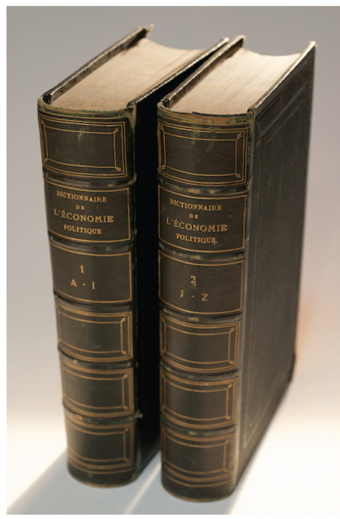
This paper is about a book, or rather two volumes of a very large book. It is an important book. It is a book about economics and this is the story of how it came into being, where this happened, why it was created, and by whom - in particular the work of four men (and later two women): Guillaumin the publisher and his daughters Félicité and Pauline, Clément the first editor, Coquelin the second and main editor, and the young senior editor and contributor Molinari. Its title is Dictionnaire de l'Économie Politique, or in English the "Dictionary of THE Political Economy". [1]
It is also about networks of people who came together to achieve certain intellectual and political goals. The main network for the political economists in Paris in the second half of the 19th century was "le réseau Guillaumin" (the Guillaumin network) which was at the center of several other networks of people of various kinds which will be discussed below. The activities of the Guillaumin publishing firm provided the backbone of the liberal political economy movement in France for 70 years.
I am particularly interested in the work of two members of this network, Frédéric Bastiat who died just as he was reaching the peak of his powers, and his younger friend and colleague Gustave de Molinari, who was just beginning what would be a long and very productive career. I have written about Bastiat elsewhere so I will not repeat that here. In this paper I will focus instead on the contributions of the young Molinari to the DEP project which I discuss in some detail at the end of the paper.
Some Personal Introductory Remarks
I first came across the writings of Molinari and Bastiat 50 years ago when I was a high school student in Sydney and I have been studying them ever since.
I wrote my Honours thesis in history at Macquarie University in 1979 on Molinari (much to my supervisor's shock and horror); [2] I wrote my PhD on two figures who had a large influence on Bastiat and Molinari and the other mid-century French political economists, Chalres Comte and Charles Dunoyer (much to the indifference of that supevisor); [3] and then later when I was the Academic Editor of Liberty Fund's Collected Works of Bastiat [4] and the editor and co-translator of their edition of Molinari's Soirées on Saint Lazarus Street (1849).
There has also been a recent resurgence of interest in the works of Bastiat and Molinari with the Institut Coppet in Paris publishing new French language editions of Bastiat [5] and most importantly the Oeuvres complètes de Molinari which began in 2019 (the bicentennial of his birth) and which has now reached 22 volumes (up to 1868 - so the 1st 25 years and only 40 or so years to go!). [6]
With the passing of a couple of important anniversary years - 2012 (the 100th anniversary of his death) and 2019 (the 200th anniversary of his birth) - I have edited and put online several anthologies of Molinari's works, initially in French, and now some in English translation. [7] The most recent has been an anthology of the 25 entries he wrote for the DEP (1852-53) which I have also translated into English (March 2025). [8] I have also translated 4 books [9] and 4 chapters of other books and some articles. [10] I have more planned.
The reasons I am so interested in him might need some explanation, given the general lack of interest in him in particular and the Paris School of political economy in general. These reasons include:
- he was so long-lived, some 93 years, which spanned most of the 19th century which was so important in the political, social, and economic development of Europe and the modern world; seeing these changes through the lenses of his eyes I find fascinating
- he was a pioneer in economic and sociological thought which still repays our consideration some 200 years later (especially his thinking about the private provision of public goods, his application of economic analysis to a very wide range of topics which until recently have escaped the attention of economists, and his economic and sociological analysis of the state). Some people might describe him as "the French Herbert Spencer", whereas I like to think of Spencer as "the English Molinari".
- he combined, especially in his youth, the study of theory with political activism, which took him and his colleagues onto the streets of Paris during the revolutions of 1848 and 1871, and on which he reported at length
- his inquiring mind kept him intellectually active until very nearly the end of his long life; he kept writing and arguing and finding new topics on which to do both, which I think is an inspiration; he cheekily called his last book (published the year before he died) Ultima Verba: Mon dernier ouvrage (Final Words: My Last Work). [11]
- studying Bastiat and Molinari introduced me to the remarkable world of the Guillaumin publishing firm which published literally thousands of books on economics and social theory during the course of its 70 year operation 1837-1907. It was an extraordinary intellectual and entrepreneurial achievement. I have humbly attempted to do something similar with my online "Guillaumin Collection" of classic texts (which are "near replica" editions of the originals) which numbers 217+ titles and counting. [12] Fifty four of these titles are on economics. [13] (See the Appendix for a full list of the economic titles.)
As part of my explorations into the life and thought of Gustave de Molinari I want to look at some of the young economist's (he was 30) earliest contributions to one of the great publishing achievements of the Paris-based political economists, namely the Dictionnaire de l'Économie politique (1852-53). This will requite a brief discussion of the major figures behind the project, especially the publisher Guillaumin and the main editor Coquelin, and the circles in which they and the young Molinari moved.
Given the time constraints I will briefly talk about the following:
- overview of the Guillaumin firm and its publishing history, and "the Guillaumin network"
- a brief overview of the DEP project and Guillaumin, Clément, and Coquelin
- a brief overview of the life and work of Molinari
- a discussion of his most innovative entries in the DEP in which he explores "the economics of everything"
II. The Guillaumin Publishing Firm and the Guillaumin Network↩
The Beginnings
The centre of the universe for the French liberal political economists for much of the 19th century was number 14 rue de Richelieu in the first arrondissement in Paris. [14] It was in this building that the publishing firm of "Guillaumin" was located.
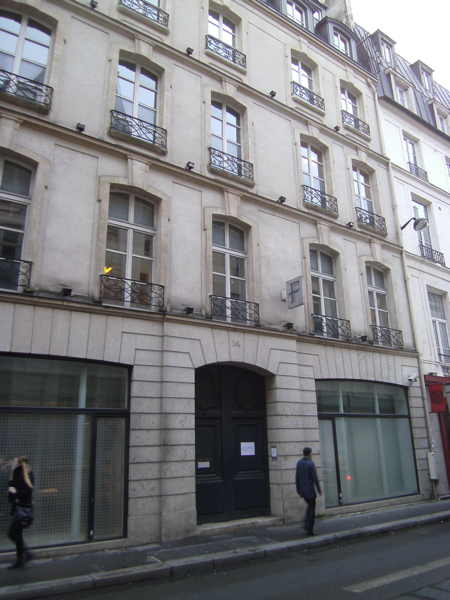
It was out of the Guillaumin office that
- books and dictionaries were published (a total of 2,356 titles between 1837-1910)
- the Société d'Économie politique (1846-1920) was run and the Minutes of its meetings published
- the Journal des Économistes (1841-1940) and the Annuaire de l’économie politique et de la statistique (1844-99) were published
- people in the broader free market circle met, discussed, and planned their activities
It had been founded in 1835 by a young, politically active, and ambitious man from the provinces, from where, interestingly, a number of the key people in the movement originated. His name was Gilbert-Urbain Guillaumin (1801-1864). [15] After arriving in Paris in 1819 (at the age of 18) he became active in radical political circles (the republican Carbonari movement) during the repressive years of the Bourbon restoration. After the July Revolution of 1830 which saw a new monarch, Louis Philippe, come to the throne Guillaumin came into contact with other liberal minded people, many also from the provinces, with whom he would work for the rest of his life. These friends and colleagues were made up of two cohorts.
The older cohort was born in the first years of the 19th century and consisted of the following people:
- the book publisher, editor, and fundraiser Gilbert-Urbain Guillaumin (1801-1864), who founded the firm which bore his name, and was born in Moulins in the Auvergne region, and arrived in Paris in 1819
- the lawyer, manufacturer, journalist, economist, and editor Charles Coquelin (1802-1852), who wrote on free banking and was the main editor of the Dictionnaire de l'Économie politique (DEP), and was born in Dunkerque which was a coastal city in the département du Nord in the région of Nord-Pas-de-Calais, and settled in Paris in 1832
- the magistrate, free trade activist, politician, and economist, Frédéric Bastiat (1801-1850), who was born in Bayonne, Les Landes in Gascony, and arrived in Paris in 1845
A second younger cohort was born some 15-20 years later, the most important of which were:
- Joseph Garnier (1813-1881), who was an economics teacher, editor, and peace advocate, from the south eastern town of Beuil, Alpes-Maritimes near Nice and came to Paris in 1830
- Gustave de Molinari (1819-1912), who was a journalist, an economic theorist, and a sociologist, was born in Liège in which would become the Kingdom of Belgium
- Hippolyte Castille (1820-1886) who was a journalist, popular historian, wrote for le Courrier français, and held regular soirées at his home on the rue Saint-Lazare (1843?-48), who was born in the sea-side town of Montreuil-sur-Mer, Pas-de-Calais, and came to Paris in 1839
- Alcide Fonteyraud (1822-1849) who was a specialist on Ricardo, a translator, and a gifted public speaker, who had the most exotic origin having been born in Mauritius, was brought up with English as a second language taught to him by an old English soldier after his mother died, and who came to Paris 1830.
What is striking about these men is that they were "outsiders" who had recently moved to Paris and would have had many things in common, such as their regional accents and ways of dressing, their ambition to succeed in a new city, the lack of family support networks, their new and different ways of thinking about political and economic problems, and their optimism about the possibilities of bringing about liberal change in France. This group makes a very interesting sociological study of how “outsiders” can bring original ideas to a major city where there is considerable opportunities for meeting other people and greater tolerance for innovative thinking. Other examples include Vienna in the 1870s and 1880s, and New York City in the 1930s and 1940s.
The contemporary historian Gérard Minart noticed this fact and called four members of this group - Gilbert-Urbain Guillaumin, Charles Coquelin, Frédéric Bastiat, and Gustave de Molinari - “The Four Musketeers” [16] of French political economy. This term was inspired by the fact that Bastiat, like D’Artagnan, came from the south-west province of Gascony, and that Dumas’ popular novel came out in 1844 (it was serialised in Le Siècle) at the same time as Bastiat came into contact with the Paris-based economists. These four men formed a close band of liberal intellectuals and activists in Paris who were fighting protectionism and socialism rather than the Protestant enemies of the King of France.
The Guillaumin Network
Overview
The term "le réseau Guillaumin" (the Guillaumin network) was also coined by Minart [17] to describe the interlocking network of like-minded individuals, associations, and groups which through their activities and publications had a considerable influence on French political, economic, and intellectual life for over 70 years. The economist Henri Baudrillart also recognised the importance of the Guilaumin firm and its connections when he described it in 1865 as “le centre et le lien de notre école” (the centre and link/bond of our school of thought). [18] This network is summarised in the "map" I have drawn up below:
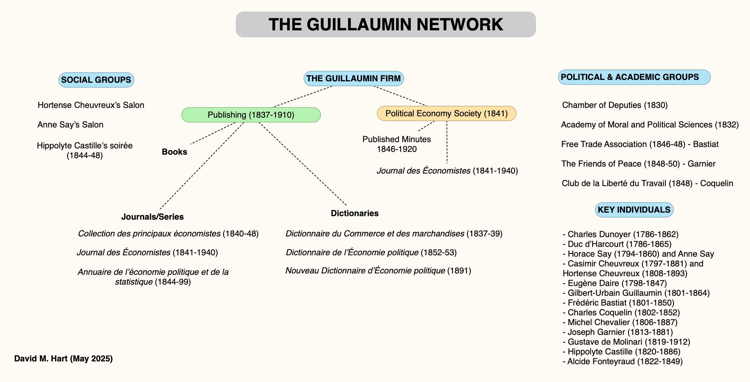
See a larger version of this image.
The Guillaumin firm is at the center but it is connected to other important groups such as the private salons of wealthy benefactors (Say and Cheuvreux), various political and academic groups, and a dozen or more key individuals. The "Guillaumin Network" was made up of the following overlapping organistions and individuals:
- the private "salons" and "soirées" organised by
- the wives of two leading figures in the circle of the economists, Madame Hortense Cheuvreux (wife of the manufacturer Casimir Cheuvreux) and
- Anne Say (née Cheuvreux) who was married to the rich mechant and son of J.-B. Say, Horace Say. Say and Cheuvreux were the main financial backers of the Guillaumin network
- the journalist Hippolyte Castille’s soirées at his home on the rue Saint-Lazare (1844-1848)
- the government run and funded scholarly organisation the Academy of Moral and Political Sciences which had a Political Economy section (restarted in 1832 after being shut down by Napoléon) some but not all of whom were sympathetic to the economists
- the Political Economy Society (founded 1842) and its journal the Journal des Économistes (founded 1841)
- the French Free Trade Association (1846-1848) run by Bastiat
- the political club - “Club de la Liberté du Travail” (March 1848) (organised by Charles Coquelin and Alcide Fonteyraud) and street magazines launched during the 1848 Revolution: La République française (Feb. 1848) and Jacques Bonhomme (June 1848) (by Bastiat and Molinari).
- Joseph Garnier’s Friends of Peace peace network (1848-50)
- liberal members of the Chamber of Deputies
Details about these groups follows below.
The "salons" and "soirées" organised by Castille, Cheuvreu and Say
There were two private salons run by the wives of two leading figures in the circle of the economists, Madame Hortense Cheuvreux (wife of the manufacturer Casimir Cheuvreux) and Anne Say (née Cheuvreux) (the wife of the businessman and son of Jean-Baptiste Say, Horace Say). Both men raised money to fund the activities of the economists.
Another important meeting place was provided by Hippolyte Castille whose network of friends participated in his soirées at his large home on the rue Saint-Lazare (1844-1848). Many of them wrote for or read the magazine he and Molinari worked for, Le Courrier français, and the magazine about intellectual property rights Le Travail intellectuel.
Hippolyte Castille's "Soirées" on the rue Saint-Lazare
Hippolyte Castille (1820-1886) was born in Montreuil-sur-Mer (département de Pas-de-Calais) and was a prolific French author who wrote popular works on the History of the Second French Republic (4 vols. 1854-56) and a multi-volume series of Portraits politiques au dix-neuvième siècle (1857-1862) which included several small volumes on classical liberal figures such as Mme de Staël, Benjamin Constant, Béranger, Lafayette, Garibaldi, Cavour, Mazzini, as well as many other individuals. He founded in 1847 a short-lived journal devoted to the importance of intellectual property, Le travail intellectuel, journal des intérêts scientifiques, littéraires et artistiques. for which Molinari wrote a number of articles. Molinari is mentioned as a "collaborator" and other leading economists were listed as "supporters" (Frédéric Bastiat, Charles Dunoyer, Horace Say, Michel Chevalier, Joseph Garnier). The journal was monthly and lasted 7 months before closing in 1848. Castille's home on the rue Saint-Lazare (the old residence of Cardinal Fesch) was the meeting place for a small group of liberals (which included Bastiat, Molinari, Garnier, Fonteyraud, and Coquelin) which met regularly between 1844 and early 1848 to discuss political and economic matters. It was Castille's home which supplied the name for Molinari's book, Les Soirées de la rue Saint-Lazare (1849). Castille was also one of the founders of Bastiat's revolutionary journal La République française in February 1848, along with Gustave de Molinari. In mid-1848 Castille gradually drifted apart from his economist friends and eventually worked on the Jacobin republican magazine La révolution démocratique et sociale edited by Charles Delescluze (1809-1871).
Hortense Cheuvreux's Salon
Hortense Cheuvreux (née Girard) was married to Jean Pierre-Casimir Cheuvreux (1797-1881), who was a wealthy textile merchant. Casimir was active in liberal circles in Paris, helping to fund their activities and running an important salon, headed by Hortense, from their Paris home. People like the scientist Jean-Jacques Ampère and the politician and historian Alexis de Tocqueville attended, as did Bastiat. Casimir's sister, Anne Cheuvreux, had married Horace Say, the son of the economist Jean-Baptiste Say, who was also a wealthy businessman who helped fund liberal activities. Like Hortense, Anne Say also ran a liberal salon. Thus the two women and the Cheuvreux-Say families played an important role in liberal circles in Paris during the 1840s.
One of the economists Madame Cheuvreux took a special interest in was Frédéric Bastiat. He visited them on holiday in their country home outside Paris. They also helped Bastiat during the summer of 1849 when he was trying to complete the Economic Harmonies by arranging for him to have use of a hunting lodge (Butard) in some woods outside Paris where he could write in peace. It is clear that Bastiat's friendship with Hortense was a close one (how close we can only speculate). She was one of the few people to visit him in Rome in his last days in December 1850 as he lay dying of throat cancer, and 27 years years after his death she published a book of his letters to her, Lettres d'un habitant des Landes (1877) which show us a much more personal side to Bastiat than we see in his other writings. In this letter we can see her amused response to his "country attire" when they first me at Madame Say's salon sometime in 1845. It also tells us that, in Bastiat's case at least, at these "economists' salons" there was the recitaion of poetry and the playing of instruments (Bastiat played the cello), and sometimes the singing of songs (such as Béranger's "goguette" pieces): [19]
| Je vois donc Bastiat débarquant des grandes Landes, se présenter rue Boursault, chez M. Say. Sa tournure se détachait si pittoresquement parmi celles qui l’entouraient que l’œil, tout distrait qu’il fût, ne pouvait s’empêcher de se fixer un instant sur lui. La coupe de ses vêtements, due aux ciseaux d’un artiste de Mugron, s’éloignait absolument des formes ordinaires. Des couleurs tranchées mal assorties, étaient mises à côté l’une de l’autre, sans souci de ce genre d’harmonie. Sur des mains gantées de filoselle noire, se jouaient de longues manchettes blanches ; un col de chemise aux pointes menaçantes, enfermait la moitié de son visage, un petit chapeau, de grands cheveux ; tout cet ensemble eût paru burlesque si la [4] physionomie malicieuse du nouveau venu, son regard lumineux et le charme de sa parole n’avaient fait vite oublier le reste. | There I saw Bastiat fresh from the Great Landes present himself at M. Say's home. His attire was so conspicuously different from those surrounding him that the eye, however distracted, could not help but stare at him for a moment. The cut of his garments, due to the scissors of a tailor from Mugron, was far away from ordinary designs. Bright colors, poorly assorted, were placed next to one another, without any attempt at harmony. Floss-silk gloves covering his hands, playing with long white cuffs; a sharp collar covering half his face; a little hat, long hair; all that would have looked ludicrous had not the mischievous appearance of the newcomer, his luminous glance, and the charm of his conversation made one quickly forget the rest. |
| Assise à table en face de ce campagnard, je constatai que non-seulement Bastiat était un des grands-prêtres du temple, mais un initiateur passionné. Quel feu, quelle verve, quelle conviction, quelle originalité, quel bon sens vainqueur et spirituel ; et à travers cette abondance d’idées nettes, de ces piquantes et neuves démonstrations, le cœur se sentait, le véritable ami des hommes se révélait. « En voilà un, me disais-je, avec lequel il faudra comprendre ou dire pourquoi ; les dames, malgré elles, pourront peut-être s’intéresser à l’influence des tarifs anglais ou français. » | Sitting in front of this rustic man, I discovered that Bastiat was not only one of the high priests of the temple, but also a passionate initiator. What fire, what verve, what conviction, what originality, what winning and witty common sense! Through this cascade of clear ideas, of these displays, new and to the point, the heart was shown, the true soul of man revealed itself. "Here is someone," I said to myself, "whom one will have to get to know better or say why not, the ladies, in spite of themselves, will perhaps take an interest in the impact of English and French tariffs after all. |
| Après le dîner on fit de la musique. L’habitant des Landes nous ménageait encore une surprise : il possédait au suprême degré le sentiment des arts et de la poésie. | After dinner we played music. This inhabitant of Les Landes arranged yet another surprise for us; he possessed to an extraordinary degree feelings for art and poetry. |
Anne Say's Salon
I do not have any information about Anne Say unfortunately.
The Say family played a very important role in liberal political economy circles in France for nearly 100 years. It began with Jean-Baptiste Say (1767-1832), then his son Horace Émile Say (1794-1860), and his grandson Léon Say (1826-96).
Horace Émile Say (1794-1860) was the son of Jean-Baptiste Say. He married Anne Cheuvreux, sister of Casimir Cheuvreux. Say was a businessman and traveled in 1813 to the United States and Brazil. A result of his trip was Historie des relations commerciales entre la France et le Brésil (1839). He became president of the Chamber of Commerce of Paris in 1834, a councillor of state (1849-51), headed an important inquiry into the state of industry in the Paris region (1848-51), and wrote a book advocating the reform of city tolls Paris, son octroi et ses emprunts (1847). Say was also very active in liberal circles, participating in the foundation of the Société d'économie politique, the Guillaumin publishing firm, the Journal des économistes. the Journal du commerce ; and was an important collaborator in the creation of the Dictionnaire de l'économe politique (1852-53) and the Dictionnaire du commerce et des marchandises (1837, 1852). In 1857 he was nominated to the Académie des sciences morales et politiques but died before he could join it formally.
The Academy of Moral and Political Sciences (1832)
The Académie des sciences morales et politiques (the Academy of Moral and Political Sciences) is a French learned society and one of the five academies which comprise the Institute of France. The Academy was founded in 1795 as part of a restructuring of the pre-revolutionary Royal Academies. It was abolished in another restructuring made by Napoleon in 1803 in order to remove the many members who had opposed his rule. It was reconstituted by King Louis-Philippe in October 1832 on the advice of François Guizot and Pierre-Louis Roederer as the Académie Royale des Sciences Morales et Politiques (Royal Academy of Moral and Political Sciences).
There are 50 members of the Academy who are elected by their peers. There are also additional "corresponding" members. In 1832 there were 5 sections: philosophy, moral science, law and jurisprudence, political economy, and history. In January 1847 the membership of the 2nd section (Morale) included Dunoyer (1832), Droz (1832), Lucas (1836), Toqueville (1838), Beaumont (1841), and Alban de Villeneuve (1845). The 4th section (Économie politique et Statistique) had as full members - Dupin (1832), Villermé (1832), Rossi (1836), Blanqui (1838), Passy (1838), and Duchatel (1842). Bastiat was made a "corresponding" (or junior) member of the 4th section on 24 January, 1846 when he was elected with 20 votes (out of a possible 21) by the other full members of the Academy. [20] Dunoyer had promoted Bastiat's candidature by presenting copies of Bastiat's two books which had appeared since his arrival in Paris: his book on Cobden and the League (1845) and the first series of the Economic Harmonies (January 1846). Bastiat was very proud of this position and included it as part of his credentials on the cover of the books and pamphlets he published. For example, L'État. Maudit argent, par M. Frédéric Bastiat, Représentant du peuple, Membre correspondant de l'Institut, et du Conseil général des Landes. (Paris: Guillaumin, 1849). His younger friend and colleague, Gustave de Molinari also never became a full member of the Academy - he too was elected a corresponding member on 28 March, 1874. [21]
To become a full member one had to wait for an existing member to die after which an election by the other sitting members would be held to fill the empty "chair". After Pellegrino Rossi's assassination in Rome, his chair was filled by Léon Faucher in 1849, which was the only possibility Bastiat might have had for promotion within the Academy. Michel Chevalier was elected in 1851 to replace Louis Villermé and Louis Wolowski was elected in 1855 to replace Adolphe Blanqui. Bastiat's friend and colleague Joseph Garnier had to wait until 1873 before he was elected to replace Charles Dupin.
Many of the Economists and other classical liberals were members of the Academy, such as the following (with the year they were elected): Charles Dunoyer (1832); Joseph Droz (1832); Charles Comte (1832); Pellegrino Rossi (1836); Alexis de Tocqueville (1838); Hippolyte Passy (1838); Adolphe Blanqui (1838); Gustave de Beaumont (1841); Léon Faucher (1849); Louis Reybaud (1850); Michel Chevalier (1851); Louis Wolowski (1855); Horace Say (1857); Augustin-Charles Renouard (1861); Henri Baudrillart (1866); Joseph Garnier (1873); Frédéric Passy (1877); Léon Say (1881). [22]
The Political Economy Society and its journal the Journal des Économistes
Société d'Économie Politique (SEP) (the Political Economy Society)
The Société d'économie politique (Political Economy Society) was founded in 1842 by the Comte d'Esterno and Pellegrino Rossi with the name "Réunion des économistes." [23] It failed to attract members because of its academic tone and folded after a few meetings. Later in the year, another attempt at forming a society was made by Adolphe Blaise, Joseph Garnier, and Guillaumin which began meeting regularly from 15 November 1842. It attracted considerably more members because of its more relaxed and open format (Garnier estimates about 60 by its second meeting) where the members would meet every month for a meal in a restaurant before beginning a more formal discussion of topics selected by the committee. Its membership was drawn from members of the Institute, ex-parliamentarians, educators, journalists, judges, and several active in commerce and industry. The meetings were held in the Maison-Dorée restaurant which was located at 20, Boulevard des Italiens in the 9th arrondissement of Paris. It opened in 1839 and had a reputation for excellent food and wine (it boasted a wine cellar of 80,000 bottles) and attracted regular customers such as Honoré de Balzac and Alexandre Dumas.
The Society's first president was Charles Dunoyer, who served from 1845 to 1862, and Joseph Garnier was made permanent secretary in 1849. Its membership in 1847 was about fifty and grew to about eighty at the end of 1849. A summary of its monthly meetings was published in Le Journal des économistes. The Society was managed by 2 presidents (Charles Dunoyer and Hippolyte Passy), 2 vice-presidents (Horace Say and Charles Renouard), a permanent secretary (Joseph Garnier), and a treasurer (Guillaumin). Summaries of the meetings were published by Joseph Garnier, the permanent secretary and vice president of the society, in the Journal des économistes. More detailed minutes of the meetings were published in 16 volumes between 1889 and 1896 by the perpetual secretary Alphonse Courtois and cover the years 1846-1887. It was followed by annual issues of the Bulletin de la Société d'Économie Politique (Paris: Guillaumin, 1888). In 1889 summaries of the Society's meetings were published by Guillaumin: Annales de la Société d'Économie politique (1889). [24] [25]
The Society also issued medallions of famous liberal economists such as Turgot, Jean-Baptiste Say, and Frédéric Bastiat. It also sold portraits of Turgot, Bastiat, Rossi, Say, Quesnay, Sismondi, Malthus, and Adam Smith. They cost 4 francs each. To celebrate the 70th anniversary of the founding of the Society a history of the Society was published in 1892. [26]
Journal des Économistes (JDE)
The Journal des économistes: revue mensuelle de l'économie politique, des questions agricoles, manufacturières et commerciales was the journal of the Société d'économie politique (Political Economy Society) and appeared from December 1841 and then roughly every month until it was forced to close following the occupation of Paris by the Nazis in 1940. It was published by the firm of Guillaumin, which also published the writings of most of the liberals of the period.
The Journal des économistes was the leading journal of the free-market economists (known as "les économistes" (The Economists)) in France in the second half of the nineteenth century. The editors of the JDE were as follows:
- the founding editor and publisher Gilbert-Urbain Guillaumin (1801-64) editor from December 1841 to 1842;
- Adolphe Blanqui (1798-1854) editor 1842-43;
- Hippolyte Dussard (1798-1876) editor 1843-45;
- Joseph Garnier (1813-1881) editor 1845-55;
- Henri Baudrillart (1821-1892) editor 1855-65;
- Joseph Garnier (1813-1881) editor (1866-81);
- Gustave de Molinari (1819-1912) editor October 1881-1909; and
- Yves Guyot (1843-1928) editor from 1910.
The Institut Coppet has produced an anthology of "the best articles" of the JDE, one volume of which has appeared so far. It consists of 20 articles and is 339 pages in length. [27] They have also produced a list of the main articles which were published in the first three "series" of the journal between the years 1841 and 1877 - some 133 quite large volumes. [28] I have on my website PDFs of the complete first four series from 1841-1889. [29]
The French Free Trade Association (1846-1848)
The Association pour la liberté des échanges (Free Trade Association) was founded in February 1846 in Bordeaux. Bastiat was the secretary of the Board, which was presided over by François d’Harcourt and had among its members Michel Chevalier, Auguste Blanqui, Joseph Garnier, Gustave de Molinari, and Horace Say. The first public meeting of the Paris Free Trade Association was held in Montesquieu Hall on 28 August 1846. The journal of the Association was called Le Libre-échange and was edited and largely written by Bastiat. The first issue appeared on 29 November 1846, and the journal closed on 16 April 1848 after seventy-two issues, most of which (sixty-four) were written by Bastiat. The last eight issues were published by Charles Coquelin. The offices of Le Libre-échange were in the rue de Choiseul in Paris.
I have on my website the PDF of the collected first full year of publication. [30]
“Club de la Liberté du Travail” (March 1848, June 1848)
Coquelin, Bastiat, and Molinari had become close personal friends as well as committed activists who took the opportunity provided by the overthrow of the July Monarchy in February 1848 to "take political economy to the streets" of Paris. They started two small revolutionary magazines which were handed out on the streets of Paris in February and June 1848 - La République française [31] and Jacques Bonhomme respectively. They also participated in public debates held among the political clubs which had sprung up in Paris in the early days of the revolution after the enforcement of the strict censorship laws and bans on political associations collapsed.
At the first public meeting of the Free Trade Association held after the outbreak of the revolution, in the Montesquieu Hall on 15 March, a motion was discussed to form a political club to confront the socialists directly in public debate before large audiences. So, Coquelin, Bastiat, and Molinari set up Le Club de la liberté du travail (The Club for the Freedom of Working) to combat socialist ideas about the "right to work" (le droit au travail) which had become popular with the creation of the National Workshops which Louis Blanc had set up on 26 February. Coquelin in particular was a gifted pubic speaker, and Bastiat was clever and witty with his ability to combine references to classic French literature to illustrate economic ideas. The first meeting of the Club was held on March 31 to discuss the question of "The Organization of Labor" with 3 socialists defending Louis Blanc’s proposals and attacking free trade, and Coquelin, Fonteyraud, and Garnier defending the free market position of the "Liberty of Working." [32]
Here is a ticket for a meeting of the Club. Posters advertising meetings of all the Clubs would have been stuck on the walls of the buildings of Paris. [33]
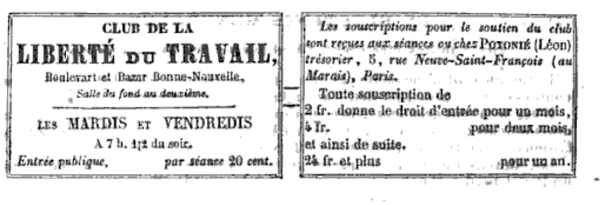
One of the Club’s best public speakers was Alcide Fonteyraud (1822-1849) who died in the cholera epidemic which swept France in mid 1849. He was famous for his florid and witty style of speaking and his ability to mix references to the classics of French literature with the classics of political economy. The Club lasted only a few weeks before they were forced to close because of the intimidation and violence they faced from what Molinari describes as “a band of communist thugs”. Later, Molinari regretted the fact that the economists had been too meek in the face of socialist violence and had not stood up to them.
The three men had a second round of revolutionary street activism in June 1848 when they started a another newspaper, Jacques Bonhomme (Jack Everyman), which was designed to appeal to ordinary workers on the streets. [34] It lasted for only 4 issues before it was forced to close as a result of the use of troops to put down the riots of the June Days resulting in the deaths of 1,500 and the arrest of thousands. Again, we know from Bastiat’s correspondence that he got caught in the crossfire (the army used artillery to destroy the street barricades), witnessed the deaths of several protesters, and tried to organise a cease fire so the injured could be removed from the street barricade. [35]
The Friends of Peace (1848-50)
The Paris Friends of Peace Congress was held between 22-24 August in Saint-Cecila Hall. It was presided over by Victor Hugo. The Political Economy Society was represented by Joseph Garnier and Bastiat who gave one of the major speeches on the second day, and Molinari who wrote a detailed report on the conference for the JDE. According to Joseph Garnier, the organiser, there were 21 delegates from the U.S. (including two ex-slaves), over three hundred from England, 230 from France, 23 from Belgium, and a small number of delegates from other European countries. [36] [37]
The first International Friends of Peace Congress was held in London in 1843 on the initiative of the American Peace Society and Joseph Sturge. Some 340 delegates attended, the bulk of which were British. The second was organized by Elihu Burritt and chaired by the Belgian lawyer Auguste Visschers and took place in Brussels in September 1848. The third Congress was held in Paris in August 1849 (22-24th) chaired by the novelist Victor Hugo and where Bastiat gave an important speech. The 4th was held in Frankfurt in August (22-24th) 1850 with 600 delegates, the 5th in London in July 1851, the 6th in Manchester in 1852, and the 7th in Edinburgh in 1853. The Congresses came to an end with outbreak of the Crimean War in 1854.
Liberal members of the Chamber of Deputies
Michel Leter provides a useful list of those members of the Paris School who held positions in the French government. [38] These were the following:
- three ministers: Victor Destutt de Tracy, Léon Faucher, and Hippolyte Passy;
- four Peers of France: François d’Harcourt, Hippolyte Passy, Charles Renouard, Pellegrino Rossi;
- 13 elected Deputies: Alexandre Annisson-Dupéron, Frédéric Bastiat, Adolphe Blanqui, Charles Comte, Victor Destutt de Tracy, Léon Faucher, Henri Fonfrède, François d’Harcourt, Édouard Laboulaye, Hippolyte Passy, Charles Renouard, Louis Reybaud, and Louis Wolowski;
- four members of the General Council: Alexandre Annisson-Dupéron, Frédéric Bastiat, Michel Chevalier, Horace Say;
- five members of the Council of State: Michel Chevalier, Jean-Gustave Courcelle Seneuil, Hyppolite Dussard, Charles Renouard, and Horace Say;
- two Prefects of Departments: Charles Dunoyer and Hyppolite Dussard: and
- two ambassadors: François d’Harcourt and Pellegrino Rossi.
Conclusion
The importance of the Guillaumin network in developing and spreading liberal free market ideas was increased by the fact that it was so hard to break into the government monopoly of higher education. The audience they were trying to reach was the intellectual and political élite (what Bastiat referred to as “la classe électorale”) which consisted of the very small minority of tax payers who were allowed to vote under the July Monarchy of Louis Philippe who ruled France. They wanted to influence the thinking of this elite in a more liberal and free market direction in the hope that this would influence government policy. As there were only two or three chairs of political economy in France at that time (the prestigious Collège de France (Michel Chevalier held this chair from 1841), the Conservatoire national des arts et métiers , and the engineering school the École des Ponts et Chaussées (which only began teaching economics in 1846)), the opportunities for academic work within the state universities were very limited. [39] This forced the French political economists to work outside the university system such as lecturing at the private Athénée royal de Paris , writing for the quality journals (such as the Journal des Débats and the Revue des Deux mondes ), or getting appointed to the non-teaching Academy of Moral and Political Sciences. The Guillaumin publishing firm provided them with an opportunity to get their work published and thus reach a wider group of readers than they would otherwise have had.
The History of the Guillaumin Firm
Gilbert-Urbain Guillaumin (1801-1864)
The focal point for the group of economists was Urbain Guillaumin whose publishing firm provided an important meeting place for its activities and provided the funds to get their books and journbals published. Guillaumin was born in Moulins in the Auvergne region and orphaned at the age of five and was brought up by his uncle. He came to Paris in 1819 and worked in a bookstore before eventually founding his own publishing firm in 1835.
He had been a radical republican during the 1820s moving in Carbonari circles before becoming interested in book selling and publishing. One of his earliest publishing successes was a three volume collection of the popular radical poet and song writer Pierre-Jean de Béranger (1780-1857), Les Chansons de Béranger (The Songs of Béranger) which appeared in 1829. [40] Béranger would stay in contact with the Guillaumin network for the rest of his life, becoming in effect the movement's poet and song writer. (See the Appendix for an example of his free trade poetry - "Les Contrebandiers" (the Smugglers).) Bastiat had the reputation of singing Béranger's "drinking songs" at the economists' soirées and also playing his cello which he sometimes took with him.
Guillaumin became active in liberal politics during the 1830 revolution and made contact with the economists Adolphe Blanqui and Joseph Garnier. With funding from Horace Say, the son of the economist Jean-Baptiste Say, Guillaumin expanded and formalised his publishing activities in 1835 and by the early 1840s it had become the focal point of the classical liberal group in Paris at its premises at 14 rue de Richelieu. The firm was to publish most of the books written by the liberal political economists over the course of the next 70 years.
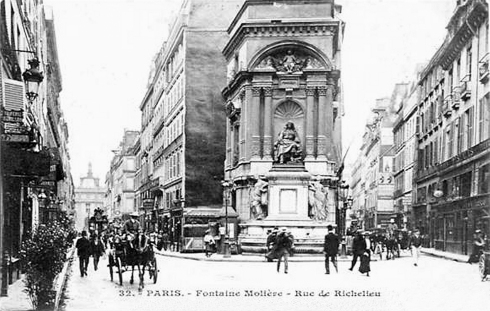
The business was located in the Rue Richelieu, no. 14, in a very central part of Paris not far from the River Seine, the Tuileries Gardens, the Louvre Museum, the Palais Royal, the Comédie Française theatre, and the Bibliothèque Nationale de France. The above picture postcard from the end of the 19th century shows the Molière fountain at the intersection of the Rue Richelieu (left) and the Rue Moliére (right) near the Théâtre du Palais Royal. The fountain was built in 1844 opposite the building, 40 Rue Richelieu, where Molière had once lived. The office which housed the Librairie de Guillaumin et Cie would have been about half way down the Rue Richelieu from the fountain.
Guillaumin’s first major project in economics was the editing and publishing of a Dictionnaire du Commerce et des marchandises (1837-39). [41] This was a business oriented publication rather than a work which dealt with economic theory or the history of economic thought in great detail. Horace Say used his contacts in business to get experts to write on commercial topics and the young economist Joseph Garnier who was teaching at the École supérieure de Commerce wrote the articles on economic theory.
We can trace the steady growth of its publishing activities from its catalogues which were often included at the back of the books they published. The size of the Guillaumin catalog kept expanding throughout the 19th century. In 1850 it was 50 pages long and by 1886 it was 121 pages and listed 166 separate book titles. I have collected many of these over the course of my research and put them online. [42]
While the 1848 Revolution was underway the firm issued a special catalog of 40 anti-socialist writings featuring the work of Bastiat, Molinari, Garnier, as well as Michel Chevalier, Léon Faucher, Antoine-Elisée Cherbuliez, Ambroise Clément, and others, many of which were collections of speeches in the Chamber or journal and magazine articles which were rushed into print for the occasion.
Guillaumin also published a broad range of other material in addition to its main focus on political economy, such as publishing translations of John Stuart Mill’s Principles of Political Economy [43] and On Liberty, [44] Charles Darwin’s Origin of Species, and Hugo Grotius’ The Laws of War and Peace and many others. [45] However, it was renowned for its academic journal, large collections of historical material, encyclopedias, annual collections of data and government documents, and dictionaries which would have challenged many other publishing firms.
It kept Bastiat’s 7 volume Oeuvres complètes in print throughout the century even when interest in liberal political economy began to fade towards the end. The last complete edition of the 7 volume collection appeared in 1884 (some 30 years after the first edition). They also kept in print Bastiat's treatise on economics, Harmonies économiques (1850-51) with the 10th edition appearing in 1893.
After Guillaumin's death in 1864 the firm's activities were continued by his oldest daughter Félicité who managed the firm for 20 years (1865-85), and after her death it was handed over to his youngest daughter Pauline who managed it for another 20 years (1886-1905). The firm of Guillaumin continued in one form or another from 1835 to 1910 when it was merged with the publisher Félix Alcan. Thus the firm provided a very important vehicle for the dissemination of economic material from a free market perspective for nearly 75 years until it was finally taken over by the Félix Alcan firm.
A Publishing History of the Guillaumin Firm
The main publishing projects undertaken by the firm consisted of seven types:
- large scale more commercial projects: dictionaries of commerce
- Encyclopédie du commerçant. Dictionnaire du commerce et des marchandises, 2 vols. (1837-39)
- Dictionnaire universel théorique et practique du commerce et de la navigation (1859-61).
- large scale intellectual/academic projects: CPE, DEP, NDEP, the minutes of the SEP monthly meetings
- the multivolume Collection des principaux économistes (1840–48) (see below for details).
- Dictionnaire d’économie politique (1852-53) (coedited by Guillaumin and Charles Coquelin)
- Bibliothèques des sciences morales et politiques (1857–)
- Annales de la Société d'Économie Politique (1846-1899)
- Nouveau Dictionnaire d’Économie Politique (1891,1900) (co-edited by Léon Say and Joseph Chailley)
- journals and series: JDE, AEPS
- Journal des économistes (1842–1940)
- L’Annuaire de l'économie politique (1844–99)
- books: some 2,356 titles at an average of 31.8 titles p.a.
- journal article reprints
Benoît Malbranque of the Institut Coppet has compiled a complete list of the publications of the Guillaumin firm which I have edited and amended somewhat. My statistical analysis of the list is below.
Of these special note should be made of the following:
- Collection des principaux économistes (Paris: Guillaumin, 1840-48), 15 vols.
- Journal des économistes (1842–1940)
- L’Annuaire de l'économie politique (1844–99)
- Dictionnaire d’économie politique (1852-53) and its revised "New" edition of 1891
Collection des principaux économistes (1840-48), 15 vols.
One of the most ambitious publishing projects which Guillaumin undertook during the 1840s was the 15 volume collection of key works in the history of economic thought, the Collection des principaux économistes (Collection of the Principal Economists) (1840-48) [46] edited by Eugène Daire. Eugène Daire (1798-1847) was of all things a tax collector who revived interest in the heritage of eighteenth- and early nineteenth-century free-market economics. He came to Paris in 1839, met Guillaumin, discovered the works of Jean-Baptiste Say, and began editing the fifteen-volume work, Collection des principaux économistes (1840-48). It included works on eighteenth-century finance, the physiocrats, Turgot, Adam Smith, Malthus, Jean-Baptiste Say, and Ricardo. He was a founding member of the Political Economy Society. (See the Appendix on the CPE for more details.)
The purpose of the project was to provide new editions of classic works by the Physiocrats such as Turgot and Quesnay, Adam Smith, David Ricardo, Jean-Baptiste Say and others, which had long introductions and critical notes by the new generation of economists who were appearing in the 1840s such as Joseph Garnier, Alcide Fonteyraud, and Molinari.
- Joseph Garnier who was to become one of the leading Malthusians in France edited vol. VII Malthus’ Essai sur le principe de population (1845). [47]
- Alcide Fonteyraud edited vol. XIII Œuvres complètes de David Ricardo (1847) with newly translated material by Ricardo on money and finance. [48]
- Gustave de Molinari edited the final two volumes, vols. XIV and XV, on 18th century authors such as David Hume, Condillac, Benjamin Franklin, and Jeremy Bentham, Mélanges d'économie politique (1847-48). [49]
By providing the younger economists like Fonteyraud and Molinari with a chance to work on serious and important scholarly work like the Collections des Principaux Économistes, and to earn money while doing so, Guillaumin helped them establish their credentials and, especially in the case of Fonteyraud, helped him become one of the leading authorities in France on the work of Ricardo at the tender age of 25.
The Collection consisted of the following titles copies of which in PDF format can be found on my website (see also the Appendix below): [50]
- T. I. Économistes financiers du XVIIIe siècle: Vauban, Boisguillebert, Law, Melon et Dutot.
- T. II. Physiocrates: Quesnay, Dupont de Nemours, Mercier de la Riviére, l'Abbé Baudeau, Le Trosne.
- T. III et IV. Œuvres de Turgot, avec notes par Dussard et Daire.
- T. V et VI. Recherches sur la nature et les causes de la richesse des nations, par Adam Smith.
- T. VII. Essai sur le principe de population, par Malthus, avec Introduction par Rossi et Notes par Joseph Garnier.
- T. VIII. Principes d’économie politique, suivis des Définitions en économie politique, par Malthus, nouvelles traduction française par Alc. Fonteyraud, et une Introduction par M. Maurice Monjean.
- T. IX. Traité d’économie politique, par J. B. Say. 6e édition.
- T. X et XI. Cours complet d’économie politique pratique, par J. B. Say.
- T. XII. Œuvres diverses de J.-B. Say: Mélanges, Correspondance, Catechisme, Petit volume, Olbie, Opuscules inédits, etc.
- T. XIII. Œuvres complètes de David Ricardo, nouvelle trad. française par Alc. Fonteyraud.
- T. XIV et XV. Mélanges (d’économie politique), formés des principaux écrits économiques de Hume, Forbonnais, Condillac, Condorcet, Lavoisier, Franklin, Necker, Galiani, Montyon, Bentham, avec des notes et des notices par M. G. de Molinari.
Publications by the Guillaumin firm by Year (1837-1910)
We have taken our information from the list compiled by Benoît Malbranque for the Institut Coppet in Paris, [51] and have modified it somewhat. [52] From this I have created the following table which shows the number of titles published per year 1837-1910:
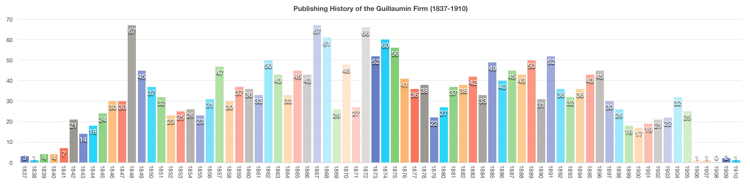
See a larger version of this graph.
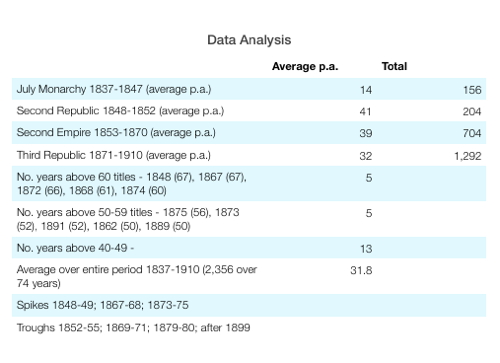
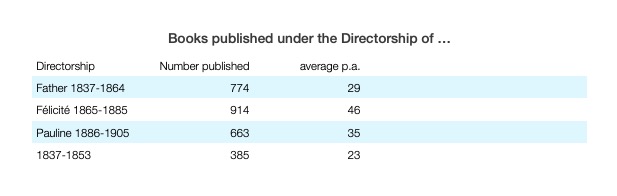
The eldest daughter Félicité who took over the firm after her father's death in 1864 and ran it for 20 years seems to have been the most productive with a total of 914 titles at 46 p.a.
Of note:
- between 1837 and 1910 (74 years) the Guillaumin firm published 2,356 titles at an average of 31.8 titles p.a.
- during the first period we are interested in, up the appearance of the DEP (1837-1852 - 16 years) the firm published 360 titles at an average of 22.5 p.a.
- during the July Monarchy (1837-1847) 156 titles were published at an average of 14 p.a.
- during the Second Republic (1848-1852) 204 titles were published at an average of 41 p.a.
- during the Second Empire (1853-1870) 704 titles were published at an average of 39 p.a.
- there were 5 years when 60 or more titles were published: 1848 (67), 1867 (67), 1868 (61), 1872 (66), 1874 (60)
- there were 5 years when 50-59 titles were published: 1862 (50), 1873 (52), 1875 (56), 1889 (50), 1891 (52)
- we can see three periods when their activity spiked: Spikes in 1848-49; 1867-68; 1873-75
- and three periods when there were troughs: 1852-55; 1869-71; 1879-80;
- and a general falling off of activity after 1899
Publishing milestones:
- End of 1852: 361 titles had been published
- 500th title: Le Nouveau et l’ancien droit de timbre, par Emile Brincard, Paris, 1857
- 1,000th: L’association coopérative, par Eugène Villedieu, Paris, 1869
- 1,500th: Question monétaire, lettre à MM. les membres de la conférence internationale siégeant à Paris, par Théodore Mannequin, Paris, 1881
- 2,000th: Les causes financières de la Révolution française. II. Les derniers contrôleurs généraux, par Charles Gomel, Paris, 1893
- last title before being taken over by Alcan: no 2,354 La transmission de la propriété immobilière et l’introduction des livres fonciers en Angleterre, par Alexandre de Lavergne, Paris, 1905
III. The DEP Project↩
Introduction
Fifty years after Jean-Baptiste Say published his Traité d'économie politique (1803) a veritable "monument" to the intellectual tradition he had begun in France was erected by some of his followers, the Dictionnaire de l'Économie politique (1852-53). [53] I use the word "monument" deliberately because that is what Molinari called it (4 times) in the "review" of the project he wrote for the JDE soon after the completed volumes appeared in print in October 1853. [54] He said that the study of political economy had been badly neglected by the ruling political and economic elites in France, but had survived because of a small group of "elite minds" (un petit nombre d’esprits d’élite) had taken up the challnge. This he believed, as did Guillaumin, deserved the building of a suitable monument to their achievements : [55]
| Ensuite, par un concours particulier de circonstances, les économistes français se trouvaient précisément dans les conditions les meilleures pour élever en commun un monument à la science. Exclue de l’enseignement officiel; considérée encore généralement, malgré son utilité manifeste, comme une science de pure curiosité, l’économie politique n’est cultivée en France que par un petit nombre d’esprits d’élite qu’une vocation irrésistible attire vers cette branche trop négligée des connaissances humaines. Mais, à cause même de leur petit nombre et du peu de faveur dont jouissent leurs doctrines, les économistes ont senti la nécessité de se réunir pour agir plus efficacement sur l’esprit public. … (p. 425) | Furthermore, due to a particular conjunction of circumstances, French economists found themselves in the best possible conditions to collectively erect a monument to their science. Excluded from official teaching and still generally regarded, despite its obvious utility, as a science of mere curiosity, political economy in France was cultivated only by a small number of elite minds irresistibly drawn to this too-neglected branch of human knowledge. But precisely because of their small number and the lack of favor their doctrines enjoyed, economists felt the necessity of uniting in order to exert greater influence on public opinion. |
| M. Guillaumin avait donc à sa disposition les ouvriers qu’il lui fallait pour élever à l’économie politique un monument digne d’elle. Les circonstances étaient aussi des plus favorables à l’édification de ce monument scientifique. La révolution de Février avait montré quels abîmes l’ignorance des gouvernements et des peuples avait creusés sous les pas de la société. N’était-ce pas le moment de présenter, dans un vaste et harmonieux ensemble, les acquisitions de la science qui avait sondé ces abîmes et signalé les moyens de les combler ? M. Guillaumin le comprit, et il commença, dans les derniers mois de 1850, la publication du Dictionnaire de l’Économie politique. (p. 426) | Thus M. Guillaumin had at his disposal the workers he required to erect a monument which would be worthy of political economy. Circumstances were also most favorable for the construction of this scientific monument. The February Revolution had revealed what chasms had opened up under society because of the ignorance of economics of governments and the people. Wasn’t this the moment to present in a vast and harmonious whole the achievements of the science which had plumbed these chasms and shown how to fill them in? M. Guillaumin understood this and he began the publication of the Dictionary of Political Economy in the last months of 1850. |
He also wrote, perhaps not surprisingly the entry in the DEP on "Monuments publics" (Public Monuments or Buildings), [56] in which he strongly criticised the waste of tax-payers' money by governments and politicians in building "monuments" to the state or to themselves. In stark contrast, the Guillaumin publishing firm raised private funds to build a monument to themelves and the cause they believed in, partly because they had been excluded from teaching in the publicly funded universities. He must have felt some kind of triumph and vindication when he saw these large volumes finally in print.
Another factor was the fact that, because the economic forces unleashed by the industrial revolution and the spread of markets were so large, if government policies or popular revolution continued on their current course the "locomotive" of economic change might be "derailed", causing massive damage to society. In his mind, using the colourful vocabluary for which he was well-known, interventionist policies introduced whether by the conservatives or the socialists would cause a veritable "train wreck": [57]
| En présence d’une révolution si vaste et si profonde, révolution dont les résultats devaient infailliblement tourner au profit de la civilisation, mais que l’ignorance des uns, les passions malfaisantes des autres pouvaient détourner de sa voie naturelle et entraîner dans des précipices dangereux, n’était-il pas plus nécessaire que jamais d’étudier l’organisation de la société ? Les hommes disposaient de nouvelles forces que leur labeur intelligent avait dérobées à la nature; mais ces forces ne pouvaient-elles pas leur causer plus de bien ou plus de mal, selon qu’une direction bonne ou mauvaise leur était imprimée? Une locomotive qui emporte, dans sa course vertigineuse, des centaines de voyageurs, rend plus de services qu’un cheval d’attelage; mais une locomotive qui déraille ne cause-t-elle pas des accidents plus désastreux qu’un cheval qui prend le mors aux dents? A mesure que le mécanisme de la production se renforce et s’agrandit, au profit de l’espèce humaine, la mauvaise direction de ce mécanisme ne doit-elle pas engendrer des catastrophes plus redoutables ? L’étude approfondie de l’organisation sociale, étude qui fait l’objet de l’économie Politique, est donc devenue plus que jamais une nécessité depuis l’avénement de la grande industrie, car elle seule peut signaler les moyens d’empêcher cette puissante locomotive de dérailler. | In the face of such a vast and profound revolution—one whose results were inevitably destined to benefit civilization, but which ignorance in some and harmful passions in others could divert from its natural course and lead into perilous abysses—was it not more necessary than ever to study the organization of society? Men now possessed new forces that their intelligent labor had wrested from nature; but could these forces not bring them more good or more harm, depending on whether they were given the right or wrong direction? A locomotive that carries hundreds of passengers at dizzying speed is more useful than a draft horse; but does a derailed locomotive not cause more disastrous accidents than a runaway horse? As the machine of production grows stronger and larger for the benefit of humanity, does not the misdirection of this machine generate even more formidable catastrophes? The thorough study of social organization—the very object of political economy—has thus become more than ever a necessity since the advent of large-scale industry, for it alone can identify the means to prevent this powerful locomotive from derailing. |
The DEP project had been conceived in late 1848 or early 1849 when it became clear to the political economists that they were losing the intellectual battle, if they had not already done so already, in the months immediately following the February Revolution of 1848 and the first few months of the Second Republic. The statements by the publisher Guillaumin, the original editor Ambroise Clément (1805-86), and by the senior editor Molinari make it very clear that this was the main reason for undertaking the project. [58]
However, in spite of the above sentiments the DEP was not only going to be just a "static" monument to the achievements of the past but also the foundation upon which to build a new "dynamically" changing and improving set of ideas which could keep the "locomotive" safely on its tracks. The word they used to describe this next phase was "un vaste bazar intellectuel" (an immense intellectual bazaar), so, appropriately, a term for a large market, but in this case a "market of ideas" in which liberal political economy would present its wares and compete with other suppliers of ideas for the attention of the consumers. Molinari seized on this idea which he found in an essay by François Guizot from 1826. It was from a rather strange book entitled Encyclopédie progressive (Progressive Encyclopedia) which contained 2 essays on economic matters (one by J.B. Say on "Économie politique") which is probably why Molinari came across it. The opening essay was by the editor, François Guizot, on "Encyclopédie" and why they are written and why they are read. He likened them to a bazaar where new ideas were spread out on tables in the hope that passing consumers will stop, have a closer look, and perhaps "buy it": [59]
| Or les Encyclopédies, plaçant une foule d'idées et de faits à la portée d'une foule d'hommes qui n'y songeaient point, qui sans cela peut-être n'en auraient jamais entendu parler, font pénétrer partout et arriver, pour ainsi dire, de toutes parts, cette provocation dont notre intelligence a besoin. Les ouvrages spéciaux ne parviennent qu'aux hommes qui les demandent et ont formé d'avance le dessein de s'en servir. Par la voie des Encyclopédies, les connaissances de tout genre vont au devant de tous les lecteurs; les regards de celui qui s'occupe d'histoire y tomberont sur un article de philosophie; y cherchez-vous le sens de quelque terme? l'explication pratique d'un art appellera votre attention. C'est comme un vaste bazar intellectuel où les résultats de tous les travaux de l'esprit humain s'offrent en commun à quiconque s'y arrête un moment, et sollicitent à l'envi sa curiosité. | Now Encyclopedias, by placing a multitude of ideas and facts within reach of a multitude of people who had never thought of them, who perhaps would never have heard of them otherwise, spread everywhere and bring in from all sides, so to speak, that stimulus which our intelligence requires. Specialized works reach only those who seek them out and have already intend making use of them. By means of Encyclopedias, knowledge of every kind goes out to meet all readers; the eyes of someone interested in history will alight there on an article about philosophy; are you looking up the meaning of some term? The practical explanation of an art will catch your attention. It is like a vast intellectual bazaar where the results of all the labors of the human mind are offered together to anyone who pauses there for a moment, and compete to arouse his curiosity. |
Molinari would have been aware of Bastiat's use of the term "bazaar" to describe society itself as "one great market or bazaar". The idea originally came from Destutt de Tracy who thought that "société est purement et uniquement une série continuelle d'échanges" (society was purely and simply a continual series of exchanges) and "la société ne consiste que dans une suite continuelle d'échanges" (society is nothing but a continual succession of exchanges). [60] Bastiat also came to the conclusion that society as a whole was just one big market place or bazaar. As a result of growing trade and the potential to expand this even further with policies of free trade which were in the air in the 1840s there was increasingly what he called "le marché général du monde" (the general market place of the world), or what we might call today a "global market." Marvelling at the bounty of goods imported from all over the world was a common rhetorical device used by free traders at this time. It was probably invented by Adam Smith who used it to good effect in his story of the ordinary worker's woollen jacket and later adopted in another form and made very popular by an orator of the Anti-Corn Law League, William J. Fox (1786-1864).
In his speeches for the Free Trade Association Bastiat liked to use a more colorful expression, that of a "bazaar," which suggested something more exotic, oriental, and perhaps more unstructured than the traditional market places of London or Paris. He talked about "un vaste bazar" (a vast bazaar). Like Fox, he described the world market in this way, stating in September 1846 that "Le monde, au point de vue économique, peut être considéré comme un vaste bazar où chacun de nous apporte ses services et reçoit en retour" (From the economic point of view, the world can be considered to be a vast bazaar to which each of us can bring our services and receive others in return); or in his unpublished note from 1849 on "The Mutuality of Services" where he talks about society in a way reminiscent of Destutt de Tracy, that "la société peut être considérée comme un immense bazar où chacun va d'abord déposer ses produits, en faire reconnaître et fixer la valeur" (society may be thought of as a huge bazaar to which everyone initially brings their products, and has their value acknowledged and set). In his debate with the anarchist Proudhon he criticised his plan to create a permanent "Société de l'Exposition" (Exposition Company) to enable workers to better buy and sell their goods and labor. It would be modelled on the Great Exposition which was being planned for London in 1851 but run and organised by workers themselves. Proudhon predicted that this would become "un magnifique bazar" (a magnificent bazaar) where workers could display their wares themselves, cut out the parasitic middlemen such as retailers and merchants, and bring more order to the chaos of the free market. [61] Bastiat's response to Proudhon was that this is exactly what the free market was already providing with the expanding global market and free trade, thereby creating what he called "ce bazar d'échange" (this trading bazaar). [62]
What Molinari was doing was reframing Tracy's and Bastiat's idea that the whole of the world and the societies within it was just one large market or bazaar for goods and services. The world of ideas could just as well be described as "un vaste bazar intellectuel" (an immense intellectual bazaar) with the offerings of the economists, as represented in the DEP, being one of the many heavily laden tables in that bazaar. Whether or not the consumer of ideas would pick these ideas up and purchase one was of course always a bit uncertain for the stall owner.
The Size and Scope of the DEP Project
The DEP is a two volume, 1,854 page, double-columned, nearly 2 million word encyclopedia of political economy and is unquestionably one of the most important publishing events in the history of 19th century French political economy and classical liberal thought. Similar large scale encyclopedias of political economy which also appeared in the 19th century include the following:
1.) The Staats-Lexikon of Carl von Rotteck and Carl Welcker, the first edition of which appeared in 15 volumes between 1834-1843, with a Supplement in 1846-48; and a second edtion in 12 volumes between 1845–1848. The editors of the DEP were aware of their German language competitor but dismissed it as being founded by the arch-protectionist Friedrich List, being too closely tied to the discipline of "state administration" and thus inclined to accept "interventionist" policies by the government, being too diverse in its opinions (some liberal and free market, others interventionist) and lacking in radical liberal rigour in parts (in other words the Germans did not have the equivalent of the radicals Coquelin, Bastiat, and Molinari). [63]
2.) Thirty years after the appearance of the DEP the American political scientist and economist John Joseph Lalor (1840-1899) attempted to do something similar for the English-speaking world with his Cyclopaedia of Political Science, Political Economy, and of the Political History of the United States (first ed. 1881-84, second edition 1899) in 3 large volumes (some 3,088 pp.). In addition to his own formidable list of American authors he included translations of 89 articles from the DEP including many by Bastiat, Henri Baudrillart, Michel Chevalier, Cherbuliez, Ambroise Clément, Charles Coquelin, Léon Faucher, Joseph Garnier, J.E. Horn, Louis Leclerc, H. Passy, members of the Say family, Courcelle-Seneuil, and of course Molinari. [64] This constituted a veritable "who's who" of the economists in the Guillaumin network. Just as America was moving further into the protectionist camp, Lalor and his colleagues were translating some of the hardest of hard-core French free trade advocates, such as Molinari's "Freedom of Commerce. Free Trade," and offering it to American readers. Lalor translated and included in his Cyclopedia 7 of Molinari's 20 principal articles, which were "Cities and Towns", "Civilization", "Fashion", "Fine Arts", "Freedom of Commerce and Free Trade", "Nations", and "Nobility". The impact of this infusion of French political economy into America seems to have been minimal if anything, but it was a remarkable undertaking.
3.) Palgrave's Dictionary of political economy (1894-99) in 3 volumes and around 2,400 pages. [65]
4.) a revised "New" edition of the DEP, edited by Léon Say, Nouveau Dictionnaire d'économie politique (1st ed. 1891-92 in 2 volumes with 2,493 pp.; which was reprinted in 1900 with a new volume, a Supplément of 271 pp.). In this new edition the editors dropped Molinari's most controversial entries but included his entry on "Céréales", a new one on "Valeur", and his biographies of "Robert Peel" and "Sully, and a new one on "Malthus".
The aim of the editors of the DEP was to assemble a compendium or an encyclopedia of the state of knowledge of liberal political economy in the middle of the 19th century, with articles written by leading economists on key topics concerning economic theory as well as government economic policies, biographies of important economic thinkers and economic reformers, extensive annotated bibliographies of the most important books in the field designed to encourage further reading, and tables of economic and political statistics. These articles and the many cross references between them enabled the editors to codify political economy in a format that would make its ideas more “user-friendly” to the politicians and bureaucrats who ran the French state, as well as to the intellectuals who wrote for the serious periodical press.
At the end of volume 2 there were tables which listed the often quite long "Principal Articles" with their author's names (335 entries), the short "Biographical Articles" (I estimate about 1,352), and the "Principal Bibliographcial Articles" (50 entries). (See the Appendix for details.)
The volumes also included 8 "portraits" of what the editors called "des Économistes les plus éminents, de ceux auxquels la science doit le plus" (the most eminent Economists to whom economic science owes the most). They were François Quesnay, Turgot, Adam Smith, Thomas Malthus, Jean-Baptiste Say, Simonde de Sismondi, Pellegrino Rossi, and Frédéric Bastiat. (See the Appendix on "Portraits of the Most Eminent Economists").
There were five key collaborators on the project. In addition to the overall editing responsibilities exercised by Gullaumin, Clément, and Coquelin one can rank their contributions by the number of principle articles they wrote. In order they are:
- Charles Coquelin who wrote 70
- Horace Say (29)
- Joseph Garnier (28)
- Gustave de Molinari (25)
- Ambroise Clément (22)
- Courcelle-Seneuil (22)
- and Maurice Block wrote most of the short biographical entries.
(See the relevant Appendices on the Principal Articles written by these authors.)
The first editor was Ambroise Clément (1805-86) who was an economist and the secretary to the major of Saint-Étienne (south west of Lyon in central France). He had to withdraw from being editor because of other work commitments and was replaced by Charles Coquelin. He wrote 22 articles for the DEP (see the list in the Appendix) and one of the introductions to the printed version. [66]
The replacement editor was Charles Coquelin who wrote 70 major articles and was assisted in his editorial duties by Molinari who wrote 25 principle articles (most notably the important articles on “Free Trade”, “Tariffs”, and “Slavery”) and 5 biographical articles. Bastiat had been expected to play an important role in this project as well but his early death prevented his full participation. However, the editor Coquelin took Bastiat’s seminal 1848 essay on “The State” and his 1850 essay on “The Law” and adapted them for the key articles on the State and the Law in the DEP, so great was Bastiat’s reputation among the economists. Unfortunately, but perhaps not surprisingly given the frantic pace and heavy workload, Coquelin dropped dead from a heart attack in August 1852 before he had finished work on volume 2.
It should be noted that in keeping with the Economists’ practice of referring to themselves as “The Economists” the DEP was called the “Dictionary of the Political Economy” as if to reinforce the idea that there was only one correct form of political economy which was liberal and free market and not socialist or protectionist. Guillaumin explained this himself in his Introduction: [67]
| Le Dictionnaire de l'Économie politique est donc le complément indispensable des traités fondamentaux que possède la science. Tous nos efforts ont tendu à ce que, malgré le nombre des auteurs et les diverses nuances de leurs opinions, ce fût toujours la même doctrine générale qui prévalût, afin que notre livre pût servir de guide au lecteur, à travers l'océan des doctrines contradictoires qui se sont produites surtout de nos jours. Aussi est-ce avec intention que nous lui avons donné le titre de Dictionnaire de l'Économie politique au lieu de celui de Dictionnaire d'Economie politique. | Thus, the Dictionary of (the) Political Economy serves as the indispensable complement to the fundamental treatises in the field. Despite the diversity of authors and the nuances of their opinions, all our efforts have been directed towards ensuring that a consistent general doctrine prevails, so that our book may serve as a guide to the reader amidst the sea of contradictory doctrines that have proliferated, particularly in our time. For this reason, we have deliberately titled it Dictionary of "the" Political Economy rather than Dictionary of Political Economy. |
The DEP was first announced in the May 1849 Catalog of the Guillaumin firm as a new title “in preparation” with the title Dictionnaire d’économie politique. It was announced along with a title called Bibliographie générale de l’économie politique which was slated to appear in installments beginning in January 1850. The latter never appeared as a separate volume but was merged into the DEP project which would eventually take its name from the Bibliographie and appear in 1852 as the Dictionnaire de l’économie politique. The DEP was made available initially in subscription form in August 1849, and the first volume of which was printed in book form in early to mid-1852.
To help raise money for the project the volumes were issued in parts as they were completed and sold to subscribers. The final volumes were then sold as a set as they were completed. [68] The first installments were announced in the Parisian press in August 1851 at a price of 1 fr. 25 each. The first complete volume (A-I) went on sale in September 1852. The second complete volume was published in October 1853. According to Guillaumin catalogues of the period the price for the two volume set was expensive at 50 fr. This compares with other Gullaumin books such as Bastiat's Sophismes économiques for 2 fr. and Molinari's Les Soirées for 3 fr. 50.
Here is the advertisement for the DEP in the catalogue included at the end of an edition of Bastiat's Sophismes économiques from 1851:
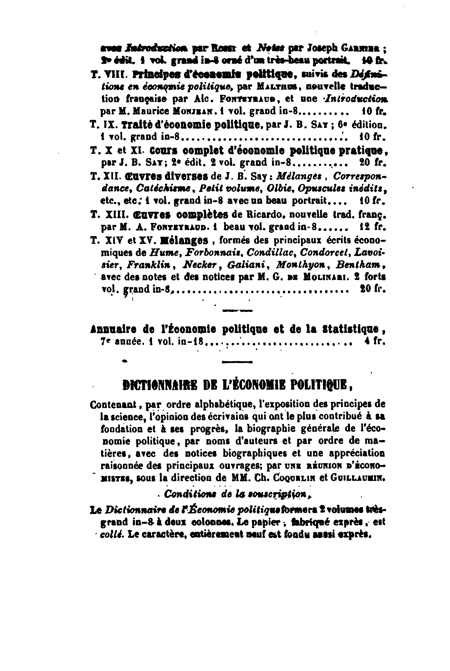
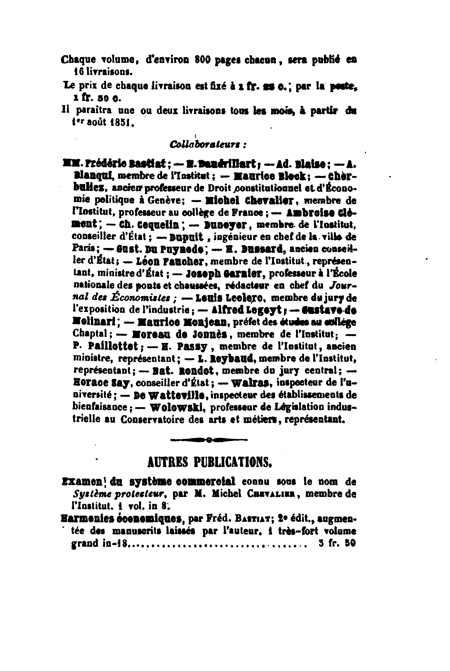
Guillaumin’s great skill was his ability to act as a kind of intellectual entrepreneur who could bring together skilled editors and writers to produce material on time for what were often very large projects, to arrange funding by his backers like businessmen Horace Say and Casimir Cheuvreux, and to see the books through the complex stage of typesetting and printing. According to Joseph Garnier, Guillaumin was part diplomat, part entrepreneur, part salesman, part editor, and part printing craftsman. He was also entrepreneurial in setting up separate legal entities to oversee large projects such as the Journal des Économistes in order to keep any losses which might eventuate from bringing down the entire publishing edifice. Guillaumin also seemed to have the knack for spotting a potential market for his products, such as his first publishing success the Dictionnaire de Commerce et des marchandise (1837) which, even if they did not make him rich at least kept his firm afloat for several decades. [69]
In his obituary of Guillaumin in January 1865 Joseph Garnier described the extraordinary set of skills which Guillaumin had which made his publishing and editing projects so successful and so crucial to the liberal movement in France: [70]
| “Le métier d'éditeur, de producteur de livres, est un des plus délicats qui se puisse entreprendre : il faut savoir apprécier les qualités intrinsèques des manuscrits et des ouvrages proposés, les frais de fabrication et de publicité, les chances de vente, c'est-à-dire la nature et l'étendue du débouché. Il faut savoir demander et obtenir certaines modifications des auteurs, tant à cause de l'étendue des œuvres que de leur disposition; il faut savoir choisir les meilleures combinaisons typographiques, etc. S'il s'agit d'ouvrages à commander aux autres, de dictionnaires, de collections, il faut savoir s'adjoindre un directeur spécial, le guider, l'aider, le surveiller dans son travail, ou bien savoir diriger soi-même les collaborateurs, demander à chacun ce qu'il sait faire, provoquer le travail des uns, repousser celui des autres : besogne délicate et difficile quand on a affaire à des hommes dont l'âge, la position, le caractère, ou les prétentions, plus ou moins fondées, exigent des précautions, et des ménagements. Il faut enfin, une fois que l'œuvre est produite, savoir la vendre, c'est-à-dire faire concourir les intermédiaires à son écoulement et provoquer l'attention du public. Pour cela, il faut mettre à la loterie des annonces, choisir les meilleurs modes et les meilleures places pour la publicité, faire les dépenses nécessaires et n'en pas faire au-delà de ce que comporte l'ouvrage.” [p. 118] | The job of editor, the producer of books, is one of the most delicate which could be undertaken: one must know how to appreciate the intrinsic qualities of the manuscripts and the works which are proposed, the costs of manufacturing and publicising them, the chances of making a sale, that is to say one has to know the nature and the extent of the (book) market. On needs to know how to ask for and get certain changes from the authors, whether in the length or the perspective of the work; one needs to know how to choose the best combination of type fonts, and so on. If it is a matter of works which will be edited by others, such as dictionaries or collections, one has to know to collaborate with a particular editor, how to guide him, assist him, and supervise his work; or even to know how to manage the collaborators oneself, to ask each one to do what he knows best, to encourage the work of some, and to reject the work of others: it is a delicate and difficile task when one has to deal with men whose age, position, character, or ambitions, which may or may not be justified, demand some caution and careful management. Finally, once a book has been produced, one needs to know how to sell it, that is to say how to encourage middlemen to distribute it and how to stimulate the attention of the public. To do that, one has to enter into the lottery game which is advertising, to select the best method and the best places to advertise, and to spend only what is necessary and not go beyond what the book requires. |
The First Editor, Ambroise Clément (1805-86)
Clément was an economist and secretary to the mayor of Saint-Étienne for many years. Clément was able to travel to Paris frequently to participate in political economy circles. In the mid 1840s he began writing on economic matters and so impressed Guillaumin that the latter asked him to assume the task of directing the publication of the important and influential Dictionnaire de l’économie politique, in 1849, which he edited briefly before he had to withdraw because of his business commitments (he was replaced by Charles Coquelin).
Clément was a member of the Société d’économie politique from 1848, a regular writer and reviewer for the Journal des économistes, and was made a corresponding member of the Académie des sciences morales et politiques in 1872. He wrote the following works: Recherches sur les causes de l’indigence (1846); Des nouvelles Idées de réforme industrielle et en particulier du projet d’organisation du travail de M. Louis Blanc (1846); La crise économique et sociale en France et en Europe (1886); as well as an early review of Bastiat’s Economic Harmonies for the Journal des économistes (1850), in which he praised Bastiat’s style but criticized his position on population and the theory of value. Two works which deserve special note are the article on "spoliation" (plunder), "De la spoliation légale,"Journal des économistes, vol. 20, no. 83, 1er juillet 1848, which he wrote in the heat of the June Days uprising in Paris, and the two volume work on social theory which has numerous "Austrian" insights, Essai sur la science sociale. Économie politique - morale expérimentale - politique théorique (Paris: Guillaumin, 1867), 2 vols.
As the first editor he would have worked closely with Guillaumin to plan the contents of the DEP, to organise the dozens of writers involved in the project, and the timely publication and sale of each installment. In addition he wrote 26 of the principal articles (see the Appendix for the full list) and the Introduction to the DEP which clearly stated its political purpose. The problem he thought was not just "les fausses notions" (the false notions) which people had about economics and how markets operated, but also the groups or classes who used or wanted to use the power of the state to benefit themselves at the expence of everybody else. Bastiat had concisely summarised what the state really was for the economists in his short essay "L'État" (1848, 1849): [71]
| L’ÉTAT, c’est la grande fiction à travers laquelle TOUT LE MONDE s’efforce de vivre aux dépens de TOUT LE MONDE. | The state is the great fiction by which everyone endeavors to live at the expense of everyone else. |
Bastiat had developed a detailed theory of class and exploitation in several works between 1845 and 1850 where he contrasted "la classe spoliatrice" (the plundering class) and "les classes spoliées" (the plundered classes). These ideas were taken up by Clément and especially by Molinari in several works. Clément wrote an essay in the JDE expanding on Bastiat's ideas one month after he wrote the first version of "L'État" (June 1848). It was entitled “De la spoliation légale". [72] He followed this up with an entry for the DEP on "Fonctionnaires" (Functionaries). [73] Both the concepts of "la spoliation légale" (legal plunder) and "fonctionnarisme" (functionaryism, or rule by functionaries) were central to Bastiat's theory of class and exploitation which suggests that Clément also thought along these lines.
He spoke at some length about this in his Introduction to the DEP which I reproduce here because it so neatly sums up the polticial and economic perspective of the publisher and editors of the Project: [74]
| Depuis 1789, la nation française s'est trouvée plusieurs fois maîtresse de son établissement gouvernemental, et, bien que ses tendances les plus générales fussent pour la liberté, les fausses notions qu'elle avait adoptées sur ce point ne lui ont pas permis de réussir à fonder des institutions propres à atteindre le but. La plupart de nos hommes politiques ont toujours considéré les institutions gouvernementales comme les principaux et presque les seuls organes de la vie des sociétés, comme les forces dont elles doivent attendre l'impulsion et subir la direction dans tous les modes de leur activité : préoccupés de l'exemple de certains personnages que nos historiens se plaisent à signaler comme de grands hommes d'État, parce qu'ils sont parvenus à faire dominer leur volonté ou leurs vues personnelles, quelque absurdes et quelque désastreuses qu'elles aient été le plus souvent; — influencés, parfois à leur insu, par des réminiscences classiques sur les institutions des Grecs et des Romains, sur les systèmes législatifs de Lycurgue, de Solon, etc., ou par des notions non moins propres à les égarer, puisées dans des écrits tels que ceux de Montesquieu, de Rousseau, de Mably, de Raynal, etc., ils n'ont vu dans les sociétés civilisées que des corps incapables de vivre et de prospérer par eux-mêmes; ils n'ont pas compris que leur existence et leurs progrès dépendent avant tout d'efforts individuels dont les principes sont en nous-mêmes et non dans la législation ou dans l'action de l'autorité publique, efforts que la Providence a rendus d'autant plus puissants pour assurer le bien général qu'ils sont moins contrariés par les lois d'invention humaine et que chacun les exerce avec plus de liberté dans tout ce qui ne porte pas atteinte à la liberté d'autrui; qu'en conséquence, la mission rationnelle du législateur n'est pas de conduire les hommes, de diriger leur activité, mais de les préserver de toute injuste atteinte dans leur personne ou dans leurs intérêts, de garantir à chacun la libre disposition des facultés qui lui sont inhérentes et de ce qu'elles produisent. | Since 1789, the French nation has repeatedly found itself in control of its governmental establishment, and although its general inclinations leaned toward liberty, the false notions it had adopted on this point prevented it from successfully establishing institutions capable of achieving that goal. Most of our politicians have always regarded the institutions of government as the primary, and almost the sole, organs of social life, as forces from which society must receive its impetus and to whose direction all forms of activity must submit. Influenced by the example of certain figures whom our historians delight in portraying as great statesmen—merely because they succeeded in imposing their personal will or views, no matter how absurd or disastrous they often were—shaped, sometimes unconsciously, by vague memories of classical Greek and Roman institutions, of the legislative systems of Lycurgus and Solon, or by equally misleading ideas drawn from works such as those of Montesquieu, Rousseau, Mably, and Raynal, they have seen civilized societies only as bodies incapable of thriving and prospering on their own. They have failed to understand that the existence and progress of societies depend primarily on individual efforts, whose principles lie within ourselves rather than in legislation or public authority. These individual efforts, made all the more powerful by Providence in order to ensure the general welfare so long as they are not thwarted by human-devised laws and so long as they exercised with greater freedom in all areas that do not infringe upon the liberty of others. Consequently, the rational mission of the legislator is not to lead men or direct their activities but to safeguard them from unjust infringements on their persons or interests, guaranteeing each individual the free use of his inherent faculties and the fruits of his labor. |
| C'est en ce sens que les populations des États du nord de l'Union américaine comprennent la liberté politique; elles la font consister surtout dans une indépendance des facultés et des activités individuelles aussi complète que possible, c'est-à-dire uniquement subordonnée, pour chaque individu pris en particulier, à la condition de respecter les mêmes droits chez tous les autres. La liberté n'a jamais été entendue ainsi par nos hommes politiques, même par ceux qui faisaient profession d'appartenir à l'opinion libérale; ceux-ci jugeaient la liberté suffisamment établie dès que la puissance législative, à laquelle ils donnaient mission de diriger la société sur tous les points, avait son origine dans le suffrage de la majorité de la [**xxvi**] population, et que les règles qu'elle imposait étaient communes à tous; pourvu que cette puissance leur parût être l'expression de la volonté la plus générale, ils n'hésitaient pas à lui sacrifier la liberté individuelle. Il est à remarquer, au surplus, que, lorsque des changements politiques sont venus substituer à la volonté générale, pour la formation du pouvoir législatif, la volonté d'une fraction plus ou moins restreinte de la population, ou même celle d'un seul homme, l'omnipotence du législateur n'a pas été plus contestée qu'auparavant. | This is how the populations of the northern states of the American Union understand political liberty. To them, it consists primarily in an independence of individual faculties and activities as complete as possible—that is, constrained only by the necessity for each person to respect the same rights in others. Liberty has never been understood in this way by our politicians, even those who claimed to belong to the liberal camp. They believed that liberty was sufficiently established once the legislative power, which they charged with directing society in all respects, derived its authority from the suffrage of the majority of the [**xxvi**] population and the fact that the rules which it imposed were common to all. As long as this power appeared to them to be the expression of the broadest general will, they did not hesitate to sacrifice individual liberty to it. Moreover, when political changes replaced the general will as the basis for legislative power with the will of a more or less restricted fraction of the population—or even that of a single man—the omnipotence of the legislator was no more contested than before. |
| Sous l'empire de pareilles idées, renforcées en France, et dans d'autres pays qui ont tort de nous imiter, par une disposition universelle à l'exercice de la domination et à la recherche des emplois publics comme moyens d'existence ou de fortune, il était inévitable que l'action du gouvernement ne tendit sans cesse à s'accroître. Dès que l'on attribuait au législateur, quel qu'il fût, une mission illimitée, il devait avoir continuellement à ajouter aux prescriptions, aux règles nécessaires pour faire marcher la société selon ses vues. Aussi les hommes que la succession des événements a investis tour à tour de ce suprême mandat en ont-ils usé si largement que l'on compte par centaines de mille le nombre des lois ou des règlements qu'ils nous ont imposés depuis soixante ans. | Under the influence of such ideas—reinforced in France and in other countries that mistakenly imitate us by a universal inclination toward domination and the pursuit of public offices as means of making a living or a fortune—it was inevitable that governmental action would tend to expand continuously. Once legislators, whoever they might be, were entrusted with an unlimited mission, they inevitably had to add to the dictates and regulations necessary to make society function according to their vision. Consequently, those who have successively wielded this supreme mandate have done so so extensively that they have imposed hundreds of thousands of laws and regulations upon us over the past sixty years. |
| C'est ainsi que notre système gouvernemental et administratif a acquis des proportions colossales et sans exemple jusqu'ici dans aucun pays du monde; qu'il a étendu successivement son action, ses règlements, ses entraves, à presque toutes les branches d'activité, en restreignant leurs développements et leur fécondité proportionnellement à ce qu'il enlevait à leur liberté; que, pour suffire à l'immensité des attributions qu'il comporte, il a multiplié les services et les emplois publics au point de faire vivre une très-grande partie de la population sur le produit des contributions, et de pousser ainsi au développement des races parasites demandant à vivre de la même manière, jusqu'à en faire une force subversive des plus dangereuses et l'une des principales causes d'agitation et de désordre qui rendent chez nous la sécurité si précaire. | This is how our governmental and administrative system has acquired colossal proportions, unprecedented in any country in the world. It has gradually extended its reach, its regulations, and its restrictions to almost every sector of activity, stifling their development and productivity in proportion to the freedom it has curtailed. To manage the vast numbers of its duties, it has multiplied public services and positions to such an extent that a significant portion of the population now lives off tax revenues, fostering the growth of parasitic groups that seek to live the same way. This has created a dangerously subversive force and one of the primary causes of the unrest and disorder that make security so precarious in our country. |
| L'Économie politique étudie et analyse tous les éléments de perturbation que renferme un semblable régime; elle en montre les fâcheux résultats; elle en signale le remède, qui consiste principalement à réduire et à simplifier l'action gouvernementale par la restitution à l'activité privée du libre exercice de toutes les branches de travaux qui, par leur nature, sont hors des attributions rationnelles de l'autorité publique, et que nos gouvernements ont voulu diriger, monopoliser ou réglementer. | Political economy studies and analyzes all the elements of disruption contained in such a system; it exposes its harmful consequences and identifies the remedy, which consists primarily in reducing and simplifying governmental action by returning to private activity the free exercise of all branches of labor that, by their nature, fall outside the rational functions of public authority but which our governments have sought to control, monopolize, or regulate. |
| Dans un pays comme le nôtre, où tant de gens sont possédés de la manie de gouverner leurs semblables, l'enseignement de pareilles doctrines devait susciter à l'Économie politique une multitude d'adversaires. Les partis qui recherchent l'exercice du pouvoir, l'armée des gens en place, l'armée plus nombreuse encore de ceux qui aspirent à être placés, et tous les réformateurs qui ont inventé un plan quelconque de refonte sociale, devaient se réunir contre une science qui menace de soustraire un jour la société aux soins trop multipliés qu'ils veulent absolument lui prodiguer. Aussi est-ce à cette partie de ses doctrines qu'elle a dû la plupart des attaques dont elle a été l'objet. | In a country like ours, where so many people are obsessed with governing their fellow citizens, the teaching of such doctrines was bound to provoke numerous adversaries of political economy. Political parties seeking power, the vast army of those already in office, the even larger army of those aspiring to office, and all the reformers who have devised some new scheme for social restructuring—all had to unite against a science that threatens one day to free society from the excessive intervention they are determined to impose upon it. Thus, it is to this aspect of its doctrines that political economy owes most of the attacks it has faced. |
The Second Editor, Charles Coquelin (1802-1852
Charles Coquelin (1802-1852) was one of the leading figures in the Political Economy movement in Paris before his untimely death. [75] He was chosen by the publisher Guillaumin after the depature of the first editor Ambroise Clément to edit the DEP because of his erudition and near photographic memory. He also wrote 71 articles for the Dictionnaire (all in vol. 1).
Coquelin was born in Dunkirk and went to Paris in order to study law but he spent considerable time reading the classic works of political economy, developing a keen interest in business cycles after the depression of 1825-26. In 1827 he began a journal, Les Annales du Commerce (1827-28) in which he wrote on banking matters. [76] In the early 1830s he turned to banking policy in the United States, especially in New England where there were liberal laws governing the creation of banks. Financial concerns in 1839 forced him to seek employment in the textile and linen industry on which he wrote a number of works. In the early 1840s he wrote a series of articles for La Revue des Deux-Mondes on banking in which he toyed with the idea of the competitive issue of currencies by banks competing for business in the market. These ideas were further developed in his major book on the subject, Du Crédit et des Banques which appeared in 1848. [77] In 1845 he became one of the editors of the Revue de Paris.
Coquelin was a key member of the Free Trade Association serving as one of its Secretaries, and writing many articles which were published in its journal Libre-Échange, and one of their key public speakers. He took over the role of editor of the journal from Bastiat in late 1847 or early 1848 as the latter’s health declined and when he returned to his home region in order to campaign for election to the Constituent Assembly (which was successful in the April 23 election). Like Molinari Coquelin became a regular contributor to the JDE during 1847 and wrote 30 articles and book reviews before his sudden death in 1852.
According to Molinari, Coquelin was one of the most eloquent and best debaters among the economists who had honed his skills before large and sometimes rowdy audiences in Montesquieu Hall where the Free Trade Association held its Paris meetings. Like Bastiat who sprinkled his Economic Sophisms with references to the plays of Molière, the fables of La Fontaine, William Dafoe’s Robinson Crusoe, and the political songs of Béranger, he was able to stand before a boisterous and hostile audience and weave references to Racine and Molière with passages from the masters of political economy like Adam Smith, J.-B. Say, and Ricardo. Molinari described his memory as “une bibliothèque où les poètes et les orateurs avaient leur place à côté des économistes” (a library where poets and orators had their place beside the economists). As he recollects in his obituary of Coquelin: [78]
| Son intelligence était prompte et facile, sa mémoire véritablement prodigieuse. Vers la fin de sa vie, il possédait non-seulement à un degré remarquable toutes les notions relatives à la science à laquelle il s'était spécialement voué, mais encore il avait retenu les plus beaux morceaux des maîtres de notre littérature. Il savait Racine et Molière à peu près par cœur, [like bastiat!!] comme il connaissait d'une manière approfondie Adam Smith, J.-R. Say et Ricardo. Sa mémoire était une bibliothèque où les poètes et les orateurs avaient leur place à côté des économistes, et où il trouvait, avec de nombreux et solides matériaux pour ses travaux scientifiques, des [168] modèles dont l'influence s'aperçoit dans l'élégante et facile correction de sa diction et de son style. | His mind was quick and sharp; his memory was truly prodigious. Towards the end of his life he not only possessed to a remarkable degree all the ideas relevant to the science (of economics) to which he was especially devoted, but in addition he remembered the best pieces of the masters of French literature. He knew Racine and Molière off by heart, just as he deeply knew the work of Adam Smith, J.B. Say, and Ricardo. His memory was a library where the poets and orators had their place alongside the Economists, and whose numerous and substantial works he drew upon as models of elegance and correctness in his speech and style for his scientific works. |
When the revolution broke out in February 1848 scores of political clubs sprang up in the absence of any effective censorship or police supervision. By some estimates there were nearly two hundred such clubs in Paris before they were suppressed following the riots of the June Days. Not to be outdone by the socialists, Coquelin started a political club in March 1848 to publicly debate the socialists on the question of the “right to work” (le droit au travail) which was a major issue in the first months of the Revolution with the formation of the government funded employment program called the National Workshops. His club was called appropriately enough the Club de la Liberté du Travail (the Club for the Freedom of Working, or “Club Lib” for short) as the economists believed in the “right to engage in work” (le droit du travail) not “the right to a job” (le droit au travail). The Club survived for a few weeks until it was forced to shut down when socialist opponents used violence to disrupt the Club’s meetings. Molinari relates that their Club was “envahi et dissous par un troupeau de communistes” (invaded and dissolved by a herd of communists - Molinari also used the phrase “bande” or gang) (p. 171).
Since Coquelin had failed to get elected to the Constituent Assembly in the elections of April and had been forced out of the debating halls and off the streets of Paris he decided to return to writing and spent the rest of 1848 completing his book on free banking which was published by Guillaumin later in the year. He briefly returned to the streets during the outbreak of violence known as the "June Days". He, Bastiat, Fonteyraud, Garnier, and Molinari, decided to launch the popular journal Jacques Bonhomme in June 1848 in the hope that they could overturn some of the most commonly held anti-market prejudices. It only lasted a few weeks before it too had to close as the rioting over the closing of the National Workshops turned violent and bloody. Molinari wryly noted that “les doctrines libérales n'étaient décidément pas en faveur à cette époque, bien que le mot liberté se trouvât dans toutes les bouches et sur tous les murs” (liberal doctrines were definitely not in favor at this time, although the word liberty was on everybody’s lips and written on all the walls). [79]
Coquelin was asked by Guillaumin to be the editor of the massive Dictionnaire de l’économie politique project because of his knowledge of banking, his photographic memory, and his organizational skills. In a remarkably short period of time (Molinari says barely two years). [80] Coquelin was able to edit and prepare for press a 2,000 page, double-columned compendium of practically everything about the state of knowledge of French political economy in the mid-nineteenth century. He also wrote 71 of the 185 major articles in volume 1 including the key articles on “The National Workshops,” “Banks”, “Capital,” “Commercial Crises,” “Commerce,” “Competition”, “Credit”, “Industrial Harmony,” “The State” (largely based upon Bastiat’s essay), and the all important article on “Political Economy.” (See the full list of his articles in the Appendix.)
When Coquelin died suddenly from a heart attack on 12 August 1852 he was half way through editing the DEP and Molinari was deeply shaken. He was the 6th economist to die within the past 6 years thus decimating the small community of Economists in Paris at a time when they felt most under threat from their intellectual adversaries. Molinari noted that Théodore Fix (publisher of the Revue mensuelle d’économie politique (1833-36) died 31 July 1846), Eugène Daire (the editor of the Collection des Principaux économistes died 14 June 1847), Pellegrino Rossi (the professor of political economy who replaced J.B. Say at the Collège de France, murdered in Rome 15 Nov. 1848), Alcide Fonteyraud (August 1849 in the cholera epidemic), Frédéric Bastiat (24 December 1850 from throat cancer), and now Charles Coquelin (1852) had all gone. He says he could cope with all this bad news for the liberal movement if he thought their shoes would be filled by younger economists stepping forward to continue the fight of this “petite armée des propagateurs de la science” (this little army of disseminators of economic science), but in the current climate of political oppression in Paris and the efforts of the government to close down some of the chairs in economics or to amalgamate political economy with the teaching of statistics or government administration, Molinari thought there was little chance of this happening. He feared that political economy would be relegated to being taught as a side-discipline alongside the teaching of Tibetan or ancient Sanskrit: [81]
| La science économique vient de perdre encore une de ses meilleures plumes et l'une de ses voix les plus éloquentes. Le savant directeur du Dictionnaire de l'Economie politique, l'orateur applaudi de la salle Montesquieu, qui avait tenu en tant d'occasions et d'une main si ferme le drapeau de la liberté économique, Charles Coquelin est mort le 12 août dernier, à l'âge de quarante-neuf ans. C'est ainsi que nos rangs s'éclaircissent peu à peu; c'est ainsi que nous avons successivement perdu, en quelques années, Eug. Daire, Th. Fix, Rossi, Fonteyraud, Bastiat, Coquelin, morts dans la vigueur de l'âge et du talent. Encore si de nouvelles recrues avaient rempli aussitôt les vides que tant de morts hâtives ont causés dans la petite armée des propagateurs de la science, nos regrets auraient été adoucis par des espérances. … | Economic science has just lost another of its best authors and one of its most eloquent voices. The wise editor of the Dictionnaire de l'Economie politique, the acclaimed orator of the Montesquieu Hall, who held high the flag of economic liberty with a firm hand on so many occasions, Charles Coquelin died on 12 August last at the age of 49. In this way, our ranks are gradually thinning; in this way we have successively lost in just a few years, Eugène Daire, Théodore Fix, Rossi, Fonteyraud, Bastiat, and Coquelin, all dead in the prime of gtheir lives and the peak of their talents. However, if some new recruits had stepped forward to fill the gaps that so many sudden deaths have produced in the little army of disseminators of economic science, our regrets would have been eased by these hopes. … |
Molinari wrote this passage in Brussels after he had gone into voluntary exile following the coup d’état of Louis Napoléon in December 1851 where he was probably feeling these recent losses particularly acutely.
IV. Molinari and the "economics of everything"↩
Bio of Gustave de Molinari (1819-1912)
Gustave de Molinari (1819-1912) was born in Liège, Belgium but spent most of his working life in Paris, becoming the leading representative of the laissez-faire school of classical liberalism in France in the second half of the nineteenth century. His liberalism was based upon the theory of natural rights (especially the right to property and individual liberty), and he advocated complete laissez-faire in economic policy and the ultra-minimal state in politics.
He came to the attention of the Guillaumin network with some magazine articles he wrote for La Nation in 1843-44 and Le Courrier Français in 1844-45 on railways (the construction of which began in earnest in the eary 1840s) and the laws against workers forming trade unions. [82] His first article for the JDE on English agriculture was published in January 1847 [83] and he would go on to publish a total of 234 articles for the journal, [84] and would become the journal's editor in 1881 upon the death of Joseph Garnier until his retirement in 1909.
Guillaumin quickly spotted his skill and encouraged him to join their stable of writers, publishing his first book for them in 1847 which was a two volume history of tariffs. [85] This was followed soon after when he worked with Eugène Daire on the Collection des Principaux Économistes for which he edited and wrote lengthy intrductions to volumes XIV and XV called Mélanges d'économie politique which contained works by David Hume, Forbonnais, Condillac, Condorcet, Lavoisier, Lagrange, Benjamin Franklin, Necker, Galiani, Montyon, and Jeremy Bentahm.
The next book he published with them was his very controversial work Les Soirées de la rue Saint-Lazare; entretiens sur les lois économiques et défense de la propriété (1849) which was his first attempt to write a a popular book on economic ideas in the style of Bastiat, using "conversations" between "a Conservative", "a Socialist", and "an Economist". [86] It ruffled a few feathers among the other economists because of his advocacy for the private provision of all public goods, including "the production of security" (both police and national defence). He would write two more similar works of "popular economics" for Guillaumin: Conservations familières sur le commerce des grains (1855) [87] and Conversations sur le commerce des grains et la protection de l’agriculture (1886). [88]
Guillaumin would eventually publish a total of 25 individual books by Molinari, plus 7 introductions to other books.
During the 1840s he joined the Société d'économie politique and was active in the Association pour la liberté des échanges. During the 1848 revolution he vigorously opposed the rise of socialism and took to the streets with other members of the Guillaumin network to wrote for and distribute copies of a newsletter called La République francaise in February and again in June with Jacques Bonhomme. He was also active in the political club "Le Club de la libertee du travail" with Conqueling and others. He also wrote a regular "column" for the JDE discussing the events of the revolution every couple of weeks.
In the early 1850s he worked as a senior editor in the DEP project for which he contributed a number of significant articles on free trade, peace, colonization, and slavery before going into exile in his native Belgium to escape the authoritarian regime of Napoleon III. There he became a professor of political economy at the Musée royale de l'industrie belge and published a significant treatise on political economy (Cours d'économie politique, 1855) [89] and a magazine called the Économiste belge [90] in which he promoted his ideas on public goods and a "Bourse du travail" (a labour exchange) mondelled on the stock exchange. [91]
In the period between moving to Paris (in the early 1840s) and his entry into the Guillaumin network in 1847, and the end of 1853 (the publication of vol.2 of DEP and his move to Belgium (1852) he wrote 66 pieces (6 books, plus a book-length collection of entires in the DEP, and 37 named articles for the JDE); the most significant of which were:
- 2 volume Histoire du tarif (Paris: Guillaumin, 1847)
- his introductions to 2 volumes of the Collection des Principaux Économistes. T. 15 and 16 (1847-48); on Hume, Forbonnais, Condillac, Condorcet, Lavoisier, Franklin; Galiani, Necker, Montyon, Bentham
- his article in the JDE: “De la production de la sécurité,” Journal des Économistes, S. 1, T. 22, N° 95, 15 février 1849
- the collection of "conversations" between a Conservative, a Socialist, and an Economisat: Les Soirées de la rue Saint-Lazare; entretiens sur les lois économiques et défense de la propriété (Paris: Guillaumin, 1849).
- the book-length collection of 25 entires in DEP (1852-53)
- his book-length lecture on Les Révolutions et le despotisme envisagés au point de vue des intérêts matérie (1852)
Some of the key issues and ideas he concerned himself with during this period of intense activity include the following:
- labour issues involving bans on labour organisations, the nature of coerced labour (especially slavery in the colonies), and the idea of labor exchanges which would do for the labour market what stock exchanges were doing for the capital market.
- the history and economics of tariffs and other forms of trade restrictions, and his involvement in Bastiat’s French Free Trade Association
- his involvement in the Guillaumin publishing firm’s large history of economic thought program for which he edited two large volumes of late 18th century thought with his introductions and annotations.
- his lectures in economic theory at the private Athénée royal de Paris which were interrupted by the February Revolution but which he resumed when he became a professor in Brussels in the early 1850s
- his involvement in the Revolution of February 1848 as a journalist, public speaker, and anti-socialist writer
- the book length series of “conversations” between a Socialist, a Conservative, and an Economists - the “Soirées de la rue Saint-Lazare” - in which he provided a concise survey of the classical liberal position (perhaps the first of its type) and explored how all public goods might be privatised, including the “production of security” (i.e police and national defence)
- his large contribution to another important Guillaumin publishing project, the Dictionary of Political Economy (1852-53) for which he wrote nearly 30 long articles on things like free trade, tariffs, slavery, colonies, and war
- his class analysis of the causes of the 1848 Revolution and the rise to power of Louis Napoléon, and his general theory of the state
Towards the end of the 1860s Molinari returned to Paris to work on the prestigious Journal des débats, becoming editor from 1871 to 1876. He combined this with several international trips which gave him the opportunity to write a form of "economic travel literature" in which he made astute and critical observations about the economic conditions of the countries he visited.
Following the death of Joseph Garnier he became the editor of the leading journal of political economy in France, the Journal des économistes (1881-1909). In the decades which followed he wrote a series of works on "economic sociology" in which he explored the rise of markets and trade out of the feudal period, the role played by war in economic and political development, the rise of the modern state which he treated as a "profit making" firm which served the interests of its "owners", i.e. the "ruling class". These writings were published in two pairs of texts. The first pair were L’évolution économique du XIXe siècle: théorie du progrès (Economic Evolution in the 19th Century: A Theory of progress) (1880) and L’évolution politique et la Révolution Political Evolution and the Revolution) (1884) [92] . The second pair were Grandeur et decadence de la guerre (The Greatness and Decline of War) (1898) and Esquisse de l’organisation politique et économique de la Société future (A Sketch of the Political and Economic Organistion of the Society of the Future) (1899). [93]
A complete bibliography of his writings is still a work in progress as more of his journalism continues to come to light. [94] So far I have counted 44 books, 8 introductions to other books, 17 pamphlets, and some 249 articles. The Institut Coppet and I have have attempted to draw up as full a list as possible and we are both putting as much of his work online as we can - the Institut Coppet has published 22 volumes of his Complete Works (up to 1868); while I have put online scores of his books in PDF, a smaller number in HTML, and several of my translations of his works.
Concerning his 44 books we can identify 12 main areas of interest:
- Biographical pieces
- Travel writing
- Trade Unions / Labour issues
- Slavery (forced labour)
- Protectionism/Tariffs
- Popularisation of Economics
- Economic Theory
- Theory of Class / Economic Sociology of the State
- Peace and War
- Politics/ Policy
- Socialism
- History of Economic Thought
Molinari's Contributions to the DEP Project
Overview
A prime concern in this paper is to look at his contributions to the DEP which included 5 biographical articles, 25 "principal articles", 6 of which were major bibligraphical articles as well. I translated these 30 articles and posted them online in March 2025. This paper is a result of that undertaking. [95]
The entries Molinari wrote for the DEP cover the following topics:
- fairly standard topics for free market economists of the time (free trade, tariffs and protectionism) - it was thus of some note that this young economist (he turned 30 in 1849 when the project began) would be asked to write on these important topics
- topics which were of great concern for mid-century classical liberals (both French and English) which might surprise some modern readers (peace and opposition to war, the economics of coerced labour (slavery and serfdom), and opposition to colonies)
- topics which were a special concern to the more radical of the French political economists, such as class analysis and the evolution (political and economic) of societies through various stages on their way to a final stage of "industry"
- topics which were the special concern of Molinari and which might have worried some of his more
conservative colleagues, such as his willingness to apply economic analysis to everything including
some rather unusual topics on which he wrote specific articles for the DEP:
- articles on civilisation, nations, the nobility, war, towns and cities, in which he could outline his ideas on class analysis and the economic and political evolution of the state and the emergence of markets on which he further expand over the course of his long life.
- articles on fine arts, emigration, fashion, public buildings/monuments, theatres, and international travel from an economic perspective: which I would argue are original and perhaps the first time they have been analysed in this way
On the Economic Sociology of the State and the Ruling Class
- Civilisation - “Civilisation,” DEP, T. 1, pp. 370-77. Online in French; Online in English.
- Nations - “Nations,” DEP, T. 2, pp. 259-62. Online in French; Online in English.
- the Nobility - “Noblesse,” DEP, T. 2, pp. 275-81. Online in French; Online in English.
- Serfdom - "Servage", DEP, T. 2, pp. 610-13. Online in French; Online in English.
- War - "Paix, Guerre", DEP, T. 2, pp. 307-14. Online in French; Online in English.
- Towns and cities - “Villes,” DEP, T. 2, pp. 833-38. Online in French; Online in English.
Some of the key ideas which he first developed in these early articles and on which he would much of the rest of his long life elaborating, were the following:
- the importance of "the production of security" of person and property for the expansion of economic production in general, the deepening of the division of labour, the extension of markets in both space and time. This was first achieved almost as an afterthought or an unuintended by-product by the conquering tribes in the early feudal period who realised that if they protected their subject population from other marauding tribes and allowed them to keep more of their output they would produce more for them in the long run. Related to this was the "monetisation" of dues by converting forced labour or the requisition of goods into cash payments. The second key development, although separate from and in opposition to the first, was the creation of towns with defensive walls behind which the "bourgeoisie" could shelter from the depradations of both the old and the new marauders by striking deals with the most powerful feudal lord or king to provide annual tribute (taxes) in exchange for being left alone by the lesser exploiting nobles. Over time the medieval "communes" or towns competed with each other in order to attact inhabitants (and hence producers and taxpayers) by providing better terms (lower and more predictable dues and better protection).
- the initial positive role played by war in the development of the conditions necessery for the provision of security of persons and property, also had the beneficial consequence of stimulating the beginnings of the division of labour (the emergence of a specialised warrior class with specific and complex skills), the larger scale organisation of manpower and production (administration skills were needed to run a large army and produce weaponry and other war materiel), and technolgicial development (there was a strong incentive to develop technology to improve weapons and their lethality). For several hundred years (until the invading Germanic tribes which overan the Roman Empire were defeated) the "benefits" of being ruled by a warrior state and its ruling class outweighed the "costs" (note Molinari's idea of the economist as the "bookkeeper" of government policies which drew up an account book). When strong, centralised "dynastic states" began to emerge in the 15/16th centuries the economic balance shifted and the "costs" of war and the warrior class began to outweigh the economic "benefits". On the one hand, the emerging wealthier class of "producers" (mercantile, agricultural, and later industrial) wanted better terms to justify being ruled by a noble, warrior, and ecclesiastical class. On the other hand, the costs of waging war with other powerful dynastic states required a change in the way in which states raised their revenue (loans became more important) and regulated their economies (mercantilism). When the two forces eventually clashed Europe entered the democratic and revolutionary era the effects of which were still being very much felt when the DEP was written in 1850.
- analsysing the state as an economic "firm" which was owned and run for the membersor "shareholders" of the firm who sought profits, the expansion of their market, and dealing with competitors (both internal and external). There are strong hints of this in the DEP articles but he would not develop his ideas in great detail until his later first pair of books in the 1880s (L’évolution économique du XIXe siècle (1880) and L’évolution politique et la Révolution (1884)) after he gave up his job editing the JDD and became the editor of the JDE (1881-1909); and then in another pair of books written in the late 1890s (Grandeur et decadence de la guerre (1898) andEsquisse de l’organisation politique et économique de la Société future (1899). He did use some of his earlier insights to analysise the strict economic constraints under which states had to operate in his treatise on economics Cours (1855, 1863) which was based on his lectures at the Musée royale de l'industrie belge in Brussels during the 1850s. Here he argued that states "sinned" (pêcher) by not recognising and following the economic laws which he and the other economists had described in great detail, especially when it came to the operation of firms in the market place. There were 4 major "sins" committed by states in their economic functions: they did not specialise in one area of activity and tried to do too much in too many areas, they grew too big and became inefficient and too costly, by eliminating competition with other firms they became lazy and did not innovate, and in the distribution of their services they did not provide their customers with the products they wanted at ther price they were willing to pay. [96] He had subtitled his 1849 book Les Soirées de la rue Saint-Lazare as "entretiens sur les lois économiques et défense de la propriété" (discussions about economic laws and a defence of property) and would later return to the topic with several books he wrote 40-50 years later. [97]
The Economics of "Everything"
Another important aspect of Molinari's thinking at this time was his innovative efforts to apply economic analysis to "everything", something which had not been done before this time to my knowledge, and which surprisingly the publisher Guillaumin and the editor Coquelin gave him considerable scope to explore in print. He did this in the following DEP entires:
- Fine Arts - "Beaux-arts," DEP, T. 1, pp. 149-57. Online in French; Online in English.
- Emigration - "Émigration", DEP, T. 1, pp. 675-83. Online in French; Online in English.
- Fashion - “Mode,” DEP, T. 2, pp. 193-96. Online in French; Online in English.
- Public Buildings/Monuments - "Monuments publics", DEP, T. 2, pp. 237-8. Online in French; Online in English.
- Theatres - “Théâtres,” DEP, T. 2, pp. 731-33. Online in French; Online in English.
- International Travel - "Voyages", DEP, T. 2, pp. 858-60. Online in French; Online in English.
He began applying economic analysis to all kinds of human activity in an unexpected and innovative way in his 1849 book Les Soirées and continued this practice in several of his DEP entries. The key ideas were that :
- everything was an "industry" which had "producers", "consumers", and "entrepreneurs" who brought it all together; his motto was "markets for everything and entrepeneurs in every market"
- private industry was cheaper and more efficient than state provided or heavily regulated industry
- therefore, all industries should be provided competitively on the market
- when industries were not provided privately and competitively the following things would happen:
- vested interests would seek and usually get special privileges from the state (monopolies, protected markets, government contracts) which were at the expnse of ordinary taxpayers and consumers
- politicians and bureaucrats would use their access to state power and taxpayer money to further their own interests (his "public choice" insights)
- the state should be seen as a "firm" which tried to maximise "profits" for its "owners" (the ruling class), exclude "competitors" from its "market", and sought to expand that "market" through war, conquest, and the expansion of its domestic activities
This way of analysing everything from an economic perspective led him to some startling conclusions, such as:
- the topic for which he had stirred up some opposition in 1849 concerning the private provision of ALL public goods including police and national defence
- that prostitution [98] was an "industry" like any other and should be supplied by "entrepreneurs in the prostitution industry" [99]
- the monopolies like the funeral industry (which was monopolised by one firm in Paris), the municipal water supply, the issuing of currency, the supply of education, etc. should all be privitised
- that the Church should be seen as a "protected industry" (religious ideas were the "goods" whose production, sale and distrubution were protected by the state) which tried to stifle its competion by "prohibitions" and monopoly privileges
- that forming a family and raising children should be seen as an economic activity (another kind of a "firm") which required savings, economic planning, costs and benefits, capital investment, etc. He returned to this topic in a book-length treatment in 1897 Viriculture (The "Cultivation" or Growing of Humans) [100]
Molinari also came to the conclusion that the role of the economist was to act as the "book keeper" of society (les teneurs de livres de la politique) who kept a ledger or account book of the costs and benefits, losses and profits, and liabilities and assets regarding all governemnt activities and policies, and to keep the taxpapyers and consumers aware of what was going on by issuing regular "financial statements". This attitude was implicit in what he wrote for the DEP and he made this explicit in his lecture on Les Révolutions et le despotisme envisagés au point de vue des intérêts matériels given on 4 October, 1852 after he had moved to Brussels but before the DEP project had been completed. [101] In this lecture he attempted to draw up an account book for the revolutions France had been through (both in 1789 and 1848) and the "despotisms" which followed in ther train (both of whom were "Bonapartist". He concluded that:
| Or, comme les révolutions ne résistent pas à l’épreuve de la tenue des livres en partie double; comme les révolutions sont de grandes mangeuses, des dissipatrices effrénées qui engloutissent en quelques jours les épargnes accumulées pendant des siècles; comme elles n’ont le plus souvent à donner au peuple, en échange de son épargne et de la vie de ses enfants, que des paroles échauffantes et des utopies malsaines, les économistes, qui sont les teneurs de livres de la politique, ont crié haro sur les révolutions et déclaré une guerre mortelle aux révolutionnaires. | Now, since revolutions do not pass the double book-keeping test, since revolutions are the great eaters/consumers, the unrestrained spendthrifts who gobble up in a few days the savings which were accumulated over centuries; since they all too often give the people only stirring words and unsound utopian dreams in exchange for their savings and the lives of their children, the economists who are the bookkeepers of politics, raise an outcry against revolutions, declaring deadly war against the revolutionaries. |
To appreciate his method I strongly suggest that you read his entries in the DEP (which I have recently translated). I have selected the following pasages from these entries as typical of his approach.
1.) Fine Arts - "Beaux-arts," DEP, T. 1, pp. 149-57. Online in French; Online in English.
| Les beaux-arts pourraient donc être définis d'une manière générale : toute application du travail humain à la production du beau. Online | The fine arts might, therefore, be defined in a general manner as any application of human labor to the production of the beautiful. p. 150 |
| La peinture, la sculpture et surtout l'architecture n'ont pu se développer qu'avec l'auxiliaire des arts industriels. L'industrie du bâtiment a dû nécessairement précéder l'architecture. Celle-ci a servi à donner à chaque édifice le genre de beauté que comportent sa destination et les exigences locales. Online | It was possible to develop painting, sculpture, and, above all, architecture, only by the aid of technology. The trade of building must necessarily have preceded architecture. It was the latter’s mission to give to each individual edifice the kind of beauty appropriate to its purpose and to local exigencies. p. 150 |
| Les économistes se sont posé, au sujet des beaux-arts, deux questions principales. Ils se sont demandé, d'abord, si les beaux-arts constituent une richesse pour les peuples ; en second lieu, s'il est nécessaire que le gouvernement intervienne pour les protéger. Online | Economists have asked themselves two main questions on the subject of the fine arts. They have inquired, first, whether the fine arts are a kind of national wealth and second, whether the intervention of the government to protect them is necessary. p. 151 |
| Les produits des beaux-arts constituent-ils une richesse? En ce qui concerne les produits de l'architecture, de la peinture et de la sculpture, la réponse ne saurait être douteuse. Un édifice, une statue, un tableau sont des richesses matérielles dont l'accumulation augmente évidemment le capital d'une nation. Mais peut-on en dire autant des produits de la musique et de la danse? Peut-on regarder comme productif le talent du musicien et du danseur ? Adam Smith dit non, J.-B.Say et M. Dunoyer disent oui. Online | Do the products of the fine arts constitute a kind of wealth? As regards all that concerns architecture, painting, and sculpture, there can be no doubt as to the answer. A building, a statue, and a picture are material riches, the accumulation of which evidently augments the capital of a nation. But can as much be said of the products of music and dancing? Can the talent of the musician and the dancer be regarded as productive? Adam Smith says, no; J. B. Say and Dunoyer [4] say, yes. p. 151 |
| Mais parce qu'un produit matériel ou immatériel est consommé immédiatement après avoir été créé, s'ensuit-il bien qu'il n'augmente pas le capital d'une nation? ne peut-il pas augmenter, sinon son capital extérieur, du moins son capital intérieur, pour nous servir de l'expression de Storch, le capital de ses facultés physiques, intellectuelles et morales? Online | But does it follow, because a product, material or nonmaterial, is consumed immediately after having been created, that it does not increase the capital of a nation? May it not increase, if not its external capital, at least its internal capital, or, to make use of Storch’s expression, [7] the capital of its physical, intellectual, and moral faculties? p. 151 |
| Après avoir examiné la question, longtemps débattue, de la productivité des beaux-arts, il nous reste à rechercher si ce genre de production doit être spécialement dirigé et encouragé par le gouvernement, ou s'il doit être abandonné à la libre activité des individus, comme tous les autres genres de production. Online | After having examined the question of the productiveness of the fine arts, we must now see if this kind of production should be specially directed and encouraged by the government, or should be abandoned to the free action of individuals, like all other kinds of production. p. 152 |
| On s'explique, du reste, parfaitement que le gouvernement ne soit pas apte à protéger les beaux-arts. Le gouvernement protecteur des arts se personnifie dans une administration et dans un ministre. L'administration est routinière de sa nature; le ministre, ancien avocat, professeur ou journaliste, n'acquiert pas nécessairement, en prenant possession de son portefeuille , le goût éclairé d'un Mécène ou d'un Médicis. D'ailleurs, il a bien d'autres affaires : il est obligé de correspondre avec les préfets, d'endoctriner les maires, de diriger la gendarmerie, de défendre à la tribune la politique du gouvernement. Le temps lui manque pour diriger ou surveiller l'emploi des fonds d'encouragement accordés aux beaux-arts. Il est forcé de s'en remettre pour cette besogne à des subalternes qui ne sont pas plus responsables qu'il ne l'est lui-même du bon emploi des subventions. Doit-on s'étonner, [156] après cela, si ces fonds d'encouragement si péniblement arrachés aux contribuables servent plutôt à alimenter l'intrigue et le savoir-faire qu'à encourager le mérite et le savoir ? Online | Furthermore one can perfectly explain why the government is not suited to protecting the Beaux-Arts. The government as protector of the arts is personified by the nature of administration and in how one becomes a minister. Administration is routine by its very nature; a minister, usually a former lawyer, professor, or journalist, in taking possession of his portfolio does not inevitably acquire the taste of a Mécène [41] or a Medici. Besides, he has many other concerns to attend to: he has to correspond with the Prefects; to instruct the Mayors of towns, to direct the police (gendarmerie), and to defend the policies of the government in the Chamber. He lacks the time to direct or supervise the use of the funds granted to support the Beaux-Arts. He is forced to leave this task up to his subordinates who are no more accountable than he himself is for the good use of these grants. Should one be surprised [156] after all this, if the support funds which were so painfully snatched from the tax-payers now serve rather to feed bureaucratic intrigue and savoir-faire than to encourage artistic merit and knowledge? p. 155-56 |
| On voit donc que le monopole en fait d'arts ne vaut pas mieux qu'en fait d'industrie ou de commerce. Online | Thus one can see that a monopoly in matters relating to the arts is not worth any more than one relating to matters in industry or commerce. p. 156 |
| Les progrès des arts seront accélérés encore par la généralisation de l'aisance qui augmentera leur débouché et par les progrès de l'industrie, qui mettront de nouveaux matériaux et de nouveaux instruments à leur disposition. On bâtira peut-être moins de palais, on peindra moins de batailles que dans le passé, mais on construira des gares de chemins de fer et des palais pour les expositions industrielles; on peindra les paysages splendides et grandioses du nouveau monde que la vapeur rend de jour en jour plus accessibles à nos artiste?, et l'on élèvera des statues aux hommes utiles après en avoir élevé aux conquérants. Online | The progress of the arts will be accelerated also by the spread of comfort, which will increase their market, and by the progress of industry, which will place new materials and new tools at their disposal. Fewer palaces, perhaps, will be built, fewer battle pieces painted than in the past, but railway stations and palaces for industrial expositions will be constructed; [46] the splendid and grand landscapes of the new world, which steamships render more and more accessible to European artists, will be painted; and statues will be erected to useful men instead of to conquerors. p. 156 |
| Mais si la liberté a été la condition essentielle du progrès des arts dans le passé, elle le sera encore dans l'avenir. Comme toutes les autres branches de la production, plus encore à cause du caractère de spontanéité qui leur est propre et qui leur a valu le nom d'arts libéraux, les beaux-arts progresseront d'autant plus rapidement qu'ils seront plus tôt affranchis de toute protection et de toute entrave. Online | But if liberty was the essential condition of the progress of the arts in the past, it will be no less so in the future. Like all other branches of production, and more still because of the character of spontaneity which is peculiar to them, and which has given to them the name of liberal arts, the fine arts will progress the more rapidly the sooner they are freed from all protection and all shackles. |
2.) Emigration - "Émigration", DEP, T. 1, pp. 675-83. Online in French; Online in English.
the opening to the entry:
| L'émigration peut être définie : une exportation de travail et de capital. Elle a lieu lorsque des travailleurs ou des capitalistes croient pouvoir améliorer leur situation en changeant de lieu, en abandonnant le pays où ils sont nés pour s'établir dans un autre pays. Comme toutes les autres entreprises, l'émigration peut réussir ou échouer, selon les circonstances ; mais il importe essentiellement au bien-être et surtout à l'indépendance des populations qu'elle ne soit entravée par aucun obstacle. Online | Emigration can be defined as an export of labor and capital. It occurs when workers or capitalists believe they can improve their condition by relocating—leaving the country where they were born to settle elsewhere. Like all other enterprises, emigration can succeed or fail, depending on the circumstances; however, it is essential for the well-being and, above all, for the independence of people that they not be hindered by any obstacles. p. 675 |
it can be voluntary or coerced (slave trade)
It is usually economically driven:
| … l'industrie renaissante attirer irrésistiblement les travailleurs et les capitaux des endroits les plus éloignés. Les émigrations ont lieu à l'intérieur et au dehors, et elles vont se développant à mesure que les obstacles opposés à la circulation des hommes et des choses disparaissent ou s'abaissent. Online | A reawakening of industry began to irresistibly attract both workers and capital from the most distant locations. Emigration occurred both internally and externally, and it continued to expand as the obstacles to the movement of people and goods either disappeared or diminished. p. 676 |
and is the result of industrial progress:
| … mais l'accroissement de la circulation des travailleurs, leur tendance à émigrer et à s'agglomérer dans de grands foyers de production, n'en sont pas moins des conséquences inévitables, et, selon nous, bienfaisantes du progrès industriel. Online | However, the increasing movement of workers, their tendency to migrate, and their concentration in major centers of production remain inevitable consequences of industrial progress—and, in our view, beneficial ones. p. 676 |
when and where settlers move west in the US depends of the capital they have:
| A leur arrivée aux États-Unis, les émigrants se partagent en deux catégories. Ceux qui sont pourvus de l'aptitude et des capitaux nécessaires pour fonder un établissement agricole se dirigent vers l'ouest, où les chemins de fer et les canaux les transportent à très bas prix. Les autres séjournent dans les États de l'Est, soit pour s'y fixer, soit pour accumuler les capitaux nécessaires à leur établissement dans l'ouest. Souvent ces traînards de l'émigration vont grossir la masse flottante du paupérisme des grandes villes. Online | Upon arriving in the United States, emigrants generally fall into two categories. Those who possess the necessary skills and capital to establish an agricultural settlement head westward, where railways and canals transport them at very low costs. Others remain in the eastern states, either to settle there permanently or to accumulate enough capital before continuing their journey west. Often, these stragglers of emigration end up swelling the ranks of the transient poor in large cities. p. 678 |
other insights:
| Le désir d'augmenter leur bien-être et le besoin de se soustraire à l'oppression, voilà quels ont été, de tout temps, les mobiles qui ont poussé les hommes à émigrer. Des obstacles naturels et artificiels ont, de tout temps aussi, combattu et parfois neutralisé l'action de ces mobiles. Au premier rang des obstacles naturels, il faut placer la difficulté des communications et le sentiment d'affection qui attache l'homme à la terre où il est né. Mais ces obstacles s'aplanissent, à leur tour, sous l'influence de la civilisation. Le progrès des arts industriels, en occasionnant une révolution soudaine et prestigieuse dans la locomotion, a rendu faciles des déplacements d'hommes et de capitaux qui semblaient naguère impraticables. Online | The desire to improve their well-being and the need to escape oppression—these have always been the driving forces behind human migration. Throughout history, natural and artificial obstacles have counteracted and sometimes entirely neutralized these motives. Among the foremost natural barriers are the difficulty of transportation and the deep-seated attachment that binds individuals to the land of their birth. Yet these obstacles, too, have gradually diminished under the influence of civilization. The advancement of industrial technology has brought about a sudden and remarkable revolution in locomotion, making possible the movement of people and capital in ways that once seemed unimaginable. p. 681 |
| Ainsi donc les barrières naturelles et artificielles qui arrêtaient naguère le déplacement des hommes, s'abaissent de toutes parts. D'un autre côté, les nécessités ou les excitations qui poussent les hommes à se déplacer vont sans cesse en se multipliant. Toute industrie qui passe du petit atelier dans la grande manufacture choisit de nouveaux emplacements, mieux appropriés à ses conditions actuelles, et elle rassemble dans une seule localité des travailleurs auparavant disséminés dans vingt localités différentes. Tout progrès, en substituant à l'action de la force de l'homme celle d'une puissance mécanique, oblige encore un certain nombre de travailleurs à se déplacer. Enfin, les inégalités de situation des classes laborieuses, dans les différentes parties du grand atelier du monde, inégalités que le développement des communications fait mieux connaître chaque jour, provoquent activement le» travailleurs à émigrer. Online | Thus, the natural and artificial barriers that once restricted human mobility are being dismantled everywhere. Meanwhile, the incentives and pressures that encourage people to migrate are multiplying. Every industry that moves from small-scale workshops to large-scale manufacturing seeks new locations better suited to its present condition, drawing workers from twenty scattered localities into a single one. Every technological advance that replaces human labor with mechanical power forces some workers to relocate. Lastly, the stark disparities in living conditions among laboring classes across different parts of the world—disparities increasingly evident due to improvements in communication—act as a powerful stimulus for migration. p. 682 |
| En résumé, les gouvernements ne sont pas plus aptes à diriger les émigrations et plus fondés à les subventionner, que n'importe quelle autre espèce d'entreprises agricoles, industrielles et commerciales. Sans doute, les émigrants abandonnés à eux-mêmes font des écoles nombreuses et déplorables : des milliers périssent pour s'être dirigés vers des contrées où ils ne peuvent s'acclimater, ou pour n'avoir pas suffisamment tenu compte des difficultés qu'ils avaient à surmonter; d'autres, mal informés de la situation du marché de travail dans les pays étrangers, aggravent en se déplaçant leur condition qu'ils ont voulu améliorer; mais ces écoles sont inévitables dans toutes les entreprises, et elles ont leur utilité finale, en [683] ce qu'elles signalent les écueils qu'il faut éviter et la route qu'il faut suivre. Online | In conclusion, governments are no more competent to oversee or subsidize migration than they are to manage agricultural, industrial, or commercial enterprises. Certainly, left to their own devices, emigrants suffer numerous misfortunes: thousands perish after settling in lands where they cannot adjust to the conditions, while others, having misjudged labor market conditions in foreign countries, worsen rather than improve their economic standing. Yet such hardships are an unavoidable reality of all human enterprises, and ultimately, they serve a purpose. [683] These experiences—often painful—help to map out the pitfalls to avoid and the paths to follow, guiding future generations of migrants toward better outcomes. pp. 682-83 |
3.) Fashion - “Mode,” DEP, T. 2, pp. 193-96. Online in French; Online in English.
| La mode exerce une influence considérable sur un certain nombre d'industries, notamment sur celles qui s'occupent du vêtement et du logement. Tout changement qui survient dans la [194] mode est une source de bénéfices pour les uns, une cause de pertes pour les autres. Un homme qui trouve un nouveau dessin ou une nouvelle combinaison de couleurs pour étoffes, une nouvelle forme de meuble ou d'habit, et qui réussit à mettre cette invention a la mode, peut en tirer de beaux profits, surtout si la propriété lui en est garantie. (Voyez Propriété artistique.) En revanche les individus qui possèdent un approvisionnement des objets dont la mode ne vent plus éprouvent une perte. Il en est de même des fabricants et des ouvriers qui s'occupaient de la production de ces objets, lorsque la mode nouvelle s'éloigne sensiblement de l'ancienne. Online | Fashion exercises considerable influence on a number of industries, particularly on those pertaining to clothing and lodging. Every change in [ii-194] fashion is a source of profit to some persons and of loss to others. A man who invents a new design or a new combination of colors in dry goods, or a new style of furniture or of a coat, and who succeeds in bringing his invention into fashion, may derive great profits from it, especially if his right to it is guaranteed him. (See LITERARY AND ARTISTIC PROPERTY.) On the other hand, the individuals who possess a supply of articles which are out of fashion, experience a loss. It is the same with the manufacturers and workmen who devote themselves to the production of these articles, when the new fashion varies noticeably from the old. |
| En effet comment agit la mode sur certaines industries et sur certaines catégories de travailleurs? Elle agit comme un risque. Or ce risque, qui se traduit en pertes pour les fabricants, en chômages pour les ouvriers, doit nécessairement être couvert, de telle façon que les profits des uns et les salaires des autres se trouvent en équilibre avec les profits et les salaires de l'ensemble des branches de la production. S'il en était autrement, si le risque provenant des fluctuations de la mode n'était point complètement couvert, les capitaux et les bras cesseraient bientôt de se porter dans les branches assujetties à ce risque particulier … Online | How, in fact, does fashion operate on certain industries and on certain classes of laborers? It acts as a risk. Now this risk, which may result in losses to the manufacturers and in stoppage of work to the workmen, must necessarily be covered, so that the profits of the one class and the wages of the other may be in just proportion to the average profits and wages in other branches of production. If it were otherwise, if the risk arising from the fluctuations of fashion were not completely covered, capital and labor would soon cease to be directed to branches of industry subject to this particular risk. p. 194 |
| En examinant l'influence que la mode exerce sur le développement de l'industrie et des beaux-arts , on acquiert la conviction que l'impulsion vivifiante qu'elle imprime à l'esprit d'invention et de perfectionnement suffit, et au delà, pour compenser les dommages dont elle peut être la source. D'ailleurs les modes ont leurs limites de longévité dont la moyenne pourrait être aisément calculée, et que l'expérience des producteurs, à défaut d'une table de mortalité dressée ad hoc , est habile à apprécier. Il est rare qu'un fabricant intelligent produise d'un dessin ou d'une nuance plus que la consommation n'en peut absorber avant que ce dessin ou cette nuance ait passé de mode; et si, par aventure, ses prévisions se trouvent démenties, si la mode passe plus vite qu'il ne l'avait prévu, il trouve aisément à se défaire de l'excédant de sa marchandise auprès de la vaste classe des consommateurs arriérés. Online | On examining the influence which fashion exercises over the development of industry and the fine arts, one becomes convinced that the invigorating impulse which it gives to the spirit of invention and improvement more than compensates for any injury it causes. Besides, fashions have their life expectancy, whose average may be easily calculated, and which the experience of producers, since they do not have have a “table of mortality rates” prepared ad hoc, is skilled in estimating. Rarely does an intelligent manufacturer produce more of any design or shade than the consumption can absorb before this design or this shade is out of fashion; and if, perchance, his forecast has proved incorrect, if the fashion passes by sooner than he had foreseen, he easily finds some way of getting rid of the excess of his merchandise among the large class of consumers who are behind the times. p. 195 |
| La mode ne subit pas seulement l'influence physique de la température d'un pays et l'influence morale du goût et du caractère des populations ; elle est soumise encore, et pour une large part, à l'influence de l'organisation économique et sociale. Les institutions d'un peuple s'y reflètent comme dans un miroir. Ainsi, dans les pays où les abus du privilège et du despotisme permettent à une classe considérée comme supérieure d'alimenter son oisiveté aux dépens du reste de la nation, les modes sont communément fastueuses et compliquées. Elles sont fastueuses, parce que les privilégiés sentent la nécessité d'éblouir la multitude par la splendeur de leurs dehors, et de la convaincre ainsi qu'ils sont tirés d'une argile supérieure : From porcelain clay of earth, « de la terre de porcelaine, » comme disait le vieux poète Dryden. Les modes sont en même temps compliquées, parce que les privilégiés ont tout le loisir nécessaire pour s'occuper longuement de leur toilette, dont le faste sert, comme on l'a dit, à inspirer au vulgaire une haute idée de ceux qui la portent. Mais que la situation de la société vienne à changer ; que les privilèges disparaissent; que les classes supérieures, désormais assujetties à la loi de la concurrence, soient obligées de faire œuvre de leur intelligence pour subsister : aussitôt on verra les modes se simplifier; on verra les habits brodés, les culottes courtes, les robes à queues ou à paniers, en un mot tout l'appareil majestueux et compliqué des modes aristocratiques disparaître pour faire place à des vêtements faciles à ajuster et commodes à porter. Online | Fashion is not alone affected by the physical influence of the temperature of a country and the moral influence of the taste and character of the population, it is also largely subject to the influence of the social and economic organization. The institutions of a people are reflected in it as in a mirror. Consequently, in countries where the abuses of privilege and despotism permit a class considered to be superior to maintain their idleness at the expense of the rest of the nation, the fashions are commonly ostentatious and complicated. They are ostentatious, because those who are privileged feel the necessity of dazzling the multitude by the splendor of their external appearance, and of thus convincing them that they are made of superior clay: “from porcelain clay of earth,” as the poet Dryden said. The fashions are also complicated, because the privileged class have all the leisure necessary to devote a long time to their appearance, the sumptuousness of which serves, as has been said, to inspire in the vulgar an exalted idea of those who wear it. But let the condition of society be changed; let those who are privileged disappear; let the upper classes, henceforth subject to the law of competition, be obliged to employ their faculties in earning their living; we at once see fashions become simpler; and the embroidered coats, short clothes, dresses with trains or with paniers, in a word, all the magnificent and complicated apparel of aristocratic fashion are seen to disappear, to give place to attire easily adjustable and comfortable to wear. p. 195 |
4.) Public buildings/monuments - "Monuments publics", DEP, T. 2, pp. 237-8. Online in French; Online in English.
economists need to examine the so-called benefits of government building projects:
| On est généralement porté à vanter les gouvernements qui emploient une large part des revenus publics à élever des constructions monumentales. Ces gouvernements font l'admiration des artistes et les délices des architectes; ils fournissent, enfin, un thème inépuisable à l'enthousiasme des poètes lyriques. Méritent-ils au même degré l'approbation des économistes? C'est ce que nous allons examiner. Online | Governments that allocate a large portion of public revenue to the construction of monumental buildings are generally praised. These governments earn the admiration of artists and delight architects; they also provide an inexhaustible theme for the enthusiasm of lyrical poets. But do they deserve the same degree of approval from economists? This is what we shall examine. p. 237 |
| Maintenant quelle est la règle économique à observer au sujet de la construction et de la multiplication des édifices de ce genre? C'est qu'ils soient proportionnés, quant à leur nombre et quant à la richesse de leur construction, à l'objet qu'il s'agit de remplir ainsi qu'aux ressources dont la nation dispose. … Un gouvernement fournira-t-il une preuve bien évidente de sagesse et de bonne administration en multipliant indéfiniment le nombre des édifices publics et en n'épargnant rien pour leur donner une apparence fastueuse? N'en déplaise aux architectes et aux poètes lyriques, nous ne le pensons pas. Online | What, then, is the economic principle to be observed regarding the construction and proliferation of such edifices? It is that their number and the richness of their construction should be proportionate to the purpose they serve and to the resources available to the nation… Does a government provide undeniable proof of wisdom and good administration by endlessly multiplying the number of public buildings and sparing no expense to make them luxurious? With all due respect to architects and lyrical poets, we do not believe so. p. 237 |
| D'un autre côté, la tentation de laisser « des traces durables » de leur passage ne manque jamais d'agir vivement sur l'esprit des gouvernements. Ils sont généralement imbus de la conviction que leur renommée future se proportionnera au nombre et au volume des amas de pierres ou de briques qu'ils auront légués à la postérité. Et cette conviction s'enracine d'autant plus aisément dans leur esprit que les frais de construction des édifices destinés à immortaliser leur mémoire retombent moins directement sur eux. Online | Moreover, the temptation to leave "lasting traces" of their time in power never fails to exert a strong influence on governments. They are generally imbued with the conviction that their future renown will be proportional to the number and size of the piles of stone or brick they bequeath to posterity. And this conviction takes root even more easily in their minds because the costs of constructing these buildings—meant to immortalize their memory—do not fall directly on them. p. 237 |
| Au premier rang des sophismes qui ont été employés pour justifier cet emploi fastueux et improductif des deniers publics, nous signalerons la « nécessité de donner du travail aux ouvriers. » Ce sophisme vulgaire a été admirablement réfuté par F. Bastiat dans son petit pamphlet intitulé : Ce qu'on voit et ce qu'on ne voit pas. Online | At the forefront of the sophisms employed to justify this extravagant and unproductive use of public funds, we must highlight the so-called "necessity of providing work for laborers." This common fallacy was masterfully refuted by Frédéric Bastiat in his brief pamphlet Ce qu'on voit et ce qu'on ne voit pas (What Is Seen and What Is Not Seen). p. 238 |
| C'est dire assez que les gouvernements sont tenus de se laisser guider, en cette matière, bien plutôt par les conseils des économistes que par les plans et devis des architectes ou par les dithyrambes des poètes lyriques. Online | This is to say that governments must allow themselves to be guided in this matter far more by the counsel of economists than by the grand designs of architects or the effusive praise of lyrical poets. p. 238 |
5.) Theatres - “Théâtres,” DEP, T. 2, pp. 731-33. Online in French; Online in English.
| Nous n'avons à nous occuper des théâtres qu'au point de vue de la réglementation particulière à laquelle ils se trouvent soumis. Cette réglementation est des plus compliquées. En France, elle peut se résumer de la manière suivante : 1° Le nombre des entreprises dramatiques est limité ; il faut un privilège pour établir un théâtre ; 2° des subventions sont accordées à certaines entreprises dramatiques, soit aux frais des contribuables, soit aux dépens des autres entreprises de même nature; 3° un impôt spécial est prélevé sur les théâtres; 4° les pièces de théâtre sont soumises à la censure.Ce régime ultra-réglementaire date en France de l'origine même des théâtres, … Online | We are only concerned here with theaters in terms of the specific regulations to which they are subjected. These regulations are among the most complex. In France, they can be summarized as follows: 1. The number of theatrical enterprises is limited; a privilege is required to establish a theater; 2. subsidies are granted to certain theatrical enterprises, either at the expense of taxpayers or at the expense of other enterprises of the same nature; 3. a special tax is levied on theaters; 4. plays are subject to censorship. This ultra-regulatory regime has existed in France since the very inception of theaters, … p. 731 |
| Sans doute, la limitation du nombre des entreprises dramatiques peut être, dans une certaine mesure, avantageuse aux entrepreneurs privilégiés; mais cet avantage a été rendu à peu près illusoire par la multiplication du nombre des privilèges et par des charges dont on a accablé les concessionnaires. Online | Undoubtedly, the limitation on the number of theatrical enterprises can, to some extent, benefit the privileged entrepreneurs; but this advantage has been rendered almost illusory by the increasing number of privileges and the burdens imposed on concessionaires. p. 732 |
| Mais peut-on admettre que le goût du gouvernement vaille mieux que celui du reste de la société? L'administration se compose-t-elle d’êtres [733] d’une essence supérieure, dont les arrêts soient infaillibles en matière de goût comme en toute autre matière? Non, les partisans les plus fanatiques du principe d’autorité eux-mêmes n'oseraient l'affirmer. Cependant, si cette infaillibilité n'existe point, si l'administration n'a point l’aptitude nécessaire pour diriger le goût public à l’avantage de la communauté, en quoi le régime des subventions peut-il se justifier? Online | But can one assume that the government’s taste is superior to that of the rest of society? Is the administration composed of [733] beings of a higher essence, whose judgments are infallible in matters of taste, as in all else? No, not even the most fanatical supporters of the principle of authority would dare to claim such a thing. However, if this infallibility does not exist, if the administration lacks the necessary competence to guide public taste for the benefit of the community, how can the system of subsidies be justified? pp. 732-33 |
| Le résultat définitif de la réglementation compliquée à laquelle on soumet encore à peu près partout l'industrie des théâtres, des charges dont on l'accable et des laveurs dont on la gratifie, c’est de ralentir son développement naturel. Le plaisir du spectacle est généralement devenu de plus en plus cher au lieu de baisser de prix, et, quoique le théâtre ait à son service, plus qu'aucune branche de la production, des intelligences ouvertes et actives, il n'est aucune industrie dont les transformations progressives soient plus lentes. C'est qu'en toutes choses le privilège engendre la cherté et la routine, tandis que la concurrence amène le bon marché et le progrès. Online | The ultimate effect of the complex regulations imposed on the theatrical industry, the burdens it must bear, and the favors it receives, is to hinder its natural development. The cost of attending performances has generally risen instead of decreasing, and although the theater has at its service more open and active minds than almost any other industry, there is no sector where progressive transformation has been slower. This is because privilege, in all things, breeds high costs and stagnation, while competition fosters affordability and progress. p. 733 |
6.) International travel - "Voyages", DEP, T. 2, pp. 858-60. Online in French; Online in English.n
| Les voyages peuvent être divisés en deux grandes catégories : les voyages d'affaires et les voyages de plaisir. Les premiers, qui l'emportent infiniment quant au nombre et à l'importance sur les seconds, jouent dans la production un rôle assez considérable. Les voyages de découverte ou d'exploration, par exemple, préparent de nouveaux débouchés à l'industrie, parfois aussi de nouvelles demeures à une population surabondante. Online | Voyages can be divided into two broad categories: travel for business and travel for leisure. The former, which far exceed the latter in both number and importance, play a significant role in production. Exploratory or discovery voyages, for instance, open new markets for industry and sometimes provide new settlements for an overpopulated region. p. 858 |
| Les besoins de la production déterminent encore une multitude de voyages. La vente d'un grand nombre de marchandises s'opère par l'entremise de voyageurs de profession ; il en est de même de l'achat des matières premières nécessaires à l'industrie ou des marchandises en gros pour la revente en détail. Viennent ensuite les voyages des travailleurs qui vont porter leurs facultés industrielles ou artistiques dans les marchés les plus avantageux, ceux des apprentis, des étudiants, des artistes qui vont compléter leur éducation dans les foyers de l'industrie, de la science ou des beaux-arts, etc., etc. Online | The needs of production also give rise to a multitude of voyages. The sale of many goods is conducted through professional traveling salesmen; the same applies to the procurement of raw materials for industry or wholesale goods for retail resale. Then there are the journeys of workers who seek to apply their industrial or artistic skills in the most favorable markets, those of apprentices, students, and artists who go to complete their education in centers of industry, science, or the fine arts, etc. p. 858 |
| ceux qui ont pour objet la distraction, le plaisir, méritent à peine d'être mentionnés. Jusqu'à une époque encore bien récente, ceux-ci ont été un luxe exclusivement réservé aux classes aisées ; mais, grâce aux progrès de la locomotion, ils commencent à être mis à la portée de tout le monde. Déjà les trains de plaisir des chemins de fer transportent au loin des masses d'individus qui naguère ne franchissaient jamais le cercle borné où les [859] retenaient leurs occupations. Rien de plus propre que cette facilité et ce bon marché des voyages à détruire les vieux préjugés qui séparent encore les peuples. Online | those (travels) undertaken for leisure and pleasure barely deserve mention. Until very recently, such trips were an exclusive luxury of the wealthy classes; however, thanks to the progress of transportation, they are beginning to be accessible to all. Already, pleasure trains on railways are carrying masses of individuals to distant places—people who, not long ago, never ventured beyond the small circles where [859] their occupations kept them confined. Nothing is better suited than the ease and affordability of travel to eradicate the old prejudices that still separate nations. pp. 858-59 |
| Mais si l'on doit s'applaudir des progrès qui permettent aux peuples de se visiter plus aisément, ce n'est pas une raison pour approuver les dépenses de luxe que font certains gouvernements et certaines administrations municipales en vue d'attirer les voyageurs étrangers. Aucune spéculation n'est plus fausse que celle-là ; aucune cependant n'est plus encouragée par les préjugés populaires. Laissons à J.-B. Say le soin de la combattre : Online | But while we should welcome the progress that enables nations to visit each other more easily, that is no reason to approve the extravagant spending of certain governments and municipal administrations aimed at attracting foreign travelers. No speculation is more misguided than this; yet none is more encouraged by popular prejudices. Let us leave it to J.-B. Say to refute this notion … p. 859 |
| Les gouvernements ont, du reste, à leur disposition un moyen beaucoup plus simple et moins coûteux d'attirer les voyageurs étrangers : c'est de supprimer ou de simplifier les formalités gênantes et onéreuses des passeports et des visites douanières : c'est de n'apporter à la liberté de la circulation que les entraves rigoureusement nécessaires pour sauvegarder les intérêts du trésor et ceux de la sécurité publique. Online | Governments, moreover, have at their disposal a much simpler and less expensive way to attract foreign travelers: to abolish or simplify the burdensome and costly formalities of passports and customs inspections, imposing only those restrictions on free movement that are strictly necessary for safeguarding public finances and security. p. 859 |
The DEP gets "Indexed"
The Catholic Church regarded the Economists and their DEP (1852-53) as grossly immoral and it was thus put on the Index of Banned Books on 12 June 1856 by Pope Pius IX for for "religious reasons." [102] The DEP was not alone as J. S. Mill’s Principles of political economy was also "indexed" that year. There are many things the Church found to dislike in the DEP. For example, Joseph Garnier in the artciles on "Malthus" and "Population" discussed the idea of "moral restraint" in order to limit the size of one's family. Molinari's views on many matters would also have angered them, such as his economic analysis and tolerance of prostitution, the economics of planning and raising a family (seeing it as a "firm"), thinking that the Church should be seen as a "protected industry" (religious ideas were the "goods" whose production, sale and distrubution were protected by the state) which tried to stifle its competion by "prohibitions" and monopoly privileges, and that education should be privatised thus ending the Church's near monopoly of the education of children.
Endnotes↩
[1] Dictionnaire de l’Économie Politique, contenant l’exposition des principes de la science, l’opinion des écrivains qui ont le plus contribué à sa fondation et à ses progrès, la Bibliographie générale de l’économie politique par noms d’auteurs et par ordre de matières, avec des notices biographiques et une appréciation raisonnée des principaux ouvrages, publié sur la direction de MM. Charles Coquelin et Guillaumin. (Paris: Librairie de Guillaumin et Cie, 1852), 2 vols. Tome premier A-!; Tome second J-Z. Editions: 1st ed. 1852-53; 2nd ed. 1854; 3rd ed. 1864; 4th ed. 1873. Copies in PDF can be found Online.
[2] David M. Hart, "Gustave de Molinari and the Anti-Statist Liberal Tradition" (Sept. 1979) - an Honours thesis presented as part of an Honours degree in the Department of History at Macquarie University, Sydney in 1979. Online. Subsequently published | in the Journal of Libertarian Studies in three parts: Vol. 5, nos. 3 and 4 (1981) and Vol. 6, no. 1 (1982). Online elsewhere: Part 1; Part 2 and Part 3.
[3] I recall being introduced by the convenor of a research seminar in Cambridge as being someone who was interested in the writings of the "justly obscrure economist XYZ". David M. Hart, "Class Analysis, Slavery and the Industrialist Theory of History in French Liberal Thought, 1814-1830: The Radical Liberalism of Charles Comte and Charles Dunoyer" (King's College Cambridge, 1994). 2013 version Online
[4] The Collected Works of Frédéric Bastiat, in 6 Vols. Online Library of Liberty
[5] Oeuvres complètes de Frédéric Bastiat, les 7 tomes réunis. (Insatitut Coppet, 2015). Online elsewhere
[6] Œuvres complètes de Gustave de Molinari. Publiées sous la direction de Mathieu Laine et avec le soutien de M. André de Molinari. Notes et notices par Benoît Malbranque. (Institut Coppet). Online elsewhere
[7] An Antholoigy of Molinari's Wrtings on the Future of Liberty. Three pieces by Molinari (in French) on where he thought the world was heading at the start of the 20th century. It should be read along with my 2000 paper on this topic: Gustave de Molinari, Thoughts on the Future of Liberty (1901-1911). Edited by David M. Hart (The Pittwater Free Press, 2023). Online. And also The Bicentennial Anthology of the Writings of Gustave de Molinari on the State (1846-1911) (Nov. 2018). Online.
[8] An Anthology of the Articles by Gustave de Molinari in the 'Dictionnaire de l'économie politique' (1852-53). Edited as part of the 200th anniversary celebrations of Molinari's birth. With 5 biographical articles and 25 "principle articles". The introduction by me is in English; the articles are in French: The Collected Articles from the Dictionnaire de l'Économie politique (1852-53). Edited by David M. Hart (The Pittwater Free Press, 2023). Online
[9] Books: Gustave de Molinari, Soirées on rue Saint-Lazare: Discussions about Economic Laws and a Defence of Property. Translated and edited by David M. Hart (Pittwater Free Press, 2025). English trans. Online. See the French original Online; Gustave de Molinari, "Revolutions and Despotism considered from the Perspective of Material Interests" (1852) - a lecture given at the Museum of Industry in Brussels, on October 4, 1852. English trans. Online. See the French original Online; Gustave de Molinari, Grandeur et décadence de la guerre (The Greatness and Decline of War) (1898) in English Online. See also the French original Online.
[10] Chapters: Gustave de Molinari, A translation of the 12th Lesson on "Public Consumption" in Cours d'économie politique. Deuxième édition (1863). English trans. Online. See the full text in French Online; and Gustave de Molinari, A Translation of Chap. 10 "Les gouvernements de l'avenir" (The Governments of the Future) from L’évolution politique et la Révolution (1884). English trans. Online. See the full text in French Online.
[11] Ultima Verba: Mon dernier ouvrage (Paris: V. Girard et E. Briere, 1911). Online in PDF.
[12] "The Digital Library of Liberty and Power. 'The Guillaumin Collection' " Online.
[13] The Table sorted with Economics titles at the top Online
[14] I say French "liberal political economists" to distinguish them from other streams of economic thought which emerged later in the century and began to exclipse them in terms of political and intellectual influence especially after the formation of the Third Republic. Most historians have acknlowedged their existence but have seen them as "intellectual dinosaurs" whose ideas were no longer relevant to the needs of the new interventionist, protectionist, colonialist, and welfare states which were beginning to solidify their power in the decades before the outbreak of the First World War, and which they continue to do at the present time. Since most economists today accept the need for and the ability of the state to massively intervene in and plan the economy they naturally regard the French economists who rejected this from the start, like Bastiat, Molinari, and other members of the Guillaumin circle, to be no more than cursiosities of "uncompromising liberalism and anti-statism" (Béraud and Silvant, p. 48). Their attention is drawn to those economists in the 19th century who developed the theoretical underpinnings of and justifications for the modern interventionist state in which they also believe. Of course the reverse is also true as Béraud and Silvant point out (p. 73). Modern day adherents of the Austrian school, public choice, and libertarianism have rediscovered the "lost or forgotten knowledge" once held by members of the Paris School of political economy and seek to find out more about them and their origins, which is what I am attempting to do in this and other papers. For background on the "Paris School" of political economy see my paper David M. Hart, "The Paris School of Liberal Political Economy, 1803-1853". A Paper given at the History of Economic Thought Society of Australia Annual Conference, Melbourne VIC, 22 Sept. 2022. Online. For a recent detailed but rather dismissive account of this school see the two chapters by Alain Béraud and Claire Silvant, in A History of Economic Thought in France: The Long Nineteenth Century. Edited by Gilbert Faccarello and Claire Silvant (The Routledge History of Economic Thought, 2024), "3. Liberal economists after Say," pp. 40-77 and "7. Tradition and innovation at the turn of the twentieth century," pp. 162-94.
[15] Guillaumin and his family await their biographer. For some details see Joseph Garnier, “Guillaumin. Ses funérailes, - sa vie et son oeuvre.” JDE. Sér. 2. T.45 (Jan-Mars 1865). No. 133. Jan. 1865, pp. 108-21; Lucette Levan-Lemesle, “Guillaumin, Éditeur d’Économie politique 1801-1864,” Revue d’économie politique, 96e année, No. 2, 1985p ,p. 134-149.
[16] Gérard Minart, Gustave de Molinari (1819-1912), p. 381. His “Four Musketeers” were made up of Frédéric Bastiat, Gilbert-Urbain Guillaumin, Charles Coquelin, and Gustave de Molinari.
[17] Minart, p. 56.
[18] Henri Baudrillart in Joseph Garnier, “Guillaumin. Ses funérailes, - sa vie et son oeuvre.” JDE. Sér. 2. T.45 (Jan-Mars 1865). No. 133. Jan. 1865, pp. 108-21. Quote comes from p. 111.
[19] Frédéric Bastiat, Lettres d’un habitant des Landes (Paris: A. Quantin, 1877). Online. pp. 3-4.
[20] Séances et travaux de l'Académie des sciences morales et politiques : compte rendu par MM. Loiseau et Ch. Vergé. Sous la direction de M. Mignet, secrétaire perpétuel de l'Académie. Tome neuvième. premier semestre de 1846 (Paris: Au bureau du moniteur universel, 1846), pp. 5, 8, 84.
[21] Amable Charles comte de Franqueville, Le premier siècle de l'Institut de France, 25 octobre, 1795-25 octobre, 1895: Notices sur les membres libres, les associés étrangers et les correspondants. Fondations et prix décernés. Personnel des anciennes académies. Two vols. (Paris: J. Rothschild, 1896). On Bastiat, vol. 2, pp. 233-34; on Molinari, vol. 2, p. 293.
[22] See, the Academy of Moral and Political Sciences website "Académiciens depuis 1832" Online elsewhere.
[23] A history of the Society can be found in Breton, Yves. "The Société d'économie politique of Paris (1842–1914)." In The Spread of Political Economy and the Professionalisation of Economists: Economic Societies in Europe, America and Japan in the Nineteenth Century, edited by Massimo M. Augello and Marco E. L. Guidi. London: Routledge, 2001.
[24] See, Annales de la Société d'Économie Politique publiées sour la directions de Alph. Courtois fils, secrétaire perpétuel (Paris: Guillaimin, 1889-1896), 16 volumes covering the years 1846-1887; and Bulletin de la Société d'Économie Politique sous la direction du secrétaire perpétuel (Paris: Guillaumin, 1888-1920).
[25] The Institut Coppet has a page which lists the topics discussed at each meeting of the Society. "Bibliographie Société d’Économie Politique" Institut Coppet Online elsewhere. I have put on my website PDFs of the bound volumes of the minutes - 16 volumes of the Annales (1846-1887) and 33 volumes of the Bulletin (1888-1920). My page "The Société d'Économie Politique (1842)" Online.
[26] P.-R. Thomas, Historique des Travaux de la Société (1892). (I have not been able to locate a copy of this book.)
[27] "Le Journal des Économistes (Anthologie) – Volume I", 20 articles, 339 pp. Institut Coppet. Online.
[28] "Table Complète du Journal des Économistes", Institut Coppet Online elsewhere.
[29] "The Journal des Économistes. Revue Mensuelle de l’economie politique, des questions agricoles, manufacturieres et Commerciales (Paris: Guillaumin, 1841-1940)" Online Online
[30] Le Libre-Échange (20 Nov. 1846 - 16 AVR. 1848)" Online. Le Libre-Échange. Journal du travail agricole, industriel et commercial. Première année, No. 1: 29 novembre 1846; No. 52: 21 novembre 1847. Edited by Frédéric Bastiat and Charles Coquelin. The last issue edited by Frédéric Bastiat was No. 12: 13 février 1848. Subsequent issues were edited by Charles Coquelin as Bastiat became increasingly busy during the revolution, editing and distributing the little magazine La République française and then standing for the April elections to the Constituent Assembly (which he won representing his home district of Les Landes).
[31] La République française appeared daily and was edited by Frédéric Bastiat, Hippolyte Castille, and Gustave de Molinari. It appeared in 30 issues between 26 February and 28 March. The format of the magazine was only one or two pages which could be handed out. PDFs of the 30 issues are online in PDF format. See "La République Francaise (Feb.-March, 1848)" Online.
[32] (Molinari), "Chronique," JDE (1 April 1848).
[33] See the collection of these posters in (Anon.) Les murailles révolutionnaires: Collection complète des Professions de foi, Affiches, Décrets, Bulletins de la République, Facsimile de signatures. (Paris et les Départements). Illustrées des portraits des membres du Gouvernement provisoire, des principaux chefs des Clubs, des Rédacteurs et Gérants des premiers journaux de la Révolution (Paris:Chez J. Bry (ainé), Édit., 1852). 1856 ed. 2 vols.
[34] See "Jacques Bonhomme, (Paris: 11 June - 13 July, 1848)". The authors (unsigned) were Frédéric Bastiat, Gustave de Molinari, Charles Coquelin, Alcide Fonteyraud, and Joseph Garnier. Online in PDF. The Institute Coppet has republished the journal: Jacques Bonhomme : L’éphémère journal de F. Bastiat et G. de Molinari , ed. Benoît Malbranque (Paris: Institut Coppet, 2014). Online elsewhere.
[35] Bastiat’s correspondence can be found in CW1 (Liberty Fund, 2012). See 104. Letter to Julie Marsan (Mme Affre), Paris, 29 June 1848.
[36] Joseph Garnier, Congrès des amis de la paix universelle réuni à Paris en 1849 : compte-rendu, séances des 22, 23, 24 Aout; - Résolutions adoptées; discours de Mm. Victor Hugo, Visschers, Rév. John Burnett; Rév. Asa Mahan, de l'Ohio; Henri Vincent, de Londres; Ath. Coquerel; Suringar, d'Amsterdam; Francisque Bouvet, Émile de Girardin; Ewart, membre du Parlement; Frédéric Bastiat; Richard Cobden, Elihu Burritt, Deguerry; Amasa Walker, de Massachussets; Ch. Hindley, membre du Parlement, etc., etc.; Compte-rendu d'une visite au Président de la République, de trois meetings en Angleterre; statistique des membres du congrès, etc.; précédé d'une Note historique sur le mouvement en faveur de la paix, par M. Joseph Garnier. (Paris: Guillaumin, 1850).
[37] There was also an English language collection: Report of the Proceedings of the Second General Peace Congress, held in Paris, on the 22nd, 23rd and 24th of August, 1849. Compiled from Authentic Documents, under the Superintendence of the Peace Congress Committee. (London: Charles Gilpin, 5, Bishopsgate Street Without, 1849).
[38] See, Michel Leter, “Éléments pour une étude de l’École de Paris (1803-1852), in Histoire du libéralisme en Europe, eds. Philippe Nemo and Jean Petitot (Pais: Presses Universitaires de France, 2006), pp. 429-509.
[39] See Martin S. Staum, “French lecturers in political economy, 1815-1848: Varieties of liberalism,” History of Political Economy , Spring 1998, 30, 1, pp. 95-120.
[40] Chansons de P. J. de Béranger, précédées d'une notice sur l'auteur et d'un essai sur ses poésies par M. P. F. Tissot (Paris: Perrotin, Guillaumin, Bigot, 1829). 3 vols. Béranger was to play a special role in radical liberal circles with H. Castille writing a short book about him, Bastiat successfully getting him to join the Free Trade Association, both Molinari and Bastiat quoting his verse quite frequently in their economic writings, and he was elected alongside Bastiat to the Constituent Assembly in April 1848. See also: L'âge d`or du libéralisme français. Anthologie. XIXe siècle. Robert Leroux et David M. Hart. Préface de Mathieu Laine (Paris: Editions Ellipses, 2014). "10. Pierre-Jean de Béranger et ses chansons sur la liberté et la politique," pp. 111-22; and French Liberalism in the 19th Century: An Anthology. Edited by Robert Leroux and David M. Hart (London: Routledge, 2012). "11. Pierre-Jean de Béranger on his songs and liberty (1833)," pp. 97-109.
[41] Dictionnaire du Commerce et des marchandises, contenant tout ce qui concerne le commerce de terre et de mer. Publié sous la direction de M. G.U.G. T. 1 (A.-F.). T. 2 (G-Z). (Paris: Guillaumin: Galerie de la Bourse, no. 5, Passage des Panoramas, 1837-39).
[42] See my collection of 19 catalogues here Online.
[43] John Stuart Mill, Principes d'économie politique, avec quelques-unes de leurs applications à l'économie sociale, par M. John Stuart Mill, traduits par MM. H. Dussard et Courcelle-Seneuil, et précédés d'une introduction par M. Courcelle-Seneuil. 2e édition (Paris : Guillaumin, 1861). 2 vol. 1st edition 1854.
[44] John Stuart Mill, La Liberté. Traduit et augmenté d’une Introduction par M. Dupont White (Paris: Guillaumin, 1864).
[45] See the Bulletin de la Librairie. Guillaumin et Cie. No. 2. Mai 1866. 32 pp.
[46] Collection des principaux économistes, Avec Commentaires, Notes, et Notices; par MM. Blanqui et Rossi (de l'Institut), Eugène Daire, H. Dussard, J. Garnier, M. Monjean, H. Say. (Paris: Guillaumin, 1840-48), 15 vols. Summary details are from a 1851 Librairie Guillaumin Catalogue.
[47] T. VII. Essai sur le principe de population, par Malthus, traduit de l'anglais par MM. Pierre et Guillaume Prévost (de Genève). Précédé d'une introduction par P. Rossi, et d'une notice sur la vie et les ouvrages de l'auteur, par Charles Comte, avec les notes des traducteurs, et de nouvelles notes par M. Joseph Garnier (Paris, Guillaumin, 1845).
[48] T. XIII. Oeuvres complètes de David Ricardo, traduites en français, par MM. Constancio et Alcide Fonteyraud, augmentées de notes de Jean-Baptiste Say, de nouvelles notes et de commentaires par Malthus, Sismondi, MM. Rossi, Blanqui, etc., et précédées d'une notice sur la vie et les travaux de l'auteur par M. Alcide Fonteyraud (Paris: Guillaumin, 1847).
[49] T. XIV. Mélanges d'économie politique I. D. Hume, Essais sur le commerce, le luxe, l'argent, l'intérêt de l'argent, les impots, le crédit public, etc. Forbonnais, Principes économiques. Condillac, Le commerce et le gouvernement. Condorcet, Mélanges d'économie politique. Lavoisier et Lagrange, De la richesse territoriale du royaume de France. Essai d'arithmétique politique. B. Franklin, La science du bonhomme Richard, et autres opuscules. Précédés de notices historiques sur chaque auteur, et accompagnés de commentaires et de notes explicatives par MM. Eugène Daire et G. de Molinari (Paris: Guillaumin, 1847). T. XV. Mélanges d'économie politique II. Necker, Sur la législation et de commerce des grains. Galiani, Dialogues sur le commerce des blés. Montyon, Quelle influence ont les diverses espèces d'impots sur la moralitè, l'activité et l'industrie des peuples. J. Bentham, Lettres sur la Défense de l'usure. Précédés de notice historique sur chaque auteur, et accompagnés de commentaires et de notes explicatives par M. Gust. de Molinari (Paris: Guillaumin, 1848).
[50] See my page on "Collection des Principaux Économistes (1840-1848) ate [my websiteFrenchPolEc/CPE/index.html) with links to PDFs copies of the texts.
[51] Benoît Malbranque, "Liste complète des titres publiés par Guillaumin (1837-1910)", Institut Coppet (janvier 2, 2017), Online elsewhere.
[52] David M. Hart, “Gilbert-Urbain Guillaumin (1801-64) and the Guillaumin Publishing Firm (1837-1910)”, with links to the texts which I have on my website. Online.
[53] It was therefore appropriate that the first 2 titles in the "monumental" Collection des Principaux Économistes published by Guillaumin to categorically state what their intellectual heritage was, were volumes by J.B. Say: Cours complet d'économie politique pratique (1840) and Traité d'économie politique (1841). These were published ahead of works by Turgot and Adam Smith which suggests their priority. See the Appendix for details.
[54] Gustave de Molinari, ”Dictionnaire de l’économie politique, par M. G. de Molinari,” JDE, T. 37, N° 152. 15 Décembre 1853, pp. 420-32. Online.
[55] Molinari, "Dictionnaire de l'économie politique," (JDE, 15 Décembre 1853), p. 426. Online.
[56] Gustave de Molinari, "Monuments publics", DEP, T. 2, pp. 237-8. Online in French. Online in English.
[57] Molinari, "Dictionnaire de l'économie politique," JDE (Dec. 1853), p. 422. Online in French ( and English.
[58] “Préface de l’éditeur (Guillaumin),” DEP, T. 1, pp. v-viii Online in French; Online in Eglish. “Introduction (Ambroise Clément),” DEP, T. 1, pp. ix-xxvii. Online in French; Online in English. Gustave de Molinari, ”Dictionnaire de l’économie politique, par M. G. de Molinari,” JDE, T. 37, N° 152. 15 Décembre 1853, pp. 420-32. Online in French; Online in English.
[59] François Guizot, "Encyclopédie", p. 13, in Encyclopédie progressive; ou, Collection de traités sur l'histoire, l'etat actuel et les progrès des connaissances humaines, avec un manuel encyclopédique, ou Dictionnaire abrégé des sciences et des arts (Paris: Bureau de l'Encyclopédie progressive, 1826). The essays in the book were: "Encyclopédie," by Guizot (mai 1826), pp. 1-48; "Law (et de son systeme de fiances)," A. Thiers (mai 1826), pp. 49-128; "Irritation," by Broussais (mai 1826), pp. 129-192; "Religion," by Benjamin Constant (Mai 1826), pp. 193-215; and "Économie politique," by J.B. Say (mai 1826), pp. 217-304.
[60] Destutt de Tracy, Traité d'économie politique, par le comte Destutt de Tracy (Paris: Bouget et Levi, 1823). Chap. I. "De la Société", pp. 65-80. Quote, pp. 68-69. Online.
[61] Proudhon, "Appendice: Société de l'Exposition perpétuelle: projet," in Appendix to Théorie de la propriété. Deuxième édition (1866), pp. 249-308. The discussion of the permanent bazaar is on p. 297.
[62] Footnote 4 in "Maudit argent" (Damned Money), Journal des Économistes, 15 Avril 1849, T. 23, no. 97, pp. 1-20. Published as book or pamphlet: Bastiat, L’État. Maudit argent! (Paris: Guillaumin, 1849). In OC5.4, pp. 64-93. Online.
[63] Maurice Block wrote a brief entry on the "Staatslexikon", DEP, T.2, p. 652.
[64] Cyclopaedia of Political Science, Political Economy, and of the Political History of the United States by the best American and European Authors, ed. John J. Lalor (New York: Maynard, Merrill, & Co., 1899). 3 vols. 1st ed. 1881. See the table of contents of the Cyclopedia in "Lalor's Cyclopaedia of Political Science, Political Economy, and of the Political History of the United States (1899)" Online. On the French contribution (some 89 entries) see "The French Contribution to Lalor's Cyclopaedia Of Political Science, Political Economy, And Of The Political History Of The United States (1881-1900)" Online. PDFs of the 2nd edition of 1899 are Online Vol1: Abdication - Duty, Vol2: East India Company- Nullification, and Vol3: Oath - Zollverein.
[65] Robert Harry Inglis Palgrave, ed. Dictionary of political economy (London: Macmillan, 1894-99). 3 vols. Vol. 1 A-E pp. 800. Vol. 2 F-M pp. 847. Vol. 3 N-Z pp. 762.
[66] “Introduction (Ambroise Clément),” DEP, T. 1, pp. ix-xxvii. Online in French; Online in English.
[67] Guillaumin's Introduction, DEP, p. v Online in French and in English.
[68] See Benoît Malbranque, "Essai de datation du Dictionnaire de l’Économie politique (1851-1853)" (juin 22, 2022) Online elsewhere.
[69] Dictionnaire du Commerce et des marchandises, contenant tout ce qui concerne le commerce de terre et de mer. Publié sous la direction de M. G.U.G. T. 1 (A.-F.). T. 2 (G-Z). (Paris: Guillaumin et Cie: Galerie de la Bourse, no. 5, Passage des Panoramas, 1837-39).
[70] Joseph Garnier, “Guillaumin. Ses funérailes, - sa vie et son oeuvre.” JDE. Sér. 2. T.45 (Jan-Mars 1865). No. 133. Jan. 1865, pp. 108-21.
[71] The three different version of his essay are reproduced in this comparative edition along with English translations: Frédéric Bastiat, A Comparative Edition of Frédéric Bastiat's essay on "The State" (1848-49). Translated, edited, and with an Introduction by David M. Hart (The Pittwater Free Press, 2025). Online. The quotes come from here: French version and English trans.
[72] Ambroise Clément, “De la spoliation légale,” (On legal plunder) Journal des économistes, 1 July 1848, Tome 20, no. 83, pp. 363–74.
[73] Ambroise Clément, “Fonctionnaires," DEP, Vol. 1, pp. 787–89.
[74] Ambroise Clément, "Introduction", DEP, T.1, pp. xxv-xxvi. Online in French and English.
[75] On Coquelin: Philippe Nataf, “La vie et l’oeuvre de Charles Coquelin (1802-1852),” in Histoire du libéralisme en Europe , eds. Philippe Nemo and Jean Petitot (Pais: Presses Universitaires de France, 2006), pp.511-30.
[76] See the Bibliography of Coquelin's works at the Institut Coppet Online elsewhere.
[77] Charles Coquelin, Du Crédit et des Banques (Paris: Guillaumin, 1848, 1st edition). A second edition with a biographical essay on him by Molinari appeared in 1859: Du Crédit et des Banques. 2e Édition, revue, annotée, augmentée d'une Introduction par J.-G. Courcelle-Seneuil. Et une Notice Biographique par M. G. de Molinari (Paris: Guillaumin, 1859).
[78] Molinari, “[nécr.] Charles Coquelin,” JDE, N(os) 137 et 138. Septembre et Octobre 1852, pp. 167-76.
[79] JDE, N(os) 137 et 138. Septembre et Octobre 1852. [nécr.] Charles Coquelin, par M. G. de Molinari, pp. 167-76. Quote from p. 172.
[80] JDE, T. 37. N° 152. 15 Décembre 1853. Molinari, “Dictionnaire de l’économie politique,” p. 426.
[81] Obit Coquelin, p. 167.
[82] These early works have been identified and republished in the Institut Coppet's Œuvres Complètes de Gustave de Molinari. See Volume 1 "Avant la conversion au libéralisme (1842-1845)" (Before his Conversion to Liberalism (1842-1845) which contains his articles from Le Courrier français and La Réforme. I have compiled a collected table of contents of the volumes which have appeared to date Online.
[83] Gustave de Molinari, “De l’agriculture en Angleterre,” Journal des Économistes, S. 1, T. 16, N° 62, janvier 1847. This can be found in Volume 4 of his Œuvres Complètes "L’entrée au Journal des Économistes (1846-1847)".
[84] The full list of his articles in the JDE can be found here Online.
[85] Gustave de Molinari, Histoire du tarif (Paris: Guillaumin, 1847). Vol. 1: Les fers et les houilles; vol. 2: Les céréales. Online in PDF - vol1 and vol2.
[86] Gustave de Molinari, Les Soirées de la rue Saint-Lazare; entretiens sur les lois économiques et défense de la propriété (Paris: Guillaumin, 1849). Online in French and English. See Gustave de Molinari, Soirées on rue Saint-Lazare: Discussions about Economic Laws and a Defence of Property. Translated, edited, and with an Introduction by David M. Hart (Pittwater Free Press, 2025). Online in English.
[87] Gustave de Molinari, Conservations familières sur le commerce des grains. (Paris: Guillaumin, 1855). Online in HTML and PDF. First published as articles in JDE, November 1854 and January 1855: JDE, N° 11. 15 Novembre 1854. Le commerce des grains. Dialogue entre un émeutier, un économiste, un prohibitioniste, etc., pp. 186–204; JDE, N° 4. 15 Avril 1855. Conversations familières sur le commerce des grains. La Prohibition à la sortie, par M. G. de Molinari, 52–64.
[88] Gustave de Molinari, Conversations sur le commerce des grains et la protection de l’agriculture (Nouvelle édition) (Paris: Guillaumin, 1886). Online in PDF
[89] Molinari, Cours d’économie politique, professé au Musée royal de l’industrie belge, 2 vols. (Bruxelles: Librairie polytechnique d’Aug. Decq, 1855). 2nd revised and enlarged edition (Bruxelles et Leipzig: A Lacroix, Ver Broeckoven; Paris: Guillaumin, 1863). The 2nd edition of 1863 is Online in French vol1 and vol2. This has been reprinted in his OC, Volume 11: Professeur, Journaliste et Propagandiste (1855).
[90] I have the PDFs of L'Économiste belge(1855-1858) Online. They are also being republished in the OC, vols. 11 ff.
[91] He returned to this topic with a colelction of his earlier writings. See Molinari, Les Bourses du Travail (Paris: Guillaumin, 1893). Online in PDF.
[92] Molinari, L’évolution économique du XIXe siècle: théorie du progrès (Paris: C. Reinwald 1880). Online. It was serialised in the JDE first, beginning with Molinari, “L’Évolution économique du XIXe siècle”, JDE, T. 45, N° 133. Janvier 1877, pp. 11–32. And L’évolution politique et la Révolution (Paris: C. Reinwald, 1884). Online. It was serialised in the JDE first, beginning with Molinari, “L’Évolution politique et la Révolution,” JDE, T. 15, N° 44. Aoút 1881, pp. 165–81.
[93] Molinari, Grandeur et decadence de la guerre (Paris: Guillaumin, 1898). Online in French; and in English, Gustave de Molinari, The Greatness and Decline of War. Edited and translated by David M. Hart. (The Pittwater Free Press, 2025). Online. And Esquisse de l’organisation politique et économique de la Société future (Paris: Guillaumin, 1899). Online. An older English translation: The Society of Tomorrow: A Forecast of its Political and Economic Organization, ed. Hodgson Pratt and Frederic Passy, trans. P.H. Lee Warner (New York: G.P. Putnam’s Sons, 1904). Online. A new translation by me is forthcoming.
[94] See my list of his works in a sortable table format Online. This includes 44 books, 8 introductions to other books, 17 pamphlets, and some 249 articles.
[95] See my anthologies of his DEP entries in French and my English translation. See Gustave de Molinari, Gustave de Molinari, The Collected Articles from the Dictionnaire de l'Économie politique (1852-53). Edited by David M. Hart (The Pittwater Free Press, 2023). Online. And The Collected Articles from the Dictionnaire de l'Économie politique (1852-53). Edited and translated into English by David M. Hart (March, 2025 draft). Online. They have been republished in his OC, vols. 9, "En Exil dans son propre pays (1852)" and vol. 10, "Deux années de transition (1853-1854)".
[96] On the “anti-economic” nature of government activity see his discussion in vol. 2 of Cours d’économie politique (1863), 12th Lesson on "Public Consumption", pp. 521-25 Online. See also my translation of this important chapter: Online.
[97] Molinari thought there were 6 key natural laws of economics which he discussed in some detail in the following works: Les Lois naturelles de l'économie politique (1887), Première partie: Les lois naturelles, pp. 1-31 Online; La Morale économique (1888), Livre I chap. IV "Les lois naturelles qui régissent les phénomènes économiques de la production, de la distribution et de la consommation," pp. 10-19 Online in PDF; Notions fondamentales économie politique et programme économique. (1891), Introduction Section I, pp. 2-11; Section I, chap. 1 "Les lois naturelles," pp. 55-70 Online; and Esquisse de l'organisation politique et économique de la Société future (1899), Introduction-Les lois naturelles, pp. i-xxvii Online.
[98] Prostitution was legal in France until 1946 although heavily regulated. A "maison de tolérance" (brothel) could be established with the permission of the police and health authorities on condition that the "femmes publiques" (prostitutes) undergo regular health inspections (at least once every two weeks) and carry at all times an identity card which they had to present to police upon demand. Males could not own brothels so they were run by a manageress ("directrice" or madam) who had silent partners (usually men) who would put up the capital for the business. As setting up a "maison" fully furnished was expensive many women preferred to freelance ("prostitution interlope") by renting cheap rooms ("hôtel garni" or "maison garnie") and working from there, thus avoiding surveillance by the health inspectors as well as the madam. This was illegal under a police ordinance of 6 November 1778 which was revived in the Law of 30 September 1828. Boarding house owners who rented such rooms were liable to a 500 livres fine. Molinari calls the individuals who run brothels "entrepreneurs de prostitution" (entrepreneurs in the prostitution business) which suggests that he thinks they are running a business much like many others which provided a voluntary service to customers but which were heavily regulated by the government, with unfortunate consequences. Molinari also uses the phrase "la prostitution interlope" (pirate or freelance prostitution) to describe women who operated on their own outside of the law as "black market" or "underground" prostitutes.
[99] He talks about this in Soirée 9, pp. 269-70. Online in French and English.
[100] Molinari, La Viriculture. Ralentissemnt du movement de la population. Dégénérescence - Causes et remèdes (Paris: Guillaumin, 1897). Online in PDF.
[101] Gustave de Molinari, "Les Révolutions et le despotisme envisagés au point de vue des intérêts matériels" (Revolutions and Despotism seen from the point of view of material interests) which was a speech given at the Museum of Industry in Brussels, on October 4, 1852. Gustave de Molinari, Les Révolutions et le despotisme envisagés au point de vue des intérêts matériels; précédé d'une lettre à M. le Comte J. Arrivabene, sur les dangers de la situation présente, par M. G. de Molinari, professeur d'économie politique (Brussels: Meline, Cans et Cie, 1852). Deuxième Partie, pp. 81-152. Online in French. Also my English translation Online. Quote, pp. 115-16 Online.
[102] See the "Beacon for Freedom of Expression" database of banned books and the entry for the DEP Online elsewhere.
VI. Appendices↩
Economics Titles in my "new" Guillaumin Collection
"The Digital Library of Liberty and Power. 'The Guillaumin Collection' " Online.
The Table sorted with Economics titles at the top Online
- [richard cantillon], Essai sur la nature du commerce en général. Traduit de l’anglois. (A Londres, chez Fletcher Gyles, dans Holborn. M.DCC. LV. (1755).
- François Quesnay, "Observations sur le Droit naturel des hommes réunis en société", Journal de l'agriculture, du commerce & des finances (septembre 1765), tome II, 1ère partie, pp. 4-35.
- Turgot, Réflexions sur la formation et la distribution des richesses (1766).
- Pierre-Paul Lemercier de la Rivière, L’ordre naturel et essentiel des sociétés politiques 2 vols. (A Londres chez Jean Nourse, Librairie; & se trouve à Paris, chez Desaint, Libraire,1767).
- Adam Smith, An Inquiry into the Nature and Causes of the Wealth of Nations. By Adam Smith, LL.D. and F.R.S. Formerly Professor of Moral Philosophy in the University of Glasgow. In Two Volumes. (London: Printed for W. Strahan; and T. Cadell, in The Strand, MDCCLXXVI (1776)).
- Étienne Bonnot de Condillac Le Commerce et le Gouvernement, Considérés Relativement l'un à l'autre. Ouvrage Élémentaire, Par M. L'abbé de Condillac, de L'Académie Françoise, & Membre de la Société Royale d'Agriculture d'Orléans. (A Amsterdam, Et se trouve à Paris, Chez Jombert & Cellot, Libraires, rue Dauphine. M. DCC. LXXVI. (1776)).
- Thomas Robert Malthus, An Essay on the Principle of Population, as it affects the future improvement of society. with remarks on the speculations of Mr. Godwin, M. Condorcet, and other Writers (London: J. Johnson, 1798).
- Jean-Baptiste Say, Traité d’Économie Politique, ou simple exposition de la manière dont se forment, se distribuent, et se consomment les richesses. Par Jean-Baptiste Say, Membre du Tribunat (De L’imprimerie De Crapelet. À Paris, An XI —1803). Two volumes.
- James Mill, Commerce Defended. An answer to the arguments by which Mr. Spence, Mr. Cobbett, and others, have attempted to prove that commerce is not a source of national wealth. By James Mill, Esq. Author of an Essay on the Impolicy of a Bounty on the Exportation of Corn. (London: Printed for C. and R. Baldwin, New Bridge-street. 1808).
- Benjamin Constant, Commentaire sur l’ouvrage de Filangieri par M. Benjamin Constant (Paris:
Chez P. Dufort, Librairie, Quai Voltaire, no. 19, M. DCCCXXII (1822)). Vol. 1.
- Commentaire sur l’ouvrage de Filangieri par M. Benjamin Constant. Deuxième partie. (Paris: Chez P. Dufort, Librairie, Quai Voltaire, no. 19, M. DCCCXXIV (1824)). Vol. 2.
- Antoine Destutt de Tracy, Traité d'économie Politique. Par M. Le Comte Destutt de Tracy, Pair de France, Membre de L'institut de France, et de la Société Philosophique de Philadelphie. (Paris, Chez Mmes Bouguet et Lévi, Libraires, Quai des Augustins, No. 23, 1823).
- Thomas Robert Malthus, An Essay on the Principle of Population, or a View of its Past and Present Effects on Human Happiness; with an Inquiry into our Prospects respecting the Future Removal or Mitigation of the Evils which it Occasions (London: John Murray 1826). 2 vols. 6th ed.
- Thomas Hodgskin, Popular Political Economy. Four Lectures delivered at the London Mechanics' Institution. By Thomas Hodgskin, formerly Honorary Secretary to the Institution (London: Charles Tait, 1827).
- Charles Dunoyer, Nouveau traité d’économie sociale, ou simple exposition des causes sous l’influence desquelles les hommes parviennent à user de leurs forces avec le plus de LIBERTÉ, c’est-à-dire avec le plus FACILITÉ et de PUISSANCE (Paris: Sautelet et Mesnier, 1830). 2 vols.
- Thomas Hodgskin, Labour Defended against the Claims of Capital; Or the Unproductiveness of Capital proved. By a Labourer. Second Edition. (London: Steil, 1831).
- Jean-Baptiste Say, Traité d’économie politique ou simple exposition de la manière dont se forment, se distribuent et se consomment les richesses. Sixième édition entièrement revue par l'auteur, et publiée sur les manuscrits qu'il a laissés, par Horace Say, son fils (Paris: Guillaumin, 1841).
- John Stuart Mill, Essays On Some Unsettled Questions Of Political Economy (London: John W. Parker, 1844).
- Frédéric Bastiat, Cobden et la ligue, ou l’Agitation anglaise pour la liberté du commerce (Paris: Guillaumin, 1845). “Introduction,” pp. i-xcvi.
- Frédéric Bastiat, Sophismes économiques. Par M. Frédéric Bastiat, Membre du Conseil général des Landes (Paris: Guillaumin, 1846).
- Frédéric Bastiat, Sophismes économiques. Par M. Frédéric Bastiat. Membre correspondant de l’Institut et du Conseil général des Landes. Deuxième Série. (Paris: Guillaumin, 1848).
- Adolphe Thiers, De la Propriété (Paris: Lheureux et Cie., 1848).
- Adolphe Thiers, The Rights of Property: A Refutation of Communism & Socialism (London : R. Groombridge & Sons, 1848). Unknown translator.
- Gustave de Molinari, Les Soirées de la rue Saint-Lazare; entretiens sur les lois économiques et défense de la propriété (Paris: Guillaumin, 1849).
- Frédéric Bastiat, Ce qu’on voit et ce qu’on ne voit pas, ou l’Économie politique en une leçon. Par M. F. Bastiat. Représentant du Peuple à l’Assemblée Nationale, Membre correspondant de l’Institut (Paris: Guillaumin, 1850).
- Frédéric Bastiat, L’État. Maudit Argent. Par M. Frédéric Bastiat, Représentant du Peuple. Membre Correspondant de L'institut, et du Conseil Général des Landes. (Paris: Guillaumin et Ce, 1849.)
- Frédéric Bastiat, Harmonies économiques. 2me Édition. Augmentée des manuscrits laissés par l’auteur. Publiée par la Société des amis de Bastiat. (Paris: Guillaumin, 1851).
- Gustave de Molinari, Conversations familières sur le commerce des grains (Paris: Guillaumin, 1855; Bruxelles: Auguste Decq, 1855).
- Gustave de Molinari, Cours d’économie politique, professé au Musée royal de l’industrie belge, 2 vols. 2nd revised and enlarged edition (Bruxelles et Leipzig: A Lacroix, Ver Broeckoven; Paris: Guillaumin, 1863).
- Œuvres Complètes de Frédéric Bastiat. Mises en Ordre, Revues et Annotées d’après les manuscrits
de l’auteur. Deuxième Édition. (Paris: Guillaumin et Cie Libraires, 1862-64). 7 vols. The 1st
ed. in 6 vols. was published between 1854-55. The 2nd ed. with 7 vols. came in 1862-64.
- Tome Premier. Correspondance, Mélanges (1862)
- Tome Deuxième. Le Libre-Échange (1862)
- Vol. 3 "Cobden et la ligue" is not inlcuded as most of it consists of translations from the English by Bastiat. We do have his Intrduction from the 1st ed. of 1845.
- Tome Quatrième: Sophismes Économiques, Petits Pamphlets I (1863). We also have online the 1st ed. of 1846 (see above).
- Tome Cinquième. Sophismes Économiques Petits Pamphlets II (1er Édition) (1854). Note: this volume comes from the 1st ed. but it seems to be identical to the 2nd ed. We also have online the 1st ed. of 1848 (see above).
- Vol. 6 "Harmonies Économiques" is not included here as we have the 2nd ed. of 1851 (see above).
- Tome Septième. Essais - Ébauches - Correspondance (1864)
- William Edward Hearn, Plutology or the Theory of the Efforts to Satisfy Human Wants (Melbourne: George Robertson, 1863; London: Macmillan and Co., 1864).
- Richard Cobden, Speeches on Questions of Public Policy by Richard Cobden, M.P. Edited by John Bright & J.E. Thorold Rogers. With a Preface and Appreciation by J. E. Thorold Rogers and an Appreciation by Goldwin Smith. In Two Volumes. (London: T. Fisher Unwin, MCMVIII 1908). First edition 1870. Third edition 1908.
- John Stuart Mill, A System of Logic Ratiocinative and Inductive. Being a connected View of the Principles of Evidence and the Methods of Scientific Investigation. In Two Volumes. Seventh Edition (London: Longmans, Green, Reader, And Dyer, MDCCCLXVIII (1868)). 1st ed. 1843.
- John Stuart Mill, Principles of Political Economy with some of their Applications to Social Philosophy. By John Stuart Mill. In Two Volumes. Seventh Edition. (London: Longmans, Green, Reader And Dyer, 1871).
- Carl Menger, Grundsätze der Volkswirthschaftslehre (Wien: Braumüller, 1871).
- Carl Menger, Untersuchungen über die Methode der Socialwissenschaften und der politischen Oekonomie insbesondere (Leipzig: Verlag von Duncker & Humboldt, 1883).
- Henry George, Protection or Free Trade: An Examination of the Tariff Question with Especial Regard to the Interests of Labor (New York: Henry George & Co., 1886).
- Gustave de Molinari, Les Lois naturelles de l'économie politique (Paris: Guillaumin, 1887).
- Paul Leroy-Beaulieu, The Modern State in relation to Society and the Individual (London : S. Sonnenschein & co., 1891). Trans. A.C. Morant. A translation of the first French edition of 1890.
- Eugen Richter, Sozialdemokratische Zukunftsbilder. Frei nach Bebel. Verlag „Fortschritt-Aktiengesellschaft“ (Berlin, November 1893). See also the English trans.: Eugen Richter, Pictures of the Socialistic Future (1907).
- Eugen von Böhm-Bawerk, "Zum Abschluss des Marxschen Systems" in Staatswissenschaftliche Arbeiten. Festgaben für Karl Knies zur fünfundsiebzigsten Wiederkehr seines Geburtstages in dankbaren Vehehring. Otto v. Boenigk (Hrsg.) (Berlin: O. Haering, 1896), S. 87-205.
- Gustave de Molinari, Esquisse de l'organisation politique et économique de la société future (Paris: Guillaumin et cie., 1899).
- Ludwig Von Mises, Die Entwicklung des Gutsherrlich-Bäuerlichen Verhältnisses in Galizien (1772-1848) (Wien und Leipzig: Franz Deuticke, 1902). Wiener Staatswissenschaftliche Studien herausgegeben von Edmund Bernatzik und Eugen von Philippovich in Wien. Vierter Band. Zweites Heft.
- Adam Smith, An Inquiry into the Nature and Causes of the Wealth of Nations by Adam Smith, edited
with an Introduction, Notes, Marginal Summary and an Enlarged Index by Edwin Cannan (London:
Methuen, 1904). 2 vols.
- Vol. 1: Preface, Introductions, Books 1-4
- Vol. 2: Book 4 (continued), Book 5, and Appendix
- Eugen Richter, Pictures of the Socialistic Future (Freely adapted from Bebel), trans. Henry Wright, Introduction by Thomas Mackay (London: Swan Sonnenschein & Co., 1907).
- Paul Leroy-Beaulieu, Collectivism: A study of some of the leading social questions of the day, by Paul Leroy-Beaulieu, tr. and abridged by Sir Arthur Clay (New York : E. P. Dutton, 1908). The 1st French edition was published in 1884.
- Philip H. Wicksteed, The Common Sense of Political Economy, including a Study of the Human Basis of Economic Law (London: Macmillan and Co., 1910).
- Paul Leroy-Beaulieu, L’État moderne et ses fonctions. 4e édition. Revue et augmentée (Paris: Félix Alcan et Guillaumin, 1911).
- Ludwig Mises, Nation, Staat und Wirtschaft. Beiträge zur Politik und Geschichte der Zeit (1919).
- Friedrich von Wieser, Das Gesetz der Macht (Wien: Verlag von Julius Springer, 1926).
- Ludwig von Mises, Liberalismus (Jena: Verlag von Gustav Fischer, 1927).
- Ludwig Mises, Die Gemeinwirtschaft: Untersuchungen über den Sozialismus. Zweite, umgearbeitete Auflage (Jena: Verlag von Gustav Fischer, 1932) (1st edition 1922).
- Ludwig Mises, Grundprobleme der Nationalökonomie. Untersuchungen über Verfahren, Aufgaben und Inhalt der Wirtschafts- und Gesellschaftslehre (Jena: Gustav Fischer, 1933).
- Ludwig von Mises, Socialism: An Economic and Sociological Analysis. Translated by J. Kahane B.Sc. (Econ.) New Edition, Enlarged With An Epilogue (New Haven: Yale University Press, 1951). First edition London: Jonathan Cape, 1936.
- Ludwig von Mises, Nationalökonomie: Theorie des Handlens und Wirtschaftens (Genf: Editions Union, 1940).
The Poet of the Guillaumin Network: Pierre-Jean de Béranger
Bio of Pierre-Jean de Béranger (1780-1857)
Béranger was a poet and songwriter who rose to prominence during the Restoration period with his funny and clever criticisms of the monarchy and the church, which got him into trouble with the censors who imprisoned him for brief periods in the 1820s. Béranger came from a humble background and was apprenticed to a printer at the age of 14. Through the help and patronage of Napoleon’s brother Lucien, Béranger secured a job in the offices of the Imperial University of France and began writing his songs for purely private use, many of which circulated in manuscript form thereby creating an appreciative audience. The satire of Napoleon "Le Roi d’Yvetot" (The King of Yvetot) (1813) was particularly popular. He shot to fame with his first published collection of songs and poems in 1815 (Chansons morales et autres) and two more followed in 1821 and 1825.
His material was much in demand in the singing societies or "goguettes" which sprang up during the Restoration and the July Monarchy as a way of circumventing the censorship laws and the bans on political parties. After the appearance of his second volume in 1821 he was tried and convicted to 3 months imprisonment in Sainte-Pélagie. Another bout of imprisonment (this time 9 months in La Force) followed in 1828 when his 4th volume was published. Many of the figures who came to power after the July Revolution of 1830 were friends or acquaintances of Béranger and it was assumed he would be granted a sinecure in recognition of his critiques of the old monarchy, but he refused all government appointments in a stinging poem which he wrote in late 1830 called "Le Refus" (The Refusal).
Guillaumin had one of his earliest publishing successes with a 3 volume edition of Béranger’s poems in 1829 which sold very well after which Béranger and he became close friends. Béranger visited the offices of the Guillaumin firm frequently. He was sympathetic to free trade, wrote a poem about the heroism of smugglers "Les Contrebandiers" (1829), and even joined Bastiat’s Free Trade Association. Bastiat quoted his work frequently in the Economic Sophisms as Béranger’s songs were well-known to the audience Bastiat was trying to reach. Molinari also quotes an anti-monarchical poem by him at the end of Les Soirées, "La sainte Alliance des peuples" (The Holy Alliance of the People) (1818) and his poem "Les quatre âges historiques" (The Four Ages of History) in his article on "Paix-Guerre" (War and Peace) in the DEP.
At the age of 68 Béranger was overwhelmingly elected to the Constituent Assembly in April 1848 in which he sat for a brief period before resigning. He began writing as a firm supporter of Napoleon but later evolved into a more mainstream classical liberal in the 1840s.
See also:
- L'âge d`or du libéralisme français. Anthologie. XIXe siècle. Robert Leroux et David M. Hart. Préface de Mathieu Laine (Paris: Editions Ellipses, 2014). "10. Pierre-Jean de Béranger et ses chansons sur la liberté et la politique," pp. 111-22.
- French Liberalism in the 19th Century: An Anthology. Edited by Robert Leroux and David M. Hart (London: Routledge, 2012). "11. Pierre-Jean de Béranger on his songs and liberty (1833)," pp. 97-109.
"Les Contrebandiers" (The Smugglers) (1829)
Oeuvres complètes de P.-J. de Béranger. Nouvelle édition revue par l’auteur. Illustrée de cinquante-deux belles gravures sur acier entièrement in édites, d’après les dessins de MM. Charlet, A. de Lemud, Johannot, Daubigny, Pauquet, Jacques, J. Lange, Pinguilly, de Rudder, Raffet (Paris: Perrotin, 1847). 2 volumes. "Les Contrebandiers. Chanson adressée à M. Joseph Rernard, Député du Var, Auteur du Bon Sens d'un Homme de Rien (1829). (Date 1830???), vol. 2, pp. 250-54. Sung to the tune of Air: Celte chaumière-là vaut un palais.
Béranger: Two Hundred of His Lyrical Poems, done into English Verse by William Young (New York: George P. Putnam, 1850). 183. "The Smugglers" (Les contrebandiers), pp. 331-335.
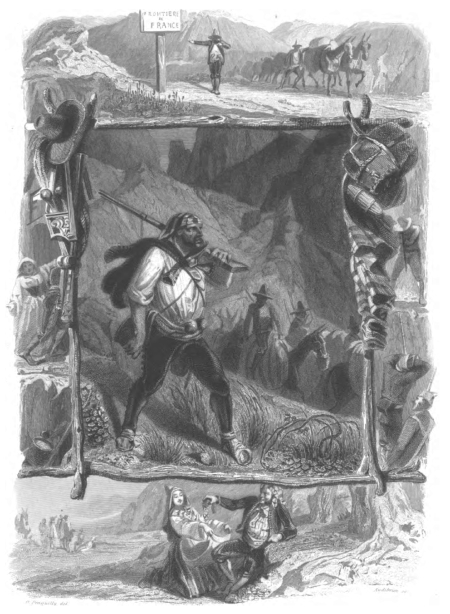
| Malheur! malheur aux commis! A nous, bonheur et richesse! Le peuple à nous s'intéresse: Il est de nos amis. Oui, le peuple est partout de nos amis; Oui, le peuple est partout, partout de nos amis. |
Hang the excisemen! let us get hold Of pleasures in plenty, and heaps of gold! We have the people on our side; They're all our friends at heart: Yes, lads, the people far and wide, The people take our part. |
| Il est minuit. Ça, qu'on me suive, Hommes, pacotille et mulets. Marchons, attentifs au qui-vive. Armons fusils et pistolets. Les douaniers sont en nombre; Mais le plomb n'est pas cher; Et l'on sait que dans l'ombre Nos balles verront clair. |
'Tis midnight—ho there, follow me; prepare Men, mules, and ventures on their backs—it's time Forward—ears open for the "Who goes there ?"— Pistols and guns be sure you load and prime! The officers are out, in force arrayed; But lead's not dear: And you know well that in the thickest shade Our balls see clear. |
| (Le refrain: Malheur! malheur aux commis! …) | (Refrain: Hang the excisemen! let us get hold …) |
| Camarades, la noble vie! Que de hauts faits à publier! Combien notre belle est ravie Quand l'or pleut dans son tablier! Château, maison, cabane, Nous sont ouverts partout. Si la loi nous condamne , Le peuple nous absolut. |
Comrades, how noble is this life of ours; What high achievements are there to be told: How is our fair one gladdened, when in showers To till her apron we rain down the gold! Castle, and house, and cottage in our cause Are all unbarred: The people will absolve us, if the laws Should press us hard. |
| (Le refrain: Malheur! malheur aux commis! …) | (Refrain: Hang the excisemen! let us get hold …) |
| Bravant neig, froid, pluie, orage, Au bruit des torrents nous dormons. Ah! qu'on aspire de courage, Dans l'air du sommet des monts! Cimes à nous connues, Cent fois vous nous voyez La tête dans les nues Et la mort sous nos pieds. |
Braving the snow, the cold, the rain, the gale, Lulled by the roar of torrents, we can sleep: And oh, what draughts of courage we inhale With the pure breezes, o'er the heights that sweep! Hundreds of times, those peaks that well we know Our passage greet: Our heads are in the clouds, and Death below Yawns at our feet! |
| (Le refrain: Malheur! malheur aux commis! …) | (Refrain: Hang the excisemen! let us get hold …) |
| Aux échanges l'homme s'exerce; Mais l'impôt barre les chemins. Passons: c'est nous qui du commerce Tiendrons la balance en nos mains. Partout la Providence Veut, en nous protégeant, Niveler l'abondance, Éparpiller l'argent. |
Man might his barter have convenient made, But taxes blocking up the roads abound; Then forward, comrades, forward !—such is trade, That in our hands its balance must be found. Heaven, shielding us from ills that might befall, Works out its views— To bring down plenty to the reach of all, And wealth diffuse. |
| (Le refrain: Malheur! malheur aux commis! …) | (Refrain: Hang the excisemen! let us get hold …) |
| Nos gouvernants, pris de vertige, Des biens du ciel triplant le taux, Font mourir le fruit sur sa tige, Du travail brisent les marteaux. Pour qu'au loin il abreuve Le sol et l'habitant, Le bon Dieu crée un fleuve; Ils en font un étang. |
Our rulers seized with dizziness, who now Triple their tax on all Heaven kindly yields, Condemn the fruit to wither on the bough, And break the hammer that the laborer wields, They for their fish-ponds would the rivers take, That from God's hand Came forth, ordained by him the thirst to slake Of man and land. |
| (Le refrain: Malheur! malheur aux commis! …) | (Refrain: Hang the excisemen! let us get hold …) |
| Quoi! l'on veut qu'uni de langage, Aux mêmes lois longtemps soumis, Tout peuple qu'un traité partage Forme deux peuples d'ennemis. Non; grâce à notre peine, Ils ne vont pas en vain Filer la même laine, Sourire au même vin. |
What! 'tis their will, that where one tongue is spokenWhere the same laws long time have been obeyed, Because some treaty may such bonds have broken,Two hostile nations should, forsooth, be made!But no—for, thanks to our exertions, vainIs that design;The self-same fleeces shall they spin, and drainThe self-same wine. |
| (Le refrain: Malheur! malheur aux commis! …) | (Refrain: Hang the excisemen! let us get hold …) |
| A la frontière où l'oiseau vole, Rien ne lui dit: Suis d'autres lois. L'été vient tarir la rigole Qui sert de limite à deux rois. Prix du sang qu'ils répandent, Là, leurs droits sont perçus. Ces bornes qu'ils défendent, Nous sautons par-dessus. |
Birds, that at will across the frontier fly, Find nought to bid them other laws obey: A summer's sun, perchance, the trench may dry, That marks the limit of two monarchs' sway. Taxes—the which on bloodshed they will spend— Are levied there: We—leaping o'er the barriers they defend— Little we care. |
| (Le refrain: Malheur! malheur aux commis! …) | (Refrain: Hang the excisemen! let us get hold …) |
| On nous chante dans nos campagnes, Nous, dont le fusil redouté, En frappant l'écho des montagnes Peut réveiller la liberté. Quand tombe la patrie Sous des voisins altiers, Mourante elle s'écrie: A moi, contrebandiers! |
Song for her theme our deeds will often take, Whose deadly guns such terror spread around, That whilst they bid the mountain echoes wake, Freedom herself may waken at their sound. When haughty neighbors strike, and bleeding, low Our country lies, Her dying words are, "To the rescue, ho! Smugglers, arise!" |
| (Le refrain: Malheur! malheur aux commis! …) | (Refrain: Hang the excisemen! let us get hold …) |
The Collection des Principaux Économistes (1840-1848)
Collection des principaux économistes. Avec Commentaires, Notes, et Notices; par MM. Blanqui et Rossi (de l'Institut), Eugène Daire, H. Dussard, J. Garnier, M. Monjean, H. Say. (Paris: Guillaumin, 1840-48), 15 vols.
Bio of Eugene Daire (1798-1847
Daire was of all things a tax collector who revived interest in the heritage of eighteenth- and early nineteenth-century free-market economics. He came to Paris in 1839, met Guillaumin, discovered the works of Jean-Baptiste Say, and began editing the fifteen-volume work, Collection des principaux Économistes (1840-48). It included works on eighteenth-century finance, the physiocrats, Turgot, Adam Smith, Malthus, Jean-Baptiste Say, and Ricardo. He was a founding member of the Political Economy Society.
The Collection des Principaux Économistes (1840-1848)
The details of the collection are from a 1851 Librairie Guillaumin Catalogue. See also the entry in DEP, "Collection des principaux économistes," DEP, vol. 1, pp. 392-93.
PDFs of the volumes can be found on [my websiteFrenchPolEc/CPE/index.html).
T. I. Économistes financiers du XVIIIe siècle. Vauban, Projet d'une dîme royale. Boisguillebert, Détail de la France, Factum de la France, et opuscules divers. Jean Law, Considérations sur le numéraire et le commerce. Mémoires et lettres sur les banques, opuscules divers. Melon, Essai politique sur le commerce. Dutot, Réflexions politiques sur le commerce et les finances. Précédés de notices historiques sur chaque auteur, et accompagnés de commentaires et de notes explicatives, par M. Eugène Daire (Paris: Guillaumin, 1843).
- 2nd edition 1851. Facsimile Online in PDF 41.8 MB.
T. II. Physiocrates. Quesnay, Dupont de Nemours, Mercier de la Rivière, l'Abbé Baudeau, Le Trosne, avec une introduction sur la doctrine des Physiocrates, des commentaires et des notices historiques, par Eugène Daire (Paris: Guillaumin, 1846). 2 vols.
- 1st edition 1846. Vol. 1 - works by Quesnay and Dupont de Nemours. FacsimileOnline in PDF 21 MB.
- 1st edition 1846. Vol. 2 - works by Mercier de la Rivière, Baudeau, Le Trosne, Condillac. Facsimile Online in PDF 21 MB.
T. III and IV. Œuvres de Turgot. Nouvelle édition, classée par ordre de matière. Les notes de Dupont de Nemours, augmentée de lettres inédites, des Questions sur le commerce, et d'observations et de notes nouvelles, par MM. Eugène Daire et Hippolyte Dussard, et précédée d'une notice sur la vie et les ouvrages de Turgot, par M. Eugène Daire (Paris: Guillaumin, 1844).
- 1st edition 1844. Tome premier. Facsimile Online in PDF 30.5 MB.
- 1st edition 1844. Tome second. Facsimile Online in PDF 38.6 MB.
T. V and VI. Recherches sur la nature et les causes de la richesse des nations, par Adam Smith, traduction du Comte Germain Garnier entièrement revue et corrigée, et précédé d'une notice biographique par M. Blanqui, avec les commentaires de Buchanan, G. Garnier, Mac Culloch, Malthus, J. Mill, Ricardo, Sismondi; Augmentée de notes inédites de Jean-Baptiste Say, et d'éclaircissements historiques par M. Blanqui (Paris: Guillaumin, 1843). Nouvelle édition 1859.
- 1st edition 1843. Tome premier. [not available]
- 1st edition 1843. Tome second. Facsimile Online in PDF 37.3 MB.
- (Since vol. 1 from the CPE is not yet available online we have the revised new edition which
appeared in 1859 edited by many of the dame people). Recherches sur la nature et les causes de la
richesse des nations, par Adam Smith, traduction du Germain Garnier, revue corrigée et précédé d'une
notice biographique par M. Blanqui, avec des Notes de Buchanan, G. Garnier, Mac Culloch, Ricado,
Sismondi, Bentham, Storch, Malthus, Turgot, J. Mill, Dufresne Saint-Léon, A. Blanqui, J.B. Say.
Nouvelle édition revue et augmentée de notes explicatives, par Joseph Garnier (Paris:
Guillaumin, 1859).
- 1859 edition. Tome premier. Facsimile Online in PDF 13.3 MB.
- 1859 edition. Tome deuxième. Facsimile Online in PDF 23.2 MB.
- 1859 edition. Tome troisième. Facsimile Online in PDF 11.8 MB.
T. VII. Essai sur le principe de population, par Malthus, traduit de l'anglais par MM. Pierre et Guillaume Prévost (de Genève). Précédé d'une introduction par P. Rossi, et d'une notice sur la vie et les ouvrages de l'auteur, par Charles Comte, avec les notes des traducteurs, et de nouvelles notes par M. Joseph Garnier (Paris, Guillaumin et ce, 1845). 2nd edition 1852.
- 2nd edition 1852. Facsimile Online in PDF 28.5 MB.
T. VIII. Principes d'économie politique considérés sous le rapport de leur application pratique, Seconde édition, Revue, corrigée et considérablement augmentée; suivis Des définitions en économie politique, par Malthus, avec des remarques inédites de J.-B. Say; précédés d'une introduction et accompagnés de notes explicatives et critiques, par M. Maurice Monjean (Paris: Guillaumin, 1846).
- 1st edition 1846. Facsimile Online in PDF 21.4 MB
T. IX. Traité d'économie politique, ou simple exposition de la manière dont se forme, se distribuent et se consomment les richesses. Par Jean-Baptiste Say. Sixième édition entièrement revue par l'auteur, et publiée sur les manuscrits qu'il a laissés, par Horace Say, son fils (Paris: Guillaumin, 1841).
- 1st edition 1841. Facsimile Online in PDF 24.7 MB
T. X and XI. Cours complet d'économie politique pratique. Ouvrage destiné à mettre sous les yeux des hommes d'état, des propriétaires fonciers et les capitalistes, des savans, des agriculteurs, des manufacturiers, des négocians, et en général de tous les citoyens, l'économie des sociétés, par Jean-Baptiste Say, Seconde édition entièrement revue par l'auteur, publiée sur les manuscrits qu'il a laissés et augmentée de notes par Horace Say, son fils (Paris: Guillaumin, 1840). 2 vols.
- 1st edition 1840. Tome premier. Facsimile Online in PDF 38.7 MB
- 1st edition 1840. Tome second. Facsimile Online in PDF 29.9 MB
T. XII. Oeuvres diverses de J.-B. Say, contenant Catéchisme d'économie politique, Fragments et opuscules inédits, Correspondance générale, Olbie, Petit volume, Mélanges de morale et de littérature. Précédées d'une notice historique sur la vie et les travaux de l'auteur, avec des notes, par Ch. Comte, E. Daire et Horace Say (Paris: Guillaumin, 1848).
- 1st edition 1840. Facsimile Online in PDF 30.5 MB
T. XIII. Oeuvres complètes de David Ricardo, traduites en français, par MM. Constancio et Alcide Fonteyraud, augmentées de notes de Jean-Baptiste Say, de nouvelles notes et de commentaires par Malthus, Sismondi, MM. Rossi, Blanqui, etc., et précédées d'une notice sur la vie et les travaux de l'auteur par M. Alcide Fonteyraud (Paris: Guillaumin, 1847).
- 1st edition 1847. Facsimile Online in PDF 46.7 MB
T. XIV. Mélanges d'économie politique I. D. Hume, Essais sur le commerce, le luxe, l'argent, l'intérêt de l'argent, les impots, le crédit public, etc. Forbonnais, Principes économiques. Condillac, Le commerce et le gouvernement. Condorcet, Mélanges d'économie politique. Lavoisier et Lagrange, De la richesse territoriale du royaume de France. Essai d'arithmétique politique. B. Franklin, La science du bonhomme Richard, et autres opuscules. Précédés de notices historiques sur chaque auteur, et accompagnés de commentaires et de notes explicatives par MM. Eugène Daire et G. de Molinari (Paris: Guillaumin, 1847).
- 1st edition 1847. Facsimile Online in PDF 35.1 MB
T. XV. Mélanges d'économie politique II. Necker, Sur la législation et de commerce des grains. Galiani, Dialogues sur le commerce des blés. Montyon, Quelle influence ont les diverses espèces d'impots sur la moralité, l'activité et l'industrie des peuples. J. Bentham, Lettres sur la Défense de l'usure. Précédés de notice historique sur chaque auteur, et accompagnés de commentaires et de notes explicatives par M. Gust. de Molinari (Paris: Guillaumin, 1848).
- 1st edition 1848. Facsimile Online in PDF 35.7 MB
Portraits of the Most Eminent Economists
The portraits were described and listed on p. viii of Volume 1.
Les poitraits, au nombre de huit, sont ceux de :
- Fr. Quesnay, gravé par Outhwaite, d'après le beau portrait de François, célèbre graveur du dernier siècle. (between pp. 484-85)
- Ad. Smith, gravé par Bosselmann, d'après le seul portrait authentique que l'on connaisse. (between pp. 622-23)
- Malthus, par madame Fournier, d'après la belle gravure anglaise de J. Linnell. (between pp. 126-27)
- Turgot, par L. Massard , d'après la photographie de la statue qui orne la salle des séances du palais du Luxembourg. (between pp. 776-77)
- J.-B. Say, par Hopwood, d'après le beau tableau peint par Decaisne et appartenant à M. Horace Say. (between pp. 590-91)
- Sismondi, par Eug. Gervais, d'après le portrait du célèbre graveur Toschi. (between pp. 616-17)
- Rossi, par Eug. Gervais, d'après une photographie de l'admirable buste de Tenerani, que possède la famille. (between pp. 548-49)
- Fr. Bastiat, par madame Fournier, d'après une épreuve au daguerréotype. (between pp. 144-45)
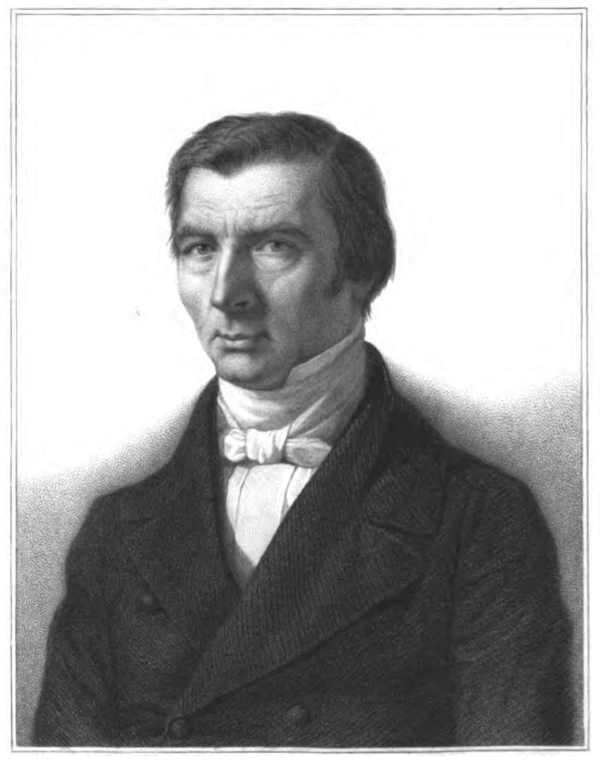
Fr. Bastiat, par madame Fournier, d'après une épreuve au daguerréotype. (between pp. 144-45)
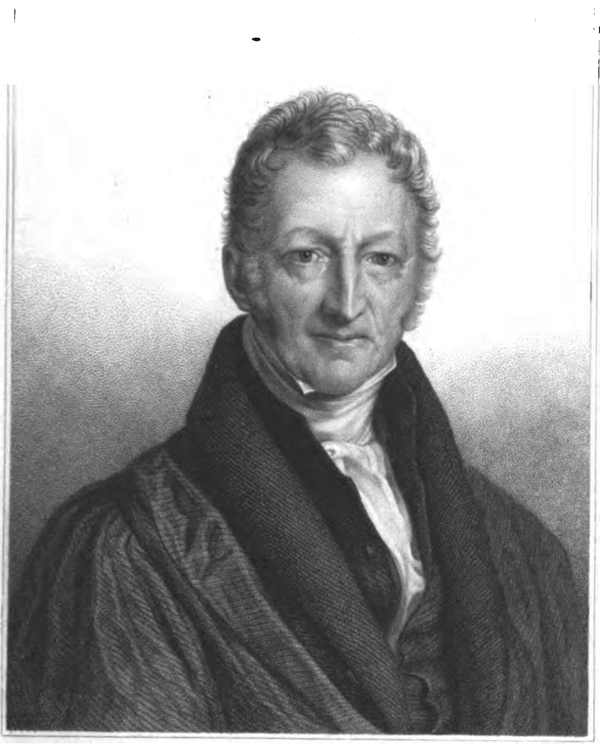
Malthus, par madame Fournier, d'après la belle gravure anglaise de J. Linnell. (between pp. 126-27)
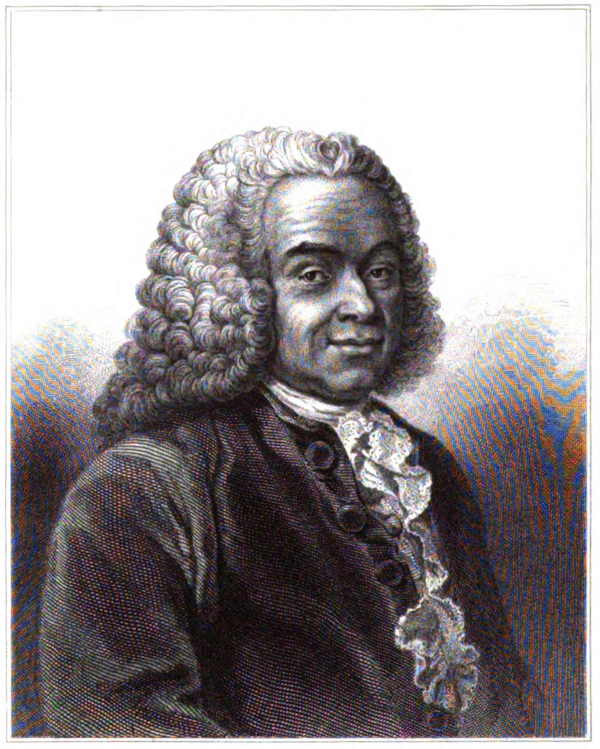
Fr. Quesnay, gravé par Outhwaite, d'après le beau portrait de François, célèbre graveur du dernier siècle. (between pp. 484-85)
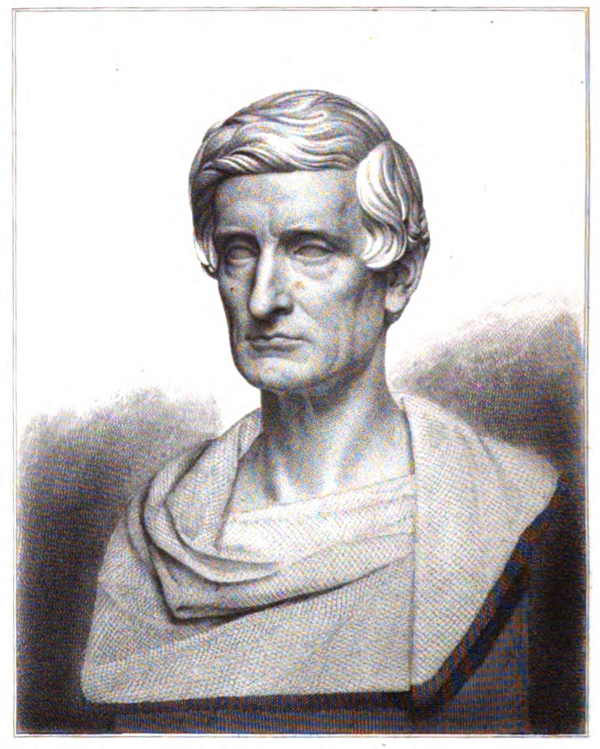
Rossi, par Eug. Gervais, d'après une photographie de l'admirable buste de Tenerani, que possède la famille. (between pp. 548-49)
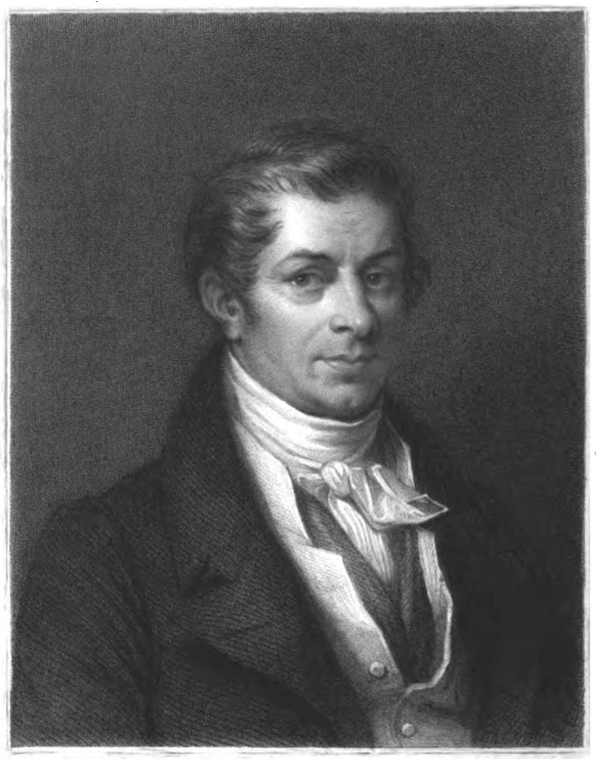
J.-B. Say, par Hopwood, d'après le beau tableau peint par Decaisne et appartenant à M. Horace Say. (between pp. 590-91)
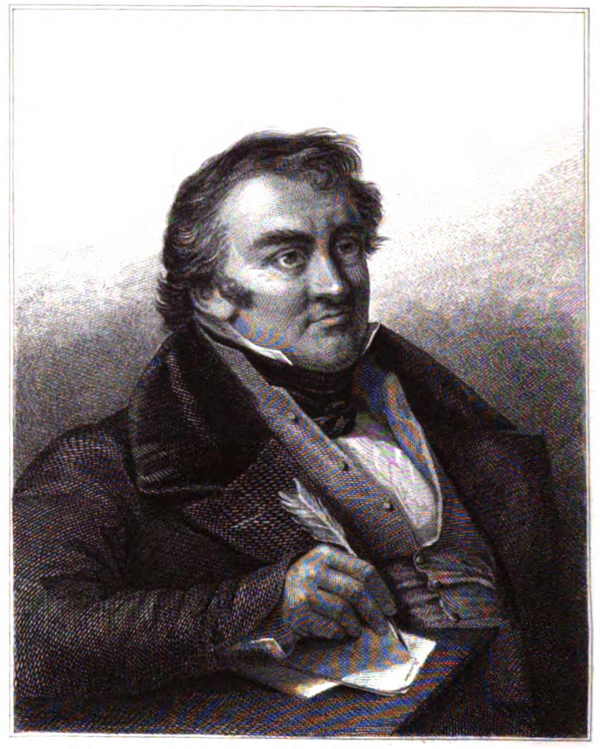
Sismondi, par Eug. Gervais, d'après le portrait du célèbre graveur Toschi. (between pp. 616-17)
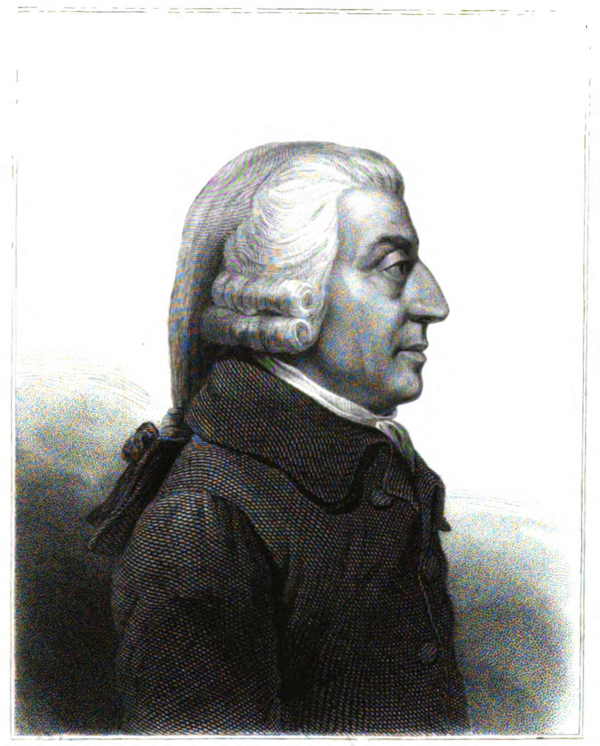
Ad. Smith, gravé par Bosselmann, d'après le seul portrait authentique que l'on connaisse. (between pp. 622-23)
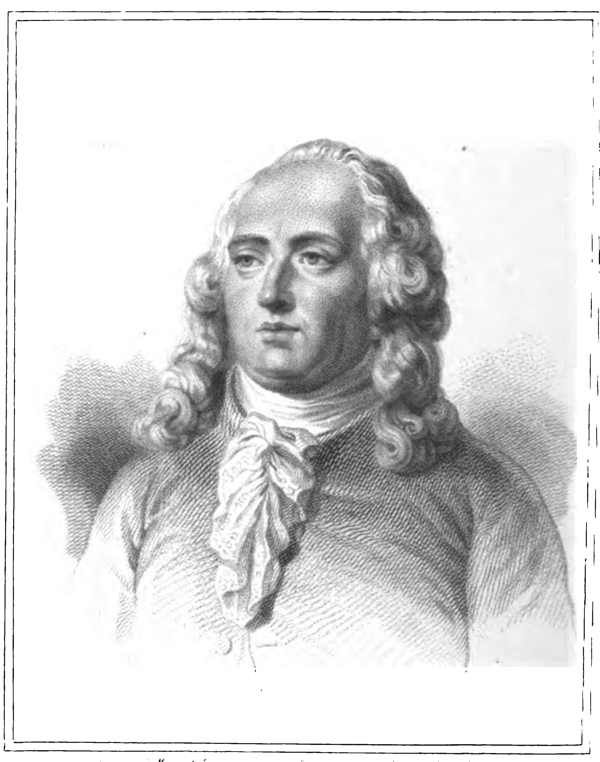
Turgot, par L. Massard , d'après la photographie de la statue qui orne la salle des séances du palais du Luxembourg. (between pp. 776-77)
Principal Articles in the DEP
These are listed in DEP, T.2, pp. 885-96.
Table des principaux articles (335)
A.
- Abondance, par Frédéric Bastiat.
- Absentéisme, par Ambroise Clément.
- Accaparement, par Ambroise Clément.
- Accumulation, par Ambroise Clément.
- Achat, par Ambroise Clément.
- Acte de navigation, par Charles Coquelin.
- Adjudication, par Charles Coquelin.
- Administration publique, par Ambroise Clément.
- Affinage, par Michel Chevalier.
- Agents naturels, par Charles Coquelin.
- Agents de change, par Horace Say.
- Agio, par Charles Coquelin.
- Agiotage, par Horace Say.
- Agriculture, par Hippolyte Passy.
- Aides, par Charles Coquelin.
- Alliage, par Charles Coquelin.
- Amortissement, par Ad. Blaise.
- Annuité, par Charles Coquelin.
- Anticipation, par Charles Coquelin.
- Apprentissage, par Ambroise Clément.
- Appropriation, par Charles Coquelin.
- Approvisionnements, par Ambroise Clément.
- Arbitrage, par Charles Coquelin.
- Argent, par Michel Chevalier.
- Arithmétique politique, par Joseph Garnier.
- Armées permanentes, par Ambroise Clément.
- Artisans, par Charles Coquelin.
- Assignats, par Charles Coquelin.
- Association, par Ambroise Clément.
- Assurances, par Horace Say.
- Ateliers nationaux, par Charles Coquelin.
B
- Balance du commerce, par Ambroise Clément et Charles Coquelin.
- Banque, par Charles Coquelin.
- Beaux-Arts, par Gustave de Molinari.
- Besoins des hommes, par Ambroise Clément.
- Bienfaisance privée, par Ambroise Clément.
- Bienfaisance publique, par Antoine Cherbuliez.
- Billet à ordre, par Charles Coquelin.
- Billet de banque, par Charles Coquelin.
- Billets de l’Echiquier, par Charles Coquelin.
- Billon, par Michel Chevalier.
- Blocus continental, par Joseph Garnier.
- Bons du Trésor, par Charles Coquelin.
- Boucherie (commerce de la), par Adolphe-Gustave Blaise (des Vosges).
- Boulangerie (commerce de la), par Joseph Garnier.
- Bourgeoisie, par Henri Baudrillart.
- Bourse de commerce, par Horace Say.
- Brevets d’invention, par Charles Coquelin.
- Budget, par Charles Coquelin.
C.
- Cabotage, par Charles Coquelin.
- Cadastre, par Charles Coquelin.
- Caisse d’amortissement, par Charles Coquelin.
- Caisse des dépôts et consignations, par Charles Coquelin.
- Caisse d’épargne, par Louis Leclerc et Charles Coquelin.
- Caisses de retraite, par Émile Thomas.
- Canaux de navigation, par Michel Chevalier.
- Capital, par Charles Coquelin.
- Centralisation, par Charles Coquelin.
- Céréales, par Gustave de Molinari.
- Chambres de commerce, par Léon Say.
- Change, par Joseph Garnier.
- Chasse, par Alfred Legoyt.
- Chemins de fer, par Michel Chevalier.
- Circulation, par Charles Coquelin.
- Civilisation, par Gustave de Molinari.
- Clearing-house, par Charles Coquelin.
- Clientèle, par Léon Say.
- Climat, par Hippolyte Passy.
- Coalitions, par Antoine Cherbuliez.
- Coalitions industrielles, par Charles Coquelin.
- Colonies, par Gustave de Molinari.
- Colonies agricoles, par Gustave de Molinari.
- Colonies militaires, par Gustave de Molinari.
- Comices agricoles et chambres d’agriculture, par Jules de Vroil.
- Commerce, par Charles Coquelin.
- Commune, par Charles Coquelin.
- Communisme, par Henri Baudrillart.
- Compagnie anglaise des Indes orientales, par Jean-Baptiste Say et Charles Coquelin.
- Compagnies privilégiées, par Charles Coquelin.
- Compagnonnage, par Léon Say.
- Comptabilité commerciale, par Jean-Baptiste Say.
- Comptoirs d’escompte, par Alphonse Courtois.
- Concurrence, par Charles Coquelin.
- Condition des soies, par Léon Say.
- Congrès, par Jules de Vroil.
- Conseil général de l’agriculture, des manufactures et du commerce, par Léon Say.
- Conseils généraux des départements, par Léon Say.
- Conservatoire des arts et métiers, par Louis Wolowski.
- Consommation, par Joseph Garnier.
- Consuls, par A. de Clercq et de Vallat.
- Contrainte par corps, par Charles Coquelin.
- Contrebande, par Joseph Garnier.
- Contrefaçon, par Émile Thomas.
- Corporations privilégiées, par Charles Coquelin.
- Cour des comptes, par Alfred Legoyt.
- Cours forcé, par Charles Coquelin.
- Crédit, par Charles Coquelin.
- Crédit foncier, par Louis Wolowski.
- Crédit public, par Gustave du Puynode.
- Crises commerciales, par Charles Coquelin.
- Cultes religieux, par Antoine Cherbuliez.
D.
- Déboisement, par Jules de Vroil.
- Débouchés, par Jean-Baptiste Say.
- Définitions, par M. Monjean.
- Dépôts de mendicité, par M. de Watteville.
- Dessins de fabrique, par Louis Wolowski.
- Dimanche), par Charles Coquelin.
- Disette, par Antoine Cherbuliez.
- Distribution des richesses, par Charles Coquelin.
- Division du travail, par Horace Say.
- Docks, par Émile Thomas.
- Domaine public, par Alfred Legoyt.
- Domesticité, par Charles Coquelin.
- Douane, par Horace Say.
- Drainage, par Jules de Vroil.
- Droit au travail, par Léon Faucher.
- Droits réunis, par Charles Coquelin.
E.
- Eau, par Jules Dupuit.
- Échange, par Charles Coquelin.
- Échiquier, par Alfred Legoyt.
- Écoles professionnelles, par Charles Coquelin.
- Économie politique, par Charles Coquelin.
- Économie politique (Société d’), par Joseph Garnier.
- Économistes (Congrès des), par Joseph Garnier.
- Économistes financiers, par Joseph Garnier.
- Effets de commerce, par Charles Coquelin.
- Embargo, par Charles Coquelin.
- Émigration, par Gustave de Molinari.
- Empthytéose, par Charles Coquelin.
- Emprunts publics, par Gustave du Puynode.
- Encouragements, par Charles Coquelin.
- Enfants trouvés, par Frédéric Cuvier.
- Enfants (travail des), par Alfred Legoyt.
- Enquêtes, par Horace Say.
- Enseigne, par Léon Say.
- Entrepôts, par Horace Say.
- Entrepreneur d’industrie, par Joseph Garnier.
- Épargne, par Louis Leclerc.
- Épaves, par Charles Coquelin.
- Esclavage, par Gustave de Molinari.
- Établissements de bienfaisance, par Charles Coquelin.
- Établissements dangereux, insalubres ou incommodes, par Alfred Legoyt.
- État, par Charles Coquelin.
- État civil, par Charles Coquelin.
- Évaluation des sommes historiques, par Charles Coquelin.
- Excise, par Alfred Legoyt.
- Exportations, importations, par Joseph Garnier.
- Expositions des produits de l’industrie, par Adolphe Blanqui.
- Expropriation pour cause d’utilité publique, par Alfred Legoyt.
F.
- Faillite, banqueroute, déconfiture, par Horace Say.
- Féodalité, par Jean-Gustave Courcelle-Seneuil.
- Fermage, par Charles Coquelin.
- Fermes-écoles, fermes-expérimentales, fermes-modèles, par Jules de Vroil.
- Fermiers généraux, par Gustave du Puynode.
- Fêtes publiques, par Alfred Legoyt.
- Finances, par Joseph Garnier.
- Fisc, par Joseph Garnier.
- Foires et marchés, par Edgar Duval.
- Fonctionnaires, par Ambroise Clément.
- Fondation, par Alfred Legoyt.
- Fonds productifs, par Charles Coquelin.
- Forêts, par Jules de Vroil.
- Fortune publique, par Charles Coquelin.
- Fortunes particulières, par Jean-Gustave Courcelle-Seneuil.
- Frais de perception ou de recouvrement, par Joseph Garnier.
- Frais de production, par Charles Coquelin.
- Franchise, par Charles Coquelin.
G.
- Gabelle, par Charles Coquelin.
- Garantie des matières et ouvrages d’or et d’argent, par Prosper Paillotet.
- Gouvernement, par Charles Dunoyer.
- Grand livre de la dette publique, par Alfred Legoyt.
- Greniers d’abondance, par Charles Coquelin.
H.
- Haras, par Jules de Vroil.
- Harmonie industrielle, par Charles Coquelin.
- Hérédité, par Charles Coquelin.
- Hôpitaux, hospices, par M. Vée.
- Hypothèques, par Louis Wolowski.
I.
- Impôt, par Hippolyte Passy.
- Imprimerie, par C. S.
- Industrie, par Charles Coquelin.
- Industrie manufacturière, par Charles Coquelin.
- Instruction publique et privée, par Charles Vergé et Charles Coquelin.
- Instruments (du travail ou de l’industrie), par Charles Coquelin.
- Intérêt (prêt à), par Léon Faucher.
J.
- Jeu, par Alfred Legoyt.
- Jury central des produits de l’industrie, par Natalis Rondot.
- Jury international, par Natalis Rondot.
L.
- Laissez faire, laissez passer, par Joseph Garnier.
- Législation, par Augustin-Charles Renouard.
- Lettre de change, par Jean-Gustave Courcelle-Seneuil.
- Liberté des échanges (association pour la), par Gustave de Molinari.
- Liberté du commerce, liberté des échanges, par Gustave de Molinari.
- Liberté du travail, par Joseph Garnier.
- Librairie, par C. S.
- Ligue anglaise, par Joseph Garnier.
- Ligue anséatique, par Maurice Block.
- Livrets d’ouvriers, par Jean-Gustave Courcelle-Seneuil.
- Logements insalubres, par Horace Say.
- Loi, par Frédéric Bastiat.
- Lois agraires, par Jean-Gustave Courcelle-Seneuil.
- Lois somptuaires, par Jean-Gustave Courcelle-Seneuil.
- Loteries, par Edgar Duval.
- Louage, loyer, par Joseph Garnier.
- Luxe, par Jean-Gustave Courcelle-Seneuil.
M.
- Machines, par Joseph Garnier.
- Main-d’œuvre, par Horace Say.
- Mandats territoriaux, par C. S.
- Marchand, par Horace Say.
- Marchandage, par Horace Say.
- Marchandises, par Horace Say.
- Mariage, par Félix de Parieu.
- Marques de fabrique et de commerce, par Augustin-Charles Renouard.
- Matières premières, par Horace Say.
- Maximum (lois de), par Joseph Garnier.
- Mendicité, par Ambroise Clément.
- Métaux précieux, par Michel Chevalier.
- Meubles et immeubles, par Horace Say.
- Mines, par Alfred Legoyt.
- Mode, par Gustave de Molinari.
- Monnaie, par Michel Chevalier.
- Monopole, par Ambroise Clément.
- Monts-de-piété, par Horace Say.
- Monuments publics, par Gustave de Molinari.
- Morale, par André Cochut.
- Morcellement, par Alfred Legoyt.
- Moyens d’existence, par Ambroise Clément.
N.
- Nations, par Gustave de Molinari.
- Nature des choses, par Jean-Baptiste Say.
- Navigation, par Louis Reybaud.
- Noblesse, par Gustave de Molinari.
O.
- Octrois, par Félix de Parieu.
- Offre et demande, par Joseph Garnier.
- Or, par Michel Chevalier.
- Organisation du travail, par Jean-Gustave Courcelle-Seneuil.
- Ouvriers, par Joseph Garnier.
P.
- Pacte colonial, par Horace Say.
- Pain (taxe du), par Horace Say.
- Paix, guerre, par Gustave de Molinari.
- Paix (société et congrès de la), par Gustave de Molinari.
- Papier-monnaie, par Jean-Gustave Courcelle-Seneuil.
- Parasites, par Augustin-Charles Renouard.
- Paupérisme, par Antoine Cherbuliez.
- Péage, par Jules Dupuit.
- Pêches et pêcheries, par Horace Say.
- Physiocrates, par Joseph Garnier.
- Poids et mesures, par Jules Dupuit.
- Police, par Alexandre-François Vivien.
- Ponts et chaussées, par Jules Dupuit.
- Population, par Joseph Garnier et Alfred Legoyt.
- Postes, par Jean-Gustave Courcelle-Seneuil.
- Pratique et théorie, par Ambroise Clément.
- Prestation, par Jean-Gustave Courcelle-Seneuil.
- Préventif (système), par Ambroise Clément.
- Primes et drawbacks, par Horace Say.
- Prisons, par Louis-Mathurin Moreau-Christophe.
- Prix, par Joseph Garnier.
- Probabilités, par Adolphe Quételet.
- Production, par Charles Dunoyer.
- Produit net, par Ambroise Clément.
- Produits immatériels, par Ambroise Clément.
- Professions, par Jean-Gustave Courcelle-Seneuil.
- Profit, par Jean-Gustave Courcelle-Seneuil.
- Progrès industriels, par Ambroise Clément.
- Prohibitions, par C. S.
- Propriété, par Léon Faucher.
- Propriété littéraire, par Gustave de Molinari.
- Prud’hommes (conseils de), par Prosper Paillottet.
Q.
- Quarantaines, par Louis Reybaud.
R.
- Recensement, par Alfred Legoyt.
- Recrutement, par Alfred Legoyt.
- Régie, par Jean-Gustave Courcelle-Seneuil.
- Réglementation, par Ambroise Clément.
- Règlements de fabrique, par Ambroise Clément.
- Rente du sol, par Hippolyte Passy.
- Revenu (impôt du), par Jean-Gustave Courcelle-Seneuil.
- Richesse, par Ambroise Clément.
- Routes et chemins, par Jules Dupuit.
S.
- Salaires, par Léon Faucher.
- Salubrité, par Horace Say.
- Savants, par Jean-Baptiste Say.
- Sciences morales et politiques, par Jean-Baptiste Say.
- Secours publics, par M. Vée.
- Sécurité, par Ambroise Clément.
- Seigneuriage, par C. S.
- Sel, par Félix de Parieu.
- Servage, par Gustave de Molinari.
- Services productifs, par Ambroise Clément.
- Socialistes, socialisme, par Louis Reybaud.
- Sociétés de secours mutuels, par Alfred Legoyt.
- Sociétés commerciales, par Augustin-Charles Renouard.
- Spéculation, par Horace Say.
- Statistique, par Joseph Garnier.
- Succession, par Félix de Parieu.
- Sucre, par Horace Say.
- Système, par Jean-Gustave Courcelle-Seneuil.
- Système mercantile, par Joseph Garnier.
- Systèmes pénitentiaires, par Louis-Mathurin Moreau-Christophe.
T.
- Tabac (impôt du), par Joseph Garnier.
- Tables de mortalité, par Adolphe Quételet.
- Taille, par Jean-Gustave Courcelle-Seneuil.
- Tarifs de douane, par Gustave de Molinari.
- Taxe des pauvres, par Antoine Cherbuliez.
- Télégraphie électrique, par Aristide Dumont.
- Tenure, tenement, tenancier, etc., par Alfred Legoyt.
- Terre, par Jean-Gustave Courcelle-Seneuil.
- Théâtres, par Gustave de Molinari.
- Timbres et enregistrement, par Félix de Parieu.
- Tontines, par Alfred Legoyt.
- Traités de commerce et de navigation, par Charles de Brouckère.
- Transit, par Horace Say.
- Travail, par Gustave de Molinari.
- Travail dans les prisons, par Horace Say.
- Travaux publics, par Ad. Blaise.
- Trésor, par Jean-Gustave Courcelle-Seneuil.
- Tribunaux de commerce, par Horace Say.
U.
- Union douanière, par Gustave de Molinari.
- Usure, par Gustave de Molinari.
- Utilité, par Hippolyte Passy.
- Utopie, par Hippolyte Passy.
V.
- Vaine pature et parcours, par Jules de Vroil.
- Valeur, par Hippolyte Passy.
- Valeurs officielles, par Léon Say.
- Vénalité des offices, par C. S.
- Vente, par Félix de Parieu.
- Viande de boucherie, par Horace Say.
- Villes, par Gustave de Molinari.
- Vingtième, par Jean-Gustave Courcelle-Seneuil.
- Vins (impôts sur les), par Louis Leclerc.
- Virement de parties, par Jean-Gustave Courcelle-Seneuil.
- Visa, par Jean-Gustave Courcelle-Seneuil.
- Voies de communication, par Jules Dupuit.
- Voitures publiques, par C. S.
- Voyages, par Gustave de Molinari.
W.
- Warrant, par Horace Say.
Z.
- Zollverein, par Alfred Legoyt.
Principaux Articles Bibliographiques par ordre de matières. (50)
- Administration publique.
- Agriculture.
- Apprentissage.
- Association.
- Assurances.
- Banque.
- Bienfaisance publique.
- Boucherie.
- Boulangerie.
- Bourses de commerce.
- Brevets d'invention.
- Caisses d'épargne.
- Caisses de retraite.
- Centralisation.
- Céréales.
- Change.
- Chemins de fer.
- Colonies.
- Commerce.
- Consommation.
- Consul.
- Corporations.
- Crédit foncier.
- Crédit public.
- Douanes.
- Droit au travail.
- Économie politique.
- Enfants trouvés.
- Esclavage.
- Expositions de l'industrie.
- Finances.
- Hôpitaux, hospices.
- Impots.
- Intérêt (prét à).
- Liberté des échanges (association pour la).
- Liberté du commerce.
- Ligue anglaise.
- Luxe.
- Monnaies.
- Monts de piété.
- Octroi.
- Papier-monnaie.
- Population.
- Propriété.
- Propriété littéraire.
- Salaires.
- Socialistes.
- Statistique.
- Systèmes pénitentiaires
- Zollverein.
The Principal Articles Charles Coquelin wrote for the DEP (71)
Bio of Charles Coquelin (1802-1852)
Coquelin was one of the leading figures in the Political Economy movement in Paris before his untimely death. He was selected by the publisher Guillaumin to edit the prestigious and voluminous Dictionnaire de l’économie politique (1852) because of his erudition and near photographic memory. He also wrote dozens of articles for the Dictionnaire before his sudden death in August 1852 having just completed editing volume 1.
Coquelin was born in Dunkirk and went to Paris in order to study law but he spent considerable time reading the classic works of political economy, developing a keen interest in business cycles after the depression of 1825-26. In 1827 he began a journal, Les Annales du Commerce (1827-28) in which he wrote on banking matters. In the early 1830s he turned to banking policy in the United States, especially in New England where there were liberal laws governing the creation of banks. Financial concerns in 1839 forced him to seek employment in the textile industry on which he wrote a number of works. In the early 1840s he wrote a series of articles for La Revue des Deux-Mondes on banking in which he toyed with the idea of the competitive issue of currencies by banks competing for business in the market. These ideas were further developed in his major book on the subject, Du Crédit et des Banques which appeared in 1848.
Coquelin was also very active in the free trade movement, becoming secretary of the Association and writing articles for Bastiat’s journal Le libre-échange and later taking over the editor’s role when Bastiat had to resign because of ill health. He also wrote dozens of articles and book reviews for the Journal des économistes. During the 1848 Revolution Coquelin was active in forming a debating club, the Club de la Liberté du Travail (the Club for the Freedom of Working) which took on the socialists before it was violently broken up by opponents. He, along with Bastiat, Fonteyraud, Garnier, and Molinari, started a small revolutionary magazine written to appeal to ordinary people, Jacques Bonhomme, which lasted only a few weeks in June before it too was forced to close. Coquelin wrote on transport, the linen industry, the law governing corporations, money, credit, and banking (especially free banking of which he was probably the first serious advocate).
Principal Articles written by Charles Coquelin
- Acte de navigation
- Adjudication
- Agents naturels
- Agio
- Aides
- Alliage
- Annuité
- Anticipation
- Appropriation
- Arbitrage
- Artisans
- Assignats
- Ateliers nationaux
- Balance du commerce
- Banque
- Billet à ordre
- Billet de Banque
- Billet de l’Échiquier
- Bons de Trésor
- Brevets d’invention
- Budget
- Cabotage
- Cadastre
- Caisse d’amortissement
- Caisse des dépôts et consignations
- Caisse d’épargne — L. Leclerc et Coquelin
- Capital
- Centralisation
- Circulation
- Clearing House
- Coalitions industrielles
- Commerce
- Commune
- Compagnie anglaise des Indes Orientale — J. B. S. et Ch. C.
- Compagnies privilégiées
- Concurrence
- Contrainte par corps
- Corporations privilégiées
- Cours forcé
- Crédit
- Crises commerciales
- Dimanche
- Distribution des richesses
- Domesticité
- Droits réunis
- Échange
- Écoles professionnelles
- Économie politique
- Effets de commerce
- Effets publics
- Embargo
- Emphytéose
- Encouragements
- Épaves
- Établissements de bienfaisance ;
- État
- État-civil
- Évaluation des sommes historiques
- Fermage
- Fonds productifs
- Fortune publique
- Frais de production
- Franchise
- Gabelle
- Greniers d’abondance
- Harmonie industrielle
- Hérédité
- Industrie
- Industrie manufacturière
- Instruction publique et privée — Vergé et Ch. C.
- Instruments du travail ou de l’industrie.
The Principal Articles Horace Say wrote for the DEP (29)
Bio - Say, Horace émile (1794-1860)
The Say family played a very important role in liberal political economy circles in France for nearly 100 years. It began with Jean-Baptiste Say (1767-1832), then his son Horace Émile Say (1794-1860), and his grandson Léon Say (1826-96).
Horace Say was the son of Jean-Baptiste Say. He married Anne Cheuvreux, sister of Casimir Cheuvreux, whose family were friends of Bastiat. Say was a businessman and traveled in 1813 to the United States and Brazil. A result of his trip was Historie des relations commerciales entre la France et le Brésil (1839). He became president of the Chamber of Commerce of Paris in 1834, became a councillor of state (1849-51), and headed an important inquiry into the state of industry in the Paris region (1848-51). Say was also very active in liberal circles, participating in the foundation of the Société d’économie politique, the Guillaumin publishing firm, the Journal des économistes, the Journal du commerce; and was an important collaborator in the creation of the Dictionnaire de l’économe politique and the Dictionnaire du commerce et des marchandises. In 1857 he was nominated to the Académie des sciences morales et politiques but died before he could join it formally. He also wrote two important works, Paris, son octroi et ses emprunts (1847) which was analysis and critique of the octroi tax on imported goods into the city of Paris, and on behalf of the Chamber of Commerce of Paris a detailed analysis of the state of industry in the city, Statistique de l’Industrie à Paris résultant de l’enquête. Faite par la Chambre de commerce pour les années 1847-1848 (1851).
Principal Articles by Horace Say (29)
- Agents de change, par Horace Say.
- Agiotage, par Horace Say.
- Assurances, par Horace Say
- Bourse de commerce, par Horace Say.
- Division du travail, par Horace Say.
- Douane, par Horace Say.
- Enquêtes, par Horace Say.
- Entrepôts, par Horace Say.
- Faillite, banqueroute, déconfiture, par Horace Say.
- Logements insalubres, par Horace Say.
- Main-d’œuvre, par Horace Say.
- Marchand, par Horace Say.
- Marchandage, par Horace Say.
- Marchandises, par Horace Say
- Matières premières, par Horace Say.
- Meubles et immeubles, par Horace Say.
- Monts-de-piété, par Horace Say.
- Pacte colonial, par Horace Say.
- Pain (taxe du), par Horace Say.
- Pêches et pêcheries, par Horace Say.
- Primes et drawbacks, par Horace Say.
- Salubrité, par Horace Say.
- Spéculation, par Horace Say.
- Sucre, par Horace Say.
- Transit, par Horace Say.
- Travail dans les prisons, par Horace Say.
- Tribunaux de commerce, par Horace Say.
- Viande de boucherie, par Horace Say.
- Warrant, par Horace Say.
The Principal Articles Joseph Garnier wrote for the DEP (28)
Bio - Garnier, Joseph (1813-1881)
Garnier was a professor, journalist, politician, and activist for free trade and peace. He came to Paris in 1830 and came under the influence of Adolphe Blanqui, who introduced him to economics and eventually became his father-in-law. Garnier was a pupil, professor, and then director of the École supérieure de commerce de Paris, before being appointed the first professor of political economy at the École des ponts et chaussées in 1846. Garnier played a central role in the burgeoning free-market school of thought in the 1840s in Paris and was one of the leading exponents of Malthusian population theory. He was one of the founders of l’Association pour la liberté des échanges and one of the editors of its journal, Libre échange; he was active in the Congrès de la paix; he was one of the founders along with Guillaumin of the Journal des économistes, of which he became chief editor in 1846; he was one of the founders of the Société d’Économie politique in 1842 and was its perpetual secretary; and he was one of the founders (with Bastiat) of the 1848 liberal broadsheet Jacques Bonhomme. Garnier was acknowledged for his considerable achievements by being nominated to join the Académie des sciences morales et politiques in 1873 and to become a senator in 1876. He was author of numerous books and articles, among which include Introduction à l’étude de l’Économie politique (1843); Traité d’Économie politique (1845), Richard Cobden, les ligueurs et la ligue (1846); and Congrès des amis de la paix universelle réunis à Paris en 1849 (1850). He edited Malthus’s Essai sur le principe de population (1845); Du principe de population (1857).
Principal Articles written by Joseph Garnier (28)
- Arithmétique politique, par Joseph Garnier.
- Blocus continental, par Joseph Garnier.
- Boulangerie (commerce de la), par Joseph Garnier.
- Change, par Joseph Garnier.
- Consommation, par Joseph Garnier.
- Contrebande, par Joseph Garnier.
- Économie politique (Société d’), par Joseph Garnier.
- Économistes (Congrès des), par Joseph Garnier.
- Économistes financiers, par Joseph Garnier.
- Entrepreneur d’industrie, par Joseph Garnier.
- Exportations, importations, par Joseph Garnier.
- Finances, par Joseph Garnier.
- Fisc, par Joseph Garnier.
- Frais de perception ou de recouvrement, par Joseph Garnier.
- Laissez faire, laissez passer, par Joseph Garnier.
- Liberté du travail, par Joseph Garnier.
- Ligue anglaise, par Joseph Garnier.
- Louage, loyer, par Joseph Garnier.
- Machines, par Joseph Garnier.
- Maximum (lois de), par Joseph Garnier.
- Offre et demande, par Joseph Garnier.
- Ouvriers, par Joseph Garnier.
- Physiocrates, par Joseph Garnier.
- Population, par Joseph Garnier et Alfred Legoyt.
- Prix, par Joseph Garnier.
- Statistique, par Joseph Garnier.
- Système mercantile, par Joseph Garnier.
- Tabac (impôt du), par Joseph Garnier.
The Principal Articles Gustave de Molinari wrote for the DEP (25)
Biographical Articles (5)
- Comte (Charles), T. 1, pp. 446-47. Online in French; Online in English.
- Necker, T. 2, pp. 272-74. Online in French; Online in English.
- Peel (Robert), T. 2, pp. 351-54. Online in French; Online in English.
- Saint-Pierre (abbé de), T. 2, pp. 565-66. Online in French; Online in English.
- Sully (duc de), T. 2, pp. 684-85. Online in French; Online in English.
Principle Articles (25, 6 with Bibliographie)
- Beaux-arts, T. 1, pp. 149-57. Online in French; Online in English.
- Céréales, T. 1, pp. 301-26. (Bibliographie) Online in French; Online in English.
- Civilisation, T. 1, pp. 370-77. Online in French; Online in English.
- Colonies, T. 1, pp. 393-403. (Bibliographie) Online in French; Online in English.
- Colonies agricoles, T. 1, pp. 403-5. Online in French; Online in English.
- Colonies militaires, T. 1, p. 405. Online in French; Online in English.
- Émigration, T. 1, pp. 675-83. Online in French; Online in English.
- Esclavage, T. 1, pp. 712-31. (Bibliographie) Online in French; Online in English.
- Liberté des échanges (Associations pour la), T. 2, p. 45-49. (Bibliographie) Online in French; Online in English.
- Liberté du commerce, liberté des échanges, T. 2, pp. 49-63. (Bibliographie) Online in French; Online in English.
- Mode, T. 2, pp. 193-96. Online in French; Online in English.
- Monuments publics, T. 2, pp. 237-8. Online in French; Online in English.
- Nations, T. 2, pp. 259-62. Online in French; Online in English.
- Noblesse, T. 2, pp. 275-81. Online in French; Online in English.
- Paix, Guerre, T. 2, pp. 307-14. Online in French; Online in English.
- Paix (Société et Congrès de la Paix), T. 2, pp. 314-15. Online in French ; Online in English.
- Propriété littéraire et artistique, T. 2, pp. 473-78. (Bibliographie) Online in French; Online in English.
- Servage, T. 2, pp. 610-13. Online in French; Online in English.
- Tarifs de douane, T. 2, pp. 712-16. Online in French; Online in English.
- Théâtres, T. 2, pp. 731-33. Online in French; Online in English.
- Travail, T. 2, pp. 761-64. Online in French; Online in English.
- Union douanière, T. 2, p. 788-89. Online in French; Online in English.
- Usure, T. 2, pp. 790-95. Online in French; Online in English.
- Villes, T. 2, pp. 833-38. Online in French; Online in English.
- Voyages, T. 2, pp. 858-60. Online in French; Online in English.
The Principal Articles Ambroise Clément wrote for the DEP (22)
Bio - Ambroise Clément (1805-86)
Clément was an economist and secretary to the mayor of Saint-Étienne for many years. Clément was able to travel to Paris frequently to participate in political economy circles. In the mid 1840s he began writing on economic matters and so impressed Guillaumin that the latter asked him to assume the task of directing the publication of the important and influential Dictionnaire de l’économie politique, in 1849, which he edited briefly before he had to withdraw because of his business commitments (he was replaced by Charles Coquelin).
Clément was a member of the Société d’économie politique from 1848, a regular writer and reviewer for the Journal des économistes, and was made a corresponding member of the Académie des sciences morales et politiques in 1872. He wrote the following works: Recherches sur les causes de l’indigence (1846); Des nouvelles Idées de réforme industrielle et en particulier du projet d’organisation du travail de M. Louis Blanc (1846); La crise économique et sociale en France et en Europe (1886); as well as an early review of Bastiat’s Economic Harmonies for the Journal des économistes (1850), in which he praised Bastiat’s style but criticized his position on population and the theory of value. Two works which deserve special note are the article on "spoliation" (plunder), "De la spoliation légale,"Journal des économistes, vol. 20, no. 83, 1er juillet 1848, which he wrote in the heat of the June Days uprising in Paris, and the two volume work on social theory which has numerous "Austrian" insights, Essai sur la science sociale. Économie politique - morale expérimentale - politique théorique (1867), 2 vols.
Principal Articles written by Ambroise Clément. (26)
- Absentéisme, par Ambroise Clément.
- Accaparement, par Ambroise Clément.
- Accumulation, par Ambroise Clément.
- Achat, par Ambroise Clément.
- Administration publique, par Ambroise Clément.
- Apprentissage, par Ambroise Clément.
- Approvisionnements, par Ambroise Clément.
- Armées permanentes, par Ambroise Clément.
- Association, par Ambroise Clément.
- Balance du commerce, par Ambroise Clément et Charles Coquelin.
- Besoins des hommes, par Ambroise Clément.
- Bienfaisance privée, par Ambroise Clément.
- Fonctionnaires, par Ambroise Clément.
- Mendicité, par Ambroise Clément.
- Monopole, par Ambroise Clément.
- Moyens d’existence, par Ambroise Clément.
- Pratique et théorie, par Ambroise Clément.
- Préventif (système), par Ambroise Clément.
- Produit net, par Ambroise Clément.
- Produits immatériels, par Ambroise Clément.
- Progrès industriels, par Ambroise Clément.
- Réglementation, par Ambroise Clément.
- Règlements de fabrique, par Ambroise Clément.
- Richesse, par Ambroise Clément.
- Sécurité, par Ambroise Clément.
- Services productifs, par Ambroise Clément.
The Principal Articles Courcelle-Seneuil wrote for the DEP (22)
Bio - Courcelle-Seneuil, Jean-Gustave (1813-1892)
Courcelle-Seneuil studied law, worked in the metallurgy business, was an editor of the Journal des Économistes, served briefly as the Director of Education in Duclerc’s government during the 1848 revolution, before seeking a kind of voluntary exile after 1851 by accepting a professorship in political economy in Santiago, Chile from 1852-1862. He returned to France in 1863, became a Conseiller d’État in 1879, and worked at the École normale supérieure de Paris from 1881-1883. In 1882 was was elected to the Academy of Moral and Political Sciences. His scholarly interests included banking and credit, numerous works on economic theory, a constitutional investigation of the impact of the French Revolution, and the translation into French of works by J.S. Mill, William Graham Sumner, and Adam Smith. See especially the Traité théorique et practique d’économie politique, 2 vols. (1856), Études sur la science sociale (1862).
Principal Articles written by Courcelle-Seneuil (22)
- Féodalité, par Jean-Gustave Courcelle-Seneuil.
- Fortunes particulières, par Jean-Gustave Courcelle-Seneuil
- Lettre de change, par Jean-Gustave Courcelle-Seneuil.
- Livrets d’ouvriers, par Jean-Gustave Courcelle-Seneuil.
- Lois agraires, par Jean-Gustave Courcelle-Seneuil.
- Lois somptuaires, par Jean-Gustave Courcelle-Seneuil.
- Luxe, par Jean-Gustave Courcelle-Seneuil.
- Organisation du travail, par Jean-Gustave Courcelle-Seneuil.
- Papier-monnaie, par Jean-Gustave Courcelle-Seneuil.
- Postes, par Jean-Gustave Courcelle-Seneuil.
- Prestation, par Jean-Gustave Courcelle-Seneuil.
- Professions, par Jean-Gustave Courcelle-Seneuil.
- Profit, par Jean-Gustave Courcelle-Seneuil.
- Régie, par Jean-Gustave Courcelle-Seneuil.
- Revenu (impôt du), par Jean-Gustave Courcelle-Seneuil.
- Système, par Jean-Gustave Courcelle-Seneuil.
- Taille, par Jean-Gustave Courcelle-Seneuil.
- Terre, par Jean-Gustave Courcelle-Seneuil.
- Trésor, par Jean-Gustave Courcelle-Seneuil.
- Vingtième, par Jean-Gustave Courcelle-Seneuil.
- Virement de parties, par Jean-Gustave Courcelle-Seneuil.
- Visa, par Jean-Gustave Courcelle-Seneuil.
A List of Molinari's books by Topic (1843-1911)
Note: I count some 44 books in total. In this list some pieces are in more than 1 category.
See the fuller (though still incomplete) bibliography of his writings: "THE WORKS OF GUSTAVE DE MOLINARI (1819-1912)" (revised 24 Feb. 2025). Online.
- Biographical pieces
- Biographe politique de M. A. de Lamartine. Extrait de la Revue générale biographique, politique et littéraire, publiée sous la direction de M. E. Pascallet. Deuxième Edition. (Paris: Madame de Lacombe, 1843).
- DEP entries (1852-53):
- Charles Comte
- Jacques Necker
- Robert Peel
- Abbé de Saint-Pierre
- Duc de Sully
- L’abbé de Saint-Pierre, membre exclu de l’Académie française, sa vie et ses oeuvres, précédées d’une appréciation et d’un précis historique de l’idée de la paix perpétuelle, suivies du jugement de Rousseau sur le projet de paix perpétuelle et la polysynodie ainsi que du projet attribué à Henri IV, et du plan d’Emmanuel Kant pour rendre la paix universelle, etc., etc. (Paris: Guillaumin, 1857).
- Napoleon III publiciste; sa pensée cherchée dans ses écrits; analyse et appréciation de ses oeuvres (Bruxelles: A. Lacroix, Van Meenen, 1861).
- General (no specific category) / Travel writing
- Biographe politique de M. A. de Lamartine. Extrait de la Revue générale biographique, politique et littéraire, publiée sous la direction de M. E. Pascallet. Deuxième Edition. (Paris: Madame de Lacombe, 1843).
- Les Limites de la Belgique, réponse aux “Limites de la France”, 2e édition (Bruxelles : A. Decq, 1853). 175 pp.
- La conquête de la Chine (Londres : Williams et Norgate ; Bruxelles et Leipsig [sic] : C. Muquardt, 1856). 78 pp.
- Lettres sur la Russie (Paris: Guillaumin, 1861); Nouvelle édition entièrement refondue (Paris: E. Dentu, 1877).
- Lettres sur les États-Unis et le Canada addressés au Journal des débats à l’occasion de l’Exposition Universelle de Philadelphie (Paris: Hachette, 1876).
- Charleston - la situation politique de la caroline du sud (Paris: Librairie Hachette et Cie, 1876).
- La Rue des nations, visites aux sections étrangères de l’Exposition universelle de 1878 (Paris : Dreyfous, (1878). pp. 323.
- L’Irlande, le Canada, Jersey. Lettres adressées au “Journal débats” (Paris: E. Dentu, 1881).
- Au Canada et aux montagnes Rocheuses, en Russie, en Corse, à l’Exposition universelle d’Anvers. Lettres adressées au Journal des débats(Paris: C. Reinwald, 1886).
- A Panama: l’Isthme de Panama - la Martinique - Haïti; Lettres adressées au Journal des débats (Paris: Guillaumin et cie, 1887).
- Trade Unions / Labour
- Études économiques. L’Organisation de la liberté industrielle et l’abolition de l’esclavage (Paris: Capelle, 1846.)
- Les Bourses du Travail (Paris: Guillaumin, 1893).
- Slavery (forced labour)
- Études économiques. L’Organisation de la liberté industrielle et l’abolition de l’esclavage (Paris: Capelle, 1846.)
- DEP entries (1852-53)
- Esclavage
- Servage
- Protectionism/Tariffs
- Histoire du tarif (Paris: Guillaumin, 1847). Vol. 1: Les fers et les houilles; vol. 2: Les céréales.
- DEP entries (1852-53)
- Céréales
- Liberté des échanges (association pour la)
- Liberté du commerce, liberté des échanges
- Robert Peel
- Tarifs de douane
- Union douanière
- Conservations familières sur le commerce des grains. (Paris: Guillaumin, 1855). First published as articles in JDE, November 1854 and January 1855: JDE, N° 11. 15 Novembre 1854. Le commerce des grains. Dialogue entre un émeutier, un économiste, un prohibitioniste, etc., pp. 186–204; JDE, N° 4. 15 Avril 1855. Conversations familières sur le commerce des grains. La Prohibition à la sortie, par M. G. de Molinari, 52–64.
- L’Industrie de la Suisse sous le régime de la liberté commerciale, rapport de MM. les délégués de l’Association belge pour la réforme douanière à l’Exposition de Berne. (Bruxelles : au bureau de l’Association belge pour la réforme douanière, 1857), 63 pp.
- Popularisation of Economics
- Les Soirées de la rue Saint-Lazare; entretiens sur les lois économiques et défense de la propriété (Paris: Guillaumin, 1849).
- Conservations familières sur le commerce des grains. (Paris: Guillaumin, 1855). First published as articles in JDE, November 1854 and January 1855: JDE, N° 11. 15 Novembre 1854. Le commerce des grains. Dialogue entre un émeutier, un économiste, un prohibitioniste, etc., pp. 186–204; JDE, N° 4. 15 Avril 1855. Conversations familières sur le commerce des grains. La Prohibition à la sortie, par M. G. de Molinari, 52–64.
- Conversations sur le commerce des grains et la protection de l’agriculture (Nouvelle édition) (Paris: Guillaumin, 1886).
- Economic Theory
- Les Soirées de la rue Saint-Lazare; entretiens sur les lois économiques et défense de la propriété (Paris: Guillaumin, 1849).
- DEP entries (1852-53)
- Beaux-arts
- Colonies agricoles
- Colonies militaires
- Émigration
- Mode
- Monuments publics
- Propriété littéraire
- Théâtres
- Travail
- Usure
- Voyage
- Cours d’économie politique, professé au Musée royal de l’industrie belge, 2 vols. (Bruxelles: Librairie polytechnique d’Aug. Decq, 1855). 2nd revised and enlarged edition (Bruxelles et Leipzig: A Lacroix, Ver Broeckoven; Paris: Guillaumin, 1863).
- Du principe de population. 2. éd. précédée d’une introduction et d’une notice par M. G. de Molinari, augmenté de nouvelles notes contenant les faits statistiques récents et les débats relatifs à la question de la population. Avec un portrait de l’Auteur (Paris: Guillaumin, 1885). Molinari and Garnier, Joseph.
- Les Lois naturelles de l’économie politique (Paris: Guillaumin, 1887).
- La Morale économique (Paris: Guillaumin, 1888).
- Notions fondamentales économie politique et programme économique. (Paris: Guillaumin, 1891).
- Précis d’économie politique et de morale. (Paris: Guillaumin et cie, 1893).
- La Viriculture. Ralentissemnt du movement de la population. Dégénérescence - Causes et remèdes (Paris: Guillaumin, 1897).
- DEP - Book length contributions to DEP:
- Dictionnaire de l’économie politique, tome 1. 1852:
- Beaux-arts ;
- Céréales ;
- Charles Comte ;
- Civilisation ;
- Colonies ;
- Colonies agricoles ;
- Colonies militaires ;
- Émigration ;
- Esclavage.
- and Dictionnaire de l’économie politique, tome 2. 1853:
- Liberté des échanges (association pour la) ;
- Liberté du commerce, liberté des échanges ;
- Mode;
- Monuments publics ;
- Nations ;
- Jacques Necker ;
- Noblesse ;
- Paix, guerre ;
- Paix (société et congrès de la) ;
- Robert Peel ;
- Propriété littéraire ;
- Abbé de Saint-Pierre ;
- Servage ;
- Duc de Sully ;
- Tarifs de douane ;
- Théâtres ;
- Travail ;
- Union douanière ;
- Usure ;
- Villes ;
- Voyages.
- Dictionnaire de l’économie politique, tome 1. 1852:
- Theory of Class / Economic Sociology of the State
- Les Révolutions et le despotisme envisagés au point de vue des intérêts matériel; précédé d’une lettre à M. le Comte J. Arrivabene, sur les dangers de la situation présente, par M. G. de Molinari, professeur d’économie politique (Brussels: Meline, Cans et Cie, 1852).
- DEP entries (1852-53)
- Civilisation
- Colonies
- Nations
- Noblesse
- Villes
- L’évolution économique du XIXe siècle: théorie du progrès (Paris: C. Reinwald 1880). It was serialised in the JDE first, beginning with Molinari, “L’Évolution économique du XIXe siècle”, JDE, T. 45, N° 133. Janvier 1877, pp. 11–32.
- L’évolution politique et la Révolution (Paris: C. Reinwald, 1884). It was serialised in the JDE first, beginning with Molinari, “L’Évolution politique et la Révolution,” JDE, T. 15, N° 44. Aoút 1881, pp. 165–81.
- Grandeur et decadence de la guerre (Paris: Guillaumin, 1898).
- Esquisse de l’organisation politique et économique de la Société future (Paris: Guillaumin, 1899). Trans.: The Society of Tomorrow: A Forecast of its Political and Economic Organization, ed. Hodgson Pratt and Frederic Passy, trans. P.H. Lee Warner (New York: G.P. Putnam’s Sons, 1904).
- Économie de l’histoire: Théorie de l’Évolution (Paris: F. Alcan, 1908).
- Peace and War
- DEP entries (1852-53)
- Paix, guerre
- Paix (société et congrès de la)
- Abbé de Saint-Pierre
- L’abbé de Saint-Pierre, membre exclu de l’Académie française, sa vie et ses oeuvres, précédées d’une appréciation et d’un précis historique de l’idée de la paix perpétuelle, suivies du jugement de Rousseau sur le projet de paix perpétuelle et la polysynodie ainsi que du projet attribué à Henri IV, et du plan d’Emmanuel Kant pour rendre la paix universelle, etc., etc. (Paris: Guillaumin, 1857).
- Grandeur et decadence de la guerre (Paris: Guillaumin, 1898).
- DEP entries (1852-53)
- Politics/ Policy
- De l’enseignement obligatoire. Discussion entre G. de Molinari et Frédéric Passy. (Paris: Guillaumin, 1859). Molinari, Gustave de and Passy, Frédéric.
- Napoleon III publiciste; sa pensée cherchée dans ses écrits; analyse et appréciation de ses oeuvres (Bruxelles: A. Lacroix, Van Meenen, 1861).
- Questions d’économie politique et de droit public (Paris: Guillaumin; Brussels: Lacroix, 1861), 2 vols.
- La République tempérée. (Paris: Garnier, 1873).
- Religion. (Paris: Guillaumin et Cie, 1892). Second edition: “augmentée d’un aperçu de l’”Avenir des religions””. Trans.: Religion, translated from the second (enlarged) edition with the author’s sanction by Walter K. Firminger (London: Swan Sonnenschein, 1894).
- Science et religion (Paris: Guillaumin, 1894).
- Comment se résoudra la question sociale (Paris: Guillaumin, 1896).
- Les Problèmes du XXe siècle (Paris: Guillaumin, 1901).
- Questions économiques à l’ordre du jour (Paris: Guillaumin, 1906).
- Ultima Verba: Mon dernier ouvrage (Paris: V. Girard et E. Briere, 1911).
- Socialism
- Les Clubs rouges pendant le siège de Paris (Paris: Garnier Frères, 1871).
- Le Mouvement socialiste et les réunions publiques avant la révolution du 4 septembre 1870, suivi de : la Pacification des rapports du capital et du travail (Paris : Garnier frères, 1872).