| The Digital Library of Liberty & Power incorporating the Guillaumin Collection of the Great Books of Liberty |
Home | New | Authors | Works | Papers | Blog | About | Correspondence | Search |
 |
|
German Classical Liberals & Other Radicals
[Created: 8 July, 2010]
[Updated: May 12, 2023 ] |
Contents
This is a collection of some of my favourite German classical liberal and radical thinkers.
- Johann Gottlieb Fichte (1762-1814)
- Wilhelm von Humboldt (1767-1835)
- Carl von Rotteck (1775-1840)
- Friedrich Murhard (1778-1853)
- Karl Theodor Welcker (1790-1869)
- John Prince Smith (1809-1874)
- Eugen Richter (1838-1906)
- Ludwig von Mises (1881-1973)
Wilhelm von Humboldt (1767-1835)
 |
 |
Bio
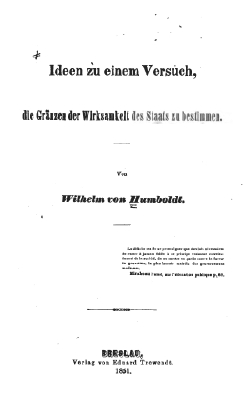
Wilhelm von Humboldt (1767-1835) was described by Friedrich Hayek as “Germany’s greatest philosopher of freedom.” Humboldt wrote in 1792 a path-breaking defense of the minimal state which had a profound influence on John Stuart Mill. Humboldt later became Director of the Section for Public Worship and Education, in the Ministry of Interior. In this capacity, he directed the reorganization of the Prussian public education system, and, in particular, founded the University of Berlin.
Works at this Website
- Ideen zu einem Versuch, die Gränzen der Wirksamkeit des Staates zu bestimmen. Einleitung von Dr. Eduard Cauer. (Breslau: Eduard Trewendt, 1851). [PDF 14.7 MB].
- a cleaner copy of the first edition [PDF 12.1 MB].
John Prince Smith (1809-1874)
 |
 |
Bio
Prince-Smith, John (1809-74). Liberal economist, born in London, where he worked as a parliamentary reporter before moving to Hamburg in 1828 to write for an English-language newspaper there. He was an ardent supporter of Bastiat. In 1831 he was employed as an English teacher at a local gymnasium. While in Hamburg Prince-Smith discovered economics and began writing about British economic developments for his German readers. In 1846 he settled in Berlin, where he published a small book on tariff reform in Britain and its likely impact on Europe after having become interested in Cobden, Bastiat, and the Anti-Corn-Law League. He also published works on banking and currency issues. In 1846 he founded a German free-trade association and was elected deputy representing Stettin in the Prussian parliament. Between 1870 and 1874 he was head of the Congress of German Economists. His writings include John Prince-Smith über die englische Tarifreform und ihre materiellen, sozialen und politischen Folgen für Europa (1846). His collected works, published shortly after his death, were titled John Prince-Smith’s Gesammelte Schriften (1877-80).
Works at this Website
- John Prince Smith's Gesammelte Schriften. Herausgegeben von Dr. Otto
Michaëlis (Berlin: F.A. Herbig, 1877-1880). 3 volumes.
- Erster Band. Zur Physiologie des Verkehrs. Staat und Volshaushalt. Ueber das Denken. Zur Münzreform. Zur Lohnfrage. Die Sozialdemokratie. (1877) [PDF 12.1 MB].
- Zweiter band. Ueber den politischen Fortschritt Preussens. Handelsfeindseligkeit und Zollschutz. Ueber die englische Tarifreform. Vermischte volkswirtschaftliche Schriften. (1879). [PDF 11.2 MB].
- Dritter Band. Kommissions-Bericht über das Gewerbegesetz vom 9. Februar 1849. Der Handelsminister auf sechs Stunden. Grund- und Kapitalrente. Vom volswirtschaftlichen Kongress (zwei Vorträge). Vermischte volkswirtschaftliche Schriften. Lebensskizze, verfasst von Dr. Otto Wolff. (1880). [PDF 11.6 MB].
Eugen Richter (1838-1906)
 |
 |
Bio
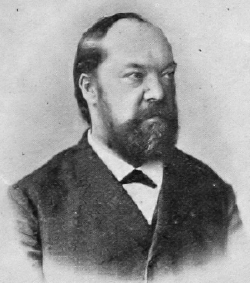
Eugen Richter (1838-1906) was one of the very few radical liberals in late 19th century Germany. As a member of the Reichstag, he consistently opposed the growing budget, German militarism and imperialism, and the rise of socialism.
Works at this Website
- ABC-Buch für freisinnige Wähler. Ein Lexikon parlarmentarischer Zeit- und Streitfragen. Fünfter, vollständig umgearbeiteter und erweiterter Jahrgang. (Berlin: Fortschritt Aktiengesellschaft, 1889). [PDF 13.7 MB].
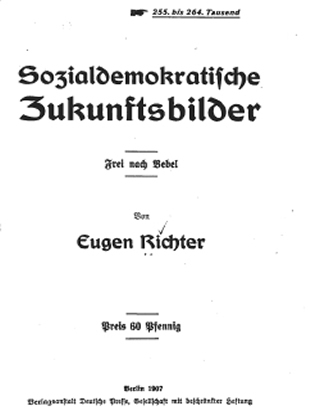
- Sozialdemokratische Zukunftsbilder. Frei nach Bebel (Berlin: Verlagsanstalt Deutche Presse, 1907). in German [facs. PDF and HTML] and English [facs. PDF and HTML]
Ludwig von Mises (1881-1973)
 |
 |
Bio
Ludwig von Mises (1881-1973) was the acknowledged leader of the Austrian School of economic thought, a prodigious originator in economic theory, and a prolific author. Mises’ writings and lectures encompassed economic theory, history, epistemology, government, and political philosophy. His contributions to economic theory include important clarifications on the quantity theory of money, the theory of the trade cycle, the integration of monetary theory with economic theory in general, and a demonstration that socialism must fail because it cannot solve the problem of economic calculation. Mises was the first scholar to recognize that economics is part of a larger science in human action, a science which Mises called “praxeology”. He taught at the University of Vienna and later at New York University. Mises wrote many works on two related economic themes: 1. monetary economics, inflation, and the role of government, and 2. the differences between government-controlled economies and free trade. His influential work on economic freedoms, their causes and consequences, brought him to highlight the interrelationships between economic and non-economic freedoms in societies, and the appropriate role for government.
Works at this Website
- [Mises's doctoral dissertation]: Die Entwicklung des gutsherrlich-bäuerlichen Verhältnisses in Galizien (1772-1848) (Wien und Leipzig: Franz Deuticke, 1902). [PDF 4.6 MB].
- Nation, Staat und Wirtschaft: Beiträge zur Politik und Geschichte der Zeit (Wien und Leipzig: Manzsche Verlags- und Universitäts-Buchhandlung, 1919). [PDF 12.7 MB].
- Die Gemeinwirtschaft: Untersuchungen über den Sozialismus (Jena: Gustav Fischer, 1932). [PDF 29.7 MB].
- Die Nationalökonomie: Theorie des Handelns und Wirtschaftens (Editions Union Genf, 1940). [PDF 47.5 MB].
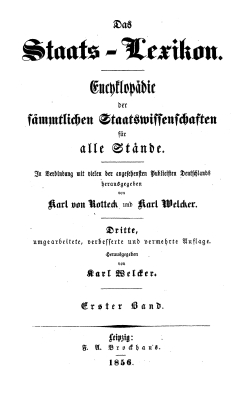
Karl von Rotteck (1775-1840) and Karl Welcker (1790-1869)
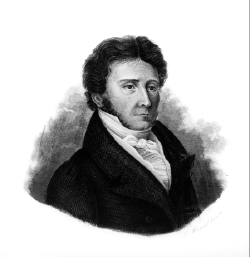 |
 |
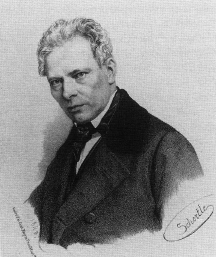 |
1st Edition (1834-1843).
Staats-Lexikon oder Encyklopädie der Staatswissenschaften in Verbindubg mit der vielen der angesehensten Publicisten Deutschlands, herausgegeben von Carl von Rotteck und Carl Welcker (Altona, Johann Friedrich Hammerich, 1834–1843), 15 Bände.
- 1. Band 1834: Aachen-Autonomie [PDF 59.4 MB]
- 2. Band 1835: Appenzell-Brautschasß [PDF 61.5 MB]
- 3. Band 1836: Breisgau–Contagieuse Krankheiten [PDF 140.8 MB]
- 4. Band 1837: Continental-Sperre – Eisenbahnen und Canäle [PDF 56.1 MB]
- 5. Band 1837: Elbe – Frankreich [PDF MB]
- 6. Band 1838: Frankfurt am Main – Gewissensfreiheit [PDF MB]
- 7. Band 1839: Gewohnheitsrecht – Hippolytus a Lapide [PDF MB]
- 8. Band 1839: Historisches Recht – Justizverweigerung [PDF MB]
- 9. Band 1840: Jüstemilieu – Lippe-Schaumburg [PDF MB]
- 10. Band 1840: Litteratur der Staatswissenschaften – Mündigkeit [PDF MB]
- 11. Band 1841: Münzverbrechen – Orangemänner [PDF MB]
- 12. Band 1841: Oranien – Praxis [PDF MB]
- 13. Band 1842: Preßfreiheit - Rheinschifffahrt [PDF MB]
- 14. Band 1843: Richelieu und Mazarin – Staatspapiergeld [PDF MB]
- 15. Band 1843: Staatsrath – Zollverein [PDF MB]
Supplemente zur ersten Auflage des Staats-Lexikons oder der Encyklopädie
- 1. Band 1846: A – Chatoull-Gut
- 2. Band 1846: Chiliasmus – Hege
- 3. Band 1847: Hessen vom Jahre 1838 an – Natürliche Grundlagen
- 4. Band 1848: Naturrecht – Steinacker
2nd Edition (1845-1848).
Das Staats-Lexikon. Encyklopädie der sämmtlichen Staatswissenschafen für alle Stände, Leipzig 1845–1848, 12 Bände.
- 1. Band 1845: Aachen – Auswanderung
- 2. Band 1846: Ausweisung – Calmarische Union
- 3. Band 1846: Calvin – Deutsches Landes-Staatsrecht
- 4. Band 1846: Deutsches Reich – Forum
- 5. Band 1847: Fourier’s Theorie der Gesellschaft – Girobank
- 6. Band 1847: Glarus – Hessen-Homburg
- 7. Band 1847: Hexen, Hexenprocesse – Justinian
- 8. Band 1847: Justiz – Meiningen
- 9. Band 1847: Menschheit, Geschichte der – Notariat
- 10. Band 1848: Nothstand, Nothrecht – Praxis
- 11. Band 1848: Preßfreiheit – Schifffahrtsgesetze
- 12. Band 1848: Schlözer – Zweikampf
3rd Edition (1856-1866).
Das Staats-Lexikon. Encyklopädie der sämmtlichen Staatswissenschaften für all Stände. In Verbindung mit vielen der angesehensten Publicisten Deutschlands herausgegeben von Karl von Rotteck und Karl Welcker. Dritte, umgearbeitete, verbesserte und vermehrte Auflage. Herausgegeben von Karl Welcker. (Leipzig: Brockhaus, 1856-1866). 14 volumes. Table of Contents of the entire 14 volumes [PDF 5 MB].
- Band 1: Abc - Atheismus, 1856 [PDF 128 MB]
- Band 2: Athen - Börse, 1858 [PDF 117.4 MB]
- Band 3: Börsenschwindel - Confiscation, 1859 [PDF 117.1 MB]
- Band 4: Conföderation - Einkommenssteuer, 1860 [PDF 111.4 MB]
- Band 5: Ein- u. Auswandern - Friedensgerichte, 1861 [PDF 111 MB]
- Band 6: Friedrich II. Griechische Volksansichten, 1862 [PDF 112.7 MB]
- Band 7: Großbritannien - und Irland, 1862 [PDF 111.2 MB]
- Band 8: Hessen - Kammergut, 1863 [PDF 125.2 MB]
- Band 9: Kanonisches Recht - Mercantilsystem, 1864 [PDF 130 MB]
- Band 10: Messen - Oldenburg, 1864 [PDF 125 MB]
- Band 11: Oligarchie - Presse, 1864 [PDF 122.5 MB]
- Band 12: Preußen - Rußland, 1865 [PDF 126.3 MB]
- Band 13: Sachsen - Steuern, 1865 [PDF 123.9 MB]
- Band 14: Stiftungen - Universitäten. Universalregister, 1866 [PDF 125.1 MB] - also contains a complete ToC for the series.