| The Digital Library of Liberty & Power incorporating the Guillaumin Collection of the Great Books of Liberty |
Home | New | Authors | Works | Topics | Papers | Blog | About | Email | Search |
 |
|
David M. Hart, “Unfortunately, hardly anyone listens to the Economists”: The Battle against Socialism by the French Economists in the 1840s.
|
[Created: 12 July, 2014]
[Updated: July 21, 2022] |
Introduction
Date: Tuesday, 8 July 2014, 6.00 pm.
Location: The Centre for Independent Studies, Level 4, 38 Oxley St, St Leonards, Sydney 2065
General Info
Topic: David M. Hart, “‘Unfortunately, hardly anyone listens to the Economists’: The Battle against Socialism by the French Economists in the 1840s.”
Summary: The 1848 Revolution in France saw the first attempt by socialists to create a government which would introduce some key aspects of the modern welfare state as we know it today, namely government guaranteed (taxpayer funded) unemployment relief, make work schemes, and the “right to a job” for all workers. This was vigorously opposed by the group of free market political economists (known as “les Économistes” or “the Economists”) who had become organised during the 1840s in Paris and played an active and important role during the Revolution in opposing socialism in the press, on the streets, and in the Chamber of Deputies. Some of the leading figures in this liberal opposition to socialism were young men who had come to Paris from their homes in the provinces and formed a network of active and innovative economists who changed the face of French classical liberal thought with their original and radical ideas. This talk will examine how the Economists organised themselves to fight socialism, some of the key ideas in the ideological battles they fought, the strategies they adopted to do this, and the lessons liberals in the present day can draw from their struggle.
Bio of DMH:

[David M. Hart]
David was born and raised in Sydney and has degrees from Macquarie University, Stanford University, and King’s College, Cambridge. He taught in the history department at the University of Adelaide for 15 years before moving to the U.S. to work for Liberty Fund, a non-profit educational foundation based in Indianapolis, Indiana. For the past 13 years he has been the Director of the Online Library of Liberty Project and is the academic editor of a large translation project for LF of the works of two of the leading members of the French Economists, Frédéric Bastiat and Gustave de Molinari. Two volumes of a projected 6 volume Collection of Bastiat’s writings have already appeared and a third is in production; the manuscript for Molinari’s book Evenings on Saint Lazarus Street: Discussions on Economic Laws and the Defence of Property (1849) was submitted only 2 weeks ago. David has also co-edited two anthologies of French Classical Liberal thought, an English language collection published in 2012 by Routledge and a French language collection published by Ellipses in 2014.
“Unfortunately, hardly anyone listens to the Economists”
Opening Quote
“l’économie politique … cette science-mère du vrai libéralisme” (Political economy is the mother science of real liberalism.)
“les économistes … sont les teneurs de livres de la politique” (The economists are the bookkeepers of politics.)
“Malheureusement, on n’écoute guère les économistes” (Unfortunately, hardly anyone listens to the Economists)
[Molinari, Révolutions et despotisme (1852), pp. 79, 116, 151]
Anti-Socialist Cartoon by Amédée de Noé
Amédée de Noé, dit Cham, “Ce qu’on appelle des idées nouvelles en 1848” (Paris?: Imp. Aubert & Cie, 1848). Lithograph (26.5 x 41.1 cm). Bibliothèque nationale de France http://catalogue.bnf.fr/ark:/12148/cb41520291k.
Six anti-socialist cartoons from 1848:
- Pierre-Joseph Proudhon
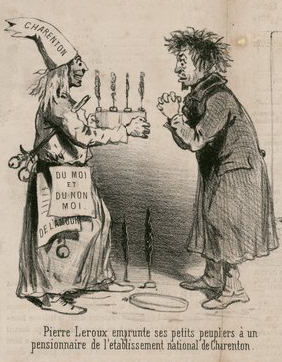
- Pierre Leroux
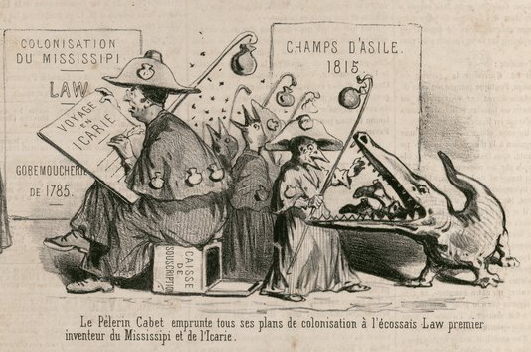
- Étienne Cabet
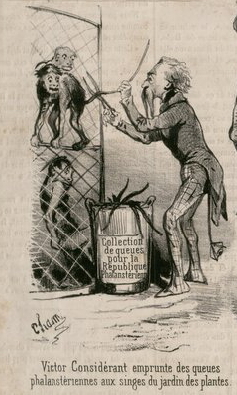
- Victor Considerant
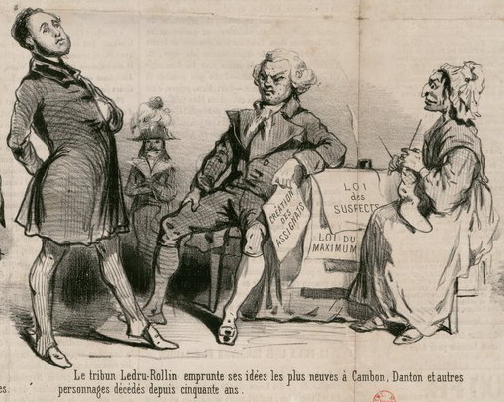
- Alexandre Auguste Ledru-Rollin
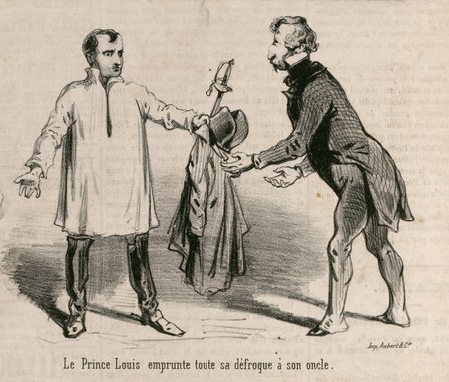
- Louis Napoléon Bonaparte
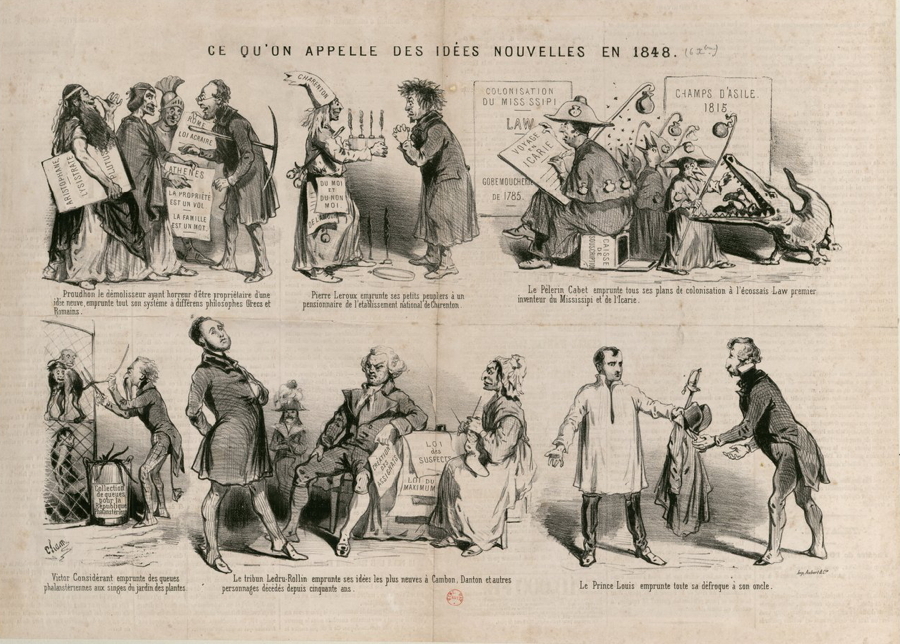
[What are called New Ideas in 1848]
Pierre-Joseph Proudhon, the demolition expert:

Pierre Leroux, the madman:
Étienne Cabet, the pilrim and his gullible followers:
Victor Considerant, the creator of a “new socialist man”:
Alexandre Auguste Ledru-Rollin, who dreams of a new socialist Terror:
Louis Napoléon Bonaparte, the socialist “Prince-President”:
The Importance of the 1840s to the Development of CL/FM Thought
-
key period (1830–1860) when CL began to form as a distinct “worldview” (ideology) which applied basic ideas about individual liberty, private property, free markets, limited government to full range of problems (economic, political, social)
- 1830s and 1840s also key period in the development of socialism as a distinct
“worldview” (see below for details)
- utopian socialism of Fourier, Considerant
- electoral or political socialism of Louis Blanc (“socialism from below” - GdM)
- anarchist socialism of Proudhon (1809–1865)
- revolutionary socialism of Karl Marx (1818–1883) [Paris 1843–45, Brussels 1845–48, Paris 1848, 1849)
- bureaucratic or state socialism of Napoleon III (“socialism from above”)
- events of early 1848 1st real attempt to create a modern welfare state, precursor of what
was to emerge after WW2 in western Europe, UK, and later USA
- both socialists and CLs learnt from this experience
- evolution of CL partly just natural evolution of ideology, partly result of reaction against rise of socialism (1830s and 1840s), partly the growing wealth and education of middle class who were benefitting from industrialisation and growth of market economy
- key events Britain
- 1st Reform Act 1832 (right to vote for MC),
- 1846 repeal of the Corn Laws (FT),
- 1859 formation of Liberal Party
- key events France:
- 1830 July Monarchy of Louis Philippe (constitutional monarchy),
- Feb. Revolution 1848 (universal manhood suffrage, 2nd Republic, constitution),
- 1860 Cobden-Chevalier FT treaty
- key texts Britain:
- JS Mill, Principles of Pol Ec (1848), On Liberty (1859), Considerations on Representative Government (1861);
- Herbert Spencer, Social Statics (1851)
- key texts France:
- Alexis de Tocqueville, Democracy in America (1835, 1840)
- Charles Dunoyer, De la liberté du travail (1845)
- GdM, Les Soirées (1849); Cours d’économie politique (1855)
- FB, Economic Harmonies (1850–51)
Key People: the “Seven Musketeers” of French Political Economy

[The Seven Musketeers of French Political Economy]
1840s in Paris saw the emergence of a very special and unique collection of individuals who came together to promote CL and FM thought and to fight socialism and interventionism. I call them “the Seven Musketeers” of French political economy:
- from Gérard Minart’s new bio of GdM (2012) who described FB and GdM and 2 other colleagues
(Guillaumin, Coquelin) as “The Four Musketeers”
- Dumas popular novel came out in 1844 [serialised in Le Siècle]
- Bastiat, like D’Artagnan came from the south-west province of Gascony
- they formed a close band of liberal intellectuals and activists in Paris who were fighting protectionism and socialism not the Protestant enemies of the King of France (siege of la Rochelle)
- my research has revealed that 7 individuals actually fit this description
- two generations who were key figures in CL movement,
- 1st born around 1800 (mid to late 40s in 1848);
- 2nd around 1820 (late 20s in 1848)
- 1st generation
- Gilbdert-Urbain Guillaumin (1801–1864) - publisher): Guillaumin’s publishing firm which published books, pamphlets, and the Journal des Économistes (1841–1940)
- Charles Coquelin (1802–1852) - economist on free banking, eloquent public speaker, editor DEP
- Frédéric Bastiat (1801–1850) - FT activist, popularizer ec. thought, theorist, head of French Free Trade Association and editor of its journal Le Libre-Échange (1846–48)
- 2nd generation
- Joseph Garnier (1813–1881) - economics teacher, editor, peace advocate
- Hippolyte Castille (1820–1886) - journalist, popular historian, wrote for le Courrier français and held regular soirées at his home on the rue Saint-Lazare (1843?–48)
- Alcide Fonteyraud (1822–1849) - specialist on Ricardo, translator, public speaker
- Gustave de Molinari (1819–1912) - journalist, economic theorist, sociologist
- [note dates of 3 other key figures: Alexis de Tocqueville (1805 –1859); JSM (1806–1873); Karl Marx (1818–1883)]
- came together for brief period in late 1840s and early 1850s and changed French CL
- dispersed by 1852 through early deaths, political reaction, exile
- importance of outsiders who migrate to a city and enrich its intellectual life with new and radical ways
of thinking
- the “7 Musketeers” of French political economy in Paris in the 1840s
- Vienna in late 19th and early 20th C
- New York city in 1930s and 1940s with German and eastern European immigrants
Key Organisations
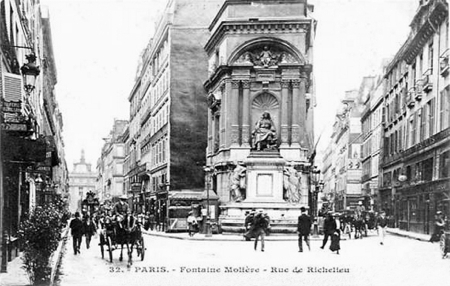
[14 rue Richelieu late 19thC]

[
- Guillaumin publishing firm 1835–1910??
- Société d’économie politique (SEP) 1842
- Journal des Économistes (JDE) 1841–42
- economic schools: Athénée, Collège de France
- Castille’s Soirées 1843??–1848
- French Free Trade Association (FTA) 1846–48
- activities in Feb Rev: street journalism, Club Lib, political faction in Constit. Assem
- J. Garnier’s Friends of Peace
- Académie français (reconstituted 1832)
The Ideological Battles
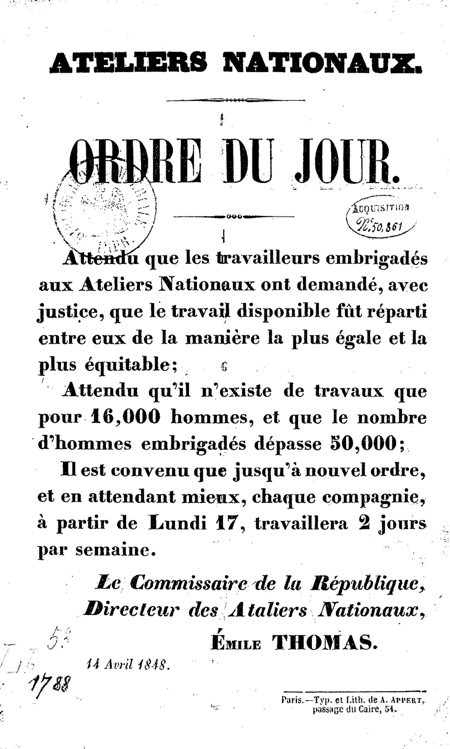
[Decree issued by Émile Thomas of the National Workshops, 14 April, 1848]
- free trade: most important battle prior to Feb Rev;
- opportunities to reform tariffs 1822, 1833, 1847 (liberals lost);
- not successful until middle of 2nd Empire 1860 (Cobden-Chevalier Treaty)
- political liberties: freedom of speech, assembly, right to vote, right to form/join
unions
- major issues in Restoration (1810s and 1820s - important work done by Benjamin Constant, Charles Comte, Dunoyer);
- strict prior censorship, ban on political parties and associations, popular politics driven underground (goguettes);
- opposition to censorship major reason for overthrow of Bourbon monarchy 1830, ban on political banquets in Jan 1848 major reason for 1848 Feb Rev
- collapse of censorship in Feb 1848 led to free press and political clubs, full manhood suffrage introduced;
- crackdown under Pres. Louis Nap., martial law
- political freedoms not achieved until Third Republic (1875 Constit.)
- socialist critique of private property
- Proudhon 1841, profit, interest, rent
- Blanc, Considerant - right to work, organisation of labour; came to head in Feb 1848 with National Workshops, right to work clause in Constit.
- bureaucratic interventionism in economy (regulation, subsidies, monopolies):
- constant feature of all regimes
- new version appeared under Nap. III (Saint-Simonian influence) - “socialism from above” (GdM)
The Economists’ Critique of Socialism
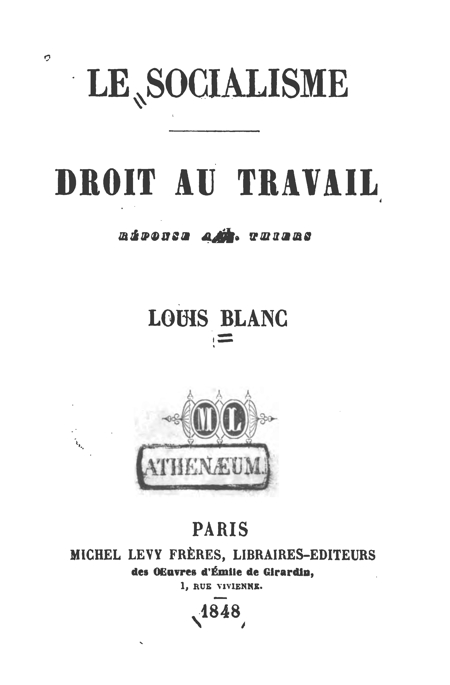
[Louis Blanc, Socialism and the Right to Work (1848)]
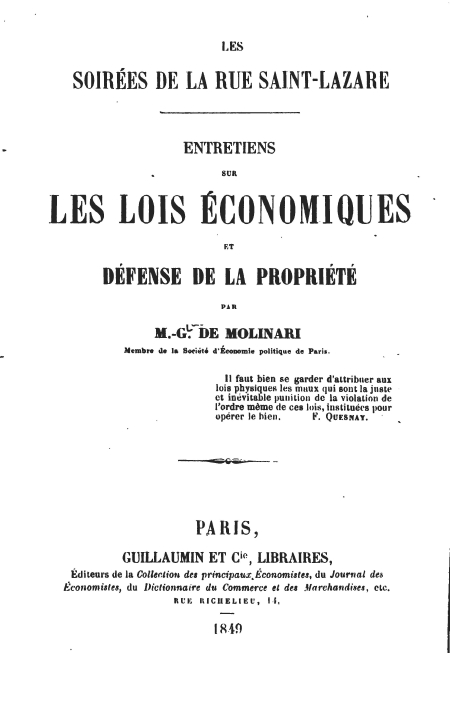
- socialists’ critique of free market and wage labour based upon
- Smithian/Ricardian labour theory of value (labour was main source of the creation of value, workers not given full value of their labour, profits to owners was therefore “unearned”) and
- “unearned” nature of land rent (gift of soil, sun), therefore rent was wrong and should be eliminated or reduced, or land redistributed to propertyless
- Malthusianism - inevitable impoverishment of the WC due to population pressure
- key texts by the socialists criticising property and the FM
- Proudhon, Qu’est-ce que la propriété? ou Recherches sur le principe du Droit et du Gouvernement (1840)
- Louis Blanc, Organisation du travail. Association universelle. Ouvriers (1841)
- Victor Considerant, Droit de propriété et du droit au travail (1848)
- Louis Blanc, Le Socialisme. Droit au travail, réponse à M. Thiers (1848)
- Pierre Joseph Proudhon, Le droit au travail et le droit de propriété (1850)
- key texts by the Economists defending property and the FM
- Charles Dunoyer, La Liberté du travail (1845)
- F. Bastiat, Economic Sophisms I (1846) and II (1848)
- Adolphe Thiers, Discours prononcé à l’Assemblée Nationale sur le droit au travail (1848)
- Adolphe Thiers, De la propriété (1848)
- Léon Faucher, Du droit au travail (1848)
- Michel Chevalier, Lettres sur l’Organisation du travail (1848)
- Frédéric Bastiat’s series of 12 anti-socialist pamphlets (1848–1850)
- Molinari, Les Soirées (1849)
- Bastiat and Proudhon, Gratuité du crédit (Oct. 1849 - Feb. 1850)
- response of political economists took two forms: “weak” response or “strong” response
- weak response:
- to work within Smithian and Ricardian orthodoxy, argued that competition between capitalists and landowners would reduce profits and rent to a minimum (to the “natural value” or cost of production of goods), workers would benefit in long run through greater overall productivity
- essential utility of profits and rents to the operation of market (in spite of suspect origins)
- WC had to exercise “moral restraint” in limiting the size of their families in order to avoid poverty and death
- strong response: to rethink economic theory to remove these problems;
- JBS’s idea of importance of non-material goods (services), more to economy than use of labour to produce physical goods;
- FB’s complete rethinking of nature of value and exchange, all exchanges were mutually beneficial “exchange of one service for another service”, theoretical insights left incomplete at this death, on brink of inventing Austrian school insights 20 years ahead of marginal revolution of 1870s
- FB’s idea that nothing special about land rent, just another exchange of services
- FB’s radical anti-Malthusianism: they had badly underestimated the productive power of the FM and FT; individuals were intelligent and rational actors who could adapt their behaviour (not plants)
- GdM’s idea that part of socialist critique of existing property distribution was correct, that ruling elites had seized land and other assets unjustly and used power of the state to protect them, govt had to end these privileges and create more equal defense of property held by all people
- GdM’s recognition of the important role of the entrepreneur (“markets in everything” and “entrepreneurs for everything”)
- while socialists were arguing that government (or “organisations” modelled on government bureaucracies or the army) could better supply goods and services than private individuals or firms, GdM moving in opposite direction in arguing that all “public goods” could be provided more cheaply and efficiently [city water supply, roads and rivers, postal services, security] - breaking with Smithian orthodoxy on key functions of government
- both groups within the economists’ camp shared many criticisms of socialism
- incentive problem: communally organised living and working arrangements destroy incentives for individuals to work hard, all profits go to community to be equally distributed
- division of labour problem: people with key skills (managerial, financial, technical, organisational, entrepreneurial) need to be paid for their extra contribution to productive process
- the risk problem: all economic activity involves risks (loss, miscalculation, natural disaster) which needs to be rewarded
- injustice of expropriation: to create socialist system existing justly owned property has to be confiscated and given to new communally organised groups
- individual liberty problem: soicalists envisaged new communal institutions would be organised like army or govt bureaucracy - hierarchical, command from above, communal eating and sleeping arrangements
- human nature problem: socialists assumed human nature is not fixed but malleable, possible to create “new socialist man”; economists believed humans were social but not communist, self-interested (broadly understood) not willing to sacrifice their interests to the community’s; humans vastly different in tastes, preferences, skills, and interests
- the public choice problem - rulers not disinterested parties but have own agendas
- problem of ignoring economic laws - economy governed by economic laws (such as law of
supply and demand) which cannot be ignored or wished away either by well meaning people or by economic
predators
- GdM identified 6 natural laws of political economy in Les Soirées
- “la loi naturelle de l’économie des forces ou du moindre effort” (the natural law of the economising of forces, or of the least effort) - by this he meant that individuals attempted to gain the most that they could with the least amount of effort.
- “la loi naturelle de la concurrence” (the natural law of competition) or “la loi de libre concurrence” (the law of free competition) - Molinari thought that there was a Darwinian struggle for survival by all living creatures. In the case of human beings, this competition could be either “productive competition” in the case of industrial or economic activity, or “destructive competition” in the case of war or politics.
- “la loi naturelle de la valeur” (sometimes also expressed as “la loi de progression des valeurs”) (the natural law of value, or the progression of value) - by this Molinari meant that in a free market the price of goods and services will be lowered as a result of competition to their “natural value” or cost of production.
- “la loi de l’offre et de la demande” (the law of supply and demand) which he also sometimes called “la loi des quantités et des prix” (the law of supply and prices) - this was short hand for saying that prices vary according to their supply and demand in the market place and that both consumers and producers alter their behavior as a result.
- “la loi de l’équilibre” (the law of economic equilibrium) - which is Molinari’s version of Bastiat’s theory of Harmony, that if markets are left free to function they will tend to produce order not chaos, and there will arise a balance between the demand for products by consumers and the supply of those products by producers
- “Malthus’ law of population growth”
- FB’s great insight into the nature of “The State” (Sept. 1848)
- exploitation by a small ruling elite made some economic sense in that mass of consumers and taxpayers forced to pay subsidies and benefits to small group of beneficiaries (e,g, slaves vs. slave owners, owners of protected industries vs. consumers)
- democratic or socialist “exploitation” made no sense because everybody couldn’t benefit from taxing everybody else (including themselves), if all were paying taxes or higher prices how could everybody benefit? Definition of state “as the great fiction whereby everybody tries to live at the expense of everybody else”. Net beneficiaries even in democratic socialist state would be those who worked for the state or ran it, or were friends of those who ran it.
- public choice insight that politicians and bureaucrats also self-interested and pursue agendas which are not the same as the “interests of the people”
- two different kinds of socialism
- GdM: distinguished between “socialism from below” (democratic, republican: Blanc, Considerant, etc) and “socialism from above” (by alliance of bureaucrats, Bonapartists, militarists, crony capitalists)
- democratic socialism impossible in long run because of mutual or “self-exploitation”
- FB: protectionists just like communists; use power of state to achieve their own private purposes; privileges for an elite vs. privileges for all mediated by politicians and labour leaders
Strategies Used to Spread FM Ideas

[Special 1848 Guillaumin catalog]
- publishing books, journals, economic statistics
- Guillaumin catalog, JDE, Annuaire statistique, encyclopedias, dictionaries (DEP)
- economic history: GdM history of tariffs (1847)
- history of ec. thought - CPE
- social question: conditions of workers, poverty
- ec. theory: FB’s Economic Harmonies (1850–51)
- 1848–50: anti-socialist pamphlets and collections, debates in Chamber
- popular works (see below)
- DEP project
- journalism: “high, middle, and low brow”
- professional: JDE
- high brow: JDD, RDM
- middle brow: Le Libre-Échange, Courrier français
- low brow: revolutionary street journalism, la République française (Feb/Mar 1848), JB (June 1848) - “taking it to the streets”
- public associations and meetings
- French FTA meetings (Montesquieu Hall)
- Club lib debates with socialists
- teaching in schools and colleges:
- Joseph Garnier - Athénée
- Michel Chevalier - Collège de France
- FB and GdM in late 1847
- membership of elite institutions like Académie (reconstituted 1832)
- politics
- lobbying Chamber: 1847 debate on tariff reform
- election to Chamber of Deputies
- Constit. Assem. - FB in April 1848; finance committee
- debate in Chamber on “right to work” clause
- popularisation of economic ideas (see below)
The Popularization of Economic Ideas: Taking it to the Street
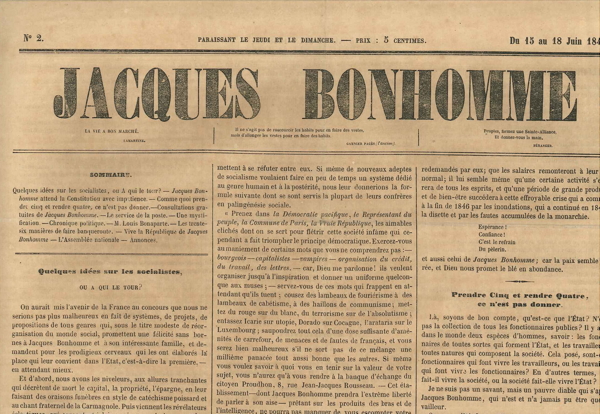
[Title page of the 2nd issue of Jacques Bonhomme, 15–18 June 1848]
Deliberate strategy of appealing to educated public during campaign for free trade 1845–47. - Feb Rev showed need to broaden this to include educating public (voters) about misconceptions about free market in general in response to sudden political success of socialists - important to influence bureaucrats and politicians who ran the state
This is one of the problems still most relevant to our concerns today:
-
profound ignorance of economics by general public hampers/prevents reform in CL direction
-
public either knows very little or nothing
- what they do know is usually wrong
- government can create jobs
- govt can manage the money supply to keep prices stable and solve unemployment
- regulation of economy is costless
- promotion of “national industries” is in long-term interests of workers, consumers, and taxpayers
- protection and subsidies is a good way to achieve prosperity
- govt bureaucrats and politicians are well meaning, un-selfish individuals
-
very depressing book by Bryan Caplan on The Myth of the Rational Voter: Why Democracies Choose Bad Policies (Princeton UP, 2008)
- French Economists realised that unless they disabused public of their incorrect economic views no
liberal reforms would be possible
- vested interests, politicians, and bureaucrats even more of a problem because of their self-interest in regulation and subsidies
- hence need for two pronged popularisation campaign:
- ordinary people: pamphlets, fliers, amusing tales and stories (FB), public speeches/talks
- business people, politicians, and bureaucrats: middle and high brow journalism, books, encyclopedias, DEP
- examples of variety of approaches (pre–1848):
- JB Say’s Catechism of Pol. Ec. (1815), Little Book of Pol. Ec. (1817), and Complete Course on Pol. Ec. (1828)
- Harriet Martineau, Illustrations of Political Economy (1832)
- J. Garnier’s textbooks Introduction to Pol. Ec. (1843)
- FB’s journalism collected as Economic Sophisms I (1846) and II (Jan. 1848)
- examples of variety of approaches (post–1848):
- Fonteyraud and Wolowski’s essay on pol. ec. (Principles of Pol. Ec.) (1850) for popular encyclopedia Instruction pour le People: 100 Traités (1850)
- Antoine-Elisée Cherbuliez’s Le potage à la tortue: entretiens populaires sur les questions sociales (Turtle Soup) (1849).
- GdM’s Les Soirées (Sept 1849)
- Guillaumin’s special catalog of anti-socialist books (very entrepreneurial)
- FB’s anti-socialist pamphlet war between mid–1849 to July 1850: The State, The Law, WSWNS (sold separately or packaged as a set for 12 fr. ???)
- collections of writings by Faucher and Chevalier on right to work and socialist organisation of labour
- revolutionary street journalism, la République française (Feb/Mar 1848), Jacques
Bonhomme (June 1848) of Bastiat, Molinari, Coquelin - “taking it to the streets” [like 2
leading Oz economists handing out leaflets of FR and FT on Wynyard ramp to commuters]
- short and simple articles aimed at ordinary workers - 2 sided sheet
- radical free market alternative to socialist magazines
- very patriotic, pro-republican, anti-ruling elite designed to appeal to ordinary workers
- participation in political clubs; breakdown of censorship led to formation of hundreds of clubs in Paris;
- held speeches and debates accessible to ordinary people;
- socialists and radical republicans used them to mobilize their supporters for street demonstrations to pressure govt over National Workshops and troops to Rome
- Economists best public speakers (Fonteyraud and Coquelin) organised “Club de la liberté du travail” (Club Lib) to take on socialists at their own game; club had to close when meetings broken up by “communist thugs” (gang or herd - GdM)
- [like Oz economists debating in Domain on Sundays against all comers]
- Fonteyraud’s strategy paper on how Economists made strategic error in ignoring WC and leaving socialist free to get to them first
- DEP massive compendium of economic knowledge with articles summarizing current theory,
biographies of key figures, bibliographies with commentary, statistical info and economic data
- 2 vols, 2,000 pages, double columned text - crowning achievement of French political economy in mid–19thC
- designed as reference work for business people, journalists, “socialists from above” in government bureaucracies
- planned in early 1849 as part of Guillaumin’s anti-socialist campaign
Conclusion: The Importance of the French Economists in the 1840s for the Development of CL Thought
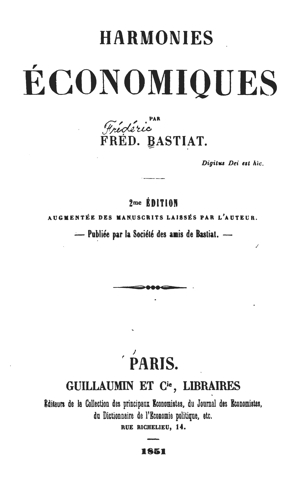
[Bastiat’s Economic Harmonies 1851 ed.]
- the attempt to create the first socialist welfare state in Feb. 1848 and the opposition
of the French Economists is very instructive for modern CLs
- importance of the theoretical arguments against socialism are still relevant today (they are timeless)
- the variety of strategies used and the flexible way they were applied - theoretical, popular, political - are a model we can also use
- the rise of socialism in the 1840s stimulated leading French CLs to rethink the theoretical
foundations of their ideas (made them more radical and consistent):
- Charles Coquelin’s theory of free banking (1848)
- FB’s theory of plunder, proto-Austrianism and prot-Public Choice ideas in his unfinished treatise Economic Harmonies (1850–51)
- GdM’s first ever one volume survey of CL thought which incorporated both theory and policy proposals for reform (precursor of Mises’ Liberalism (1929); Friedman, Capitalism and Freedom (1962); Rothbard, For a New Liberty (1974)
- others (see below)
- GdM’s idea of “markets in everything” (including all so-called public goods) and “entrepreneurs for everything” (entrepreneurs in the security business, entrepreneurs in the prostitution business)
- realisation that CL political and economic theory had to be grounded more firmly in sound theory of property rights (which had been assumed or ignored by political economists)
- golden age for the popularization of economic ideas
- FB’s Economic Sophisms
- GdM’s Conversations (1849, 1855, 1886)
- next period would be post-WW2: Henry Hazlitt’s articles in NYT, Fridman’s column in Newsweek, Thomas Sowell and Walter Williams’ columns today, FM bloggers
- French economists, in spite of losing the battle (their ranks depleted by premature
deaths and exile) showed remarkable courage and persistence:
- FB continued to work as journalist, politician, economic theorist in spite of suffering from suspected throat cancer which killed him in Dec. 1850
- Guillaumin kept coming up with new projects (such as DEP) which he funded and organised
- GdM started again in Brussels after he went into voluntary exile (refused to live under dictator Nap. III), kept writing books and articles in favour of FM for next 60 years
Supplementary Material
One volume surveys of CL thought
in 19thC:
- Wilhelm von Humboldt, The Sphere and Duties of Government (The Limits of State Action) (1792, 1854) <oll.libertyfund.org/titles/589>
- Gustave de Molinari, Les Soirées de la rue Saint-Lazare (Conversations on Saint Lazarus Street) (1849) [draft of our new translation http://oll.libertyfund.org/pages/molinari-s-evenings-on-saint-lazarus-street-1849]
- Herbert Spencer, Social Statics (1851) http://oll.libertyfund.org/titles/273
- J.S. Mill, On Liberty (1859) <oll.libertyfund.org/titles/347>
- Herbert Spencer, The Principles of Ethics (1879) http://oll.libertyfund.org/titles/1882
- Bruce Smith, Liberty and Liberalism (1888) <oll.libertyfund.org/titles/296>
in the 20thC:
- Ludwig von Mises, Liberalism (1927) <oll.libertyfund.org/titles/1463>
- Friedrich Hayek, The Constitution of Liberty (1960)
- Milton Friedman, Capitalism and and Freedom (1962)
- Murray Rothbard, For a New Liberty (1974)
Lessons for Liberals Today
- economists realised that by focussing on single issue (free trade) they left the field
open for socialists throughout the 1840s to attract supporters with their broader critique of private
property and the free market; economists had focused on intellectual or academic response to socialists
- LESSON : need to maintain a broad defence of liberty in all its apsects
- the speed with which the socialists were able to organise themselves when the opportunity
arose in late Feb. 1848 surprised everybody
- 12 radical republicans and socialists formed Prov. Gov on day 1 and moved to implement socialist programs like National Workshops immediately
- not undone until April elections returned more moderate republicans and some liberals to Constit. Assem (like Bastiat)
- sudden collapse of censorship led to formation of hundreds of political clubs and small magazines, many of which were socialist; CL quickly responded with their own but were always playing catch-up
- FB and GdM realised they had to show ordinary people how they benefited from free trade
and free markets, and individual liberty in general
- hence their interest in popularizing economic ideas
- GdM and FB defended right of workers to form unions (voluntary associations), form political groups, and express their views (GdM’s early journalism on unions and labour exchanges)
- emphasised how ordinary consumers and taxpayers were exploited (“plundered” FB) by political elites via tariffs, subsidies, monopolies (CL class analysis)
- LESSON : need to always have a popular program in place
- both FB and GdM criticised the Conservative right throughout the revolution for being
inconsistent and anti-liberty
- FB argued that crony capitalists’ demand for protection was just as “communist” as the demands of the socialists for welfare
- GdM attacked Theirs’ influential book “On Property” (1848) for his defense of the current unjust distribution of property and political privileges of ruling elite, and for ignoring the legitimate demands of the exploited WC
- LESSON : since CL is neither completely of the Right nor the Left it needs to be be critical of both when they are anti-liberty
- the importance of the moral dimension (Justice)
- ordinary workers and consumers were motivated by outraged sense of injustice at their exploitation by ruling elites
- most economists argued in terms of “utility” or “efficiency” to defend the free market and free trade
- both FB and GdM thought this was a mistake and wanted to see economics more firmly grounded in a moral framework of just property titles, voluntary exchange, and rejection of violence/coercion
- LESSON : arguments in favour of liberty are both utilitarian and moral
- problem of deciding which side to support: radical republicans and socialists on left or
conservatives, royalists, large landowners, crony capitalists, military on right. Economists caught in the
middle because both sides wanted more state intervention.
- FB and GdM deliberate strategy of appealing to left, to stress their common cause in fighting privilege: street journalism, GdM explicit appeal to socialists in June 1848 (“Le Rêveur” article), Les Soirées (key participant in conversation was “The Socialist”)
- many conservatives and liberals eventually sided with right in crackdown on violent socialists (June 1848, 1849) and supported martial law.
- eventually out-manoeuvred by Bonapartists who used their support to bring Prince-President to power and then coup d’état
- LESSON : need for tactical alliances with either Left or Right depending on the circumstances
- three pronged strategy of reform: intellectual, popular, political
- Guillaumin’s publishing program aimed at academics and educated elite
- constant efforts to reach ordinary people with popular books and magazines
- small group of FM supporters in Chamber: FB vice-President of Finance Committee, Léon Faucher in cabinet, many speeches in Chamber against right to work legislation, Faucher and Tocqueville on Const. Committee
- LESSON : need to appeal to intellectuals, ordinary people (especially in a democracy), and politicians and bureaucrats
- ability of many economists to “multi-task”: successfully turned their hands
to journalism (middle brow as well as street journalism), public speaking in the political clubs, MPs in
committees, encyclopedia articles (DEP), yet at same time continued to teach and work on developing CL
theory
- LESSON : need for advocates with a diverse range of talents in order to appeal to different segments of the intellectual market place
Final Thoughts about Socialism
- the Economists were able to help defeat the 1st phase of socialism in 1848–49, called by GdM “socialism from below”
- socialist ideas were absorbed by other politicians and bureaucrats and incorporated into new
regime of Louis Napoleon (Bonapartist) who was inspired by socialist Saint-Simon
- socialism from above, bureaucratic socialism, “Nanny state” (more like “Bully State”), policy of “interventionism”
- combined with continued crony capitalism (subsidies and protection for industry and agriculture) and militarism (military action in Crimea, Italy, Mexico, Lebanon; colonization of Senegal, Indochina)
- modern welfare state today is a mixture of features which emerged in France
1848–1870 and expanded in 1940s and 1950s
- state (taxpayer) funded health, education, welfare, pensions
- protected or state owned enterprises (employment subsidies)
- highly regulated economy (nanny or bully state) run by massive state bureaucracies
- American welfare/warfare state is closest to Bonapartist model
- evolution of American presidency into a form of Bonapartism
- welfare state combined with Napoleonic style militarism (Britain and France active in in post-colonial phase), US many interventions (military industrial security complex)
- Economists were unable to defeat this new form of socialism because of
- widespread acceptance of socialist ideas by bureaucrats, politicians, and intellectuals
- political repression until 1870s
- premature deaths and exile of key members of their group
- gradual fading out of CL in late 19thC and collapse in early 20thC